

Airfields of Britain Conservation Trust Logo
The Airfields of Britain Conservation Trust (ABCT) is a registered charity that was founded in 2006 as a non-profit organisation. They work to preserve and protect airfields in Great Britain, as well as educating people about their history and providing support to help enthusiastic young people to secure airfield or aviation-related employment. Another aspect of their work is gathering and making available information on different airfields history and this can be seen on their website: http://www.abct.org.uk. Finally, and particularly relevant to this essay, is that they place inscribed memorial stones on or near disused airfields.
In and around Dover there were five airfields set up prior to or during World War I, Capel, Guston, Marine Parade – Dover, Swingate and Whitfield. Each one is honoured with an ABCT memorial or plaque. These airfields played an important role in the history of British aviation as did some forty other airfields that were set up during that period. Glimpses of their stories, along with Dover’s airfields stories, are told below.
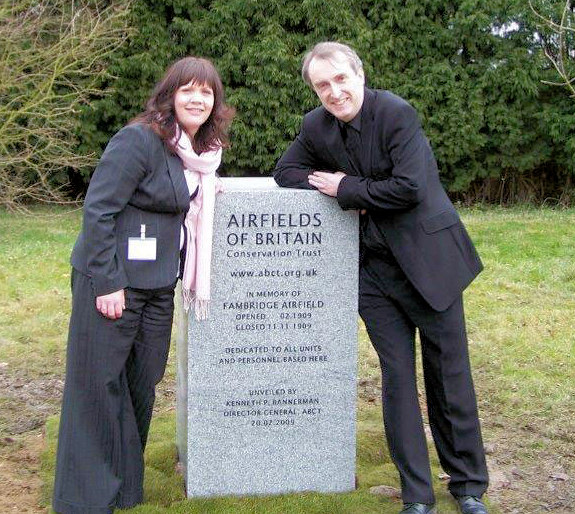
Fambridge airfield memorial. Kenneth Bannerman Chairman of ABCT and Linda Coxon a Trustee
It is now generally recognised that Fambridge in Essex was Britain’s first ever purpose built airfield. Founded in February 1909 by aviator Noel Pemberton-Billing (1881-1948) Fambridge airfield was built on reclaimed marshland. This meant that drainage was a problem, in consequence the site closed in November 1909. In honour of the former airfield’s status, ABCT erected a memorial stone there in February 2009, one hundred years after the airfield opened!
Five months after the Fambridge airfield opened, on the morning of Sunday 25 July 1909, Louis Blériot (1872-1936) crossed from Sangatte, France to England. He was flying his Blériot No XI 25-horsepower monoplane and the flight was the first heavier than air to make the Channel crossing. He landed on Northfall Meadow, between Swingate and Dover Castle, Dover and the journey had taken him 36minutes 30 seconds. Besides making history, Blériot instigated the meteoric rise of interest in aviation.
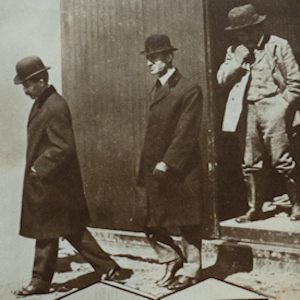
Orville and Wilbur Wright followed by Horace Short possibly at the Eastchurch factory. Eveline Larder
On 17 December 1903 near Kitty Hawk, South Carolina, United States, bicycle manufacturers Wilbur Wright (1867-1912) and his brother Orville (1871-1948) made the first ever controlled and sustained powered flights landing on ground at the same level as the take-off point. By 1905 the brothers had built a flying machine with controls that made it completely manoeuvrable and that was another first. However, the US Army showed no interest in this new machine. Hence, in 1906, when an American patent was granted to the Wright brothers they entered agreements with European firms.
Early contacts with the Wright brothers in America by aeronaught Charles Rolls (1877-1910) helped balloon manufacturers, Horace Short (1872-1917) and his brother Oswald (1883-1969) to gain the right to build the Wright brothers aeroplanes. They lived at Mussell (Muswell) Manor, at Eastchurch on the Isle of Sheppey, north Kent and the Wright Brother’s contract enabled them to consider opening an aeroplane manufacturing factory.
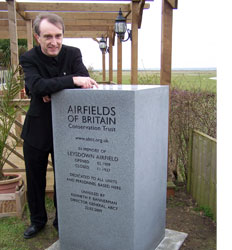
Memorial at Leysdown Airfield and Kenneth Bannerman Chairman of the Airfields of Britain Conservation Trust
Pioneer aviator Francis Kennedy McClean (1876-1955) owned land at Leysdown near to Eastchurch, Kent. He joined forces with the Short brothers and in February 1909 they opened an aircraft production factory at Eastchurch with an airfield at nearby Shellbeach, Leysdown. The following year they laid another airfield at Eastchurch and the Leysdown Airfield became the base for the Aero Club of which McClean was a founder member. Not long after the army moved into the Leysdown site for military training purposes though they allowed the Aero Club to continue to use the airfield. In the spring of 1909 the Wright brothers came to England as guests of the Aero Club and Charles Rolls acted as their official host. During that time they visited the Eastchurch Short factory.
The idea of the Aero Club had been born in September 1901 when Charles Rolls and his friend and fellow balloon pilot or aeronaught as they were called, wine merchant Frank Hedges Butler (1855-1928) along with Butler’s daughter Vera, were taking a trip, probably in a balloon. Vera, so the story goes, suggested the formation of an Aero Club within the Automobile Club of which both Butler and Rolls were members. They discussed it, and on the insistence of Vera, agreed that the new club was to be open ‘equally to ladies and gentleman, subject to election’. In 1903 the Aero Club of Great Britain was launched for aeronaughts but with the increasing popularity of aeroplanes the Club broadened its remit to aviators. In 1910 the Aero Club was granted the Royal prefix becoming the Royal Aero Club (RAeC).

Balloon Corps Transport. South Africa 1899. National Army Museum
One of the experiments appertained to hydrogen, the gas used for ballooning as it it is lighter than air so has a good lifting capacity. It is also cheap to produce but is highly flammable. In the United States they were using helium that had similar lifting power as hydrogen but was considerably safer as it is an inert gas that cannot burn. However, helium is a natural resource that was found in Texas, Oklahoma, and Kansas and the Americans tightly controlled their monopoly making it very expensive to buy. The Army School of Ballooning found that both hydrogen and helium were preferable to hot air balloons as they required less effort and could stay aloft for much longer periods. Hence, as a result hydrogen filled balloons were preferred and adopted by the British Army. In 1890 the RE Balloon section became a permanent unit of the Royal Engineers establishment and the School moved to Stanhope Lines, Aldershot, Hampshire with a designated airfield. This was on Laffan’s Plain a large area of land used for Army training and named after Robert Michael Laffan (1821-1882) and called the Aldershot Airfield.
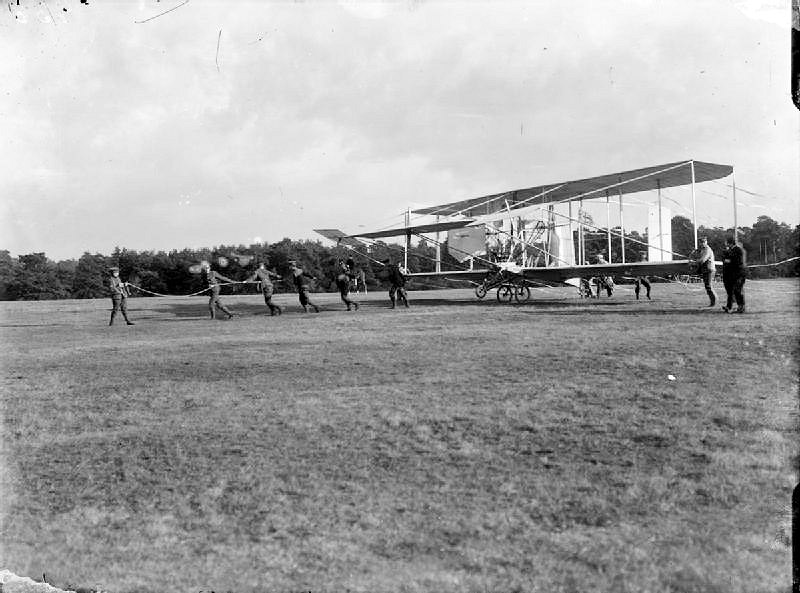
British Army Cody aeroplane Mark IB at Laffan’s Plain, Aldershot, being pulled into position by a team of soldiers. RE
From 1897 the School was called the Balloon Factory and a special RE Balloon section were trained to use balloons operationally. They took part in the Second Boar War (1899-1902) and experiments with cameras were undertaken for air photography and in the summer of 1906 RE balloonists took the earliest known aerial photographs of Stonehenge. In 1902 the Balloon Factory began experiments with ‘dirigible balloons’, better known as airships. Balloons are a lighter than air craft that can lift but are very much dependent on wind direction. By way of contrast, an airship is a lighter than air craft that not only lifts but is also powered by an engine(s). This enables it to move in any direction, even against the wind. By 1909 much time was being spent on the research of the different types of envelopes for airships and also the different types of gondolas in which crew, passengers and goods could be carried. Aeronauts such as Edwin Alliott Verdon Roe (1877-1958) generally called Alliott Roe or A.V. Roe, who later in 1910 founded the Avro Company in Manchester, worked at the Balloon Factory undertaking experiments with airships. While Samuel Franklin Cody (1867-1913) and John William Dunne (1875-1949), both aeronauts made significant contributions, particularly on engine design. Requiring more space to inflate the new ‘dirigible balloon’ or airship, which was then under construction, it was decided to move to a larger area. Between 1904-1906 the military Balloon Factory was relocated about 5 miles away on Farnborough Common.
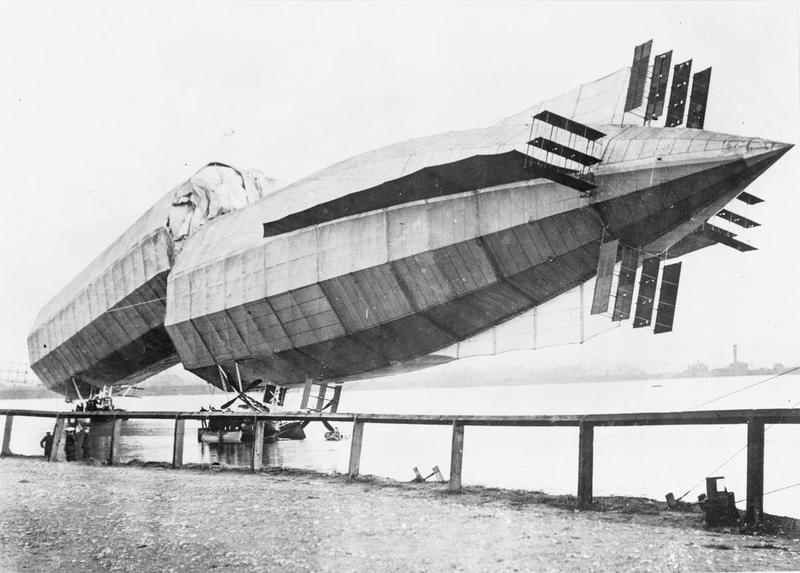
Mayfly the RN HMA No 1 airship with a broken back. Sept 1911 Wikipaedia
At the time Germany was spending a great deal on balloon based aeronautical research. The British Government having recognised the military potential of balloons were also interested in aeroplanes. The Prime Minister, Herbert Henry Asquith (1852-1928), approved the formation of an ‘Advisory Committee for Aeronautics’ and an ‘Aerial Sub-Committee of the Committee of Imperial Defence’. Both committees were composed of politicians, army officers and Royal Navy officers, one of the latter was Captain Murray Fraser Sueter (1872-1960). Albeit, after aeronaught John Dunne reported that a German airship had been reported as being able to travel at 40 miles an hour, discussions took place on the production of a rigid airship. Based upon the German Zeppelin. £2,500 was spent on research and a prototype airship HMA No1 and called Mayfly was constructed under the supervision of Captain Sueter. However, on 24 September 1911, while attempting its first flight during strong winds, the airship broke in half and the project was abandoned. Nonetheless, the exercise provided valuable training for both designers and air crews.
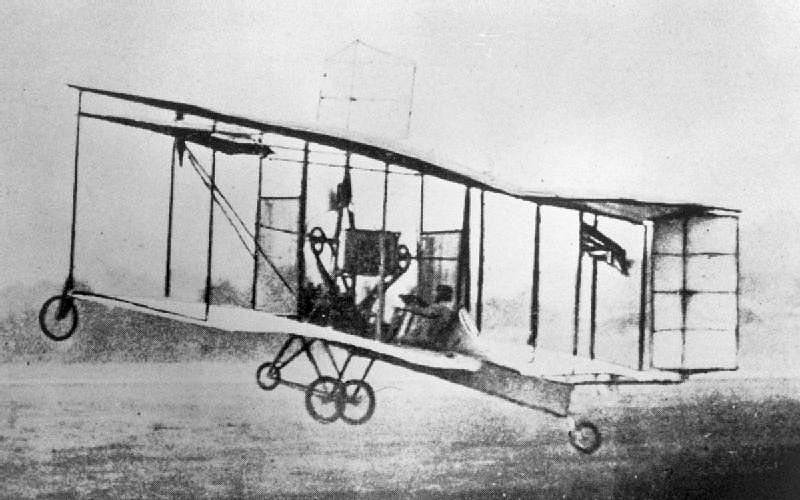
British Army Aeroplane No 1 flown by Sam Cody October 1908 IWM RAE-O
The French government considered air travel to be feasible but preferred aeroplanes. This enabled Blériot and Anglo-French aviator, Henri Farman (1874-1958) to undertake research and development. Farman built a biplane more stable than the Wright aeroplane. The Americans, less than a year after rejecting the notion of a powered flying machine such as the Wright brother’s aeroplane changed their mind. They decided to back the development of a powered flying machine designed by American Samuel Cody. At the time Cody was actually in England working as a civilian Kite Instructor with the Army Balloon Factory at Farnborough. On 16 October 1908 on Farnborough Common, Cody made his first flight – the first official flight of a piloted heavier-than-air machine in Great Britain! Albeit, as work was being carried out on developing the Mayfly airship, Army funding on aeroplanes ceased but Cody was able to keep the aeroplane. On 14 May 1909, at Laffans Plain, Aldershot some 5miles from Farnborough Common, he succeeded in flying about 1,400 feet before crashing. Nonetheless, he established the first official British distance and endurance record.
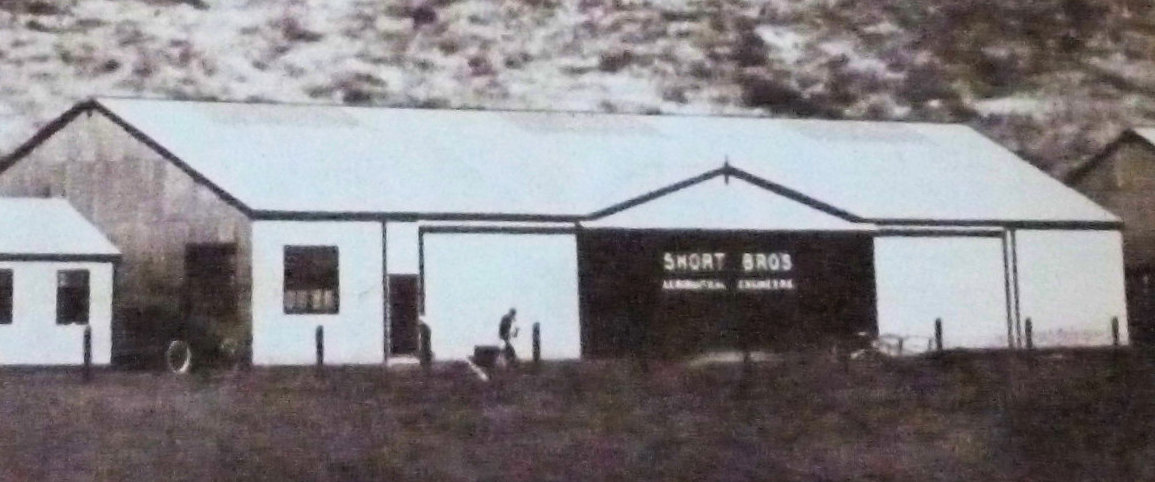
Short’s first aircraft factory, at Eastchurch, Isle of Sheppey 1910. Eveline Robinson
That summer the Short Brothers produced and sold six Wright Flyers and they received headline coverage when aviation pioneer John Theodore Cuthbert Moore-Brabazon, 1st Baron Brabazon of Tara (1884-1964) became the first resident Englishman to make an officially recognized aeroplane flight on 2 May 1909. On 30 October that year Moore-Brabazon flew a Short No 2, a circular mile in a Daily Mail newspaper competition and won £1,000 prize money. Also in October 1909 Britain staged its first air show, which was held at Doncaster Racecourse. Around twelve aviators took part including the French aviators Léon Delagrange (1872-1910) and Roger Sommer (1877-1965) as well as Samuel Cody.
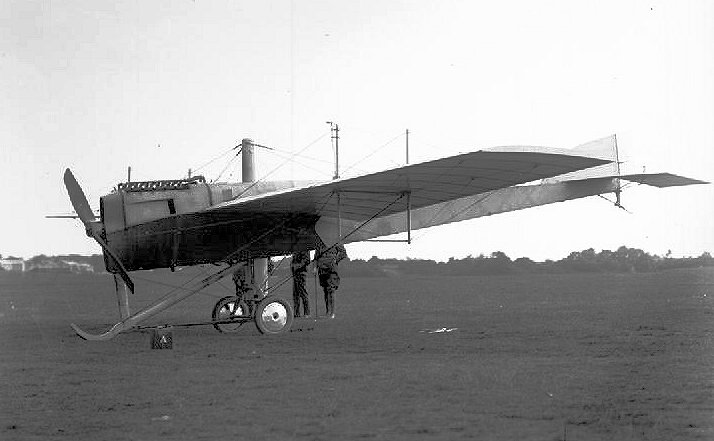
Martin-Handasyde 1912 monoplane. Aviation in Britain before the first World War. RAE -0422
Also that year, more airfields were opening but often little thought was given to their terrain, length or even general suitability. Albeit, the pioneers of the British aircraft manufacturing industry, such as Frederick Handley Page (1885-1962), took a more professional stance and opened a purpose built factory in June 1909. This was on the north bank of the River Thames, just east of Creekmouth where he laid down an airfield close by. A contemporary account of the Creekmouth Airfield, published in Flight Magazine August 1909, stated that it was about 2½ miles long and about a mile wide and was situated between Barking and Dagenham Stations on the London, Tilbury and Southend Railway. A flat part of the airfield was being levelled for starting purposes and an artificial hill was erected for gliding experiments. As well as Creekmouth Airfield from about July 1911 the company also used Fairlop Aerodrome at Ilford , which was already being used by aircraft designers and builders, Helmuth Paul Martin (1883-1968) and George Harris Handasyde (1877-1958). In 1908 they had built the monoplane Martin-Handasyde No 1 there where its first and only trial, was piloted by Martin on a very windy day. The heavy weather brought the prototype down wrecking it but despite this setback, Martin and Handasyde went on to design and build a succession of monoplanes. These included the one flown by test pilot Edward Petre (1886-1912), which on Christmas Eve 1912 was also brought down by heavy weather.
Martin and Handasyde continued to build aeroplanes but it was their S.1, built in 1914, that turned the company into the United Kingdom World War I (1914-1918) third most successful aircraft manufacturers. Meanwhile, in September 1912, Handley Page closed both the factory and Creekmouth Airfield and re-established both at Cricklewood. During the War the company became famous for their heavy bombers built at Cricklewood for the Royal Navy with the intention of bombing the German Zepplin Yards. They were flown from the company’s adjacent Cricklewood Aerodrome. In 1920 Handley Page inaugurated a London to Paris air service from Cricklewood Aerodrome but in 1929 the aerodrome was closed to make way for suburban development. Following the success of the Martin-Handasyde S.1, Martin and Handasyde opened a factory at Woking, Surrey but used Brookfield airfield in preference to Fairlop Aerodrome for testing. At the same time and also after the War the company became particularly well known for their motorcycles. Meanwhile Fairlop Aerodrome remained in use during both World Wars.
Why, after the outbreak of War in October 1914 Fairlop Aerodrome was rejected by the Royal Naval Air Service (RNAS) in favour of the creation of a new airfield at nearby Hainault Farm, is unclear. However, a RNAS report did state that the site was chosen as a Day Landing Ground because it featured well-drained land that was surrounded by open countryside in all directions and was close to railway stations, useful for personnel travelling there. In February 1915, Hainault Aerodrome was transferred to the Royal Flying Corps, which had already taken over Fairlop Aerodrome, when they were looking for suitable sites east of London. This was to protect the City from German bombing raids as part of a ring of ten aerodromes around London. Hainault Aerodrome closed in 1919 but shortly before World War II the City of London Corporation bought the site intending it to be London Airport. However, at the outbreak of War it was requisitioned together with Fairlop Aerodrome as an air and military base. Both Fairlop and Hainault closed in 1946.
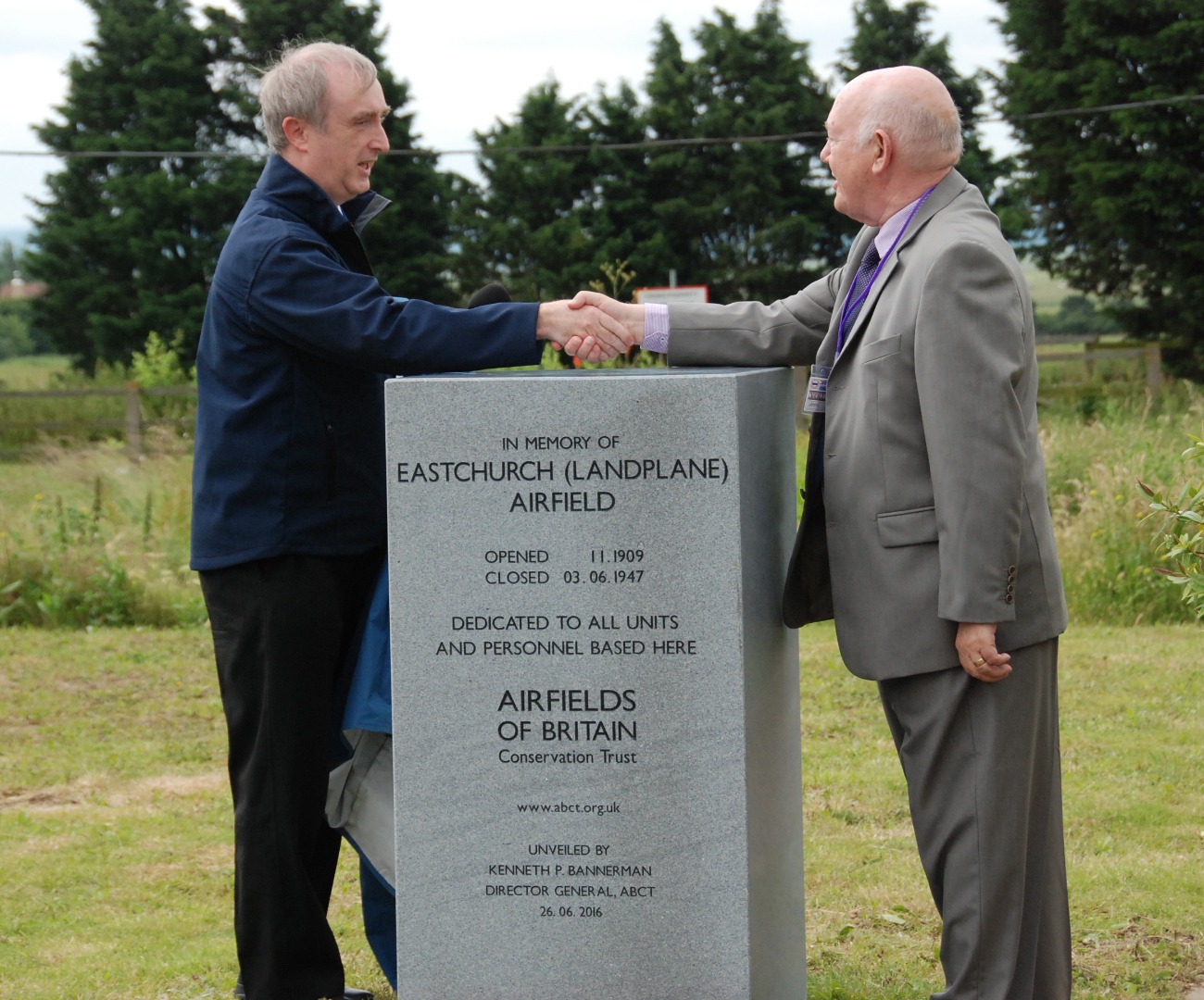
Eastchurch (Landplane) Airfield, Airfields of Britain Conservation Trust
In November 1909 the Short brothers opened their newly built Eastchurch airfield on the marshes. Whether the Admiralty had been preparing for what became World War I is debatable, but in 1898, work started on converting Dover Harbour into the Admiralty Harbour, that was to last for over 100years. The new harbour was built as the base for the Royal Navy at the southern end of the North Sea and on Friday 15 October 1909, it was opened by the Admiral of the Fleet, George, Prince of Wales, (later George V 1910-1935).
1910
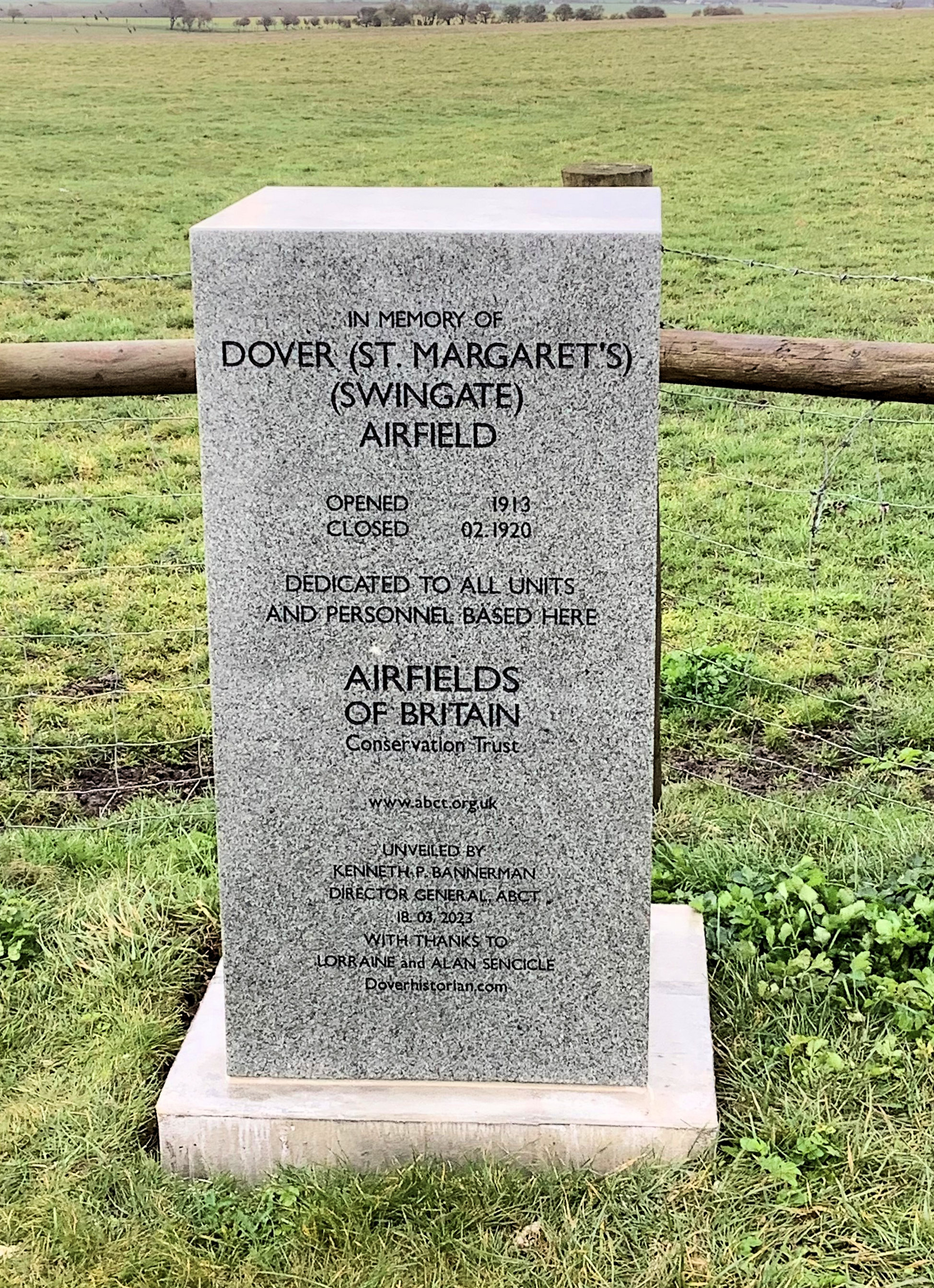
Swingate Aerodrome named by Charles Rolls when he made his memorable flight. Airfields of Britain Conservation Trust. Mike Weston 2023
In the spring of 1910, Charles Rolls saw Swingate Down plateau on the east side of Dover and overlooking Admiralty Harbour, as having potential for an airfield. He persuaded the War Office to rent the Down to him when it was not required for military purposes. Rolls renamed the plateau Swingate Aerodrome and had an ‘aeroplane garage’, or hangar as they were soon after called, erected by William Harbour Ltd of St Mary Cray, Kent. That company was later commissioned to build hangars on many of the newly created airfields that were to open after Rolls’ successful flight. That took place at 18.30hrs on Thursday 2 June when Rolls took off in his Wright Flyer from the Aerodrome, passed over Sangatte, France at 19.15hrs. After re-crossing the Channel back to England, Rolls circled around Dover Castle and finally landed at Swingate Aerodrome at 20.00hrs having made the first two way Channel crossing in an aeroplane.
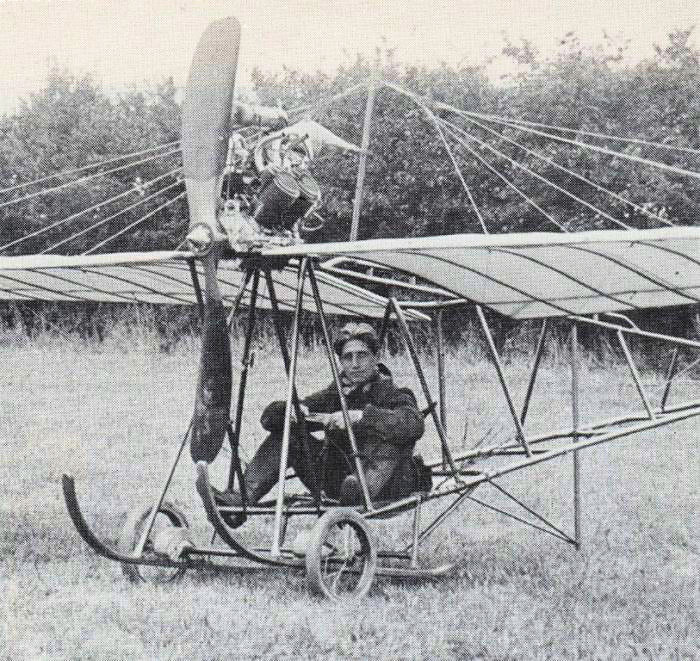
Edwin Rowland Moon Eastleigh Airfield. Chris-pictures, Bishopstoke history society
That same year, aviation pioneer Edwin Rowland Moon (1886-1920) flew his Moonbeam 2 monoplane from the meadows of North Stoneham Farm, Eastleigh, Hampshire. He had made his first successful flight in an aeroplane he built himself in the corner of the family boat builder’s workshop. At the outbreak of World War I Moon joined the Royal Naval Air Service and became a pilot and eventually a test pilot at RAF Felixstowe. Following the War he stayed on at Felixstowe but on 29 April 1920 he was instructing a crew in a Felixstowe F5 N4044 flying boat when suddenly there was a loud crack, the aeroplane went into a spin, crashed and Moon was killed. In the meantime just before the outbreak of War there was a public flying display given by Gustav Hamel to an audience of ten thousand! A few weeks later Eastleigh Airfield was requisitioned by the Royal Flying Corps and renamed ‘Eastleigh Airfield Aircraft Acceptance Park’ then in 1917 the renamed Atlantic Park, site was given over to the United States Navy to develop an assembly area.
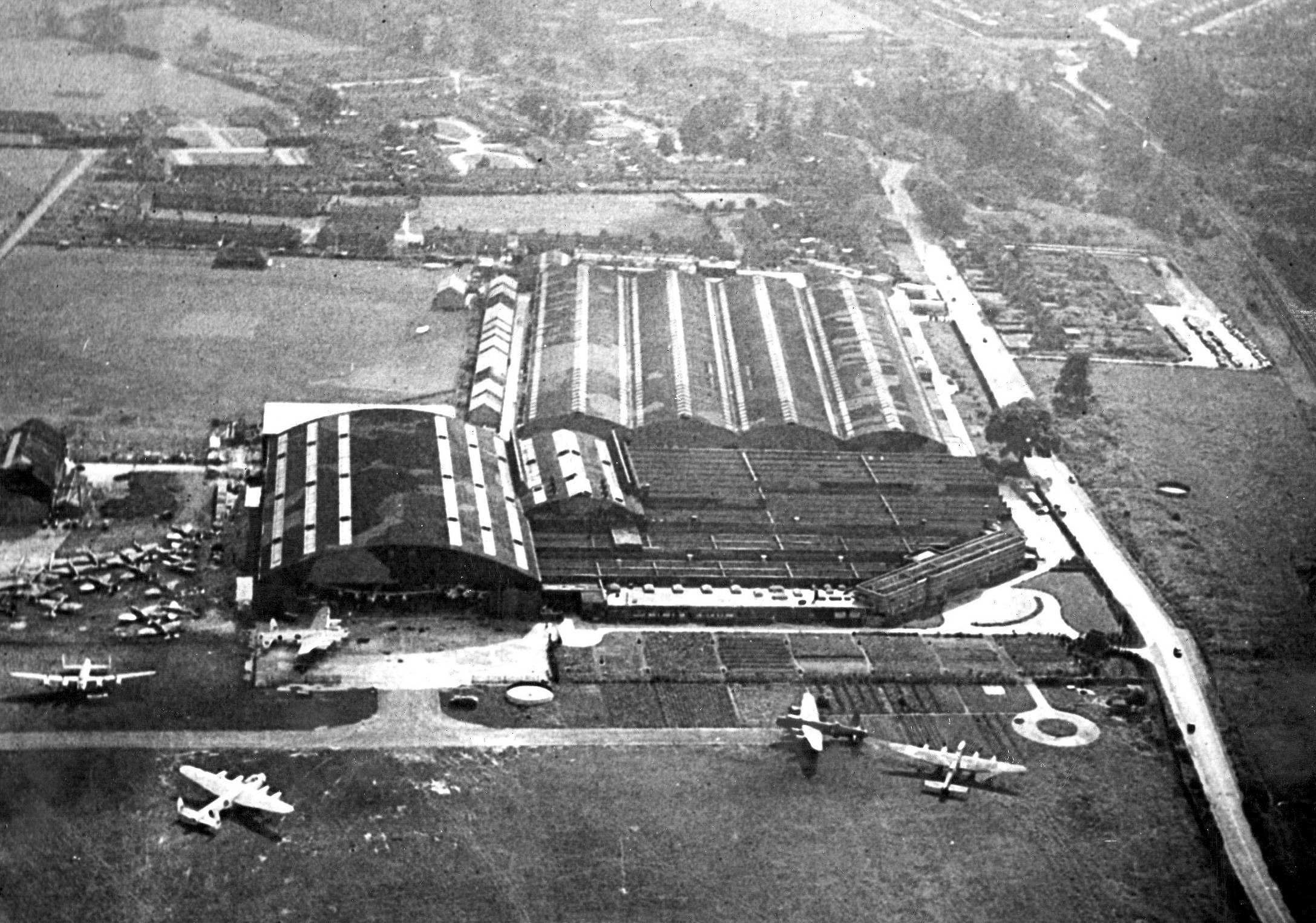
Southampton Municipal Airport c1946. Southampton International Airport
In 1932, Atlantic Park was purchased by Southampton Corporation and renamed Southampton Municipal Airport with regular air services to the Channel Islands. During World War II the Airport was again requisition but marking the return of the wartime aerodrome to a municipal airport in 1945, the regular air services to the Channel Islands resumed. In the 1960s J N Somer bought the Airport and during his tenure made a number of improvements including the construction of a 5,653 feet concrete runway. In 1988 a consortium headed by Peter de Savary (1944-2022) bought the airport site for redevelopment then in 1990 it was sold to the British Airport Authority, that had been privatised in 1987. Major reconstructions took place and in 1990 what had started off as the tiny Eastleigh Airfield was renamed Southampton International Airport by Prince Andrew, Duke of York. Edwin Rowland Moon was credited as being the first person to fly from there!
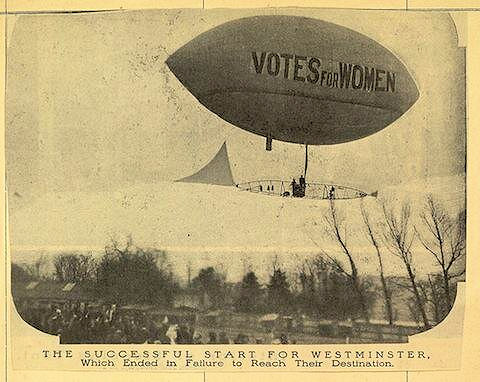
Votes For Women Airship 1909 Muriel Matters
From about 1862 what eventually became Hendon Aerodrome, Middlesex, seven miles north west of Charing Cross at Colindale close to Brent Reservoir, was a balloon airfield. The first powered flight to take off from there was an 88-foot long non-rigid airship built by C G Spencer & Sons’ airship factory at 56a Highbury Grove, Islington. On Tuesday 6 February 1909 the airship, piloted by Henry Spencer (1877-1937) took off carrying just one passenger, the Australian suffragette Muriel Lilah Matters (1877-1969). In fact Matters had hired the airship and emblazoned on one side of the balloon was the slogan ‘Votes For Women’ and on the other ‘Women’s Freedom League.’ The airship rose to a height of 3,500 feet and Matters scattered 56 pounds of handbills promoting the Women’s Freedom League. The flight made headlines around the world when it was stated that Matter’s had made the first ever powered flight from the airfield.
Albeit, in 1906, the Daily Mail newspaper had challenged aviators to fly from London to Manchester or vice versa, the prize being £10,000. The journey had to be completed within twenty-four hours, with no more than two landings allowed. For the race railway companies painted the rail sleepers white along the route to be followed. On 27 April 1910 French aviator Louis Paulhan (1883-1963) set off from Hendon Airfield and flew 117 miles to Lichfield. Before dawn on 28 April he took off and after 3 hours 55 minutes in the air reached Burnage on the outskirts of Manchester. Paulhan had not only won the prize, he is recognised as the first person to make an aeroplane flight from Hendon Airfield! About this time aviator, Claude Grahame-White (1879-1959) purchased more than 200 acres of land converting Hendon airfield into a recognised aerodrome. He employed the London Aerodrome Co to build sheds and in 1910 opened the Bleriot Aviation School. The following year, as part of the George V (1910-1936) coronation celebrations (9-16 September 1911), the first ever ‘official’ UK airmail was flown from Hendon to Windsor and vice versa.

Hendon Aeroplane factory in the 1914 book Aeroplane p202. Wikipaedia
During World War I, Grahame-White’s company concentrated on aircraft production and to facilitate the transportation of the 3,500 workers and materials, Midland Railway built a spur from the embanked main line with a platform close to the main line and a loop around the airfield to the plant. In November 1916 the War Office commandeered the Bleriot Aviation School and subsequently 490 pilots were trained there. Hendon Aerodrome was the first aerial defence airfield of a city as part of a ring of ten aerodromes around London. After World War I, the airfield became famous for pioneering experiments, including the first parachute descent from a powered aircraft and the first night flights. However, in 1922 the Air Ministry took over the aerodrome and factory. This led to an ugly three-year legal fight after which Grahame-White left and had nothing more to do with aircraft production. RAF Hendon was briefly involved in the Battle of Britain (1940) during World War II but thereafter the aerodrome was mainly used for transport activities notably flying dignitaries to and from London. Following the War the demand for housing put pressure on the RAF to relinquish the aerodrome and the Metropolitan Communication Squadron was the last flying unit to leave left Hendon and that was in November 1957. The RAF remained operating as a Supply Control Centre and the Joint Services Air Trooping Centre. However on 1 April 1987 the RAF base closed and it is now the site of the Grahame Park Housing Estate and Hendon Police College. The Royal Air Force Museum, London, is situated on south east side of the former aerodrome site. In 1968 a Blackburn Beverley, an exhibit at the new RAF Museum, landed at what was left of the airfield – the last aircraft to use the field.
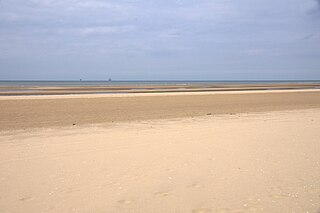
Freshfield Beach, Merseyside, from where Paterson made his historic flight 10.05.1910. Mike Pennington
Throughout the country the interest in flying was gathering momentum and none more so than on the Lancashire side of the Mersey River. Freshfield, is part of the town of Formby on the coast of the Mersey and it is said that it was on this Merseyside beach that Sam Cody established an ‘aerodrome’ in the autumn of 1909. Cody planned to use the beach to make an attempt at the first flight between Liverpool and Manchester. In the event he opted for Aintree but was not successful. Nonetheless, the Aintree Airfield was laid out on the famous Grand National racecourse site and Sam Cody made several demonstration flights there in November that year. Aintree airfield remained and during World War I the airfield was used by the Cunard Steamship Company who managed National Aircraft Factory No 3 where they made Bristol F.2b fighter aircraft. Albeit, on Saturday 10 May 1910 at 15.30hours the Freshfield Airfield achieved fame as the country’s first ‘Beach Aerodrome’, that is an airfield on the beach next to the sea! That Saturday, Cecil Compton Paterson (1885-1937), who up to two years before had ran a prosperous motor business in Liverpool, took off from and landed his biplane on Freshfield’s wide flat sands. In the intervening time Paterson had sold his business to Liverpool Motor Company becoming a director and using the facilities to build a biplane to the design of the Curtiss Golden Flyer.
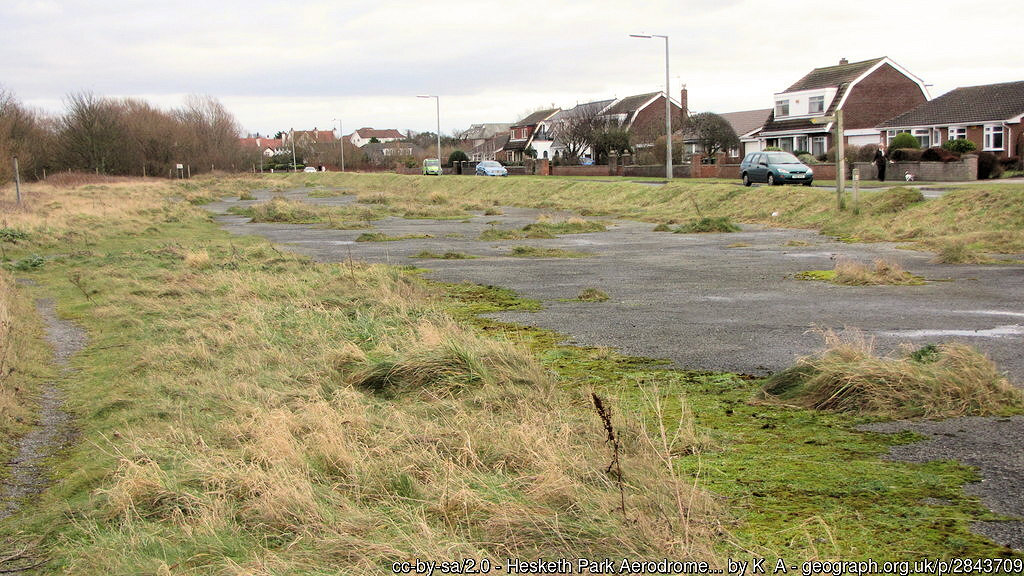
Remains of the Hesketh Park airfield. K.A.geograph org uk 27.12. 2011
Paterson, having gained RaeC certificate in December 1910, following his successful flight approached Southport Town Council for a grant of £500 to open an aerodrome and flying school on Fairfield’s sands. Southport Town Council expressed interested but thought Paterson’s project cost too much. Instead they opted to construct a municipal airfield with a hangar adjacent to the beach at Hesketh Park paying John Gaunt £150 to become Southport council’s aviator! In the summer of 1910 Gaunt flew his biplane from Hesketh Park Aerodrome up and down Southport beach for the benefit of large crowds. Thereafter the council’s aerodrome was little used until WWI when it was commandeered for military service as No.11 Acceptance Park. During the inter-war period Norman and Percy Giroux operated the Giro Aviation Company from Hesketh Park. They offered a regular aeroplane service to Blackpool, Isle of Man and Ireland as well as pleasure flights and pilot training. World War II saw the airfield become No.7 Aircraft Assembly Unit, when Mosquito and Anson aircraft were assembled as well as the repair of Spitfires. Following the War Hesketh airfield was used by Southport Aeroclub until 1961 but flying continued until the airfield closed in 1965.
Meanwhile in 1910, at Freshfield, Paterson, having already built a hangar for his biplane, built a second and subsequently three more hangars in the dunes. He also built a second biplane with a larger engine for aviator Gerald Higginbotham (b1877) of Macclesfield who kept it in one of the newly constructed hangars. Other aviators were using Freshfield airfield, including Robert Arthur King (b1883) from Neston who later became a Sub Lieutenant in the Royal Navy Reserve and was stationed at the Central Flying School at Upavon (see below). Paterson and King, on 29 November 1910, made the first crossing of the River Mersey by air flying a Farman biplane. Another aviator was Henry Greg Melly from Aigburth (1868-1957) who after building a Blériot monoplane in Shed 3, moved to Waterloo Sands, Crosby on the Mersey. There he built two wooden sheds and a workshop for his two Blériot monoplanes – one of which he had built at Freshfield aerodrome.
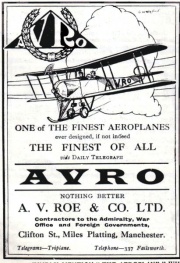
Avro Company, Manchester advert 1914. Grace’s Guide To British Industrial History
Melly subsequently built another Blériot monoplane and in 1911 opened the Liverpool Flying School and became the first full time flying instructor in Lancashire. With one of his pupils, Alfred Dukinfield-Jones (1888-1976) Melly flew from Aintree to Trafford Park, Manchester, on 07 July 1911 in a Blériot XI. At Trafford Park, Alliott Roe had created a well marked landing area for his newly opened 69AVRO company nearby. The flight appears to be the first between Liverpool and Manchester. During World War I Waterloo Sands was designated a Diversion/Emergency Landing Ground for aircraft in transit up the west coast to Scotland and following the War the Avro Transport Company used the airfield for Avro 504s as well as their own. Southport council, in 1911, opened another airfield at Blowick, Southport, to attract summer visitors by holding air displays including well known aviation pioneers such as Claude Grahame-White.
That year Paterson moved to Hendon to work for Claude Grahame-White as a flying instructor and while there built a two seater biplane with a more powerful 50-h.p. Gnome engine for Higginbotham. This flew for the first time on 18 October 1911 and two days later Higginbotham flew to Southport from Freshfield Aerodrome to make the first aerial delivery of mail in the North West of England. At about the same time Freshfield became the testing ground for aviator Robert Cooke Fenwick (1884-1912) who tested the Planes Ltd biplane and Merseyside Military monoplane fitted with a 45-h.p. Isaacson engine as Handley Page’s first employed test pilot. In December 1911 Fenwick flew the Merseyside Military monoplane to a War Office trial for military aircraft at Larkhill, Wiltshire and again in August 1912. On both occasions he flew from Freshfield but on 13 August, just after 18.00hrs, Fenwick’s plane was seen in difficulties. The aircraft plunged for about 50 feet, recovered to an even keel then made a vertical dive to the ground. Fenwick was killed instantaneously. Although these Mersyside airfields have long since gone, in 1941 RAF Woodvale opened as an all-weather night fighter airfield for the defence of Liverpool and today operates as a training station and is the home of Liverpool University Air Squadron.
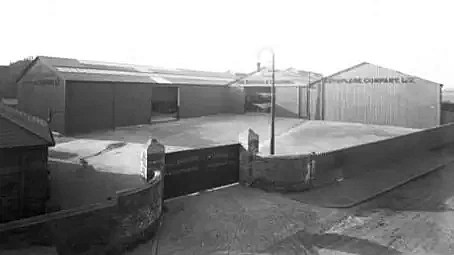
Bristol & Colonial Aeroplane Co Ltd factory 1910. BEA
The growing interest in learning to fly inspired a officers in both the Army and the Royal Navy, to learn. Staff from the British and Colonial Aeroplane Company trained many of these officers to become qualified pilots. The Company was a subsidiary of the Bristol Tramways Company and was founded by George White (1854-1916) together with his brother Samuel (c1862-1928). The Company’s factory was at Filton near Bristol where the two brothers built a factory, which opened in March 1910, to build aircraft to improve existing aeroplane designs. Close to the factory was a small ‘flying ground’ at the top of Filton Hill. As the Company flourished, it was referred to as the Bristol Aeroplane Company (BAC). During World War I, like Eastleigh, the airfield was taken over by the Royal Flying Corps and named Filton Airfield Aircraft Acceptance Park. This involved the final assembly and flight testing of aircraft sent from other aircraft production sites.
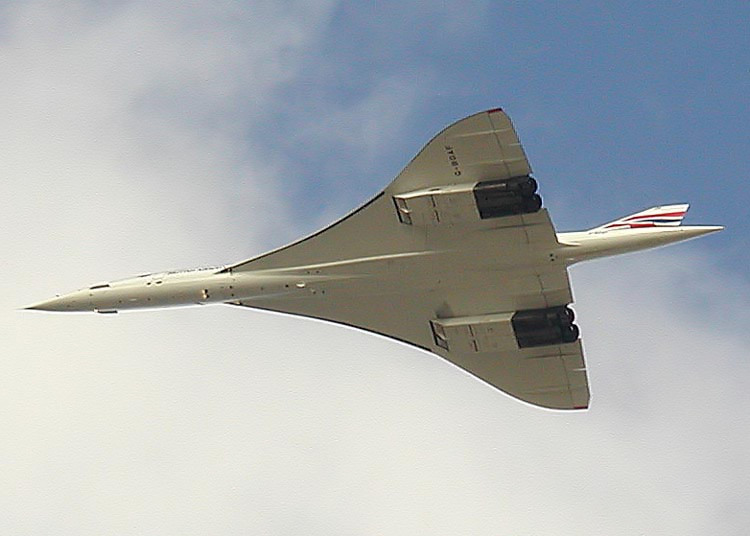
The last flight of any Concorde, 26.11.2003. G-BOAF overflying Filton Airfield at 2,000ft. Adrian Pingstone
During the interwar period the military airfield facilities were expanded to that of a full flying base built by the Army. The runway was lengthened and Filton became part of an operational fighter base. Following World War II, in 1947, RAF Filton closed as a military airfield and factory but both physically remained and they reverted to their original owners BAC. In 1960, the British Aircraft Corporation took over the aircraft interests of BAC and the development and production of Concorde took place at Filton. To accommodate Concorde the main Filton runway, which had already been extended several times as Filton Aerodrome expanded, was further extended. However, on 26 November 2003, Concorde 216 (G-BOAF) made her last flight, this was from Heathrow aerodrome and she was flown westward over Bristol, where crowds waved as she passed over, and then to Filton Aerodrome, where she landed. Not long after, much of the Filton Aerodrome was sold off for the Patchway housing development and Trading Estate. British Aircraft Corporation remained on what was left eventually becoming a forerunner of British Aerospace. Then, on 31 December 2012, the site finally closed. However, Airbus UK purchased 26 acres of the former Rolls-Royce Rodney Works that had operated close to the original Filton Airfield. There they built a facility for wing development and manufacture and now they are the main company on this former airfield.
About 1898, the War Office bought farmland on Salisbury Plain, Wiltshire, for military training purposes. By the following year a large tented camp for Army units training was established called Larkhill Range. In 1909, Horatio Barber (1875–1964), rented a small piece of land on Larkhill, adjacent to the military camp and built a hangar to house his new aeroplane. More enthusiasts soon joined him including George Bertram Cockburn (1872-1931) and Captain John Duncan Berties Fulton (1876-1915). At the time Fulton was stationed at Bulford military camp on Salisbury Plain and had bought a Grahame-White Blériot-type monoplane out of the proceeds of patents for the improvement of field guns he had invented. During 1910 Cockburn and Fulton became such good friends that in November Fulton gained his RAeC Aviators Certificate flying Cockburn’s Farman I-bis. They also manage to persuade the War Office of the need for a military airfield for aeroplanes. The Army extended their Durrington Down military site to include an airfield and in July 1910 Larkhill Aerodrome, the first military airfield in Britain designated for aircraft as opposed to balloons, opened.
Several more hangars were built at Larkhill next to the hangar that Barber had built. Barber’s hangar still exists along with a three-bay hangar and the Army gave the contract for building hangars to BAC. On 1 April 1911, No. 2 Company of the Air Battalion – Royal Engineers was established at Larkhill, the first flying unit of the armed forces to use aeroplanes as opposed to balloons and Fulton was appointed to command. This evolved into No. 3 Squadron, Royal Flying Corps in May 1912, the first Royal Flying Corps squadron to use aeroplanes. On Friday 30 September, aviator Robert Loraine (1876-1935), who first named the aircraft control stick a ‘joystick’, was asked to test an upgraded Farman biplane.
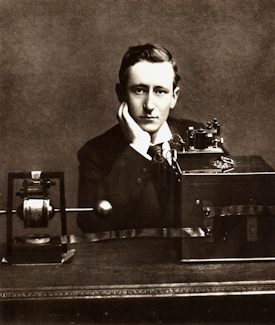
Guglielmo Marconi publicity photograph in front of his early radio apparatus. Smithsonian Institute Library
The aeroplane had been adapted with a basic Marconi wireless transmitter weighing 14lbs. Guglielmo Marconi (1874-1937) had been demonstrating revolutionary new techniques of communication by radio wave-based wireless telegraph system in England since January 1897. The machine was attached to the passenger seat and monopole antenna wires stretched along the breadth and length of the biplane. The Morse key for tapping out messages was fixed next to Loraine’s left hand and he was asked to send a predetermined message while flying over Stonehenge, on Salisbury Plain, approximately 2 miles away. This he did with his left hand while controlling the aeroplane with his right. In a hangar at Larkhill, surrounding the Marconi receiver were Marconi engineers, a number of dignitaries headed by the Home Secretary (1910-1911), Winston Churchill (1874-1965) as well as army and navy officers. Loraine did as he was bid and the dignitaries were delighted when the message ‘enemy in sight’ was received on the apparatus in the hangar. However, the dignitaries generally expressed reservations about the use of aeroplanes for defence purposes.
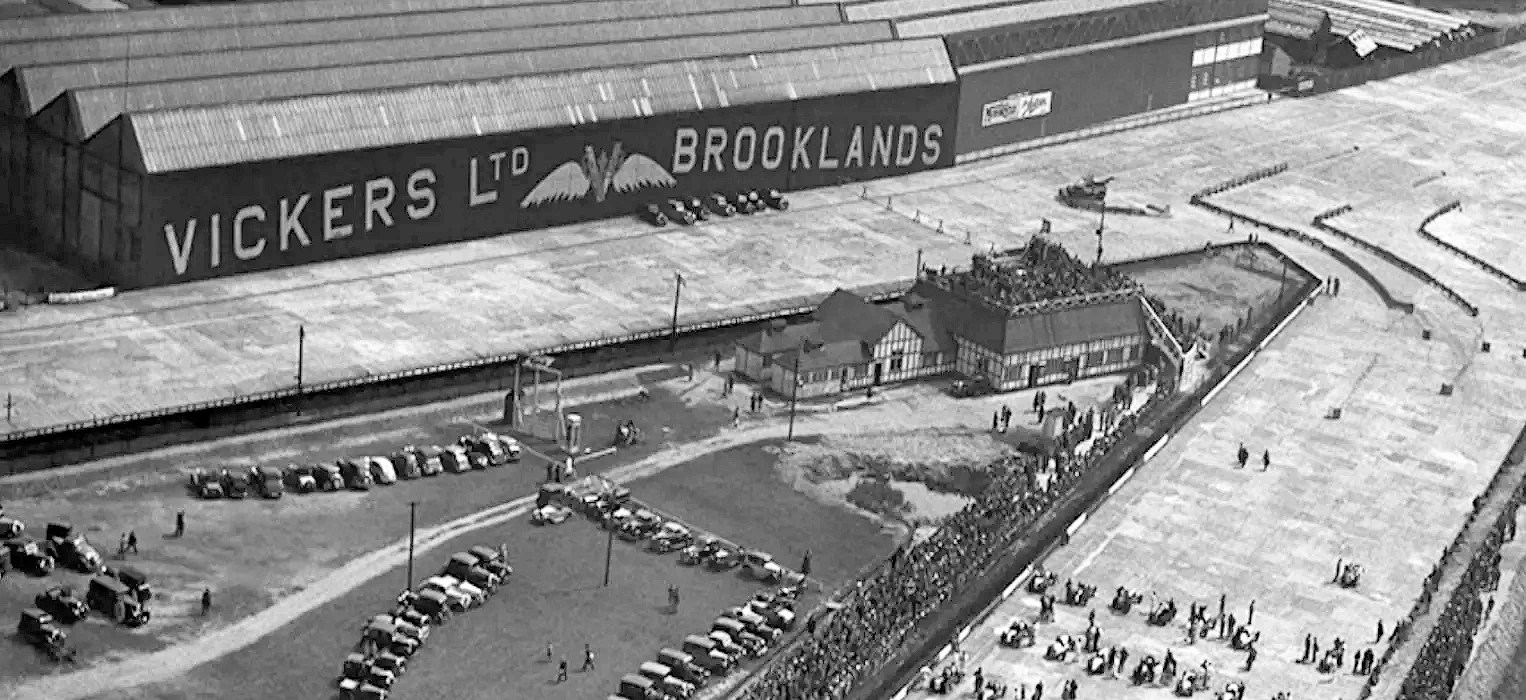
Brooklands famous race track existed alongside the Vickers Aviation works until 1939 BAE Systems
Brooklands motor racing circuit opened in 1907 near Weybridge, Surrey, and just south-west of London in south-eastern England. The track was 2.767-mile long, 100 feet wide, with banking nearly 30 feet high. It was the world’s first purpose-built ‘banked’ motor racing circuit. Hugh Fortescue Locke King (1848-1926) who had inherited the estate, founded and financed the venture, for at the time, Britain lagged behind European countries in the development of motorcars. Locke King decided to try and redress the balance by building a testing track to give impetus to the industry. The track was opened on 17 June 1907 and on that day 43 cars were driven around the circuit, one of them by Charles Rolls. The motor racing circuit quickly proved popular with many of the competitors also interested aeronautics, notably Alliott Roe who in 1910, founded the Avro Company in Manchester. In 1908 Alliott Roe made the first flight of an English aircraft by an English pilot at Brooklands. At one of the motor racing meetings Roe met aviators Louis Paulhan, who won the London-Manchester air race that year and Henry Farnham. The three men persuaded Locke King to lay an airfield alongside the motor racing track. Before Brooklands Aviation Ground, opened in early 1910, Roe built workshops close to the airfield to attract his London social friends and financial backers to the site.
Brooklands quickly became a British major flying centre with a number of aviators making their base including brothers, solicitor Henry Aloysius Petre (1884-1962) and Edward Petre, who built a single-seater monoplane with a wooden fuselage. This was shown at the Olympia Aero Show London in March 1910 and was taken from there to Brooklands. In Shed No.11 at the airfield the aeroplane was completed making its one and only flight on 23 July 1910, piloted by Henry Petre . Following this experimental flight Edward, tested aeroplanes for Handley Page and also for aircraft designers Martin and Handasyde at Fairlop, Essex. Flying a Martin Handasyde monoplane, Martin Petre took off from Brooklands at 09.10hours on 24 December 1912. The intention was to fly to be the first person to fly to Edinburgh non-stop and the weather was favourable as a fresh breeze was blowing and the sky was clear. The planned route was to leave Brooklands and fly overland in a north-easterly direction until he reached the Wash. Once there he would go north following the coast until he reached Newcastle then turn in a north-westerly direction cross country to Edinburgh. However, by the time he reached the Wash wind speed was increasing and continued to gather strength the further north he flew.
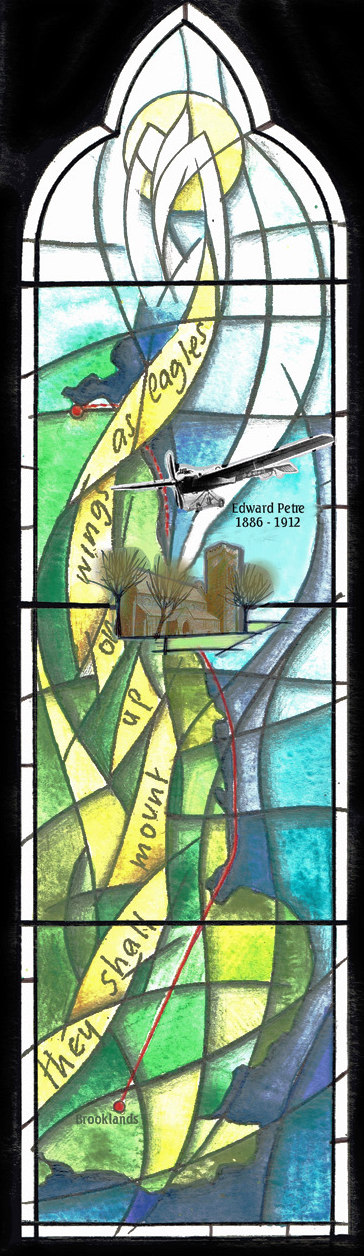
Aviators Window – Edward Petre accident, St Mark’s Church Marske, North Yorkshire. Peter Sotheran
By midday a gale was blowing but Petre could see the long sandy bank of the River Tyne which he followed towards Marske-by-the-Sea, north Yorkshire. There he turned his craft inland probably with the intention of landing on Marske airfield behind the beach. He knew that Marske beach had been used back in 1908 by Robert Blackburn (1885-1985) and his wife Jessy (1894-1975) to test their aeroplanes what they had built in Leeds. News of this had spread throughout the aviation world and Marske beach had earned the reputation of being a good landing ground. Indeed, on 25 June 1910 an air show was held on farmland, west of Marske village across the the coast road from the beach. For the event the farmland was flattened and the site was billed as Marske-by-the-Sea Aerodrome. On that December day in 1912, according to locals, it was the aerodrome that Petre was making for. He was almost making touch down when a sudden fierce gust of wind seem to catch the plane and it rose about 40feet into the air. The wings seemed to collapse and Petre appeared to lose control of aeroplane. It crashed in the village, about 400 yards from the St Mark’s Parish Church, killing Petre.
At the inquest into Petre’s death George Handasyde, the Martin and Handasyde chief engineer, gave evidence. He stated that the machine used by Petre had a normal power of 80mph and described Petre as ‘a big, powerful man, and one of the most fearless aviators in the country.’ Officers from the newly created (April 1912 see below) Royal Flying Corps inspected the site but noted that Marske-by-the-Sea airfield failed to come up to the standard airfield design. A verdict of ‘Accidental death’ was returned and Edward Petre was buried at Fryerning Churchyard, Ingatestone, Essex. Of note Henry Petre, Edward’s elder brother, later became a founding member of the Australian Flying Corps. Of note, in the Parish Church of St Martin’s Marske-by-the-Sea, on Sunday 1st November 2015 the Bishop of Whitby, the Rt. Revd Paul Ferguson, dedicated a stained glass window to Edward Petre. The window was created by Ann Sotheran, Churchwarden of St Mark’s Church and is based on a schematic map of eastern Britain. It shows Petre’s route from Brooklands Airfield to Edinburgh marked with a red line and the site of the crash near the Parish Church.
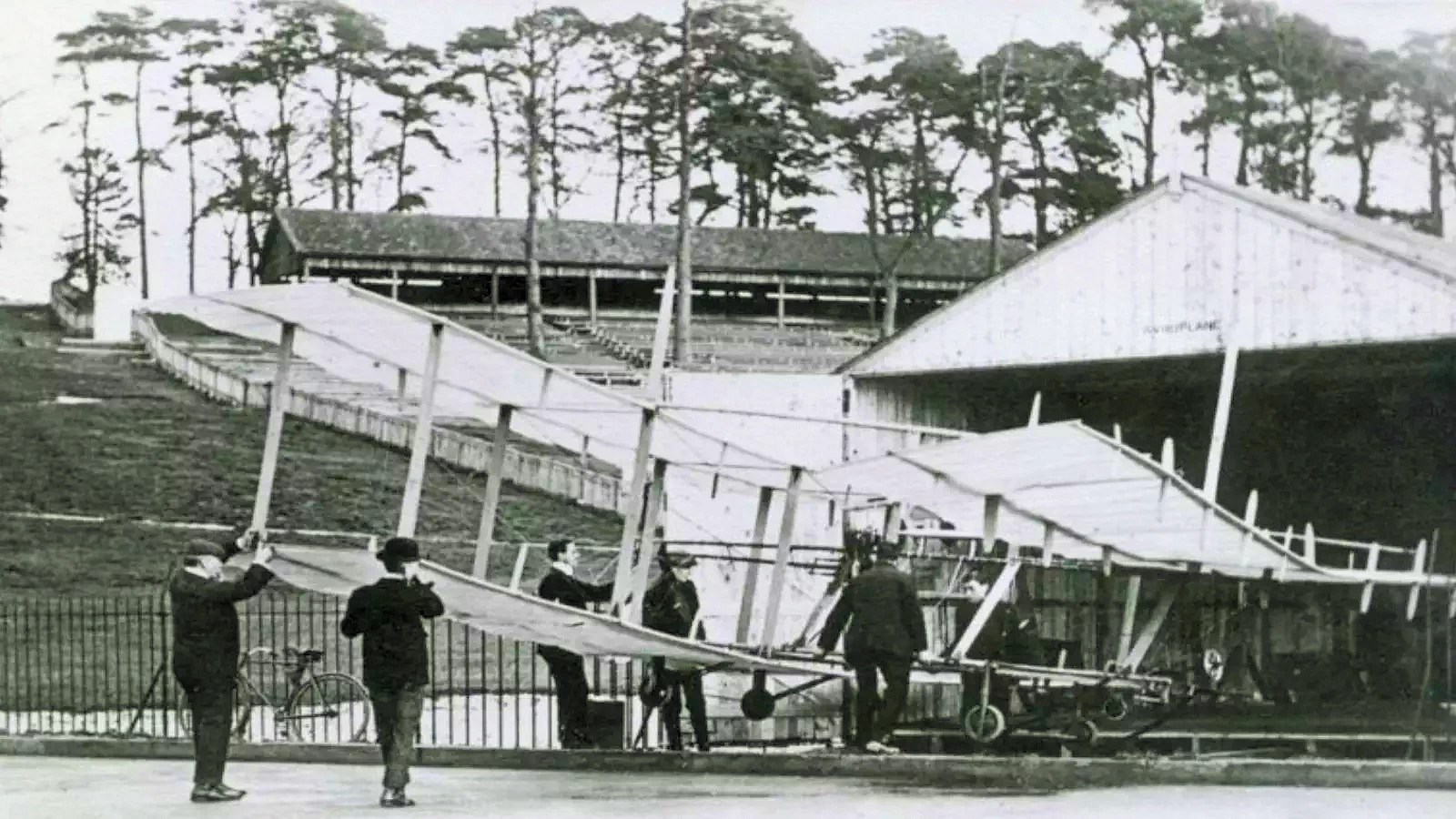
Manoeuvring Alliot Roe’s Triplane out of the Hangar at Brooklands 1909 BEA Systems
Brooklands continued to attract aviators and would be aviators. Entrepreneur and aviator Hilda Hewlett (1864-1943) seeing this joined forces with Gustav Jules Eugene Blondeau (1871-1975) opened Britain’s first flying school nearby. BAC followed, establishing a flying school in late spring 1910. The company’s first instructor and test pilot was Archibald ‘Archie’ Reith Low (1878-1969). Alliott Roe also opened a flying school at Brooklands and in July that year BAC opened a second flying school near Larkhill Aerodrome. In 1912 Vickers engineering company opened a flying school having expanded into aircraft manufacture the year before.

WWI Royal Flying Corps wireless training session. marconiheritage.org
One of the Vickers instructors was Richard Harold Barnwell (1879-1917) who became a test pilot for the company. The Vickers flying school taught 77 pupils to fly before it closed in August 1914, one of which was Hugh Dowding (1882-1970), the Air Officer Commanding RAF Fighter Command during the Battle of Britain 1940. From then on, aviation companies and associated industries also set up close to Brooklands, including Sopwith Aviation Company owned by Thomas Octave Murdoch Sopwith (1888-1989). During World War I Brooklands motor racing circuit closed, as did the civilian flying schools and Vickers Aviation Ltd opened a factory there in 1915. Other associated factories followed and by 1918 Brooklands had become Britain’s largest aircraft manufacturing centre. During the War various Royal Flying Corps Squadrons were based at Brooklands and air-ground wireless trials pioneered by a Marconi team, that had started in 1912, continued with the World’s first voice to ground wireless message successfully transmitted over Brooklands in 1915.
In late 1917, three large ‘Belfast-truss‘ General Service Sheds for a new Aircraft Acceptance Park were erected to enable assembly and testing new aeroplanes until it closed in early 1920. In 1927 Vickers Limited, the largest aviation manufacturing company at Brooklands, merged with Sir W G Armstrong Whitworth & Company to form Vickers Armstrong. As the British economy picked up in 1931 Brooklands Aviation Ltd was formed and the aerodrome became a major flying training centre. Motor racing at Brooklands ceased at the outbreak of World War II and the site was given over to war-time production of military aircraft in particular the Vickers Wellington, Vickers Warwick and Hawker Hurricane. To help screen the Hawker and Vickers aircraft factories at Brooklands trees were also planted into the concrete of the former racing circuit.

Brooklands – the end of an era as Ron Hedges removes the name plaque after 80 years of aircraft manufacturing Christmas Day 1989. BAE Systems
On 4 September 1940 the Vickers Brooklands factory was bombed, nearly 90 aircraft workers were killed and at least 419 injured. Following the war the former racing circuit was sold to Vickers Armstrong when the design and production of new aircraft increased such that in the 1960s aircraft production at Brooklands achieved its peak. In 1960 Brooklands became the headquarters of the newly formed British Aircraft Corporation. Two years later, to house the new prototype VC10, a large new 60,378 square-foot hangar, nicknamed ‘the Abbey’, was erected and in 1964 the larger ‘the Cathedral’, 98,989-square-foot hangar was erected. Brooklands was also the country’s major assembly factory for Concorde but lack of orders for VC10s and Concordes plus changes in Government policies led to a decline in aircraft orders. In 1977 Brooklands became part of the newly formed British Aerospace (BAe) and at about that time airfield activity ceased. All aircraft manufacturing at Brooklands was wound up and Brooklands aircraft manufacturing closed on Christmas Day 1989. Shortly after Brooklands Museum opened and BAe’s successor, BAE Systems has a logistics centre at Brooklands.
The Aero Club had, from 1905, issued Aeronauts’ Certificates for balloonists. On 15 February 1910 when the Aero Club was elevated to RAeC, it became the regulative body for issuing of Aviators’ Certificates to qualified aircraft pilots. The certificates were recognised by the Fédération Aéronautique Internationale founded in 1905 and the world governing body for air sports. The first aeroplane pilot to qualify for a RAeC certificate was Moore-Brabazon. He had previously been assigned certificate number 40 of the Fédération Aéronautique Internationale and was issued with RAeC Certificate Number 1 on 8 March 1910. On the same day certificate No.2 was issued to Charles Rolls, who had flown a Short-Wright Biplane for his test flight.
On 21 June 1910, Lieutenant George Cyril Colmore (1885–1937) after completing training, which he had paid for out of his own pocket, became the first qualified pilot in the Royal Navy, certificate number 15. Hilda Hewlett was the first woman to receive a certificate, the number being 122. The RAeC, besides testing pilots on their ability to fly, they also trained most military pilots up until 1915. From then on most training took place at military airfields such as Swingate, Dover, but the trainee pilots still had to pass the RAeC test. Salisbury Plain was one of the main training grounds and scattered memorials across the Plain pay tribute to these first military flyers. Albeit, by the end of the First World War, more than 6,300 military pilots had received the RAeC Aviator’s certificates. Since its formation in 1972, the Civil Aviation Authority (CAA) has regulated pilot licensing in the UK.
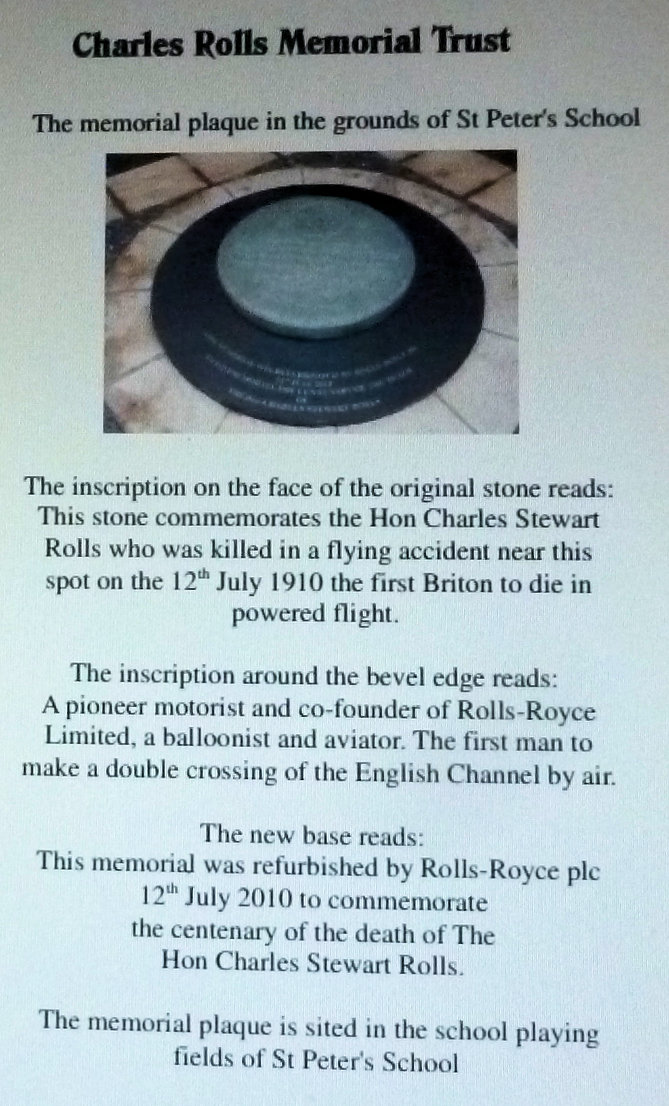
Charles Rolls Memorial Trust
For 11-12 July 1910 at Hengistbury Head Airfield, Southbourne near Bournemouth in Dorset, a Pageant was organised to celebrate the Centenary of Bournemouth. It was hoped that the airfield would prove popular to wealthy locals and also bring wealthy visitors to the town. Hence, one of the attractions was an aviation meeting with competitions one of which was for the aviator to land his aeroplane as close as possible to a touch down point. One of the aviators attending was Charles Rolls who was flying a Wright Flyer with a modified controlling wire that had been attached to the tail. Having competed in the event on the first day but not satisfied with his result Rolls had another go on the second day a Tuesday. However, when he was about 80 feet above the ground the controlling wire broke and Rolls was thrown out of the aeroplane. He died from his injures shortly afterwards. Charles Rolls was the first person in Britain to die in an aircraft accident and a memorial to him was erected and is maintained by the Royal Aeronautical Society in what is now the rear playing field at St Peters School Hengistbury Head. Following the accident aviators lost interest in using Hengistbury Head Airfield and it was finally abandoned in the 1920s.
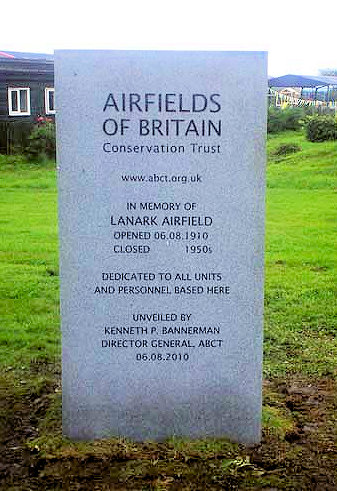
Lanark Airfield. Airfields of Britain Conservation Trust.
The summer of 1910 saw a number of aviation meetings planned but following the death of Charles Rolls, they were then cancelled. However with trepidation, the owners of Lanark Racecourse Airfield decided to carry on with their aviation meetings set for Saturdays 6 and 13 August 1910. The racecourse was reputed to be the oldest in Britain having been founded by King William the Lion of Scotland (1165-1214) who gave the Lanark Silver Bell as a prize. The bell disappeared for centuries but was found in 1836 in Lanark Town Council’s vaults and is competed for annually. In 1908, a new flat right-handed oval racecourse 10 furlongs round with a run-in of around 3+1⁄2 furlongs was laid. All the facilities both race horse owners and the paying public needed were provided but it did not attract them. The main reason was the lack of a railway line to bring people in from the populous Edinburgh and Glasgow. It was for this reason the owners decided to hold first aviation meeting in Scotland regardless of the death of Rolls near Bournemouth the month before.
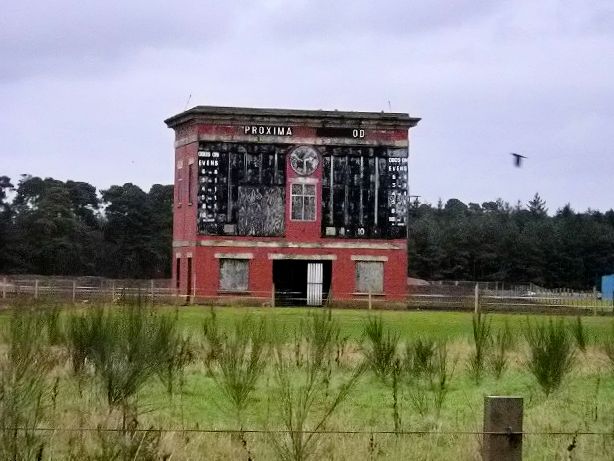
Lanark Racecourse (Disused) Iain Thompson geograph.org.uk
With the right social connections the owners persuaded Caledonian Railway Company to constructed a railway line from the main Glasgow-Edinburgh line to Lanark. The Railway Company built the station near to the entrance of the racecourse in order, so they said, to enable the aeroplanes to be transported to the meeting by rail! The owners of the horse racecourse offered £8060 as prize money and the aeroplane races were to be accurately timed over straight measured distances which allowed records to be set for the first time. Further, the horse racecourse stables would be used as hangars for the aeroplanes. To protect spectators, no aircraft was to fly closer than 300 yards from them. The first Saturday arrived and so did aviators from seven countries with their aeroplanes! They all arrived by train as did about 80,000 people mostly from Edinburgh and Glasgow. The meeting held the following Saturday and attracted some 200,000 people! The racecourse continued to be used as an airfield until the 1950s including in both World Wars. In 1911 Scottish aviation pioneer, William Hugh Ewen (1873-1947) opened a flying school nearby. The racecourse closed in October 1977 but it is still an official emergency airfield. The railway station was officially opened on 27 September 1910 but in 1965 was subjected to the Beeching cuts. The Lanark Silver Bell horse race is now run at Hamilton Park Race Course, south of Glasgow.
Following the failed construction of the British prototype airship Mayfly in 1908-09 Captain Sueter, who had supervised its construction, continued to undertake pioneering work in naval aviation. In 1910 Oliver Swann / Schwann (1878-1948) was selected to assist Captain Sueter and using his own money purchased an Avro Type D landplane. Although not having qualified as a pilot Swann added floats to the aeroplane and successfully managed to fly it off water. Although Swann crashed the aircraft, this was the first aircraft take off by a British pilot from salt water.
1911
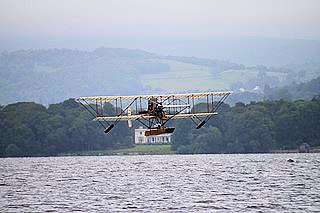
Replica seaplane Waterbird takes off from Lake Windermere 14 June 2022. Bakedinaspen
On January 26, 1911 Glenn Hammond Curtiss (1878-1930) an American aviation pioneer and one of the founders of the U.S. aircraft industry flew the first seaplane from water. At the time, in Britain, an aeroplane capable of rising from and alighting upon water was described in Flight magazine as ‘scarcely even dreamt of’. However, Edward Wakefield, an engineer who had been experimenting with the idea of producing a floatplane that could. decided otherwise. Wakefield ordered a floatplane similar to the design of the 1910 Fabre Hydravion – an experimental floatplane designed by Henri Fabre (1882-1984), an aircraft that had taken off from water under its own power. He commissioned Alliott Roe’s Manchester Avro Company to build seaplane based on their Avro Curtiss aircraft with modifications based on the Fabre Hydravion. Wakefield set up the Lakes Flying Company and what was to become the seaplane named Waterbird, was built at Brownsfield Mills, Manchester with wheels for testing at Brooklands. It was delivered to Lake Windermere on 7 July 1911 where conversion took place to the seaplane including the floats that were to replace the wheels. These were built by Borwick & Sons, boat builders of Bowness. Aviator, Herbert Stanley Adams successfully took off in the Waterbird floatplane on 25 November 1911 from Windermere and landing on the lake. This was the first successful British built seaplane to take off and land on water.

Windermere Airfield monument and Kenneth Bannerman Airfields of Britain Conservation Trust
Together Wakefield and Adams went on to develop seaplanes but local residents complained. Most notably Hardwicke Drummond Rawnsley (1851-1920) internationally known as one of the three founders of the National Trust and Beatrix Potter (1866-1943), author and conservationist. However, the Home Office found no reason to control their activity. On 11 December 1911, Wakefield filed a Patent for float attachment to an aeroplane including rubber bungees for shock absorption when taking off and landing. The following year another Patent for a stepped float and in 1913 for wingtip floats, all of which were granted. Even though on water, Windermere Airfield was split between two locations, Cockshott Point and Hill of Oaks, further down the lake’s east side and became an RNAS base in WWI, closing in 1920.
In June 1911 an airfield opened on farmland at Whitfield, a village just outside of Dover. It was generally known as Dover Aerodrome! It was favoured by aeronauts who would fly to the airfield where they would leave their aeroplane, until they returned, before boarding a ferry to cross the Channel to France. Harriet Quimby, (1875-1912), an American journalist, gained her pilot’s licence in August 1911, the first woman to do so in the US. By Christmas, she had decided to be the first woman to fly across the English Channel and through contacts, managed to get a letter of introduction to Louis Blériot in Paris. On 1 March 1912, Harriet set sail from New York for London on the Hamburg-American liner Amerika, and on arrival put her plan to the editor of the Daily Mirror. She described Dover aerodrome, as the airfield at Whitfield just outside Dover as being, ‘a fine, smooth ground from which to make a good start. The famous Dover Castle stands on the cliffs, overlooking the Channel. It points the way clearly to Calais.’ Harriet then went to see Blériot and persuaded him to loan her a Blériot monoplane with a 50hp Gnome engine. She also persuaded the English aviator, Gustav Wilhelm Hamel (1889-1914), to help with her project.
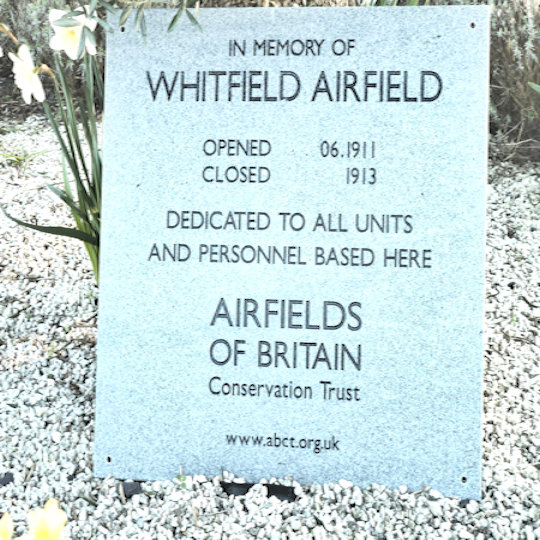
Plaque commemorating Whitfield Airfield near Dover. It can be seen in the garden of Whitfield Holiday Inn. Airfields of Britain Conservation Trust. 2023 AS
On the early morning of Tuesday 16 April 1912 Harriet arrived at Whitfield airfield dressed in a flying suit of her trademark, purple wool-back satin, under which she wore two pairs of silk combinations. Over the apparel, to keep her warm, Harriet wore a long woollen coat in the style of an ‘American raincoat’ all topped with sealskin stole. At the airfield, Hamel undertook a trial run and satisfied with the monoplane, Harriet climbed aboard and took off at 5.30am. 59 minutes later she landed on Equihen beach in the Pas de Calais, the first woman to fly across the Channel! The following year Whitfield airfield ceased to be used as such but before Whitfield airfield was ploughed over it featured in one of the earliest recorded films of any British airfield by British Pathéone. Entitled, the Circuit of Europe International Air Race at Hendon, Shoreham and Whitfield. This can be seen on ABCT’s Whitfield page: https://www.abct.org.uk/airfields/airfield-finder/whitfield/
A month after Harriet Quimby’s memorable flight, Germany sent the gunboat Panther to Agadir, Morocco, supposedly to protect German firms even though the port was closed to non-Moroccan businesses. The Admiralty reacted by, among other things, ordering the Camber in Dover Harbour to be altered into a submarine basin. The depth was deepened to 17-feet (5.19 metres); a pair of breakwaters and submarine shelters were constructed with a small dry dock alongside. As international tensions deepened and in order to create a safe anchorage for destroyers as well as submarines, the Camber was also deepened. In November 1913 the Camber was formally designated a torpedo centre with a repairing depot that came into use on 22 May 1914. Storage for oil fuel at the Eastern Dockyard was increased and Langdon prison, on the Eastern cliffs overlooking the harbour, was converted into Naval Barracks.
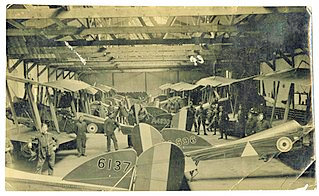
Aeroplane repair shop Joyce Green Airfield 1918. Carroll H Bunch
On 14 July 1912, at Long Reach near Dartford Joyce Green Airfield was opened by Vickers Limited, for use as an airfield and testing ground. The site had been chosen by inventor Hiram Maxim (1840-1916) who, between 1883 and 1885, had founded an arms company to produce automatic guns that used gas, recoil and blowback methods of operation. The Maxim automatic gun was patented and, with financial backing from Edward Vickers (1804-1897), Maxim produced his machine gun at a factory in Crayford, Kent. At the outbreak of World War I Joyce Green aerodrome became an ‘air defence’ airfield to protect London from bombing raids by Zeppelins as part of a ring of ten aerodromes around the City. One of the first occupants was No. 10 Reserve Squadron with a variety of aircraft. The unit also provided pupils from preliminary training schools with the final training in order to get their ‘wings’ before being posted to the Front. Each course of 20 pupils lasted two or three weeks and during that time, the pupils spent time at Lydd, Kent, where aerial gunnery was practised at the Hythe Range. Of note, during the War Maxim’s automatic gun was the standard weaponry of the British Army.
Winston Churchill (1874-1965), on 25 October 1911, was appointed the First Lord of the Admiralty (1911-1915), and from the outset expressed his concern about Germany building up her military strength. In Germany from 1898, with the active support of Kaiser Wilhelm II (1888-1918) the German Empire had passed four separate Flottengesetze – Fleet Laws or Naval Laws, one in 1900 then 1906 followed by 1908 and the last one in 1912. On land, Germany had created the Heer by combining ground and air assets into an integrated force. This was to protect herself in the event of an invasion from France in the west and Russia from the east. In 1905 the German Army Chief of Staff, Alfred von Schlieffen (1833-1913), had taken this one step further by drawing up a plan based on taking the offensive against the perceived attack. First against France, quickly beating her and before Russia had a chance to mobilise her armed forces Germany would attack that country. To fulfill the Schlieffen plan, Germany began to build up her military and aeronautical strength or Heer. While at sea, the German Secretary of State for the Navy or Kriegsmarine, Grand Admiral Alfred von Tirpitz (1849-1930) was committed to building up a force capable of competing against the Royal Navy. To gain information on what was happening in Germany, Churchill created the Naval War Staff whose role was advisory providing ‘with the accuracy of the facts on which that advice is based.’ Churchill also visited naval stations, dockyards and aircraft factories at the same time as successfully campaigning in the cabinet for the largest naval expenditure in British history.
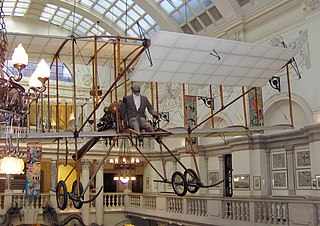
Bristol Aeroplane Company’s first aeroplane made at Filton Bristol Boxkite – Replica Bristol Museum
Frederick Bernard Fowler was born in Lewes, East Sussex in 1883, the son of a farmer. He started his training as an engineering draughtsman, possibly at Callender’s Cable & Construction Company, Erith Kent, that specialised in the manufacture of cables. He then joined Vickers, Sons and Maxim and showed a particular interest in the internal combustion engine of their 20-horse power Thorneycroft car. After five years Fowler joined the Climax Motor Company in Coventry but his interest in aviation was aroused by Blériot’s cross-channel flight in 1908. Moving to Eastbourne, Fowler, while working as a consultant engineer bought a single-seater Blériot Anzani from William Edward McArdle (1875-1935). He taught himself to fly, gaining RAeC certificate on 16 January 1912. Fowler then leased a 50 acre site to the west of St Anthony’s Hill, Eastbourne for a proposed airfield and flying school from Victor Christian William Cavendish, 9th Duke of Devonshire (1868-1938). McArdle was opening East Boldre aerodrome and flying school at Beaulieu, near Lymington, Hampshire, (see below) and he advised Fowler on the pros and cons of opening and running a flying school. McArdle allowed Fowler to use the hangars and airfield at Beaulieu while Fowler’s airfield and hangars were being constructed. At the beginning of December 1911 Fowler opened the Eastbourne Aerodrome and Flying School.
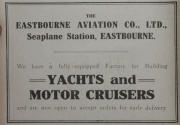
Eastbourne Aviation Co. Graces Guide
Eastbourne aerodrome had a 580 yard long runway made of wooded boards covering the intervening drainage ditches. It also had spacious hangars, well-equipped workshops and on the foreshore hangars to accommodate seaplanes. With 2 mechanics and a fleet of 3 aeroplanes, one of which was a seaplane, Fowler’s flying school opened. Pupils were taught to fly both types of planes being charged an ‘inclusive fee for tuition in one type £65 for aeroplane and £90 for both types.’ However, Fowler soon found teaching in single-seater aeroplanes both time consuming and expensive so he bought a Bristol Boxkite two-seater directly from Bristol Aeroplane Company at Filton. This was the first aeroplane to be built at Filton, for which he paid £280. Both the Flying School and the Aerodrome were profitable with Fowler continuing to expand his fleet including buying two more Boxkites. In early 1913, with the financial backing provided by Charles W de Roemer (1887-1963), Fowler joined forces with Frank Hucks Waterplane Co to form the Eastbourne Aviation Co. Ltd (EACL). They opened an aircraft factory to produce B.E.2c and Avro 504 aeroplanes. At about the same time the Admiralty leased part of the Eastbourne airfield and at the outbreak of War the RNAS took over the factory, airfield, the flying school and subsequently neighbouring land. Fowler joined the RNAS and following the amalgamation of the RNAS and the RFC into the RAF in 1918, Eastbourne Aerodrome became the training station of day bombers. At the factory, besides the aircraft already in production they also made Bristol F.2B, Airco DH.6, Airco DH.9 and Sopwith Camel. After the War the ownership of both airfield and the factory returned to EACL. They closed the airfield and the factory diversified into building motorbus bodies as well as aircraft employing 60 people. However, orders subsequently declined and the factory closed in 1924.
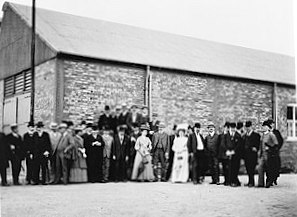
Members of the Aero Club at Royal Engineers Balloon Factory, Farnborough Common, Hampshire 1909. Wikipaedia
Between 1904 and 1906, the Army Balloon Factory together with the Army School of Ballooning, both of which were under the command of Colonel James Templer, moved from Aldershot to Farnborough Common. The name Balloon Factory was a misnomer for the remit was research, experimentation and evaluation of different types of balloons, airships and war kites. Production of successful projects were passed to the private sector that gained concessions through bidding. Typical of such a project were war kites produced by Samuel Cody’s. They were winged box kites capable of carrying a man and were of particular use in meteorology and for reconnoitering. Templer was due to retire 1906 and a new Superintendent (1906-1909) John Edward Capper (1861-1955) was appointed. However, at the time of the Templer-Capper handover, Templer was involved in the development of Britain’s first military airship the Nulli Secundus (‘second to none’) by the Balloon Factory, so stayed on until this development was completed. As the new century dawned in Germany, Ferdinand von Zeppelin (1838-1917) made the first flight of his twin Daimler engine, aluminium framed rigid airship, the Zeppelin LZ1, over Lake Constance in southern Germany. The airship remained in the air for 20 minutes but was damaged on landing. Brazilian Alberto Santos-Dumont (1873-1932), at about the same time, was experimenting with petrol engine driven non-rigid airships. He designed, built and flew around the Eiffel Tower in his first powered airship and won the Deutsche Prize in 1901.
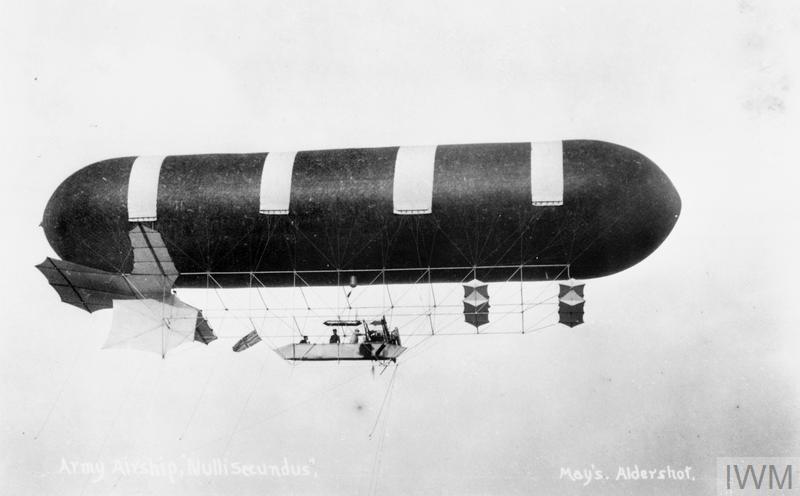
Nulli Secundus Dirigible No 1, semi-rigid airship. Britain’s first military aircraft that flew on 10 September 1907. IWM
Templer went to Paris, visited Santos-Dumont and compiled a report on his return in which he recommended that further research should be undertaken into airships. Consent was given and in 1904 work began on the first British airship, the 55,000 cubic feet Nulli Secundus. The following year, to coincide with the move to Farnborough, the airship’s shed was completed. On 10 September 1907, the Nulli Secundus inaugural flight took place from Farnborough common, not far from the Balloon Factory and was scheduled to fly over London. However, due to strong winds the Nulli Secundus was forced down and seriously damaged. Three weeks later, on 5 October, the flight was again attempted with Capper and Cody at the helm. While over London increasing wind forced her down, she was moored at Crystal Palace and eventually returned back to Farnborough. The Nulli Secundus design was scaled down and on 1 May 1909 the experimental airship, Nulli Secundus II or Baby was launched. Like the parent airship she was not a success but following modifications including a larger envelope Beta proved to be successful. She took part in Army exercises and proved that she was able to stay aloft for almost eight hours. Following which, unusually, both Beta and the Army’s third airship Gamma went into production at Farnborough.
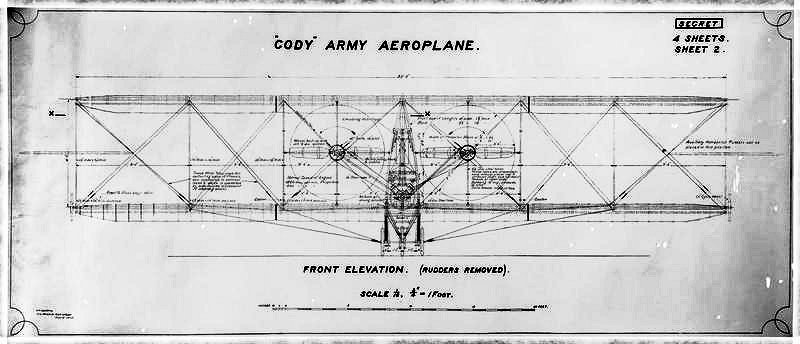
General arrangement drawing of British Army Aeroplane No 1 (Cody 1) biplane, 1909 – front view. IWM
Samuel Cody worked on the development of Britain’s first military aeroplane, British Army Aeroplane No.1. The first flight of which took place at the newly laid Farnborough Airfield on 16 October 1908. Although the flight ended in disaster for the aeroplane Cody started work on British Army Aeroplane No.2 as well as working on the Mayfly airship. Fellow aeronautical engineer in 1908-9, John Dunne, was working on secret experiments in Glen Tilt, a flat area of land in the Grampian Mountains owned by John George Stewart-Murray, Marquis of Tullibardine (1871-1942). The Marquis was an Army friend of Capper and in 1908 Blair Atholl Airfield was laid for the projects. There, Dunne developed a man-lifting glider – almost certainly a monoplane – and a tailless biplane. In 1909 Richard Burdon Haldane (1856-1928) the Secretary of State for War (1905-1912) was instrumental in setting up the Advisory Committee for Aeronautics (1909-1979). This was to ‘provide the aircraft industry with a sound body of science on which to base the development of aircraft.’ Shortly after funding was withdrawn on Cody’s aeroplane project and all of Dunne’s projects. Haldane, in October 1909 appointed Mervyn O’Gorman (1912–1916) as the first civilian Superintendent of the Balloon Factory, replacing Capper. However, Capper did remain the Superintendent of the Army Balloon School but his post was of short duration for in February 1911 it was announced that the Balloon Section, School and Factory were to be replaced. They then became the Air Battalion of the Corps of Royal Engineers and the Balloon Factory was restyled as the Army Aircraft Factory.
The British media, at the close of 1911, were reporting that other countries were actively developing their air armoury including the setting up of specialised defence divisions within their armed services. Germany that saw the future in airships, had twenty officers and 465 men in their air service. France had 8 airships, 10 aeroplanes, 24 officers and 432 men in their specialised air division. While the US had set up the American Aeronautical Division, Signal Corps, the 1st Aero Squadron having 29 factory-built aircraft. Back in February 1909, the Aerial Navigation sub-committee of the Committee for Imperial Defence recommended that all government-funded heavier-than-air experimentation should stop. Sir William Nicholson (1845–1918), the Field Marshal Chief of the General Staff 1908-1912, was quoted as saying, ‘aviation is a useless and expensive fad advocated by a few individuals whose ideas are unworthy of attention.’ On 29 September 1911, the Italo-Turkish War broke out between the Kingdom of Italy and the Ottoman Empire. The war lasted 13 months and both sides used aircraft for reconnaissance and aerial bombardment. Realising that progress in aviation, including specialist trained forces to fly and to look after machines, the lack of an air armoury could no longer be ignored. Sir William Nicholson wrote, ‘It is of importance that we should push on with the practical study of the military use of air-craft in the field… (And the) training of men … in view of the fact that air-craft will undoubtedly be used in the next war, whenever it may come, we cannot afford to delay the matter.‘ In November 1911 the Committee for Imperial Defence set up a sub-committee to examine the question of the future of military aviation.
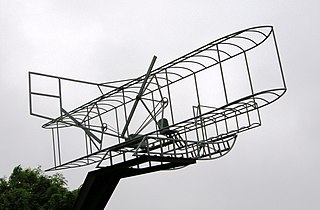
Eastchurch sculpture depicting a Short Brothers biplane. Unveiled 2009 to commemorate the centenary of British aviation. Grindtxx
The first Naval Flying School was established at Eastchurch in December 1911 due to the persistence of Francis McClean. It was he who had joined forces with the Short brothers by providing the land at Leysdown and Eastchurch for an airfield and an aircraft production factory. At the end of 1910 he offered both the Admiralty and the War Office aircraft and the Eastchuch airfield to teach naval and military personnel to fly heavier-than-air machines. Even though the RAeC offered its members as instructors the War Office declined though the Admiralty accepted. Of note, in the US, aviator Eugene Burton Ely (1886-1911) on 18 January 1911 had landed his Curtiss pusher aeroplane on a platform on the armoured cruiser USS Pennsylvania. The plane was stopped using the tailhook system designed by aviator Hugh Robinson (1881-1963). It was this feat that aroused the interest of the British Admiralty that set in motion McClean’s ambition.
1912
The sub-committee that was set up in November 1911 to examine the question of military aviation, reported on 28 February 1912. They recommended the establishment of a Flying Corps made up of a military and naval wing with a central flying school and an aircraft factory. The recommendations were accepted by Parliament and on 26 March 1912, George V (1910-1936) gave his approval to the title ‘Royal Flying Corps’ (RFC). This received Royal Assent on 13 April 1912. The RFC consisted of a Military Wing administered by the War Office and a Naval Wing supervised by the Admiralty and by the terms of its inception, the Admiralty were permitted to carry out experimentation at its flying school at Eastchurch and shortly afterwards full permission was ratified.

British floatplane with folding wings possibly a Short Type 184 1918. Wikipaedia.
The RAeC offered the Royal Navy two aircraft to train the first pilots and the first training course began on 2 March 1912. The Admiralty advertised for unmarried officers, who were able to pay the membership fees of the RAeC, to apply and two hundred did! Four were accepted and these were Lieutenant Eugene Louis Gerrard (1881-1963) who eventually became an Air Commodore. Lieutenant Reginald Gregory (1883 -1922) who worked with RNAS Armoured Car Division in Belgium and Russia. Lieutenant Arthur Murray Longmore (1885-1970) who eventually became an Air Chief Marshal and Lieutenant Charles Rumney Samson (1883-1931) who was the first pilot to take off from a ship underway at sea (see below) and eventually he too became an Air Commodore. Prior to the beginning of the course, the chosen officers received technical instruction at the Short Brothers aircraft factory and visited French aeronautical centres. A concomitant of the Naval Training School was close to the location of the Eastchurch Short aircraft factory. There, significant developments were taking place including production of folding wing aeroplanes for use aboard aircraft carriers. These days, Francis McClean’s gift is seen as the start of the RNAS.
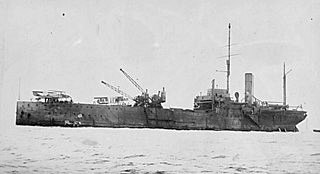
Ark Royal – the first ship designed and built as a seaplane carrier. War Department Central News Photo Service 1918
The Home fleet was restructured and came into force on 1 May 1912 when HMS Hibernia was based at the Nore. This was the naval command for the Thames estuarine area of south east of England and the Nore’s base was the naval port of Sheerness. The Hibernia was a Royal Navy King Edward VII Class pre-Dreadnought Battleship commissioned in 1907 fitted with a temporary runway on the foredeck. This consisted of a trolley-shuttle system ramp that stretched over her forward 12 inch guns from the ship’s bridge to bow. She went to sea on 9 May 1913 and on board was a Short S.38 T 2 floatplane (later called a seaplane) modified by air-bag floats as well as wheels. Charles Samson, one of the first four naval officers to be chosen to attend the Naval Training School, agreed to undertake the experiment. While the ship was underway Samson took off along the ramp and both the launch and the subsequent landing on water were successful! The Royal Navy cruiser Hermes had been adapted as a seaplane carrier and under the command of qualified pilot Captain Gerald William Vivian (1869-1921) she was ready to start undertaking trials. These proved successful but at Christmas 1913 the War Office stopped the project. Nonetheless, the Admiralty, who had been impressed by the Hermes trials, procured the Ark Royal that was being built by Blyth Shipping Company, Northumbria. Following instructions by Vivian and his team the Ark Royal was modified and as a seaplane carrier the Ark Royal was launched on 5 September 1914.
In 1912 a total of 211 pupils were being trained at the various private flying schools around the country. The largest number of these establishments were at Brookland, Hendon and on Salisbury Plain. Flying schools at Eastchurch and Upavon trained 31 pupils that year and Eastbourne 6. The other schools were at Freshfield, Farnborough, Fairlop and Windermere. The pupils were a mixture of military and naval officers as well as civilians all of whom paid for the course themselves but very few could also afford to pay to take the RAeC exam. The construction of the Central Flying School began on 19 June 1912 east of Upavon village not far from Larkhill at the edge of the Salisbury Plain.
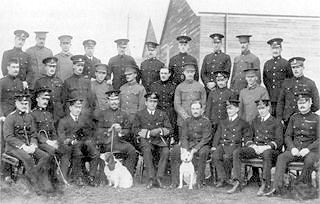
Members and Staff on the Central Flying School’s first course at Upavon. Capt Godfrey Paine RN is seated in the front row, at the centre Major Hugh Trenchard standing in the second row extreme right. Air Publication 3003
The first commandant was Naval Captain Godfrey Marshall Paine, (1871-1932) with Major Hugh Montague Trenchard (1873-1956) his assistant and ten Staff Officers. Paine had commanded torpedo schoolship HMS Actaeon when the first four naval officers who learnt to fly, Lieutenants Gerrard, Gregory, Longmore and Samson spent time there. Throughout their training, Paine had taken a keen interest in their progress and both Paine and Trenchard had learned to fly in order to take up the posts. However, although Trenchard was not a good pilot he excelled at organisation and thus, he ensured that the Central Flying School trainee pilots were well-versed in map reading, signalling and engine mechanics. Later Trenchard became known as the ‘father of the Royal Air Force’. From the outset, eighty flying students were taught on each Central Flying School course which lasted for sixteen weeks. The students did not pay for the course nor to take the RAeC exam as long as their instructors sanctioned them applying. In December 1912, 32 officers graduated with RAeC certificates.
From the outset, the Military Wing consisted of three squadrons each commanded by a Major. It was also recognised that squadrons in the field would need dedicated support beyond that provided by the Royal Aircraft Factory at Farnborough. This was assigned to the Line of Communications Workshop, later to become the Flying Depôt then at the outbreak of World War I ‘the Aircraft Park’. During this time, the Army’s Balloon Section of the Royal Engineers had been increased to two companies. Number 1 Balloon Section for balloons and airships and Number 2 for aeroplanes. Together they formed the basis of the Military Wing of the RFC founded on 13 May 1912. The Army Balloon Factory on Farnborough Common was renamed the Royal Aircraft Factory employing it’s first aeroplane designer, Geoffrey de Havilland (1882-1965)
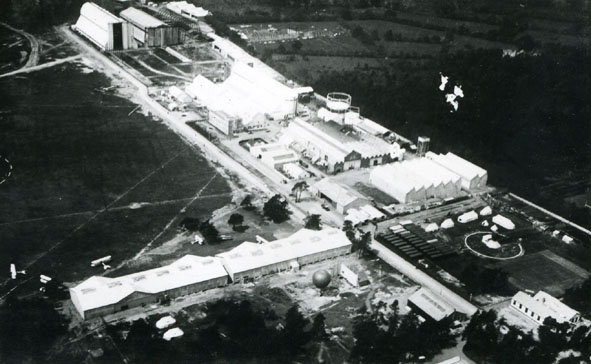
Royal Aircraft Factory at Farnborough in WWI. RE Official Photograph
In 1912 the Superintendent of the Royal Aircraft Factory (RAF) at Farnborough was Mervyn O’Gorman, a post he held until 1916 when engineer Henry Fowler (1870-1938) succeeded him. By this time the RAF was heavily involved in manufacturing aircraft for use by both the Naval and Military Wings. A role it maintained until 1918, employing many notable aviation and aerospace engineers as well as designers, including Alan Arnold Griffith (1893-1963), Henry Philip Folland (1889-1954), Samuel Dalziel Heron (1891-1963) and John Kenworthy (1883-1940). By the beginning of World War I RAF had ready for production, two effective machines, B.E.2 = the Blériot Experimental – tractor or propeller – second layout, and the F.E.2 = Farman Experimental – pusher or propeller – second layout and in both cases their derivatives. By 1918 the RAF had eleven scientific departments researching into full-scale flight and all the other scientific, design and engineering processes that are needed to support safe and effective flight.
On 1 April 1918 the Royal Air Force was formed and to avoid confusion the Royal Aircraft Factory was renamed the Royal Aircraft Establishment (RAE). Under engineer William Sydney Smith (1866-1945), Superintendent from March 1918 to 1925, the RAE relinquished its manufacturing role to concentrate on aeronautical research. This, Smith stated, was to make its resources and the results of its work, readily available to the aircraft industry in general. However, due to the serious recession that struck Britain’s economy in the 1920s retrenchment of Government expenditure reduced funding to about 20% of its 1918 level. This forced Smith to reduce the number of employees from 5,052 in 1920 to 1,316 in 1922. That year, as part of the cut backs, the Biggin Hill Wireless and Photographic Departments were transferred to Farnborough. In 1924 further savings in funding were proposed and the Halahan Committee was formed to report ‘what steps, if any, should be taken to reduce the cost without impairing its value as an experimental establishment in peacetime or its capacity to expand in an emergency’. They concluded that ‘The primary function of the Establishment is that it should provide a full-scale aeronautical laboratory for the Air Ministry.’ The Committee went on to list a number of activities that the Establishment could undertake but these remained unaltered other than the Establishment had to keep a close eye on expenditure and to find innovative ways of getting round financial inconveniences.

Memorial commemorating Samuel Cody’s first flight, Farnborough Road (A325) overlooking the airfield.
This was the remit of the Establishment at Farnborough until 1988 and proved to be both successful and financially viable. On 1 May 1988 the RAE was renamed the Royal Aerospace Establishment and the following year Farnborough housed the first civilian operations In 1991 the Ministry of Defence decided that the airfield was surplus to military requirements and should be redeveloped as a business aviation centre. The history of Farnborough airfield, on Farnborough Common, goes back to 1908, the year it was especially laid for Britain’s military aeroplane’s first flight, designed and piloted by Samuel Cody (see above). A grassy area south of the Balloon and Airship sheds at Farnborough Factory was used and following the 1924 Halahan report it’s use was specifically for looking at and dealing with problems associated with airfield runways. For instance, in the early days one of the many problems facing pilots was not being able to see the runway when trying to land, hence thought was given to runway lighting by the Establishment. A survey in the 1930s showed that even where civil airfields had installed high intensity lights, in the UK, US and Europe, accidents still happened. During WWII runway lighting was banned except in the US where experiments continued but remained fraught with problems.
In 1946, in Britain, the problem was passed to Farnborough, specifically to Edward Spencer Calvert (1902-1991). He had designed and specified the use of the spotlights that enabled the bombers of 617 squadron to carry out the attack on the Rhur dams in May 1943. Calvert, helped by another Farnborough researcher, John Sparke took up the cajole. Backed by simple practical simulations they attempted to ascertain the visual and mental processes by which a pilot lands an aircraft. They then developed a theoretical model by which different lighting systems could be compared, and tested the theoretical results using simulation on a cyclorama, a panoramic image on the inside of a cylindrical platform designed to give viewers standing in the middle of the cylinder a 360° view. This demonstrated conclusively that the mental processes by which visual judgements on the present position of the aircraft, aiming point and the rate of change of position were extracted from the changing perspective of lighting patterns. They aimed to provide smooth transition from instrument to visual flying without optical illusions, and to provide sensitive and natural indications which could easily be interpreted by the average pilot. The approach lighting pattern should consist of a centre line of light with horizontal bars of light running transversely across it at even intervals. This pattern consists of two basic elements – a line of lights leading to the runway threshold, and horizontal lights to define the altitude of the aircraft. Calvert was the first to realise that it was easy to confuse lateral displacement with angle of bank so placed much stress on roll guidance.

Calvert cross-bar airfield lighting system. CAHS Collection
The Calvert cross-bar system, as it is called, does not indicate a defined glide path, but the widths of the horizon bars take him to the correct touch down point. If a pilot maintains a glide each bar will appear to be the same width as the previous one as it disappears under the nose of the aircraft. Distance was indicated by using single lights in the centre line to indicate 1000 ft or less from the threshold, double lights for 1000-2000 ft and triple lights for 2000-3000 ft. In 1948 a temporary cross-bar approach lighting system was installed on the Farnborough airfield. Following its success the system was adopted for London Airport at Heathrow. On 24 June 1948 the Soviet Union blocked the Western Allies’ railway, road, and canal access to the sectors of Berlin under Western control. Britain and the US responded by airlifting food and fuel to Berlin from Allied airbases in western Germany but landing in Berlin was fraught. Calvert and Sparkle flew to Berlin and installed their lighting system. Pilots found this easier to use than being talked down by the control tower and the system radically speeded up the airlift. The outcome was that the Soviet forces lifted the blockade on land access to western Berlin on 12 May 1949. Following the Berlin airlift, the Calvert cross-bar system was widely employed throughout the World.
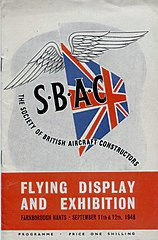
Farnborough Airshow Programme 1948. Wikimedia
Due to the development of heavy bombers in WWII concrete runways were laid at Farnborough Airfield. They were extended when, post-war, the Establishment became the centre for excellence in experimental aircraft and research. High speed wind tunnels and high pressure technologies to supersonic levels were introduced. In 1946 work began to convert RAF Thurleigh into RAE Bedford as a subsidiary of the Establishment and in September 1948, the first Farnborough Airshow took place. This enabled the public to see what developments were taking place and over the following years, the event grew to become the second largest airshow of it’s kind, only to the Paris airshow. Further, experimental research also continued especially the updating of the wartime makeshift ways of dealing with problems. One such problem was landing aircraft in poor visibility conditions and to deal with this the Blind Landing Experimental Unit (BLEU) was formed. They were tasked with creating an early autolanding system for military and civilian aircraft. Initial research led BLEU to conclude that blind landing would be best achieved with a fully automatic system by increasing the accuracy of the Instrument Landing System (ILS). This had been developed during WWII but increasing the accuracy was subject of numerous experiments and trials. Favoured was ‘Lateral Guidance’ that was enhanced using mile long magnetic leader cables extending from each end of the runway together with an improved FM radio altimeter developed by BLEU. Although this was capable of resolving height differences to 2 feet at low altitude, most airports did not have room for mile long cables so the system was replaced by a radio-based solution.

Farnborough Airfield 2010 geograph.org.uk9
On 3 July 1950 Flight Lieutenant Noel Adams made the first automatic landing in BLEU’s test plane, a Vickers Varsity. In the following 20years BLEU, in conjunction with UK industry and the UK airworthiness authorities, was responsible for almost all the pioneering work needed to convert the concept of those experimental demonstrations into safe accurate blind landings by civil and military aircraft. On 4 November 1964, Captain Eric Poole landed a British European Airways (BEA) flight at Heathrow with visibility of 40 metres, which was the first use of the system to land a commercial flight in such severe conditions. R W Howard in his essay ‘Progress in the use of automatic flight controls in safety critical applications’, published in The Aeronautical Journal, October 1980, p. 318 reported that ‘the Trident had carried out more than 50,000 in-service automatic landings. The VC10 accrued 3,500 automatic landings before use of the system was curtailed in 1974 for economic reasons. By 1980, Concorde had performed nearly 1,500 automatic landings in passenger service.’ Airfield research continued and in 1961, the world’s first grooved runway for reduced aquaplaning was constructed. However, as noted above, in 1991 the Ministry of Defence decided that Farnborough airfield was surplus to military requirements and was put on the market. TAG Aviation, an acronym of Techniques d’Avant Garde, a company that generates revenue through its various subsidiaries that offer products and services in the business aviation industry, won the bid. They took over in 1997 and in 2003 TAG Farnborough Airport Limited took full control under a 99 year lease as a fully compliant CAA airport for business aviation. Four years later TAG bought the airfield freehold and in 2019 the shareholders sold TAG Farnborough Holdings Limited to a long-term infrastructure fund managed by Macquarie Infrastructure and Real Assets (MIRA). The package included the airport, Aviator Hotel and the Swan pub.
Back in 1912, Farnborough airfield was at the beginning of its prodigious career in research aeronautics. For the first six months of that year the Secretary of State for War, Viscount Haldane, was desperately trying to achieve détente with Germany, earning the name Haldane Mission. The German Empire had recently passed the fourth Flottengesetze that increased the size of her navy. This was justified by the 1905 Schlieffen plan of preparing to take the offensive against the perceived attack. This, the German’s believed was about to be launched by France and if war resulted Germany wanted Britain to remain neutral thereby reinforcing their claim that Germany was not the aggressor. Haldane could not accept this and in consequence the Mission not only failed but also forced the introduction of the 1912 Anglo-French Naval Agreement. The Agreement was an extension of the 1904 entente cordiale between France and Britain. In June 1912, following the retirement of the Lord Chancellor, Haldane was promoted to succeed him and John Edward Bernard Seely (1868-1947) was appointed Secretary of State for War (1912-1914). Seely was a yeomanry colonel and from the outset was active in preparing the army for war with Germany. Further, he was also particularly interested the development of the RFC.
However, there were many both in Parliament and in the media, who argued that Churchill and Seely were over reacting and in particular were exasperated over the establishment of the RFC. Aeronautics, they said, was no more than a dangerous pastime for rich gentlemen and therefore the RFC was a waste of public money. In May 1912 in the House of Commons, this disapproval was levelled at Seely who responded by telling Members that the RFC had five aeroplanes that could fly 70 miles per hour and that there were 15 more on order. ‘The Corps also had 26 trained military pilots,’ he added, ‘with another 36 expected to graduate in December by which time the number of aeroplanes would have increased significantly.’ Winston Churchill, agreed adding that Germany had five rigid airships, one military, one naval, two civilian and one experimental. He went on to say that opinions differed as to which were better, airships or aeroplanes and the subject was still receiving the attention of the Admiralty. Nonetheless, ‘the Navy would continue to endorse the growth of aeronautics as part of the country’s defence.’ Dover’s Member of Parliament, George Wyndham, (1863-1913) supported both Ministers, making it clear that in his opinion, more money should be spent on increasing the number of aircraft, airfields and pilots.
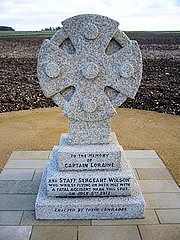
Memorial to Captain Loraine and Staff Sergeant Wilson killed 05.07.1912 when their plain went into a spin. Ashley Columbus
Nonetheless, it was agreed that with the opening of Upavon airfield, Larkhill would close by 1914. This sad demise of Larkhill airfield was given in May 1912 when the first RFC squadron to use aeroplanes, No.3 Squadron, Royal Flying Corps, was renamed at Larkhill aerodrome. The Squadron evolved out of No. 2 Company of the Air Battalion Royal Engineers. Further, two of their members on 5 July 1912, Captain Loraine and his observer Staff Sergeant Richard Hubert Victor Wilson (1883-1912), left from Larkhill airfield but shortly after their aeroplane went into a spin, crashed near Stonehenge on Salisbury Plain and both were killed. A memorial was originally erected near the A303 road but later moved to a site near the Stonehenge visitors’ centre in 2013. The accident added to the despondency of the other aviators moral in the Squadron but later that day the order ‘Flying will continue this evening as usual’ was issued setting a tradition that still holds today in the RAF.
In August 1912, the first Military Aeroplane Trials were held at Larkhill aerodrome rather than Upavon, before a military team headed by Brigadier-General Sir David Henderson (1862-1921). Thirty different aircraft, based on eight different designs, were assessed and each plane had an RFC’s trained military pilot on board. Two were biplanes based on the Blériot Experimental or BE series of monoplanes built by the Royal Aircraft Factory. For the trial, Edmond Perreyon (c1882-1913) flew these. There were two built by René Hanriot (1867-1925) one of which was flown by Major Sydney Vincent Sippe (1889-1968) and the other by Juan Bielovucic (1889-1949). There was also a Maurice Farman biplane flown by Pierre Verrier and a French Deperdussin Monocoque flown by Maurice Prévost, (1887-1952), a Cody V Riplane flown by Sam Cody and finally a Coventry Ordnance aeroplane flown by Tommy Sopwith. The challenge was to assemble the planes and then to carry a load of 350lb and included fuel and oil to last 4hours 30 minutes along with a passenger for 3hours. The aeroplane had to maintain an altitude of 4,500feet for one hour, the first 1,500feet could be gained at 200feet a minute although 300feet a minute would be ideal.
The weather was stormy on the day of the test, and the first part – preparation of the aeroplane, showed a huge variation in the length of time taken, from 14 minutes 30 seconds to 116 minutes 55 seconds! Except for the Coventry Ordnance and one of Hanriot’s aeroplanes, the other aeroplanes completed the test successfully. The Hanriot’s number 1 flown by Bielouvucic retired, while the Coventry Ordnance was forced to land after 25 minutes. The passenger in the latter was Major Henry Robert Moore Brooke-Popham (1878-1953) – later knighted and becoming the Air Chief Marshal of the Royal Air Force – who reported that a valve spring regulating the petrol supply had broken. Sopwith repaired the faulty valve spring and again set off, managing to fly the furthest distance.

BAC hangars at Larkhill, remains of the first military aerodrome in Britain. Ranger Steve
The competition was won by Sam Cody and not only were the military and Parliament interested in the outcome of the trials but also Prince Edward (1894-1972), the Prince of Wales and the future Edward VIII (1936), who was to actively support the RFC. That year, the estimate for government spending on air defence was £85,000. Larkhill airfield continued to be used both for trials of prototype aircraft and by the Bristol Aeroplane Company (BAC) flying school. But in June 1914, only months before the outbreak of War, the airfield was formally closed and hutted garrisons were built over the airstrip. The original Bristol Aeroplane Company hangar remains and is the oldest surviving aerodrome building in the UK. It was given Grade II* listed building status in 2005 and is at the corner of Woods Road and Fargo Road.

Swingate Down Map inc Military area, WWI Airfield, Masts, Memorials, Fort Burgoyne, South Foreland & St Margarets LS
At Swingate in east Kent, due to the mounting demands of a possible war and the fact the the aeroplane as a form of defence was held in low esteem, the training of ground forces became paramount. The increasing number of military exercises on the site ensured that Swingate ceased to be used as an aerodrome and all aeronautical buildings etc. reverted to ground military use. Then on 14 October 1912, a 450-foot long Zeppelin paid a clandestine visit to north Kent. Shortly afterwards the War Office made £45.000 available to extend the Swingate site and to build the largest flying depot in the country. The Commander was Major Hugh Caswall Tremenheere Dowding (1882-1970), later commander-in-chief of Fighter Command, Royal Air Force, from its formation in 1936 until November 1940 and is generally credited with playing a crucial role in Britain’s defence during the Battle of Britain 1940 (1940). The new airfield, named Dover (St Margaret’s) aerodrome, was formally established in June 1913. Its old name of Swingate elevated to aerodrome was affectionally retained.
The new aerodrome on the top of cliffs overlooking Dover harbour covered 219acres with three large hangars constructed of brick 180 feet x 100 feet and twelve portable timber and canvas Bessonneau hangars. Besides the hangars, the site had administrative and recreational buildings, workshops, motorised transport garages and a coal yard. During October and November 1913, two Maurice Farman biplanes arrived with the pilots, and ground crew all of whom were billeted in the nearby former Langdon Prison. With the possibility of more men arriving it was decided to accommodate them in Nissen huts – prefabricated steel structures made of arcs of corrugated iron that could be assembled in a few hours. When completed, the aerodrome was categorised as First Class with a squadron based there.
Although formed of an Army and a Naval branch of the RFC, the two branches operated separately and the Admiralty set up their own Air Department. In September 1912 Captain Sueter, who had overseen the failed Mayfly airship experiment, was appointed Director of the newly formed Air Department. Not long before Sueter had given his blessing to Commander Oliver Swann (1878-1948), to take off from salt water, the first British pilot to do so and a naval officer too! Swann was appointed assistant director and although the Admiralty Air Department was unofficially known as the Royal Navy Air Service (RNAS), together for the following two years Sueter and Swann worked to officially establish the RNAS. During that time the Admiralty established a ‘regular chain of stations for naval aircraft along the coast of the United Kingdom within easy flight of each other.’ The first air station was , approved on 3 December 1912. This was at the Isle of Grain on the Hoo peninsula on the Medway, Kent. Known as the Isle of Grain Air Station it was commissioned on 1 January 1913 under the command of Lieutenant John Wilfred Seddon (1886-1969), R.N. At the time of his appointment Seddon together with A.G ‘Willy’ Hacket designed a tandem biplane with the bracing constructed with crossing hoops instead of struts and ties. They too named their invention ‘Mayfly’ and in some write ups Seddon’s biplane is confused with Sueter’s airship experiment of the same name.
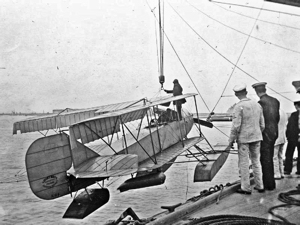
Short Folder seaplane (S.64), serial number 81, being hoisted out from the Royal Navy ship Hermes with wings folded. wikimedia commons
Grain air station, by the outbreak of WWI, was one of the largest seaplane stations in the country employing some eight hundred workers. The Grain air station was used as an holding unit for reserve Short and Sopwith seaplanes for the forward bases at Westgate, Kent and Clacton, Essex. From early 1915 it was upgraded to Grain aerodrome with an airfield formed over boarded dykes and Bessoneaux hangars were also erected next to seaplane sheds inside the sea wall. As the newly formed R.N. Aeroplane Repair Depot it was commissioned under Squadron Commander G. W. S. Aldwell and named Port Victoria Marine Experimental Aircraft Depot. Later in 1915, the Experimental Armament Section was set up beside the Repair Depot where they evaluated British and German equipment. included were such devices as the Davis recoilless gun and the Rankin anti-Zeppelin explosive dart. Early the following year the Seaplane Test Flight and the Experimental Construction Depot came into being. While in three large sheds work was undertaken to modify the Sopwith Baby with high-lift wings for use at sea. This was designated the PV1 (for Port Victoria) and was the start of a number of Port Victoria designs. The Depot also redesigned other aircraft for use at sea and were produced under the name Grain Griffin. The Seaplane Test Flight had become a separate organisation with hangars and tested both land and seaplanes involved in a number of diverse experiments. One such instrument were hydrophones that went on to be used by the Dover Patrol to detect submarines under the water. During this time the Isle of Grain Airfield and sheds remained as an Acceptance Depot and also the administrative unit for the different sections that between them occupied 15 separate buildings.
Three slipways had also been cut and a large accommodation camp housing some 1,500 staff had been built nearby. Albeit, when in 1917 saw the amalgamation of the Army’s Royal Flying Corp and the Navy’s Royal Naval Air Service to form the RAF, there was an obvious duplication of facilities. Following the War, excepting the seaplane station, the different sections were amalgamated and the Depot retained the Seaplane Test Depot while the Aeroplane Repair Depot was renamed the Experimental Construction Depot. The airfield was part of the Experimental Aircraft Depot and a 200 feet diameter dummy ships deck with various arrangements of arrester wires was constructed for ship landing trials. The seaplane station was integrated into the newly formed RAF and renamed the Marine Aircraft Experiment Station where they tested all new seaplanes. During these years. Shorts aircraft company also used the facilities to test their seaplanes. On 16 March 1920 to recognise that the new Experimental Armament Section was added where weapons and other equipment were evaluated it was renamed Marine and Armament Experimental Establishment and the name changed again on 1 March 1924 when it became the Marine Aircraft Experimental Establishment. It was then moved to Felixstowe and the Isle of Grain facilities closed.
1913
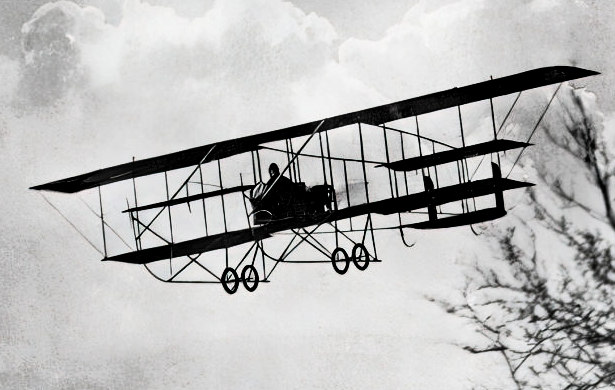
Upper Dysart Farm first biplane sighted landing 26 February 1913
Churchill, seeing that Germany was beginning to consider the North Sea as their own demanded that a second air station was to open at Montrose, Scotland, to protect the Royal Navy bases at Rosyth, Cromarty and Scapa Flow. On 13 February 1913, five RFC military aircraft took off from Farnborough and flew north. On 26 February they landed three miles south of Montrose at Upper Dysart Farm and the first operational military RFC airfield in Scotland opened! However, for a number of reasons the site was far from adequate and within a year closed.
However, Upper Dysart has left an aeronautics ghost story legacy that concerns a military RFC pilot, Lieutenant Desmond Arthur (1884–1913). From Ireland, the experienced aviator was described by his colleagues as having an ‘unassuming manner and unfailing good spirit’. On Tuesday 27 May 1913 about 07.30hrs, Arthur was on a routine training flight about 2,500 feet above Upper Dysart airfield in a B.E.2 biplane when the right wing of the aircraft snapped off. As the aircraft plunged, Arthur was thrown out and died of his injuries. The Accidents and Investigation Committee of the RAeC found that the accident was due to an incompetent repair of a broken spar by an unknown mechanic. However, the official investigation, undertaken by a government committee, concluded that it was Arthur’s fault due to dangerous flying. Following public demands, a brief official investigation by a government committee was carried out on 3 August and they upheld the findings of the official investigation. Following the publication of the report the ghost of Lieutenant Arthur was frequently reported flying over Upper Dysart Farm. Towards the end of 1916 a more in-depth official inquiry took place and although this concurred with the findings of the RAeC investigation and Arthur’s reputation was cleared, his ghost continues to be seen. Particularly by pilots or passengers in planes, flying in the area of what had been Upper Dysart airfield.
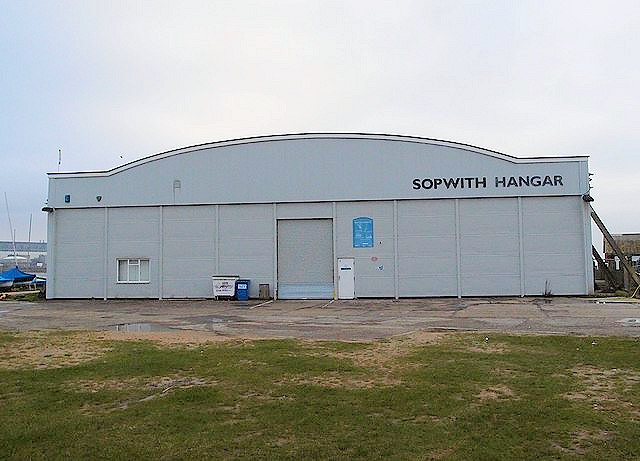
Sopwith Hangar Calshot. geograph.org.uk Michael Ford
Concerned over the country’s vulnerability because of the close proximity Continent led, on 28 March 1913, to the Admiralty taking over Dover’s Promenade Pier as part of their Admiralty Harbour defences and to renamed it the ‘The Navy Pier.’ The following day Calshot Naval Air Station, located at the end of Calshot Spit in Southampton Water, Hampshire opened. The station’s purpose was to test seaplanes for the RFC Naval wing. The first aircraft to be assessed was the Sopwith Bat Boat, a single-engine pusher biplane that proved to be the first successful flying boat and amphibious aircraft built in Britain. One of the buildings to accommodate the Sopwith Bat Boat and other seaplanes brought for testing was the Sopwith Hangar that is still there today.

Dover Castle where experiments took place in wireless telegraphy that led to the creation of the Headquarters Wireless Telegraphy Unit (HQ WTU) on 27 September 1914
RFC Dover (St Margaret’s) later RAF Dover was first established at Swingate Downs as a stopping-off point for aircraft pilots before making the crossing to France from the aerodrome. The Royal Engineers were based at Dover Castle, adjacent to Swingate Downs where Major Dowding was in command. In March 1913 an experimental branch of the Military Wing of the RFC was formed that included research in ballooning, kiting, photography, meteorology, bomb-dropping and wireless telegraphy. Major John Nassau Chambers Kennedy (1865-1915) of the Royal Engineers was in charge of communications at the Castle and as a young Captain, Kennedy had witnessed Marconi’s experiments in wireless communication on Salisbury Plain. In consequence he saw the potential of wireless communication for the armed services and subsequently assisted Marconi with many experiments and demonstrations in that sphere. With Dowding’s blessing, Kennedy, set up a wireless for military use and housed in a decommissioned battery in the Castle grounds and it was agreed that Kennedy’s team could undertake experiments in wireless telegraphy in relation to aircraft at RFC Dover (St Margaret’s). The work carried out by Kennedy and his second in command, Captain Baron Trevenen James (1889-1915), led to the creation of the Headquarters Wireless Telegraphy Unit (HQ WTU) on 27 September 1914. Of note, in 1938, before the outbreak of World War II RAF Dover was re-established as a Chain Home radar station.
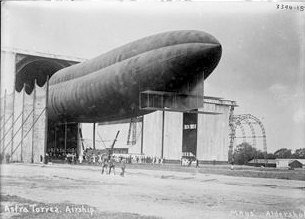
Astra-Torres, Airship Farnborough 1910 Library of Congress
On 16 April 1913 ten naval officers graduated at the Central Flying School and by 7 June, 44 officers and 35 other ranks had also been trained. At Eastchurch 35 officers and men had been trained in airship work. In September 1912 three non-rigid airships, the Willows No. 4, Astra-Torres and Perseval PL 18 were bought by the Admiralty for £1,050. The Admiralty ordered that Willows No. 4, 24,000 cubic feet capacity envelope was to be expanded to 39,000 cubic feet. It had a keel on which was mounted a 35-horsepower Anzani engine driving two four-bladed steerable propellers. Below was suspended a two-man gondola that was replaced by a three-man version with dual controls in 1914. In WWI the envelope was used for the prototype for the successful SS class airship that was used for anti U-boat activities. The Astra-Torres airship was designed by Spanish Leonardo Torres Quevedo (1852-1936) and built by Société Astra in France. The Admiralty also bought AT-14, AT-17 and AT-19 and renamed them HMA No. 3, HMA No. 8 and HMA No. 16 respectively. The third airship, Perseval PL 18 was designed by German August von Parseval (1861-1942) and built by the German company Luft-Fahrzeug-Gesellschaft (LFG). It was 80metres in length with a diameter of 15 metres with two 132kilowatt (177-h.p.) engines and a speed of 68kilometres per hour. The gondola was fitted with radio and weaponry and carried two men. It was to serve as a patrol airship during WWI and proved to be popular.
The Royal Naval Air Service in 1912 undertook surveys for suitable land on the coast of East Anglia where seaplanes could be handled and launched, similar to their established base on the Isle of Grain. They eventually chose two sites, one at Great Yarmouth, Norfolk and the other at Felixstowe in Suffolk. The Great Yarmouth RNAS aerodrome was built on the old racecourse at South Denes and the seaplane beach on the adjacent foreshore. It was commissioned on Sunday 13 April 1913 and soon two sets of service buildings, hangars and hard standings were erected. In-between an approximately 580metre long runway, varying in width between 20metres and 40metres, was laid. On the foreshore two large seaplane sheds approximately 62metres by 32metres were erected and two smaller sheds. All four sheds according to a 1918 survey have ‘T’ shaped areas that were not surfaced with concrete and are believed to be inspection pits or dry docks for undertaking maintenance on the seaplanes. By the outbreak of World War I the aerodrome was equipped as both a landing and seaplane base and as the War progressed the station was supported by six landing grounds. On 9 January 1915 Great Yarmouth was on the receiving end of the first aerial attack in Britain by a Zeppelin airship and two townsfolk were killed. At the time the Squadron Commander was de Courcy Plunket Ireland (1885-1915) but a month later he was killed while undertaking a full experimental flight at RNAS Kingsnorth (see below). He was the co-pilot with Neville Usbourne and they were trying to launch a fighter aircraft from a non-rigid patrol airship once a Zepplin had been located. After the war, Great Yarmouth airfield was used for commercial flights until the 1930s.
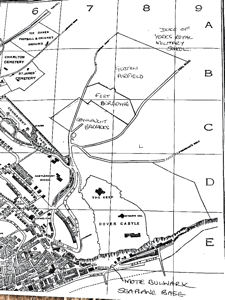
Schematic Map of Dover showing location of the Dover Seaplane Base & Guston Road Airfield
In June 1913, Guilford Battery, Marine Parade, Dover and the surrounding grounds below Dover Castle, with the roller-skating rink, dance hall and open air theatre there, were requisitioned by the RNAS for the Royal Naval Seaplane Patrol. Three hangars for seaplanes were built on the site of the open-air theatre, the skating rink was converted into workshops and a training school and a mess room, accommodation, stores, and administration buildings were built. The whole came under the command of Sheerness Naval District and was officially named the Dover Hydro (Marine Parade) Aeroplane Station and came into operation on 18 November 1914. However, from 3 September 1914 and the outbreak of War, seaplanes were sent from Eastchurch to Dover and the station became better known as the Dover Seaplane Service. Requiring an emergency landing base in Flanders on the opposite side of the English Channel, the RNAS were given the use of St.Pol-du-Mer, Aerodrome Dunkirk. This opened on 28 September 1913 and had been designed as an extension of the nearby port of Dunkirk, hence it had facilities for seaplanes. The aerodrome was on the site of a former sanatorium and as some of the buildings were still standing, they were used by the RNAS who erected a large tent that could hold some 20 aircraft and although it had been envisaged that the RNAS would only use Dunkirk for emergencies with the outbreak of War the French authorities commandeered the aerodrome for both their airforce and the RNAS.
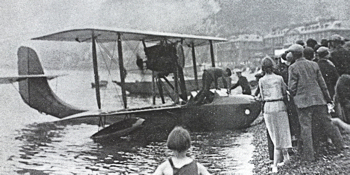
Short type 74 seaplane having landed in Dover Harbour, Dover Express 13 July 1914
As for the Dover Seaplane Service, in early September 1914 Germany swept through Belgium routing the Belgian army and announced that Allied shipping would be sunk in the English Channel. The first German submarines appeared in the Channel around the middle of September with the Aboukir, Hogue and Cressy sunk off Zeebrugge. The Admiralty ordered a minefield to be laid across the eastern entrance to the English Channel, between the East Goodwin Lightship and Ostend. The Scout, Attentive, was attacked by a U-boat (submarine) on 27 September and the Admiralty replaced them by the Dover Patrol with the Dover Seaplane Service working closely with the Patrol. Their job was to protect British supply lines through the English Channel. The work of the Dover Patrol is legendary and on 23 April every year in Dover the famous Zeebrugge Raid of 1918 is commemorated. In 1915 an associated airfield was opened at Guston Road, Dover (see below) and in May 1917, due to the threat from German Gotha bombers, emergency landing grounds were set up across Kent. One of these was opened at Hawkshill Down, Walmer near Deal. The only time the Dover Seaplane station was damaged by enemy action was in October 1917 when a Gotha bomber dropped its load along Dover seafront. The Dover Seaplane service was active throughout the War and was closed in 1919.
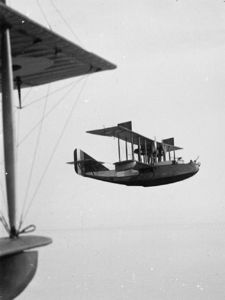
WWI Felixstowe flying boat F.2A N4297 in flight. Imperial War Museum Wikimedia Commons
Landguard, Felixstowe in 1912 was chosen by the RNAS as the second suitable site in East Anglia as a base for Naval hydroplanes or seaplanes as they are better known (see Great Yarmouth above). The Felixstowe base was commissioned 5 August 1913 on the River Orwell under the command of Captain Charles Erskine Risk, as Seaplanes, Felixstowe. The station was similar in layout to the seaplane stations established on the Isle of Grain and Great Yarmouth. During the War, RNAS Felixstowe became the largest operational seaplane station in the United Kingdom. It was also the testing base for experimental seaplanes. From 1915 Felixstowe was under the command of Lieutenant-Commander John Cyril Porte (1884-1919) and at the time the station was equipped with Curtiss flying boats. Porte improved their hull designs, before developing the Felixstowe flying boats from those experiments. Although the flying boats were generally known by the Felixstowe name, excepting prototypes they were produced by British aircraft manufacturers such as Short Brothers, Phoenix Dynamo of Bradford and under licence in the USA. From 1917 Dick, Kerr and Co of Preston produced aircraft fuselages for the Felixstowe F.3 flying boat, which was to be flown from South Shields. Although 50 F.3 were ordered and 82 F.5, the order was cancelled at the end of the war with only 11 and 3 respectively completed.
On the formation of the Royal Air Force on 1 April 1918, the Felixstowe unit was renamed the Seaplane Experimental Station but was disbanded in June 1919. From 1 April 1924 until World War II the base and its facilities were used by the Marine Aircraft Experimental Establishment. As before, although seaplanes and flying boats were designed and prototypes were produced there mass production was undertaken by established manufacturers. In 1931, Frank Whittle (1907-1996), engineer and inventor and noted for the turbojet engine, was posted to Felixstowe as an armament officer and test pilot of seaplanes. It was while he was at Felixstowe, it is believed that, Whittle wrote the draft on his turbo-jet idea. Felixstowe was the base of the 1931 Schneider Trophy team that secured the trophy for the UK permanently. The Trophy was awarded annually, later biennially, to the winner of a race for seaplanes and flying boats and was particularly significant in advancing aeroplane design in the fields of aerodynamics and engine design. Felixstowe closed 20 August 1962.
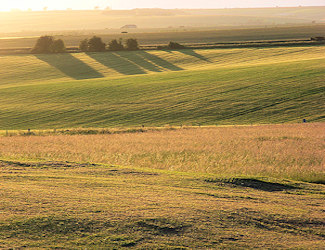
Netheravon Airfield downland. Andrew Smith geograph.org.uk 2008
Like the Admiralty, the Army was also looking for suitable places for their operational bases as the Military Wing of the Royal Flying Corps and they received the Royal Warrant on 13 April 1912. Towards the end of that year they chose a site close to Choulston Farm within the War Office owned area of Salisbury Plain. The nearest village, Netheravon on the River Avon is about 4 miles north of the town of Amesbury in Wiltshire and they named the site Choulston Camp. Prefabricated buildings of a standard design that included officers’ and airmen’s accommodation with their associated messes, were quickly erected and a grass strip airfield was laid. As access to the site was along a road from Netheravon, the name of the new base was changed to Netheravon Airfield, and it became the World War I prototype-flying base built by the Army. On 16 June 1913 two squadrons arrived No 3 and No 4 RFC and in spring the following year the Royal Flying Corps held the Netheravon Concentration Camp. Under the leadership of Colonel Frederick Hugh Sykes (1877-1954) the commander of the Military Wing of the RFC. The idea was for squadrons of the corps to undertake concentrated training exercises and practice mobilisation. Altogether there were approximately 60 aircraft, 150 vehicles, with 700 officers and men obliged to attend. Most of the flying training took place in the morning while the afternoons were given over to committees and lectures where officers and men were expected to share their knowledge and gain practical experience. On Wednesday and Saturday afternoons sporting events were held and on Monday 22 June 1914, a flypast was organised for the birthday of King George V (1910-1936).
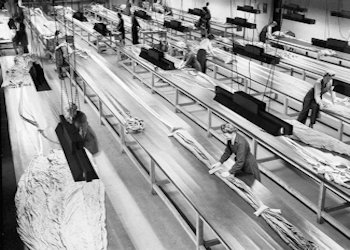
Parachute packing room, Allied Expeditionary Air Force Headquarters No.38 Group RAF Netheravon, 1939-1945. IWM
In August 1914 Nos. 3 and 4 squadrons left Netheravon for Swingate, Dover before crossing the Channel to France and support the British Expeditionary Force. A few days later War was declared and Netheravon was designated a forming-up station for new squadrons with No 1 squadron in charge of training. By early 1915 the base had become No. 8 Training Depot Station training aircrew, ground crew, specialist signalers and fitters. Although still a training centre in 1918 Netheravon was designated a bomber base and hangars were built but this idea was abandoned as the War was drawing to a close. The base was briefly used for the dissolution of squadrons and in 1919 it became No 1 Flying training school. From 1924, for four years, crews were trained for the newly formed Fleet Air Arm but by 1931 the economic depression put all training on hold. In 1935 training was resumed and during World War II Netheravon, besides training pilots, trained Fleet Air Arm aircrew in 1941 before their relocation in the United States and glider pilots in 1944 in preparation for the invasion of Normandy. It was also the Headquarters of the Allied Expeditionary Force No.38 Group. For squadrons to recoup, throughout the War Netheravon was one of the most popular short stay bases. Following the War, Netheravon was used for a variety of purposes including RAF Police training then in 1963 it was transferred to the Army Air Corps. The 7 Army Aviation Regiment was formed there in 1969 and renamed two years later as the 7 Regiment Army Aviation Corps. In 1995 it became a volunteer Territorial Army regiment and later moved to Middle Wallop in 2009. During that time until 2011 Netheravon was also the home of the Brigade of Gurkhas. It is now the Joint Services Parachute Centre for serving and injured personnel as well as the base of the Army Parachute Association, a charity that supports sports parachuting for serving and retired personnel.
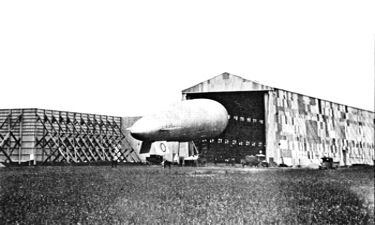
WWI Airship shed at Capel Aerodrome and an SS12 airship Dover Transport Museum
At about this time the Ministry of War was taking over much of the coast of Kent and erecting defensive military structures. Before the War the ground on the opposite side of the road to the Royal Oak pub in Capel-le-Ferne between Dover and Folkestone had been used by civilian aircraft. 240 acres of fields, on the other side of the road, became an RNAS airship station and the original airfield’s grass runway was made fit for purpose. Three large hangars were erected along with accommodation and the associated messes, ancillary buildings, pits for anchoring airships and a perimeter road. The former airfield was designated Capel Aerodrome (also known as Folkestone airfield) a Class C RNAS airship station. It came into operation on 8 May 1915 and was destined to become one of Britain’s most important airship stations during the War. Albeit, initially ex-Army non-rigid airships Beta II designated as RNAS HMA No.17, Delta designated as RNAS HMA No.18 and a Gamma II RNAS HMA No.19 made up Capel’s fleet. modification-of-ss-airship-by-capel-engineers-folkestone-library.jpg
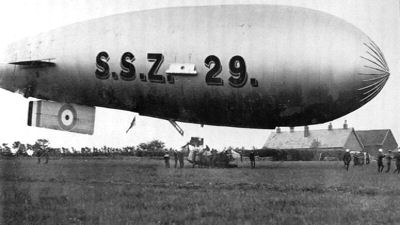
Blimp SSZ airship. Successful modification of SS airship by Capel engineers. Folkestone Library
Following a meeting headed by John Arbuthnot Fisher (1841-1920) – Admiral of the Fleet (1914-1915), a prototype designated ‘Sea Scout’ (SS) class seaplane was created at RNAS Kingsnorth (see below) by a team led by Neville Florian Usborne (1883-1916). The seaplane had a Royal Aircraft Factory B.E.2c (B.E. = Bleriot Experimental) aeroplane fuselage and engine without wings, tailfin or elevators. The fuselage and engine were slung below an envelope taken from a disused Willows No. 4 airship designated as HMA No. 2. The prototype was ready for evaluation trials within a fortnight of approval being granted for the scheme and on 18 March 1915 the first SS class airship, nicknamed ‘Blimp’, entered service. The name is attributed to the original commander of Capel Airstation, Lieutenant Alexander Duncan Cunningham (1888-1981), who apparently caught his thumb in the tight inflated fabric envelope of the SS 12 airship and it made the unusual ‘Blimp’ noise. The name is also claimed by Short’s Factory at Kingsnorth, who made the plane, as been given by Horace Short in February 1915!
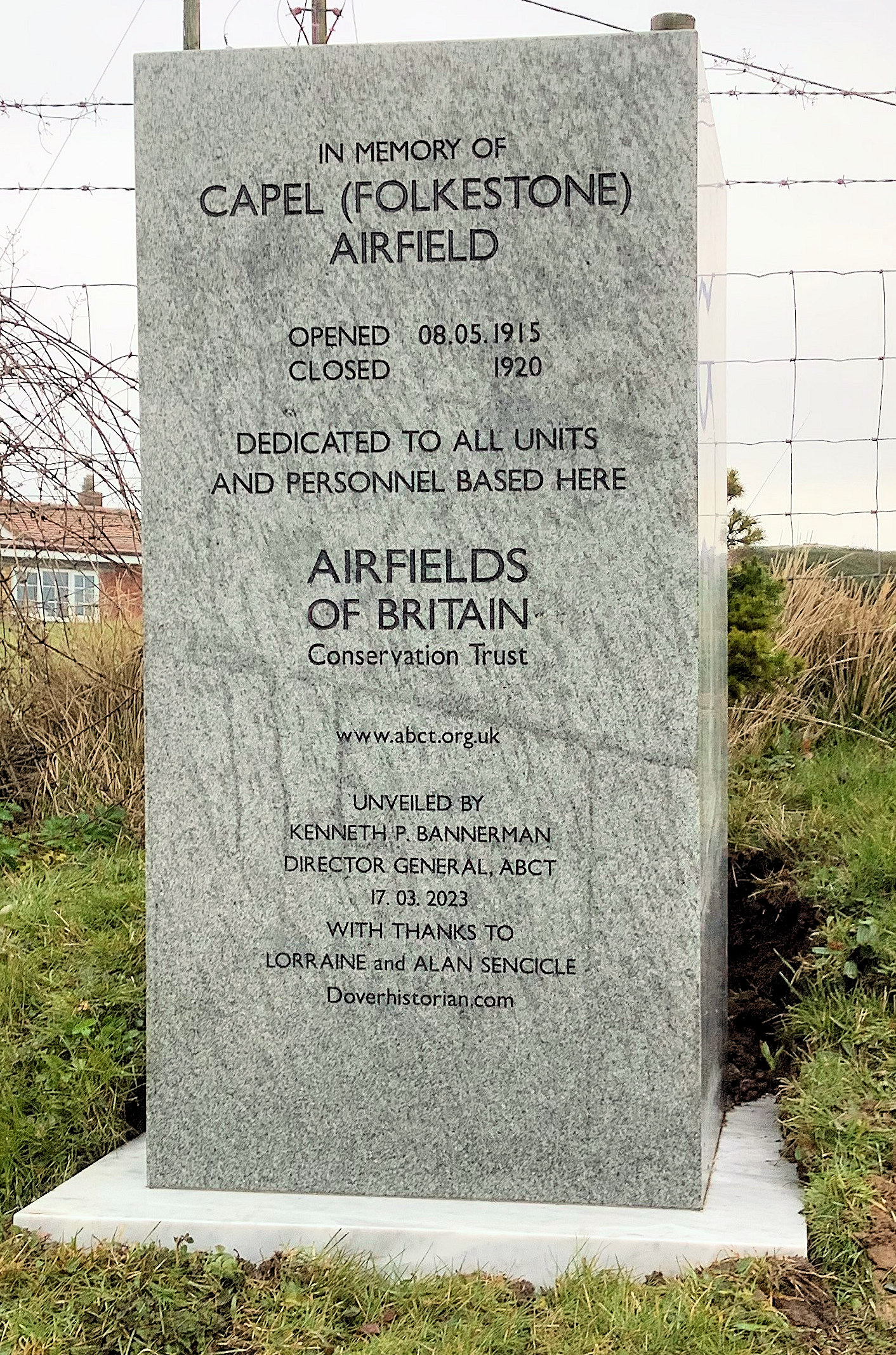
Capel (Folkestone) airfield (1915-1920). Airfields of Britain Conservation Trust. Mike Weston 2023
Albeit, in the English Channel, attacks on shipping intensified and in April 1915 Admiral Reginald Bacon (1863-1947) was appointed Commander-in-Chief of Fortress Dover. This included the Dover Patrol and by June the first Blimp arrived at Capel Aerodrome. It’s main purpose was to protect troopships crossing the Strait of Dover and soon more Blimps arrived. The pilots and observers in the airships, like their seaplane colleagues at the Dover seafront base, were particularly good at spotting hostile submarines, as travelling at great heights made it easier to see the underwater hostile crafts. Before the end of 1915 Capel had a fleet of Blimps and the station became the main assembly and test-station for the SS class airships. The first moonlight raid on England took place on 23 January 1916 at 01.00hours. It was carried out by a Friedrichshafen FF 33b seaplane that dropped eight high explosive bombs and one incendiary bomb.
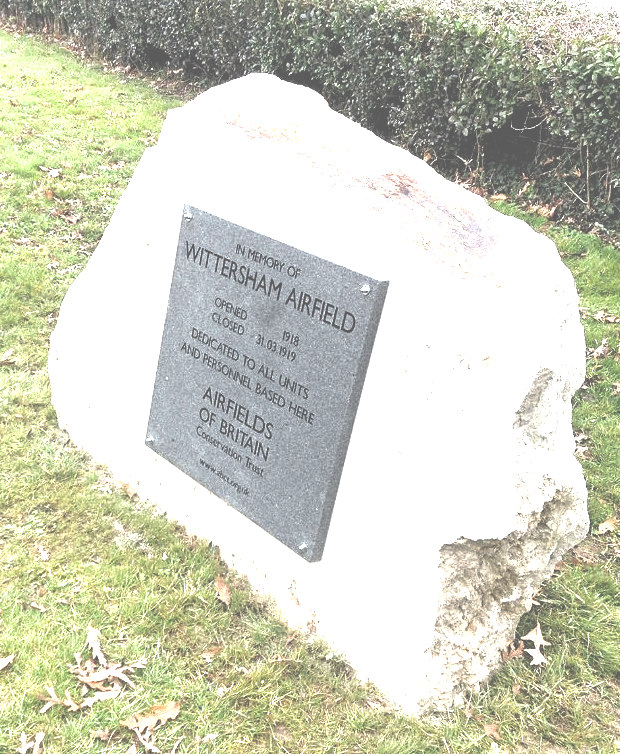
Wittersham Airfield 1918-1919 plaque. Airfields of Britain Conservation Trust.
The attack included Capel air balloon sheds but they were not badly damaged. However, at lunchtime on the following day two German seaplanes dropped bombs on the Capel air balloon sheds destroying or damaging both the sheds and the airships. The two craft then went on to attack Dover but came under fire from the Drop Redoubt on Western Heights. Altogether, in both raids, one man and four soldiers were killed and 2 men, 1 woman, 3 children together with 11 soldiers were injured. As the War progressed mooring-out Capel sub-stations were established first at Godmersham Park, which was operated by the RAF from 12 May 1918 to 28 February 1919. Also one at RAF Wittersham from 1918 to 31 March 1919. Capel aerodrome closed during 1920 but during World War II the site provided major assistance as an important wireless station. One WWI airship shed survived into immediate peacetime afterwards and various foundations and roadways can still be seen as part of the Holiday Park there today. In 1993, the Battle of Britain Memorial, also in the village of Capel, was opened by Queen Elizabeth the Queen Mother (1900-2002) and is dedicated to the 69 squadrons that took part in the 1940 epic WWII Battle of Britain.
1914
Although talk of war was permeating the corridors of power in Britain, for the average person it was agreed that such talk should be hushed up so as not to cause alarm! For the Senior Officers of the RFC Military Wing and the RNAS they were to look and earmark possible new airfields in case of war. For the RFC Officers this was no easy task but for RNAS there were so many more factors to be taken into account that at times the task seemed impossible.
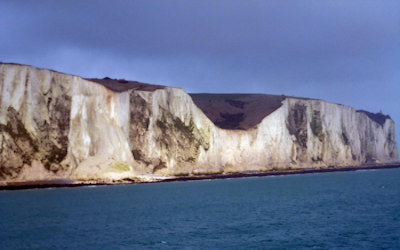
Dover White Cliffs east – Langdon Cliffs. LS 2013
When Bleriot had flown across the Channel he had landed at Northfall Meadow, Dover, which is in a valley and surrounded by trees, for that and other practical reasons Rolls had chosen Swingate Downs, for his record breaking flight. Swingate is a high, large, almost flat expanse of cliff top with few trees, close to the coast at Langdon Bay on the east side of Dover. The height had given Rolls the lift off he needed to cross the Channel and was relatively easy for landing and the closest proximity to the European mainland. The site’s biggest drawback, as far as the Military RFC was concerned, were the White Cliffs of Dover. Their highest point was 350 feet but that was on the western side of the town, on the eastern side, the same side as Swingate they were about 300feet and stretch for eight miles along the coast. Grand as the Cliffs looked, they were already proving a death trap for pilots when aircraft failed.
The RFC looked at the former East Boldre Aerodrome, Hampshire, in March 1914 for a military airfield but rejected the idea due to its proximity to trees. Aviator William Edward McArdle (1875-1935) had laid the airfield in 1910, four miles north-east of Lymington, close by the New Forest. He was planning to open what he called the New Forest Flying School over which the Office of Works was anything but keen, (see Eastbourne Airfield above – 1911). Nonetheless, he built a hangar, a workshop and laid a grass landing strip on heathland he had cleared. McArdle called his site the East Boldre Aerodrome and on Sunday 1 May 1910, together with American aviator John Armstrong Drexel (1891-1958) both men flying Bleriot monoplanes, gave a display to a large crowd of people. The idea was to attract would-be pupils but after two years the flying school closed its doors and the site reverted back to heathland. Although the RFC didn’t buy the former East Boldre aerodrome they did take out a three-year lease on the hangar. Towards the end of 1914, when it was realised that the War would not be over by Christmas, they returned but again rejected the site.

Beaulieu airfield, note the Belfast Truss Hangars and the RFC roundel. Postcard East Boldre Village Hall.
However, on the opposite side of the village of East Boldre, to north of the former aerodrome, they saw another site and there they laid an airfield. This was the start of RFC Beaulieu Air Training School. In 1917, as RAF Beaulieu the airfield was greatly enlarged, three large hangars were erected along with accommodation, the associated messes and ancillary buildings. Before the end of the War three squadrons were formed at Beaulieu before being sent to France but following the War, in July 1919, Beaulieu Airfield closed. During WWII, on Saturday 8 August 1942, RAF Beaulieu reopened for use by bomber and fighter groups and on 1 March 1944 it was made available for USAAF Ninth Air Force use. Following WWII, from 1946 until 1950, the airfield became a drop zone for parachute experiments as part of an Airborne Forces Experimental Establishment. And the site continued to be used for experimental work until it closed on 10 November 1959. All that is left is the WWI officers’ mess, which is now part of the East Boldre village Hall and the word ‘Beaulieu’ in the heath just to the south of the Lymington road.
Both the Military and Naval wings of the RFC recognised that if war did break out, Swingate at Dover, due to the proximity of the English Channel, would be the best airfield from which aeroplanes could leave for the Continent. Therefore, they looked around for the location of a back-up airfield. Landward of Swingate, between Fort Burgoyne and the Duke of York’s school, cultivated farm land appeared to be ideal. Next to Fort Burgoyne, in a field on the Dover – Guston Road, a runway of hardened earth was laid for the airfield and this was quickly utilised to enable RNAS aeroplanes to bring in personnel and goods for the seaplane station on Dover’s Marine Parade by the seafront.
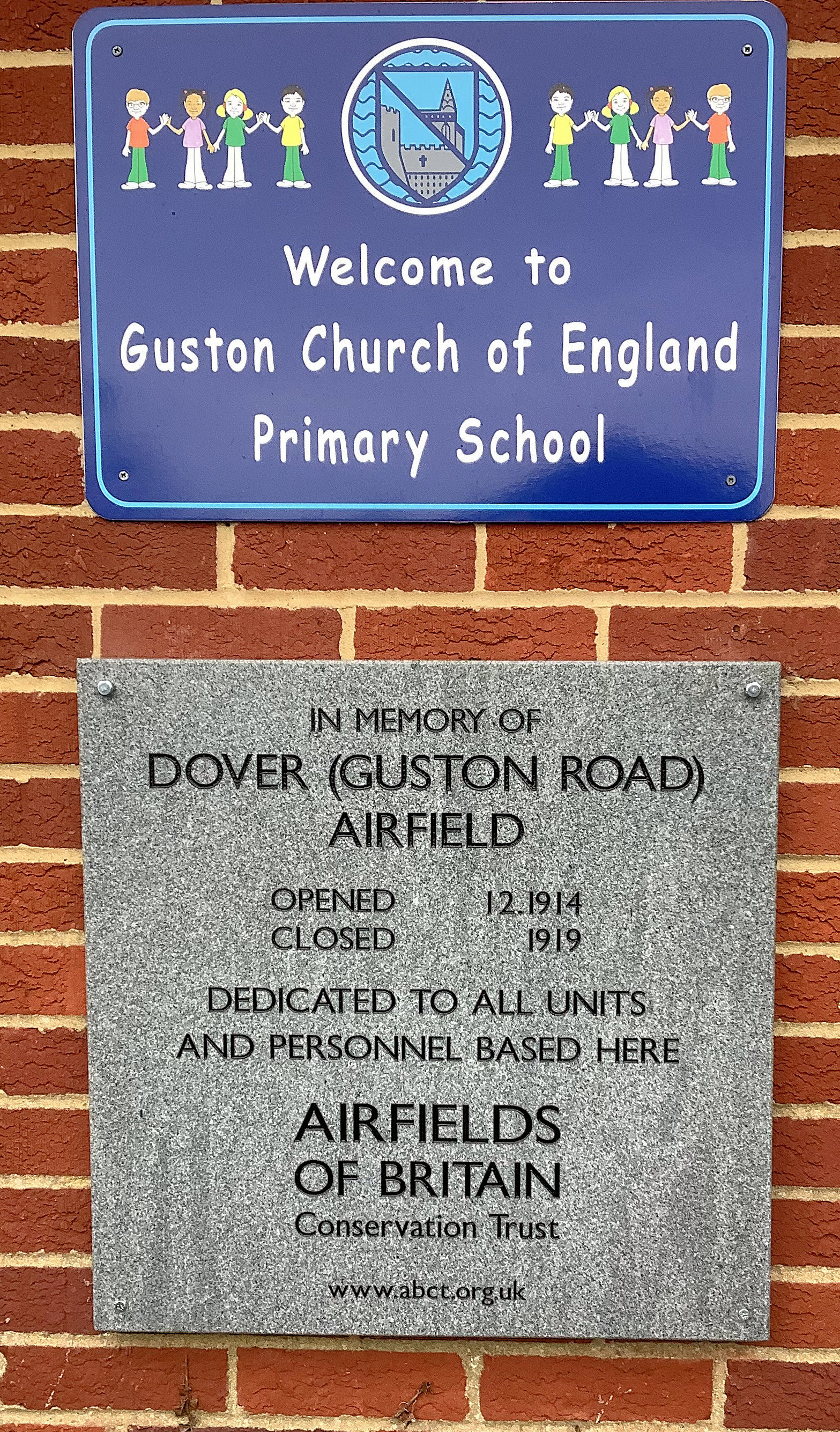
Dover Guston Road aerodrome Airfields of Britain Conservation Trust. Mike Weston
The RFC constructed officers and ground crew messes nearby and an adjacent field to what had become Guston Road Airfield, was commandeered by the RNAS for the erection of tin huts. Locally named ‘Tin Town’, the site provided extra accommodation for naval and associated personnel in case war did breakout. Albeit, it was not until December 1914, four months after the outbreak of War that the RNAS Dover (Guston Road) Airfield became officially operationally active. During 1915 RNAS bombers based there bombed German-occupied naval targets in Belgium. Training duties, in conjunction with the nearby RFC Swingate aerodrome as well as the Dover Seaplane station also took place at the aerodrome throughout the War. In addition, Dover (Guston Road) Airfield RNAS aeroplanes took part in the intensive anti-submarine and fighter patrols that lasted until the end of fighting. After the War, in 1919, Dover (Guston Road) Airfield was closed and today the site is devoted to housing and a school.
Although the RNAS opened airfields adjacent to the sea or rivers for their expanding seaplane fleet, throughout the war they were also looking for sites for new bases that could be fully equipped as combined seaplane and airship stations if war came. Over and above the requirements of land based airfields, the officers’ in choosing a site had to take into account of the siting of slipways that could be used or what alternative means could be adapted to launch the seaplanes. For instance, the seaplanes at Dover’s Marine Parade Base were initially launched using a crane.
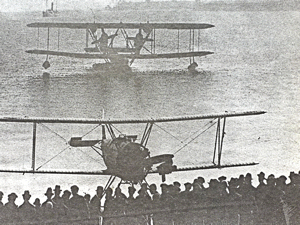
Seaplanes arriving in Dover Harbour for the Marine Parade Seaplane Base 1914. Bob Hollingsbee collection
Once on the sea, the officers had to assess the length, depth, width and quality of what would be the water based runway including the displaced threshold of the seaplane, turning basins, taxi channels and mooring areas. They also had to know all the obstructions and obstacles above and under water and on the adjacent land. Moreover, they needed to know about prevailing wind direction and tides and also the local movement of tidal flows. From these and other data collected they wrote their final report on which senior officers and government ministers made their final choice. Once the decision was made, the public had to be handled. Government and both Army and Navy officials opted for the philosophy of denial and if that failed the less said the better. Typically, in Dover, there was a flat denial that the works at Mote Bulwark and on Marine Parade were for the establishment of a seaplane base even though local workman were well aware of what they were building! Indeed, the local bulletin issued to the local council and newspapers papers in August 1914, stated that the arrival of a large squadron of seaplanes landing in Dover Harbour, in preparation for War, were there in order for George V to undertake a review!
At Government level, Richard Burdon Haldane (1856-1928) the former Minister of War, successor John Edward Bernard Seeley (1868-1947), along with the Chief of the General Staff – Field Marshal Sir John French (1852-1925), were forced to resign following the Curragh incident of the 20th March. Curragh Army Camp, County Kildare, Ireland was the main base for the British Army in Ireland. That year Ireland was scheduled to receive a measure of devolved government. Seeley and French put the Army on standby in the expectation of the unionist Ulster Volunteers taking military action. Some Protestant Army officers stationed in Ireland threatened to resign or accept dismissal rather than obey orders and both Seeley and French were blamed. Following these resignations, Prime Minister Asquith took over the War Office and empowered Haldane to carry out tasks at the War Office on his behalf. Consistently warning the Government over the possibility of a European War, which Haldane heeded, in August 1914, Seeley was one of the first to join up.
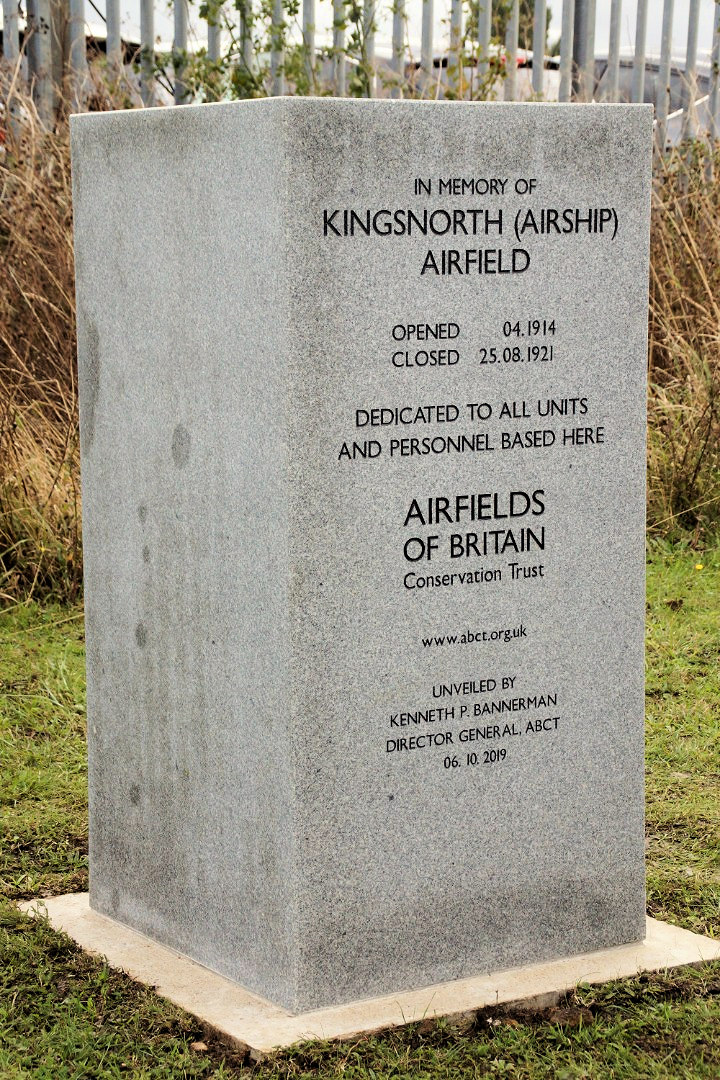
Kingsnorth (Airship) Airfield of Britain Conservation Trust
In April 1914 the Medway Airship Station Kingsnorth, was commissioned on the south side of the Hoo Pennisula – not to be confused with the World War Two fighter Advanced Landing Ground bearing the same name some distance away but also in Kent. Kingsnorth Airship Station was first under the control of the Admiralty through the Naval Airship Branch and then the Royal Naval Air Service when it was formed on 1 July 1914. Neville Florian Usborne (1883-1916) – see Capel above, was appointed the commanding officer and in July promoted to Wing-Commander. He was the driving force in the development of airships at the station, playing a prominent part in British military lighter-than-air aviation. Initially a shed was built for an Astra Torres airship and a large shed was erected to house a German built Parseval airship. After the outbreak of War, lighter-than-airships mounted many patrols both along the River Thames and over the English Channel. The station, under Usborne’s guidance was involved in the development of various non-rigid airships, with the SS (Submarine Scout) type being the first (again see Capel above) followed by the C-Class (or Coastal) type. Up until April 1916 and the opening of RAF Cranwell, Lincolnshire, airship crews were trained at Kingsnorth and support buildings and facilities were developed to accommodate this increased activity. Kingsnorth gained an excellent reputation with regard to the range of non-rigid airships that were designed and constructed there as well as experiments that were carried out to test how to best use airships, notably as a defence against the German Zeppelin bombing raids in the first years of World War I.
Together with Squadron Commander de Courcy Ireland (1885-1916) of RNAS Great Yarmouth, Usborne was making the full experimental flight to launch a fighter aircraft from a non-rigid patrol airship once a Zepplin had been located on 21 February 1916. Earlier experiments had been successful and on that day, at Kingsnorth, they were in a B.E.2c aeroplane that was suspended from the envelope of the AP.1 airship which rose to an altitude of about 4,000 feet. Suddenly the airship lost pressure and buckled, the forward suspension cable supporting the airplane broke causing the aeroplane to hang vertically from the envelope nose down. This caused the rear cables to be overloaded such that they broke and the airplane began to fall in the aerodynamic term ‘slideslip’. It then flipped, ejecting Ireland who fell to his death. Usborne remained with the plane until it crashed in Strood railway station goods yard, killing him. Following Usborne’s death Kingsnorth continued with the production of non-rigid airships, albeit towards the end of the War the official emphasis was on aeroplanes rather than airships and Kingsnorth Station was switched to holding or supplying RAF kite balloons until it closed on 25 August 1921. The site was initially used by a wood-pulping factory then in 1932 an oil refinery until 1977. In 1973 Kingsnorth power station was commissioned on the site of the seaplane station but closed in 2012 and subsequently demolished.
Of note the Usborne Memorial Prize for best contribution to the Royal Aeronautical Society’s publications written by a graduate or student was established in Neville Usborne’s memory and was first awarded in 1928. This was for a paper by Mr W T Sandford ‘Some recent developments in the design of rigid airships‘. In the years that followed, the prize was awarded for a variety of essays but in 1965 concern was being expressed that prizes had been awarded to people not occupying the position of Graduate or Student as per the regulations. In consequence, the Pilcher & Usborne Award for graduates and students was established. Then in 1996, it was decided to amalgamate the funds for the different awards into a single fund for awarding the Society’s Gold, Silver and Bronze medals. (Thanks to Anne Hayward, Librarian, Royal Aeronautical Society)
St Mildred’s Bay, Westgate, slipway. geograph.org.uk
The possibility of War was seriously being considered by both the Army and Admiralty as well as in some political and media circles, but nationally the thought of peace generally prevailed. After a cold and very wet spring the weather was becoming warmer and by June the weather promised to be exceptionally nice and day trips to the seaside dominated conversations. One favourite location, particularly for Londoners, was the beautiful cliff lined sandy St Mildred’s Bay, Westgate-on-sea on the Kent coast, with its promenade and tidal pool. In early June 1914 an RNAS air station was being built in the Bay and rumour was rife. Westgate-on-Sea faced the Continent from where the threat of war, if it did exist, was the greatest but boarding house proprietors initially played such rumour down. As visitor numbers increased, they too imparted the latest gossip on what was going on, all of which was officially denied but it was noticed that what was being built was similar to the seaplane base at Marine Parade, Dover. Rumour was correct excepting that at Westgate two slipways had been laid, at Dover it was another year before they were laid. When the site was finished the slipways took seaplanes from the hangars to the sea and from the sea, the seaplanes were winched back up the slipways.
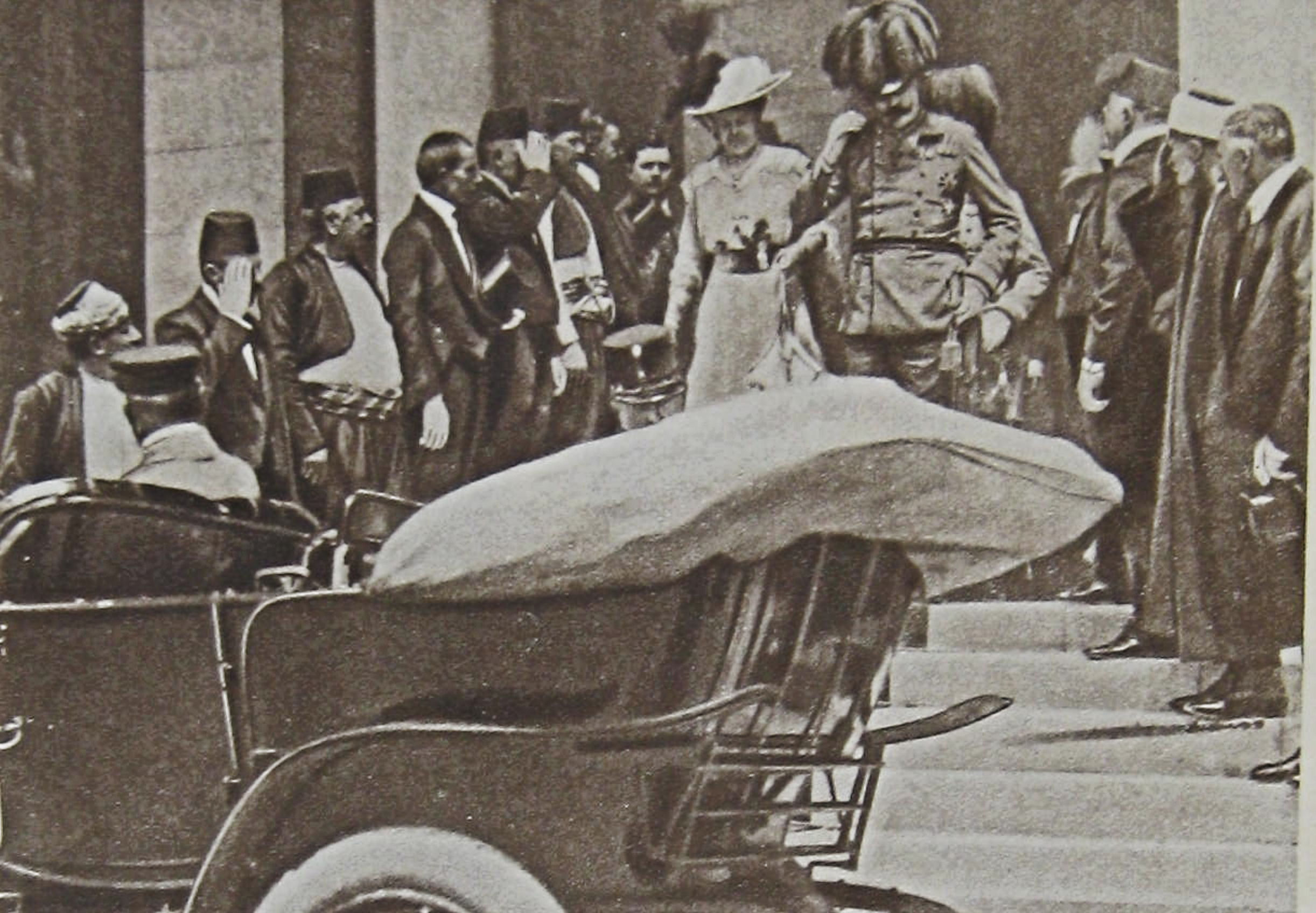
Archduke Ferdinand & wife just before assassination at Sarajevo 28 June 1914 – Robinson Collection
On Sunday 28 June at 11.00hours in far away Sarajevo, Bosnia and Herzegovina the events that led directly to the outbreak of the First World War took place. That morning Gavrilo Princip (1894-1918) fired two gun shots at Archduke Franz Ferdinand (1863-1914) heir to the throne of the Austro-Hungarian Empire and his wife, Sophie the Duchess of Hohenberg (1868-1914), killing them both. At Westgate-on Sea the holiday makers and boarding house proprietors, like many ordinary folk in the country, couldn’t quite get their heads round the significance of what had happened. But the effect on the constructions that were taking place on the beautiful St Mildred’s beach dramatically increased and that summer was the last many would enjoy for many years to come. The Westgate-on Sea Seaplane Base and an airfield on adjacent farmland on top of the cliffs, became operational in April 1915 as a sub-station of the seaplane base. However, the airfield was prone to sea-fog causing a number of accidents including the death of Flight Lieutenant Reginald Lord (1892-1915) on the night of 9 August 1915. A Zeppelin raid on the east coast of England was taking place and Lord was one of the pilots sent up to engage the enemy. Weather conditions were poor, with thick patchy fog, and Lord was killed as he attempted to land. He was buried at Margate Cemetery, Kent with full military honours.
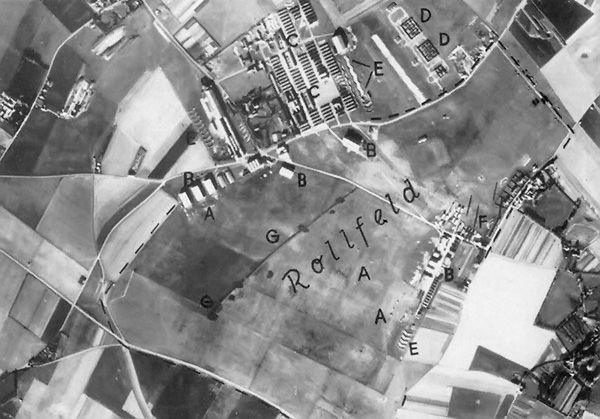
Luftwaffe photograph of RAF Manston 1939. Ian Dunster
Not long after, Manston Airfield was laid as a sub-station of the Westgate-on-Sea seaplane base with the last patrol to use Westgate airfield on 20 May 1916. Manston became operational on 29 May 1916 while Westgate-on Sea seaplane base closed in February 1920. During the War Manston instructed pilots in the use of the new Handley Page Type O bombers and by the close of 1916, the Operational War Flight Command was based there. During World War II Manston became a front line Battle of Britain (1940) airfield but was badly damaged that year during a German bombing raid.
In the 1950s the United States Air Force used Manston Airfield as a Strategic Air Command base for its fighter and fighter-bomber units but withdrew in 1960. The airfield then became a joint civilian and RAF airport. Alongside its continuing role as a RAF base it was used for the occasional package tour and cargo flights. In 1988, the owners of Kent International Airport signed a 125-year legal agreement with the RAF that obliged the latter to maintain the runway, as well as to provide ongoing air traffic control and fire & rescue services. The cost of this provision was estimated as approximately £3m per annum by the Ministry of Defence. During the summer season of the following year charter flights operated by Dan-Air and Aviogenex, a Yugoslavian carrier, were introduced. They were followed by Aspro Holidays who were taken over by Airtours until their flights ceased and the Ministry of Defence then sold Manston, in March 1999, for £4.75million. Since that time the site has had a miriad of owners, promises and uses, albeit the RAF Manston History Museum and the Spitfire and Hurricane memorial are surviving with both located on the northern edge of the airfield and well are worth a visit.
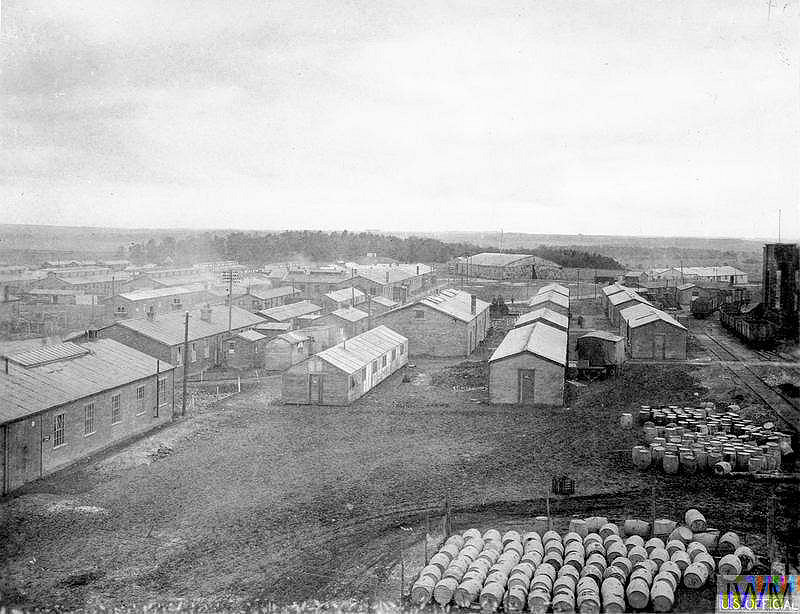
Main Camp at Stonehenge aerodrome February 1919. Imperial War Museum
Although Larkhill airfield, Salisbury Plain, ceased to exist in June 1914 at the outbreak of war in 1914, the Royal Flying Corps (RFC) had no bomber aircraft in service and this is how the situation remained up until 1917. That year the country was plagued with heavy German bombing raids, particularly in June when daylight raids on London killed 162 people and injured many more. This prompted a major re-evaluation of Britain’s air strategy and defence. As part of this, the government decided to increase the number of aeroplanes (mostly bombers) in service. More aeroplanes meant that more airfields were urgently needed, as well as training for those who were to fly them. A railway line was laid between the Larkhill garrison and Amesbury, a small town close to Stonehenge and Stonehenge Airfield, on Salisbury Plain, one of the many new airfields created across southern England. Later the railway line was nicknamed the Apple Track as soldiers would throw their apple cores out of the carriage windows and the pips took root! The building of the 360-acre airfield began late in 1917 and it was officially opened in November 1917 as a RFC training site. From January 1918 it became the No. 1 School of Aerial Navigation and Bomb Dropping using RNAS Handley Page bombers, the only heavy British bombers of the First World War. They arrived at Stonehenge aerodrome in January 1918 and operated mainly at night. This was in advance of plans for a newly created armed service, the Royal Air Force (RAF) – formed from the RFC and RNAS – which took over the heavy bombing. It was envisaged that Stonehenge aerodrome would have two camps, lying on either side of a take-off and landing ground.
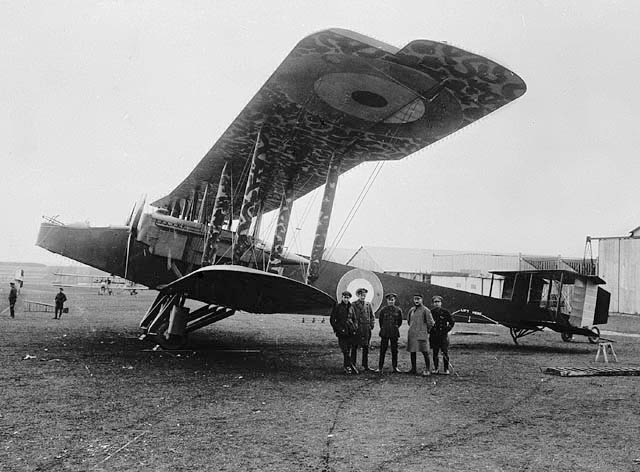
Handley Page O100 1459 Le Tigre aeroplane. Library & Archives of Canada 1917
Stonehenge Aerodrome main or Day Camp contained the main technical buildings, offices and accommodation blocks while the Night Camp was to include two ‘permanent’ hangars to house the massive Handley Page bombers, the pilots, observers and ground crew, however the Night Camp was not finished before the Armistice was signed. The No.1 School provided the final stage of training for pilots and observers before they were sent to the Western Front and the courses, which lasted about a month, included navigation, formation flying, cloud flying and bomb-dropping. The aim was to train up to 60 Day Bombing and 60 Night Bombing pilots a month, and the same number of observers as the casualty rate for aircrew was high. This was approximately 80% due to the dangerous nature of flying at that time. The No.1 School stayed at Stonehenge aerodrome until September 1919 and the station was relinquished in October 1921. Of note, at that time Wiltshire was a major producer of apples and as soldiers travelled on the Amesbury – Larkhill railway line they would throw their apple cores out of carriage windows. Following the closure of Stonehenge Aerodrome the site remained untouched during which time the apple pips took took root and apple trees grew. In 1927 the Stonehenge Protection Committee was set up and following a public appeal the aerodrome and neighbouring farmland were bought. The land was handed to the National Trust and although by the early 1930s the aerodrome’s buildings had all been dismantled and removed, including the former railway line, but the apple trees remained. Now it is a footpath and shown as ‘Dismantled railway’ on the Ordnance survey map.
The town of Gosport, Hampshire is on the peninsula on the western side of Portsmouth Harbour and work started on an open area at the 19th century Palmerston Fort Grange in February 1914. The ground had previously been used by amateur aviation enthusiasts who had initially gained permission from the War Department, ‘for experiments in aeronautical science’. Although the site was not conducive to flying, being far from level and full of potholes, the enthusiasts made good use of the ground. In preparation for possible War, grass runways were laid to the north and to the west of Fort Grange and Fort Rowner and the site was named Grange Airfield. On 6 July 1914 four RFC aeroplanes arrived: a Sopwith Tabloid, a Royal Aircraft Factory B.E.1, a Sopwith three-seater and a Farman MF.7 Longhorn. After which members of a squadron were regularly seen practising over Gosport until they moved out about the 28 July. Where they went is unclear but by Sunday 2 August they had arrived at Swingate, Dover from where they left for the Western Front. It was not until October 1914 that Grange Airfield was used again and this time by Royal Naval Air Service (RNAS), the Naval Wing of the Royal Flying Corps – officially recognised as such on 1 July 1914. They stayed for about 3 months before RFC (Army) squadrons returned in January the following year. For the rest of the War both the RFC and the RNAS squadrons occupied the airfield undertaking a variety of duties including tarmacking the runway.

A damaged row of houses in Gosport following an air raid on 12 August 1940. RAF
During this time at Gosport’s Grange Airfield the School of Special Flying was established. There, pilots were taught to become flying instructors and in 1918, Grange Airfield became part of the newly formed Royal Air Force as RAF Gosport. Following World War I RAF Gosport became part of the School of Special Flying as well as the Central School of Flying. Tarmac was removed and the site became a grass airfield again. During World War II RAF Gosport remained on active duty with a number of squadrons using the airfield even when it came under enemy attack on 12 August 1940 . In 1940, the Air Torpedo Development Unit was formed at Gosport and following the War, on 01 August 1945, it was transferred to the Royal Navy. For three days the airfield was named HMS Woodpecker before becoming HMS Siskin the name which remained until the airfield was closed in May 1956. The following month HMS Sultan opened as a Mechanical Training and Repair Establishment on the site but in the 1960s the need for new housing became paramount and the Grange estate was built and then rebuilt again on the original airfield site. Albeit two of the original hangars remain and apparently they are still in use by HMS Sultan, the Royal Naval Air Engineering and Survival School. They have upwards of 50 helicopters either in storage or for use in engineering training. However, in 2016 HMS Sultan was earmarked for closure by the Ministry of Defence (MOD) as part of its 2016 ‘A Better defence estate’ strategy which set out plans to dispose of 91 military sites across the UK. Later it was announced the airfield’s closure ‘would be no earlier than 2029.’
Back in 1913, the Military RFC Officers were looking for a site in the north of Scotland to protect the Royal Navy bases of Rosyth, Cromarty and Scapa Flow. This was while the Upper Dysart site, near Montrose, was proving to be far from satisfactory (see above). Major Charles James Burke (1882-1917) the commanding officer of No 2 Squadron that had used the newly laid field at Upper Dysart had considered it inadequate from the outset. He had looked around locally and had suggested Broomfield Farm, 1 mile north of Montrose. His arguments included that the site was next to the railway line so would enable men, machines and supplies easy access. Although the landing ground was 30feet above sea level it was in line with the prevailing wind and with sandy soil that ensured good drainage. Lastly, the RFC had already developed a prototype design for their airfields first seen at Netheravon Airfield on the Salisbury Plain and Broomfield Farm area fitted neatly into this RFC standard airfield design. It didn’t exceed 500 acres, it was a relatively flat area of land so could accommodate a runway of up to 2,000 feet in length as well as facilities. If given the go-ahead the airfield could include spacious hangars, prefabricated officers’ and airmen’s accommodation with their associated messes, administrative and recreational buildings, well-equipped workshops and motorised transport garages. On checking this out, it was agreed that the proposed site had good soil conditions including drainage and good atmospheric meteorological conditions for flying. The topography was free of obstructions such as trees, high hills or cliffs and tall buildings as well as potential dangers such as wide, deep fast flowing rivers or precipices. The RFC gave its approval and work started in 1913, while Upper Dysart was still being used (see above). In December 1913 the new site, named Montrose Airfield, opened, however in June 1914 No 2 Squadron were sent to Farnbrough and the now completed Montrose Airfield was put on hold.
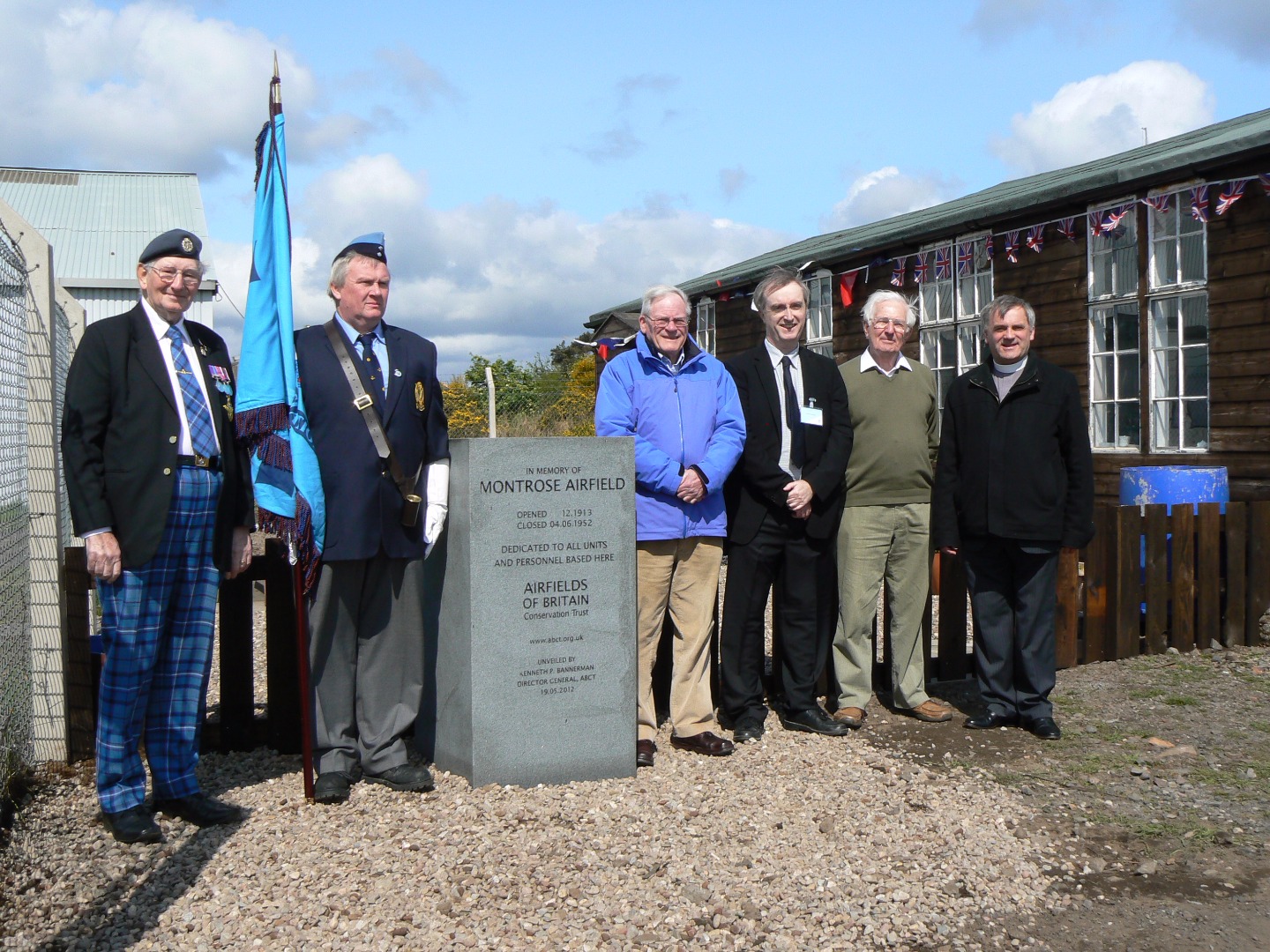
Montrose Airfield the unveiling of the ABCT memorial marker on 19 May 2012
It was not until the summer of 1915 when No 6 Aeroplane Squadron arrived and from then on Montrose Airfield became one of the major bases for flying instruction in the country. By July 1918, No 32 Training Depot Station (TDS), had a fleet of aeroplanes that included Avro 504, Royal Aircraft Factory SE5a and Sopwith Camel. Although the topography around Montrose is flat, due to the close proximity of the nearby Grampian Mountains an American pilot wrote that there was ‘a crash every day and a funeral every week’. The local cemetery bares witness to this. The training school closed in May 1919 and the airfield closed in March 1920. Again, it stood empty, then in January 1936, due to the international uncertainties Montrose Airfield was reopened as a pilot training school. However, due to its strategic position following the outbreak of World War II, it became a base for RAF Fighter Command Hawker Hurricane and Supermarine Spitfire squadron detachments. On 25 October 1940, during the Battle of Britain, three German Junkers Ju 88 aircraft dropped 24 bombs on the station killing five, injuring 18, destroying two hangars and the officers’ mess. Repaired quickly, the squadron detachments continued to be sent to Montrose Airfield but slowly they took on another role. Due to the close proximity of the Grampian Mountains during the War, the RAF station personnel carried out mountain rescue. In January 1944 they became part of the Royal Air Force Mountain Rescue Service but on 11 July 1945 the airfield was downgraded becoming a RAF Unit for Maintenance. With the advent of the Korean War (1950-1953) the airfield again became very busy, meanwhile in 1949 a Mountain Rescue Team (MRT) of the RAF Mountain Rescue Service was established at RAF Montrose to cover the area of the central Grampians. Finally, RAF Montrose closed permanently on 4 June 1952 and in 1955 the Mountain Rescue Service moved to RAF Leuchars, Fife.
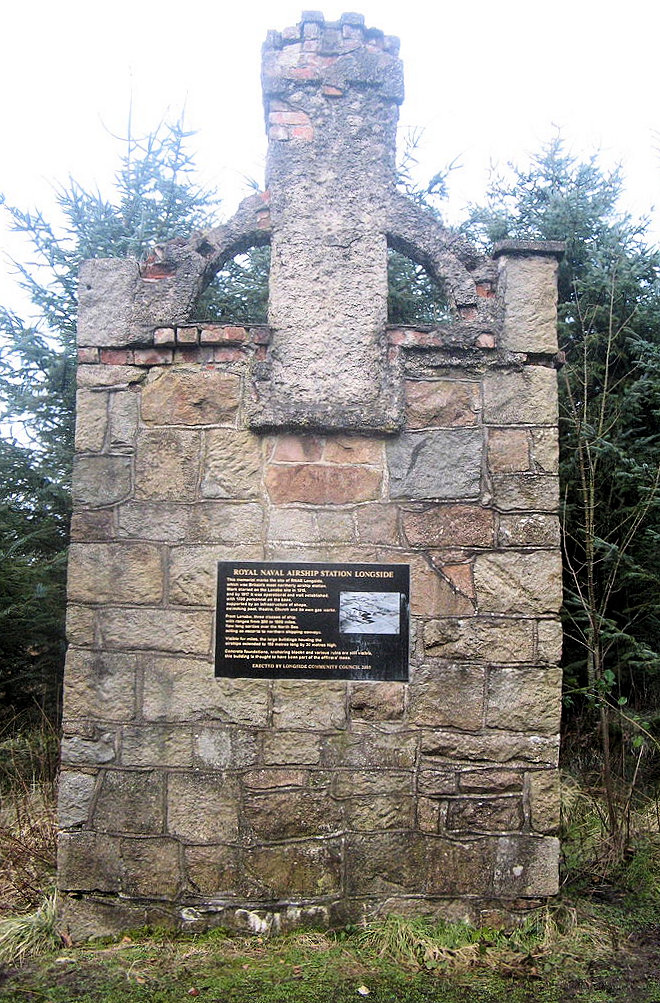
Memorial to RNAS Longside Airship station now at what is entrance to forestry walks. Sagacopiusphil
Not far from Montrose is Auldbar and in April 1918 the RNAS opened a mooring-out station for anti-submarine patrol non-rigid airships based at RNAS Longside. The only mooring-out base in Scotland, it was to be used in bad weather if the pilots were unable to return to the main base station at Longside Airfield some 70 miles away. The mooring-out station was in the Montreathmont Forest and was initially named Montrose but was soon changed to Auldbar Airfield after the local railway station! Longside Airfield, Aberdeenshire, was the most northerly airship station in mainland Britain and was sited at Lenabo, Gaelic ‘Lannam bo’ meaning ‘wet meadow of the cows’. The area lived up to its name and thousands of Irish and Scottish labourers were drafted in to prepare the ground. Built of heavy concrete and bricks Longside Airfield had three 100foot high airship sheds. One could accommodate four airships, while one or two airships were housed in the smaller hangars. There were also accommodation blocks for about 1,500 personnel, workshops, stores administration areas, gas works, two 66foot tall chimneys, a swimming pool, shops, theatre and a church. The main entrance had two concrete pillars adorned with elaborate globes mounted at the top and personnel regularly produced the base magazine, ‘The Battlebag’. Longside Airfield became operational on 15 March 1916 and during the remainder of the War NS class blimps N.S.3, 4, 6, 11 and 12 were based there.
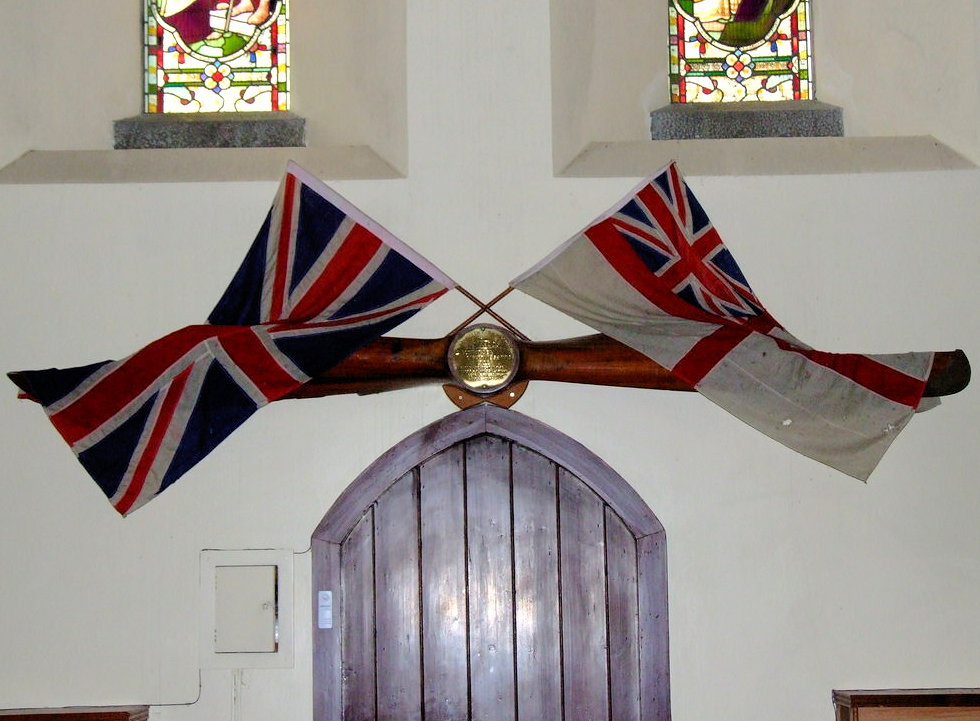
Airship propeller memorial to the lost crew at St. John’s Church, Longside, ABCT
In June 1918 an airship was damaged over the Firth of Forth and five crew members were lost and a month later another airship and crew were lost in the North Sea. Eventually a wooden propeller was found and can be seen in St John’s Church, Longside as a memorial to the lost crew. Auldbar Airfield was decommissioned in January 1919 and Longside Airfield in December that year. During the 1920s trees were planted and the site became a forestry plantation. At the outbreak of World War II another airfield was laid east of the village of Lenabo. Commissioned as RAF Peterhead airfield on 7 July 1941. During the remainder of the War five accommodations camps were constructed and about 2,000 personnel were based there including about 250 WAAF. Further, a large number of RAF squadrons from a variety of nations used the base but RAF Peterhead was disbanded in 1945 and the land returned to agricultural use. However, the Longside community were proud of their aviation connections and in 2003, Longside Community Council mounted a memorial plaque. This incorporates a photo of the World War I base on a structure that is believed to have been part of the Officers’ mess. Also that year, the local branch of Longside British Legion erected a cairn in memory of those who had served at RAF Peterhead – Longside airfield.
Wormwood Scrubs model aircraft flying 2015. David Hawgood geograph.org.uk.
Wormwood Scrubs in west London, at 170acres is one of the largest areas of common in the Capital and in the run-up to World War I it was quickly recognised as an ideal air base by both the RFC and RNAS. The Army had the greater claim on the site as they had purchased 135acres of the Scrubs under the Military Forces Localisation Act 1872 with a view to creating a military exercise ground. To ensure protection of this new publicly owned and used land the Wormwood Scrubs Act 1879 placed it in the care of the Metropolitan Board of Works. This ensured that the site, when it was not being used for military training, inhabitants of the metropolis had free use of the land for exercise and recreation. Further, to guarantee that the Army complied with the Act they were forbidden to build any permanent structures other than rifle butts. In 1909 Gustave Adolphe Clément-Bayard (1855-1928) was a blacksmith with an entrepreneurial flair who had earned a name for himself in designing and producing bicycles pneumatic tyres, motorcycles, automobiles and aeroplanes. That year the French Army having expressed an interest in airships, Gustave designed one. On completion of his airship, Clément-Bayard No.1, he offered it to the French government but they rejected it for being too expensive. However Tsar Nicholas II (1894-1918) thought otherwise and bought the airship for the Russian Army!
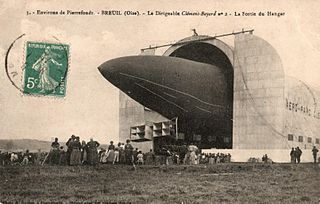
Airship Clément-Bayard at Breuil (Oise – France) in 1910. ABACA from postcard published by ed. G. Duclos à Pierrefonds
Soon after Gustave’s airship Clément-Bayard No.2 was completed and after making modifications to the steering and engines it made its first flight on 1 June 1910 piloted by Gustave’s son, Maurice Clément-Bayard (1887-1931). The airship was 76.50 metres (251 feet) long, 13.22 metres (43metres) wide and having a volume of 6,500 cubic metres (229,545 cubic feet). It was powered by 2 Clément-Bayard 120 cv (horsepower) engines, with a top speed of 54 km/h and carried seven passengers. The airship left from the Aster Clément-Bayard airship hangar at La Motte-Breuil, Picardy, France and arrived on Wormwood Scrubs 6 hours, 11 minutes later having travelled approximately 150miles. This was the first English Channel crossing by an airship! The attendant publicity ensured that the French Army would be interested and they ordered 3. British Army Balloon Factory at Farnborough bought the one that had landed on Wormwood Scrubs and was still there. This was against the site’s bylaw so the War Office reminded the Board of Works that they had more authority and a shed was built to house the airship. Both the purchase of the airship and the shed was partially funded by the Daily Mail newspaper and the site became locally known as the Daily Mail Airship Garage. Not long after the airship was deflated and dismantled before being taken to Farnborough while the shed remained and was used for storage by the Army. In 1912 Farnborough while undertaking trials, landed a Gamma airship at Wormwood Scrubs and after spending a short time in the shed, successfully took off. Again the newspapers were on hand to ensure publicity.
In mid 1914, notwithstanding the Board of Works bylaw, all air-related activities on the Scrubs passed to the authority of the Admiralty and the site was renamed Wormwood Scrubs Naval Air Station. Throughout the War the grass airfield was used to train RNAS armoured car crews and as an emergency landing ground close to central London for any aircraft, a role it kept until the 1930s. The shed was mainly used to assemble and test the Submarine Scout class airships. On completion these airships were shipped out to other RNAS stations by rail. Following the War Wormwoods Scrubs reverted to its public use but in 1939, with the onset of World War II, the Scrubs again were taken over for military purposes and as an outstation department of the Government Code and Cipher School at Bletchley Park. Today the Linford Christie Athletic Stadium occupies the site.

A crew member of a British SS-z class airship about to drop a bomb from the rear cockpit of the gondola. Wikimedia-Commons
July 1914 the advent of War seemed likely and the RNAS were determined to demonstrate the manner in which aeroplanes could be deployed in naval operations. Between 18-20 July 1914 a Royal review of the Fleet took place at Spithead, an area of the Solent, Hampshire, between Gosport and the Isle of Wight. During the review flights of RNAS aeroplanes and seaplanes gave a show that ensured that the demonstration was a success. After the exercise, with the exception of three of the aeroplanes returning to Felixstowe and one to Yarmouth, the others went to Eastchurch. A week later RNAS seaplanes were mustered at Eastchurch, Felixstowe, Westgate and Yarmouth to train as coastal patrols in the event of War. At about the same time two airships were allocated to Kingsnorth, in north Lincolnshire and in July at Killingholme Haven on the Humber estuary. There the RNAS opened an air station for maritime patrol purposes and on 28 July, the former Lieutenant Longmore, one of the first four naval officers to be chosen to attend the Naval Training School back in 1912, was the Squadron Commander. He had previously dropped an 810 pound Whitehead torpedo, the first United Kingdom aerial torpedo, from a Short seaplane at Calshot.
Albeit, in the last week of July 1914, the War Office, issued a notice to the RNAS that they were to confine themselves to home defence and the protection of vulnerable points from possible attack by enemy aircraft and airships. The RFC were told that they were to support the Army. The Admiralty chose to ignore the War Office directive and instead ordered anti-aircraft guns to be mounted onto ships and to protect land based naval establishments including seaplane stations. They also established aircraft defence around London and sea ports such as Dover, Southampton and Liverpool etc. Their favoured design were 3 and 4 inch high angle quick firing guns and possibly, for this reason, the Admiralty took responsibility of establishing an Anti-Aircraft Corps (Accords) as part of the Royal Naval Volunteer Reserve. These air defence stations, besides being armed with quick firing guns, were also fitted with acetylene-lit searchlights to provide night illumination. In the first week of the Hostilities, the War Office was made responsible for important locations such as the aircraft and munitions factories. While the Army ensured that all their facilities, including RFC airfields, installed anti-aircraft equipment manned by Royal Artillery soldiers. It was envisaged that each military Division going to the combat areas would include a contingent to transport, erect and man air defence stations but it was not until 1916 that this was achieved
To be continued …

 The Dover Historian