Womens’ Suffrage in Dover

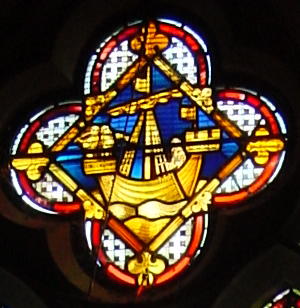
Cinque Port Ship window, Council Chamber, Maison Dieu

Cinque Port Ship window, Council Chamber, Maison Dieu

Dover, as a Cinque Port, held on to the terms of Gavelkind, a Saxon Law, long after the Normans came in 1066. Meaning ‘Give all kind’, it was a form of land tenure dealing with intestate estates where, amongst other things, the children, whether male or female, of a deceased son inherited the father’s portion. It was not until the end of the 16th century, when Elizabeth I was on the throne, that it became custom for women to bestow their titles and properties on their husbands and sons. In consequence, they slowly lost their rights to property and associated rights. The Reform Act of 1832 replaced the term ‘person’, as was usual, with the term ‘male’ and women, from then on, were officially disenfranchised.

In 1857, women from the upper strata of society successfully campaigned for the right to sue ex-husbands after divorce for their share of the marital home. John Stuart Mill, in 1865, called for women to have the vote and women’s suffrage was discussed during the debates on the Second Reform Act of 1867. The Act extended the vote to ratepayers and male franchise increased to 2.5 million. The Act, however, did not specify the sex of the ratepayer. On 26 November 1867 Mrs Lily Maxwell, of Manchester, voted but the Court of Common Pleas declared her vote illegal and the word ‘man’ was inserted into the Act.
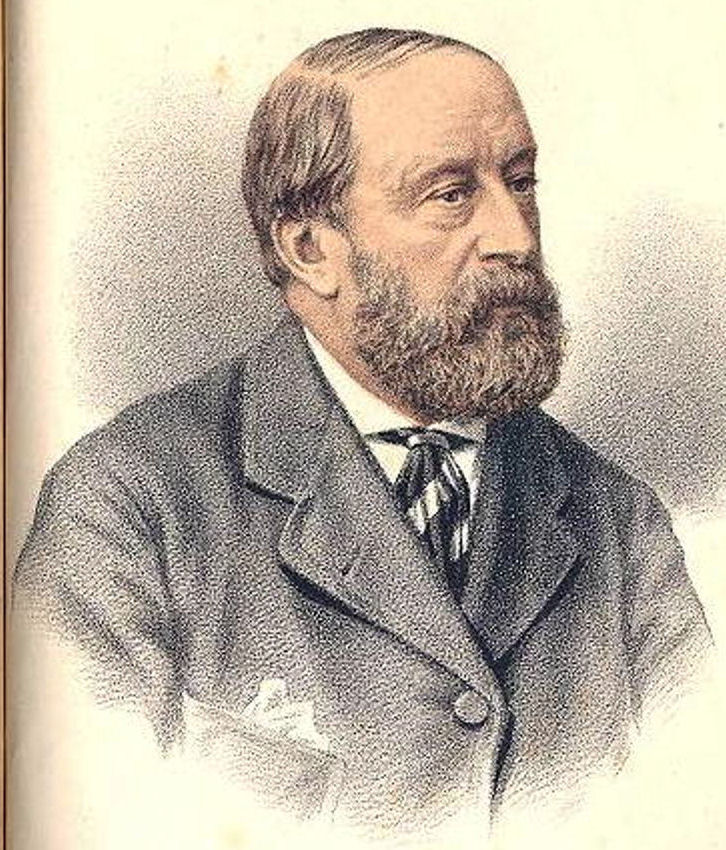
Richard Dickeson elected to the Corporation in 1871 through the influence of those women who had been given the vote in local elections

Richard Dickeson elected to the Corporation in 1871 through the influence of those women who had been given the vote in local elections

This led to an outcry from women, including a petition from Dover dated 17 June 1869, and led to the Municipal Franchise Act of that year. This Act allowed unmarried women householders to vote in local elections and in Dover, the women used their vote, most notably in 1871. Their vote turned the Conservative long-standing majority in Pier Ward to Liberal. Richard Dickeson was elected Mayor. He went on to make a positive impact on Dover’s economy and supported women’s rights.

The year before, MP Richard Pankhurst pushed through the first stage of the Married Women’s Property Act, which allowed married women the right to own property. However, it was another twelve years before it was fully achieved. Parliament’s procrastination triggered a public outcry ensuring that a Mrs. Ronniger spoke to a full house at the Apollonian Hall, Snargate Street, on 21 February 1872, on the subject.
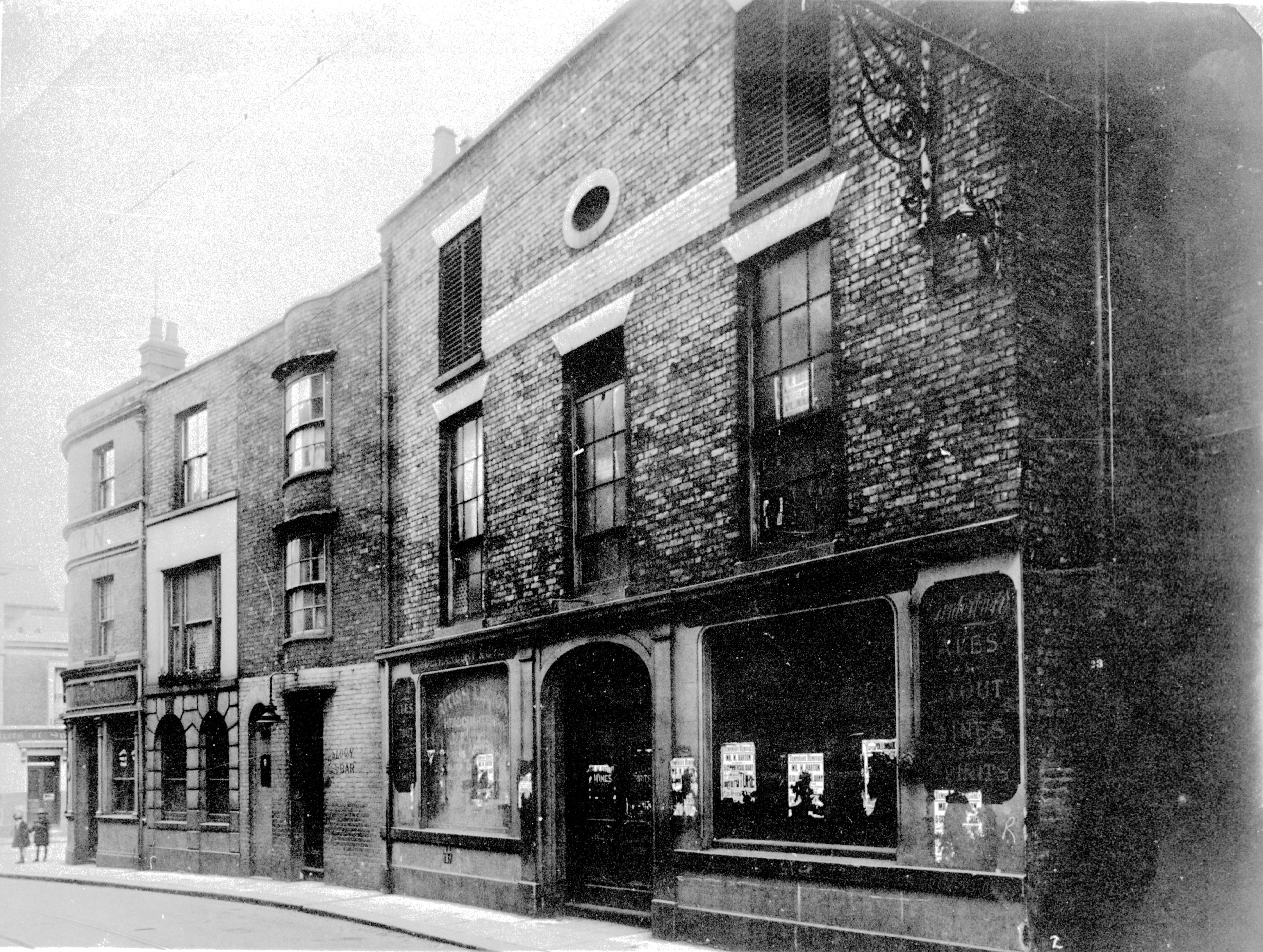
Apollonian Hall, Snargate Street. Dover Museum

Apollonian Hall, Snargate Street. Dover Museum

Mrs. Ronniger also argued that, ‘It was unjust that those women who were taxed equally to men had no direct power to say, through members of Parliament, how the public money should be raised, and how it should be spent.’ Going on to say that, ‘Women must obey the Law and many laws affect the interests of women, yet they are the largest class of citizens without a share in the making of laws that affect them.’

Later that year the National Society of Women’s Suffrage was formed and on 15 January 1873, a meeting was held in Dover that initiated the Dover Suffrage Society. Its committee included Mary Anne Apps of 68 Maison Dieu Road and Mrs. Wakefield of 8 East Cliff, who was the secretary.

Public meetings were held and on 6 December 1876, 400 people, mainly women, attended a packed Wellington Hall, (between Snargate and Northampton Streets), to hear speeches from leading suffragists, Helen Blackburn, Isabella Tod, Caroline Biggs and Mary Anne Apps of Dover Suffrage Society

The third Reform Act of 1884 doubled male electors to 5 million. Five years later, in 1889, Emily, the widow of Richard Pankhurst, founded the Women’s Franchise League. Their campaigning led Government to allow property owning single women to become Poor Law Guardians, and to become members of School Boards.
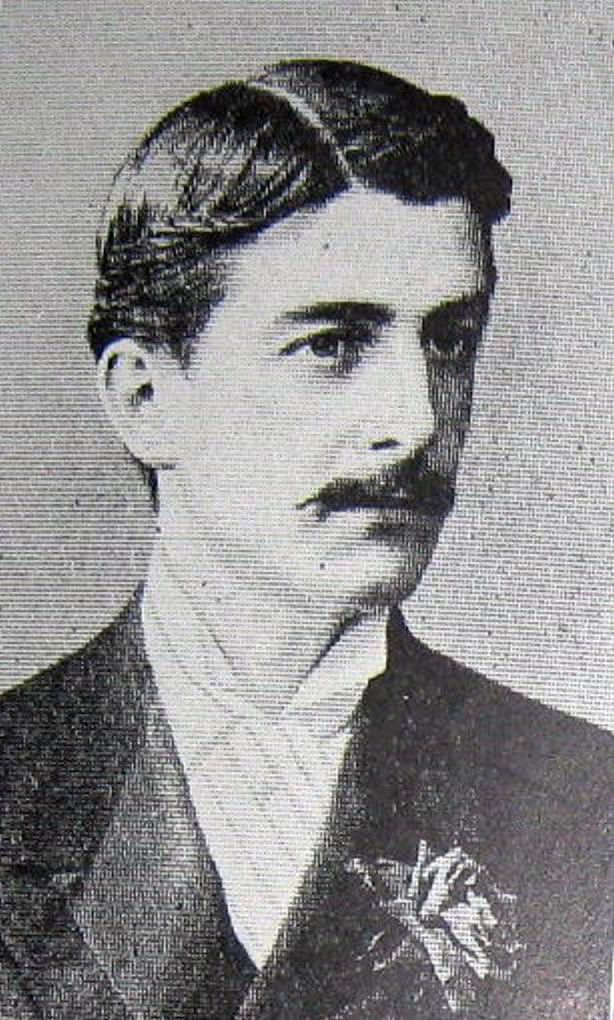
George Wyndham Dover's MP. Photographer A J Grossman c 1885

George Wyndham Dover’s MP. Photographer A J Grossman c 1885

1892 and George Wyndham, Dover’s Conservative MP, made a stirring speech in Parliament advocating Women Suffrage. He thus became one of the oldest and trusted supporters of the suffrage movement. However, he did not receive the backing of the House of Commons and with frustration mounting groups women, all over the country, were setting up independent organisations all aimed at the same purpose.

This led, on 14 October 1897, to the formation of the National Union of Women’s Suffrage Societies or the NUWSS. Their main aim was to put pressure on non-supportive MPs. The long-standing president was Millicent Fawcett, the sister of Elizabeth Garrett Anderson (1836-1917), and UK’s first female doctor. Of note, Dr Anderson had been reluctantly admitted to the British Medical Association in 1873 and it was another 19 years before the next female was admitted.

Emily Pankhurst and her two daughters, Christabel and Sylvia, were members of the NUWSS but felt that it was not radical enough. Thus, in 1904, the Pankhurst’s set up the Women’s Social and Political Union -WSPU. Their first campaign was aimed at a Liberal Party conference but made little impact. With the slogan, ‘Deeds Not Words’, in June 1906, they organised a Women’s Sunday march in Hyde Park attended by 250,000 people. It was at this time the word Suffragettes was coined and was only applicable to members of the WSPU.

The following February (1907) the NUWSS held a demonstration in which over 3,000 women took part – including a small contingency from Dover. On 30 September 1908, the NUWSS held an even larger rally and again Dover was represented. Of those who attended was Dr Annie Brunyate (1872-1937) Dover’s first female medical practitioner.
A graduate of Girton College, Cambridge (1892-5) she had undergone medical training at Durham and gained her doctorate from St Hugh’s, Oxford. She lived with her mother at 4 Effingham Crescent, where she practised. The house was also the HQ of the Dover Suffrage Society.

In January 1909, Dr Annie along with six other ladies took the Dover Women’s Suffrage Society (DWS) into the NUWSS and invited women of the town to an ‘At Home’. This was held in the then Christ Church Mission Hall and one of their speakers was Elizabeth Garrett Anderson. The chairman was Hungarian born Ilena Ginever, the wife of a vicar and lived at 17 Park Avenue.
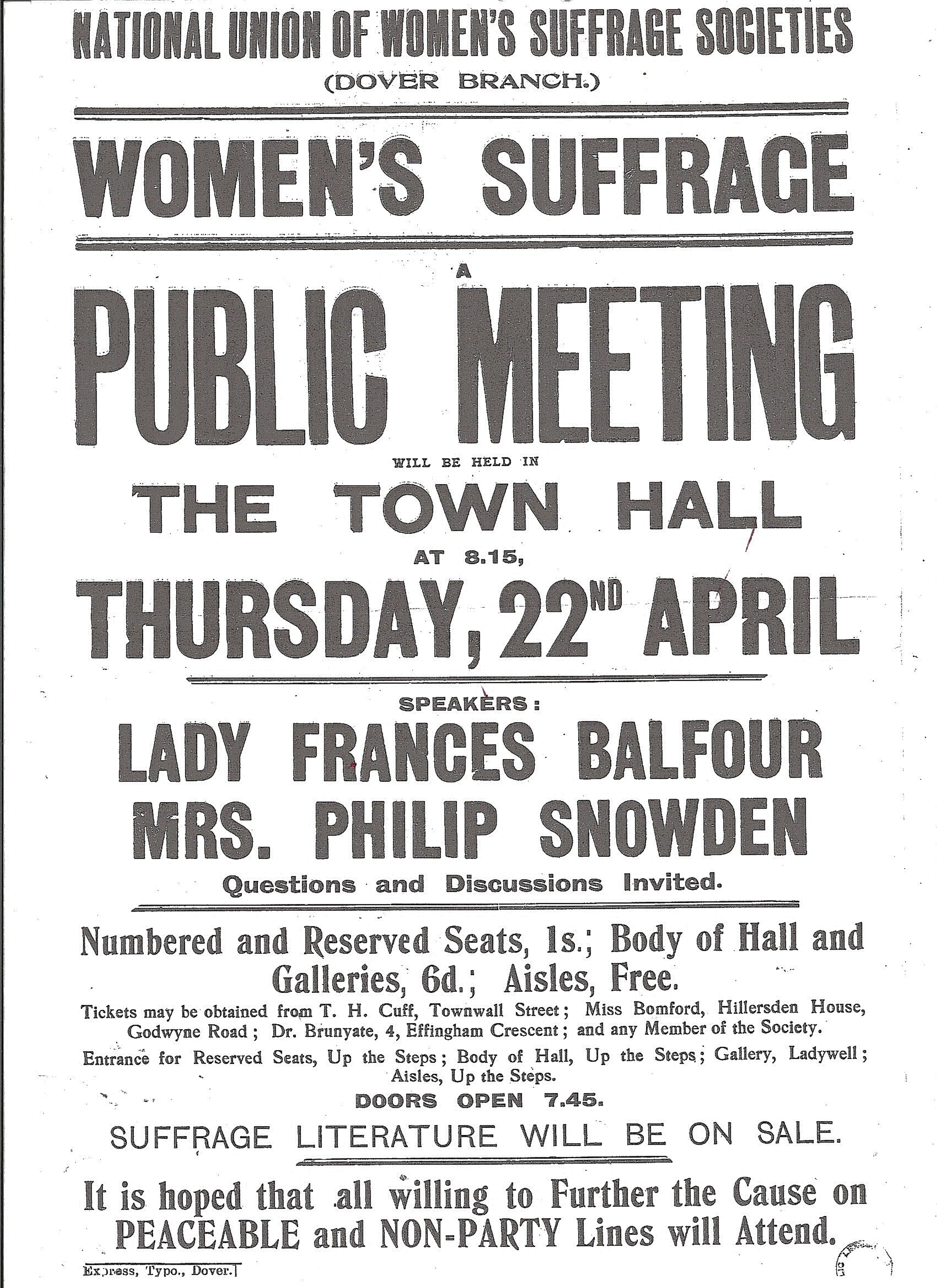
Women's Suffrage meeting, Maison Dieu - then the Town Hall - 22 April 1909. Dover Library

Women’s Suffrage meeting, Maison Dieu – then the Town Hall – 22 April 1909. Dover Library

The meeting was a lively affair emphasising that the right to elect an MP was not an end in itself but the beginning of major social reforms appertaining to women. These included:
Equality in wages,
Equality in the work place, for instance the abolition of sweating system for women – it had already been abolished for men;
The availability of technical training for women – trades unions had successfully legislated against this being available to women
Opening up the professions, such as the law, to women.

The majority of those who attended were impressed and on Thursday 22 April 1909 DWS held a public meeting at the Town Hall. Mrs Alice Barlow, wife of Edward Percy Barlow, Chairman of Wiggins Teape, Buckland, was elected President. Her daughter-in-law Alice, vice-president. Honorary Secretary was Dr Annie Brunyate and Honorary Treasurer was Lorna Bomford. Lorna was born on 29 December 1883, the daughter of the retired Indian Surgeon-General Sir Gerald Bomford. She lived with her parents at Hillesden, 14 Godwyne Road.
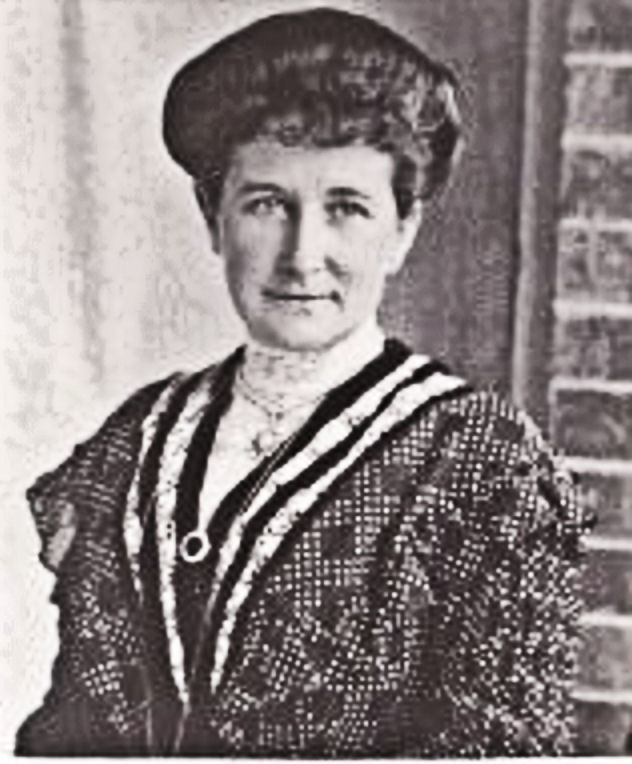
Alice Mary Barlow President of Dover Women's Suffrage Society and wife of the Chairman of Wiggin Teape's Buckland Paper Mill. Photo Ralph Harding

Alice Mary Barlow President of Dover Women’s Suffrage Society and wife of the Chairman of Wiggin Teape’s Buckland Paper Mill. Photo Ralph Harding

The DWS committee arranged further public meetings frequently joined forces with Florence Macauley (1862-1945) of Folkestone. She was the Kent representative of the radical WSPU, led by Mrs Pankhurst.

1909 saw an increase in militancy by the WSPU with more of their members arrested and imprisoned. Following her imprisonment, on 5 July that year, Marion Wallace Dunlop went on hunger strike. She was released after 91 hours of fasting. 9 July a deposition was made to King Edward VII for female suffrage, but was blocked by protocol. In retaliation, hunger strikes, following imprisonment became the next stage in the WSPU campaign. By September, force-feeding was introduced – this was not only by mouth.

At the end of December 1909, the Dover Express published a long letter from Alice Barlow, Lorna Bomford and Annie Brunyate – saying, in essence, that woman should not be disqualified from voting simply on the grounds of their sex. Making the same points as before, they added that at the General Election, to be held in January 1910, they would wait with their petitions outside the polling stations.
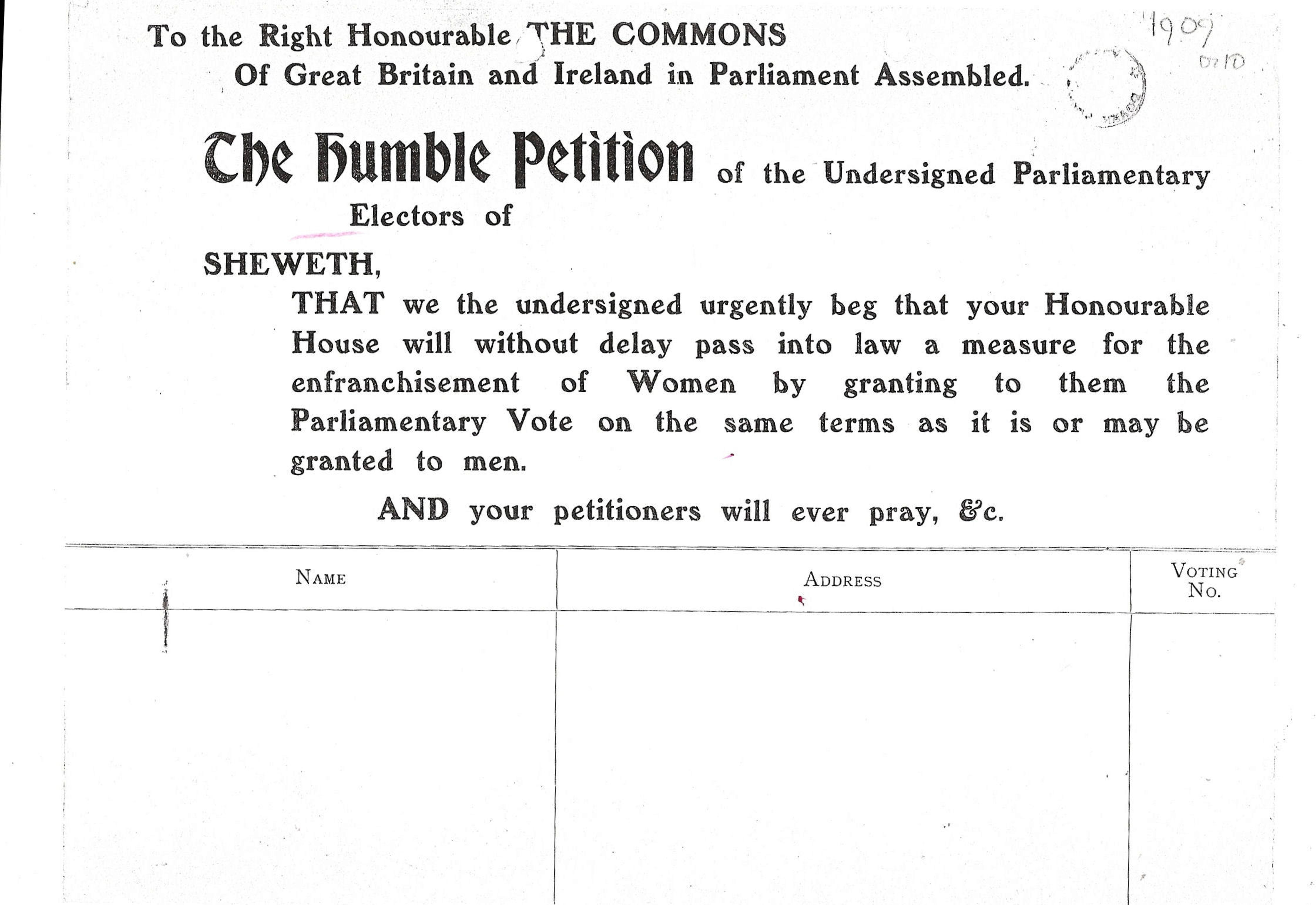
Dover Ladies Suffrage Petition January 1909. Dover Library

Dover Ladies Suffrage Petition January 1909. Dover Library

1910, was unusual in that for the first time in over 200 years there were two Parliamentary elections, but only one contest took place in Dover. The first Parliamentary Election was on 15 January and in the run up deputations from the DWS was received by both local candidates, Conservative, George Wyndham and Liberal, Montague Bradley. George Wyndham reiterated his commitment to women being enfranchised on the same grounds men but added that his Party was divided. Montague Bradley did not pledge himself. George Wyndham won although the Liberals were returned to power at Westminster.
In the second contest, which took place in December, Mr Wyndham was returned unopposed and again the Liberals won nationally.

During 1910, the WSPU increased their campaign and on Saturday 28 May organised a march along the Westminster Embankment to the Royal Albert Hall, where Emily Pankhurst chaired the meeting. A delegation from Dover attended.

On 4 June Dr Annie Brunyate called for local Suffrages to attend another demonstration organised by the WSPU but this was openly frowned upon by the Executive Committee of the NUWSS. Angered with this response together with a change in the election policy within the NUWSS, the Dover ladies voted to affiliate themselves with the New Constitutional Society. That Society’s policy was to ‘unite all suffragists who believe in the anti-Government election policy, who desire to work by constitutional means and to abstain from public criticism of other suffragists whose conscience leads them to adopt different methods’.

Thus, distancing themselves from the NUWSS, the Dover ladies joined the WSPU London march on Saturday 18 June along with over 10,000 women. These included factory workers, teachers, university students, office workers and nurses – who carried banners, bearing a flaming red cross. The leaders wore outfits representing famous women of the past but most ladies wore white dresses adorned with purple green and gold ribbons – the ‘uniform of the Suffragists’– many carried bunches of flowers. Those who had been incarcerated in prison carried small banners with their names inscribed. A thousand police officers were deployed keeping back tens of thousands of spectators most of whom were cheering. The establishment press barely mentioned the march.
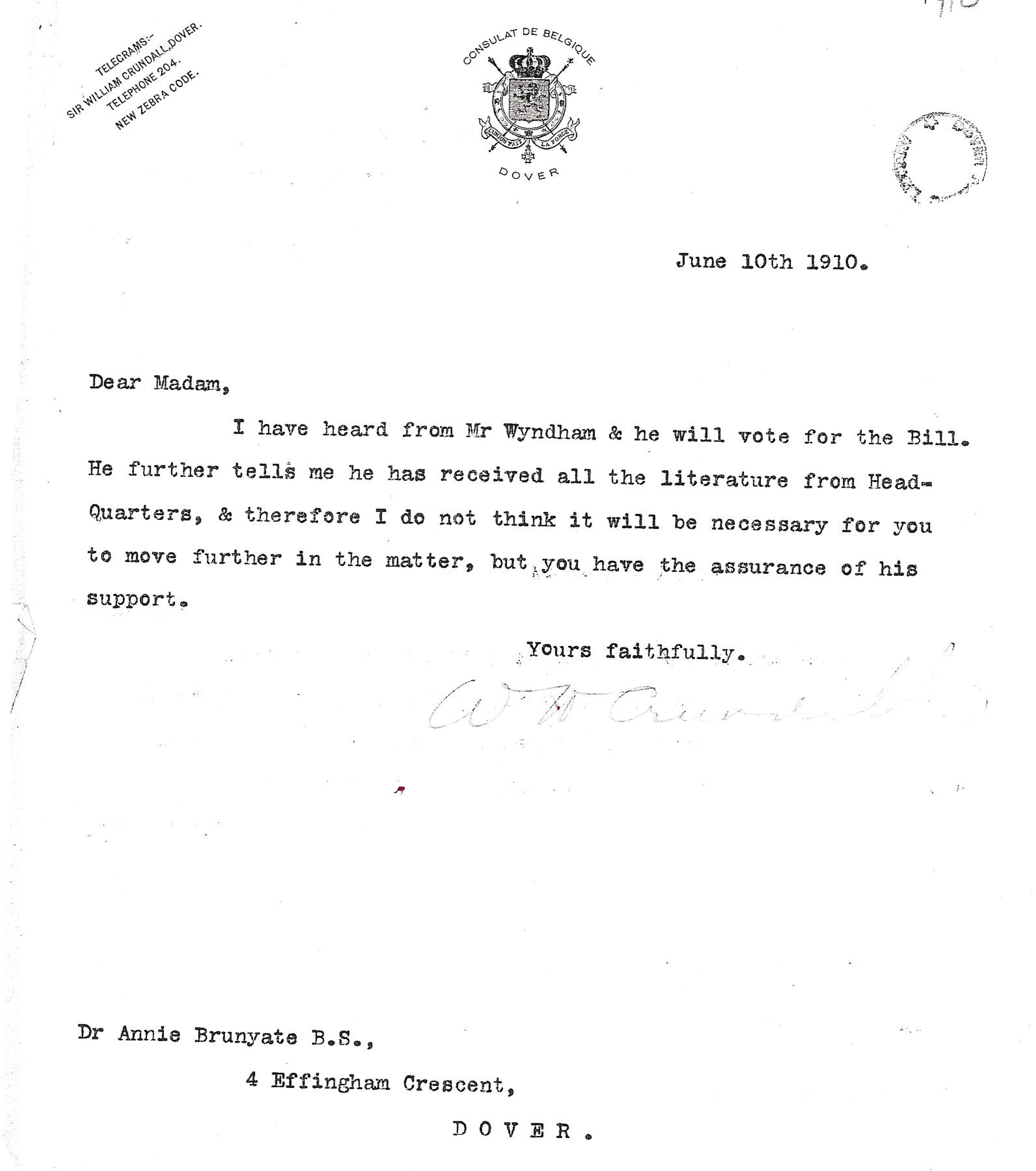
Support for the 1910 Consolidation Bill from Dover Conservatives. Dover Library

Support for the 1910 Consolidation Bill from Dover Conservatives. Dover Library

In the meantime, on 10 June, William Crundall, Mayor of Dover, wrote to Annie Brunyate saying that Dover’s MP, George Wyndham would be voting for the Bill supporting Women suffrage. This was the Parliamentary Franchise (Women) Bill, better known as the first Conciliation Bill, and if enacted it would enfranchise women on the same terms as men. The Bill was given a Second Reading on 12 July and by the large majority of 299 to 190 was sent for consideration to Committee. To keep up the momentum going the next major demonstration was scheduled for 23 July.
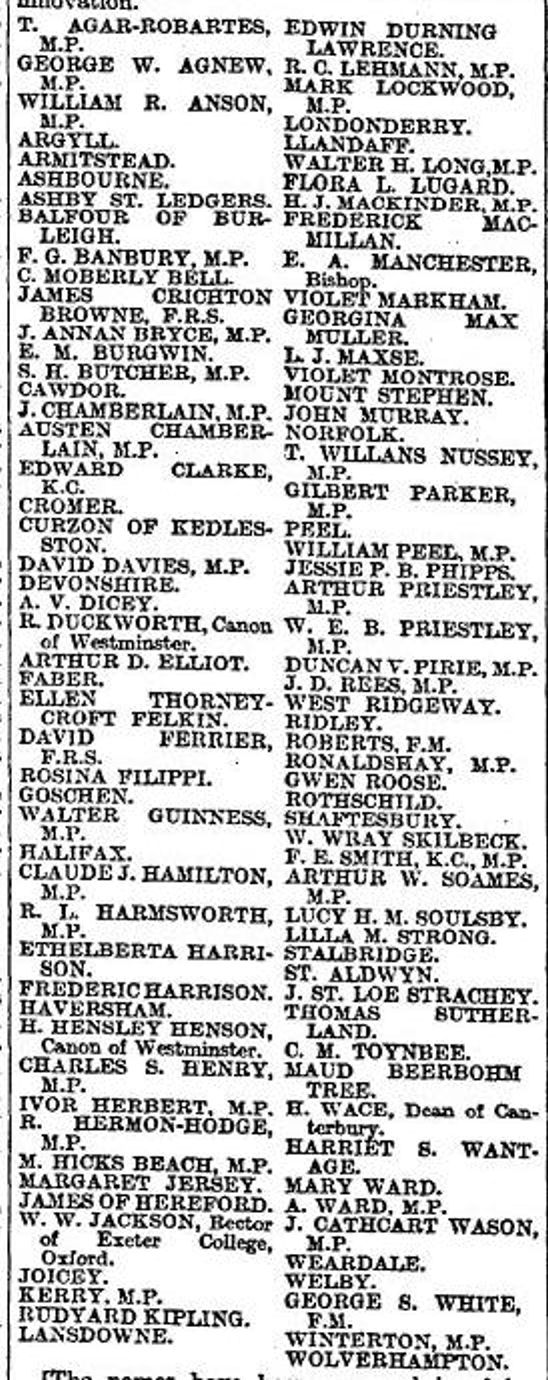
Anti-Women Suffrage leaders 21.07. 1910

Anti-Women Suffrage leaders 21.07. 1910

However, two days before a letter, signed by the Anti-Suffrage League, was published in the Times. Lord Curzon of Kedlestone, the Lord Warden of the Cinque Ports (1904-5), founded the League on 12 July 1908. Prominent women in public also actively supported it. The stance was that:
– Women were predominantly confined to the domestic sphere and therefore their husbands vote was effectively their vote.
– Female suffrage would ‘raise unduly the standard of women’s pay. Men work to provide the home, women’s place is in home.’

The views expressed by the League were supported by the Socialists and Trade Unionists and given positive coverage by the establishment press. Added to this, were the populist views of Harley Street specialist, Leonard Williams. He stated that women were breeding machines. ‘That the operation of that machinery, whether actually productive or potentially, unfits her for any other use or activity whatsoever between the ages of 17 and 50. Therefore, if women were given suffrage on the same grounds as men it would affect the future of the British race.’

The WSPU demonstration of 23 July 1910 took place and the ladies of Dover were at the forefront receiving a special mention. In Dover on 9 September the largest demonstration ever to take place in Dover’s Market Square was held – it was the third that summer. Led by WSPU’s Florence Macauley with a Mrs Arnott, representing women working in sweatshops. Mrs Arnott gave a descriptive account of their working conditions and poor pay – many of the women were widows with families to support. The meeting was a great success and in reply to questions, Miss Macauley told assembled throng that she believed equality of pay would be achieved and that it would not be long in coming – this received the loudest cheer.
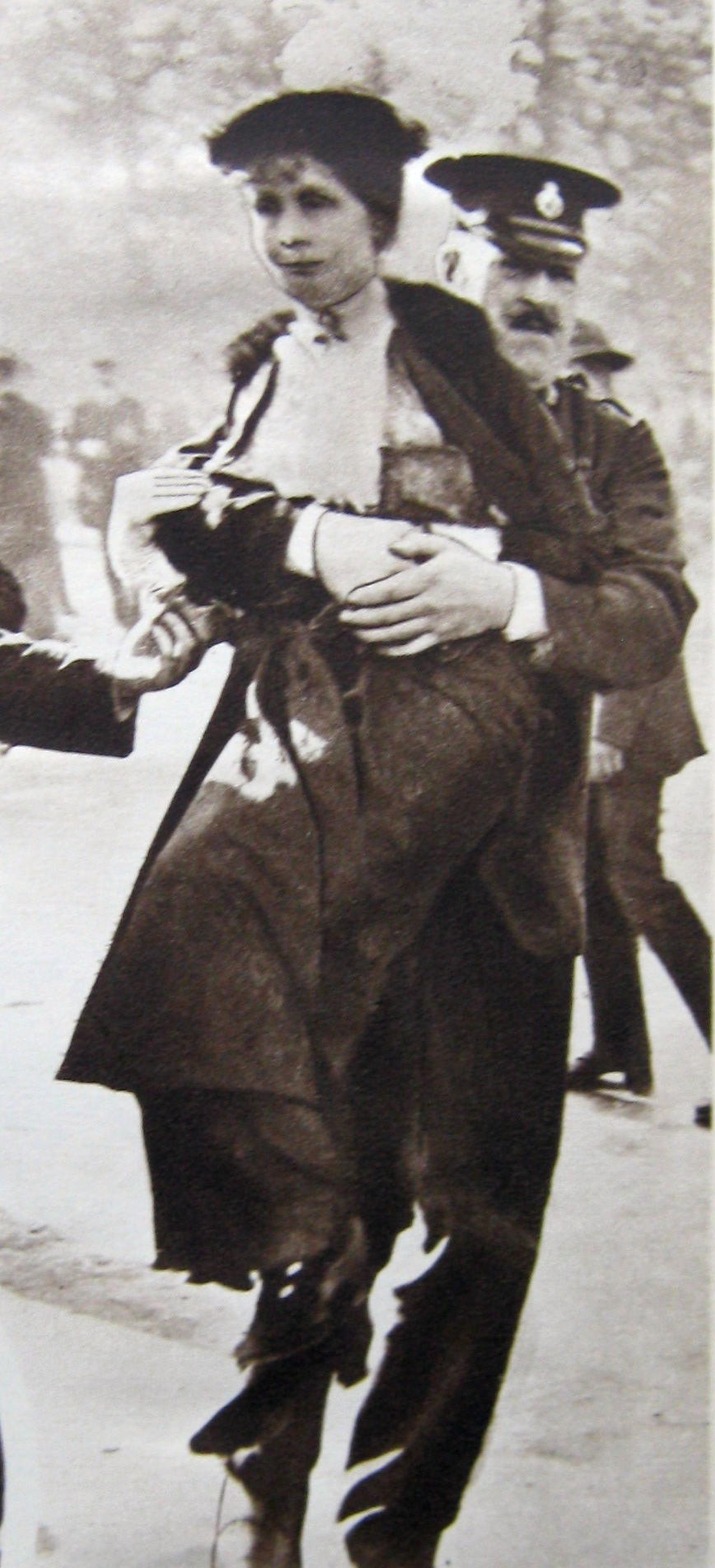
Suffragette removed from a demonstration Thanks to Eveline Robinson

Suffragette removed from a demonstration Thanks to Eveline Robinson

At the same time, the Anti-Suffrage league collected well over 250,000 signatures and Prime Minister, Herbert Asquith, refused to give the Conciliation Bill more Parliamentary time. Instead, the wording was changed to enfranchise more men thus keeping both the Anti-Suffragist and the Unions happy.

The response by the WSPU took place on Friday 18 November when a delegation of about 300 women demonstrated outside Parliament. The Home Secretary, Winston Churchill, called out the police and many of the women were beaten. Over 100 were arrested. The day was named Black Friday.

In response, the WSPU began to wage guerrilla warfare, alienating many Suffragists. The Suffragettes aim was to get themselves arrested and arrived at court carrying their bags and smiling. On being given prison sentences of 3 days to several months – usually in Holloway – they went on hunger strike and suffered force-feeding.

A Second Conciliation Bill – Women’s Enfranchisement Bill – was introduced into the new Parliament on 9 February 1911. The Second Reading debate was scheduled for 5 May. However, although the Bill secured a Second Reading by 255 to 88, it made no further progress. The WSPU organised a mass rally for 17 June, prior to the Coronation of George V on 22 June.
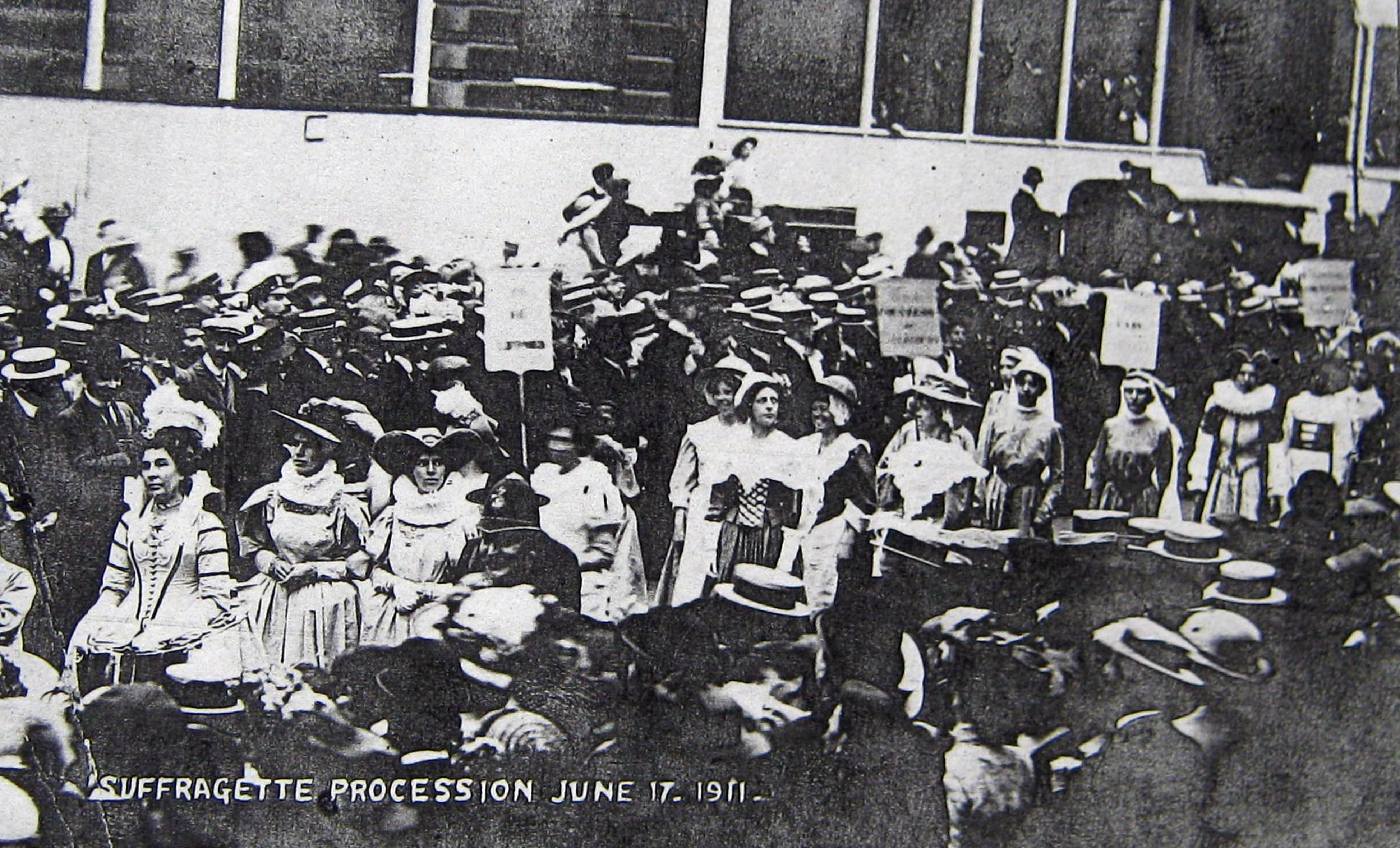
Womens' March prior Edward VII coronation 17.06.1911. Dover Library

Womens’ March prior Edward VII coronation 17.06.1911. Dover Library

On that day, the Suffragists again wore historic costumes and some Dover ladies watched while others, led by Lorna Bomford, took part. The Third Conciliation Bill was introduced on 19 February 1912 and set down for Second Reading on 22 March but delayed until 28th. It was then defeated by 222 to 208 votes due to:
– The Anti-Women Suffrage league launching an active campaign
– The Irish Parliamentary Party who did not want to waste parliamentary time, which could be used for discussing Home Rule, on women.
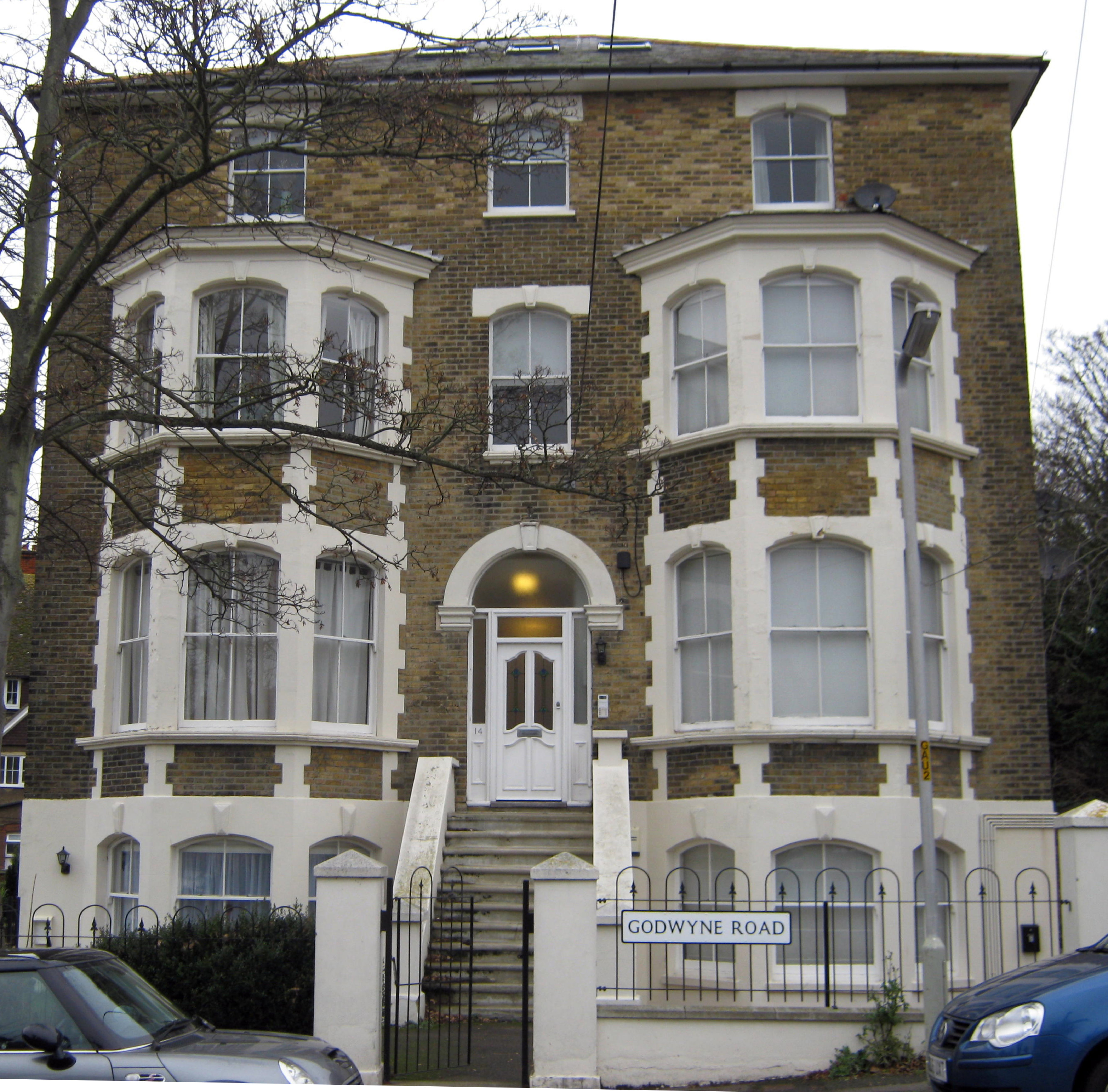
Hillesden House, 14 Godwyne Road

Hillesden House, 14 Godwyne Road

On 23 June 1912, Edward Barlow, the husband of Mrs Alice Barlow, the President of the Dover Women’s Suffrage died at the early age of 57. Although Alice remained President, it appears that she ceased to take an active part in Dover’s suffrage campaign. By that time, Annie Brunyate had moved away. However, the Vice President of the DWS was Countess Brassey, the wife of the new Lord Warden! Lorna Bomford was by this time, the chief and most active protagonist representing Dover. The centre of activity was her home, 14 Godwyne Road

The WSPU campaign of active disobedience and hunger strikes, following imprisonment, continued. Many women such as the Deal, Walmer and District Branch of the National Union of Women’s Suffrage, who, in July 1912, passed a resolution condemning ‘the recent outrageous and wanton window breaking and other acts of militancy’, condemned this. The government buoyed by such proclamations introduced the Prisoners (Temporary Discharge for Ill Health) Act 1913 or as it became known, the Cat and Mouse Act.

The rationale behind the Act was to stop force-feeding, which led to public sympathy, and replaced by the women being kept in prison until they became extremely weak when they were released and on recovery re-imprisoned. Thus, the government reckoned, they could say that any harm the women suffered was entirely their own fault. However, as the women recovered they were moved to ‘safe houses’, including ones in Dover organised by Lorna Bomford. The Act soon became counter-productive.
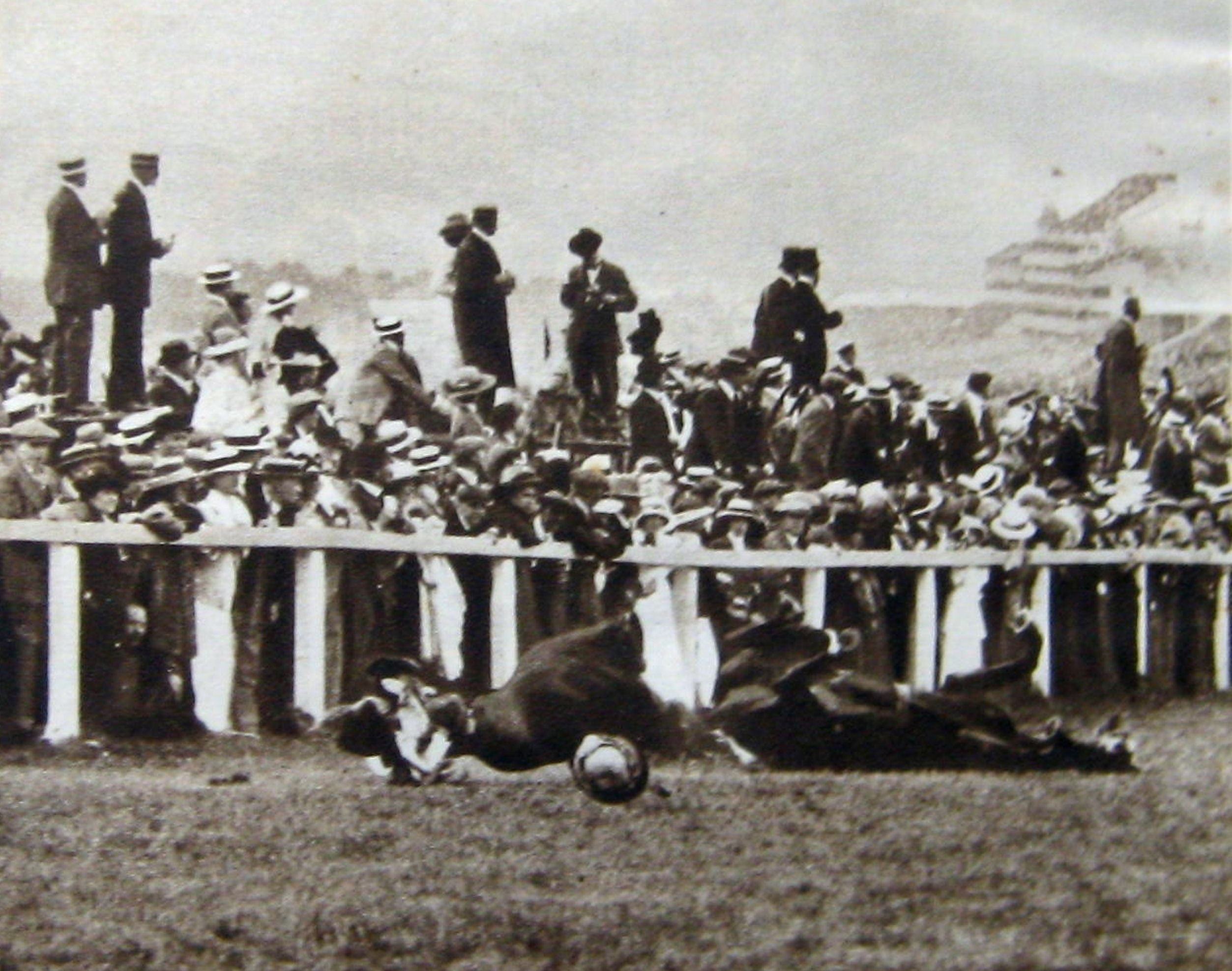
 Emily Davison falls under King's horse, Anmer, at the Derby 1913

Emily Davison falls under King’s horse, Anmer, at the Derby 1913

On 4 June 1913 Emily Wilding Davison, trying to pin a WSPU flag on the King’s horse, Anmer, at the Epsom Derby, fell underneath its hoofs. The establishment were outraged, with the Times giving lengthy coverage on the state of the horse and the jockey. The horse was unharmed and the jockey’s injuries consisted of slight concussion, cuts and bruises and an injury to his arm.

As for Emily Davison, she received a few short sentences, saying that she had been taken unconscious to Epsom Cottage Hospital and that she was a suffragist who had been imprisoned several times but usually released after hunger strike.

What mention there was of Emily’s condition was shrouded in vilification until she died on 11 June. Then it emerged she had gained a 1st class honours degree from Oxford. Emily was to be buried in Northumberland and the Suffragists announced that there would be a public tribute as her coffin crossed from Victoria railway station to Kings Cross in London.

The Home Office issued a statement saying that only a few women were to escort the body and the establishment press made it clear that only extreme militants would do so. On the day, Emily’s body was accompanied by a long procession of Suffragists, including Lorna Bomford and members of Dover’s Suffrage movement. On the way, the cortege stopped at the WSPU headquarters in Kingsway, where a memorial service was held.
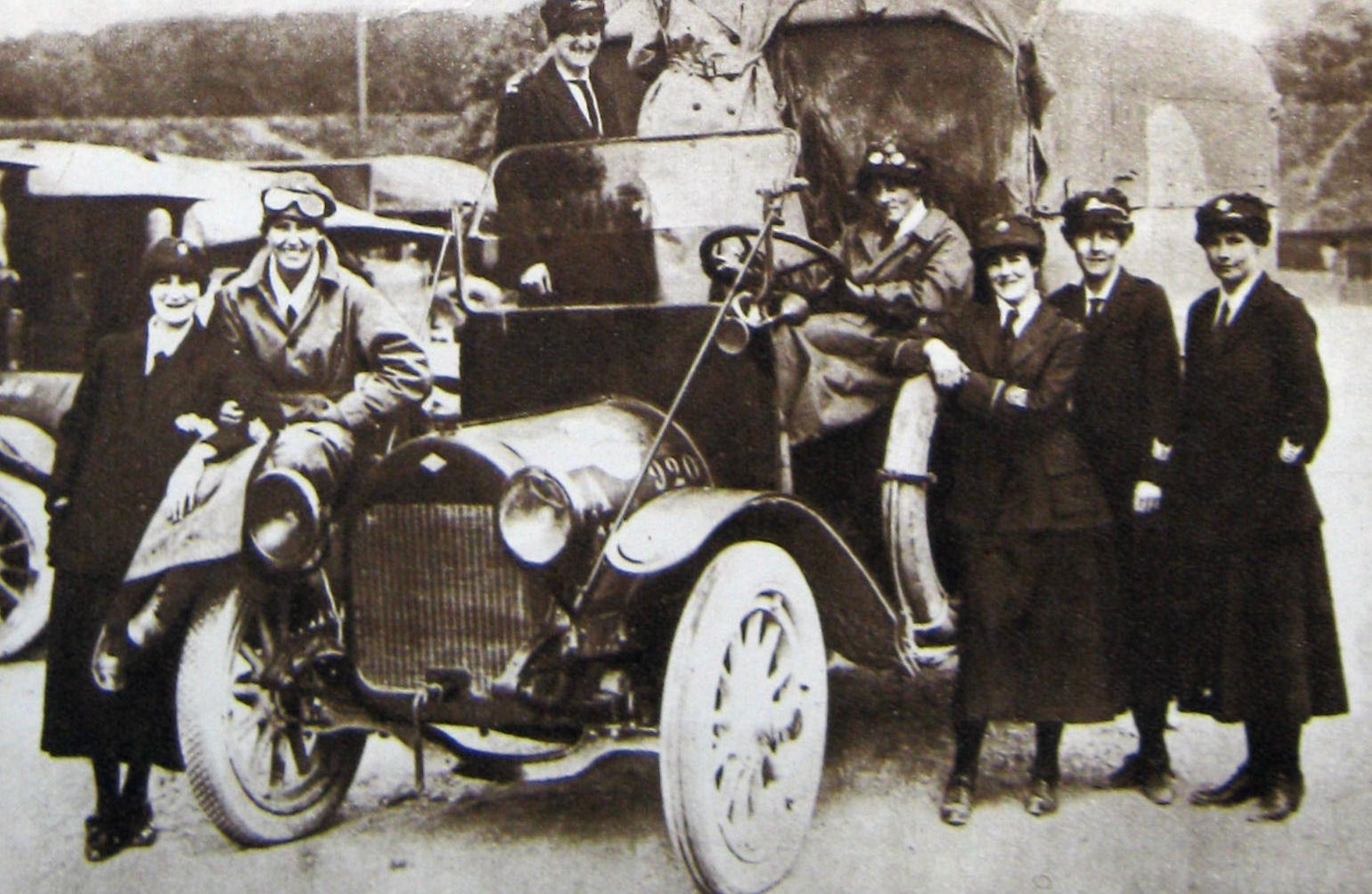
Women Ambulance Drivers. Thanks to Eveline Robinson

Women Ambulance Drivers. Thanks to Eveline Robinson

On 4 August 1914, World War I (1914-1918) was declared and the WSPU suspended its activities when the Government released all those held in prison. The Suffragists throughout the country threw themselves into supporting Britain’s war effort. By Christmas, nearly 5.9 million out of the 23.8 million females in Britain were in paid employment and many more worked in the voluntary sector.

As more men were sent to the Front, women replaced them by taking on jobs that were traditionally regarded as ‘men’s work’. However, only nurses were sent to the front line. In August 1915, the Dover Women’s Volunteer Reserve was formed under the command of Mrs Vasse and in 1916, the Women’s Land Army. In 1917, the Queen Mary’s Women’s Army Auxiliary Corps and the Women’s Royal Naval Service (Wrens), were formed.
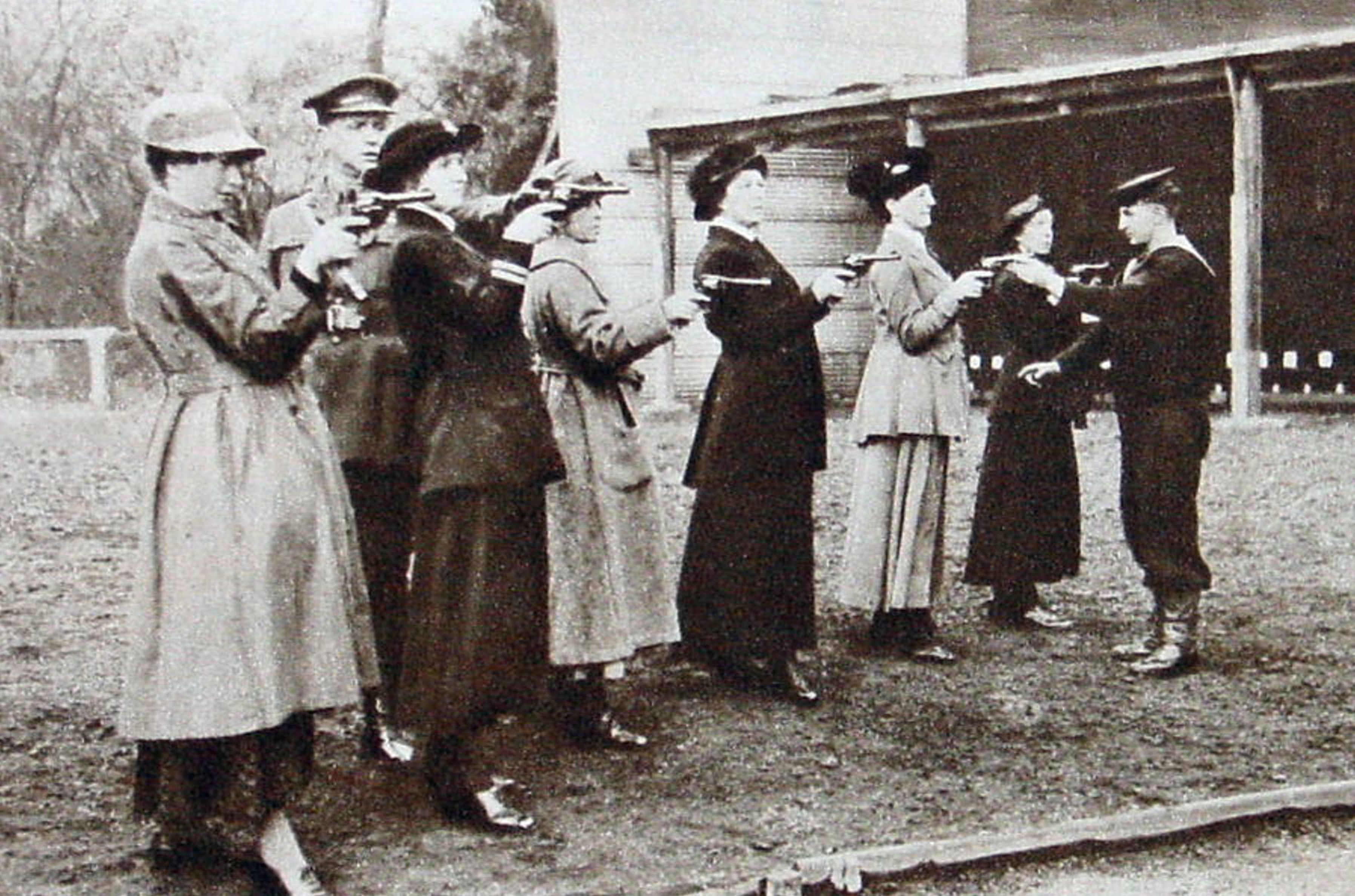
Women's Royal Navy Reserve in training. Doyle Collection

Women’s Royal Navy Reserve in training. Doyle Collection

Mrs Maria Barnes of Shooters Hill, Dover, the last surviving founder member of the Wrens at Dover died in St Mary’s Hospital, Etchinghill in April 1984 age 90 yeas of age. Along with five other local girls, their job was to take damaged parts from minesweepers to the Ordnance repair shop. Because no uniforms were available they were issued with souwesters, overalls and gumboots. Towards the end of 1917, as food shortages became severe, the Dover Food Control Committee was established and Lorna Bomford was appointed chief assistant and organiser. A role she resumed following the outbreak of World War II.
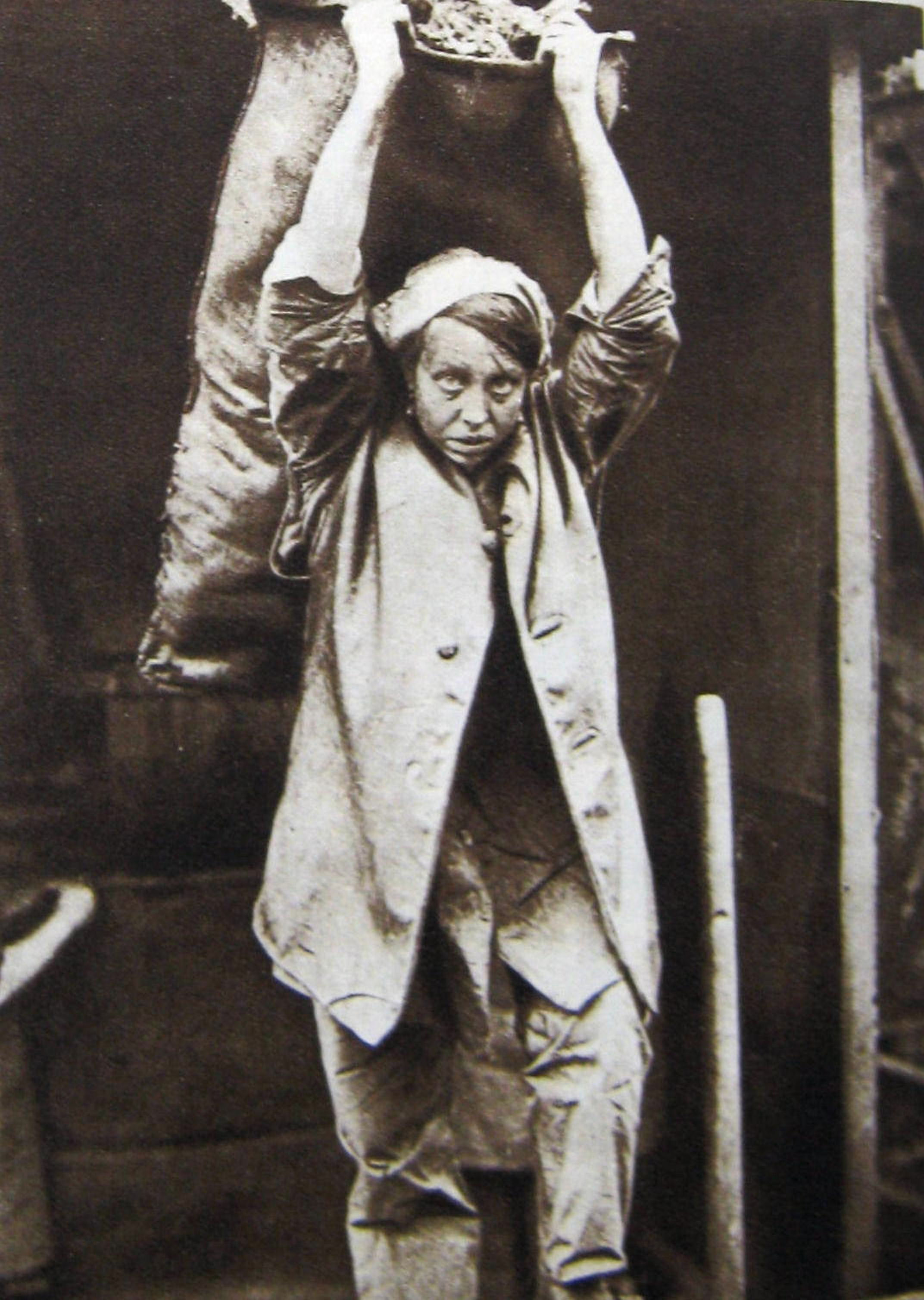
Woman coalheaver carrying 1 cwt sack. Thanks to Eveline Robinson

Woman coalheaver carrying 1 cwt sack. Thanks to Eveline Robinson

By 1918, it was hard to imagine a single job that had not been taken by women. In farming, industry, offices and health services there were women in every position.  In the coal trade, a minor concession was made to women with the introduction of the 1-cwt weight sacks instead of the pre-war sacks weighing 2-cwt.

In response, the Government introduced the Representations of the People’s Act, 1918, which gave the right of Parliamentary vote to women over the age of 30 who were householders, the wives of householders, occupiers of property with an annual rent of £5, and/or graduates of British Universities. As a result, 8.5 million women became entitled to vote in General Elections. On 23 October, the Commons had voted 274-25 to allow women to become MPs.

The next General Election was held on 14 December 1918. Several of the women involved in the suffrage campaign stood for Parliament but only Countess Constance Markiewicz, standing for the Sinn Fein, was elected but she never attended Parliament. Nancy Astor, who played no part in the women’s suffrage movement, became the first woman to take her seat in the Commons. She won Sutton, Plymouth by-election in December 1919.

In January that year, a by-election called in River saw Lorna Bomford elected as the first woman on Dover Corporation. She was appointed to the Housing and the Higher Education Committees. Her lasting legacy was the naming of the roads of the first part of the Buckland Estate after characters from Chaucer’s Canterbury Tales – Friars way, Weavers Way, Knights Way etc.

On 23 December 1919, the Sex Disqualification (Removal) Act, the first piece of equal opportunities legislation, entered the statute book. However, the first solicitor, Helena Normanton, was not accepted into the profession until December 1922 and only after a struggle. Women were not permitted to sit in the Lords until 1958 and then only as Life Peers. Hereditary Peeresses were not given seats until the passage of the Peerage Act 1963.

In March 1920, the Dover Housewives Union was established with the aim of combating the ever-increasing cost of food and other items. That year the Dover Autumn Quarter sessions saw, for the first time, women jurors. In 1926, Emily Pankhurst paid a visit to Dover and was photographed in Cambridge Road. In April 1927, Lorna Bomford was appointed a County Magistrate, the first woman from Dover to be given the office. She remained a Justice of the Peace until 1947.
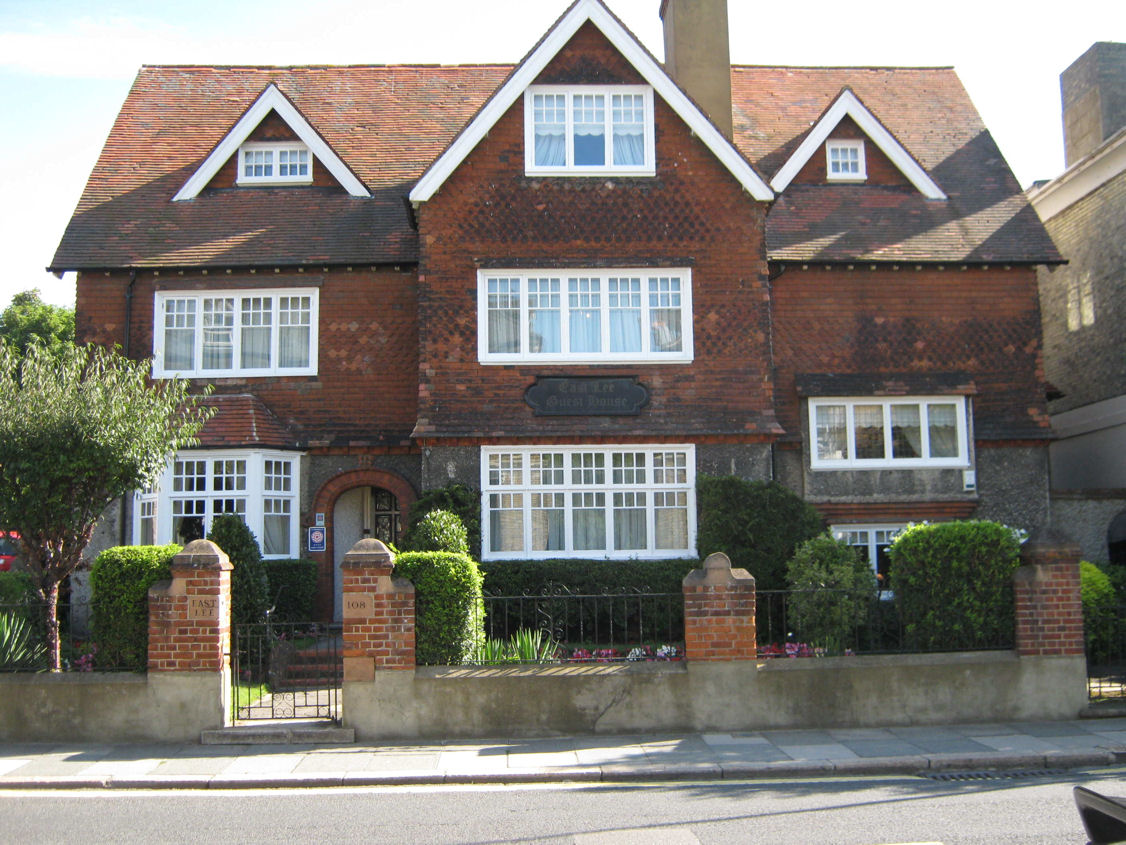
East-Lee, 108 Maison Dieu Road. The home of Emma east the first women to be appointed an Honorary Freeman of Dover

East-Lee, 108 Maison Dieu Road. The home of Emma east the first women to be appointed an Honorary Freeman of Dover

On 26 April 1927, Mrs Emma East was given the honorary Freemanship of the town, the first lady so honoured. She had supported her husband, who was the Mayor throughout the General Strike when they were on duty 24/7. He died shortly afterwards. To date, although Emma’s marital home still stands, the powers that be in Dover have not erected a plaque to honour Emma.

Emily Pankhurst died on 14 June 1928, the same year as the Representation of the People’s Act gave women the vote on equal terms to men. To the end, the Establishment never honoured Emily. However, close to Houses of Parliament is a statue to her, the cost was born by former WSPU members and sympathisers.

The General Election of 1929 was given the derogatory nickname ‘Flapper Election.’ The Labour Party took office for the second time with Ramsay MacDonald as Premier. Margaret Bondfield was appointed Minister of Labour – the first woman to hold a Cabinet position.
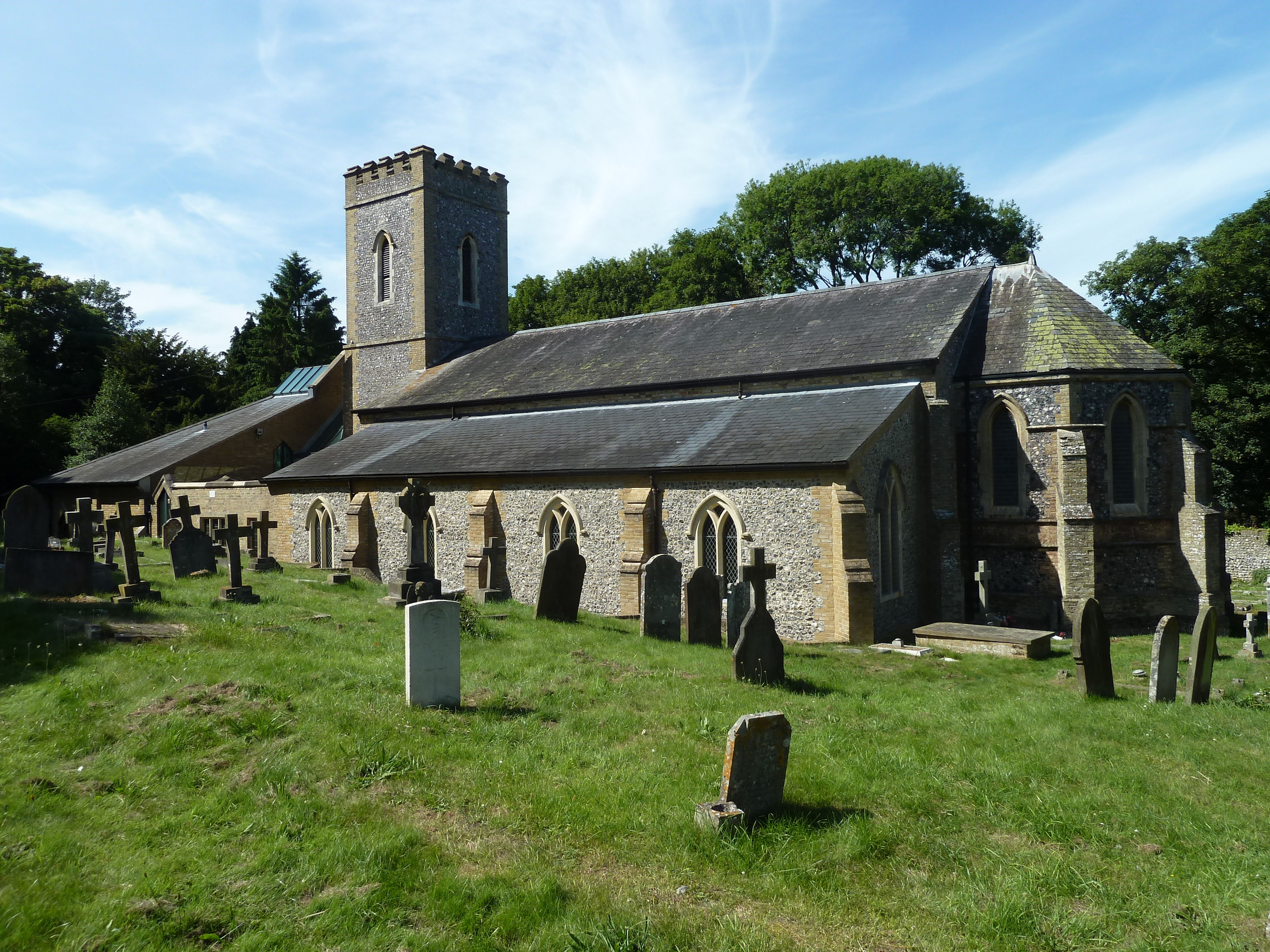
Alice Barlow died on 2 March 1930 and was buried in SS Peter and Paul Churchyard, River. near Dover.

Alice Barlow died on 2 March 1930 and was buried in SS Peter and Paul Churchyard, River. near Dover.

On 2 March 1930 Alice Barlow, Dover’s Suffrage President, died at 15 Victoria Park – her residence. She was buried next to her husband in SS Peter & Paul Churchyard, River, near Dover. Her death passed unnoticed.

Dr Annie Brunyate, Dover’s first woman doctor and Suffrage leader left Dover to take up the post of assistant medical officer of health in Manchester and Stockport (1913-17). She then went to the Lindsey Division of Lincolnshire (1917-1932) where later was appointed deputy medical officer of health. She died in Bristol on 13 October 1937 but her death passed unnoticed. Her home in Effingham Crescent, the first headquarters of Dover Suffrage movement, was badly damaged by a shell on 3 November 1943, during World War II, and was subsequently demolished.
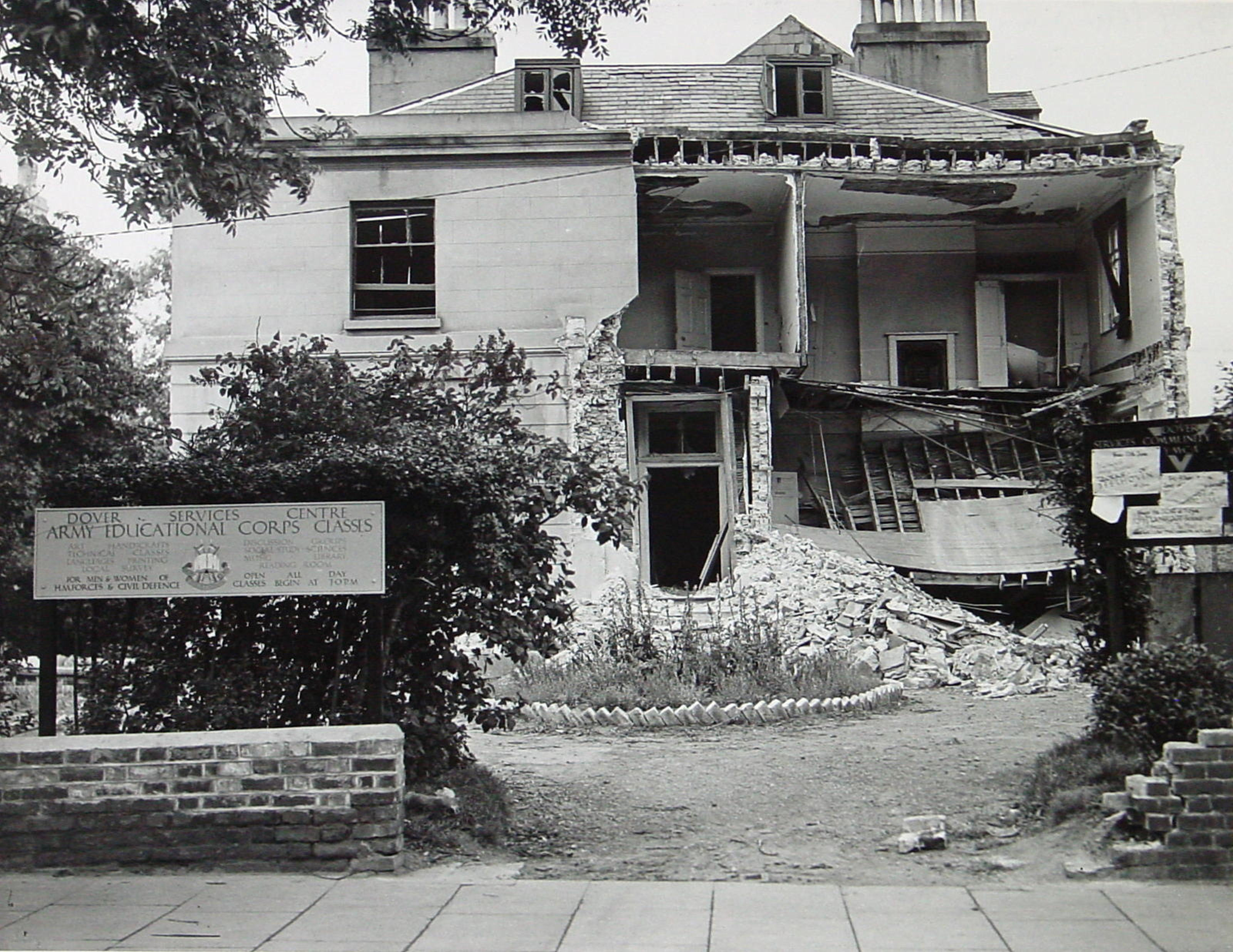
Dr Annie Brunyate's home and centre of the early Dover women's suffrage campaigns in Effingham Crescent following shell attacks in World War II. Dover Library

Dr Annie Brunyate’s home and centre of the early Dover women’s suffrage campaigns in Effingham Crescent following shell attacks in World War II. Dover Library

During World War II, women were given major roles, but when honours were given out, they tended to be lower than their male equivalents. Following the war, in July 1946, Dorothy Knight Dix, (1909 –1970) a barrister and Deputy-Recorder of Deal, made legal history when she covered for Dover’s Recorder, at the Quarter Sessions. She was the first woman to pass sentence.

The following year, the Dover’s Business and Professional Women’s Club made equal pay an issue that, it was hoped, would be achieved within the members’ lifetime.
– Equal Pay Act came into force following the Ford Dagenham female workers dispute and under the auspices of Labour politician, Barbara Castle, in 1970
– Sex Discrimination Act came into force in 1975. This was superseded by the Equality Act of 2010 to bring UK anti-discrimination law into line with EU Equal Treatment Directives.
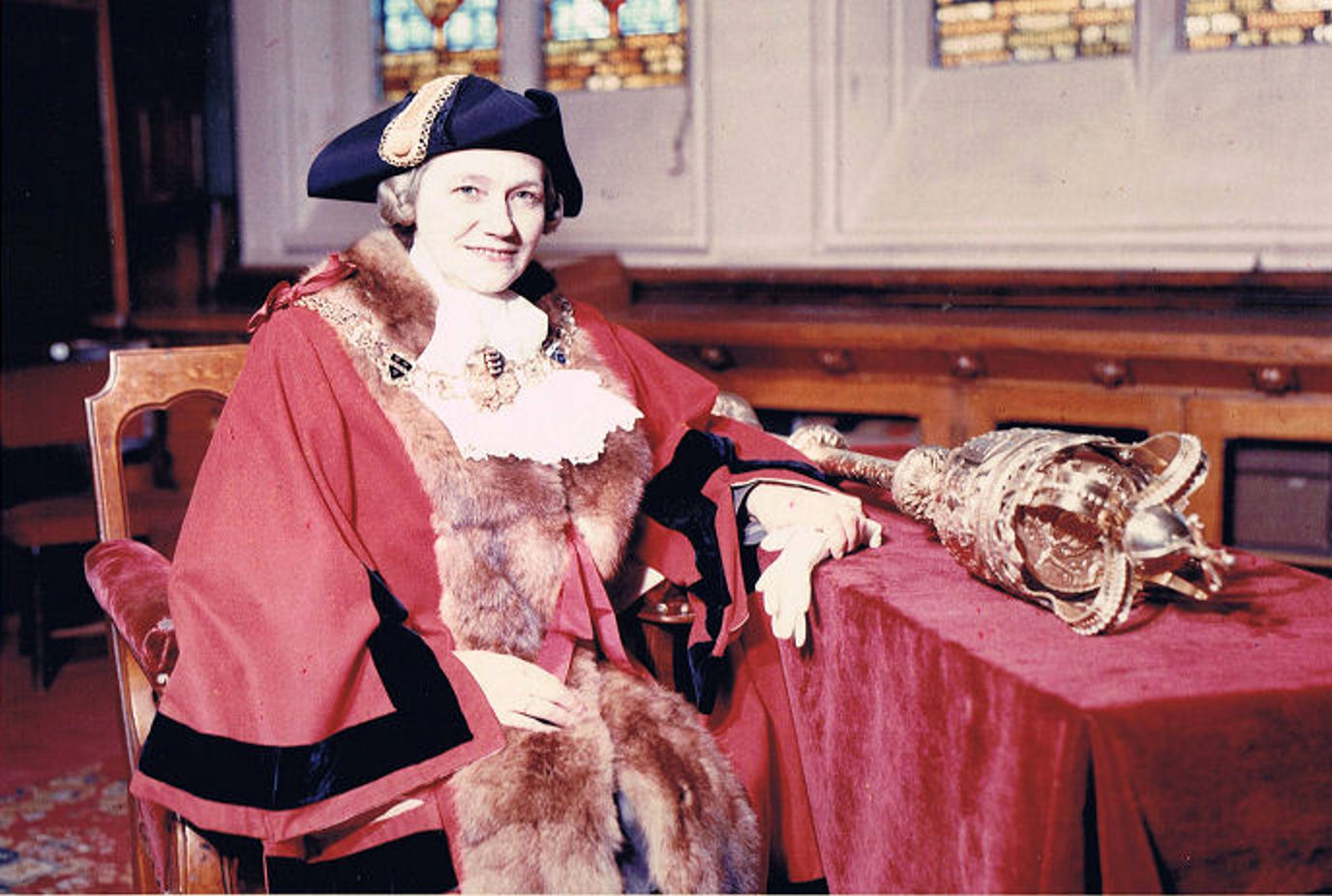
Dorothy Bushell - Dover's first lady Mayor 1960-61 - Courtesy of Fr. Peter Sherred

Dorothy Bushell – Dover’s first lady Mayor 1960-61 – Courtesy of Fr. Peter Sherred

On 25 February 1962, Dover’s leading fighter for women’s rights, Lorna Bomford, died aged 78 at her home, Milestone House, Temple Ewell. She has never been given a civic honour nor is there a plaque on Hillesden House in her honour. Two years earlier, on 23 May 1960 Alderman Mrs Dorothy Bushell was elected the first ever lady Mayor of Dover.
As Mayor, she proved that a woman was more than capable of holding the office. Dorothy died in 2004 age 95 – again, there is nothing publicly to honour her.

Post Script.
Following the author giving a talk on the above to the Dover Ladies Luncheon Club, member Patricia Biginell, publicly expressed the view there should be recognition given to these ladies. They had worked hard, against all the odds, to secure rights for women.

The Ladies of the Luncheon Club agreed and the Committee organised a plaque that was unveiled by the Chairman Avril Woolf on Wednesday 27th February in the Stone Hall, Maison Dieu (former Town Hall).
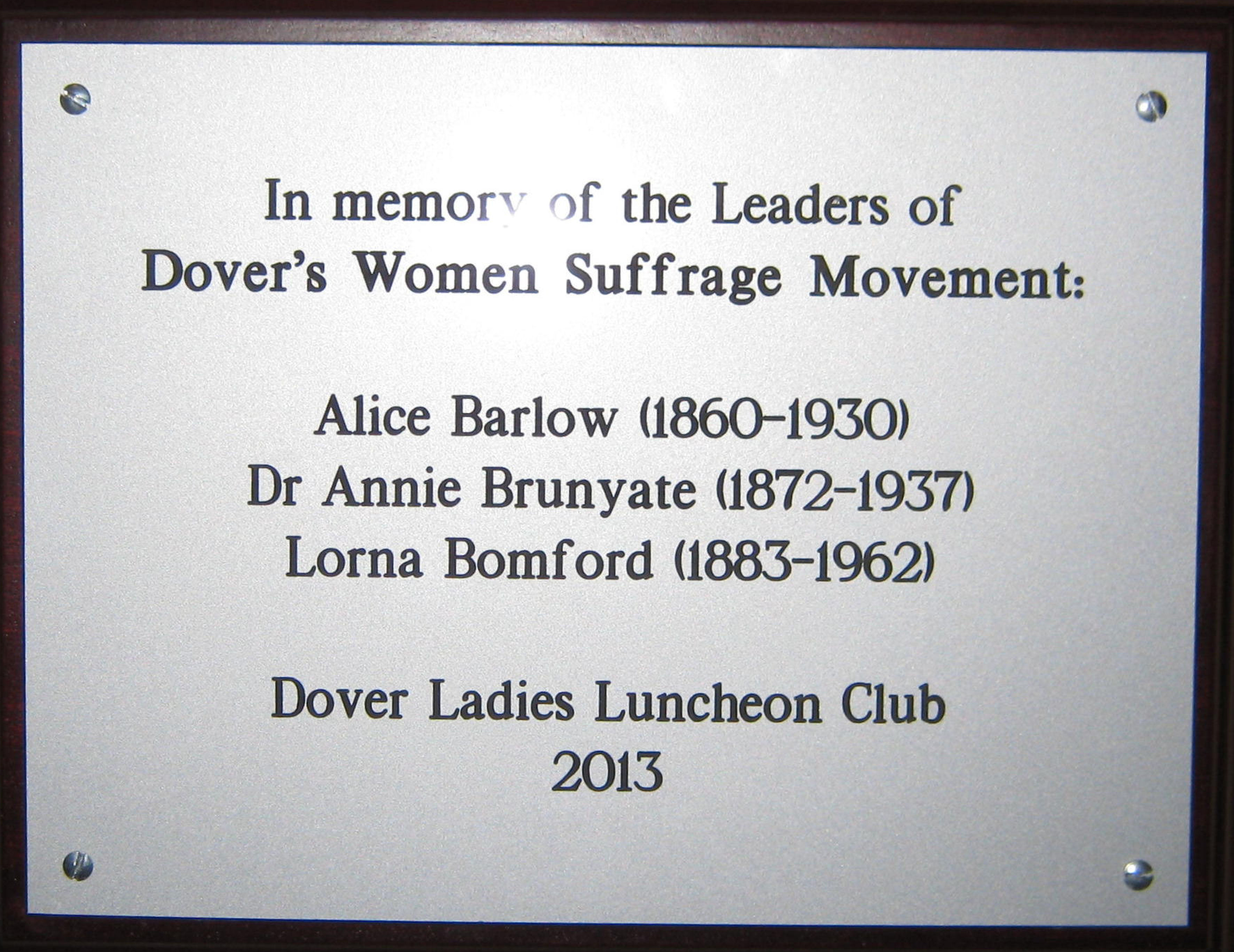
Dover Ladies Luncheon Club - Plaque dedicated to the leaders of Dover Women's Suffrage

Dover Ladies Luncheon Club – Plaque dedicated to the leaders of Dover Women’s Suffrage

Dover Ladies Luncheon Club: http://www.doverladiesluncheonclub.co.uk

  • Published:
    Dover Society Magazine July & November 2012 + March 2013
    Dover Mercury 07 March 2013 Full page article + Centre Spread
Posted in Local Government, Womens' Suffrage in Dover | Comments Off on Womens’ Suffrage in Dover

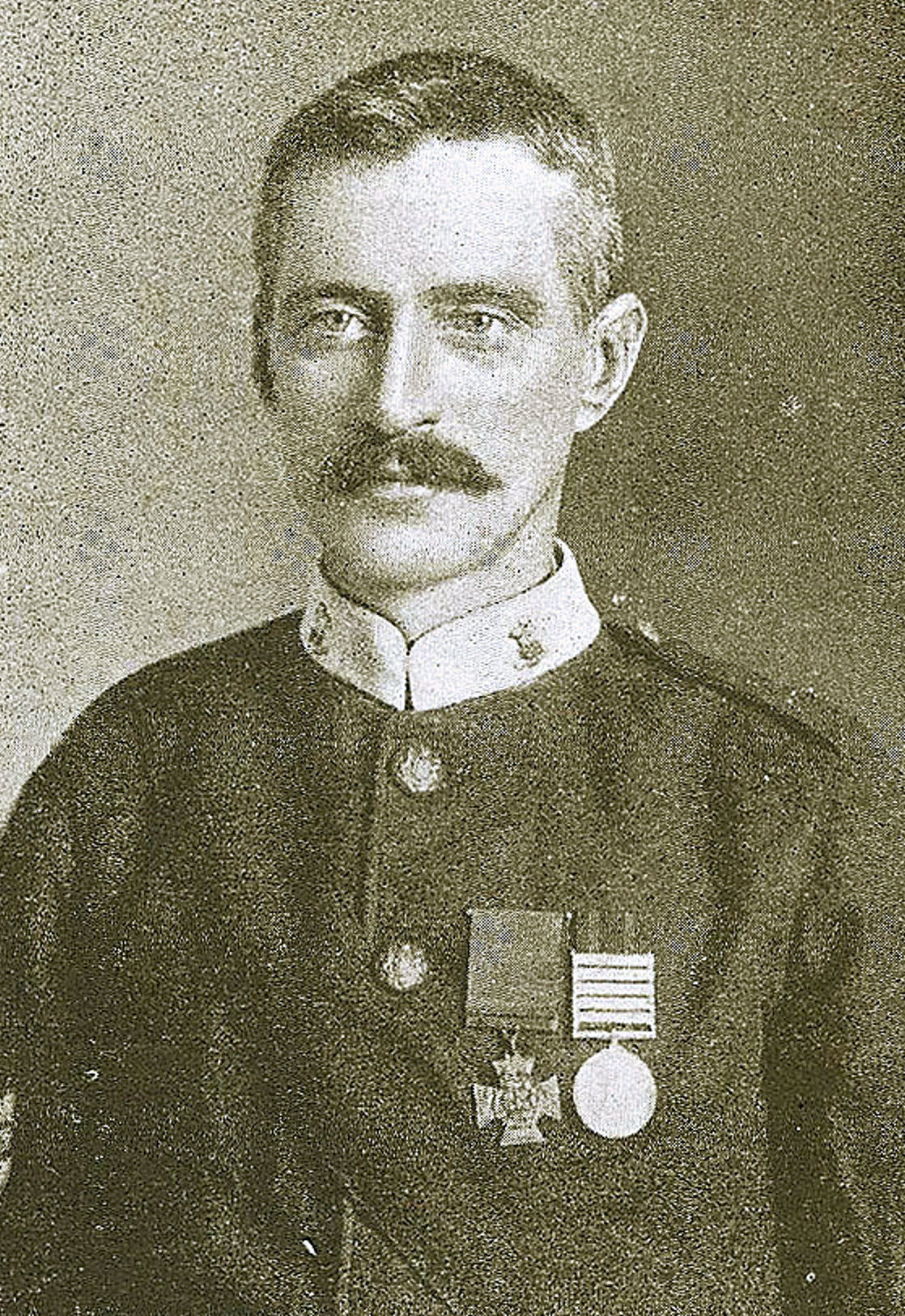
William Bernard Traynor VC

William Bernard Traynor V.C. 1870-1954 courtesy of Dix Noonan Webb

William Bernard Traynor V.C. 1870-1954 courtesy of Dix Noonan Webb

In Britain, Armistice or Remembrance Day originally commemorated the cessation of hostilities on the Western Front during World War I on 11 November 1918. That war, however, did not officially end until the signing of the Treaty of Versailles on 28 June 1919. Following World War II, the annual ceremony was extended to include those who had fallen in that war. Since then, it has been extended to those who have fallen in subsequent conflicts such as Korea, Falklands, Persian Gulf, Kosovo, Bosnia, Northern Ireland, Iraq and most recently Afghanistan.

Extending the Remembrance Day ceremony back in time to the Boer Wars, South Africa (11 October 1899 – 31 May 1902) was, for one Dovorian, an annual crusade. Every 11 November up until his death in 1954, Bill Traynor, ensure that his fallen comrades in the Boer Wars were remembered.

Briefly, the Boer Wars was a conflict between the British and Boers, the latter mainly farmers who had emigrated to South Africa from northern Europe. Over time, they had formed independent Republican States that the British Empire was determined to unite into one country under British rule. The Boer’s fiercely objected and following an unsuccessful rebellion in 1880-81, they organised themselves into fighting units. In 1899, two of these units, the South African Republic and the Republic of the Orange Free State, combined and launched an offensive.

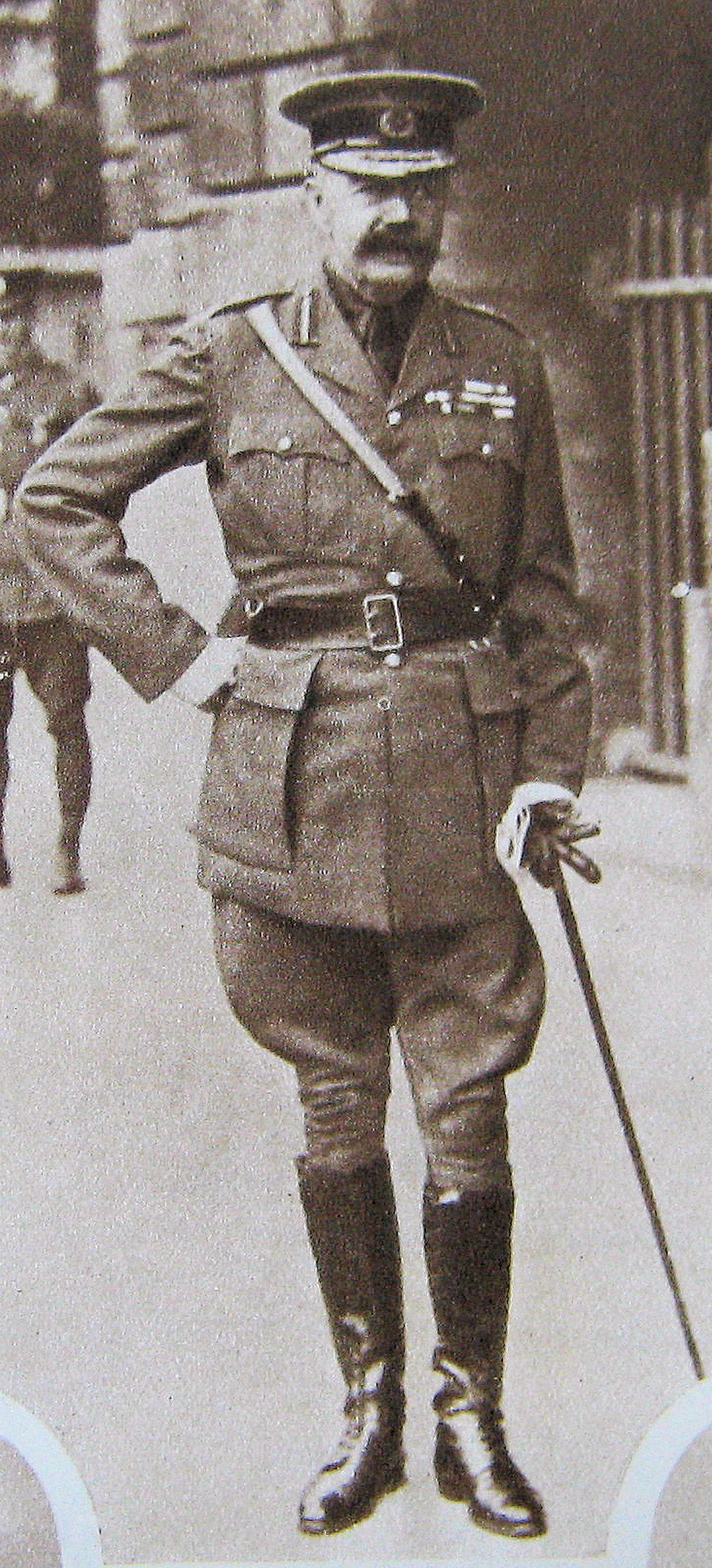
Lord Horatio Kitchener 1850-1916

Lord Horatio Kitchener 1850-1916

The British response, under Lord Kitchener, was quick and initially appeared to be successful, but losses were high. The Boers regrouped and responded with guerrilla tactics and the British response was brutal. Burning farms, restricting civilian movements and the introduction of concentration camps in order to starve the Boer’s into defeat. Eventually the negotiations led to the formation of the Union of South Africa with limited autonomy for the Boers.

The British losses were due to combat, disease and general sickliness. Indeed, the Army Medical Corps reported that between 40% and 60% of men presenting for service were physically unfit to fight. This resulted in the major social reforms in Britain, prior to World War I.

Those in the regular army were fit and one of these was William Bernard Traynor. Born in Hull in 1870 he joined the West Yorkshire Regiment (Prince of Wales Own) when he was 18-years old. Having spent some years in India, in 1897, he returned to England and married Jane Elizabeth Martin and six of their children survived into adulthood. Promoted to Sergeant, at the outbreak of the Boer Wars, Bill, as he was informally called, served under General Horace Smith-Dorrien. He was stationed at Bothwell Camp, close to the large Chrissiesmere in South Africa’s Lake District

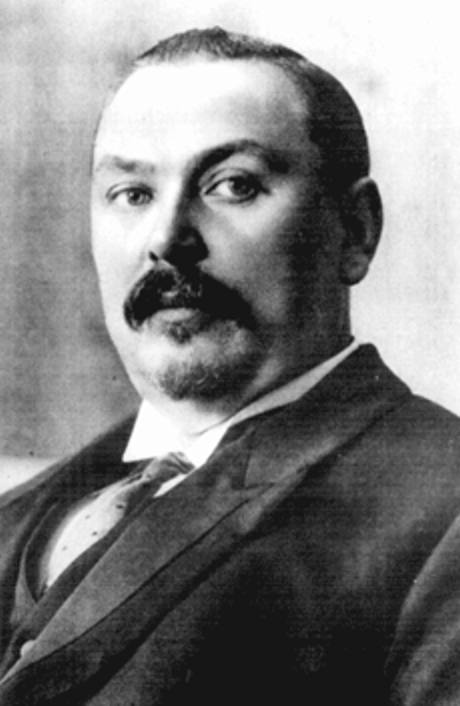
Louis Botha 1862-1919 - Internet

Louis Botha 1862-1919 – Internet

The night of 6 February 1901, Bill was on duty commanding a section. It was particularly dark and the mist from the lake made it difficult to see. In the bush, some 2,000 Boer’s, led by Louis Botha, silently crept towards the Camp. At 03.00hrs, Botha gave the command to attack and the Boer’s, driving loose horses in front of them to cause confusion, rushed forward. They then opened with heavy rifle fire. The soldiers including those who minutes before had been asleep in their barracks, fought back – it was mainly hand-to-hand combat.

The fighting was fierce but seeing one of his men severely wounded Bill leapt from his trench and under a hail of bullets went to the man’s assistance. Unfortunately, Bill was hit in the chest and thigh so was unable to carry the casualty and called for assistance. Lance-Corporal Lintott, who was later commended for his bravery, joined him. Between them, they carried the wounded soldier to shelter and although his wounds were serious, Bill remained in command of his section encouraging his men.

It was before daybreak that Botha called off his men sending detachments in different directions to confuse the British if they followed. At daybreak, the British tally was twenty-four officers and men killed and fifty-three wounded. It was reported that Bill was amongst the dead and when communications were restored and the War Office sent a telegram to Bill’s wife, to this effect.

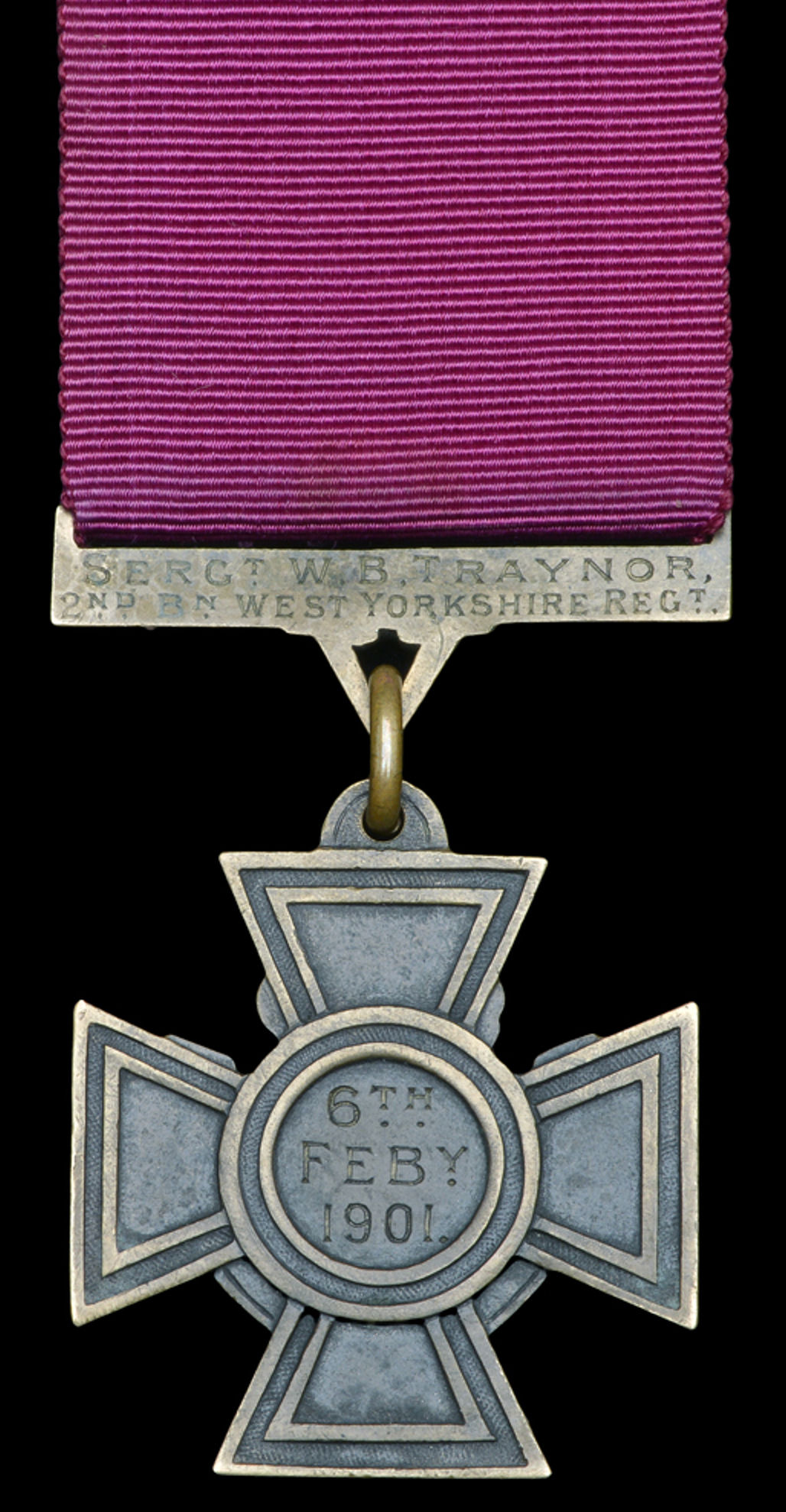
Bill Traynor's Victoria Cross.  Dix Noonan Webb Ltd

Bill Traynor’s Victoria Cross. Dix Noonan Webb Ltd

In fact, Bill survived and in the London Gazette of 17 September 1901, it was announced that he had been awarded the Victoria Cross. The only one given to an N.C.O. or private soldier in the West Yorkshire Regiment in the Boer War. Later that month, on the 29 September, Bill was discharged from the army but the investiture of his VC took place in July 1902, at the York garrison.

In the autumn of that year, Bill and his family moved to Dover, where he took up the post of Barrack Warden. He joined in the town’s civilian life but his heart was with the military and in World War I (1914-1918) was mentioned in despatches for valuable services rendered. In 1929, following a dinner for holders of the V.C. at the House of Lords he joined the British Legion becoming one of its staunchest supporters. For ten years, he served as Dover’s Vice-Chairman.

Jane, Bill’s wife, died in 1934 and a year later, he retired but stayed in Dover and continued to remain loyal to his regiment. He named his home on Sandwich Road, Whitfield, Ca Ira – the regimental march of the West Yorkshires. In 1951, a special dinner was held in the Maison Dieu – then the Town Hall – to honour the 50th anniversary of Bill’s award. Two years later, he was one of the few non-Freemen invited to a Coronation lunch at the Town Hall held in honour of Hereditary and Honorary Freemen.

Bill died on 20 October 1954 aged 83 and was buried at Charlton Cemetery. Military and civic dignitaries including the Mayor of Dover, Reginald Snelgrove, attended his funeral. By that time members of his immediate family were following successful careers in the Army.

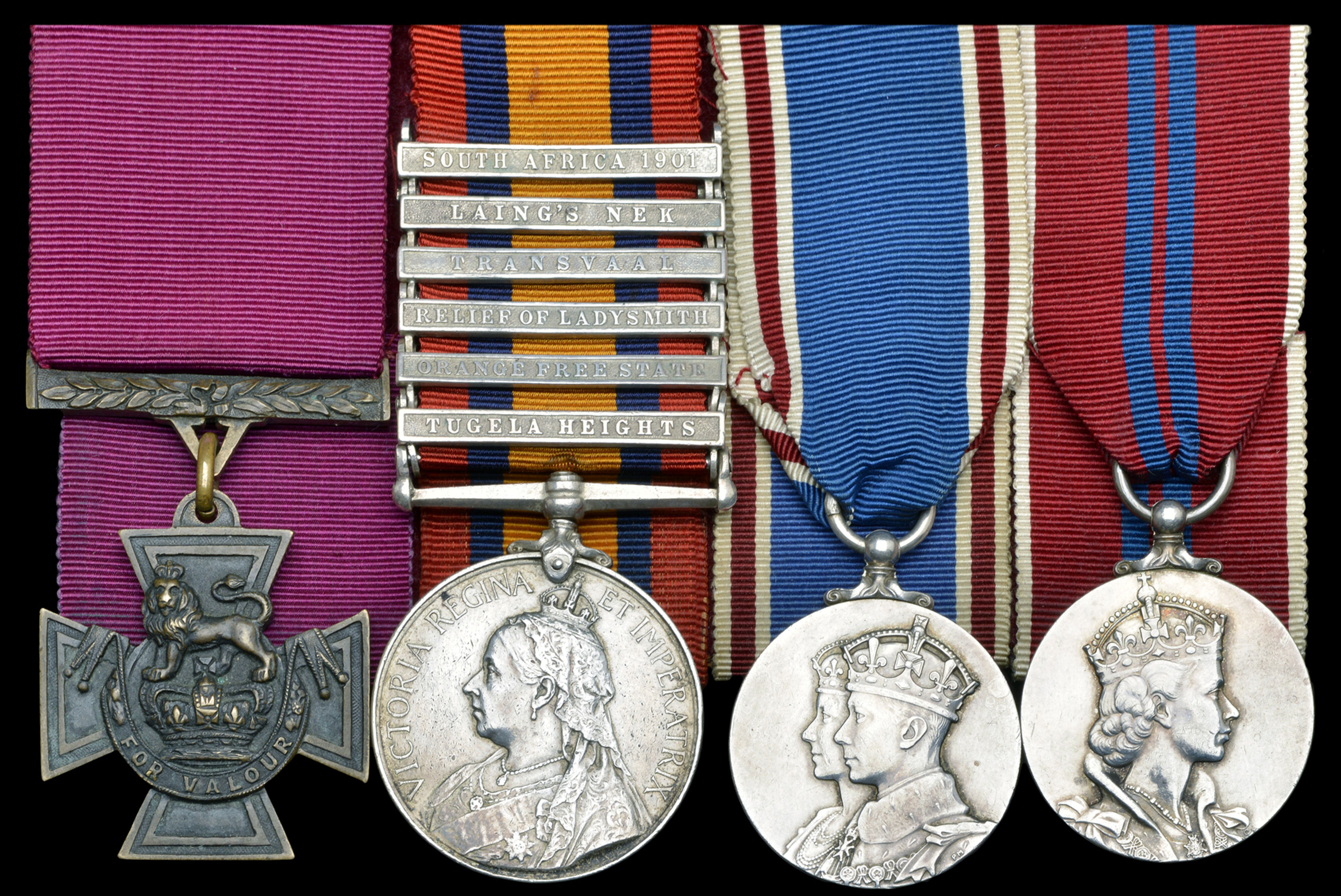
Bill Traynor's medals. Dix Noonan Webb Ltd

Bill Traynor’s medals. Dix Noonan Webb Ltd

Since then Bill’s V.C. and other memorabilia have been kept by his family but in December 2012, they came up for auction at Dix Noonan Webb Ltd, Bolton Street, London. The VC fetched £160,000. Bill’s other medals were the Queen’s South Africa medal with 6 clasps: Tugela Heights, Orange Free State, Relief of Ladysmith, Transvaal, Laing’s Nek; and the 1937 and 1953 Coronation medals.

My thanks go to David Erskine-Hill of Dix Noonan Webb and Tony Belsey for telling me about the auction

  • Published: 
  • Dover Mercury 8 November 2012
Posted in Armed Services, People, Traynor William Bernard VC, Traynor William Bernard VC | Comments Off on William Bernard Traynor VC

Wrecking

Edward I - Council Chamber, Maison Dieu (former Town Hall).

Edward I – Council Chamber, Maison Dieu (former Town Hall).

Smuggling, privateering, piracy and wrecking have all played an important part, for centuries, in securing the finances of those who lived along the south-east Kent coast. Wrecking, the practice of taking valuables from a ship, which has foundered near or close to shore, was ensconced in Edward I (1239-1307), Cinque Ports Charter of June 1278. The Charter was written in recognition of the importance to Realm of the five ports of Hastings, Romney Hythe, Dover and Sandwich, and the two Antient towns of Winchelsea and Rye. In return for supplying 57 ships, fully manned for 15 days service a year and defining each ports share of the total burden, the Ports were given special privileges. One of these was the right to claim any wreckage found on the sea or on shore. At the time, the entire South Kent coastline was under the Cinque Ports direct control.

Killing survivors or deliberately faking signals, help or other forms of deception, in order to salvage from the wreck of a ship was not part of the remit. Nonetheless, it was well recorded that the Cinque Portsmen were not adverse luring passing ships on to treacherous sandbanks, such as the Goodwins and the Varne Bank, and take possession of anything they could retrieve from the hapless vessels.

In order to try and put a stop to such practices at the same time as protecting English shipping from Continental pirates; successive monarchs employed Cinque Portsmen to provide protection. However, on the king’s order in 1305, one of the Cinque Ports ships, Snake of Sandwich, was cruising in the Strait of Dover supposedly protecting merchantmen from Continental pirates. While on this duty the crew of the Snake of Sandwich chased a London trader into St Margaret’s Bay and took £250 and goods from the resulting wreck.

St Margaret's Bay c1960s, South Sands House formerly the Hermitage, left.

St Margaret’s Bay c1960s, South Sands House formerly the Hermitage, left.

The problem did not go away so on the Ides of May in 1367, Archbishop Langham granted 40 days indulgence to those in his diocese who contributed towards the maintenance of ‘Brother Nicholas de Legh, of the Hermitage at StMargarettes Stairt, in the Parish of St Margarette atte Clyve.’ Brother Nicholas’ cave was on the west side of St Margaret’s Bay and his job was effectively that of a lighthouse keeper. Of note, the South Foreland lighthouse (ceased operation in 1988) and South Sands House are nearby. The latter was formally called the Hermitage.

William Warde was the Mayor of Dover four times (1612,13,18 and 1619) and also Deputy Lieutenant of the Castle. In 1613-14, during his second Mayoralty, together with the Clerk of the Castle, and the Droit Gatherer General (tax collector), he was accused of embezzling the profits from wrecked ships. The case was heard at the Court of Admiralty, then held in St James’ Church, Dover. The Mayor argued that this was a right under the Charter of Edward I so, on being found guilty, the Mayor sort legal redress through the Privy Council.

St James (Old) Church where the Court of Admiralty was held.

St James (Old) Church where the Court of Admiralty was held.

The case took three years and the Privy Council upheld the findings of the Dover court saying that in 1602, the Crown claimed wreckage rights throughout the land. However, they recognised that a concession had been made to the Cinque Ports by Edward I’s Charter. The Privy Council therefore ruled that Mayor Warde was correct, such wreckage did not belong to the Crown. However, As the Lord Warden was the most senior person in the Cinque Ports, all wreckage within the jurisdiction belonged to him! Thus Mayor Warde was forced to retract his stance and was forced to accept the Lord Warden’s rights.

Warde was again elected Mayor but the populace ignored the Privy Council’s ruling. Rumour of a wreck was sufficient to bring every man, woman and child hurrying to the beach. If a member of the crew or a passenger of the shipwreck got in the way, they would be dealt with by a fist or a knife. As for the Lord Warden, he probably received a share of the proceeds and ignored how it came about.

However, in 1515, Henry VIII created the Fellowship of the Cinque Ports Pilots or Lodesmen (meaning one who leads the way). They operated under the auspices of the Court of Lodemanage, part of the Court of Admiralty and presided over by the Lord Warden. Following the King’s decree, all ships, except those with native masters and mates, had to use a licensed pilot to navigate the Channel, Thames and Medway estuaries safely to port.

The chances of being wrecked in the Channel decreased but this put a strain on the livelihoods of many along the coast. As time passed another evil variation of the old wrecking practices emerged. Men would go out to a vessel and pass themselves off as a Cinque Port Pilot. Once on board they would signal to accomplices who would help to  unload the cargo, and then they would all take it home as bounty. The hapless crew would have been dealt with and the distressed ship would be then left in the hands of Fate.

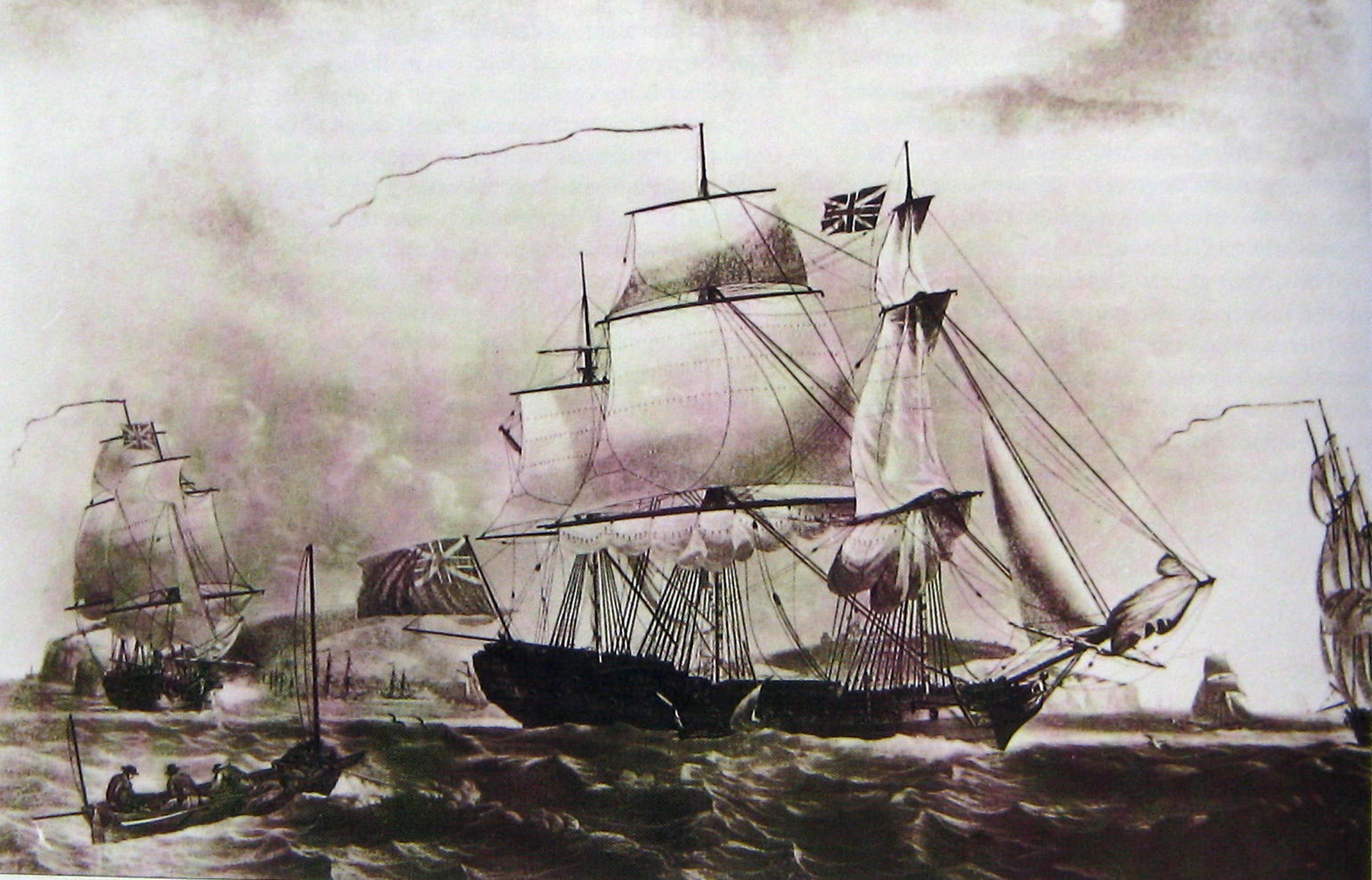
East Indiaman c1800. Dover Museum

East Indiaman c1800. Dover Museum

Matters had come to a head on 8 February 1805 when the Endeavour, a West Indiaman, ran aground on the Goodwin Sands. Her cargo was valued at £23,000 and included rum, sugar and coffee. Peter Atkins, a Deal boatman, offered the captain help to unload the stricken vessel but when the captain accepted, Atkins was alleged to call out, ‘A wreck! A wreck!’ and a number of Deal boatmen came aboard and unloaded the ship. An audit of goods landed showed that only £500 had been legally salvaged and Atkins was prosecuted for ‘felony and piracy on the high seas,’ a capital offence.

The case was tried at the Admiralty Court in the Old Bailey, London, and received a lot of publicity. Representatives from the Dover Court of Lodemanage and Lady Hester Stanhope -the niece of the Prime Minister William Pitt, who was also the Lord Warden – came to Atkins defence. They argued that Pilotage dues on foreign vessels were so extortionate that many ships traversed the Downs without pilots. When the Deal boatmen go out to help, they were often only paid a small reward for the dangerous work they undertake and therefore should be allowed a share of the goods.

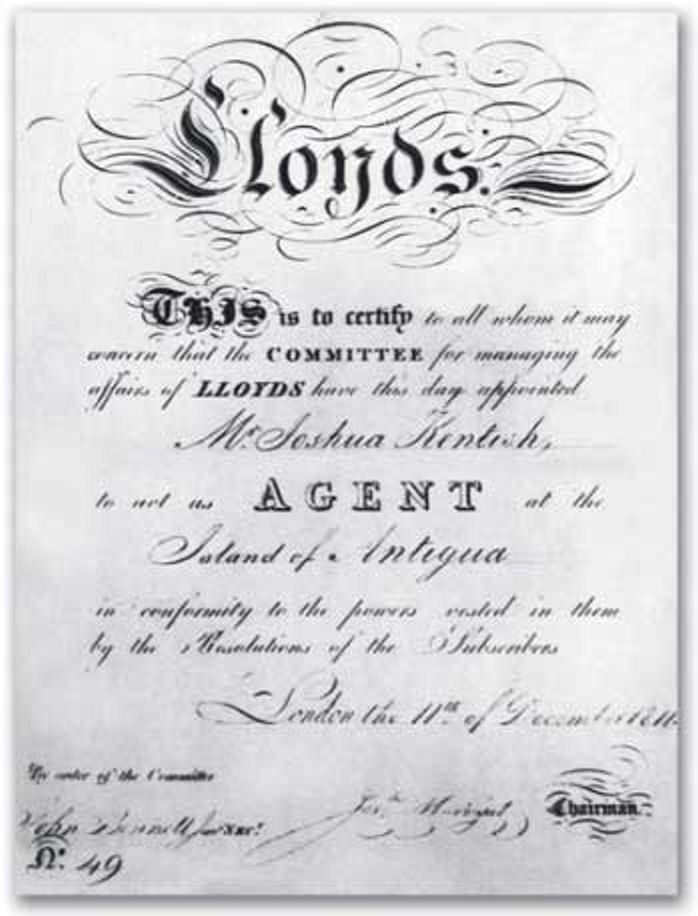
Lloyds Agents certificate. Lloyds of London

Lloyds Agents certificate. Lloyds of London

The trial ended with Atkins being found guilty and sentenced to transportation. However, before the trial had even started Medmer Goodwin, of the Ramsgate Commissioners of Salvage, approached Lloyds of London suggesting that his firm should act as agents for the Insurance underwriters. The offer was accepted and on 28 August 1811 Lloyds agents were appointed for 140 ports, including Dover.

Lloyds Agents were responsible for the insurance that had to be paid on any cargo lost and Dover’s first Agent was John Friend of Deal, an associate of Medmer Goodwin. He was succeeded by Dover ship owner, banker, senior officer in the Court of Lodemanage and Mayor of Dover (1814, 21 and 1830), Henshaw Latham. In this capacity and also responsible for the discipline of Pilots within the Court of Lodemanage, Latham instituted major reforms to combat wrecking and Pilots taking goods from ships as of right.

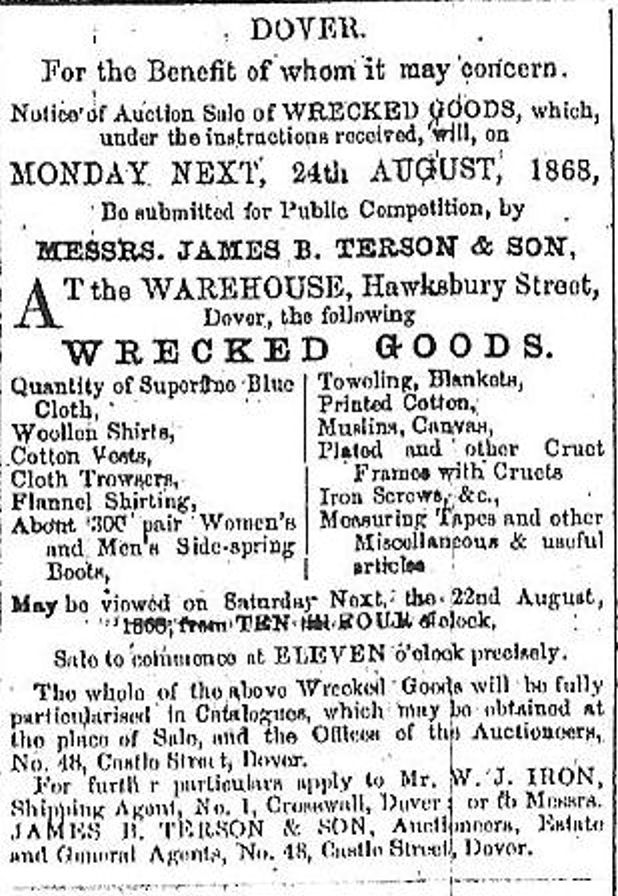
Terson's Wrecked Goods Auction 21.08.1868

Terson’s Wrecked Goods Auction 21.08.1868

The problem of wreckers though, did not go away. In 1843, at Maidstone Winter Assizes Thomas Ladd age 38, John Kingsmill 40, John Norris 33, Richard Marsh 34, Richard Collard 28, John Godden 23, William Fagg 49, John Castle 28, George Marsh 40, all labourers,  were accused of ‘Making a signal for the purpose of giving notice to some persons on board a smuggling boat, at St Margaret’s at Cliffe.’ They were all found guilty and imprisoned for six months with hard labour.

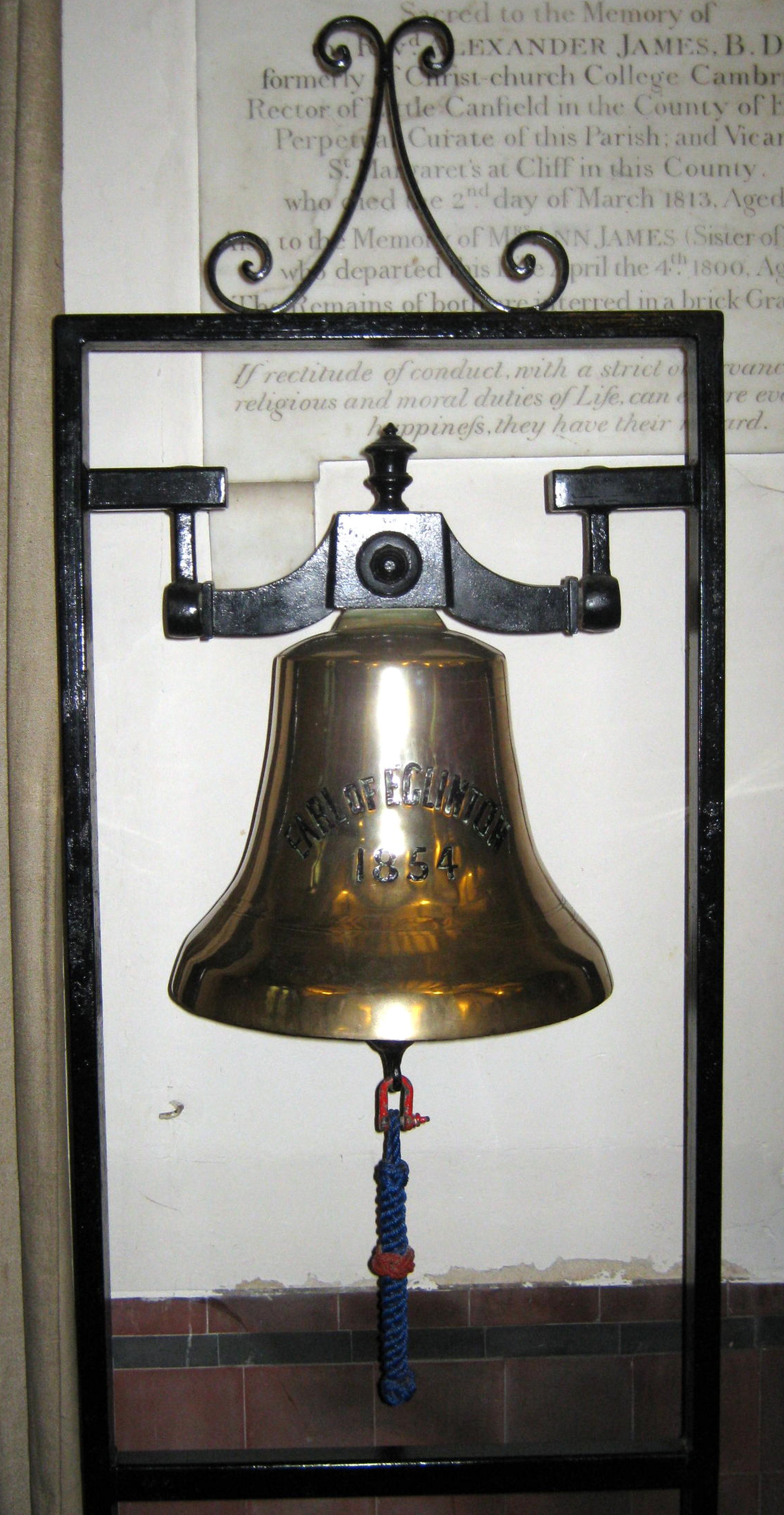
On 28 January 1860, the Earl of Eglinton, launched 1854, sailed from London for Calcutta but on 6 February she ran ashore in St Margaret’s Bay, no lives were reported lost. The inventory of goods recovered from the wreck states: 18 bales and sundry pieces of cloth, one cask of blacking, 4 bolts of cloth, 9 cases 5 of which was suppose to be wine, 5 pieces plus sundry pieces of loose linen, three casks of porter, 1 iron safe. Following the accident the number of wooden cottages on the beach at St Margaret’s increased dramatically, one of which was named Eglinton Cottage!

Earl of Elginton Bell 1854, St Andrew's Church, Buckland

Earl of Elginton Bell 1854, St Andrew’s Church, Buckland

However, the most interesting piece salvaged was the ship’s bell, which did not appear on the goods salvaged list. Instead, it was sold to the Buckland school managers by, according to their accounts, the owners of ship. At the time, the now defunct Buckland School, on London Road, was being built and the managers wanted a school bell. The Eglinton ship bell can now be seen in St Andrews Church, Buckland.

  • Published:
  • Dover Mercury: 21 July 2005
Posted in Courts, Crime & Punishment, Port and Transport, St Margaret's, Wrecking, Wrecking, Wrecking | Comments Off on Wrecking

Bushy Ruff

Alkham Valley showing the river Dour to the north of Chilton, Hasted 1798

Alkham Valley showing the river Dour to the north of Chilton, Hasted 1798

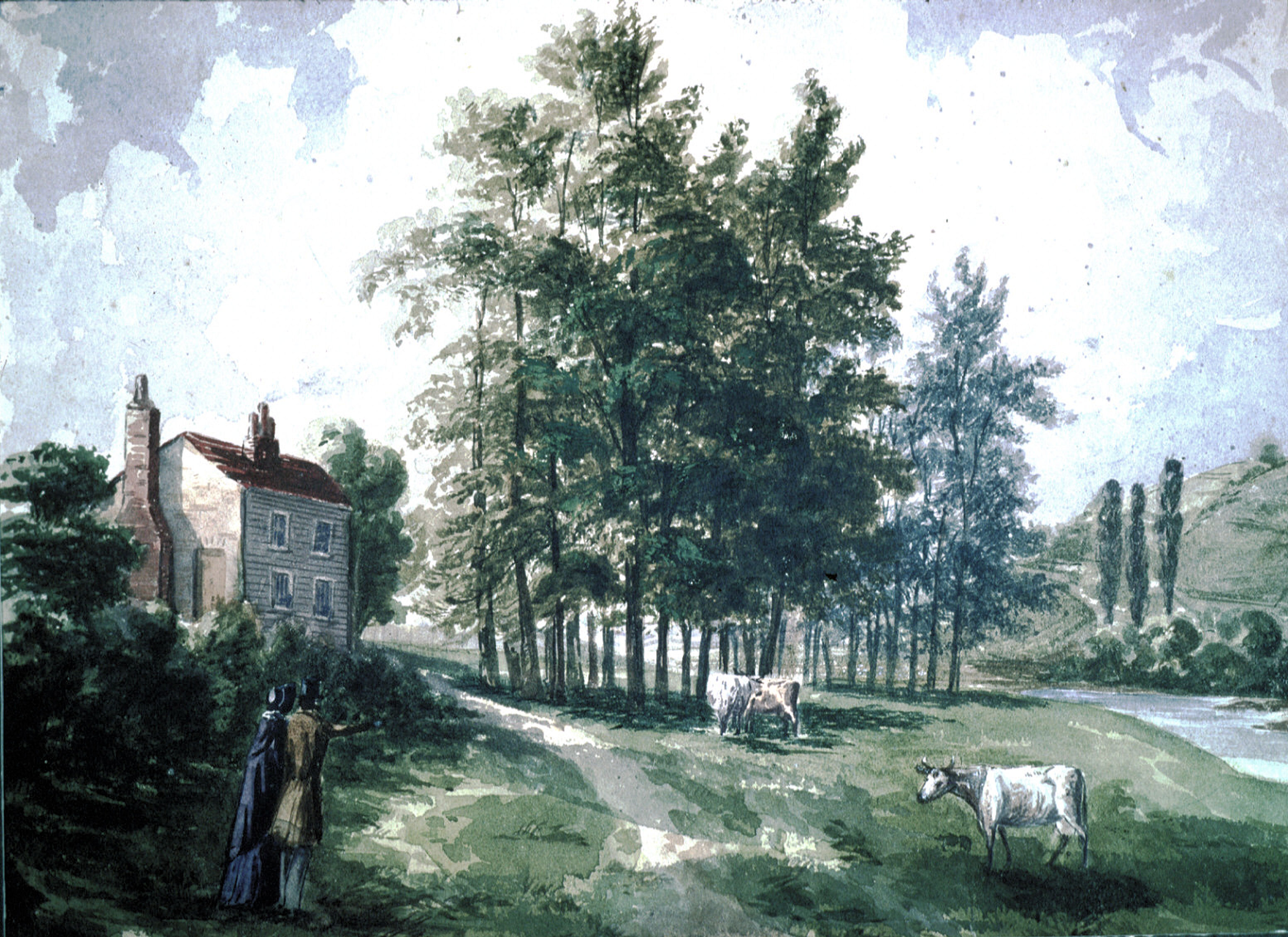
The four-mile long river Dour‘s main source is at Watersend, Temple Ewell. In addition, a tributary source rises at Drellingore in the Alkham Valley. The Drellingore, in 1830, was described as generally being ‘sometimes quite dry, at other times it overflows its banks, and produces a considerable stream of water, which taking its course over the fields, passes down the valley and joins the river.’ (Z Warren 1830 Dover Guide p105). Like its counterpart from Temple Ewell, this tributary of the Dour is fed by several springs while an estate map of 1774 shows that once there was a lake, called Chilton Brook, to the north of Chilton Farm. This expanse probably existed from Saxon times and stretched from where Russell Gardens are today to where the road rises near Kearsney Abbey. The vehicle track from Alkham, in those days, was to the north of Chilton Brook as shown on the 1798 map, above, but probably surveyed earlier.

Bushy Ruff Lake

Bushy Ruff Lake

Towards the end of the 18th century a mill was built to the west of Chilton Brook and the milldam partially drained the brook, creating Bushy Ruff Lake. Why it was called Bushy Ruff is open to guess work but the newly created land became part of the Kearsney estate. The main track from Alkham moved south to lower ground and across what was part of Coxhill Farm. It would seem that the then owner, Dr Osborn accepted this when he leased the farm in September 1796 to RC Wakefield for sixty years.

As for the mill, according to the Kent Insurance Company who undertook a survey in 1815, it was a ‘miserable place.’ Describing it as a ‘wooden building with a paper roof and a furnace, from which the flue gasses dried the paper that was hung on sticks to dry.’ Because of the risk of fire, the surveyor recommended that the mill should not be insured.

About 1820, solicitor William Knocker (1761-1847) sold his house on the Esplanade to banker John Minet Fector senior, of the Banking family, and bought Bushy Ruff paper mill and adjoining lands. He then set about a building programme creating two adjoining mills, one for brown and the other for white paper. However, for the water to drive the mills, there were problems with the centrifugal wheel. These were dealt with by digging a canal so that an overshot wheel could be fitted. The canal went across the track that had developed along the Alkham Valley and so a bridge was built. When all the work was finished, the buildings, classed as one mill, were surveyed and the satisfied surveyor noted that there were three vats making brown and white paper.

Bushy Ruff by S J Mackie c 1842. Dover Museum

Bushy Ruff by S J Mackie c 1842. Dover Museum

William Knocker leased the mill to a series of papermakers. One of whom was George Dickinson who owned Buckland Paper Mill and  brother of the famous paper manufacturer John Dickinson. He ran Bushy Ruff mill from 1826 to when he was declared bankrupt in 1837. In the meantime William had a colonial style mansion built and moved in with his wife Ann in 1825. William had been the Mayor of Dover four times between 1792-1817 and was elected Mayor again in 1832 by which time Ann had died.

Much to the dismay of his spinster daughters, on 13 September 1833 – during his Mayoral year – William, aged 72, married his housekeeper Sarah Tyson at Chislehurst. They still lived at Bushy Ruff where their only child, Frederic, was born in June 1835. William died in 1847 by which time Bushy Ruff was occupied by Edward and Mary Oliver and owned by John, 3rd Earl of Mexborough, (1783-1860).

In 1852, the lease on Coxhill Farm, through which the track from Alkham ran, expired. The new owner, Mrs Charlotte Angel Every, of Old Park, immediately demanded that the road be stopped up and took legal action through the Wingham Court. This failed but on Saturday 9 February 1856, she instructed her agent, Thomas Smith, to block the road.

Smith had a 4-foot (1.22metre) trench dug across the route but the Highway Surveyor for River, Mr Gould, ordered him to fill it in and return the road to its proper state. Smith refused and was prosecuted. On 8 March, the trench was filled in, but on 2 May, it was there again!

TH Modern Footbridge over the River Dour tributary showing the bifurcation at Bushy Ruff. Left stream goes to the Russell Gardens, right stream to Chiltern Brook. Alan Sencicle

Modern Footbridge over the River Dour tributary showing the bifurcation at Bushy Ruff. Left stream goes to the Russell Gardens, right stream to Chiltern Brook. Alan Sencicle

Gould instructed a John Collard with two workmen to fill in the trench but when Smith and his men arrived he ordered them off. Collard instructed his men to carry on and a fight ensued. Thomas Smith was taken to court on an assault charge and fined £1 plus costs. Nonetheless, Mrs Every instructed Smith to block and defend the road. He barred it with a wooden stake across the bridge over the canal from the paper mill.

Coming from Alkham on 17 May was Valentine Gambrill who started to climb over the stake when Smith tried to stop him. Gambrill hit Smith with his thick walking stick, which stunned the hapless Smith and damaged his hat! Gambrill was fined 1s (5p)! In the meantime, John Collard took Gould to court for failing to carry out his duties as highway surveyor. The Chairman of the Bench, Dr Edward Astley, mindful of the Wingham hearing, declared it a public road and the road we know today laid. Gould, was fined 1s (5p) and bound to keep it free from obstruction!

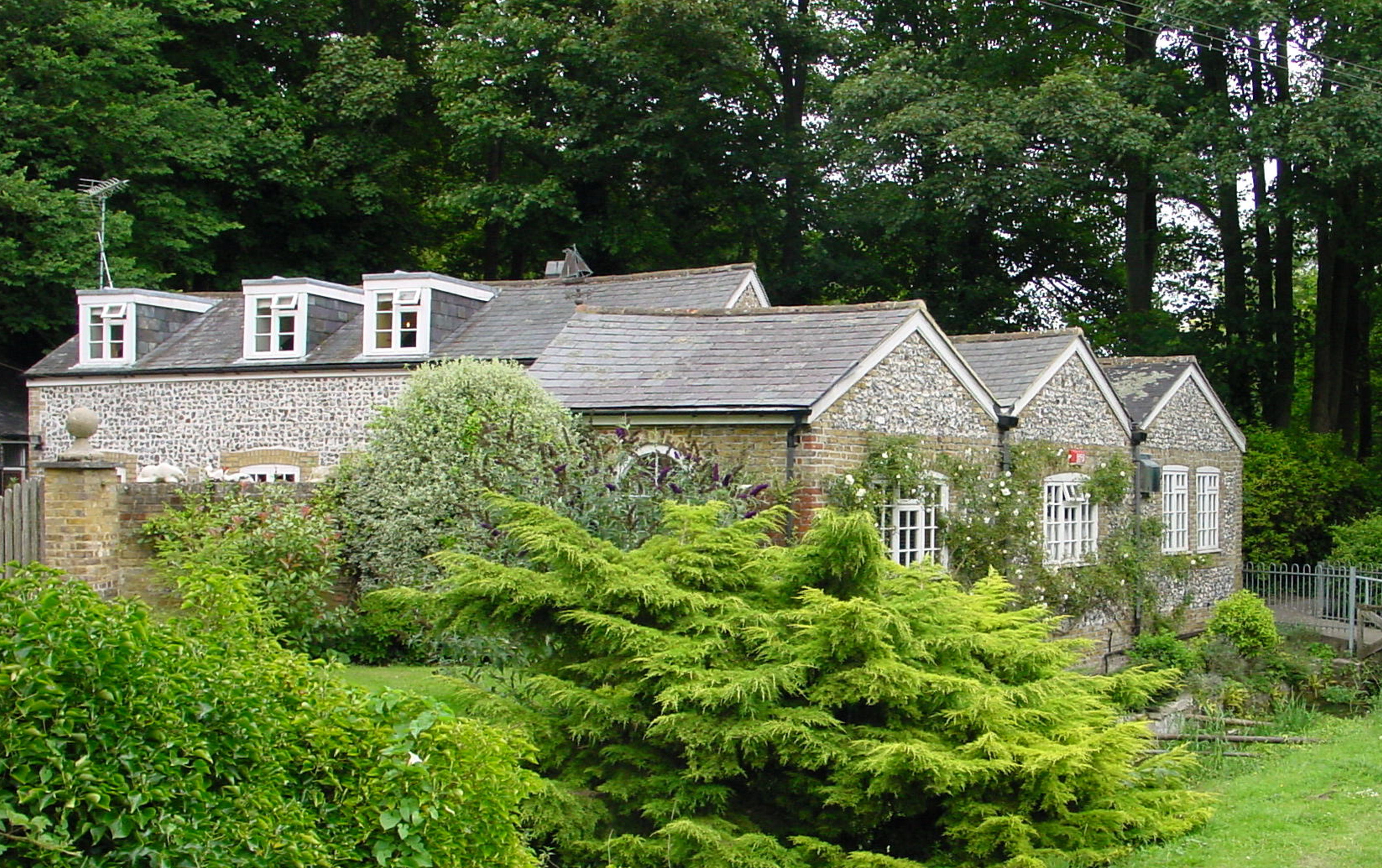
Bushy Ruff Stables today

Bushy Ruff Stables today

The last reference to Bushy Ruff mill was in 1858 but it is believed to have ceased production eight years earlier. It was demolished in 1870, when Joseph Churchward bought the estate, although the drying room and stable still remained and are now dwellings. The canal and bridge seemed to have disappeared when the gardens of Kearsney Court were laid out and the fishpond constructed. There is a water channel that disappears into a culvert that the late local Historian, Joe Harman, suggested may have been to do with the canal and bridge.

Bushy Ruff House was extended and almost rebuilt by owner John Banks in 1860, to create seven bedrooms on the first floor. There was a walled kitchen garden with fruit trees on both sides of the wall, two coach-houses, coachman’s cottage and a porter’s lodge as well as piggeries, cowshed and a tool house. General Henry Darby-Griffith, of the Scot Greys and Colonel of the 5th Lancers, bought Bushy Ruff as his retirement home. He died there in November 1887 aged 78 and there is a brass plate in River Church to his memory.

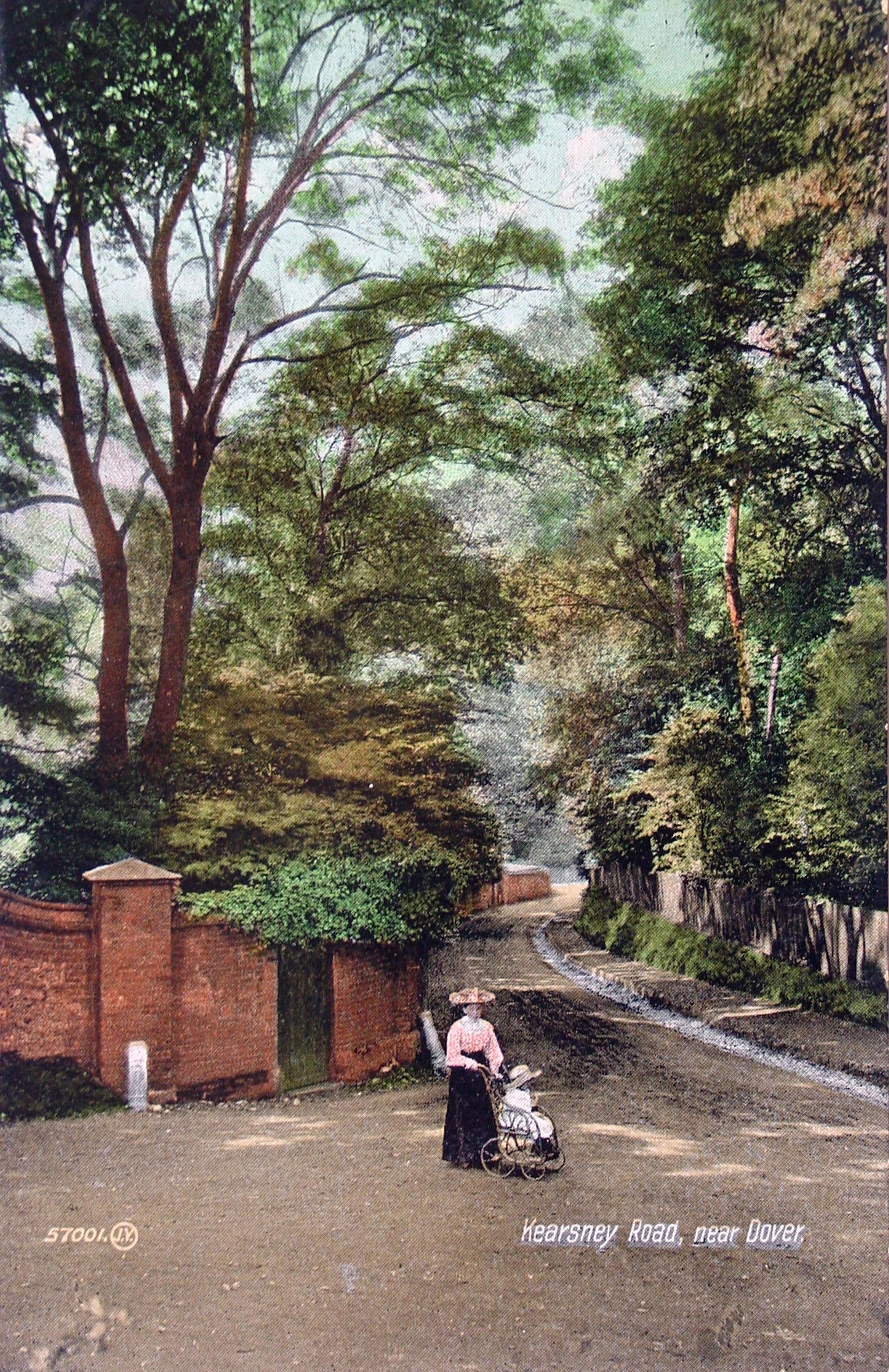
 Kearsney - Alkham Valley Road c1900. Dover Library

Kearsney – Alkham Valley Road c1900. Dover Library

During the latter part of the nineteenth century, Bushy Ruff Lake became popular with artists, ornithologists and botanists. Children, from the slum areas of Dover were brought by train to Kearsney Station for a walk along the valley to the lake to see the flora and fauna. The place also attracted the sportsmen, which raised the question from local historian, Mary Horsley, ‘Why is it when a rare bird is known to be in the neighbourhood, the first idea of anyone who can get hold of a gun, is to go out and shoot it.’ Kingfishers were singled out as they caught trout, sticklebacks and bullheads, ‘which the angler thought his property.’

However, in 1898 the Folkestone Water Company decided to extract water near the source of the nailbourne at Drellingore. Dover Corporation took them to court, claiming that it would affect the water supply to the Dour but lost the action. Since then, the waters from this tributary of the Dour have been much reduced.

By 1930 Captain Conrad Jörgensen and his wife Constance, owned Bushy Ruff House. Captain Jörgensen died on 12 June 1941 age 68 years but his widow stayed on for a while, occupying part of the residence. The rest was commandeered for the war effort – World War II (1939-1945). In 1940, the Local Defence Volunteers (later that year the Home Guard) was formed from civilians not called up for active service. From them a small number of men, who knew their territory well, were recruited to be disruptive if the Germans invaded.

Colin McVean Gubbins 1896-1976 - Internet

Colin McVean Gubbins 1896-1976 – Internet

Known as the 201 Battalion Home Guard, they came under the command of Colonel McVean Grubbins of Military Intelligence. Near Bushy Ruff, a special bunker was hewn out of the hillside by the Royal Engineers and the Drellingore Platoon, commanded by Lt Cecil Lines, with George Marsh, Samuel Osborne, Thomas Holmans, Charles Fayers and Dennis Dewer moved in.

They were trained in unarmed combat, to kill silently as well as to use anti-personnel mines, plastic explosives and weapons and operated in absolute secrecy. Even their wives, friends and the local Home Guard did not know what they were doing and if the invasion had become a reality and they had been captured, they would have been treated as spies.

Following the War, in the 1950s, Chilton farmhouse was all but demolished and Bushy Ruff House was deserted. In 1953 a Public Inquiry was held when Kent County Council proposed to Compulsorily Purchase Bushy Ruff and the grounds to be used for a new highway depot. Dover Corporation successfully objected.

Constance Jörgensen died in 1973 and the derelict Bushy Ruff House with 26 acres of ground was put on the market. Dover District Council immediately purchased it for about £90,000 with a view to developing the site with the house as a centre piece. The House was given a Grade II listing in 1975, repaired at a cost of £8,000 and put on the market. Clive Biddulph, owner of Simmonds jewellers in Biggin Street, submitted a planning proposal the following year to create a country club with six tennis courts and swimming pool facilities.

However, Dover District Council accepted local opinion that part of the grounds and the lake should be opened to the public as an extension of Russell Gardens. The House was let to Mrs Harriett Sherman and a further £20,000 was spent on refurbishment as a home for six elderly residents. By November 1982 the place was empty and Mrs Sherman was about to give up the tenancy when arsonists gutted the building.

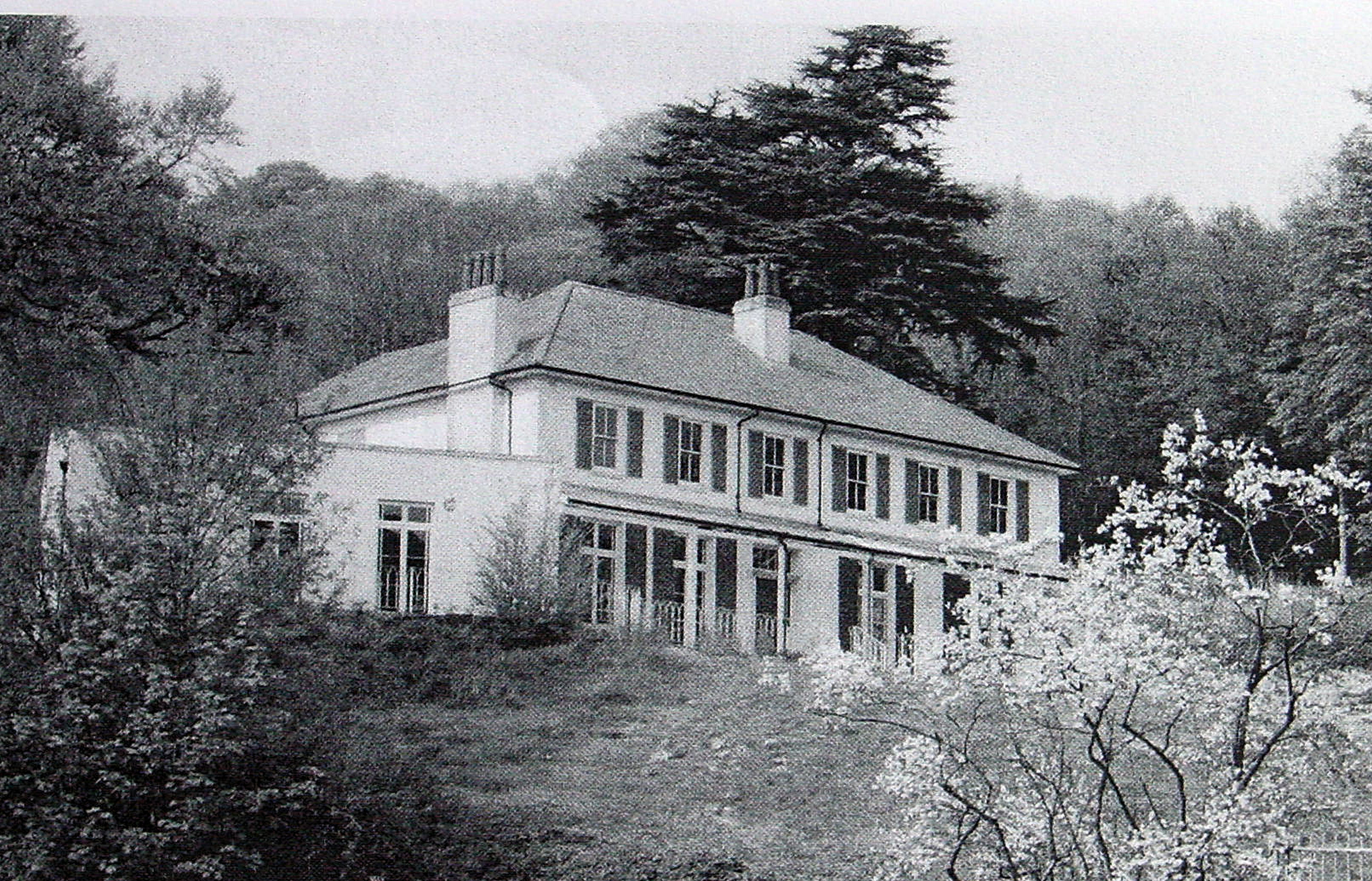
Bushy Ruff House April 1984. Dover Library

Bushy Ruff House April 1984. Dover Library

Bushy Ruff House was temporary repaired and put on the market in May 1983 but by 1986 it was in a poor state when bought by Quality Homes. They rebuilt and refurbished it and opened a luxury nursing home. It was sold again in 1998 with plans to use the House as a care home for people with learning disabilities, but increasing costs led the house being sold again.

In 2002, permission was given for Bushy Ruff House to become a family home with six bedrooms, swimming pool and staff accommodation. However, a year later it was put up for auction at a guide price of £500,000. In 2005 planning application was submitted to convert the House into 13 flats was refused, in 2009 there was a proposal to convert it into 14 self-contained flats.

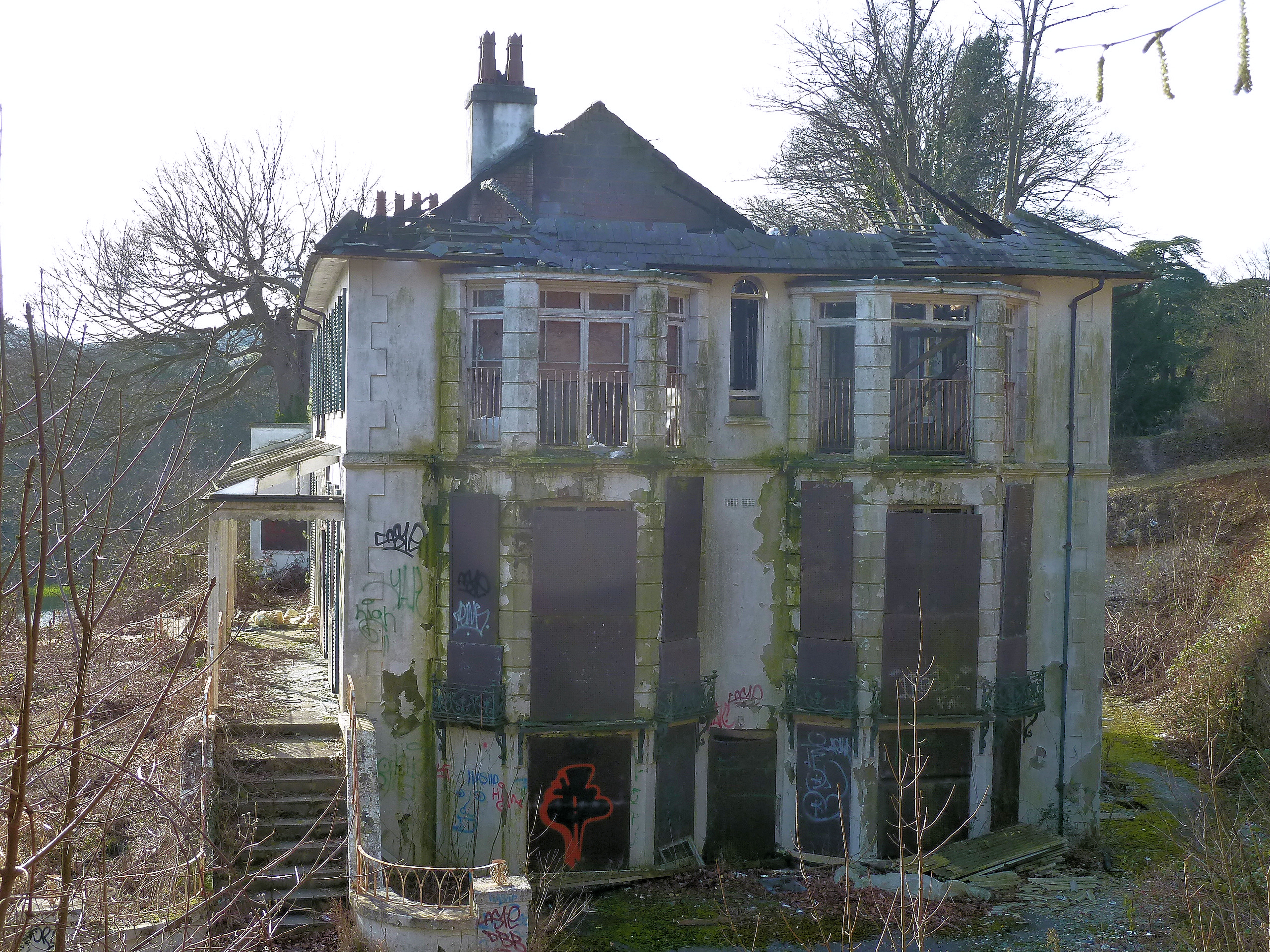
Bushy Ruff House 2013

Bushy Ruff House 2013

In the meantime, Bushy Ruff House was falling further into disrepair and being used by squatters. On 11 February 2010, flames were seen coming from the roof and it took more than an hour for fire crews to bring the blaze under control plus another forty minutes to put it out. Around 50% of the building was damaged. On 15 October 2009 planning permission was given for a conversion into 14 self-contained flats as long as the work began before the expiration of three years from the date of the permission.

Bushy Ruff House Side Elevation 2013

Bushy Ruff House Side Elevation 2013

Since the Court ruling over the extraction of water by the then Folkestone Water Company in 1898 the number of times Bushy Ruff lake has dried up as been of concern. The level of the water in the lake has a direct effect on Kearsney Abbey lake, the Dour and all the wild life that depend on it. In 1989, the lake was deepened to more 6-feet (2 metres) but the problem had not gone away. Further, when there is heavy rainfall the banks around the lake and along the Dour, tend to be washed away. In recent years, these problems have been dealt with by a combination of wooden boards and plants to strength the banks.

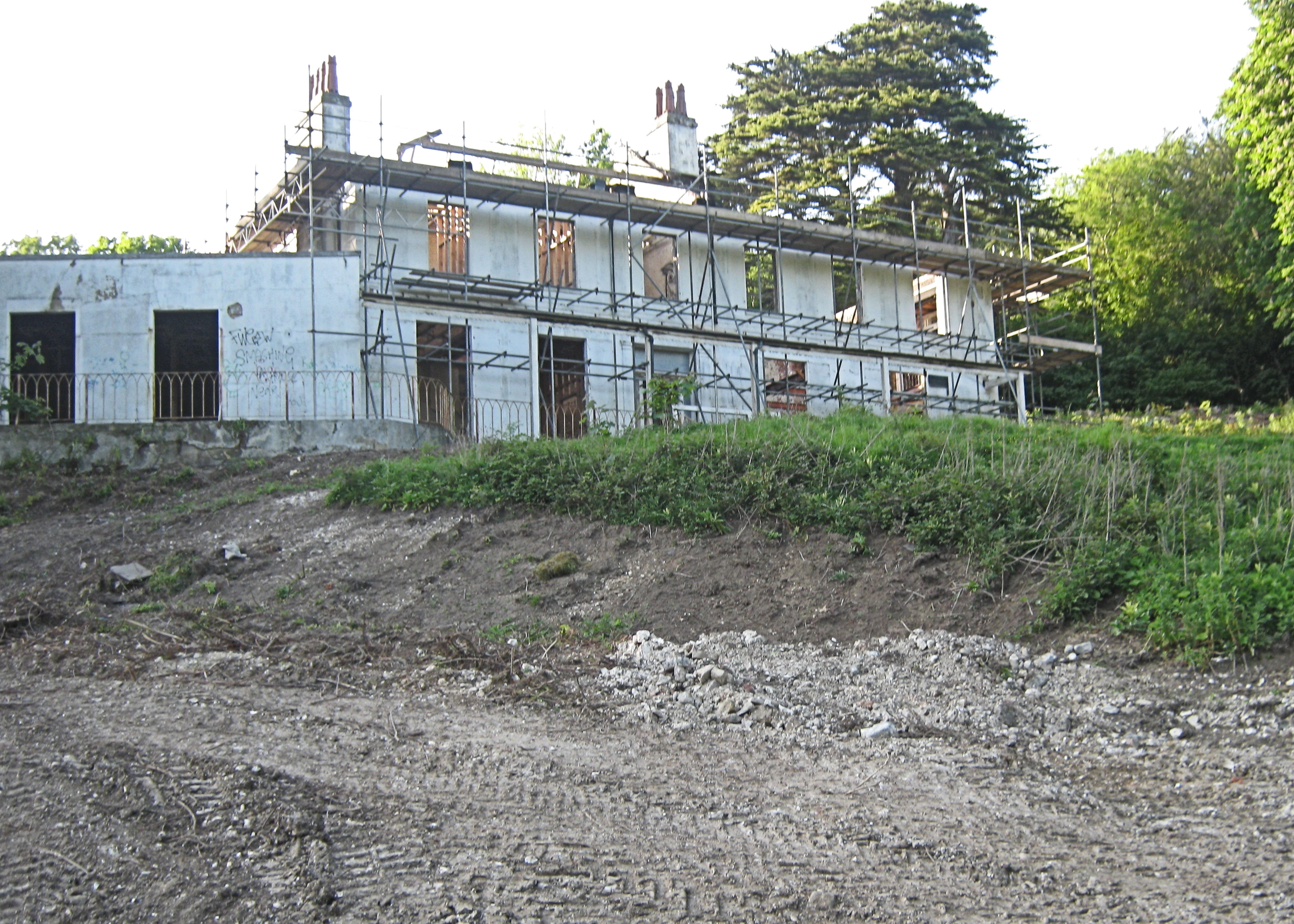
Bushy Ruff gutted. Spring 2016. Lorraine Sencicle

Bushy Ruff gutted. Spring 2016. Lorraine Sencicle

In the spring of 2016 work began on gutting Bushy Ruff House. However, the on-line Dover District Planning Applications gives no clue as to what is envisaged.


  • Published:
  • Dover Mercury: 29 March 05 and 12 April 2012
Posted in Bushy Ruff, Bushy Ruff, Kearsney, Wanton Destruction | Comments Off on Bushy Ruff

Edward Ferrand Astley – The Doctor who cared for the people of Dover

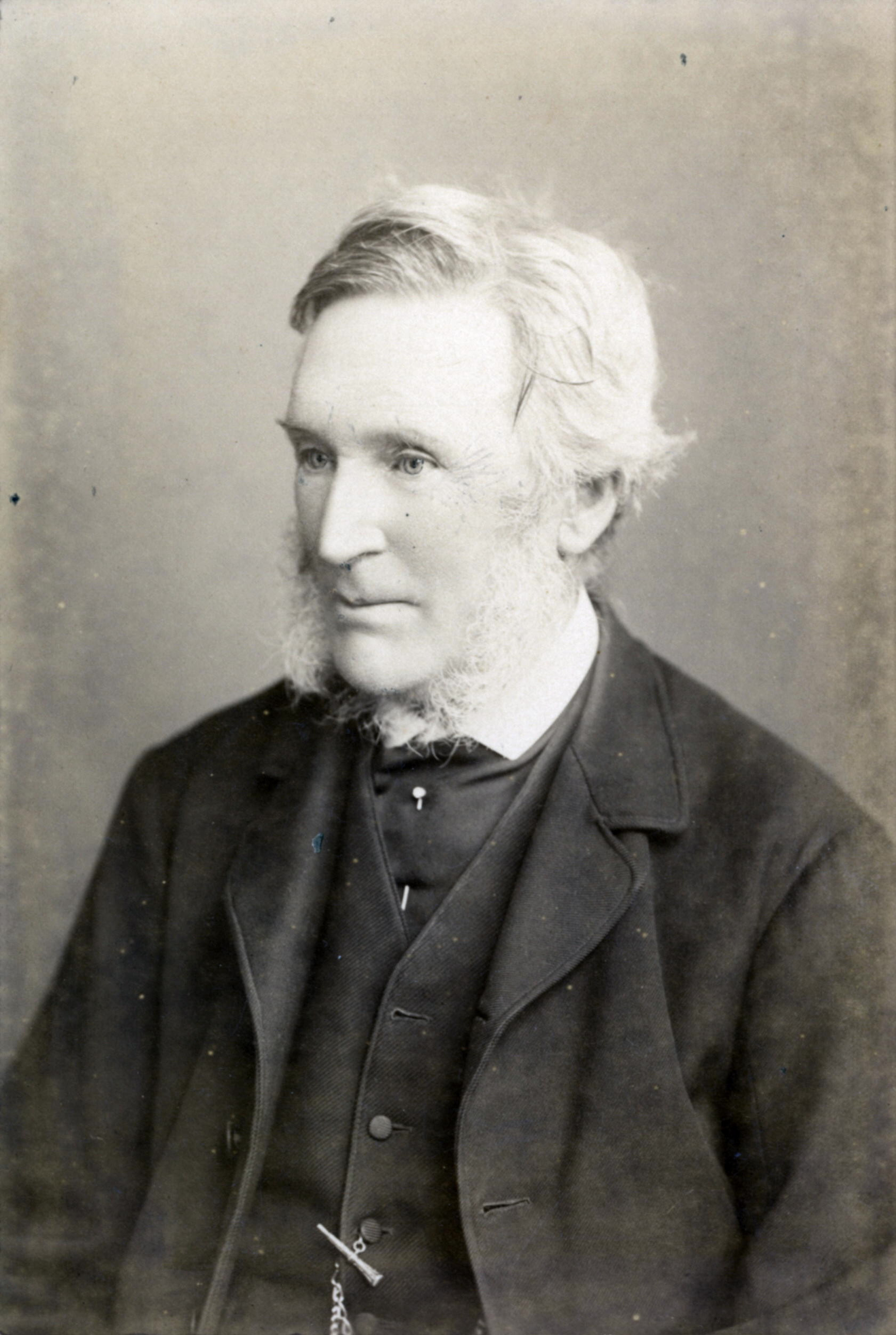
Dr Edward Ferrand Astley 1812-1907. Dover Museum

Dr Edward Ferrand Astley 1812-1907. Dover Museum

In 2008 I was the head of a local government team that won £20m Community Hospital for Dover – a small token after loosing a major facility that, it had been decided in 2002-4, was to be replaced by a polyclinic. For selfish and political reasons some of Dover’s politicians, a local paper and the GPs (family doctors) fought against the proposed Community Hospital. Using misinformation people of Dover were brought out into the streets to protest. In consequence, Dover is to end up with the polyclinic that the local Health Trust wanted in the first place.

Dover’s politicians and doctors did not always behave this way… On the lower slopes of Long Hill and leading into Barton Road, Sir William Crundall built Astley Avenue. As a mark of respect to a local doctor who always put the town’s folk of Dover before profit or political conseradations, Crundall named it after his friend and fellow Conservative, Dr Edward Ferrand Astley.

Born on 17 February 1812 in Quenington, Gloucestershire, Dr Astley came to Dover when he was about 30 to practice medicine. It was here that he met and married his wife, Elizabeth Anne Gale, daughter of a retired military officer. They moved into her father’s house at 29, Marine Parade where they were to live for the rest of their lives.

Almost from the outset, Dr Astley was involved in civic affairs, first as a Magistrate, then, in 1853, when he was elected an Alderman. It was during his second term as an Alderman that Dr Astley was appointed Mayor for the remainder of the term brought about by the death of Mayor Birch in June 1858. Although a Conservative, Dr Astley was nominated by Liberal Councillor William Rutley Mowll and seconded by Conservative Councillor John Birmingham for Mayor the following November, not one councillor voted against the nomination!

During Dr Astley’s time as Mayor, Queen Victoria paid an unexpected visit to the town. She was returning from Prussia (now part of Germany) to London via the Thames. At the time, Admiralty Pier was under construction and the Queen decided to inspect it! However, due to the lack of communication facilities, it was not until the Royal Yacht, Victoria and Albert, was seen off the South Foreland, did the change of destination become apparent! Nonetheless, everything was done to give the Queen a royal welcome even if only Dr Astley and a few members of the Corporation were there to meet her!

Edward Ferrand Astley Memorial tablet, Dover College chapel.

Edward Ferrand Astley Memorial tablet, Dover College chapel.

As Mayor, Dr Astley considered that it would be beneficial for the town to have its own Public School so helped to found Dover College. This was to meet the educational needs of the children of the officers stationed at the garrison and the town’s professional class. After the dissolution of the monasteries, the site of Dover Priory had been rented as a farm. This became available and the College opened with fifteen boys, on 15 September 1871 in St Martin’s House, on Folkestone Road. Much of the ancient Priory structures were, at the time, in a poor state but local builder, William Adcock, restored them and many are still in use today.

In the years that followed, Dr Astley was appointed the Chairman of the Licensing Committee. At the time, not only did Dover boast of a pub for every day in the year but there was also a strong Temperance Movement. Concerned over the problems of heavy drinking both on health and family life, Dr Astley ran the gauntlet of much criticism by reducing the number of pubs in the town. He also held the office of President of the Dover Benevolent Society, which distributed coals to the poor during winter. Taking a ‘hands-on’ approach, he was horrified at the depths of deprivation that old age had reduced many of the locals. From these observations, he was instrumental in founding the Gorely Almshouses on Cowgate Hill, on the lower slopes of Western Heights.

Gorley Almshouses, Cowgate Hill.

Gorley Almshouses, Cowgate Hill.

The recently widowed Mrs Susan Gorely (1798-1880), of Ladywell farm, in 1877, wanted to leave a legacy to the town by which she would be remembered. She was persuaded by Dr Astley to pay paid for ten almshouses to be built. When Dr Astley died in April 1907, by his will he left two-thirds of his £23,000 estate to the Gorely Almshouses. He stipulated that part of this money was to go towards increasing the weekly allowances paid to the inmates. Henry Hobday of Buckland Paper Mill provided further funds to extend the homes in 1921. At the time of writing, Gorely House consists of 23 single one-bedroom flats. Each flat has a kitchen, lounge, bedroom and shower room. The homes look out over the beautiful gardens to the front and from the back, it looks towards Western Heights.

The provision of adequate and affordable housing for the working classes was another of Dr Astley’s concerns. He had been involved with the Dover and  East Kent Building Society since its inception in June 1846. Following the Society’s reconstitution in 1855 as a Permanent Building Society, Dr Astley was voted the Chairman. At the time the minimum contribution to building societies was usually 10s (50p) a month, which most working class people could not afford. In order to reach them, the Building Society introduced a 2s 6d a month saving scheme – the first in the country. It was also one of the first Societies making direct loans to women savers.

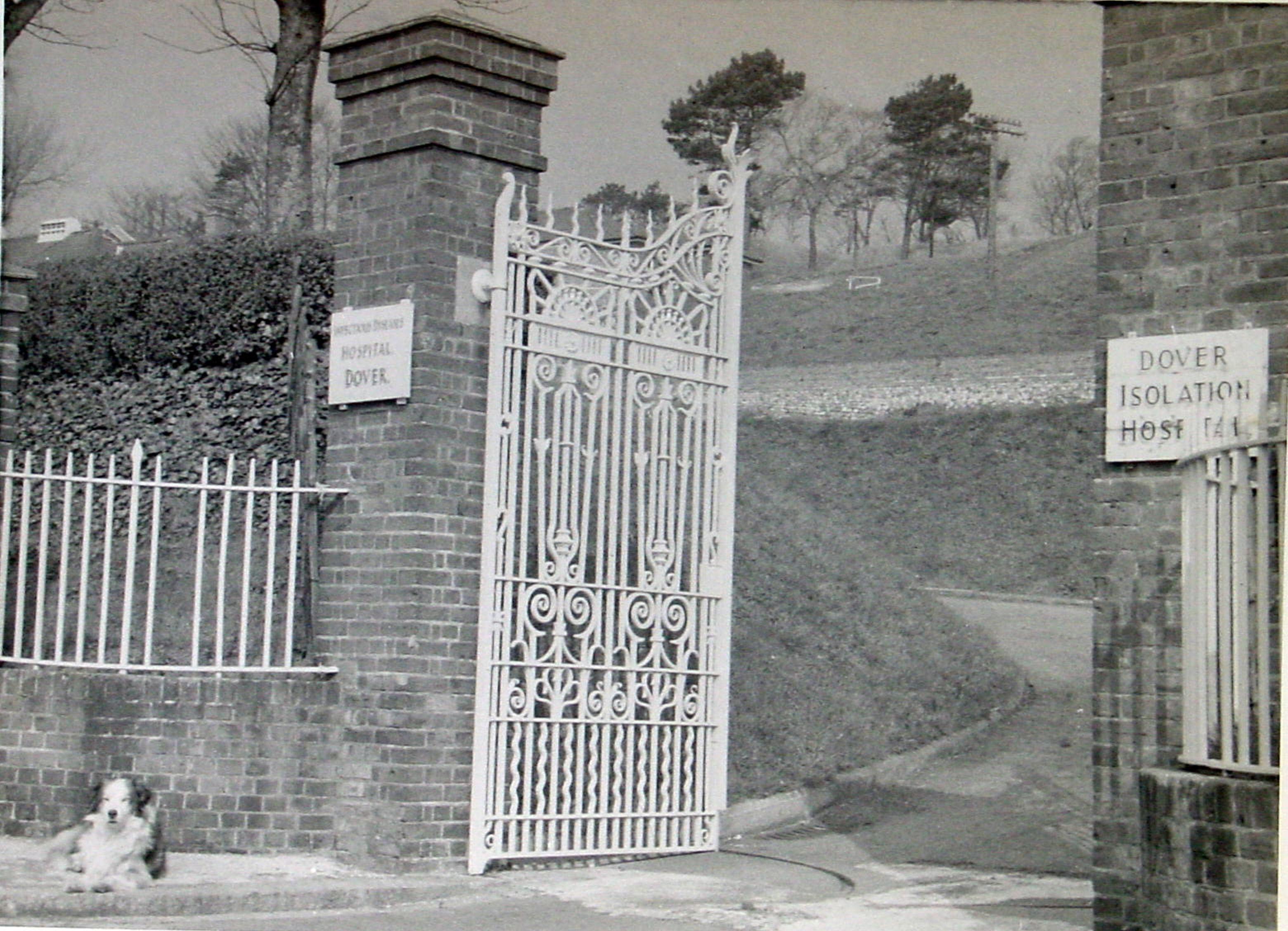
Isolation Hospital Gates, Noah's Ark Road.  Dover Library

Isolation Hospital Gates, Noah’s Ark Road. Dover Library

In his professional role, Dr Astley visited the sick regardless of whether they could afford to pay him and became increasingly concerned over the spread of infectious diseases. At the time these included smallpox, measles and diphtheria and he put a powerful case forward for an isolation hospital to be built. The moneyed folk of Dover were not so keen at lumbering themselves and future generations with the cost of an isolation hospital; Dr Astley acquired land on Chapel Mount (Noah’s Ark Road) and established a cottage hospital.

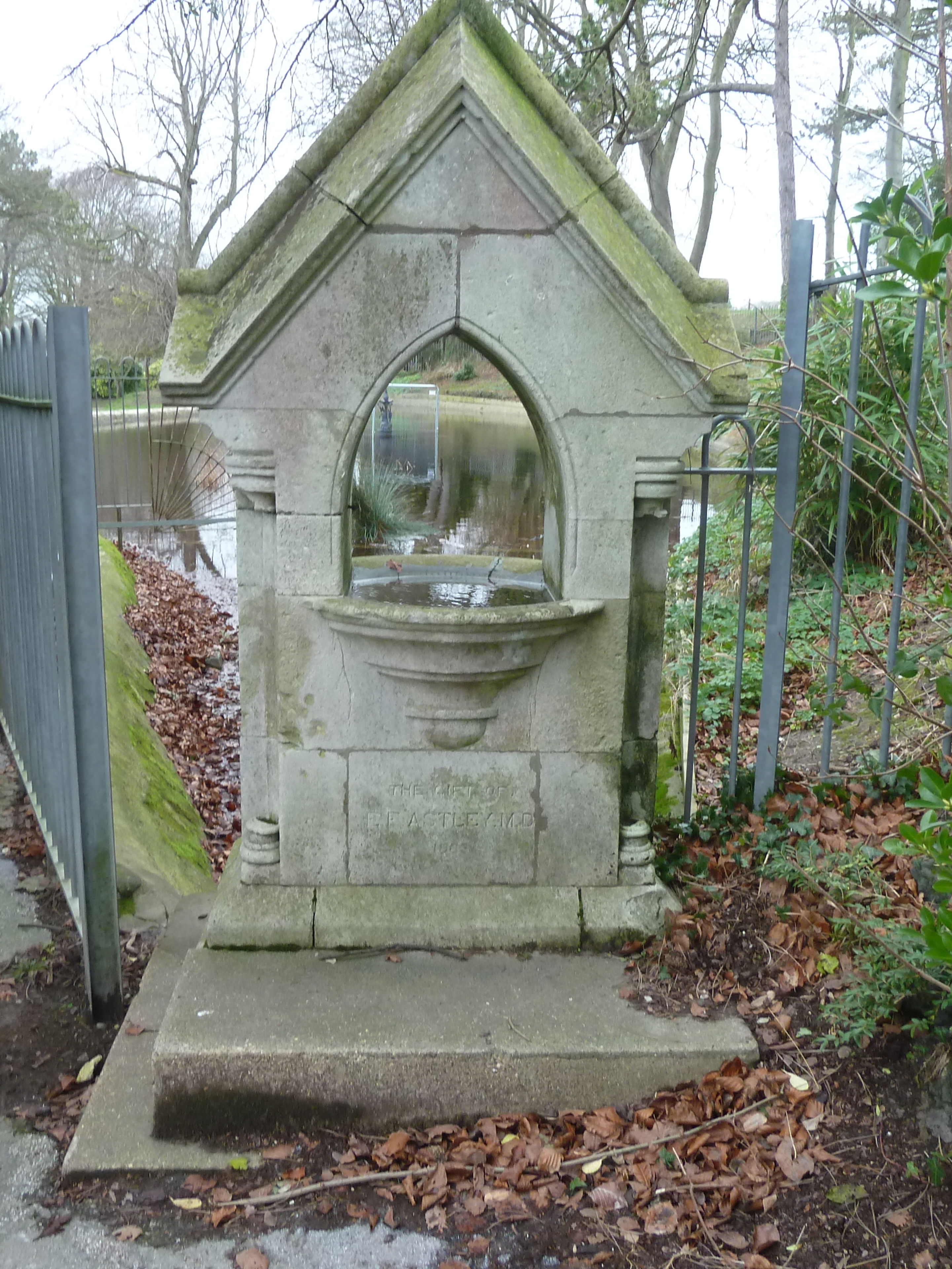
 Edward Ferrand Astley water fountain, Connaught Park, erected 1883.

Edward Ferrand Astley water fountain, Connaught Park, erected 1883.

At the time, patients were expected to pay for their hospital care. At Dr Astley’s hospital medical and nursing care was free but relatives and friends were expected to provide food. In 1872 smallpox hit the town and Dr Astley’s hospital came into its own, not only in patient care but in preventing the disease reaching epidemic proportions as it did in the adjacent towns of Folkestone and Canterbury. For his work during this epidemic, the town’s folk made a collection from which Dr Astley was encouraged to buy a memento. Instead, he suggested that it should be used to set up a scholarship for Dover College. This was accepted and the fund reached £900, which provided three scholarships for local children.

 Edward Ferrand Astley Organ presented 1902, Connaught Hall

Edward Ferrand Astley Organ presented 1902, Connaught Hall


Dr Astley was active in the town’s various musical societies and in 1902 paid for the grand organ we still can see in the Connaught Hall, Maison Dieu (former Town Hall). He was also a ChurchWarden at St James (new) Church and sometime Captain of the 1st Cinque Ports Volunteers. At Connaught Park, the water fountain he provided is still there although no longer working. Following his death on 12 April 1907 at the age 95 a subscription was raised out of which the window depicting Sir John Beauchamp, William Lord Latimer and Edmund Langley – Earl of Cambridge in Connaught Hall was erected. The remaining balance was invested to send to the patients of the then Royal Victoria Hospital to Convalescent homes.

  • Published:
  • Dover Mercury  01 June 2006
Posted in Astley Edward Ferrand - The Doctor who cared for the people of Dover, Edward Ferrand Astley - Founder of Dover's Isolation Hospital, Hospitals and Health, People | Comments Off on Edward Ferrand Astley – The Doctor who cared for the people of Dover