Harbour Station

Map showing the location of Harbour Station left of Custom House Quay 1890

Map showing the location of Harbour Station left of Custom House Quay 1890

Dover’s first railway station, Town Station, opened on 6 February 1844 by the South Eastern Railway Company (SER) in the Pier District.  In February and March 1845 the Mayor, William Clarke, convened well attended public meetings for a railway line from London to Dover via Canterbury. He also gave evidence before a committee  of the House of commons in support of a Bill for this purpose.

By 1851, the Railway Company had built its North Kent Line as far as Strood and an Act of 1853 allowed the formation of the East Kent Railway Company, (EKR), which in 1860 connected Rochester to Canterbury.  Negotiations continued to join Canterbury with Dover and the new railway line was almost completed by 1860. However, SER decided not to connect this line with their North Kent Line so EKR obtained an Act to build a direct line between Rochester and London, built a separate station at Canterbury and  changed their name to the London, Chatham and Dover Railway (LCDR). The line, from London to Dover Priory railway station, opened on 22 July 1861.

Schematic drawing giving dates of the laying of East Kent Railway Lines

Schematic drawing giving dates of the laying of East Kent Railway Lines

Meantime the company excavated a 684-yard (626 metre) tunnel from the Priory Station towards the docks at the western side of the present harbour, and built the Harbour Station on Elizabeth Street. However, in so doing they demolished a number of properties but tried to make out they were old and unsanitary and so were doing a favour. They were forced to pay £650 compensation to the Dover Catholic community for the priest’s house and £50 per annum to the parish for a new school in return for demolishing the Holy Trinity School.

Although William Cubitt (1785–1861), their engineer, had assured the company that the line would be completed by 1 May 1861, it was decided to wait before building a permanent station. The temporary station opened on 1 November that year. Its main advantage over the existing Town Station, so it was claimed, was that luggage would go straight onto the ferries at the same time as the passengers. Their adverts implied that lost luggage was a main problem that faced passengers using the Town Station.

Harbour Station proposal. Dover Library

Harbour Station proposal. Dover Library

In order to upstage SER, Harbour Station, whose Town Station had started out as a temporary structure and was, by this time, permanent, Harbour Station was planned it to be in the Italianate style. Opening on 1 November 1861 the building was dominated by a tall, Italianate style clock tower with an Italianate ornate clock. Possibly due to the lack of finance, this was still envisaged to be a temporary structure. Nonetheless, the company boasted that luggage would go straight onto the ferries at the same time as the passengers. They also made the point that passengers using the SER trains had to carry their luggage to the ships.

The temporary Harbour Station was eventually replaced with the permanent structure, some of which has survived and has been given Grade II status. As the station was aimed at the cross Channel passenger, the booking office was on the harbour side of the track so that ship passengers could buy their LCDR railway tickets to other parts of the UK. It was assumed that most of their passengers going to the Continent would arrive by train and therefore already have tickets. For this reason there was little point in providing a booking office facing Elizabeth Street.

The Railway Company were very proud of clock tower and the clock was used to set their time. Up until 1840, time was decided at the local level, usually by a church clock. Great Western Railway, in that year, introduced ‘Railway Time’ that synchronise railway clocks on each station and enabled the railway companies to produce an accurate timetable. Following Great Western’s lead Railway Time was adopted by all the individual railway companies and this was set by the Royal Observatory at Greenwich – Greenwich Mean Time. Unfortunately, the Harbour Station’s tall Italianate ornate clock had the obstinate tendency to be slow! This led to a businessman bringing a successful court action against LCDR after he missed his train. The clock was removed and never replaced!

LDCR also provided washing facilities with running water in the lavatories. However, as most of the neighbouring households had to make do with water pumps, locals also made use of the facilities! Spiers and Pond, who pioneered railway catering in the UK, won the railway refreshment rooms’ contract. They later won the Town Station contract but lost both in 1905 to J Lyons – founded in 1887 – but Spiers and Pond regained it in 1923.

Postcard circa 1900 showing the two railway lines joining on Admiralty Pier. Note the boat builders to the right and the steamer tied up on outside of the Pier

Postcard circa 1900 showing the two railway lines joining on Admiralty Pier. Note the boat builders to the right and the steamer tied up on outside of the Pier

In 1871, together with the SER, the line was extended on the Admiralty Pier. Ten years later a double track extension was opened to connect the SER line to the newly opened joint SER/LCDR line to Deal. Again, property in the Pier District was demolished under the pretext of slum clearance. This included a small Primitive Methodist chapel built in Round Tower Street seven years before in 1874. The Methodist community had to wait before they received their compensation, when they did they built a church in Belgrave Road.

South Eastern and Chatham Managing Companies incorporated in 1899. York Railway Museum

South Eastern and Chatham Managing Companies incorporated in 1899. York Railway Museum

As for the railway companies, it was evident that by joining forces they had the virtual monopoly of the passage to the continent, rolling stock as well as the railway services in Kent. Although remaining as two separate companies, they semi-amalgamated on 1 January 1899 and began operating under a single Management Committee that was confirmed on 5 August by the South Eastern and London, Chatham and Dover Railway Companies Act, and known as South Eastern & Chatham Railway (SECR).

On 1 January 1902, the Prince of Wales Pier opened and was officially completed on 31 May that year. The Mayor, Sir William Crundall, who was a member of Dover Harbour Board, and saw its potential for cruise ships. SECR, who also had representatives on the Harbour Board and they agreed to obtained an Act to build a line from Harbour Station to the Pier. In order to provide access to the new line, the down platform of Harbour Station was rebuilt – on wheels – so it could be swung out of the way as needs necessitated! During World War I, the Seafront Railway was laid, which accessed the Harbour Station by the Prince of Wales Pier Line.

At the end of 1903 one of the Hamburg-American Liners called at Dover on an experimental visit. This was followed by an agreement between the shipping company and the Harbour Board for the steamers to regularly call at Dover from July 1904. At the time Admiralty Harbour was being built, which enclosed the whole of the bay as we see today. This restricted passage and in 1906, the Deutschland collided with the Prince of Wales Pier. The damage to the liner was such that the rest of its voyage to New York had to be cancelled. After the accident, cruise liner traffic declined.

Marine Station now the Cruise Terminal. Dover Harbour Board

Marine Station now the Cruise Terminal. Dover Harbour Board

As part of the creation of the Admiralty Harbour, work had started on extending the Admiralty Pier in 1897 and it was agreed that the Harbour Board could widen it at landward end. In 1907, SECR obtained a 99 years lease to build the Marine Station but before it was completed the station was commandeered for the duration of World War I for military use. Marine Station was returned to civilian use in January 1919 and became the main station for cross Channel passengers.

Southern Railway coat of Arms 1923-1948

Southern Railway coat of Arms 1923-1948

On 19 August 1921, the Railways Act received Royal Assent that proscribed all the railway companies, which were in private hands, to merge into four ‘Groups’. One of these was the Southern Railway Company and was made up of railway companies that operated south of the Thames and included SECR. Southern Railway came into operation on 1 January 1923 and the following year it was announced that the Harbour Station was closing and finally did in 1927. At the time it was agreed to demolish the building to make room for new custom sheds and warehouse accommodation.
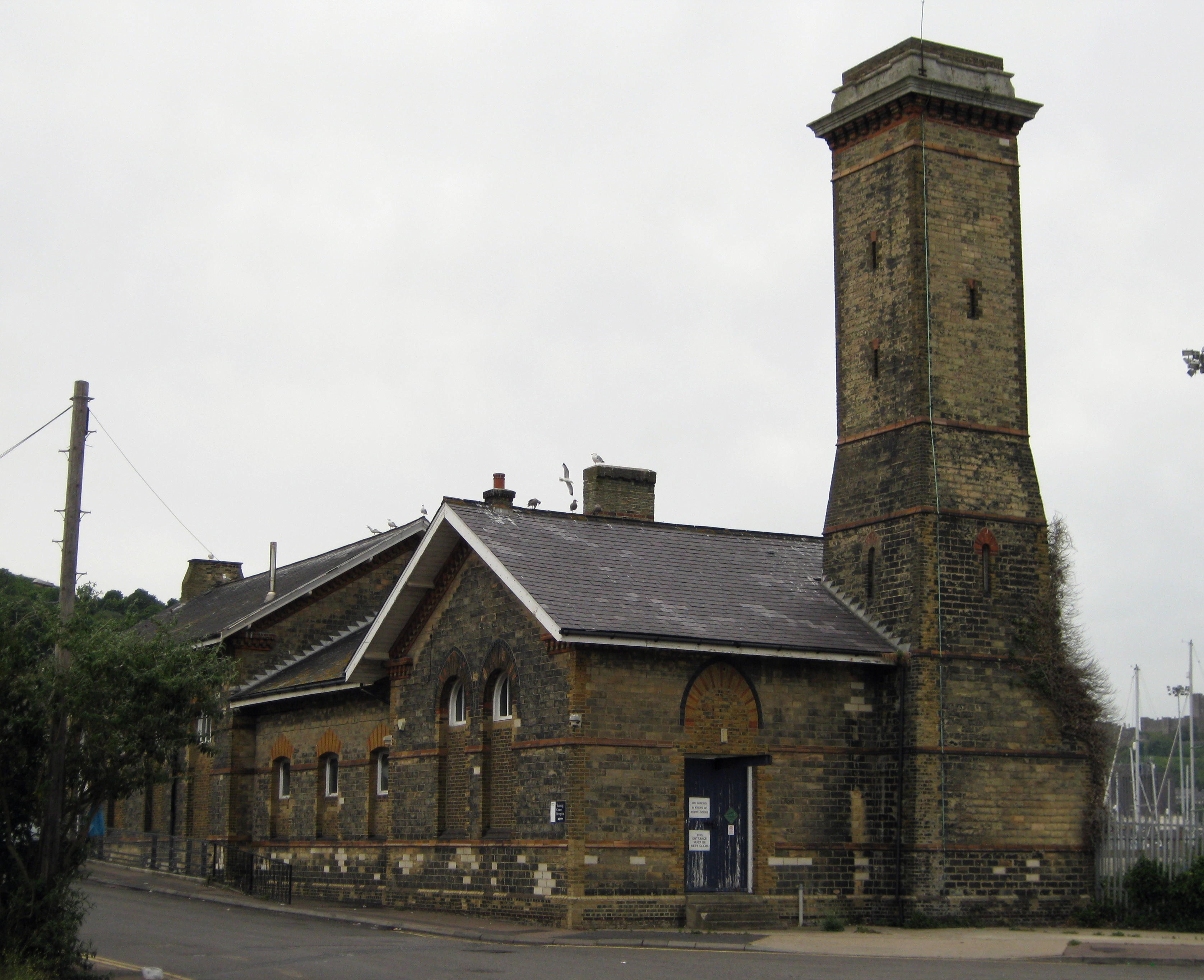
Harbour Station with reduced size clock tower.

Harbour Station with reduced size clock tower.

Partial demolition was completed by June 1929 when the ferry captains put forward the case for keeping the clock tower as it provided an excellent leading line. The tower was reduced in size, a light fixed on the top and it was decided to keep the connecting building. This remained in the hands of Southern Railway Shipping department, which together with the railways was nationalised on 1 January 1948.

The 1980s saw British Rail broken up and sold including, on 27 July 1984, Sealink UK Ltd the owners of Harbour Station. After a couple of changes of owners and name, the company joined with P&O on 10 March 1998, to form P&O Stena Line. In August 2002, P&O bought out Stena Line and gained full possession of the old Harbour Station. By that time the building was Listed and the shipping company used it for training.

Site Office 'signal box' created out of recycled bitsIn 2010 P&O put the old Harbour Station on the market and following negotiations that lasted nearly two years, John Shirley, head of a Snargate Street freight-forwarding business took over the building early in 2013. He  plans to institute the ‘Green policy’ similar to that he successfully put in place at the offices in Snargate Street. This included recycling and composting measures, installation of a sedum grass roof, solar panels, rainwater harvesting and use of wood-pellet boiler.

In preparation for converting the old Harbour Station, Mr Shirley constructed a site office using recycled bits and resembles a signal box. Since then he has refurbished much of the old station adding appropriate historic memorabilia. More recently the Booking Hall has been converted into an independent entertainment venue with a standing capacity of 350. It boasts of in-house professional sound and lighting and designed with touring artists and the community in mind. The aim is to bring some of the biggest names in the industry to the venue, as well as encourage and promoting local talent. These days, besides live music, comedy, theatre and community events are stages at what is called The Booking Hall.

London, Chatham and Dover Railway - Harbour Station

London, Chatham and Dover Railway – Harbour Station

First Published:
Dover Mercury: 16 & 23 September 2010


Posted in Harbour Station, Port and Transport | Comments Off on Harbour Station

Ramsay MacDonald – Dover’s MP that never was

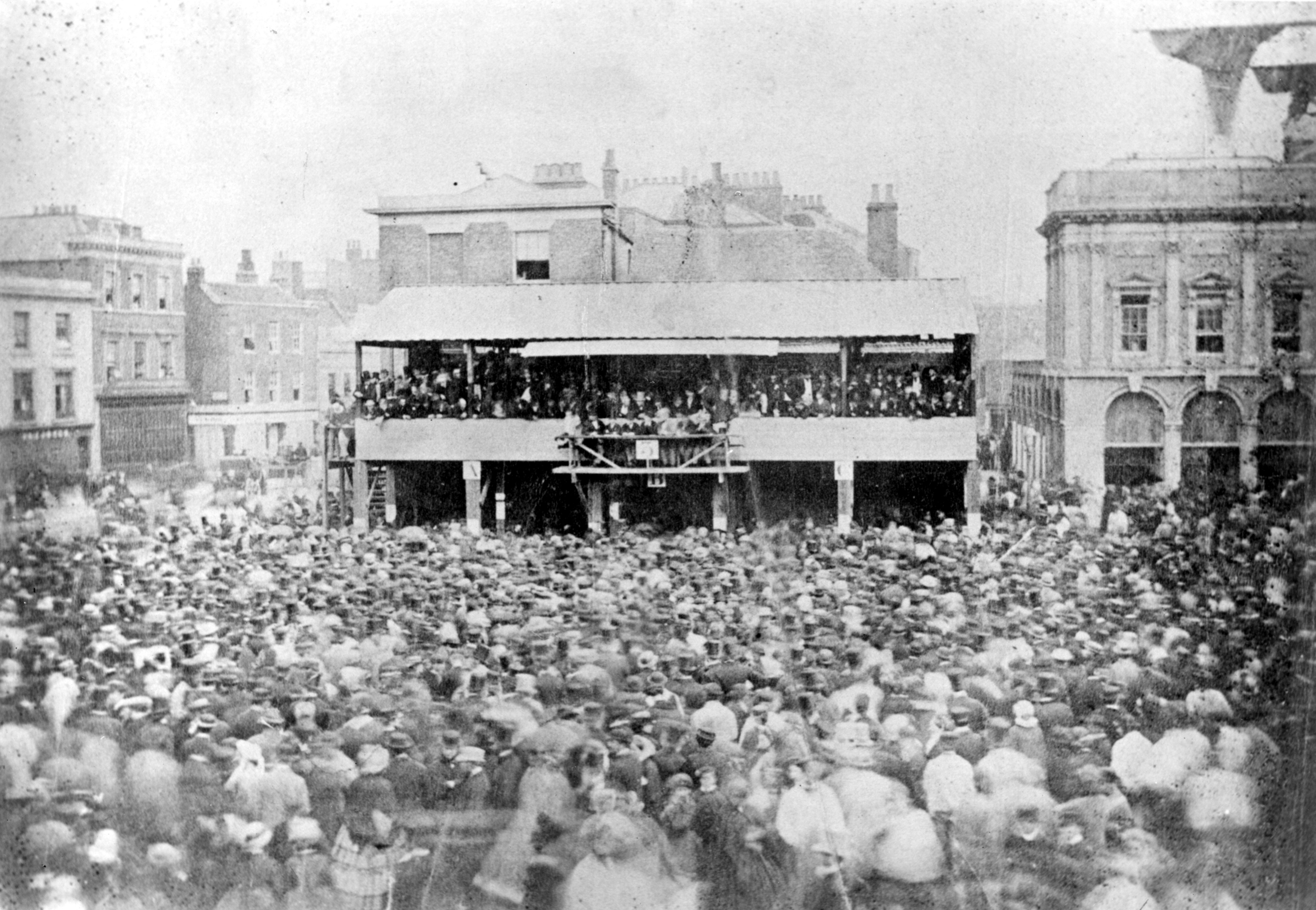
Market Square at the time of the 1871 Parliamentary Dover bye-election. Dover Museum

Market Square at the time of the 1871 Parliamentary Dover bye-election. Dover Museum

Following the Re-Distribution Act of 1885, Dover, then a Borough, the representation in Parliament was reduced from two to one MPs and the National Exchequer – now the Treasury – paid the elected representative a wage. In July 1889 Conservative, George Wyndham, stood unopposed and remained the Borough’s MP until his death in 1913. Nonetheless, there was a strong Liberal following in the town, headed by Montague Bradley and Arthur Harby, two local solicitors.

Known by his middle name, Augustus Montague Bradley (1865-1953) was the youngest son of John Lade Bradley, Mayor of Dover in 1881. Educated at Dover College, Montague along with his brothers, William and Edwin, held prominent positions in public life of the town for decades. Montague was admitted to the Roll of Solicitors in 1886. His practice was at 6 Market Square – now gone – and he was also active in local politics. In 1892, he was elected as a Liberal councillor and remained on the Town Council until 1918.

Arthur Harby c 1890.  Maurice Sayers

Arthur Harby c 1890. Maurice Sayers

Arthur Harby (1862-1900), the other solicitor, was in practice at 4 and 6 St James Street – also gone. Born at Snars Brook, Essex, he was taken on as an article clerk, in 1882, by James Stilwell (1829- 1898). Six years later, in 1888, the firm became Stilwell and Harby, by which name it is still know today. James had two daughters, Eliza Amy and Maud Ann, the first married Arthur and the second his brother, Travers Bidder Harby, who was also a solicitor. Arthur was also active in politics and on the Executive of the Dover Liberal Party.

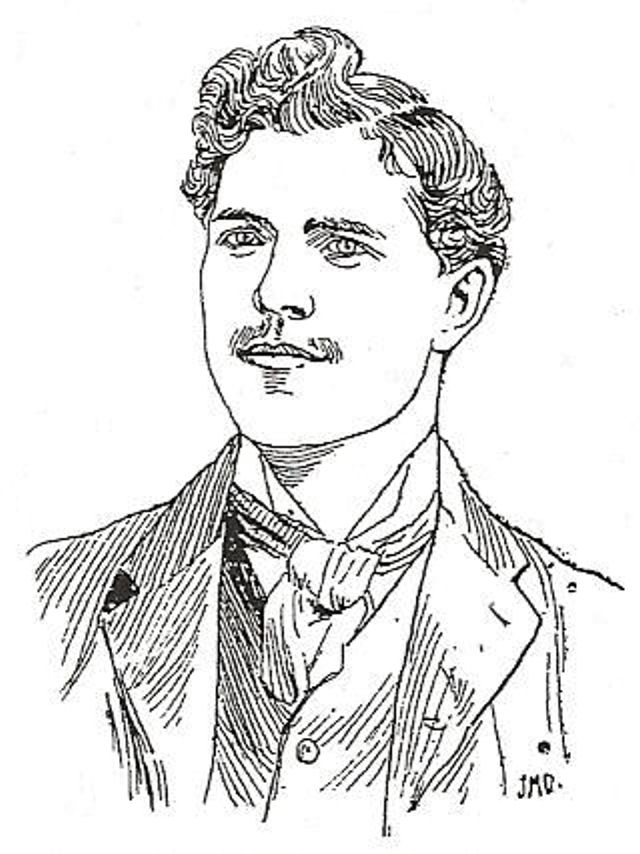
In 1892, James Ramsay MacDonald (1866-1937), popularly known by a combination of his middle and surname, was in Dover supporting Major Eustace G Edwards, the Labour Electoral Association (LEA) candidate. MacDonald was the illegitimate son of a farm labourer in Lossiemouth, Morayshire. As a young man, he moved to Bristol and joined the extreme radical Democratic Federation that eventually became part of the Bristol Socialist Society. MacDonald then moved to London gaining employment with Thomas Lough, a Liberal MP, before venturing into journalism.

Ramsay MacDonald 1892 at the time he wanted to stand as Dover's prospective Member of Parliament

Ramsay MacDonald 1892 at the time he wanted to stand as Dover’s prospective Member of Parliament

In the meantime, the Trade Union Congress had created the LEA but had entered into loose alliance with the Liberal Party in 1886. The LEA representative in the Dover 1892 election was thrashed by Conservative George Wyndham 2,231 votes to 978 – the Liberal’s did not field a candidate.

In Westminster, the Conservatives were in power but the Liberals were beginning to get the upper hand. Dover’s politics were dominated by thirteen times Mayor, Conservative,  Sir William Crundall. Indeed, Crundall’s hold was such that George Wyndham’s role in the governance of the town was that of a figurehead so those who felt that Crundall’s power should be curtailed were impressed by MacDonald.

Recognising this, the Dover LEA immediately selected Ramsay MacDonald as its prospective parliamentary candidate. In his adoption speech, published in the Dover Express of 30 September 1892, MacDonald made it clear that the LEA and the Liberals were separate entities, saying that, ‘We shall adopt no shibboleth which will tie us to the old parties.’ However, to have any chance of winning the Dover Seat, MacDonald knew that he would have to join forces with the local Liberals.

It was not, however, until the following June that MacDonald wrote to the National Liberal Foundation asking for an introduction to the Dover Liberal Party following which a meeting was arranged with Montague Bradley and Arthur Harby. MacDonald assumed that the meeting was merely formality and dominated the discussion.

Not surprisingly, the meeting was not a success and Arthur Harby wrote to the National Liberal Association to this effect. MacDonald was furious, saying that he did not ‘believe that the resolution represents the true opinion of Liberals in Dover.’ Further meetings were arranged between Arthur and MacDonald and correspondence continued into 1894. However, a compromised could not be reached and in the end, MacDonald wrote a terse letter, which was published in the Liberal Dover Chronicle, informing the readers that he was standing in Southampton for the Liberal Party!

After MacDonald left the town, Arthur Harby turned his attention to his sporting activities, particularly rowing – he was captain of the local club in 1895. He married Eliza on 5 June1897 and was appointed Clerk to the Justices on the death of Eliza’s father. Arthur was also a Major in the Cinque Port Volunteers but tragedy struck while undertaking an inspection at Sandwich on 3 July 1900. He was thrown from his horse and killed, Arthur was 38 years old.

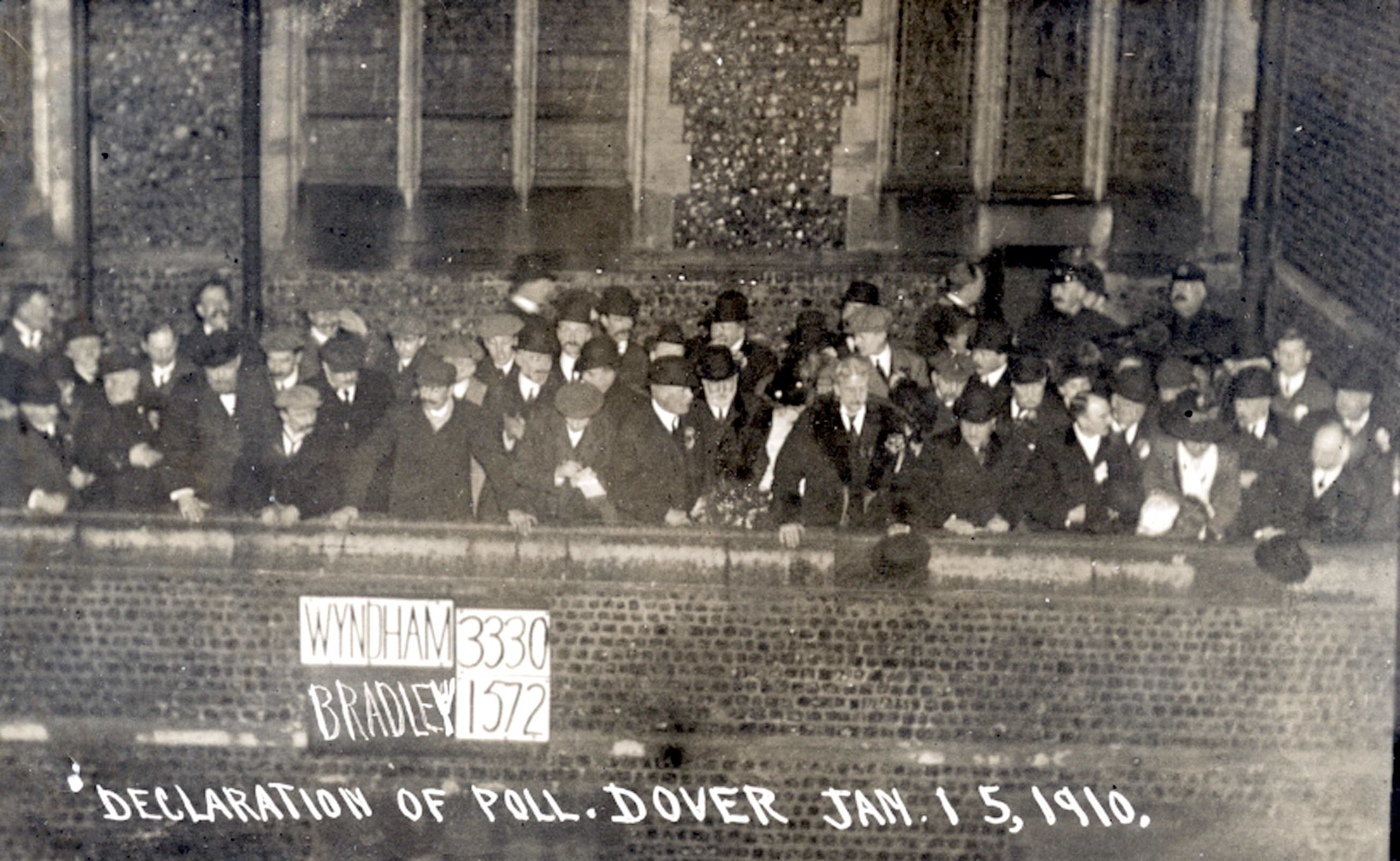
 Election 15.01.1910  Montague Bradley-v-George Wyndham. Dover Museum

Election 15.01.1910 Montague Bradley-v-George Wyndham. Dover Museum

Montague Bradley married Hilda, daughter of fellow solicitor, Syndenham Payn, in 1894 and in 1905 joined forces with solicitor Leonard Watson, the practice moving to 22 Castle Street. He continued in local politics and was selected as Dover’s Liberal candidate for the 1910 General Election but was defeated by George Wyndham 3,330 votes to 1,758. On 24 June that year, as Colonel commanding the 3rd Home Counties (Cinque Ports) Brigade R.F.A., Montague was knighted – for his services in helping with the formation of the Territorial Army in 1908.

During World War I Sir Montague commanded the 2nd North Midland Brigade. One of his sons was killed in France in 1917. Following the war, in 1920, Sir Montague, Lady Hilda and the remaining two sons emigrated to South Africa and his firm amalgamated becoming Bradley, Chitty and Scorer in Castle Street. When he was over eighty Sir Montague visited England and became an air enthusiast taking flying lessons on returning to South Africa, where he died on Tuesday 9 June 1953.

Although Ramsay MacDonald boasted that the Liberals in Southampton had selected him as their candidate, they too turned him down. However, Keir Hardie’s recently founded Independent Labour Party did accept MacDonald for the Southampton seat but he was heavily defeated in 1895. Eventually MacDonald gained a seat in Parliament and became Britain’s first Labour Prime Minister in 1924 and again in 1929. Faced with economic crisis in 1931 he formed the National Coalition, the overwhelming members of which were Conservatives. Accused of betrayal he was expelled from the Labour Party but remained Prime Minister until 1935. He retired from politics in 1937 and died later that year.

Published:

Dover Mercury: 15 December 2011

Posted in Arthur Harby and Ramsay MacDonald, Local Government, MacDonald Ramsay - Dover's MP that never was, Montague Bradley and Ramsay MacDonald | Comments Off on Ramsay MacDonald – Dover’s MP that never was

BAHA – A Personal Story

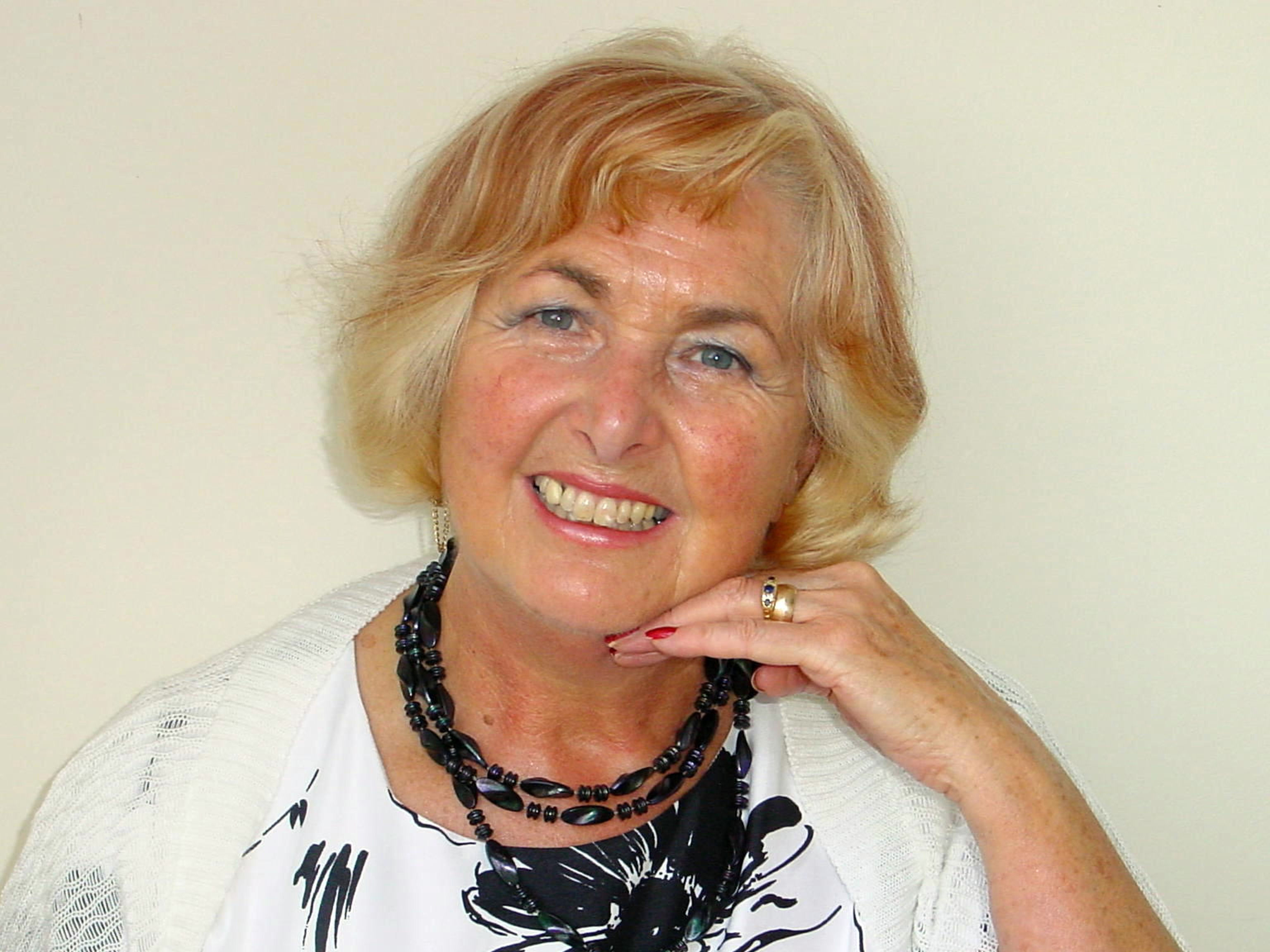
Lorraine

Lorraine

It was 1995, and although registered deaf I was one of two witnesses to an offence. I actually saw what had happened as did the other key witness, whom I neither knew nor was I aware that he had seen what I had seen. The investigating officers could not believe their luck, as both of us had reported the incident within minutes of it happening.

Reporting what I saw and what had been said, (I had ‘heard’ by a combination of lip reading and hearing) I was later told that the other witness, a hearer, had reported more or less the same as I had. The prosecuting officer felt, however, that even though the case rested on what had been seen, as I was deaf and wore a hearing aid – including at the time the offence was committed, I should have it confirmed that I had understood what was going on.

A letter was written to my ENT consultant for the said testimonial, though I had not seen a consultant for some twenty years. As a patient with a chronic disability one only saw consultants when things were going wrong. I did know the registrars though as I had been attending ENT clinics since I was about three years old. By this time I was in my late forties.

My deafness had come about due to a proneness to mastoids – briefly, inflammation of the mastoid bone behind the ear – and having undergone a radical mastoidectomy in 1972, I was completely deaf in one ear. The other ear, also subjected to a mastoidectomy, still offered me some residual hearing, at that time, which was augmented by a hearing aid. The hearing aid, however, gave rise to almost continual ear infections, which can precipitate mastoiditis and also cause wear and tear that meant there was a good chance I would lose hearing in that ear too – which I subsequently did.

Typical of my sort of deafness, my speech tended to be rapid, very nasally and loud when I was not consciously controlling it (i.e. anxious etc.). Otherwise, I spoke too quietly and without much intonation. I enjoyed music that had a strong beat that I could feel through my feet, but anything complex was lost on me. When I was a teenager I managed to get a front row ticket for a Pink Floyd concert and fell asleep as I could not understand the complexity of sounds!

Television required too much concentration so I only watched programs that really interested me. Even then, after about forty minutes my concentration would go and I either fell asleep or went off to do something else. My husband had rigged up the sound to go through our stereo loudspeakers that did help, as did the loop system in conjunction with my hearing aid, but I preferred to read.

James Farley - Ear Nose and Throat Consultant, William Harvey Hospital, Ashford, Kent, England

James Farley – Ear Nose and Throat Consultant, William Harvey Hospital, Ashford, Kent, England

The Ear Nose and Throat (ENT) consultant at William Harvey Hospital, Ashford, Kent, Mr James Fairley, asked to see me before he would write the letter for the court. He examined my ears, nose and throat and I had hearing tests. At then end, he said that he would write a letter of confirmation and he also asked if I would like to be a guinea-pig for a new hearing appliance, the Bone Anchored Hearing Aid or BAHA. I promptly said NO! In 1967 I had an operation which had improved my hearing a little but in 1972 things went horribly wrong and I ended up having the radical mastoidectomy mentioned above and lost three teeth.

Undeterred, Mr Fairley gave me copies of all the bumf appertaining to the BAHA and an appointment was made for me to see the Audiologist, Andrew Bean. I went home and discussed what happened with my husband, Alan, and he suggested that I should at least go and see Mr Bean before I made up my mind.

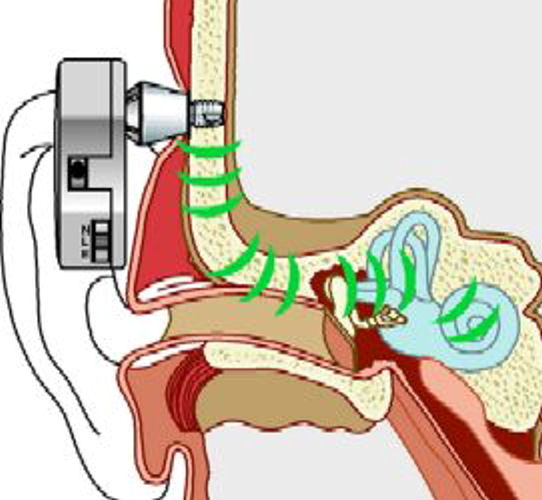
Schematic drawing of how the BAHA bone conduction implant works

Schematic drawing of how the BAHA bone conduction implant works

About a week before the case came to court I saw Andrew. I was still cynical and only half heatedly went along with the tests he wanted to perform. One of these tests was to grip a BAHA between my teeth and report what I heard. I was sitting in one of the consulting rooms with my back to the door that led onto the corridor. Yes I could ‘hear’ what Andrew was saying – I was facing him and could lip read him augmented with my bit of residual hearing. There was no extraneous noise so I correctly reiterated what Andrew was saying but was not impressed.

Then someone came into the room and asked Andrew if he would go and check something. Andrew apologised and left leaving the BAHA between my teeth and the door open. I was about to take the machine out of my mouth when I noticed that I could hear the people in the corridor. Not the usual muffled noise that told me that they were there but words and clearly!

I took the BAHA from between my teeth and sounds became a muffled cacophony that I was used to. I put the BAHA back and the sounds became louder but, and this was the main thing, clearer. After a few seconds concentration I managed to hone in on the nearest conversation and could follow what was being said – and I deliberately had my back to them!

Andrew came back and closed the door and I promptly opened it again! Checked what I could hear with the BAHA between my teeth and what I could hear without it. The difference was unbelievable. Andrew looked at me as if I was crazy, but soon softened when I told him what had happened and that I … agreed to go ahead with the operation!

The court case came and I gave my evidence. I was cross-examined – ever so politely and left the stand feeling mildly satisfied that I had done my bit for British justice. I did not hear the summing up by either the defence or the judge. I am glad I did not for when I read what the judge had to say I was horrified.

In essence, I was deaf and therefore I was not a reliable witness even though the case rested on what had been seen! This just left the word of the other witness against the perpetrator. The other witness had used the expression ‘I believe’ on the stand, and this, the judge felt, could mean that the witness was not sure of his facts. Needless to say the perpetrator was found not guilty.

Schematic drawing of the BAHA componants and where it is fitted in relation to the ear

Schematic drawing of the BAHA componants and where it is fitted in relation to the ear

Shortly after I had the first of the then two-stage operation, the second part was some four months later. Then came the day of reckoning. As I was one of the first ones to have a BAHA fitted in my area, there were a number of people in the consulting room at Buckland Hospital, Dover, besides Mr Fairley, Andrew and Alan. Mr Fairly put the BAHA in, having adjusted it to the level he thought would be correct for me and switched on. I could clearly hear one of the nurses saying to another ‘Do you think it will work? To which I replied ‘YES! Tears were in both the nurses’ eyes. I could hear clearly for the first time in my life.

We left the consulting room, both Alan and I almost euphoric and went straight into a world that I had never experienced before – it was raucous! I commented to Alan ‘My goodness what a loud world you live in!’ He hugged me and he too had tears in his eyes – and he still recalls the event!

The noise of traffic, as we left the hospital, was far too much for me, so the BAHA was switched off. When we reached home I switched it on again. Alan had put Mozart’s Piano Concerto Number 21 on the CD player. It was the first time I had heard anything so beautiful. I switched off the BAHA, yes I could hear the noise but it was nothing like the music I heard with the BAHA switched on. We have a close friend, who is a professional pianist, and now includes that piece of music in her repertoire calling it ‘Lorraine’s theme’.

Lorraine's BAHA, the chain ensures that if the BAHA is knocked off it is lost

Lorraine’s BAHA, the chain ensures that if the BAHA is knocked off it is lost

It took about six months to get use to the BAHA, but that it made a considerable difference to my life. First, I can now speak properly (although it did take a couple of years of hard work to achieve the clarity I now have). I used that skill to raise deaf awareness throughout the county until I was ill with cancer in 2002. I enjoy a wide range of music although I still find Pink Floyd and symphonic pieces beyond my ken. Nonetheless, I can now watch television programs without falling asleep but still need subtitles to augment what I can hear.

So, even though my day in court did not produce the result that had been hoped for, it did enable me to hear! Did the perpetrator commit the same offence again and was he caught? To be honest I do not know, but I am sure that as fate played a large part in restoring my ‘hearing‘ through the BAHA, fate will also see that justice was done.

  • Published:
  • BAHA Journal Spring 2002

Footnote by Mr James W Fairley, Consultant ENT Surgeon:
I remember Lorraine’s story well. We now know that BAHA implants reliably achieve excellent hearing improvement. We fitted the first BAHA (Bone Anchored Hearing Aid) in Kent at the William Harvey Hospital, Ashford in 1995. Lorraine was one of the earlier patients in our district, but not the first to undergo this life-transforming treatment. The technology is based on Swedish Professor Branemark’s invention titanium dental implants. The first prototype BAHA was implanted in Goteborg, Sweden in 1977. By 2013, over 100,000 patients worldwide have received BAHA implants. Some NHS commisioning groups (including Kent) have classifed BAHA as a Low Priority Procedure, and there have always been funding restrictions. Despite the restrictions, we have helped over 150 Kent patients to hear again using BAHA implants. Further information on BAHA at http://entkent.com/baha.php

Posted in BAHA - A Personal Story, Hospitals and Health | Comments Off on BAHA – A Personal Story

Gertrude Toland – Buckland Hospital’s Extraordinary Doctor

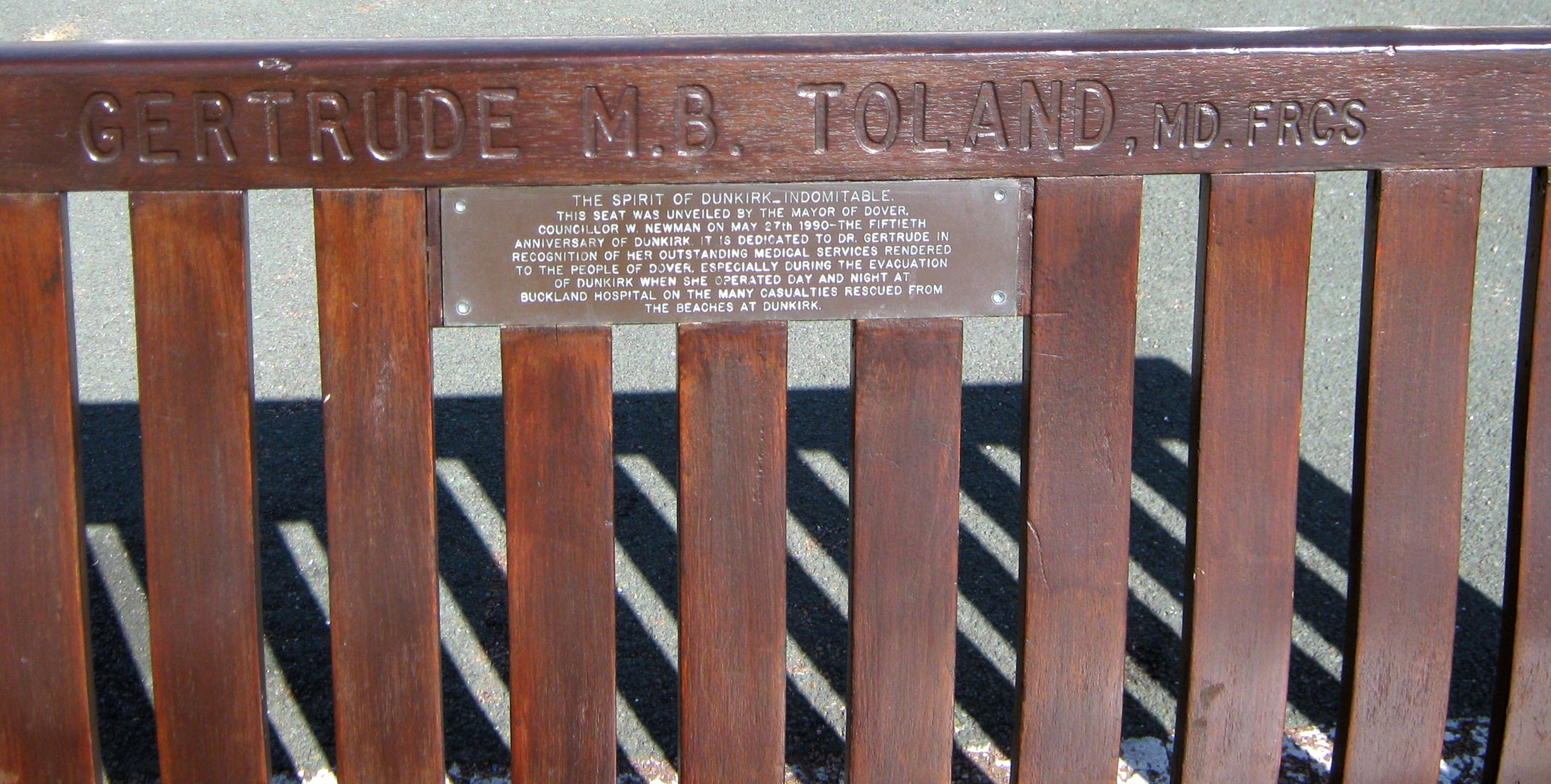
Seat dedicated to Dr Gertrude Toland, Dover Seafront

Seat dedicated to Dr gertrude Toland, Dover Seafront

On Dover’s Seafront is a seat dedicated to Dr. Gertrude Toland, there is also a plaque to her memory at Buckland Hospital. These are both in commemoration of her tireless work during the evacuation of Dunkirk, which although generally known was not acknowledged until these tokens of appreciation were erected.

Born in Edinburgh on 27 November 1901, Gertrude Morgan was educated at Edinburgh Ladies College, Newnham College – Cambridge and St. Mary’s Hospital – Paddington. She was the first woman ever to gain the qualification as a medical doctor from Cambridge University and came to Dover in 1932. This was following her marriage to fellow doctor Patrick Toland at Eastry, East Kent.

Buckland Hospital c1950. Anglo-Canadian Trade Press

Buckland Hospital c1950. Anglo-Canadian Trade Press

A year later Dr. Toland, as she was always referred to, was appointed honorary surgeon at Dover’s hospital, which was at that time, the Royal Victoria in the High Street. At the outbreak of World War II (1939-1945) in 1939, it was felt that the Royal Victoria was vulnerable and the patients were moved to Waldershare, northeast of Dover. The fate of Buckland workhouse was in the balance so it was decided to turn it into a Casualty Hospital. It remained so until 1943 when it became the County Hospital.

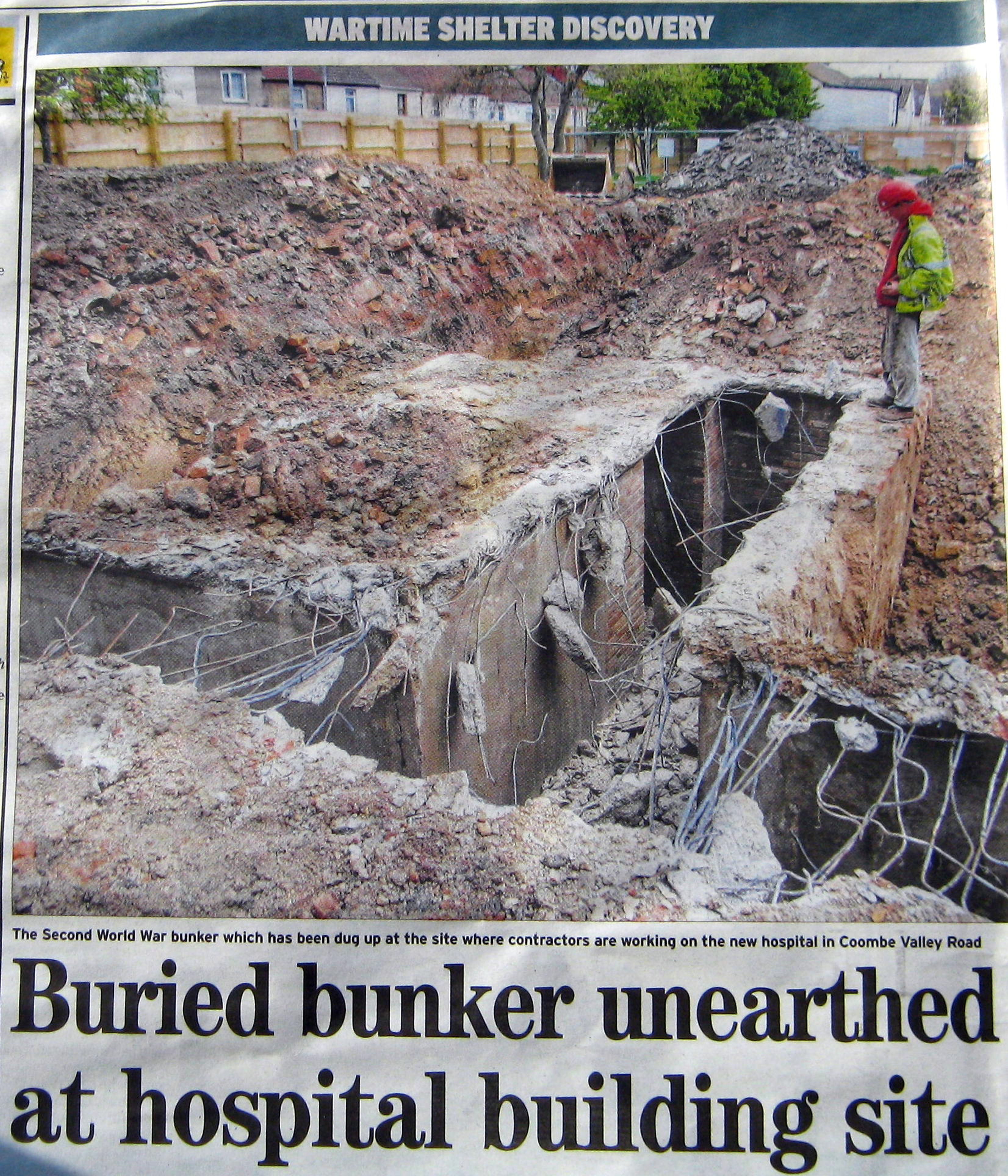
Buckland Hospital Wartime Bunker exposed - Dover Mercury 22.08.2013

Buckland Hospital Wartime Bunker exposed – Dover Mercury 22.08.2013

As a Casualty Hospital, a massive under ground concrete bunker was created in the grounds under what eventually became the car park. Within it was an operating theatre with two operating tables, so that procedures could be carried out regardless of might be going on outside. The main hospital was equipped with 110 beds that could be moved to the underground bunker if needs necessitated.

Initially very few patients were admitted then in spring 1940 there was an outbreak of influenza and 800 army personnel being given treatment. A few weeks later, on 26 May 1940, things changed dramatically. The harbour was crammed with ships as men were being evacuated from the beaches of Dunkirk. It was at this time that Buckland Casualty Hospital received its worst cases as many of the men were suffering from Gas Gangrene.

The two operating tables in the underground bunker were brought into action and Dr Toland operated on one. Teams of doctors and nurses from further a field, including Guys Hospital, London, joined her and they all worked continuously day and night. In all approximately 350 wounded men were dealt with in the nine days of the evacuation and 300 survived. Most of those who died were buried in St James Cemetery on Copt Hill.

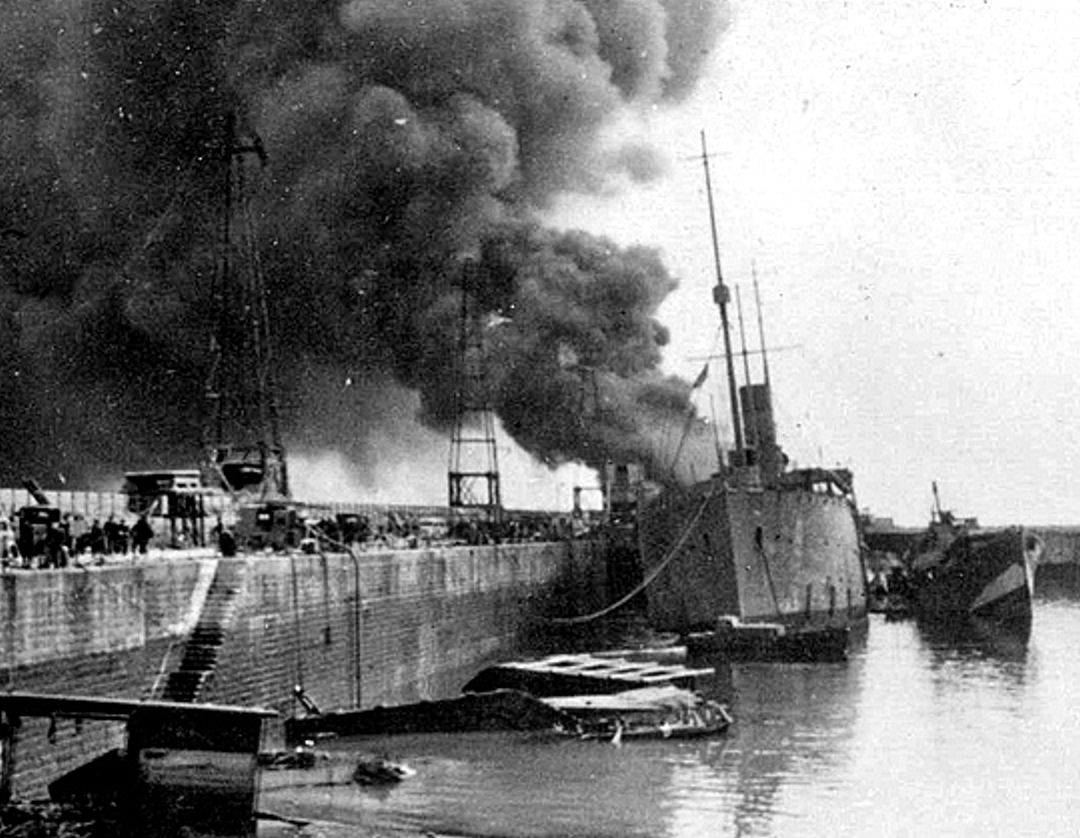
Sandhurst during the attack on Dover's Harbour 29 July 1940. Michael Harmer

Sandhurst during the attack on Dover’s Harbour 29 July 1940. Michael Harmer

In July that year, at the start of the Battle of Britain, 122 naval casualties were dealt with following a dive-bomb attack on the harbour. In August the first cross-channel shells fell on the town bringing civilian casualties to the hospital. Then on the 19th, a bomb was dropped on an Army-v-Navy football match on Northfall Meadow, behind the Castle, killing all the players and some of the spectators. Those who survived kept the hospital theatres busy for over twenty-four hours.

Throughout the next three years, Dr Toland and her colleagues coped with numerous casualties both at Buckland and at the Royal Victoria Hospital, where surgeries were held. Accounts of how problems were dealt with were written up in at least two medical books and her own publications that included ‘War Surgery in Dover England’ published in the American Medical Women’s Journal.

In this, she wrote of her experiences during the Dunkirk evacuation, ‘Some having survived the ordeal, came in still wearing their bloody and dirty field dressings … Those who died were laid out in sacks, together with those who were brought in dead, and taken to the hospital chapel to await burial. The operating theatre had two operating tables … Every effort was made to save limbs, but unfortunately many had to be amputated.’

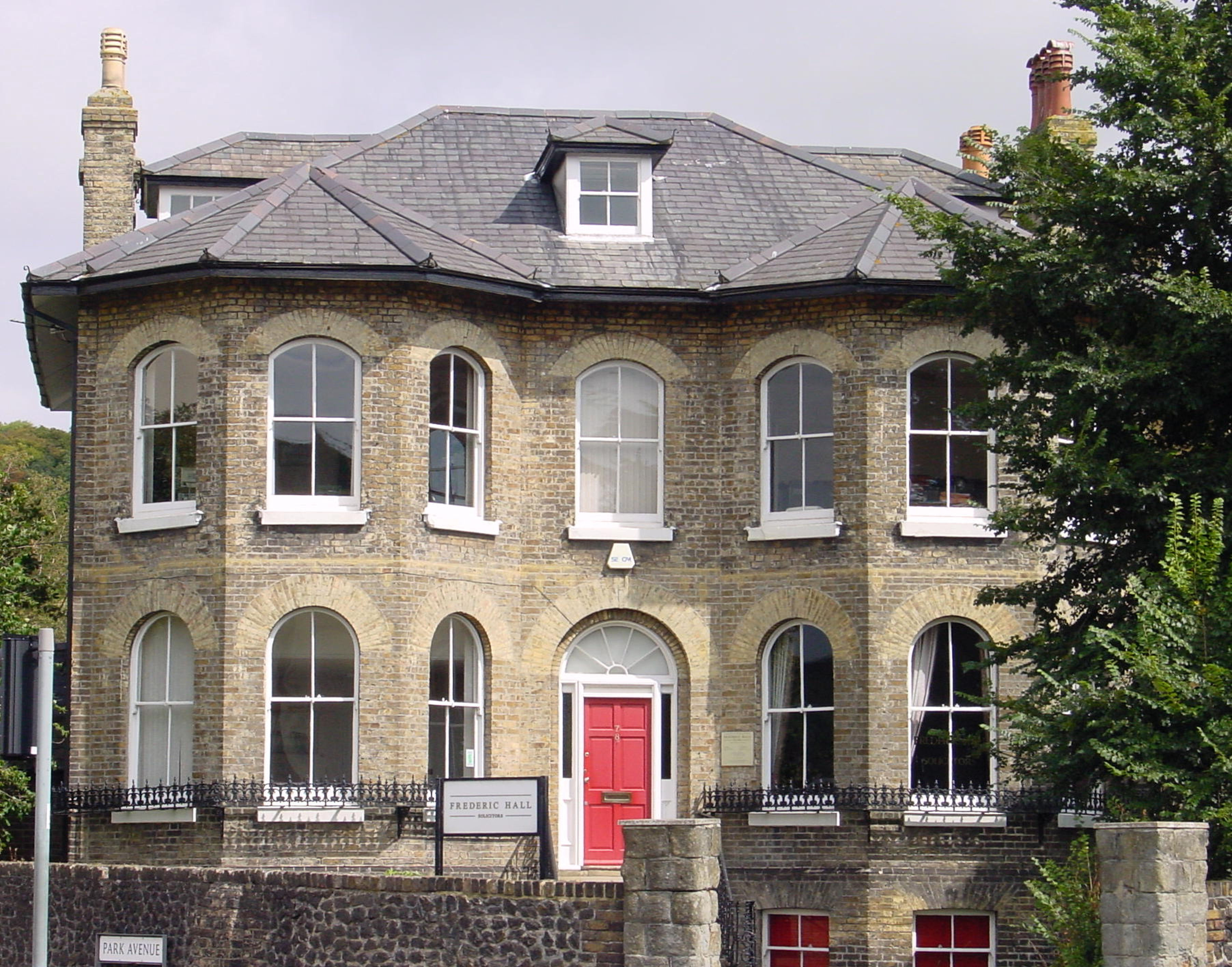
Clyde House, Maison Dieu Road

Clyde House, Maison Dieu Road

Following the war, in 1948, Dr Toland was appointed Consultant Obstetrician and Gynaecologist at Buckland Hospital, as well as continuing in general practice at Clyde House, in Maison Dieu Road. She was also active in local politics, serving as a Conservative town councillor between 1960-1963 and was appointed deputy Mayor in her last year of office. Dr Toland also served as governor to a number of secondary schools and was active in youth services. She was awarded the Serving Sister of the Order of St John of Jerusalem and was the president of Dover’s Business and Professional Women’s Club.

Dr Patrick Toland was in the forces during the War and rejoined the practice in 1945. The Tolands retired in 1968 and went to live in Kingsdown, to the east of Dover. However, when Dr Gertrude Toland died in May 1985  he had not received any official recognition, in the town, for her wartime work.

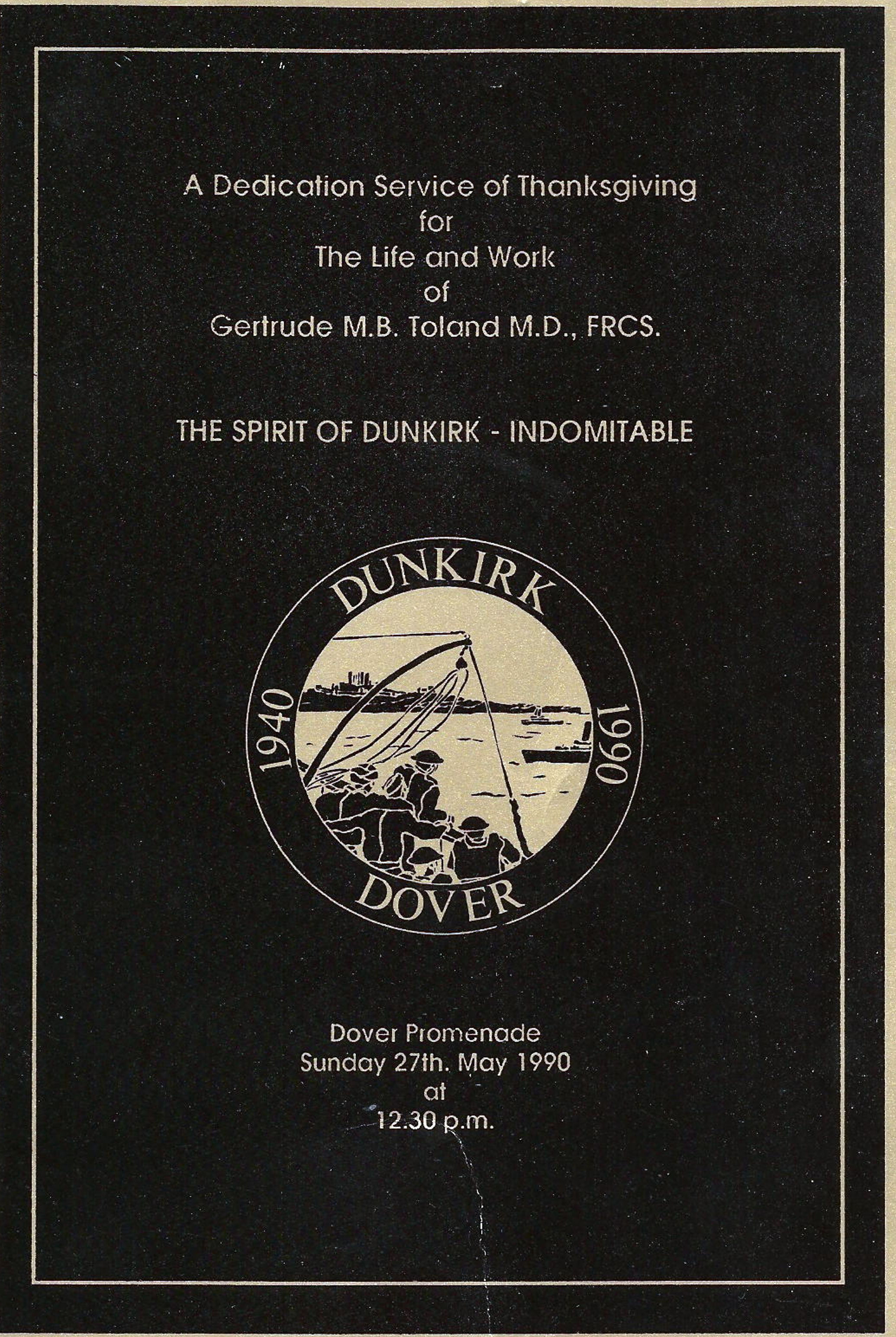
Front page of the Dedication Service 27.05.1990 to Dr. Gertrude Toland. Thanks to Fr. Peter Sherred

Dedication Service 27.05.1990 to Dr. Gertrude Toland. Thanks to Fr. Peter Sherred

In 1989, Councillor Arthur Husk and Mary Hutchinson launched a fund to provide the Seat, mentioned at the beginning, in her memory on the Seafront for the 50th anniversary of Dunkirk. This was unveiled by the then Mayor, Cllr. Bill Newman, on 27 May 1990. The dedication reads, ‘… to Dr Gertrude Toland in recognition of her outstanding medical services rendered to the people of Dover, especially during the evacuation of Dunkirk when she operated day and night at Buckland Hospital on the many casualties rescued from the beaches of Dunkirk.’

At the same time, the Dover Rotary Club thought it would be appropriate to have a lasting memorial in the place where Dr Toland operated. In February 1991 Fr. Peter Sherred, then President of the Rotary Club, unveiled a plaque in her memory outside what was then the operating theatre at Buckland Hospital. Dr Toland’s son Gordon was in attendance and the plaque was blessed by Canon Allan Simper.

As noted above, the area above the massive underground theatre at the wartime Casualty Hospital eventually became Buckland Hospital’s main car park. When Buckland Hospital cease to exist as an in-patient facility, what had been the main hospital closed. A new Community Hospital – without inpatient beds, operating theatres etc. – was built on the site of the car park and the East Kent Hospitals University National Health Service Foundation Trust who own the site, feigned surprise when the wartime complex was rediscovered!

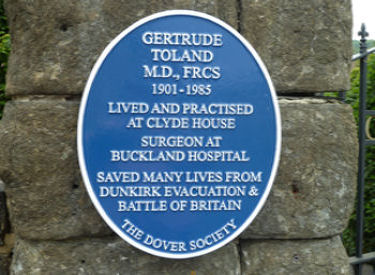
Dover Society blue plaque unveiled on the gatepost of Clyde House, Maison Dieu Road to Dr Gertrude Toland on 13 April 2018. AS 2018

Dover Society blue plaque unveiled on the gatepost of Clyde House, Maison Dieu Road, to Dr Gertrude Toland on 13 April 2018. AS 2018

On 13 April 2018 members of Dr Gertrude Toland family attended a ceremony when the Dover Society unveiled a blue plaque on the gatepost of Clyde House, in Maison Dieu Road, where she practised as a GP following World War II. The plaque honoured Dr Toland’s work during World War II and her son, Gordon Toland, told the many who attended that among his mother’s possessions was a bullet she extracted from a German pilot’s bottom! Dr Gertrude Toland never discriminated.

  • First Published:
  • Dover Mercury 12 November 2009
Posted in People, Toland Gertrude - An Extraordinary Doctor, Toland Gertrude - An Extraordinary Doctor, World War II | Comments Off on Gertrude Toland – Buckland Hospital’s Extraordinary Doctor

Cinque Ports and Great Yarmouth

Cinque Ports Flag showing the Coat of Arms, Maison Dieu. LS 2009

Cinque Ports Flag showing the Coat of Arms, Maison Dieu. LS 2009

The Confederation of the Cinque Ports was formed in the reign of Edward the Confessor (1042-1066) and is made up of the towns of Dover, Hastings, Sandwich, Hythe and Romney and the two Antient towns of Winchelsea and Rye. Each of the towns had Limbs, towns and villages that came under the jurisdiction of an individual Cinque Port.

Originally, there were more that 30 towns and villages, stretching from the Manor of Grange, near Chatham, Kent, to Pevensay in Sussex, attached to the heads ports as members or ‘Limbs’. Some were corporate members, their membership conferred by Royal Charter; the others were associated to their head port by private agreement.

The main function of Limbs was to help the Head ports discharge ‘Ship Service.’ According to the Cinque Ports Charter of 1155, this meant the provision of 57 ships crewed by 21 sailors apiece for 15 days a year to defend the realm and to maintain the ships ready for the Crown in case of need. In return, the Cinque Ports and their Limbs received many rights and privileges that were encompassed in the Charter.

One of these privileges allowed the Portsmen to fish for herrings off the River Yare, East Anglia. As this was a considerable distance away instead of returning to the south coast, the fishermen would set up camp on the banks of the Yare estuary. As this became a regular habit, the Portsmen built themselves huts to live in during the fishing season.

One of the main problems that the Portsmen faced was following the river in the estuary, when visibility was poor, to where they had set up camp. To deal with this they built beacons but these needed maintaining. Locals under the supervision of the Portsmen undertook this job.

Slowly, around the Portsmens encampment, a village started to grow. Not only was this made up of locals who helped to maintain the beacons but also those who sold goods at a makeshift market set up in the encampment. The Portsmen encouraged the growth of the market where they also sold their herrings. Before long it had become an annual fair – the Michaelmas Free Fair, that ran from 29 September to 11 November each year.

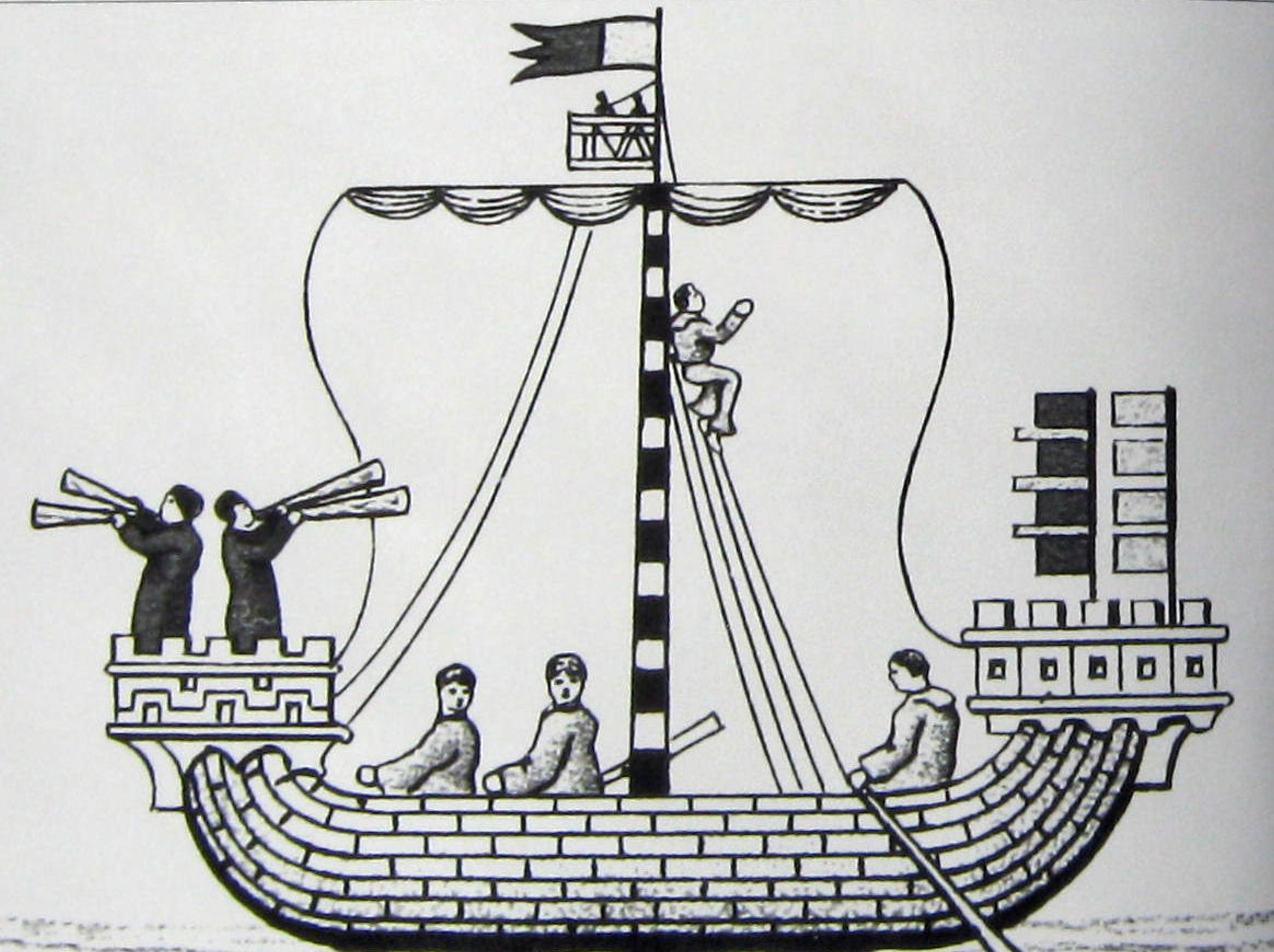
circa 13th Century Cinque Ports ship

circa 13th Century Cinque Ports ship

The Portsmen appointed ‘Portreeves’ or bailiffs who enforce stringent regulations that they had compiled undertook administering and the policing of the Fair. For instance, the Portsmen dictated who could have stalls, charges, opening hours, the weight of beer and bread sold and many other things. They also used the Fair to raise money to pay for the beacons as well as levying an ‘Oar Pence’ on locals. The latter was one-penny for every oar that the local used in their boats, and four-pence for each boat.

By 1109 the settlement besides the Yare had grown into the town of Yarmouth and Henry I (1100-1135) extended the bailiffs duties to include the dispensing of justice and the collecting the King’s customs. The locals petitioned the King asking for the town’s independence from the Portsmen saying that unlike the Cinque Ports Limbs, they did not receive any of the rights and privileges.

The Portsmen reminded Henry I that by royal prerogative they were given the right to fish off the River Yare and it was they who had founded the town. As for the locals, if it weren’t for the Portsmen, they argued, the locals would not have a town. Further, the locals had never provided Ship Service so were not privy to the rights and privileges of the Cinque Ports and their Limbs. The Portsmen won the case but the people of Yarmouth made their anger felt and the result was the loss of life and property.

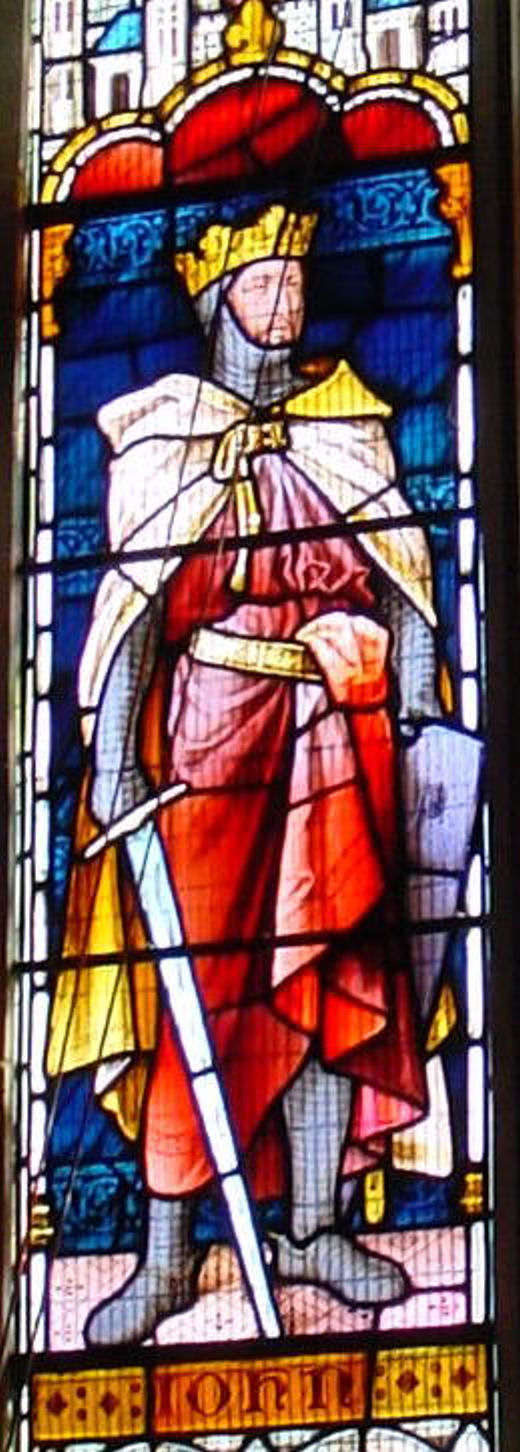
King John, Council Chamber, Maison Dieu (former Town Hall)

King John, Council Chamber, Maison Dieu (former Town Hall)

In 1208, King John (1199-1216) was on the throne and the Yarmouth locals again petitioned. The King came down on their side; his only caveat was that the town was to send to the sheriffs of Norwich every year, ‘one hundred herrings, baked in twenty-four pasties.’ The Norwich sheriffs were then to take the pies to the lord of the manor of East Carlton who would convey them to the King!

However, within a year John, faced with possible invasion from France, was building up a navy and needed the loyalty of the Portsmen more than he needed the Yarmouth fish pies. He therefore, allowed the Portsmen to retain their rights over the Yarmouth fishing trade, which  meant that the town was under dual control. The result was an increase in the number and ferocity of clashes between the locals and the Portsmen.

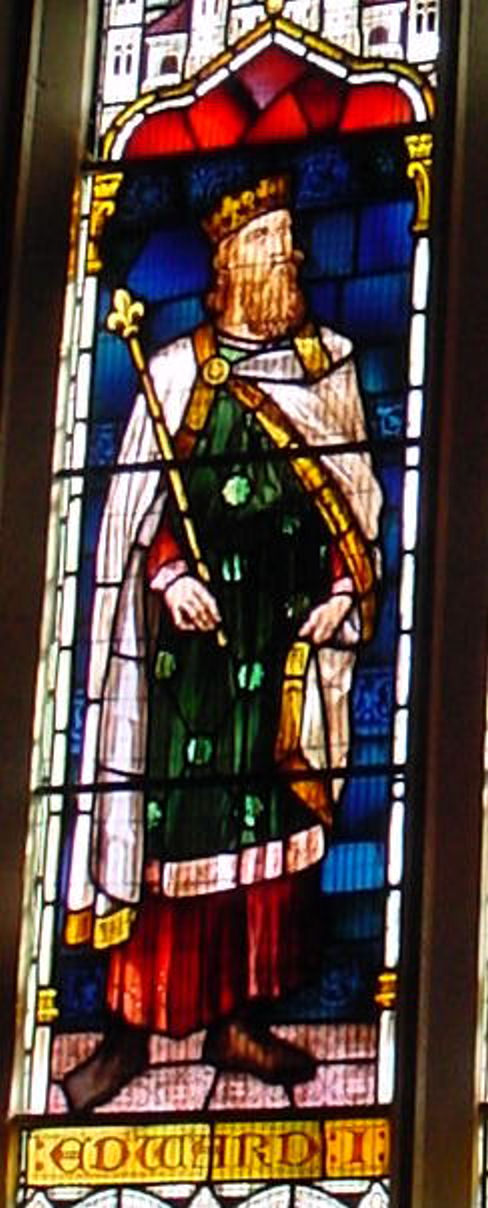
John died in 1216 and was followed by the infant Henry III (1216-1272), who was under the protection of Hubert de Burgh (1160-1243), the Constable of Dover Castle from 1202 to 1232, amongst his many responsibilities.  Although de Burgh fell out of favour in 1232, Henry needed the Portsmen as did his successor, Edward I (1272-1307). With all their power the Portsmen had little time for what was perceived by the locals in Yarmouth as their rights.

Edward I, Council Chamber, Maison Dieu (former Town Hall)

Edward I, Council Chamber, Maison Dieu (former Town Hall)

Things came to a head in 1296 over the payment to locals for looking after the beacons when the Cinque Ports increased their charges to locals for using the river. As always, the Portsmen collected the charges out of which they paid the locals to maintain and light the beacons. However, if the bill came to more than the Portsmen collected, then they made the people of Yarmouth pay the difference, if it was less, then the Portsmen kept the profits.

The altercation that year was fierce with the Portsmen burning twenty-five Yarmouth ships. 171 men were killed and goods to the value of £46,360 despoiled. To settle the difference, King Edward issued an edict that gave the Portsmen the right to collect the money but they also had to maintain all the beacons. The animosity, however, did not go away, at the Battle of Sluys, in June 1340, the Portsmen and the men from Yarmouth fell upon each other instead of the enemy and over 200 men were killed or drowned.

Fishermens Cottages Great Yarmouth - Great Yarmouth Tourist Information

Fishermens Cottages Great Yarmouth – Great Yarmouth Tourist Information

The locals of Yarmouth continued to strive for their independence but to no avail until 1635, when the Portsmen tried to issue licences to a Dutch fleet that wanted to fish off Yarmouth. The Dutch refused to pay and the Portsmen tried to attack them but were no match. The Portsmen sought the help of the Admiral of the Fleet and the Dutchmen agreed to pay a yearly tribute of £30,000. However, they only paid it for that one-year.

This gave the people of Yarmouth the confidence to stand up to the Portsmen and their rule over Great Yarmouth gradually diminished. Although the relationship between the Cinque Ports and Yarmouth was never formally dissolved, it was allowed to quietly terminate.

  • Published: 
  • Friends of Dover Castle Magazine Autumn 1999
  • Dover Mercury 30 April 2006
Posted in Cinque Ports, Limbs and Great Yarmouth | Comments Off on Cinque Ports and Great Yarmouth