Caroline of Brunswick – Dover’s Queen

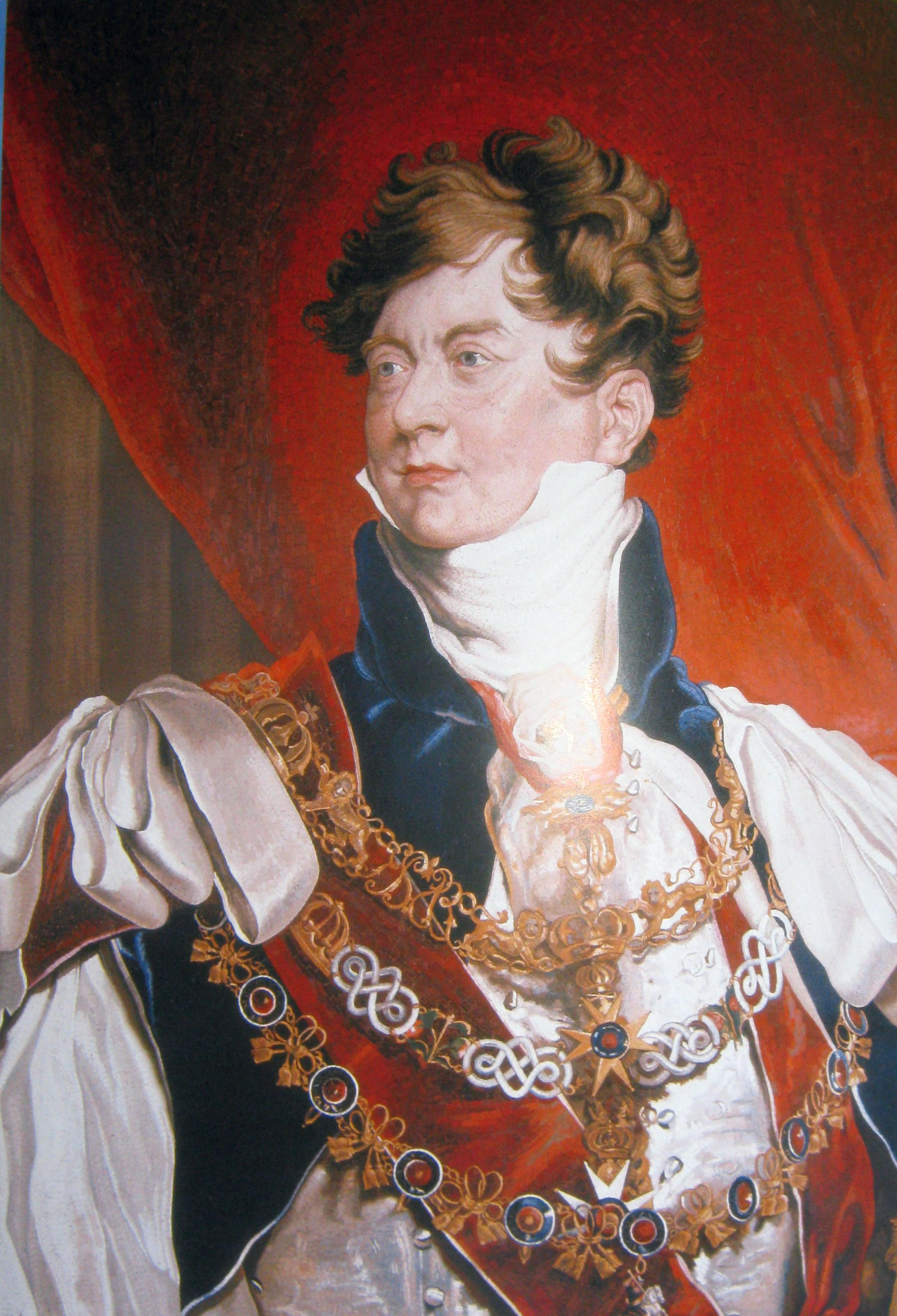
Prince Regent (1811-1820) George IV (1820-1830). Brighton Pavillion

Prince Regent (1811-1820) George IV (1820-1830). Brighton Pavillion

George III (1760-1820) died at the age of eighty-two. He had been deemed incapable of ruling the country since 1811, when his son, George IV (1820-1830) had reigned as Prince Regent. Within the ‘ton’ – the name given to high society of the time – the Prince Regent was feted, the Napoleonic Wars (1792-1815) were being fought and ordinary people saw him seen as extravagant and self-indulgent.

Following the victory of Waterloo (1815), approximately a quarter of a million soldiers and sailors, many of them maimed, returned home and were faced with no prospects. Crops had been poor and so food prices were rising. Income tax was abolished and replaced by taxes on staple commodities and to save money, Poor Law relief rates were drastically cut. Starvation was rife.

In Dover, things were not as bad as elsewhere in the country. The two banking families, the Fectors and the Lathams, were providing work directly and indirectly, financed from profits made during the Napoleonic Wars. Nonetheless, the people of Dover expressed their abhorrence of George the Prince Regent by favouring his estranged wife, Caroline of Brunswick-Wolfenbüttel (1768-1821)

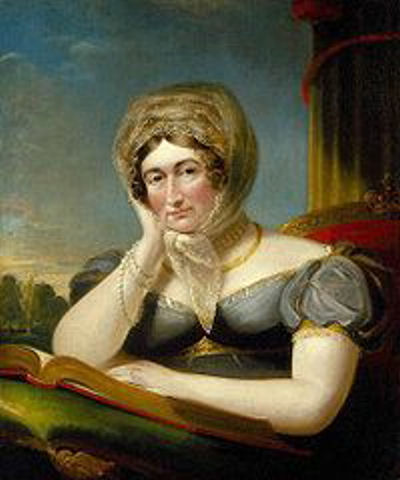
Caroline of Brunswick Queen to George IV c1820, by James Lonsdale*. Internet

Caroline of Brunswick Queen to George IV c1820, by James Lonsdale*. Internet

The marriage of George to Caroline, his first cousin, in 1794 was seen as politically expedient to cement alliances at the start of the Napoleonic Wars. Also for George to sire an heir with hopefully, a spare. In return, the government paid George’s debts amounting to some £150,000. George had previously contracted a marriage with Maria Anne Fitzherbert (1756–1837), but as she was a Catholic this violated the Royal Marriages Act of 1772 so was unlawful. At the time of George’s marriage to Caroline, Frances Villiers, Countess of Jersey (1753-1821), was his latest mistress, having superseded Mrs Fitzherbert.

The royal couple, who had never met before, married on 8 April 1795, he was drunk and described her as short, fat, ugly and smelly! Over the next two days, the Prince did what was expected of him and then abandoned the matrimonial bed and returned to the Countess of Jersey.

Nine months later Caroline, having been given the title of Princess of Wales, gave birth to a daughter, Princess Charlotte of Wales (1796-1817). Within a week, George had made out a new Will leaving all his property to his ‘wife’ Mrs Fitzherbert and Caroline, one shilling (5pence). The ‘ton’ cold-shouldered Caroline and three years after the marriage, the couple separated but she retained her title. Moving to a house in Blackheath, London, Caroline created her own social circle and it was said that she entertained a number of lovers. One of these was Sir Sidney Smith, (1764-1840) son of Captain John Smith who built Smith’s Folly.

Caroline’s daughter Charlotte, in 1813, married Prince Leopold of Saxe-Coberg-Saalfeld. Charlotte was popular so the marriage was an excuse for celebration, particularly in Dover. On 6 April 1814, Napoleon of France, abdicated and on 8 August, Caroline stayed at the Fector house in Dover before crossing to the Continent. She was a friend of the family and the Fector’s had named their third daughter after her. From the British government, Caroline had negotiated an allowance of £35,000 a year and after crossing to the Continent in one of the Fector ships she made her home in Italy. However, in November 1817, Charlotte died in childbirth – her son was still born.

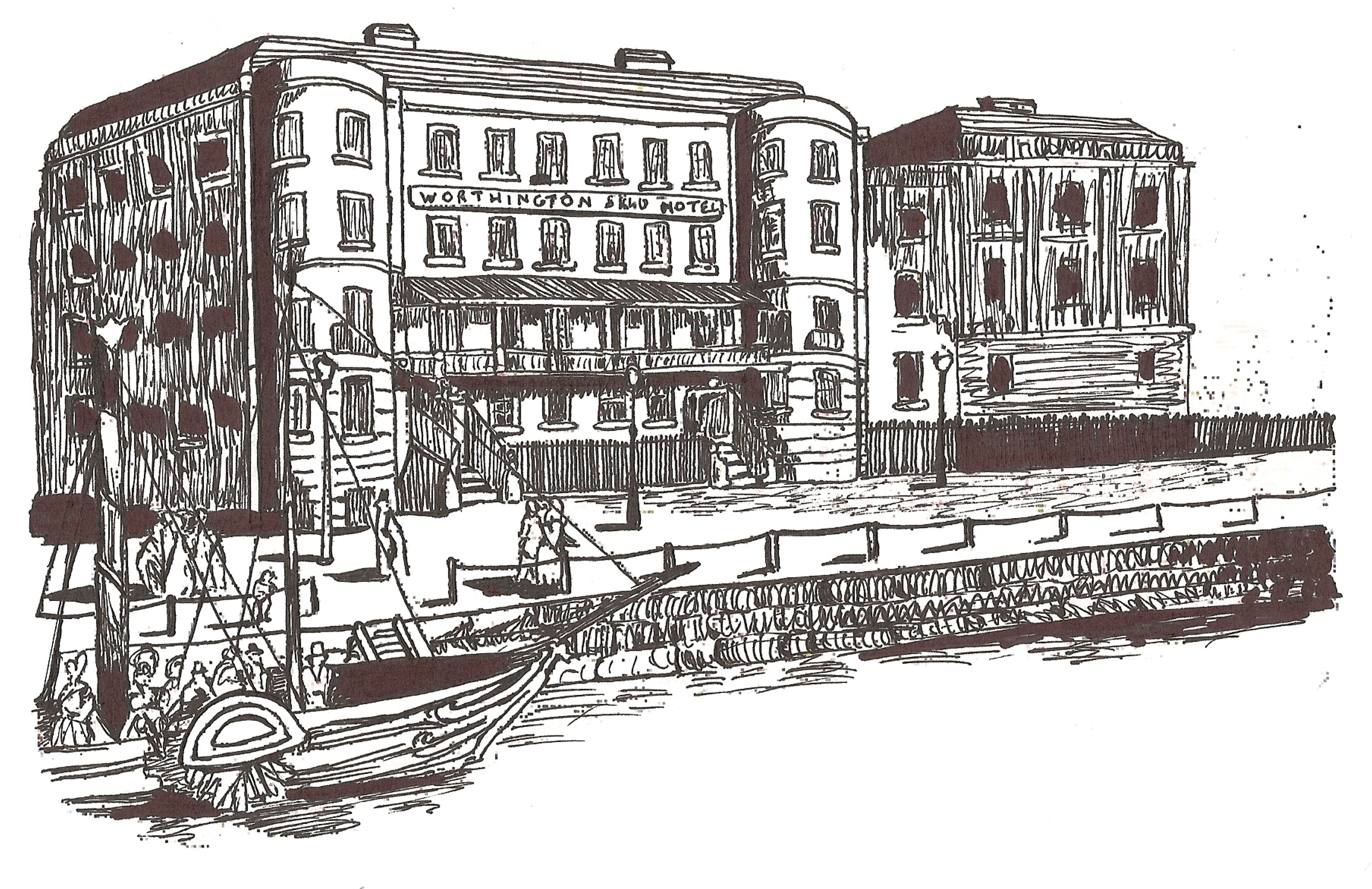
Ship Hotel on Custom House Quay circa 1834 by Lynn Candace Sencicle

Ship Hotel on Custom House Quay circa 1834 by Lynn Candace Sencicle

George III died on 29 January 1820 and Caroline was brought to England in the Prince Leopold a Fector Packet (mail carrying ship) – Master R Rogers. She arrived on 5 June 1820 and was given a tumultuous welcome plus a royal salute from the commandant of the garrison plus a guard of honour! As Caroline tried to walk from the harbour to the Ship Inn, close by, the crowds were so abundant that she was forced to go to the York Hotel. From there Benjamin Worthington, the proprietor of the Ship, rescued and guided the Queen through an internal passage between the two hotels!

Caroline stayed until the evening and the crowds outside chanted, ‘God bless Queen Caroline!’ When she left for London and local men unhitched the horses of her carriage and pulled it manually. The road out of Dover was also crowded with people who cheered as she passed by.

George, oblivious to all of this, was trying to secure grounds to divorce Caroline. A Bill had already been introduced to Parliament designed to strip Caroline of the title of queen consort and dissolve their marriage. In it she was accused of adultery with Bartolomeo Pergami, one of her servants in Italy.

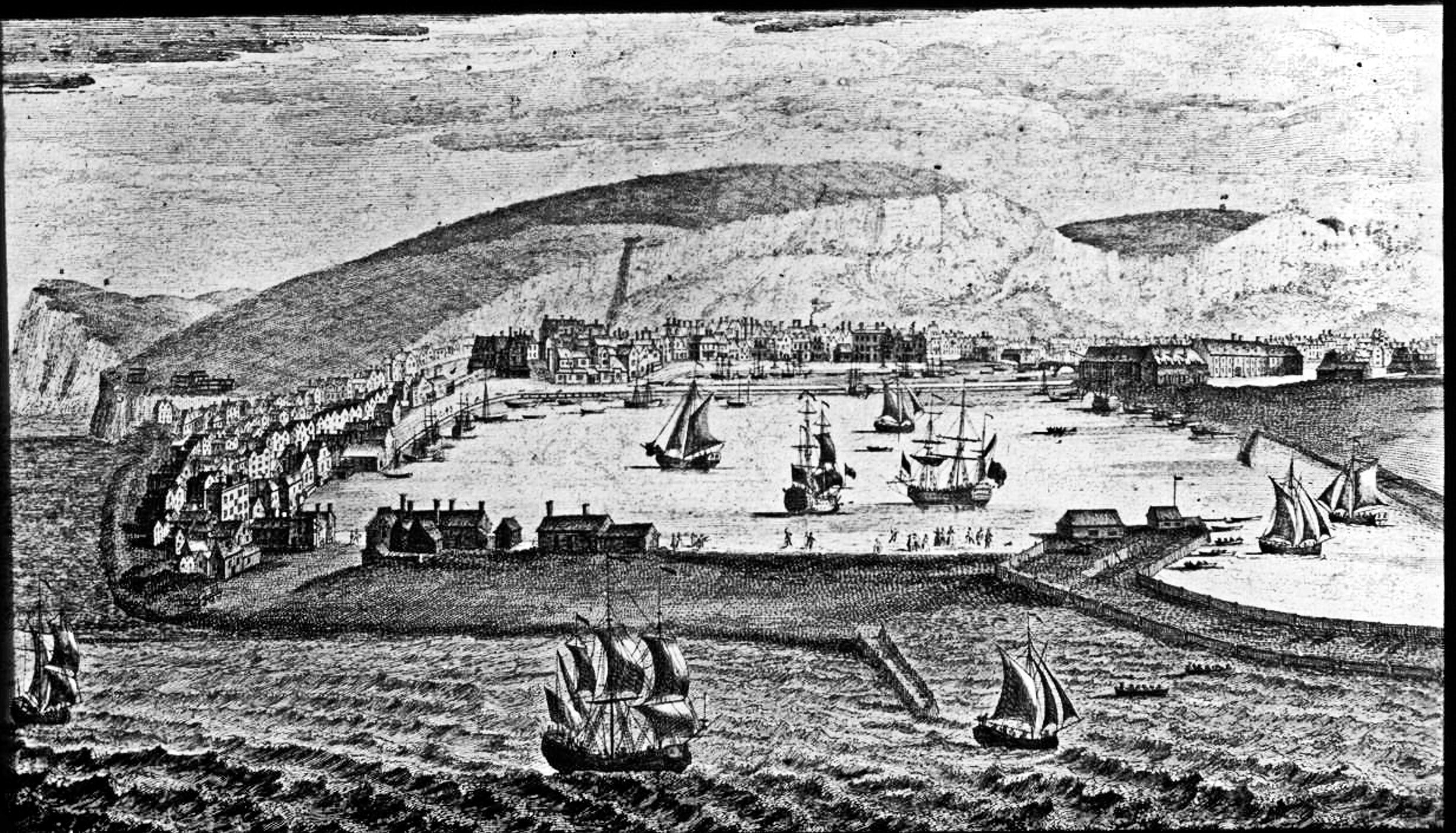
Dover Harbour 1738 glass slide artist Nathaniel & Samuel Buck. Dover Museum

Dover Harbour 1738 glass slide artist Nathaniel & Samuel Buck. Dover Museum

On arrival in London, the hapless Queen was forced to undergo a humiliating eleven-week inquiry by the House of Lords with witnesses against Caroline summoned from Italy. The first group, of which were eleven men and one woman, arrived in Dover on 7 July. No sooner had they set foot on land than a crowd gathered and demanded that they should return to the Continent. The Mayor, Sir Thomas Mantell, read the Riot Act but the townsfolk took no notice.

In the end, the witnesses took refuge in the Ship Hotel but the coaches that were to take them to London were smashed and the horses ‘disappeared’. When they left, Benjamin Worthington showed them the front door where the hostile crowds waited. There, a large group of women attacked the witnesses and it was much later that they left the town battered and bruised ‘by stealth.’ The next day national headlines covered the story under the headline, ‘Dover Massacre!’

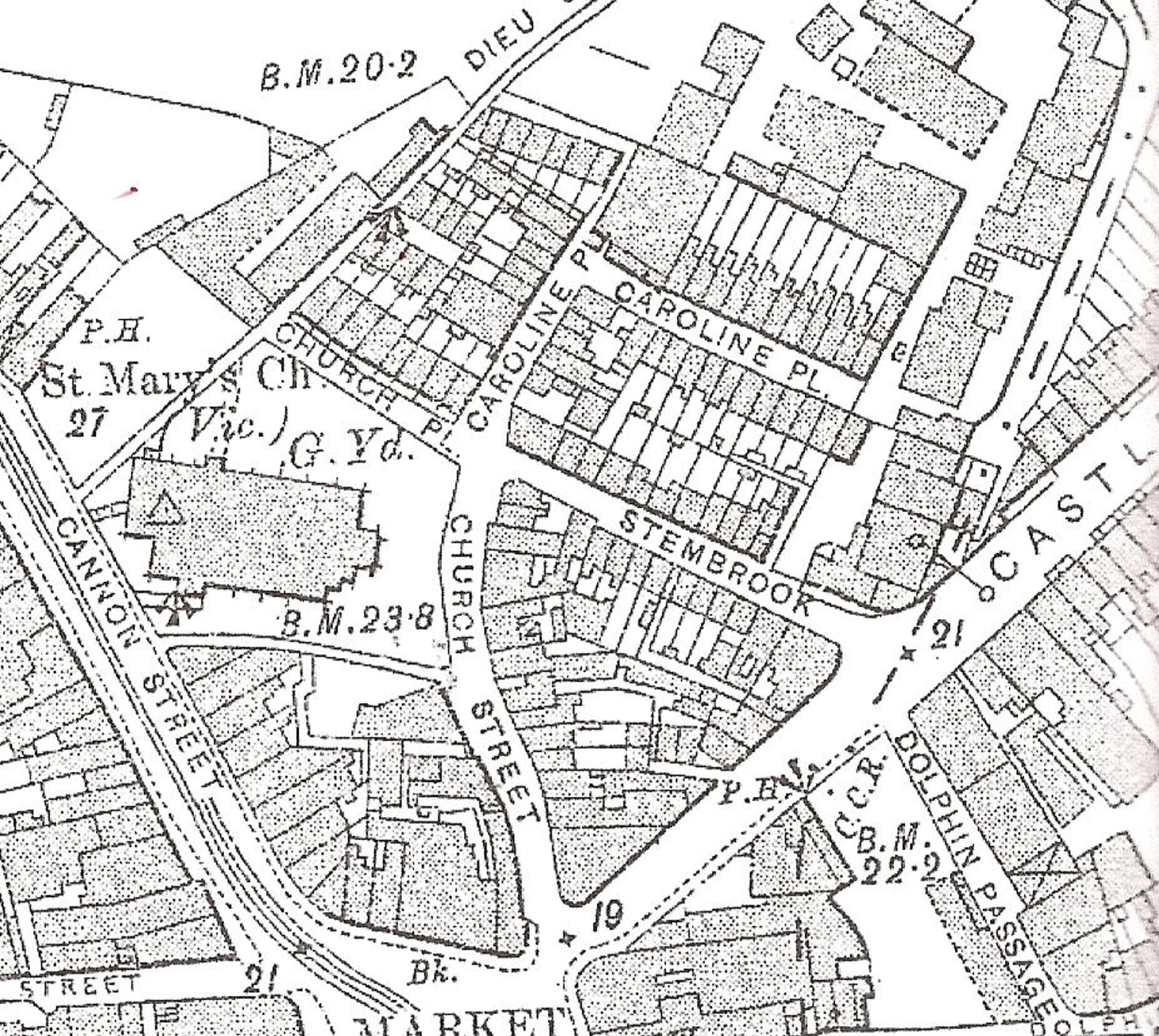
Caroline Place, named after Dover's 'Queen' - Map 1907

Caroline Place, named after Dover’s ‘Queen’ – Map 1907

Robert Jenkinson, the Earl of Liverpool, (1770-1828), was the Prime Minister and the Lord Warden of the Cinque Ports (1806-1829) and he was none too pleased with how the town had behaved. Nonetheless, Caroline’s trial went ahead and it was said that she had over 100 potential witnesses in her favour many from the first families in Italy. When asked if she had committed adultery, Caroline said that she had … with one man, ‘the husband of Mrs. Fitzherbert.’ The House of Commons, with little evidence to go on, abandon the case and the town of Dover was blamed for this catastrophe. Caroline’s initial welcome was cited along with the failure to put down the riot and the way the witnesses had been treated. The government demanded arrests and imprisonments of the ringleaders but these were ignored.

Prior to the Coronation the Earl of Liverpool had told Caroline that she should not attend but she did, only to find the doors of Westminster Abbey locked against her. As tradition then dictated, Cinque Port’s burgesses carried the coronation canopy accompanied by two officers. One of the officers was Dover lawyer, John Shipdem and Dover’s two burgesses were Edward Bootle Wilbraham (1771-1853) -one of Dover’s two Members of Parliament –   and Mayor, Henshaw Latham.

Caroline Place. Dover Library

Caroline Place. Dover Library

Afterwards, Henshaw Latham said that during the ceremony he could hear the piteous pleas of Queen Caroline asking to be let in. The weather was cold, wet, and that night Caroline complained of feeling unwell. She died three weeks later on 7 August 1821, age 53. Her tomb, in Brunswick, bears the inscription ‘Caroline of Brunswick, the Injured Queen of England.’

In Dover, Caroline Place was named after her, which was roughly where Stembrook car park is today. The short street succumbed to World War II attacks but because the Queen’s full title was Caroline of Brunswick it was decided not to name the car park, after Queen Caroline!

*Portrait note: The portrait of Queen Caroline, ca. 1820, by James Lonsdale, who styled himself ‘Principal Painter in Ordinary to the Queen’. Her hands are arranged to display her wedding ring in order to emphasise her fidelity to her marriage vows.

  • Published:
  • Dover Mercury: 04 February 2010
Posted in Caroline of Brunswick – Dover’s Queen, Royalty | Comments Off on Caroline of Brunswick – Dover’s Queen

Duke of York’s Royal Military School and the Legend of the Lone Tree

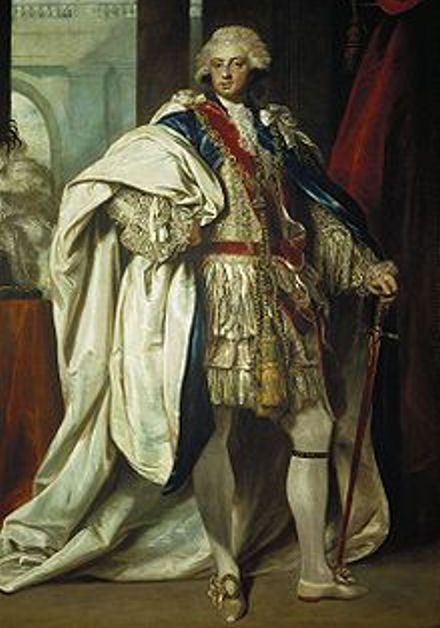
Frederick Duke of York, founder of the Duke of York's Military School. Internet

Frederick Duke of York, founder of the Duke of York’s Military School. Internet

The original Duke of York’s Royal Military School was founded in 1803 by an 1801 Royal Warrant. Called the Royal Military Asylum it was located in Chelsea. It was the time of the Napoleonic Wars (1793-1815) and Frederick Augustus, Duke of York (1763-1827), second son of George III (1760-1820), was the Commander in Chief of the British Army. It was he who was concerned over the increasing number of neglected orphans of soldiers that had fallen during the Wars and prepared to do something about it.

The scheme that the Prince had advocated in 1801 was modified and he laid the foundation stone of the school that opened two years later. The first child was the orphaned John Evans, the son of Corporal Evans of the 81st Regiment and by 1806, the school was accommodating some 1,000 orphans. This was to rise to 1,250 and to help with the accommodation a subsidiary school was opened in 1817 at Southampton. This eventually became the girls’ school and was followed by an infant school on the Isle of Wight.

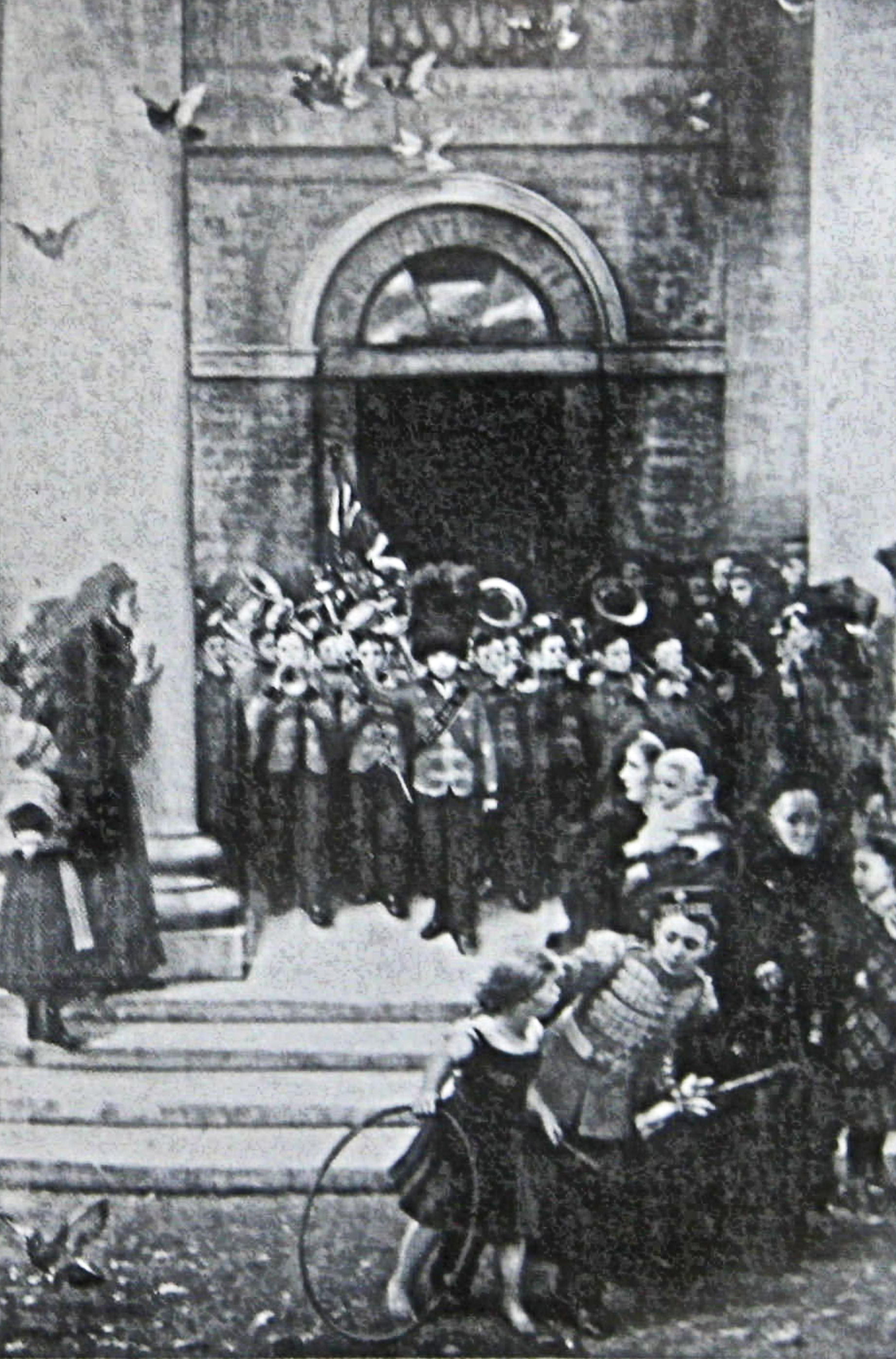
The children wore a uniform consisting of a red bob-tailed coat, white starched collar, blue skirts for girls / knee britches for boys, low shoes with brass buckles, starched mop caps for girls/ leather caps for boys. The ‘teachers ‘ – retired sergeants – wore red bob-tailed coats with white waistcoat and breeches, black gaiters, cockade hats, white wigs with a tail and they all carried a sword.

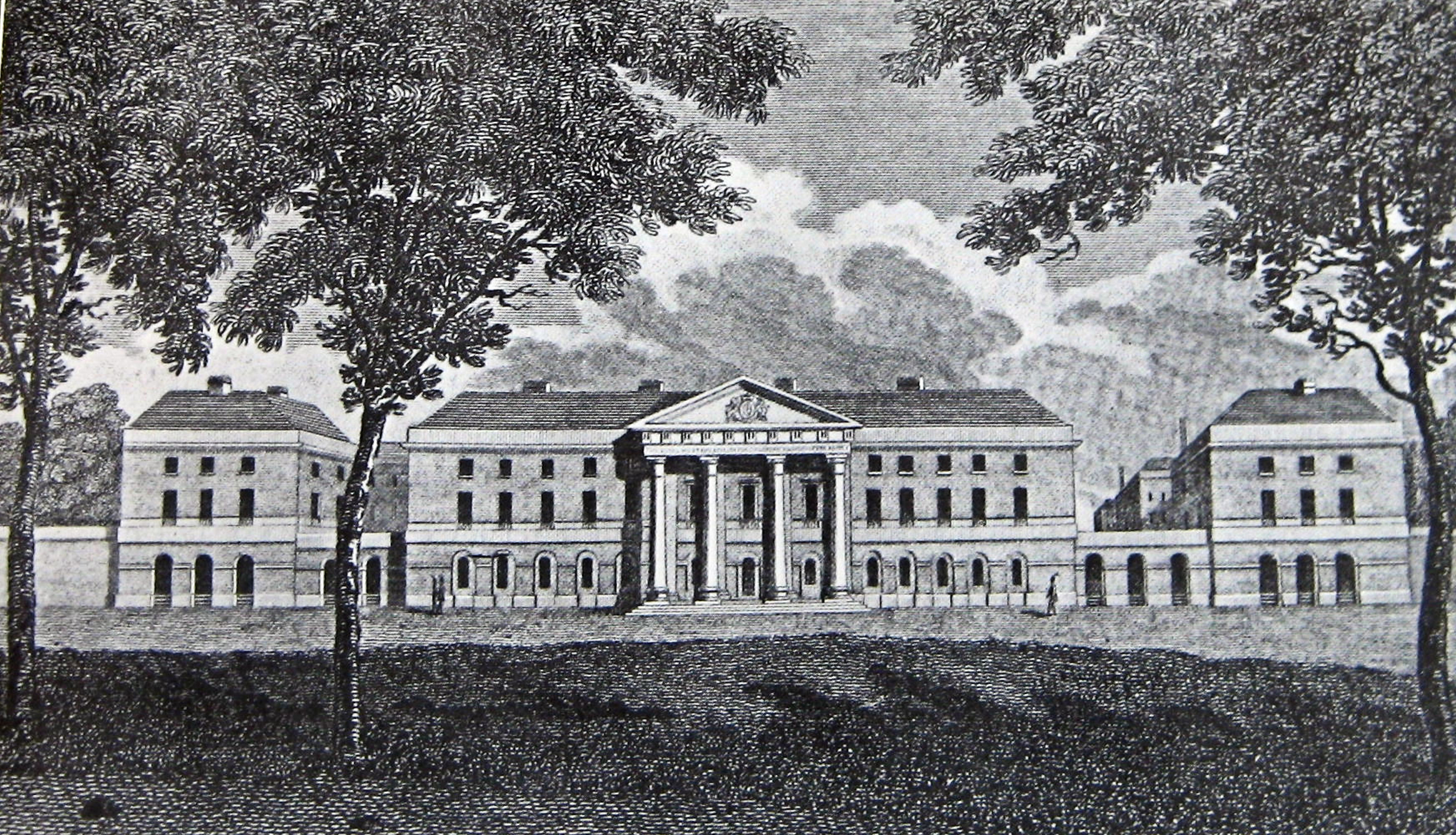
Royal Military Asylum, Chelsea, 1804, later renamed Duke of York's School, engraved by A Warren from a drawing by Schnebbelic

Royal Military Asylum, Chelsea, 1804, later renamed Duke of York’s School, engraved by A Warren from a drawing by Schnebbelic

The school used the ‘Madras’ method of teaching over which an inspector’s report of 1811 was critical, writing, ‘Before I entered the school-room my ears were assailed with the most disagreeable clamour proceeding from the symbolic mode of spelling … from the great noise it created, as well as the unnatural voice it gave the children … (who) seemed to be labouring under the burden of awkward and unpleasant habits to which was to be added, the terror excited by several old sergeants walking up and down the school-room waving their well waxed canes.’ (Times 26.09.1811)

The co-educational aspect of the school ceased in 1840 when both the Southampton and Isle of Wight schools closed. At the time, the country was in a severe economic depression that was to continue deteriorating. In 1849, there were talks of cutting back or closing the Royal Military Asylum and Hibernian School, Dublin – that latter was for the orphaned sons of Irish soldiers and dated back to 1769. In the House of Lords report of the time, both schools were described as places ‘of retreat for orphans of soldiers, and a nursery for military schoolmasters.‘ The joint cost of both establishments was given as £18,016 (29.03.1851) over what time scale this appertained was not given but the prevalent feeling was that the schools should close and premises be given over to barracks. However, Queen Victoria (1837-1901) stepped in and was adamant that neither school premises were to be closed.

By this time, although the teachers were still retired sergeants, the school curriculum had changed to one devised by Dr Bell. The boys were taught reading, writing and arithmetic three days a week and a trade for three days. Sundays were spent in religious worship. Following the appointment of Walter McLeod as headmaster in 1846, the curriculum changed to that adopted by most public schools of the time and Army schoolmasters replaced the sergeants. The amount spent on nourishment, per boy, per day, was 6½d (3 pence) and ale was replaced with tea, cocoa and milk. The boys were taken on visits to London attractions but punishment was severe although typical of the time. The most common form of correction was ‘three dozen’ using a birch rod.

The Council for Military Education, in 1865, reported that there were 500 boys at the school and it was in favour of moving the Asylum to the neighbourhood of Wellington College, founded in 1859, at Crowthorne, Berkshire. The reason given was the boys were ‘on average two inches and one-fifth shorter and weighing 3½lbs less,‘ than comparative 14-year olds who attended Greenwich Hospital School. This was attributed to the unsuitability of the school premises.

Duke of York's School for the Sons of the Brave by Philip Morris

Duke of York’s School for the Sons of the Brave by Philip Morris

Nothing happened about the premises but the style of the school uniform was updated. By 1890, the government was looking for more army accommodation and the report of 1865 was used to justify the school being moved to the Chiltern Hills near Tring. Whether it was the fear of upsetting Queen Victoria or financial reasons, the scheme was put on hold. However, in 1892 the establishment was renamed The Duke of York’s Royal Military School and was for the Sons of the Brave.

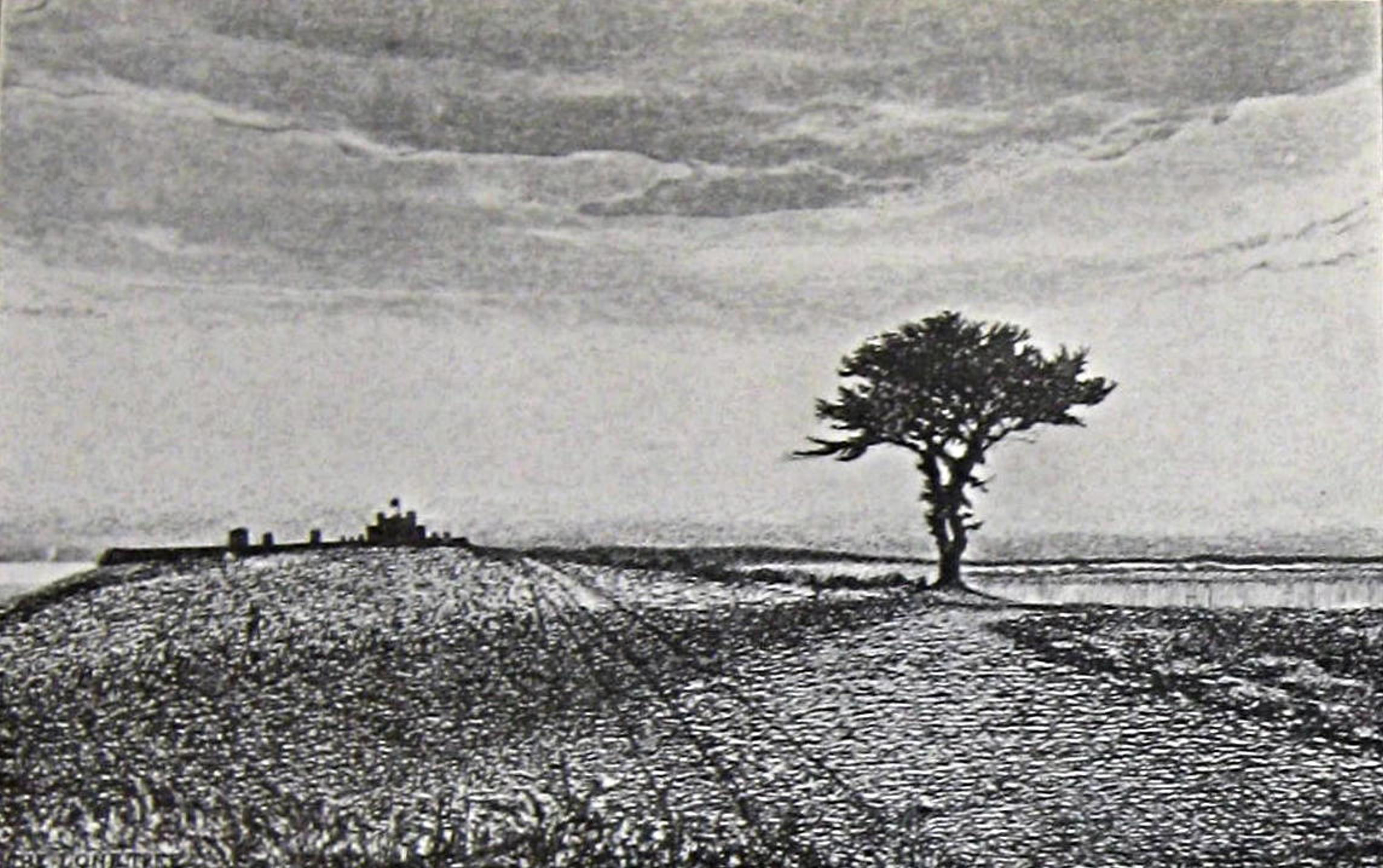
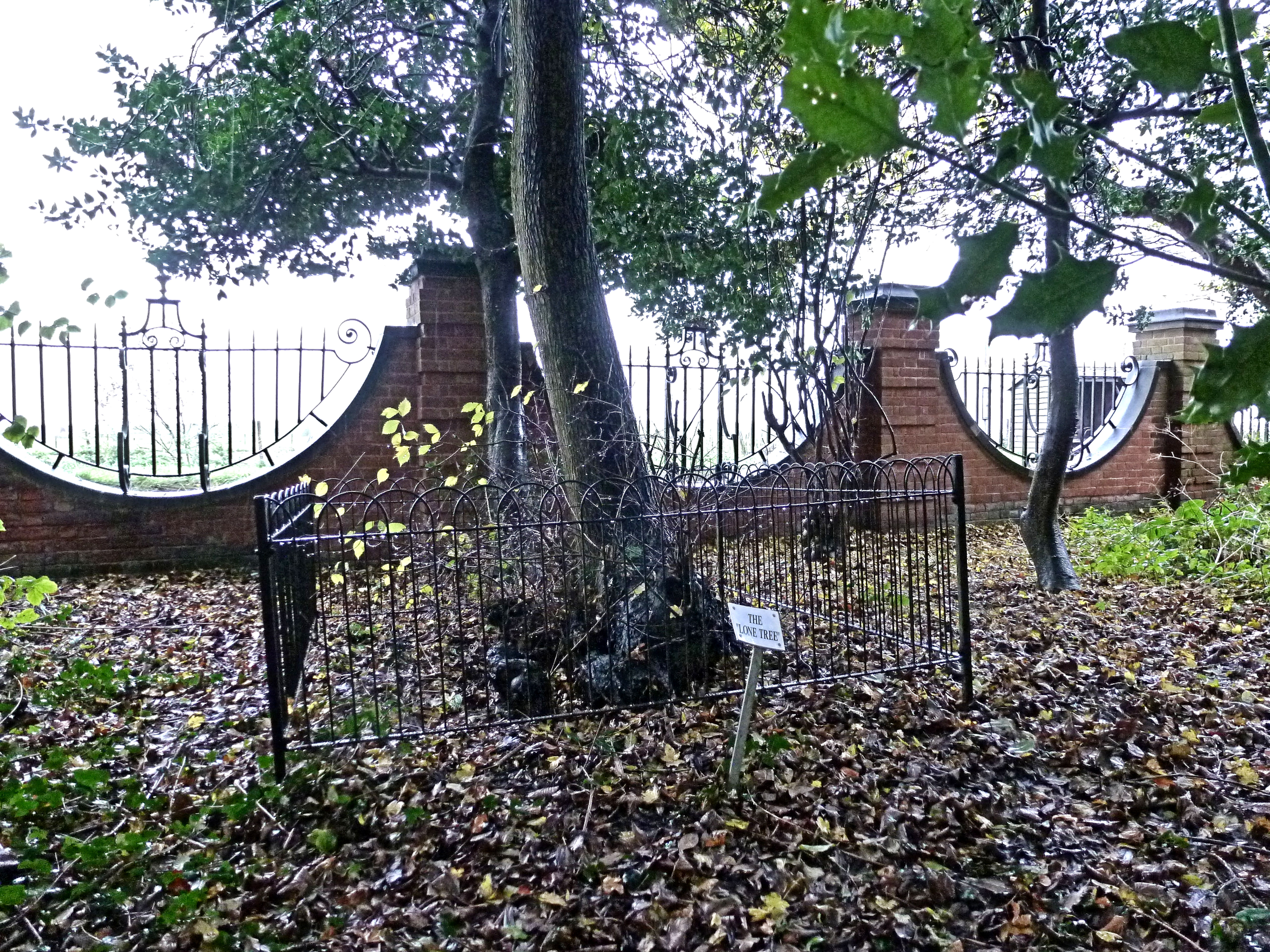
Victoria died in 1901 but it was another three years before a new location for the school was sought. The 170-acre Lone Tree site, at Guston near Dover, was given approval and purchased in 1904. At the time, the site was barren except for one solitary tree, misshapen by the prevailing winds. So unmistakable was the tree that it featured on Ordnance Survey maps and Admiralty charts – the latter as a landmark guide to mariners.

Lone Tree c 1904

Lone Tree c 1904

The Lone Tree was also part of Dover’s folklore. The story goes that in 1784, a regiment of soldiers was billeted at the Castle. One of these was a young Scotsman named Donald MacDonald. He had fallen in love with one of the local girls but so had one of his comrades. One evening Donald saw, from a distance, his colleague walking, arm in arm, with the young lady across the then barren area. Smitten with jealousy, Donald cut a heavy branch from a hedge and set off in pursuit of the pair. Shortly after the girl left the scene and Donald furiously attacked his colleague – leaving him for dead. He then ‘thrust the bloodied club deep into the ground.’

The next morning Donald’s regiment marched off without the missing man and Donald was so convinced that the crime would never be traced, he said nothing about what had happened. Many years passed and Donald, on his way to Scotland, was once again in Dover. Morbid curiosity took him to the scene of his crime and found that the branch had grown into the flourishing Lone tree. He then continued his journey.

Lone Tree 2013

Lone Tree 2013

Guilt and remorse started to eat into Donald and when he finally reached Montrose, he confessed all to the minister of the Kirk. The minister took it upon himself to write to Dover’s town clerk, John Shipdem, who replied that although battered and bruised Donald’s comrade had recovered and was at that time serving on board an East Indiaman. Apparently, Donald was never punished for his crime and died in 1843 at the age of 94.

The go ahead was given for building of a new Duke of York’s Royal Military school at Guston in 1905. The estimated cost was £215,986 and was expected to be financed from the sale of the 12-acre Chelsea site for housing. This value of that site was given at £315,000, which would pay for the school and conversion of the Chelsea site into barracks. However, in Chelsea, there was a public outcry that was partially pacified in 1910 when London County Council applied for the site to be used by the Territorial Army as their headquarters.

As for the new school in Dover, a tender was accepted from Alfred Hudson & Co., of the Broadway, Westminster. Within weeks of starting construction work stopped much to the constination of the folks in Dover. At the end of 1906, the company was subject to a hearing at a Middlesex bankruptcy court when it was stated that Hudson’s liabilities amounted to £33,350 with assets of £440!

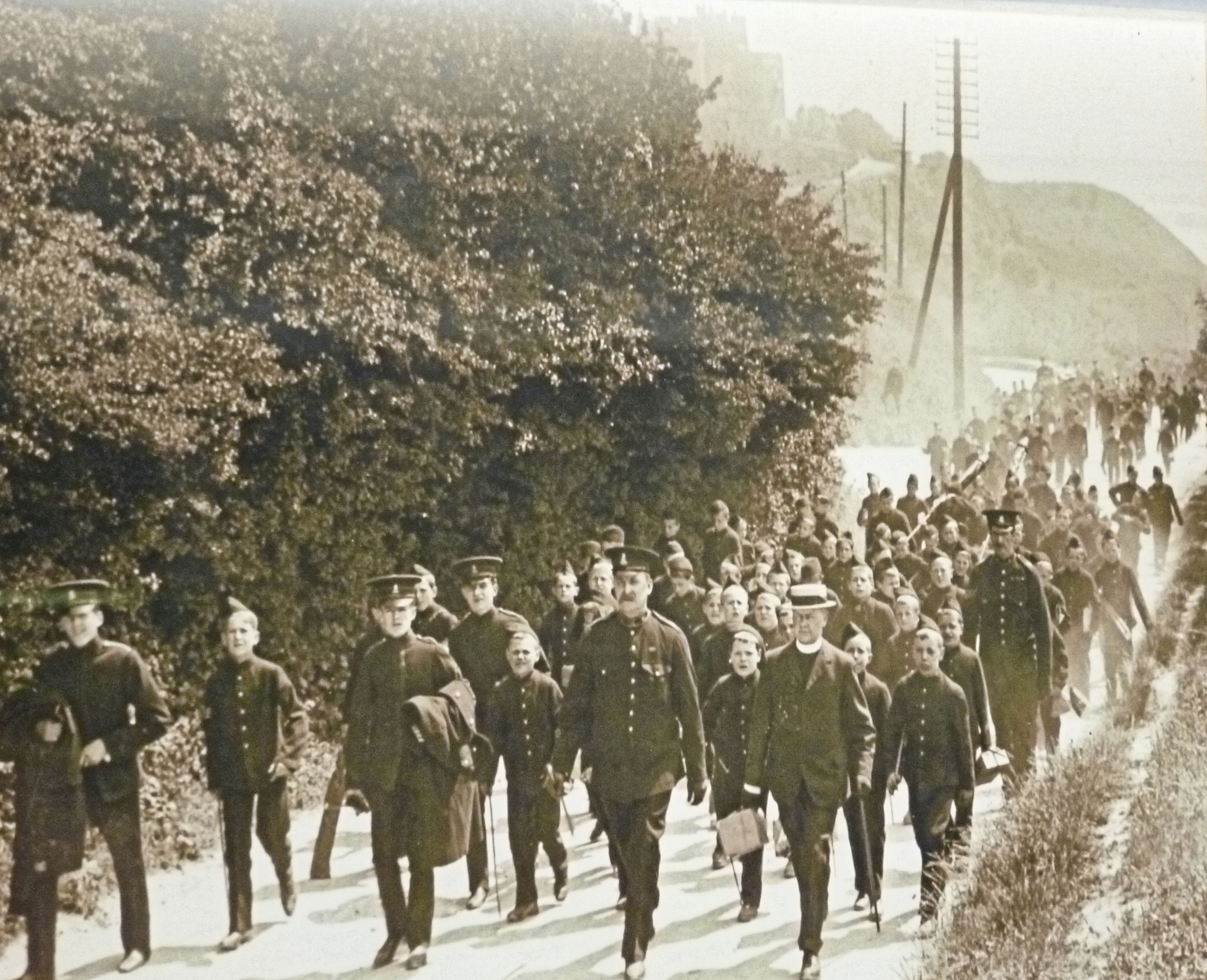
Duke of York's pupils and teachers walking along the Dover-Deal Road (A258) c1908

Duke of York’s pupils and teachers walking along the Dover-Deal Road (A258) c1908

A new Royal Warrant was issued in 1907 and Mr Dunne of Walmer was given the contract. This would provide work in Dover for the building of Admiralty Harbour was almost completed.  Before Hudson lost the contract a branch line from the standard guaged Dover Martin Mill (Pearson Line) was built to carry material to the new school.

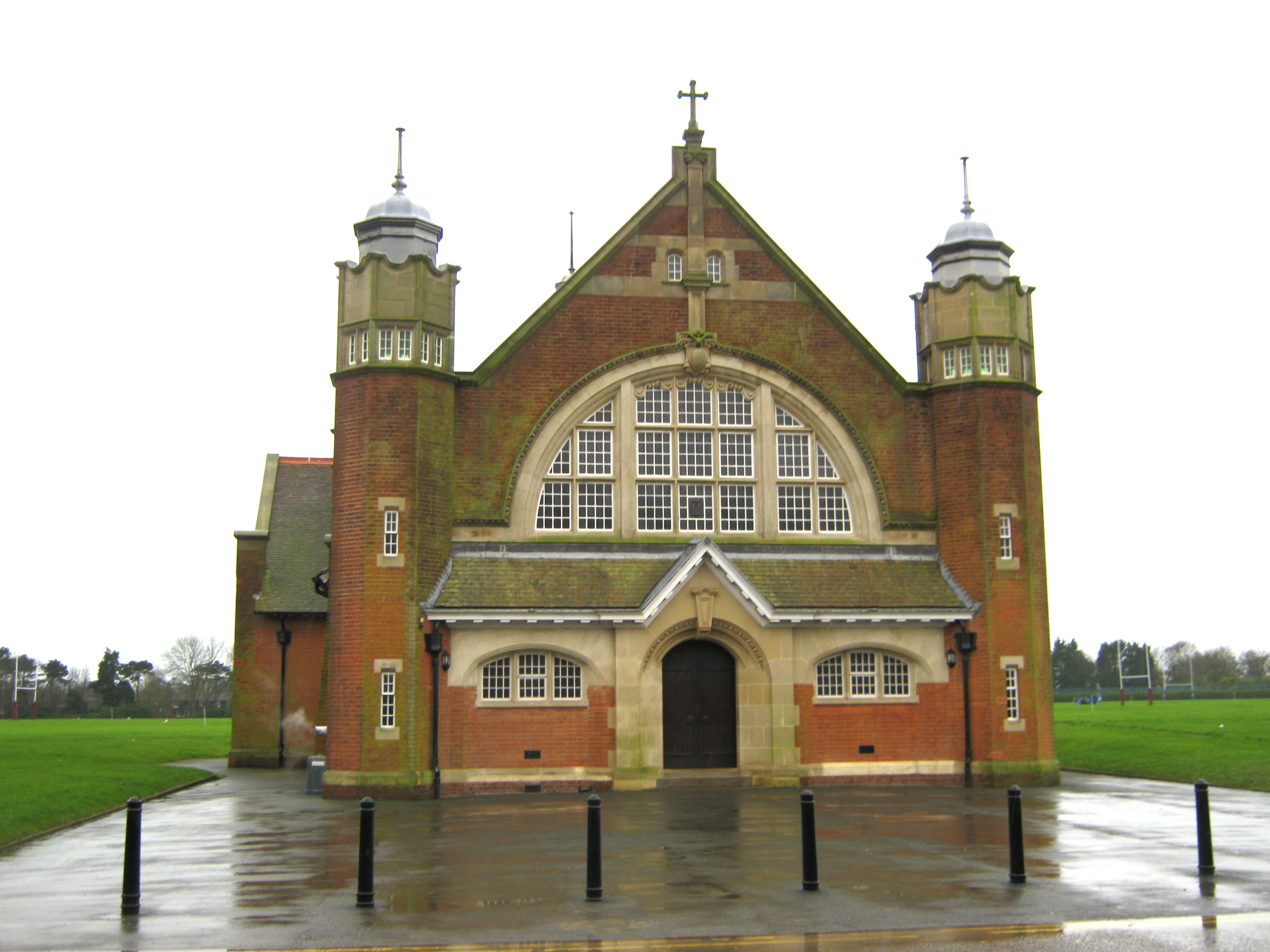
On 20 November, Lady Grosvenor, the wife of Dover’s MP, George Wyndham, laid the foundation stone of the new school. Costing £215,086, it had its own swimming pool and post office and was ready in the spring of 1909. The first students arrived at Harbour Station 11 July and in their distinctive uniform, they marched through the town and up the hill to the new school. One can only guess what the boys and the staff felt that day, but the town rejoiced. The official opening of the school was on 15 July but there was no official celebration. Chaplain-General Bishop Taylor-Smith dedicated the chapel on 15 September that year.

For the duration of World War I (1914–1918), the students were evacuated to Hutton, near Brentwood, Essex, while the school premises were used as a transit for troops going to and coming from the battlefields of Western Europe. In 1915, khaki replaced the colourful school uniform and during the War, 297 old boys won decorations while 145 gained commissions from the ranks. However, 247 old boys or Dukies, as they were – and still are – affectionately called, were killed.

St Martin of Tours Church, Guston, where Dukies are buried

St Martin of Tours Church, Guston, where Dukies are buried

At the end of World War I and for over two years after, ‘Spanish Flu’ was killing healthy folk, indeed, the infection was said to have killed more people than the War. The Dukies were at Hutton when it hit the school and 293 cases were reported. Prior to the War, six pupils had died due to illness while at the school and were buried at St Martin’s Church, Guston. A further six boys, who died between 1929-1973, were also buried at Guston. Because the village is some way from the school, all the funeral services were held in the school chapel. Then the boy’s friends, Company or house provided a guard of honour and accompanied the coffin, mounted on a carriage to Guston churchyard.

Duke of York's Chapel

Duke of York’s Chapel

The school at Dover reopened in September 1919 and two years later, the curriculum was reorganised to comply with national secondary education. Nonetheless, it was still run as a boys’ battalion with the various boarding houses seen as military companies under pensioned warrant officers. The former school uniform had replaced the khaki for when the Duke of York – later George VI (1936-1952) – carried out an inspection in March 1921. In December of that year, a New Warrant was issued for the governance and management of the school.

The Duke of Connaught (1850-1942) was appointed President and the administration was vested in a Board of Commissioners responsible to the Army Council. Priority for the selection of boys for admission was laid down as orphans whose fathers had been killed in action or had died on foreign or home service. Others who could be considered included those boys who had lost their mothers and although their fathers were alive, they were on duty abroad. Occasionally, if there were spare places, boys from large families were considered.

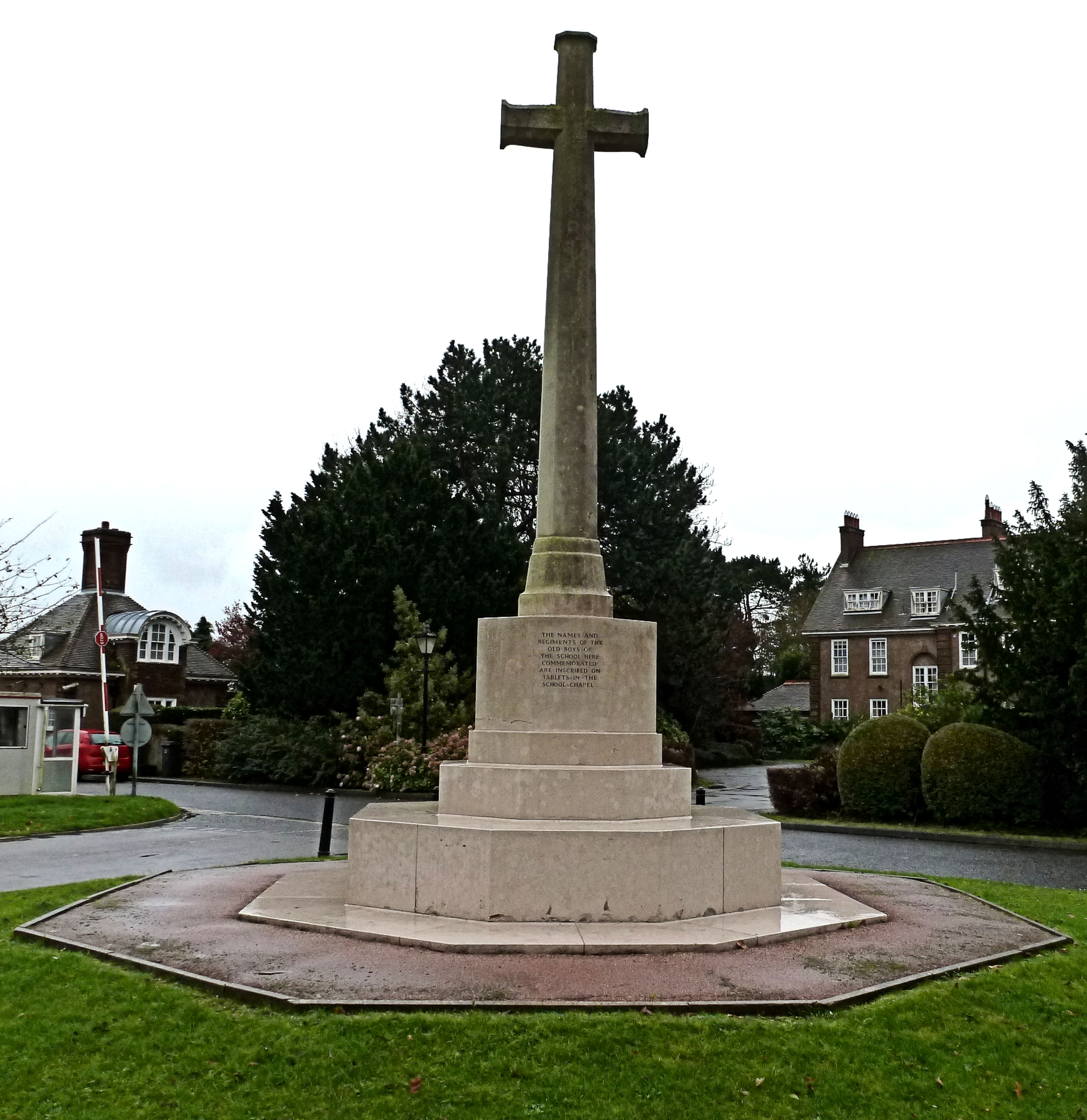
Duke of York's Grand Memorial Cross to the 247 old boys killed during World War I. Following World War II, the names of former pupils killed were added.

Duke of York’s Grand Memorial Cross to the 247 old boys killed during World War I. Following World War II, the names of former pupils killed were added.

Albeit, one criterion dominated, only legitimate children of warrant officers, NCOs, or men, or of an officer originally enlisted on a long-service attestation in the Regular Army but afterwards promoted to a commissioned rank, were considered. The age of admission was between nine and eleven as long as the boy was up to the medical and educational standard. The pupils were allowed to remain at the school until they were nineteen years of age as long as they intended to go straight into the Army, if not, they were to leave when they were fifteen.

In 1921, a scholarship was founded – as a war memorial to old boys – which enabled a boy from the school to go either to the Royal Military College, Camberley or the Royal Military Academy, Woolwich. The Duke of Connaught unveiled the Grand Memorial Cross, in June 1922, to the 247 old boys killed during World War I. Dover’s Mayor, Charles Sellens, and the Corporation of Dover attended. That year the Hibernian School moved from Dublin to specially altered facilities at Shorncliffe, Folkestone. They only stayed two years before their school was amalgamated with the Duke of York’s on the Guston site. One concession was made to the former Hibernian pupils, they could wear green socks.

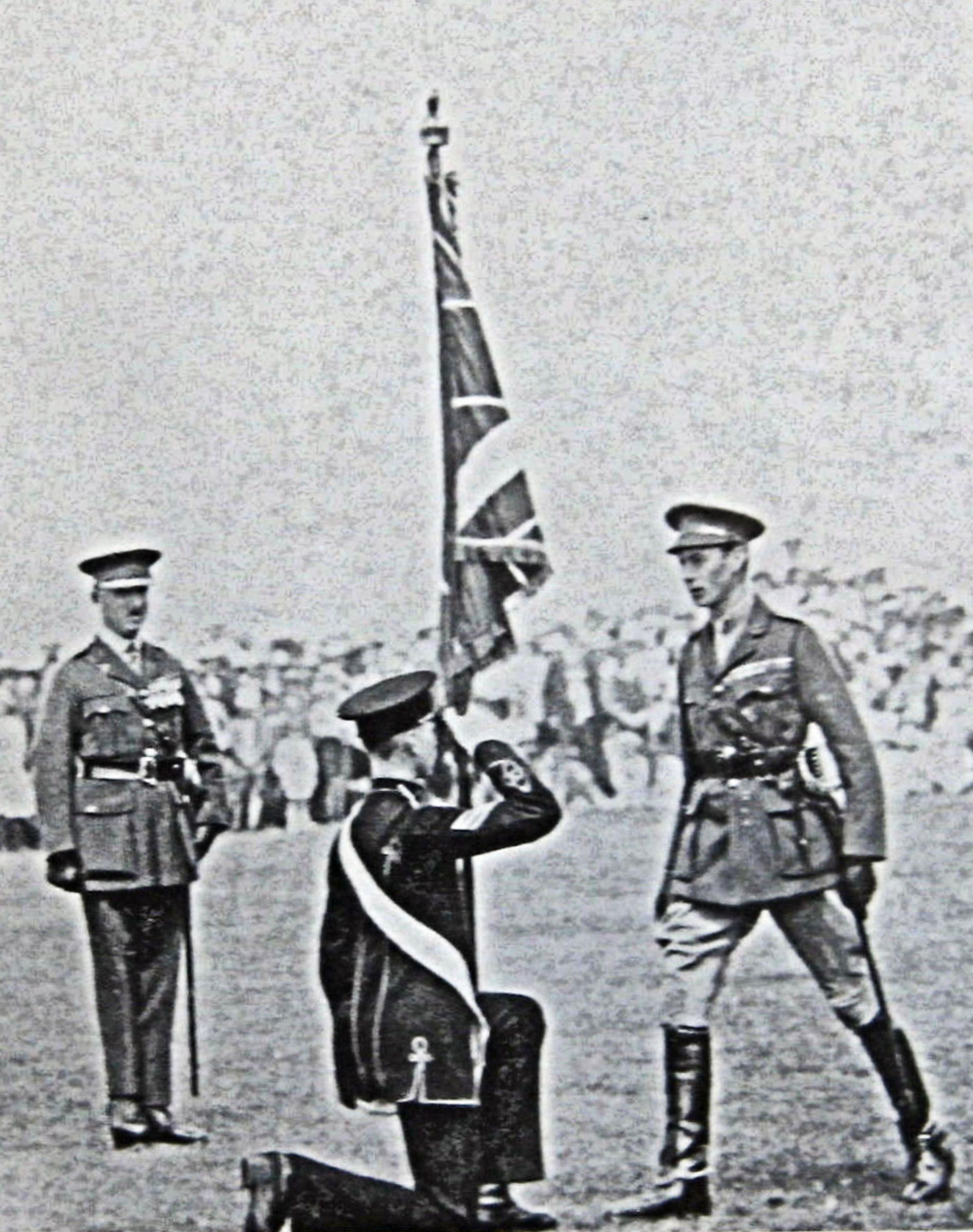
Presentation of colours by George Duke of York (later George VI) 30.07.1924

Presentation of colours by George Duke of York (later George VI) 30.07.1924

The following year a deputation from the school went to Buckingham Palace to present a wedding present to the Duke of York and Lady Elizabeth Bowes-Lyon, (later Queen Elizabeth the Queen Mother and Lord Warden). It was she who welcomed the boys. The following year, the Duke of York again visited the school and presented new colours. The first colours had been presented by George IV (1820-1830) in 1825 and were replaced in 1897 by the then Duke of York (created in 1892), later Edward VII (1901-1910).

Sports was definitely part curriculum and the school had a particularly strong hockey team, successfully pitting their ability against local and military adult teams at Crabble. June 1925 saw more than 100 red-coated Dukies visit Calais along with the Mayor Sidney Livings and other Dover officials. They were guests of the municipality and the French town gave them a splendid welcome. The official reception was held at war battered Hotel de Ville where some of the boys gave an exhibition of gymnastics.

On the second of the three-day visit, the boys laid wreaths at two war grave cemeteries. This was of national interest in both countries as all the boys were orphans and their fathers had been killed in World War I. Some had been buried in one of the two cemeteries visited. At Etaples, the boys laid a wreath on the grave of a single British soldier. This, they paid for and organised the event themselves giving the instruction that no ’grown-ups’ were to attend. The father of the small boy who carried the wreath was buried in that cemetery.

Toy Soldiers presentation

Toy Soldiers presentation

Before leaving France, the boys gave an exhibition of their famous ‘Toy Soldiers’ routine, to the delight of their hosts. This had been choreographed earlier that year by CSM A Wragg and was to prove popular in Dover and by World War II (1939-1945) had become nationally famous. About 50 boys were dressed in bright blue or red jackets, white trousers and black ‘bearskin’ hats similar to those worn by the Guards but made out of brown paper and painted black! Red circles were painted on their cheeks and they carried wooden rifles. As ‘Toy Soldiers’, the boys performed a series of drills that included a mock battle all carried out without any commands. By 1937, with more sophisticated hats and increased to 72 soldiers, 50 bandsmen and 30 drummers, they were the principal performers at the Royal Tournament. The following year their routine was included in the film, ‘Stepping Stones.

An edict was issued in the 1930s stating that boys’ names could be registered between the age of 8 and 11 years, ‘but cannot under any circumstances, be considered by the Selection Board of His majesty’s Commissioners before they reach the age of 9 or after they have attained the age of 11 years.’ At that time there were 420 places and was entirely maintained by funds voted by Parliament.

The boys were evacuated to Saunton Sands Hotel, near Braunton, north Devon for the duration of World War II and the Dover school became a military transit camp. At about 11.00hrs on Wednesday 2 December, with no warning, four enemy planes flying very low suddenly attacked the school. They opened fire with cannon shells that did a significant amount of damage but there were no reported casualties. Following the War the school was given the accolade the ‘Army’s own public school,’ although the pupils were none fee paying. The motto ‘Sons of the Brave’ was emphasised and the school song, ‘Play Up, Dukies’, which mentions the Lone Tree (see below), was sung loudly by pupils, former pupils and their relatives and friends at the opening function.

Duke of Yorks School. Dover Library

Duke of Yorks School. Dover Library

In 1946 the first professional teachers were appointed to the staff and two years later the Sergeant-Major housemasters were replaced by Royal Army Education Corps Majors and civilian teachers. Shortly after the curriculum was changed with the emphasis on the academic and a grammar stream was introduced. Army trades ceased to be taught in 1948 and that year rugby became the major winter sport.

On Whit-Monday 1947, the first public television demonstration in Dover took place at the Dukies school fete but it was not until 1959 that Dover received viewable television pictures. With the academic changes at the school, came a change in the uniform from service dress to army battle dress for every day wear. Four years later, ‘Blues’ or No 1 Dress uniforms were provided for parades. In 1965 civilian style school uniforms replaced the army battledress.

Duke of York's school building

Duke of York’s school building

Kent Schools’ sports championships were staged at the school in June 1955 and in 1961 the school was divided into junior and senior houses. In 1966 the post of School Commandant was abolished and the role combined with that of the Headmaster. The ‘Dukies’ band regularly participated (and still does) in the town’s and national events. In 1980, the 70 strong band headed the final parade of five of the remaining ten members of the Dover branch of the Old Contemptibles Association, who took the salute for the last time.

The Nye Hall opened in 1993, providing a theatre for the School. In 1994, the Dukies re-admitted girls for the first time since 1840. That year the day uniform was changed and the Lindsay tartan was adopted for the girls kilt. Five years later, in 1999, the first civilian headmaster in modern times was appointed. In 2007, due to national cutbacks, the post office at the school closed coinciding with the retirement of the post office manager. The building is now a meeting place for students as a tuck shop.

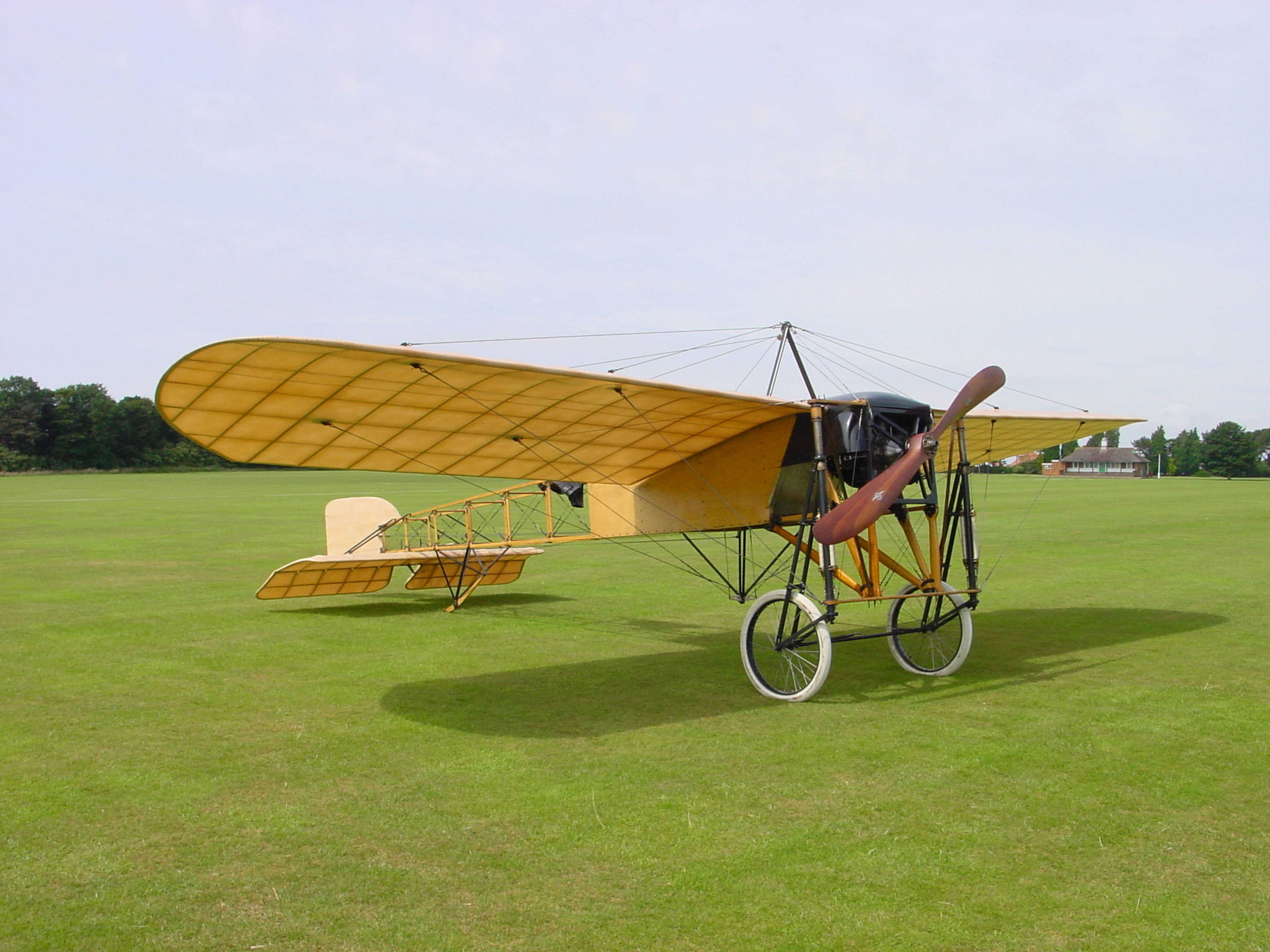
Blériot No XI Replica plane at the Blériot Centenary celebrations, Duke of York's

Blériot No XI Replica plane at the Blériot Centenary celebrations, Duke of York’s

The School hosts many events and significantly in 2009, thousands of folk, including this author and her husband, went to the Duke of York’s to celebrate the centenary of Louis Blériot’s historic flight across the English Channel. That year also saw the School celebrated it’s centenary of being in Dover. The following year (2010) the Duke of York’s became an academy sponsored by the Ministry of Defence.

The School has, at the time of writing, 450 students but it is part way through an expansion programme to accommodate 700 students. The age of admission these days is 11years and all students are full boarders. Applicants must have a British or European Economic Area passport. The original Duke of York’s in Chelsea is now the home to the Saatchi Gallery where the School was thrilled to be able to launch the new Dukies’ Association in September 2013, encouraging former Dukies to keep in touch with their old School.

The Duke of York’s school song, Play Up, Dukies’ – first verse and chorus
Words by Col G C Nugent Music by M A C Salmond

We’re drilled and dressed and disciplined and proud of our great name,

Play up Dukies! Play up Dukies!

We’ll take you on at anything and always play the game

Play up Dukies! Play up Dukies!

The Spirit of our Soldier Sires is Round about us still,

Play up Dukies! Play up Dukies!

And whatsoever we have to do we work at with a will

Oh! We’ve got no use for slackers at the School on Lone Tree Hill

Play up Dukies! Play up Dukies!

Chorus:
Be it peace or be it war, Play up Dukies!
As you fathers did before, Play up Dukies!
For the honour of your name
Take the torch and fan the flame
Play the game! Play the game! Play up Dukies!

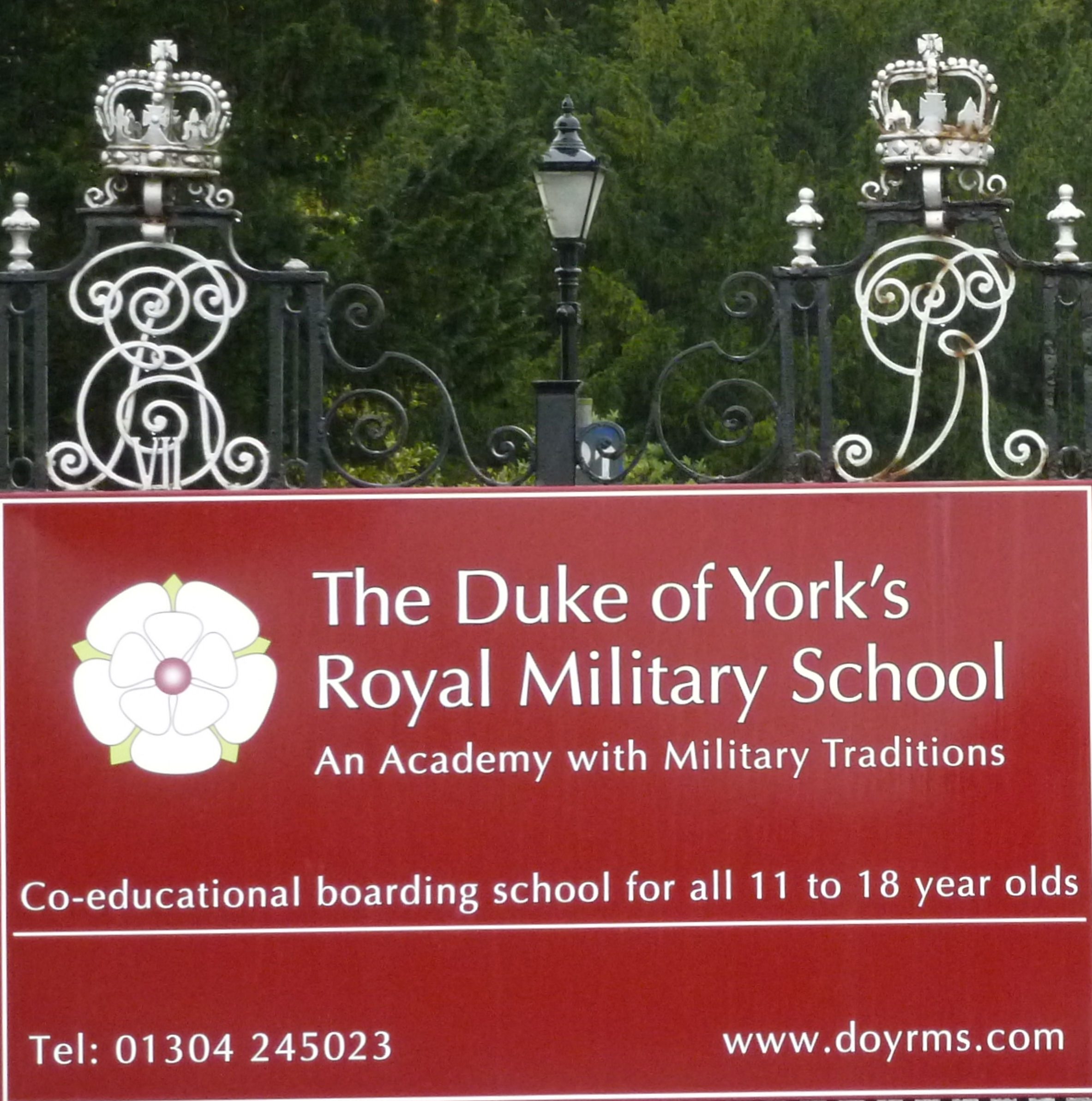
Duke of Yorks School

Duke of Yorks School

Duke of York’s school website: http://www.doyrms.com.

  • Published:
  • Lone Tree story:
  • Dover Mercury: 15 July 2004
  • Duke of York’s School History:
  • Dover Mercury: 09, 16 & 23 January 2014
Posted in Armed Services, Duke of York’s Royal Military School and the Legend of the Lone Tree, Duke of York’s Royal Military School and the Legend of the Lone Tree, Schools and Education | Comments Off on Duke of York’s Royal Military School and the Legend of the Lone Tree

Reginald Maltby GC – Remembered

Reg Maltby courtesy of Mike Maltby

Reg Maltby courtesy of Mike Maltby

Reginald Harry Maltby was born on 24 January 1882 in Fulham, south London and in 1903, married Beatrice Lubbock. They had two children, Reginald Charles, born 1903 and Freda May 1906. In January 1909, Reg enlisted with the London Electrical Engineers (RE Territorial Force) and was called up for full time service on 5 August 1914, at the outbreak of World War I (1914-1918). He spent all of the war in the UK with the Royal Engineers as a motor engineer but did not receive any medals because he had not served overseas.

Demobilised on 21 May 1920 Reg only spent a short time on civvy street for on 11 March 1921 he enlisted in the Tanks Corps, joining the 11th Armoured Car Company two months later. On 11 February 1922, the Company sailed for India and then travelling to Kirkee (now Khadki), near present day Pune on the Deccan plateau. One section of the Company remained on attachment duty at Bombay, present day Mumbai. It was whilst he was in Kirkee that Reg received the Territorial Efficiency Medal and promoted to the rank of Corporal.

The Armoured Car Company moved to Lahore on 3 January 1925 and Reg had been promoted to Staff Sergeant.  On 18 January 1926 G.H. Bruce Kerr, Chaplain to the Lahore Cantonment wrote to the Commanding Officer of the Royal Tank Corps, Lahore bringing to his notice the ‘very prompt and gallant assistance rendered by Staff Sergeant Maltby,’ in rescuing his 3½ year old daughter from drowning.

Letter of thanks from Mr & Mrs Bruce Kerr 03.09.1926. Thanks to Mike Maltby

Letter of thanks from Mr & Mrs Bruce Kerr 03.09.1926. Thanks to Mike Maltby

That afternoon Reg along with Captain Wilton, were walking across the compound to the latter’s car, which Captain had asked Reg to look at. Mrs Keer, the wife of the Chaplain ran to them and was evidently agitated. She said that the ground had suddenly given way under her daughter and had disappeared. The Captain realised at once that the little girl had fallen down a disused well. The little girl could be heard crying and splashing around. The well was about 2-feet square and some 30-feet deep.

For would be rescuers, they were faced with a number problems. First, the top of the well consisted of heavy earth and mortar resting on rotting timbers. The well was not lined and the walls were already beginning to collapse. Further, as the well was unventilated, there was the distinct possibility of methane gas as well as a slow build up of carbon dioxide from the little girl’s breathing. Finally, the well was ‘in pitch darkness.’

The Captain found some old rope, which Reg tied around himself and with the help of the Chaplain, Reg was lowered into the crumbling well. As he made his way down, the falling soil was turning water into mud that became thick and sticky.  By the time Reg reached the little girl, she had been sucked under the mud. Pivoting himself against the well walls, Reg managed to ease the little girl out of the gluey mud. He then climbed the disintegrating shaft walls carrying the little mite until safety was reached.

Although, initially traumatised the little girl quickly recovered from the experience and did not suffer any physical damage. As for Reg, according to the Captain, after a little refreshment he returned to work. On receipt of the Chaplain’s letter and another from Captain Wilton, Reg was recommended for the Albert Medal by the Senior Commanding officer of the Lahore District.

A few days later, on 26 February 1926 Reg was transferred to Razani, now in north Waziristan, then the Northwest Frontier Province (1901-1955). However, on 5 June 1926, the following citation was published:

Citation June 1926. Thanks to Mike Maltby

Citation June 1926. Thanks to Mike Maltby

The EGM was instituted on 29 December 1922 and was just over an inch wide, suspended from a purple riband with the words ‘For Gallantry’ etched below a depiction of Britannia. However, those who were awarded the EGM were not able to use the letters after their names. The Colonel Commandant of the 7th Indian Infantry Brigade, Razmak presented the Medal to Reg, on the Northwest Frontier on 24 January 1927.

Not long after Reg was promoted to Warrant Officer Class Two and returned from India in 1928 on the SS California. His final posting was on 4 October 1932 to the 3rd Battalion Royal Tanks Corps at Lydd, Kent. There he stayed until finally discharged from the Army on 3 August 1938, holding the rank of Warrant Officer Class Two. On 10 July 1937, a Royal Warrant was issued that allowed recipients of the EGM to use the letters after their names. The Royal Warrant also allowed for a small silver laurel branch emblem to be worn on the riband to denote that it was a gallantry award.

Five Alls Market Street 1958. Paul Skelton

Five Alls Market Street 1958. Paul Skelton

On retirement, Reg and Beatrice came to live in Dover taking over the licence of the Five Alls Inn, 13 Market Street on 19 August 1938. The name ‘Five Alls‘ was said to represent, a lawyer, a priest, a farmer, a soldier, and the devil and were all depicted on the pub sign, with the legend underneath: ‘I plead for all, I pray for all, I work for all, I fight for all, and I claim all.’

Dew Drop Inn, Tower Hamlets Street

Dew Drop Inn, Tower Hamlets Street

Reg was considered too old for further service when World War II (1939-1945) broke out and so he and his wife remained licensees of the Five Alls. In January 1940, the couple took over the Dew Drop Inn, in Tower Hamlets but on 17 December 1943 age 62, Reg died of a cerebral haemorrhage. The funeral took place on Tuesday 21 December 1943 at Charlton Cemetery and was conducted by Rev James Embry, St Bartholomew’s Church, London Road. Besides Reg’s wife, son, daughter, and their spouses, the others present were Mrs P Doolin, a close friend of the family, W Drennen and N Staines, president and secretary of the Dover Licensed Victuallers Association and representatives of the Peace and Harmony and the Military Jubilee Masonic Lodges. A small tablet with the inscription ‘Reginald Maltby O.B.E. 1882-1943’ was placed on his grave.

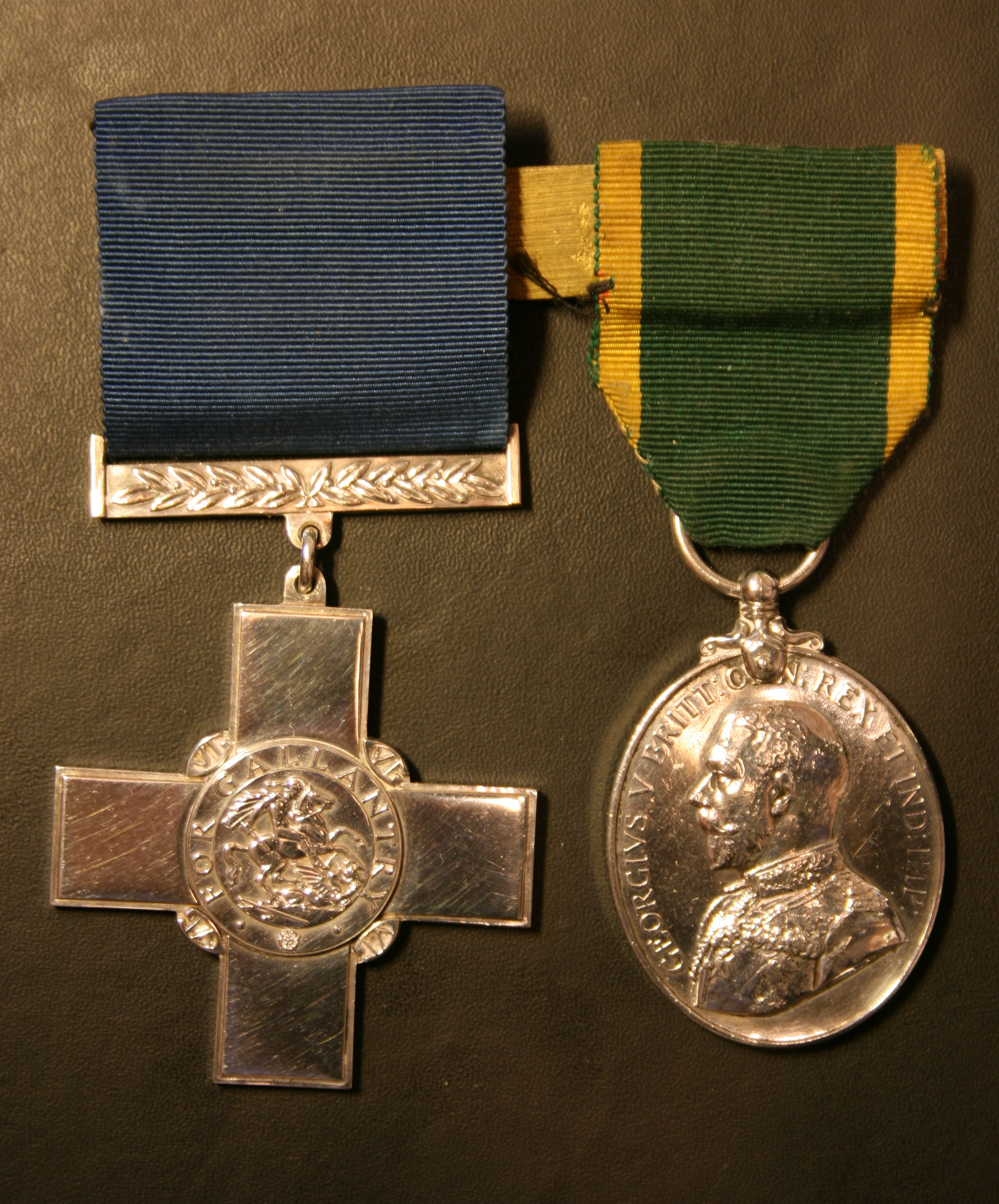
Reg Maltby's George Cross and Empire Medal. Thanks to Mike Maltby

Reg Maltby’s George Cross and Empire Medal. Thanks to Mike Maltby

At that time the OBE or more formerly, the Order of the British Empire, was often confused with the EGM. In fact, on 24 September 1940, it was the George Cross that had superseded the EGM. Of interest, a total of 130 EGM’s had been awarded between 1922 and 1940. After the war, Beatrice sought to have Reg’s medal exchanged for the George Cross but as only holders of the EGM still living were eligible, this was refused. Beatrice was persistent and by special request, on 15 April 1948, George VI allowed the exchange to take place.

In the 1990s, the late Bill Green, a member of the Orders and Medals Research Society was undertaking a piece of research on the recipients of the EGM and noted that Reg’s grave was unmarked. He decided to do something about this but it was a long uphill struggle to try to raise interest in providing funds to buy an appropriate headstone, In the end, Bill organised a traditional ‘whip-round’  and donations came in.

Reg Maltby's gravestone dedication 06.01.1998 Charlton cemetery. Dover Mercury

Reg Maltby’s gravestone dedication 06.01.1998 Charlton cemetery. Dover Mercury

On 6 January 1998, at a moving ceremony, with his family present, the £700 headstone was dedicated. With the Regimental badge centred on top, underneath is inscribed: Ex-W.O.II R.H. Maltby G.C. Royal Tank Corps, Born 24 January 1882 Died 17 December 1943.
Underneath the Regimental prayer:

‘Fear naught but to fall from Thy favour, dear Lord. Remembered by his comrades.’

The George Cross emblem is in the centre of the headstone.

Thanks to Tony Belsey for bringing Reg Matby’s story to my attention and Mike Maltby for the sight of the original documents.

  • Published:
  • Dover Mercury: 26.12.2013 & 02.01.2014


Posted in Armed Services, Maltby Reginald GC - Remembered, Maltby Reginald GC - Remembered, People | Comments Off on Reginald Maltby GC – Remembered

Crabble Athletic Ground and County Cricket

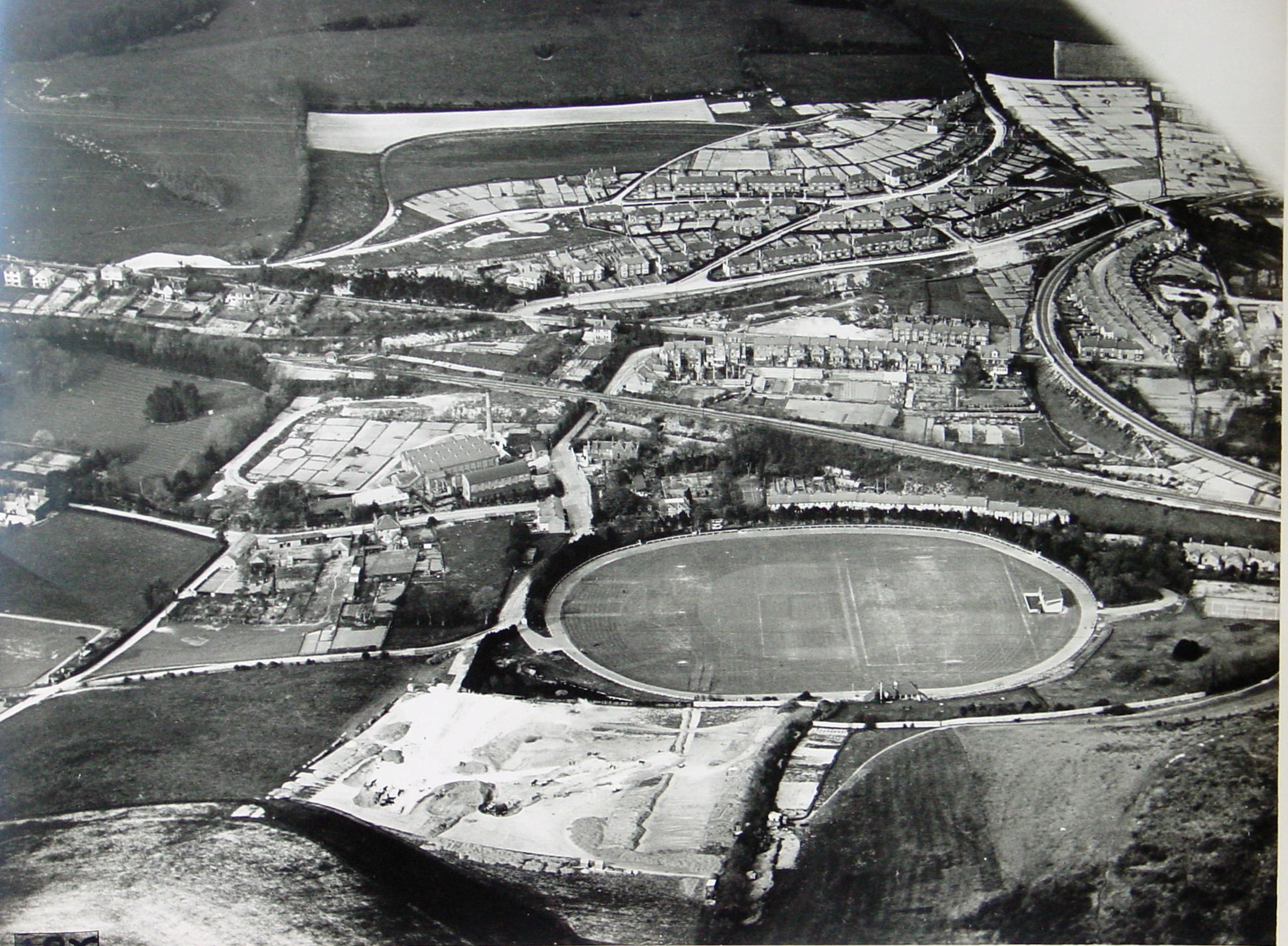
Crabble Athletic Ground (right) 1897. Dover Library

Crabble Athletic Ground (right) 1897. Dover Library

In 1896, Dover cricket ground, which was on land that Millais and Leighton Road were built, was put up for sale. Cricket had been played in Dover for a very long time, indeed, the first recorded match took place on the 6 August 1753 when the town met Dartford at Coombe Hole, Buckland. Nothing much else is on record until 1851, when the house that was later to become part of the Royal Victoria Hospital, on the High Street, was auctioned. At that time, the town’s cricket matches were being played on the adjoining meadows and the building of Wood Street led to the move to where Millais and Leighton Roads are now.

Alfred Charles Leney (1860-1953), the brewer, Francis Finnis, Henry Hayward – surveyor and James Stilwell – solicitor, formed a syndicate and purchased land from Bunkers Hill to Crabble railway bridge, called Crabble Meadows. Previously the part of the meadow under what is now the Dover Athletic football pitch had been used by Dover Football Club. Of the remaining area, the syndicate agreed that 14 acres were for an athletic ground of which eight acres were to be levelled to form a cricket ground.

Henry Hayward - Museum

Henry Hayward – Museum

Henry Hayward’s son, Fred – an architect – designed and developed the site, which included the 8-acre perfect oval area for cricket. The famous cricketer, Alec Hearne (1863–1952), laid out the quick draining/drying playing surface. Arthur Munns, who played for Kent on one occasion, was appointed groundsman. Surrounding the state-of-the-art cricket pitch an asphalt cycle track was constructed. At the side were tea lawns and a pavilion. Later, a winding road interspersed with flowerbeds and shrubberies was laid and has since matured into a very nice walk.

While all this was going on the syndicate had set up ‘The Dover Athletic Ground Ltd’ with an authorised share capital of £8,000 in shares and £4,000 in bonds. The costs were anticipated to be £10,000 and included £5,500 for levelling, £1,000 for a pavilion, £1,000 for turf and £600 for the cycle track. Although the syndicate were keen businessmen, these expenses plus the cost of purchase of the land meant that there was little margin for unknowns. Nonetheless, the work was completed and on Whit-Monday 1897, George Wyndham, Member of Parliament for Dover (1889-1913), opened Crabble Athletic Grounds, to great fanfare. That day athletics and cycling were the main events.

Cricketers Arms, Crabble Avenue

Cricketers Arms, Crabble Avenue

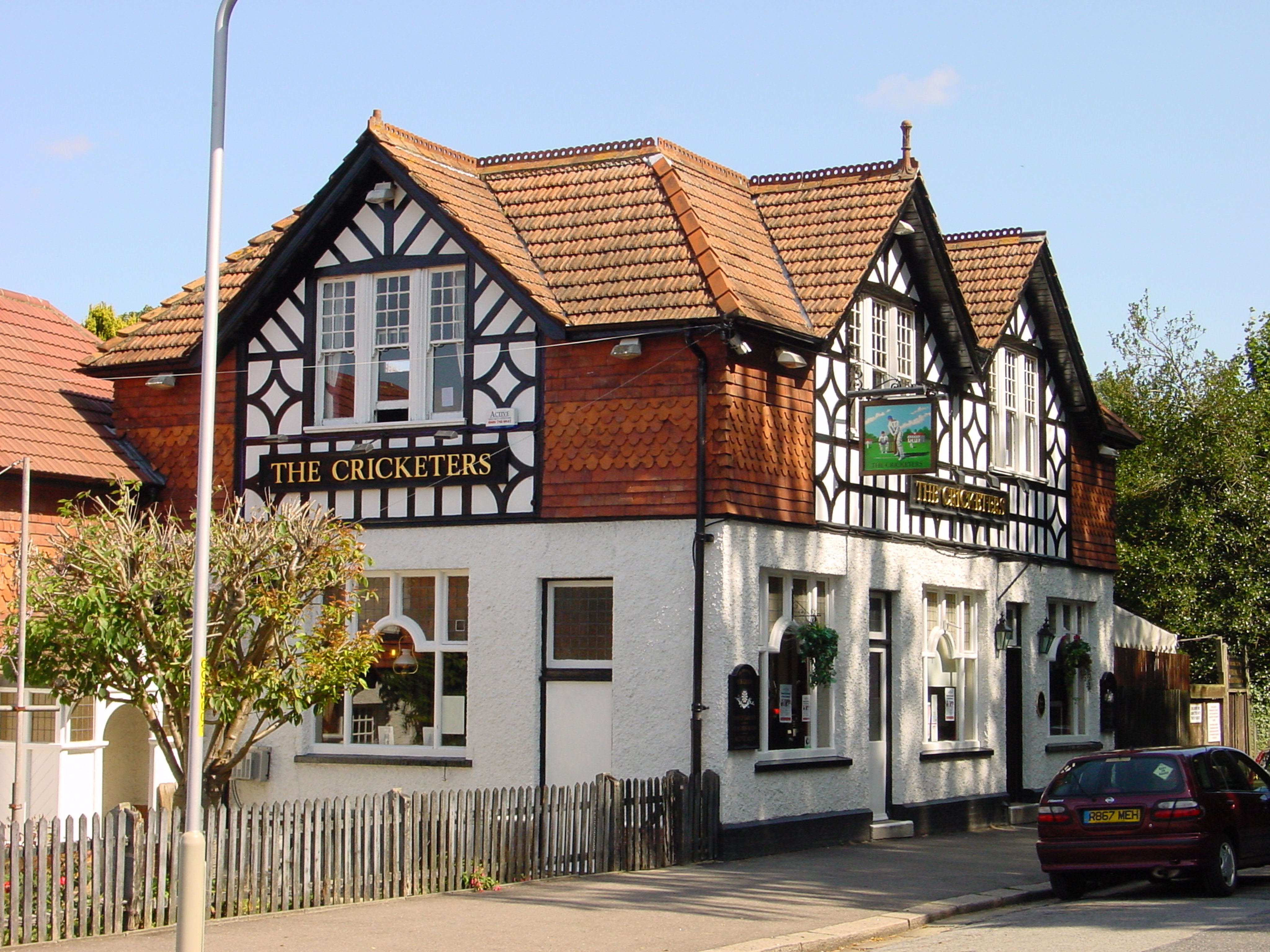
At the time, on the site now occupied by the Cricketers’ pub, there appears to have been a hostelry run by Frank Leney, the younger brother of Alfred C Leney and son of the brewer, Alfred Leney (1837-1900). Previously there had been a tin hut owned Total Abstinence Society. The land purchased by the consortium included this and Alfred C Leney, who was toying with the idea of building a hotel nearby, bought the hostelry from the syndicate, enlarged it and renamed it Cricketers’ Arms.

Although the ground proved to be popular, it was a court case that hit the syndicate hard. In 1898, Champion cyclist Robert Bennett, who was under contract with Dunlop Tyre Company, filed a High Court lawsuit against the syndicate. This was for injuries he sustained while training, when a small dog ran across the track and he fell off his bicycle.  Although Bennett’s legal battle failed, the syndicate were not given costs.

To try to offset this unexpected expense, the syndicate sought to bring county cricket to the town and in 1899, Marylebone Cricket Club (MCC) played at Crabble. The following year, even though the town held a successful cricket festival, the syndicate was running into severe financial difficulties and decided to sell Crabble for housing. However, Dover Corporation stepped in and bought the ground for £5,500 in 1902.

The Mayor of Dover at the time was Sir William Crundall (1847-1934) and on 19 September 1899 he organised Dover’s first motorcar exhibition at the Ground. Members of the Automobile Association drove down from London for the event and 25 or 26 vehicles of various types took part in a grand parade round the cycle track. It was reported that the ‘most handsome vehicle’ was an electric phaeton that the Mayor was driving and belonged to Alfred Harmsworth (1865-1922), later 1st Viscount Northcliffe, the owner of the Daily Mail newspaper. Other vehicles included a velocipede – a human powered vehicle, these days called quadracycles, that had probably been made by Dover’s Willard Sawyer (1808-1892) the ‘first truly professional maker of man-powered vehicles’. There were also electric cars, a lorry, a motor dogcart and a motor tricycle. Driving a Panhard was Charles Rolls (1877-1910), who on 2 June 1910 made the first none-stop flight across the Channel and back again. Also in the parade was the new Pioneer – the new steam vehicle belonging to the Dover and East Kent Motor Bus Company. Following the parade, there were free rides on the Pioneer until the driver drove it off the track onto the grass where it sank almost to the axles!

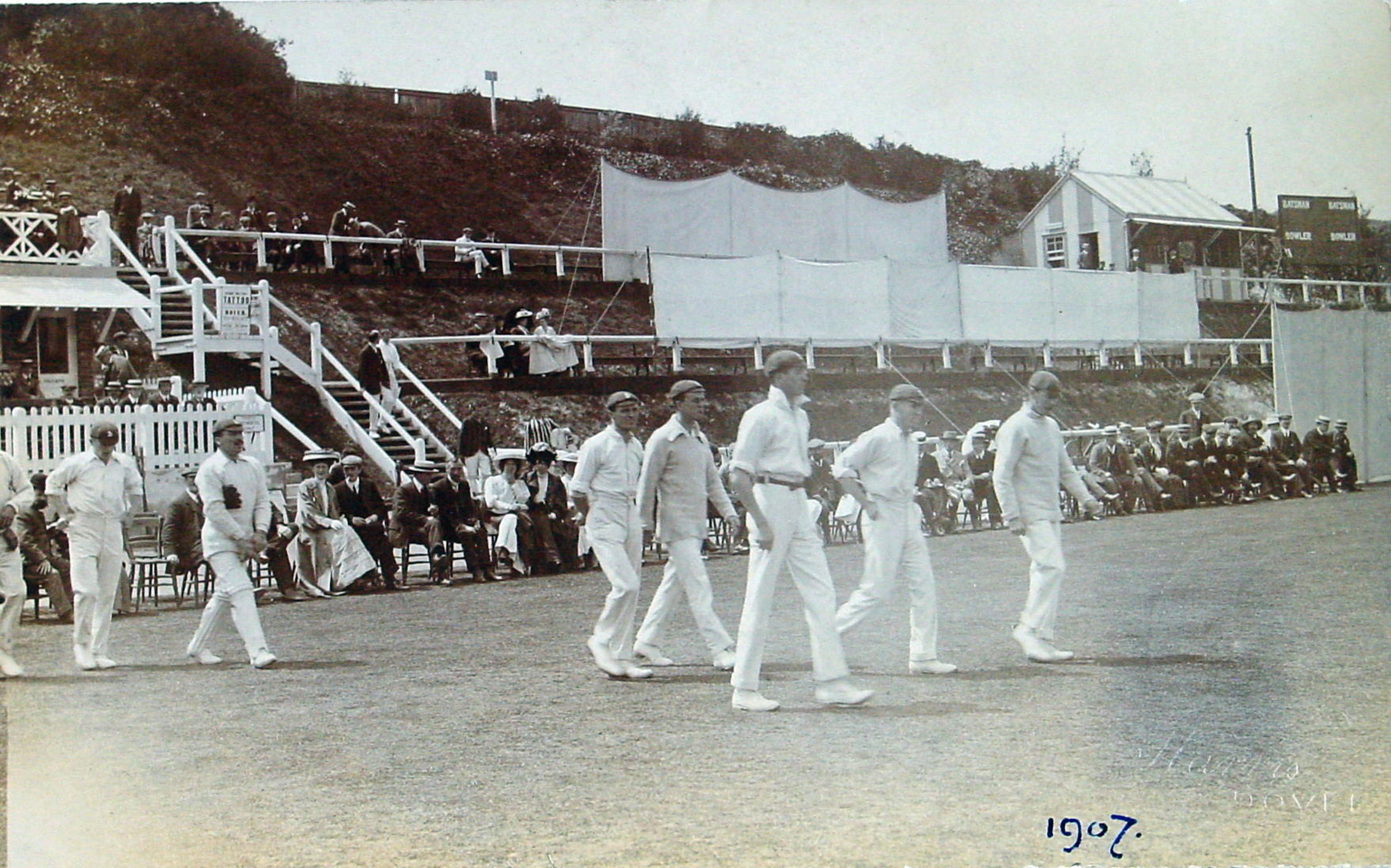
Crabble Athletic Ground - Cricket 1907. Dover Library

Crabble Athletic Ground – Cricket 1907. Dover Library

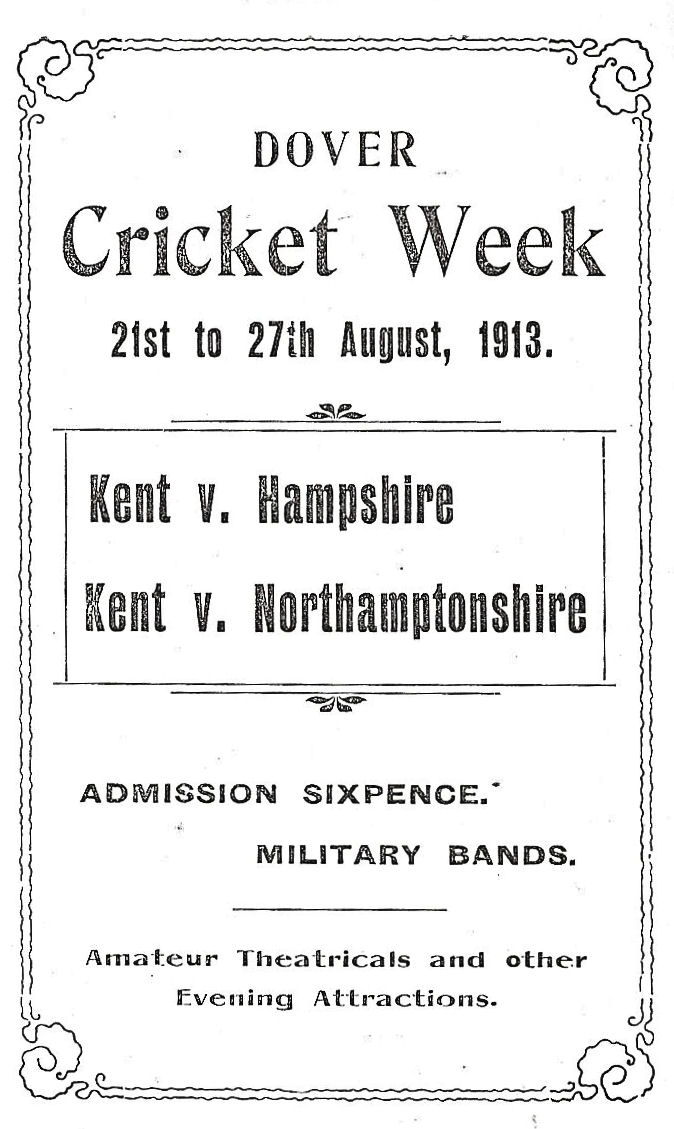
In 1905, moves again were made to bring county cricket to Dover but it was not accomplished until 1907. Between 11-13 July that year, 13,000 spectators saw Kent beat Gloucester, with a team including, Bill Fairservice, Frank Woolley, Charlie Blythe, Arthur Fielder, James Seymour, Jack Mason, Dick Blaker, Edmund Hardinge, Punter Humphreys and captained by Cloudesley Henry Bullock Marsham (1879-1928).

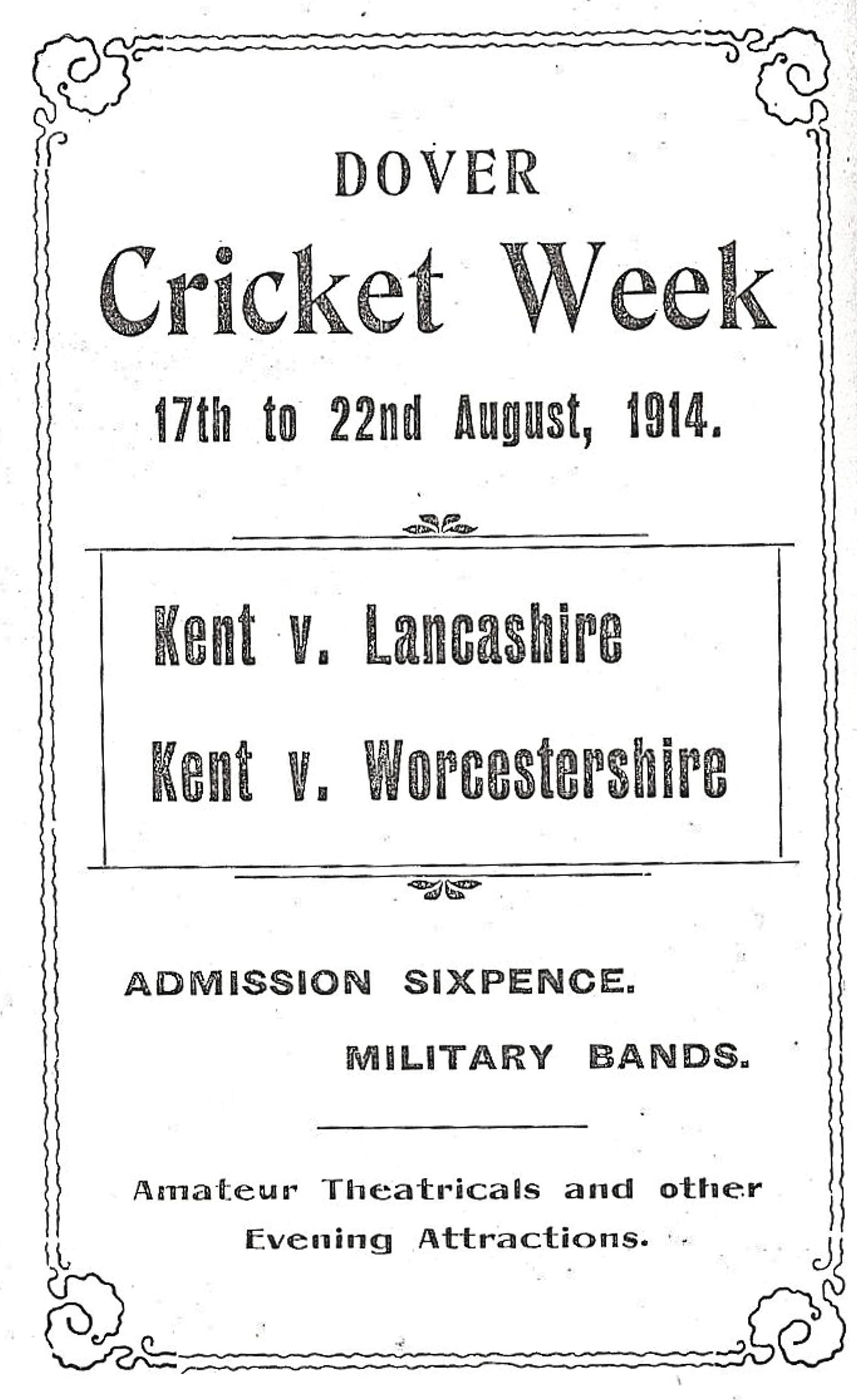
Crabble Athletic Gound - Cricket Week 17-22 August 1914

Crabble Athletic Gound – Cricket Week 17-22 August 1914

The following year the streets, shops and every tram in Dover were festooned with decorations. Special trains were laid on and with so many fans coming to the town, every hotel and guesthouse was full. They were not disappointed for Kent first played Yorkshire and then Somerset with James Rothery (1877–1919) setting a record by scoring 161 runs. By 1908, it appears that Henry Hayward owned the former football pitch, for that year he put the land up for sale advertising plots, ‘overlooking this magnificent Cricket Ground and tram line.’ However, the plots did not sell. In 1911 crowds saw Kent play Nottinghamshire then Leicestershire, the latter setting the record for the highest team totals of 530 for 6 declared, a record that was to last until 1935.

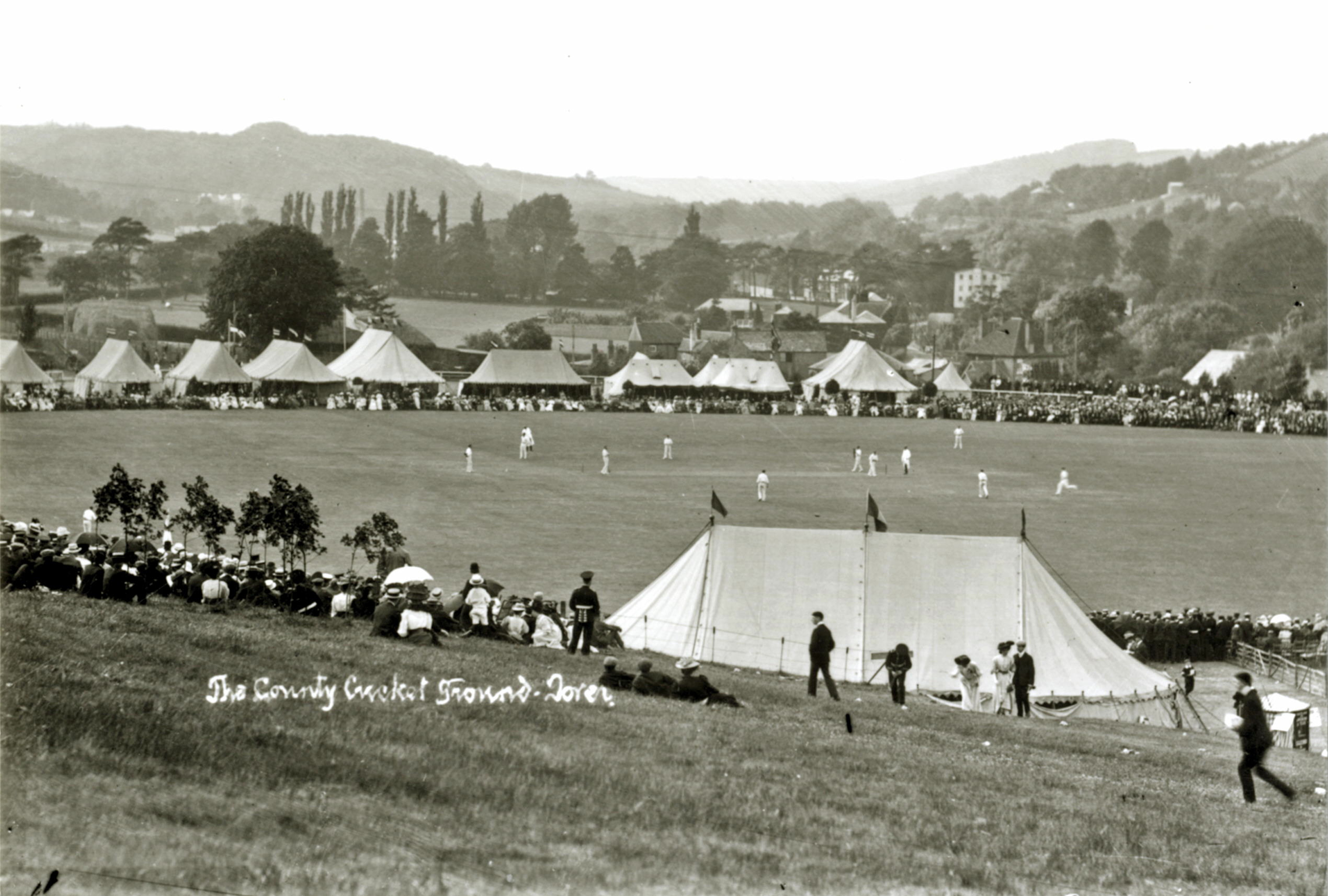
County Cricket at Crabble was suspended during World War I (1914-1918) but returned in 1919 when Kent played Yorkshire. The following year it was decided that Cricket week would be spectacular and reception marquees were provided by Lord George Hamilton, Earl Beauchamp, Connaught Rangers, Royal Irish Fusiliers, Dover Cricket Club, the Commercial Club (Chamber of Commerce) and Dover Corporation. Dover Cricket Week was back on the County agenda and people flocked to the town. In 1922, George Collins (1889-1949) set an unbeaten record at Crabble, taking 16 wickets for 83 when Kent played Nottinghamshire.

Crabble cricket ground with the new football pitch, constructed by the unemployed 1929-1930, nearer the camera. Dover Library

Crabble cricket ground with the new football pitch, constructed by the unemployed 1929-1930, nearer the camera. Dover Library

From the outset of the council owning Crabble, they had allowed, during the winter season, football to be played on the cricket pitch. Following the War, the football season had increasingly encroached at the end of the cricket season. Matters came to a head in 1924 and the council called meeting between Leney and Henry Youden, for the Cricket committee and Herbert Geddes for the Dover United Football Club. Geddes apologised but blamed the Football Association, who set the fixtures. It was suggested that if money came available a new football ground would be laid at the back of the Athletic Ground on the old football ground.

Leney undertook to make enquiries as to who owned the land in order to acquire it and the Borough Surveyor, William Boulton Smith, prepared the plan, estimated costs etc. for a new pitch. An application was made to the Unemployment Grants Committee and in 1929, this came through. The new football ground, utilising the unemployed and estimated at £10,000 was laid next to the cricket ground and the following year, the first full season was played there. It is now the home ground of Dover Athletic Football Club. Cricket week continued to be a crowd-puller with the correspondent for the Manchester Guardian, in 1931, wrote ‘ The field just outside Dover, is fit for a cricketer’s seventh heaven …’

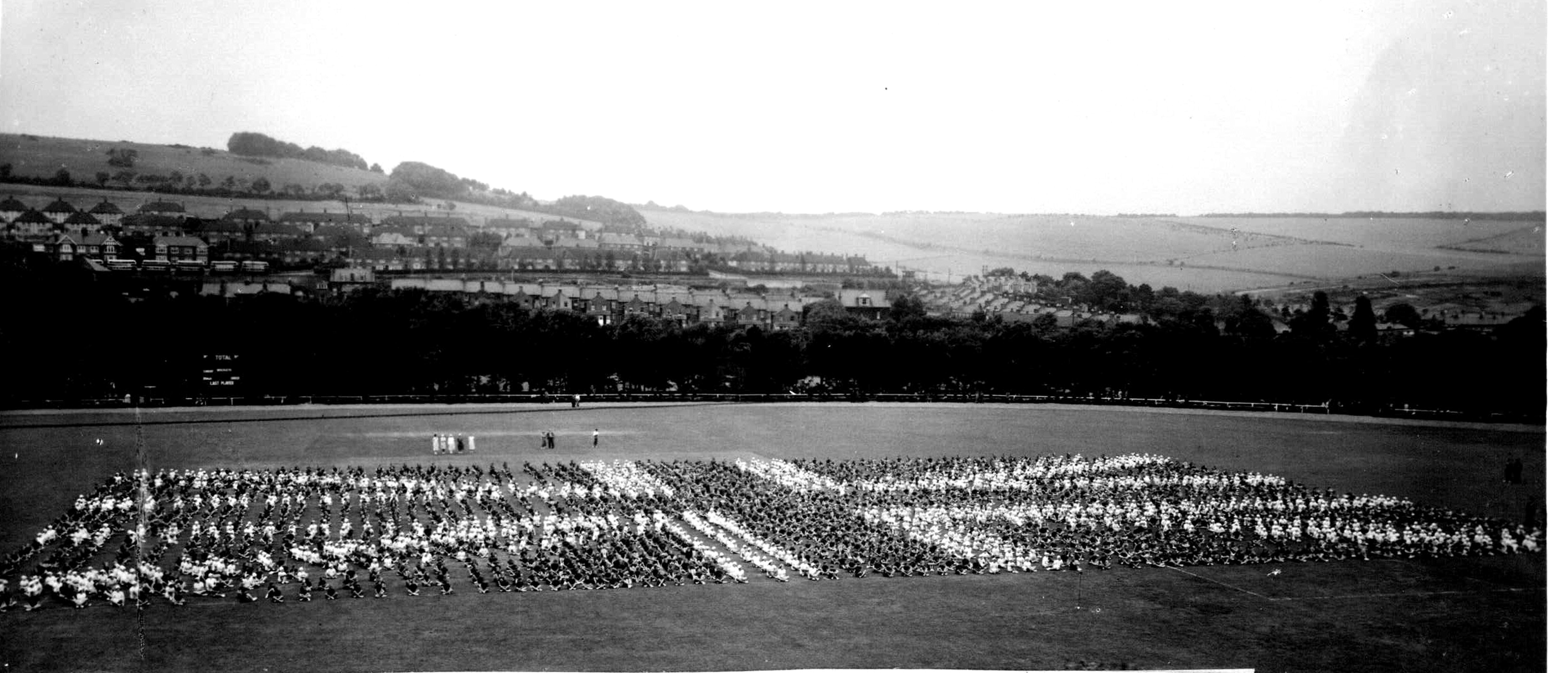
Crabble Athletic Ground Silver Jubilee of George V 10.05.1935 from Hollingsbee Collection - Museum

Crabble Athletic Ground Silver Jubilee of George V 10.05.1935 from Hollingsbee Collection – Museum

The Silver Jubillee of the ascension of George V (1910-1936) to the throne was celebrated on 10 May 1935, when 3,000 Elementary School children wearing red, white and blue, formed living patterns one of which was the Union Jack. Two years later, on Wednesday 12 May for the coronation of George VI (1936-1952) the same configeration was repeated along with other pictoral demonstrations. This took place on 30 July 1937 due to a heavy thunderstorm and down pour on Coronation Day, Wednesday 12 May.

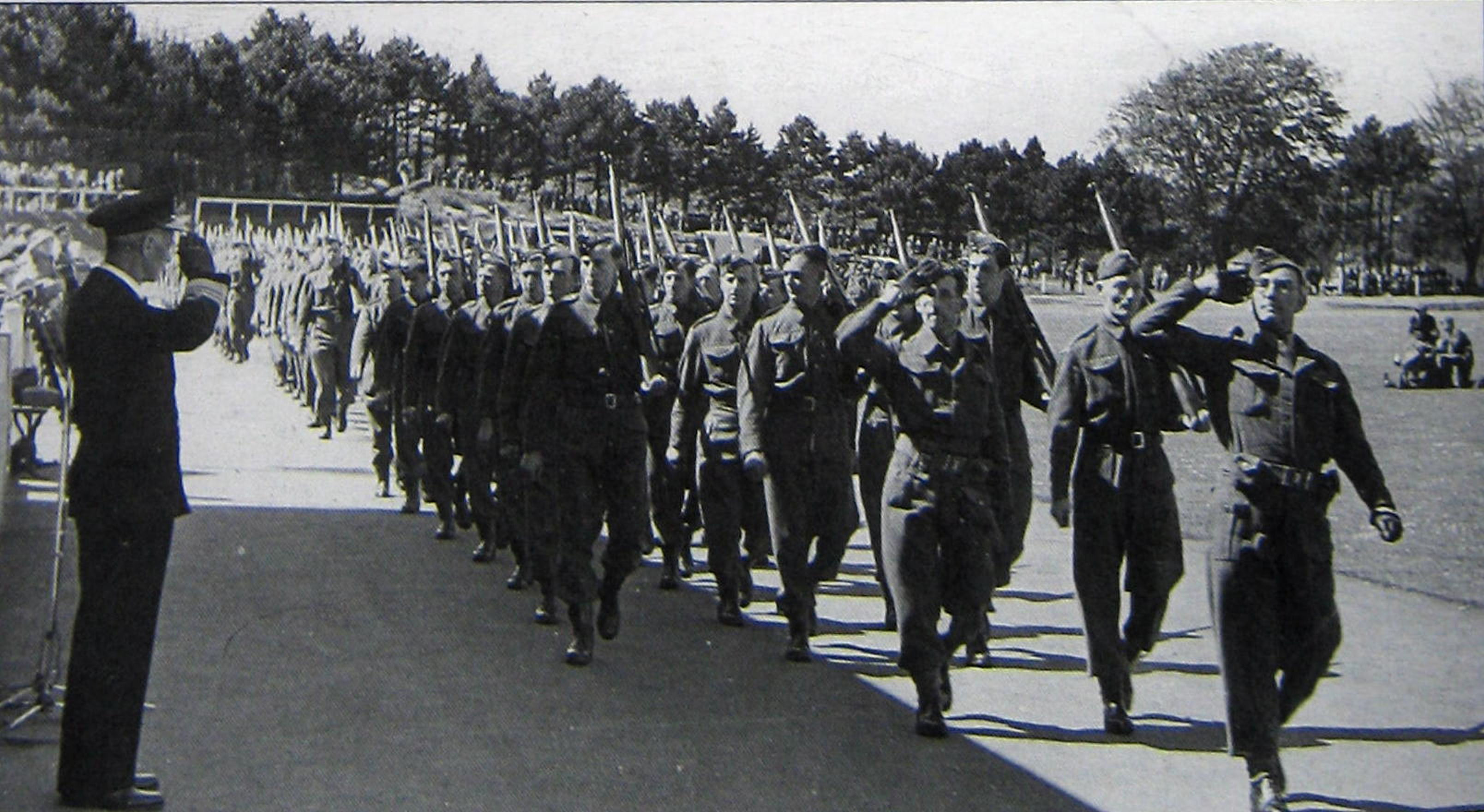
Crabble Athletic Ground - Home Guard officially stood down in December 1944 and were part of the victory celebrations at Crabble Athletic Ground in 1945. The photograph was taken in 1943. Jim Davis

Crabble Athletic Ground – Home Guard officially stood down in December 1944 and were part of the victory celebrations at Crabble Athletic Ground in 1945. The photograph was taken in 1943. Jim Davis

In 1935, Kent played Lancashire and then Derbyshire, and in the latter game, Bill Ashdown (1898–1979) made 305 runs, a record that was never beaten at Crabble. Cricket Week in August 1937 saw the county play against Gloucestershire with the visitors scoring 434 runs in the first innings. Kent scored 399 but Gloucester responded with a further 182 runs. This left Kent to make 218 runs in just two hours, if they were to win. Kent achieved this with the loss of just two wickets! The last inter-war First class cricket match opened on 26 August 1939, just days before war broke out, and Arthur Fagg (1915-1977) made 138 runs helping Kent beat Lancashire. For the duration of World War II Crabble became the headquarters of the Royal Corps of Signals and my Father, who was there in 1940, proudly boasted that he played cricket on the same ground as the cricketing greats of the time!

County Cricket resumed in 1946 when Kent beat Glamorgan at Crabble. Dovorian, Eddie Crush (1917-2007), renowned for his bowling, during Australia’s Ashes tour in 1948, bowled out the legendary Australian batsman Don Bradman (1908-2001). During his first class career that lasted from 1946 to 1949, Eddie took 83 wickets and made 1,078 runs. In 1948, the Crabble crowd also watched Arthur Fagg score 203 runs while Eddie made 50 runs against Middlesex. Dover’s Cricket Week had returned to its full pre-war glory!

Crabble Athletic Cricket Ground - pre-WWI - Museum

Crabble Athletic Cricket Ground – pre-WWI – Museum

In 1953, Doug Wright (1914-1998) took 12 wickets for 102 when Kent beat Somerset. This was the most wickets ever taken in a single match at Crabble. In 1961, an estimated crowd of 10,000 watched Peter Richardson (b1931) score 132 runs when Kent beat Northamptonshire. Nonetheless, the Corporation complained that they were paying all the costs for County Cricket but not reaping the benefits, so cut back on maintenance. The fact that the town not only received the accolades of holding First class cricket it reaped a lot financial benefits from visitors to the town who came to watch. However, the council stuck to its guns and by 1964, because of the poor state of the wicket, it was announced that there would only be one more County match at Dover.

First class cricket did continue, as did Cricket Week, but First class cricket at Crabble was doomed. In 1970, the Dover Cricket Week was trimmed to four days with a county championship match and a Gillette Cup fixture against Northamptonshire. During the three-day fixture, MCC’s inspector of pitches, Bert Lock, was called in and ruled that Crabble was to be dropped from the Kent cricketing circuit. Money was spent on bringing the wicket up to standard and the First class cricket returned in 1972. That year, crowds – including this author and her father – saw Colin Cowdrey (1932-2000) score 107 runs.

Cricket Week 21-27 August 1913 when Dover council cared

Cricket Week 21-27 August 1913 when Dover council cared

On 1 April 1974, Dover District Council (DDC) was born and it was hoped that the cricket pitch would be upgraded – the new council gave just £350 for this! That year Derek Underwood (b1945) caught 12 for 80 when Kent beat Gloucester at Crabble. The following year Asif Iqbal (b1943) scored 107 runs when Kent beat Nottinghamshire. In July 1976, Kent beat Derbyshire by 62 runs but the match was a financial failure due to lack of spectators. This was the final County match was played at Crabble for the following month the Test and county pitch inspector, Bernard Flack, failed the pitch for the following year’s fixtures.

Dover Cricket Club ensured that cricket continued at Crabble and this produced such local stars such as Chris Penn (b1963) who, in 1978 became Dover Schools’ cricket captain and also played for England boys. The fast bowler, in 1982, made his debut for Kent against Glamorgan and played for Kent until 1994, when he was forced to retire through a shoulder injury. Chris had joined another Dovorian, Derek Aslett, in the Kent squad – 1981 saw the start of Derek’s six-year career with the County team. In recognition to both DDC laid a £3,000 artificial wicket at Elms Vale Recreation Ground. While at Crabble, the cricket pavilion was renovated at a cost of £120,000. This was officially opened in October by the then Chairman of Dover District Council, Councillor Walter Robertson with a game between Dover Rugby Club and a Kent XV. That year, however, did see the birth of the Dover and District Cricket League, which produced, amongst others, Richard Pepper who played for England’s Schools’ and his brother Stuart.

There was talk of First class cricket returning to Crabble, but the cost of bringing the ground up to standard made it prohibitive. Instead, DDC found it more lucrative to rent the ground for boot fairs and soon they took precedence over cricket fixtures. Although still enjoying success the Dover Cricket Club folded in the 1990s and now Rugby is played on the former cricket ground.

  • Published:
  •  Dover Mercury: 15 & 22 November 2007
Posted in Crabble Athletic Ground and County Cricket, Crabble Athletic Ground and County Cricket, Open Spaces, Societies, Culture and Entertainment | Comments Off on Crabble Athletic Ground and County Cricket

Maison Dieu Windows

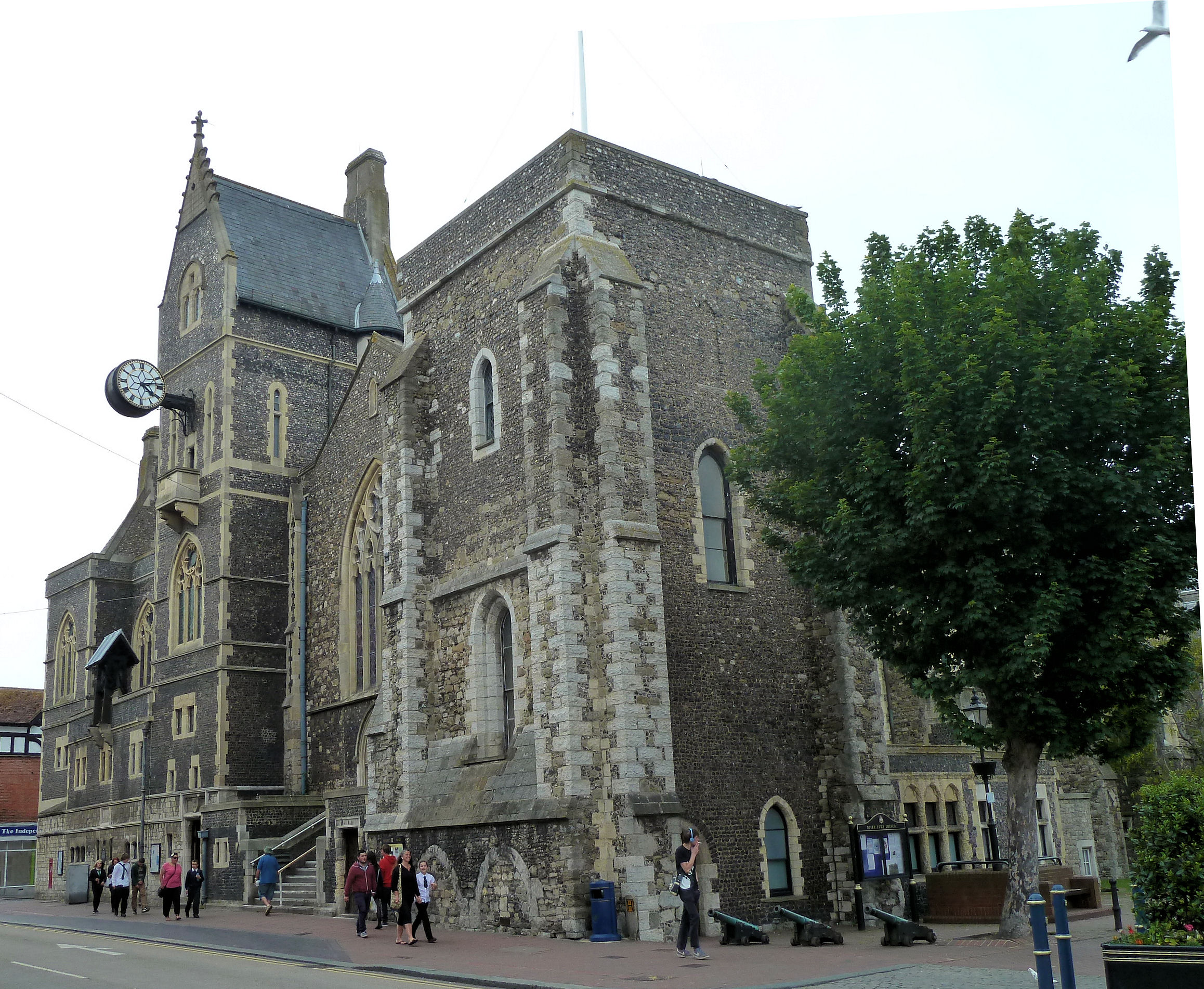
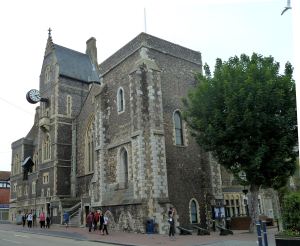
Maison Dieu - Dover's former Town Hall

Maison Dieu – Dover’s former Town Hall

In May 1202, Hubert de Burgh (c.1160–1243) was appointed the Constable of Dover Castle and the following year he found a Hospital now referred to as the Maison Dieu. The Great Chamber, or Stone Hall we see today, dates back to 1253 and on the north side was the church, behind which, and running the length of Stone Hall, was the guesthouse. In 1524, Henry VIII (1509-1547) ended all religious functions at the Maison Dieu and ten years later the monks were evicted.

The victualling department of the Royal Navy, in 1552, appropriated the building and in February 1835, Dover Corporation managed to gain possession in order to use it as a replacement Town Hall and Law Courts. About 1850, Ambrose Poynter (1796–1886) was instructed to draw up plans for the restoration of the building. Between 1852-1862, his designs were carried out, chiefly under the direction of his successor, William Burges (1827-1881). The son of Ambrose Poynter, Edward John Poynter (1836–1919), later knighted and appointed the Director of the National Gallery and President of the Royal Academy, drew a series of cartoons for the insertion of coloured glass into the window frames in the Stone Hall. This was completed about 1873.

In September 1939, with the outbreak of World War II (1939-1945) the stained glass windows were all moved to places of safety. Once hostilities were over and money became available, the windows were restored and in 1968 repair work were carried out.

Windows in the Stone Hall
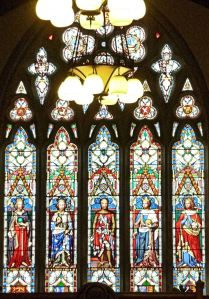
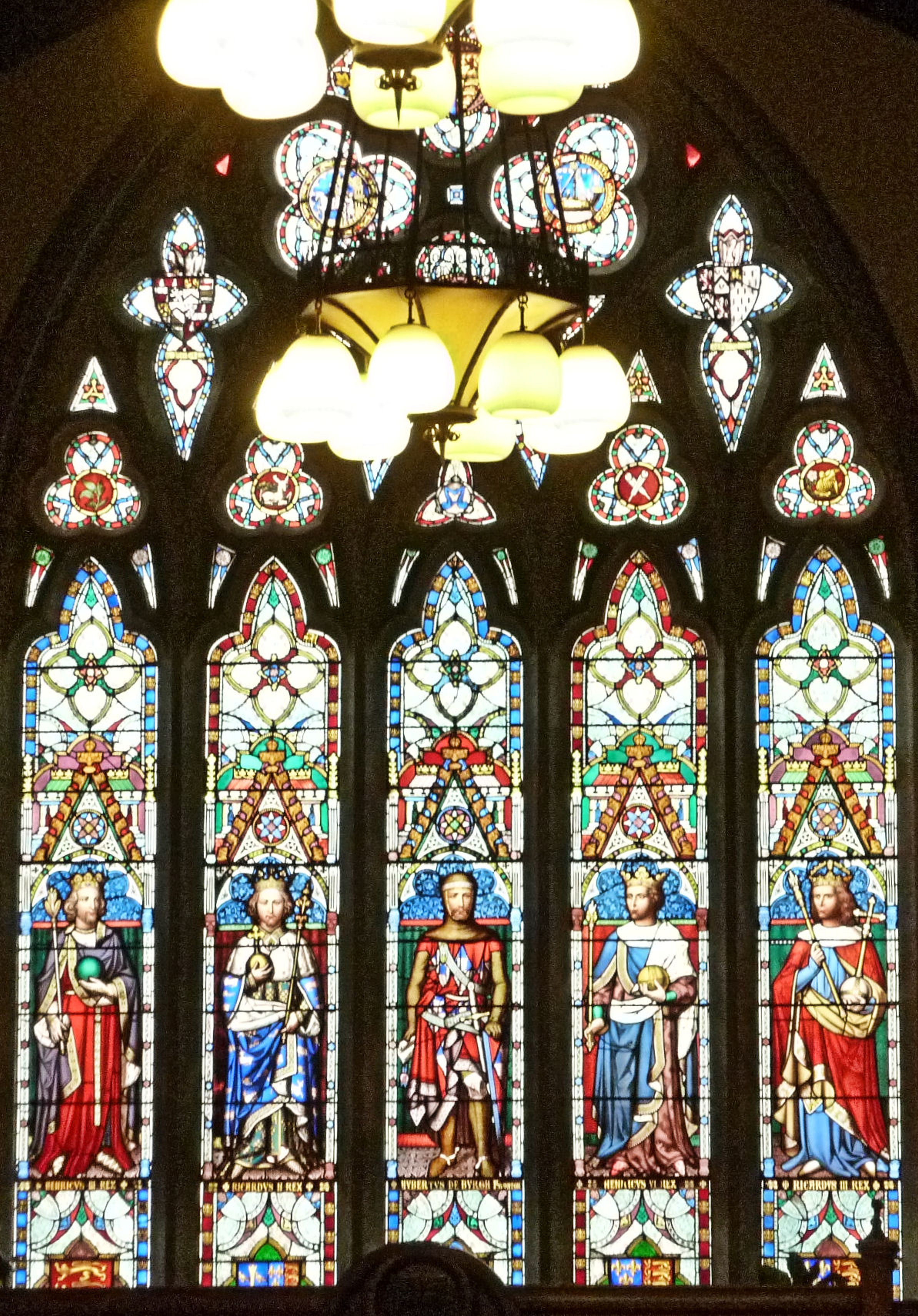
Kingsford Window above the main entrance into the Stone Hall

Kingsford Window above the main entrance into the Stone Hall

Above the entrance into the Stone Hall is a large window divided into five sections depicting the principal benefactors of the Maison Dieu. The centre figure of the five windows is a full-length depiction of Hubert de Burgh, the founder of the Maison Dieu. He is wearing a suit of chain mail covered with a surcoat emblazoned with his armorial bearings gules, seven lozenges vair 3.3 and one. In his right hand is a scroll with a sealed pendant – depicting his gift – and his left hand rests on his shield that also shows his coat of arms. The trefoil above contains a water bouget, the crest of the De Burgh.

On either side of Hubert de Burgh are on the right are Kings Henry III (1216-1272) and Richard II (1377-1399) and on the left Henry VI (1422-1461 + 1470-1471) and Richard III (1483-1485). Above each figure are a building that the individual was connected with and their badge. Over Henry II is the planta genista or broom, over Richard II the white hart, Henry VI two ostrich feathers and an angel and white rose over Richard III. The four large trefoils contain the arms of Queen Victoria, the arms of the Cinque Ports and depiction’s from the Dover Corporation seals, namely St. Martin – the titular Saint of Dover and a Cinque Port galley, fully rigged and manned.

Mrs Mary Bell donated these windows. She was the benefactor of her cousin William Kingsford who died on 26 May 1856. Starting his working life as a corn miller, William owned Buckland corn mill and Maison Dieu House when he died. The windows bear the inscription: Guiliemus Kingsford obit. XXVI Maii Anno Dominii MDCCCLVI. Aetatis suoe LXVIII. Maria, consanquinea sua, filia Thomoe Roberti Holmes et uxor Johnannis Bell hane Fenestram Posvit. William Wailes (1808–1881) of Newcastle produced the window in 1856. He was the proprietor of one of England’s largest and most prolific stained glass workshops and the artistic treatment, as to both the design and colour, is recognised as being superb.

Edward Poynter designed the six large windows along the south wall. He was in Paris in 1860, when he received the commission for just the first one. The council were so impressed that they paid him £20 to make designs for the remaining five windows. The stonework decorations of the windows are a copy of the original 14th Century tracery. The subjects of windows are in chronological order from the furthest end and the heads of all six windows are principally decorated with heraldic references to the periods the incidents represented. In the large compartments are the arms of the reigning monarch and the minor compartments cognizances and devices.

Relief of the Castle by John de Pencester AD MCCXVI (1216)

Relief of the Castle by John de Pencester AD MCCXVI (1216)

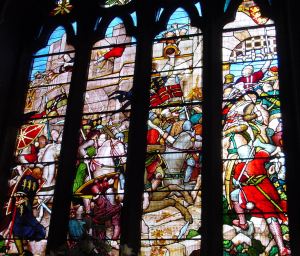
From the east end, the first south window was given in memory of those who fell in the Crimea War (1854-1856) and in the Indian Mutiny (1857-1858). Again, William Wailes produced the window.

Installed in 1865, the window depicts the Relief of Dover Castle by John de Pencester AD MCCXVI (1216). In 1216, the last year of the reign of King John, Dover Castle was besieged by Louis the Dauphin of France (1187– 1226 later Louis VIII 1223–1226) defended only by Hubert de Burgh and a small number of followers. Eventually, so the story goes, John de Pencester arrived with reinforcements and the Dauphin left. The incident shows Pencester bearing his banner aloft (gules, a cross void or) and his horsemen bearing arbalests, scorpions and other defence weapons. They are shown rushing at the Castle Postern Gate with the Dauphin’s men attacking them as they gallop past. In the foreground on the left is William Longspee, Earl of Salisbury, (c.1176–1226), with six lioncels rampant on his surcoat and wielding a two-handled sword from which he took his name. In the background is a moveable tower frequently used in sieges of that time.
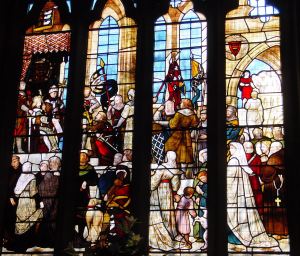
Henry III confirming the Charter of the Maison Dieu AD 1227

Henry III confirming the Charter of the Maison Dieu AD 1227

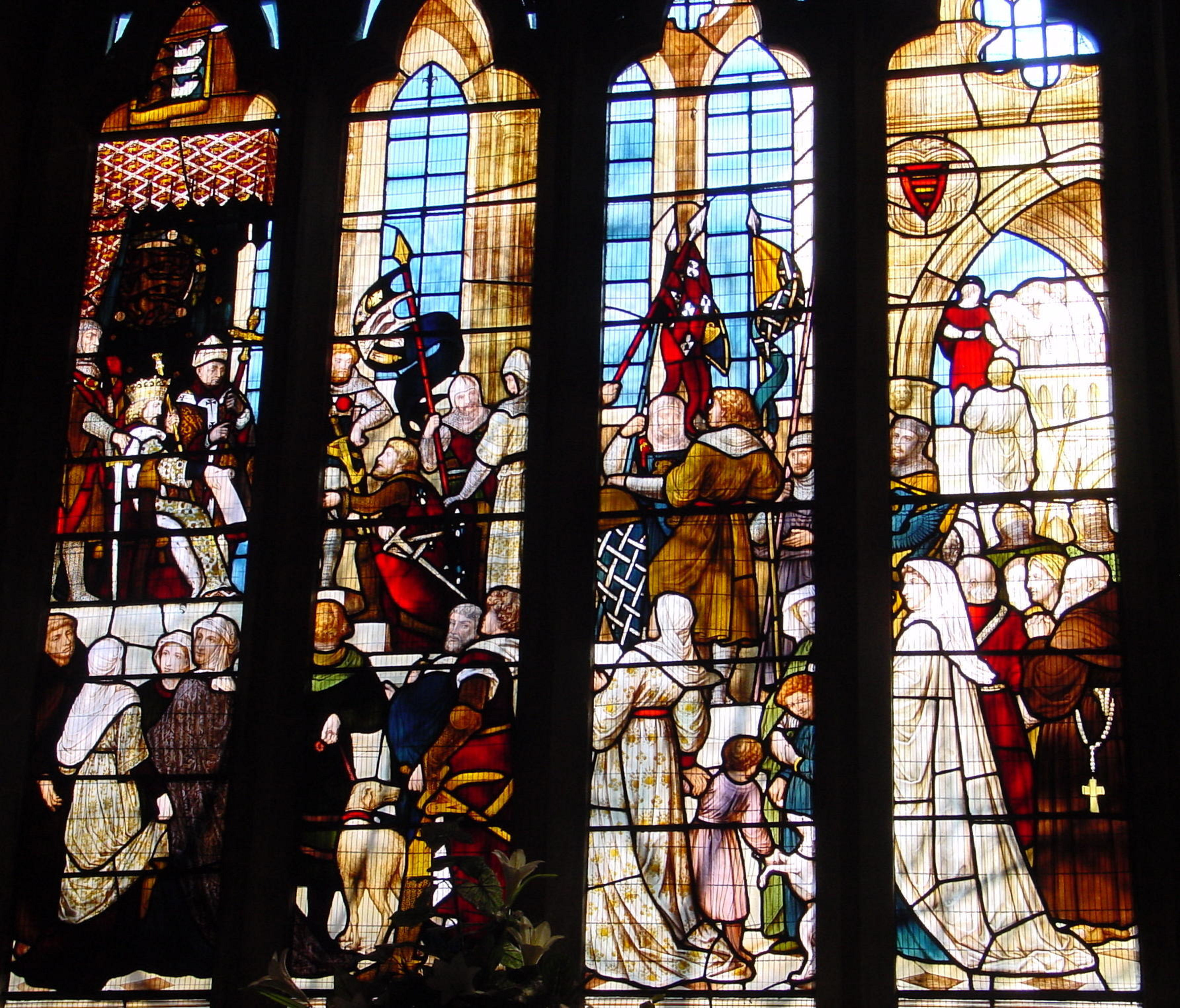
The second window was installed in 1872, produced by William Wailes and shows Henry III (1216-1272) confirming the Charters on the Maison Dieu in 1227. The King, visited the Maison Dieu to assist in the consecration of the Chapel and during the stay he confirmed all the charters that had previously been granted to the Maison Dieu. The King, on the left, is shown enthroned under a canopy and nearby is Stephen Langton, Archbishop of Canterbury between 1207 and his death in 1228. Hubert de Burgh is shown kneeling before the King and receiving the deed of confirmation. The king’s guards and other figures are shown in costume typical of the time. The window was given to the town by the Merchants and Citizens of London as ‘ A memorial to the commercial honour and uprightness of Richard Dickeson (1823-1900), Mayor of Dover 1872, 1880, 1881, 1883.’
Embarkation of Edward III for France from Dover AD 1359

Embarkation of Edward III for France from Dover AD 1359

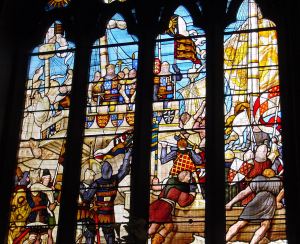
The third south window shows the Embarkation of Edward III for France from Dover 1359. It was given as a memorial to Robert Taylor (1793-1867), a Commander in the Royal Navy, by his widow. From about 1860, Heaton, Butler and Bayne, who produced the glasswork,were London’s foremost glass design team producing, arguably, the worlds greatest stained glass masterpieces. They made the remaining three windows in the Stone Hall.

This window was installed in 1873 and was the last of the six windows to be completed. It was partly paid for by Sir Richard Dickeson. Captain Taylor was an Hereditary Freeman of Dover who like many local lads joined the Navy at an early age and rose through the ranks. He retired back to Dover after 40 years of distinguished service. At the time, the Town Hall was being refurbished and he expressed the desire to purchase one of the windows. His death, however, left his wife with little funds so Sir Richard paid the difference.

The Window shows Edward III (1327-1377), prior to his second expedition to France in 1359, making a short speech to his followers. They answered with shouts of ‘God and St George!’ The King, his sons and commanders are shown in the foreground and can be identified by the arms on their surcoats. On the left side of the King is Edward the Black Prince (1330-1376), distinguished by the dark colour of his armour. To the right, in the next light, is Sir Bartholomew Burghersh (c1329-1369) and next to him is a knight with a mantle embroidered with the Order of the Garter –  founded in 1348. The ship is being pushed off by sailors and the stern is decorated with the banners of Thomas Beauchamp, 3rd Earl of Warwick (1314-1369) and Roger de Mortimer 2nd Earl of March (1328-1359). The occupants can be identified from the arms shown on the surcoats and include Sir James Audley (c.1318–1369) and Humphrey de Bohun (1342-1373) 7th Earl of Hereford, 6th Earl of Essex, 2nd Earl of Northampton

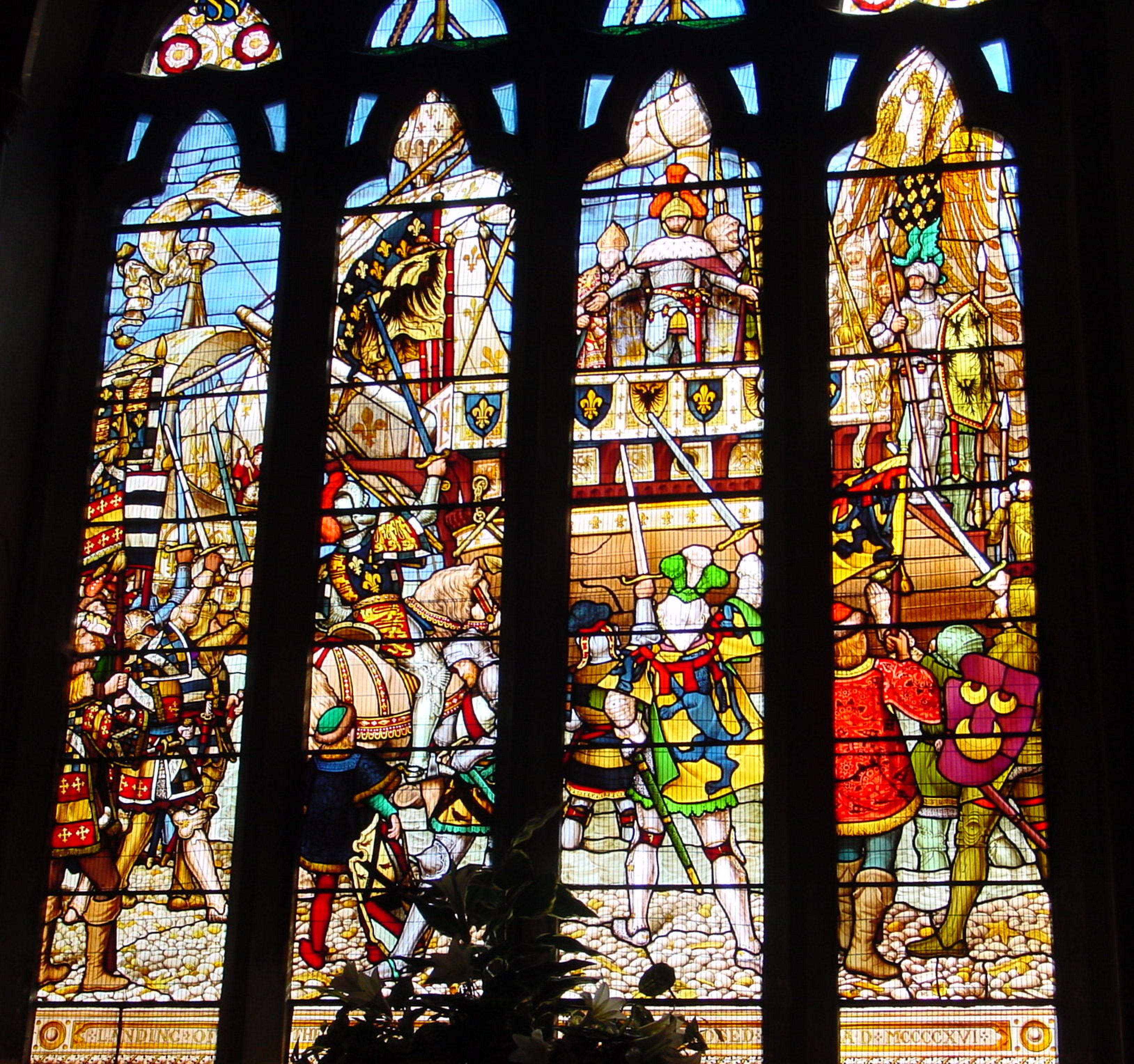
Landing of Emperor Sigismund opposed AD MCCCCXVI

Landing of Emperor Sigismund opposed AD MCCCCXVI

The fourth window was installed in 1864 and depicts the Landing of Emperor Sigismund at Dover in 1415-16. It was presented by Henry P Mackenzie, builder who was one of the contractors commissioned to install the windows. However, the council could not afford to pay him so they offered him the window instead!

On 16 March 1415-16 (new year started on 25 March in those days), Sigismund of Luxembourg, King of Hungary and Croatia (1387-1437) and later Holy Roman Emperor (1433-1437), accompanied by the Archbishop of Rheims, visited Henry V (1413-1422) to bring about what was hoped to be a reconciliation between Henry and the King of France, Charles VI (1380-1422). The imperial ship, as it draws nearer the shore, is met by nobles and barons, including Humphrey of Gloucester (1390-1447) – Lord Warden and Constable of Dover Castle (1415-1447). He is on horseback with his sword drawn and asks if the party comes in peace. On Sigismund disclaiming any war like intentions, he is received with the honours in accordance with his rank. The Emperor is shown standing on the forepart of the ship which is hung with shields bearing the arms of the Emperor and of France. In the light, on the left, is Richard de Beauchamp, 13th Earl of Warwick (1382-1439).
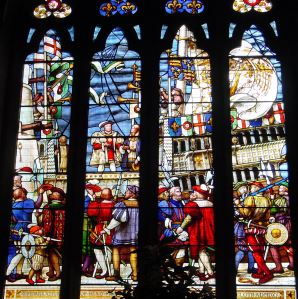
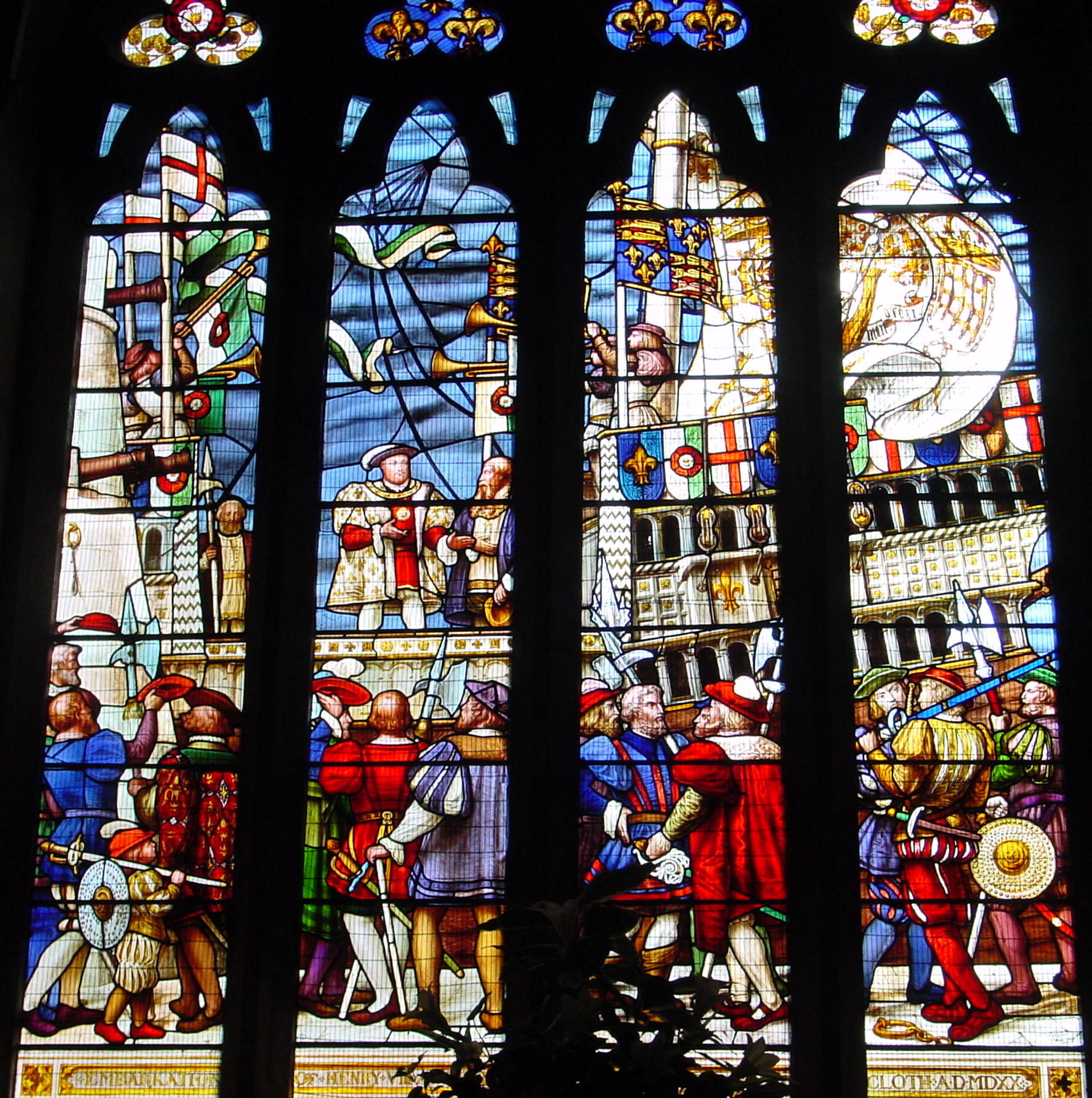
Henry VIII at Dover leaving for the Field of the Cloth of Gold

Henry VIII at Dover leaving for the Field of the Cloth of Gold

Fifth window, installed in 1860, shows the Embarkation of Henry VIII (1509-1547) at Dover for the Field of the Cloth of Gold, 31 May 1520. The citation reads, ‘In memory of William Allen, a native of this Town, who died in South Australia 15 October 1805.’ In his Will, Thomas Bass – Town Clerk (1847-1860) and one of the founder’s of Stilwell & Harby solicitors, bequeathed a silver vase with lid valued at £200 to pay for the stained glass window. This was in memory of his relative, Captain William Allen. The Captain had rescued the ship Ann in Bombay harbour some years before for which the underwriters had presented Captain Allen with the vase. On his death he had left the vase to Thomas Bass. Above the main scene are the arms of Captain Allen.

The 801-ton Ann was built at Bombay in 1812 and originally carried a full ship rig. She was later re-rigged as a barque, a common practice, later in the century, to reduce crewing costs. However, the ship has achieved lasting fame as she was depicted by Australian artist Frederick Garling (1806-1873) in a water-colour entitled ‘the barque Ann bound for Calcutta, off Millers Point, Sydney, and 13 August 1845.’ The painting sold for £3,585 by Bonham’s in 2004.

The Window shows Henry VIII standing on the gangway of his ship immediately after the embarkation. He is acknowledging the acclamations of his loyal subjects who line the shore. To the King’s right is Sir Thomas Docwra (d1527), the Grand Prior of the Order of St John of Jerusalem from 1501-1527 and a renowned soldier and diplomat. Edward Poynter, drew much of this work from a well-known painting which was, at that time, at Hampton Court. Of local significance, it gives a glimpse of Clarke’s harbour, which was still intact. This was started in 1495 by John Clarke, Master of the Maison Dieu,  who turned a small natural cove at Archcliffe Point into a harbour that was the forerunner of Western Docks.

Charles II landing in Dover 25 May 1660 for the Restoration of the Monarchy

Charles II landing in Dover 25 May 1660 for the Restoration of the Monarchy

The final window in the Stone Hall was the second one to be installed – 1861 – and depicts the Landing of Charles II (1649-1685) at Dover, on his Restoration, 25 May 1660. The dedication reads, ‘Georgii Thomoe Thompson, per infortunium coeso IX Augusti MDCCCLX Amici et Municiples.’ On 9 August 1860, at Archcliffe Fort, Captain George Thompson and Sergeant John Monger of the 1st Cinque Ports Artillery Volunteers were killed and several others injured during a practice.

George was Dover’s coroner at the time, which led to a problem unique in the legal system, as there was no one to conduct the inquest! The country’s chief Coroner was the Lord Chief Justice of the Queen’s Bench and it was assumed he would appoint someone to act in place of Captain Thompson until the town appointed another coroner. However, the Lord Chief Justice declined, stating that the responsibility lay with the Town Council. Eventually the matter was sorted out and George was buried at Shepherdswell. George’s widow provided some of the pikes and other weapons on display in the Stone Hall, however, the majority of these were presented by the Government from the National Stores at the Tower of London.

The Window shows, on the left, the Mayor of Dover, Thomas Broome, holding in his hand the address that he has just read to Charles II. Kneeling before the King is the Reverend John Reading, former vicar of St Mary’s Church, who had endured much suffering during the Civil Wars and the Interregnum (1642–1660). In the council minutes of the time it states, ‘That on coming ashore, the Mayor of this town, Thomas Broome, Esq., made a speech to his majesty on his knees, and that Mr John Reading, Minister of the Gospel, presented his Majesty with the Holy Bible, as a gift from the town, and his gracious Majesty, laying his hand upon his breast, told the Mayor, nothing should be more dear to him than the Bible.’  Behind the King is General George Monck (1608-1670), who was the first to greet the King on his landing, the King’s brothers, James, Duke of York (b1633) and Henry Stuart, 1st Duke of Gloucester (1640–1660) are behind him.

Council Chamber Windows.

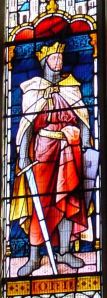
The Council Chamber was added in 1868 and again it was hoped that the plain windows would be replaced by coloured glass depicting royalty who had direct connections with Dover. There are three windows all made by Heaton, Butler and Bayne of London. The figures depicted are those of Kings who are known to have visited the Maison Dieu.

Edward I - detail from the Steriker Finnis window in the former Council Chamber

Edward I – detail from the Steriker Finnis window in the former Council Chamber

The centre window shows Edward I (1272-1307), Edward II (1307-1327) and Richard II (1377-1399). It was erected by Members of the council and other Burgesses on the retirement of Alderman Steriker Finnis J.P., (1817-1889) from the Corporation. He was Mayor in 1850 and 1851, Alderman 1850-52, 1871-77, 1880-83 and Councillor 1847- 50, 1861-64.
A Liberal, Steriker Finnis, was the owner of Dover’s largest timber yard and was also a builder; he was involved in introducing sanitary reforms that resulted in the adoption of the Public Health Act on 1 December 1848. On 25 September 1852, he resigned from the council, as it was his firm that won the contract for Dover’s main drainage. He took little part in council affairs until 1861. That year, as candidate for Castle Ward, he headed the poll and was a member of the council for most of the following 22 years. However, on 16 June 1883, he resigned through ill health that was to plague him for the rest of his life. In accordance with the requirements of the Municipal Corporations Act of 1883 he was required to pay a fine of £25, which the Council had no option but levying. The Corporation spent the sum with other amounts subscribed, in placing the memorial window in the Council Chamber.
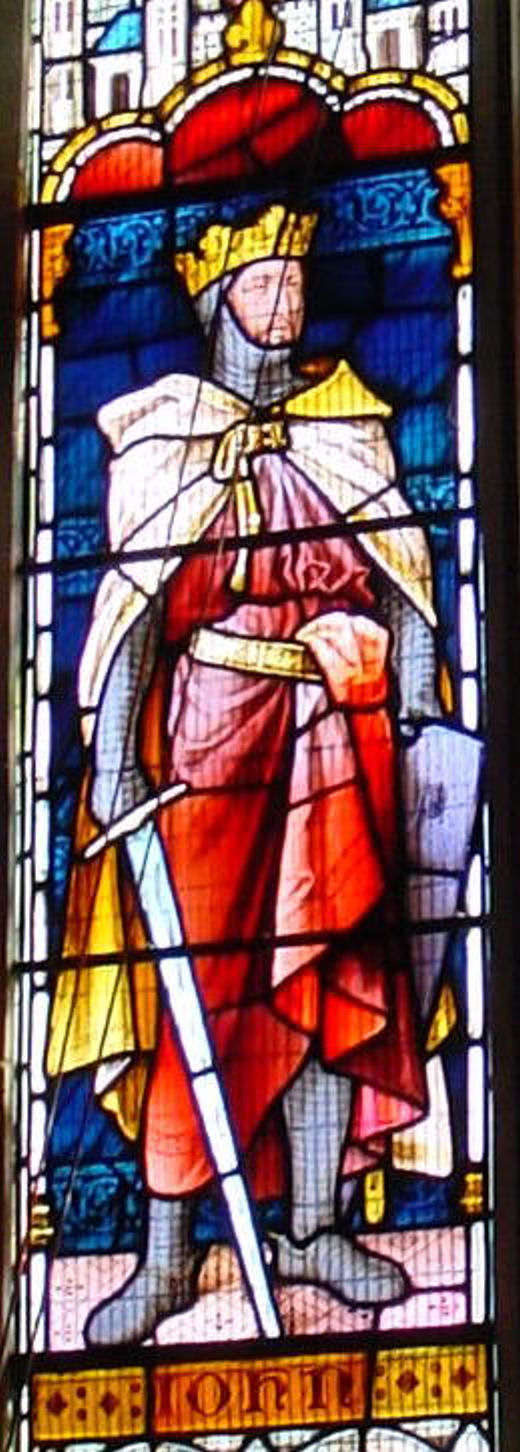
King John - detail from the William Adcock window in the former Council Chamber

King John – detail from the William Adcock window in the former Council Chamber

The east window depicts King John (1199-1216) and Henry III (1216-1272) and was presented by  Alderman William John Adcock J.P., Mayor 1885-6 and 1890-91, Alderman 1877 to 1883 and 1887 to 1892 and Councillor 1871 to 1877 and 1885-6. He made the presentation when he was given the Honorary Freedom of the Borough in 1892.

The west window is of Henry VIII (1509-1547) and Charles I (1625-1649). Sir Richard Dickeson J.P., Mayor 1871-2, 1879-80, 1880-1 and 1882-3 and Councillor 1853 to 1865 and 1868 to 1883 presented it. On 9 November 1891, Freedom of the Borough was conferred on Sir Richard by his archrival in politics, William Crundall. In the citation, Sir Richard’s philanthropic gestures were given and in particular the provision of the finance to build St Mary’s Church north doorway. In return for his Freedom, Sir Richard paid for the stained glass window.

In 1873, the working men and mechanics, which met in the Dover Institute, wanted to purchase one of the windows in the Town Hall. Their offer was considered favourably and it was suggested that the window should feature Prince Albert, the Prince Consort (1819-1861), who had shown the town great generosity. However, the Prince did not fit in with the overall pattern of the designs chosen so the offer was declined.

Connaught Hall Windows

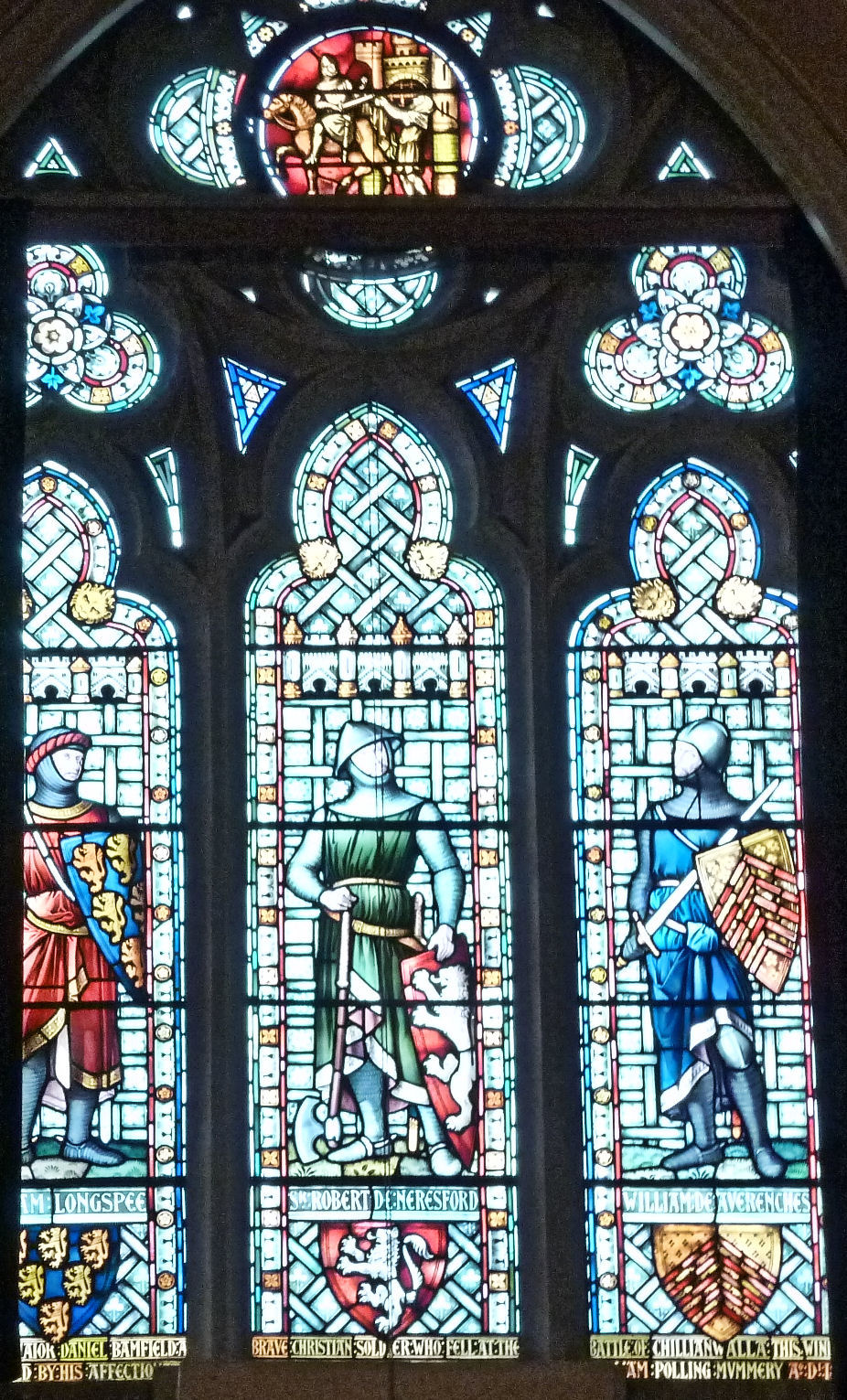
When Connaught Hall and adjoining rooms, including the Mayor’s Parlour, were built, they had plain windows. Nine stained glass windows around the balcony of Connaught Hall were designed by H W Lonsdale and were to be made by Heaton, Butler and Bayne of London. Each window has three bays and each bay was to represent the figures of historic characters with a connection to Dover. However, only seven of the windows were completed and these days they are sometimes covered. The subjects are of interest especially as three of the characters depicted met their end by execution!
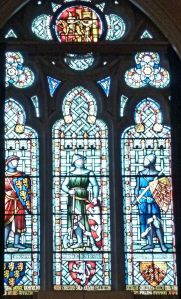
William Longspee, Sir Robert de Neresford and William de Averenches

William Longspee, Sir Robert de Neresford and William de Averenches

West windows from left to right first: William Longspur or Longspee / Sir Robert de Neresford / William de Averenches or Averanch the first Constable of Dover Castle to be appointed Lord Warden (1226-1227). This window was in memory of Major Daniel Bamfield – 56th Bengal Native Infantry who died of wounds on 13 January 1849 aged 44 at the Battle of Chillianwala. It was presented by Elizabeth Bamfield, wife of William Polling Mummery in 1886.

Centre west: William Devereaux / Hubert de Burgh, 1st Earl of Kent, Lord Warden 1202-1232 / William Longchamp (1197) Lord Chancellor and Chief Justiciar of England. It was erected to commemorate the opening of Connaught Hall by the Duke and Duchess of Connaught, 14 July 1883 and paid for by Richard Dickeson, Mayor

South west: William Peveral or Peverel, Constable of Dover Castle 1066 / Godwyn (1001-1053) Earl of Kent / John de Fienes or Fiennes, Constable of Dover Castle 1084. In memory Jane Anna, William Lindsay and Walter Bamfield, the children of William Polling Mummery and his wife Elizabeth Bamfield, 1886.

North windows first and second from west – plain glass. The drawings were prepared for stained glass windows with one featuring: Stephen de Pencester was Constable of Dover Castle in 1267 and Lord Warden of the Cinque Ports in 1276 until 1297 / Robert de Surland / Hugh Despencer (1267-1297). The second window was to feature: Bertram de Criol (d1256)- Constable of the Castle 1227-1232, 1236-1242 and 1242-1256, Humphrey de Bohun (c1208-1275) – 2nd Earl of Hereford, Lord Warden 1241, and Sir Reginald Cobham de Allington Constable of the Castle (1256-1258)

Third north: Edmund Plantagenet, Lord Warden 1321-1323 Executed 1329 / Ralph Basset, 3rd Baron Basset de Drayton, Lord Warden 1325-6 (nine months) / Henry Cobham – Lord Warden 1306-1307. The constituents of Charles Kaye Freshfield, Dover’s Member of Parliament 1865-68, 1878-80, 1880-85, dedicated the window.

Fourth north: Bartholomew Baron Burghersh – there were two Lord Wardens of this name, father & son / William de Clinton, 1st Earl of Huntingdon, Lord Warden 1330-1343 / Roger de Mortimer, 3rd Baron Mortimer, 1st Earl of March, Lord Warden 1355-1359 Executed. Constituents of Major Alexander George Dickson, Member of Parliament 1865 to his death, erected the Window in 1889.
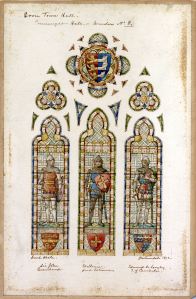
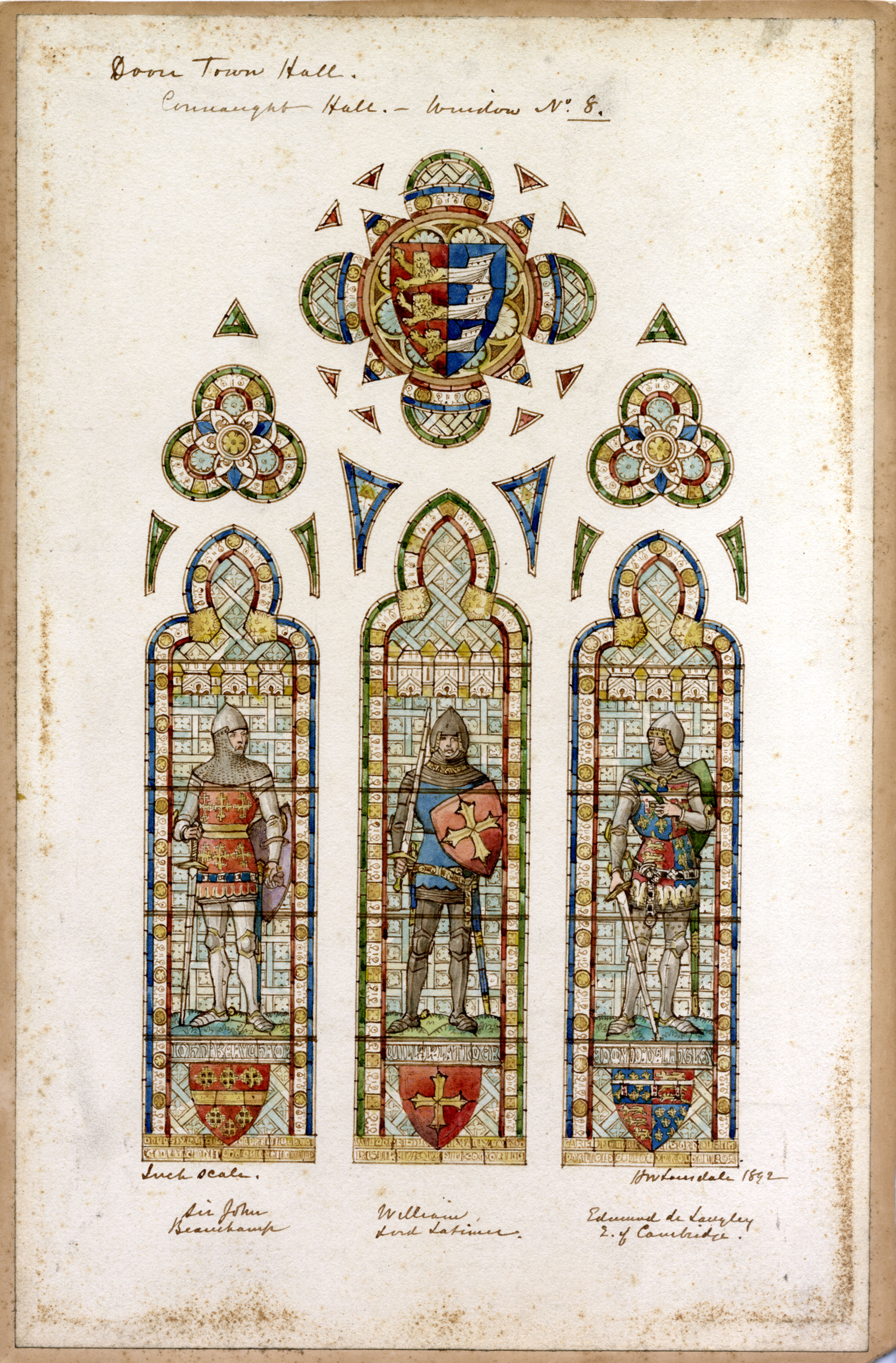
Edward Astley window design by H W Lonsdale 1892 - John de Beauchamp Lord Warden 1359-1360, William Latimer, Lord Warden 1374 and Edmund of Langley, 1st Duke of York, 1st Earl of Cambridge, Lord Warden 1376-1381 - Dover Museum

Edward Astley window design by H W Lonsdale 1892 – John de Beauchamp Lord Warden 1359-1360, William Latimer, Lord Warden 1374 and Edmund of Langley, 1st Duke of York, 1st Earl of Cambridge, Lord Warden 1376-1381 – Dover Museum

Fifth north: John de Beauchamp, 1st Baron Beauchamp de Warwick, Lord Warden 1359-1360/ William Latimer, 4th Baron Latimer, Lord Warden 1374 / Edmund of Langley, 1st Duke of York, 1st Earl of Cambridge, Lord Warden 1376-1381. Erected in memory of Edward Farrand Astley died 12 April 1907, age 95 by the Corporation.

Sixth north: Sir Simon de Burley, Lord Warden 1384-1388, Executed / Sir Thomas Erpingham, Lord Warden 1399-1409 / Thomas Fitzalan, 12th Earl of Arundel and 10th Earl of Surrey, Lord Warden 1413-1415. In memory of Edward Worsfold Mowll who died 26 January 1906 and was erected by his friends.

Edward Worsfold Mowll was one of Dover’s Stalwarts and who did much to ensure the Conservative Party victories in the town. He died after a very short illness on 26 January 1906 and was buried on 30th. On 2 May 1906, a packed public meeting, largely attended by residents of Dover and Kentish towns, decided to erect as a memorial to Worsfold Mowll, as he was known. From the funds collected, it was agreed that a stained glass window in Connaught Hall, a lych gate for St Peter’s Church, Whitfield Church were to be bought and any surplus funds to be given to the charities in which Worsfold Mowll had shown interest. The subscription achieved all three objectives and on 3 October, the window was unveiled in the presence of a large gathering.

To Visit Dover’s Maison Dieu and see the magnificent Windows and hear about the historic venue:
Guided tours are provided by volunteers from The Dover Society and are available on Wednesdays every week from 10am and 4pm (from 1 November to 31 March 10am to 2pm) and last up to an hour. For further information and group bookings, please telephone from the UK: code: 01304 and either 205108 / 206458 / 823926. Outside the UK the code: 44 0304 plus the number.

  • Published:
  • Dover Mercury 13 & 20 February 2014
Posted in Maison Dieu - Former Town Hall, Maison Dieu Windows, Maison Dieu Windows, Tourism | Comments Off on Maison Dieu Windows