Dynasty of Dover Part IV – Minet-Fector

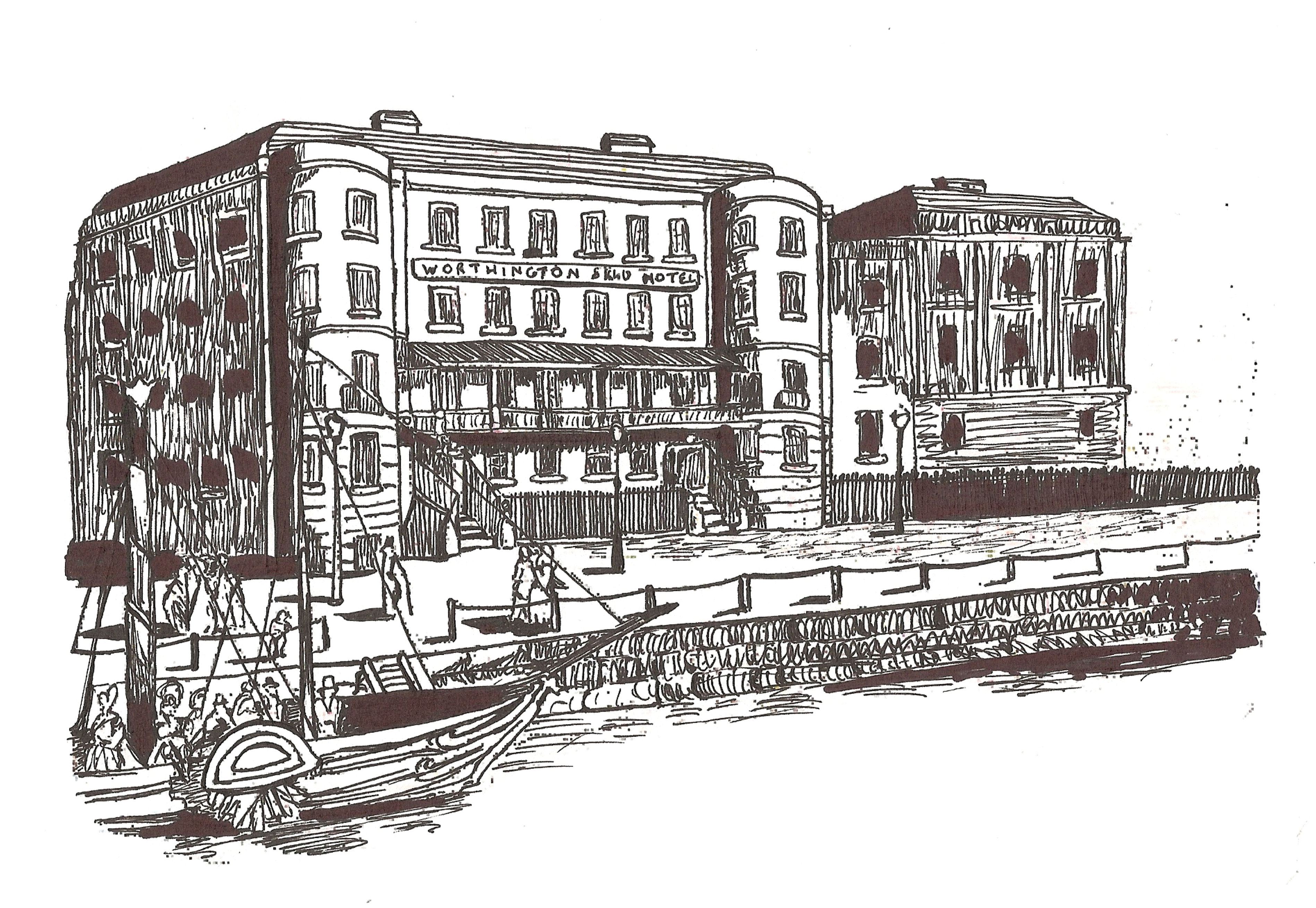
Ship Hotel, Custom House Quay, circa 1834. From an etching and drawn by Lynn Candace Sencicle

Ship Hotel, Custom House Quay, circa 1834. From an etching and drawn by Lynn Candace Sencicle

In 1856, Charles Dickens (1812–1870) stayed at the Ship Hotel, on Custom House Quay, to work on Little Dorritt. However, due to concerns over domestic issues he spent most of his time taking long walks and talking to locals. These were recounted in Out of Season, published in Household Words. Some years ago, I undertook a piece of acclaimed academic research in relation to A Tale of Two Cities, Dickens’ twelfth novel, (Dickensian Summer 2002 pp 140-144).  Dickens’ started working on the novel in March 1859 but I successfully showed that it was his 1856 stay in Dover that inspired many of the themes that he used.

The book is set at the time of the French Revolution (1789) and starts with a coach journey to Dover. Charles Dickens describes the town at that time and making an oblique reference to smuggling, ‘The little narrow crooked town of Dover is itself away from the beach, and ran its head into the chalk cliffs, like a marine ostrich. The beach was a desert of heaps of sea and stones tumbling wildly about, and the sea did what it liked, and what it liked was destruction. It thundered at the town and thundered at the cliffs, and brought the coast down madly … A little fishing was done in the port and a quantity of strolling about by night, and looking seaward, particularly at those times when the tide made and was near flood. Small tradesmen who did no business whatever, sometimes unaccountably realised large fortunes, and it was remarkable that nobody in the neighbourhood could endure a lamplighter!’
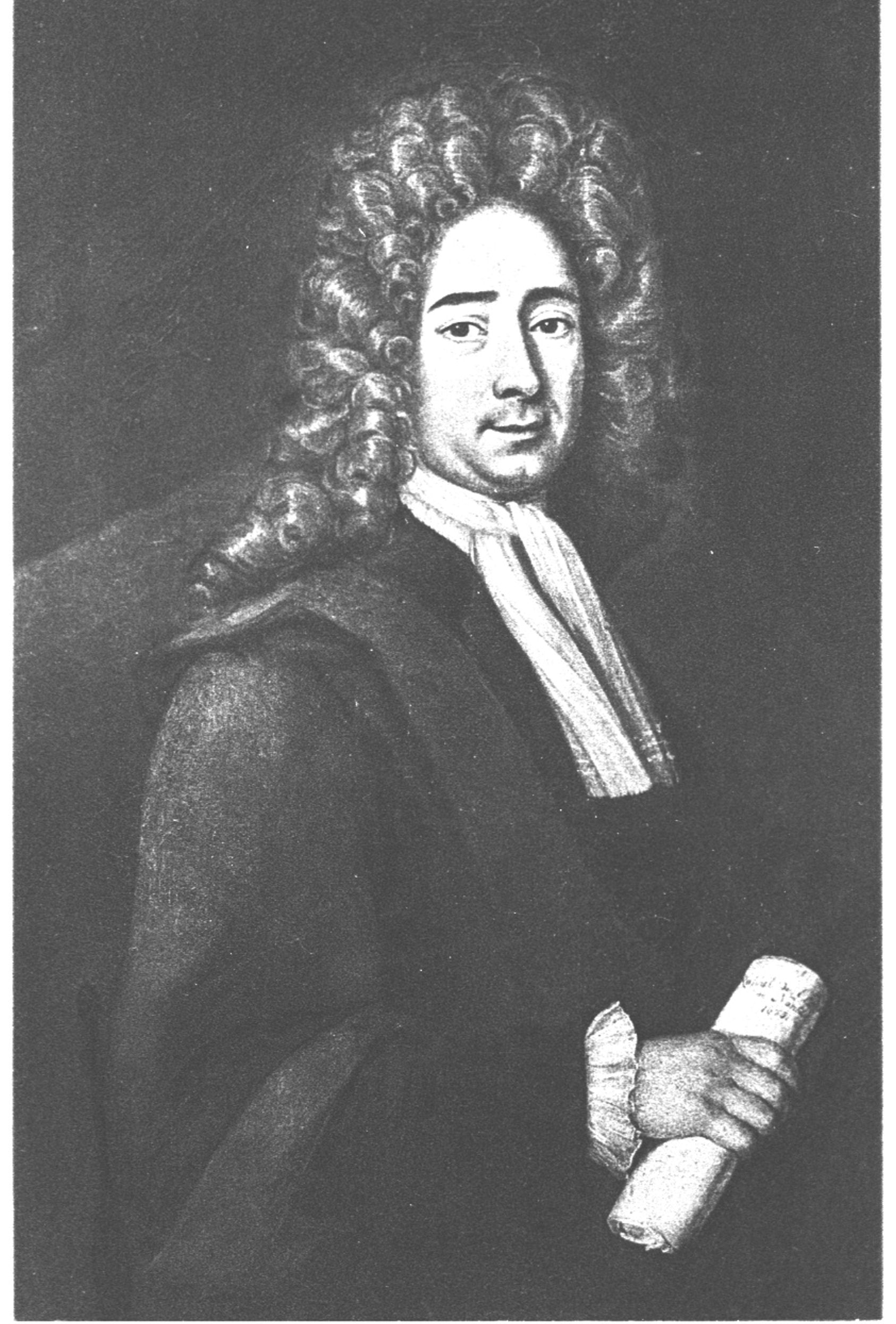
Isaac Minet - Dover Museum

Isaac Minet – Dover Museum

The key characters in the Tale of Two Cities not only have similar names to members of Dover’s Minet-Fector family, there is reason to believe that the main character, Charles Darnay, was based on one of Dover’s leading personalities at the time of the French Revolution (1789), John Minet Fector (1754-1821). A key player in the Dynasty of Dover, John was the son of Peter Fector (1723-1814), who came to Dover as a 16-year old from Rotterdam to do his apprenticeship in his uncle’s shipping business. His uncle was Isaac Minet, a wealthy Huguenot (French Protestant) merchant of Calais who managed to escape to England in 1685 at the time of religious persecutions in France.

Isaac Minet’s home and business was in Strond Street on the north side of the Bason, now Granville Dock, in the Pier District. Between Strond Street and the Western Heights was – and still is – Snargate Street and on the other side between Strond Street and the Bason, Custom House Quay. There, Isaac built ‘notable mansion’, named at Pier House, which fronted Strond Street and backed onto the Quay. Nearby was the Customs House that gave its name to the quay. Once Isaac was made a Freeman, his business flourished and by 1721, he owned four packet boats running regularly between Dover, Calais and Boulogne.

Pier House, Strond Street. Minet and then the Fector family home. Lynn Candace Sencicle

Pier House, Strond Street. Minet and then the Fector family home. Lynn Candace Sencicle

Isaac was a frail old man when Peter Fector came to Dover so he was put to work and train Isaac’s youngest son, William Minet (1703-1767) direction.  William was an excellent teacher and by April 1743, Peter had become confident in all aspects of the company business and noting what new directions it might take. In charge of the Custom House next door was Kit Gunman (1714-1781), who had purchased the lucrative position and would boast of the excise taxes he imposed of which he received a percentage. Peter Fector observed that Dutch and French ships would use Madeira, a Portuguese island, as a clearing house for trade with the English American colonies, which seemed to him to be illegal.

Gunman explained that the English Navigation Acts were designed at keeping the English colonies dependent on the mother country. This should have meant that goods could only be transported in English ships or via England and this accounted for why the Dover custom house was so busy. However, the man with the power behind the Portuguese throne, the Marquis of Pombal (1640-1777) had, during his career, created a special relationship with England. Part of the agreements allowed him to turn Madeira into a clearing port under the English Navigation Acts, as the island was en-route to the America’s from mainland Europe. (See the Edward Randolph story). This, Peter was to bear in mind and later opened an office in Madeira.
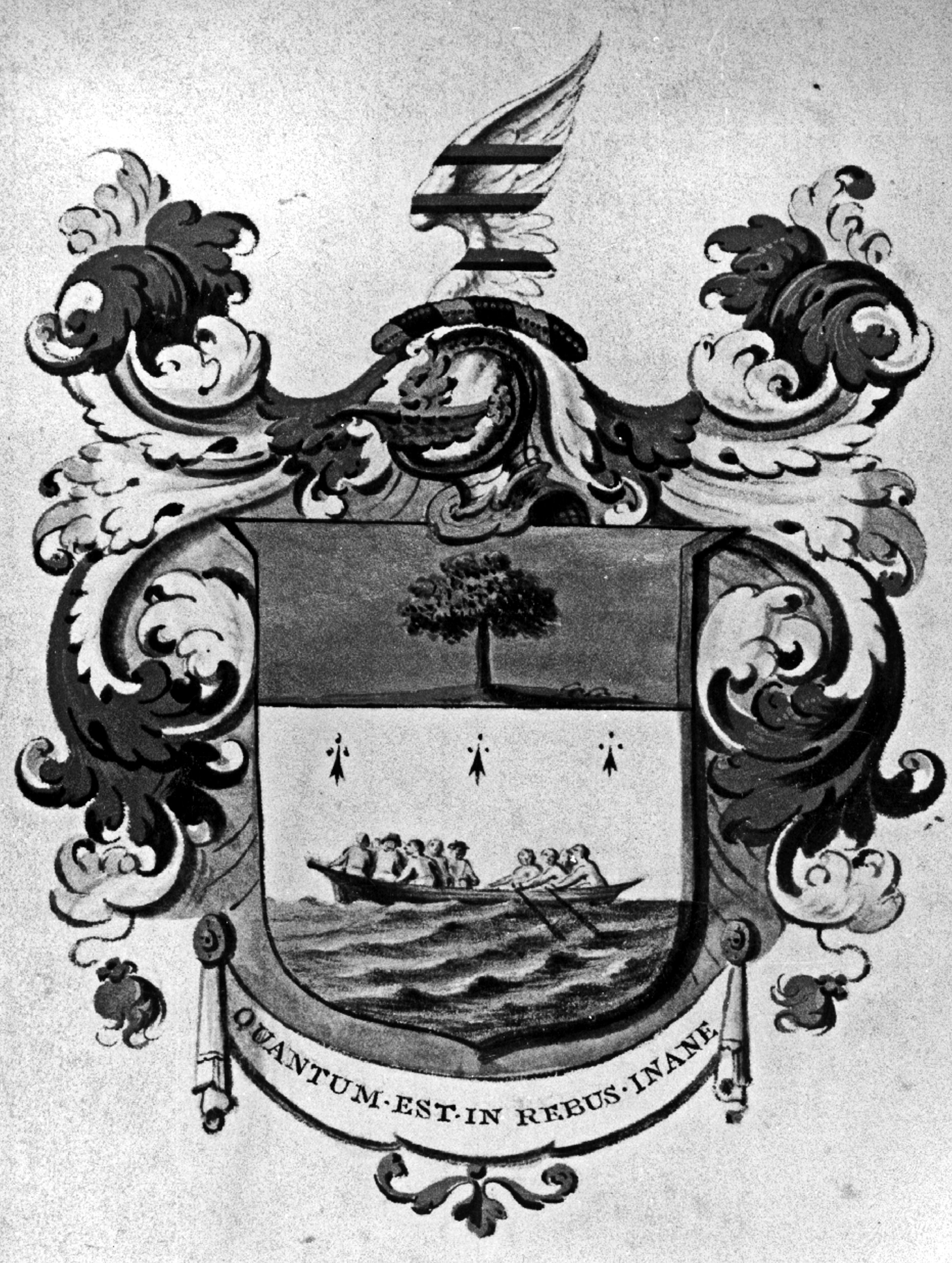
Minet Family Arms 1797 depicting the rowing boat in which Isaac crossed from France. Dover Museum

Minet Family Arms 1797 depicting the rowing boat in which Isaac crossed from France. Dover Museum

It was about this time, circa 1740, that Isaac and William took the first step into the field of banking. Although the running of their own ships was the main function of the business, they were also shipping agents, importers, and exporters on their own behalf as well as for others. Isaac was already offering deposit facilities of hard cash to both mariners and traders for which he issued a receipt. Because of the number of transactions going through the books, these receipts started to be used as tender – or Bills of Exchange – which, particularly traders, were using to settle commercial transactions. The Bills of Exchange where then used by the purchaser of goods to buying another set of goods. Somewhere along the line one of the suppliers present the Bill of Exchange – that may have been used for several transactions – to the Minet establishment in exchange for cash. The deposited hard cash, in the meantime, was kept safe by the Minet’s who charged a low interest rate to the final person in the chain.

The Wars of the Austrian Succession (1740-1748) had been raging for four years before England, in March 1744, joined in. This brought the country into conflict with her old enemy, France and from April that year, Dover’s ship owners could buy Letters of Marque. These were effectively a licence issued by the government that allowed private citizens to seize goods of enemy ships as a prize for making war on them – in other words a legal form of piracy! Privateering, as it was called, was to provide the fortune of a number of Dover households including the Minet-Fector. Indeed Peter writes on 5 September that he expects to get a cut as a ship of company, the Eagle, had successfully captured a French ship!

Dover Castle

Dover Castle

The French prisoners of war were housed in Dover Castle and it was Peter’s job to exchange the prisoners’ money into English currency to enable them to buy food etc. from the prison guards. Among the prisoners were French officers from affluent families who received greater sums from home. For these prisoners Peter recognising that they were vulnerable to theft offered to look after their hard currency and issued Bills of Exchange that they used to buy goods. The prison guards were happy with this and soon the Bills of Exchange became an unofficial form of currency.

Uncle Isaac and William along with Peter, quickly realised that the amount of hard cash that was being withdrawn from their depository, was only a small percentage of the full worth of their Bills of Exchange. Therefore, they could issue Bills of Exchange backed by either of the currencies when folk asked for loans and because there was not much call for the hard currency, the chances of having a run on that was low. When they took this step, Dover’s business community started to expand and modern High Street banking was born.
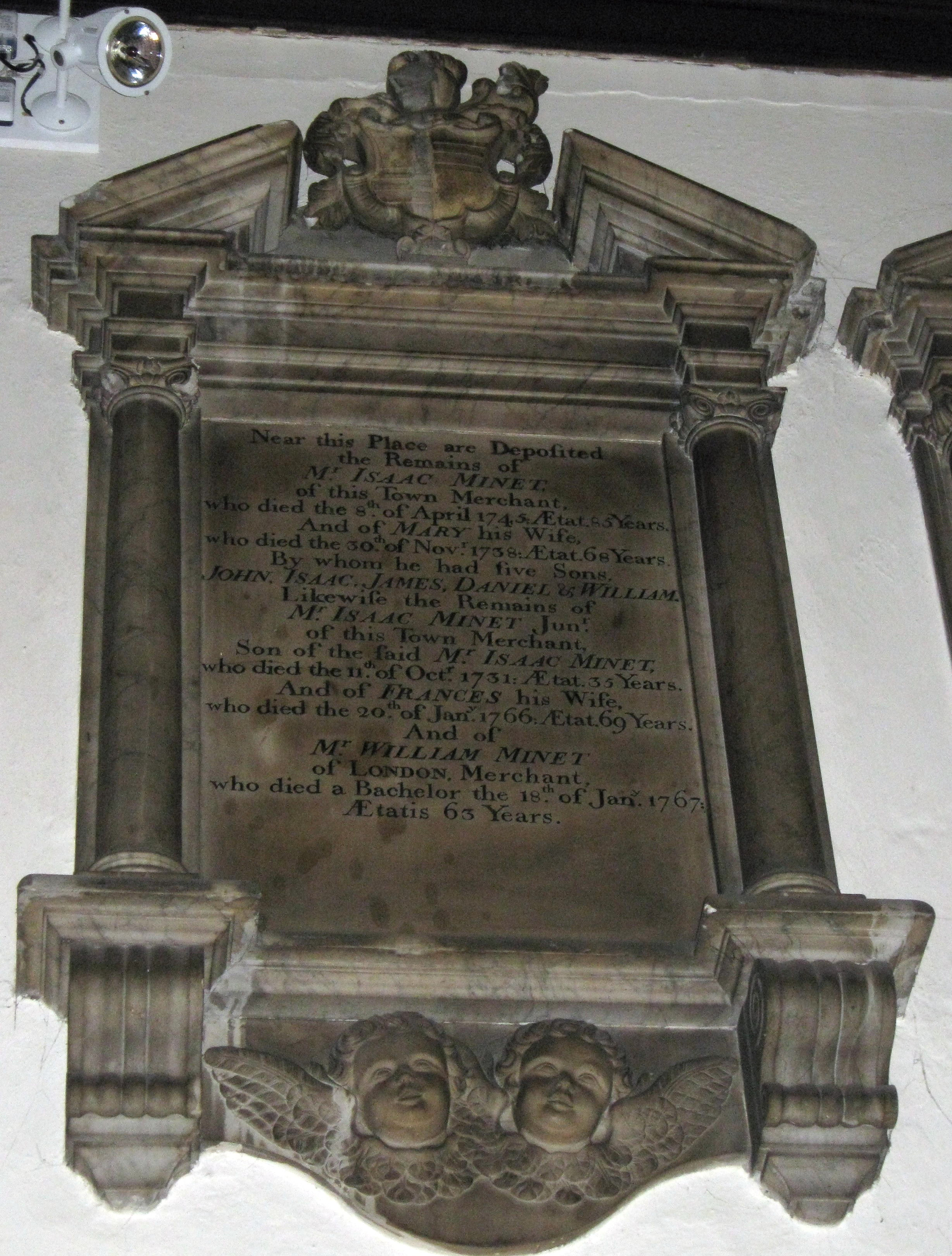
Memorial in St Mary's Church to Isaac Minet (died 08.04.1745) and William Minet (died 18.01.1767).

Memorial in St Mary’s Church to Isaac Minet (died 08.04.1745) and William Minet (died 18.01.1767).

On 8 April 1745, Isaac Minet died and was buried at St Mary’s Church where a memorial can be seen near the south door. On 9 September, Peter paid £10 to become a Freeman by purchase and in 1746, bought one-third share in the Dover business. At Canterbury Cathedral on 13 July 1751 Peter married his half-cousin, Mary Minet (born 4 February 1728), against the wishes of her father. They had 5 children, Elizabeth (1752-1820), who married Charles Wellard; John Minet (1754-1821), more of whom below; Mary (1757-1814) who became Peter’s housekeeper on the death of her mother; James Peter (1759-1804) more of whom below and William (1764-1805) actor/ theatre manager.

Uncle William died on 18 January 1767  in London and his body was brought back to London for burial at St Mary’s Church and Peter increasingly took control of the extensive Dover business from other Minet family members. Back in 1753, Peter had been forced to resign from the office of Dover council Jurat, because he was not English by birth. This affected Peter so much that he became ruthless in all his transactions and refused to have anything to do with Dover’s established society except for business. Albeit, two of Peter’s sons, John (b1754) and James (b1759) were already part of the business, John working to take over the shipping side and James learning the basics of banking.

The American Colonies declared their independence from England on 4 July 1776. In the same year a recent emigrant Thomas (Tom) Paine, whom it is locally believed to have come from Sandwich, published the pamphlet ‘Common Sense.’ Aimed at those loyal to the Crown, he said that they were ‘… with a heart of a coward and the spirit of a sycophant,’ and two years later, on 17 July 1778, France declared war on Britain in support of the Colonists. Dover’s defences were put in charge of Captain Thomas Hyde Page (1746-1821) and in 1781, the Board of Ordnance bought two parcels of land on Western Heights, totalling 33 acres. Page, organised the building of fortified batteries, on this land, for which he was knighted. By the time peace returned the works on Western Height incorporated a self-contained redoubt fort at the eastern end of the hill and a Citadel on the west, with entrenchments between – this was the start of a major permanent new fortress on the Western Heights.
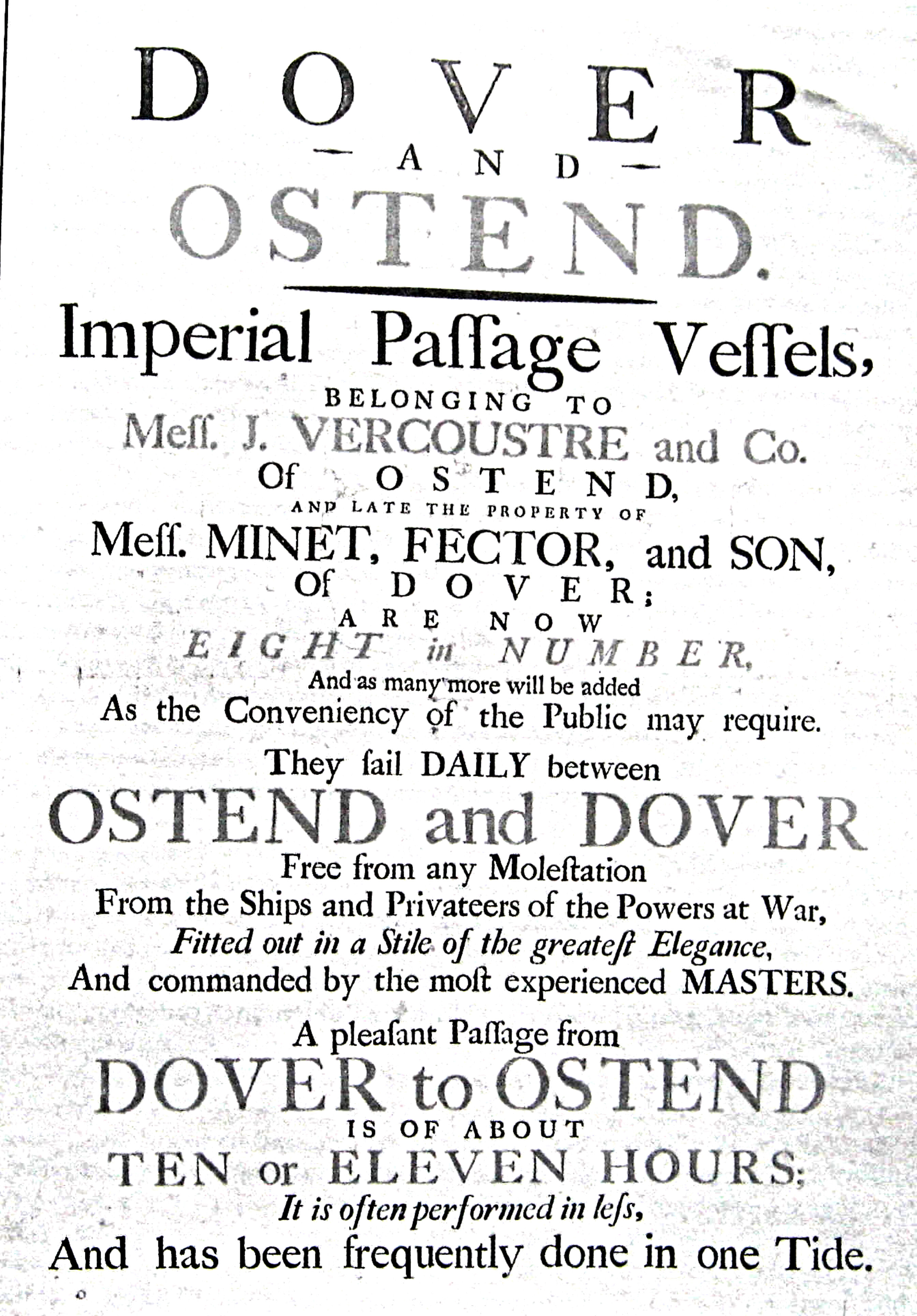
During the American War of Independence 1776-1781 the Fectors sold some of their ships to Flanagan Vercoustre of Ostend. Dover Museum

During the American War of Independence 1776-1781 the Fectors sold some of their ships to Flanagan Vercoustre of Ostend. Dover Museum

Initially, the War took its toll on the Fector business and Peter was obliged to sell some of his ships to Flanagan Vercoustre of Ostend. The Fectors still managed them and had Letters of Protection. However, French privateers took little notice and the Dover packets were in danger of ceasing. The Fectors and other packet owners started to use small but fast boats with shallow draughts and used ‘safe’ Continental natural harbours. Their main source of income was smuggling. From these revenues the Fectors started to buy their ships back and successfully sought Letters of Marque. This enabled the ships to carry weapons and as records show, the Dutton, an East Indianman running out of Dover made £30,000 in profits from only three privateering voyages at that time.

Nonetheless, the Fectors, and it was believed the eldest son John, was either involved or turning a blind eye to smuggling when their boats and ships were involved. Soon the smuggling became so flagrant that there was a public outcry and investigations were undertaken. It was found that in Dover the game of eluding the revenue laws were played to perfection and with even more zest in the West Country. Admiralty records show that Customs Officers more than once complained of the obstruction they met with when the Revenue men went on board Dover packets and passage ships to carry out routine examination. By the end of the War four Dover packets operated, making the crossing every Wednesday and Saturday with mails for Calais and Ostend and belonged to either the Fectors or the Lathams, Dover’s other banking family.

By this time, Dover was in the state described by Dickens’ in Tale of Two Cities, cited above. In 1778 the Dover Local Government Act created the Dover Paving Commission in order to rectify matters. The Act was renewed in 1810 and three times after, the last time in 1835. The members included members of Dover’s old established elite and a number of new ‘monied’ personnel but not the Fectors. Although the Commission instituted a number of reforms it was noticeable that the lighting of the streets was to remain deficient compared to other towns and cities. Historian, Edward Hasted, wrote in 1797, that ‘so numerous are the contraband traders here whose success is chiefly owing to the blackness of the night; and at this time there is not a single light in the night throughout the whole town of Dover.’ Brandy, wine and tea were the main commodities smuggled.
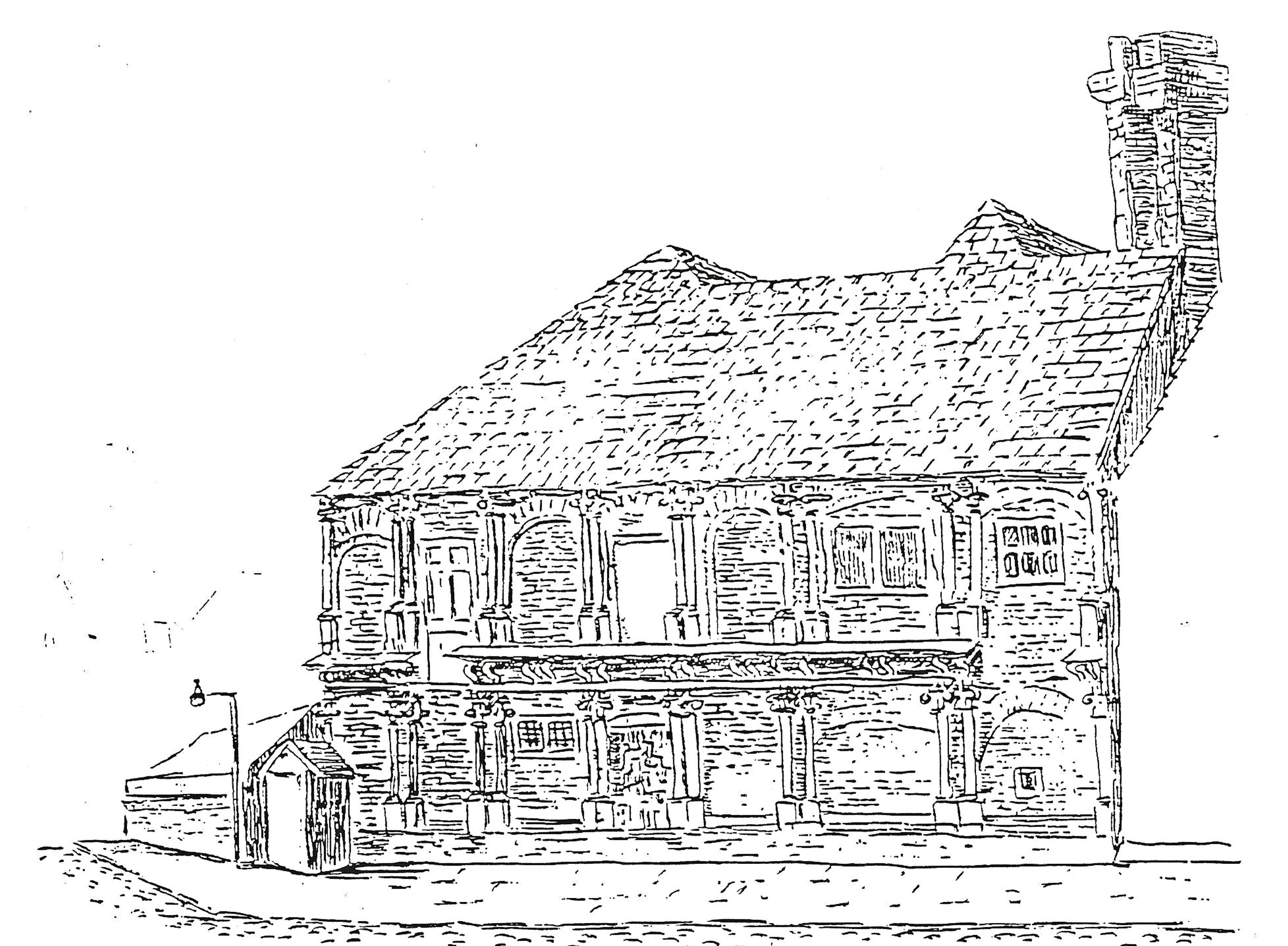
Old Customs House built 1666 demolished March 1821 replaced by John Minet Fector Bank in 1821. Dover Museum

Old Customs House built 1666 demolished March 1821 replaced by John Minet Fector Bank in 1821. Dover Museum

This was not new, John Wesley (1703–1791), the founder of Methodism first visited Dover in 1760 and expressed concern about the prevalence of smuggling, denouncing it by saying, ‘every smuggler is a thief-general who picks the pockets both of the king and all his fellow subjects. He wrongs them all.’ While William Arnold, the Revenue Collector for Cowes, having been to Dover, wrote in 1784, ‘These vessels frequently convoy over the other smaller ones. They keep off until towards night, when they run and land their cargoes at places where gangs of smugglers sometimes to the number of 200-300 meet them. Goods are often landed and (are) of large casks, which have been unshipped from the seafront, the importing vessels. As soon as seen by a Revenue cruiser, they drop the boat astern, which immediately rows off while the commander of the Revenue Cutter is pursing the vessel he supposes to be loaded …

Blanchard and Jeffries Channel Crossing, Friday 7 January 1785. Dover Library

Blanchard and Jeffries Channel Crossing, Friday 7 January 1785. Dover Library

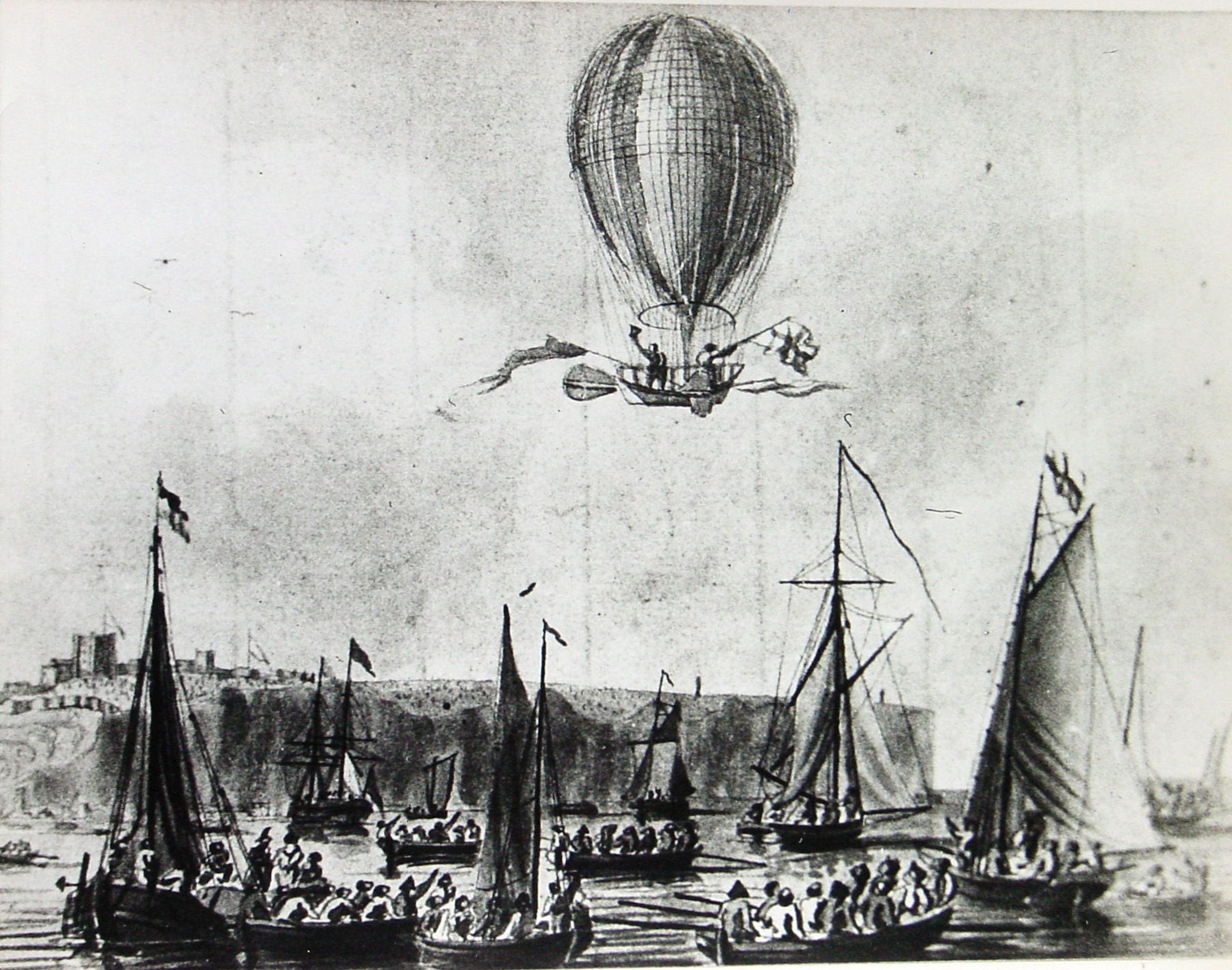
The following year, 1785, the people of Dover witnessed, with great excitement, the flight from Dover’s Castle Hill to France of Dr John Jeffries from Massachusetts and M. Jean Pierre Blanchard, in a hot air balloon. Mail coaches between Dover and London were introduced in 1786, which increased the number of passengers crossing the Channel to the Continent. In the autumn of that year, just as the crops were being brought in, East Kent suffered the ravages of unprecedented storms. Many of those who normally worked on farms came into Dover to look for work around the harbour or on ships. Both the Fectors and Lathams, Dover’s other maritime banking family, were sending out coastal vessels to bring back supplies of vegetables and cereals.

King George the Fector flagship c1790 by Lynn Candace Sencicle

King George the Fector flagship c1790 by Lynn Candace Sencicle

In 1783, the firm became Fector & Minet with John in charge. ‘A Gentleman’ on a ‘Tour thro’ the Whole Island of Great Britain’, in 1792, wrote, ‘… The Packets for France go off from here, in time of Peace, as also those for Ostend, with Mails for Flanders; and all those Ships which carry Freights from New York to Holland and from Virginia to Holland, come generally hither, and unlade their Goods, enter them with the Custom-house Officers, pay the Duties, then enter them again by certificate, reload them and draw back the Duty by Debenture, and so they go away for Holland …’ John was one of the main shipping agents to many famous London merchants and also looked after the interests of the East India Company.’

John married Anne Wortley Montague Laurie (1769-1848) of Glenairn, Dumfries, in 1794. She was the daughter of General Sir Robert Laurie, member of Parliament for the county of Dumfries . They had four children, Anne Judith born 1799, Charlotte Mary born 1801, Caroline born 1804 and John Minet junior born 28 March 1812. James married Frances Lane, daughter of Thomas Bateman Lane in November 1783 and had five children, three of which survive to adulthood. They were, Peter Lane born 1787, Mary born 1791 and Emma born 1792.

Minet Fector Bank draft for £20.3s payable to W & E Allen 24.10.1801. Reproduced by kind permission of The Royal Bank of Scotland Group © 2013

Minet Fector Bank draft for £20.3s payable to W & E Allen 24.10.1801. Reproduced by kind permission of The Royal Bank of Scotland Group © 2013

By the outbreak of the Napoleonic Wars (1793-1815) John was not only well respected he had that extra quality of commanding loyalty from his workers. This loyalty was well rewarded as was shown when the captain of the Prince of Wales, one of their cross-Channel packets, was found carrying a substantial amount of contraband. John stood bail for a ‘considerable sum’ and although the smuggled cargo was impounded, no charges were brought. Nonetheless, there was concern over John’s alleged smuggling activities particularly by Thomas Mantell. Following the French Revolution on 11 July 1789, John’s fleet of ships, sometimes with John at the helm, were known to be crossing the Channel far more often than warranted by the number of passengers or goods carried. During the year of his Mayoralty, in 1795, Thomas Mantell led a crusade against smuggling with his sights set on John.

Officially, during the Napoleonic Wars, Calais and other Channel port were no longer open to English ships but because the Fector bank held a large percentage of the Vercoustre company based in Ostend, their ships sailed under the neutral Belgian flag and were immune from attack. In fact, their advertisement asserted that they sailed ‘free from moslestation from ships and privateers of the Powers at War’. Nonetheless, the Napoleonic Wars put a great deal of strain on the British economy. Between 1793 and 1796, the government’s deficit abroad amounted to £36,439,269 with excise and customs duties its main source of revenue. This was of a similar magnitude to the deficit that had started the chain of events culminating in the French Revolution.

Matters came to a head in February 1797 when the coins and bullion held by the Bank of England against liabilities such as its banknotes, had fallen so low that the Bank Restriction Act was passed which meant that bank notes could no longer be exchanged for gold. On 5 March 1798 a man was about to be arrested at a fisherman’s house, in Folkestone, escaped but was later apprehended at Rochester. He left behind him three mahogany boxes in one of which were some letters. The captain of a Dover vessel was arrested and he acknowledge that he had accepted a large bribe from the man who wanted a passage to France. The fisherman was to take the man and the boxes to the vessel.

In April 1799, a warrant was issued for John’s arrest but before it was invoked, he had disappeared and the people of Dover closed ranks around him although there was a substantial reward on offer. John was accused of ‘aiding the enemy’ by smuggling gold to France in exchange for wine and brandy. The hearing was held without John and the evidence against him was overwhelming and included papers that the man in Folkestone had left behind. To everyone’s surprise John was suddenly cleared! (see Peter Fector – the story behind the Town’s treasure and the Country’s banking system)
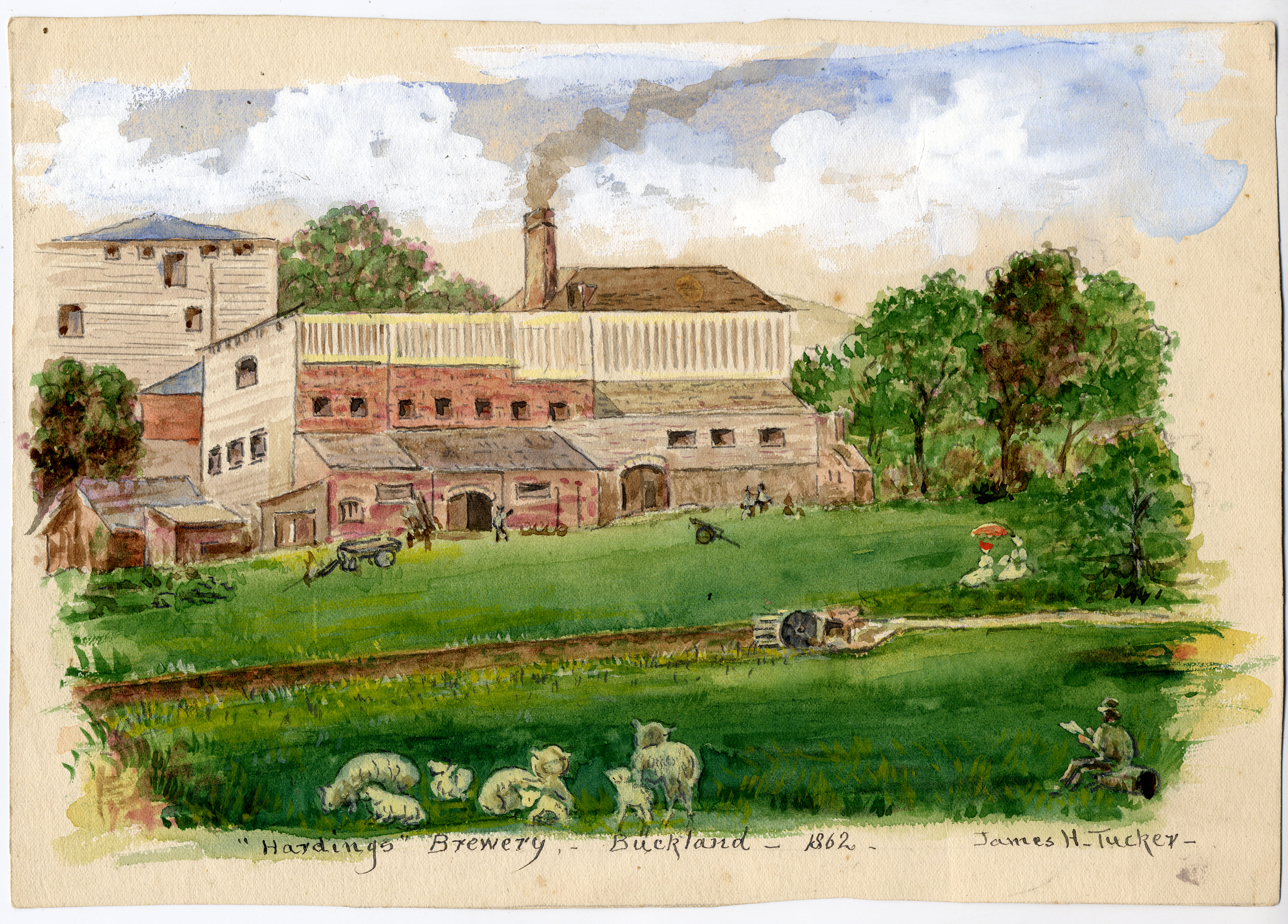
Hardings Brewery 1862 that was previously Lower Buckland Paper Mill, painted James A Tucker c 1910. Dover Museum

Hardings Brewery 1862 that was previously Lower Buckland Paper Mill, painted James A Tucker c 1910. Dover Museum

Part of the Bank Restriction Act enabled country banks, such as the Fectors, to print promissory notes. James had virtually taken over from Peter the running of this side of the business at local level, particularly the mills. The three-four mile long, River Dour supported seven paper mills and six flourmills. In around 1780, William Phipps purchased the River paper mill using a loan from the Fector bank. Two years later Phipps was declared bankrupt and the mill reverted to Fectors with Phipps running it. Phipps quickly recovered his financial position and leased the mill from the bank. In 1800 he paid £2,000 through Israel Claringbould ‘to Peter and James Fector’ to repurchase it. In 1795, Phipps purchased the lower Buckland Paper Mill using loans from both Fector and Latham banks.

Peter Fector. Dover Museum (detail)

Peter Fector. Dover Museum (detail)

For his part, Peter concentrated on lending money to the wealthier clients with large estates around Dover and by their default, acquired a number of them. He purchased Kearsney Manor in 1790 and gave it to his son John. Peter had, in 1762, built a fine mansion Eythorne House, a village of the same name north east of Dover that had views across the Channel to Boulogne. There he had lived with his beloved wife, Mary and adored family. Mary Fector died on 21 October 1794 and was buried at Eythorne.

Although General Napoleon Bonaparte, seizing power at the end of 1799, caused consternation over the possible threat of invasion in Dover, the panic soon subsided. It was estimated that 10,000 troops were brought into the town to meet the invasion, but when it did not materialise most were given their marching orders. The militia followed the troops, but even they only stayed a short time. By the time the town and country were celebrating the two Acts of Union between Great Britain and Ireland on 1 August 1800, it was reported that only the local Volunteers and the Essex militia were quartered in Dover.

During the American War of Independence, Thomas Hyde Page, with the backing of John Latham, had set up the Dover Volunteers Association, the forerunners of the war time Home Guard and the present day Territorial Army. In 1798, eight companies had been re-formed by the decree of the Mayor, William Knocker, who also was appointed a captain. It was expected the William Pitt (1759-1806), Prime Minister and Lord Warden, would welcome the move but in 1803 he stated that they should, ‘never be sent out of the country except in case of actual invasion.‘ The main role of the Volunteers was that of signallers, ‘being stationed at different places along the coast to transmit to the others inland the news of the approach, if it should ever come, of the French fleet.’ However, Thomas Pattenden (1748-1819) wrote in his diary of the time, that volunteers paraded in their scarlet uniforms on the Ropewalk (now Camden Crescent) and then marched with William Pitt at their head to Maison Dieu Fields (now the Dour Street area). Pattenden described the defences that were erected in and around Dover to counter a possible invasion and details of the troops that embarked from the harbour.    

Dover Harbour c 1830

Dover Harbour c 1830

As a reaction against the French blockading the port of Dover, the ‘Corps of Sea Fencibles for the Defence of the Coast of England against Invasion’, was formed. This included Dover’s two shipping magnets, John Fector and John Latham whose businesses were suffering because of the blockade. The corps was made up of seafaring men resident in Dover and other ports. Their duties were to gain intelligence and to offer greater security to coast-trading vessels.

On 22 July 1801, soldiers from the Castle reported that on the hills around Boulogne, they could see Napoleon’s army getting ready for invasion and in the harbour ships were being prepared to bring an army across the Channel. Within five days the British fleet, under the command of Horatio Nelson (1758-1805) assembled in the Downs off Deal. At 22.30hrs on the night of 15 August a fleet of ‘8 flat boats 8inch howitzers with a Lieutenant in each and 14 men and artillerymen … and 6 flats with 24 pounder carronades with a Lieutenant in each, seamen and 8 marines … under the command of four captains,’ crept into Boulogne harbour. Unfortunately, the boats did not arrive together and the first ones roused the French. They quickly took to their boats and the British flotilla was defeated. Of the men who set out 44 were killed and 128 were wounded.

Castle Hill House where the magnificent 'Peace Ball' was held in 1802

Castle Hill House where the magnificent ‘Peace Ball’ was held in 1802

With great relief in Dover, by October 1801,  moves were being made to sign a peace treaty between Britain and France. This resulted in the Peace Treaty of Amiens of 27 March 1802 and that evening the Mayor George Stringer organised a grand ball at his home, Castle Hill House. Neither John Minet nor John Latham were convinced that peace would last for although the blockade of Dover had been lifted, the terms of the Treaty meant that the French could exclude the British from trading with ports that had French ties.

The Dover garrison was reduced from 10,000 men to just a few hundred and local trade almost died. Meanwhile the long term problem of the shingle bar was making the harbour difficult to enter. In an effort to combat this, the Harbour Board invited engineers John Rennie and Ralph Walker to suggest how improvements could be made. Their report was published on 8 December 1802 advising that the south pier be lengthened and contoured at its tip to ‘shoot the pebbles past the mouth of the harbour.’ The cost of undertaking was estimated at £54,000 and was therefore shelved.

As Fectors and Lathams expected, the Amiens Peace Treaty was not to last. At the end of March 1803, Napoleon Bonaparte announced that Britain had violated the Treaty. He subsequently occupied Switzerland and closed the Dutch Ports to British trade. On 17 May, Britain declared war on France and the government remobilised the Navy and reintroduced the Letters of Marque. Through the Army Reserve Act, they encouraged the enlistment of thousands of volunteers and re-introduced Income Tax that had been set up and abolished the year before. In Dover, Lady Hester Stanhope, (1776-1839) acting as deputy of the Lord Warden, her uncle William Pitt, equipped his volunteer regiment – the Cinque Ports Fencibles. Most Dovorians enrolled including both John and James Fector. Dover’s diarist, Thomas Pattenden recorded that the volunteers paraded in their scarlet uniforms on the Ropewalk and then marched with William Pitt at their head to Maison Dieu Fields.

Lady Stanhope wrote, ‘We took a (French) vessel the other day – loaded with gin – to keep up their spirits; another with abominable bread and vast quantity of peas and beans, which the soldiers eat. One of the boats had an extremely large chest of medicine, probably for about half the flotilla, their guns are ill-mounted and cannot be used with the same advantage as our fine pieces of ordnance. Bonaparte was to be at Boulogne a few days ago, our officers patrolled all night with the men, which was pleasant. I have my orders how to act in case of real alarm in Mr Pitt’s absence.’ (14 January 1804)

Some of the cross-Channel packet boats were fitted out as fighting ships and it is recorded that the Minerva, under the command of Lord Proby was used to gather pressed men. The Press gangs were made up of officers and men from the ship, who would go into taverns or even enter homes uninvited, and press any male they found into public service. These men, often not mariners, were then taken to join the fleet as sailors.
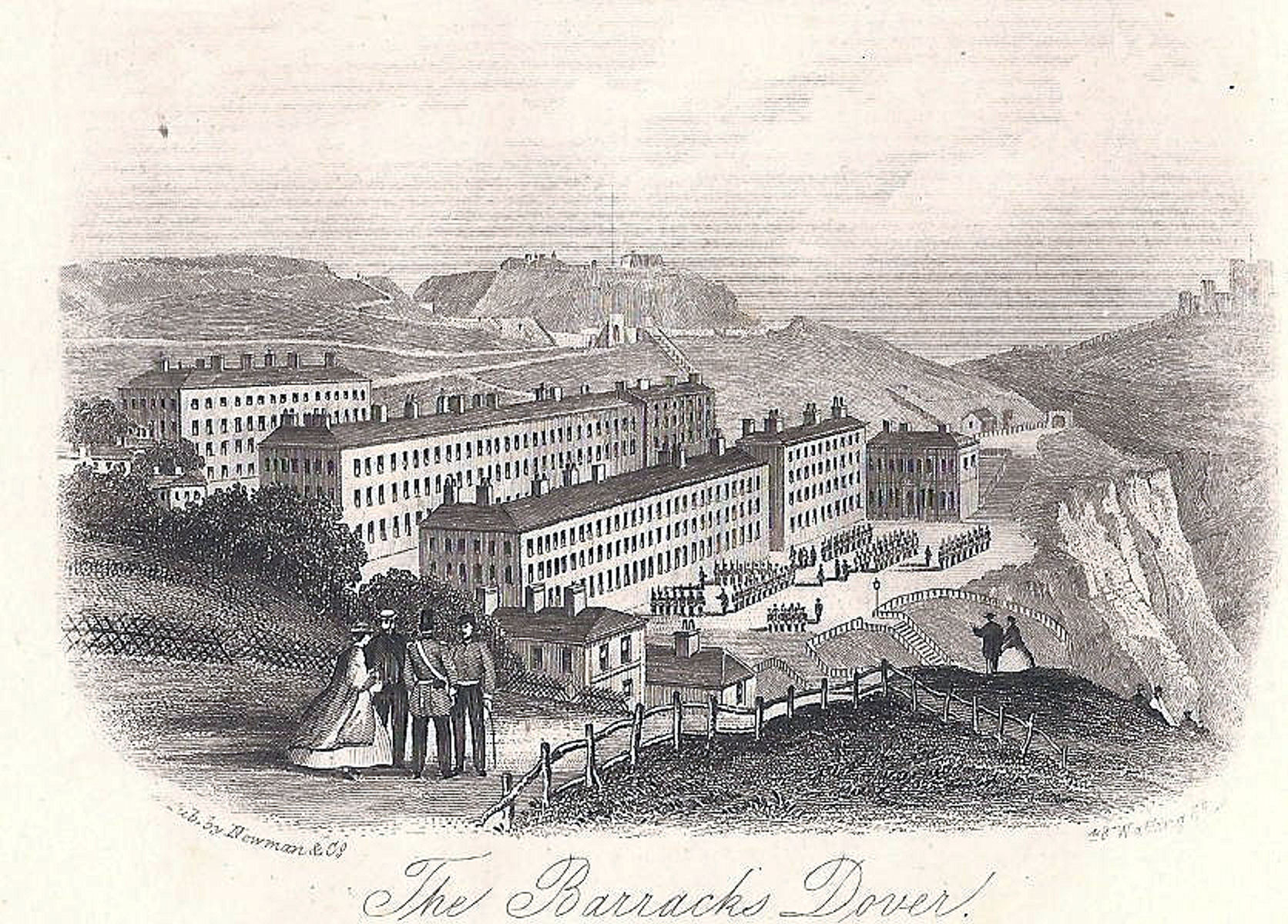
Grand Shaft Barracks 1850s. Dover Library

Grand Shaft Barracks 1850s. Dover Library

War meant an influx of about 20,000 soldiers into Dover and an impressive new orders for ships – sailing ships built in Dover already had the reputation of being the ‘Pride of Europe’. On 18 May 1804, Napoleon declared himself Emperor and the fear of invasion was very real. By 9 August, more than 100,000 seasoned French troops were on the hills outside Boulogne, while in the harbour there were 2,000 landing craft at the ready. The Volunteers set up a chain of semaphores from Dover to London, so messages could be passed to George III (1760-1820) should the invasion force arrive. Queen Charlotte (1744-1818) had been sent to Worcester with the Crown jewels for safety.
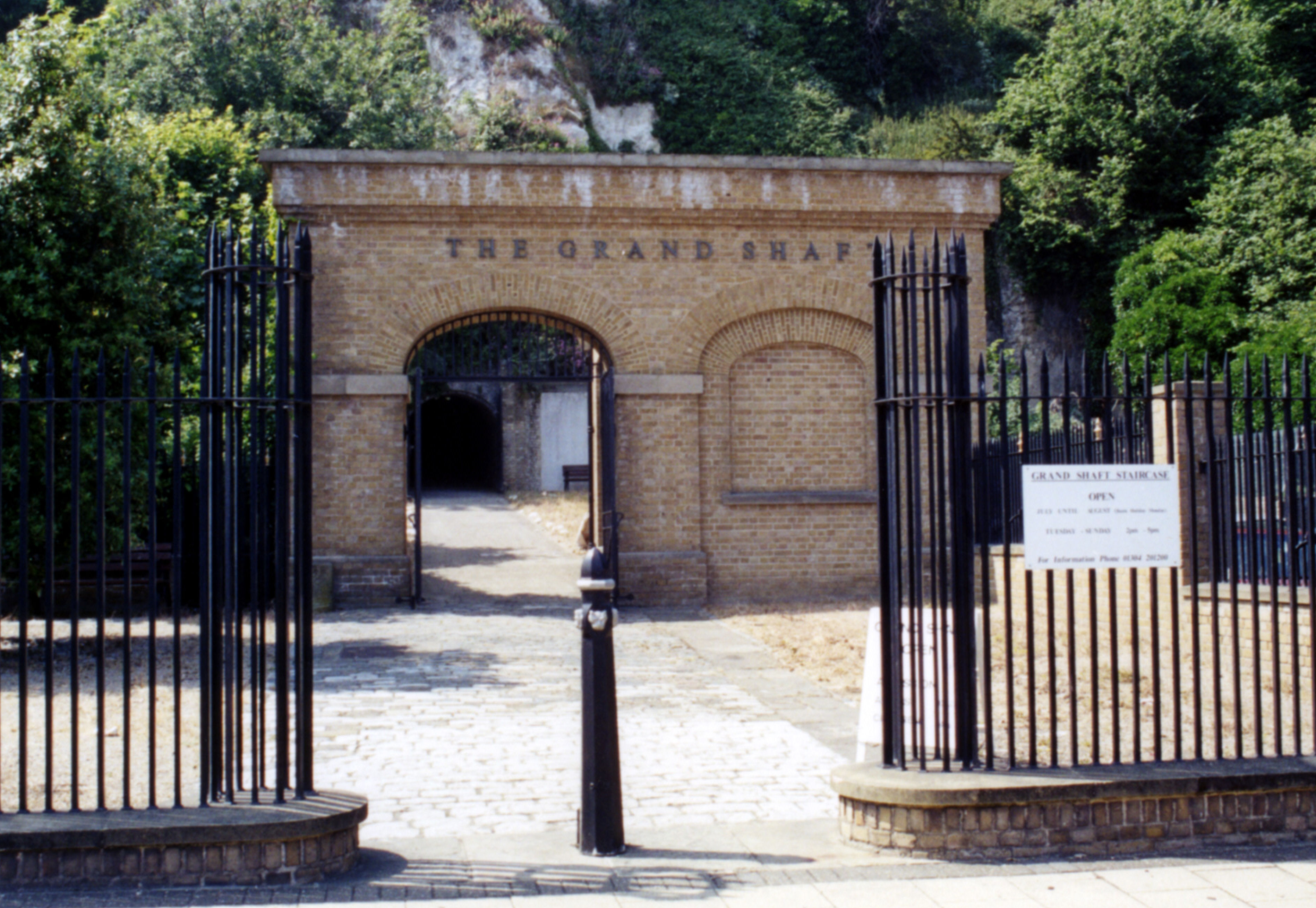
Grand Shaft, Snargate Street Entrance. Dover Museum

Grand Shaft, Snargate Street Entrance. Dover Museum

A massive defence programme was started on Western Heights, including the:
Citadel – The centre of the defences, this was built between 1804 and 1815, and completed in 1853-5 – during the next Napoleonic threat.
Drop Redoubt Fort – the second major defence. A sunken fortress of considerable strength, from which soldiers were able to fire in all directions, it was built between 1804 and 1808.
Barracks – These were located in the dip, near the cliff edge above Snargate Street. They provided accommodation for 59 officers, 1,300 NCO’s and privates plus eight horses. They were renowned for their light and airy situation and were used in times of war up until the end of World War II.
Military Hospital – This was built near Archcliffe Gate and had beds for 180 soldiers.
St Martin’s Battery, a 3-gun emplacement, and commanding unrivalled views of the harbour and town. It was named after the Patron Saint of Dover, St Martin.
Running between all these locations was, and remains, a series of deep dry moats, which were dug straight out of the chalk and lined with brick or flint.
To get them men from the barracks to the harbour the Grand Shaft triple stairway was built. The total cost of the defences on Western Heights was £236,305 17s 2d.
Across the valley, at the Castle, the Mote Bulwark and the Guilford Shaft were built to link the Castle with the shore.
The Casemate Barracks were extended from just above Cannons Gate.
Along what are now Townwall Street and Woolcomber Street a defensive canal was dug – all traces of which have now gone.
The Cinque Ports Volunteers, for the most part, manned the defence of the coast and at St Margaret’s Bay, a wall that formed part of the defences can still be seen.

Ship and military building together with victualling meant that local trade boomed in the town as never before. Much of the timber for shipbuilding came from the forests around Lyminge, Elham and Lydden. The bricks were initially brought in by sea from Ipswich but at a cost of £3.12s 6d per thousand this galvanised Dovorians into manufacturing them. The first recorded brickfield was at Dodd’s Lane, off Crabble Hill and was founded in 1808.
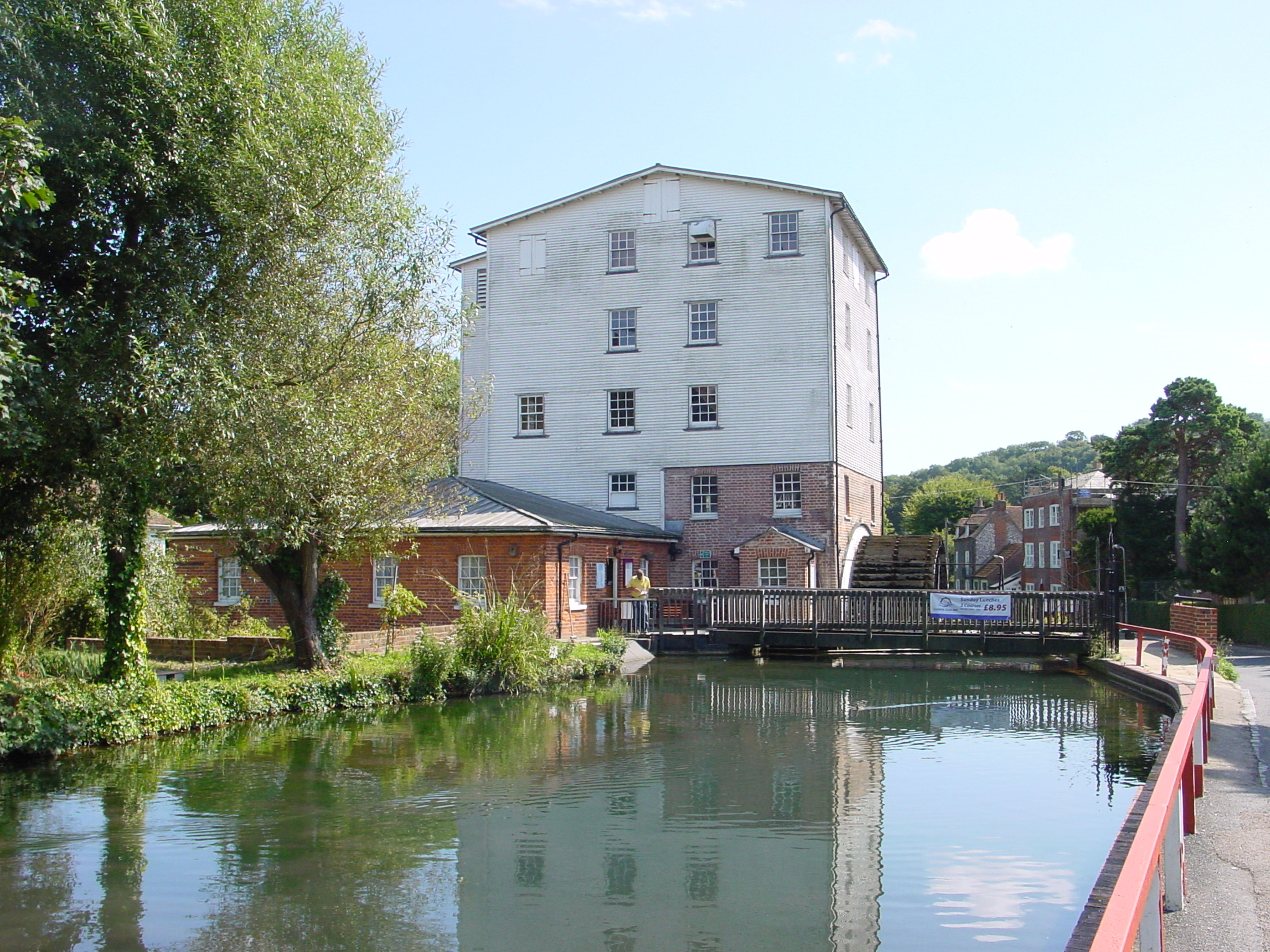
Crabble Corn Mill, River.

Crabble Corn Mill, River.

The war also brought prosperity to Dover’s corn mills as they supplied the troops billeted in the town and naval ships in the harbour. At about this time the Maison Dieu was used as a massive bake house. The Royal Navy, in 1792,  built Stembrook mill, south of what are now Pencester Gardens and as the demand for flour grew, the mill was rebuilt and enlarged in 1799 and again in 1813. To meet the demand, Thomas Horne (d 1807) rebuilt the Town Mill in 1802 and ensured that his corn mill at Charlton was in full swing. The Pilcher family rebuilt Crabble corn mill we see today in 1812 using loans from the Fector bank. They also rebuilt Temple Ewell and Kearsney Court mills.

Privateering brought considerable rewards and both the banking families were involved along with other Dover ship owners. Privateering ships were allowed to carry weapons – usually twelve or fifteen-pound cannonades – which they used to capture ships as well as to defend themselves. At the end of 1809 John Fector’s cargo ship, Mary, on her way home from America, was lost after being challenged by a French privateer. A contemporary account states that these conflicts usually took place late in the evening and provided entertainment for the locals, ‘It was curious on these occasions, to see men, women and children, running in multitudes, and as eager to witness these conflicts, as they would have been to view some harmless amusement. None seemed conscious of fear; but the field pieces, firing unexpectedly before the crowd, would sometimes cause them to scamper behind buildings.’

James Fector died on 9 January 1804 he was 45 years old and had played a large part in securing the family fortunes, particularly through banking and real estate. Following James’s death, John took over full control of the family business and the following year he was elected a Jurat of Dover (senior councilman) and High Sheriff of Kent. The latter was introduced in the 11th century and until Tudor times the Sheriff was the Sovereign’s sole representative in the County. By the early 19th century, the main role was to administer justice at the Maidstone – County assizes.

On the Continent, Napoleon was winning victory after victory. In March 1805, having seized Italy, he proclaimed himself King and on 9 August, another attempt was made to invade England from Boulogne. In Dover soldiers, both regulars and volunteers, stood to Arms for four nights and in the following weeks twenty-four and twelve-pound guns were landed at Dover to arm the Martello Towers that were being built along the coast from Folkestone to Lydd. In the Channel the British fleet, that included a number of Dover ships, was again under the command of Vice-Admiral Lord Nelson. While preparing for his attack Nelson, along with Lady Hamilton, stayed at John’s country residence, Updown House, near Ham to the east of Dover. Nelson led the offensive that prevented the invasion and the thwarted Napoleon turned his attention east where he routed the Russians and Austrians at Austerlitz on 2 December.

The British fleet was at Cape Trafalgar, off the southern coast of Spain, by 21 October 1805. That day, Nelson’s fleet won a crushing victory over the combined French and Spanish fleets. During the Battle, the Vice-Admiral was mortally wounded and his body was brought back to England for burial. His ship, the Victory, arrived off the South Foreland on 16 December and came into Dover as a gale was blowing. She left on the 19th for Chatham with Edward Sherlock, a Dover pilot, at the helm.
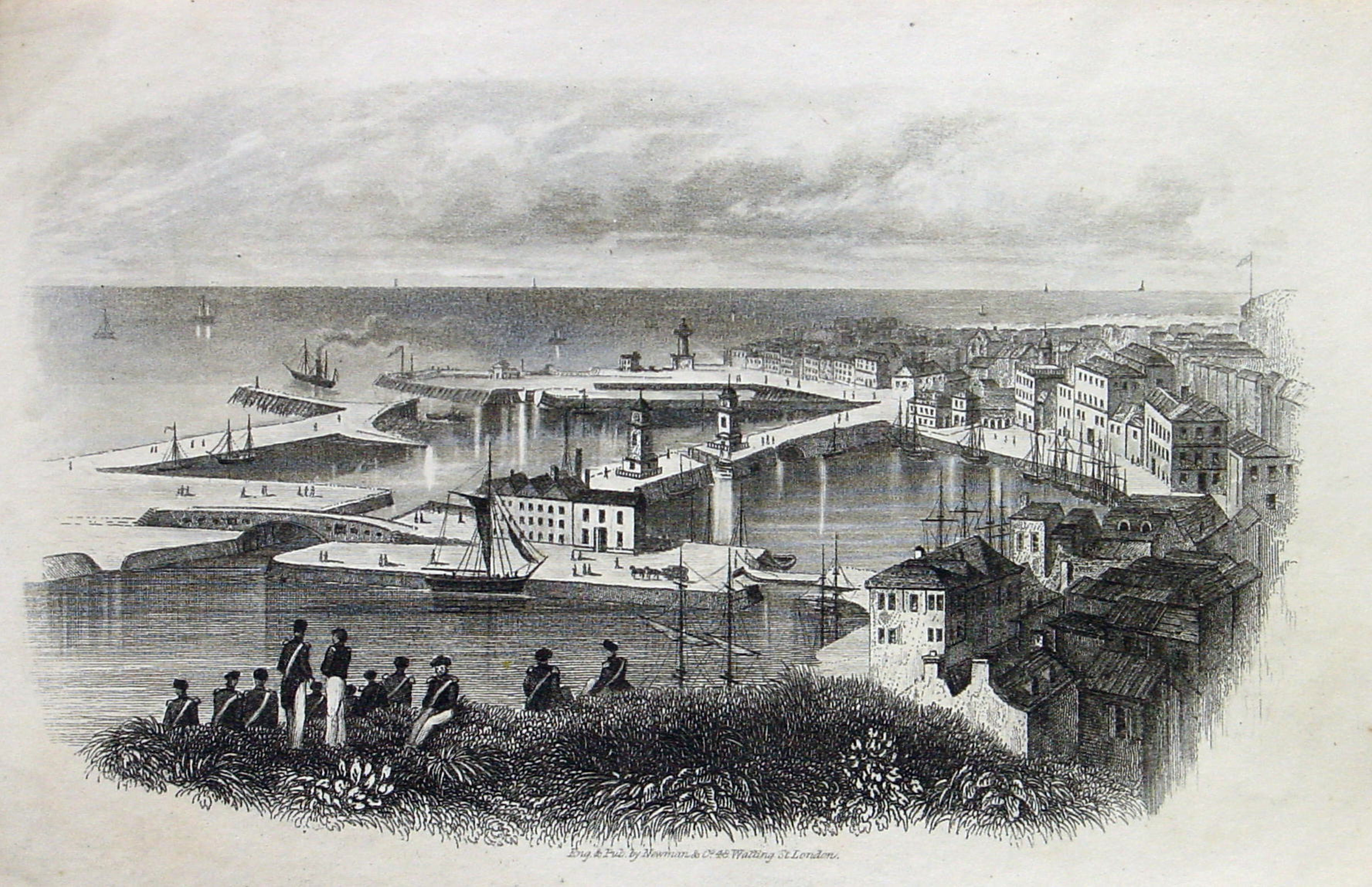
Dover Harbour c1850, from Western Heights. Dover Library

Dover Harbour c1850, from Western Heights. Dover Library

Following the death of William Pitt, on 30 January 1806, Robert Banks Jenkinson, the Earl of Liverpool, was appointed the Lord Warden (1806- 1828). A year later the ‘Case of Dover Harbour’ was presented to government in an attempt to extend the Tonnage Dues Act (Passing Tolls) that were about to expire. In 1723, Dover lost 66% of the Passing Tolls, revenue earned from ships traversing the Dover Strait to Rye. The argument put forward by Lord Liverpool was that Harbour Commission had a debt of £9,000 and the south-pier head needed rebuilding, the cost of which was estimated at £25,000. Following the submission Parliament agreed not only to extend the Act for another period, but also to take the right of tonnage dues away from Rye, on the grounds they had failed to construct a useful harbour. The final report stated that the dues were to be levied on all vessels from twenty to three hundred tons, passing from, to, or by Dover. Vessels laden with coal paid one penny the chaldron (approximately 28 cwt, 3,136lb or 422 kg) the same for every ton of grindstone, Portland and Purbeck stone.

James Moon was appointed harbour master and engineer and his first task was to deal with the enduring problems of the shingle bar across the harbour entrance and the south-pier. On 21 April 1811, he presented his report in which he said the south-pier head was in a dangerous state and suggested rebuilding it in a similar manner to the north-pier. Within the new pier-head, Captain Moon suggested, there should be a canal to direct water through three apertures onto the shingle bar to disperse it. He also recommended the building of a dry dock between ‘the boom-house and the houses in the King’s Head Street.’  (Now Clarence Place). He estimated that the work would cost £20,000 not including the dry dock but when digging began, flooding made it impracticable to proceed. Moon made further recommendations that were costly, put in place, but were not very successful.
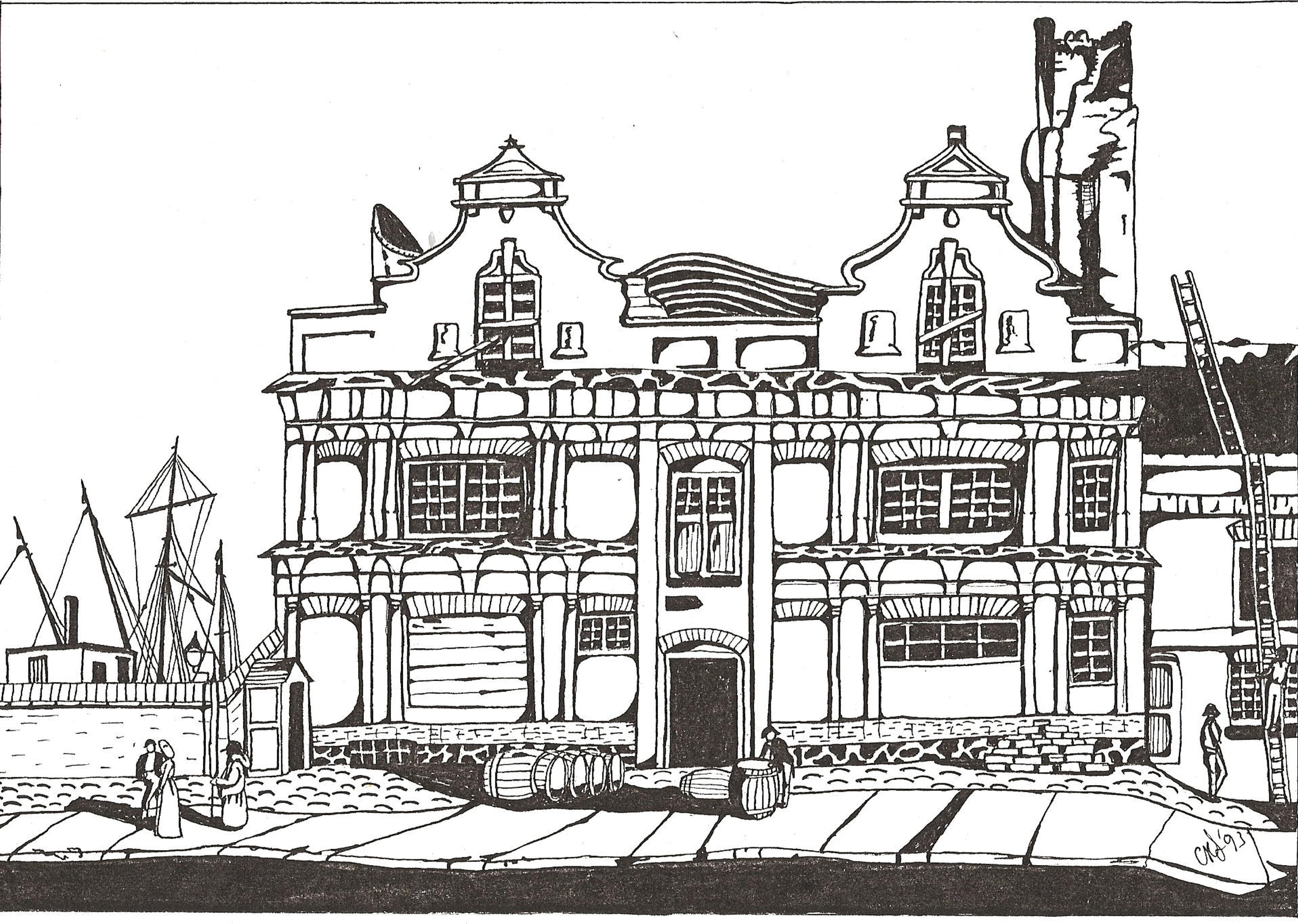
Custom House built by John Minet Fector in 1809. Lynn Candace Sencicle

Custom House built by John Minet Fector in 1809. Lynn Candace Sencicle

The French prisoners of war, on arrival were taken to the town’s gaol before being moved up to the Castle. In 1808 Thomas Pattenden recorded, three escaped by boat, but they were pursued and recaptured in the Channel despite thick fog. The following year Thomas Mantell was again elected Mayor and his reputation against smuggling reached London where he was knighted, to set an example to others. As a gesture of goodwill John Minet Fector heavily contributed to the cost of a new larger Customs House along Customs House Quay requiring five houses to be demolished.

During 1811, the attack on Dover ships from French privateers increased. On 13 January John Fector’s ship, Cumberland, was set upon by four privateers off Folkestone on her way home from Quebec. During the confrontation, the French boarded her three times, but the Cumberland’s crew managed to fight them off. The fracas finished when the Cumberland, firing a number of rounds, disabled at least one of the French vessels. On arriving in Dover the captain reported that the Cumberland had lost one man and that the mate was injured but they had taken three French prisoners. It is also reported that during the encounter, the crew of the Cumberland had killed sixty French privateers but this was never substantiated.

Because of the continued shortage of soldiers, Parliament voted to revive the militia including that of the Cinque Ports. This was done at the expense of disbanding the Volunteers, who were then expected to join the regulars and go abroad. The men of the new Cinque Ports Militia were instructed to assemble in Dover in July 1811 but the women of the town, already fed up due to the lack of men to work in industry and agriculture, rioted. What actually triggered off the riot is difficult to ascertain, but the Corps was going through their marching drill in the Market Square when the women attacked them! Apparently, the soldiers ‘took to their heels and fled’! In consequence, the militia were ordered to Walmer where they continued their training and then were sent to join the Duke of Wellington (1769-1852) on the Continent.

St James Street- circa 1840. Drawn by George Shepherd. Dover Library

St James Street- circa 1840. Drawn by George Shepherd. Dover Library

Following the abdication of Napoleon on 6 April 1814, a Peace Treaty was signed and once again, there were celebrations in Dover. On Saturday 23 April Louis XVIII (1814-15 & 1815-24), arrived at Archcliffe Fort on the Jason. He was on his way to being restored to the throne of France after 21 years in exile. The French King was received by a guard of honour headed by Mayor John Walker and after being welcomed by the Lords of the Admiralty he went to the Fector mansion on St James Street. At 19.00hrs that evening, along with John Fector and his wife Anne, the French monarch was joined by the Prince Regent (1811-1820) – later George VI on his yacht for a sumptuous meal. The Prince Regent also spent the night at the Fector residence and the next day, they all breakfasted on the Jason.

Not long after, on 8 August, Caroline of Brunswick (1768-1821), the estranged wife of the Prince Regent, stayed at the Fector house before crossing to the Continent. Caroline was a friend of the family and the Fector’s had named their third daughter after her. That summer, Emperor Alexander of Russia (1801-1825) had also stayed with John and his family and it was recorded that a considerable number of previously exiled French aristocrats stayed at either St James Street or Pier House at that time. One can only speculate how many of these people, or their parents, had crossed the Channel in John’s ships to safety 21 years before.

On 18 January 1815 Lady Hamilton, the mistress of Lord Nelson, died in Calais destitute, where she was buried. She had fled to France at the cessation of hostilities to escape from her creditors. On his death, it was said the Lord Nelson had bequeathed her care to the nation and a subscription was set up to bring Lady Hamilton’s body back to England. John made his prize ship, the King George, available for the task. At about this time Napoleon escaped from Elba and quickly reassembled his Grand Army. Determined to regain his supremacy Napoleon launched his army into battle and Dover became a hive of activity as the town was swarming with troops waiting to embark for Belgium.

During the morning of 18 June 1815, Napoleon and Wellington faced each other on the battlefield at Waterloo. Napoleon attacked while Wellington held his army in ‘battle squares’, waiting for his Prussians allies. Wave after wave of French attacked the British and Wellington was heard to say, ‘hard pounding gentlemen’. Eventually the Prussians arrived and the French broke ranks and were crushed. The battle was one of the bloodiest in history and lasted nine hours. 200,000 infantry, cavalry and gunners took part of which more than 13,000 were killed and 35,000 wounded.

After the Battle of Waterloo, approximately a quarter of a million soldiers and sailors, many of them maimed, returned home and were faced with unemployment and destitution. Crops had been poor and although Corn Laws had been instituted in an effort to curtail imports and protect the price of home produced goods; the Laws only served to make matters worse. Income Tax had been abolished but was replaced by taxes on staple commodities such as candles, paper and soap as well as luxury items such as sugar, beer and tobacco. In addition the Poor Law relief rates had been drastically cut, which meant the starvation was rife.

Separating the Fector bank from the Fector shipping interests 31 December 1814

Separating the Fector bank from the Fector shipping interests 31 December 1814

Peter Fector had died and was buried at Eythorne on 9 February 1814. In his Will, he left the Corporation of Dover three chests of silver plate for the town and in August that year,  John presented the treasure to the Mayor, Henshaw Latham.  In return a portrait of Peter Fector was hung in the Town Hall – it is now in the Stone Hall of the Maison Dieu. On 31 December John Minet Fector separated his business with the Banking side – J Minet Fector & Co – run by John’s old friend and lover, George Jarvis. John remained in control of the commercial/shipping side except for the minor concerns and these came under the management of his senior clerk, Henry Morris.

John and George had become friends about 1806, when George had been the acting Brigadier Major of his regiment in Dover. On the occasions when George was away on  campaigns, John took responsibility for George’s wife, Philadelphia and their children. It was while he was on a campaign in Holland that George contracted Walcheren fever and returned to Dover a dying man. John looked after George’s care and it was during this time that their friendship became intimate. George resigned his commission to work for John.
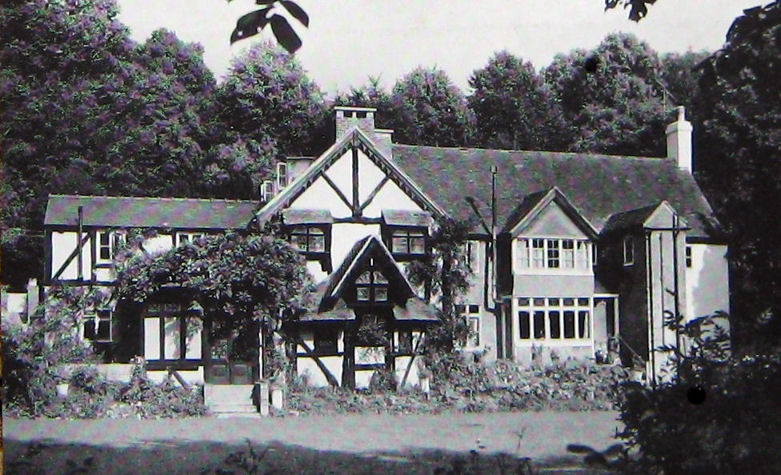
Kearsney Manor

Kearsney Manor

For John the war had been exceedingly profitable but following the death of his sister Mary, who had managed all the country estates, he closed Updown House, Pier House and his parent’s home at Eythorne. He kept Kearsney Manor for entertainment purposes and the St James’ Street mansion as a town house. Nonetheless, he was seen as Dover’s Godfather and in 1818 was asked if he would stand as one of Dover’s representatives in Parliament, but declined. Instead, John decided to take his own and James’s family on an extended tour around Europe. He left the whole of his business in the charge of George Jarvis.

Following the Wars, the government decided to take a hard line against smuggling and in 1816, the Coastal Blockade was established. The Admiralty frigates, Ganymede, Ramillies, and Severn, were put under the command of Captain McCulloch, who proceeded to wage war on smugglers. All ships were watched, followed and frequently boarded. If any contraband was found, both the men and vessel were seized. Initially the Blockade covered the area between the North and South Forelands, but soon it was extended all round the coast from Sheerness to Beachy Head. By 1824, 2,784 men were employed and in 1824 the Blockade was extended to Chichester.

In Dover, the economic depression was biting and the Coastal Blockade made unorganised smuggling almost impossible. Then on 14 October 1820 John Minet Fector, Dover’s Godfather, returned home and it was reported that, ‘The pier heads were crowded by multitudes of people, who testified their grateful feelings by reiterated shouts of joy.’ His eldest daughter, Anne Judith Laurie Fector, had met and planned to married Henry Pringle Bruyere, a French Canadian sea captain, whose family had once lived at Archliffe Fort. Although against the engagement, John announced that ‘a splendid ball was to be given to all the beauty and fashion of the town and neighbourhood.’
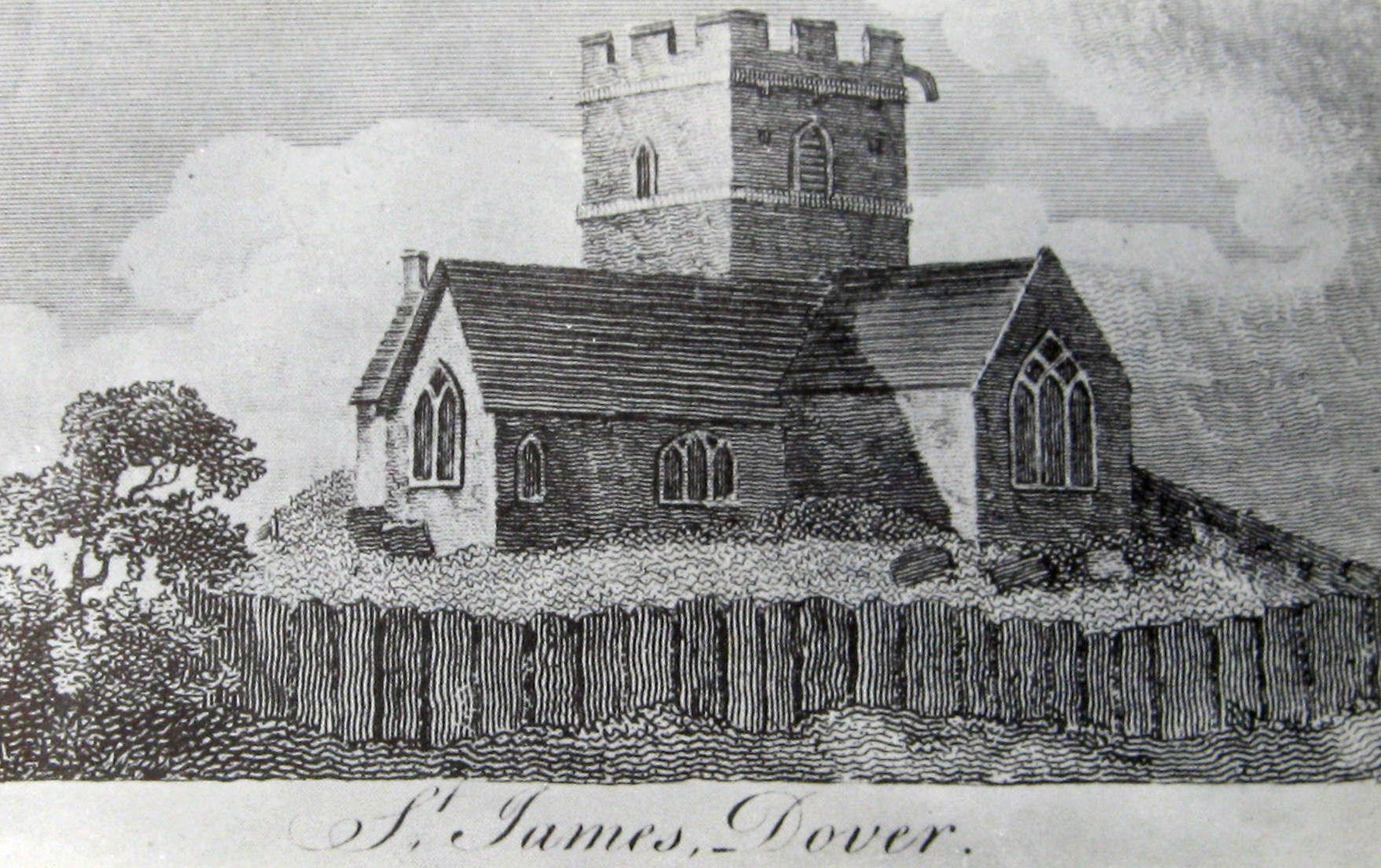
18th Century sketch of St James' Church

18th Century sketch of St James’ Church

John soon realised that the town was in a desperate state and that a ball was not expedient so he changed the celebration to an ‘At Home’. This was held on 27 October 1820 and according to contemporary accounts ‘nearly the whole male population of Dover, above the age of 21, consisting of 2,300 persons, were entertained at the Assembly rooms, in celebration of the return of Mrs Fector and her family to England.’ The day started with a peal bells from St Mary’s and St James’ churches and the male population were divided into five groups and given admission cards that allowed admission at 11.00hrs or 13.00hrs, 16.00hrs, 18.00hrs or 20.00hrs.

That morning ‘Barons and several other joints of beef were placed on a cart, drawn by 6 horses with riders in scarlet liveries.’ The cart was taken from John’s mansion to the Assembly Rooms at the corner of Snargate street and New Bridge. This was preceded by a band of musicians, and followed by a long procession of people. Flags, ensigns and banners decorated with laurel, adorned the Assembly Rooms and John’s elevated seat was surmounted with an arch, around which was inscribed, in large letters, ‘British Hospitality’. There were three transparencies surmounted by a large Union Jack on which was written: ‘The House of Fector, so honourable to the town of Dover; may it flourish for ages and perpetuate its high character for probity, liberality and benevolence. Health and long life to John Minet Fector, esquire, the munificent entertainer of crowned heads, and liberal benefactor and kind friend to his townsmen.’

Kearsney Abbey 1840 by Lynn Candace Sencicle

Kearsney Abbey 1840 by Lynn Candace Sencicle

John, with George by his side, interviewed every man and afterward, in a speech to the assemble throng, made it clear that smuggling was no longer an option. Instead, he said, he would boosted the employment prospects of the town’s men by building on part of the 11,000 acre Kearsney Manor estate a new mansion in the ‘in style of an Abbey.’ The mansion was for his only son, John, and the building programme was to start straight away. It was known from the outset as Kearsney Abbey. He also announced the building of an improved bank on the site of the now derelict old Customs House and make low costing credit available to all local businesses that needed it.
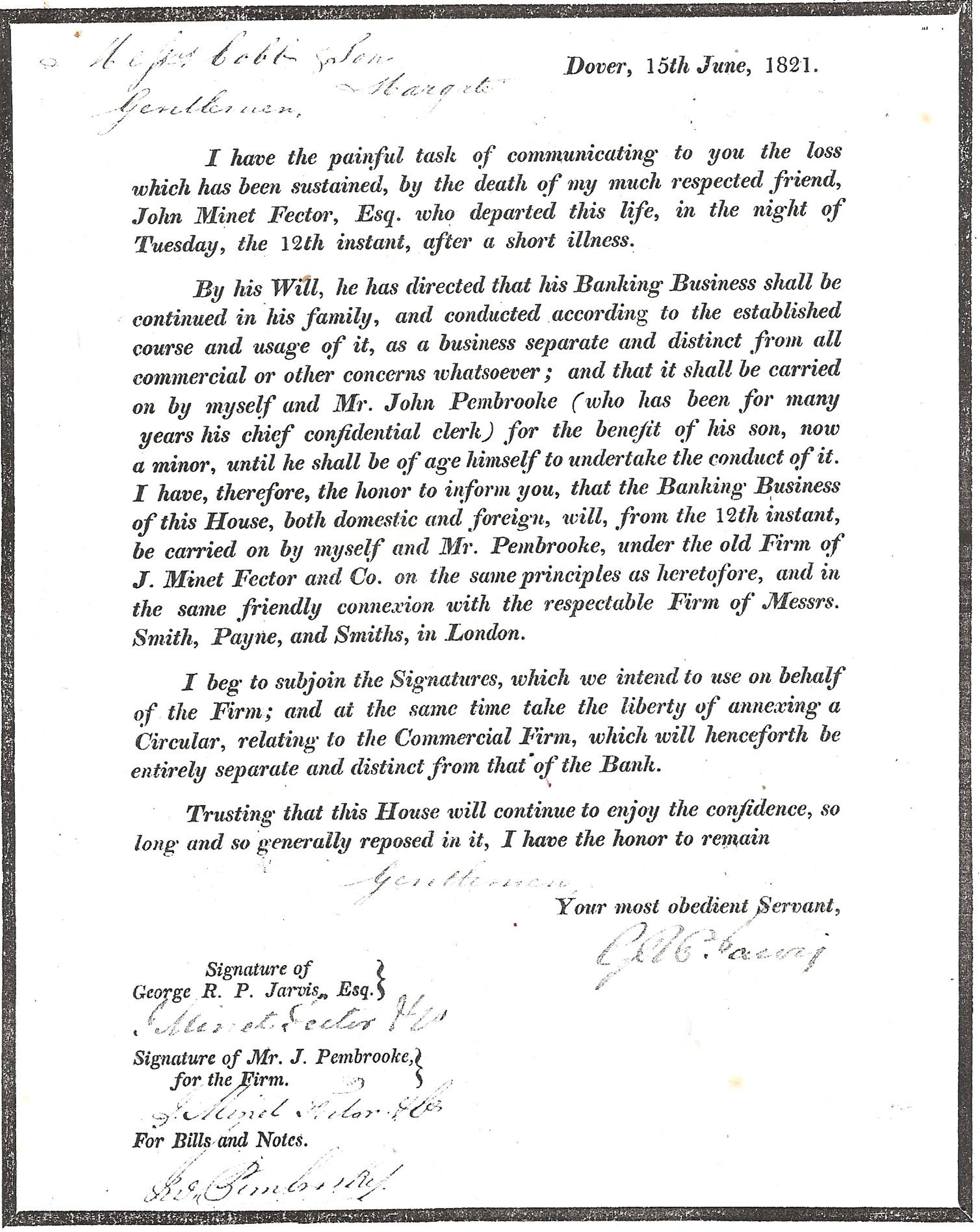
Fector Bank, the announcement of the death of John Minet Fector dated 15 June 1821

Fector Bank, the announcement of the death of John Minet Fector dated 15 June 1821

John Minet Fector was never to see the town boom again or Kearsney Abbey completed. He suddenly died on 12 June 1821 at Kearsney Manor, he was 67-years old. The town was shocked and grief stricken. The funeral route from Kearsney Abbey to St James churchyard, where a mausoleum was later constructed, was lined by ever man, woman and child in the district. John always looked after the town and the people had looked after John when he was in trouble.

Dynasty of Dover part Vi Fector – Jarvis gives as ccount of the next part of the story of modern Dover.


  • Published:
  • Dickensian Summer 2002 pp 140-144 (Basis)
    Lorraine A.M Sencicle:  Banking on Dover (Extracts)
Posted in Dynasty of Dover, Part IV - Minet-Fectors | Comments Off on Dynasty of Dover Part IV – Minet-Fector

Richard Dawkes and John Reading – the Civil Wars and Interregnum

Dover Castle

Dover Castle

At the beginning of the English Civil Wars and the Interregnum (1642–1660), a Dovorian and his friends captured Dover Castle from the Royalists, who supported Charles I (1625-1649), and quickly myths grew surrounding the event. At the same time, the vicar of St Mary’s Church, Royalist John Reading, stood by his convictions. By the 19th century, their stories were part of Dover’s folklore but unfortunately they had been re-written as a novella that centred on a romance between Dawkes and the daughter of the Rev. Reading and the real story was lost.

Charles I (1625–1649) - Worcester Cathedral Cloisters

Charles I (1625–1649) – Worcester Cathedral Cloisters

Richard Dawkes was born in 1606 and was related to the owner of a hostelry in King Street known as the ‘Fleur de Lis Inn’. Richard married Dorothy Stokes in 1638 and appears to have had a son, also called Richard, but who died in 1640 when he was three days old. At the time, the country was splitting into two sides, those who supported King Charles I (1625-1649) – the Royalists; and those who supported Parliament – known as Parliamentarians or Round Heads – from their helmets. Dover’s political allegiance was also split, with the Dover’s Member of Parliament (1640-1646) and Lieutenant Governor of the Castle, Sir Edward Boys (1579-1646) sitting on the proverbial fence.

In the years leading up to the Civil Wars, Charles I had demanded ship money, a form of tax. The town had not long before been obliged to billet Count Mansfelt and his legions, for which they had not received any financial help – the subject of another story. So even if the town father’s had wanted to oblige the King over the tax, they were not able to but the King’s representatives still demanded the money.

The majority of folk belonged to the Anglican Church, which supported Charles I,  attending one of Dover’s two churches, at that time, St Mary’s and what is now referred to as the old St James’ Church. However, there were a growing number of locals who preferred the Puritan or Non-Conformist faiths. The uncompromising Archbishop of Canterbury, William Laud (1573-1645), in and attempt to ensure the religious conformity of officials, in 1641, asked them to sign a petition to preserve the liturgy. Dover’s Mayor, Thomas Teddiman, and all but one of the Jurats (senior councillors) acquiesced but of the 36 common councilmen, fifteen declined to sign. Albeit, when the Civil Wars broke out in 1642, the town was one of the first places in Kent to declare against the King. The Castle was in the hands of the Royalist Lord Warden (1640-1642), James Stuart, Duke of Lennox (1612-1655).

During the summer of 1642, shiploads of horses and men had been coming through Dover from the Continent in support of Charles I. Alarmed, Richard Dawkes went to London, saw the appropriate officials and offered to seize the Castle in return for a Commission in the Parliamentary Army. This was promised and he returned to Dover, meeting fellow conspirators in the Fleur de Lis Inn. In the meantime, as James Stuart had left to support Charles I on the battlefields, Sir Edward Boys had been appointed nominally in charge of the Castle.

Avranches Tower from Inner Bailey, Dover Castle

Avranches Tower from Inner Bailey, Dover Castle

Knowing the Castle fortifications well, at 02.00hrs on the night of 20-21 August, Richard, along with between 20 and 30 men, scaled the walls between Averanche’s Tower and the edge of the cliff and disarmed the guards. They surrounded the porter’s lodge, beating on the door until the guard surrendered the keys, then unlocked the Castle gates. They  collected all the ammunition they could find and sent word to the town for reinforcements. Sir Edward Boys, who was in the town at the time, told the Mayor, Thomas Cullen, to ignore the request and raised a Trained Band – local men who had undertaken basic military defence training. Boys’ strategy was to starve Richard and his colleagues out and on realisation of this, some of Richard’s men did desert him.

Nonetheless some ‘well-affected people of the Town…’ did manage to send more weapons and ammunition up to the beleaguered Richard and he managed to despatched messengers for help. These were sent to Canterbury and the Medway area, where Parliamentarian, Nathaniel Rich (died c.1701), was camped. Both the city and the Lord Rich sent 40 men each with the latter ordered two ships, ‘to ride near the castle, and to keep town in awe, till Parliament shall do something for settling thereof.’ All of this persuaded Sir Edward Boys to revoke his earlier orders and along with the townsfolk went to help Richard and his colleagues. When the Castle was safely in the hands of the Parliamentarians Richard went to London to take up his Commission … but what he saw as his promised right, was refused!

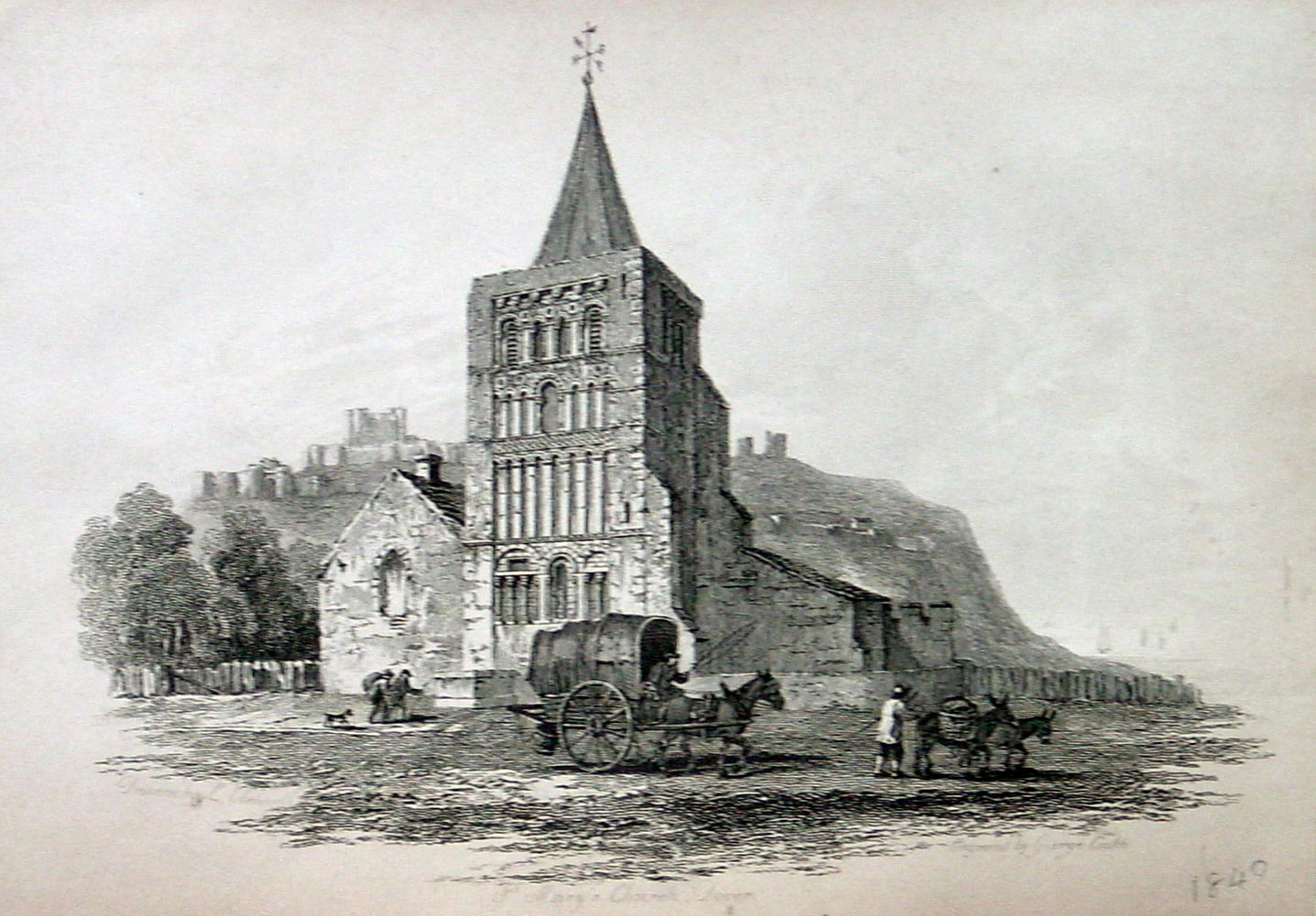
St Mary's Church 1849

St Mary’s Church 1849

Reverend John Reading (1588-1667) , the vicar of St Mary’s Church was a Calvinist who had been appointed chaplain to Edward, Lord Zouch, Lord Warden of the Cinque Ports in 1614. The Reverend came from a poor Buckinghamshire family but as a bright young man he had worked his way through Magdalen Hall, Oxford, where he gained his degree. Rev Reading’s sermons were controversial but very interesting and following a particularly memorbable sermon at a Castle funeral, by popular acclaim, he was elected to St Mary’s Church with a salary of £100 a year. As his fame spread, Rev. Reading was appointed to the chaplainry of Charles I.

In April 1642, before Richard Dawkes had captured the Castle, a local Parliamentarian force under Edwin Sandy’s junior had tried but failed to do the same. They then turned their attention to the Rev Reading and raided his house. The morning following Richard Dawke’s captured of the Castle, Rev Reading preached a scathing attack on the Parliamentarians at St Mary’s. This provoked another raid on his residence, when manuscripts were seized and the Reverend was arrested.

St Mary’s was then ravaged and the Font, made of Purbeck marble, was ripped out and disappeared (see Walk around St Mary’s Church story). Rev Reading was imprisoned in the Castle for the next nineteen months. On the order of Parliament, John Godwin was brought in as a replacement and on his death, Michael Porter. Albeit, Charles I still had some power and he made it known that he was angry that one of his chaplains had been imprisoned, so when Rev Reading was released he was given the living of Cheriton. There he wrote a controversial annotation of the Bible causing the Parliamentarians displeasure. One of those who helped him was Dovorian, Rev Basil Kennett, the father of Dr White Kennett.

St James' Church - 18th Century sketch

St James’ Church – 18th Century sketch

Across the town at St James’s Church, in July 1642, parishioners and the Churchwardens had petitioned Parliament over local Royalists who had disturbed John Vincent, their lecturer given the post by Parliamentary order, while he was preaching. John Jacob, William Legent, John Woodgreene and Edward Kempe were impeached and common councillors, Valentine Tatnell, Henry Teddiman and William Richards along with Edward Chambers and Simon Yorke, both prominent as Presbyterians, were summoned to give evidence. Simon Yorke was a town constable and used his office, it was said, in a way which was ‘more his owne unspeeking than Mr Moiors comand …’

Rumours were rife but when it reached the ears of Sir Edward Boys that the Royalists were about to attack the town, he issued the order to ‘chaine upp the streetes and to fortify the towne at all speed’. By this time Edward Prescott of Guston was the Captain of Dover’s Trained Band and Mayor Cullen decreed that £100 be spent on defences and for the townsfolk, ‘to worke and labour,’ until these were completed.

Richard Dawkes, still seething over the lack of a Commission joined the Royalists and obtained a Royal Commission from Charles I to retake the Castle. The attack was to take place in September 1643 and the plan was to drug the sentries beforehand. However, just before it was put into effect two of Richard’s friends, Belton and Tillet, betrayed Richard and his other conspirators. A significant number of Dovorians being imprisoned in the Castle including Richard. Shortly after he disappeared for good – it is believed that he was executed.

On 20 January 1644, the Parliamentarians ordered all Kent churches, to read an account of the plot. Members of congregations were then asked to stand up if they approved of the action taken – of course, they all did. The tide though, was beginning to turn and a year later, the locals were openly threatening the ‘Roundhead rogues.’ In order to weaken the power of the Jurats – the majority were Royalists – constitutional changes were introduced on 20 May 1644.

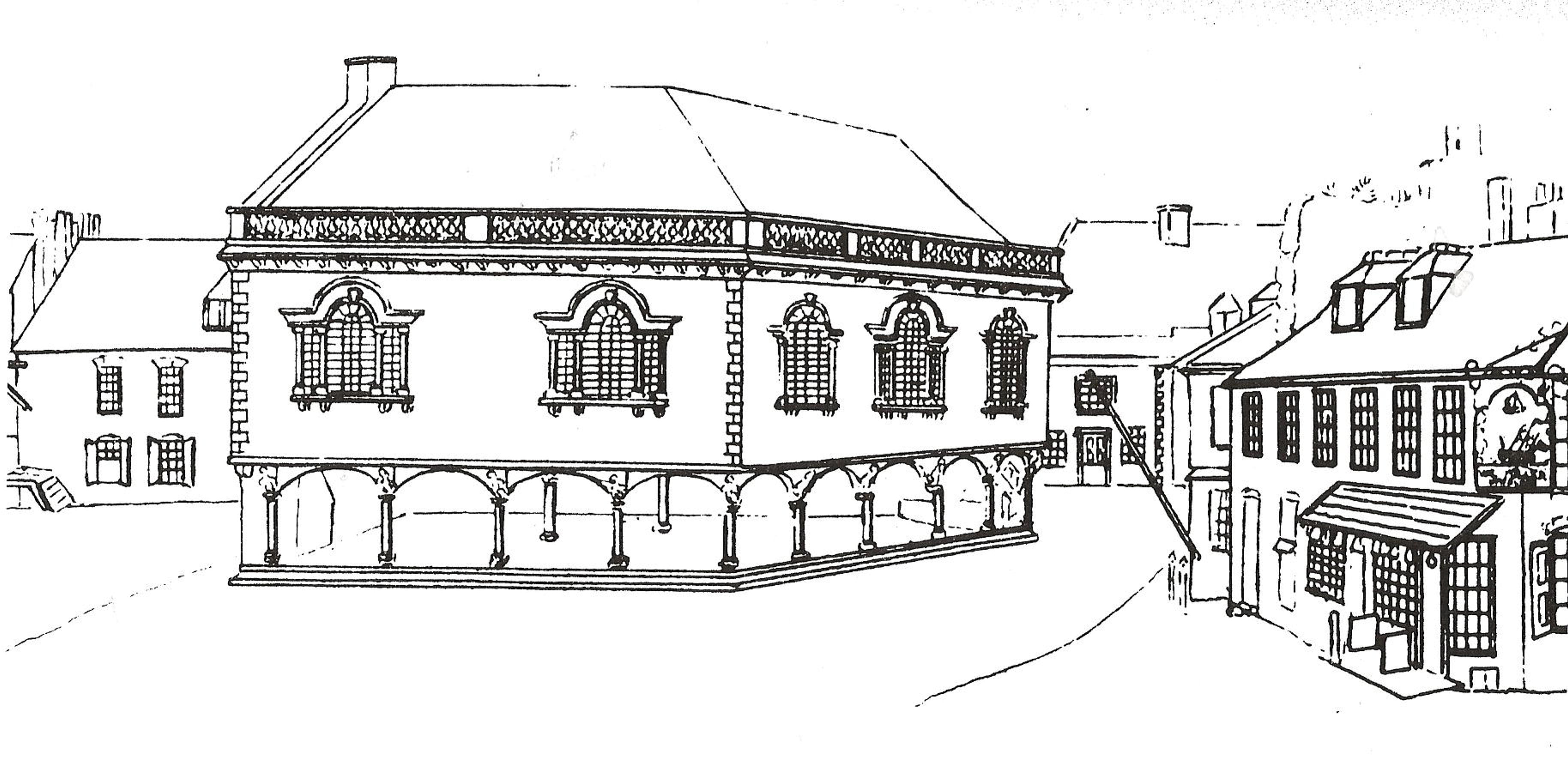
Dover's then Town Hall in the Market Square. Dover Museum

Dover’s then Town Hall in the Market Square. Dover Museum

At the time, the Freemen chose common councilmen and from these the Jurats were appointed for life. It was from the Jurats that the Mayor was appointed. This was changed to the Freemen appointing Jurats and electing the Mayor. Nine new common councilmen were then elected, they were, John Kenton, George West, Randolph Partridge, Edward Chambers, Richard Knight, Thomas Fidge, John White, John Finch – he never served – and Thomas Brendon. William Richards and John Broome – a Royalist, were elected, from the common  councilmen as Jurats. A month later Jurat, Thomas Day, a staunch Parliamentarian, was elected bailiff for Yarmouth.

During the winter of 1645/6, Rev. Reading was re-arrested for alleged complicity in another plot to take Dover Castle and was held prisoner in Leeds Castle, near Maidstone. Following his release, with few possessions and no job, he was incarcerated in the Fleet debtor’s prison in January 1647. Eventually released, Rev Reading returned to East Kent, but in March 1650 he had a public dispute in Folkestone against Baptist, Samuel Fisher. This was against un-ordained preaching in the Anglican Church and again the Reverend was in trouble.

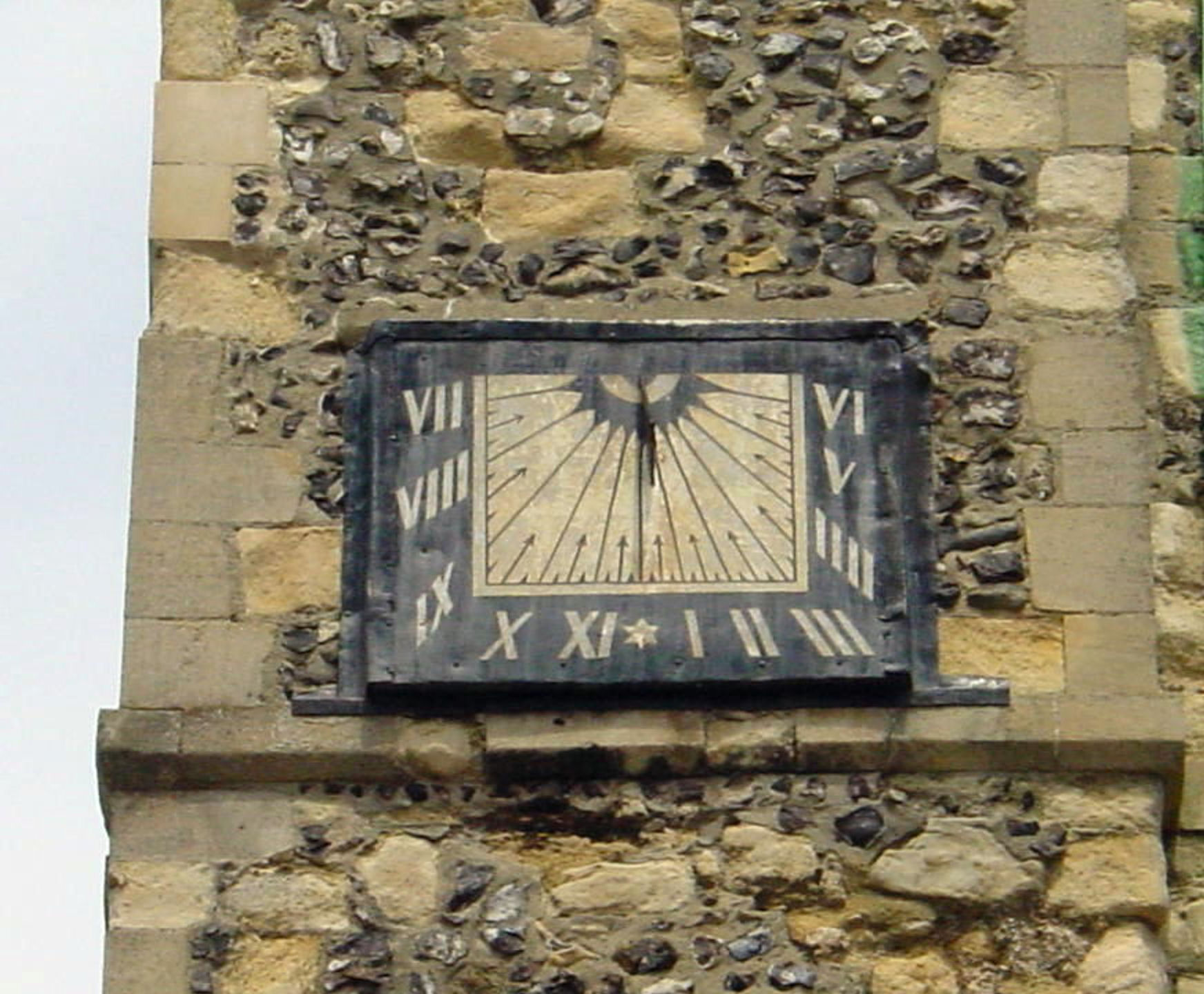
St Mary's Church Sundial erected in 1656 to ensure that councillors arrived at meetings on time.

St Mary’s Church Sundial erected in 1656 to ensure that councillors arrived at meetings on time.

In the meantime, his former Dover parishioners at St Mary’s sent a petition to Parliament asking for Rev. Reading to be restored. This was refused and John Dykes, 1647-1650, was appointed followed by John Robotham, 1650-53, Nathaniel Northcross, 1653-54 and finally Nathaniel Barry, 1654-1660. The Mayor and Jurats’ meetings, as well as all elections, from 1585 to 1826, were held at St Mary’s Church and before meetings commenced the Minister perform prayers. To ensure that the Councillors were on time the sundial, we see today, was erected in 1656.

Following the death of Edward Boys in 1646, John Dixwell (1607-1689), a Parliamentarian, became Dover’s Member of Parliament. As the town’s representative, he succeeded in getting the harbour defences strengthened, which proved invaluable at the time of the Battle of Dover in 1652 . However, in 1649, he was one of the Regicides who signed Charles I death warrant. Following the Restoration, in 1660, a warrant was issued for Dixwell’s arrest and he fled the country.

By 1647, Royalist sympathisers in Dover were openly hostile to the Parliamentarian troops threatening to make them ‘ere it be long eate or love Christmas pies…’ , and were circulating ‘scandalous verses’ and singing songs hostile to Parliament. Since the Civil Wars began, Dover had lost 50 ships and according to a council letter, the town had paid Parliament £5,000 in various ways. Such was the town’s poverty that when a ship in the Mediterranean, with a Dovorian on board, was captured and a ransom demanded, the town had to ask other Cinque Ports for help. It is doubtful that the ransom was paid.

Mote Bulwark at the base of the Castle, seaward side

Mote Bulwark at the base of the Castle, seaward side

At Christmas, that year an ordnance was published throughout Kent requiring strict religious observance. This meant that fairs and the celebration of Christmas were banned. In Canterbury there was a revolt and although quickly suppressed it spurred other towns and villages to follow suit. Soon the whole County was in revolt. One of the ringleaders, Sir Richard Hardres, together with 2,000 men, seized Dover’s Mote Bulwark, which was full of ammunition. They then went on to try to storm the Castle but failed, nonetheless, they held siege to it. Lord Rich was detached to relieve Dover and recover the castles along the coast that had fallen into the hands of the Royalists. On 30 May, Parliamentarian Colonel Birkhamstead relieved Dover Castle and Lord Rich retook Walmer, Deal and Sandown Castles. For Dover’s part in the revolt, the townsfolk were made to pay dear.

War was declared against the Dutch in 1652 and Dover became a major victualling post for the ships involved in the conflict. In September, Admiral Blake, commanding the English fleet, defeated the Dutch and following this the Dutch were ordered to dip their flag when passing through the Downs. Forty-four ships of the Dutch fleet under the command of Admiral Von Tromp refused and the fierce Battle of Dover began. Reinforcements were provided by Dover seamen and in gratitude, the Council of State wrote thanking the Mayor and promised money for a new pier, repairs to the harbour and payment for sick, wounded and prisoners billeted in the town. Although £1,227.16s 5d (£1,227.82p) was received, most of this was taken up in ‘charges’ and in 1655 the town was forced to sell three small maces to pay for harbour repairs and meet it’s debts.

Although Cromwell was tolerant of the right to private worship of those who fell outside evangelical Puritanism, his regime was intolerant of any acts of public worship. Edward Prescott of Guston, although elected Mayor in 1653, was forced to hold Baptist meetings in isolated fields and woods. On one occasion Captain Samuel Taverner, Governor of Deal Castle came across such a meeting but instead of arresting the Mayor and his congregation, stayed and listened. So impressed was Taverner that he joined the congregation and following the Restoration resigned his commission and eventually became a senior exponent for the Baptists in Dover.

The following year, 1654, Valentine Tatnell was elected Mayor and with the full approval of the Common Assembly, he along with a Jurat, two common councilmen, two constables and a churchwarden, walked around the town every Sunday morning and afternoon. They checked that all the alehouses, inns and premises believed to be holding religious meetings not conforming to evangelical Puritanism and other places were closed. They arrested and imprisoned all those they believed to be infringing the prevailing statutes. Contempt was growing and when Oliver Cromwell died in 1658 moves were made to restore the monarchy. At St Mary’s Church, Nathaniel Barry was replaced at St Mary’s by Rev. Reading.

Charles II landing in Dover 25 May 1660. Maison Dieu window.

Charles II landing in Dover 25 May 1660. Maison Dieu window.

The Interregnum ended on 25 May 1660 when Charles II (1649-1685) came ashore at Dover and was Restored to the throne. That day, Rev. Reading welcomed the King on Dover beach, giving him a bible. Charles had arrived in a rowing boat such was the poor state of the harbour!

Two years later, Charles II granted the Passing Tolls Act for eight years but this did not raise enough money to make the harbour improvements needed. Nathaniel Barry, whom Rev Reading replaced, was to suffer persecution in the years that followed. The Fleur de Lis hostelry, where Richard Dawkes conspired to take Dover Castle, was later renamed Flying Horse Inn after the fastest stagecoach to London that left from there. The Inn was demolished to make way for a new General Post Office in 1892 but the Inn was remembered by the adjacent St James Lane being renamed Flying Horse Lane. Reverend Reading was reinstated at Chartham, near Canterbury, although stayed at St Mary’s until August 1662. He died at Chatham on 26 October 1667 and was buried within the church there.

  • Published:
  • Dover Mercury: 11 February 2010
Posted in Civil Wars and Interregnum, Dawkes Richard - the Civil Wars and Interregnum, Dawkes Richard and Reverend John Reading - the Civil Wars and Interregnum, People, Reading Reverend John - Civil Wars and the Interregnum | Comments Off on Richard Dawkes and John Reading – the Civil Wars and Interregnum

Camden Crescent and Granville Gardens

Camden Crescent with the Round House to the right 1844

Camden Crescent with the Round House to the right 1844

For centuries, the area where Camden Crescent now stands was part of the foreshore. Here herrings were hung to dry and there was a ropewalk nearby. To make rope, locals used hemp and sometimes other materials including nettles. These were twisted into long lengths then most was wound into a ball. The remaining lengths would be stretched and twisted between two fixed points of the ropewalk. Walkers, usually women, each with a ball of the twisted hemp would wind it round the anchored hemp until they reached the end. Then they would turn round and carry on until a rope was formed of sufficient the thickness. Often these ropes, using the same method, were also twisted around a centre rope to form a thicker rope.

During the American War of Independence (1776-1783) France supported the colonials and Britain, fearing an invasion, strengthened the national defences. Due to the proximity of Dover to France, the town’s defences were put in charge of Captain Thomas Hyde Page (1746-1821). He organised the building of four batteries along the seafront one of which was North’s Battery, opposite where Granville Gardens are today. Following the opening of New Bridge in 1800, the area behind became a Military Parade ground for the remainder of the Napoleonic Wars (1793-1815).

Round House, built for John Shipdem later British Legion Dover HQ

Round House, built for John Shipdem later British Legion Dover HQ

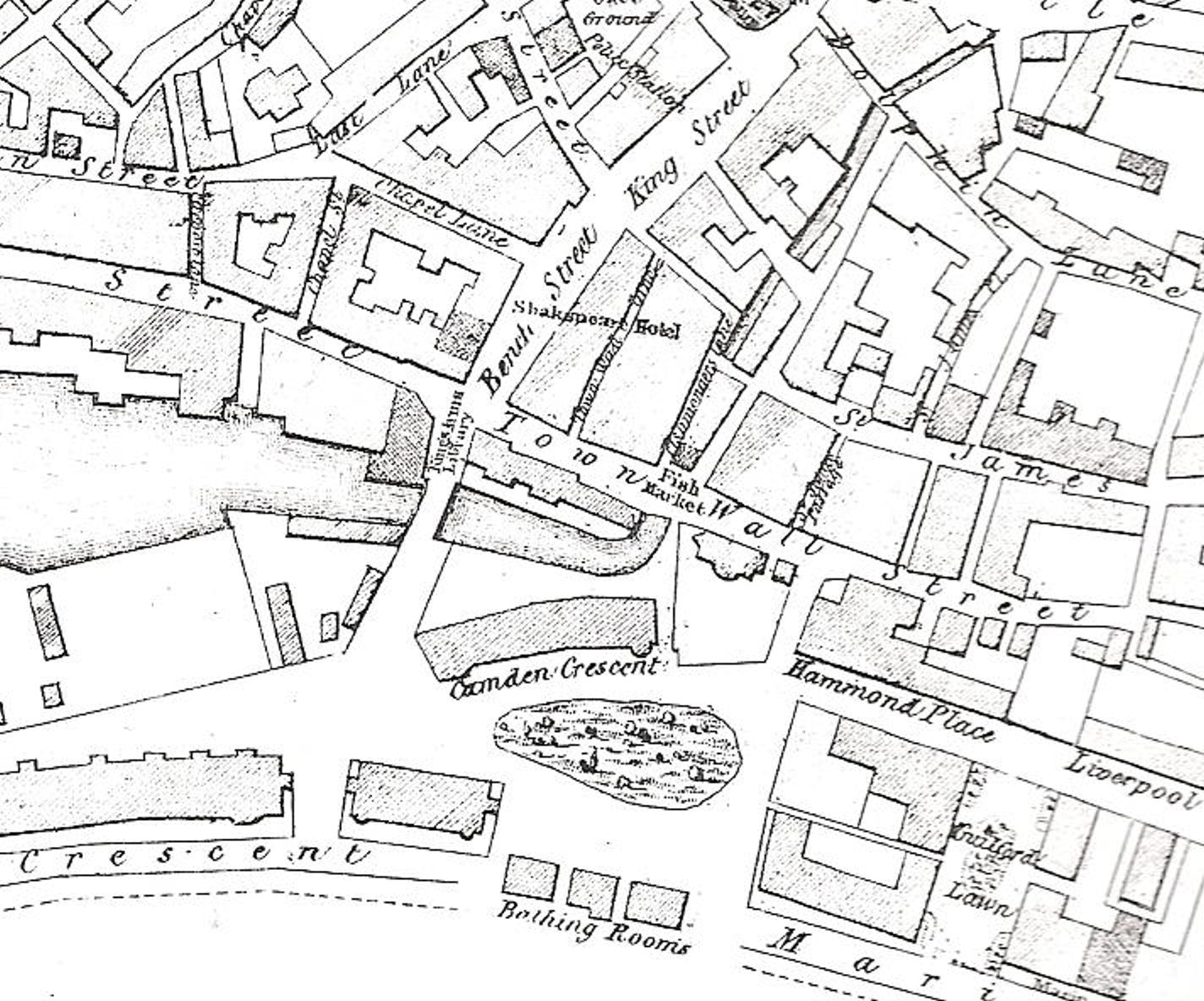
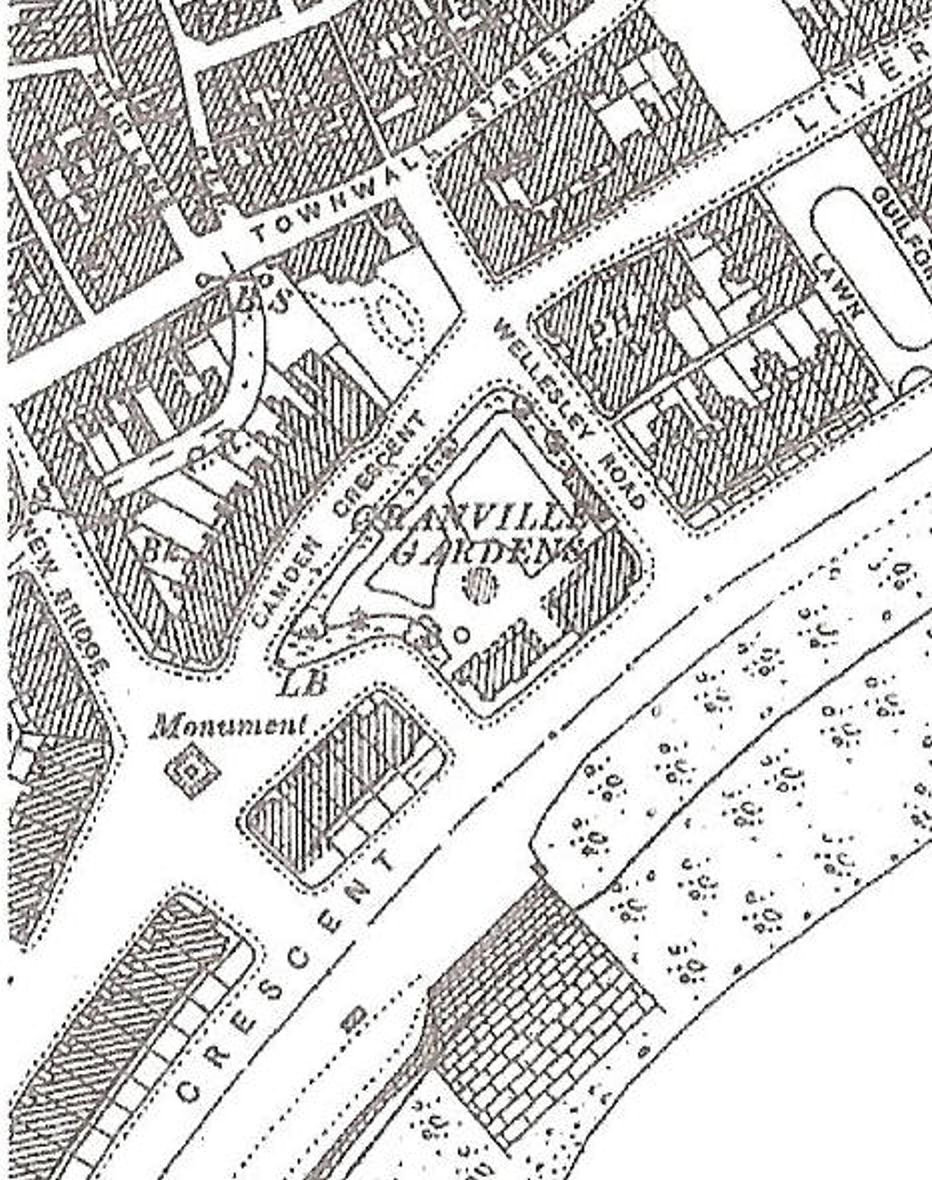
Following the Wars, the town’s surveyor, Richard Elsam, at the behest of the Town Clerk, John Shipdem, an unusual turreted roundhouse with a Moorish theme and bow windows on part of the Military ground. The Round House, as it was called, was technically on Townwall Street with the turret facing the sea – it can be made out on the map above at the the eastern end of Camden Crescent. John Shipdem was a solicitor, Town Clerk 1761-1826 and Register of Dover Harbour Commission from 1806 to1840. It was said that the turret was round so the devil couldn’t catch him in a corner! Occasionally, there would be travelling shows on the Military ground but in the late 1830s, so the story goes, a Polar bear belonging to Wombwell’s menagerie was rendered restless by the smell of the sea and the shows moved inland!

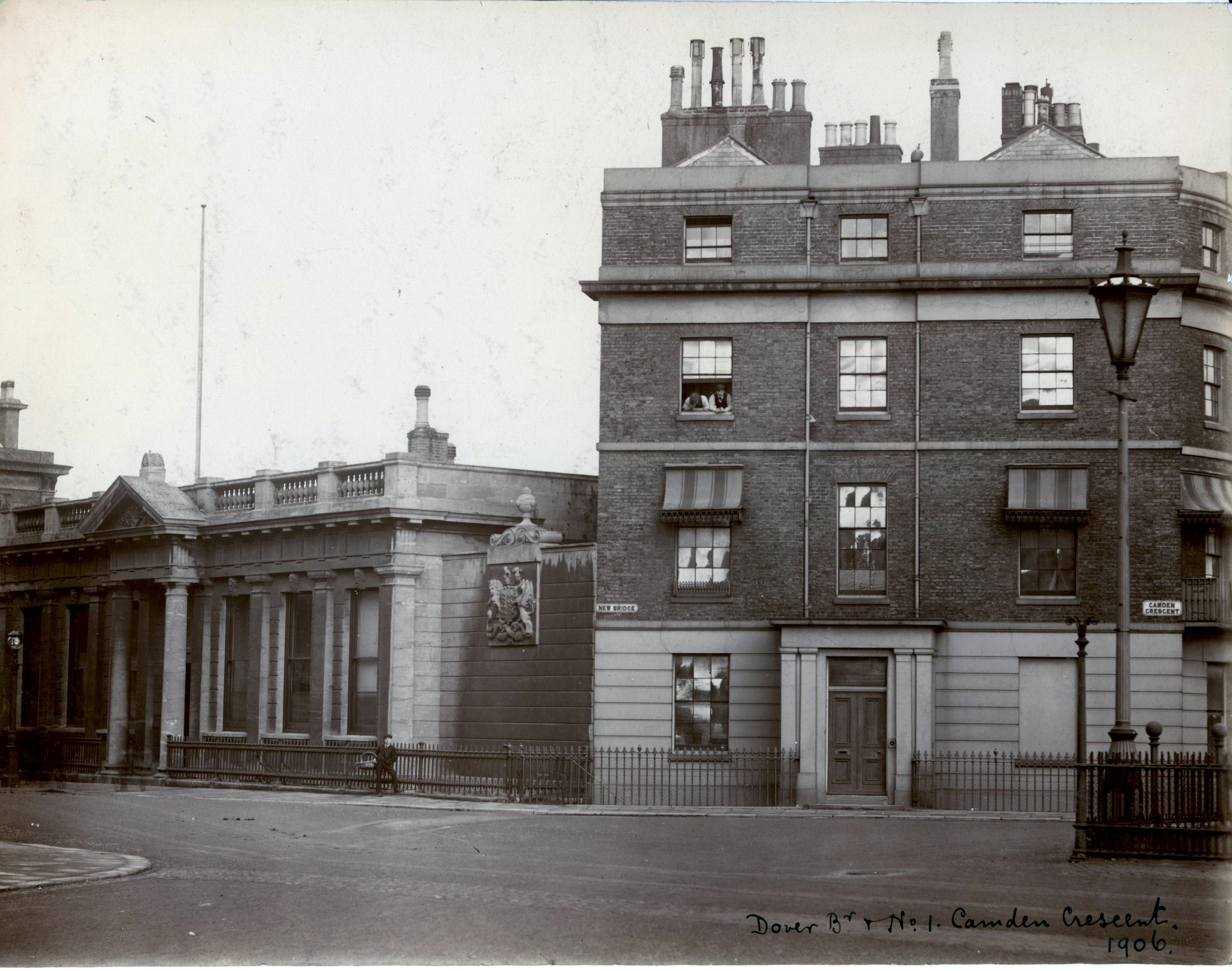
1 Camden Crescent with National Provincial Bank at New Bridge House 1906. Reproduced by kind permission of The Royal Bank of Scotland Group © 2013

1 Camden Crescent with National Provincial Bank at New Bridge House 1906. Reproduced by kind permission of The Royal Bank of Scotland Group © 2013

The creation of Camden Crescent was the inspiration of Dr William Sankey a local doctor who had been mentioned in despatches by Arthur Wellesley, the Duke of Wellington (1769-1852) when he was attached to the Rifle Brigade during the Peninsula Wars (1807-1814). As the land was reclaimed under the Harbour Commission Charter of 1606, it belonged to them but the Duke of Wellington, the Lord Warden (1829-1852), gave Dr Sankey’s scheme his blessing.

Named after the John Jeffreys Pratt, 1st Marquess Camden (1759–1840), Lord Lieutenant of the Kent 1808-1840 and a member of the Harbour Board Commission. Work started in 1840 on the terrace of ten tall and imposing residences. Dr Sankey and his family moved into 1 on completion and the other residences were quickly snapped up mainly by the local elite. Following Dr Sankey’s death in 1866, his wife sold 1 Camden Crescent to the National Provincial Bank, the owners of New Bridge House, for use as the manager’s residence.

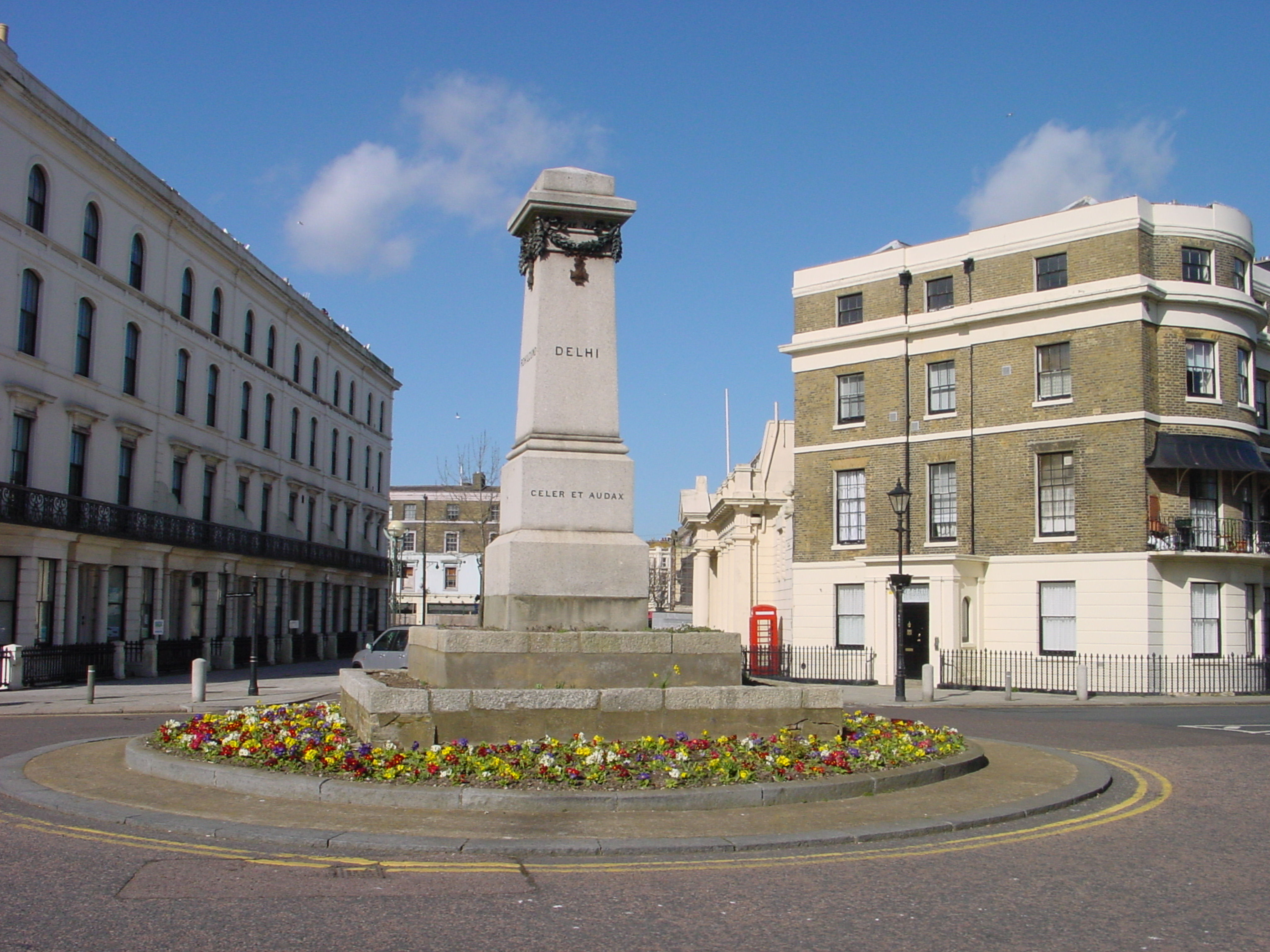
 Rifles Monument, 1 Camden Crescent on the right and Cambridge Terrace on the left

Rifles Monument, 1 Camden Crescent on the right and Cambridge Terrace on the left

As a former officer of the Rifle Brigade, Dr Sankey was instrumental in ensuring that the Rifles Monument was sited where we see it today. It was erected by the Officers of the 1st Battalion of the 60th Rifles – King’s Royal Rifle Corps, to their comrades who fell in the Indian Mutiny of 1857-9. The obelisk was unveiled, with great pomp, in August 1861 but within days, orders came from central government to dismantle it because the political agenda had changed. Instead, the council erected iron railings around it and posted a guard!

Camden Crescent and Granville Gardens 1890

Camden Crescent and Granville Gardens 1890

These days the houses in Camden Crescent are now numbered 1 then 7, 8 and 9. At the original number 7, Cuthbert John Ottaway (1850-1878), England’s first football captain lived with his parents. On 30 November 1872, he captained the first England squad against Scotland in a match at West Scotland Cricket Club, Partick. It was played before a crowd of 4,000 and throughout England dominated but the game ended in a one-all draw. Cuthbert died on 2 April 1878 and buried in Kensal Green Cemetery, West London.

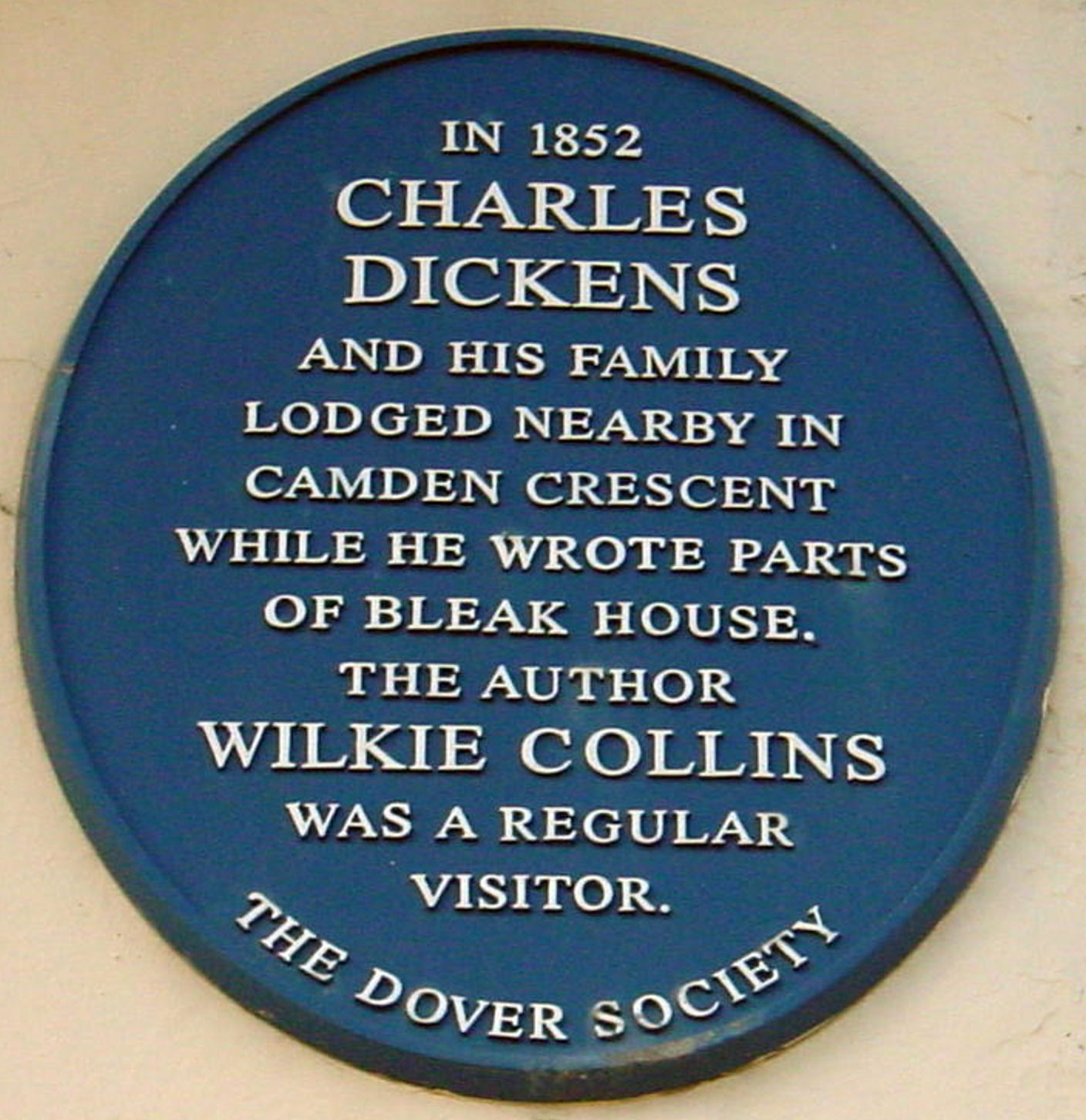
For three months in 1852, Charles Dickens (1812-1870) stayed at 10 Camden Crescent, whilst writing Bleak House. Like number 7, the original house fell victim to enemy action during World War II (1939-1945) so the Dover Society plaque is on the last house in the block. In April 1848, the Admiralty Pier was started but caused flooding along the seafront and a defensive seawall had to be built from the front of Waterloo around the Bay to the Boundary Groyne. Protecting the open space behind North’s Battery, in the summer bands of the different regiments quartered in the town perform on this open space.

Dover Society Plaque to Charles Dickens, Camden Crescent.

Dover Society Plaque to Charles Dickens, Camden Crescent.

Eventually Dover Harbour Board laid gardens on this site and these opened on 3 August 1878. They were named in honour of George Leveson Gower, Earl Granville (1815-1891), Lord Warden (1866-1891) and Chairman of the Dover Harbour Board (DHB). Local military bands, paid for by public subscription, provided entertainment most weekends and the Gardens became very popular. When Edward Hills’ coachworks on Castle Street were destroyed by fire in 1887, which also housed the Dover Proprietary Library, temporary accommodation for the library was erected on the Gardens.

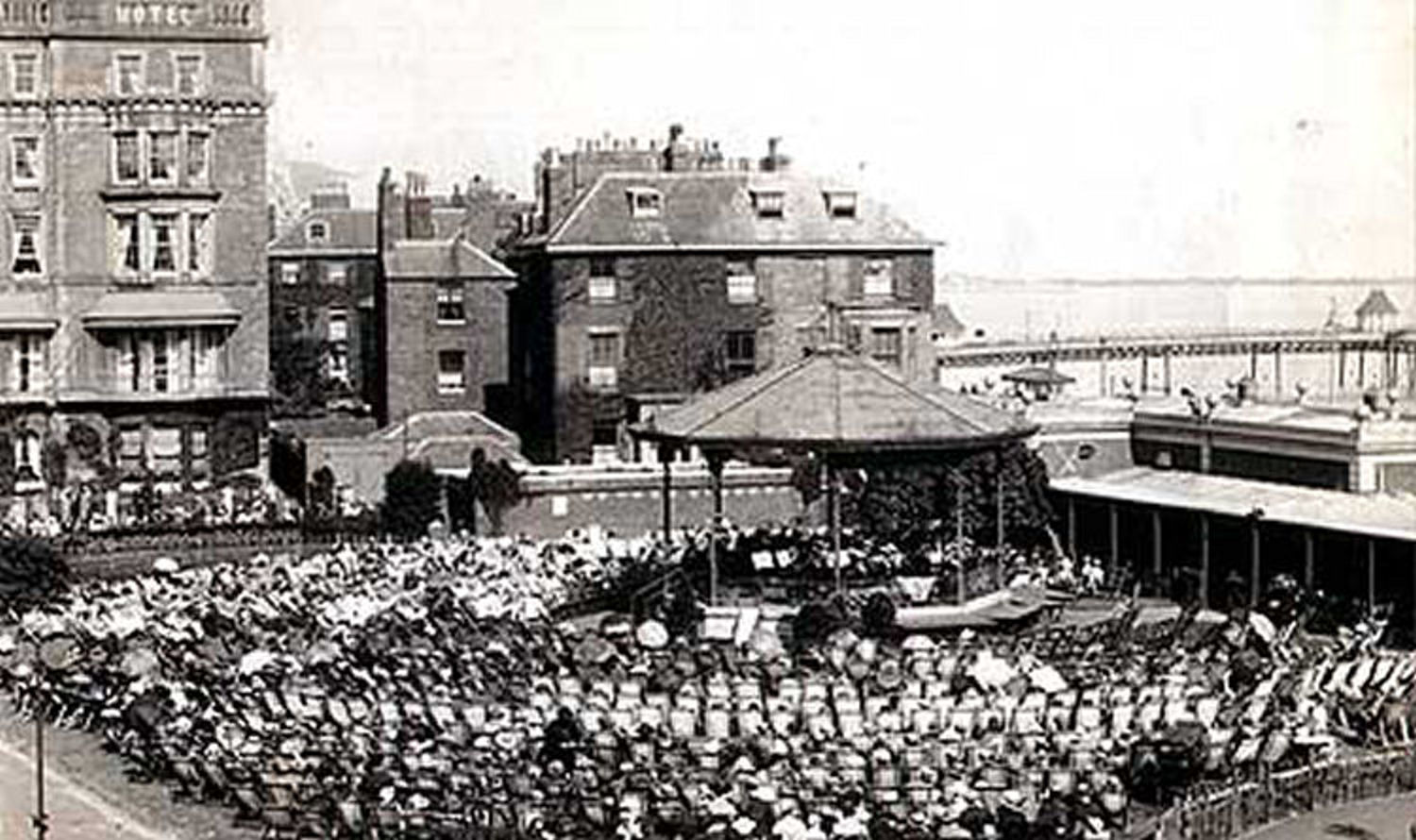
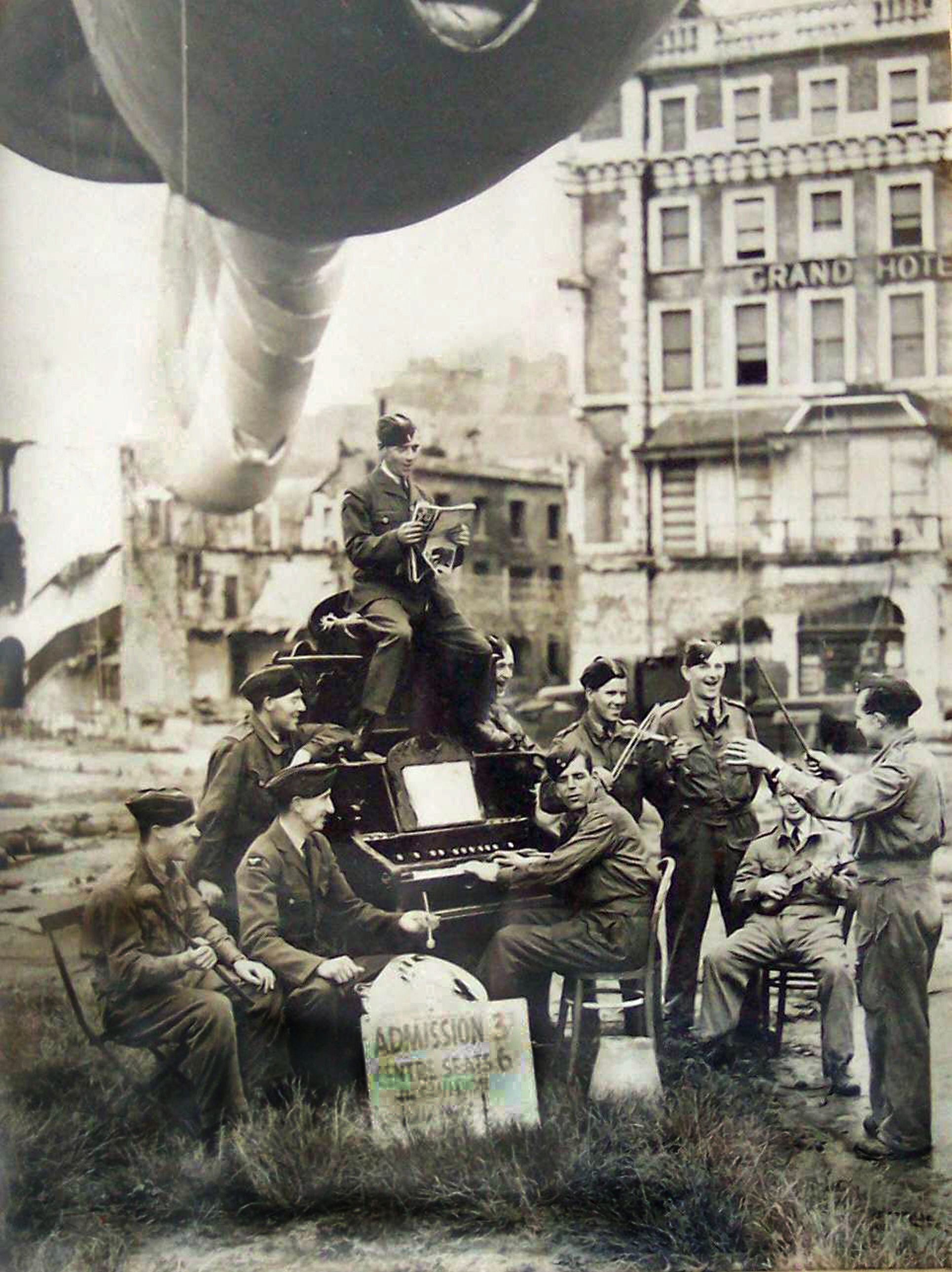
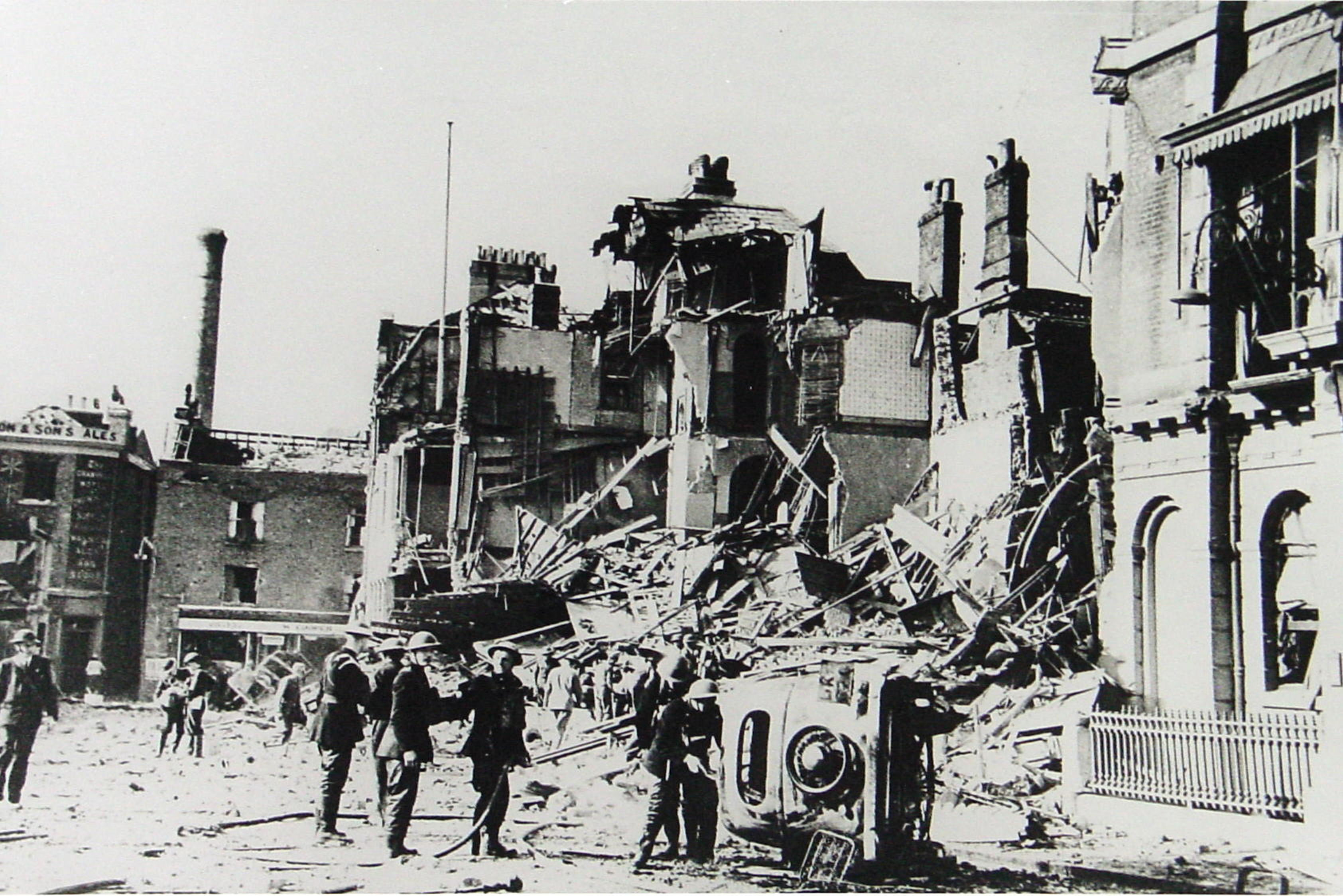
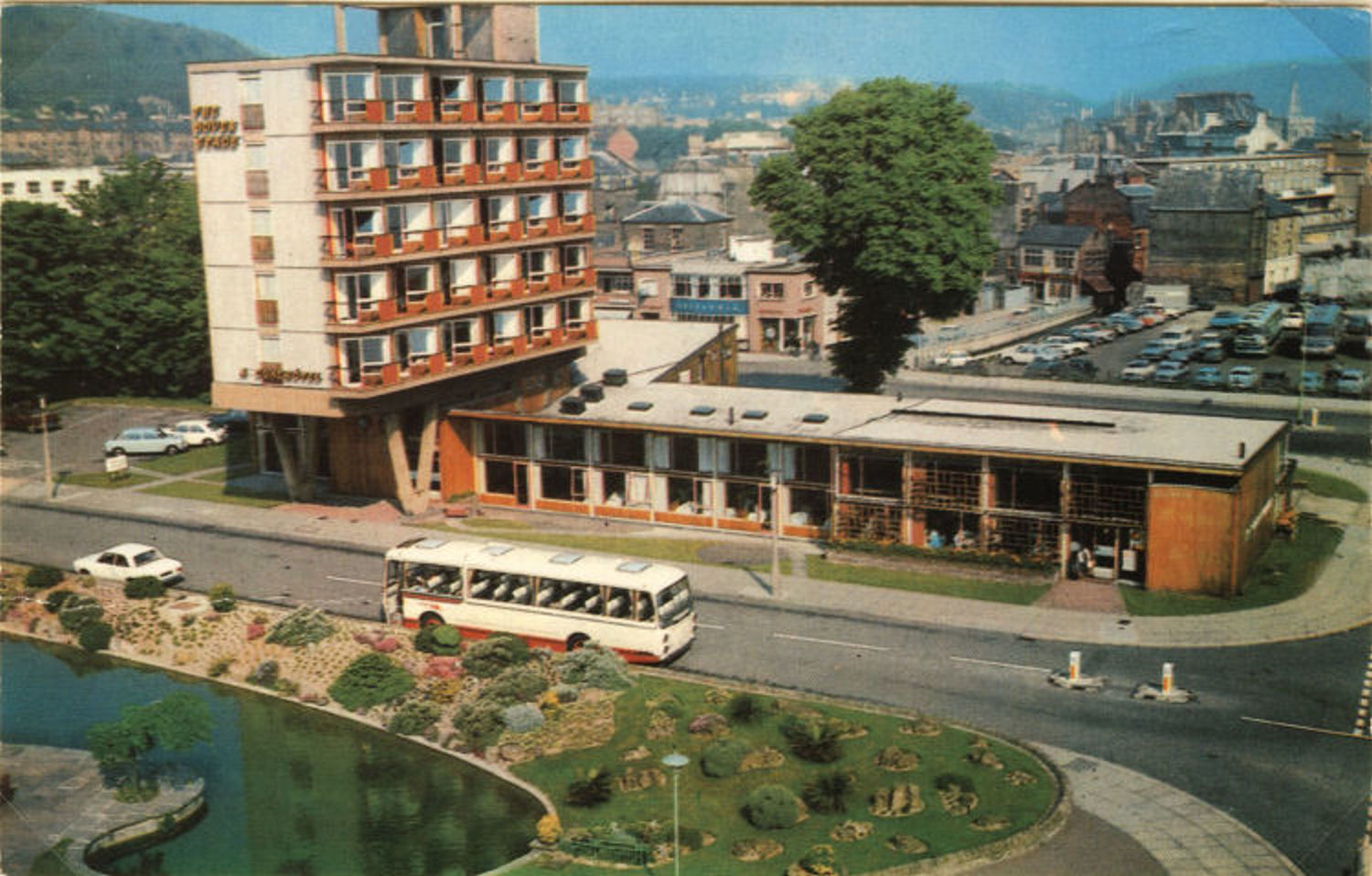
Wellesley Terrace, a handsome block similar to nearby Cambridge Terrace, was erected in 1846, overlooked the Gardens from the east. Four of these houses were later converted into the Grand Hotel that opened on 29 April 1893. A month later, the council took over the Gardens from DHB and immediately erected a bandstand. The former temporary library building was converted into a glass-roofed conservatory cafe, called Granville Bars. Crowds flocked to the venue at weekends throughout the summer.

On Friday 18 February 1910, Dover’s first fatal motor accident happened in Camden Crescent. Visitors, Mrs Alice Von Wieldt and her daughter, were crossing the road at 17.30hrs near the Rifles Monument. At the same time Captain Hickman, Adjutant of the 4th Buffs (Military) was driving his car along Camden Crescent and hooted. Miss Von Wieldt tried to pull her mother back but Mrs Von Wieldt rushed forward to try to cross in front of the car but was knocked down. The wheels passing over her head. Immediately Captain Hickman stopped and picked her up and took mother and daughter to the Royal Victoria Hospital, in the High Street. Mrs Von Wieldt died the following Sunday. Captain Hickman was exonerated from blame but the Coroner, Sydenham Payn, strongly  suggested that speed limits should be introduced in towns.

Granville Gardens circa 1910 - Grand Hotel facing, bandstand on the left Granville Bars on the right. Paul Skelton

Granville Gardens circa 1910 – Grand Hotel facing, bandstand on the left Granville Bars on the right. Paul Skelton

In spring 1911, the Granville Gardens were re-laid at a cost of £1,050 but the building that had been the Granville Restaurant and the Library remained closed. In August 1912, the council put forward the proposal that they would take it over, however, DHB announced that they were going to demolish it. The bandstand remained a popular attraction, until the 19 February 1914 when Captain Palliser, who lived in Camden Crescent, took  legal action against DHB and Dover Corporation, to remove it from the Gardens! His argument rested on a covenant dated 1842 which stated that no building was to be higher than 15ft 7inches (4.8metres) between Camden Crescent and the sea. However, because the site belonged to DHB at the time of the covenant but had been taken over by the council without taking the covenant into consideration, the judge decided that the covenant was not strong enough for the success of Captain Palliser’s action and dismissed the case. When it came to costs the judge, however, stated that as DHB and the council had deliberately caused the confusion and so they would have to pay their own costs!

During World War I (1914-1918) the Gardens were used by the military but as Armistice Day approached and was expected to take place in November 1918, it was decided to build a model of Dover on Granville Gardens. This was to show the damage that had been inflicted upon the town during the War. At 11.00 hours on 11 November 1918, a 6inch Howitzer gun, which had arrived in the town by train that morning, was taken to the Town Hall (now the Maison Dieu). The gun became the centrepiece of a procession, headed by Mayor Edwin Farley to Granville Gardens and the model village, where news of the Armistice was formally announced.

Following the War and the removal of the model of Dover town, Granville Gardens, like the rest of the seafront, was in a state of neglect. It was not until 1925 that the dilapidated bandstand and pavilion were replaced and summer military band concerts reintroduced. Dover Corporation were, in 1929, were forced to pay the military bands the same rate as professional civilian bands and the number of performances were cut to three a week and 1,000 people protested!

Waiting Miner Statue by H Phillips before it was wrongly moved from Granville Gardens moved in 2010

Waiting Miner Statue by H Phillips before it was wrongly moved from Granville Gardens moved in 2010

Although it now appears to be politically expedient to forget that Dover was the original centre of the Kent coalmining industry, it was to Granville Gardens where coalminers from all over the country came, following the 1926 General Strike. At that time there was little work in the national coal mines and Pearson, Dorman Long advertised for experienced miners to work in the Kent coalfield. All they had to do was find their own way to Dover’s seafront, near Granville Gardens and someone from the Union would meet them. Miners from South Yorkshire, Durham, Lancashire, Scotland and Wales came to Dover. Many of them, like this author’s Grandfather, walked. The union man met them and they started work within hours of arriving. My Grandfather was put to work at Snowdown Colliery, north of Dover.

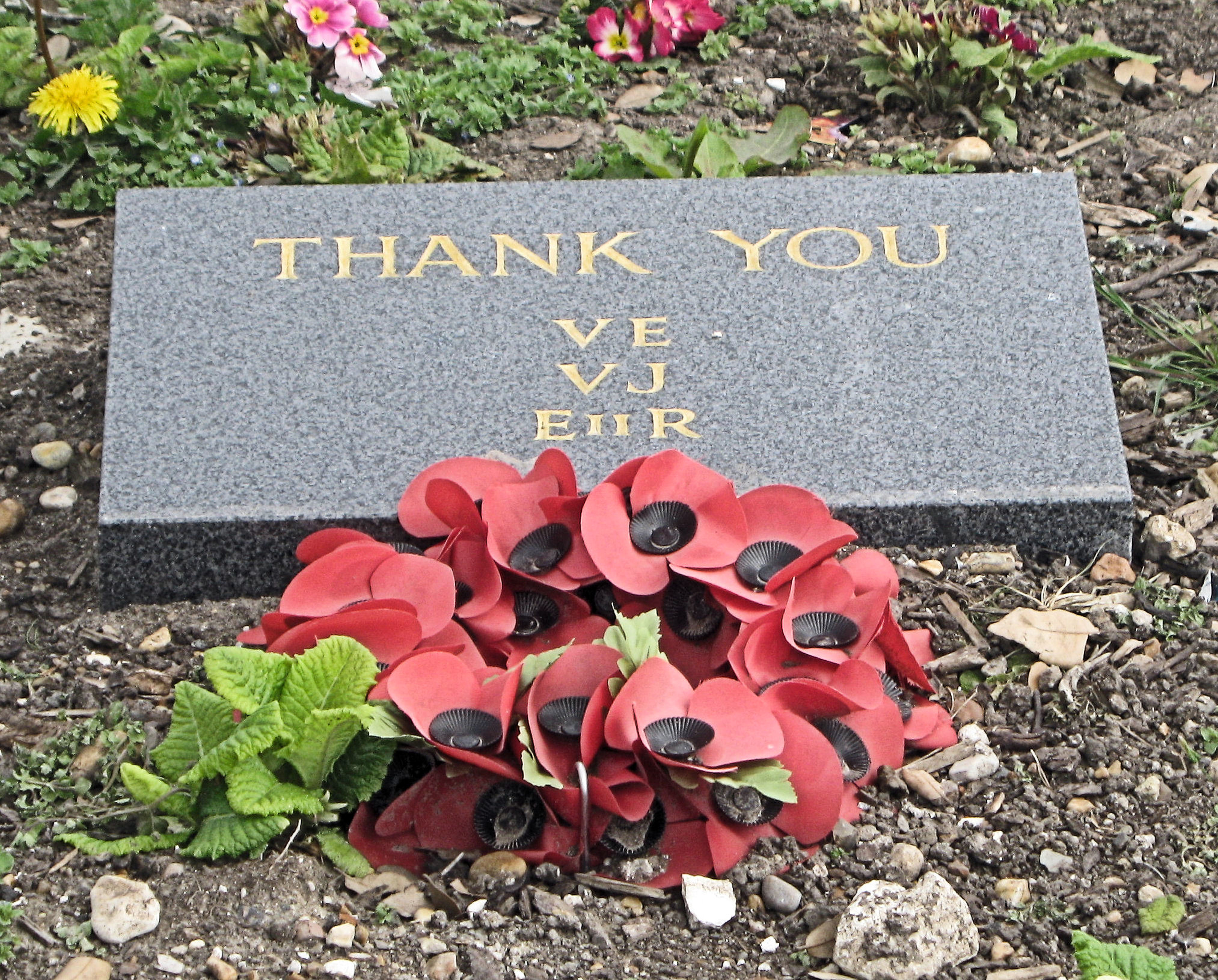
To mark the Centenary to the end of WWI this statues was erected in Granville Gardens and the caption reads:  Thank You to the WWI Generation. AS  2019

To mark the Centenary to the end of WWI this statues was erected in Granville Gardens and the caption reads: Thank You to the WWI Generation. AS 2019

The coal mining industry was nationalised on 1 January 1947 and two years later, the National Coal Board (NCB) opened their South East Division Offices in Waterloo Crescent, at the end nearest to Granville Gardens. In 1969 Chislet Colliery closed, followed by Tilmanstone and Snowdown (both in 1987) and Betteshanger on 28 August 1989. With the demise of the Kent coalfield, it was felt that a lasting reminder, based in the town of its origin, should be erected. Nothing happened until 1997 when the Waiting Miner statue that had been outside Richborough power station was in need of a new home it was placed it in Granville Gardens for obvious reasons. Unfortunately, the statue was moved to a new home in 2010 in an effort to ensure that the town’s relationship with the Kent coal mining industry would be lost. In 2019, on the plinth that had stood empty for 9 years a new statue was erected on the centenary anniversary of the end of World War I. The caption reads, Thank You to the WWI Generation.

Granville Gardens inter-war period

Granville Gardens inter-war period

During the economic depression of the 1930s, most of the houses in Camden Crescent were converted into flats. The formalisation of Dover’s tourist industry took place about this time when the manager of the Granville Gardens Pavillion, G Leslie Buxton, was appointed as the Entertainments and Publicity Manager for the town. Dancing, to amateur bands, were introduced at the Gardens on Tuesday and Thursday evenings and in 1935, a roller skating rink opened with a special floor costing £249 on Monday and Friday evenings. The financial report of that year’s the accounts showed that roller-skating had produced £292, at a cost of £200, where as the bands had produced £1,159 at a cost of £2,240. The number of times military bands played was reduced until eventually the concerts ceased.

At this time, for the affluent and businesses, cars were becoming the norm and there were a number of car manufacturing firms in the town. Concurrently, the calls for regulation and speed restriction were increasing. At the end of 1936 two traffic roundabouts were created, one near the Lord Warden Hotel, in the Pier district and the other incorporated the Rifles Monument.

Barrage balloon maintenance crew Granville Gardens. Courtesy of Tim Allen

Barrage balloon maintenance crew Granville Gardens. Courtesy of Tim Allen

At the outbreak of World War II (1939-1945), the Grand Hotel basement was designated an air raid shelter accommodating 250 persons and in 1940, a barrage balloon was erected in Granville Gardens. This was an easy target for enemy aircraft and consequently the Gardens suffered serious damage nonetheless the gun battery there, for the most part of the War, was manned by the Home Guard.  On Easter Sunday 1941, the balloon following an attacked was on fire when it drifted towards Trevanion Caves, where people were sheltering. Luckily, it only set light to the grass above the caves.

Visiting correspondents, particularly from the US used the Grand Hotel. In the summer of 1940, during the Battle of Britain, the American war correspondent and radio broadcaster Ed Murrow interviewed Crown Prince Bernhardt of the Netherlands.

Wellesley Road looking towards Townwall Street following the attack of 9 September 1940. Dover Library

Wellesley Road looking towards Townwall Street following the attack of 9 September 1940. Dover Library

However, on 9 September, a bomb devastated the Hotel and many Royal Navy and civilian personnel were killed or injured. Robin Harvey age-19, was so deeply buried under the rubble, his body was not freed for ten days. At the same time as the Grand Hotel was devastated, 7, 8, 9 and 10 Camden Crescent were destroyed. Over the next three years, the Hotel and Crescent were hit on numerous occasions by shells.

After the war the owners of the Grand wanted to rebuild but their application was refused and the council bought the leasehold, without the liquor licence, for £26,200. This payment was offset by a government war-damage payment of £25,000. DHB paid £4,000 for the freehold reversion out of which the council purchase the liquor licence for 300 guineas (£315) that they sold on later. The roller-skating rink floor was sold to John Lukey of the Shakespeare hotel, in Bench Street, where it became the dining room floor. Contractor, Frank Luck Ltd paid £1000 to demolish the building with the right of salvage. Demolition began in April 1951 and was completed by November. The council were very pleased with the deals!

Dover Stage and Granville Gardens with lake c 1970

Dover Stage and Granville Gardens with lake c 1970

Buoyed by this and using Compulsory Purchase Orders, the council took over the remaining houses in Camden Crescent in April 1949. They leased two to Messrs Autotels Ltd as an annex to the White Cliffs Hotel and another to the Automobile Association for offices. The site where the houses had been badly damaged was cleared and put on the market in 1951. As an incentive to would be buyers, the former Grand liquor licence was part of the deal. In January 1956, the building of a coachotel on the site was started and opened as the iconic Dover Stage in May 1957.

Granville Gardens, Camden Crescent with Cambridge Terrace behind - winter.

Granville Gardens, Camden Crescent with Cambridge Terrace behind – winter.

At the same time, Camden Crescent was re-aligned and Granville Gardens were re-laid as public gardens complete with illuminated fountain. However, Edinburgh Road, the opening between Granville Gardens and Waterloo Crescent where the National Coal Board had their offices, was closed and made into a car park. Townsend Ferry Company moved their offices to 1 Camden Crescent and eventually took over the entire Crescent.  The company moved into the purpose built Enterprise House, in Channel View Road, in 1983 retaining Camden Crescent as a passenger travel centre.

In June 1984 Dover District Council (DDC) put the terrace properties on the market in order to raise capital and engaged the services of both local and London estate agents. Townsend’s, having bought the former Automobile Association offices in Russell Street for public access, moved out.  On 30 June 1988, Dover District Council (DDC) Planning Committee granted approval for Dover Stage to be demolished and in November that year it was bulldozed into oblivion. The following January the site became a car park.

World War II Garden in Granville Gardens. Time capsule of Dover buried September 2015 to all those who died in the War. LS 2016

World War II Garden in Granville Gardens. Time capsule of Dover buried September 2015 to all those who died in the War. LS 2016

Following the removal of the Waiting Miner statue the plinth remained empty. Various ideas were put forward but as noted above in 2019 a new statue was erected the caption of which reads: The caption reads, Thank You to the WWI Generation. In September 2015, three feet under one of the flower gardens, a time capsule was ceremoniously buried. Contained in an old ammunition box, inside are World War II medals and cap badges along with mementoes of Dover and a scroll carrying the names of all of Dover Councillors at that time. The idea is that of local Augusta Pearson who believes that future generations should know of the sacrifices of those who died during the War. It was buried by Frank Thompson – a former Staffordshire regiment soldier, assisted by Dover Sea Cadets’ Petty Officer Oliver Worsell and Cadet Jake Joliffe. The time capsule is to be opened in 30years time and the ceremony coincided with Queen Elizabeth II becoming the longest serving British monarch on 9 September 2015.

Seats

When Granville Gardens were re-laid, the public were invited to purchase seats for dedication. At the time of writing, these dedicated seats include:

H.R. Armstrong Royal Hippodrome Theatre 1936-1944

H.R. Armstrong Royal Hippodrome Theatre 1936-1944

H R Armstrong – Royal Hippodrome Theatre 1936-1944. H Roberts Armstrong was the proprietor of the Royal Hippodrome Theatre in Snargate Street during the years stated. World War II brought a great number of servicemen and women to Dover and although the Hippodrome was in the front line of the constant attack on the town, the twice-nightly shows played to packed houses. Many internationally famous entertainers performed there ignoring the sirens and devastation going on around. Although the theatre had been hit before, on 25 September 1944, it was heavily shelled. The next day the shelling of Dover ceased, but the wrecked building never re-opened and was demolished in January 1951. There was once a plaque to the theatre in Snargate Street but after it was stolen it was never replaced. The seat to HR, as he was known, is the only reminder of that once extremely popular theatre.

Audrey Scott Honorary Secretary of the Channel Swimming Association 1971- died 07.04.1993

Audrey Scott Honorary Secretary of the Channel Swimming Association 1971- died 07.04.1993

Other seats are dedicated to the Crothall Family, Hugh Thomson, William Chidwick, Ted Joseph Edwin Adams and Rose Adams of Snargate Street, Oliver H Teulon – Chief Engineer P.W.D. Burma; George Skaife – Superintendent Borough Engineers Department 1953-1963; Edward G Saunders seat presented by his wife Ida Saunders. There is also a seat dedicated to Audrey Scott – Hon Sec Channel Swimming Association 1971-1993 who died on 7 April.1993 and Norman Edward Lawrence of the Dover Sea Angling Association, who died in 2005.

Egerton John Quested was born 25 September 1947 and was a member of the Catering Staff that died on board the Herald of Free Enterprise Disaster on 6 March 1987. This is one of the many tributes in Dover to the 193 people who tragically lost their lives that day. The day, it is generally felt, that Dover died.

  • Presented:
  • 18 October 2013
Posted in Camden Crescent and Granville Gardens, Roads & Streets | Comments Off on Camden Crescent and Granville Gardens

Thomas Tallis and Dover’s choral tradition

 Dover Society Blue Plaque to Thomas Tallis Dover College gatepost, Folkestone Road. AS

Dover Society Blue Plaque to Thomas Tallisn Dover College gatepost, Folkestone Road. AS

Thomas Tallis (circa.1505–1585), one of England’s most important composers of his time, started his career in Dover. His first appointment was that of the organist of Dover Priory in 1532. The site of Dover Priory is now that of Dover College and on the stone gatepost is a blue Dover Society plaque dedicated to Thomas.

Thomas was born about 1505 but little is known about his life until he was appointed to the post of organist at Dover Priory. Because of his profession, there is little doubt that his early years were spent as a chorister possibly at Canterbury Cathedral. He certainly had East Kent connections and these he maintained throughout his life. It is feasible that it was while Thomas was at the Dover Priory that he composed Missa Salve Intemerata, his earliest known work.

However, the days of the Priory were numbered for Henry VIII (1509-1547), through the Act of Supremacy of 1534 – when the Sovereign was proclaimed the supreme had of the Church of England – instigated the Dissolution of the Monasteries. During the years that followed all the monasteries, priories, convents and friaries in England and Wales were closed down. This enabled Henry VIII to appropriate the income and dispose of the assets of the former establishments but as for the former incumbents, they were left without work or homes. Further, the services to the community they had for centuries provided, were lost.

Thomas Tallis - internet

Thomas Tallis – internet

Dover Priory ceased to exist on 16 November 1535 but whether Thomas stayed to the end is unclear. Two years later, Thomas was in the choir and possibly the organist at St Mary-le-Hill in Billingsgate, London. He then moved to the Holy Cross Abbey, Waltham, Essex until that was Dissolved in March 1540. Although out of work again, Thomas did not receive any gratuities when he lost his jobs. He was then accepted as a clerk at Canterbury Cathedral and was in the choir. Three years later, he had been accepted as a ‘gentleman’ (lay singer) of the Chapel Royal.

The Chapel Royal was not, nor still is, a building as such but an establishment of the Royal Household. When Henry VIII came to the throne it was a body of priests and singers whose job it was to serve the spiritual needs of the sovereign. Following the Dissolution of Monasteries, Henry retained the Chapel Royal for which, in 1531, he had a specific building constructed in St James’ Palace. Of note, in 1540 the ceiling was painted by Hans Holbein in honour of Henry’s short-lived fourth marriage to Anne of Cleves.

Tapestry depicting Henry VIII. Dover Town Council

Tapestry depicting Henry VIII. Dover Town Council

Part of Thomas’s duties, within the Chapel Royal, was the musical education of all three of Henry’s children – Edward VI (1547-1553), Mary I (1553-1558) and Elizabeth II (1558-1603). This, Thomas undertook and remained a member of the Chapel throughout their reigns. He married widow Joan Bury during Mary I reign and lived in Greenwich. As he became more established, his earnings increased and he was given leases of property, mainly in east Kent. Yet, through a succession of monarchs, with diverse religious views, Thomas, it would seem, managed to remain true to the Roman Catholic faith.

Thomas was to remain with the Chapel Royal for the remainder of his life and eventually became the choir’s most senior member. The financial security and tenure together with working with notable singers, nurtured his talents that resulted in most of the works that survive today. Sadly, the Chapel Royal music books of Thomas’ time have not survived so much of his work that comes down to us today, comes from other sources. From these, experts have identified when most of compositions were written.

Elizabeth I. Dover Museum

Elizabeth I. Dover Museum

It would seem that although Henry VIII had broken with Rome he retained most of the Catholic traditions and this is reflected in Thomas’s work of that period. During the reign of Protestant Edward VI, English texts were introduced and it is Thomas’s work at this time that has given him that accolade as one of the founding fathers of Protestant church music. Mary I, was a staunch Roman Catholic and Thomas, without doubt returned to traditional settings for his work. Following Protestant Elizabeth I ascending the throne changes was probably made accordingly but as time progressed, it would seem that the political climate of that time had little bearing on Thomas’s work.

Thomas died on 23 November 1585 and was buried at St Alfege Church, Greenwich. The site was marked with a brass memorial but was destroyed during World War II. Today, Thomas ranks among the most performed, recorded, researched, and respected composers of Tudor England.

18th Century sketch of St James' Church

18th Century sketch of St James’ Church

At the time the Dissolution, not only did Dover’s Priory suffer but all the other religious establishments in the town. That is, with the exception of the old St James’ Church the ruins of which can be seen. However, following a petition from the town’s folk, Henry VIII relented over St Mary’s Church and allowed it to stay. Nonetheless, it would seem that the quality of music that Dover had experienced before the Reformation was lost for the next two hundred years.

In 1742, with money raised by subscription and a generous donation by the Dover’s Cinque Ports Pilots, an organ was bought for St Mary’s Church. Following this, there is ample evidence that music again became part of the fabric of the town. There were musical evenings, both large and small orchestras and a proliferation of shops selling sheet music and musical instruments.

Following the opening of Connaught Hall, in the Maison Dieu,  in 1883 there were choral recitals by the Dover Harmonic Society. The singers were accompanied by the orchestra of Dover Amateur Musical Society, whose members included muscians from the military bands stationed in town. In 1892 Dr Edward Ferrand Astley (1812-1907) established a town choir and within three months the Dover Choral Union was formed whose leader was the Borough organist, Professor Harry J. Taylor. Their first concert featured Mendelssohn’s Hear My Prayer and other works and proved a great success.

Dr Edward F Astley Organ presented 1902. Connaught Hall.

Dr Edward F Astley Organ presented 1902. Connaught Hall.

Professor Harry J. Taylor was the musical director for the Dover Pageant of 1908, for which he composed All Hail to Thee Dauntless Dover – this is still sung at the annual Dover Festival Prom Concert. After a discussion with Professor Taylor, Dr Astley bought the magnificent organ that can still be seen in Connaught Hall. This was officially given to the town on Wednesday, 5 November 1902 and cost over £3,000. Fitted with electronic action throughout, it was nationally applauded as  ‘a veritable triumph in organ building.’ Professor Taylor was in charge of the instrument until his death in 1936. He also composed a number of works and these were central to the acclaimed memorial concert that year.

Dover Choral Society Michael Lewis conducting 04.04.2009

Dover Choral Society Michael Lewis conducting 04.04.2009

Following World War II, in 1945, the Dover and District Music Club was formed under the Chairmanship of Sydney Clout. The next year John Stainer formed the Dover Orchestra, the Leader of which was also Sydney Clout. Two years later the Choral Union, renamed Dover Choral Society, took to the stage under a new conductor, Wilfred Holland, the Borough organist and head of music at Dover College. When he left for Australia, John Stainer was appointed the director. Miriam Knights (died 2002) came to Dover in 1946 and conducted 12 different choirs winning more than 300 awards at festivals and competitions. One of the choirs, in 1970, appeared in the television programme Opportunity Knocks. In 1952, Doris Knight joined the Choral Society and enjoyed her 100th appearance as a participating memberof the Dover Choral Society in 2003 – singing alto, Doris has, at the time of writing, taken part in 116 performances!

Dover Choral Society's music director Steve yarrow, second from the leaft, with soloists Michael Solomon Williams, Samuel Queen, Jenni Harper, Gordon Waterson and James Priest. Graham Tutthill 2013

Dover Choral Society’s music director Steve yarrow, second from the leaft, with soloists Michael Solomon Williams, Samuel Queen, Jenni Harper, Gordon Waterson and James Priest. Graham Tutthill 2013

In 1960 Ross Andersen was appointed conductor and musical director, followed by Geoffrey Beadle in 1968. He was succeeded, twenty years later, by Michael Foad and in 2005, Michael Lewis, who also conducts the Snowdown Colliery Welfare Male Voice Choir, was appointed. In November 2012, Micheal Lewis passed the baton to Stephen Yarrow, who founded and directs the Pharos Chamber Choir. The Society continues to put on two major productions every year and Stephen Yarrow’s debut concert, in March 2013, was Haydn’s masterpiece The Creation. 

In May 1964, Bryan Anderson, Head of Music at Astor Secondary School and Musical Director of the Dover Operatic and Dramatic Society (DODS) brought together a group of singers. Specialising in Madrigals and unaccompanied Tudor church music, such as Tallis’ work, Bryan Anderson and Friends, as they were called, they quickly proved popular. Four years later, when Bryan moved to Bristol, the group continued as the Anderson Singers. Alf ‘Dusty’ Miller, took over the role of conductor until his death in 1981. The following year the singers were under Ralph Harding, organist at St Peter and St Paul’s Church, River, followed by Ann Wadey, one of the original singers and also the then musical director of many of the Astor Secondary School musicals.

Soprano - Jean Pearson

Soprano – Jean Pearson

Ann continued until 1993, when Stephen Yarrow, now organist and choirmaster at St. Mary’s Church, Dover, succeeded her. Three years later, however, the Anderson singers gave a ‘Farewell Concert’ at the River Church. In February 2003 Stephen Yarrow founded the Pharos Chamber Choir and their first concert was at St Mary’s Church on 25 October that year. The guest soloist was Jean Pearson (soprano).

Since then they too have been much in demand and together with the Choral Society, the annual Festival Prom Concert – one of the major highlights of the year – Dover’s many school choirs, together ensure that Dover’s choral heritage lives on. Further, Gareth Malone, from BBC2’s ‘The Choir: Sing While You Work’ worked with a group of choristers from Dover’s P&O Ferries in 2013 … and they won the competition!

Returning to Thomas Tallis, the Dover College music school is named after Thomas Tallis and on the school gates is a Dover Society blue plaque to his memory. On Saturday 19 May 2018 Prince Harry and Meghan Markle were proclaimed husband and wife in a ceremony at St George’s Chapel at Windsor Castle, watched by a global audience. During the service the Choir of St George’s Chapel sang the motet, If Ye Love Me by Dover’s Thomas Tallis!

Posted in People, Tallis Thomas and Dover's choral tradition | Comments Off on Thomas Tallis and Dover’s choral tradition

Sir Henry Mainwaring – Dover’s piratical Member of Parliament

Elizabethan Galleon - Observer Series

Elizabethan Galleon – Observer Series

Henry Mainwaring (or Maynwaring) was an infamous seventeenth century pirate who went on to become Dover’s Member of Parliament! Born 1586/7 into an old Shropshire family, Henry graduated on 15 July 1602 from Brasenose College, Oxford University at the age of fifteen. He was admitted as a student to the Inner Temple in 1604. He next became a soldier and then a sailor with the authorisation to suppress pirates in the Bristol Channel.

In 1612, Henry’s father bought and fitted a 160-ton ship out for £700, including crew, that was named Resistance. Young Henry was planning to go with Sir Thomas Shirley (1564-1634), to Persia to fight the Turks, but the scheme was aborted due to the influence of the Spanish Ambassador and Shirley’s financial problems. Thus, Henry went off on his own accord promising to fight every Spanish ship he met! This was not particularly expedient at the time as England was trying to build a good relationship with Spain!

Nonetheless, Henry sailed for the Barbary Coast – the North African-Mediterranean/Atlantic coast – in order to fulfil his dreams. Although initially not particularly successful, he used the time well to learn the art of seafaring and commanding. Creating a base near modern-day Mehidia, on the west coast of Morocco, Henry built up a fleet of ships and by piratical methods secured some £3,500 of goods meant for Spain. He then sought to use his sailing knowledge and ship to help England’s cause and in 1614 was ordered to go to Newfoundland to arrest and return with Peter Easton, ‘The Pirate Admiral’.

By the time Henry arrived, Easton had moved onto new rich pickings and Henry knew he would be in trouble if he returned to England empty handed. Thus, he decided emulate Easton and turned his attention to the Spanish galleons laden with gold that were returning from the Americas! Earning the name of ‘Maynwaring the Pirate’, he quickly reached the ‘rank’ of ‘Admiral’ of a largest pirate fleet operating along the American coast from Newfoundland to the West Indies!

James I 1603-1625 - Worcester Cathedral Cloisters

James I 1603-1625 – Worcester Cathedral Cloisters

Henry’s fleet was so successful that the king of Spain, Philip III (1598-1621), wrote to the English king, James I (1603-1625), to complain. This was after the Philip III had, in vain, used his naval ships to attack Henry’s fleet. James I relayed the complaint onto Henry and asked him to leave the Spaniards alone. Whether Henry received the request or not is unrecorded but he appears not to have taken any notice. Philip then tried a different tactic and offered Henry a free pardon, twenty thousand ducats a year and the command of a Spanish Squadron!

This message Henry did receive but declined the offer. The Spanish king again contacted James I, and possibly threatened reprisals on English ships. This spurred James into sending a message to Henry saying that he would order the English navy to attack his fleet and bring him home in irons. Alternatively, added James, Henry could disband his fleet and return to England and be given a free pardon. This, Henry accepted.

Dover Castle

Dover Castle

On his return voyage, Henry encountered an English convoy sailing to Cadiz that was being attacked by pirates. Not only did he fight off the attack, he escorted the convoy to its destination before returning home. By this time, Henry had earned the accolade of being dashing and charismatic hero. When he landed at Dover on 6 June 1616, the town turned out to cheer him!

Henry then settled down and wrote the book, Discourse on Piracy, which became the recognised manual for the suppression of the illegal occupation. In his book, Henry said that Ireland was a popular rendezvous for pirates as there was a ‘good store of English, Scottish and Irish wenches, which resort unto them and these are strong attractions to drawn the common sort of seaman thither.’ He also made the profound observation that many sailors were driven into the piracy due to hunger and lack of regular work. Henry therefore advocated the provision of worthwhile work and pay, in seafaring towns, as the best solution to the problem.

Dover Harbour c 1830

Dover Harbour c 1830

At the time Dover was, economically, in a very distressed state compounded by the Cross Channel passage being beset by Dunkirkers – the name given by Dovorians, for pirates from the Continental mainland and the Mediterranean. With his expertise, Henry was recruited into trying to solve the problem and the poacher turned gamekeeper was very successful. So impressed was James I by this that he knighted Henry on 20 March 1618 and appointed him a ‘Gentleman of the Bedchamber’.

Lord Warden (1604-1614), Henry Howard - Earl of Northampton by Sylvester Harding - Wikapaedia

Lord Warden (1604-1614), Henry Howard – Earl of Northampton by Sylvester Harding – Wikapaedia

In 1620, Sir Henry was appointed a Lieutenant of Dover Castle and Deputy Warden of the Cinque Ports. While Deputy Warden, Sir Henry improved the defences of the Castle and King James asked for Sir Henry, along with another Castle Lieutenant – Sir Richard Younge (d1651), to be Dover’s representatives in Parliament. In those days, Dover had two elected Parliamentary representatives and in 1613, King James had asked Henry Howard – Earl of Northampton (1540–1614), the then Lord Warden (1604-1614), for the representatives to have the interests of the Crown at heart. This was agreed to by the outgoing Mayor, William Waade (sometimes spelt Warde) – who was also a Deputy Lieutenant at the Castle – and the Jurats and set a precedence. The Common councilmen and Freemen of the town had no say in the matter.

The next parliamentary election was in 1621 and Edward la Zouche, 11th Baron Zouche of Harringworth, Northamptonshire, (1556–1625) was the Lord Warden (1615-1625). With the Mayor of Dover and Jurats blessing he complied with the Royal request. One of the suggested candidates was Sir Henry, who was popular and this had increased as he mixed freely with the town’s mariners. Indeed, he took note of their discussions and this culminated in the Seaman’s Dictionary that was eventually published in 1644. So, although the way the candidates had been selected aroused a lot of ill feeling amongst the Common councilmen and the Freemen of the town, they kept relatively quiet because one of the candidates was Sir Henry.

In Parliament, proved an excellent representative for the mariners of Dover. For instance, on the 27 February and 8 March 1621, he opposed the Bill for the transferring of the control of lighthouses along the Kent coast from the Cinque Ports Pilots to Trinity House. Arguing that their knowledge of the coast stretched back further and was far was greater that of the Trinity House Pilots.

Lord Warden (1615-1625) - Edward la Zouche, 11th Baron Zouche of Harringworth - Wikapaedia

Lord Warden (1615-1625) – Edward la Zouche, 11th Baron Zouche of Harringworth – Wikapaedia

However, Sir Henry was a known womaniser and this became part of the reasoning dismissing him from the post of Lieutenant of the Castle, and because the selections was made by the Lord Warden, from his post as one of Dover’s Members of Parliament. The accusation was compounded by evidence that he had been seen brawling in the street. Sir Henry vigorously denied brawling and in response to the accusation over women, he said, ‘I am sure the world cannot tax me for keeping any women or frequenting their companies’. Nonetheless, Lord Zouche demanded and accepted Sir Henry’s resignation in May 1623.

Shortly after Sir Henry was appointed captain of the Prince Royal and in October 1623, brought the King’s son, Charles – later Charles I (1625-1649) – and King James’ favourite, George Villiers, Duke of Buckingham (1592-1628) back from Spain. This followed the breakdown of talks over Charles’s possible marriage to the Infanta of Spain.

In 1624, another parliamentary election was called and along with Sir Richard Younge, Sir Edward Cecil (1572-1638) was appointed as Dover’s representatives. Sir Edward, a veteran Parliamentarian and supporter of James, had been created a Castle Lieutenant especially for the election and the Mayor and Jurats of Dover again supported the decision. In response, a petition was sent to the House of Commons, stating that the election had been carried out without the full body of Freemen being assembled. The House issued a new election writ but the same two men were returned. It is unclear if anyone else stood.

Lord Warden (1625-1628) George Villiers, Duke of Buckingham - Wikapaedia

Lord Warden (1625-1628) George Villiers, Duke of Buckingham – Wikapaedia

As for Sir Henry, he effectively worked for George Villiers, the Duke of Buckingham, who was appointed Lord Warden on the death of Lord Zouche. However, the Duke was assassinated in 1628 and with his death, Sir Henry lost his patron. Sir Henry married in 1630 but his wife died three years later and his only child, a daughter, was fostered by her uncle but died when she was six. During the Civil Wars (1642-1651), Sir Henry was a Royalist but due to financial problems exiled himself in Jersey. He returned to England in 1651, when it was recorded that he was worth £8. Sir Henry died on 15 May 1653 and was buried next to his wife in Camberwell.

  • Published:
  • Dover Mercury: 19 February 2009
Posted in Mainwaring Sir Henry – Dover’s piratical Member of Parliament, People | Comments Off on Sir Henry Mainwaring – Dover’s piratical Member of Parliament