East Cliff and Athol Terrace

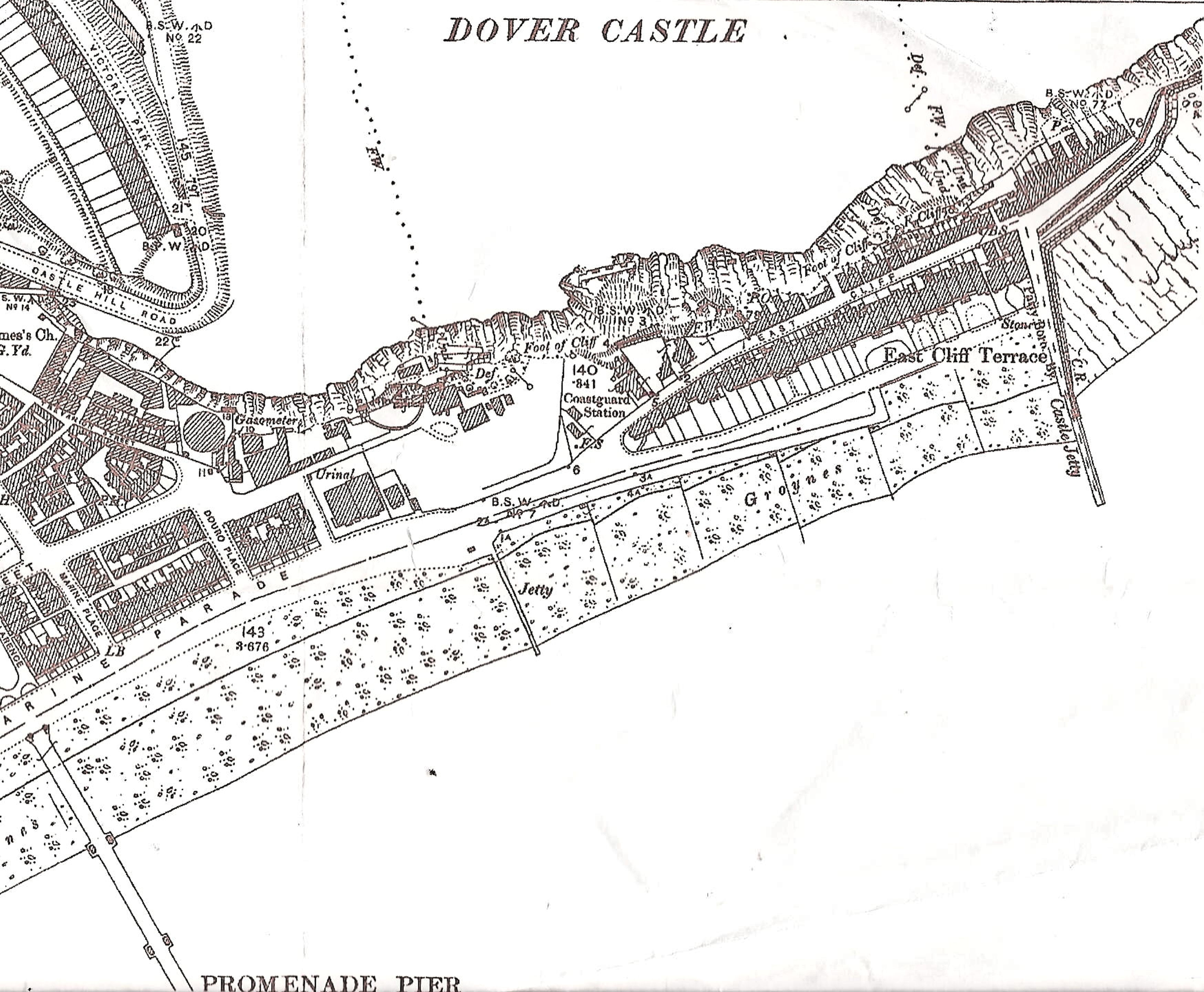
East Cliff and Athol Terrace area 1898 showing Castle Jetty

East Cliff and Athol Terrace area 1898 showing Castle Jetty

Dover’s harbour, up until the late medieval period, was at the east end of the harbour under Castle cliff, approximately where the Swimming pool and Sports centre are today. Due to a series of natural catastrophes, this harbour became useless and was moved to the west side of the Bay where it developed over the next few centuries. These developments affected the tidal streams causing what became known as the Eastward or Longshore Drift, which caused shingle to be deposited around the edge of the Bay. However, for a variety of reasons it was necessary to access the Castle from the sea so in 1753, a wooden pier was built – the Castle Jetty – where ships could tie up and cargo unloaded for the Castle.
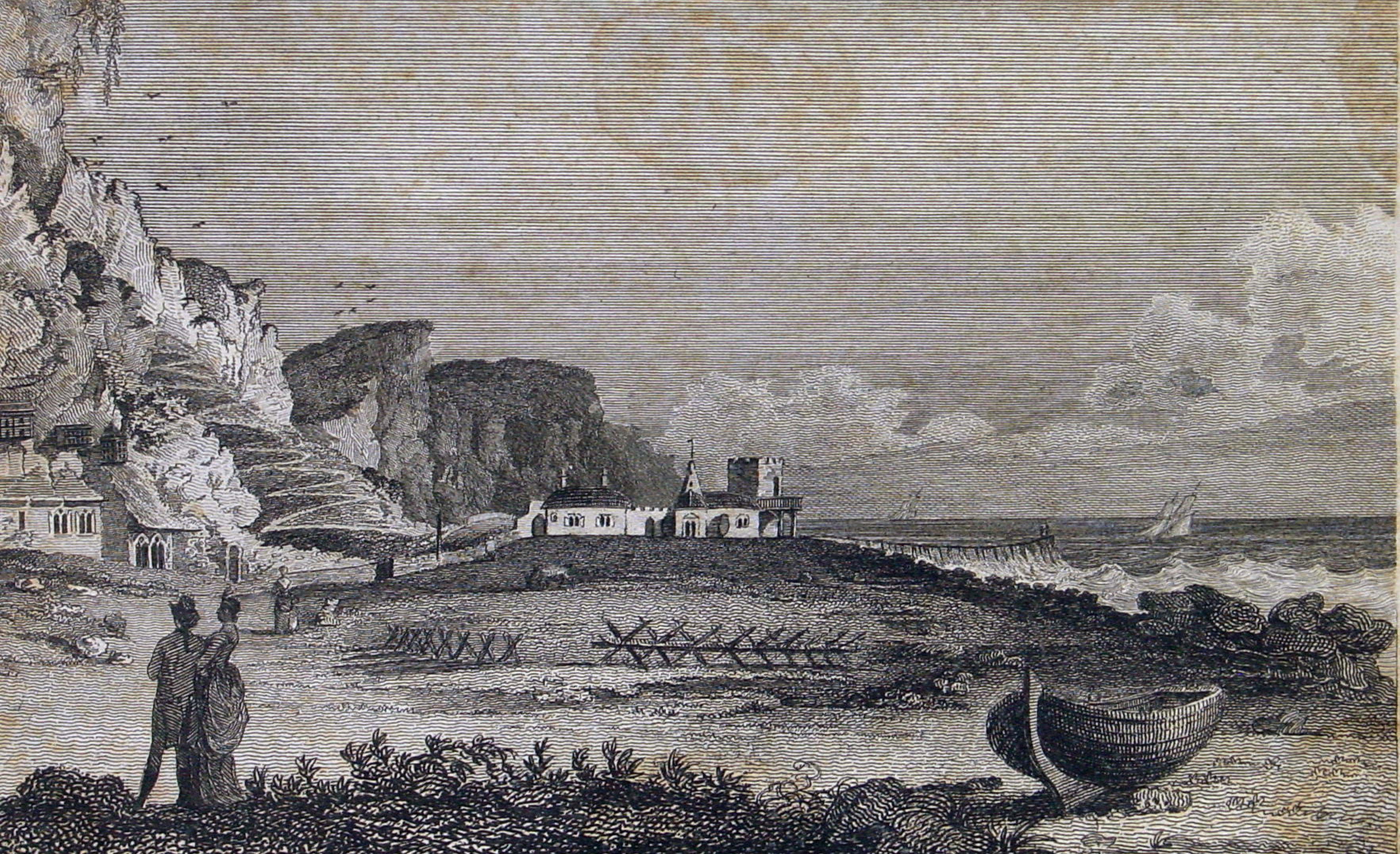
Smith's Folly, East Cliff, from an original drawing by Rawle and engraved by John Nixon 1801. Dover Library

Smith’s Folly, East Cliff, from an original drawing by Rawle and engraved by John Nixon 1801. Dover Library

This triggered the Law of Unintended Consequences as shingle built up against the new Jetty and soon a broad strip of beach accumulated. On the newly created land Guilford Battery was built, fishermen erected huts and Captain John Smith built his Folly. A painting dated 1816 shows that a windmill stood where Athol Terrace was eventually built and four years later, records tell us that a terrace of cottages had been erected. A Scottish lady, Mrs MacIntyre, apparently purchased number 3 and suggested the terrace to be called Athol Terrace after Blair Athol, to remind her of her native land.

East Cliff cave dwellers home (interior) by Henry Prior circa 1833-1857. Dover Museum

East Cliff cave dwellers home (interior) by Henry Prior circa 1833-1857. Dover Museum

The soft white chalk of the steep cliffs was hewed out to create homes that were captured by artist John Nattes (c1765-1822) in a series of sketches. These caves were described as being dry, comfortable, and cool in summer and warm in winter and the 1841 census shows that James Hart lived in one and Widow Mary Burville, along with her four children lived, in another. The Burvilles (various spellings) were said to originate from Tilmanstone, east of Dover, and Mary’s husband, Benjamin, was a carrier of coals. He was killed when he fell from his cart at Broadlees Bottom in 1833 and a public appeal for financial help was launched by the Dover Telegraph. Another artist, W Henry Prior, between 1833 and 1857 used water-colours for his paintings of the interiors and exteriors of the caves and one may well have been Mary’s. One exterior painting shows a cave with three windows and a chimney coming out of the cliff face several feet above the entrance door.

East Cliff Mansions showing the date 1834

East Cliff Mansions showing the date 1834

Captain John Smith owned much of the newly created land for his son, Sir Sidney Smith, sold it to Wilson Gates a builder. He was responsible for the development of East Cliff and the adjacent Athol Terrace that we see today. This took place between 1817 and 1840 the date of 1834 can still be seen on one set of the mansions. The new residences proved popular and soldier Francis Cockburn (1780-1867) later General Sir Francis and his wife Alicia (1782-1854) moved in and they stayed until their deaths. Sir Francis played a major role in the European settlement of Canada, was the Commandant of the Settlement of British Honduras (now Belize) and became the Governor of the Bahamas, for which he was knighted and a major role in freeing US slaves. Here in Dover, he was applauded over his compassion for widows and orphans of drowned seamen.

Once the area had been developed, which parish did it belong to became a concern of Dover council especially as the residents were not paying any rates! This came up before the courts at the East Kent Quarter Sessions on 9 April 1847. After the hearing, where twenty witnesses had given evidence, it was decreed that the houses were in the parish of Guston, and were thereafter so rated. However, for municipal purposes, for instance, Parliamentary elections, East Cliff and Athol Terrace were in the Borough of Dover!

Dover Corporation were annoyed, for at the time the town was having flooding problems at high tides for which they were having to pay for sea defences. They decided that as East Cliff and Athol Terrace did not to contribute to the rates, the defences stopped at the Boundary Groyne – so called following the court Ruling. However, at the time of the Ruling work was starting on the Admiralty Pier, at the west end of the Bay. This directly affected the Eastward Drift causing the denuding of the seashore at the eastern end of the Bay and serious flooding at East Cliff. This was noted in the Rawlinson Report on Public Health in Dover published in 1849 but nothing was done.

Athol Terrace - c 1880. Bob Hollingsbee

Athol Terrace – c 1880. Bob Hollingsbee

As the situation deteriorated, pressure was put on Dover Corporation who submitted a Private Bill to parliament seeking approval to carry out what was becoming essential sea defence works. The Dover Ratepayers Association, however, strenuously opposed the Bill, to the extent that in the local elections of 1876, they put up candidates in all the Wards. Although only one candidate was successful this was sufficient to raise doubt over the use of the Borough funds for the promotion of the proposed legislation. The Mayor, George Fielding, chaired a public meeting, which was boisterous but ended with a division in favour of the Bill – but only just.

The Ratepayers Association demanded a poll of all Dover ratepayers but on 1st January 1877, before the referendum, a vicious westerly storm swept into the bay damaging much of the partially built Admiralty Pier. Masonry was carried across the Bay impacting on the residences of East Cliff and at the same time, the raging seas flooded the whole area. The result of the poll was 2246 votes for and 281 against the Sea Defence Bill, which became an Act in 1877 and the contract for £9,428 was given to Josiah Paul of Queenborough. The money was borrowed, with the consent of the Local Government Board, on the understanding that the East Cliff / Athol Terrace properties would be rated for the purpose until the debt was repaid.

At that time, and for most of the 19th century, senior army personnel occupied the large mansions and fishermen the  cottages on East Cliff back road. In 1846 the Finnis Family, local timber merchants and philanthropists, opened the British and Foreign School in one of the mansions. The school had no religious barriers and accommodated 50 girls and an unspecified number of boys who were charged 2d a week to attend. Some of the villas along the back road and in Athol Terrace offered lodging accommodation although some were  bought as summer residences.

Typically, Lady Clifford, who bought 4 Athol Terrace, would arrange local staff to get her cottage ready before she arrive with her butler and maid for the summer. Charles Okey and his family followed the same format until he was appointed to the Antigua Legislative Council. One of those who lodged at 1 Sydney Place was Marian Evans, better known as novelist George Eliot (1819-1880). She stayed in 1855 and wrote, on 16 March, to her friend, Sarah Sophia Hennel who lived in Coventry. The novelist said that ‘Dover looks very lovely under a blue sky. The cliffs with the soft outline of hills beyond looking, as Kingsley says, like the soft limbs of mother Hertha lying down to rest, and the town with its blue smoke made a charming picture under the afternoon sun as I walked up the castle hill. But here as everywhere else man is vile cheating one of sixpences and making one feel misanthropic in spite of oneself. My lodgings however are very comfortable and I have a nice quiet woman to wait on me.’
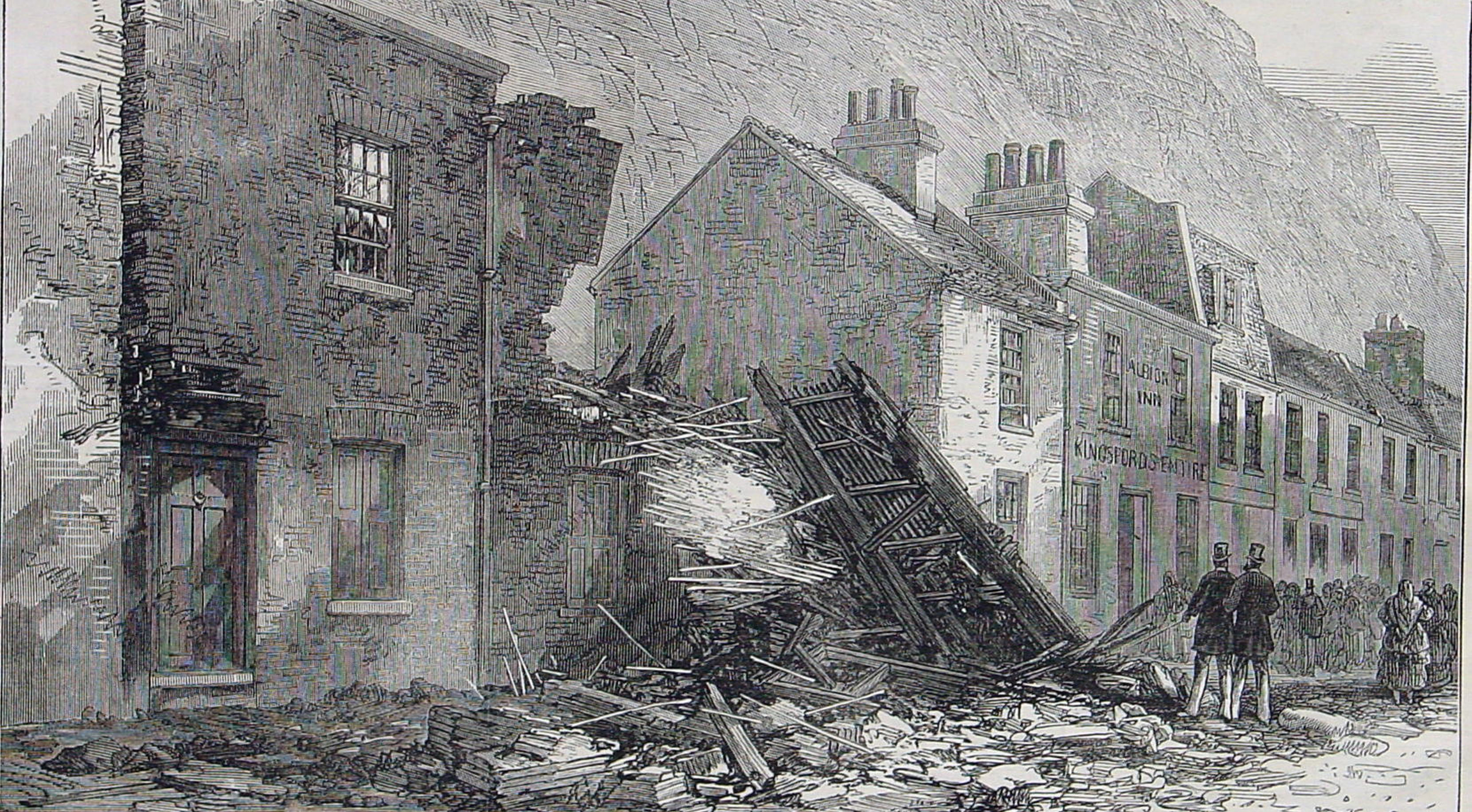
Cliff Fall of November 1872. Illustrated London News 18 December 1872

Cliff Fall of November 1872. Illustrated London News 18 December 1872

The dwellings under the shadow of the cliffs were/are vulnerable to cliff falls. During the night of 14 December 1810, a fall killed Eliza Poole and her five children while they were sleeping. John Poole was pulled out of the debris and the only other survivor was the family pig. On 17 November 1872 two houses were demolished by a fall of cliff and less than nine days later on 25 November another cliff fall causing several houses to be devastated. A gale on 16 September 1935 brought about a cliff fall damaging 8 Athol Terrace. Following a fall in October 1967 the cliff was trimmed to prevent a reoccurrence. However, in February 1980 a six-foot high chalk boulder, weighing over five-tons, landed in one of the back gardens. Since then, strong netting has been put over the cliff face in order to minimise the impact of falls.

Athol Terrace Cave

Athol Terrace Cave

In order to provide work for the unemployed and for the benefit of visitors the North Fall (Meadow) Tunnel Footpath was created by the Dover Chamber of Commerce in 1870. Supervised by John Hanvey, Borough Surveyor, it was designed to provide a short cut from the beach to the Castle and for the most part was in a tunnel. A man was employed at 2s6d (12.5p) a week to sweep the path and to stop local boys frightening people by yelling down the tunnel. It was probably some of these boys that discovered the hitherto unknown caves behind Athol Terrace in 1891. A pathway was laid, at about this time, to the top of the cliffs giving fine views across the Bay and the Channel, as well as a bracing walk to St Margaret’s Bay. This walk became a favourite with tourists and  Buckland shopkeeper, George Small, seeing the potential, converted an Athol Terrace cottage into a cafe, and opened up one of the caves behind.

Patrick Saul, the famous Sound Archivist. Courtesy of the British Library

Patrick Saul, the famous Sound Archivist. Courtesy of the British Library

As the 19th century progressed the town boundary changed, putting more of the properties in the Dover Borough. A shop opened at 62 East Cliff providing groceries, a post office and bread made on the premises. A number of the large villas were adapted into convalescent and nursing homes for soldiers injured in action. These increased during the Boer Wars (1899–1902) with the largest, the Grosvenor Convalescent Home for Sick Soldiers, opening at 18 East Cliff in June 1899 – four months before the Wars officially started. Of note the house was later sold to dentist W. Hodgins Saul, whose son, Patrick Saul, the famous Sound Archivist, was born there on 15 October 1913.

With the construction of the Admiralty Harbour, from 1898, the cliffs at the east end of the Bay were cut back destroying the North Fall (Meadow) Tunnel Footpath and the caves at the eastern end of Athol Terrace. Pearson’s, who won the contract to build the new harbour, used compulsory purchase powers to buy the front gardens of the Athol Terrace cottages, paying each householder about £60. The remainder of Athol Terrace frontage to the sea was lost as the construction of what became Eastern Dockyard took place.

During World War I properties at East Cliff were commandeered by the Admiralty, 23 East Cliff became His Majesties Naval Depot and 24-27 East Cliff the Headquarters of the 6th Flotilla (Dover Patrol). During that War, the mansions came in for a battering from German Vessels with 14 East Cliff suffering notable shell damage on the night of 15-16 February 1918.

East Cliff back road looking east.

East Cliff back road looking east.

Following the War the Dover garrison was run down and this had a direct effect on the occupation of the mansions front East Cliff. Exacerbating this was the threat of the demolition of the properties along the East Cliff back road and Athol Terrace when, in 1920, the Channel Steel Company applied to run a railway line following the base of the cliff to St Margaret‘s Bay. This came to nothing but the whole of the area was blighted for some years after. In 1934, the boundaries were yet again changed and the remaining properties came under Dover Corporation. That year, in order to relieve the high unemployment in the area, the East Cliff path we know today was reconstructed.

As international tensions started to rise in 1937, the caves were requisitioned by the Council to provide air raid shelters, but when the situation appeared to cool, they were handed back. In February 1939, the council, against government advice, re-requisitioned the caves between Trevanion Street and Athol Terrace to provide deep shelter accommodation for approximately 23,550 persons. The complex of caves is connected by a series of tunnels and these days are in the care of English Heritage as part of its Dover Castle property.

1940 South Staffordshire Regiment marching along East cliff, note barbed wire along the seashore. David Collyer

1940 South Staffordshire Regiment marching along East cliff, note barbed wire along the seashore. David Collyer

During World War II (1939-1945), the caves were well used, as the town came under heavy bombardment and the properties in the area suffered. Towards the end of the Battle of Britain in 1940, Elsan toilets were introduced in the caves. At Christmas 1941, a party was held for over forty children attended by a naval officer, dressed as Father Christmas, who gave out presents. Following the D-Day Landings, in June 1944, Dover became a major port of embarkation for reinforcements of men, munitions and machinery. Tanks of various types, landing craft, and amphibious vehicles for crossing the Rhine and the floods of Holland, were sent from the Port. Embarkation jetties and ramps had already been built in 1943-44 on the East Cliff beach and at the Eastern dockyard to this end.

In the last years of the War Dover Corporation produced a post-war plan that included the demolition of East Cliff and Athol Terrace in order to build an access road to the Eastern Dockyard. This was ear marked as an industrial zone. The plan was endorsed by Sir Patrick Abercrombie, Professor of Town Planning, and covered much of the town. In November 1947, the Plan was given consent by the Government and demolition began in 1948 but there was a change of mind before East Cliff was reached. That summer Messrs Burwill of 6 Athol Terrace, Taylor of 31 and Cockings of 44 East Cliff, all manned 12 seater pleasure boats around the harbour for tourists returning to the town. To meet the needs of these tourists it was decided to extend the promenade to the Eastern Dockyard and build a lavatory block opposite East Cliff.

In 1952, the cost of repairs for the Castle Jetty became a major issue – two years before repairs had cost the council £4,295. A joint bill of £1500 was sent to the residents and at the same time, the owners of the properties facing the sea front were told that they were to lose part of their gardens to enable the widening of the road. It appeared that it was expected that these combined actions would convince the residents to move out so that the houses could be demolished without the council having to pay compensation. Instead the residents reacted by staying put, protesting loudly and raising petitions. In July the Ministry of Housing and Local Government held an inquiry at the then Town Hall (now the Maison Dieu) who upheld the council’s view that the properties should be demolished.
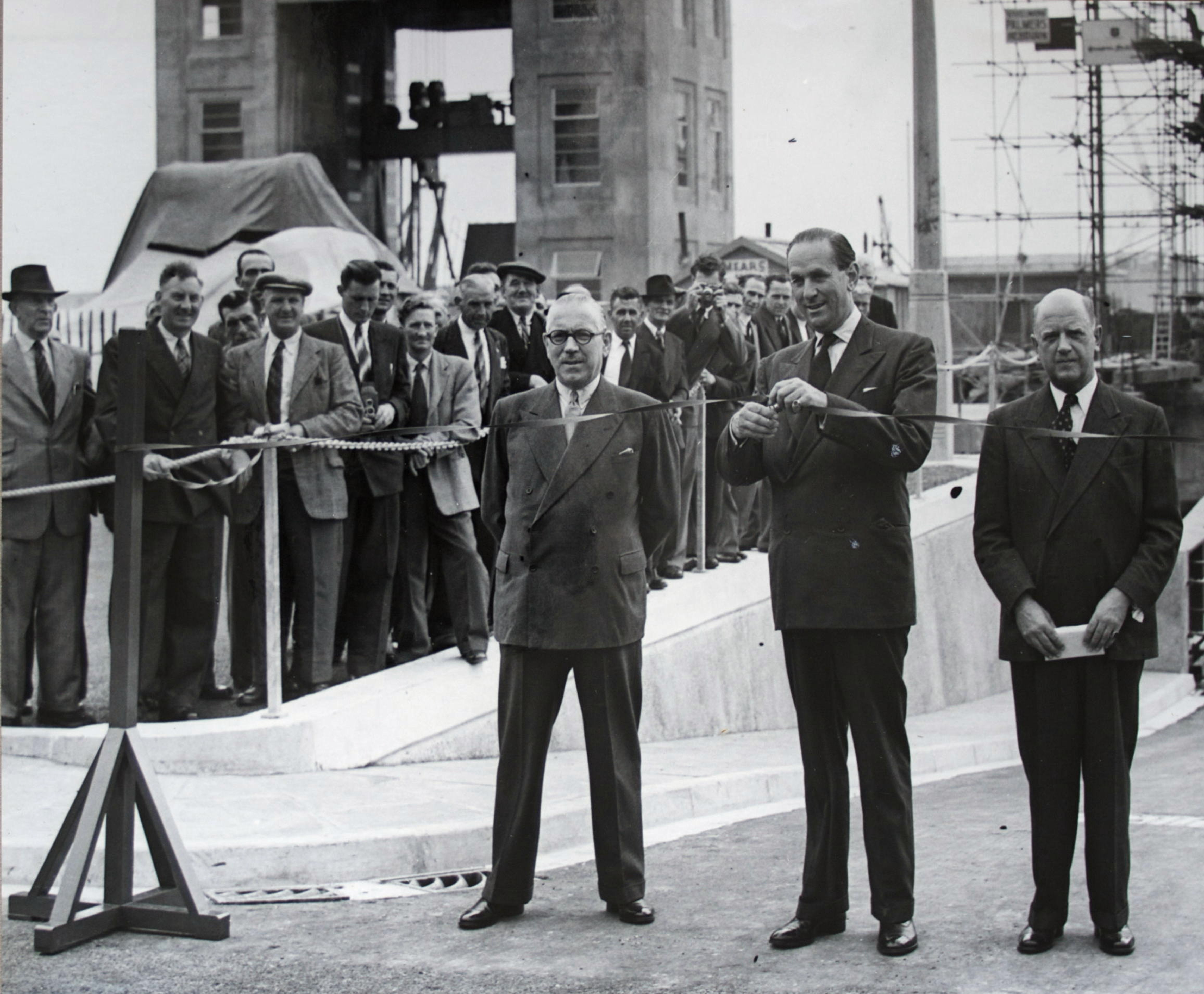
 Opening of the Eastern Docks 30.06.1953 by the Minister of Transport the Rt. Hon. Alan T Lennox-Boyd MP. Accompanied by the Chairman of DHB - H T Hawksfield and the General Manager - Cecil Byford. DHB - Lambert Weston

Opening of the Eastern Docks 30.06.1953 by the Minister of Transport the Rt. Hon. Alan T Lennox-Boyd MP. Accompanied by the Chairman of DHB – H T Hawksfield and the General Manager – Cecil Byford. DHB – Lambert Weston

On the 30 June 1953, the new Eastern Docks opened and traffic proved heavy, noisy and polluting. Not long after the Corporation promoted Bill in Parliament regarding Dover’s bus services and used the opportunity to secure a repeal of the 1887 Dover Corporation (Sea Defences) Act. In 1956, the council were informed that they were successful and at the same time the War Department conveyed to them their interest in a small part of the foreshore and promenade at East Cliff that including Castle Jetty. Earlier that year, it was proposed to make Townwall Street, Douro Place and parts of Marine Parade and East Cliff a trunk road.

The first section of the dual carriageway was opened in April 1959 and included the demolition of one of the East Cliff villas. There was also the loss of more of the front gardens. Two years later, as the Port of Dover was rapidly becoming the busiest passenger port in the World, the road was further widened at a cost over £22,500. Many of the residences, by this time, were offering bed and breakfast accommodation for Continental travellers and permission was given to turn one of the mansions into a youth hostel.

Not only was Dover the busiest passenger port in the World, during the 1960s it was becoming one of the busiest freight ports and the demand for more road space increased. In December 1968, Mears began an 18-month contract to build a new terminal designed to speed the flow of passengers and to provide space for the expanding lorry borne freight traffic. Costing about £1,5m it was completed in 1970 and opened on 1 May by Fred Mulley, Transport Minister. That summer saw a massive increase of traffic through the port, particularly lorries and in July, during a national docks dispute that did not include Dover, the town was brought to a halt. The  pressure was on to demolish the East Cliff /Athol Terrace properties.

 Dock Exit Road opened 2009

Dock Exit Road opened 2009

That year, Kent County Council, under new legislation, became responsible for earmarking Conservation Areas and East Cliff and Athol Terrace were included. Both the council and Dover Harbour Board fought bitterly against the proposal. Over the next few years, a number of these residences were turned into flats and bed-sits, ironically mainly used by those with jobs associated with Eastern Docks. A fire, in September 1979, led to questions being raised over fire safety and escapes.

In 1992, following a local reversal of policy, Dover District Council named the area as having special interest. Nonetheless, the Eastern Docks continued to expand and the road was widened at the expense of the seafront. In 2009, the Dock Exit Road opened that effectively cutting East Cliff and Athol Terrace from the sea.

East Cliff Path to Langdon Cliffs and St Margaret's

East Cliff Path to Langdon Cliffs and St Margaret’s

The East Cliff / Athol Terrace area has all the makings of a tourist jewel most towns would be proud to promote. It has lovely rows of houses that are packed with history and captivating stories, some of national importance. The footpath leading up and along the cliffs to St Margaret’s has been named a one of the National Trust’s top 10 hiking routes in Great Britain (2013). Yet, time has shown that these attributes are ignored by the planners.

  • Presented:
  • 28 September 2013
Posted in East Cliff and Athol Terrace, Roads & Streets | Comments Off on East Cliff and Athol Terrace

Bob Forsyth – Wood Carver Extraordinary

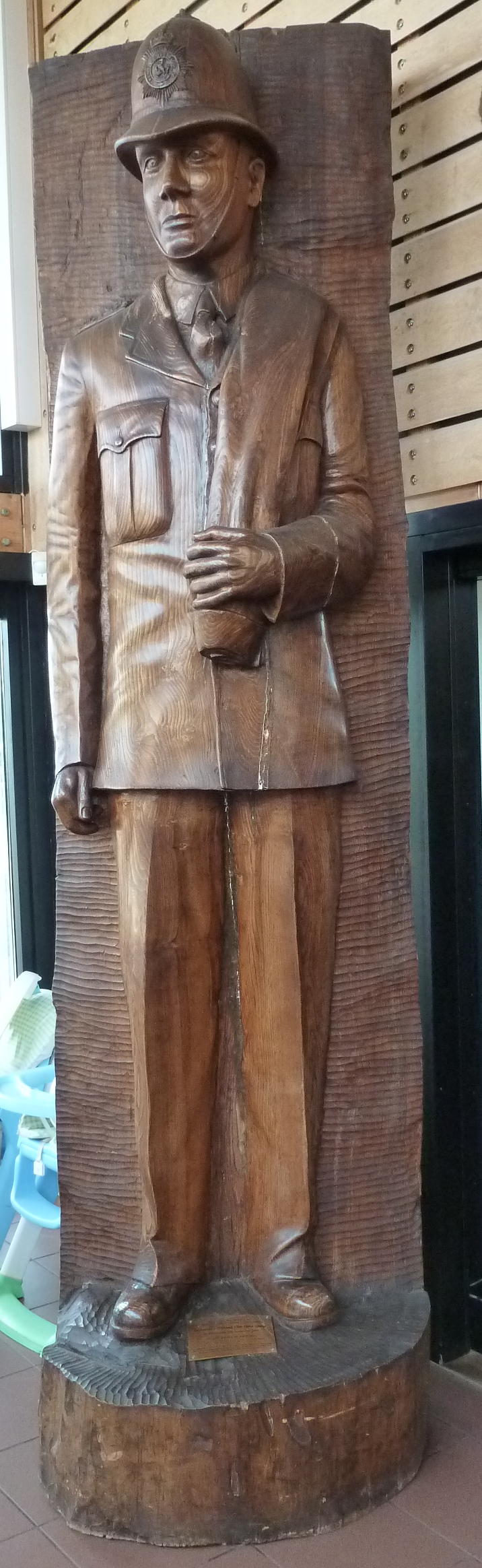
 Policeman National Memorial Arboretum , Staffordshire carved by Bob Forsyth of Dover

Policeman National Memorial Arboretum , Staffordshire carved by Bob Forsyth of Dover

Early in 2013 we visited the National Memorial Arboretum, Alrewas, Staffordshire, where there is plaque to a dear friend, John Petch. Access to the site, for those who travel by bus is poor except for Sundays. As it was a week day by the time we finally arrived a sit down and cup of tea was the first priority.

In the corner of the cafeteria was a 10-foot tall, finely carved wooden policeman, complete with helmet. I immediately recognised the statue as the one I had last seen, some years ago, at Bramshill Police Training College. Dovorian, Police Sergeant Bob Forsyth had carved it for the centenary of Kent County (Police) Constabulary in 1957. Examination of one of the attached plaques confirmed this. Apparently, the carving was presented to Bramshill Police Staff Training College in 1958 and is on loan to the Arboretum where Her Majesty’s Chief Inspector of Constabulary, Sir David J O’Dowd on 26 September 2001, unveiled it.

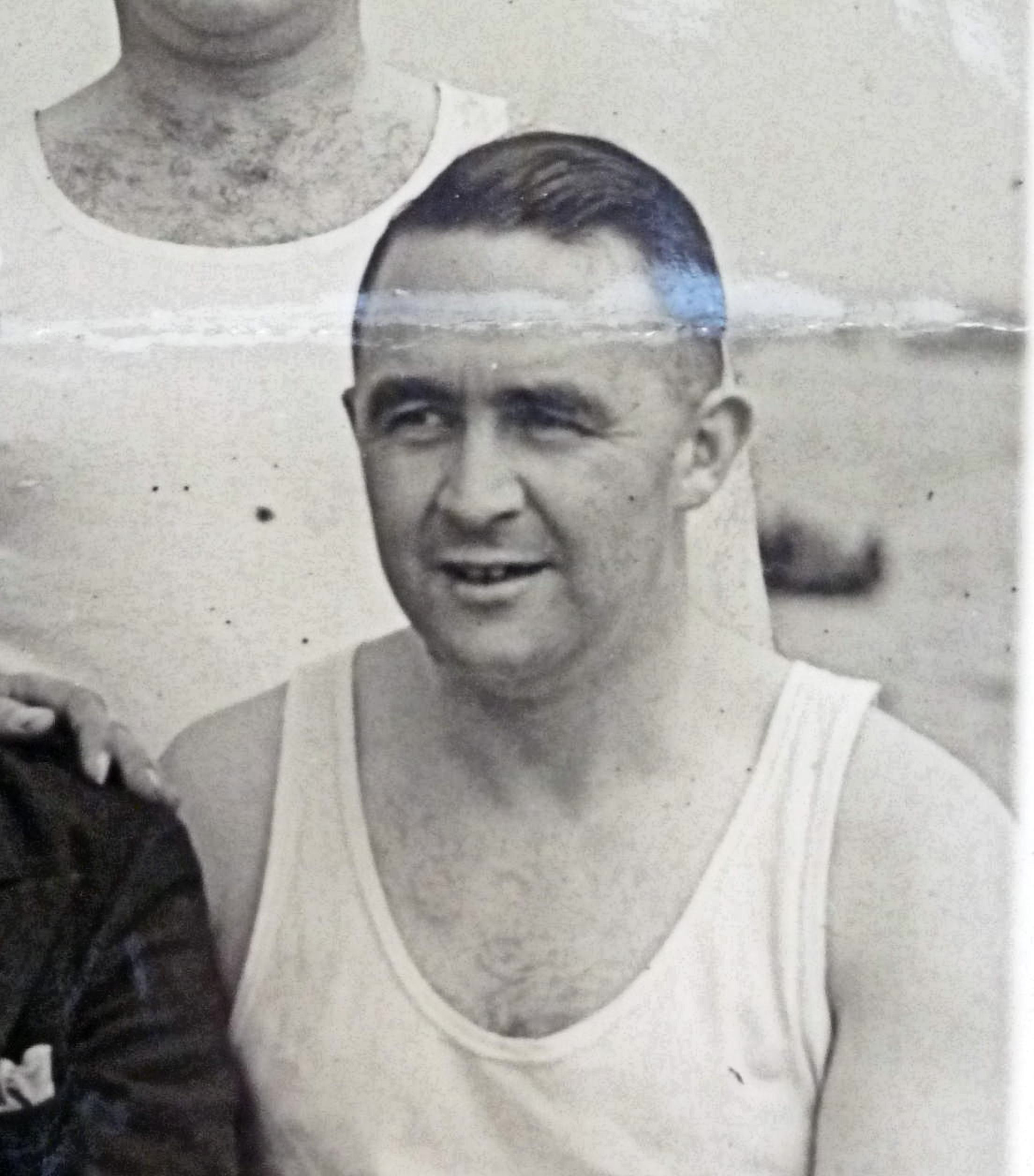
Bob was born on Tyneside and a keen sportsman, particularly rowing, he eventually joined the police. Of his children one – Alan – was in the same class at the Dover Boys Grammar School as my husband, also called Alan. There is Jean, his daughter, eldest son is Robert and Jim, the youngest, who was a fire-fighter in Dover. In his spare time, Bob developed his interest on woodcarving, working from his studio, at his home in Lower Road, River. Self-taught, he became one of the most commended word-carvers in the country and he also passed on his skills by teaching adult education classes up until he died on 29 April 1989.

Bob Forsyth as a member of the Tyneside Rowing Team - thanks to Jim Forsyth

Bob Forsyth as a member of the Tyneside Rowing Team – thanks to Jim Forsyth

Showing a remarkable artistic talent from an early age, Bob was only 11-years old a pen and ink drawing of his was given highly commended. However, it was not until World War II that he turned to carving. With a group of fellow servicemen he was in a pub when someone produced a small carved figure by an African artist, saying that ‘None of our chaps could do anything like that.’ Bob bet £2 that he could and produced his first wood carving this is of ‘Flying Officer Kite,’ using wood from the end of a beechen air-raid bunk – he won his bet!

 Bob Forsyth - St Richard of Chichester carved in 1955 in the Maison Dieu

Bob Forsyth – St Richard of Chichester carved in 1955 in the Maison Dieu

He then went on to carve many pieces that are now highly acclaimed, perhaps the best known, at the local level is the life size carving of St Richard of Chichester that stands in the Stonehall, Maison Dieu. That statue was carved from elm tree trunk, which came from  Waldershare Park in 1955 and was listed in the Dover District Council Art Audit in 1992.

In 1959 Bob carved a plaque of Sir Winston Churchill, the then Lord Warden, for Colonel Cecil Lines. Six years later, in October 1965,  Colonel Lines, councillor for Denton and Wootton, presented it to Dover Rural Council and, until their demise in 1974, gave it pride of place.

Bob Forsyth - Pieta for the Church of Our Lady of Dover, Buckland Estate 1961 - thanks to Jim Forsyth

Bob Forsyth – Pieta for the Church of Our Lady of Dover, Buckland Estate 1961 – thanks to Jim Forsyth

However, it is in the church of Our Lady of Dover, Buckland Estate where one can see the magnificent Pieta, carved by Bob, which depicts Christ lifted from the cross by Mary Magdalene, with Mary mother of Jesus and Joseph of Arimathea in attendance. This was created at the behest of Peter Mee, who in 1974, became the first Town Mayor of Dover (after the 1972 Local Government Act).

The figures are life size and the cross is over 15-feet high. It was in 1961 that Bob created this work of art using the engineering shop at the former Buckland Paper Mill, Crabble Hill. At the time, Bob said that when he was working on the face of Jesus, he could not get it right. In the end he went home feeling disgusted with himself. He returned to his makeshift studio the following morning with the intention of trying to rectify the carving but when he looked at the face – it was perfect, but not as he left it!

Bob Forsyth - Pieta for Our Lady of Dover Buckland Estate 1961 detail Face of Christ - thanks to Jim Forsyth

Bob Forsyth – Pieta for Our Lady of Dover Buckland Estate 1961 detail Face of Christ – thanks to Jim Forsyth

In January 1994, Dover Harbour Board announced that the former White Cliffs Hotel, on Dover’s seafront, was being refurbished. In April that year, it re-opened as the Churchill Hotel with the Lord Lieutenant of Kent, Robin Leigh Pemberton marking the occasion by unveiling a cold-cast bronze plaque of Sir Winston Churchill.

Jim Forsyth had made this, and it had been turned and cast by Barry Sheppard, of Rawlson Ltd, Holmestone Road, from the woodcarving made by his father, Bob, in 1958 and had been presented to Dover Rural Council. Of note, Barry was also in the same class at the Dover Boys’ Grammar School as Jim’s brother, Alan.

In 2005, the Churchill Hotel became part of the Best Western Marketing Consortium. A couple of years later I was asked to give a talk at that venue, in which I planned to refer to the sculpture but it was missing! I enquired several times as to what had happened to it but was repeatedly told that the sculpture had gone for cleaning. Then on 28 January 2010, the Consortium announced that the hotel had ceased trading. By that time, I had brought Mike Krayenbrick of Dover Harbour Board into the search for the missing sculpture, along with Dover’s two local papers, Dover Mercury and Dover Express, but we all drew a blank.

Bob Forsyth - One of his smaller carvings - thanks to Jim Forsyth

Bob Forsyth – One of his smaller carvings – thanks to Jim Forsyth

Besides carving the majestic pieces, Bob created numerous smaller pieces such as heraldic beasts,  unicorns and owls as well religious pieces. During the Great Storm of 1987, Barry Sheppard lost his Japanese Pagoda tree and when he cut across the wood he was astounded by the different colours. He told Bob and he carved an owl for Barry out of it. Bob also carved for the Dover Probus Club the Chairman’s badge of office. This has Dover Castle on the front and a humorous verse on the reverse. It is worn with a ribbon at the monthly luncheons.

  • Published:
  • Dover Mercury: 21 and 28 November 2013
Posted in Forsyth Bob - Wood Carver Extraordinary, Forsyth Bob - Wood Carver Extraordinary, People, Religion & Churches | Comments Off on Bob Forsyth – Wood Carver Extraordinary

Train Ferry Dock and Train Ferries

Train-Ferries Statistics, pre-war.

Train-Ferries Statistics, pre-war.

Like many other local historians in Dover, I feel strongly that there should a special place set aside to show aspects of Dover’s sea-going history. This facility, if I had my way, would include a section on the Train Ferry Dock. Not only has it a special place in Dover’s maritime history, but the design was revolutionary at the time and served as a prototype for the Thames Barrier. The story of the Train Ferry dock goes back to 1869 when the original Cross-Channel sleeper service was introduced. Then, passengers were required to catch the train in London, alight in Dover, embark on the night sleeper ferry, disembark at the Continental port and then catch a train to Paris or Brussels. The return journey was equally as disruptive.

To run a service where that passenger could stay in the same compartment between London and a Continental capital without alighting was problematic due to Dover’s tides. The maximum difference between high and low tides at Dover is some 23-feet; however, by the 1920s advances in technology appeared to make such a service possible. Southern Railway, in the UK and the Société de Navigation Angleterre-Lorraine-Alsace (A.L.A.) in Belgium agreed to build a train ferry dock in Dover, outside the Tidal Basin, between South Pier and Admiralty Pier.

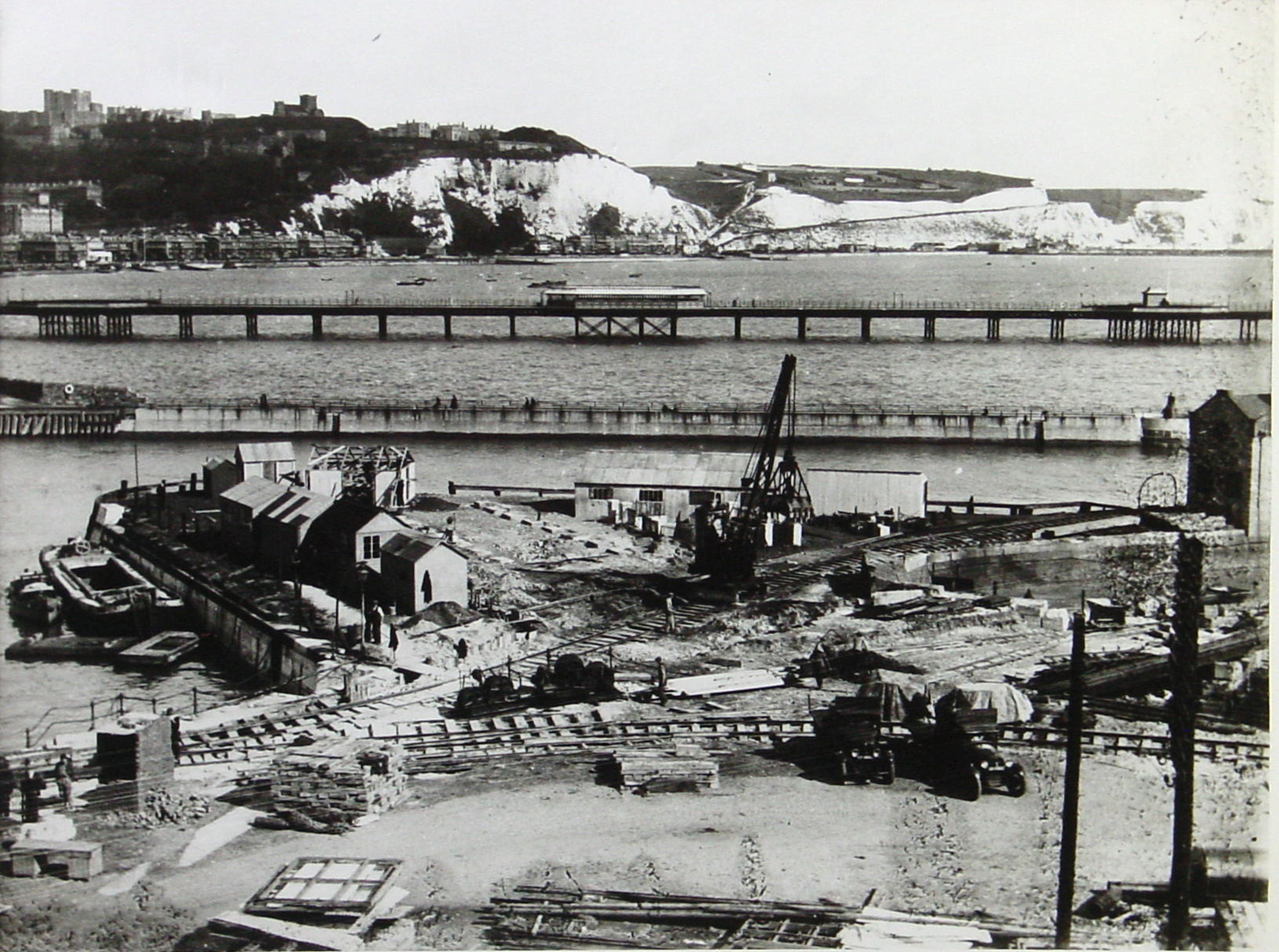
The specifications, drawn up by George Elson*, Chief Engineer of Southern Railway, was a concrete dock 414-feet long and 72-feet wide, with a minimum depth of water of 17-feet to a maximum of 36-feet. John Mowlem & Co. along with Edmund Nuttal, Sons & Co. were given the contract and work started in August 1933. Initially a cofferdam was to be built using piles of sheet steel within which the dock was constructed. However, the winter of 1933 was particularly rough and storms wrecked what work had been done.

Building the Train Ferry Dock. Dover Library

Building the Train Ferry Dock. Dover Library

Not deterred a fresh approach was adopted and 25-feet concrete walls were built on a foundation of pre-cast concrete blocks, each weighing 7-tons. The concrete blocks were put into position by divers and were bonded together to withstand pressure from outside. A caisson, weighing 525-tons was floated down from the Tyne and positioned within the concrete walls. Water was then pumped out and the dock built.

Unfortunately, fissures in the chalk percolating through the bottom caused significant leakage. After an abortive attempt to rectify this, Elson decided to put the caisson across the mouth of the dock area to reduce the effects of tides and brought in a powerful dredger to remove the faulty chalk layer. The bottom was then covered with thick concrete laid by divers in strips of 80-feet x 5-feet.

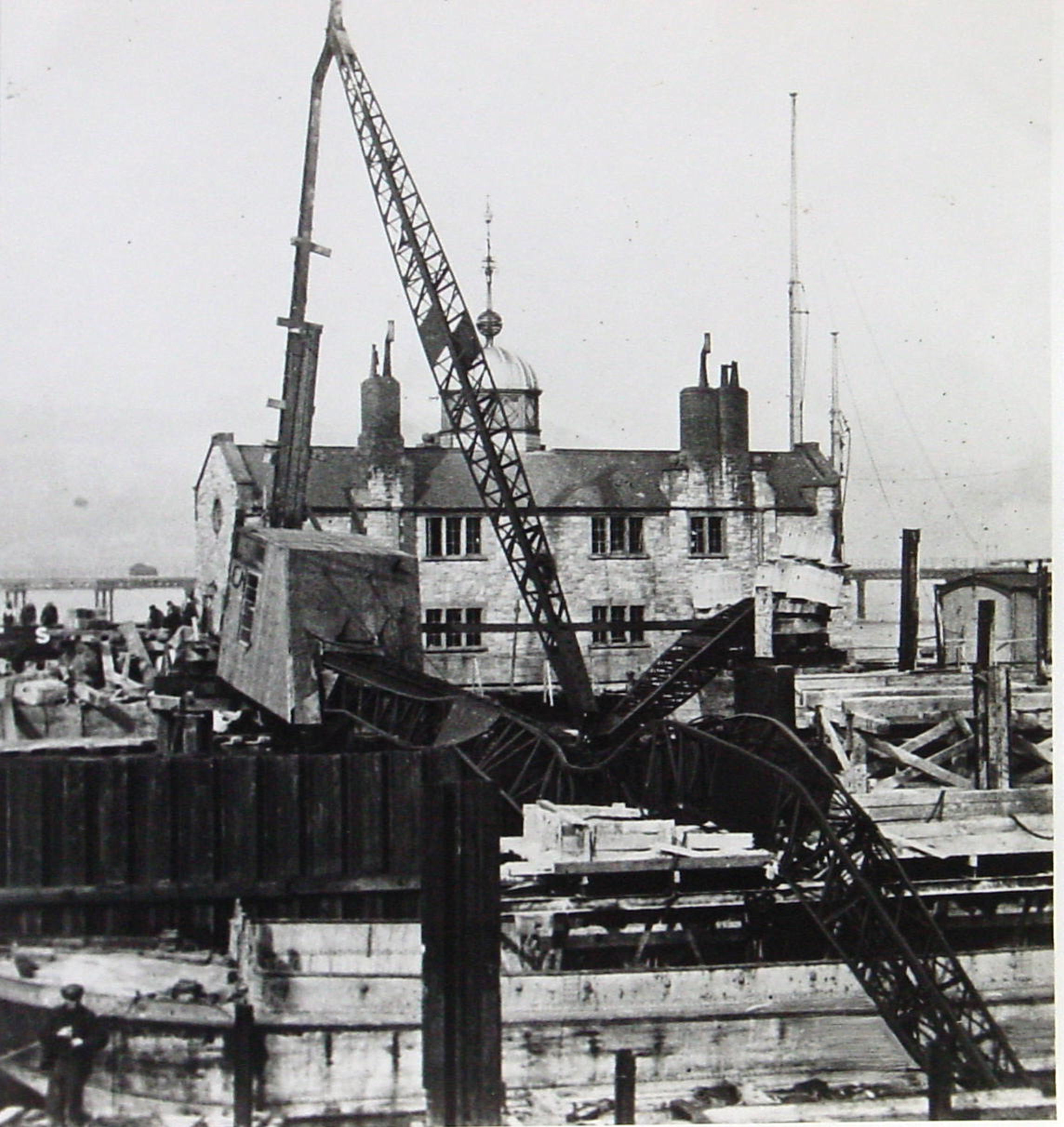
Train Ferry Dock, mishap during building when crane fell over. Dover Library

Train Ferry Dock, mishap during building when crane fell over. Dover Library

Laying the dock sill and fitting the two gates posed more problems. William Arrol & Co. – leading Scottish civil engineers made the Gates, and each one weighed more than 300-tons. They worked on horizontal hinges fixed below the dock sill. When open they would lie at the bottom of the lock to allow access and egress of the train ferry. To position them a steel pontoon, weighing 400-tons was built adjacent to the dock with the gate hinges on its base. The pontoon was then sunk across the entrance between guides to ensure accuracy and filled with concrete. The gates were then sunk and the hinges secured. However, while work was taking place a steam railway crane toppled over the sea wall causing considerable damage.

Train ferry dock steel pontoon being put in place c1934. Dover Library

Train ferry dock steel pontoon being put in place c1934. Dover Library

The gates, designed to operate singly to enable easy removal for maintenance without disrupting the service, were in place by the autumn of 1936. Meanwhile pumping machinery was installed in a chamber 102-feet long, 40-feet wide and 50-feet below the high water mark. It contained three sets of centrifugal pumps, each of 270 horsepower and collectively capable of moving 120,000 gallons of water a minute! In 1932, Dover council decided to take electricity from the Grid to try to ensure a stable supply. Pylons were erected, transformer houses built and a cable supply was specially laid to operate the pumps costing £1,065.

Two rail-lines were laid to connect the dock to the main rail-line at the same time, William Arrol & Co. erected a link span to connect the rail-lines to the ships. For sidings, 1.8 acres of land was reclaimed and named Clarence Quay. A 362-foot approach jetty, against which ferries could be warped before entering the dock, was also built. The Dock cost £231,000.
At Dunkerque, A.L.A. was not faced with the problems experienced at Dover. The only special need was the provision of an adjustable bridge and motor ramps.

Train Ferry  under construction c1933. Dover Library

Train Ferry under construction c1933. Dover Library

It had been agreed that Southern Railway would provide three purpose built ferries. Built by Swan, Hunter & Wigham Richardson, Newcastle-on-Tyne, they were the Twickenham, Hampton and Shepperton. 2,839 tons each, they were coal-fired and had an average speed of 15 knots. The length was 359-foot; 63-foot 9-inch beam and 12-foot 6-inches draft. Each ship was designed to take 12 sleeping cars, 500 passengers during the day, or approximately 40 goods wagons. There was also a small floor above the train deck to accommodate approximately 20 cars.

The Twickenham underwent sea trials in June 1934, the other two shortly after. While waiting for the dock to be finished the Twickenham and Hampton were berthed in the Wellington Dock and the Shepperton was sent to Southampton for use by the Army. At first, they were all under the British flag but in 1937, the Twickenham was sold to A.L.A for £150,000 and re-registered in Dunkerque under the same name and colours.

Train Ferry logo - on Railway rolling stock. York Museum 2010

Train Ferry logo – on Railway rolling stock. York Museum 2010

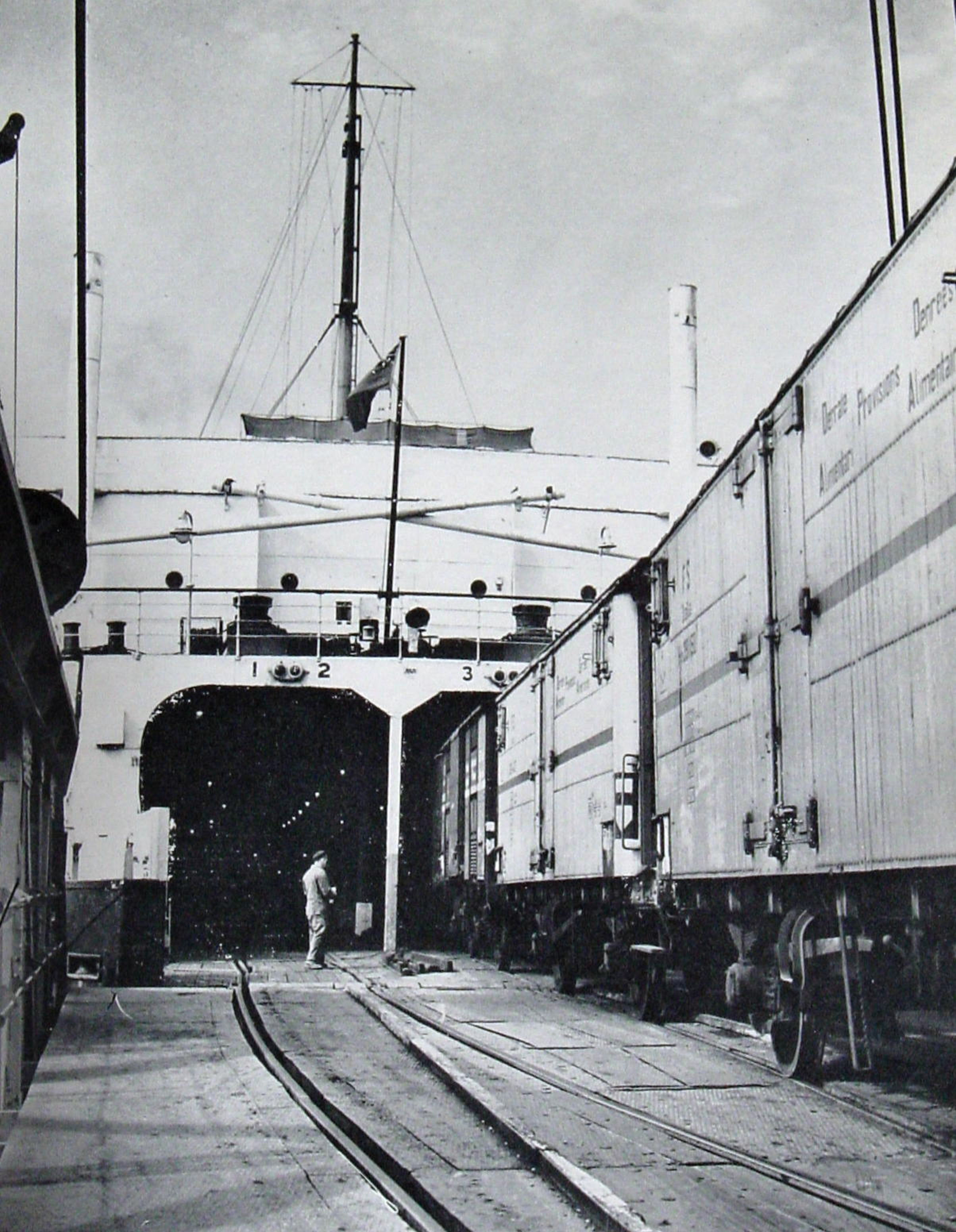
The Southern Railway had special luggage vans and goods wagons for the service, with a white anchor painted on the side. On the train deck of the ships was a system of jacks and chains, the former to take the weight of the carriages off their own springs, the latter to hold each carriage securely in position. There were also two island platforms, enabling passengers to leave the train and explore the ship during the crossing.

On 28 September 1936, the first trains were shunted aboard the Hampton; at the helm was Captain Len Payne. He had also brought the train ferries from the builders’ yard to Dover and was the Captain on Monday 12 October when the formal crossing was made. The Hampton, dressed overall with flags and bunting the official crossing was to Calais and back with many distinguished guests on board. These included the Home Secretary – John Allsebrook Simon, 1st Viscount Simon (1873-1954), the French Ambassador, British and French railway officials and the Lord Warden of the Cinque Ports – Major Freeman Freeman-Thomas, 1st Marquess of Willingdon (1866-1941). Calais was chosen as the crossing to Dunkerque would have taken about three hours and forty minutes and was considered too long for the occasion.

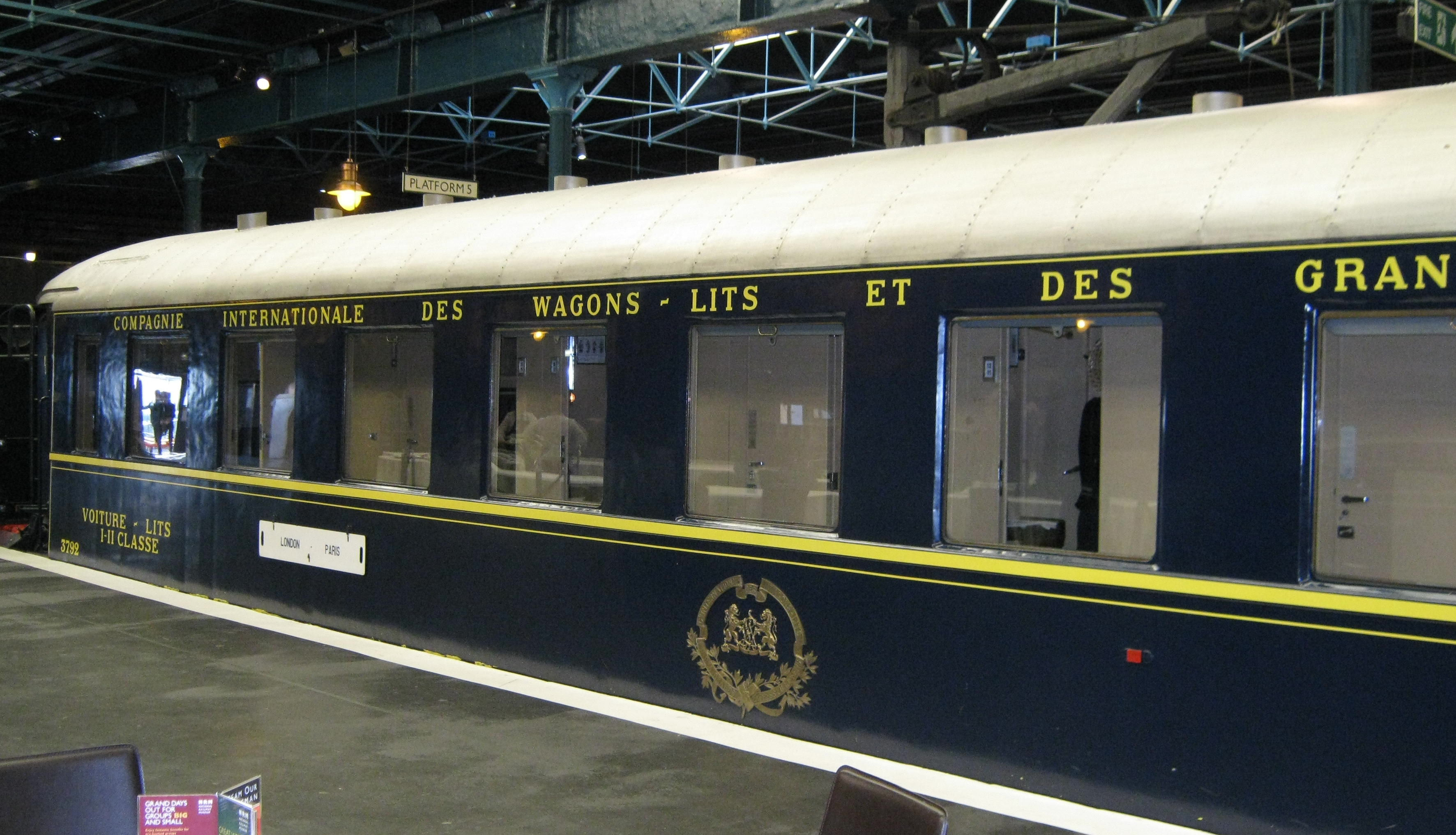
Compagnie Internationale des Wagons - the 'Blue Train' -  York Railway Museum

Compagnie Internationale des Wagons – the ‘Blue Train’ – York Railway Museum

The night service between London and Paris was officially inaugurated by the French Ambassador on 5 October 1936. The train left Victoria Station at 22.00hrs and arrived in Paris at 08.55hrs the following day. Featuring newly constructed, blue liveried, sleeping coaches from the French, Compagnie Internationale des Wagons-Lits, it was nicknamed the Blue Train. Adapted for the British loading gauge, each overnight train carried up to five and occasionally six, sleeping cars and because of their weight, the train was double-headed. The counterpart left Paris for London and there was a daily goods service via the ferry, which allowed the commodities being consigned to and from any part of the Continent without transhipment.

Train Ferry - loading goods wagons c 1960s. Courtesy of Dover Harbour Board

Train Ferry – loading goods wagons c 1960s. Courtesy of Dover Harbour Board

Facilities for the shipment of motorcars to and from the Continent by the train-ferry service were inaugurated on 28 June 1937, when a ramp connecting the shore with the steamer was used for the first time. The ramp enabled motorists to drive direct into a steel garage with room for 25 cars. The garage, on the top deck was fire proofed, and motorists were able to leave petrol in their tanks. The first car to be placed on the ramp was an 1898 Benz, a member of the Veteran Car Club that had been loaned for the occasion by Major Allday. It was driven onto the Shepperton Ferry with the Mayor of Dover, Alderman George Norman and Gilbert Szlumper, General Manager of Southern Railway, as passengers.

As the war clouds gathered, the ‘Night Ferry’ made the last crossing on the 25/26 August 1939. War was declared on 3 September and the Royal Navy requisitioned, for mine laying, the two British train ferries as HMS Hampton and HMS Shepperton. Refurbished to carry about 300 mines, narrow gauge railway lines were welded between the existing railway tracks on which the mines were carried in cradles to be launched at the stern from the train-deck.

Hampton Ferry - Dropping Mines WWII. Courtesy of Ron Akines

Hampton Ferry – Dropping Mines WWII. Courtesy of Ron Akines

Between December 1939 and May 1940, mines were laid in the Channel and southern North Sea by the two train ferries and two Royal Navy minelayers. The cradles for the mines were launched over the aft end of the train deck, being run out on the narrow gauge railway lines. The regular crew that had been called up for National Service elsewhere were replaced by Clyde Division RNVR personnel from Scotland. Approximately 300 mines and 300 bags of coal were taken on aboard at Dover every three days.

Hampton and Shepperton were also involved in the evacuation of troops from Dunkirk but shortly after the Hampton made an unsuccessful attempt to evacuate the 51st Division from St Valery-en-Caux and Le Havre. Both ships were involved in bringing troops from the USA. The train ferry dock, meanwhile, was used to house motor torpedo boats. Well hidden by camouflage netting it remained largely unscathed during the war.

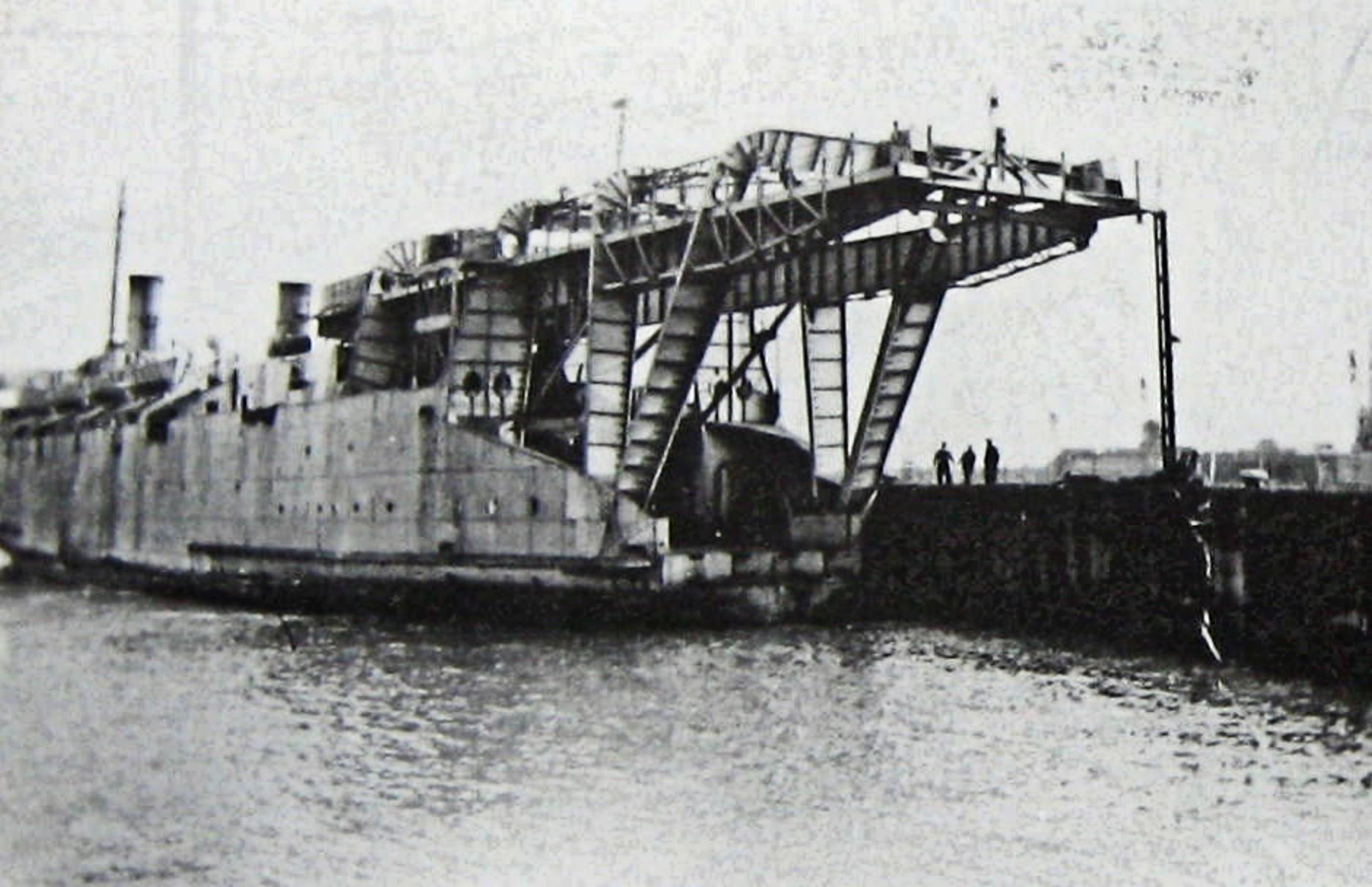
Train Ferries - 1944 gantry superstructure to carry locomotives - David Collyer

Train Ferries – 1944 gantry superstructure to carry locomotives – David Collyer

Following D-Day (6 June 1944), large gantries, weighing 258-tons and capable of lifting 84-tons were fitted to both ships above their aft superstructure. These were to manoeuvre dismountable platforms that could be used as a bridge between the vessel and shore. It was expected that most of the Channel Continental port facilities would have been sabotaged so the platform was to be used to discharge locomotives on to purpose-built hards with railway connections. By early 1945, both vessels were crossing the Channel regularly for this purpose, mainly to Calais, where the rail connection was almost intact. Of interest on this point, Adolph Hitler (1889-1945) had given the order, before the Battle of Britain in 1940 that the port was to remain serviceable as he planned to cross the Strait by sea to receive Britain’s surrender from George VI (1936-1952).

Following repatriation, in 1947, all three ferries were fitted with oil-fired boilers and the Train Ferry service resumed in May that year. In October, the American Loan crisis led to a complete ban on pleasure travel abroad and the service was severely reduced. Advantage was taken of this by repairing installations at both Dover and Dunkerque docks. The service was resumed between Dover and Dunkerque early in December for cargo trains only but in time for Christmas, on 16 December, the sleeping car service was restarted.

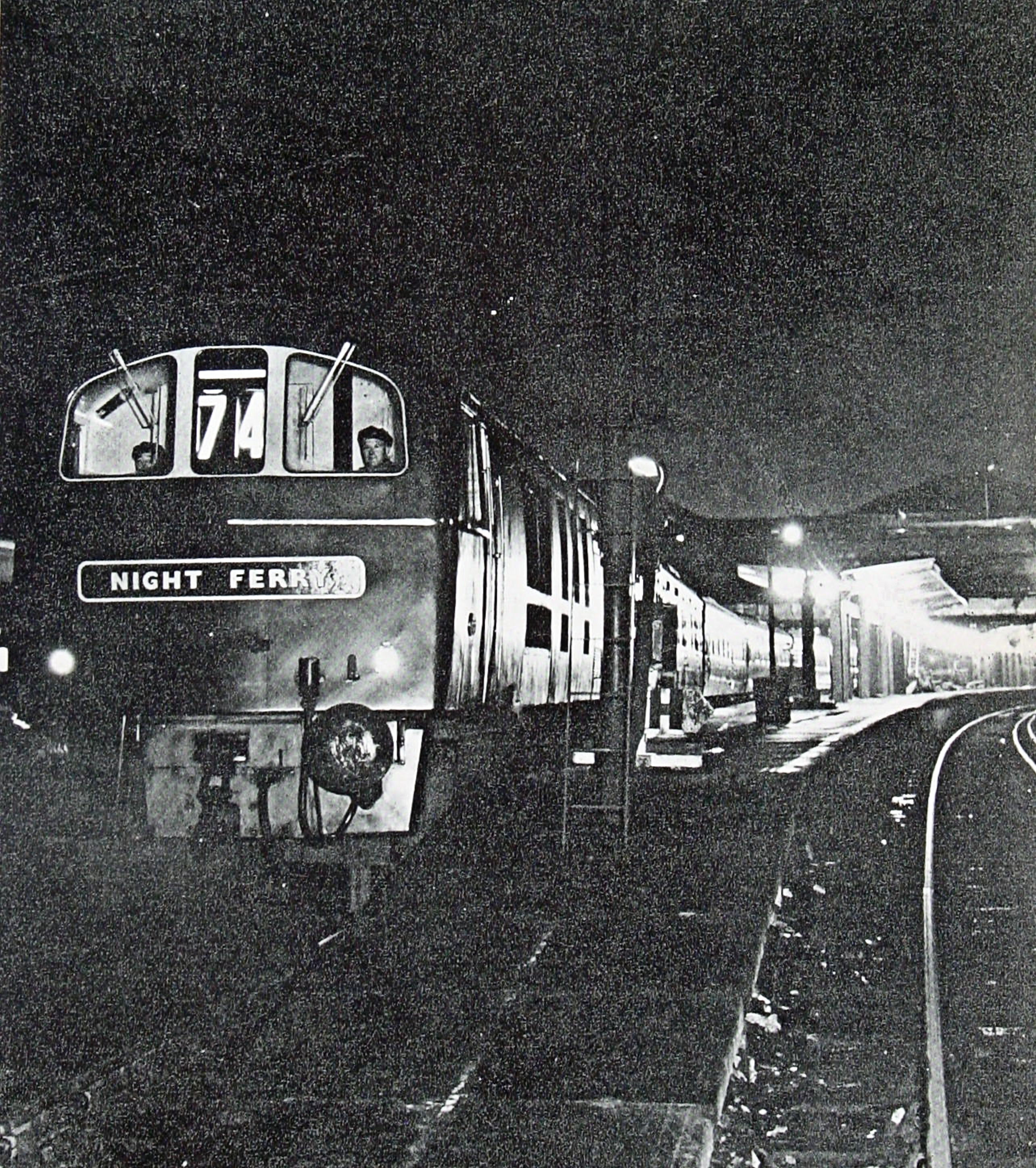
Train Ferry - Night Ferry c 1960s. Courtesy of Dover Harbour Board

Train Ferry – Night Ferry c 1960s. Courtesy of Dover Harbour Board

In 1950, the ships were fitted with additional flooring on the train deck to allow them to take approximately 100 cars and also lorries. On 2 June 1957, a ‘Night Ferry’ service was introduced to Brussels and in 1961-62, the electrification of the line to Dover was undertaken. In January 1962, the Hampton went to the rescue of the crew of the Yugoslav steamer Sabac, which weighed 2,811 tonnes, when she was struck by the London steamer Dorington Court, weighing in 6,223 tonnes. At the time, there was thick fog and along with Dover Lifeboat, the crew of the train ferry searched for survivors. Of the Sabac crew of 33, only five survived.

Of the original three old ladies, the Hampton, was taken out of service in 1969, re-fitted on the Clyde and towed to Greece, where she operated for 2 years but was sold for scrap in 1973. She was replaced by the Vortigern. Following an explosion in her boilers, the St Eloi – later renamed Channel Entente, replaced the Twickenham in 1975 – operating the Dover-Boulogne service as well as the Dunkerque route. She was designed to carry rail wagons as well as cars and lorries. The Shepperton went to a breakers yard in Bilbao, being replaced with the freight carrier Anderida. Other ships sailing the route were the St Germaine and the Chartres.

By 1976, the decision had been taken to expand the port of Dunkerque and the train ferry berth moved to the newly built port of Dunkerque West just east of Gravelines. This cut the crossing time to 2½hrs. In August 1978, saw the millionth post-WWII passenger using the service but on 1 November 1980, the last overnight sleeper train arrived in Dover at 06.30am. The final passenger service, on the St Eloi, was on 27 September 1985. The original Dover Train-Ferry dock closed on 8 May 1987 and the area used as a depot for importing aggregates for road making.

During 1987/88, a new Train Ferry Berth on Admiralty Pier, costing £2.8m, was constructed by W A Dawson. Designed to accommodate vessels of 23-metre beam it could be modified to allow ships of 30 metres beam. The link span was computer controlled to meet the different states of the tides. The Nord Pas de Calais (NPC) was the only designated ferry. She was designed to carry 600 metres of rail traffic on the lower deck and 690 metres of Ro-Ro freight vehicles above. The loading bridge and machinery, built by Cleveland Bridge, cost £34.6m and the associated sidings were constructed by British Rail for £0.35m. However, the Great Storm of 1987 reaped havoc on the construction time. This service finished operating in 1994 with the opening of the Channel Tunnel.

 Twickenham Ferryleaving port from  advertising leaflet c1934. Dover Library

Twickenham Ferryleaving port from advertising leaflet c1934. Dover Library

As there was talk of reopening Marine Station that had closed on 24 September 1994, the specially built bridge that connected with the ships was put in storage for a time by Dover Harbour Board. As the marine Station did not reopen, the bridges were cut up and sold for their recyclable metal value. The area is now Cruise Terminal 2

* Dover Train Ferry Dock by George Elson. Journal of Institute of Civil Engineers, Vol 7 1937.

  • Published:
  • Dover Mercury:  18, 24 February & 4 March 2010
Posted in Port and Transport, Train Ferry Dock and Train Ferries, Train Ferry Dock and Train Ferries | Comments Off on Train Ferry Dock and Train Ferries

Guston, St Roch and the Royal Victoria Hospital, Dover

St Martin of Tours Church, Guston

St Martin of Tours Church, Guston

The plague, throughout the ages, has been one of the most feared scourges. Old records are littered with reference of its devastation, prevention and cures. During such times, most sick people turned to the saints for hope. In St Peter’s Church, which stood where Lloyds Bank is now in Dover’s Market Square, a special place was given to St Roch for this purpose. He was also particularly venerated in the still standing, St Martin of Tours church, Guston.

St Roch was born about 1350 at Montpellier, France, of wealthy parents who died when he was young. When he was about 17, Roch went on a pilgrimage to Rome. On the way at Acquapendente, north of Rome, he not only nursed suffers from the plague but they recovered! By the time, Roch reached Rome his fame had arrived before him and he was asked to nurse Cardinal Anglic, the pope’s brother. The Cardinal recovered and Roch stayed in the area of Rome nursing and curing others.

Saint Roch - Wikapaedia

Saint Roch – Wikapaedia

About 1371, Roch was in Piacenza in Northern Italy when he too fell sick from the plague. In order to ensure he infected no one else he withdrew to the nearby forests to die. However, a dog found and befriended him and brought him food. On recovery, Roch, with the dog, returned to Piacenza, where the plague had taken a grip. He successfully healed people and cattle, which were also ailing. St Roch’s biographers differ over the locality of what happened next. Some say that he returned to Montpellier and was arrested as a spy, others, that he was arrested in Angera, Italy. Albeit, following the arrest, Roch was thrown into gaol where he died five years later, in 1380.

That would probably have been the end of the legend had not the ecumenical council met in Constance in 1414. There pestilence raged and the council Fathers ordered a public intercession to Roch and the epidemic ceased. In 1485, relics of St Roch, now canonised, were enshrined in the church of San Rocco, Venice, where they remain. St Roch is seen as the protector against pestilence and also the patron saint of dogs and is depicted with a beard in medieval pilgrim garb. He is pointing to a sore on his thigh and a friendly dog is at his side. The dog sometimes has a loaf of bread in its mouth.

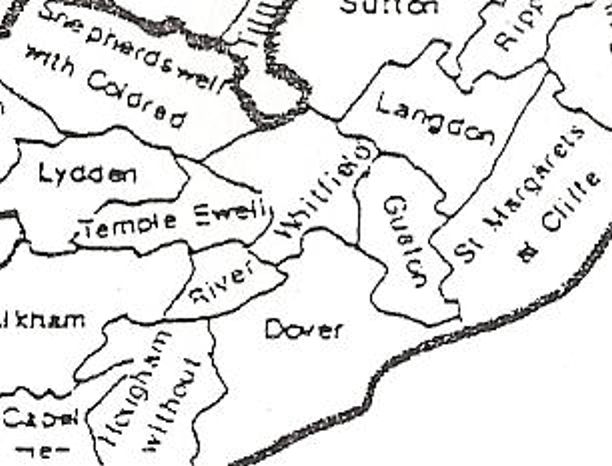
Kent Parishes showing Guston to the east of Dover

Kent Parishes showing Guston to the east of Dover

Guston is a small village to the east of Dover and was written in the Domesday Book (1086) as Gociston with other records referring to the village as Gounceston and Gusseton. The church at Guston is dedicated to St Martin of Tours – the patron Saint of Dover – and was built in around 1090. It is listed by English Heritage as Grade II* – one of only 6 per cent of the most architecturally significant buildings in the country.

The church initially belonged to the Augustinian Canons of St Martin-le-Grand, Dover, but following its demise in 1124 and the opening of Dover Priory in 1136, it came under the auspices of the Benedictine monks at Canterbury. Although small, the church was held in high esteem, possibly due to its land holdings that amounted to 109 acres of pasture according to a report of 1377. Two hundred years previously, inn 1179 the Abbot of Canterbury obtained a Papal Bull for the church’s confirmation to himself and his successors and thereafter and this was repeated several times.

During the Middle Ages, the Church would have been decorated with wall paintings. These were covered with cement rendering during the 17th century Protestant fanaticism. It is recorded that in the church, up to that time, there were statues of the Virgin Mary, St Martin, St Nicholas and St Roch.

Guston

Guston

Statues of St Roch, usually with his faithful dog, are still seen in many French churches and perhaps Dover and Guston’s proximity with France is the reason why he was venerated here. Of particular note, a bequest to pay for votive candles to all four saints was recorded in the Will of Edward Prescott of 1531. During the Civil Wars and the Interregnum (1642–1660) and the years that followed a descendent of Edward Prescott, also of that name, was well known as holding strong Non-Conformist beliefs as described in the story of Samuel Taverner, on this website. It could well have been he who organised the destruction of the statues!

Statues of St Roch are still seen in many French churches and perhaps Dover and Guston’s proximity with France is the reason why he was venerated in both these churches. From the 17th century, the village of Guston became well known for its Goose fair that was held on 16 August – the feast day of St Roch.

By that time, though the cult of St Roch had almost died out and dogs were believed to be the cause of the plague. In Dover, it was decreed that any dogs straying in the town should be destroyed, and a poor-man was paid two-pence for every one he killed. Nonetheless, the plague did break out on 1 August 1666 and lasted until Christmas, by which time about 900 hundred people had fallen victim. In order to bury the dead the corporation purchased a piece of land on Western Heights, which became known as the ‘Graves‘.

Former Royal Victoria Hospital, High Street.

Former Royal Victoria Hospital, High Street.

In the 1832, cholera had reached epidemic proportions in Britain, during that year 32,000 people died from the disease, which is rapid in onset, has gruesome symptoms followed by death. There was a second pandemic in the late 1840s and the cult of St Roch was revived in Dover. The town almost remained free of the disease and as a way of expressing thanks, £1,760 was raised. This was used to establish the Dover Hospital – later the Royal Victoria Hospital, on Dover‘s High Street, that opened on 1 May 1851.

  • Published:
  • Dover Mercury: 15 December 2005
Posted in Guston St Roch and the Royal Victoria Hospital Dover, Villages and Towns | Comments Off on Guston, St Roch and the Royal Victoria Hospital, Dover

Freemen – Dover’s Bygone Rulers

Honorary Freemen - Jack Woolford, John Turnpenny & Bob Tant

Honorary Freemen – Jack Woolford, John Turnpenny & Bob Tant

On 18 November 2010, three Dover stalwarts were created Honorary Freemen, Bob Tant, John Turnpenny, and Jack Woolford. This was the first time that Dover had been allowed to present the honour since the town lost its Borough Status in 1974.

The privilege of being a ‘Freemen’ of Dover had its origins in the days of the Saxons. Then the ruler was the king of Kent and the king’s favourites, or Barons as they were known, were given land on which they paid rent in return for aiding the king’s defences when needed. Those who did not heed the call to arms were severely punished. As towns developed the inhabitants, who had acquired personal property, shared in paying the town’s rent to the king. They also were obliged to undertake the call to arms. In return, they were classed as Free Men that soon became corrupted into ‘Freemen’.

The original Freemen of Dover owned their own boats and earned the living from the sea. As Dover is the nearest seaport to France, the town had more mariners who worked this passage between the two countries than any other port. Thus the Fellowship of the Passage, as it was called, was comprised entirely of Dover Freemen who when required by the king of Kent provided ship service.

Cinque Ports Flag showing the Coat of Arms. Stonehall the Maison Dieu LS 2009

Cinque Ports Flag showing the Coat of Arms. Stonehall the Maison Dieu LS 2009

One of the major problems facing all the Channel seacoast towns were piratical raids. To combat these, over the course of time, the Dover Freemen amalgamated with those from Sandwich, Hythe, Romney and Hastings to form the Confederation of the Cinque Ports. They were soon after joined by the Freemen of Rye and Winchelsea and the main purpose of the Confederation, at that time, was to protect their coast.

The seamanship and the ships of the Confederation were the best in the country and recognised as such by Edward the Confessor (1042-1066). In return for providing him with, effectively, a Royal Navy, he gave the Confederation Rights written down in a Charter. These included:

  • Barony, answerable only to the king and could be referred to as Barons. This eventually was only accorded to the town’s Mayor and Members of Parliament.
  • Personal liberty
  • Freedom of movement
  • Purchase the Freehold of property
  • Run a business and take apprentices
  • First choice of goods in the town’s market.

By the time of the Conquest, when William I (1066-1087) took over the throne of a united England, just under half the adult males in Dover were Freemen, a ratio that would not change for over 600 years. Up until the Municipal Corporations Act of 1835, Freemen ruled Dover while non-freemen were described as foreigners and had few rights. The Mayor was the top Freeman and had enormous powers. He was supported by 12 Jurats or senior councilmen, who were drawn from the Common Council all of whom were  Freemen. The only ones allowed the vote were … Freemen!

The right of becoming a Freeman was jealously guarded and could only be obtained by:

– Birth. This right still stands, but can only be claimed if the person is born in Dover after his father has claimed his Freedom.

– Marriage. Again, this right still stands whereby the husband can claim the right through his wife if her father had claimed his Freedom.

– Apprenticeship. A parent has the right to pay a standard sum to enter their son into an apprenticeship lasting seven years under a Freeman. This right still exists but it has not been taken up for about a century.

– Purchasing a Freehold. By purchasing the Freehold of a property, it was possible to buy a Freemanship. This gave the person the right to trade in Dover but following the  Municipal Corporations Act of 1835 this ceased to be a necessity although the Right was not officially abolished until 1933.

– Redemption. What was meant by redemption is unclear; but it would appear that if a man made substantial gift to the town they were rewarded with the right to trade by virtue of being a Freeman by Redemption. Again, this was dying out following the 1835 Act but was not abolished until 1933.

– Decree. This was meant for orphans or poor children of Freemen whom the Town had paid for them to served their apprenticeship training under a Freeman. As time passed this was extended to friends of the Lord Warden of the Cinque Ports, who had given an acceptable sum of money to the town. This was abolished in 1933.

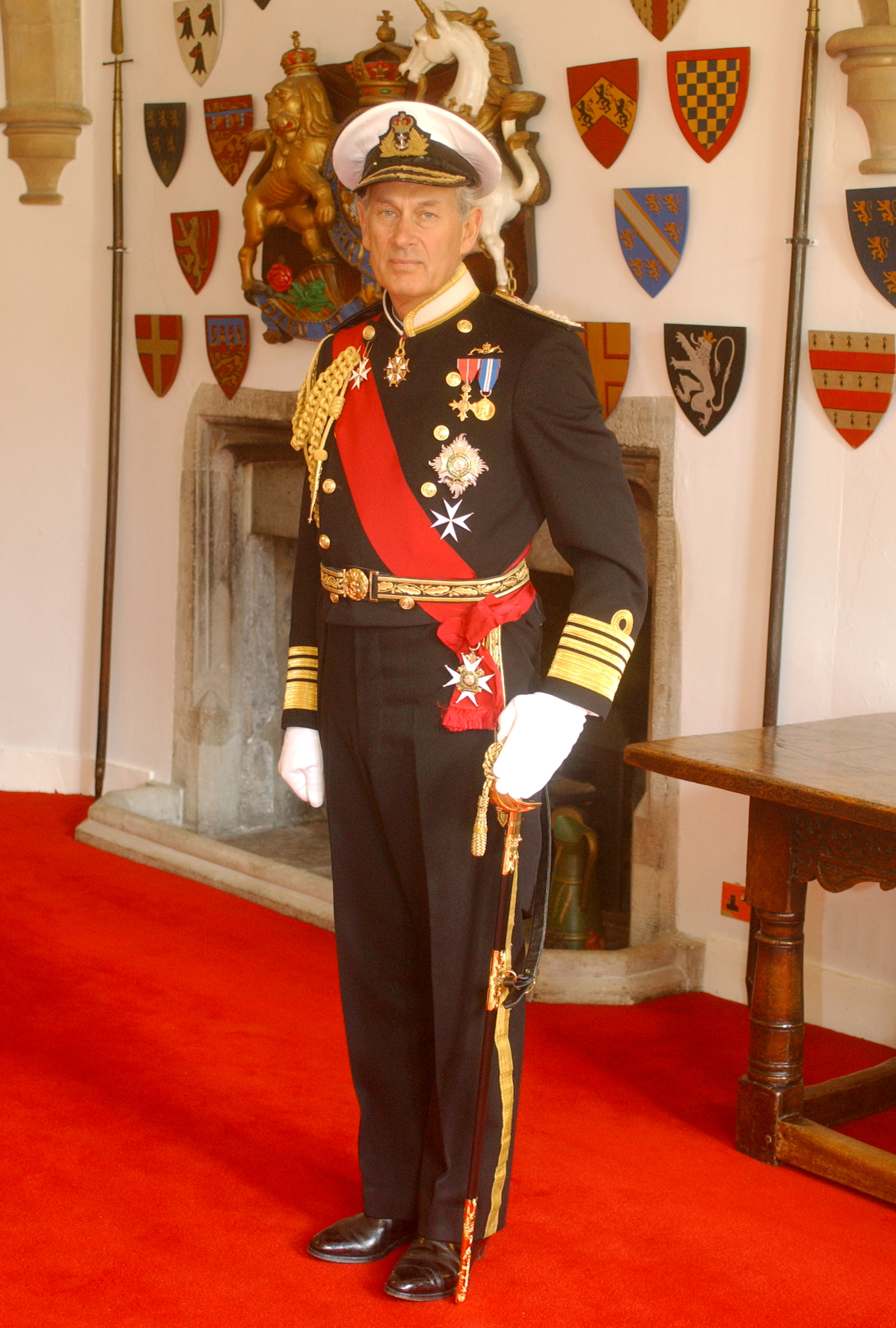
Lord Warden Admiral Lord Michael Boyce who managed to have the legislation amended in 2010 allowing Dover to re-introduce the accolade of Honorary Freemanship - Thanks to 2 (SE) Brigade Media Ops

Lord Warden Admiral Lord Michael Boyce who managed to have the legislation amended in 2010 allowing Dover to re-introduce the accolade of Honorary Freemanship – Thanks to 2 (SE) Brigade Media Ops

– Honorary. Given because of services to the town and was introduced under the Honorary Freeman’s Act of 1885. Under the Local Government Act of 1972 only Boroughs could make this grant. However, Michael Boyce, Baron Boyce, the Lord Warden of the Cinque Ports, took this up in the House of Lords and legislation was amended in 2010 with the re-introduction of this right. Under the new legislation the maximum number of Honorary Freemen, at any one time, is restricted to twelve and nominations are subject to a vote whereby two-thirds of the Town Councillors must support the nomination.

There was a strong religious element in Freemanship and as St Martin of Tours (circa 316-397) was, and still is, the Patron Saint of Dover, he was adopted by the town’s Freemen as their patron Saint. Martinmas – 11 November – is St Martin’s feast day and up until the mid-nineteenth century, this was celebrated with festivities in Dover that included a procession of Freemen headed by the Mayor.

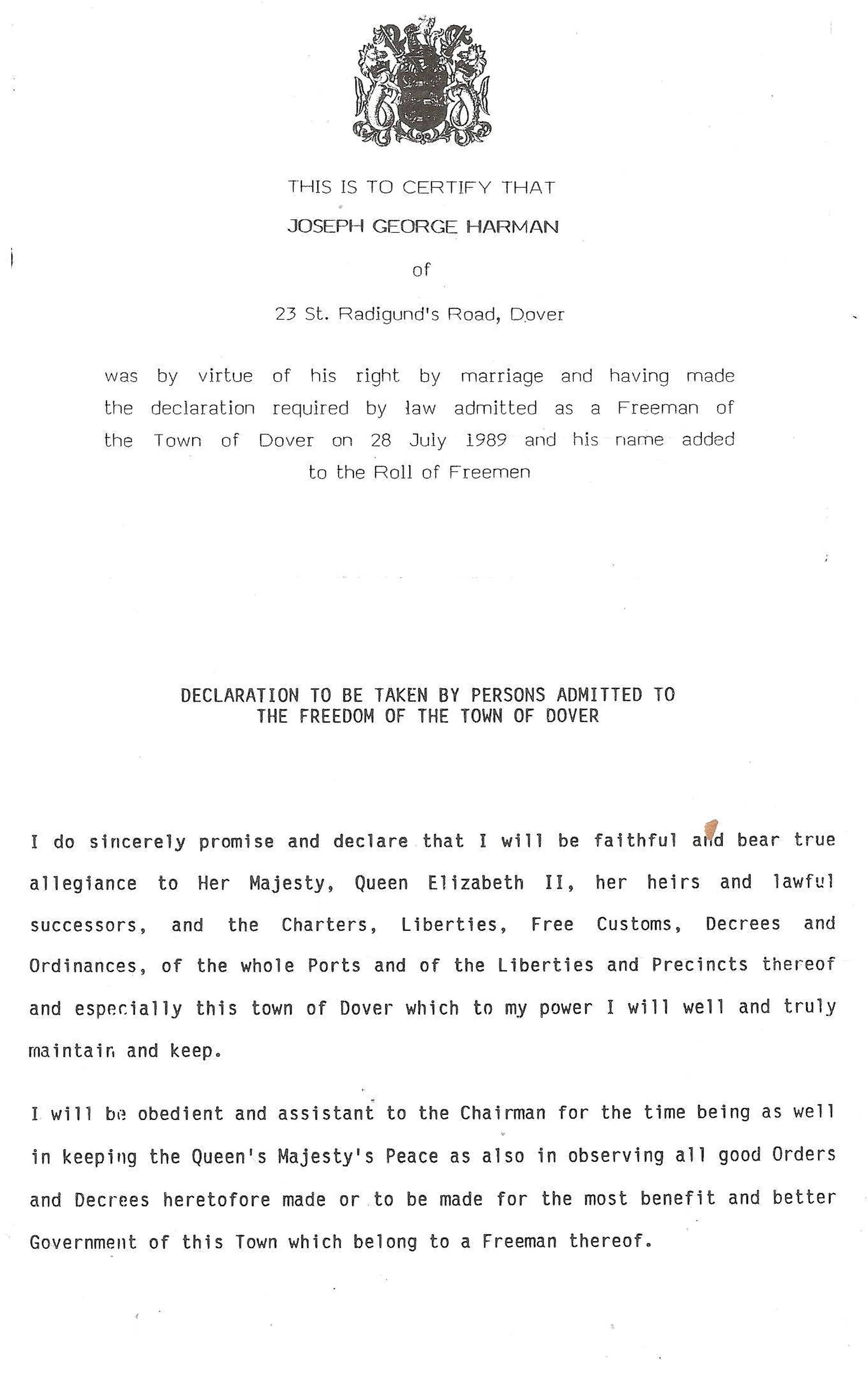
Freeman Certificate given to the late Joe Harman in 1989

Freeman Certificate given to the late Joe Harman in 1989

In the early days admission to the  Freemanship was given when a boy reached the age of 12. The ceremony was held in the church when he would make an oath on the Bible that enshrined all the responsibilities that underpinned the laws of the town. If a Freeman committed a crime fines were imposed but if the crime were serious then the whole family would be published. This  could include denying them the right of Freedom. Punishments along with the description of Dover’s civic and judiciary system and laws were detailed in the Dover Customal of 1356. Although the author, Roger Mortimer – the Earl of March and Lord Warden at the time, was removed from office for not quite getting the Customal right, the fabric of the contents give us an insight into what life was like at that time.

Simon de Montfort (c1208– 4 August 1265) summoned Parliament in January 1265, insisting that all representatives were elected. The vote was given to those who owned the freehold of land to an annual rent of 40 shillings -Forty-shilling Freeholders – and in Dover this franchise was given to all Freemen. Probably in order to win the Cinque Ports sympathy, he allowed each port to send four Burgesses (Freemen) to represent them in Parliament.

The number of representatives sent to Parliament was reduced to two around 1366 and this remained so until the Re-Distribution Act of 1885, when the representation was reduced to one. In the early days, the writs were sent to the Lord Warden and one of the two MPs was nominated by him, the other by the town’s Freemen. However, in 1579, the Freemen of Dover asserted their right to elect both Members of Parliament and although they won the case, it was almost a century and much conflict before the Lord Warden finally relinquished what he perceived to be his right.

Part of the Lord Warden’s argument wrested on the way the hierarchy of the town was evolving. Once a Freeman had been elected a Jurat, he retained that right for life. It had become the custom for the Jurats to select four of their number to stand as Mayor and for the Freemen to elect one of them. In consequence a self-perpetuating clique was ruling the town. After much wrangling, in 1668, both the nomination and the election of Mayor were thrown open to the whole body of the Freemen.

By 1770, the Freemen of Dover were electing both Members of Parliament and that year, following a ballot. It was resolved that Freemen not living in Dover had the right to vote in Dover parliamentary elections. At that time, there were 470 non-resident and 1,000 resident Freemen but it was not until 1835 that non-Freemen resident in the town were allowed the vote.

Local Historian, Joe Harman, claimed the right of Freedom through marriage in 1989.

Local Historian, Joe Harman, claimed the right of Freedom through marriage in 1989.

Although women were not allowed to become Freemen, marriage to the daughter of a Freeman did secure entry into the prestigious upper echelons of Dover’s society. How often such relationships were founded in love is open to speculation. Albeit, the reverse, that of a Freeman marrying the daughter of a non-Freeman was deemed a punishable offence. In the reign of Mary I (1553-1558) Thomas Wood, a brewer, was ordered to pay a fine of £3.10s (£3.50p) for marrying for love rather than marrying a Freeman’s daughter!

Margery, the wife of wealthy gentleman Edward Wivell, died on 23 October 1695. She was the daughter of a Freeman through whom Edward Wivell had claimed the right of Freemanship and had held the position of  Jurat for nearly thirty years.  Wivell was at eventually elected Mayor in 1698 but this was immediately challenged as technically he was no longer a Freeman due to Margery’s death. A major debate in council ensued and the outcome set a precedence that still holds today, ‘The death of his wife, Margery, did not make void his being a Jurat, Justice of the Peace and Mayor. In other words, the Freedom of Dover, gained through marriage, carries on after the wife’s death.

Local Historian, and this author’s mentor, Joe Harman, claimed the right of Freedom through marriage in 1989.

Towards the end of the Middle Ages, Freemen, who were not part of the elite but who were running successful trades set up Guilds within the town and joined up with others further a field and especially in London. This, however, had the effect of weakening Dover’s age-old power base of Freemen and the situation came to a-head with Hackney Carriers Guild. Although they were Freemen of Dover, they started to carry goods and mail over land, which was cheaper, than by sea. The council reacted by fixing the price that the Hackney carriers belonging to the Guild were to charge. For instance, from Dover to Canterbury was 16d (6.5p) and to Sandwich at 8d (3p), which was prohibitively expensive at that time.

Even if people did pay the price, the Hackney Carriers Guild members were obliged to give the council the difference between the actual price and the asking price set by the council! The Hackney carriers who were not members of the Guild were allowed to charge the actual fares thereby undercutting the Guild members as all charges had to be displayed. Further, none-Guild members were allowed to charge less than Guild members to carry the king’s business (official post), the council paid the none-Guild members the difference. Finally, the council imposed a penalty of 5s(25p) and ten days imprisonment if  Guild carriers did not abide by the rules.

Albeit, the Guild carriers and other trade guilds found ways of getting round such rules so in 1556, the Corporation made it unlawful for trade guilds to operate in Dover. Over the next few decades the economic climate in Dover suffered a severe downturn and in 1636, when the fledgling Guild of Leathermakers’ Master, James Cullen, (1588-1640), wanted to rent a room in Biggin Gate for their use, the council acquiesced, the council acquiesced. A lease was agreed for 21 years, at 21s (£1.05p) a year and the room was to be used by shoemakers, glovers, saddlers, collar makers and cobblers belonging to the Guild. In 1653, during the Civil Wars and the Interregnum (1642–1660), although the town continued its slide into poverty the Guild was removed by order of the Puritan Mayor, Edward Prescott.

Even though it was the Act of 1836 that irreversibly took away the power of the Freemen in Dover over a century before there is ample evidence that their power was on the wane. During the heyday of the Freeman, the punishments of their own kind had lessened as long as they abided by the laws of fraternity. They were usually fined but occasionally sent to prison for misdemeanours against other Freemen.

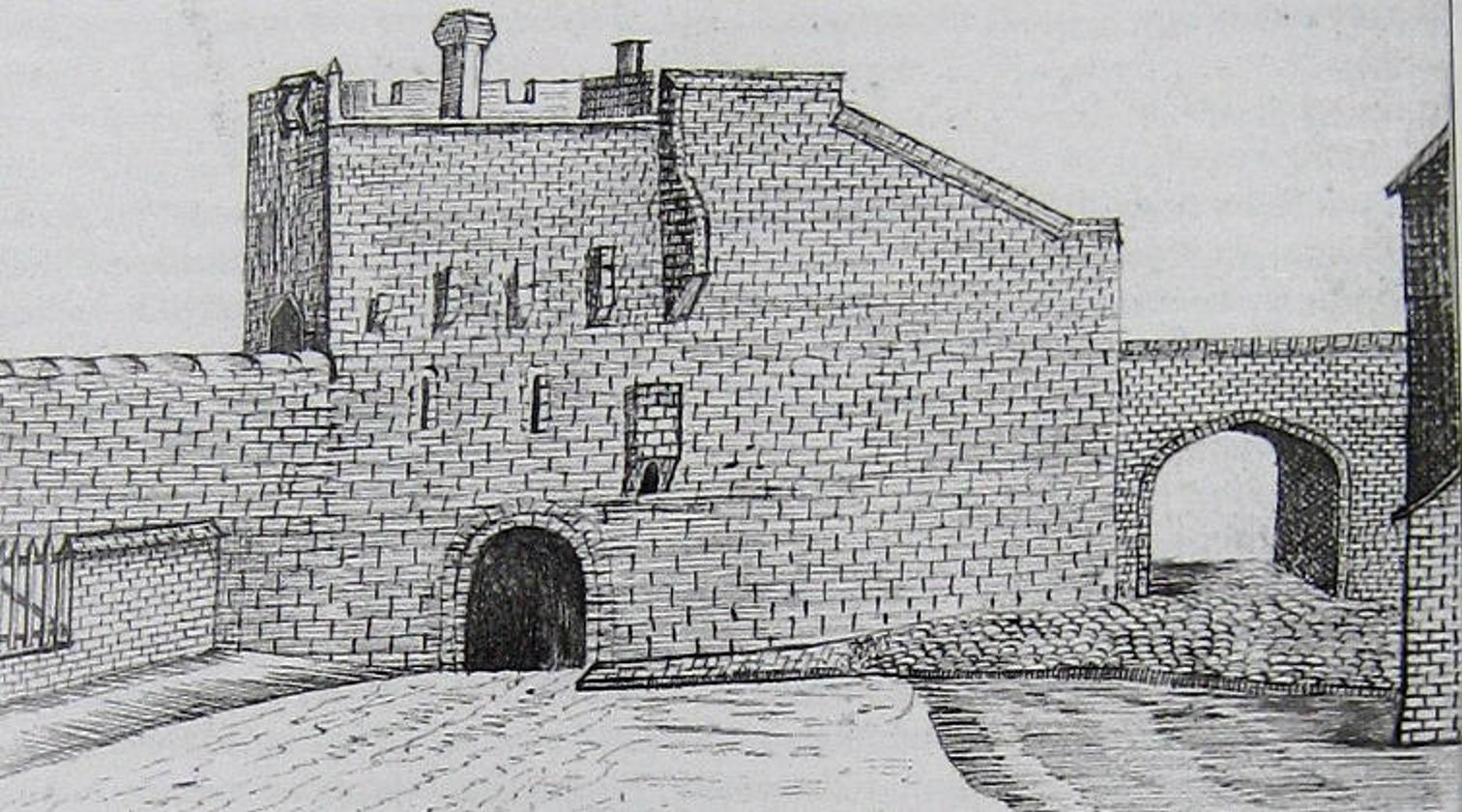
Sketch of Butchery Gate with Steadfast Tower, Townwall Street

Sketch of Butchery Gate with Steadfast Tower, Townwall Street

The Freeman’s prison was in Butchery Gate, facing the sea and was relatively comfortable. Although the inmates paid for food, heating, lighting, bedding etc. the gaolers, who tendered for the post, were open to bribes and looked the other way when luxuries were brought in. In 1722, when more prison space was needed, the town decided to do away with the Freeman’s prison and institute fines instead.

Dover Hereditary Freemen at 21.10.2005 were:

Joe Harman – was the last man gaining the right of Hereditary Freeman and that was in 1989.

E King, Dover

M G Bingham, Devon

Ian D Pascall, Whitfield

In 2013 Robin Atherden successfully claimed his Freedom of Dover

  • Published:
  • Dover Mercury: 09 February 2006
Posted in Freemen - Dover's Bygone Rulers, Local Government | Comments Off on Freemen – Dover’s Bygone Rulers