Clock Tower

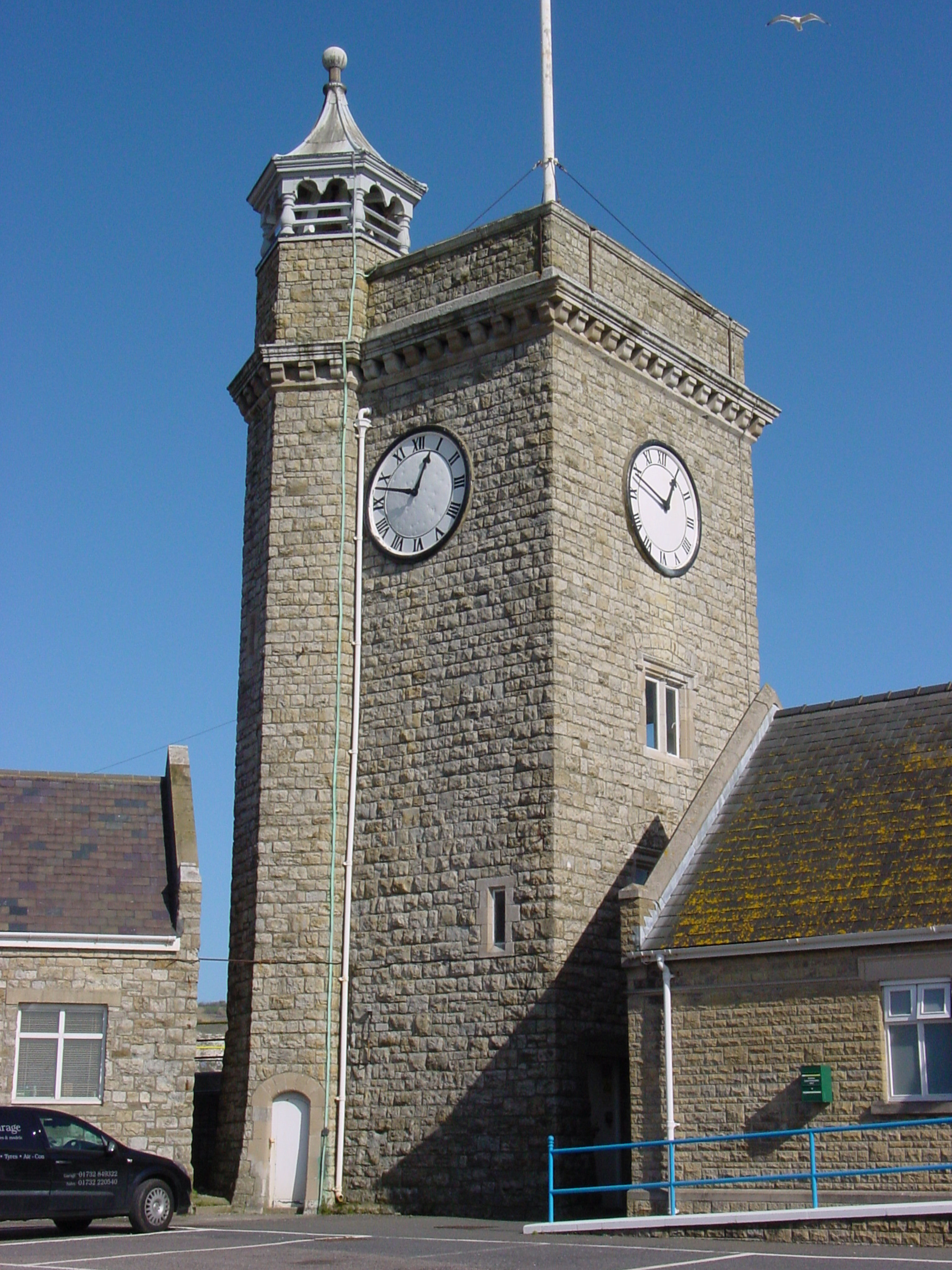
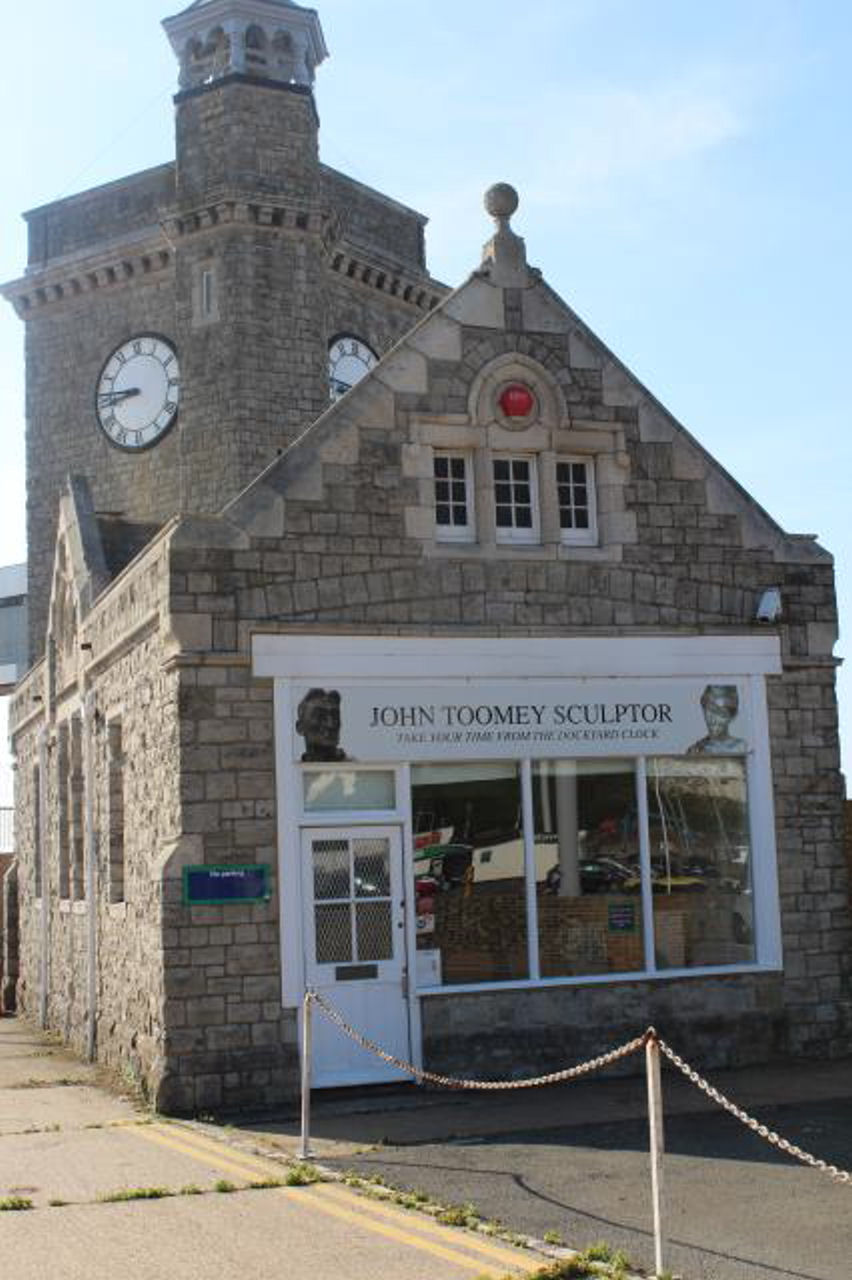
Clock Tower on Dover's seafront. Alan Sencicle

Clock Tower on Dover’s seafront. Alan Sencicle

The Clock Tower, near the entrance to the Prince of Wales Pier, is one of Dover’s landmarks. Originally built in the 1870s during the deepening and reconstruction of what became the Granville Dock. Together with the adjacent lifeboat station  the building was demolished and then rebuilt in order to make room for the Prince of Wales Pier in 1891/2. The story of the clocks goes back to the early part of the 19th century.


At that time, Dover’s main harbour was on the western side of the Bay and the outer entrance, through the south and north pier heads can still be seen today. The harbour master James Moon who was also an engineer, had been working on the perennial problem of Dover harbour entrance being blocked with shingle. This was caused by the Eastward Drift that carried the shingle round the west point of Dover’s bay and deposited it on the seashore and in the harbour entrance.  To try to combat this Moon had undertaken a number of major building works, one of which was the reconstruction of the Crosswall alongside the Tidal Harbour. This took place between 1819 and 1821.

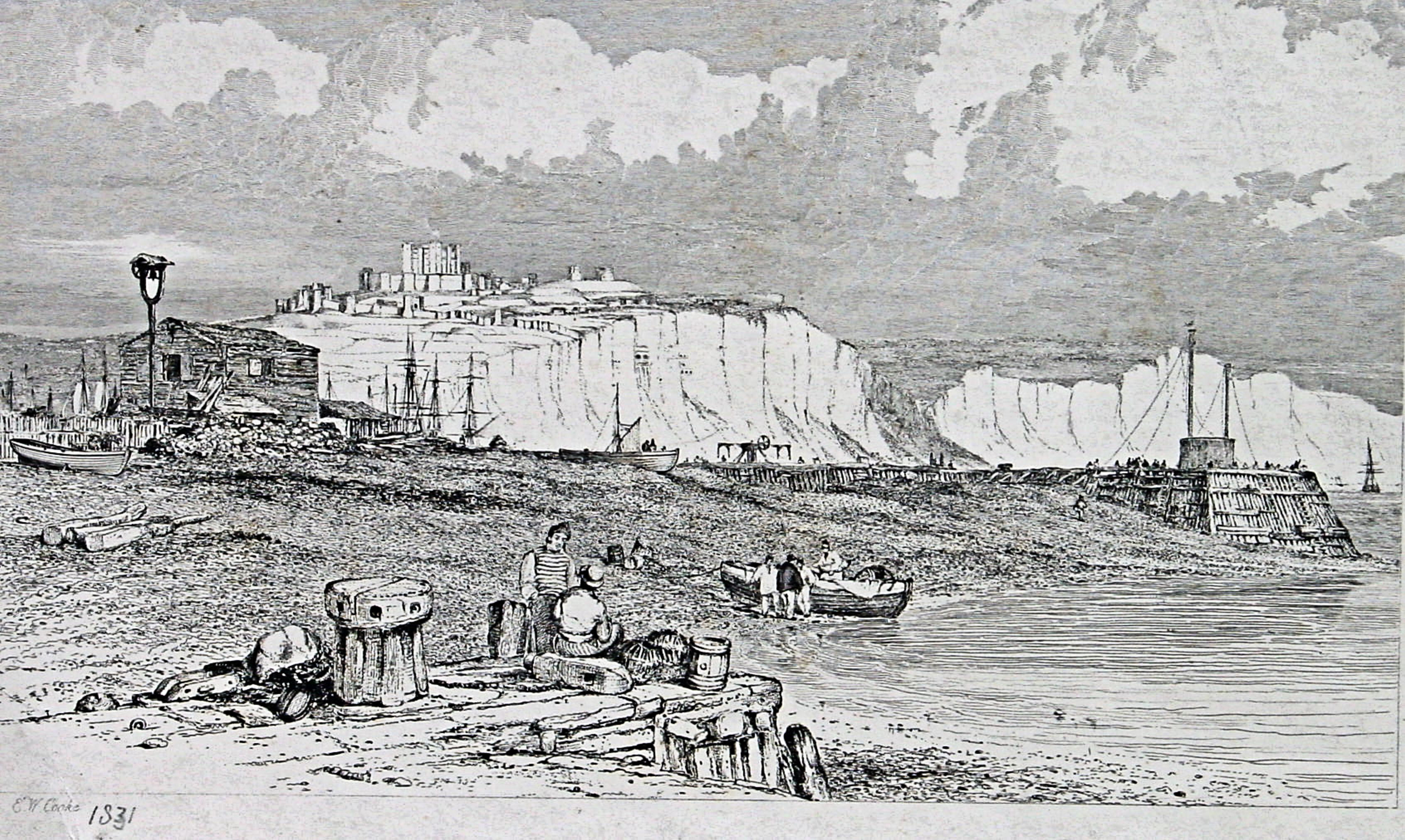
The Bason 1831 - Showing the silting problems. Dover Library

The Bason 1831 – Showing the silting problems. Dover Library

New gates were erected opposite to the outer entrance to the harbour and giant sluices were inserted. The idea was that the Bason, as the inner harbour was then called, would fill up with seawater at high tide and this would be released through the sluices at low tide. The force would be such that it would clear the outer entrance of shingle. The sluices’ operating mechanism was by the east lock gate, although efficient, it was large and ugly. Moon suggested that a clock tower should be built to house this and at the same time the edifice would add a sense of magnificence to the entrance of the Bason.

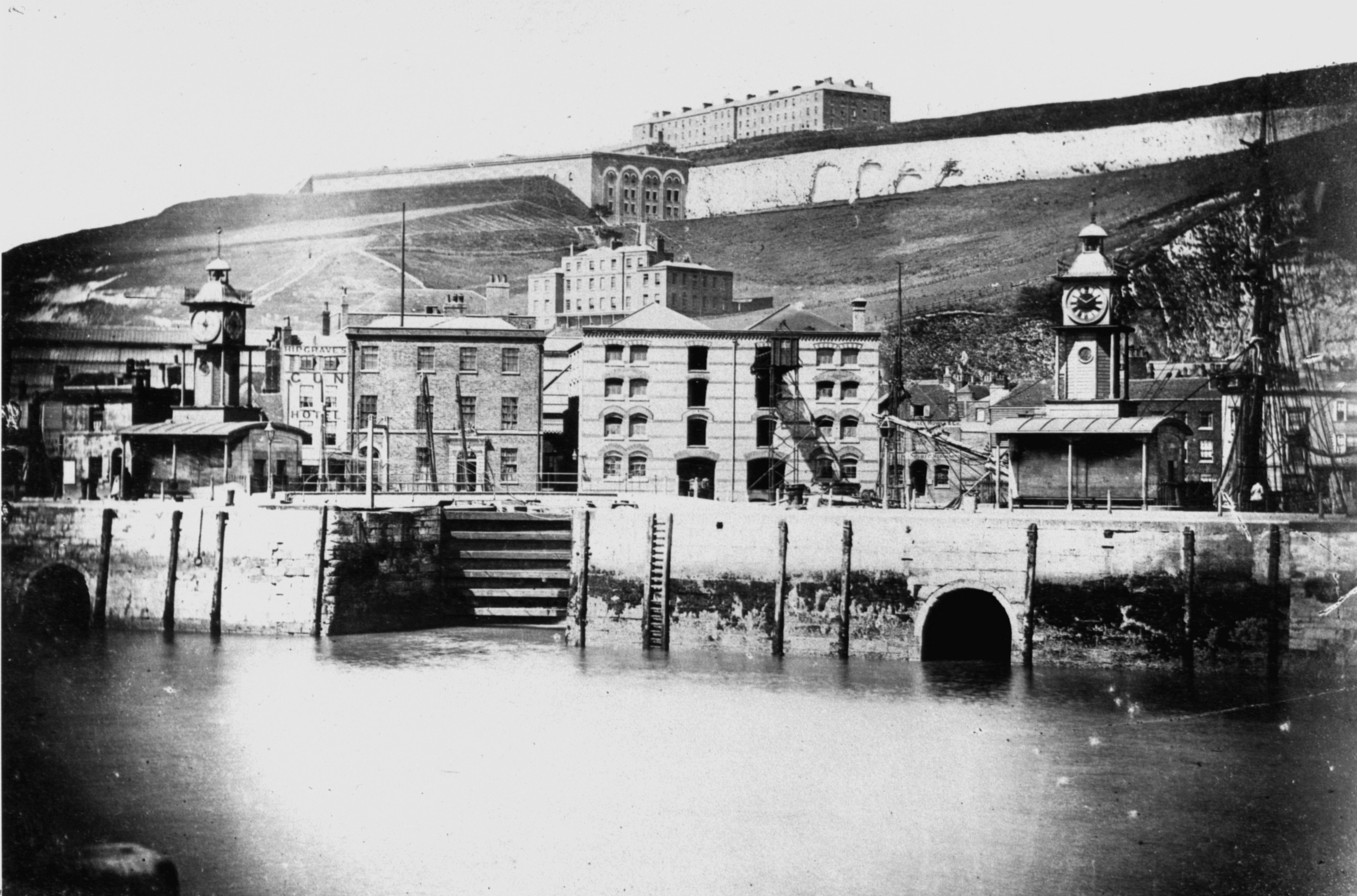
Clock Tower (east) and Compass Tower (west) on Crosswall c 1870. Dover Museum

Clock Tower (east) and Compass Tower (west) on Crosswall c 1870. Dover Museum

The idea of an impressive clock tower was well received and four clocks were made by I P Paine of London. The faces were painted red in the centre with a white outer rim and black numbers. The Tower was officially opened on 14 April 1830 and looked magnificent, won a national award, but looked decidedly odd. This was due to the lack of a similar edifice on the opposite side of the gates. Funds were made available to build another, similar tower containing four compass faces, on the western side and was completed and erected the following year.

The entrance to the inner harbour looked exactly as Moon had envisaged and both the council and the Harbour Commissioners were pleased. However, the clock tower did not go down well with every visitor to the town. Charles Dickens (1812-1870), stayed at the Ship Hotel on the then Custom House Quay opposite the clock tower in 1856. He was in Dover to work on Little Dorritt but due to concerns over domestic issues, he spent a lot of his time taking long walks and talking to locals.

These were recounted in Out of Season, published in Household Words later that year. In his essay, Dickens’ wrote of the clock tower that, ‘It was impossible, under the circumstances, for any mental resolution, merely human, to dismiss the Custom-house cutter, because the shadow of her topmast fell upon my paper, and the vane played on the masterly blank chapter.’ Going on to say, ‘I had scarcely fallen into my most promising attitude when I found the clock upon the pier – a red-faced clock with a white rim – importing me in a highly vexatious manner to consult my watch, and see how I was off for Greenwich time…’

As the century, progressed ships became larger and parliamentary approval was gained to undertake a number of works including widening the entrance to the Bason. After much consideration, it was decided to demolish both the clock and the compass towers. This took place in May 1871 and the clocks went sent to John Bacon of 4 King Street. A clock maker, John removed the red paint, cleaned and restored the clocks and kept them until a decision was made as to what to do with them.

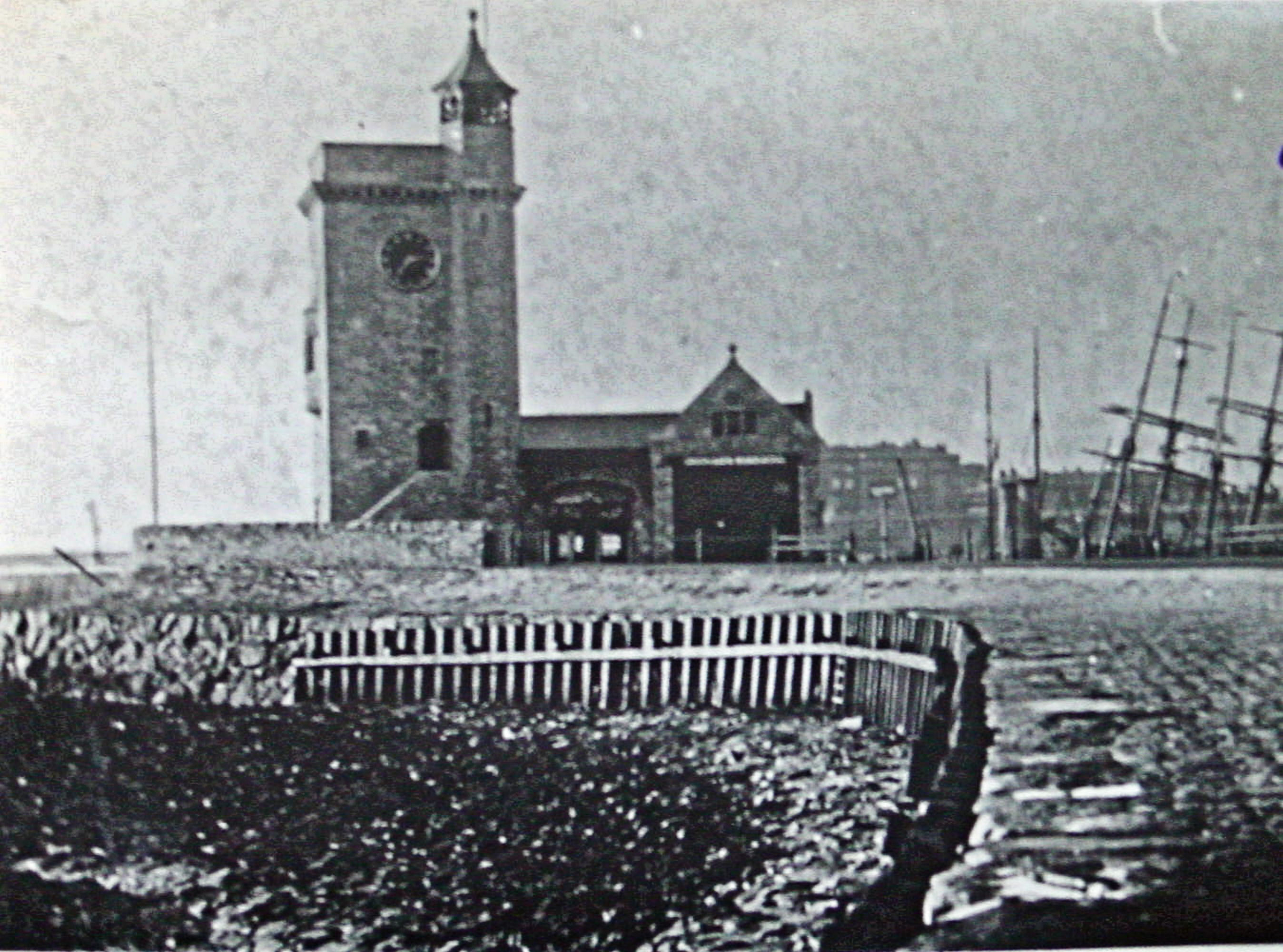
Clock Tower and Lifeboat Station 1880s. Dover Library

Clock Tower and Lifeboat Station 1880s. Dover Library

The entrance to the Bason was widened to 70-feet and the sill was lowered allowing vessels drawing 20-feet at spring tides and 16-feet at neat tides also to enter. Earl Granville – the Lord Warden (1866-1891) – opened the newly modified Bason on 6 July 1874 and it was renamed Granville Dock. At the west end of the Esplanade on the Sea Front, next to the lifeboat house that was built in 1866, a new Clock Tower was built and in 1877 the refurbished clocks were installed. The aggregate expenditure was £74,416 13s 1d.

The Prince of Wales Pier was built as the east pier of a new Commercial harbour and completed in 1902. To make room for the root of the new Pier, the Clock Tower was moved and the lifeboat house was demolished and rebuilt on the west side of the clock tower. Before then the Admiralty had commissioned the harbour we see today that was officially opened in 1909. In 1905, the King’s harbourmaster of the Admiralty Harbour was Captain Chambré RN and he took over Clock Tower making it his headquarters. During his time the Coastguard, which had previously taken over the top floor and the roof shortly after the Clock Tower opened, renewed their semaphore equipment and erected a wireless antenna on the roof.

Throughout both World War I (1914-1918) and World War II (1939-1945) the Clock Tower came under the jurisdiction of the military and no doubt during the latter War came under heavy shelling although details are not available. However, on Monday 21 October 1940, during heavy shelling, it was reported that there were two casualties at the Clock Tower. On 18 January 1943, an oil bomb was dropped near the Clock Tower and it was reported that it lit up the whole of that side of the harbour. Much of the surrounding area was devastated during the War and was subsequently demolished.

Clock Tower and former Lifeboat Station. Dover Harbour Board

Clock Tower and former Lifeboat Station. Dover Harbour Board

Following World War II pillboxes, barbed wire and other anti-invasion precautions along the Sea Front were removed. The Clock Tower was restored and returned to civilian use together with the lifeboat house next door. For many years, when a vessel was reported to be in distress, Port Control would ‘electronically’ fire two maroons from the roof of the Clock Tower to call out the lifeboat crew. In order to prevent the maroons being fired at the same time as person was up there a  safety switch had to be operated to give access. The maroons were kept at the lifeboat house at the Eastern Docks and were replaced by members of the crew when they returned after being called out. The maroons ceased to be fired with the advent of technological paging systems.

In 1997, it was planned to turn the Clock Tower into a restaurant but this came to nothing. More recently, the building was Listed and although there are new redevelopment proposals for the western part of the harbour I have been assured by a spokesperson, on behalf of Dover Harbour Board, that the Clock Tower is safe.

  • Published:
  • Dover Mercury: 27 August 2009


Posted in Buildings, Clock Tower, Clock Tower, Maritime | Comments Off on Clock Tower

Archbishop Richard of Dover

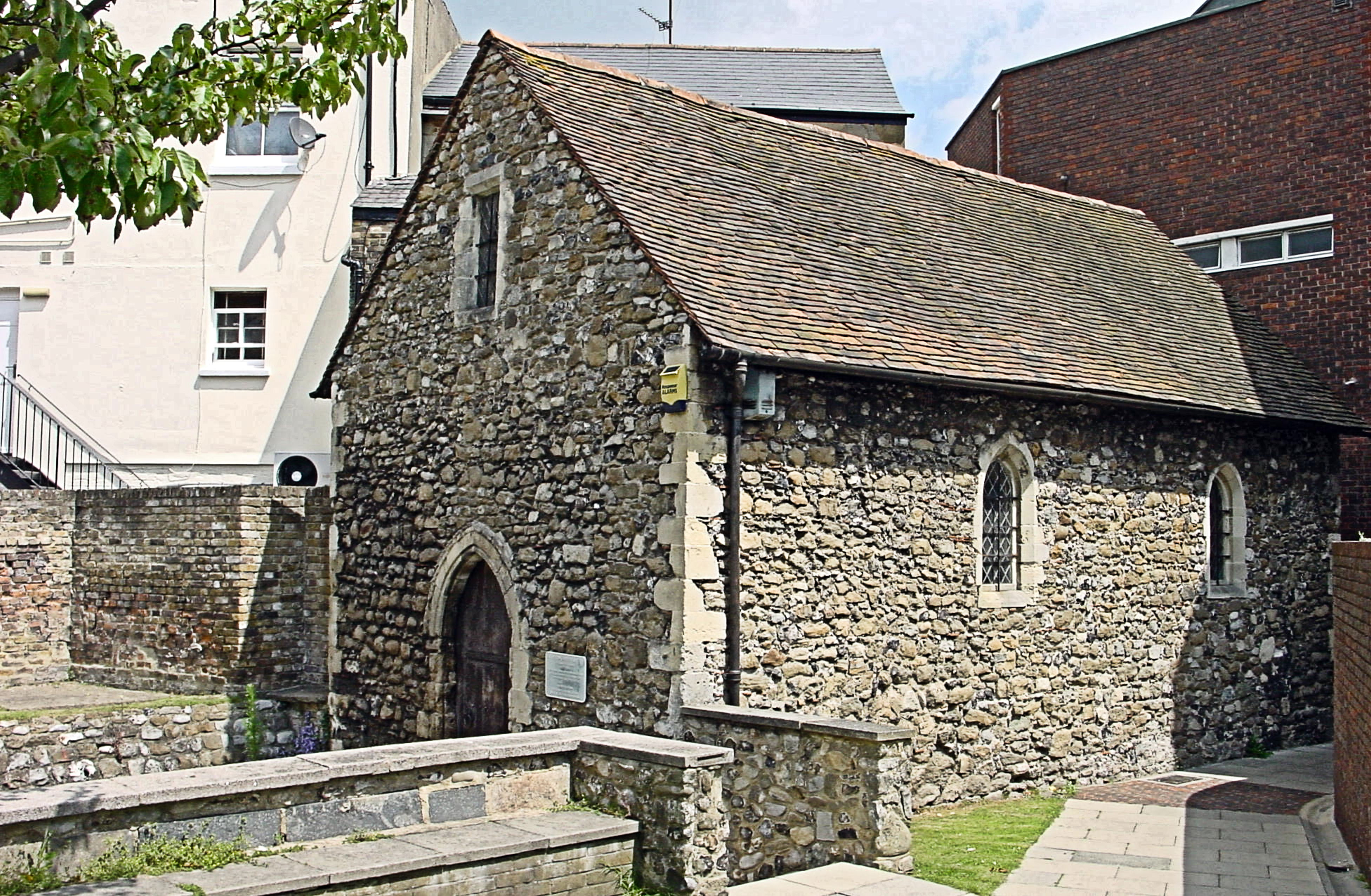
St Edmund's Chapel,  Priory Road, dedicated by one Saint to another Saint. Alan Sencicle

St Edmund’s Chapel, Priory Road, dedicated by one Saint to another Saint. Alan Sencicle

Dover, ecclesiastically, is unique for a small town. There is St Edmunds Chapel that was dedicated by one Saint (St Richard -1197-1253), to another Saint (St Edmund 1175-1240). Pilgrims, including a king, venerated Thomas Hale (d1295) as a saint although he was never formally canonised. The town also boasts of a highly regarded Archbishop of Canterbury! The latter was Richard of Dover, who was appointed Archbishop in 1174, a position he held until his death ten years later. 

Dover Priory, now Dover College, was dedicated in 1134 to St Martin of Tours (316-397), the patron saint of France, Soldiers and Dover. At the time, it was contentious decision as Dover already had the magnificent St Martin-le-Grand monastery near present day Market Square. This had been built on the site of a Saxon monastery that the Norman’s had razed to the ground following the Conquest (1066). Like the Saxon monastery, the grand new church was dedicated to St Martin. William I (1066-1087), angered at what had happened,  ordered the new, grander, monastery to be built as a way of compensation.

Remains of St Martin-le-Grand, off the Market Square, Dover

Remains of St Martin-le-Grand, off the Market Square, Dover

Both St Martin’s and Canterbury Cathedral were rebuilt at the same time. However, because of St Martin’s magnificence, it was seen by some at Canterbury as a threat in what became an ecclesiastical power struggle. St Martin-le-Grand was a Collage of Secular Canons, who were only accountable to God, the King and Rome but within a hundred years of the Conquest, Diocesan hierarchy reigned supreme. The two contenders for the head of the Church, in England, were the Archbishop of Canterbury and the Archbishop of York.

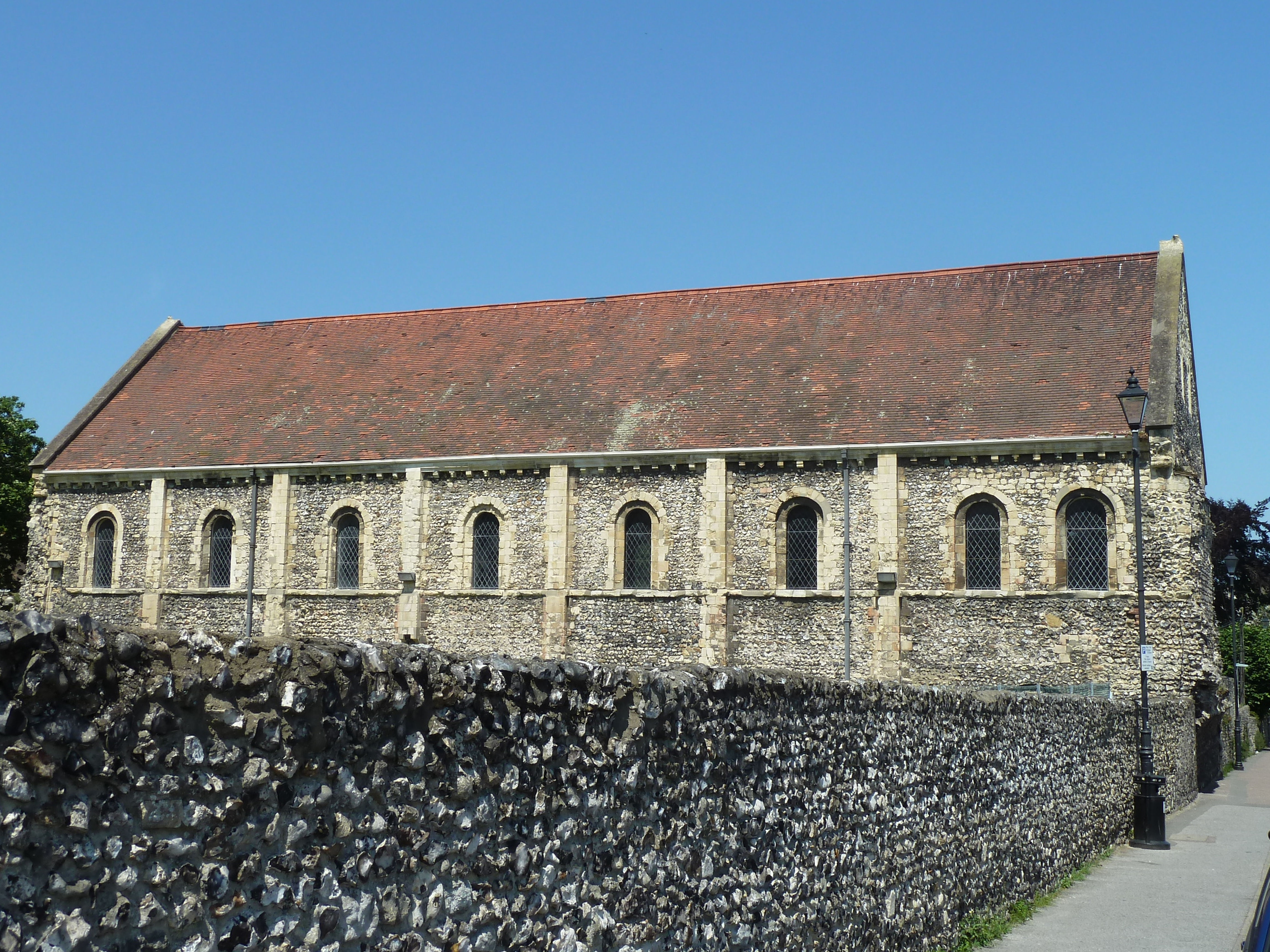
In 1124, the Archbishop of Canterbury, William Corbeil (1123-1136), persuaded Henry I (1100-1135) that the canons’ moral behaviour at St Martin’s, left a lot to be desired and the King gave him the authority to replace them with canons of Corbeil’s own order from Merton. As Corbeil had used the proximity of the harbour as one of the reasons for what, he said was the Dover canons immoral behaviour, he said that a new establishment, out of town, was called for. Thus, Corbeil had the Priory built outside the town walls of Dover on land west of the Maison Dieu, then a religious house. The design was on monastic lines and it was to be dedicated to St Martin when it was ready in 1136.

Dover Priory Refectory now Dover College - seen from Effingham Road - Alan Sencicle

Dover Priory Refectory now Dover College – seen from Effingham Road – Alan Sencicle

The Bishops of Norwich and St David’s came to Dover to dedicate the new Priory. However, before the ceremony took place the Benedictine monks of Canterbury swooped into Dover in the most ungodly fashion. They were objecting to the Priory being given to the canons of Merton. The two Bishops beat a hasty retreat and, it was said, Archbishop Corbeil was so distressed that he died eleven days later. Following an appeal to Rome, the Canterbury monks were given the authority to take over the Priory and they immediately assumed authority of all the parochial rights and dues that belonged to St Martin-le-Grand. In 1139, the latter was officially reduced in status.

Theobald of Bec (1090–1161), was appointed the Archbishop of Canterbury in 1139 (1139-1161) and not long after Richard came from Normandy. It was probably to study at Canterbury and one of his colleagues was Thomas Becket (circa 1118 -1170). Richard was eventually appointed Theobalds chaplain and in about 1155, joined Dover Priory. That year Pope Adrian IV (1154-1159), born Nicholas Brakespear (1100-1159) – the only English Pope – confirmed the Priory in favour of the Benedictines.

Dover Priory Chapel Interior c 1850.  Dover Library

Dover Priory Chapel Interior c 1850. Dover Library

Richard, a pious and mild mannered man had a reputation for being thorough and he impressed the Priory monks by sorting out their financial affairs. At the same time, he gently ensured that their behavior conformed to ecclesiastical law. Two years later the monks appointed Richard as the Prior of Dover much to the annoyance of Theobald, as the decision should have been his. For three years, Dover and Canterbury were in a state of deadlock over this until finally, a compromise was reached. Pope Alexander III (1159-1181) ruled that, ‘the Prior of Dover should always be taken from the Convent of Canterbury and from no other place.’ Although, successfully dealing with the situation at the time the ruling was to prove contentious right up until the Reformation (1529-1536).

Theobald died in 1161 and Henry II (1154–1189), fed up with what he saw as an all-powerful Church, appointed his friend and Chancellor, Thomas Becket, as Archbishop of Canterbury (1162-1170). Almost from the moment Becket took office, his allegiance changed from the King to the Church. This endeared him to Richard, whom Becket appointed as his chaplain.

The story of what happened to Archbishop Thomas Becket is well covered. Suffice to say that on the afternoon of 29 December 1170, Archbishop Becket was in conference with, amongst others, Richard, when four of Henry II’s knights – Reginald fitzUrse, Hugh de Morville, William de Tracy and Richard le Breton, entered the Cathedral and murdered him. Afterwards Richard took charge of Becket’s body, arranging for an immediate burial. Three years later Becket was canonised but his replacement as archbishop had not been appointed.

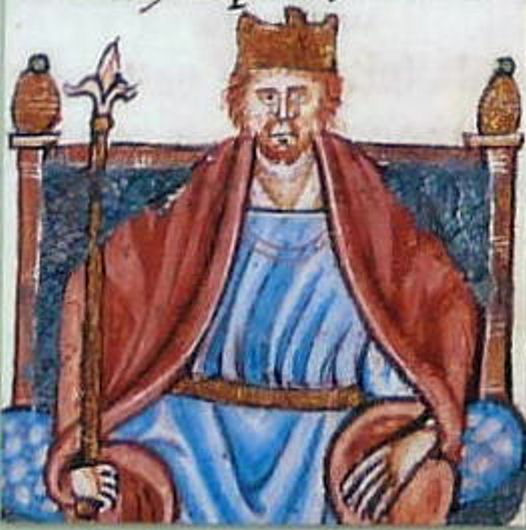
Henry II - his knights murdered Archbishop Thomas Becket

Henry II – his knights murdered Archbishop Thomas Becket

On the advice of the Archbishop of York – Robert of Bishop’s Bridge (circa 1115-1181) – it is said – the King proposed the quiet, mild mannered, Richard as Archbishop. The Canterbury monks preferred Odo, Prior of Canterbury who was of a similar disposition as Theobald and Becket. In the end, Richard travelled to Italy and was consecrated by Pope Alexander III on 7 April 1174. He was also appointed Alexander’s Legate, (judge for the papacy).

Following his return to England Richard was enthroned at Canterbury on 5 October. About this time Canterbury Cathedral destroyed by fire in 1174 and subsequently rebuilt in the then modern Gothic style we see today.

The Archbishop of York had assumed Richard was a soft touch and promptly announced that York was superior to Canterbury. This led to a bloody fight between the respective supporters! Henry II intervened resulting in a five-year truce, which he expected to have the power over the Church he craved.  Asserting this authority, the King demanded that the election of bishops was to take place in the Royal Chapel, with him present. Richard did not object.

The Arms of Dover Priory - four leopard heads

The Arms of Dover Priory – four leopard heads

Using this as ammunition, Archbishop Robert of York rallied his support for York’s supremacy over Canterbury. The quiet, meditative and supposedly weak Richard of Dover, in May 1175, invited nineteen canons to examine the ecclesiastical laws and find ways of enforcing compliance. This became known as the Council of Westminster with which Archbishop Richard strengthened the Church’s authority by implementing uniform Canon Law throughout the realm. The punishment included the sacking abbots, bishops and possibly Archbishops, who failed to comply. With this, Richard left his mark on both the Church and the country. In 1180, he returned to Dover and gave the Priory a new and more beneficial Charter.

Archbishop Richard of Dover died on 16 February 1184 and was buried in Canterbury Cathedral. Pope Alexander III included Richard’s laws in the Decrials – the collection of ecclesiastical laws governing the Roman Catholic Church.

  • Published:
  • Dover Mercury: 24 September 2009


Posted in Archbishop Richard of Dover, People, Religion & Churches, Richard the Archbishop from Dover | Comments Off on Archbishop Richard of Dover

Ville de Liege – the shipping accident that was waiting to happen

Ville de Liege - steel screw turbine Belgian State Railways cross-Channel fleet steamer

Ville de Liege – steel screw turbine Belgian State Railways cross-Channel fleet steamer

On 11 February 1929, the steel screw turbine Belgian State Railways cross-Channel fleet steamer, Ville de Liege, sank in Dover harbour. The origins of the catastrophe were set in motion some 400 years before!

Up until the end of the 15th century, Dover’s harbour was on the east side of the bay. However, by the time of Henry VII (1485-1509), it was silted up and a new harbour had been built on the west side of the Bay. This, Dover mariners called ‘Paradise Pent’ as it met their needs. Sadly, by 1532, Paradise Pent was too small and was also suffering from silting. Sir John Thompson, minister of St James’ Church, wrote to the new King, Henry VIII (1509-1547) on behalf of four Jurats (senior councillors), with a plan to improve the harbour. The King responded favourably with £300 and as a reward Sir John Thompson was given the position of Master of the Maison Dieu. Thompson was also appointed engineer and work on the new harbour began on St Anne’s Day, 26 July 1533.

The Wick / Wyke / King’s Foundation / Mole Head Rock or Moule Rodd - built by John Clarke 16th cent. From a British Museum print. Dover Library

The Wick / Wyke / King’s Foundation / Mole Head Rock or Moule Rodd – built by John Clarke 16th cent. From a British Museum print. Dover Library

Although Henry approved and promised to pay, when the costs reached £50,000, the King’s accountant for the Dover project, Anthony Aucher (d.1558), suggested that it should be brought to a halt. By that time, except for the breakwater, the project was complete. Although the breakwater head mole was finished the wall between it and the harbour was only 18 feet (5.5 metres) high. On spring tides, it did not present a problem until ships of greater depth were introduced and from that time, what became known as the Mole Head Rocks, were a constant problem. However, the ‘isolated’ head mole –  the Wick or variously called the Wyke, King’s Foundation, Mole Head Rock and Moule Rodd, caused more.

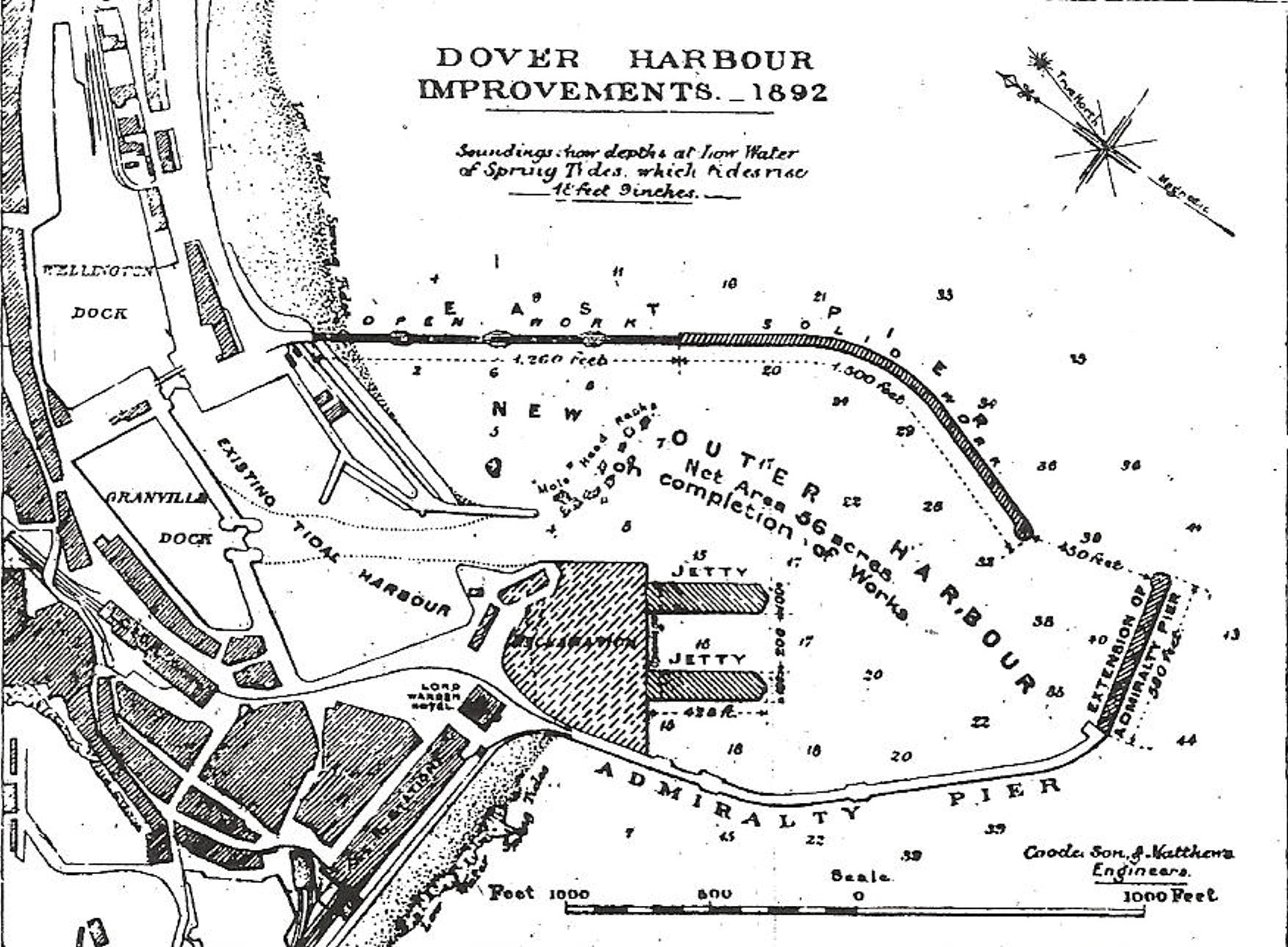
Over the subsequent centuries, the harbour grew and there were many modifications including the building of the Admiralty Pier, which was finished in 1871. Some twenty years later the Commercial Harbour was started with the building of the Prince of Wales Pier in 1893. 2,900 ft long (884 metres), the Pier opened in 1902 and the Admiralty Pier was extended from 2,100 feet (640 metres) to 4,100 feet (1, 250 metres) when the great Admiralty Harbour was built between 1898 and 1909. Throughout these grand schemes, no attempt was made to remove the Wick, which was between the new  Prince of Wales Pier and the extended Admiralty Pier. On the inside of the Admiralty Pier, facing the prince of Wales Pier, was the then Number One ferry berth.

The Ville de Liege was a small mail steamer of 1,500 gross, built by Cockerill’s of Hoboken, Belgium and launched in 1914. Not long after World War I (1914-1918) was declared she was commandeered for war service as a troop carrier. Her main role was bringing the wounded back from the Western Front. Following the declaration of Peace, she was the first Belgium ship to return Belgium expatriates to their homeland. The little ship was then returned to Belgian State Railways for the service between Dover and Ostend. By then, however, she had earned the notorious accolade that she was unsteady in rough weather.

Western docks showing the Admiralty Pier, Prince of Wales Pier the Tidal harbour entrance with the Mole Head Rocks to the east.

Western docks showing the Admiralty Pier, Prince of Wales Pier the Tidal harbour entrance with the Mole Head Rocks to the east.

At about 19.30 hours on the evening of Monday 11 February 1929 a  north-easterly gale was blowing when the Ville de Liege attempted to get along side the Number One berth on the Admiralty Pier. She had 48 passengers on board and they were coming on deck in readiness to disembark. It was low tide when the Ville de Liege was suddenly struck heavily by waves on the port side quarter. This sent a shudder down the ship and the lights went out. The ships siren was sounded and a distress flare released. The force of the waves made the Ville de Liege change direction and she was driven onto the Mole Head Rocks / Wick. Luckily, she finished broadside on to the sea so the crew could lower lifeboats into the comparatively calm waters on her port side.

The rescue was undertaken in total darkness and the cutting wind was driving sea spray that froze in the passengers’ hair and on their clothes. Due to the ice forming on the rope ladder the passengers found it both difficult and frightening descending into the ships lifeboats. The Dover lifeboat, William Myatt , Coxswain Colin Bryant, came to the help but still the whole process was very slow. It took three hours but surprisingly, there was little panic. Although most lost their luggage and one person their car, none of the passengers were injured.

Captain John Iron, Harbour Master, asked the Military officer in charge of the Searchlights on the Admiralty Pier to switch them on. He belonged to he 3rd Company of Royal Engineers and was a stickler to rules. He refused until a higher authority gave permission but after a bit of cajoling agreed to telephone his boss. Much later the lights were turned on but the next day Captain Iron was sent a bill for 5d (2p) to cover the cost of the telephone call! Nonetheless, other members of the Company did come to the harbour and help with the rescue even though they did not have permission!

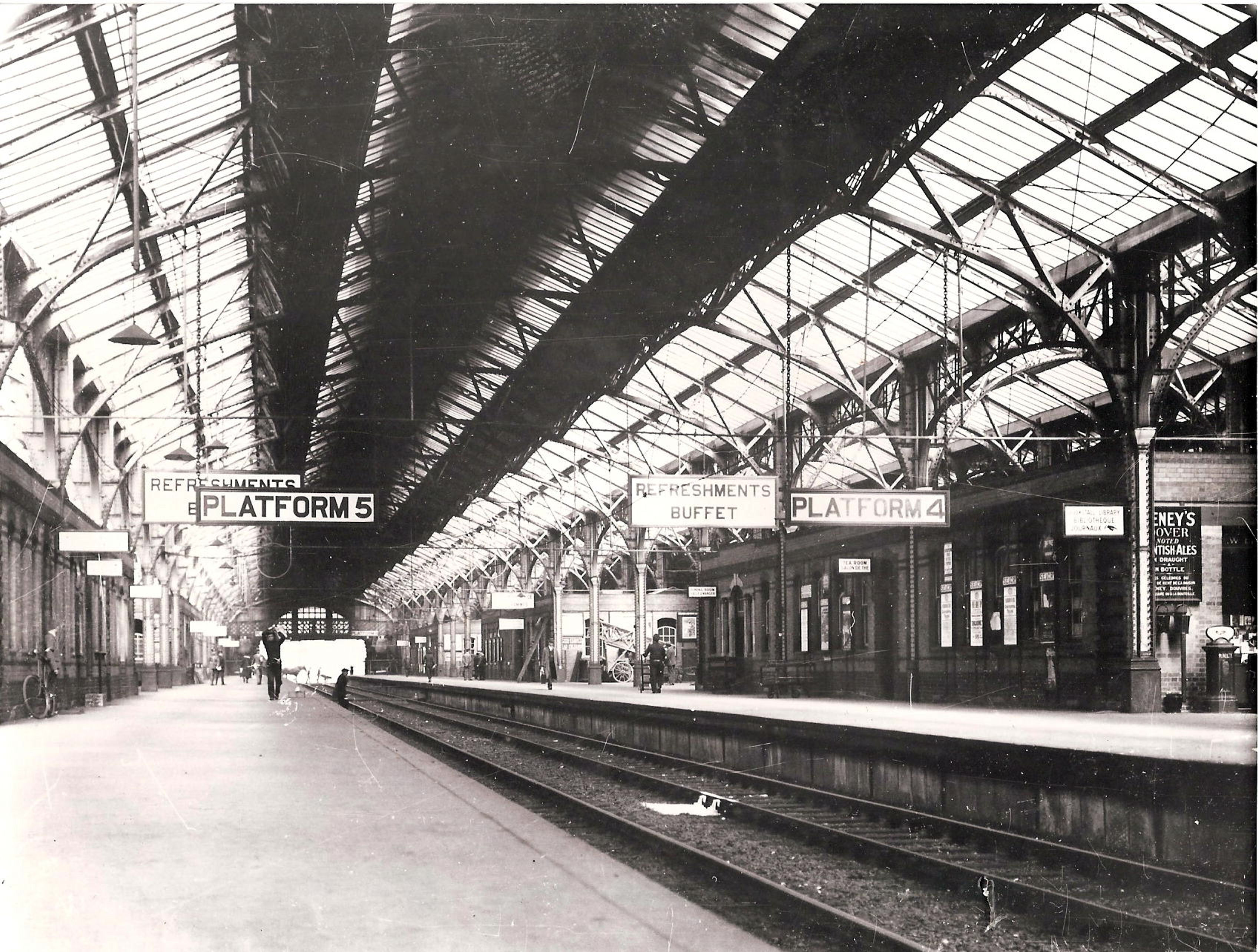
Marine Station 1920s. Dover Library

Marine Station 1920s. Dover Library

Once in the lifeboats, due to the heavy seas, it took a long time to get the passengers to the shore. From there they were taken to the Marine railway station and given warm, dry, clothing, by the Seaman’s Mission, and hot tea. It was then that the ordeal that they had been through began to hit. When the next train came in to London, the passengers boarded it and were looked after by the railway staff. However, when they arrived in London not only had they missed connections but also their possessions and in some cases most of their money. They were stranded, destitute and there was no help at hand. Eventually, some managed to contact relatives and it was they who took over the care of all the beleaguered passengers.

Meanwhile the Harbour Board tugs, Lady Brassey and Lady Duncannon, were alongside the Prince of Wales Pier but unable to get close to the Ville de Liege. A rocket was fired from one of the tugs so managed to get a rope on board the stricken vessel. However, it soon came clear that the Ville de Liege was badly damaged and was starting to make water. The tide was coming in and by 22.30 hours, she was listing so badly that the crew were ordered to abandon ship.

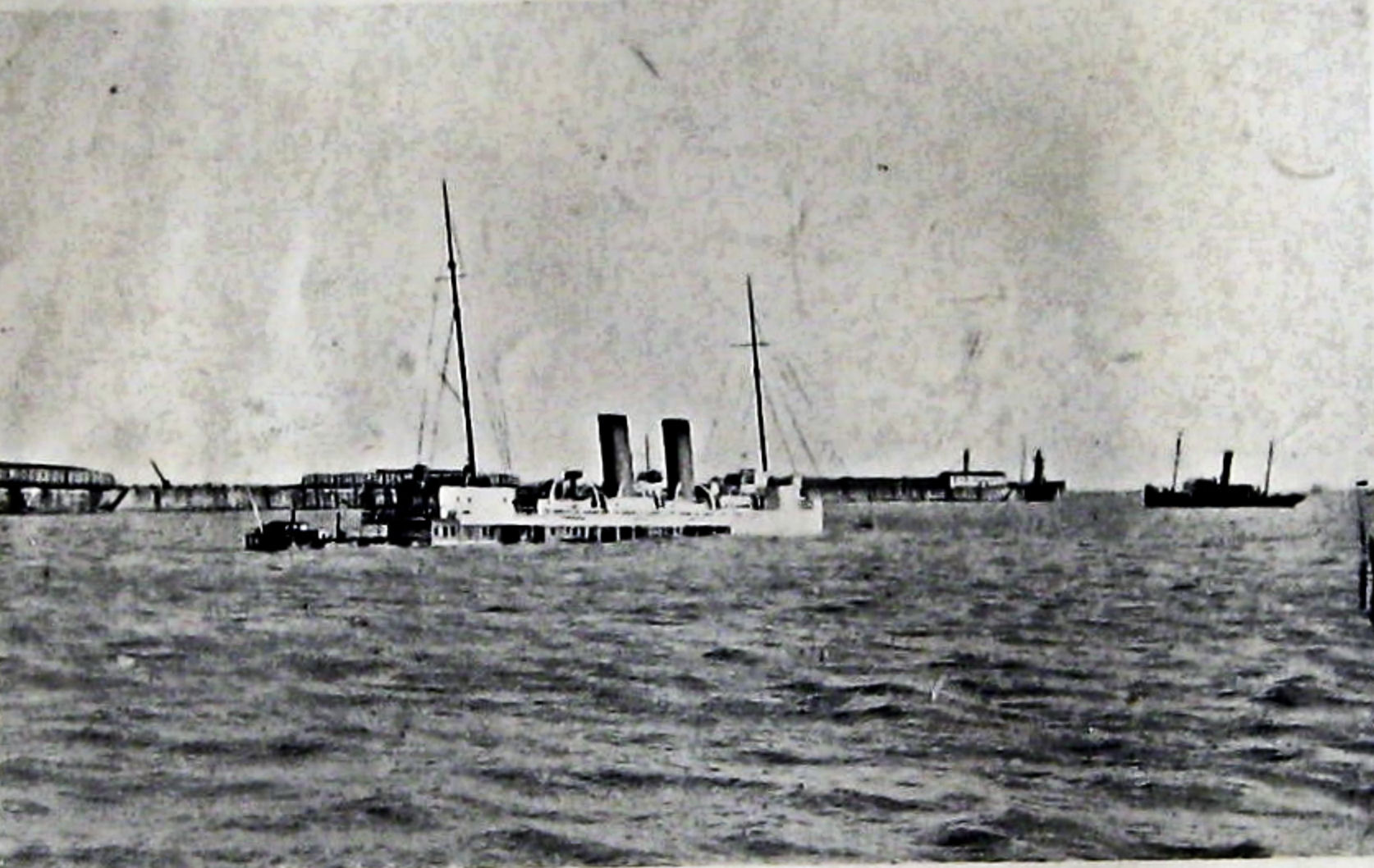
 Ville de Liege the day after the accident 12 February 1929 photograpph taken by John Iron, Dover Harbour Master. David Iron

Ville de Liege the day after the accident 12 February 1929 photograpph taken by John Iron, Dover Harbour Master. David Iron

The next day, although it was too rough to attempt to salvage the vessel, Captain Iron and members of the crew went on board. They found that all the cabins and holds, with the exception of the engine-room, were full of water. The engine-room was flooded to the level with the water outside and from this, Captain Iron surmised that the damage to the hull was in the engine-room. Conscious of his duty, the Harbour Master organised the collection of the mail that the Ville de Liege had been carrying to be salvaged – most was floating on the main deck! He then notified the postal authorities so that they could collect it.

Over the next few days divers, under the supervision of Percy Sutton – the Harbour Board Superintendent of Works, plugged the holes in the hull of the Ville de Liege and pumped the water out. On 20 February she was towed, by Lady Bassey, into the Granville Dock, while Lady Duncannon and salvage tug, Dapper, were along side pumping out water. There the Ville de Liege was made watertight and on 8 March she was towed, stern first, to Calais so that full repairs could be undertaken in the dry-dock there. When these were completed the Ville de Liege returned to her homeport of Ostend and to working the Passage. She remained in service until 1936 when she was retired and was about to be sent to auction.

However, in 1928, Captain Stuart Townsend introduced a fledgling car-carrying cross-Channel service and Southern Railway responded with the Autocarrier – the car-carrying ferry industry was born. The Belgium’s recognising that this had potential rebuilt and refurbished the Ville de Liege to carry cars. Taking less than six months, on completion she was capable of carrying 60 cars and 200 passengers and renamed the London-Istanbul. She was fitted with four doors on her starboard side to allow cars to be driven on and off at different states of the tide and commenced on the Dover – Ostend service 30 July 1936.

Commandeered for war service, (World War II -1939-1945) the little ship was sent to Calais to serve as a hospital ship. On 10 May 1940, the Germans launched their offensive against France and the London-Istanbul returned to England. Converted into a minesweeper depot ship she was sent to the Scarpa Flow under the name of HMS Ambitious. She then went to Iceland as an accommodation ship, coming back to the UK for the Normandy Landings in June 1944.

When peace returned, under the name of the London-Istanbul, she was the first Belgium ship to open up the Ostend passage, initially from Folkestone. Thus repeating her World War I triumph, when she was called the Ville de Liege! The little ship worked the Dover-Ostend passage until 1949 when she was chartered by British Railways Southern Region for their Folkestone-Calais car carrying service but was scrapped the following year.

For their efforts in saving the Ville de Liege in 1929, Dover’s Harbour Master, Captain John Iron, was awarded the Knight of the Order of Leopold (K.O.L.), and Percy Sutton, the Harbour Board Superintendent of Works, a Knight of the Order of the Crown (K.O.C) Belgium’s highest honours.

  • Published:
  • Dover Mercury: 29 February 2009


Posted in Ships, Ville de Liege - the shipping accident that was waiting to happen | Comments Off on Ville de Liege – the shipping accident that was waiting to happen

Edward Stephens – the Customs Official who became an MP

Harbour c1543 - Cottonian Manuscript. Bob Hollingsbee Collection

Harbour c1543 – Cottonian Manuscript. Bob Hollingsbee Collection

Edward Stephens was elected Dover’s Member of Parliament in 1589, the year after the Spanish Armada, along with Sir Thomas Fane. In those days, Dover boasted of two representatives in Parliament and Edward was the junior of the two. Although Sir Thomas has been revered in Dover’s history, Edward has been dismissed as an ‘outsider’. Indeed, in John Bavington-Jones, Annals of Dover (Dover Express 1916) it states that Edward was only admitted ‘to the Freedom of Dover to qualify him to be elected.’ As the records showEdward was born about 1552, when Queen Mary (1553-1558) was on the throne, and spent most of his life in the town.

Dover Custom House 17th cent. Lynn Candace Sencicle

Dover Custom House 17th cent. Lynn Candace Sencicle

It would seem that he received good formal education and when of age, became a customs official. Eventually he was promoted to the post of Deputy Searcher for Dover Harbour around 1582. Although well educated, Edward appears to have been somewhat hot tempered for records show that he was fined and bound over in 1582 for fighting Dover’s deputy Bailiff – who administered the local law! He also had an altercation with his boss on a market day that resulted in Edward getting bloody nose and another fine! On the other hand, depositions show that he took his job seriously and that he was threatened a number of times such that he had to apply to Queen Elizabeth’s (1558-1603) Privy Council for protection.

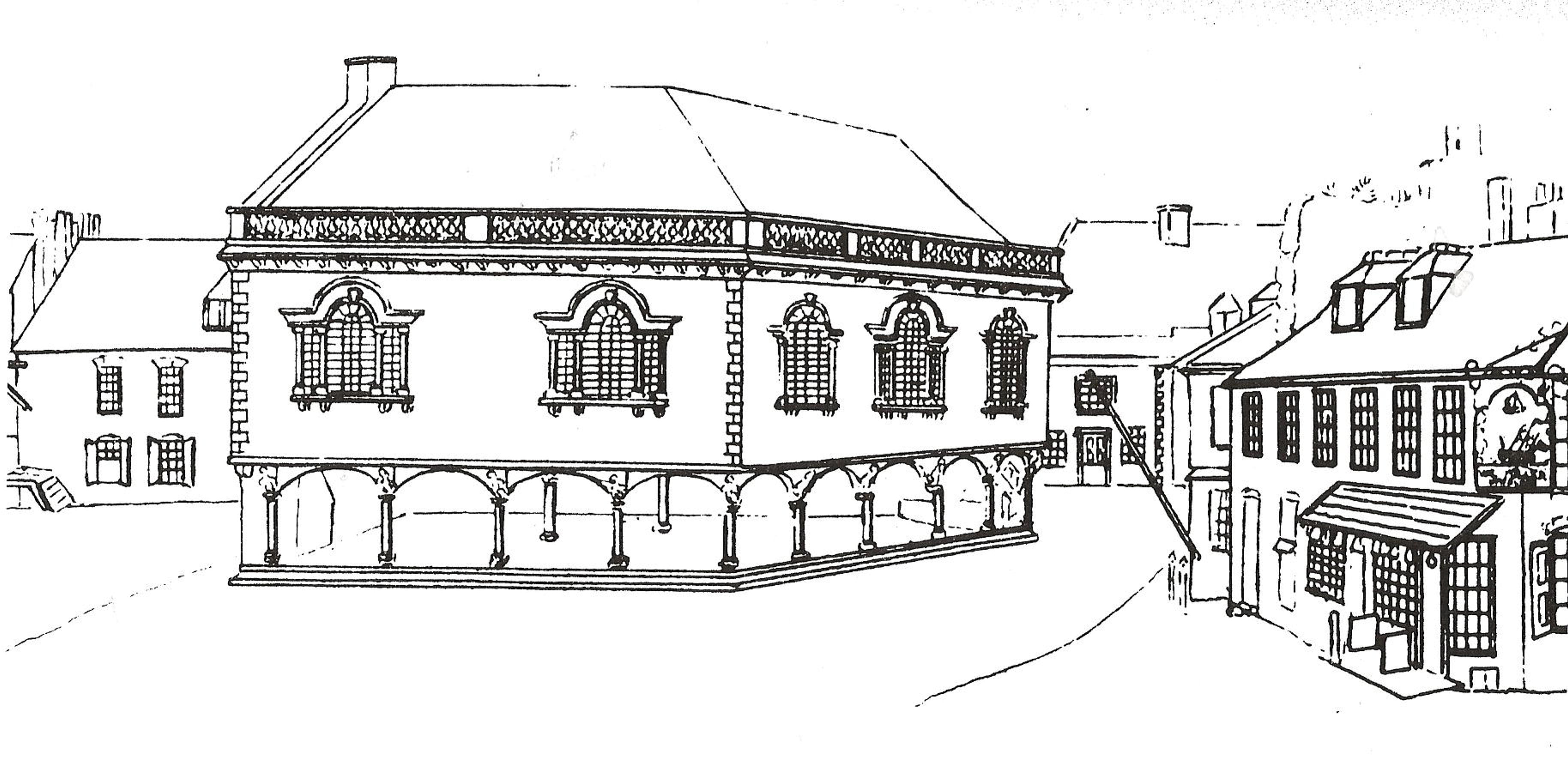
Town Hall 1606-1834 demolished 1841. Dover Museum

Town Hall 1606-1834 demolished 1841. Dover Museum

At some time prior to 1584, Edward married, for that year through his wife – the daughter of a Freeman – he claimed the right to become a Freeman of Dover. The couple had at least one child a son named Richard. Edward was elected to the Common Council and then a Jurat – one of twelve senior Common Councilmen. As an educated Freeman, Edward was appointed as one of Dover’s four Chamberlains or the Town’s treasurers, that same year. This was a thankless task but was the first rung of the ladder from being Jurat to becoming the all-powerful Mayor of Dover. The arduous task of the Chamberlain was collecting fines and taxes out of which they paid the Corporation’s bills. If there was not enough money to cover these, then the Chamberlains had to pay the difference out of their own pockets. They were reimbursed at the end of the year but in between, they had to meet their own commitments as well as spending a great deal of time chasing up defaulters.

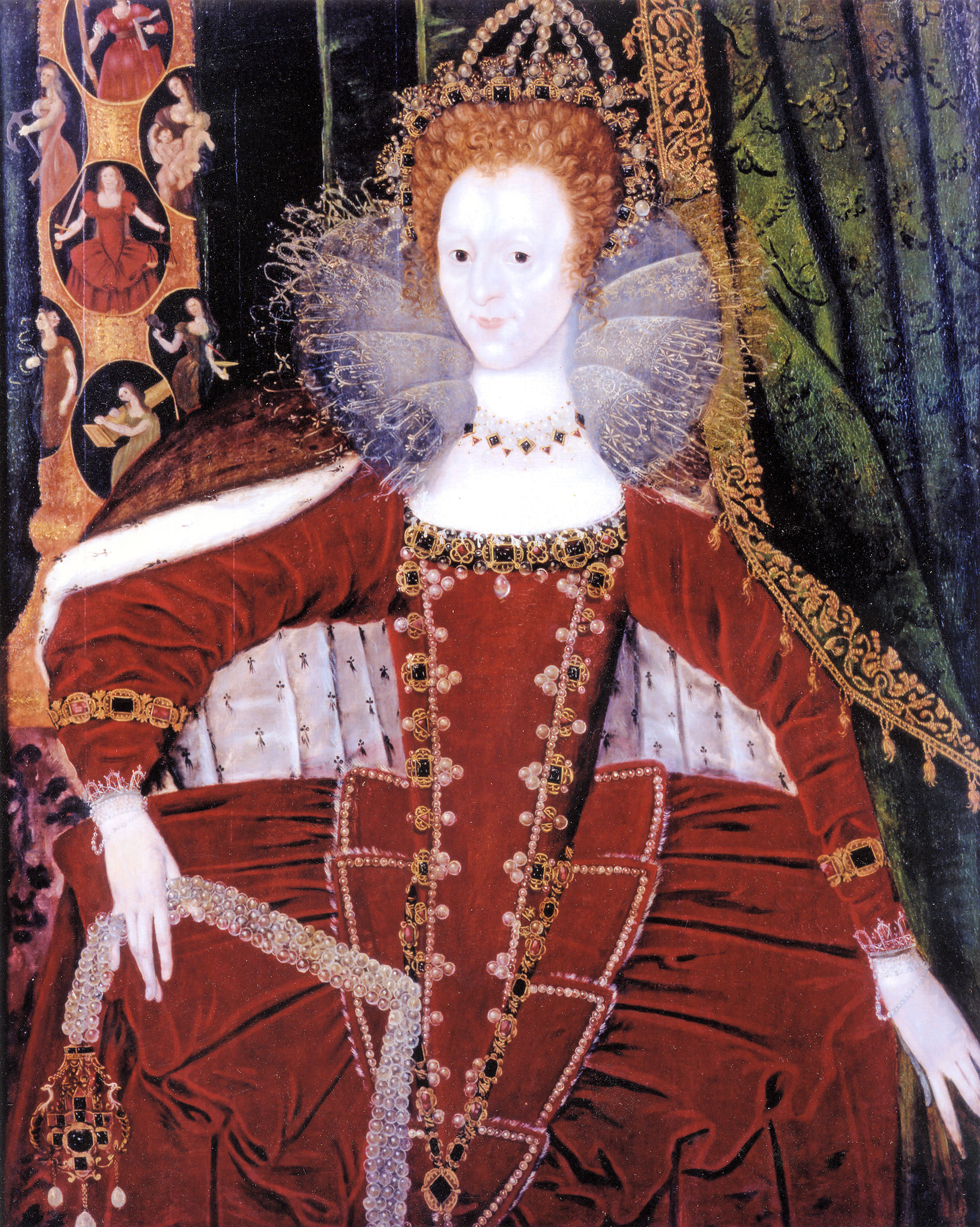
Elizabeth I courtesy of Dover Museum

Elizabeth I courtesy of Dover Museum

Although Elizabeth I was popular with the English Protestants, her major rival was her Roman Catholic cousin Mary Queen of Scots (1542-1587). Indeed, many argued that as her mother’s marriage to Henry VIII (1509-1547) was annulled, Elizabeth was illegitimate. This had been confirmed in a Bull by Pope Pius V (1566-1572) in 1570, which released Elizabeth’s subjects from obedience and those that did obey her orders could be excommunicated. Elizabeth’s parliament reacted by making it a treasonable offence – carrying the death penalty – to try to convert English Protestants to the Catholic faith. From then on there were a number missionaries that arrived secretly from the Continent to reconvert England. There were also a number of conspiracies to end Elizabeth’s life and put Mary Queen of Scots on the throne.

In 1583, Francis Throckmorton (1554–1584) had been found guilty, following torture on the rack, of conspiring against Elizabeth. Kentishman, Francis Walsingham (1532-1590), later known as the father of the English Secret Service, had uncovered the plot. By this time, Walsingham had a free hand to employ informers, use surveillance and intercept correspondence and use any means at his disposal to collect and collate information on potential assassination attempts. In March 1585, the Act of Surety of the Queen’s Person was passed that enabled a Regency Council to bring those guilty to trial in the event of Elizabeth’s death or wounding.

In April 1585, Mary Queen of Scots was placed in custody and about the same time, in Dover, Edward detained a ship on which the French Ambassador, Seigneur Mauvissiére, was returning home. Several people were brought ashore and Edward interrogated them. One of these was Catholic sympathiser, Dodswell and with ‘persuasion’, he revealed an attempt to free Mary Queen of Scots by a group of Jesuits. Dodswell gave the whereabouts of these Jesuit priests and Walsingham acted upon this intelligence.

The following year, Walsingham and his spies uncovered the Babington Plot, whereby Mary Queen of Scots, in a postscript of a letter to Anthony Babington, asked for immediate ‘intelligence of the successful assassination of Elizabeth.’ The letter was passed to Walsingham and placed Mary’s complicity beyond reasonable doubt. For service to his country, Edward was commended by the Lord Warden (1558-1596), William Brooke, 10th Baron Cobham, (1527–1597) but unsuccessfully stood for the position of the Mayor of Dover.

Elizabethan Galleon - Observer

Elizabethan Galleon – Observer

Mary Queen of Scots was executed on 1 February 1587 and made the threat of a Spanish invasion real. In November that year, as a preparation for the inevitable invasion, Edward along with another Jurat and with 20 men each, were given the responsibility of protecting the town. In August 1588, under the command of Alonso the 7th Duke of Medina Sidonia (1550–1615), 130 ships set sail from the Spanish port of A Coruña to invade England. Dover’s harbour had been enlarged between 1579-1586 but the Cinque Ports fleet were no longer the backbone of England’s navy. Nonetheless, the Cinque Ports Fleet of six ships sailed from Sandwich, to confront the Spanish Armada. Each of the ships had one pinnace of thirty tons, in attendance and one of ships, said to have belonged to Dover, acted as decoy leading one the Spanish galleons onto a treacherous Goodwin Sandbank. There, the beleaguered galleon was set upon by the other Cinque Ports ships, her crew killed and the ship completely destroyed.

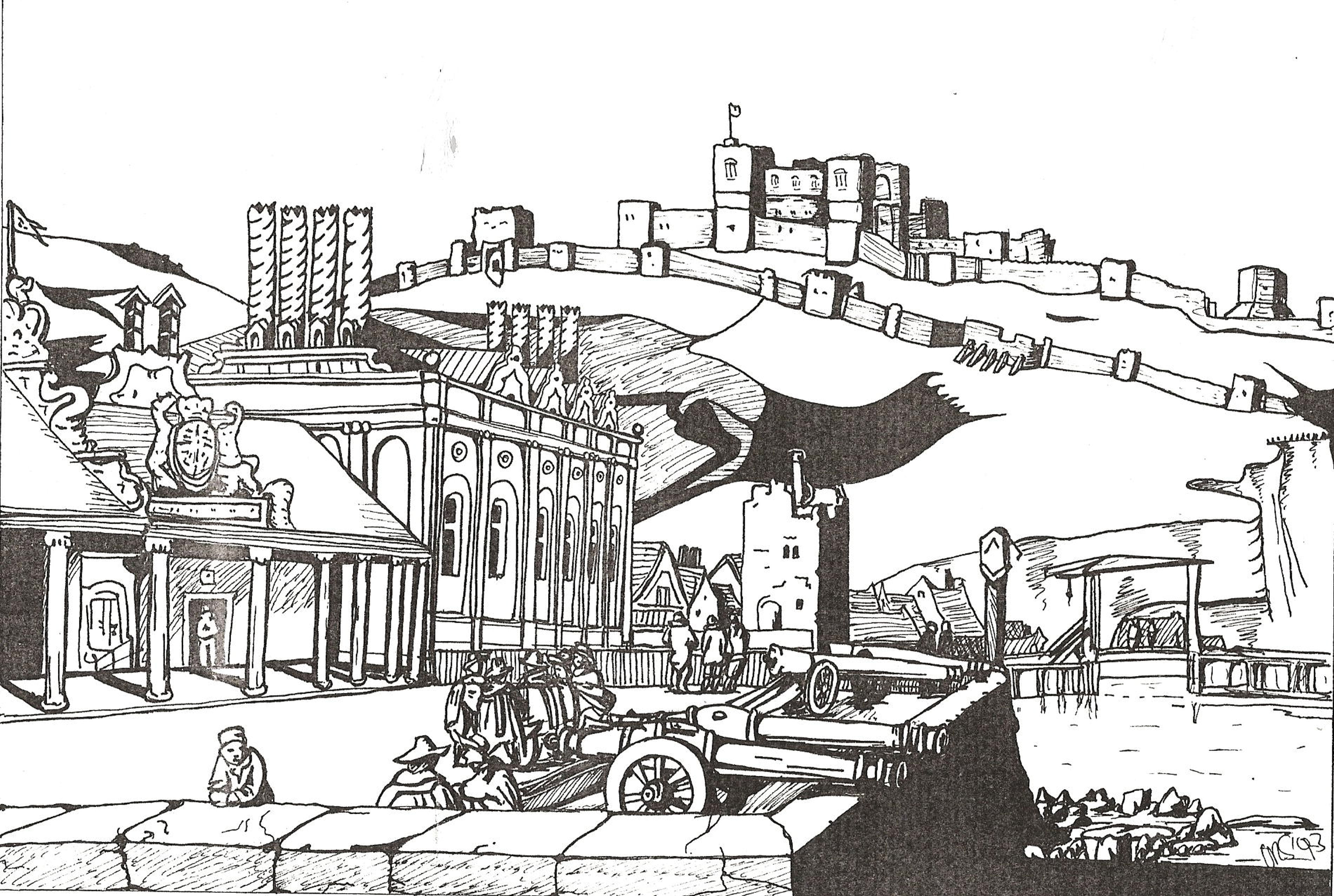
Dover and harbour circa 1590-1600 re-drawn by Lynn Candace Sencicle

Dover and harbour circa 1590-1600 re-drawn by Lynn Candace Sencicle

Following the defeat of the Spaniards, Edward again stood for Mayor and again was not chosen. He was, however, elected as Dover’s representative in Parliament for which he received 2shillings 6pence (12½p) a day from three days before parliament sat until 3 days after. There is little on record to show how active Edward was in this capacity other than he was involved in the rebuilding of Dover’s harbour. Before he left parliament in 1594,Edward presented the House with a model of what is now referred to as the Thomas Digges harbour.

  • Published:
  • Dover Mercury: 30 November 2006
Posted in Maritime, Members of Parliament, People, Stephens Edward - the Customs Official who became an MP, Stephens Edward - the Customs Official who became an MP, Stephens Edward - the Customs Official who became an MP | Comments Off on Edward Stephens – the Customs Official who became an MP

Connaught Park – Part II

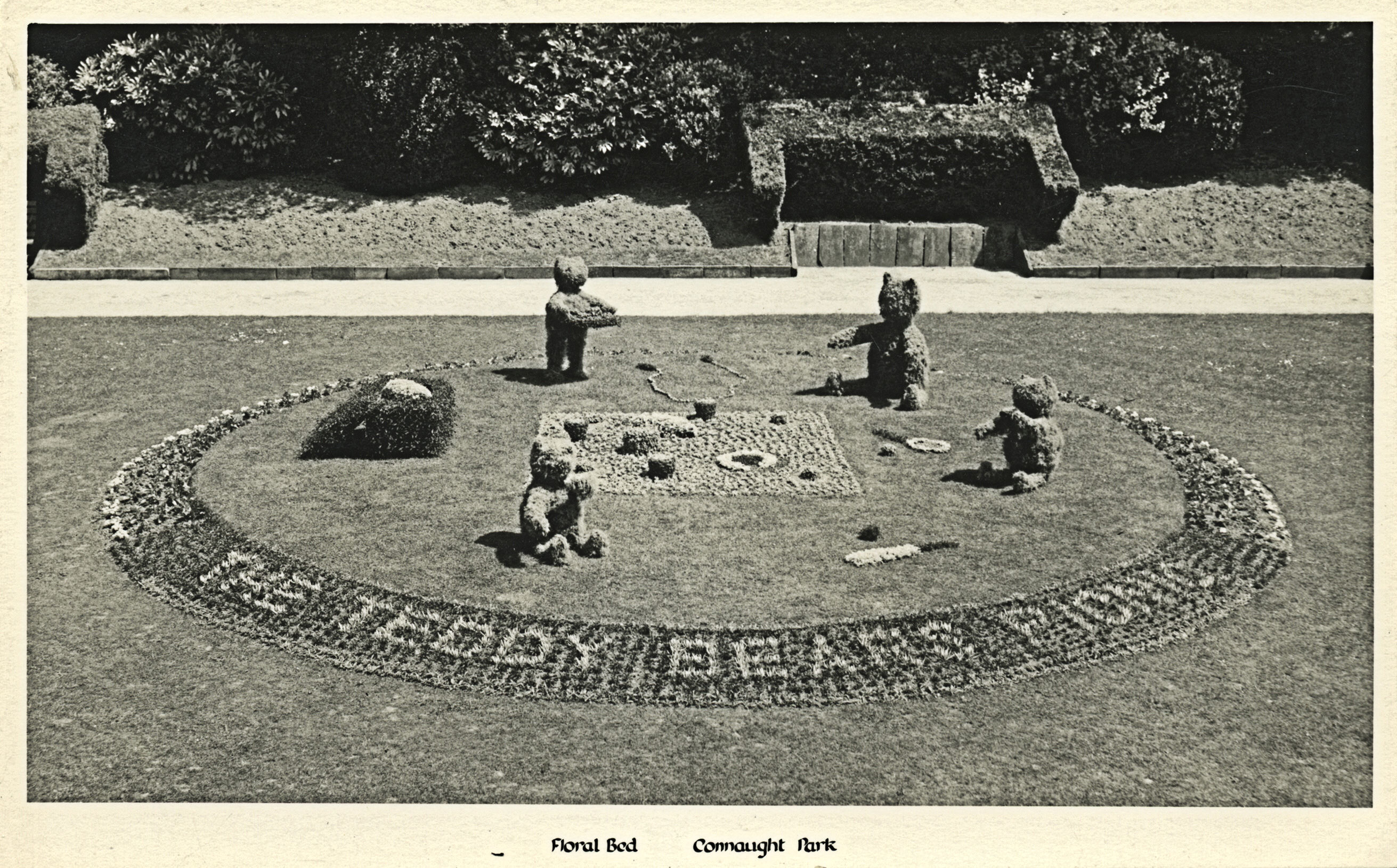
Flower beds at Connaught Park - Teddy Bears Picnic theme 1950s - Dover Museum

Flower beds at Connaught Park – Teddy Bears Picnic theme 1950s – Dover Museum

Following World War II (1939-1945) the town was little better than a bombsite, however, people were determined to get back to normality as quickly as possible. In May 1947, an application was submitted for a garden fete at Connaught Park  from the Dover Deanery Personal Endeavour Campaign on behalf of the Church of England children’s society. The garden party was a success and this  gave the impetus to other organisations to hold garden parties there even though the Park was still in a sad state of neglect. In 1949, the Electrical Contractors’ Association held their annual conference in Folkestone and they too chose to hold their celebration garden party in Connaught Park. This gave the town the major confidence boost it needed and locals volunteered to make it as splendid as possible. In 1954, money was finally set aside by the council for the formal restoration to begin. Two years later this was completed just in time for the Scouting movement’s silver jubilee.

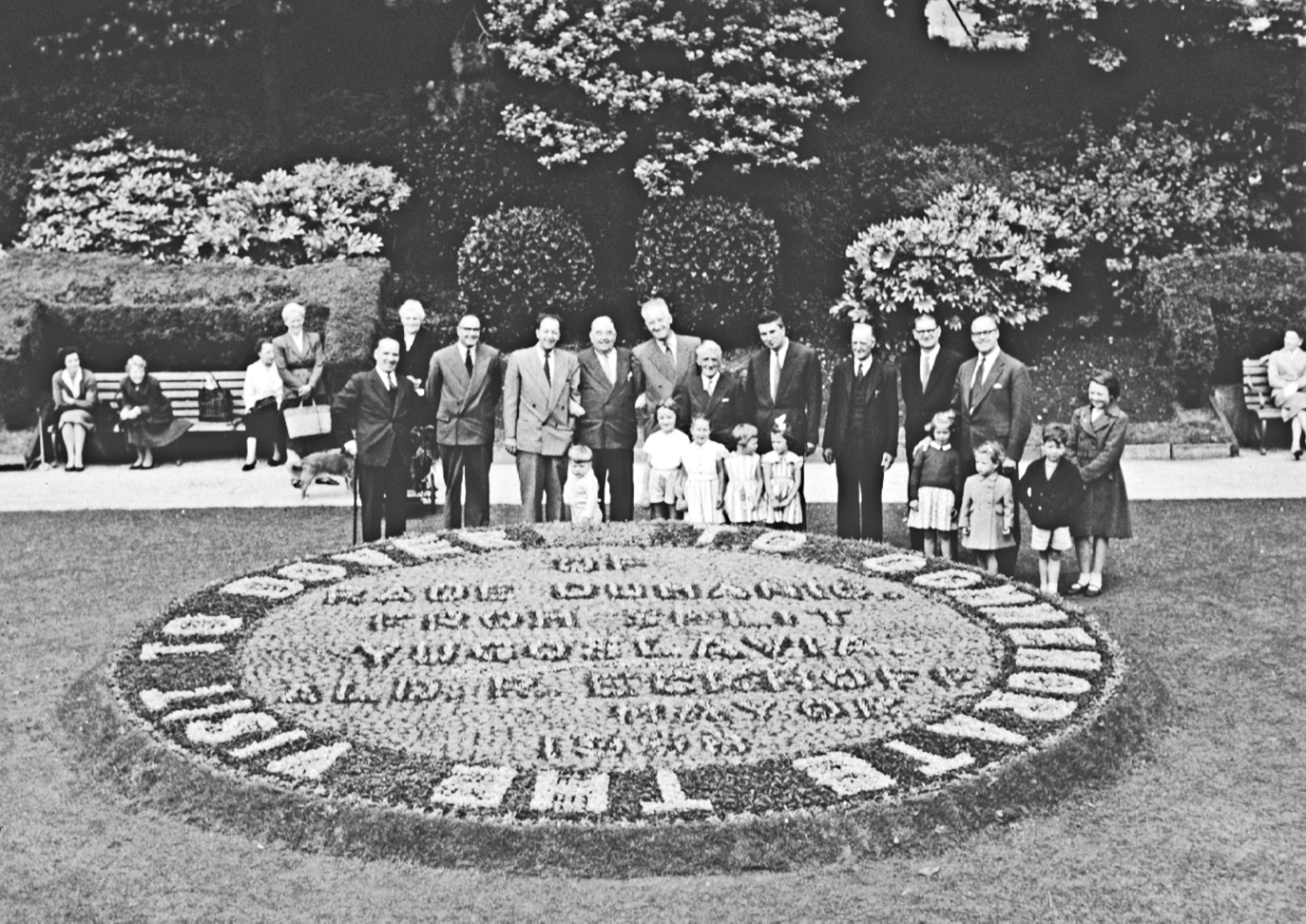
Connaught Park marking the twinning with Split in, what was then, Yugoslavia, 1956. Dover Museum

Connaught Park marking the twinning with Split in, what was then, Yugoslavia, 1956. Dover Museum

Again this was a great success such that the Dover and District Boy Scouts’ Association held their annual fete at the Park for the next few years. However, in 1961, the Rural Dean and Vicar of St Mary’s Church, the Reverend T Ewart Roberts, used the occasion to deride the then popular form of dance – jiving. He called it a ‘dervish of decadence’ and then made scathing remarks about the lifestyles of young people that centred on coffee bars, gramophone records and dancing. He finished by saying that ‘Everything Scouting stands for is opposite to these kinds of things when taken in excess.’ This, appeared to have the opposite effect to what the Reverend wanted as it led to friction between local teenagers.
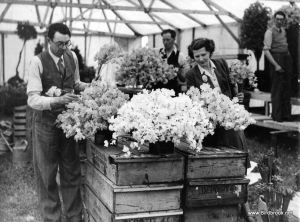
Robert and Christina Bolton, winners of the Dover Cup for the best trade exhibit arranging sweetpeas. Robert Bolton & Son

Robert and Christina Bolton, winners of the Dover Cup for the best trade exhibit arranging sweetpeas. Robert Bolton and Son

The National Sweet Pea Society held their annual exhibition at the Park in 1955, in conjunction with the annual Dover Flower show. The event was even reported in national papers where it was recognised that the exhibition contained blooms was of the highest quality seen since the War. The Dover Cup for the best trade exhibit went to Messrs Robert Bolton and Son of Warton, Lancashire, while the Daily Mail Cup for 12 vases of distinct varieties of sweet pea went to the Society’s president, J.C.P.M Davis of Radlett, Hertfordshire. Following this the Park was a favoured venue for many events and celebrations. Sometimes the flowerbeds were designed to reflect an event.

Save Connaught Park Campaign 1988

Save Connaught Park Campaign 1988

Up until 1974 and the Local Government Reorganisation that created Dover District Council (DDC), the Park was well kept and retained its popularity. However, following the Reorganisation the Park was allowed to deteriorate. The spectacular flower beds were replaced with plants requiring less attention or allowed to become over-grown. The cafe only occasionally opened and the tennis courts were allowed to deteriorate. All of this enabled DDC to claim that the townsfolk no longer used the Park and that the area would better serve if used for other purposes. As the existing covenants forbid development a tourist caravan park was proposed. This was immediately seen as a stepping stone towards redevelopment when the covenants lapsed, a public outcry ensued and the Park was saved.

Dover Pageant 1990: Elizabeth I - Lorraine Sencicle , Walter Raleigh - Michael van de Heuven. Michael Banks

Dover Pageant 1990: Elizabeth I – Lorraine Sencicle , Walter Raleigh – Michael van de Heuven. Michael Banks

Mike McFarnell reintroduced the Dover Pageant in 1983, based on the Louis N Parker Pageant held in 1908 at Dover College. Connaught Park was the venue and over the next alternate years the spectaculars were held on May Day Mondays. The event quickly caught the town’s imagination when Dover’s colourful history, acted by an ever-increasing number of locals, unfolded to an increasing larger crowd. The weather threw everything at these Pageants from deluge to burning hot sunshine but enjoyed regardless. However, there was a number of problems in holding the event, namely the increasing costs due to tighter health and safety legislation and people sneaking into the Park without paying. In 2001 the event was moved to the grounds of Dover College.

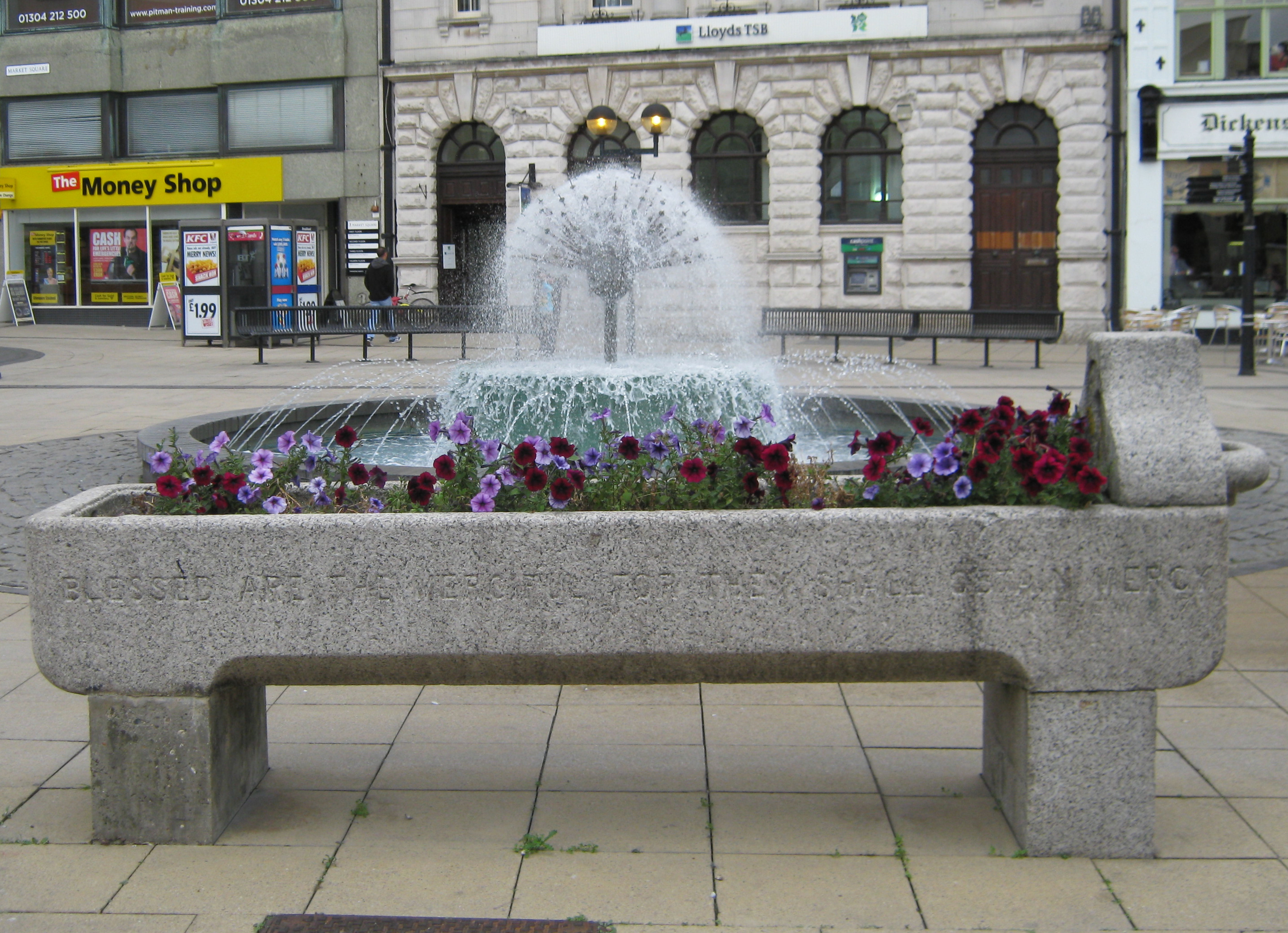
The former Horse Trough now a feature in Market Square but for a long time was abandoned in the former nursery at Connaught Park

The former Horse Trough now a feature in Market Square but for a long time was abandoned in the former nursery at Connaught Park

In the 1990s Dover town centre, already a precinct, was transformed by cobbles, flagstones, attractive lamps and a fountain in the Market Square. To finish this off it was decided to move the ancient horse trough there. This had been found in the abandoned nursery at Connaught Park there and had been bought for the town 1884. Mr & Mrs Johnson, who ran the People’s Café in Snargate Street gave the council, that year, £100 to purchase a horse trough and drinking fountain. The trough was originally placed on a triangular piece of ground near the cottages at Elms Vale junction but was later declared obsolete and dumped. In 1992, when the Connaught Park nursery was cleared out the old horse trough was found. Restored, it still has pride of place in the Market Square where, in the summer, it is filled with flowers. The trough bears the quotation taken from Matthew‘s Gospel, ‘Blessed are the merciful for they shall obtain mercy.’
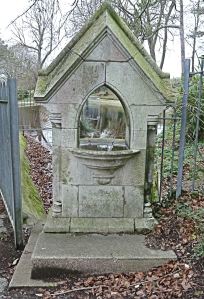
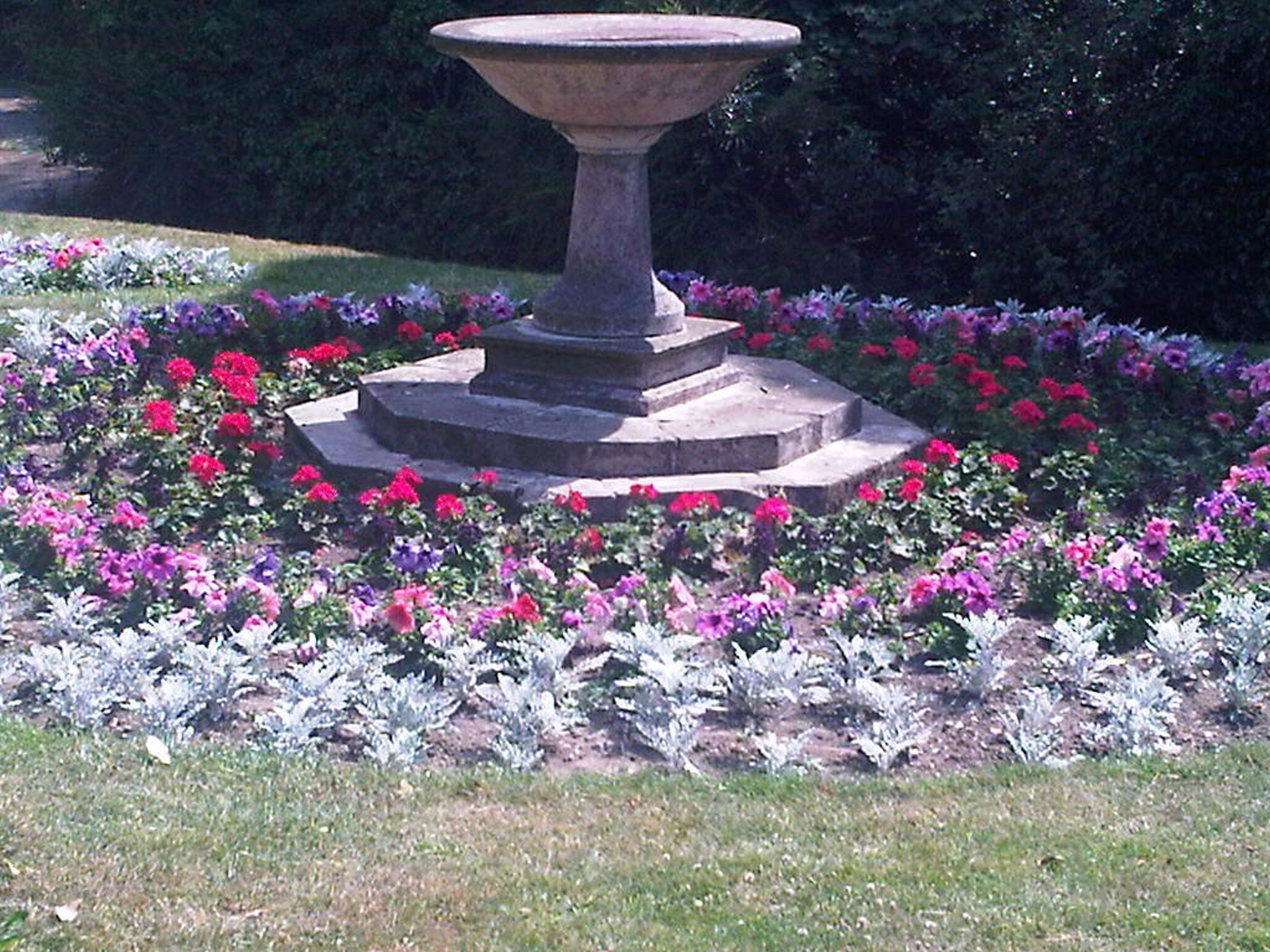
Connaught Park - Water fountain gifted by E F Astley in 1883

Connaught Park – Water fountain gifted by E F Astley in 1883

Not long after the horse trough was given a new home the stone drinking fountain, given by Dr Astley when the Park first opened, was declared to be an asset to the town and was restored. The Park was given a face-lift and on 6 May 1994, the day of the official opening of the Channel Tunnel, 500 Dovorians took part in the Pageant at Park. The spectacle was watched by 3,000 and televised on a French State television network and although the prospects for Dover looked bleak, the Park looked well loved. Indeed, it was being well used by a number of groups for a variety of activities and from 1990 the Lions had put on a fireworks display there every year.


Connaught Park - Plea for restoration by Peter Collins 07.09.2000. Dover Mercury

Connaught Park – Plea for restoration by Peter Collins 07.09.2000. Dover Mercury

However, in 1991, following an ‘audit’, DDC declared that there was no need for a park keeper as the nursery had closed and so the Lodge was declared surplus to requirements and put up for sale. It was also decided that there was no need for the refreshment kiosk or the crazy golf course. The latter was allowed to dilapidate and when this was successfully achieved, the area where it had stood was dug over and turfed. As the decade progressed, it became increasing apparent that the costs of what DDC had deemed, as a catalyst for rejuvenation of Dover, the White Cliffs Experience in Market Square, was becoming a financial burden. The decision was taken to close,  make major financial cut backs or sell what had been considered essential ‘tourist’ assets in the town. For Connaught Park, it was stringent cut backs. In the summer of 2000, retired businessman and Dover Society member, Peter Collins called for urgent action to protect the Park saying that ‘Dover needs to portray itself as well-run, efficient area to attract inward investment‘ (Dover Mercury 14.09.2000)

1,500 sign Cllr Dean Watson's petition over the neglected state of Connaught Park. Dover Mercury  11.04.2002

1,500 sign Cllr Dean Watson’s petition over the neglected state of Connaught Park. Dover Mercury 11.04.2002

Two years later little had been done so Councillor Dean Watson organised a petition, which 1,500 people signed. This called for the Park to be saved from further neglect, for more facilities to be provided and for improvement to its upkeep. The council reacted by installing five-a-side football posts, erecting four picnic tables and draining the pond, refilling and replanting it. Ornamental signs from the town centre pointing visitors to the Park were considered.

In 2003 the Lions annual fireworks display was moved to the Crabble football ground and although this was due to an insurance problem, it was used by some to justify the closure and selling the Park for development. DDC undertook what they called a ‘regeneration’ of the Park, in 2006, but at the same time the decision was made to close the long established aviary. Nonetheless, overgrown areas were cleared and there was talk of the Park being taken back to how it had been in Victorian times. August that year saw the Park transformed into an open-air cinema – the film shown was Ice Age 2. Park-and-ride buses were put on from the town centre and the event proved very successful.

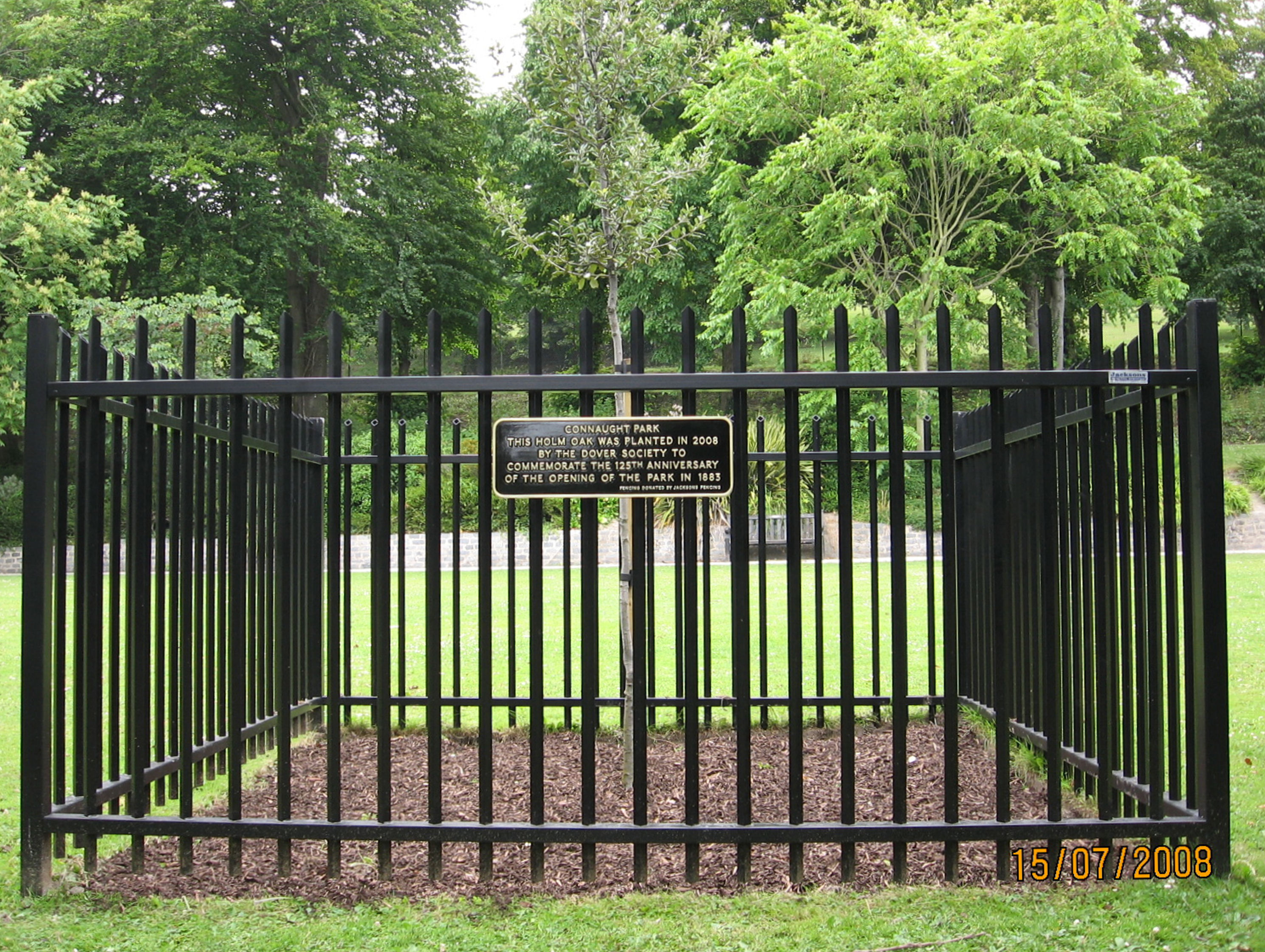
Dover Society Commerative tree to mark the 125th Anniversary of the Park opening

Dover Society Commerative tree to mark the 125th Anniversary of the Park opening

The impetus, however, quickly fizzled out and the sad state of the aviary became a major concern to the town’s folk. In March 2007 it was announced that the aviary was to be closed as a cost saving measure. At the time trees and shrubs were neglected and if perceived as dangerous, dug up. The pond was aptly described as a green putrid mess. There were calls to set up a ‘Friends of Connaught Park,’ to raise funds through subscriptions in order to finance improvements. Graham Wanstall was appointed to the voluntary role of Connaught Park Officer, by the Dover Society. He wanted to mark the 125th Anniversary celebrations of the Park’s opening with a major refurbishment but all that was agreed to was the planting of a holm oak tree. Jacksons Fencing provided the tree’s protection saving the Society £1,800 but there were those on the committee that believed that the Park was no longer as asset to the town. The council in the meantime drained and cleaned the pond and restored and reinstated the water fountain.
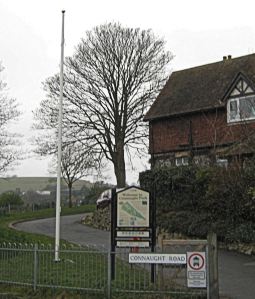
Graham Wanstall - the Chairman of the Friends of Connaught Park - arranged for the flag pole to be erected at the entrance to the Park

Graham Wanstall – the Chairman of the Friends of Connaught Park – arranged for the flag pole to be erected at the entrance to the Park

The 125th Anniversary of the Park’s opening celebrations took place on 20 July 2008 with special guests including two of Dover Society’s oldest members, Lillian Kay and Jack Woolford. Miss Kay was formerly the headmistress of Dover Girls’ Grammar School and Jack was the long time Chairman of the Society. The occasion was marked with a planting of a tree by the chairman of DDC, Cllr Bernard Butcher and witnessed by Loren Selby – Miss Dover – and her Court. The Anniversary year coincided with the Elizabeth II 60th Wedding Anniversary and to mark the occasion, Graham Wanstall – the Chairman of the Friends of Connaught Park – arranged for the flag pole to be erected, which can be seen at the entrance to the Park.


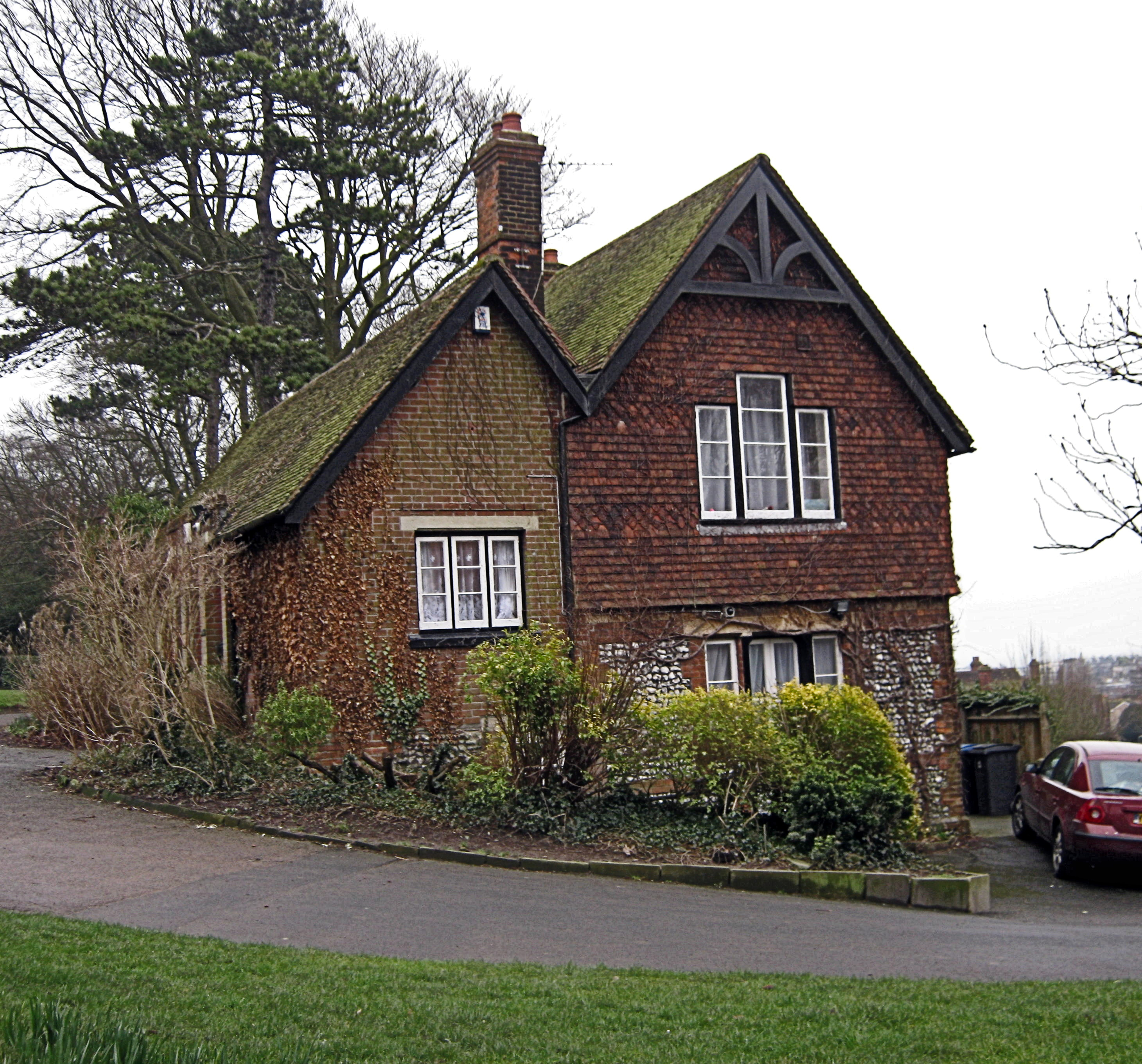
 Connaught Park Lodge. It was suggested that it it should be converted into an Educational Office and café

Connaught Park Lodge. It was suggested that it it should be converted into an Educational Office and café

The following year DDC announced that the Park was to have a £95,000 face-lift. Leisure contractors Wicksteed Playscapes re-built the children’s playground with wheelchair access and included a climbing rock, sandpit in the shape of a teddy bears head, tree house with a tube slide, swings, roundabout and zig-zag benches. At about the same time the Friends of Connaught Park had several metal seats installed at the top of the Park. They also proposed that the derelict nursery should refurbished as a car park for disabled drivers and a place for cyclists to leave their bikes in order to enjoy the Park as a quiet haven. Graham looked into the possibility of repurchasing the Lodge in order for it to be converted into an Educational Office and café.

DDC and Town Council (founded in 1996) appeared to take a negative stance against any aesthetic / cultural improvements put forward, indeed, the latter turned down an application for a grant to install a proper notice board! By 2012, although the aviary was still there and looked after, flowerbeds remained empty except for weeds while the once beautifully manicured lawns were left uncut. The refurbished fountain was again looking in need of care and the tennis courts appeared to be in the last stages of decay. Some councillors were openly talking of selling the top part of the Park for a luxury development and using the money raised to bring the remainder up of the Park up to standard. Graham made it clear that the Friends of Connaught Park would fight such a proposal.

Colette Boland, a frequent user of the Park over the previous 13 years, was so distressed about its neglected state that in September 2012 she wrote on the Dover Forum website: ‘Every time I come home after the walk I feel quite upset at the state of this once beautiful park and it’s getting worse by the week … The once well-kept tennis courts have been left to decay, there are no flowers throughout the summer, the grass is left to grow knee high over the rolling hillside of the park, the pond with its beautiful sculpture/fountain is completely grubby, in fact almost everything is grubby.’ Colette asked, ‘Why is this park so neglected?

C PAG volunteers Pat Sherratt and Barry Wadsworth-Smith refurbishing a seat - Colette Boland 2013

C PAG volunteers Pat Sherratt and Barry Wadsworth-Smith refurbishing a seat – Colette Boland 2013

The general response was that due to government cuts there was no money available. In November 2012 Colette formed the Connaught Park Appreciation Group (C PAG), under the umbrella of the Castle Forum. The role and function of which is to ‘improve and enhance all areas of the park both with new ideas and hopefully to implement some old ideas.’ With a core group of 12 volunteers they set to work straight away and by the summer of 2013 twelve benches had been refurbished, weeding and general maintenance of shrubbery had been taken in hand, the flower beds had been cleared and replanted. The volunteers had also helped with the clearing of the pond and refurbishment of the Victorian shelter.
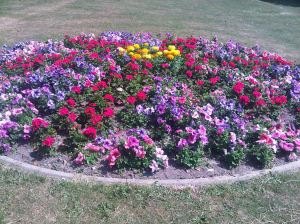
Connaught Park flower bed, planted by C PAG, in bloom. Colette Boland  2013

Connaught Park flower bed, planted by C PAG, in bloom. Colette Boland 2013

On 11 August 2013, Colette and C PAG, in association with the Castle Forum, held a splendid ‘Pimms in the Park‘ celebration that attracted nearly 300 Dovorians and raised over £100 towards further upkeep of the Park. C PAG has also raised funding from elsewhere and with positive publicity from both Dover local newspapers the Group is successfully maintaining awareness of their projects. Besides clearing and replanting flowerbeds their projects for 2014 include painting of the toilet blocks and maintaining or replacing signs where necessary.

Connaught Park Flower bed on bloom - Colette Boland  2013

Connaught Park Flower bed on bloom – Colette Boland 2013

Volunteers wanting to help maintain Connaught Park Contact:

Colette Boland, The Moorings, 81 Castle Avenue, Dover


  • Published:
  • Dover Mercury: 01 & 08 May 2014


Posted in Connaught Park - Part II, Connaught Park - Part II, Open Spaces, Tourism | Comments Off on Connaught Park – Part II