Saint Thomas of Dover – Thomas Hale

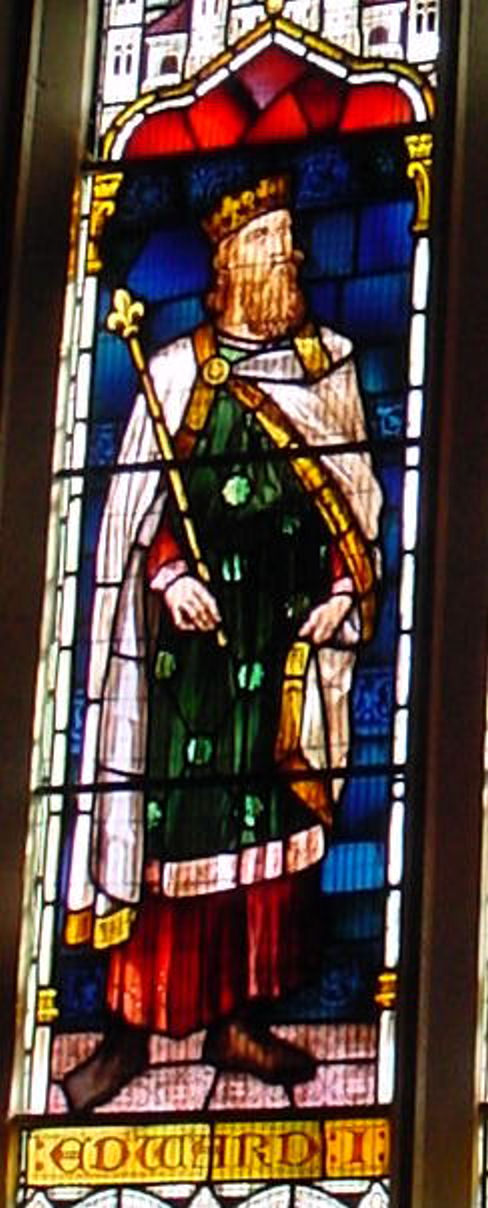
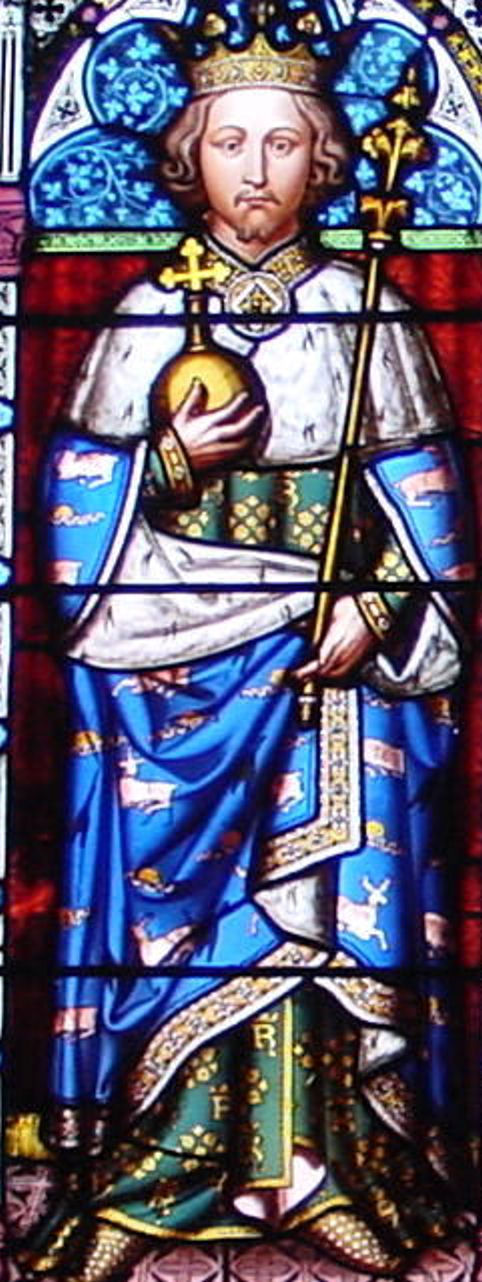
Edward I, detail from the Finnis window, Council Chamber, Maison Dieu. Alan Sencicle

Edward I, detail from the Finnis window, Council Chamber, Maison Dieu. Alan Sencicle

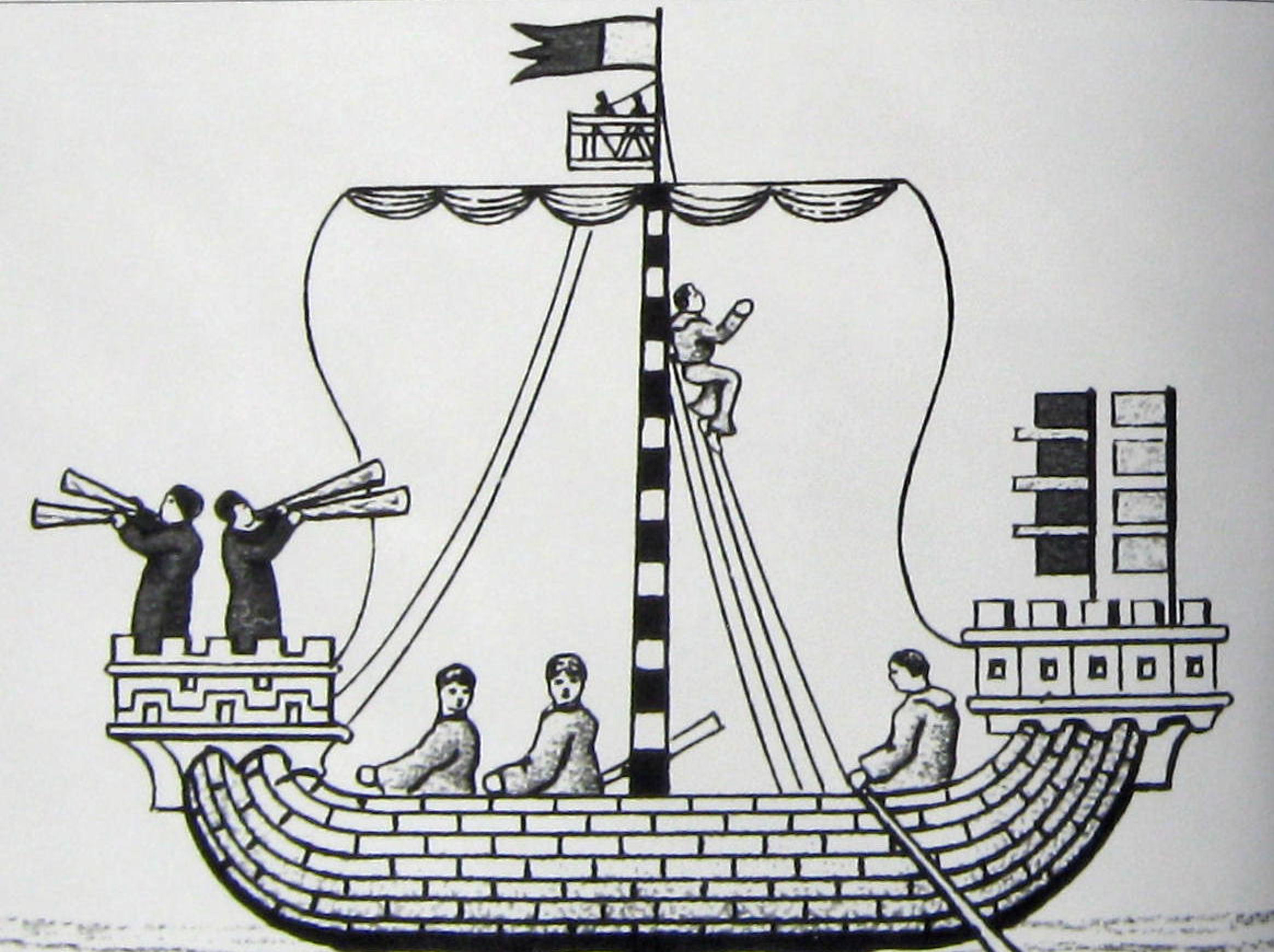
At the end of the thirteenth century, Edward I (1272-1307), with large estates in France to protect, needed ships to transport his army across the Channel. In 1278, he gave the Cinque Ports a Charter, which encapsulated their role, function, and recognised their importance to the realm. The Cinque Ports are the ports of Hastings, Romney, Hythe, Dover and Sandwich, and the two Antient towns of Winchelsea and Rye and at this time, they were at the zenith of their power.

The Portsmen, as they were called, were not averse to raiding, piracy and wrecking. In fact, they attacked passing ships that appeared vulnerable regardless of which country they belonged to! Be they French, English or from anywhere else they were all equal prey. They also attacked Continental ports and killed inhabitants who got in their way with importunity. At sea, they were equally as ruthless, throwing the crew overboard in order to take possession of the spoils. In other words, they were not a god-fearing lot but a bunch of thugs!

Cinque Port ship c13th century

Cinque Port ship c13th century

In 1291, for once England and France were not at war, but the Portsmen were as usual pillaging the French coast. Edward had, the previous year, lost his beloved wife Eleanor of Castille (1241-1290), and for political reasons was looking at Blanche (1278-1305), sister of Philip IV (1285-1314), of France, as her successor. He therefore called for a Commission of Inquiry to look into the Portsmen’s behaviour in the hope that this would make them less pugnacious. However, as the King received one-fifth of the Portsmen’s booty, little came of the Inquiry. Then on 15 May 1293, Portsmen engaged in sea battle, with the French, off Point St Mathieu, Brittany. About 400 vessels were involved and the Portsmen brought many prizes home but not before throwing several thousand Frenchmen over-board to their deaths. They then went on to ransack and raze Cherbourg and sack La Rochelle.

Following the Cinque Ports men’s attack on the French ports Philip demanded Edward, as the Duke of Gascony, to go to Paris and make recompense. Edward had inherited the Gascony lands and title from Eleanor of Aquitaine (c1122-1204), the wife of Henry II (1154–1189) and as Duke, he was effectively a vassal of the French King. Indeed, not long after Philip ascended the throne Edward paid homage to him for diplomatic reasons but this time Edward refused to see Philip. The French King therefore declared that Edward had to forfeit Gascony. As for Blanche, she was betrothed to someone else.

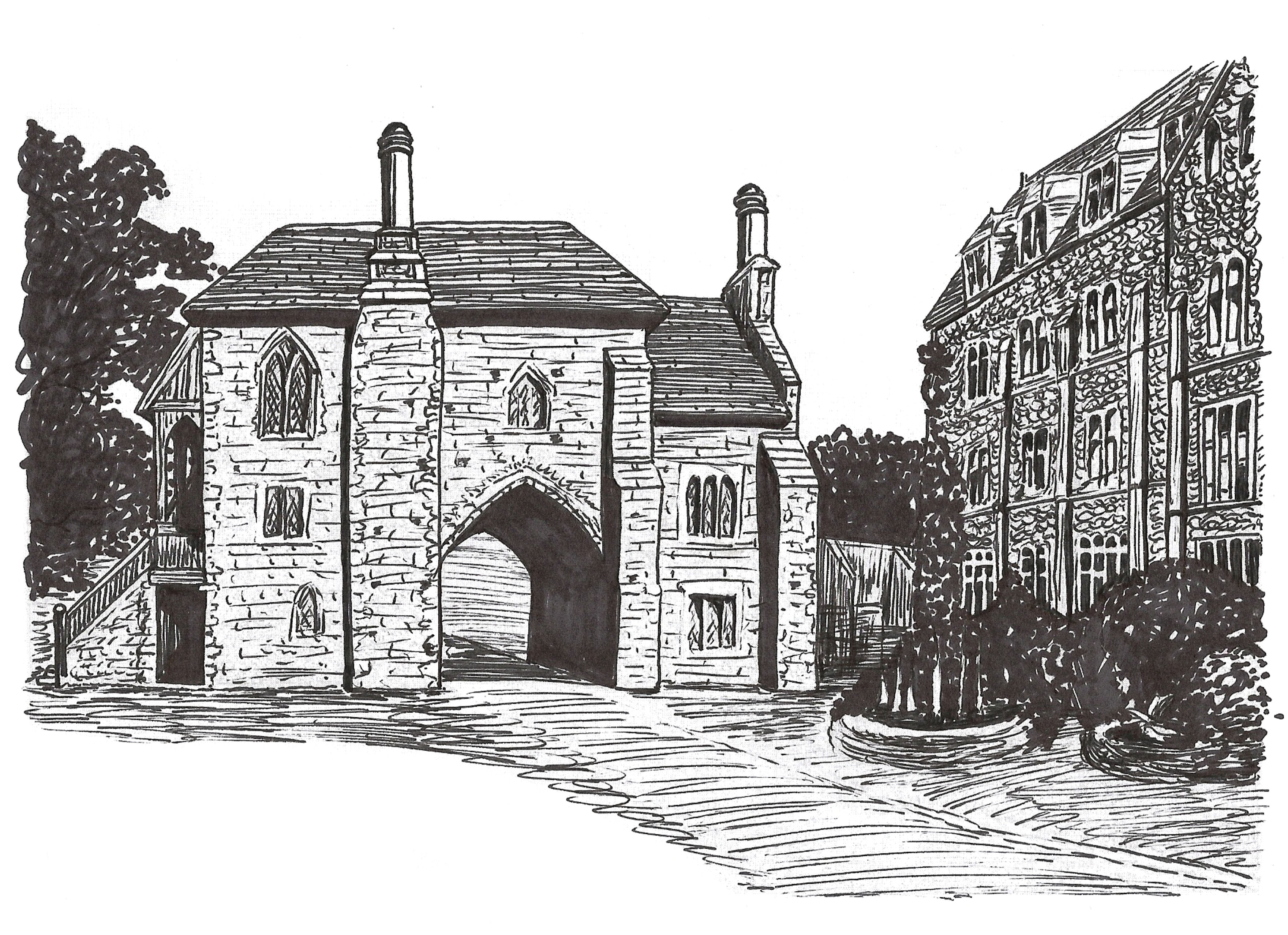
In 1294, Edward embarked on an expedition to recover Gascony and a protracted war ensued. On the night of Tuesday 2 August 1295, the French, with a fleet of 300 ships, landed a force that disembarked under Western Heights and proceeded to set Dover alight. They then ‘Beset the gates of the Convent church (Dover Priory) … they broke them forcibly down and likewise burnt them with fire. Upon entering, they immediately put to a cruel death all the servants they found at large within the precincts‘.

Priory Gatehouse from a drawing by E Piper by Lynn Candace Sencicle

Priory Gatehouse from a drawing by E Piper by Lynn Candace Sencicle

The monks fled except for the elderly Thomas Hale (sometimes written Thomas de la Hale/Hayle), who followed his usual routine, ignoring the mayhem around him. However, ‘scarcely had he reached his bed when, lo! The accursed band, led by the men of Calais, followed hard after him’. Apparently, the marauders knew that the Priory’s treasures were hidden somewhere near Thomas’s dormitory and quickly found the recess where ‘books, vestments, cups, censers, basins, vials, relics, charters granted by kings and popes and many other ornamenta,’ were hidden.

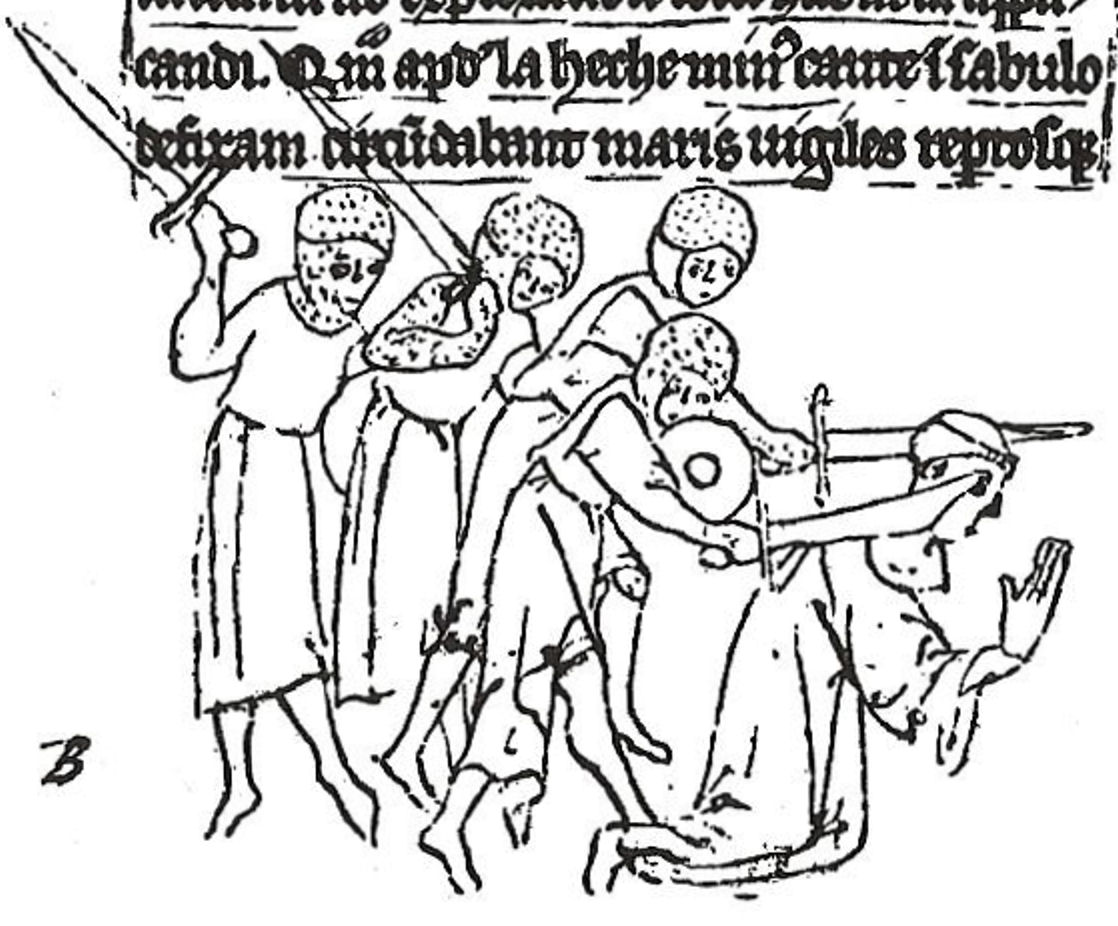
The aged Thomas tried to stop the plunderers, ‘presuming as they did to handle so irreverently with polluted and unworthy hands the consecrated reliquaries of God’, but to no avail. They then turned on Thomas and demanded that he hand over the treasure. Thomas, so it is written, ‘answered them quietly that he had indeed a treasure, of which they could never rob him, laid up in his heart’, that was, ‘his Lord Jesus Christ and his Virgin Mother.’ Then he was slain with swords, spears and daggers.

Thomas Hale Murder 1295 from the Life and Passion of Thomas de la Hale by John of Tynemouth 1377

Thomas Hale Murder 1295 from the Life and Passion of Thomas de la Hale by John of Tynemouth 1377

The Frenchmen left Dover taking back with them some £1,500 of booty as well as precious relics and charters. When the Priory monks returned, they found Thomas’s body and were full of remorse for their cowardice. He was buried with full honours in Dover Priory Church.

The following January, John of Pontoise (d1304), Bishop of Winchester, visited the Priory and at the behest of the monks, granted forty days ‘indulgence to all Christian people who would pray for the soul of Thomas Hale.’ This led to Thomas’ tomb becoming a pilgrimage for the devout. The Gascony war proved costly and as part of a truce Edward married Blanche’s younger sister, Margaret (c1279-1318) – Philip IV’s half-sister. As part of the dowry, Philip returned of much of Edward’s inherited lands.

Richard II from Window in the Maison Dieu. Alan Sencicle 2010

Richard II from Window in the Maison Dieu. Alan Sencicle 2010

In Dover, soon after, miracles were recorded at the tomb of Thomas Hale and in 1370, Archbishop of Canterbury, William Whittlesey (1368-1374), visited. Not long after the widow of the Black Prince (1330-1376), Joan, the Fair Maid of Kent (1328-1385) came to pay her respects. She persuaded her son, Richard II (1377-1399), to ask Pope Urban VI (1378-1389) to include Thomas in the Calendar of Saints. The Pope issued a bull, in 1381, to the new Archbishop of Canterbury, William Courtenay (1381-1396), to take evidence to this effect.

However, as pilgrims going to the murdered Archbishop Thomas Becket’s (1162-1170) tomb was a lucrative money earner, Courtenay was less than enthusiastic about the canonisation of Dover’s Thomas Hale. Nonetheless, until the dissolution of the Priory on 16 November 1535, pilgrims still came to Dover. After the Reformation, Dover Priory was rented out as a farm and it is now the site of Dover College.

Quotes taken from the “Life and Passion of Thomas de la Hale, Monk of Dover, slain by the French” written in 1377 by John of Tynemouth, which includes the sketch of his death.

  • Published:
  • Dover Mercury: 3 April 2008


Posted in Cinque Ports, Hale Thomas - Saint Thomas of Dover, People, Religion & Churches, Saint Thomas of Dover - Thomas Hale, Saint Thomas of Dover - Thomas Hale | Comments Off on Saint Thomas of Dover – Thomas Hale

World War I – Dover at the Outbreak

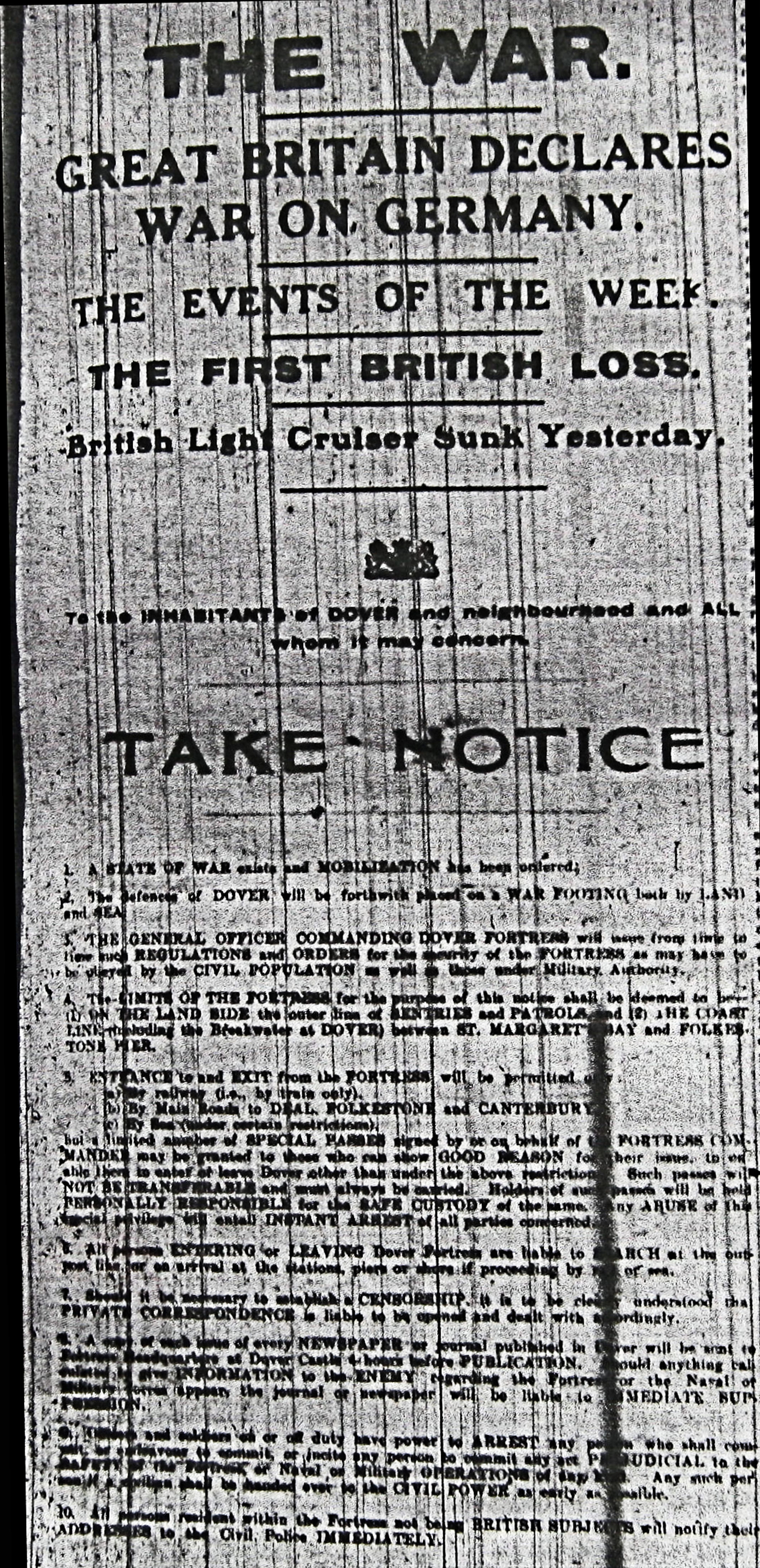
World War I - Geat Britian declared War at 23.00hrs on Tuesday 4 August 1914 and the declaration notice was published on 7 August 1914

World War I – Geat Britian declared War at 23.00hrs on Tuesday 4 August 1914 and the declaration notice was published on 7 August 1914

During both World War I (1914-1918) and World War II (1939-1945) Dover became Fortress Dover – a military zone from where, amongst other things, troops embarked for Continental Europe and beyond. Indeed, Dover, besides being a port was also a major military base with huge barracks on both the Eastern – where the Castle is – and Western Heights. Because Dover was the military port, Folkestone remained the civilian port for the Channel crossing, supplementing as a military port when needs necessitated. This is the story of Dover at the outbreak of World War I.

In 1914, there existed a number of defence alliances between the major world powers at that time. This was, supposedly, to stop such catastrophic conflicts that was about to begin. In 1905, Germany assumed she was vulnerable to invasion on two fronts – in the west France and the east Russia. As a defensive measure the German Army Chief of Staff, Alfred von Schlieffen (1833-1913), drew up a plan by which France would be beaten quickly forcing her surrender before Russia had a chance to mobilise her armed forces. To fulfil the Schlieffen plan, as it was called, Germany began building up her military strength.

It is well documented that on 28 June 1914, a Serbian student assassinated the Austro-Hungarian Archduke Ferdinand and in accordance with the Schlieffen plan, on 3 August, German troops declared war on France and massed her troops on the Belgium border. A Treaty of 1839 had given Belgium neutrality and the British demanded that Germany respect it. They refused and the next day, Tuesday, 4 August, the ultimatum from the British Government was sent to Berlin and that evening saw the start of World War I.

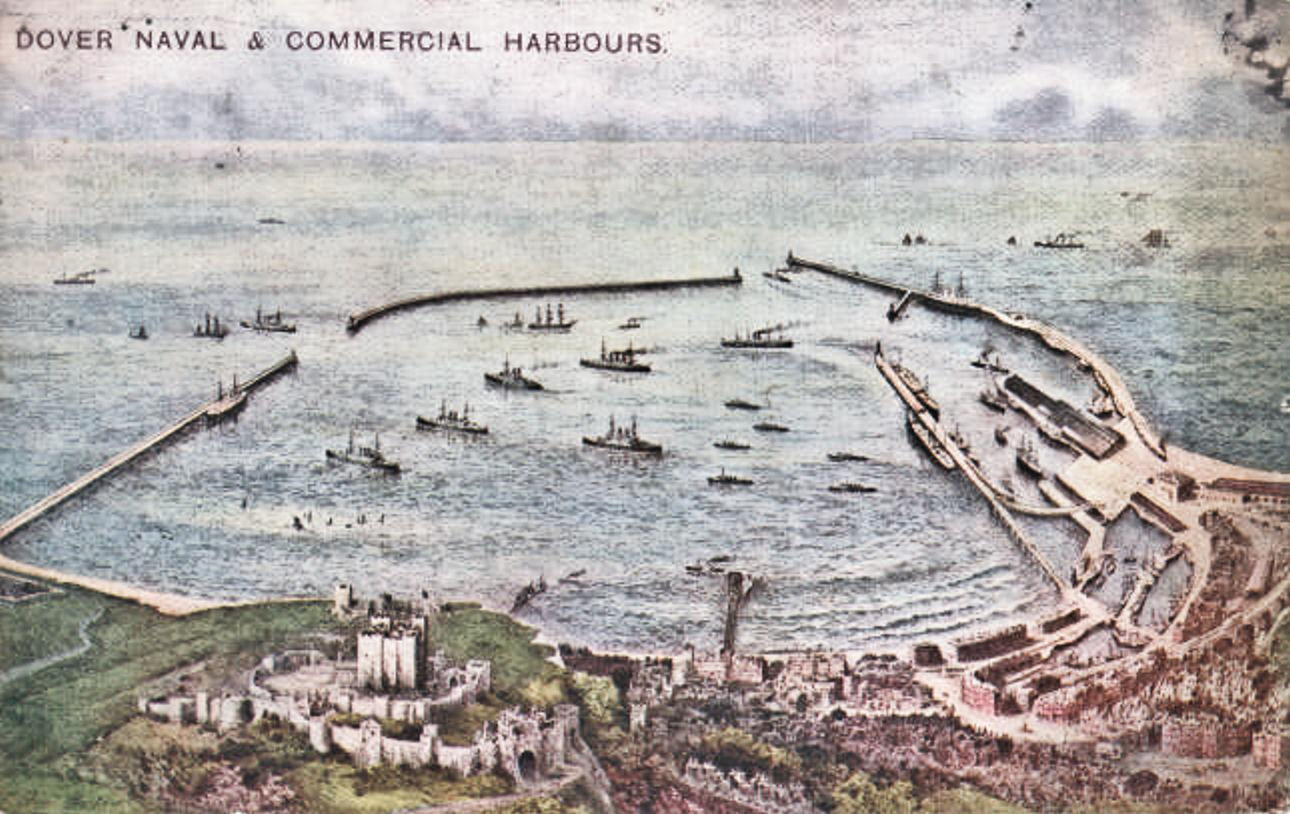
Admiralty Harbour - c1914 Postcard

Admiralty Harbour – c1914 Postcard

Whether the Admiralty had been preparing for such a conflict is debatable, but in 1898, work started on converting the Dover into the Admiralty Harbour, that we see today. It was to be the base for the Royal Navy at the southern end of the North Sea. On Friday 15 October 1909, the new harbour was opened by the Admiral of the Fleet, George, Prince of Wales, (later George V 1910-1935). In January 1908, Messrs Pearson’s secured the contract for the erection of a Camber, or tidal dock, at the Eastern Dockyard for launches, pinnaces and tugs. Initially, the Camber was to be 1,000 feet square with a minimum depth was 15-feet (4.58 metres) at low tide and it was to be protected from all seas. Work started immediately.

A year later, at the end of January 1909, the 650-feet wide (198-metres) Eastern Entrance of the Admiralty Harbour was opened and a fort was erected at the seaward end of the Arm. This contained breech-loading medium and light quick-firing guns mounted in concrete emplacements along with searchlights, quarters, and magazines. There was also machinery for a quick drawing boom to be put in place across the harbour entrance if needs necessitated. In 1910, two oil tanks with a holding capacity of 110 tons and costing £10,000 were erected.

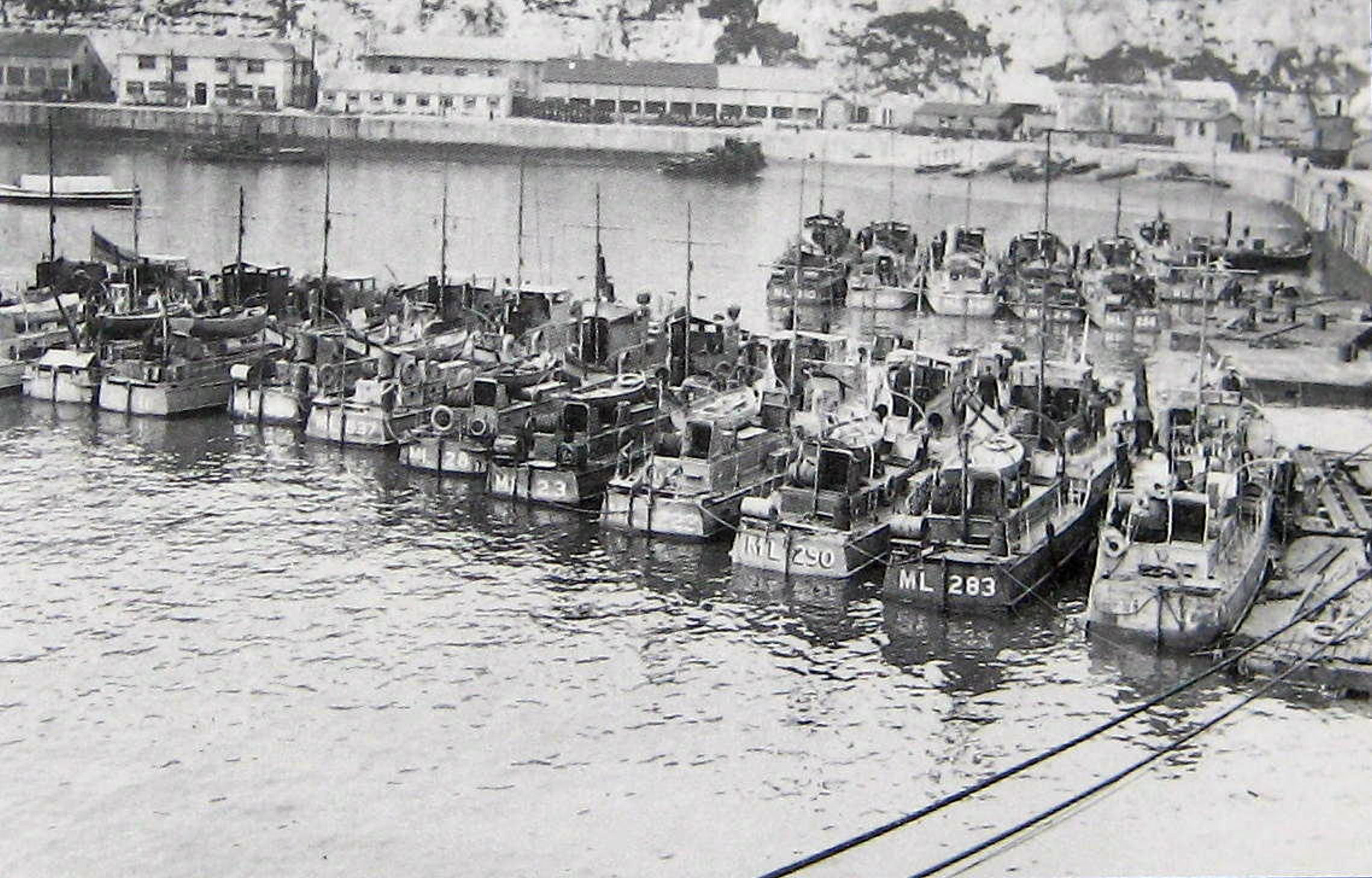
Camber in World War I, filled with Motor Launches. The Admiralty buildings are in background

Camber in World War I, filled with Motor Launches. The Admiralty buildings are in background

Germany sent her gunboat Panther to Agadir, Morocco, in July 1911, supposedly to protect the country’s firms even though the port was closed to nonMoroccan businesses. The Admiralty reacted by, amongst other things, ordering the Camber to be altered for use by submarines. The depth was deepened to 17-feet (5.19 metres); a pair of breakwaters and submarine shelters was constructed with a small dry dock along side. As international tensions deepened so was the Camber, in order to create a safe anchorage for destroyers as well as submarines. In November 1913 the Camber was formally designated a torpedo centre with a repairing depot that came into use on 22 May 1914. Storage for oil fuel at the Eastern Dockyard was increased and Langdon prison, on the Eastern cliffs, was converted into Naval Barracks.

Following the demise of the transatlantic cruise service from Dover in 1907, it was agreed to give the east side of the Prince of Wales Pier to the Admiralty. In return, the Admiralty Pier was widened and the South Eastern and Chatham Railway Company obtained a 99 years lease to build the Marine Railway Station for their Continental service. Although all the building work of the Marine Station was finished by the end of July 1914, the station was not quite ready for passengers when the Admiralty commandeered it. In April 1909 the Admiralty Pier Turret was designated Pier Turret Battery and further construction took place plus two 6-inch MK VIIs guns mounted on the top. Just prior to the outbreak of War searchlights were installed. On 28 March 1913, the Admiralty took over the Promenade Pier and renamed it the ‘The Navy Pier.’ Privately owned, the Company sold it for £8,000 and then wound up their affairs.

 Royal Flying Corps founded 1912 and that year money was found to create a military airfield on Swingate Downs. Doyle Collection

Royal Flying Corps founded 1912 and that year money was found to create a military airfield on Swingate Downs. Doyle Collection

Although Dover had been an important military establishment for centuries, prior to World War I the Army appeared to lag behind the Admiralty in preparations in Dover for War. On 14 October 1912, a 450-foot (approx.150 metres) long Zeppelin paid a clandestine visit to north Kent. Shortly after the military made £45.000 available to build a flying depot on Swingate Downs and £10,000 was earmarked for building at Connaught Barracks and another £10,000 for an Officers’ Mess. Dover’s G Lewis and Son obtained the contract but due to the outbreak of War, this was deferred.

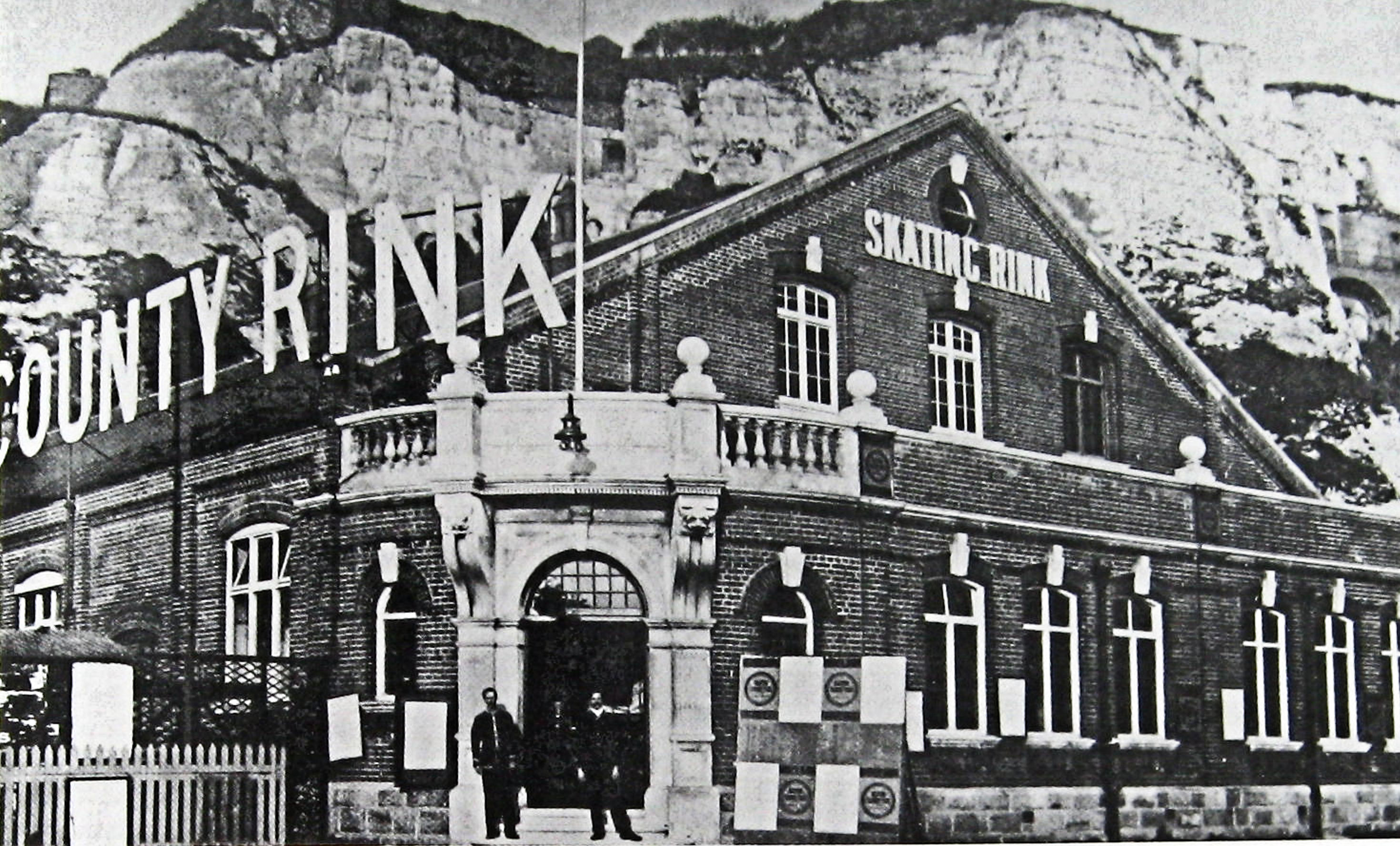
County Skating Rink Marine Parade Commandeered for Sea Planes. Dover Museum

County Skating Rink Marine Parade Commandeered for Sea Planes. Dover Museum

In June 1913, the roller-skating rink, dance hall and open air theatre, on Marine Parade, was requisitioned for the Royal Naval Seaplane Patrol and a hanger for seaplanes was then built on the site previously used by the open-air theatre. The skating rink was converted into workshops and training school. The whole was under the command of Sheerness Naval District and officially named the Hydro Aeroplane Station. The seaplane service worked closely with the Dover Patrol.

Brigadier-General Fiennes Henry Crampton (1862-1938) came to Dover on 4 January 1914, as Officer in command of the South Eastern Coast Defences. The Brigadier-General noted that the land defences around Dover only consisted of Citadel Battery and Langdon Battery – both erected in 1900 and armed with 9.2 guns. He added that even one of those had been removed! At the Drop Redoubt, there were two machine guns while the only anti-aircraft gun was a 12-pounder at the Langdon battery but there were no anti-aircraft searchlights.

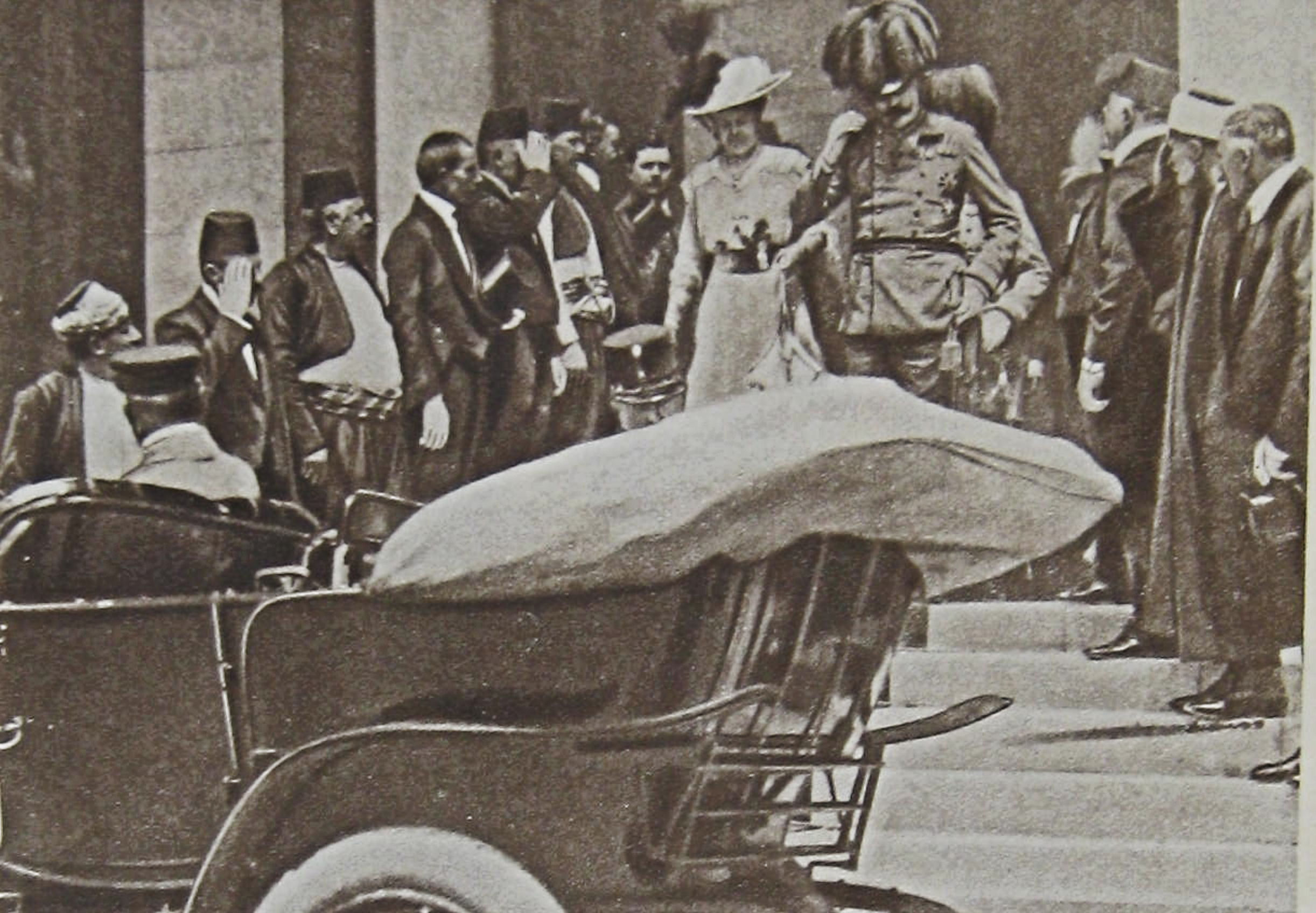
Archduke Ferdinand & wife just before assassination at Sarajavo 28 June 1914 - Robinson Collection

Archduke Ferdinand & wife just before assassination at Sarajavo 28 June 1914 – Robinson Collection

These and other military defences the Brigadier-General was still trying to get into place when, on Sunday 28 June Nedeljko Čabrinović (1895-1916) threw a hand grenade at the car in which Archduke Francis Ferdinand of Austro-Hungary and his wife the Duchess of Hohenberg were travelling. The Royal couple were on their way to the Sarajavo town hall and lucky for them, they made it to the appointment as the grenade missed.

Instead, it hit a car behind causing serious casualties who were then taken to hospital. Later that morning the couple returned to the car and stated that they wished to see the hospitalised casualties. While the cars were turning round a 19-year-old student, Gavrilo Princip (1894-1918), took the opportunity of shooting the Archduke and his wife. The Archduke died within minutes and the Duchess on her way to hospital. Princip died later that year of tuberculosis and Čabrinović, of the same disease, in January 1916.

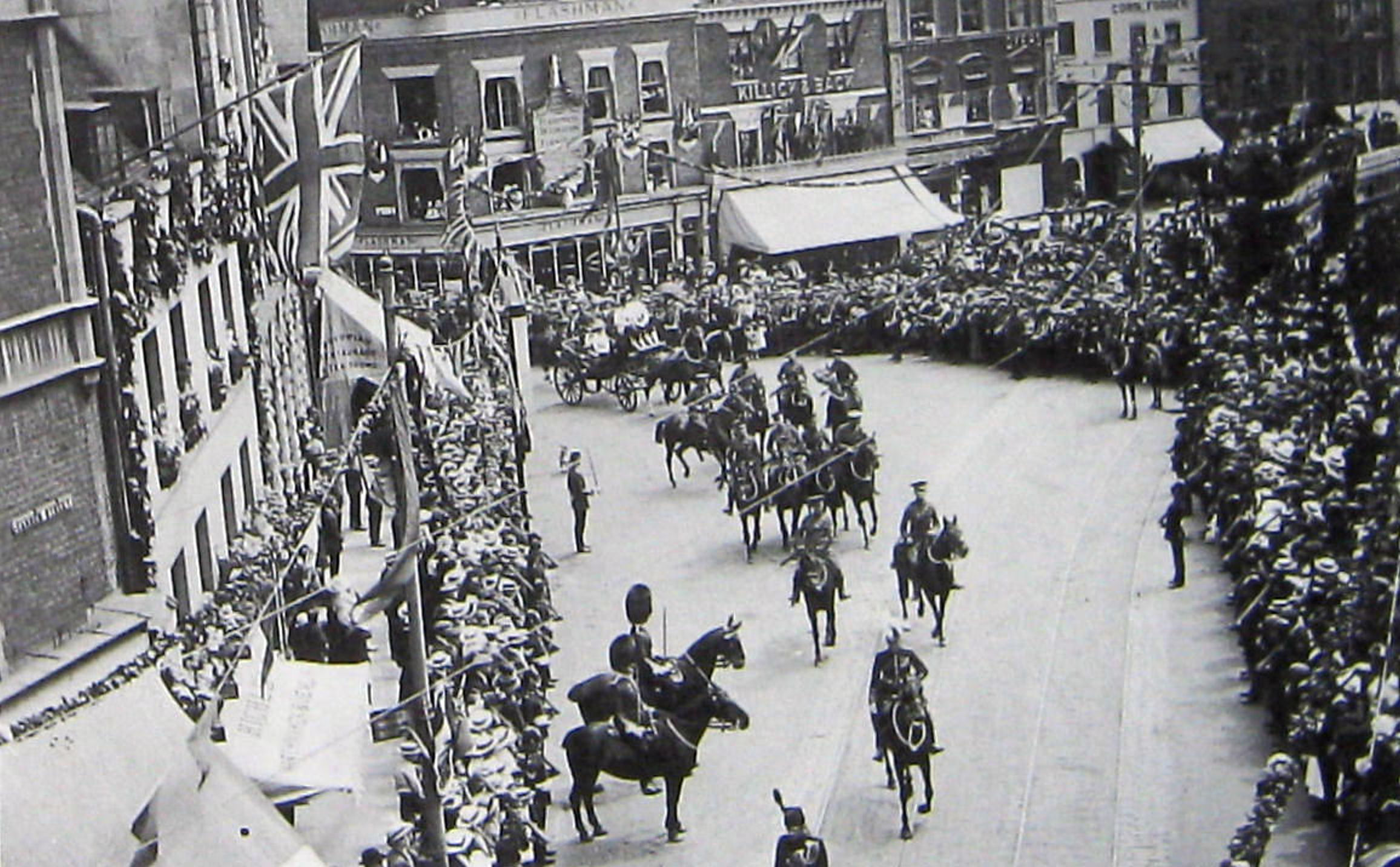
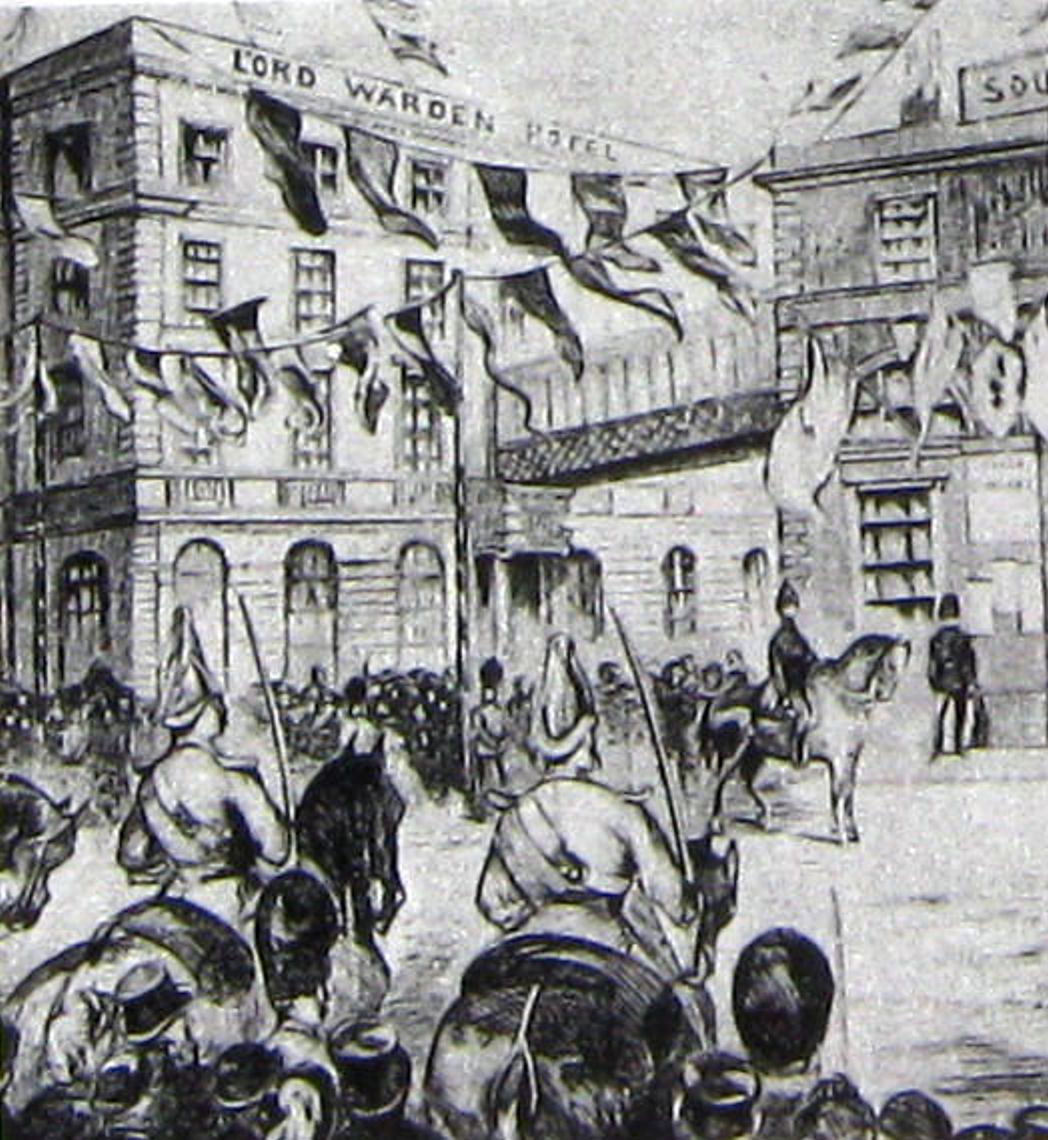
 Inauguration of the Earl Beauchamp as the Lord Warden on 18 July 1914 passing through Market Square. Bob Hollingsbee collection

Inauguration of the Earl Beauchamp as the Lord Warden on 18 July 1914 passing through Market Square. Bob Hollingsbee collection

Through the efforts of the Amusements Committee, the summer season of 1914 in Dover was the most successful for years. Tourists came from near and far with some intending to stay for the whole of the summer. The main topic of discussion, in hushed tones, at the installation of William Lygon, 7th Earl Beauchamp (1872 -1938) as the new Lord Warden (1913-1934), on 18 July, was the Earl’s private life – homosexuality. Nonetheless, the preparations for War were all around in Dover and people were well aware that there was a possibility of war.

The focus of conversations had change by Friday 24 July, with the main topic, the ultimatum sent by the Austro-Hungarian Minister in Belgrave, General Baron von Gieslingen (1860–1936), to the Serbian government the evening before. In essence, it accused the Serbians of abetting propaganda against the Monarchy and being indirectly responsible for the assassination of the Archduke and his wife. It went on to make heavy demands for compensation that the Serbians had little alternative but to refuse to comply. That weekend there was a large flotilla of destroyers in Dover Harbour. It was said that they were there to test Dover’s defences the following week.

The following day, Saturday, the Dover Unit of the Cinque Ports Territorial Force of Royal Engineers, left the town for Southsea Castle, near Portsmouth. It was their annual fortnight’s training under canvas. In Dover, four Regular Infantry battalions had just completed their musketry training and were at the town’s barracks.

By Monday morning (27 July), tension was mounting and Dover people were out in the streets asking questions that no one seemed able to answer. At 15.30hrs, a gun was fired from the warship Attentive, in the harbour. The Blue Peter was run up recalling all crews ashore to return to their ships. People jostle for places on the seafront and on the cliffs to watch what was happening. Less than two hours later one of the patrol flotillas steamed out of the harbour headed by Pathfinder (she was sunk off the Northumbrian coast by a submarine on 5 September 1914). Throughout the day, the ferries arriving at the port were packed with continental holidaymakers hurriedly returning to England.

The gravity of the situation was reflected by a crisis on the London Stock Exchange when, on Tuesday 28 July, Austro-Hungary declared war on Serbia. On Wednesday, all naval harbours were cleared and a warning telegram was sent to commanders-in-chief and appropriate personnel to take up their battle stations. This included Dover harbour. At 19.00hrs, a gun was fired and again naval personnel were recalled to their ships. Sentries with guns and ammunition took possession of various strategic points in Dover. The military establishments were fully manned with everything made ready for an emergency. During the night, with all lights were ‘dowsed’ and a huge fleet of battleships passed by Dover harbour.

With the coming Bank Holiday weekend, concern was being expressed as to whether the events that had been organised should be cancelled. Dover Cricket week was rescheduled to be played at Canterbury, the Regatta was abandoned and all sport fixtures, including football, were cancelled. Band performances and public dinners ceased. The Dover Company of the Royal Engineers and the London Electrical Engineers arrived in the town to operate searchlights.

On Saturday 1 August, Germany declared war on Russia, invaded Luxembourg and crossed the French frontier at several points. Winston Churchill, the First Lord of the Admiralty, issued the order to mobilise the Royal Navy on a war basis and on the warships still in the harbour, the crews were engaged in getting rid of all surplus woodwork in preparation for action. Cross Channel ferries were ploughing across the Channel at speed and out of schedules. They were endeavouring to bring back home as many as possible before the War commenced. In the town, crowds surrounded the telegram posts, such as Leney’s office in Castle Street, to find out the latest news.

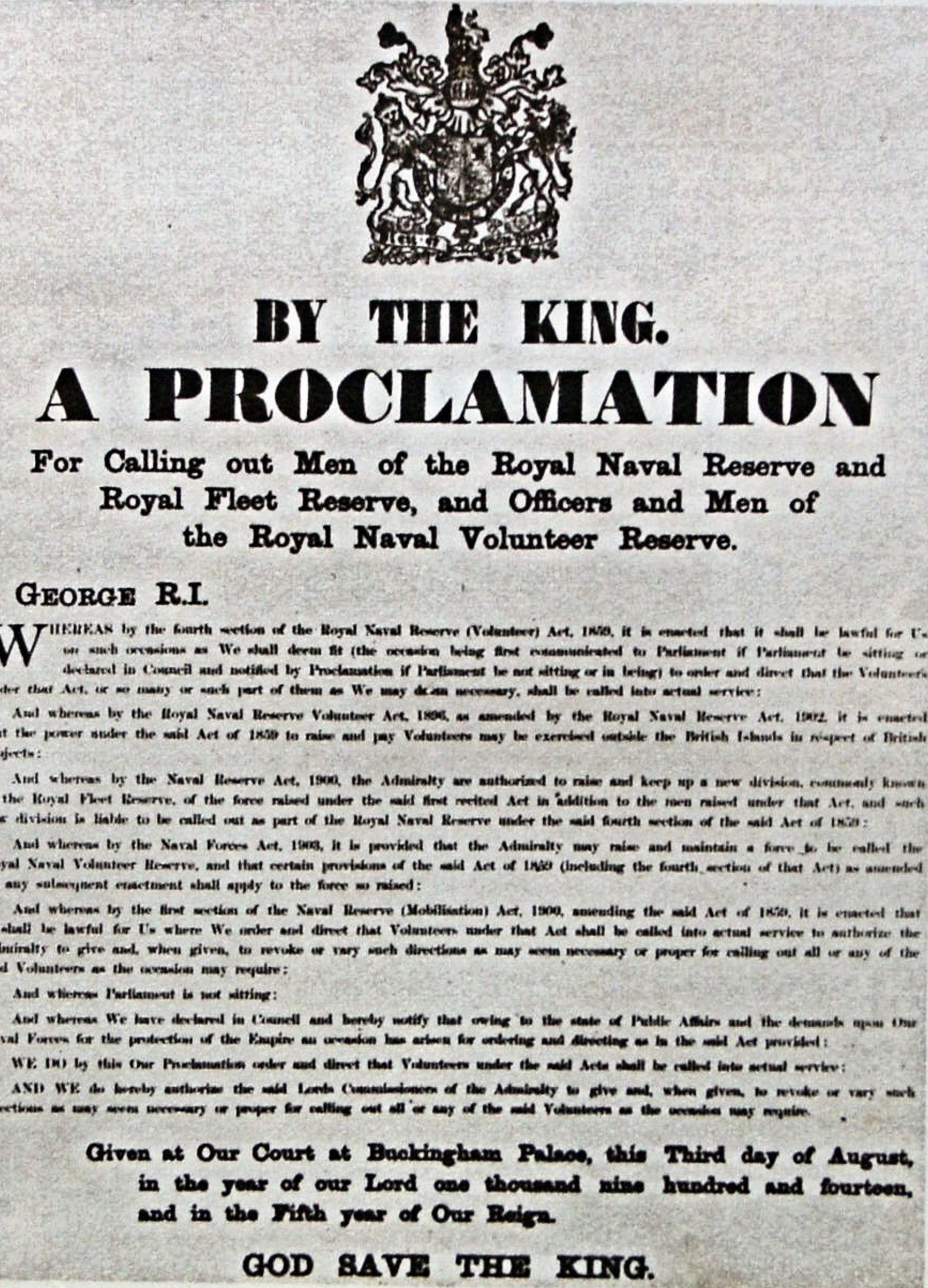
3 August 1914 Naval Reserves called up courtesy of the Doyle collection

3 August 1914 Naval Reserves called up courtesy of the Doyle collection

Russia joined in on the side of Serbia on Sunday 2 August and France was immediately embroiled. Germany declared war on France and proceeded to march through Belgium, thus violating the Treaty of London of 1839. This recognised and guaranteed the independence and neutrality of Belgium and confirmed the independence of the German-speaking part of Luxembourg. By Bank Holiday Monday, 3 August, it was clear that only a miracle could avert Britain being drawn into the conflict. At 03.00hrs, a telegram was sent to Southsea Castle ordering the Dover Unit of the Cinque Ports Territorial Force of Royal Engineers to return to Dover at once. George V (1910-1936) issued a Royal Proclamation calling up the Royal Navy Reserve, Royal Fleet Reserve and Officers and Men of the Royal Naval Volunteer Reserve.

That morning the harbour was crowded with war vessels under full steam and thousands of people came into the town. The packed South Eastern and Chatham Railway ferry, Engadine, arrived from Calais at 08.00hrs following which all Channel traffic from France was transferred to Folkestone. She left for Calais at 13.00hours at the same time as the French cruiser squadron of with six ships came up the Channel. The crowds on the cliffs cheered.

In London, the House of Commons was recalled and the Chancellor of the Exchequer, David Lloyd George (1863-1945), brought in the Postponement of Payments Bill, which quickly passed through all its stages and received Royal Assent. At the same time, the Chancellor announced that Banks would remain closed until Friday morning 7 August. Approximately three million 10 shilling and pound notes would be available that day to replace sovereigns and half sovereigns (both made of gold). Afterwards, it was envisaged about 5million notes would be released every day to replace gold coinage. On Friday 7 August, it was announced that Post Office postal orders would become legal tender.

Marie Henrietta - nearest ship along side Admiralty Pier c 1899. Bob Hollingsbee Collection

Marie Henrietta – nearest ship along side Admiralty Pier c 1899. Bob Hollingsbee Collection

In the afternoon, at 14.30hrs, the Marie Henrietta arrived in Dover from Ostend with 1,122 passengers on board. Before the ship had tied up the passengers were cheering loudly for having made it safely to Britain. This was repeated at 19.30hrs when the Princesse Clementine arrived from Ostend with 1,400 passengers on board. That evening the Admiralty mobilised all the Fleet and at 19.00hrs, as the warships left the harbour. The Special Service section of the Cinque Ports Territorial Force operating the Coast Defence Searchlights at the Admiralty Pier started cheering as these ships arrived. The first aeroplanes touched down at the military Swingate ‘aeroplane station’ but the only armament the pilots possessed were revolvers and automatic pistols.

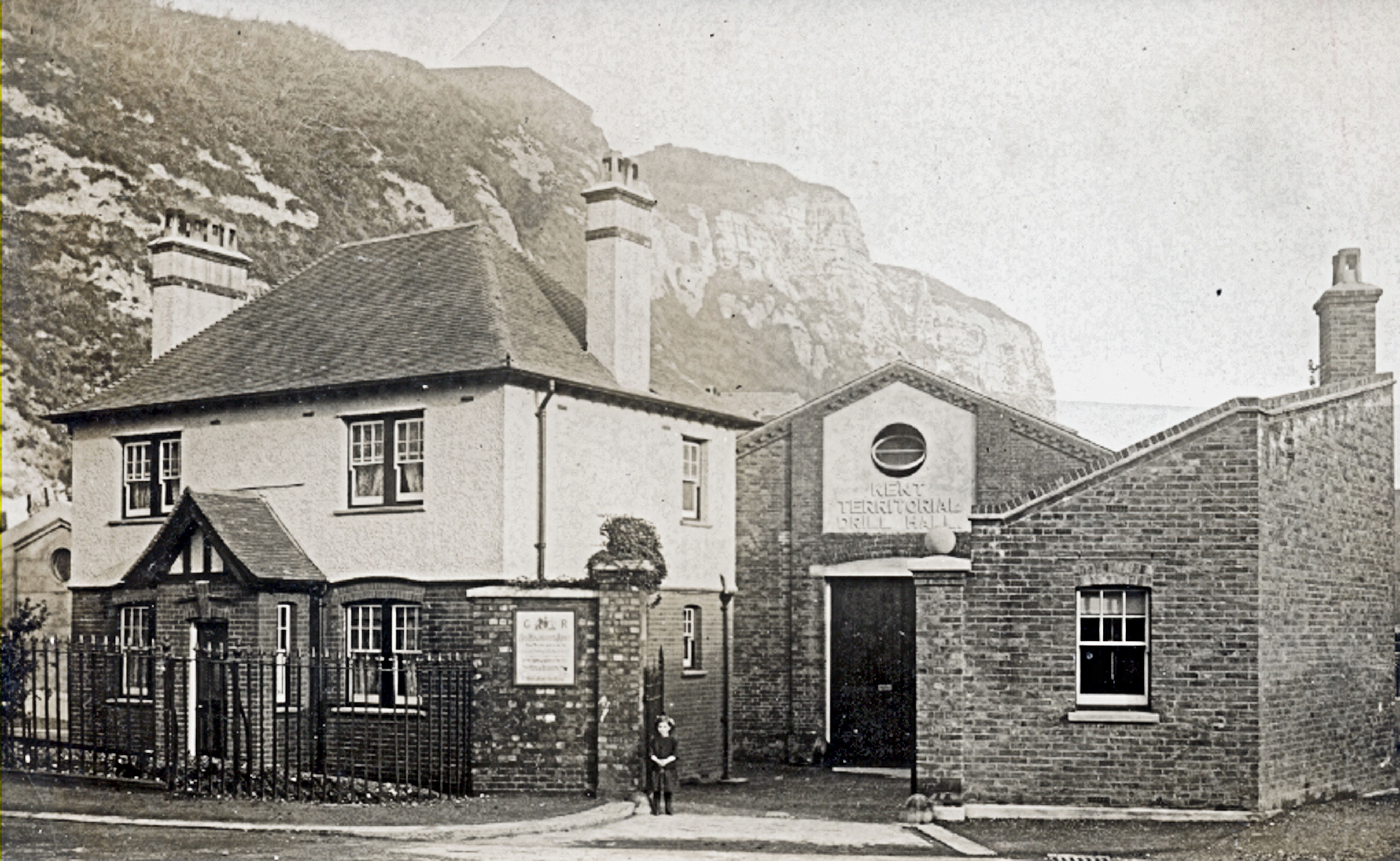
Drill Hall, Townwall Street 1912 - Dover Museum

Drill Hall, Townwall Street 1912 – Dover Museum

The Engineers Unit of the Cinque Ports Territorial Force eventually made it to Dover that Monday evening, arriving at 19.00hrs. They formed up outside the Priory Station and marched to the Drill Hall in Liverpool Street – approximately, where the Gateway flats are today. Later in the evening came the news that Britain had told Germany she would prevent their Fleet attacking French Channel ports and that Britain would do her best to uphold neutrality of Belgium. That evening the Marie Henrietta, with 700 passengers on board, was stopped by gunfire off Dunkerque and boarded. She was then allowed to leave for Dover.

The last passenger ship to arrive at Dover from Belgium on Tuesday 4 August was the steamer Rapide, at 02.10hrs in the early morning with 893 passengers on board. She left at 15.30hrs that afternoon for Ostend with six passengers, by which time Germany had declared war on Belgium. From the early morning, people were out in the streets and stood in awe as a large column of Territorial Troops marched through Dover. Then town’s folk went about their business concerned but not knowing what the future would hold.

That morning the Red Star Liner Finland, having been bound from Antwerp to New York with 96 passengers on board, returned to the port. The South Eastern and Chatham Railway announced that until further notice a service from London to Paris and back would operate but only on Mondays via Dover and Boulogne. The service would leave Charing Cross at 14.05 and Paris 09.55hrs.

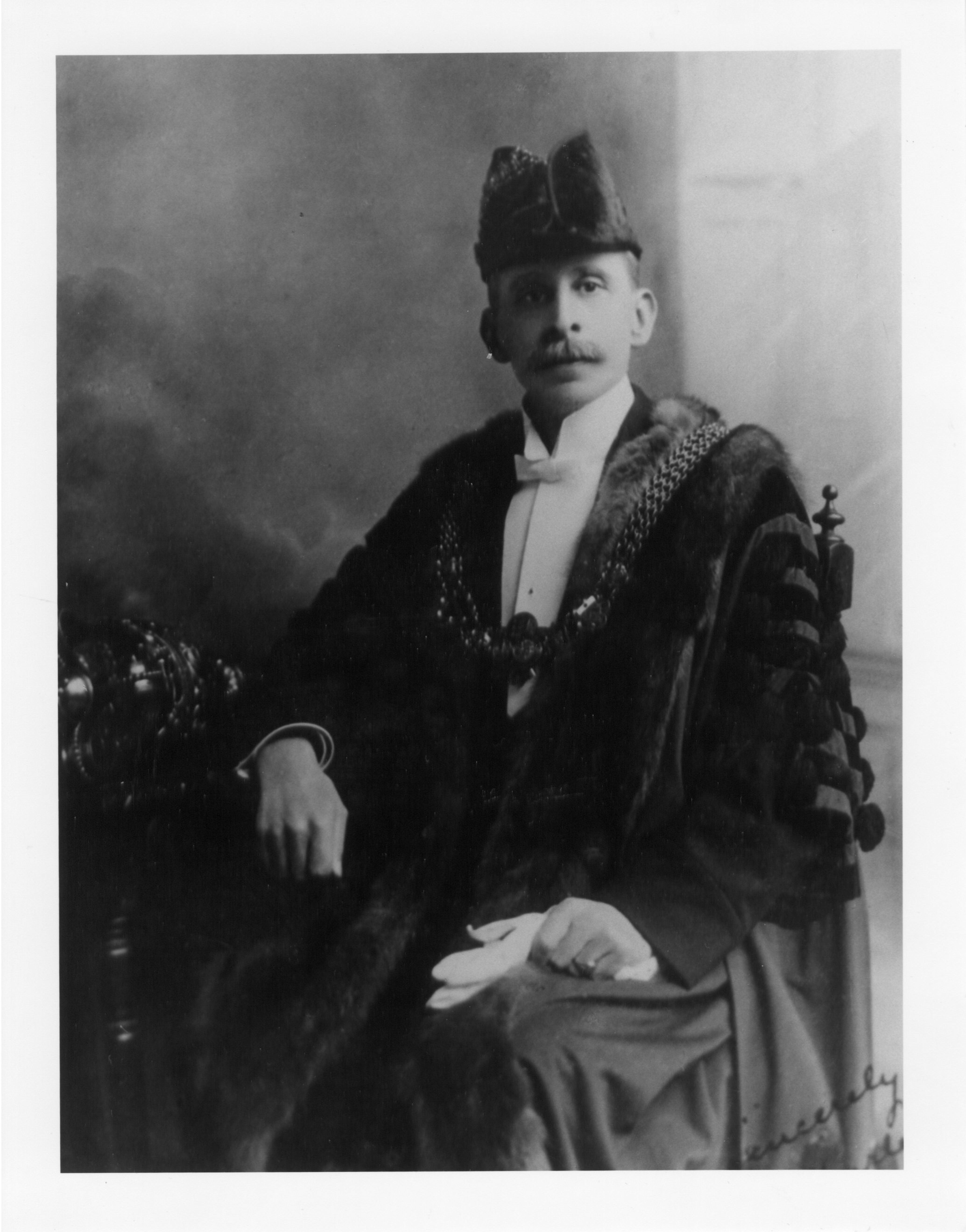
Mayor Edwin Farley 1913-1918. Courtesy of Clare Farley

Mayor Edwin Farley 1913-1918. Courtesy of Clare Farley

It was not until 23.00hrs on Tuesday 4 August 1914 that Britain declared war on Germany in accordance with the written obligation of 1839 to uphold the neutrality of Belgium. Promptly notices signed by Mayor Edwin Farley and Brigadier-General Crampton, stating that war had been declared and mobilisation had been ordered. Defences of Dover were placed on a war footing on both land and at sea. Entrance and exit to, the now Fortress Dover, could only take place by the railways and the main roads to Folkestone, Deal and Canterbury. Special passes, limited in number, were necessary for those who required entering or leaving the town. The Military Authorities had the power to arrest and search. All local newspapers were subject to censorship by the military and anyone approaching any defensive works were stopped, questioned and searched.

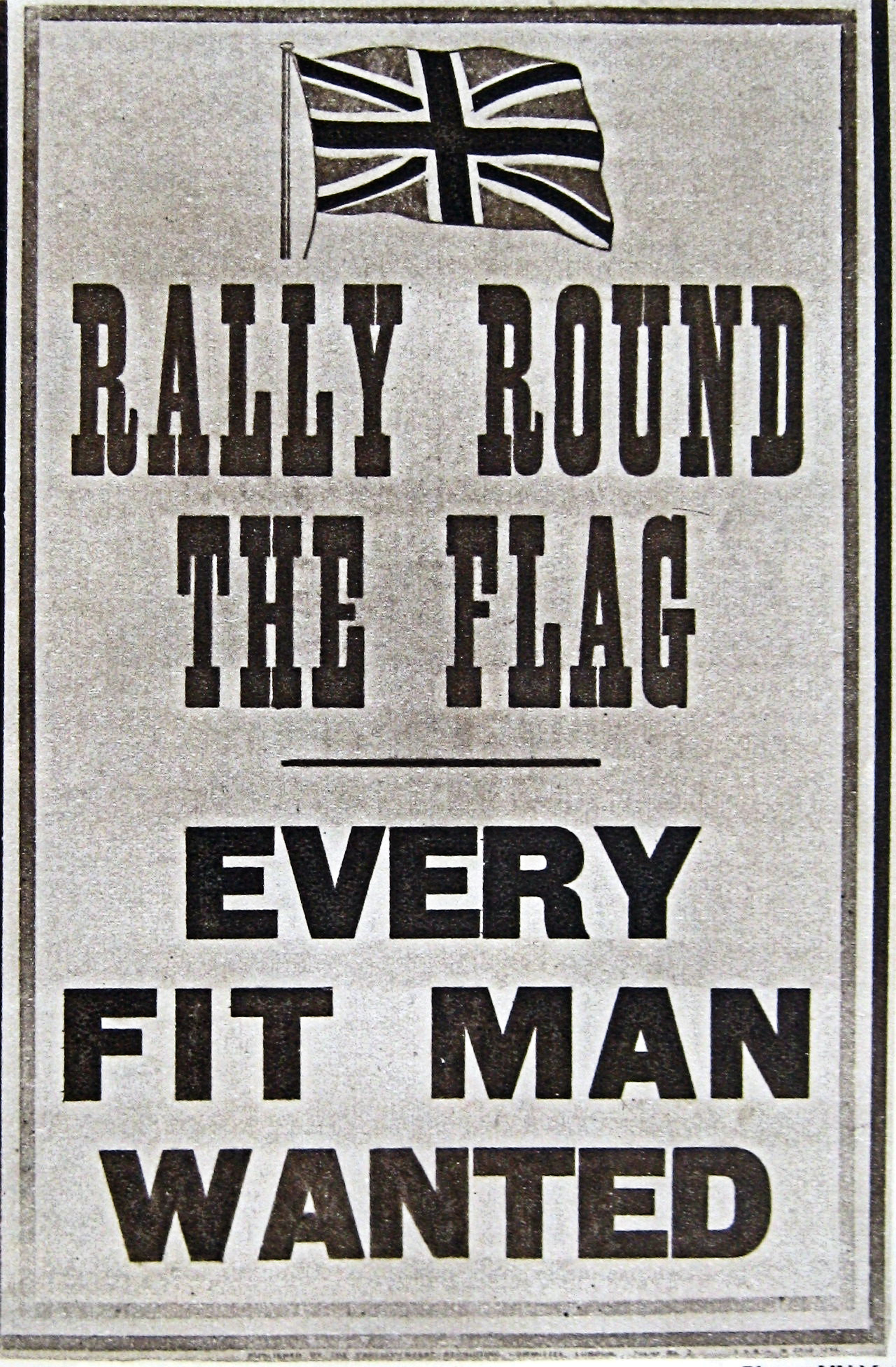
Recruiting Poster issued at the outbreak of World War I. Robinson Collection

Recruiting Poster issued at the outbreak of World War I. Robinson Collection

The order, ‘Commence hostilities against Germany‘ was sent.

The British Expeditionary Force went to France on 9 August via Dover and the Royal Flying Corps followed four days later. The first arrival was Lieutenant Hubert Dunsterville Harvey-Kelly (1891–1917), whose BE 2 had left Dover at 06.45hrs and landed at Amiens at 08.20. By the end of the day Squadrons 2,3 and 4 were in France and No 5 six days later.

On 7 August 1914, Montenegro declared war on Austro-Hungary, followed by France declaring war on Austro-Hungary on 10 August. On 12 August, Britain declared on Austro-Hungary and on the 14th, the First British Expeditionary force landed in France.

By then there had been a call to arms was made in Dover following which an Anti-Aircraft Corps had been formed under the aegis of the Royal Naval Volunteers.


  • On the international front further declarations were made by Britain on Turkey and Bulgaria.
  • Italy declared war on Austro-Hungary, Turkey, Bulgaria and Germany.
  • France declared war on Bulgaria and Albania on Austro-Hungary.
  • Germany declared war on Portugal and Rumania and Turkey on Rumania.
  • Rumania declared war on Austro-Hungary and Bulgaria on Rumania and the US.
  • Cuba and Panama declared war on Germany and Austro-Hungary on the US.
  • Siam (Thailand) declared war on the central powers (Austro-Hungary, Germany and their allies).
  • China on Germany and Austro-Hungary
  • Brazil on Germany.
  • In 1917, the US declared war on Germany.

This was the First World War


  • Published:
  • Dover Mercury: 5, 12 & 19 June 2014
Posted in World War I, World War I - Dover at the Outbreak | Comments Off on World War I – Dover at the Outbreak

Coachmakers and Hills of Castle Street

Map of Castle Street c1900 - location of Hills coachworks hilighted in red

Map of Castle Street c1900 – location of Hills coachworks hilighted in red

It is hard to imagine that the building where the upmarket bridal shop, Country Brides, in Castle Street is, was once a major factory producing high quality coaches that were sent to the all corners of the globe. The factory was Hills that was founded in 1827 in premises in what was once Market Street.

Although the word ‘coach‘ today applies to various types of motorised people carriers, originally it was a horse drawn vehicle that had a fixed roof and some form of suspension. The word comes from the Hungarian kocsi and showing that coaches were  Continental in origin. Indeed, many of the words used to describe the different parts of a coach, these days’ motorised vehicles, reflect this. The history of coaches or carriages, as they are also referred to, can be traced to at the least the days of the Roman Empire if not before. In the early days the suspension was usually made of leather but by the Middle Ages some vehicles had metal chain suspension and pivoting front axles. The chains made for a smoother ride than leather, as the carriage did not rest on the turning axles. The most common form of transport in those days, after horses, were four wheeled wagons.

Dover Mail Coach - Hollingsbee collection Dover Museum

Dover Mail Coach – Hollingsbee collection Dover Museum

Carriages with doors at the side and a step to help the passenger up evolved from these wagons and it is on record that the first fee-paying coaches were introduced in England, following the Restoration circa 1662. They set the style and were made of wood but did not have glazed windows at first. Instead, there was a leather roller type blind that the passenger could lower when it was dark or in inclement weather. The driver sat on a high seat at the front of the vehicle from where he controlled the horses and steered. Steering was controlled by the front wheels that had a centre-pivoting front axle that passed under the coachman’s box when the carriage turned the corner. As the driver was sitting above them, they were smaller than the rear wheels.

Schematic drawing of the Ackermann steering

Schematic drawing of the Ackermann steering

Over the next century, many improvements took place, including the introduction of glazed windows. However, it was not until 1816 that German coachbuilder, George Lenkensperger of Munich, developed the steering mechanism whereby the two front wheels turned about a centre that lies on the extended line of the back axle. Known as Ackermann steering after publisher Rudolph Ackermann (1764-1834) who acquired the English rights in 1818. This revolutionised coachbuilding for up until then the front wheels were smaller than the back wheels as the previous

Edward Hills, born in Chelmsford, came to Dover with his family about 1809 and they opened a coach-building firm in Market Street with offices in Biggin Street in 1827. Nine years later, in 1836, while the rest of Castle Street was in the process of being built, Edward moved into then number 47, now 54. This was for his own use and he also bought the property next door, number 48, now 56, for letting. He initially rented the second property out as a newsroom until auctioneer Charles Lamb, expressed an interest in it for his business. The Dover Proprietary Library, a private concern, rented the upper floors. The family lived on the upper floors of number 47 with the lower rooms and the back of both properties used for building coaches.

Ackerman Steering of coach during the process of being restored by Tony Newton. Courtesy of Tony Newton

Ackerman Steering of coach during the process of being restored by Tony Newton. Courtesy of Tony Newton

At the time there were about 46,000 four wheeled carriages licensed in Britain and there were a number of other coachbuilders in Dover. Whereas they had kept to the traditional axles, Edward introduced the Ackermann steering. He also aimed his business at the wealthy that came to Dover for the ‘summer season’ in other words his firm made upmarket coaches for those who were prepared to pay. Edward married twice and was belonged to the Salem Baptist church. In 1839, he was appointed a Trustee of the new church erected in Biggin Street and laid the foundation stone. After which he was presented with the commemorative trowel.

The business was a success and Edward was active in the town’s affairs joining the Liberal Party and being appointed to the Board of Guardians who were responsible for sick and poor of the town. In 1855, he was involved in the preparations for a presentation of Dover’s French connections in the Maison Dieu – Stone Hall. He observed that to finish the presentation there was a need of a Royal Coat of Arms so his firm made one. This was presented to the town, which was gratefully accepted, by Alderman William Clarke and seconded by Cllr. John Birmingham who said the he ‘hoped that the wealthy of the Dover community would imitate the liberal example of Mr Hills, by contributions ot the restoration (of the Stone Hall), which be made the most handsomest in the county of Kent.’ The vote was unanimously agreed to. Edward and his employee were again congratulated and he was given a script of thanks, written on velum and sealed with the Corporation seal.

Edward Hills advert in the Dover & Folkestone Directory, Sinnock, Howard & Co 1875. Folkestone Library

Edward Hills advert in the Dover & Folkestone Directory, Sinnock, Howard & Co 1875. Folkestone Library

Edward eventually retired and moved to Cambridge Villa, Whitfield where he died in 1885. By that time his two sons, Edward born 1841 and William born 1843 were running the business. His third son, Charles, had died through drowning in 1869. Edward junior and William initially ran the firm but later Edward bought his brother’s share and became sole owner. Edward had three sons, all destined to join the company and the eldest of which was Clement, born in 1869. Edward opened a smaller outlet in Folkestone but the Castle Street premises, except for the area used for domestic purposes and the part rented by the Library, was devoted to coach building. Hills coaches were prized not only by the local affluent market but the reputation had spread beyond the national to the international colonial market.

With the emphasis of personalisation, typical questions asked of the customer included the purpose for which the carriage was to be employed, the number and size of the horses that were to draw it and the type of terrain it was to be used. Armed with the information a full size working drawing was made, in chalk, on black canvass. Once the client gave their approval and the deposit paid the working drawing was used by six different groups of specialist craftsmen, within the factory, to build the coach.

In the area behind the Castle Street factory, separated from the main building by a yard, were the timber sheds. Ash, from Waldershare Park, was the main timber used along with imported timbers such as mahogany, walnut and birch. On arrival, the wood was sawn into planks of various thicknesses and then stored in the sheds for seven years to season! Each plank was about three-feet (1 metre) and was stacked with a space between the adjacent plank. They were all taken out every year to be brushed and restacked.

Frame of a coach in the process of being restored. Courtesy of Tony Newton

Frame of a coach in the process of being restored. Courtesy of Tony Newton

The carriage and body makers were on the first floor of the building and it was here that the seasoned ash was brought. It was then cut to make the frame, by the carriage-makers, using the work drawing. The body makers would then make the wooden beds of the under carriage along with shafts, pole and other wooden parts of the coach. When completed, the frame would go to the smith’s forge, which was in a separate building in the back yard.

There the strong side-plates were made, extending from the back to the front on both sides of the carriage to give rigidity. These were held in place by side bolts and screws and the craftsmen would also have to ensure that, when fitted, doors could open and close easily.

The carriage was then transferred to the paint room and the varnishing loft that were on the second floor of the building. The carriage would be painted with three coats of lead paint on which thin wet leather was placed over the roof, quarters and back and secured to the sides. The coach would then have been left to dry for fourteen days, by which time the leather was tight. Hills stored their varnishes for several years in order to gain a better gloss and more wear resisting power. It was said, their well-finished carriages were given twenty coats of paint and varnish! After the final varnish had hardened, it was rubbed down with pumice stone to ensure a smooth surface.

Wheels fitted onto body of the coach in the process of being restored. Courtesy of Tony Newton

Wheels fitted onto body of the coach in the process of being restored. Courtesy of Tony Newton

While this was going on, in the basement the timber wheels were made using elm for the centre, oak for the spokes and ash for the rim. On completion, they would be passed onto the forge and the iron tyres fitted. The iron was in a one-piece circle, heated to expand so that it could be placed in position round the wheel. The wheel was then dropped into a Hill’s patented water trough to ensure that shrinkage was even so that the iron tyre fitted tightly. The wheels were then fitted with axle boxes. The axles had tapered arms and were bought directly from a manufacturer. When completed the wheels would be painted and varnished in the same manner and matching the body of the coach.

The restored coach upholstery undertaken by Nick Woods of Fairbourne Carriages. Courtesy of Tony Newton

The restored coach upholstery undertaken by Nick Woods of Fairbourne Carriages. Courtesy of Tony Newton

In another department, on the first floor, but separate from the body makers by sliding doors, were the trimmers. They made the cushions using Hill’s ‘special cloth’ that, apparently, felt luxurious but was hard wearing and kept its colour and nap. The stuffing used was horsehair. Lamps, handles, straps and glazing were either made on the premises or bought in. The parts would then be moved to the downstairs show room where the coach was fully assembled and put on show.

Mid 19th century top quality coach similar to those produced by Hills and restored by Tony Newton with the upholstery by Nick Woods of Fairbourne Carriages. Courtesy of Tony Newton

Mid 19th century top quality coach similar to those produced by Hills and restored by Tony Newton with the upholstery by Nick Woods of Fairbourne Carriages. Courtesy of Tony Newton

In 1887, the company sent several carriages, in charge of their foreman, to the Adelaide Jubilee Exhibition in Australia and succeeded in winning five of the highest orders of merit out of seven different categories for carriages. However, on 5 January 1888 the Castle Street works were destroyed by fire and the stables of Leney’s brewery, nearby, were completely gutted. The horses fortunately were led to safety. Some six thousand books many dealing with Kent and local history held by the Dover Proprietary Library, were lost. The adjacent Forster’s chemists – now Blakes – and the butchers next door were both badly damaged. An inquiry following the catastrophe showed that the pressure of the town’s water supply was inefficient at the time.

Castle Street c1900 Hills Coach factory right - Bob Hollingsbee Collection

Castle Street c1900 Hills Coach factory right – Bob Hollingsbee Collection

After the fire, the library moved permanently to Granville Gardens and with the emphasis on fire prevention, the coachworks were rebuilt. The walls were strong and substantial and all the fireplaces were fitted with thick iron shutters that were let down when the rooms were to be left empty. The joists were nine-inches by four-inches and the floors two inches-thick, with iron tongues between each board. In order to isolate the ground floor showroom and offices from the main factory, iron girders, coke-breeze, cement and ‘strong’ asphalt’ was used along with iron doors. The building was also fitted with a patent lift worked by one man.

Even though the disaster reduced the company output, that year Clement Hills, along with the foreman A Bucknor, managed to show eight carriages at the Melbourne, Australia, Centennial Exhibition. They then toured the principal business centres of Australia and on the way back to England visited agents in cities in India. They brought back with them ‘a good sheaf of orders to supplement home trade.‘ Although this was still the hey-day of the horse drawn carriages with some 500,000 coaches in use, their days were coming to an end. The last fee-paying coach ran between Dover and Deal in 1882 – the year after the opening of the Dover-Deal railway line.

The first motor car made its appearance in Dover in December 1896 and was said to have created considerable noise in its workings and left behind it ‘the rather unpleasant smell of burnt petroleum!‘ Nonetheless, the demand for horse drawn coaches fell and for awhile Hills became the specialised coach painters of Daimler bodies made by Palmer & Son of London Road. However, the factory closed in 1906 by which time Cresswell and Newman – Architects and Civil Engineers – occupied the upper floors of the Castle Street factory. Edward and his wife Alice had lived upabove the factory for a number of years and then moved to ‘Shortlands’ Park Avenue and finally to Cambridge House (previously Villa), Whitfield, where he died aged 87, on 25 January 1928.

Alfred Leney and Co, who owned the nearby Phoenix brewery, bought the factory and let it to Dover Motor Co Ltd motor engineers. They changed their name to Dover Autocar Co. and was run by Harry Hooper, Francis Sheridan and Jack Tyson. The company also had premises in Effingham Crescent and a taxi business. Rogers and Stevens, auctioneers, superseded Cresswell and Newman in occupying the upper floors.

Following World War II (1939-1945), Horace Sawyer’s firm initially occupied the old factory until Folkestone Motor Company acquired the building and applied for a licence to redevelop it – a requirement in the early post-war years. This was approved in April 1951 and the programme went ahead at the estimated cost of £12,000. The following year, their subsidiary, Kennex Coachworks Ltd, manufacturers of motor vehicle bodies, moved into the lower floors and the County Court administrative office rented the upper floor.

Country Brides 54-56 Castle Street. LS

Country Brides 54-56 Castle Street. LS

In the early hours of 27 June 1955, fire broke out and although the 19th century fire precautions stopped the fire spreading and reduced the potential damage internally, the destruction was still extensive. Repairs were undertaken but the company decided to have a rethink and in the summer of 1958, Kennex moved into a new factory in Barwick Road on the Poulton Industrial estate. This enabled them to double output of commercial conversions but in 1962, the company was bought out.

The once upmarket carriage factory was taken over by Henleys’ motorcar accessories and then Unipart – keeping up the vehicle tradition. At the time of writing the former industrial premises has been totally revamped and the ground floor is occupied by an upmarket gown and wedding shop, again in keeping with tradition.

Restorers Tony Newton & Nick Woods. Courtsy of Tony Newton

Restorers Tony Newton & Nick Woods. Courtsy of Tony Newton

The photographs used to illustrate the building of a typical Hill’s coach were provided by Tony Newton and taken while he was restoring a similar coach. The upholstery was undertaken by Nick Woods of Fairbourne Carriages. The photograph on the right is of both gentleman during a discussion.

Prepared: 23 April 2014


Posted in Businesses, Coachmakers and Hills of Castle Street, Coachmakers and Hills of Castle Street, Vehicles | Comments Off on Coachmakers and Hills of Castle Street

South Eastern Railway Company and Town Station

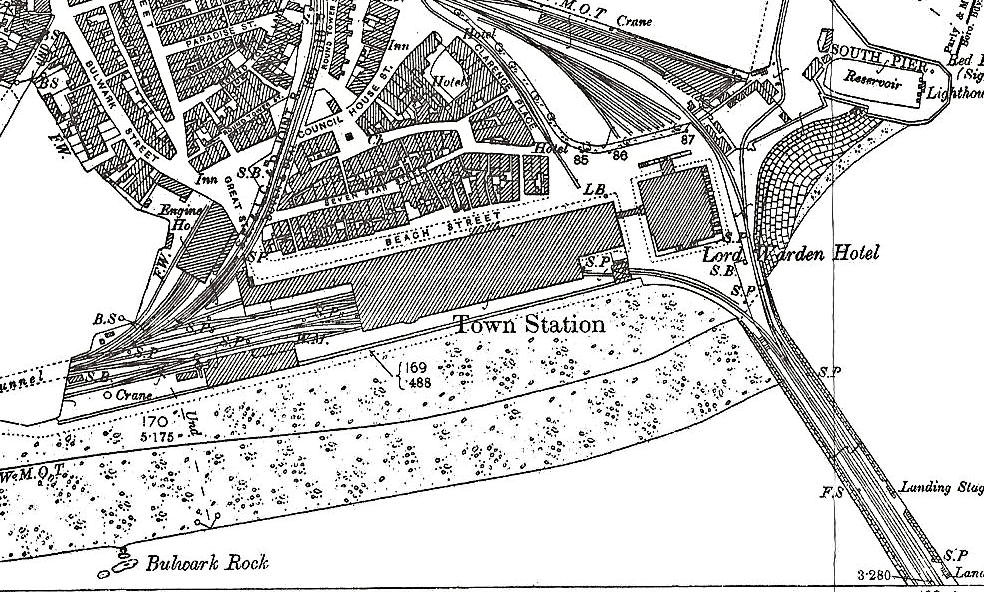
Town Station next to the beach. 1890 map

Town Station next to the beach. 1890 map

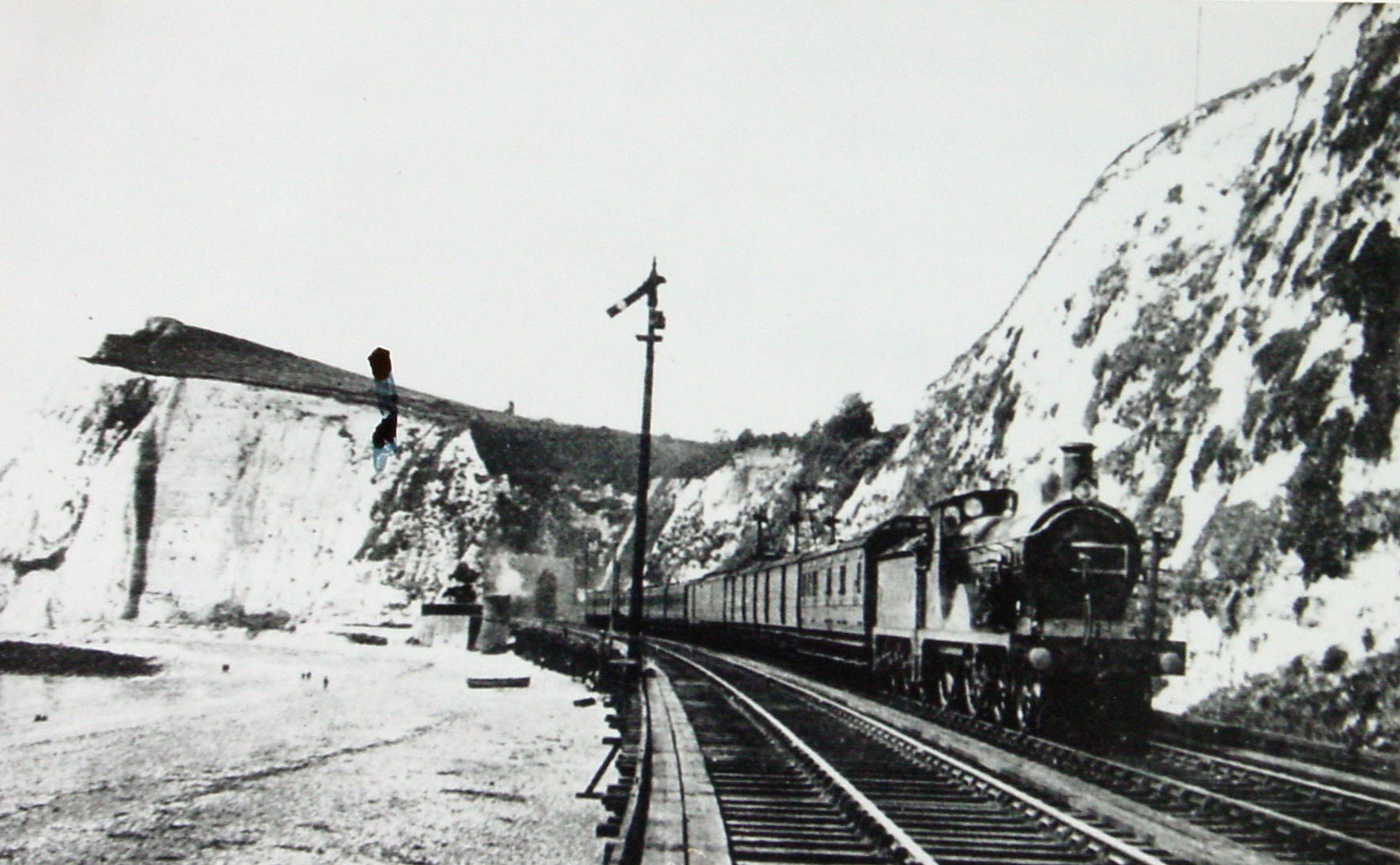
It was in May 1834 that the decision was made for Dover to have a railway connecting the town and port with London. Two years later the South Eastern Railway Company (SER) asked Parliament for an Act to build the line. Given Royal Assent on 21 June 1836 but with the proviso that the company would share the London, Brighton and South Coast Railway between London Bridge – the terminus – and Redhill. From there to Ashford was almost straight but there was the major physical obstacle of the cliffs between Folkestone and Dover. It was for this reason that the company bought Folkestone Harbour and turned it into their port of choice for the cross-Channel passage. Nonetheless, on 26 January 1843, the major obstacle – Round Down Cliff – was purposely blown up and the railway to Dover was soon after completed.
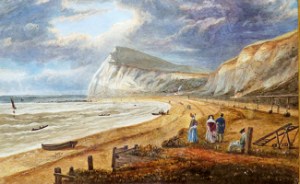
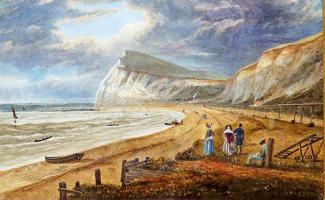
Shakespeare Beach, Dover c1840 by James Patterson Cockburn. Note the lay out of the SER railway track on right. Tom Hutton

Shakespeare Beach, Dover c1840 by James Patterson Cockburn. Note the lay out of the SER railway track on right. Tom Hutton

As part of the Dover Terminus Act, the railway company was allowed to purchase land belonging to Dover Harbour Commission for the station. At the same time they were obliged to pay compensation to the thriving community of shipbuilders on what is now Shakespeare Beach also to the owners of the Mulberry Tree – a popular pub – and a rope factory belonging to J Jones. A considerable number of cottages were demolished, 16 belonging to John Finnis along with his factory for which compensation was paid. However, for those cottagers who were to poor to seek legal help, compensation was not forthcoming. Townsend battery, built in 1779, was demolished along with the Cinque Ports Pilot’s lookout station. The latter was replaced by a highly ornate lookout further to the east. The line, traversing Shakespeare Beach was on trestles.

Proposed Town Station - Architects drawing c 1840

Proposed Town Station – Architects drawing c 1840

It had been envisaged that the station would be a grandiose structure, but due to lack of money, the final building consisted of a yellow brick building 300-feet long, 30-feet wide and 20-feet high, parallel to the platform for passengers. This was the main entrance containing the booking office and had a tiled roof. A 250-foot extension with an iron roof was erected for use as the waiting rooms, goods and parcel offices and pay offices. Further offices were added to the east, all of poor quality with iron roofs. The original architect’s drawings had been freely available since the project commenced and were used in the publicity material long after the station opened!

In order to counter criticism the company said that the station was only temporary but when it became evident that the structure was permanent, they had a change of tack. The publicity releases stated that the station was ‘ striking by its simplicity particularly in the dark when it was internally lit by gas lights!‘ Between the station and the beach was a turntable and a number of lines on which spare carriages were kept. There were also water tanks, loading wharves and warehouses. The project was said to have cost £29,475 out of which Dover Harbour Commission received £23,500 for the land.
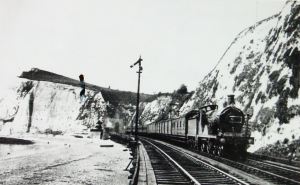
The trestles along Shakespeare Beach. Dover Library

The trestles along Shakespeare Beach. Dover Library

The line was completed by 27 January 1844 and the trial run was hauled by the 2-2-2 steam locomotive number 36 Shakespeare. At 14.00hours on Tuesday 6 February townsfolk and visitors, which included dignitaries from Calais, Ostend, Boulogne, Folkestone, Deal, Ashford and London assembled at New Bridge. The Calais contingent had arrived the previous day on the Beaver and included 33 members of the National Guard of Calais band, resplendent in their military uniform and who joined the town and the military bandsmen to lead the procession. The cavalcade, 6,000 strong, set off at 15.00hours the first reaching the makeshift Dover Station half an hour later. At 16.00hrs, a shrill was heard from the Shakespeare engine pulling four carriages, with SER chairman, Joseph Baxendale (1785-1872), and directors, came into the station. The multitude cheered and a gun salute was fired from Archcliffe Fort.

This was followed by a sumptuous banquet held in the Assembly Rooms, near New Bridge on Snargate Street. Used as a theatre, it was completely stripped of scenery and machinery to make room for the 300 men who celebrated that evening. The gallery was given over to ladies but because they were ‘crammed in’ and wearing hooped skirts found it difficult to partake of the meal! In the speeches that followed it was generally agreed that Dover was the ‘highway of nations’. The final cost of the railway line was estimated to be £3,564,172, two and half times more than originally planned.

 South Eastern Railway Company Timetable for Dover - February 1844

South Eastern Railway Company Timetable for Dover – February 1844

The next day the railway opened to public traffic and according to the Railway Times of 24 February, six trains a day were provided in each direction. Between 08.00hrs until 17.30hrs from London and 07.00hrs until 18.50hrs from Dover. The latter gave rise to a number of complaints from passengers that came over from the Continent on the afternoon ferries to Dover. The Company’s response was that they should use the Boulogne-Folkestone ferry services as these did tie in with the train times – an attitude that never altered! Another source of complaint came from third class passengers, for their carriages were open and in consequence, sparks from the engine burned their clothes. It was suggested that to avoid this problem they should travel by first class! However, the Gladstone Act of 1844 required Companies to run ‘Parliamentary Trains’ charging 1pence a mile and with proper seating and protection against the weather. SER, like many other Companies, reluctantly accepted the ruling and by the end of the decade found that the number travelling third class had increased without any wider detriment.
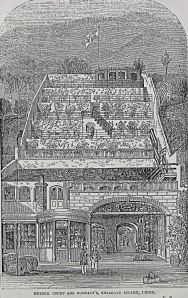
From the South Eastern Railway Guilde 1846 for Court & Co Snargate Street. Dover Library

From the South Eastern Railway Guilde 1846 for Court & Co Snargate Street. Dover Library

From the outset, SER showed an interest in attracting tourists to Dover by offering excursion fares to what they described as an ‘otherwise closed district. ‘ In their brochures were pictures of Dover’s more unusual attributes such as the garden of Court’s the wine merchants in Snargate Street. They also introduced ships from Dover to Ostend; the first was the Princess Mary, built by Ditchburn and Mare in 1844. She departed from Dover on Sundays and Thursdays, in the morning, and returned on Tuesdays and Fridays. Two years later, she was transferred to Ramsgate for a short-lived service from there to Ostend following which her home port was moved to Folkestone.

This was because the company’s major interest was the promotion of Folkestone harbour. Following the building of the line to Dover, SER had successfully applied for permission from parliament to build a railway line from London to northeast Kent, called the North Kent Line. By 1846 this was open from Ashford to Margate, Thanet, by way of Canterbury (now Canterbury West station) and Broadstairs. The following year they opened a spur down Sandwich and Deal but discounted the need to join Dover to either Canterbury or Deal. On the west side of the county, SER had opened their North Kent Line as far as Strood going through Greenwich, and Dartford but did not consider it economically worthwhile to join this up with the Margate spur.

To promote Folkestone harbour, in 1844, SER formed a subsidiary, the South-Eastern and Continental Steam Packet Company. This company bought the ships and, typically, offered passage from Folkestone to Boulogne at specially reduced rates for passengers buying a combined sea and rail ticket. When the company won the contract for carrying mail on both their trains and ships through Folkestone, there were major ructions in Dover and led to a move to build another railway line to the town.

Train running alongside Shakespeare Beach c 1840

Train running alongside Shakespeare Beach c 1840

Accidents on the line were frequent and fatalities were not unknown. Engine driver Jasper Hilyard aged 23 was killed. He had turned off the steam in order to stop the train as it was approaching Croydon station. Looking out he hit his head on one of the columns on the station, lost his balance and fell under the wheels of the train. In 1844, the roof collapsed at London Bridge Edward May, a carpenter, was killed and seven others were injured. Robert Buckley and Aaron Wilkinson were killed when an engine fell from a bridge onto the engine they were driving. Thirty people were injured when a train ran into the back of another as the red light rods had not been placed on the back of the first train. At the subsequent enquiry William Cubbitt (1785–1861), the Company’s senior engineer, accepted that not putting out the red light rods was the cause of most rail accidents.

In February 1846, twelve men William Jordan aged 28, Thomas Hutton aged 52, James Cook aged 56, John Pain aged 39, Israel Hughes aged 28, John Wilson aged 28, John Kendall aged 24, Joseph Hambrook aged 24, John Russell, William Richards, Edward Ruck and Joseph Williams alias Reader, were killed in an explosion at Dover. Ten were married and John Pain left a widow and seven children. There was only one survivor, a Mr Gillham but was seriously injured and unable to give evidence. However, one of the victims did give a clear statement before he died.
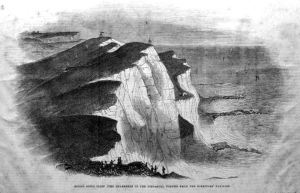
Round Down Cliffprior to being blown up on 26 January 1843 - Dover Museum

Round Down Cliffprior to being blown up on 26 January 1843 – Dover Museum

At the Inquest, presided over by Dover’s coroner George Thompson (d 1860), the jury were told that there were three caves one of which had a door keeping the inside dry, the other two were open to the elements and used as workshops. It was raining and the men, who were working on the line, went into the dry cave to eat their meal – there was no lock on the door. It was dark and one struck a lucifer to light his pipe and let it fall to the ground. As the light fell they saw black powder on the floor and remembered little else.

A subsequent enquiry found that the cave was the one that the gunpowder was stored in that was used to blow up Round Down Cliff. Two unrecorded barrels had been left in the cave. The verdict of accidental death was passed and the company gave 100guineas to a fund set up by George Thompson for the 50 dependants’ left destitute by the accident. After this, all the caves between Folkestone and Dover were searched for gunpowder and other combustibles and they were disposed of by throwing them into the sea.

On 2 April 1848, the foundation stone for the Admiralty Pier was laid. This was the west and first pier of two piers that were to be constructed to form a Harbour of Refuge, but the second was never built. The Admiralty Pier required the demolition of the Pilot’s lookout station that was replaced by a highly ornate lookout further to the east.

Paddle steamer Goliath paying out the Submarine Cable across the Strait of Dover. 28 August 1850 Illustrated London News

Paddle steamer Goliath paying out the Submarine Cable across the Strait of Dover. 28 August 1850 Illustrated London News

The children of the Pier district, where the Station was located, were awe-struck on 28 August 1850 when they saw a horsebox taken into a siding close the Station. Besides a table, chairs, a new fangled apparatus carried in. By the time the Mayor, Steriker Finnis, Charles Walker (1812-1882) the SER’s electrician and Thomas Crampton (1816-1888), a Company engineer, along with other dignitaries arrived that evening, a large crowd had collected. The men said nothing and the door was closed on the assembled throng by which time reporters from London had arrived. What took place in that horsebox that evening was to have worldwide impact. The steamer Goliath accompanied by the Admiralty survey ship Widgeon had laid the first submarine telegraph cable from Dover to Cap Gris Nez! At 21.00hrs that evening, from a temporary building at Cap Gris Nez, France, the world’s first international telegraphed message, using Morse Code, was sent across the Strait and received by the apparatus in the horsebox!

The railway was, by this time, beginning to eclipse coach travel as the best form of transport. Charles Dickens first travelled on a train to Dover when he was going to Paris in 1851, having previously undertaken the journey by mail coach. He was astounded by both the comfort and the speed but asked what has SER ‘done with all the horrible little villages we used to pass through, in the diligence? (A Flight published 1851).  Charles Dickens was a frequent guest at the Lord Warden Hotel, located between the station and the harbour. Engineer, Thomas Crampton besides proving his engineering skills with the laying of the Channel submarine cable was employed by SER to design locomotive engines. He designed and built ten and No136 Folkestone, was on show at the Great Exhibition of 1851.
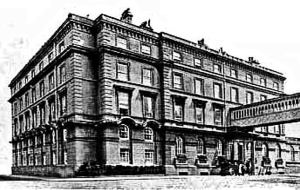
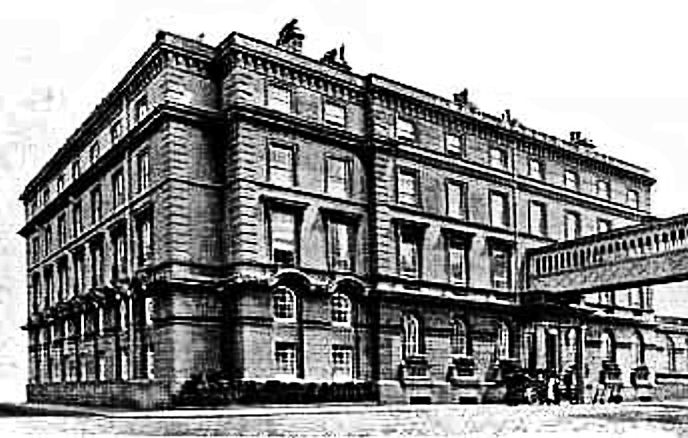
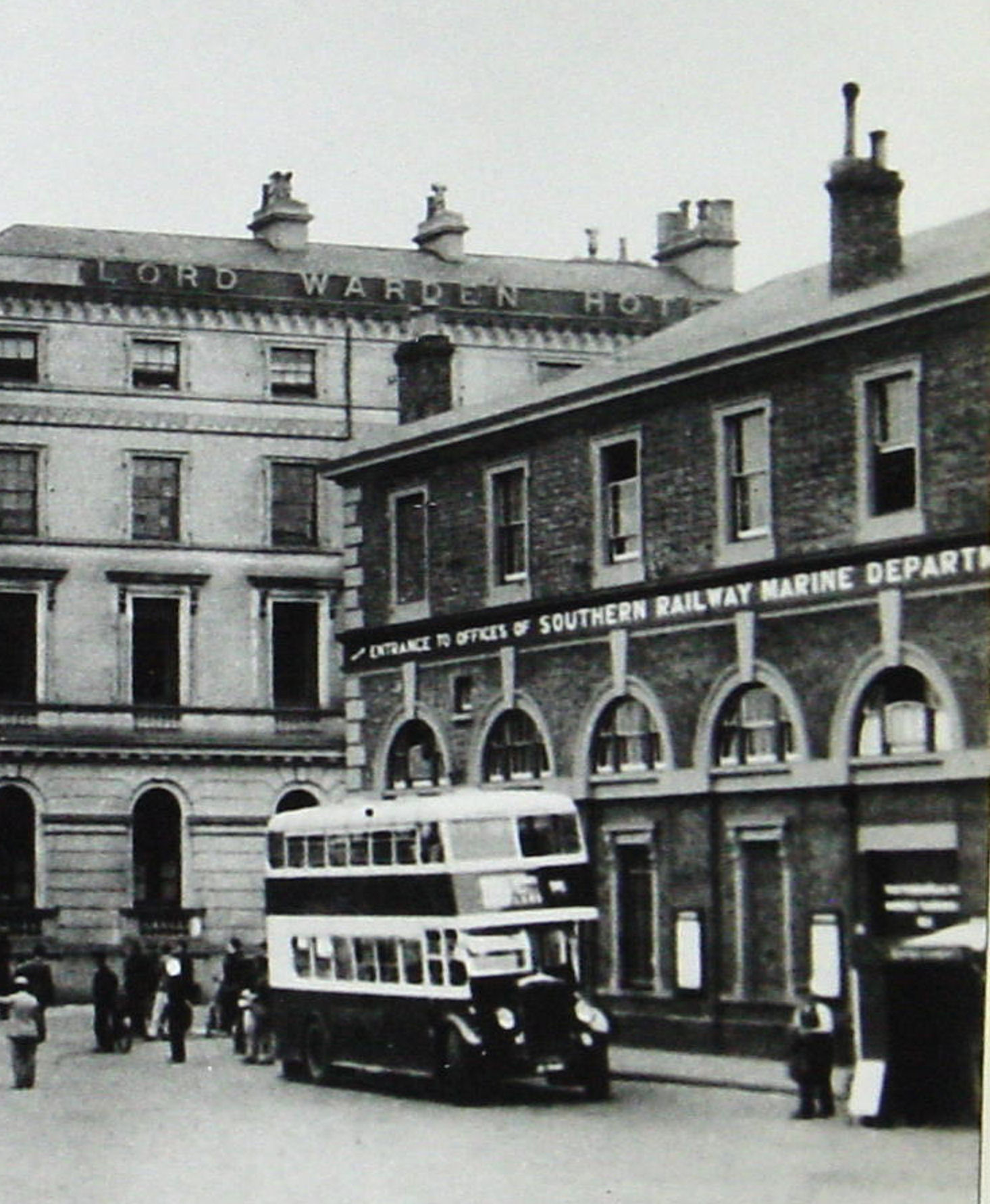
Lord Warden Hotel showing the walkway to Dover Town Station. Nick Catford

Lord Warden Hotel showing the walkway to Dover Town Station. Nick Catford

Part of the plans for the Dover station – in 1863 renamed Town Station – had included a terminus hotel and this was eventually built on the land originally designated for the station. Designed by Samuel Beazley (1786-1851), it was named after the Lord Warden 1829-1852 – the Duke of Wellington (1769-1852) – who had actively promoted the railway. The hotel opened on 7 September 1853 and although both were dead, everyone raised their glasses to the Duke of Wellington and Samuel Beazley. The hotel was aimed at the wealthier cross-Channel travellers and from the first floor, there was a covered walkway to the Town Station.

South Eastern Railway c1850s soldiers ticket Dover to Folkestone Junction. Michael Stewart Collection

South Eastern Railway c1850s soldiers ticket Dover to Folkestone Junction. Michael Stewart Collection

By this time, Edmondson’s railway tickets had been introduced. These were named after Thomas Edmondson (1792-1851), a trained cabinetmaker, who became a stationmaster on the Newcastle & Carlisle Railway. His tickets, a card about 1inch x 2inches, on which the name of the station, destination and the number printed. They were date-stamped in the booking office when issued and different colours and patterns were used to distinguish the different type of tickets. Not long after they were introduced on SER they played a crucial role in bringing the Great Bullion Robbers to justice. This took place on the down mail train from London Bridge to Dover on 15 May 1855. The use of Edmondson tickets, by British Rail, ceased in February 1989.

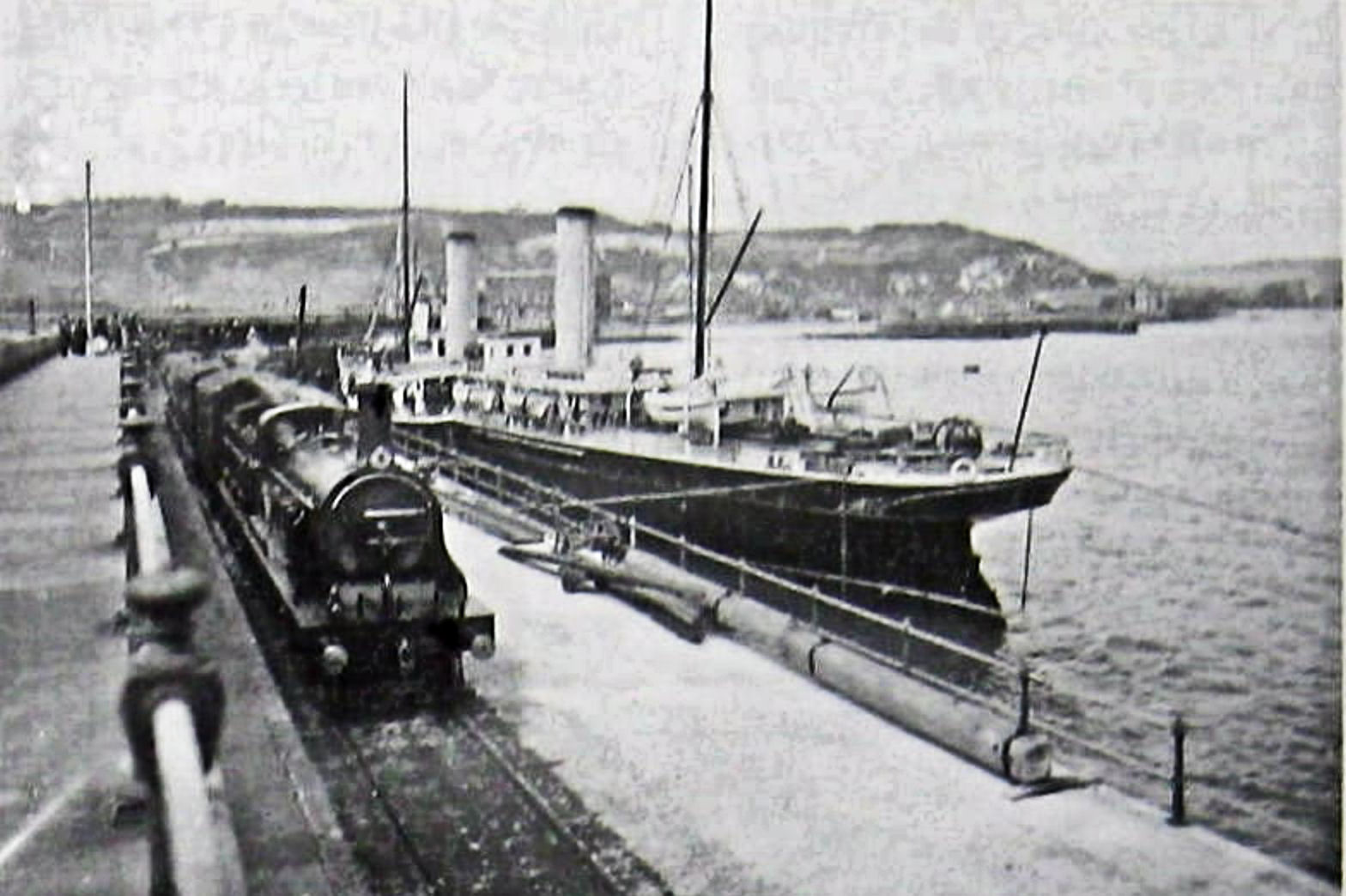
The first part of the Admiralty Pier was finished by 1854 and fully completed in 1871. On 1 September 1854, the Admiralty agreed that passenger trains would be allowed on to the Pier and in 1861 the SER were running trains along it. From the outset, SER had the lucrative government mail train and passage contract at Folkestone. When, in 1853, the Mail Packet Service from Dover was to be transferred from the Admiralty to private contractors they expected that they would get it. However, it went to Messrs Jenkins and Churchward and SER virtually turned its back on Dover.

Admiralty Pier foundation stone laid in 1848 came into use in 1854 and fully completed in 1871. SER trains ran along the Pier from 1861.

Admiralty Pier foundation stone laid in 1848 came into use in 1854 and fully completed in 1871. SER trains ran along the Pier from 1861.

In 1861 the London, Chatham and Dover Railway (LCDR) opened their line from London through to the Harbour Station on nearby Elizabeth Street. Although adjacent to the harbour, passengers had to walk along Admiralty Pier to reach the ferries. SER buried their pride and moved the Princess Clementine, an iron paddle steamer built by Laird Brothers and launched in 1846, together with the Princess Maud, built by Ditchburn and Mare and launched in 1844, from Folkestone to Dover. The ships plied between Dover and Ostend but the service was short-lived ceasing in April 1862.

At the outset SER’s, main terminus for Dover passengers, in the City, was London Bridge Station, which they shared with the London, Brighton and South Coast Railway. The Station was actually two stations in close proximity to each other. SER had their station rebuilt to a design by Samuel Beazley opening in 1850. Following the arrival of LCDR, the company bought the site of Hungerford Market and commissioned Sir John Hawkshaw (1811-1891) to build a central London station and this opened on 11 January 1864. Named Charing Cross Station, like London Bridge Station, it was on the north side of the Thames and in January 1869, they opened Waterloo Junction Station, opposite on the south side of the Thames.

LCDR petitioned Parliament to run their trains along Admiralty Pier and from 1864 they had their wish. In the meantime in 1863, they won the converted Mail Packet contract for Dover! Although the two companies, with the blessing of Parliament, entered into the Continental Agreement, whereby all railway receipts appertaining to the Channel Passage ports between Margate and Hastings, were pooled and then divided in agreed portions between the two companies. However, SER continued to promote Folkestone and built an attractive new Shorncliffe station (now Folkestone West) at Cheriton, which was outside of the Agreement area.

By 1875, LCDR had a fleet of cross Channel packet ships running out of Dover and although the Continental Agreement had fallen into abeyance, Sir Edward proposed a quasi merger between the two railway/packet companies, whereby there would be a fusion of the net profits of both companies, for an interchange of traffic and a friendly working relationship. At the time James Staats Forbes (1823-1904) who was the Chairman of LCDR was ill, but on his recovery made it clear that he was not happy with the proposed arrangement and the proposal fell through.

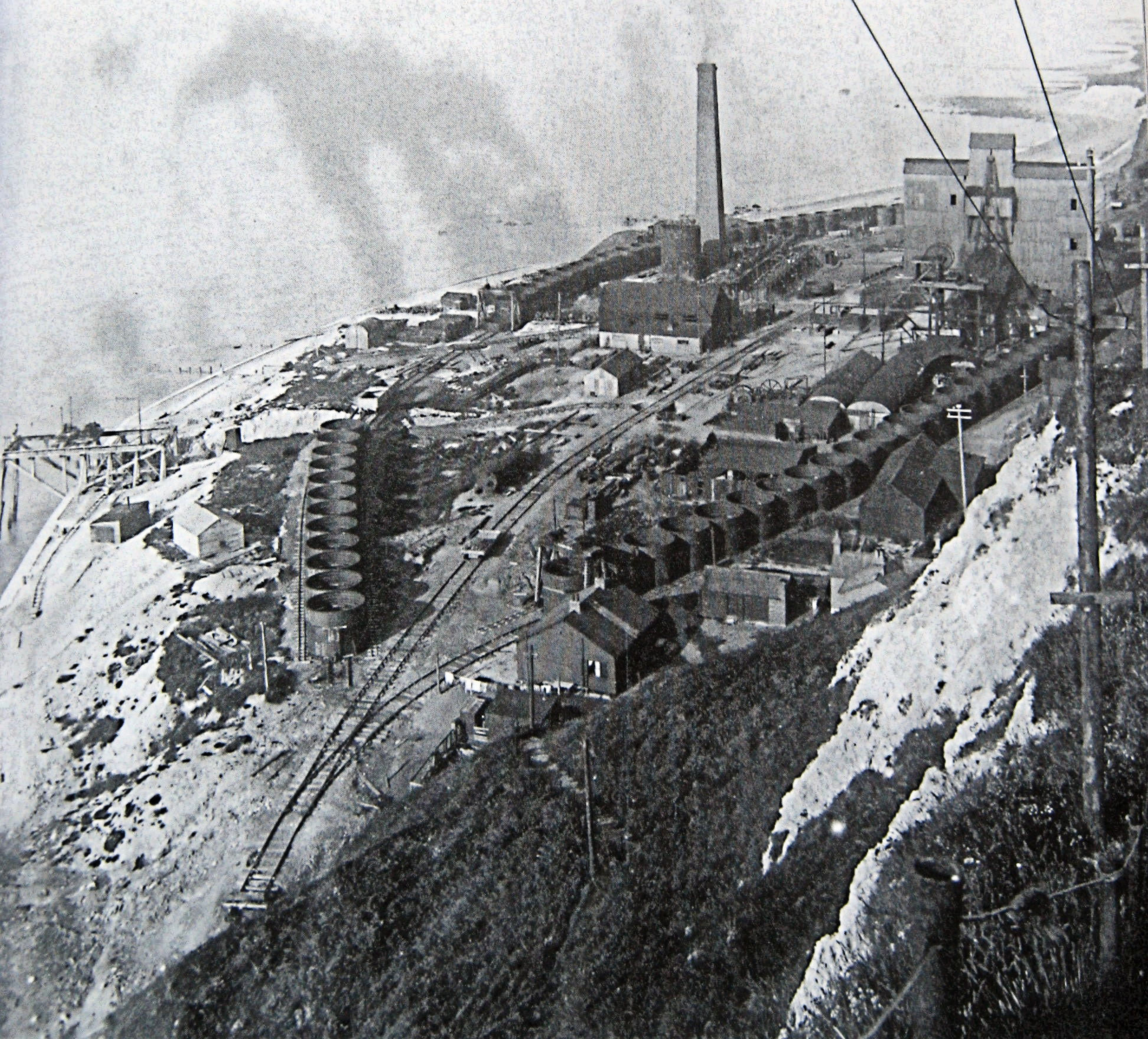
Sir Edward immediately turned his attention to excavating a Channel tunnel in order to have a through line from London to Paris. Working in conjunction with the Nord Railway, SER formed the Submarine Continental Railway Company and worked started at the foot of Shakespeare Cliff, next to where Round Down Cliff had once been. A 22.55 metre shaft was sunk and a level heading driven for 792.68 metres. A second heading was driven for 1,944 metres under the sea. Sir Edward planned to run a railway line to St Margaret’s, on the east side of Dover, and bought Pencester Meadow in order to build a railway station in the centre of Dover. In 1878, SER installed a 60-lever signal box adjacent to the Town Station in preparation.
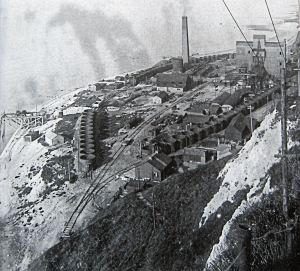
Dover Colliery opened on the site of the first Channel Tunnel now Samphire Hoe. Bob Hollingsbee Collection

Dover Colliery opened on the site of the first Channel Tunnel now Samphire Hoe. Bob Hollingsbee Collection

However, a Joint Committee of both Houses of Parliament held an enquiry, in July 1883, into the proposed tunnel and declared that: ‘The majority of the Committee are of the opinion that it is not expedient that Parliamentary sanction should be given to a submarine communication between England and France.’ Following the failure of the Channel tunnel proposal, William Crundall senior re-purchased the Pencester site making a nice profit. Close to the Watkin borings, a site was created out of spoil from the present Channel Tunnel working and in 1994, the site was officially named Samphire Hoe. The White Cliffs Countryside Partnership (WCCP) runs this very popular visitor attraction.

Coal had been found across the Channel, near Calais and a borehole was sunk at the bottom of the abandoned Channel Tunnel shaft. Coal was found at a depth of just over 300 metres and under the supervision of Francis Brady, the Chief Engineer of the Railway Company, drilling was started and eventually Shakespeare Colliery opened. During this time a halt, near the site, was built. In June 1886, SER opened a halt on the Warren, between Folkestone and Dover, but failed to gain the consent of the Board of Trade. The company was forced to close the halt until they met specified criteria. It was a long time before the Board of Trade was entirely happy, in fact, the halt was not officially opened until 1 June 1908 and thereafter not very often.

One of the problems that SER constantly faced was that from Folkestone to Dover the tracks were – and still are – in close proximity to the cliffs and sea. These days there are many safe guards and safety warnings but in the 19th century, such gadgetry was not available. On 14 November 1875, there was a severe storm that wrecked groynes severely damaged the Town station roof and the track was flooded. By the beginning of 1876, the weather was so bad that a storm damaged Admiralty Pier and cost £26,000 to repair. The damage to SER ships, berthed in Folkestone, was estimated at £2,000 and as the storms did abate, the cliffs between Folkestone and Dover started to give way. LCDR, helped out by accepting SER passengers travelling to Dover, on their trains. As the wet stormy weather continued sections of the LCDR line between Dover and Canterbury became vulnerable to collapse and so LCDR diverted their packet ships to Folkestone and SER trains carried the mail for them.

This gave Sir Edward the impetus to make Forbes, LCDR’s chairman, an offer to amalgamate. Watkins set out a time table for talks, sending an appropriate Bill to parliament with a view for the resultant Act to be given Royal Assent two years after. The proposal was put to the LCDR Board, who generally endorsed but in negotiation, the terms were not acceptable and the proposal fell through. Shortly after LCDR opened a steam packet service to Flushing, now Vlissingen in southern Netherlands. Later, SER countered this by opening a new cross Channel route via Port Victoria, also near Queenborough and years of litigation ensued.
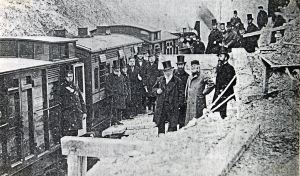
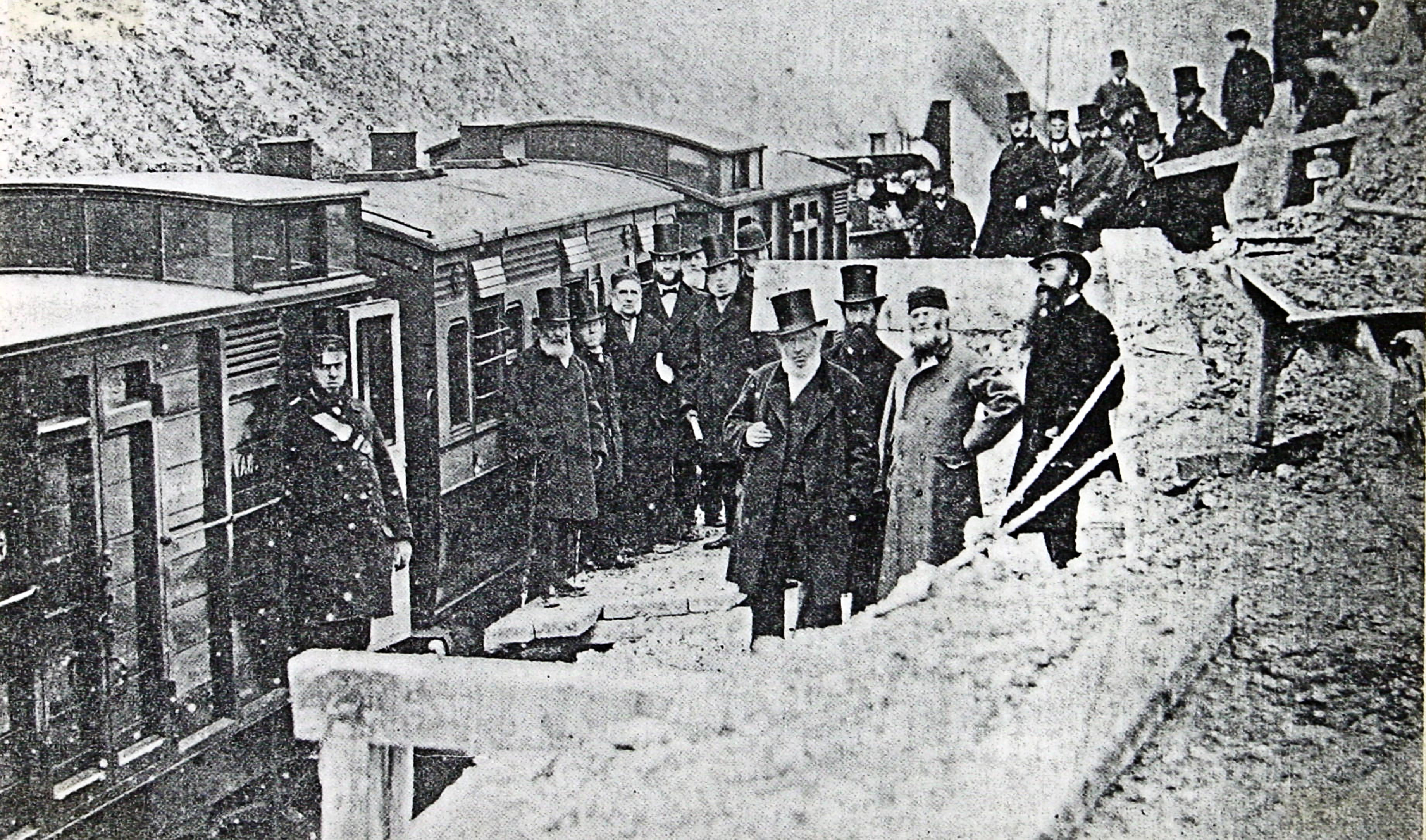
Sir Edward Watkin (in a Cossak hat) and the SER Board members at the re-opening of the Dover-Folkestone railway line following the 1877 landslip. Dover Library.

Sir Edward Watkin (in a Cossak hat) and the SER Board members at the re-opening of the Dover-Folkestone railway line following the 1877 landslip. Dover Library.

In January 1877 a severe storm washed away the foot of the cliff at the eastern end of the Martello Tunnel, on the line between Dover and Folkestone. This had brought down some 60,000tons of the chalk cliff, killed three workers and completely blocked the line. Forbes of LCDR reacted by offering SER the use of the whole of the LCDR railway lines saying that ‘We are partners … take your mails over our railway.’ For the following two months, until the line was repaired, SER trains carrying mails for Belgium, went from London to Beckenham on the SER line and from there on the LCDR line to Dover. However, a rumour spread that SER would not be re-opening the railway line between Folkestone and Dover. The rumour was attributed to LCDR and therefore Sir Edward arranged an official re-opening of the line. For this, he wore a Cossak style hat and with his retinue, arrived on a Cudworths 2-4-0 Class E locomotive with a stovepipe chimney.

It had been hoped that the venue for the annual Volunteer Review of 1883, held over the Easter weekend, would be Dover. However, the Hon. Secretary of Commanding Officers wrote to say that it would be in Brighton. The reason cited was that neither of the two railway companies had replied to their communication concerning special trains. Dover council were angry and the Mayor, Rowland Rees wrote a terse letter, saying that over the previous ten years the number of cross-Channel passengers, going through Dover, had fallen. He went on to say the following the Bank Holidays Act of 1871 the council had launched an expensive tourism initiative to persuade people to come to Dover and for those travelling across to the Continent, to stop over. In support of this initiative, private horse driven omnibus companies were prepared to collect passengers and return them to the terminus and that since 1881 Back’s Omnibus had been running a regular service between the Town Station and Buckland Bridge, calling at the Harbour Station.
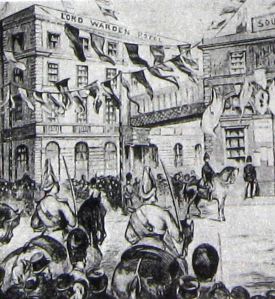
 Duke & Duchess of Connaught welcomed at Town Station - 14.07.1883

Duke & Duchess of Connaught welcomed at Town Station – 14.07.1883

The town’s Member of Parliament, Major Alexander Dickson (1834-1889), was a managing director of LCDR and on being informed of why the Volunteer Review was not being held in Dover, was angered and at his railway company’s behaviour. That summer LCDR introduced excursion trains from London to Dover and SER quickly responded with similar offers. Then on 14 July 1883, SER was given the greatest fillip of all. The Duke and Duchess of Connaught chose the Town Station to arrive when they came to open Connaught Hall and Connaught Park!

A Parliamentary Bill was put forward, in 1890, proposing a joint Board for the management of SER and LCDR for a period of ten years. The proposal suggested that there would be a division of profits and the new Board would sanction the provision of new capital in specified proportions. As the Bill was going through parliament, Dover Mayor, William Adcock, and council together with the Chamber of Commerce, presided over by Richard Dickeson, pledged to secure guarantees for equitable fares and rates and sufficient service of trains. However, due to the animosity between the chairmen of the two railway companies the Bill was dropped.

In March 1892 SER were awarded the contract for the conveyancing mail on the railway worth £25,000. LCDR’s contract was only worth £2,275 and Sir Edward celebrated. However, within two months, in May 1892, a blaze broke out at the Town Station destroying all the offices. While the fire was still raging, two boat trains ran through the station! Following the fire, repairs were undertaken but about twelve months later the roof over one platform collapsed. This caused a carriage to be de-railed, which smashed into a pillar, but luckily, no one was hurt. Investigations showed that the fire had weakened the roof and the accident happened due to inadequate repairs brought about by cost cutting.

South Eastern Railway ceased to exist on 1 January 1899

South Eastern Railway ceased to exist on 1 January 1899

On 6 September 1897, Dover became the first town to have a municipally owned tramway system and this ran from the town centre to the Pier District, close to the railway stations. Six years before, in 1891, the Dover Harbour Board, with the full backing of the council and the Chamber of Commerce, applied for an Act of Parliament for the construction of a Commercial Harbour. In 1895, this was upgraded to the Admiralty Harbour and it was quickly recognised that on completion it was likely to turn Dover into a major port. In 1894, Sir Edward Watkin retired and four years later, his major adversary, James Staats Forbes retired. The two railway companies sort Parliamentary approval for a joint Management Committee. Although strongly opposed by the Trade Union Congress (TUC), the South Eastern and London, Chatham and Dover Railway Companies Act of 5 August 1899 confirmed the formation of the South Eastern and Chatham Railway Companies (SECR) that came into operation on 1 January 1899.
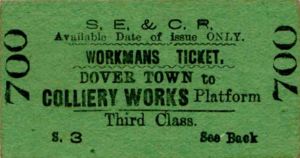
Railway ticket from Dover to Shakespeare Colliery post 1899 . Michael Stewart Collection

Railway ticket from Dover to Shakespeare Colliery post 1899 . Michael Stewart Collection

The miners’ strike of 1912 began in March that year and continued to the end of April creating a national fuel shortage. Railway services were hit and the Town Station closed. The cross Channel ships were concentrated at Dover but coaled up in Calais. Two years later, due the expected opening of Marine station, Town station was officially downgraded. This occurred on 14 October 1914, ten weeks after World War I was declared on Tuesday 4 August. In the event, Marine Station was commandeered and the Town Station was used as an ambulance station for dealing with the seriously injured returning from the Frontline.
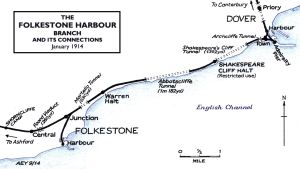
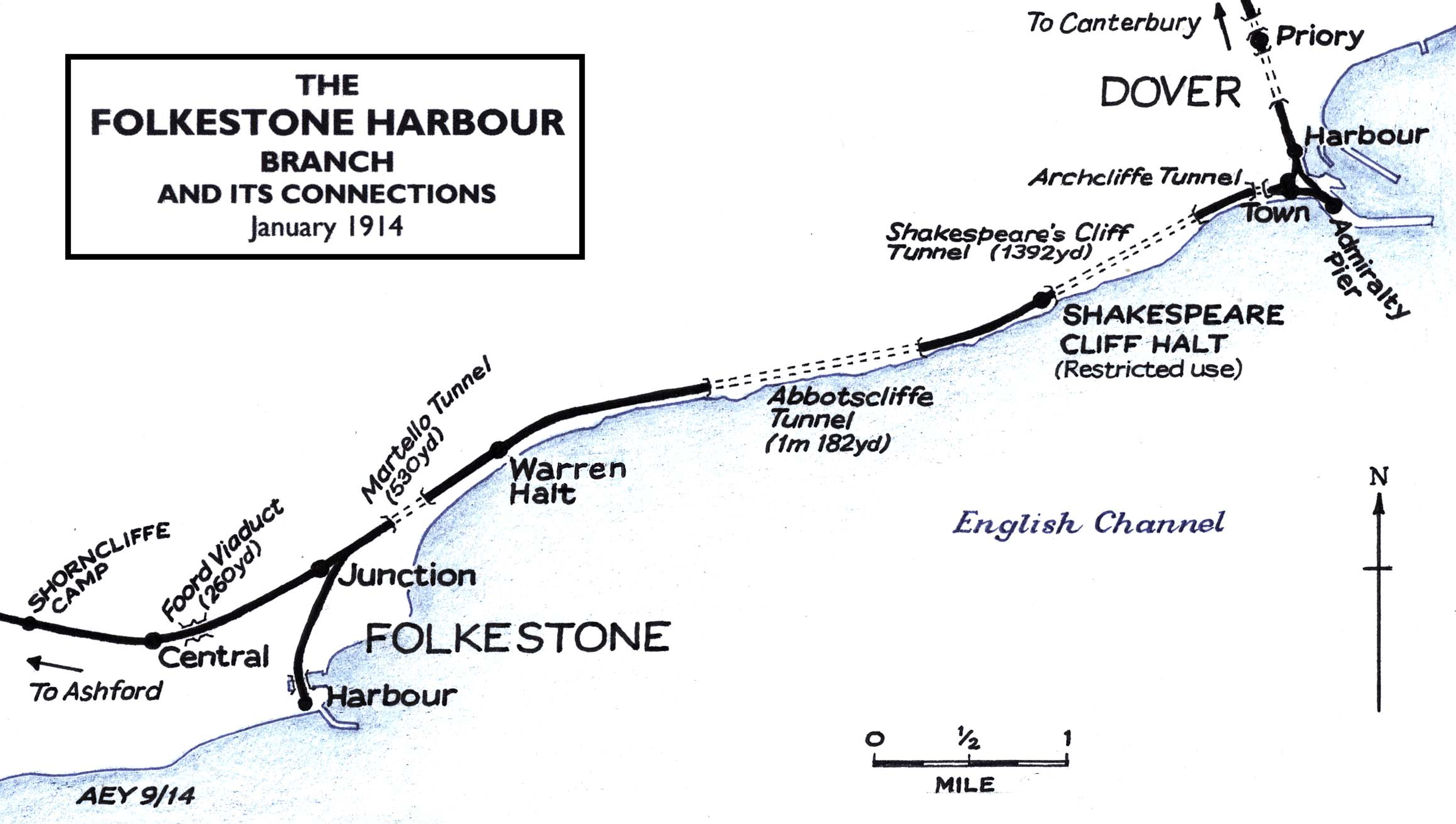
SECR Line from Folkestone Harbour to Dover 1914. Alan Young Disused-stations.org

SECR Line from Folkestone Harbour to Dover 1914. Alan Young Disused-stations.org

On 19 December 1915, a landslide completely blocked a mile of track between the Martello and Abbots Cliff tunnels. A train, on the track at the time, was derailed but luckily, no one was injured and the passengers and crew walked back to Folkestone Junction. SECR after consultation with the Board of Trade decided that the blockage could not be removed during the War. Thus, passengers that wished to travel from Folkestone to Dover were faced with a long arduous journey for Dover was under military rule and they could not enter the town except by rail. Thus they had to leave Folkestone on the Elham Valley Line to Canterbury then back to Dover on the old LCDR line. For the remainder of the War the Admiralty used the tunnels to store mines and shells for locally based warships and the Town Station became a mortuary.

Town Station after being taken over by the Marine Department. Dover Library

Town Station after being taken over by the Marine Department. Dover Library

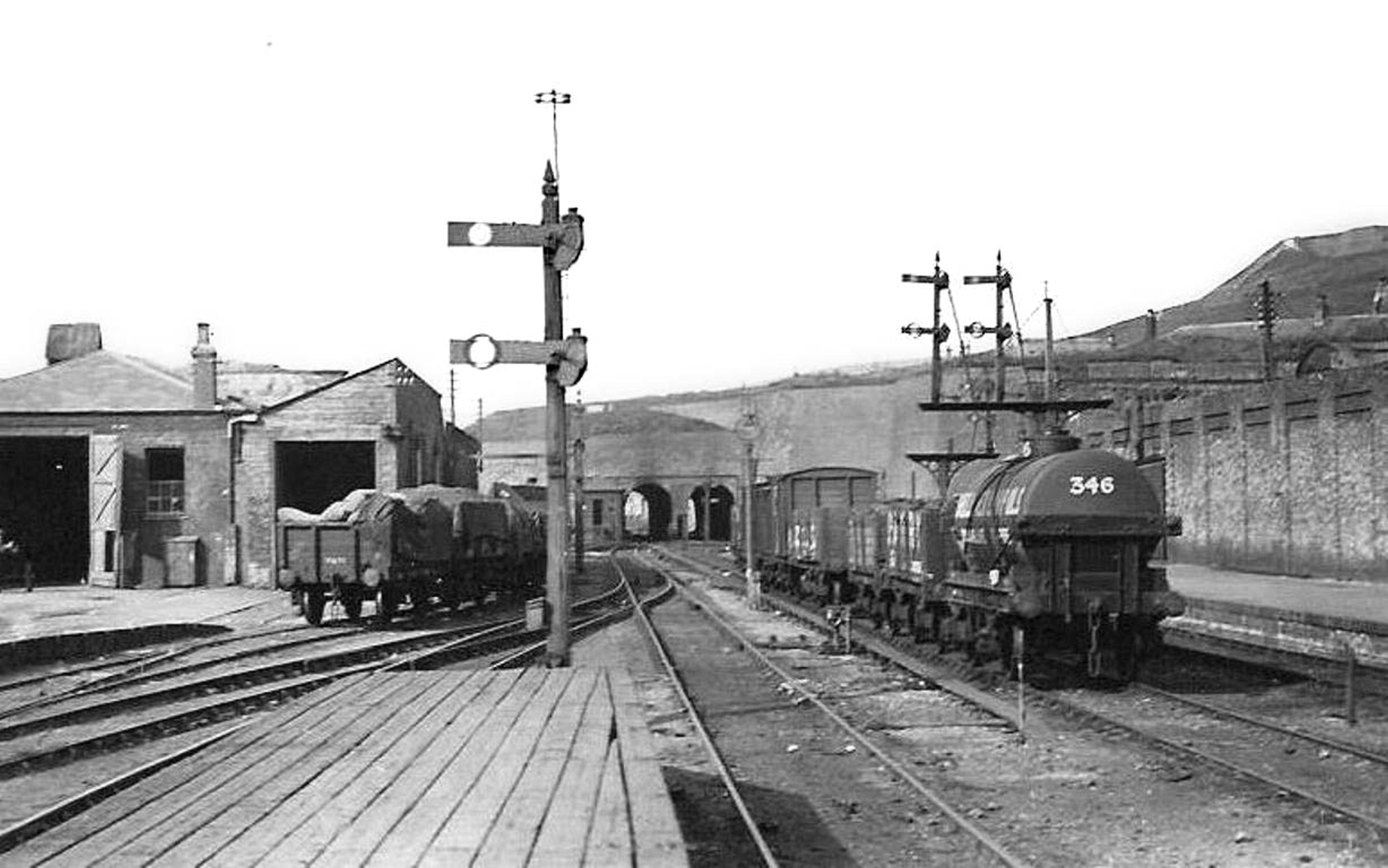
The reopening of the line between Dover and Folkestone took place on 11 August 1919 the line having been reconstructed during the spring and early summer. Except for the part used as mortuary the Town Station was closed. It was decided to convert the portion nearest the Lord Warden Hotel into offices for the Marine Department. The engine sheds from Priory Station were moved onto the site and in September 1920, the rear of the Town Station was turned it into a lock-up garage, complete with petrol pumps!

SECR became part of Southern Railway that came into operation on 1 January 1923. The Marine Department offices at the old Town Station were converted into offices for the operating staff of the Eastern Division who were responsible for 744 miles of railway. Another part of the old station was demolished. Three years, in February 1926 work started on the construction of a seawall using rubble created by the levelling part of Archcliffe Fort.
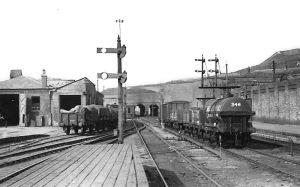
Former Dover Town Station late1920s. Archcliffe Fort on the right. Nick Catford

Former Dover Town Station late1920s. Archcliffe Fort on the right. Nick Catford

The old four-line railway track was replaced and by Act of Parliament, the footbridge spanning the railway to a promenade on Shakespeare Beach connected with the then landward side footpath. New engine sheds were built nearby and were opened on 9 November 1929. A large coaling tip was erected and what remained of the Town Station was demolished except for the offices. In October 1934 the Southern Railway Marine Department Divisional were moved from Admiralty House, on Marine Parade, back to their original offices in the old Town Station!

 Centenary celebrations of the Opening of the South Eastern Railway - Dover Express 11.02.1944

Centenary celebrations of the Opening of the South Eastern Railway – Dover Express 11.02.1944

In February 1944, during the dark days of World War II (1939-1945), a centenary celebration of the railway coming to Dover was held at the Maison Dieu. Opened by Dover’s Member of Parliament, Colonel John Jacob Astor, the exhibition was an upbeat affair looking forward to a positive future for Dover’s railway connections. Albeit, post World War II developments finally saw the end of what was left of the Town Station. The desolate site is used as a lorry/ car park. A sad ending to what was Dover’s first railway station.
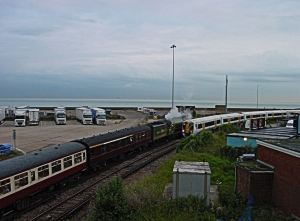
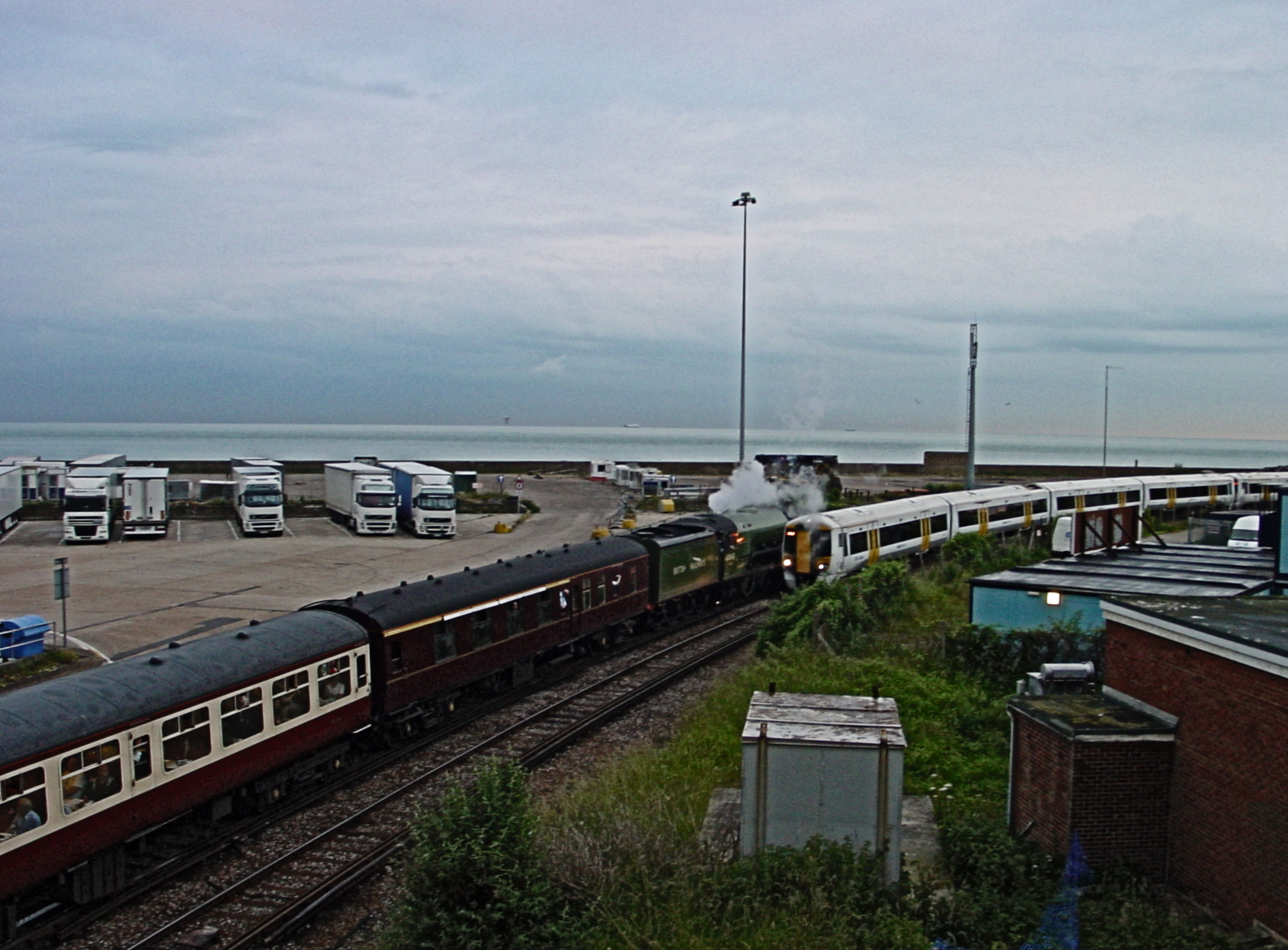
Town Station site today with the Tornado in foreground. Alan Sencicle 2009.

Town Station site today with the Tornado in foreground. Alan Sencicle 2009.


  • Presented:
    15 April 2014

For more information:

www.disused-stations.org.uk


Posted in Businesses, II. South Eastern Railway Company and Town Station, Railways, South Eastern Railway Company and Town Station | Comments Off on South Eastern Railway Company and Town Station

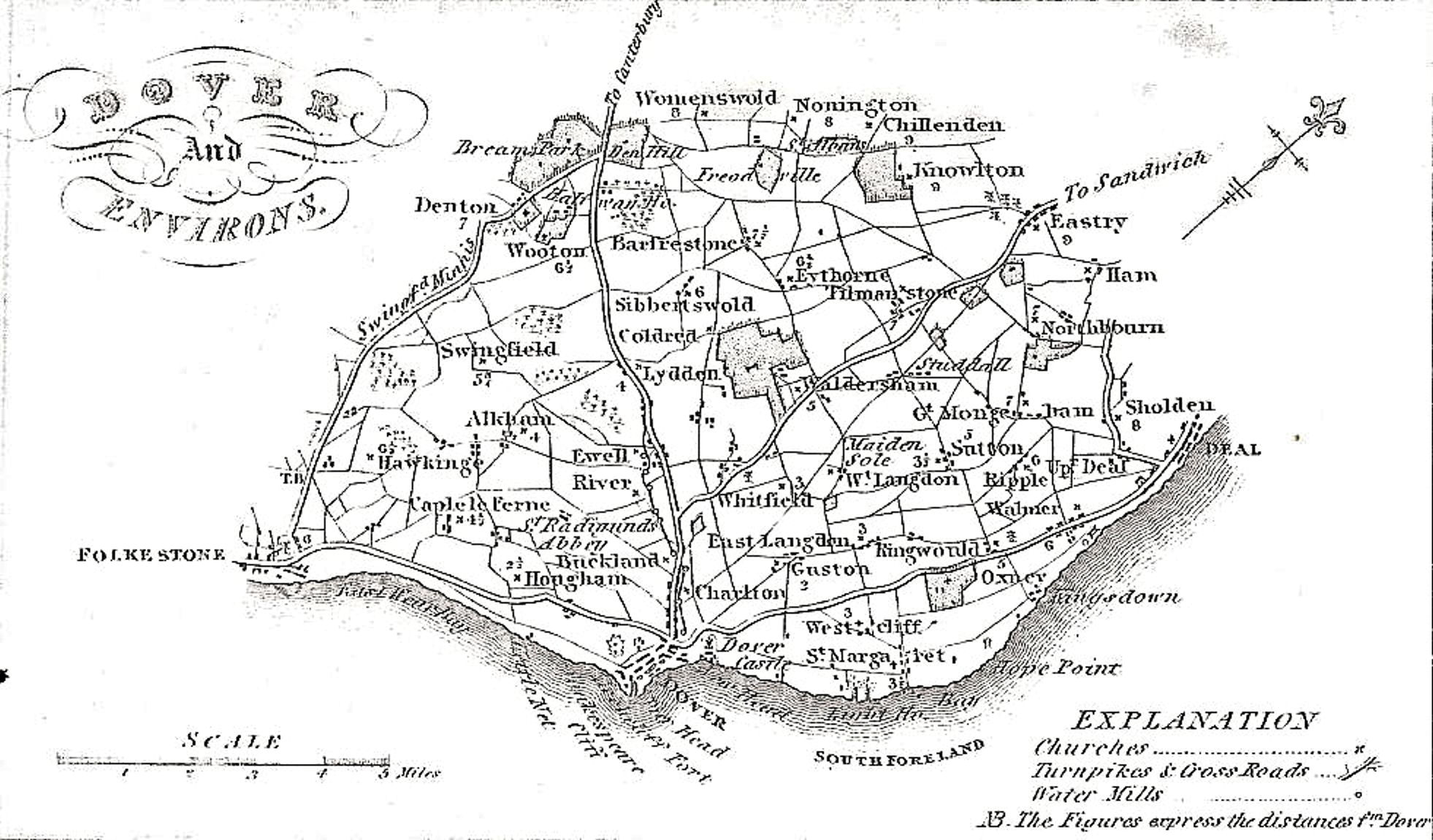
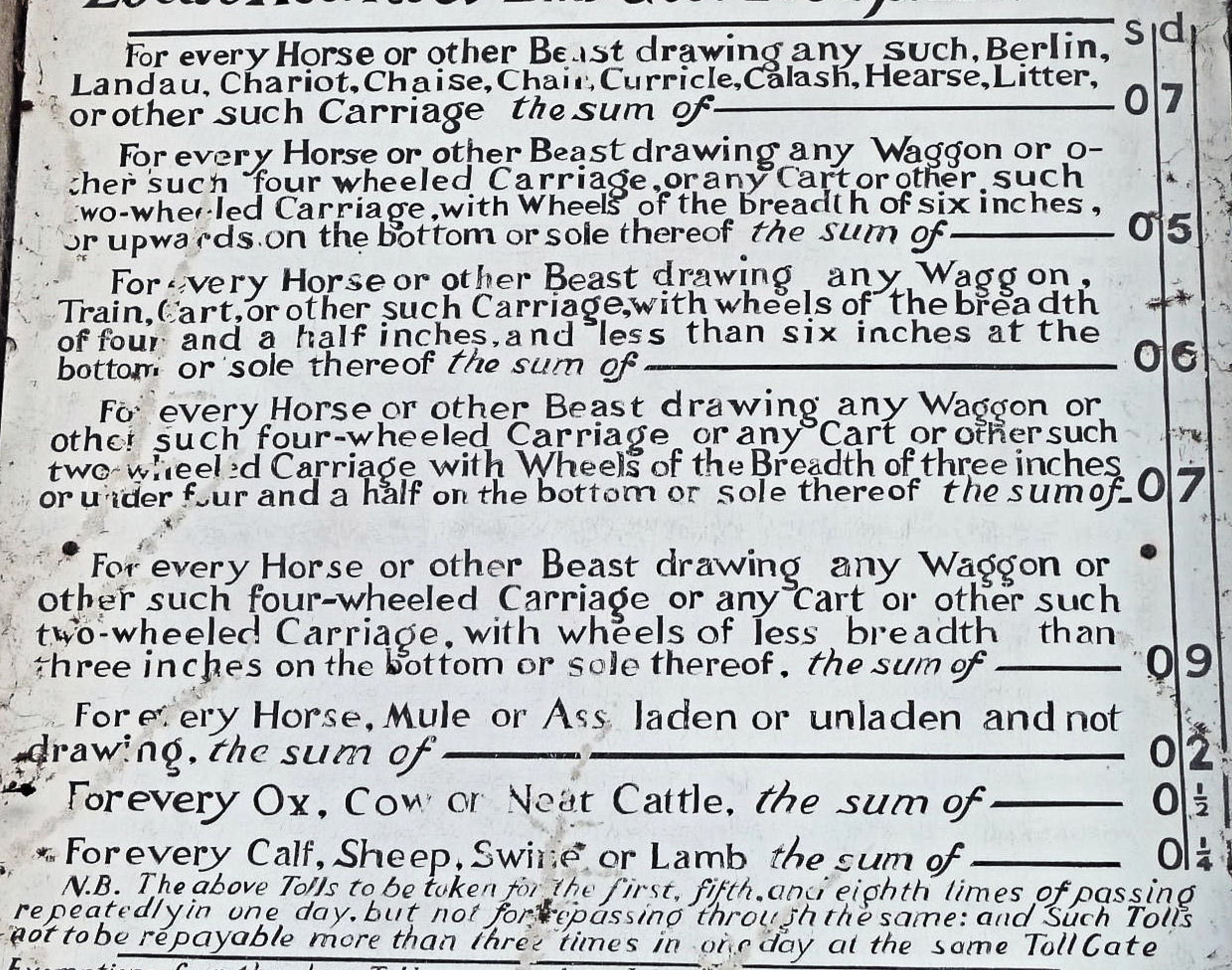
Turnpikes – an important part of Dover’s Road net work

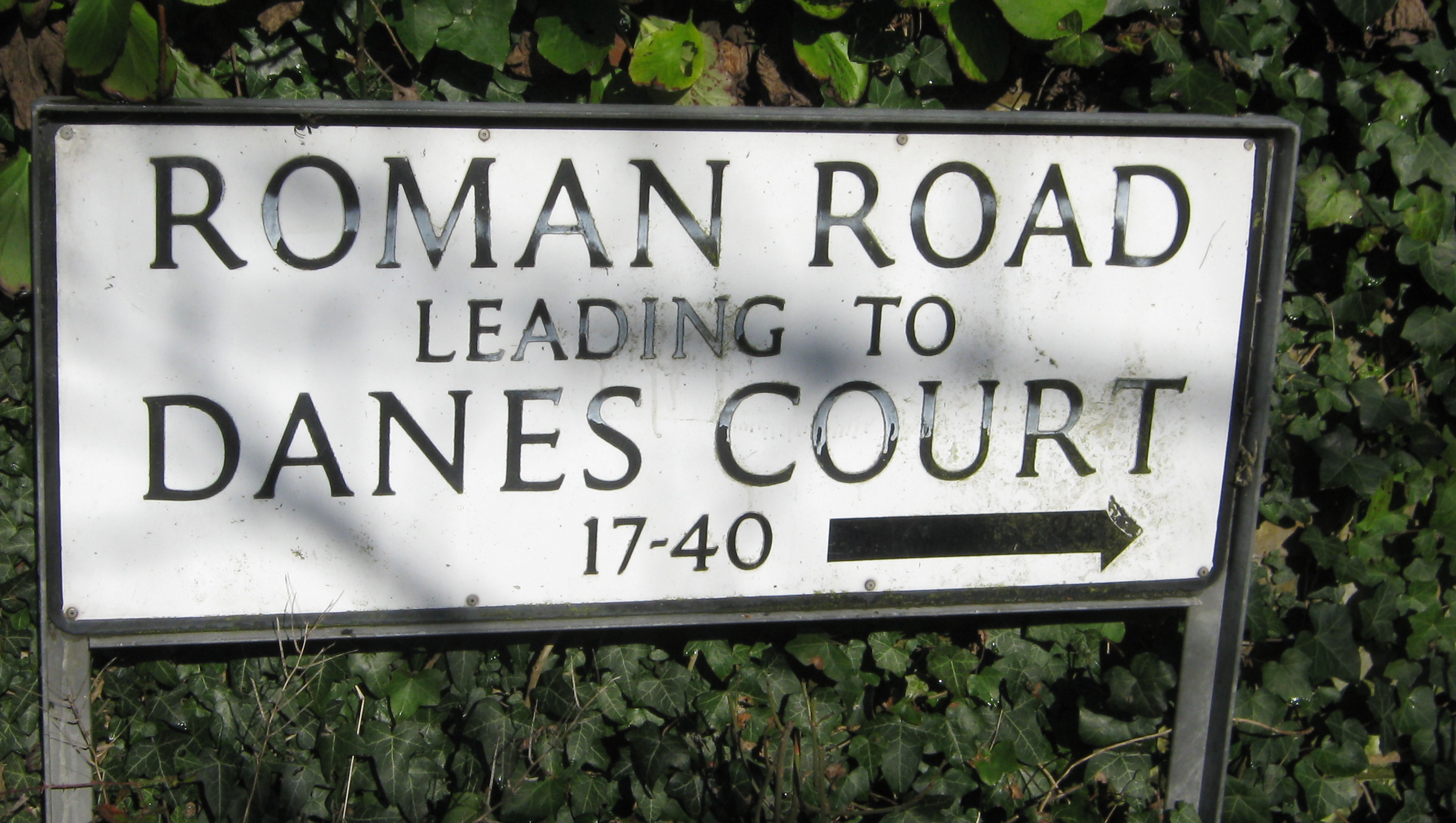
Roman Road out of Dover beside going to Danes Court also goes towards Richborough

Roman Road out of Dover beside going to Danes Court also goes towards Richborough

Many main roads (non-motorways), as we know them today, were originally dirt tracks that evolved by folk going from place to place using the easiest possible route. When the Romans invaded the island they straitened and paved roads to enable their armies to move fast – Watling Street from Dover to London (A2) and the Great North Road between London and York (A1) are classic examples of these. From Dover, there were two Roman roads. The first was Watling Street that crossed the River Dour by a ford where Buckland Bridge is today, up Crabble Hill, through Kearsney, Temple Ewell, Lydden and on to Canterbury.

The second road went to Richborough, probably crossing the River Dour where Bridge Street bridge is today and then ran up Frith Road, Old Charlton Road and east over the Downs. Indeed, this is now part of the North Downs Way and a section is still called the Old Roman Road. It is believed by some archaeologists that there was a third Roman Road that went westward, over the cliffs from the town towards the Roman settlement of Lympne.

Travelling, in Saxon and medieval times, was mainly on horseback with merchandise been carried on a packsaddle. The roads followed broadly existing routes but as horses did not like walking on the stone roads that the Roman’s had left the long-term effect were meandering routes. The main road out of Dover was through Biggin Gate and passing between the Maison Dieu and St Martin’s Priory. A record of 1229 refers to a ‘Grant to the Brothers of the Maison Dieu of the porch which they have built in the King’s highway in front of the hospital.’ (Calendar of Charter Rolls 1226-57, p98). The road then continued to the modern junction of Bridge Street and London Road where it split following the two ancient routes.

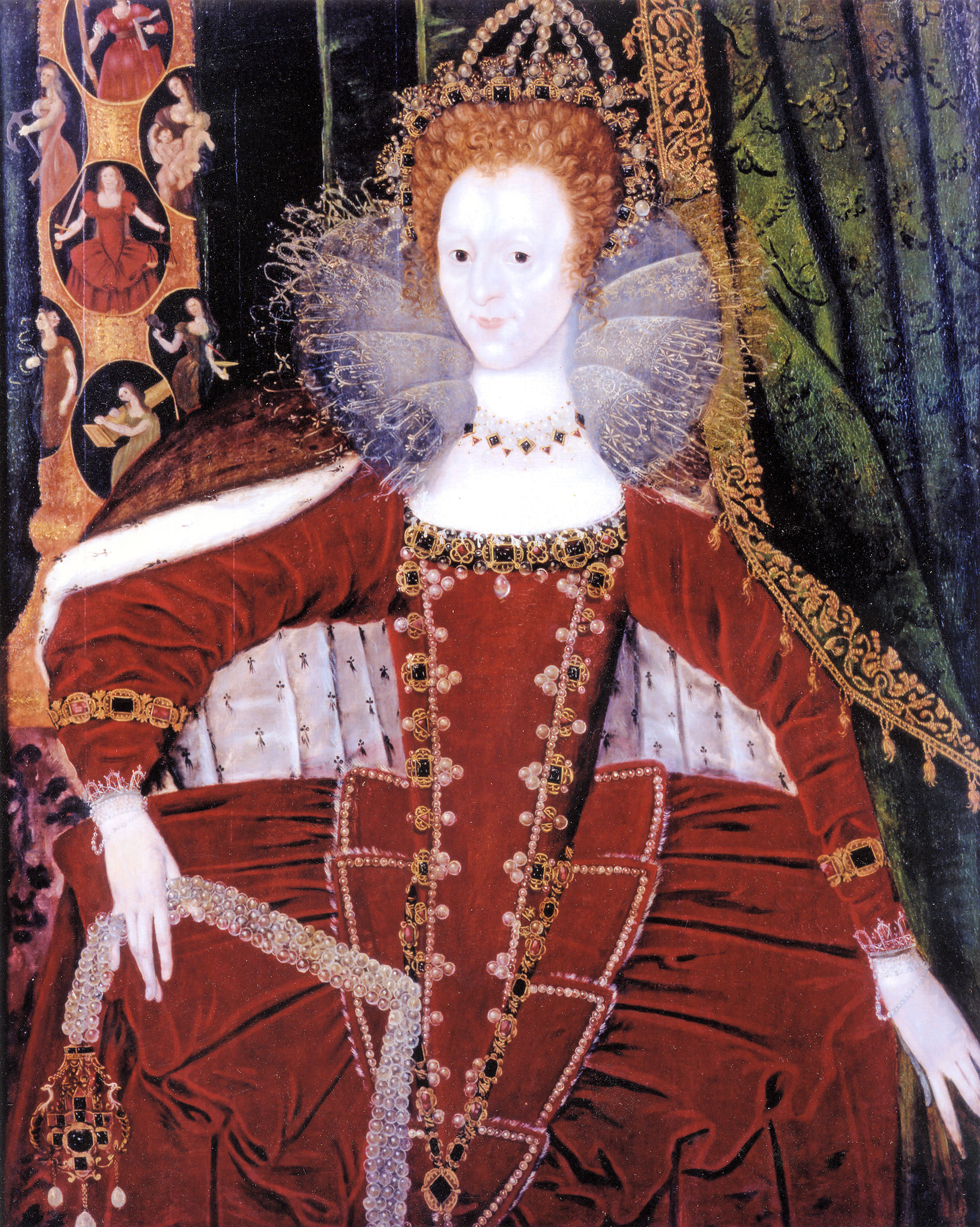
Elizabeth I came to Dover in 1573 travelling over Western Heights and through the Cow Gate and into the town by Queen Street that so named in her honour. Dover Museum

Elizabeth I came to Dover in 1573 travelling over Western Heights and through the Cow Gate and into the town by Queen Street that so named in her honour. Dover Museum

It was by a third route from the west, over the cliffs to Shakespeare Cliff; across to the Western Heights and entering the town through the Cow Gate, that Elizabeth I (1558-1603) came in the autumn of 1573. From Cow Gate, her entourage passed down a thoroughfare that was then renamed Queen Street in her honour. There were other ways from Folkestone, through Elms Vale and the Dover Priory or via Alkham and Swingfield Minnis.

By this time not only did the roads meander they were almost impassable in wet weather and when it was in dry, they were dusty and very uneven. Under the 1555 Statute of Highways, each person within a parish had to help to repair the roads within for six days under the supervision of a Highway Surveyor. He was chosen each year from among the parishioners but was not paid and often did not feel obliged to maintain the roads to a higher standard than needs of the parish necessitated.

During the Interregnum (1651–1660), Oliver Cromwell tried to introduce a ‘Minister of Roads’ to co-ordinate and oversee for road maintenance but was not successful. Following the Restoration (1660), with the increase use of coach and carriage traffic, it was recognised that something must be done. From 1663 a series of individual Turnpike Acts were passed giving the right to trustees, usually local gentry, employers or/and merchants, to collect tolls to pay for the repair of lengths of roads. The office was a public service and very few trustees expected a return but if any profits were made, they were allowed to keep them. Of interest, the word turnpikes came from the medieval barriers used to prevent animals from passing and were made of two bars topped with pike heads.

East Kent - showing turnpikes and large Estates 1828

East Kent – showing turnpikes and large Estates 1828

The first two Turnpike Acts appertaining to Kent were passed in 1709 and 1711; these were applicable to the west of Kent. By the middle of that century, many other stretches of roads had been turnpiked including, in 1753, the Dover to Barham Downs part of the London road. The first tollhouse in Dover was opposite the present Eagle Inn on London Road that had long marked the boundary of the town. Indeed, it was here that the gallows were erected.

The road, under the jurisdiction of Act, followed the old road crossing the River Dour at Buckland. There in 1799, the River Dour was deepened and narrowed in order to build the brick bridge paid for out of the toll money. The first two Turnpike Acts appertaining to Kent were passed in 1709 and 1711; these were applicable to the west of Kent. By the middle of that century, many other stretches of roads had been turnpiked including, in 1753, the Dover to Barham Downs part of the London road. The first tollhouse in Dover was opposite the present Eagle Inn on London Road that had long marked the boundary of the town. Indeed, it was here that the gallows were erected. The road, under the jurisdiction of Act followed the old road crossing the Dour at Buckland over a brick bridge paid for out of the toll money. For those who wished to avoid paying tolls, they could still follow the old route through the ford at Bridge Street. That is until the tollgate was erected on Crabble Hill and from that money the bridge on Bridge Street was built in 1829.

The Act to turnpike the stretch of the Dover-London road, like most other turnpike acts, provided for the appointment of four paid officers – the clerk, treasurer, surveyor and the collector of tolls. The clerk’s duty was overseeing the accounts and, in most cases, they were solicitors by profession. In the majority of cases, the treasurer was a banker while a highway surveyor undertook the maintenance.

Turnpikes - Details of Charges following the General Turnike Act of 1773

Turnpikes – Details of Charges following the General Turnike Act of 1773

He would employ the men to carry out the road maintenance and they would come from all sorts of backgrounds. In Dover, besides the Elizabethan statutory 6 days a year for every resident to maintain roads, most road workers were prison inmates from either the town gaol or prisoners of war held at the Castle. However, the weight and width of vehicle wheels regularly using a road would cause it to disintegrate. For this reason, the General Turnpike Act of 1773 was introduced to standardise a series of additional tolls based on the width of the wheel and the weight of the loads a vehicle was carrying. Assessing the latter, however, was fraught with difficulties.

Dover-Deal Road Toll House on right c1860

Dover-Deal Road Toll House on right c1860

Last was the Toll Collector who was in charge of the gatekeepers who actually manned the gates. The Toll Collector’s job was to police the gatekeepers and the travellers. The gatekeepers were on duty 24/7 so his residence was the tollhouse. If he was caught being dishonest, for instance misrepresenting the amount of money he had collected, then he would loose both his job and his home. Travellers would try to misinform the gatekeeper in order to pay less, or one would distract him while others sneaked passed or, worse still, physically attack the toll keeper and steal his takings.

The Collectors would often misrepresent the amount they had collected from the individual tollhouses. To try to stop such abuses and to ensure that Collector was efficient at policing the system was modified by the Toll Collector’s position being put out to tender. The Collector paid an agreed sum to the trustees for his position and it became his vested interest to ensure that the takings exceeded the amount he had paid.

Gate Inn, Crabble Hill 1869 by James M Tucker painted 1912, shows the toll house further down the hill from the inn - Dover Museum

Gate Inn, Crabble Hill 1869 by James M Tucker painted 1912, shows the toll house further down the hill from the inn – Dover Museum

Some towns put the toll gate system to other uses. The Dover Paving Commission, set up in 1778, concluded that the sanitary arrangements, pavements and street lighting in the town left a lot to be desired. Except for street lighting, which would have made smuggling difficult, they introduced a number of reforms. To pay for these ‘Coal Dues’ were introduced on coal transported through the town. One of the main collecting points was the Crabble Hill tollhouse, owned by the Turnpike Trust. This was on the corner of Dodds Lane further down Crabble Hill from the old Gate Inn.

In 1810 the Paving Commissioners were authorised to raise £11,000 and double their former duties and in 1830 a third act was passed enabling Commissioners to raise £10,000 on the security of the turnpike tolls and the rates. In 1835 a fourth act was obtained for three years only to raise £5,000 on the security of the rates for the specific purpose of making improvements to certain street. The turnpike tolls to be appropriated to paying off an outstanding debt of £10,000, and when this was paid, the tolls were to be discontinued. In realty the Paving Commission ceased before the debt was paid.

The introduction of the mail coach in 1784 was the catalyst for improvements in stagecoach design and adherence to maintaining tight schedules. Increased speed, which in turn increased demand, meant the increase in the number of stages and changes of horses. These led to a change in attitude of Turnpike Trusts and stones were used to provide a solid road surface while reducing steep gradients was undertaken where possible. This was the reason why the then very steep London Road between Crabble and Kearsney, was excavated to the present road.

It was not until the reign of Henry VII (1485-1509) that the area under the cliffs to western side of the town became passable. There, in what became known as the Pier district, locals built their dwellings and thoroughfares evolved. One such thoroughfare passed close by the cliffs where the chalk, excavated from the cliffs, was turned into lime and appropriately the thoroughfare became known as Limekiln Street. By the 17th century, the exit route from the town westward was leaving by the Snar Gate, near the shore, along a track that evolved into Snargate Street and then past the limekilns.

From there, the track that went by Hay Cliff (Haycliffe and now Aycliffe) eventually became the Folkestone Road. By the middle of the eighteenth century, the Pier district was the busiest part of Dover. Captain John Bazely was elected Mayor for the second time in 1761 and he succeeded in piloting through Parliament clauses in a Turnpike Bill. These resulted in the making of the first turnpike road from Dover to Folkestone, along this route, in 1763. The toll road eventually joined up with the Sandgate turnpike of ten years before and thus the new toll road became known as the Dover-Sandgate Turnpike.

Castle Hill Tollhouse. Dover Museum

Castle Hill Tollhouse. Dover Museum

The exit from Dover eastwards, for centuries, had been by the narrow, winding St James Street followed by a steep ascent landwards of the Castle and along the Downs following a similar route to the present A258 to Deal and Sandwich or through Guston to Whitfield and on to Sandwich. In 1797, the road from Dover to Sandwich via Deal was turnpiked. The Guston turn-off on the A258 is approximately, where the tollhouse stood and the next one along the Deal Road was near the present Swingate inn – where the A258 still kinks slightly. From the tolls collected, the gradient up Castle Hill was made easier by the cutting of a zigzag route towards the top of a lane that became Laureston Place.

Whitfield Toll House. Dover Museum

Whitfield Toll House. Dover Museum

Besides making it easier for horses to climb the hill, the zigzag slowed descending the vehicles going down. Banker, John Minet Fector junior (1812-1868), built a mansion for his mother part way up the hill. Her maiden name was Laurie from which Laureston Place was derived. In 1797, during the Napoleonic Wars (1793-1815), a military road was laid from Western Heights to the Castle cutting across the Stembrook marshland. Following the Wars, the Military Road was handed over to the Dover and Deal Turnpike Trust and it eventually became Castle Street. The Dover turnpike to Sandwich through Waldershare went by way of the London Road turnpike to Kearsney, then up Whitfield Hill to Whitfield and on to Waldershare, was enacted in 1801. 

Charlton High Street abutted with London Road, Buckland at Bridge Street, opposite the Eagle and the road to Tower Hamlets. This, for centuries called ‘Paul’s Corner’ and the nearby pasture land was bought, in September 1647, by the Dover Alms House Trust. When the Turnpike Act came into force the land was let to the Turnpike Trust for a tollhouse and stone yard for road maintenance. In July 1840, the land adjoining the tollhouse was sold on a 62-year lease, and adjoining frontages as far up London Road as the Almshouses lands ran, on a building lease. The tollhouse and gate was removed in 1855 on which the Falcon Hotel, demolished in 1969, was built and the shops along London Road that we see today. The leases on the shops terminated in 1902 and reverted back to the Dover Municipal Charities who granted them for 99 years to the London, County & Westminster Bank Ltd. In 1904 the Bank advertised 4 and 5 London Road and became  Turnpenny’s Furniture shop.

Most Turnpike Acts ran for twenty-one years under the misguided assumption that once an adequate road had been laid it would look after itself. The management of each gate was lasted a year and could be lucrative especially on main coach roads. Pigot’s Directory of 1824 lists two mail coaches leaving Dover from the Ship Inn, Custom House Quay, at 06.30hrs to Folkestone, Hythe and Romney and another at 08.00hrs to London. Other passenger coach services included a regular service to London picking passengers up at their homes, hotels or inns at 06.00hrs, 10.00hrs and 18.00hrs.

There was a regular service to Folkestone Sandgate, Hythe and Maidstone at 07.45hrs from the Gun Inn and Packet Boat Inn on both Strond Street and the Pilot Office by the harbour. In the afternoon, the coach left at 15.00hrs but only went as far as Hythe. The coach to Deal, Sandwich, Margate and Ramsgate left from Union Street at 10.00 and 16.00 daily and another to Deal left from Gun and Packet Boat Inns at 18.00hrs. During the summer season, additional coaches went to Brighton, Margate and Ramsgate throughout the day.

Carriers also operated out of Dover taking both personal and commercial goods along the turnpiked roads. Rutley and Co of Snargate Street operated vans daily to London. Grants van left from the Fountain Inn, in the Market Square, every morning except Sunday, to Canterbury. Another van left for Canterbury from the Plume of Feathers, Limekiln Street every morning except Sunday at 08.30hrs. Jones van left for Deal from the Fountain Inn and the nearby Fleur de Lis every morning except Sunday while another company had vans going to and from Deal on request and they left from the Fox, St James Street, every morning except Sunday at 09.30hrs. The Lydd and Romney cart left from the Packet Boat inn every morning except Sunday at 09.00hrs while the Folkestone, Sandgate and Hythe van went from the Gun and the Packet Boat Inns daily except Sunday at 15.30hrs. The van for Elham went from the Packet Boat Inn on Thursday afternoons – thus there were regular services!

By the 1830s, the development in road surfaces enabled even speedier and more comfortable travel. Initially, a Turnpike Trust’s well-laid road consisted of a foundation of large, ideally interlocking, stones placed broad end downwards. On these were smaller stones or in Dover, pebbles from the beach, were laid. The iron-shod wheels of the coaches would grind the stones into even smaller pieces creating a firm, waterproof surface. Roads had a slight camber to encourage rainwater to run to the side and occasionally there were cross-drains leading to ditches on either side of the roads. On country roads, these can still be seen.

John MacAdam (1756–1836) had, from 1816, revolutionised road building by doing away with the foundation stones as unnecessary. Instead, roads were laid on a ten inch thick layer of smaller stones that finished above ground level. They again were grounded in by the iron wheels of coaches. With Dover’s, pebble beach the turnpike roads were considered amongst the best and cheapest in the county!

In 1833, Alexander Bottle paid £198 for the post as Collector of the Castle Hill gate tolls. Six years later the bidding was such that he paid £326! This reflects the increase in the volume of traffic using the Dover-Deal Road and there was a similar rise in the amount paid for Dover’s other tollhouses. Nevertheless, the days of the mail and stagecoaches travelling along turnpikes were numbered. The first railway line to Dover was opened by South Eastern Railway, from London, in 1844.

Dissolution of the Folkestone Road Turnpike - 29.09.1871

Dissolution of the Folkestone Road Turnpike – 29.09.1871

Although the Dover-Deal railway line did not open until 1881, the Castle Hill tollhouse had closed in 1878. There had not been a bidder for that tollhouse for a number of years so the tolls had been collected at the expense of the Trust. The last toll keeper there was Thomas Munn while the occupant of the tollhouse went by the name of ‘Cock Linnet’, who also worked as a shepherd. After losing his home, Linnet became a night watchman with the Corporation.

Cottages built by Major Robert Lawes to replace the toll house on Folkestone Road. AS 2014

Cottages built by Major Robert Lawes to replace the toll house on Folkestone Road. AS 2014

The Folkestone Road via Limekiln Street was dis-turnpiked in 1783 due to it becoming ‘very dangerous from the falling cliffs.’ The present Folkestone Road through the Farthingloe Valley was built out of the proceeds and the new road opened in 1783. The tollhouse was at the junction of Folkestone Road with the then Elms Road, now Elms Vale Road. The turnpike continued until 1877 when the Trust applied for renewal to Parliament but a large body of Dover petitioners successfully opposed the application and the tollhouse was demolished. The present cottages were built shortly afterwards by Major Robert Lawes and the horse trough, or more correctly cattle and dog drinking fountain, that once stood nearby is now in the Market Square.

  • Published:
  • Dover Mercury: 31 May 2007


Posted in Local Government, Routes, Turnpikes - an important part of Dover's Road net work, Turnpikes - an important part of Dover's Road net work | Comments Off on Turnpikes – an important part of Dover’s Road net work