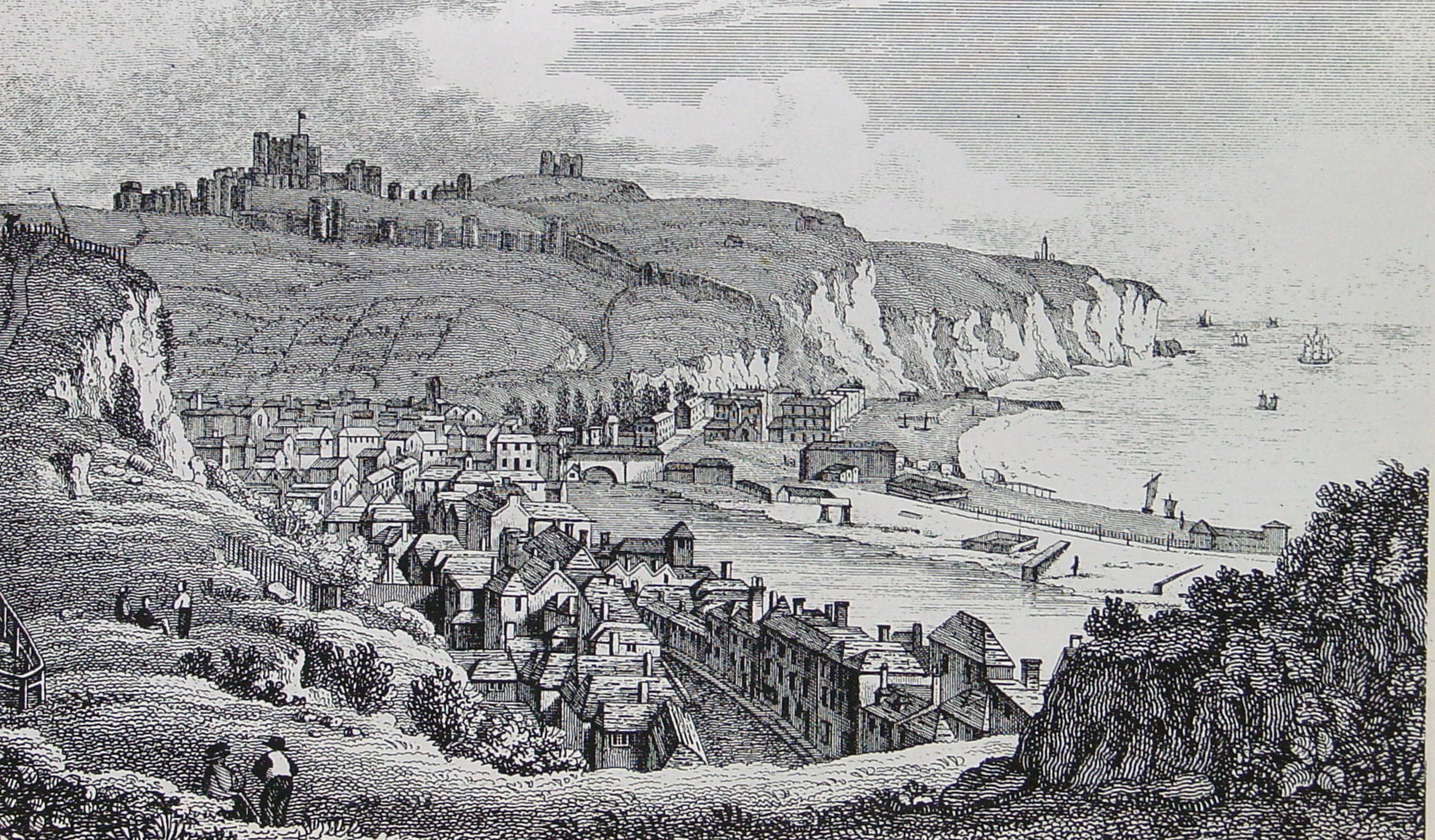
110 London Road

110 London Road, Buckland

110 London Road, Buckland

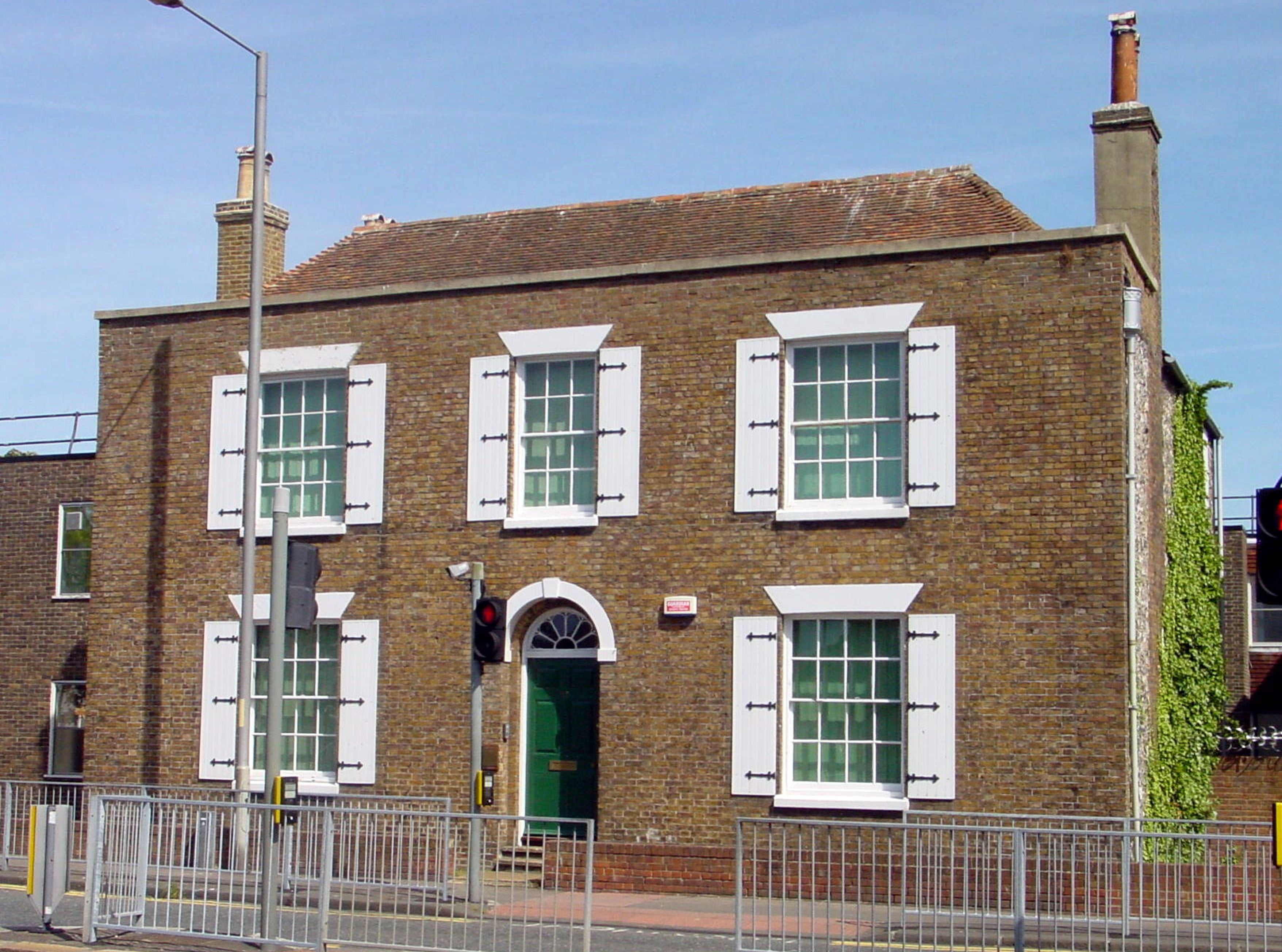
Facing Coombe Valley Road is a late 18th century house, once-upon-a-time called Bucklands, which was once under threat of demolition. It was part of ‘old Dover’ that the council, at the time, wanted knocked down to make way for modern concrete and glass office development. Luckily, a building preservation order protected it, but the adjacent cottages were demolished and the modern office block was built around the house.

Listed as 110 London Road, the house was built by Sir Thomas Hyde Page, the military engineer responsible for a number of important defence works at the Castle during the American War of Independence (1776-1783). He was also responsible for starting what eventually became the Western Heights fortifications, building four shore batteries (since demolished) which together with Archcliffe Fort and a canal along the seafront, made an effective line of defence during the Napoleonic Wars (1793-1815).

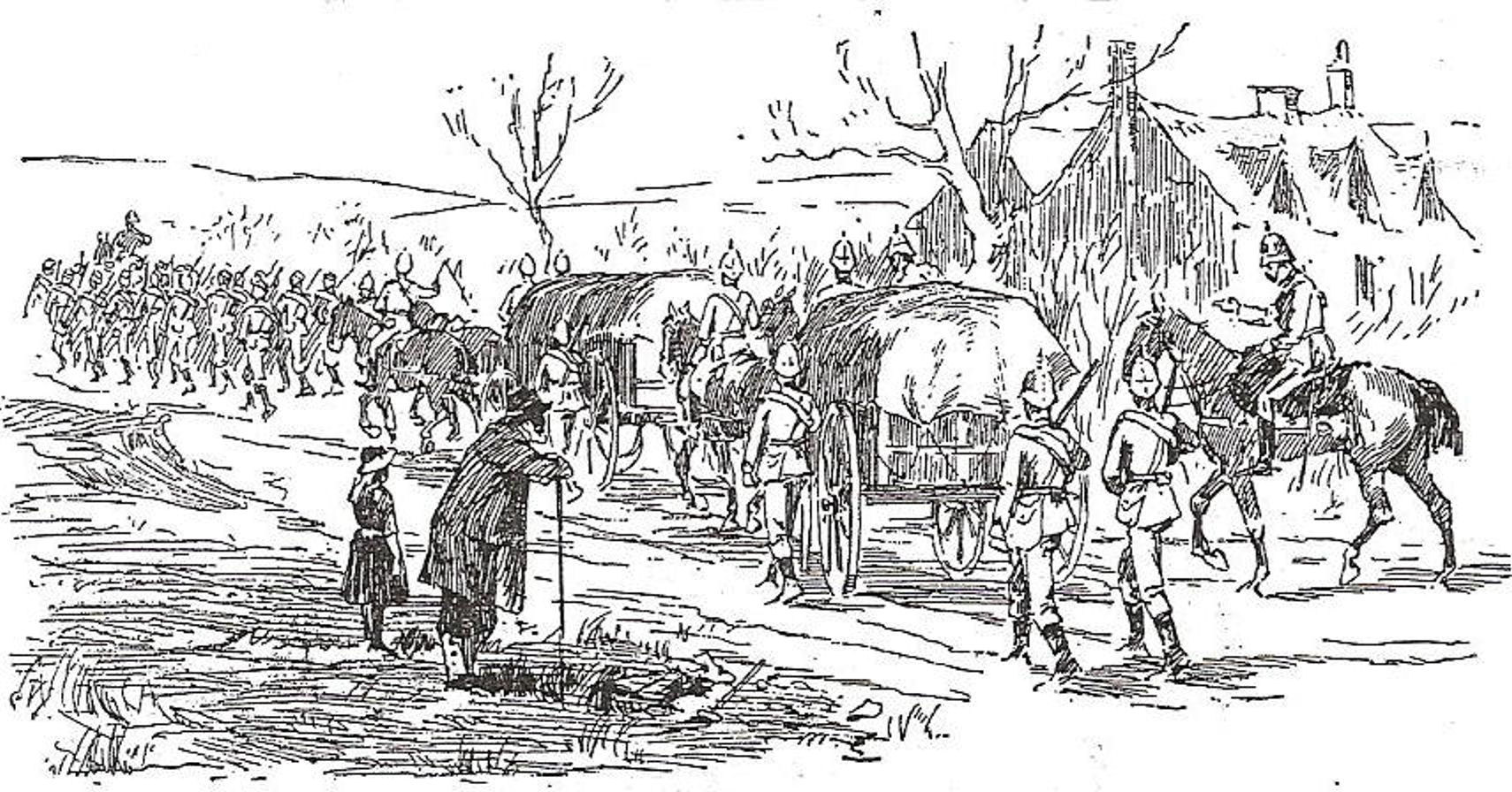
 Volunteers Marching Column with Transport Waggons - Penny Illustrated 28.03.1891

Volunteers Marching Column with Transport Waggons – Penny Illustrated 28.03.1891

After the War of Independence, Thomas built the mansion in Buckland. The extensive gardens of which ran from present day Lorne Road to Cherry Tree Avenue and extended to the east bank of the Dour, which was crossed by a ford. His wife, Dame Albina, took charge of the gardens and were said to be the most beautiful in East Kent.

Meantime, Sir Thomas interested himself in local affairs and was responsible for the founding of the Dover Volunteer Association, the origin of the present Territorial Army. Dame Albina Page died in 1804 and about 1810, Sir Thomas sold his extensive lands in Buckland and Charlton to William Kingsford for £5,750 and moved away.

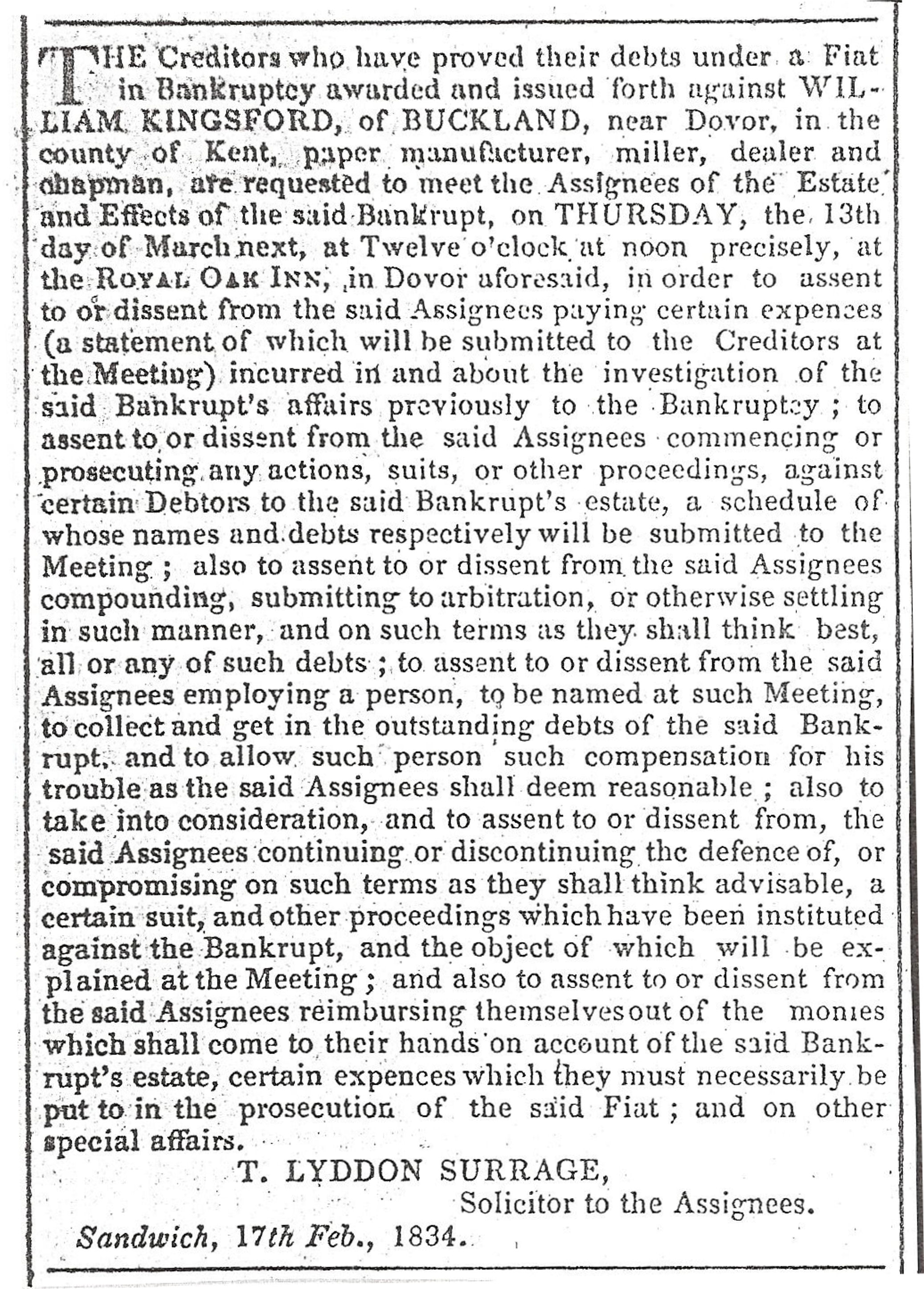
William Kingsford Bankruptcy 17 February 1834

William Kingsford Bankruptcy 17 February 1834

What Kingsford was going to do with the house and garden is unclear, however, on 17 February 1834 he was declared bankrupt and his property was put up for sale. In the sale documents, foundation walls for an oil mill (Lower Buckland Mill) were listed as part of the London Road property. George Hatton Loud bought the house, garden and 130 acres of the Kingsford estate. He enclosed the house and garden with a wall on which was inscribed, ‘This wall built in 1835 is the property of G H Loud.’ The bridge providing access to the east bank of the garden was rebuilt.

In 1835, the boundary of Dover Borough was extended to southern edge of George’s home. Part of his newly acquired lands and properties included Dudmanscombe farmhouse, approximately where the Sportsman pub, on London Road, is today. This now was within Dover town so the farmhouse was demolished and George, Erith and Victoria Streets were built.

Land, at the back of the farmhouse, through which a footpath to Poulton that eventually became Coombe Valley Road ran, George sold to John Finnis, brick maker. He also sold the land for the workhouse, which eventually became Buckland Hospital. Shortly after George was elected to the Town Council and over the next three decades, he farmed the remaining lands, selling off parcels for development when the price was right.

At the time he bought the house and lands, George was about 33 years old and married to Mary Kingsford from St Margaret’s Bay. They had a son, George, born in 1830 and daughter, Caroline, born two years later. In 1836 Georgiana was born and on 19 July 1838 Jane Wood Loud was christened at St Andrew‘s Church, Buckland.

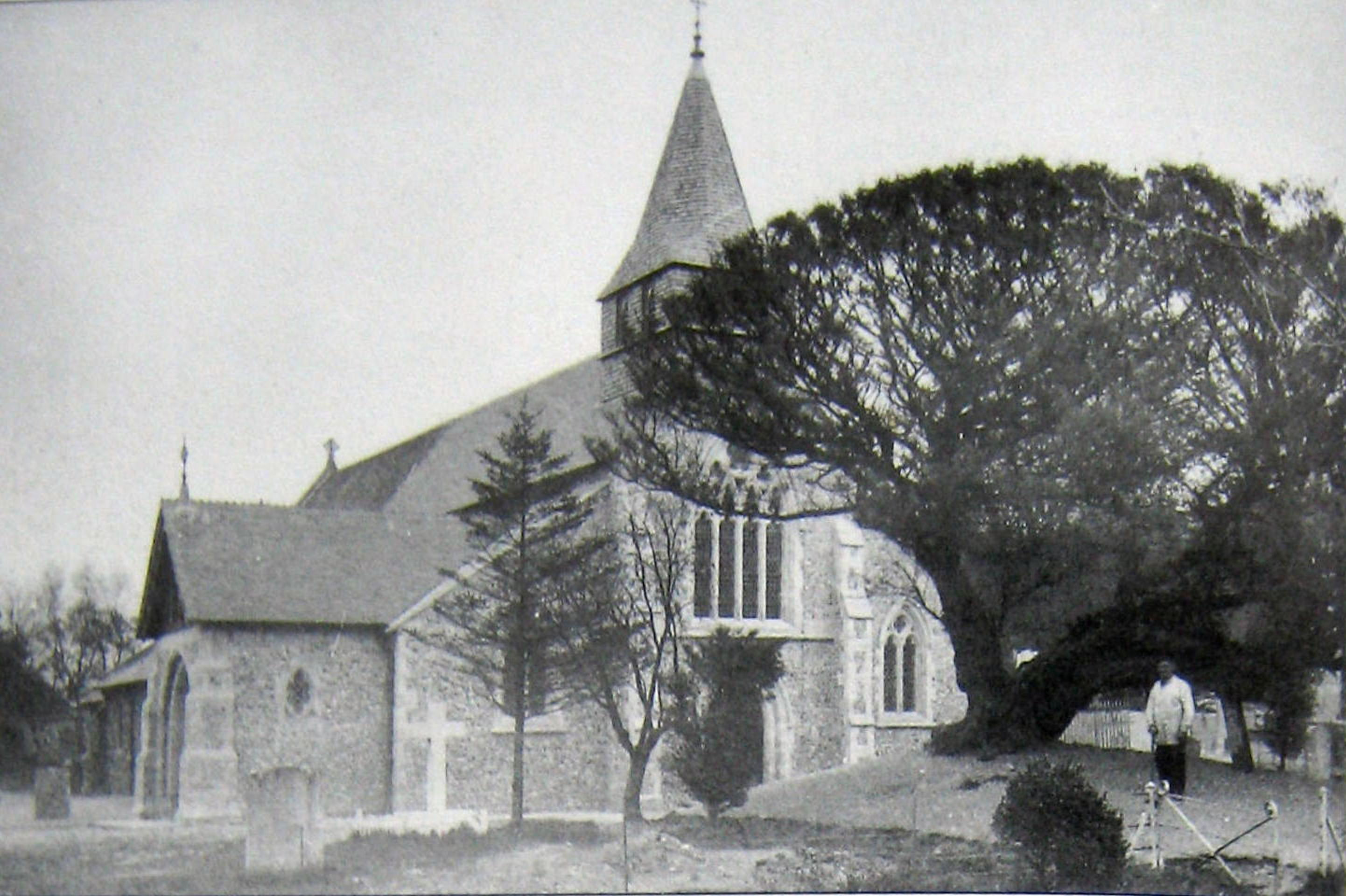
St Andrew's Church, Buckland, circa 1880s. Bob Hollingsbee

St Andrew’s Church, Buckland, circa 1880s. Bob Hollingsbee

In 1844, George, no longer a councillor, received a great deal of praise from the town for his quick thinking when a fire threatened to engulf the Pier District. He was returning in his dogcart from the Folkestone direction and saw Robson’s engineering works, in the highly populated area, on fire. Alarm bells, strategically situated around the town, were sounding and one of the town’s fire appliances was on the way to the disaster. A second one was being hauled to the scene manually and George attached it to his cart and took it to the scene. Eventually eleven appliances, many belonging to the railway company, brought the fire under control.

By the time George Loud died, age 59, on 15 September 1861. His son died three years later so it was Mary, his wife, took over the running of the estate, still selling parcels of the farmland for development when the price was right. The two remaining daughters cultivated the garden, which became as famous as it was in the days of Dame Albina. Mary died in 1871 and Georgiana in 1880, leaving Jane in charge.

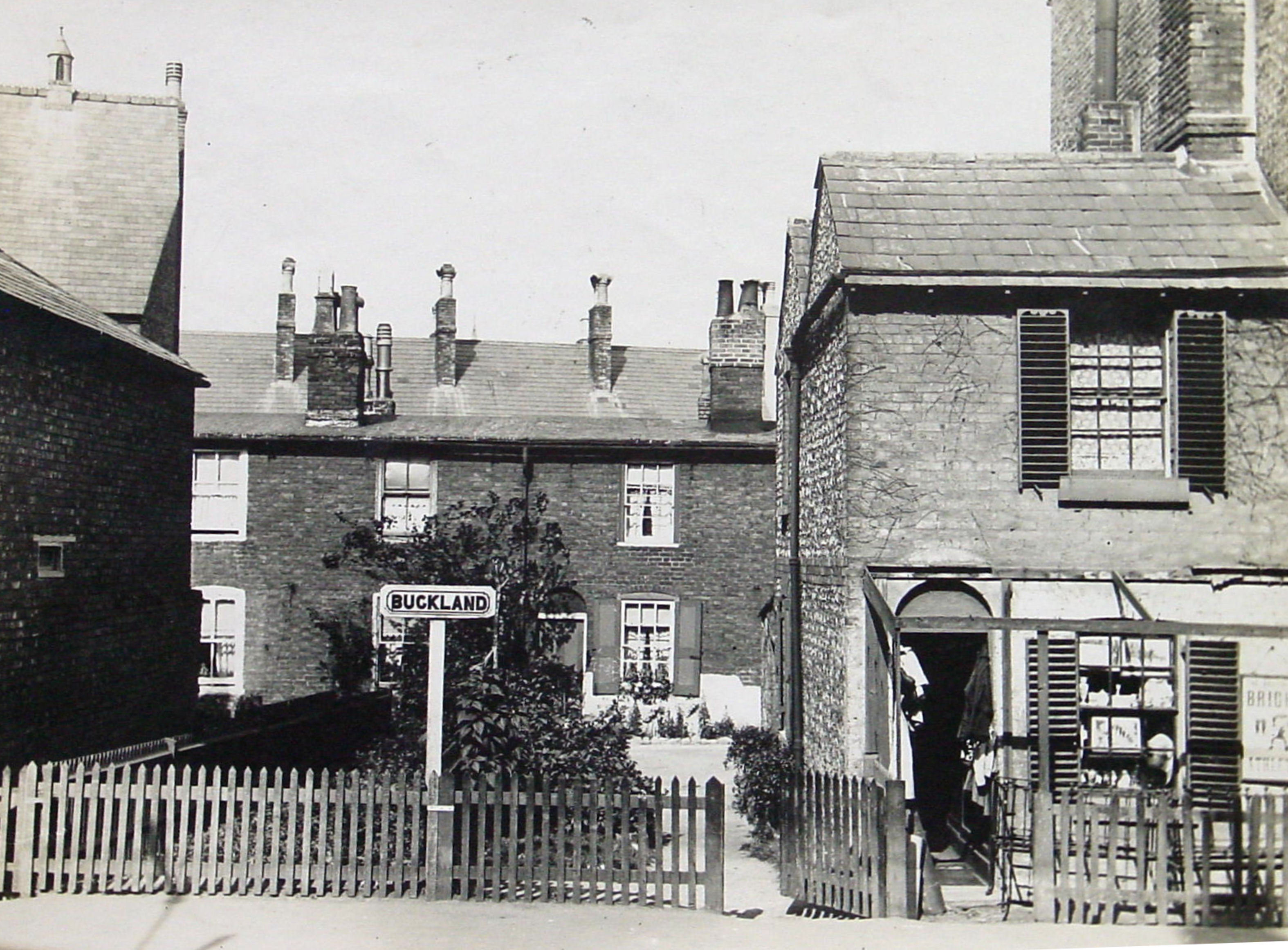
Boundary sign between Charlton with Buckland, London Road, nr Beaconsfield.

Boundary sign between Charlton with Buckland, London Road, nr Beaconsfield.

Jane was to use her remaining years tending the garden, selling off the remainder of her estate and pursuing philanthropic work. Bucklands, the name she gave to her home, still marked the start of Buckland parish even though the civic boundary with Charlton was further south. It was at her house that the beating of the bounds procession started and Jane would provide the victuals to sustain parishioners for the walk around the parameters of the parish. She also conducted meetings at a Mission Hall in Primrose Road, erected about 1893, and provided help to young mothers and ‘fallen women’ of Buckland.

However, she was especially remembered for her kindness to the town’s tram drivers and police officers. During inclement weather, she would ensure that covered jugs of hot coffee and either cakes or sandwiches were placed at pre-arranged points for them.

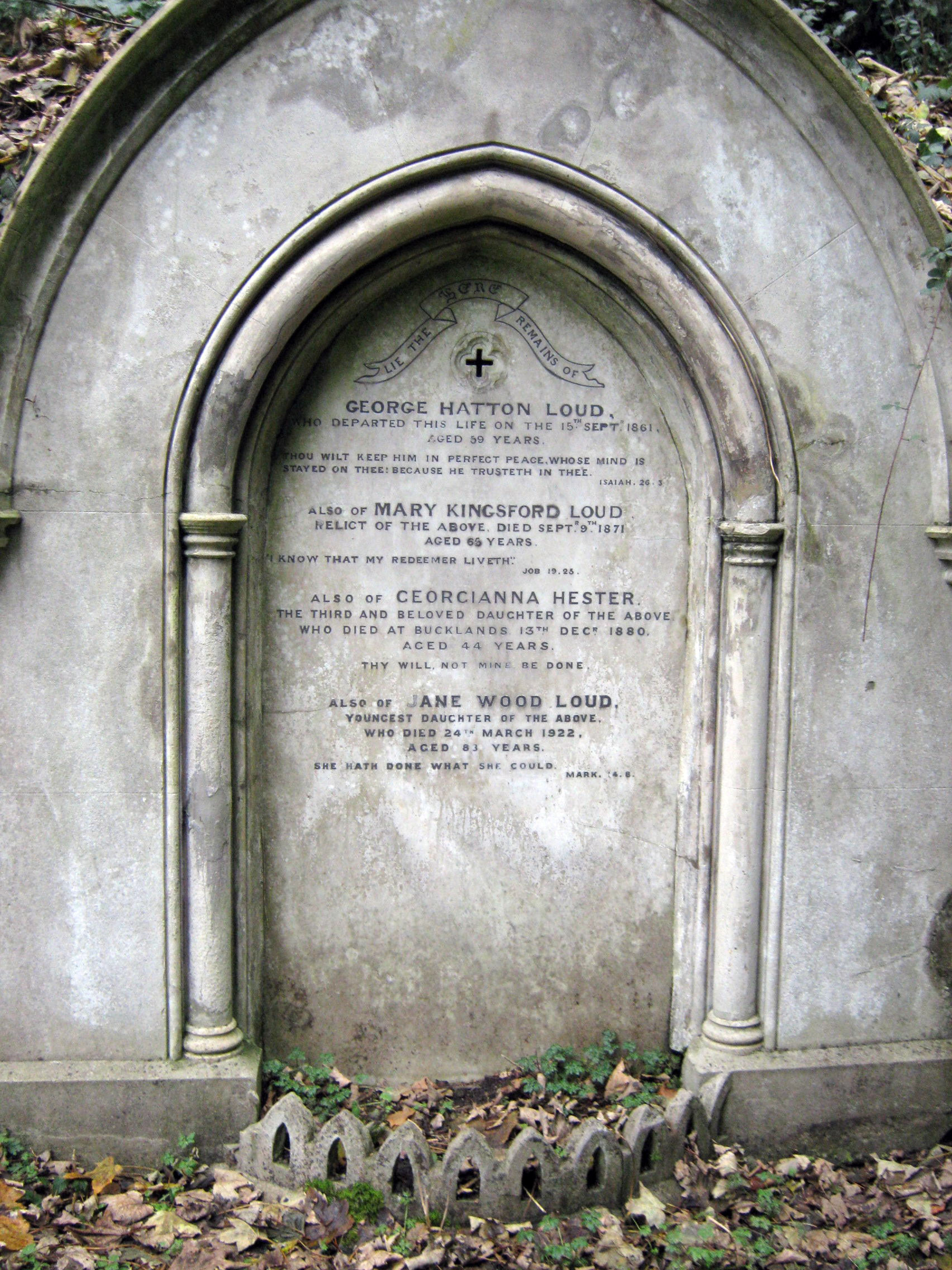
 Jane Wood Loud died 24 March 1922 age 83. Family Vault St Andrew's Churchyard

Jane Wood Loud died 24 March 1922 age 83. Family Vault St Andrew’s Churchyard

Jane died on 24 March 1922, age 83 and was buried at Buckland cemetery and it was reported that there were a large number of sympathising friends present, including her faithful servant and friend, Ann Boyle. Jane’s name was engraved on the family vault but in 1991, local historian, Joe Harman, photographed her gravestone in a scrap yard by Kearsney Station. The dedication stated that ‘she hath done what she could.

Following Jane’s death, Bucklands had a series of occupants, Major H.C.F. Hull in 1926, Miss Olphert between 1930-3. From 1933 to the outbreak of World War II a series of military gentlemen, Captain S.L. Appleton, Captain W.H.A. Bishop, Captain Alexander George Davidson and Major Thomas R.A. Carson.

Following the war Dr. Richardson moved in and the house was renamed Whitehead. Drs Ross and Rutherford succeeded him; and I well remember walking past and admiring ‘Miss Loud’s garden’ as it was still called. However, in 1969 the house was empty and under threat of demolition.

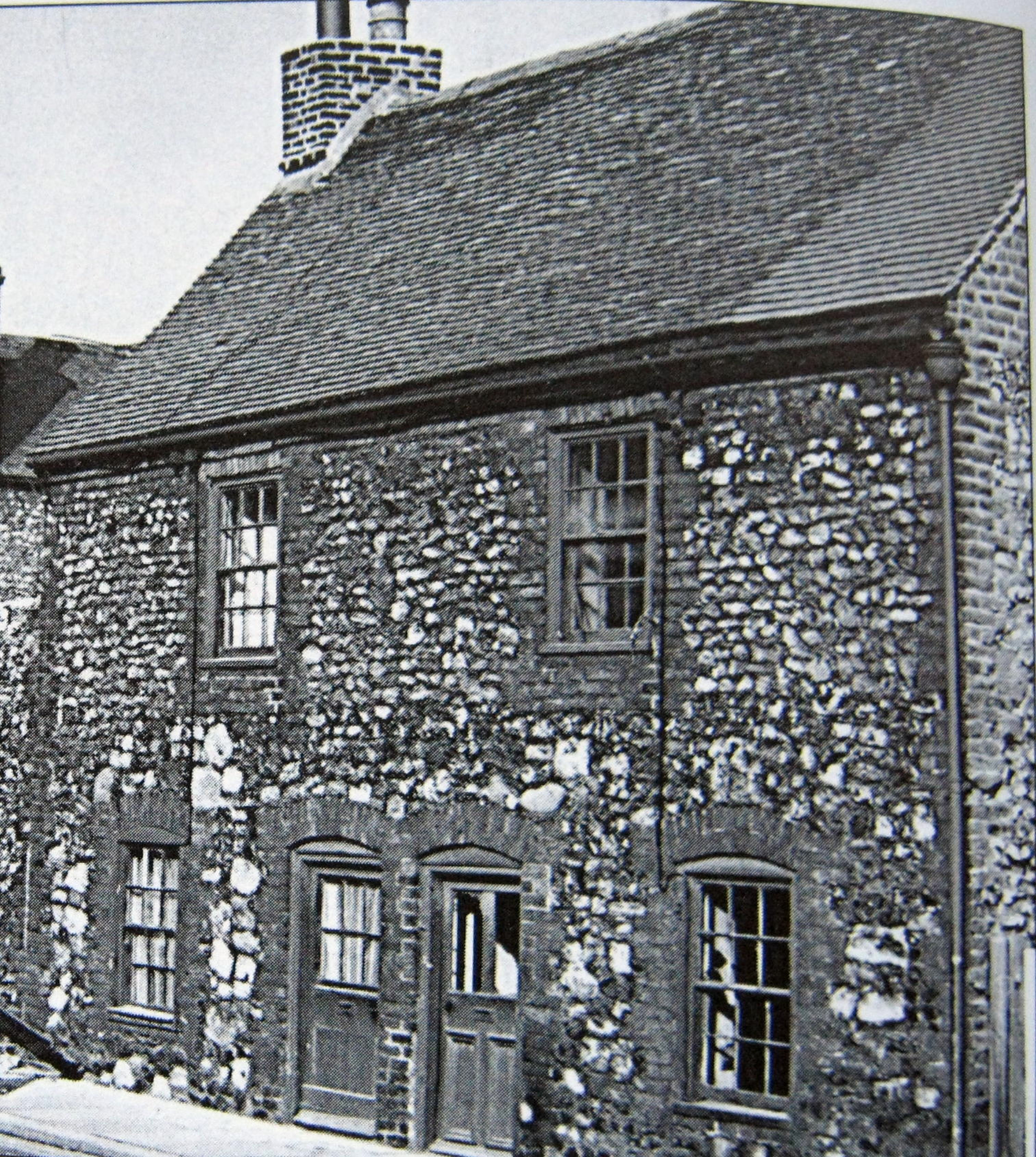
Pear Tree Cottages, London Road, Buckland demolished 1970s. Bob Hollingsbee

Pear Tree Cottages, London Road, Buckland demolished 1970s. Bob Hollingsbee

The developers who bought the property and the two adjacent Pear Tree cottages, on the corner with Cherry Tree Avenue, promised to renovate the house and garden as long as they could demolish the cottages for parking. They refurbished 110, but soon after demolishing the cottages they resold the land for industrial development. The garden with its wall and plaque, were destroyed and the modern offices and businesses that we see today were built.

Published:

  • Dover Mercury  03 & 10 February 2011
Posted in Armed Services, Buildings, London Road 110, Page Thomas Hyde - 110 London Road | Comments Off on 110 London Road

Stilwell and Harby – Solicitors

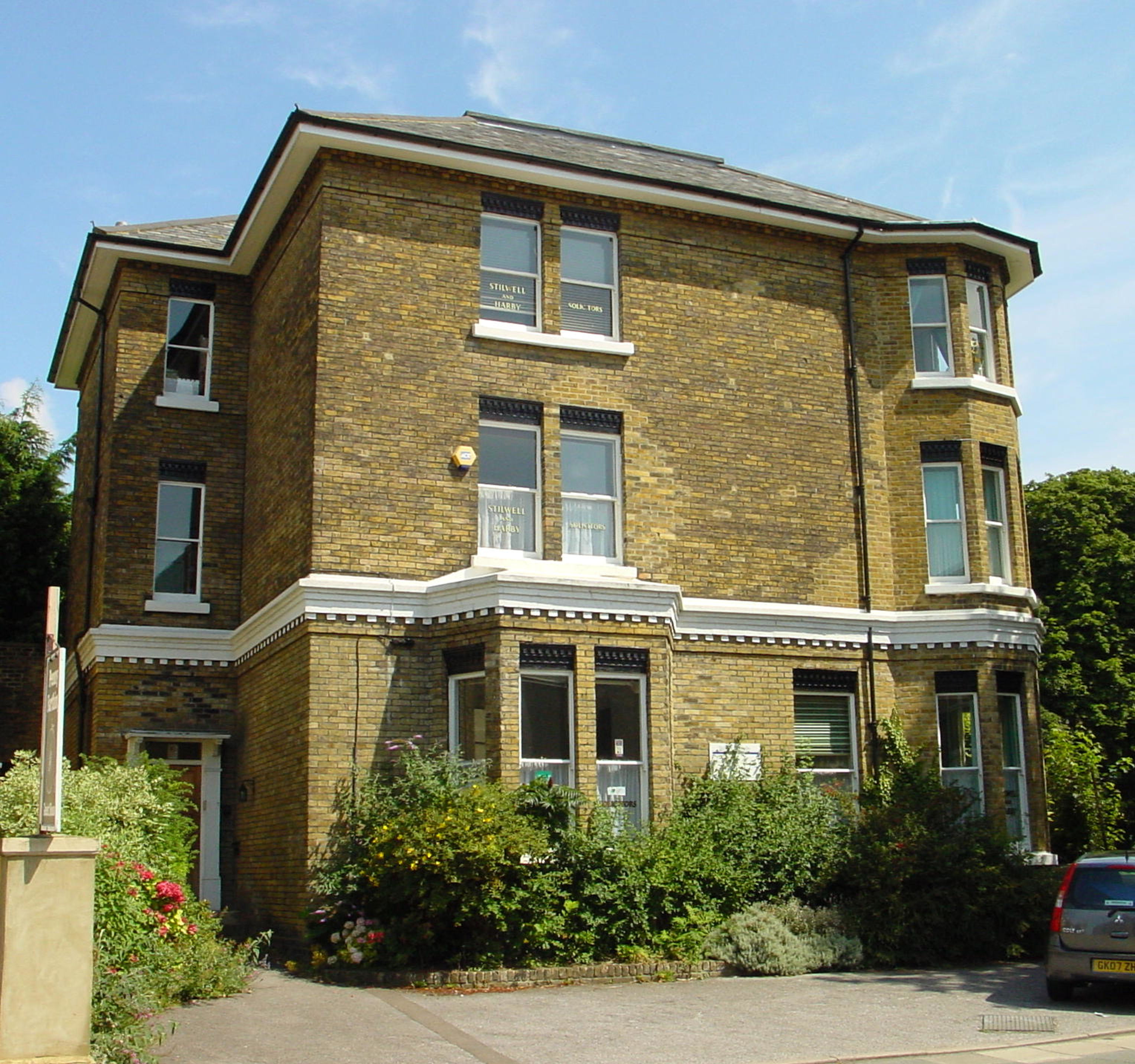
Stilwell and Harby, 110 Maison Dieu Road,

Stilwell and Harby, 110 Maison Dieu Road,

On Thursday 5 January 2012, Maurice Sayers passed away. Before he died, Maurice very kindly lent me a scrapbook telling the story of his firm, Stilwell and Harby – Solicitors. The published article in the Dover Mercury, was dedicated to Maurice with thanks.

Uniacke, 110 Maison Dieu Road, the house occupied by solicitors Stilwell and Harby, was built for Herbert Stiff, of the Dover iron founder’s dynasty, about 1880. The house still sports characteristic Stiff cast-iron lintels and it would seem that Herbert was friendly with the Uniacke family from Halifax, Nova Scotia. James Boyle Uniacke (1799-1858) was the first Premier of Nova Scotia and his relative, barrister and president of the Bank of Nova Scotia, Andrew Mitchell Uniacke (1808-1895), died at 4 Camden Crescent. Herbert aged 48, died of consumption at Uniacke in 1897, leaving a wife and family.

For many years, Uniacke was the home of Henry Crundall, a local corn merchant. However, in World War II, on Sunday 20 October 1940, the already war battered St James Church next door, was hit by yet another shell. This went straight through one wall of the church, coming out the other and exploding. Uniacke’s adjacent wall was ‘sucked out’ but following the war, in 1946, the house was successfully rebuilt. The relatively ‘new’ southern wall of the building can still be seen.

Following the devastation of Uniacke, it would appear that Henry Crundall moved to Ashford, where he died in 1941. Following the war, the house was repaired and the Crundall family let it to the Ministry of National Insurance and other government bodies. In the 1960s, they put Uniacke on the market and Stilwell and Harby solicitors bought it and moved in on 3 October 1966.

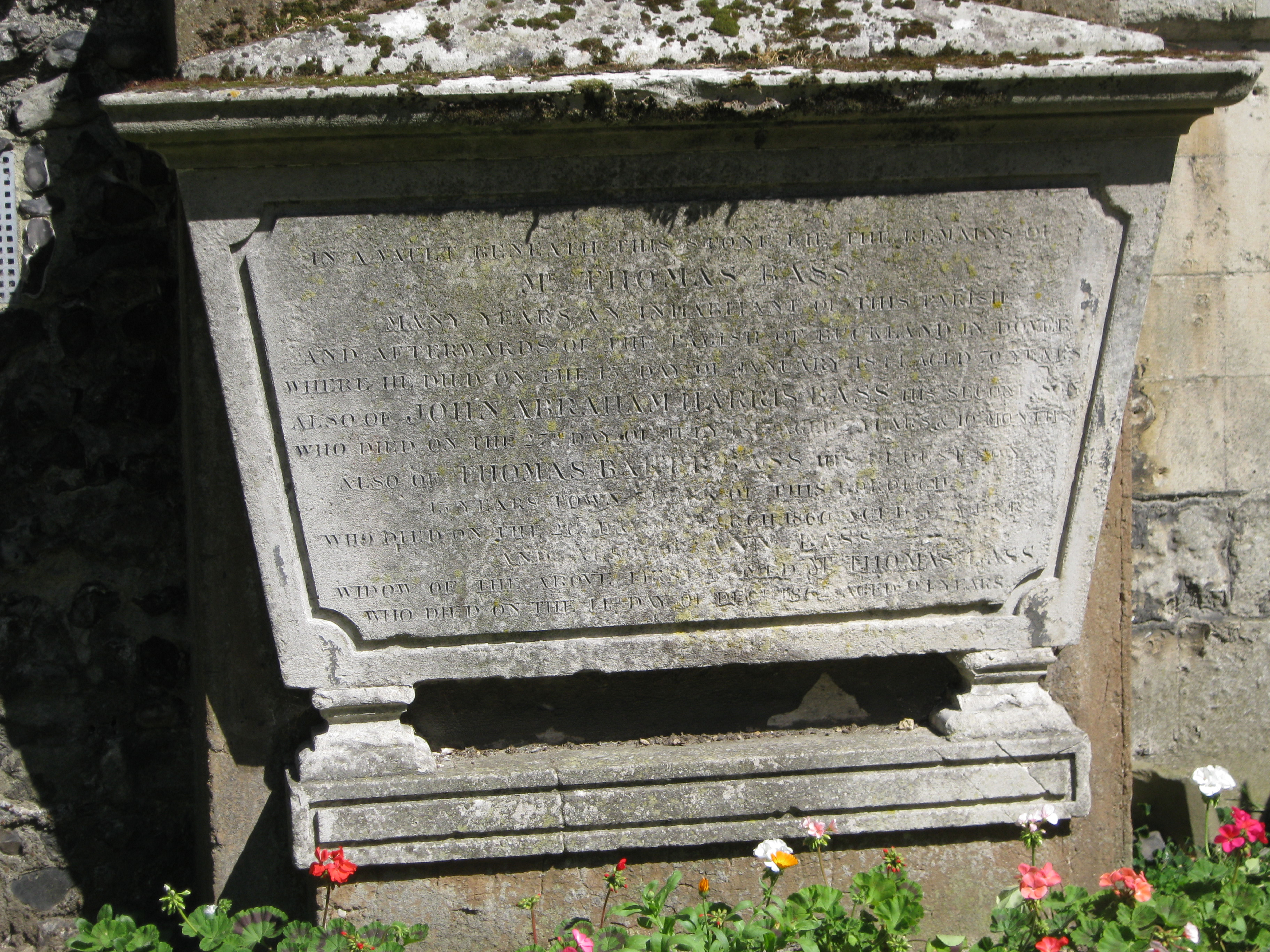
Bass family sarcophagus - St Mary's Churchyard

Bass family sarcophagus – St Mary’s Churchyard

The history of Stilwell and Harby can be traced back to Thomas Bass who was born about 1774 and practised in Dover. He lived in Buckland where his son, Thomas Baker Bass (1807-1860) was born. When Thomas junior was old enough he joined his father in the practice and was admitted to the Chancery roll on 25 May 1830. Thomas senior died on 15 January 1840 and was interred in what became the family vault to the left of the entrance of St Mary’s Church.

Thomas, the son, was active in local politics and a representative for Castle Ward. This he resigned on 1 December 1847 and seven days later, he was elected Town Clerk. During his term of office, Thomas collated the Chamberlains’ accounts from the time of Henry VIII to 1784. These, like most of Dover’s archives, are now kept at Maidstone. Thomas was also responsible for drafting a number of bylaws that brought order to the anarchical sectors of the town!

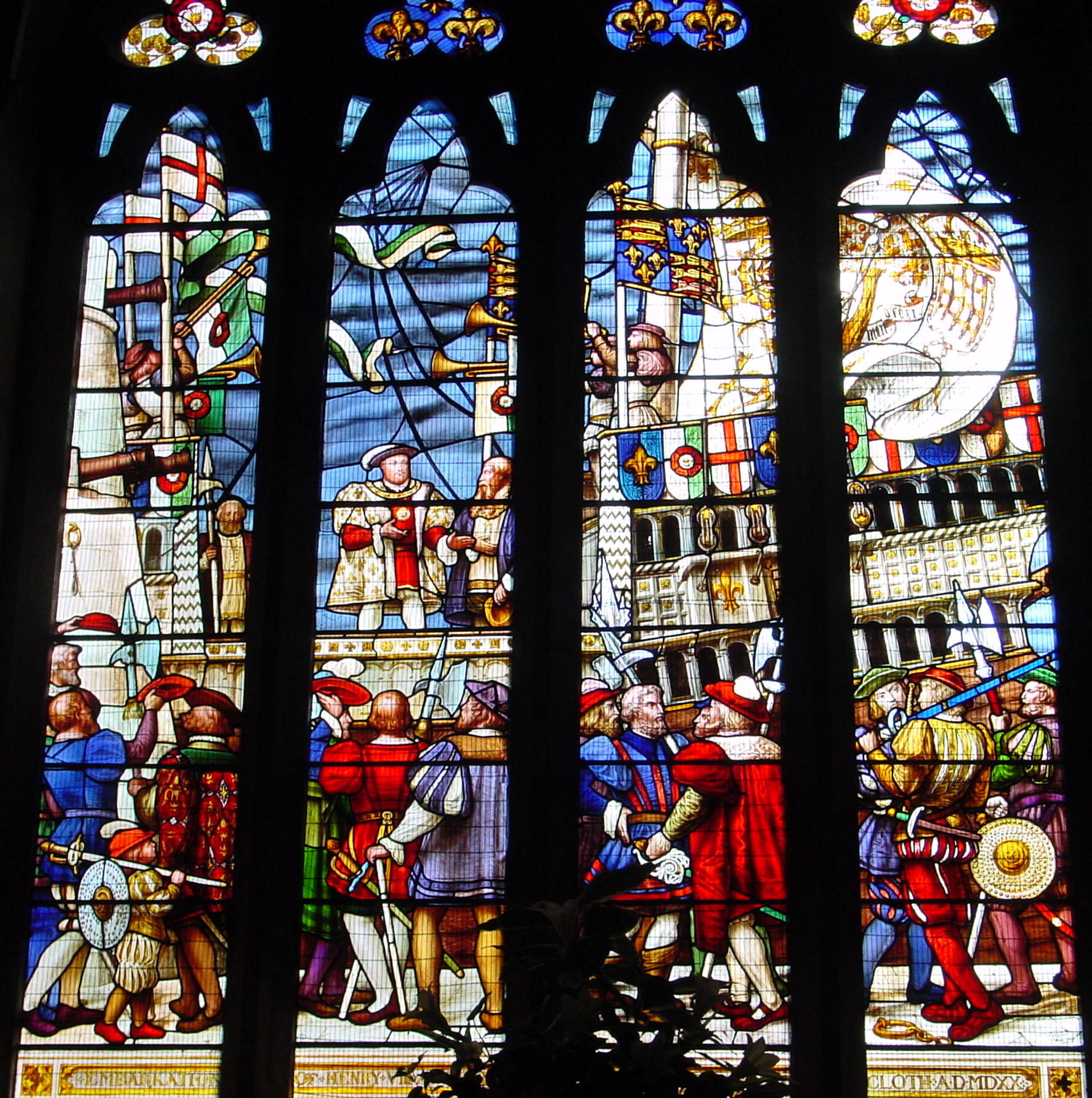
Henry VIII at Dover for the Field of Gold Cloth window in the Stone Hall, Maison Dieu.

Henry VIII at Dover for the Field of Gold Cloth window in the Stone Hall, Maison Dieu

Thomas’s residence and practice was 68 St James’ Street and in 1851 he took James Stilwell into partnership. Nine years later, Thomas died and in his Will, he bequeathed a silver vase valued at £200 to be used to pay for a stained glass window in the Maison Dieu dedicated to Captain William Allen. A relative of Thomas, Captain Allen had rescued the ship Ann in Bombay harbour some years before and the underwriters had presented him with the vase. On his death, he bequeathed it to Thomas. The window it was used to pay for is the Embarkation of Henry VIII at Dover for the Field of the Cloth of Gold, 31 May 1520.

James Stilwell was born about 1829 in Uxbridge and twenty years later was admitted to the Roll of Solicitors. He was appointed Clerk to the Justices of the Borough of Dover in 1857 and Surrogate to the Judge of the Cinque Ports Admiralty Court in 1860. The following year he became the Register of the reconstituted Dover Harbour Board a position he held until his death on 22 May 1898. James had two daughters Eliza Amy (b1868) and Maud Ann (b1872). They married two brothers, Arthur James Harby in 1897 and Travers Bidder Harby in 1905, respectively.

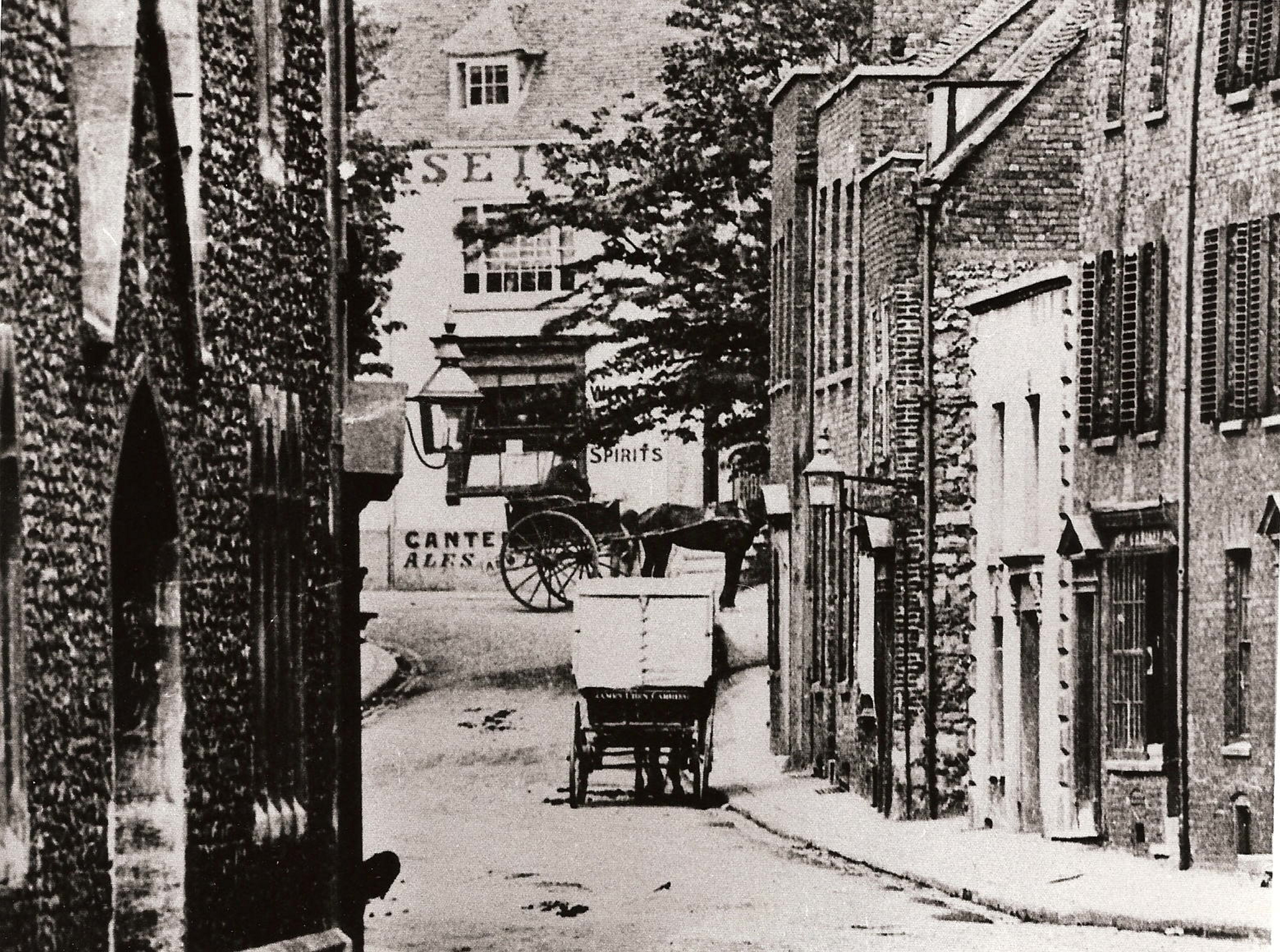
St James Street c1890 before widening 4&6 on right, number 5 opposite

St James Street c1890 before widening 4&6 on right, number 5 opposite

Arthur Harby (1862-1900), was born at Snars Brook, Essex and joined the firm in 1882 as an articled clerk. He became a partner in 1888 when the firm was renamed Stilwell and Harby. By this time, the firm’s offices were at 4 and 6 St James’ Street and later extra rooms were rented at number 5, on the opposite side of the road. In 1894, following the widening of Woolcomber Street, the offices became corner properties and number 4 was enlarged with a new frontage on that Street.

Active in local politics, Arthur was on the Executive of the Dover Liberal Party. Together with solicitor, Augustus Montague Bradley, between 1892-4, Ramsay Macdonald, (1866-1937) tried to persuade them that he should represent Dover as a Liberal candidate for Parliament. The negotiations broke down and eventually Ramsay Macdonald, as a representative of the Labour Party, became an MP and Britain’s first Labour Prime Minister in 1924.

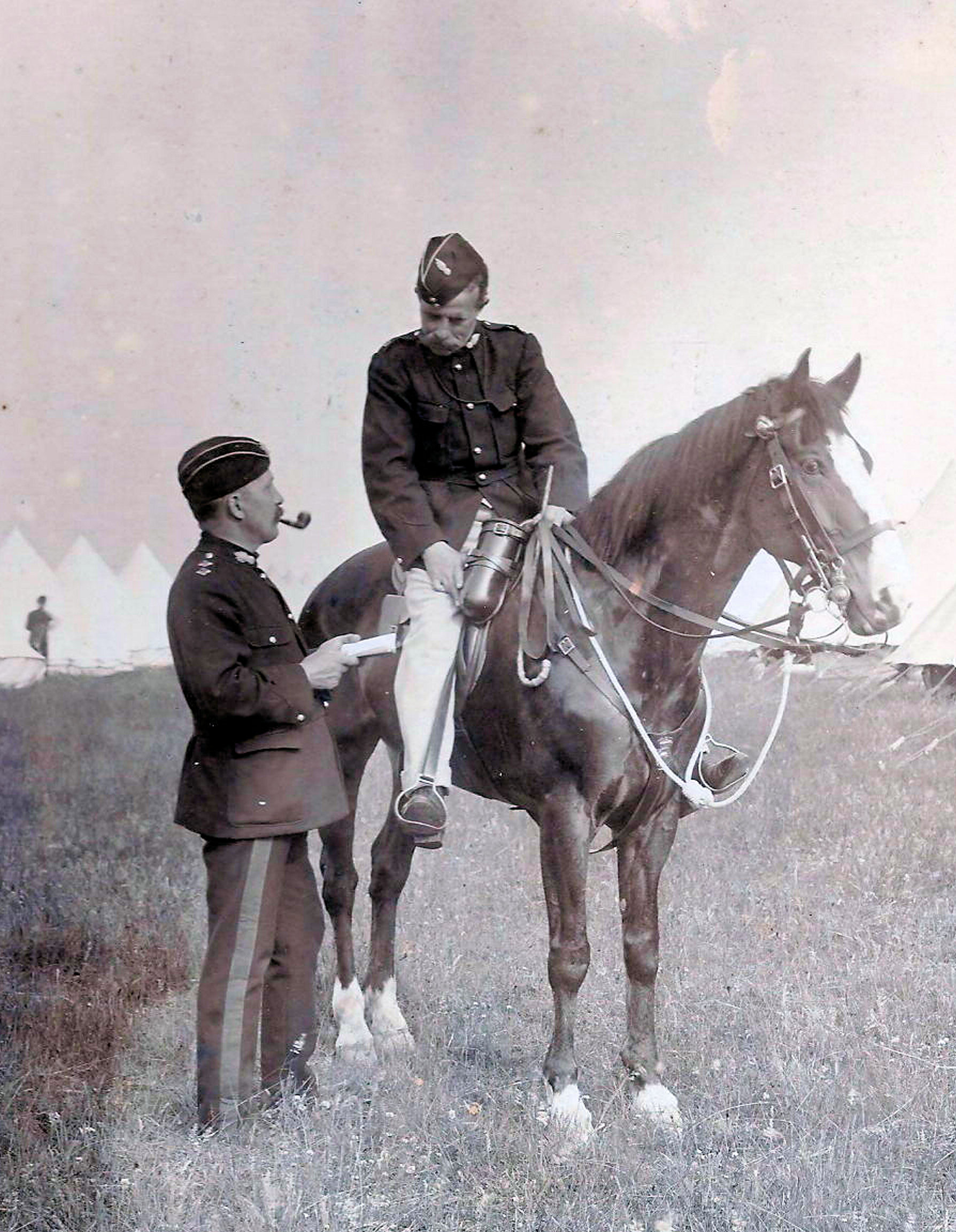
Major Arthur James Harby, Cinque Ports Volunteers

Major Arthur James Harby, Cinque Ports Volunteers

On the death of his father-in-law James, Arthur was appointed Clerk to the Justices. He was very much involved in Dover’s sporting activities – he was elected the captain of the rowing club in 1895. However, his greatest interest was Cinque Ports Volunteers, in which he held the position of Major. Tragedy struck while Arthur was inspecting the Volunteers at Sandwich on 3 July 1900. Arthur was thrown from his horse and killed; he was 38 years old.

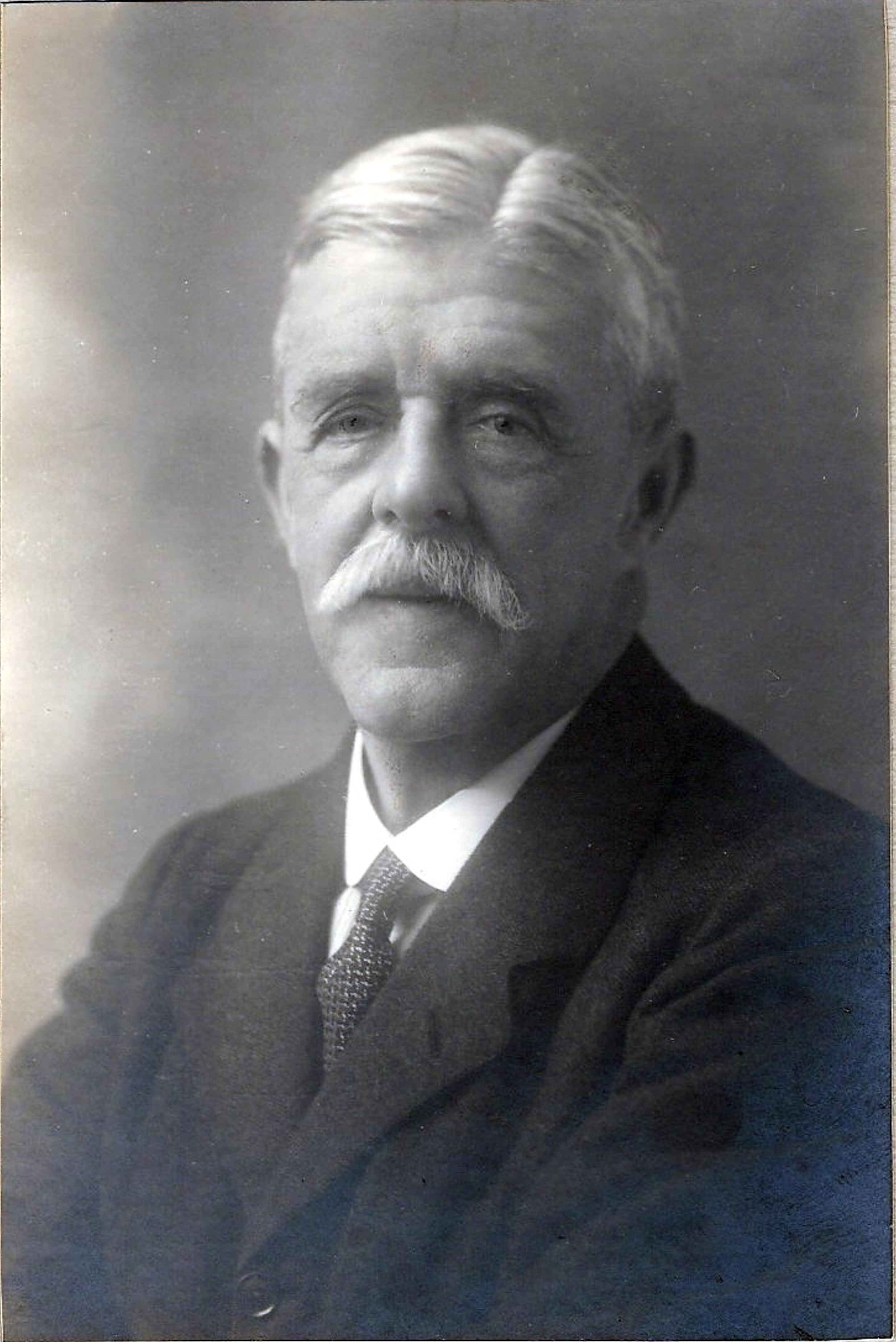
Arthur’s younger brother, Travers Bidder Harby (1866-1948) was articled to his father in 1884, admitted as a solicitor in 1889 and was partner in a practice in the Strand, London. On the death of his brother, he took over the Dover practice and also his brother’s position as Clerk to the Dover Borough Justices. Like his father, Travers was appointed Surrogate of the Court of Admiralty of the Cinque Ports.

Travers Bidder Harby

Travers Bidder Harby

A keen oarsman, Travers was elected captain of the rowing club, and was one of the club’s Senior 4. At the time, they were merited as the ‘most outstanding crew in Britain.‘ Prior to World War I, Travers was the chairman of the Council Entertainment’s Committee and successfully organised a special function to celebrate the coronation of George V in 1911.

During in World War I, Travers commanded No1 Detachment of the Royal Naval Volunteer Reserve. This was responsible for the defence of the town from air attack. Following the war, he was particularly interested in the welfare of the elderly and was appointed the Treasurer Dover Hospital, Clerk and Treasurer Alms House Trustees and Clerk to the Gorely (Almshouses) Charity. He was also the Registrar to the Buckland and Charlton cemeteries.

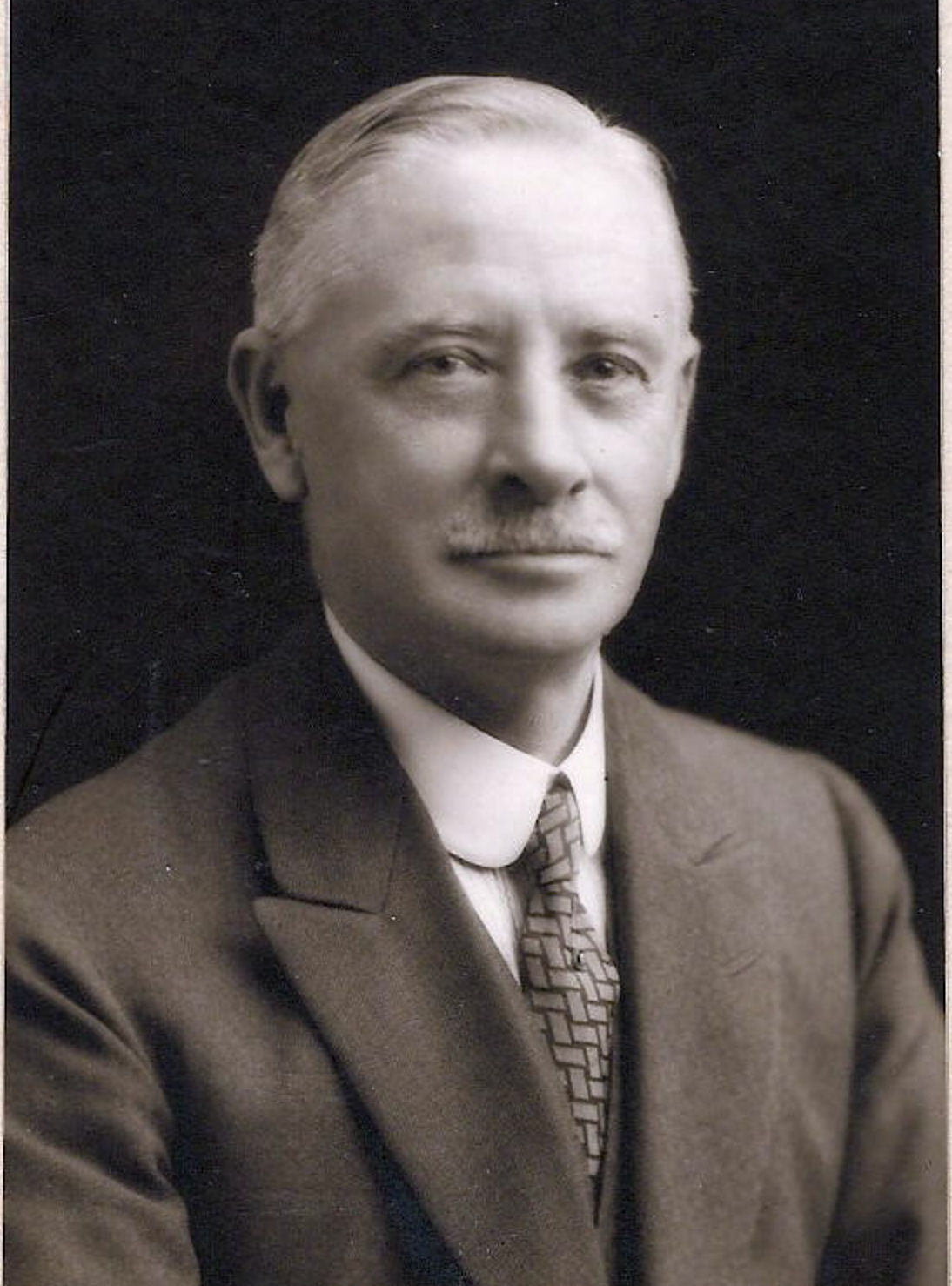
Henry Wallace Youden

Henry Wallace Youden

Henry Wallace Youden (1873-1956) joined the firm in 1888 as a junior clerk, later articled to Arthur Harby. The latter’s premature death in 1900 prevented Henry from continuing so the articles were put on hold. Albeit, he was eventually admitted as a solicitor in March 1923 and taken into partnership with Travers Harby on 1 July that year.

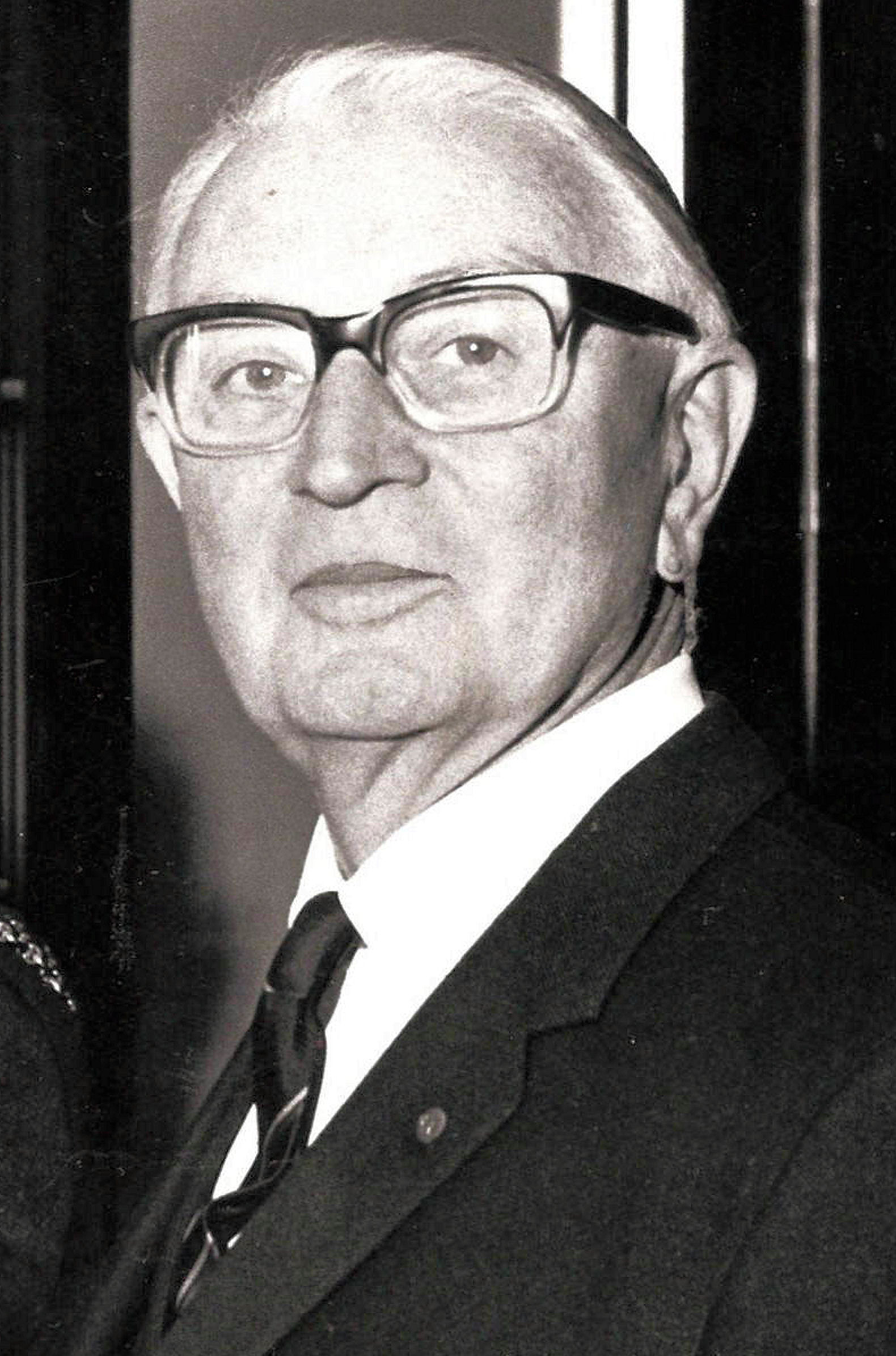
His son, George Henry Youden joined the firm on leaving Sutton Valence School in September 1921, was articled to Travers Harby and admitted a solicitor on 2 May 1927. The following year, on 1 March 1928, the County Court Judge refused to hear a case that George was acting on behalf of the firm. The reason given was the George was not a partner. At lunchtime that day, George was taken into the firms’ partnership and returned to Court that afternoon, to be congratulated by the Judge! He then proceeded to hear the case!

Early in 1929, Major Dacre Carder died from injuries sustained during World War I. He too was a solicitor, in a joint practice with his father, Eugene Carder, in Market Square. In order to help out, George was transferred to that practice until Eugene’s death in 1935, when the firms amalgamated.

1934 saw the installation of Lord Reading as Lord Warden attended by Travers Harby as the Surrogate of the Court of Admiralty of the Cinque Ports. The following year Travers represented the owners and tenants of property in the Adrian Street area where the council were seeking to demolish the houses. Although the council won, they were forced to pay more in compensation than they expected.

George Henry Youden

George Henry Youden

Four years later, on 18 November 1938, Travers retired as Clerk to the Magistrates of the Borough and his partner, George Youden, was appointed in his place. A few months later, following the death of another of Dover’s solicitors, Sydenham Armstrong Payn, Stilwell and Harby absorbed his practise.

Geoffrey Crawford joined the firm in the 1930s but was called up in 1939. His Regiment was involved in the fighting to stop the Japanese advance in South East Asia and following the Fall of Singapore managed to get to Sumatra. Sadly, he was killed in the jungle by a sniper bullet near Pelambang.

During the Battle of Britain, in the summer of 1940, Dover solicitors were advised to move out of the town for security reasons. During one of the air raids a tombstone from Old St James’ Churchyard, some 80 yards away from the offices of Stilwell and Harby in St James Street, was blown into the air and landed on the firm’s roof going through it. Travers quickly arranged for all the firm’s deeds and documents to be sent to new premises in Cheltenham, Gloucestershire. To deal with local clients, an office was opened at the home of Mrs Violet Carder in London Road, Kearsney.

The war took its toll on the St James Street offices and all were demolished except No 5, which is now a listed building. After the war, on returning to Dover, Travers obtained a 21-year lease on 20 and 22 Castle Street. However, he did not practice there long, as he died on 13 December 1948 aged 82.

James A Johnson Dover Town Clerk 1944-1968

James A Johnson Dover Town Clerk 1944-1968

The following year saw a legal case that was to affect the firm’s relationship with the council for years to come. In order to combat inflation stringent price policies were in force and the price of newly built houses was fixed by a licence. In 1949, a former town councillor, Fred Dolbear, offered a house in Mount Road for £1,275 while the licence was fixed at £1,025.

The case was taken to court by the Corporation’s Town Clerk, James A Johnson. Dolbear was found guilty and fined the maximum penalty, £100. That should have been the end of the matter, but the Town Clerk immediately issued a summons against George Youden, in his capacity as Clerk to the Magistrates, for aiding and abetting. The magistrates dismissed this but Johnson appealed to the King’s Bench. They reversed the decision and Youden was fined £25 with £25 costs.

At the time, besides George Youden, the other senior partner was Ronnie Brydone (1909 -1987), who joined the firm in 1946. Their office boy was Maurice Sayers, who joined the firm on 21 September 1942. He had been a pupil at Dover Boys’ Grammar school and evacuated to Ebbw Vale, Monmouthshire, for the War. However, fed up, Maurice returned to Dover and joined the firm. He was 13-years old! Called up and joined the Army as a conscript at 18, Maurice returning to Stilwell and Harby in April 1949. He persuaded George Youden to take him as an articled clerk in 1956, passed the final exam in 1961 and became a junior partner the following year.

When James Stilwell, the great-grandson of the first James Stilwell, qualified as a solicitor in 1962 the firm was at a low ebb and he had to seek an opening elsewhere. With the lease expiring on the Castle Street property, the firm bought Uniacke, 110 Maison Dieu Road and moved in on 3 October 1966. Two years later George Youden retired.

The move seemed to impart new enthusiasm and the firm went from strength to strength. Maurice Sayers became a senior partner when Ronnie Brydone, described as a fantastic eccentric, retired in 1971.

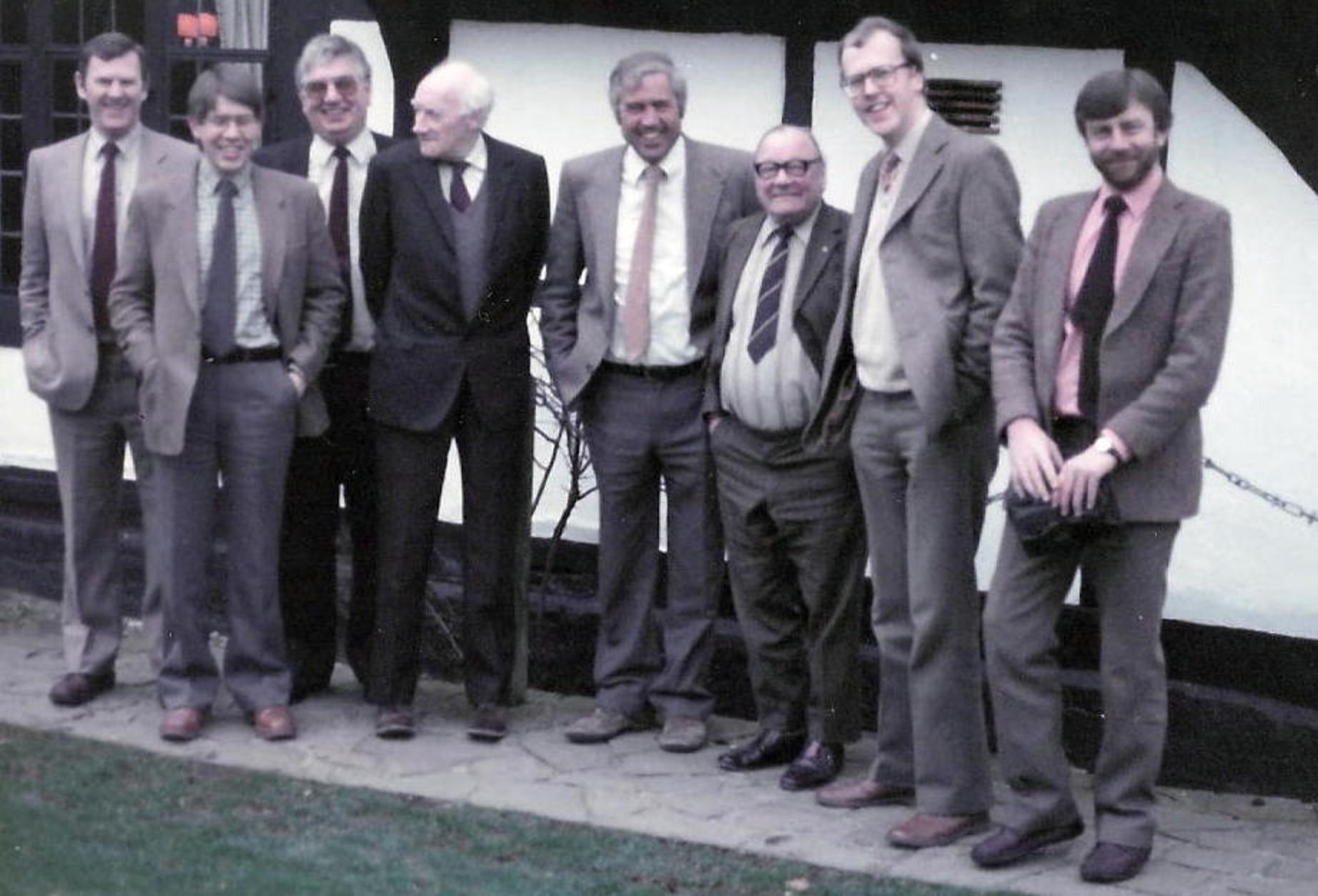
Partners of Stilwell & Harby c 1985. Courtesy of the late Maurice Sayers

Partners of Stilwell & Harby c 1985. Courtesy of the late Maurice Sayers

By the early 1980s the firm had eight partners whose photo was taken about that time, they were:
(Pix LtoR):

1. William (Bill) Writer joined the firm about 1970 and became a partner in 1974.

He left 110 to open an office in Douglas Avenue, Hythe in 1975, but remained a partner until he retired in 2008, aged 65.

2. Robert (Bob) Ludlow joined the Hythe Office in 1975 and retired in 2008.

3. Thomas Stephen (Tom) Cowell joined the firm in 1971 and was made a partner in 1972. Opened an office in Deal about 1985, remaining a partner for about three years. He left to set up a firm in his own name.

4. Ronald (Ronnie) Brydone who ceased to be a partner on retirement.

5. Maurice Sayers, senior partner of Stilwell and Harby (Dover Office) retiring at the age 68 in 1996. Maurice passed away on Thursday 5 January 2012.

6. Bernard Henry (Barney) Lock joined the firm in August 1982 on his retirement as senior partner of Knocker Bradley and Pain – now Bradley’s. He was a partner at the Deal office until he retired in 1990.

7. Peter Sherred, a former Dover District Council solicitor, joined in January 1981 and remained a partner until about 1992, when he left to join Bradleys. He also took Holy Orders.

8. Peter Brothwell was a partner in the Folkestone office but the partnership was dissolved in March 1987

The possible photographer was Jeremy Garner a partner Dover Office.

At the time of writing, the firm is run by Patricia Sayers (married name Comfort), the daughter of Maurice, and Jeremy Garner with associate solicitor, Claris Muir. Stilwell and Harby remain a busy practice, as well as Jeremy, Patricia and Claris they employ two senior legal executives and about ten staff.

Published:

  • Dover Mercury: 13, 20 & 27 December 2012
Posted in Maison Dieu Road, Solicitors, Stilwell and Harby, Stilwell and Harby - Solicitors | Comments Off on Stilwell and Harby – Solicitors

Eastern Docks – Part II 1945-1953

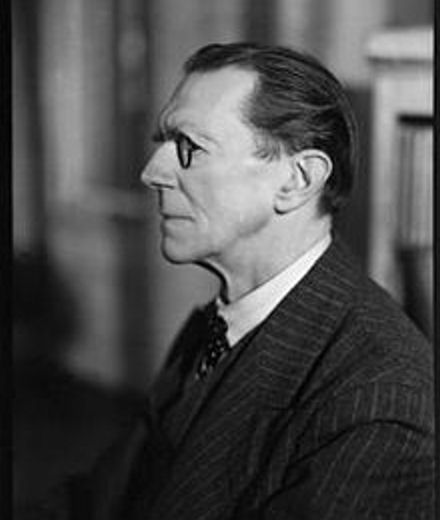
Professor Sir (Leslie) Patrick Abercrombie (1879-1957)

Professor Sir (Leslie) Patrick Abercrombie (1879-1957)

During the dark days of World War II, Dover Corporation devised a plan for the future of the town. Following the War town planner, Professor Abercrombie, was hired to give weight to this plan. Although Abercrombie recognised the importance of Dover harbour, the Professor said that ‘the lifeblood of a town of the nature of Dover is undoubtedly its industry.’ He went on to recommended the demolition of East Cliff and Athol Terrace to be replaced by a wide access road to the Eastern Dockyard – as it was then called. The Dockyard had been earmarked for industrial purposes.

On 1 April 1947, Townsend Brothers returned to the Eastern Dockyard where the company had started and ran its business during the inter-war years . Their ship was the Cromarty Firth, a small coasting vessel of 538 tons gross built by J Lewis & Sons of Aberdeen in 1937. Twelve days later their flagship, Forde, returned from war service having been used as an Admiralty salvage vessel. In May the Forde replaced Cromarty Firth but she made her last crossing on 18 October 1949 and was replaced by the Halladale. She was a 1,370-ton River class frigate built at Glasgow in 1944. With the capacity to accommodate 50 to 60 cars and 350 passengers, she came into service on 6 April 1950.

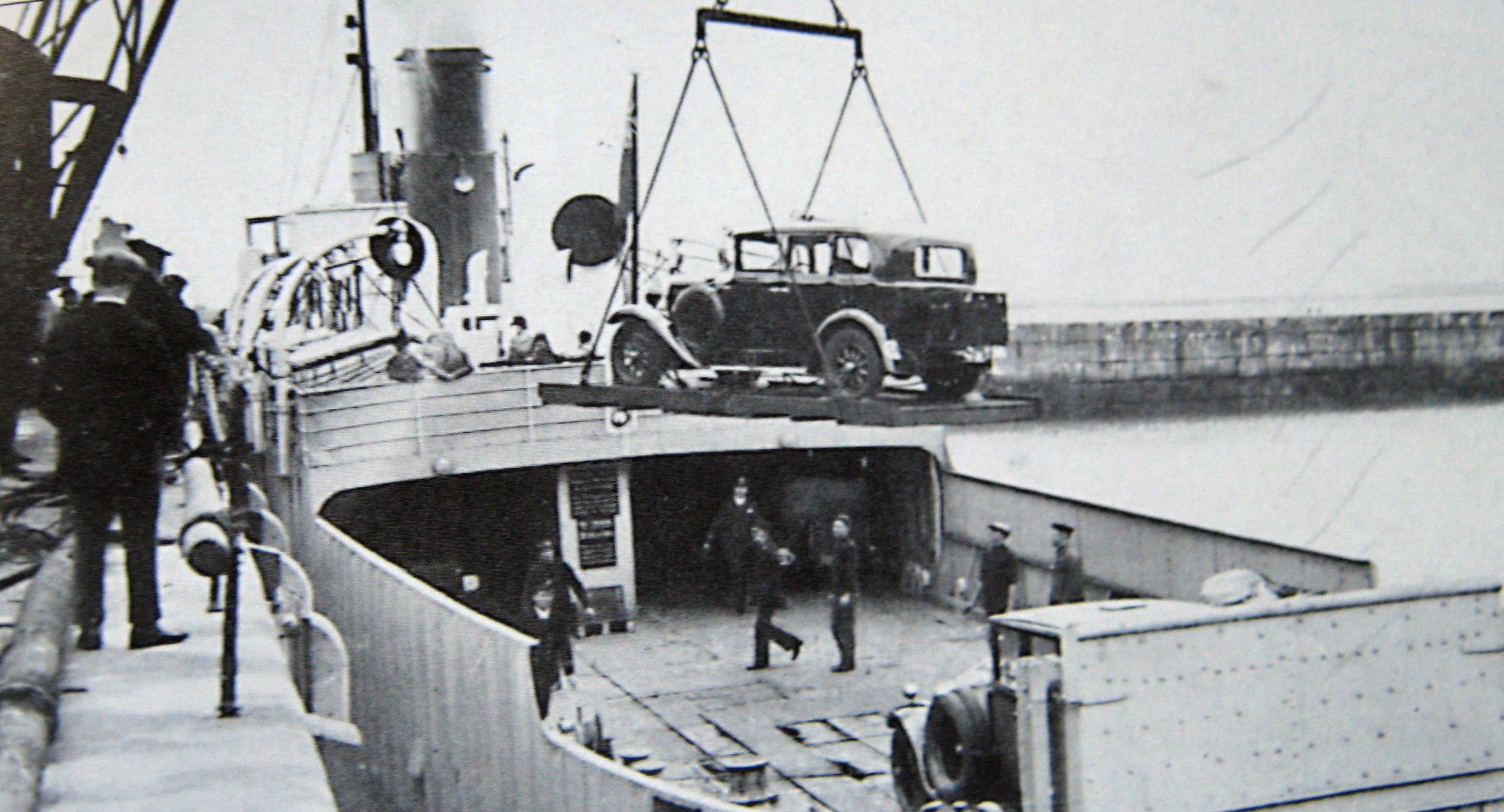
At the Eastern Dockyard, not only did the car drivers make their way through the rapidly expanding industrial complex, but on reaching the ship the cars were being craned on and off. Whereas in Boulogne changes were taking place that would enable cars to be driven on and off ferries.

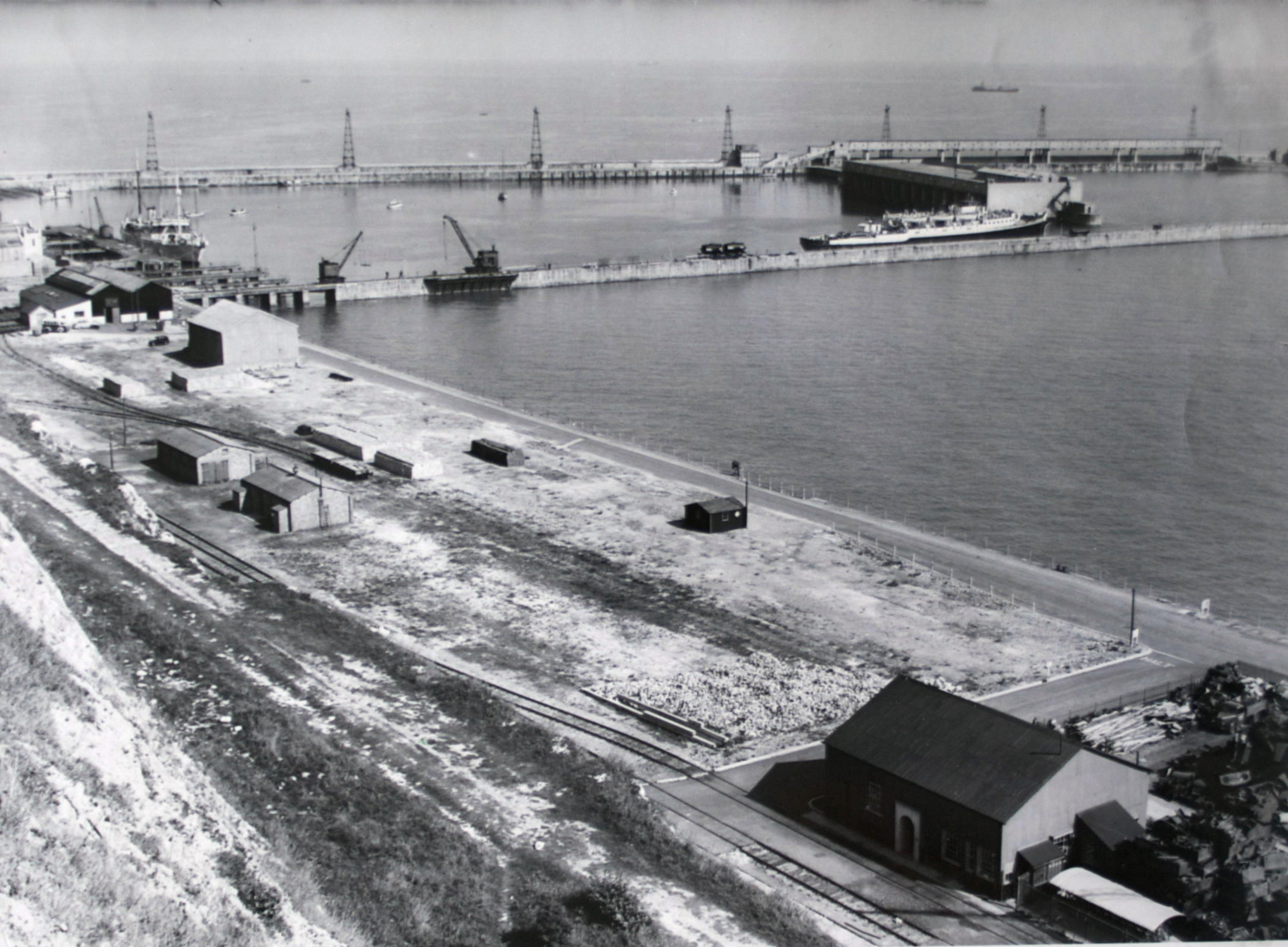
Eastern Dockyard May 1951. DHB - Lambert Weston

Eastern Dockyard May 1951. DHB – Lambert Weston

Dover Harbour Board (DHB) had vehemently opposed the industrialisation of the Eastern Dockyard but was over-ruled. Albeit, in November 1949, against strenuous opposition from Dover Corporation, DHB promoted a Parliamentary Bill to create a specialised Car Ferry terminal at the Dockyard. Permission was given in February 1951 and it was estimated that the facility would cost £500,000.

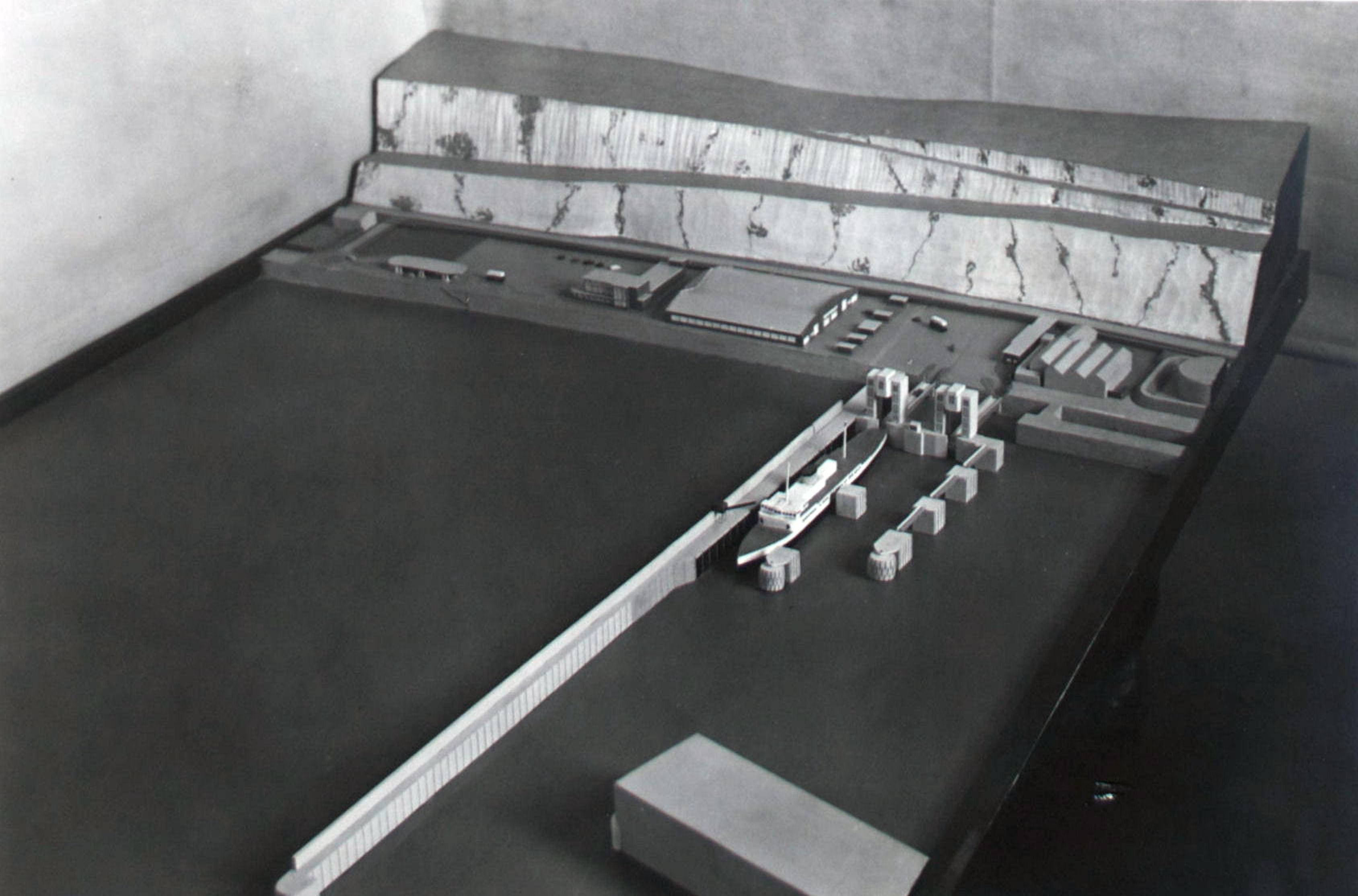
Car Ferry Terminal proposal 1952. DHB - Lambert Weston

Car Ferry Terminal proposal 1952. DHB – Lambert Weston

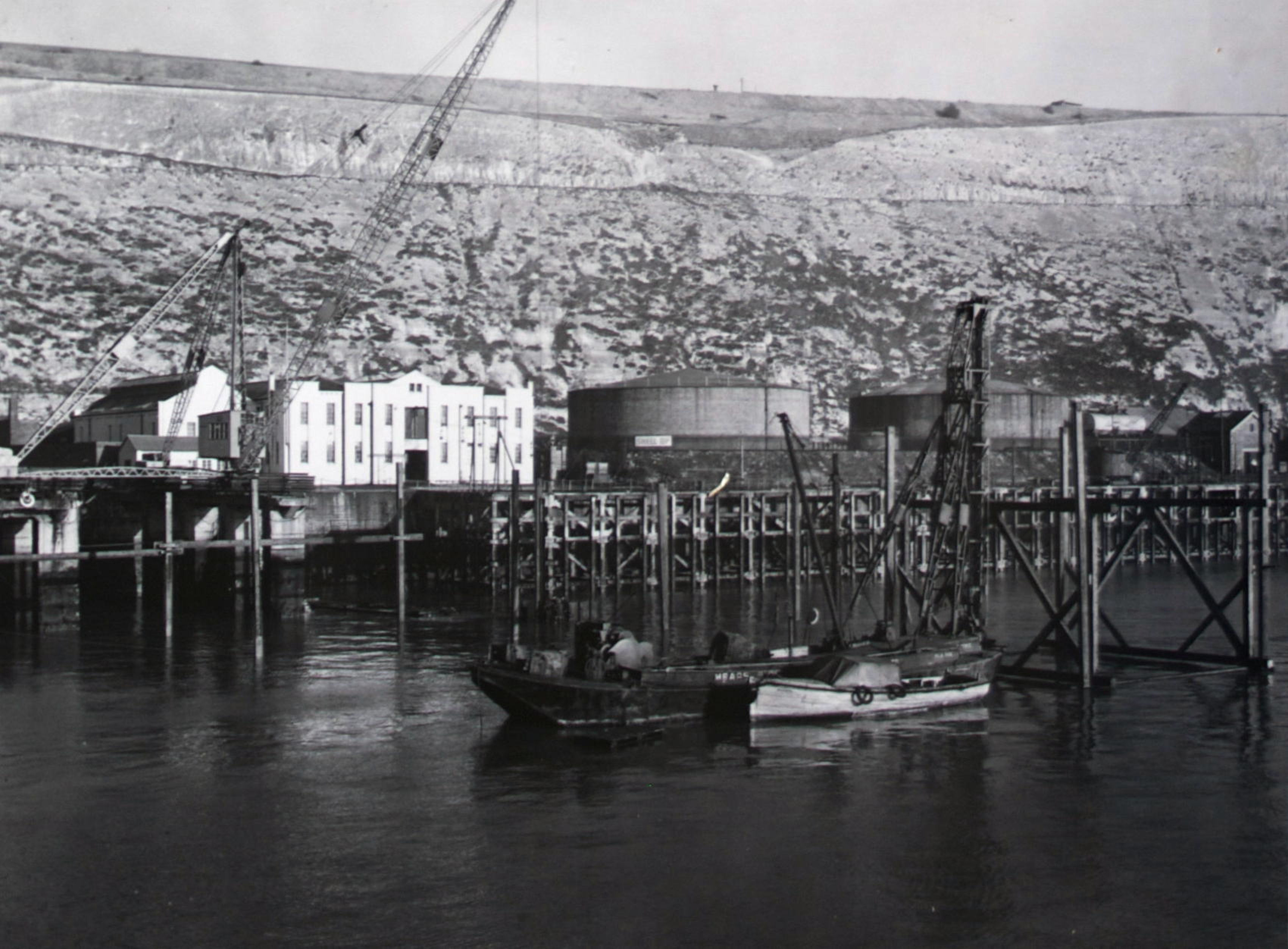
The contract for the new Car Ferry Terminal was given to Messrs Mears Bros. and work began in October 1951. It was hoped to have it operational the following year but was subject to delay due to a national shortage of steel.

27 June 1951 had seen Townsend’s Halladale, the first drive-on drive off cross Channel steamer crossed the Channel from the Eastern Dockyard. On board the guests included Board members from both Dover Harbour Board and from East Kent Road Car Company and also on board was an 8-ton single-decker with driver. At Calais the ramp was lowered on to the rear of the ship and the bus was driven off down the 120-foot incline without trouble. The driver turned the bus round and successfully drove it back on board. Four days later, the Calais ramp came into operation and the first drive-on, drive-off facility became available for Channel crossings.

In Dover, the mock-up of the proposed terminal was put on public view early in 1952, which showed that there would be two berths designed to accommodate up to four ships. Loading centred on the roll-on roll-off or ro-ro system that enabled cars to be driven straight onto and off the ferries. There would also be two standing jetties, access roads, custom shed, reception hall and offices.

Terminal Commencement - 31.01.1952. DHB - Lambert Weston

Terminal Commencement – 31.01.1952. DHB – Lambert Weston

Temporary piling for East Dolphin 31.06.1952. DHB - Lambert Weston

Temporary piling for East Dolphin 31.06.1952. DHB – Lambert Weston

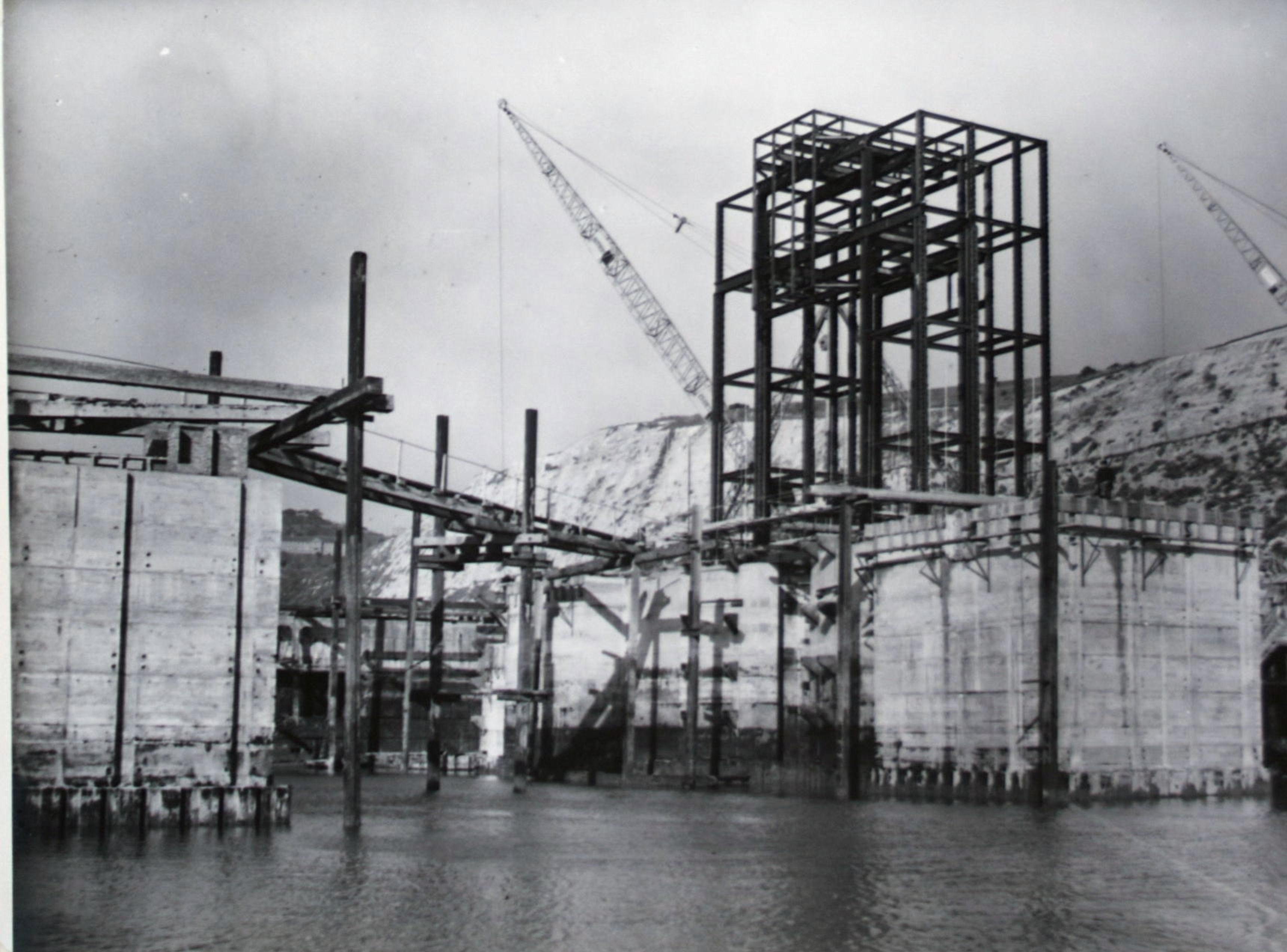
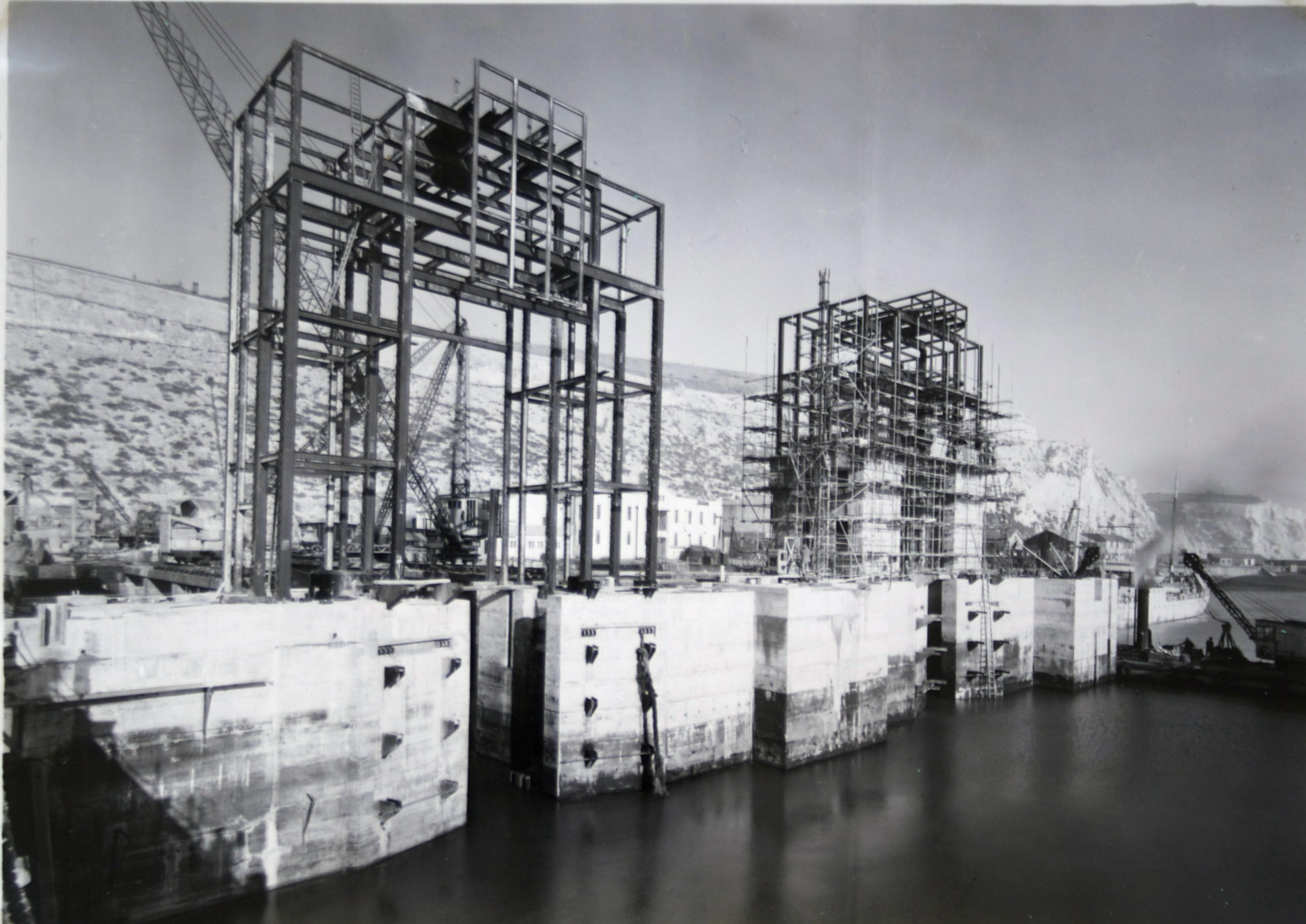
East Portal Steelwork & Dolphins 06.09.1952. DHB - Lambert Weston

East Portal Steelwork & Dolphins 06.09.1952. DHB – Lambert Weston

East Portal Concrete Cladding 25.11.1952. DHB - Lambert Weston

East Portal Concrete Cladding 25.11.1952. DHB – Lambert Weston

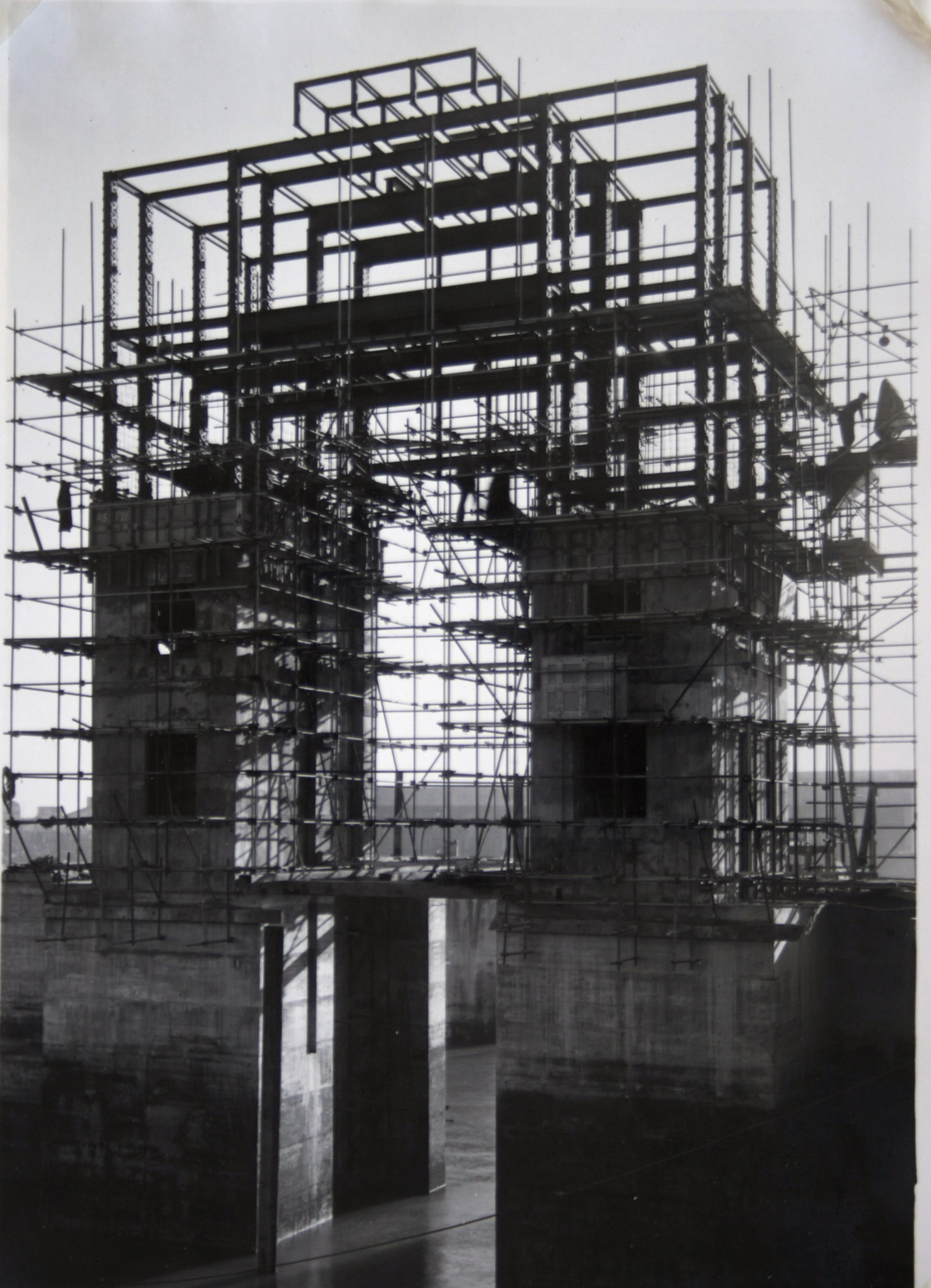
Portal Dolphins 25.11.1952. DHB - Lambert Weston

Portal Dolphins 25.11.1952. DHB – Lambert Weston

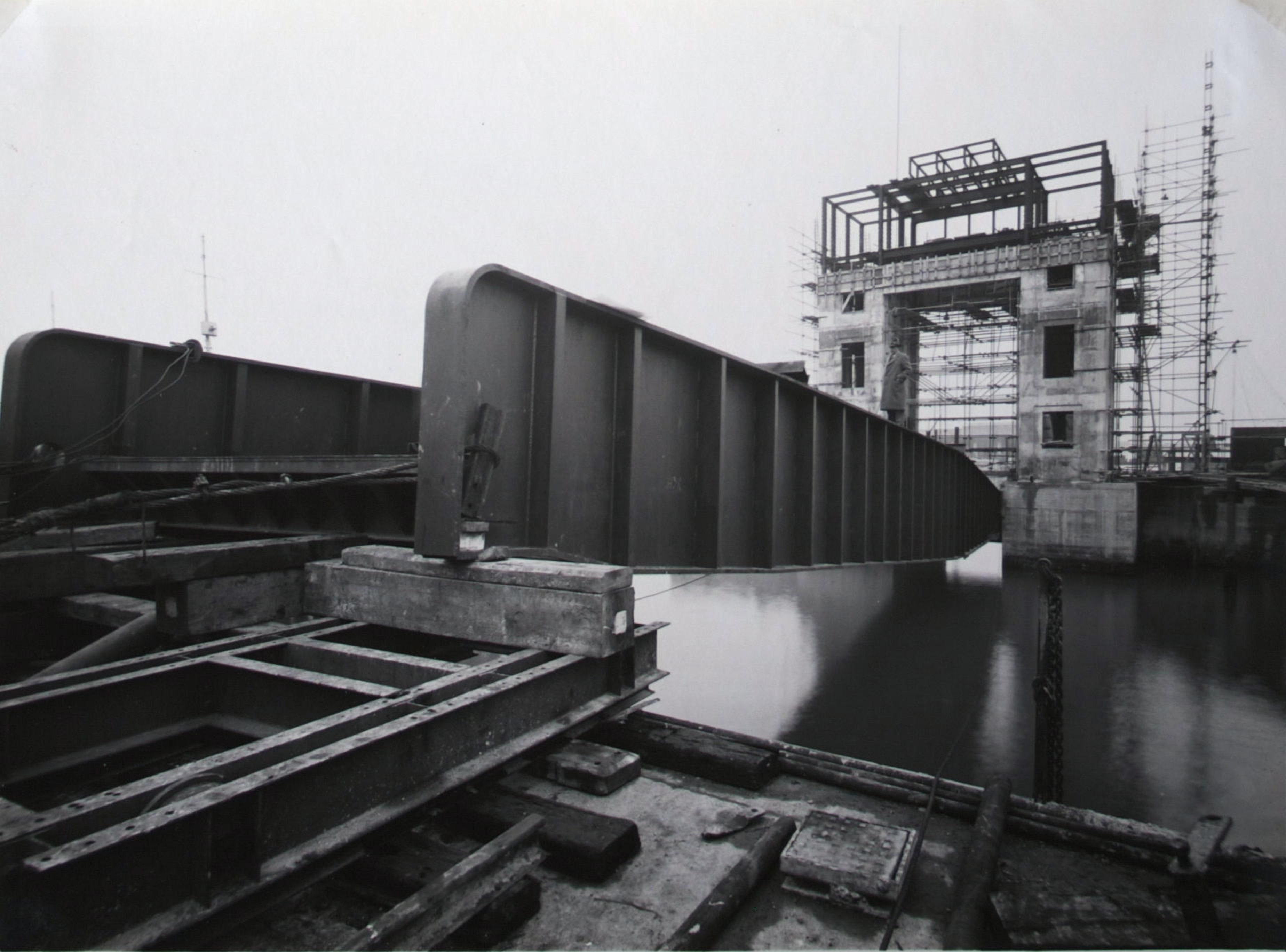
East Bridge - On Temporary Supports 01.01.1953. DHB - Lambert Weston

East Bridge – On Temporary Supports 01.01.1953. DHB – Lambert Weston

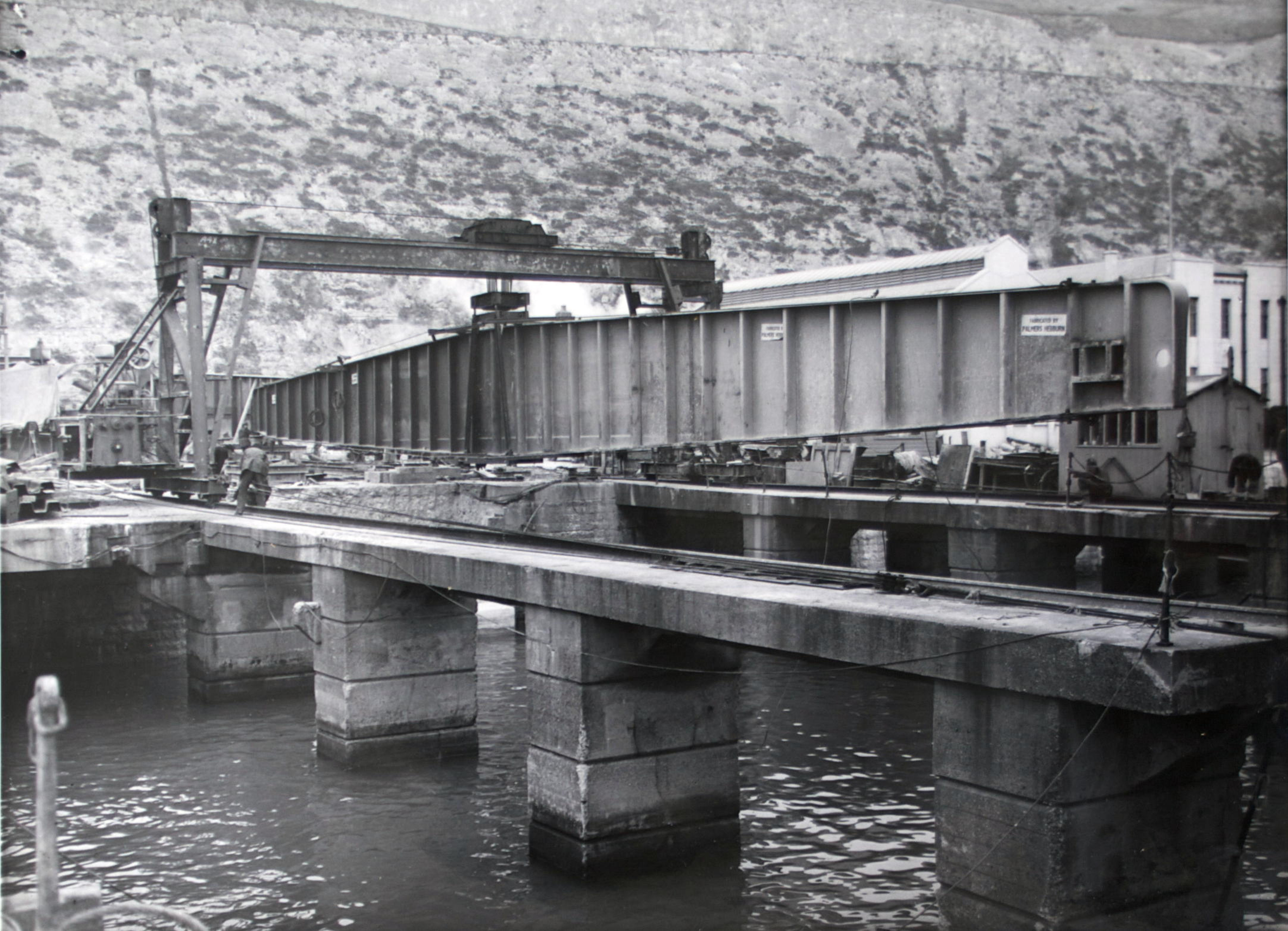
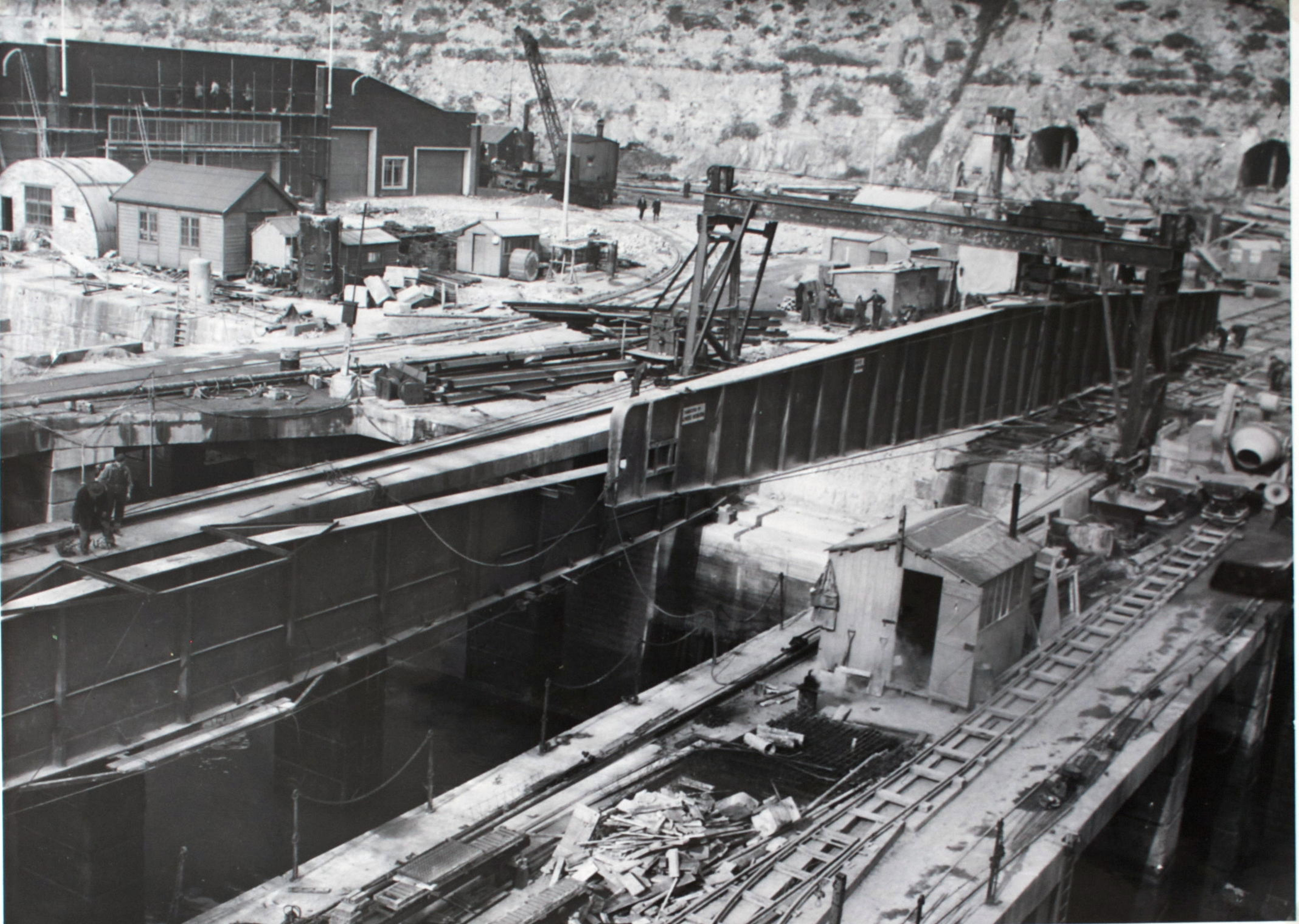
Due to the different loading levels of the ships – some had two car decks – the berths were equipped with hinged loading bridges. It was estimated that at low water spring tide there would be 21 feet (6.4 metres) of water underneath and therefore were designed to be moved 35-feet (10.7 metres) by means of winches housed in the portals.

West Bridge - launch of West Girder 9 March 1953. DHB - Lambert Weston

West Bridge – launch of West Girder 9 March 1953. DHB – Lambert Weston

West Bridge - launch of East Girder 9 March 1953. DHB - Lambert Weston

West Bridge – launch of East Girder 9 March 1953. DHB – Lambert Weston

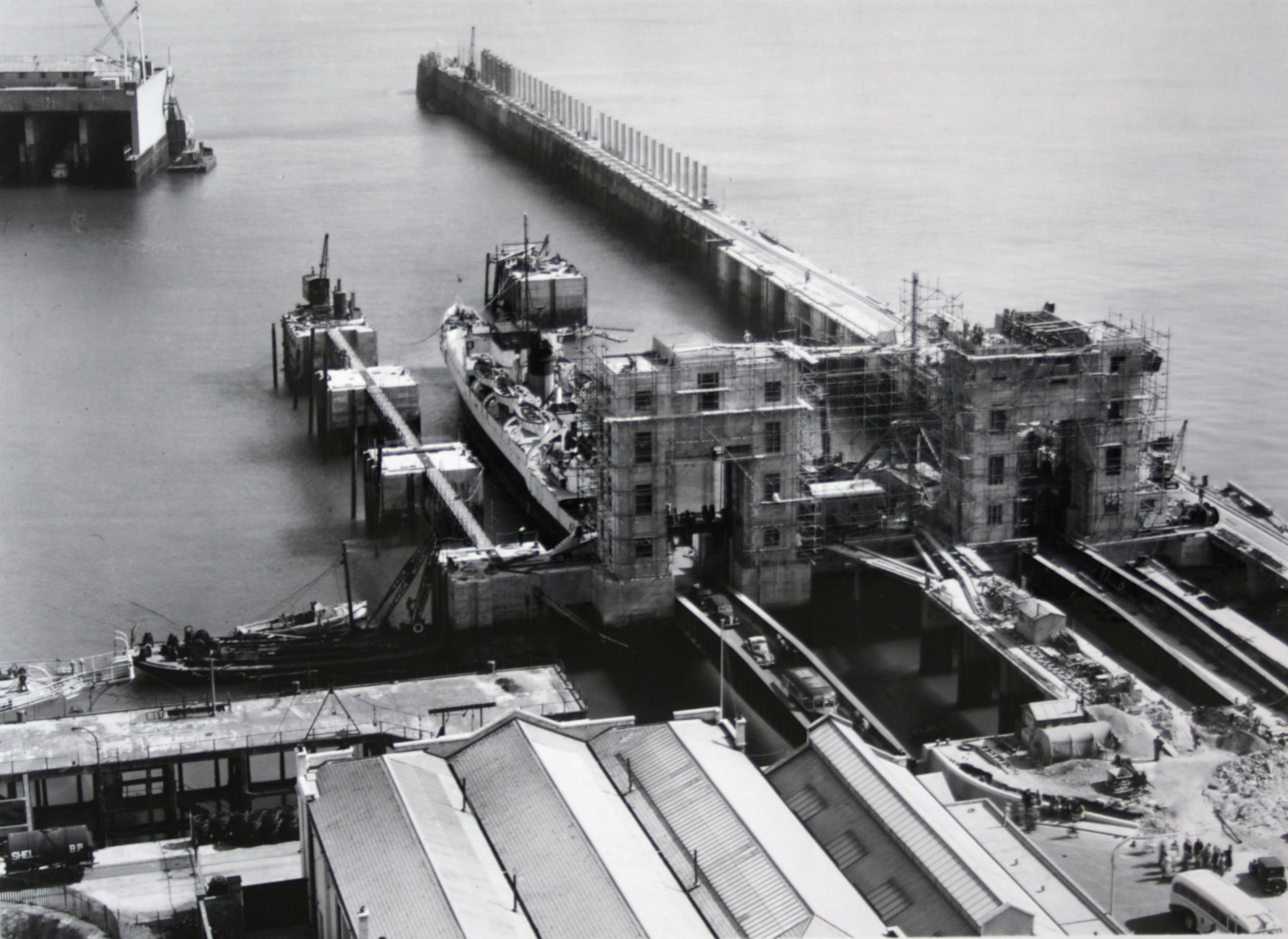
By the end of March 1953, the bridges were in place and it was expected that 240 cars an hour could be loaded. The bridges were designed to take ships 300-400 feet (91- 122 metres) long and 35-45 feet (10.5- 13.7 metres) wide. On 11 May 1953, the East berth was tested using Townsend’s ship, Halladale and proved successful.

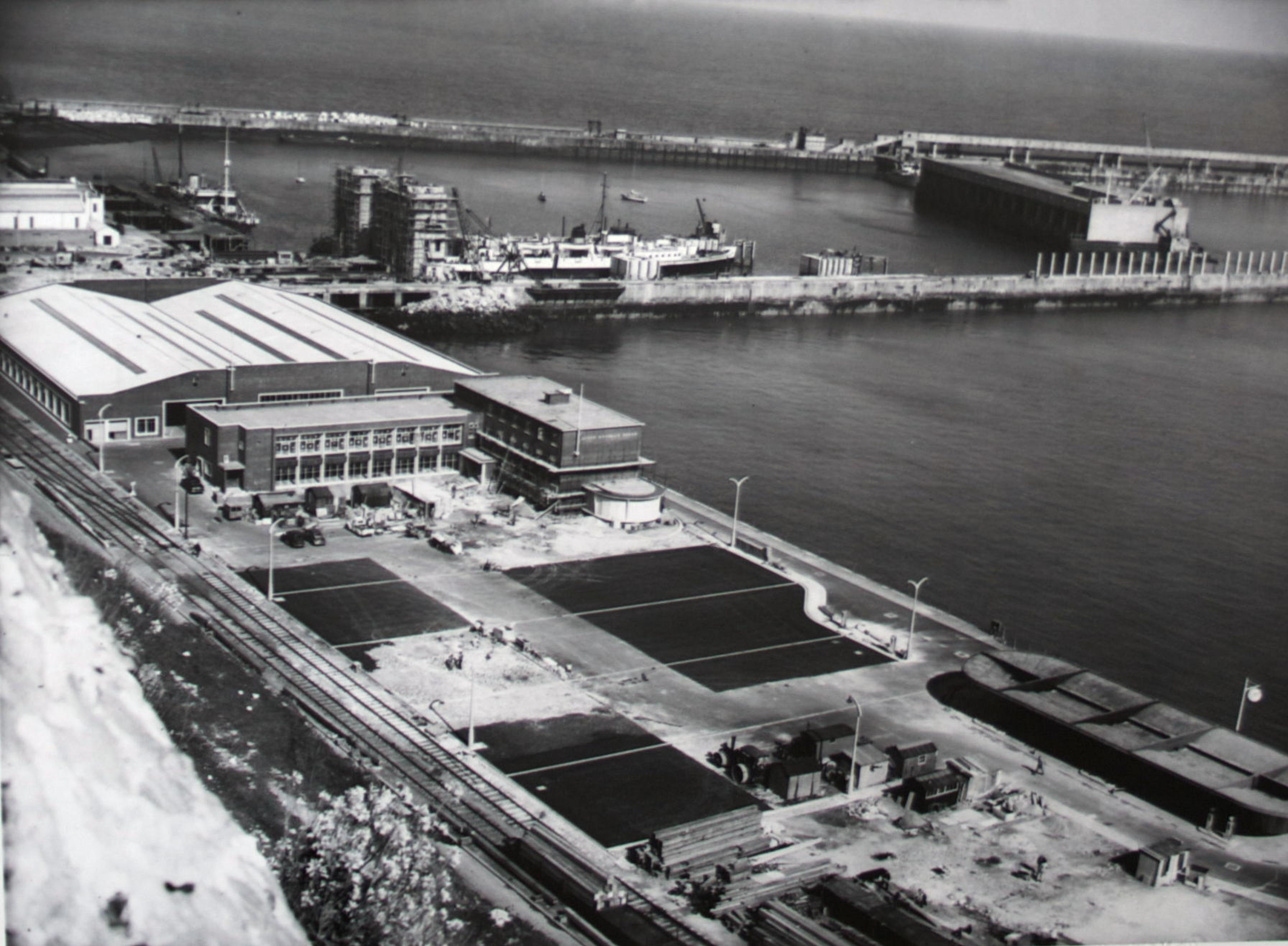
Berths from the Cliffs 28.03.1953. DHB - Lambert Weston

Berths from the Cliffs 28.03.1953. DHB – Lambert Weston

The shore side construction included a 12-pump filling station and a 300-car reception park, with separate bays for each destination – Calais, Boulogne and Ostend. Traffic was marshalled into waiting lanes for particular ship/ destinations, which was a novel feature.

Terminal & Customs Sheds 28.05.1953.DHB - Lambert Weston

Terminal & Customs Sheds 28.05.1953.DHB – Lambert Weston

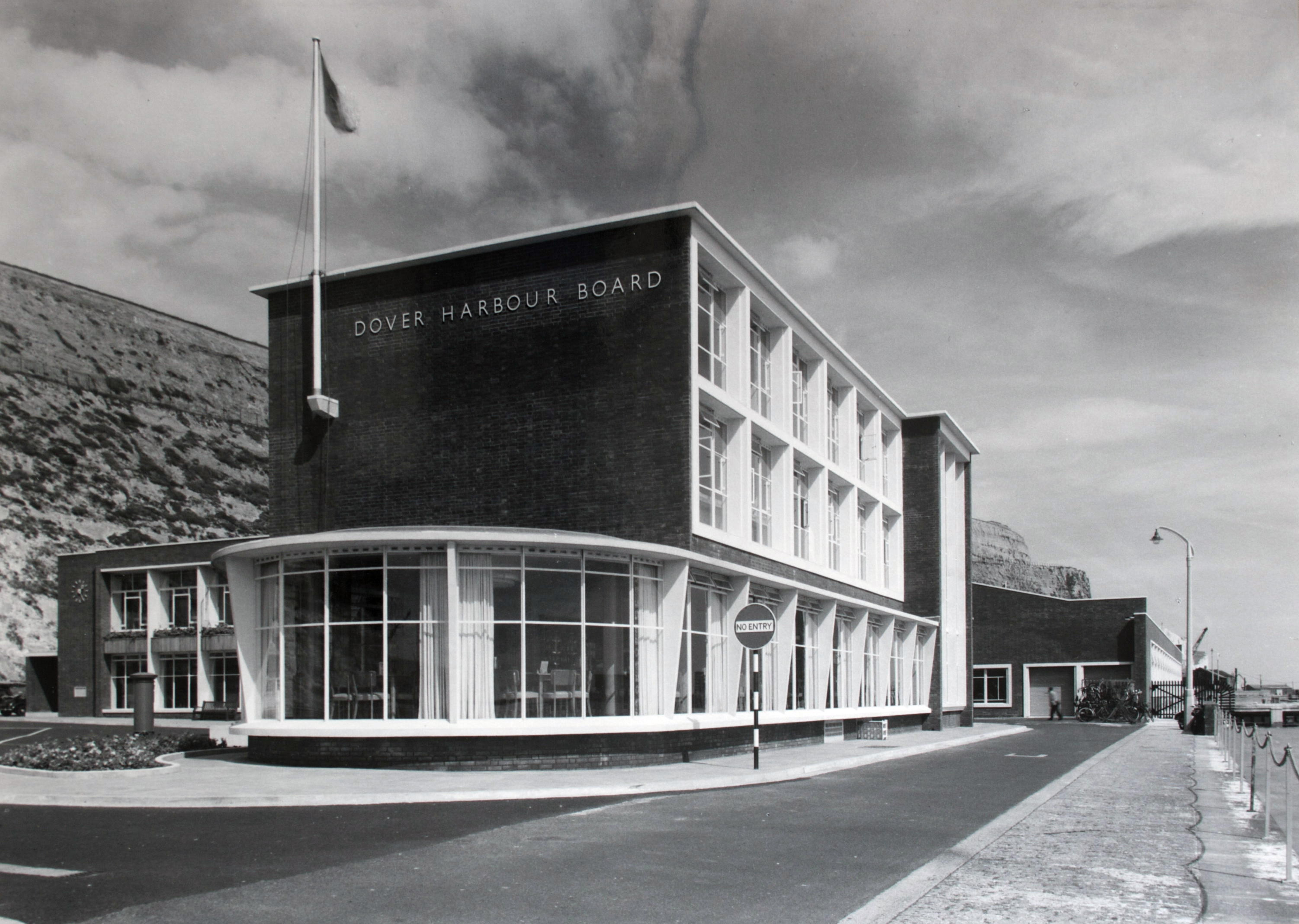
Besides seating, the reception building included a bank, post office, buffet, shops, telephones, restaurant, the Merry Dolphin, and bureaux for British Railways – Southern Region, Townsend and Belgium Marine ferry operators, as well as the motoring organisations. The 42,000 square-feet Customs examination shed was a separate building and allowed for 240 vehicles an hour.

Some 33,000 tons of concrete together with 1,600 tons of steel were used in the marine works and the final cost of the development was £750,000. The issue of 4.75% Debenture Stock raised £700,000 redeemable by 1993 in annual instalments from 1978. The floatation was heavily over subscribed – the applications amounted to £21,500,000!

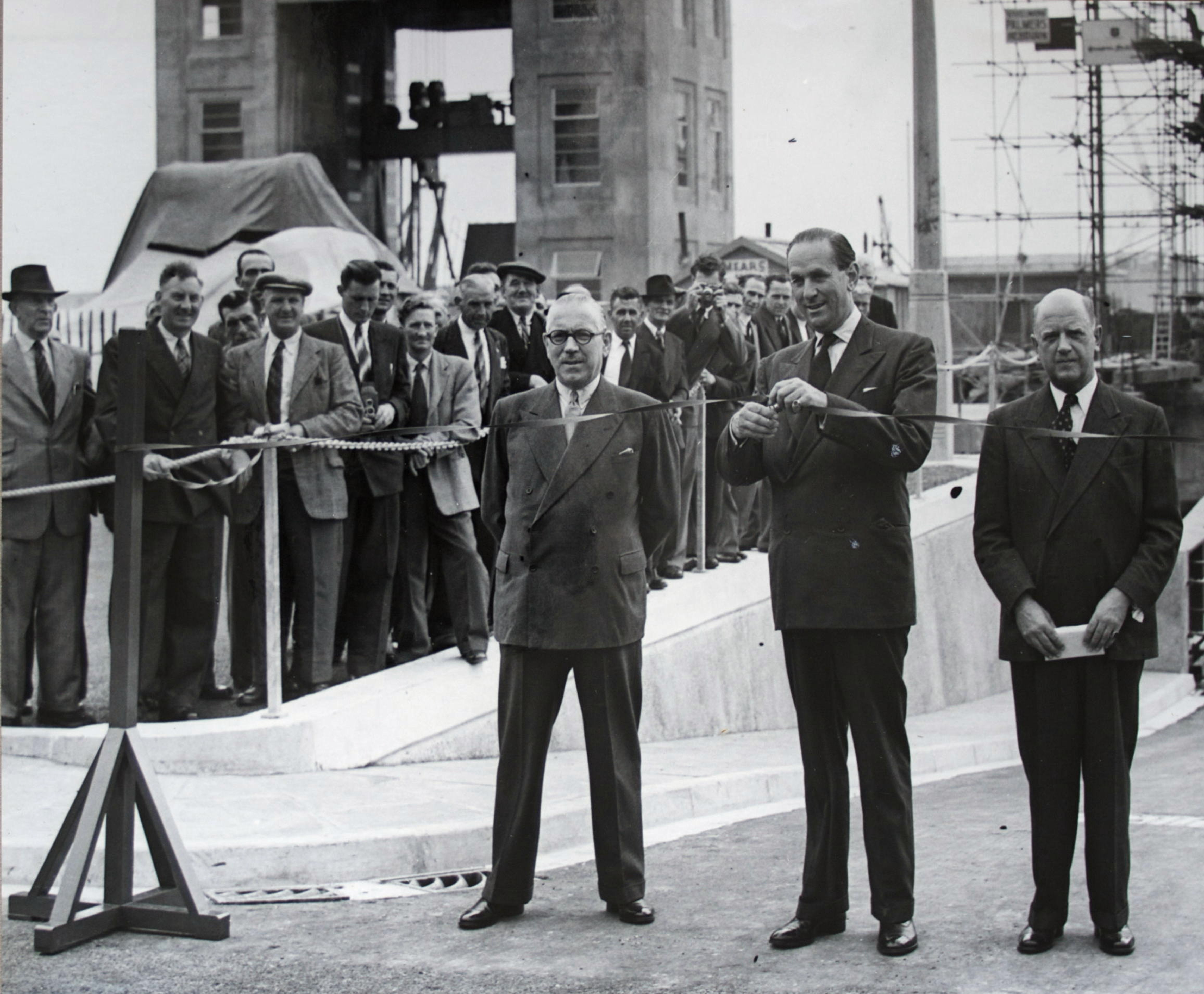
Opening of the renamed Eastern Docks 30.06.1953 by the Minister of Transport the Rt. Hon. Alan T Lennox-Boyd MP. Accompanied by the Chairman of DHB - H T Hawksfield and the General Manager - Cecil Byford. DHB - Lambert Weston

Opening of the renamed Eastern Docks 30.06.1953 by the Minister of Transport the Rt. Hon. Alan T Lennox-Boyd MP. Accompanied by the Chairman of DHB – H T Hawksfield and the General Manager – Cecil Byford. DHB – Lambert Weston

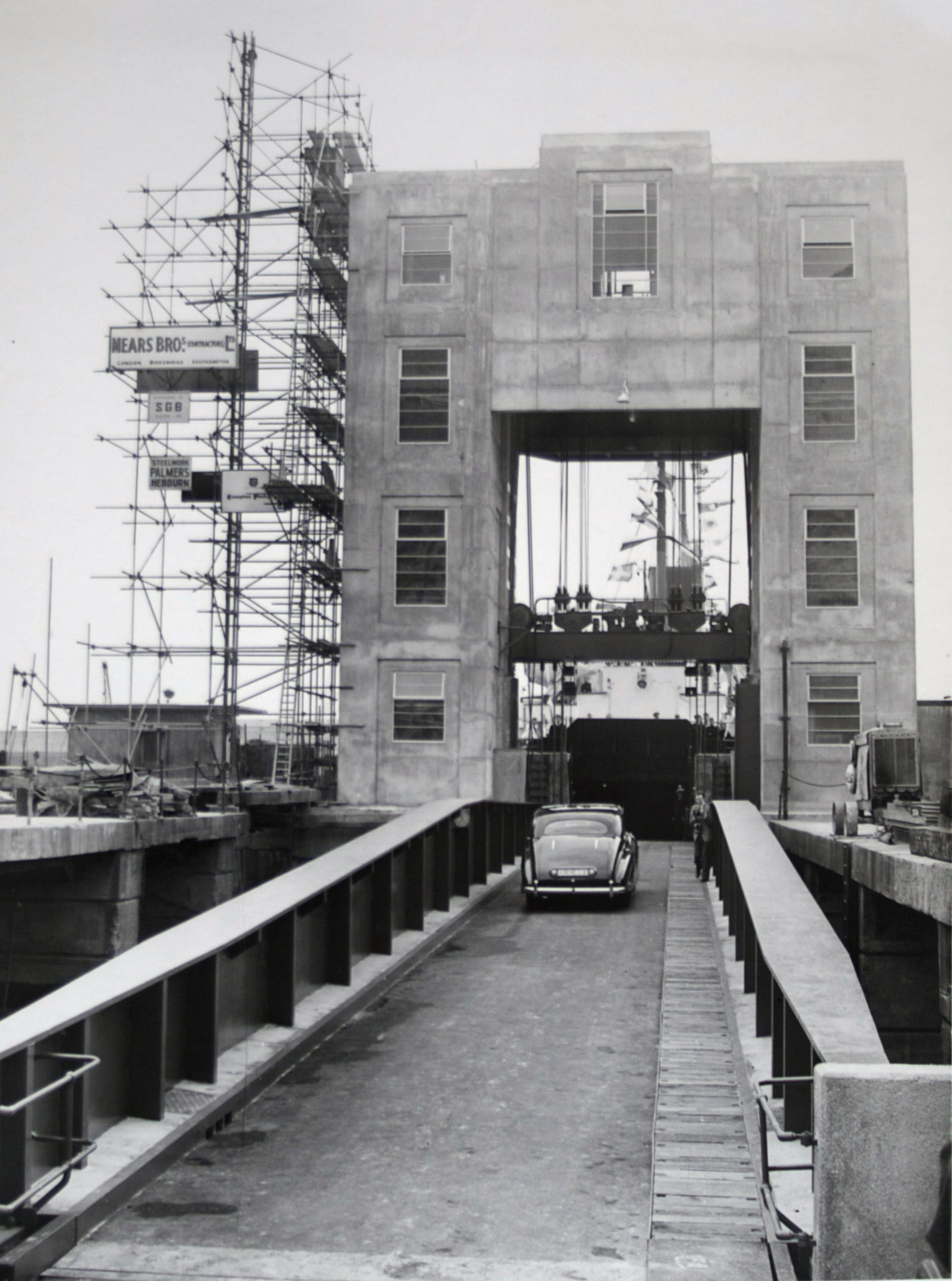
On the 30 June 1953, the Minister of Transport, the Rt. Hon. Alan T Lennox-Boyd MP, formerly opened the terminal. He already knew the Eastern Dockyard as he had commanded a motor torpedo boat out of Dover during the war. The opening ceremony included changing the name to the Eastern Docks. It finished with a Rolls Royce bearing the Minister, the Chairman of DHB – H T Hawksfield and the Register/General Manager – Cecil Byford being driven aboard the Dinard. Built and engined by Denny’s of Dumbarton, she was a Southern Region steel twin-screw steamer, launched in 1924 for Southern Railway’s Southampton – St Malo service. She had been brought to Dover in June 1947 and had been fitted with a turntable on the main car deck that worked on the first-on, first-off principle. Having spent time at Folkestone, with the opening of the eastern Docks she returned to Dover for the Boulogne service.

Opening ceremony 30.06.1953. Minister of Transport's car being driven onto the Dinard. DHB - Lambert Weston

Opening ceremony 30.06.1953. Minister of Transport’s car being driven onto the Dinard. DHB – Lambert Weston

During the construction, the pre-war Aerial Ropeway and coal staithe were removed. At the end of 1953 the communications station opened at the end of the Eastern Arm. Providing 24-hour radio communication with vessels leaving and entering the harbour it was one of the first such facilities in the world. At the same time, eight British Railways cross-Channel ferries were fitted with radio-telephonic equipment.

Passenger Terminal 30.06.1953. DHB - Lambert Weston

Passenger Terminal 30.06.1953. DHB – Lambert Weston

In 1953, the newly opened Eastern Docks coped with approximately 110,000 cars, buses and motorcycles. During the planning, it was not envisaged that there would be the massive surge in traffic that occurred over the following years. Demand quickly exceeded supply such that from 1 January to 30 November 1954 no fewer than 146,456 vehicles passed through the port!

Eastern Docks developments underway - Spring 2013

Eastern Docks developments underway – Spring 2013

To create more space, the industries that were seen as a key to Dover’s prosperity by the council, were encouraged to move out. Parker Pens, the council’s pivotal firm with approximately 40+ employees, moved to Newhaven and the Dover factory closed in 1958. The demand continued to increase and with the departure of the cable vessel H.M.T.S. Ariel and the demolition of the Submarine Cable headquarters, the Camber was filled in to provide more parking spaces. The number of ferry berths increased and the two original portals were demolished. Dover had become the ‘Busiest passenger port in the World!’

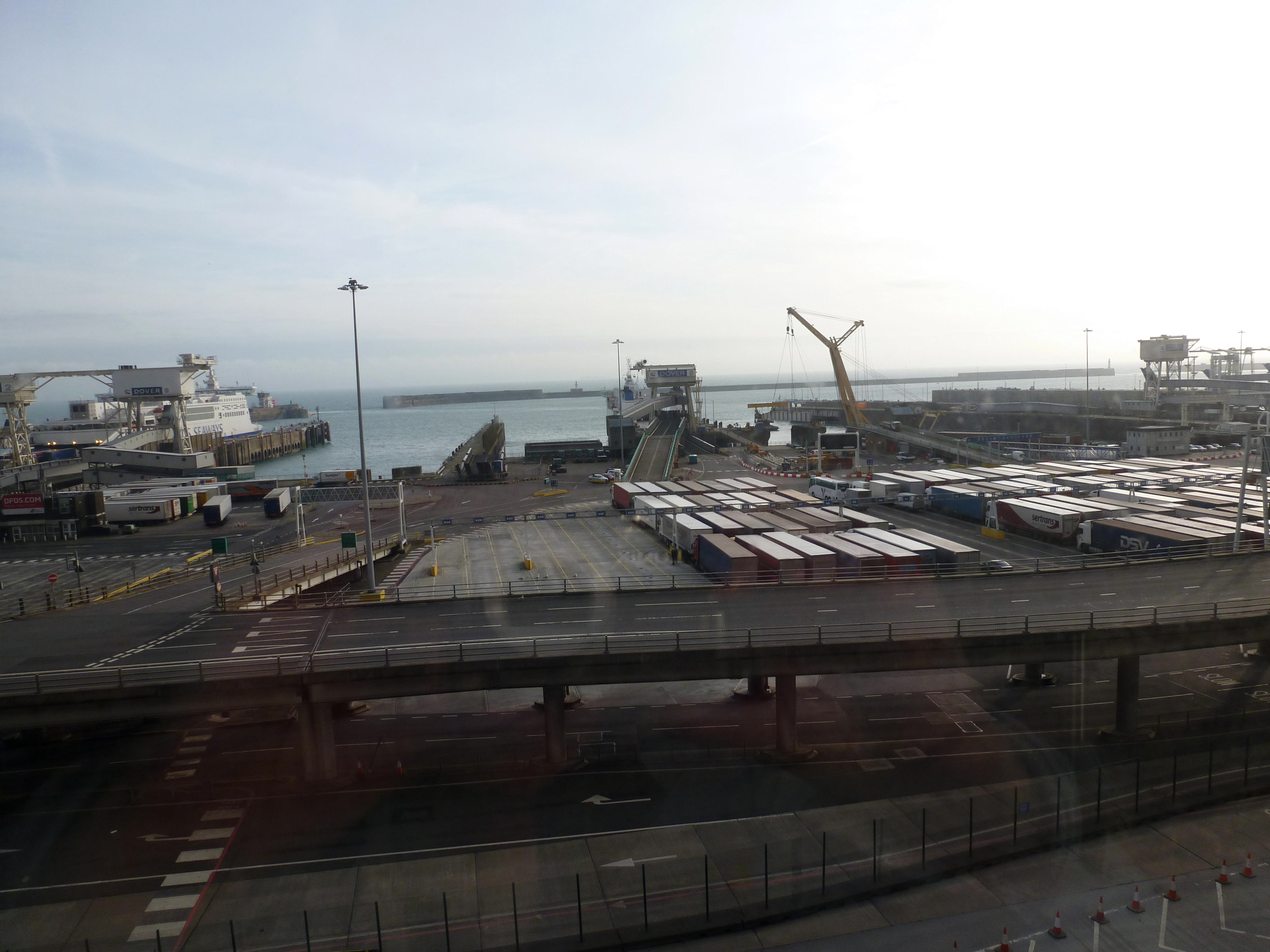
At the time of writing (2013), a £4.5m contract is underway for the redevelopment of the passenger terminal that will enable some vehicles to be processed quicker. It is also expected that a number of buildings will be demolished to create 11 more lorry lanes.

The construction photographs kindly provided by Dover Harbour Board

  • Published:
  • Dover Mercury: 25 July and 2 August  2013
Posted in Eastern Docks - Part II 1945-1953, Maritime | Comments Off on Eastern Docks – Part II 1945-1953

Eastern Dockyard – Part I to 1945

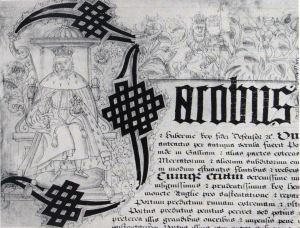
1606 Dover Harbour Charter - Illuminated letter 'J' and portrait of James I. DHB

1606 Dover Harbour Charter – Illuminated letter ‘J’ and portrait of James I. DHB

The 1606 Dover Harbour Charter did not include land to the east of the Boundary Groyne on Dover’s seafront. At that time, much of this area was covered by sea at high tide. However, harbour works, at the western end of Dover’s great bay was causing the Eastward Drift to deposit shingle below the Castle cliff. This, from mid 18th century was being built on. The inhabitants claimed the area as theirs until asked to contribute to the repairs of Castle Jetty. Their objection led to Dover Corporation taking over the beach and the inhabitants were obliged to pay rates to Dover Rural District Council until 1934.

For a long time there had been the demand for a Harbour of Refuge along the Channel coast and in the early 19th century the demand centred on Dover as the ideal port to serve this purpose. The first stage of the Harbour of Refuge was the Admiralty Pier, started in April 1848 and completed in 1871.

In 1893, Dover Harbour Board (DHB) decided to create a Commercial Harbour using the Admiralty Pier at the west and building a second – the Prince of Wales Pier – as the eastern boundary. It was envisaged that this would, with the then end of Admiralty Pier, create an entrance into the Commercial harbour. The Prince of Wales Pier was opened on 31 May 1902 by the Marquess of Salisbury, Lord Warden of the Cinque Ports. However, before then international changes brought a change to its finished design.
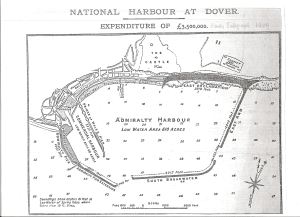
Commercial and Admiralty Harbour 1909. Daily Telegraph

Commercial and Admiralty Harbour 1909. Daily Telegraph

The German government, under Bismark, had been building up armaments and warships and in 1897 the Admiralty announced that it was to use the port of Dover as a base for the Royal Navy. They envisaged the closure of the whole of Dover bay with a harbour comprising of a 3,320ft (1,012 metres) Eastern Arm and a 4,200ft (1,280 metres) long Southern breakwater curving from the Eastern Arm to the Admiralty Pier. To meet the Breakwater and so creating the western entrance, the Admiralty Pier was to be extended by 2,000ft (610 metres). This change of plan meant that the end of Prince of Wales Pier was turned less to the south-west than was originally intended. Work began in December 1898 with the extension of Admiralty Pier.

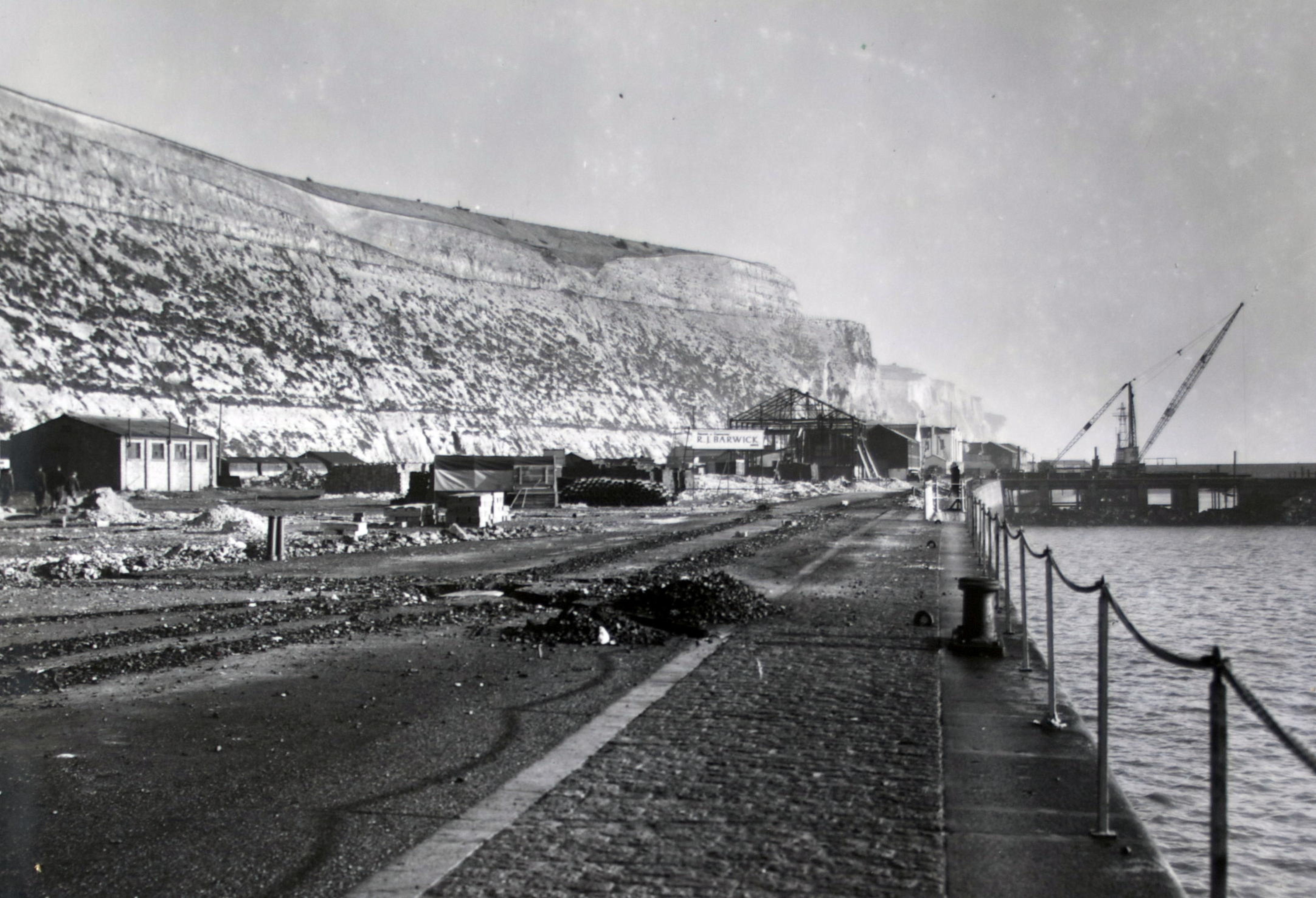
S Pearson & Sons’ tendered to build the Admiralty Harbour. This was accepted on 5 April 1898 in co-operation with Sir John Jackson, engineer, who had been responsible for the Prince of Wales Pier.  The ironwork for the new harbour was sub-let to Messrs Head, Wrightson & Co of Teesdale Iron Works, Stockton-On-Tees. Different aspects of the construction were  sub-let including to local firms including Barwicks.
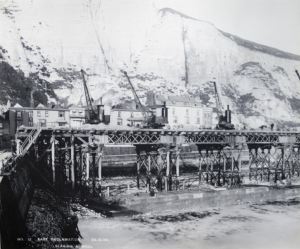
Eastern Arm 1898 note Athol Terrace in background - DHB

Eastern Arm 1898 note Athol Terrace in background – DHB

The actual building of the Eastern Arm, 2,800-feet (approx. 854 metres) in length and with depths between 26-32 feet (7.93-9.8 metres), was started in January 1901. Initially the seabed was levelled from diving bells, each measuring 17-feet (5.2-metres) long by 10-feet (3 metres) wide and weighed 35 tons and said to be the largest in the world. They were lit by electricity and the air was pressurised at 27lbs per square inch. Four men at a time worked inside them for three hours.

The spoil was raised by giant grabs lowered by crane and carried away in trucks hauled by steam locomotives. As work progressed, a temporary bridge was built and a track was laid on the Southern Breakwater. The frame for the Arm was built out of Huon Pine, a heavy wood that does not float and was brought from Dover, Tasmania. Using this framework, massive concrete blocks were laid.

Eastern Arm Blockyard 1902 - DHB

Eastern Arm Blockyard 1902 – DHB

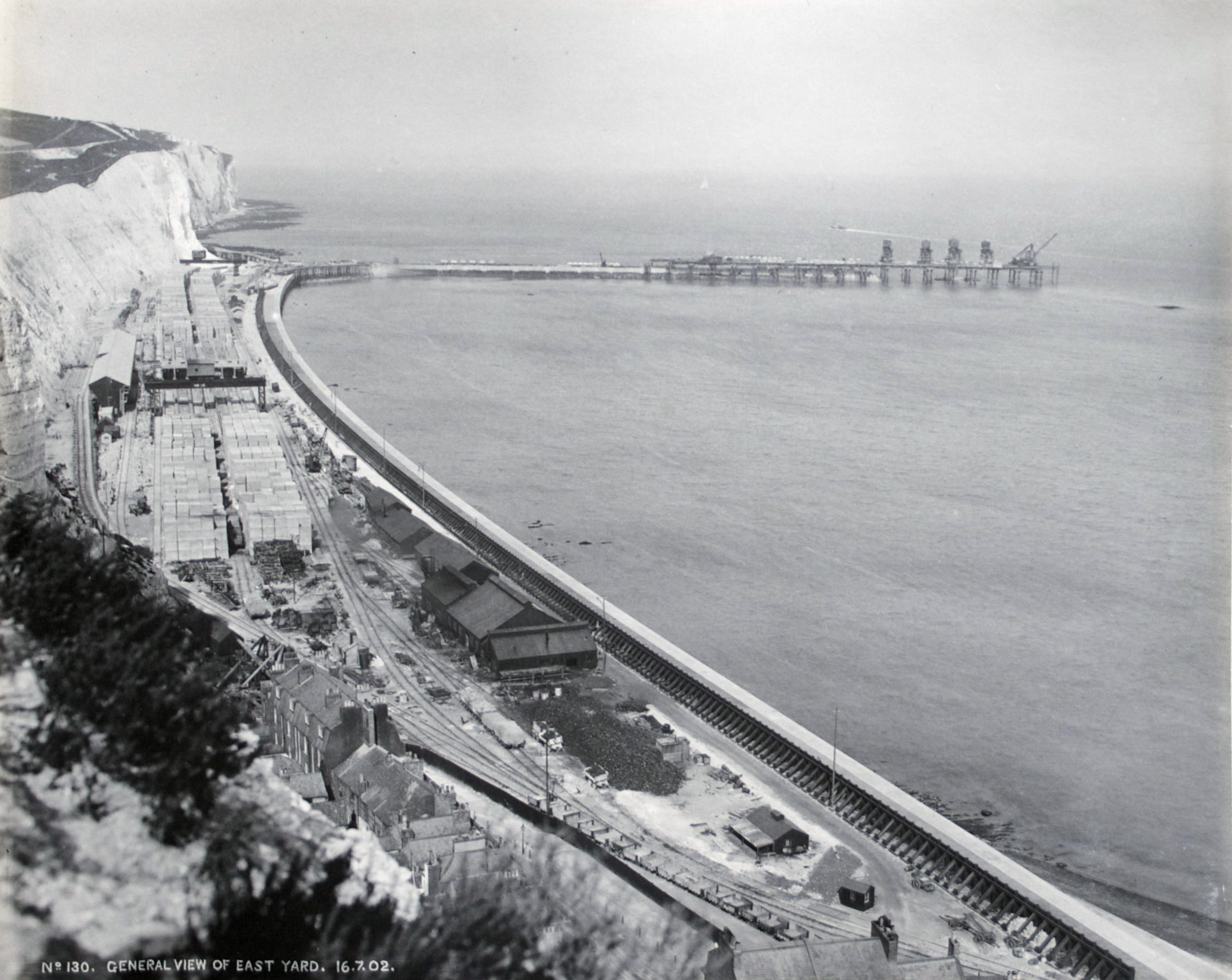
These were made in a dockyard covering 24½ acres (9.915 hectares) built under the East Cliff. It had been formed by the reclamation wall, 4,000 feet (1,220 metres) long, back-filled with chalk from the cliffs. Shingle and sand came from Stonar, near Sandwich, and was brought by railway to Martin Mill and then on the specially constructed Dover Martin Mill Railway. The shingle and sand were mixed with concrete and water in six lines of giant electric mixers. The contents were emptied into giant moulds and some 250 blocks were made at the same time.

Two goliath cranes, with a span of 100-feet (30.5-metres) and a lifting capacity of 50-tons were used to move them. The blocks were dovetailed and keyed together with concrete and laid, on average, 600 a month. They were faced with granite that was shipped in from Plymouth. Men, wearing diving suits and breathing compressed air that was pumped down to them, put the blocks into their final positions.

The Eastern Arm was completed by 1904 and in May 1905, an official notice was published stating that the Admiralty had taken over the sole control of the Eastern Dockyard – the name then given to the reclaimed eastern part of the bay.

In January 1908, Messrs Pearson secured the contract for the erection of a Camber or tidal dock at the Dockyard for a submarine station. Work started immediately on the 1,000 feet square (304.8 metres square) Camber. The minimum depth was 15-feet (4.58 metres) at low tide and it was protected from all seas.

At the end of January 1909, the 650-feet wide (198-metres) eastern entrance was opened and a fort was erected at the seaward end of the Arm. This had breech-loading medium and light quick-firing guns mounted in concrete emplacements along with searchlights, quarters, and magazines. There was also machinery for a quick drawing boom to be put in place across the harbour entrance if needs necessitated.
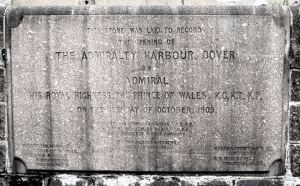
Official opening of the Admiralty Harbour, Eastern Arm. Stone laid by the Prince of Wales 15.10.1909

Official opening of the Admiralty Harbour, Eastern Arm. Stone laid by the Prince of Wales 15.10.1909

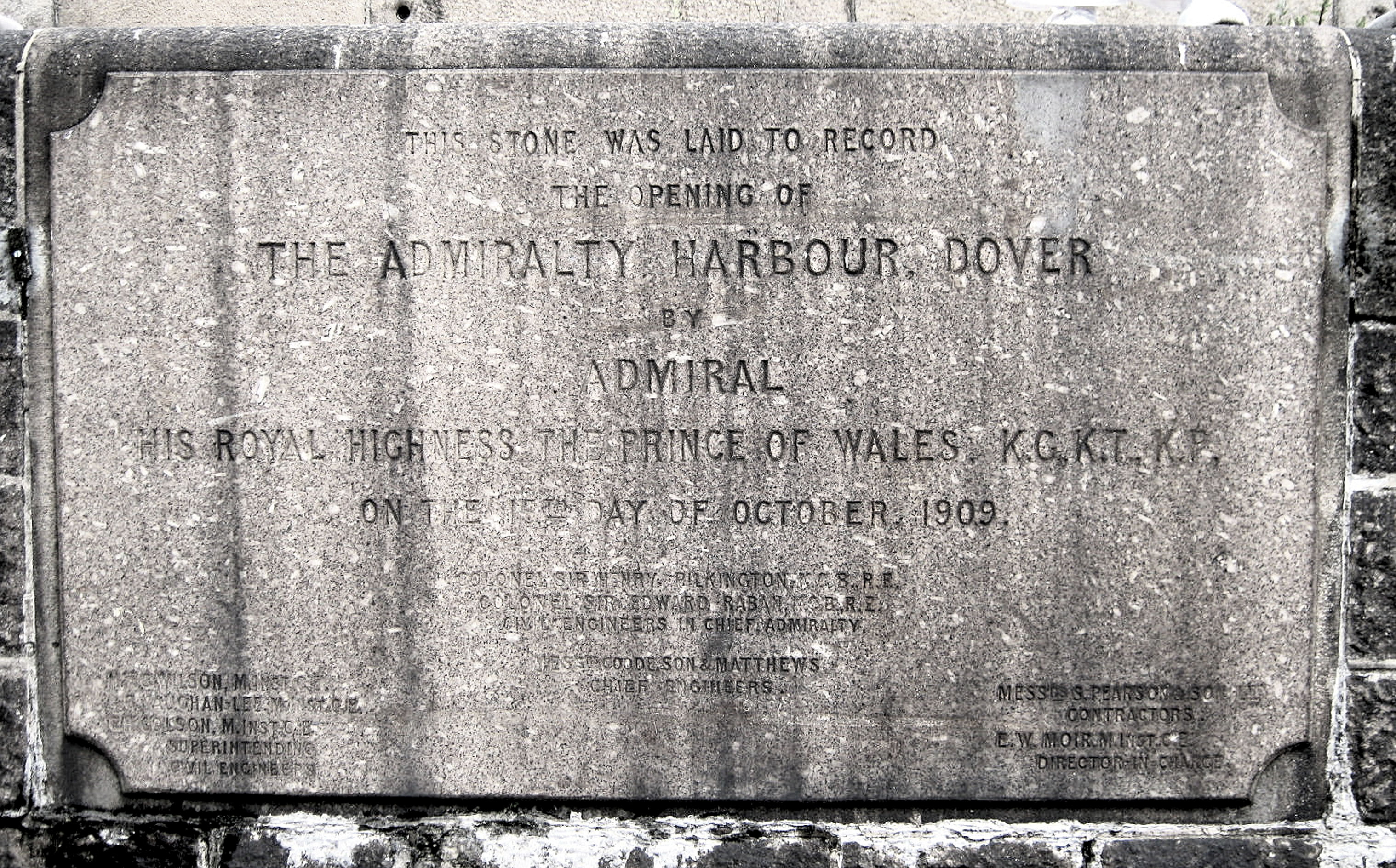
The Admiralty harbour was officially opened on 15 October 1909 by HRH the Prince of Wales. The final Stone, which he ceremonially laid, is on the inside of the Eastern Arm wall at the cliff end. In 1910, oil installations in the shape of two oil tanks with a holding capacity of 110 tons and costing £10,000 were erected for the proposed submarines.

In July 1911, Germany sent her gunboat Panther to Agadir, Morocco to supposedly protect the country’s firms even though the port was closed to non-Moroccan businesses. The Admiralty reacted by, amongst other things, ordering the Camber to be altered for use by both torpedo craft and submarines. The depth was deepened to 17-feet (5.19 metres); a pair of breakwaters and submarine shelters was constructed with a small dry dock along side. In addition, several lubricating oil tanks were erected and a new asphalt road was laid.
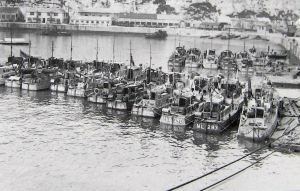
Camber- WWI Motor Launches

Camber- WWI Motor Launches

As international tensions deepened so was the Camber in order to create a safe anchorage for destroyers. In 1913, tests proved satisfactory and it was finished by March 1914 becoming operational on 22 May that year. A parapet on the Southern Breakwater was erected at a cost of £27,000 and oil-fuel storage facilities were increased at a cost of £5,800.

Britain declared war on Germany on 4 August 1914 and a floating dock was brought to the port and placed in the Camber. The boom across the entrance was put in place but it fitted so badly that it was carried away during a heavy sea, as was its replacements!

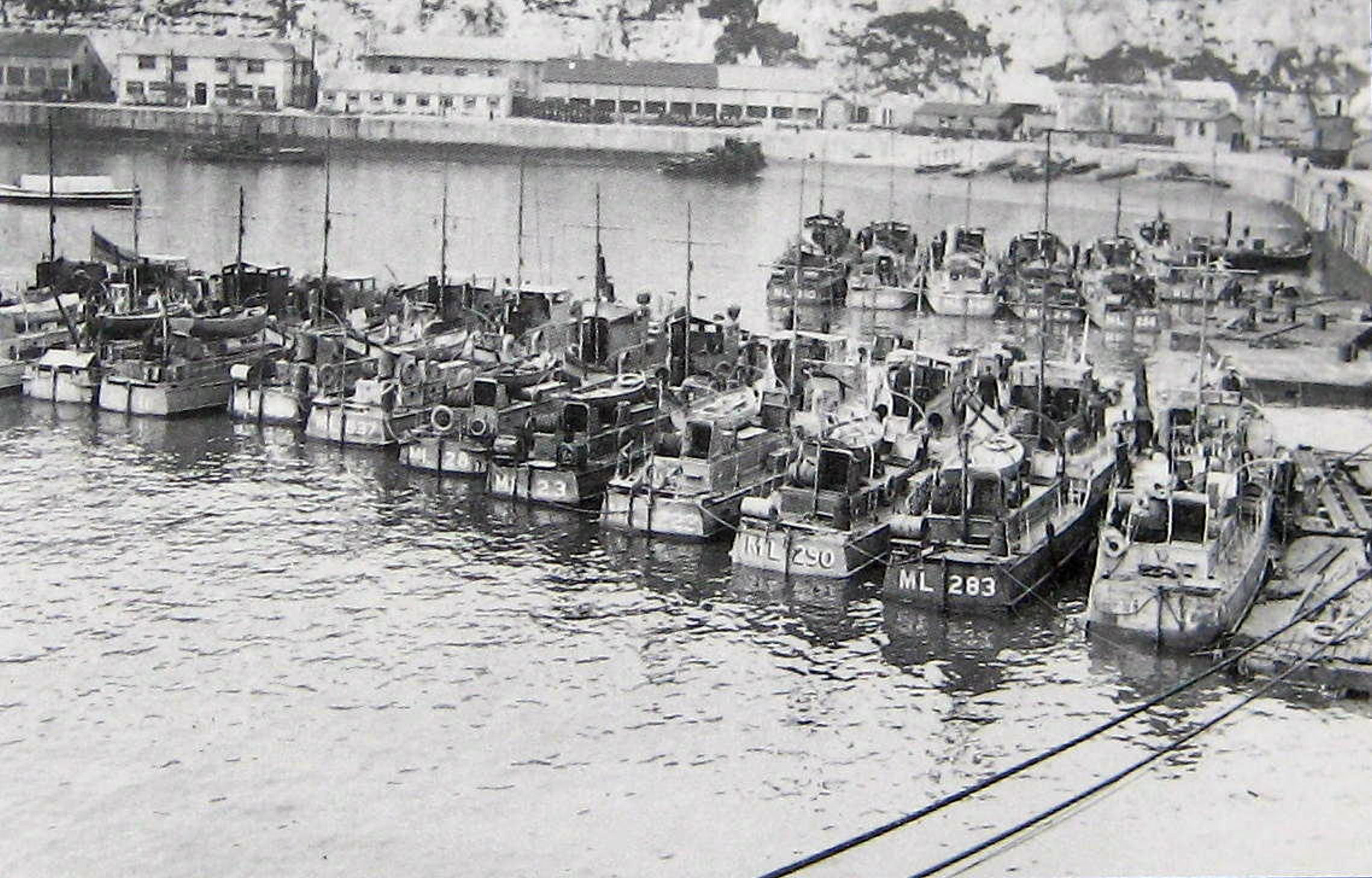
Although the Dockyard was designated for the repair of auxiliary craft, destroyers and submarines by naval staff, the work was actually carried out by Dover Engineering Company. The caves behind the Dockyard were used for the safe storage of explosives and ammunition while the Camber became the base for fast motor torpedo boats, gunboats as launches, pinnaces, and tugs. Even though facilities for the seamen, such as barracks had not been given consideration. In order to carry explosives to ships berthed in the Camber, the Sea Front railway from the Harbour station at the Western docks opened in 1918.

Towards the end of the war, the Naval uses of the Eastern Dockyard diminished so the facilities  were used for ship repairs. Following Armistice, the Dockyard was used for shipbreaking of ships classed as obsolete and in March 1920, the Admiralty leased the Dockyard to Stanlee Shipbreaking Company for ten years. The firm’s first job was the battleship Duncan that arrived in Dover on 18 June 1920. Shipbreaking soon became a major activity that employed up to 600 men except during a temporary slump in steel prices in 1921.

Back in 1889 the Post Office Marine Division had acquired the privately owned Submarine Telegraph Company. This firm had been responsible for laying the first submarine telegraph link between England and the Continent. At the time of the take-over, the company’s vessel was the paddle steamer Lady Carmichael, which the GPO renamed H. M. T. S. Alert. A second ship of the same name built by Swan, Hunter and Wigman Richardson in 1918 replaced her. The Division was based at Western Docks until 1921, when it moved to purpose built accommodation in the Camber. The lifeboat station, which had closed for the duration of the war, opened again in 1919, using the Camber, but closed in 1922.

On 29 September 1923, the Admiralty Harbour, comprising of 610 acres, was handed over to the control of the DHB and officially renamed the Outer Harbour. The Admiralty retained the Camber. Stanlee Shipbreaking Company, although still working at full capacity, were aware that the numbers of ships to be broken up was ending. Negotiations started with colliery owners, Pearson Dorman Long to take over part of the lease for a coal yard.

The Official Receiver wound up the Stanlee Shipbreaking Company in 1926 and the remaining time of the lease was taken over by A G Hill Ltd. They undertook an extensive trade in scrap metal particularly exporting to Spain. The Admiralty relinquished their control of the Camber the spring of 1927 to DHB, having removed the floating dock and crane to Rosyth in 1925. The Post Office submarine cable depot remained.

Aerial Ropeway entering the eastern Dockyard through the cliff - the two tunnels can still be seen

Aerial Ropeway entering the eastern Dockyard through the cliff – the two tunnels can still be seen

On 5 November 1926, application was made by Tilmanstone (Kent) Collieries Ltd for the right to carry an Aerial Ropeway for a distance of 6½ miles from the colliery to the Eastern Arm. The proposed course extended over land owned by 18 different personages one of whom was Southern Railway. Although permission was granted, Southern Railway, amongst others, appealed.

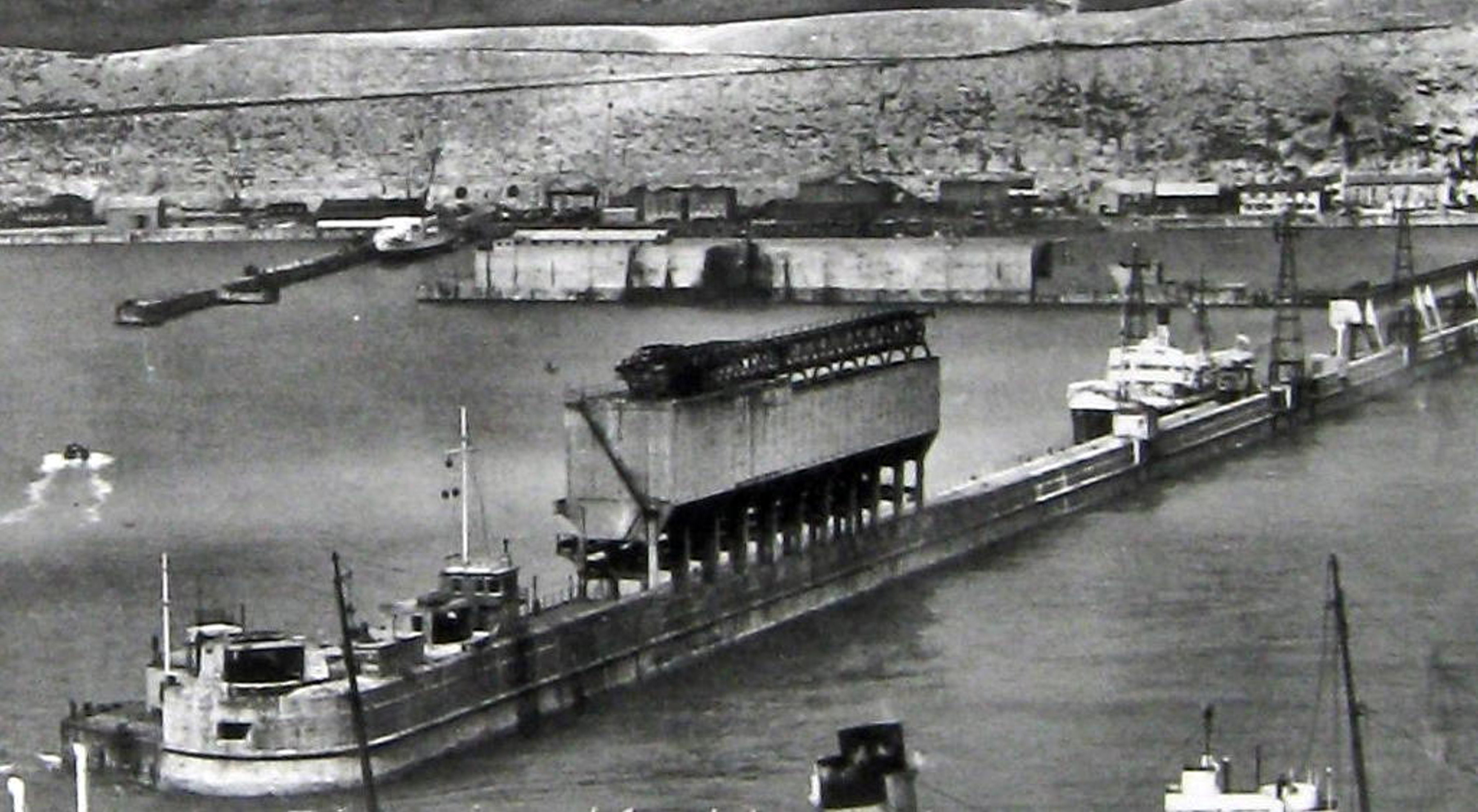
At a hearing, held on 17 March 1927, the application was refused. At the same time, Southern Railway sought permission to carry coal on the Seafront Railway and along Eastern Arm to specially built giant bunkers. The main shareholder of Tilmanstone Colliery was Richard Tilden Smith, who, after fierce battle, won the right to erect the aerial ropeway. Permission was also given for two tunnels to be cut through the cliffs. However, before the now 7½ mile aerial ropeway was completed Tilden Smith died on 18 December 1929, in the House of Commons. The formal opening of the ropeway took place on 14 February 1930 when the coal from Tilmanstone carried in buckets. Each bucket weighed 5hundredweight and had the capacity if 16hundredweight. Tilmanstone coal were emptied into a massive coal staithe capable of holding 5,000 tons of coal and built by the Yorkshire Hennebique Company . The first ship to be loaded was the collier Corminster belonging to Messrs W Cory and Co.
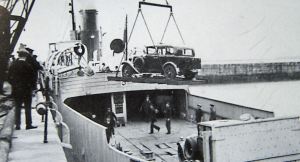
Townsend Brothers Forde alongside Eastern Arm at the Camber pre war.

Townsend Brothers Forde alongside Eastern Arm at the Camber pre war.

The Lifeboat was brought back into service from the Camber in 1929 and in May and the following year the Post Office replaced the wooden jetty with reinforced concrete. The Yorkshire Hennebique Company carried out the work. In the meant time in July 1928, Captain Stuart Townsend chartered the 386-ton coastal collier Artificer and launched a new car-carrying cross-Channel service between Dover and Calais for the transport of motorcars. Although vehicles had to be craned on and off, some 6,000 vehicles were carried that year and various motor associations opened special shipping offices in the town. The Artificer was replaced by the Royal Firth followed by the Forde, an adapted Admiralty sloop costing £5,000 that carried 168 passengers and 26 cars. The Forde, made her first trip on 15 April 1930 and although her stern door could be folded down onto the quay enabling cars to be driven on or off, because of the variable heights of tides, cars had to be craned.
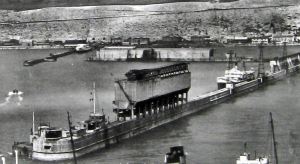
The Giant Coal Staithe on the Eastern Arm

The Giant Coal Staithe on the Eastern Arm

In August 1928, work started on Tilden Smith’s giant coal staithe however when it was almost ready, Southern Railway and Pearson Dorman Long who owned Snowdown and Betteshanger collieries, through DHB, asked for the staithe to be altered. They wanted a lower staithe constructed and to use the giant staithes loading facilities but Tilden Smith refused. Coal, up to that time, had been unloaded at Western docks but due to passenger trains using Marine Station and goods trains using the Wellington and Granville Docks, congestion was a major problem. In 1923, an Act of Parliament had allowed the military built Seafront Railway, by then in the ownership of DHB, to be used once a day. It seemed natural to use this Railway to carry coal from Western Docks to the Eastern Arm and together with the coal brought in by the aerial ropeway justified the giant coal staithe.

Rails were laid for the assembling of coal wagons to feed the staithe and to make room the old blacksmith’s shop and World War I ambulance sheds, afterwards used for oil lorries, were demolished. In the spring 1930, DHB had two railway tracks laid along Eastern Arm to the staithe. The up railway line ran underneath and the down line was on the seaward side of the giant staithe. In 1931 Southern Railway paid to have a low coal staithe built adjacent to Tilden Smith’s giant staithe.

Designed to load ships, the coal arrived by train and each wagon was upturned into one of the low staithees by a tippler. From the low staithe the coal was carried by a conveyor belt of steel 4-foot wide. The inclined belt raised the coal sufficiently high to be above the sidings and onto a specially designed apparatus the transferred the coal by the means of a telescopic to the holds of ships. It was designed to take ten hours to load 5,000 tons of coal and cost £22,000. The first ship to be loaded was the Kenneth Hawksfield that took on board 2,400-tons from Snowdown Colliery on 19 April 1932.
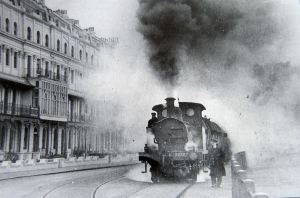
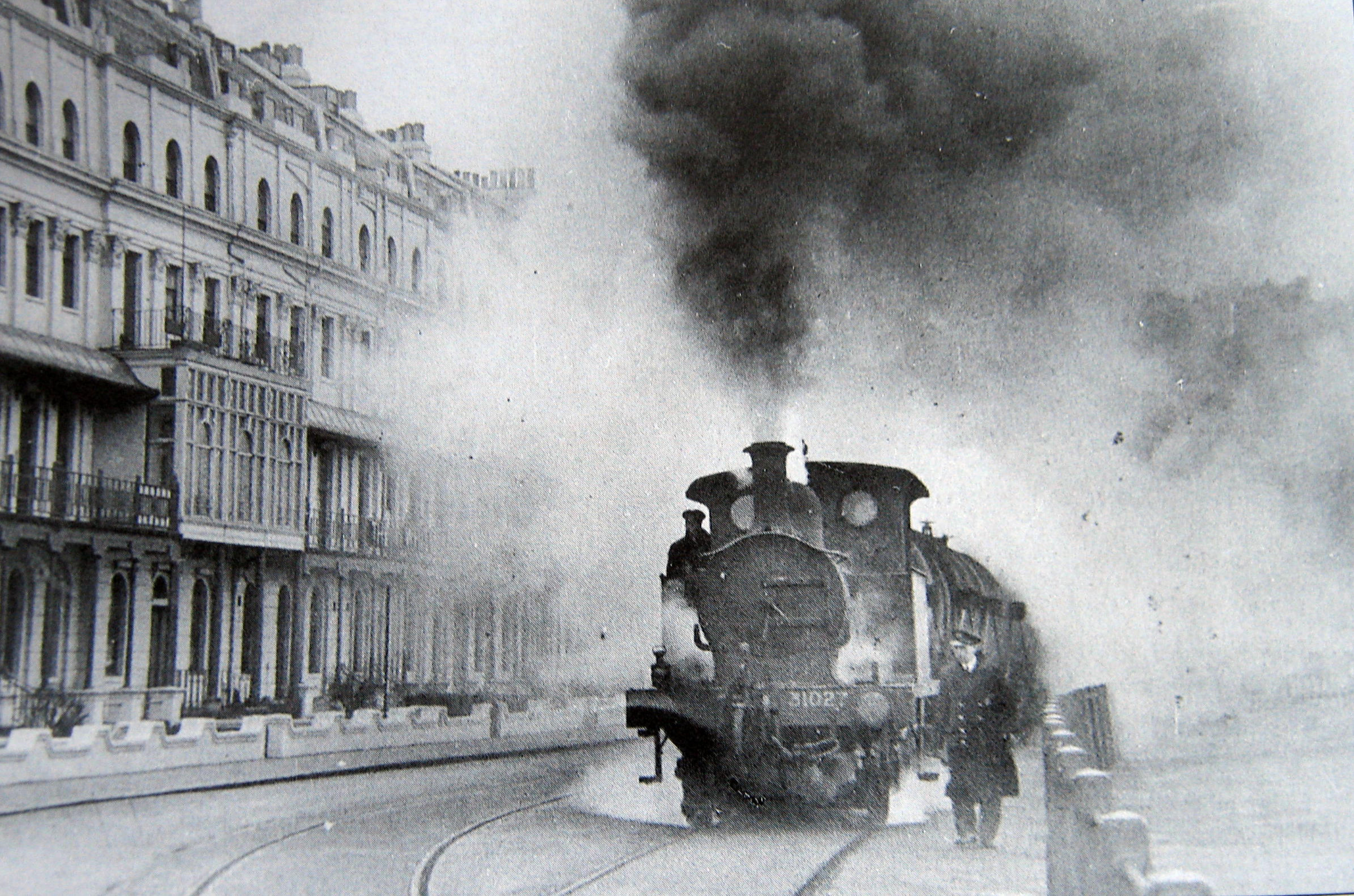
Seafront Railway c 1955 - No 31027 a P-class 0-6-0 tank-engine

Seafront Railway c 1955 – No 31027 a P-class 0-6-0 tank-engine

However, Southern Railway had made it clear that it was their intention was to use the Sea Front Railway for coal traffic at least 14 hours a day. This provoked a public outcry. In the event, a statutory restriction of 500,000 tons was imposed and the hours in use limited.

On 10 February 1931, the shipbreaking firm, C A Hill Ltd, was taken over by Messrs Peterson and Albeck of Copenhagen. In 1933, the Dover Corporation successfully sought to have their boundaries extended to include the Eastern Dockyard this came into operation the following year. At the same time, both the oil depot and the Submarine Cable Depot were extended. The demand for the car ferry service operated by Townsend continued to increase, even if cars were loaded on and off by crane. To meet this increase in traffic, the customs examination shed doubled in size in 1936. In the summer of 1939, Townsend’s carried 31,000 cars across the Channel.

Sandhurst July 1940. Thanks to Michael Harmer

Sandhurst July 1940. Thanks to Michael Harmer

That summer two 12-pounder guns were installed at the end of the Eastern Arm and the Camber was commandeered for the Royal Navy for motor torpedo boats, motor gunboats, launches and other miscellaneous craft. World War II broke out on 3 September 1939. During the Battle of Britain, on 27 June 1940, dive-bombers attacked the harbour and the pipeline was damaged. Oil leaked into the sea and caught fire and soon the 10,000-ton naval supply ship Sandhurst and other vessels were alight. The Sandhurst was full of torpedoes, ammunition and fuel oil. Dover’s police/firemen attended the scene, and persuaded the authorities to allow them to fight the fires. It took 12-hours to extinguish and the Dover firemen went with her to the Thames, still pumping out her holds. Captain Fred Hopgood, one of the Harbour Board tug masters, along with Dover’s police/firemen Ernest Herbert Harmer, Cyril William Arthur Brown and Alexander Edmund Campbell were awarded the George Medal for their part in saving several ships that day and the following two days.

Following the attacks on the harbour during the Battle of Britain, in the summer of 1940, the Camber pens were strengthened with steel and concrete. The 3-metre thick roof contained eight layers of reinforcement and weighed 23,000 tonnes. This was supported on a grid of large reinforced concrete columns that sat on large concrete caissons driven into the chalk seabed. A two-storey office block with quarters was also erected on the crosswall. For protection, on the flat roof there was a reinforced concrete pill box-cum-observation post with mountings for a light machine gun.
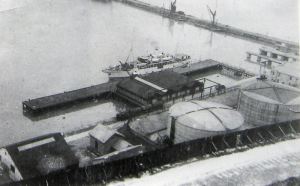
Alert - Cable Ship in the Camber

Alert – Cable Ship in the Camber

Operating from the Camber, throughout the War, was the Post Office Cable ship Alert. However, on 24 February 1945, while cable repairs were being undertaken off Dumpton Gap, near the North Foreland, the ship disappeared. With a crew of 60, many of which were local men, it is believed she was torpedoed. There were no survivors but their names are listed in Dover’s St Mary’s Church Book of Remembrance.

After the Germans had been driven from the Channel coast in late autumn 1944, Dover became a busy port of embarkation of men, munitions, railway engines and machinery. At the Eastern Dockyard, embarking jetties were built. At about the same time Dover Corporation drafted a plan for the future of the town that was, when Peace returned, embodied in the post-war Abercrombie Report.

The Eastern Dockyard was earmarked for industry and firms were encouraged to move in. Dover Industries Ltd opened a shipbreaking business and A.W. Burke, small engineering firm, made specialist parts for the British aircraft industry. Sunbury Cross Engineers Ltd and Whitecliff Works followed and in 1948, Parker Pens opened a large factory. The coal staithe was, by this time, in a poor state of repair but a decision on its future had not been made. The Post Office submarine cable depot in the Camber and the Shell /BP and Esso oil installations, for fuelling ships remained.

Next: Eastern Docks

  • Published:
  • Dover Mercury 27 June, 04, 11 & 18 July 2013
Posted in Eastern Dockyard - Part I to 1945, Maritime | Comments Off on Eastern Dockyard – Part I to 1945

William Eldred – the man who first mapped Dover

Dover Harbour 16th century - Cottonian Manuscript (Bob Hollingsbee)

Dover Harbour 16th century – Cottonian Manuscript (Bob Hollingsbee)

The history of Dover harbour tells us that it was once at the east side of the Bay, called Eastbrook, it was in the area where Castle Street and Maison Dieu Road cross. Between 1300 and 1500 there was a movement in land mass of Britain that triggered a phenomenon that affected the Bay, called the Eastward Drift – the tide sweeping round Shakespeare Cliff and depositing masses of pebbles at the eastern end of the Bay. This rendered the Eastbrook harbour as useless.

Around 1495, John Clarke, Master of the Maison Dieu, sought Henry VII’s patronage to turn a small natural cove at Archcliffe Point, on the west side of the Bay, into a commodious harbour. This he did and the mariners were so pleased with the result that they called it ‘Little Paradise.’

1606 Dover Harbour Charter - Illuminated letter 'J' and portrait of James I. DHB

1606 Dover Harbour Charter – Illuminated letter ‘J’ and portrait of James I. DHB

On 10 June 1606, Dover Harbour Commission received its Charter from James I (1603-1625) and although its main concern was the harbour, the Charter made it clear that all lands claimed from the sea was rightfully theirs. Obviously, as the land on which the mariners had built their cottages belonged to the new Harbour Commission, they justifiably demanded ground rent. They also considered the possibility of utilising the land for other purposes and thus required their holdings to be surveyed.

The first survey was carried out not long after the Commission was formed but was crude and generally unhelpful. By the 1630s, a suitable map had still not been produced but living in Dover at the time was William Eldred, b1580, a Freeman. He was also a Puritan with very strong views and later, during the Civil Wars (1642-1651), he joined the parliamentary army.

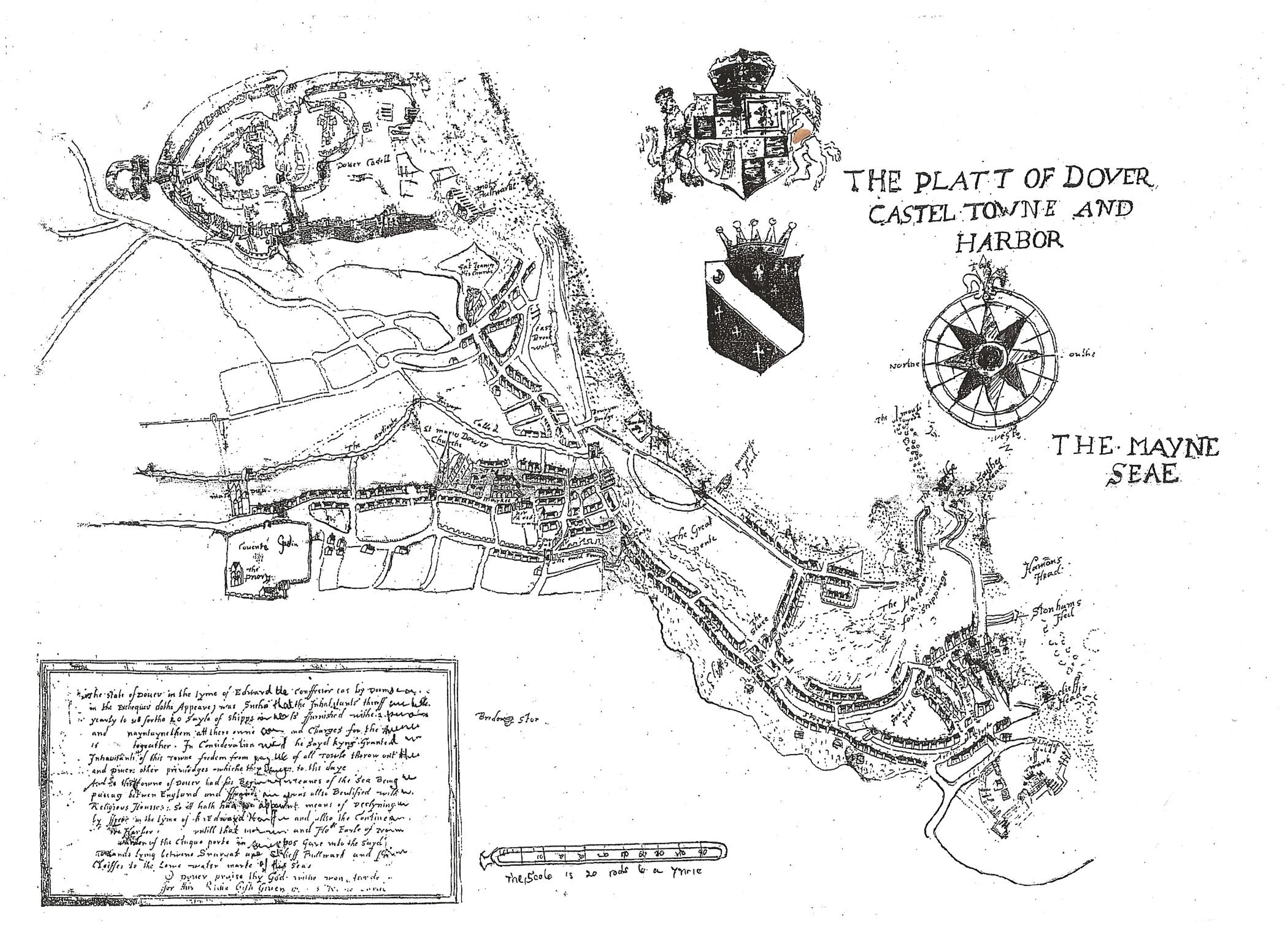
William Eldred Map of Dover and Harbour 1641

William Eldred Map of Dover and Harbour 1641

William was appointed to undertake a survey of the land and occupiers for the Harbour Commission. This he completed in 1641 and comprises of eleven large documents including maps in seven frames. The last time I saw them they were in a remarkable state of preservation in the vaults of Harbour House, Waterloo Crescent.

The first shows a map of Dover including the Castle, the main highway to London, the Priory and, schematically, the dwellings. The scale on this map is 20 rods to one inch (ynche) and bears an inscription. This starts with a reference to the Domesday Book, the Cinque Ports and ship service. In essence, it states that, ‘there are the five Cinque Ports (Dover, Sandwich, Hythe, Rye and Hastings) and the two antient towns (Rye and Winchelsea) so called because they were later additions. That they agreed to provide ships on the king’s command in return for certain privileges.’

William finishes this discourse by praising the Earl of Northampton, who as Lord Warden of the Cinque Ports (1604-1614), had advised James I to take away the running of the harbour from the town and create the Harbour Commission. Eldred reminds everyone that it was the Earl of Northampton, by the resultant Charter, confirmed that all the reclaimed land between ‘Sargat and Ayclieff Bullwork, and ffrom the Cleiffes to the Lowe water marke of the seae,’ belonged to the Commission.

The second is a detailed map of the reclaimed land and the houses that existed there at that time. This bears the inscription, ‘At this antient Gate called Snargate Begine the that memorable Grant of this Harbour lands whithe Lands was Given by King Jeames to the Right noble and Earle of Northampton for eveer to the use and mayntaynance of Dover Harbor in anno 1605.’

Pier District and Dover from Western Heights. Drawing by T S Cooper c 1820

Pier District and Dover from Western Heights. Drawing by T S Cooper c 1820

Of the remaining five, four are detailed schematic drawings and descriptions of the Pier District dwellings c1641. Giving the name of each principal tenant. Detailed are the measurements of each dwelling. On the reverse of each of these frames are documents listing the principal tenants with their sub-tenants. The area that the dwelling occupied is also given together with the ‘the situation south or north with the name also of the strete where it lyes.’

On the final document, William has written another dedication that reads, ‘To the most noble and gracious Lord James, Duke of Richmond, Earle of March etc. Constable of Dover Castle. Lord Warden Chencellor and Admiral of the Cinque Ports. Two Ancient Townes and their members knight of the most noble order of the garter and one of his Majesties most Honourable Privy Councell. And to the rest of the household and worshipful the Commissioners for Dover harbour.’

Dover Arms in William Eldred's time

Dover Arms in William Eldred’s time

William started the assignment when Henry Howard, the Earl of Northampton, who died in 1614, was the Lord Warden. By the time he finished the assignment there had been two other Lord Wardens and James Stewart (1612-1655), whom he refers to above, was appointed in 1640 and stayed two years. When the Civil Wars broke out, he joined Charles I (1625-1649) and Edward Boys succeeded him in 1642. This dates the completion of the maps.

Finally, William describes the areas he surveyed by saying, “With the Boke I heare present unto all this house sessions, which now are and always have been so carefull for the benefit of the harbour, to the intent it may remain to suredinge ayes, which will be then more use than it is now. And this recommending my work and payns to your wise and Honerable Consideration, my time labour in this world being now at an end, with my humble and hearty prayer to God for the health and prosperity of my Lord Dukes Grace and the rest of this house sessions. I humbly reste at your service to be comanded. William Eldred

Six years later, William was a Master Gunner at the Castle and published ‘The Gunner’s Glasses, where in the diligent Practitioner may see his defects, and may from point to point reform and amend all errors that are commonly incident to unskillful gunners.’ This was a practical guide for Gunners that became a major textbook for a long time after.

  • Published:
  • Dover Mercury:  7 January 2010
Posted in Armed Services, Eldred William - the man who first mapped Dover, Eldred William - the man who first mapped Dover, Eldred William - the man who first mapped Dover, Eldred William - the man who first mapped Dover, Local Government, People, Port and Transport | Comments Off on William Eldred – the man who first mapped Dover