Ralph Stott – A maligned experimenter in Vertical takeoff flying machines?

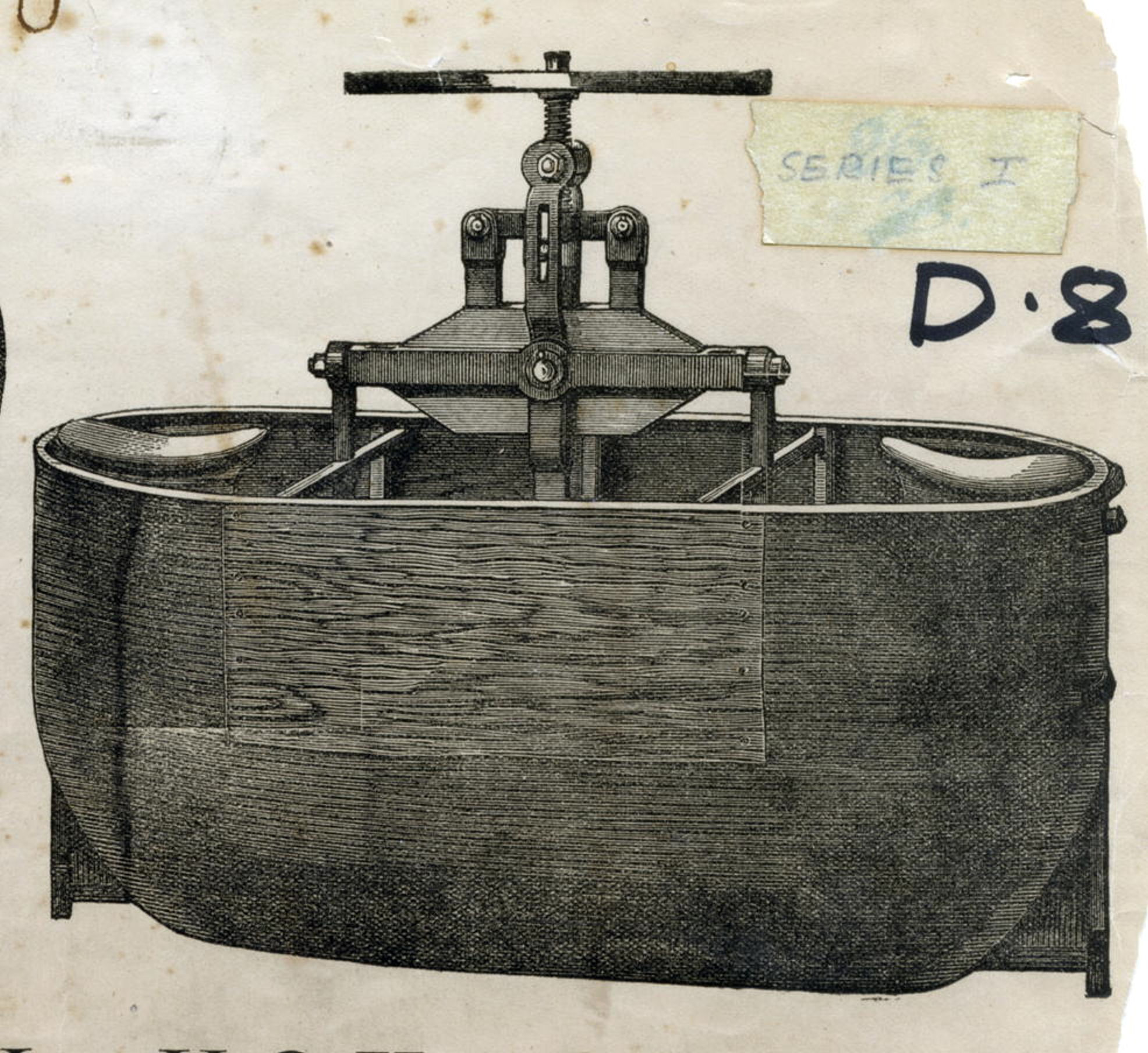
Ralph Stott's 'Flying' machine 1876. Dover Museum

Ralph Stott’s ‘Flying’ machine 1876. Dover Museum

The word ‘helicopter’ is adapted from the French ‘hélicoptère‘, and is said to have been coined in 1861 by experimental aeronautics engineer Gustav de Ponton d’Amecourt (1825-1888). The machines are defined as being able to take off and land vertically by the means of a rotor. The first design for a helicopter is generally attributed to Leonardo da Vinci (1452– 1519), in the 15th century, although it is believed that the idea was known to the Chinese from about 400BC.

Leonardo’s design involved a vertical screw but the adaptations ran into the continual problem of not being able to stop the whole machine rotating at the same time as the blades. The 18th-19th century saw the idea refined by a series of engineers and inventors but it was not until 1877 that Enrico Forlanini (1848-1930) managed to get his steam powered machine 43 feet (13 meters) off the ground for 20 seconds. The year before, in Dover, the town had been invited to see what Ralph Stott advertised as the world’s first powered, sustained and controlled vertical takeoff. This did make it into the history books but not for the reasons that Ralph Stott hoped.

Ralph was born in Trincomalee, Ceylon (now Sri Lanka) in 1839, an important British naval base from 1782-1952. His father was the Reverend Ralph Stott, a Methodist minister who was transferred to Durban, South Africa in 1862, taking his family, including Ralph and his brother Simon with him. The year before Natal has started to import Indentured Indians and Rev. Stott’s job was to serve their spiritual needs as he spoke fluent Tamil. Although a thankless task, Rev. Stott was eventually given the post of Protector of Indian Immigrants in Durban and for them, he introduced formal education. His son Simon carried on the work of his father after the latter’s death in 1879.

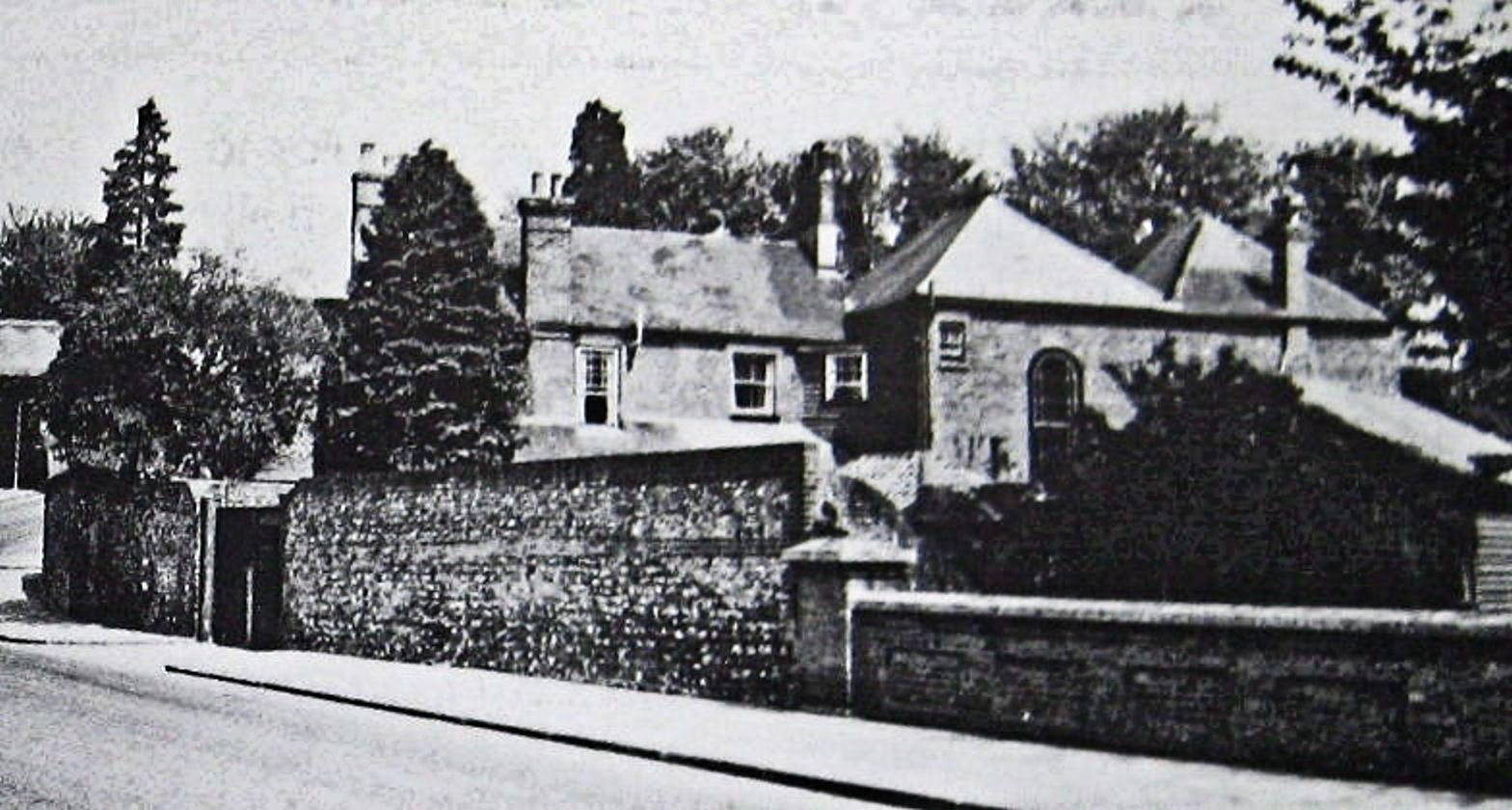
Crabble House demolished in1965 for bungalows.

Crabble House demolished in1965 for bungalows.

It has been said that Ralph came to England as young man about 1860 claiming to be a gymnast but soon after trained as a mechanical engineer. The latter is true and he was fascinated by the work of Gustav Amecourt. As a successful engineer Ralph, by 1876, was residing at Crabble House, opposite the then Crabble paper mill, where he was carrying out trials on a ‘vertical takeoff flying machine’.

Confident with his experimentation Ralph announced, through the local press, that he planned to make an ‘aerial voyage’ from Dover to Calais and back in one-hour, ‘whatever the force or direction of the wind.’ When asked about the details about how he was going to accomplish this feat, Ralph was evasive, only saying that he was not prepared to sell his prototype for ‘less than half a million pounds!’ As his work progressed, he did offer one-twentieth share of the profits from the sale of the machine, as long as the investor paid £4,000 before the public trial!

At the time, there was a great deal of interest in aviation as the competition hotted up to be the first person to make a powered flight*. Dover, with its high cliffs, the Channel and France beyond, attracted a considerable number of would be aviators. However, because of the various lucrative prizes put up by newspapers and the like, the world of experimental aeronautics was also highly competitive to the point of being cutthroat. Therefore, it is not surprising to read that Ralph was soon complaining that there had been attempts at stealing his invention and of being ridiculed.

Ralph Stott details of the proposed flight 09.10.1876. Dover Musem

Ralph Stott details of the proposed flight 09.10.1876. Dover Musem

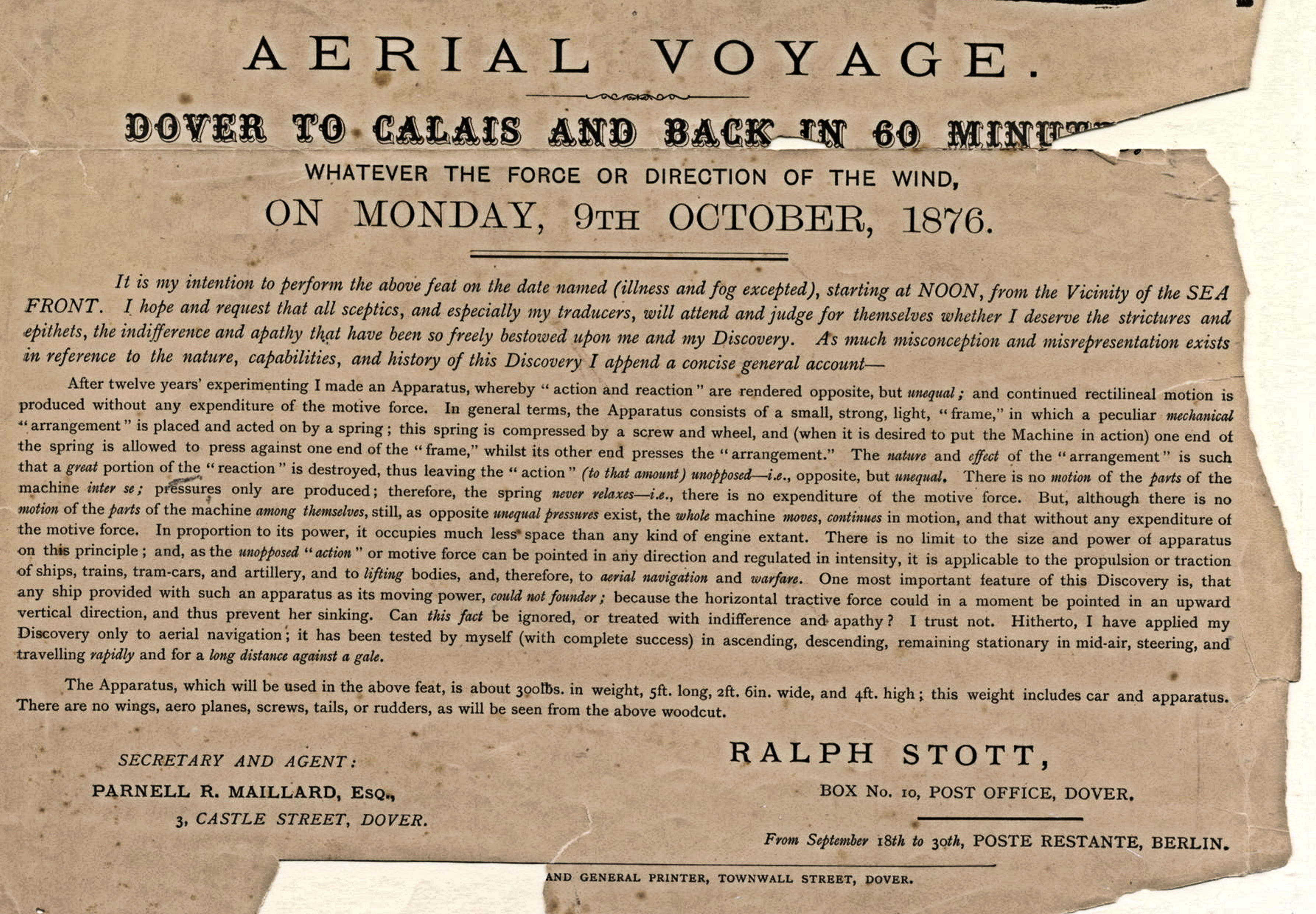
Albeit, Ralph decided to bring his machine into the public spotlight and ran off numerous posters, which were plastered all over Dover. The Dover Museum still has one in which the reader is told that, ‘After twelve years of experiment I have made an apparatus whereby action and reaction are rendered opposite but unequal and continued rectilineal motion is produced without expenditure of motive force.’

Ralph went on to say that he hoped that all sceptics ‘and especially my traducers,’ would attend and judge for themselves whether ‘I deserver the strictures and epithets, the indifference and apathy that have been so freely bestowed upon me and my Discovery.’  The proposed flight was to take place on 9 October 1876 from the Royal Cinque Ports Yacht Club, then further up the seafront on Marine Parade.

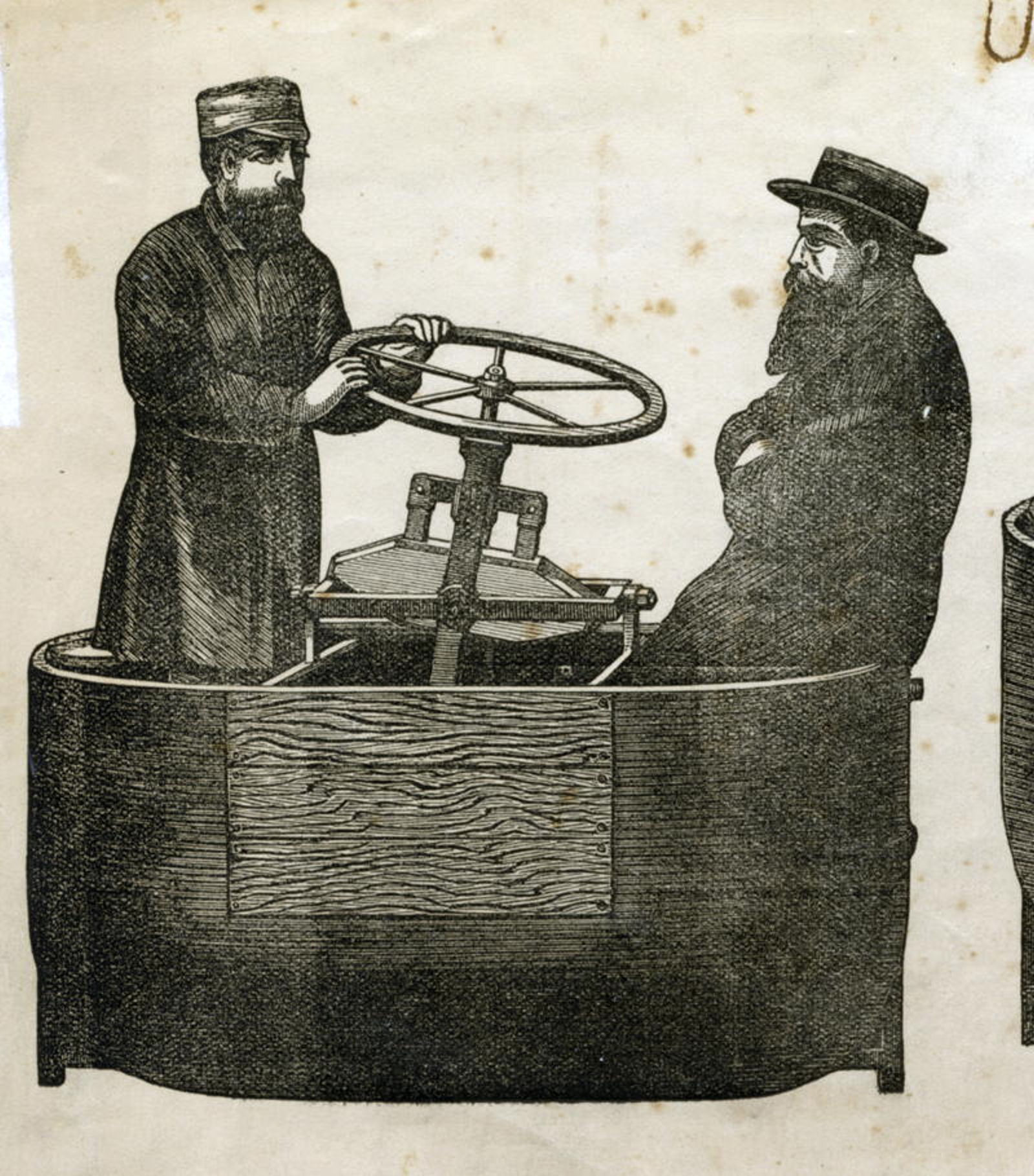
The poster shows two drawings, one with two men in the machine giving the indication of size, the other is just of the machine. It was shaped like a bathtub and, according to Ralph, ‘fitted with an arrangement acted upon by a spring compressed by a large screw and a wheel.’ The spring, he said, was pressed against the frame at one end, and the screw, which is in the middle, at the other end. Apart from the screw and wheel, the machine had no moving parts – such as a rotor – and relied on ‘pressures produced.’

Ralph Stott's Flying machine with passengers indicating its size, 1876. Dover Museum

Ralph Stott’s Flying machine with passengers indicating its size, 1876. Dover Mu

What he meant by this is unclear but in press statements Ralph cited many uses for his ‘engine’, especially as it did not use steam – those were the days before the internal combustion engine. His recommendations for the engines use included trains, trams and ships. Concerning the latter, Ralph said that the engine would ‘prevent any risk of floundering.’ For, ‘the force’, which the machine produced could ‘in a moment direct (the ship) vertically instead of horizontally.’

Excitement, fuelled by anticipation, grew but on 3 October 1876, Ralph wrote from Berlin saying that, ‘in consequence of unavoidable delay in seeing certain personages here,’ the flight was postponed. He claimed that a Russian nobleman had seen the machine who had ‘left at once with full particulars for St Petersburg whence he will return to accompany me in the … aerial voyage.’

Ralph returned to England early in 1877 and took up residence in Marine Cottage, East Cliff. He immediately  publicised a flight that was to take place on 5 March. However, it was again cancelled as, Ralph said, he had been invited to the St Petersburg’s Imperial Russian Naval Academy. He returned to England a sick man and entered a nursing home at Egloshayle, north Cornwall. There he died of pulmonary tuberculosis on 26 December 1877 age 39 years. At the time he was recognised as an brilliant engineer.

It was not until 17 December 1903 that the Wright Brothers made the first controlled, powered and sustained heavier-than-air flight. That year, Igor Sikorsky (1889-1972) began studying at the St Petersburg’s Imperial Russian Naval Academy where, apparently Ralph went. There Sikorsky ‘learned enough to recognise that with the existing state of the art, engines, materials, and – most of all – the shortage of money … he would not (have been) able to produce a successful helicopter at that time.’ (Encyclopaedia Britannica)

In 1933, although a successful helicopter prototype had still not been produced, Ralph Stott’s 1876 experiments were ruthlessly described as a ‘caper’ and he was supposedly ‘unmasked as an elaborate fraud,’ but the writer lacked details. Nine years later, the first helicopter, designed by Igor Sikorsky, went into full production.

  • Published:
  • Dover Mercury: 09 July 2009
Posted in Aviation, Stott Ralph - A maligned experimenter in Vertical takeoff flying machines? | Comments Off on Ralph Stott – A maligned experimenter in Vertical takeoff flying machines?

Dover Sea Cadets – A proud contribution to Dover’s maritime history

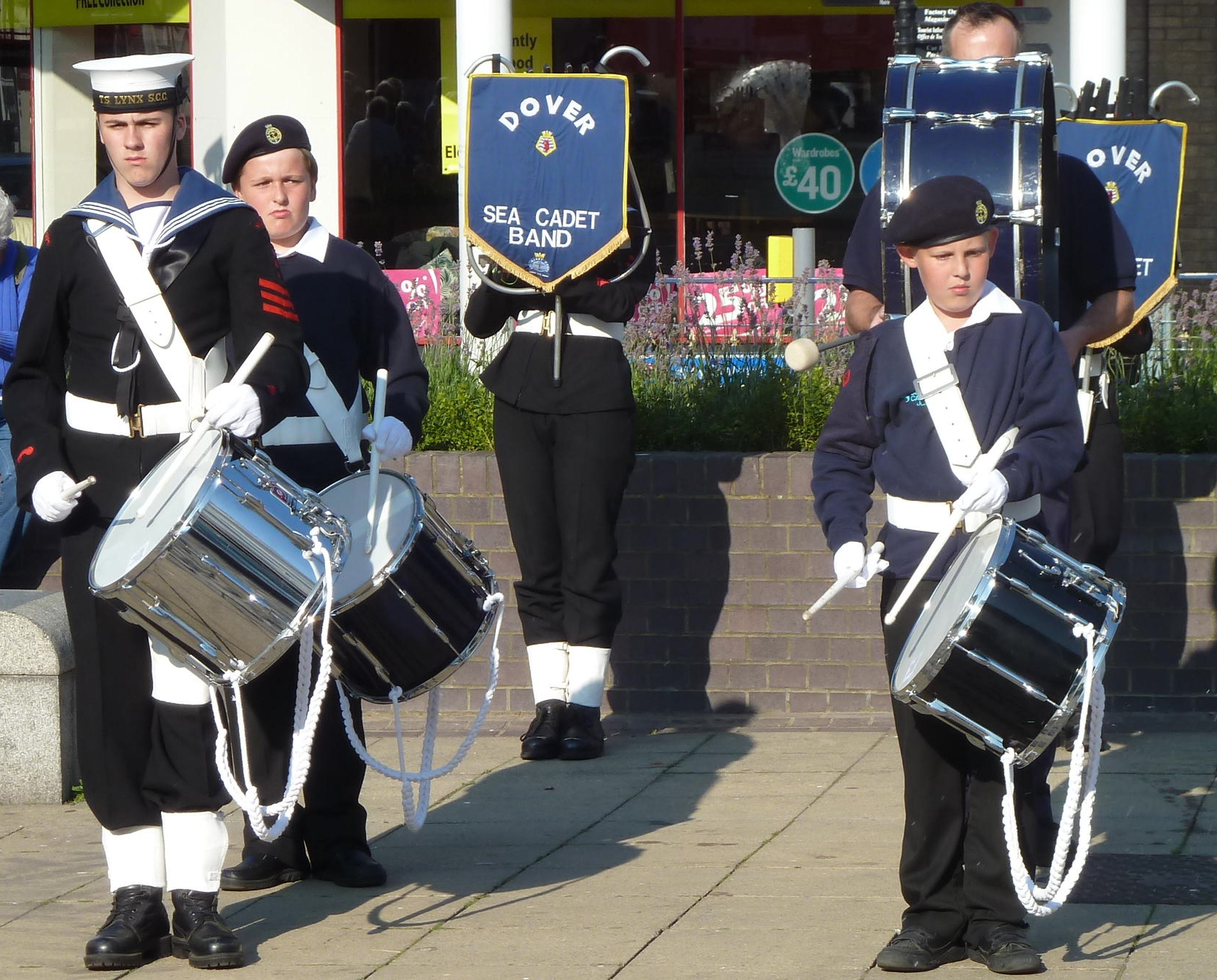
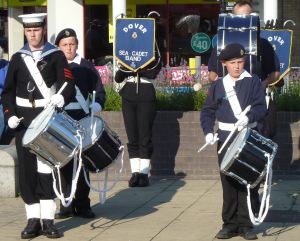
Dover Sea Cadets Market Square summer 2013

Dover Sea Cadets Market Square summer 2013

The training of young men in the art of seamanship was recognised in Denmark 1801 by the establishment of the Academy of Sea-Cadets and the idea soon spread throughout Europe’s maritime nations. Eventually national naval colleges were founded such as the Britannia Royal Naval College, Dartmouth and in 1712 the Royal Hospital School was established at Greenwich – it is now located at Holbrook, Suffolk. The original purpose of the school was to provide assistance and education to orphans of seafarers in the Royal and Merchant Navies and eventually it became the largest school for navigation and seamanship in the country.
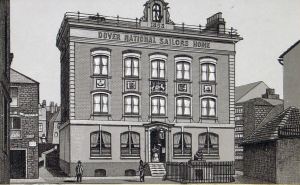
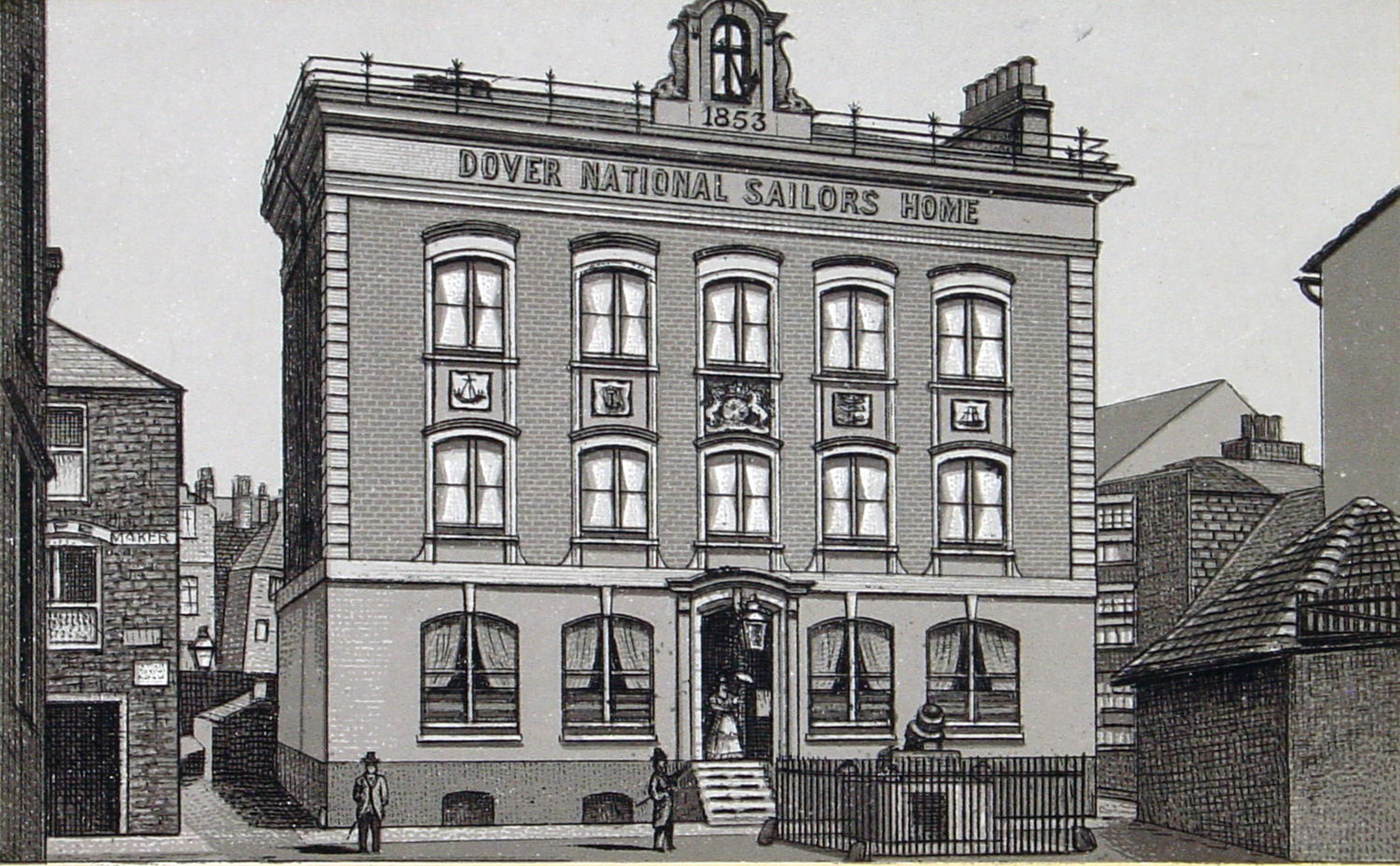
Sailors' Home, Blenheim Square. Dover Library

Sailors’ Home, Blenheim Square. Dover Library

In the seaport town of Dover by March 1846, a Captain Porter of Longford, Ireland, owned St John’s Church, Middle Row. This was in the maritime Pier District of the town. He rented the building to Reverend William Yate, a Church of England clergyman (1803-1877) who enlarged it to accommodate 700 communicants, most of whom were seafarers and their families. It was through his ministry that Reverend Yate saw, at first hand, many problems that destitute seamen faced especially when ships were lost in the Channel. He felt that there was a need for hostel in Dover specifically to meet their needs and through Rev Yate’s tenacity, Dover’s first Sailors’ Home was officially opened on 2 January 1853. This was under the auspices of the Shipwrecked Mariners’ Society. John Gilbert (c1812-1890) was appointed superintendent.
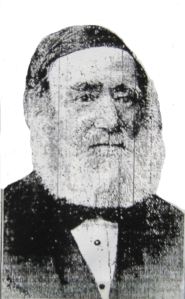
John Gilbert founder of the Dover Sea Scouts later to become the Dover Sea Cadets

John Gilbert founder of the Dover Sea Scouts later to become the Dover Sea Cadets

At the time the first part of the Admiralty backed Dover’s Harbour of Refuge was being built – the Admiralty Pier. Officials included Edward Royds Rice, Dover’s MP, who had fought hard for the Harbour of Refuge and was interested in the work of Reverend Yate and John Gilbert doing everything in his power to help them. Within two years of arriving in Dover, John Gilbert had gathered together the sons of the seafarers in the town and formed Dover Sea Scouts. The boys were required to have two pre-requisites, an interest in playing music – even if the instrument was a comb! More importantly, an active interest in learning seamanship both theory and practice. As time passed, for formal occasions they were provided with smart square rig uniform of navy blue top and white trousers that were paid for out of public subscription – collection tins were positioned at strategic places – and by members of the Rice family.

The age of the boys ranged from 8-years to late teens and many stayed on to help with the teaching. Initially Richard Dana’s Seaman’s Friend (published 1841) was the main reference textbook but this was superseded by Lieutenant George S Nares’ Seamanship, first published in 1862. Seamanship training ranged from knowing the principal parts of a ship, rigging and managing sails to helming, making sail and nautical emergencies. The boys would be given practical training initially on local fishing vessels and, as they advanced, hoys and other carriers going from Dover to London and back.
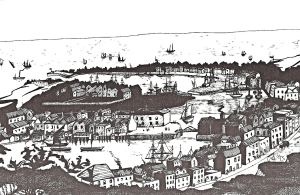
Dover Harbour and the Pier District circa 1830 by Lynn Candace Sencicle

Dover Harbour and the Pier District circa 1830 by Lynn Candace Sencicle

Typically, the hoys would leave Dover at high water, taking the fair tide up to the North Foreland. If conditions were not in their favour, they would anchor off Margate. Otherwise, following two to three hours of adverse ebb, the flood tide would take them comfortably up the Thames estuary to a possible anchorage at Hole Haven off Canvey Island. They would then take the next flood tide to London. With such training, the boys had little difficulty in finding work on fishing boats, cross Channel Packets, ocean going merchant vessels and the Royal Navy.
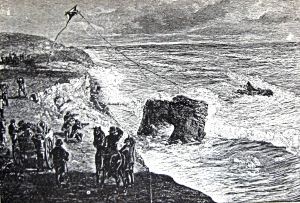
Lieutenant George Life-Kite from land from Lt G S Nares’ book Seamanship 1862

Lieutenant George Life-Kite from land from Lt G S Nares’ book Seamanship 1862

A few exceptional boys were admitted to the School Frigate Conway, based at Liverpool where they received training to become officers in the merchant navy. That course lasted three years and in 1862 cost 35guineas per annum. To be accepted the boy required a good knowledge of seamanship, leadership abilities and were expected to be literate. The course was run by Liverpool ship owners and following completion of the training, the boy would be accepted as ship apprentices without premiums. In Dover, packet owner Joseph Churchward introduced a similar scheme at a much lower cost to the student.

By 1875, in Germany young men, who had been at sea for three years on merchant ships and having undergone similar training to that Churchward had introduced, were being offered places in naval officer training colleges. The only proviso was passing the entrance examination. Pressure was put on the Admiralty for a similar scheme and this was introduced in 1889. That year, the Naval Defence Act embodied the need for both the Royal and Merchant Navies to be kept strong in order to ward off any possible rivals to Britain’s leading maritime world position.
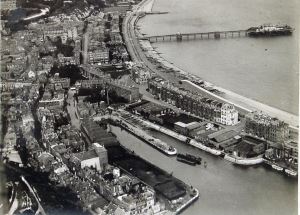
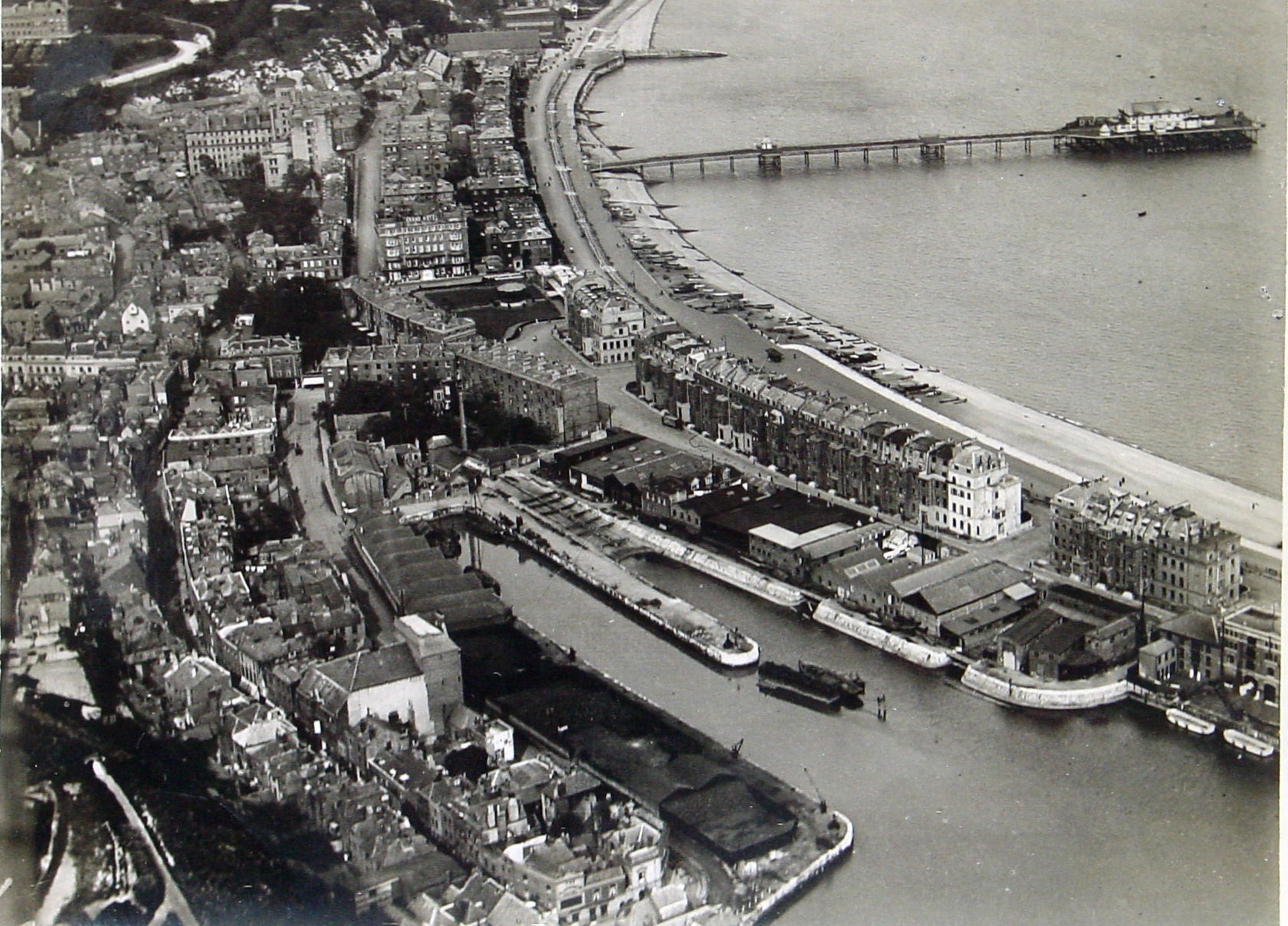
Western Docks 1920s before Promenade Pier was dismantled. Dover Library

Western Docks 1920s before Promenade Pier was dismantled. Dover Library

In the mid-19th century at an orphanage in Whitstable, on the North Kent coast, nautical skills were taught. Other orphanages, notably in Whitby, Brixham and Deptford followed suit and from these roots, the Naval Lads Brigade developed. Over the years, similar Brigades could be found in many towns and on 25 June 1899 Queen Victoria presented £10 to the Windsor Naval Lads’ Brigade for the purchase of uniforms. Following a meeting in London, on 11 December 1894, the British Navy League was formed. The first President was Admiral of the Fleet, Sir Geoffrey Phipps Hornby and among their various objectives was, under the 1889 Act, to promote the Navy to the young through education. By 1910 the British Navy League were sponsoring a small number of Naval Lads’ Brigades.

Up to the outbreak of World War I (1914-1918) in Dover the Sea Scouts continued to be a popular avenue in seamanship training and this was recognised by the Royal Navy. Indeed, recruitment from Dover Sea Scouts for ratings was one of the highest in the country. At the same time, the Windsor Branch of the Navy League was developing the skills of their local Lads’ Brigade to a high level. They suggested that the Brigades throughout the country should all receive similar training and come under the auspices of the Admiralty. On 14 January 1919, official recognition was given to the Lads’ Brigades and they were renamed Sea Cadet Corps (SCC). The following year the Admiral of the Training Services took responsibility of the SCC.
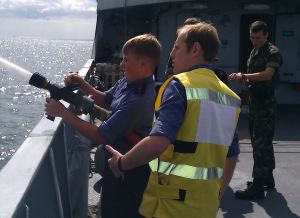
Dover Sea Cadet today at Sea. TS Lynx

Dover Sea Cadet today at Sea. TS Lynx

In many seafaring towns there were Sea Scout groups that had been in existence since the 19th century and in Dover they were faced with two problems. The first was due to the economic depression and the decline of both fishing and small coastal vessels industries. The first was due to the economic depression and the decline of both fishing and small coastal vessels industries. This made the provision of basic seagoing training increasingly difficult but local, Sydney Sharp came to the rescue. He provided an old 27ft whaler, Stormcock, for which he paid £5. At about the same time, the British Sailors’ Society offered a residential year long training course in seamanship for the Sea Scouts. Although competition was fierce, boys from Dover out numbered those from other seaports and on graduation, most joined the Merchant Navy. In 1924, the school was given Royal recognition when Edward, Prince of Wales (later Edward VIII) gave 20 guineas (£21) for Christmas festivities!
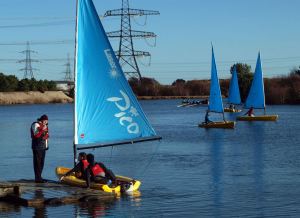
Dover Sea Cadets Sailing today. TS Lynx

Dover Sea Cadets Sailing today. TS Lynx

The second problem stemmed from 1907, when Robert Baden-Powell (1857-1941) founded the Scout movement. As the Boy Scout movement’s popularity increased so did confusion with the Sea Scout movement. This gave the impetuous to a number of Sea Scout groups applying to the Admiralty to be part of the Sea Cadet Corps and this included Dover. Following an inspection by Captain C.H. Pilcher on 7 June 1926 the Admiralty officially recognised the Dover Sea Scouts as Sea Cadets. By this time, not only were members from the maritime families of Dover but from other walks-of-life. This was brought home to the people of the town that year by the death of James Joseph Smith, who was killed while working down Snowdown pit. While the Unit escorted James’ coffin through Dover shop owners drew their blinds and folk turned out to show their respect.

The previous year, 1925, the Seaman’s Mission amalgamated with the National Sailors’ Society and the lease of their Northampton Street premises was put up for sale. The Sea Cadets managed to raise £1,600 and bought it. However, their tenure was short lived for Dover Harbour Board (DHB), who owned the freehold, used a compulsory purchase order to take over the building and it was demolished in 1930. The Cadets were offered the use of the Drill Hall in what was Liverpool Street. In 1937, Lord Nuffield gave £50,000 to fund the national expansion of the Corps and by the start of World War II (1939-1945), there were nearly 100 Units with some 10,000 cadets. However, in Dover, the Drill Hall was requisitioned for military purposes.
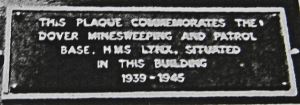
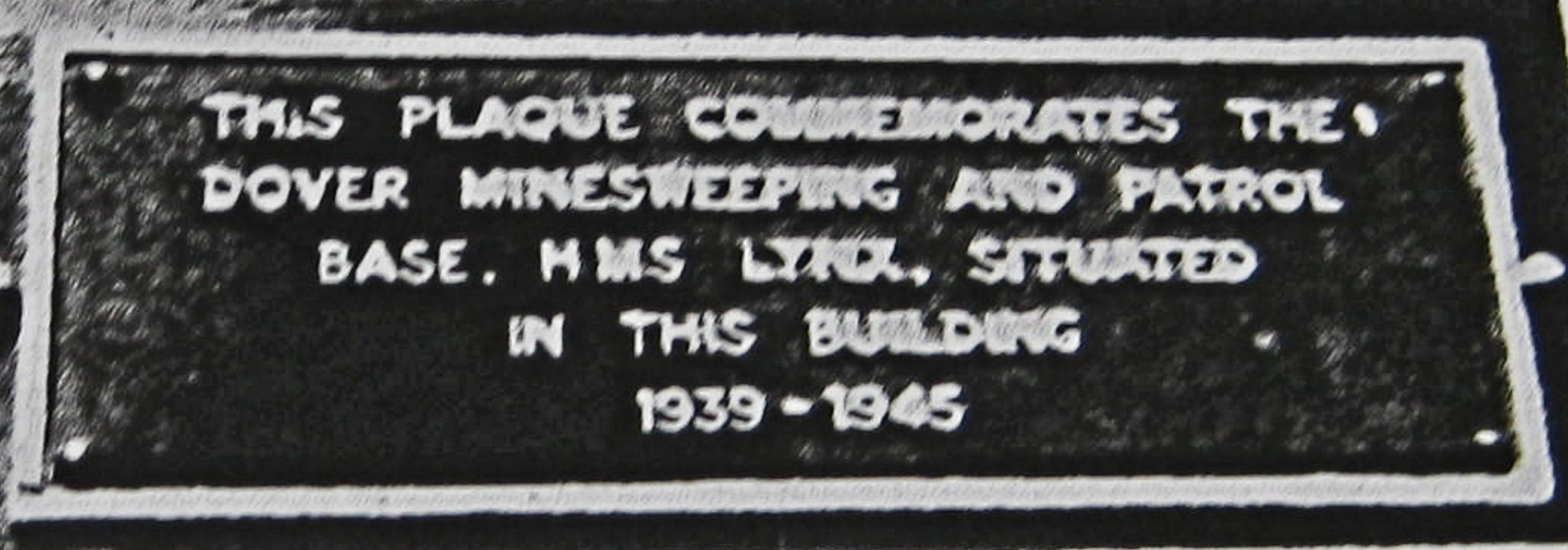
HMS Lynx Minesweeping & Patrol Base St James Lane plaque unveiled June 1984

HMS Lynx Minesweeping & Patrol Base St James Lane plaque unveiled June 1984

The Dover Sea Cadets moved first to River Primary School then to the River Parish Hall followed, amongst other places, Crabble Athletic Ground. On 1 June 1940 more than 3,000 children were evacuated from Dover to Monmouthshire, Wales but by September some 800 had returned and the numbers continued to increase. During this time George VI became Admiral of the SCC and in Dover the Minesweeping and Patrol craft headquarters, H.M.S. Lynx, operated from the cellar of the former bus garage in St James Lane. To meet the needs of the older children who had returned to the town, from 1941 to 1943, Commander William Gillette, the minesweeper maintenance officer took special interest in promoting Sea Cadets in Dover.

In January 1942, the Admiral Commanding Reserves took over the training of the SCC but in Parliament, it was stated that there were only 13,000 SCC and so to coincide with War Ship Weeks, there would be a recruitment drive to increase the number to 50,000. War Ship Weeks were held in every town and village when emphasis was given to the Navy and the locality would adopt a named ship for which they would make a collection. It was also agreed that to help recruitment to the SCC, the Admiralty would pay for uniforms and the Navy League fund sport and unit headquarters.
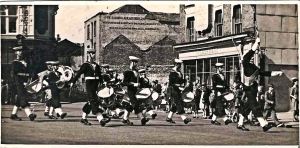
 Sea Cadets Market Square c 1947-8. Courtesy of TS Lynx.

Sea Cadets Market Square c 1947-8. Courtesy of TS Lynx.

That same year saw the formation of the Girls’ Naval Training Corps as part of the National Association of Training Corps for Girls. Other changes included the introduction of Units numbers in sequence to their affiliated to the Navy League and an order was sent that new recruits had to be at least 14½ years old and of 5feet 2inches (1m 57.5cms) tall! Under the Ministry of War Transport scheme, in 1944, all Sea Cadets having reached the age of 16½years and suitably qualified could obtain quick entry into the Merchant Navy. They were required to pass out of a four weeks’ course at the Wallasey Sea Training School on the Wirral.
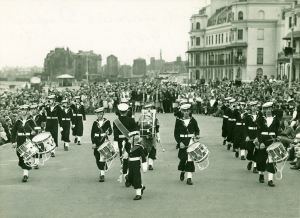
Dover Sea Cadets 1949. Courtesy of TS Lynx.

Dover Sea Cadets 1949. Courtesy of TS Lynx.

In 1947, both Admiralty and the Navy League agreed a continuation of their wartime co-sponsorship and this was embodied in what tends to be called the Sea Cadet Charter. It was agreed that the Admiralty would support a maximum of 22,000 cadets by supplying uniforms, boats, training facilities, travel expenses and limited pay to adult staff with retained appointments in what is now known as the Royal Naval Reserve, (RNR). The Sea Cadet Council was set up to govern the SCC and a retired Captain took on the supervision.
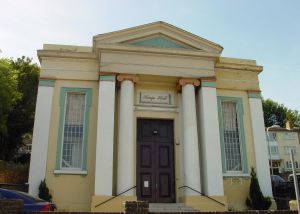
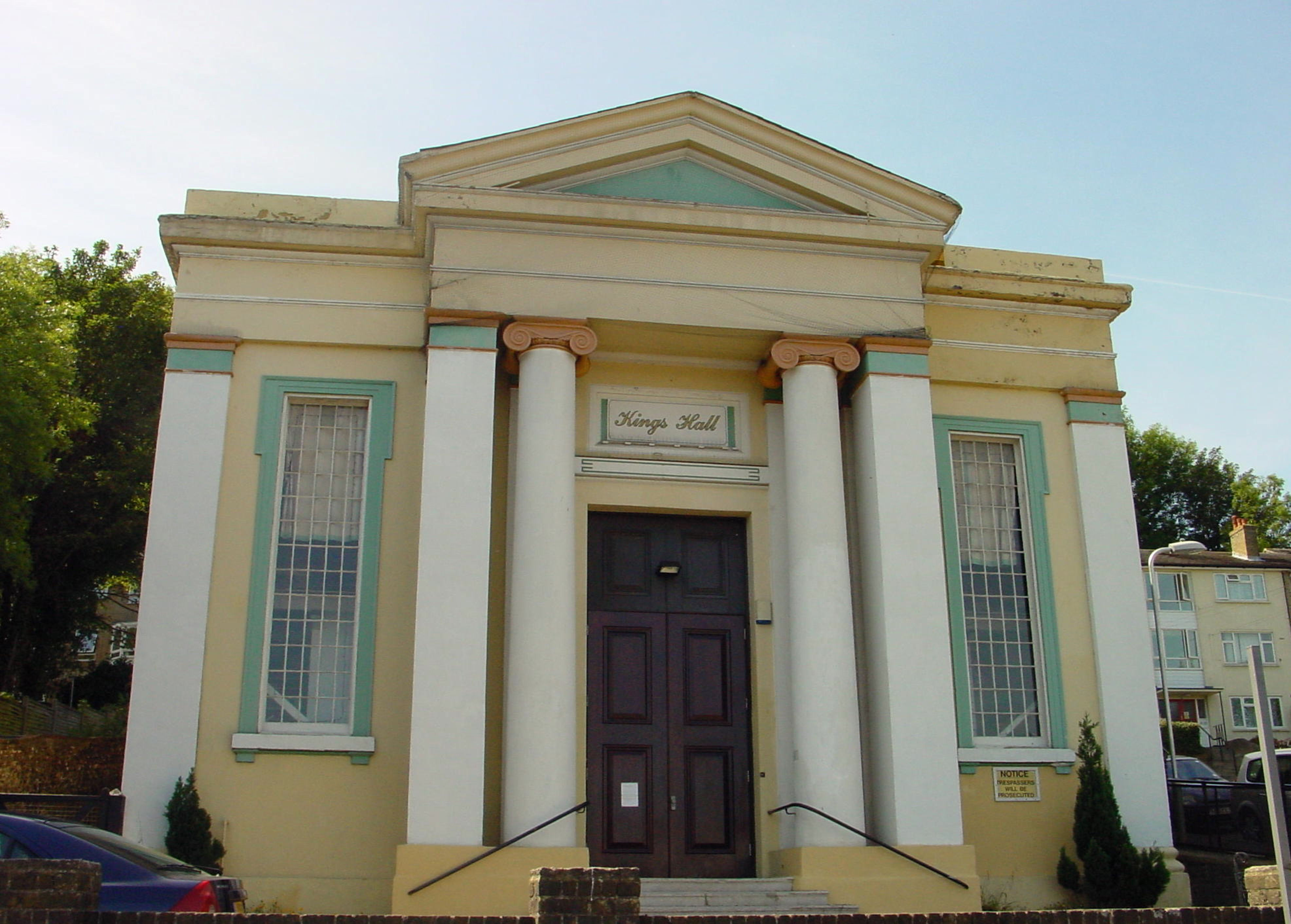
Kings Hall, London Road for about 15 years TS Lynx

Kings Hall, London Road for about 15 years TS Lynx

As a mark of esteem for the large contingent of Dover Sea Cadets, in July 1949 the Ladies of the Dover Society presented them with their colours. At about the same time Dover Sea Cadets moved into the Wesleyan Methodist Chapel on Buckland Terrace, off London Road (now the King’s Hall).  In May 1955, Admiral Sir Geoffrey Oliver (1898-1980), Commander in Chief, officially dedicated the Dover Sea Cadet Unit as Training Ship Lynx after the wartime connection between the Minesweeping and Patrol craft headquarters and the Dover Sea Cadets. The Cadets were again presented with new Colours. That year saw the formation of the Marine Cadet section of the SCC.
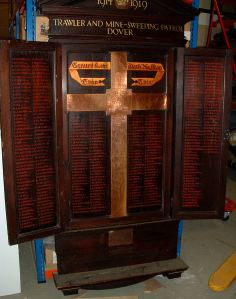
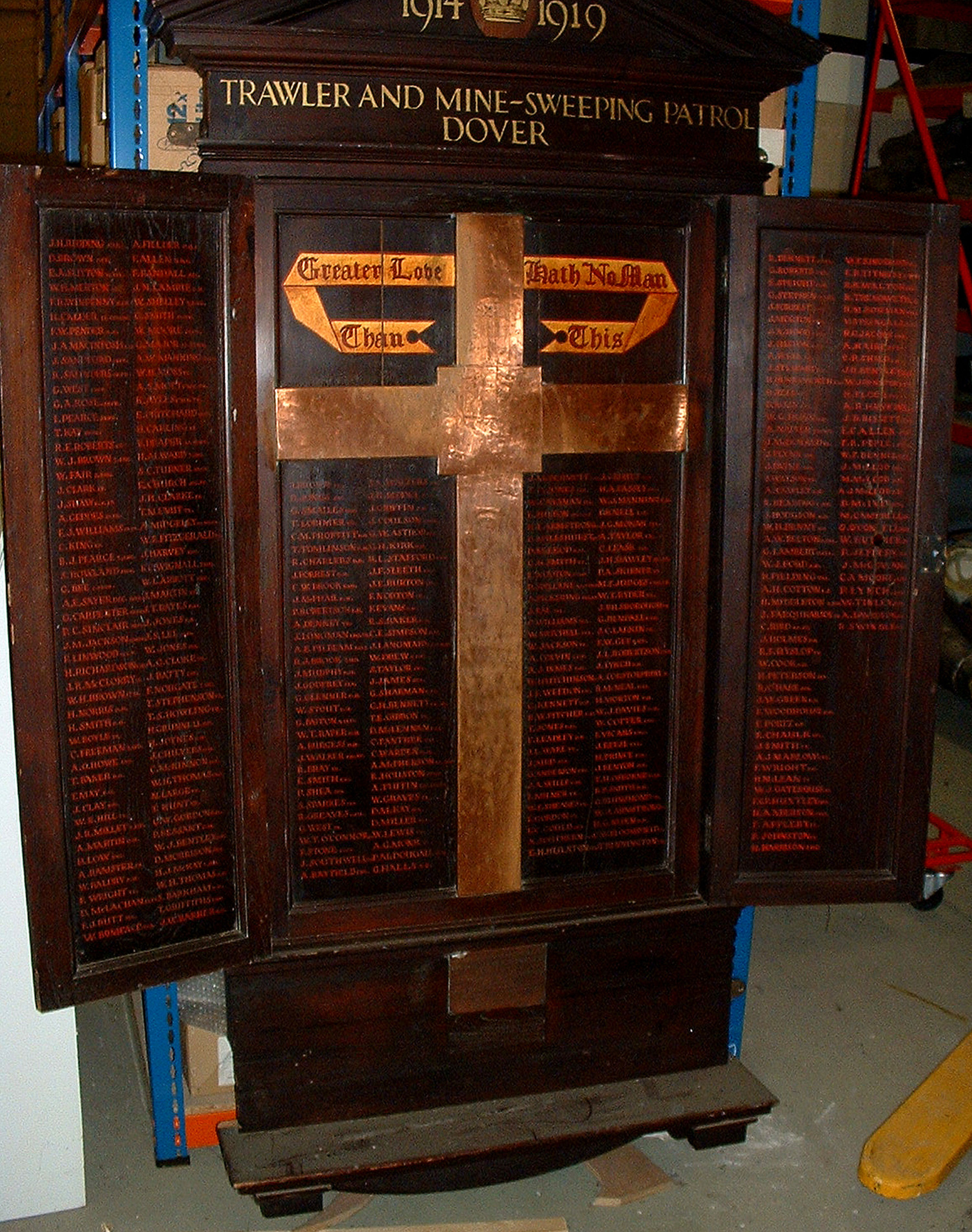
Trawler and Minesweeping Patrol Memorial 1914-1918. Originally in the Holy Trinity Church- Pier District then Archcliffe Fort now Dover Museum. Dover Museum

Trawler and Minesweeping Patrol Memorial 1914-1918. Originally in the Holy Trinity Church- Pier District then Archcliffe Fort now Dover Museum. Dover Museum

In the late 1950s, the name of the Girls’ organisation was changed to the Girls’ Nautical Training Corps and in 1964, they were formerly affiliated to the SCC. However, at local level, the Wesleyan Chapel was put up for sale and the Dover SCC was forced to look for a new home. The Army, at the time, was occupying Archcliffe Fort and found them space. Fittingly, on the wall of their new headquarters was the memorial to the World War I Dover Trawler and Minesweeping Patrol (now in Dover Museum).

Then, in 1978, Archcliffe Fort was taken over by English Heritage and the Sea Cadets were homeless again. At the time, the Chairman of the Dover SCC was Cllr. Walter Robertson and he approached Brigadier Maurice Atherton, then deputy-Constable of Dover Castle and now President of the Dover Society. The Brigadier persuaded the Department of the Environment to allow the SCC to use the old Garrison primary school near the Castle. The building had stood empty for 15 years and was in a poor state but over the next few years, the Dover SCC managed to raise enough money and refurbish the building.

At the national level in 1976, the Navy League was renamed the Sea Cadet Association and the Admiralty responsibility for the SCC, was transferred to the Commander-in-Chief Naval Home Command in Portsmouth. The Sea Cadet Charter was revised and replaced by a Memorandum of Agreement. On 31 March 1980, the Ministry of Defence (Navy) approved the admission of girls into the SCC.
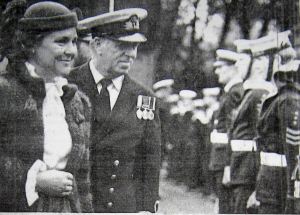
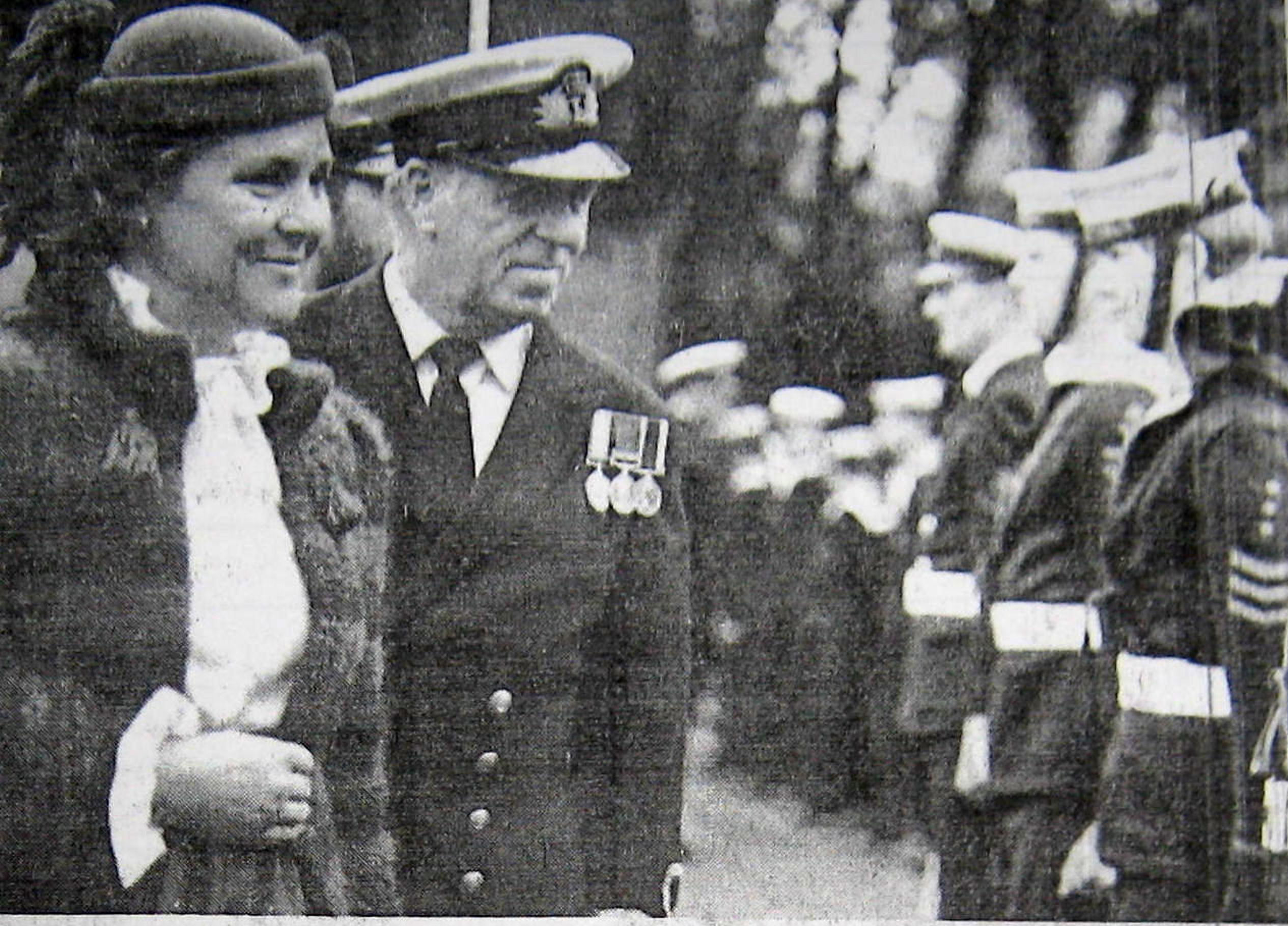
Countess of Guilford opening the new Training Ship Lynx, accompanied by Lt Dick Liggett. September 1983

Countess of Guilford opening the new Training Ship Lynx, accompanied by Lt Dick Liggett. September 1983

In June 1982, Rear Admiral George Brewer unveiled the plaque on the wall of the former East Kent Road Car Company’s Bus garage, at the time owned by East Kent Bus Company, in St James Lane to commemorate all the Officers and Ratings Minesweeping and Patrol craft that served in HMS Lynx during World War II. The Dover SCC provided the honorary guard. The following year Lady Guilford officially opened Training Ship Lynx at the old Garrison school. Alterations had cost £4,500, included redecoration and had been undertaken by workers under the Manpower Services Commission’s Youth Opportunities Programme, supervised by Dick Horton. During ceremony a special presentation of a Unit Ceremonial Sword, that had belonged to the late Commander William Gillett, of HMS Lynx at Dover, February 1941 – June 1943. Lieutenant Eley, Royal Naval Volunteer Reserve made the presentation to Lieutenant Dick Leggett and the Cadets on behalf of Commander Gillett’s daughters
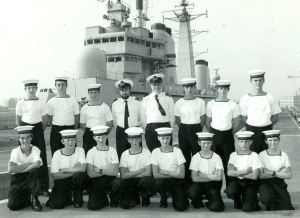
Dover Sea Cadets 1985. Courtesy of TS Lynx.

Dover Sea Cadets 1985. Courtesy of TS Lynx.

Richard Liggett Lt. Cdr. (SCC), in 1986, formed a Unit for Dover girls and in 1992 Sub Lt. (SCC) David Kemp, Officer-in-Charge, T.S Lynx, formed the Dover Junior Section. That year single sex units were abandoned and cadets were amalgamated into mixed sex units. Two years later the Parents and Supporters Association was set up. Since that time the Dover Sea Cadets have gone from strength to strength, undertaking sea training on H.M.S. Illustrious,s community activities and Petty Officer Cadet Craig Clark and Leading Cadet Tim Weaver, were appointed the Lord Warden’s Sea Cadets at Admiral Ls Installation in Dover on Tuesday 12 April 2005.

Dover Sea Cadets Sailing. Courtesy of TS Lynx.

Dover Sea Cadets Sailing. Courtesy of TS Lynx.

It looked as if the Dover Sea Cadets were going to loose their premises in the old Garrison schoolhouse behind the Castle when, in 2008, the Ministry of Defence put the premises up for sale. The £30,000 was raised and the premises were bought – at last, after more that 160-years the Dover Sea Cadets had a permanent home! 2013 was an eventful year for the Dover unit. Eileen Wiggins became the Honorary Patron – in respect and gratitude for her underlying loyalty, love of her family (former sea cadets) and the Dover Sea Cadets. The Dover SCC was awarded the Burgee Award for the second time. This is the Highest Award the Headquarters can give to a unit and is given for the effectiveness of training. Finally, due to the increasing size of the catchment area, in 2013 the group changed their name to the Dover and Deal Sea Cadets.
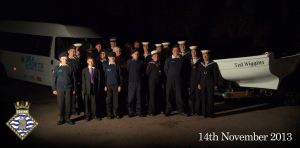
Dover and Deal Sea Cadets 2013. TS Lynx

Dover and Deal Sea Cadets 2013. TS Lynx

It is now March 2014 and already the unit has been nominated for the National Sea Cadet Award – TS Indefatigable Cup – for the most improved unit in the Southern Area, which are 80 units strong.

Former Dover Sea Cadet, Sarah Butler, is the present Commanding Officer, previous ones include: Dick Liggett, Dave Kemp, Peter Franklin and from 2002 to 2012 Sheila Watson.

Contact:

info@tslynx.co.uk

facebook.com/doverseacadets

  • Published:
  • Dover Mercury: 15, 22 & 29 May 2014
Posted in Armed Services, Dover Sea Cadets - A proud contribution to Dover's maritime history, Port and Transport | Comments Off on Dover Sea Cadets – A proud contribution to Dover’s maritime history

Markets of Dover – Part II

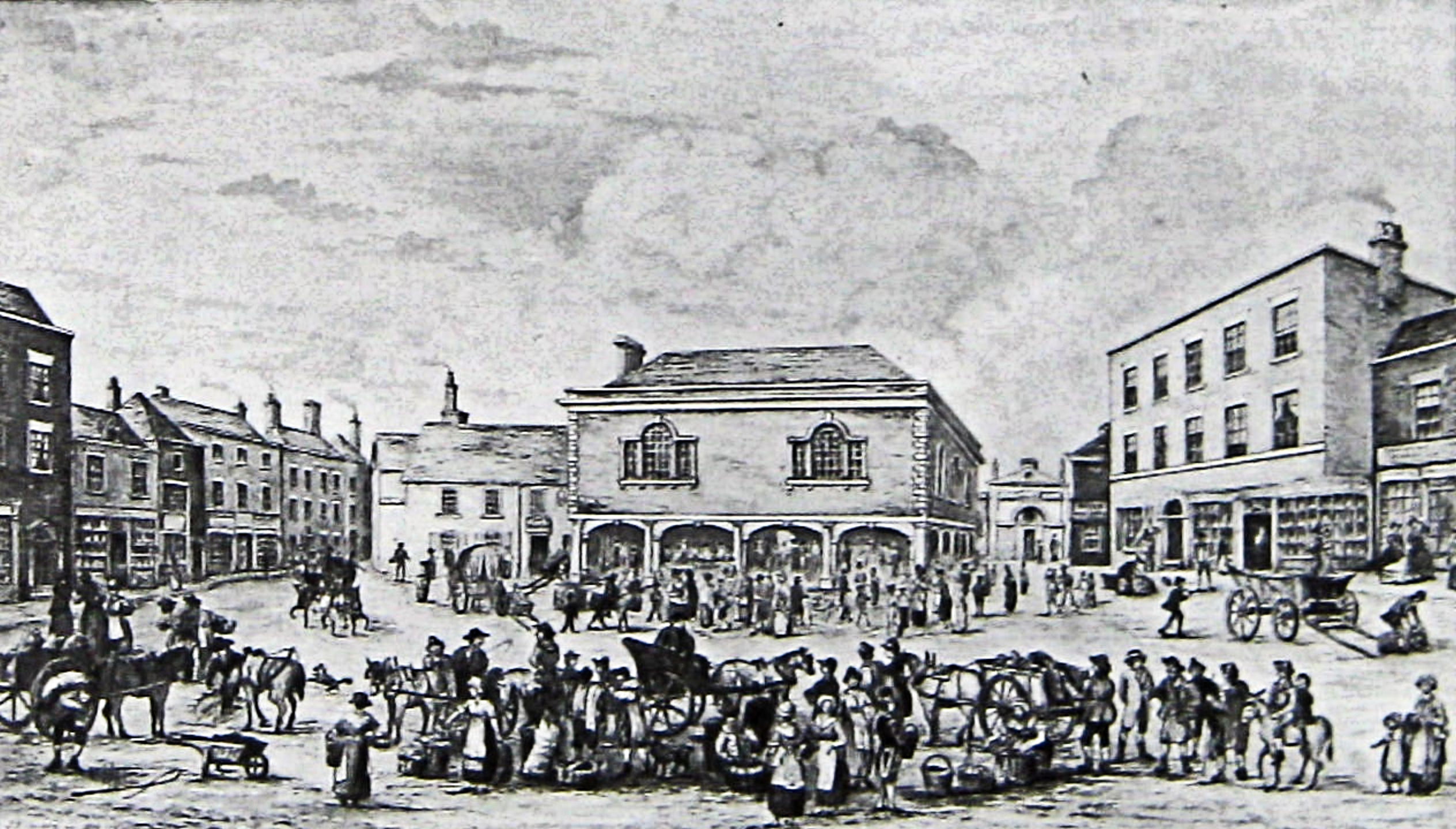
The Court Hall in the Market Square 1822 with the market underneath by John Eastes Youden given by E E Pain - Dover Museum

The Court Hall in the Market Square 1822 with the market underneath by John Eastes Youden given by E E Pain – Dover Museum

Markets had existed in Dover for centuries receiving its Royal Charter around 1160. The old Court Hall, which also served as the Town Hall, in the Market Square, opened in 1607. Dover’s main market was held underneath and around about, the area became known as the Shambles. In 1836 Dover Corporation purchased the Maison Dieu and moved from the Court Hall.

Although Dover’s Mayor and Jurats were also the magistrates, separate account books were kept for the council and the courts. The gaol came under the jurisdiction of the courts and when a new gaol was built onto the side of the Maison Dieu, the old one near the Market Square was sold to the Corporation. The council immediately found a private purchaser and stood to make a nice profit until it was pointed out that the newly established Dover Police Force, required a police station with a lock-up!

The council tried but failed to rescind on the deal and the new owner put up the site for sale at public auction. This was held on 2 October 1837 and the Mayor, William Cocke – as the head of the Market Committee, was forced to repurchased most of the site for £555 – making a loss. On the land not required for the police station the council decided to designated for a Market Hall.

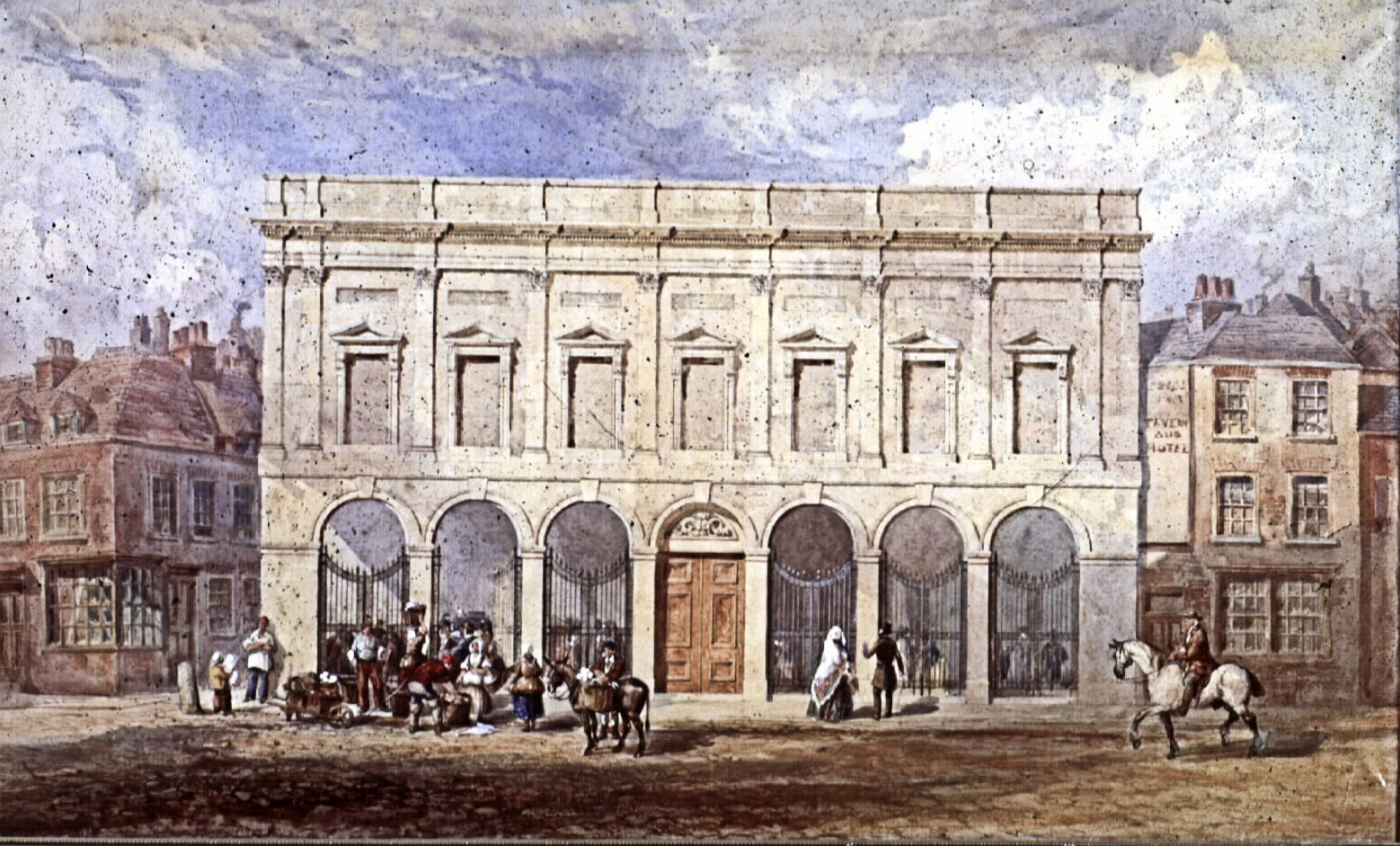
Market Hall 1846. Dover Museum

Market Hall 1846. Dover Museum

In April 1846, Edmund Woodthorpe presented a plan for what became the Market Hall and it was estimated that the edifice would cost £3,000. The lowest tender for building it was £344 and was submitted by local builder George Fry. Accepted, the new Market Hall with a Museum on the upper level opened in 1848. The market was held on Tuesdays, Thursdays and Saturdays, when produce, meat, butter and dairy products were sold. Outside, on the wall, a drinking fountain was erected on 15 May 1849. However, the death knell of the ancient annual St Martin’s Fair, held in November, had been sounded four years before. Following pressure from shopkeepers the council decreed, in 1845, for the fair to cease. The next two years, against the authority’s decree, a fair was held but it evolved into a tatty fun fair and then gradually died out.

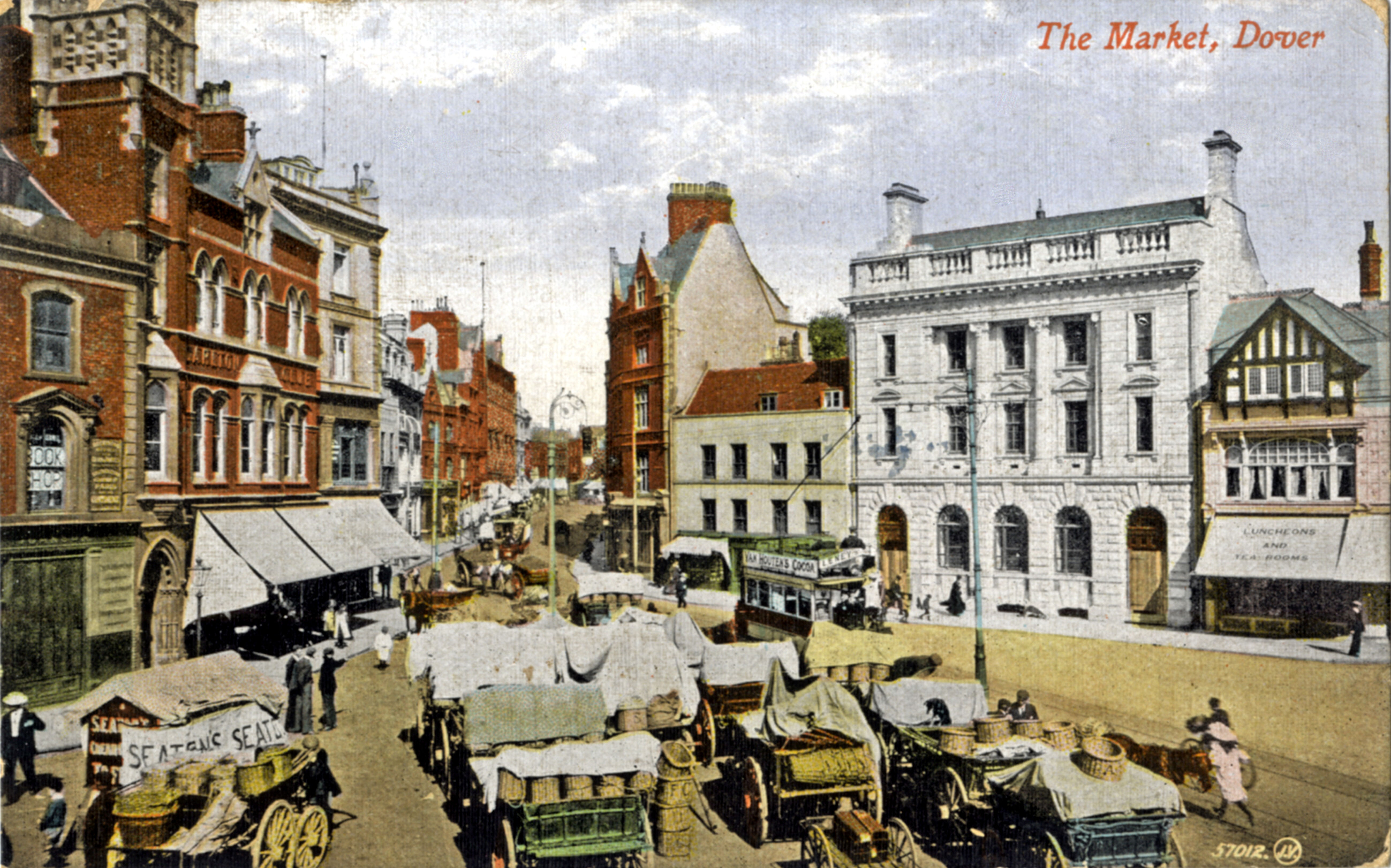
Market Square c1905 showing the outside market. Dover Museum

Market Square c1905 showing the outside market. Dover Museum

In the years that followed the opening of the Market Hall, traders still set up stalls under the old Court Hall. Produce and wares would be sold in direct competition to the indoor Market store holders and local shops. Further, the streets around the Market Square were becoming increasingly busy with traffic. Pressure by the shop owners, backed by the Chamber of Commerce, demanded that the old Court Hall should be demolished. The main justification for this was that the building ‘interfered with the free flow of traffic’. In 1861 the ancient building was knocked down. Of  interest, the Town Surveyor – Rowland Rees, had the wooden pillars moved to his garden at the Waterworks. Nonetheless, by the end of the century market traders were setting up their stalls again in the Market Square much to the annoyance of local shopkeepers.

Traders were allowed in the Market Place as of ancient right and upheld by the Local Government Board, as long as they paid a nominal rent to the Council fixed by the said Board. Hawkers –  those who did not have a permanent position but sold their wares from a cart – were allowed to trade as long as they had a licence from the Local Government Board. On 26 January 1892, Dover council introduced a local licence to trade in the town and the Hawkers were angry. As one fishmonger explained, his Local Government Board licence worked out at 1d a day for any quantity of fish on his barrow. Dover council’s licence was 8d a day per basket of herrings in order to push his barrow through the streets of the town yet in Folkestone, his central government was sufficient. Things came to a head at a meeting held in the Saracen’s Head pub, Biggin Street, in March 1892, when the ‘Dover Street Hawkers’ Protection Society’ was formed under the chairmanship of Reginald Radcliffe. There were at least 50 members and eventually, the council rescinded their ‘tax.’

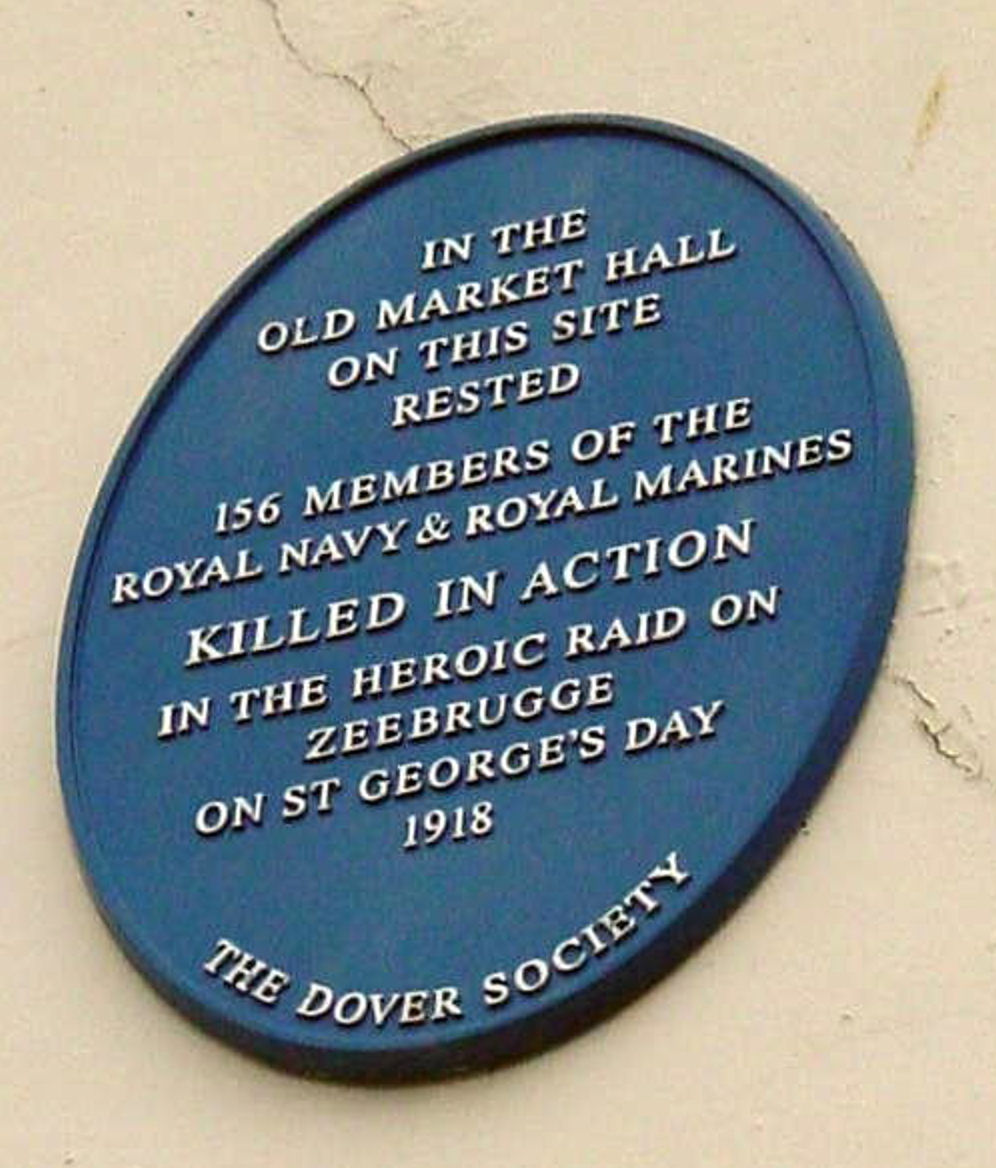
 Dover Society Plaque marking the Zeebrugge Raid on the outside of what was once the Market Hall now Dover Museum

Zeebrugge Raid on the outside of what was once the Market Hall now Dover Museum

During World War I (1914-1918), the Market Hall took on an altogether different role. Initially the indoor market carried on but they were moved out on Sunday 24 February 1916 when 58 bodies recovered from the torpedoed P&O liner Maloja were brought there. Following the incident it was decided to keep the Market Hall free for duration of the war, in case it was needed again for the same purpose. Former traders were allowed to use the building for storage purposes. The Hall was used again following the Nubian being torpedoed on 27 October 1916. On 20-21 April 1917 after an altercation between six German destroyers and two British ships, Swift and Broke and on Sunday 19 August 1917 for civilian casualties following the Crabble tram disaster. It was used again as mortuary in the weeks following 23 April 1918 and the Zeebrugge raid and in September 1918 following the Glatton catastrophe.

Following the War, traders moved back into the Market Hall until the council decided on a major refurbishment and the stalls were transferred to the Market Square. During the refurbishment the Hall was used for events such as the Dover and District Fur and Feather Soiety but the stallholders stayed outside. In order to raise finance for the refurbishment, in 1921 the council agreed to increase tolls by 100% plus parking charges for motor vehicles. There was an outcry but the council were resolute. The Hall was ready for occupancy in 1928 and boasted of purpose built stalls and lock-up facilities but the rent was increased. The traders said that they could not afford the new rent and stayed in the Market Square using their own stalls. On 20 August that year these traders were forcibly removed and afterwards the number of occupied stalls increased to 17. Thirteen sold food items, two were hardware stalls, one a bicycle dealer and a china and glass dealer.

Market Hall circa 1930s. Dover Museum

Market Hall circa 1930s. Dover Museum

When 1930s economic depression hit, as part of job creation scheme, the council authorised the enlargement of the Market Hall and they allowed allotment holders and market gardeners to sell their produce in the Market Square! For the enlargement the council accepted the tender of £1,698 from Messrs Herbert Godsell of Maidstone and decided to incorporate a heating system. Arora Company, of Loughborough provided the latter for £355. It was proposed to increase the rent to the stallholders but only charge ½d per unit for the heating when the ordinary heating rate in Dover was 1½d. This the traders accepted. However, from 16 September 1934 the Square at night was designated a quiet zone under the Road Traffic Act and this meant that traders had to wait until 07.00hours before they could drive into the Square to set up their stalls within the Market Hall!

Market Hall 1943 after a battering by bombs and shells. Dover Museum

Market Hall 1943 after a battering by bombs and shells. Dover Museum

The Market Hall took a battering during World War II (1939-1945). At 13.00hrs on 21 August 1940, it was badly damaged and on 26 September four shells fell in the Market Square area, killing two, injuring 18 others and damaging a great deal of property. At 12.50hrs on 21 October that year, a bomb hit the rear of the building, buried tons of foodstuffs and wrecked what was left of the Market Hall. The Market Hall and the Museum above closed for the remainder of the War.

In 1948, despite rainwater coming through the war-damaged roof, there were 23 stallholders in the Market Hall. Fourteen were selling food products, 6 non-food and 3 cafes. Kay Grove and her sister Joan started off with second-hand clothing that was displayed on racks in the bays. When it rained, they move the items into the centre stalls, of which they had four. The non-food stalls did a thriving trade and later, when clothing came off coupons, the women sold men’s new clothing and then diversified into hats, jewellery, furniture, brassware and antiques.

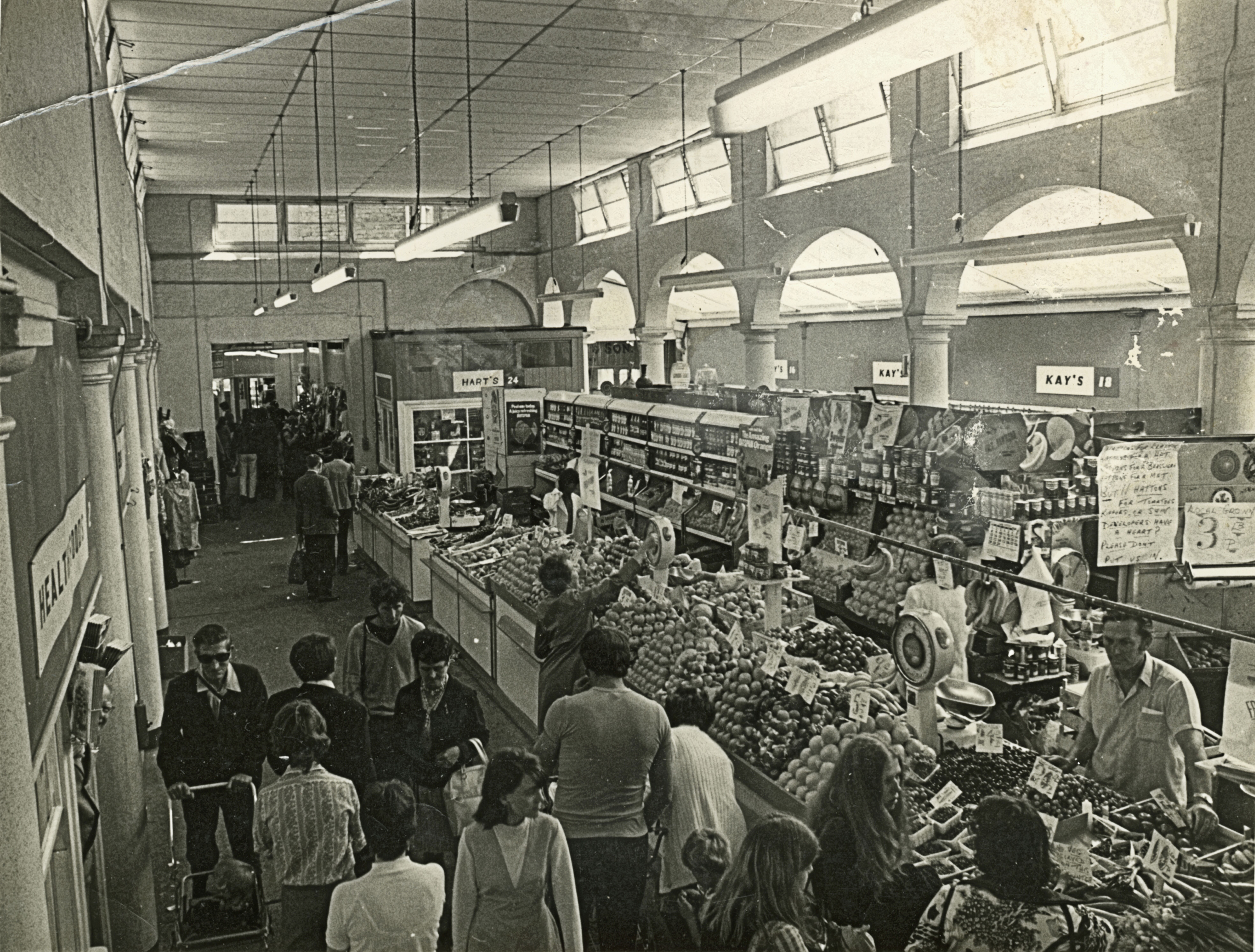
Interior of the Market Hall c1960s - Kent Photos. Dover Museum

Interior of the Market Hall c1960s – Kent Photos. Dover Museum

Slowly the building was renovated, the stalls increasingly became occupied and the Market Hall was the favourite shopping area for Dover people. At the entrance was Charley Orme’s cafe and inside Hiltons the butcher and grocer that later became Wilson’s fish shop. There were Hammonds and Hearn’s greengrocers, a wool shop, baby-wear shop, a shoe repairer and many others.

Dover at the time, had a population of 34,240 (2011 – 31,022) and according to a Board of Trade report there were 404 retail shops in the town with an annual turnover of £3.8million. These shops included, 76 grocers, 27 butchers, and 12 fishmongers. The first self-service shop in the town was the Co-op store at Elms Vale in 1950 and six years later, the Biggin Street Co-op was revamped to become Dover’s first supermarket. Since then Dover has seen a plethora of supermarkets come ago, each taking their toll on both the small shopkeeper and market stalls.

In 1966 Dover Corporation voted to promote a Bill through Parliament to stop the erection of market stalls outside of the Market Hall. Six years later, in 1972, a development scheme for Market Square was proposed and this included the demolition of the Market Hall. With the threat of closure, the number of market traders dwindled but about the same time Hatton’s departmental store, in Biggin Street, closed and the remaining 23 stallholders were forced to move there. An indoor market opened in Bench Street in June 1975 but was short lived.

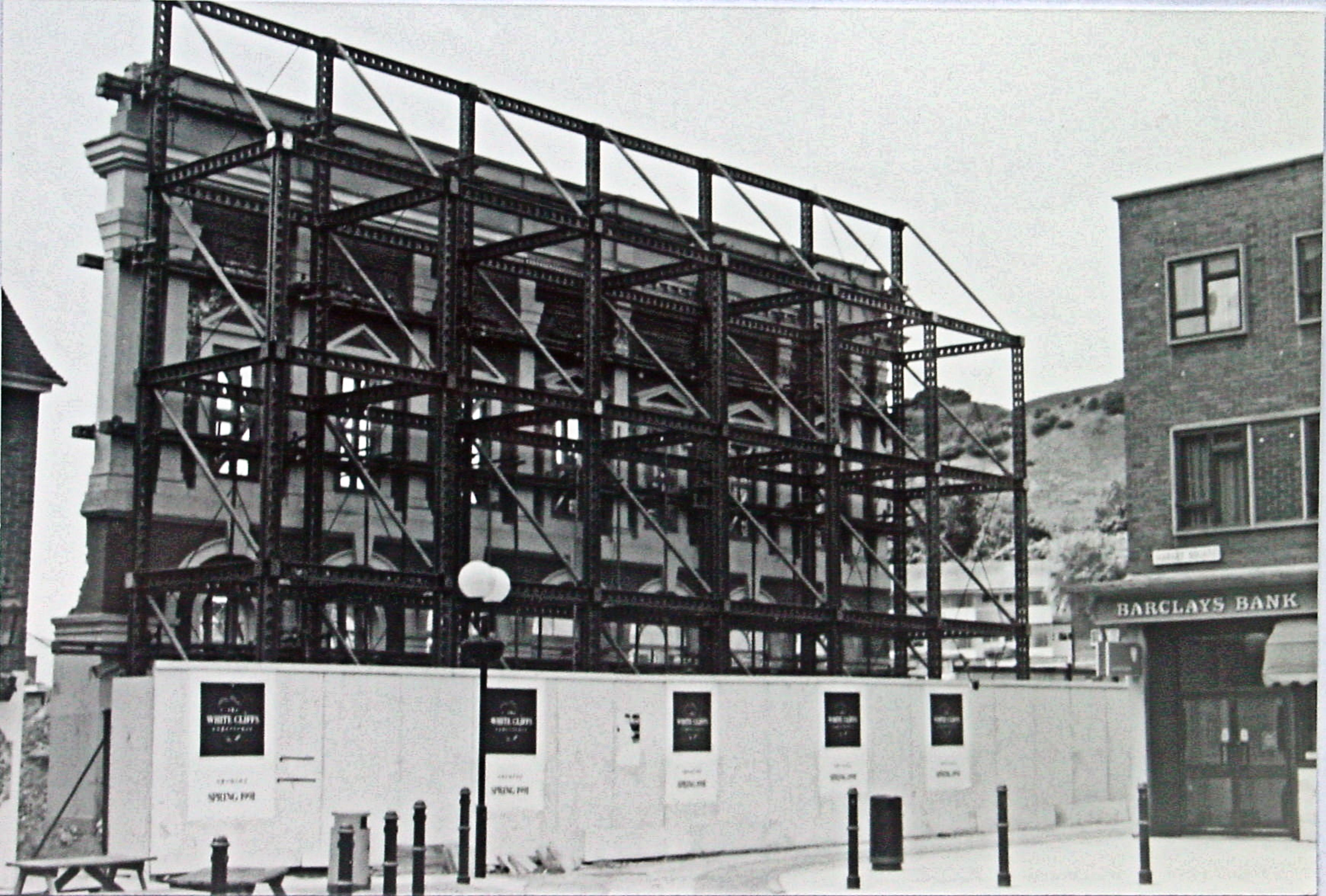
The listed Market Hall facade during reconstruction in 1989. Dover Library

The listed Market Hall facade during reconstruction in 1989. Dover Library

While this was going on John and Mary Dixon, along with members of the New Dover Group (forerunners of the Dover Society) campaigned to save the Market Hall and in 1973 they succeeded in having the façade listed. However, due to the failure of the redevelopment scheme, both the façade and the interior were abandoned and allowed to rot.

The first East Kent Boot Fair was held at Crabble Athletic Ground on May Bank Holiday 1979. Organised by the former Conservative party agent David Meyer (1935-2010), it proved successful. He had the idea from seeing Boot Fairs in the US, advertised the idea and received 400 responses! As the Fairs took off, David moved the business to 201 London Road and lived above the shop. The last Fair David organised was in 1994 before he moved to South Africa.

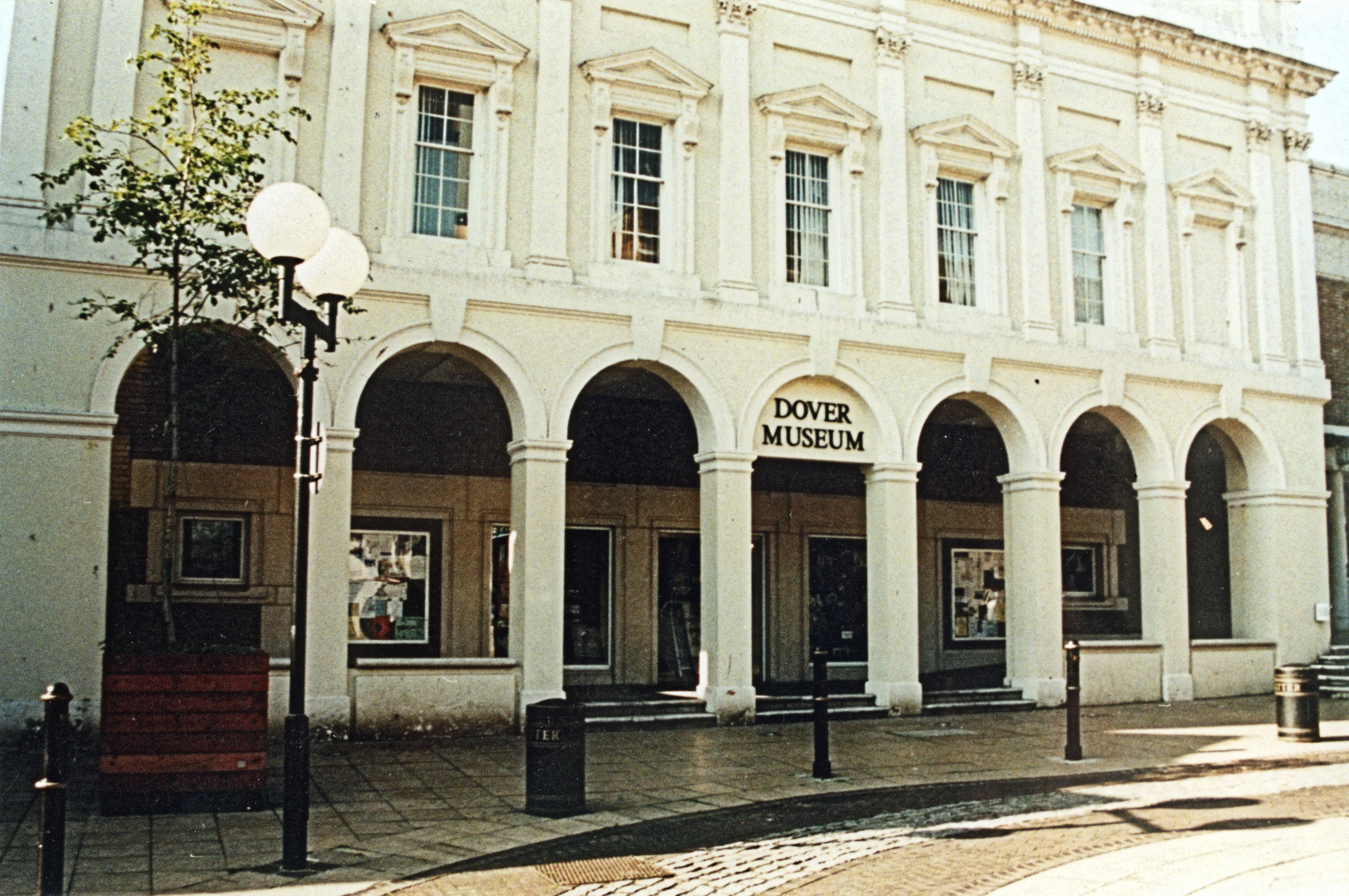
Museum former Market Hall circa 1990. Dover Museum

Museum former Market Hall circa 1990. Dover Museum

Pedestrianisation between Market Square and Pencester Road was started in 1980 and it officially came into use on 27 February 1981. It was later extended to the top of Biggin Street. Market traders were allowed to set up in the area but were ‘controlled’. In 1985, the Kent Building Preservation Trust identified 15 properties as historic buildings in the Dover District Council (DDC) area that were endangered by decay, one of which was the Market Hall. At that time, the Council considered rebuilding the back of the façade for a three- storey Heritage Centre. Work had started when it was decided to develop the adjacent site for the tourist attraction – White Cliffs Experience. Work continued on the old Market Hall and it was turned into the Museum we see today.

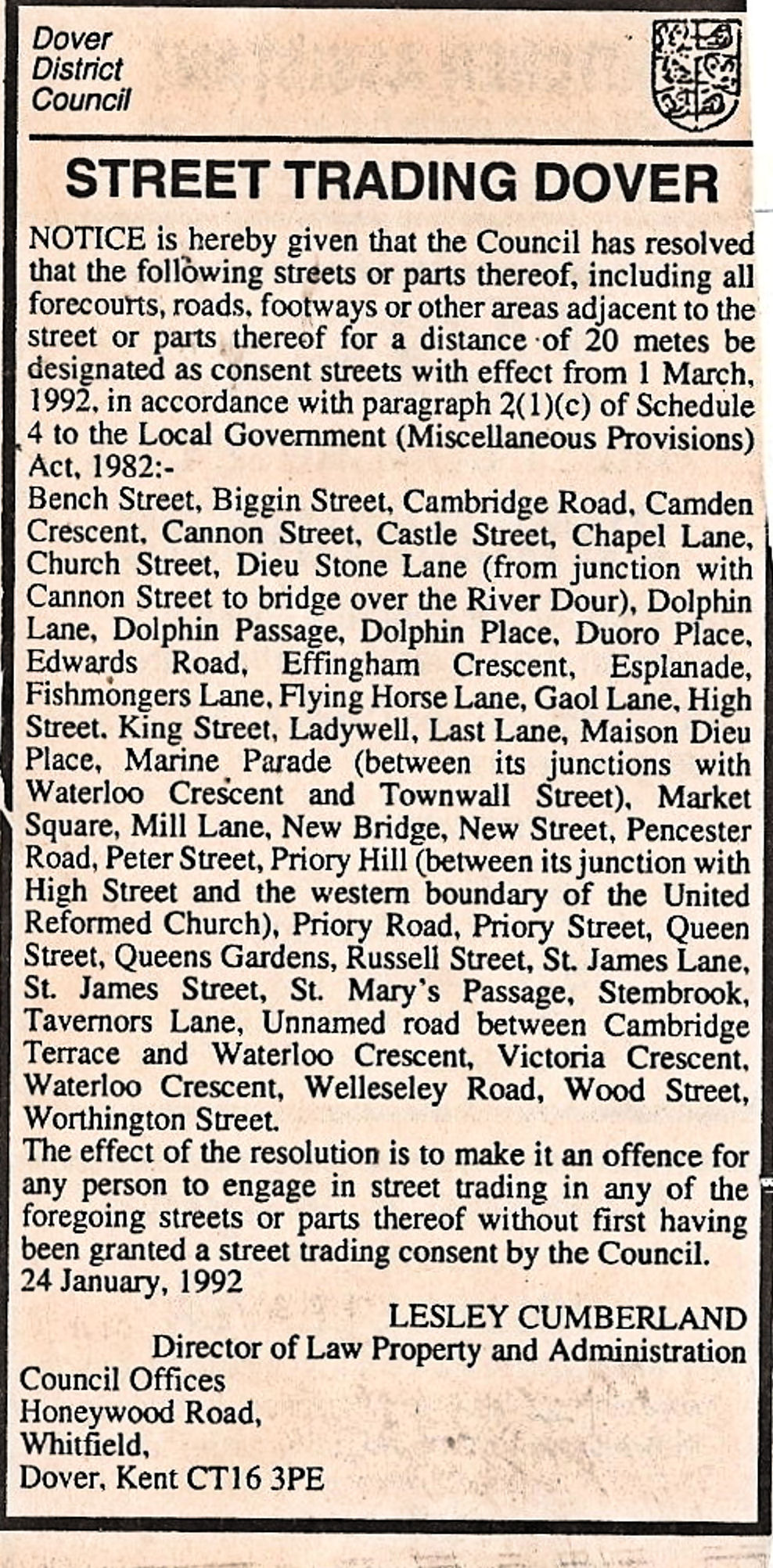
Street Trading designated areas notice

Street Trading designated areas notice

Regardless that market traders were regularly setting up stalls in the pedestrianised /precinct zone, in 1985/86, the council prosecuted shopkeepers for displaying their merchandise on pavements adjacent to their premises. In response, at the end of 1987, the Dover Chamber of Commerce wrote to the Council asking them to implement the Local Government (Miscellaneous Provision Act 1982) Schedule IV to prohibit street trading there. The council responded by designating the area as ‘consent’ – only entrepreneurs that had gained the council’s ‘consent’ – for which they paid a fee – could have stalls or display merchandise.

Market trading continued in Market Square until January 1988, when the stall holders were moved to Church Street, initially Saturdays then only on Sundays. In June that year an open-air market opened on the former Crypt site in Bench Street. During this time to compliment the short-lived White Cliffs Experience Dover’s town centre was upgraded. Market Square’s roundabout was removed and cobbles, flagstones, attractive lamps transformed the whole area and a fountain in the Square was installed.

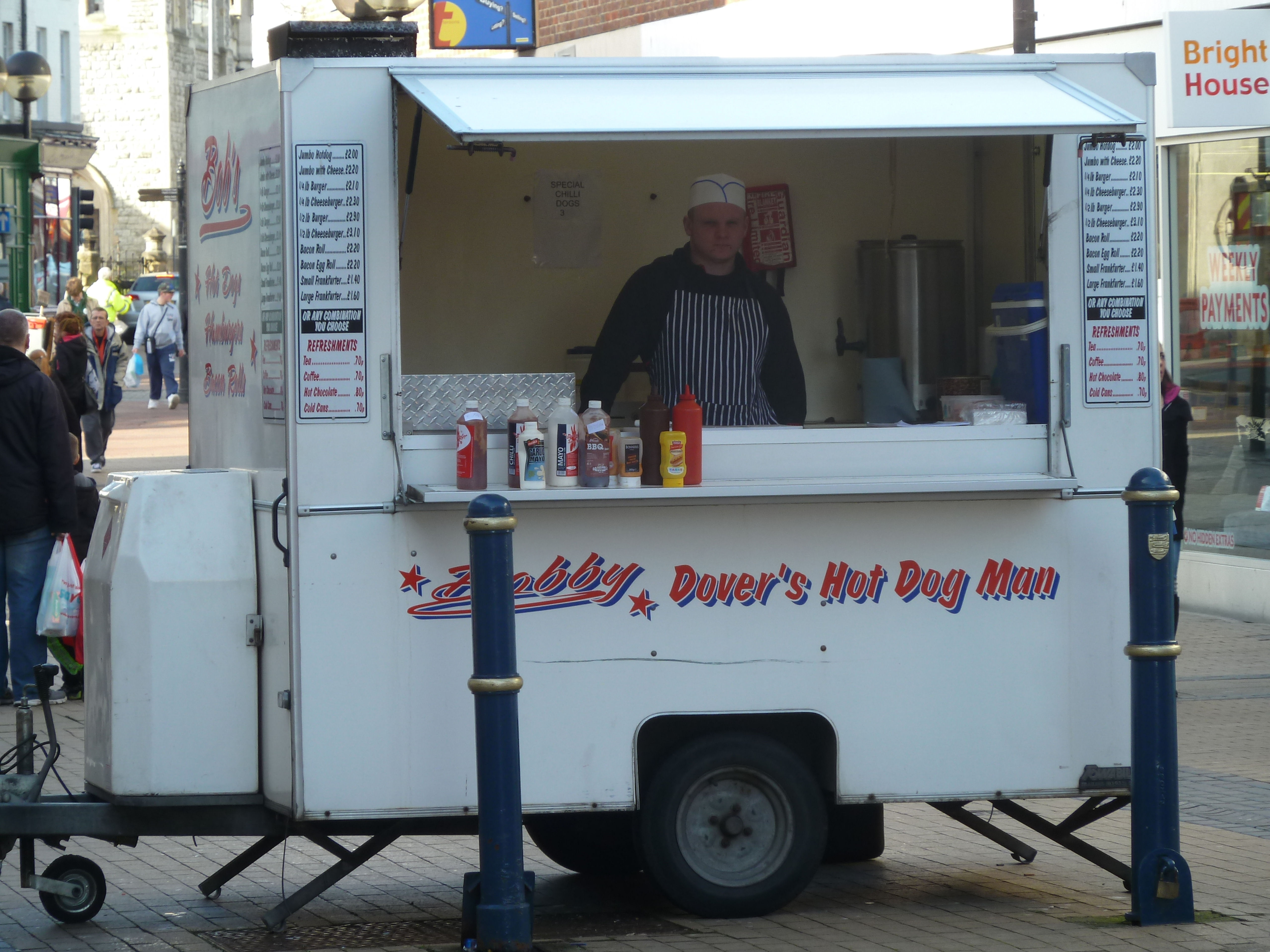
Bob Royston's Hot Dog stall now under new management. Biggin Street 2014

Bob Royston’s Hot Dog stall now under new management. Biggin Street 2014

January 1993 saw Mr P Mills of Victoria Crescent apply to Dover District Council to sell doughnuts from a tricycle in the Market Square but this was turned down, as it was said, it would conflict with rate-paying businesses in the vicinity. That same year the shopkeepers in the Precinct announced that they welcomed a plan to have a Thursday market outside their shops. Councillors disagreed saying that a street market would create problems for the said shopkeepers! Then the shopkeepers rates were increased by 300% and they changed their mind. Of note, shops pay a business rate or property tax that is assessed by the Valuation Office Agency who equate it with what they perceive as the annual rent the property would fetch on the open market, street venders, on the other hand, pay rent to DDC.

At about that time, Lincolnshire Markets were given permission to hold a market on a derelict site adjacent to the Charlton Centre in the High Street (now a doctors surgery complex), much to the horror of the Centre manager, other local shopkeepers and the Chamber of Commerce. It was opened by DDC chairman Bill Chesterfield in October 1993 and was held every Friday and Saturday. It was about this time that people started to park their cars in the streets offering them for sale. Both residents and commercial garages complained loudly and in areas designated as ‘consent’ a £100 trader’s licence was imposed. This brought a further outcry as parking bays soon became blocked with second hand cars being offered for sale.

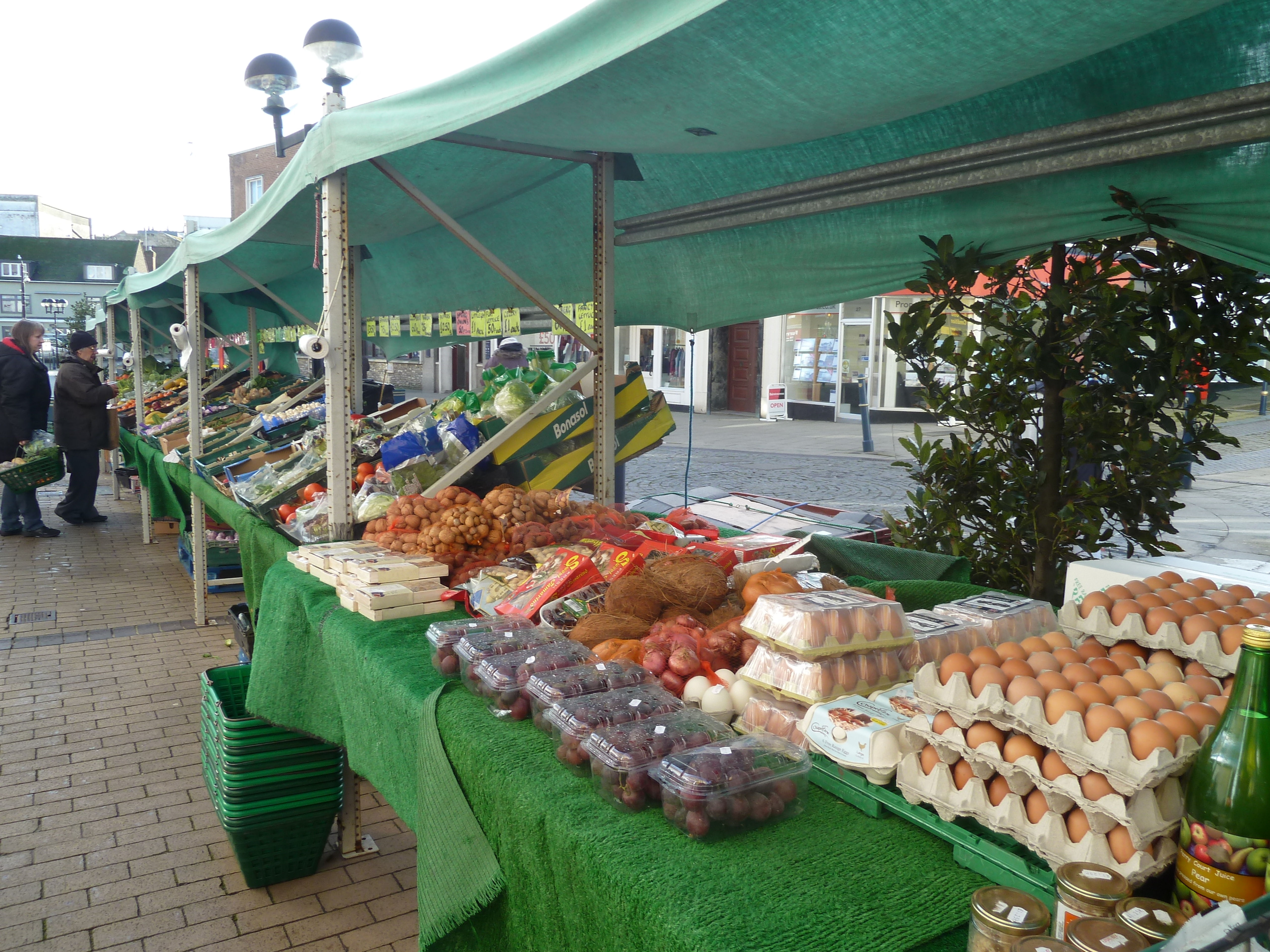
Dunfords Fruit & Vegatable stall Market Square 2014

Dunfords Fruit & Vegatable stall Market Square 2014

1996 saw ice cream seller, Alan Rolfe of Lewisham Road, who had the previous summer allowed to operate in Biggin Street, refused permission to extend his area to Cannon Street on the grounds that it would conflict with existing traders. Albeit, slowly there was a change of heart and the Dunfords family moved their fresh vegetable stall from Church Street into the Precinct and it is still going strong. In April 1998 Bob Royston of Clarendon Place received permission to set up a hotdog stall in Biggin Street and is still successfully operating, now under a different operator.

A joint initiative by KCC and DDC, IMPACT, was started in 1996 that provided for the Town Centre Management Company Ltd (TCM) – chairman Alan Elcocks of Boots the Chemists in Biggin Street. The remit was to ensure that the town became ‘a thriving community with profitable businesses, where residents were happy to shop and relax and a place that visitors will return to.’ In 1998 Tina Pullinger, Dover’s Town Centre Manager, instigated the setting up of a French Market on 12 and 13 December. The traders sold a wide range of products and the event was a great success but local shopkeepers complained the stalls obstructed the entrances to their shops.

Angela of Gomes Patisserie, Market Square 2014

Angela of Gomes Patisserie, Market Square 2014

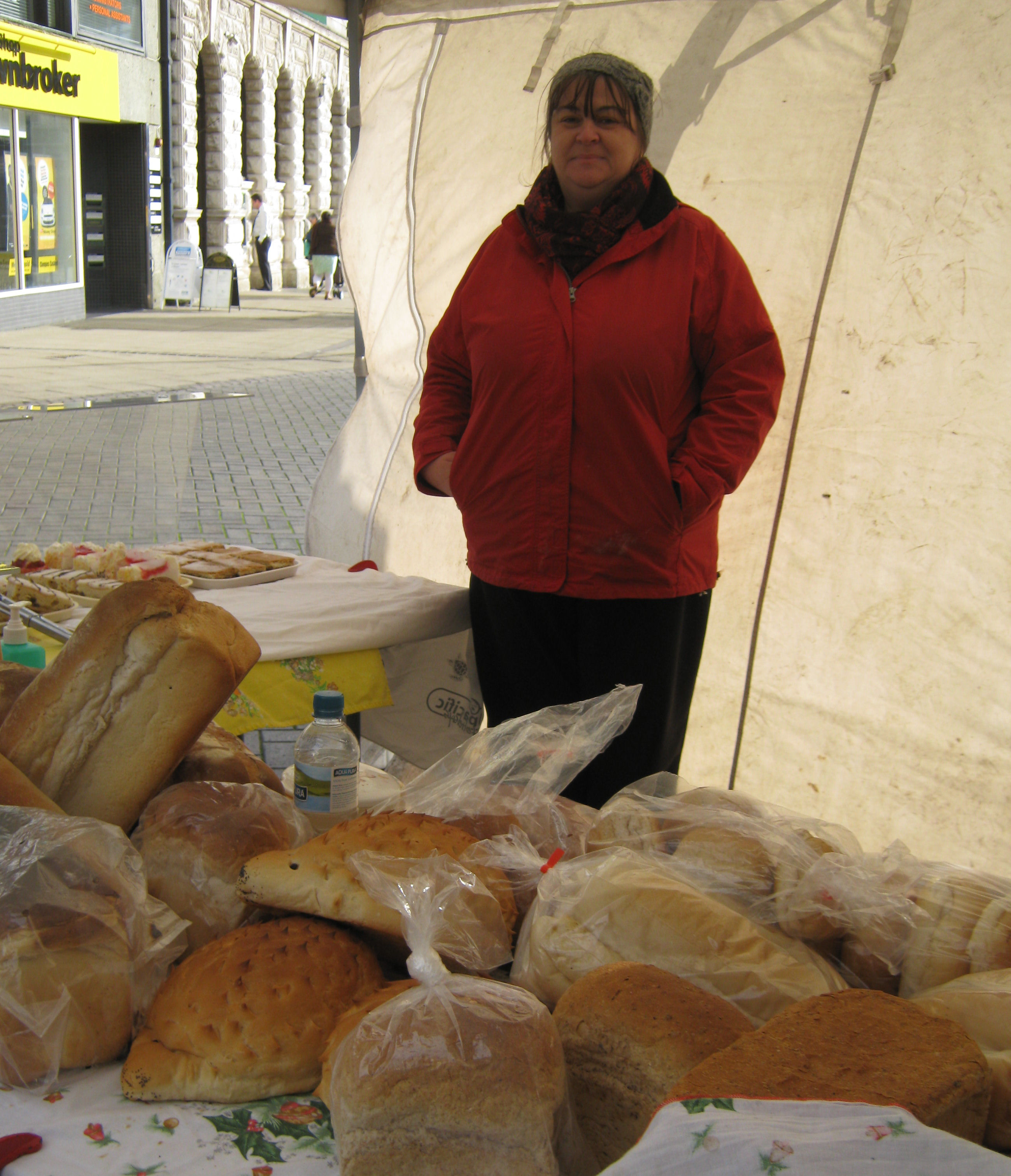
Nonetheless, similar occasional markets were instigated and in 2010 the Dover Chamber of Commerce, through its Dover Business Support Initiative, launched a Saturday market in the Market Square and Cannon Street. Market traders were charged £440 a year if they had a stall in the same place throughout that time and £112 for an occasional licence. In November 2012, the Bluebird Market, operating on Tuesdays was launched. In the early hours of nearly every Tuesday John Angell, who owns a jeweller’s shop that dates back to 1830, in Biggin Street, can be seen erecting stalls ready for market  traders … showing that shops and markets can work together in Dover!

  • Published:
  • Dover Mercury: 22 June 2006

:

Posted in Businesses, Market Square, Markets of Dover - Part II, Markets of Dover - Part II | Comments Off on Markets of Dover – Part II

Markets of Dover – Part I

Ruins of St Martin-le-Grand by the Dover Discovery steps, Market Square

Ruins of St Martin-le-Grand by the Dover Discovery steps, Market Square

Many cities and towns boasts of ancient markets and Dover is no exception. Markets developed out of Fairs and once upon a time Dover’s Fair was one of the most celebrated in the country. Fairs were originally religious festivals usually held in honour of the local patron saint and were a time of celebration as well as providing a day when hard working folk would dress in their finery, pray and celebrate. In Dover, the main church was St Martins-le-Grand, situated on the west side of Market Square, traces of which can still be seen from the Dover Discovery Centre steps.

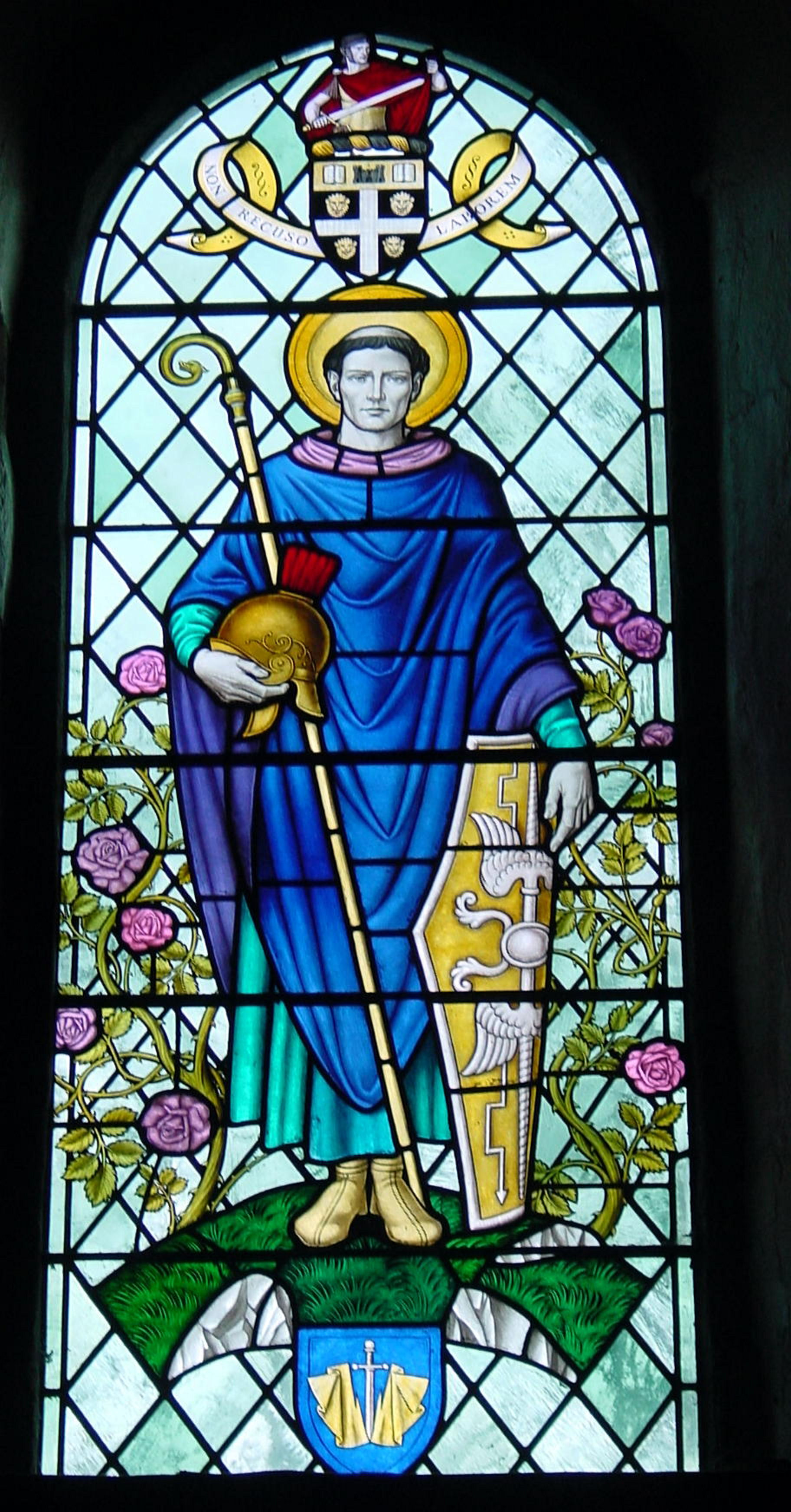
St Martin's Window, Dover College Chapel. Thanks to Stephen Jones, former Headmaster

St Martin’s Window, Dover College Chapel. Thanks to Stephen Jones, former Headmaster

Dover’s Holy Day, or holiday, was the feast day of St Martin of Tours, 11 November, and celebrations originally lasted three days. The event attracted large crowds from the surrounding countryside and possibly from across the Channel, with many bringing with them goods to sell. It was only a matter of time before codes of behaviour were introduced. Typically, an Act of Lothaire, King of Kent 673, stated that no persons should barter, except in front of a credible witness the penalty for so doing was thirty shillings and the forfeiture of the property to the superior, in whose jurisdiction the transaction took place.

There were then few, if any, local shops so it was only from the travelling salesmen who bought wares to these fairs that the people were able to buy such things as cloth and household utensils. As time passed towns introduced local controls but to add weight to these and to provide conformity throughout the country, a town would apply and pay for a warrant from the monarch. Dover received its Royal Charter around 1160 by which time St Martin’s fair lasted ten days and the Charter stated that it was not to get any longer!

However, the Charter  effectively legitimised that Dover’s fair could last ten days that made it very popular indeed! Other restrictions included the revival of the ancient barter rule, which required such transactions only to take place in front of a credible witness, under the penalty of double the value of the goods sold and the loss of the trader’s booth. The Charter dictated with where the fair was to take place, when and the times of operation. The Corporation were also given the privilege of holding a court of Piepoudre, where disputes were settled and fines for misdemeanours were levied. This, the town was allowed to keep free of taxes.

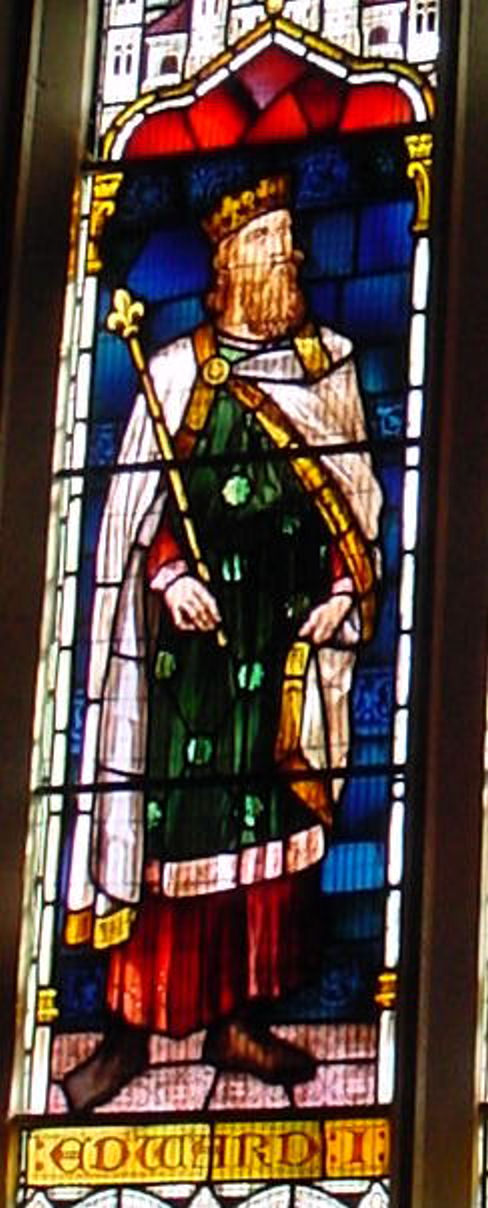
Edward I, detail from the Finnis window in the old Council Chamber, Maison Dieu

Edward I, detail from the Finnis window in the old Council Chamber, Maison Dieu

By Edward I’s reign (1272-1307) fairs had a bad reputation so rules and standards were tightened. These included forbidding fairs to be held in church yards, the council have to state how much it would cost to hire a site and duration for a stall and what form punishment of offenders would take. It was also stipulated that councils had to state what could be sold and at what times and any bias, for instance in Dover local produce and livestock had priority over goods brought from further a field. From what is known of fairs at this time, there would have been food and ale-sellers, local craftsmen and itinerant peddlers the latter selling goods such as utensils and cloth that could not be produced locally. There would also have been a great deal of merry making.

For centuries Dover’s main industry was fishing, particularly herrings as they were part of the English staple diet. It was the sturdy little fishing boats built in Dover and the other towns that made up the Cinque Ports, which were called upon by successive monarchs when they went to war. In June 1278, Edward I besides granting Dover’s Fair Charter issued one encapsulating the role and function of the Confederation of the Cinque Ports. This effectively confirmed the Cinque Ports as England’s first true navy. In return the Cinque Ports were given a number of privileges including the right to dry fishing nets and to take control of the yearly Yarmouth Herring Fair. Dover’s Herring Fair was part of the 10-day St Martin’s Fair.

In 1479, the council decided that a half-year maletot (rate) should be levied on the town’s folk to pay for a new cross in Cross Place – the name for Market Square at that time. It was also decreed that in future the market for local produce and livestock, as well as St Martin’s Fair, should be held in the vicinity. Two years later, it was agreed that on market day merchants could sell butter, eggs, geese, capons, hens and chickens all day. Town’s folk could buy and sell corn between 08.00hrs and 12noon but strangers (non-townsfolk) were not allowed to buy or sell corn until after 16.00hrs. Butchers, drapers, mercers and others had to close by mid-day and to have left the market by 13.00hrs or they would be fined.

After the Reformation (1529-1536) saints lost much of their veneration in England but as Dover thrived on its fair Henry VIII (1509-1547) granted the Archbishop of Canterbury the right to hold three fairs in the town. These were St Margaret’s Day (19 July), St Bartholomew’s Day (24 August), and St Martin’s Day (11 November). The profits were, however, to go into the King’s coffers! Nonetheless, the Corporation still had the privilege of holding the court of Piepoudre from which the town could keep fines. During the reign of Mary I (1553-1558) it was decreed that the Mayor should have the power and authority set the prices charged in the Market. At about the same time the Corporation built at least four shops in or near the market place for which they charged 13s 4d (67p) a year rent. Whether they were taken up is not known but by 1569 the council had ‘improved’ the shops in the fish market. There the take up was poor, with only William Lovell, John Whetstone and Robert Bonyard mentioned by name as renting them. The fairs, however, continued to be very popular and entertainment had become an important part of the festivities.

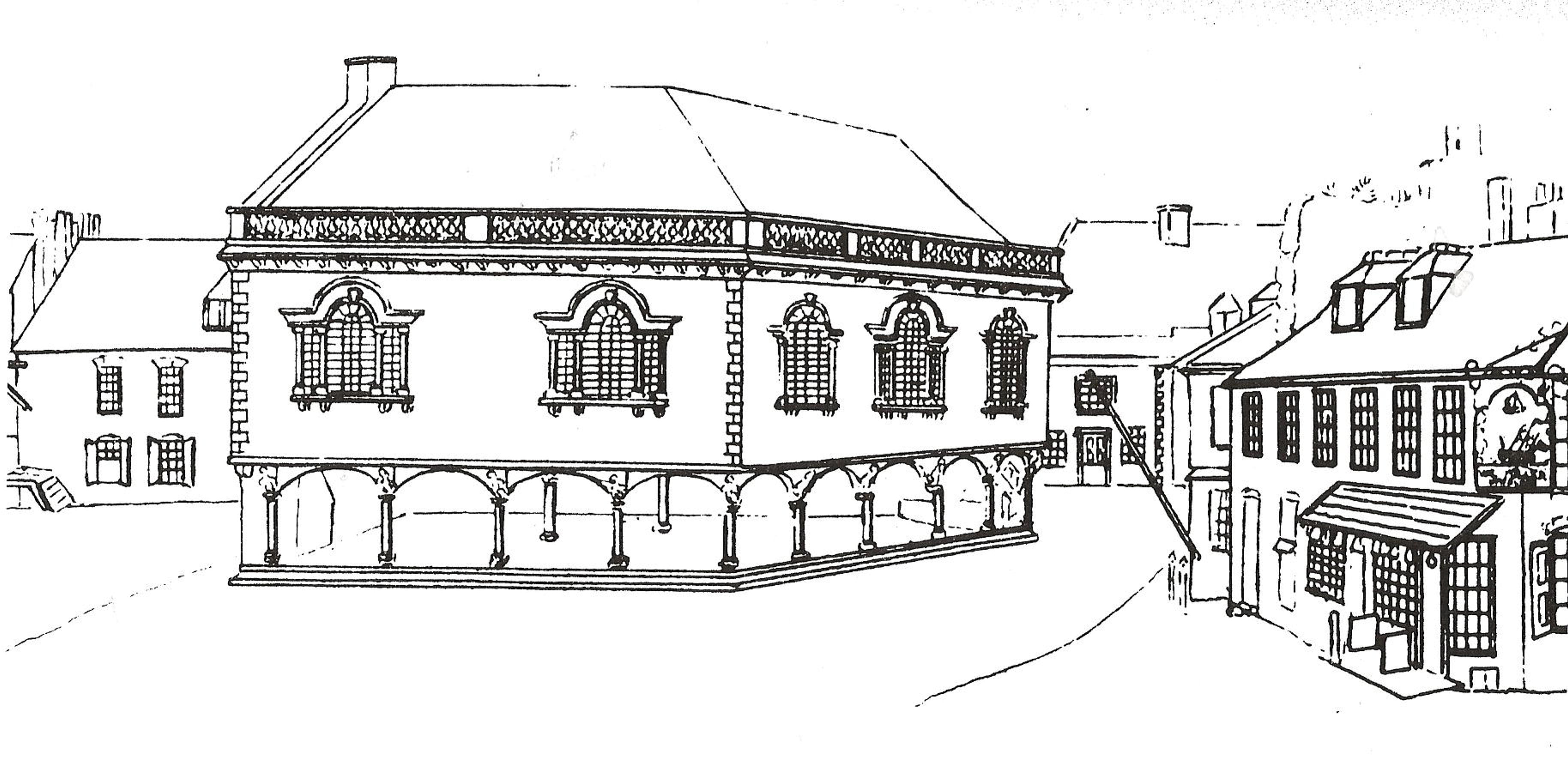
Court Hall 1606-1834 demolished 1841. The market was held underneath inside of the wooden pillars. Dover Museum

Court Hall 1606-1834 demolished 1841. The market was held underneath inside of the wooden pillars. Dover Museum

About 1500 the council considered building a place in which they could hold meetings and court sessions. At the time they were held in a building belonging to St Martin-le-Grand in King Street. Following the Reformation, the council laid claim to the site of what had been St Martin-le-Grand and on 6 July 1606 the order was given that a new building would be erected on the site where the Market Cross stood. The new Court Hall (also referred to as Council Chamber, Town Hall and the misnomer – Guild Hall), stood on wooden pillars carved with grotesque faces created by a local named Weekes. It was opened in 1607 with the business of the town taking place in the upper rooms and below, within the wooden pillars, meat, butter and vegetable markets were held. From the ceiling hung grappling irons and hooks, in case of fire.

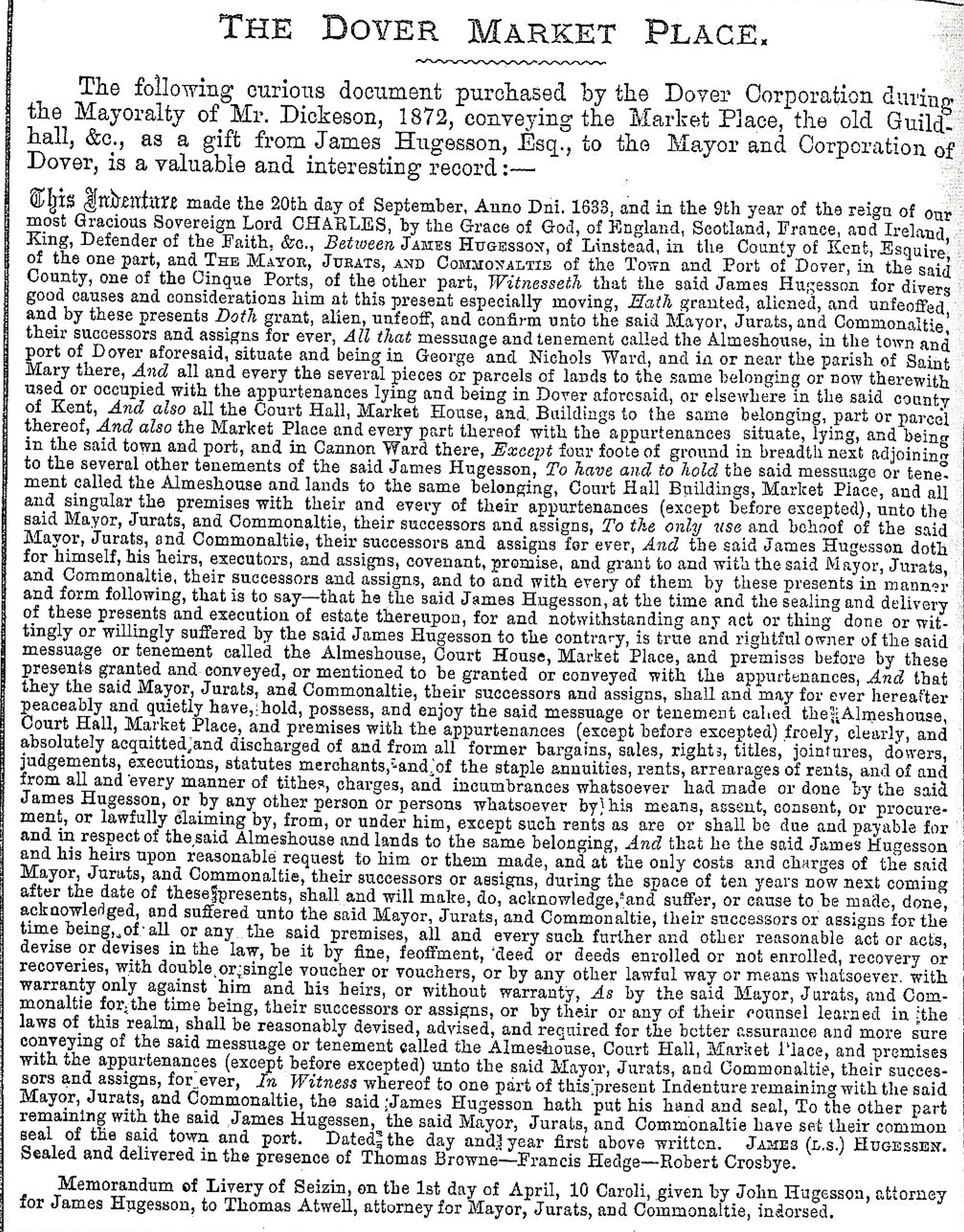
James Hugesson gift of the Market Place and Court Hall etc. to the town published in the Dover Year Book 1874

James Hugesson gift of the Market Place and Court Hall etc. to the town published in the Dover Year Book 1874

Much to the surprise and consternation of the council, in 1633 James Hugesson (d1637), a wealthy merchant adventurer, claimed possession of the St Martin-le-Grand lands that included the site of the new Court Hall and market. The case was taken to the King – Charles I (1625-1649) – who upheld Hugesson’s claim. Once Hugesson was acknowledged as the owner he leased part of the site to the parish of St Mary’s for 1000 years to be used as a cemetery – St Martin‘s cemetery. The remainder of his lands were given to the town on the promise that £3 was to be given annually to six poor widows of Freeman. The land given included the whole Market Place, with the Court Hall and surrounding streets and buildings.

By the reign of Charles II (1649-1685), only St Martin’s Fair remained but as a way of thanks for the welcome the town gave him at the Restoration in 1660, he granted a fair for cattle, on the 23 and 24 April, and on the 25 and 26 September. The King also confirmed the St Martin’s Fair but to begin on 23 November with ‘piccage, tallage and toll’ and all other profits arising from the fairs to go to the town. However, much of the remainder of the Charter was so complex that it caused more problems than it resolved. Gradually many of the rules were abolished and replaced by more convenient ones for both buyers and sellers.

Towards the end of the 17th century St Martin’s Fair had become synonymous with the hiring of servants and labourers. Those looking for employment would gather around the Market Cross hoping to have a master seal their contract with the gift of a ‘fasting penny’, also known as a ‘godspenny. The value varied over time but the contract was binding to both parties. If either party infringed the deal they could be fined or imprisoned. This way of seeking work and hiring workers lasted well into the 19th century.

Market day in Market Square 1822 by John Eastes Youden given by E E Pain - Dover Museum

Market day in Market Square 1822 by John Eastes Youden given by E E Pain – Dover Museum

Over the next century, the different wares for sale and other attractions increased, as did the Fair’s popularity. The market under the Court Hall was held every Wednesday and Saturday, the latter being the principal market. On that day folk from miles around would come early into town to sell their produce. There was also a butter market in the same locality and a butchers shambles nearby.

By 1790 St Martin’s Fair started on 22 November and continued over the following three market-days (about 10 days). To accommodate the ever increasing size of the market the Corporation in 1826, promoted through parliament, the Dover Market Act enabling them to demolish part of the west side of King Street. The same Act provided for the removal of elections from St Mary’s Church to the Court Hall. In Buckland there was St Bartholomew‘s Fair on 24 August and the traditional date for Charlton Green Fair was 6 July. The latter was particularly noted for merrymaking until it ceased about 1840.

From late medieval times the land below the Western Heights had been drying out, a situation that was taken advantage of by mariners and became known as the Pier District. In a rate book of 1665, a Fisherman’s Street (later Middle Row) was listed and eventually a purpose built fish market opened near to where the Clock Tower stands today. This site proved to be so unpopular that the council were obliged build a new one that opened in what became known as Fishmongers Lane, near Townwall Street, on the same days as the main market under the Court Hall.

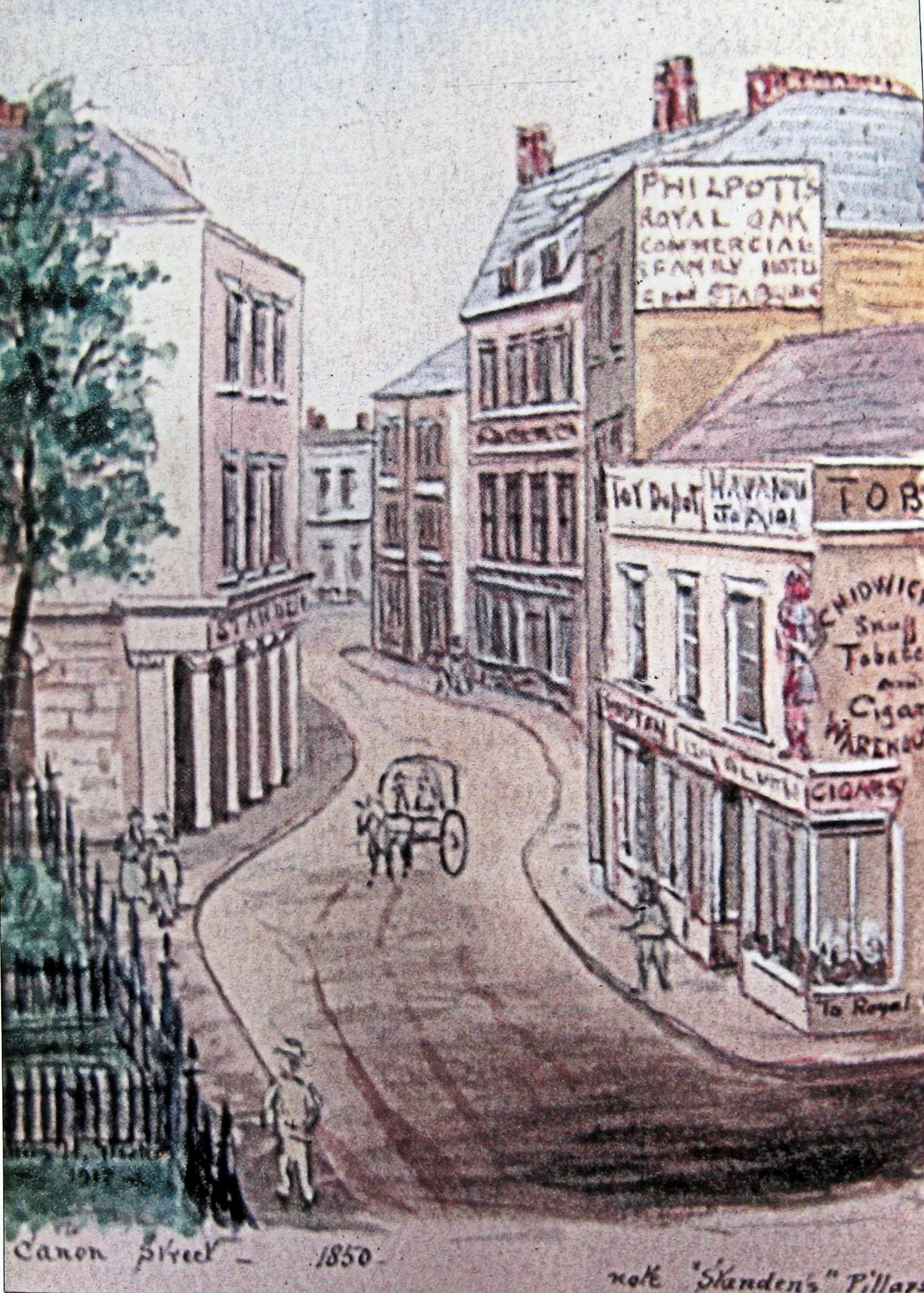
Cannon Street 1850 by James M Tucker. The Royal Oak Inn is on the right

Cannon Street 1850 by James M Tucker. The Royal Oak Inn is on the right

In the Royal Oak Yard – adjoining an ancient inn on Cannon Street – was Dover’s centuries old corn market. In 1861, it was of national interest due to a legal case. The year Farmer Gambrell bought wheat seed but later found that it to be giant sainfoin seed, which was not what he wanted. He could have also bought the sainfoin seed  much cheaper elsewhere.  He returned to the market and confronted Mr Terry, the merchant who sold him the seed and an heated argument took place that included strong language and insults. Terry took the matter to court accusing Gambrell of slander and Lord Chief Justice, Sir Alexander James Edmund Cockburn (1802-1880), heard the case. The Lord Chief Justice stated, in his summing up, that the case should be thrown out as both men were respectable and that the matter should be settled without recourse to court proceedings and recommended that both men shared the costs and go home. However, this was not acceptable to either party and the jury found for Gambrell. The corn market closed in 1893 when the Royal Oak was demolished to make way for the buildings on the east side of Cannon Street.

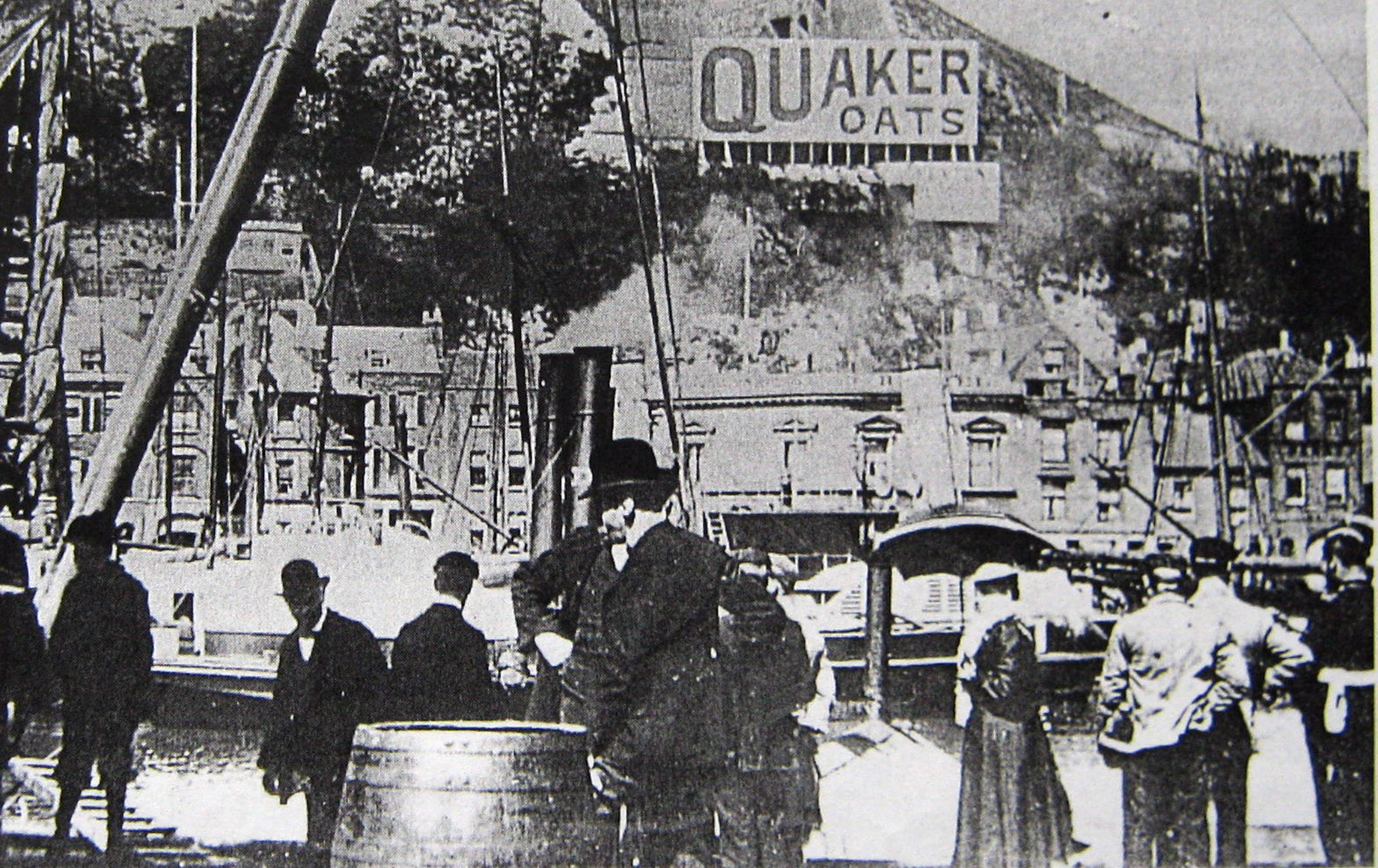
Crosswall Fishmarket - note advertisement on Western Heights behind.

Crosswall Fishmarket – note advertisement on Western Heights behind.

In 1886 a wholesale fish market was built by Dover Harbour Board near the Crosswall, adjacent to the Tidal Basin. In the early morning the ‘catches’ were sold by auction. However, the commercial fishing was starting to decline for in 1871, there were 21 first-class fishing vessels by then there was only 52 Dover registered (carrying the DR boat registration) fishing boats, employing 185 men. In 1906 only ten DR fishing vessels remained and four years later the numbers had fallen to five.

  • Published:
  • Dover Mercury: 22.06.2006
Posted in Businesses, Market Square, Markets of Dover - Part I, Markets of Dover - Part I | Comments Off on Markets of Dover – Part I

Anthony Aucher – Entrepreneur and Creative Accountant

Elizabethan Galleon - Observer

Elizabethan Galleon – Observer

Up until the seventeenth century the Mediterranean was the centre of commercial power. Because of this, the great sea was jealously guarded and was feared by English sailors. At the eastern end was the rich Levant and to import goods from there England had to rely on other nations with their attendant mark ups. To break this stranglehold became of economic, political and maritime importance and in 1550 one ship made a successful journey. This was the Aucher, whose owner was Sir Anthony Aucher (d.1558).

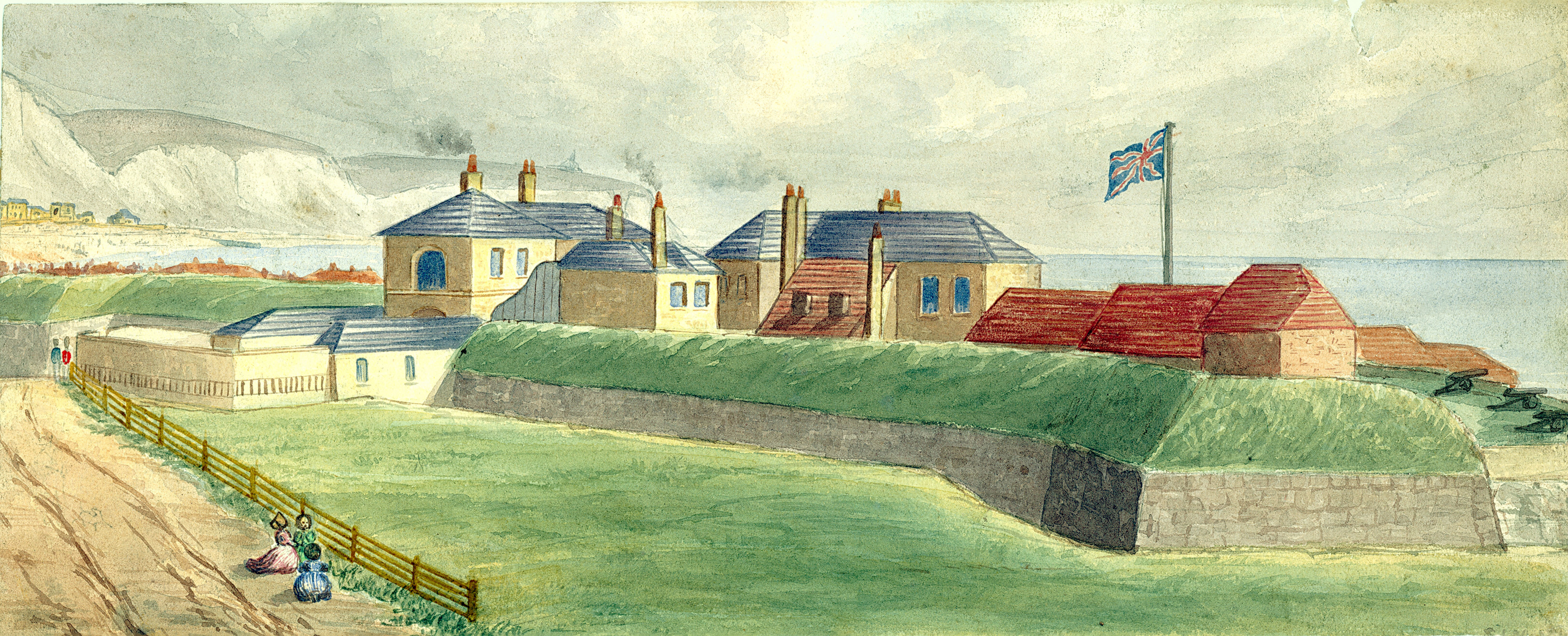
Archcliffe Fort by Samuel Joseph Mackie c 1840s - Dover Museum

Archcliffe Fort by Samuel Joseph Mackie c 1840s – Dover Museum

Anthony Aucher was the only surviving son and heir of James Aucher (d.1509), of Otterden, Kent, and his wife, Alice Hill. On the death of her husband, Alice married into the family of Hardres of Upper Hardres, near Canterbury and as a young man, Aucher worked in the household of Thomas Cromwell (c1485–1540), Secretary of State to Henry VIII (1509-1547). There he became a proficient accountant and acquired the position of auditor and surveyor of the estates of Christ Church Priory, Canterbury. In 1537, Aucher was appointed paymaster of the Royal Haven works at Dover, his base was at Archcliffe Fort.

Up until the end of the 15th century Dover’s harbour was on the east side of the bay but had albut silted up. Around 1495, John Clarke, Master of the Maison Dieu sought Henry VII’s patronage to turn a small natural cove at Archcliffe Point, at the west side of the bay into a commodious harbour. This he did by building a strong bank out into the bay, and ‘cut an entrance through Archcliffe Point’. At the extreme end of the bank, he built two towers on which mooring rings were fixed.

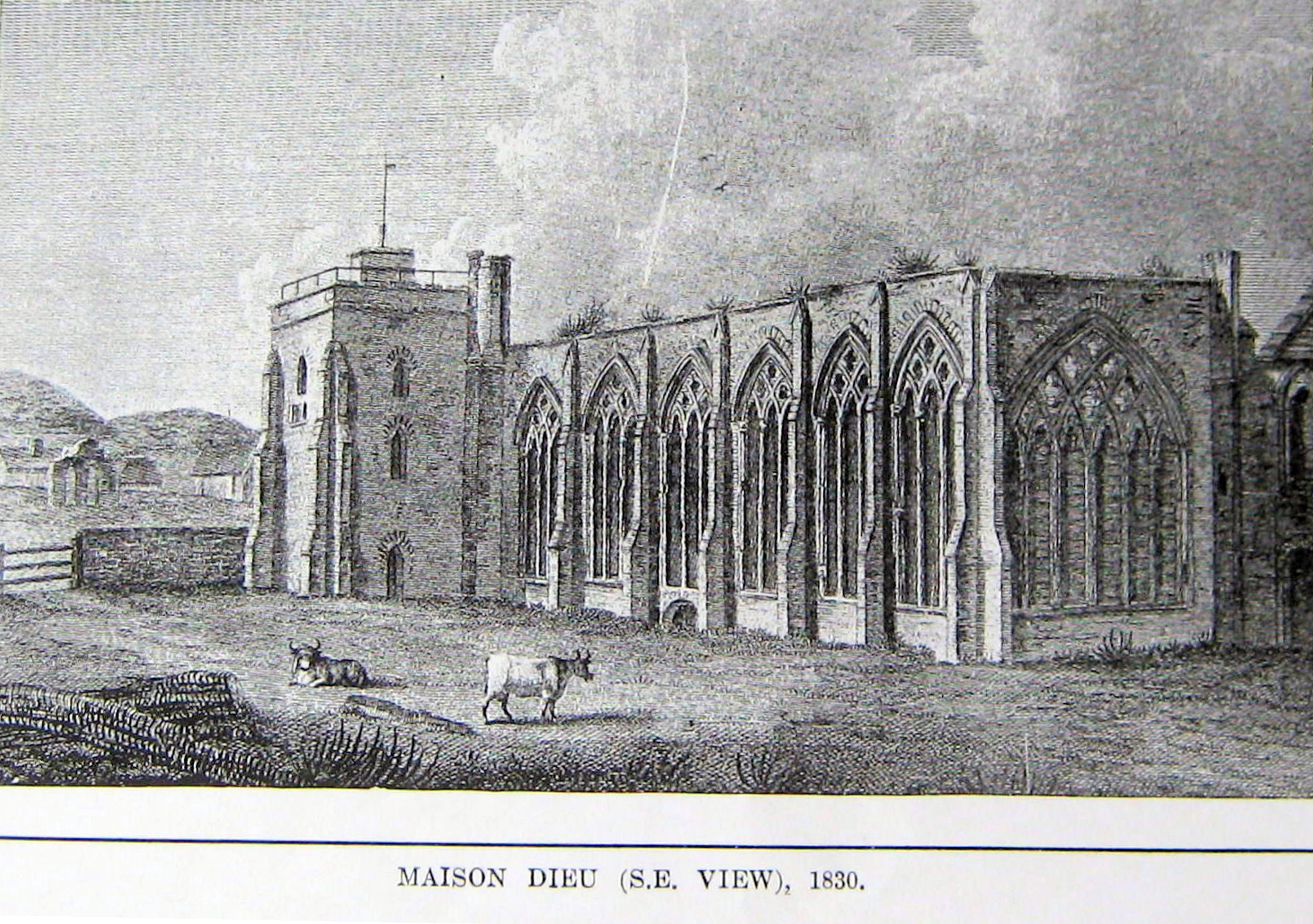
Maison Dieu - 1830

Maison Dieu – 1830

Due to repeated severe southwesterly gales, in 1530, one of the two harbour towers was demolished and part of the bank was washed away. John Thompson, minister of St James’ Church wrote to Henry VIII, on behalf of four Jurats, with a plan to improve the harbour. Henry responded favourably with £300 and as a reward he was knighted and given the position of Master of the Maison Dieu.

Sir John was also appointed engineer and work began on St Anne’s Day, 26 July 1533.

Harbour c1543 showing the Harbour works. Cottonian Manuscript. Bob Hollingsbee

Harbour c1543 showing the Harbour works. Cottonian Manuscript. Bob Hollingsbee

The King took an active interest in the project and brought in his own harbour master, John Young, to construct a breakwater, some 1400 feet long and 18 feet high, using blocks of chalk and stone, with a Mole at the sea end. John Young, after experimenting with floating nutshells and eggshells calculated that stone piles could be floated out in casks and then sunk in situ. Henry was so impressed by the success of the scheme that Young was granted a pension of 4d per day for life. A Mole was built first then a wall was constructed from the land to meet it. However, costs escalated and when they reached about £80,000, on Aucher’s advice, Henry withdrew his support. This left the Mole isolated and was to be a hazard to shipping until after the Ville de Liege catastrophe of 1929.

Besides keeping a weather eye on the escalating costs of the harbour works, Aucher had other projects to handle. Then Henry VIII chose to align himself with Emperor Charles V of the Holy Roman Empire (1519-1556) that culminated in the Anglo-French War of 1542-1546. Aucher was appointed paymaster and surveyor of all building works in Dover and was responsible for turning the Maison Dieu into a major victualling station for the army and navy. In 1544, English forces took Boulogne and held the town preventing a French invasion in 1545, however, as Aucher undoubtedly showed, the war and the capture of Boulogne cost the English £2million. The French retook the town in the subsequent War of 1549-1550.

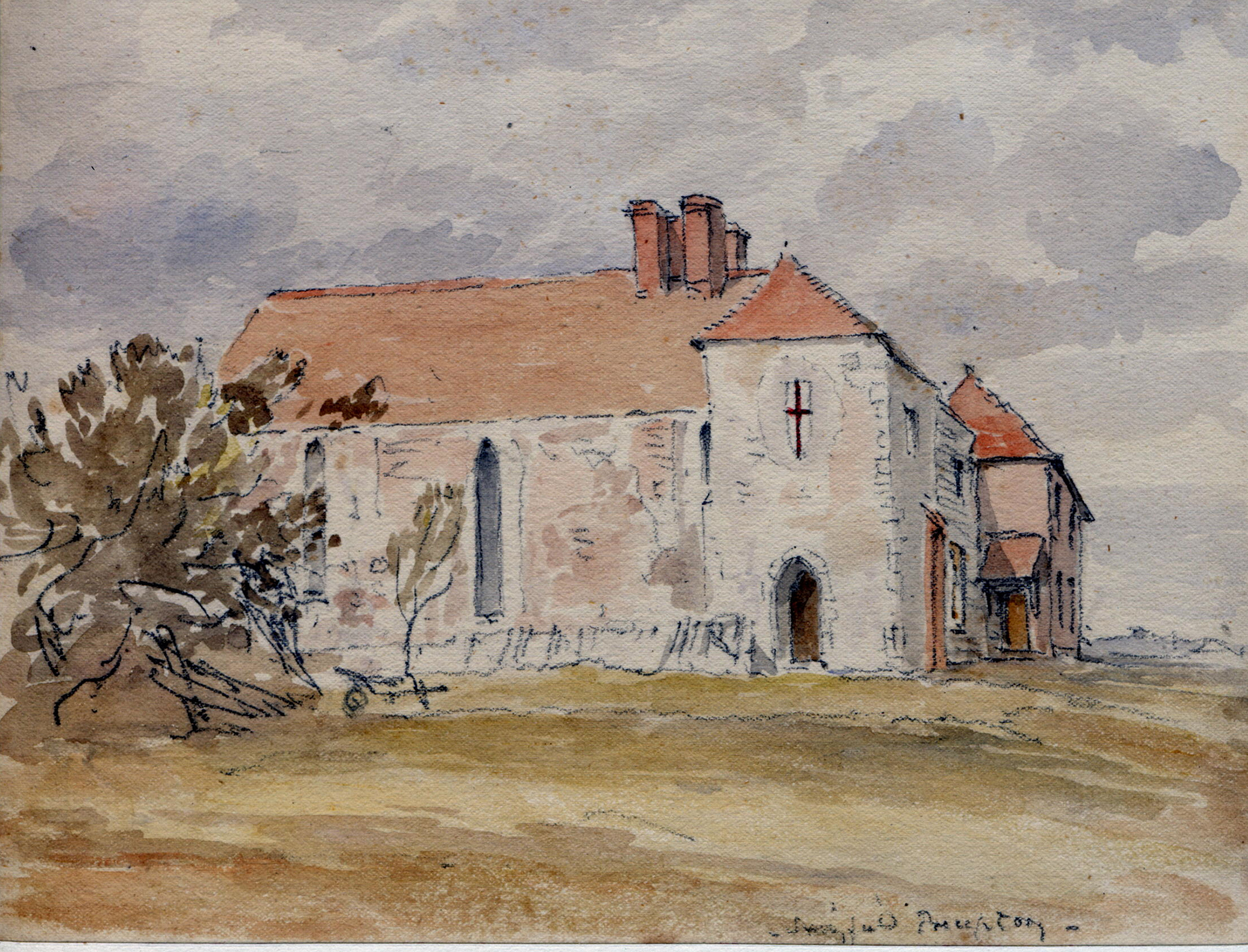
Swingfield Preceptory By Roget 1800. Dover Museum

Swingfield Preceptory By Roget 1800. Dover Museum

During the Dissolution of Monasteries between 1536 and 1541, Aucher’s accounting acumen was well used and in 1543, he was appointed a Commissioner of Kent. The position enabled him to amass a great deal of property including the Swingfield Preceptory and Tilmanstone Rectory along with a small fortune. His accounting knowledge and wealth made Aucher an ideal appointee for the position of Master of the Jewel House a post he held until his death. He was also given a number of other appointments and on 22 February 1547 was knighted by Edward VI (1547-1553). Albeit, questions were beginning to be asked regarding Aucher’s fortune but little official notice was taken of these concerns.

Like many subsequent self-made men, Sir Anthony Aucher decided to build the equivalent of a modern luxury yacht. This was the great bark Aucher, a vessel of 240 tons with a crew of 200 and was launched in 1545. Sir Anthony leased his ship to the Navy as the flagship of Thomas Wyndham (1508- 1554) in the Scottish campaign of 1547–8 but he knew that it was a cargo of scarce goods from the Levant where real money could be made. On 13 November 1550, the Aucher set sail from Gravesend, under Captain Roger Bodenham. The crew of seventy men and boys were chosen with the help of the famous explorer, Sebastian Cabot (c.1474–c.1557). The remit for the voyage, and no doubt much of the government  funding for the journey, was to provide experience in long distance seamanship. This was a skill that English mariners lacked at that time.

Because of bad weather, the Aucher did not arrive in Dover until 6 January 1551 and it was here that Sir Anthony joined her. On leaving Dover, they made for Cadiz, southern Spain, arriving on 30 January. There they stayed for three weeks, before making sail and calling at Majorca and Sardinia arriving at Massina in Sicily on 5 March. Then it was onto Chios in the Levant, where they were given safe anchor for 20 days for the sum of 12,000 ducats. However, once in the harbour, locals swarmed on board carrying off everything that was not nailed down!

Due to Aucher’s size and unfavourable winds, they could not escape and some of the crew threatened mutiny. In response, Sir Anthony’s servant loudly proclaimed, while brandishing a sword, he would take on ‘a whole army of Turkes and never yield.‘ This brought the dissident crew into line but not the locals. That night a few of the crew went into the town pretending to merry make. While they distracted the locals and with the help crews off other ships, the Aucher managed to creep out of the harbour. The merrymakers were to join the Aucher at sea but were caught and, it was assumed, sent as slaves to the Turkish galleys.

Hotly pursued the Aucher made for an island off Candida, (modern Crete), which was used as an open prison as there was no possibility of escape except by ship. There, the ‘prisoners‘ were free to roam so it was with trepidation that Sir Anthony weighed anchor. Soon, the prisoners gathered round and were, according to Captain Bodenham, as, ‘good archers, every one with his bowe and arrowes, a sword and dagger, with long haire and bootes that reach right up to their grine, and a shirt of male, hanging the one half before and the other halfe behinde…’

Luckily, for the crew, the prisoners were hospitable even hiding the beleaguered Aucher and the crew when their foes ships were off the island. In fact, the prisoners were so friendly that before leaving, the Aucher was loaded with wine and other goods. Sir Anthony and the crew of the Aucher were to have a number of other adventures before finally returning home to England. By that time the rich cargo was still intact and the crew well trained. Of the crew, it was later claimed by Captain Bodenham that all became ships’ masters within the five years following the Aucher’s return. One member of the crew, apprentice pilot Richard Chancellor (d 1556), laid the foundations of English trade with Russia.

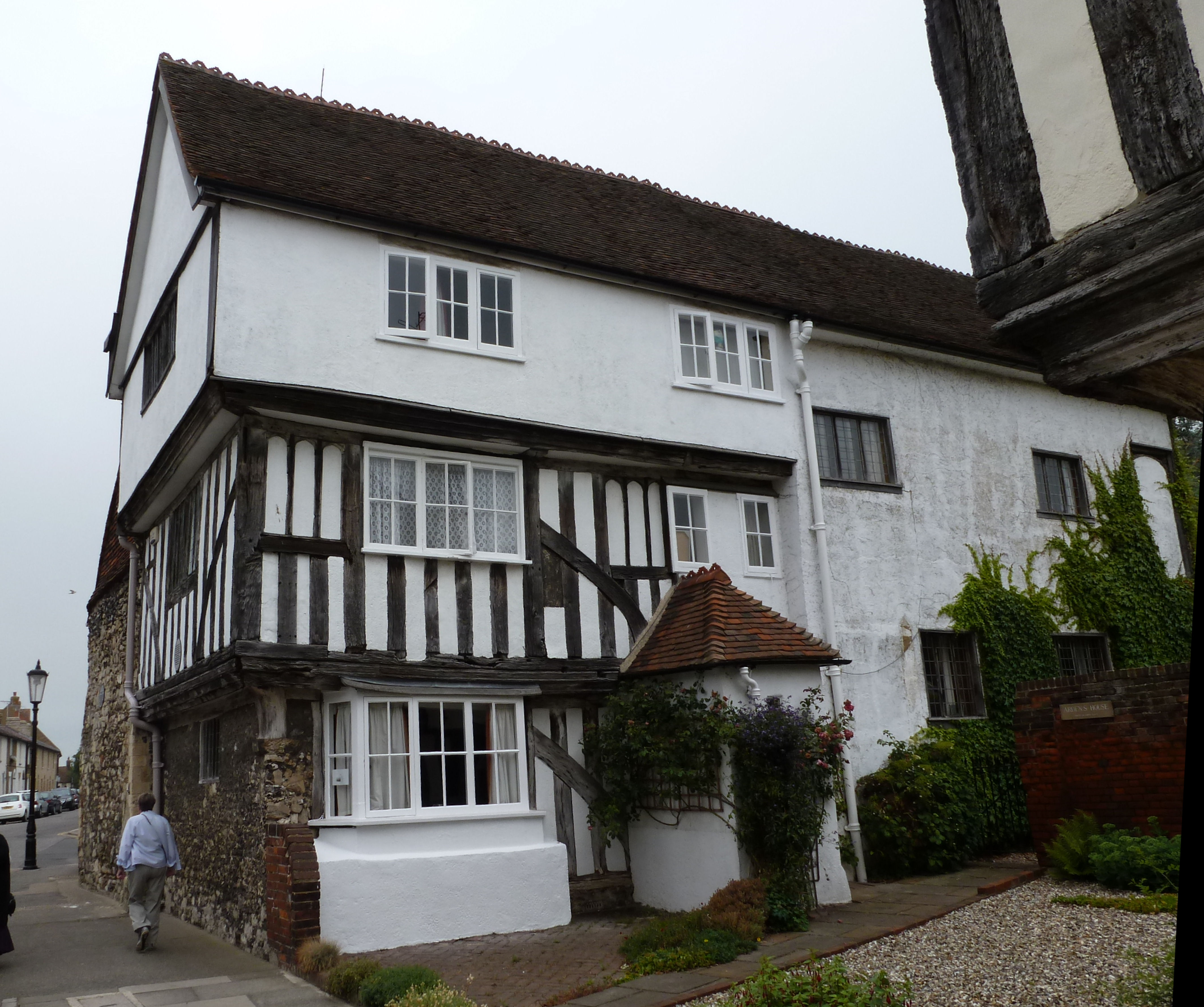
Thomas Arden's house, Faversham where he was murdered on 15 February 1551.

Thomas Arden’s house, Faversham where he was murdered on 15 February 1551.

While Sir Anthony had been away, England had experienced bad harvests and the people were in revolt. With the expertise in handling a ship’s crew, Sir Anthony was assigned to put down the insurrection in Kent over which he was notoriously aggressive. Then a major scandal touched the Aucher household. on 15 February 1551 Thomas Arderne, a former mayor of Faversham (1548), Comptroller of the Port of Sandwich and Customer of Faversham, was murdered. His wife, Alice and her lover, Thomas Mosby, were responsible, the couple having made a number of attempts before. These included hiring John Greene, one of Sir Anthony’s servants, to do the dirty deed. Like all the other potential assassins, John Greene botched the job. Eventually two hired did assassins succeed but were caught and dealt with. Both Alice and her lover were arrested and found guilty and all the other potential assassins were rounded up and found guilty of complicity. Sir Anthony’s servant, John Green, was hung along with Alice’s lover Thomas Mosby and other attempted assassins. Alice was burnt at the stake in Canterbury.

Sir Anthony’s connection with the case put him in the spotlight and this was the start of his downfall. He was asked to account for many of his transactions on behalf of the Crown and was forced to pay back some £4,500. When Mary I (1553-1558) came to the throne tighter accounting controls was implemented and Sir Aucher’s creativity in that field came in for scrutiny. He was forced to sell or mortgage a number of his estates including Swingfield. Then, in 1556, his accounts as Keeper of the Jewel House were audited. It would appear that the findings were so embarrassing that instead of paying a hefty fine, imprisonment or even execution, Sir Anthony was obliged to resign the office and given a gratuity of £366 13shilling 4pence!

Calais La Reprise en 1558  Calais Musée

Calais La Reprise en 1558 Calais Musée

Further, Sir Anthony was appointed Marshall of Calais and Governor of Guisnes. England had ruled Calais since 1347 but Mary and her husband Philip of Spain (1554-1558) sided with Spain when that country invaded France. The defences in Calais consisted of the man-made fortifications that can still be seen. In January 1558, Henry II of France (1547-1559) forces made a surprise attack on the town and Sir Anthony was badly wounded. On 7 January 1558 Lord Thomas Wentworth handed the French the keys to the town and it is said that as Mary I was dying, later that year, she proclaimed that, ’When I am dead and cut open, they will find Calais inscribed on my heart.’ Sir Anthony Aucher died of his wounds on 9 January.

Sir Anthony Aucher’s  granddaughter Anne married the great maritime explorer, Sir Humphrey Gilbert (c.1539–1583).

  • Published Dover Mercury:
  • Aucher – the ship : 15 February 2007
  • Aucher  – Entrepreneur and Creative Accountant: 26 June & 3 July 2014
Posted in Aucher Anthony - Entrepreneur and Creative Accountant, Maritime | Comments Off on Anthony Aucher – Entrepreneur and Creative Accountant