Old Park Part II: From Barracks to Junior Leaders to Houses & Business Park

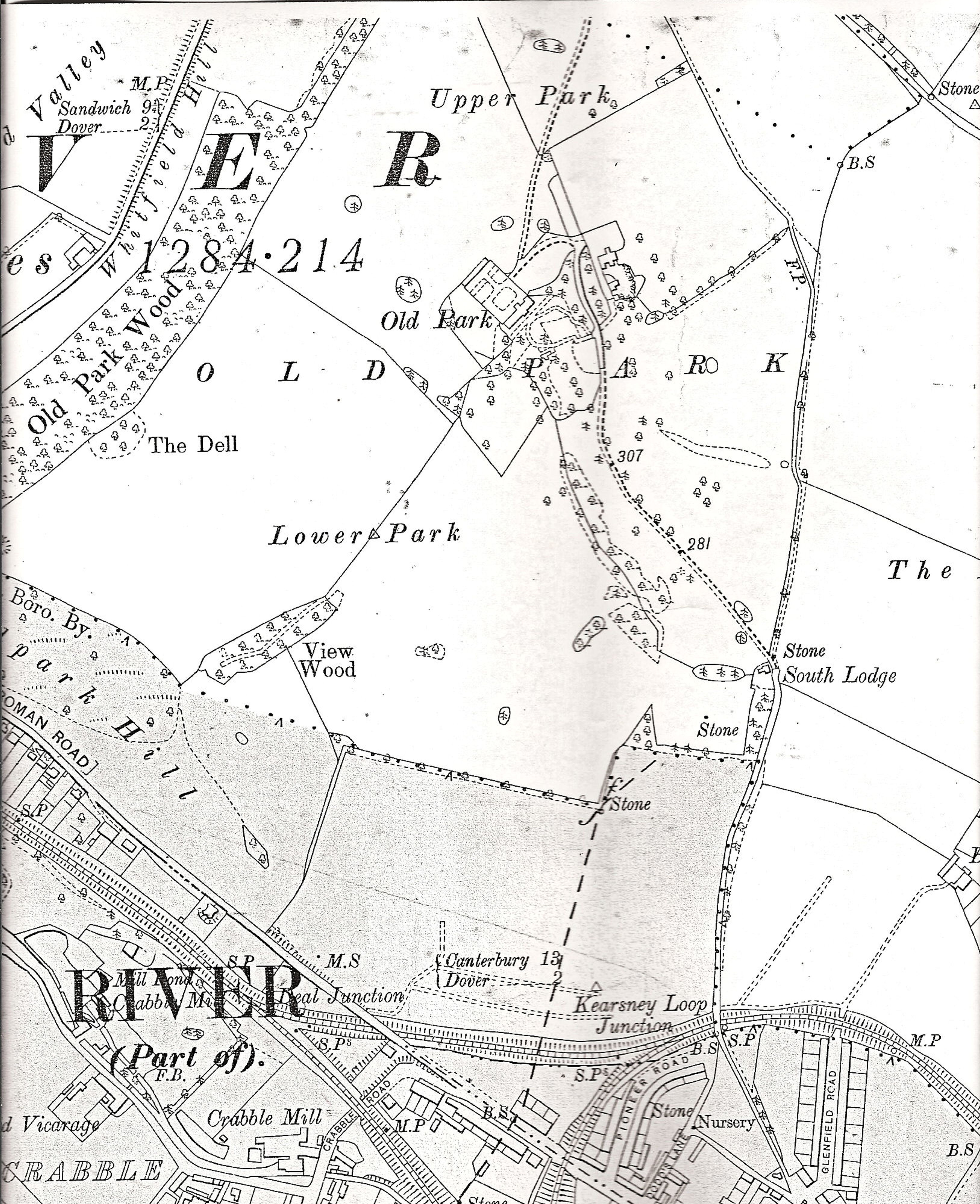
Old Park Mansion estate map 1919

Old Park Mansion estate map 1919

In 1938 Robert Letheridge Murray Lawes was the owner of the 423 acres Old Park estate on the north east side of Dover (see part I of the Old Park story). This was originally two separate estates, the originally Old Park Mansion estate boundary went along the full length of Whitfield Hill on the south side from Whitfield to the then London Road. Along London Road to the then Green Lane, where there was a small farm, the track up the hill going east until what is now Melbourne Avenue, but at the time another track, was reached and along that track northwards to the top of Whitfield Hill. Old Park mansion was within the boundary of this part of the estate. The remaining 198 acres juxtaposed the south of the Mansion estate excepting that the boundary was several hundred yards short of the London Road.

Murray Lawes, as he was known, was a major advocate in the National and Kent Playing Fields Associations, having been a founder member of both. However, with war looming, on 24 November 1938 he gifted with covenants Old Park Mansion estate to the Ministry of War. By the outbreak of World War II (1939-1945), Lawes had joined the army rising to the rank of Lieutenant Colonel. In the summer of 1939 Old Park Barracks were built and the Royal Artillery (RA) moved in. Various RA and other units stayed at Old Park for rest, recuperation and in some cases, hospital care between combat assignments in the different theatres of war.

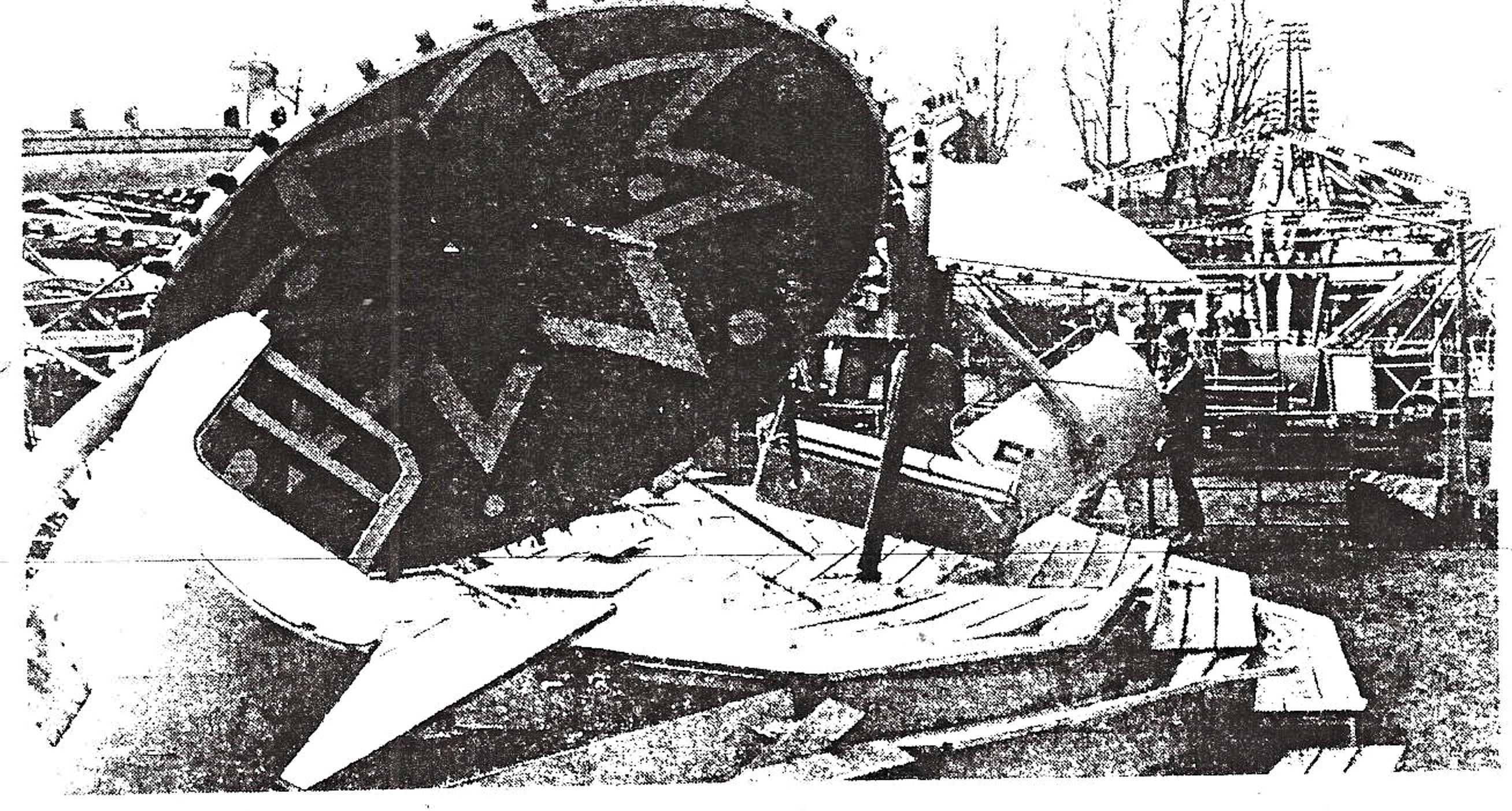
World War II nearby Cannon Street war damage

World War II nearby Cannon Street war damage

During that time there were many heroic acts by various members of the different units, however, one is particularly remembered in Dover. In spring 1942 Lieutenant John Warren, an officer in the Royal East Kent Regiment – the Buffs – was stationed at Old Park. On the evening of 23 March he and some of his colleagues went to the Granada cinema in Castle Street, Dover, but while watching the film Junker 88s bombers circled the town and then began dive-bombing. One of the bombs hit the Conservative Carlton Club in the nearby Market Square killing 57-year-old Cllr. William Austin a sign writer of Pencester Road: haulage contractor Percy Snelgrove age 60 of Millais Road; Co-op bakery manager Donald Mackenzie age 53 of Barton Road and William Bank age 53 of Avenue Road. In the Square, Private Alan Bowles age 20 was killed by falling masonry, while inside the devastated building a woman and two children were missing.

The Granada cinema was evacuated and as the young Lieutenant and his colleagues were running through the Square they heard about the missing woman and children. They went to investigate and were told that the two children, Pauline (15) and Ivan (4) Cleak were found sheltering under a billiard table but their mother, Lilian Cleak was trapped and buried under the heavy debris. Lt. Warren, a short wiry rugby wing and three-quarter realised that he was small enough to wiggle through a tiny gap. This he did with his feet held by fellow subaltern, Robert Brownrigg and helped by Captain Arthur Harvey of the Salvation Army, a tunnel was dug to prevent Mrs Cleak from being crushed to death. His colleagues from Old Park, some of whom had only recently joined up from local reform schools, were also involved in the rescue by shoring up the debris including the use of a car-jack.
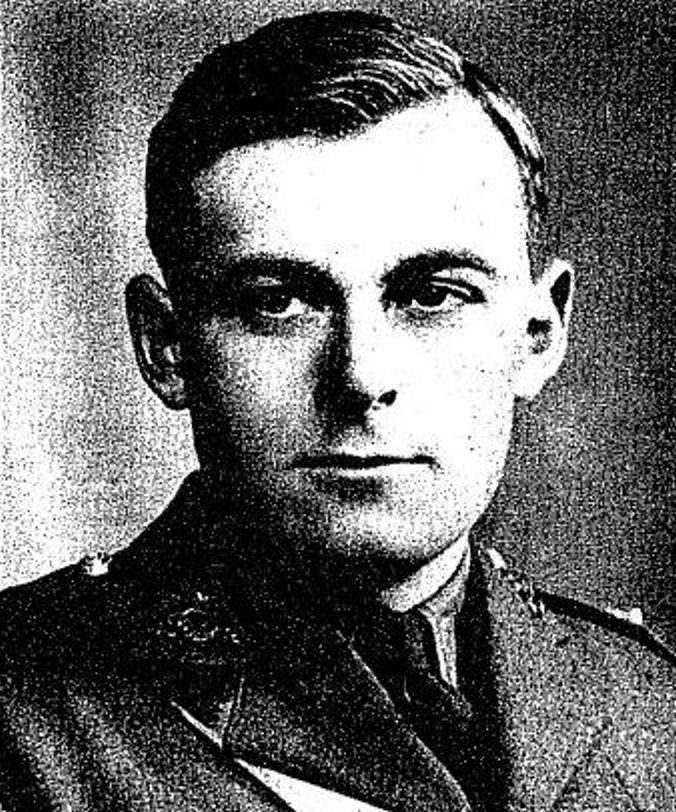
Lt. John Warren rescued Lilian Cleake from a bombed building in Market Square on 23 March 1942

Lt. John Warren rescued Lilian Cleake from a bombed building in Market Square on 23 March 1942

When Lt. Warren reached Mrs Cleak he lay her on her side, cleaned her face and gave her an injection of morphia while Dover’s Medical Officer of Health, Dr E Hughes, shouted the instructions as to how it was to be administered. Lt. Warren then instructed the rest of the team how best to free Mrs Cleak, an operation that took five hours. In all Mrs Cleake was buried for thirteen hours. Following the rescue Lt. Warren and his colleagues returned to the barracks at Old Park.

The next morning, not having had any sleep, Lt. Warren was late on parade and was put on a charge. His colleagues in the rescue were also in trouble for being late and they too were punished but not one said anything of the events the night before. On the Friday that week, the Dover Express published an account of the rescue, such that Lt. Warren was able to make a full report naming all the individual combatants involved and subsequently all the charges were dropped. For their bravery, Lieutenant John Warren was awarded the George Medal and the Salvation Army Captain Arthur Harvey the British Empire Medal.

During the continuing attacks on Dover at this time it is difficult to ascertain how Old Park faired as damage to military establishments were not made public. However in September 1944, when the Allied troops were closing in on the German troops still occupying the French coastal towns of Boulogne, Calais and Dunkirk. Dover was under fierce attack. Indeed, the town, already having earned the reputation of ‘Hell Fire Corner,’ suffered the heaviest shelling bombardment from the French coast including Old Park. On Tuesday 26 September, the last of thirteen days of continual bombardment, two soldiers were killed at the Barracks.
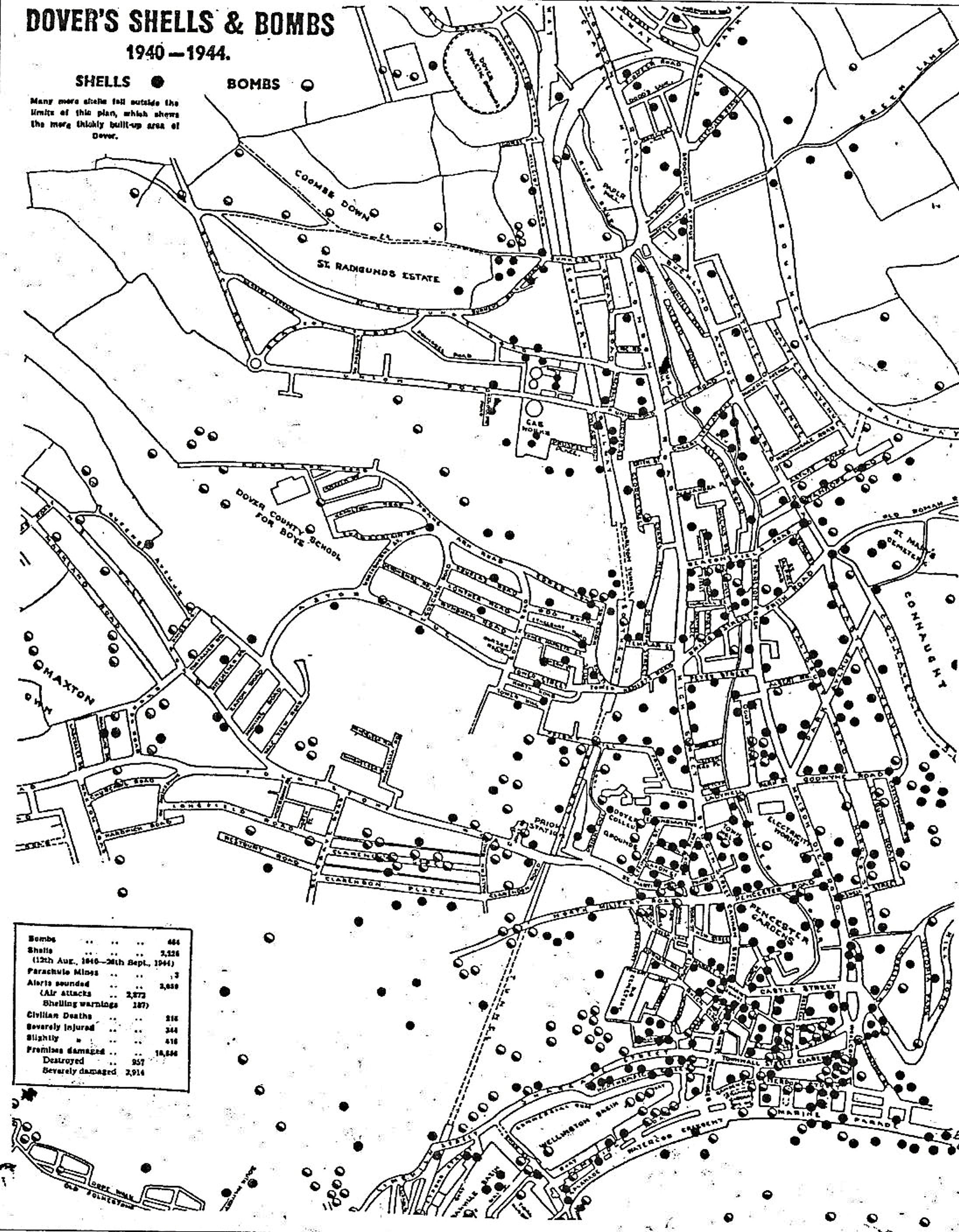
Map of Dover showing World War II bombing and shell damage

Map of Dover showing World War II bombing and shell damage

Immediately following the ending of hostilities, in 1945, ships came into Dover packed with soldiers returning from the Continent. Old Park, along with Connaught Barracks, Duke of York’s School and the former Oil Mills were turned into transit camps. It was estimated that between 15,000 and 20,000 soldiers were dealt with daily in the town. Long convoys of army transport carrying men to and from Old Park was a regular occurrence.

The damage Dover had sustained during World War II was proportionally greater than in any other town in the country, or so it is said. 957 houses had been destroyed; 898 seriously damaged but in part fit for uneasy habitation; and 6,705 were less seriously damaged. Public, general businesses and industrial premises were also badly damaged. Dover Corporation’s Town Clerk, James A Johnson, spoke to Lieutenant Colonel Lawes about utilising what had been the playing field adjacent to Chaucer Crescent to erect prefabricated ‘temporary’ homes. Lawes had gifted, with covenants, the land to the town as a playing field but for war purposes it had been put under cultivation due to food shortages. At the time it was still under cultivation but was eventually expected to revert to a playing ground. Lawes was concerned that if the land was used for temporary housing, temporary may become permanent. However, he did suggest another site to the south of the then Green Lane.
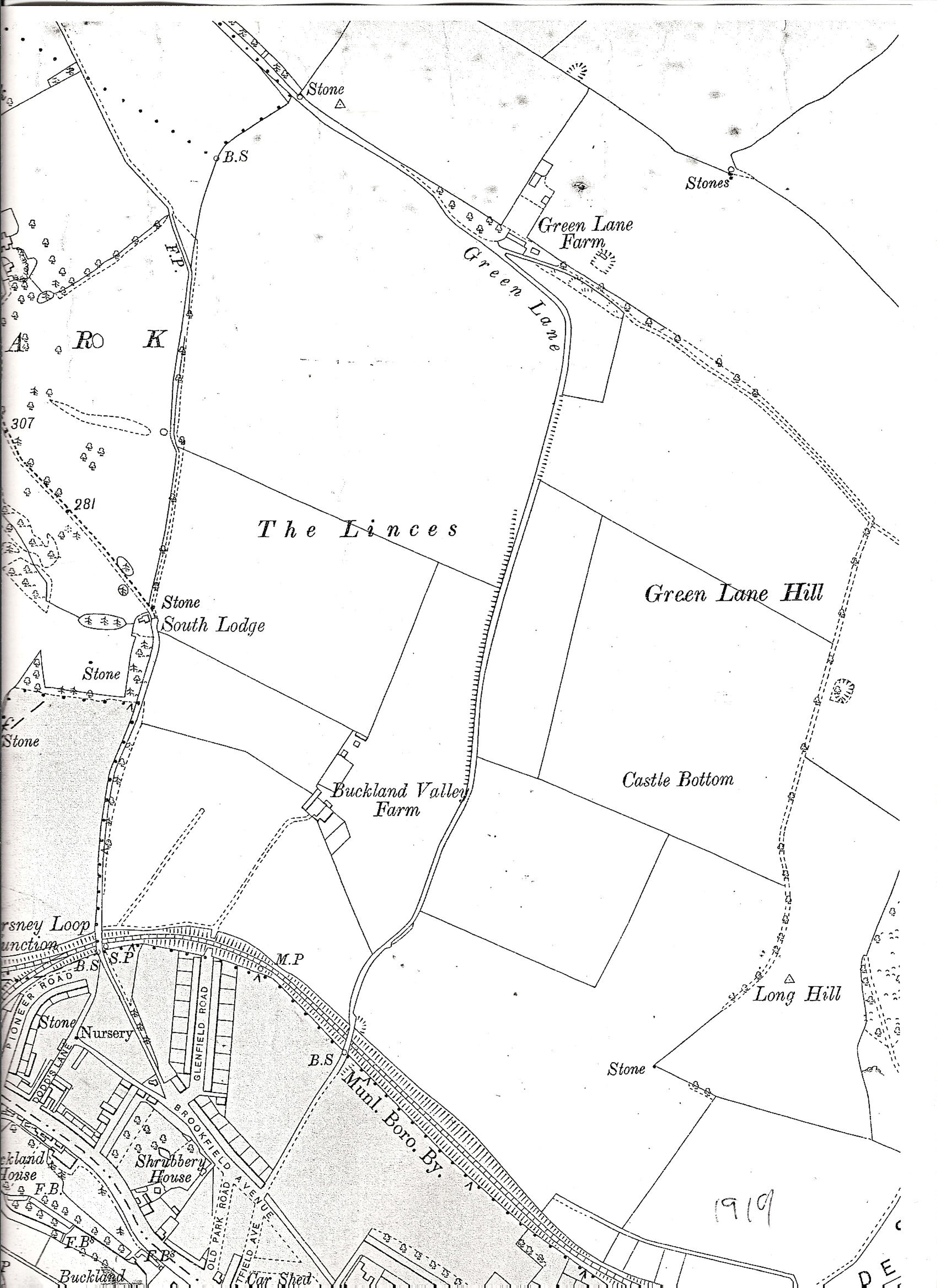
Buckland Manor Farm and Green Lane Farm. 1919

Buckland Manor Farm and Green Lane Farm. 1919

This was declined, instead, so it appears, the council or Town Clerk, asked for the site of Green Lane farm, approximately between where Winant Way and Roosevelt Road are today. Again Lawes declined saying that the area was not suitable for housing, as it was prone to intermittent flooding caused by underground springs. Again he offered the site across Green Lane but it would seem that some sort of altercation took place between the Lieutenant Colonel and James A Johnson. This ended with Johnson seeking and gaining, in 1946, a compulsory purchase order for the whole of Lawes remaining 198 acre Old Park estate! Lawes moved to West Kent, where he continued his fight on behalf of the Kent Playing Fields Association for playing fields.

Initially, 480 prefabricated ‘temporary’ homes were built on both sides of Green Lane. These took three days to erect but as some came from the U.S. and included fridges, due to a shortage of electricity the appliances could not be used! Initially the development was named Green Lane estate as the council objected to any reference to Lawes or Old Park. The roads were named after Commonwealth cities and towns that had sent food parcels to the town during and after the War. However, again, out of animosity to Lawes, there were to be no playing fields.
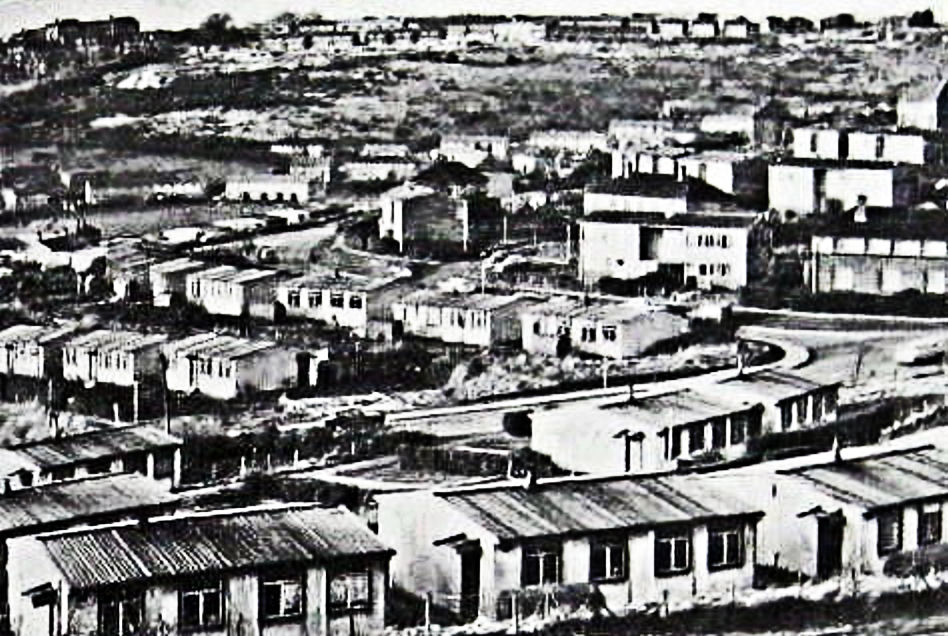
Buckland Estate - Prefabs prior to Demolition

Buckland Estate – Prefabs prior to Demolition

In 1949 the council decided to build the first 50 houses of a new estate at Green Lane but shortage of materials meant that the prefabs had to stay longer than originally envisaged. It was not until 1965 that the development of the Green Lane estate began in earnest and eventually it became Dover’s largest housing estate. Except for the pre-war playing field at the end of  Chaucer Road and the playing fields that were part of the two schools, no playing fields were laid. The areas that Lawes had warned were prone to flooding due to underground springs, proved to be correct. The last of the prefabricated bungalows were demolished in 1971.

Following the War, the 21st Training Regiment occupied Old Park Barracks until April 1947, when following a re-designation they became the 121st Training Regiment. They left Old Park on 30 January 1948 and were replaced in March by the 14th Field Regiment, who had been abroad for 22 years. The 1st Royal Sussex Regiment arrived at Old Park in July that year pending an amalgamation of the 1st and 2nd Battalions and were followed by the Depot Battalion R.A.S.C. The Depot Battalion stayed until September 1950 when they were replaced by the Somerset Light Infantry then quickly followed by 1st Battalion of the Buffs. This was the first time in forty years that the Buffs had been stationed in the town so an official greeting was laid on when they arrived in December that year from Sudan.
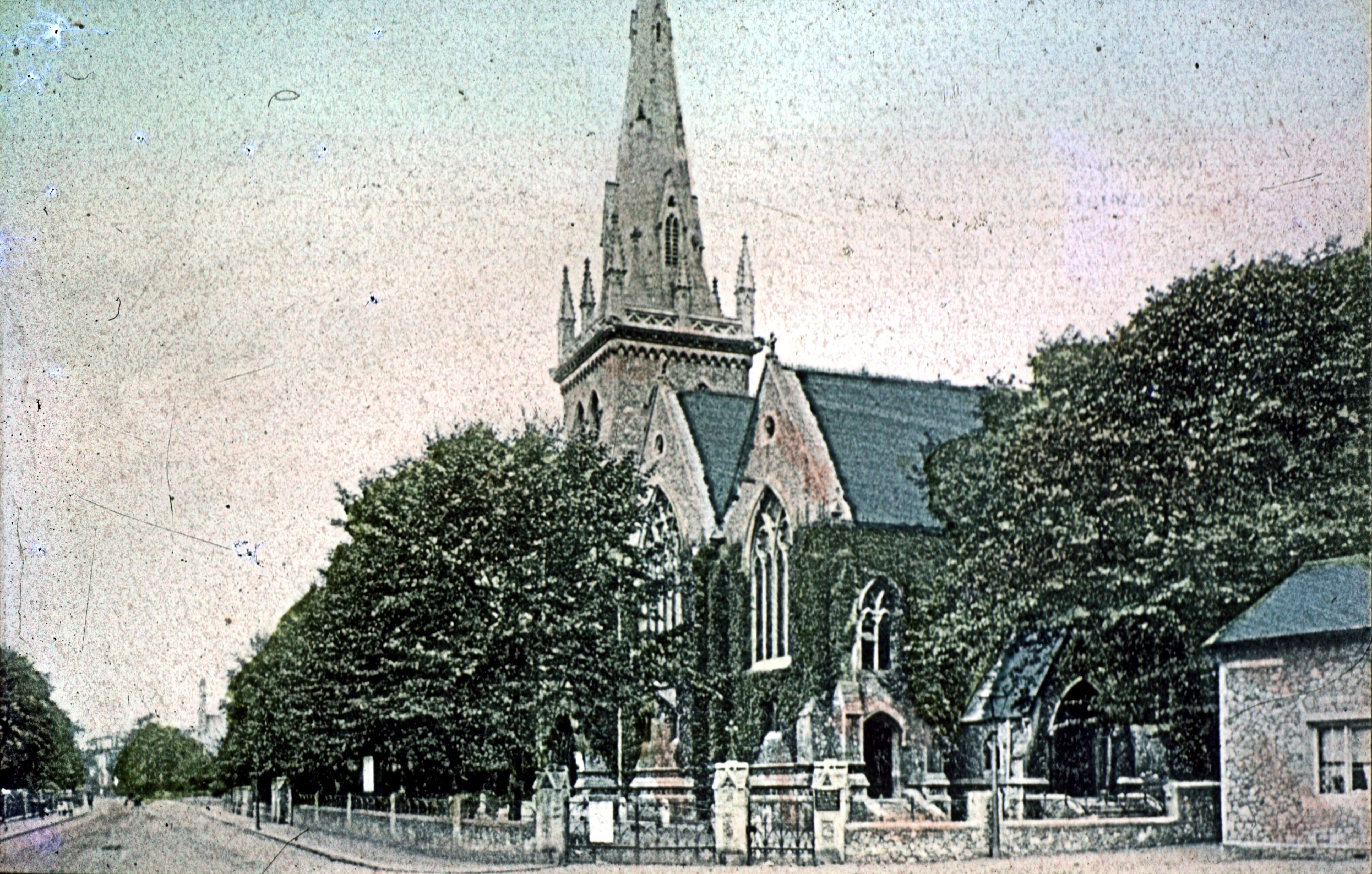
St James (New) Church 1939 - Maison Dieu Road. Budge Adams Collection Dover Museum

St James (New) Church 1939 – Maison Dieu Road. Budge Adams Collection Dover Museum

To provide for the soldiers spiritual needs a chapel was built and in April 1949 was dedicated by the Bishop of Dover to St Alban the Martyr. However, it did not have a church bell. In Dover most of the churches had suffered war damaged and were repaired, that is with the exception of both the old and new St James’ churches. Old St James’ Church became the ‘Tidy Ruin’ that can still be seen today. It had been expected that the noble new St James’ Church would be repaired but despite mass protests in Dover, in 1952 a Commissionary Court ordered the Church to be demolished.

The Court also ordered that the altar was to be broken up and burnt ‘under supervision’ and the font, pulpit and anything else that could be removed, was to ‘be pounded to dust.’ During the demolition the church bells were left exposed but one was so corroded that it had to be thrown away. The other bell, however, was ‘rescued’ one night and given sanctuary in a rapidly built tower close at Old Park Barracks! The site of St James’ (New) Church is now St Mary’s School playing field, Maison Dieu Road.
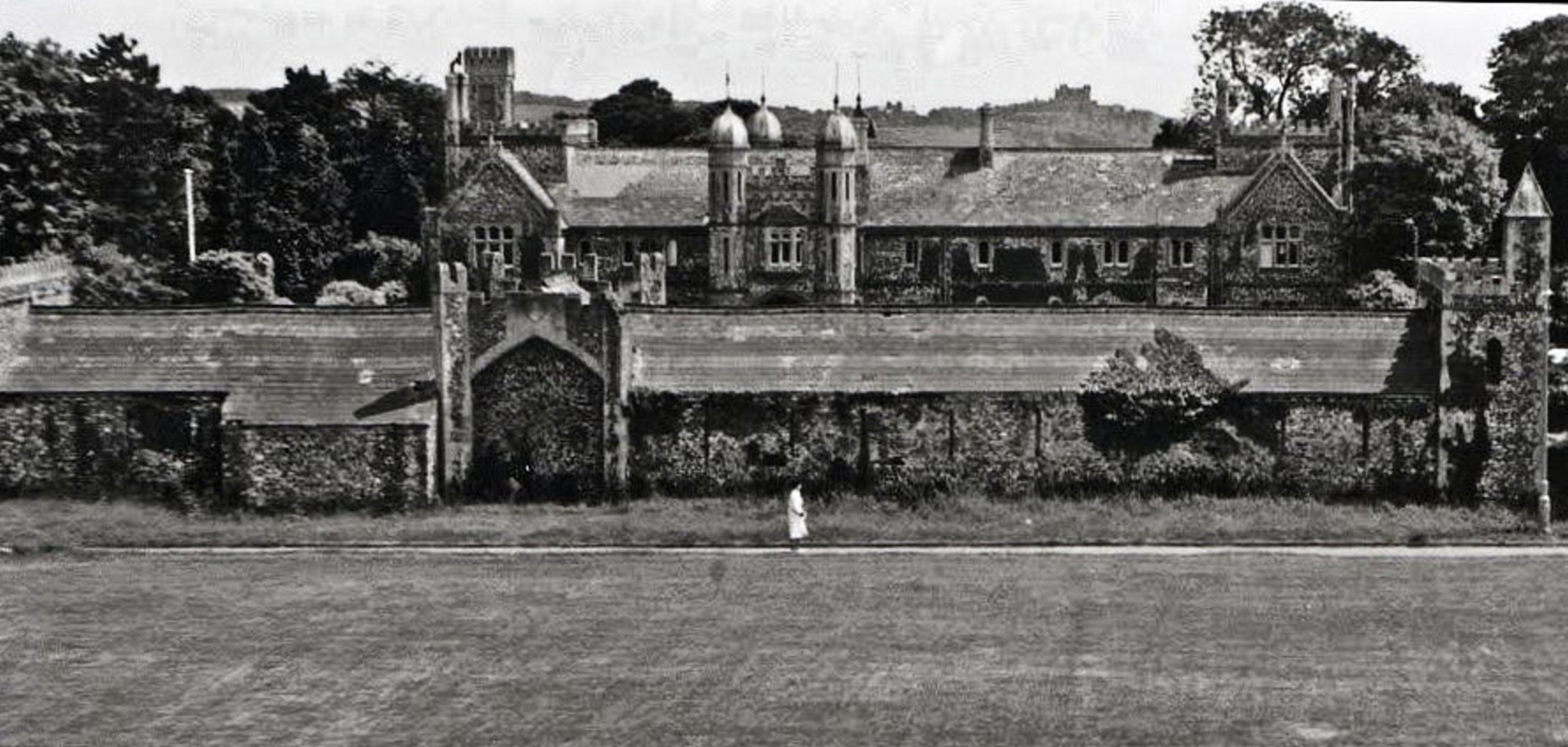
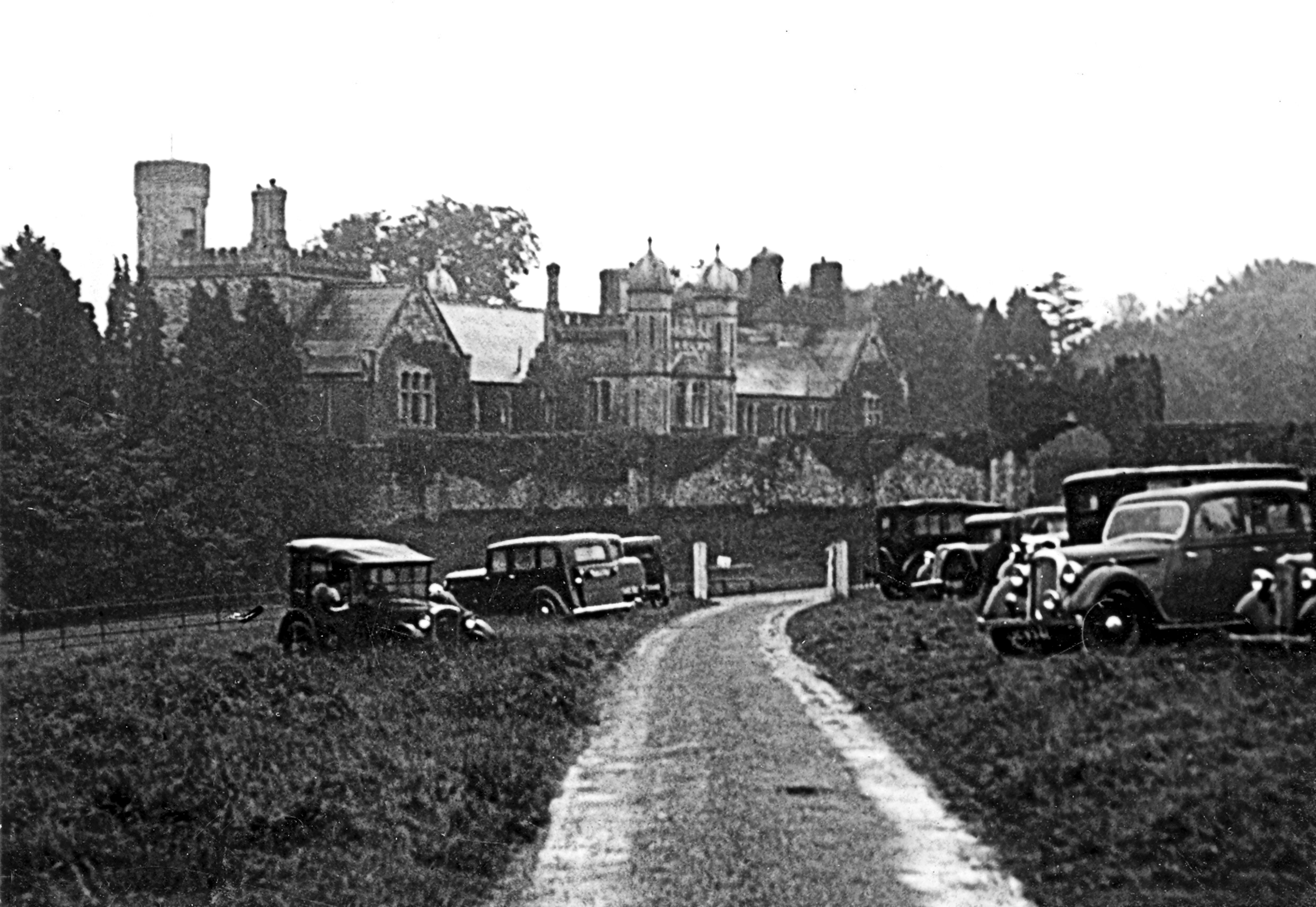
Old Park Mansion c1960s - Thanks to Roger Gray

Old Park Mansion c1960s – Thanks to Roger Gray

The Buffs left Old Park in November 1951 to go to Enniskillen, Northern Ireland. It was not until December 1952 that the Barracks were in use again, when the 72nd L.A.A. Regiment arrived. They moved on after six months for Hong Kong but in October the Buffs returned with the Royal Inniskilling Fusiliers. At the time Kenya, east Africa, was a British colony and the indigenous Kikuyu wanted independence. There had been a series of uprisings and revolts and in 1953, there was the Mau Mau rebellion. The units at Old Park, which by this time included the Headquarters of the 19th Infantry Brigade, left Old Park for Kenya. Dover townsfolk lined the streets to wave them off and to wish them a safe journey and a speedy return. The uprising lasted until 1959 and the country gained its independence in 1963.

In June 1956 the Royal West Kent’s arrived in Dover from Germany and moved into Old Park Barracks. They had hardly unpacked when on 26 July, the President of Egypt, Gamal Abdel Nasser, announced the nationalisation of the Suez Canal and along with the rest of the Dover Garrison, the Royal West Kent’s were redeployed. Then on 23 October, in Budapest, Hungary, students organised a demonstration against Soviet Union control of the country. Although the students were hoping for a good turnout they did not expect the thousands that came and marched with them. This was the start of the Hungarian Uprising that was to last until 10 November, when the Soviet Army moved in and regained control. This led to a massive exodus of refugees fleeing Hungary.

On 19 November 1956 the Ostend boat arrived at Dover carrying 236 refugees and more arrived over the next few days. Initially, they were met by relief workers and dispersed throughout the country. By the end of the month, it was decided that Dover’s temporarily empty army barracks would be used to house up to 3,000 of the refugees. By early December, Old Park Barracks had 900, Connaught and Northfall Barracks, 1,300 each and as the month progressed, more were accommodated. Troops, still in the UK, together with a considerable number of Dover folk tended to the refugees needs until the British Red Cross, with Hungarian help, took over the administration and the refugees were dispersed.

Junior Leaders

At the time a relatively new army squadron was looking for a new, larger home. They were the Junior Leaders of the Royal Engineers. It was in 1946 that the Army Council had been authorised by Government to maintain the Army Cadet force, ‘as an efficient organisation that blended military and social activities of the established corps at the same time as meeting youth training in the wider sense.’ The Council felt that the opportunity should not be lost of utilising commissioned, warrant and non-commissioned officers who had active experience during the war, as teachers. The subsequent discussions led to the formation of the Junior Leaders – young men straight from school, who would be trained to provide the regular army with a supply of manpower that was trained in leadership skills in order to take on the mantle of the senior Non Commissioned Officer (N.C.O).

The first 50 recruits arrived at Chatham in 1950 and a further 30 at Aldershot at the same time. The courses proved to be such a success that aggressive recruiting followed. Anthony Head (1906-1983) was the Secretary of State for War (1951-1956). His theme, in 1955, when he presented the Army estimates for that year, was Army restructuring. He stated that there would be a greater emphasis on Brigades being self-contained groups, easily detachable but re-attachable to the Division. This change included addressing the major problem that most of the recruits to the Armed services came via National Service. Peace time conscription, or National Service, started on 1 January 1949 when all healthy males age 17 to 21 years old were expected to serve in the Armed Forces for 18 months, and remain on the reserve list for four years after. However, said the Minister, it was not until their final six months that they were most economically viable as tradesmen and/or non-commissioned officers. Conscription ended in 1960 with the last conscripted soldiers leaving the service in 1963. The way forward, he said, was the expansion of the Junior Leaders.

Hand over to Junior Leaders 1958 at Old Park Barracks. Photographer Hudson - Dover Museum

Hand over to Junior Leaders 1958 at Old Park Barracks. Photographer Hudson – Dover Museum

At the start of 1955 there were 580 Junior Leaders and ‘A’ and ‘B’ Squadron Royal Engineers (RE) was formed. By the end of that year there were, in total, 4,700 Junior Leaders. It was estimated that by 1959 there would be 6,000. Lieutenant Colonel Murray Lawes, hearing of this, suggested Old Park Barracks as ideal, especially as the philosophy behind the Junior Leaders was close to his own and complied with the covenants of his 1939 gift of Old Park to the Ministry of War. The Ministry agreed and Old Park Barracks at Dover was selected as the Headquarters of the Royal Engineers Junior Leaders.

The first intake of Junior Leaders into the refurbished barracks took place in December 1958 under the first Commanding officer (C.O.), Lt Col R.L. France R.E. In January 1959 ‘C’ Squadron was formed by combining ‘A’ and ‘B’ and the Junior Leaders Squadron RE became known as ‘The Junior Leaders Regiment Royal Engineers.’ Dover was their Regimental home. The objective was to teach the boys general and higher education, sport, discipline, teamwork and military skills to a high standard with the overall emphasis on developing qualities of leadership.
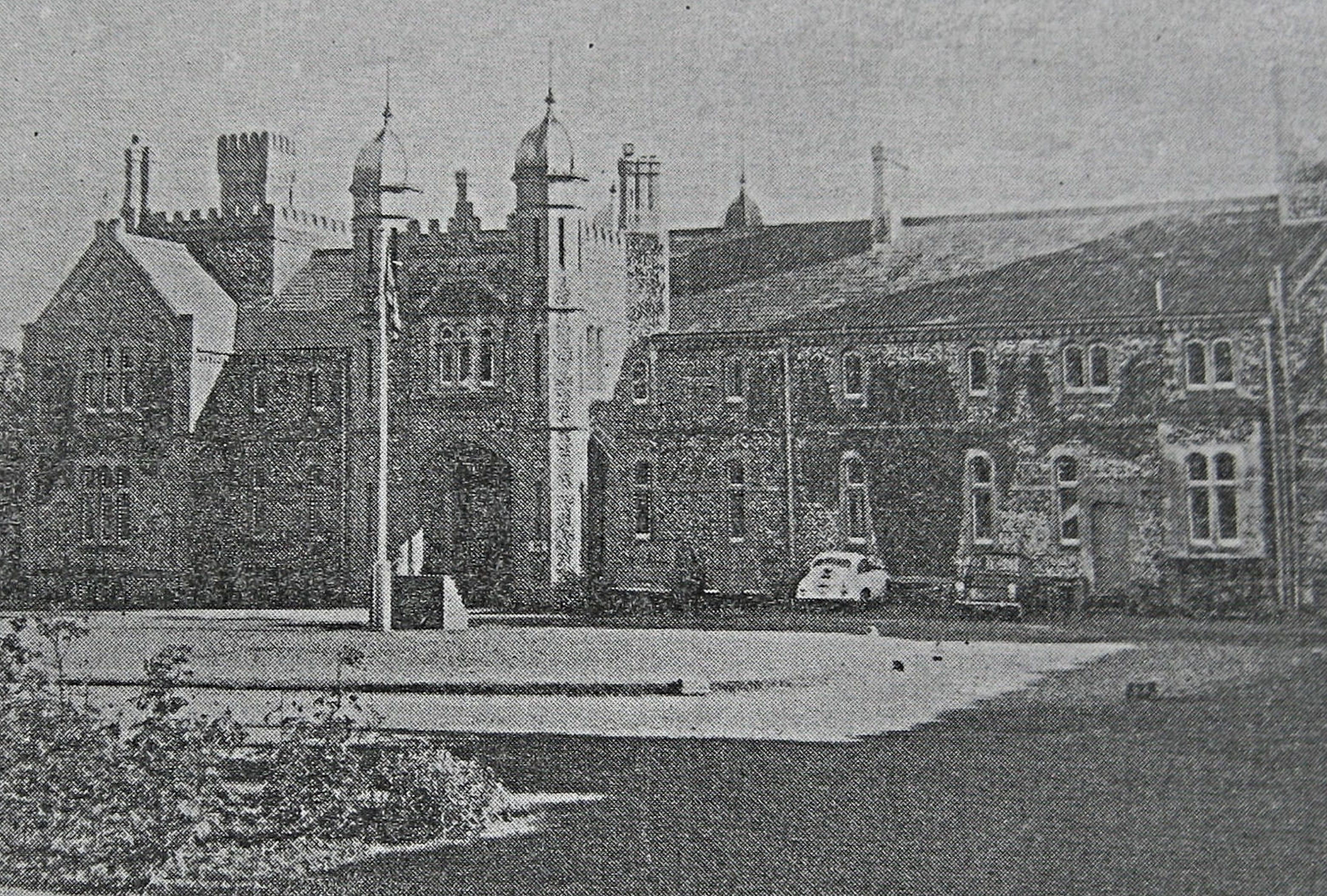
Old Park Mansion. Kentish Express 07.11.1963

Old Park Mansion. Kentish Express 07.11.1963

After 2 years at Old Park, the Junior Leaders Regiment threw open their doors to invited civic dignitaries, employment exchange representatives and the press to show what the training scheme had to offer. This event took place in January 1961, at which time there were 500 boys at, what was termed, the Army boarding school. They told their invited guests that their stay at Old Park was for two and a half years during which they learnt a trade. All of the recruits had signed on for at least six years and the guests were surprised to learn that the high standards required were such that a large proportion of applicants was rejected. The visitors came away impressed.

From their first arrival at Dover, the Regiment had made every endeavour to assimilate into the town. In 1959, for the first time, the council’s Entertainments Committee arranged a Whit-Monday (last Monday in May) attraction. The occasion included the ‘Beating Retreat’ by the Junior Leaders Regiment from Old Park. So impressive were they that over the next few years, they were seen at numerous military tattoos and almost every public occasion held at Crabble Athletic Ground.

In 1957 the Junior Leaders Regimental Band had formed and for many years after, performed at Chelsea Football Club matches. In 1969 they combined with the Corps of Engineers Band for the final of the Football League Cup at Wembley. On these occasions they wore the scarlet full dress uniform that included busbies identical to those worn by the Corps of Engineers on ceremonial occasions before 1914.

Junior Leaders objectives circa 1960s - Thanks to Roger Gray

Junior Leaders objectives circa 1960s – Thanks to Roger Gray

To meet the requirements of the Junior Leaders Royal Regiment R.E. which was to amalgamate with the R.E.M.E Junior Leaders Regiment, in 1961, the government spent £250,000 enlarging and converting Old Park. In March that year, Junior Corporal Malcolm J Thomas won an Amateur Boxing Association championship and was subsequently selected for England to fight an East Germany team. Then in August, 50 Junior Leaders passed off to the men’s service. General Sir Frank Ernest Wallace Simpson (1899–1986), the new Chief Engineer took the salute and inspection.

The following year, 1962, having gained permission from Lieutenant Colonel Murray Lawes, 120 married families’ houses were built at the Barracks adding to the housing stock. At about the same time, the bell from the then recently demolished Garrison Church on Western Heights was moved to Old Park and put into store until an envisaged new church was built. The ornate Gothic cross was also taken from the old Garrison Church and given a new home in the then Chapel at Old Park.
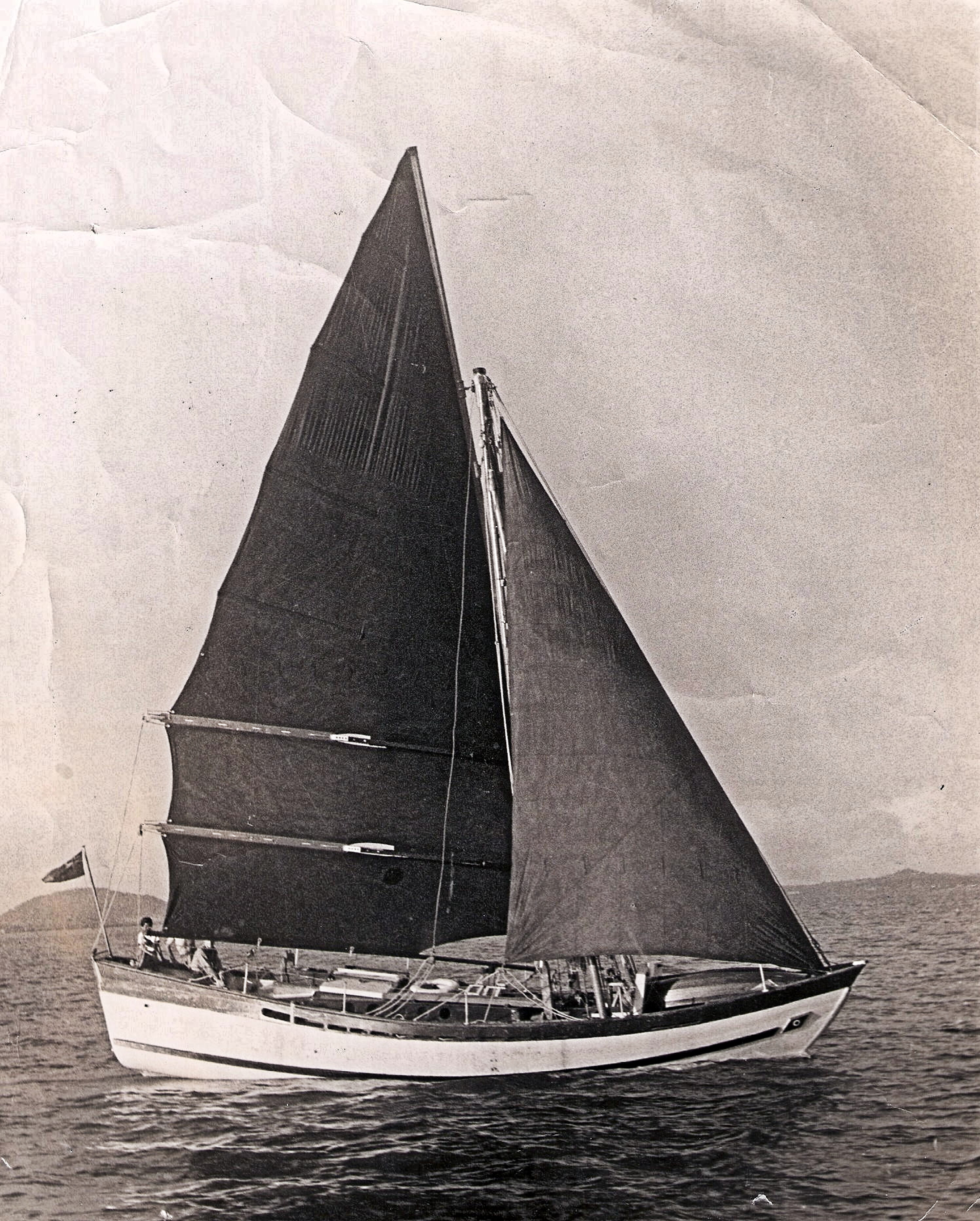
Boleh, built in Singapore and sailed to Salcombe in the UK 1950 under Commander Robin Kilroy. Thanks to Roger Gray

Boleh, built in Singapore and sailed to Salcombe in the UK 1950 under Commander Robin Kilroy. Thanks to Roger Gray

The Boleh – meaning ‘Can Do’ in Malay – a Chinese junk built in Singapore and sailed to the Salcombe UK in 1950 under Commander Robin Kilroy, was loaned to the Junior Leaders Regiment in 1963 for three years, by his nephew Lieut. George Middleton. Used for adventure training the Boleh carried over 300 young Sappers (the nickname for members of the Royal Engineers) a total of 6,500 miles. The regular trips were to Calais and Boulogne, but she was also taken to Guernsey and Middleburg in Holland.
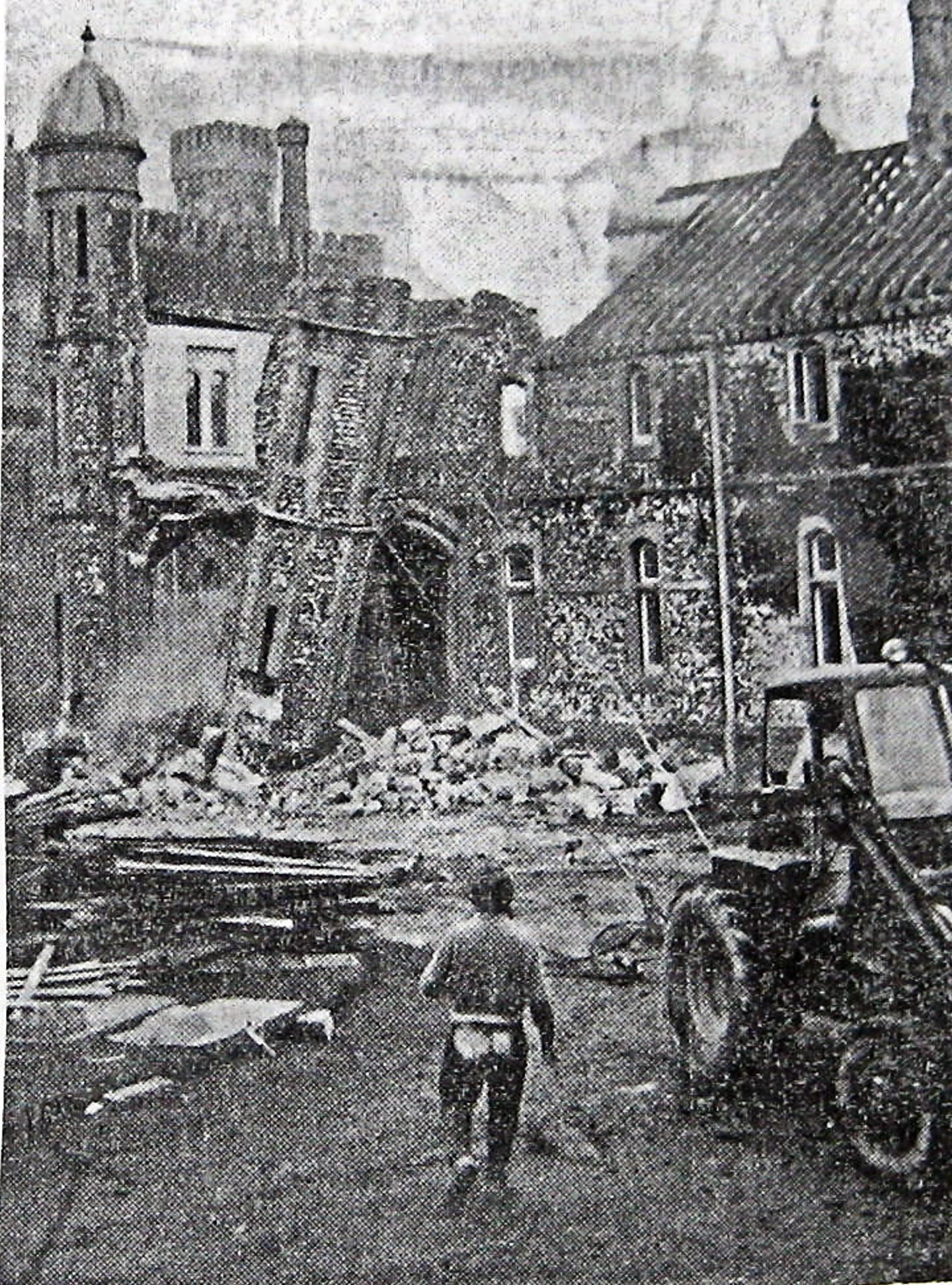


Old Park Mansion demolished to make way for new church. Kentish Express 31.01.1964

Old Park Mansion demolished to make way for new church. Kentish Express 31.01.1964

As part of an extensive modernisation scheme of the camp, the ancient Old Park mansion house, restored and partially rebuilt in 1876, was demolished to make way for the new Garrison Church. The foundation stone for the Church was laid in December 1966. That year the Junior Leaders raised £500 for soldiers blinded on duty in Northern Ireland and they also raised money for charity by undertaking a marathon ride from John o’Groats to Old Park. Other good deeds included the building of a sun shelter for the then Cornfields retirement home, at Whitfield. For all of these and other projects the Junior Leaders were presented with a mascot, Rover a pup of Petra, BBC Children’s Television programme dog.

The internationally famous pop group, the Beatles, were awarded the M.B.E. in the Queen’s the Birthday Honours list of June 1965. Retired Royal Artillery Officer, Colonel Frederick Wagg M.B.E, returned his award to the Queen as a protest and although the Colonel actually lived in Old Park Avenue, when the national press got hold of the story they wrongly assumed that the Colonel lived at Old Park Barracks. The barracks were quickly under siege by the national media. Much to the amusement of the young sappers, four look/sound-a-likes donned themselves in ‘Beatles’ style wigs and played the fab four well! Apparently, it was not until one of the officers called the young sappers bluff did the media realised that they had been fooled! Nonetheless, the Colonel’s protest was taken very seriously but a straw poll showed that two-to-one people in the country were in favour of the Beatles receiving the award.
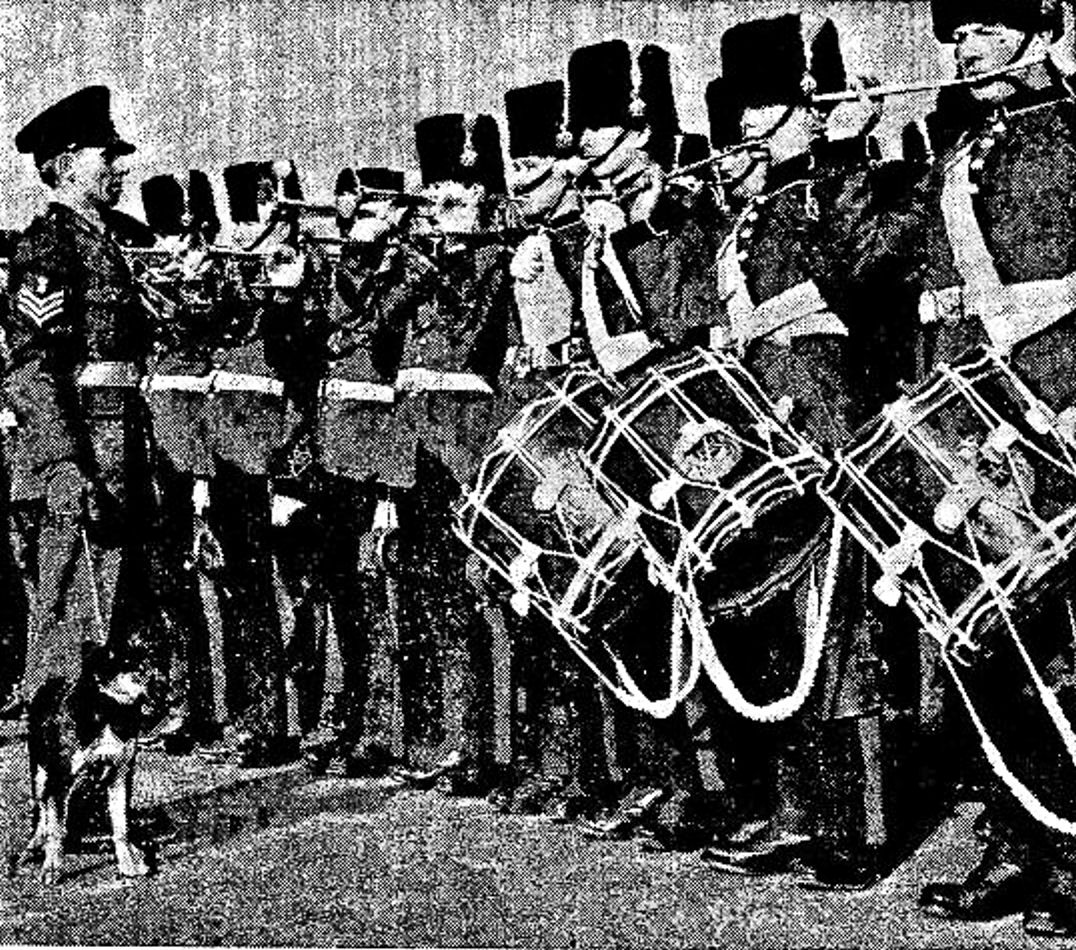
Presentation of Rover pup of Blue Peter's Petra. Note the Junior Leaders Regimental Band wearing the full dress uniform incluing busbies identical to those worn by the Corps of Engineers on ceremonial occasions before 1914. Kent Messenger December 1965

Presentation of Rover, the pup of Blue Peter’s Petra. Note the Junior Leaders Regimental Band wearing the full dress uniform incluing busbies identical to those worn by the Corps of Engineers on ceremonial occasions before 1914. Kent Messenger December 1965

The 1969 Pass on Parade was a great occasion for Dover as it was taken by the Lord Warden of the Cinque Ports (1966-1978), Sir Robert Gordon Menzies (1894- 1978) on one of his visits to England from Australia. At the time the Regiment’s compliment was 700 and for a Junior Leader to Pass On, he had to pass the Army Certificate of Education – Intermediate test. The Education Department was run by a Major in the Royal Army Education Corps and there was a staff of 20 professional teachers, both military and civilian. The Army Certificate of Education – Intermediate test qualified the Junior Leader educationally, for promotion to Sergeant.
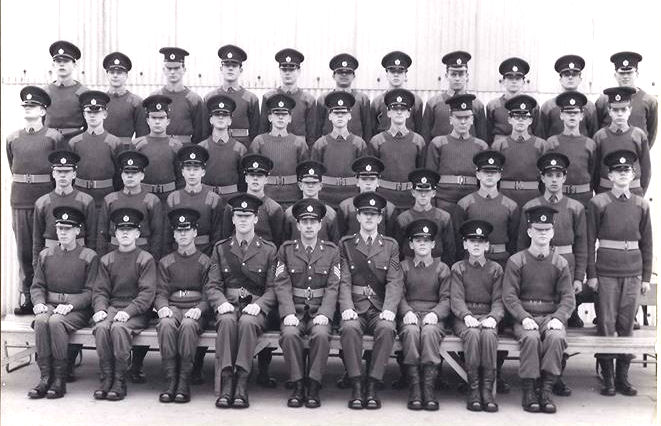
Junior Leaders C Squadron intake Spring 1971. Alan Pearce

Junior Leaders C Squadron intake Spring 1971. Alan Pearce

Once achieved, the Junior Leader had the chance of passing the Senior Test, which qualified him for promotion to Warrant Officer and to take ordinary level certificate of education (‘O’ levels). At the time only children who attended public, grammar and certain technical schools were given the possibility to take ‘O’ levels. As Junior Leaders offered an excellent chance to climb the academic ladder, the training enabled many of them to become commissioned officers. The academic subjects taught were English language and literature, mathematics, map reading, current affairs, engineering and building drawing, applied physics, military administration, art and woodwork. The flexibility in the curriculum meant that it could be tailored to meet the individual’s needs and non-academic activities.
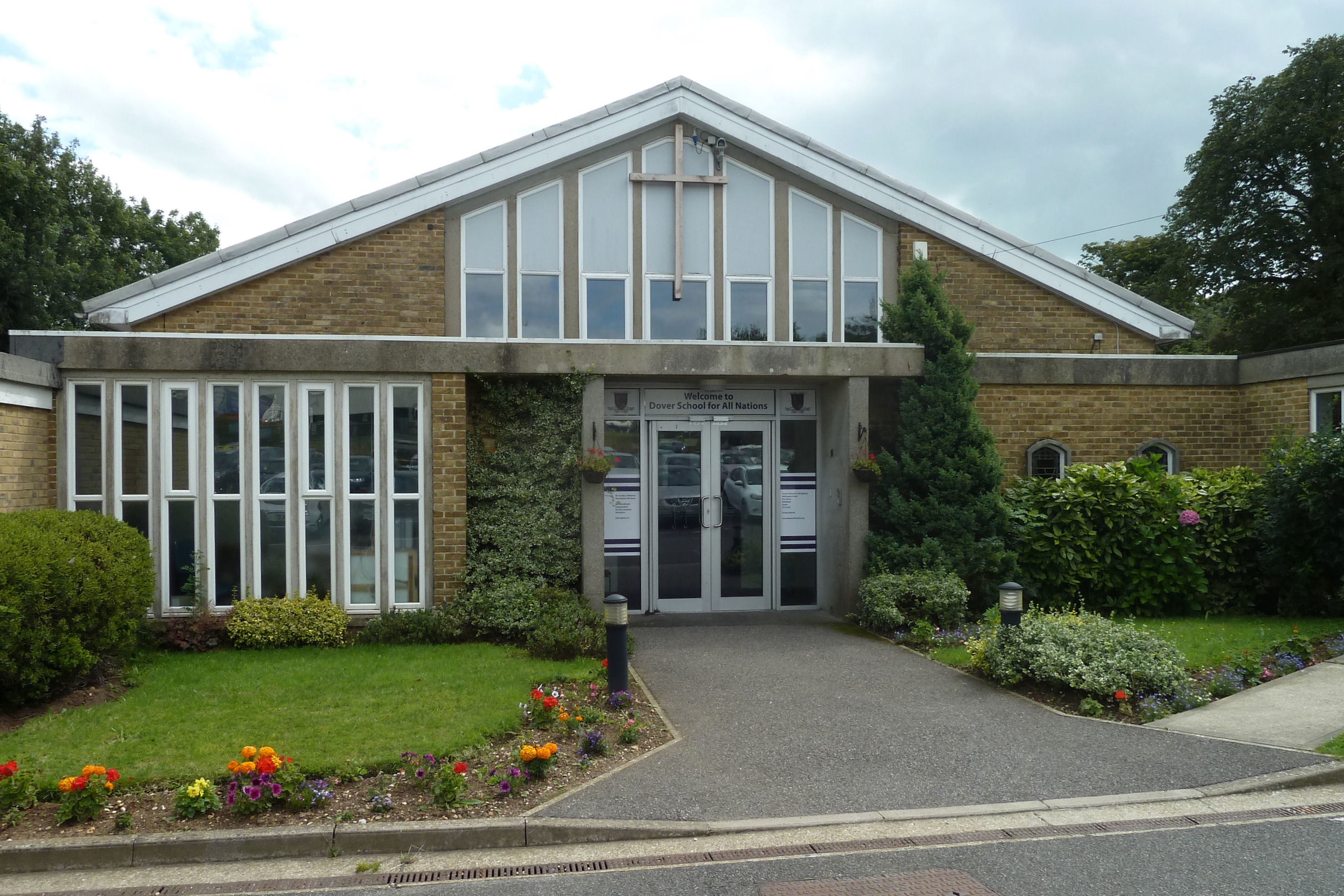
Former Garrison Church at Old Park Barracks now the School for All Nations. AS 2014

Former Garrison Church at Old Park Barracks now the School for All Nations. AS 2014

The halcyon days of the 1960s were coming to an end, and in 1972 the country was heading towards an economic recession. Cut backs were imposed and, among other government activities, there was talk of severely reducing or even axing the Junior Leaders. At the time it was a Conservative Government and Dover’s Member of Parliament was Conservative, Peter Rees. In the House of Commons, against what was expected of him, he put a strong case for both keeping the Regiment and expanding the academic curriculum to include an ‘O’ level year that non military school children attending local secondary modern schools could also join! Although this never reached fruition, by the end of the year reassurance came that the Regiment would remain intact and at Old Park Barracks.

World War II hero Major-General Sir Gerald Duke (1910-1992), who had attended Dover College as a boy, opened a museum of military engineering at Old Park in August 1979.  Three months later, in November,  General (later Field Marshall) Sir Ronald Gibbs (1921-2004) toured Old Park Barracks and presented long service and good conduct medals. He then went to dine with the Dover Garrison Commander, Colonel Maurice Atherton, later Brigadier and now President of the Dover Society who, at the time, resided at the Castle. At the Castle towards the end of that month, the Junior Leaders erected a Trebuchet medieval sling shot machine.

The Junior Leaders Band together with the 3rd Queens Band played on the Seafront, in 1980, during the Queen Elizabeth the Queen Mothers birthday celebrations. The Queen Mother was the Lord Warden of the Cinque Ports (1979-2002) and as such made a point of being in Dover for the celebration. In September the following year, Captain James Winter of Dover and member of the Zaire River Expedition, took a party of 32 Junior Leaders to Tunisia for three weeks. There the young men helped archaeologists in a dig at the ancient Punis port at Carthage, replaced broken headstones in British war cemeteries, were taught desert navigation, how to deal with scorpions and snakes as well as visiting desert forts.

However, in Dover, things were not going well for Junior Leaders as gangs of local youths took up the sport of squaddy bashing. On one occasion a gang of 25 youths armed with studded belts, bottles, sticks, motor bike helmets and cricket stumps attacked four Junior Leaders. Eleven of the group were arrested and sentenced by Dover magistrates’ court. That summer the Regiment held an open day in an attempt to improve relations with the town.
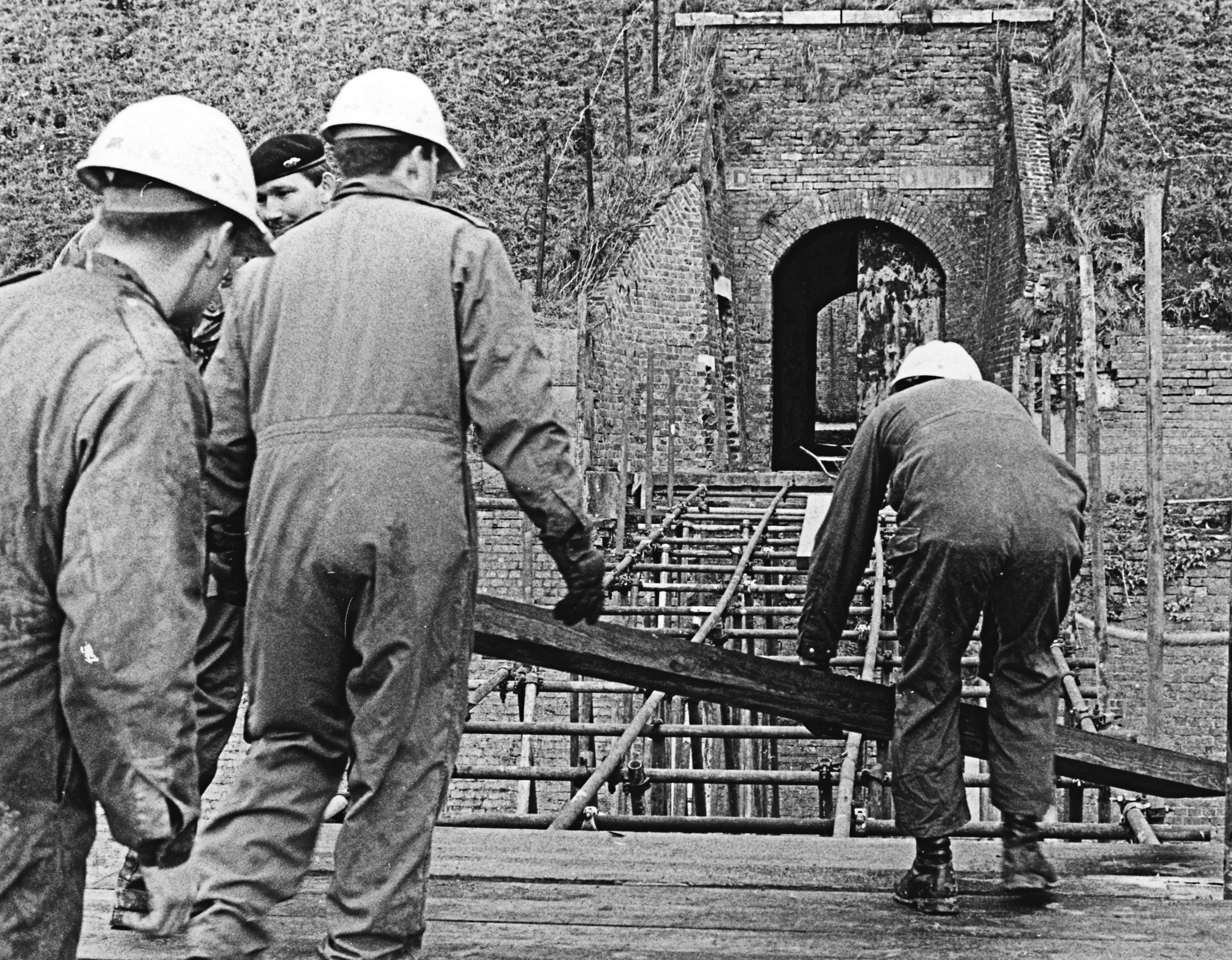
Junior Leaders repairing the Drop Redoubt, Western Heights 1987. Dover Museum

Junior Leaders repairing the Drop Redoubt, Western Heights 1987. Dover Museum

February 1984 saw Les Welham, the Junior Leaders fencing coach become the Champion at Arms after winning the three-weapons competition by coming first in the sabre, second in epee and third in foil. He had previously won the title in 1981. The Junior Leaders, as well participating in local sports fixtures continued to play a constructive role in Dover. Under the auspices of English Heritage, they helped to clear the Drop Redoubt on Western Heights of dumped vehicles, machines and general rubbish and in 1987, they were involved in repairing the Drop Redoubt. The following year they were at the Castle moving the ancient Queen Elizabeth pocket pistol indoors.

In August 1984, the Ministry of Defence announced that after examining ways of streamlining the Army’s training and organisation the Junior Leaders’ Regiment, Royal Engineers would be leaving Old Park in 1988/89. The regiment was to amalgamate with the Apprentices College at Chepstow. At the time there were 600 Junior Leaders at Old Park, plus 40 officers, 100 permanent military staff and 100 civilians. The following year Lord David Trefgarne, the Parliamentary under Secretary of State for Defence announced that following a review it was decided that the move would not take place until 1990. Further, that Old Park would be redeployed for other military uses.

Tragedy struck on 1 August 1989 when three Junior Leaders were killed when their Lynx helicopter crashed at the Stanford Army training ground, near Thetford, Norfolk. They were Stuart Driscoll age 16 from Carnoustie, Tayside, Peter Lowe age 17 from Croydon and Christopher Lapping age 17 from Stourbridge, West Midlands. The pilot, Sergeant Peter Bennett of the Army Air Corps, was also killed. Five others survived. The accident was due to a mechanical fault.

The 1990 Options for Change Defence Review confirmed the removal of the Junior Leaders from Old Park and also the closure of the Barracks. The last Pass Off Parade was held on 26 October 1991 with the remaining 82 Junior Leaders were transferred to the Army Apprentice College in Chepstow to finish their training. The last Junior Leader to leave Old Park was Rob Doutch. During their stay in Dover, the Junior Leaders had made great contributions to the social, welfare and economic aspects of the town. Further, at Old Park, 240 locals were employed to provide support for the 600-700 Junior Leaders that would be stationed there at any one time.

The Junior Leaders were sadly missed.
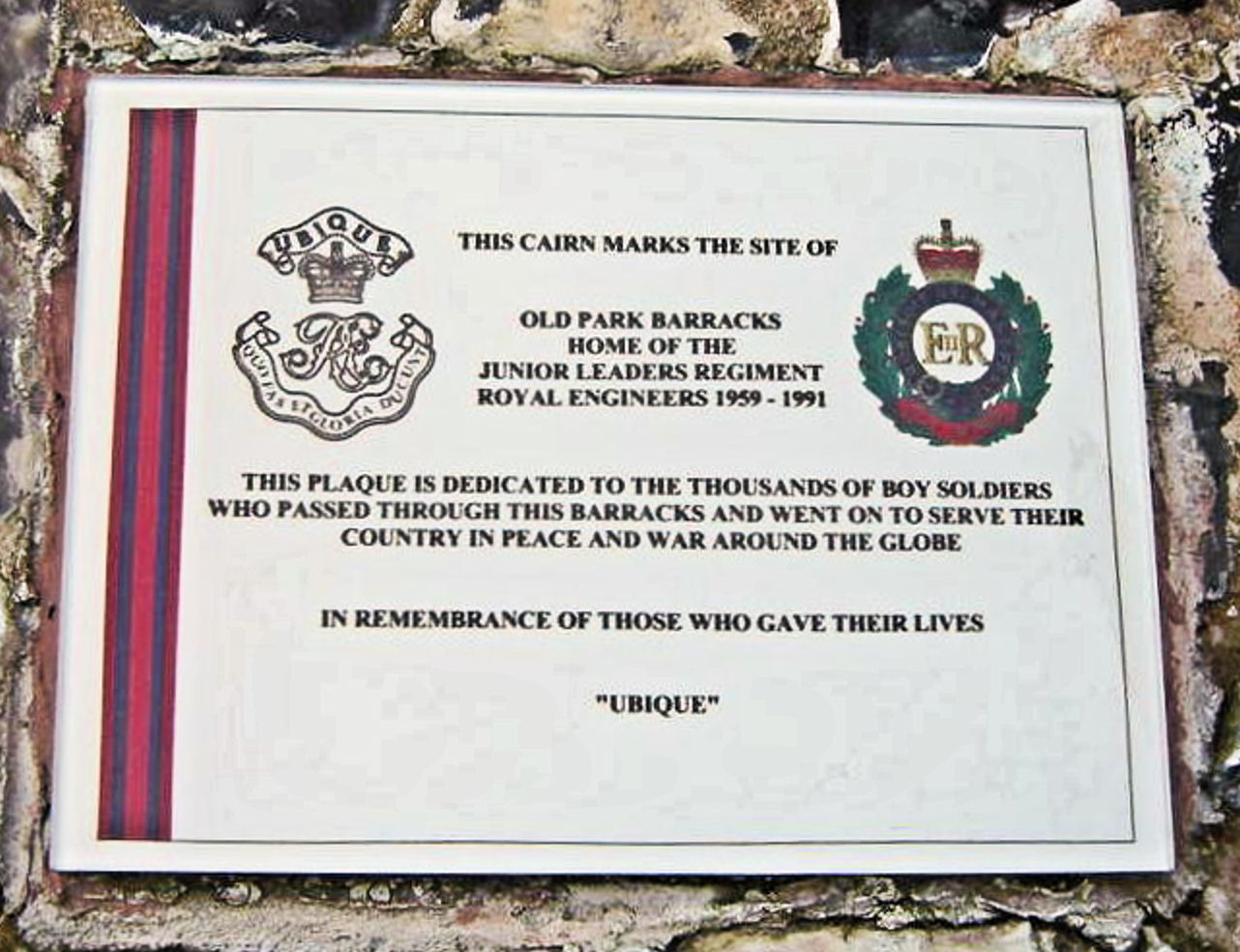
Junior Leaders memorial plaque on the Cairn made by them and dedicated to all those who passed through Old Park Barracks. Thanks to Roger Gray

Junior Leaders memorial plaque on the Cairn made by them and dedicated to all those who passed through Old Park Barracks. Thanks to Roger Gray

In 1992 the Junior Leaders Regiment Branch of the Royal Engineers Association erected a Cairn, built by ex-Junior Leaders, near what had been the Chapel. Dedicated to the thousands of boy soldiers who passed through the barracks and went on to serve their country in peace and war around the globe. Chief Royal Engineer, Lieutenant General Sir Scott Grant, unveiled the Cairn. In 2001, Major (Retird.) Dick Barton the Chairman of the Junior Leaders Regiment Association, with an original Junior Leader who came to Dover and Rob Doutch, the last Junior Leader to leave Old Park marked the 10th anniversary of the closure.  Sadly, at the time of writing, the plaque and crest are missing from the Cairn.

Houses and Business Park

The Ministry of Defence put the 225 acre Old Park Barracks up for sale in 1991, with the caveat that the 91-acres of woodland was to be preserved as such. The houses on the site were still occupied by the Argyll and Sutherland Highland Regiment and were being considered for retention. Consultants, DTZ Debenham Thorpe drew up a planning brief for Dover District Council (DDC). At the time the estate included two adjacent and  extensive playing fields with pavilions; an athletics track, two large parade grounds, a gymnasium, swimming pool, workshops, classrooms, indoor ranges, stables, garages, the chapel, offices and mess halls. The Dover Society put forward a strong case for the site to be converted into a Sports College.

The houses in 1992 were assigned to the ill-fated Independent Crown Housing Trust and subsequently became part of the package of Ministry of Defence housing stock that was sold en-masse to Annington Homes. They were still empty in 1996 when the decision was taken that the families of Ghurkhas, stationed in Hong Kong were to be returned to Nepal prior to the Transfer of Sovereignty on 1 July 1997. In the UK there was public outrage and in a letter to the Times newspaper, Chris Barnett, the Director of Health and Housing at Dover District Council, put the case for 120 Ghurkhas and their families to be housed in the still empty homes at Old Park. Annington Homes did not take up the idea and the houses remained empty.

DTZ Debenham Thorpe presented their Draft Planning Brief to DDC in 1995 by which time they had leased out buildings to a variety of small businesses. Their report ignored the Dover Society suggestion for a Sports College. Then, the Ministry of Defence, having found a potential buyer, said that the whole site was to close and all the incumbents were sent eviction notices. These were rescinded four days before the deadline and it then became known that Dover Harbour Board (DHB) was the potential buyer.
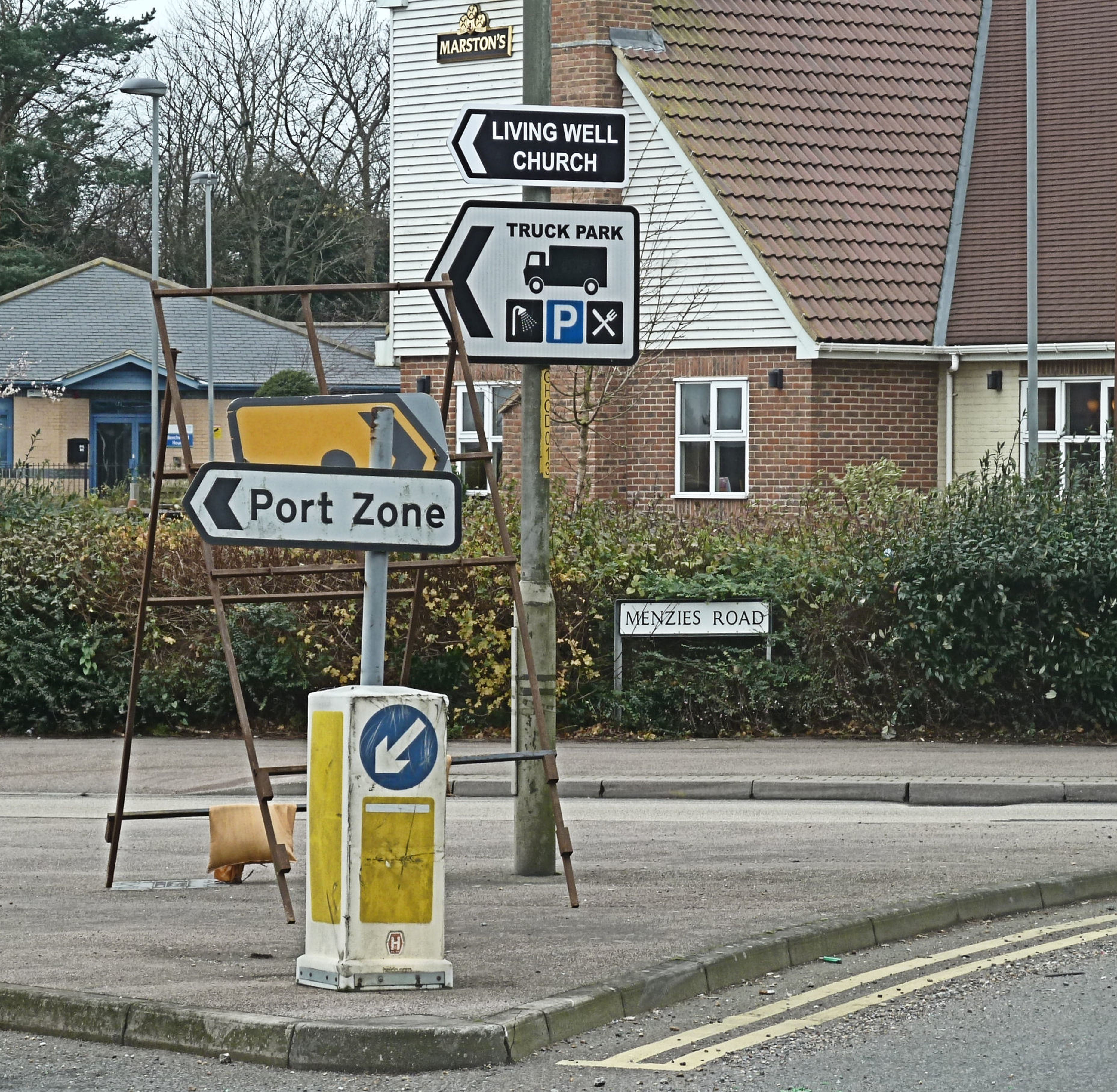
Entrance into the Old Park estate stating that it still is a Port Zone and Lorry Park. Alan Sencicle 2015

Entrance into the Old Park estate stating that it still is a Port Zone and Lorry Park. Alan Sencicle 2015

After long negotiations, during which time more businesses opened at Old Park, in March 1998, the site was formally bought by DHB. They announced, to a great fan-fare, that it was to become a Freight Village. Lorries, the people of Dover were assured, going to and from the Continent would be held at Old Park to ease the problem of congestion. The site would also be an operational base for all freight related activities to free up space at Eastern docks. To improve the road infrastructure from the A2 to the entrance of the proposed Freight Village, with DDC approval, DHB were given a £500,000 government grant. The road realignments were carried out and Dover’s Member of Parliament, Gwyn Prosser undertook the formal opening in June 2000. By this time the Freight Village had become a Port Zone – and according to the advertisement blurb of the time, would be used strictly for port-based industries as well as a lorry park. It was expected that 1,000 new jobs would created.

In 2003 DHB sold most of their holdings at Old Park, selling the remainder the following year. This was the former military houses together with a three-storey barrack block to the High Wield Housing Association. The Association refurbished their acquisition into 500 flats and Nick Raynsford opened the scheme. As a publicity stunt, the Minister of State for Housing and Planning abseiled down the former three-storey barrack block!
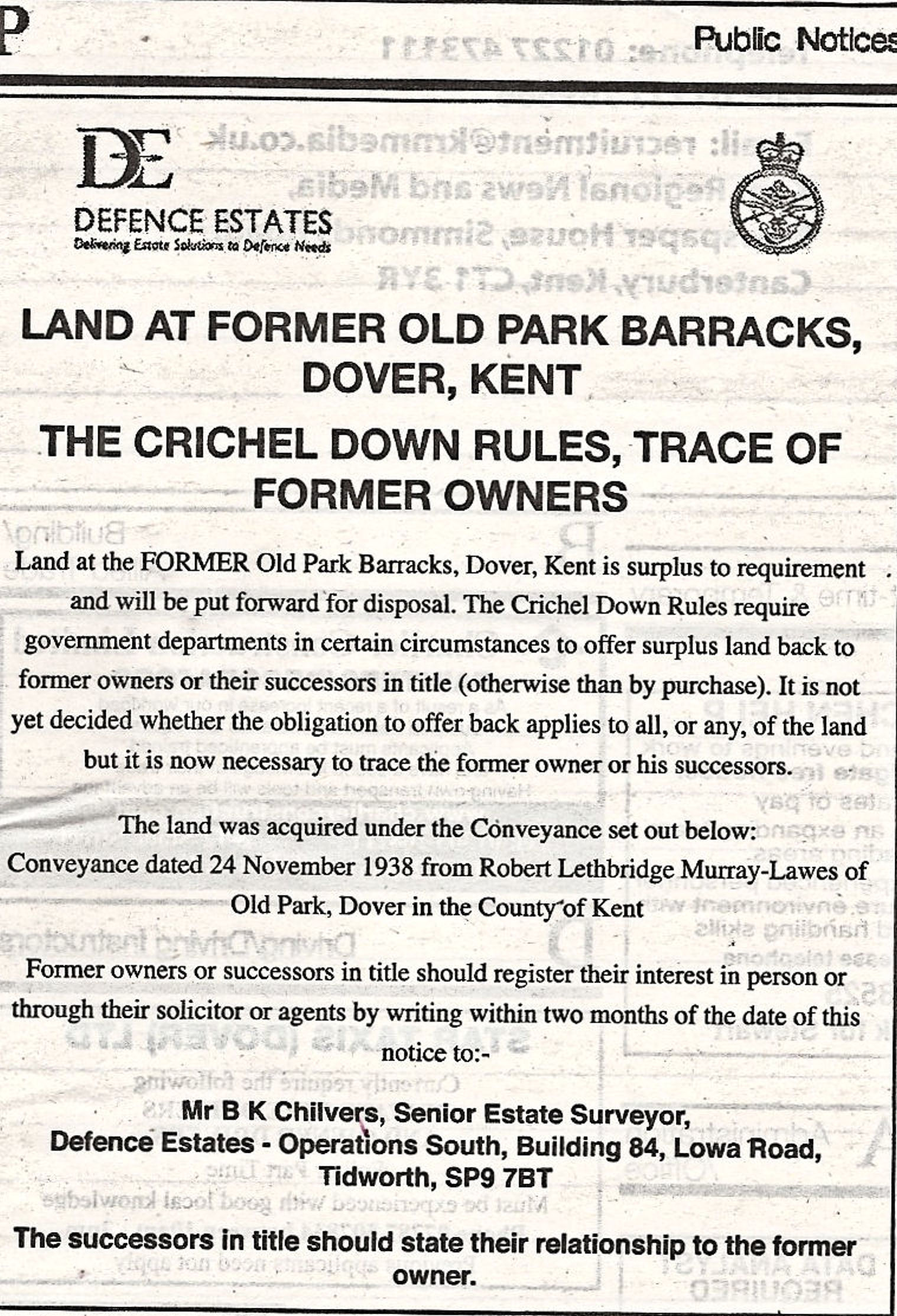
Old Park Barracks- Ministry of Defence estates notice July 2009

Old Park Barracks- Ministry of Defence estates notice July 2009

By 2005, DHB had sold off about two-thirds of the Old Park site that they had proclaimed would be a Port Zone and a variety of businesses, many non port related, had offices there. The former Junior Leaders sports fields, running track and officers’ mess had been sold for housing development. More of DHBs acquisition has been sold since. Albeit, in 2009 a Public Notice was published by the Ministry of Defence, which served as a reminder that Old Park had been a Gift to the Nation and with Covenants by Lieutenant Colonel Robert Letherbridge Murray Lawes. The covenants almost certainly comply with the objectives that Lieutenant Colonel Murray Lawes spent his life fighting for (see Old Park part I), namely playing fields and restricted development.

The 91-acres of woodland that was to be preserved was finally put in the care of the Kent Wildlife Trust in 2011 by DHB.
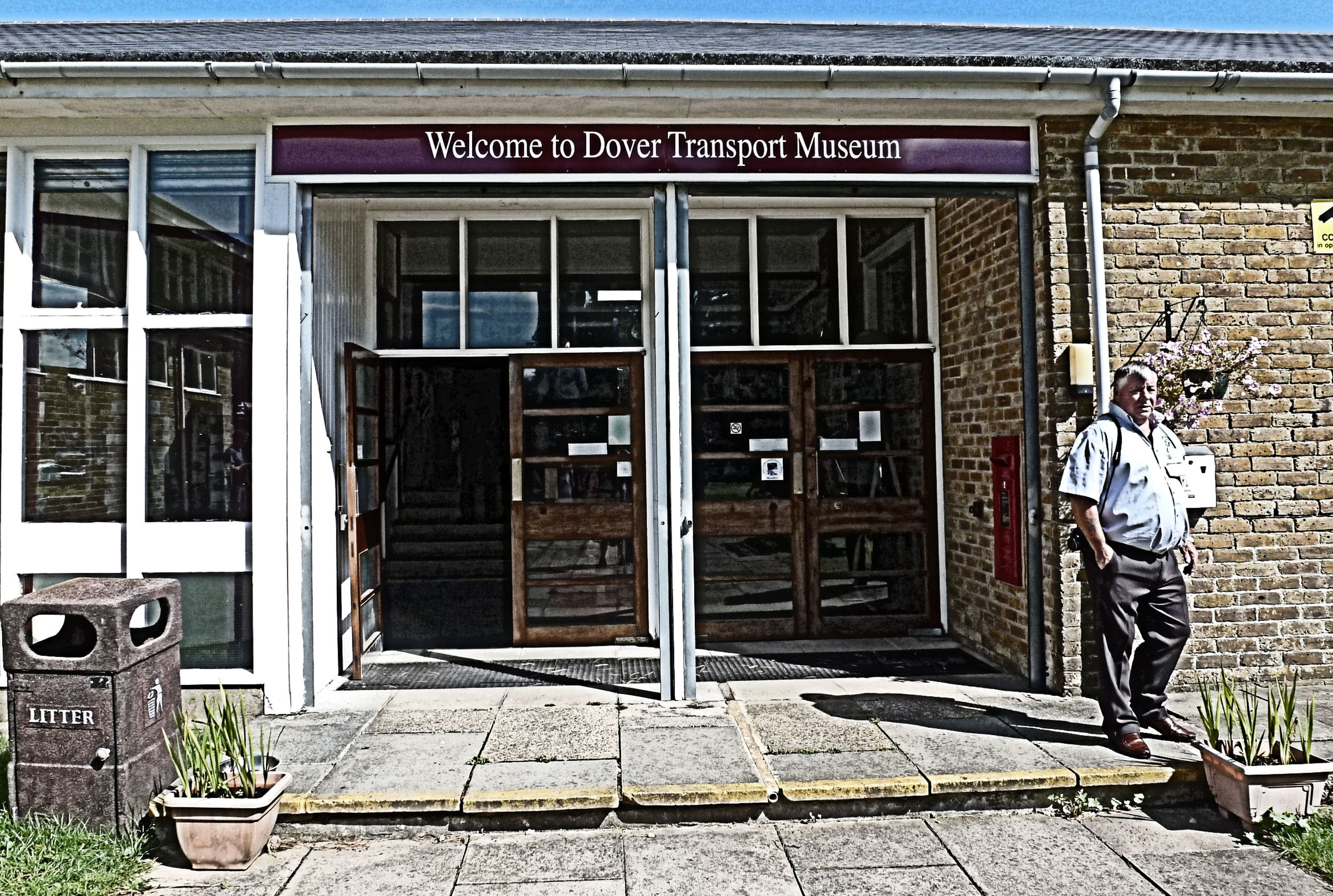
Dover Transport Museum, Willindon Road, Old Park estate. AS 2014

Dover Transport Museum, Willindon Road, Old Park estate. AS 2014

The Dover Transport Museum has been given a home on the old Park estate and can be found in Willingdon Road on the Old Park estate and is well worth a visit. The Museum was founded in 1983 and occupying the old Water Works on Connaught Road, were facing eviction. The DHB Register later retitled Chief Executive (1983-2002), Jonathan Sloggett offered them a temporary new home in DHB’s former workshops on Cambridge Road. In the early 1990s the Transport Museum was on the move again as the Cambridge Road building was refurbished as the De Bradelei Wharf shopping complex that opened in 1993. Initially, DHB loaned them one of the former motor transport halls at Old Park until they moved to their present home (see below for details).
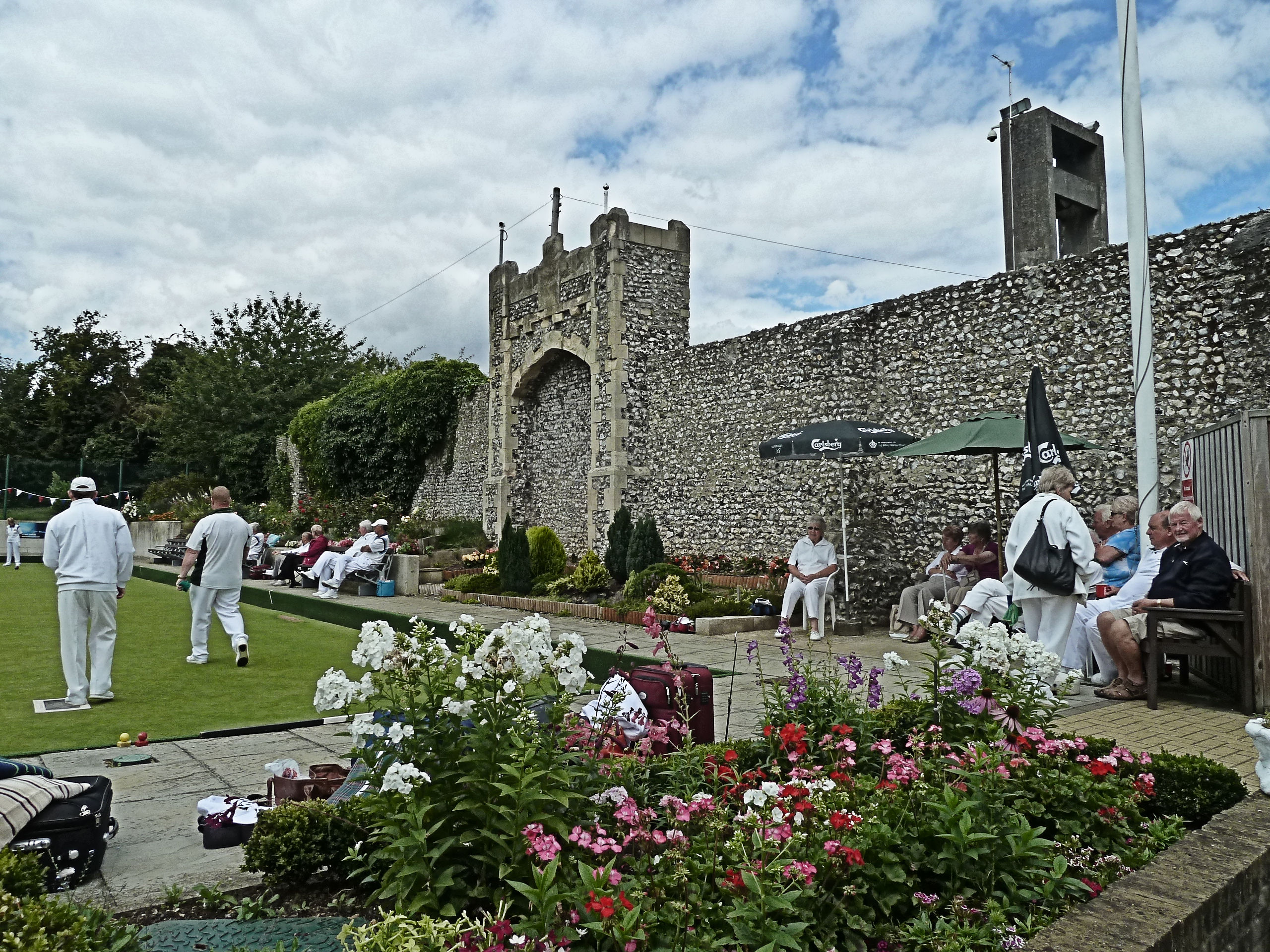
Old Park Mansion ruins and Gateway Bowling Club. AS 2014

Old Park Mansion ruins and Gateway Bowling Club. AS 2014

It was the members of the DHB Sports and Social club that suggested that the Buckland Mill Bowling Club be given a home within the precincts of the ruins of Old Park mansion. The Sports and Social club had moved into the former chapel in 1998, when their clubhouse adjacent Wellington Dock was scheduled for demolition. The Bowling Club had started in the mid-1920s but had been without a home since the closure of Buckland Mill in 2000. The Chief Executive of DHB, Bob Goldfield (2002-2013) opened the renamed Gateway Bowling Club green and pavilion on 3 August 2007. However, the DHB Sports and Social club was later closed and in 2013 the School for All Nations moved into the former chapel. This closed in Spring 2015.

Maritime Skills Academy advert, Old Park. Dover Express 10 December 2015

Maritime Skills Academy advert, Old Park. Dover Express 10 December 2015

Although a maritime college or university in Dover has been muted for a long time, in 2009 it was announced that the Dover Maritime Skills Studio was to open in September 2010. At the time the location had not been finalised but following the launch of the merger between West Kent College at Tonbridge and the then South Kent College that resulted in the ill-fated K-College in April 2010, the Dover branch was redecorated with a nautical feel. However, a couple of articles in local papers suggested that DHB were having talks with a view to open a Maritime University in September 2011 on the Old Park site. The following month articles in the local papers were saying that Dieter Jaenicke of Viking Recruitment was the innovator behind what eventually became the Maritime Skills Academy next to the Viking site at Beechwood on the Old Park estate. By 2012 courses were on offer and in November 2016 Princess Anne formerly opened the Skills Academy. The Academy provides training courses to help those working in the maritime industry deal with ominous situations on seagoing vessels.

The Legacy

Lieutenant Colonel Murray Lawes legacy to the nation was the upper part of his Old Park estate. What the demands of the covenants were, is neither in the public domain nor how long they lasted. The projects he particularly cared and fought for were playing fields and limiting development. It is known that the Junior Leaders utilising the Old Park estate fulfilled his wishes. Murray Lawes died in 1969, so what he might have thought of the subsequent use of his land after the Junior Leaders were moved out, one can only speculate.

What is known is that Murray Lawes would not have been happy that the post-War Buckland estate development that is on the lower part of what had been his land – there are no purpose laid municipal playing fields. The estate mainly consists of social housing and therefore has more than the average number of children, yet the only municipal playing field in the locality is the one he gifted to the town in the 1930s!

It is sad that the combination of a vindictive council and, what many call, an asset stripper have almost obliterated Murray Lawes memory in Dover. Albeit, there is one major legacy he left, that only time could destroy – and that is the memorable time had by the hundred-thousand Junior Leaders at Old Park Barracks!

Lieutenant Colonel John Letherbridge Murray Lawes – they and Dover are indebted to you!

  • Presented: 14 November 2014

Junior Leaders Association:

Website: www.juniorleadersraoc.co.uk

e-mail: admin@rejuniorleaders.co.uk

Kent County Playing Fields Association:

Website: http://www.kentpfa.org.uk

e-mail: kcpfa@hotmail.co.uk

Dover Transport Museum:

Website: www.dovertransportmuseum.org.uk

e-mail: info@dovertransportmuseum.org.uk
 

Posted in Armed Services, Buckland Estate, Buildings, Businesses, Old Park Part II From Barracks to Junior Leaders to Houses & Business Park, Old Park Part II From Barracks to Junior Leaders to Houses & Business Park, Old Park Part II From Barracks to Junior Leaders to Houses & Business Park, Old Park Part II From Barracks to Junior Leaders to Houses & Business Park, Old Park Part II From Barracks to Junior Leaders to Houses & Business Park, Whitfield | Comments Off on Old Park Part II: From Barracks to Junior Leaders to Houses & Business Park

Old Park history part I & the Foundation of the Playing Fields Association

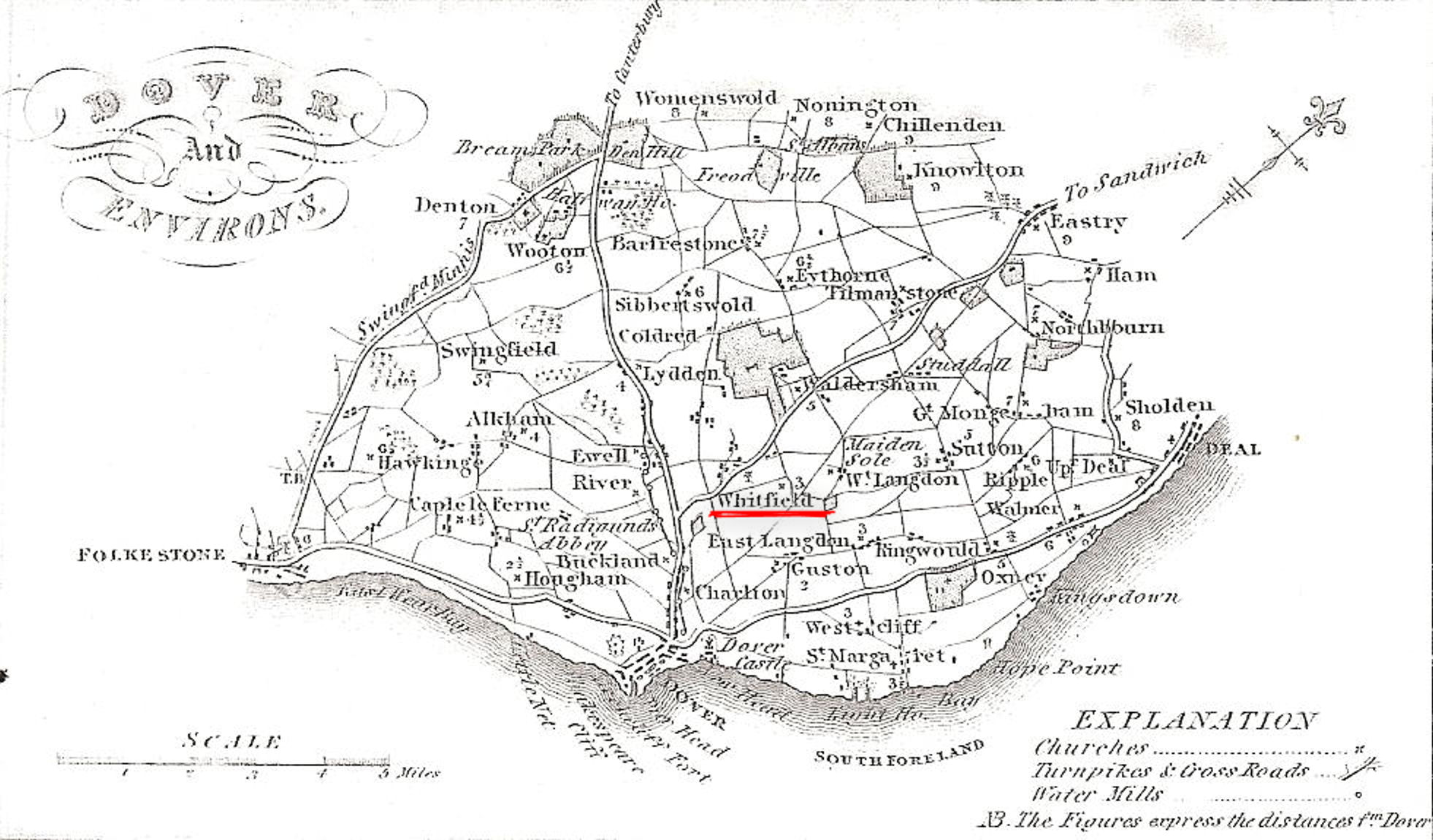
Whitfield underlined in red on the map of East Kent showing turnpikes and large Estates 1828

Whitfield underlined in red on the map of East Kent showing turnpikes and large Estates 1828

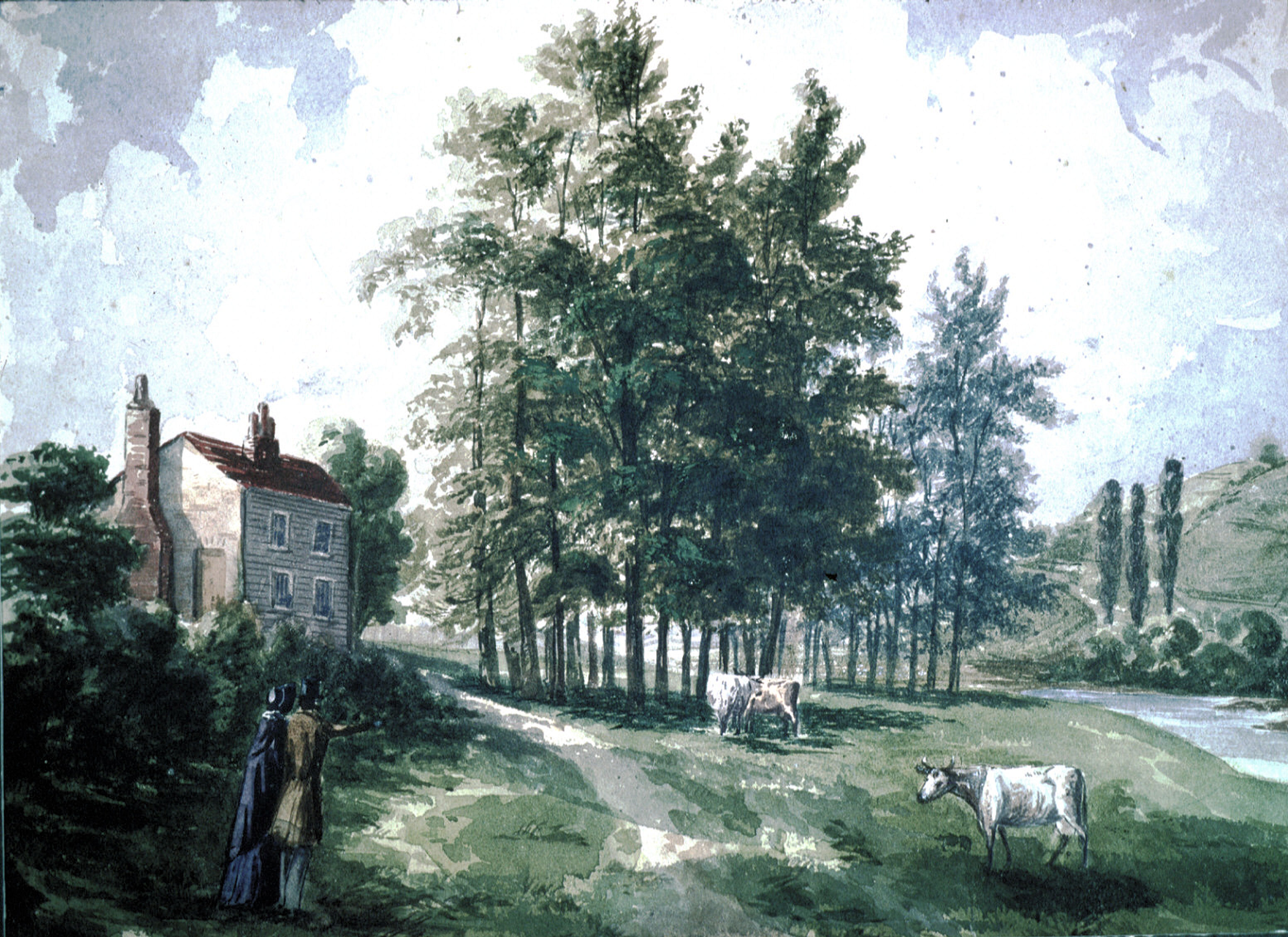
Lost in the mists of time there was the manor of Archer’s Court at Whitfield, northeast of Dover. Nearby was a house belonging to the Knights Templars with a large park. Following the demise of the Templars in the early 14th century, the estate was sold and became known as Little Archers Court and then Old Park. In the middle of the 18th century, Old Park was bought by Dr William Osborne of Hanover Square, London, who built a fine mansion on the site of the Templars’ house. This was the doctor’s summer residence and the views across the English Channel to the coast of France were acclaimed. About 1784, Dr Osborne purchased the Manor of Temple Ewell.

Dr Osborne’s only daughter and heir was Charlotte (1781-1860), whose husband was John Every (1781-1848), the second son of the 8th Baronet Every of Egginton, Derbyshire. They were married at St James Church in Dover on 3 May 1813 and moved into Old Park.  In September 1828 Ann Smyth Pigott and her son Edward, were guests of the couple and some of Anne’s letters to her husband survive. Ann’s husband was John Hugh Smyth Pigott of Brockley Hall, Somerset whom she had married in 1815 and had 10 children. She starts one of her letters by saying, ‘I really think you are very saucy to send me such a letter as I received from you a few days since – however I forgive you as it must be a great trial to have so young and beautiful a wife so long absent from you.’

Ann then tells her husband that the house and grounds of Old Park are ‘delightful,’ and that John Every was very fond of their son Edward. Charlotte though, she says, was in danger of becoming a recluse as John, due to pride and indolence, shuns society. However, Charlotte had attended the Dover Regatta with Ann and, she says, the town was ‘gay’. Anne tells her husband that her ‘unwelcome visitor’ (menstrual period) had come on early saying that ‘when I went to the Shower Bath (in Dover) last Friday I felt a little nervous, and perhaps that, and the force of the salt water may have hastened it!’

 Dover Mail Coach. Hollingsbee collection Dover Museum

Dover Mail Coach. Hollingsbee collection Dover Museum

In another letter, Ann talks of her husband coming to join her at Old Park, and suggests that he take the mail coach from the Spread Eagle in Gracechurch Street that arrived in Dover at 20.00hrs and at Buckland Turnpike 20 minutes before. John Every had said that he would arrange for Thomas, one of the servants to meet Ann’s husband, but she has her doubts and says that she will send horses.

Disaster struck Old Park in 1844 when fire broke out in one of the barns. The alarm was raised and the four Dover fire engines were dispatched, each pulled by a horse and manned by town porters. The porters and the farm workers brought the blaze under control but the barn, coach house, two stables and the granary were destroyed. It was believed that a worker smoking near the barn, which was full of straw, started the fire.

John Every died in 1848 and on 12 February was buried in St Peter and St Paul Churchyard Temple Ewell. Charlotte remained at Old Park but let part of the mansion to a Mr Wilkinson. In September 1852, he put on a coming of age party for his eldest son that lasted a week. The entertainment included the sets and cast from Dover’s Royal Theatre, Snargate Street and was attended by ‘the most fashionable visitors of Dover.’ John Every would not have approved!

Bushy Ruff by S J Mackie c 1842. Dover Museum

Bushy Ruff by S J Mackie c 1842. Dover Museum

That year Charlotte bought Coxhill Farm, in the Alkham valley, through which was the track from Dover to the village and Bushy Ruff. She immediately demanded that the track be closed and took legal action through the Wingham Court. This failed but Charlotte would not give up. On Saturday 9 February 1856, she instructed her agent, Thomas Smith, to block the road. The result was the ‘Battle of the Alkham Valley Track’ recounted in the story of Bushy Ruff and the track becoming the road that we know today. Not long after, Charlotte moved to Thanet where she died in January 1860 but her body was brought back to Temple Ewell for burial alongside her husband.

Old Park Mansion c1960s - Thanks to Roger Gray

Old Park Mansion c1960s – Thanks to Roger Gray

According to the 1871 census, Old Park house was unoccupied at that time. However, Major Robert Bartholomew Lawes (c1823-1907) bought the estate. In 1876, he had the house restored, partially rebuilt and extended by local builder, William Adcock. Major Lawes, as he was always referred to, was a Major in the Duke of Cambridge Volunteer Regiment and was a great supporter of the London Hospital becoming a Governor in 1863. On 25 April 1854, he married Emma Salina Murray and they had three children, two daughters and a son. Major Lawes was appointed a county magistrate and a Deputy Lieutenant of Kent.

Across the valley, in the seventeenth century, merchant, Peter Nepveu – a former Huguenot refugee who had a warehouse in Woolcomber Street – acquired Elms Manor and Siberston Manor. Nepveu built Chilverton Elms, and gave the valley the name of Elms Vale. In 1749, the estate covering some 375 acres, extending from Elms Vale to Aycliffe and Capel was bought by Phineas Stringer senior. He died in 1757 leaving it to his eldest son Phineas of Castle Hill House. Stringer bequeathed the Elms Vale estate to his only daughter who married Edward Broadrip, who eventually sold the vast estate to Major Lawes.

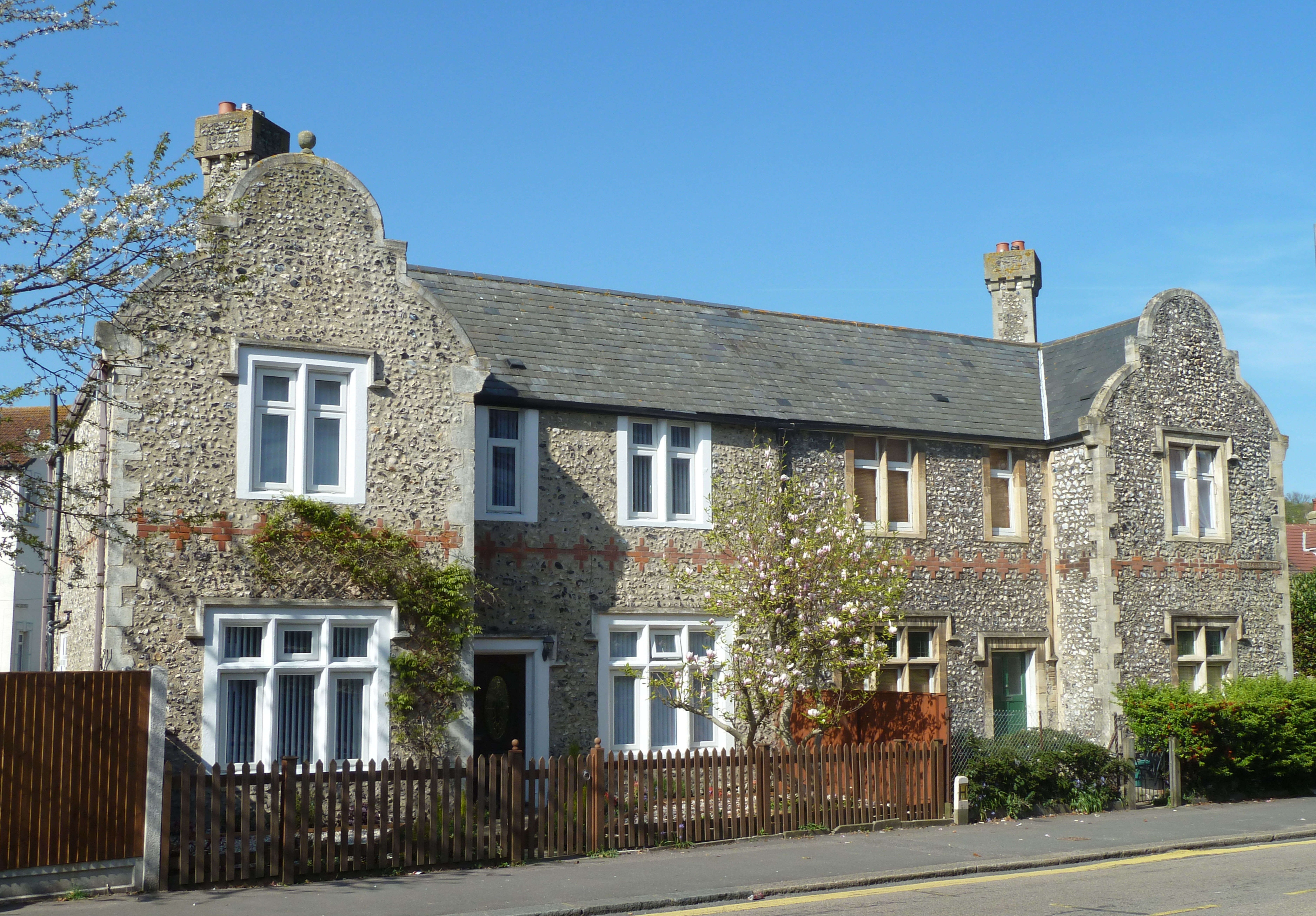
Cottages built by Major Robert Lawes to replace the toll house on Folkestone Road

Cottages built by Major Robert Lawes to replace the toll house on Folkestone Road

On 1 November 1877 the last tollgate in Dover, which had been in existence for 115 years, was taken down. This was on the Folkestone Road at the corner with Elms Vale Road, and the old tollhouse was demolished soon after. On this land, Major Lawes had built the Villas that can still be seen. Not long after, Mr & Mrs Johnson who owned People’s Café in Snargate Street gave a horse trough to the town – now filled with flowers in the Market Square. To compliment this Major Lawes erected a water fountain and later the council erected an ornate tram shelter!

Map of the Old Park Mansion estate 1919

Map of the Old Park Mansion estate 1919

The Old Park estate stretched to the London Road and about this time, Major Lawes bought the Buckland Manor house, estate and Green Lane farm. The ancient Buckland Manor house stood at the bottom of Crabble Hill and was so old it was mentioned in the Domesday Book of 1086. At that time the owner is given as Odo, Bishop of Bayeau and the estate was 108 acres. Later parts of the estates were granted to the Sheriff of Kent and James Gunman bought these and the Manor House in the 18th century. Eventually, they were acquired by Thomas Horne of Buckland paper mill from whose estate Major Lawes bought it. Not long afterwards, Major Lawes had flint cottages built for estate workers near Buckland Bridge similar to those that can still be seen on Folkestone Road.

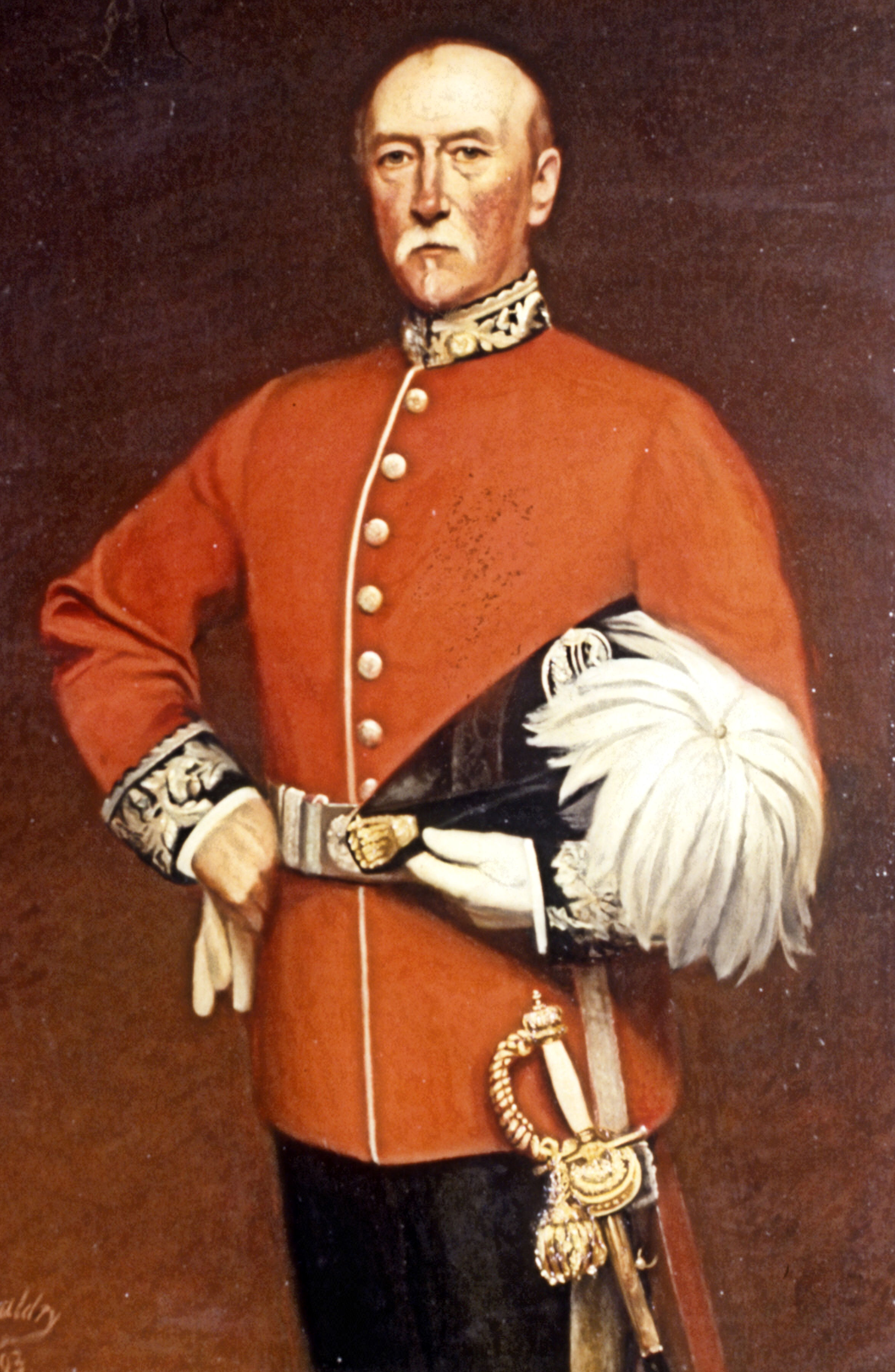
Major Robert Lawes by George W Baldry1893. Dover Museum

Major Robert Lawes by George W Baldry – 1893. Dover Museum

In 1891, Major Lawes sold a piece of the Buckland Manor land for £1,495 to the council. This enabled them to open then then Barton Road into London Road, at Buckland Bridge. At the time Barton Road petered into a footpath along what became Brookfield Avenue and this new road, the left Barton Road at angle towards Buckland Bridge was renamed Buckland Avenue.

Once the new road was opened, the council sold building plots either side netting £2,125. After the expenses of acquiring the land and laying it out were deducted, the council made a profit of about £700. The Major was none too happy about this and it galvanised him into Real Estate. On his own land, he had the houses along Brookfield Avenue and Brookfield Road built ensuring  they were attached to the town’s water and sewerage systems. However, with regards to the council acquired land, as the houses were being built the developers noticed that the land was not connected to the towns sewerage system! The council were obliged to lay pipes etc. for the additional cost of £839. Thus, for them, it was a loss-making venture!

In 1897, the council demolished Buckland Manor house and Major Lawes presented the tiles from the fine ancient chimneys to Dover Museum. On the site, the council built a tram shed for Dover’s proposed electric tramway. The system was officially opened on 6 September 1897. Shortly afterwards, Major Lawes laid out Glenfield Road and Pretoria Terrace. Emma Lawes died on 2 June 1896 and Major Lawes on 11 November 1907. His son, Robert Murray Lawes, succeeded him to the estate. Murray, as he was known, was born in 1857, educated at Eton, a barrister in the Inner Temple and had married Florence Maria Lethbridge in 1889.

Murray Lawes stood as a parliamentary candidate for Dover in the 1885 General Election. That year the Redistribution of Seats Act (1885) came into force and Dover’s representation in the House of Commons was reduced to one Member. Murray Lawes stood for the Liberals and Major Alexander George Dickson (1834-1889) for the Conservatives. Prominent on Murray Lawes platform throughout the contest was the 70-year-old Philip Stiff. On Sunday 15 November Stiff suddenly died at his home, 10 Priory Gate Road and this left the Lawes team beleaguered. Nonetheless, Murray carried on fighting hard and the final vote was close but won by Major Dickson with 2,066 to Murray Lawes’ 1,418.

The first petrol-driven motorcar was seen in the town on 1896, and two years later Murray Lawes bought a 6hp open top Daimler – registration number D 53 – becoming the first local man to own a motorcar. On 19 September 1899, Dover held its first motorcar exhibition on Crabble Athletic Ground. A grand parade of 25 or 26 vehicles of assorted designs followed the Mayor, Sir William Crundall, and his wife around the track. The Mayor travelled in an electric phaeton belonging to Alfred Harmsworth, 1st Viscount Northcliffe (1865–1922), the newspaper magnet. Along with Murray Lawes and the other drivers was Charles Rolls (1877-1910).

Old Park Sunday School Treat c 1921. Budge Adams Collection Dover Museum

Old Park Sunday School Treat c 1921. Budge Adams Collection Dover Museum

The Lawes family opened, for a long time, the grounds of Old Park for local Sunday schools to use for their annual summer parties and other special events. Murray Lawes died at his London home on 11 July 1920 after a very long illness but his wife carried on with the events. In 1921, late local historian, Budge Adams and his sister attended one such Sunday school treat and particularly remembered the penny rides on Betts’ the greengrocers cart around the grounds. The special Sunday school outings to Old Park carried on until the late 1930s.

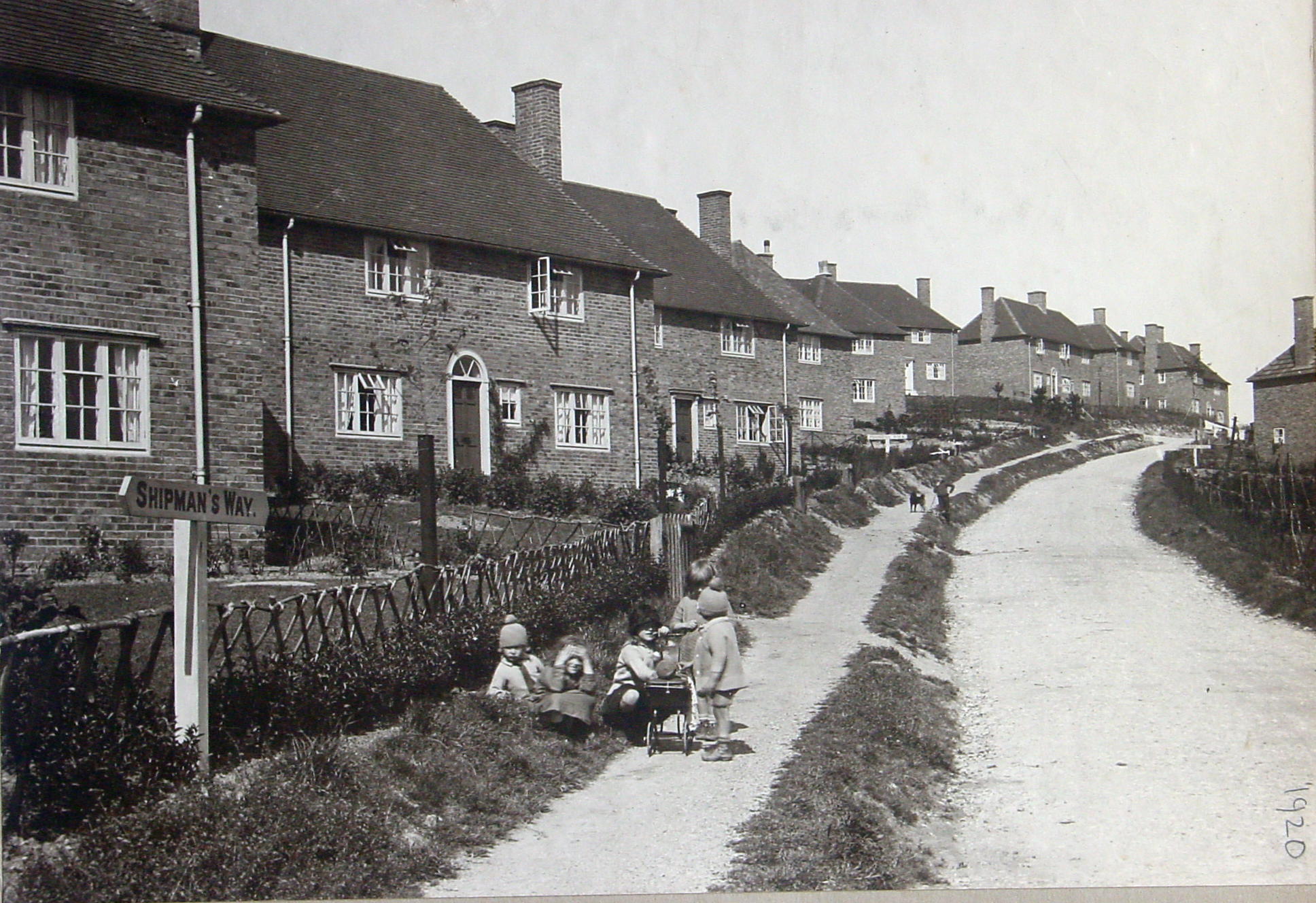
Shipman's Way 1920. Dover Library

Shipman’s Way 1920. Dover Library

Under the Housing Acts 1890-1919, following World War I (1914-1918), the council issued a compulsory purchase order for a further 55 acres of Old Park land in and around the Buckland Valley. The council had planned a major slum clearance programme in the Pier District before the War and envisaged building 600 new houses on this land. In 1921 scheme was reduced to 200 houses that were completed two years later. At the time Lorna Bomford, Dover’s first woman councillor (see Women’s Suffrage) was on the Housing Committee and her lasting legacy was the naming of the roads, of what was colloquially known at the time as the Chaucer development, after the author’s Canterbury Tales – Friars Way, Weavers Way, Knights Way etc.

In 1926, the council decided to widen Crabble Hill, which meant demolishing some of Major Lawes flint cottages near the foot of the Hill. The inhabitants, the council said, could be rehoused in cottages that the Lawes family ought to build on Green Lane farm. The foot of Crabble Hill was widened again in 1938 and more of the Lawes original cottages were demolished

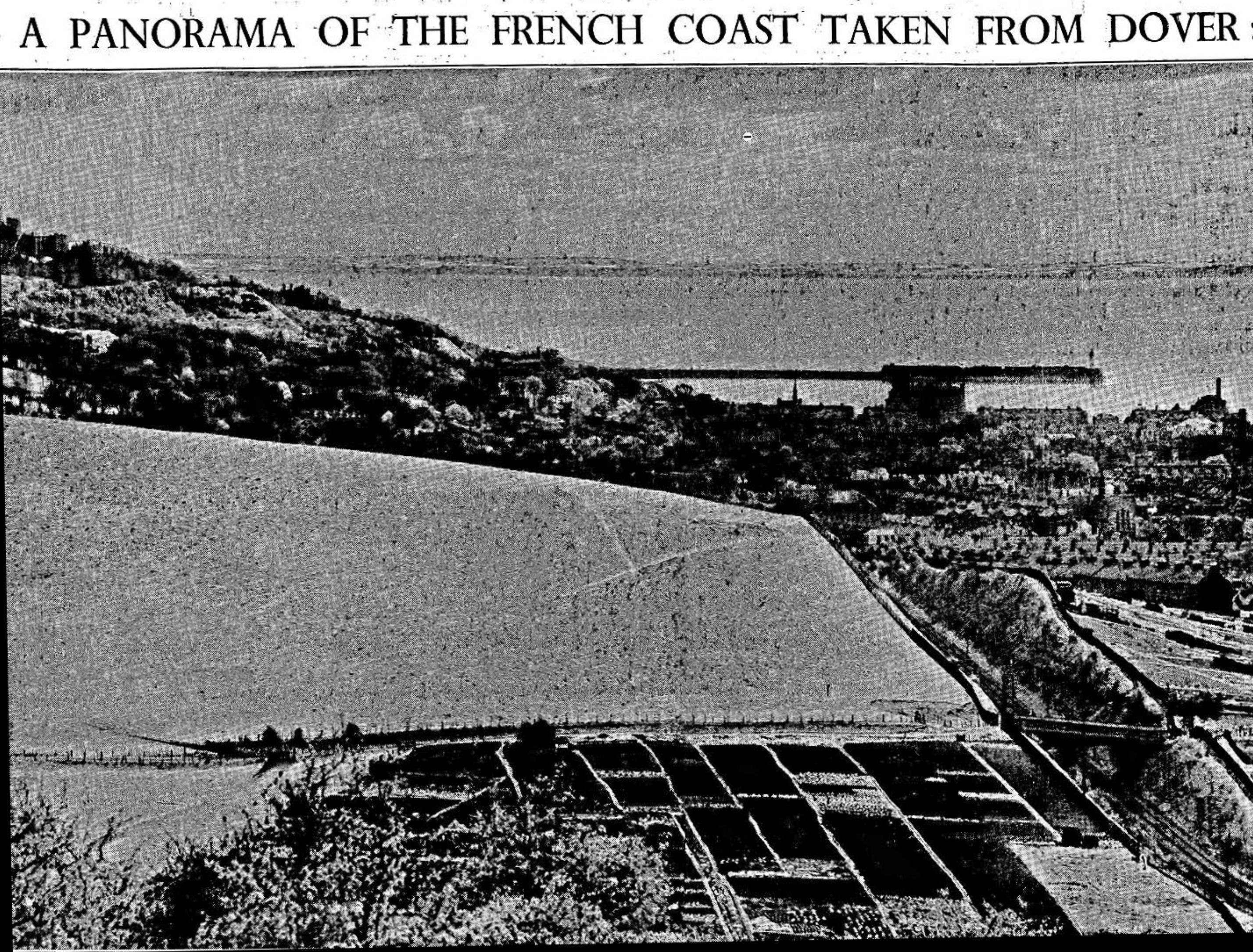
Coast of France from Old Park published in the Times 09.05.1932 by Ilford Films using the new filter and Selochrome film

Coast of France from Old Park published in the Times 09.05.1932 by Ilford Films using the new filter and Selochrome film

Alfred Hugh Harman (1841-1913), founded Britannia Works Company in Ilford, northeast London in 1879. They made photographic plates and the firm eventually took the name of the town. By 1932, Ilford films had become a household name and in spring that year, the company had developed a revolutionary new lens for cameras. The lens allowed the photographer to take long distance photographs that penetrated mist and haze. This was based on the premise that red light scatters light less than blue so they developed an infrared filter – a suitably dyed piece of gelatine that was placed in front of a telescopic lens. To use with the new lens they developed Selochrome film and to publicise both, Ilford took photographs of Cap Gris Nez, on the French coast, from the roof of Old Park Mansion in the presence of national newspaper reporters. On the day of the shoot, the unaided eye could not see the coast and to find direction a compass was used. The presentation was a success!

Trix Rogers was involved with Dover scouts and guides and in 1935 she persuaded Mrs Lawes to lease a derelict farm cottage on the outskirts of Elms Vale for the use by the various troops. The scouts, guides, their relatives and friends repaired, decorated and furnished the cottage and during the Battle of Britain (1940), it was officially renamed ‘Hell Fire Cottage.’ Most of the scouts and guides had been evacuated by that time but many returned on 18 January 1941, for a memorial service in honour of Robert Baden-Powell (1857-1941) who had died in Kenya.

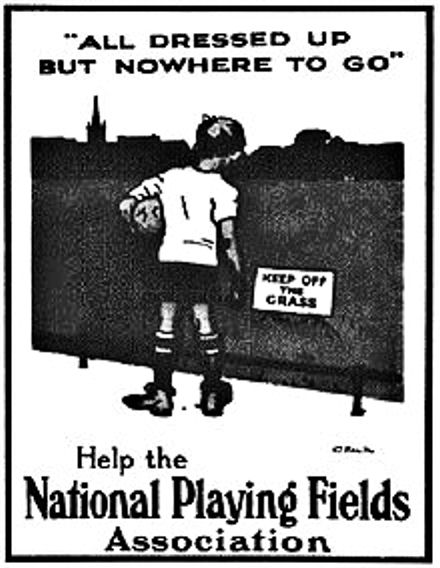
National Playing Fields Association advert c1930

National Playing Fields Association advert c1930

Florence Lawes died in October 1936 leaving her only son, Robert Lethbridge Murray Lawes at Old Park. Murray Lawes, as he too was known, was born on 19 November 1897 and educated at Eton. Following World War I (1914-1918), he became a close friend of fellow Etonian, Wykeham Stanley Cornwallis – 2nd Baron Cornwallis (1892-1982). The latter knew Brigadier-General Reginald Kentish and in 1925, the two young men helped the Brigadier to set up the National Playing Fields Association. The objective was to acquire, protect and improve playing fields, playgrounds and play areas where they were most needed, and for those who most needed them. These were particularly, children of all ages and people with disabilities. Their work with the Brigadier inspired the two friends to set up a similar organisation specifically for Kent.

They approached Dover’s Member of Parliament, the Hon. John Jacob Astor (1886-1971), who agreed to be the President. He not only proved to be a figurehead but was also active in using his connections to promote what became the Kent Playing Fields Association (KPFA) founded in 1926. The objective of the KPFA was to ensure that there were adequate facilities for recreation in every city, town and village in Kent and to encourage the provision, improvement, retention and use of playing fields, children’s playgrounds and other recreational centres. Lawes was appointed chairman and Cornwallis the chairman of the Appeals Committee. To raise money they asked Kent breweries to persuade every one of their pubs to contribute £1 to the KPFA – and it worked! During this time Albert E Reed & Co, the newsprint manufacturers, starting making significant financial contributions to KPFA.

The Kent Rural Community Council, in 1927, held a conference in the Chapter House of Canterbury Cathedral on the development of the coal mining industry in East Kent. The fledgling organisation was invited and Lawes read out a letter written by Major Astor. The letter emphasised the need for and the conservation of open spaces for the purpose of recreation.

Old Park Mansion put on the market in 1928 with the 424-acre Buckland and Green Lane Farm which, Lawes said, was suitable for development purposes. Hollingsbee Collection Dover Museum

Old Park Mansion put on the market in 1928 with the 424-acre Buckland and Green Lane Farm which, Lawes said, was suitable for development purposes. Hollingsbee Collection Dover Museum

In June 1928, Lawes put the Old Park estate on the market. The mansion was described as a moderate size country home with terraced pleasure gardens, two tennis lawns, garage and stabling accommodation, tannery with bailiffs house, two entrance lodges all set in a well-timbered park. He also put to auction the 424-acre Buckland and Green Lane Farm saying that it was nine miles from the famous golf links at Sandwich as well as being situated on the outskirts of Dover. He finished by suggesting that the farm would be suitable for development purposes – which ran contrary to philosophy he had espoused.

It appears that Lawes, not long after, withdrew the estate from the market and he certainly threw himself into the work of the KPFA. In 1929, he attended the hearings of Walthamstow Urban District council -v- London Playing Fields Society (LPFS) that went to appeal at the Essex Quarter Sessions. LPFS was incorporated and the land in question was vested in them as trustees under the Recreation Grounds Act 1859. Walthamstow argued that playing fields were rateable by law while LPFS made the points that they were established, under 1859 Act, to promote sport among young people and paid neither dividends nor profits to members. Further, although they charged rent to clubs for the use of the sport fields, these did not cover costs. LPFS won the case because they were registered under the 1859 Act and therefore their grounds were not rateable. Lawes gave this decision a great deal of publicity such that numerous trustees of established grounds ensured that these were also covered by the Act.

The following year, 1930, the Road Traffic Act was passed, and Section 61 (3), in essence, stipulated that large vehicles carrying eight persons or more, except where they were carrying their owners’ workers, were to be subject to an annual inspection and licence. The inspection and licence cost £6. Lawes, strongly objected, saying that the new Act would have a negative effect on village sports clubs who use such vehicles to transport teams and fans to other villages. In Parliament, the baton was taken up by the Labour Party’s Herbert Morrison (1888-1965), who referred to Lawes stance adding that such vehicles were used to convey disabled ex-Servicemen to sport fixtures and schoolchildren to Sunday Schools. Politicians of all parties then joined in the fray citing other users such as scouts, guides, church lads’ brigades and choir outings. The support that Lawes received was so overwhelming that the Minister of Transport, who happened to be … Herbert Morrison, suggested that the Act be amended – it was!

River Recreation Ground 1988, shortly after it had been in danger of redevelopment. Old Park hill in the background. Dover Museum

River Recreation Ground 1988, shortly after it had been in danger of redevelopment. Old Park hill in the background. Dover Museum

Hardly had Parliament recovered before Lawes hit them again. This time the target was the 1930 Finance Bill, that was designed to reduce government grants to local authorities and urging them to be thrifty. The country had hardly recovered from the 1920s economic depression when it was dragged into a worldwide economic slump. Lawes received support from the Liberal Party, who wanted the Bill amended to exempt private sports clubs not run for divisible profits. They were concerned, like Lawes and KPFA that such grounds, without local government grants, would not be sustainable and so were in danger of being sold for redevelopment. This time he did not win.

Buckland Paper Mill Sports day possibly at Crabble 1935. Dover Museum

Buckland Paper Mill Sports day possibly at Crabble 1935. Dover Museum

By 1933, John Charles Pratt, 4th Marquess Camden (1872-1943) and Lord Lieutenant of Kent was the long term President of KPFA and Major Astor the Chairman. Lawes, a Conservative, was Dover’s representative on Kent County Council and as Vice-Chairman, of KPFA, he was very active in promoting the Association’s objectives. By that year, KPFA had opened 60 new playing fields in Kent that amounted to 1,200 acres, with a capital value of £120,000! They were also working with the NPFA to persuade major industrial organisations to provide sports gear for their workers and for the unemployed and to help distribute the clothing and equipment.

However, there were set backs to achieving their objectives. The one that caused Lawes particular concern was the Ministry of Health’s refusal to sanction a loan for a new playing field at Maxton. They had sanctioned the laying out of one gifted by Lawes with covernants adjacent to the Chaucer housing development at Buckland where both Lawes and Dover Corporation emphasised the help it had brought to the unemployed in the town. In the event, with Lawes financial help, Elms Vale dairy farm and 61 acres of fields were bought by the town in June 1933 for £2,000 and Elms Vale recreation ground was laid. The rest of the land, it was suggested, should be used for housing development.

Lawes was, by this time, troubled about the proliferation of housing development schemes particularly in Kent County Council (KCC) areas close to London and on playing fields not covered by the 1859 Act. By 1936, KPFA was strongly identified with those who advocated a Green Belt scheme around London. This culminated in the Green Belt (London and Home Counties) Act 1938, which permitted local authorities around London to purchase land to be protected as open spaces. In 1947, the Town and Country Planning Act allowed all local authorities to include green belt proposals in their development plans. In Kent in 1937, due to sustained pressure from Lawes, KCC agreed to acquire some 2,000 acres on the outskirts of London for open spaces or recreation grounds!

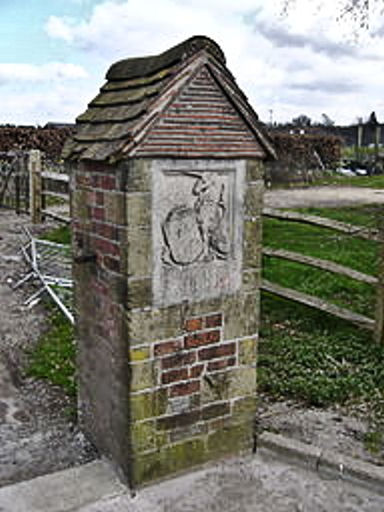
Kent Playing Fields Association - King George V Field Pillar. KPFA

Kent Playing Fields Association King George V Field Pillar. KPFA

In order to raise money for KPFA, Lawes – a keen golfer – persuaded the Prince’ Golf Club at Sandwich to present a challenge cup with the proceeds from the competitors to be given to KPFA. Edward, Prince of Wales later Edward VIII and then Duke of Windsor (1894-1972) agreed to give his name to the trophy in recognition for KPFA‘s work. These days, although the KPFA Challenge Cup still figures in some of the Princes’ Golf Club schedules and occasionally donations are made to the KPFA since 1957, when the Cecil Leitch ‘Five’ Club Competition was introduced, this has been the main fund raiser. Initially the competition was staged at the Royal Cinque Ports Golf Club, Deal but is now for at various international goldf courses around the county. The competition attracts thousands of golfers each year. Charlotte Cecilia Pitcairn Leitch or Cecil, as she is known, is a well-known and highly esteemed international golfer.

Following the death of George V (1910-1936), the NPFA launched a memorial appeal and again Lawes was heavily involved. This provided grants towards the costs of playing fields, which would be preserved in perpetuity. All the sports grounds were called King George’s Field. In Kent, there are three, London Road – Faversham, Park Avenue – Sittingbourne and Costells Meadow – Westerham.

The Duke and Duchess of Kent in 1936 agreed to be the Patrons of KPFA. Later that year, following the abdication of Edward VIII, they became George VI (1936-1952) and Queen consort Elizabeth. That year Lawes was the elected Chairman of the Men of Kent and Kentish Men Association (MK&KM) and at KCC was the Chairman of the Public Amenities Committee. In a speech to the MK&KM, in 1938, the Archbishop of Canterbury (1928–1942), Cosmo Lang (1864-1945), put a question to Lawes. He asked Lawes if, through his position within KCC, he would do all he could to preserve the countryside and not allow it to become over- housed. Adding, ‘New buildings should not be allowed to sprawl about and to be built without congruity to their surroundings.’ The Archbishop finished by begging Lawes ‘Never to allow Kents glory to become KCCs shame.’ (Speech in Dover 10 May 1938).

As the decade progressed, Lawes expressed increasing concern that the dark clouds of war were gathering. In his letters to the press, he pointed out that one of the major sources of recruits to the Regular and Territorial Army was the cadet force. Prior to 1929, the army cadet force had Royal patronage and received grants through the Board of Education. This was axed and he recommended that the grants should be restored. By 1936, he was adding ‘with the utmost urgency.’

Old Park Mansion remains. AS 2014

Old Park Mansion remains. AS 2014

Murray Lawes married Kathleen Francis Biega née Seeley in December 1937 and the following year was elected KCC Alderman of the County of Kent. November 1938, Lawes gifted Old Park mansion and 225 acres of the estate to the Ministry of War. In the summer of 1939, Old Park Barracks were built. By the outbreak of World War II (1939-1945), Lawes had joined the army rising to the rank of Lieutenant Colonel. Following the War, Lawes remained actively involved in KPFA but was forced to sell the remaining acres of the Old Park estate to Dover Corporation for housing development. He died in London in 1969.

The story of Old Park from 1939 can be read in Old Park Part II.

  • Presented: 30 November 2014

Kent County Playing Fields Association:

Website: kentpfa.org.uk Phone: 01622 753960; email: kcpfa@hotmail.co.uk
 

Posted in Buildings, Lawes Murray Old Park & the Foundation of the Playing Fields Association, Old Park history part I & the Foundation of the Playing Fields Association, Old Park history part I & the Foundation of the Playing Fields Association, Old Park history part I & the Foundation of the Playing Fields Association, Open Spaces, People, Whitfield | Comments Off on Old Park history part I & the Foundation of the Playing Fields Association

Crabble Tram Accident – 19 August 1917

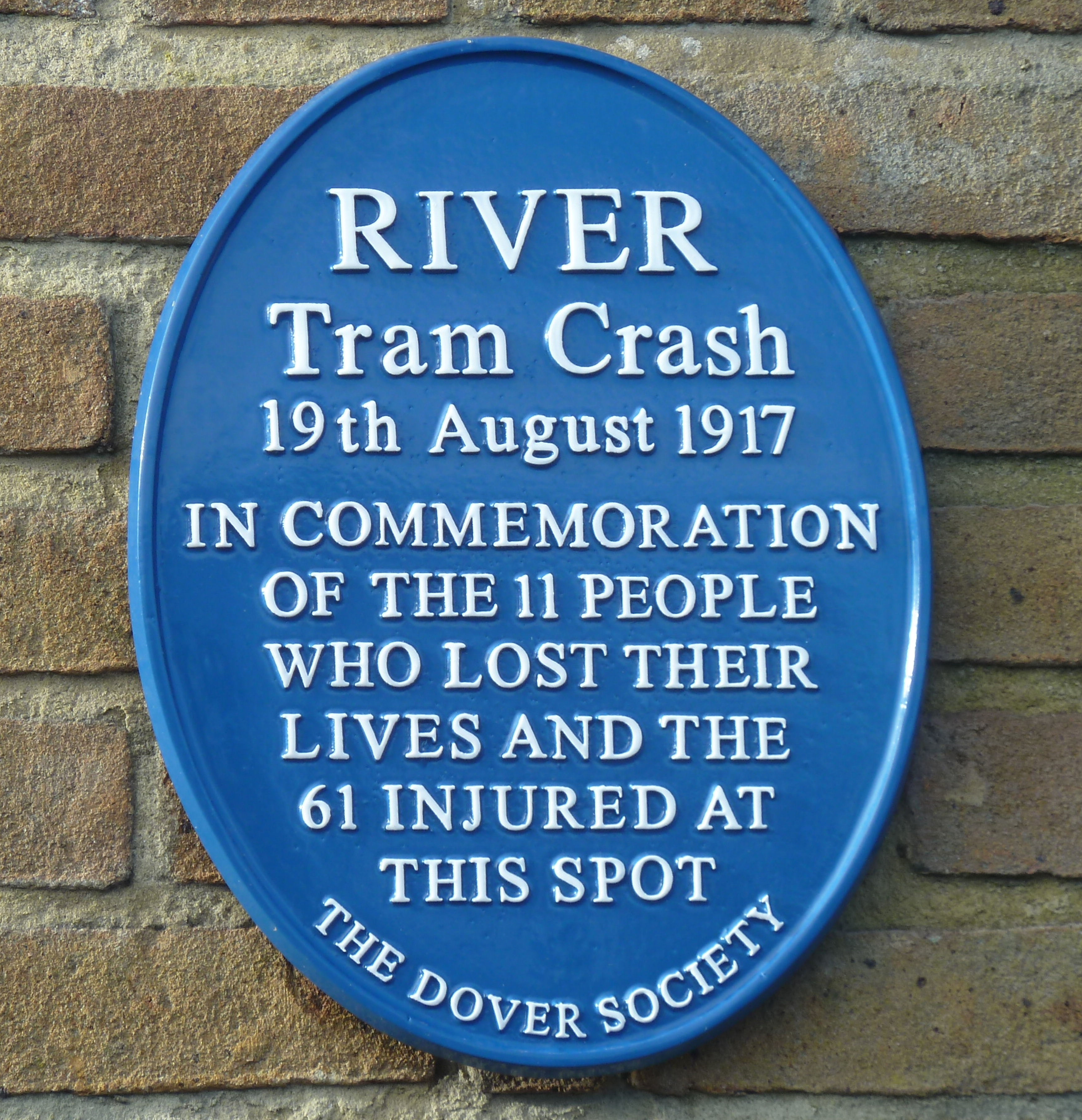
 The Crabble tram accident of 1917 remains one of the worst on record with 11 dead and 60 injured (figures taken from the coroner’s report), many seriously. This is the story.

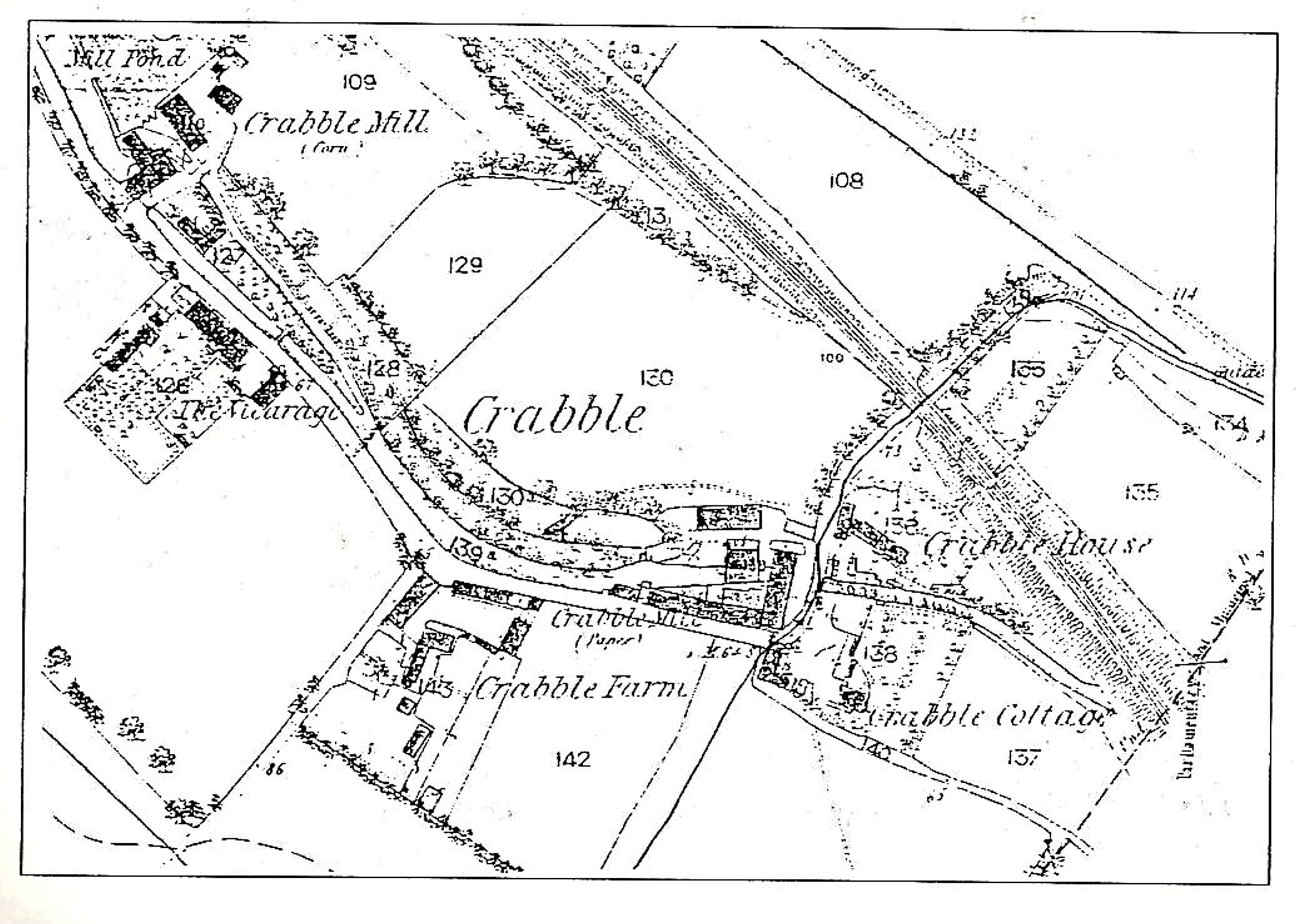
Map of Crabble 1874

Map of Crabble 1874

Crabble is a hamlet in the village of River. The village is situated about two miles from Dover and is a combination of high hills with a deep valley through which the River Dour flows. The old A2 London Road is on the east side and up until 1977, when the Eastern Bypass opened, was the main road northward out of Dover. The western hills were once given over to farming and woodland but are now predominantly covered with housing estates. Alongside the river is the original village of River, a long straggling row of pretty cottages and meadows. There were once two paper mills, a corn mill, a seed mill and the Church dedicated to St. Peter and St. Paul. Crabble lies in a hollow at the southern end of the village. The hamlet, until the end of the 19th century contained a farm, Crabble corn mill and Crabble paper mill.

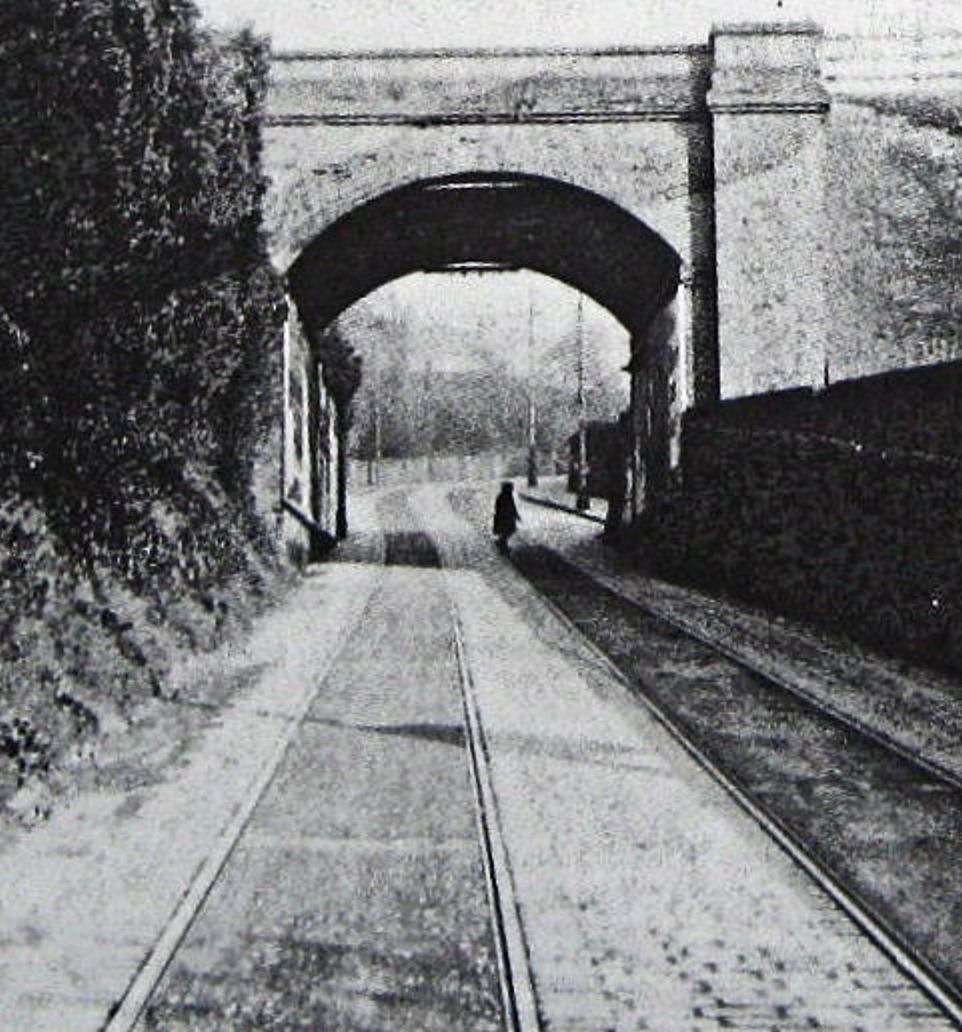
Crabble Road railway bridge prior to 1936 when it was demolished

Crabble Road railway bridge prior to 1936 when it was demolished

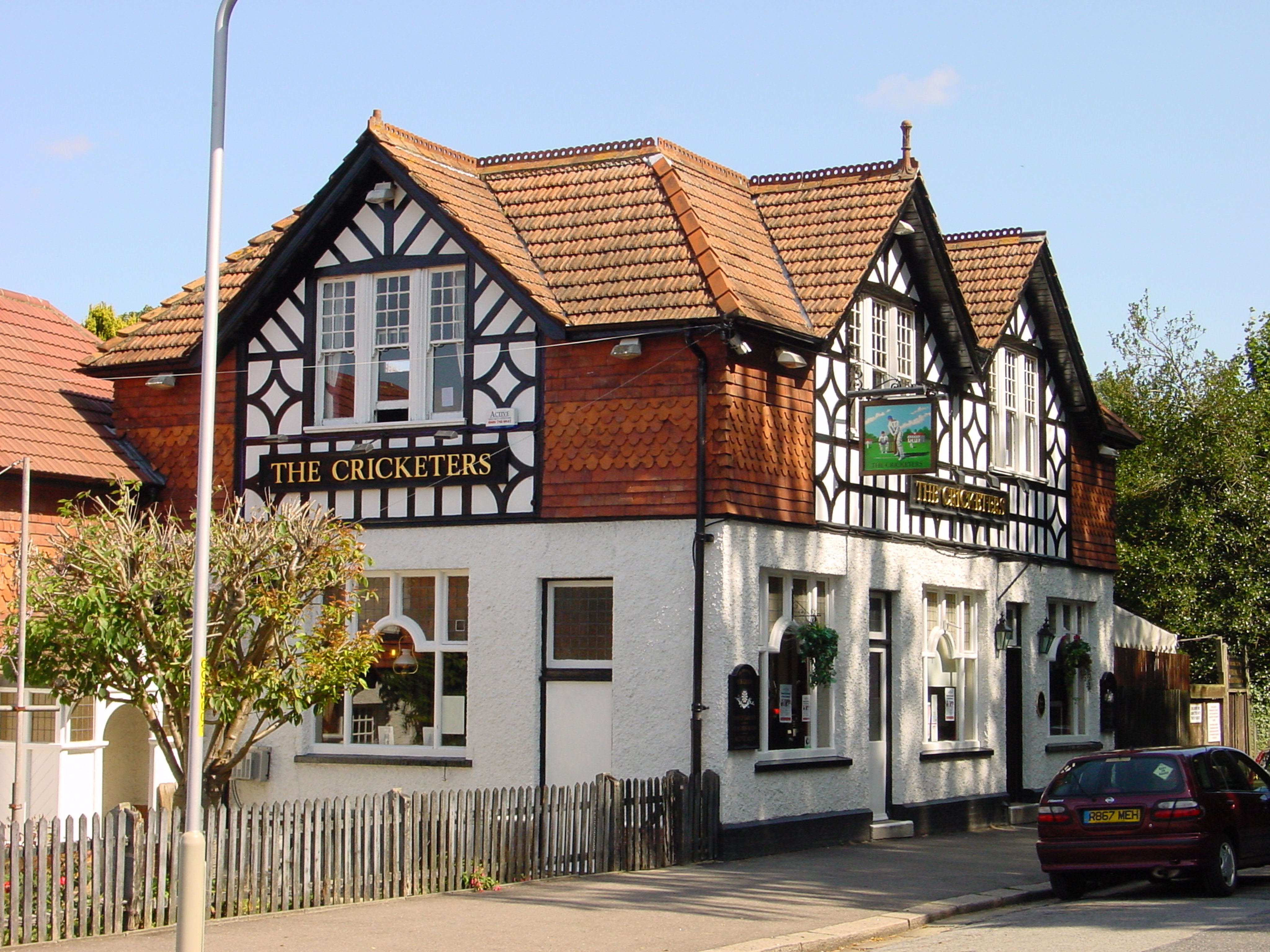
There were, and still are, two road entrances into River from the London Road. The northern entrance leaves at Kearsney to the Alkham Valley, the first left turn is the road to River. The southern, and main access to River, leaves from Crabble Hill taking a sharp left turn into Crabble Road. The road then goes down a sharp incline, round a bend, under a railway bridge and curves to the valley bottom and the river Dour. On the right, at the time of the accident, was the Crabble Paper mill and opposite, abutting the north side of the river was Crabble House. After crossing the river, on the left is Crabble Avenue with the Cricketers pub on the left and on the right one of the entrances into the Crabble Athletic Ground. Crabble Road, after crossing the river goes up another incline and past, on the left, the main entrances into the Athletic Ground. Following a sharp right turn, these days is Lewisham Road that leads to the centre of River village and the church.

Map of Dover's Corporation Tramways

Map of Dover’s Corporation Tramways

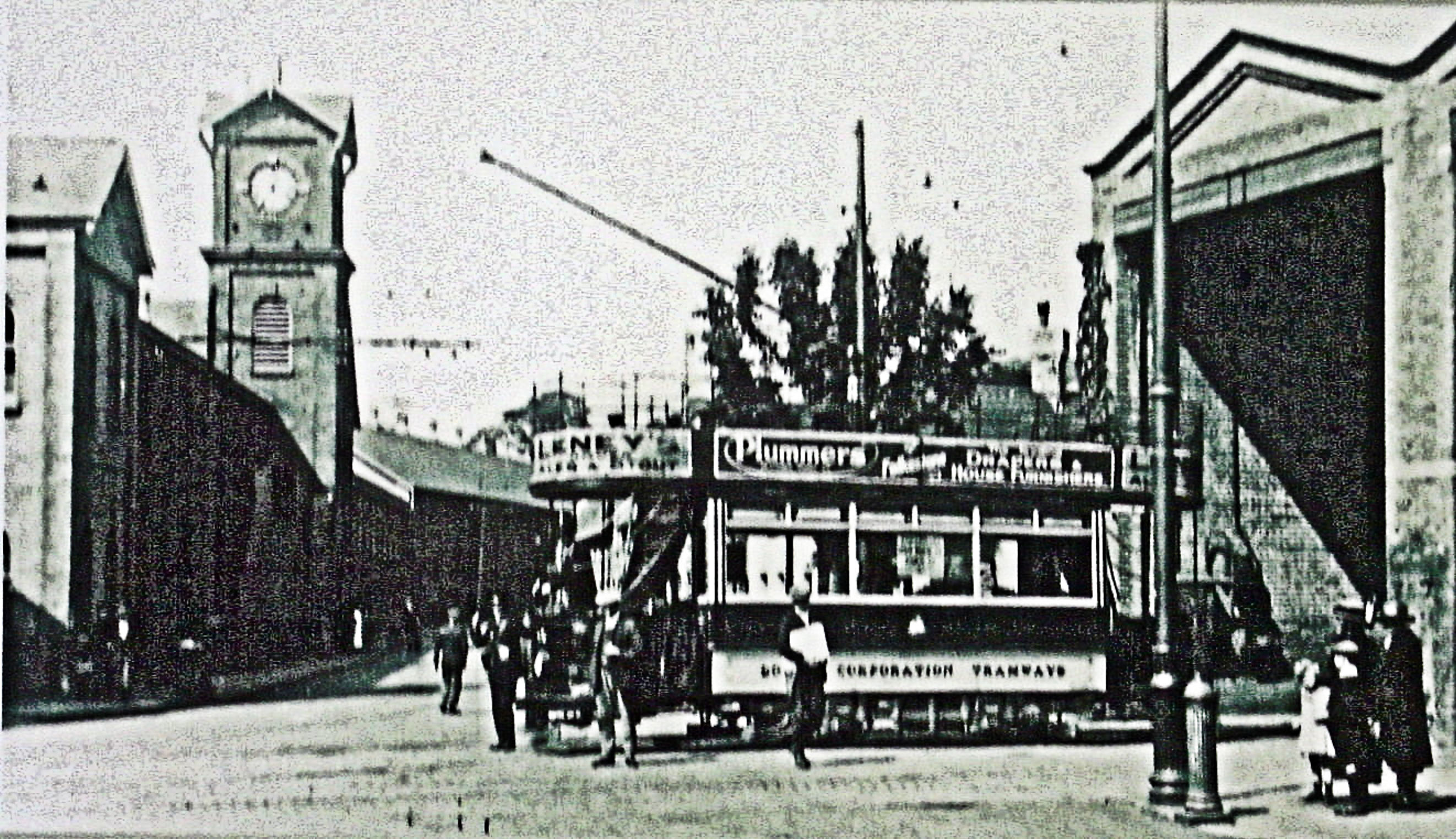
Electricity was first generated in Dover in 1894 and on 9 November 1895, the Corporation passed a resolution proposing an electric tramway. Authorisation was given through the Dover Corporation Tramway order of 1896, which was confirmed by the Tramways Orders Confirmation (no1) Act 1896. Costing £28,000 the first tramway was officially opened on 6 September 1897 and ran from Market Square. The 3 miles with 3foot 6inch (just over a metre) gauge track was laid within a year. All the trams were double-decker vehicles and up to 1926 had open top decks. Each tram was fitted with a primitive ‘cow-catcher’ type of lifeguard to prevent anyone falling under the front of the vehicle. The seats were slatted and were reversible by moving the backrest – one such seat can be seen at the Dover Transport Museum. In 1911, Sunday services were introduced.

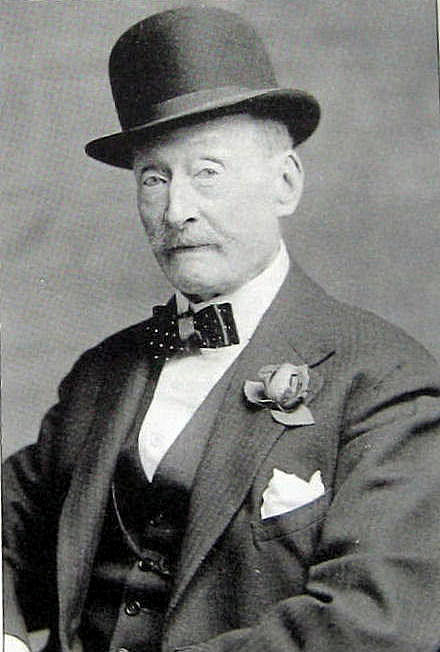
Sir William Crundall - Chairman of the syndicate that first proposed the River Tramway

Sir William Crundall – Chairman of the syndicate that first proposed the River Tramway

In January 1901, a private syndicate was formed headed by Sir William Crundall (1847-1934) and included Weetman Dickinson Pearson – 1st Viscount Cowdray (1856-1927), and John Jackson (1851-1919). At the time, all three were involved in the building of the Dover, St Margaret’s and Martin Mill Railway Line as well as the great Admiralty Harbour. Crundall was also the Chairman of the Dover Harbour Board and of the privately owned Dover Electricity Company. He was heavily involved in local politics and was to be Mayor thirteen times. The syndicate proposed to build a tram/railway service powered by electricity, from the Dover-Deal railway line on Crabble Hill to River Church and then through to Kearsney Abbey and the Alkham Valley terminating about a quarter of a mile north of the road leading to Chilton Farm.

Following an official inquiry in April 1902, permission was granted to build the tramway with the understanding that it was to terminate at Minnis Lane, River – close to the Church. It was agreed that the Company would lay down the track but that they could not exercise that power for two years. This was to give time for the council, if desirable, to obtain the authority to extend their tramways and include this track.

Before finally being given the go-ahead, the tramway required the approval of the Board of Trade. Their report on the proposal made reference to the steep gradients and sharp curves. However, they were satisified as long as the outer rail on the upper curve of the down hill track on Crabble Road was super-elevated by an inch and a quarter. The lesser curve, near Crabble paper mill, was also to be super-elevated but by a lesser extent. These modifications were considered ample safeguard.

The route was passed on 28 September 1905, by Colonel Sir John Wallace Pringle CB, FRGS (1863-1938), Chief Inspecting Officer of the Railways Inspectorate of the Ministry of Transport. The Dover and River Light Railway Order 1903 was granted on 12 October that year and named Sir William Crundall, Andrew Clark, George Clark and Robert Tritton, as the directors of the company.

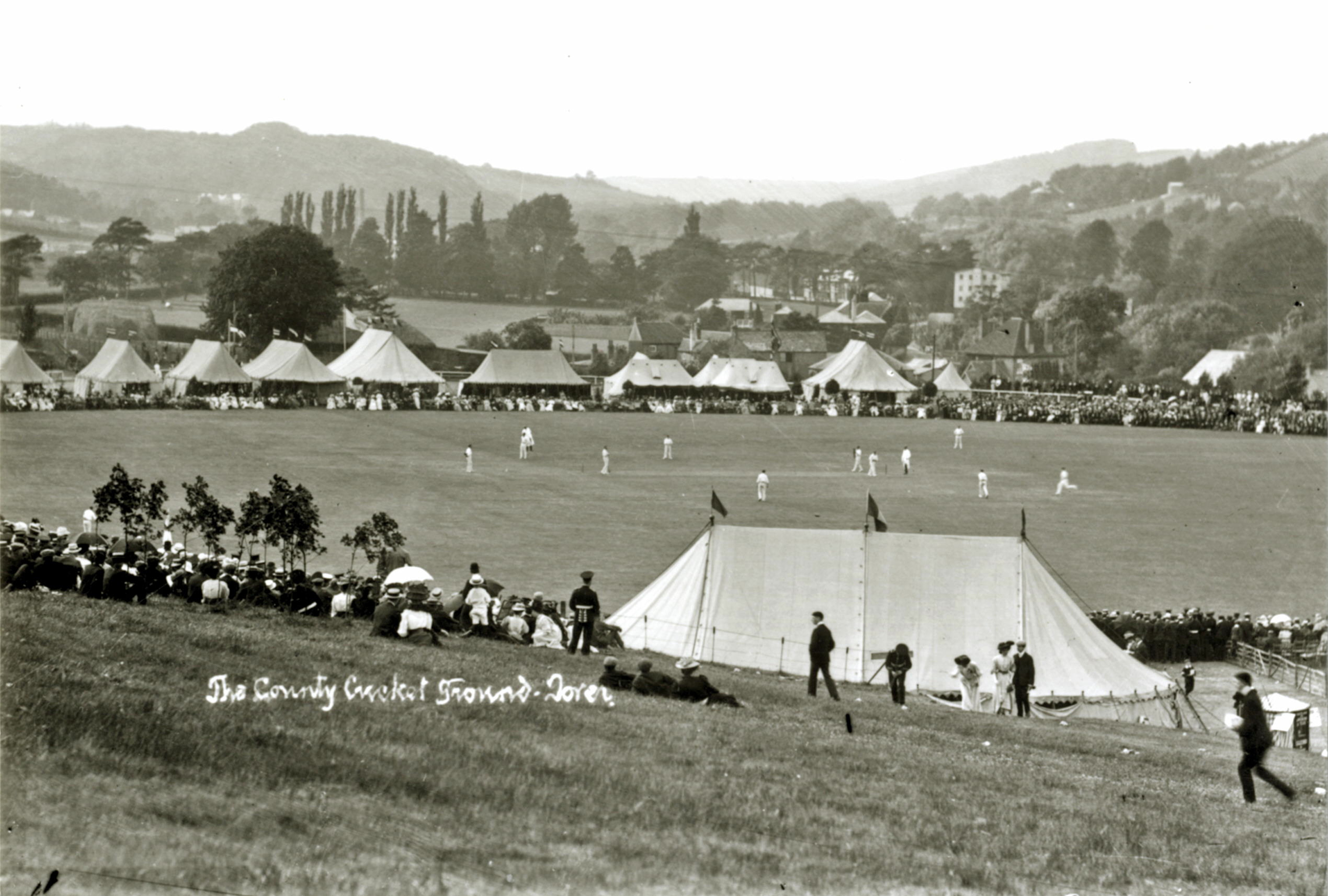
Cricket at Crabble Athletic Ground pre-WWI. Dover Museum

Cricket at Crabble Athletic Ground pre-WWI. Dover Museum

As the proposed track ran across a considerable number of private land there were delays due to the compensation claims being unexpectedly large. In 1904, Crabble Athletic Ground opened but it was a time of high unemployment and by autumn, it was necessary for the council to provide relief works. On 11 October that year, Councillor Wright proposed to invoke the 1902 provision and used the unemployed to build an extension track for trams to River.

Building the double-track tramway involved overcoming several major obstacles, the main ones being the gradients and curves. Crabble Road is steep – 1in10 – with a 135º bend before the track passed under the low bridge that carried the then London, Chatham and Dover railway line. After which, there is the second curve on the incline. Following the laying of the track, another Board of Trade inspection recommended that the curves on Crabble Road should be increased in radius and the gradient modified. It was estimated that this would cost £21,000 but was not introduced, possibly due to the cost.

Because of the terrain, after the railway bridge it was found to be easier to erect the poles carrying the overhead cables on the ‘wrong-side’ of the road. This caused the trolley-booms to trail across the top of the cars. From the tram shed at the bottom of Crabble Hill, on London Road, to the 90º turn for River the track was on wood block. At the start of the turning into Crabble Road, the track was on a sett paving that continued until it reached the north gate of the Athletic Ground. From there were open fields until the village of River was reached.

After the track crossed the Dour river bridge on Crabble Road, there was the incline past the Athletic Ground and then fields. It was decided to lay the track on sleepers, with chalk and clinker ballast, through a narrow cutting to lessen the gradient. Before reaching the top of the hill a long gentle curve was started for what became a 45º right turn. Still on sleepers and ballast the track followed a contour, level with River Church roof, behind the River workhouse to a terminus in Minnis Lane. This part of the track eventually became Lewisham Road. On reaching the made-up road behind the workhouse the track was bedded on wooden blocks. From the curve to the made-up road, much of it was fenced with several crossing gates for cattle.

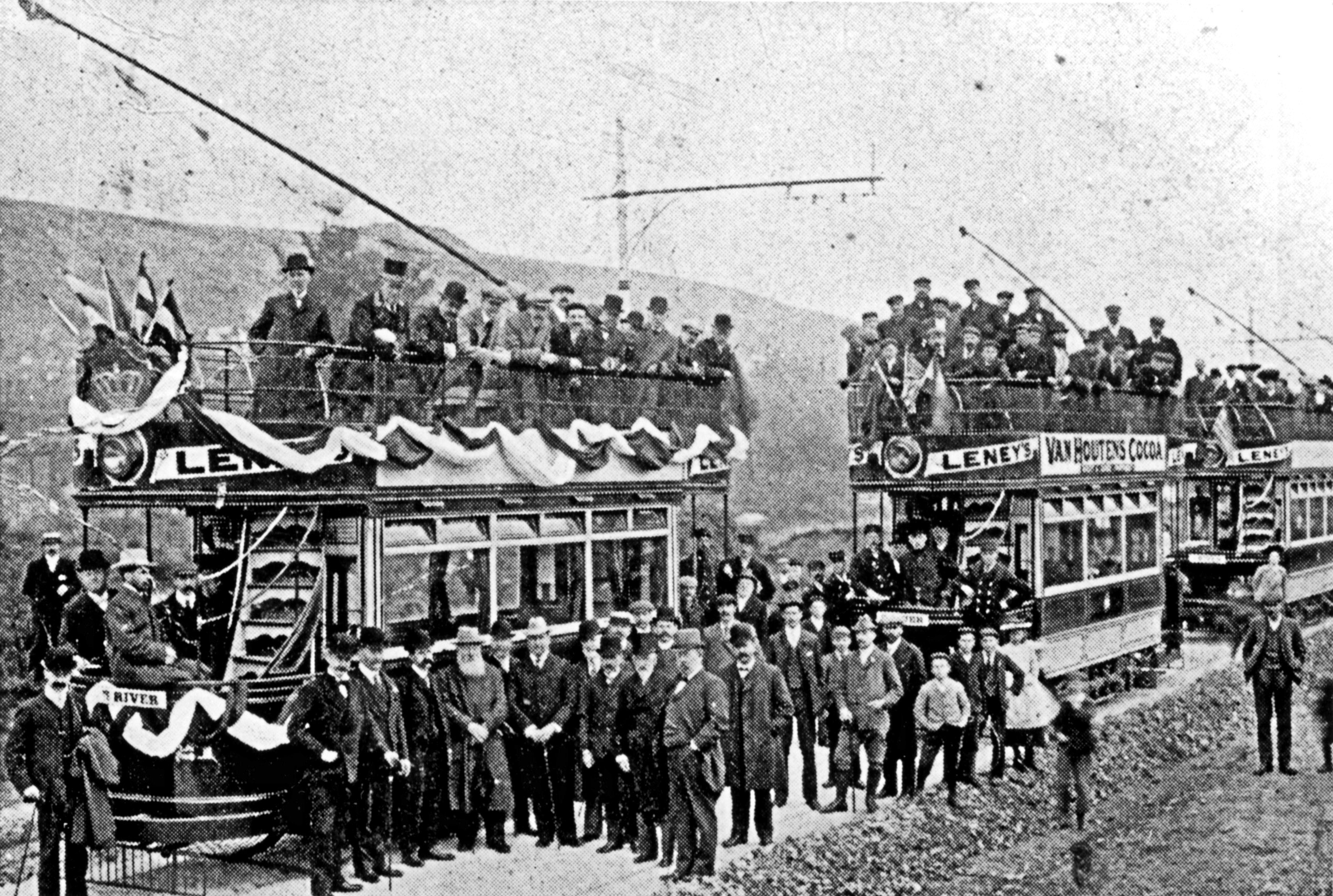
Opening of the Tramline extension to River 2 October 1905. Dover Museum

Opening of the Tramline extension to River 2 October 1905. Dover Museum

The British Electric Equipment Company tender of £10,353 2shillings 8pence, won the contract for the building of the River extension and work started on 20 February 1905. On 2 October 1905 Dover’s Member of Parliament (1889-1913), George Wyndham (1863-1913) opened the track, travelling in Car No21. Car Nos.18, 19 and 20 carrying dignitaries, followed.

World War I (1914-1918) for Britain started on 4 August 1914 and it was generally accepted that it was the duty of every man, who was of military age, to do his duty and fight for the country. It was not until 1917 that the Ministry of War issued a directive stating that experienced tram drivers were exempt from being called up. Up until that time, another directive stipulated that tram driver vacancies should be filled by soldiers who had been discharged from the Army on medical grounds. This was regardless whether they were experienced tram drivers or not. In August 1917, it was reported that 70 experienced tram drivers had left the Dover service since the outbreak of war.

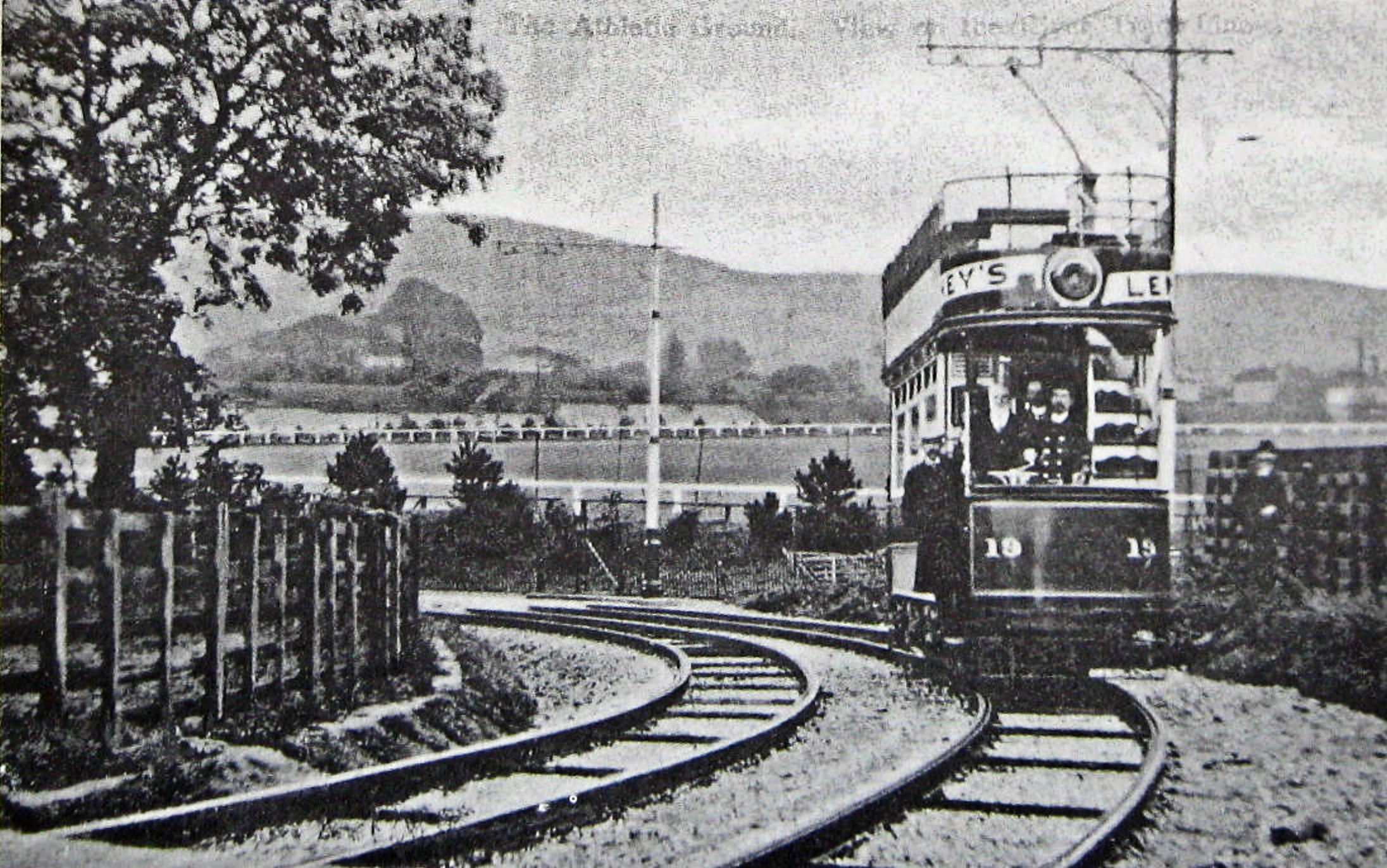
Postcard of the River tram with Crabble Athletic Ground in background

Postcard of the River tram with Crabble Athletic Ground in background

The council coffers had gained by the use of inexperienced drivers as they were paid less. Indeed, in 1915 they were delighted to report that the Tramways undertaking, owing to the great increase of population and the fall of expenditure, had a most profitable year. Further, as the accidents had been negligible, the amount paid in insurance premiums had reduced. In 1917, the annual premium was £200 and this provided coverage, in case of accidents, of up to £1,000.

The driver of the No 20 tram on the afternoon of Sunday 19 August 1917 was one such recruit. Albert James Bissenden, who was born on 12 August 1888 at 5 Granville Terrace, Charlton and married Mable Minnie Reeves on 12 December 1915 in Saint Bartholomew’s parish. Bissenden volunteered at the outbreak of World War I and became a private in the Army ordnance corps, based in Colchester. Bissenden was sent to Egypt where he examined explosives but at the end of 1916, due to heat and pressure of his work, Bissenden suffered a nervous breakdown and was discharged on 22 February 1917. Following his return to England, Bissenden made a rapid and complete recovery. Five weeks before the accident he started work as a tram driver having never driven a tram before.

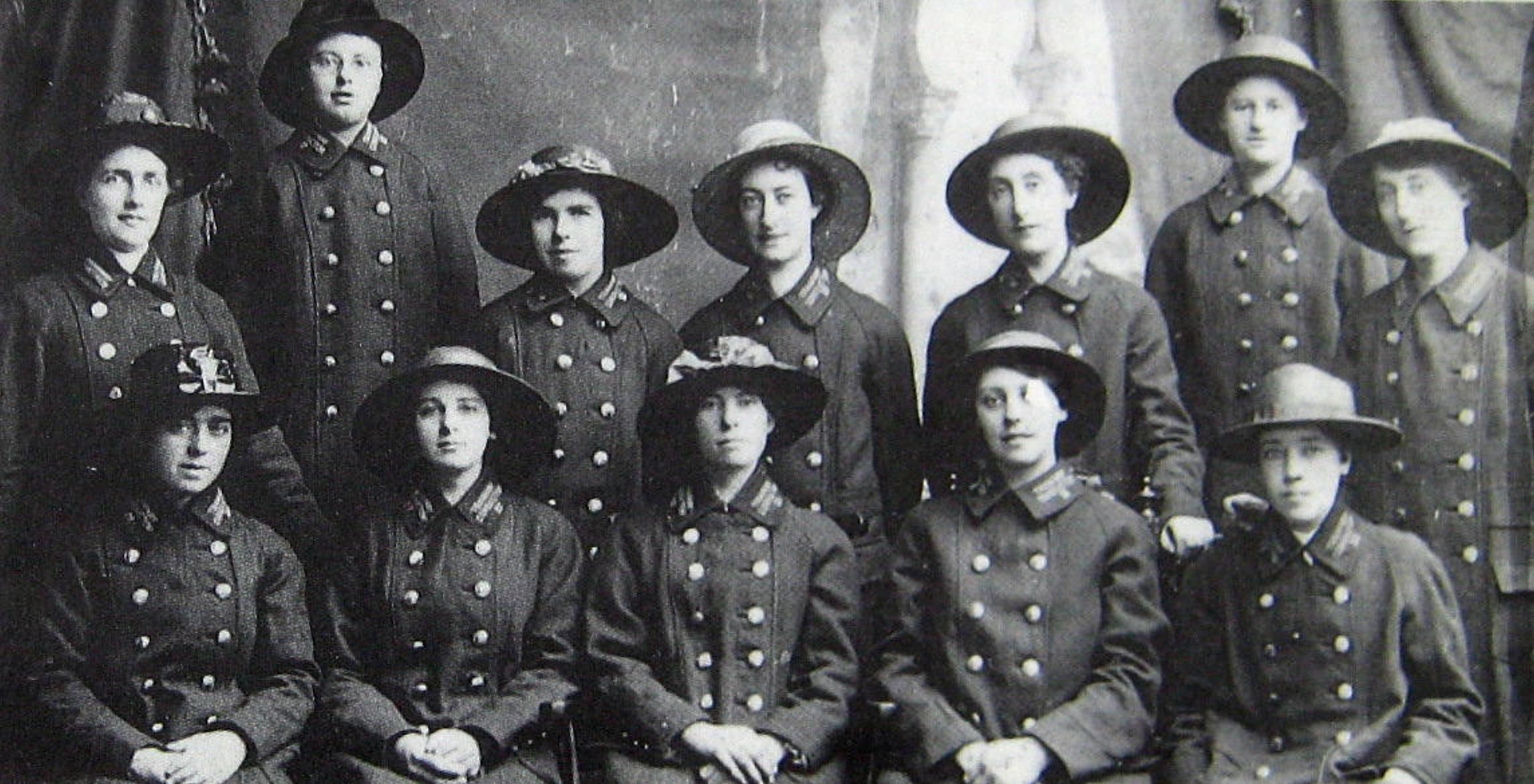
Conductress Lottie Scrase is in the centre of the front row.

Conductress Lottie Scrase is in the centre of the front row.

Bissenden proved to be quick learner, within two weeks he had passed the in-house test and was in charge of driving a tram. It was well recognised that only drivers with considerable experience drove trams on the River route but due to the shortage of experienced drives, that Sunday was the fourth day in a row that he had covered the route. The conductress was the experienced Charlotte (Lottie) Scrase, who was adept at handling passenger-related problems. She had changed shifts that day in order to be free the following weekend as she was getting married.

At St Bartholomew’s Church in the High Street, women’s suffrage campaigner, Lorna Bomford climbed on board No20 and found a seat on the inside. By the time the tram had reached Buckland Mill, at the bottom of Crabble Hill, Miss Bomford later testified that the tram was so full that people were standing in the doorway and on the step. Lottie told driver Brissenden that the vehicle was full and that there was no room for any more. She then went upstairs but as it was so full and folk were standing, she did not come down.

It was probably because the tram was so full that Bissenden drove past the next stop, where potential passengers were waiting. On reaching the brow of Crabble Hill, before traversing Crabble Road, it was usual for drivers to stop and turn the control key to the off position in order to cut the power supply. This automatically slowed the trams down and because the main brakes were rheostatic – electrical braking using a load resistance – they could only be applied if the power was cut off.

For whatever reason that Sunday, on that run, Bissenden did not stop and turn off the control key. This meant that the tram was on full power from the top of the incline.

Bissenden, as usual, applied the Spencer slipper track block brake on the first bend but instead of slowing down the tram gained momentum. Realising that it was going too fast Bissenden tried to apply the emergency brake but this did not work as the power was still on. Probably a combination of panic and inexperience, Bissenden failed to realise this. Instead, he tried the slipper brakes that was operated by a wheel and pressed on the running rails, but under the circumstances were of little use. The tram was by now careering down the hill and Bissenden tried the hand brake but it seemed to be jammed. On board was an off-duty soldier, Trooper Walter George Gunner of the 1st Dragoon Guards attached to the Army Pay Corps, who tried to stop the tram using his feet as emergency brakes. Before the tram hit the Dour bridge wall, Brissenden had jumped free.

Crabble Road Tram Accident 19 August 1917. Dover Museum

Crabble Road Tram Accident 19 August 1917. Dover Museum

The tram overturned at the bottom of the second bend on Crabble Road and the upper deck smashed into the wall. Eleven people were killed and 51 civilians plus 9 military personnel were injured.

At the time, a train was crossing the railway bridge on Crabble Road. The driver stopped at the Bunkers Hill signal box and reported the accident. There, the signalman went to the house next door and the lady occupant ran down the hill with the intention of going to the tram shed at the bottom of Crabble Hill to tell them of the accident. On her way, she met Inspector Elgar of Dover police force who went instead. At about the same time Police Constable Booth was passing the scene of the accident. He immediately went to Crabble Paper mill and telephoned the police station.

Cricketer's pub, Crabble Avenue, where the dead were taken. Alan Sencicle 2009

Cricketer’s pub, Crabble Avenue, where the dead were taken. Alan Sencicle 2009

Inspector Elgar, on finding that the police station had been informed, boarded the next tram to River and on reaching the top of the slope disembarked the passengers and then took the tram down Crabble Road. Although, medical aid had not yet arrived, P.C. Booth was applying tourniquets and had organised locals tear up sheets for bandages. He had also arranged for others to carry the dead to a nearby shed or the Cricketers pub. The badly injured were being moved into the shade or into a house nearby. Inspector Elgar organised the most severely injured to be taken to the Royal Victoria Hospital (RVH) in the High Street on the commandeered tram. Two of the victims died on the way.

Chief Constable David Fox, on receiving the telephone call alerted local G.Ps – Doctors Long, Koettlitz and Elliot. He also requested help from the Army and sent the three-wheeled police ambulance to the scene. More tramcars were commandeered along with military ambulances to take the injured to the RVH

All the injured were initially taken to the RVH and from there the military personnel were taken to the Military Hospital on Western Heights. Six people had died instantly, three more on the way to the RVH. All the dead except Lieutenant Roberts passed away after admission into the hospital. The Market Hall was used as a mortuary. Lieut. Roberts died at 19.45hrs the following day from a fracture of the skull at his home 46 Denby Road, Belgravia. Trooper Gunner lost both his feet in consequence of his actions.

Those Killed were:

  • Arthur David Axford – age 26, married, 51 Church Road, Deputy Chief Clerk, Electricity Department
  • Henry Boteler – age 60, 22 Snargate Street, Restaurant owner
  • David Thomas Cade – age 26, married, Royal Naval Reserve on motor launches
  • George Ernest Foster – age 34, 5 Belgrave Road, of the Metropolitan Police stationed in Dover, fiancé of Susan Green
  • Susan Green – age 29, 4 Norman Street, employed in the Army Records Office, fiancée of George Foster.
  • Cllr. Solomon Ward Joseph – age 49, jeweller and Folkestone councillor of 34 Castle Hill, Folkestone
  • Private William Livermore – age 36, married with five children, of the Royal Fusiliers
  • Lieut. William Arthur Roberts – age 21
  • Ernest Alfred Royal – age 28, Royal Naval Reserve on the Drifter Patrol
  • Charlotte (Lottie) Eleanor Scrase – age 27, 80 Heathfield Avenue, Tram Conductress
  • Walter Skinner – age 17, son of the landlord of the Red Lion, St James Street for whom he worked.
Henry Boteler killed in the Crabble Road Tram Accident. Dover Express 24.08.1917

Henry Boteler killed in the Crabble Road Tram Accident. Dover Express 24.08.1917

Walter Skinner age 17 killed in the Crabble Road Tram Accident. Dover Express 24.08.1917

Walter Skinner age 17 killed in the Crabble Road Tram Accident. Dover Express 24.08.1917

Susan Green killed in the Crabble Road Tram Accident. Dover Express 24.08.1917

Susan Green killed in the Crabble Road Tram Accident. Dover Express 24.08.1917

The inquest opened in the then Town Hall, now the Maison Dieu, on the afternoon of Tuesday 21 August under the guidance of Sydenham Payn, the coroner. Present in the Court was Mayor Edwin Farley, General Bickford, Brigadier-General Massey-Lloyd, Cllr. Richard Barwick – Chairman of the Council’s Tram Committee, Reginald Knocker – Town Clerk and E Carden – the Tramways General Manager.

The jury comprised of Foreman – James Wood, P E Wraight, A Cogger, J Hogben, J Graves, A White, G Bethal and E R Jezzard. The coroner told them that his first duty was to take evidence as to the identity of the victims. Thus, the jury had to first go to the Market Hall and then to the Military Hospital to view the bodies. This was followed by a visit to the scene of the accident. Coroner Payn set the tone of the proceedings by saying that some of the victims were men who had returned from the Front safely only to lose their lives in the accident.

Court Hall Jury Box, Maison Dieu, where the Inquest jury sat

Court Hall Jury Box, Maison Dieu, where the Inquest jury sat

Sydenham Payn then thanked the organisations whom helped following the accident. These included Members of the Military, the Ambulance staff, town nurses from Dover Union (the workhouse), Dr Elliot, the Chief Constable and his officers, many of the residents of the district and Dr Fairlie Clark and the staff of the RVH. The Inquest was then adjourned until the following Monday and the jury left with the Coroner on their mission.

On the following Monday the details of what had occurred prior to, at the time of and after the accident were examined. It quickly became clear that Bissenden had made a mistake by not switching the engine off and due to the lack of experience was unable to rectify the situation. Although the seating was for 48 passengers, it was evident that the tram was seriously overloaded, the number of passengers was given as 70.

The jury retired at 18.00hrs and returned 45 minutes later with the verdict, ‘We find that the accident was caused by an error of judgement on the part of the driver, who, we consider, was too inexperienced.’ The jury foreman, James Wood, then said ‘I have a rider which the jury wish to add, We strongly recommend that the drivers and the cars should be licensed, so that the police may have some supervision over the overcrowding of these cars for the future safety of the general public.’

The Coroner wound up the inquest by thanking everyone and paying a tribute to the actions of Trooper Gunner, saying that, ‘but for his efforts the consequences would have been much worse.’ Trooper Gunner was later awarded the Albert Medal for his actions that day. The Inquest official verdict was that ‘the deaths were caused by the tram-car running away and overturning, and that the accident was caused through by the error of judgement and inexperience of the driver of the car, and that the deceased’s met their deaths through misadventure.’

The Board of Trade Inquiry took place on Friday 28 August in the Town Hall, under Colonel Sir John Pringle, who had passed the route in 1905. Mayor Edwin Farley and Brigadier-General Massey-Lloyd accompanied him. E Carden, the Tramways General Manager, was the first witness and described the tram, saying that it had two 25.h.p. Motors fitted with ordinary hand brakes, electrical rheostat brakes and Spencer slipper track brakes that worked off a wheel. He and the remaining witnesses gave the history and details of the running of Dover’s tram system and their findings following the accident. The Inquiry concluded that Car No20 was not faulty but that Board of Trade recommendations should have been carried out.

Car No20 was repaired and ran on the Buckland-Pier district service for several years after.

Crabble Tram Accident Dover Society Blue Plaque. AS 2015

Crabble Tram Accident Dover Society Blue Plaque. AS 2015

The financial cost of the accident due to the inadequate insurance cover immediately led to an increase in the rates by 1shilling 6pence (7.5p) in the £. Paying back the borrowings to meet compensation claims was a burden on the ratepayers for a number of years after. On the declaration of War in 1914 the town had become ‘Fortress Dover’, under combined military and civilian ordinance. During that time, the economic stringency’s left massive repair bills following the withdrawal of the military in 1919 so money was tight. To compound this, countrywide there was an economic depression that was to last well over a decade. Hence, the philosophy of make do and mend applied throughout the tram system as to most other things.

Thus, a tram, due to mechanical failure, careered down Crabble Road in September 1923. A passenger panicked, jumped off and was seriously injured. The tram stayed upright and momentum took it up the hill after crossing the river before slowly reversing and coming to a stop. The tram only had a few passengers on board as very little of the housing development envisaged along the tramway had been undertaken.

The tramway manager had undertaken a feasibility study on the possibility of extending the line along the London Road to Kearsney and making a circular route by linking up with River tramway in Minnis Lane. However, it was estimated to cost £34,000 and was shelved. In 1929, East Kent Road Car Co. (EKRC), which had come into force in 1916 with the amalgamation of five bus companies, opened an office for charabanc bookings in Market Square. Their services took passengers to Deal, Folkestone and Canterbury and sometimes further afield. In 1934, the council discussed the possibility of replacing trams with trolley buses but this was narrowly defeated so the council negotiated with EKRC to lease petrol driven buses. In 1937, in return for a 21-year agreement giving EKRC a virtual monopoly in the town and the council receiving 75% of the net profits, buses replaced trams.

Buckland Tramshed at the bottom of Crabble Hill.

Buckland Tramshed at the bottom of Crabble Hill.

Mayor, Alderman George Norman, drove the last tram to Buckland tramshed, at the bottom of Crabble Hill, on 31 December 1936. People lined the streets to wave goodbye. Just before 23.30hrs that evening the last tram, Car No23, was driven by Vic Tutt onto the sleeper track at River then Joe Harman, the conductor – later a Dover historian, walked back to the Buckland tramshed. There he telephoned the Electricity Works to cut the electricity off for the last time to Dover’s tramway system.

Bissenden family: Albert, Eileen, Colin, Edward and Mabel. David Bissenden

Bissenden family: Albert, Eileen, Colin, Edward and Mabel. David Bissenden

Local man, Albert James Bissenden, was the driver of the tram that fatal day and what happened haunted him for the rest of his life. He and his wife Mabel remained in Dover living at 25 Barton Road. Their eldest son, Colin was born on 16 April 1918, their daughter Eileen in 1920 and younger son Edward in 1923. At the time and thereafter no one ever expressed any recriminations over what happened. Eileen later said ‘which just goes to show what decent people live in Dover!’ Following that accident Bissenden trained as a carpenter and in 1930, the family moved to Acton then to Dagenham. Albert Bissenden died on 6 February 1953.

The Above Presented: 24 October 2014

Centenary Memorial Exhibition of the River Tram Crash

Saturday 19 August 2017

Presentation of the story of the Crabble Tram Accident by the Dover Tales from left to right Ray Newsam, Barry O’Brien, Stephanie Precious and Chris Precious. Watching, the Chairman of Dover District Council, Councillor Sue Chandler. A Sencicle.

Presentation of the story of the Crabble Tram Accident by the Dover Tales from left to right Ray Newsam, Barry O’Brien, Stephanie Precious and Chris Precious. Watching, the Chairman of Dover District Council, Councillor Sue Chandler. A Sencicle.

On Saturday 19 August 2017 the Dover Society presented a Centenary Memorial Exhibition honouring those who died, were injured or involved in the Crabble Tram Accident. As recounted above, this took place on Crabble Road when the out of control tram hit the northern parapet of the River Dour Bridge – there is a Dover Society Plaque in commemoration of those that died or were injured.

The Exhibition was held at Crabble Corn Mill and four members of the Dover Tales led by Barry O’Brien, supported by Ray Newsam and Stephanie and Chris Precious. They provided an excellent account of the tragedy that was accompanied by Paul Cheneour on the flute. In attendance was the Chairman of Dover District Council, Councillor Sue Chandler.

Nine members of the Bissenden family came from all over England for the event and included Albert Bissenden’s grandsons David and Alan. Following the Exhibition presentation the family, accompanied by the Chairman of the Dover Society – Derek Leach and the author of the above article – Lorraine Sencicle, gathered at the place where the accident happened. There, beneath the Dover Society plaque, after a short but moving speech given by David the two brothers laid a bouquet in Memory of those killed and injured that day 100 years ago.

Bouquet of flowers laid in Memory of those killed and injured in the Crabble Tram Accident by David and Alan Bissenden below the Dover Society Plaque on the bridge that crosses the Dour where the accident happened. A Sencicle

Bouquet of flowers laid in Memory of those killed and injured in the Crabble Tram Accident by David and Alan Bissenden below the Dover Society Plaque on the bridge that crosses the Dour where the accident happened. A Sencicle


Posted in Crabble Tram Accident - 19 August 1917, Crabble Tram Accident - 19 August 1917, Crabble Tram Accident - 19 August 1917, Crabble Tram Accident - 19 August 1917, River, Trams & Buses, World War I | Comments Off on Crabble Tram Accident – 19 August 1917

Edward Knocker – The Town Clerk who Reformed

Dover Harbour c 1800

Dover Harbour c 1800

There are no records as to when a Town Clerk, or Common Clerk – as the post was originally called – was first appointed for Dover; but the role was referred to in 1356. At that time the function of the Town Clerk was both secretarial and legal but over time position became steadily more important due to the strong legal element. Therefore, in Dover up until 2005, it was only members of the legal profession who were appointed. Much of the individual Town Clerk’s personal histories have been lost in the mists of time although many of their written records remain. The data available from the last couple of century’s assessments can be made and from what I have collected and collated two Town Clerks stand out as particularly inspiring. They are father and son – Edward and Wollaston Knocker.

William Knocker (1761-1847), like Edward and Wollaston, was a solicitor and was one of the founders Bradleys. This firm has, up until recently, their offices on Castle Street. In 1792, William had a thriving practice and lived in a fine house on the Esplanade, socially solicitors were treated educated tradesmen in the lower middle class of Dover’s society. This was just before the outbreak of the Napoleonic Wars (1793 to 1815) and the smuggling industry in Dover was lucrative, highly organised and mostly run by these ‘educated tradesmen’! The ‘Godfather‘ of the east Kent smuggling industry was banker John Minet Fector and the domains of each of the lesser smuggling fraternities around the East Kent coast, were neatly mapped out. It is believed that William’s smuggling area was around Seasalter, seven miles east of Faversham and at Heron, near Reculver, both on the north Kent coast.

Paving Commission Act 1777 - Front Cover. Responsible for street lighting - or in the case of Dover - the lack of street lighting. Dover Library

Paving Commission Act 1777 – Front Cover. Responsible for street lighting – or in the case of Dover – the lack of street lighting. Dover Library

Although the government was making efforts to combat organised smuggling, they relied heavily on local administrators. In 1778 Dover’s Paving Commission was set up by Act of Parliament, the principal function was town management and this included street lighting. As those who organised smuggling were members of the Paving Commission, lighting was kept deliberately poor. Indeed, Charles Dickens (1812-1870), in ‘Tale of Two Cities’, commented on this, writing: ‘A little fishing was done in the port and a quantity of strolling about by night, and looking seaward, particularly at those times when the tide made and was near flood. Small tradesmen who did no business whatever, sometimes unaccountably realised large fortunes, and it was remarkable that nobody in the neighbourhood could endure a lamplighter!’

William was the Mayor of Dover four times between 1792-1817 and again in 1832. He had hoped to be appointed Mayor a fifth time in 1807, but the battle that year was one of the fiercest seen in the town. There were four candidates, William, Thomas Mantell – anti-smuggling, George Stringer – owner of Castle Hill House and William King – shipbuilders both for the Passage and for Horatio Nelson’s fleet. William King won but it was Thomas Mantell’s stance on smuggling that roused the most interest as it threatened the future of the smuggling industry. Mantell had been elected Mayor in 1795, was subsequently elected five more times and was knighted for his campaigns against smuggling. Following this election the local ‘educated tradesmen,’ including ‘Godfather’ Fector, William and the others started to distance themselves from the industry.

On 25 September 1771, William had married Ann West King, daughter of shipbuilder, Thomas King and a close relative of William King who had won the 1807 election. Edward, the Town Clerk of this story, was William’s 11th child was born on 10 September 1804 and on qualifying as a solicitor joined his father’s law practice. During the Napoleonic Wars (1793-1815), William was actively involved in the local Militia becoming the Captain of Archcliffe Fort, the guns of which were particularly used to repel French privateers.

Following the Napoleonic Wars the Coastal Blockade was introduced to combat smuggling. William had sold his house on the Esplanade to John Minet Fector and bought Bushy Ruff paper mill and adjoining lands in the Alkham valley. There William built two adjoining mills and the colonial style mansion. By the time William was elected Mayor again in 1832 Ann had died and he had married a bride much younger than himself. They had subsequently moved away.

Castle Street north side. Alan Sencicle 2009

Castle Street north side. Alan Sencicle 2009

Some ten years before Edward, William’s son, had been appointed to the elite Paving Commission and had quickly risen through the ranks becoming the Clerk, a position he was retain. The land between Market Square and Castle Hill House, at that time, was low and marshy but in 1797, the military had built road across. Edward, along with three other businessmen – William Prescott, John Finnis, and Henry Elve, purchased the land alongside the military road for £2,000. Using his excellent position as the Clerk of the Paving Commission, Edward moved on to the next part of the consortium’s scheme, to build two facing rows of high-class houses along what became Castle Street.

To aid the project’s success, the military road was raised eight feet and the River Dour was arched – both of which was paid for by the Paving Commission out of money collected from the then equivalent of council tax. The first buildings were erected in 1830 but as the stables of the Antwerp Hotel blocked the opening into Market Square, there was a problem. Edward, acting on behalf of the consortium, offered to buy the stables but the owner sold them to a William Huntley for £2,900. As Clerk of the Paving Commission and acting on their behalf, offered Huntley £1,500 but Huntley held out for more.

Market Place looking towards Castle Street after the demolition of the Antwerp stables. Dover Museum

Market Place looking towards Castle Street after the demolition of the Antwerp stables. Dover Museum

At the time, the Paving Commissioners had applied to Parliament for permission to widen Bench Street and King Street and the canny Edward inserted a paragraph appertaining to the compulsory purchase of the Antwerp stables! The Bill became law in 1836 and the stables were demolished, but Huntley still owned the land on which they had stood and for this he asked £3,026 11s 6d! This, for Edward proved a major learning curve.

Like most other solicitors of that time, Edward was involved in real estate. Among the properties he was involved in the selling was a nine bed-roomed newly built villa on Marine Parade, the Priory Gate Road Brewery, the Plume and Feathers Inn – Snargate Street, the Manor of West Farleigh and Crabble House, River. The latter had belonged to the late Nathaniel Walker of Dover’s major brewing family. John Jeken, Mayor of Dover in 1822, had bought Castle Hill House and estate from the Stringer family and in 1829, he placed it on the market – not through Edward. Charles Lamb bought the whole package but three years later, in 1832, the estate was put up for auction and Edward bought it for £7,000.

Castle Hill House. Alan Sencicle 2009

Castle Hill House. Alan Sencicle 2009

By 17 March 1837, when Castle Street was formerly opened, it had become Dover’s professional quarter with fine town houses, offices and high-class shops. Although Edward’s consortium had made a tidy profit, the Paving Commissioners had run up a bill of £4,149 and were not so happy. At the time the main road out of Dover going east to Deal and Sandwich was St James Street. This was also the southern boundary of the Castle Hill House estate and Maison Dieu Road did not exist. Instead, there was a crooked, unlit, track called Back O’ Charlton that went to Charlton Green cutting through the grounds of Castle Hill House.

Castle Street crossed this lane and, as to day, finished at Ashen Tree Lane. On the west side of Back O’ Charlton, part of the Castle Hill House estate was sold and developed into Eastbrook Place and again Edward made a nice profit. On the sea side of St James Street, approximately where the swimming pool is today, was the Trevanion estate. This had long since been reduced in size by a maze of cottages and hovels that had been thrown up by fisher folk, woolcombers and weavers – more that once Edward cast a covetous eye on what had become a slum.

Although solicitors were starting to be seen as respectable professions, they were still viewed as tradesmen for social purposes by the ‘respectable‘ society. For Edward to achieve higher social status it was necessary for him  to marry the right woman. She was Elisabeth Sarah Martha Bartlett, daughter of the Rector of Kingston and the married on 10 September 1832. They couple had two children, but the second only survived two days and Elisabeth died shortly afterwards of typhus.

Oil Mills, Limekiln Street that were owned by Elizabeth's father. Dover Museum

Oil Mills, Limekiln Street that were owned by Elizabeth’s father. Dover Museum

Edward’s second marriage to Elizabeth Mary Moser Walker was on 15 June 1837 and took place at Eastry. She was the daughter of Robert Walker, Mayor in 1804 and 1818 and proprietor of the Dover Oil Mills in Limekiln Street. Superficially, not of a sufficiently high status, Elizabeth’s father was from the prestigious Walker brewing family and had many of the ‘right’ connections. They had seven children the eldest of which was Edward Wollaston Knocker, born in 1838.

The decade beginning with 1840 was one of severe economic depression with much turmoil across the Channel on the Continent. Both hardly touched Edward and his family, indeed his financial coffers continued to expand and he had opened a second practice in Hythe. This was in conjunction with his cousin, Edward Newman Knocker, who ran the Hythe office. If successful, they planned to open other offices in East Kent towns. In Dover in 1842, one of Edward’s relatives – Captain John Bedingfield Knocker – was the manager of the joint stock London & County bank in Snargate Street (the present Masonic Lodge).

Born in Dover in 1793, John joined the Royal Navy and rose to rank of captain. In 1822 he married Elizabeth Cox the daughter of banker in Harwich, taking this over when his father-in-law died. Eventually the bank was amalgamated with others to form the London & County bank and John undertook the management of the Dover branch. At the time there were two other banks in Dover – Fectors owned by John Minet Fector junior and Dover Union Bank owned by the Latham and Rice families.

 £5 note issued by Latham's Dover Union Bank c 1830. Courtesy of David Ryeland

£5 note issued by Latham’s Dover Union Bank c 1830. Courtesy of David Ryeland

In the past Lathams had leant heavily to the local industries especially the corn and paper mills but the economic depression was hitting the local economy hard. Some of the mill owners defaulted on repayments and this had put Lathams in a vulnerable position. Edward, along with his relative John Knocker and fellow solicitor, Edwin Elwin, hatched up a scheme to take the Lathams out and make a nice profit for themselves.

John Knocker, on behalf of the London County bank, made Henshaw Latham a token offer, which the banker refused. Then just before Christmas 1844, the three conspirators distributed a libellous pamphlet about the Lathams, which the local paper, the Dover Telegraph accepted as having some truth. This was followed, over the next two years by a strategy of death by short cuts and on 19 April 1846, Edwin Elwin issued a fiat causing the bank to collapse. The three conspirators did do financially well but the effect on Dover’s corn and paper mills and their workers was devastating.

South Eastern Railway line on trestles along Shakespeare Beach. Dover Library

South Eastern Railway line on trestles along Shakespeare Beach. Dover Library

As Clerk to the Paving Commission Edward, like many of his colleagues, cared little about the plight of the starving poor and the sick. Their attitude was that ‘they should have saved and there was always the workhouse.’ As a businessman, he actively supported the South Eastern Railway Company‘s proposal to connect Dover with London that was realised in 1843. For the people in the Pier district, whose homes were demolished to make way for the railway line, Edward cared little. That is, until Mayor William Clarke, (1845-6) set up the Dover Investment and Mutual Building Society – a Terminating Society and seeing it as another lucrative business scheme, Edward became the Secretary. It was not successful.

In 1842, Edwin Chadwick (1800-1890) produced a report on ‘The Sanitary Condition of the Labouring Population,’ that led to the formation of the Health of Towns Association and ultimately the 1848 Public Health Act. The aim of the Act was to improve the sanitary conditions by placing the supply of water, sewerage, drainage, cleansing, paving and environmental health regulation under a single local body. In Dover, this was already the work of the Paving Commission and to bring about any change the Act required either a petition of one-tenth of the population who paid rates or a death rate in excess of 23 persons in one thousand. In either event an Inspector was appointed to conduct a local inquiry.

The death rate in Dover was below that which would have instigated a compulsory inquiry. Therefore, the question of adopting the Act was put to the males who paid rates in a show of hands. The proposal was overwhelmingly rejected and as one observer wrote, ‘the town took pride in the variety of smells which were generated in cesspools under the control of the Paving Commission.’ Albeit, two of Dover’s citizens, Alexander Bottle – a chemist, and Rowland Rees – a surveyor, continued to voice their concerns. This resulted in the resignation of the Paving Commission’s surveyor, John Hall and Rowland Rees, along with three other candidates applied for the job. Edward Gotto (1822-1897) was appointed.

Gotto immediately set to work and drafted a plan for a town drainage scheme but the Paving Commissioners put it aside as too expensive. This resulted in Bottle and Rees calling more public meetings and to quieten them a second referendum was called. This was held on 1 December 1848 and before voting both Bottle and Rees gave powerful speeches. So powerful were the speeches that the show of hands totally supported them. Prior to the referendum both men had instigated a Public Inquiry on the assumption they would win.  Four days later the Inquiry opened and was chaired by Robert Rawlinson (1810-1898), the great sanitary reformer.

Edward Knocker was one of the first to give evidence and made it clear that the Paving Commission were doing an excellent job and then went on to use the Inquiry as a way of having the cottages and hovels demolished near Castle Hill House. He said, ‘I have to order all the windows in my house to be closed on the side towards which the wind is blowing. I believe that I have myself been made very ill by the smell.’ On inspection, Rawlinson agreed, noting that the cottages were crowded together and relied on shared crude privies that did not have underground drains. The channels running down the narrow streets served as drains and were partially blocked with rotting food, animal and human faeces.

Dover Corporation Scavanger c1890. Dover Library

Dover Corporation Scavanger c1890. Dover Library

Rawlinson had read Gotto’s proposal and invited Edward to accompany him to inspect the area he complained about and other areas of the town in the light of Gotto’s draft report. One of the areas they went to was Worthington Lane (now Street). Again, there were no underground sewers but some houses did have crude privies but these were close to the dwellings. The contents of the privies were collected at night by the town scavengers employed by the Paving Commission. They collected the sewerage in large, lidless tubs and carried them in a cart to the harbour into which the tubs were emptied. Chamber pots were emptied by the householder into gutters and those householders who declined to pay the scavenger, also emptied their privies into the central gutters.

Larger and more affluent residences, including Castle Hill House and those in Castle Street, St James’ Street and Eastbrook Place, had cesspools. These were very close to the houses and if not emptied frequently overflowed into basements where the kitchens were. Again, there were those, mainly tenants living in these houses, who instead of paying for the scavengers to pump out the cess pools and dispose of the contents, did so themselves and deposited the contents in the gutters that ran down the centre of the streets!

Rawlinson was a persuasive teacher and during these perambulations around the town, changed Edward’s attitude totally – it was said by some that for Edward it was a ‘Road to Damascus’ experience.

During this time, Gotto had sort and acquired the post of Assistant Engineer to the Metropolitan Commissioners of Sewers and before the Rawlinson Report was published, had left Dover. The Paving Commission reconvened and particularly Councillor Steriker Finnis noted the change in Edward’s attitude. However, the Paving Commission voted not to adopt Rawlinson’s recommendations as too expensive. The post of Surveyor was advertised for which four candidates applied, one of which was Roland Rees. At the interview, held on 12 July 1849, he argued for the adoption of Rawlinson’s recommendations in full and Edward, seconded by Steriker Finnis proposed that Rees should be given the job. By a large majority Rees was and the council subsequently abolished the Paving Commission adopting the Public Health Act in 1850!

Over the next few years, Edward immersed himself in learning everything he could about all aspects of Public Health as well as joining and voicing his change of attitude on many of the town’s committees. One of the first philanthropic ventures he immersed himeself was the Boys’ Ragged School that opened on 1 January 1850 in Ladywell, where as a volunteer he helped in teaching. At the same time, he maintained his legal practice and helped the Town Clerk, Thomas Baker Bass – a solicitor with expertise in municipal law, compile a series of bylaws on public health.

Laureston Place with the original cobble stones and drainage system. Lorraine Sencicle 2010

Laureston Place with the original cobble stones and drainage system. Lorraine Sencicle 2010

Thomas Baker Bass was one of the founders of the Stilwell and Harby solicitors and was an expert in municipal law. Their work resulted in the municipal waterworks started in 1853 and the sewage scheme; both are part of Dover’s present day’s systems. The by-laws led to the roads were being surfaced with cobble, gravel and some with hard wood paving. Proper drains were laid at the side of the roads and an example of one of these early drains can still be seen in Laureston Place.

In 1856 the Dover Gas Company bought the Fector town mansion, which stood on the seaside of St James Street. They sold much of the land for redevelopment and demolished the fine Regency residence in order to build a large gasholder. Workmen were digging the foundations when and about 20-foot (6 metres) down they came across a framework of stout oak skilfully dovetailed together. Edward offered to look at the find on his way home for lunch and it was expected that he would give a cursory glance and the workmen could get on with digging the gasholder foundations.

Edward arrived, peered down the hole and went home – to get changed. Over the next few weeks, he oversaw the excavation of the find, laboriously noting and measuring all the aspects. The following account is a précis: ‘it was constructed of four longitudinal beams on each side, about a foot square, laid upon one another. From each of these beams traverse ones were placed, at a distance of eleven feet apart. About 100 feet in length were dug out, being cut off at each end, and thus proving that it extended further on either side. The frame had a slight incline downwards towards the river, with which it lay at a right angle. The timber, though discoloured by water, was as sound as when first used. Though strongly built, this novel structure had but few bolts or pegs.’

The discovery excited both local and national interest and it was concluded that the structure was laid down ‘by the Romans as a hard or roadway to and from their landing place on what was a boggy shore, and it must have been constructed at least 1,500 years ago.’ In other words it was a massive Roman quay!

Although Edward’s attitude towards the health, social and historic aspects of Dover had changed dramatically, he still had a head for business and the real estate side remained successful. In 1846, he was one of the solicitors involved in the disposal of Farthingloe Manor and 500 acres of land. He was solicitor responsible for the disposal of the large Leacon Hall estate, near Ashford in 1855 and in 1860 the Rose Inn, Folkestone. Albeit, in May 1858, he and Edward Newman Knocker dissolved their partnership and the latter moved to west Kent.

On a personal level, Edward’s wife Elizabeth, who had become increasing disable with chronic rheumatism, died on 11 October 1859. The doctor wrote, ‘All her tissues were atrophied,’ she was 53. That same year, Thomas Baker Bass, Town Clerk and Edward’s mentor died. Edward was devastated and threw himself into his new found interests.

By 1860, Edward was the Clerk of the Local Board of Health, Register and Clerk of Dover Castle, Seneschal of the Grand Court of Shepway of the Cinque Ports, Registrar of St James’ Burial Board, Clerk of the Commissioners of Property and Income Tax, Treasurer of the Dover and Barham Turnpike Trust, Treasurer of Dover Hospital (later Royal Victoria Hospital), Treasurer of the Church Missionary Society and Treasurer of the British and Foreign Sailors Society (Seamen’s Mission).

On Thomas Baker Bass’ death, Edward was elected Dover’s Town Clerk and almost immediately was using his legal expertise to deal with two separate local problems. The results of both have had lasting consequences. The first case, also set a national precedence and concerned uncontrolled development that was taking place on Military Hill.

Military Hill where the confrontation between the council and the military that Edward took up and won setting a national legal precedence. Alan Sencicle 2009

Military Hill where the confrontation between the council and the military that Edward took up and won setting a national legal precedence. Alan Sencicle 2009

From the beginning of the Napoleonic Wars (1793-1815), much of Western Heights was under the jurisdiction of the military. Outside of the military establishment perimeters but on land under military jurisdiction a ‘red light’ slum serving the ‘needs‘ of the garrison had developed. The occupiers did not pay rates to the military or the council. About 1855, near the foot of Military Hill, on military land the council had authorised the building of terraces that complied with the standards set by Robert Rawlinson. For these dwellings, the military charged the council ‘rent’ and the council refused to pay. In response, the military authorised that the newly laid road, with water and sewerage pipes underneath, be smashed using heavy gun carriages. This, was in compliance with the legally accepted view that it was the military’s right as owners of the land.

This was the situation when Edward was appointed Town Clerk but with the council’s blessing, he decided to challenge this perceived right through the courts but as the victim. Using the council’s powers under the Public Health Act, he ordered the water mains and drains to be re-laid and to be covered with a sufficiently strong road surface to take the weight of the heavy gun carriages. Then he sent the bill to the War Office. They retaliated by increasing the rent they charged for the site, which Edward ignored. Thus, as Edward hoped, the War Office started legal proceedings. In court Edward argued that the council had the power, under the Public Health Act, to carry out the duties the Act prescribed. This was accepted and the successful challenge set precedence throughout the country!

Pencester Road by Mary Horsley 1893. Dover Museum

Pencester Road by Mary Horsley 1893. Dover Museum

The second case was local affair but set the tone of the council’s stance up to World War I (1914-1918). What became Pencester Road was started as a track by William Moxon to provide egress into Biggin Street from his estate at Brook House. A make shift bridge was built across the Dour and Moxon applied for permission to build houses along both sides of the track and a permanent bridge. This was agreed and in return, the council would lay the water and sewerage system and surface the lane into a road. Moxon was a highly thought of civil engineer brought in by the council to create Dover’s waterworks and the sewerage system. However, in December 1860, his company was wound up and everything he owned, including Brook House, was sold at auction. The money raised went to his creditors, which included the council.

The new owners, who were former creditors, started building villas along Pencester Road but there was no agreement as to who should pay for the laying of the road or the building of the bridge. Edward, using powers under the Public Health Act, had the road completed and the bridge built. He then sent the creditors/developers the bill for road and bridge, which they refused to pay. Therefore, he claimed, on behalf of the council, full ownership of the road, bridge and villas leaving the other creditors to claim them back through the courts – they did not!

Supporting Edward throughout all of this and taking over the public works following the demise of Moxon, was Rowland Rees, but he was also running his own private practice. At that time this was allowed, but in 1860, the council gave Rees the option of working full time for them or to resign. They gave him six months to make up his mind. During this time, the government introduced the Harbour Act of 1861 that created a new Harbour Board superseding the Harbour Commission set up in 1606. Rees was offered the post as Engineer, Architect and Receiver of Rents as well retaining his private practice – and he took it.

Edward was saddened to loose his right-hand man, especially as the demands on his time and expertise continued to escalate. The Lord Warden, James Andrew Broun-Ramsay, 1st Marquess of Dalhousie, born 1812 died on 19 December 1860. Henry John Temple, 3rd Viscount Palmerston (1784- 1865) and Prime Minister, was appointed and as the Seneschal of the Cinque Ports it was up to Edward to arrange the new Lord Warden’s investiture.

Bredenstone - the ancient Roman Paros on Western Heights. Dover Museum

Bredenstone – the ancient Roman Paros on Western Heights. Dover Museum

From 1668, formal installations had taken place on Western Heights  by the Bredenstone  – ancient Roman Pharos – but this had ceased when the Heights becoming a military zone. Further, the investitures no longer had the grandeur they once enjoyed due to the increasing demise of the Cinque Ports. Ideally, Edward wanted to reintroduce the magnificent ceremonies but due to the perceived threat of Napoleon III (1852-1870) extensive works had been started on the Heights in October 1859 and were not completed. At a meeting of the Court Shepway, the other Cinque Ports called for the installation to be low keyed and to take place in their towns but Edward successfully argued that Dover was the supreme port and that the full ancient ceremony should be revived.

The installation of the Lord Palmerston as Lord Warden in1861. Dover Museum

The installation of the Lord Palmerston as Lord Warden in1861. Dover Museum

The installation took place on 29 August 1860 and as the Lord Warden was/is also the Constable of Dover Castle. This part of the investiture was carried out at the Castle first. Then a grand procession of dignitaries in their full regalia walked down the hill from the Castle, along Castle Street and ‘was marshalled and toiled up the hills to the conspicuous Heights from which the noon gun was fired, and the ceremony of the inauguration having been performed.’ The ceremony took place in the Drop Redoubt where the works had exposed the Bredenstone buried by the earlier Napoleonic fortifications. This was used as the central focus of the ceremony and the area around was draped in sumptuous apparel with limited seating provided. The entourage then traipsed down the hill to the Maison Dieu where they enjoyed a grand banquet in the Stone Hall paid for by Edward.

Dover Trefoil shaped Coat of Arms. Dover Museum

Dover Trefoil shaped Coat of Arms. Dover Museum

To add to and emphasise the supremacy of Dover over the other Cinque Ports, Edward introduced and paid for the Dover Corporation trefoil shape Device adopted by Dover Corporation up until 1974 and by Dover Town Council in 1996. Designed by William Courthope (1807-1866) the Registrar of the College of Arms, the bottom left is the traditional Cinque Ports vessel with a forecastle, poop etc. and the bottom right, the story of St Martin. These are cheekily surmounted by the shield of the Cinque Ports! Finally, to add even more weight to Dover’s supremacy over the other Cinque Ports, he paid for the former Lord Wardens shields that decorate the Stone Hall. The designs were supplied by and carried out by local artist and later photographer, Edward Sclater.

Lord Palmerston died in 1865 and was succeeded by George Leveson Gower, 2nd Earl Granville, (1815-1891). Although the other Cinque Ports agreed that the installation should again be a splendid affair, they could not agree as to the financing or where it should be held. Consequently, the Earl was never formally installed! Following the debacle, Edward took legal proceedings to ensured that in future the ceremony would follow the 1860 format. This has been retained excepting the installation of the Lord Warden on Western Heights, which ceased in 1891 and has since been held in the grounds of Dover College.

Edward resigned as Town Clerk in 1868 and his son Wollaston, was unanimously voted to succeed him. On retirement Edward presented the town with the Mayor’s ‘Wand of Office’ a white painted wooden staff with silver gilt Crown finial and a silver gilt ferrule to the base. It is now only used on ceremonial occasions. He was immediately appointed to the position of Alderman on the council and busied himself cataloguing, co-ordinating and writing about Dover’s Borough Records.

Edward Knocker, Mayor 1870 in the new robe. Dover Museum

Edward Knocker, Mayor 1870 in the new robe. Dover Museum

Then, on 9 November 1870, Edward was elected Mayor and shortly before a new mayor’s  robe had been ordered. Edward wore this when he was one of the guests of Queen Victoria (1837-1901) when she opened the Royal Albert Hall, London, on 18 March 1871. The robe was described as being ‘a superb garment of crimson silk, purple velvet bands, silk tassels with sable trimming.’

During his Mayoral year, Edward set another legal precedence. Since the days of Henry VIII (1509-1547), St Mary’s Church parishioners had elected their vicar. This had not been an edifying occasion and Edward moved that the selection should be placed in a public trust. Canon Puckle, the incumbent vicar, who suggested that the patronage should be vested in the Lord Warden, the Lord Lieutenant of Kent and the Archbishop of Canterbury, endorsed his argument. This came to pass and still holds today.

During that year, the Lord Warden, Earl Granville opened Dover College, with the Mayor and Corporation taking a leading part in the proceedings. Not long after Edward went to London on business and much to everyone’s surprise, came back with his third wife! He was 66 years old and his wife, Jane Celia Bayley Dames, was 31. They subsequently had three children.

Edward Knocker - Archives of the Cinque Port and Borough of Dovor 25.04 1878. Dover Library

Edward Knocker – Archives of the Cinque Port and Borough of Dovor 25.04 1878. Dover Library

Edward’s interest in local history was unabated and he was elected President of the Dover Propriety Library, above Hills coachworks, Castle Street. In 1874, he was elected the Town’s Honorary Librarian and on 23 April 1877 gave a lengthy antiquarian address to a packed Stone Hall. The lecture was on the History and Traditions of the Municipality of Dover and remains the leading authority on the subject.

Prior to the 1881 census, Edward and his young family had moved to Ventnor, Isle of Wight but he returned to Dover on 25 August 1883 and gave a lecture, again to a packed house, in the newly built Connaught Hall. The subject was ‘The Regalia of the Corporation of Dover.’ This was revised and expanded by his son Wollaston in 1898.

On Christmas Day 1883, Edward died in Torquay his body was returned to Dover and buried in the family vault at Cowgate cemetery.

  • Published:
  • Dover Mercury: 29 September, 06, 13 and 20 October 2011


Posted in Knocker Edward - The Town Clerk who Reformed, Knocker Edward - The Town Clerk who Reformed, Knocker Edward - The Town Clerk who Reformed, People, Solicitors, Town Clerks | Comments Off on Edward Knocker – The Town Clerk who Reformed

Fairs

St Martin-le Grand ruins besides the Dover Discovery steps, Market Square. LS

St Martin-le Grand ruins besides the Dover Discovery steps, Market Square. LS

In medieval times, the feast of St Martin, on 11 November, was Dover’s Holy Day or holiday and initially lasted three days. During that time merry-making took place close to St Martin-le Grand Church that was situated on the west side of the present day Market Square. Traces can still be seen from the Dover Discovery Centre steps. Because the feast attracted large crowds, it was only a matter of time before travelling salesmen came and the Fairs became synonymous with markets.

About 1160 St Martin’s Fair received its Royal Charter and the popularity increased as did the number of days it lasted – ten! Profits originally went to St Martin’s Church but in 1124, Archbishop William Corbeil (1123-1136) persuaded Henry I (1100-1135) that the Canons’ of St Martin’s moral behaviour left a lot to be desired. The ploy worked and a new Priory, also dedicated to St Martin, was built on the outskirts of the town. This opened in 1136 and amongst other benefits, the Priory retain the profits of St Martin’s Fair along with the profits from St. Margaret’s Fair held on 19 July and St. Bartholomew ‘s Fair (Buckland), held on 24 August.

Fairs - Miracle Play. Ridgen 1844

Fairs – Miracle Play. Ridgen 1844

By Edward I’s reign, (1272-1307) fairs were gaining a bad reputation, including Dover’s, so standards were tightened up. These included forbidding them to be held in church yards, stating how much it would cost to hire a site for a stall, duration of the fair, punishment of offenders and what could be sold and at what times. From what is known of fairs at this time, besides the market aspect, there would have been singers, musicians, dancers, acrobats, conjurers, cockfighting, bear bating, archery, travelling theatres, competitive and team sports. There would have also been a spit roast and ale-sellers, which added up to a great deal of merry making.

With the coming of the Reformation (1529-1536), it was feared that Dover’s the annual ten-day St Martin’s Fair would be lost. Instead, Henry VIII (1509-1547) granted the right for the town to hold the three annual fairs and included the ten-day St Martin’s Fair. Following the demise of St Bartholomew’s hospital at that time, the Buckland Fair was renamed and moved to 4 September and was extended to a week! SS Peter and Paul Church, Charlton had, up until the Reformation, been owned Charlton Green. The Green became a common area and from that time on 6 July, there was an annual Fair. By all accounts, Charlton Fair was one of the best in the neighbourhood especially for merry making!

During the Civil Wars and the Interregnum (1642–1660), the number of days of St Martin’s Fair was reduced to three. Following the Restoration (1660) Charles II, (1649-1685) granted a fair for the sale of cattle on 23, 24 April 25 and 26 September. Initially, only during the time of the three-day St Martin’s Fair did entertainers visit the town but over the following century the number of days it lasted increased, as did the entertainment. This was similar to that enjoyed in medieval times but with the addition of different sideshows where participants could show off their skills, such as cabbage shies (later coconut shies).

Early 19th century Fair possibly at Sandwich. Painting by Benjamin Robert Haydon (1786-1846) - Dover Museum

Early 19th century Fair possibly at Sandwich. Painting by Benjamin Robert Haydon (1786-1846) – Dover Museum

By the early nineteenth century, St Martin’s Fair lasted ten days beginning on 23 November and was the highlight of the town’s year. Stalls selling everything and anything  were set up from Market Square along King Street, Bench Street and overflowing into Townwall Street. There were numerous entertainments on offer as nineteenth century local historian, Mary Horsley, tells us that it was ‘a menagerie of wild beasts, a theatre where all the actors were joined dolls, or as we called them, poppets, shows of dwarfs and giants, peepshows, where a slightly magnifying glass made the picture of the battle look more real, a glass blower, who would make you a pen or a toy while you looked on … and Beefeaters, dressed like those at the Tower, added to the noise by sounding trumpets … and other men beat big drums.’

The Fair, however, was not without incidents for instance in 1805, there was a major boycott of some attractions due to price increases. There was also a problem with increase in the number of crimes committed. On one night, during the 1818 Fair, a soldier at the Three Tons public house, Biggin Street, stabbed a man in the side with a bayonet. The stall belonging to linen draper, Mr Shrewsbury, was broken into and goods to the value of £20 were stolen. The following evening, Peter Sampson, who worked for Messrs Friend and Co., had his pockets picked and £6 plus valuable papers were stolen.

Modern day Helter-Skelter - Pencester Gardens. LS 2014

Modern day Helter-Skelter – Pencester Gardens. LS 2014

As the century progressed, the retail side of the Fair declined but this was more than offset by the number of attractions and the advent of the modern day travelling fairs. These companies brought with them helter-skelters, steam powered roundabouts, swing-boats, and big wheels so the Fair retained its popularity. However, there were those at work seeking to destroy the event. In the Dover Telegraph of 2 December 1837, it was written that, ‘our Annual Fair, which terminates this evening, has, from the commencement been as sombre as the sourest moralist could desire … we hear the crushing and crowding, for which the dancing boots were so notorious … The Giantess and the Hottentott venues, with their attendant wanders, are the only legitimate novelties in the fair.’

The pressure to deride the fair continued, especially from the retail sector, and in 1845 the council announced that the Fair was to cease. This gave rise to major protest from the townsfolk so it was reprieved. However, in 1847, the Charter for St Martin’s Fair was surrendered.

Although Dover’s ancient, St Martin’s Fair had ceased to exist, in surrounding villages the fairs remained major attractions. Nonetheless, there was a vociferous minority who saw them as a nuisance and they kept up their protests. In 1879, Charlton Fair, which had earlier moved from Charlton Green to Barton Meadow (the present Barton School playing field), came in for attack. It was held over a two day period in early July and was very popular but was, at this time, labelled as being ‘divest of any public interest’ and by the end of the century had cease to exist.

Modern Children's Roundabout - Pencester Gardens. LS 2014

Modern Children’s Roundabout – Pencester Gardens. LS 2014

The Coronation of George V (1910-1936) took place on 22 June 1911 and a special celebration was put on for Dover’s schoolchildren at Northfall Meadow, near the Castle. On that day, the Mayor, Sir William Crundall, and councillors in carriages and escorted by police on horseback, led marching children, each wearing a coloured ribbon representing the school they belonged, up Castle hill to the site. There they were entertained with a Punch and Judy show, sideshows and mechanical fun fair attractions such as roundabouts. A special tea followed and each child was given a Coronation medal, supplied by local jeweller, Cromwell Marsh. The medals were all inscribed with Mayor Crundall’s name – who had paid for the event.

Fair on the Seafront 1932. Dover Museum

Fair on the Seafront 1932. Dover Museum

During World War I (1914-1918), fun fairs all but ceased. Following the War, in the 1920s, travelling fun fairs were seen at special celebrations, typically at the Royal Victoria Hospital fete that was the highlight of the town’s social calendar. The fete was held in Pencester Gardens and the fun fair in adjoining Stembrook tanyard. Towards the end of the decade, Dover Regatta started to regain its pre-war eminence and this included a massive travelling fun fair that spread along the Seafront. In the 1930s Southern Railway put on special excursion trains for these events helping Dover to become a major destination for day-trippers.

In the immediate post World War II (1939-1945) years, fairs were very much local activity put together with the minimum of resources and the maximum amount of enthusiasm. The Regatta was reintroduced in 1947 and quickly proved a major summer attraction with a travelling fun fair in attendance. 1951 saw the Festival of Britain celebrations and in 1953 there was the Coronation celebrations, in Dover both included fun fairs. In 1955, crowds listened to the first band concert held Pencester Gardens since the end of the War and not long after a travelling fun fair stayed for a week there. As the years went by the annual travelling fun fair grew in rides and sideshows and the number of people attending increased. 

Fair Accident - Dover Express 03.05.1985

Fair Accident – Dover Express 03.05.1985

However, on Saturday 27 April 1985 at 15.30hrs, when more than 200 people were enjoying the annual fun fair, catastrophe hit. The highly experienced Forrests Fun Fairs ran the travelling fair on Pencester Gardens and approximately 20 young folk were enjoying the Paratrooper ride. When the accident happened, the ride had reached its top speed and the highest possible position and the screams of delight gave way to those of fear. A large piece of machinery had flown off then the ride started swinging and jolting wildly before it collapsed. The riders were trapped but as they were freed, it could be seen that they were all covered in oil. Luckily, no one was killed but 17 youngsters were taken to Buckland Hospital. Five, aged between 11 and 16, were detained to be treated for broken arms and legs. The Health and Safety Executive were called in to investigate.

All the attractions at the fun fair had recently been examined by the Health and Safety Executive, including the 11-year old Paratrooper ride, and all had passed the inspection. However, for years, there had been concern over the lack of a national code of practice for travelling fun fairs. Indeed, in 1957, the British Safety Council had called for one but by 1974, nothing had happened. That year a ride collapsed at Battersea Fun Fair and seven people were killed but a code of practice was not forth coming. In 1984, the year before the accident at Dover, it was reported that there were 170 travelling fun fairs and the much needed code of practice was introduced, This, however, did not carry the full weight of the law nor specific penalties. Nonetheless, it was envisaged that already stretched officers from the Health and Safety Executive would examine every fair ground attraction in the country.

Examination of the wreckage found that it was a freak accident caused by a fault in the cap of the hydraulics system that had sheered off causing the ride’s arm to collapse. The Forrest’s fun fairs returned to Pencester Gardens the following year and for many years after, during which time its popularity increased and more attractions were added.

The atmosphere in Dover prior to the 1999 fun fair was described by the Leader of Kent County Council, Sir Sandy Bruce-Lockhart (1942-2008), as a ‘powder keg.‘ The previous decade had seen an ever-increasing number of asylum seekers, economic migrants and ‘refugees’ arriving at the Port. By 1999 there were approximately 5,000 generically named ‘refugees’, living in the town and most were accommodated in lodging houses, particularly along the Folkestone Road. At a national level the authorities were in a state of denial, while national journalists focused on the refugees complaints to the detriment of locals. At a local level the towns folk felt that they were doing everything possible to help the refugees ‘fit in’ but if they did complain were accused of being intolerant.

It was in August 1999 when the annual fun fair arrived to spend ten days in Pencester Gardens. The violence erupted there on Friday 13 and carried on the following day. More than 15 people, many teenagers from both the local and refugee community suffered knife wounds. The national media descended upon the town and most gave grossly exaggerated or/and inaccurate accounts of what had actually happened. In the town, the authorities appeared to blame locals intolerance for what had happened and said that we ‘should face up to the towns problems and this should be in a positive and constructive way.’ Such attitudes only served to provoke antagonism towards the said authorities. Eventually, to diffuse the situation, it was agreed to disperse the refugees to other towns and cities.

Manning and Thurston's Fair poster 2014. LS

Manning and Thurston’s Fair poster 2014. LS

The fun fair did not return to Dover until 2004 by which time the national and local attitude towards Dover folk had under gone a ‘U’ turn. It was, by this time, being said that we showed ‘admirable restraint and tolerance!’ Manning and Thurstons fun fair arrived in May that year and set up in Pencester Gardens. During that week more than 16,000 people came and on the Friday enjoyed a fireworks display. The following year the company returned, stayed for two weeks and again put on a fireworks display. Since then the travelling fun fair has returned to Dover annually and remains popular.

In 2017, folk enjoyed Manning & Thurstons Family Funfair on 3 June which included funfair rides, children’s rides, hoopla, slides and stalls. Attending was local teenager Kelly Turner, who is fighting a rare form of cancer and is trying to raise £1m for treatment in America. That day, £1,000 was donated to her fund.

  • Presented:
  • 8 October 2014


Posted in Fairs, Fairs, Societies, Culture and Entertainment, Tourism | Comments Off on Fairs