Len Hook – Pioneer of Road Cycle Racing

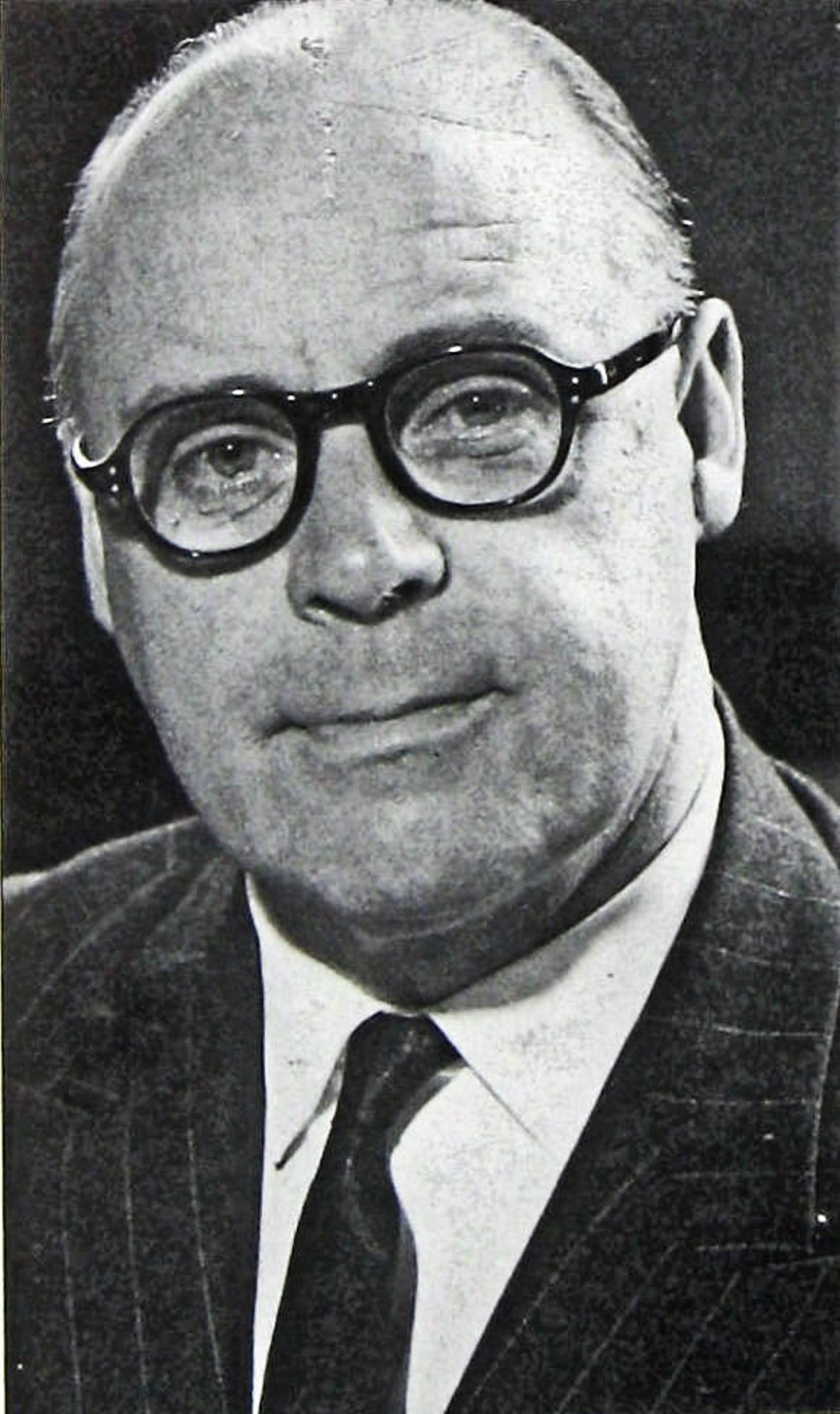
Len Hook c 2009 - thanks to Betty Hook

Len Hook c 2009 – thanks to Betty Hook

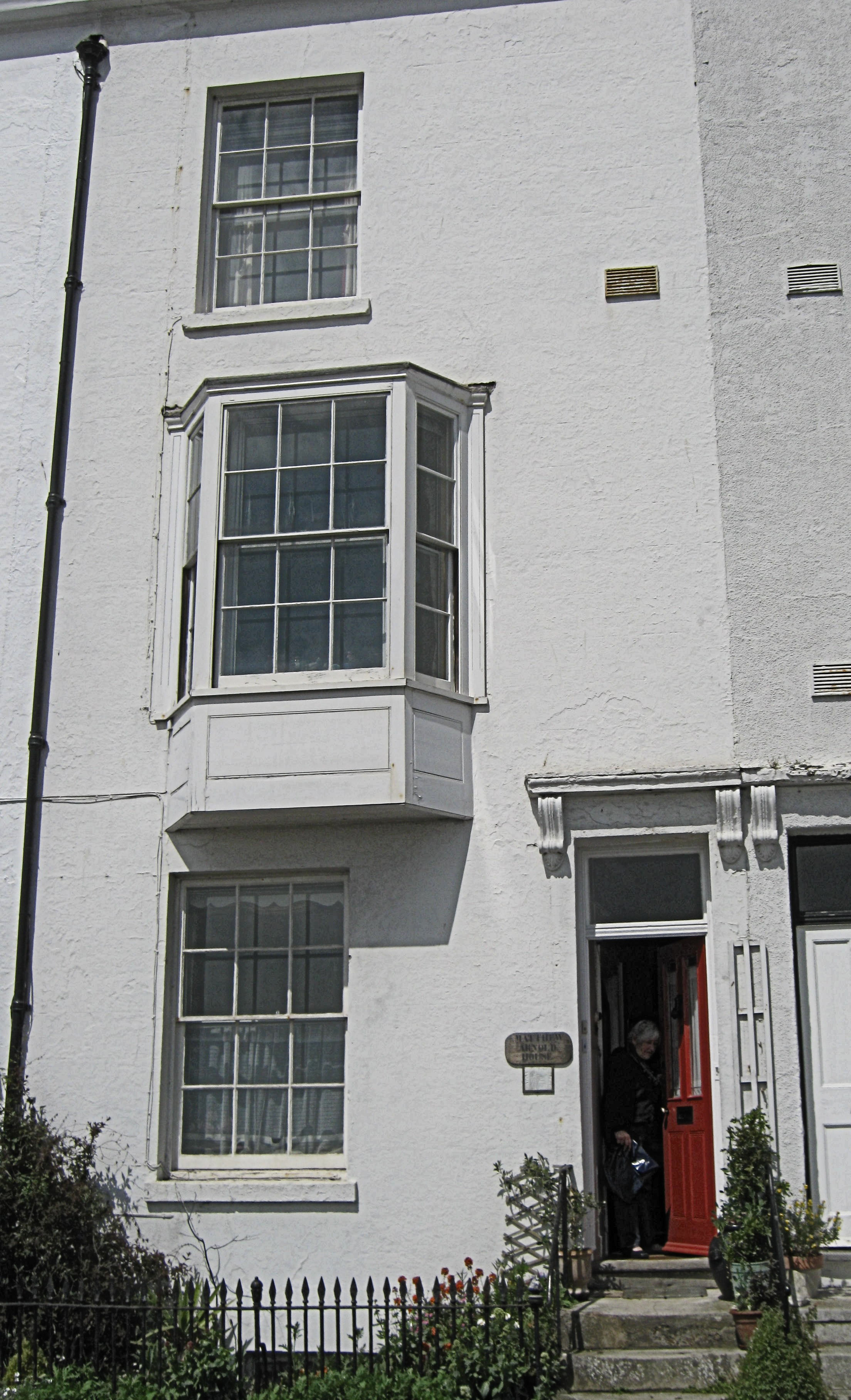
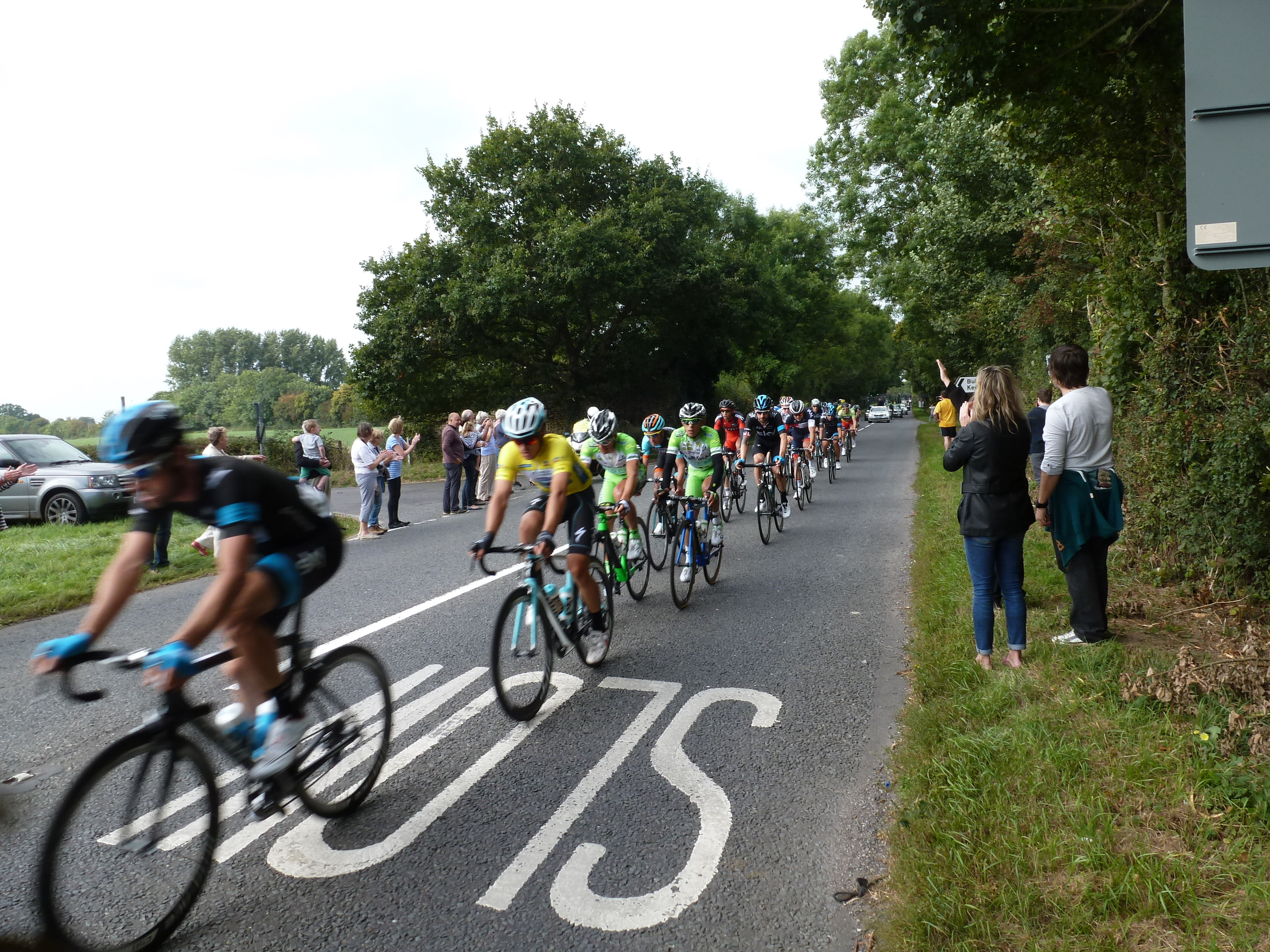
When Sir Bradley Wiggins, in 2012, became the first British rider to win the Tour de France, road cycle racing became a high profile sport. Since then Chris Froome has won the race three times! No doubt, following the forth-coming Olympics, the British cycling team that includes road cyclists, will come home with well-deserved medals. Yet road cycle racing was once outlawed by the cycle racing fraternity and one of the key pioneers, Len Hook, who lived in Athol Terrace, Dover!

Born in Hendon in 1921, at the age of 15 Len joined the Ealing Manor Cycling Club where he rode in countless time trials, hill climbs and track events. At the outbreak of World War II (1939-1945), due to an old eye injury, he was rejected by the RAF for navigation but accepted as an apprentice toolmaker. In this career he became highly proficient and was a renowned toolmaker-inventor.

At that time, the National Cyclist Union (NCU), founded in 1878, dominated British cycle racing and one of its rules was that only time trials could be held on roads. These had to start very early in the morning and competitors had to wear inconspicuous clothing,’ typically, all-over black jackets and tights. There were some specially constructed outdoor grass tracks but these tended to be located in large cites. For would be contenders who lived any distance away, this made it difficult to practice or compete.

Athol Terrace, Dover the home of the late Len Hook and his wife Betty. LS 2012

Athol Terrace, Dover the home of the late Len Hook and his wife Betty. LS 2012

Although, before the War, road cycle racing was taking place on the Continent, it was only in the races that had the same rules as the NCU could British riders compete. Further, the NCU selected those from Britain who could take part and many aspiring racing cyclists, including servicemen and those in reserved occupations, were refused. In 1942, Percy Stallard (1909-2001) decided that as British wartime roads were hardly used by traffic due to petrol rationing, they would be ideal for cycle racing. On 7 June that year, he organised, with the backing of the Chief Constables of Denbighshire, Shropshire, Staffordshire and Wolverhampton, a road race between Llangollen and Wolverhampton. The only obligation on competitors was that they were advised ‘to carry their identity cards!’

Len took part and the race was a great success. However, the NCU loudly made their anger felt and banned any more such races. This did not go down well, and on 14 November 1942, twelve brave men, led by Percy Stallard and including Len Hook, formed the British League of Racing Cyclists (BLRC). Their remit was to promote mass start road cycle racing, as we know it today. The immediate reaction of the NCU was to expel and blacklist all of  them from cycle racing. Over the next few years, the twelve and anyone who dared to join the BLRC, or take part in any of their races, received the same treatment. They were also subjected to abuse and marginalised by the cycle racing fraternity and some national newspapers.

Albeit, in 1943 BLRC promoted the first British national road race. The following year they introduced the Southern Grand Prix, held in Kent. This was a three-day staged race around Tonbridge and was backed by the Government’s Ministry of Information. At the time, the German propaganda machine were broadcasting that the people of Southern England ‘were cowering in their shelters.’ The race was seen as a way of dispelling such myths.

Len was one of the main organisers of the race and also took part, coming second on a borrowed shopping bike! He had actually started out on his own bike but a group from the NCU threw tintacks onto the road puncturing Len’s tyres. This was typical of the tactics employed by the NCU at that time. Albeit, the event was a great success and proceeds went to the Red Cross. The race also received national publicity from Picture Post (1938-1957) and other newspapers that had previously ostracised the BLCR followed suit!

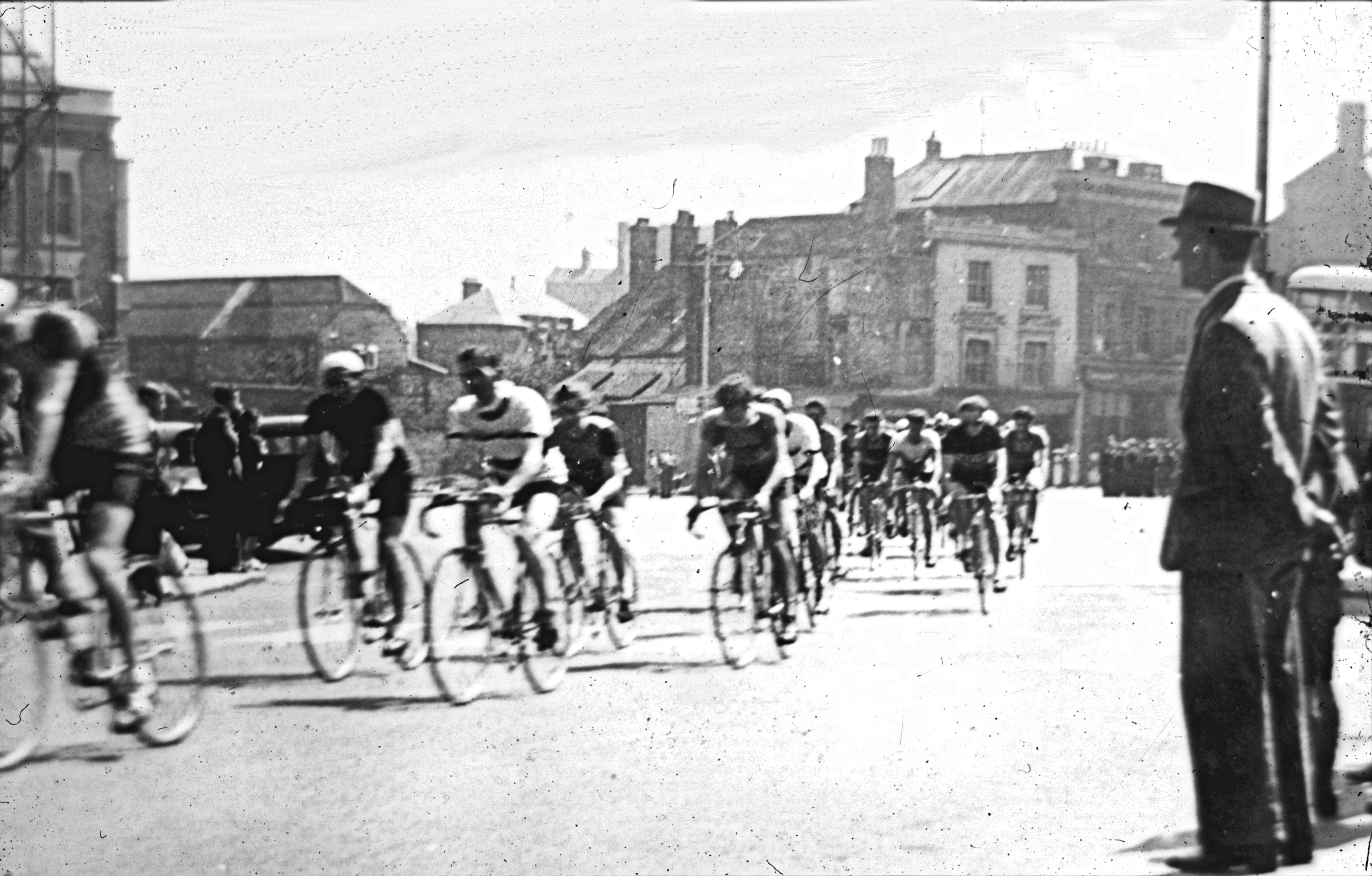
Market Square 1946 - the Dover - Canterbury stage of a BLRC race. Budge Adams Collection Dover Museum

Market Square 1946 – the Dover – Canterbury stage of a BLRC race. Budge Adams Collection Dover Museum

In 1945, the BLRC promoted the Brighton to Glasgow Victory Cycle Marathon, a staged road race and precursor to the Tour of Britain. Again, it was a great success with many cyclists who were not members of the BLRC taking part. The police were out in force controlling traffic and onlookers to ensure as few mishaps as possible. So pleased were the BLRC with this level of co-operation that they delivered an illuminated address to Buckingham Palace during the race! Nonetheless, all the cyclists who took part were immediately expelled by the NCU.

Len won one of the stages but during the third day, he crashed and landed in a gutter. The driver of one of the cyclist-following-car-official stopped to give assistance. She was Betty Durrant, a keen cyclist. They married in 1946 and were together for 64-years. They had three sons and a daughter with one of sons, Simon, becoming a professional cyclist winning many top classics.

Len Hook at the finish of the 1950 Peace Race, Prague. Thanks to Betty Hook

Len Hook at the finish of the 1950 Peace Race, Prague. Thanks to Betty Hook

Besides organising races in Britain, the BLRC also organised British representative teams to race in other countries including the world’s international amateur Peace Race from Warsaw to Prague via Berlin – or as it was known during the years of the Cold War (1947-1991) the ‘Tour de France of the East’. The race was originally set up to relieve tensions between Central European Countries following World War II and the logo was a white Dove representing peace. As professional cycling was forbidden in Communist countries, the race enabled top-flight cyclists from the Eastern Block to compete against guest teams from non-communist countries. In 1948, Britain sent six competitors one of whom was Len.

As the race progressed, due to the bad road surfaces, five of the British team retired and by the last stage, Len’s shoes were badly worn and he was suffering from a poisoned foot. Nonetheless, against all odds and in 48th position, he finished! As Len crossed the finishing line, the spectators in the crowded stadium erupted! They stood up, cheering and applauding and Len was encouraged by the officials to do a lap honour. This he did carrying the Union Jack, as can be seen in the photograph above, and the crowd cheered even louder! Len was then asked to give a speech, which he did through his translator.

Besides NCU and bad road surfaces the BLRC organiser’s faced another problem in the UK – the weather. In September 1950, the gales that hit Britain were severe with an average wind speed of 50 miles per hours. Cyclists taking part in the BLRC national hill climb championship held at Winnatt’s Gorge, Castle Town, Derbyshire were blown off their machines as many as six times! The winner was Tony Murray, who managed only to be blown off once but of the 28 starters, only 18 finished the race.

Nonetheless, BLRC carried on and having successfully organised the annual multi-staged Victory Road race from Brighton to Glasgow for six years, in 1951, they changed the race name to the Tour of Britain! This was a 1,400-mile cycle race from Brighton to Glasgow, which was won by (John) Ian Steel and the following year he again won.

Although the Communist-bloc riders tended to dominate the international Peace Race, Britain continued to send competitors, under the management of Len. In 1952, Ian Steel was the first Briton to win the Peace Race and the first to win any major international road cycle event. The BLRC team also won the team prize making this the first time that one nation won both. With the fall of the Eastern Bloc, the name of the Peace Race lost its significance but in 2012, Alan Buttler organised a re-run of the 1955 race as a tribute to his late father, Alf, who was the chief mechanic of the British cycling team.

Simon Hook, international cyclist with son. Killed while riding his bicycle on his way home from work in 1995. Thanks to Betty Hook

Simon Hook, international cyclist with son. Killed while riding his bicycle on his way home from work in 1995. Thanks to Betty Hook

Over the following years, Len became heavily involved in international cycling politics as well as the manager of the BLRC team taking part in major races on the Continent. In 1957, in the latter capacity, he took a team to the Moscow World Youth Games. At the same time he was waging an ongoing battle on behalf of the vulnerable cyclists on British roads. He particularly emphasised that in France, drivers gave cyclists a wide berth, but not so in the UK. Tragically, Simon, Len’s son, was killed in Folkestone in November 1995, on his way home from work while riding his bike. Simon, an international racing cyclist, he is remembered at France’s national cycling chapel – Notre Dame des Cyclists, Bastde d’Armagnac, South West France.

As the 1950s decade progressed and possibly, due to the influence of the NCU, the British police were not quite as favourable towards road race cycling as they had previously been. In May 1954, Wingham Magistrates Court fined £5 the international road racing cyclist from Cambridge, Fred Krebs (1931-1995). He was one of 70 riders taking part in the BLRC Dover to London Road race and, Krebs, along with other cyclists had reached 48 miles-an-hour on the A2 Dover-Canterbury road! The police considered this dangerous and Krebs was found guilt of ‘riding to the common danger of passengers!’ Major Sir John Ferguson (1891-1975) the Chief Constable of Kent, at the time, was most perturbed by the conduct of the cyclists and warned that the annual race would cease – and it did.

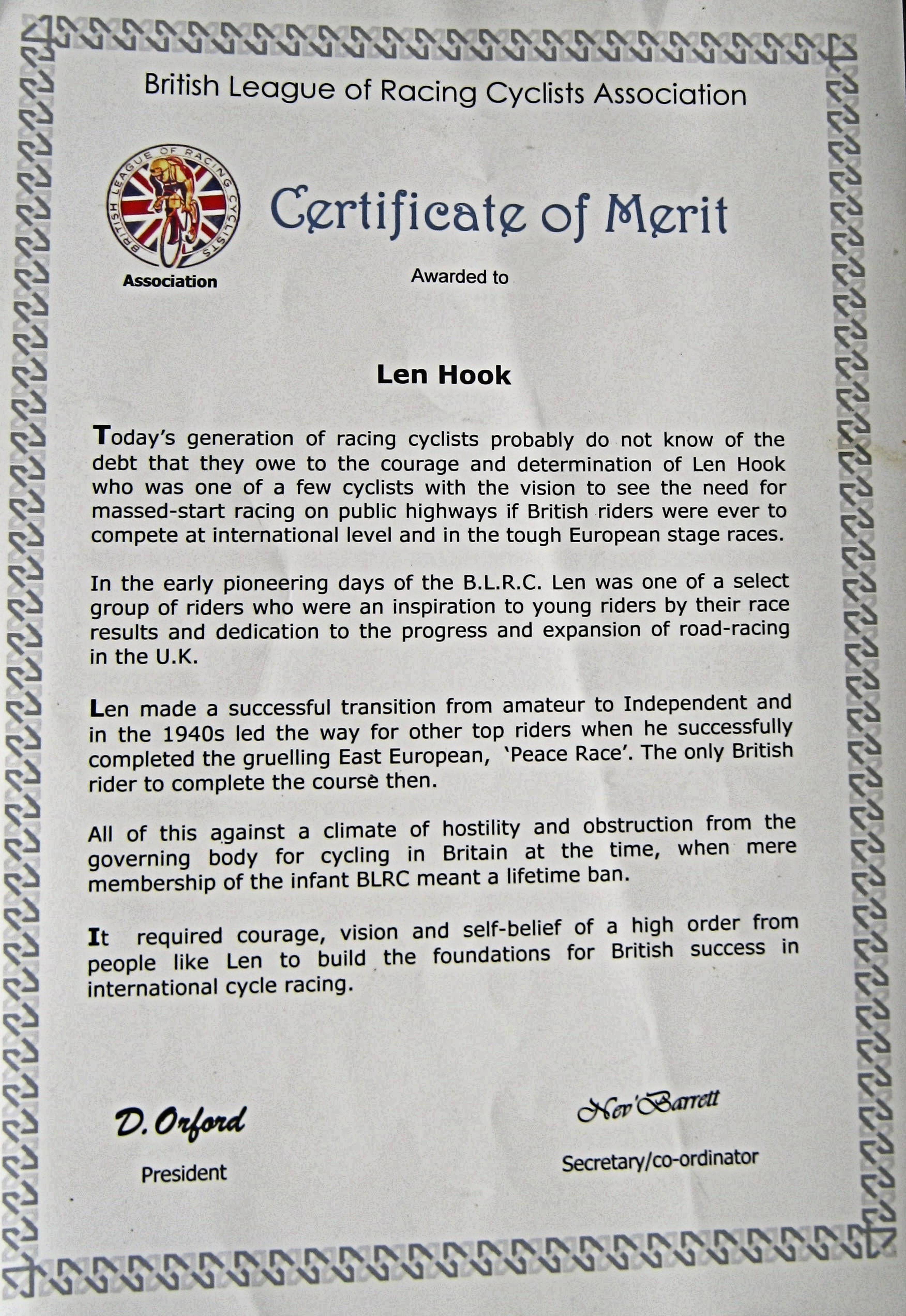
British League of Racing Cyclists Association Certificate of Merit awarded to Len Hook. Thanks to Betty Hook

British League of Racing Cyclists Association Certificate of Merit awarded to Len Hook. Thanks to Betty Hook

Later in 1954, stringent legislation was introduced by the British Government to control road cycle racing. Although they recognised that there had not been a serious accident or major road congestion, they feared that there was likelihood if restrictive legislation was not imposed. The number of events each year was limited to one circuit such as the Tour of Britain and an agreed number of local races the maximum number of which was to be verified by the Home Office and the Department of Transport.

Races were to begin and end before 09.00hrs, should not be less than fifteen miles long and avoid all major roads and right hand turns. The following year, 1955, five Russian cyclists at the invitation of Len, on behalf of the BLRC, competed against British riders in the Tour of Britain. For this and all his work from the outset of the BLRC, Len was awarded the Certificate of Merit. Betty Hook, his widow, is rightly enormously proud of the accolade.

After some sixteen years of bickering over the control of road cycle racing, in October 1958, by fifty-eight votes to seven, the BLRC agreed to merge with NCU and form the British Cycling Federation (BCF). The merger came into force on 1 January 1959 with the BCF becoming the ruling body for all British cycle sport, including massed start road racing. The new federation was formed as a limited liability company limited by guarantee.

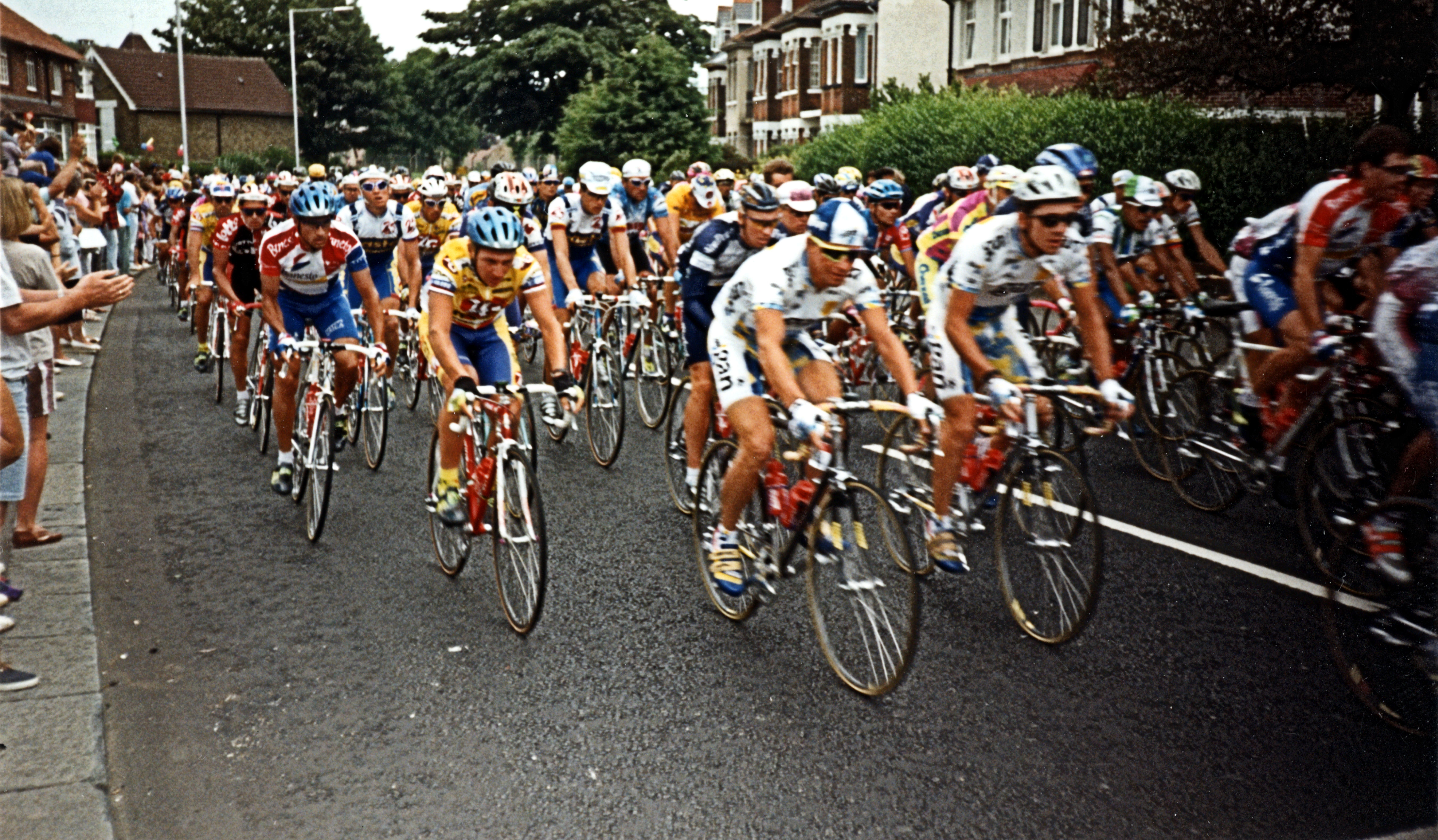
Tour de France race going along Folkestone Road 1994. Dover Museum

Tour de France race going along Folkestone Road 1994. Dover Museum

The Milk Marketing Board sponsored the Tour of Britain in 1958, which was won by Richard Durlacher of Austria. The following year and as a result of the amalgamation, the event was renamed the Milk Race after the main sponsor. Bill Bradley (1933-1997) of Britain, who also won the following year, won this. For the next 35-years, the Milk Race was an annual event but following the Agricultural Act of 1993, the Milk Marketing Board ceased to exist.

Professional Tour of Britain road cycle races were organised by Kellogg’s from 1987 to 1994. In the latter year, the race the kent stage started in Dover and people turned out in their thousands to watch cyclists flash by. Prudential sponsored professional Tour of Britain races in 1998 and 1999. In 2004, the Tour of Britain was reintroduced as a 5-stage race increasing to 8 stages in 2008. It is now part of the Union Cyclist International European Circuit. In 2012, it was won by Britain’s Jonathan Tiernan-Locke, 2013 by Sir Bradley Wiggins and in 2014 Dylan van Baarle.

Tour of Britain cycle race. LS 12 September 2014

Tour of Britain cycle race. LS 12 September 2014

Len continued to be a key figure in the road cycle racing world and was riding his bike until two weeks before he died on 12 March 2010 aged 89-years at his home in Athol Terrace. It is thanks to pioneers such a Dovorian, Len Hook that road cycle racing is now a top class sport in which Britain excels.

  • First Presented:
  • 05 September 2014


Posted in East Cliff and Athol Terrace, Hook Len - Pioneer of Road Cycle Racing, Hook Len - Pioneer of Road Cycle Racing, Hook Len - Pioneer of Road Cycle Racing, People, Sports | Comments Off on Len Hook – Pioneer of Road Cycle Racing

Gateway Flats

Dover Seafront - 1930s. Dover Library

Dover Seafront – 1930s. Dover Library

In July 1944, while World War II (1939-1945) was still raging and Dover was still earning the accolade ‘Hell Fire Corner’, Dover Corporation was discussing a master plan for when peace came. Although property damage, due to the constant assault, that was to continue,  town was devastated including Dover’s seafront, that comprised of the Esplanade, Waterloo Crescent and Marine Parade. The report only made a cursory reference to these once regal properties and those between the seafront and Townwall Street, such as Cambridge Road, New Bridge, Camden Crescent, Wellesley Road, Marine Place, Douro Place and the long Liverpool Street.

The reason was that the council had taken for granted that the land on which these properties stood belonged to Dover Harbour Board (DHB) and therefore, their responsibility. It is written in the Dover Harbour Charter of 1606, that all reclaimed land belonged to DHB. This is land east of the Boundary Groin (opposite the Swimming Pool) to Shakespeare Beach in the west. Seafront land from the Boundary Groin east and including East Cliff and Athol Terrace, came under the council’s jurisdiction. At that time, the Eastern Dockyard, along with the rest of the harbour, was under the control of the Admiralty. Thus, the report mentioned the loss of an open sea view due to the Admiralty harbour and the Sea Front railway (which eventually ceased at the end of 1964) and the property damage at East Cliff but little more.

James A Johnson Dover Town Clerk 1944-1968

James A Johnson Dover Town Clerk 1944-1968

In December  1944, the council appointed a new Town Clerk, James Alexander Johnson – known as James A – a brusque Yorkshire tyke with an astute legal brain. He was of the opinion that the laws appertaining to reclaimed land were obsolete. He argued that Dover Borough Council boundary had been redrawn several times since then and all the property occupying reclaimed land sites paid rates to the council including those to the east, such as East Cliff, which the DHB did not ‘claim’ to be theirs. Further, land surrounding Eastern Dockyard, at that time under the jurisdiction the Admiralty that too, when peace returned would be returned to the rightful owners, the Dover Borough Council. Thus, when DHB announced that they were going to repair the war-torn property on what they believed to be their land, Mr Johnson advised the council to refuse permission!

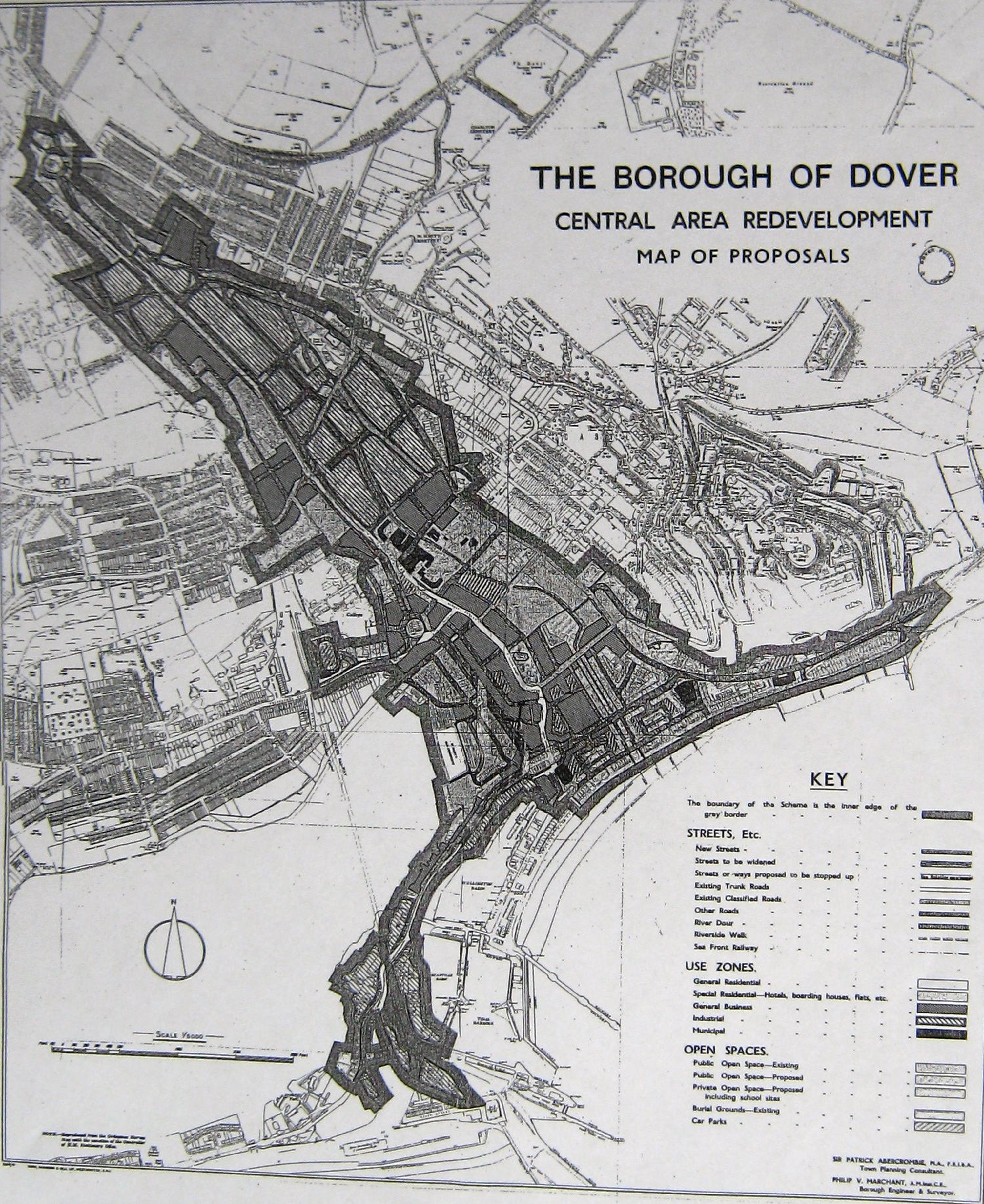
When peace eventually returned, the council sort the help of Town Planner, Professor Patrick Abercrombie (1879-1957), to encapsulated their plans. His report was published in January 1946 and land formerly claimed by DHB  was included. This, according to the Professor’s report, represented ‘the front door’ to the town and it was envisaged that the existing properties that had suffered war damage would be demolished and replaced by marine gardens. Behind, would be a wide access road to the Eastern Dockyard that would become one of the town’s industrial zones.

Abercrombie Plan - Planned redevelopment following World War II c 1947. Dover Library

Abercrombie Plan – Planned redevelopment following World War II c 1947. Dover Library

The Professor’s Plan went before the Council in February 1947, who having made some modifications and then asked the Government for a Declaration Order. This covered 252 acres of land extending from Buckland Bridge to the Seafront. At the subsequent Public Inquiry the proposals were well argued by James A., who finished by asking for immediate Compulsory Purchase Orders on Seafront properties as well as properties in other parts of the town.

At the Public Inquiry the DHB team did put a forceful argument to repair the properties on land that they claimed to be theirs. However,  James A tore the arguments apart and he finished by saying that the rebuilding of the properties was ‘inconsistent with the council’s planning proposals…’ and could not … ‘be regarded as even remotely connected with the statutory functions of Dover Harbour Board.’ Finally, he argued, if DHB could legally show that they had full legal rights of the land on which the properties stood, their plans would be costly to implement. DHB had estimated cost for refurbishment was £38,000 but the Inspector agreed with James A. DHB appealed but this was dismissed.

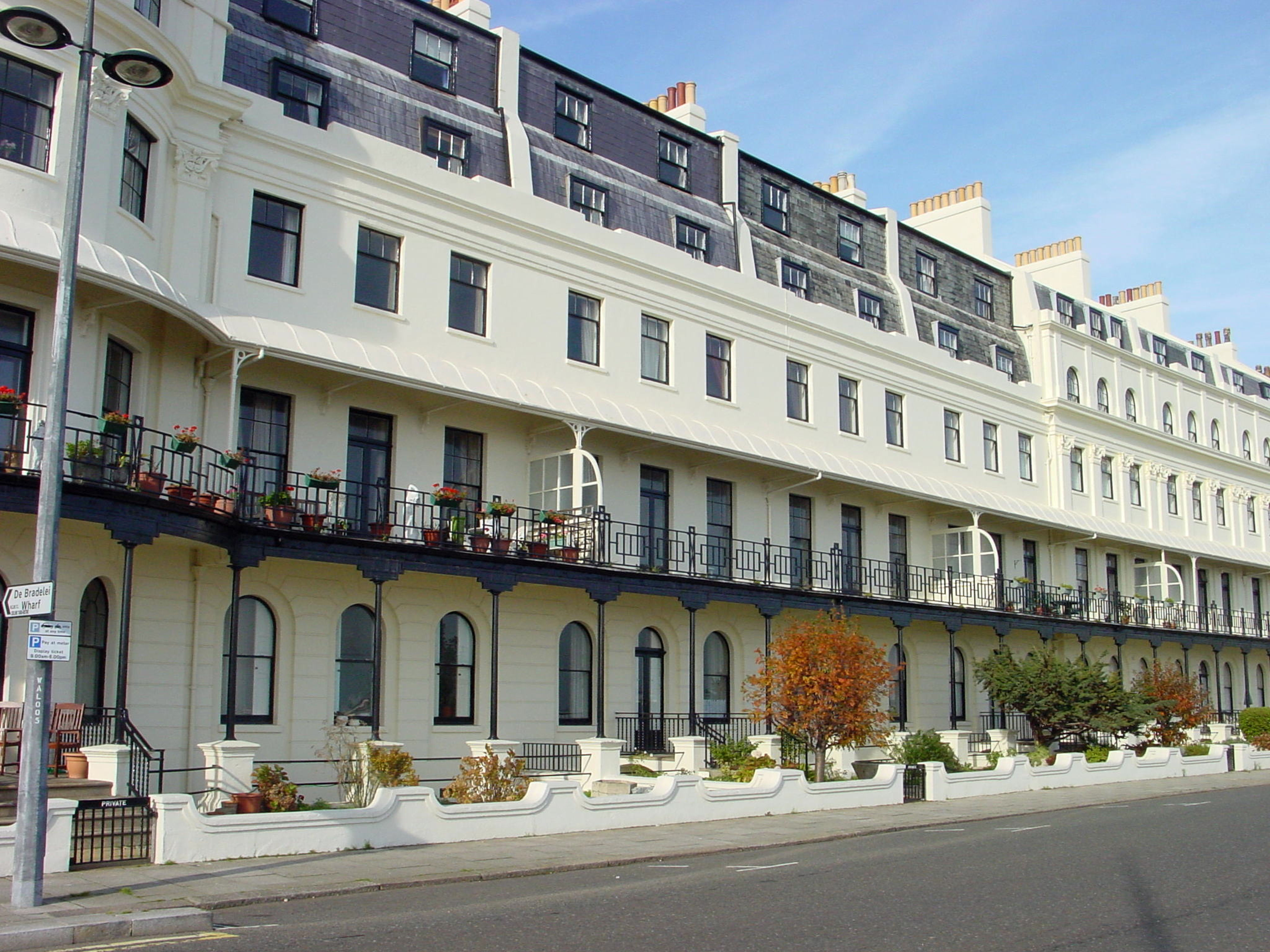
Waterloo Crescent central block. Alan Sencicle 2009

Waterloo Crescent central block. Alan Sencicle 2009

The council then consulted the eminent Structural Engineer influential in the development and use of reinforced concrete, Dr Oscar Faber (1886-1956). He agreed with the council and Professor Abercrombie saying that, ‘all existing buildings along Dover’s seafront are examples of early 19th century ‘jerry building’, and as such unsound and unsafe so should be demolished and the sites be put to more economic use.’ His report did however, say that Waterloo Crescent should be retained!

With this in mind, the council decided to balance the eastern and central block of Waterloo Crescent with a ‘New York style‘ apartment block of 450 flats. The block would be set approximately 180-feet (244 meters) back from the sea wall and incorporate an access road at the rear. The intervening area between the flats and the seafront road was to be laid out in lawns and gardens, ‘to provide a much-required amenity.’

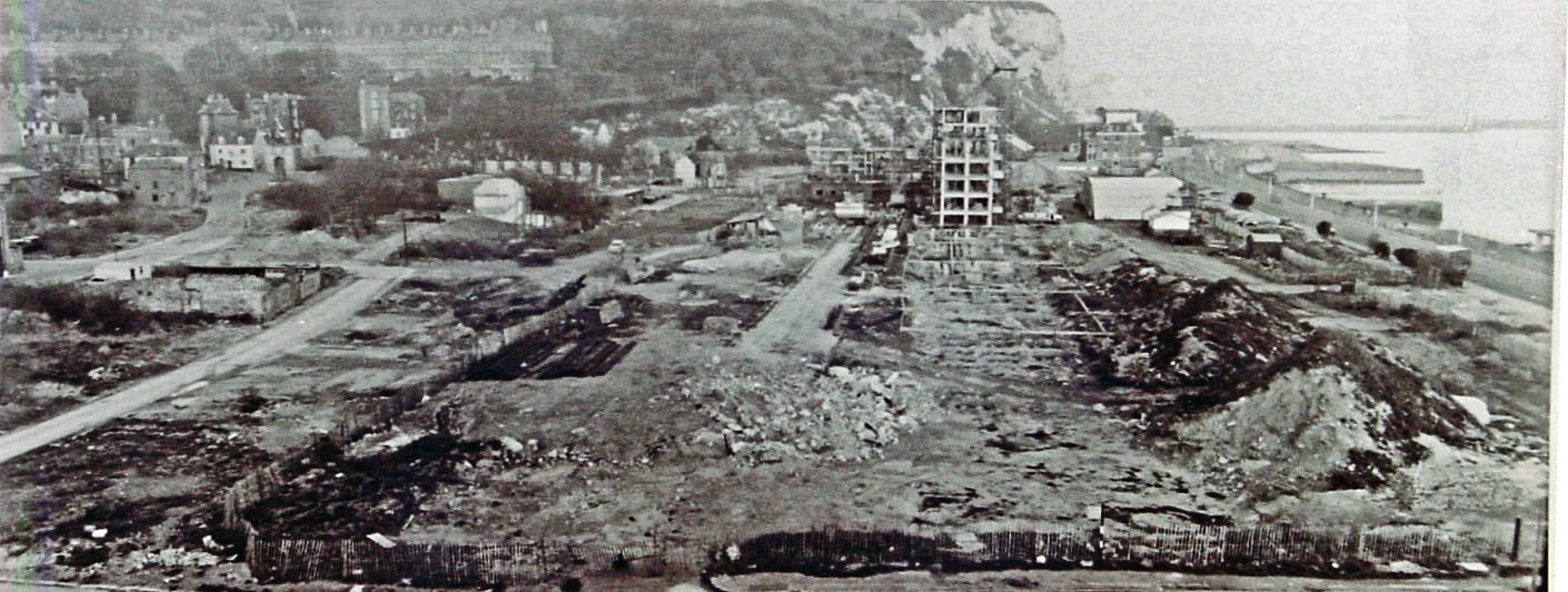
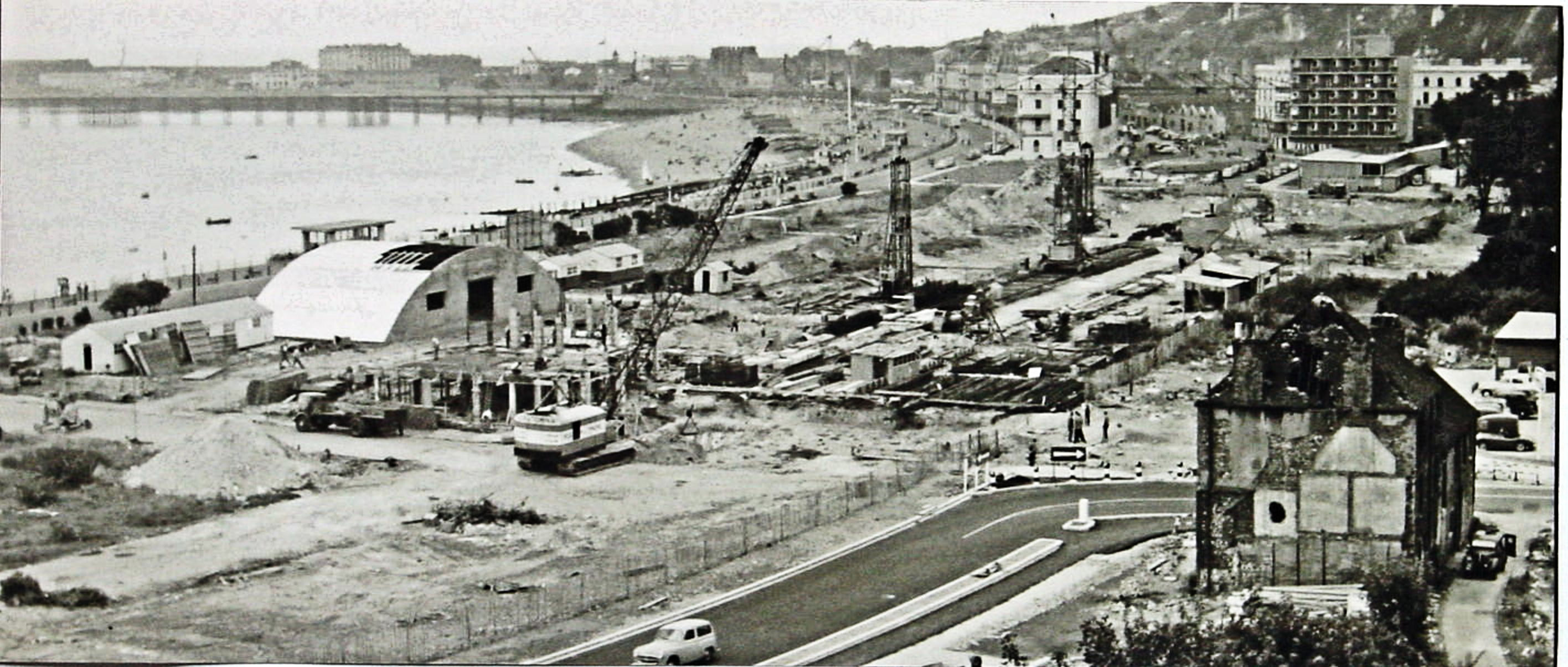
Dover seafront after the demolition of property and the ground prepared for what became the Gateway Flats. Courtesy of David G Atwood.

Dover seafront after the demolition of property and the ground prepared for what became the Gateway Flats. Courtesy of David G Atwood.

Against considerable opposition from DHB and their tenants who still occupied Seafront premises, the council applied for a Declaratory Order to compulsory purchase all the Seafront properties with the exception of the western and central block of Waterloo Crescent. A year later, the eastern block was saved following an appeal by the National Coal Board, who occupied offices there. Using the compulsory purchase orders, the council bought 71 properties and numerous vacant sites from DHB for £52,500. The council then accepted an offer of £4,700 for the right to demolish this property and for the contractor to keep the debris.

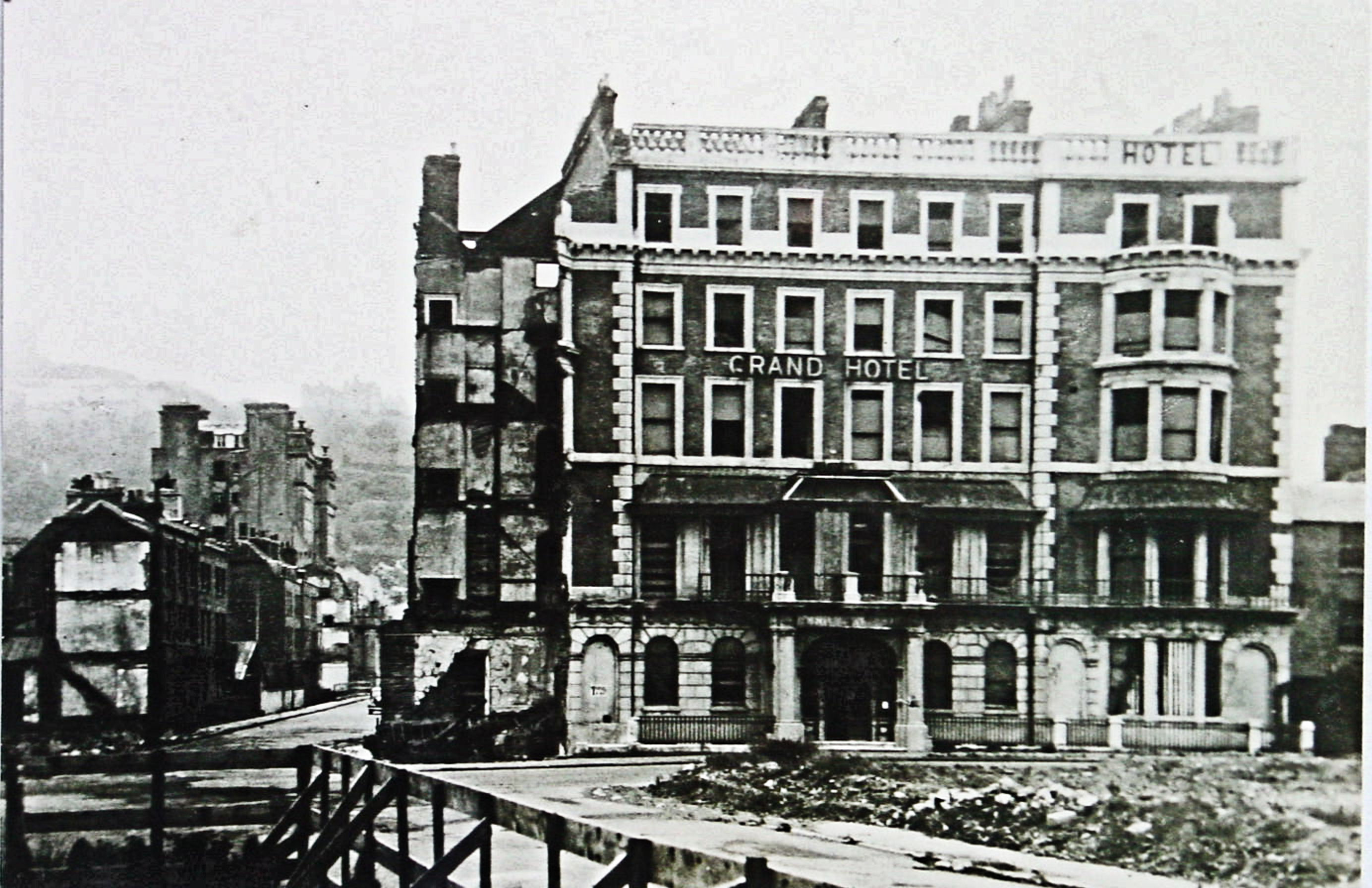
The war battered Grand Hotel before demolition. Courtesy of David G Atwood

The war battered Grand Hotel before demolition. Courtesy of David G Atwood

The financial proposal for the ‘New York style‘ flats went to the Ministry of Housing and Local Government in1949 and received favourable backing. By October 1951, the number of flats had been reduced to 300 in three blocks each of seven storeys with garages at the rear. The cost was estimated at £½m. The council bought the Grand Hotel for £4,300 and demolished that in the autumn of 1951.

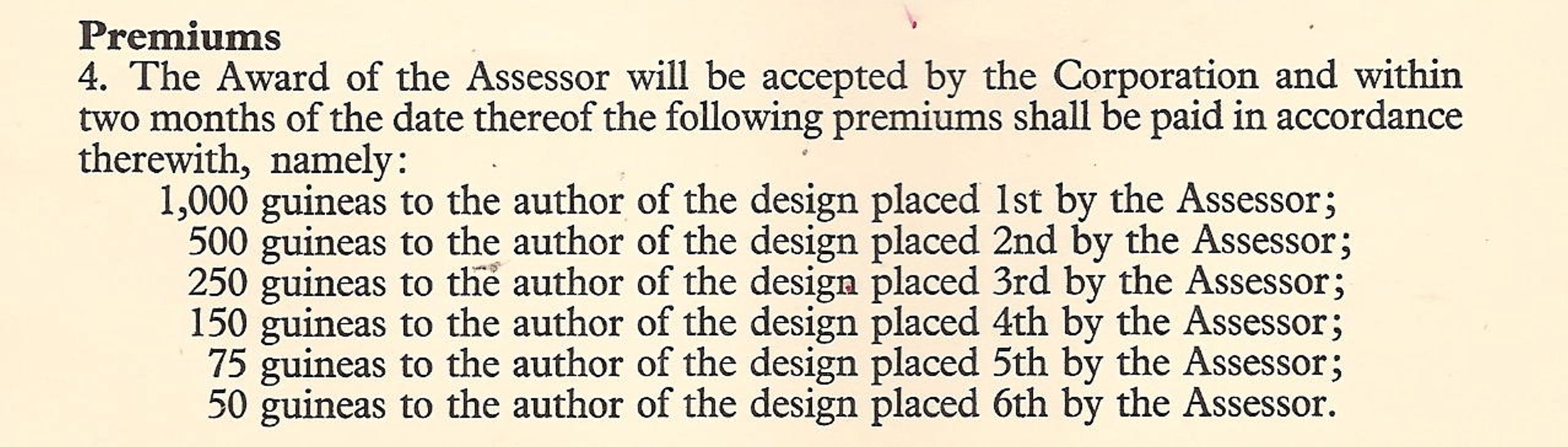
Gateway Flats - Competition Prizes

Gateway Flats – Competition Prizes

The following June approval was given for the flats but with the proviso that the design came out of a national architectural competition. The remit was for 300 flats in a continuous block of such great height that they gave living room and at least one bedroom of every flat a southeasterly orientation and a frontal view of the sea. The submitted designs were to be judged by architect Arthur W Kenyon (1885-1969) who specialised in Town Planning. There were to be six prizes with the rewards ranging between 1,000guineas (£1,050) to 50 guineas (£52.50p)

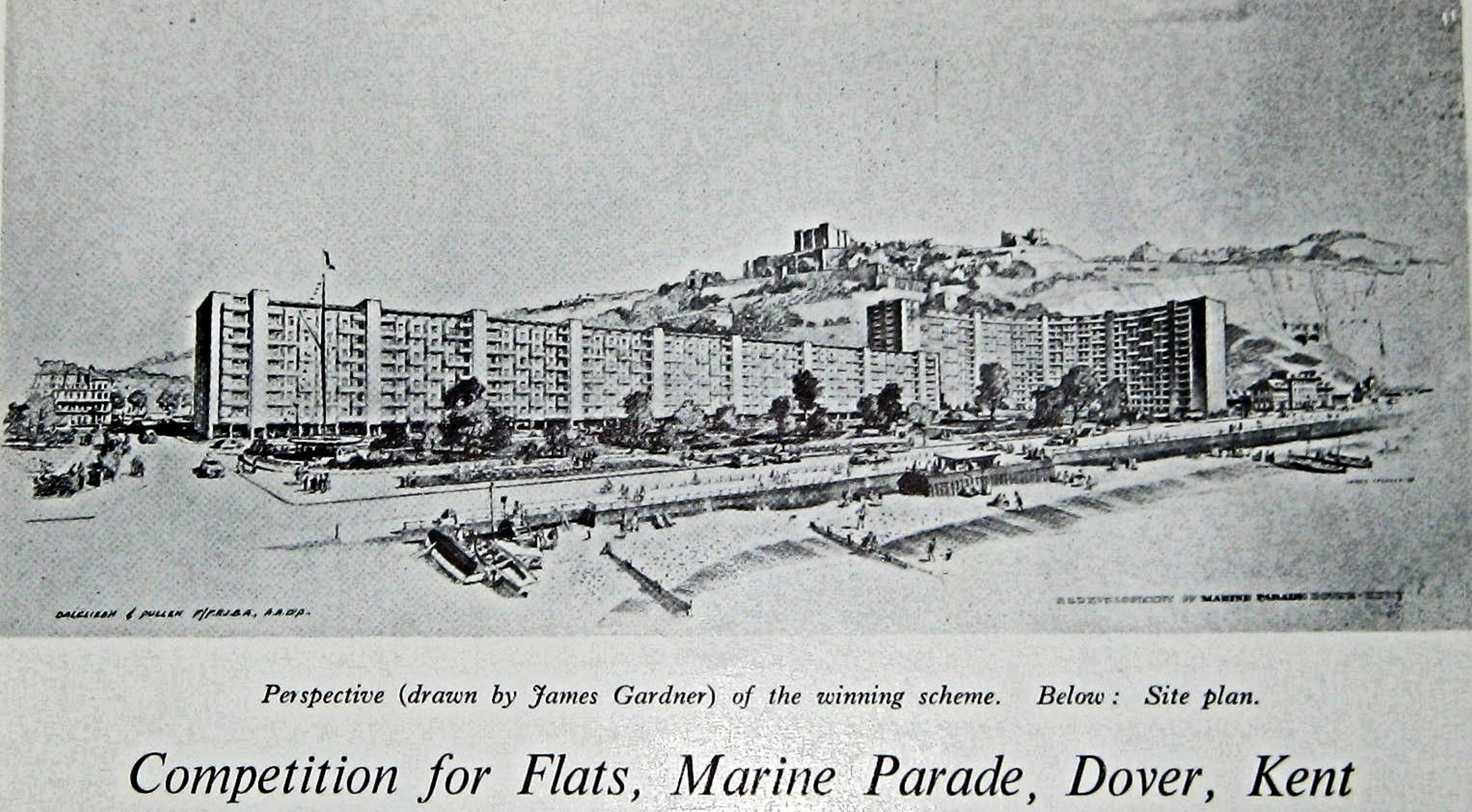
Gateway Flats - Winning design by Roger K Pullen and Kenneth Dalglish October 1953. Thanks to Richard Barwick

Gateway Flats – Winning design by Roger K Pullen and Kenneth Dalglish October 1953. Thanks to Richard Barwick

In September 1953 it was announced that Roger K Pullen and Kenneth Dalglish who had won and was to receive 100guineas (£105) with a design that provided for 301 flats. The difference in the prize money given and that promised, immediately called the competition into question. The council replied that the remainer of the prize money would be offset against the final fees paid to the architects. The other prizes were scaled down accordingly and eventually thoose architects accepted the reduced prize money.

The proposal was for a long narrow nine-story block of flats, with staircase towers at intervals and projecting lift shafts on the roofline. Running parallel to Marine Parade the apartments consisted of a curved 15-storey block at the eastern end and the cost was estimated at £773,573. The Royal Fine Arts Commission (RFAC) disapproved of the plan saying that the design had three clear defects. They were:

i. The flats created a barrier, which would cut Dover town off from the seafront.

ii. The height of the flats would not only dwarf its surrounding area but would throw out of balance the view of Dover from the sea, which included the harbour, cliffs and Castle. Further, the Castle especially would suffer severely from so overpowering neighbour.

iii. The architecture showed a lack of sensitivity in the handling of mass and detail worthy of so fine situation.

Kent County Council (KCC), whose approval was required in those days, agreed with the Commission and the scheme was rejected. In June 1954, after a number of debates in which the RFAC and KCC were severely criticised for not providing an alternative suitable scheme, Pullen‘s design was amended. The proposal was for 12-storeys, in a gentle curve with a ‘leg’ at the western end overlooking Granville Gardens. The lift shafts were eliminated and replaced by Pent-houses that were accessed by stairs. The number of flats was reduced to 283.

This new proposed design was given approval by architects Arthur Kenyon and Geoffrey Jellicoe, (1900-1996). Jellicoe was later knighted for his work on landscape gardening but at the time he was the consultant architect to KCC. However, KCC did not entirely agree with the eminent architects but eventually gave tacit approval as long as the number of storeys was reduced to nine.

The prepared ground for what became the Gateway Flats.  Courtesy of David G Atwood.

The prepared ground for what became the Gateway Flats. Courtesy of David G Atwood.

Dover council submitted an amended design to the Minister of Housing for a loan. This showed a curved block of 10-storey flats with garages on the ground floor and a 7-storey block parallel to Marine Parade and Granville gardens. In December 1954, the government sanctioned the loan if the height was reduced by two storeys throughout, giving 223 flats. The estimated cost had risen to £870,000 but the lack of money and shortage of building materials resulted in the Seafront remaining derelict.

Nevertheless, the idea of the flats did not go away and the council reconsidered the plans in March 1956. However, at the meeting, Mayor Sydney Kingsland (Conservative) warned that if flats went ahead, the annual cost could exceed a shilling (5p) on everyones rates. Therefore, an alternative proposal of creating a grassed open space to tie in with Granville Gardens was agreed. Then, during the summer the government granted £600,000 towards the flats and the new Conservative Mayor, John (Jack) Williams, voted with the opposition for the development to go ahead. The plans were submitted to KCC who gave approval in August 1956.

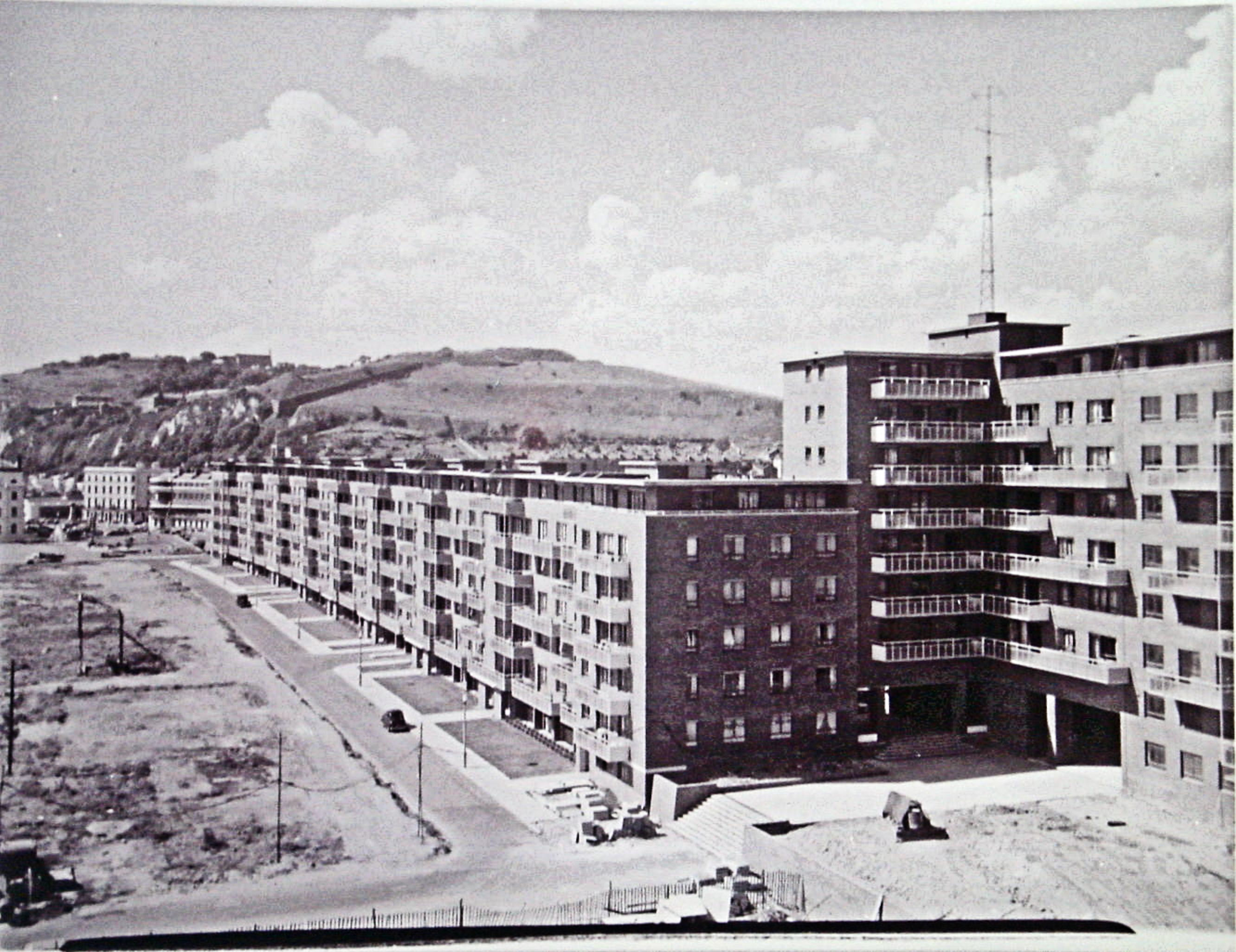
1957 building has begun. Courtesy of David G Atwood.

1957 building has begun. Courtesy of David G Atwood.

Tenders were invited and after a three-hour debate the council accepted the offer of £1,044,613 from Rush and Tompkins of Sidcup, Kent, the lowest of 12 applicants. By this time, thirteen years had elapsed from when the notion of a large apartment block on the Seafront was first proposed. Albeit, the development was new and exciting and one of the many novelties of the scheme was the balconies. These were cast on-site, which enabled each flat to be completed in two and a half days. Within a year the first flat was completed.

Albeit, it was not all plain sailing for the council thereafter, one of their major problems was the residents of the property on which compulsory purchase orders had been served. Many of the residents refused to move so the council, used ‘heavy tactics’ to get them evicted. Typical of the ‘heavy tactics’ was recounted by the family of Mrs Gibbs, the 84-year-old owner of Marine Garage on Townwall Street. In 1959 the County Court heard that her property had been ‘utterly devastated’ by the council in order to acquire it by compulsory purchase. Of course, the council’s legal department denied this even though evidence was to the contrary.

Gateway Flats named and completed. Courtesy of David G Atwood.

Gateway Flats named and completed. Courtesy of David G Atwood.

In February 1958, the council, announced the winner of a competition to name their edifice. With more than fifty suggestions they chose to call the new flats ‘The Gateway’. Within a week of issuing application forms for tenancies, 153 had been returned completed. By the end of June 1958, the number of applications had exceeded the number of flats by 40 with approximately half of the applicants coming from outside of Dover. A council sub-committee was appointed and decided that 75 per cent of the smaller flats should be allocated to local residents or those working in Dover. In the case of larger flats although no percentage was fixed preference was given, all things being equal, to local people.

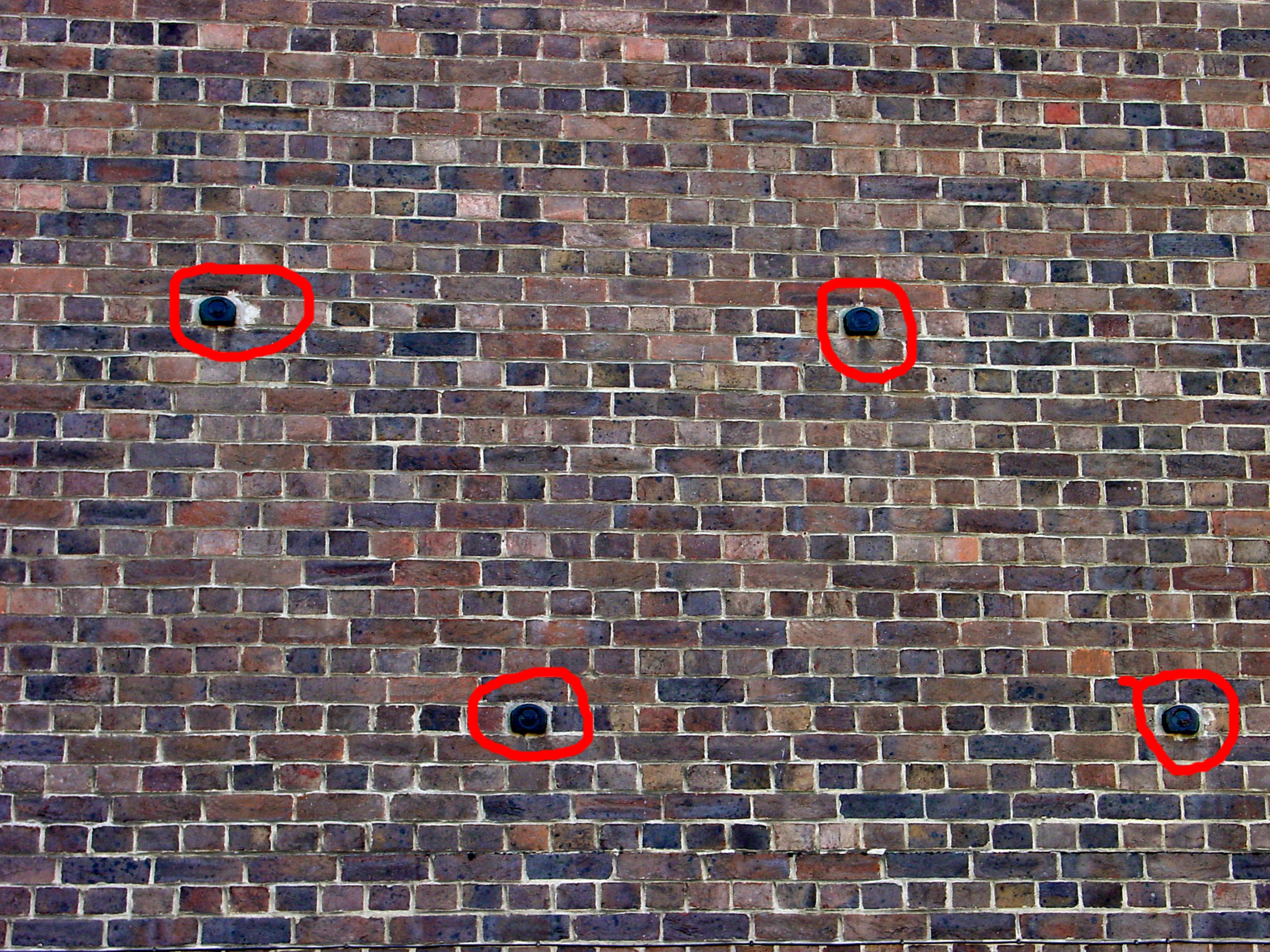
Lukey's Gin bottles used instead of tile,  adjacent to the Townwall Street entrance opposite Swimming Pool. Alan Sencicle 2009

Lukey’s Gin bottles used instead of tile, adjacent to the Townwall Street entrance opposite Swimming Pool. Alan Sencicle 2009

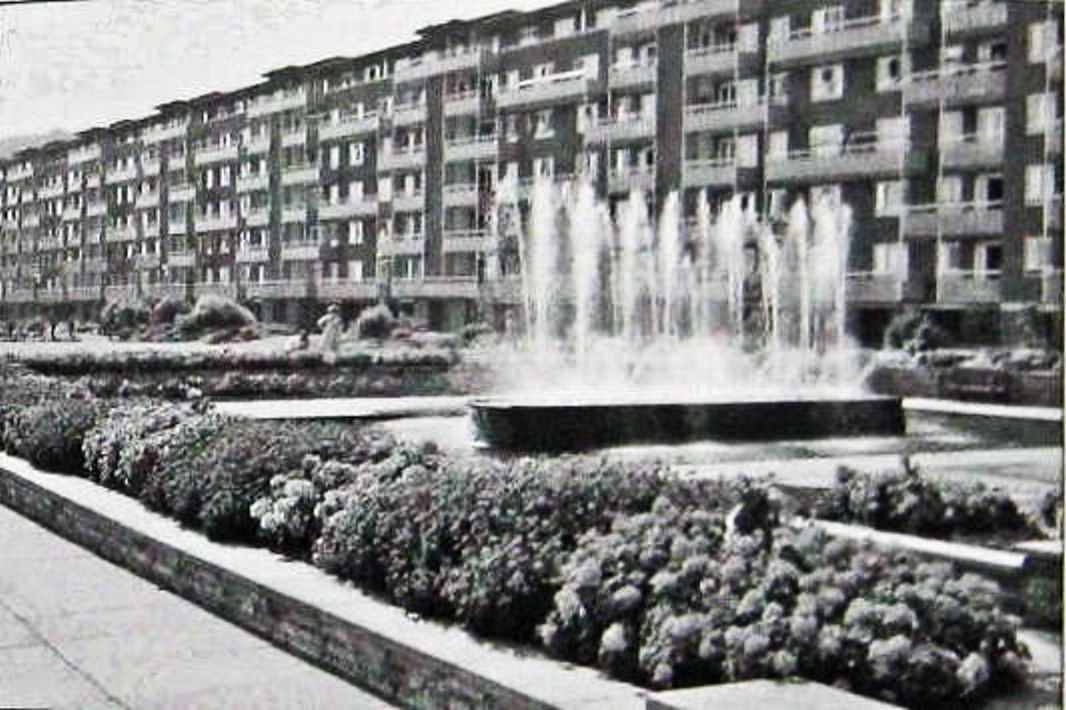
Besides the balconies, mentioned above, other ‘novel’ features of the Gateway included an ‘entrance’ from Townwall Street to the seafront gardens that was designed to ‘entice visitors’ – but no longer. The gardens, that at the time included a long low rockery, an illuminated fountain, and a pool with a footbridge spanning a cascading streams from the fountain. At the west end, facing Granville Gardens across Wellesley Road, was (and still is) a multi-coloured mosaic panel depicting the Channel coastlines. On the Townwall Street side, near to the entrance opposite the Swimming Baths, due to a shortage of matching green tiles dark green gin bottles, provided by Lukeys, were used instead – these can still be seen!

The Gateway, with 221 flats all with sea views, was eventually completed in October 1959 at a cost £1m. When ready for occupation, former Mayor, Cllr. Jack Williams, who had voted with the opposition for the proposal, was one of the first to move in! The last of the flats was handed over in January 1960. A Government subsidy of £10,416 was given and the contribution from the rates was £8,321 – 4pence on every property rated in the town.

Gateway flats and Gardensin the 1960s

Gateway flats and Gardensin the 1960s

The flats had hardly been occupied when a problem manifested itself. The council, in 1961, had banned caravans from public carparks due to the occupants, for the most part awaiting ferries or returning from the Continent, doing their laundry, ablutions etc. Caravanners looking for somewhere else to park on the way to Eastern Docks, found the Seafront and the gardens in front of the Gateway.

There they camped utilising the gardens for recreational purposes and hanging out washing. The drains were used for dumping the contents of chemical toilets and the litterbins for household rubbish. Within a couple of years, tourists found the seafront an ideal place to spend their holidays and when ferries started to take lorries, lorry drivers showed a tendency to park there for a night or two. The problem was, and still is, quickly dealt with by the authorities.

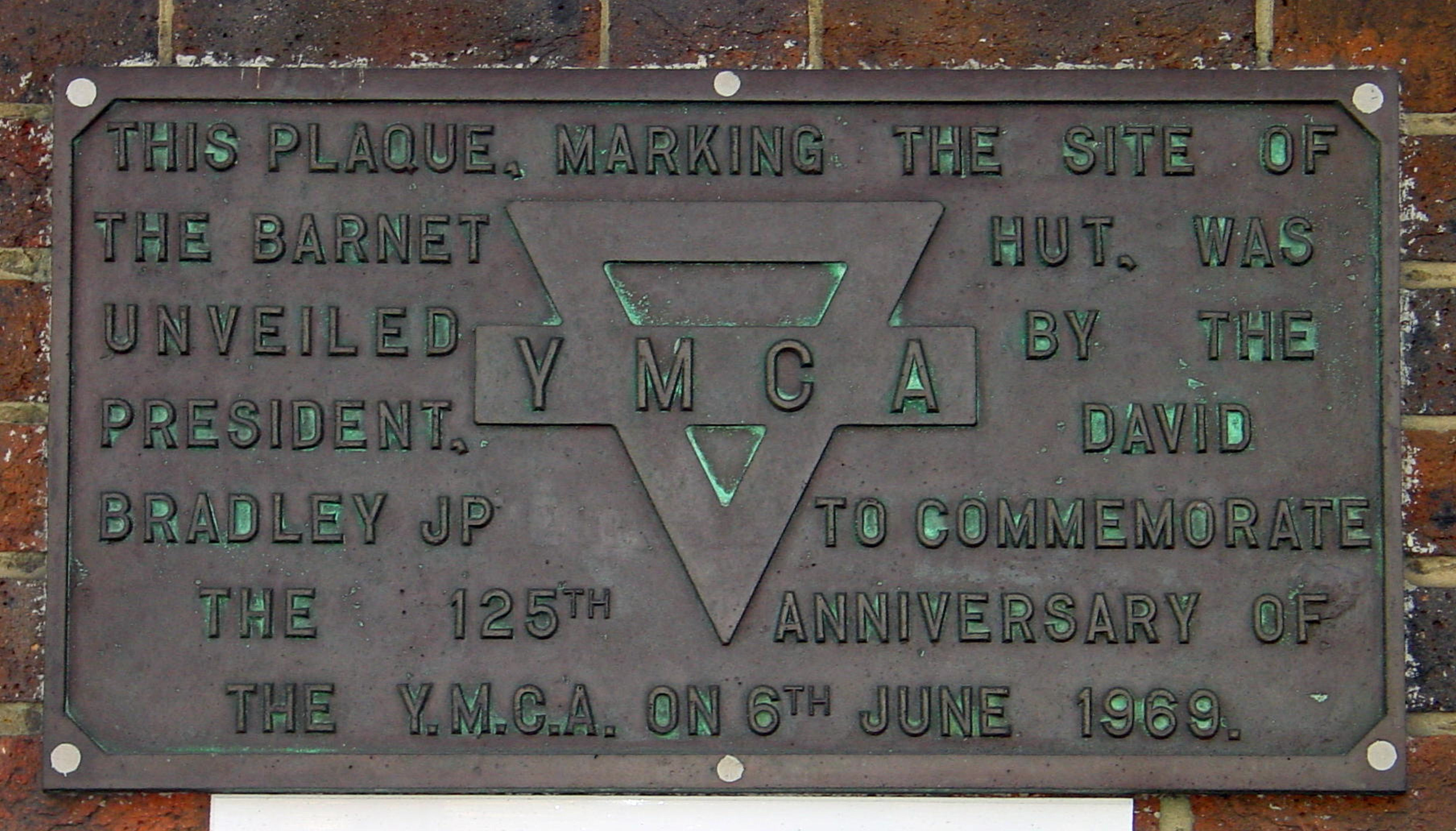
YMCA 125th anniversay plaque former site of the Barnet Hut, Gateway garages Townwall Street 6 June 1969

YMCA 125th anniversay plaque former site of the Barnet Hut, Gateway garages Townwall Street 6 June 1969

Before World War II the YMCA Barnet Hut occupied the site on which the garages of the Gateway Flats were built. The Hut succumbed to severe shelling on Sunday 20 October 1940 and never opened again. 6 June 1969 saw the 125th Anniversary of the YMCA and a plaque was unveiled on the site of the Barnet Hut and can still be seen.

Originally, the flats were owned by Dover Corporation and let to residents but following the 1974 Local Government reorganisation, they became the property of Dover District Council (DDC). With the introduction of the 1980 Housing Act – Right to Buy, some residents bought their flats at a discount rate reflecting the rents that they had already paid.

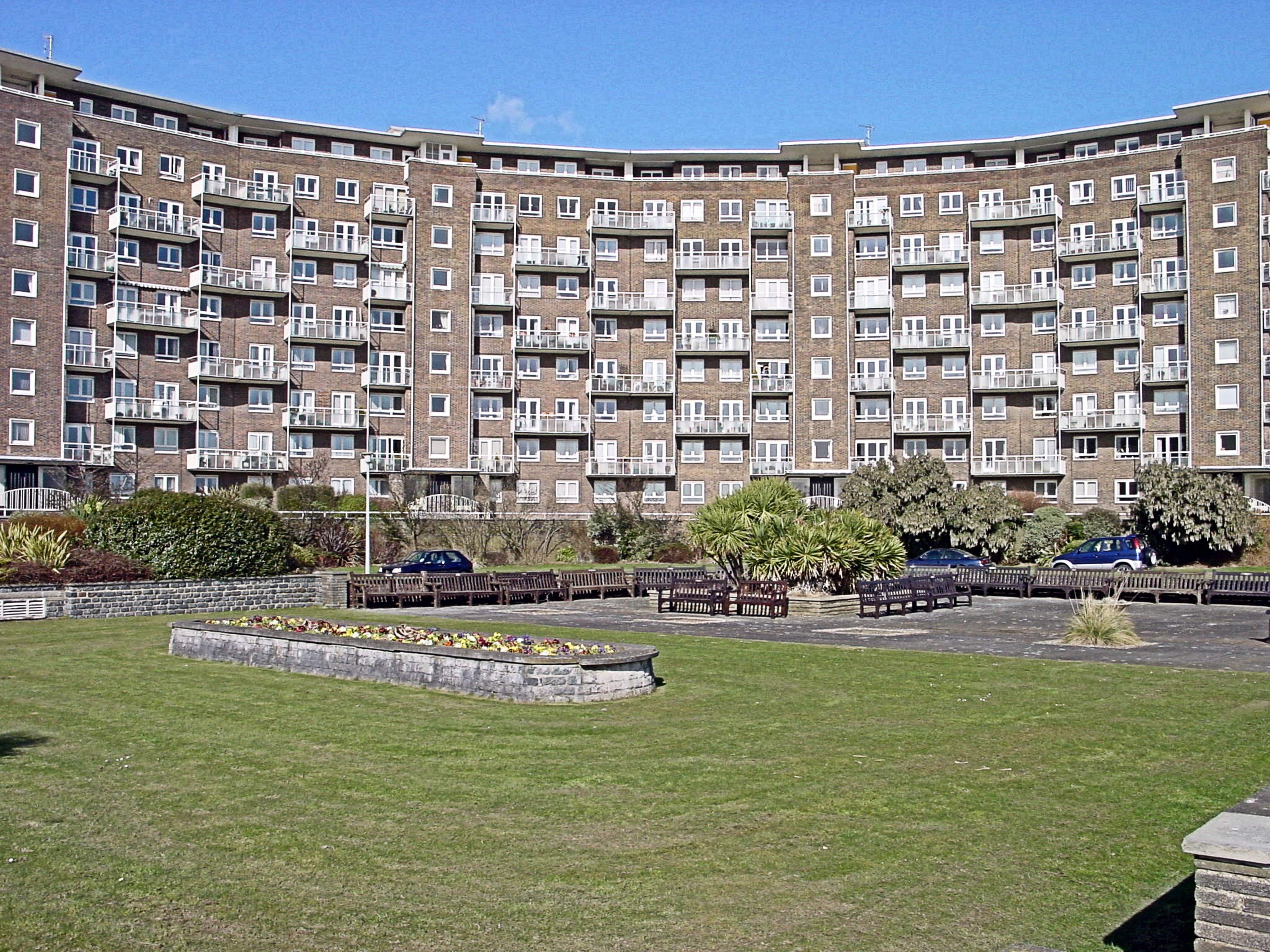
The east wing of the Gateway Flats today. Alan Sencicle 2009

The east wing of the Gateway Flats today. Alan Sencicle 2009

By May 1987, the number of flats were in private ownership were sufficient for DDC to proposed disposing of the remainder to a Housing Co-operative or Housing Association, but this was rejected by the residents. Since then most of the flats have been individually sold and in May 2008, it was announced that the freehold of the Gateway was to be transferred to the Gateway Marine Parade (Dover) Ltd.

  • Published:
  • Dover Mercury 07 August 2008


Posted in Buildings, Gateway Flats, Gateway Flats, Sea Front | Comments Off on Gateway Flats

St. Peter’s Church in the centre of Dover

Early 16th century map of Dover. St Peter's Church can be seen on the north side of Market Square. Ian Cook

Early 16th century map of Dover. St Peter’s Church can be seen on the north side of Market Square. Ian Cook

On the north side of Market Square, in medieval times, stood Dover’s parish church of St. Peter. Its churchyard is believed to have covered the ground from the east of present day Cannon Street to Castle Street and along Church Street to St. Marys churchyard. Present day Dickens corner is approximate the site of the Church’s altar.

It is difficult to ascertain exactly when the Blessed St Peter of Dover, to give the Church its full name, was built. It was probably erected towards the end of the 11th century, soon after the monastery of St Martin-le-Grand’s magnificent church was completed.  St Peter’s rectorate patronage was in the hands of the king and the Church first came under St Martin’s. However, when St Martin’s Priory superseded St Martin-le-Grand in 1136, it came under that house.

The first reference of St Peter’s is dated 26 April 1342 and refers to the Church using the dedicated name. In the 16th year of Edward III’s reign (1327-1377), court records show that the forge of William Kenartone adjoined the churchyard. By 1367, the Church had superseded St Martin’s as the centre of civic life with the elections for both Mayors of Dover and Members of Parliament being held there.

From the Church tower the curfew bell, which gave order to the town life, was rung. The bell summoned residents to work in the morning, to their mid-day meal and to their beds at night. A different peal was rung for the hailing the election of a new mayor or representatives to Parliament and yet another announced the assembling of the magistrates.

When sea raiders threatened the town the curfew bell and the Great bell of St Martin’s were rung – the latter taking the lead. The same order applied when a great personage was passing through the town, and national events such as the monarch’s birthday or death. Nonetheless, curfew and the ringing of the bell bringing order lasted until the 19th century although fishermen were exempt from the outset.

Of interest is the proximity of the sea and the River Dour to the location of St Peter’s Church – St Peter was a fisherman. The church at Temple Ewell, near the source of the Dour, is dedicated to St Peter, so is the church at River while Charlton church is dedicated to St Peter and St Paul. The Church at Buckland was dedicated to St Andrew – St Peter’s brother, who likewise was a fisherman. In addition, is that within St Peter’s, Dover there was a chapel dedicated to St Roch who is the patron saint of the sick and especially the plague. There was also a chapel dedicated to St Roch in St Martin of Tours Church, Guston!

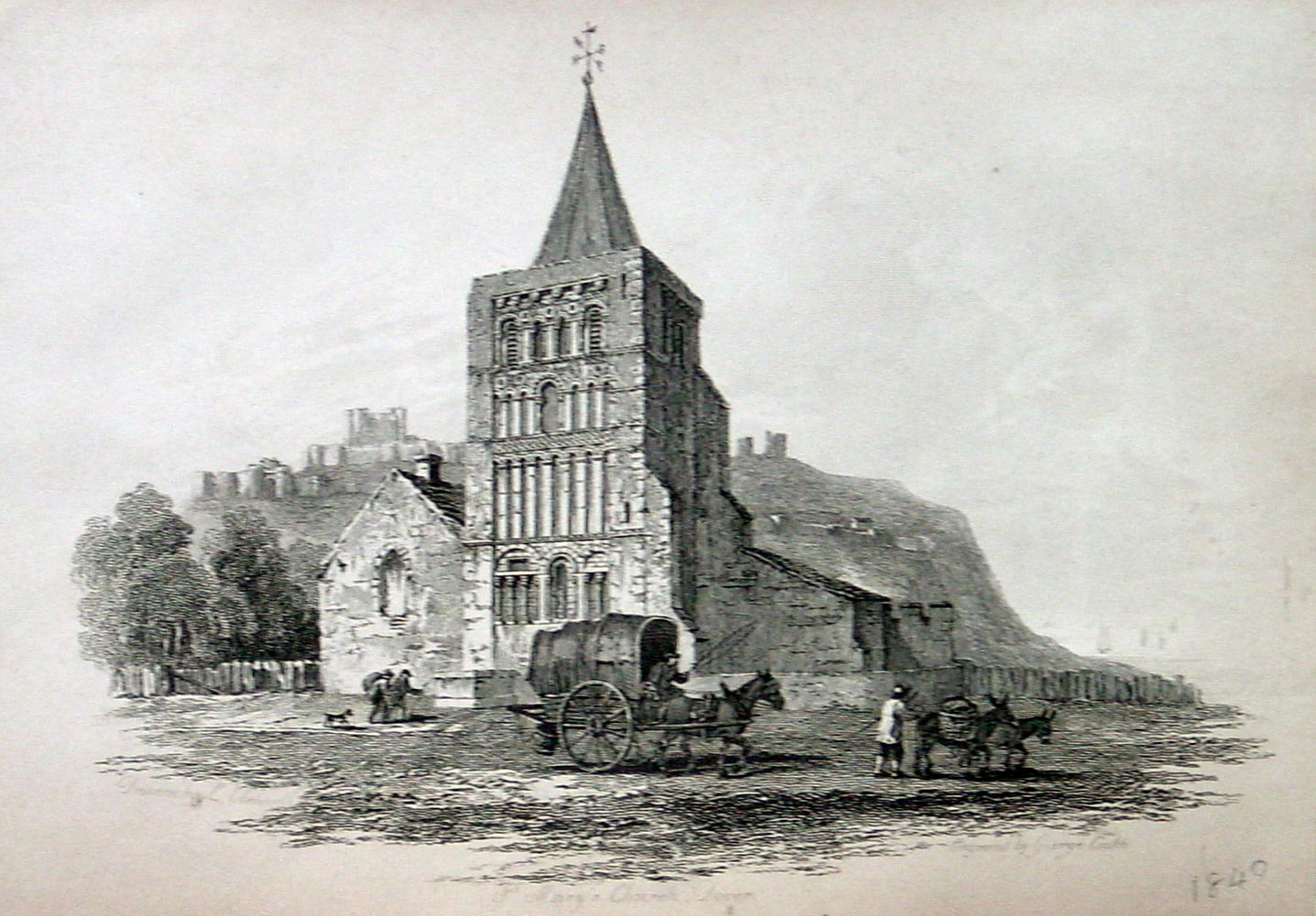
St Mary's Church 1849

St Mary’s Church 1849

There is little doubt that by the beginning of the 15th century the town had become an important religious centre. Within the town walls was the church of St Martin – still taking up what is now the west part of Market Square. To the north, before the start of what is now Biggin Street – and at that time the town wall –  was St Mary’s Church. In between was St Peter’s and outside the walls were St. Martins Priory, the Maison Dieu Hospital and the Church of St. James.

During the Reformation (1529-1536), except for St Peter’s church, Dover’s churches were sealed by order of Henry VIII (1509-1547). The town’s folk successfully petitioned for St Mary’s to be  reopened and used as a parish church. In 1555, the Curfew bell was moved there. A Visitation eleven years later decreed, ‘that the parishioners of St Peter’s …should be admonished to resort to the church of St Mary’s henceforth ward, as if they were parishioners of St Mary’s until the Church of St Peter’s was repaired.’

This evidently did not go down well with all the St Peter’s parishioners for three years later it was reported that John Knapp had refused to go to St Mary’s. When Thomas Pepper, Mayor of Dover in 1559,1563, 1565 and 1567, died about 1575, having written his Will out a year before, he stated that he was to be buried in St Peter’s churchyard. Albeit, the last recorded burial there was in 1572. Elections were officially transferred to St Mary’s in 1581 and the last one was reported to have taken place in St Peter’s in 1585.

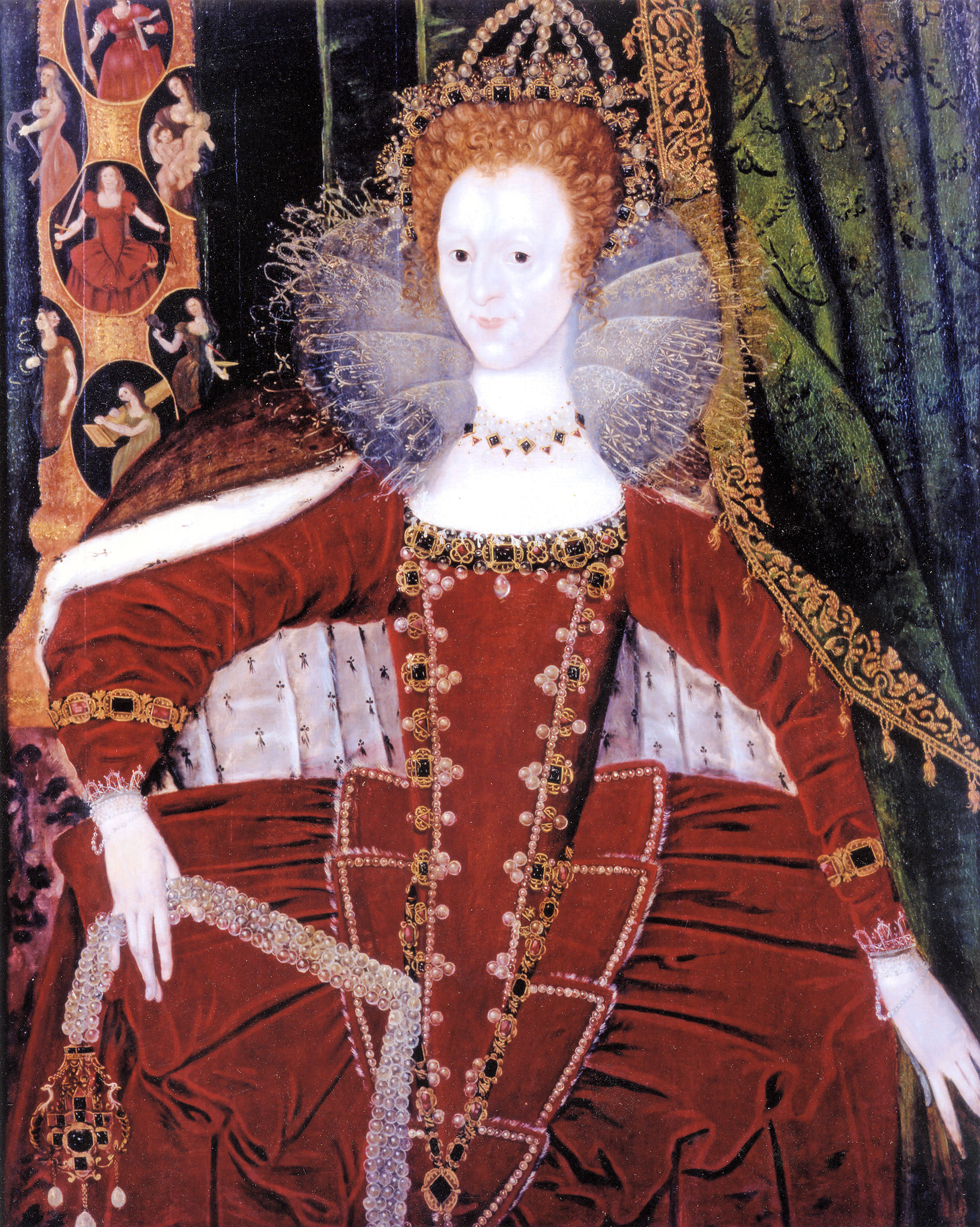
Elizabeth I. Dover Museum

Elizabeth I. Dover Museum

The Mayor and Jurats successfully petitioned Elizabeth I (1558-1603) to sell lead from St Peter’s roof and use the money to improve the harbour. In 1579, Mayor Thomas Allyn, accepted £20 for the lead from the Church to be used for harbour repairs. At the time the Mayor was responsible for looking after the town’s coffers along with the Chamberlain and the repairs were started. They were finished by May 1584, and payment was asked for. However, when pressured former Mayor Allyn panicked and skipped town – he had misappropriated the money!

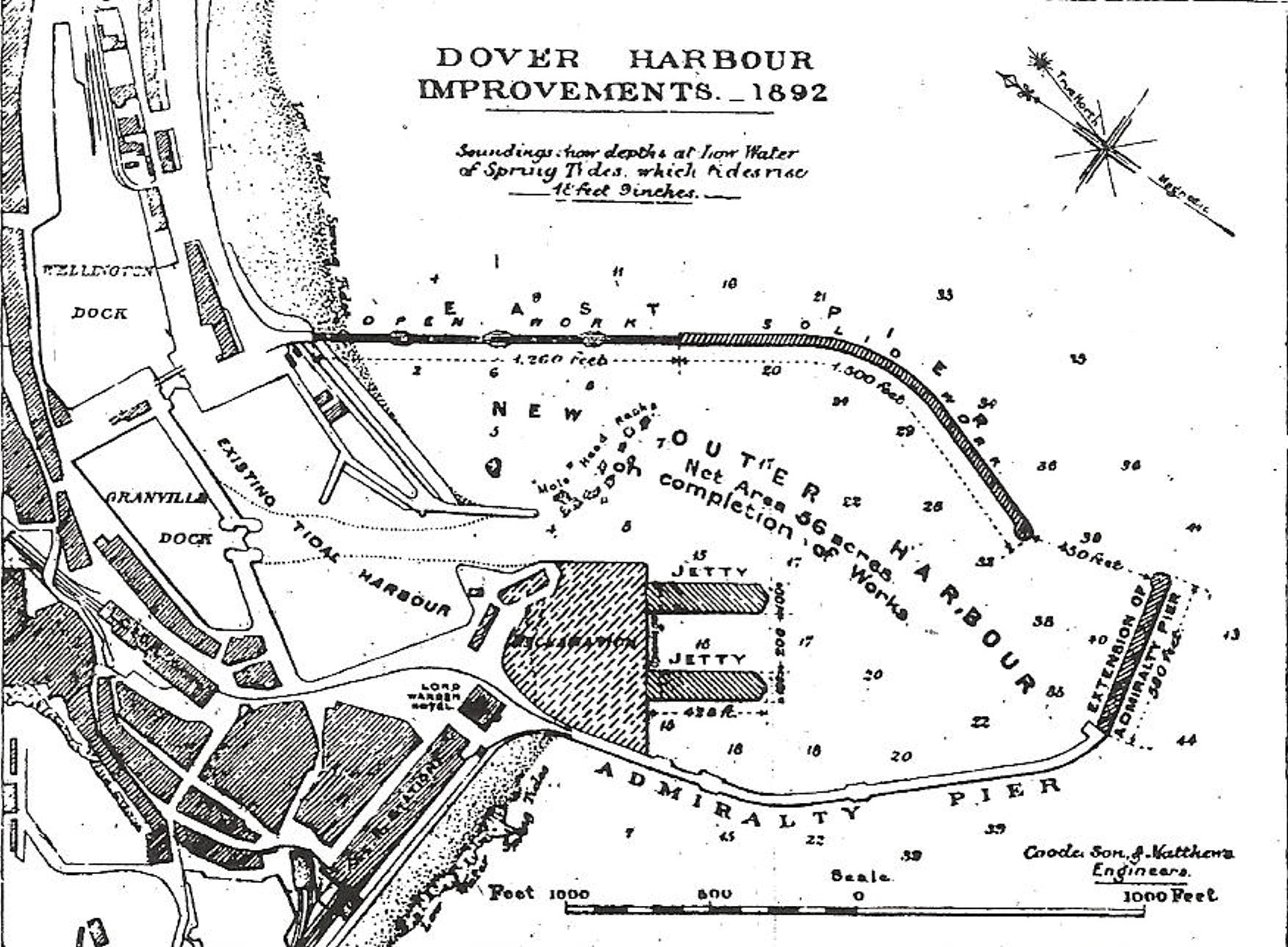
Dover archives tell us that Elizabeth I, in 1590, gave authority for the sale of St Peter’s together with its land and again the money was to be used for harbour repairs.  This time the money was to augment a national tax on shipping that had been instituted to pay for extensive new harbour works. Mostly completed by 1595 the works created three great docks, as shown in the map above. The Pent, Little Paradise and the Great Paradise that, for the present time, form the basis of today’s modern Western Docks. The Pent became Wellington Dock and the Great Paradise became the Granville Dock and Tidal harbour – these are now under threat to be filled in to create a lorry park.

The last rector of St Peter’s church was Rev John Grey and he is listed as holding the incumbency in 1611. A Master Golder eventually demolished the Church and Church Street was extended to Market Square. The present day path from Church Street to Cannon Street, by St Mary’s Church, roughly defines the boundary between what were St Peter’s and St Mary’s churchyards. The latter came into use as a burial ground after St Peter’s ceased to exist.

Market Square north c1880 the shops existing then had developed from a mansion that had been built on the site in the 17th century. Dover Museum

Market Square north c1880 the shops existing then had developed from a mansion that had been built on the site in the 17th century. Dover Museum

Following the demise of St Peter’s Church, the City of Antwerp Hotel was built on the corner of Market Square and Cannon Street, which was on part of the site. The hotel stables were on the northeast side of Market Square, where the Castle Street junction is today but were demolished and rebuilt to provide access to that Street. A grand mansion facing Market Square had been built between the Antwerp Hotel and the stables. However, the mansion was said to be haunted by the ghost of William de la Pole’s (1396- 1450) body looking for his head!

The mansion was later converted into shops, which kept a number of the external features of the mansion. Nineteenth century local historian, John Bavington Jones in his book Perambulation of the Town, Port, and Fortress of Dover, tells us that, ‘The internal oak beams were massive and in some rooms there was traces of fireplaces and other work of the Jacobean period, indicating apartments fit for a man of wealth and position.’ These were demolished in 1905 to make way for Lloyd’s bank

Fleur de Lis Plaques, above door of the Torchlight Homeless Drop in Centre, Church Street. One had R and B inscribed the other appears to E and R inscribed. Alan Sencicle 2009

Fleur de Lis Plaques, above door of the Torchlight Homeless Drop in Centre, Church Street. One had R and B inscribed the other appears to E and R inscribed. Alan Sencicle 2009

Excavations in 1810, 1893, 1905-08 of the area where St. Peter’s Church once stood, all revealed foundations of the old church and it is probably from one of these digs that the tile above the present day Torchlight doorway in Church Street, was found. The building is set back between 5 and 8 Church Street where two shield shaped plaques can be seen. One has what appears to be a fleur-de-lis and is inscribed with the initials ‘R’ and ‘B’. The other, badly corroded, may have had the initials ‘E’ and ‘R’ inscribed.

During the 1810 excavations, a chalk casket was found, inside which was a skull believed to have belonged to the ill-fated Duke of Suffolk – William de la Pole! On 2 May 1450, he was decapitated off Dover and his headless body dumped on Dover beach. The body was taken to Wingfield, Suffolk to be buried and it was said that his head was brought to St Peter‘s Church. My book, Haunted Dover, recounts the whole story.

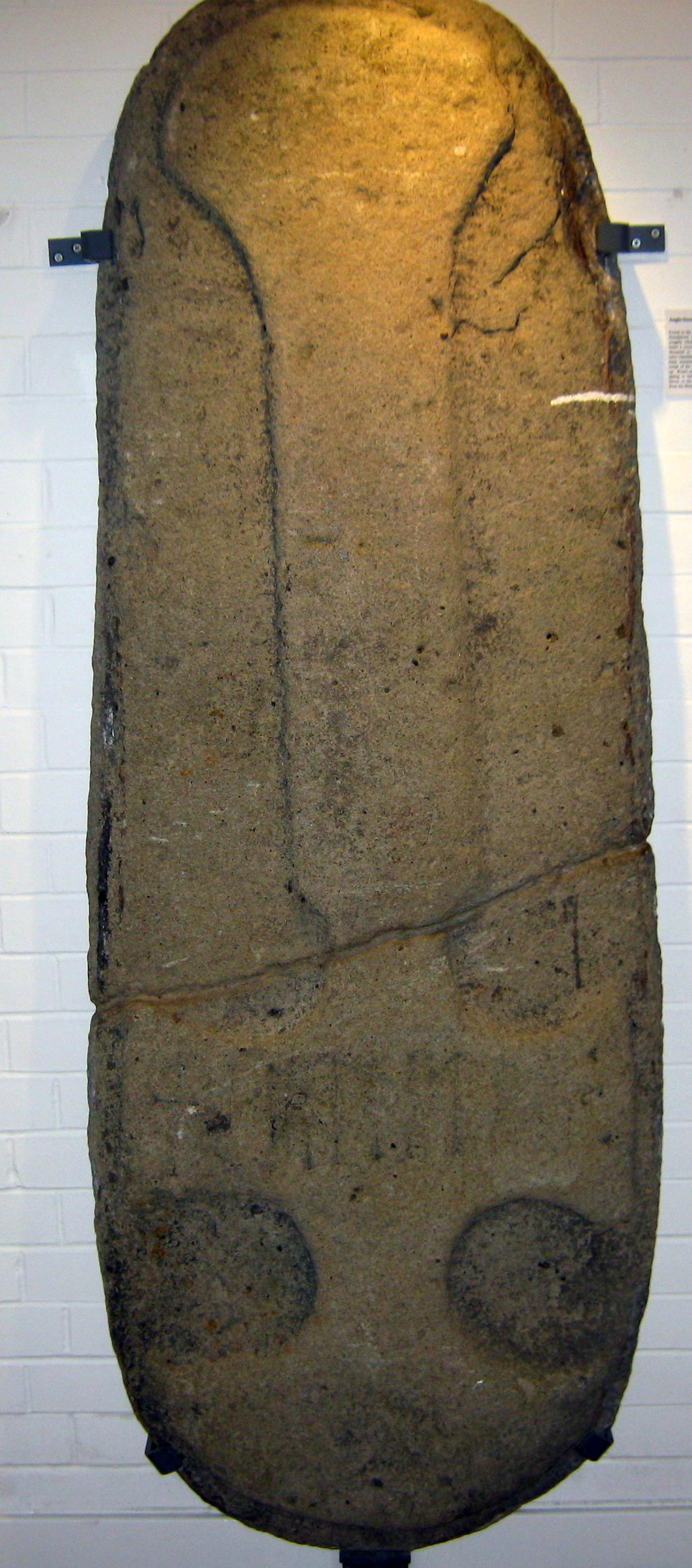
Anglo Saxon Grave Slab found under the foundations of St Peter's Church in 1810 now in Dover Museum. LS 2014

Anglo Saxon Grave Slab found under the foundations of St Peter’s Church in 1810 now in Dover Museum. LS 2014

The foundations of St Peter’s church were also revealed during the excavation and the base of a pillar resting on two large fragments of stone, one on top of the other was found. After removal, when the two pieces formed an entire monumental slab, with a cross and an Anglo-Saxon or runic inscription on the cross. This has been translated as Gisilheard‘ and the stone is now on display in Dover Museum. It has been mounted such that the runes are the right way round. Of interest, although runes are hardly found in Kent some dating before AD650 were found in Dover on the back of one the disc brooches during the excavations of the Buckland Anglo-Saxon cemetery.

The major excavations took place between 1905-1908 in order to build Lloyds Bank and adjacent buildings. Up until that time the corner of Market Square and Church Street was called ‘Peter’s Corner’. A small pillar was unearthed that these days form the capital of the Font in St Mary’s Church. The excavations also uncovered large quantity bones.

The eminent anatomist, Dr Frederick Gymer Parsons (1863-1943), examined the bones and reported that about 500 were from oxen, sheep and horses. Amongst them were the remains of an antler, possibly belonging to a red deer. There were also the bones of about 26 individuals, more male than female. This was possibly because in the Middle Ages, Dover was an active seaport as well as a religious centre and therefore there was likely to be more men than women.

Market Square north side showing Lloyds Bank and Dicken's Corner, where the Church of St Peter once stood. Alan Sencicle

Market Square north side showing Lloyds Bank and Dicken’s Corner, where the Church of St Peter once stood. Alan Sencicle

Most of the human skulls had white, sound, and regular teeth but were greatly worn, possibly, due to eating coarsely ground grain and tough, badly cooked, meat. The bones showed that, overall, the people had died in the prime of life without long standing ailments. This Dr Parsons’ suggested, was because the time between when infections where caught and death was short – which would explain why in St Peter’s church, St Roch was venerated.

Another reason given by Dr Parson, was that, ‘old records show that there were few more turbulent places than the Cinque Ports, and probably many of these men were killed in some brawl or another.’ The exhumed skeletons were first buried in St Martin’s Cemetery that stood at the top of Market Street until 1970. They were then re-interred in Charlton Cemetery

  • Presented:
  • 30 August 2014


Posted in Market Square, Religion & Churches, St. Peter’s Church, St. Peter’s Church | Comments Off on St. Peter’s Church in the centre of Dover

Harbour of Refuge Part II

Harbour of Refuge – A truly national work that would enable the rendezvous in times of war of the entire national fleet and serving as a national harbour of refuge, so much needed in the interests of humanity … Dover, holds the key of the Channel! (Steriker Finnis 1872)

Harbour prior to start of Commercial Harbour - Courtesy of Ian Cook

Harbour prior to start of Commercial Harbour – Courtesy of Ian Cook

The battle for a harbour of refuge on the Channel coast of south-east England had been unremitting  for well over a century and Dover had been chosen as the ideal location. The first arm of the proposed harbour – Admiralty Pier – had been built but the remainder of the proposal was still on the drawing board and showed no signs of ever becoming a reality regardless of the number of lives lost at sea.

On Monday 9 May 1878, the first stone for a national harbour of refuge was laid at Boulogne. Over the previous few years, some 50million francs had been set aside by the French government for national harbours at Dunkerque, Calais, Dieppe, Havre as well as Boulogne. This was heavily commented upon in the national press, with the Times of 7 September 1878 stating, ‘The English experience has been disastrous, it is now nearly thirty years since the we set about forming a harbour of refuge at Dover and we lost no time in constructing fortifications to defend it, but the harbour itself has been reduced to the Admiralty Pier, where the sea in one night destroys the work of a year … The Strait of Dover is about the worse sea crossing in the world…’

Earl of Granville Earl - Lord Warden and Chairman of Dover Harbour Board c1890

Earl of Granville Earl – Lord Warden and Chairman of Dover Harbour Board c1890

In April 1880, the Liberals returned to power so the Earl of Granville (1815-1891) – Lord Warden and Chairman of DHB,  Steriker Finnis (1817-1889) – local councillor deputy Chairman of the Dover Harbour Board (DHB) and Charles Freshfield – one of Dover’s two Conservative Dover MPs (1865-1868 & 1874-1885), combined to exerted as much pressure on the government as they could muster. October 1881 saw some of the worst gales to hit the south coast for a number of years. In one week, there were 130 British and foreign ships wrecked of which, 104 were British. During that week, a large number of vessels tried to seek refuge in Dover harbour and over the days that followed an increasing number of disabled ships arrived in the bay.

Typically, the derelict Juliesche was towed in by the London tug Palmerston, accompanied by Deal lifeboat and the Deal lugger Briton’s Pride. The Juliesche was a schooner and was picked up four miles south-west of the South Sandhead lightship with only the timber she was carrying keeping her afloat. It is evident that the crew made every effort to save the vessel but they had all been swept into the raging sea.

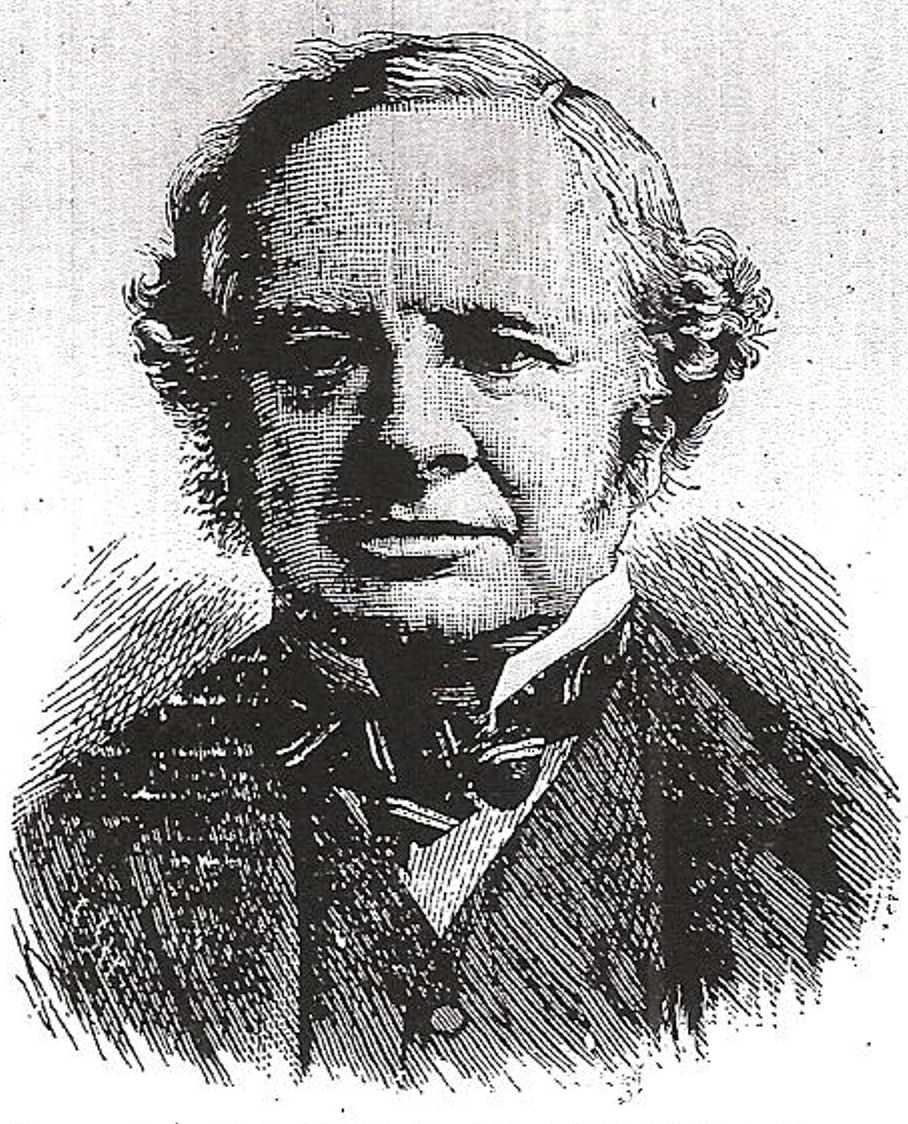
Steriker Finnis

Steriker Finnis

Finnis and the Harbour Board Register, James Stilwell (1829-1898), put together yet another Bill that was then presented to Parliament in July 1882. This was asking for the powers necessary to create a large harbour that would enclosed Dover bay as far as the Northfall Tunnel – Eastern Cliffs – and serve as a commercial harbour as well as a harbour of refuge. The Standing Orders of both Houses were suspended so that the proposal could be fully discussed. The major obstacle, however, was the Continental agreement between South Eastern Railway (SER) and the London Chatham Dover Railway (LCDR) whereby they pooled the receipts received from Channel crossings by their ships and then divided them. The contents of the Bill, it was argued by SER, could interfere with this arrangement.

On reconsideration, the Harbour Board agreed reduce the dues that LCDR were paying to using the harbour and Dover’s other Conservative MP (1874-1889) Major Alexander Dickson (1834-1889), supported the Bill. He pointed out that the eminent engineer, the late James Walker (1781-1862), along with Sir John Hawkshaw (1811-1891), both believed that the works projected by the Bill could be carried out. The Bill was given Royal Assent but two years later, a Treasury minute intimated that the government wanted to carry out works themselves to their own designs.

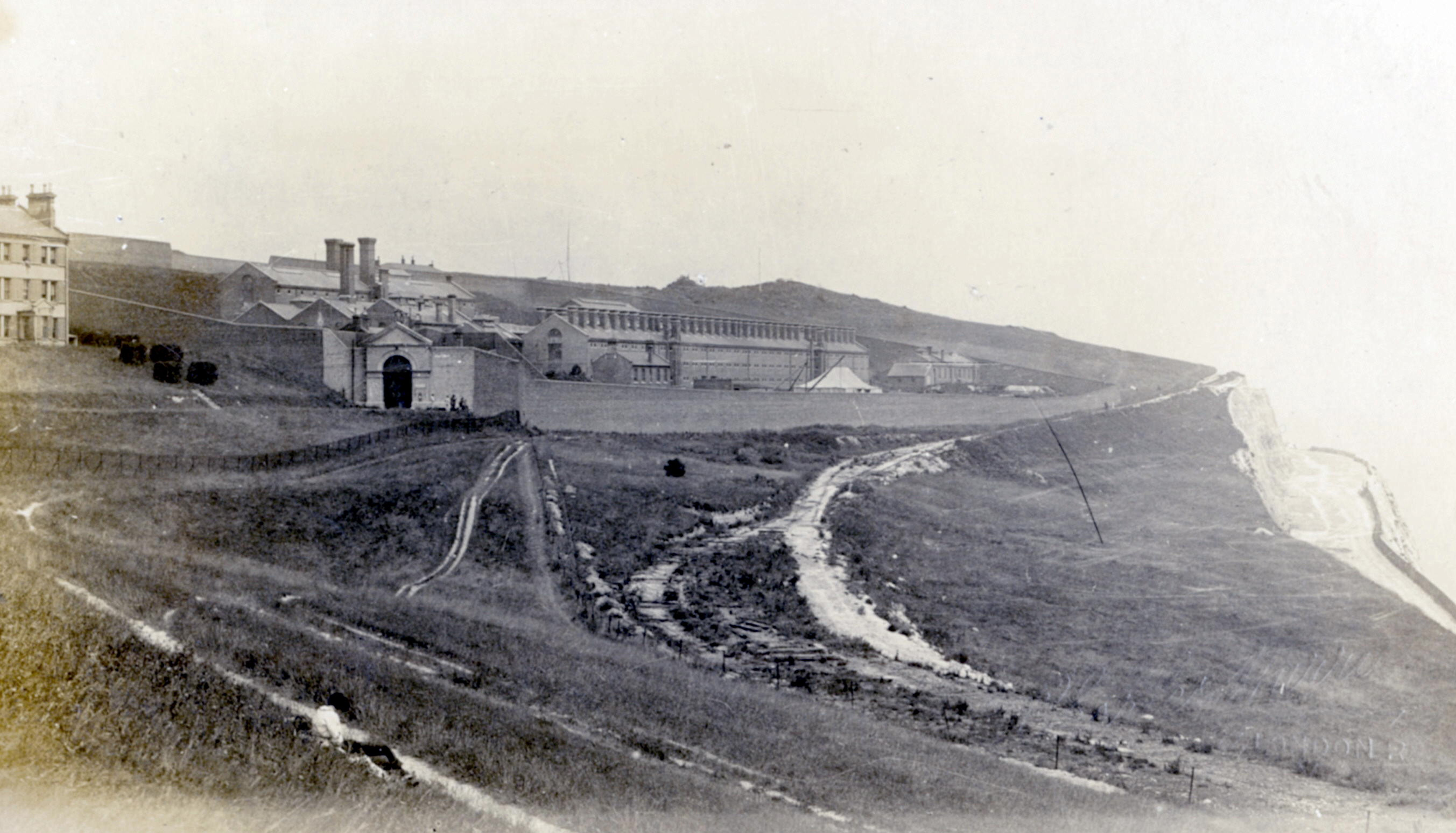
Langdon Prison 1905 built to provide labour for the proposed Harbour of Refuge. Dover Museum

Langdon Prison 1905 built to provide labour for the proposed Harbour of Refuge. Dover Museum

The government, in 1883, announced that convict labour would be used for the building of a National Harbour. Two designs were put forward for the harbour and the land behind the Castle was earmarked for what became Langdon prison. Under the superintendence of oceanographer and hydrographic surveyor Captain Thomas Henry Tizard (1839-1924) on the Triton, a major survey of Dover Bay in April 1885 was carried out. The area covered extended from Shakespeare Cliff on the west to Langdon Bay on the east, the distance off shore was a little over 1¼ miles. The work then stopped.

The Dover builder, William Adcock (1840-1907), who was involved in the building of Admiralty Pier, had been elected Mayor and in 1886, the Town council voted to take matters into their own hands. They introduced a Bill in parliament to restore the ancient union between the Town and Port and asked for Harbour affairs to be entrusted in a managing Committee of the Town Council with representatives of other interests co-opted. As the Bill progressed through parliament, concessions were introduced such that the Bill was in danger of danger of bearing little resemblance to what the council wanted, so they withdrew it.

Two years later, on 4 April 1888, Major Dickson announced in the Commons that the convict prison was ready and occupied, and, he asked, ‘was it the intention of Government to proceed with the harbour of refuge at Dover?’ William H Smith (1825-1891) – later Lord Warden (May 1891 until his death that year) – on behalf of the government said that it was. That year the Wellington Dock gates were widened ten feet to accommodate the new Channel paddle steamers the Victoria, (LCDR 1,030 gross launched 20 May 1886) and the Empress (LCDR 1,213gross launched 4 June 1887), as well as others of that class when they came on station. By that time, the Harbour Board had been in existence 28-years and the harbour of refuge was still an unfulfilled promise.

Out of pure frustration with the government, on 3 October 1890, the Harbour Board voted to undertake the much-needed harbour of refuge themselves. They unanimously agreed to apply in the next session of parliament for a Bill to authorise the Board to spend £300,000 and to raise more money by the introduction of a passenger tax. This was similar to one imposed by the French government to help pay for their harbours in northern France. The Register, James Stilwell, drafted the application and included a design for the new harbour submitted by Sir John Coode (1816-1892), of Coode, Son and Matthews.

Proposed Commercial Harbour

Proposed Commercial Harbour

The proposed harbour of refuge was to be bound on the western side by the existing Admiralty Pier that was to be extended by 560-feet. On the eastern side an arm 2,760-feet seaward, starting in a southerly direction and curving towards the south-west was to be built. This gave an entrance 450-feet wide facing towards the east and sheltered by an overlap of the extended Admiralty Pier. Within the new harbour would be a water station – a covered space to accommodate four or five cross Channel steamers – and a connection from the shore over which the trains would pass to get alongside the cross-Channel ships. However, the best contract price for the proposed eastern arm was over £400,000, so in the final submission, presented in August 1892 the estimate for the work was increased to £600,000.

The submitted proposal stated that the number of passengers travelling to and from Ostend were just under 17,000 in 1836 when Parliament first recommended a harbour of refuge at Dover. The proposal then went on to compare the years 1861 to 1891:

In 1861 the passenger traffic through Dover harbour was:

Dover to Calais = 61,673

Calais to Dover = 52,653

Total = 114,326

Dover to Ostend = 5,613

Ostend to Dover = 7,567

Total = 13,180

Overall Total for 1861 = 127,506

In 1891 the passenger traffic through Dover harbour was:

Dover to Calais = 132,759

Calais to Dover = 129,425

Total = 262,184

Dover to Ostend = 44,427

Ostend to Dover = 41,157

Total = 85,587

Overall Total for 1861 = 347,768

Giving an increase 272.75% in the number of passengers in 30 years.

In 1861, the Bill stated, the largest vessel in the cross-Channel service was the Prince Frederick William (215-tons) and smallest the Ondine (101-tons). In 1891 the largest was the Calais-Douvres (1212- tons) and the smallest is the France (388-tons). The 1891 Bill was Royal Assent and the government granted the power for the Harbour Board to levy a tax of 1 shilling (5pence) on each Channel passenger. Parliament also agreed to lease the Admiralty Pier to the Harbour Board for 99-years.

The plans were submitted to the Admiralty, the War Office, the Board of Trade, and the Office of Woods and Forests, and the approval was given by all except the Admiralty. The contract for the new east Pier was given to John Jackson of 2, Victoria Street, Westminster. The sub-contractor for the ironwork went to Messrs Head, Wrightson & Co. of Stockton-On-Tees. As for the extension of Admiralty Pier, sanction by the Board of Admiralty was awaited so a contractor was not appointed.

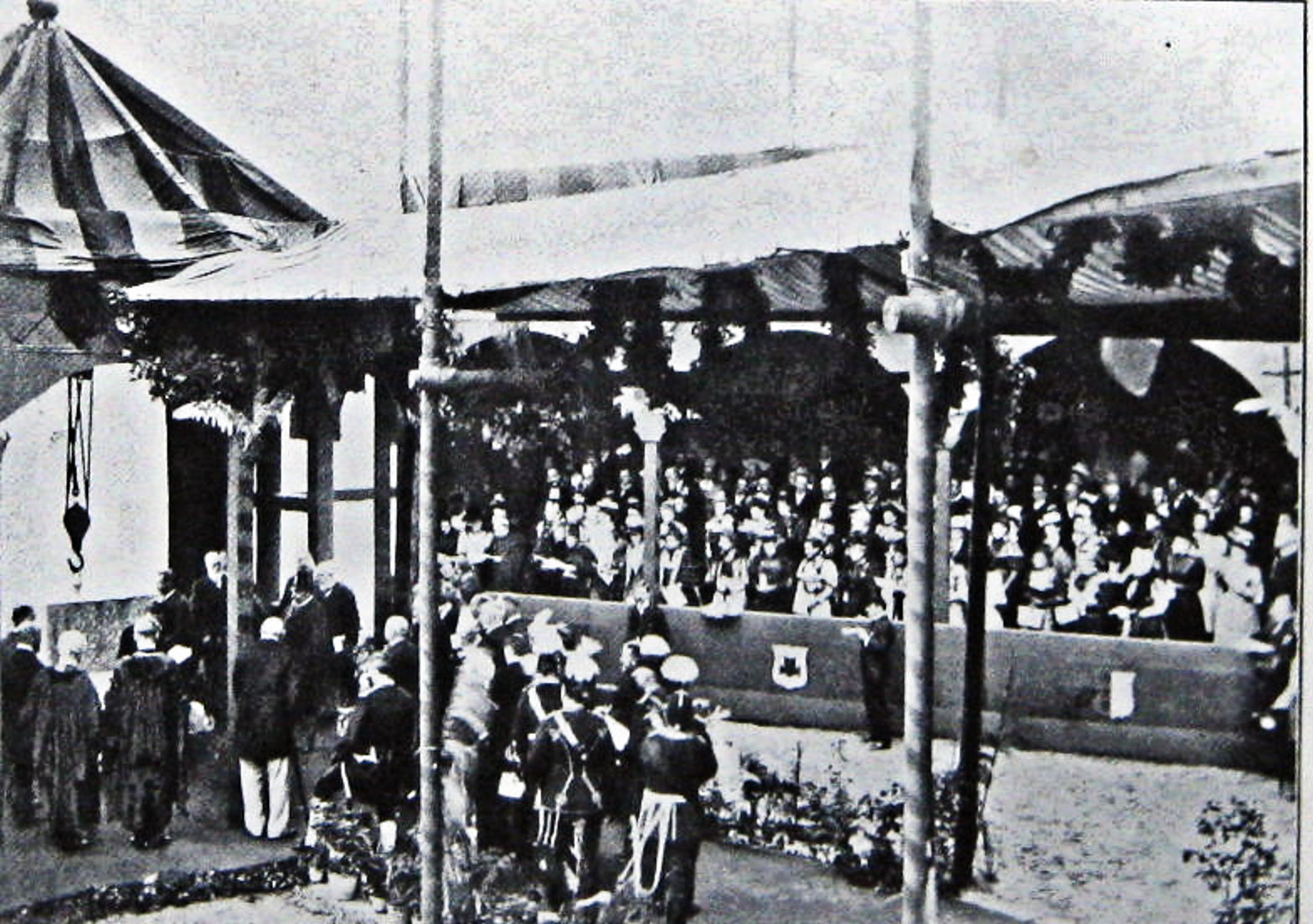
Prince of Wales Pier 26 July 1893. The laying of the first stone of the new Commercial Harbour by Edward Prince of Wales, later Edward VII. John H Mowll

Prince of Wales Pier 26 July 1893. The laying of the first stone of the new Commercial Harbour by Edward Prince of Wales, later Edward VII. John H Mowll

On 26 July 1893 the first stone of the eastern arm of the project, called Commercial harbour, was laid by Edward, Prince of Wales – later Edward VII(1901-1910), and took the name of Prince of Wales Pier. On the same day, W. Agnew presented ‘Harbour of Refuge’ by Frederick Walker (1840-1875), to the National Gallery. In September 1894, the first submarine block of the Prince of Wales Pier was laid on the bed of the sea but approval from the Admiralty for alterations to the Admiralty Pier were still awaited.

The Admiralty, at this time was taking a close interest in events on mainland Europe. On 18 January 1871, Germany had unified under the country’s first Chancellor, Otto von Bismarck (1815-1898), which changed the balance of power in Europe. Bismarck strived to keep the peace but in 1890, Wilhelm II (1888-1918) effectively sacked him and then pursued a massive programme of naval expansion. It was this that had galvanised the British government into sanctioning the Commercial Harbour.

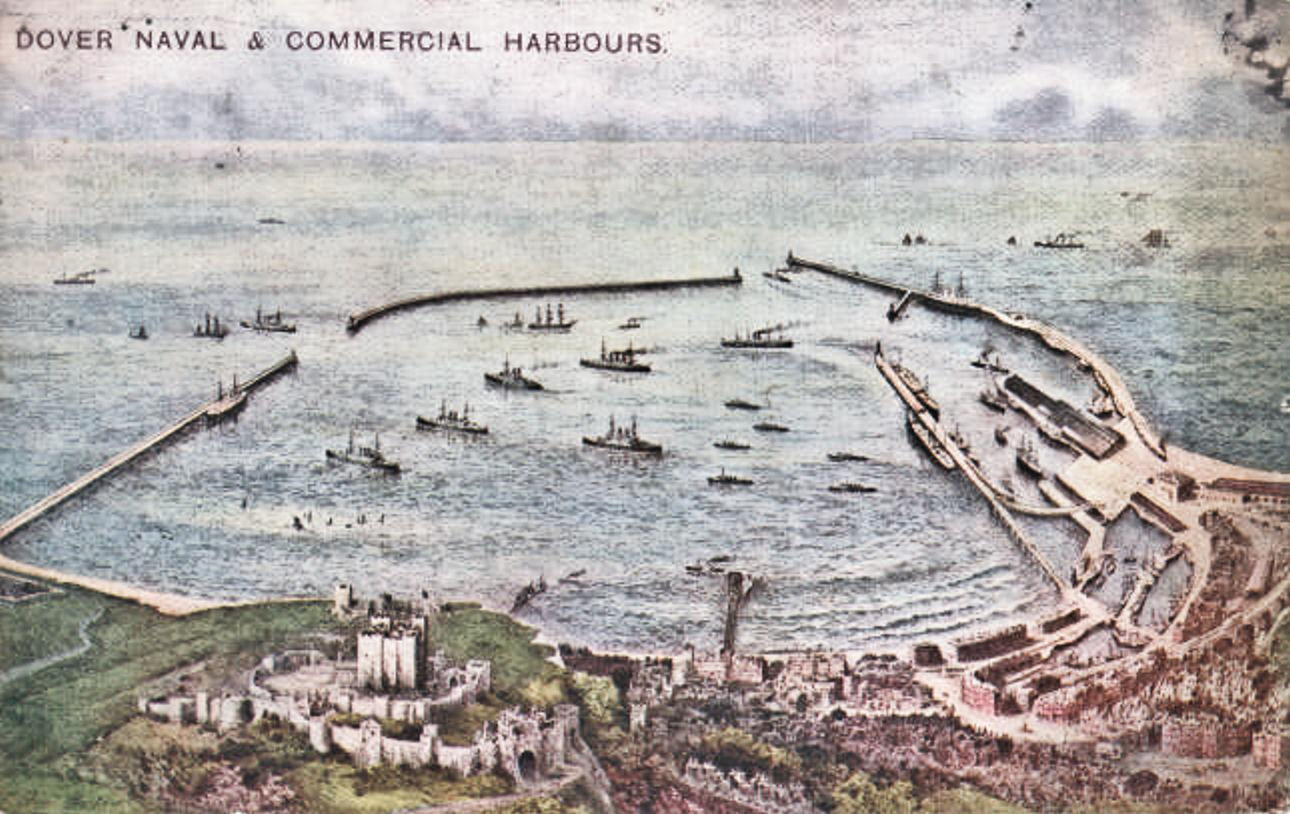
Postcard of the Naval and Commercial Harbour c 1914 giving an immaginative view.

As the situation in Germany continued and concern increased the Board of Admiralty presented a revised proposal to government. In May 1895, when about three-quarters of the Prince of Wales Pier had been built the Admiralty announced their decision. The Admiralty was going to use the port of Dover as a base for the Royal Navy and that this new Admiralty Harbour, would enclose the bay – as we see today!

  • Presented:
  • 15 August 2014


Posted in Harbour of Refuge Part II, Maritime | Comments Off on Harbour of Refuge Part II

Harbour of Refuge Part I

Harbour of Refuge – A truly national work that would enable the rendezvous in times of war of the entire national fleet and serving as a national harbour of refuge, so much needed in the interests of humanity … Dover, holds the key of the Channel! (Steriker Finnis 1872)

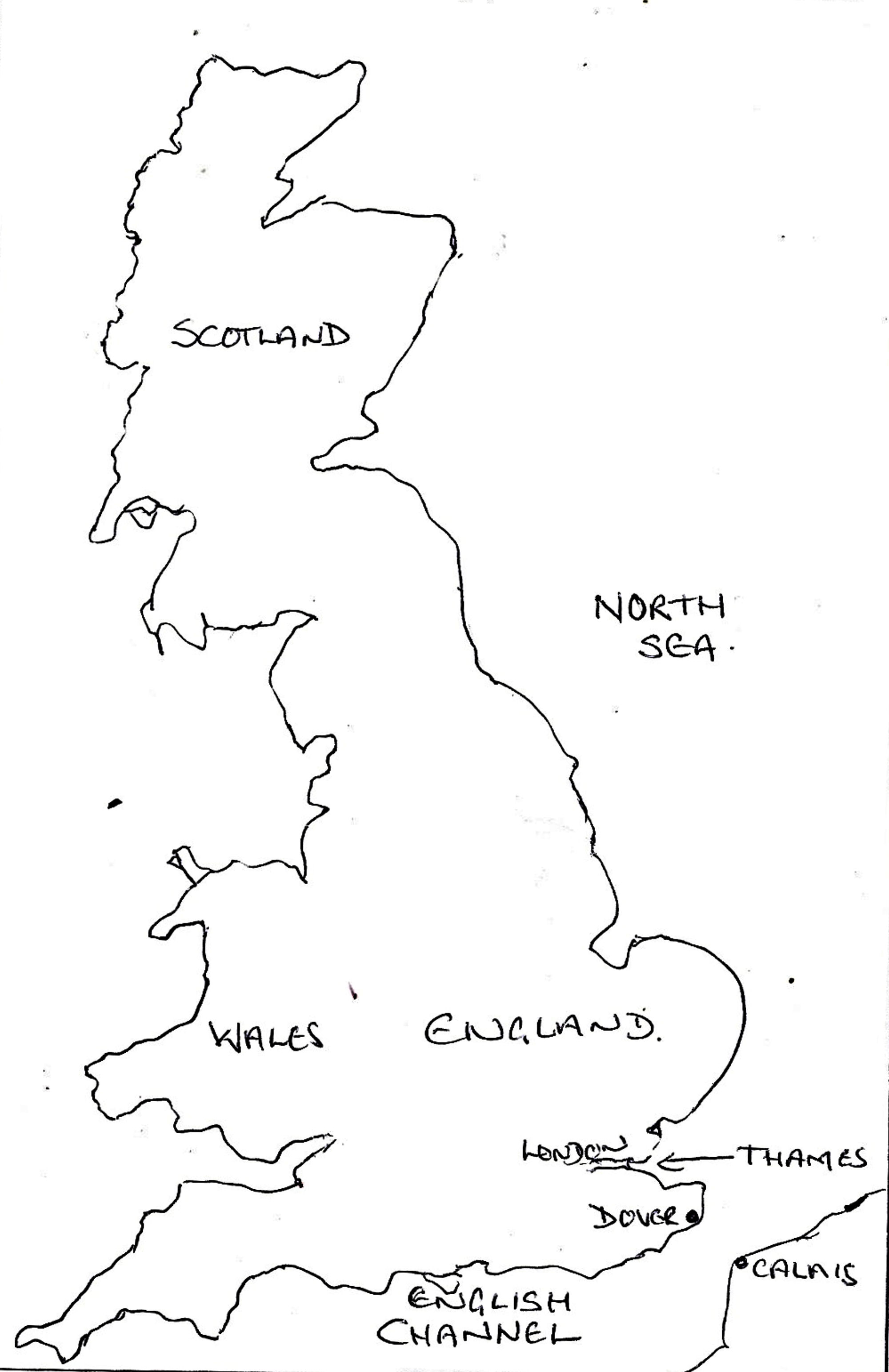
UK Map showing the location of Dover and the English Channel

UK Map showing the location of Dover and the English Channel

For centuries, it was through the English Channel that much of the commercial traffic in and out of the country passed. In the days of sailing ships, this depended entirely on the wind and weather and therefore a place was needed to shelter during storms. During his incumbency as mayor (1756-7), this was the basis of the argument presented by Captain John Bazeley, in a petition to Parliament for harbour improvements. He pointed out that Dover was the most favourable port of refuge between Portsmouth and Harwich and therefore was of national importance. His petition was effectively ignored.

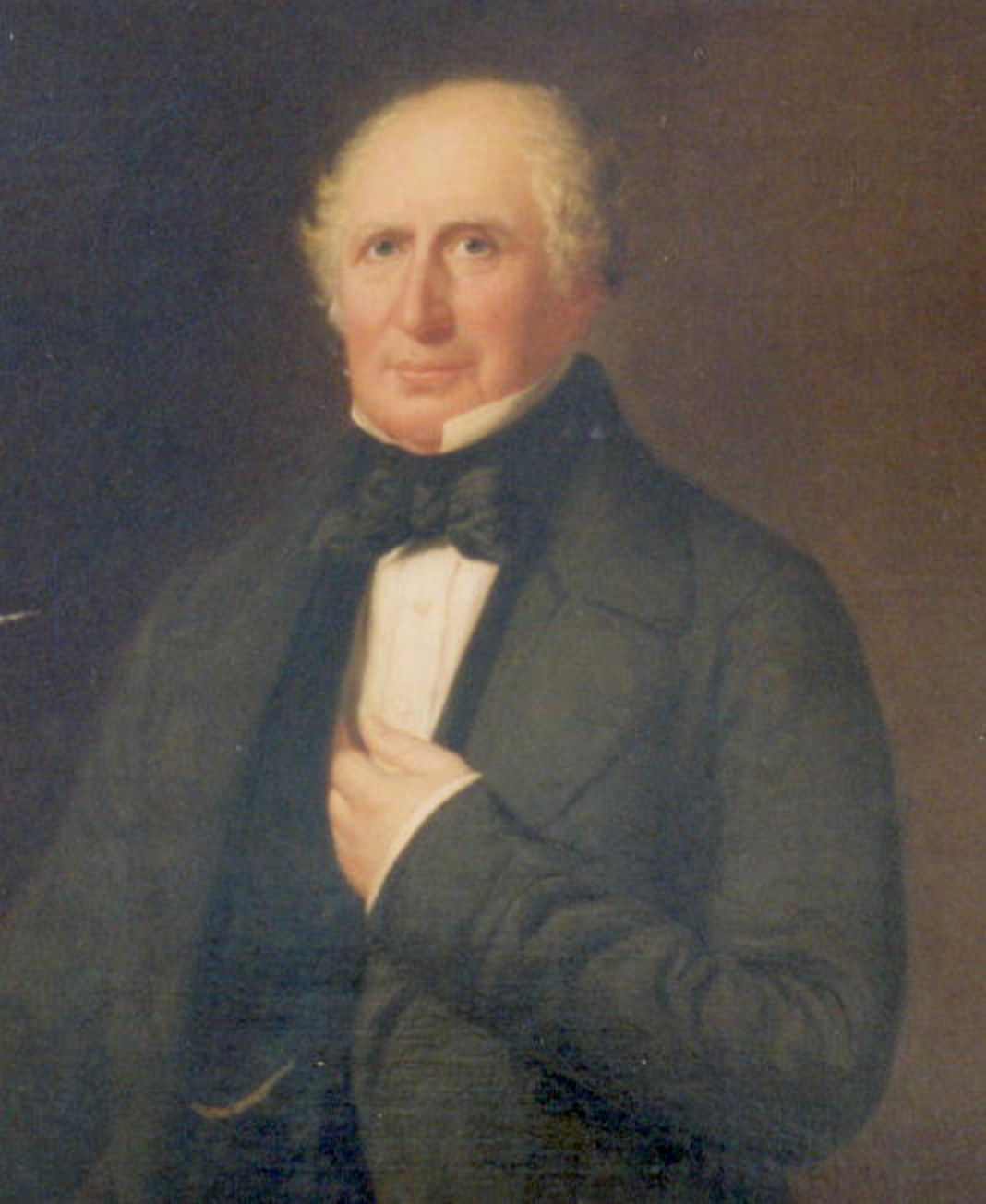
In 1830, Henshaw Latham (1752-1846) was the Mayor of Dover for the third time. He was also a senior member of one of Dover’s two banking families, the Treasurer of Dover Harbour Commissioners, Warden of the Pilots’ Court of Lodemanage and Lloyds shipping agent. Latham was resolved to turn have Dover’s harbour expanded into a harbour of refuge stating, as Bazeley and many others before had, that sailing ships and the, then new, steamships, needed a haven in bad weather and somewhere to go for a refit even for the smallest problems. At that time, Britain had about 24,500 ships employing 250,000 men and for every sixteen sailors who died at sea, eleven died by drowning or in shipwrecks.
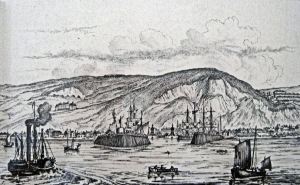
Dover Harbour Entrance by William Heath published 1836 by Rigden. Dover Harbour Board

Dover Harbour Entrance by William Heath published 1836 by Rigden. Dover Harbour Board

The consensus within the shipping industry was that a place of refuge was needed between the Thames estuary and Portsmouth and the groundswell of national opinion was that it should be at Rye, Sussex. The argument rested on the depth of the channel leading to that port at a low water, which was estimated as 12-14 feet. Latham, however, was determined that if such a harbour was to be built then it should be in Dover Bay and his opportunity came in 1836 when the Dover Harbour Commissioners promoted a Parliamentary Bill. This was to raise £60,000 in an effort to combat the age-old problem of the Eastward Drift – causing the harbour entrance being blocked with shingle that, at times, rendered it useless.

The Parliamentary Committee sat between 12 May and 7 June 1836 and examined nineteen witnesses. The first to be called was solicitor John Shipdem, the Harbour Commissioners’ Register (now Chief Executive), who briefly outlined how harbour revenues were received. The second witness was Henshaw Latham and his evidence centred the need for a harbour of refuge. To back his argument, Latham provided evidence to show that 1,573 vessels had been stranded or wrecked off Dover between 1833-1835. That 129 vessels were missing or lost and in the case of 81 vessels, the entire crew had drowned.

One of the other witnesses was Daniel Peake, a Cinque Ports Pilot for 40 years, who was asked: ‘Have you had occasion to make use of Dover harbour as a harbour of refuge?

Answer: Yes.

Question: Coming which way?

A: From westward; sometimes from the eastward.

Q: Suppose you were taken in a heavy gale from the south-west, would you rather run for Dover or for Ramsgate?

A: At particular times, if there is no bar (caused by the Eastward Drift) before Dover harbour, I should run for Dover harbour.

Almost all the other witnesses concurred with Latham and Peake, they were Captain Edward Boxer – Royal Navy, William Cubitt (1785–1861) – Civil Engineer and Government Witness, Philip Going -Ship owner, Robert Hammond – Warden of the Pilots, Philip Hardwicke – solicitor and Receiver of Harbour Rents, John Hawkins – Clerk of Harbour Works, Humphrey Humphries – Chairman of the council Common Hall, John Iron – Harbour Master, Captain Harry David Jones – Royal Engineer and Government Witness, Isaac Pattison – Harbour Pilot, John Benjamin Post – Cinque Ports Pilot, William Prescott – Chairman of the Meeting of the Inhabitants, James Walker (1781-1862) – Harbour Engineer, Richard Wardle – Engineer’s Assistant and Lieutenant Benjamin Worthington – Royal Naval Officer and author of a plan to improve the harbour. The one witness who did not concur was Dover’s MP, John Minet Fector junior (1812-1868).

That year the South Eastern Railway Bill was going through Parliament and received Royal Assent on 21 June. If the problem with the harbour entrance could be solved, then folks in Dover generally assumed that the Railway Company’s main passage to France would be from their port. However, on Saturday 2 October, during a heavy gale, ships were forced to bear up to leeward in the Bay as the harbour entrance was blocked. Four seamen off the Dover ship Duncan were washed overboard and drowned. They were Robert and Thomas Ford, Thomas Dixon and Henry Bustard. Brigs off Sandgate, near Folkestone, and Ramsgate sank. Then, at the end of the month, the French announced that in future all mails would go to Ramsgate instead of Dover and the railway company started to look towards buying Folkestone harbour for their main crossing.
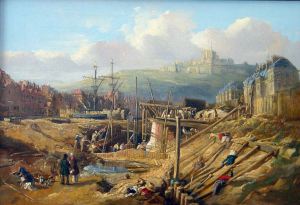
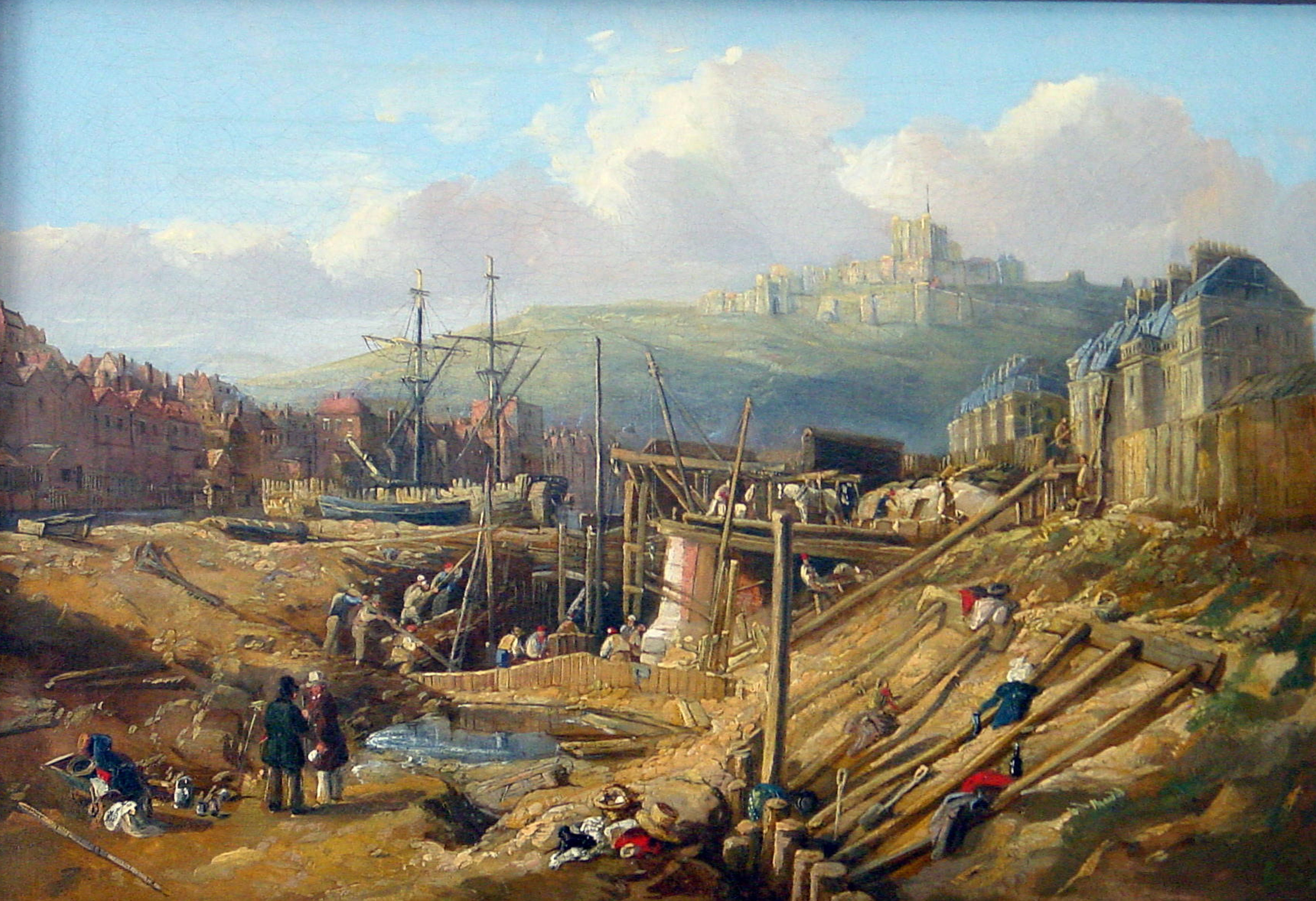
The Pent being scoured out to create the Wellington Dock. Dover Harbour Board

The Pent being scoured out to create the Wellington Dock. Dover Harbour Board

The Inquiry did galvanise the government into giving permission for work to be carried out on Dover’s harbour. The Tidal Basin was enlarged by about 5 acres, the Pent was scoured and lined and using the excavated mud both Northampton Quay and Street were created. The Pent was renamed Wellington Dock and was opened on 13 November 1846 by the Duke of Wellington (1769-1852) Lord Warden of the Cinque Ports (1829-1852) and chairman of Dover Harbour Commissioners.

In the General election of 1837, John Minet Fector junior was rejected in favour of Edward Royds Rice (1790-1878), who lived at Dane Court, Tilmanstone. He was a partner in the Latham Bank and his manifesto centred on a harbour refuge at Dover. Following his arrival at Westminster he pursued his objective with vigour and in 1839 he successfully laid a motion calling for an inquiry into the need for more harbours of refuge and a Commission was set up to look into the proposition.
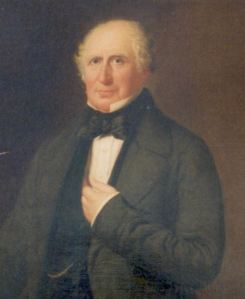
Edward Rice Liberal MP for Dover 1837-1857 who took on Parliament for a harbour of refuge at Dover. Dover Museum

Edward Rice Liberal MP for Dover 1837-1857 who took on Parliament for a harbour of refuge at Dover. Dover Museum

Under Sir James Gordon the Commission  included William Cubitt who had given evidence at the 1836 Inquiry and was, by this time, working for the South Eastern Railway Company (SER). The Commission concluded that there should be three large harbours of refuge along the south coast. For its part, SER had bought Folkestone harbour in March 1843 for £18,000 and were pressing for the proposal to be in Hythe Bay.

Although in opposition, the Liberal front bench and senior politicians enthusiastically supported the Folkestone proposition leaving only Rice, a back-bench member of the Liberal party, actively supporting Dover. With the full backing of the Duke of Wellington, over the next few years Rice pestered, cajoled and generally made himself a nuisance in the cause of Dover.

Eventually it was the Conservative Prime Minister (1841-1846), Sir Robert Peel (1788-1850), who took notice and Rice’s political party were outraged – a view shared by Liberal supporters in Dover who spoke of dropping Rice as their representative. Peel appointed yet another Commission, with the remit was to look at the loss of property and life in shipwrecks. The hearings were under Admiral Sir Thomas Byam Martin (1773-1854), a Conservative stalwart, and started on 1 May 1844. Martin was also a well-known naval administrator with a penchant for retaining well-stocked and highly trained dockyards capable of responding rapidly to any international emergency. His remit was to enquire:

i. Whether it was desirable to construct a Harbour of Refuge in the English Channel

ii. What situation would be best for such a Harbour?

Both Rice and Latham, the latter as a shipping agent and representative of the Pilots’ Court of Lodemanage, gave evidence. However, a strong argument was put forward from representatives from Rye that the harbour of refuge should be to the west of Dungeness, namely Rye. This was forcibly endorsed by one of the members of the committee, Sir William Symonds (1782-1856), Surveyor of the Navy. He argued that for military reasons in the event of war the naval harbour should be mid-point between the Downs and Spithead and on the windward side of the narrowest part of the Channel. This, he said, was Dungeness!
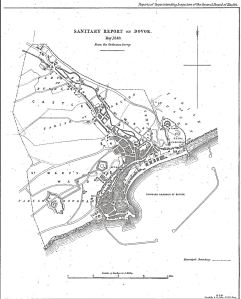
Harbour of Refuge proposal 1844 from Rawlinson Sanitary Map of 1846

Harbour of Refuge proposal 1844 from Rawlinson Sanitary Map of 1846

On 7 August 1844, the Commission published its report and, except for Sir William, strongly recommended that Dover should be a combined harbour of refuge and naval base. Subsequently, William Cubitt, recommended that the harbour of refuge should be formed by a curved breakwater enclosing an area of 500 acres and would take over 15-years to construct. He estimated the cost at £1.5million. In France, the reaction was of horror as they perceived the proposal as a military threat and immediately instigated similar works along the French side of the Channel. However, in England, due to the unrelenting opposition from SER who had supported the Rye contingency, nothing happened. In Parliament, Rice kept banging the proverbial drum on behalf of Dover.

This led to another Inquiry, this time looking into why nothing had come of Martins’ inquiry! Its report was published on 13 November 1846, reiterating the earlier recommendations adding, ‘Dover, situated to a distance of only four miles and a half from the Goodwin Sands, and standing out favourably to protect the navigation of the narrow seas is naturally the situation for a squadron of ships of war. Its value in a military point of view is undoubted; but the construction of a harbour of refuge, there is, in our opinion, indispensable, to give Dover that efficiency as a naval station which is necessary to provide for the security of this part of the coast and the protection of trade.’ The report finished by saying that there should be an ‘Immediate commencement of the construction of a great National Harbour at Dover‘. In the meantime, on 10 April that year, Henshaw Latham died.
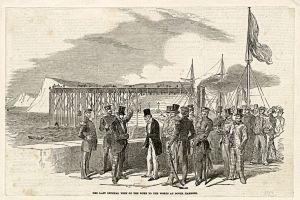
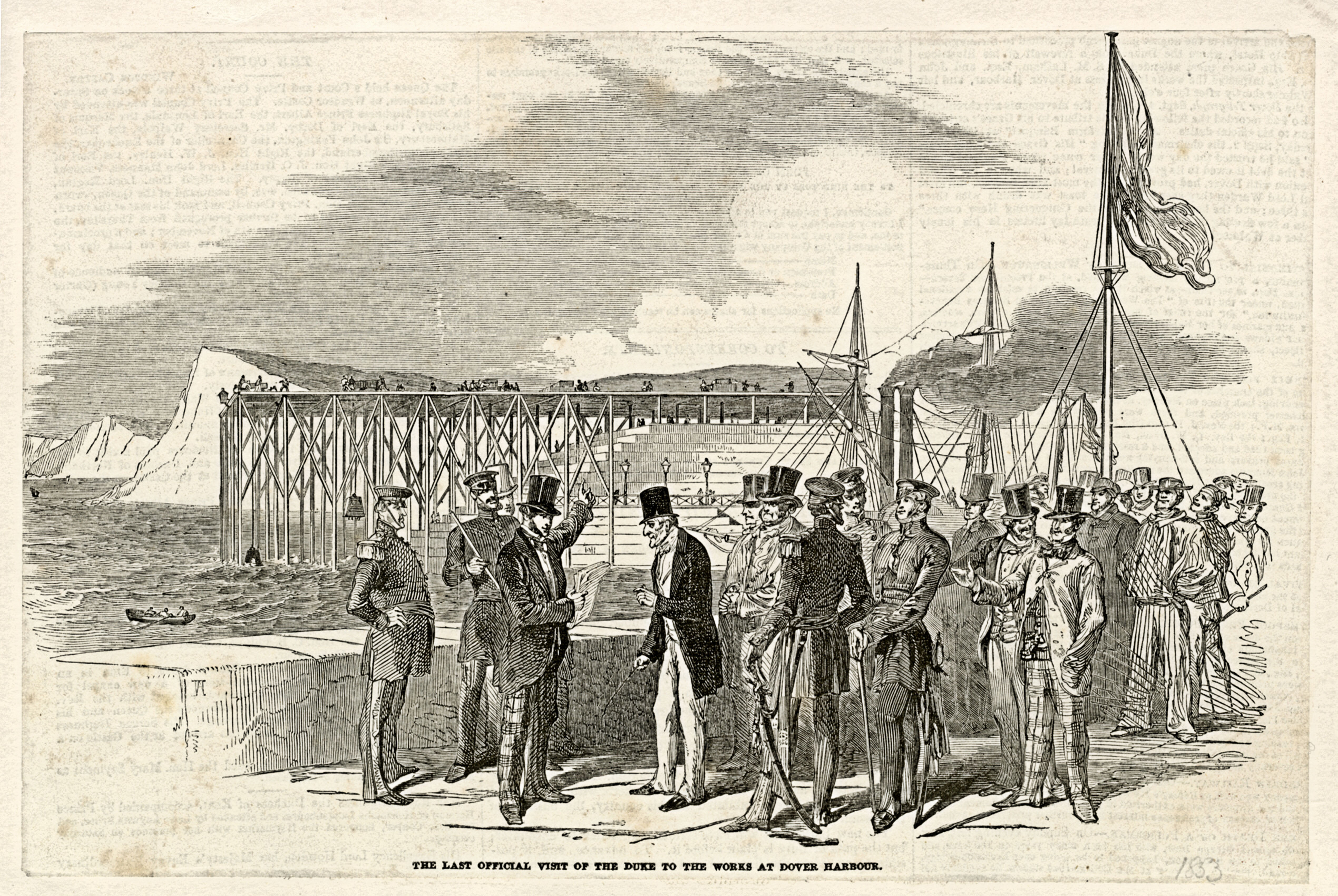
Admiralty Pier construction being inspected by the Duke of Wellington (1769-1852) - Dover Museum

Admiralty Pier construction being inspected by the Duke of Wellington (1769-1852) – Dover Museum

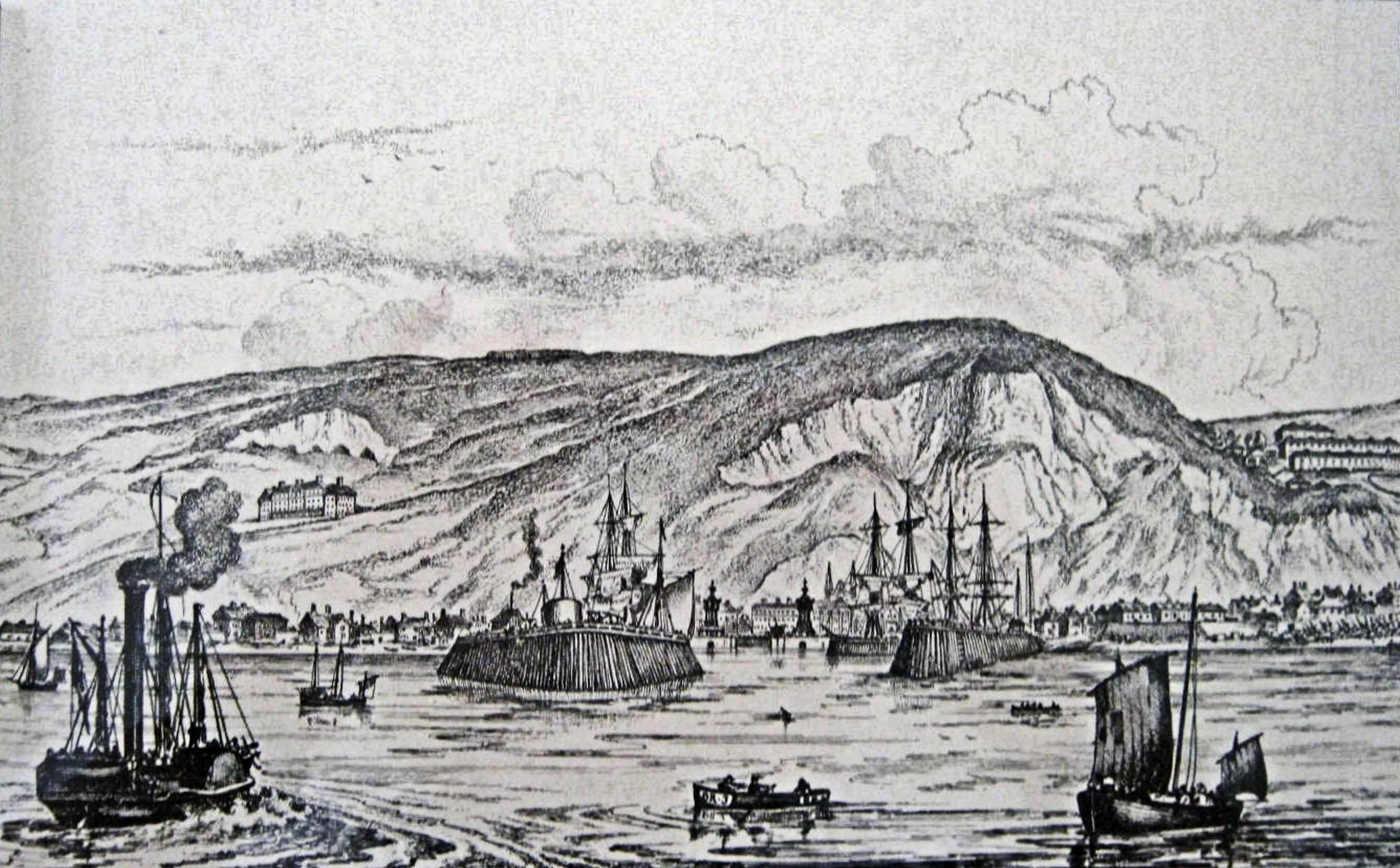
At last, in 1847, approval was given for four large harbours of refuge – Holyhead, Portland, Alderney and Dover. It was estimated that the works would cost in total £2,250,000. At Dover, the designed was by Sir John Hawkshaw (1811-1891), with the main building contractor Henry Lee & Sons. An 1848 Act of Parliament 1848 enable the Warden & Assistants of Dover Harbour to raise more money and work started in April 1848 on the construction of the west pier that became known as the Admiralty Pier. By early October 1850, the foundation of the pier was 650-feet long but on Tuesday 8 October an intense storm, centring on Dover destroyed all the works that had been undertaken.

Piles, 18-inches square were snapped and three huge diving bells were carried away to sea – two were later found. At daybreak, the bay was strewn with fragments of timber and machinery including broken cranes air-pumps and traversers. The Duke of Wellington rode from Walmer to inspect the damage accompanied by civil engineer James Walker – who had given favourable evidence at the 1836 Inquiry. Along with Colonel Blanchard of the Ordnance, Wellington went to the extreme end of what remained of the pier looking carefully at what had survived.

Work was restarted but by 1853, national discontent had been roused over the cost of building a harbour of refuge at Dover. In general it was believed that Folkestone – Hythe Bay would be the better place to site a harbour of refuge. Further, it was being said, that what remained of the proposed Admiralty Pier was putting the town of Dover in danger of being flooded. The critics added that this, ‘might be no bad thing as the population are made up of land sharks.’ Agitation was such that on 27 August that year Sir James Graham (1792-1861), First Lord of the Admiralty headed a retinue of delegates to Dover on an official fact finding visit. Captain Luke Smithett, of Dover, brought them to the town on the Vivid mail packet.
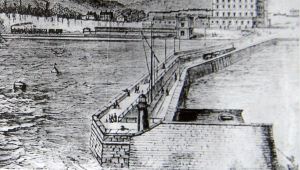
Admiralty Pier - Turret to right of lighthouse

Admiralty Pier – Turret to right of lighthouse

The ship tied up on Admiralty Pier and the Mayor, Charles Lamb and the two members of Parliament, Edward Rice and Henry Cadogan – later Viscount Chelsea (1812-1873) MP for Dover (1852-1857) met the influential officials. The Board members inspected Archcliffe Fort where the Royal Artillery had recently fixed large guns to protect the envisaged harbour of refuge. At the time Napoleon III (1852-1870) of France, following an official visit to Calais and Boulogne, had suggested that one, if not both, ports should be expanded into harbours of refuge. The Board members report stated that work was progressing well and that the town and harbour was in danger but from forces in France. A subsequent Royal Commission recommended that the Admiralty Pier should be extended and that a gun turret should be incorporated.

At the time the Bill for the Canterbury-Dover railway line was going through Parliament that eventually became the London Chatham Dover Railway (LCDR). During the due process, they had added the port of Dover as the terminus and would take the line under the Western Heights. This, they argued, was to enable them to use the harbour of refuge as their main cross Channel port. SER had chosen to make Folkestone their main harbour for the Continent and had created a cross-Channel monopoly.
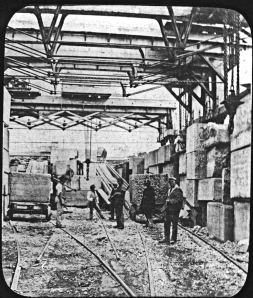
Admiralty Pier under construction. Dover Museum

Admiralty Pier under construction. Dover Museum

The 1857 General election campaign in Dover again centred on the harbour of refuge. During the campaign, it was reported that between 1840-1855 the government had spent £278,000 at Dover. In 1856, a further £34,000 had been spent and that as expenditure on the other three harbours of refuge was also beginning to escalate that objections were being raised by the Board of Trade. In fact the Board of Trade had publicly stated that the need for harbour of refuge was not so imperative as before. This was because steam vessels were largely superseding sailing ships and thanks to parliamentary legislation and the supervision of the Board, ships were more seaworthy than formerly.

As the election approached, the landlubbers declined to support Edward Rice and he decided to retire and leave the battle to others. Albeit, Liberals Ralph Bernal Osborne (1808-1882) MP 1857–1859 and Lieutenant-General Sir William Russell, 2nd Baronet (1822-1892), MP 1857-1859, were selected and both had based their campaigns on the need for a harbour of refuge! Following the election Osborne was appointed Secretary to the Admiralty.
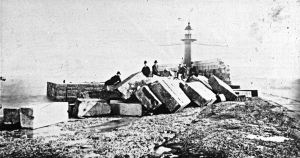
Admiralty Pier construction. Dover Museum

Admiralty Pier construction. Dover Museum

In 1858 a House of Commons Select Committee was set up to look into the supposed squandering of public money on the four ’great’ harbours of refuge. They found that approximately 1,000 lives and £1,500,000 of property were lost on average every year through shipwrecks on British coasts. Then went on to say that if the proposed harbours of refuge were completed and more were built, as long as the costs of these harbours did not exceed the financial amount lost through ship wrecks then they would be a worthwhile investment for the country at make. They recommended that £2million should be set aside for the building harbours of refuge. A Royal Commission the following year agreed and increased the recommended expenditure to £4million!

Aside from the harbour of refuge, as Secretary to the Admiralty, Osborne was instrumental in proposing the abolition of the Dover Harbour Commissioners. In the General election of 1859, he lost his sea but two years later, in 1861, the Harbours and Passing Tolls &c. Act came into force with the aim of facilitating the construction and improvement of Harbours by authorising loans to Harbour authorities.
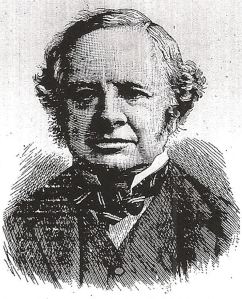
Earl of Granville Lord Warden and Chairman of Dover Harbour Board c1890

Earl of Granville Lord Warden and Chairman of Dover Harbour Board c1890

This Act abolished Dover’s Passing Tolls and embodied within it a new constitution that led to the Harbour Act of the same year that abolished the Dover Harbour Commissioners replacing them with the Dover Harbour Board (DHB). As before, DHB was presided over by the Lord Warden (1866-1891) who, at the time, was George Leveson Gower the Earl Granville (1815-1891). However, the makeup of the Board was different and consisted of six members, two of which were members of Dover Corporation, two represented the railway companies, one the Admiralty and one the Board of Trade.

Dover Corporation’s representatives were appointed on an annual basis, one of which was the Mayor (1863 and 1864) – Captain Jeffrey Wheelock Noble RN. He was the superintendent of Pilots but on 21 March 1865, he died and the Deputy Mayor, Steriker Finnis (1817-1889) took his place. As Captain Noble had also represented the Admiralty on the Board, on 3 May, Finnis became the Admiralty’s representative and elected Deputy Chairman at the same meeting. He was to hold the position for almost a quarter of a century and throughout that time, the harbour of refuge was his main concern. The phrase, ‘Dover holds the key of the Channel’, was his.
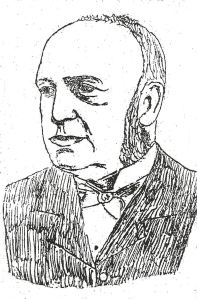
Steriker Finnis

Steriker Finnis

Nationally and in Parliament the costs of the harbours of refuge remained a source of discussion with some demanding for more such harbours to be built, others who wanted to see the big four completed first and a third group who saw the ventures a waste of money. By 1864, the total amount budgeted for the building of the big four was £5million of which £3,300,000 had been spent. At Dover the western pier – Admiralty Pier – was no where near completion and the design for the eastern arm had not even been approved.

The Board of Trade successfully argued that all works on the four harbours of refuge should stop once the £5million had been spent. In their argument they pointed out the ship owners, as a body, were unanimous in declining proposed aids to navigation if they have to pay for them. Secondly, they said, harbours such a Dover, where the newly built pier offers protection, the charges for marine insurance had not been reduced to vessels plying near the port.

Albeit, Finnis and the Board Register (now Chief Executive) – James Stilwell (1829-1898) – prepared a Bill for submission to Parliament. The proposal was for the deepening of the Bason, Wellington Dock and the Tidal Basin and for the technical details, the Board consulted Sir John Hawkshaw. He produced a scheme and estimated the cost at £166,000. During the preparation, an accident occurred that was to bring the Admiralty to openly support of Finnis and Stilwell.
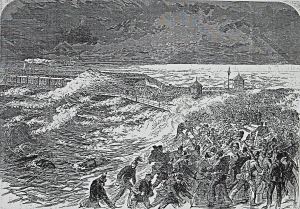
Ferret - Scene of the wreck. Illustrated London News 10.04.1869. Dover Library

Ferret – Scene of the wreck. Illustrated London News 10.04.1869. Dover Library

The accident involved the sail training brig, Ferret on Easter weekend 1869. On board were 17 men, 8 stewards and 86 boys under training – some of which belonged to Dover Sea Scouts (now Sea Cadets). During a severe storm that weekend, the ship, which had been on a buoy, broke free and hit the Admiralty Pier. Eventually it sank but luckily all the crew and the boys were rescued. In the subsequent inquiry, the lack of the second pier of the proposed harbour of refuge was given as a reason for the mishap.

1871 saw the completion of the Admiralty Pier, 2,100-feet long and costing £693,077 but the harbour of refuge was put on hold by the government. On 24 July that year the Dover Harbour Improvement Bill received Royal Assent and work started on deepening Bason so that vessels drawing 21-feet could enter at high water. The Bason was completed on 6 July 1874, opened by the Earl Granville and was renamed Granville Dock.

With other works that the Board envisaged to be part of the harbour of refuge, the aggregate cost came to £74,416 13s 1d. Although considerably less than Hawkshaw’s estimation, as DHB income had been severely reduced following the abolition of Passing Tolls the money had to be raised by loans and the selling of property. The latter included part of the Matson estates that had been bequeathed to the Harbour Commissioners in 1721.

Following the Ferret Disaster and the Admiralty proclaiming the necessity for a harbour of refuge over next few years, ten schemes were put forward by DHB. The government however, was unrelenting and SER were backing councils in vicinity of Dungeness who were putting forward equally powerful arguments. One of the strongest arguments was to extend the SER line from Robertsbridge in Sussex to Dungeness where a harbour would be created by cutting through the point itself. The proposal again incorrectly stated that the French port of Audreselles (between Boulogne and Calais) opposite Dungeness was closer than Dover is to Calais. This time, it served to weaken the whole of their argument.

In August 1872, at a DHB Board meeting, presided over by Steriker Finnis, Dover representatives Samuel Metcalf Latham (1799-1886) and John Birmingham together with London, Chatham and Dover railway company’s representatives, James Staat Forbes (1823-1904), C W Eberall agreed to adopt a smaller scheme. This had been designed by Sir John Hawkshaw utilising the Admiralty Pier and enclosed 340 acres of sea space. This was to be ‘deepened so as to admit steamers of draught of not less than the Holyhead class.’ Other improvements were to include a covered walkway from both the LCDR Harbour Station and the SER Town Station. Each of the stations were to have a landing wharf, so that, ‘passengers could embark and disembark in comfort, whatever the condition of the weather.’ 
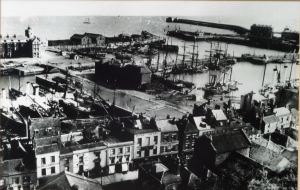
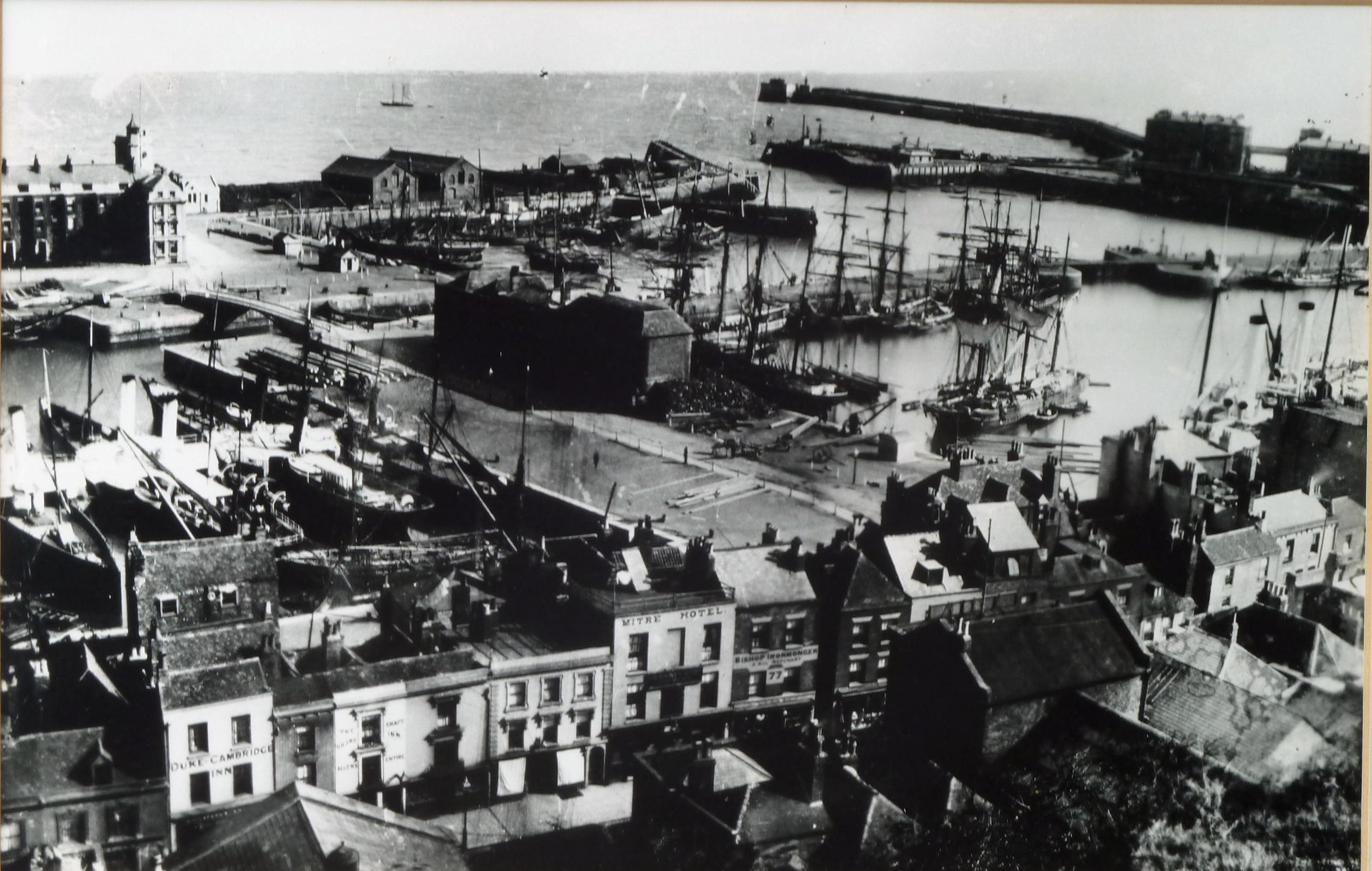
Dover Harbour late 19th century. Courtesy of Ian Cook

Dover Harbour late 19th century. Courtesy of Ian Cook

Afterwards, Finnis publicly stated that the representatives of the two railway companies had agreed to give sureties for the payment of interest on outlay etc. The estimated cost was around £200,000 and he finished by saying that it would be a ‘truly national work that would enable the rendezvous in times of war of the entire national fleet and serving as a national harbour of refuge, so much needed in the interests of humanity …

Dover, holds the key of the Channel!

This was given both national and international coverage and it was agreed that Sir Andrew Clark would build the proposed harbour but a reassessment of cost increased the proposal to £970,000. In May 1873, it was reported by the former Packet Company owner, Joseph Churchward (1818-1890), in his Dover Chronicle that the Harbour of Refuge, as had been agreed, would go ahead. This was sanction by the 1873 Dover Harbour Act and in July the Admiralty ship, Porcupine, arrived in Dover to undertake survey for the planned harbour of refuge. At that time, the Liberals were in power and to ensure the government received value for money they added six government appointees to the Harbour Board, two of which came from the Board of Trade.

However, later that month, the Treasury, through the Board of Trade, proposed that both railway companies (SER and LDCR) should contribute £10,000 each and charge a 6d (2½p) per passenger toll towards the scheme. They agreed to pay £8,000 per annum – £4,000 by each for 5 years – on condition that the passenger tax was dropped and that the accommodation to be afforded should be separate and free of charge but the Board of Trade rejected the offer. Representing LCDR on the Board was James Staat Forbes who had been approached by DHB Board member, Samuel Metcalf Latham, the local Liberal Party Chairman, to stand in the next parliamentary election for Dover which was expected to be held approximately four to five years time. Forbes centred his manifesto on the harbour, saying that if elected he would help to make the port of Dover  great and a Harbour of Refuge that the town had been calling for. In the event a by-election was called in 1873 but Forbes lost to the Conservative representative.

Following the General election of February 1874 the new Conservative administration referred the proposal to a Parliamentary Select committee. They advocated a larger scheme and a Bill was submitted to Parliament in December and estimated to cost £1,600,000. The new proposal, on government initiation, was placed in the hands of the Board of Trade’s two representatives on DHB, to pilot it through the Committee stages. In June 1875, the House of Commons Select Committee gave its approval. However, on Tuesday 13 July, in the House of Lords, Charles Henry Gordon-Lennox, 6th Duke of Richmond (1818-1903), on behalf of the government, announced that the proposal was to be, in essence, put on hold.

On 1 January 1877, there was a terrific storm at Dover that damaged the thinnest part Admiralty Pier – the centre curve of the parapet that was 5-feet 6-inches wide. Shortly after it was replaced by a 12-foot parapet with the stone facing filled in with concrete that is still in situ today. Dover builder, William Adcock (1840-1907), who had completed the later work on the Admiralty Pier, undertook the repair of the upper galleries.
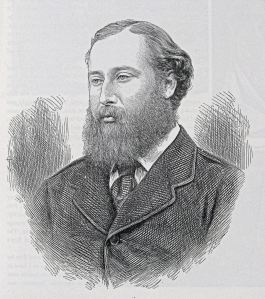
Edward Prince of Wales c1890 Later Edward VII (1901-1910)

Edward Prince of Wales c1890 Later Edward VII (1901-1910)

In June that year Trinity House, of which the fraternity of the Cinque Ports Pilots belonged and presided over by HRH the Prince of Wales (later Edward VII 1901-1910), held a banquet in London. The Lord Chief Justice of England, Sir Alexander Cockburn (1802-1880) gave the toast in which he said that ‘Trinity House was still busying itself keeping up our lighthouses and endeavouring to make the coasts dangers as trifling as possible. He only wished that the work of constructing harbours of refuge all round our coasts would be intrusted to Trinity House. … He had understood that … the construction of one at Dover … the Treasury has prevented it. The harbour of refuge was still, however, work that remained to be accomplished, and he hoped that heaven would permit him to live so long as 20-years to see it begun … if not put off again!’ He died three years later.

In the House of Commons, one of Dover’s two Conservative MPs, Charles Kaye Freshfield (1865-1868 & 1874-1885) strongly put the case for a harbour of refuge. He pointed out that it was of national importance ‘that the Strait of Dover, through which a large proportion of the nations commerce and navy had to pass and where the country’s ships of war could best wait in ambush should there be a need, should be completed.’ (01.06.1877) In the Lords, the Earl of Granville was loudly banging the same drum but on 26 March 1878, the Prime Minister, Benjamin Disraeli (1804-1881) 1st Earl of Beaconsfield, responded in Lords. His speech was so sarcastic that it was generally understood that while he was in power, a harbour of refuge at Dover would not happen.

Hopes that Dover would become a National Harbour Of Refuge were at a low ebb. Albeit, international events were coming into play as Part 2 of the Harbour of Refuge recounts.

  • Presented:
  • 15 August 2014
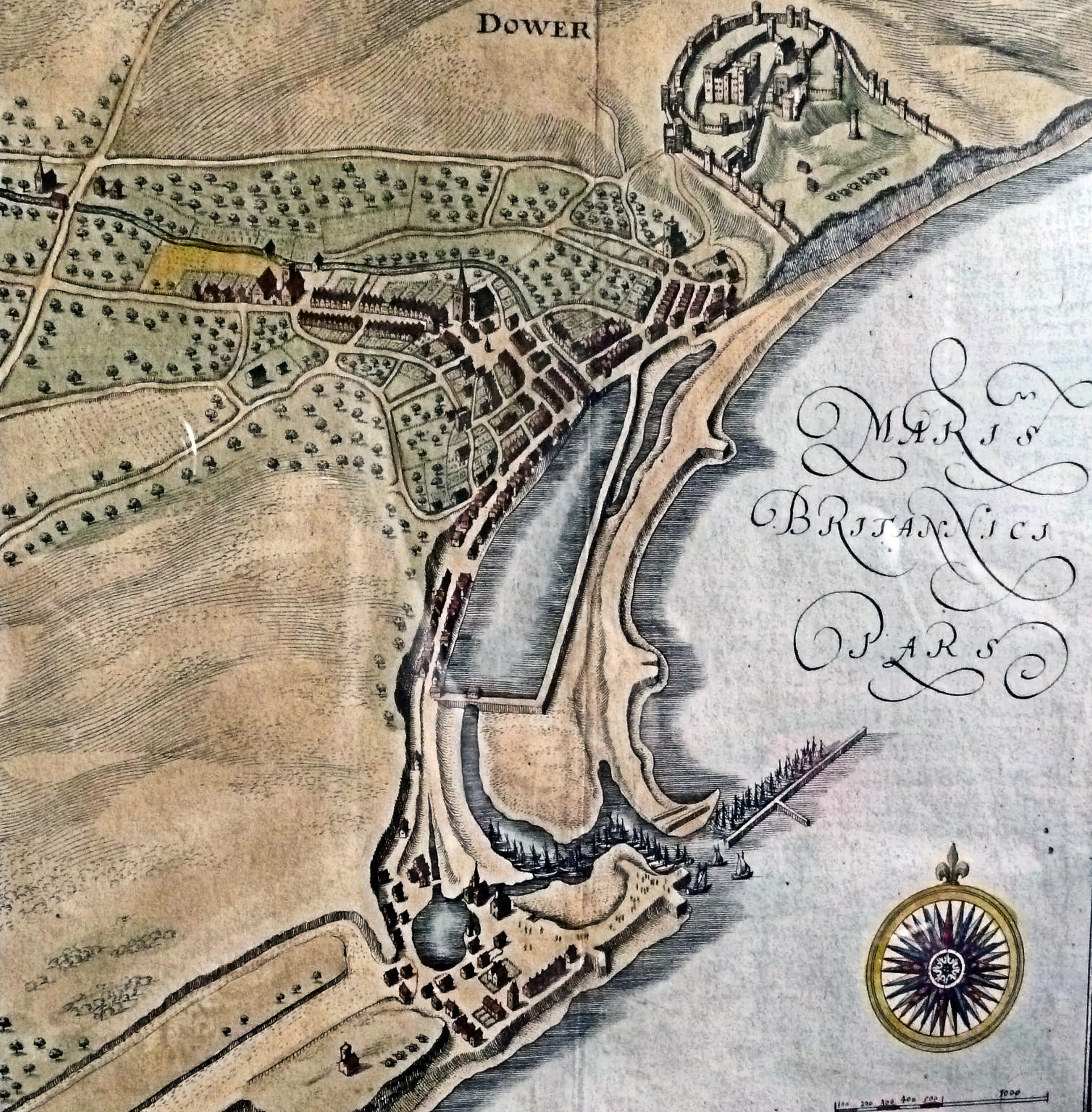
 

Posted in Harbour of Refuge Part I, Maritime | Comments Off on Harbour of Refuge Part I