Museum – An Historic epic

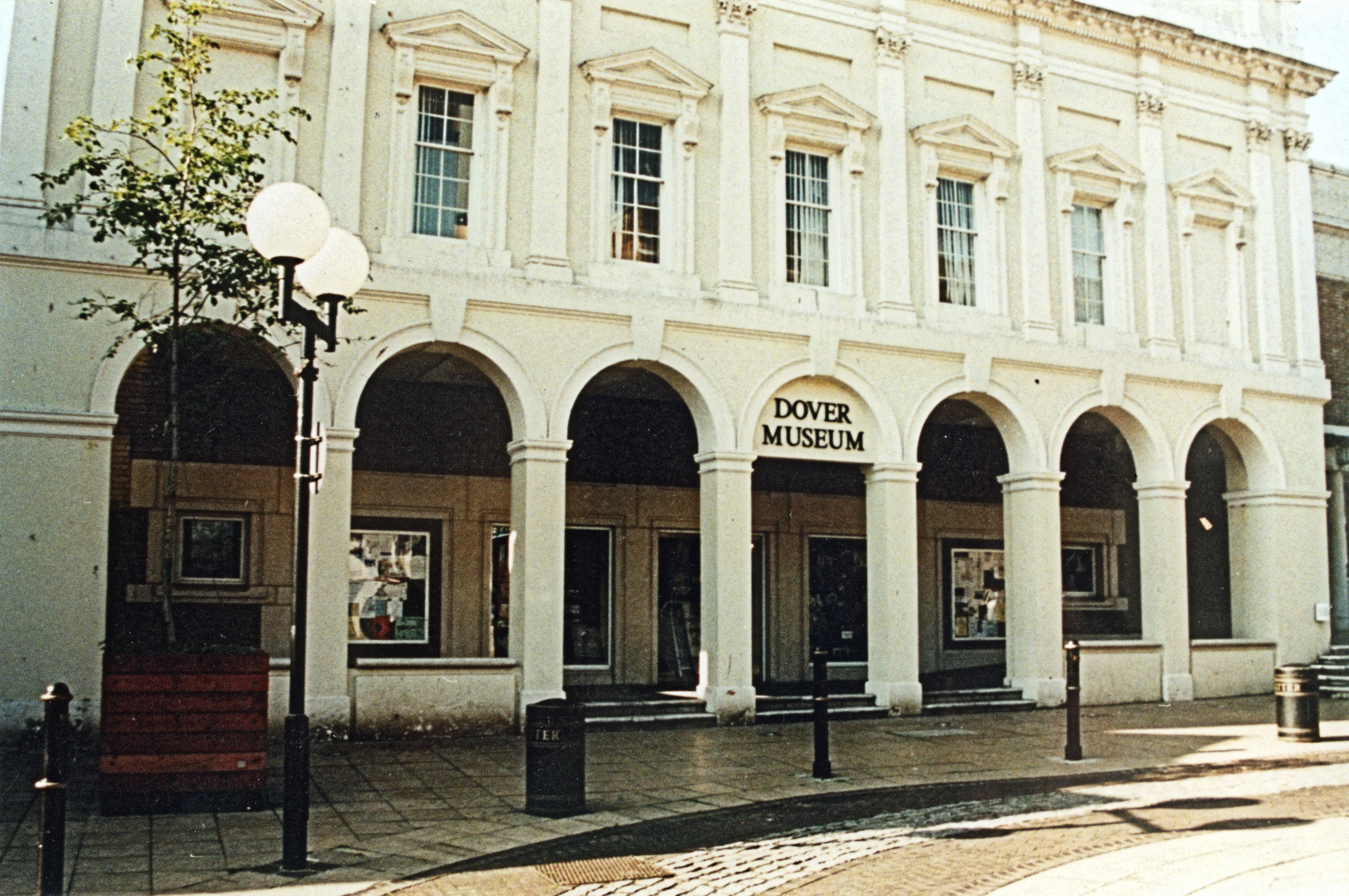
Museum, Market Square c1990. Dover Museum

Museum, Market Square c1990. Dover Museum

Dover Museum is one of the many jewels in Dover’s crown. Housed in a spacious building behind a Listed older, grand, façade it is here that the world famous Bronze Age Boat is on show. A must see attraction during even the briefest visit to the town. The museum gives an overview of the town’s history that whets the appetite to see more of the many historic gems the town has to offer. To help with this, the Tourist Information office is situated on the ground floor.

The history of the museum itself goes back two centuries, for it was during the Napoleonic Wars (1793-1815), that the idea of a town museum was sown. At the time, there was an influx of military and naval personnel, which had led, on the one hand, to a major growth in the entertainment industry such as theatres, assembly rooms for dances and balls and pubs etc., on the one hand, an interest in intellectual pursuits. One such organisation was the Dover Philosophical Institute whose remit was the ‘promotion of literary and scientific knowledge.’ In February 1835, Dover Corporation managed to gain possession of the Maison Dieu in order to use it as a replacement Town Hall and Law Courts. The council and courts, at that time, met in the ancient Court Hall in Market Square.
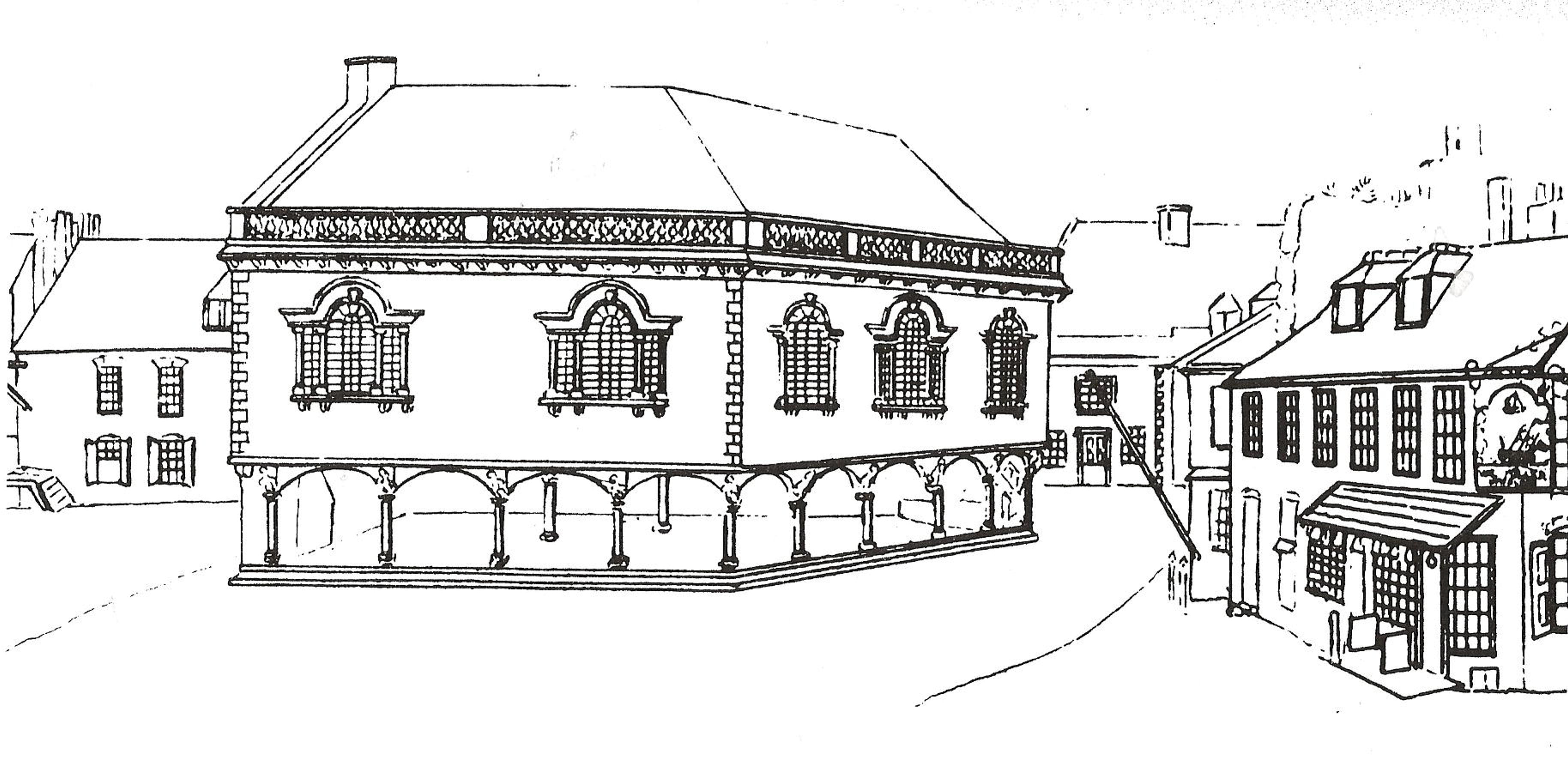
Dover Town Hall situated in the Market Square, the first home of the Dover Museum. Dover Museum

Dover Town Hall situated in the Market Square, the first home of the Dover Museum. Dover Museum

The galleries underneath the ancient Market Square building were used for a market but following the move, the council let the upper storey to the Philosophical Institute for £40 per annum to be used as a museum. Under the guiding influence of the Mayor, Edward Pett Thompson (1802-1870), who donated a valuable collection of 470 specimens of vertebrate zoology, including 420 stuffed birds and 50 fossils; it was formerly opened on 26 August 1836. The new museum was only open to members of the Institute with the intention to provide a library and reading room for conversation and classes.

Ordinary members of the public showed interest so to test the water, on Boxing Day – 26 December – 1836, the Institute opened the doors to the general public for five days. 1,500 people came and it was reported in the Dover Telegraph that, ‘the hall was so crowded that not all could sign the visitors’ book.’ Because of the interest the building was renamed the Dover Museum and in December 1837 it was announced that, ‘ The Museum would be open every Monday to all classes gratuitously!’

Earlier that year, in February 1837 a wild hog, killed in the forests of Germany, was presented to the Museum. This was the first of many such donations. It was reported that when Mr Gordon of Canterbury Museum skinned the hog, a bullet was found in the loins and several swan-shots in various parts of the body, over which the skin had healed. Albeit, of particular interest at that time, underneath the bristles and close to the skin was a kind of woolly hair not found in hogs elsewhere.

In September 1837, the Corporation Market Committee bought the town gaol and the land on which it stood, adjacent to the Market Square, for £555 from Dover magistrates. This left very little in their budget to build an intended market hall so the council sold the site to a private purchaser for more than was paid for it. However, on 20 January that year, the new Dover Police Force had been formed and they required a police station and lock-up. Thus, the site was repurchased but at a loss!

Time passed and a new prison and police station was built adjacent to the Maison Dieu and by 1845, the council was able to repurchase the site. That year saw the passing of the Museums Act that empowered boroughs with a population of 10,000 or more to raise a ½d rate for the establishment of museums. Dover decided to have a municipal museum and commissioned a report from architect, Mr Woodthorpe for a Market Hall that included room for the museum.
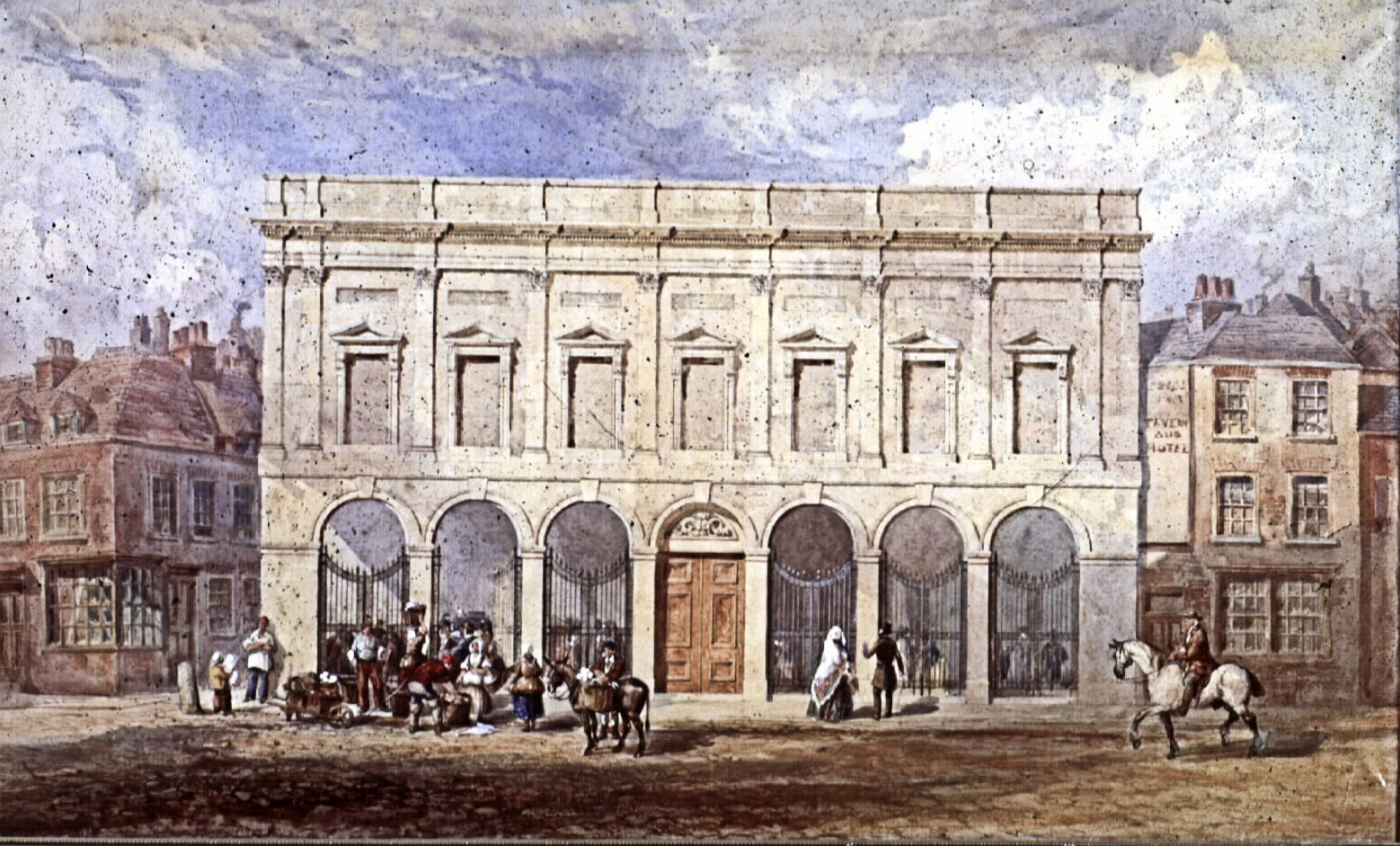
The new Market Hall with Museum above 1846. Dover Museum

The new Market Hall with Museum above 1846. Dover Museum

Mr Woodthorpe presented his report in April 1846 and the plans showed, ‘an open market with stone piers and arches above, subdivided in the interior by columns of a Tuscan character, comprising of a Museum along the whole front and above the centre of the Market, the exterior having Corinthian columns, the interior space being filled with pedimented windows.’ (John Bavington Jones: A Perambulation of the Town, Port, and Fortress of Dover. Dover Express 1907 pp 35.

The project was estimated to cost £3,000 and this was set aside. Ten builders tendered, seven from Dover, but all gave estimates greater than that budgeted. This was due to the cost of the Caen stone and the ornamental work. In the end, it was agreed not to use Caen stone and to cut back on the ornamental work and the lowest tender, from local builder George Fry, was accepted. The eventual cost for the building was £3448.

On completion the museum moved from the old Town/Court Hall into the upper storey in January 1849 and the old building was eventually demolished in 1861. The new premises consisted of a large gallery devoted to stuffed animals and birds, all carefully classified. There were also three smaller rooms, used for administration, lectures and talks etc. Admission was free on weekdays except Thursdays and was open for six hours a day.

Lectures and talks were on a variety of subject. Fir instance, on 25 March 1851 a Mr Mottley gave a talk on ‘The Electric Light’, which he illustrated with experiments using a powerful battery. Later that year, water, tea, coffee, cocoa and sugar were examined during a talk on ‘The Chemistry of the Breakfast Table’. That year local taxidermist Charles Crudden, who undertook much of the museum work, was awarded bronze medal at the Great Exhibition in London, for a case of ornithological taxidermy depicting the ‘mobbing of an owl’. In summer, nature rambles were organised and there were soirees and discussion groups that put both Dover and the world to rights!
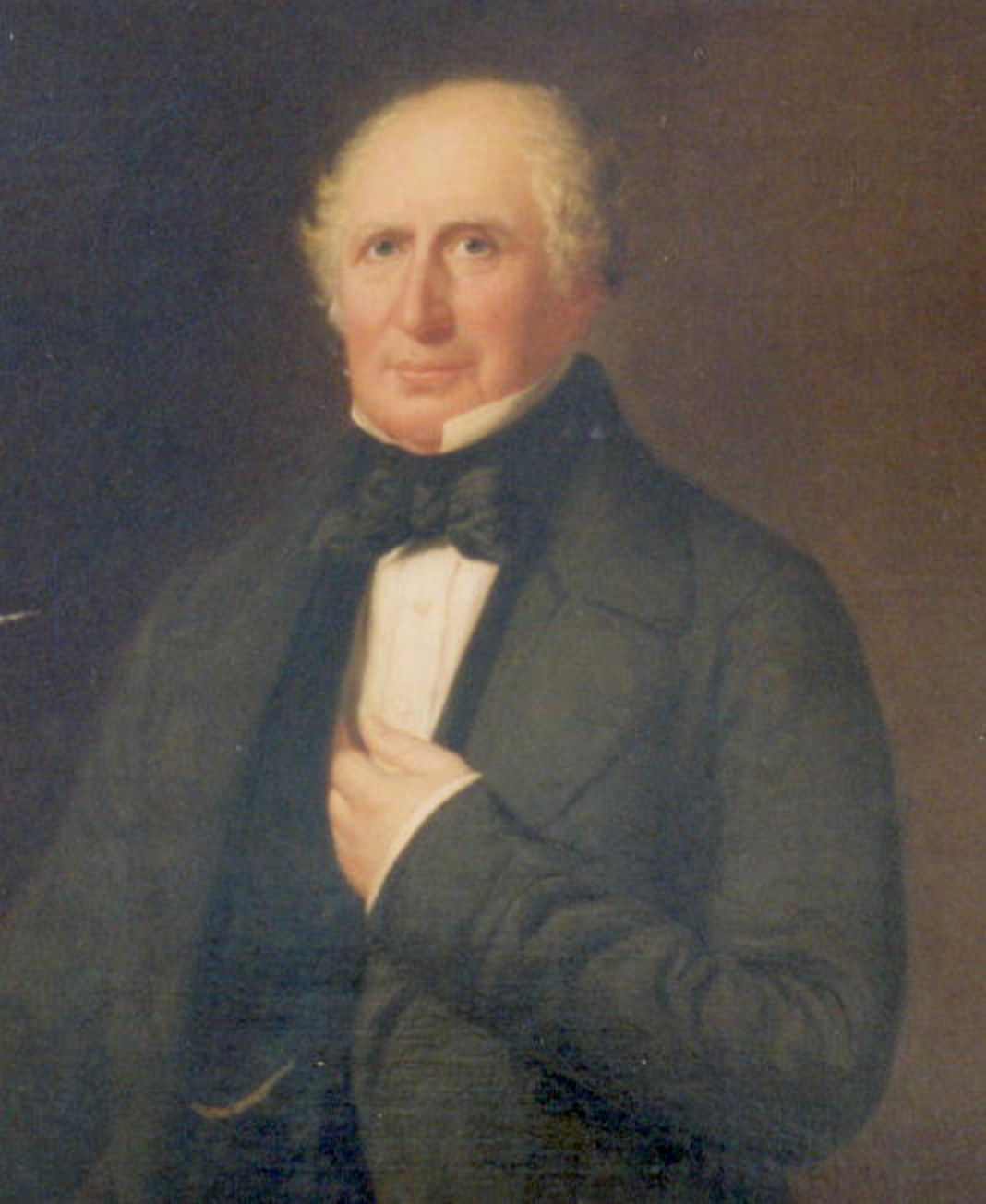
Edward Rice, Liberal MP for Dover 1837-1857, who successfully petitioned for official papers and reports to be made available to the public through places like Dover Museum. Dover Museum

Edward Rice, Liberal MP for Dover 1837-1857, who successfully petitioned for official papers and reports to be made available to the public through places like Dover Museum. Dover Museum

In the House of Commons in December 1852, Dover MP (1835-1852), Edward Royds Rice (1790-1878) asked for reports relating to arts, manufactures and commerce, to be made available to bodies such as the Dover Philosophical Institute. This was so that they became easy accessible in places such the museum and similar places throughout the country. The proposal was eventually accepted. In February 1860, the Dover Philosophical Institute petitioned the House in favour of the budget that year – especially the remission on the duty paper duty – Dover, at that time, had a number of paper mills.

The Mayor in 1854 was James Poulter and when Dr. Plumley of Maidstone offered his collection of fossils found mostly in Kent, the Mayor and the council gladly accepted them. However, the museum did not have the room in the main gallery to display them so the room previously used for lectures, talks and discussions was cleared to make room. Later that year the Mayor Poulter gave a dinner at the Ship Hotel on Custom House Quay. There Dr Plumley was presented with an illuminated address in recognition of his munificence. At about this time excavations were being undertaken on the former Priory site, now Dover College, where Roman pottery and cinerary urns were found. These too were displayed in the museum taking up the second of the three smaller rooms and lectures and talks were moved to a new venue.

The museum was severely damaged by violent thunderstorms in early September 1871 and a number of artefacts were damaged. National museums offered to care for Dover’s precious historical records until repairs were undertaken. Although local historians expressed concern that they would not be returned reassurances to the contrary were, apparently, given. Albeit, when the building was eventually repaired the precious documents were not returned.
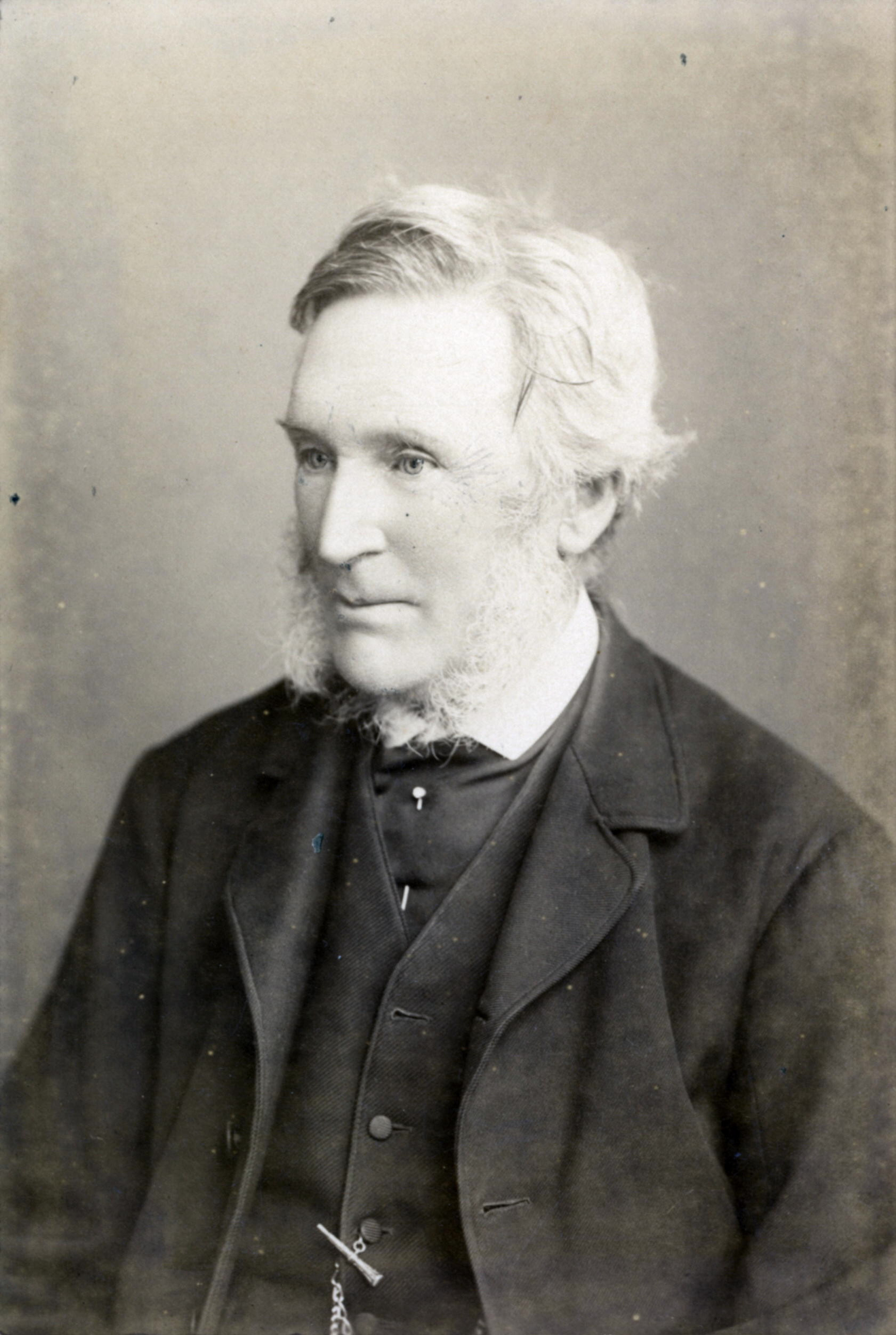
Dr Edward Farrant Astley hon. Curator - Dover Museum. Dover Museum

Dr Edward Farrant Astley hon. Curator – Dover Museum. Dover Museum

Nonetheless, tourist guides were positive about the museum’s collection of stuffed animals, birds and the large Sloper collection of mounted and labelled butterflies. Roman artefacts as well as numerous Indian, Chinese and Burmese curios were given as attractions. Also listed, in an 1890 guide, are ‘ancient remains from Ninevah and Egypt’. These included a mummy-case richly decorated with a mummy inside.   At this time, the museum was under the direction of local philanthropist Dr Edward Farrand Astley (1812-1907).

In 1894, a Captain Lang gave the Cesar, a Man o’War model made of bone. This was, and still is, of local interest for it is said to have been made at Dover Castle by a French prisoner. Now subject to dispute, traditionally, it is said that it was made during the Napoleonic Wars out of the bones left over from food rations. Apparently, the prisoner who was making it had not quite finishedwhen the Peace of Amiens was signed in 1802, so he remained at the Castle. By the time he has finished the ship war had begun again and the prisoner had to remain in the Castle for another ten years!

The hon. Walter Rothschild (1868-1937) presented a collection of stuffed mammalians to the town in 1901. To house them the museum and market hall were extended at the back in to Queen Street. The Mayor at the time was chemist,  William James Barnes (c1850-1942) and he succeeded Dr. Astley as the hon. curator of the museum and librarian. The Rothschild collection, together with other items on display, regularly drew visitors from  both home and abroad. Of particular interest was a parrot-feather cloak from Hawaii that had belonged to Kamehameha the Great (1758–1819) and presented to Wingham born General William Miller (1795–1861). He had participated in several South American revolutions before becoming the British diplomatic Consul to the Pacific Islands from 1844-1859.

Other items that attracted visitors was the head of a Maori chief, Oliver Cromwell’s (1599-1658) sword and a collection of rats dressed up as a skiing party together with a collection of stuffed kittens made to look as if they were drinking tea. Both were put together by local taxidermists of which there were several in the town at the time. There was also  a bottle holder that had held the brandy used to try to revive Horatio Nelson (1758-1805) after he fell at the Battle of Trafalgar (1805), or so it was said.

However, local historians were becoming increasingly angry over the lack of interest in the loss of the town’s ancient records to national museums. The editor of the Dover Express, John Bavington Jones, who was also an amateur historian, spelt this out in a letter to the Times of 9 September 1912. He wrote, that a large portion of Dover’s minute books and a greater part of the original plans for Dover Harbour of the Tudor period were in the British Museum along with records of Dover Castle. That the ancient striking clock made in 1346 for Dover Castle and having the earliest form of casement, had been moved to the Victoria and Albert museum against the wishes of the people of Dover.

Bavington Jones went on to point out that in 1878, a five-coil torque was dug up during the excavations for the building of Castlemount. The torque was described as the finest armlet discovered in England and had been sent to the British Museum for verification but was never returned to the town! (A replica can now be seen in Dover Museum). Finally, he wrote, the MSS relating to St Bartholomew’s Hospital, Buckland, and compiled in 1373 was sent to the Bodleian Library, Oxford for safekeeping while the museum was being repaired. When he made inquires, the staff at the Bodleian did not know where it had been put!

On 30 April 1917, during World War I (1914-1918), a new curator, Frederick Peter Abbott, was appointed with a salary of £100 per year plus war bonuses. In December 1918, he wrote to the council pointing out that it had been agreed to increase his salary by £26 and from 1 January 1918 receive a war bonus of 10s per week but this had not happened. In his letter, the curator pointed out that the number of visitors to the museum during the quarter ending 30 September 1918 was 9,876 while in the corresponding quarter of 1917, there had been 9,588. It does not appear that his letter met with any sympathy for the council only recommended that the museum should close at 16.00hrs on Wednesdays, to save electricity!

Against increasing cutbacks, Mr Abbott struggled to keep the museum going. He even managed to add what was later described as a ‘fine collection of pictures, prints and books.’ However, visitor numbers were falling and there was a danger of the museum closing down. The National Museum Association visited and they were not kind about its state and recommended that Frederick Knocker (1858-1944) should be employed for a two-year experimental period to sort things out. The son of a local man, Knocker had a life long experience of museum work.

In August 1931, Knocker presented his report in which he said that the building was unsuitable, dank and cold. Due to lack of interest by the council both prestige and moral were low and the cases of exhibits were ‘odd shapes, sizes and of doubtful utility’. He recommended the disposal of many of the more dubious specimens. In addition, he noted that the staff consisted of Mr Abbott – whose salary had been increased – an exhibitor who was paid £156 a year, an attendant paid £52 a year and, on occasions, a charwoman who dusted and washed the floors.

On receipt of the report, the council proposed to increase spending from £500 to £2,000. A year the scheme, outlined by Knocker to revitalise the museum, was considered in September 1931. This was sent to the Carnegie Trustees in the hope of getting a large grant towards the cost of implementation. While awaiting a reply and under Knocker’s direction, the exhibits were thoroughly overhauled and the building cleaned and redecorated.

The showcases were placed where there was abundant light so that the contents could be seen and two of the small rooms were devoted to exhibits of a local nature. However, the Carnegie Trustees only granted £150 and that was to be matched by an equal amount from the Corporation. On appeal, the Trust increased the award by a further £100, again to be matched, but stipulated that the whole amount was to be used to provide an extension for the zoological wall cases.

Museum and market hall circa 1930s. Dover Museum

Museum and market hall circa 1930s. Dover Museum

Accordingly, in 1933 the museum and market hall beneath were enlarged. A tender of £1698 was accepted from Messrs Herbert Godsell of Maidstone for building work and one of £355 for an electric heating system from the Arora Company, of Loughborough. It was proposed by the council to charge only ½p per unit of electric heating current when the ordinary heating rate in Dover was 1½d.

Carnegie Trustees responded by giving a further grant of £2,000 for museum works and upgrading of facilities. The new look museum was opened by Dover’s MP (1922 -1945), Major the Hon. John Jacob Astor (1886-1971) on 4 May 1934. Although local history and archaeology were given as the main features, the first exhibition was designed to attract national attention and centred on photographs of Mount Everest provided by the Times!

To coincide with the opening a proposal was submitted to the council for the formation of a Friends of the Dover Museum Association. The objective was the raising funds by subscriptions and contributions ‘for the provision of modern casework and efficient maintenance and preservation of specimens.’ It was suggested that the minimum annual subscription should be 5shillings and that members be entitled to free copies of the museum’s publications, privileged admissions to exhibitions and lectures etc. However, the council refused instead they gave instructions that three additional collecting boxes were to be fixed at suitable places in the museum!

By now acting curator, Frederick Knocker forcibly suggested the establishment of a learned society for stimulating public interest in the museum by exhibitions, lectures etc. The council agreed but due to the lack of room, Knocker suggested turning part of the recently vacated Biggin Hall into a lecture hall accommodating 120 people.

The council refused but the first lecture went ahead on 5 January 1935, given by John Mowll at the Art and Technical school on Ladywell. The number of people who turned up was greater than the capacity of the facilities provided and with each subsequent lecture interest continued to grow. Eventually, the council relented and turned part Biggin Hall into a lecture hall accommodating 120 people.

Biggin Hall used for Dover Museum organised lectures in the 1930s.

Biggin Hall used for Dover Museum organised lectures in the 1930s

Having formed an embryonic Friends of the Dover Museum Association in all but name, in April that year Knocker suggested a scheme to affiliate public museums in Kent with the view of pooling scarce resources to provide for a museum service in rural areas. This was placed before the Kent County Council Education committee, the Joint Committee of the Museums Association and the Carnegie Trust for their approval and financing and, it would appear, approval was given.

Mayor Alderman George Norman opened the Centenary exhibition of the founding of the Dover Museum on 31 July 1935. This coincided with National Navy week, so the event centred on a Naval and Maritime exhibition and the Dover Patrol during World War I. Artefacts included several items appertaining to relics from the Vindictive and the Zeebrugge Raid lent by the then Admiral of the Fleet Sir Roger Keyes (1872-1945)

The following day, in another part of the museum, Mayor Norman opened a six-week exhibition commemorating the Silver Jubilee of the ascending to the throne of George V (1910-1936). This was organised by John Mowll and included autographed letters written by Queen Victoria and chief Ministers of her reign. There were medals, coins and stamps of the preceding 100 years together with pamphlets and books connecting the Royal family with Dover. Both exhibitions were a great success attracting people from all over the country and from abroad.

In 1938, Frederick Knocker resigned and eventually a Mr Warner was appointed. World War II (1939-1945) broke out on 3 September 1939 and the period immediately following, often referred to as the phoney war, saw an increase in visitor numbers. Indeed, on 28 November 1939, the new curator congratulated the council for the ‘conversion of a dump into what you see to-day’. However, as the war progressed and danger became closer, Mr Warner asked the council if he could move items into caves for safe storage. The council’s priorities lay elsewhere, but as space became available, Warner moved precious town records that were still retained in Dover and local history books to safety.

On Monday 21 October 1940 at 12.50hrs, four bombs were dropped on the town. One hit the rear of the museum/market hall, damaging the building. No warning had been sounded but luckily no one was hurt. Following this Warner moved more items to safer places. The building was hit again on 23 March 1942 and afterwards, it was said, pieces of a mummy’s shroud fell all around the town! However, about 70% of the remaining collection was destroyed. What remained was quickly moved to caves, the Congregational Church and Sunday school on Russell Street and empty houses.

Museum and market hall 1943 following shelling. Dover MuseumThe Plomley collection of Kentish birds, including specimens that were, by this time, extinct were moved to empty houses, but the new locations proved to be damp. Until another ‘home’ could be found the collection was moved back to the museum. During further shelling of the town on 4 October 1943 the Plomley collection was destroyed and the museum building was finally abandoned. Then on Thursday 23 December 1943, a shell hit the Russell Street Congregational Church and most of the exhibits stored there were lost. Frederick Knocker died age 70 on 28 January 1944. He had lived away from Dover for many years but helped to prepare the museum’s war damage claim.

On Tuesday 26 September 1944 more than 50 shells were fired at the town, this was the last day of the four-year bombardment. When the shelling ceased it was estimated that the war damaged sustained by the town was proportionally greater than any other town in the country. A reconstruction plan had already been drawn up but to give it weight town planner, Professor Abercrombie (1879-1957), was appointed and his report was published in January 1946. Among his many recommendations was that in the middle of the town, between Brook House and Maison Dieu House, would be a Civic Centre. The two ancient Houses, both damaged due to the war and years of neglect, were to be repaired and protected. Brook House was to be refurbished as museum and Maison Dieu House was to become the town’s library.
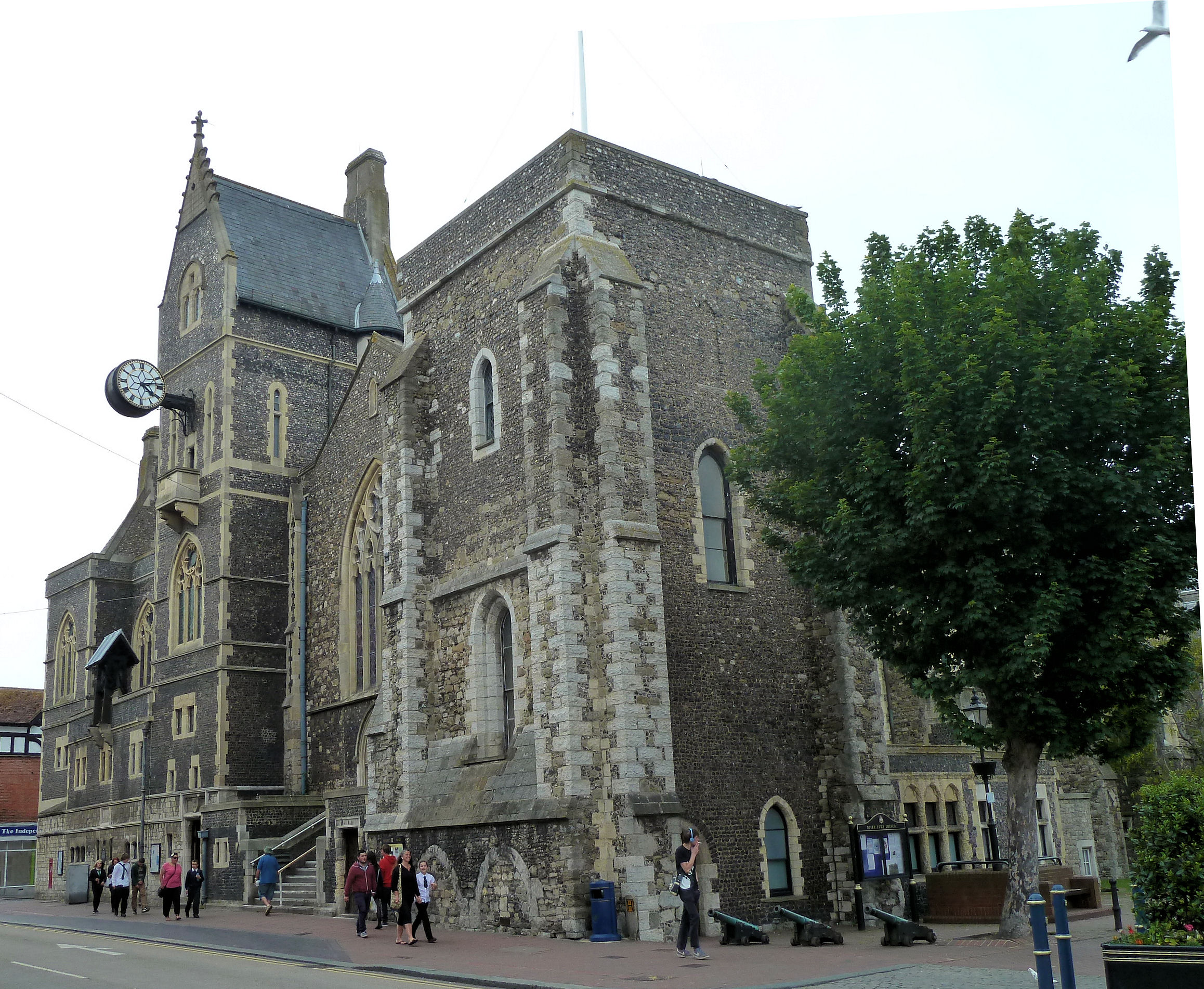
Following World War II what remained of the museum's artefacts were moved to the basement of the then Town Hall or stored in the tower. AS

Following World War II what remained of the museum’s artefacts were moved to the basement of the then Town Hall or stored in the tower. AS

Following the War, what remained intact or could be repaired of the museum artefacts were moved the bowels of the Maison Dieu, the then Town Hall. The remainder was put in storage in the Tower above the Town Sergeant’s office. The collection of town archives and local books were removed to the town library, in anticipation of the move to Brook House. In 1947, the depleted collections of artefacts were enhanced by the bequest of Lady Anne Cory’s collection of Victorian furniture. About the same time ceramics were acquired. Two years later Miss S Minet of Hadham Hall, Little Hadham, Hertfordshire, presented to the Corporation a collection of 20 framed prints and water colours of old Dover that initially were displyed in the Stone Hall of the Maison Dieu before been put into care of the museum.

After much deliberation the council agreed to convert Maison Dieu House into a library and to move the occupants, the Borough Engineers’ Department, to Brook House. The museum artefacts were to remain in the basement of the Maison Dieu, the tower and the library. To give the appearance of a respectable town museum, in February 1949 it was agreed to the widen the doors to the basement, in Ladywell and to insert the oak doors from the war torn St James’ old Church. The letters ‘MUSEUM’ was carved above the entrance and on 28 November 1949 the ‘new’ Museum was officially opened by the Mayor William (Bill) Fish.
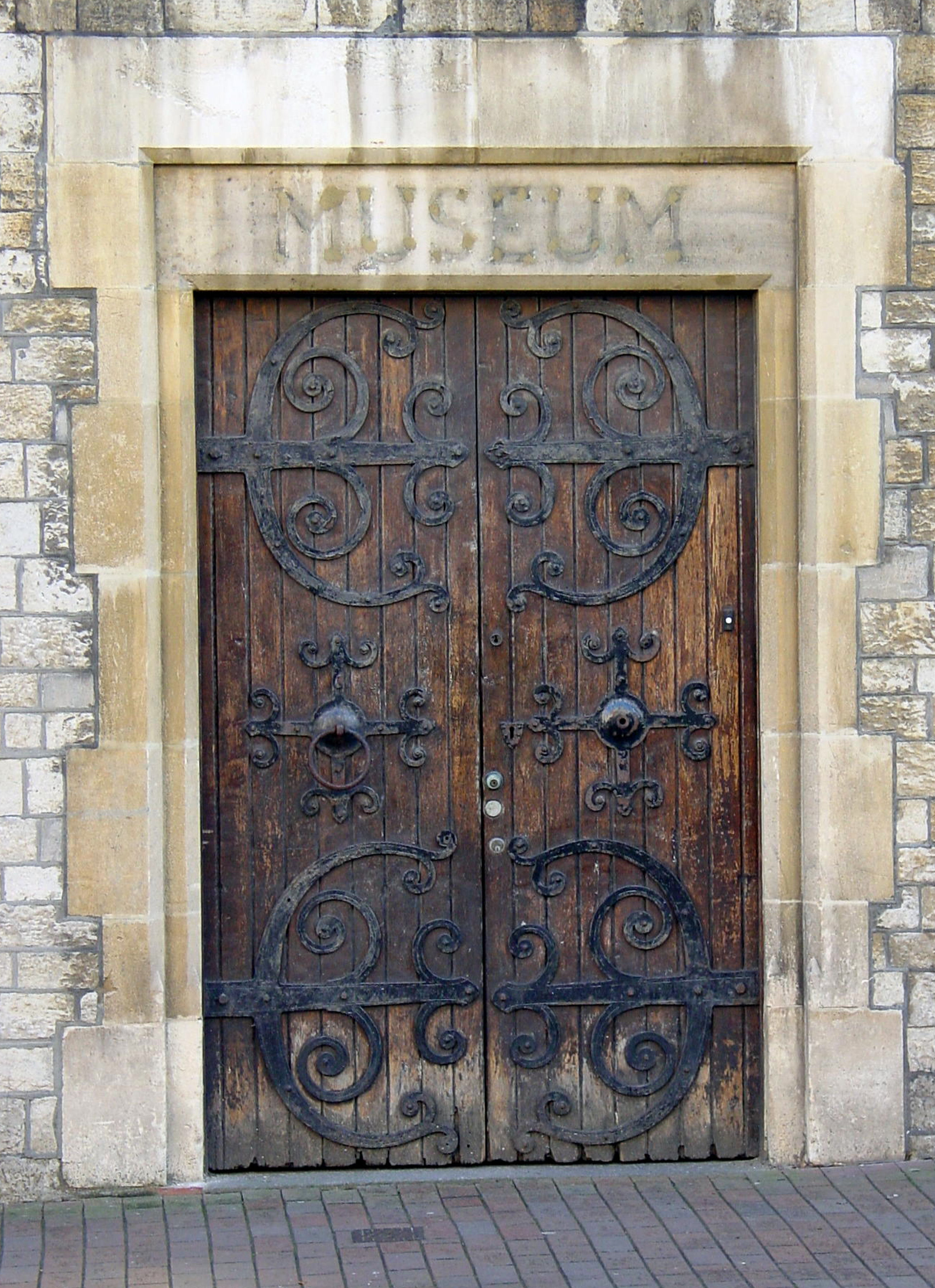
The entrance to the museum on Ladywell when it was housed in the bowels of the Town Hall. AS

The entrance to the museum on Ladywell when it was housed in the bowels of the Town Hall. AS

From the outset, the premises were far from adequate and such items as the Hawaiian parrot-feathered cloak was sold to James Thomas Hooper (1897– 1971). He was a collector of ethnographic artefacts. Other artefacts that no one was interested in, such as a large stuffed black bear were kept. It was to spend the next few years at the bottom of the spiral staircase leading to the Tower, spooking unsuspecting visitors!

Across town, on 7 January 1951, the Bench of the Barons of the Cinque Ports was moved from the war-damaged vestry of the old St James Church, repaired in the Dover Harbour Board workshops and dedicated in St Mary’s Church. Due to lack of room in the museum, it remained in the church for the next few years. It is now on the third floor of the museum, where it can still be seen.

In 1956, for the first time since the war, the museum was mentioned in the Dover trade directory as a place to visit but the location was stated as Market Square! It was another three years before that was rectified. Francis McQueeney took over as museum curator in 1960. His special interests were silver, ceramics and military history and shortly after arrival a collection of cap-badges were on display at the museum along with war relics. He was also interested in transport and added a collection of bus tickets. However, McQueeney’s main aim was to bring people, from small children to old age pensioners, into the museum and one of the main attractions arrived shortly after Mr McQueeney!

 Koettlitz Polar Bear. Dover Museum

Koettlitz Polar Bear. Dover Museum

Following the death of Dr Maurice Koettlitz, of Charlton House, London Road, on 6 February 1960, a polar bear that had been shot by his grandfather, Dr Reginald Koettlitz (1860-1916) was donated to the museum. The bear met its end while Dr Koettlitz was on the 1894 Jackson-Harmsworth Polar Expedition however, the good doctor is better remembered for accompanying Captain Scott on his Antarctic Expedition in 1901.

On returning to Dover, Dr Koettlitz donated clothing, skis, snowshoes and medical bag to Dover Museum while the bear was stuffed and fitted with a lamp holder in its paw. It then was placed in the surgery waiting room. Having no room for the smaller black bear, the huge polar bear posed a dilemma until McQueeney placed it as a doorstop at the museum entrance. It quickly acted as magnet to Dover children, including our own. It is now on the first floor of the museum in a glass case and proved a great favourite to Prince Charles on his visit in 2000!

During the 1960s, the increasing problem of lack of space led to a major clear out of exhibits, particularly those that were beyond repair. Those that could be salvaged and were of relevance to Dover were kept or lent. Everything else was sold or given away. Nevertheless, artefacts kept on coming in, such as a Maori carving in 1963, bequeathed by George Tulloch, a transport director. Some of those dispensed with have since been returned to the museum and restored but there were regrets. For instance, the Hawaiian parrot-feather cloak that belonged to Kamehameha, given to the museum by General William Miller and sold in the late 1940s  fetched £140,000 at auction in June 1977!
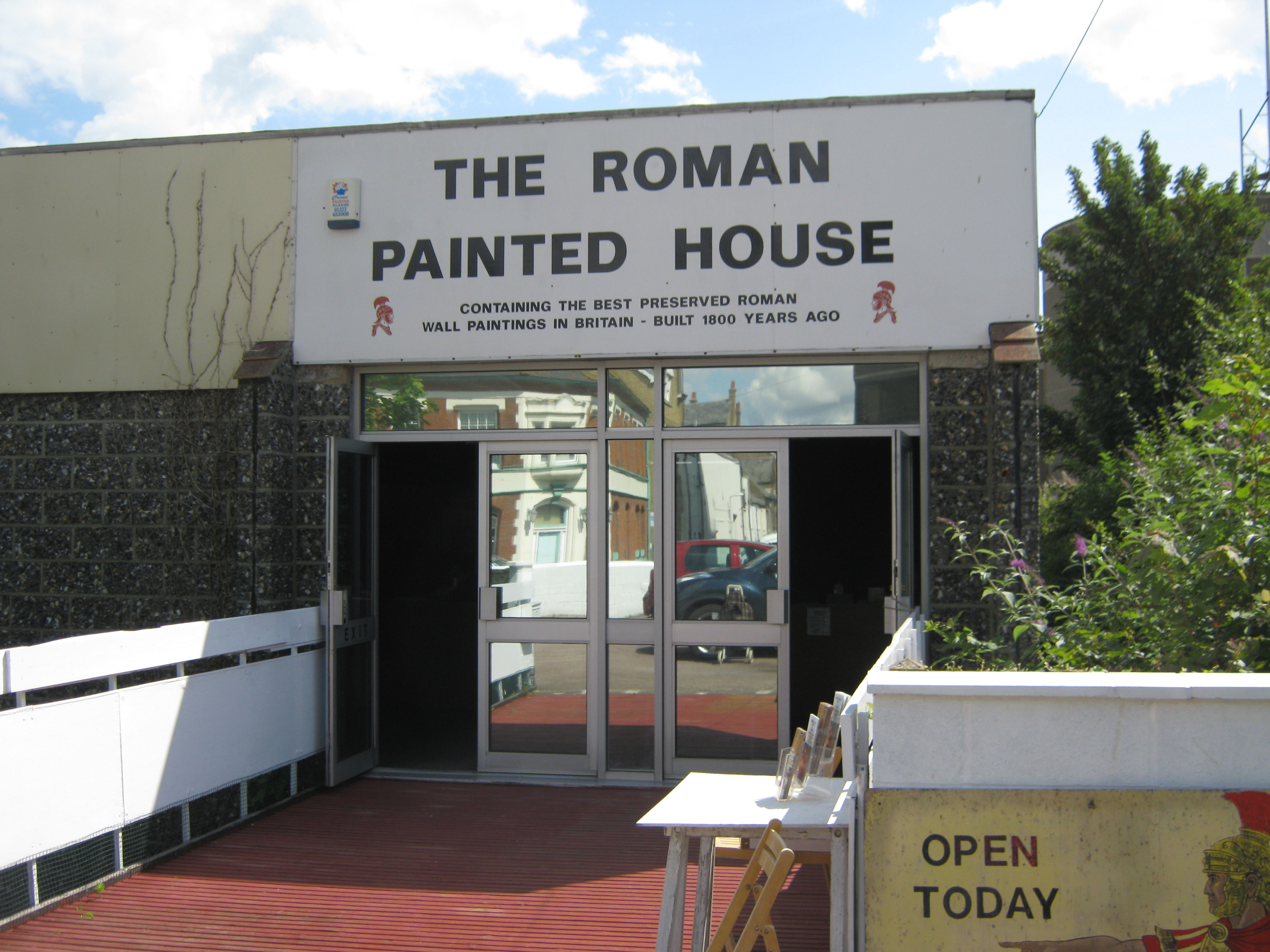
Roman Painted House, New Street, the best-preserved building of its type north of the Alps. LS 2014

Roman Painted House, New Street, the best-preserved building of its type north of the Alps. LS 2014

Work started on York Street dual carriageway in the late 1960s and included the demolition of buildings, some dating from Tudor times. The road, it was envisaged, would relieve the town centre from traffic going to the docks. Dover Corporation, on the insistence of the New Dover Group (now Dover Society), contacted archaeologist Brian Philp of Kent Archaeological Rescue Unit (KARU). Philp with his team of archaeologists and local volunteers excavated and uncovered what turned out to be the richest 15 acres of buried history in Britain.

Ruins of St Martin-le-Grand with the Roman Painted House in the background. LS

Ruins of St Martin-le-Grand with the Roman Painted House in the background. LS

This included many large, exceptionally well preserved, Roman buildings that made up the Classis Britannica Fort. The Roman Painted House is recognised as the best-preserved building of its type north of the Alps. The archaeologists also discovered considerable amount of Saxon artefacts and the early history of St Martin-le-Grand Church. For his work, Brian Philp was awarded the M.B.E in the Queen’s Birthday Honours list, 2013.

The 1972 Local Government Act led to the formation of Dover District Council (DDC) on 1 April 1974. Once again, consideration was given to Brook House being converted into a museum. However, the idea was put on hold until new district council offices were built but eventually Brook House was demolished to make way for a coach park for visitors to the ill-fated White Cliffs Experience (WCE). As a consequence of Local Government reorganisation Dover’s library came under Kent County Council (KCC) and with this, the ownership of Dover’s books and records were transferred to KCC. Local access was maintained in the Local History room in Maison Dieu House with a specialist librarian in charge.

Mr McQueeney retired in 1978 and died the following year. Sarah Campbell, the town’s first professional curator, succeeded him and she instituted a determined change in museum policy. The emphasis was to be on the history of Dover and the surrounding area. This was given major impetus that year when in Langdon Bay, Dover Sub-Aqua Club divers found what they believed to be dumped were rail wedges.

Finds from the Langdon Bay Wreck. LS 2014

Finds from the Langdon Bay Wreck. LS 2014

The wedges were examined by the marine archaeologist, Keith Muckleroy (1951-1980), who identified the wedges as Bronze Age median-winged axes and within three days, a protection order on the site was issued. Eventually a rich haul of 280 bronze age pieces were recovered that included axe heads, jewellery and rapiers but there was no sign of a ship. That year, KARU archaeologists working within the grounds of Dover College, found flint implements some 4,000-year-old.

In 1982, Cllr. Peter Mee put forward the idea that the old prison cells under the then Town Hall, should be opened up to the public as an extension of the existing museum. As some of the cells still had gaslight installation, he suggested that they could have waxworks figures within wearing prison uniform. He pointed out that the slate ablutions and the police station sergeants’ desk still remained and could be used as part of the exhibition. Cllr. Mee’s idea not long after became the very popular ‘Old Town Gaol’ visitor attraction that was closed in 2000 and sadly missed.

Ms Campbell moved to Northumberland in November 1983 and was succeeded by Christine Waterman the following February. Her first exhibition was on the town’s malting industry. Ms Waterman, in 1987, instituted the re-launch of the Friends of Dover Museum, to promote the activities of the museum and the history of the area in general for which DDC gave a grant of £300.

A ‘Heritage Centre’ idea for Market Square was put forward in 1987 by DDC consultants Hillier Parker, hired by DDC.  In November, following the consultants advice, John Clayton, the Director of Planning and Technical Services, presented the ‘Roman Heritage Centre’ scheme that cantered on displaying many of the archaeological finds in the previous 20 years. The project was to be in-house as part of a Market Square redevelopment programme that would have a common entrance where a tourist information office would located.
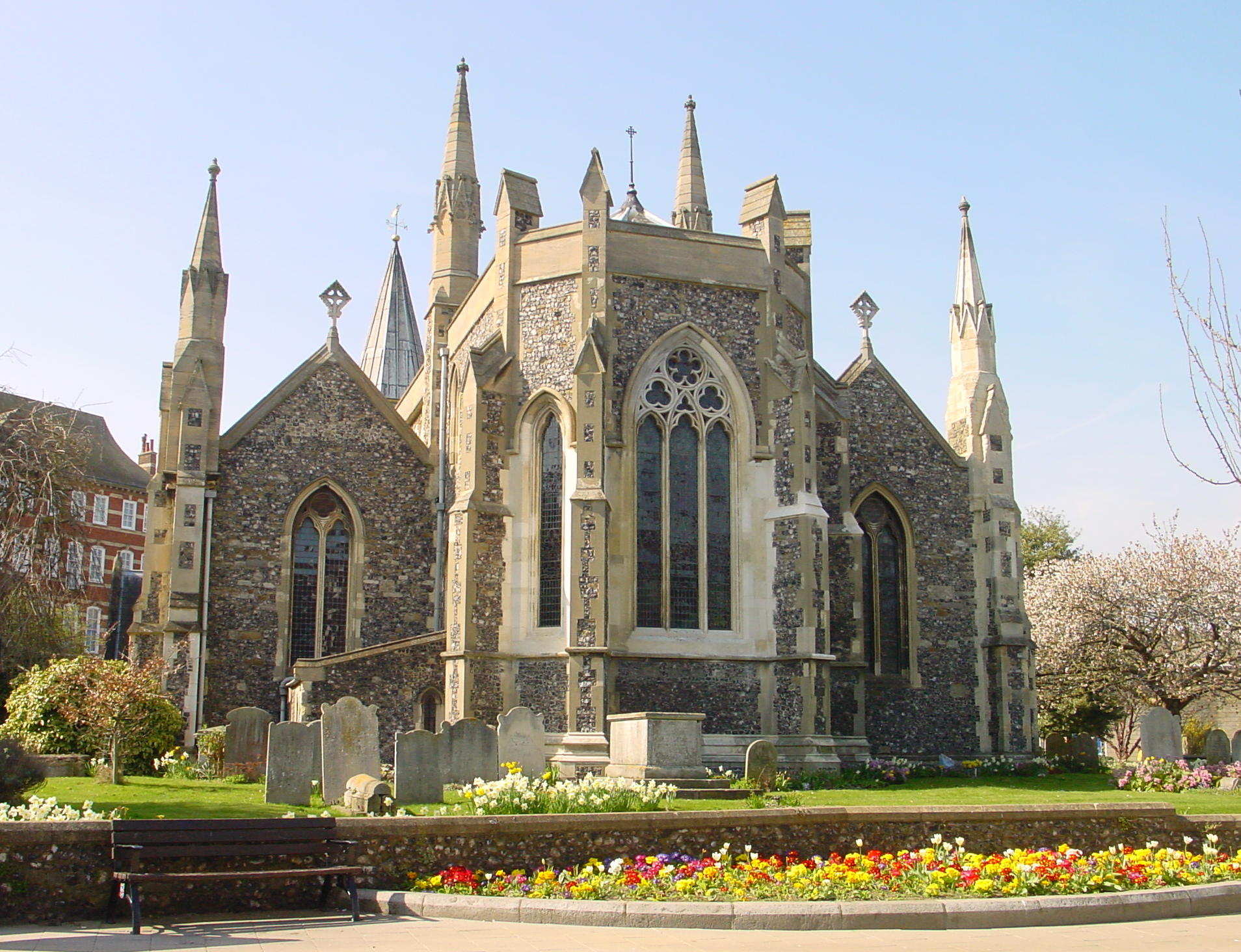
St Mary's Church from the south-east, one of the tourist envisaged tourist attractions. LS

St Mary’s Church from the south-east one of the tourist envisaged tourist attractions. LS

This, it was envisaged, would encourage visitors to local historical sites. These included: the Castle, Roman Painted House, Roman Invasion Sites at Deal and Walmer, Richborough Castle, St Mary’s Church, Barfrestone Church, the remains of St Martin-le-Grand, the Knights Templar Church on the Western Heights, Archcliffe Fort, Mote Bulwark, Admiralty Pier Turret, Dover Patrol Monument – St Margaret’s Bay, Langdon Cliffs to view Eastern Docks, the Maison Dieu, St James ‘Old’ Church and St James Cemetery. As well as the memorials on the Seafront, other Cinque Ports including Sandwich and World War II sites such as Hawkinge and Manston. The nucleus of this grand scheme was the ‘Roman Heritage Centre’ and museum that Dover could be proud of. The expenditure was estimated at £20m.

At about this time the Kent Building Preservation Trust identified 15 properties that were endangered by decay. One of these was the derelict old market hall/museum, the façade of which was Listed. This tied in neatly with the Clayton project and the council gave permission to create the three-storey ‘Roman Heritage Centre’. With the close collaboration of Brian Philip and KARU, work started. With the change of policy, DDC commissioned a report from the Area Museums Service for South East England on the potential of Dover’s museum as a tourist attraction.

In their report, published in May 1988, the Museums Service noted the chronically cramped conditions with poor access and low staffing levels of Dover’s museum. They made a number of recommendations that resulted in a restyling of the museum service for the development of heritage-based tourism. The ‘Roman Heritage Centre’ idea gave way to the creation of the White Cliffs Experience adjacent to which would be a purpose built museum the interior of which was designed by Ivor Heal.

Map showing the lay out of the Museum

Map showing the lay out of the Museum

In 1989, the museum started the move into a new build that retained old market hall/museum the façade. Utilising many of the contents from the old museum, the presentation in the new museum was carefully considered to provide interest at a variety of levels from young children and tourists from abroad to local historians and academics. However, it did not include a tourist information office or any reference to the work of KARU and the Roman Painted House.

In March that year, ‘Historic Dover’ information boards went into production and were erected throughout the town and District. In Dover, a leaflet provided an easy to follow trail for Dovorians and visitors alike. Designed in-house and produced by a Dover sign maker, the text was written by museum staff and checked by local historians Ivan Green and Joe Harman and by members of the Committee of the Dover Society.

On the instigation of the District Auditor, a collective management policy for the District’s museums was considered. This was in order to facilitate grants under the National Registration Scheme for Museums but required staffing levels etc. to comply with a set standard. The recommended museums included Dover museum, the Old Town Gaol and the Grand Shaft that goes from Snargate Street to what once were the barracks on Western Heights. Dover museum was registered under the scheme.

Assistant Curator Mark Frost and Ethel (Sunny) Lowry who swam Channel 1933. Dover Museum

Assistant Curator Mark Frost and Ethel (Sunny) Lowry who swam Channel 1933. Dover Museum

At that time, I was undertaking an intensive piece of academic research into high street banking, which started in Dover. This culminated in the academically successful book, Banking on Dover (published 1993). Throughout my research, Ms Waterman and her team was very helpful, particularly assistant curator, Mark Frost. Mark was involved in putting on a number of successful exhibitions at the museum appertaining to the locality. Typically, in 1998, there was an exhibition on the history of Channel Swimming centring on 400 photographs that had been donated to the museum. There were also artefacts such as Ethel (Sonny) Lowry’s swimsuit – she successfully made the crossing in 1933. It was a sad day when Mark left the museum.

The museum and the White Cliffs Experience next door were officially opened by Princess Anne in 1991. At the time, the A20 from Capel to Eastern Docks through Aycliffe and following the line of Snargate Street and Townwall Street was being laid. It was recognised that once completed the busy road would effectively cut the town of Dover from the Seafront, so a wide underpass was to be built from Bench Street to New Bridge. To try and ensure that the underpass would be a pleasant concourse the Highways Agency (the Highway Authority for Trunk Roads) together with their design consultants (Mott MacDonald) and the staff of the museum came up with a decorating scheme detailing the history of Dover.
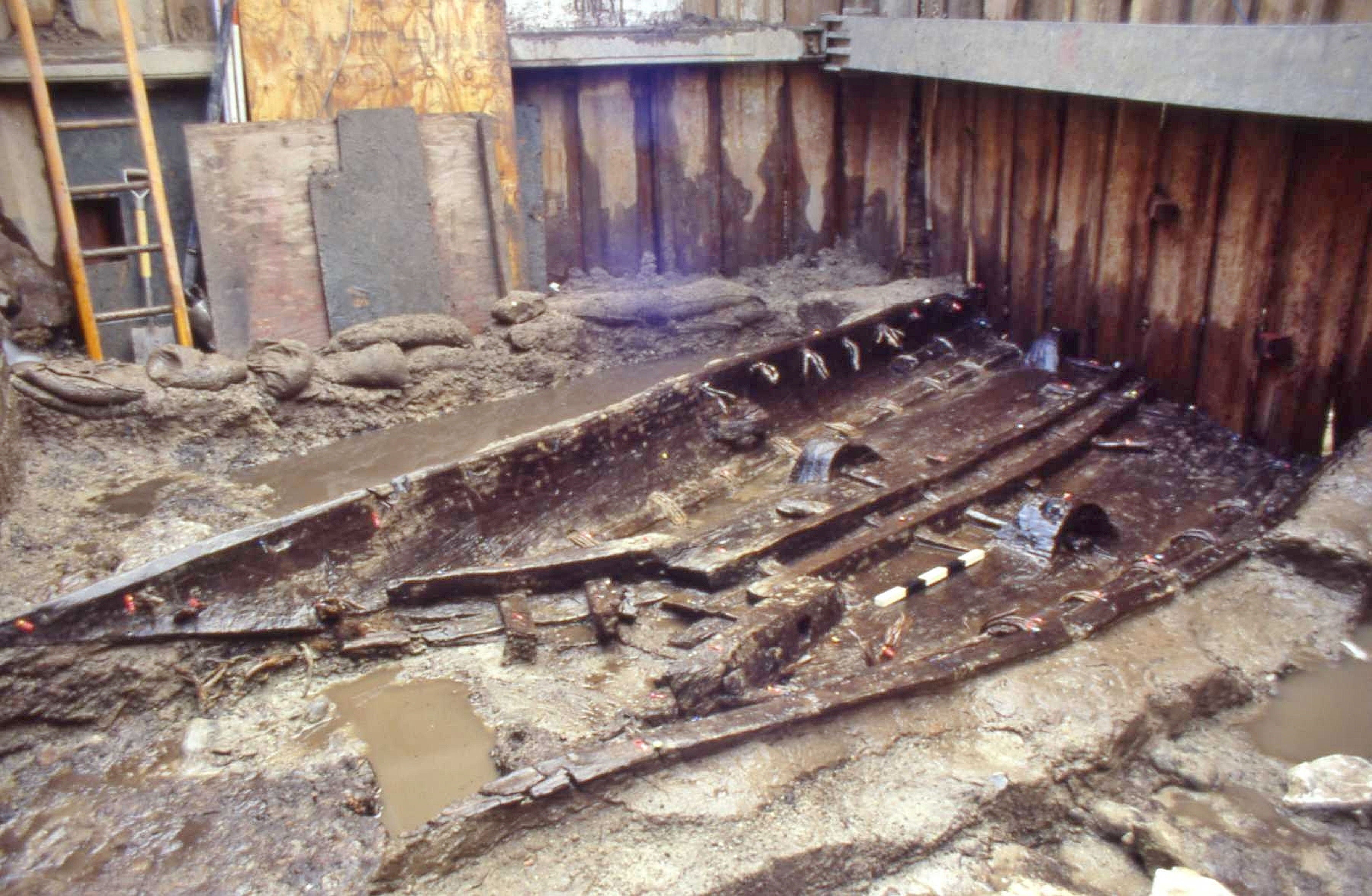
Bronze Age Boat discovered while excavating for the A20 underpass September 1992. Thanks to Nick Edwards

Bronze Age Boat discovered while excavating for the A20 underpass September 1992. Thanks to Nick Edwards

During the excavations for the new road, archaeological surveys were undertaken by Canterbury Archaeological Trust led by Keith Parfitt. In autumn 1992, work started on the proposed underpass and on the morning of 28 September Nick Edwards, operating a Caterpillar excavator for the contractors Norwest Holst, uncovered what turned out to be a Bronze Age boat – believed to be the worlds oldest known seagoing vessel was unearthed by the archaeologists!

Dating from 1550 BC it is about 18-metres long, 3-metres broad and it was immediately recognised as of international importance. Constructed of oak planks it is joined together by a complex system of wedges, timbers and ropes a crew of sixteen paddlers probably propelled it. The Boat was in operation before the Egyptian ruler Tutankhamun was born, and when the Romans arrived in Kent the coastal silt had already buried it for 1,600 years!
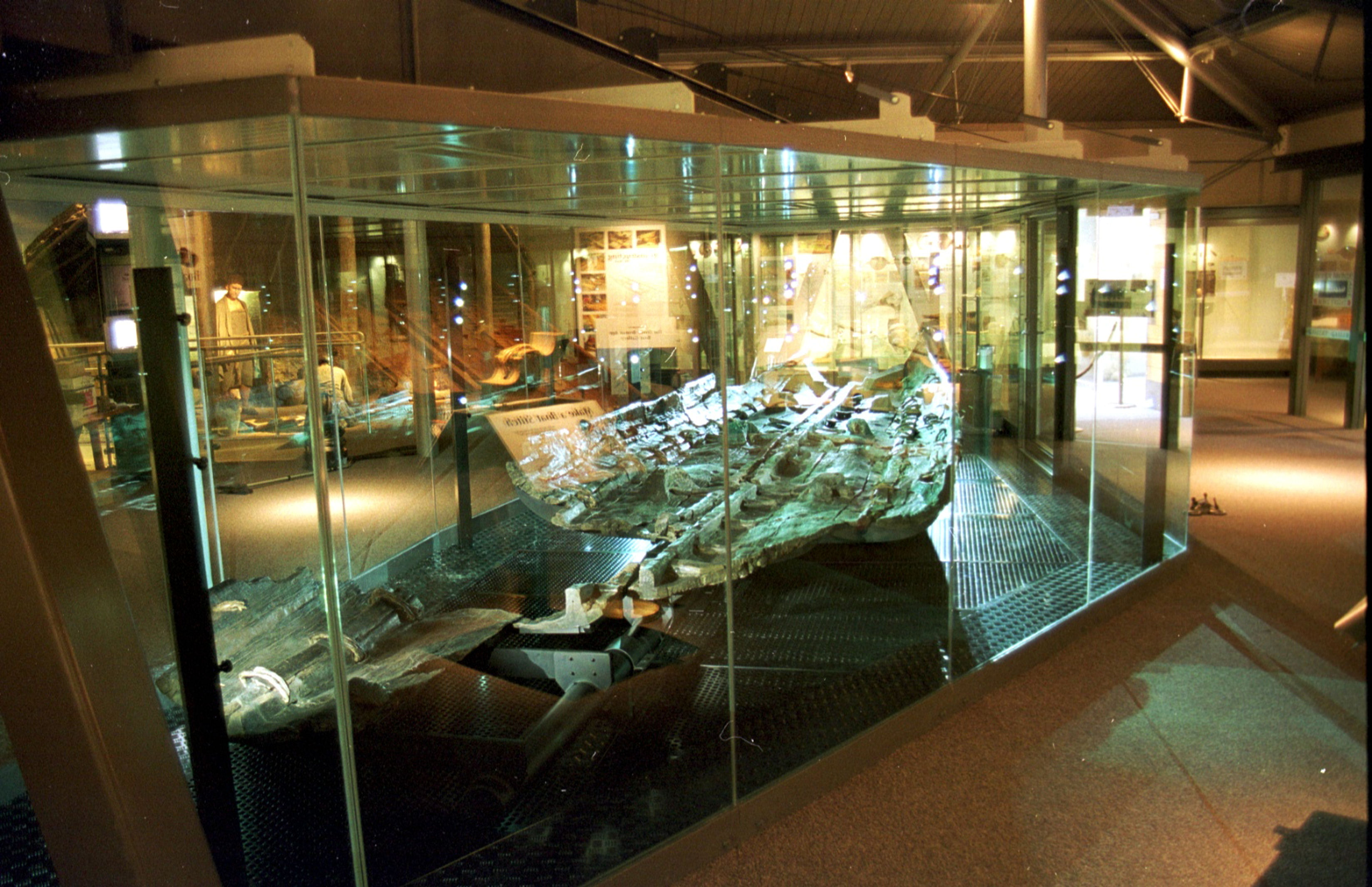
Bronze Age Boat in its own special gallery on the 3rd floor - Dover Museum

Bronze Age Boat in its own special gallery on the 3rd floor – Dover Museum

November 1999 saw the official opening of a  specially constructed gallery on the top floor of the museum by Robert Leigh-Pemberton, Baron Kingsdown, and Lord Lieutenant of Kent (1927–2013). The exhibition in the gallery housing the Bronze Age Boat explains how experts saved the craft after it was discovered what it was used for and how it looked like at the time it sailed. By this time, the White Cliffs Experience was proving a financial liability and closed on 17 December 2000. It was hoped that the 3,600 year-old craft, among the best-preserved vessels of its type in the world, would go some way towards attracting the visitors that the White Cliffs Experience failed to do. It is certainly doing just that and rightly so.

Claudius Model ground floor gallery. Dover Museum

Claudius Model ground floor gallery. Dover Museum

In the 1999 Queen’s Birthday Honours List Ms Waterman, the museum curator received the M.B.E. and in this author’s opinion deserved it for ensuring that the Boat stayed in Dover. As yet, Keith Parfitt – the archaeologist who discovered the Boat – has not received such an award, hopefully he will. On 8 March 2000 saw Prince Charles touring Dover and environs on an official royal visit. His first stop was, naturally, to see the Bronze Age Boat at the museum. On his way down from the gallery, he came face to face with the Koettlitz polar bear, by then in a glass case on the first floor. ‘What an amazing creature,’ he exclaimed!

The following year, the museum undertook its first community-led project, centring on the old village of Buckland. Absorbed into Dover Borough in 1835, the village was famous for its brickfields, paper, corn mills breweries, blacksmiths and watchmakers. The church of St Andrew’s Buckland, is the only existing parish church in the town listed in the Domesday Book of 1086.

The funeral of Sergeant Monger by William Burgess. Dover Museum

The funeral of Sergeant Monger by William Burgess. Dover Museum

Not long after an historic art collection was acquired by the museum comprising of artworks, engravings, lithographs, photo’s prints, watercolours and sketches that depict Dover from the early 1720s to 1904. They were bought with a grant from the Victoria and Albert purchase fund plus a generous donation from a local benefactor. The collection included three watercolour and two pencil sketches by the town’s most important artist William Burgess (1805-1851)

White Cliffs Metal Detecting Club exhibits at Dover museum. LS 2014

White Cliffs Metal Detecting Club exhibits at Dover museum. LS 2014

Ms Waterman was promoted to head the housing department of DDC and was succeeded by Jon Iveson, the deputy curator. Among Jon’s many accolades is that he actively encourages the community and local historians to become involved in the museum and thus helping to ensure its survival. This quickly became evident when, in 2002, DDC’s policy moved rapidly away from tourism and the museum’s budget was cut by almost £200,000 a year and closure threatened. The White Cliffs Metal Detecting Club – many of whose finds are on display in the museum – and others, including this author, actively campaigned to reverse the decision. The Metal Detecting Club collected over 6,000 signatures on petitions that included representatives from the British Museum. Swingeing cutbacks were introduced but the museum survived.
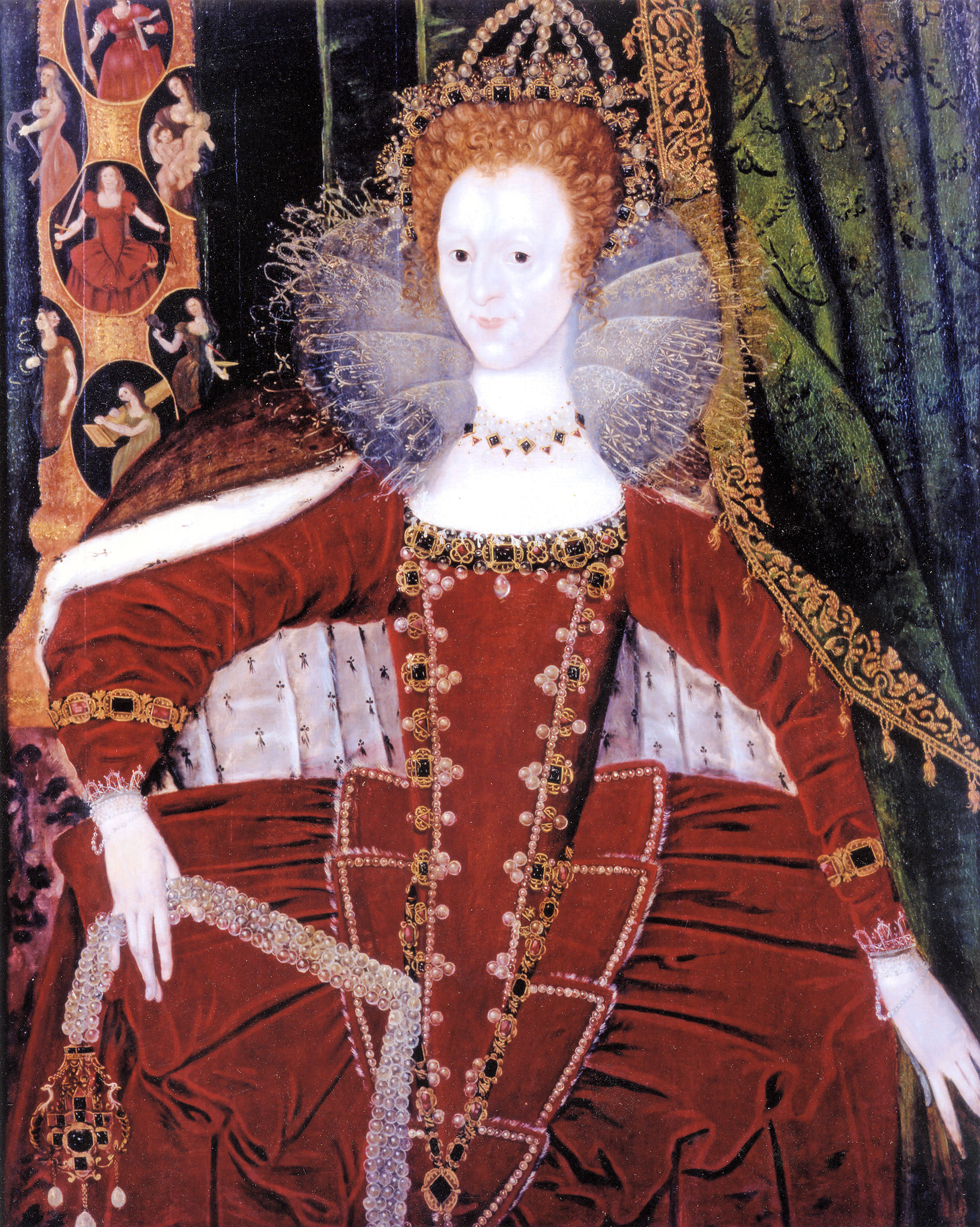
Elizabeth I. Dover Museum

Elizabeth I. Dover Museum

Spring of 2003 saw the National Maritime Museum in Greenwich put on an Elizabethan exhibition and the painting of Elizabeth I (1558-1603), that had not left Dover since completion over 400-years before, was loaned by the Dover museum. Called, ‘Portrait of Elizabeth I with the Cardinal and Theological Virtures’, it is one of the few paintings of Elizabeth that is documented as specifically made for a civic environment. Following the exhibition, unlike all of Dover’s precious historic documents loaned to the country’s great museums in the past, it was returned to the museum.

The White Cliffs Experience building was sold to Kent County Council (KCC) for £1 and renamed the Dover Discovery Centre. 2003 saw the library move from Maison Dieu House to the Centre that included the Adult Education Centre and a theatre later taken over by the Blackfish Academy (theatrical). The local studies section of the library continued for a short while but a change in KCC policy from specialist to ubiquitous librarians meant the loss of valuable expertise in local studies. Initially, specialist expertise along with access to Dover archives that had been kept in the old premises of Maison Dieu House and County Hall Maidstone were to a small unit at Whitfield. After a few years, due to cut backs, it was closed making it difficult to access Dover’s ancient and not so old records.
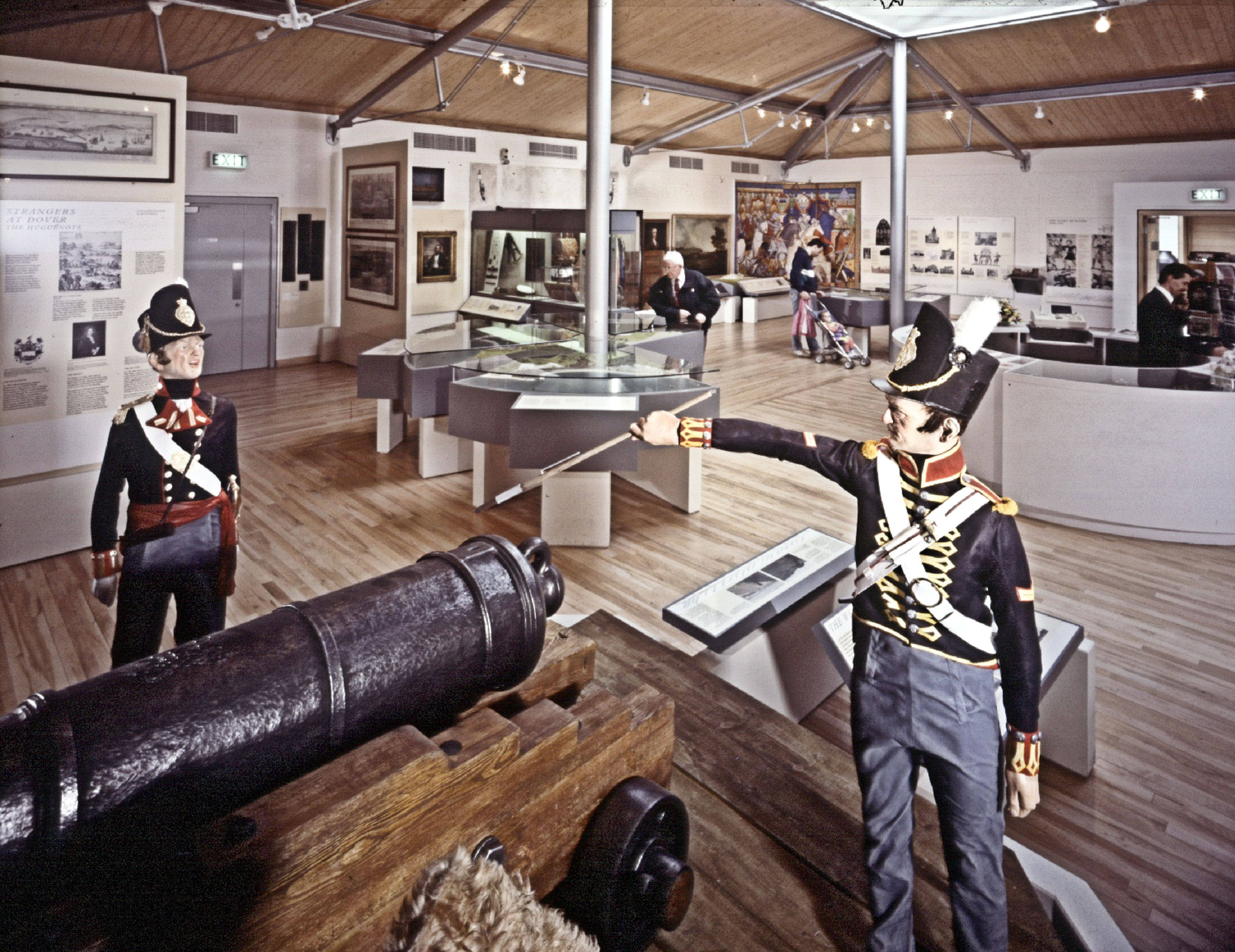
Models of soldiers at the Drop Redoubt, Western Heights c1812 top floor. Dover Museum

Models of soldiers at the Drop Redoubt, Western Heights c1812 top floor. Dover Museum

The museum, on the other hand, has increasingly built up its library of local studies and the librarian, Bryan Williams, is a mine of information and very helpful. Albeit, the museum library, which is situated on the second floor at the front of the building, is long, high but very narrow. This means that the public are not able to access it.

On 20 July 2005, Queen Elizabeth II visited the museum to see the Bronze Age Boat exhibition. She was received by curator Jon Iveson and Admiral the Lord Boyce, Lord Warden of the Cinque Ports. She was introduced to the Mayors of the Cinque Ports and their officers and although she passed the Koettlitz polar bear, she did not react in the same way as her son did!
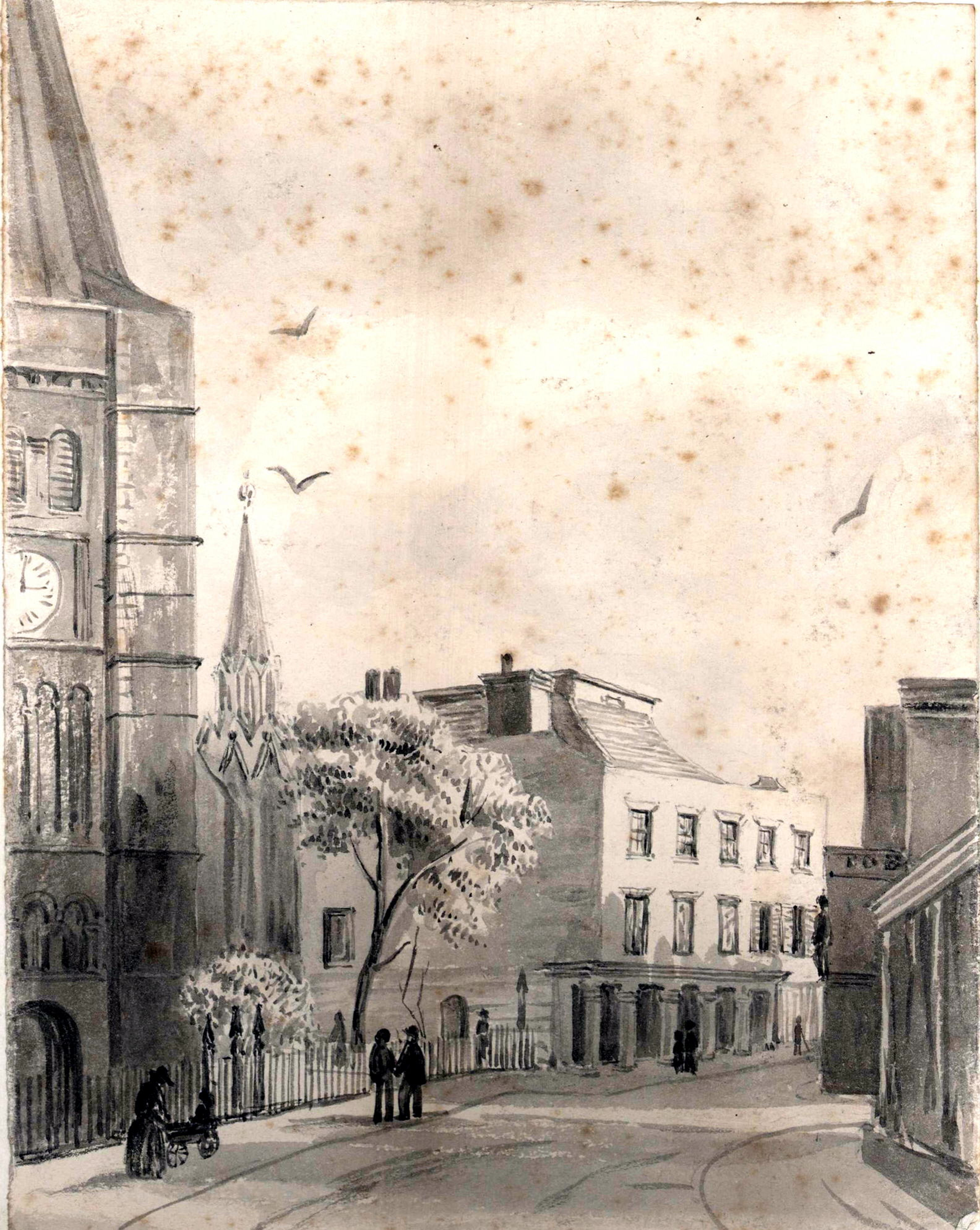
Cannon Street by Mary Horsley December 1892. Dover Museum

Cannon Street by Mary Horsley December 1892. Dover Museum

In 2005, Elizabeth Knott died at the age of 92. Her father, who had been an auctioneer’s clerk at Flashman’s in the Market Square,  had acquired a collection of some 122 painting by Mary and Susanna Horsley. Also work of the Reverend Maule of St Mary’s Church. These, Miss Knott bequeathed to Dover Museum.

Together with Jon Iveson and with the help of Colin Friend plus the support of the Friends of Dover Museum, in January 2006, this author put on a six-week exhibition telling the story of Market Square. However, more financial cutbacks were imposed in December 2007, but the museum survived and continued to attract locals, students, schoolchildren, and tourists. In 2011, an EU ruling obliged local council taxpayers to pay an entrance fee, nonetheless they still come, especially to bring their visitors to see the Bronze Age Boat.

Tourist Information and Entrance, Dover Mueseum. LS

Tourist Information and Entrance, Dover Mueseum. LS

Tourist buses from cruise ships stop nearby the museum and in September 2012, the tourist information centre was relocated to the ground floor of the museum. The deputy Mayor, Ronnie Philpott and Chairman of DDC, Cllr. Sue Nicholas, officially opened it and the museum is a ‘must see’ for visitors to Dover.

Dover Museum and Visitor Centre: telephone: 01304 201066 or email tic@doveruk.com
Friends of Dover Museum membership card and Programme 2013- 2014

Friends of Dover Museum membership card and Programme 2013- 2014

Friends of Dover Museum

The Friends of Dover Museum, formed in 1987 to promote the activities of the Museum and the history of the area in general. They meet at 7.30pm on the third Tuesday in the month (except July and August) at the Baptist Hall on Maison Dieu Road. Enquiries: Dover Museum or friendsofdm@tiscali.co.uk


Finally, a special thank you to Jon Iveson – Dover Museum Curator – and Bryan Williams – Dover Museum Honorary Librarian – for their continued unflagging encouragement, help and support – You are great guys!

  • Presented: 20.08.2014
 

Posted in Buildings, Local Government, Market Square, Museum - An Historic epic, Museum - An Historic epic, Museum - An Historic epic, Museum - An Historic epic, Museum - An Historic epic, Societies, Culture and Entertainment, Tourism | Comments Off on Museum – An Historic epic

Fred Greenstreet and Centurion House

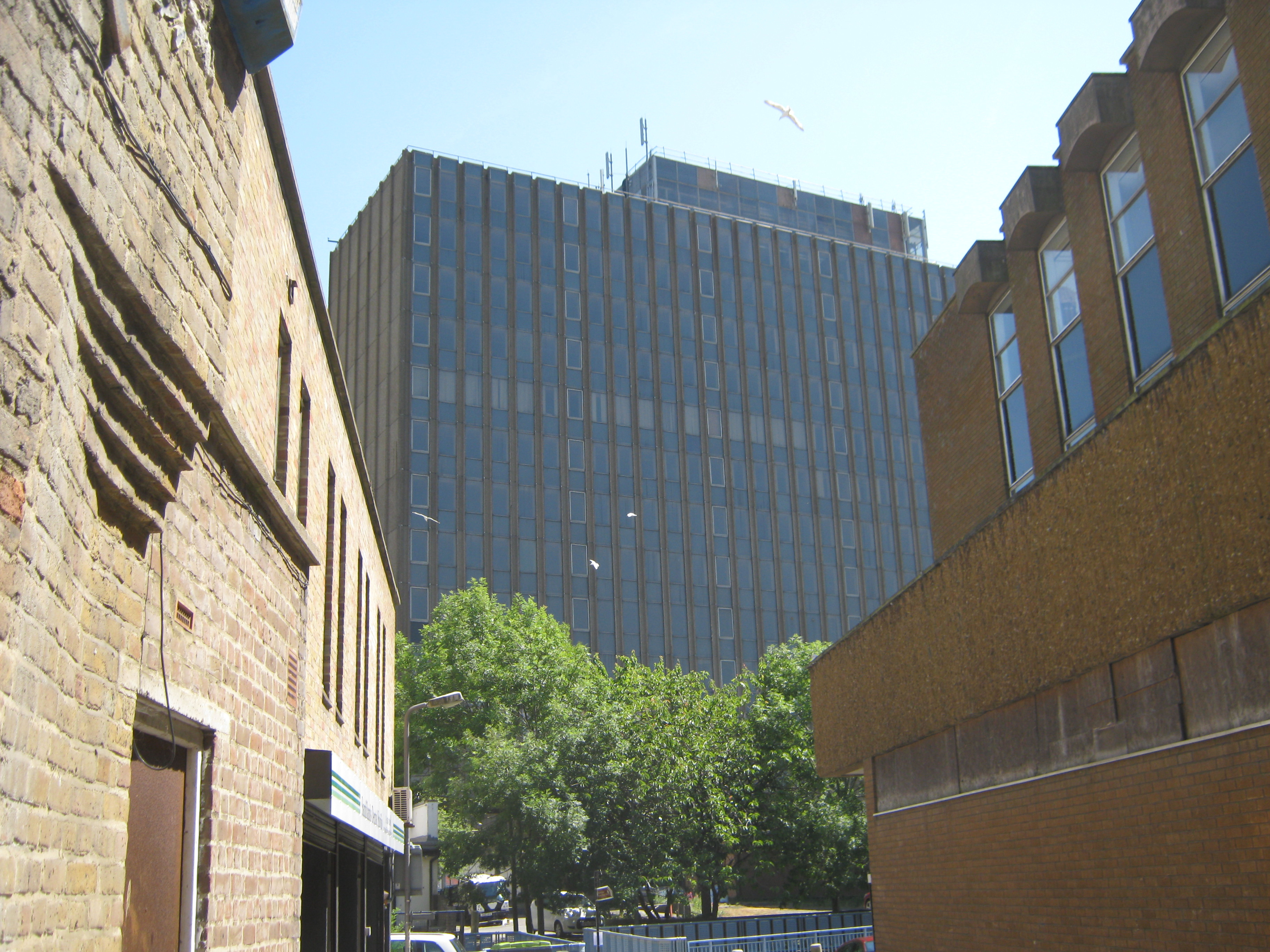
Burlington House from Fishmonger's Lane, Centurion House on right both earmarked for demolition as part of the St James Area

Former Burlington House from Fishmonger’s Lane, Centurion House on right both earmarked for demolition as part of the St James Area

As part of the latest St James Area Development proposal Centurion House, on the corner of Bench Street and Fishmongers Lane, has been demolished. Ironically, the building it replaced was the centre of a major legal battle that divided the town and centred on a craftsman bootmaker called Fred Greenstreet.

Bench Street was once part of King Street, the main thoroughfare from the seafront to Biggin Gate, near St Mary’s Church. During medieval times the King’s Custom was set up nearby. This was known as the ‘Bench’ and this part of King Street eventually became known as Bench Street and up until recent times the area was part of the centre of commercial trade.

Fred Greenstreet’s great-grandfather, John, was born in 1786 Kingston, near Canterbury and apparently served his apprenticeship in that city. At that time only those who had the Freeman of Dover status could set up a business in the town and this could only gained by birth, marriage, apprenticeship, purchase, redemption – making a gift to the town or by decree. In 1827, John Greenstreet paid £30 to purchase his Freedom and set up his business as a bootmaker in Snargate Street.

John’s shop at 133 Snargate Street, was possibly where Sharpe and Enright are today. At that time, Snargate Street was in the heart of the heavily populated commercial and maritime Pier District of the town. Later, John moved the business to number 54, further west and on the opposite side of Snargate Street. The value of the new location was that it backed onto Commercial Quay where the shop was listed as number 4.

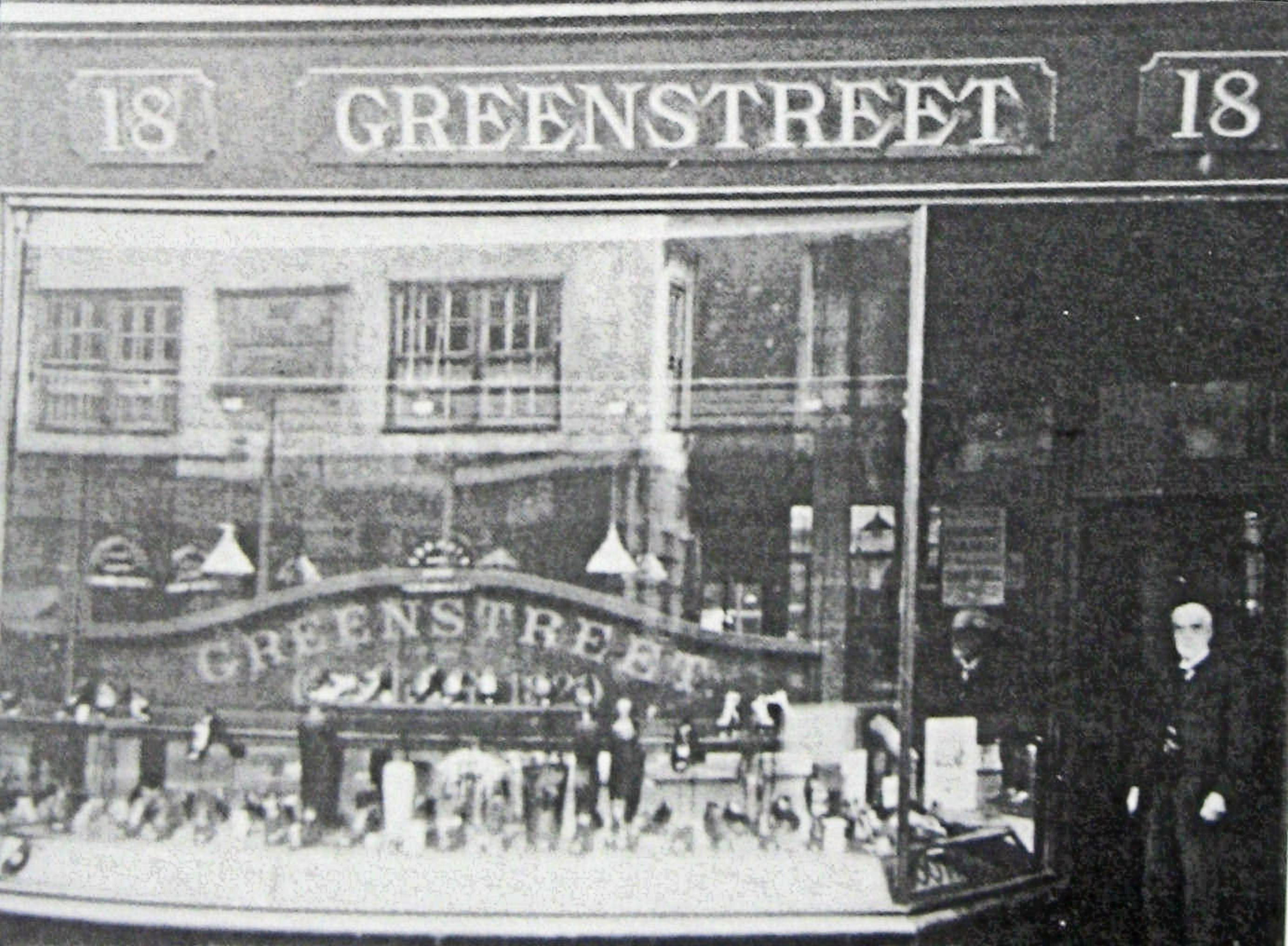
Bootmaker John Greenstreet at the doorway of his shop,18 Bench Street. Thanks to Joe Harman

Bootmaker John Greenstreet at the doorway of his shop,18 Bench Street. Thanks to Joe Harman

John James, his son, was born in 1821 and claimed his freedom by apprenticeship to his father in 1848. He too had a son called John, who was Fred’s father. John junior was born in 1848 and claimed his freedom by birth in 1877. In 1899, John junior married Kate Baker and bought 87 High Street and forge, Charlton for £720. His solicitor was Arthur Harby of Stillwell and Harby, 4 St James Street and he wrote to congratulate John on his marriage. That same year, the Greenstreet firm moved to 18 Bench Street.

Fred (Frederick William) was christened in St Mary’s Church on 29 October 1905 and attended Dover Boys’ Grammar School from 1915 to 1922 – at the time this was on Frith Road. On 15 March 1930 John, died and from his obituary, it would seem that for a while his two brothers were also involved in the family firm.

In 1934, Fred married Mary (Mollie) Prescott and they had two children, John born in 1936 and Rosemary in 1944. A keen sportsman Fred belonged to the Dover Cricket Club at the same time as Dover’s international cricketer Eddie Crush (1917-2007) was starting out on his career. In May 1939, they were both mentioned in Times when Dover College beat the Dover Cricket team! Fred was l-b-w by P J Pearce for 31 and Bloy bowled out Eddie for 22.

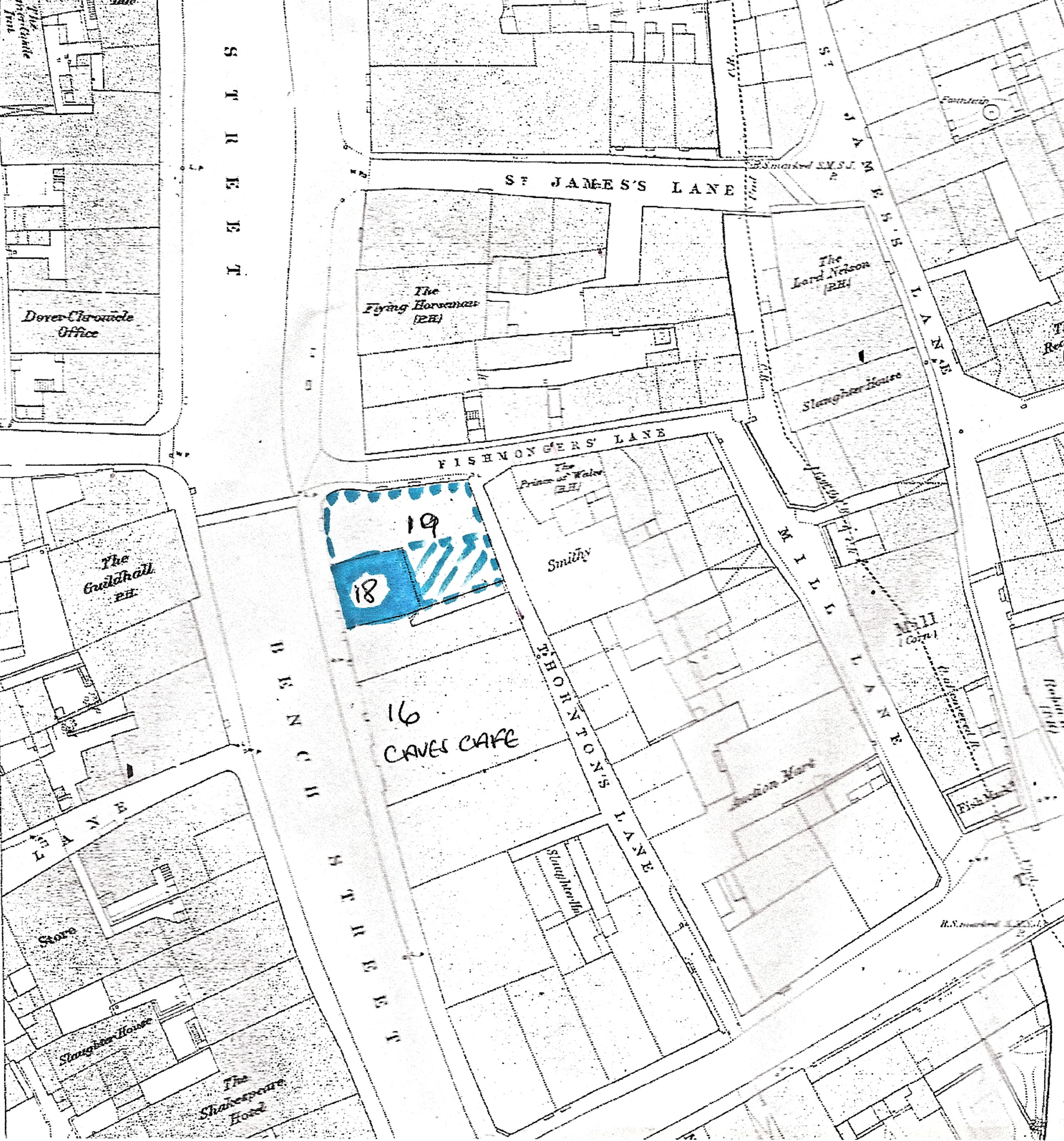
Map circa1900, showing Fred's shop, Caves Café, Bench Street, Fishmongers Lane and Thornton Street

Map circa1900, showing Fred’s shop, Caves Café, Bench Street, Fishmongers Lane and Thornton Street

By the outbreak of World War II (1939-1945) the firm had purchased the land behind the shop that had belonged to 19 Bench Street and extended to Thornton Lane. This they turned into a garden for the children while underneath the cellar was enlarged used as a workshop. The council designated the workshop as an air-raid shelter for 60 people for the duration of the War. During that time much of Dover was devastated including Caves Café, next-door-but-one to the Greenstreet premises.

In 1959, a Walmer builder bought the derelict Café, number 16 Bench Street with the intention of rebuilding it as a shop with a flat above . Nothing happened and the site was eventually sold to Bernard Sunley Investment Trust of London. In November 1965, they launched a £500,000 redevelopment scheme for the east side of Bench Street and King Street, which included Fred Greenstreet’s shop.

The plan was to build a three-storey block of shops in Bench Street and a mirror image block in King Street, all of which would be fronted by a paved pedestrian forecourt. Although Fred’s shop and others were thriving, part of the area was a bombsite and those that buildings that remained standing, like Caves Café, were derelict. The town council therefore gave the plan their full support.

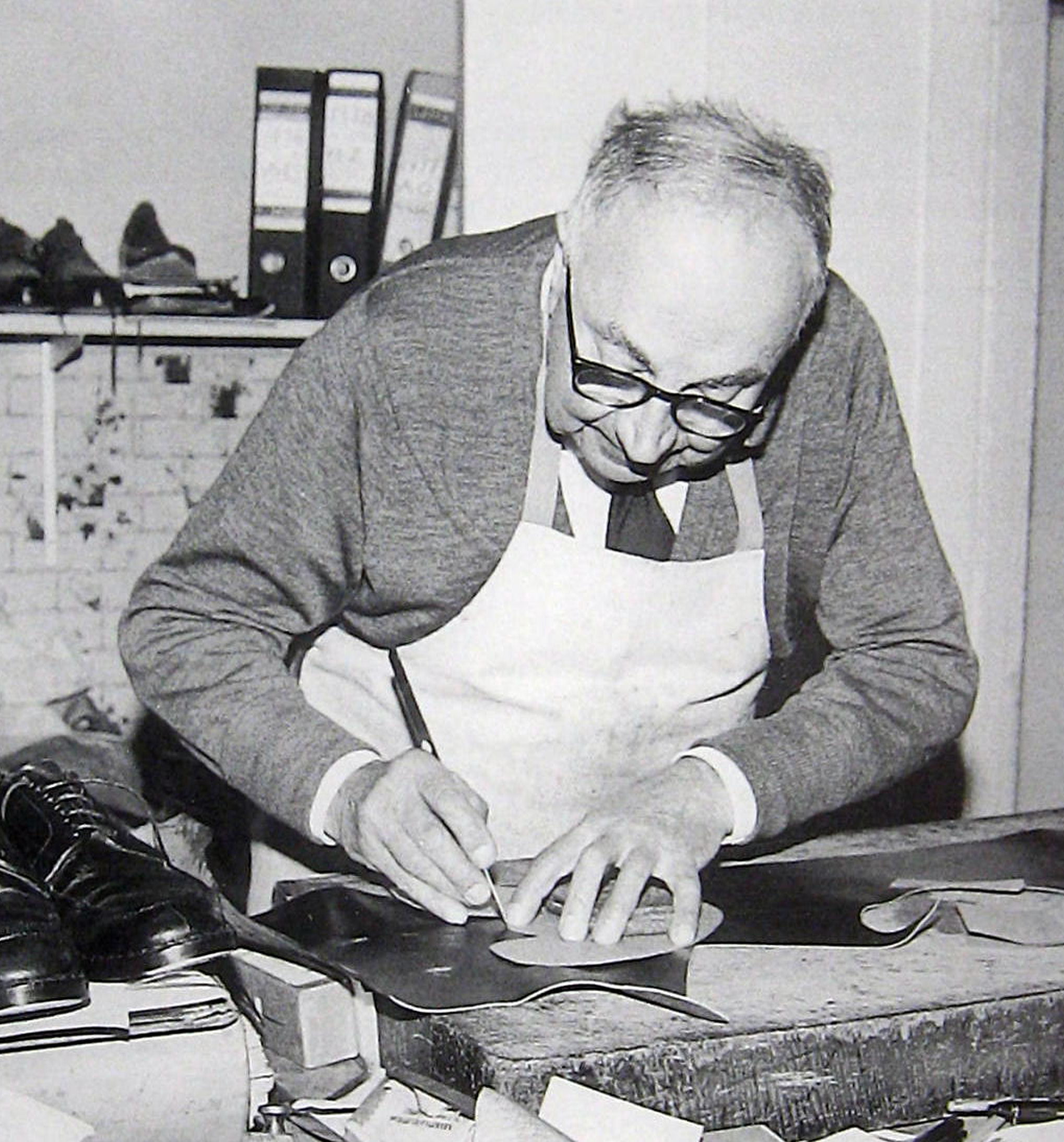
Fred Greenstreet at work. Thanks to Joe Harman

Fred Greenstreet at work. Thanks to Joe Harman

This resulted in a protracted feud between Fred and the council,  in which Fred based his argument on his rights as a Freeman by birth. Dating from Saxon times the original Freemen of Dover earned their living from the sea. Over time they amalgamated with their counterparts in Sandwich, Hythe, Romney and Hastings to form the Confederation of the Cinque Ports. This was formalised in a succession of charters that gave an increasing number of rights to Dover Freemen, throughout the Norman and Medieval periods, making them very powerful. The situation began to alter from 1835 when national changes in legislation reduced the special rights of Freemen.

As Fred’s great-grandfather, John had purchased his Freedom in 1823, the rights descended through the male lineage that, Fred argued, gave him right to trade and for the Mayor to ensure that he could. When, in April 1970, Dover Borough Council gave planning consent for Mr Greenstreet’s shop to be compulsorily purchased and demolished Fred wrote to the then Mayor, Alderman William Muge reminding him of this right. He wrote, ‘You are not only the town’s first citizen, but also a trustee of the rights and privileges of hereditary and honorary freemen of the borough. It is therefore your duty, and the duty of the council, to honour your trusteeship by safeguarding the rights of Freemen, against any person or persons who may wish to endanger our rights to trade in this Borough.’

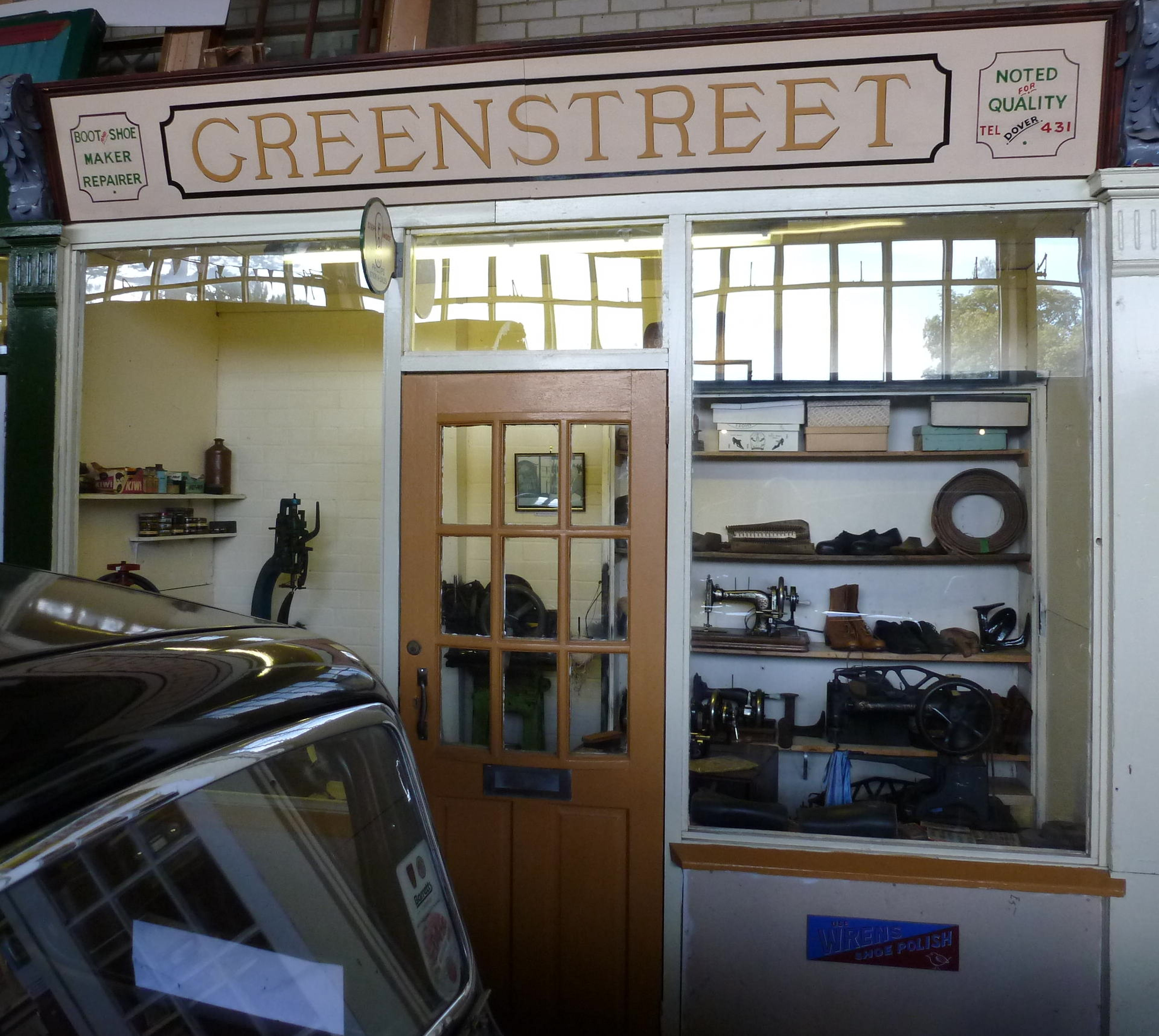
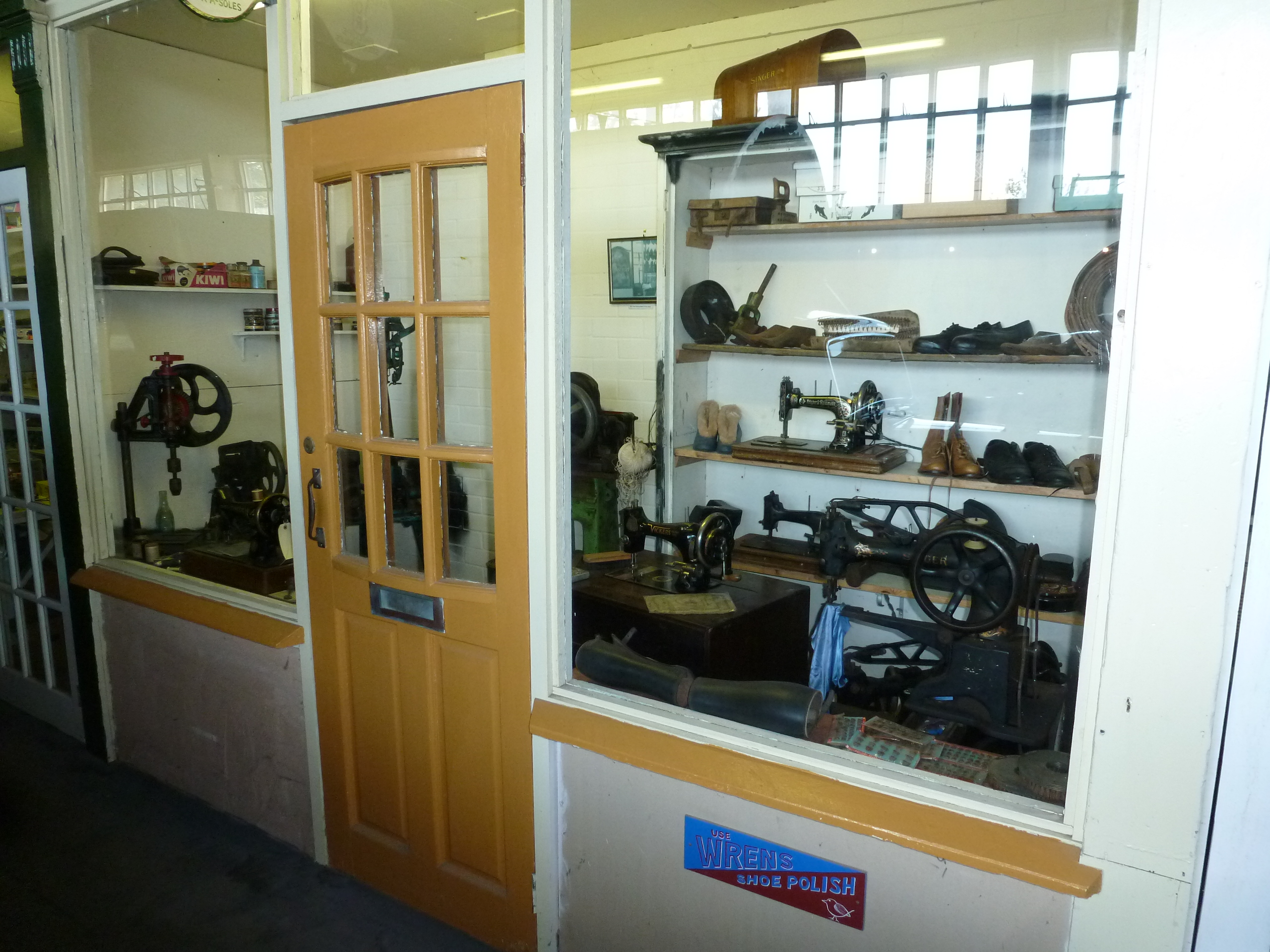
Greenstreet bootmakers shop, Bench Street, mock-up at Dover Transport Museum. AS 2014

Greenstreet bootmakers shop, Bench Street, mock-up at Dover Transport Museum. AS 2014

The council offered £12,500 for the shop but Fred declined, saying that it would cost him £30,000 to move. Adding that the council were assisting the developer to get rid of the Greenstreet business for peanuts in order for the developer to, ‘make a handsome profit.’ The council retaliated by claiming, wrongly, that the garden behind the shop belonged to them and so reduced the offered of compensation to less than the market value of the Greenstreet site.

Bernard Sunley Investment Trust sold their holdings in the area to Commercial and General Investment who planned to build the largest supermarket in Dover with offices above. This, it was envisaged would cover the same King Street/Bench Street site as the earlier plan. The council was unanimous in serving Fred with a purchase order for his property in order to allow the development to go ahead and ‘bring new life’ to that part of town.

Fred, by this time, was living in Shepherdswell but was resolved that he was not going to close his shop. The result was a two-day Public Inquiry held in May 1971, under the Department of Environment Inspector, Peter Baines. Barrister Christopher Cochrane represented Fred.

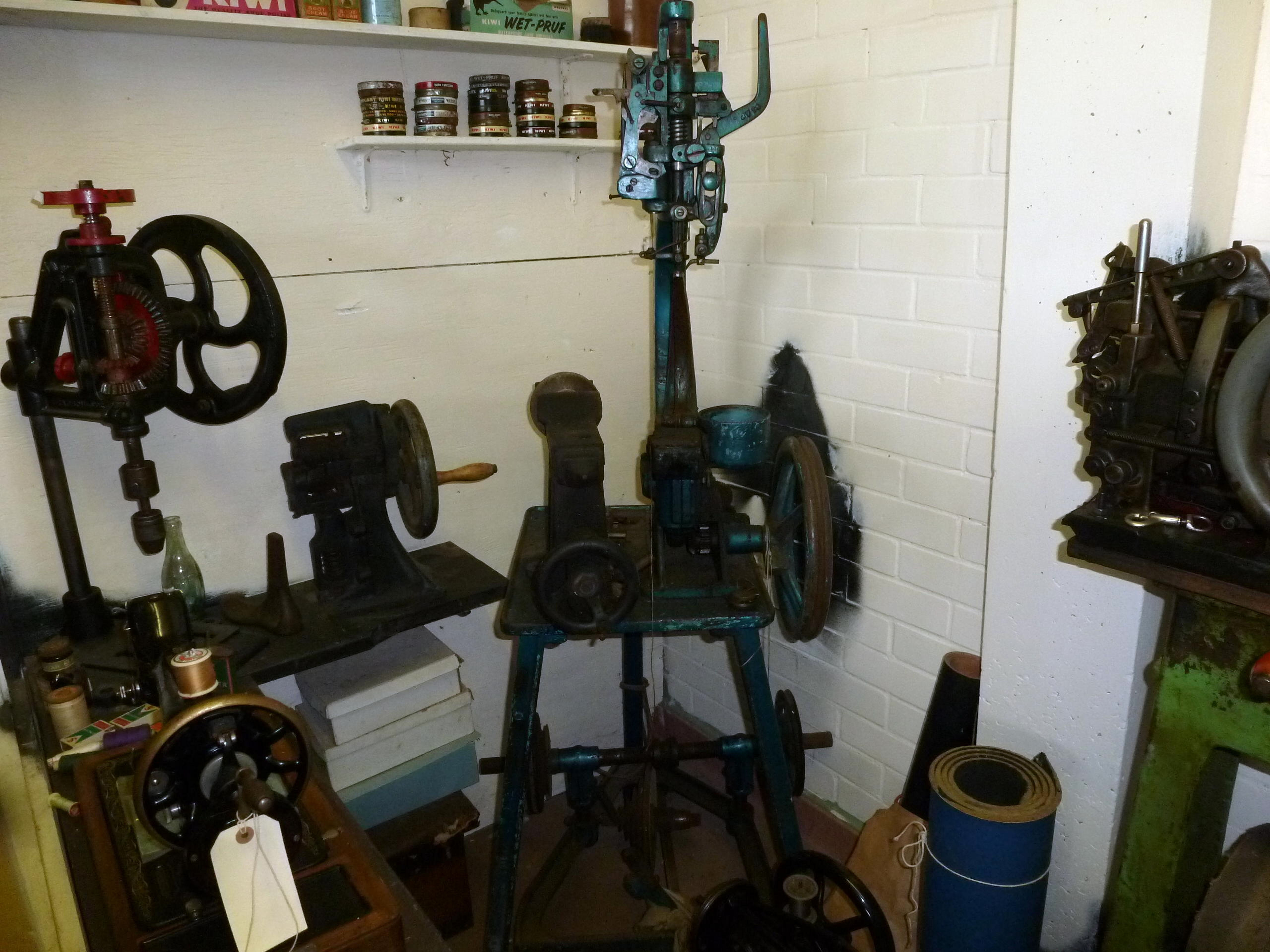
Greenstreet bootmakers shop, Bench Street, mock-up at Dover Transport Museum with authentic bootmaking machines. AS 2014

Greenstreet bootmakers shop, Bench Street, mock-up at Dover Transport Museum with authentic bootmaking machines. AS 2014

At the Inquiry, Bernard Gould, for the developers, said that they had offered Fred £22,500 for the shop but this had been declined. Fred, he told the Inspector, had said that it was not enough as he wanted more money so that he could retire and set his son up in a business of his own. Malcom Barrett, for the council and looking at the bigger picture, stated that there was a demand in Dover was for large multiple shops, not for small shops. Adding that there was also a demand for offices, as they would provide jobs.

Some 30 witnesses appeared on Fred’s behalf, including Mary Dixon, who later, with her husband, successfully took on the council in the Cowper Road gate affair and they also had the façade of the Museum listed. John Mannering of the corn milling family gave supporting evidence along with shoe shop owner, Gerald Walter and John Clithero, general secretary of the New Dover Group (now Dover Society).

However, the Environment Secretary, Peter Walker (1932–2010), took the side of the council and the developers and confirmed the compulsory purchase order. However, he went on to say that as to the validity of the legal arguments, he was leaving these to the legal advisers at the Department of Environment. They confirmed the validity and Fred’s only option was to take the matter to the High Court, which he did.

Again, the Establishment was against Fred but, by this time, he did have most of the town supporting him. Fred also managed to get one over the council! With their usual vindictiveness, the council were set to make life for Fred as uncomfortable as possible (see Transparency). At the time he was a chorister at St Mary’s Church and would leave his car in Stembrook carpark when attending.

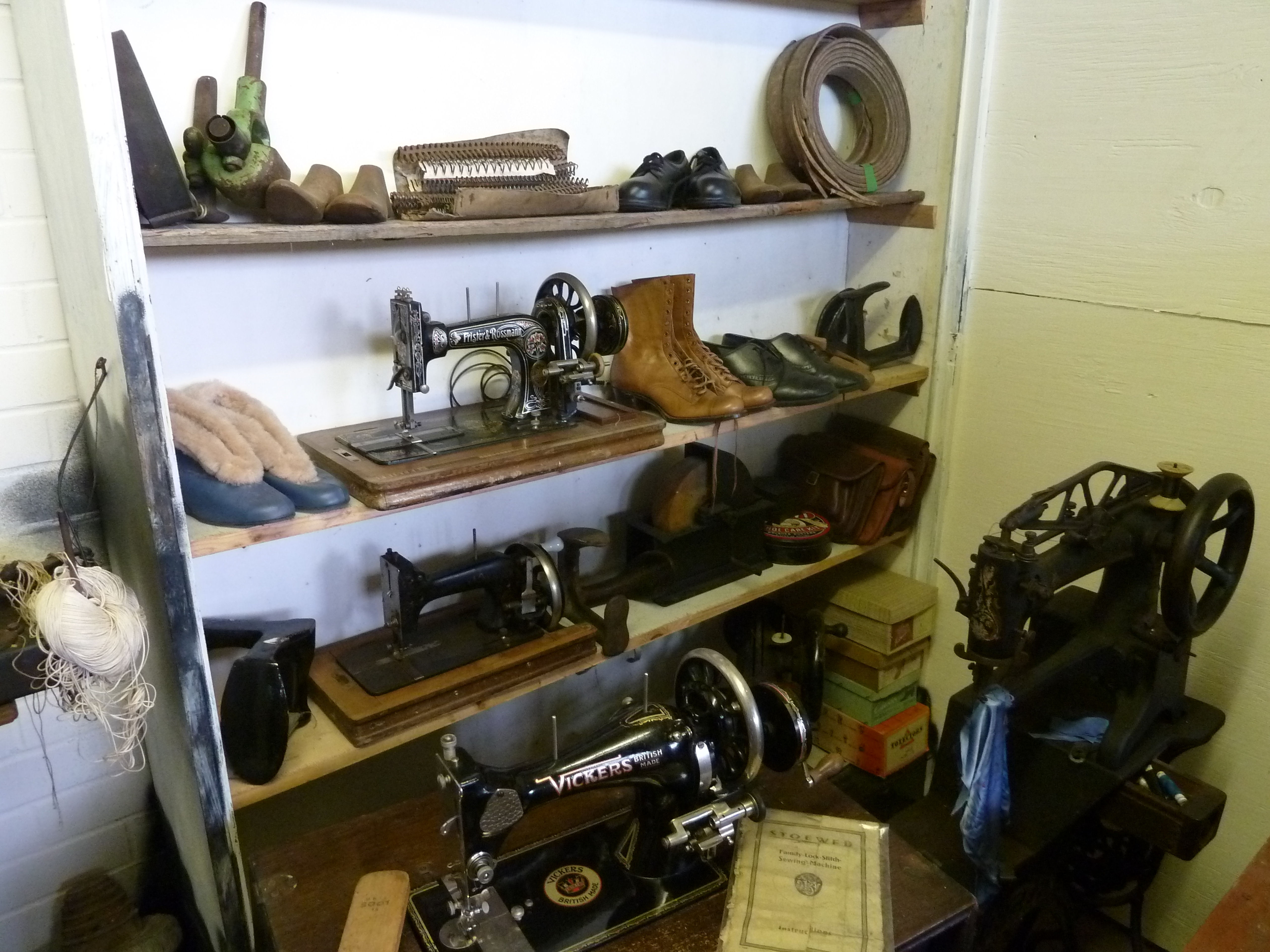
Greenstreet bootmakers shop, Bench Street, mock-up at Dover Transport Museum showing the different sewing machines and other artefacts used in the boot/shoe making trade. AS 2014

Greenstreet bootmakers shop, Bench Street, mock-up at Dover Transport Museum showing the different sewing machines and other artefacts used in the boot/shoe making trade. AS 2014

In 1972, the council put a parking ticket machine in the carpark  and charged 50pence a day to park. It was Sunday, so Fred did not buy a parking ticket, was subsequently hauled in front of the local magistrates and fined £2. Fred successfully appealed to Canterbury Crown Court, pointing out that the council had not applied for permission to erect the parking machine! His conviction quashed and the council were ordered to pay Fred £24 costs!

Albeit, a new set of development plans were submitted to the council in May 1973 for area. The proposed development had been severely reduced and did not include the King Street bombsite. The plan was for a supermarket with offices above at 16-19 Bench Street and 1-4 Mill Lane, at the rear of 16-19 Bench Street. The council was far from pleased and asked the developers for a comprehensive development plan for the Bench Street site and the King Street before they would consider giving approval.

The Local Government Act (1972) that came into force on 1 April 1974 created Dover District Council (DDC) and the development project was, by this time being locally handled by Worsfold’s estate agents in Market Square. The speculators were Centros Properties Ltd in association with Sun Alliance and London Insurance Group. DDC gave approval for the development as had been envisaged in May 1973. However, as part of the agreement Fred Greenstreet’s business was to be incorporated – Fred had won!

Until his new shop was ready, Fred moved to 9 Victoria Crescent, opposite the Royal Victoria Hospital. Not long after he was commissioned to make a pair of riding boots for Princess Ann.

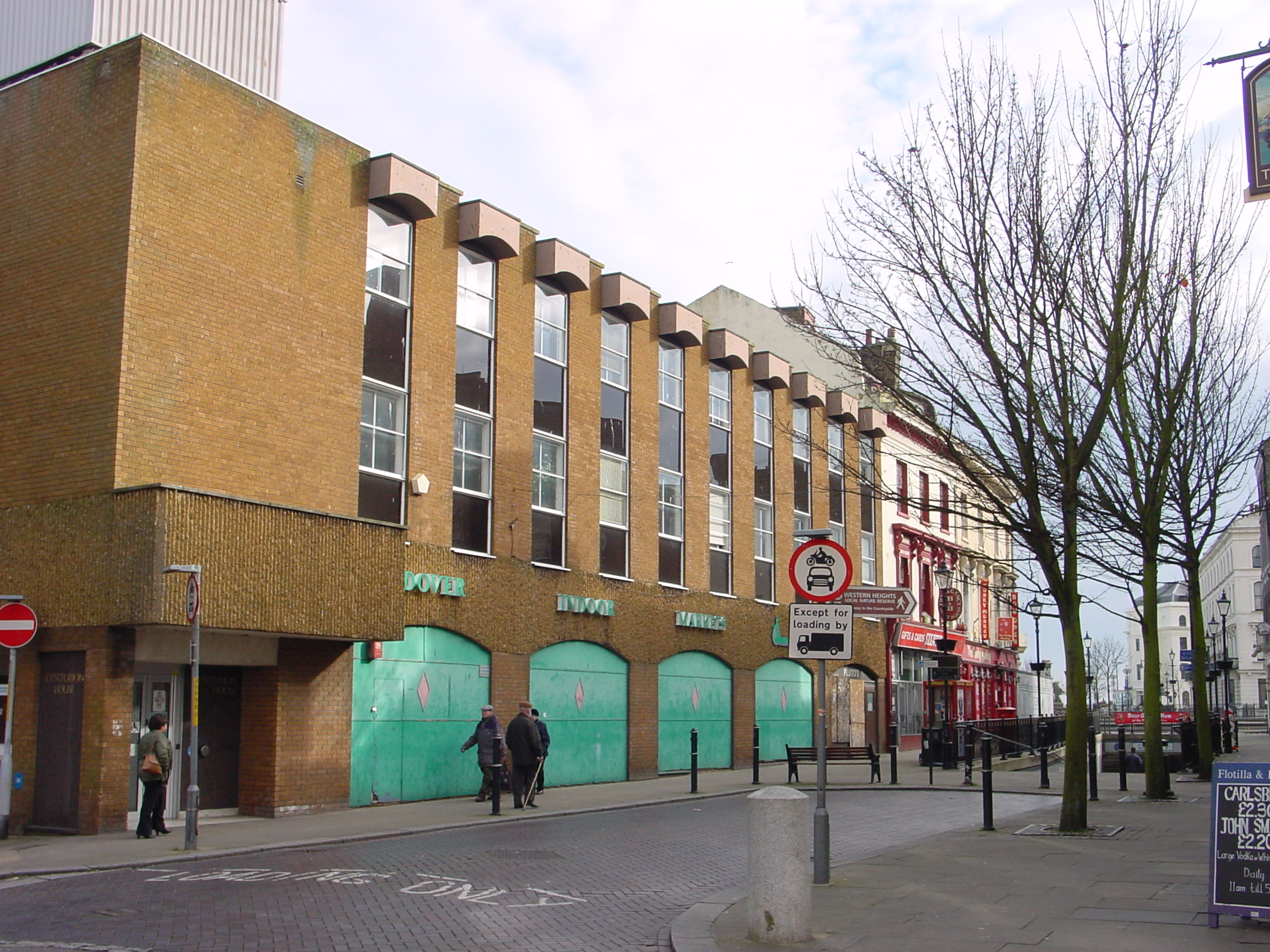
Centurion House Dover Indoor Market Bench Street boarded up as it was for years. AS

Centurion House Dover Indoor Market Bench Street boarded up as it was for years. AS

Centurion House, as it was named, was designed by Bovingdon Fowler, McBride of Harrow, built by R.J. Barwick, and opened in 1976. It was estimated to have cost £800,000. The ground floor was to be leased to Marples furnishing company and the first floor was to be used for storage. Marples never moved in and neither did Fred – the promise was rescinded! The ground floor briefly became an indoor market and upstairs, offices for the Inland Revenue.

Following a reorganisation, the tax office moved out but for years, the ground floor remained empty. In 2012 it was refurbished and briefly became a youth centre. However, in spring 2015 the building was demolished to make way for another development said to ‘bring new life’ to that part of town!

Greenstreet bootmakers shop, Bench Street, mock-up at Dover Transport Museum. AS 2014

Greenstreet bootmakers shop, Bench Street, mock-up at Dover Transport Museum. AS 2014

With the 1972, Local Government Act the existing rights of Dover’s Freemen ceased to exist. Fred stayed at Victoria Crescent until he finally retired in 1988. His wife Mollie died in 1989 and Fred died in October 1992.

The excellent mock-up of Fred’s shop, machines and artefact shown in this article can be seen at Dover Transport Museum, Willingdon Road, Whitfield.


  • Presented:
  • 23 August 2014

Posted in Bench Street, Buildings, Businesses, Centurion House and Fred Greenstreet, Greenstreet Fred - Bootmaker - and Centurion House, Greenstreet Fred and Centurion House, Greenstreet Fred and Centurion House, Greenstreet Fred and Centurion House, People, Wanton Destruction | Comments Off on Fred Greenstreet and Centurion House

Philip Yorke – the local lad who became Lord Chancellor

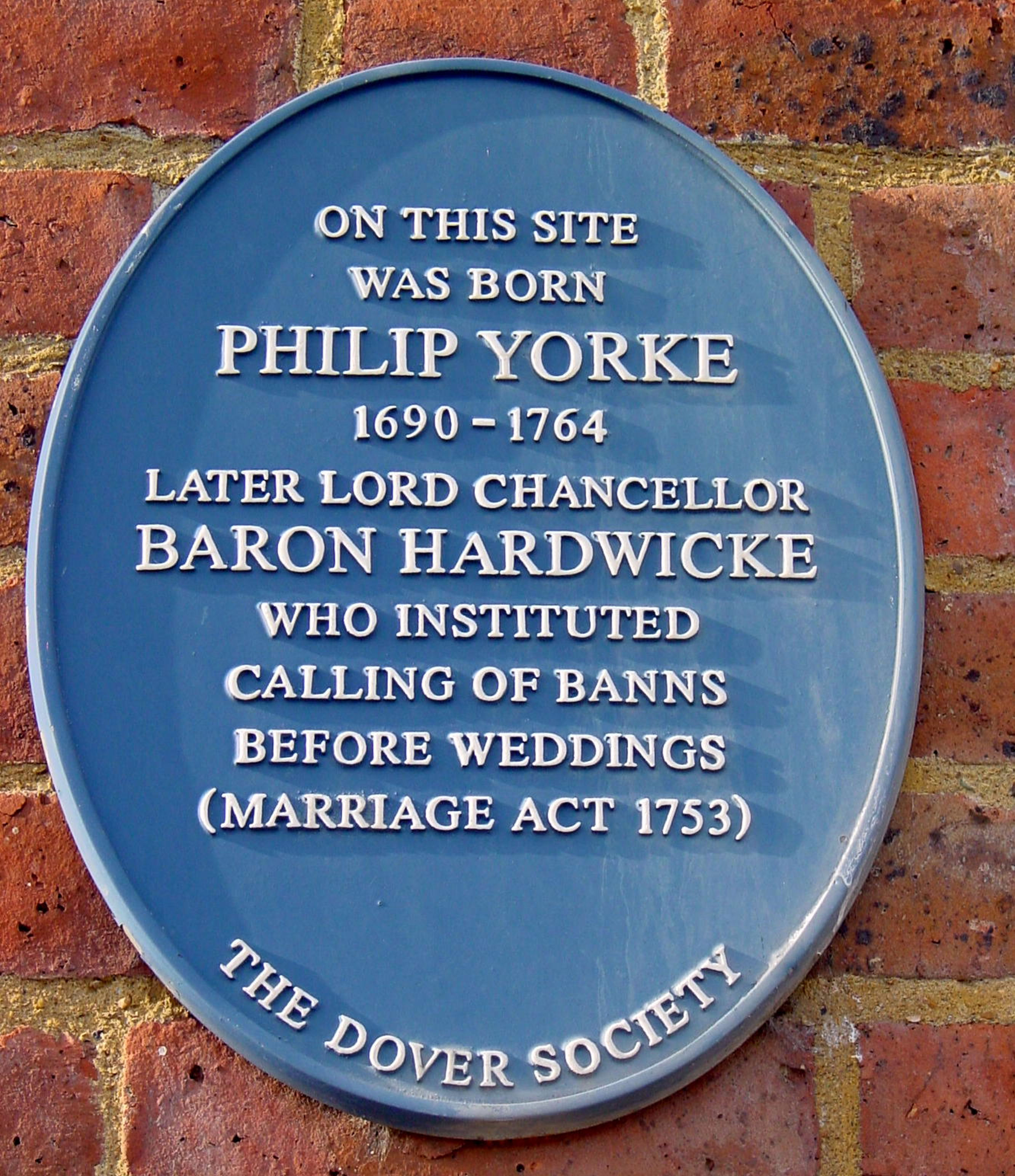
Dover Society Plaque in honour of Philip Yorke, at the corner of Yorke Street with Snargate Street .

Dover Society Plaque in honour of Philip Yorke, at the corner of Yorke Street with Snargate Street

On the corner of York Street and Snargate Street is a Dover Society plaque that states, ‘On this site was born Philip Yorke 1690-1764, Later Lord Hardwicke who instituted calling of the Banns before weddings (Marriage Act 1753).’ York Street, without the ‘e’ along with Hardwicke Road, Maxton, were named after Philip Yorke – Lord Hardwicke – Lord Chancellor of England.

The original name for York Street, on the west side of Market Square, was Priory Lane as it led from the harbour to the Priory (now the site of Dover College). First mentioned in the Dover Charter of 1540, the lane was by then an ancient thoroughfare. By 1606, it was referred to as Back Ditch, due to an intermittent storm stream from Western Heights that flowed down one side. That year the following entry was made in the Almshouses accounts, ‘for wydeinge sheet for Spaniard buried at Back Ditch 1s 10d, and for carrying him to be buried 12d!’ The Ditch, by this time was also referred to as Black Ditch and it eventually became an open sewer that ran down Worthington Lane (now Street) and eventually into the River Dour.

Meantime, the Pier District was developing on what had been Dover’s harbour – Paradise Pent – but had silted up. From the granting of the Harbour Commissions Charter in 1606 until 1802, the Commissioners had leased this land to tenants on which they built houses, shops, warehouses and hotels etc. Snargate Street was one of the earliest streets to be laid and initially started from the Snar Gate on the River Dour going west, while Back Ditch, was on the other side of Snar Gate going north.

It was around this area that Philip’s grandfather, Simon Yorke (1605-1682), settled after he came to Dover from Calne, Wiltshire, as a young man. During his lifetime, he gained fame as a local religious Dissenter of strong Puritan leanings (see Taverner and Stokes). Although Simon Yorke spent time in the Castle prison for his beliefs, he was not particularly sympathetic to those who did not agree with him.

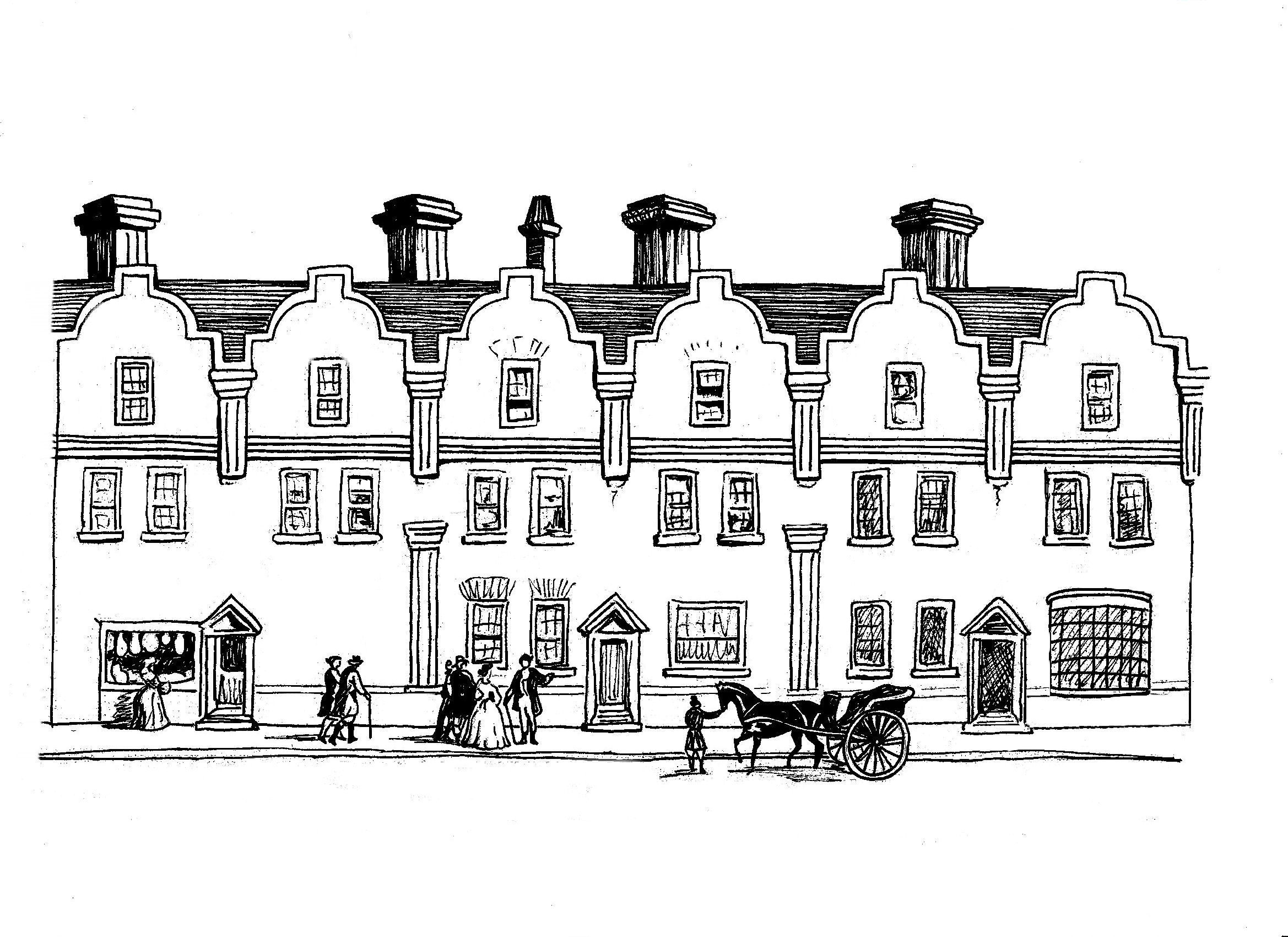
Yorke Family Home re-drawn from an old print by Lynn Candace Sencicle

Yorke Family Home re-drawn from an old print by Lynn Candace Sencicle

Philip’s father, also called Philip (d 1721), was a local solicitor and is remembered for unsuccessfully helping the town when they were fighting to retain their ancient charter. It was he who had built the family home on the Back Ditch side of Snar Gate along what became Five Post Lane. The gabled house looked pretentious but Philip senior was not at all wealthy. He had, however, married Presbyterian Elizabeth Gibbon, daughter and co-heiress of Richard Gibbon of Rolvenden and widow of her cousin Edward Gibbon. She was also related to Edward Randolph (1632-1703) of Westcliffe, whom, it is said, was one of the most hated men in pre-Revolutionary America!

One of nine children and the only male to survive to adulthood, Philip was born on 1 December 1690 and when old enough, was sent to a private school in Bethnal Green. This was run by Samuel Moreland a strict Dissenter who was renowned for his classical learning. Philip’s maths teacher at the school was William Jones (1676-1749), a well-known intellectual at that time and although Philip applied himself, he was described as a ‘plodder.’

On leaving school, Philip’s mother wanted her son to enter the church, but instead he chose to train as an articled clerk without fees with his father’s London colleague, William Salkeld (1671–1715) of Brooke Street, Holburn. Salkeld had been a student in the Middle Temple, called to the bar in 1698 and highly regarded within the legal fraternity as a law reporter, particularly the King’s Bench. Philip made a deep impression on Salkeld who, on 29 November 1708, entered the young man into Middle Temple. He also recommended Philip as law tutor to the sons of Sir Thomas Parker (1666-1732).

Sir Thomas was climbing up the legal ladder and the appointment, it seems, fired Philip’s ambition to get to the top and stay there come what may. Indeed, at the time it was said that he had, ‘cast off his youthful associations that were likely to retard his upward flight … seeking acquaintances with ranks that had the power to help him.’ Philip was called to the bar on 27 May 1715, and through Sir Thomas – who was by then the Lord Chief Justice (1710-1718) and given the title Baron Parker of Macclesfield (1710), secured a post on the Western circuit. Three years later, on 3 October 1718, Philip was appointed the Recorder of Dover and he personally took charge of proceedings at the Quarter Session courts, in the town, for the next eighteen years.

Philip’s next step up the ladder of success was a transfer to the Court of Chancery. There he made a name for himself by clarifying the distinction between Law and Equity in a society case. Following this and the fact that he was handsome, charming, diligent, and eloquent with a strong musical voice, he had little trouble in persuading widow, Margaret Cocks niece of the by then Lord Chancellor Parker, to marry him on 16 May 1719.

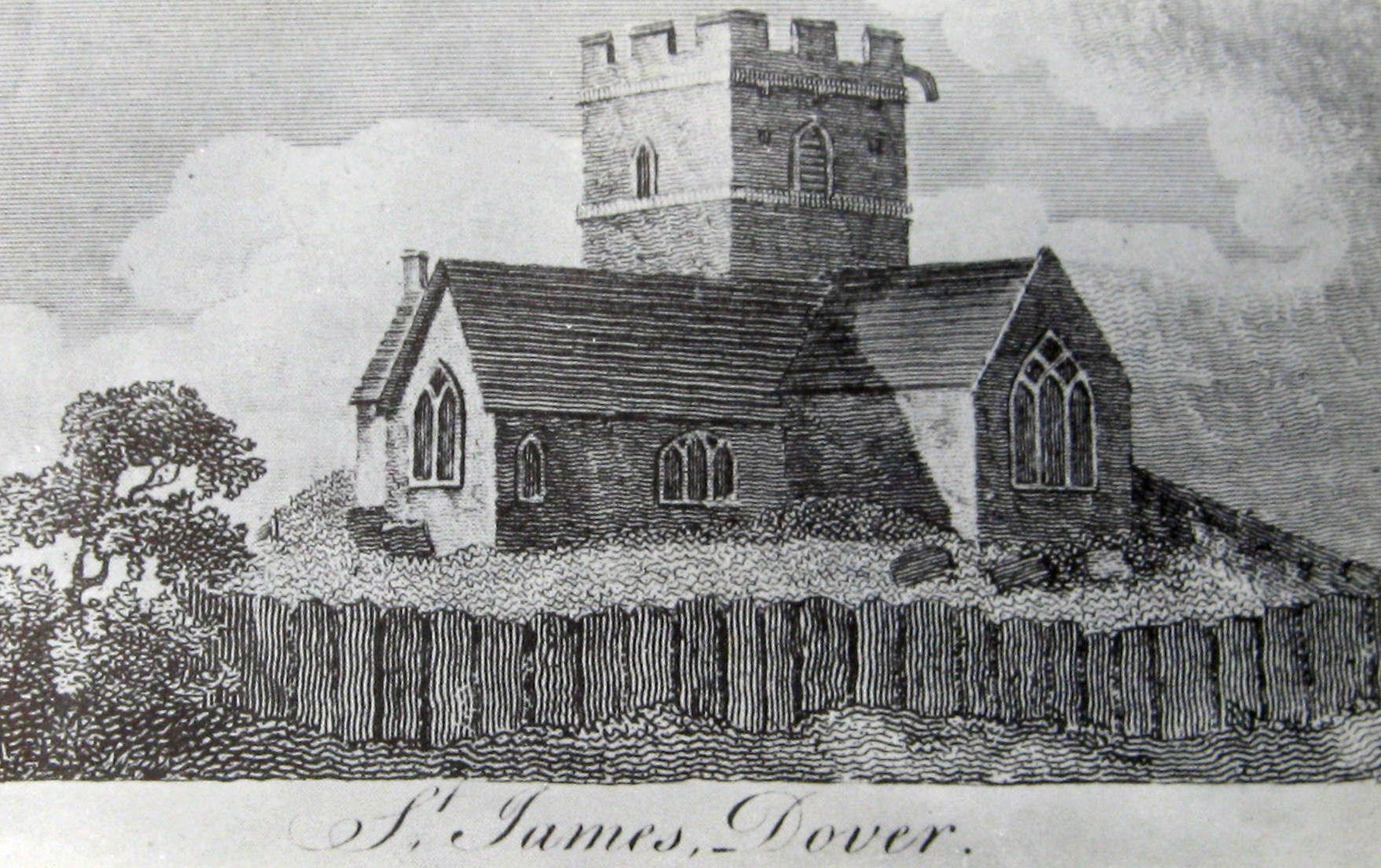
18th Century Sketch of St James' Church where Philip York's parents were buried

18th Century Sketch of St James’ Church where Philip York’s parents were buried

Through his wife’s connections, Philip entered Parliament as member for Lewes and two years later represented Seaford, a limb of the Confederation of the Cinque Ports. On 4 March 1720, he secured his reputation in the Commons in a speech on the supremacy of the British Parliament over that in Ireland. As a reward, although only 30 years old, Philip was appointed Solicitor-General and knighted. Sadly, on 18 June the following year, his father died. His mother was to live another six years both were buried in St James’ Church (the Tidy Ruin near the swimming pool).

The successful prosecution for treason of Jacobite, Christopher Layer (1683–1723) was his next step to power. Layer had also been a student in the Middle Temple and became the legal adviser to William North, 6th Baron North and 2nd Baron Grey, known as Lord North and Grey, (1678-1734), an English professional soldier and Jacobite. Together with other sympathisers and led by Francis Atterbury (1663-1732), Bishop of Rochester and Dean of Westminster, they had conspired to restore the House of Stuart to the English Throne. The plot collapsed in the spring of 1722 and many were arrested including Atterbury, Lord North and Grey and Christopher Layer. Although evidence was scant, Layer was betrayed and brought to trial 21 November 1722 with Philip handling the prosecution. Found guilty, Layer was condemned to be immediately hung, drawn and quartered but this was delayed until he was finally executed at Tyburn 17 May 1723.

As a reward for his success, Philip was appointed Attorney-General and to help his career further, he moved from the Middle Temple to Lincoln’s Inn. However, the society gossips had linked Philip’s meteoric rise with his benefactor, Sir Thomas Parker who had been elevated to Earl of Macclesfield in 1721. Four years later, the Earl was impeached, accused of taking more than £100,000 in bribes and tried in the House of Lords. In his new role, Philip was called upon to undertake the prosecution but on the grounds of friendship, Philip declined. Instead, he stood back and watched his beleaguered former patron torn apart. After being found guilty, Macclesfield had to pay a fine of £30,000 and to remain in the Tower of London until it was paid. He then retreated to his country estate for the rest of his life.

At about this time Philip bought the Hardwicke estate in Gloucestershire. In 1729, Philip’s opinion was sort, as Attorney General, and along with Charles Talbot (1685-1737) in his capacity as Solicitor General, on aspects of slavery. In essence, they concluded that a slave’s status did not change if they were brought to England, a slave could be compelled to return to the colonies from England and that baptism would not free a slave. This view, Philip appears to have held throughout the remainder of his life and played an important role in the justification of the slave trade at that time. The 1807 Slave Trade Act and the 1833 Slavery Abolition Act eventually abolished slavery in England and the colonies.

Before the demise of the Earl of Macclesfield, Philip had found a new patron, the politically powerful Thomas Pelham-Holles (1693-1768) Duke of Newcastle and Secretary of State. Newcastle, nor the Prime Minister, Robert Walpole (1676-1745), had any wish to involve the country in wars particularly the War of the Polish Succession (1733–1738), which was beginning to flare up. George II (1727-1760) and popular opinion was of the opposite view. Philip supported Newcastle and on 31 October 1733, out of gratitude, he was appointed Lord Chief Justice of the King’s Bench. The next day Philip was sworn in as a Privy Councillor and within twenty-three days was created Baron Hardwicke – taking the title form his new home in Gloucestershire.

George R P Jarvis drawing c1820-1840 of Gunman's gardens where pencester Gardens are today. Courtesy of Antony Jarvis

George R P Jarvis drawing c1820-1840 of Gunman’s gardens where Pencester Gardens are today. Courtesy of Antony Jarvis

Although the elevation made it difficult to continue taking an active role in the legal proceedings in Dover, Philip appointed, as his deputy, Thomas Knowler who did all the work while Philip was given the credit. He was also active in ensuring that the elite of Dover upheld the moral code he dictated! For instance, James Gunman, Commissioner of the Peace for the County of Kent and a Jurat – senior councillor – on Dover’s Corporation had married Elizabeth Wivell of the ancient Stokes family. The Gunman’s had a palatial home on what is now Pencester Gardens and were arguably the wealthiest family in the town.

Elizabeth spent a good deal of time in Bath enjoying the waters and the social life but died there on 2 October 1739 and her body was brought back to Dover for burial in St Mary’s churchyard. Shortly after rumours began to spread that James was about to marry a woman much younger than himself. This reached the ear of Philip, who wrote James a terse letter suggesting that if he was thinking of marriage, he should think again. James strenuously denied the rumour and in Dover remained a highly moralistic widower for the remainder of his life. Albeit, when he died in London on 27 June 1756 aged 79, his young mistress was at his bedside!

As Lord Chief Justice of England, Philip was active making pronouncements based on strenuous legal arguments, which were hardly ever challenged. He was also heavily involved in parliamentary politics and soon became the controlling power within the government. This was confirmed by George II, who appointed Philip the head of the Council of Regency when he was out of the country – a post held by Macclesfield during George I (1714-1727) reign.

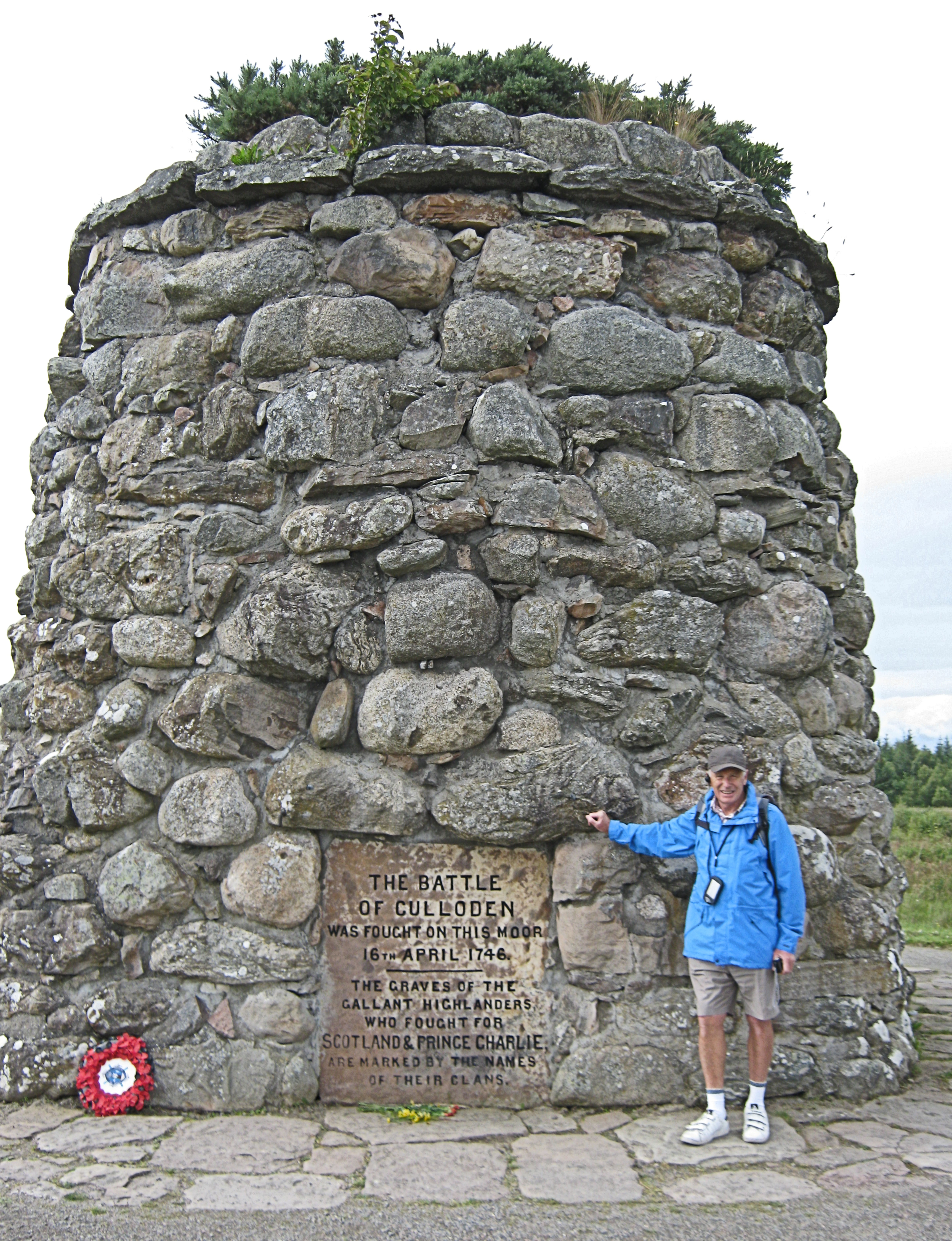
Memorial cairn on the site, near Inveness, where the Battle of Culloden took place 16 April 1746

Memorial cairn on the site, near Inveness, where the Battle of Culloden took place 16 April 1746

Philip, however, was making powerful enemies for although he was generally criticised for his selfishness and arrogance; he was beginning to use his incisive legal mind to justify unfair legal judgements. This came to a head in 1746, following the Battle of Culloden – the final confrontation of Jacobite Rising near Inverness, in the highlands of Scotland – where the Jacobites were routed. Of the 3,471 ordinary soldiers, one in twenty were brought to trial as representatives of the others. Initially they were sentenced to death but this was commuted to transportation and some were released. The officers, however, were all sentenced to death and many took place on Tower Hill, London.


There was public outrage at the cruelty of the punishments and Philip was deeply shocked by the criticism. His son Joseph, then age 21, was an officer in the English Coldstream guards and at the height of the battle had written, ‘No, wait, the rebels are withdrawing. What strange foolishness. Surely, they ought to defend against our passage? Very little art would be needed to make that river almost impossible to cross. Maybe it’s because the rebels here are mainly lowlanders. They’ve complained bitterly of the Pretender and the clans for not coming down to help them.’

A year later, Philip tried to make amends by outlawing some abuses of power in Scotland and outlawed the wearing of the tartan by Highlanders. Nonetheless, he did use his qualities to reform the marriage laws that, with a few modifications, are applicable today.

At the time, there was a proliferation of confidence tricksters, of both sexes, who made a living by tricking wealthy aristocratic offspring into imprudent and often bigamous marriages. The only necessity for the pronouncement of a marriage, at that time, was the verbal ‘agreement’ by the two parties, of any age, in a ‘service’ conducted by a man belonging to the clergy. Albeit, often the supposed ‘clergy’ were not men of the cloth.

Philip’s Marriage Act of 1753 forbid the marriage of persons under 21 years of age without parental consent. All marriages, except Jewish and Quaker, were to take place in a recognised church. Banns had to be published, legal impediments taken into account and the ceremony recorded in the parish register. Although the new law was well received, the day before it was enacted at least 300 weddings took place that would have been seen as illegal the next day!

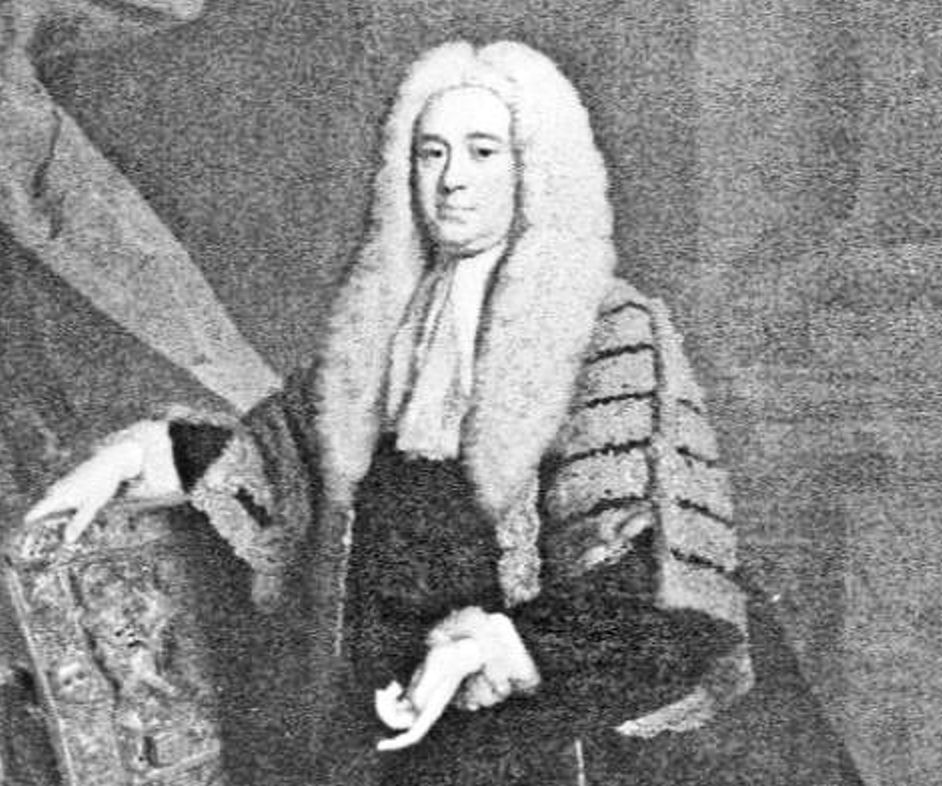
Phillip Yorke c1740 by A Ramsey (detail) in the Stonehall, Maison Dieu. Courtesy of Dover Museum

Phillip Yorke c1740 by A Ramsey (detail) in the Stonehall, Maison Dieu. Courtesy of Dover Museum

For this, the brother of his patron Newcastle, the Prime Minister Henry Pelham (1694-1754), elevated Philip to Earl of Hardwicke and Viscount Royston. Following his brother’s death, Newcastle became Prime Minister but two years later, he was forced to resign over England’s loss of the Mediterranean island of Minorca. The island had been a British possession since 1708  when it was captured during the War of the Spanish Succession (1701–1714). During the Seven Years War (1754-1763), on 20 May 1756, British and French naval squadrons met off Minorca.

The French were holding the British garrison under siege and a fierce battle took place that the French won. The British naval commander, Admiral John Byng (1704-1757), his ships badly needing repair, retreated to Gibraltar and he was subsequently court marshalled and shot by firing squad. This was seen by many as a smoke screen to hide Newcastle’s incompetence in handling the situation. Nonetheless, Philip stood by Newcastle and on 19 November 1756, he relinquished the Great Seal of the Lord Chief Justice.

Four years later and a new monarch, George III (1760-1820), Philip was back in favour such that he drafted the King’s coronation speech. Philip’s reward was to be sworn back into the Privy Council but was of little influence, as he was becoming increasingly frail. Philip died 6 March 1764 and was buried at another ‘family seat’ that he created in 1740 at Wimpole, in Cambridgeshire.

Although Philip was selfishly devoted to his ambitions and had moved his ‘seat’, first to Gloucestershire and then to Cambridgeshire, he maintained a close and influential contact with Dover. His two sisters remained in the town and they, no doubt, kept him abreast of the goings on. He frequently corresponded with local inhabitants, not only the Gunman’s but also the Wellard family and Isaac Minet and retained the position of the Recorder of Dover until his death – the longest in Dover’s history. Nationally and historically, he was, and still is, seen as one of the greatest judges who ever sat on the English bench.

Philip left five sons and two daughters. The eldest son, Philip (1720-1796) succeeded him as Viscount Royston. His second son, Charles (1722-1770) succeeded his father as the Recorder of Dover and eventually was appointed Lord Chancellor but committed suicide. Joseph (1727-1792), the third son, was a diplomat, Dover’s MP (1761-1774) and created Baron of Dover. John (1728-1801) was the MP for Reigate and Higham Ferriers and James (1730-1808), the youngest son, ordained into the church and eventually was appointed the Bishop of Ely. Of his daughters, Lady Elizabeth (1725-1760) married Admiral Lord Anson (1697–1762) of Shrugborough Hall, Staffordshire who is noted for his circumnavigation of the globe. Finally, Lady Margaret who married Sir Gilbert Heathcote.

Following the death of Philip Yorke, it was felt, in Dover, that a statue should be erected in his honour. This came to nothing so instead, Back Ditch was re-laid and renamed York Street (without the ‘e’) following which it was quickly developed. In the late 1960s, there were plans afoot to build the York Street dual carriageway. This was going to be in a deep cutting that would take traffic to and from Eastern Docks to the Folkestone Road without going through town. The New Dover Group (fore runners of the Dover Society) expressed concern that the proposed route would destroy artefacts of archaeologically significance. Dover Corporation contacted archaeologist, Brian Philp, who headed the Kent Archaeological Rescue Unit (KARU) and with his team of archaeologists and local volunteers, started excavating.

In 1970, the archaeological world was astounded by the team’s discovery of the richest 15 acres of buried history in Britain! They had uncovered many large, exceptionally well-preserved, Roman buildings that made up the Classis Britannica Fort including the Roman Painted House. This opened to the public on 12 May 1977 and is recognised as the best-preserved building of its type north of the Alps. KARU also discovered considerable amount about the Saxons, who settled in the area and the early history of St Martin-le-Grand Church.

However, in autumn 1971 construction started on the York Street trunk road, and it was only after a considerable amount of lobbying, which included Brian Philp and his supporters sitting in front of JCB diggers, that the new road was raised six feet to go over the valuable archaeological sites! Except for the Roman Painted House, the sites have been carefully re-buried to preserve the precious archaeology. The road was completed in 1972 but sadly, about 100 buildings that characterised old Dover from Tudor times were destroyed in the process.

The tribute to Philip Yorke, after whom the road was named, was erected by the Dover Society and can be seen on the corner of York Street with Snargate Street near the roundabout.


  • Published:
  • Dover Mercury: 14 & 21 October 2010


Posted in Courts, Crime & Punishment, People, York Street, Yorke Philip - the local who became Lord Chancellor, Yorke Philip - the local who became Lord Chancellor, Yorke Philip - the local who became Lord Chancellor | Comments Off on Philip Yorke – the local lad who became Lord Chancellor

Dover’s Jazz Scene and the Louis Armstrong

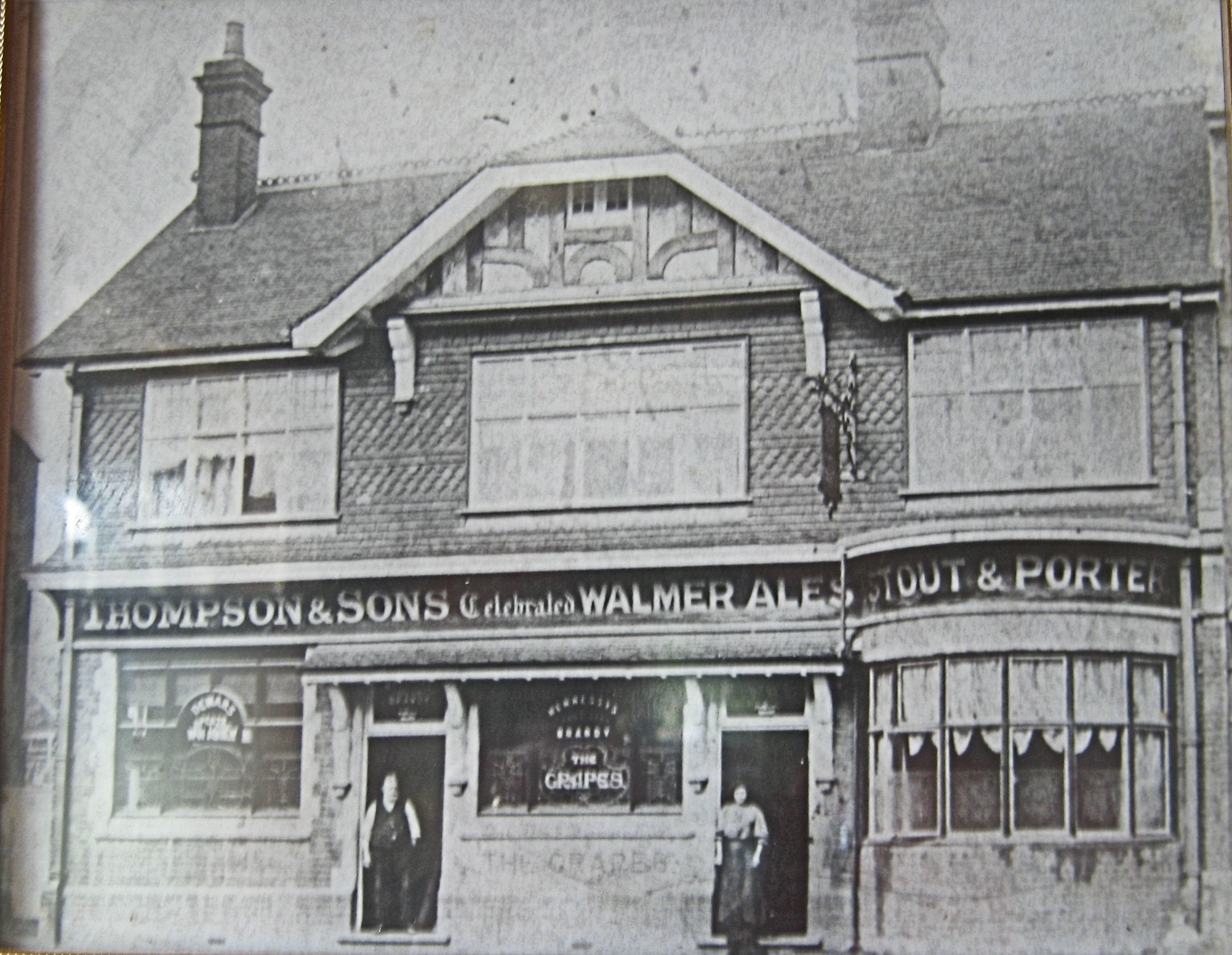
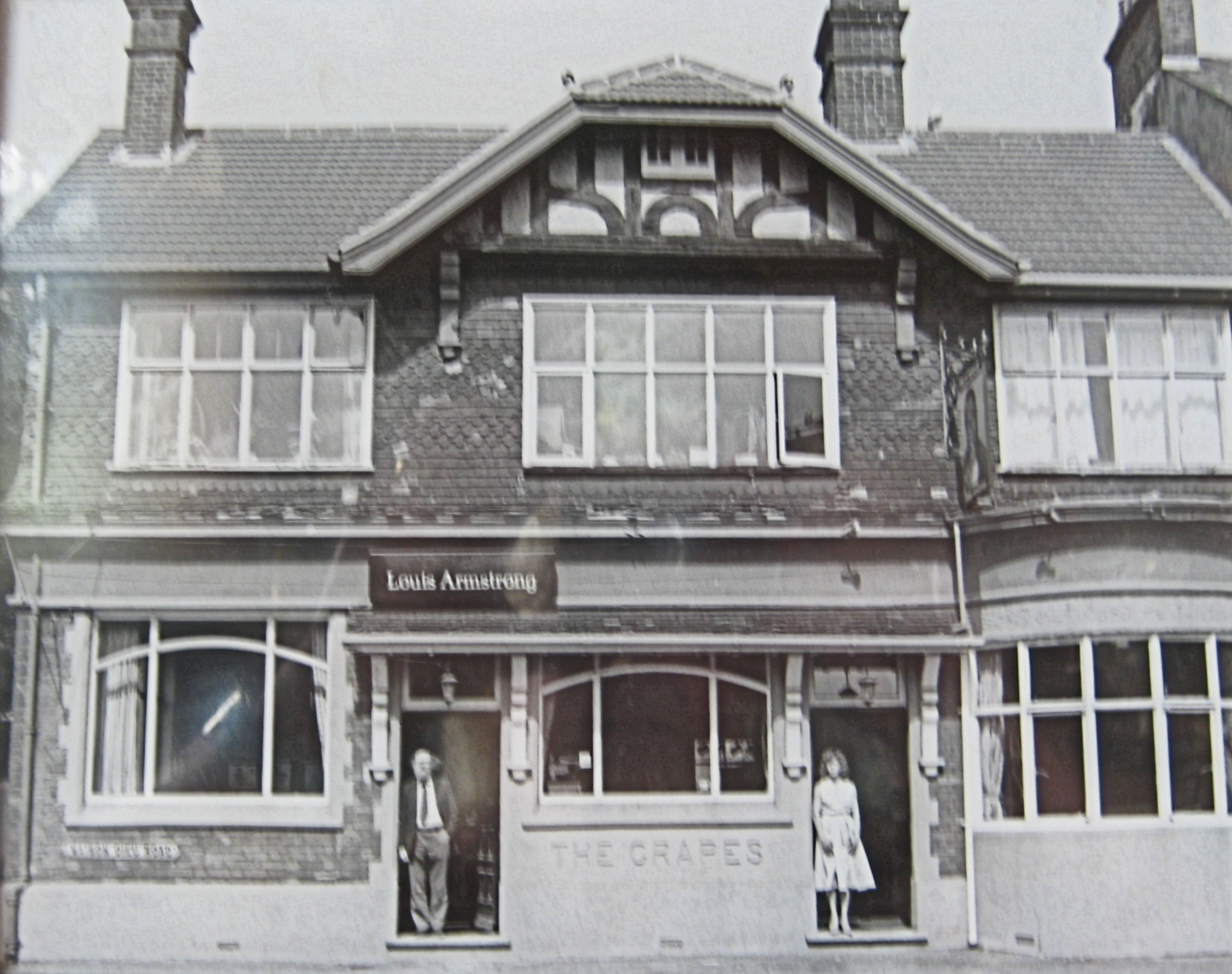
Grapes - circa 1893 , William Gray licensee and his wife at the doors

Grapes – circa 1893 , William Gray licensee and his wife at the doors

The Grapes pub, on what we now call Maison Dieu Road, first opened around 1862. Thirty-one years later, in 1893, it was demolished! This was to allow the road to be widened and the new pub – which we see today – was set further back. The licensee at this time was William Gray.  On 14 September 1962, the pub was taken over by Jackie and Bod Bowles, they both had a love of jazz so was renamed the Louis Armstrong and Jackie, now a widow, still encourages jazz to be played there!

Jazz, in Dover was popular before World War II (1939-1945) but by the early 1950s, crooning and rock‘n‘roll were more popular. At this time Ray Doble was playing in a trio called the Melody Makers at the Red Cow, Folkestone Road, with Arthur Thompson on drums and Ernie Bucker on accordion. The band was increased to five when Ron Holt also on accordion and Les Sutton on trumpet joined. Ray’s particular love was boogie-woogie and he put together another band, The Good Ambition with musicians George Hurst on drums and Peter Coe on electric bass, doubling on trumpet; the fourth member was Maurice Worsley, guitarist from Folkestone. Ray’s son, Raymond, joined on vocals when he was 14!

At the time there were numerous bands in East Kent, including, Bunny Austin,  Holmes Family Band and Ray Harris and his accordion band. The Crochets, the Kays, the Shilson Brothers, the Three Gees, Les Sutton’s Band, Laurie Thatcher and Jackie Dukerall. The Lonely Ones, Pete Brown’s Piblocoto, the Sundowners, Double Identity with Pete Scopes, Kitson Kenne and the Rolling Stones. Pete Webb’s Dixielanders, Jackie Castle and Take Five, Duke Humphries accordion band and the Happy Travellers – the latter all East Kent Bus drivers and conductors!

Ray Doble - Dover Express 16 November 2006

Ray Doble – Dover Express 16 November 2006

As Ray’s involvement in the local music industry expanded, he introduced new local talent such as the beautiful Joyce Siddell who had a strong singing voice. Another was Jack Williams a Welshman with a voice well capable of performing songs from the shows and opera. Then there was Maisie, the wife of the Odeon cinema manager Joe Anthony, who was an excellent music teacher and accompanist along with Elsie Thompson of Pioneer Road. Both ladies played piano for dancing schools in Dover. At the time there were three music shops in Dover, Goulden and Wind in Cannon Street, where Robin Basford, a performing musician worked, Murdoch’s in Biggin Street with workshops in Snargate Street and Licences in the High Street.

All of this led Ray to open the 500 Jazz Club at the Red Cow in 1954 and on the opening night a reporter noted the number of ‘foreign’ tongues heard in the audience! The club was a great success and led Ray opening a second Jazz club, the Blue Note, at the Co-operative Hall on Maison Dieu Road that specialised in Modern Jazz. At the time pubs had to apply for extension after 22.30 hours but when the landlord of the Red Cow, Edwin O’Neill, applied for an half-hour extension on nights when the club opened, this was refused. Thus, O’Neill saw little point in having the club on his premises that was using up heating and electricity when he could not sell alcoholic drinks to cover the costs.

Biggin Hall the venue of Ray Doble's 500 Jazz Club in the 1950s

Biggin Hall the venue of Ray Doble’s 500 Jazz Club in the 1950s

The 500 Club closed but reopened in the Biggin Hall and specialised in Trad Jazz. There, now legends, such as Chris Barber’s Jazz Band were enjoyed on alternative weeks to more mainstream music of the time. During this time Ray, with the blessing of Dover’s Mayor, Captain Sidney Kingsland, organised a Jazz Shuffle to Calais on Channel ferries as well as Jazz Band Balls at the Co-operative Hall. The first starred Chris Barber and Ottilee Patterson (1937-2011) – who had just given up her job as a schoolteacher to sing! The second one featured the American blues singer Big Bill Broonzy (1893-1958).

Sadly, rising costs started to take their toll, first the 500 Club closed in 1956 and not long afterwards the Blue Note Club. While looking for a new venue, Ray had formed his own traditional jazz band. This group was made up of Ray on piano, Cyril Blowers on trombone, Wally Wallis on clarinet, Jack Holmes on banjo, Arthur Thompson on drums, and Ernie Bucker on washboard. Eventually, Ray was offered full-time employment with Philip Moss Vernon as a travelling manager for his nation-wide shows and presentations and since that time has enjoyed a professional musical career that exists to this day. By that time the Gateway jazz club had formed and in November 1957, a moulder at Dover Engineering Works who worked with Ray, Bob Bowles, played jazz trombone there.

Robert ‘Bod’ Bowles was born in Dover in 1930 and educated at Dover Grammar School for Boys. His father, who died on 13 May 1936, had been the District Inspector with the Irish Constabulary before he took over Maison Dieu Road post office. Bod was called up for National Service and on returning to Dover, worked for a while in a bank before starting at the Engineering works across Maison Dieu Road, Charlton Green, from where he lived. A keen rower, Bod was an active member of the Dover Rowing Club and lived above the post office, which his mother ran. In August 1962, Bod married Jacqueline Taylor and they moved into the flat above the post office.

Formerly the Grapes, Louis Armstrong with Bod and Jackie at the doors, May 1972

Formerly the Grapes, Louis Armstrong with Bod and Jackie at the doors, May 1972

Born just outside Oxford, Jackie moved to Dover when she was nine when her father took over the running the shirt factory in Folkestone Road. She was a pupil at St. Ursula’s Convent, Park Avenue, then St Mary’s convent in Folkestone where she later taught maths after teacher training college. A month after taking up the post, Jackie came home from the school and saw the Grapes pub, next door to the post office, was in darkness. Bod told her that the tenants had gone bankrupt and suggested that they should take the pub over!

A Charringtons outlet, they became tenants on 14 September 1962. The building was almost derelict, hardly any stock and fewer regular customers. Not long after Jackie found she was pregnant with Jane, born in May 1963, but she worked out the term at the school. Bod, meanwhile, was still playing his trombone around the Dover jazz circuit and in the summer of 1963, trumpeter, Bill Barnacle, a teacher at Old Park barracks, joined him.

In 1964, Bryn Lewis, a bandsman with the Staffordshire Regiment stationed in Dover, persuaded Bod and Jackie to allow his fellow bandsmen play jazz at the pub. It was agreed that Wednesday evening would be given over and quickly the news of jazz at the Grapes, spread. By the following year, famous local jazz musicians including Ian Shawcross, Jeff Miller, Gunner Yates, Barry Cole, Paul Jury, Les Feast, Dave Corsby and Barry Judge were playing there regularly.

 Bod Bowles Jazz Band vol I record sleeve produced by Ron Nunn

Bod Bowles Jazz Band vol I record sleeve produced by Ron Nunn

Sarah was born in March 1965 and about that time Bod decided to reform his own jazz band to play every Sunday night in the public bar of the Grapes. In the early days, the band included Bill Barnacle – trumpet, Ian Turner – clarinet, Dave Fairfoul – bass, Pete Stevens on drums, Pete Mercer on banjo and vocalist Paul Sherman, with the two Petes’ respective wives, Judy and Jean, helping Jackie behind what had quickly became a very busy bar.

Jazz on Sunday evenings at the Grapes quickly became the town’s main attraction – you had to arrive early and be prepared to be squashed like a sardine, to get in! After awhile, LPs, produced by Ron Nunn, of live sessions could be bought. The line up of Bod’s jazz band over the next few years also included locals, Jim Beechy, Arthur Collingson, Colin Hodges, Mick Marsh ,Steve Mellor, Bruce Roberts, John Talbot and Paul ‘the Pounder’ (apologies I cannot rember your surname Paul – LS). With one of the highlights of Dover’s Christmas calendar being the annual Boxing Day Party featuring trumpeter, Pat Halcox, who usually spent the festive time in Lydden.

The popularity of jazz at the Grapes was such that in 1971, in the memory of Louis Armstrong (1901-1971) Jackie and Bod persuaded the brewery to change the name to that of the Jazz Legend. A new sign was commissioned, the pub redecorated and the Louis, as the pub quickly became known, was given a grand re-opening on Monday 22 May 1972.

 Louis Armstrong pub sign after it became a free House in 1980. Courtesy of Paul Skelton - By the Way www.dover-kent.com

Louis Armstrong pub sign after it became a free House in 1980. Courtesy of Paul Skelton – By the Way http://www.dover-kent.com

While jazz musician, Chris Barber – a National service college of Bods – played at the pub that night, an old Paris bus with an open back platform, loaned by Derry of the Three Horseshoes at Lower Hardres, trundled around Dover twice. The passengers, which included me, gave out Pernod to eager Dovorians and were accompanied by Bod’s jazz band on the upper deck. Afterwards, we returned to the Louis, and joined an estimated crowd of 600 to hear Chris Barber, Pat Halcox (1930-2013), John Crocker, George Webb, and Johnny McCullam with some twenty other jazz musicians playing!

Unfortunately, the local police inspector was not so happy and as the evening ended doggedly pointed out that a music licence was required! This was about to put an end to live jazz for some three months until when the next magistrates’ sitting was scheduled. However, to quote Jackie, ‘concerted support from the local musicians who threatened to boycott the police social club, together with a withdrawal of the Chief of Police’s honorary membership of the Officers’ Mess, a special sitting was convened and a music licence issued within the week for a cost of 50p a year!’

In 1980, Bod and Jackie bought the Louis Armstrong from Charringtons Brewery and the pub became a free house. They immediately had the two bars knocked into one open space and built a raised stage for musicians. The ‘new look’ Louis gave the excuse for another ‘Grand Opening‘, with the great jazz clarinettist Monty Sunshine (1928–2010) and his band playing that evening. It was at this time that Bod and Jackie got to know Alan Gresty, Ken Bawton and Beryl Brydon (1920-1998), all of whom came back to play at the pub.

 Jazz Programme for July 2014 not Bill Barnacle on Sunday and the other East Kent jazz legend, Ian Shawcross

Jazz Programme for July 2014 not Bill Barnacle on Sunday and the other East Kent jazz legend, Ian Shawcross

Following the break-up of Bod’s Jazz band Bill Barnacle joined the Pete Rose Band but after a few years left and formed his own band that still plays regularly at the Louis on Sunday nights. During the rest of the week there was, and still is, live music almost every night. Sometimes these were ‘jam‘ sessions that included local wannabees to, the by then internationally known professional musicians such as local, Nick ‘Topper’ Headon of the Clash punk rock band that formed in 1976.

Over time, evenings became specialised and ranged from folk to rock along with jazz on a Sunday evening. One group that played regularly at the Louis from 1982 until they broke up in 1994 was the Dover Skiffle Band. Their original line-up included Paul Sherman – who had sung with Bod Bowles jazz band – Chris Tophill, Lee Edgington, Jason Pegler and Dave Fairfoul – who had played in Bod’s band.

To celebrate Bob and Jackie’s twenty-five years at the pub, Chris Barber agreed to host the evening with his band. A marquee was erected in the garden with straw bales as seating (Health & Safety rules did not apply then) and outdoors amplification. Five years later, 30 years was celebrated with another marquee venue plus a hog roast. This time the host was Phil Mason and his band. Since then, Martin Bennett and Trefor Williams, from that band, have played regularly at the Louis.

The popularity of jazz at the Louis had, by this time, spread to the Continent, with bands such as the Hot Revival Stompers, the Oriental Jazz band, the Limehouse headed by Robert Duis, Dixie Kings and the Uralski from Russia, playing there. Joe Haniot and Chris Tyle, from New Orleans, have also dropped in.

Bod Bowles died 14 October 2000. R.I.P

Bod Bowles died 14 October 2000. R.I.P

Having suffered ill health for some time, on Saturday 14 October 2000, Bod died in William Harvey Hospital. At the time, the group Helium Lovesok were playing and when the news came through they immediately stopped to raise a glass to Bod. Jackie organised a magnificent New Orleans jazz style send off. A black horse drawn hearse followed by 20 – 30 jazz musicians and literally hundreds of friends and supporters went from the pub to St Paul’s Catholic Church, on Maison Dieu Road.

Jazz continued to be played both outside and inside the church. The wake that followed was held at the Louis with Pat Halcox, George Webb and many others paying their own tribute to Bod. Many professional musicians owed their start to Bod, including drummer – Nick ‘Topper’ Headon, clarinettist – Bruce Roberts and Gary, Steve and Pete Barnacle while saxophonist and songwriter, Matt Clackett proudly states that he gave his first performance at the Louis.

Although the situation was hard for Jackie, their two daughters and more recently grandson Luke, kept the pub and the music going. In the years that followed numerous loyal musicians and the supporters ensured – and still do – that Jazz at the Louis is part of Dover’s cultural heritage. Greats such as Charlie Conner with Roger Howlett on banjo, Clive Fletcher on double bass and Robin Beams on drums, play there.

Jazz 'n' Jam Boree Pencester Gardens 15 September 2007

Jazz ‘n’ Jam Boree Pencester Gardens 15 September 2007

Away from the Louis, a Jazz and Jam Boree event was organised by Dover Town Centre Manager, David Somers, on 15 September 2007. Playing that day were two of  the country’s leading Jazz bands, Bill Barnacle and his Jazz Band and Ian Shawcross with his band. The event, on Pencester Gardens, lasted eight hours and was a brilliant success. In 2014, the South Foreland Rotary Club raised £1,500 for the RNLI lifeboat with a jazz evening provided by the Just Friends Swing Sextet at the Cruise terminal at Western Docks.

In 2008, Mick Fox, who had entertained at the Louis, with his wide selection of harmonicas, for more than 30 years, died. September that year saw a festival in memory of him, at the Louis that went over two weekends and organised by Jackie and music teacher Bert Osborne. A wide selection of Kentish real ales was on offer along with barbecues such that pub and garden heaved with people. Among those performing were Joe Jones, jazz singer Sheila Collier and her partner clarinettist Lasse Karlsson from Helsingborg. The Psychedelic Monks – Merlin Mercer, Tom Robson, Charlie Lawson and Alfie Hammond and Yer Blues – George and Patrick Holmes, Jake Clapson, Jack Kennett and Jimmy Dawkins, Bridie Douglas, Molly Milne and Jack Daniel.

Stage at the Louis Armstrong

Stage at the Louis Armstrong

The following year the LA Music Club opened at the Louis, this is to give young musicians the chance to play with others and improve their skills. The co-founders were Eddie Clapson – Dover Express photographer – and Mick Morris. Nick ‘Topper’ Headon id the president and funding is provided by Strummerville a charity set up as a foundation to promote new music in memory of Clash front man Joe Strummer (1952–2002). The club has proved popular in encouraging local talent.

In February 2012, Eddie Clapson died and the LA Music Academy put on an all-day music extravaganza to raise funds for the Pilgrim’s Hospices. The staff had cared for Eddie during his final days. In the 1960s Eddie had been the lead vocalist and his grandson Jake’s band, Deep Water Horizon, were among the many musicians playing that day.

Jackie and daughter Jane behind the bar of the Louis Armstrong. LS 2014

Jackie and daughter Jane behind the bar of the Louis Armstrong. LS 2014

In 2012, Jackie Bowles celebrated 50 years as the town’s longest serving landlady and of the hottest jazz venue in East Kent. Three years earlier, on 6 November 2009, musicians and friends gathered at the Louis for a weekend party to celebrate Jackie’s 70th birthday. The golden jubilee of Jackie’s success at running the one of the best jazz pubs in the country topped even that. The weekend started on the Friday night, when the pub was packed with the crowds that increased on the Saturday and Sunday proving that Jazz at Dover’s famous venue, lives on.

  • Published: Dover Mercury –  14 December 2007

A Sad Loss …

The start of Jackie Bowles Funeral procession from the Louis Armstrong to St Paul's Church Friday 26 April 2019

The start of Jackie Bowles Funeral procession from the Louis Armstrong to St Paul’s Church Friday 26 April 2019

The Queen of Dover’s music scene, Jackie Bowles, died on Friday 15 March 2019 aged 79, after a short illness. Jackie’s funeral was on Friday 26, April. The procession started from the Louis Armstrong at 10.30am and the service took place at St Paul’s RC Church, Maison Dieu Road. The committal was at Barham Crematorium, which was followed by a Wake at the Louis Armstrong where bands played throughout the day representing its different eras.

Jackie Bowles (1939-2019) Service to Celebrate the Life of Jackie Bowles, Dover's Queen of Music

Jackie Bowles (1939-2019) Service to Celebrate the Life of Jackie Bowles, Dover’s Queen of Music

Posted in Dover's Jazz Scene and the Louis Armstrong, Dover's Jazz Scene and the Louis Armstrong, Dover's Jazz Scene and the Louis Armstrong, Maison Dieu Road, Societies, Culture and Entertainment, Tourism | Comments Off on Dover’s Jazz Scene and the Louis Armstrong

Cinque Ports Pilots – Part II

Duke of Wellington, the champion of the Cinque Ports Pilots. Dover Harbour Board.

Duke of Wellington, the champion of the Cinque Ports Pilots. Dover Harbour Board.

On 14 September 1852 the Cinque Ports Pilots champion, the Lord Warden (1829-1852), Duke of Wellington (1769-1852), died –  see Cinque Ports Pilots Part I. The government lost no time, having rationalised pilotage, to do the same with the Admiralty Court. The Lord Wardens Bench, on which for centuries the Lord Wardens had sat while presiding over the Court, stayed in what became old St. James’ Church until World War II (1939-1945). For safekeeping it was moved to St. Marys Church and then to the Museum, where it still be seen.

Although the Cinque Ports Pilots had become part of Trinity House, their licenses covered the area from Dungeness (west of Dover) to London Bridge and vice-versa. Albeit there were other changes, for instance, to become a Trinity House pilot the applicant could be no older than 35-years but only required 5-years as a master mariner instead of 7-years that had been required by the Cinque Ports Pilots. Another change was that all pilots on passing an examination went straight on to the Upper Book – or became First Class, as this was now called. The Lower Book was redefined as Second Class and these pilots could take the exam after only one-year experience. Finally, the cruising system was introduced, where pilots took ‘turns’ at being stationed at sea on a pilot cutter.

The Merchant Shipping Act of 1854 consolidated most of the existing legislation on pilotage. Four years later the Deal Pilots were gradually transferred to Dover with the last three transferred in 1937. Many ship owners were still antagonistic towards compulsory pilotage and made their views felt at the meeting of the Parliamentary Select Committee into Shipping in 1860.

Trinity House Pilot cutter c1830. Alan Sencicle collection

Trinity House Pilot cutter c1830. Alan Sencicle collection

About this time the pilot cutter, which was paid for by the Cinque Ports Pilots and had to be on the move all the time, was authorised to anchor at a fixed station off Dungeness. However, the cutter, in a fixed position, was vulnerable to being sunk. On 22 May 1862, the Princess was run down with the loss of two lives. The cutter usually had a crew of five and on average 14 pilots was on board. As these pilots joined ships another 14 would be brought to the cutter. It was agreed within Trinity House that all ships bound for London received Cinque Ports pilots and ships going in the opposite direction, carried Trinity House pilots. 

Once a pilot had boarded a ship his flag was hoisted so that ships that did not have a pilot on board could easily be identified. A pilot on duty at one of the shore stations would be rowed out to the pilot less ship. Hefty fines were imposed on any vessel found guilty of avoiding pilotage.

The 1872 Merchant Shipping Act altered the way payments were made by Cinque Ports Pilots to bring them into line with their Trinity House colleagues. The Act also authorised the issuing of special licences to persons ‘acting as pilots for any part of the sea or channels beyond the limits of any pilotage authority. However, no pilot so licensed be entitled to supersede an unlicensed pilot outside the limits of the authority by which he is licensed.’ As the Cinque Ports Pilots fee included a percentage towards the cost of the cutter, they charged more than the Trinity House pilots did. The new Act enabled ‘choice pilotage’ whereby ship owners could approach Trinity House pilots of their choice to bring their ships up the Channel to London, as they were cheaper.

The Granville Dock, Dover, was opened in 1874 and from that time Pilot boats not in service were kept there. At the beginning of 1879 there were 73 pilots living in Dover headed by Superintendent Captain Cow with the longest serving pilot, Peter Decent, who joined in 1837. There were also five pilot cutters, Wellington, Granville, Princess, Vigilant and Edinburgh. On 13 March, that year saw the biggest disaster ever to befall the Cinque Ports Pilots. The 62-ton cutter Edinburgh was run down by the 1,100-ton mail steamer Severn, and ten pilots plus three crew lost their lives.

12 women were widowed, 60 children left fatherless and the whole town went into mourning. The subsequent Inquiry blamed Clement Bateman, the Severn’s second officer, as he should have slackened speed when he saw the Edinburgh. However, the Inquiry also found that the Edinburgh crew had not properly observed regulations appertaining to lights so Bateman’s ticket was only suspended for six months. Trinity House tried to claim costs but failed for the same reason.

In 1883, it was reported that there were 3,168 pilots in the British Isles and they piloted 168,418 vessels for a total income of £427,532. The following year the United Kingdom Pilots Association (UKPA) was formed representing the interests of licensed pilots throughout the UK. Underlying the formation was the continuing effects of the 1812 Pilotage Act (see Pilotage Part I) relating to the freedom of liability for vessels subject to compulsory pilotage. Further, the number of foreign ships being taken up and down the Channel without a licensed pilot was increasing and was said to be a contributory factor in the German ironclad Grosser Kurfürst, disaster on Thursday 30 May 1878.

A formal Inquiry into Pilotage was held in 1888, when the ‘choice’ pilotage service came under scrutiny  and it was recognised that it was unfair to the Cinque Ports Pilots. It was also found that a number of Trinity House pilots actually obtained more ‘choice’ work than they could handle and they ‘hired’ other pilots to take on this extra work – making quite a bit of money for themselves. It was formerly agreed that Cinque Ports Pilots were to take ships from Dungeness to Gravesend where, by then, the largest pilot station in the world was situated.

 Granville Dock last sailing and first steam pilot cutters. c1898. Dover Museum

Granville Dock last sailing and first steam pilot cutters. c1898. Dover Museum

Steam cutters were introduced at Dover in 1891 with part of the cost deferred by the pilots. Three years later, in 1894, the Merchant Shipping Act consolidated existing legislation and pilots were defined as ‘any person not belonging to a ship who had the conduct thereof. And they are under an obligation to offer their services in all weathers, unless under circumstances of absolute danger to their lives.’ Albeit, the number of foreign ships operating in UK waters without UK licensed pilots was escalating.

The Dover pilots moved out of their ornate Pilots Tower, by the Lord Warden Hotel, on 24 May 1912. In March 1914, it was demolished in order to lay a double railway line from the South Eastern and Chatham railway to the Admiralty Pier. Earlier that year the Pilots had bought No 1 the Esplanade. By Royal Warrant of 1912, Trinity House Elder Brethren were empowered to use the title of Captain and take precedence immediately after captains of the Royal Navy. Shortly after, all pilots wore a naval style uniform. On 28 July 1914, a new pilot cutter the Patrol came to Dover.

Pilot Boat going to a Red Star cruise liner c1910. Thanks to Barrie Wilson

Pilot Boat going to a Red Star cruise liner c1910. Thanks to Barrie Wilson

A Committee on Pilotage was set up by Parliament in 1909 and a searching inquiry resulted in the Pilotage Act of 1913. The Act laid down a general framework of by-laws for pilotage authorities to adopt and adapt. The Act defined the meaning of ‘excepted ships’ that were not legally obliged to employ pilots. These included Her Majesty’s ships, pleasure yachts, some fishing vessels, and other small craft. It also settled on the ship owner or master liability for damage caused when under pilotage.

In August 1914, World War I (1914-1918) was declared and Dover pilots conducted vessels not only through the Strait but also sometimes as far west as the Bristol Channel and north as Scarpa Flow. Their work was dangerous with Dover Pilots, R H Kitson, A G Knox, W Fletcher, J Ferguson and T Blaxland losing their lives.

Pilot boarding a ship c1930. Alan Sencicle Collection

Pilot boarding a ship c1930. Alan Sencicle Collection

The UKPA published their first magazine, the Pilot, in 1920 and a year later records show that 1,300 pilots belonged to the Association. The magazine raised awareness of the problems pilots faced and how difficulties could be avoided or averted by adopting better procedures. However, the country was sliding into an economic depression during which time ship owners pressed for reductions in pilots’ charges. In 1925 returns relating to pilotage for the previous year was published in the national press and showed that Trinity House had, in 1924, 573 pilots who had piloted 45,007 British ships and 26,323 foreign vessels. The total amount received was £413,535 16shillings, equalling approximately £722 per pilot.

In Dover there were 75 attached pilots, who were employed in the Channel Service and the average earnings for them was, £900 net and £22 for extra services. Ten years later the average earnings had fallen to £875 per year with £13 for extra services. Over the next few years there were numerous Parliamentary Inquiries into Pilotage and in 1935, there was a demand by ship owners to reduce the number of pilot cutters and methods of boarding in order to reduce their costs. At the same time, the number of vessels using pilot exemption certificates was again on the increase.

Cinque Ports Pilots memorial St Mary's Church.

Cinque Ports Pilots memorial St Mary’s Church.

During World War II (1939-1945), the Cinque Ports Pilots, as in World War I, took ships far beyond the Channel and in the run up to the D-Day landings of June 1944, they were involved in moving parts of Mulberry harbours to France. E M Smith, F O Ensor, D MacDonald, W H Hopkins and W E Peverley lost their lives. On 23 May 1948, in appreciation of their war service, a plaque bearing the Trinity House Coat of Arms was presented to the Cinque Ports Pilots and now hangs in St. Marys church. A year later, the oak table, below the plaque, was dedicated to those Pilots who gave their lives during both wars and on 1 June 1958, Cinque Ports Pilots window was dedicated by the Rev. Stanley Betts (1912-2003) – Bishop of Maidstone.

The number of pilots increased during the 1950s and 60s and in Dover their base was on Marine Parade. 1956 saw a Ministry of Transport Inquiry, chaired by Sir Robert Letch – the general manager of the docks division of the British Transport Commission – and resulted in the Letch Agreement. This set the structure of pilots’ earnings and conditions of service. Pilots are self employed and licensed for vessels up to a certain draught. As their experience increases so, they are able to take vessels of deeper draught and their earnings increase accordingly. Charges made by Trinity House are based on tonnage that is, based on the draught band that the vessel belongs.

Pilot Cutter model made by Paul Wissenden 4-foot long working model. Dover Transport Museum

Pilot Cutter model made by Paul Wissenden 4-foot long working model. Dover Transport Museum

In June 1960 Prince Henry, Duke of Gloucester (1900-1974), as Master of the Corporation of Trinity House, visited the pilot office in Dover and inspected the pilot cutter personnel before going to Dungeness to open the new lighthouse there. The last cutter based at Dungeness was Pathfinder and in 1967, the boarding of pilots from a cruising cutter was abolished. From that year, pilots were taken out by a fast launch based at Folkestone and from 1971, their base was the newly built Folkestone Pilots’ Tower. On 12 May 1970, following the success of a Ten-Minute rule Bill in Parliament present by the Folkestone MP, Sir Albert Costain (1910-1987), regulations were introduced ensuring that the pilots ladder, by which they access ships, were secured to the ships structure.

Dover Pilot Boat - Tidal Basin. Alan Sencicle 2009

Dover Pilot Boat – Tidal Basin. Alan Sencicle 2009

The Pilotage Act of 1987 took effect in October 1988 and the Cinque Port Pilots were disbanded. The service was transferred to Competent Harbour Authorities (CHA) such as the Dover Harbour Board. These days’ pilots have bases at Dover, Ramsgate, Harwich and Sheerness for ships coming and going from the north, south and east of the Continent. London pilots operate from Gravesend – for ships going to and from Tilbury and berths along the Thames from Margate up as far as the Pool of London. Trinity House is one of the three authorised bodies responsible for deep-sea pilotage.

Following the 1996 Sea Empress disaster (off south Wales), the Port Marine Safety Code was established (amended in 2013 by the Marine Navigation Act). This enables a CHA to relinquish its powers and permits Pilot Exemption Certificates to be awarded to suitably qualified deck officers but has tightened the use of Exemption Certificates.

Every year, on Trinity Sunday, (first Sunday after Pentecost) a special Pilots’ service is held in St Mary’s Church, Dover.

  • Published:
  • Dover Mercury: 27 May 2010


Posted in Cinque Ports, Cinque Ports Pilots - Part II, Cinque Ports Pilots - Part II, Maritime | Comments Off on Cinque Ports Pilots – Part II