St Edmund’s Chapel – dedicated by one Saint to another Saint

St Edmund’s Chapel – Priory Road, Dover. Alan Sencicle

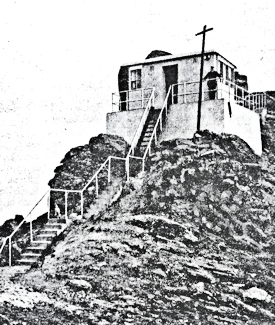
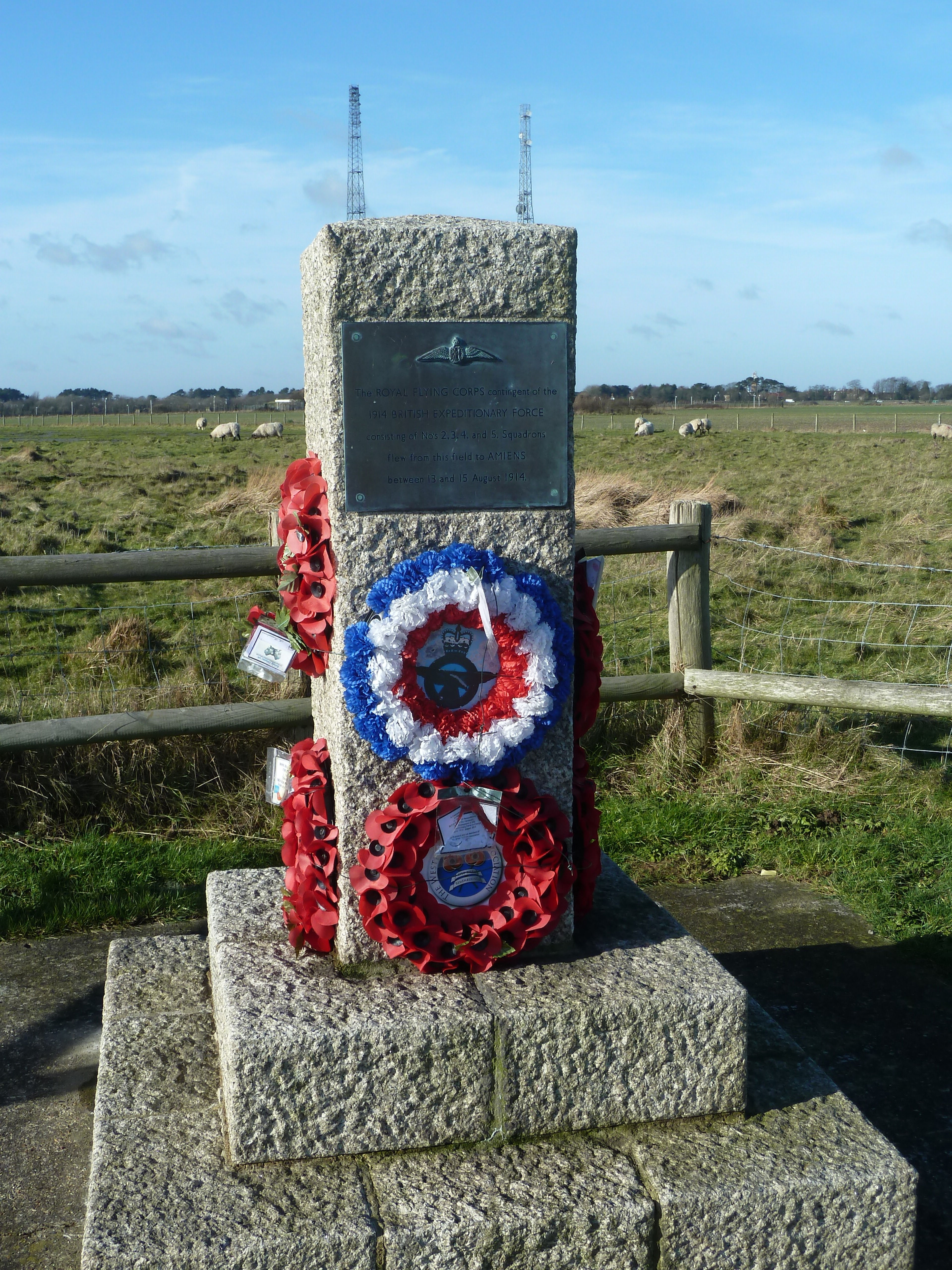
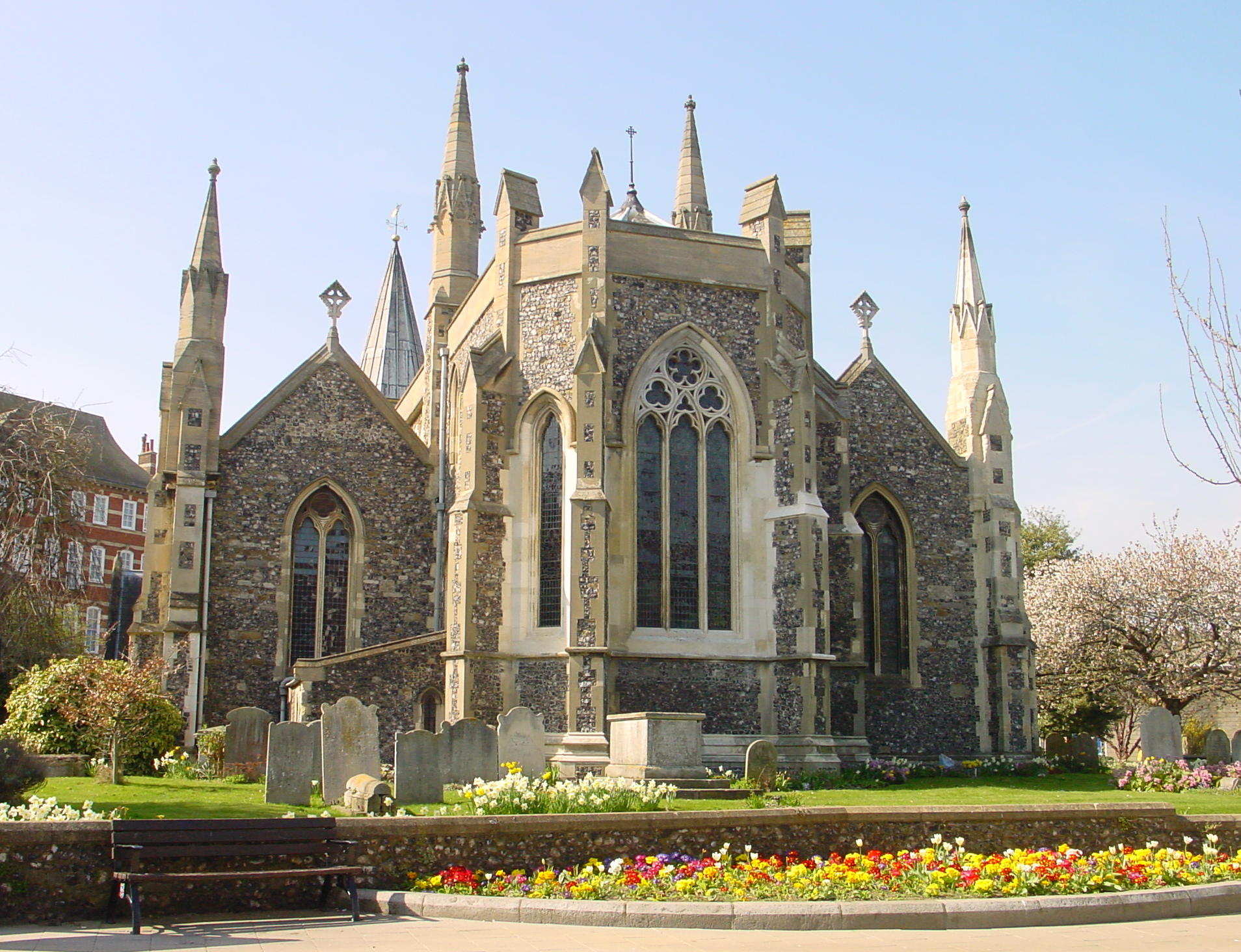
The tiny Chapel of St Edmund on Priory Road, sometimes in 19th century books referred to as the Church of St John, has had a chequered history. It is believed that a ‘Cemetery of the Poor’ was established in 1131 by the Priory of St Martin’s on ground between the Priory (now Dover College) and the Maison Dieu. The latter, a religious hospice, particularly administered to pilgrims going to and from Canterbury Cathedral where there was a shrine to Thomas Becket Archbishop of Canterbury (1162-1170). Many of the pilgrims were sick and those who died and had no money were buried in the poor peoples’ cemetery. This was established facing the monastery walls for which the small chapel was built.

Henry III, detail from one of the windows in the Maison Dieu, Dover. Alan Sencicle

Edmund Rich (1175-1240) was born in Abingdon, Berkshire, educated at Oxford University where he later taught logic (1219-1226) and was appointed a canon of Salisbury Cathedral, Wiltshire in 1222. He quickly gained fame as a preacher in England and France and was commissioned by Pope Gregory IX (1227-1241) to preach, throughout England, in support of the Sixth Crusade (1228-1229). Following the death of the Archbishop of Canterbury (1206-1228) Stephen Langton (c.1150- 1228), Pope Gregory appointed Richard le Grant, to the See in 1229 and he held the office until his death in 1231. By then, the Archbishop had fallen foul of Henry III (1216-1272) over the Clare estates in Tonbridge, Kent. The King was supporting Hubert de Burgh, (c.1160–1243), his Chief Justicular, who was also the 1st Earl of Kent, Constable of Dover Castle, the benefactor of Dover’s Maison Dieu. Not long after, in 1233, De Burgh also fell foul of the King and in 1233, was imprisoned in Devizes Castle, Wiltshire.

On the death of Archbishop Richard le Grant, four men were put forward to become the Archbishop of Canterbury. The first was rejected outright by both Pope Gregory and King Henry while the other three, although supported by the King, had their election quashed by the Pope! In the end, in 1234, Pope Gregory put forward Edmund Rich and at first Henry agreed. However, that year he married Eleanor of Provence (1223-1291) and the new Queen insisted that high offices including the See of Canterbury should go to her own kinsmen. Pope Gregory refused to be over-ruled.

1240 Archbishop Edmund leaves England for Rome with Richard. Droitwich Heritage Centre

As the new Archbishop Edmund instituted reforms in the ecclesiastical courts, monasteries and among the clergy but, not surprisingly, these reforms did not go down well with some. They complained to both the Pope and the King and the Pope ordered 300 English benefices to be assigned to Rome. Although Edmund was physically far from well he decided to go to Rome to plead his case before the Curia (the administrative unit of the Holy See). To accompany him, the Archbishop called upon his protégé and Chancellor, Richard de la Wyche (1197-1253).

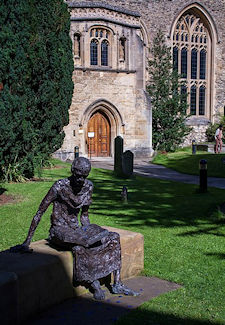
St Edmund, a bronze sculpture outside St Edmund Hall, Oxford. Simononly

Richard, born in Droitwich (then called Wyche), Worcestershire, had been one of Edmund’s students at Oxford. He then went on to study at the Universities of Paris and Bologna, Italy, where he read Canon Law. On returning to Oxford in 1235, Richard was appointed Chancellor and soon after Edmund asked him to become the Chancellor to the Province of Canterbury. In this role Richard would have been responsible for administration and the preparation of documents etc. of the See.

The late autumn weather in 1240 was treacherous and took its toll on Edmund’s health such that when they arrived at the Cistercian Monastery of Pontigny, near Paris, the feeble Edmund became sick. They decided it would be best to return to England but Edmund’s health continued to deteriorate and a few days later on 16 November 1240 Edmund died. He was buried in the Great White Church, Pontigny.

Subsequent to the death of Edmund, Richard decided to follow his beloved master’s calling and to devote the remaining years of his life to the priesthood joining the Dominican Order. St. Dominic (1170-1221) founded the Order in 1215, the monks been known as the Black Friars due to the black cloaks they wore over their white habits. Unlike, other monastic institutions, Dominicans did not stipulate as belonging to a designated House. In consequence the friars could, and were, sent anywhere and at any time, to preach the Christian doctrine. Because all the other Orders stipulated that preaching was the prerogative of bishops and their delegates, the Dominicans were, at best, frowned upon by the other monastic institutions. Under the Dominicans, Richard studied theology in Orléans, France, for two years and was Ordained. Following Ordination, Richard returned to England and in 1243 he was appointed the Rector of Charing, Kent.

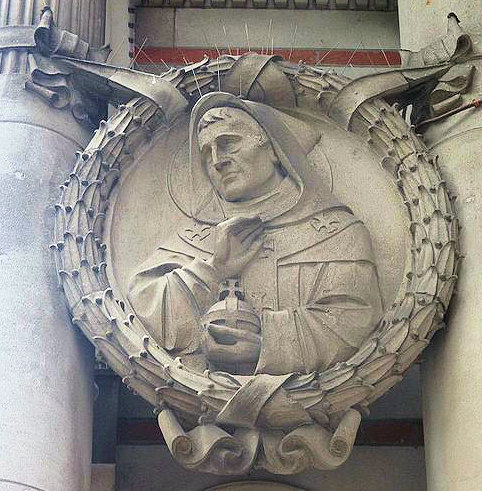
Archbishop Boniface of Canterbury on the facade of Westminster Cathedral, London. Thomon

On 16 September 1243 Boniface of Savoy (c. 1207- 1270), the uncle of Queen Eleanor, was nominated as the Archbishop of Canterbury and this was confirmed by Pope Innocent IV (1243-1254). Boniface arrived in England the following year but found that the Canterbury See was in debt by 22,000 marks and immediately instituted sweeping financial stringency on both tenants and clergy. Two years later, in 1245, the First General Council of Lyon was held when the Pope consecrated Boniface into office. He was enthroned when he returned to England in 1249. While in Lyon, in 1246, Boniface put forward the case for the canonisation of Edmund of Abingdon and offered Richard his former post, that of the Chancellor to the Province of Canterbury. 

Meanwhile, in February 1244, Ralph Neville the Bishop of Chichester died. He was also the Lord Chancellor, the Keeper of the Great Seal, the Chief Royal Chaplain and adviser to Henry in both spiritual and temporal matters. The King’s favoured candidate was Robert Passelewe (d 1252) the Archdeacon of Lewes who had recently regained favour of the King as an adherent of Peter des Roches (d 1238). Roches had been appointed the Chief Justicular of England, Hubert de Burgh’s former post. And he had also been given de Burgh’s manors, some of which he had passed on to Passelewe. Archbishop Boniface, on the other hand, favoured his Chancellor, Richard de Wych. Pope Innocent had the final choice and he declared Passelewe’s candidacy void while supporting the Archbishop’s choice by confirming Richard’s election.

Richard Bishop of Chichester carved by Robert (Bob) Forsyth in 1955 in the Maison Dieu. Roy

Henry III was so angry that he refused to give up properties and revenues of the See of Chichester and banned anyone helping or offering hospitality to Richard. Although Pope Innocent wrote to the King on Richard’s behalf, Henry refused to accede. Thus, Richard was forced to wander around his own diocese, dependent on charity, in return for which he showed folk how to make the most of their farmland. At the same time, Richard sought redress through Henry’s Royal Court but to no avail, while letters from the Pope to the King on Richard’s behalf, made no impression. Eventually, in 1247, Pope Innocent threatened to excommunicate Henry if he did not accept Richard as the Bishop of Chichester and the King was forced to acquiesce.

The Holy Land Crusades (1095-1291) were a series of religious wars initiated, supported, and sometimes directed by the incumbent Pope with the intention of permanently recovering Jerusalem and its surrounding area from Islamic rule. In 1244 Jerusalem was in the hands of the Muslims and Pope Innocent IV advocated the need for another crusade. However, he was heavily caught up in a power struggle against the Holy Roman Empire’s Frederick II (1220-1250), as well rebellions in the Baltic along with Mongol incursions. The French King Louis IX (1226-1270), a devout Christian, made the decision to lead what became known as the Seventh Crusade (1248-1254). Given Pope Innocent’s blessing, his aim was to reclaim Jerusalem by attacking Egypt, then the main seat of Islamic power under As-Salih Ayyub (1205-1249). Although Henry III declined to be involved, he did not discourage members of his Court from joining and he even signed a truce promising not to attack French lands during the Crusade!

Initially, the Crusade was a success and following the death of As-Salih Ayyub, Louis felt confident of victory. This did not last long, for the proclamation of the Sultan’s son Al-Muazzam Turanshah (1249-1250) gave the Egyptians renewed impetus. In April 1250 the Crusaders were defeated at EI Mansûra in Egypt and Louis IX and his army were taken into captivity. Although the King was held for a ransom the ongoing power struggle between the Pope and Frederick II continued to dominate European politics, so outside of France, little notice was taken of the plight of Louis and his Crusaders. Then, in December 1250, Frederick died peacefully in bed wearing the habit of a Cistercian monk. His Empire was divided between his sons and he willed that all the lands he had taken from the Church be returned. Thus, the Pope’s attention was able to focus on the plight of the Crusaders and he called on Richard and other bishops to raise funds to pay the ransom of 400,000 livre for Louis IX.

Maison Dieu the religious hospice founded by Hubert de Burgh in 1203, where Richard of Chichester sought refuge.

Richard set out from Chichester in early January 1253 in order to raise money by preaching about the Crusade and the plight of the Crusaders. Wearing a hair-suit and simple open sandals he was well known for his frugal clothes and eating habits. Slowly, he worked his way eastwards along the south coast and although welcomed every where he went, the already cold, wet and windy weather continued to do its worst throughout February and March. Indeed, by late March 1253, when Richard arrived in Dover, there was no sign of spring. Both emaciated and sick he sort refuge at the town’s Maison Dieu, the religious hospice founded by Hubert de Burgh. Under the care of the Master, Michael de Kenebalton, Richard gained a little strength and he was asked by the Brethren to consecrate the nearby, rebuilt, poor people’s cemetery Chapel in honour of St Edmund of Abingdon. This, Richard was more than happy to do.

The dedication ceremony of the Chapel took place on Refreshment Sunday, 30 March 1253, but the next day Richard health rapidly deteriorated and at midnight of 3 April, at the age of 56, he died in the Maison Dieu. Before the Bishop’s body was returned to Chichester Cathedral for burial, his heart was removed, put in a leather pouch and buried in a Cist, or pit, under the Chapel’s altar. On 22 January 1262, 9 years after his death, Richard was canonised at Viterbo, Italy, by Pope Urban IV (1261-1264). As St Edmund’s chapel was the only church in England dedicated to one English Saint by another it quickly became a place of pilgrimage that lasted until Reformation (1529-1536).

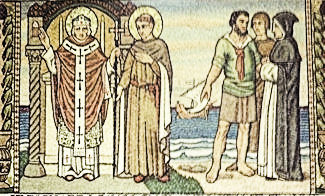
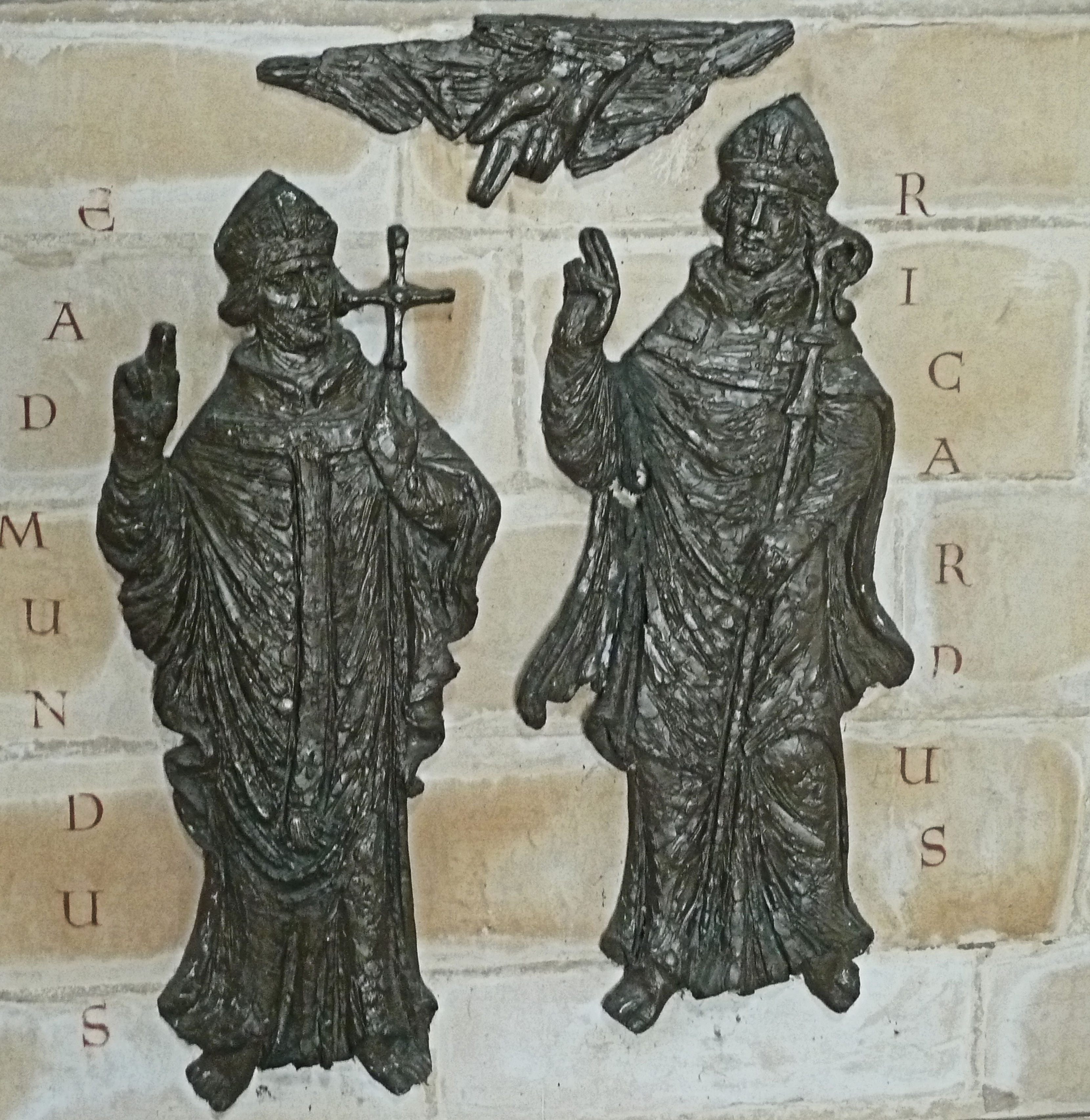
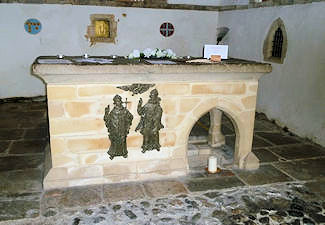
St Edmund and St Richard depicted on the Altar of St Edmund’s Chapel

During the Reformation the Chapel, the Maison Dieu and the nearby Priory of St Martin’s were surrendered to Henry VIII (1509-1547). The Wellard family, who were of considerable importance in Dover at this and for some time after, built their mansion on the site of the Chapel incorporating it into their dwelling. Reverend John Lyon of St Mary’s Church, Dover, described this in his two volume History of Dover published in 1813.

In the years that followed the mansion was demolished but the Chapel remained and was incorporated into buildings facing the town’s main thoroughfare, Biggin Street. The site of the old Priory became Priory Farm and was bounded by a stone wall, probably the original one that also went around the Chapel’s small cemetery. It is reported that there was a small gate in the corner of this wall, approximately where the Prince Albert pub now stands. This opened onto a path that led to the front of the Priory Farm.

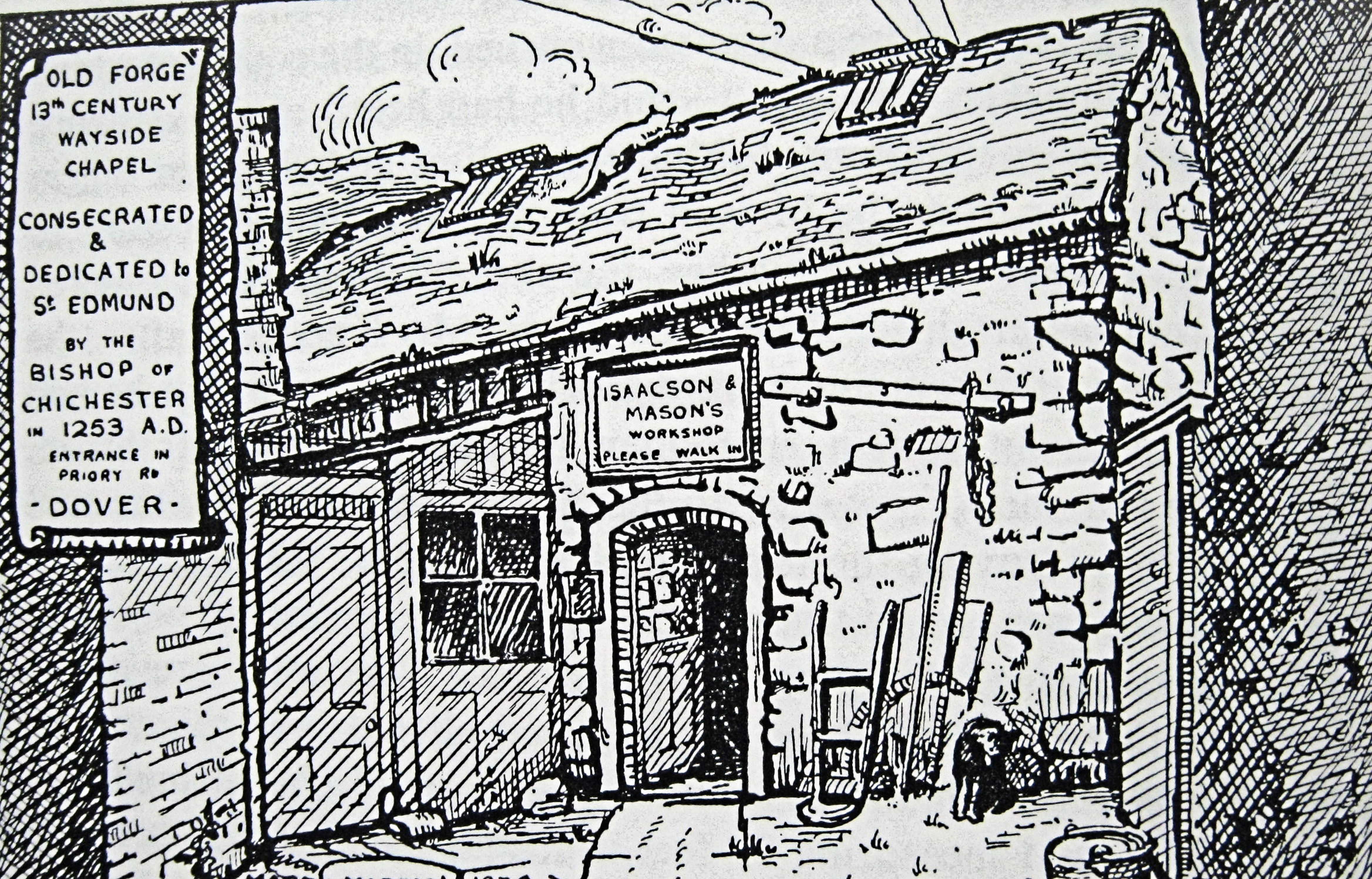
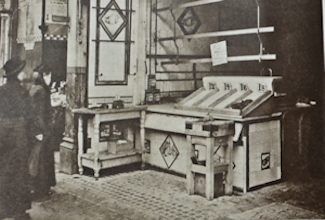
St Edmund’s Chapel – a whitesmiths workshop drawn by Mabel Martin in 1939

Priory Road was laid in 1872 by which time Fred Turtle, a whitesmith, plumber and electrician, was using the Chapel as a workshop. Mabel Martin captured this in a drawing she made 1939. In 1875, the floor of the adjoining Comet Inn collapsed and to everyone’s surprise, in the debris were found coffins! These roused a great deal of interest and local historian, Reverend S.P. Stretham wrote a description of the Chapel stating that it was still incorporated in the surrounding buildings. He described the Chapel as small – 28 feet long (8.5 metres) and 14 feet broad (4.26 metres) with walls ‘which are fairly intact.’ These, ‘are 2 foot thick (0.6 metres) and built of rubble masonry with Caen stone quoins and dressings.’ Reverend Stretham conjectured that the Chapel belonged to the Priory, the Maison Dieu or the Hospital of St Bartholomew in Buckland.

Reverend Stretham’s speculation was, at best, dismissed as it was generally agreed on the evidence available, that the building was a medieval wayside chapel that was dedicated to St John. It wasn’t until 1932 that anyone dared to contradict that theory but in that year local historian, W J Baker, suggested that it was possibly the Chapel consecrated by St Richard of Chichester in honour of St Edmund of Abingdon in 1253. In January 1935, during the relaying of Priory Road, Professor F M Downey of Oxford University came to Dover and examined the building carefully. At the time Isaacson & Mason were using the building as a forge but the Professor was able to confirmed Mr Baker’s opinion.

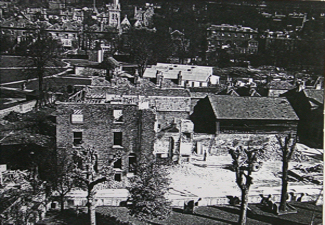
St Edmund’s Chapel revealed following the heavy shelling on 24 August 1943 of nearby buildings!

On 3 September, World War II (1939-1945) was declared and on 24 August 1943, during heavy shelling, Bricknell’s newsagents and tobacconist shop in Priory Road was wrecked. When the ruins were cleared, St Edmund’s Chapel was seen unattached to surrounding buildings for the first time in four hundred years! For many in Dover this was seen as a message from God and revered. Indeed in 1944, following a request from the Reverend Stanley Cooper, vicar of St Mary’s Church, Borough Engineer, Philip Marchant, proposed to restore the Chapel as a war memorial. With this in mind it became a major feature of the proposed post-war Abercrombie Plan for the future development of Dover.

Much to the surprise of many, in 1953 a memo from the Ministry of Works stated that St Edmund’s Chapel was not an ancient monument and its preservation could not be described as of national importance. At the time the Buckland branch of Toc H – the international Christian Charity movement, occupied the Chapel. They had undertaken some restoration before refurbishing the Chapel as a workshop to make and repair toys as Christmas presents for poor and sick children, assisted by lads from the Borstal on Western Heights. Among other charitable deeds, Toc H collected and chopped wood to give to the elderly poor of the town who had open fires. Throughout their tenure moves were made to have the 1930’s Downey and Baker report that the building was of historic significance recognised and for it to be listed as an Ancient Monument. Albeit, at that time although some of old Dover was still standing following the War, this was succumbing to demolition in the twin names of reconstruction and progress.

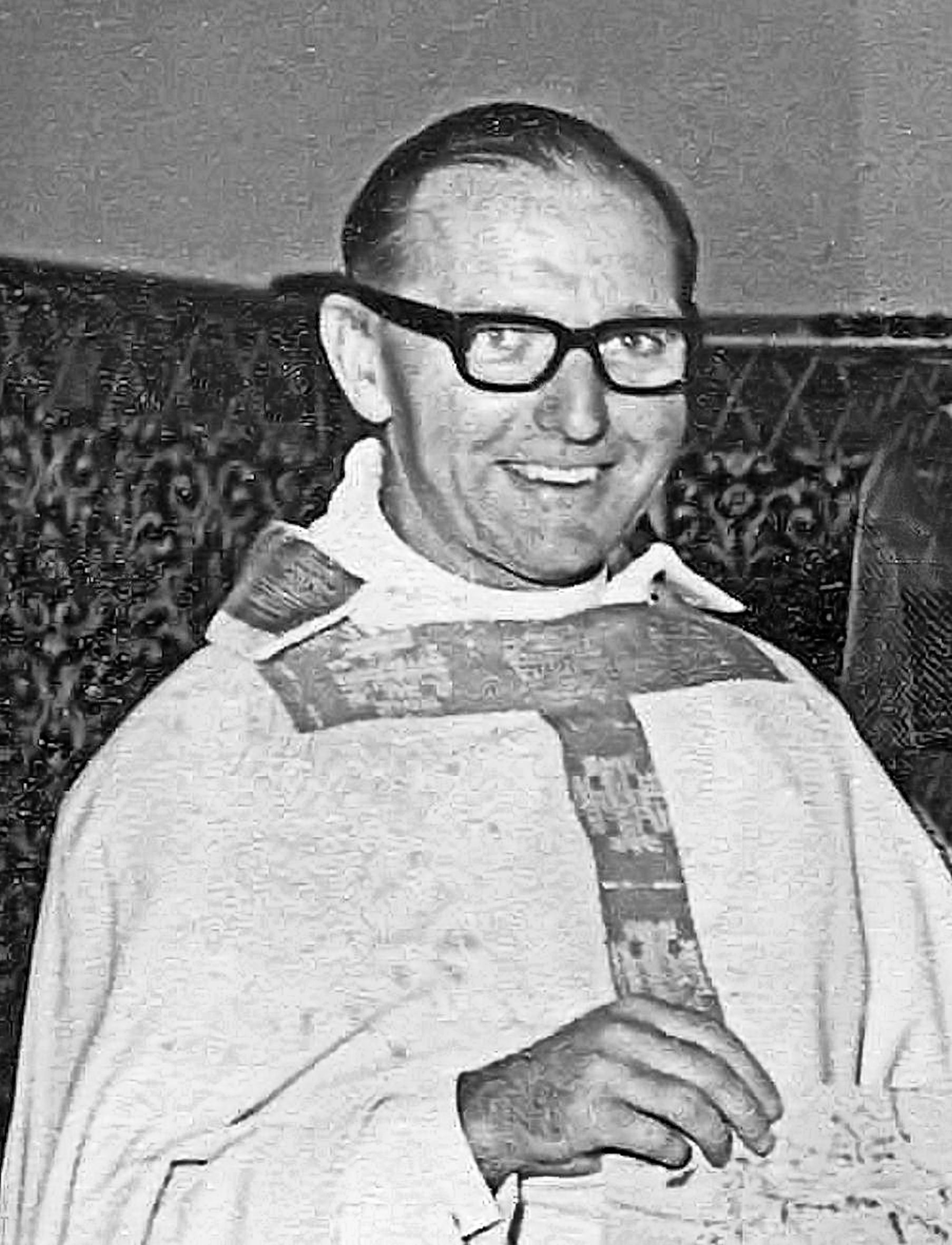
Father Terence Tanner thanks to Paul Smye-Rumsby

In 1963, the Chapel was designated for demolition along with adjacent buildings. Father Terence Tanner (1916-1982), Parish Priest of St. Paul’s Roman Catholic Church responded by launching an appeal to buy all the properties. Patron of the appeal was former Prime Minister, Harold Macmillan (1894-1986) but two years later, the appeal was still £1000 short of the £12,000 needed. Dover Corporation gave £100 and Kent County Council another £100 and finally an anonymous donor gave £2,000 and the Chapel was saved!

On 16 November 1966, restoration began under the auspices of historic buildings architect and consultant, Anthony Swaine of Canterbury. The work was carried out between 1966 and 1968 by local craftsmen and local contractor, Richard Barwick’s, using only genuine medieval materials. The flagstones came from Faversham Abbey in Kent (1152-1160). The main part of the altar was built from recovered stone from Bell Harry tower of Canterbury Cathedral, (1475-1507). The ‘Mensa’ Stone (the top stone) of the altar is pre-reformation, and was found in a farmyard adjoining the church of St. Clement in Old Romney, Kent.

St Edmund’s Chapel undergoing restoration Dover Express 1967.

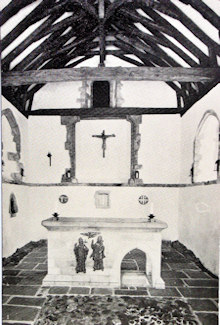
The two central tie-beams came from a barn on the Barham Downs at Elden, Kent. The east beam is original but it would appear that there was never a west beam. The roof is considered a fine and remarkable example of 13th Century construction. There is still a number of its original tenon joint securing pegs in place. The floor area in front of the altar was probably laid in the 14th century and has since remained undisturbed. The Crucifix on the east wall, is a contemporary carving in the style of the 13th century by Bob Forsyth. A small relic of St. Edmund in the south wall niche was donated by the Abbey of Pontigny, France, where St. Edmund’s shrine still stands today. The finished Chapel was presented, as it would have looked in the thirteenth century and therefore, there are neither pews nor fabric hangings. 

On the right is the Cist under the Altar where the heart of St Richard was buried. Droitwich Heritage Centre

During the restoration, the Kent Archaeological Research Unit (KARU) under Brian Philp, conducted a 4-day archaeological investigation. The archaeologists removed nearly a metre depth of ‘soil’ to get back to the ground level of the 13th century. They dated the walls between 1150 and 1253 and the foundations of boundary wall after 1253. While they were excavating the archaeologists came across a nearly vertical tubular impression in the soil. The impression was left by a wooden stake and since rotted away, that had been driven into the ground to the Cist where the leather bag that contained the Saint’s heart lay. The stake enabled pilgrims to ‘touch’ the relic of St Richard and, it was reported, miracles were performed. The Cist is now empty but can still be seen.

The Chapel dedicated to St Edmund was re-consecrated on 27 May 1968 by Archbishop Cyril Cowderoy (1905-1976) of Southwark. In attendance was the Mayor of Abingdon, Leslie Steggles – an old boy of Dover Boys’ Grammar School. Following the consecration part of the bone of St Edmund enshrined in a gold reliquary was given to the Chapel by Henri Marie Charles Gufflet (1913-2004) the Bishop of Limoges, France. This was stolen in July 1973 but within days two local boys were arrested and the casket was returned.

St Edmund’s Chapel – after restoration. Dover Library

Later that year, on 5 November, the St Edmund of Abingdon Memorial Trust was set up to maintain the building. A narrow passageway from Biggin Street to Priory Road that runs past the Chapel was named St Edmund’s Walk.

The Civic Trust was founded in 1957 and established their award scheme two years later. The Awards recognised the very best in architecture, design, planning, landscape and public art and in 1969 the Restoration of St Edmund’s Chapel won an award. Unfortunately, the judges had been told that Dover Corporation’s borough engineer, David Bevan, had initiated the restoration and he was given the prize. To give Mr Bevan his due, he did inform the Civic Trust that it was Father Terence Tanner who was responsible. Sadly, the Civic Trust went into administration in 2009 due to a shortage of funding.

Dedication to Father Terence Tanner 1916-1982

In April 1971 Father Terence Tanner of St Paul’s Church, Maison Dieu Road, was transferred to the smallest parish in the diocese at Goudhurst. No reason was given and it was met with considerable opposition. In June he left Dover following a failed appeal to Rome and was formerly seconded to work in drug rehabilitation in London. Father Tanner, the saviour of St Edmund’s Chapel died in Leominster in 1982. In recognition of Father Tanner’s endeavours, a memorial plaque is mounted in the Chapel and his ashes are interred close to the altar.

St. Edmund’s Ecumenical Chapel – accepts all faiths and denominations.
It is the smallest church in England that is still used for services.

For further information about St Edmund’s Chapel see: http://www.stedmundschapel.co.uk . Included on the website is a copy of Fr Tanner’s book which he produced following the restoration.

For the information on St Richard, thanks are given to Droitwich Spa Heritage Centre


Posted in St Edmund's Chapel, St Edmund's Chapel - St Edmund & St Richard, St Edmund's Chapel - St Edmund & St Richard, St Edmund's Chapel - St Edmund & St Richard, St Edmund's Chapel - St Edmund & St Richard, St Edmund's Chapel - St Edmund & St Richard, St Edmund's Chapel - St Edmund & St Richard, St Edmund's Chapel - St Edmund & St Richard, St Edmund's Chapel - St Edmund & St Richard | 3 Comments

Swingate Part IIb – World War I Front Line Aerodrome

Continued from Swingate Part IIa – World War I Front Line Aerodrome

1917 – On the Offensive & the Americans come to Swingate

Attacks on neutral shipping continued. Typically from the beginning of the War to the end of 1916 the Germans had sunk 242 Norwegian ships, with a combined tonnage of 325,415 tons – and Norway was a designated neutral country. In the Channel, regardless of the efforts of the Dover Patrol, supported by the Dover based RNAS and Swingate RFC, both Royal Navy and merchant ships were succumbing to torpedo attacks from German destroyers and U-boats. During the nights of January and February 1917 these destroyers and submarines had also shelled Dover, Southwold, Broadstairs, Margate, Ramsgate and Dunkirk. Following the attacks, the vessels returned to their bases at Zeebrugge and Ostend. Because of these attacks on merchant shipping, food shortages were increasing and on 2 February 1917 the Minister of Food Control (1916-1921) Hudson Ewbanke Kearley, Lord Devonport (1856-1934), asked for voluntary restriction of food consumption to avoid compulsory rationing.

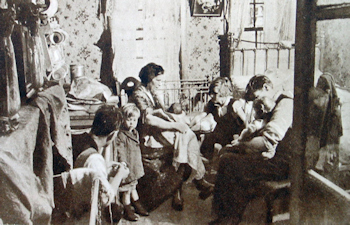
By 1917 food shortages was a national problem and what was available was very expensive. Topical

By 1917 food shortages was a national problem and what was available was very expensive. Topical

Even though there was a voluntary restriction on food consumption, by the early months of 1917 there was a shortage of food and what was available was very expensive. Food supplies were allotted to towns according to the size of their populations less those serving in the armed forces, as shown by the National Registration Returns (census). In Dover the crews of Royal Navy ships, trawlers and drifter patrol boats were not counted in the town’s census returns but most of their food supplies came from the town’s civilian supply. To compound this, Messrs R Dickeson & Co’s wholesale establishment of Market Street, which for years had been the main supplier of East Kent’s local provisions, had been taken over by the Navy and Army Canteen Board. The only other local supplier was the fledgling Dover and District Co-operative Society and they were finding it next to impossible to get fresh food. As Dover and the surrounding villages were well represented in the armed forces the resulting labour shortages meant that women were filling most posts and that included vegetable farming.

The irony was that Alexander William Prince (1870-1933) had been appointed Chairman of Messrs R Dickeson & Co back in 1909. Besides supplying Dover and south east Kent with wholesale provisions, the firm was a major supplier to the Army at the outbreak of World War I. Prince then played an active role in reforming naval and military procurement and was also the driving force in the setting up of the Expeditionary Force Canteens for which he was knighted in 1916. On 1 January 1917, the Army Canteen Committee was created and this absorbed Messrs R Dickeson & Co, which was why Dover and the surrounding district were left without a wholesale supplier. By this time shortages were a national problem and the Dover Production Committee had increased the amount of allotment ground in the autumn of 1916. By Easter 1917 women, old folk and children were starting to harvest what was to be the largest potato crop produced in Dover up to that time! The Dover Food Control Committee had also been set up and although the national rationing of sugar had not been introduced, they rationed the towns supply with the introduction of sugar cards. They also succeeded in ensuring, albeit at a higher price, adequate supplies of milk to Dover residents.

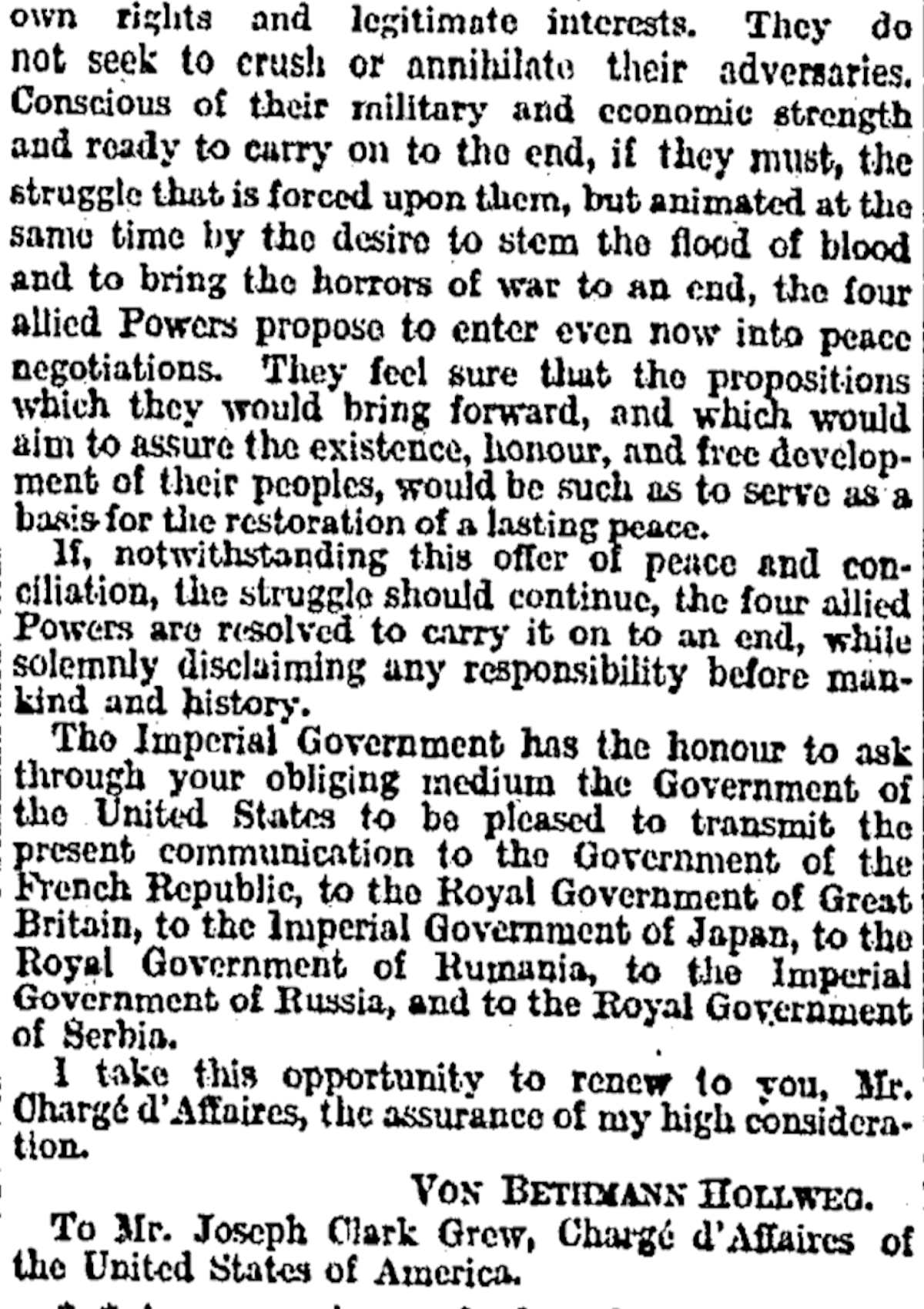
On 1 February that year, having discussed the response of Britain’s and the Allies to their peace proposal, the German Reichstag had agreed from 1 February 1917 ‘to adopt unrestricted submarine warfare against all commerce, whether belligerent or neutral, that should seek to approach Great Britain or Ireland, the Atlantic coasts of Europe, or harbours in the eastern Mediterranean, and to conduct those operations without regard to the established restrictions of international practice, and without regard to any considerations of humanity even which might interfere with their practice.’ (President Woodrow Wilson paraphrasing the communiqué from Germany to the joint Session of Congress on 26 February 1917).

The President had told Congress that on 3 February, two American vessels had been sunk by German submarines, the 3,143 ton Housatonic 20 miles south of Bishop’s Light was carrying foodstuffs destined for London. Also the 1,300 ton Lymen M Law carrying lemon box staves to Palermo, Italy had been captured and sunk 25 miles from land near Cagliari, Sardinia. Adding that such atrocities ‘disclosed a ruthlessness of method that deserves grave condemnation.’ He went on to say that he did not wish to involve the American armed forces in any action that might be taken. Instead, he asked Congress ‘to authorise the supply of US merchant ships with defensive arms … and to employ any other instrumental or methods that may be necessary and adequate to protect our ships…’ Henry De La Warr Flood (1865-1921), the Chairman of the American Foreign Affairs Committee, announced that he would immediately introduce a Bill granting President Woodrow Wilson the jurisdiction to arm ships and all other authority he needed.

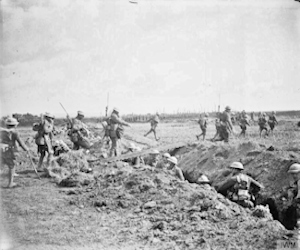
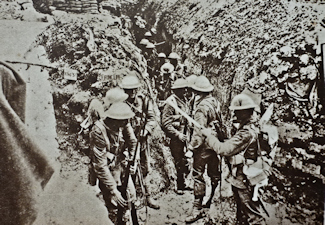
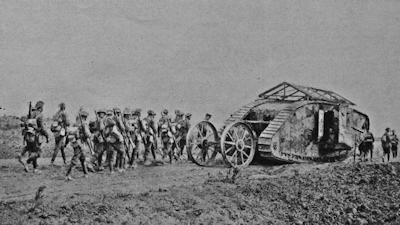
British infantry moving across trenches on the first day of the Battle of Arras, 9 April 1917. John W Brooke Imperial War Museum

British infantry moving across trenches on the first day of the Battle of Arras, 9 April 1917. John W Brooke Imperial War Museum

The offensive that had been planned in December by Nivelle and Haig, was to start with the Battle of Arras (9 April-15 May 1917). In preparation and to try and avoid arousing the suspicions of the Germans through a large number of troops being deployed in one area, New Zealand engineers created a vast network of underground tunnels. Through these the troops could pass and come up directly in front of the German Front line without, it was planned, them knowing. Nor would the troops have to face the deadly machine gun fire of no man’s land. The total length of the tunnels was approximately 12miles. These tunnels were equipped with kitchens, water supplies, latrines, electricity and a hospital capable of treating up to 700 wounded men. The hospital was also equipped with an operating theatre and a mortuary. The tunnels were divided into galleries each named by the men of the division housed there, usually after the majority’s hometown.

Bomb shelter in the vaults of the Phoenix Brewery. Dover Museum

Bomb shelter in the vaults of the Phoenix Brewery. Dover Museum

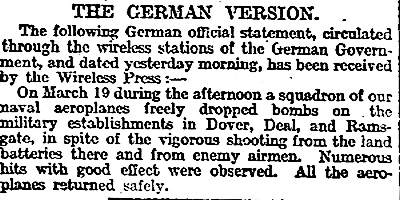
Across the Channel, at about this time, aerial attacks on Dover increased. On 17 March 1917 a Zeppelin came towards the town from the direction of Canterbury and dropped a bomb, reputed to have weighed 600lbs, on Whinless Down in a corner of Long Wood, Elms Vale. This was the largest bomb dropped in the district during the War. On the same day an aeroplane dropped several bombs on Swingate and the nearby Langdon Battery as well as the Camber at Eastern Dockyard. Following the raid, the German press falsely claimed that the Swingate aerodrome had been destroyed but they were correct in that except for use by the Home Defence Flight No 50 Squadron it had been almost abandoned.

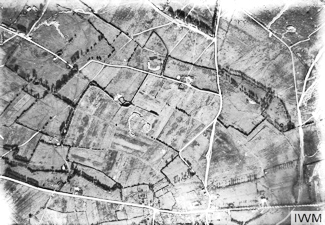
Prior to the main offensive, around Arras RFC squadrons assiduously photographed the whole area and ground raids were carried out to test the German defences, identifying strengths and weaknesses. From these, models were constructed similar to the one the Reuters’s reporter had seen at Swingate and these were used by officers and company leaders to familiarise themselves with the terrain and location of structures such as buildings. Full size sectors of the German lines were also constructed in order that the men could train in conditions similar to the ones they were going to encounter during the attacks. In mid March intensive bombardment on targets identified by the RFC and ground raids were started. At the same time tanks were brought in and other heavy armaments.

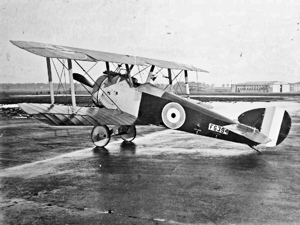
Sopwith Camel - did not come on line until October 1917 but when it did to the end of the War, Camel pilots were credited with the shooting down of 1,294 enemy aircraft, more than any other Allied fighter of the conflict. Wikimedia

Sopwith Camel – did not come on line until October 1917 but when it did to the end of the War, Camel pilots were credited with the shooting down of 1,294 enemy aircraft, more than any other Allied fighter of the conflict. Wikimedia

While preparations were taking place, Trenchard had written to Haig saying that the RFC was not ready to support the proposed offensive, adding that ‘Our fighting machines will almost certainly be inferior in number and quite certainly in performance to those of the enemy.’ In December, at the Chantilly Conference, Trenchard had made it clear to Lloyd George and Haig that the British new type of fighting machines, the Bristol Fighter Type 14 F.2, the S.E.5 (both described below) and the Sopwith Camel would not be ready. It was not until October 1917 that the superior Sopwith Camel, a single-seat biplane fighter aircraft was introduced on the Western Front. The aeroplane was powered by a single rotary engine and armed with twin synchronised machine guns. For experienced pilots the aeroplane proved to be highly manoeuvrable and from October 1917 to the end of the War, Camel pilots were credited with the shooting down of 1,294 enemy aircraft, more than any other Allied fighter of the conflict.

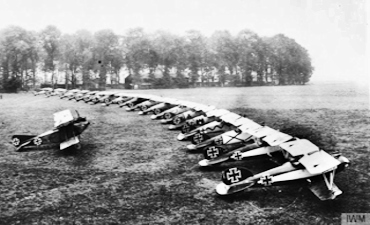
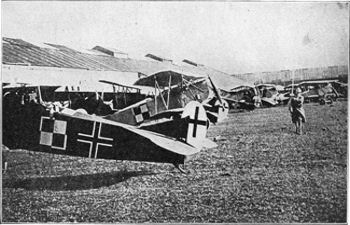
Albatros D.Vs of Jagdstaffeln (Jasta) 12 lined up at Roucourt (Douai) airfield, August-September 1917, in a similar way to those seen by the pilots of No. 54 Squadron near Arras in March. Imperial War Museum

Albatros D.Vs of Jagdstaffeln (Jasta) 12 lined up at Roucourt (Douai) airfield, August-September 1917, in a similar way to those seen by the pilots of No. 54 Squadron near Arras in March. Imperial War Museum

Reconnaissance had been increased in preparation for the offensive. No. 54 Squadron, a day fighter squadron formed at Castle Bromwich, Birmingham and equipped with Sopwith Pups took photographs. On 25 February 1917 they returned to base with photographs that showed German troops withdrawing in stages to a new line from Lille to Metz. This was confirmed from the interrogation of prisoners and captured documents and was of concern. There was also evidence that a number of new airfields had been laid and aeroplanes could be seen. In Germany, with the success of the KEK and the Fokker Scourge, Oswald Boelcke had started to organise the manning, equipment and training of 37 new squadrons that were eventually to make up the Jagdstaffeln – each referred to as Jasta plus the number of the squadron. Following Boelcke’s death in an air accident flying an Albatros DI fighter the previous October, his groundwork ensured that the Jasta was establishing air superiority. The aeroplanes in the photographs belonged to Jasta Squadrons.

The Battle of Arras was to be the diversionary offensive. The British main attack was on the German stronghold established on the 146-foot high Vimy Ridge. Because of its strategic importance it was not only heavily fortified and protected by several lines of trenches and concrete shelters, there were also large underground facilities that housed men and artillery. There had been previous attempts to capture Vimy Ridge, but each had failed, this time the task was to be undertaken by Canadians supported by the RFC. While these operations were taking place, the French would be fighting to make a breakthrough at Chemin des Dames Ridge about 68miles north-east of Paris. Of note, at the beginning of the War and the months that followed about 800 Canadians came over to Britain and joined both the RFC and the RNAS. This prompted Canada to set up their own training centre and since that time nearly 4,000 cadets had been commissioned into the Canadian Expeditionary Force. They were subsequently deployed as part of the RFC.

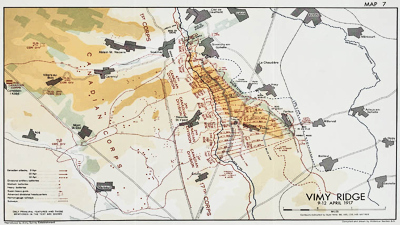
Vimy Ridge, April 9–12, 1917 the Canadian Offensive. Gerald W.L. Nicholson, Canadian Expeditionary Force, 1914-1919 Library & Archives of Canada

Vimy Ridge, April 9–12, 1917 the Canadian Offensive. Gerald W.L. Nicholson, Canadian Expeditionary Force, 1914-1919 Library & Archives of Canada

On the evening of 8 April 30,000 Canadian soldiers began to make their way towards Vimy Ridge supported by the Canadian airmen and the next morning, in blizzard conditions, the British left the tunnels at Arras. The Canadians launched their assault and within an hour had taken parts of the first two lines. By the middle of the afternoon the Canadians had started to take control of the Ridge and by 12 April had taken full control. Throughout the offensive the Jasta Squadrons kept up continuing air attacks and the Allies were continually thwarted due to the inferiority of their aeroplanes.

Nonetheless, it was an outright victory but at a cost that would have been lessened if the Allies aeroplanes could have at least matched those of the Germans. The Canadians suffered 10,602 casualties including 3,598 killed. The British, meanwhile, had advanced about 3 miles in two days taking eight villages and after Vimy Ridge was secured with continual intense fighting they forced the Germans to fall back several miles. Then with the arrival of reinforcements the Germans launched a successful counter attack. Nonetheless, the British did take about 20,000 prisoners and a large quantity of munitions. They also managed to push back the Front by about 6 miles.

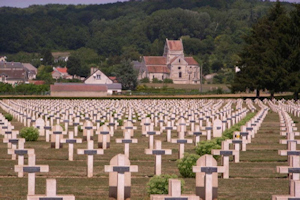
Soupir N° I National Cemetery Chemin des Dames ridge, graves of French soldiers who fought in the Second Battle of Aisne 1917. Bodoklecks

Soupir N° I National Cemetery Chemin des Dames ridge, graves of French soldiers who fought in the Second Battle of Aisne 1917. Bodoklecks

1.2million Frenchmen were involved in the Second Battle of the Aisne (16 April- mid-May 1917), their offensive at Chemin des Dames Ridge. The Germans were based in the warren of tunnels and caves that had been excavated for stone over the centuries. Not only did they escape bombardment but also they were able to inflict heavy machine-gun fire on the French assailants. Although the French succeeded in advancing the Front line by about 4miles and took about 29,000 prisoners, approximately 20% of the French Army were killed or were injured and they had failed to beat the Germans. Within days a mutiny started and quickly gathered pace. In an effort to quell the uprising in May, Philippe Pétain (1856-1951) replaced Nivelle as commander-in-chief and 3,400 mutineers were arrested. At the subsequent court marshals 554 were sentenced to death for mutiny but following a public outcry and the general revolutionary mood of the country, over 90% of the sentences were commuted.

During the Allied offensive, Jasta Squadrons had focused their assault on the reconnaissance and bombing squadrons rather than attacking ground operations. In the first week of April, the RFC lost 75 aeroplanes in defensive confrontations and by the end of the month the British air services had lost 150 aeroplanes and 316 aircrew. The French air services lost an additional 200 aircraft. That month is still remembered as ‘The Bloody April‘.  Then in May, four German Jagdstaffeln were combined to form Jagdgeschwader 1 under the command of the Red Baron, Manfred von Richthofen. His first act was to bring together many of Germany’s finest fighter pilots in order to try and force the Allies to concentrate their squadrons opposite whichever sector the Jagdgeschwader chose to occupy.

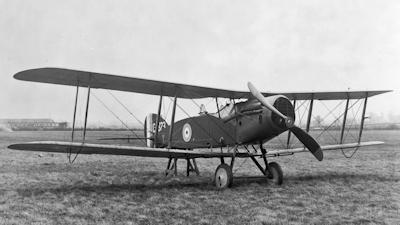
Bristol Fighter Type 14 F2B (prototype C823) one of the most successful fighters during WWI. BAE Systems

Bristol Fighter Type 14 F2B (prototype C823) one of the most successful fighters during WWI. BAE Systems

It was about this time that the Trenchard promised, Bristol F Type 14 F2B biplanes started to arrive. They were a two-seater fighter and reconnaissance aircraft that were particularly agile in dogfights. The aeroplane was developed by Bristol Aeroplane Company’s Frank Barnwell and was often called the ‘Brisfit‘ or ‘Biff’. Developed to replace the B.E.2c’s with self-defence capabilities it was initially fitted with the newly available 190 hp Rolls-Royce Falcon I inline engine. It featured a fully covered lower wing centre-section and downward sloped longerons in front of the cockpit to improve the pilot’s view when landing. The fuselage was supported mid-way between the wings and the pilot was seated forward while the observer was equipped with a single flexible .303 inch Lewis Gun on a Scarff ring and an Aldis optical sight over the rear cockpit. A forward-firing .303 inch Vickers machine gun was also mounted on the fuselage centreline.

The prototype Bristol Type 12 F.2A (C3303) was first flown on 9 September 1916 at Filton, Bristol. This was followed by prototype Bristol Type 12 F.2B (C823) on 25 October fitted with a Hispano-Suiza power unit. 50 of the Type A were produced before switching to the Type B, that became the definitive Bristol Fighter. Initially they were fitted with a Falcon 1 then Falcon II but most had the 275 hp Rolls-Royce Falcon III engine allowing a top speed of about 123 mph, making it three minutes faster in a climb to 10,000 feet. Some 5,300 Bristol F.2B were built in Britain and proved to be one of the most important and successful British designs to serve during World War I.

Following President Woodrow Wilson’s decision of 26 February, Germany and the other Central Powers continued attacking merchant shipping from Allied and neutral countries including the US. On 16 March the 2,833ton American steamer Algonoquin bound for London from New York carrying foodstuff, was sunk without warning 65 miles west of Bishops Rock, off the Scilly Islands. The submarine emerged from the depths and fired shots using two guns, four of which hit the Algonoquin. The shooting did not stop until all the crew was on the boats and clear of the ship. The submarine then sent out a small boat and members boarded the Algonoquin and hauled down the American flag. About five minutes after they had left the ship there was a huge explosion and the Algonoquin sank. The Algonoquin was not armed and it took 27 hours before the crews’ boat reached land and safety. In Washington it was stated that that the incident would not change policy but unofficially it was said that a series of such outrages would probably compel Congress to declare war.

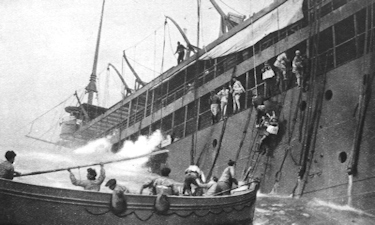
Crew of a doomed merchant vessel leaving their ship after being torpedoed by the Germans. Cossira

Crew of a doomed merchant vessel leaving their ship after being torpedoed by the Germans. Cossira

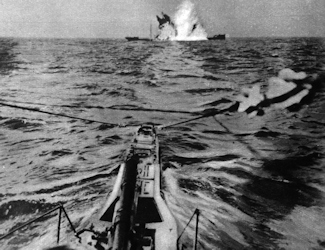
The sinking of the US merchant ship Algonoquin on 16 March was followed by the 4,115ton Vigilancia, being torpedoed and sunk by German submarine U-70, 145 miles west of Bishops Rock when 15 lives were lost. The following day the 5,252 ton City of Memphis was sunk with gunfire from a German submarine 35 miles south of Fastnet Rock. Then two days later on 18 March, the 5,225 ton Illinois, a tanker was sunk by a German submarine in the English Channel, 20 miles north of Alderney in the Channel Islands. On 20 March the previously torpedoed 789 ton schooner Fhineas W. Sprague was grounded and lost near Carbouerns, Spain and the next day the 4,489ton tanker Healdton was torpedoed and sunk by a German submarine 25 miles north of Terschelling, Holland with 20 lives lost. On 1 April the 3,727ton Aztec was torpedoed and sunk by a German submarine off Ushant, Brittany, at the south-western end of the English Channel, with the loss of 28 lives. 4 April saw the 1,553-ton schooner Marguerite sunk by German submarine U-35 in the Mediterranean, 35 miles southwest of Sardinia. On the same day near Porto Maurizio, Italy, the 7,924ton Missourian, was shelled and sunk by German submarine U-52.

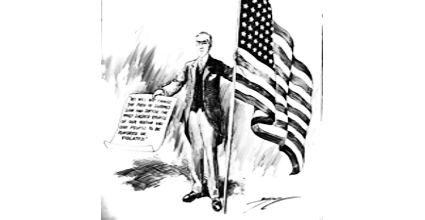
 President Woodrow Wilson Declaration of War 06.04.1917. US National Archives

President Woodrow Wilson Declaration of War 06.04.1917. US National Archives

The attacks on the American ships were compounded by an apparent intercepted telegram from Arthur Zimmerman (1864-1940) the German State Secretary for Foreign Affairs (1916-1917) to the German ambassador to Mexico. The telegram, called the Zimmerman Note by newspapers, was published on 3 March 1917 and proposed that the Mexican president Venustiano Carranza, (1859–1920) would ally with Germany in the event of the United States entering the war against Germany. In return, Germany promised to help Mexico recover the territory it had lost to the US in 1848 namely: California, Nevada, Utah, most of Arizona, about half of New Mexico, about a quarter of Colorado along with a small section of Wyoming. The Zimmerman Note together with the attack on US merchant ships led President Woodrow Wilson to ask Congress on 2 April 1917 for a Declaration of War. Only 6 Senators and 50 Representatives voted against the proposal and President Woodrow Wilson signed the resolution that the United States of America had declared war on Germany. This became effective on 6 April 1917.

In pre-war Dover there had been Consulates – defined as ‘an official appointed by a government to reside in a foreign country and to represent its interests there. The Imperial German Consulate was Sir William Crundall – thirteen times Mayor of Dover and Chairman of Dover Harbour Board. The German Consulate Office was at 2 Strond Street and the Vice-Consul was Ernest Ardlie Marsh (1858-1938). Sir William was also the Vice-Consul for the United States of America and the US Consular Agent was his brother, Frederick Crundall (1863-1934)! Mexico was represented by a Vice-Consul in Dover and this was another of Sir William’s brothers, Percy (1869-1940). With the outbreak of War both Germany and America closed their Consulates but Percy Crundall remained the representative for Mexico and therefore was privy to the discussions surrounding the supposed Zimmerman Note and the US entry into the War. This propelled him to be involved in discussions with the American delegates as to where it would be best, to base their troops in Britain. Supported by his two brothers, they brought the almost abandoned Swingate airfield to the notice of the US procurement officers.

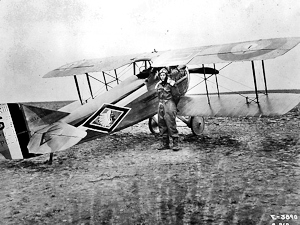
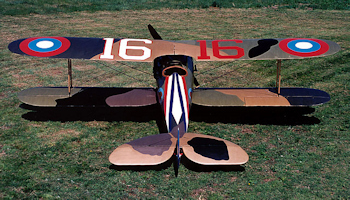
103rd Aero Squadron (US) Spad XIII C.1 and Capt. Robert Soubiran. US Army

103rd Aero Squadron (US) Spad XIII C.1 and Capt. Robert Soubiran. US Army

When America entered the War their Regular Army, National Guard, and National Army, which included conscripts, were combined to form the United States Army. This mixed experienced soldiers with untrained recruits and many of the latter served as infantrymen – nicknamed ‘Doughboys’ – supported by artillery and tank units. Initially, about 60% of the army worked for the Service of Supply, which supervised the logistical operations, laying telegraph lines, railways, and roads. African Americans were segregated and mostly assigned to unskilled labour jobs such as unloading supplies, canteen work or grave digging. The US did not have a separate air service, instead most non-civilian aviators were part of the existing military and naval establishments. From late 1914, an increasing number of American civilian aviators had joined the French air service and 38 of them formed the Lafayette Escadrille Squadron. Since that time they had been very active on the Front but their existence remained unrecognised by the American Government. This changed on 11 April 1917 when Newton Diehl Baker Junior (1871-1937) Secretary of State for War (1916-1921) officially stated that the US recognised their services and desired them to remain at the Front, working with the Allies. They were transferred as the 103rd Aero Squadron, wore American uniforms and flew under American colours.

Aeronautical Division, Signal Corps had been founded on 1 August 1907 and the 1st Aero Squadron, with 29 factory-built aircraft, was the first permanent US air squadron. The Aviation Section, Signal Corps (ASSC) was created by the 63rd Congress on 18 July 1914 and absorbed the Aeronautical Division. Not long after, Major Hiram Bingham III (1875-1956) learned to fly and subsequently organised the United States Schools of Military Aeronautics at 8 universities. These flying training schools usually produced a candidate for commissioning in 15 to 25 hours of flight but when the US entered the War, their Aviation Section only had 131 officers of which 35 were pilots and 51 student pilots plus 1087 enlisted men and approximately 280 airplanes. So upon entering the War approximately 1,700 cadets were to be sent from the Universities to Europe to undertake the entire flying portion of their training in Great Britain, France, and Italy. Swingate airfield or more correctly, the United States Army Airfield, Dover was designated as one of these training schools!

Swingate Aerodrome 1917. Construction in preparation for the Americans. Dover Museum

Swingate Aerodrome 1917. Construction in preparation for the Americans. Dover Museum

The rebuilding of Swingate was supervised by US military contractors using local labour. Dover, at that time, boasted of 30 building and contracting companies and although since the outbreak of War most of their able bodied workers had joined the navy or army the businessmen were quick to accept the American contracts. They supplemented their workforce with retired construction workers, off duty mariners and miners as well as members of their families, young boys and women. Building supplies were brought in by ship from the US but as Swingate was beginning to take shape these materials were disappearing from the site. Dover’s Chief Constable Fox was asked to arrange for some of his police officers to deal with the problem. He declined, due to the wartime depletion of his force, the pressure on those that remained because of the the continuing German attacks on Dover plus the demands of the military authorities in connection with the surveillance that they felt to be necessary in a military area such as Dover. So the Americans brought in Irish police officers from Chicago, in the belief that they had the same accents as the locals, who spoke Dovorian!

As noted above, that year Dover produced a good crop of spring potatoes out of which, so the story goes, Polish military personnel based in Dover made liquor. This was offered, as a goodwill gesture, to the American police officers and military contractors and relations became amicable. When Swingate was finally finished many repairs to the neglected and war damaged properties in Dover were also completed and as a consequence more properties were sold since before the War! Unfortunately, the principal buyers of large premises were property developers and this has left a detrimental legacy that still blights Dover to this day. In the short term some Dovorians were flush with money, which made the town’s contribution to the country’s Great War Loan Fund one of the most successful in the country – £570,000 was raised! Finally, when the American police officers and military contractors went home, they did speak positively of their stay in Dover!

On the first night the American contractors arrived in Dover, 20-21 April, they witnessed their first Channel sea battle. Five German destroyers attempted a raid on the port and town but it was met by two Dover Patrol destroyers and three German vessels were sunk. Two were torpedo boats G85 and G42 and in the morning 10 German officers and 108 men, who had been rescued, were brought into Dover. Of the sea battle, one of the Americans wrote that the ‘sound of rapid and fairly heavy gunfire awoke most of us at about 00.30hours. And there was no doubt that it was coming from a seaward direction … In the darkness it was impossible to see quite what was happening … at rapid intervals bright star shells were sent up … they were brilliant and as they burst in groups they made a pyrotechnic effect. Each flight of star shells was followed by rapid firing and the flashes of guns through the darkness …

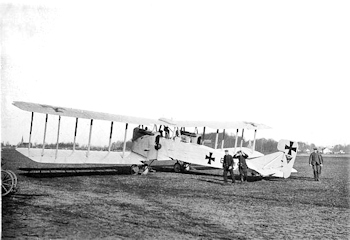
Gotha G IV aeroplane of the Kagohl 3. Adolph Genth 1916 Wikimedia

Gotha G IV aeroplane of the Kagohl 3. Adolph Genth 1916 Wikimedia

The Germans launched their strategic bombing campaign Operation Turkenkreuz in May 1917 and this was to last until April 1918. It consisted of squadrons of about 16 Gotha G. IV bomber aeroplanes of the Kagohl 3 to attack London, East Anglia and South East England. The latter usually was east of a patrol line that Kagohl 3 operated stretching from Throwley, south of Faversham, through Bekesbourne to Hougham, west of Dover. During that period there were 113 air-raid alarms and the town was bombarded with 185 bombs and 23 shells. The number of civilians killed was 23 and 71 were injured. On Friday, 25 May 1917, the Gotha bombers, using the Thames for navigation, were intent on attacking Essex airfields but due to heavy cloud, on reaching the Thames they turned south. At about 18.20hours the sky cleared and this was when the squadron was just north of Folkestone. They dropped their loads over the town. As Folkestone was not considered to be in danger of air attacks, no sirens were sounded and Tontine Street, crowded with shoppers, received the brunt of the raid. 71 civilians – 16 men, 28 women and 27 children – were killed, while those injured amounted to more than 94.

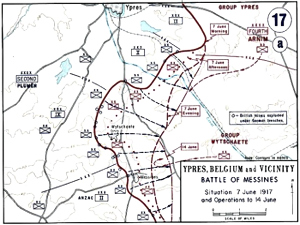
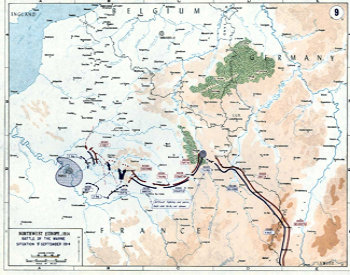
Map of the Battle of Messines 7-14 June 1917. West Point Department of History

Map of the Battle of Messines 7-14 June 1917. West Point Department of History

On the Continent, 7 June saw the start of the Battle of Messines (7-14 June) with the British /Australians/ New Zealanders and Canadians on the offensive. The objective was to capture the Wytschaete Ridge, the high ground southeast of Ypres. After the disaster of the earlier Neville offensives the French moral was low. Thus the idea of the offensive was to move the German Reserves from Arras and Aisne in order to take the pressure off the French. The attack started with the detonation of 21 mines beneath the German Front position, of which 19 exploded creating large craters. It was reported that the noise created by the explosions was the loudest ever recorded to that date and could be heard as far away as Dublin. The explosions also blew the crest off the Messines/ Wytschaete Ridge! This was followed by a 700 yard ‘creeping barrage’ – an artillery attack developed by the British, where one or more guns were fired steadily, continuously and indirectly for a fixed period of time, then moved forward to the next predetermined point and did the same again. Supporting this manoeuvre were tanks, aircraft – both balloons and aeroplanes – and gas attacks using Livens projectors. This was a mortar-like weapon that could throw the contents of large canisters of flammable chemical and was designed by William Howard Livens (1889-1964) of the Royal Engineers.

The Battle of Messines for the Allies was a much-needed success that boosted morale and it is particularly noted that two Irish divisions, the 16th (Irish) Division and the 36th (Ulster) Division, for the first time fought together and won an incontestable victory! There was a cost for the Irish but relatively low by the standards of the First World War. For the Australians it was high, 6,056 casualties and for the New Zealanders with 4,978 casualties. For the Germans however, it was the heaviest as they lost approximately 25,000 of their soldiers with as many as 10,000 being killed when the mines exploded. Of the two mines that did not explode, neither was located at the time but in 1955, during a thunderstorm, one did explode and killed a cow. The other, at the time of writing, has not been found.

Haig had long held the belief that the best chance of a break through the German lines would be an offensive in Flanders and would have preferred that option in the summer of 1916 rather than the Somme. Planned to the last detail, the objective of the offensive he now proposed was to take control of the village of Passchendaele, not far from Messines on the ridges southeast of Ypres. This was envisaged to be done by outflanking the German Fourth Army defences and forcing them to withdraw from the Continental Channel Ports. Both Lloyd George and General Ferdinand Foch (1851-1929) had fiercely opposed the proposal at the Chantilly Conference – the then Commander of the French Northern Army Group and at the time of Haig’s proposal, the Chief of the General Staff (France). With the success of the Battle of Messines under his belt, Haig managed to persuade the British War Cabinet on 25 July and it was agreed to send the Fifth Army, formed in May 1916 from voluntary conscripts and under the command of Sir Hubert de la Poer Gough (1870-1963).

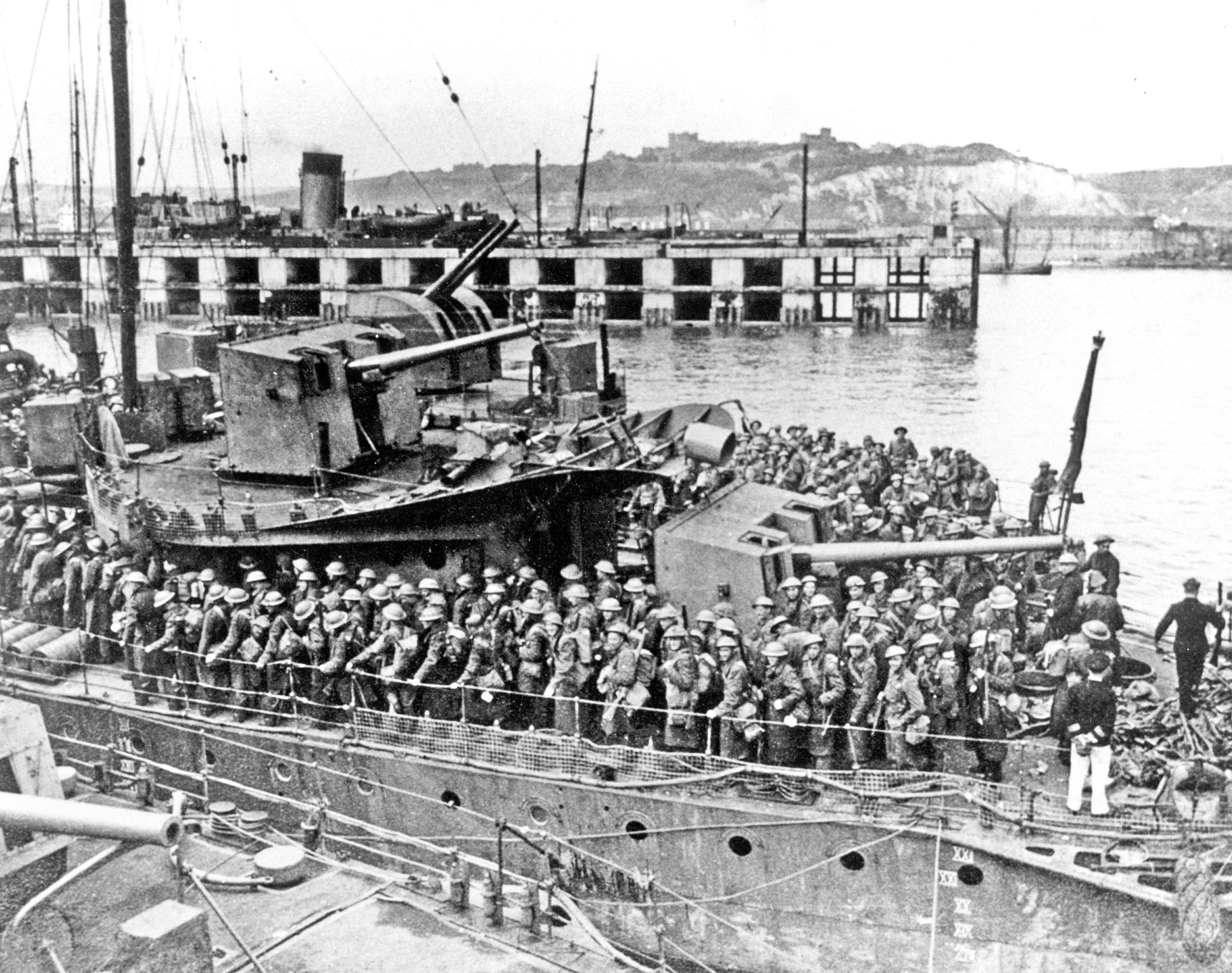
Admiralty Pier - Troop transport ship taking soldiers to fight on the Western Front. Dover Museum

Admiralty Pier – Troop transport ship taking soldiers to fight on the Western Front. Dover Museum

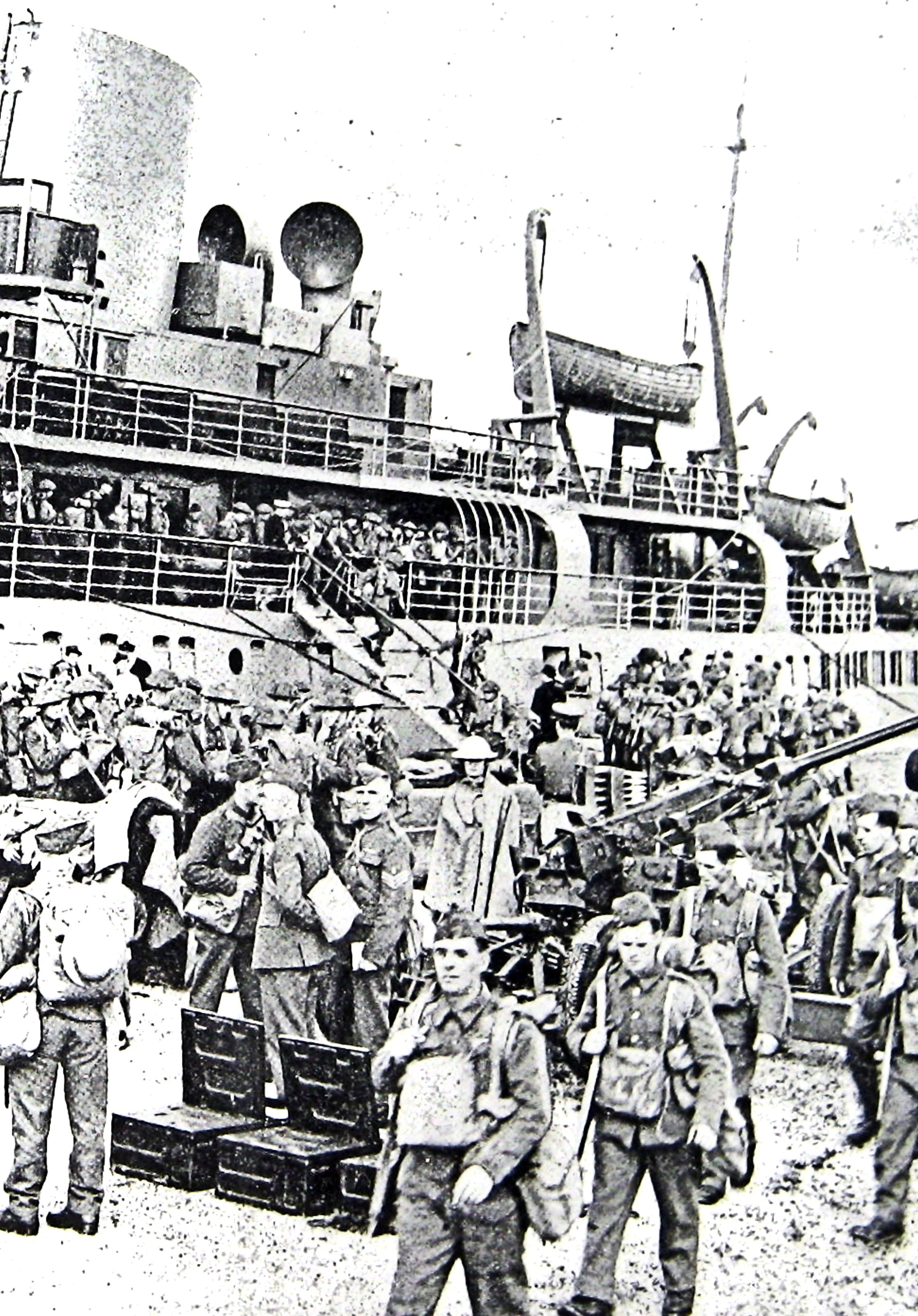
Over the next few days ships left Dover packed with newly recruited/trained volunteer conscripts to join the ones already in the field. Of note, from July 1917 until the Armistice, 2,694 designated troop transport ships crossed the Channel out of Dover 11,938 times and carried nearly four million troops to the Continent. On Thursday 26 July, although German Albatros in a ratio of 50-37 outnumbered RFC fighters, the latter managed to hold their own, while other squadrons undertook reconnoitring. The next day these were joined by further RFC squadrons and Allied air forces and by the evening of Saturday 28 July there were over 800 aircraft in the vicinity of which 330 were fighter aircraft. On that day the weather had been unusually fine and squadrons spent time reconnoitring and it was noted that many of the German batteries had moved from where they had been two days before.

That evening the weather started to deteriorate and after a night of heavy rain that continued the next day, limiting the follow up. Those who did manage to get up, found that again a significant number of German batteries had moved. Flying was curtailed due to bad weather on Sunday 29 and by midnight of Monday 30 July, it was torrential rain. That day the air plan had again been cancelled, nonetheless, another 40 aircraft managed to fly in and all the aircraft, which included 330 fighters, were concentrated between the Lys River and the sea. There were also bomber squadrons, artillery-observation squadrons and balloons. A few pilots had gone up with most undertaking low-level flying to see if the Germans had moved again. Some had, though bullets and shells in the process damaged thirty Allied aeroplanes.

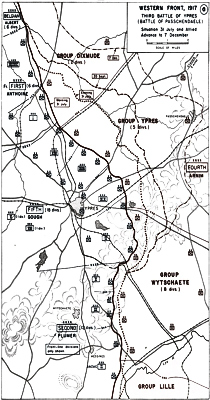
Map of the Third Battle of Ypres (31.07-10 11.1917) History Department of the US Military Academy West Point

Map of the Third Battle of Ypres (31.07-10 11.1917) History Department of the US Military Academy West Point

The Third Battle of Flanders  or the Third Battle of Ypres (31 July-10 November 1917) are better known simply as Passchendaele, started on Tuesday 31 July and was to last until 10 November that year. As it was high summer, Haig had hoped that the weather would be kinder than it had been the previous year at the Somme. Instead it was worse, much worse. Nonetheless, in the early hours of 31 July more than a quarter of a million Allied soldiers left the rain sodden trenches to do their bit at the Battle of Pilckem Ridge (31 July-2 August). They waded through the deep, sticky mud of no-man’s land, some leading horses that were failing to keep their footing and others digging out the tanks that were sinking in the stuff. As for aeroplanes, because of the sludgy conditions only a few took off and flew at low level but most, like the tanks, were immobilised and men, horses and pack mules suffocated as they drowned in swamps. The rain did not let up – Ypres suffered the heaviest rainfall for 30 years and the low lying heavily shelled area turned into a tenacious morass. Nonetheless on that first day the Allies managed to gain 1.7miles of ground but at a loss of nearly 32,000 men though Haig counted the outcome as a victory.

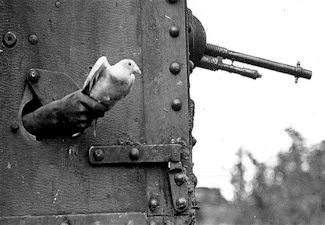
Pigeon being released from a tank. Daily Telegraph 12.10.2019

Pigeon being released from a tank. Daily Telegraph 12.10.2019

Over the next few days the whole of the Pilckem Ridge had been captured except for Gheluvelt Plateau that ran along the southern edge of the Ypres Salient. The next offensive, known as the Capture of Westhoek (10 August) had initially been planned to take place on 2 August but delayed due to the atrocious weather. That day, the now exhausted men had to wade through knee deep mud, as the rain still had not stopped. Air back up and reconnaissance was severely limited and both wireless and telephones were down. The fall back in communication was the age-old carrier pigeons and in consequence attacks were made on empty gun emplacements and the Allies were being shot at from gun emplacements they did not know existed. Moral was sinking lower with every passing hour and the result was a German victory. The most moving story to come out of the tragedy was that of Pigeon 2709 that had been dispatched from the Front line to carry a message back to base. Enroute, the little bird was hit by enemy fire and the bullet that broke his leg then passed through its tiny body taking the metal container with the message inside with it. The metal cylinder became embedded but the little pigeon carried on. It took 21 probably agonising hours to arrive but he did and the message was delivered. Pigeon 2709 died the following day of his injuries and was posthumously awarded the Animal Victoria Cross – the Dickin medal.

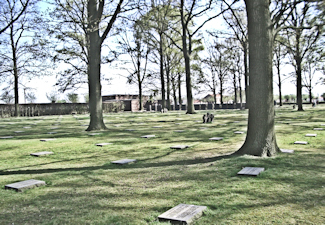
Langemarck German War Cemetery - The Battle of Langemarck (16–18 August 1917). Jean Marsh

Langemarck German War Cemetery – The Battle of Langemarck (16–18 August 1917). Jean Marsh

It had been hoped that the weather would have let up by the time of the Battle of Langemarck (16-18 August) that was the next designated offensive – instead it rained continuously. Of the Allies, Units involved were the 16th (Irish) Division and the 36th (Ulster) Division that had successfully fought together at Battle of the Messines Ridge. Before the Battle of Langemarck began, the two Divisions were down to a third of the number of men at the start of Battle of the Messines Ridge, due to death and injury. What happened is best described by Cyril Bentham Falls (1888-1971) the historian of the 36th Division, ‘The story of the attack, alas! Is not a long one. Enemy machine guns all along the front opened fire almost simultaneously with our barrage. There were assuredly not 2,000 infantrymen in the force who went over the top. The foremost wave must have consisted of less than 300 men, probably reduced to a third within half a minute.’ All told, there were 68,010 Allied casualties at Langemarck of which 10,266 had been killed. The Germans suffered 24,000 casualties including 5,000 missing.

Battle of the Menin Road Ridge. Signals section of the 13th Battalion, Durham Light Infantry, equipped with telescopes, field telephone and signalling lamps, 20.09.1917. John Brooke IWM

Battle of the Menin Road Ridge. Signals section of the 13th Battalion, Durham Light Infantry, equipped with telescopes, field telephone and signalling lamps, 20.09.1917. John Brooke IWM

The successful outcome of three consecutive battles restored confidence, the first was the Battle of Menin Road Ridge (20–25 September), a combined British, Australian and South African operation. Throughout the Battle, the Allies ground forces worked in tandem with the air forces with the German air force suffering badly. The second was the Battle of Polygon Wood (26 September-3 October) when the weather came to the aid of the Allies, the sun shone from early morning that not only dried out the ground but also created a mist that enabled the forces to move without being seen. It was a combined British and Australian action where again the ground and air forces worked closely together giving the Allies definite superiority over their German counterparts.

Battle of Broodseinde Ridge -13 pounder 9cwt anti-aircraft gun in action. National Library of Scotland

Battle of Broodseinde Ridge -13 pounder 9cwt anti-aircraft gun in action. National Library of Scotland

The third was the Battle of Broodseinde (4 October) at the east end of the Gheluvelt plateau by the British, Australian and New Zealanders. It started badly, with heavy rain that was to continue most days until the end of the offensive in November. The 4 October had been chosen by the Germans to launch a counter offensive for which they were preparing when the Allies launched an early morning attack that took them by surprise. For once the Germans were notably weak and disorganised while the Allies ground and air forces again worked together with the infantry receiving a great deal of support from the aircraft even though the visibility was poor. Of interest, taking part was the No 4 Squadron, one of the original four squadrons that had left Swingate at the outbreak of the War in 1914. Although the outcome of the three battles, established Allied possession of the ridge east of Ypres their losses amounted to over 61,000 men.

Battle of Passchendaele - Three Canadian gunners and a dump of 18 pounder shells. 21 09 1917. John Brooke IWM

Battle of Passchendaele – Three Canadian gunners and a dump of 18 pounder shells. 21 09 1917. John Brooke IWM

Following the capture of the Gheluvelt plateau very little was achieved as many of the Allied forces were diverted to Italy following the Austro-German victory at the Battle of Caporetto (24 October-19 November). The weather in Belgium remained wet and winter set in early precluding any chance of the Allies reaching the Channel ports until the following year. Nonetheless, the Third Battle of Ypres ended in a hard won victory on Tuesday 6 November when British and Canadian forces recaptured the village of Passchendaele. On that Tuesday morning, not surprisingly it was raining! The British launched an attack at 06.00hrs against the German positions in the neighbourhood of Passchendaele and made satisfactory progress. Meanwhile the Canadians successfully attacked German defences in and around Passchendaele notably the fortress at Mosselmarkt and the hamlet of Goudberg. They then advanced towards the Goudberg Spur northwest of Passchendaele. To reach the high ground of the Spur they had to cover 2,000yards of mostly marshy ground. The unsettled misty weather had protected them in the morning and when it cleared in the afternoon it assisted the artillery and airmen to use their guns effectively against German batteries and concentrations of hostile infantry. After hard fighting the Canadians raised their flag at 21.30hours and the accolade ‘no troops could have done it better’ was bestowed on them!

Tynecot War Cemetery - The Battles of Passchendaele (31 July-10 November 1917). Jean Marsh

Tynecot War Cemetery – The Battles of Passchendaele (31 July-10 November 1917). Jean Marsh

Passchendaele was won at a cost of about 500,000 casualties – approximately 275,000 Allies: 216,000 British, 38,000 Australians, 15,700 Canadians and 5,300 New Zealanders fell – killed, wounded or missing and more than 200,000 Germans. Nonetheless, as we will see later, the outcome of Passchendaele lifted the spirits of those back home at a time when the Allies moral was at its lowest. However, in his Memoirs published in 1933, David Lloyd George wrote, ‘Passchendaele was indeed one of the greatest disasters of the war … No soldier of any intelligence now defends this senseless campaign.’

Although the Americans were not involved in Campaigns until 1918, their entry into the War had a direct effect on innovation. For instance, the gyro-compass was made by the Anschutz-Kaempe Company of Kiel, Germany to sense the direction of ships by being set to indicate true north. This, the gyro-compass maintains through the operation of a gyroscope, regardless of relative movement in the immediate environment of the device. Used in the gyrocompass, the gyroscope consists of a flywheel mounted inside a ring on an axis that leaves it free to pivot in any direction without being prone to disturbance from outside forces. The original instrument was modified for shipping by the American inventor Elmer Ambrose Sperry (1860-1930) who further modified the instrument for use on aircraft in 1911, but this was crude. The instrument used for shipping was manufactured by Sperry in the US and by the Anschutz-Kaempe Company in Germany. Prior to WWI, Britain bought the German manufactured gyrocompass and gyroscopes. At the outbreak of War, Britain switched to buying them from Sperry although the company, having a monopoly, increased their prices. Electrical engineer, inventor and successful businessman, Sidney George Brown (1873-1948) an American born of English parents, set about producing them for the Royal Navy and British merchant ships. He also devised a new method of damping the oscillation set up in a compass by a change in course called ‘liquid ballistic control’ and on 3 August 1916 the patent was granted.

Turn and Slip indicator and Turn Coordinator. Instrument Flying Handbook. Wikimendia

Turn and Slip indicator and Turn Coordinator. Instrument Flying Handbook. Wikimendia

In the meantime in America, Sperry’s son, Lawrence Burst Sperry (1892-1923), a keen inventor and aviator created a gyrostabiliser in 1913. This could control the elevators and ailerons of an aircraft through a series of servos and he successfully implemented this gyrostabiliser technology into aircraft – winning the 1914 Aero Club of France’s competition. Although never commercially exploited, the system laid the foundation for the autopilot system. He also solved the problem of magnetic compasses indicating the opposite position when an aircraft is turning. This he did by inventing the Gyro Turn Indicator – later modified as the Turn and Slip Indicator and Turn Coordinator. By adding Directional Gyro and Gyro Horizon, Sperry created a core of flight instruments that have become standard aircraft equipment. With America entering the War, these innovations were quickly incorporated into British manufactured aircraft. However, on Thursday 13 December 1923, on a flight from London to Amsterdam in his own designed aeroplane, Lawrence Sperry disappeared over the Channel. The wreckage of his aeroplane was found by coastguards’ 3 miles off Rye, Sussex and his body was washed up onto a nearby beach a month later.

The Americans entering the War, also had a negative effect on Britain’s use of innovation. From before the War, the Germans had used wireless communication to coordinate their shipping far more than the Allies and from September 1914 wireless communication was used to provide information to their U-boats / submarines. Further, the Germans had become masters at intercepting Allied wireless messages but for reasons unclear, the Allies were slow to devise coding! This is a conundrum as the German Imperial Navy did have a codebook to use for sending messages and one came into British possession in 1914! The Admiralty, at that time, set up a cryptanalysts section to decipher the book and other encrypted material, particularly wireless messages that came into their possession. This had proved to be satisfactory and when the US entered the War, the cryptanalysts section expected they would work together. The US recruited American wireless operators not only for the Front line but also to assist against the German submarine campaign, some operating out of Swingate. This was expected to be part of the transmission and collecting information coverage of the Channel but as the US government had assumed control of their wireless industry there was an inherent distrust of the Allies. This limited the amount of information shared with the various bodies protecting the Channel such as the Dover Patrol, military, naval, Western Front personnel and the Coastguard. Further, suspicious messages that would have been sent to the cryptanalysts were probably withheld and together possibly prolonged the War.

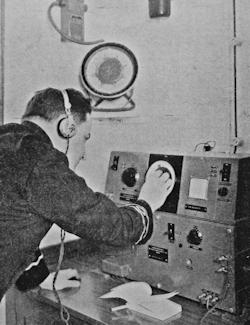
On 14 February 1917, Prince’s Wireless Testing Park moved from Joyce Green to the newly opened airfield at Biggin Hill to be part of the RFC Radio Signals Unit. The Commandant was Colonel Harry Borlase Triscott Childs (1884-1960), who had been a Marconi Engineer prior to the War. Prince was soon joined by his old team from Brooklands, by then, headed by his old colleague the promoted Captain John Furnival. One of the many aspects they were working on was inter aircraft speech communication, using as a base the Mark One aircraft to ground wireless apparatus. It was this that Prince had demonstrated to Lord Kitchener and Sir Douglas Haig in February 1916 but at the time both had found reasons as to why not to proceed with further experimentation. Encouraged by Trenchard and Dowding, Prince and his Bat team had continued to work assiduously in overcoming the clarification of transmitted speech. They tried different types of diaphragms but each time voices or accents or both came over distorted. Then they found that if the operator’s headphones were connected to the transmitter circuitry, so that hearing the sound of his own voice, he could alter his speech patterns to aid transmission.

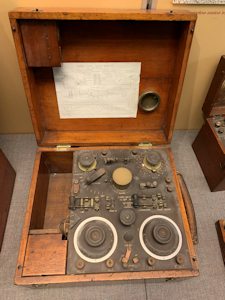
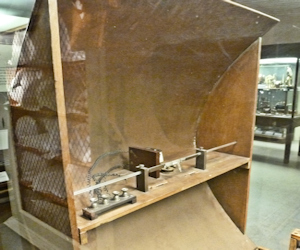
Short Wave Receiver Mark III of the type that Prince and Trenchard would have used in the experiments. Royal Signals Museum

Short Wave Receiver Mark III of the type that Prince and Trenchard would have used in the experiments. Royal Signals Museum

Prince organised a trial with two aircraft at St Omer and two pilots with different accents/ intonation and Trenchard listening to their conversation through a third receiver. He was impressed and following a second trial with two different pilots with totally different accents and intonations the trial was equally successful, immediately informing the Directorate of Military Aeronautics, Lieutenant General Sir David Henderson. By this time Haig recognised the importance of both the wireless and aeroplanes in the war effort. The equipment was installed in a number of aircraft including the Home Defence Flight No 50 Squadron some of whom were stationed at Swingate. On 31 October 1917 it was reported that, ‘Fighters were put on readiness at 22.38. Four pilots briefly saw bombers, which quickly vanished. Two pilots, Oswell and Lucas, flying B.E.12’s of No 50 Squadron both signalled their sightings back to base. Oswell followed a Gotha flying at 11,500-ft. northwest from Dover. The crew of a Strutter N5617 from Eastchurch picked up the Gotha. They closed in and the observer fired a drum from his Lewis gun. Shortly afterwards they lost sight of the machine.’ The upgraded Mark I apparatus, the Mark III, was increasingly carried on all British reconnaissance aircraft in order to communicate with artillery batteries and for his work, Prince was awarded the OBE.

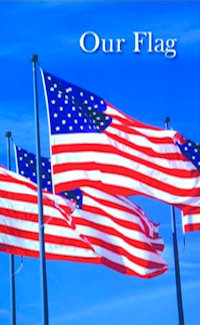
American Stars and Stripes Flags flown at Swingate and also around Dover following the arrival of the first Americans. U.S.Congress

American Stars and Stripes Flags flown at Swingate and also around Dover following the arrival of the first Americans. U.S.Congress

Major Hiram Bingham took over the Dover American Air Base – as Swingate was renamed, towards the end of July 1917 and the first contingents arrived shortly after. These first arrivals were a mixture of cadets and junior enlisted men under the command of officer/instructors and sergeants of different ranks. By November 1918, approximately 40,000 Americans had applied to join the ASSC – Aviation Section, Signal Corps as cadets, 22,689 were accepted and 17,540 completed ground school training of which about 15,000 were admitted into preliminary training. Most squadrons of cadets, as the trainees were referred to regardless of their age, did their preliminary training at US aerodromes. Albeit, a minority of squadrons did their preliminary training at US aerodromes in the UK, such as Swingate, also in France and Italy. Some 10,000 pilots graduated as first lieutenants in the Signal Officers Reserve Corps and 8,688 became Reserve Military Aviators and either remained in the squadron they were first assigned, reassigned to newly created squadrons or commissioned as instructors at one of the training schools. On arrival in Europe, together with those who had trained in Europe, had to complete advanced specialised training courses in pursuit, bombing or/and observation at specialised schools in the UK and France. Swingate ran all three courses.

These first arrivals had come quietly alongside the Prince of Wales Pier in the early hours of the morning, having crossed the Atlantic in rough weather. It was later said that this was possibly why they were not harassed by U- boats. The tired men walked up to Swingate and without any particular order they bunked down in the prepared huts. By morning the news was spreading around Dover that they had arrived and by noon Stars & Stripes flags had been hoisted on the Town Hall, the Castle and public and private buildings.

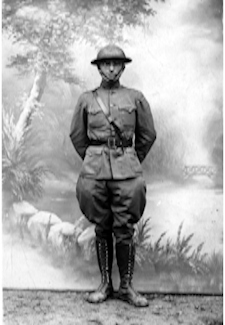
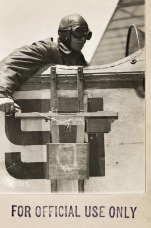
American WWI Aviation Section, Signal Corps Cadet. United States National Archives

American WWI Aviation Section, Signal Corps Cadet. United States National Archives

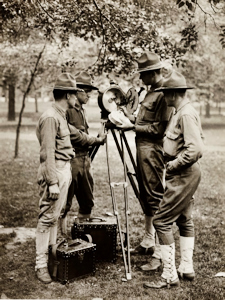
Later that day groups of cadets and junior enlisted men came into Dover wearing their khaki breeches, well polished brown knee length boots with matching thick leather belts. The jackets buttoned up to the neck with no collar and some wore khaki coloured peaked service hats, while others wore military caps but most wore campaign hats with ‘Montana creases’. The men were, on average, taller and thicker set than the locals and most chewed gum. This was of particular interest to children who quickly nicknamed them rabbits! The officers at the camp were entertained by Mayor Farley and other officials of the town and their uniform was much smarter with brown, well polished leather shoes, beige straight legged trousers, chocolate brown military style jacket with ribbons, badges and insignia. Underneath could be seen beige shirts and ties and their chocolate brown peaked service hat was worn at a rakish angle that appealed to the ladies!

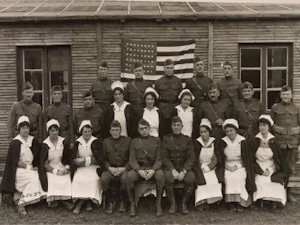
The Americans spoke much louder than the locals did and some of the new arrivals were particularly disparaging about the British and Colonial soldiers’ military abilities on the Front line. They endorsed their argument by referring to the length of time the War had gone on and the number that had been killed – many local men had been killed. The mouthier of the locals retorted emphasising the length of time it had taken before the Americans came into the War to support the Allies. As it was known that the new arrivals had been blighted with seasickness during the crossing, they told the newcomers that they were, ‘green in face and yellow in belly.’ The situation was already escalating when some of the Americans assumed that the Royal Victoria Hospital nurses’ home Wood Street, off the High Street, was a whorehouse.

Chief Police Constable (1908-1920) David Fox (1864-1924). Dover Museum

Chief Police Constable (1908-1920) David Fox (1864-1924). Dover Museum

On hearing this, Chief Constable Fox left the Town Hall proceedings, and together with a number of not so young local police officers they marched into the nurses’ home. There, his men manhandled and booted the Americans into Wood Street and stiffly informed the senior Swingate officers that ‘All the men would require special passes, authorised by himself, to come into Dover again! By that evening, except for a flag on the Castle – the headquarters of Admiral Reginald Bacon in charge of Fortress Dover – all the Stars and Stripes memorabilia in the town had been removed. The locals referred to the men at Swingate with disdain, calling them the standard variation of ‘Uncle Sam’ – Sammies or/and yanks.

It had previously been discussed with Admiral Bacon that some of the American cadets arriving at Swingate would be well used to military discipline and what was expected of them. Consequently, it was agreed that when they were acclimatised to their new role some would be sent to the School of Military Aeronautics at Oxford. There they would be taught basic flying skills, aerial combat, repairing machines etc. before being sent back to Swingate to finish off their training. Those not chosen to train as pilots or observers, would stay at Swingate and learn skills required by ground crews.

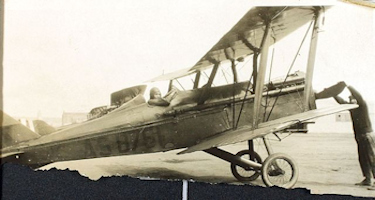
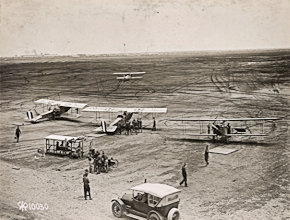
Avro 504A at RFC Swngate 1917. Dover Museum

Avro 504A at RFC Swngate 1917. Dover Museum

The trainee pilots would not be gazetted until they had completed 25hours of flying and as there were a number of AVRO 504’s at Swingate, these would be used. The two-bay all-wooden biplane with a square-section fuselage was the most produced aircraft used in the War with 8,970 made either by AVRO or under licence by other companies. It was first flown in September 1913 and although was used on the Western Front at the beginning of the War it soon became obsolete. However, it quickly proved to be an excellent training aircraft and many different versions came off the production line, more to accommodate the different engines that became available due to shortages than changes in design. When the trainers were satisfied with the progress of the cadets, Bacon suggested that in preparation for going to the Front, they should join No 50 Squadron Home Defence Flight that remained at Swingate and the proposed Squadron 59 and Squadron 69 that were being brought in as part of the Channel defences. It was agreed that the cadets would use their aircraft and the practical arrangements started to be put into effect.

US Commander in Chief General Pershing arriving in France 1917. Cassira

US Commander in Chief General Pershing arriving in France 1917. Cassira

However, in charge of the American Expeditionary Force (AEF) combat operations which the airmen would join on the Front, was the American Commander-in-Chief, General John Joseph ‘Black Jack’ Pershing (1860-1948). At that time, he had not long been in the European theatre of War and had openly scorned the slow trench warfare of the previous three years on the Western Front. Pershing had also made it clear to Haig and Pétain that the AEF would operate as a single unit under his command. As far as the Dover base was concerned, Bacon’s suggestion on gaining practical experience was  rejected. Pershing’s office told the Admiral that Pershing was adamant that the airmen would get all the practical experience required when they joined the AEF on the Front. 

Out of the raw recruits, many were sent to Oxford to undergo pilot and observer training but most remained on base where they were trained to become mechanics. The British were, by this time, earning a high reputation in aeronautical engineering including the training of mechanics in maintaining and repairing aeroplanes in the field. An offer was made to help with the training but was firmly rejected by the American command. Instead, the ASSC set up the Motor Mechanics Regiment, Signal Corps the training officers of which were to come from the American automobile industry. Graduating officers were to be classed as ‘technical officers’ and their job was to supervise aircraft maintenance and the men carrying out the maintenance also underwent their training at Swingate. Albeit, the training officers from the automobile industry quickly made it clear that they were out of their depth with aeroplanes with one reported as saying that the high command had thought an aeroplane was just a motor car with wings!

Automobile Mechanics in training 1917-1918. US National Archives

Automobile Mechanics in training 1917-1918. US National Archives

From the outset, Colonel Sidney Dunn Waldon (1873-1945) of the Signal Corps questioned the uselessness of the training that the mechanics received in aeronautical maintenance. His background straddled both the automobile industry and flying and he spent time observing British factory and field methods in aviation operations. He was also a Chartered member of the US Aircraft Production Board and had been posted to France to establish airfields. It was in this capacity that he had been looking at the British methods. In February 1918 he made his report and recommended aircraft, rather than automobile mechanics, both British and American, should be recruited as teachers.

This was immediately instigated at Swingate and the trainees became efficient at assessing what was wrong with the aeroplane and speedily putting things right. They were trained not only with what the vast array of spare parts were for, but were able to adapt and even to make new ones. They were expected to know how cameras work and again be able to fix and adapt as necessary and the same applied to wireless maintenance, bombs, rockets and machine guns. The first American aircraft trained mechanics took up duties at the end of July 1918. As for the original cadets and men and those who continued to be trained by the automobile industry teachers that remained at Swingate. They became specialists in vehicle maintenance and horse transport and some were sent to the Western Front while others remained in Britain in that capacity.

Troops in tents. Dover Museum

Troops in tents. Dover Museum

To accommodate the Americans, billet huts had been erected at Swingate and also on Northfall Meadow below Dover Castle. As more Americans arrived, new raw recruits were housed in tents erected on the adjacent Edinburgh Hill and the Cow Pastures on Long Hill – now the site of Danes Court and the Girls’ Grammar School sports ground. Kitchens, food and clothing stores were all at Swingate, along with a large bakery with its own store for white flour that was imported from the US. Canned, bottled food and drink were imported and an area of airfield was given over to growing vegetables, the seeds also having been imported from the US.

There was also a medical facility complete with Registered nurses, Volunteer nurses, beds, medical equipment etc. and rocking chairs! The Registered Nurses belonged to the United States Army Nurse Corps that had been established by the US Congress on 2 February 1901. The Corps was, and still is, composed entirely of Registered nurses and when America entered the War some 20,000 civilian Registered nurses were recruited to serve in 58 military hospitals, many in Europe. The Army also set up a School of Nursing and 5,400 nurses enrolled to train for the Register.

US Camp Hospital 10. Officers and Nurses 1919. US National Archives

US Camp Hospital 10. Officers and Nurses 1919. US National Archives

By far the greater number of nurses at Swingate though were volunteers belonging to the American Red Cross. This had been founded in 1881 by Clara Barton (1821-1912), a hospital nurse in the American Civil War (1861-1865) who advocated the provision of humanitarian aid and relief in times of war and disaster. Prior to America entering the War the organisation had 25 paid members of staff, and fewer than 17,000 members. Following the Declaration of War the organisation expanded exponentially and by the beginning of 1918 it had raised $400million, had 31 million members and 8 million active volunteers. Besides nursing, the various branches provided numerous specialities including catering, entertainment, financial advice and bereavement and injury counselling. One of the branches of the volunteer services was the Production Corps. They acquired or made hospital equipment, including beds, bedding, surgical dressings medical supplies, relief items and rocking chairs – an item seen in all the American medical facilities!

Wounded men on one of the wards at Debarkation Hospital No 3. United States National Archives

Wounded men on one of the wards at Debarkation Hospital No 3. United States National Archives

The Nursing Service arm of the American Red Cross was founded in 1909. During 1917 the number of ARC nurses enrolled was 23,822 and of these 19,931 were assigned to active duty overseas, including Swingate. These volunteers supported the Registered nursing staff while those with additional psychiatric or social work training were assigned to help the injured returning from the Front. There was also a large contingent of nursing volunteers in the US, helping to support the injured back into civilian life and aiding bereaved families of lost servicemen. In less than two years that the volunteers operated in the war zones, 400 had lost their lives due to enemy fire of which 296 were volunteer nurses.

Royal Aircraft Factory S.E.5 the British produced aircraft in which the American airmen trained while at Swingate. San Diego Air and Space Museum Archive

Royal Aircraft Factory S.E.5 the British produced aircraft in which the American airmen trained while at Swingate. San Diego Air and Space Museum Archive

The main training aircraft for the US Army back home was the Curtiss JN-4, nicknamed Jenny. These were biplanes built by the Curtiss Aeroplane Company of Hammondsport, New York. Until they arrived, it was decided that the main training aircraft for ASSC recruits at Swingate would be the new Royal Aircraft Factory’s Scout Experimental 5 or S.E.5. This was one of the fast fighter biplanes that Trenchard had told Lloyd George and Haig would be coming on line during 1917. The aeroplane had been developed by Henry Folland (1889-1954), John Kenworthy (1883-1940) and Frank Widenham Goodden (1889-1917) and had a geared 200 hp Hispano-Suiza 8b engine. Its stability made it an ideal gunnery platform and it was manoeuvrable, safe and relatively easy to fly and was expected to arrive before the year was out.

Cadets attending a lecture in firing. All lessons began at 07.30hrs. US National Archives

Cadets attending a lecture in firing. All lessons began at 07.30hrs. US National Archives

Pershing believed that American soldiers’ skill with the rifle would enable them to avoid costly and senseless fighting over a small area of no-man’s land, as had happened thus far in the War. Proficiency in this skill was high on the training agenda, particularly for the raw recruits at Swingate. To incorporate the amount of time Pershing demanded that should be spent on the rifle range, with the other skills the cadets had to be taught, meant that the days were very long. Especially as they had to acquire an accepted proficiency in a lot of other skills in the short time allowed.

This situation was reluctantly accepted by the instructors but what became a major source of contention with Pershing’s office was the practical experience that could have been gained by the cadet aviators if they had spent time attached to the Dover Patrol Channel and Home Defence Squadrons. Pershing was dogmatic in his refusal but from off the record reports implied that a steadily increasing number of the trainee aviators did join local Channel and Home Defence Squadrons to gain experience.

Lieutenant General Jan Christiaan Smuts (1870-1950). Cossira

Lieutenant General Jan Christiaan Smuts (1870-1950). Cossira

The previous year, as mentioned above, Mayor Farley, along with a deputation of local Mayors, had attempted to see the Commander-in-Chief of the Home Forces, Field Marshal French to explain the need for an increase in Home Defence against the German air raids. The Field Marshal had refused to see them so the general feeling was that he didn’t care. This they said, they could not comprehend, as French was a local man who should have appreciated the vulnerability of East Kent. What they did not know was, at the time they had tried to see him, Field Marshal French was strenuously lobbying to combine the RFC and the RNAS to create better protection for places like East Kent. Eventually he found an ally – the South African Lieutenant General Jan Christiaan Smuts (1870-1950). Smuts had been invited by the Prime Minister, Lloyd George, to join the Imperial War Cabinet and the War Policy Committee. Under its umbrella, Lloyd George set up a Cabinet Committee to consider air organisation and air defence.

The Prime Minister was the chairman of the Committee and he invited Smuts to be the only other member. He also seconded the calm, wise Lieutenant General Sir David Henderson, as Smut’s adviser. In less than a month, on 17 August 1917, Smuts presented his radical report to the War Council on the future of Britain’s air power. Because of the potential for the ‘devastation of enemy lands and the destruction of industrial and populous centres on a vast scale’, he recommended a new air service be formed that would be on a level with the Army and Royal Navy. The War Cabinet accepted the report and Smuts was appointed to chair a committee to work out the details with Henderson remaining his principal adviser. On 1 April 1918, the RFC and the RNAS were amalgamated to form the new service, the Royal Air Force (RAF), under the control of a new Air Ministry.

Crabble Road Tram Accident - Crabble 19 August 1917 Dover Museum

Crabble Road Tram Accident – Crabble 19 August 1917 Dover Museum

On 19 August 1917, a Sunday afternoon, tragedy struck Dover when a tram bound for River went out of control as it descended Crabble Road, near the Cricketers Inn, River. About two weeks before the Dover Express reported that 70 tram drivers had gone to the Front since the outbreak of war and that inexperienced drivers, usually War casualties, were driving the trams. The driver of the River tram was one such inexperienced driver who failed to apply the slipper brake as the tram descended the hill. As the tram went out of control, the driver jumped free of the vehicle while an off duty soldier, Trooper Walter George Gunner of the 1st Dragoon Guards attached to the Army Pay Corps, tried to stop the tram, using his feet as emergency brakes. The tram overturned, struck a wall and smashed the upper deck. The Cricketers Inn quickly became a first aid centre with locals administering first aid. Trams and military ambulances, including some from Swingate, were used to take most of the injured, 51 altogether, to the Royal Victoria Hospital. Army personnel were taken to the Military Hospital on Western Heights. Eleven people were killed and had been taken to Dover’s Market Hall. Trooper Gunner lost both his feet, but in recognition of his bravery was awarded the Albert Medal by King George in April 1918.

Three days later, on 22 August a group of seven or eight Gotha planes in squadron formation came over the town at a height of 11.000 to 12,000feet and dropped a dozen bombs. Many fell into the Harbour but one dropped in the yard of the Admiralty Harvey pub in Bridge Street and another fell in the grounds of Dover College, near a party of reservists in training, killing two and wounding three others. A third fell on a house in Folkestone Road and passed right through the floors without exploding. Two of the raiders were brought down by anti-aircraft gunfire and attacks by those of the No 50 Squadron stationed at Swingate flying B.E.12’s. A third raider was shot down near the coast by an RNAS aircraft.

Royal Aircraft Factory R.E.8.2 aeroplane Wikimedia

Royal Aircraft Factory R.E.8.2 aeroplane Wikimedia

As Bacon had previously told the American senior personnel at Swingate, at the end of August Squadron 59 and Squadron 69 came on station. They were based at Swingate and Calais respectively and their job was to protect the English Channel. Squadron 59 had been operating on the Western Front for over a year. Although given the designation Squadron 69, they were in fact No. 3 Squadron of the Australian Flying Corps (AFC), a branch of the Australian Army. No. 3 Squadron had been raised in Egypt, where there was an RFC training school and had been joined by airmen from AFC No 1 Squadron or had come directly from the Australian Central Flying School, Point Cook, Melbourne. They had only just arrived on the Western Front. Both Squadron 59 and No. 3 Squadron flew Royal Aircraft Factory R.E.8 reconnaissance aircraft and liaised with their counterparts in Squadron 50 in Home Defence and the Dover Patrol. The R.E.8 was a British two-seater biplane and was the standard British reconnaissance and artillery observation aircraft that came on station in mid-1917.

The ASSC staff and cadets at Swingate, by this time, had settled down to their heavy schedules. Up at 06.00hours, the cadets were present at their first lesson by 07.30hours. Their courses were intense, including: acoustics, aerodynamics, aeronautic engineering, batteries and charging batteries, camouflage, communication, electricity generating, map reading, meteorology, navigation, photography, pigeon care and training, protective clothing and gas masks, reconnaissance, rifle shooting, telephony, trench warfare, wireless and electromagnetic waves.

Camouflage woods creating irregular lines of overhanging trees across frequently used boardwalks to the Front. United State National Archives

Camouflage woods creating irregular lines of overhanging trees across frequently used boardwalks to the Front. United State National Archives

The use of camouflage had grown exponentially since the outbreak of War in 1914. At that time the French military uniform was a smart blue jacket with red trousers and a hat that in some regiments was adorned with a feather. It soon became evident that the soldiers made easy targets and the uniform was changed to camouflage ‘horizon-blue’ – a blue-grey. Soon after, the French were camouflaging their equipment and positions and the Allies quickly followed suit along with the Germans. Possibly because the British were running down Swingate in 1916, camouflage did not appear on their curriculum, even though a Camouflage Section had been established at Wimereux, near Boulogne that year. The ASSC, did include camouflage in the cadets training and the Americans were particularly influenced by artist Lucien-Victor Guirand de Scévola (1871-1950) the commander of the French Camouflage Corps. As a second-class gunner in 1914, Scévola camouflaged his gun emplacement with a painted canvas screen. This and his other camouflage techniques came to the attention of Marshal Joffre and the Section de Camouflage was formed with Scévola at its head. The Section became influential during the Second Battle of Artois (May-June 1915) when they erected their observation tree – an iron lookout post camouflaged with bark and other materials. By 1918, the US Women’s Reserve Camouflage Corps had been set up and they created both clothing and disguised military equipment. The most common camouflage erected along the Front by the ASSC, were camouflage woods. These were irregular lines of over hanging trees along what appeared from the sky to be a stream. In fact the stream, which for the most part was in shadow or hidden by the trees, was a boardwalk along which the troops moved to and from the Front.

Teaching mechanical construction of Akeley camera United States National Archives

Teaching mechanical construction of Akeley camera United States National Archives

The Photographic Section of the Signal Corps was established on 21 July 1917, being responsible for the U.S. Army’s official ground and aerial photography of World War I. The remit was photographic coverage for military reconnaissance, identification, scientific and propaganda purposes as well as providing a pictorial history of the US involvement in the war. Initially, there were only 25 men in the Corps but as photography was part of the training of cadets, the number rapidly increased and was part of the Swingate curriculum by late 1917. The Signal Corps had produced ‘Training of the Soldier’ a 62,000 foot training film series as well as ‘Flightwings’ a 16,000 foot aviation training film. Each AEF Division had an assigned photographic unit that consisted of a motion picture cameraman, a still photographer and assistants. The ‘Instructions for Signal Corps Photographers’ was the standard manual in the classroom and also carried by each Division.

Demonstrating the latest aerial camera May 1918. United States National Archives

Demonstrating the latest aerial camera May 1918. United States National Archives

As was the case for aeroplanes, America made use of French and British cameras when they became involved in the War. Frederick Charles Victor Laws (1887-1975) started aerial photography experiments in 1912 with No.1 Squadron of the RFC using the British Beta airship. He discovered that vertical photos taken with a 60% overlap could be used to create a stereoscopic effect when viewed in a stereoscope. This enabled the height of objects on the landscape to be determined by comparing photographs taken at different angles. By creating the perception of depth both intelligence and map making were refined. John Moore-Brabazon (1884-1964) invented the first purpose-built and practical aerial camera in 1915 with the help of the Thornton-Pickard Company based in Altrincham, near Manchester. The camera was inserted into the floor of the aircraft and was triggered by the pilot or observer at intervals and later incorporated the stereoscopic techniques. By the time the Americans joined in the conflict aerial cameras were considerably larger and their focal power had dramatically increased and both the Allies and the Germans were photographing the Front twice, if not more times, a day.

The Americans at Swingate were becoming used to the daytime air attacks. At night the fighting took place at sea which, like the locals, they often watched. Most had gone to bed on the night of 2-3 September when they were awoken by the heavy drone of a Gotha bomber. The sky was clear and the bright moonlight made it easy to see the first bomb drop. It was nearby and exploded on Northfall Meadow where some of the American cadets were housed. On the Meadow the 5th Battalion Royal Fusiliers were in tents and Second Lieutenant Henry Reginald Reader Larcombe (1899-1917) was killed and other soldiers were injured. Bombs continued to be dropped on the town, but there had been no warning and the sirens remained silent. The cadets could not see any searchlights in operation nor did any guns fire at the raider. Fear was all-pervasive.

Nieuport N.28C-1 aeroplane. United States Air Force Museum

Nieuport N.28C-1 aeroplane. United States Air Force Museum

Nothing was said the next day, instead the cadets were informed that on 30 August, the American and French governments had agreed to purchase 1,500 French Aéronautique Militaire Breguet 14 B.2 bomber-reconnaissance planes; 2,000 French SPAD S XIII fighters and 1,500 Nieuport 28 pursuit planes for the ASSC. Further, it was expected that they would all have been delivered on or by 1 July 1918 and that Swingate would get some of each for training purposes. As it turned out, due to shortages, the ASSC only received Nieuport 28 fighters. These differed from the earlier Nieuports in that they had two spars to both upper and lower wings. A total of 258 were built in Britain before the deadline and some were sent to Swingate for training purposes.

Pilot cadets undergoing training in Texas, one of the Aeroplanes is taking off. United States National Archives

Pilot cadets undergoing training in Texas, one of the Aeroplanes is taking off. United States National Archives

At the beginning of October the first batch of S.E 5’s arrived at Swingate, causing great excitement. As they could be quickly converted into two-seater training aircraft this made them extra special and popular with the American instructors at Swingate. As this view was reflected throughout the US training airfields in the UK, the American government ordered more but from the Curtiss Aeroplane and Motor Company, back at Hammondsport. Unfortunately, the company only managed to produce and send just one to the UK before the War ended. On 30 October ten bombs were dropped on Swingate smashing many of the new aeroplanes and damaging others. Three bombs were dropped on the harbour and the following day a raid lasting five hours hit the town by a large number of hostile aeroplanes. Incendiary bombs were dropped along the Seafront with one causing an outbreak of fire at the Seaplane Base. Between 04.00hours and 06.30hours in the early morning, four bombs were dropped in a row from the Camber at Eastern Docks to Fort Burgoyne, with one falling on Northfall Meadow close to a billet hut housing American cadets.

Postcard of Kent - The Doorway of England - No Germans Admitted. Typical of the postcards that reflected popular feeling following the outcome of Passchendaele. Dr Jo Stanley

Postcard of Kent – The Doorway of England – No Germans Admitted. Typical of the postcards that reflected popular feeling following the outcome of Passchendaele. Dr Jo Stanley

Due to these raids and the deterioration in the general economy, all the shops in Dover closed by six o’clock, and in many cases by five o’clock. Evening entertainment, meetings and social gatherings ceased except on moonless nights, when there was less chance of an evening raid. Food shortages continued to increase although the summer crop of potatoes was far in excess of the amount normally grown. However, regardless of the sugar cards, getting the commodity was almost impossible. This started to apply to butter in September and by November 1917 the same applied to margarine. The shortage of tea made it a luxury commodity to be drunk only on special occasions but the Food Control Committee were doing their best and they remained successful in getting hold of milk. Many had lost their loved ones so far in a War that seemed to have no ending and compounded by the food shortages, an air of sadness seemed to pervade everything. Then on 6 November the town heard of the outcome of the Third Battle of Ypres or Passchendaele. The fatality of defeat evaporated overnight, lifting peoples’ spirits. Postcards, reflecting this view appeared and were sent to friends and family.

The relationship between the Americans and the town was still distant although many locals had jobs up at Swingate. The Americans saw them as a miserable, hostile, complaining lot but on seeing the dramatic change in attitude following the news on the outcome of Passchendaele, they realised the toll the continual stress had taken on the folk of Dover. As a result they decided to try and make amends for their arrogant behaviour when they first arrived. All the American bases in England and France had already planned to have a special Thanksgiving Day lunch, Thursday 28 November, as they were so far away from home. At Swingate the Americans invited the town’s school children, their teachers, Mayor Farley, Chief Constable Fox and a few others to join them for the Thanksgiving Day lunch. Mayor Farley accepted the invitation on behalf of the town and in the classrooms teachers focused on ensuring that the children had some understanding of the American history and the significance of Thanksgiving Day.

Second American Aviation Instruction Center Tours Aerodrome, France Thanksgiving menu 1918. United States National Archives

Second American Aviation Instruction Center Tours Aerodrome, France Thanksgiving menu 1918. United States National Archives

The Americans sent vehicles down to Dover to pick up their guests and the children, who were scrubbed clean and had promised their mothers that they would be on their best behaviour. On arrival the children were over awed by the decorations of the large hall where the celebrations were to be held and quietly sat down on the benches and chairs by the long tables that were provided. A tall man in his late twenties, who said that he was a cadet and had a booming voice, introduced himself as Ed and took charge of proceedings. He started by asking the children what they knew about Thanksgiving Day. They shuffled in their seats and some reluctantly put their hands up. A group of the children were pointed to a thin-faced girl with two wispy plaits, wearing a thin dress and a small shawl. She had reluctantly put her hand up and revealed a bony bare arm. Ed, intrigued, pointed to her and when she stood up all the other children and the teachers were quiet. In response to being asked her name, age and school, in an assured clear voice she said that her name was Jane, she would be ten years old at Christmas and that she attended St James School.

The children who evidently attended St James school let out a loud cheer. When they had quietened down, Jane in a confident clear voice that carried round the large hall told the audience that the Pilgrim Fathers had celebrated the first Thanksgiving in 1621 and that President Abraham Lincoln (1809-1865) had proclaimed it a national holiday. The audience clapped and Jane was about to sit down when Ed thanked her, smiled and in a jovial tone said that he bet that she did not know what year that was. Without hesitation and with intonation, Jane said, ‘On 3 October 1863 at the height of the Civil War, President Lincoln made a speech, saying that …‘ Jane’s voice took on a slow authoritive, ‘ In every part of the United States, and also those who are at sea, and those who are sojourning in foreign lands, to set apart and observe the last Thursday of November next as a Day of Thanksgiving and Prayer to our beneficent Father who dwelleth in the heavens.’ Jane sat down to a loud applause and her classmates and teachers mouthed ‘well done‘. An officer was told by Jane’s teacher that the little girl was one of the cleverest children in the school but that she had lost her Father at Passchendaele. Then the officers, cadets, teachers, dignitaries and the children all settled to eat more food and of a greater variety than most of the children had ever seen. The children were particularly dumbfounded when roasted turkeys were brought in on large metal trays, each carried by two men. Most of the children wrapped slices of turkey in whatever they could find and shoved the packages down their pants or in their knickers to take home!

 Diagram of the German Siegfriedstellung (Hindenburg Line), 1917. Times History of the War

Diagram of the German Siegfriedstellung (Hindenburg Line), 1917. Times History of the War

While the children of Dover were enjoying the well deserved time at the Thanksgiving celebrations at Swingate, in France No 40 Squadron that had trained at Swingate were involved in the Battle of Cambrai (20 November-4 December). An offensive launched by the Allies to penetrate the Hindenburg Line (Siegfriedstellung or Siegfried Position). This was a German defensive position built during the winter of 1916–1917 to reduce the strain being felt due to the loss of men and wartime economy. General Paul Ludwig Hans Anton von Beneckendorff und von Hindenburg, known simply as Paul von Hindenburg (1847-1934), became the German Chief of the General Staff in 1916. At a meeting at the German General Headquarters including Crown Prince Rupprecht of Bavaria (1869-1955), Albrecht, Duke of Württemberg (1865-1939) and Crown Prince Wilhelm of Prussia (1882-1951). Hindenburg told them that in his opinion the defence should be improved on the Western Front. What the Allies called the Hindenburg Line, a heavily fortified zone that ran from Arras to Laffaux, near Soissons on the River Aisne was put into place. Further, even though the Allies had taken every precaution possible to keep the preparations for the Battles of Arras and the Second Battle of the Aisne secret, reconnaissance and civilian informants had ensured that the Germans were well prepared.

The Bomber Squadrons were designated to take part in the Battle of Cambrai with the RFC long-range night bombers for the first time fitted with Marconi valve transmitters. The Battle opened with the RFC making low level attacks on anti-tank guns, troop concentrations and strong points. Then the Allies attacked with explosive shells on the German trenches and followed this with tanks. The general view towards the worthiness of tanks was not good, so far they had been unreliable, slow and vulnerable to heavy artillery but on 28 July the Tanks Corps had been formed and they were full of confidence. The tanks, much to everyone else’s surprise, made quick progress and soon reached the enemy’s trenches. This caused several of the German units to retreat and by the evening of the first day the Allies had won nine kilometers of terrain and were closing in on Cambrai. The Allies appeared to have the upper hand and supporting the British 3rd Army were three regiments of US Army engineers.

Then on 30 November the Germans launched a counter attack. Using a barrage of poison gas shells, the Germans advanced more than five kilometers in two hours and then put into effect a new method of fighting developed by the field commander Oskar Emil von Huiter (1857-1934). They sent into the Allies Front lines, small groups of highly skilled and heavily armed soldiers to undertake what turned out to be close quarter massacres. These tactics were referred to as Huiter attacks but by the end of the War they were better known by the designation of the men who carried them out – Stoßtruppen or storm troopers. By 4 December, all the terrain initially won by the Allies had been lost.

No 40 Squadron’s Badge heraldry - a broom in honour of Mick Mannock. RAF Heraldry Trust

No 40 Squadron’s Badge heraldry – a broom in honour of Mick Mannock. RAF Heraldry Trust

On the positive side, the Tank Corps, had proved their machines capabilities and reported that if they too had wirelesses, there would have been a greater co-ordination of commands on the ground. One of the pilots in No 40 Bomber Squadron was Edward (Mick) Mannock (1888-1918) flying a Royal Aircraft Factory S.E.5a biplane fighter aeroplane. Mannock had spent time at Swingate and was one of the Squadron’s foremost pilots. By June 1918 he had brought down 58 machines but the following month Mannock was killed. No 40 Squadron’s Badge heraldry shows a broom chosen to immortalise Mannock’s saying that those who served with the squadron’s job was to ‘sweep the Huns from the air!’ At the end of the Battle, 44,000 Allies were killed, wounded or lost in action (including 6,000 prisoners) and 45,000 Germans (including 10,000 prisoners). The Americans suffered 77 casualties.

The War had not only taken its toll on the thousands of the young lives of the countries involved but as had been observed in Dover by the Americans at Swingate, on the folks back home. Unrest was just below the surface and on 8 March 1917 (23 February in the Russian calendar) due to food rationing, this spilled in St Petersburg, the then capital of Russia. Four days later the country was in revolutionary mood and on 15 March Tsar Nicholas II (1894-1918) abdicated. Called the February Revolution (8-16 March 1917), it was followed by a period of dual power with the Provisional Government holding state power. The other power holder was a national network of Soviets, led by different groups of socialists. They had the support of the majority of the people and the largest group were the Bolsheviks led by Vladimir Illych Ulyanov Lenin (1870-1924). He had campaigned for an immediate end to the War with land to be given to the peasants and bread to the workers.

Vladimir Lenin with his secretary Vladimir Bonch-Burevich talking in Kremlin Courtyard. Moscow 1918. Wikimedia

Vladimir Lenin with his secretary Vladimir Bonch-Burevich talking in Kremlin Courtyard. Moscow 1918. Wikimedia

In the meantime, following the disaster at Chemin des Dames Ridge when 20% of the French Army had been killed or injured, there was the mutiny in France. This was ruthlessly stamped on causing much resentment towards the French Government’s continued support of the Allies in the War effort. In Russia, following the February Revolution, there were frequent mutinies, protests and strikes but the Provisional Government, like France, continued to support the Allies. However, on Thursday 7–8 November (Russia 25-26 October), the Bolshevik led different socialist fractions, workers and soldiers successfully overthrew the Provisional Government in St Petersburg and transferred all its authority to the Bolsheviks.

Their promise to end Russia’s participation in the War was honoured on 3 March 1918 with the Treaty of Brest-Litovsk and this relieved the pressure on the German Army. With a possibility of a similar outcome in France, the Germans set about bringing France to her knees. Food shortages in Britain led to compulsory rationing that was introduced in stages between December 1917 and February 1918. The possibility of ill content in Britain spurred the Germans into preparing for a massive Spring offensive. During that winter a German army of seventy-four divisions consisting of about 900,000 men gradually took up positions along a 50mile Front defended by thirty British divisions, from Bapaume to Saint-Quentin. The aim was to seize the Channel ports before the American reinforcements, which were still in training, were deployed. This would put Germany in a strong position to negotiate favourable conditions for the termination of the war.

Cont: Swingate – World War I Front Line Aerodrome Part IIIa  January – March 1918


Posted in Aviation, Open Spaces, Port and Transport, Swingate, Swingate Part IIb World War I Front Line Aerodrome, Swingate Part IIb World War I Front Line Aerodrome, Swingate Part IIb World War I Front Line Aerodrome, Swingate Part IIb World War I Front Line Aerodrome, World War I | Comments Off on Swingate Part IIb – World War I Front Line Aerodrome

Swingate Part IIa – World War I Front Line Aerodrome

Map of the Swingate Downs Area of Outstanding Natural Beauty (AONB) - openstreetmap thanks to Protect Kent - Branch of the CPRE

Map of the Swingate Downs Area of Outstanding Natural Beauty (AONB) – openstreetmap thanks to Protect Kent – Branch of the CPRE

Swingate is a large stretch of downland on the east side of Dover Castle. It is a designated Area of Outstanding Natural Beauty and the history of the site is internationally unique, particularly in relation to communication. This essay is the second in a series of four stories, told in chronological order, which gives a glimpse into this fascinating history.

This Section of the story of Swingate centres on the site’s role during in World War One (1914-1918) and covers:
1. Pre-World War I – Swingate and Aviation  
2. 1914 – The War will be over by Christmas
3. 1915 – Inventions, Innovations and Developments
4. 1916 – Cannon Fodder, Quagmires and an Offer of Peace
5. 1917 – On the Offensive & the Americans come to Swingate – on Swingate Part IIb – World War I Front Line Aerodrome
6. 1918 – Dover and the End of a War to End All Wars on Swingate Part IIb – World War I Front Line Aerodrome

1.  Pre-World War I – Swingate and Aviation  
Bleriot XI aeroplane aviator Louis Blériot. US Library of Congress Wikimedia

Bleriot XI aeroplane aviator Louis Blériot. US Library of Congress Wikimedia

As described in Swingate Part 1 – Marconi, South Foreland and Wireless, Swingate was commandeered by the military in the 1850s and many of Guglielmo Marconi’s (1874-1939) early experiments in wireless communication took place on the site and/or the nearby South Foreland. Historically, it is also significant for on the nearby Northfall Meadow, between Swingate and the Castle on the morning of Sunday 25 July 1909, Louis Blériot (1872-1936) had landed. He had crossed from Sangatte, France to England in his Blériot No XI 25-horsepower monoplane and it was the first heavier than air flight to make the Channel crossing. When he landed, 36minutes 30 seconds after take off, besides making history, he instigated the meteoric rise of interest in aviation in which Swingate played a significant role.

The first aerial crossing of the English Channel had taken place on 7 January 1785 by Dr John Jeffries (1744-1819) and Jean-Pierre Blanchard (1753-1809). In a lighter than air balloon they had made the crossing from Dover. Although not at Dover, in 1804 British amateur engineer, Sir George Cayley (1773-1857) flew a model glider, the world’s earliest known successful heavier-than-air craft. In his paper of 1799, Cayley particularly recognised that the basic principle of heavier-than-air flight is that lift is provided by horizontal surfaces. He went on to say that the other two principles of flight are drag and thrust. Drag is the resistance of the air to a moving body and thrust is the driving force that overcomes drag.

It was in 1853 that Cayley had made his historic adult piloted glider flight and about the same time French engineer, Henri Giffard (1825-1882) was working on the manoeuvrability of airships. In 1852 he flew 27kilometres from Paris to Trappes – north-central France. His machine was a steam engine airship that was more oval in shape than its predecessors – the design made it easier to drive through air. The first fully controlled airship, La France, was powered by electricity and flew in 1884 but it was the invention of the petrol engine that led to more practical airships.
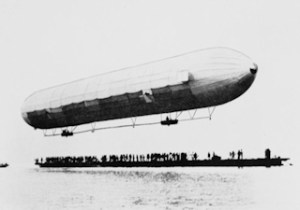
First Zeppelin ascent on July 2, 1900. Library of Congress Wikimedia

First Zeppelin ascent on July 2, 1900. Library of Congress Wikimedia

German bookseller Friedrich Hermann Wölfert (1850- June 1897) produced a successful airship using a Daimler petrol engine in 1888 and in the following decade, Croatian-Hungarian Dr David Schwarz (1850- January 1897) built the first rigid airship. It was filled with gas contained within a rigid aluminium envelope that was riveted on to a metal framework. The airship, based on this design, was then successfully developed and commercialised by German Count Ferdinand von Zeppelin (1838-1917).

During the 19th century the British Army used balloons and later airships in the First Boer War (1880-1881). Developed by, amongst others, the Royal Engineers, in 1890 they were granted a full Balloon Section with its own Balloon Factory on Farnborough Common, Hampshire. Aviators such as Edwin Alliott Verdon Roe (1877-1958), who later in 1910 founded the Avro Company in Manchester, undertook experiments with the airships there. Also, aviators Samuel Franklin Cody (1867-1913) and John William Dunne (1875-1949) made significant contributions, particularly in engine design. However, the War Office only saw the potential of air flight in reconnaissance and was horrified when, in 1909, Dunne reported that an airship could travel at 40miles an hour! The War Office, having spent £2,500 on the research, immediately cancelled the funding. Of note, by this time Germany had spent £400,000 on aeronautical research!
Orville & Wilbur Wright followed by Horace Short. The Short brothers won the right to build Wright planes. Eveline Larder

Orville & Wilbur Wright followed by Horace Short. The Short brothers won the right to build Wright planes. Eveline Larder

On 17 December 1903 near Kitty Hawk, South Carolina in the US, bicycle manufacturers Wilbur (1867-1912) and Orville (1871-1948) Wright, had made the first controlled and sustained powered flights, landing on ground at the same level as the take-off point. By 1905 they had built a flying machine with controls that made it completely manoeuvrable. The US Army showed no interest in the achievement so in 1906, when an American patent was granted to the Wright brothers, they entered agreements with firms in Britain, Germany and France. The first British aeroplane manufacturing company to gain the right to build their aeroplanes was the Short Brothers at Mussell (Muswell) Manor, at Eastchurch on the Isle of Sheppey, north Kent. This was owned and run by Horace Short (1872-1917) and his brother Oswald (1883-1969) and opened in February 1909.

The German government continued to recognise the possibilities of aeronautics and saw the future potential of airships. The British government’s view, on the other hand, can be best stated by Richard Burdon Haldane (1856-1928), the Secretary of State for War (1905-1912). In a letter dated 4 March 1907 he wrote, ‘the War Office has not the least intention of entering any agreement as to flying machines with anyone, or giving the slightest guarantee.’ The French government, however, did see the feasibilities particularly in aeroplanes and encouraged private funding. For instance both Blériot and Anglo-French aviator, Henri Farman (1874-1958) who built a biplane more stable than the Wright aeroplane, were actively encouraged by the French government.
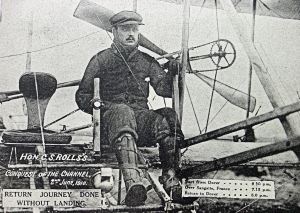
Charles Rolls postcard, commemorating his two way non-stop flight across the Channel Thursday 2 June 1910. Dover Library

Charles Rolls postcard, commemorating his two way non-stop flight across the Channel Thursday 2 June 1910. Dover Library

In the spring of 1910, wealthy Charles Rolls (1877-1910) saw Swingate Down plateau as having potential for an airfield and persuaded the War Office to rent him the site when it was not required for military purposes. On acquiring the Swingate Aerodrome, as he renamed the area, Rolls had an ‘aeroplane garage’, or hangar as they are now called, erected. On 20 May 1910 a Wright Flyer machine, belonging to Rolls, arrived at Dover and at 18.30hrs on Thursday 2 June he took off from Swingate Aerodrome. Rolls passed over Sangatte, France, at 19.15hrs and after re-crossing the Channel he circled around the Castle in triumph. Rolls landed at Swingate aerodrome at 20.00hrs having made the first two way Channel crossing in an aeroplane. Over 3,000 people witnessed the event, after which Rolls was carried through the town shoulder high. A month later, on 12 July 1910, Charles Rolls lost his life due to a controlling wire breaking that had been added to his Wright Flyer.

The main military purpose of Swingate Downs was for training the volunteers that made up the different brigades of the Territorial Army (TAs). The Royal Engineers, based at the Castle, also used the site to try out equipment, one of which was being overseen by Major John Nassau Chambers Kennedy (1865-1915). This equipment was associated with a wireless station he had set up for military use and was housed in a decommissioned battery in the Castle grounds. As a young Captain, Kennedy had witnessed Marconi’s experiments in wireless communication on Salisbury Plain. He saw the potential of wireless communication for the armed services and subsequently assisted Marconi with many experiments and demonstrations in that sphere (see Swingate Part 1).

In the armed services, flights such as that undertaken by Rolls inspired a number of officers to learn to fly and concurrently, private aircraft producing factories were opening. One such factory was the Bristol Tramways Company owned by George White (1854-1916) – later knighted – together with his brother Samuel (c1862-1928). As a subsidiary, they founded the British and Colonial Aeroplane Company at Filton in Bristol in 1910 to build aircraft using improved existing aeroplane designs. They quickly gained the reputation of being the largest aeroplane manufacturer in Europe! As successful businessmen they also saw the need for flying schools with their own airfields, and opened their first at Brooklands near Weybridge in Surrey followed by a second one at Larkhill, Salisbury Plain, Wiltshire in July 1910.
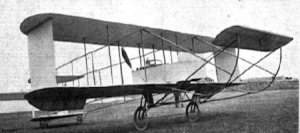
Maurice Farman Biplane. Flight International March 1910. Wikimedia

Maurice Farman Biplane. Flight International March 1910. Wikimedia

On 31 September, two months after the Larkhill airfield opened, aviator and West End actor Robert Loraine (1876-1935) – who first named the aircraft control stick a ‘joystick‘ – was asked to test an upgraded Farman biplane with a special adaptation. The adaptation was a basic Marconi wireless transmitter weighing a mere (for those days) 14lbs. The machine was attached to the passenger seat with monopole antenna wires stretched along the breadth and length of the biplane. The Morse key for tapping out messages was fixed next to the pilot’s left hand and Loraine, who had used terrestrial Marconi transmitters, was asked to send a predetermined message while flying over Stonehenge, on Salisbury Plain, approximately 2 miles away. This he did with his left hand while controlling the aeroplane with his right.
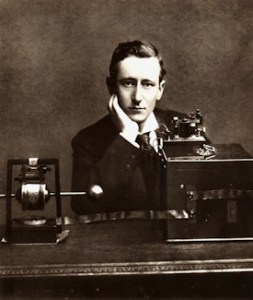
Guglielmo Marconi publicity photograph in front of his early radio apparatus. Smithsonian Institute Libraries Wikimedia

Guglielmo Marconi publicity photograph in front of his early radio apparatus. Smithsonian Institute Libraries Wikimedia

In a hangar at Larkhill surrounding the Marconi receiver was Captain Kennedy and Marconi engineers Harry Melville Dowsett (1879- January 1964), Charles Samuel Franklin (1879- December 1964) and a number of dignitaries. These were headed by the Home Secretary (1910-1911), Winston Churchill (1874-1965); Field Marshal William Gustavus Nicholson, 1st Baron Nicholson, (1845-1918) the Chief of the Imperial General Staff (1908-1912); Field Marshal Frederick Sleigh Roberts, 1st Earl Roberts (1832-1914) and former Commander in Chief (1901-1904); along with Sir John French (1852-1925) later the Chief of the Imperial General Staff (1912-1914) and then Commander-in-Chief of the British Expeditionary Force (1914-1915). Also in the hangar were army and navy officers and one of the army officers was a Major Herbert Musgrave (1876-1918). Loraine did as he was bid and the dignitaries were delighted when the message ‘enemy in sight‘ was received on the apparatus in the hangar. However, the dignitaries generally expressed reservations about the use of aeroplanes for defence purposes.

At the time the Army’s Balloon Section of the Royal Engineers had a couple of airships, five officers who could fly aeroplanes – one of which was Musgrave – and 40 men. Germany had six airships, twenty officers and 465 men. The US government had one airship, one aeroplane, three officers and 10 men but within a year the Aeronautical Division, Signal Corps had been set up and the 1st Aero Squadron had 29 factory-built aircraft. While France had 8 airships, 10 aeroplanes, 24 officers and 432 men. Albeit, within the British armed services a number of officers had taken private flying lessons and Musgrave proposed the formation of an aviation division. This was initially rejected so above the airfield adjacent to the Balloon Factory, they practised manoeuvres using private aircraft. Then on 12 May 1911, at Hendon aerodrome (1908-1968) at Colindale, seven miles north west of Charing Cross, London. Musgrave and his colleagues put on an impressive display. In 1912 the Army Balloon Factory on Farnborough Common was renamed the Royal Aircraft Factory (later renamed the Royal Aircraft Establishment) and employed it’s first aeroplane designer, Geoffrey de Havilland (1882-1965). Musgrave became one of the test pilots.

With the prospect of a possible War against Germany, in November 1911, the Committee of Imperial Defence set up a sub-committee to examine the question of military aviation. They reported on 28 February 1912 and recommended the establishment of a flying corps made up of a military and naval wing with a central flying school and an aircraft factory. The recommendations were accepted and on 26 March 1912 George V (1910-1936) gave his approval to the title ‘Royal Flying Corps’ that received Royal Assent on 13 April. The year before, in 1911, the Army’s Balloon Section of the Royal Engineers had been increased to two companies. Number 1 Balloon Section for balloons and airships and Number 2 for aeroplanes and together they formed the basis of the Military Wing of the Royal Flying Corps founded on 13 May 1912.
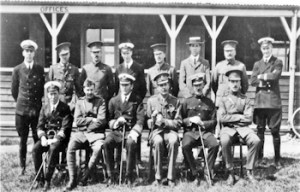
RFC Central Flying School staff in January 1913 at Upavon. The commandant, Capt Godfrey Paine, is 3rd from left on the front row. Major Hugh Trenchard, Assistant Commandant, is immediately to his right. Air Publication 3003. HMSO Wikimedia

RFC Central Flying School staff in January 1913 at Upavon. The commandant, Capt Godfrey Paine, is 3rd from left on the front row. Major Hugh Trenchard, Assistant Commandant, is immediately to his right. Air Publication 3003. HMSO Wikimedia

From the outset the Military Wing consisted of three squadrons each commanded by a major but it was not until 1914 the Naval Wing organised itself into squadrons. Nonetheless, the Central Flying School was established at Upavon, Wiltshire and at the time a Major Hugh R Trenchard (1873-1956), was keen to be involved. To do so, he was required to learn to fly but due to his age, Trenchard only had ten days in which to gain his aviator’s licence before he would be 40years of age and too old!  Trenchard signed in at Thomas (Tommy) Octave Murdoch Sopwith’s (1888-1989) flying school at Brooklands and successfully gained his wings in time!  Trenchard, however, was not a particularly good pilot but his main ability was as an organiser and when he applied that was the skill he hoped to put to good use. He was employed at the Central Flying School but the first Commandant, Sir Godfrey Marshall Paine, (1871-1932) appointed him as an instructor! Luckily for the RFC, Trenchard was shortly after promoted to Assistant Commandant and he ensured that the trainee pilots were well-versed in map reading, signalling and engine mechanics. In December 1912, 32 officers graduated and by that time the Royal Flying Corps had 12 manned balloons and 36 aeroplanes. Their motto, devised by Lieutenant J.S Yule was Per ardua ad astra -Through adversity to the stars.

The establishment of the new Royal Flying Corps (RFC) came in for criticism as flying was seen as a dangerous pastime for rich gentlemen and therefore a waste of public money. This accounted for the reluctance to provide any funding and the disapproval was levelled at Colonel John Edward Bernard Seely, 1st Baron Mottistone (1868-1947) Secretary of State for War (1912-1914). In the House of Commons in May 1912, Seely responded by telling members that the RFC had five aeroplanes that could fly 70 miles per hour and that there were 15 more on order. ‘The Corps also had 26 trained military pilots,’ he added, ‘with another 36 expected to graduate in December by which time the number of aeroplanes would have increased significantly.’ Winston Churchill, at that time was the First Lord of the Admiralty (1911-1915), and expressed his concern about Germany building up her military strength. He went on to say that Germany had five rigid airships, one military, one naval, two civilian and one experimental. He went on to say that opinions differed as which were better, airships or aeroplanes and the subject was still receiving the attention of the Admiralty. Nonetheless, ‘the Navy would continue to endorse the growth of aeronautics as part of the country’s defence.‘ Although Dover’s Member of Parliament, George Wyndham, (1863-1913) agreed with the two Ministers, he made it clear that in his opinion, more money should be spent on increasing the number of aircraft and pilots.
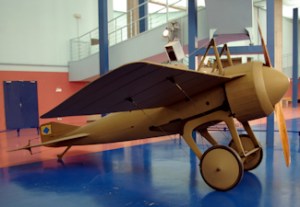
Deperdussin Monocoque exhibited at the Air & Space Museum at Le Bourget, France.

Deperdussin Monocoque exhibited at the Air & Space Museum at Le Bourget, France.

At Larkhill in August 1912, before a military team headed by Brigadier-General Sir David Henderson (1862-1921), a trial of different aircraft took place for the RFC. A total of 30 machines, based on eight different designs, were assessed and each plane had an RFC’s trained military pilot on board. Two of the biplanes were based on the Blériot Experimental or BE series of monoplanes built by the Royal Aircraft Factory – the forerunner of which was the Blériot No XI that Blériot had used to make his historic flight. At the trial, these were flown by Edmond Perreyon (c1882-1913). There were two built by René Hanriot (1867-1925) one of which was flown by Major Sydney Vincent Sippe (1889-1968) and the other by Juan Bielovucic (1889-1949). There was also a Maurice Farman biplane flown by Pierre Verrier and a French Deperdussin Monocoque flown by Maurice Prévost, (1887-1952), a Cody Riplane flown by Sam Cody and finally a Coventry Ordnance aeroplane flown by Tommy Sopwith. The challenge was to assemble the planes and then to carry a load ( a passenger) of 350lb for 3hours, and fuel and oil to last 4hours 30minutes, maintaining an altitude of 4,500feet for one hour the first 1,500feet obtained at 200feet a minute although 300feet a minute was desirable.

The weather was stormy on the day of the test, and the first part – preparation of the aeroplane, showed a huge variation in the length of time taken, from 14minutes 30seconds to 116minutes 55 seconds! Except for the Coventry Ordnance and one of Hanriot’s aeroplanes, the other aeroplanes completed the test successfully. The Hanriot’s number 1 flown by Bielouvucic retired, while the Coventry Ordnance was forced to land after 25minutes. The passenger in the latter was Major Henry Robert Moore Brooke-Popham (1878-1953) – later knighted and the Air Chief Marshal of the Royal Air Force – who reported that a valve spring regulating the petrol supply had broken. Sopwith repaired the faulty valve spring and again set off, managing to fly the furthest distance. Not only were the military and parliament interested in the outcome of the trials but also Prince Edward (1894-1972), the Prince of Wales and the future Edward VIII (1936), who was to actively support the RFC. That year, the estimate for government spending on air defence was £85,000.

The RFC had their first air accident on 5 July 1912 near Stonehenge on Salisbury Plain. Captain Eustace Broke Loraine (1879-1912) and his observer, Staff Sergeant Richard Hubert Victor Wilson (1883-1912) were flying from Larkhill. Both were killed and this had a negative effect on the moral of the other aviators. Later that day an order was issued stating that ‘Flying will continue this evening as usual’, setting a tradition that still holds today. A month later Lieutenant Wilfrid Parke (1889-1912), who had just broken a world endurance record in an Avro G cabin biplane was flying the same plane when he was observed to recover from an accidental spin some 700 feet above ground level at Larkhill. Sadly, on 11 December 1912 Parke was killed when his Handley Page monoplane, in which he was flying from Hendon to Oxford crashed.
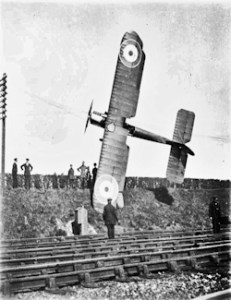
Royal Aircraft Factory BE.2 biplane suspended from telegraph wires beside a railway. Imperial War Museum

Royal Aircraft Factory BE.2 biplane suspended from telegraph wires beside a railway. Imperial War Museum

In September 1912, two experienced aviators, Captain Patrick Hamilton (1882-1912) and Athole Wyness-Stuart (1882-1912), who were undertaking the Central Flying School course and flying a Deperdussin, were killed at Graveley near Hitchin, Hertfordshire. The main witness, Walter Charles Brett (1865-1942) of the George and Dragon public house, Graveley, said that the aeroplane was high up but wobbling about then it appeared to dip down, which was followed by a loud retort, as from a gun, and the aeroplane seemed to collapse altogether and fell to the ground.

Expert opinion was provided by Major Brooke-Popham, who said that the primary cause of the accident was possibly due to a rod working the exhaust in the engine braking. This in turn would have probably broken the vertical strut and the wires that kept the wings in position. Fritz Kollhaven of Deperdussin agreed, adding that the plane would have then been impossible to steer. The following year, in May 1913, ground witnesses described the sound of a loud sharp crack when BE Biplane being flown by experienced Irish pilot, Lieutenant Desmond Arthur (1884–1913) of the Second Squadron, Military Wing, then at about 2,000feet. The weather was favourable for flying but following the loud noise one of the wings collapsed and it plunged to the ground landing besides a railway track.

On investigating these and other similar accidents, it was found that lack of maintenance was a principle cause. Indeed, it was cited that because of problems and breakdowns it had taken Lieutenant Arthur 5 days to fly from Farnborough to Montrose, where his accident had happened. In parliament it was agreed that a Maintenance Division of the RFC should be set up immediately. That the Division should be made up of officers, non-commissioned officers and men, all of whom were skilled mechanics and had received full flying instruction and training in the construction of the aircraft and maintenance. The Division was to be divided into sections, each with responsibility for specific aircraft and that each of these units were to be brigaded under the command of a brigade aeroplane officer and each with its own repair shop. This eventually came about and also included ground maintenance crews comprised of mechanics, fitters, metalsmiths and armourers as well as an equipment officer and a transport officer. Each establishment also had a car, five light tenders, seven heavy tenders, two repair lorries, eight motorcycles and eight trailers.

DFW Mars mono and biplanes published in Aeroplane 19, 08.11.1913. The top photograph is the monoplane flown by Lieutenant von Hiddensson at the Strasbourg aeroplane show in May 1913. Wikimedia

DFW Mars mono and biplanes published in Aeroplane 19, 08.11.1913. The top photograph is the monoplane flown by Lieutenant von Hiddensson at the Strasbourg aeroplane show in May 1913. Wikimedia

In Germany, the interest in aeronautics and the possible usage, both civilian and particularly military continued to grow. This was fuelled by the assumption that the country was vulnerable to invasion on two fronts – France in the west and from the east, Russia. As a defensive measure, in 1905 the German Army Chief of Staff, Alfred von Schlieffen (1833-1913), had drawn up a plan based on at first, taking the offensive against France, quickly beating her and forcing her surrender before Russia had a chance to mobilise her armed forces. To fulfill the Schlieffen plan, as it was called, Germany began building up her military strength including aeronautics.

For this reason the German Military were interested in researching and developing aeroplanes and they held public competitions to assess their versatility. The shows were fully supported by the German Emperor, Kaiser Wilhelm II (1888-1918), who organised the provision of trophies and prize money. Typically, in May 1913, at the Strasbourg aeroplane show, three prizes were awarded. The first was for the best all round performance, the second for the best reconnaissance flight and finally a prize for reliability. On that particular occasion the first prize went to Lieutenant Canter flying a German War Office Rumpler-Taube monoplane. This was the first German military aeroplane to be mass-produced and had a 72 horsepower Daimler engine. Canter’s companion on the flight was Lieutenant Bohmer and he received the prize for the best reconnaissance reports. The third prize, the Prince Albert William Henry of Prussia (1862-1929) Trophy for reliability, was awarded to Lieutenant von Hiddensson flying a Deutsche Flugzeug-Werke (DFW), Mars monoplane. Both the DFW Mars monoplanes and biplanes were consistently found to be reliable and were purchased by both the German military and the British Admiralty.
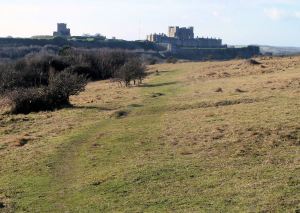
Swingate Downs and the site of the new Dover (St Margaret's) aerodrome. Looking west towards the Castle on the left is St Mary-in-Castro church and Northfall Meadow. Alan Sencicle

Swingate Downs and the site of the new Dover (St Margaret’s) aerodrome. Looking west towards the Castle on the left is St Mary-in-Castro church and Northfall Meadow. Alan Sencicle

At Swingate, due to the mounting demands of a possible war, the training of ground forces became paramount. Because of the increasing number of military exercises the site ceased to be used as an aerodrome. Then on 14 October 1912, a 450-foot long Zeppelin paid a clandestine visit to north Kent. Shortly afterwards the War Office made £45.000 available to extend the Swingate site and to build a flying depot. The Commander was to be Major Hugh Caswall Tremenheere Dowding (1882-1970) and the new airfield, named Dover (St Margaret’s) aerodrome, was formally established in June 1913 but it was generally known as the Swingate airfield or aerodrome.
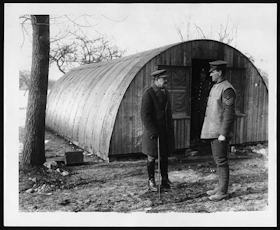
Nissen hut in France c1918. National Library of Scotland Wikimedia

Nissen hut in France c1918. National Library of Scotland Wikimedia

Eventually the aerodrome covered 219acres with three large hangars constructed of brick 180feetx100feet and twelve portable timber and canvas Bessonneau hangars. Besides the hangars, the site had administrative and recreational buildings, workshops, motorised transport garages and a coal yard. During October and November 1913, a portion of No 5 Squadron of the Royal Flying Corps with two Maurice Farman biplanes arrived with the pilots, and ground crew all of whom were billeted in the former Langdon Prison. With the possibility of more men arriving it was decided to accommodate them in Nissen huts – prefabricated steel structures made of arcs of corrugated iron that could be assembled in a few hours. When completed, the aerodrome was categorised as First Class with No 5 Squadron based there.
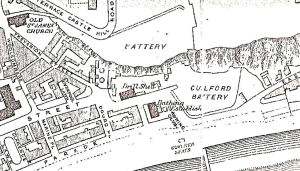
Mote Bulwark & Guilford battery - 1890

Mote Bulwark & Guilford battery – 1890

During this time, on Dover’s Seafront, the Admiralty requisitioned Guilford Battery and the surrounding grounds for the Royal Naval Seaplane Patrol. This was part of the Naval wing of the RFC that on 1 July 1914 separated and became the Royal Naval Air Service (RNAS). In 1913 new barracks and administrative buildings were erected at Fort Burgoyne to accommodate the expected influx of men. On Liverpool Street, near the Seafront, new Territorial headquarters, which included a riding school, was completed for use by the Dover Units of the Royal Field Artillery, Royal East Kent Mounted Rifles and the Cinque Ports Royal Engineers.
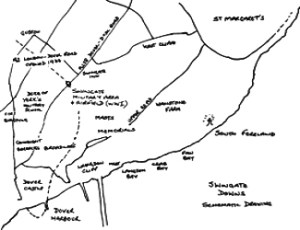
Swingate Down Map inc Military area. WWI Airfield, Masts, Memorials, Fort Burgoyne, South Foreland & St Margarets LS

Swingate Down Map inc Military area. WWI Airfield, Masts, Memorials, Fort Burgoyne, South Foreland & St Margarets LS

Besides Swingate, other RFC camps were established in the Dover area including at both Dover Castle and Fort Burgoyne, also on Western Heights in the Citadel, South Front and the Grand Shaft Barracks. Prior to redesignation, these camps were classed as Permanent Peace Stations and when the Duke of York’s school was requisitioned by the Depot of the Royal Fusiliers, it too received the same classification along with Langdon Prison, which was renamed Langdon Fort. Additionally, camps were set up at Archcliffe, the Danes on Long Hill, Broad Lees adjacent to Swingate on the Downs, Maxton and at the RNAS Guston Aerodrome on Northfall Meadow. There were also Rest Camps at the Oil Mills on Snargate Street, Victoria Park and at South Front Barracks on Western Heights.

In the last week of July 1914, the Dover Company of the Royal Engineers and the London Electrical Engineers arrived in the town to operate searchlights. The War Office, on 29 July, issued a notice to the RNAS that they were to confine themselves to home defence and the protection of vulnerable points from possible attack by enemy aircraft and airships. The RFC were told that they were to support the Army. On Saturday 1 August in accordance with the Schlieffen plan, Germany declared war on Russia, invaded Luxembourg and crossed the French frontier at several points. The First Lord of the Admiralty, Winston Churchill, issued the order to mobilise all the Royal Navy personnel and the warships still in Dover harbour to establish a war footing. Channel ferries were crossing Dover Strait at speed and out of schedules endeavouring to bring back to England as many people as possible before War commenced. In Dover crowds surrounded the information posts, such as Leney’s brewery office on Castle Street to find out the latest news.  They in turn were kept up to date by telephone from the Coastguard at Spioen Kop wireless telegraph station on Western Heights.
 Air Marshal Hugh Dowding c1935 Ministry of Information official photographer

Air Marshal Hugh Dowding c1935 Ministry of Information official photographer

On Sunday 2 August, Russia joined in the conflict on the side of Serbia and France was immediately embroiled. Germany declared war on France and proceeded to march through Belgium, thus violating the Treaty of London of 1839. This recognised and guaranteed the independence and neutrality of Belgium and confirmed the independence of the German-speaking part of Luxembourg. During the evening of the August Bank Holiday Monday, 3 August, some 60 aeroplanes arrived at Swingate aerodrome by which time it was confirmed that Major Dowding, who was head of Fighter Command in World War II (1939-1945) most notably in the Battle of Britain (1940), remained in charge at Swingate. Brigadier-General Henderson had been appointed Commander of the RFC. The Military Wing was commanded by Major Frederick Hugh Sykes (1877-1954), later Air Vice Marshal and knighted. The Naval Wing, or the Royal Naval Air Service as it had been renamed, was under Commander Charles Rumney Samson (1883-1931).

At 23.00hrs on Monday 3 August 1914, the Prime Minister (1908-1916) Herbert Henry Asquith (1852-1928), on behalf of Britain declared War on Germany in accordance with the Treaty of London. What was to begin was expected to be all over by Christmas but in reality it was an intensive and vicious war that was to last until 11 November 1918. Eventually it was fought on four fronts:
– Western Front, considered from the outset to be the decisive Front and Swingate was directly linked.
– Eastern Front, with Russia;
– Italian Front, in the Alps;
– Balkan Front, against the Ottoman Empire – a state that had controlled much of Southeast Europe, Western Asia and North Africa since 1299.

2. 1914 – It will all be over by Christmas

Dover Castle - Headquarters of Fortress Dover during WWI and WWII. AS

Dover Castle – Headquarters of Fortress Dover during WWI and WWII. AS

Immediately, in Dover, Mayor Edwin Farley (1864-1939) and the Dover Coast Defence Commander, Brigadier-General Fiennes Henry Crampton (1862-1938), signed notices declaring that the port and town of Dover were to be ‘Fortress Dover’. The headquarters would be at the Castle and Rear Admiral Horace Hood (1870-1916) had been appointed the Commander in Chief. The next day Brigadier-General Crampton was promoted to the General Officer Commanding (G.O.C.) Fortress Dover and notices were distributed that stated mobilisation had been ordered and the Defences of Dover had been placed on a war footing, both on land and at sea. The British Expeditionary Force (BEF), a significant number of Royal Navy ships and all of Britain’s military air fleet were concentrated at Dover.
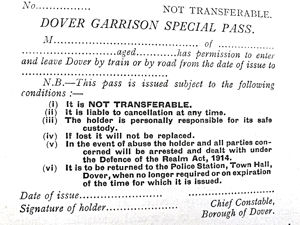
Defence of the Realm Act 1914 World War I Dover Garrison Pass.

Defence of the Realm Act 1914 World War I Dover Garrison Pass.

Entrance and exit to the town could only take place by the railways and the main roads to Folkestone (old A20), Deal (A258) and Canterbury (old A2). Each was well guarded and under the Defence of the Realm Act of 1914, a limited number of special ‘Dover Garrison’ passes, were necessary for all those who required to enter or leave the town. This applied to all military and naval personnel as well as the general public. The passes were issued by Dover’s Chief Police Constable, David Fox (1864-1924). The military authorities also had the power to arrest and search anyone approaching the harbour, the Castle, any defensive works and the Seafront. All local newspapers were subject to censorship by the military. On Tuesday 4 August air-raid drills commenced for all civilians and some shelters opened including the vaults of Leney’s Phoenix Brewery in Dolphin Lane. Posted in the window of the company’s offices in Castle Street were notices of all official rulings, news from the Front line and as the War progressed, the casualties who had connections with the town.
Earl Horatio Herbert Kitchener (1850-1916) Secretary of State for War 1914-1916. Evelyn Larder

Earl Horatio Herbert Kitchener (1850-1916) Secretary of State for War 1914-1916. Evelyn Larder

On 23 June Earl Horatio Herbert Kitchener (1850-1916) had arrived in Dover from Egypt and returned home to Broome Park, near Canterbury to celebrate his 64th birthday on 24 June. On the morning of 3 August he was at Dover and about to cross to Calais and return to Egypt, when he was called by telegram to take up the position of  Secretary of State for War (1914-1916). The following day, 4 August, Sir John French, from Ripple near Dover, was appointed the Commander-in-Chief of the British Expeditionary Force (1914-1915) that was to go to the Western Front.
Sir John French (1852-1925) Commander-in-Chief of the British Expeditionary Force (1914-1915). Cossira

Sir John French (1852-1925) Commander-in-Chief of the British Expeditionary Force (1914-1915). Cossira

In an attempt to drive the German Army from the occupied territories on the Western Front, the Allies had agreed to mobilise a coalition force comprising of more than twenty nations. During August, to try and ensure that none would attempt to negotiate a separate peace with the Central Powers (Germany and her allies), on 4 September, Britain, France and Russia signed the Declaration of London. To assist their Allies, Britain had agreed to help meet their financial obligations of goods purchased from the British Empire and the United States. The then Chancellor of the Exchequer (1908-1915), David Lloyd George (1863-1945) was well aware that both the French and the Russian gold reserves were far greater than those held by the Bank of England but it was generally assumed that the War would be over by Christmas. At sea, it was agreed that the Royal Navy would provide the greatest number of ships and on the Western Front, the French and British Armies were to provide most of the soldiers and equipment.

Although France was way ahead of other countries in aeroplane production, including the United States, when War was declared it was evident that the Germans had realised the value of aviation. Their air force was made up of the military Luftstreitkräfte and the naval Marine-Fliegerabteilung, with 232 aeroplanes between them. The aeroplanes were flown by highly trained pilots who were expected to play an active part in the German fighting force. Further, the German senior personnel believed in the potential of both the aeroplanes and the pilots. Thus a team of active aviation researchers, highly trained mechanics and a number of aircraft factories supported their air forces.

By way of contrast, the British RFC and the RNAS had 272 aeroplanes between them but neither the Army or the Admiralty had very little confidence in their potential. Not only were the aeroplanes not considered capable of participating in aerial combat, the pilots were only allowed to carry revolvers or automatic pistols for personal defence! However, officers such as Trenchard, Dowding, Kennedy and Musgrave made their views felt and by the summer of 1914 the British military air fleet consisted of five squadrons, made up of a large number of privately owned aeroplanes – borrowed or belonging to the pilots:
RFC No 1 Squadron – an observation balloon squadron, made up of airships that was shortly after transferred to the RNAS.
RFC Nos. 2,3,4 and 5 aeroplane squadrons primarily used for reconnaissance
At the outbreak of War, RFC Nos. 2,3,4 and 5 were sent to Swingate aerodrome.
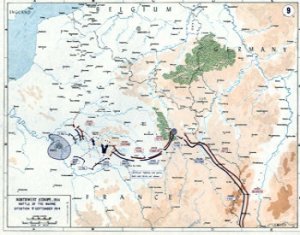
WWI - Belgium, France and Germany showing the situation at the Battle of Marne 5-9 September 1914. Westpoint Military Academy Museum

WWI – Belgium, France and Germany showing the situation at the Battle of Marne 5-9 September 1914. Westpoint Military Academy Museum

On 2 August the Germans had demanded the unobstructed passage through Belgium in order to achieve their objective of advancing south to Paris via Verdun-sur-Meuse, and Marne in north-eastern France. The following evening, 3 August, the Belgians took measures to obstruct the German advance at Liège on the Meuse River and on the morning of 4 August, forty-four German divisions invaded Belgium. Their objective was to attack the rear of the French Army massed in the north-east of France, mostly in Lorraine, with the first offensive being the Battle of Mulhouse, south of Lorraine (7-10 August). This was followed by the Battle of Haelen (12 August) in Belgium and although a Belgium victory, the Germans managed to capture Namur, Liège and Antwerp. Between 14 and 25 August the French took a strong offensive stance in the Battle of Lorraine, with the objective of pushing the Germans back. The German priority, on the other hand, was to continue with the Schlieffen plan in order to force France to surrender attacking the French at the Battle of Ardennes, between Namur to the north, Meuse in the east, Marne in the south and Aisne in the west. This took place between 21 and 23 August and at the same time, they engaged France and Belgium at the Battle of Charleroi between 21 and 23 August.

BE 2 (early version) Royal Aircraft Factory two-seat general purpose biplane of the No. 2 Squadron, RFC Montrose. Wikimedia

BE 2 (early version) Royal Aircraft Factory two-seat general purpose biplane of the No. 2 Squadron, RFC Montrose. Wikimedia

The BEF under the command of Sir John French had landed in France on 8 August with the remit to stop the German advance on Paris. Three days later Brigadier-General Sir David Henderson, who had been appointed to command the RFC in the field with his second in command Lieutenant-Colonel Frederick H Sykes (1877-1954) from the RFC headquarters, left Farnborough, crossing the Channel by sea, arriving on Thursday 13 August in Amiens, France. That day, 2-5 squadrons in 56 aeroplanes left Swingate also for Amiens, at intervals of about one minute. Not all made it, and from Amiens those that did flew on to Maubeuge, close to the Belgian border, northern France. The first to arrive was a Royal Aircraft Factory BE 2a – a two-bay tractor design biplane flown by Lieutenant Hubert Dunsterville Harvey-Kelly (1891-1917), who had taken off at 06.25hours. An aircraft constructed with a tractor configuration has the engine mounted with the airscrew in front so that the aircraft is ‘pulled’ through the air, as opposed to the pusher configuration, in which the airscrew is behind and propels the aircraft forward.

No. 2 Squadron, led by Major Charles James Burke (1882-1918) from Limerick, Ireland, and No. 3 Squadron led by Flight Commander Lionel Evelyn Oswald Charlton (1879-1958) flew Bleriot monoplanes and Henri Farman biplanes. No. 4 Squadron flew Farmans, B.E.2cs and Avro 504s – a two-bay all-wooden biplane with a square-section fuselage. Major John Maitland Salmond (1881-1968) who eventually became the Chief of the Air Staff (1930-1933) led the squadron. Number 5 (Army Co-operation) Squadron flew BE.2a aeroplanes, some of which had been produced by Vickers the previous year while the British and Colonial Aeroplane Co. made others. The British engineering firm, Vickers, was founded in 1828 and Vickers Ltd (Aviation Department) was formed in 1911. Two of the pilots were Robert Raymond Smith-Barry (1886-1949) and Louis Arbon Strange (1891-1966), both distinguished aviators with Smith-Barry developing flying instruction methods and Strange successfully introducing wartime aeroplane adaptations.

For the duration of the War most of the aeroplanes were supplied to the RFC by 8 private firms who built the aeroplanes to either a government or private approved design. However, the main provider of machines was the Royal Aircraft Factory at Farnborough. The supply of engines was a major problem, eventually eased by experimentation, innovation and replication of foreign produced engines. At the outbreak of War the aero-engine industry in Britain was almost non-existent. There was a lack of experience, skilled labour, suitable engineering works and general wherewithal. As the War progressed expertise increased such that, by the end of the War Britain possessed the largest number and most efficient aircraft engineers in the world – many had learnt their trade at Swingate.
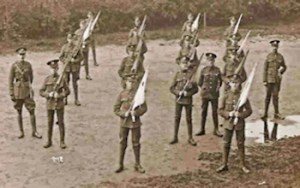
Using flags for visual signalling during WW1. Royal Signals Museum

Using flags for visual signalling during WW1. Royal Signals Museum

None of the airmen carried any sort of armaments, as they were not to be involved in combat but one aircraft per squadron was fitted with very crude wireless apparatus in order to transmit directions for artillery fire. This equipment consisted of a large and heavy spark set with its batteries mounted in the plane and a massive crystal receiver on the ground. On the ground, artillery batteries had transmitters consisting of a large, heavy unreliable spark set with cumbersome batteries and a massive crystal receiver. The apparatus used a long wave. The noise of the engine, wind, gunfire etc in the open cockpit drowned out the sound of any Morse Code transmissions sent from the ground. In order to instruct the pilots the direction to be observed, the men in the battery signalled using flags and/or laid strips of white cloth on the ground in prearranged patterns.

On arrival in France, a total of 63 aeroplanes, 105 officers, 155 men and 320 transport vehicles made up the RFC (British Expeditionary Force) air support contingent. On 22 August the BEF moved up to the Belgium town of Mons with the intention of supporting the French Fifth Army in two lines like a broad arrow with its tip at Mons. However, at the Battle of Charleroi the weight of the German offensive drove the French and Belgians back. From both cavalry and air reconnaissance reports, it was evident that the German forces were rapidly closing in on Mons.

Up to this point, the Germans had employed observation balloons to give them a tactical advantage during the engagements and it became obvious to the British high command that the mapping of enemy positions was of paramount importance if gunners were to be accurate, particularly when firing shells. For the Battle of Mons aircraft reconnaissance transmitted where to aim shells with reference to known features on the issued maps, for instance they would try to tap out, in Morse Code ‘100 yds est of chrch’ and if nearby the pilot would physically point in the appropriate direction. Initially the BEF managed to hold the Germans but the severely weakened French and Belgium armies left the BEF exposed. Although the BEF were eventually forced to abandon their positions it was recognised that the information provided by the pilots of the reconnaissance aircraft did help to avoid a catastrophe. The German superiority however, including the use of aeroplanes in combat, overcame the Allies resistance at the Battles of Le Cateau (25 August), Noyon (26 August) and St. Quentin (29–30 August).

On 3 September French reconnaissance aircraft pilots spotted General Alexander Heinrich Rudolph von Kluck’s (1846-1934) German 1 Army change direction. This contradicted intercepted radio messages between the German high commanders that stated instead of going south-west to Paris, the German Armies were to turn east in order to trap the Allies between Verdun-sur-Meuse and Paris. Field Marshal Karl Wilhelm Paul von Bülow (1846-1921) German 2 Army was to be the striking force while General von Kluck’s (1846-1934)’s Army was to protect the flank and the Allies were taking action accordingly.
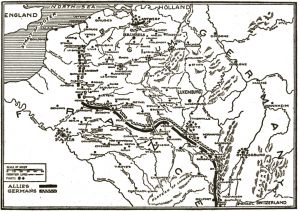
WWI Front Line following the Battle of Marne September 1914. Solid lines show Allies trench fronts, dotted the German. The Race to the Sea. Wikimedia

WWI Front Line following the Battle of Marne September 1914. Solid lines show Allies trench fronts, dotted the German. The Race to the Sea. Wikimedia

So far in the offensive, von Kluck’s Army had been the striking force and at that time, in keeping with the pre-war tradition of German field commanders’ independence, he was free to take decisive action contrary to that of the high command if needs necessitated. Von Kluck was aware that more British reinforcements had landed in France but was unaware as to how many and their combat capabilities. As his Army was moving east, he reasoned that potentially the British could be a danger to his tiring army, so he took independent decisive action and turned south-west towards Paris rather than going east towards Verdun. The Allies changed their action plan.

Battle of the Marne 5-12 September 1914. A shell has exploded at the road side while ammunition going to the Front is passing. Tom Robinson collection

Battle of the Marne 5-12 September 1914. A shell has exploded on the road side while ammunition going to the Front is passing. Tom Robinson collection

A counter-attack was launched by the French and the BEF along the Marne River that became known as the First Battle of Marne (5-12 September). This forced the German Army to retreat northwest to a defensive line along the Aisne River and resulted in the First Battle of Aisne (13-28 September). On 15 September an RFC reconnaissance pilot flying over the German lines took the first British Army aerial photograph of the conflict. In January 1915, the Experimental Photographic Section of the Royal Flying Corps was formed under the command of Lieutenant John Theodore Cuthbert Moore-Brabazon, later 1st Baron Brabazon of Tara (1884-1964). It consisted of two officers and three other ranks.

The Battle of Aisne was followed by what became known as The Race to the Sea as the Germans aimed for the Channel and the Allies fought to stop them. After a series of disorganised battles in which both sides suffered huge losses the Germans final attempt at a breakthrough was near the Belgium city of Ypres in late October 1914. The British Army, under the command of Sir John French remained at Ypres. To stem the advancing Germans and save the Channel Ports and Paris the First Battle of Flanders (19 October – 22 November 1914) and the 1st Battle of Ypres ensued (19 October-30 November). Lying on a forward spur of the low ridge that covers the town of Ypres, is the village of Gheluvelt and this was the last point retained in British hands from which the German line could be dominated. By noon on 31 October, the Queens, the Royal Scots Fusiliers, the Welsh and the Kings Royal Rifles regiments had been overwhelmed, while on the right the South Wales Borderers had been forced to retreat. This tantamount to the effective loss of Gheluvelt creating a serious gap in the British line through which the Germans could break through.
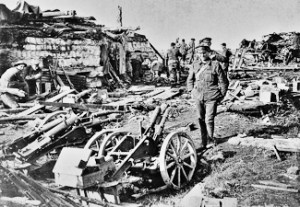
WWI German machine guns and trench mortars captured at Gheluvelt 31 October 1914 in front of a German pill-box. Wikimedia

WWI German machine guns and trench mortars captured at Gheluvelt 31 October 1914 in front of a German pill-box. Wikimedia

That afternoon the Second Battalion of the Worcestershire Regiment in Polygon Wood – afterwards known as Black Watch Corner – and under the command of Major Edward Barnard Hankey (1875-1959) and guided by Captain Augustus Francis Andrew Nicol Thorne (1885-1970) later became a General and was knighted, of the Grenadier Guards, attacked. It was raining heavily  and they were in full view of German guns. Out of 370 men, 187 were killed or wounded. They saved Gheluvelt and the foothold between Ypres and the French border. Of note, for the saving of Ypres, Sir John French was made the Earl of Ypres and when he was buried in the churchyard of St. Mary the Virgin, Ripple on 27 May 1925 the Second Battalion of the Worcester Regiment formed the funeral party.

While this was taking place the Belgium Army was involved in the Battle of the Yser (16-30 October) along a 20 mile stretch of the River Yser and Yperlee Canal between Nieupoort and Diksmuide in north-west Belgium. By this time the much reduced small Belgium Army was exhausted and the Germans were expecting to take over the country giving them direct access to the sea. However, even though the Belgians backs were against the proverbial wall they managed to stop the German advance by flooding a large expanse of the country. This was from the Belgium North Sea coast between Nieupoort and Westende to Diksmuide, which was occupied by the Germans. Thus they had blocked the German reaching the sea and invading Britain. Further, to the south, the German Army had successfully been split with a militarised zone of the German Front along the Belgium border with France that was totally separate from the rest of German occupied France.
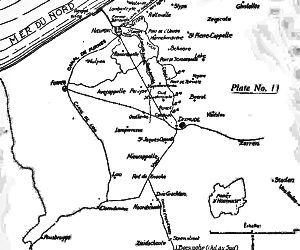
Map of the area of the Battle of the Yser. Belgium. Armée Volume 1 Subject World War, 1914-1918

Map of the area of the Battle of the Yser. Belgium. Armée Volume 1 Subject World War, 1914-1918

Because of  the outcome of battles that had been fought on Belgium territory since the outbreak of War, King Albert I of Belgium (1909-1934) was sceptical of offensive warfare. It had thus far proved costly and he felt that it was unlikely that decisive victory could be achieved by the Allies. This being so, the best that could be hoped for, he reasoned, was a mediated peace and Belgium’s best interests would be served by neutrality until such time that Germany would be forced to open negotiations. As for Britain and France and their Dependencies, they continued to fight and took up positions in a continuous line of trenches, barbed wire entanglements, blockhouses and underground shelters. 

Throughout all of these campaigns the RFC sustained heavy losses undertaking reconnaissance yet the airmen asked for authority to participate in combat! Taking little notice of reports that were coming from the Front that both the German and French, like the British aviators, were proving the capabilities of aeroplanes – something that was echoed by the troops on the ground, it was left to the media to make these views felt. The Times (14.09.1914 page 6) reported a conversation with a private in the Royal West Kent Regiment, who told of an air-battle between a German and a French aircraft. He said, ‘the Frenchman manoeuvred to get the upper position of the German and after about ten minutes or so the Frenchman got on top and blazed away with his revolver. He injured the German so much that he was forced to descend and when found he was quite dead.’
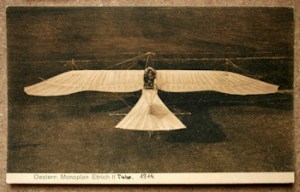
Etrich Taube II monoplane the first military aeroplane in the Austro-Hungarian Monarchy Army 1914. Takkk Wikimedia

Etrich Taube II monoplane the first military aeroplane in the Austro-Hungarian Monarchy Army 1914. Takkk Wikimedia

Nonetheless the British pilots were still refused to be allowed to participate in combat. But at Noyon, northern France, on 26 August 1914, Harvey-Kelly virtually tail-gated a German Taube II aeroplane while flying his BE 2a. As he was not allowed to use armaments, Harvey-Kelly used aggressive flying tactics and forced the German pilot to land. When later the British military attitudes towards the role of airmen changed, it was officially acknowledged that Harvey-Kelly was the first British pilot to bring down a German aeroplane! The Taube was originally designed by Igo Etrich (1879-1967) and was known for its unique wing form, which was copied from the seeds of the Peruvian cucumber (Alsomitra macrocarpa) and both the seeds and the plane were renowned for being able to fly long distances.

Back in Britain as part of the Fortress Dover defences, a series of trenches and redoubts were constructed on Swingate Downs. From aerial photographs held by the Imperial War Museum taken later in the War, it appears that there were three redoubts built at Swingate. Also, adjacent to the accommodation provided for the RNAS at Guston Aerodrome, more RFC accommodation huts were erected and the nearby Connaught Barracks had been built. Between Fort Burgoyne and the Duke of York’s school, tin huts (later called Tin Town) were erected as accommodation for the RNAS, whose role at this time was to provide reconnaissance reports for the defence of the Admiralty Harbour.
Plan of the original WWI Castle Wireless Telegraph Station. English Heritage poster

Plan of the original WWI Castle Wireless Telegraph Station. English Heritage poster

At the Castle, the military wireless station in a decommissioned battery set up by Major Kennedy was renamed the Port War Signalling Station and kitted out. Kennedy had adapted the original gun battery magazines to house a generator and electrical batteries to provide power for the wireless. He had also erected a tall aerial, close to the Castle wall which was stabilised by a series of large blocks spaced equidistant for the rings which held the stays connected to the mast. The station communicated with Admiralty House on Marine Parade, Royal Navy ships, the Admiralty signal station on Admiralty Pier and the Admiralty Spioen Kop signal station in the Citadel on Western Heights.
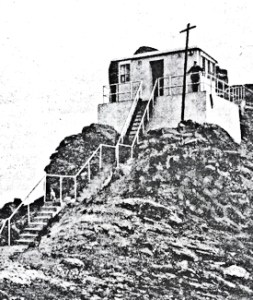
Typical Coastguard Concrete watchtower c1900-1960s. Alan Sencicle Collection

Typical Coastguard Concrete watchtower c1900-1960s. Alan Sencicle Collection

The Coastguard at this time came under the auspices of the Admiralty and in 1903 the office of Admiral Commanding Coastguard and Reserves had been established. Admiral Sir Arthur Murray Farquhar 1855-1937) was appointed and held the post until June 1915. The main Dover Coastguard Station, or to give its correct name Townsend Coastguard station, was at Aycliffe. Its antenna was on Shakespeare Cliff and the Coastguard was also in communication with Portland and Sheerness as well as both the local navy and military signal stations. On the east side of the Castle close to Swingate Down were Coastguard cottages not far from a typical coastguard watchtower on the top of cliffs close to the site of the present day coastguard station. Up to 1898, the watchtower was approached by a zigzag path, on Corn Hill at the eastern end of Langdon Hole but was demolished that year to make way for the Langdon Battery.

A second coastguard signal station occupied the top floor of the Clock Tower on the Seafront and that one was in contact with the Townsend Station and the Harbour signal station which occupied the same premises on Admiralty Pier as the Royal Navy signal station. Prior to World War I there were about 22 coastguard stations along the coast of East Kent between Margate and Hythe. Many were equipped with wireless signalling equipment, as the watchtower on Swingate Down was, as the War progressed. Retired naval and military personnel along with sea captains on two-year secondment awaiting ships, mainly staffed these stations and since 1857, the Coastguard had been formally embodied for ‘the Defence of the Coasts of the Realm, and the more ready manning of the Navy.’  This did not include rendering assistance to vessels in distress and saving the lives of persons on board.

In November 1914, the term Military Wing of the RFC was abolished and replaced by Administrative Wing but the favoured term for military aviators was just RFC. By that time there were six squadrons in France, divided into 2 ‘Wings’ of 3 squadrons each. The Wings were commanded by lieutenant-colonels. However, the role of pilots remained that of reconnaissance but a British squadron from Swingate and Dunkirk successfully bombarded the Belgium port of Zeebrugge on 23 November. An experimental branch of the Military Wing of the RFC had been formed back in March 1913 under Musgrave that included research in ballooning, kiting, photography, meteorology, bomb-dropping and wireless telegraphy. The latter, in which Major Kennedy was involved together with Captain Baron Trevenen James (1889-1915), led to the creation of the Headquarters Wireless Telegraphy Unit (HQ WTU) on 27 September 1914.

A crew member of a British SS 'Z' Class airship about to throw a bomb from rear cockpit of the gondola. Wikimedia Commons

A crew member of a British SS ‘Z’ Class airship about to throw a bomb from rear cockpit of the gondola. Wikimedia Commons

The growing pressure on communication, particularly by wireless, was beginning to be recognised and on 8 December 1914 at St. Omer, France the No. 9 (Wireless) Squadron, under the command of Musgrave and including Captain James, was part of the newly formed Bomber Squadron of the RFC. The bombs, at that time, were basically aerodynamically shaped hand grenades, weighing between 1 and 2 pounds with a percussion fuze in the nose that detonated on impact with a hard surface. They were carried in the cockpit of the plane or gondola, in the case of airships, and dropped by hand over the side.  No. 9 (Wireless) Squadron was made up of two flights and they were tasked with developing the use of radio for reconnaissance missions through artillery spotting on which bombs could be dropped.

In command of the 1st Wing of the Indian Corps was Major Trenchard, and although he could see what Musgrave was trying to achieve, as his commission was such that he had no influence with the senior military personnel. They were not impressed and the project was officially abandoned on 22 March 1915. However, the use of the wireless failed to impress the senior military personnel and was officially abandoned on 22 March 1915. The preference was for the Telegraph Troop, that had been formed before the War, to install telephone equipment and as a mounted unit to carry messages. The Troop also had dogs trained to carry messages between trenches and homing pigeons trained to carry messages back to the established Headquarters from the front line. Albeit, in England, an increasing number of amateur wireless operators that were impressed by the apparatus were also being arrested and heavily fined for having it without the consent of the Post Office.

On the Western Front, Field Marshal French and Marshal Joseph Jacques Césaire Joffre (1852-1931) were both of the opinion that only a war of attrition – wearing the Germans down over a prolonged period of conflict – would bring about their capitulation. Albeit, even jointly, both the British and French armies knew that they were against a formidable enemy. As the winter of 1914 set in, it was agreed that the British would launch an offensive to push the Germans further north. Field Marshal French planned to achieve this by making six simultaneous small-scale attacks in the Givenchy area of north west France, by men of the Indian Corps. These men had shown their mettle at Ypres where they had suffered heavy losses but carried on nonetheless.
Formation sign of the First Indian Corps in the First World War. Wikimedia

Formation sign of the First Indian Corps in the First World War. Wikimedia

Field Marshal Roberts, although retired, took a keen interest in the Indian troops that had arrived on the Western Front. He quickly made it known that they were inadequately attired for the cold European winter. It was also evident to Roberts, that their religious beliefs were not being taken account of with regards to the contents of their  food rations and had made a formal complaint to the High Command. These and other oversights he was personally dealing with through Trenchard, then on 14 November, Roberts died of pneumonia at St Omer, while visiting the Indian Corps. His body was taken to Ascot, Berkshire, by special train for a family funeral service on 18 November before being taken to London for a lying-in-state in Westminster Hall. Field Marshal Roberts was given a state funeral with representatives of the Indian Corps, including Trenchard, in attendance followed by burial in St. Paul’s Cathedral.

Warmer clothes eventually arrived for the Indian Corps, but footwear was totally inadequate for the quagmires of the trenches. Further, stocks of ammunitions were in short supply and so only forty rounds were issued with each gun and a limited number of hand grenades. In the early hours of Saturday 19 December the temperature was below freezing and it was very wet when the Indian Corps attacked, in what became known as the Battle of Givenchy (18-22 December). Although they came under heavy German machine gun fire the Corps were initially successful, taking two German lines.

The enemy then quickly regrouped and with the backing of aeroplanes, counter attacked. The minefields, the Indian Corps had traversed, together with gunfire and bombs the Germans dropped from their aeroplanes soon caused a significant number of injuries and deaths. Then the German infantry moved in and over 800 hundred men of the Corps were taken prisoners of war. Before the Battle started, many were already suffering from debilitating frostbite and trench foot – a painful circulatory disease caused by standing in cold water for long periods of time that resulted in blisters, open sores, fungal infections and eventually gangrene. Of the 800, many died before even reaching the prisoner of war camp. Shortly after Trenchard was promoted to Command the RFC in the Field (France) but the whole of the Indian episode was to have a major impact that was to influence his decision making as he continued to rise through the ranks.
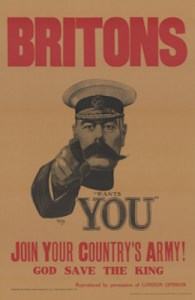
Alfred Leete WWI recruitment poster - Kitchener pointing and the caption ‘Britons Wants You'. Eybl, Plakatmuseum Wien. Wikimedia

Alfred Leete WWI recruitment poster – Kitchener pointing and the caption ‘Britons Wants You’. Eybl, Plakatmuseum Wien. Wikimedia

Due to the heavy losses but to avoid the need to introduce conscription, Kitchener launched a campaign designed by graphic artist, Alfred Leete (1882–1933) featuring a picture of Kitchener pointing at the reader with the caption ‘The Country Wants You.’ The campaign was successful with over one million men enlisting by January 1915. Nicknamed ‘Kitchener’s Army’ in December 1914, four battalions were formed in Dover: the 9th Buffs, the 10th East Surrey Regiment, and the 14th and 15th Battalions of the Royal Fusiliers. These battalions were attached to Western Heights, Fort Burgoyne and Swingate but were billeted with the civilian population. They remained in Dover for several months, mainly undertaking drafting administration and organising training, clothing, transport etc for other volunteers that were destined to be sent to join the Expeditionary Forces on the Continent. The defence of Kent was in the hands of the Kent Defence Corps – a fully equipped force of both the naval and military services with headquarters in Canterbury. Because of the influx of new recruits, the British Expeditionary Force, under the overall command of Sir John French, was split into two on 26 December 1914. The First Army was under Lieutenant-General Sir Douglas Haig (1861-1928) and the Second Army under General Sir Horace Lockwood Smith-Dorrien (1858-1930).
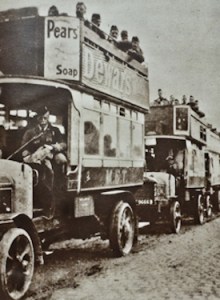
WWI - London Buses taking fresh troops from Calais to the Front Line 1914. Eveline Larder

WWI – London Buses taking fresh troops from Calais to the Front Line 1914. Eveline Larder

At their own request and where possible, new recruits were kept within the communities they had come from. On completion of training they were shipped from England as reinforcements, mainly via Dover – Calais, on commandeered cross-Channel ferries. These had been commandeered as transport ships at the beginning of the War and many were also used as hospital ships for the return journey. The recruits were then taken to the Front Line on buses. Using the same vehicles and ships, the injured members of the Indian Corps had been taken back to Calais then on to Dover. During December 1914, some 4,000 men were killed on the Western Front and many more were injured. Because of the atrocious conditions that the Indian Corps had faced prior to the Battle of Givenchy and the inadequacy of their armaments during the Battle, the British General Staff feared possible mutiny. It was suggested and agreed that the remaining members should be withdrawn from the Front Line over the following months but due to shortage of men, this did not happen. Instead, they did receive adequate clothing, footwear and appropriate food.
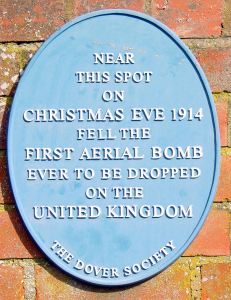
Dover Society Plaque marking the First Aerial Bomb to fall on Great Britain, landing in Taswell Street on 24 December 1914. A Sencicle

Dover Society Plaque marking the First Aerial Bomb to fall on Great Britain, landing in Taswell Street on 24 December 1914. A Sencicle

At 11.00hrs on Wednesday 24 December 1914 the first German aerial bombing raid on the United Kingdom took place. Lieutenant Alfred von Prondzynski flying a Taube II aircraft dropped a bomb aimed at Dover Castle. The bomb landed in a cabbage patch near Taswell Street. The blast broke an adjoining window and threw the St James Rectory gardener, James Banks, out of a tree but he was only slightly hurt. Nearby, there is a Dover Society plaque marking the event.

Two aeroplanes from Swingate and a seaplane from Mote Bulwark chased Prondzynski’s aircraft, the pilots of which were only armed with pistols that they were only allowed to use in self-defence. Lt. Von Prondzynski managed to evade them and when he returned to Germany he was given a hero’s welcome. In Dover fragments of the bomb were mounted on a shield and presented to George V. Another fragment was bought at auction for £20, by a man from Bootle on Merseyside and the money given to the Red Cross. The raid was one of the rare occurrences of an aeroplane attack on Britain in the early part of the War, the Germans preferring the less flimsy airships that could carry much larger bombs than the hand thrown bombs carried on aeroplanes.

The Germans had four types of airships, the Zeppelin, the Shütte-Lanz, the Parseval and the ‘M’ type military airship. The Zeppelin was recognised by its long stretched tubiform shape envelope with one, the L 33, brought down in Essex. It was described as 680feet long weighed 50 tons, had four gondolas, a total of 6 x 240 horsepower Mercédès engines and five propellers. It was estimated that she carried 2,000gallons of petrol and the envelope was filled with 2million cubic feet of gas. The L 33 was fitted with 60 bomb-droppers, had three control wheels in the captain’s cabin and a crew of 22 officers and men. It took about a year to build her and cost between £250,000 and £500,000.
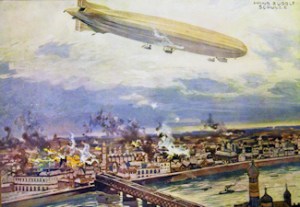
WWI German Schütte-Lanz Airship SL2 bombing Warsaw, Poland 1914. Hans Schulze. Library of Congress

WWI German Schütte-Lanz Airship SL2 bombing Warsaw, Poland 1914. Hans Schulze. Library of Congress

The Shütte-Lanz had a smaller fish-form body and carried behind them horizontal and vertical steering surfaces. They had five gondolas, three under the keel and the other two were higher, right and left of the keel. The Parseval had a cigar-form body and was more compact, carrying only one gondola from which a thick tube led to the airship body. The steering planes were four sided and the colour of the skin was yellow. Finally, the Military airships were a torpedo shape with the keel running the full length of the underside. The conning tower was at the front end of the keel with the two engine cabins further aft. The keel was built into the gas envelope to form one body and the hull was again yellow.

In the trenches, the distance between those of the Allies and those of the Germans was not far, indeed, they could hear the sound of each other’s voices and smell cooking. Both sides, by Christmas 1914, had suffered severe losses and the trenches were cold, wet and muddy. If a soldier put his head above the parapet, it was sure to be shot at and comrades lay dead in no-mans land between the two lines of opposing trenches. The senior officers, concerned that the men would become morose and lethargic, which would affect future offensives, made sure that they were kept busy and at the same time instilled harsh discipline. On the evening of 24 December, some German soldiers stationed near Neuve Chapelle erected Christmas trees, complete with candles and paper lanterns on the parapets of their trenches and started singing well known carols.

Stationed on the other side of no man’s land was the British 18th Brigade under the command of Brigadier-General Walter Norris Congreve (1862-1927) from Chatham, Kent. Of what happened that day, Congreve recounted in his report, saying that one of his men climbed over the parapet of his trench, into ‘no man’s land’ and joined in the singing of a carol. ‘Other men then joined him from his platoon and soon what seemed like a choir of men, both British and German, were singing carols.’ He went on to say that officers and men, from both sides, exchanged cigars and cigarettes. The Brigadier-General added that he was reluctant to personally witness the scene of the truce for fear he would be a prime target for German snipers! By Christmas Day, the Front Line truces had spread and this also enabled the men from both sides to remove from no man’s land their dead comrades and bury them.

3. 1915 – Inventions, Innovations and Developments

By New Year 1915, thought-through contingency plans were being put into operation and the British high command were beginning to realise that aeroplanes were a valuable asset. The Central Flying School at Upavon, Wiltshire had increased its intake to 40 students a time but there was an acute shortage of experienced pilot instructors as most had been sent overseas. Experienced pilots were brought back for R&R (rest and recuperation), during which time they trained new officers to fly. There were also only 4 government aerodromes – one of which was Swingate – so civilian aerodromes were pressed into service.
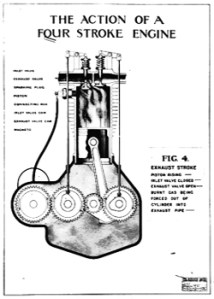
WWI Training slide - The Action of a Four Stroke Engine. From the Robert McKenzie fonds. Wikimedia

WWI Training slide – The Action of a Four Stroke Engine. From the Robert McKenzie fonds. Wikimedia

Other changes were afoot when an Army order, dated 16 January 1915, was issued abolishing the post of Officer commanding the RFC. It was specified that the ‘Wings,’ which had been created the previous November, were to consist of between two and four squadrons under a Wing Commander. Further, one flight in each squadron was to specialise in bombing as well as normal duties. An additional Wing Commander was also appointed to command the RFC depots, one of which was Swingate, and he was in charge of records, reserve aeroplane squadrons and additional training. Civilian voluntary recruits, without flying experience on enlistment were also sent to an RFC depot for training. Their training started by learning the ordinary duties of a soldier and then as air mechanics for the technical section of the RFC. The training was expected to take six months, followed by specialist training at an aerodrome that would be his base. Some out of the ranks were given the opportunity to train as pilots, observers or photographers as well as mechanics and all who trained at Swingate undertook a course in aerial gunnery at Lydd and on the practise range at Hythe. By May 1915 there were eleven government aerodromes and 235 officers were actually under instruction as pilots. Amongst the trainees were volunteers from Canada and South Africa who successfully completed training. By the end of 1915 approximately 800 Canadians and possibly twice the number of South Africans were RFC pilots, observers or ground crew. On gaining their wings, all the pilots and observers plus graduating ground crew were given 48 hours leave before being posted to the Front.

Meanwhile, enemy U-boats (submarines) were the scourge of Channel shipping. The first German U-boat appeared in the Channel around the middle of September 1914, sinking the Aboukir, Hogue and Cressy off Zeebrugge. Immediately after, the Admiralty gave notice that a minefield was to be laid in the eastern entrance to the English Channel, between the East Goodwin Lightship and Ostend. The Scout boat, Attentive, was attacked by a U-boat/submarine on 27 September, which led to the withdrawal of the Scouts from patrol duties. They were replaced by the Dover Patrol as part of Fortress Dover that was under the command of Vice Admiral Hood. The Dover Patrol consisted of naval destroyers, small submarines, drifters, requisitioned fishing vessels and the Royal Naval Seaplane Patrol based on Marine Parade. The Patrol’s main function was to stop U-boats passing down the Channel.

Map of Belgium. Wikimedia

Map of Belgium. Wikimedia

On 21 January 1915, German U-boats moved into newly erected submarine bases along the Channel, North Sea and into the Baltic. The main German base for the Channel was at Bruges, the capital of West Flanders in northwest Belgium. The city had outlets at Zeebrugge nearby on the North Sea coast of Belgium and further south at Ostend. Germany saw the behaviour of British sea defenders, such as the Grand Fleet, based in the Orkneys at Scapa Flow, and the Dover Patrol, as a blockade against their much-needed resources from America. This was confirmed in their minds on 11 February when RFC pilots based at Swingate and under the command of Wing Commander Samson of the RNAS, were ordered to attack these submarine bases. A squadron of 34 aeroplanes attacked the bases at Bruges and Ostend by the pilots dropping bombs over the side of their cockpits. On 16 February, 48 British aeroplanes bombarded Ostend, Middelkerke, Ghuistelles and Zeebrugge in Belgium. On 18 February 1915 Germany retaliated by launching their blockade of Great Britain, declaring that, ‘All the waters surrounding Great Britain and Ireland including the English Channel, are hereby declared to be a war zone. From 18 February onwards every enemy merchant vessel found within the war zone will be destroyed without warning to the crew and passengers.’
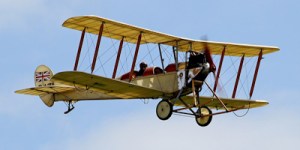
Royal Aircraft Factory B.E 2 aeroplane. Tony Hisgett, Birmingham, UK. Wikimedia

Royal Aircraft Factory BE 2 aeroplane. Tony Hisgett, Birmingham, UK. Wikimedia

During this time Swingate had become a major training establishment of pilots for the RFC and trainees with their tutors piloted the aeroplanes. The men and officers commandeered as tutors at Swingate all had practical experience in their various fields on the Western Front and initially they were none too happy about their new posts. Indeed, they quickly made it known that they had signed up to fight. Then Major Trenchard visited Swingate, was persuasive and before he left the tutors saw their new role in a positive light. He later noted that pilot tutors had said that if they were going to be allowed to participate in combat, they would prefer single seater planes to two-seaters, as they were more easily manoeuvrable. Two-seaters aeroplanes, they had said, were cumbersome. Further, the Swingate training aeroplanes were mainly BE.2a’s from the Western Front, damaged but sufficiently airworthy to be flown back to Swingate for repairs. These were carried out by the trainee mechanics on the base under the supervision of experienced tutors and it was also noted that the pilot tutors had asked to have armaments that could be used in combat.
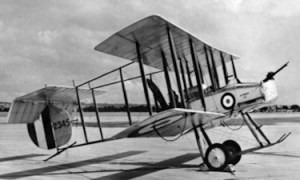
Vickers pusher F.B.5 aeroplane, nicknamed the Gunbus. World's first operational fighter aircraft. Wikimedia

Vickers pusher F.B.5 aeroplane, nicknamed the Gunbus. World’s first operational fighter aircraft. Wikimedia

At the time the Lewis machine gun was being used but due to its open bolt firing cycle it was almost impossible to synchronise. Some RNAS aircraft, notably the Bristol Scouts, had an unsynchronised fuselage-mounted Lewis gun positioned to fire directly through the propeller disk, but were not often not synchronised hence the possible reluctance of senior RNAS personnel for pilots to take part in aerial combat. Prior to the War, Vickers designer Archibald (Archie) Reith Low (1878-1969) had been experimenting with machine gun carrying aircraft. The prototype was eventually developed as the pusher type F.B.5 (Fighting Biplane 5), a two-seater rear engined plane that avoided the problem of firing through the two-bladed propeller as it was behind the pilot, facing backward, rather than at the front of the aircraft.

The F.B.5 was armed with a single drum-fed .303 inch Lewis gun mounted at the front cockpit, operated by the observer who could fire it directly forward without an obstructing propeller as well as being reloaded or cleared in flight. Specifically built for air-to-air combat, the tutors at Swingate were impressed, however they did report that due to the pusher design, the single 100 hp Gnome Monosoupape nine-cylinder rotary engine was not as efficient as in tractor designed craft. This was due to the tractor types having the airscrew in front pulling the aircraft through the air, whereas the pusher type resulted in more drag due to the struts and rigging necessary to carry the tail unit. The F.B.5, nicknamed the Gunbus, came off line in February 1915 becoming the world’s first operational fighter aircraft when in July 1915, No 11 Squadron, some leaving from Swingate, arrived in France fully equipped with these new combat planes.
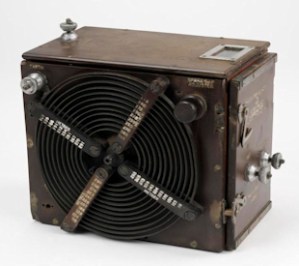
RFC British wireless transmitter c1915 - MWT marconiheritage.org  

RFC British wireless transmitter c1915 – MWT marconiheritage.org

The first major attack launched by the BEF on the Western Front in 1915, was on 10 March at the Battle of Neuve-Chapelle (10-13 March 1915). In the previous months a considerable number of fresh troops, crewed aircraft supported by mechanics with equipment plus special units of photographers with cameras designed for purpose had arrived. By this time the Marconi Wireless Telegraph Company had also developed their aircraft transmitter and Musgrave’s team devised ways of fitting it into the confined space of the aircraft’s cockpit. The small, compact equipment had a range of 10 to 12 miles and required about 40watts. As it was deemed almost impossible for the pilot to transmit and fly the plane at the same time, the transmitter was designated to be used in two seater aircraft by the observer. To ensure that the transmitting equipment was close at hand, the Morse key was strapped to the top of the observer’s leg between his hip and knee. The battery was on the floor between his feet. Even though the equipment was small, the wireless made it very difficult for the observer to change position, something he had to do if he was to maintain his observations.

Making the ground personnel aware that a message was being sent was usually done by the blasting of a Klaxon horn but the actual transmission of messages was fraught with difficulties. It was almost impossible to continue tuning while rapidly changing distances and altitudes. The actual transmission of messages was also fraught with difficulties particularly tuning in due to the rapidly changing distances and altitudes. The aerial wire was about 250feet long and was unwound by hand from a spool on the fuselage next to the observers’ position. This had to be done with great care, as the wire was deadly if it came loose and wrapped itself around the aeroplane’s control systems. Research had shown that it was possible to use much shorter aerial wire with the metal aeroplanes but most of the aeroplanes on the Front were wooden. There were two more problems, the first was making it clear to the ground personnel where exactly the targets were and second the receiving of messages owing to the noise of the engine.
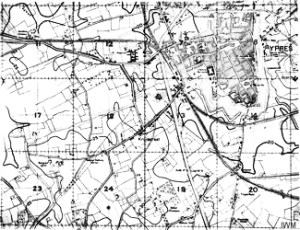
Musgrave & James style map of Ypres. British Army the Western Front, 1915-1918. Imperial War Museum

Musgrave & James style map of Ypres. British Army the Western Front, 1915-1918. Imperial War Museum

Musgrave was informed that he was to be transferred to take command of the 104th Royal Field Artillery Battery, but prior to leaving he devised a system with Captain James. He had devised a system using wireless telegraphy to help the artillery hit specific targets based on compass readings and the estimated distance from key locations shown on both the observer’s and the ground artillery commander’s identical maps. With James flying an aeroplane and Musgrave on the ground, they developed and simplified James innovation to enable the observation to be rapidly repeated. Using two identical maps, they divided the area under observation into Zones and each Zone was divided into squares with A, B, C etc. on the horizontal axis going from left to right and 1,2, 3 etc. on the vertical axis going from top to bottom. The observer after identifying the position of an enemy target on his map repeatedly transmitted in Morse Code messages such as A3 etc. to the artillery commander. This was inaugurated at the Battle of Neuve-Chapelle and this innovation quickly spread throughout the Allies lines.

Following Musgrave’s transfer, No. 9 (Wireless) Squadron was broken up but on 1 April the former researcher at the Marconi experimental establishment, Brooklands, Captain Charles E Prince, then serving with the Westmorland Cumberland Yeomanry, was sent to his old establishment. By this time it had been commandeered to become the RFC Wireless Training School and Trenchard told Prince that his remit was to develop ‘a system of air-to-air and air-to-ground radio telephony. A one-mile all-round range was a minimum, no adjustments to the transmitter when in operation, and only one tuning adjustment allowed on the receiver. Perfect speech quality with one hundred per cent reliability was demanded, and the maximum aerial length was 150 feet, to be replaced by a fixed aerial if possible.’
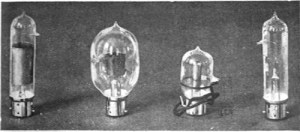
Thermionic Valves developed by John A Fleming. First used by No 9 (Wireless) Squadron on 9 May at the Battle of Aubers Ridge to receive, amplify and transmit clear radio signals. John A Fleming 1919

Thermionic Valves developed by John A Fleming. First used by No 9 (Wireless) Squadron on 9 May at the Battle of Aubers Ridge to receive, amplify and transmit clear radio signals. John A Fleming 1919

Prince’s commanding officer at Brooklands was Major Hugh Dowding, the first Commandant of Swingate aerodrome, and together the two men increased the size of the training school. There, Prince distinguished himself as a researcher/teacher and shortly after his arrival, he brought together Musgrave’s former No 9 (Wireless) Squadron. This included Captain James and they set up a ‘Wireless Testing Park’ to comply with Trenchard’s orders and develop practical wireless telephony for speech transmission and also to overcome the barrage of cockpit noise. With regards to the second problem, overcoming cockpit noise, Prince was already aware of Fleming’s oscillation or thermionic valve (See Part 1 of the Swingate story) and its subsequent development by Lee De Forest (1873-1961) as a vacuum or electron tube – the radio valve. This received, amplified and transmitted radio signals by controlling electric current flow in a high vacuum between electrodes to which an electric potential difference had been applied. The result was a loud and clear signal that had first been used by No 9 (Wireless) Squadron on 9 May at the Battle of Aubers Ridge.

However, development of practical wireless telephony remained a conundrum. Prior to the War and while he was working for Marconi, Prince had been working on developing a continuous wave valve transmitter for airborne use. In his present capacity, the first hint of success had come in the summer of 1915 when using a wavelength of 300 metres, speech from air to ground was obtained. However, the trailing antenna was 250 feet in length and the ground to air the communication was in Morse Code. He therefore tried to contact Major Kennedy to ask him to join the ‘Bat’ team, as his Wireless Testing Park team were nicknamed. He was saddened to be told that Kennedy had recently died and was buried at Aldershot Military Cemetery. Albeit, Prince did manage to contact Musgrave’s close colleague Captain James, who was on manoeuvres in France but on 13 July, Captain James was killed near Arret close to Hooge, Flanders – a major war zone almost continually under fire. Frustrated, Prince turned to his former colleagues at Marconi’s and on the promise from Dowding that they would be fast tracked to the position of captain he persuaded them to join up. These engineers included John McGarry Furnival (1892-1962), Lieutenant (later Major) Robert Orme, Lieutenant Edward Herbert Trump (1893-1974), and Richard Whiddington (1885-1970).

On the Western Front the Battle of Neuve-Chapelle was not the success the RFC had hoped for. In an effort to delay the progress of enemy reinforcements they had attempted to bomb railway lines at Kortrijk / Courtrai and Menin both in Belgium, Lille, Douai, and Don all in France, with 25 pound and 100 pound bombs. Out of 141 attacks only 3 had been successful. When fighting ceased on 13 March the Allies had gained an area of just over a mile and about 2 miles wide with a loss of 7,000 British and 4,200 Indian soldiers either killed or wounded. The Germans had suffered similar losses and 1,700 of their soldiers were taken prisoner.
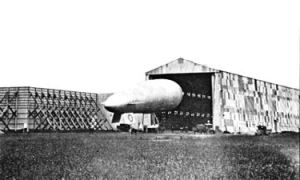
Airship shed at Capel Aerodrome and an SS12 airship. Dover Transport Museum DTMuseum

Airship shed at Capel Aerodrome and an SS12 airship. Dover Transport Museum

In the English Channel, attacks on shipping intensified and in April 1915 Admiral Reginald Bacon (1863-1947) was appointed Commander in Chief of Fortress Dover. The RNAS Dover Seaplane establishment at Mote Bulwark on the Seafront and attached to the Dover Patrol, was expanded with both machines and personnel. While at Capel, 240 acres of fields became an RNAS airship station whose main role was to protect troopships crossing the Channel. The pilots and observers working in airships, like their seaplane colleagues, were particularly good in the detection of hostile submarines as travelling at great heights made it easier to see the hostile crafts underwater.

In early May the Admiralty announced that 14 neutral vessels had been destroyed in the three months since Germany had announced the seas around Great Britain was a war zone. Although, Swingate continued to be developed primarily for training aircraft personnel from pilots to mechanics, the tutors often joined their RNAS colleagues working with the Dover Patrol flying planes that had arrived at the station for repair by the trainees, such as the B.E.2a and the Bristol Scout.
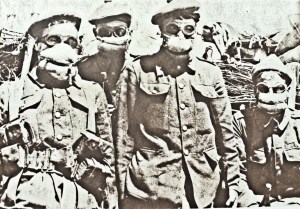
22 April 1915 - at Ypres the Germans introduced Chlorine Gas attacks. Improvised gas-masks were made out of cottonwool soaked in washing soda. Tom Robinson collection

22 April 1915 – at Ypres the Germans introduced Chlorine Gas attacks. Improvised gas-masks were made out of cottonwool soaked in washing soda. Tom Robinson collection

The situation continued to go badly on the Western Front and on 22 April, during the Second Battle of Flanders (21 April – 25 May 1915) – the Second Battle of Ypres, the German’s introduced a new weapon. They released clouds of poisonous chlorine, a strong irritant to the lungs. Prolonged exposure proved fatal and inflicted significant casualties among the British and Canadian troops. Then at the Second Battle of Artois (9 May-18 June) the French Army suffered 102,000 casualties without achieving their objective of regaining the north France coal basin. That remained in German hands. The day long (9 May) Battle of Aubers Ridge resulted in the British Army losing 11,000 men and it took three days to transfer the wounded to field ambulances. At the Battle of Festubert (15-27 May), the combined British, Indian and Canadian casualties amounted to some 16,000 having made no significant contribution to the French offensive. Field Marshal French, told a journalist from the Daily Mail that the catastrophe was due to insufficient quantity and quality of the shells.
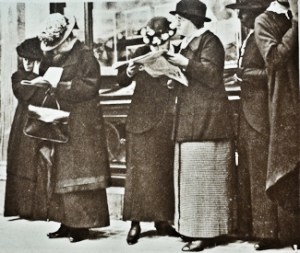
7 May 1915 Cunard Liner Lucitania sunk by U-20, people waiting for news outside Cunard's London Offices. P&G

7 May 1915 Cunard Liner Lucitania sunk by U-20, people waiting for news outside Cunard’s London Offices. P&G

On Friday 7 May, in line with the German directive of February 1915, submarine U-20 torpedoed the Cunard passenger liner Lusitania as she sailed in neutral waters, 11 miles off the Irish south coast. The ship sank in eighteen minutes and 1,198 of the 1,959 people aboard drowned, leaving only 761 survivors. Of the dead were 128 Americans, which caused outrage in the United States. Before the Lusitania set sail from New York to England, the German embassy had placed newspaper advertisements warning people of the dangers of sailing on British merchant ships such as the Lusitania. The result was a crisis in German/American relations with the United States President (1913-1921) Thomas Woodrow Wilson (1856-1924) demanding Germany discontinue submarine warfare against merchant and passenger ships and a veiled threat of economic sanctions.

Of note the Lusitania’s distress signal was SOS, unlike the Titanic, which had been – code CQD – the international distress signal used by the Marconi Company since 1904. That was the general call, ‘CQ,’ followed by ‘D,’ denoting distress and together meaning ‘All stations: distress,’ (See Part I of the Swingate Story). Although there are a number of meanings given for SOS, in reality it does not stand for anything. By World War I it had become the International Morse code distress signal. Unlike the CQD, which was three separate letters, SOS is always transmitted as a continuous sequence of: three dots, three dashes and three dots, not as individual letters. Following the introduction of audio radio transmitters the spoken distress phrase, ‘Mayday’ – the idea of senior radio officer Frederick Stanley Mockford (b1891) at Croydon Airfield – was introduced in 1923. Mayday was adopted by the 1927 International Radio Convention as the equivalent of the SOS and officially recognised in 1948. The SOS was the maritime radio distress signal until 1999, when it was replaced by the Global Maritime Distress and Safety System. Nonetheless, it is still recognised as a standard distress signal that may be used with any signalling method.

In the early hours of 17 May, a Zeppelin approached Dover from the east and dropped a large number of incendiary bombs in fields between Swingate and Martin Mill. By then the military defence of Fortress Dover had surrounded the town with anti-aircraft stations and the Zeppelin came under heavy fire. It quickly made off hotly pursued by Swingate pilots in Bristol Scouts armed with hand held machine guns. Not long afterwards afterwards aeroplanes with synchronised machine guns came on station with the introduction of the Vickers Gunbus, discussed above. But the aeroplane that appears to have been the favourite of the Swingate tutors at that time was the Bristol Scout.
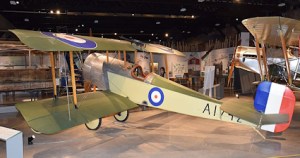
Bristol Scout D aeroplane at Aerospace Bristol. Note Lewis gun on upper wing. Hugh Llewelyn Wikimedia

Bristol Scout D aeroplane at Aerospace Bristol. Note Lewis gun on upper wing. Hugh Llewelyn Wikimedia

The Bristol Scout single seater was an 80 hp Gnome Lambda rotary engined biplane, produced by the British and Colonial Aeroplane Co. It was a fast reconnaissance aircraft that had originally been designated for racing. It had been designed in 1913 by Frank Sowter Barnwell (1880-1938), an aeronautical engineer and the company’s chief designer, along with the Company’s Chief Test pilot, Harry Busteed. One (No 206) had been on show in 1914 at Olympia and had been looked at with interest by Trenchard at the time. Although the tutors accepted that as a tractor design, the propeller was at the front of the aeroplane and therefore did not have gear synchronisation they had tried different ways to overcome the problem. They found that that two rifles, one either side, could be aimed outwards and forwards to clear the propeller arc. Also, fitting a third gun on the upper wing – as can be seen in the picture, the pilot could fire it at the undercarriage of the foes aeroplane!

That same month, on 25 July, over Passchendaele and Zillebeke on the Western Front, flying two Bristol Scout C aeroplanes, numbered 1609 and 1611 was Lanoe George Hawker (1890-1916). A gifted engineer, Hawker had left Swingate in October 1914 as a captain in the RFC’s No. 6 Squadron flying a Henri Farman biplane. During the freezing dank winter of 1914-1915, he had designed sheepskin boots to combat the risk of frostbite at high altitude that reached the upper thigh and were known as ‘fug-boots’. These became standard issue to all aerial personnel. Regarding the Bristol Scout C numbered 1611, Hawker had mounted a Lewis machine gun on the left side of the fuselage just forward of the cockpit and at about a 30° horizontal angle. Using this, on that Sunday afternoon he took on several two-seater German observation aircraft of the Fliegertruppe, managing to defeat three of them in aerial engagements. For this he was awarded the third Victoria Cross given to a pilot and the first given for actions in aerial combat against enemy with fixed-wing aircraft.
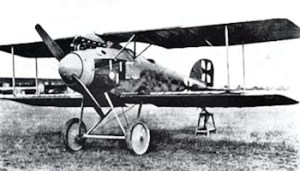
German Albatros D.II, a biplane flown by Lieutenant Manfred von Richthofen (1892-1918) better known as the ‘Red Baron,’ Wikimedia

German Albatros D.II, a biplane flown by Lieutenant Manfred von Richthofen (1892-1918) better known as the ‘Red Baron,’ Wikimedia

On 23 November 1916, Hawker was killed in combat flying an Airco DH 2. His adversary was Lieutenant Manfred von Richthofen (1892-1918) better known as the ‘Red Baron,’ who was flying an Albatross D.II (see below). William Barnard Rhodes-Moorhouse (1887-1915) on 26 April 1915 was the first pilot to be awarded the Victoria Cross for conspicuous bravery. A member of No2 Squadron and flying a B.E.2 from Kortrijk, Belgium, Rhodes-Moorehouse successfully dropped a 100lb bomb on the railway line near that station. He immediately came under rifle and machine gun attack and was severely wounded. Nonetheless, he managed to fly his badly damaged plane for 35 miles, at a very low altitude and under more barrages, back to base. He died of his wounds the following day. The second airman to be awarded the Victoria Cross, was RNAS pilot Reginald Alexander John Warneford (1891-1915) for bringing down the German Army airship, LZ 37 by dropping bombs on it while he was under machine gun fire. Warneford was killed later the same day when the right-hand wings of his Morane-Saulnier Type L aeroplane collapsed.

At Brooklands, where Prince and his Bat team were working on aerial wireless communication, open hostility was developing between the Marconi personnel and the regular RFC wireless technicians. This was regardless that the latter were not working on wireless communication but on other aspects of wireless technology. For instance, bomb-dropping gear and testing magnetos that formed part of wireless installations and to determine their liability to ignite explosive mixtures of gases. Nonetheless, they saw the Marconi men as part-time soldiers that had not gone through the disciplined training they had nor had they had to go through the same stringent selection process. This came to a head in the summer of 1915 and to ease the situation, Prince’s team was moved. Their new location was the former Vickers testing airfield at Joyce Green, on the River Thames side of Dartford, Kent. Commandeered at the beginning of the War for the RFC number 6 Wing, the airfield suitability was questionable as it was covered with a profusion of drainage ditches criss-crossing the Dartford Salt Marshes. Shortly after the Bat team arrived No. 39 Home Defence Squadron detailed for anti-Zeppelin raid duties in the London area moved in. Then the No. 10 Reserve Squadron, pupil pilots in their final training sessions. The first Home Defence Squadron, No39, formed in May 1916 became the foundation of the newly formed Home Defence Wing in September that year. The Wing continued to expand such by the time of the Armistice, Home Defence had become the 6th Brigade made up of six Wings and 18 Service squadrons.
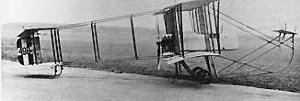
Farman MF.7 Longhorn on Royal Air Force Marham website.

Farman MF.7 Longhorn on Royal Air Force Marham website.

Prince’s Bat team did have a laboratory but this lacked the necessary special equipment. Some of this Prince managed to borrow from Brooklands and also non-military sources, with which he or members of his team had connections with such as the Marconi Company. There one of the Managing Directors, Samuel Flood-Page (1833-1915) was of particular help in providing highly specialised equipment but in 1915 he died.  Then, according to Hugh Dowding’s biographer Vincent Orange, the necessary equipment was obtained by Dowding and Prince visiting the Marconi London office in the evening. While Dowding distracted the night storeman with tales of his aerial exploits on the Western Front, Prince relieved the Company of the apparatus he needed! The team’s first goal was to develop speech communication from the air to the ground, which was relatively easily accomplished. Next was communicating from the ground to the air and this was finally achieved in August 1915 between Prince on the ground and the former Marconi engineer, Captain John Furnival flying a Farman MF.7.
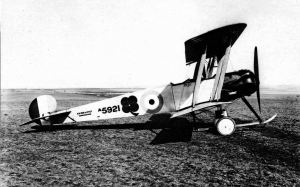
Avro 504A at Swingate Aerodrome in 1917. Dover Museum

Avro 504A at Swingate Aerodrome in 1917. Dover Museum

Towards the end of 1915 Prince’s Bat team produced the first practical aircraft telephony set, this being known as Mark One. It weighed 20lbs and Prince wrote to Dowding, ‘It seemed almost beyond hope to achieve really practical wireless telephony from an aeroplane, but the difficulties have been overcome, and the new set is by no means a toy, or only of scientific interest. A new and amazing power is conferred by it.’ By this time the team were quartered at Swingate, where they equipped a Royal Aircraft Factory B.E.8a, an Avro 504 and a Martinsyde S.1 with their precious equipment. On 12 December No. 9 (Wireless) Squadron left for Saint-Omer and took the planes with them. Most of the ex-Marconi personnel returned with Prince to Joyce Green while a couple of team members and an officer from No. 9 (Wireless) Squadron stayed on at Swingate to teach aerial wireless communication and adapt aeroplanes.

That summer, wireless telephony had been upgraded at the former Marconi and GPO ship to shore stations, which had been taken over by the War Office at the outbreak of the War. At the same time sixteen new auxiliary wireless stations were brought into service. Most of the new sites were within existing buildings or structures and were to be used for communications with the yachts, trawlers, drifters, minesweeping service and additionally at Dover, the Dover Patrol. One such building was the former coastguard signal station on Swingate Downs whose personnel from then on, worked closely with the Castle and Harbour signal stations as well as the Dover Coastguard station at Aycliffe and the Light Vessels stationed at the Goodwin Sands. Most of these were already equipped with wireless telephony. The result was the provision of transmission and collecting information covering the Channel with direct links to both Dover and the Western Front.
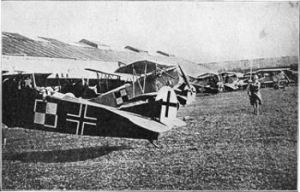
A collection of German Planes awaiting to do battle from The People's War Book (1919) Wikimedia

A collection of German Planes awaiting to do battle from The People’s War Book (1919) Wikimedia

By this time, the Germans had a marked superiority in the air not only in the number of aircraft but also in the number, superiority of skill and daring of their pilots. The Albatross D.II German fighter aircraft, which the ‘Red Baron’ was flying when he successfully shot down Captain Hawker (see above), was designed by Robert Thelenm (1884-1938), came on station in August 1915 as part of the Jasta 2 (Jagdstaffel Zwei) Luftstreitkräfte Squadrons. On 12 December 1915, the first all-metal aeroplane, the Junkers J 1 monoplane made its maiden flight, though failed to make it to mass production. The aeroplane was produced by Junkers Plane and Motor Works, Dessau, Germany and served as a prototype for later Junkers such as the Junkers 4 – named Junkers 1 by the German military – which with its successors was more feared by residents in Dover than the Zeppelins.
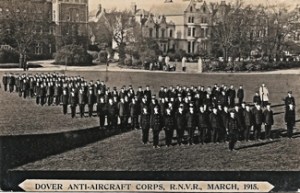
Anti-Aircraft Corps March 1915. Dover College Grounds. Maurice Sayers

Anti-Aircraft Corps March 1915. Dover College Grounds. Maurice Sayers

On 1 August 1915 the RFC was officially separated from the Army and the Dover
Voluntary Anti-Aircraft Corps, which had been set up by the Admiralty in November 1914, was disbanded. Under the command of local General Practitioner Dr Ian Howden (1870-1923) and supported by a Chief Executive Officer, Lieutenant-Commander William Capper (1844-1925), the Corps were in charge of the searchlights that had been erected at the Drop Redoubt, Castle Keep and Langdon Battery by the Admiralty. The Military took over these and also set up anti-aircraft gun emplacements outside of Fortress Dover that were manned by soldiers. On 9 August they were the first in England to illuminate a Zeppelin and managed to wing it. Off Dunkirk the Zeppelin was then hit by a bomb dropped by a British airman but even though badly damaged it did make it back to Brussels. Members of the RFC based in Dunkirk had followed the distressed Zeppelin and when it landed, they too attacked it and managed to destroy it.

A Zeppelin, on 10 August 1915, bombed the harbour near the western entrance killing one sailor and injuring three. Fifteen days later there was another Zeppelin attack but there were no casualties. One of the bombs dropped in a wooded area just outside Dover and exploded with great force. In a field close by was a poacher who had been catching rabbits using nets and ferrets. The story goes that the explosion so shook the poacher that he took to his heels, leaving his equipment, catch and ferrets behind. On seeing a policeman on a bicycle, he told him exactly where the bomb had dropped. The next day the police called on the poacher, thanked him for the information and handed him his poaching equipment. The poacher paled as he realised he had incriminated himself but Dover Police Chief Constable David Fox had taken ‘a sportsman like view of the matter,’ and no proceedings followed!
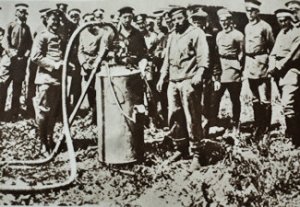
Liquid Fire was introduced by the Germans in early 1915. Soldiers learning how to use it before the Great Offensive began in September 1915. Tom Robinson Collectionn

Liquid Fire was introduced by the Germans in early 1915. Soldiers learning how to use it before the Great Offensive began in September 1915. Tom Robinson Collection

The Great Allied Offensive on the Western Front of 1915, began on 25 September with the Battle of Loos (25 September to 8 October), which was launched simultaneously with the main French offensive with the Second Battle of Champagne (25 September to 6 November). The French commander-in-chief Marshal Joffre, considered that the numerical superiority of his army, however temporary, would be sufficient to bring about the decisive breakthrough at Artois. The plan of attack was to be four days of continuous shelling climaxing in an apocalyptic final four hours followed by the infantry launching a massive and continuous assault. The assault included the use of Liquid Fire, introduced by the Germans on 26 February 26 1915, when it was used against the French outside Verdun. Consisting of a vertical single cylinder 4 feet high that was horizontally divided in two, with pressurised gas in the lower section and flammable oil in the upper section. The apparatus was carried on the back with the liquid delivered through a nozzle held in the hand. It was used by the French during the Great Allied Offensive.
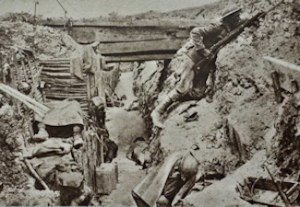
Scene from the Trenches, a soldier keeps watch while his exhausted colleagues sleep. Ovilliers

Scene from the Trenches, a soldier keeps watch while his exhausted colleagues sleep. Ovilliers

The RFC’s main role in the Great Offensive, besides reconnaissance, was to bomb railway lines, trains etc. They were successful in damaging 16 lines, destroying 5 trains as well as a signal box and railways sheds at Valenciennes. For this Field Marshall French wrote to Trenchard in appreciation. Adding that he desired, ‘especially to thank pilots and observers for their plucky work in cooperation with the artillery, in photography and bomb attacks …Throughout these operations the RFC have gallantly maintained the splendid record they have achieved since the commencement of the campaign.

Overall, however, very little was achieved and when the fighting finally died down due to bad weather after 14 October, the French casualties were between 100,000-120,000. Following the Battles, the Germans entrenched themselves along a line, which ran north to south and they set up defensive positions on high ground and in the ruins of villages. Trench warfare of World War I had begun.
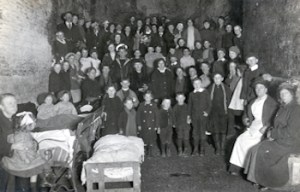
Dover bomb shelters - The old oil mill caves in Snargate Street 1915. Dover Museum

Dover bomb shelters – The old oil mill caves in Snargate Street 1915. Dover Museum

On 23 September, Admiral Bacon, the Commander in Chief of Fortress Dover, welcomed George V who had come to see the Eastern dockyard and the naval establishment. The King was also shown around both Swingate and Capel aerodromes. In a speech, he sympathised that the town was suffering from the ‘scourge of the Zeppelins’, adding that both aeroplanes and anti-aircraft guns were showing the Germans that they could be dealt with. On 9 October a Zeppelin dropped bombs on the harbour and 3 sailors were injured.

On 28 October 1915, while inspecting troops in France, George V fell from his horse, which then rolled over on top of him. The King was brought back to England through Dover on the Anglia, that had been requisitioned at the outbreak of War from the London & North West Railway Company. After 10 months service she was converted into a hospital ship and from 17 November 1915 was employed carrying wounded from France to Dover flying the Geneva Convention, Red Cross flag. Across the Channel buoys had been laid marking a course specifically for hospital ships and as part of the Convention, hospital ships following this course were safe from attack. The Anglia left Boulogne on 17 November at 11.00hours carrying wounded from France, her Captain was Lionel John Manning (1858-1936). The weather was fine and clear and all was going well as the ship followed the designated course. About 12:30hours, midway across the Channel, the ship reached the change in direction (turning) buoy of the designated course.
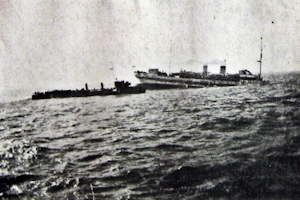
Anglia - sinking of hospital ship off Dover. The Ure rescuing ship in attendance. Dover Patrol

Anglia – sinking of hospital ship off Dover. The Ure rescuing ship in attendance. Dover Patrol

Suddenly there was a loud explosion – the ship was holed on the port side forward of the bridge and immediately began to sink bow first. The Captain ordered the wireless operator to send a SOS signal but the wireless room had taken the full impact of the explosion. The operator was injured and the wireless was useless. Lifeboats and life rafts were launched but one of the boats sank with loss of life. The Royal Navy ships, Ure and Hazard quickly came on the scene taking patients off and three other ships, Torpedo Boat No. 4, Langton, and the Channel Queen came to help. The collier Luisatania, which was going down the Channel at the time, turned round to take off the crew after the patients were safely aboard the other ships. As the first crewmember climbed on board the Luisatania, there was another explosion and shortly after, she sank stern first. Estimates of the loss of life that day due to explosions or drowning vary, up to 164, with 25 of that number being crew. Both ships had hit mines that had been laid by the German U-boat, UC-5.

During the summer of 1915, it was recognised that the RFC contribution in combat was of equal importance to that of reconnaissance. As a result, Swingate underwent further expansion. This included training in wireless communication by members of Prince’s Bat team. Aerial combat was also introduced into the curriculum and this included a Machine Gun School under Captain, later Sir, Arthur Travers Harris (1892-1984) who in World War II was Air Officer Commanding-in-Chief (AOC-in-C) RAF Bomber Command during the height of the Anglo-American strategic bombing campaign against Nazi Germany. In a letter dated September 1915, the War Office stated that ‘the importance of a thorough knowledge of the Lewis Gun and training in firing it from an aeroplane is daily becoming more important.’ However, by November the Machine Gun School had moved to Hythe, the home of the School of Musketry since 1853. As the Germans increased their air attacks so Britain increased the training of pilots, observers, mechanics and technicians. On 15 November 1915 the No. 12 Training Squadron was founded at Swingate and on 27 November the No. 13 Training Squadron received their colours. Most of these newly trained air teams were sent to the Western Front.
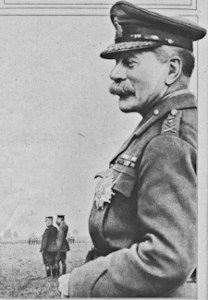
Sir Douglas Haig (1861-1928) in 1916 at the Western Front. Wikimedia

Sir Douglas Haig (1861-1928) in 1916 at the Western Front. Wikimedia

On the Western Front, the stalemate had led to changes in the British High command including, on 15 December, Field Marshal Sir John French being replaced by Sir Douglas Haig. French had been forced to resign following heavy criticism by a deputation of officers that included Major General Richard Cyril Byrne Haking (1862-1945). A new Chief of the Imperial General Staff, General Sir William Robertson (1860-1933) had been appointed on 12 December. As he had enlisted in the army as a private in 1877 and rose through the ranks, it was hoped that he would attract more recruits. Back in late 1914 when Kitchener launched his famous volunteer recruiting campaign over one million men had enlisted by January 1915. However, the appeal of that poster and others was waning so this form of recruitment was not keeping up with the ever-increasing number of casualties. Parliament were considering introducing compulsory military service but this came in for severe criticism out of fear that it would bring mutinous inclined men into the ranks.
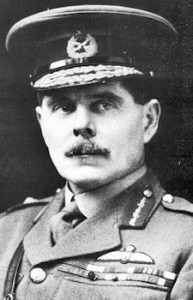
 1915 Hugh R Trenchard (1873-1956) promoted to Brigadier General. Wikimedia

1915 Hugh R Trenchard (1873-1956) promoted to Brigadier General. Wikimedia

In May 1915, the upper age for volunteers had been increased from 38 to 40 but this made little impression on recruitment. On 15 July 1915 the National Registration Act was passed that obliged every man between the ages of 15 and 65 to give their employment details. The result showed that there were 5million males of military age who were not in the forces of which only 1.6million were in protected high or scarce skill jobs. Shortly after on 11 October 1915, Edward George Villiers Stanley, 17th Earl of Derby (1865-1948), was appointed Director-General of Recruiting and 5 days later the ‘Derby Scheme’ was introduced. Men aged 18 to 40 were encouraged to enlist voluntarily (graded Class ‘A’) or agree to join up if obliged to later on (graded Class ‘B’). Instructions were clear and concise and it was repeatedly stated that single men would be called up before married men. As it was anticipated that this would bring an influx of the much-needed new recruits and the Wing system was becoming unwieldy, brigades were introduced into the RFC with a brigadier-general commanding each brigade. A Third Army was formed in July 1915, the first commander being General Edmund Allenby (1861-1936). Brigades were also introduced into the RFC with a brigadier-general commanding each brigade. Resulting from this, Trenchard, was promoted to Brigadier-General.

During 1915, Germany had been switching from Zeppelins and seaplanes to aeroplanes. All told, during WWI, Zeppelins made over 50 raids but preparation for flight required a large number of personnel and as they were easily seen they were vulnerable to attacks. The seaplanes were slowly phased out as they could only carry light bombs and were not fast enough against the new breed of Allied aeroplanes. Of the many different types of aircraft that Germany produced, the most formidable was the  Fokker Eindecker fighters, which made their appearance in the autumn of 1915. The machine was fast, manoeuvrable and more sophisticated in that it was designed to perform near vertical dives. It was also fitted with interrupter gear that synchronised gun and airscrew enabling the gun to be fired at its full rate through the arc of the propeller without striking the blades.
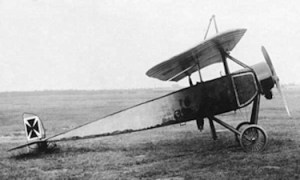
Captured Morane-Saulnier Type L with German insignia on which the Fokker Eindecker was designed. Wikimedia

Captured Morane-Saulnier Type L with German insignia on which the Fokker Eindecker was designed. Wikimedia

The design came from the French type L Morane-Saulnier H monoplane that was being flown by French aviator Eugène Adrien Roland Georges Garros (1888-1918) when it crashed on the German side of the lines – of note the famous Paris tennis stadium that hosts the French Open was named after Garros. The wreckage was taken to Fokker Flugzeugwerke GmbH at Schwerin, Germany and developed by the owner, Dutch engineer Anton (Anthony) Herman Gerard Fokker (1890-1939). Not long after, the factory produced a similar synchronised gear system in the Eindecker fighters. The period between the late summer of 1915 and the spring of 1916 became known as the time of the fearsome Fokker Scourge.

4. 1916 – Cannon Fodder, Quagmires and an Offer of Peace
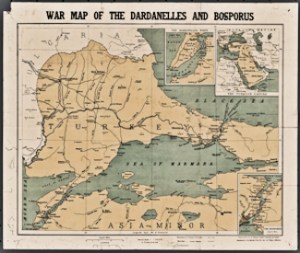
WWI map of the Sea of Marmara, the Dardanelles and the Bosphorus. W & A K Johnstone Ltd 1914. Wikimedia

WWI map of the Sea of Marmara, the Dardanelles and the Bosphorus. W & A K Johnstone Ltd 1914. Wikimedia

Back in February 1915 on the Eastern Front, the Allied powers of Britain, Australia, Canada, France, India and New Zealand had sought to take control of the narrow Dardanelles Strait in the southern part of East Thrace, Turkey. This was in order to weaken Turkey’s Ottoman Empire (1299-1922) and to provide a trade route to the Black Sea for Russia. The main objective was to capture Constantinople (later Istanbul) the capital of the once vast Empire that was in decline and by this time centred on Turkey. In the early 20th century the Empire had allied with Germany, a position that remained at the outbreak of World War I. On 29 October 1914 two Ottoman ships brought from Germany and manned by German crews, attacked Russian ports in the Black Sea. As a result, on 5 November 1914, the Russians entered the War on the side of the Allies. By February 1915, the Allies offensive strategy was to attack the Ottoman forts at the entrance of the Dardanelles followed by an amphibious landing on the Gallipoli peninsula. The Gallipoli Campaign, as it was generally called, was particularly advocated by Winston Churchill as First Lord of the Admiralty and had lasted from 17 February 1915 to 9 January 1916. The Allies had badly underestimated the capacity of the Turkish forces and approximately 58,000 were killed. 87,000 Ottoman Turkish troops also died and at least 300,000 more from both sides were seriously wounded. Following the debacle, Churchill resigned from the government and went to command an infantry battalion in France. One of the soldiers who took part in the Gallipoli Campaign was Viscount Vere Brabazon Ponsonby Duncannon (1880-1956), Dover’s Member of Parliament (1913- 1920).
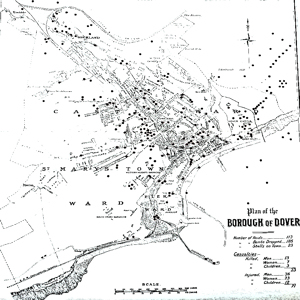
Map of the Borough of Dover showing the extent of the bombing and shelling the town suffered during WWI. Dover Library

Map of the Borough of Dover showing the extent of the bombing and shelling the town suffered during WWI. Dover Library

Although, fighters on the Western Front were supplementing Zeppelins and seaplanes, they were still being used by the Germans for bombing raids over the UK. At Dover on 23 January 1916 at 01.00hours, the town was subjected to its first moonlight raid carried out by a Friedrichshafen FF 33b seaplane. Eight high explosives and one incendiary bomb were dropped with the first falling on Waterloo Crescent. This was followed by one on Cambridge Terrace then Camden Crescent and as the plane travelled towards the Castle, another was dropped on the roof of the Red Lion pub in St James’ Street. This killed Harry R Sladden (1873-1916) and injured James Browning, George Gambrill and Richard Willis. Another fell on the malt house of Leney’s Phoenix Brewery on Dolphin Lane causing a fire that was soon extinguished. The gas offices in Russell Street were hit, while three children were injured in Golden Cross Cottages and an old lady in nearby Golden Cross Place by another bomb. The final bomb fell on Victoria Park – where senior personnel of Fortress Dover resided.

The following lunchtime two seaplanes dropped bombs on the air balloon sheds at Capel then approached Dover, coming under fire from the Drop Redoubt on Western Heights before dropping a bomb on the town. Altogether, one man and four soldiers were killed and 2 men, 1 woman, 3 children and 11 soldiers were injured. The estimated cost of damage was given as £1,591. The attackers were then pursued by a Swingate pilot, armed with a Winchester rifle and five rounds of ammunition. A seaplane from the Base at Mote Bulwark also took to the air, but without the required permission of the Admiralty. The seaplane pilot was armed with a pistol but the Swingate pilot mistook the seaplane as German and opened fire with his Winchester. During the fracas the two German seaplanes made off without suffering any damage.
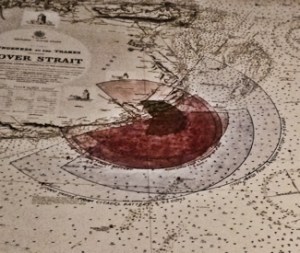
WWI Gun Ranges from Dover's defending batteries. English Heritage

WWI Gun Ranges from Dover’s defending batteries. English Heritage

At this time, Fortress Dover had what was believed to be ample anti-aircraft batteries as it was thought that the town was relatively safe from attack. However, although they had the guns, to save costs ammunition provided consisted of cheap percussion shells. Although these could have been effective, they did require a high degree of accuracy and therefore were only of use if the target was fixed, such as a building. Against the two moving German aircraft the gunners would only have been successful by accident hence their only significant impact, on this occasion, was on the Walmer Church tower!

The Ottoman victory in the Dardanelles, bombing raids over England plus heavy casualties on the Front were having a negative effect on morale, though Allied Command were failing to appreciate this. Kitchener believed that men would continue to rally round the flag if asked, especially as he and his colleagues were planning to launch another determined offensive on the Western Front. This was earmarked to take place on 1 July and the attack was to be concentrated on a wide front of 12½ miles in length, between Serre in the territory of Pas-de-Calais and Maricourt to the south in Hauts-de-France, on the right bank of the river Somme. To the north of Serre, a diversionary attack on the first day of the offensive was scheduled and the whole was to be launched to coincide with a French operation to the south of the Somme. It was expected that this time a well-planned onslaught would overwhelm the German positions in the hills and lead to that much needed major breakthrough.

To prepare for the offensive, in January 1916, of the 215,000 men not in protected high or scarce skill occupations, enlisted as class ‘A’ and 2,185,000 in class ‘B’ under the Derby Scheme, were called up. As they were classed as volunteers, they did not have to and many did not. On 27 January 1916 the Military Service Act was passed, which imposed Voluntary Conscription on all single men aged between 18 and 41, with the exception of the medically unfit, clergymen, teachers and those in protected high or scarce skill jobs. Assuming that this would bring in the much-needed men, the British Army was again restructured in February 1916 with the formation of the Fourth army commanded by General Henry Rawlinson (1864-1925). On 25 May 1916 a second Act passed extending Conscription to married men and although many men failed to respond, in the first year 1.1 million did enlist. The age limit was increased to 51 in the summer of 1918 and although the War ended later that year, Conscription was not abolished until 1920. Another Army was formed in May 1916, under the command of Sir Hubert de la Poer Gough (1870-1963), at first known as the Reserve Army, then later renamed the Fifth Army in October 1916.

With this proliferation of new recruits, measures were taken to increase the number of pilots and support personnel on the Western Front with the concept of Training Squadrons being introduced. Under this scheme new recruits were based at one airfield and fast tracked through the different training courses appertaining to flying and their abilities. Then, after 48hours leave, they were sent straight into war zones for practical experience! To pay for the influx of trainees Kitchener’s office introduced more economies, one of which was the reduction in the number of seaplane pilots and seaplanes based at Dover. When this was questioned in the House of Commons, the members were told that there was still a large contingency of aeroplanes at Guston to defend Channel shipping against ‘U’ boat attacks.

Albeit, Canterbury MP Captain Francis Bennett Goldney (1865-1918) refuted this, telling the Commons that the previous weekend he had taken a walk to the RNAS Guston airfield and discovered it had hardly been used since the previous autumn. In fact, the farmer was ploughing it up in preparation for crops! Nonetheless, the seaplane cut backs were instigated with hardly any increase in the number of aeroplanes at Guston. At Swingate, No 20 Training Squadron arrived on 1 February 1916 and No 64 Training Squadron on 7 April. The newly trained fast tracked squadrons then left for the Western Front. On arrival, it was discovered that due to a shortage of aircraft the new pilots were to gain experience flying aircraft, – usually the BE 2c, – that mechanics of their squadron had attempted to repair. The planes had been made unairworthy in combat and therefore, according to a report by Trenchard, were a ‘flying target’ for German pilots.

Four of the No. 20 Squadron were non-commissioned officers (NCOs) and although none survived the War,  two -, James Thomas Byford McCudden (1895-1918) of Gillingham, Kent and Thomas Mottershead (1892-1917) from Widnes Lancashire were to win the highest awards the country could offer. McCudden had trained as an engineer and was sent to the Front in 1914 as a mechanic with No. 3 Squadron. In 1915 he came to Swingate to train as an observer but was sent to Gosport to learn to fly before returning to Swingate to train with No. 20 Squadron. McCudden rose through the ranks to become a Major and he was one of the most highly decorated airmen in British military history. Further, having shot down a total of 57 enemy aircraft he was the seventh highest scoring ace in WWI and on 26 March 1918 was awarded the VC. However, Major McCudden was killed on 9 July 1918, when his aircraft crashed in France due to an engine fault. Both his brothers, William and John, were also pilots and they too died in the War.
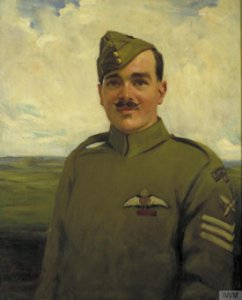
Sergeant Tommy Mottershead (1892-1917) was the only Non-Commissioned RFC Pilot to be awarded the Victoria Cross. Wikimedia

Sergeant Tommy Mottershead (1892-1917) was the only Non-Commissioned RFC Pilot to be awarded the Victoria Cross. Wikimedia

Mottershead received the V.C. for saving the life of his observer. This was the only one awarded to a non-commissioned RFC officer during the First World War. On 7 January 1917 near Ploegsteert Wood, Belgium, he was on patrol in an FE 2d with observer Lt. W E Gower when he was engaged in combat by two Albatros D.III’s, with Lt Gower managing to hit one. The second Albatros was flown by German ‘ace’ Leutnant Walter Göttsch (1896-1918) who hit Mottershead’s FE 2d’s, petrol tank setting the aeroplane on fire. With only a hand-held extinguisher Lt Gower was unable to put the flames out. Although badly burned, Mottershead managed to land the aeroplane. On touching the ground the under-carriage collapsed throwing Lt Gower clear but pinning Mottershead in his cockpit. He was subsequently rescued but died of his burns five days later.

No9 Bomber Squadron note the bat. The motto Per Noctem Volamus - we fly by night. Wikimedia

No9 Bomber Squadron note the bat. The motto Per Noctem Volamus – we fly by night. Wikimedia

At the Front, No. 9 (Wireless) Squadron, as part of the Bomber Squadron of the RFC, had moved from Saint-Omer to Bertangles, in the department of Somme part of the French region of Picardie on 24 December 1915. On 17 January 1916, with BE.2c’s along with the specially consigned BE.8a, the Avro 504 and a Martinsyde S.1 carrying the Mark 1 aircraft telephony sets, commenced bombing missions. Before the month was out, Prince and other members of the Bat team were joined by Dowding. He examined and flew the three specially equipped planes and was well satisfied. Following this, members of the media were invited to watch one undertaking reconnaissance, it was a cold, wet and very windy day.

One journalist wrote of the No. 9 Squadron pilot , ‘In his work in watching the Germans he moved across the gale, mounted in spirals, came down wind in a swooping black streak, turned, and went back to his beat. And all the time we watch him we watched the efforts of the German gunners trying to bring him down. Near him, when he was closest to the German front, a black spot would suddenly appear. It was often difficult to distinguish the airman from the smoke burst. But the spot would enlarge and the airman would change his flight. Then another ball of smoke would appear and it looked as if the airman was festooned with them … He was above us when a light flashed just beneath his machine and we heard a report just like an exploding rocket … In the meantime the British batteries were pouring shells incessantly guided by wireless talk from their comrade in the sky…’ (Times January 1916).
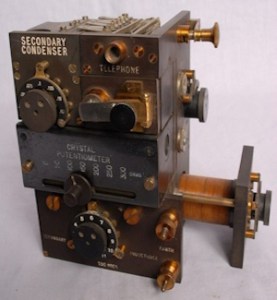
WWI Crystal set receiver - Medium Wave Transmission. marconiheritage.org

WWI Crystal set receiver – Medium Wave Transmission. marconiheritage.org

In February, with Prince and Dowding in attendance, the No. 9 (Wireless) Squadron pilots demonstrated the Wireless Set Mark I to a party of senior officers including Lord Kitchener, Sir Douglas Haig, General Robertson and Trenchard. They were all impressed at being able to hear speech on the ground from an aircraft twenty miles away but neither Kitchener nor Haig were happy for the apparatus to be deployed on the Western Front. Trenchard and Dowding kept their tempers and quietly encouraged Prince to return to England and to resume research, particularly in clarifying speech. By May 1916, 306 aircraft and 542 ground stations were equipped with wireless sets but these were the old-fashioned spark wireless and crystal set receivers using Morse Code. However, other changes were afoot, where at one station at Rathlyn Island on the Isle of Mull, the War Office had appointed a woman in charge!

Much to the consternation of Kitchener and the others in Allied Command, the Germans launched an offensive on 21 February and this was to last until 18 December 1916. It had the generic name of Battle of Verdun and began against the French with the Germans using their air superiority that enabled them to establish a blockade on the French air squadrons. The objective of the Germans against the French was to wear them down in order to force the British and the other Allies to take charge of more of the line. The French fought back with specialist fighter squadrons eventually regaining superiority, though much to the delight of the Germans, ten new British army divisions – all raw recruits – arrived to replace the French 10th Army stationed in Artois.
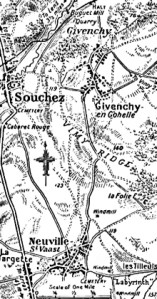
Map showing Vimy Ridge in the Times history of the War. Times 1916

Map showing Vimy Ridge in the Times history of the War. Times 1916

They arrived in March 1916 and replaced the French along a thirty-kilometre stretch of the Front from Loos-en-Gohelle to Ransart, south of Arras. The Front they were expected to defend extended from Ypres to the Somme. The trenches the French had left behind were shallow and in generally poor condition. To deal with the problems required Royal Engineers being seconded from other important War work. Adding to this difficulty, the Germans used the opportunity to move their positions to higher ground and to increase their numbers. This enabled them to easily fire on the British lines from the top of Vimy Ridge and move to the rear of the British using the Ridge as a cover.

Of the seconded Royal Engineers, those with specialist tunnelling skills created a network that enabled the British to seek safety from the onslaught and to move to positions where they could be proactive. By 21 May the Germans, having realised what was happening, increased their artillery and mortar activity from Vimy Ridge in an attempt to capture the entrances to the Allies’ tunnels. In the space of four hours they bombarded a narrow section of the Allies lines with 70,000 shells – it was one of the heaviest attacks in the War. Two days later the British launched a counterattack but they were soon outgunned by German shelling and machine gun fire.

Supporting this German offensive were specialist fighter-only aviation units the Kampfeinsitzer Kommando formations – single-seat battle units abbreviated as ‘KEK’. They had been introduced in February 1916 and flew Fokker Eindeckers. The following month, German master aerial tactician, Oswald Boelcke (1891 – October 1916) had introduced the notion of ‘forward observers’ Fokker Eindecker aircraft close to the Front lines to spot Allied aircraft approaching. Then KEK pilots attacked, flying the newer and superior Halberstadt D.II – a fighter biplane developed and manufactured by Halberstädter Flugzeugwerke, a pre-War British and Colonial Aeroplane Company of Filton, Bristol – German joint venture company, and having a more powerful 120 hp Mercedes D.II engine.
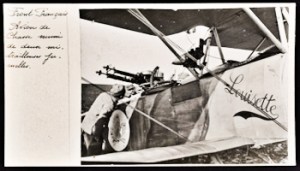
Sopwith 1½ Strutter (French) closeup showing Lewis guns and generator. Université de Caen Basse-Normandie

Sopwith 1½ Strutter (French) closeup showing Lewis guns and generator. Université de Caen Basse-Normandie

Aeronautic developments were also taking place in Britain and in January 1916 one such plane was sent to Swingate. It’s origins was traced back to December 1914 when Frederick Sigrist (1884-1956), works manager of Sopwith Aviation Company was involved in the design of a small two-seater biplane, given the nickname Sigrist Bus. This eventually flew in the summer of 1915 and from this prototype a larger fighter aircraft was designed by Herbert Smith (1889–1977) powered by a 110-hp Clerget engine. Like the original Sigrist Bus, the upper wings were separate but connected to the fuselage by a pair of short or half struts and a pair of longer struts, forming a ‘W’. This gave rise to its nickname, the Sopwith 1½ Strutter. Fitted with a synchronised Lewis machine gun equipped with interrupter gear it allowed the gun to fire through the propeller arc and another Lewis gun was mounted in the rear cockpit. At least one of these 2-seater fighters arrived at Swingate in January and a number went to France in May with No.70 Squadron.
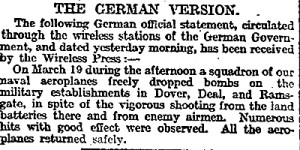
German version of the seaplane bombing raid on Dover 19 March 1916

German version of the seaplane bombing raid on Dover 19 March 1916

In March 1916, a Zeppelin dropped a number of bombs on Whinless Down, west of Dover, and two incendiary bombs on nearby Hougham. Then, in the afternoon of Sunday 19 March seaplanes attacked Deal, Margate, Ramsgate and Dover – dropping twenty-two bombs on the town. These killed two women and a child injuring 4 men and 3 women and the Germans widely circulated their version of what had happened. At the inquest, the jury recommended that the Government should investigate all the circumstances attending the town’s defence against these air raids.
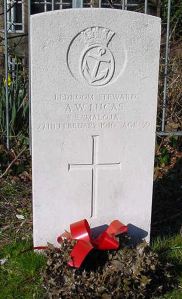
The gravestone of Bedroom Steward A W Lucas, age 30 who died when the Maloja was torpedoed off Dover on 27 February 1916. St Mary's Cemetery, Copt Hill. Alan Sencicle

The gravestone of Bedroom Steward A W Lucas, age 30 who died when the Maloja was torpedoed off Dover on 27 February 1916. St Mary’s Cemetery, Copt Hill. Alan Sencicle

On 27 February 1916, about 2 nautical miles off Dover, the liner Maloja – the largest ship in the P&O fleet – sailing from Tilbury to Bombay and carrying 456 passengers and crew, was torpedoed. 155 people drowned in the cold sea and 58 bodies were landed at Dover and taken to the Market Hall, now Dover’s Museum. Most of the survivors were looked after at the Lord Warden Hotel near the Admiralty Pier. The few seaplanes still based in Dover had helped in the operation.

On 24 March the 1,353ton twin-screw cross-Channel steamer, Sussex, sailing under the French flag, left Folkestone for Dieppe with 386 passengers and a mostly French crew of 50 on board. The Sussex was torpedoed off Dieppe and vessels along with boats from the Dover Patrol went to the rescue. Many of the survivors and three bodies were landed at Dover. Every week the list of British and Allies merchant shipping sank by German ‘U’ boats was published and each week and week on week the list was getting longer.
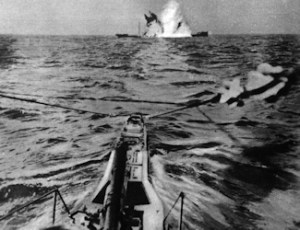
A torpedo hitting a merchant vessel showing the weapon's destructveness. I.W.M.

A torpedo hitting a merchant vessel showing the weapon’s destructveness. I.W.M.

The attack on the Sussex prompted the U.S. to threaten severing diplomatic relations with Germany and this, if put into operation, would reduce the German ability to continue maintaining the upper hand in the War. Through the American Ambassador in Berlin, James Watson Gerard junior (1867-1951), the German Imperial State Secretary of the German Foreign Office, Gottlieb von Jagow (1863- 1935) appealed to President Woodrow Wilson, saying that the British, by their blockade were acting illegally and causing the German nation to starve. With regards to the torpedoing of neutral shipping, he said that in reality those ships the German submarines had attacked were British using neutral flags in an effort to evade detection and destruction. All that Germany was doing was fighting to reopen sea passages so that the much-needed imports, on which American companies relied on to provide work for American nationals, would get through. Woodrow Wilson responded by suggesting that the ‘U’ boat attacks on British and Allied military shipping was OK but on merchant shipping, regardless of country of origin, that had to stop. He also threatened Britain with economic sanctions if the blockade against German merchant shipping did not stop.

The German government congratulated the President on being even-handed and on 4 May produced the Sussex Pledge, in which they agreed to only attack Allied shipping and also to give adequate warning before sinking merchant and passenger ships. They would also provide for the safety of passengers and crew. Many US citizens were pleased that the relationship between the two powers was becoming more friendly but complained that the President was being financially more liberal towards the Allies that to Germany. This was denied and in October 1915 Woodrow Wilson gave much publicity in permitting syndicated loans organised to help the nationals of the German homeland. The largest was syndicated through Chandler & Co of 17 Battery Place, New York, which offered the German government a loan of $25million @ ½% annual payment. Of note, by 1917 US loans to Germany stood at $27million while loans to the Allies amounted to $2.25 billion.
WWI The emblem of 49 Squadron that trained at Swingate in 1916. Wikimedia

WWI The emblem of 49 Squadron that trained at Swingate in 1916. Wikimedia

On 15 April 1916, No 49 Squadron was formed at Swingate and were bring trained to join the Expeditionary Force on the Western Front. The squadron was made up of recently recruited, fast-tracked pilots, observers and ground crew who were going to the Continent without anyone with experience of the Front going with them. On gaining experience at the Front, they would be then expected to work alongside No 9 Squadron as a night flying bomber squadron. Their motto was Cave Canem – beware of the dog. The teaching personnel at Swingate at this time all suffered from a variety of severely debilitating injuries sustained at the Front. A Reuters’ journalist visited Swingate and wrote an account of some of the training the fast-track students were receiving. In relation to the observers, he was allowed to watch and write about part of their final practical examination, which took place in a large hangar.

The floor was covered by an enormous raised contour map of one of the areas of the Western Front with wooden pieces representing buildings, bridges, woods etc. Around the map observers to be examined sat. High up in one corner was part of a BE.2 cut away to show inside the cockpit where there was a Marconi wireless set. Below, behind a screen were two other members of staff and a mock up battery armed with a gun and an identical wireless set. To illustrate what was expected of those being examined, another member of staff was designated as an observer and he climbed up and got into the exposed cockpit. Immediately he established a wireless connection with the battery below. The Commandant, with a long wand, pointed to a target and the observer, checking his Musgrave/James style map, tapped out its location using Morse Code.
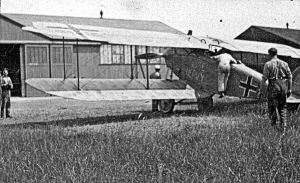
Swingate Aerodrome. A captured German aeroplane being examined. Dover Museum

Swingate Aerodrome. A captured German aeroplane being examined. Dover Museum

The wireless operator interpreted this and the screen was removed. Using the information the order was given to fire the gun and after two hits the correct target was knocked down. The apparatus was set up again and individually, each member of the class climbed into the cockpit, identified the Commandant’s chosen target and using the wireless transmitter, gave its location for the ground crew to knock over. All the trainees were successful in identifying the targets, although some took far longer than others to work them out. The journalist, in his report, went on to describe the training that the ground crew were receiving and this included dismantling and putting together 15 different types of aircraft engine and nine different types of aircraft of both British and foreign manufacture. Finally, he was shown a recently captured enemy plane, which the trainee engineers were examining.
50 Squadron crest, formed at Swingate in May 1915 motto From Defence to Attack. Wikimedia

50 Squadron crest, formed at Swingate in May 1915 motto From Defence to Attack. Wikimedia

At 02.15hours on 20 May there was another moonlight raid by seaplanes on Dover. They dropped fifteen bombs in rapid succession with the first landing on Dover College, where the college boys were still in residence. Bombs were dropped on Western Heights, damaging part of the Grand Shaft Barracks while the next fell on the roof of the Ordnance Inn, 120 Snargate Street. Another on the Commercial Quay followed this. Locals said that throughout this assault, the defence guns were silent and that no aircraft went up to fight off the attackers. As a consequence of the raid, a soldier was killed and a man and a woman injured. Up until earlier that year the defence of Fortress Dover had been the responsibility of the Admiralty, made up of professionals, such as the Dover Patrol and supplemented with local volunteers. In February 1916 the responsibility had passed to the War Office and home aerial defence was introduced subject to the availability of aircraft and pilots. Following the repeated air attacks on Dover, in May 1916 No 50 Squadron, made up of Swingate trainees was formed and designated to defend Dover docks and harbour installations. Their motto, From Defence to Attack.

The Squadron was at first equipped with BE 2s, but as aircraft design was changing to include the combat role of aviators the BE 12 arrived in May. This was a development of the BE design, with a synchronised Vickers gun with seasoned pilots putting them to the test on 19 May. A moonlight air raid took place on the South-East Coast that resulted in a large number of bombs being dropped, killing one man and injuring two people. Newly qualified pilots flew the BE 12’s to meet another moonlight attack on 9 July after which the seasoned pilots endorsed the newly qualified observations that the BE 12 was useless in combat!

Some modified B.E. 12b’s with a 200-hp Hispano-Suiza engine and a wing mounted Lewis gun, instead of the synchronised Vickers gun, were sent to the aerodrome. 50 Squadron soon had a chance to try out the new aircraft, for during the night of 2-3 August a Zeppelin attempted to approach Dover and was quickly driven off by their robust defence. However, at 12.25hours on 12 August two seaplanes dropped four bombs on the town, one falling on the harbour and another on Fort Burgoyne. There seven soldiers, who were on parade, were injured. Only two, aged battle-scarred BE 2s, went up to try and deal with the seaplanes, both were from Swingate and both were too slow.

During the previous week, most of the No 50 Squadron had been moved to Bekesbourne. Three miles south-east of Canterbury, the airfield was about 170-feet above sea level, 1,000yards long and about 450yards wide. Although sloped at the east end, there were hangars at the west end and a windmill to the south, it was reported that good landings could be made, from any direction day or night. This  just left the BE 2s at Dover even though the aerial attacks on the town and East Kent were intensifying. As the number of civilian fatalities and injured continued to rise, a deputation of Mayors led by Dover’s Mayor 1913-1919, Edwin Farley (1864-1939), attempted to see the Commander-in-Chief of the Home Forces, Field Marshal French, to explain the situation and to increase the Home Defence units. But, their efforts were met with procrastination from officials until eventually they were told that the Field Marshal was not in a position to give such orders or to change the procedures.

What Mayor Farley and his colleagues had experienced had become all too common and equally applied to other aspects of the Air Services, indeed, their senior administrators were coming in for the most criticism. To try and deal with the situation, from February 1916, for two months, the joint naval and military air services technically came under the Joint War Air Committee. This was a toothless organisation that the Treasury and more importantly the senior administrators, who had come in for criticism, totally ignored! On 16 April the Joint War Air Committee was abandoned and on 15 May it was replaced with the slightly more powerful Air Board.

With its own offices and highly trained staff the Air Board was headed by Chairman, George Nathaniel Curzon, 1st Marquess Curzon of Kedleston (1859-1925) – a former Lord Warden of the Cinque Ports (1904-5). By virtue of the post, Curzon was a member of the War Committee but in rank, his post was subservient to the navy and military members of the Committee. Further, as representatives of both were heavily caught up with their overseas operations, Aeronautical Home Defence was low on their agendas. It was this that had led to the Port of Fortress Dover and the rest of East Kent, lacking adequate aeronautical protection. Aware of this, John Walter Edward Douglas-Scott-Montagu 2nd Baron Montagu of Beaulieu (1866-1929), took it upon himself to highlight the problems of the British Air Board. In a series of articles published in the Times during 1916, he wrote that it, ‘was a Cinderella organisation when in reality it should be a Service in its own right, equal but separate from the other two.’ Seeds of change were sown.
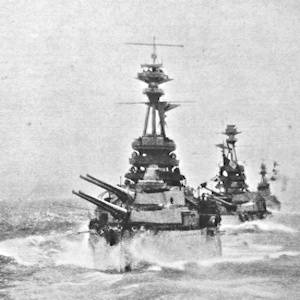
Allied Grand Fleet based at Scapa Flow in the Orkneys on Patrol in the North Sea. I.W.M.

Allied Grand Fleet based at Scapa Flow in the Orkneys on Patrol in the North Sea. I.W.M.

As noted above, the British blockade of Germany was being achieved by keeping the Allied Grand Fleet at Scapa Flow in the Orkney Isles, from where they attacked German merchant ships as they entered the North Sea. This was cutting off vital American supplies including grain, non-ferrous metals such as copper and zinc as well as nitrates essential as fertiliser and also for manufacturing high explosives. In an attempt to break the Grand Fleet strangle hold on these German imports from the US, during the day and night of 31 May-1 June 1916, the German Navy’s High Seas Fleet took on the Grand Fleet near Denmark’s Jutland peninsula.

The great naval battle of Jutland on 31 May resulted in many men in the Navy losing their lives. Amongst them were a significant number of Dover men as well Rear-Admiral Hood, former Commander in Chief of Fortress Dover. The Germans were the first to report the outcome of the Battle claiming victory as the British lost more ships and men. The British press concurred, calling it a disaster. Strategically, the British Grand Fleet quickly recovered and by the following day had reinstated the blockade. The German High Seas Fleet’s morale was badly shaken by the sheer might of the Grand Fleet and many of the German ships took quite a long time to repair. Further the blockade increased the already severe hardship to the civilian population. One of the support ships at the Battle of Jutland was the South Eastern and Chatham Railway’s cross Channel triple screw packet, Engadine launched in 1911. She had been commandeered at the outbreak of the War and fitted out to carry seaplanes. Following the Battle she took the injured that had been transferred from the battle ships back to base for hospitalisation.
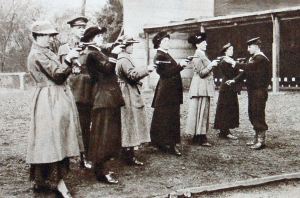
Women's Royal Navy Reserve in training. Doyle Collection

Women’s Royal Navy Reserve in training. Doyle Collection

Back in November 1914, resulting from a public meeting in Dover, a Volunteer Training Corps was established. This was aimed at recruiting men under the age of 19 who, at that time, were classed as too young to join the forces, and men over 38, who were considered too old at that time. Some 500 local men had joined and initially Sir William Crundall (1847-1934) commanded them though as they became more professional, they came under the command of a Colonel Smyth. The 1st Battalion of the Cinque Ports Fencibles was also formed of which two companies came from Dover. Later, they and the Volunteer Training Corps became part of the Kent Volunteer Regiment. These and other volunteer regiments were fully equipped under the 1916 Military Service Act and armed for home defence. The Act also gave rise to numerous women’s organisations such as the Women’s Army Auxiliary Corps (WAACs – founded March 1917) and the Women’s Royal Navy Reserve, the photograph shows the latter at revolver practice in 1916.

While on board the armoured cruiser Hampshire, Lord Kitchener was killed on 5 July 1916, when the ship struck a mine off Orkney on its way to Russia. The next day David Lloyd George, who held the post of Chancellor, was appointed the Secretary of State for War. As Chancellor, he had told the House of Commons in May that the excess of imports over exports the previous year had amounted to £800m. What he did not say was that for political reasons in the U.S., although money was being loaned to Britain, it was generally seen as expedient to imply that the lending was minimal. In Britain there was a perception that the country was financially far better off than it really was and following Kitchener’s death, this attitude was actively encouraged.
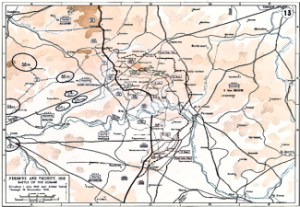
Battle of the Somme 01 July - 18 November 1916. Westpoint Military Academy Museum

Battle of the Somme 01 July – 18 November 1916. Westpoint Military Academy Museum

This applied to the Great Allied offensive that was to begin on 1 July. It was the first major deployment of the new compulsory conscripted men and the attacks were to be on a 12½ miles long Front between Serre in the Pas-de-Calais and the Maricourt district to the south, on the right bank of the river Somme. It was preceded, during the week before, by heavy shelling and the exploding of several gigantic land mines. It was planned that these would clear the area of German troops and although air reconnaissance appeared to confirm this, due to the continual heavy rain, the airmen said that it was equally possible that the Germans were seeking shelter in their heavily fortified concrete bunkers. The Generals decided that the heavy bombardment had cleared the area of the majority of Germans.
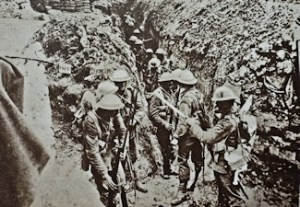
Allied Troops 'standing to' waiting to go over the top 01.07.1916 the first day of the Battle of the Somme. I.W.M

Allied Troops ‘standing to’ waiting to go over the top 01.07.1916 the first day of the Battle of the Somme. I.W.M

In drizzle on Saturday 1 July 1916 at 07.30 hours the British Army with soldiers from Australia, Canada and India left the trenches on the first day of the Battle of the Somme. They had been assured that all would be quiet and danger would be minimal. With a slow, determined and regular pace they crossed the rain soaked quagmire of no-man’s land only to be mowed down by German gunfire followed by heavy shelling. The Germans also shelled the assembly trenches where thousands of soldiers were waiting for their turn to go over the top. By that evening 19,240 British and Allied men were dead, 35,000 were wounded and nearly 3,000 were captured or missing. These losses were the heaviest sustained in a single day in British military history.

On that day, due to the Allies having 421 aeroplanes against the German 104 machines, they gained and maintained air superiority for much of the day. Therefore, it was still believed that with a bit of encouragement the Germans would retreat and therefore only the more positive aspects of what had happened was reported in the British press. Typically, it was said that Captain Arthur George Kenchington (1890-1966) of B Company, 7th Buffs – the East Kent Regiment that had recruited throughout the Dover and Folkestone Districts, that his men were caught by machine gun fire while in a chalk dump in no-man’s land west of Montauban at about 08.15hours. Many were lying dead and injured, ‘then there was silence but the snipers continued to shoot, there was a concerted rush on the part of the men remaining who carried the dump and the snipers were bayoneted.

Non-combatant stretcher bearers in the trenches giving first aid at the Somme 1916. I.W.M

Non-combatant stretcher bearers in the trenches giving first aid at the Somme 1916. I.W.M

By 19 July the Germans showed no sign of retreating so it was agreed to an infantry attack at Fromelles in the Nord department in northern France. This was to start with
heavy bombardment prior to the infantry attack. Two novice infantry divisions were fielded, the British 61st – that had spent their time thus far removing poison gas canisters from no-man’s land – and the Australian 5th, who had just arrived from halfway round the world. Although they lacked experience, the British XI Corps and RFC 10 Squadron supported them, all being under the command of Major General Haking. But the preparations had been hurried and it was still assumed that the German defence was poor. The muddy morass made movement difficult and the Allies were on open ground while the Germans were in fortified concrete bunkers, bristling with machine gun sites and behind barbed wire on slightly higher ground. Against this onslaught the infantry didn’t stand a chance – in a period of twenty-four hours the Australians lost 5,533 men and the British 1,400 with nothing to show for it.
Marine Station, the Rod of Asclepius, the ancient Greek symbol of medicine in recognition of the role the station played during World War I. Alan Sencicle

Marine Station, the Rod of Asclepius, the ancient Greek symbol of medicine in recognition of the role the station played during World War I. Alan Sencicle

It was one of the greatest tragedies suffered by the Australian nation during the 20th century and it was said that Corporal Adolf Hitler (1889-1945) of the 16th Bavarian Reserve Infantry was manning one of the machine guns. As for Major General Haking, who was already unpopular over his perceived betrayal of the highly respected former Commander-in-Chief of the British Expeditionary Force, Field Marshal French. French had been removed from the Front for publicly pointing out that insufficient quantity and quality of the shells handicapped the British. Following Fromelles, Haking was blamed, by the men who survived, for using those who were killed or maimed as cannon fodder and was blocked from further promotion. After the attack on the Somme in July 1916, as many as nine ships arrived at Dover every day, bringing back the wounded to moor alongside Admiralty Pier. As they were unloaded they were tended by local women, many of them wives of serving men. From Marine Station, 13 ambulance trains took the wounded to hospitals throughout the country – some making two or three journeys a day. The dead were taken to the Dover mortuary, then in Tower Street in the nearby Pier District.
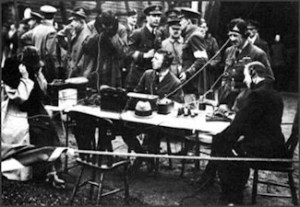
 RFC Wireless training session marconiheritage.org

RFC Wireless training session marconiheritage.org

Bats and Marconi qualified wireless operators were involved in the Somme offensive manning mobile wireless stations. The new wireless operators underwent the full Marconi training but only received basic army training and were classed in the ranks. They arrived while the Battle of the Somme was raging and were mainly attached to heavy artillery units to operate mobile wireless stations. Both the Bats and the established Marconi operators said, the new recruits should at least spend some time with them, but the senior personnel were too caught up with other concerns to listen. In consequence the young men were left to their own devices to find the best place to set up the equipment and get good signals. The Bats – No 9 Squadron (Wireless), who were all pilots were assigned to the XIII Corps in reconnaissance and artillery spotting missions. In charge of XIII Corps was Lieutenant-General Congreve, who had described the Christmas 1914 truce.

The Bats undertook low flying and communicated their observations to the Marconi trained wireless operators on the ground. Together they enabled the ground forces to successfully attack artillery batteries, field guns, trenches, transport, and hostile aerodromes. So impressed was Allied Command that by the end of the summer, former marine wireless officers and Belgian  paratroopers were dropped by parachute behind German lines equipped with Marconi sets to transmit intelligence reports. As for the newly trained operators with the heavy artillery, theirs was a sad tale. Having to operate in makeshift dugouts and to constantly repair the fragile wireless antennas the casualty rates were disproportionately high compared to the other soldiers in their batteries. This was eventually brought to the attention of the Allied Command and the unit commanders were told, in no uncertain terms, that ‘it is your duty to keep in close touch with the wireless operators attached to your command…

Aerial Photography on the Western Front 1916 IWM Wikimedia

Aerial Photography on the Western Front 1916 IWM Wikimedia

During 1916, photographic techniques increased exponentially and by autumn the Allies had the capability to photograph the entire Front on a daily basis – weather permitting. Stereoscopic photography – a technique for creating or enhancing the illusion of depth enabling highly accurate maps of the Front to be drawn up was undertaken. From the photographs taken, enlargements were made that proved invaluable to the ground forces. Further, these innovations helped fighter aircraft and bombers accomplish strategic missions and facilitate what became known as ‘trench strafing’. This was when fighter aircraft attacked German trench lines, machine-gun posts and batteries etc. from near ground level with machine guns. Also dropping Cooper 20lb fragmentation bombs. Therefore aeroplanes were both attacking the enemy and defending the land forces in coordination with each other.
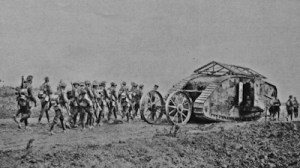
A Mark 1 tank first used at the Battle of Fleurs-Courcelette 15.09.1916 with infantry soldiers. Tom Robinson Collection

A Mark 1 tank first used at the Battle of Fleurs-Courcelette 15.09.1916 with infantry soldiers. Tom Robinson Collection

At the Battle of Fleurs-Courcelette on 15 September, part of the Battle of the Somme, the British introduced a new weapon onto the battlefield – Mark 1 tanks. Supported by No.7 and No.34 Squadrons, forty-nine arrived and thirty-two were used in the Battle though only nine made it across no-man’s land. Nonetheless, those nine did show the machine’s potential that  eventually helped to change the course of the War. The overall Battle of the Somme lasted until 18 November. The official number of Allies dead, missing or wounded was 419,654 with 72,000 having no known grave. The Royal Flying Corps lost 800 aircraft and 252 aircrew were killed.

At Scapa Flow in the Orkneys, the Marconi Company were carrying out valve transmitter tests between an aircraft and Royal Navy units. Back in the UK at the Bats base, Captain Peter Pendleton Eckersley (1892-1963), who in 1923 was appointed Chief Engineer of the infant British Broadcasting Company, had joined the team. They were undertaking research on how wireless telegraphy could be used to help home-defence aircraft during German bombing raids. It was hoped to provide warnings of pending attacks. In May 1916 a Marconi half-kilowatt ground transmitter was set up at Swingate and other airfields in raid-threatened areas. Initially, pilots reported that signals sent could be deciphered up to ten miles away. Six months later, following more work and experimentation, clear signals could be transmitted from Swingate and heard at Dunkirk over 40miles away.
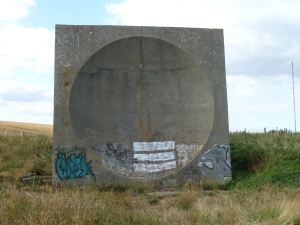
Sound Mirror at Abbots Cliff, west of Dover. Alan Sencicle

Sound Mirror at Abbots Cliff, west of Dover. Alan Sencicle

Working on an early warning system at Binbury Castle near Maidstone, Kent, in July 1915, was Professor Thomas Mather (bc 1856-1937). He had cut a 16-foot sound mirror into a chalk face and claimed that it could detect aircraft 20 miles away. The mirror was hemispherical and the sound collector was mounted on a pivot at the focal point. This was a trumpet shaped cone and the listener, who wore a stethoscope like instrument, moved the sound collector across the face of the mirror listening with the instrument until he found the point where the sound was loudest. Bearings to the target could then be read from vertical and horizontal scales on the collector. From 1916 Sound Mirrors were constructed along the south and east coasts and in the Thames estuary. The one at Abbots Cliff can still be seen. In 1928 a new breed of Sound Mirror was developed by Dr William Sansome Tucker (1877-1955). One was built at Fan Bay just below Swingate and that too can still be seen.
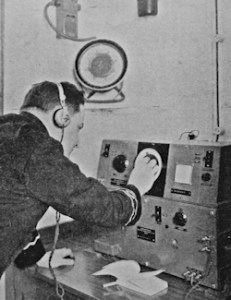
Direction finding apparatus. Marconi Wireless Telegraph Company. c 1920s

Direction finding apparatus. Marconi Wireless Telegraph Company. c 1920s

Introduced at airfields such as Swingate in 1916 was a method of detecting bearings of radio transmissions, already being used on ships. Two radio-receiving aerials, both capable of being rotated, were erected at fixed points suitably far apart to pick up approaching aircraft radio emissions. This way they were able to identify the direction from which the strongest signals were coming by triangulation. The point at which the two ‘position lines’ converged told the wireless operator the position of the aircraft. Also in 1916 Alexander Watson-Watt, (1892-1973) joined the Meteorological Office and was given the job of finding a method of detecting thunderstorms as they were a hazard to aircraft. His research eventually led to the Radio Detection and Ranging technique better known as RADAR (See Swingate Part 3). In essence, RADAR is a form of detection by transmitting microwaves – very short wavelength radio signals – and picking up their reflections or echoes from solid objects they bounce off. The idea of using the system for military purposes had been put forward to the German High Command by Christian Hülsmeyer (Huelsmeyer) (1881-1957) in 1904, but they failed to see it having any practical purpose. Of interest, RADAR superseded the Sound Mirrors and on abandoning the Sound Mirror project, Tucker gave Watson-Watts and his team their  data.

From early in the War, one of the main tasks facing the Dover Patrol and the Commander-in-Chief of Fortress Dover, was trying to stop the U-boats leaving from German occupied ports on the European mainland then passing down the Channel and into the Atlantic Ocean/Irish Sea. There they attacked the Allies merchant vessels. In 1916 Admiral Bacon was Commander-in-Chief and he had ordered a Barrage – a huge net, with minefields on either side – to be strung across the Channel suspended from fishing boats and buoys. He was convinced that it was working though towards the end of 1916 it was estimated that around 300,000 tons of shipping was being destroyed monthly in the North Atlantic. Further, captured secret German documents revealed that the U-boats were passing down the Channel at night and on the surface, travelling over the Barrage and minefields.

The local Coastguards were actively involved in coordinating transmission, collection and collation of the wireless coverage of activities and the visual movement of U-boats as they surfaced in the Channel. With regards to the latter they worked closely with local fishermen. All of this information, the Coastguards passed on to the Dover Patrol as well as military, naval and Western Front personnel. To help the Coastguards observe untoward movements in the Channel, youngsters from the Boy Scouts and Sea Scouts, were recruited and every evening, armed with binoculars and riding bicycles these boys patrolled the cliff tops. Following their reported sightings, Dover Patrol, backed by aeroplanes, including the two teams that were part of No 50 Squadron based at Swingate and flying B.E.12s, went to deal with the unwelcome vessel(s). In retaliation the air raids on Dover by the German air force increased and it was obvious that besides the harbour, the airfields in the area had become targets. Typically, on 22 September a seaplane dropped bombs close to Swingate airfield, but although there were no casualties, aircraft were damaged.
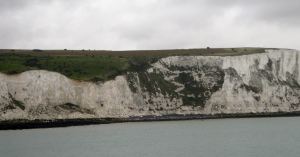
Langdon Cliffs with Swingate Down behind where the airfield was situated. Alan Sencicle

Langdon Cliffs with Swingate Down behind where the airfield was situated. Alan Sencicle

Swingate airfield at this time was coming in for national criticism. Already locally nicknamed Swingate Cemetery due to the frequent trainee pilot fatalities there, Member of Parliament, Noel Pemberton Billing (1881-1948) was particular scathing. An aviator, Pemberton Billing supported air power and the creation of a separate air force, unattached to either the British Army or the Royal Navy. However, he told the House of Commons, the media and anyone else whom he thought mattered, that Swingate aerodrome was too dangerous for the training of young pilots. ‘On arrival,’ he said, ‘they were put into fast war flight machines having previously flown nothing more than a box-kite.’ Pemberton Billing then cited a letter that he had received at the beginning of the year from Flight Lieutenant Harold Rosher (1893-1916), of No 1 Squadron based at Guston and an experienced Royal Naval Air Service pilot. Flt Lt Rosher had written that Swingate ‘Is not only a war flight base but a training school for pilots. It is the very devil of a place to fly in. The aerodrome is situated on the top of the cliffs and on two sides we have a beastly drop. If one’s engine fails on getting off the best one can do is hope and pray that when the bump comes it will not be too big. I was nearly caught this way today.’ Flight Lieutenant Rosher had been killed on 27 February 1916 and is buried in Charlton Cemetery, Dover.

The Royal Aircraft Factory and the planes that it produced also came in for criticism by Pemberton Billing, particularly the B.E 2 of which around 3,500 had been produced by the time of the ‘Fokker Scourge’. Although they were proving to be inadequate to meet the demands placed on these fragile aeroplanes, they remained on the Front Line until suitable replacements were designed, tested, produced and brought into service, such as the Nieuport 11, the Airco DH 2 and the FE 2b. On being returned to the UK, the B.E 2 were then used as trainer aircraft – the box-kite Pemberton Billing was referring to in his House of Commons speech. The fast fighter planes had proved equal in taking on the German ‘Fokker Scourge’ and those at Swingate had been returned for trainee mechanics to repair. The trainee pilots towards the end of their courses flew them.

The Airco DH.2 was a single-seat biplane ‘pusher’ with synchronisation gears and built by Aircraft Manufacturing Company Limited whose chief designer was Geoffrey de Havilland. This aeroplane was particularly equated with Squadron 24. Back in 1915, when the Squadron was first formed, some members were still, teenagers many having started their training at Swingate before going to Hounslow to join the Squadron. In 1916 the experienced Squadron 24 did not find the DH.2 suitable as a fighter but they did recognise its worth in undertaking low-level flying attacks.
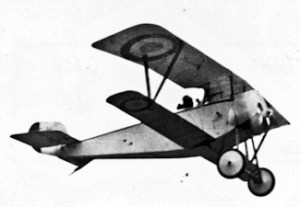
Nieuport 11. Note that the lower wing is narrower than the upper wing Wikimedia

Nieuport 11. Note that the lower wing is narrower than the upper wing Wikimedia

The French company that made the Nieuport 11 had originally been formed as Nieuport-Duplex in 1902 for the manufacture of engine components. In 1910 they produced the first Nieuport 11, which proved so successful that the company switched to producing aircraft. The RNAS particularly favoured the Nieuport 10, designed by Gustave Delage (1883-1946) with a lower wing narrower in chord than its upper wing. The RFC preferred the Nieuport 11, similar but smaller than the Nieuport 10 and the more powerful Nieuport 12, both used for fighter training at Swingate.
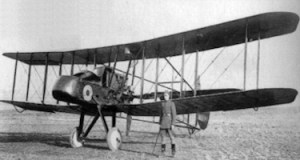
Royal Aircraft Factory FE 2b Wikimedia

Royal Aircraft Factory FE 2b Wikimedia

The French brothers Richard (1873-1940), Henri (1874-1958), and Maurice Farman (1877-1964) designed the Royal Aircraft Factory FE 2b – Farman Experiment 2b, pusher biplane. Powered by a 120hp William Beardmore (1856-1936) engine it was fitted with two Lewis guns and could carry an external bomb load. One of the Lewis guns had a high telescopic mounting in front of the pilot’s cockpit, to enable the pilot to fire forward over the observer. However, on the Front, the observers, without any form of safety harness, would often climb onto the rim of their cockpits to the gun and fire backwards over the top wing. Whether this was endorsed at Swingate flying school is not known!

What was known, was that when they were fitted with CW transmitters the FE 2b proved its worth for night-time bombing. The CW stood for an electromagnetic wave of constant amplitude and frequency that was achieved by the use of a vacuum tube electronic oscillator. American Edwin Armstrong (1890-1954) and Viennese Alexander Meissner (1883-1958) had invented this just prior to WWI. By the means of CW transmitters, which had a range of about 75miles, the airmen were also able to take on night-time reconnaissance, reporting lighted enemy aerodromes and other suitable targets.
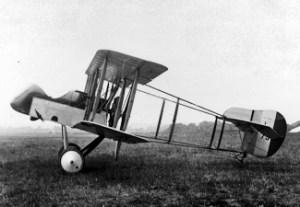
Airco DH 2 Aeroplane. Note the propeller is behind the cockpit, the aeroplane was particularly suited for low-level flying based on the instructions of Major Robert-Smith-Barry. Wikimedia

Airco DH 2 Aeroplane. Note the propeller is behind the cockpit, the aeroplane was particularly suited for low-level flying based on the instructions of Major Robert-Smith-Barry.

Pemberton Billing’s scathing attack on the Swingate airfield was noted by politicians, newspapers and particularly grieving relatives of the young men who had lost lives there. The centre ceased training novice pilots and instead focused on training Squadrons that already had experience on the Western Front. The pilots and observers undertook training in low-level flying in order to attack front line enemy troops using Airco DH.2s and based on instructions developed by Robert Smith-Barry. He was one of the aviators in Number 5 (Army Co-operation) Squadron that left Swingate for the Front in August 1914. Swingate also trained seasoned injured airmen to teach at other Training Depot Stations (TDS). Another area of learning was in conjunction with the Marine Operational Pilots School and anti-submarine and convoy protection work. This included practical sessions participating in forays over the Channel in conjunction with the Home Defence Flight as well as the Seaplane and Guston based RNAS pilots as part of the Dover Patrol.

Following these intense training sessions, the seasoned airmen returned to the Western Front, though the average life expectancy of RFC airman there was approximately 93 flying hours. Typical was Serjeant Cecil Percy John Bromley (1896-1916) of 85 High Street, Dover, who was a pilot in the 7th Squadron of the RFC and was killed on 2 November 1916 at Arras. Due to this high fatality rate, making up a full Squadron of suitably experienced pilots with highly specialised training was proving increasingly difficult as it was in finding spare suitably experienced airmen to provide such training. An assessment, instigated by Trenchard, of pilot fatalities showed that besides being shot down – which accounted for the majority of deaths, other fatal factors included engine failure, thunderstorms and poor visibility. By the end of 1916, except for the Home Defence Flight still stationed at Swingate, the airfield covering just less than 220acres was redundant. In the final three months of 1916 it was estimated that there had been 350,000 British casualties on the Western Front and that the War was costing the country £5.7million a day.
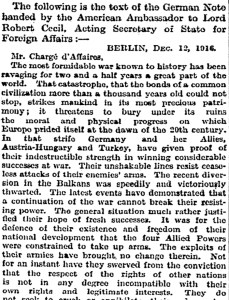
German Peace Proposal, 12 December 1916 published in the Times

German Peace Proposal, 12 December 1916 published in the Times

On Tuesday 12 December 1916 an official ‘Note’ was handed to Gerard, the American Ambassador, from Theobald Theodor Friedrich Alfred von Bethmann-Hollweg (1856-1921) the Chancellor of the German Empire (1909-1921). The detailed Note was addressed to Joseph Clark Grew (1880-1965), chargé d’affaires of the US Embassy in Berlin. In essence it said that ‘Germany and her Allies, Austria-Hungary, Ottoman Empire -Turkey and Bulgaria, have given proof of their indestructible strength in winning considerable successes at war … It was for the defence of their existence and freedom of their national development that the four Central powers were constrained to take up arms … but animated by the desire to stem the flow of blood and to bring the horrors of war to an end, the four allied Powers propose to enter even now into peace negotiations…’
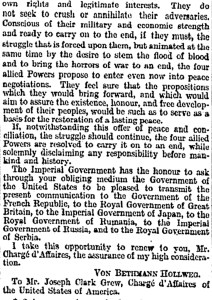
Cont ... German Peace proposal 12 December 1916 published in the Times

Cont … German Peace proposal 12 December 1916 published in the Times

The German Peace Proposal finished by asking for US President, Woodrow Wilson’s mediation to bring about peace. The President, had recently narrowly won the US presidential election with a 4,000 vote margin in California having used the slogan ‘the man who kept us out of the war.’ He was keen to organise a meeting between the different powers but did express concern over the German proclamation’s lack of terms.

In Britain, after months of intrigue and backstabbing, Herbert Asquith, seen as a Dove and supported by, amongst others, Dover’s MP Viscount Vere Brabazon Ponsonby Duncannon, resigned as Prime Minister on 5 December. On the evening of 7 December he was replaced by the Hawk, David Lloyd George. On hearing from President Woodrow Wilson of the German offer, Lloyd George responded by saying that it was less of a peace offer and more of a war manoeuvre. Adding that ‘restitution, reparation and a guarantee against repetition,’ was acceptable but if not then it was all out war against Germany. The rest of the Allies issued similar statements.

It was agreed that the proposed all out war for 1917 was to centre on the combined Allies spring offensive. This had been agreed at the third Chantilly Conference of November 1916, which Lloyd George had attended. The first such conference took place on 7 July 1915, when the Allies – representatives of France, Britain, Russia, Serbia and Italy – had met to discuss strategy. This was at the Grand Quartier Général (GQG), Chantilly, France giving the place name Chantilly to that and the two subsequent conferences. The second Chantilly Conference took place between 8-12 December 1915 with a subsequent meeting on 12-13 March 1916. The third Conference took place on 15-16 November 1916 but unlike the two previous Conferences, political leaders, including Lloyd George attended. The political leaders had actually met and discussed the situation in Paris before the combined final meeting in Chantilly. At that final meeting Haig asked for 20 additional air squadrons to be sent to France for the Spring Offensive. In December the Army Council approved the expansion of the Royal Flying Corps to 106 Frontline squadrons.

At this meeting even though a spring offensive on the Western Front was agreed, the French commander-in-chief, Marshal Joffre, wanted it to start in February. This was in order to prevent Germany pre-empting the Allies as had happened in 1916 but it was generally agreed that a February 1917 offensive would not be achievable. Shortly afterwards Joffre, who had lost credibility with his political bosses over the Somme debacle, was moved away from the Front line. His replacement as the Commander-in-Chief of the French Army was Robert Georges Nivelle (1856-1924), who with General Haig, drew up a plan for a combined action to breach the German line. The Allies, except for France, were to create a diversion that was to centre on the town of Arras and the taking of Vimy Ridge, both situated in the British zone. When the Germans were suitably engaged, the French large-scale attack would, Nivelle reasoned, result in the much needed breakthrough at Chemin des Dames Ridge in the region of Aisne, northern France.

The story continues …

5. 1917 – On the Offensive & the Americans come to Swingate – on Swingate Part IIb – World War I Front Line Aerodrome
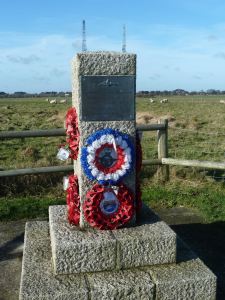
6. 1918 – Dover and the End of a War to End All Wars on Swingate Part IIb – World War I Front Line Aerodrome

Swingate - Memorial to Royal Flying Corps 2, 3, 4 and 5 Squadrons that flew to Amiens in August 1914 as part of the British Expeditionary Force. AS

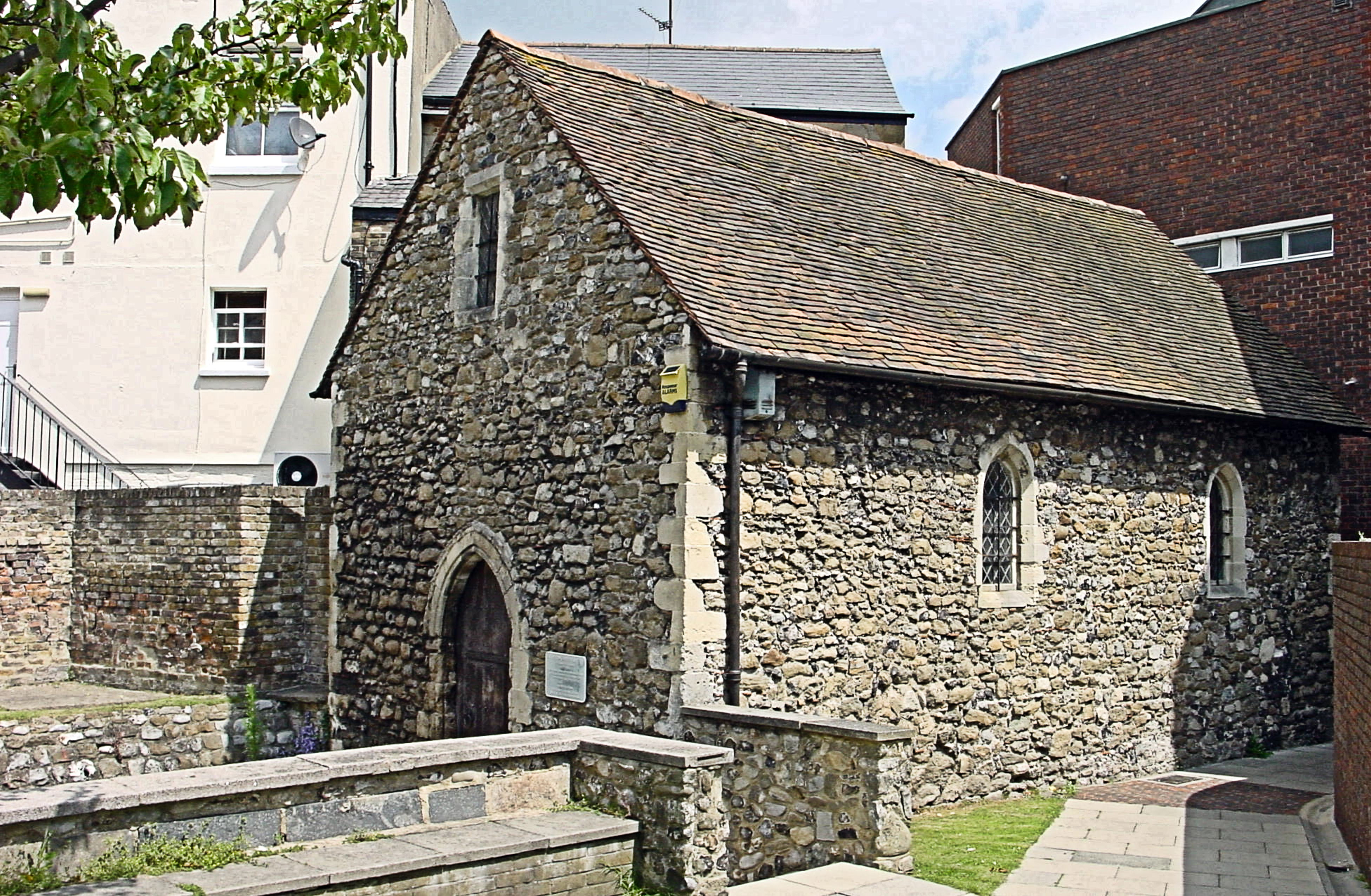
Swingate – Memorial to Royal Flying Corps 2, 3, 4 and 5 Squadrons that flew to Amiens in August 1914 as part of the British Expeditionary Force. AS

Posted in Armed Services, Open Spaces, Swingate, Swingate Part II World War I Aerodrome, Swingate Part II World War I Aerodrome, Swingate Part II World War I Aerodrome, World War I | Comments Off on Swingate Part IIa – World War I Front Line Aerodrome

Swingate Part 1 Marconi, South Foreland and Wireless Communication

Dover is a positive treasure-trove of historic jewels, many neglected, some forgotten and some, like Swingate Downs, described by one of the town’s moronic councillor/business person as wasteland while a stalwart on Dover’s tourism and Dover Harbour Board committees wants to see the area turned into a lorry park. In fact this supposed wasteland is nationally classified as an Area of Outstanding Natural Beauty and further, the area has historically played, and continues to play, a pivotal role in international communication as well as tourism! The story of Swingate deserves international acclaim and on this website it is told in chronological order in three parts. Part 1 looks at:
1. Swingate Downs
2. Developments in Electronic Communication and Wireless Waves
3. Gugliemo Marconi meets William Preece
4. Marconi’s Dover Experiments
5. Swingate and pre WWI inventions and advancements

1. Swingate Downs

Swingate Downs Area of Outstanding Natural Beauty (AONB) - openstreetmap thanks to Protect Kent - Branch of the CPRE

Swingate Downs Area of Outstanding Natural Beauty (AONB) – openstreetmap thanks to Protect Kent – Branch of the CPRE

Swingate Downs, east of Dover Castle, as noted, are classed as an Area of Outstanding Natural Beauty (AONB), and originally straddled across the parishes of Guston, West Cliffe and the Dover-Deal (A258) Road. They have a varied history but have played a particularly important role in the development of communications and during World War I (1914-1918), aviation. Originally, Swingate Downs were part of the manor of Bere in West Cliffe that was established about 1274 when Swingate was given that name. In 1797, the track from Dover to Sandwich via Deal was turnpiked into a road and the Guston turn-off, opposite the Castle, was approximately where one of the tollhouses stood. The next tollhouse was near the present Swingate inn, where the road still kinks slightly. The inn almost certainly developed because of the tollhouse.

Swingate Mill, The Lane, Guston, Rightmove Website

Swingate Mill, The Lane, Guston, Rightmove Website

Opposite the Swingate inn is The Lane, once called Hangman’s Lane that goes to the village of Guston and along this lane is the Swingate Mill. Built in 1849 for John Mummery (1792-1845), it is a rare example of a tarred brick tower windmill in Kent and is Grade II listed. When built it had a projecting round house on the ground floor where the family lived. Subsequent members of the Mummery family worked the mill up until 1936 and it was entirely wind powered. About that time, or shortly after, an electric motor was introduced. During World War II (1939-1945), one of the sweeps was damaged by enemy fire and the mill ceased to function as such. The site was then used for stabling horses. In 1953 planning permission was given to change the use of the site to kennels and two years later a Kent County Council grant was sought for financial help to restore the mill but this was refused. The planning officer responsible had wrongly assumed that brick tower mills were common in Kent. Following this, the mill was abandoned and it became almost derelict. In the 1980s planning permission was given for the mill to be converted into a 4 bedroom domestic residence and it remains a residence to this day.

Letter from Swingate Jockey Club 1856. Dover Library

Letter from Swingate Jockey Club 1856. Dover Library

Swingate Downs had been common land for aeons but in the 18th and early 19th centuries the Dover horse races were held there. A letter from the Swingate Jockey Club circa July 1856, of which only part remains, tells of races being postponed and it is signed by Walter Sutton (1825- December 1856), James Risker Hammond (c1819 – 1879) and Gilbert Eastes (1815-1888). A postscript asks that the recipient let his brother William know and the Elwins. All those mentioned were members of South East Kent elite farming community. In the late 1850s it was believed that Napoleon III (1852-1870) was going to invade and Swingate Downs were taken over by the War Office. Mainly used as a field camp for brigades awaiting embarkation and military volunteers, a couple of huts, a cookhouse and latrines were built. When the annual Volunteer Reviews were held in Dover in the 19th century, the Field Hospital was located at Swingate Downs under the charge of a surgeon and a medical practitioner.

2. Developments in Electronic Communication and Wireless Waves

Semaphore signalling. Reeds Alamanac 1971

Semaphore signalling. Reeds Alamanac 1971

Naval communication between land and ships and between ships was, for centuries, by signalling, Until the Napoleonic Wars (1793-1815) signalling was by sail movements, firing of guns and/or displays of flags, the codes of which were privately compiled and limited in use. Admiral Richard Kempenfelt (1718-1782) in 1780 devised a code of flags by which several hundreds different signals could be made. Admiral Lord Richard Howe (1726-1799) revised these in 1790, just before the outbreak of the Napoleonic Wars. Semaphore signalling was adopted in 1795 from a system devised by Reverend Lord George Murray (1761-1803) and consisted of a screen containing shutters that could be operated to give numerous combinations. The Admiralty adopted this system and the signals were relayed by a chain of signal stations situated on hills or on the top of tall towers, within sight of each other. Rear Admiral Sir Home Riggs Popham (1762-1820) improved this in 1816 by a device that consisted of two moveable arms, lit by lanterns at night, and operated so as to form different angles. Land stations were closed down in 1848, after the introduction of the electric telegraph but their legacy lives on through the ubiquitous place name, ‘Telegraph Hill.’

In 1833 Carl Friedrich Gauss (1777-1855) and Eduard Friedrich Weber (1806-1871) used copper wire to carry an electric current to a sensitive galvanometer, or current detector. They found that its movements, caused by electric signals, could be used as a code to pass messages. At that time it was known that air was a great insulator of electric current and so transmission or telegraph wires, as they were called, along which the electric signals were sent could be supported on overhead poles.

Adapted by Sir William Fothergill Cooke (1806-1879) and Charles Wheatstone (1802-1875), the first electric telegraph for public use was established in 1837. This was alongside the Great Western Railway line from Paddington, London to West Drayton, 13miles (20kilometres) away and led to the adoption by all British railway companies of Greenwich Mean Time (GMT) This is the local clock time at Greenwich, east of London and from 1884 GMT was the international standard of civil time until 1972, when it was replaced by Co-ordinated Universal Time (UTC).

Morse Code - Reeds Alamanac 1971

Morse Code – Reeds Alamanac 1971

In America in 1838, Samuel Finley Breese Morse (1791-1872) demonstrated his Morse code where various combinations of short and long signals – dots and dashes – represented different letters of the alphabet and numbers. As electric telegraph transmitted on-off signals at varying lengths, Morse code was ideal for sending telegraph messages. At about the same time Morse introduced the relay, an electrically operated switch by which a signal sent along the wire was strengthened at intervals, making long distant communication possible.

Wheatstone gave evidence to the House of Commons in 1840 suggesting the possibility of laying a Channel telegraph link between Dover and Calais (see Channel Submarine Telegraph and Telephone Cables story). The same year he also patented an alphabetical telegraph, or, ‘Wheatstone A B C instrument,’ out of which he developed the type-printing telegraph that he patented in 1841. This was the first apparatus that printed a telegram in type using letters of the alphabet and numbers on revolving hammers. They were worked by two circuits actuated by the current that pressed the required letter on to the paper.

Laying the first submarine cable off Dover. Illustrated London News 1 October 1851

Laying the first submarine cable off Dover. Illustrated London News 1 October 1851

On Wednesday 28 August 1850 the first telegraphed message, in legible roman lettering, was sent by John Watkins Brett (1805–1863) using Wheatstone’s printing machine, across the Channel from Calais to Dover. The transmission was carried on the first cross Channel submarine telegraph and telephone cable and the epoch-making experiment cost approximately £2,000. By September 1851 a cable for commercial use, laid between the South Foreland at St Margaret’s Bay – east of Dover – and Cap Gris Nez, France, came into use.

The first successful submarine telegraph and telephone cable that was laid across the Atlantic ran from western Ireland to eastern Newfoundland and the first communication took place on 16 August 1858. At the time, in the United States, Alexander Graham Bell (1847-1922) and Elisha Gray (1835-1901) were separately working on a system for transmitting voices over a distance using wire by converting acoustic vibrations to electrical signals. Both filed the patents for the invention of telephones on the same day – 14 February 1876 – but as Bell was the first to arrive at the patent office it was he who was given universal credit. The following year Thomas Edison (1847-1931) developed his variable-resistance carbon transmitter and the modern telephone was born.

Like the telegraph, the telephone needed wires for communication but these were expensive to lay and easily broken. Between 1886 and 1889, Heinrich Hertz (1857-1894), demonstrated the existence of wireless waves by generating electricity in a circuit between two terminals held slightly apart. He discovered that the electricity would jump from one to the other in the form of a spark. At the same time, about 12 metres (40 feet) away he placed a second, identical circuit and every time Hertz made the spark jump across the first circuit’s terminals an identical spark jumped across the terminals of the second circuit. He found that the first spark had generated electromagnetic radiation or wire-less waves that were picked up by the second circuit, as it was sensitive, or tuned, to the first circuit’s frequency. Thus, Professor Hertz had proved the existence of airborne electromagnetic waves, at the time called Hertzian Waves.

Map of the Goodwin Sands 1968 from Goodwin Sands Shipwrecks by Richard Larn

Map of the Goodwin Sands 1968 from Goodwin Sands Shipwrecks by Richard Larn

William Preece (1834-1913)  was an inventor and the consulting engineer for the General Post Office (1660-1969) in the 1870s. Later, in 1892, he was appointed Engineer-in-Chief of the General Post Office (GPO). Developing Professor Hertz’s observations, in 1889, Preece managed to transmit wire-less signals, using low frequency electromagnetic waves over a distance of a mile. Seven years later, in 1896, he tried to establish wireless communication using low frequency electromagnetic waves, between South Sands Head Lightship on the Goodwin Sands, and the South Foreland, St Margaret’s Bay – a distance of about 3miles. On the seabed, a cable was coiled in a ring about the size of the area that the lightvessel swung with the change of tide. Another cable was then coiled around the lightvessel above the waterline. Preece’s system actually used a mixture of induction and conduction waves and managed to transmit high frequency electromagnetic waves through the air. However, they were not considered viable due to their perceived lack of range and the screening effect of the sea-water and the iron hull of the lightvessel.

3. Gugliemo Marconi meets William Preece

Marconi Gugliemo (1874–1937) - Dover Museum

Marconi Gugliemo (1874–1937) – Dover Museum

It was beginning to look as if electromagnetic waves could be used to send wireless messages but only over short distances and not to ships. The perceived opinion was that there was no such thing as practical wireless telegraphy and that all long distance transmissions had to be carried by wires. Nonetheless, Preece felt that the problem could be overcome when he heard from the Admiralty that a young Italian, of good birth, had arrived in Dover with a contraption that the young man stated sent messages over distances without wires. They added that the young man, travelling with his mother, had come to Britain to gain the Patent for his invention.

The young Italian was Gugliemo Marconi (1874-1937), born in Bologna, Italy, the son of an Italian country gentleman and an Irish aristocratic mother who had family living in Bedford. From early childhood Marconi received formal education through enthusiastic tutors and had developed a keen interest in physical and electrical science, he also spent four years (1876-1880) in Bedford. When he was 18, Marconi was introduced to Italian physicist Augusto Righi (1850-1920) of the University of Bologna, who was a pioneer in the study of electromagnetism. Like Preece, Righi had carried out further research on Hertz’s observations and impressed by Marconi, Righi had allowed the young man to attend his lectures and to undertake experiments in his laboratory.

On Righi’s suggestion, Marconi had incorporated a coherer into his experiments – a radio wave detector invented by the French physicist Édouard Eugène Désiré Branly (1844-1940) in 1890. A coherer consists of a tube containing two electrodes spaced a small distance apart with loose metal filings in the space between. When a radio frequency signal is applied, the metal particles cling together or ‘cohere’, reducing the initial high resistance of the device so allowing a much greater direct current to flow through it. Marconi used Hertz dipole antennas, which consisted of two identical horizontal wires ending in metal plates, a coherer, a battery and an electric bell into his apparatus and created a storm alarm.

Illustration showing the path followed by line of sight propagation. U.S. Army Wikimedia

Illustration showing the path followed by line of sight propagation. U.S. Army Wikimedia

Much to his delight, the bell rang when it picked up radio waves generated by lightning. This spurred Marconi’s parents to help their son with his experiments and encouraged him to read other researchers work and develop a number of practical gadgets, based on the use of radio waves, in the home. The main problem was that radio waves travel by line of sight propagation that is in a direct path from the source to the receiver and generally they cannot travel over the horizon or behind obstacles.

Marconi's first radio transmitter built in August 1895. Wikimedia

Marconi’s first radio transmitter built in August 1895. Wikimedia

From his studies, observations and experiments Marconi devised a groundbreaking apparatus that could transmit and receive radio waves over a greater distance than predicted by line of sight propagation. Marconi’s apparatus consisted of a Righi oscillator – spark producing wireless transmitter – a Branly coherer receiver, a telegraph key to send messages using Morse Code, and a telegraph register to record the Morse code on a roll of paper tape and powered by an induction coil. Initially he had used a Hertz vertical dipole antenna but found that if instead of the dipole, one side of the transmitter and receiver was connected to a vertical wire suspended overhead, and an opposing terminal connected to the ground, he could transmit over longer distances. This, in essence, was a monopole antenna that worked by reducing the frequency of the radio waves, which meant they travelled further. Indeed, at low frequency – below approximately 3 MHz- due to diffraction, using a monopole antenna radio waves can travel as ground waves and follow the contour of the Earth!

By August 1895, Marconi, using his monopole antenna apparatus found that he could transmit radio waves further than line of sight propagation predicted. However, he failed to rouse any interest in his work in Italy so with his mother he came to England. Already fluent in English, in early 1896, the Marconi’s arrived at Dover with his precious monopole antenna apparatus and shortly afterwards met Preece, who immediately took Marconi under his wing.

Parabolic Receiver used by Marconi in his 1896 experiments. istory of Science Museum, University of Oxford

Parabolic Receiver used by Marconi in his 1896 experiments. istory of Science Museum, University of Oxford

The following year, Marconi using a Parabolic Transmitter or Reflector – a Righi oscillator with a parabolic reflector – to send a signal three miles away on Salisbury Plain where he had placed his Parabolic Receiver. The parabolic reflector has a curved surface shaped like a dish that directs the high frequency electromagnetic waves it produces. The receiver has a coherer set at the focus of the parabolic reflector. When the electromagnetic wave was received it caused metal filings in a glass tube to cohere together. This enabled the electric current to flow registering a dot or dash on a Morse recorder, both the transmitter and receiver can be seen at the Oxford Museum of Science.

The Salisbury Plain experiment was followed by another experiment, using the same equipment, when the distance was increased to 9miles and then 32 miles. Representatives of the War Office and the Royal Navy were invited by Preece to witness the second Salisbury Plain experiment. Amongst those who attended was Captain John Nassau Chambers Kennedy (1865-1915) of the Royal Engineers, who subsequently assisted Marconi with many experiments and demonstrations. He also, as we will see later, played a key role in the deployment of the equipment to the military and it used to the navy in South Africa.

On 11 December 1896 Preece gave a series of lectures entitled ‘Signalling through Space without Wires,’ at Toynbee Hall, an educational and charitable institution in London’s East End. The room was packed when Preece described the nature of electromagnetic waves and the various experiments including his own. He then described Marconi’s system, in which he said that Marconi utilized Hertzian waves of very high frequency adding that the peculiarity of the Marconi system was that apart from the ordinary conducting wires of the apparatus, conductors of a very moderate length only were needed, and even these could be dispensed with if reflectors were employed. Preece went on to say that the transmitter was Righi’s form of Hertz radiator, consisting of two sphere’s of solid brass, 4inches in diameter, fixed in an insulated case filled with oil, in such a way that a hemisphere of each was exposed. The oil, he added, kept the surfaces of the spheres electrically clean. Using waves about 120cms long, the radiator was excited by an induction coil, controlled by a Morse key. A 6inch spark coil was needed for a distance of 4 miles and the greater the distance the larger the coils needed to be.

Marconi - Apparatus used at Tonybee Hall demonstration 11.12.1896. istory of Science Museum, University of Oxford

Marconi – Apparatus used at Tonybee Hall demonstration 11.12.1896. istory of Science Museum, University of Oxford

The Marconi receiver consisted of a small glass tube which, Preece said was about 4centimetres in length in which there were two tight fitting silver poles with a half-millimetre space between them. This was filled with a mixture of fine nickel and silver filings mixed with a trace of mercury. The tube exhausted to a minimum of 4millimentres, formed part of the circuit containing a local cell and a sensitive telegraph relay. Under normal conditions the metal particles were virtually an insulator but when electric waves fell on them, Preece said, they were marshalled and arranged in such a way that they became a conductor. Hence the current could be passed through that could ring a bell or indicate a signal in other ways. There was also a ‘tapper’ device for restoring the coherer to its non-conducting state after receiving a Morse-code character and finally, an inking printer displayed the output on a paper tape.

Then Preece, using Marconi’s instrument transmitted a signal and almost immediately a bell rang in a box carried by Marconi. Preece repeated the transmission and the bell in the box Marconi was carrying rang again. Marconi then moved to different parts of the room and on each occasion the bell rang immediately after Preece transmitted the signal!

The experiment caused a sensation and numerous other demonstrations followed. On 2 June 1896 Marconi filed his complete specifications for the Improvements in Transmitting Electrical Impulses and Signals and in Apparatus There-for, for which he was awarded British, patent No. 12,039 on 2nd July 1897. Preece and Marconi were invited to repeat the demonstration to the Royal Institution on 4 June 1897 but Preece was ill and in the interim returned home to Caernarfon, North Wales.

Post Office engineers inspecting Marconi apparatus for the Cardiff - Flat Holm experiment in May 1897. Wikimedia

Post Office engineers inspecting Marconi apparatus for the Cardiff – Flat Holm experiment in May 1897. Wikimedia

While Preece was on sick leave the GPO officials together with the War Office used the opportunity to collaborate in a series of secret wireless system trials using Marconi’s equipment. On 13 May 1897, the GPO engineers using the same Marconi apparatus transmitted radio signals from Flat Holm Island to Lavernock Point near Cardiff, Wales, a distance of 3miles. It was the world’s first demonstration of the transmission of radio signals over open sea. On hearing of this, to secure his patent rights, Marconi set up the Wireless Telegraph Company on 20 July 1897 and in November, the Marconi Wireless and Telegraph Signal Company was officially registered.

Using the 1869 Telegraph Act, the GPO angrily responded saying that they held the monopoly rights of the public telegraph services ‘to deliver from a sender to a receiver.‘ They went on to describe Marconi’s company as a ‘serious challenge in the realm of public telegraph services.’ On the instruction of the Secretary of the Post Office acting on behalf of the Post Master General (1895-1900), Henry Fitzalan-Howard, 15th Duke of Norfolk (1847-1917), the GPO officially suspended all support for the young inventor and his new commercial venture.

Swingate Down Map inc Military area, WWI Airfield, Masts, Memorials, Fort Burgoyne, South Foreland & St Margarets LS

Swingate Down Map inc Military area, WWI Airfield, Masts, Memorials, Fort Burgoyne, South Foreland & St Margarets LS

The GPO together with the War Office continued to undertake wireless system trials using Marconi’s equipment and moved their base to Fort Burgoyne, near Dover. Preece argued that Marconi should take part in the trials but the GPO officials refused. Further, they declined to say that they planned to use the experiment as an attempt to make wireless transmissions across the English Channel. Assisted by soldiers of the newly established Telegraph Troop of the Royal Engineers, they transported the transmitting apparatus on a horse-drawn trolley to the site and also to place receivers in two different locations. The first receiver location was on Swingate Downs and the second at the South Foreland upper lighthouse, St Margaret’s.

South Foreland two lighthouses c1900. Dover Museum

South Foreland two lighthouses c1900. Dover Museum

The village of St Margaret’s, on the south-eastern tip of Kent, is Britain’s closest point to France – just 21 miles (34 kilometres) away. To the west is Dover and to the north-east are the Goodwin Sands, a series of sandbanks approximately 3 miles (5km) from the coast, they are 10 miles (16kms) long and up to 2 miles (3kms) wide in places. Some of the sands are so close to the surface that at low spring tides cricket matches have been played on them! However, the Goodwins are justifiably called the Great Ship Swallower as they are deadly. For this reason, at the time of the experiments there were two lighthouses on the South Foreland. These were the second pair and were built in 1843, the previous pair had been erected in 1793 and both sets were designed to show a constant light. If mariners maintained a course that kept the two lights in alignment or sailed south of this transit line, they would avoid grounding on the Goodwins, if not, then they were courting disaster.

GPO Dover Wireless Experiements using Marconi instruments. Times 13 October 1897

GPO Dover Wireless Experiements using Marconi instruments. Times 13 October 1897

From the report in the Times newspaper of 13 October 1897, it would seem that the GPO experiment was a partial success. They wrote, ‘Both receiving stations had an aerial suspended between two masts. The accumulators (batteries) used in the experiments were charged daily at Dover Electricity Works in Park Street. The induction coil was so powerful that it produced a thick spark about 1 yard long and the messages were transmitted from a vertical wire carried up a tall pole.’ The article went on to say that ‘The experiments are now being made within a radius of three miles of the fort. Hitherto they have been confined to two miles with the most successful results, messages being freely and distinctly transmitted. At the three-mile radius, it is stated, the results are not so satisfactory. In order to make the transmission to such a distance the height of the vertical wire has to be increased, and as the pole at Fort Burgoyne is already a considerable height the use of a kite has been resorted to. The kite is composed of thin copper, with a wire running from the tail to the transmitter.’

The GPO continued to undertake experiments in the Dover area, transmitting from Fort Burgoyne using different locations for the receivers but not to a ship or across the Channel. Preece occasionally attended and noted that results varied depending on atmospheric conditions and distance. Marconi was not invited so was unable to give constructive advice. On completion of the Dover trials, the GPO suspended all further wireless experiments stating that wireless telegraphy, ‘Could scarcely yet be regarded as having reached a practical state.’ Preece was furious and went on to show that using low frequency electromagnetic waves, he was able to establish communication between Sark and the other Channel Islands.

Preece retired in 1899 and that same year was knighted and elected President of the Institute of Civil Engineers.

4. Marconi’s Dover Experiments

Following the breakdown with the Post Office, Marconi concentrated on communication with and between ships at sea and with the help of the Coast Guards later renamed Coastguards, established a wireless station at the Needles Hotel, Alum Bay, Isle of Wight in 1897. There, he carried out tests with two steamers, achieving ranges of up to 18 miles thus establishing the World’s first wireless station. A second wireless station at Bournemouth and at the Haven Hotel, Sandbanks, Poole Harbour, Dorset followed this, where he erected a 100foot mast for an experimental base. In December 1898 Marconi opened the world’s first wireless factory in Chelmsford, Essex. Earlier that year he had sent a message from the Isle of Wight to Bournemouth but the Post Office quickly accused Marconi of infringement of their powers pointing out that their monopoly covered all messages within a three mile limit.

Osborne House, Isle of Wight Queen Victoria's palatial holiday home. Alan Sencicle

Osborne House, Isle of Wight Queen Victoria’s palatial holiday home. Alan Sencicle

Cowes Week, on the Isle of Wight, is one of the longest-running annual regattas in the World and is held from the first Saturday after the last Tuesday in July, until the following Saturday. In 1898, Prince Edward (1841-1910), later Edward VII (1901-1910), hurt his knee at a ball in Paris. A keen yachtsman, he had every intention of participating in the event. In order to do this, the Prince decided to convalesce aboard the Royal Yacht Osborne, instead of staying at his mother’s, Queen Victoria (1819-1901), palatial holiday home on the Isle of Wight. At the time the Queen was in residence. The Prince had already shown interest in Marconi’s experiments so asked him to install a communication system between the House and the Royal Yacht, moored about two miles away. There was no line of sight between the two.

Message sent from Prince Edward on the Royal Yacht to Queen Victoria at Osborne House, Isle of Wight, using the Marconi system August 1898. Osborne House

Message sent from Prince Edward on the Royal Yacht to Queen Victoria at Osborne House, Isle of Wight, using the Marconi system August 1898. Osborne House

Marconi and his engineers attached a vertical conductor, 83feet above the deck of the yacht and used a coil capable of producing a ten-inch spark. At Ladywood Cottage (since demolished) in the grounds of Osborne House, Marconi erected a 100-foot high mast for his antenna. While he was undertaking the installation, the Queen gave Marconi an audience and in the days that followed one hundred and fifty messages passed between the residence and the yacht.

At the time, Prince Edward’s son, Prince George the Duke of York (1865-1936) later George V (1910-1936) was in command of the first class cruiser Crescent, during a voyage lasting from June to August 1898. On 8 August he sent a message to Osborne House asking for the Queen’s approval for a cricket match to be played between the Crescent’s officers and the Royal Yacht’s officers. The Queen replied using the Marconi transmitter, later the same day, giving her approval. Like the rest of the Royal family, Prince George was impressed with the Marconi wireless transmissions. At that time he also held the position of Master of Trinity House (1894-1910).

Trinity House, City of London. Alan Sencicle collection

Trinity House, City of London. Alan Sencicle collection

Trinity House is an independent organisation that had its foundations in the earliest years of British shipping. Its headquarters is in the City of London. The institution was granted a Charter by Henry VIII (1509-1547) in 1514 and besides pilotage (see Cinque Ports Pilots Part II) the work of Trinity House includes the maintenance of navigation marks and lights round the British coastline. Prince George immediately brought their attention to Marconi’s apparatus and Trinity House was very interested. Albeit, on looking into the possibilities of the Marconi system, they were told of the GPO and the War Office’s 1897 abandoned Dover experiments on the grounds that wireless telegraphy, ‘Could scarcely yet be regarded as having reached a practical state.’

Marconi experiments from South Foreland to Goodwin lightships 09.01.1899

Marconi experiments from South Foreland to Goodwin lightships 09.01.1899

Newspaper reports of the Osborne House communications, however, supported the Duke of York’s observations. Newspaper reports of the Osborne House communications, however, supported the Duke of York’s observations. Further, in the previous February the German barque Ceres had collided with the South Sands Head lightship anchored off the Goodwin Sands. The weather that night had been clear and the sea calm but it was a new moon and so it was dark. The crew of the lightship saw the vessel approaching but was unable to attract the crews’ attention before she crashed into it. Although the barque was able to clear the catastrophe with little damage, the lightvessel’s light was smashed and her bulwarks and rigging were carried away. Totally incapacitated, she had to send up distress flares and the Dover Harbour Board tug, the Granville, came to her rescue. Although a little sceptical Trinity House decided to ask Marconi about his apparatus and if it would be possible to connect wireless communication between the South Sands Head lightship some 3 miles from the South Foreland, near Dover, with the mainland when she was back on station.

South Foreland Lighthouse from where, on Christmas Eve 1898, Marconi made the world's first shore to ship radio transmission. LS 2013

South Foreland Lighthouse from where, on Christmas Eve 1898, Marconi made the world’s first shore to ship radio transmission. LS 2013

On Monday 19 December 1898 Marconi began trials from a hut erected besides the South Foreland upper lighthouse, where the GPO had undertaken their questionable trial using the Marconi equipment the year before. The height of the pole used for transmission from the lighthouse was 130feet and the receiving wire on the lightship was run 80feet up the mast. On Christmas Eve, with members of Trinity House present, Marconi transmitted a signal to the South Goodwin lightship. This was the world’s first shore to ship radio transmission and was successful! Following the demonstration, Trinity House authorised the establishment of wireless communication between the South Foreland lighthouse and the South Sands Head lightship and also the South Goodwin lightship. Although the trials were due to officially end on Monday 9 January 1899, the South Foreland lighthouse wireless station stayed in operation for 14 months at the Marconi Company’s expense. A bell was installed at the lighthouse, which was activated by wireless transmission to alert the lighthouse keeper of messages arriving.

Marconi then turned his attention to cross Channel communication and the possibility of
syntonic tuning‘ to enable adjacent stations to operate without interfering with one another. On Monday 26 March 1899  he erected a 150feet vertical standard wire at his newly built wireless station, Chalet d’Artois, next to Wimereux lighthouse, 2miles north of Boulogne, France. On the following day, Tuesday 27 March, he made the first ever wireless transmission across the English Channel to South Foreland, a distance of 32miles. International wireless communication had begun. Using his three wireless stations – one of the lightvessels, South Foreland and Wimereux, Marconi then experimented with syntonic tuning. In essence, if a circuit is constructed to be a good radiator of energy – for example an open aerial – the oscillations set up by a spark discharge quickly die away as the energy is dissipated in radiation. Although a circuit can be constructed to maintain the oscillation between each discharge by sustained resonating, it would not be a good radiator as they are mutually conflicting.

He therefore combined within his apparatus two tuned circuits, one a highly resonant closed circuit and the other an aerial circuit with good radiating characteristics. Then by weakly coupling the two together, Marconi obtained a successful result, with greater range and selectivity. On 26 April 1900 he gained patent number 7777 for his `Syntonic Transmission and Reception‘ documenting a system for tuned coupled circuits that allowed simultaneous transmissions on different frequencies. Thus adjacent stations were able to operate without interfering with one another. He also discovered that range was increased. In his trials of March 1899, Marconi had made sufficient progress for South Foreland to communicate with the lightvessel without a single dot being received by Wimereux!

Still using the hut next to the South Foreland lighthouse, that month Marconi was joined by representatives from Trinity House including their scientific adviser, John William Strutt, 3rd Baron Rayleigh (1842-1919) and Captain the Hon. Foley Charles Prendergast Vereker, R.N. (1850-1900) of the Board of Trade. Marconi explained how his equipment functioned, including the aerial, which was the lighthouse flagstaff with a 150-foot wire running up it and terminating in the air like a lightning conductor. 30 miles across the Channel next to Wimereux lighthouse, he told his audience, was his Chalet d’Artois wireless station. Then Marconi demonstrated wireless communication to his Chalet d’Artois wireless station at Wimereux and also the lightvessel to the east of the Goodwin Sands, showing that each transmission took less then 10 seconds to reach the destinations, further, without the operations interfering with one another!

1930s Chart showing Dover, South Foreland, and the South Goodwin lightvessel close by the South Sands Head - the location of the former South Sands Head lightvessel. When Marconi was doing his experiments in 1899 the South Goodwin lightship was where the South Goodwin buoy is located on the chart

1930s Chart showing Dover, South Foreland, and the South Goodwin lightvessel close by the South Sands Head – the location of the former South Sands Head lightvessel. When Marconi was doing his experiments in 1899 the South Goodwin lightship was where the South Goodwin buoy is located on the chart

The Trinity House yacht Vestal then took Marconi and the rest of the party to the South Sands Head Lightship to see the Marconi apparatus on the vessel. Marconi transmitted a message to the hut at South Foreland and another to Chalet d’Artois. The party then returned to South Foreland and congratulated Marconi on successfully demonstrating the first practical shore to ship and ship to shore wireless communicating system. Marconi then showed the party the alarm bell, he had constructed, to prompt the South Foreland lighthouse keeper of incoming messages from the lightship. Only urgent messages were sent, for instance when there was a ship in danger,  so that the lighthouse keeper could communicate by telephone with the relevant authorities, such as the Dover, Walmer, Deal and Ramsgate lifeboat stations and coastguard stations. He then went on to say that earlier that month, on Sunday 11 March 1899, the first ever call for assistance and report of an accident at sea was made by wireless, on behalf of the sailing ship Elbe, from the lightvessel. On receipt of the then international distress signal, code CQD, that is the general call, ‘CQ,’ followed by ‘D,’ denoting distress and together meaning ‘All stations: distress,’ followed by a brief explanation, the lighthouse keeper at South Foreland Lighthouse telephoned Ramsgate Lifeboat station who went to the Elbe’s aid.

Before the British officials returned to London, the French authorities had informed Marconi, by wireless communication from Wimereux, that they were interested in setting up a transmission terminal at the Eiffel Tower, Paris! Marconi invited the appropriate French authorities to a demonstration. On board the French gunboat, Ibis, and using the ship’s mast as an aerial, Marconi successfully demonstrated that it was possible to send clear messages four ways – between the Ibis, South Foreland Lighthouse, the lightvessel and Wimereux. In answer to questions raised, over the following few days Marconi carried out a number of experiments successfully demonstrating that weather conditions did not affect transmissions. Concern had also been raised over the distance of the receiver from the transmission, in answer, Marconi proved that moving the ship either nearer or further way, made no difference whatsoever, as long as the height of the transmission was adjusted accordingly.

That month also saw Marconi’s experiments in wireless transmission, acknowledged and repeated by Professor Jerome Green at the University of Notre Dame, Indiana, United States. In doing so, Professor Green became the first person to send wireless transmissions in the US. Towards the end of 1899 Marconi was in the United States personally covering the America’s Cup Yacht races at the request of James Gordon Bennett Junior (1841-1918), the editor of the New York Herald and Evening Telegram. The races were off Sandy Hook, New Jersey and Marconi made his transmissions from the passenger ship Ponce of the Puerto Rico Line. This so impressed the United States Navy Board that Marconi was invited to undertake further experiments, as a result he set up the Wireless Telegraph Company of America as a subsidiary of the British Marconi Company. Marconi left for England on 8 November on the ocean liner Sant Pau of the American Line. While on board he installed wireless equipment. On 15 November Marconi established contact with the Needles Hotel, Alum Bay, 60 miles away and reported the ship’s imminent arrival to Great Britain, becoming the first ocean liner to do so, by radio, while still at sea!

In England, senior members of the Royal National Lifeboat Institution (RNLI) had been taking an interest in the Marconi experiments. Like Trinity House, the RNLI is an independent organisation that was founded in 1824 with the remit to go to the assistance of distressed vessels. In 1893 they had prevailed on the Government to set up a Commission to look at the possibility of electrical communication between rock lighthouses and lightvessels etc. with the shore as well as with Coast Guard stations. They also suggested the use of post offices near to lifeboat stations, where there were no Coast Guard stations, to have electrical communication installed. The Royal Commission sat for four years during which time they produced four reports and the fifth and final report was published in the autumn of 1897. This was about the same time as the GPO produced their damning report of their experiments in Dover and basing their final judgement on the GPO report, the Commission were happy to expand telephone communication but did not feel justified in recommending wireless communication. The senior officials at the RNLI did not agree especially when they heard the results of Marconi’s Dover experiments. Unable to overturn the Commission’s recommendations, the RNLI suggested to the Coast Guard that they should take the Marconi Dover experiments into consideration.

Coast Guard signal station on top of Shakespeare Cliff. Dover Museum

Coast Guard signal station on top of Shakespeare Cliff. Dover Museum

The Coast Guard, as it was then called, is a government institution created in 1809 by the Board of Customs as the Preventative Water Guard to fight smuggling and in 1822 were renamed the Coast Guard. In 1861, the fledgling organisation was taken over by the Treasury, expanded and strengthened to work as a shore patrol in the fight against smuggling. Except for the Channel ports of Kent, their duties were expanded to include responsibility for shipwrecks and the safety of cargoes. At the Channel ports, which included Dover, the earlier Preventative Water Guards had been replaced by the Coastal Blockade under the auspices of the Admiralty. That organisation was made up of a reserve of seamen trained in combat and dealing with smugglers. In 1831 they were amalgamated with the Coast Guards taking on their duties at the same time as retaining the training and duties of the Coastal Blockade. All the men were issued with a naval style uniform and Coast Guard cottages were built with some adapted to be the local Coast Guard station as well.

The Merchant Shipping Act of 1854 extended the Coast Guards responsibilities to include safety at sea under the Board of Trade who issued the Coast Guard stations with life saving apparatus. By 1900 the Coast Guards had proved themselves to be popular with the general public but they had three bosses, the Treasury (Customs), the Admiralty and the Board of Trade. The Admiralty, to save money, decided to reduce their numbers and sell their cottages. The general public and the other two government departments successfully opposed this, all of which made it clear that the Coast Guards were the eyes and ears of the many organisations with coastal interests. Instead of the threatened cutbacks, the numbers were increased and their duties expanded to include electrical communication. The organisation was renamed the Coastguard.

Map showing the location of Dover Coastguard Station c1910. Dover Library

Map showing the location of Dover Coastguard Station c1910. Dover Library

By electrical communication, this was telegraph and telephone communication augmenting the visual semaphore and flag signalling that the Coastguard had been using since their inception. With regards to wireless communication, because of the GPO report on their Dover experiment, it was decided that it was not sufficiently developed or reliable to be introduced. At the time, when communicating with shipping, Coast Guards – and sailors on board the ships – those participainting  were expected to read and/or send 18words a minute. Coast Guards used the arms of signalling towers and flags, while from ships flags were used. Both also used Morse Code with a flashing lamp at the expected rate of ten words a minute. That method, which used acetylene fuel, could be seen at sea 12 miles away on a clear day or night. The main Dover Coast Guard station, named Townsend, was on the Old Folkestone Road, Aycliffe with a look out/signal tower on the top of Shakespeare Cliff. From about 1877 the top room of the Clock Tower on the Seafront Esplanade was also taken over by the Coast Guard and semaphore equipment was set up on the roof.

At the instigation of the RNLI, the Coastguard in 1899, using Marconi equipment, did undertake a wireless communication trial from their station at the top of the Clock Tower, and they reported that it had possibilities. However, their various governing bodies were considering other forms of communication. On Sunday 28 May 1899 five to six hundred carrier pigeons arrived at Admiralty Pier in 11 crates a twelfth crate of homing pigeons was sent to London. The birds had been trained at Châtelet in Belgium and it was hoped they would fly across the English Channel to Châtelet. This was the second time such a trial had been tried, the first was the year before and after the birds were released, they flew in the direction of Belgium but a strong easterly wind blew them off course and they eventually landed in France. The Dover Coastguards reported that although the Royal Navy had their own carrier pigeons distinguished by their aluminium leg rings and were of use, due to their vulnerability to prevailing winds in the Strait of Dover, they were best used for relatively short maritime distances.

William Henry Preece (1834-1913), inventor and mentor to the young Marconi. Wikimedia

William Henry Preece (1834-1913), inventor and mentor to the young Marconi. Wikimedia

It was evident to Preece that the poor relationship between the GPO and Marconi brought about by the GPO Dover experiments was having a detrimental effect on the future of wireless communication. One of Preece’s last lectures before he retired from the GPO was at the Royal Society of Arts in London with senior staff of the GPO in attendance. Preece also invited Marconi to attend and he started his talk by referring to his own experiments. Saying that he was by no means satisfied that finality had been reached in aetheric telegraphy (high frequency electromagnetic waves). Preece then went on to say that he was able to report on the practicality of Marconi’s system at which point his GPO colleagues looked decidedly uncomfortable. With a saddened voice Preece said the Marconi Company preferred to experiment elsewhere, giving examples but, he concluded looking across at Marconi, that ‘the man was to be very sincerely congratulated on the success of his experiments and bringing to the attention of the public this fascinating field of electrical development.’ The two men then publicly shook hands and Marconi told Preece that he had that day received a Reuters telegram from the Trinidad Government, in the West Indies. The communication stated that Trinidad had adopted the Marconi telegraph system with the dependency of Tobago, 52miles away. Preece was delighted and expressed this to his audience. The GPO representatives buried their pride and shook hands with Marconi. Preece retired shortly after, was knighted that same year in 1899 and also elected President of the Institute of Civil Engineers. He continued to take an active interest in his protégé’s developments until he died at his home in North Wales on 6 November 1913.

The Royal Navy, in July 1899, held their annual manoeuvres – a major training exercise that took place over several days and centred on naval encounters between two fleets. Besides keeping the officers and men alert the manoeuvres gave them chance to try out and report on the validity of new equipment. On this occasion the new equipment included wireless communication using Marconi apparatus. In one of the two fleets three of the ships were equipped with the apparatus. These ships were the ironclad battleship Alexandra and the protected cruisers Europa and Juno. The Juno was under the command of Captain (later Admiral Sir) Henry Bradwardine Jackson (1855-1929) who had conducted his own wireless experiments and in 1897 had successfully demonstrated continuous wireless communication with another vessel up to three miles away. For the annual manoeuvres Marconi and his staff ran wire antennas 170feet from the main topmast to the lower aft-bridge where the wireless equipment was housed. The wireless equipment on all three ships proved to be successful both by day and night and in a variety of weathers. Further, during the exercise Marconi introduced an impedance-matching transformer between the antenna and the transmitter and receiver and this successfully provided communication at approximately 85miles and over 95 miles using an intermediate ship as a repeater. As far as the manoeuvres were concerned, the use of wireless communication gave the three ships an advantage of about three hours over the rest of the fleet.

Marconi Mast on Dover Town Hall for Ambrose Fleming's lecture in Connaught Hall on the Marconi Dover wireless experiments 1899. Bob Holligsbee Collection Dover Museum

Marconi Mast on Dover Town Hall for Ambrose Fleming’s lecture in Connaught Hall on the Marconi Dover wireless experiments 1899. Bob Holligsbee Collection Dover Museum

The year 1899 continued to be eventful for Marconi and in the late autumn, as described above, he went to the US to cover the America’s Cup and open a subsidiary in that country. In September, the British Association for the Advancement of Science held their annual conference at Dover which comprised of a series of lectures given by eminent academics of the age. One of the speakers was Dr John Ambrose Fleming (1849-1945), the subject of his talk being ‘A Centenary of the Electrical Current’. During the day of the talk, locals watched Marconi technicians under the supervision of Dr Fleming, erect a tall antenna on the roof of the Maison Dieu, then Dover’s Town Hall. The top was 140foot above the ground.

That evening Connaught Hall, where the lecture was taking place, was packed and the audience was in awe of two large what appeared to be screens but were part of the wireless equipment, that had been erected next to each other above the speakers’ lectern. The President of the Association, Sir Michael Foster (1836-1907) introduced Dr Fleming who started his talk by pointing out that the title referred to the discoveries by the Italian physicist Alessandro Volta (1745-1827), including, in 1800, the invention of the battery. He went on to say that at Volta’s birthplace, Como, the King of Italy, Umberto I (1878-1900), had opened a centenary commemorative exhibition that day. The King and Dr Fleming had communicated using the telegraph system. Adding that it was only a matter of time before such communication would be wireless. He then gave an account of Hertz and his brilliant discoveries and of the others that had made significant contributions to the understanding of the electrical current. Fleming illustrated his lecture with lanternslides.

Fleming then told his audience that he was the technical consultant to the Marconi Company. That just before the start of the lecture, using the equipment from the Marconi huts at South Foreland lighthouse set up in Connaught Hall and that the screens that dominated the Hall above him, were in fact ‘radiators’ that launched the wireless waves. These carried the wireless message to the Marconi station at Chalet d’Artois, Wimereux, – a distance of 30 miles away across the Channel. The message was addressed to Dr Paul Camille Hippolyte Brouardel (1837-1906), the chairman of the Association Francaise pour l’Avancement des Sciences and the Société Geologique de Belge, who were simultaneously holding their conference in Boulogne. When the message, which contained greetings and good wishes, reached Wimereux, Fleming told the audience, it would be taken by hand the two miles to Boulogne. The messenger had been instructed to take any reply back to Wimereux and for it to be transmitted back to Fleming in Connaught Hall.

Ambrose Fleming's lecture in Connaught Hall on the Marconi Dover wireless experiments 1899. Bob Hollingsbee Collection Dover Museum

Ambrose Fleming’s lecture in Connaught Hall on the Marconi Dover wireless experiments 1899. Bob Hollingsbee Collection Dover Museum

Fleming continued his account of the Marconi experiments at Dover and what had been achieved. He went on to say that he too was going to carry out an experiment that very evening using the equipment in the Hall and the 140foot antenna on the roof of the Town Hall. This was to transmit a message to the East Goodwin lightvessel, 16 miles away and that the first mile was to the top of the 400-foot high cliff on which stood the Castle. The topography for the following 3 miles were high cliffs dropping away to sea level and the Downs and across the Goodwin Sands to the East Goodwin lightvessel. He finished by saying that if the experiment worked it would successfully show that wireless waves would reach their destination regardless of an intervening obstacle! He then transmitted a message.

Using lanternslides, Fleming then continued to give an account of how the wireless system worked, stopping when the receiver sprung to life. This was a reply from Dr Brouardel in France which said, ‘Very much touched by proof of friendship which wireless telegraph transmits to us. I address to you our heartiest … congratulations and wishes for you and the British Association. The audience was delighted and barely had they settled when again a message was received. This time it was from the East Goodwin lightvessel acknowledging receipt of Fleming’s message … the experiment had worked and those in the audience were ecstatic!

John Ambrose Fleming (1849-1945) Page's engineering weekly 1906. Wikimedia

John Ambrose Fleming (1849-1945) Page’s engineering weekly 1906. Wikimedia

Dover’s Mayor, Sir William Crundall (1847-1934), the Recorder of Dover (1874-1901) Harry Bodkin Poland (1829–1928), Dover’s MP (1889-1913) and the Under Secretary State for War (1898-1900), George Wyndham (1863-1913) – as well as other dignitaries, were in the audience and the following day they accompanied Fleming to Marconi’s South Foreland huts. The weather was poor, with heavy rain and at the time Mayor Crundall sent his wireless message to Wimereux there was a thunderstorm in the Channel. Albeit, this did not appear to effect the communication is any way and by the end of the day Fleming had received confirmation that the scientific establishment acknowledged his experiment that wireless waves could reach their destination regardless of intervening obstacles.

Internationally, on 11 Oct 1899 Britain became embroiled in the Second Boer War (1899-1902) in South Africa, then part of the British Empire. The men of Dover, as in other British towns, were keen to go and fight for King and country. Briefly, the seeds of the two Boer Wars were sown during the 17th century when a large number of Dutch farmers (Boers) settled in the hinterland of the Cape of South Africa and named it the Boer Republic. During the Napoleonic Wars the coastal area was occupied by the British in order to stop it falling into French hands and when peace in Europe returned, the Cape was formerly ceded to the British. In the years that followed, economically, Britain went into a major depression and due to the hardship many emigrated to the Cape. In the years that followed there was an uneasy peace between the Dutch and British settlers while the native South Africans claims were totally ignored by both sides. As the century progressed, the British increasingly encroached into Boer territory and this culminated in the First Boer War (1880-1881). Using guerrilla warfare tactics the Boers were successful but the British retaliated by encouraging emigration to South Africa from both the home country and from their other colonies, particularly India.

Initially, the Second Boer War went well for the British, who surrounded the towns of Kimberley, Mafeking and Ladysmith. Soon, however, the situation reversed and the towns were under siege by the Boers. Reinforcements from Britain were sent for and these included the volunteers from Dover as well as six young engineers from the Marconi Company. They were George L Bullocke (1874-1911), Harry Melville Dowsett (1879-1964), Charles Samuel Franklin (1872-1964) as well as Messrs Elliott, Lockyer and Taylor. All were under the command of Captain Kennedy of the Royal Engineers, who had assisted Marconi with many of his experiments and demonstrations and the contingent had with them five portable wireless transmitters/receivers made from Marconi apparatus. Their remit was to use the equipment for ship to shore communication, particularly the disembarkation of troops but instead they were sent to the front line. Unfortunately the equipment failed to function properly in the field, due to a number problems including dust storms causing the bamboo masts to splinter and intense lightning storms that occurred regularly on the Veldt – the open grasslands in South Africa – between November and April. This being the very time that they were trying to operate the Marconi equipment. Thus, Captain Kennedy received orders to dismantle the equipment and for the engineers to join the troops in relieving Ladysmith.

Leney's Brewery, Castle Street that had telegraph and telephone facilities so daily bulletins from the South African Front were posted. Dover Library

Leney’s Brewery, Castle Street that had telegraph and telephone facilities so daily bulletins from the South African Front were posted. Dover Library

The relief of Ladysmith and Kimberley in March 1900 resulted in celebrations in Dover by which time the daily bulletins from the Front, posted in the window of Leney’s brewery offices in Castle Street, had become a daily magnet for most locals. Leney’s had telegraph facilities as well as telephones and besides posting general news from the Front they also listed those from Dover or with connections to Dover, who had been killed or injured. On the day the town read that the South African towns had been relieved the bulletin also stated that 26year-old Lieutenant Francis Coventry Dudfield Davidson, son of Lieutenant-Colonel Christopher Middlemass Davidson (1843-1922) of Victoria Park had died of his wounds. He was one of the increasing number of British soldiers who were killed, dying of their wounds or dying of sickness due to underlying poor health in South Africa. At a local level, this motivated members of the St John’s Ambulance Brigade to go to South Africa and a number were given the Freedom of the Borough on their return for their work there. The War ended on 31 May 1892 and in June Peace Sunday was celebrated in the town. The editor of the Dover Express, John Bavington Jones (1842-1922) wrote, ‘Soon the scars of war will be healed and South Africa will be self-governing, free and prosperous section of the British Empire,’

With regards to communication, Captain Kennedy, while the War was raging, reported that the Boers had an efficient system of telegraph communication that was enabling them to have the upper hand. Further, Paul Kruger (1825-1904), President of the Transvaal Republic between 1883-1900, in August 1899 had asked the German electrical engineering company Siemens and Halske, to provide wireless equipment. Captain Kennedy proposed to examine captured apparatus if permission was granted. Of note, Werner Von Siemens (1816-1892) and Johann Georg Halske (1814-1890) founded the German company in 1847 as Telegraphen-Bauanstalt Von Siemens & Halske

At about the same time as Kennedy filed his report, the Royal Navy, who were aware of the success of the Marconi equipment back in Britain, requested the five discarded Marconi wireless sets and the Army were pleased for them to have it. They were not so pleased that the Royal Navy also asked for Captain Kennedy and the six engineers to install, erect and operate the equipment but eventually relented. The Royal Navy ships, Dwarf, Forte, Magicienne, Racoon and Thetis, were operating a blockade in Delagoa Bay (now called Maputo and is a bay on the south-east coast of Mozambique, East Africa, near the South African border). This was to stop contraband, particularly German guns and ammunition, being smuggled in for the Boers.

Steamship equipped with wireless T antenna pre WWI. Charles R. Gibson Wikimedia

Steamship equipped with wireless T antenna pre WWI. Charles R. Gibson Wikimedia

It was possible that Captain Kennedy and his engineers erected what was called a T aerial that consisting of several horizontal wires suspended from spreaders between two masts, with vertical feeder wires connected to the centre extending down to the transmitter in the radio cabin. The vertical wires served as a monopole radiator, while the horizontal wires served as a top-load, adding capacitance to the antenna to increase the current in the vertical radiators. The wireless equipment lived up to expectations and it is generally believed that this significantly influenced the Royal Navy’s decision to equip 42 ships and 8 shore stations around Britain with wireless by the end of 1900.

5. Swingate and pre WWI Inventions and Advancements

The positive interest of the Royal Navy helped to ratify the Board of Trade’s interest in wireless telegraphy but Marconi still lacked trust in government institutions. In order to increase his control over inventions, on 24 March 1900 he officially had his UK Company renamed the Wireless Telegraph Company Limited. He also appointed Samuel Flood Page (1833-1915) as Managing Director. The following month on 25 April, the Marconi International Marine Co. was created and the maritime rights were sold to the Marconi International Marine Communication Company, which also held the controlling interests in subsidiary companies formed in the United States and Canada. At the same time he tightened his control over his scientific work by taking out his famous patent No. 7777 for ‘tuned or syntonic telegraphy’ (see above). And he confirmed what became known as Marconi’s Law – that is the relation between length of antennas and maximum signalling distance of radio transmissions that he empirically tested in the 1897 Salisbury Plain experiments and was confirmed in experiments by Italian Royal Naval officers in 1900 and 1901.

Financially the Marconi’s companies were only just the right side of being viable and therefore they were still trying to gain lucrative contracts. The main sea crossing route between Britain and the Continent was, and still is, from the port of Dover. Before 1899, two separate railway companies competed for railway traffic between London and Dover and they also held the government packet contracts on cross Channel ships from the port. The companies were the South Eastern Railway Company (SER) and the London, Chatham and Dover Railway Company (LCDR) and on 1 January 1899 they amalgamated to form the South Eastern and Chatham Railway Company (SECR). At the time of the amalgamation SER had successfully negotiated with the Marconi Company for the installation of wireless equipment on all their cross Channel ships while the LCDR were still in the process of negotiation. Following the amalgamation, the government decided to review the proposed Marconi contract with the former LCDR and ‘temporary’ reduced aspects of the former SER – Marconi contract. This infuriated Alfred Willis, the former general manager of SER / following the amalgamation the senior executive with SECR. So angry was he that he publicly confirmed that all of the former cross Channel SER ships were allowed by the government to be in contact with both the English and French bases at all times by wireless. But ‘due to the British Government dragging their feet about allowing the installation of wireless on the former LCDR ships, passengers were no longer allowed to use the wireless service that was available on some SECR ships!

Princesse Clementine Belgium Marine packet ship drawn by PJ Clay. Dover Library

Princesse Clementine Belgium Marine packet ship drawn by PJ Clay. Dover Library

The British Government were unmoved so the Belgium government’s subsidiary, Belgium Marine cross Channel ferry company, used the situation to their advantage. Their first cross Channel packet ship to be fitted with Marconi’s wireless telegraphy was the Princesse Clémentine, a fast steel paddle steamer built by Société Cockerill for the Ostend-Dover Service in 1896.  The system was installed in 1900 and the antenna was connected to the foremast, the height of which had been considerably increased. The De Panne Marconi wireless station on the Belgium North Sea coast between Ostend and Dunkirk was already in operation for communication with Dover and the ship left Ostend at 23.00hours on Thursday 10 May 1900 under the command of Captain Romyn. With members of the Belgium government and Belgium Marine present, a message was transmitted from Ostend to De Panne and on to Dover to inform them that the Princesse Clémentine had left the port. The Captain then transmitted a message to Ostend that he had informed the crew and the passengers that the crossing would be rough as a gale was expected. This was confirmed by wind speeds of 8 and 9 on the Beaufort scale being recorded that night. Nonetheless, Captain Romyn made several further transmissions and on arrival in Dover at 02.40hours the Princesse Clémentine received a congratulatory message from Leopold II (1835-1909), the King of Belgium (1865-1909). Before the ship left Dover on the morning of 11 May, the Captain transmitted a wireless message giving the number of passengers and crew on board setting a precedence that still holds today by all cross Channel ferries.

Guards band playing at Archcliffe Fort c1905. The wireless mast behind is the Spioen Kop Coastguard wireless station in the Citadel. Dover Museum

Guards band playing at Archcliffe Fort c1905. The wireless mast behind is the Spioen Kop Coastguard wireless station in the Citadel. Dover Museum

This together with the Royal Navy’s order motivated the Admiralty to show an interest in the Marconi wireless telegraph system for their shore based establishments. A successful trial took place on HMS Vernon, a shore based establishment founded in 1876 at Chatham. Subsequently the Admiralty ordered 32 sets of Marconi apparatus for their shore based establishments and they also opened five Coastguard signal stations to house wireless telegraph systems bringing in Marconi staff to run them. One of these stations was at Dover and the others were at Portland Bill – Dorset, Rame Head – Cornwall, Roches Point, near Cork, Ireland and one was on the Isle of Wight. The Dover signal station / wireless telegraph station was in the Citadel on Western Heights and named, appropriately, Spioen Kop. This was the place name of a battle fought in the Boer War on 23–24 January 1900 and the official South African English and Afrikaans definition of Spioen is ‘spy’ or ‘look-out’, and Kop means ‘hill’ or ‘outcropping’ – hence the appropriate name for its location in Dover. Of note, at the battle of Spioen Kop the Boers suffered 335 casualties of which 68 were killed and was classed as a Boer victory. Over 1,250 British were either wounded or captured and there were 243 fatalities. Mohandas Gandhi (1869-1948) worked with the British as an Indian Ambulance Corps stretcher-bearer during the battle and was decorated by the British for his work.

Telephone receiver made by Collier-Marr of Manchester and used by Marconi in the Newfoundland 1901 experiment. istory of Science Museum, University of Oxford

Telephone receiver made by Collier-Marr of Manchester and used by Marconi in the Newfoundland 1901 experiment. istory of Science Museum, University of Oxford

At Poldhu, Cornwall, in October 1900, Dr Fleming started work on a spark transmitter powered by a 25 kW alternator designed to make transatlantic wireless communication possible. A second similar apparatus, with a 500-foot kite-supported receiver antenna was built 2,100 miles away on Signal Hill, St Johns’ Newfoundland. The first successful transatlantic transmission from east to west, in fact three took place from Poldhu to Newfoundland at 12.30 hours, 13.10 hours and 14.20hours on 12 December 1901. It was blowing a gale in Newfoundland but the message – three dots, Morse code for the letter S, was successfully received proving that wireless waves were not affected by the curvature of the Earth.

Immediately, the Anglo-American Telegraph Company forbade any further experiments involving Newfoundland on the grounds that they would infringe the Pender group monopoly of communications in Newfoundland. At the same time the Poldhu – Newfoundland experiment came in for justifiable scepticism, the main one of which was that it had taken place during day light hours when it was known that radio signals travel further at night than during the day. In 1902, during a voyage in the American liner Philadelphia from England, Marconi experimented with the ‘daylight and night time effect’ and found that radio signals for medium and longwave transmissions travel much further at night than in the day – 2,100 miles at night and 700 miles during the day. This was/is due to heavy absorption of the skywave during the day in the ionosphere – an electrically charged layer of the upper atmosphere. More research and experiments took place by Marconi but due to the Anglo-American Telegraph Company’s objection to communication with Newfoundland, he moved the experimentation to Glace Bay, Nova Scotia, Canada. On 17 December 1902, a transmission from the Marconi station in Glace Bay, became the world’s first radio message to cross the Atlantic west to east.

An operator receiving wireless telegraphy message using a Marconi magnetic detector. Archie Frederick Collins 1905. Wikimedia

An operator receiving wireless telegraphy message using a Marconi magnetic detector. Archie Frederick Collins 1905. Wikimedia

That year, Marconi patented his magnetic detector which then became the standard wireless receiver for many years, superseding the coherer and was based upon the effect of high frequencies on the magnetic characteristics of iron. Further, by 1905 all Royal Navy ships, from first class battleships down to third class cruisers were fitted with wireless telegraphy apparatus and the operators were trained by the Marconi Company. The British Beaver Line was the first Merchant shipping company to have the apparatus installed while the Italian Navy not only acknowledged the achievement of Marconi, they arranged for his apparatus to be fitted on all their warships.

Although Fleming continued to work with Marconi in a consultative capacity, their relationship was far from congenial. It had soured following the Poldhu – Newfoundland transmission when the credit for Fleming’s part was claimed by Marconi at the same time that he blamed the cause of any criticism on Fleming. Indeed, Marconi verbally downgraded Fleming’s role in the Company, saying that he just did ‘some work on the power plant’ and failed to give Fleming 500 shares of Marconi stock, as promised. Unlike Marconi, who had come from a privileged background, Fleming had worked his way through the college education system by undertaking menial jobs and later with consultancy work. In 1884 he joined University College, London in the newly formed Department of Electrical Technology where is equipment was a blackboard and chalk! Nonetheless, it did open the door to more lucrative consultancy work and enabled him to undertake experiments.

Sheaves and paying-out gear on the bow of the Dominia Cable ship c1930. AS Collection
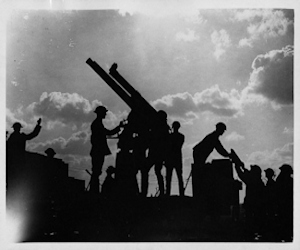
Sheaves and paying-out gear on the bow of the Dominia Cable ship c1930. AS Collection
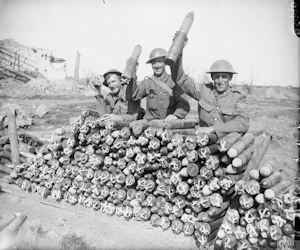
Back in 1896, the founder of the Anglo-American Telegraph Company, which had objected to the Newfoundland experiment, John Pender (1816-1896), died. The Scottish born businessman had already made his fortune in textiles when, in 1866, he headed a consortium to lay a transatlantic cable from Valentia Island, one of Ireland’s most westerly points, to Newfoundland. The design of the cable was based on the Submarine Telegraph Company’s, Dover – Calais cable – see the story on the Channel Submarine Telegraph and Telephone Cables. That was a copper conductor – the cable’s core, insulated using gutta-percha, a type of latex for under-water use and wrapped in a casing of iron wire, thicker at the shore ends to provide protection from anchors and tidal chafing. Successfully overcoming numerous technical and financial difficulties the trans-Atlantic cable was laid and this encouraged Pender to promote long-distance telegraphs through companies that once successfully established were consolidated into the parent company – Anglo-American Telegraph Company Ltd – part of the Pender group of Companies which, in 1934, became Cable and Wireless.

In commemoration of John Pender’s achievements a memorial fund was set up that raised £6,277. Out of this money, the committee donated £5,000 to the Department of Electrical Technology of University College, to enable an expansion of its facilities. This included the founding of the Pender Laboratory and the inauguration of the Pender Chair of Electrical Engineering in 1899. Dr John Ambrose Fleming was appointed the first Professor, a post he held until 1925 during which time he became known for inventing the first thermionic valve or vacuum tube (see below) and is famous for the left hand rule for electric motors -– if the forefinger, second finger and the thumb of the left hand are extended at right angles to each other, the fingers indicate the motion in an electric motor. He was also a consultant to the London Electric Supply Corporation, the Swan Company, Ferranti Limited, Edison Telephone, the Edison Electric Light Company, the Edison and Swan United Electric Light Co. and the British Admiralty Coastguard signal stations.

Admiralty Pier joint Royal Navy signal station 29 and Lloyds merchant shipping station being rebuilt 1907. Nick Catford

Admiralty Pier joint Royal Navy signal station 29 and Lloyds merchant shipping station being rebuilt 1907. Nick Catford

The responsibility of the Coastguard passed to the Admiralty and on 21 May 1903 and the office of Admiral Commanding Coastguard and Reserves was established the first incumbent being Admiral Sir Ernest Rice (1840-1927) of Dane Court, Tilmanstone and the son of former Dover MP Edward Royce Rice (1790-1878). A further eight Admiralty Coastguard signal stations were opened, they were at Bere Island, Castletown – Ireland; Spurn Head, Easington, Yorkshire; Alderney, Channel Islands; St. Abb’s Head, Berwickshire, Scotland; St. Ann’s. Head, Pembrokeshire; Landguard, Felixstowe, Suffolk; Port Patrick, Wigtownshire, Scotland and Duncansby Head on the north eastern tip of the Scottish mainland. That year, an agreement had been reached between the Admiralty and Lloyds of London insurance and reinsurance market with its roots in marine insurance. The agreement enabled Lloyds to operate commercial signalling stations for merchant shipping and one was jointly rebuilt at the end of Admiralty Pier with the Royal Navy in 1907. The station continued operating through two World Wars until February 1951 when it was transferred to the Harbour Board signal station on the Eastern Arm.

This joint operation, from the signal station on Dover’s Admiralty Pier, had come about due to the Admiralty’s concern that the maritime airwaves were becoming overcrowded. Trinity House had planned to install Marconi equipment on all their light vessels but this required the sanction of the Admiralty and they were only allowing one at a time in order to see what effect this had on the transmissions from existing stations. The same reasoning was also being applied to the SECR cross Channel ships, Lloyds, the Royal Navy and Coastguard signal stations. Experiments and innovations were also still taking place, some in order to answer questions as to why Morse Code was used in transmitting wireless messages. This was because only the ‘on-off‘ signal could be transmitted and to make radiotelephony possible.

Commercial Thermionic Valves from TheValve and its Developments in Radiotelegraphy and Telephony by John Ambrose Fleming 1919 The Wireless Press, London, p. 53, fig. 28A

Commercial Thermionic Valves from TheValve and its Developments in Radiotelegraphy and Telephony by John Ambrose Fleming 1919 The Wireless Press, London, p. 53, fig. 28A

In 1904 Professor Fleming invented the forerunner of the thermionic valve that he called the oscillation valve. This acted as a pump and the concept was then developed by the American physicist Lee De Forest (1873-1961). He created the vacuum tube, which he named the electron tube although it is better known colloquially as the radio valve. The valve enabled wireless signals to be received, amplified and transmitted  by controlling electric current flow in a high vacuum between electrodes to which an electric potential difference has been applied and thereby creating radiotelephony!

The introduction of the thermionic valve was one of the many innovations in wireless transmissions that were been made at that time. In order for the government to maintain overall control of the wireless industry, the Post Master General, Edward George Villiers Stanley, 17th Earl of Derby (1865-1948) submitted a Bill to Parliament requiring all wireless stations/companies to be licensed. On 15 August 1904, the Wireless Telegraphy Act became law and 73 stations applied for licenses of which 64 were scheduled as experimental or lecture installations. Although the Marconi Company applied, its company policy forbid, except in the case of emergencies, shore and ship stations to communicate with vessels using wireless equipment manufactured by other companies. This sort of monopoly was beginning to be prohibited by international treaties but at that time this did not include the UK.

Of the other companies that applied for British licences, one was the German Telefunken Company, a joint venture of Siemens & Halske – mentioned above in the relation to the Boer War – and the Allgemeine Elektricitäts-Gesellschaft (AEG) founded in 1903. Also, the National Electric Signalling Company – with headquarters in Washington, USA and the American de Forest Wireless Telegraph Company, which was developing Fleming’s thermionic valve. The British contingent included Lodge-Muirhead Wireless and General Telegraph Syndicate Limited. This was founded by physicist and writer Sir Oliver Joseph Lodge (1851-1940) together with electrical engineer Dr Alexander Muirhead (1848-1920) and was particularly favoured by the British military. In 1912, they sold their patents to Marconi. The 1904 Act remained in force until 31 July 1906 then it was extended year on year until the Wireless Telegraphy Act of 1924 came into force. This too was extended year on year until superseded by the Wireless Telegraphy Act of 2006.

Dover Castle

Dover Castle

Meanwhile, Swingate Downs, since the end of the Boer War, had virtually been abandoned by the military except when Royal Engineers based at the Castle used the Downs to try out searchlights and associated equipment. Also when, as part of the Castle based Royal Engineers, Captain Kennedy had overseen the set up of a military wireless station in a decommissioned battery in the Castle grounds. This, in 1914, was adapted as the Port War Signalling Station. During Captain Kennedy’s time at the Castle, it was reported that he took interested parties to the Downs when giving talks on the Marconi experiments in Dover. Albeit, with the proposed building of the Duke of York’s School on the landward side of the Dover-Deal Road, of the Downs. Locally, rumours were rampant that the Downs were to be sold.

This was well founded for in May 1895 the Admiralty had announced that it was going to use the port of Dover as a base for the Royal Navy and would build an Admiralty Harbour to enclose Dover Bay. The following year, in August 1896, the Undercliff Reclamation Act received Royal Assent for the laying out land on the South Foreland where a new ‘Dover’ was to be built (see Dover, St Margaret’s and Martin Mill Railway Line part 1). The Act had been sponsored by John Jackson (1851-1919) and Weetman Dickinson Pearson, 1st Viscount Cowdray (1856-1917), both were involved in the building of the proposed Admiralty Harbour and Sir William Crundall (1847-1934) – thirteen times Mayor of Dover from 1886 to 1910, and Chairman of Dover Harbour Board between 1906-1934. He had also attended Dr Fleming’s lecture in Connaught Hall and had been awed the following day when he had tried out the equipment (see above). Be that as it may, although the new road to the proposed St Margaret’s development was expected to go under the cliffs, in the short term it had been agreed that it would go over the cliffs crossing land including Swingate Downs.

Admiralty Harbour map 1909 Daily Telegraph 1909

Admiralty Harbour map 1909 Daily Telegraph 1909

Under the direction of Viscount Cowdray, the Admiralty harbour was created by extending Admiralty Pier and building the Eastern Arm and Southern Breakwater and on 15 October 1909 George, Prince of Wales later George V (1910-1936) opened the new Harbour. It was he who had been impressed with the Marconi wireless transmissions at Osborne House, Isle of Wight such that he brought them to the attention of Trinity House – see above. As the new Harbour was being built, the Royal Navy undertook trials and these tended to produce negative results due to the natural tidal flows (see Tides, Flooding, Western Docks & Esplanade Lock story). Thus, it was increasingly believed that the possibility of Dover becoming a national naval base would be abandoned. Further, although Dover was a long established garrison town, following the promotion of the commanding officer, Major-General Henry Fane Grant (1848-1919), his position had not been filled.

The rumours appeared to be confirmed on 14 January 1907, when it was officially announced that the headquarters of the military South Eastern District and the 5th Division, which had been for many years at Dover, would be transferred to Woolwich. Dover was downgraded to a Coast Defence Command and a Colonel Owen was appointed commander of the coast defences until he retired later that year. A Colonel F A Curteis was appointed his successor but escalating rumours stated that this was purely temporary. Volunteer camps were still taking place at Dover but in 1907, neither took place on Swingate Downs. The 1st Volunteer battalion of the Buffs trained on the Ropewalk Meadow in June and the 1st Volunteer battalion of the Sussex Regiment trained at Fort Burgoyne in August. Meanwhile the Dover garrison continued to be reduced and this had a direct effect on the economy of the town. Not that long before, Dover had been one of the top ten wealthiest towns in the country.

Canadian Pacific Atlantic Liner SS Montrose c1910 sank on the Goodwin Sands 1914. Wikimedia

Canadian Pacific Atlantic Liner SS Montrose c1910 sank on the Goodwin Sands 1914. Wikimedia

On 17 October 1907 between the Marconi wireless station at Clifden in Ireland and the station at Glace Bay, Nova Scotia, the Marconi transatlantic wireless service was inaugurated. In 1910, on board the Canadian Pacific Company of Montreal Atlantic liner, Montrose, built at Middlesbrough in 1897, was murderer Dr Hawley Harvey Crippen (1862-1910) and his mistress Ethel le Neve (1883-1967). They had embarked in Antwerp travelling on false passports and she was trying to pass herself off as a boy.

The Master of the ship, Captain Henry George Kendall (1874-1965), had become suspicious of the couple and sent a wireless telegram from the ship to England. Detective Chief Inspector Walter Drew (1863-1947) took a faster passage to Montreal from Liverpool and arrested the pair off Father Point in the St Lawrence River. This was the first use of wireless telegraphy to apprehend a criminal. The Montrose was brought to Dover in World War I, to be used as a Blockship, but during a gale broke free from her moorings. She was wrecked on the Goodwin Sands not far from the South Goodwin Lightship, which had also broken her moorings that night.

At the beginning of March 1909 the Atlantic Fleet arrived and spent a little over three months out of twelve based at Dover and the town became optimistic. But it was in the summer of that year that another invention that was to become directly connected to Swingate bringing the world’s attention on Dover, thus lifting the town’s spirits. That story goes back to 17 December 1903 when two US, bicycle manufacturers undertook an experiment near Kitty Hawk, North Carolina. They were Wilbur (1867-1912) and Orville Wright (1871-1948) and they had made the first controlled and sustained powered flights, landing on ground at the same level as the take-off point. By 1905 the two brothers had built a flying machine with controls that made it completely manoeuvrable. They immediately applied for the patent but in the US little interest was shown in the achievement. When the patent was granted in 1906 the Wright brothers looked to enter agreements with European firms where airships were being developed and seemed to be preferred.

First Zeppelin ascent 2 July 1900. Library of Congress. Wikimedia

First Zeppelin ascent 2 July 1900. Library of Congress. Wikimedia

The first aerial crossing of the English Channel had taken place on 7 January 1785 by Dr John Jeffries (1744-1819) and Jean-Pierre Blanchard (1753-1809) from Dover in a lighter than air balloon. From then on balloon and then airships were developed and in 1888 German bookseller Friedrich Hermann Wölfert (1850-1897) successfully produced an airship that could be manoeuvred by control and used a Daimler petrol engine. In the following decade, Croatian-Hungarian Dr David Schwarz (1850-1897) built the first rigid airship. This was filled with gas contained in a rigid aluminium envelope, riveted on a metal framework and Count Ferdinand von Zeppelin (1838-1917) turned the development into a commercially successful industry. Between 1910 and 1914 his airships carried over 10,000 passengers on the world’s first schedule airline service. During the 19th century the British Army had used balloons and later airships and in 1890 the Royal Engineers were granted a full Balloon Section with its own Balloon Factory on Farnborough Common, Hampshire. However, as the decade and developments progressed, the War Office only saw the potential of air flight in reconnaissance and having spent £2,500 on the research cancelled funding by which time Germany had spent £400,000 on aeronautical research!

Orville & Wilbur Wright followed by Horace Short. The Short brothers won the right to build Wright planes. Eveline Larder

Orville & Wilbur Wright followed by Horace Short. The Short brothers won the right to build Wright planes. Eveline Larder

The first British aeroplane manufacturing company to gain the right to build Wright aeroplanes was the Short Brother’s factory at Mussell (Muswell) Manor, at Eastchurch on the Isle of Sheppey, north Kent. This was owned and run by Horace Short (1872-1917) and his brother Oswald (1883-1969) and opened in February 1909. Later that year, on the morning of Sunday 25 July 1909, on Northfall Meadow between Swingate Downs and the Castle, Louis Blériot (1872-1936) landed. He had crossed the English Channel from Sangatte, France to England in his Blériot No XI 25-horsepower monoplane and it was the first heavier than air flight to make the Channel crossing. When he landed, 36minutes 30 seconds after take off he made history and initiated the meteoric interest in aviation.

Charles Rolls postcard, commemorating his two way non-stop flight 02.06.1910. Dover Library

Charles Rolls postcard, commemorating his two way non-stop flight 02.06.1910. Dover Library

With the popularity of aviation increasing, a considerable amount of private money was invested in developing and building aircraft. Landing places for the aircraft quickly proved to be problem and airfields – open, relatively flat, grassy areas – were sought after. In the spring of 1910, wealthy Charles Rolls (1877-1910) saw Swingate Downs plateau as a potential for an airfield and persuaded the War Office to rent him the site when it was not required for military purposes and this was readily agreed to. On acquiring the Swingate Aerodrome, as Rolls renamed the site, he had an ‘aeroplane garage’, or hangar as they are now called, erected. On 20 May 1910 a Wright Flyer aeroplane, belonging to Rolls, arrived at Dover and at 18.30hrs on Thursday 2 June he took off from Swingate Aerodrome. Rolls passed over Sangatte, France, at 19.15hrs and after circling round Dover Castle in triumph, he landed back at Swingate aerodrome at 20.00hrs having made the first two way Channel crossing in an aeroplane. Over 3,000 people witnessed the event, after which Rolls was carried through the town shoulder high. A month later, on 12 July 1910, Charles Rolls lost his life due to a controlling wire breaking, which had been added to his Wright Flyer.

Bleriot XI aeroplane aviator Louis Blériot and the type of aeroplane that John Moisant accompanied by his French mechanic Albert Fileux and cat, Mademoiselle Fifi made their historic crossing of the Channel . US Library of Congress Wikimedia

Bleriot XI aeroplane aviator Louis Blériot and the type of aeroplane that John Moisant accompanied by his French mechanic Albert Fileux and cat, Mademoiselle Fifi made their historic crossing of the Channel . US Library of Congress Wikimedia

Later that year, on 17 August 1910, American John Moisant (1868-1910), accompanied by his French mechanic Albert Fileux (bc1884) and his cat, Mademoiselle Fifi, flew from Calais to England in a Blériot XI, making the flight the first Channel crossing carrying a passenger as well as a cat! He landed at the East Kent Brickfield, Telegraph Farm, Tilmanstone and watching was Thomas Octave Murdoch Sopwith (1888-1989), who went on to build aircraft.

Wealthy Baron Maurice Arnold de Forest (1879-1968) motor car racer and aviator, offered £4,000 to the aviator who flew the furthest from England, having crossed the Channel, in an English-built aeroplane by 31 December 1910. On 7 December 1910 a group of aviators gathered at Swingate including Claude Grahame-White (1879-1959), Robert Loraine (1876-1935) and Cecil Grace (1880-1910). The weather, that day, was against them and continued to be so. Ten days later, a south-westerly storm reaching force 10 on the Beaufort scale, smashed one of the wooden and canvas hangars destroying Clement Hugh Greswell’s (b1890) biplane. It looked as if no one would even set fly due to the state of the appalling weather then on Sunday 18 December the aviators woke up to ideal weather conditions.

Howard-Wright Biplane. piloted by Tommy Sopwith, winner of the Baron de Forrest £4000 prize 1910. Imperial War Museum. Wikimedia

Howard-Wright Biplane. piloted by Tommy Sopwith, winner of the Baron de Forrest £4000 prize 1910. Imperial War Museum. Wikimedia

Thomas Sopwith, set off in a Howard-Wright Farman type biplane with a monoplane tail borrowed from the then recently opened Royal Flying Corps Naval Wing Station at Eastchurch on the Isle of Sheppey north Kent. He successfully flew 169 miles in 3 hours 40 minutes to Beaumont, Belgium winning the £4000 prize and used the winnings to set up the Sopwith School of Flying at Brooklands, Weybridge, Surrey. Claude Grahame-White set off from Swingate in a Bristol biplane equipped with a 60-horse-power E.N.V. engine (an acronym for V8 engines made by London and Parisian Motor Co). His biplane rose easily from the ground but then suddenly heeled over and crashed to the ground. As medical equipment was on site, this was prepared but was not required as Grahame-White manage to crawl out from underneath the wreckage and sustained nothing more than a bloody nose! Of interest the Twentieth Century Fox 1965 film, ‘Those Magnificent Men in their Flying Machines,’ set in 1910 and tells of an air race between London and Paris, to prove that Britain is ‘number one in the air’. The story was inspired by the 1910 de Forest race, authentic aircraft was used and the location of the filming around Dover was principally shot on Swingate Downs!

The weather again augured well on 22 December and several airmen took off from Swingate including Cecil Grace. Tommy Sopwith had arrived at the airfield the day before with his biplane, in case anyone beat his record in which case he would have another go. Grace was one of the first to leave, at 09.26hrs in his Short 7 biplane. There was a light wind from the west but there was mist over the sea. In case of accidents, in the Channel there were two Calais steam tugs and one from Dover with the Dover lifeboat, Mary Hamer Hoyle, standing by. On the other side of the Channel fog was rolling in but Grace eventually landed at Les Baraques, near Sangatte. At 14.10hrs, he filled his biplane with enough petrol to fly for 4-5hours and started on his return flight to Swingate. However, he never arrived and on 6 January 1911, pilot’s goggles and a cap was found on the beach at Mariakerke, in Belgium. They were later identified as belonging to Cecil Grace.

The King’s harbourmaster for the Admiralty Harbour was Captain WS Chambré RN and before World War I he took over Clock Tower making it his headquarters. During his time the Coastguards, which had a station on the top floor of the Clock Tower, replaced the semaphore equipment and erected a wireless antenna on the roof. At Dover’s main Coastguard station at Aycliffe, wireless apparatus installed and a Marconi signal tower was erected on Shakespeare Cliff. At the end of 1910 it was proposed to erect quarters at Fort Burgoyne for an Infantry Battalion comprising of 500men. This was estimated to cost £25,000 and local builder, George Lewis (1850-1923), won the contract. Further military accommodation was erected at the Castle on the site of the former Debtors’ prison then in 1911, the War Office banned aviators using Swingate and the 4th Brigade of the 2nd Division of the London Territorials camped there. Although, aviators continued to come to Dover they mainly used the airfield at Whitfield.

George Wyndham Dover's MP, former Undersecretary of State for War 1898-1900. Photographer A J Grossman c 1885

George Wyndham Dover’s MP, former Undersecretary of State for War 1898-1900. Photographer A J Grossman c 1885

The rapid developments in aeroplanes was beginning to make an impact on the British government’s thinking and on 12 May 1911 there was an impressive display of military aircraft at Hendon aerodrome (1908-1968), Colindale, seven miles north west of Charing Cross, London. In November, the Committee of Imperial Defence set up a sub-committee to examine the question of military aviation and they reported on 28 February 1912. The Committee recommended the establishment of a flying corps made up of a military and naval wing with a central flying school and an aircraft factory. The recommendations were accepted and on 26 March 1912 George V gave his approval to the title ‘Royal Flying Corps’. It received Royal Assent on 13 April. In 1911 the Royal Engineers had been given permission to form an air battalion of two companies, Number 1 for airships and Number 2 for aeroplanes and they became the Military Wing of the Royal Flying Corps on 13 May 1912. The establishment of the new Flying Corps, however, was not without controversy especially as it was not that long before, that the War Office had cancelled aviation research by the Royal Engineers as being too costly. This angered Dover’s Member of Parliament, George Wyndham who had served as Under-secretary of State for War (1898-1900). He made it clear in the parliamentary debate, that in his opinion more money should be spent on providing more aircraft and pilots, adding that the British armed services, ‘should never be tinged with partisanship or bitterness as this creates weak spots.’

An example of a Nissen hut, this one was used in France c1918. National Library of Scotland Wikimedia

An example of a Nissen hut, this one was used in France c1918. National Library of Scotland Wikimedia

At Swingate, due to the mounting demands of a possible war, its use as an army training ground became paramount. Then on 14 October 1912, a 450-foot long Zeppelin paid a clandestine visit to north Kent. Shortly after the War Office made £45,000 available to extend the Swingate site and build a flying depot. This was formally established in June 1913 and named St Margaret’s Aerodrome. Three large hangars constructed of brick 180feetx100feet were erected. Twelve portable timber and canvas Bessonneau hangars were also erected and eventually the aerodrome covered 219acres. Besides the hangars, the site included administrative and recreational buildings, workshops, motorised transport garages and a coal yard. The majority of accommodation was to be in Nissen huts, prefabricated steel structures made of arcs of corrugated iron that could be assembled in a few hours. Tents were to be used to augment them if necessary. When completed, the aerodrome was categorised as First Class.

During the summer that year, allegations were made that Members of Parliament had profited from insider trading with respect to a government issued contract to the British Marconi Company. At the time the Prime Minister (1908-1916) was Liberal Herbert Henry Asquith (1852-1928) and the scandal centred on the contract for the Imperial Wireless Chain, a strategic international communications network of powerful long range radiotelegraphy stations linking the countries of the British Empire. Although the scandal was never effectively resolved one way or another in the 1920s the Marconi Company built the Imperial Wireless Chain radio stations for the GPO. Back in 1912 George Wyndham took an interest in the case, as there was a possibility of Swingate becoming one of the long-range radiotelegraphy stations. However he was never to see the eventual outcome for Wyndham suddenly died in June 1913 from a blood clot.

Titanic being towed out on her maiden voyage from Southampton 10.04.1912. Evelyn Robinson Collection

Titanic being towed out on her maiden voyage from Southampton 10.04.1912. Evelyn Robinson Collection

The first decade of the twentieth century had seen a rapid expansion in wireless technology, by mid-1910, approximately 300 mercantile marine ships had been fitted with Marconi equipment and each one had been specifically listed at Lloyds of London. One such ship was the White Star Line Olympic class ocean liner Titanic launched in 1909. In April 1912 she was sailing from Southampton to New York, the official total number of passengers and crew on board was 2,229. Classed as crew were two Marconi wireless engineers, senior wireless operator John George Phillips (1887-1912) and junior wireless operator Harold Sydney Bride (1890-1956). At 23.40hours on 14 April, about 375miles south of Newfoundland, the Titanic hit an iceberg and over 1,500 people lost their lives. It would appear that there had been a wireless breakdown the previous day and on the evening of the disaster Philips was working to clear a backlog of passenger messages while Bride was asleep in preparation for coming on duty at midnight. Bride was with Phillips in the wireless room for hand-over when the Titanic struck the iceberg and Captain Edward Smith (1850-1912) asked Phillips to prepare to send out a distress signal. Shortly after midnight, the Captain told the wireless operators to call for assistance.

Replica of Titanic's radio room. SPARK Museum of Electrical Invention, Bellingham, Washington, U.S. Joe Mabel

Replica of Titanic’s radio room. SPARK Museum of Electrical Invention, Bellingham, Washington, U.S. Joe Mabel

Phillips sent out the international distress signal, see above, that had been used by the Marconi Company since 1904 – code CQD – the general call, ‘CQ,’ followed by ‘D,’ denoting distress and together meaning ‘All stations: distress.’ Beside the continually repeated wireless distress signal, rockets, and lamps were used to try and get help, but no ships were near enough to reach Titanic before she sank at about 02.10hours. The two wireless operators stayed until the end and had managed to get in touch with the Cunard transatlantic ship Carpathia. She arrived on the scene at about 04.00hrs and rescued 710 people. Both Captain Smith and wireless operator John Phillips died that night. Harold Bride was washed off the sinking ship and although seriously injured managed to hold onto an upturned lifeboat and was rescued by the Carpathia. The sinking of the Titanic demonstrated the value of wireless communication and from 23 November 1913 to 20 January 1914, the first International Conference for ‘Safety of Life at Sea’ was convened in London and attended by representatives from 65 countries. One of the key recommendations was to launch an international 24-hour wireless watch and this was immediately instituted throughout the English Channel.

Maurice Farman Biplane - Flight International March 1910. Wikimedia

Maurice Farman Biplane – Flight International March 1910. Wikimedia

The growing possibility of War instigated the government into making a further £10,000 available to enable the Army to build Connaught Barracks in Dover. George Lewis won the building contract but when World War I broke out, work on the Mess was suspended. In October 1913 two Maurice Farman bi-planes of the RFC 5th Squadron were flown in to St Margaret’s aerodrome or Swingate airfield, as it was generally called, and the pilots together with newly arrived ground crew were billeted at Langdon Prison. On Wednesday 5 November, some 350-400 locals walked up to Swingate Downs to watch members of the RFC 5th Squadron flying. They were under the command of Major John Frederick Andrews Higgins (1875-1948), who had been elected to head up the RFC’s Training Wing. Lieutenant Ernest Vincent Anderson (1887-1914), Lieutenant Reginald Cholmondeley (1889-1915), Lieutenant Eric Lewis Conran (1888-1924), Lieutenant Robert William Rickerby Gill (1883 -1951) and Lieutenant George Beresford Stopford (1886-1961) put on an impromptu display using the Maurice Farmans plus a Blériot monoplane and two other newly arrived aeroplanes.

This was much to the delight of the crowd but as the planes landed the crowd surged onto the designated airfield. Mounted military police and mechanics soon restored order and kept the crowd back. The highlight of the afternoon came when Lieutenant Stopforth took Duke of York Military School pupil, Searle Mott (1895-1976) and the Reverend RCT Williams, the school’s chaplain, for a flight in one of the Maurice Farman biplanes. When the plane reached an altitude that the occupants could just be still seen by the crowd, Lieutenant Stopforth switched the engine off. He then made a ‘splendid spiral descent and the plane was landed in a graceful style.’ The young Searle said that he enjoyed the flight!

Map showing the Guilford Battery - the site of the WWI Seaplane Base in Dover.

Map showing the Guilford Battery – the site of the WWI Seaplane Base in Dover.

With War becoming an increasing possibility, development in aeroplane engineering grew rapidly and in the military, any doubts over their capabilities were on the wane. Many saw the use of aeroplanes in reconnaissance and perhaps even combat but there were some, most notably Field Marshall Sir Douglas Haig (1861-1928), who were of the opinion that aeroplanes were strictly for recreational use. Saying that pilots, who were soldiers, ‘would be best undertaking reconnaissance on horseback!’ In the Admiralty there were many that were ready to accept airships but some were sceptical over the use of aeroplanes. Nonetheless, there was a belief that seaplanes could be of use in reconnaissance, particularly over the Channel. On Dover’s Seafront, the Admiralty requisitioned Guilford Battery and the surrounding grounds for the Royal Naval Seaplane Patrol. This was part of the Naval wing of the Royal Flying Corps that on 1 July 1914 separated to become the Royal Naval Air Service (RNAS).

Site of the Needles Wireless Station, Isle of Wight were Marconi carried out some pioneer work - the pionerering work carried out by Marconi and Fleming in the Dover area remains forgotten. Pix Alan Sencicle

Site of the Needles Wireless Station, Isle of Wight were Marconi carried out some pioneer work – the pionerering work carried out by Marconi and Fleming in the Dover area remains forgotten. Pix Alan Sencicle

In the last week of July 1914, the Dover Company of the Royal Engineers and the London Electrical Engineers arrived in the town to operate searchlights. The War Office, on 29 July, issued a notice to the RNAS to confine itself to home defence and the protection of vulnerable points from possible attack by enemy aircraft and airships. The RFC were told that they were to support the Army and all thoughts of wireless communication at Dover was forgotten. On Saturday 1 August, in accordance to the Schlieffen plan (see World War I – the Outbreak), Germany declared war on Russia, invaded Luxembourg and crossed the French frontier at several points. The First Lord of the Admiralty (1911-1915), Winston Churchill (1874-1965), issued the order to mobilise the Royal Navy and the warships that were in Dover harbour were put on a war footing. The crews were immediately engaged in getting rid of all surplus woodwork in preparation for action. Channel ferries were crossing the Strait of Dover at speed and out of schedules endeavouring to bring back to England as many people as possible before the War commenced.
In the town, crowds surrounded the information posts, such as Leney’s brewery office on Castle Street, which received telegrams. They were also in contact by telephone with the Coastguard at Spioen Kop wireless telegraph station on Western Heights and quickly posted the latest news. On Sunday 2 August 1914, Russia joined in the conflict on the side of Serbia and France was immediately embroiled. Germany declared war on France and proceeded to march through Belgium, thus violating the Treaty of London of 1839. This recognised and guaranteed the independence and neutrality of Belgium and confirmed the independence of the German-speaking part of Luxembourg. At 23.00hrs on Tuesday 4 August Britain declared war on Germany in accordance with the written obligation of 1839 to uphold the neutrality of Belgium.

Treaty of London (1839) signatories - Britain, Austria, France, German Confederation, Russia, and the Netherlands.

Treaty of London (1839) signatories – Britain, Austria, France, German Confederation, Russia, and the Netherlands.

Dedicated to the Memory of Patrick Quinn 1910-1991 Marconi Wireless Officer on the Townsend cross-Channel ships

Part 2 of the Swingate story continues.

Thanks to Dover Museum – as always. Also Michael Hunter, Curator, Osborne House, Isle of Wight and the History of Science Museum, University of Oxford. 


Posted in Armed Services, Aviation, Open Spaces, Radio and Telecommunications, Swingate Part 1 Marconi South Foreland and Wireless Communication, Swingate Part 1 Marconi South Foreland and Wireless Communication, Swingate Part 1 Marconi South Foreland and Wireless Communication, Swingate Part 1 Marconi South Foreland and Wireless Communication, Tourism | Comments Off on Swingate Part 1 Marconi, South Foreland and Wireless Communication

Stembrook Tannery to Pencester Gardens Part II

Tannery and Timber Yard 1907. where Pencester Gardens are today

Tannery and Timber Yard 1907. where Pencester Gardens are today

Part One of the Stembrook Tannery to Pencester Gardens story looked at the development of the area from medieval times to the 1920s. For much of that time a large part of the site was owned by the Maison Dieu and stretched from present day Ladywell to Dieu Stone Lane. On the east side of the River Dour was a narrow, twisty, lane called Charlton Back Lane and to the west the Market Place, St Mary’s Church and Biggin Street. The Maison Dieu estate was sold at the time of the Reformation (1529-1536) and a large mansion with beautiful gardens was built and occupied by the Stokes family, followed by the Wivell family, the Gunman family and the Jarvis family. They occupied the estate for the next 300years until George Knollis Jarvis (1803-1873) finally sold it in 1854.

Just north of the mansion, a public footpath that ran from Biggin Street towards the Castle bisected the grounds of the estate. When the mansion was sold the footpath eventually became Pencester Road. It was the southern part of the estate that later became Pencester Gardens. To the west of this part of the original site, between Dieu Stone Lane and the Dour, was the ancient Church Street. There was also a short thoroughfare from the back of St Mary’s Church to the Market Place otherwise the Stembrook Tannery occupied the rest of the area.

Castle Street late 19th century looking towards the Castle. On the left is Stembrook corn mill. Dover Museum

Castle Street late 19th century looking towards the Castle. On the left is Stembrook corn mill. Dover Museum

In 1797 a Military Road was laid from the Castle to the Western Heights, following another ancient footpath that ran from St James Church, past the tannery to the Market Place and from there up to the Western Heights. During the Napoleonic Wars (1793-1815), alongside this Military Road and next to the River Dour, in 1792 the Military built the Stembrook corn mill. At the end of the Wars the Military Road was handed over to the Deal Turnpike Trust and abutting Church Street, Caroline Place cottages were built. Over shadowing the cottages and between them and the tannery was the Artillery Volunteers’ Institute.

A consortium of local businessmen laid out Castle Street in 1829, following the line of the Military Road from the top of the ancient Church Street eastwards. A few years later the Paving Commission extended the ancient Stembrook from Dolphin Lane to the Church Street and Caroline Place junction. The Castle Street bridge was built and the Stembrook thoroughfare on the sea side of Castle Street was renamed Dolphin Place. Around about 1840 cottages and poorer workers residences were built on Church Place and the Stembrook thoroughfare, which had been extended to Dieu Stone Lane.

The Inter-War Period

The southern portion of the former mansion site was acquired by the Crundall family for use as a timber yard. Following World War I (1914-1918) Dover Corporation were considering the future of the yard, or Pencester Meadow as it was called, as the owner, Sir William Crundall (1847-1934) was talking of selling it. In 1922 the Stembrook tannery came on the market and the following year, the Corporation voted to ban the practice of tanning in Dover.

At the time the country was sliding into a deep economic depression – there were 1,400 men out of work in Dover. Dover’s Mayor, William George Lewis (1850-1924), prime concern was to pursue projects that would provide employment and the Corporation decided to purchase both pieces of land. Their intention was to provide a recreation area in what was then a densely populated part of town. However, the proposal was met with a great deal of local hostility that ended in a Public Inquiry. This was held on 16 March 1923 in the Council Chamber of the then Town Hall now the Maison Dieu. For details see Part One of Stembrook Tannery to Pencester Gardens.

Pencester Gardens during the inter-war period. Dover Library

Pencester Gardens during the inter-war period. Dover Library

The Secretary of State for Health (1924-1929), Neville Chamberlain (1869-1940) gave his approval for the creation of recreational area. The project was to be financed by a loan of £2,900 repayable over 20 years, by the Ministry of Health to lay out the ground as a play area and gardens. Also consent was given for a £4,200 loan, repayable over 50 years, towards the £5,000 cost of buying the Meadow. Although the Corporation were jubilant, the loan was £200 short of the required sum but this Mayor Lewis personally covered. Work began in 1924 on what was renamed Pencester Gardens. Mayor Lewis, however, never saw his special project completed for he died on 2 May that year.

Jarvis Estate c1830-1850 summer house east of Maison Dieu beyond the lawn of what is now Pencester Gardens. George Jarvis

Jarvis Estate c1830-1850 summer house east of Maison Dieu beyond the lawn of what is now Pencester Gardens. George Jarvis

Once the sale was completed those who criticised the purchase were quick to point out that there was a right of way across Pencester Meadow from Castle Street and Stembrook to Pencester Road. This meant that the Corporation could not limit access to the site. With this in mind, William E Boulton Smith (1883-1975), the Borough Engineer, submitted two alternative schemes. The first was a pleasure ornamental garden centering on the existing George IV (1820-1830) summer house, built when the Jarvis family owned the estate and close to the present Pencester Road, plus a children’s playground. The second option was four hard tennis courts and one grass court plus a children’s playground. The Corporation opted for the first suggestion, which was estimated to cost £2,940 including lavatories and shelters. Under the supervision of Edwin Pott (1882-1962), the Borough Gardens Superintendent, local unemployed men were to be recruited to provide the labour required.

The Stembrook area, to the south of the Gardens sloped down from Castle Street, comprised of tiny cottages, crowded tenements and the pubs of Stembrook, Church Street, Chapel Place and Caroline Place. Close to Church Place on Stembrook was the Corporation’s Waterworks Stores, Worsfold and Hayward’s stores while the auction rooms were on Church Street and nearby was Igglesden & Son’s bakehouse. The pubs in the area included the Ancient Druids on Stembrook while on Church Street there was the Burlington Inn and the Star Inn. Otherwise, poor families, of which a large number were headed by World War I widows, inhabited most of the tenement buildings. Many of the remaining tenement families were headed by former military and naval personnel, many of whom were handicapped by injury sustained during the War.

Vindictive on her return to Dover following Zeebrugge Raid, after which she was used to blockade Ostend harbour in the Ostend Raid. Doyle collection

Vindictive on her return to Dover following Zeebrugge Raid, after which she was used to blockade Ostend harbour in the Ostend Raid. Doyle collection

One such person was Francis O’Connor (1897-1974) of 5 Caroline Place, who had served under Vice-Admiral Roger John Brownlow Keyes (1872-1945) of the Dover Patrol, on the Zeebrugge Raid of 23 April 1917 and the subsequent Ostend Raid of 10 May 1917. The Ostend raid was meant to be identical to the successful Zeebrugge Raid and centred on sinking the Vindictive at the mouth of Ostend Harbour. Unfortunately, after a fierce battle the ship ran aground at the last moment so only partially blocked the harbour. O’Connor was among the skeleton crew on the Vindictive and had been badly injured.

On demobilisation O’Connor, like other injured personnel, was given a scanty War pension of 12s (60p) a week on which he was expected to keep his wife and family. He had tried to find work but there was very little and employers preferred healthy men. Further, although he had suffered serious injuries, due to the lack of a health service free at the point of use, he had to pay for most of his medical treatments as well as those of his family. On Friday 31 October 1925, at about 23.15hours, O’Connor brought the town’s attention to his plight when he rang the Zeebrugge Bell hanging outside the then Town Hall. He was arrested for disturbing the peace and spent the rest of the night in the nearby police station cells. Next morning he appeared in court, the Chief Magistrate of which was the Mayor (1925-1926), Captain Thomas Bodley Scott (1880-1928). O’Connor told the court of how he gained his injuries and his plight as a War veteran. Along with the other magistrates, Mayor Bodley Scott listened but showed no emotion and the retinue left the Court for deliberation.

Zeebrugge Bell outside the Maison Dieu, formerly Dover Town Hall, that was rung by Francis O'Connor on the night of Friday 31 October 1925. Alan Sencicle

Zeebrugge Bell outside the Maison Dieu, formerly Dover Town Hall, that was rung by Francis O’Connor on the night of Friday 31 October 1925. Alan Sencicle

The members of the Bench return to the Court and their attitude was serious and cold. Head bowed, O’Connor expected the worse so could not believe his ears when Mayor Scott gravely announced that under the circumstances all charges would be dropped! Further, the Mayor announced, he would personally write to the pension authorities and demand that O’Connor was to receive ‘better treatment’. Finally, the Mayor said, he would write to a recently formed organisation that specialised in helping those injured while fighting for the country. Whether Francis O’Connor was recruited to work on Pancester Gardens is unknown but on 15 March 1974 a small notice appeared in the local papers. It stated that Francis O’Connor, the last survivor of the Dover Patrol cruiser Vindictive, which was sunk at Ostend, had died the previous Sunday. He was aged 77 and lived in the Battle of Britain Homes overlooking York Street.

Francis O’Connor’s experienced following the War was far from unique. Of those men who returned, 1.75 million were suffering some kind of disability and half of those were permanently disabled. Most received a disability pension from the Ministry of Pensions but this tended to be tokenistic and it varied in scale and in accordance with the type and severity of disability. To try and deal with the increasing unemployment of that era, councils introduced unemployment schemes similar to the one that created Pencester Gardens. However, like other employers, Dover Corporation preferred to take on unemployed able-bodied men. Long before the War ended a number of altruistic minded organisations had been set up to try and deal with the plight of the disabled ex-servicemen and on 15 May 1921 four national ones joined together to form the British Legion. That year, on Remembrance Day – 11 November – the British Legion organise the Poppy Appeal to help members of the Royal Navy, British Army, Royal Air Force, veterans and their families all year round. One of those helped, at the instigation of Mayor Scott, was Francis O’Connor and his family.

The proposed Pencester Gardens were laid out under the direction of Boulton Smith assisted by Edwin Pott and a significant number of the local unemployed were recruited. Then just prior to work starting, the Corporation decided to have an 18-hole miniture golf course on what they owned of the former tannery site, increasing the cost of the enterprise to £7,500. In 1927, the first public fete was held in the Gardens and this was to raise money for the Royal Victoria Hospital, then Dover’s General Hospital.

Duke of York's pupils in their pre-War 'Toy Soldiers' Display. Duke of York's School

Duke of York’s pupils in their pre-War ‘Toy Soldiers’ Display. Duke of York’s School

That year also saw about 50 pupils from the Duke of York’s School present their ‘Toy Soldiers’ routine to a large crowd. The boys wore bright blue or red jackets, white trousers and black ‘bearskin’ hats similar to look at as those worn by the Guards but made out of brown paper and painted black! Red circles were painted on the boys’ cheeks and they carried wooden rifles. As Toy Soldiers, the boys performed a series of drills that included a mock battle without any commands. So successful was the event that they were asked to put on the show elsewhere and by World War II (1939-1945), the routine was internationally famous!

At about this time, the firm Castle Concrete, founded by Captain V D’Oyley Noble who lived in Victoria Park, bought the remainder of the old tannery site for workshops. Their main offices were at 20 Castle Street and backed onto the tannery site where they planned to make concrete and breeze blocks. However, at 17.15hrs on Sunday 6 January 1929, a fire broke out in one of Castle Concrete buildings and quickly spread. Following the fire the Company offered the site to the Corporation at a good price and would have enable them to extend Pencester Gardens. However, the council did not have the financial resources available so had to decline.

After less than five years the Corporation’s Entertainment’s’ Committee, in 1930, voted to move the miniture golf course to Granville Gardens on the Seafront. While on Pencester Gardens it was cheap for customers and had been open every day during the summer months, but this was proving costly. In order for tourists to use the facility, so they said, it was to be moved to Granville Gardens where it would be open on a Sunday and the price was to increase. There was a public outcry and although it was moved to the new location, the miniature golf course opened everyday during the summer months with a special concession for locals.

Royal Victoria Hospital Fete on Pencester Gardens in 1935. Dover Museum

Royal Victoria Hospital Fete on Pencester Gardens in 1935. Dover Museum

Pencester Gardens, was the centre of many of the town’s activities aimed at children. In her book, in her Trawling the River of Time (self-published) Mary Morrison tells us that ‘Pencester Gardens was a magical place. The magnificent Dover Castle towered over the gardens, on the skyline overlooking all below. The river Dour flowed along one side and there were swings and places to skate and play all manner of ball games.’ Since 1927, one of the highlights of Dover’s social calendar was the annual Royal Victoria Hospital Fete. Up until 1948 patients had to pay for care and as many could not afford hospital care they relied on financial help from charities. The hospitals also relied on financial contributions and the money raised at the annual Royal Victoria Hospital Fete was a major contribution in keeping Dover’s hospital functioning. The major prize was a car and every shop and garage in the town also provided prizes and displayed a number in their window. The general public bought individually numbered programmes and then would go around the town, checking each shop and garage window to see if the number of their programme matched the one displayed.

The celebrations included the carnival when horse-drawn and motorised vehicles, freely provided by the owners, pulled floats – decked out trailers put together by different businesses. They drove around the town in a convoy during which time they were judged with prizes awarded. On the actual day of the Hospital fete, various events were held and there were sideshows and victualling tents providing edible goodies and non-alcoholic drinks. In the evening the Duke of York’s School pupils put on, by this time, the nationally famous Toy Soldiers display, the highlight of which was the climax, a battle followed by the firing of shots and all the boys stiffly falling, as wooden soldiers would, at the same time!

Albeit, by this time unemployment in Dover was greater than it had been at any time in the 1920s and continued to rise, reaching a peak in 1932 with 2,624 men out of work. Locals had long since stopped enjoying any facilities requiring payment but by this time, starvation was rife and children also had to do without. It was not until January 1933 that a Corporation ran soup kitchen was opened. This was at the instigation of the Mayor (1932-1934) Alderman Frederick Morecroft (1879-1961) and was held in the cellars of the Town Hall. The facility provided 1,500 dinners a week to needy children.

In 1934, the Dover Unemployed Association held a carnival procession and fete in Pencester Gardens. This raised a total of £218, reduced to only £70 after expenses were paid including renting the Gardens. Nonetheless, out of the proceeds the Dover Unemployed Association retained 50% and the remainder they gave to the Gordon Boys’ Orphanage in St James Street, the Girls’ Orphan Home in Folkestone Road and the Lifeboat Fund. Dover lifeboat, at that time was the state of the art 64foot Sir William Hillary that was voluntarily manned by a crew that included some who were unemployed. Ironically, the boat had been brought on station to deal with the increasing number of affluent adventurous that had taken up recreational flying and ended up crashing into the Channel.

The start of a Recovery and World War II

Map (c1900) of the Stembrook area, showing the tanyard site, Castle Street, Caroline Place and Dieu Stone Lane. The eastern area of the site is the part Dover Corporation purchased using a Compulsory Order.

Map (c1900) of the Stembrook area, showing the tanyard site, Castle Street, Caroline Place and Dieu Stone Lane. The eastern area of the site is the part Dover Corporation purchased using a Compulsory Order.

In late 1935 Castle Concrete again put their old Tanyard holdings on the market but the Corporation could not afford to purchase it. In February 1936 a plan was submitted on behalf of Fyson and Nevill of Continental Motors, for the erection of a motor garage and showrooms on the Castle Street part of the site. This was followed by a second application for eight lock-up garages on an adjacent site fronting Caroline Place. The agents made it clear that Fyson and Nevill were looking at redeveloping the eastern part of the old tannery site, which was open land and close to Dieu Stone Lane. On the northern side of the Lane were Pencester Gardens and the Corporation were none too happy. Meetings were arranged with a view to the Corporation buying the land from Fyson and Nevill. However, by 9 September 1935, having not acquired the remainder of the site for a price they could afford, the Corporation started Compulsory Purchase proceedings.

Annual Dog show on Pencester Gardens organised by the Dover Brotherhood and Sisterhood. Lady Anne Davenport presenting the ‘Davenport Cup’ for the best dog in show to Mrs C.A. Jenkins of Folkestone. Left to right, Mr A. Maxfield (Judge), Sir Henry Davenport (1866-1941), Mrs Jenkins, Lady Anne and Mrs Llewellyn Langley. The Winning dog was a black and white Borzoi, name not given.

Annual Dog show on Pencester Gardens organised by the Dover Brotherhood and Sisterhood. Lady Anne Davenport presenting the ‘Davenport Cup’ for the best dog in show to Mrs C.A. Jenkins of Folkestone. Left to right, Mr A. Maxfield (Judge), Sir Henry Davenport (1866-1941), Mrs Jenkins, Lady Anne and Mrs Llewellyn Langley. The Winning dog was a black and white Borzoi, name not given.

On 2 April 1937 the Corporation, having secured a Compulsory Purchase Order, forced Fyson and Nevill to sign the contract to transfer the parcel of land at the east side of the old tanyard site. The agreed sale price was £2,400. As far as the Corporation were concerned, this came just in time as the Coronation of King George VI (1936-1952) was to be held on Wednesday 12 May 1937. The event was celebrated by the town on Pencester Gardens and the Mayor, Alderman George Madgett Norman (1866-1953), planted commemorative trees in the Gardens and on the newly acquire land. Other activities included the annual dog show organised by the Dover Brotherhood and Sisterhood that attracted breeds from all over East Kent. The highlight of the event was the Davenport Cup, given for the best dog in the show and on this occasion was presented by Lady Ann Frances Davenport (1880-1966). The winning dog was a black and white Borzoi, generally described ‘as longhaired greyhounds’, owned by Mrs C.A. Jenkins of Folkestone.

The economy was slowly picking up and during the Mayority of Alderman Morecroft, the Corporation planned a slum clearance programme. This, the Mayor said, was to create both jobs and healthy homes and the strategy initially focused on the Pier District of Dover. Proving successful, by 1937, the Corporation decided to upgrade the town centre housing and announced that homes were to be demolished in the Stembrook area. This caused consternation, not only from the folks who lived in the area but also from the more affluent residents who either owned the properties or who were concerned over possible rate increases.

Aerial view of central Dover in the 1930s Pencester Gardens is easily identifiable as the open space in the top left quadrant with circular and cross footpaths the Stembrook area is on the sea side. Dover Museum

Aerial view of central Dover in the 1930s Pencester Gardens is easily identifiable as the open space in the top left quadrant with circular and cross footpaths the Stembrook area is on the sea side. Dover Museum

In order to emphasis the need for healthy, well built new homes, the Corporation cited as an example, the state of the tenements that made up number 14 Stembrook supported by a report made by the Corporation Sanitary department. The place was described as overcrowded, damp, with the walls held together by layers of wallpaper. There was one communal lavatory that served the block and a shared cold water tap. Further, the statement went on, the deplorable condition of the property was typical of most of the properties in the Stembrook, Woolcomber Street and Trevanion Street areas, Pleasant Row and Queen’s Court in the centre of Dover. It was recommended that all should replaced with new homes. Dover Corporation councillors agreed but the owners of all these properties and many of the residents did not and a series of Public Inquiries were called.

At the Public Inquiry, the Ministry of Housing appointed Chairman looked at groups of areas and the proposed demolition of Stembrook area was looked at in conjunction with the demolition of properties in the Woolcomber Street and Trevanion Street areas. The Corporation told the Chairman that in order to maintain the community character they proposed to re-house the residents of the Stembrook area in one of the suburban developments they were undertaking, possibly in the Union Road / St Radigund’s Road area. Once the land at Stembrook was cleared, they proposed to build new swimming baths on the site and this was estimated to cost £48,446.

Housing - typical overcrowded 1930s tenement. Doyle collection

Housing – typical overcrowded 1930s tenement. Doyle collection

Permission was given and the Corporation acquired the Stembrook area in three separate blocks in 1937 and 1938. The final block was Caroline Place. Residents were re-housed as homes were completed and then their former homes were demolished. Demolition began in 1938. However, the dark clouds of World War II were gathering so it was not long after work on the project began before the new builds and the demolition was stopped. The swimming pool project was put on hold.

The Corporations preparations for war included trench shelters and one was started next to the children’s playground in Pencester Gardens. However, the cost of finishing it by making it bombproof and habitable was such that following the Munich Appeasement Agreement of 29 September 1938, the Corporation, ordered the hole to be filled in! With the renewed threat of War, in April 1939, the digging was restarted and included making it bombproof and habitable. The size was also extended to accommodate 426 people and smaller trenches were dug. All the trenches were lined with concrete and covered with two feet of earth. Inside each shelter was seating and chemical lavatories. At the same time in the Gardens, next to the established public lavatories, a decontamination centre was erected.

British Expeditionary Force leaving for the Continent in September 1939. Doyle Collection

British Expeditionary Force leaving for the Continent in September 1939. Doyle Collection

From the outbreak of World War II on 3 September 1939, as in World War I, Dover came under Military Rule as Fortress Dover. Albeit, up until the fall of Dunkirk on 26 May 1940, the direct effects of the War were merely an inconvenience. The cross Channel ferries were commandeered for War Service and at first were mainly used to carry members of the British Expeditionary Force to Europe. There was an influx of military and naval personnel into the town, many of which were billeted with local families. Children from London were sent to Dover and East Kent towns for safety. Refugees, however, arrived on an assortment of craft from mainland Europe being taken Dover’s Town Hall at the Maison Dieu before they were moved on. The evacuated children from London attended local schools and special entertainments were laid on, including in Pencester Gardens. However, as the European War seemed far away the children drifted back to their homes in London.

Children who lived in the Ropewalk and Aycliffe about to be evacuated from Dover in May 1940. Ray Langabee

Children who lived in the Ropewalk and Aycliffe about to be evacuated from Dover in May 1940. Ray Langabee

Things changed dramatically at the beginning of May 1940 as the Germans moved closer to the European Channel ports. On 22 May, the Germans captured Amiens, France, and in Dieppe harbour on 23 May, a stick of five bombs hit the 2,789-ton twin-screw cross-Channel ferry, Maid of Kent, which had been utilised as a hospital ship. The flames spread rapidly, killing and injuring many on board and reached a crowded hospital train alongside. On the night of 24 May, Boulogne fell and Calais quickly followed. Dover’s children were evacuated to the safety of South Wales.

As the Germans closed in, the British Expeditionary Force, along with their French and Belgium comrades, made their way to Dunkirk on the French coast. On the 26 May, Operation Dynamo was put into operation under the command of Vice-Admiral Bertram Ramsay (1883-1945), who was in command at Fortress Dover. Between 26 May and 4 June 1940, 338,226 British and Allied troops were evacuated from the beaches of Dunkirk and Dover played a crucial part. Pencester Gardens was used as a temporary holding area before the evacuated men were moved elsewhere.

Shortly after, the Germans launched Operation Sealion – the invasion of Britain. From 10 July 1940, the first day of the Battle of Britain (10 July-31 October 1940) right up until 26 September 1944, Dover hardly had any respite from bombardment. Throughout this period, air raid warnings of bomb attacks were regularly sounded and then on 12 August 1940 shelling from German guns on the French coast began. By October a special shelling air raid warning siren – double alert – was introduced. This, however, was too late for Edith Cameron (bc1878-1940) of 10 Church Street. On the afternoon of Thursday 26 September 1940, Edith was going about her daily business when the air raid siren was sounded. Seconds later a shell hit her home that partly collapsed and buried Edith. Even though children had been moved far away from the town, many found their own way back. Next door to Edith lived twelve-years-old James Robert Holman (bc1928-1940). He too was buried and when rescuers arrived he was still alive but sadly he died the following day.

Flashman's Depository, Dieu Stone Lane following shelling on 31 March 1941. Kent Messenger Group

Flashman’s Depository, Dieu Stone Lane following shelling on 31 March 1941. Kent Messenger Group

At the time of the Battle of Britain, the German invasion was expected any day but on 12 October 1940 Hitler postponed the actual invasion of Britain until the following year. Nonetheless, the aggression was maintained such that during the two weeks following Sunday 20 October 1940, 350 shells fell on the town. Albert Victor Ashbee, known as Frank (1883-1940), the landlord of the Ancient Druids pub on Stembrook was walking along St James Street when he was killed. As noted the shelling did not relent until 26 September 1944 and much of the town centre was devastated. Typically, on 31 March 1941 a shell hit Flashman’s Depository in Dieu Stone Lane, the building along with the graves in the nearby St Mary’s Churchyard were damaged by fire. Another shell totally wrecked the Flashman building on 4 October 1943 and that year saw the Company’s showrooms in Market Square hit by shelling and a passer-by was seriously injured. Prior to the War, the town’s bus station was located in Market Square but shortly after an air raid on 23 March 1942, when 17year-old Ella Dixon (1925-1942) of East Langdon was killed, the bus station was moved to Pencester Road. Although this was a temporary measure – it is still there!

By the summer of 1943, although the bombardment continued, it was apparent that there was an acceptance that life could take on a semblance of normality. Further, many of the children had returned to the town and local teachers, who had remained, were reluctantly given permission to re-open schools. Due to the shortage of teachers, the lack of classrooms, books, materials and general facilities, education was provided on a part-time basis. For the rest of the time children were often left to their own devices. Facilities in Pencester Gardens opened and the Corporation even considered re-opening the putting green.

At the nearby British Restaurant, on Stembrook, civilians could purchase a three-course meals, ‘off the ration’, for 9d (approx. 4p) and half that price for children accompanying an adult. Originally called Community Feeding Centres, British Restaurants were set up by the Ministry of Food. In Dover the council ran it with voluntary help on a non-profit basis. Each meal contained one serving of meat, game, poultry, fish, eggs, or cheese and vegetables that were a good source of vitamin C, such as cabbage, were classed as staple and therefore served with every meal. At Dover, meals were prepared on site and because it was a large centre, the diners had choices for each course.

Outside, the shelling continued and while children were playing in Pencester Gardens, on the afternoon of Saturday 25 September 1943 a shell exploded hitting 11 Pencester Road, next to the Gardens. Just over a week later, in the late evening of 3 October 1943, another shell exploded, this time in Pencester Gardens. It also destroyed a number of buildings including the Corporation slipper baths at Biggin Hall, the rear part of the Technical College and the police station both of which were on Ladywell.

Stembrook following the shelling on the night of 2 September 1944. Dover Museum

Stembrook following the shelling on the night of 2 September 1944. Dover Museum

Following the D-Day Landings of June 1944, the shelling significantly increased. Although the highest concentration of V1 flying bombs was, following the Landings, towards London and the Home counties. As the Allied troops moved north the robot bombers were moved and their impact on East Kent increased. The last V1 was shot down near Hythe on the afternoon of 1 September 1944. By this time the Canadian Army was fighting its way towards the cross Channel port of Calais and the shelling of Dover intensified. Dover’s Civil Defence, under Staff Officer Reginald Cyril Percy Leppard (1900-1994), had ten Heavy Rescue Squads and they were all constantly kept busy. At about 02.00hrs on Saturday 2 September 26 shells rained on the town, one of which was an 18-inch armour piercing shell. This burst on Stembook, destroying most of the properties. One of the buildings left standing was the popular British Restaurant.

Regardless, as the weather on the afternoon of Sunday 3 September was sunny and warm, Pencester Gardens was crowded. A group of sailors taking a spot of leave, meandered into the Gardens and although shattered building surrounded the place, the atmosphere within was peaceful. Children played on the swings or with balls or were just laughing and running around. Young women, wearing their Sunday best were chatting to United States soldiers and Mums, many with prams and pushchairs, were sitting about chatting. The sailors lay or sat down on the grass and were enjoying the sun and the sounds of normality, when suddenly a shell burst almost overhead.

Immediately, everyone raced for the shelters with the sailors and soldiers carrying slower children or pushing the prams and pushchairs. The next shell fell just outside one of the shelters but it seemed that all were safely inside. Albeit, a sailor and a US soldier took one last look outside and saw a few children trying to help not very ambulant old folk cross the recently created deep crater. The sailors and the soldiers went to help and once everyone was inside the doors were closed. One of the sailors later wrote that the noise of the bombardment outside could be heard but the locals were totally unfazed, chatting and laughing as they had been outside before the shelling had started – shelling was such a regular occurrence!
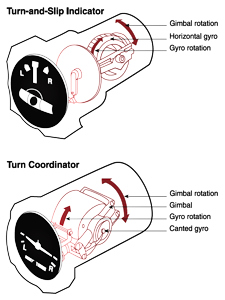
Dover Society Plaque Castle Street Last Enemy shell WWII. Alan Sencicle

Dover Society Plaque Castle Street Last Enemy shell WWII. Alan Sencicle

Monday 25 September 1944 saw the start of 48 hours of the most intense shelling that Dover suffered during the War. The Germans stationed near Cap Blanc Nez, outside Calais, were determined to use all their ammunition before the Canadian forces arrived. The streets of Dover were deserted as nearly everyone was seeking shelter from the bombardment – only four people were killed and three seriously injured. Tuesday 26 September saw even heavier shelling and much of the Stembrook area that was still standing the previous weekend, succumbed. The last shell that day exploded at 19.15hours at the corner of Castle Street and Church Street, destroying Hubbard’s Umbrella Shop in Castle Street – A Dover Society Plaque marks the area where the shop once stood. At the time, Dovorians were unsure whether the bombardment was all over for it was not until Saturday 30 September that the Mayor (1937-1944) Alderman James Robinson Cairns (1880-1969), announced that it was! On 1 October the Commander in Chief of the German Army, Field Marshal Ferdinand Schoerner (1892-1973) announced that Calais and the Channel Ports, except for Dunkirk, had surrendered unconditionally to the Canadian forces.

Post War to 1960

During the War, the Corporation had worked on a plan for the reconstruction of the town when peace came. Because the attacks on Dover had increased significantly following the D-Day landings (6 June 1944) and while the Germans were being driven out of France, the town was devastated beyond recognition. When the bombardment ceased it was estimated that the war damage sustained by the town was proportionally greater than in any other town throughout the country. 957 houses had been destroyed; 898 seriously damaged but in part fit for uneasy habitation; and 6,705 were less seriously damaged. Public buildings, general businesses and industrial premises were also badly damaged.

At the time, Dover’s Town Clerk was solicitor James Alexander Johnson (1908-1998), known, not particularly affectionately, as James A. When he was appointed in December 1944 he had already earned the reputation of having a brilliant incisive mind and dogged determination. James A. was to use these skills to propel the reconstruction of Dover, based on the original plans drawn up by his predecessor and the Corporation. To give weight to the proposal Town Planner, Professor Patrick Abercrombie (1879-1957) was hired for a fee of 1000 guineas (£1,050), to produce a Reconstruction Plan from which the Corporation could, ‘proceed systematically over the next twenty years … (and) … which will beautify Dover and make it worthier of its ancient heritage.

Stembrook 1945-7, Church Street in foreground, Pencester Gardens on left. Dover Library

Stembrook 1945-7, Church Street in foreground, Pencester Gardens on left. Dover Library

Immediately the Professor submitted an ‘Area of Extensive War Damage‘ application to the Government. This was given affirmation in January 1946, at the same time as Abercrombie’s report was published in which he made a number of proposals including redeveloping the Stembrook area with blocks of high quality flats. The Professor’s Plan went before the Corporation in February 1947, who having made some modifications asked the Government for a Declaration Order. This covered 252 acres, extending from Buckland Bridge through Charlton Green to the Seafront. The proposals were fully supported by the Town Clerk, James A, who put forward the argument to the Government Inspector. He also asked for a number of immediate Compulsory Purchase Orders to be implemented, one of which covered the Stembrook area.

The Orders, if granted, enabled the Corporation to acquire the property at site value only and many owners objected. On 12 August 1947 a Public Inquiry was held under the auspices of the Ministry of Health at the Town Hall (now the Maison Dieu). William Scrivens, a barrister with an excellent reputation in such proceedings, represented the objectors. He contended that the war damaged condition of the properties were so bad because the Corporation had refused to allow repairs to be undertaken and the owners had been denied the right of ‘cost of works allowances’ prior to the application for Compulsory Purchase orders. Further, those who had lost property due to War damage were uncertain as to what compensation they would receive, as the corporation had been deliberately unhelpful.

James A contended that all the properties in the Stembrook area were uninhabitable and that was why no attempt had been made at undertaking repairs. Scrivens responded by citing Caroline Place, where numbers 1, 5, 6, 8, 9, 14, 19, 24, 25 and 25A were not only still standing but were inhabited! To these, he said, other buildings in the Stembrook area were still standing, including the Ancient Druid’s public house and most were inhabited. Although Scriven’s put forward a strong argument the Ministry of Health granted Compulsory Purchase Orders for all the properties in the Stembrook area at site value. The adjudicator, however admonished the corporation for not informing property owners that ‘cost of works allowances’ were dealt with by the War Damage Commission and that the corporation should have both advised and made application forms available to the property owners.

The winter of 1946-1947 was one of the harshest on record and caused severe economic hardships including a major shortage of fuel resulting in a 20% cut in the supply of electricity. Schools were closed in Dover, due to heating pipes freezing and due to ice-flows the Dover-Ostend ferry service ceased operating. In March 1947, a warm spell rapidly melted the snow and ice with the result that the Dour overflowed its banks causing severe flooding in the centre of Dover. Most of Dover’s recently opened or reopened industries were on short time and some closed, never to reopen. Rationing, which had been introduced on 8 January 1940 and becoming stricter as the War progressed, became increasingly severe after the War due to the continual shortages. The austerity and its associated effects on health and well being was having a depressing effect and leading to political unrest.

Sidney Doble carrying the Olympic Torch through Dover following arrival on HMS Bicester 28 July 1948 pix Graphic Union. Dover Library
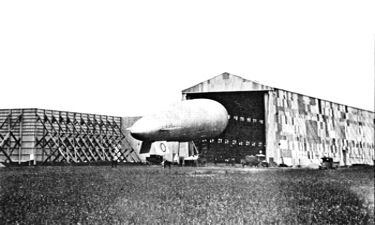
Sidney Doble carrying the Olympic Torch through Dover following arrival on HMS Bicester 28 July 1948 pix Graphic Union. Dover Library

Appropriately, due to the British economic climate, the 1948 Summer Olympic Games, which were held in London, were called the Austerity Games. Nonetheless, the government hoped that they would be a national moral booster. The country could not afford to build new venues so the events were held in Wembley Stadium, London, the Empire Pool in Wembley Park and the arts competition – the last one held in the Olympic Games – at the Victoria and Albert Museum. The Olympians were housed with locals in the Wembley area, in army and RAF camps and in London colleges. The Olympic torch left Greece on 17 July 1948 and eventually was brought across the Channel on Wednesday 28 July aboard HMS Bicester arriving at the port of Dover at 20.25hours. On disembarkation the Olympic torch was carried through the town before being passed on by Sidney Henry Doble (1908-2004) of the renamed Dover and District Co-operative Society Sports Club.

Pencester Gardens c1950s. Left the 'comfort shelter' that included toilets and a shelter with seating. David Iron Collection

Pencester Gardens c1950s. Left the ‘comfort shelter’ that included toilets and a shelter with seating. David Iron Collection

In Pencester Gardens the trench shelters had been removed and the holes filled in. The Corporation also agreed to get rid of the Decontamination Centre to enable the existing public conveniences to be extended. The number of male and female lavatories were increased and two rooms were provided for male and female attendants. An awning was erected on the outside giving covered shelter with seating accommodation for persons using the Gardens. The cost was estimated at £1,300 and an application was made to the Ministry of Health for a loan for the same amount and the facility was built. This proved popular but due to the increasing cost of upkeep much of the facility was demolished in the 1960s.

In the summer of 1949 the new Chairman of the Housing Committee, Conservative Councillor Sidney Frederick Kingsland (1900-1960) proposed that the Corporation should concentrate on re-building on some of the vacant sites near the town centre. In September the Principal Regional Officer of the Ministry of Health asked them to furnish details of their proposals. Amongst the Corporation’s recommendations were flats at the southern end of Pencester Gardens. In July that year, members of the Housing Committee visited other towns that had built council flats and were particularly interested in those in which central heating systems had been installed. They therefore proposed the erection of a block of flats of not more than four storeys, without lifts but incorporating a system of central heating.

Pencester Court during erection, nearby is the Martin Walter Garage on former bombsite c1950. Arthur Couch Dover Mercury

Pencester Court during erection, nearby is the Martin Walter Garage on former bombsite c1950. Arthur Couch Dover Mercury

In 1946 Martin Walter Ltd with motor garages in Folkestone and Broadstairs and during the pre-war had premises in Dover, that incorporated Dover’s Tapleys Motors. Shortly after, they erected new premises on the war torn area in Castle Street / Stembrook area. About the same time the Corporation supplied details of plans for re-development of the Stembrook area in the hope that the Ministry of Health would give approval for that scheme. They planned to incorporate the site of the former Tanyard into the proposed scheme, which included the still standing and thriving renamed Civic Restaurant. The war-time British Restaurants, under the 1947 Civic Restaurants Act, allowed councils to keep the restaurants that were profitable open. The Civic Restaurants, like their predecessors, provided a three-course meal, ‘off the ration‘.

At the time tuberculosis was on the increase due to poor housing and equally poor diets and it was believed by many that a decent daily meal would help to contain the spread of the disease. However, others argued that the only reason the Civic Restaurant showed a profit was because it was heavily subsidised by the Corporation. Further, by its very existence it undercut the local commercial restaurants putting them in financial jeopardy. Subsidies were decreased and various economic measures were adopted in order to make it competitive. However, at the end of eight months of the 1949-1950 financial year the Corporation Catering Service was showing a loss of £42 and consent was given to demolish the Civic Restaurant.

Thus, by a majority, the Housing Committee proposed that the Stembrook development would go ahead and be made up of four blocks of flats, three of four-storeys and one of three, the latter having shops and business premises on the ground floor. The Ministry of Health, responded by saying that although they approved, the development could not be started due to a reduction in the Government’s 1950 spending plans on housing. The Corporation responded by ensuring that all their 1949 spending allocation was taken up with providing much needed housing, showing that Dover was a special case.

Pencester Court flats at the southern end of Pencester Gardens. Alan Sencicle.

Pencester Court flats at the southern end of Pencester Gardens. Alan Sencicle.

Not far from where Martin Walter Ltd had erected their large garage, work started in September 1950 on the flats at the southern end of Pencester Gardens. The flats were on four floors, without lifts but incorporating a system of central heating and were designated for the ‘non-working class’. Appropriately named Pencester Court they were completed in 1952. To access the flats the track used by the builders was widened, joining the proposed new layout of the Pencester Gardens end of Stembrook from which another road adjacent to the Martin Walter building, allowed access into Castle Street.

Most of the remaining buildings and those damaged by shells and bombs on the Stembrook site had been cleared away in 1949. Prior to the War it had been agreed that swimming baths, estimated to cost £48,446, would be built on the site, but changing priorities and lack of money decreed that such proposals be put on the back burner. Instead, the Corporation sold the land to the Post Office who envisaged building an automatic telephone exchange with the caveat enabling the Corporation to repurchase the site at the same price if the Post Office changed their minds.

Map showing Dover Town Centre c1965, showing Stembrook and Church Street realignment.

Map showing Dover Town Centre c1965, showing Stembrook and Church Street realignment.

By 1950 the Post Office’s plans were still unclear and in April that year the Corporation announced new plans for the re-development of Stembrook. This would involve the diversion of part of Dieu Stone Lane, the eventual stopping up of Church Street, Church Place, Caroline Place, and Stembrook. At the same time there was to be an exchange between the Corporation and Messrs Martin Walter Ltd, of lands in the area. It then became clear that the land on which Martin Walter had erected their garage would be taken over by the Corporation in exchange for the land on which Stembrook Mill had once stood on the east side of Stembrook.

George VI (1936-1952) died on 6 February 1952 age 56years, and Elizabeth II was proclaimed queen by her privy and executive councils shortly afterwards. The date chosen for her Coronation in Westminster Abbey was 2 June 1953, when there was a high probability that the weather would be warm and dry for the celebrations. Dover Corporation decided to increase the rates by three pence in the £, which they estimated would raise £3,300 to help to pay for the local celebrations. In early January 1953, the Cinque Ports were informed that they had been allocated 18 places at Westminster Abbey and throughout the town various social groups and communities started to make plans. It was decided that the centre of the Coronation celebrations would be in Pencester Gardens.

 Coronation Crown in Market Square 2 June 1953. Dover Museum

Coronation Crown in Market Square 2 June 1953. Dover Museum

The weather on Coronation day did not live up to expectations, even though it was June but the town’s folk of Dover excelled themselves with the celebrations. The result was that almost every street had a Coronation party and although the Corporations contributions were modest they successfully focused on celebrations difficult for locals to stage. On the Sunday before the Coronation there was an open-air service on Pencester Gardens and to mark the event, trees were planted close to Pencester Court. The council also organised decorations with bunting, flowers and other memorabilia appertaining to the Coronation along the main streets between Buckland Bridge and the Seafront. Their pièce-de-résistance was a large illuminated crown in the centre of Market Square.

Two plaques above the door of an ancient house in Church Street. Alan Sencicle

Two plaques above the door of an ancient house in Church Street. Alan Sencicle

In the meantime, work on the development of the Stembrook area continued. New roads were laid at the Market Square end of Castle Street, the road was widened and Church Street was realigned in preparation of building retail or/and commercial premises on the ground floor of the proposed Stembrook flats. During this work an ancient building, that can still be seen, was exposed. It stands back from the other properties on the west side of Church Street and above the door there are two ancient plaques. One is a shield shaped like a coat of arms witha fleur de lis and the initials R and B, while the other may have had the initials E and R on it.

The property was probably part of the ancient St Peter’s Church that once stood on the site. This was purchased from Dover Corporation in 1761 by cordwainer-shoemaker Thomas Manger and his wife Elizabeth, née Quested with the building remaining in the Manger family until 1876. It was then purchased by jeweller Jonathan Risien (1846-1919) who sold the property in 1886 and moved to London. Charles Henry Cromwell Marsh (1845-1916), who had been the headmaster of Holy Trinity School in the Pier District bought the house for £99. He had resigned from his post following the arrival of a new vicar at Holy Trinity Church!

From his Church Street home Marsh ran a small school and at the same time he was employed by the Corporation as the Inspector of Weights and Measures and ran the Dover Watch Club. Marsh’s son Charles Powell Cromwell Marsh (b1872) was a jeweller and watch maker who in 1911 made Coronation medals to celebrate the Coronation of George V (1910-1936) for every school child in Dover. Eventually the building was bought by Rev Hammond of St Mary’s Church. Then later, printer William Albert Smeeth (1833-1932) occupied the building followed by sign writer W Austen, who hurriedly vacated the house during shelling in 1943. Following the War Estate Agent Graham Peverell Turner purchased the ancient house.

Stembrook Court facing Pencester Gardens with the Roman Quay at the far end. Alan Sencicle

Stembrook Court facing Pencester Gardens with the Roman Quay at the far end. Alan Sencicle

The Post Office had not taken up the option of building an automatic telephone exchange at Stembrook. In 1955, when the deadline expired, the contract was terminated and using government Reconstruction Grants, work started on the largest building project the post-war Dover Corporation had undertaken up to that time. The £80,000 contract involved the building of thirty-four Stembrook Court flats, two showrooms that were leased to two automobile firms, one of which was Martin Walter and the other County Motors as well as a pub on the corner of Church Street and Stembrook. During the excavation for the pub’s foundations, a length of chalk-block quay, supported by piles and planks, was found and believed to be a Roman quay or wooden causeway. Nearby evidence of a Roman bath as well as tiles, pottery, glass and part of an Andernach (Germany) lava millstone were also found. Because of these finds, the new pub was named the Roman Quay and opened on 31 July 1957 – at the time of writing it appears to have closed.

Because the Government grant was greater than expected, the Corporation had cash to spare for other projects, one of which was the refurbishment of Pencester Gardens
Back in 1951 the Corporation had made a lucrative deal with a fun fair company and out of the profits planned to refurbish the Gardens. However, residents led by George Henry Barnes (1896-1975) of Maison Dieu Road, objected claiming that fun fairs would contravene a covenant. He served an injunction but before the matter went to court, the Corporation agreed to uphold the objection.

In 1955 crowds came to listen to the first band concert held in the Gardens since before the War. That year a small children’s paddling pool and a putting green were installed and two years later a children’s roller-skating rink. It was agreed that replacing trees lost during the War would be tied in with various commemorations, similar to the planting of the trees to celebrate the Coronation. In the summer of 1956 Dover held its first post-war Carnival week, which included the Hospital fete, a midweek carnival procession and outdoor entertainments. So successful was the Hospital fete that it became an annual event and moved to Pencester Gardens in 1967. The carnival continued up until 1971, when it had to stop because of port traffic. It was revived six years later, by which time a 10-mile fun-run was held the preceding week.

1960 – 2000

County Motors in the Stembrook complex on the corner of Church Street and Castle Street 1957. Dover Museum

County Motors in the Stembrook complex on the corner of Church Street and Castle Street 1957. Dover Museum

County Motors and Henleys, the car dealers, amalgamated in 1960. A year later the company was operating under the sole ownership of Henleys on the corner of Church Street and Castle Street. Henleys also had a workshop in Dolphin Passage. 1962 marked the Diamond Jubilee of the Girls’ Life Brigade, an international and interdenominational Christian Youth Organisation founded 1902 and later amalgamated with the Girls’ Brigade. Two copper beech saplings were presented to the Mayor, Alderman Arthur James Husk (1909-1991) by Mrs Doris Myrtle Cook (1909-1994), captain of the 1st Dover Company, and Miss M Wells, captain of the St Martin’s Company.

Mayor Arthur Husk planting a tree to commemorate the Girls' Life Brigade Centenary 1962. Dover Library

Mayor Arthur Husk planting a tree to commemorate the Girls’ Life Brigade Centenary 1962. Dover Library

Janet Grant, a cadet from Salem Baptist Church and Mary Finch, a pioneer of the 2nd Company assisted the Mayor in planting the trees in Pencester Gardens. Mayor Husk, told the audience that ‘they heard a great deal about children getting into trouble, but if these children were to join organisations such as the Girls Life Brigade they would find something better, something worthwhile to do, and possibly a purpose in life.’ A plaque was erected to mark the occasion but within a few months it was stolen. Not long after it was replaced but that one was stolen in the 1970s, by which time the Company had been disbanded. In 1988 another plaque, marking a tree which had been planted by members of the Town Womens Guild founded in 1929, also disappeared. Some months later it turned up on the North Sea coast of Germany and was returned to the Guild. Inspired by the return of the Town Womens Guild’s plaque and the fact that the Girls’ Life Brigade tree was still flourishing, Mrs Cook contacted ‘Old Girls’ of the Life Brigade to instigate a re-union and erect a new plaque made of concrete!

Following the War, most of the properties along Pencester Road were repaired and together with Maison Dieu Road and Castle Street, the area became Dover’s professional district. Doctors, dentists, solicitors and estate agents etc. found the large residential properties suitable for conversion as they were close to the town centre yet relatively cheap to acquire.

East Kent Road Car Company bus shelter by the external bus services yard on the south side of Pencester Road c1986. Dover Distrcit Council

East Kent Road Car Company bus shelter by the external bus services yard on the south side of Pencester Road c1986. Dover Distrcit Council

The East Kent Road Car Company (EKRCC) purchased the land where the large houses had once stood towards the eastern end of the southern side of Pencester Road. They also purchased properties on the opposite side of the road. Prior to the War, a quasi-bus station had evolved in Market Square but rapidly moved to Pencester Road when the Square was heavily bombed and shelled. EKRCC rebuilt their war damaged garage in the Russell Street area and it was assumed that a purpose built bus station would be built nearby. Both EKRCC and Dover Corporation agreed to this and in the interim it was also agreed that the company would use the land and properties they had bought on Pencester Road for a bus station. The properties on the north side of the road became a booking and enquiry office and the vacant land on the southern side a terminus for external bus services and coach services to London. Town bus stops and a passenger shelter was erected along the south side of Pencester Road ‘to be close to Pencester Gardens and the public lavatories.’

Pencester Road shops built by St Martins Property Corporation late 1960s. Dover Museum

Pencester Road shops built by St Martins Property Corporation late 1960s. Dover Museum

As time passed and the Dover bus station did not materialise, the Corporation believed and therefore planned that EKRCC would purchase and demolish properties along the north side of Pencester Road as they became vacant. This would then become Dover’s bus station and when seven properties on the north side of the road were put on the market councillors visited both Folkestone and Canterbury in anticipation. The Folkestone bus station had opened in July 1955 and Canterbury’s in May 1956. However, St Martins Property Corporation, formerly known as St. Martins-Le-Grand Property based in London, put in a higher bid than EKRCC. In 1964 they acquired and demolished the Pencester Road buildings and on the site they erected the shops with flats above that we see today.

About the same time the Stembrook car park, abutting the south side of Pencester Gardens was laid out but local garages monopolised the parking spaces for their new and used cars. In order to stop this, in 1968 charges were levied and a Traffic Warden employed to collect the money. It was the first fee paying car park in Dover and the charges were applicable between 09.00hours and 17.00hours, Monday to Friday.

Church Street showing Dicken's corner and the Wilkins retained individual building styles. Alan Sencicle

Church Street showing Dicken’s corner and the Wilkins retained individual building styles. Alan Sencicle

The west side of Church Street, still retained scars of war damage and general neglect and according to Street Directories of the early 1960s, there was only the ancient Igglesden & Graves Bakers of Market Square bakehouse, the No 7 Club and Worsfold & Hayward’s auction rooms. It was on the steps of Igglesden & Graves that David Copperfield, in the Charles Dickens novel, rested before ascending Western Heights in search of his aunt, Betsy Trotwood. Back in 1905, the shop front on Market Square was rebuilt by local builder and undertaker, Charles Edwin Beaufoy (1869-1955) in a mock Tudor style that has since became iconic. In 1967, Igglesden & Graves was sold to John Wilkins, who had bought most of the neglected properties in Church Street for redevelopment. Wilkins promised to retain the iconic fronted building and Dover Town Council now own it. Wilkins also ensured that the Church Street properties retained much of their individuality and by the end of the decade they were all thriving businesses.

In Pencester Gardens, in 1970, a new, larger paddling pool replaced the post-war pool that had fallen into disrepair. At the same time, work started on building the town’s swimming baths in Woolcomber Street. Both pools proved to be very popular but sadly, towards the end of the summer of 1970, the paddling pool became the target of attacks by vandals and the cost of continual repairs forced the Corporation to close it. The swimming pool faired better and has now been replaced with a new facility at Whitfield.

Stembrook Car Park c1987. Dover Museum

Stembrook Car Park c1987. Dover Museum

The Corporation noted that charging for car parking at Stembrook would be lucrative if they did not have to employ car park attendants. They assumed that if car parking machines were installed, Traffic Wardens, as part of their other duties, could check the car park instead of having to employ someone to be there all the time. Therefore in 1972, Dover Corporation installed a parking ticket machine in Stembrook car park and charged 50pence a day – 09.00hours to 17.00hours Monday to Friday. Even before the machine was erected, the Corporation had decided that because it could operate 24hours a day 7 days a week and Traffic Wardens worked 24/7, they could extend parking charges to 24/7.

The machine was installed and in full working order, when on the following Sunday Fred Greenstreet (1905-1992), who owned a shoe shop in Bench Street and was a chorister at the nearby St Mary’s Church, parked his car in Stembrook. A Traffic Warden spotted this and Greenstreet was summoned to appear before the local magistrates. He was fined £2 but this he refused to pay and instead appealed at Canterbury Crown Court. There, Greenstreet pointed out that the Corporation had not applied for permission to erect the parking machine and his conviction was quashed. The Corporation were ordered to pay Mr Greenstreet £24 costs!

At the time the days of Dover Corporation were numbered due to the Reorganisation of Local Government Act being given Royal Assent in 1972. The new Act came into force on 1 April 1974 giving birth to Dover District Council (DDC), an amalgamation of four south-east Kent councils one of which was Dover Corporation. One of DDC’s many objectives was to rationalise and utilise the areas assets and council offices. Although Dover Corporation had promised that Pencester Gardens would get a new makeover, this was not forthcoming. Then, in November 1978, Gavin Astor, 2nd Baron Astor of Hever (1918-1984), visited Dover and planted oak trees in the Gardens to mark the 700th anniversary of the granting of the Great Charter of the Cinque Ports.

In the early 1980s three properties, which included the East Kent Road Car Company booking and enquiry office on the northern side of Pencester Road were demolished, with the properties on the opposite side of the Road, also demolished. At the time, it was still generally believed that this site would become part of the much needed town centre bus station and the East Kent Road Car Company had temporarily commandeered the southern site for over-night parking. Albeit, as part of the new DDC’s consolidation plans, they were building extensive Council offices on a greenfield site at Whitfield. As each phase was completed the administration moved, leaving their previous locations surplus to requirement and this included Dover Town Hall – the ancient Maison Dieu, Connaught Hall, the Magistrates Court and the Council Chambers. DDC, as a short-term policy, decided that the edifice would not be sold but instead it was retained to meet unaccounted demand.

Pencester Road Magistrates Court opened December 1986 having cost £2million to build. Closed in 2017 and sold for £900,000. Alan Sencicle

Pencester Road Magistrates Court opened December 1986 having cost £2million to build. Closed in 2017 and sold for £900,000. Alan Sencicle

This was generally accepted but the local solicitors and magistrates along with Kent County Council, pointed out that in 1976, two years after Re-organisation, the new DDC had promised a new Court Hall at the corner of Pencester Road and Maison Dieu Road. This was the same site that East Kent Road Car Company had also entered into an agreement with DDC for their new bus station! Subsequently, the Home Office gave approval for the new Magistrates Court to be built on the site. With five courtrooms plus associated offices and meeting rooms, the new court house was built by French Kier construction, services and property group of Bedfordshire. Costing £2million, it opened in December 1986 and in 2017 it closed and the building was sold to a property developer for £900,000. The area where East Kent Road Car Company booking office and enquiry office had stood was bought by DDC for £40,000, becoming a new car park for 55 vehicles.

East Kent Road Car Company, in the meantime, demanded another site as recompense for not getting the site where the new Court had been built. In the DDC 1986 Adopted Local Plan, the stated policy was, ‘TT21 The District Council will give sympathetic consideration to proposals to use land for Bus Parking subject to access and amenity considerations.’ The latter referred to Pencester Gardens, of which the bus company had demanded the northern part abutting Pencester Road, as compensation! During this time Dover Chamber of Commerce and Biggin Street traders joined forces and demanded a service road to be laid on the west side of the Gardens to provide a rear trade access for Biggin Street businesses – the total cost of that project was estimated at £12,000.

A large part of Pencester Gardens, in the mid-1980s, was under threat to be used for retail development. Alan Sencicle

A large part of Pencester Gardens, in the mid-1980s, was under threat to be used for retail development. Alan Sencicle

In the mid-1980s DDC voted to upgrade the town of Dover and turn it into a major tourist destination. The council hired Hillier Parker, commercial property consultants and agents based in London. They published their advice in the September 1986 report, Assessment of the Potential for Retail, Commercial and Leisure Development in Dover. Knowing of the pressures facing DDC from the bus company and the Chamber of Commerce, their report backed both by advising that ‘Pencester Gardens is the location most likely to be successful in attracting institutional finance and retailers.’ Further, in line with DDC’s conviction of being able to turn Dover into a tourist destination, Hillier Parker built their main body of recommendations on a Heritage Centre in the Market Square area. This was close to where the magnificent Roman remains that had been unearthed a short while before but, with the exception of the Roman Painted House, had been carefully covered to enable conversion of York Street to a dual carriageway. (see Roman Painted House story).

Following the Consultants advice, John Clayton, the DDC Director of Planning and Technical Services, presented a Roman Heritage Centre scheme that focused on displaying many of the recently discovered archaeological finds. The Council were delighted with the proposed scheme and agreed that the Centre would be created in-house and be part of a Market Square redevelopment programme. Besides the Centre, the proposal would include a common entrance where a tourist information office would be located that would encourage visitors to see Dover’s many other historical sites, including the Roman Painted House.

Sid Seagull compère in the Time and Tide Theatre of the White Cliffs Experience

Sid Seagull compère in the Time and Tide Theatre of the White Cliffs Experience

Based on the Hillier Parker recommendation of a Heritage Centre, the London real estate services company Richard Ellis advised DDC councillors to visit the successful Jorvick Viking Centre in York. The Jorvick Viking Centre was created by the York Archaeological Trust in 1984 by graphic designer John Sunderland and described by Martyn Harris of the Daily Telegraph as ‘cosy and bowdlerised views of the past,’ (24 March 1989). Nonetheless, it has proved to be very successful and in the 1980s spawned many similar centres throughout the country. Following the visit, DDC councillors abandoned the idea of an in-house Roman Heritage Centre in favour of a Dover version of the Jorvick Centre designed by John Sunderland. This became the White Cliffs Experience and was given the go ahead at the estimated cost, including off-site parking, of £22million. Dover’s iconic Brook House and Dover Stage Hotel were demolished to make way for coach and car parks that were provided for the expected plethora of tourists.

The Hillier Parker and Richard Ellis consultants told DDC that the York Jorvik Centre effectively worked conjointly with the adjacent Coppergate shopping centre in attracting tourists. It was therefore suggested that a similar shopping centre could be sited on Pencester Gardens to complement the proposed White Cliffs Experience. Not only would such a scheme attract more visitors to Dover, they suggested that it could also help DDC to meet the costs of the White Cliffs Experience. With this in mind, it was implied, it could be financially expedient for DDC to offer both the White Cliffs Experience and the Pencester Gardens shopping centre projects to the private sector as a joint development venture, possibly as a lease-back arrangement.

DDC Finance Committee minutes - Pencester Gardens to be sold by lease back barter arrangement. 9 February 1988

DDC Finance Committee minutes – Pencester Gardens to be sold by lease back barter arrangement. 9 February 1988

The Councillors were told, in essence, a lease back arrangement was a financial transaction whereby DDC would sell the asset – in this case 2.25acres of the 3.75 acre Pencester Gardens – and lease the site back for long term use, such as retail development, even though they no longer owned the ground. The money DDC received for selling part of Pencester Gardens would go some way in paying for the White Cliffs Experience, which would significantly reduce the amount they needed to borrow. The proposal was unanimously agreed at a full council meeting held on 19 February 1988. To try and keep the general public happy, it was agreed to revamp the remaining part of Pencester Gardens at a cost of £180,000 and towards the end of 1988, the serpentine path along the Dour, that can still be seen today, was laid using brick. The Biggin Street traders were being kept happy by KCC purchasing the old St Mary’s Church Hall, on the west side of Pencester Gardens to provide a rear service road.

The lease back arrangement and the proposed retail development on Pencester Gardens were quietly dropped by DDC. The White Cliffs Experience was officially opened by Princess Anne in 1991. It closed on 17 December 2000 and was sold to Kent County Council for £1 and renamed the Dover Discovery Centre. Alan Sencicle

The lease back arrangement and the proposed retail development on Pencester Gardens were quietly dropped by DDC. The White Cliffs Experience was officially opened by Princess Anne in 1991. It closed on 17 December 2000 and was sold to Kent County Council for £1 and renamed the Dover Discovery Centre. Alan Sencicle

However, the District Auditor was not so happy with the arrangement for several reasons. These included: borrowing the amount need could incur heavy interest rates; the lease payments for the Pencester Gardens site were dependent on the prevailing interest rates and financial responsibility if either or both projects failed would incur heavy debts on DDC. The lease back arrangement and the proposed retail development on Pencester Gardens were quietly dropped by DDC. The White Cliffs Experience project did go ahead and was officially opened by Princess Anne in 1991. Possibly due to the number of other Heritage Centres that were proliferating around the country at the time, it failed to attract sufficient visitors to make return visits. On 17 December 2000, the White Cliffs Experience closed leaving DDC and in consequence the locals, with huge debts. The building was eventually sold to Kent County Council for £1 and renamed the Dover Discovery Centre.

The London real estate services company Richard Ellis that had proposed the lease back arrangement merged with CB Commercial, an American commercial real estate services and investment firm to form CB Richard Ellis in 1998. That same year, CB Richard Ellis acquired Hillier Parker, which had previously merged with May & Rowden. Eventually becoming the CBRE Group, Inc., the former DDC consultants, Hillier Parker and Richard Ellis are now part of the largest real estate and investment company in the world.

As noted above, when the lease back deal was being discussed DDC had agreed to revamp what would have remained of Pencester Gardens. Also, during that time, DDC had removed ornamental bushes, flower beds, donated trees, park seats and all but one of the commemorative plaques from the Gardens. Blithely, to justify this, DDC publicity department issued press statements ignoring the fact that they had removed the Pencester Gardens furniture to make way for the then proposed shopping mall. Instead, the DDC spokesperson said that they had been removed to enable tourists to see Dover Castle better and to stop mugging.

Pencester Gardens ancient George IV Summerhouse. Dover Express 11 December 1987

Pencester Gardens ancient George IV Summerhouse. Dover Express 11 December 1987

It was quickly pointed out that Pencester Gardens was in the valley while the Castle was on the top of the cliffs overlooking the said valley! As one local wit succinctly put it, ‘even gnomes would be able to see the Castle if the features had remained!’ As for mugging, DDC were officially informed by the police that not one case of mugging in Pencester Gardens had been reported! Instead of apologising, Councillors implied that their spokesperson had made a mistake and it was the ‘winos’ (their word) that was the problem. Further, that since the removal of the Gardens furniture, the ‘winos’ had moved into the ancient George IV Summerhouse, so it should be demolished. By a unanimous decision this was agreed and the deed was carried out. The general feeling in the town was that it was demolished out of vindictiveness and the resentment towards DDC increased.

Girls Life Brigade Diamond Jubilee commemorative copper beach tree and plaque presented in 1962 in Pencester Gardens. Alan Sencicle

Girls Life Brigade Diamond Jubilee commemorative copper beach tree and plaque presented in 1962 in Pencester Gardens. Alan Sencicle

Of interest the one plaque that remained in the Gardens was the Girls’ Life Brigade plaque – the third one after the previous two had been stolen – see above. Although the Girls’ Life Brigade in Dover had ceased to exist, Mrs Cook, the former Captain of the Dover Company, had instigated the erecting of a new vandal proof concrete plaque, next to the copper beach tree that they had planted to commemorate their Diamond Jubilee. Both the plaque and the tree are still there and the magnificent tree is now approximately 50feet tall!

Following the demise of the proposed Pencester Gardens shopping mall, KCC put the old St Mary’s Church Hall up for sale and for a long time after, this side of the Gardens was badly neglected. Albeit. to make amends over the debacle, in 1990-1991, DDC spent £71,000 undertaking a major Pencester Gardens environmental improvement scheme on the remainder of the site. This included an archway entrance, a large clock by the bus shelters on Pencester Road, a boundary of trees and shrubs, planting more shrubs, putting in benches and rebuilding the bridge over the River Dour. Brick to match the serpentine path replaced the tarmac paths that had crossed the Gardens since the 1950s – the brick serpentine path was later replaced with tarmac when it became a cycle route and when the clock times became idiosyncratic it was removed. The paths were also lit by the converted to electricity, original ornate gas lamps that had once stood in Market Square. The modern ornate lamps we see today later replaced the iconic former gas lamps.

B&Q and Sunday Trading cartoon in Dover Express by Mary Onions. 30.06.1989

B&Q and Sunday Trading cartoon in Dover Express by Mary Onions. 30.06.1989

Trustee Savings Bank took over the Henleys car show rooms in 1969 and Martin Walter car dealership had, on 31 December 1981, incorporated with Chatfields of Nottingham, founded in 1946. In the mid 1980s Martin Walter moved their workshop from the east side of Stembrook to car dealers, Henley’s, vacated workshop site across Castle Street in Dolphin Passage. B&Q, the national DIY and Home Improvement store bought and demolished the Martin Walter workshops and built a new store. Not long after, nationally, the B&Q Company was caught in a legal battle for opening on a Sunday thus violating the Shops Act 1950. While this was going through the courts the company bought the Dover Engineering site on Charlton Green and built a store that was more than twice the size of the Stembrook/ Castle Street store which opened in 1989.

On the first Sunday the new store had over 1,000 customers and was taken to court by DDC. B&Q closed their Stembrook/Castle Street store and on vacating those premises the building stayed empty for quite sometime before the Castle Street section was taken over by a home improvement business then a carpet company. The Stembrook section was eventually taken over by Kwik Save discount supermarket followed by Somerfield supermarket. Of note, the outcome of the B&Q Sunday Trading case led to the 1994 Sunday Trading Act that allows shops to open on Sundays but restricts the opening times of larger stores to a maximum of six hours between 10.00hrs and 18.00hrs only.

St Mary's Church facing Stembrook with the small garden, paving and seating that was part of the 1990s IMPACT initiative. LS

St Mary’s Church facing Stembrook with the small garden, paving and seating that was part of the 1990s IMPACT initiative. LS

About 1990 Martin Walter moved out of their car show rooms in the Stembrook complex on Castle Street, briefly Trustee Savings Bank moved in. The place was then taken over by the IMPACT Team a joint initiative of KCC, DDC and the European Development Fund. IMPACT put forward an environmental improvement scheme for the Stembrook area that centred on St Mary’s Church and the fact that the back of the Church is far more pleasing to the eye than the front! A line of semi-mature trees were planted framing the view of the Church and a small area was given over to a garden for annual flowering plants. Between the Stembrook retailer and the car park DDC built a distinctive new lavatory block. Close circuit television was introduced in the car park to discourage vandalism and high quality paving was used around the whole of the Stembrook area. More trees were to be planted in cast iron grills but costs stopped these and other aesthetic proposals.

 Dover Society Plaque dedicated to William Burgess high up near the corner of the Stembrook and Castle Street. Alan Sencicle

Dover Society Plaque dedicated to William Burgess high up near the corner of the Stembrook and Castle Street. Alan Sencicle

At about the same time the Dover Society erected two blue plaques on the Stembrook complex. The first is high up on a wall near the corner of Stembrook and Castle Street. This is dedicated to arguably Dover’s greatest artist, William Burgess (1805-1861) – see Stembrook Tannery to Pencester Gardens Part One. The second plaque, shown above, is again high up but on the corner of Castle Street and Church Street and commemorates the last shell to hit Dover during World War II causing material damage. Another item of historic interest is below the River Dour bridge, close to the entrance into Stembrook from Castle Street. In the deep gully there are the remains of the former Stembrook corn mill’s wheel pit that, at times, can still be seen.

Another of the IMPACT initiatives was the Town Centre Management Company Ltd (TCM). The Chairman was Alan Elcocks – manager of Boots the Chemist, Biggin Street – and Kevin Gubbins was appointed the Town Centre Co-ordinator. Seven months later he resigned and was eventually followed by Tina Pullinger. When she left the title of the post was changed to Town Centre Manager with an office in the former car showroom complex. Mike Webb was appointed Town Centre Manager and his remit was, ‘to ensure that the town became a thriving community with profitable businesses, where residents are happy to shop and relax and a place that visitors would return.’

In 1996, under the persistent guidance of Councillor Lynette Young who was also elected Mayor that year, Dover received Parish Status. Dover Town Council, as they are called, occupied the former car showrooms / IMPACT offices until moving to Maison Dieu House in 2004. However, from the outset the relationship between the Town Council and the Town Centre Manager was fraught due to lack of clarity with regard to their different roles. In 2005, the Town Council appointed Mike Webb Dover Town Clerk, an appointment he held until he retired in 2011

The Dover Extra, a free local newspaper, which was letterbox delivered and available as a pick up was produced by the Kent Messenger Group of local newspapers. Initially, the Paper occupied premises on the east side of Church Street. At 07.20 one Monday morning in May 1996, a fire caused by an electrical fault started upstairs in the neighbouring premises of Felsons wine bar, snooker and pool club. Due to the heat, plastic pipes, containing beer, melted and part of the bar was flooded. Eventually, the beer seeped through the floor and the ceiling of the downstairs Dover Extra offices. This forced the paper’s only journalist, Graham Tutthill to abandon the place and work from home until the following weekend. That weekend he spent most of the time mopping up the beer, making repairs and decorating as well as generally making the offices smell less like a brewery. This was all much to the amusement of the significant number of staff who worked for the rival local paper, the Dover Express! The following year Radio Neptune, sponsored by the Kent Messenger Group, began broadcasting from the Extra’s Church Street offices.

Pencester Court in 2009. Alan Sencicle

Pencester Court in 2009. Alan Sencicle

Towards the end of 1998, DDC announced that they were going to install double-glazing in Pencester Court, make the flats safer and repaint the exterior walls. By this time the flats were 40 years old, had draughty ill fitting windows and were still without a lift. Added to this, said the residents who had signed a petition of complaint, was the noise that they had to put up with at weekends from revellers attending local night-clubs and public houses that included shouting and bad language. Further, when some events and the fairs were on in the Gardens, residents had to put up with flashing lights, loud generators and drunks using their doorways as public lavatories. The refurbishment took place shortly after the complaints were pubicised.

The western part of Pencester Gardens, as the 1990s progressed, looked increasingly abandoned a situation exacerbated by drug dealers moving in. The drug dealers who ran the operation were all heroin addicts and funded their own habits by selling £10 ‘wraps’ to customers, some as young as 15years of age. The actual sales took place in a nearby alley not covered by CCTV cameras and therefore, initially, it was difficult for concerned members of the public to prove to the police that anything untoward was happening. Albeit, the growing local pressure led to an undercover police operation and this resulted in the arrest of the thirteen-member gang. It was implied that those who complained were self-rightous busybodies but on sentencing the gang, Judge Giles Rooke (1930-2017) told the men, ‘The courts are bound to take a serious view of this because you are feeding the drug habits of others. It is corrupt and has to be punished.’ Following the trial, DDC agreed to use the area for a skateboard park, which opened in the early autumn of 1998 and proved popular from the outset.

Poster for the Annual Fun Fair in Pencester Gardens. LS 2014

Poster for the Annual Fun Fair in Pencester Gardens. LS 2014

Albeit, during the Fun Fair on Pencester Gardens in August 1999, riots broke out leaving 11 people wounded. The clash was between local youths and asylum seekers and, according to the national press, was fanned by the Far Right. Following the fracas the funfairs were cancelled but as Town Centre Manager, Mike Webb campaigned to bring the fair back to Dover. In 2004 fun fairs were reinstated with tighter security including a perimeter fence and guards and have been coming back during the summertime since. On each occasion, the fair has proved popular and there has not been a repetition of the events of 1999.

Celebrating the Millennium by creating a popular edifice occupied much of Dover Town Council’s time in the late 1990s and the favoured building was a performing arts pavilion on Pencester Gardens. Although eventually approved against opposition from Conservative Councillors over the cost, the proposed Millennium Pavilion was down graded to a Bandstand costing £80,000. Designed by Ole Selvaer of Selvaer Design of Castle Street, the style is a raised platform with an octagonal canopy shaped roof. It was built of brick with a concrete base, steel columns and roofing tiles that looked like lead. It was erected close to the River Dour with the Castle acting as a backdrop.

Millenium Bandstand, Pencester Gardens, Dover Town Council certificate for purchasing Peter Fector flagstone 2001.

Millenium Bandstand, Pencester Gardens, Dover Town Council certificate for purchasing Peter Fector flagstone 2001.

St Mary’s Church of England Primary School, Laureston Place, placed a Time Capsule in the base of the new Bandstand for successive generations. Organisations and local folk were invited to buy paving stones – 100 slabs, inscribed with important dates in Dover’s history from £142 each. The Dover Society purchased two flagstones at a cost of £290: 1066 Norman invasion, Dover sacked and burnt and 1520 – Henry VIII and the Field of the Cloth of Gold. This author and her husband bought one commemorating 1746 – Peter Fector joined Minet’s Bank as a partner … from this partnership Peter Fector founded High Street Banking as we know it today.

The first live performance in the Pavilion, was a new musical work commissioned under Music 2000 – the Dover Millennium Arts Project and was performed by Cantium Brass. The Town Council organised bands to play at weekends during the summer of 2001 and although these proved popular, antisocial behaviour of individuals ensured that the events were spoilt such that they were eventually abandoned. Not satisfied with spoiling people’s enjoyment the vandals, possibly the same hooligans, smothered the pavilion with graffiti, stole the bricks from the edge of the platform area and destroyed many of the dedicated stones etc.

Dover Town Council planned that the Gardens would be the centre of the town’s Queen’s Golden Jubilee celebrations in June 2002 – if the hooligans could be kept at bay. Following discussions with the police it was agreed that the Council would use volunteer stewards to deal with problems and if matters started to get out of hand, the police would rapidly respond. The event, which was religious in nature, went off without incident as the volunteer stewards dealt quickly and quietly with potential troublemakers. The weather was warm and sunny and crowds, representing a multitude of faiths, came. The Bishop of Dover (1999-2009), the Right Reverend Stephen Venner, blessed them all.

Pencester Gardens Millenium Bandstand against the backdrop of Dover Castle where successful productions and concerts were produced but local hooligans did their best to ruin. Alan Sencicle

Pencester Gardens Millenium Bandstand against the backdrop of Dover Castle where successful productions and concerts were produced but local hooligans did their best to ruin. Alan Sencicle

At the end of June, a live Radio Kent broadcast came from Pencester Gardens featuring the Dover Youth Theatre’s production of Peter Pan by James Matthew Barrie (1860-1937) Although the weather could have been better the hooligans stayed away and the production was a great success. The band concerts continued throughout the summer and even though the hooligans started to do their best to spoil them volunteer stewards quickly and quietly saw them off. Nonetheless, following one of the last concerts of the season, the hooligans moved in one evening and smothered the pavilion with obscene graffiti. A few days later some 30 heavy engineering bricks that edged the stage were stolen. Both acts of vandalism were caught on CCTV, which was passed on to the police. However, some of the hooligans vociferous sympathetic relatives were supported by a local ‘human rights’ group. They loudly complained that the use of volunteer stewards by the Town Council, was a first step to vigilantism and should be stopped forthwith.

The following year, 2003, in accordance with a growing populist move to ban the use of volunteer stewards, they were not used. During one of the first concerts that year the hooligans, which had expanded their group to include a number of girls, descended. On their way to Pencester Gardens they had attacked a number of other youngsters and on arrival in the Gardens they did their worst … in the name of ‘human rights.’ The concert was abandoned following which an angry letter from a member of the audience telling of what had happened, was published in a local paper. It finished by the author demanding the return of the volunteer stewards.

Graham Tutthill's Leader in the Dover Mercury 15 May 2003 supporting volunteer stewards for Pencester Gardens concerts.

Graham Tutthill’s Leader in the Dover Mercury 15 May 2003 supporting volunteer stewards for Pencester Gardens concerts.

This gave rise to a volume of condemnation of volunteer stewards from folk who had not attended the Pencester Gardens concert. In essence, they said that the volunteer stewards were vigilantes and therefore unlawful. However, Graham Tutthill of the Dover Mercury on 15 May 2003 responded in its Leader column saying that the volunteers ‘Far from being vigilantes, they are public-spirited citizens who want to ensure that law-abiding people are able to enjoy the amenities that are provided for them.’ Sometime later a well-publicised national production of Richard III by William Shakespeare (1564-1616) was performed in Pencester Gardens. The hooligans and their girl friends arrogantly descended, armed with paint, called the volunteer stewards ‘f****** vigilantes’ and they knew their ‘rights’. The volunteer stewards supported by the local police met them and the hooligans hastily left. The production was a great success.

The extended Skate Board Park in Pencester Gardens that opened in 2007. LS

The extended Skate Board Park in Pencester Gardens that opened in 2007. LS

The summer of 2004, with the volunteer stewards and some police officers in attendance, saw not only successful band performances. In June 2004, Dover’s first Multicultural Festival took place to coincide with Refugee Week and the next month the Dover Youth Theatre put on their production of Wind in the Willows by Kenneth Grahame (1859-1932). Both were successful although the weather did its best to provide plenty of wind for the theatre production! The post-war annual hospital fete run jointly by the Dover Rotary Club and the Dover Hospital League of Friends – founded by Ron Proudler (d1993), celebrated its 50th anniversary in the Gardens. Dentist, Ron Proudler, was the National President of Rotary International in Britain and Ireland in 1970 -1971 and on his retirement went to live in Eastbourne. The Fun Fair returned to Pencester Gardens in 2004 with 16,000 people attending and towards the end of the summer, members of the SK8 part of the DDC Youth Forum were invited to draw up plans to improve and rebuild the existing Skateboard Park in Pencester Gardens as well as another one in Deal. KCC gave £20,000 towards the £100,000 project and in 2007 the new extended Skateboard Park opened.

The following year, 2005, the refurbished children’s play area reopened and was paid for by a £257,702 lottery grant. It was designed to encourage creative play but unfortunately, the hooligans – both sexes – again returned to the Gardens. They punched anyone who got in their way as they attacked the facilities. The police were called and several were arrested. Others received fixed penalty fines as well as banning orders stopping them coming into the area for up to 48hours. Following the disturbance the police maintained high-visibility presence for the remainder of the summer and the hooligans gradually found better things to do. Since then the play area was, and still is, well used, as is the extended skateboard park.

Stembrook - Co-operative 2013. LS

Stembrook – Co-operative 2013. LS

In 2009 the Co-operative Group acquired the Somerfield supermarket chain and invested £240,000 on refurbishing the former store, which opened in July 2010 – bringing a Co-op back to the centre of Dover. Shortly after they entered into a concession with Peacock clothing store, based in Cardiff, to operate in part of their premises. The Carlisle based national retailer, Edinburgh Wool Mill, in 2012 bought the Peacocks clothing chain retaining the name. Their purchase also included the Peacock store in Biggin Street and so they subsequently closed the concession store in the Stembrook Co-op. On the north side of Pencester Gardens Dover’s magistrate court, on Pencester Road, was down graded to a legal administrative building and more recently the building was put on the market. It is believed that the site is to be used for housing development. Although the Pencester Road bus facilities offer coach services to London, buses to local towns and some services within Dover, the promised Dover bus station has not yet materialised.

Stembrook, although looking very attractive following the IMPACT refurbishment, has only been intermittently maintained. DDC announced, as a cost saving measure in 2010, that they were closing all of Dover’s public lavatories with the exception of those at Stembrook. At the time the centre of their attention was on what is now the £53million St James retail and leisure complex, to the south of Castle Street. In November 2016 the Co-operative Group announced that they would be closing their Stembrook supermarket on Saturday 11 February 2017. The empty premises accentuated what was rapidly becoming a run down feeling to this part of Stembrook that was accentuated around the public lavatories due to evidence of drug abuse.

Dover Big Local logo

Dover Big Local logo

DDC acquired the former Co-operative building in April 2018, as part of its town centre regeneration and property investment plans and planned to convert the retail building into an innovation warehouse. Where, DDC said, ‘Incubator spaces will give fledgling firms a chance to get established and provide a stepping stone to moving into permanent premises in the town centre.‘ The next month DDC met with Dover Big Local – a community-led lottery-funded organisation with the remit to make Dover a better place to live. The objective of the meeting was to discuss the state of Cannon Street and Biggin Street, where many retail units were boarded up. Unfortunately, they felt that very little could be done as most of the closed retail units are owned by out-of-town landlords.

Co-Innovation Centre, Stembrook advertising Stembrook Lane Shopping Arcade. DDC 2019

Co-Innovation Centre, Stembrook advertising Stembrook Lane Shopping Arcade. DDC 2019

This justified DDC’s remit for purchasing the Stembrook building as it was acquired to provide ‘business office space allowing entrepreneurs to move out of their front rooms or off the kitchen table into a form of serviced premises. The concept aimed to reduce the risk to these small budding enterprises in trying out their ideas and business models.’ The Co-Innovation Centre, as it is called, opened in 2018 and small start-up businesses quickly moved in. However, it soon became apparent that there was a demand for a ‘maker/seller’ market, where operators could make and sell their wares within the same space. At the time of writing, the building hosts a range of shops and offices, a cafe, leisure activities for the very young and the not so young together with meeting and conference facilities. Recently, the ‘maker/seller’ market was rebranded as Stembrook Lane Shopping Arcade in anticipation of appealing to the cruise and other tourist markets.

Pencester Gardens looking towards Stembrook Court were the Tannery once stood. Alan Sencicle

Pencester Gardens looking towards Stembrook Court were the Tannery once stood.- Alan Sencicle 2009

Pencester Gardens, Pencester Court, Stembrook development, St Mary’s Church, together with the small number of shops and the Co-Innovation Centre have the potential to be a special part of Dover town centre. Sadly, these days, concerts and theatrical productions are few and far between and further, there is a small minority of people who frequently consume copious amounts of alcohol in the Gardens and this leads to them behaving antisocially. Nonetheless, festivals are held in the Gardens every year and continue to increase in number, popularity and in the variety of content.

Pencester Gardens - a pair of herring gulls of which there are many. Alan Sencicle

Pencester Gardens – a pair of herring gulls of which there are many. Alan Sencicle

The Fun Fair has continued to come to Dover and remains great fun without the troubles seen in 1999. The commemorative trees planted in the past are now mature and although out numbered by herring gulls, rooks have set up home in the Gardens. The rooks probably came from the vicinity of Brook House when the iconic building was demolished and a car park was laid on the site. Brook House was built on part of the great Stokes-Wyvell-Gunman-Jarvis estate to which the Pencester Gardens land once belonged. (see Part I of Stembrook Tannery to Pencester Gardens). Both the skate park and the youngsters play area remain popular and the seating enables people to sit and watch the world walk by.

Presented: 17 May 2019 

Posted in Businesses, Open Spaces, Roads & Streets, Stembrook Tannery to Pencester Gardens Part II, Stembrook Tannery to Pencester Gardens Part II, Stembrook Tannery to Pencester Gardens Part II, Tourism | Comments Off on Stembrook Tannery to Pencester Gardens Part II