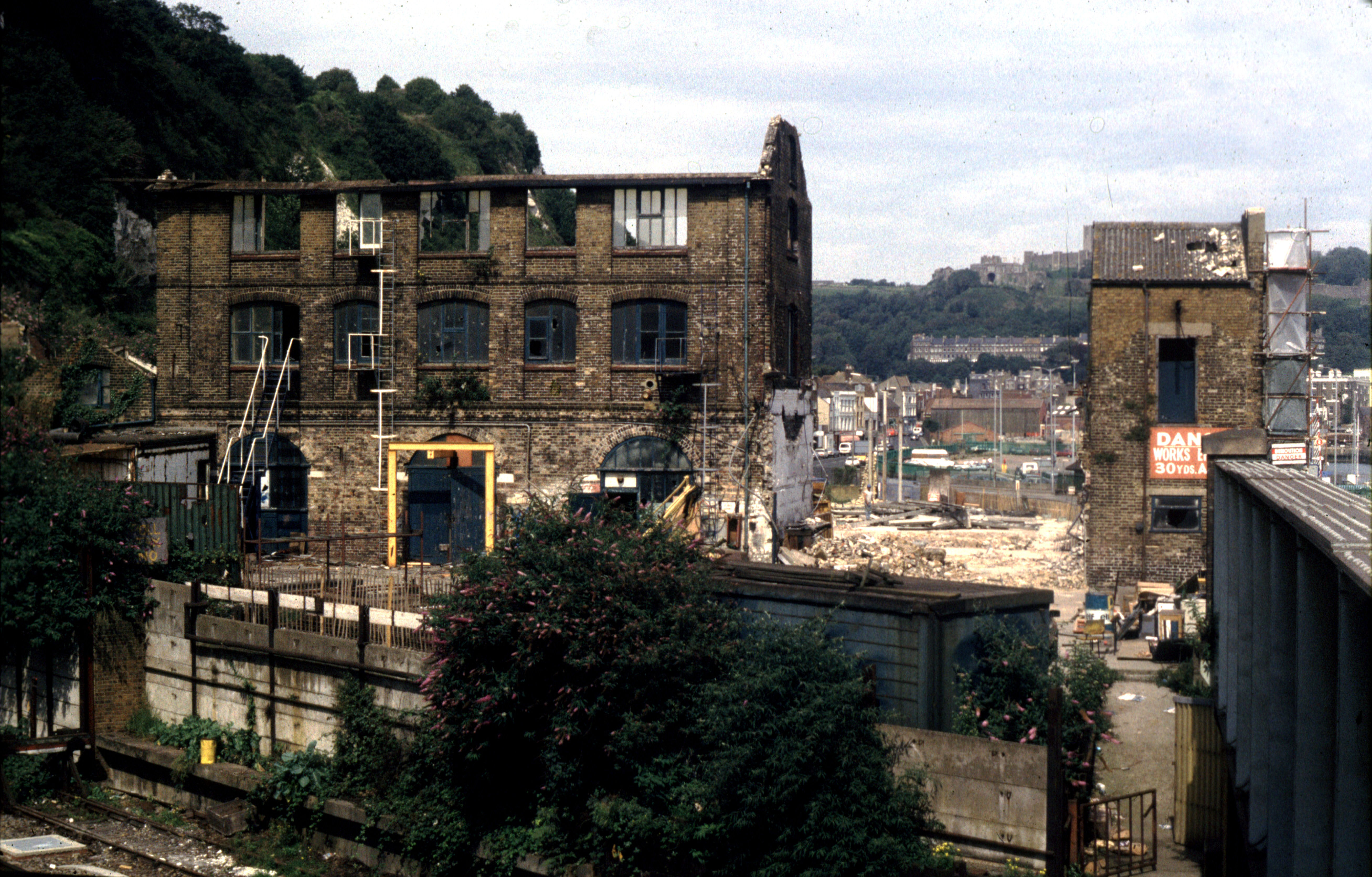
Stembrook Tannery to Pencester Gardens Part I

These days, King John (1199-1216) is particularly remembered as being forced to sign the Magna Carta by the Barons of England on 15 June 1215. Even after he died, the mood of many of England’s Barons was to invite Louis, the Dauphin of France (1187-1226) – later Louis VII 1223-1226) – and the son of Philip II of France (1180-1223), to rule the country. Back in 1200, John had made a compact with Philip that brought two years of peace but following the signing of the Magna Carta, the English Barons invited the French King to invade.

Dover Castle. Alan Sencicle

Dover Castle. Alan Sencicle

John called for the help of the Cinque Ports Fleet and they sank many French ships. From the bounty pillaged from French towns by the Portsmen, John increased England’s defences including fortifications of Dover Castle. On 14 May 1216, Louis, the Dauphin of France, invaded but days before, a storm had wrecked the Cinque Ports Fleet. Thus John and the town of Dover were forced to watch as the Dauphin and his army landed on the town’s beaches. Immediately, John left for Winchester leaving Hubert de Burgh (c1170-1243), the Constable of Dover Castle (1203-1232) along with 140 men to defend the by now well-fortified Dover Castle.

Louis and his army marched to London, where the Barons welcomed him. Most of Southern England fell to Louis, but the people of Dover remained resolute. The Dauphin returned to take Dover and the Castle in order to ensure that England was his. To achieve his purpose, he ordered to take the town’s Mayor, Solomon de Dovre, and some of Dover’s Jurats hostage and to burn the town.

Relief of Dover Castle by John de Pencester 1216 depicted in a windown in the Stone Hall, Maison Dieu. Alan Sencicle

Relief of Dover Castle by John de Pencester 1216 depicted in a windown in the Stone Hall, Maison Dieu. Alan Sencicle

On successfully carrying out these orders, the French soldiers camped in the area of today’s Laureston Place, known as Uphill and a siege of the Castle ensued. Almost starving, de Burgh and his men still held out fighting off the Dauphin’s men. The French then tried to undermine the Castle’s North Rampart Walls in order to gain entry but failed. Famously, de Burgh was reported as saying at this time, ‘I will not surrender; as long as I draw breath I will never resign to French aliens this Castle, which is the very key to the gate of England!’ Eventually, Louis called a truce on 19 October 1216, when, so the story goes, John de Pencester – after whom Pencester Road was named – arrived with reinforcements. However, by that time, King John, had contracted dysentery and died during the night of 18-19 October. He was buried in Worcester Cathedral.

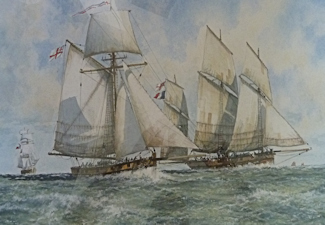
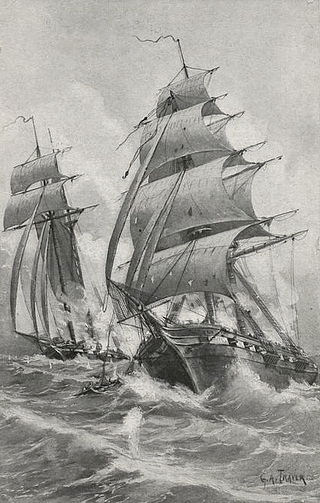
Nonetheless, as John was dead leaving as his successor his young son Henry born 1207, the French, with a massive contingent of re-enforcement set sail to invade England. Hubert de Burgh, at Dover Castle, left the mighty fortification and joined the Cinque Ports Fleet and with the Portsmen sailed to take on the French armada. They met on 24 August 1217 and the Battle of Dover ensued. De Burgh and the Cinque Ports Fleet routed the French Navy and prevented the invasion of England. The young Henry and under the care of Hubert de Burgh as the Chief Justicular of England, as Henry III (1216-1272) was pronounced King of England. Dover was given the accolade, The Gate of England and the Castle, the Key!

Maison Dieu Estate & Stembook Tannery
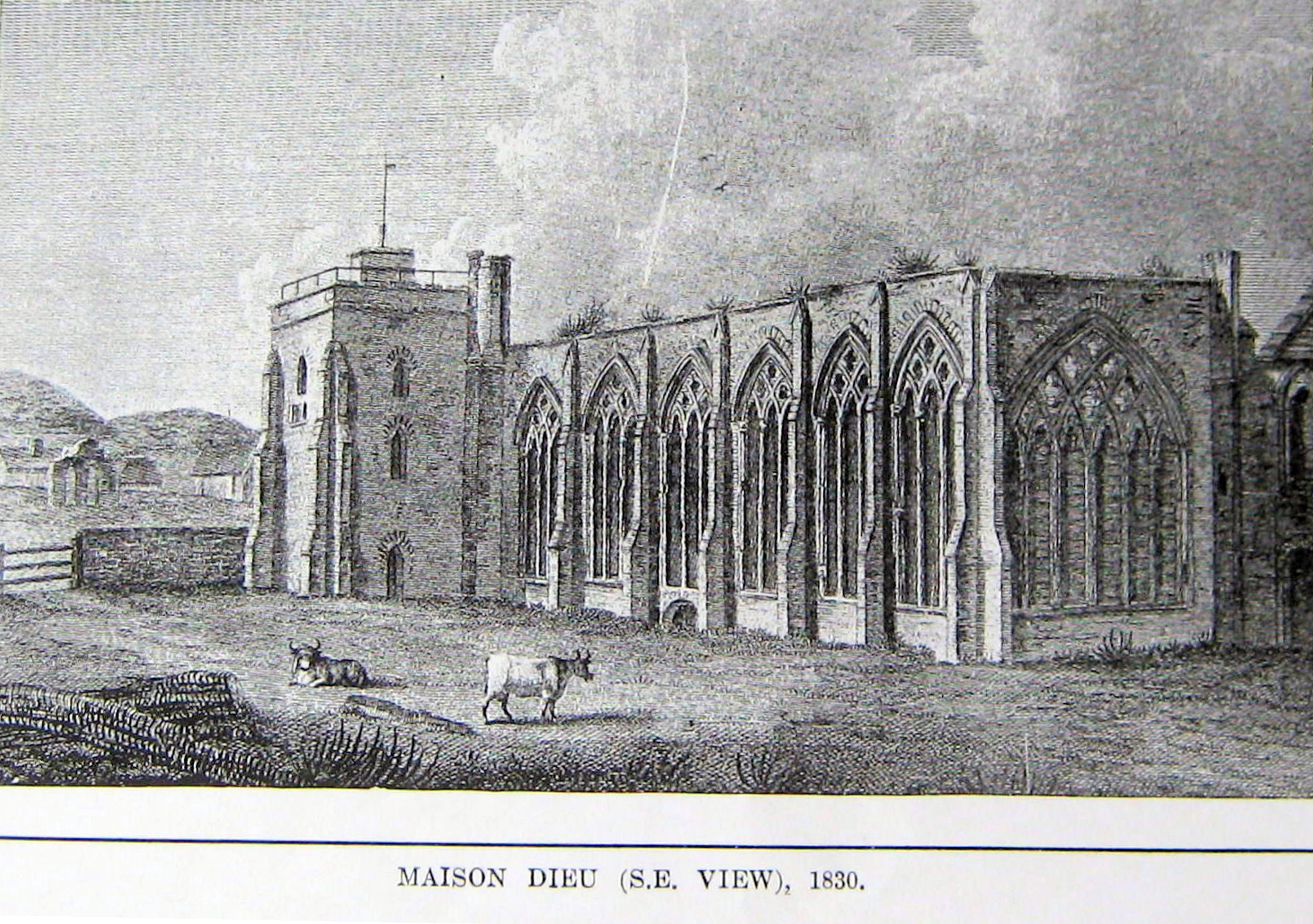
Maison Dieu in 1830.

Maison Dieu in 1830.

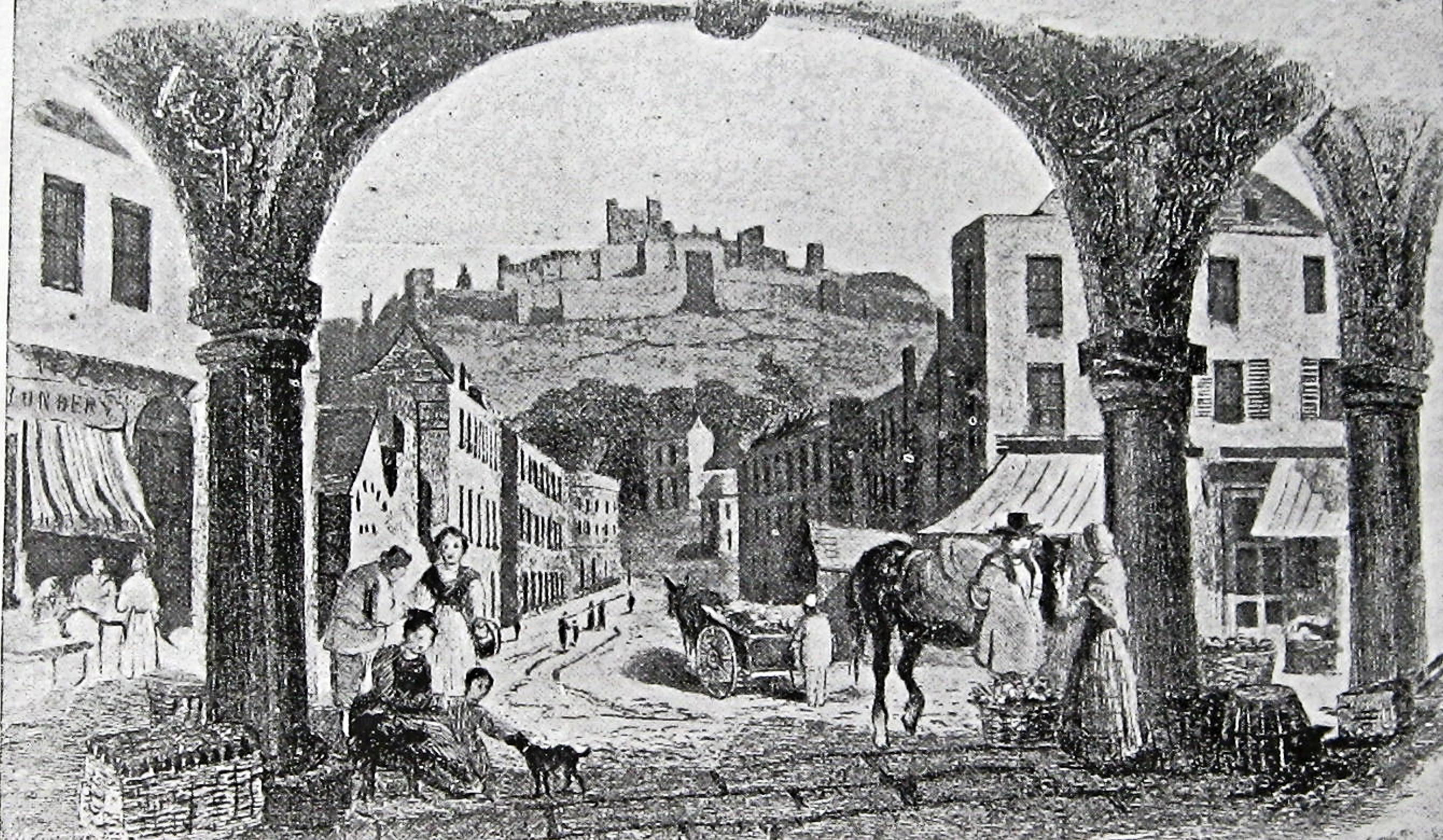
When Hubert de Burgh was appointed the Constable of Dover Castle in 1203, Dover at that time was a compact town surrounded by walls on three sides. Biggin Gate, near to the present southern end of Biggin Street, was the main northern gate into the town outside of which was farmland on both sides of the River Dour. On the northern end of this land in 1203, Hubert de Burgh established a religious house, run by the Master and Brethren of the Maison Dieu, for the accommodation of poor priests, pilgrims and strangers. They, predominantly coming from and returning to the Continent after visiting the tomb of Archbishop Thomas Becket (1162-1170) in Canterbury Cathedral.

Going east past the north side of St Mary’s Church from the bottom of Biggin Street, these days, is a footpath that wends its way to present day Maison Dieu Road. This follows the route of the ancient right of way, originally called Dee Stone Lane, as ‘D’ was carved into the boundary stone but this was probably changed to Dieu Stone Lane after the Maison Dieu was established. Dieu Stone Lane that went to the Castle and was also, effectively, the southern boundary of the Maison Dieu lands. While on the eastern side was what was officially known as Charlton Back Lane, going to the village of Charlton, to the north of Dover. By the time of de Burgh, the Dour had split into the Eastbrook and Westbrook with the latter turning sharply in a westerly direction roughly where it does today before turning sharply south to the sea. The Dour, from where it turn sharp westerly and then south, was named Stembrook.

The land along the Stembrook was marshy and by 1329 was owned by the Mayor, William Hortin. At that time, on the area near to the ancient Eastbrook Harbour, the town’s shipbuilders carried out their trade. On the west side the ground rose sharply to the Market Place, these days Market Square. There, on the north side of the Market Place stood St Peter’s Church, to which Church Street ran at the east side. From there the ground fell away to marshland and the River Dour. The rise in the topography caused the Stembrook section of the Dour to turn south towards the sea. On this land was the municipal stray animals’ pen where farm animals that had wondered off their owner’s property were kept until the owner claimed them for a fee. Nearby was the extensive Stembook tannery.
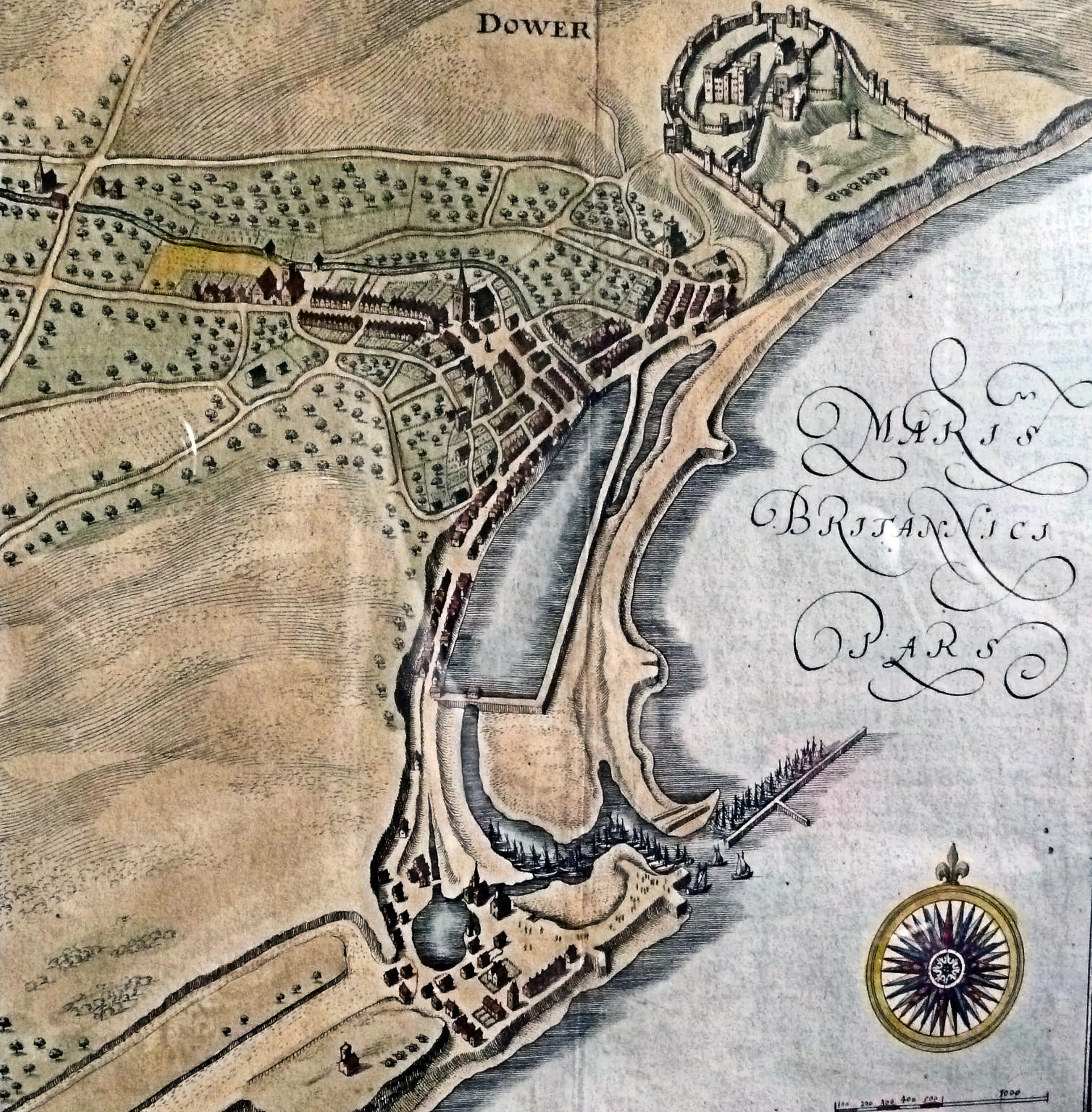
Early 16th century map of Dover. St Peter's Church can be seen on the north side of Market Square. Ian Cook

Early 16th century map of Dover. St Peter’s Church can be seen on the north side of Market Square. Ian Cook

In 1343 the decision was taken to extend St Peter’s cemetery ground over the Market Place end of Church Street. This was to last until the end of the 16th century when St Peter’s ceased to exist. In 1590 Thomas Allyn, the Mayor, sold the Church land. Queen Elizabeth (1558-1603) gave authority for the sale, and ordered that the proceeds to be devoted to the harbour and shortly after Church Street became a public thoroughfare again. The footpath that runs along the south side of St Mary’s Churchyard roughly defines the boundary between both Church grounds. At the time, the rest of St Peter’s burial ground became part of that of St Mary’s. Of interest, the Mayor, Thomas Allyn, absconded with the money raised by the sale of St Peter’s Church property!

On the land held by the Hortin family the ‘odious trade’ of tanning, or the making of leather, took place. Traditionally, this was relegated to the outskirts of towns but close to a source of water for obvious reasons when the process is examined. In those days, dry, stiff animal skins would arrive at the tannery dirty with soil and bits of innards still attached. The first job was to remove the horns, which were sold to comb makers. Then a ‘fellmonger’ would scrape the dirt, loose flesh and fat from the hides. These would then be soaked in water to clean and soften them.

The next process was carried out by flayers who pounded and scraped the hides until the entire dirt, flesh and fat were removed. Hairs were removed by soaking the skins in urine, collected by scavengers from the town’s folks piss-pots. This stale urine loosened the hairs and picklers would scrape them off. Once the hairs were removed the skins were soaked in vats of dogs-pooh, again collected by scavengers, and mixed with water.
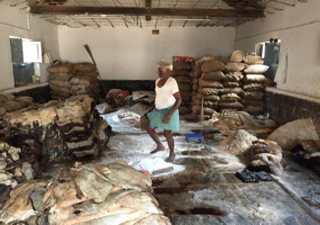
Tannery Worker kneading soaked skins, Tannery Road,Bangalore 2016 WestCoastMuskateer Wikimedia

Tannery Worker kneading soaked skins, Tannery Road,Bangalore 2016 WestCoastMuskateer Wikimedia

The tanners kneaded the soaked skins, usually barefooted, in the vats of tanning solution – diluted dogs-pooh etc. This process was repeated many times and could take as long as seven years before the skins became supple. Finally, stretchers pulled the hides into shape on frames, which were then immersed into ever increasingly stronger vats of tanning solution. The hides were then scraped by hand to get rid of the bloom, a white substance, before the skins were hung to dry.

By the 15th century, Dover boasted of a large and thriving leather industry making boots, shoes, gloves, collars, saddles etc. Much of this work was carried out in Last Lane and the immediate vicinity, in crowded ancient streets close to the then St Martin-le-Grand church and former monastery. This was on the opposite side of the Market Place from the Stembrook tannery. At the time, there were a number of other tanneries in Dover and numerous open fronted shops, each with its apprentices and journeymen all involved in aspects of making goods out of leather. Journeymen were effectively labourers having training but only able to work under a master craftsmen who was usually the owner.

From early medieval times in Dover, besides a guild incorporating the different aspects of leather making, there was another craft guild that incorporated glovers, shoemakers, cordwainers, saddlers, collar makers and cobblers. These were fraternities and by custom and the rules of their guild were not allowed to do work in areas that were covered by another craft. For instance, the cordwainer – the maker of new boots and shoes from new leather – could not cobble or mend boots or shoes. Further, crafts had subdivisions and again each had the monopoly of the particular skill. In relation to cordwainers, there were two subdivisions, the solers who made the lower parts of the footwear and the uppers who made the remainder!

Maison Dieu Estate and Private Ownership

Over the centuries the Master and Brethren of the Maison Dieu’s land holdings had extended considerably and included the land between the Mother House and Stembrook. In 1534, Henry VIII (1509-1547) ended all religious functions at the Maison Dieu and ten years later the monks were evicted. The victualling department of the Royal Navy, in 1552, appropriated the building and the lands belonging to the Maison Dieu were eventually sold by order of Parliament in 1650. Except for a large parcel of land used by the victualling department and on which Maison Dieu House was built, the Wivell family purchased the remainder. On this land, named the Maison Dieu estate, they built a fine mansion that faced Biggin Street and the east side of the estate abutted Charlton Back Lane.
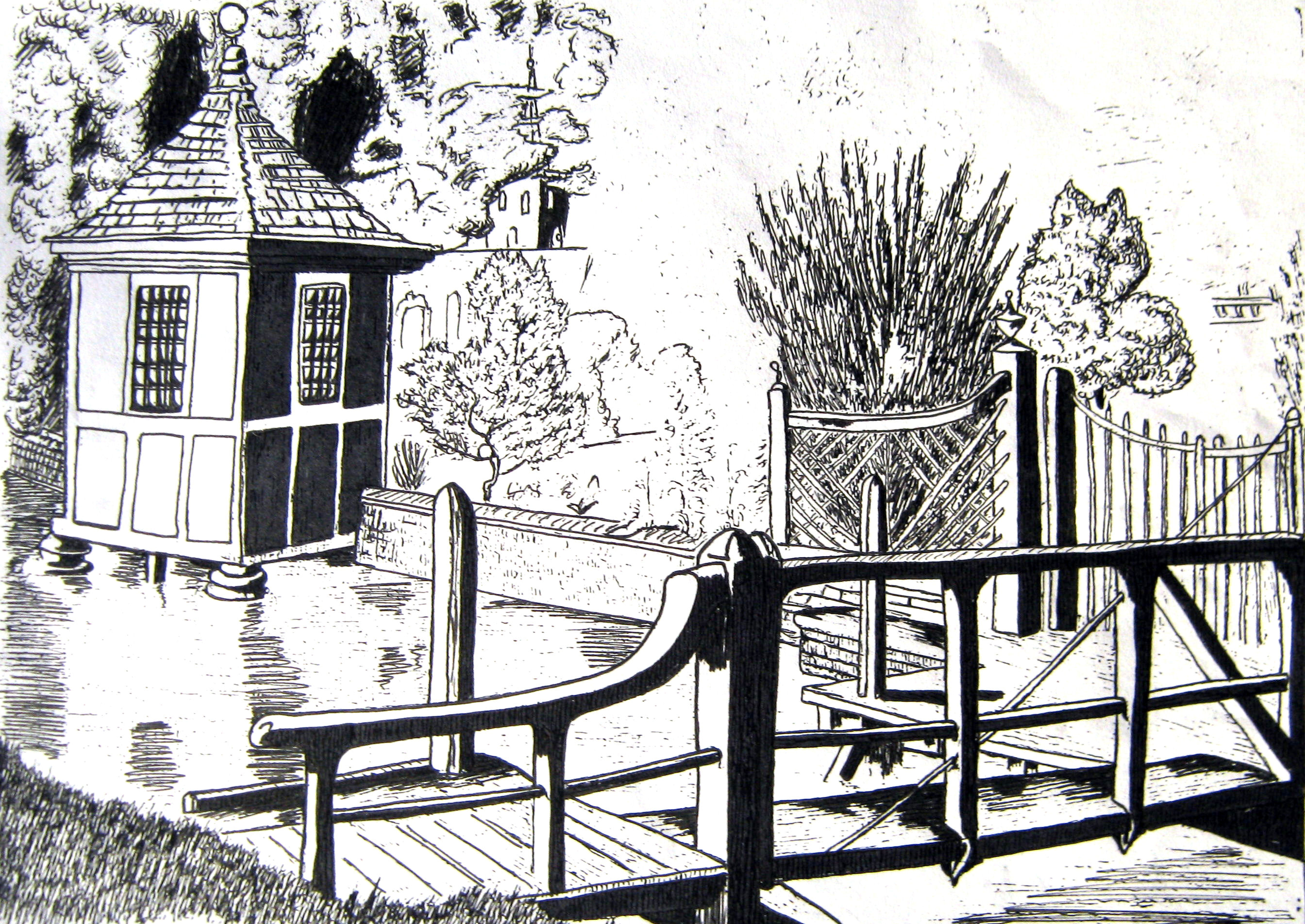
Dieu Stone Lane bridge at the south eastern corner of the then Maison Dieu estate now Pencester Gardens. Drawn by George Jarvis.

Dieu Stone Lane bridge at the south eastern corner of the then Maison Dieu estate now Pencester Gardens. Drawn by George Jarvis.

The estate eventually passed to the Gunman family and by the 18th century Stembrook tannery was owned by Edward Jeffries (d1812). Dieu Stone Lane separated the Maison Dieu estate from that belonging to the tannery and a small stream, that meandered from Castle Hill until it joined the Dour where the Stembrook turned south, provided the southern border of the tannery estate. Opposite, on the west side of the Dour was the remainder of the tannery estate and it was on this site that the tannery was situated. The southern part of the tannery estate was bordered by an ancient footpath that ran from the Market Place to St James Church, at the foot of the eastern cliffs, and then up to the Castle. The footpath traversed the Stembrook-Dour by a ford.

In 1792, just before the start of the Napoleonic Wars (1793-1815), the Market Square – Castle footpath was commandeered by the military along with a corner of land, next to the Dour, belonging to the tannery. On the commandeered land the Board of Ordnance built the four-storey Stembrook mill to provide flour for the great number of troops that were being moved into the town. Also to provide part of the victuals for the crews of the naval ships in the harbour. The Maison Dieu was turned into a massive bake house. The mill adversely affected the tannery’s water supply and it along with the land holdings was put on the market. Humphrey Humphreys, (1772-1863) from Tenterden bought the tannery and land holdings. Using the small stream, he diverted a water supply to the tannery, which subsequently thrived. As more troops moved into the town, the demand for flour increased and the Stembrook Mill was rebuilt and enlarged in 1799 and again in 1813. In1798, Humphreys married Ann Anscombe Clarke and in 1823, Caroline Baker.
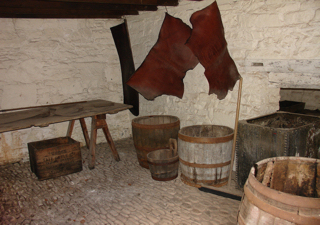
A room in St Fagans Tannery , National Museum Wales Cardiff. Zuresk 2007 Wikimedia

A room in St Fagans Tannery , National Museum Wales Cardiff. Zuresk 2007 Wikimedia

To help to pay for the War the government introduced a number of taxes and this included one on prepared leather hides and it became general practice for tanners to use false weights to indicate that the hides were lighter than they really were, thus ensuring he paid less leather tax. Whether Humphreys did this, is not recorded, as he was never implicated in this practice. Instead, he became increasingly involved in local politics and became an active member of the Paving Commission. This had been set up by Act of Parliament in 1778, with the principal function of town management, which included sanitation and lighting. Both of these the Commission tended to be lax at enforcing, indeed with regards to street lighting, this helped the town’s booming trade of smuggling.

Map showing the Stembrook area developments that took place in early and middle of the 19th Century

Map showing the Stembrook area developments that took place in early and middle of the 19th Century

A Military Road was laid in 1797 from the Castle to Western Heights, using the ancient foot path from St James Church, past the tannery and Stembrook Mill, through to the Market place and on up to Western Heights. Following the end of the War, this was handed over to the Deal Turnpike Trust and shortly afterwards Humphreys sold a piece of land at the end of Church Street. The new street was named Caroline Place after the estranged wife of George IV (1820-1830), Queen Caroline of Brunswick (1768-1821), cottages were built along it with a large building housing the Artillery Volunteers’ Institute next to the tannery.

When the Napoleonic Wars ended, the country declined into a deep depression, the demand for flour slumped and this hit Dover’s milling industry hard. However, by the end of that decade, things started to look up and with it, the demand for flour, especially in London. Hoys (seagoing vessels) would bring grain to be milled in Dover and then take the flour up to London. The Pilcher family, using loans, bought a couple of mills, one of which was Stembrook and they employed Henry Julius Winter (1766-1841) to run it. At about the same time, a consortium of wealthy local businessmen took steps to convert this part of the Military Road into the residential thoroughfare by buying the section east of the Dour. Most had made their money from running smuggling operations and all were members of the Paving Commission. The land along the former Military Road on the west side of the Dour to Market Square belonged to the Paving Commission.
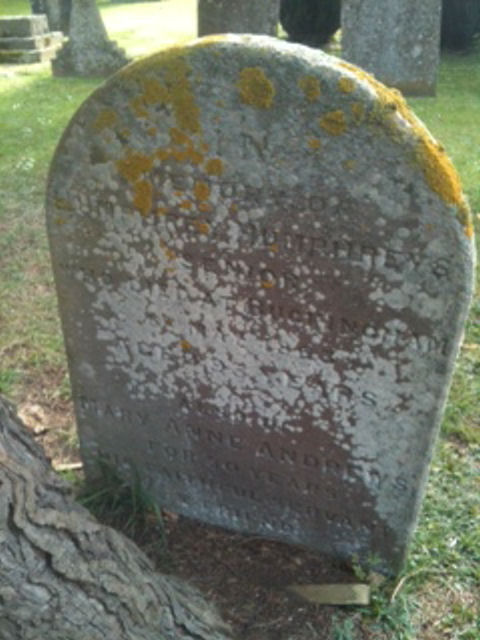
Humphrey Humphreys Gravestone. Courtesy Buckingham Town Council

Humphrey Humphreys Gravestone. Courtesy Buckingham Town Council

On this land, the Paving Commission extended the ancient Stembrook thoroughfare with its quaint cottages from Dolphin Lane to the Church Street and Caroline Place junction. To create this extension required purchasing the remaining western part of the tannery lands from Humphreys, for which they paid him £2,000. With this money Humphreys moved to Buckingham, where he styled himself a gentleman. In 1841, 1853 and 1854, Humphreys was elected the Mayor of that town and died on 2 May 1863, aged 93. He was buried in a double depth grave with his faithful servant and friend for 50-years, Mary Ann Andrews (1789-1862) from Hythe, who had died on 8 March 1862 aged 72.

Although the Paving Commision had problems in purchasing land to take the consortium’s road into Market Square, they managed to finally succeed. The bridge we see today was built across the Dour and finally Castle Street, as the new thoroughfare was called and was completed in the 1830s. Shortly after, the Stembrook thoroughfare, on the sea side of Castle Street was renamed Dolphin Place and about 1840 cottages and poorer workers residences were built on Church Place, which extended the Stembrook thoroughfare to Dieu Stone Lane.
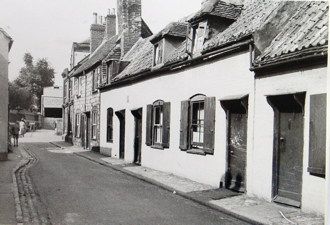
Church Place with Flashman's cabinet factory & Union Hall on Dieu Stone Lane at the end. Dover Library

Church Place with Flashman’s cabinet factory & Union Hall on Dieu Stone Lane at the end. Dover Library

On Dieu Stone Lane there once was a wool factory that was subsequently taken over as a cabinet factory by George Flashman (1804-1885), who owned a large furniture shop on Castle Street. The top and bottom floors being used for the making of furniture, while the middle floor was known as Union Hall and united religious meetings were held there. For a long time, the Dover Young Men’s Christian Association meetings were held there under the presidency of William Rutley Mowll (1824-1879). In 1894, the activities that took place in the Union Hall were moved to a building that took the same name in Ladywell and following its demolition the former Technical college was built on the site. In 1894, Flashmans took over all of the building on Dieu Stone Lane.

Economically, the 19th century was orchestrated by a series of booms and busts and towards the end of the 1830s the country was heading towards the one of deepest depressions. By 1838, unemployment and subsequent starvation was on the increase and in Church Street lived John Williams, the proprietor of the Duchess of Kent eating house in the Market Place. On one particularly cold and snowy December day he was crossing the Market Place and was distressed to see a number of men standing about, ill clad, with their hands in their pockets and starvation stamped on their pale, wan, faces. Concerned, with his friends Steriker Finnis (1817-1889), Samuel Latham (1799-1866) and others, he set up the Dover Philanthropic Society that raised funds to provide the poor with soup and bread in winter months. The successor to this voluntary service still exists in the town and provides hot drinks and food to the needy all year round.

Humphreys’ son, also called Humphrey, continued to work the tannery and was keen to show off his abilities. In 1851, he exhibited a skin of a boar from Prescott’s farm at Guston that had taken seven years to turn into good quality leather. This was first on show as exhibited at the Great Exhibition in London of 1851 and was 2-inches (5cms) thick. After doing the rounds of various local exhibitions, the leather was sold to George Coulthard (1791-1854) a local boot maker, who used it for the soles of his boots. At the time of the Great Exhibition, Humphreys senior put the tannery on the market and it was sold to William Rigden Mummery (1819-1868), from Deal.
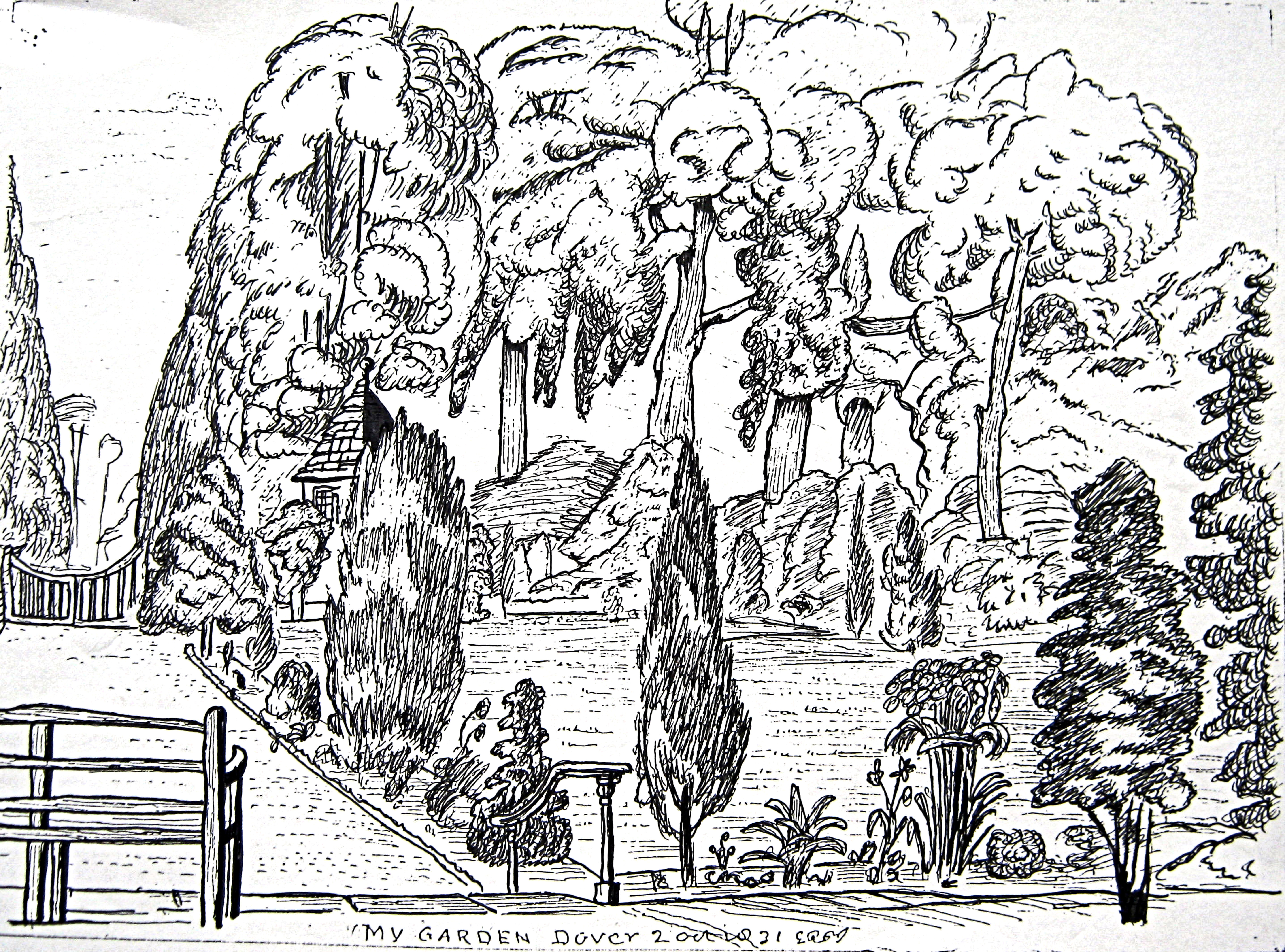
The Jarvis garden depicted by George Jarvis on 2 October 1831.

The Jarvis garden depicted by George Jarvis on 2 October 1831.

In the meantime, the Gunman estate had come into the possession of George Jarvis senior (1774-1851). When he left the town in May 1827 to become the master of Doddington Hall in Lincolnshire, George Jarvis senior gave his Dover estates to his son, George Knollis Jarvis (1803-1873), known in Dover as George junior. He and his wife, Emily Pretyman Jarvis (1815-1840) lived in the mansion built by the Wivell family on the Maison Dieu estate and continued to maintain the extensive grounds.

The estate formed the eastern boundary of the parish of St Mary-the-Virgin and the time honoured beating the bounds took place there once a year. The occasion was marked by the Town Crier walking down the middle of the River Dour alongside the Jarvis estate to Stembrook accompanied by the Town Council. As they were all in their finery, they walked on the Maison Dieu estate side of the River. Just before the Stembrook Dour left the estate, a large tent was erected and George junior, Emily and their 6-year-old daughter Emily Louisa Harriet, met the party and served them drinks and copious amount of refreshments. On 6 March 1840 Emily, died having given birth to their son, George Eden, born that day. Emily was buried within St Mary’s Church and her memorial can be seen by the north door. Shortly after, George junior move to the Knees in Shepherdswell with the two children.

The break-up of the Maison Dieu Estate

George Jarvis senior died in 1851 and George junior sold all his land holdings in and around Dover and moved to Lincolnshire. A public footpath ran from Biggin Street, across the Maison Dieu Estate towards the Castle and the northern part of the Estate was sold to William Moxon (d1865), who built Brook House. To provide egress into Biggin Street, he built a makeshift bridge across the Dour and applied for permission to lay out housing lots alongside the track.

The Corporation called Moxon’s track, Pencester Street, later changed to Pencester Road, after John de Pencester who had helped to defeat Louis the Dauphin of France at the time of the Battle of Dover in 1216. Not long before, Dover council had purchased the Maison Dieu from the victualling department of the Royal Navy and voted for the building to be glorified as Dover’s Town Hall. Part of the restoration included large stained-glassed windows in the Stone Hall depicting aspects of Dover’s history. About 1850, Edward John Poynter (1836–1919) drew a series of cartoons for the insertion of coloured glass into the window frames in the Stone Hall. One of these depicted the 1216 Battle of Dover and John de Pencester, (see above).

The remainder of the Maison Dieu Estate was sold to William Crundall senior (1822-1888) who intended to build an upmarket crescent of houses that was given the provisional name of Neville Road. He demolished the mansion and laid the road at the west side of the site, but following the opening of Pencester Road abandoned his project. Instead, Crundall built fine detached and semi-detached properties along Pencester Road. In 1856, he bought what had been the Charlton paper mill on Woods Meadow further up the Dour. This, Crundall converted into a sawmill and used the wood from the trees he had up rooted from the former Maison Dieu Estate to get the business going and created a meadow that was prone to flooding. He then dealt with this by planting different types of native trees on the banks of the Dour. Over time, tall poplar trees, copper beeches, and other fine trees flourished there. Using Neville Road as an access drive to the area, Crundall turned the site into a storage yard for his timber and allowed it to be used for school treats. The area became known as Crundall’s Meadow or more commonly Timberyard Meadow.
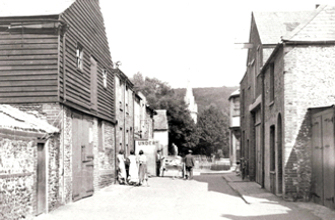
Caroline Place looking towards the timberyard. Dover Library

Caroline Place looking towards the timberyard. Dover Library

On the small piece of land he had acquired at the east end of Caroline Place, he extended the cul-de-sac from the Artillery Volunteers’ Institute south towards the back of the Castle Street residences. There he built workers residences for his timber business, much to the annoyance of the affluent owners of some of the Castle Street properties. Later the Drill Hall was built at East Cliff and the Artillery Volunteers’ Institute moved there. The building was then used by a variety of organisations, usually of a philanthropic nature, and in 1872 the Good Templar movement, under the auspices of the late Rev Hugh Price Hughes (1847-1902), took it over when their previous premises on Biggin Street became too small.

For years, the close proximity of Stembrook Mill had made the properties on Stembrook thoroughfare and Caroline Place damp and exacerbated flooding problems in the area. This was stressed by Sir Robert Rawlinson (1810-1898) engineer and sanitarian, who had been appointed one of the first inspectors under the 1848 Public Health Act to report on the sanitary conditions found. He recommended that the mill be demolished but the owner, Willsher Mannering (1814-1853) declined. Shortly after a large triangle of poor quality properties were built opposite the mill with the east side facing the mill, the south side facing Castle Street and the west side facing Church Street, which was widened and not so crooked as before.
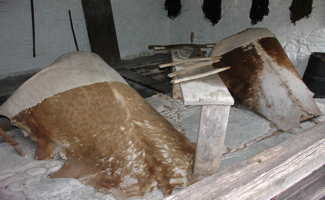
Hides being soaked before removing the hairs using the tools. St. Fagans, National Museum Wales Cardiff. Zurek

Hides being soaked before removing the hairs using the tools. St. Fagans, National Museum Wales Cardiff. Zurek

William Mummery, who had bought the tannery at the southern end of Timberyard Meadow, was a keen businessman and he introduced many improvements in both methods and the machinery of tanning. These included soaking the hides in limewater pits for about two weeks to soften and to make the hair easier to remove. Once scraped off, the hair was sold to gelatine manufacturers for sizing to be used in papermaking and for domestic purposes. In the tan pits, of which there were three blocks, one containing 65 pits the other two not so many, the skins were tanned. There they were soaked in a solution of ground oak bark and water. The bark was a by-product of saplings used for hop poles and a financial statement of May 1887, the usual time when hop poles were being prepared, shows that about 500 tons of bark was delivered.

The oak bark was milled on the premises and as the hides went through each stage of the tanning process, the ratio of bark to water became stronger. Towards the end, ground Valonea or Turkey Acorn nuts from Silesia were used to strengthen the tanning mixture. Mummery had a specially designed machine of small brushes over which the hides slowly travelled to removed bloom – a white deposit that looks like, but is not, mould, and results from fat being used in the tanning process. The hides were then dried in a large, warm aired, hall and to complete the process they were rolled with heavy brass rollers on a zinc surface until an even density and solidity was obtained.
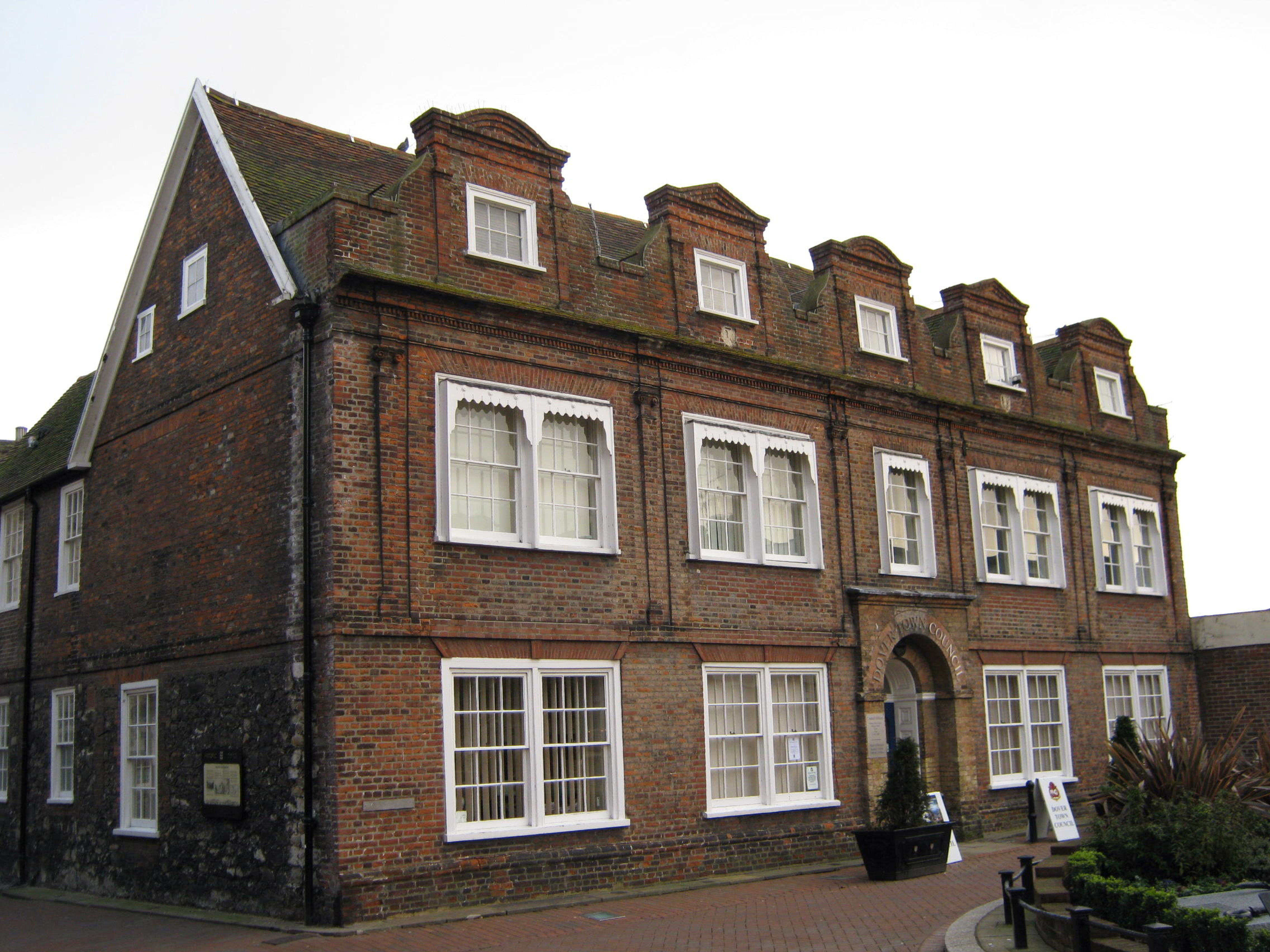
Maison Dieu House. LS 2006

Maison Dieu House. LS 2006

By 1861, Mummery was employing 21 men and making a name for himself in local politics, being elected Mayor 1865, 1866 and 1867 and living in Maison Dieu House. He died in 1868, at which time the business was taken over by his sons, William (1845-1899) and Albert (1855-1895). William, a leading light in the Russell Street Congregational Church, devoted his life to increasing and maintaining the success of the tannery. Albert, although helping to run the tannery, became World famous as the Father of Mountaineering.
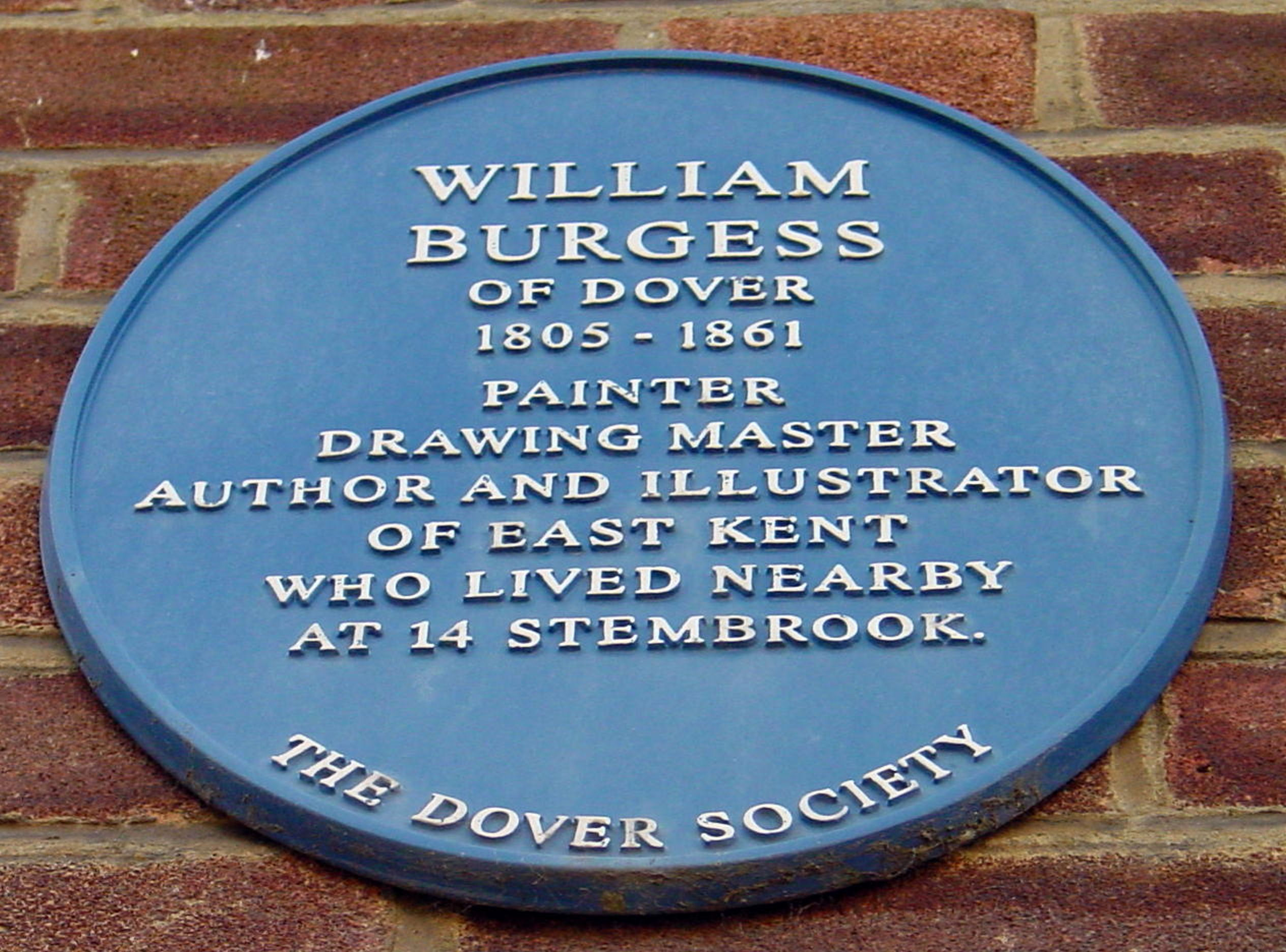
Dover Society plaque dedicated to William Burgess, high up on a wall in Stembrook. AS

Dover Society plaque dedicated to William Burgess, high up on a wall in Stembrook. AS

Meanwhile, artist William Burgess (1805-1861), who was arguably Dover’s greatest painter, was living in one of the crowded properties that faced the Stembrook thoroughfare and Castle Street. Burgess had been born in Canterbury and from an early age was encouraged to draw in order to decorate his uncle’s coaches. After a spell travelling around Europe, Burgess married Harriet (c1816-1884) from Deal and settled in Dover eventually moving to 14 Stembrook with a door for customers at 69 Castle Street. His prestigious talent was recognised and exhibited at the Royal Academy and by the Royal Society of British Artists. In 1844, Burgess opened a Cosmorama, which proved a great tourist attraction and brought him further and wider recognition. Indeed, his paintings and lithograph prints of Shakespeare Cliff in the Cosmorama were so popular that that a nearby alley was named Shakespeare Place! William died on 30 July 1861 and Harriet, married local builder Parker Ayres (1810-1885), who had laid out Norman and Saxon Streets in 1846. Dover Museum hold a collection of Burgess’ works and high up on a wall near the corner of Stembrook and Castle Street, is a Dover Society plaque dedicated to him.
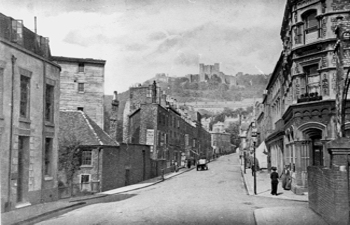
 Castle Street late 19th century looking towards the Castle. On the left is Stembrook Mill. Dover Museum

Castle Street late 19th century looking towards the Castle. On the left is Stembrook Mill. Dover Museum

What had been known since ancient times as the Charlton Back Lane, which ran along the eastern flank of Timberyard Meadow, in 1863 was widened and renamed Maison Dieu Road. Flooding had been a problem for as long as anyone could remember with many of the older folk blaming it on Stembrook Mill. Albeit, it was recommended that Maison Dieu Road surface be raised by 3 feet (1metre) above the Dour’s mean level. However, the council, or to give it the correct title, Dover Corporation, decided that this was too expensive as flooding only occurred following heavy rain, so nothing was done. Following Willsher Mannering’s death in 1853 eventually his sons Willsher junior (1841-1923) and Edward (1849-1932) took over his mills. About 1870 they sold Stembrook Mill to George Brace, who renamed it after himself.
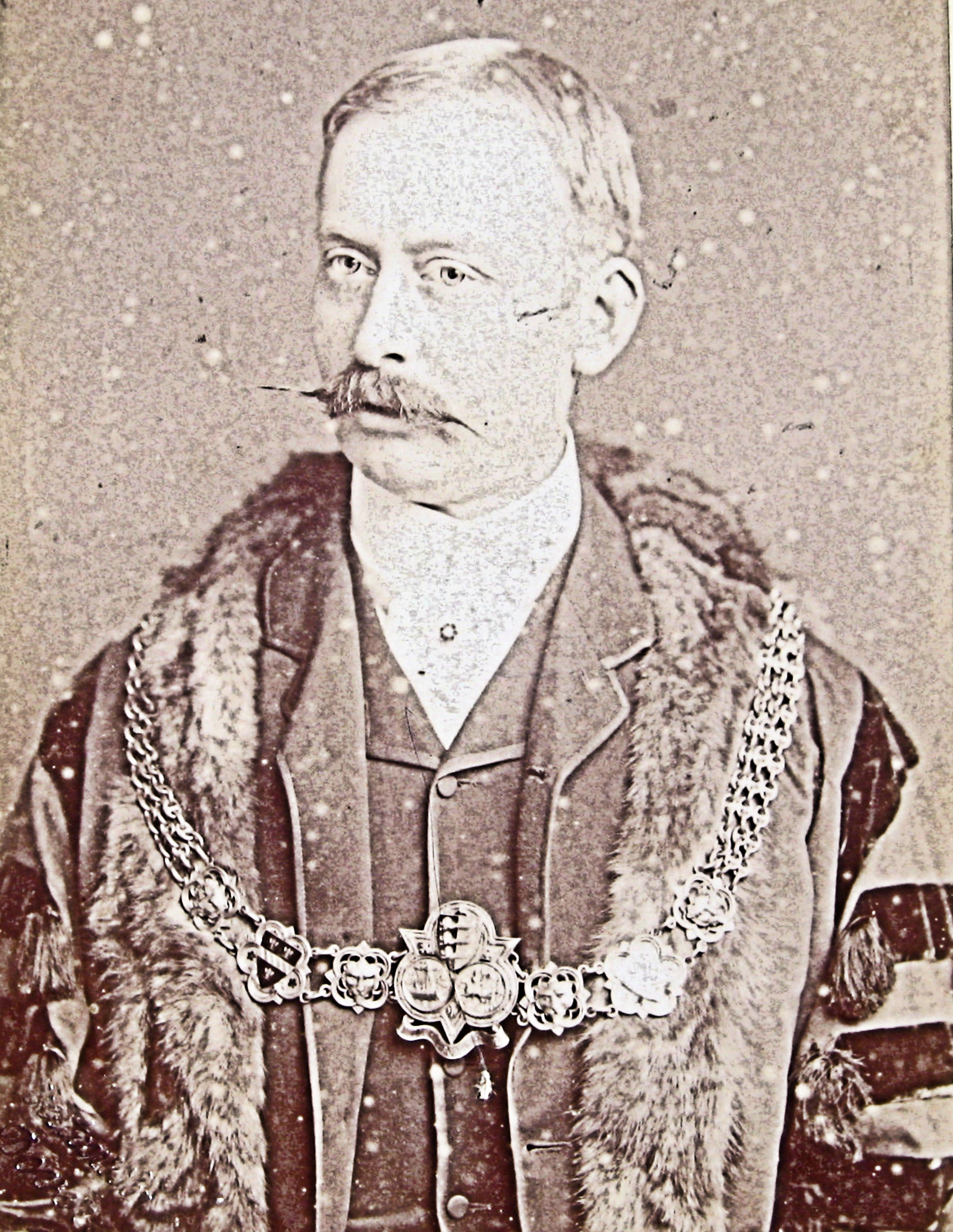
William Crundall junior (1847-1934) in his Mayoral robes - a post he was to hold thirteen times between-1886 and 1910. David Iron collection

William Crundall junior (1847-1934) in his Mayoral robes – a post he was to hold thirteen times between-1886 and 1910. David Iron collection

By this time Dover was divided into two staunch political camps, the Conservatives, headed by Edward Rutley Mowll with his deputy, William Crundall junior (1847-1934) who took over the leadership following Mowll’s death and was to be appointed Mayor 13 times. Their opponents were the Liberals, led by Richard Dickeson (1823-1900) who had taken an active role in Dover’s civic affairs since he first arrived in the town in 1840. The three men were all self-made entrepreneurs and both Crundall and Dickeson were later knighted. Of note, Dickeson’s legacy to the nation was that his company laid down the foundation for the Navy, Army and Air Force Institutes or as it is better known, the NAAFI.

November 1871 saw the start of Dickeson’s first of four terms as Mayor, during which time the Ballot Act of 1872 requiring all elections to be held by secret ballot was accepted in Dover. This was against fierce opposition from the Conservative fraction, as they saw the secret ballot as unmanly, cowardly and was likely to lead to universal suffrage. Because of this discontent, Dickeson was obliged to sign, under the Mayoral Seal of Office, a statement consenting to adhere to the Act. This pushed the two camps further apart and in the municipal elections held in November 1872, the Conservatives won and Mowll was appointed Mayor.

The Timber Yard and the Stembrook Area

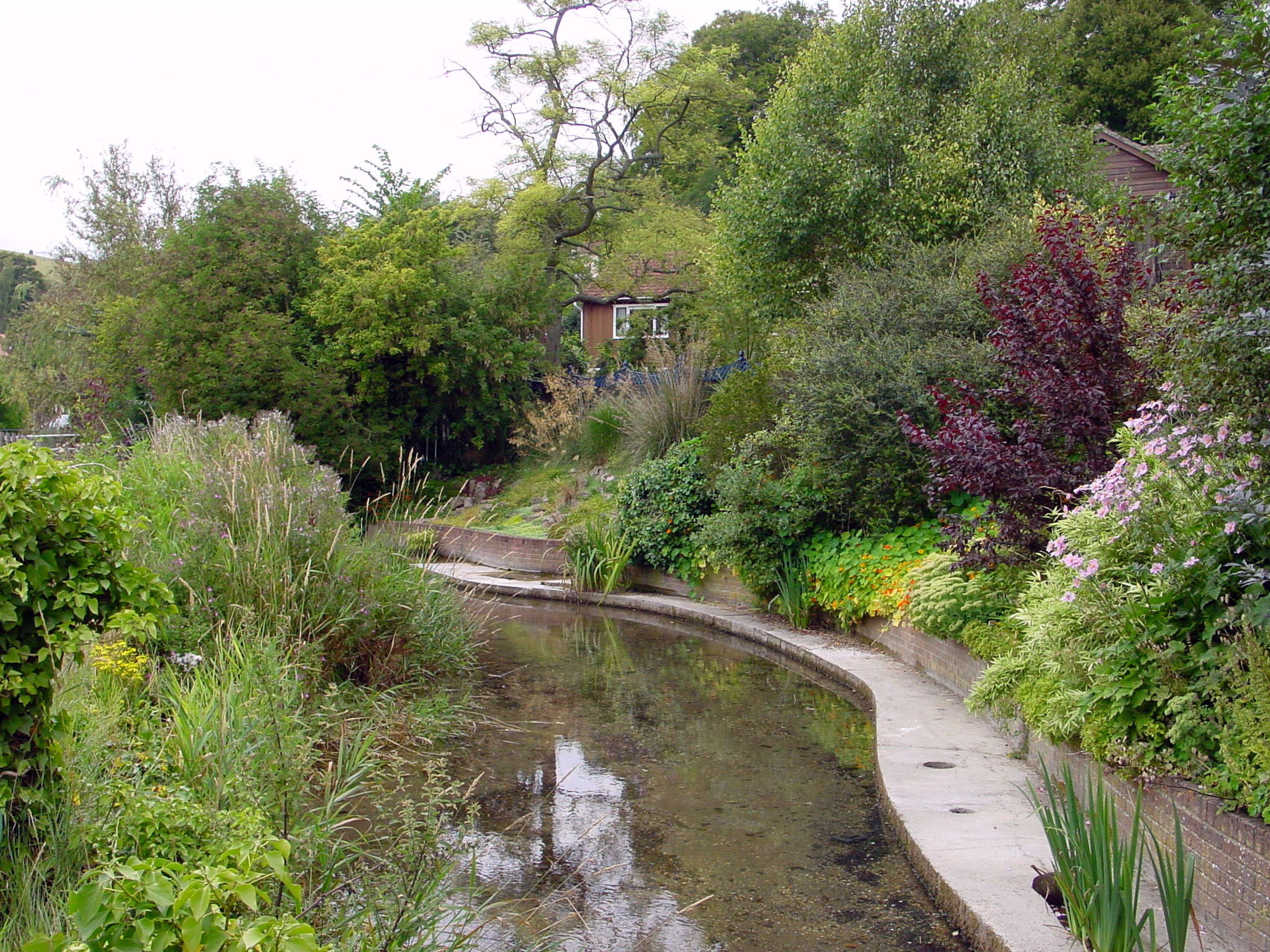
Part of the present day longitudal walk alongside the River Dour in Pencester Gardens. LS

Part of the present day longitudal walk alongside the River Dour in Pencester Gardens. LS

From 1872, the Conservatives held power, but in 1879, the Corporation candidates seeking re-election in the municipal elections or standing for vacant seats were returned unopposed. This resulted in the Liberals seizing control by a four-seat majority and they elected Dickeson as Mayor for the following two years and a fourth term in 1882. Dover Corporation immediately adopted a new motto, accepted by both political parties, ‘The greatest good to the greatest number‘ … as long as this did not cost too much! One of Dickeson’s suggestions was the purchase of land on the margin of the River Dour for a longitude pleasure walk – due to a number of reasons, this was not completed until the late 20th century. See River Dour part II the Walk section I and the River Dour part II the Walk section II stories. Albeit, after much debate it was decided to rent the Northfall Meadow, as it was ‘rural and offered a breezy promenade’ and they extend the footpath from Castle Hill to the eastern walls of the Castle, and created ‘a stepped promenade‘ that still exists.

Out of public subscription the Corporation purchased and established Connaught Park in 1883 promising to pay the annual cost of upkeep by charging it to the District Fund in perpetuity. Previously, the Conservatives, in 1878, had persuaded the Dover Harbour Board to open the Granville Gardens, in the centre of the Seafront. The Corporation held them at a nominal rent and maintained upkeep. Following negotiations carried out by the Mayor, William John Adcock (1840-1907), the Danes Recreation Ground, on Old Charlton Road, opened in 1891 and proved not as costly as anticipated so was again greeted with a long term promise for its upkeep. In 1906, the Corporation opened Maison Dieu Public Gardens, situated on each side of the Dour. They were partly laid out as a bowling green and the remaining area, as an ornamental garden.
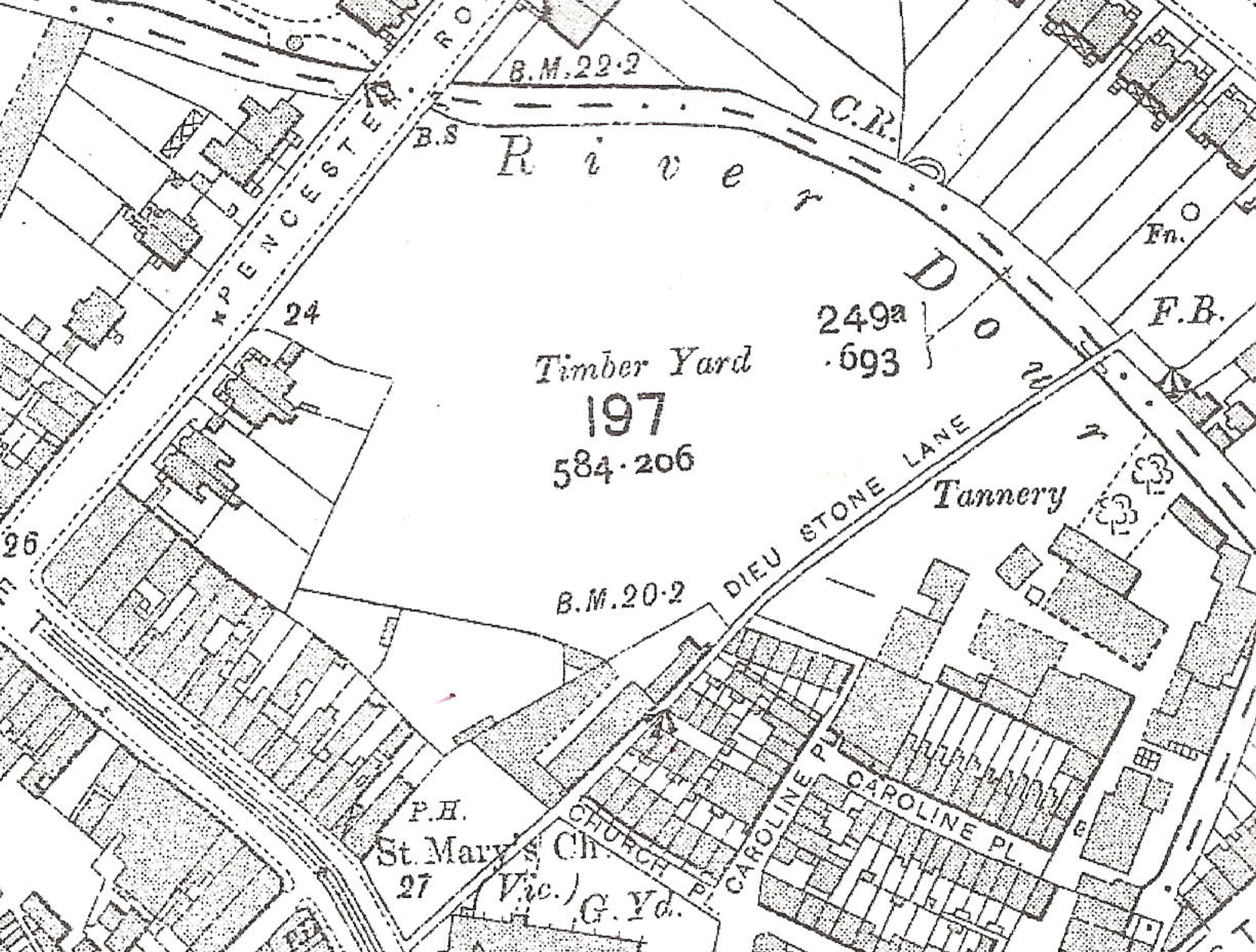
Map of 1907 showing Crundall's Timber Yard, which eventually became Pencester Gardens and the site of the Stembrook Tannery. Dover Library

Map of 1907 showing Crundall’s Timber Yard, which eventually became Pencester Gardens and the site of the Stembrook Tannery. Dover Library

Crundall was running his father’s business affairs by 1880, including the timber business and that year he sold the timber meadow to Sir Edward Watkin (1819-1901). He was the Chairman of the South Eastern Railway Company and was planning to build a railway station on the Meadow for a railway line connecting a Channel Tunnel with St Margaret’s Bay. He had already started the exploration for his Channel Tunnel project near to where Round Down Cliff had once been – now Samphire Hoe. However, in July 1883 a Joint Committee of both Houses of Parliament held an enquiry into the proposed Tunnel but stated that: ‘The majority of the Committee are of the opinion that it is not expedient that Parliamentary sanction should be given to a submarine communication between England and France.’

When the Crundalls realised that the Channel Tunnel project was unlikely to go ahead, William Crundall senior offered to buy the Timberyard Meadow back but at a reduced price. Watkin was forced to accept this by the railway company’s Board of Directors. While those negotiations were going on, Crundall junior offered the site to the Corporation for a new Town Hall. However, the Prison Act 1877 had abolished borough prison jurisdiction and the four-storey gaol on the Ladywell side of the then Town Hall – the Maison Dieu – was demolished. On the site, Dickeson advocated building a Town Hall annex and once he gained power, this was put into action. The result was the Connaught Hall. Crundall’s offer was turned down and he immediately transformed Timberyard Meadow into a business on the renamed Timber Yard.
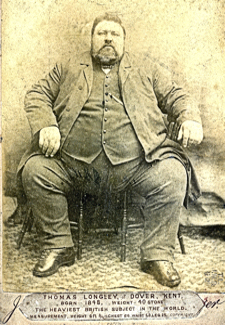
Thomas Longley of the Star public House, Church Street known as, ‘Her Majesty’s heaviest subject.' Dover Museum

Thomas Longley of the Star public House, Church Street known as, ‘Her Majesty’s heaviest subject.’ Dover Museum

On Church Street there was long established public house called the Star that was particularly favoured by the nearby market vendors. The hostelry, for many years, was kept by Thomas Longley (1848-1904), known as ‘Her Majesty’s heaviest subject.’ Longley was born in Snargate Street on 13 January 1848 to butcher William and his wife Esther. When he grew up Longley went to work at the Star and for most of his life was the landlord. He was just over 6feet tall and at his heaviest, weighed 46stone, had a chest measurement of 86 inches and each calf measured 26inches! His finger ring can be seen in Dover Museum and gives a good indication of his size. When Longley travelled out of Dover it was always by railway and in the guards van as he was too big to get into the compartments. Longley died on 22 February 1904 and was buried in St Mary’s cemetery. 10 bearers were needed to carry his coffin.

In the late 19th century there was a proliferation of aerated mineral water factories opening in Dover, one of which was owned by Arthur S, Bright (1857-1921). His business was in two cottages, knocked into one, at the Dour-Stembrook end of Caroline Place. When Bright started out, the drink he produced was made up of water, sugar and flavourings and was brewed in large copper pans heated on giant gas rings until the sugar dissolved. The mixture was then allowed to cool and an effervescence, such as Seidlitz powders – a laxative preparation containing tartaric acid, sodium potassium tartrate, and sodium bicarbonate that effervesced when mixed with water. By the end of the century, Bright had probably switched to using carbonic acid gas to create the fizz. This was purified carbonate of lime mixed with an acid and introduced into the drink by the use of an electric generator. Bright also employed retired soldier John Meenagh (c1846-1906) to manage the factory, a position Meenagh held until his death in 1906.
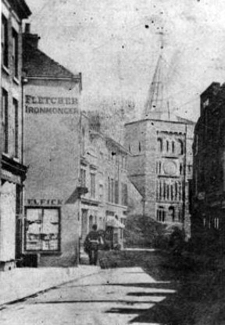
Biggin Street pre 1895 showing narrowness before widening. Dover Library

Biggin Street pre 1895 showing narrowness before widening. Dover Library

Increasingly the town centre traffic along the narrow main streets from Ladywell to Market Square had been a problem the Corporation had been trying to deal with since 1881. In 1892, they looked at a number of proposals, one of which was the widening of the High Street – Ladywell junction, widening Ladywell and laying a new street behind the Town Hall, across William Adcock’s building yard, to what was still called Pencester Street now Road. From there, across Crundall’s Timber Yard and Caroline Place to Church Street and then Market Square, as the previous Market Place had been renamed. Crundall was at the height of his political powers and the Corporation opted for another scheme that required the widening of both Cannon Street and Biggin Street. This was to enable electric trams to traverse them both, a new mode of transport that required electricity and Crundall was in the process of establishing a private company to generate it.
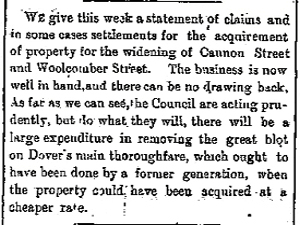
Biggin Street and Cannon Street widening, financial settlements to former retailers. September 1892

Biggin Street and Cannon Street widening, financial settlements to former retailers. September 1892

To enable the widening scheme to go ahead, Parliamentary powers were successfully sought. In Cannon Street, the properties, on the east side, from St Mary‘s Church to the Antwerp Hotel, together with properties on the west side from Market Square to almost the top of Biggin Street were purchased. These cost the Corporation £53,744 including legal fees etc. and were demolished. A competition was held for the design of new imposing buildings on the east side of Cannon Street that we see today. The land on the west side of both Cannon Street and Biggin Street was sold to property developers on the strict understanding that the new buildings would be equally as imposing and would include a grand hotel. During the demolition of the east side of Cannon Street, human remains were discovered from the churchyard of the ancient St Peter’s Church mentioned above.

On 9 November 1895, the Corporation passed a resolution proposing an electric tramway and authorisation was given through the Dover Corporation Tramway order of 1896, which was confirmed by the Tramways Orders Confirmation (no1) Act 1896. Costing £28,000, the first tramway opened in 1897 and was easily accommodated on the town centre’s main thoroughfares. Crundall, however, was still trying to find an alternative use for the Timber Yard and decided to create a cricket ground on the site. Albeit a consortium made up of predominantly Crundall’s political rivals, successfully bought land at Crabble and opened Crabble Athletic Ground in 1897.

Corporation Acquisitions

William Mummery died on 8 January 1899 and Maison Dieu House and the tannery were put on the market in February 1900. The Corporation bought Maison Dieu House for the Borough Engineer and Medical Officer of Health and Crundall, as the Mayor, said that the Timber Yard was still available for purchase. His fellow councillors agreed that the Corporation should buy both the tannery and the Timber Yard, as together they would make an ideal park in the centre of town. However, George Bacon (1852-1936) from Saffron Walden, Essex, bought the tannery and the idea was put on the back burner. Seven years later, in 1906, the Dover Bowling Club that hired the Bowling Green on Maison Dieu Gardens fell out with the owners – the Corporation – when the latter restricted the sale of intoxicating liquors in the grounds. Bacon came to their rescue by allowing the Club to construct a new Green on the tannery land.
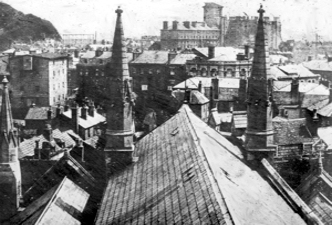
View from St Mary's Church towards the Gasometer Townwall Street, Stembrook Mill on left 1900. Dover Museum

View from St Mary’s Church towards the Gasometer Townwall Street, Stembrook Mill on left 1900. Dover Museum

Albeit, flooding remained a problem, the Corporation decided to try and deal with it. Borough Surveyor, Henry Edward Stilgoe (1867-1943) suggested deepening the bed of the River Dour. In 1901 the Corporation purchased the riparian rights to Stembrook Mill and lowered the base of the River Dour from there seawards through Leney’s Phoenix Brewery to St James Lane, by about 2 feet. Initially this solved the problem but the continual increase in the use of concrete or other impervious materials for road building in the urban area means that this problem still exists. George Brace died in 1904, Stembrook Mill closed in 1905 and was demolished in 1918. The remains of its wheel pit can still be seen below Castle Street bridge.

Tuesday, 4 August 1914 saw the outbreak of World War I (1914-1918), air-raid drills were started immediately and shelters opened. The nearest one to the crowded Stembrook area was in the vaults of Leney’s Phoenix Brewery on the sea side of Castle Street. Throughout the War notices on front line casualties were posted at the company’s brewery offices and many were the husbands and sons of those living in the Stembrook area. Throughout the War, Dover was subjected to bombing raids and just before midnight in early August 1917 German Gotha aeroplanes dropped bombs. The first fell on the Eastern Docks and this was immediately followed by bombs falling in a straight line from there, across the Timber Yard to what was then Union Street. Although the Yard was devastated, the Crundall business was not affected.

On 21 March 1918, following the surrender of the Russians 18 days before, the Germans started their Spring Offensive March-July 1918, in order to try and breakthrough the Allied lines from the Somme to the Channel. From early April their objective was to force the British and Allies back to the Channel ports of Calais, Boulogne and Dunkirk and out of the War. The ensuing Fourth Battle of Ypres (7-29 April), was bloody with an estimated 86,000 German, 82,040 British, 30,000 French and 7,000 Portuguese casualties. During that time Dover’s Military authorities feared the worst, and at their suggestion active steps were started dealing with any emergency that might arise. Alfred Charles Leney (1860-1953), the owner of the Castle Street brewery was appointed Evacuation Officer. The town was divided into ten districts, and every horse, pony, donkey and vehicle was scheduled by the Police Chief Constable David Fox (1864-1924) to be on standby. The official designated Place of Assembly for the residents of the Stembrook area was at the far end of Castle Street even though the nearest designated area was in Market Square. In the event, when it was realised by the German High Commend that the Offensive was not going to achieve its objective, it was called off.
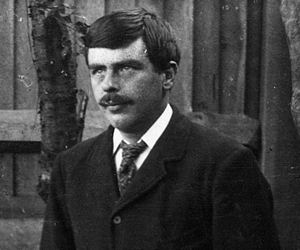
Russell Bavington Jones (1875-1949), the Editor of the Dover Express. Bob Hollingsbee Collection Dover Museum

Russell Bavington Jones (1875-1949), the Editor of the Dover Express. Bob Hollingsbee Collection Dover Museum

The War ended on 11 November 1918 and two years later the Corporation were considering the future of the Timber Yard, which Crundall was talking of selling. The Kentish Express of 1920, suggested that Dover should be built up as a naval base and strong military garrison and that the Dour should be dammed with Biggin Street and Folkestone Road to be turned into a large inland dock. Although the Dover Express did not concur with the latter suggestion the editor, Russell Bavington Jones (1875-1949) did agree that Dover should become a strong naval base and military garrison. He also agreed that the Dour should be dammed to provide inland docks but these, the editor Bavington Jones argued, should be on the Crundall Timber Yard!

By 1922 the country had rapidly slid into yet another post-war depression. Bacon, on his 70th birthday in 1922, put the Stembrook tannery up for sale and the Corporation purchased part of the site for approximately £1,100. The adjacent neglected Crundall Timber Yard was offered for sale by auction on 31 October 1922. Made up of 15 lots under the general title of Pencester Meadows, the Timber Yard was listed as a separate lot. Another lot listed was Neville Road, that Crundall senior had laid out in 1854, on the west side of what became the Timber Yard but had never built the proposed development. The vendors were the heirs to Crundall senior’s estate and the sale took place at Thomas Achee Terson’s (1843-1936) Auction House, Townwall Street, on Thursday 23 November. Earlier that month William George Lewis (1850-1924), had been elected to the office of Mayor and it was generally understood that his prime concern was to pursue projects that provided employment – at the time there were 1,400 men out of work in Dover.

The Corporation was well aware that to try and combat the increasing unemployment the Government, through the Ministry of Health, was making grants and loans for council sponsored projects as long the outcomes had long term positive outcomes and provided work. Mayor Lewis and the Corporation reasoned that the former Timber Yard, together with the tannery, could be laid out as a municipal park. This would provide work and a much needed recreation area in a densely populated part of town. Although, at the time, they were unable to put in an application until they had purchased the site, they rationalised and the council unanimously agreed that as the project fell within the Ministry of Health’s criteria, they would get a grant or, at least, a long-term loan. Thus, they would put in an application after they had successfully purchased the Timber Yard.
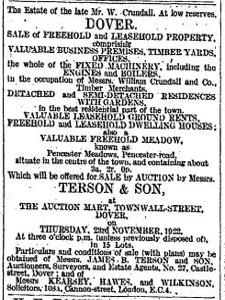
Pencester Meadow put for auction advert November 1922

Pencester Meadow put for auction advert November 1922

The lot appertaining to the Timber Yard was given as 3.125acres and the Town Clerk, Reginald Edward Knocker (1871-1956) told Mayor Lewis that before taking the project further he would contact the District Valuer, Benjamin George Turner (1882-1951) for his opinion. Turner was sorry to tell him that the Ministry of Health would not allow him to investigate the sale or provide an opinion as no State money was as yet involved. The decision therefore rested with Mayor Lewis and the councillors. Although they were unanimous as to the purchase they could not agree on how much should be paid. Knocker suggested up to £7,000 but the councillors eventually agreed to between £4,500 and £5,000.

The councillors also agreed that the Corporation would hire an agent to act on their behalf and that they would also hire a sub-agent who would be incognito. The official agent would bid up to £3,900 but if unsuccessful would not increase the bid. Instead, the sub-agent would quietly join in the fray and the principal agent would only return to the bidding contest if, in the event, it went past £5,000. The agent hired was solicitor Sydenham Armstrong Payn (1869-1939) and the incognito sub-agent was a Mr Day the clerk in Mr Wilks solicitor’s office at Deal.

The day of the auction came and due to the considerable interest, the sale room was crowded. By that time, the gossip was that the Timber Yard would go for £3,500 and it was generally known the Amstrong Payn was the Corporation’s agent. The bidding opened at £3,000 for the 3.125acre Timber Yard and it quickly rose to £3,900, with several bidders and Armstrong Payn dropped out of the fray. Day eased in and as no one realised that he was the council’s agent, the number of bidders started to fall away such that when he bid £5,000, no one offered a higher bid. The next lot auctioned was the former Neville Road site, as no one seemed to know where that was, there was little interest and it sold for just £600.
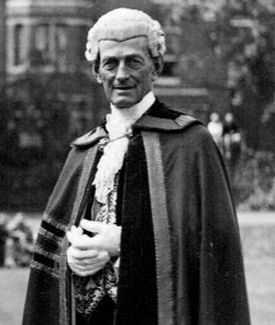
Town Clerk, Reginald Edward Knocker (1871-1956) in his official robes. Dover Museum

Town Clerk, Reginald Edward Knocker (1871-1956) in his official robes. Dover Museum

Immediately after Mayor Lewis and Town Clerk Knocker put in the application for a grant to the Ministry of Health. This was for £7,910, made up of £5,000 for the Timber Yard and £2,910 for laying it out to specifications given by the Borough Engineer, William E Boulton Smith (1883-1975). Mayor Lewis and the Corporation reasoned that the Health Minister, Sir Arthur Sackville Trevor Griffith-Boscawen (1865-1946), would look kindly on the project especially when on 27 November the Ministry issued a circular saying that District Valuers were authorised to undertake valuations when councils were applying for loans and grants.

However, local feeling, fuelled by the editor of the Dover Express, Russell Bavington Jones, was against the purchase of the former Timber Yard. The letter writers said that the Corporation had hired two men, one incognito, to act of their behalf at the auction and that both men had bid against each other. Further, the bidding dual continued until the Corporation’s official agent backed down at £5,000 and thus the price paid was far greater than it should have been. Someone else wrote that Sir William Crundall, the former Dover Mayor and more recently the Chairman of the Dover Harbour Board, was the sole owner of the Timber Yard. Others agreed, adding that in 1904 Mayor Lewis had been suspended from being a Councillor again for being involved in bribery with Crundall. It was only by nefarious reasons that he was re-elected and therefore should not be trusted.

Edwin Chitty, the Dover Solicitor, who had successfully brought the case in 1909, over which Lewis had been barred from holding municipal office for three years, wrote that in 1909 bribery was standard practice in Dover elections. Following the case there had been changes within the local political parties such that bribery was no longer a problem. However, like most other people in the town, he was unhappy about the two agents of the council bidding against each other at the auction, which resulted in the price being far greater than it should have been. Others waded into the fracas, in essence saying that the auction had provided a handsome profit for Crundall.

Bavington Jones agreed with much of what was being said and under the headline Pencester Meadow Scandal, published the details of a council meeting, where it was evident that a number of councillors had distanced themselves from the project. In an editorial, he wrote, that if the Ministry saw fit to give the Council a grant or a loan, this should be used to pay the unemployed to repair the town streets that were in a bad state of repair and other such projects. As for a children’s playground in the centre of town, Dover had a long Seafront and beaches on which the children of Dover could spend their leisure time. Because the general local feeling was so strong against the project, Griffith-Boscawen ordered a Public Inquiry.
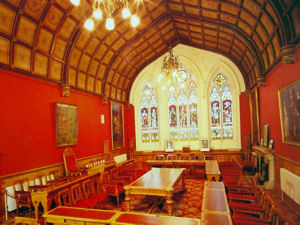
 Council Chamber in the Maison Dieu, the former Town Hall, designed by William Burgess in 1867. Dover Museum

Council Chamber in the Maison Dieu, the former Town Hall, designed by William Burgess in 1867. Dover Museum

This was held on 16 March 1923 in the Council Chamber of the then Town Hall now the Maison Dieu. The Ministry of Health Inspector, M K North presided and the room was crowded. Town Clerk Knocker was the first to give evidence and said that the council had first discussed purchasing the land on 31 October 1922, when they heard that it was coming up for auction. He then gave his account of events that subsequently took place and told the Inspector of the 27 November circular. He then told of the presentation of 3 December, when Turner, the District Valuer, gave his report, saying that £5,000 was a fair price to pay for a 3.125acre site. This drew heckles from the audience in the Chamber. Knocker then detailed what Turner had said next.

On inspecting the details provided by the vendor, Turner had told Knocker and Mayor Lewis, it was evident that the price paid by the Corporation had included Neville Road and adjacent housing lots, that Crundall senior had planned back in 1854. On checking with Terson’s, Turner found that the vendors had insisted it should be sold as a separate lot. Taking that site out of the equation, the Corporation had only purchased 2.3acres, which Turner valued at £3.500! There was uproar in the Chamber before North managed to restore order.

Knocker went on to tell the Inspector that barrister Henry Tindall Methold (1869-1952), was consulted and his opinion was that the Terson Auction House could not be held to account. However, a claim could be sought against the Crundall estate over the Neville Road site as ‘an abatement in the price paid, due to the site being sold as a separate lot‘. On relaying this to Mayor Lewis, Knocker was instructed to take action against the Crundall estate and after heated negotiations with their legal representatives, the Corporation was refunded the £600 that they had received for Neville Road site. By this time audible anger was being express and shouts that Mayor Lewis was in league with Crundall and that they were both crooked.

Boulton Smith was next to be questioned and in response to the Inspector’s query about what the Corporation proposed to do with the site, he said that a special committee had been instructed to deal with the Meadow as an open space. They had further instructed him to lay a children’s’ playground, on the opposite side from the River Dour, for there to be male and female public conveniences (lavatories) at the southern end of the Meadow and at the north, a shelter and a store. Diagonally, across the Meadow he was to lay two auxiliary paths providing access between Dieu Stone Lane and Pencester Road with a circular promenade walk in the middle. All of these works, he had originally estaimated this would cost £2,910 but because of inflation he estimated it would cost £2,940 but that it would provide 3 months work for 50 unemployed men. Upkeep would be ongoing and require a caretaker, seeds, bulbs and general maintenance, which would be approximately between £100 and £150 a year.

Armstrong Payn, the principal agent for the Corporation at the auction gave his account of what had happened there. He also made it clear that both agents representing the Corporation were well aware of the other’s presence and had not bid against each other. The audience were not convinced and loudly heckled him.
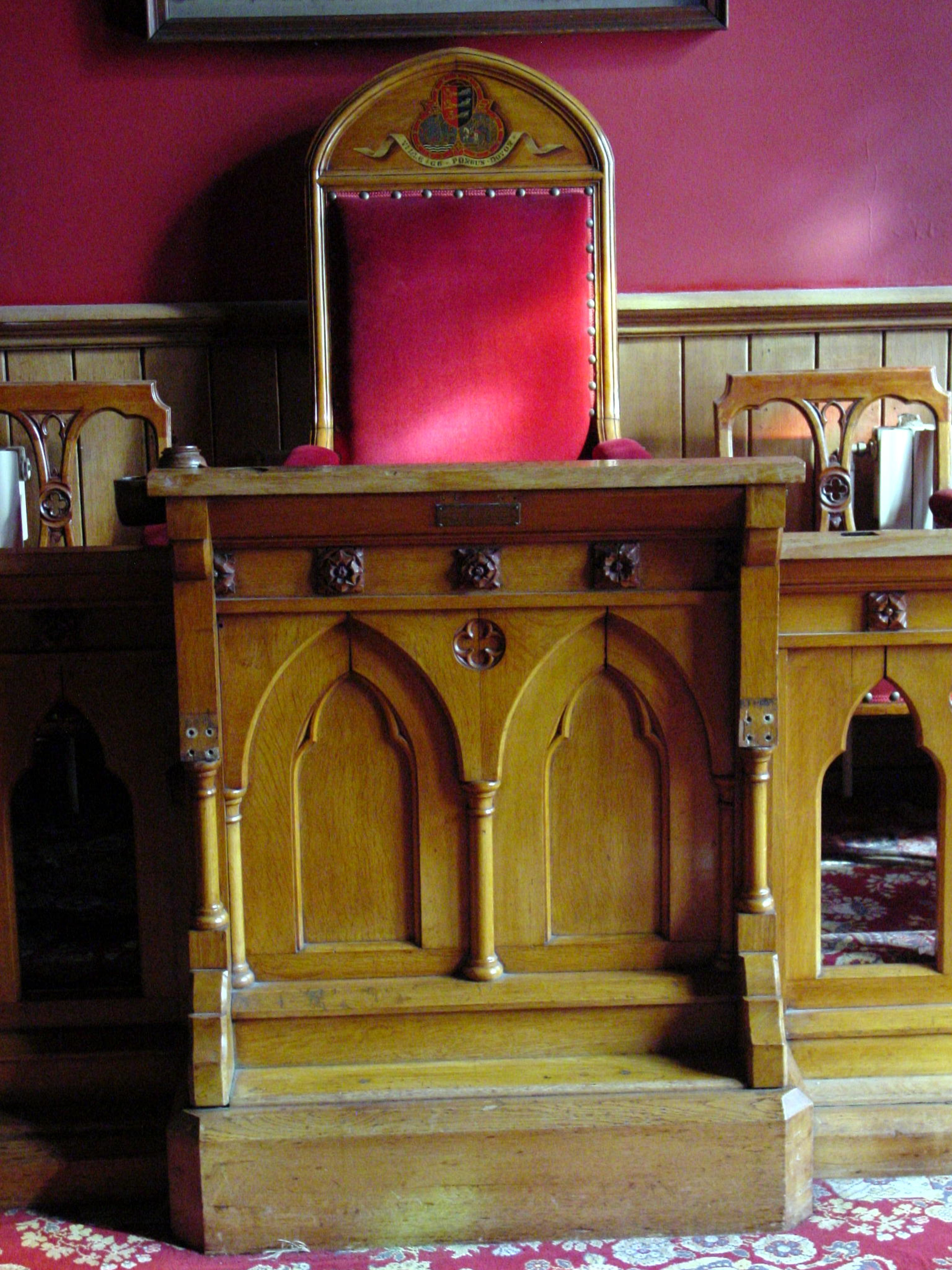
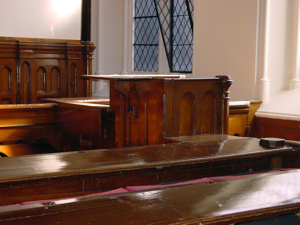
The presiding chair and in front, the Flashman lectern in the former Council Chamber where Inspector North would have sat. AS

The presiding chair and in front, the Flashman lectern in the former Council Chamber where Inspector North would have sat. AS

Finally, Mayor Lewis stood, gave his name and designation but before he could say another word, he was chastised by Inspector North over sanctioning for two agents at the auction and for making such a bid without applying for a grant first. The audience were delighted and cheered loudly. Lewis acknowledged the reprimand and apologised to the Inspector on behalf of the Corporation and then added that only days later the Ministry of Health had changed the policy which would have legitimised some of their actions. This brought the loudest protestations from the attendant audience so far and the Inspector had to bang the Flashman lectern, in front of him, several times with his gavel.

When quietness resumed Lewis said that at the time unless the Corporation actually owned the land, they would not have been eligible to apply for a grant or a loan from the Ministry of Health. This, he added, was to change several days later, after the site had been bought. The only way available to them to secure the land was to buy it before permission for a grant or loan had been granted unless some kindly person lent them the money in the interim. Someone yelled, why had they not asked Crundall, he was wealthy? Before Lewis could answer, the Inspector called for the protester to be removed and made a general warning to that effect.

In answer to why the Corporation were so interested in securing the Timber Yard site, Lewis said it was the only green space in an area of high housing density. The area from Dieu Stone Lane to the Seafront, from Pencester Road to the bottom of Crabble Hill and from Biggin Street westward, including Mount Pleasant and Tower Hamlets, were all densely populated. Further, the elementary schools serving these areas had extremely limited amount of playground space. If the Corporation were to undertake the proposal then the rates would have to be increased to pay for the land, equipment and the unemployed men’s wages. Hence the need for a grant or loan.
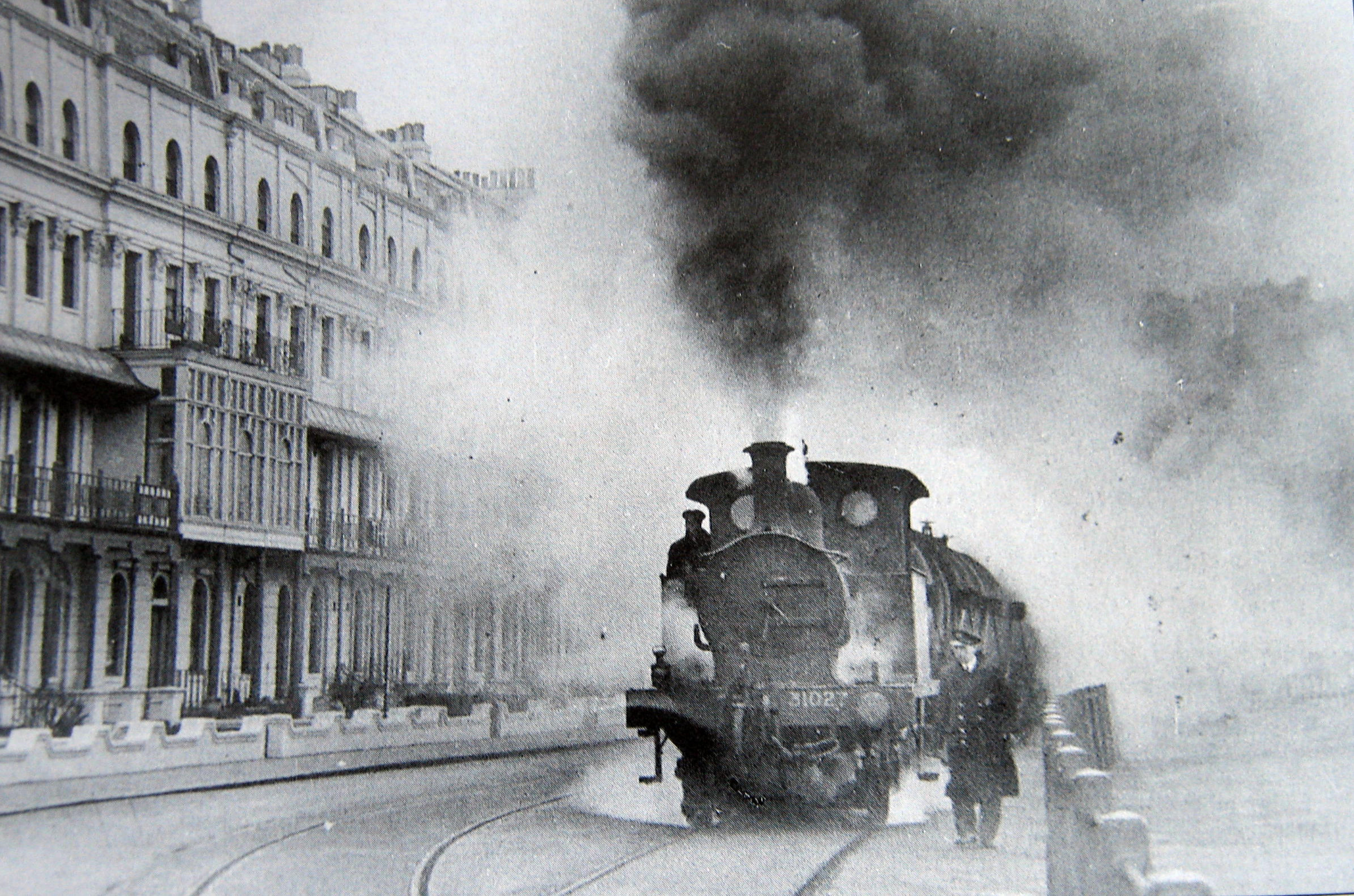
Seafront Railway loco No.3102, a P-class 0-6-0 tank-engine on the Seafront in front of Waterloo Crescent c1955.

Seafront Railway loco No.3102, a P-class 0-6-0 tank-engine on the Seafront in front of Waterloo Crescent c1955.

Mr Bavington Jones, the editor of the Dover Express, Lewis said, had told his readers that as Dover had a long Seafront and beaches there was no need for a green open space in the centre of Dover. What he failed to say, was that the War Office had laid the unhealthy Seafront Railway in 1918 and following the War, the Dover Harbour Board, under Chairman Crundall, had acquired the railway line with the intention of covering the Seafront with docks, warehouses and industrial developments along its course. Lewis added that the Dover Harbour Board were applying for permission for the developments to go ahead in conjunction with the Channel Steel Company’s proposal of taking the Railway Line over the Eastern Cliffs and demolishing homes at East Cliff and Athol Terrace to do so. This raised loud heckles of anger about that proposal from the audience when the Inspector appeared to indicate that he was not convinced.

Inspector North finished the Inquiry by saying that ‘the land had been bought and it is a question of crying over spilt milk for the conveyance is actually settled. In this case the land was purchased at auction so there is a good deal of excuse for what has been done; but the real irregularity was the inquiries as to the size of the land were not made before but afterwards. I want to make it clear that the Corporation were faced with either having to purchase the land or see it pass into others hands.’ He told Town Clerk Knocker that he would send his decision after discussing it with the new Health Minister, Neville Chamberlain (1869-1940).
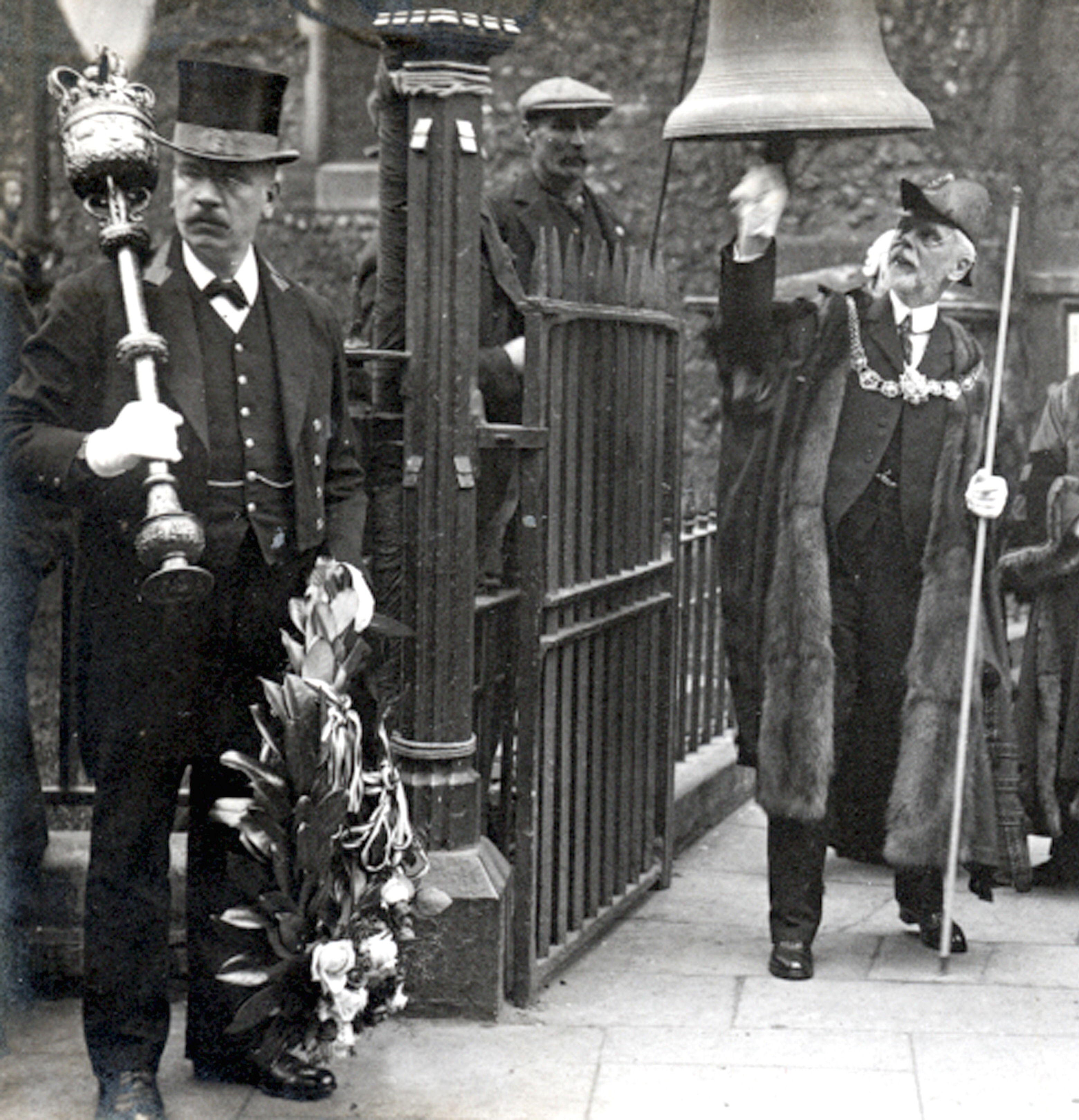
Mayor George Lewis ringing the Zeebrugger Bell on 23 April 1923. Courtesy of the Farley Family

Mayor George Lewis ringing the Zeebrugger Bell on 23 April 1923. Courtesy of the Farley Family

The report and recommendations arrived a few days later and approval for the project was given! The provisions to be provided by the Ministry of Health included a £2,900 loan repayable over 20 years for Pencester Meadow to be laid out as a play area and gardens. Also consent for a £4,200 loan, repayable over 50 years, towards the £5,000 cost of buying the Meadow. Although the Corporation was jubilant they were still required to find £200 towards the cost of the site, this Mayor Lewis personally covered.

Work began in 1924 on the site which had been renamed Pencester Gardens. Mayor Lewis, however, never saw the project completed for he died on 2 May that year. His old adversary, Edwin Chitty, gave a moving eulogy in which he said that Mayor Lewis had given many benefactions and kindness to the poor people in the town including, most recently, providing work for the unemployed and an open space for the town’s children.
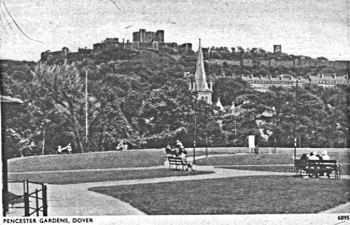
Pencester Gardens Interwar Period. Dover Museum

Pencester Gardens Interwar Period. Dover Museum

Stembrook Tannery to Pencester Gardens Part Two tells the story of the area up to the present day.

Presented: 05 April 2018
 

Posted in Businesses, Open Spaces, Roads & Streets, Stembrook Tannery to Pencester Gardens Part I, Stembrook Tannery to Pencester Gardens Part I, Tourism | Comments Off on Stembrook Tannery to Pencester Gardens Part I

The Saga of River Paper Mill

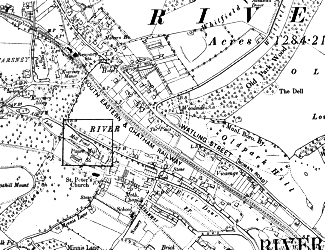
Map of River - highlighting the River Paper Mill c1890

Map of River – highlighting the River Paper Mill c1890

The village of River is about 2 miles from Dover town centre and was by the time of Edward I (1272-1307), called Villa de Riviere. This was eventually shortened to River. At the end of the 18th century the village was described by Kent Historian, Edward Hasted (1732-1812), as being ‘pleasantly situated about two miles from Dover, in a variety of country of high hills and deep extensive valleys; the high London Road goes through it, on the left side of which the unclosed down hills rise very sudden and high. On the other side, the slope of the valley is as sudden for two or three fields, at the bottom of which the River Dour meanders its little silver stream.’

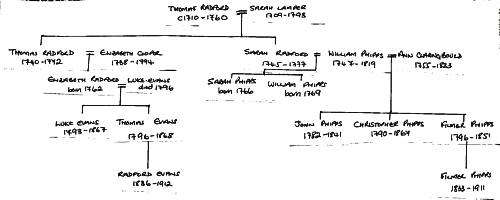
Key members of the Evans, Phipps & Radford families in the River papermill saga

Key members of the Evans, Phipps & Radford families in the River papermill saga

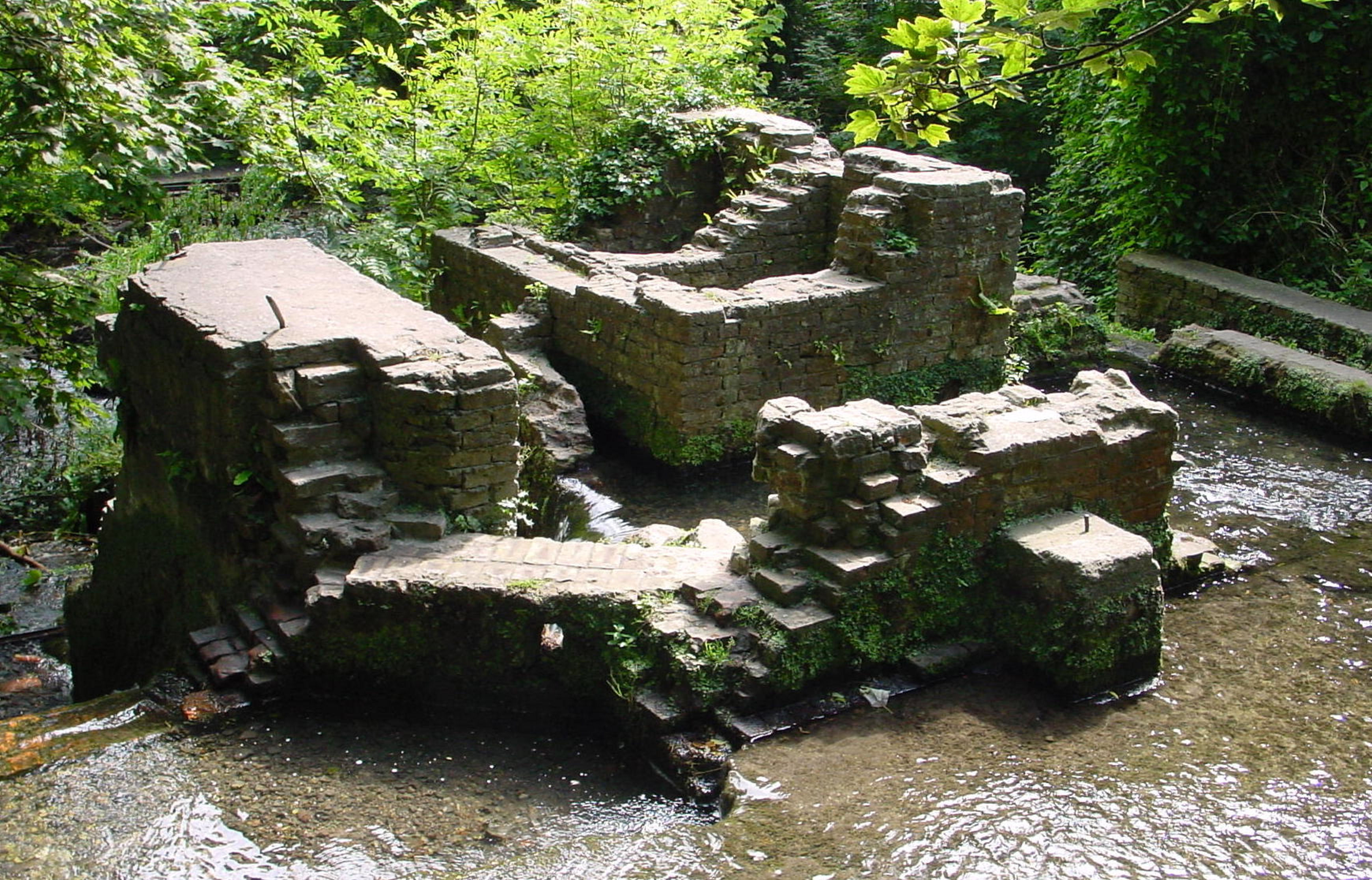
This story centres on the history of River paper mill, the ruins of which can be seen by the junction of Minnis Lane and Lower Road, River. At the time of the story, the other paper mills on the 4mile long river Dour were Bushy Ruff, Crabble, Buckland cottage, Lower Buckland, Charlton at Charlton Green and Lower Charlton – also known as Spring Garden paper mill, near the High Street.
The story is also about the inter-relationships of several key characters involved in the rise and fall of River paper mill and it is loosely divided into the following sections:
1. Thomas Radford (c1710-1760)
2. William Phipps (1747-1819)
3. John Phipps (1782-1841) and Christopher Phipps (1790-1867)
4. Christopher Phipps (1790-1867) and Filmer Phipps (1833-1911)
5. Filmer Phipps (1833-1911) and Radford Evans (1836-1912)

River paper mill, the ruins of which can be seen at the bottom of Minnis Lane, is mentioned in the Domesday Book of 1086, as a corn mill and again the corn mill is noted in 1227. By 1472, the village boasted of two water mills, Rakestravis Mill and Ash Mill, both of which were owned by the Maison Dieu. This was a religious hospital founded in 1203 by Hubert de Burgh (c.1170–1243) and the Great Chamber or Stone Hall we can still see today in Biggin Street. The two mills were leased for forty years to miller Robert Salter and his heirs at 10shillings a quarter each. The Master of the Maison Dieu, John Clerk (elected 1484-d1534), drew up the transaction but at the time Ash Mill was leased to John le By of Temple Ewell. Thus, it was noted that Salter had to wait until John le By vacated the premises. During the Reformation (1529-1536), the mills were sold but religious persecution in the Low Countries, these days the Benelux countries and consisting of Belgium, the Netherlands, and Luxembourg, between 1567-1573 by the Grand Duke Alva (1507-1582) brought a flood of refugees to England. Among them were paper makers and early records show that some settled alongside the Dour. It is believed that it was one of these refugees that converted the former corn mill into a paper mill.

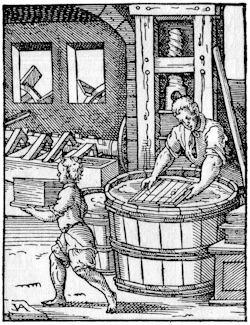
Papermaker Woodcut from Jost Amman (1539-1591). Wikimedia

Papermaker Woodcut from Jost Amman (1539-1591). Wikimedia

Papermaking can be traced back to 105AD in China, but it was not until Johannes Gutenberg (c. 1400-1468) invented mechanical moveable type printing in 1439, that demand in Europe was created. From then until the early nineteenth century papermaking was a cottage industry with the few employees supplemented by journeymen papermakers. At that time, paper was made out of rags that were sorted as the condition and the colour determined the quality and colour of the finished paper. As there were no chemical bleaches, white or near white cloth was the most prized. Sorting was the dirtiest and lowest job in the mill and was often undertaken by women.

The material was cut up into small pieces and then rettled, that is soaked and left to ferment for a few days to breakdown the weave. This was followed by boiling in tanks to which caustic soda had been added. The rags would then have been put into a metal lined trough and pounded for about 12hours by several hammers with spikes set into the heads. These were raised by cams on the waterwheel spindle, and then would fall to shred the material and create half stuff. The half stuff was put into a second trough and pounded for a further 12hours by hammers set with grooved studs in the heads that further broke up the fibre, creating whole stuff. Finally, in a third trough, the pulverised material would be subject to another 12hour beating with plain wooden hammers to produce stuff, minute particles of cellulose that was then poured into a vat of clean water.

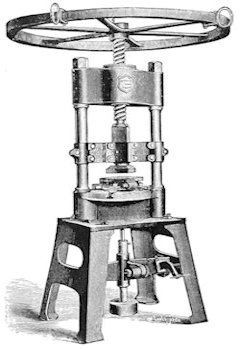
Paper press - Wilkes screw tile press c1891. Popular Science 1892 Wikimedia

Paper press – Wilkes screw tile press c1891. Popular Science 1892 Wikimedia

The vatman, a qualified papermaker, dipped a mould or deckle into the stuff. The deckle was a rectangular wooden frame with a fine mesh of straight wires sewn onto the underside. The vatman’s skill was to collect the right amount of stuff in the mould to form a sheet of paper of the required thickness. He then gently shook the frame until all the surplus water drained away leaving a layer of cellulose on the wire mesh. Once satisfied, the mould was passed onto the coucher, again a qualified papermaker, who transferred the wet sheet of cellulose onto a felt – a damp woollen cloth. The cellulose sheet was then covered with another felt and the next cellulose sheet laid on top to make a stack of cellulose sheets interspersed with felts and called a post. The post was then put into a screw press to remove as much moisture as possible. The layerman, another skilled operative, separated the felts and the sheets and the coucher would repeat the process. Following which, the sheets were hung in the mill lofts to air-dry.

By 1689, the River papermaking mill was owned by Susanna Williams for that year, she sold the mill to the Hatton family of Buckland. Edward Hatton born in Alkham, along with his brothers Nicholas and John, had all served their apprenticeships as millwrights. An indenture, dated 1700, confirms their professional status. It was probably they who introduced the rag-machine or Hollander to the factory. This was invented in Holland, patented in 1682 and replaced rag-stomping. The machine consisted of a beater wheel similar to a water wheel, the blades of which rotated to beat the fibre into a pulp.

1. Thomas Radford (c1710-1760)

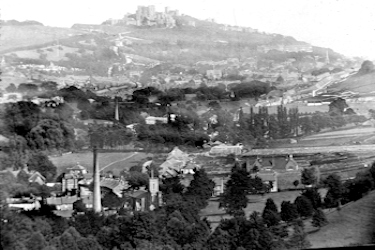
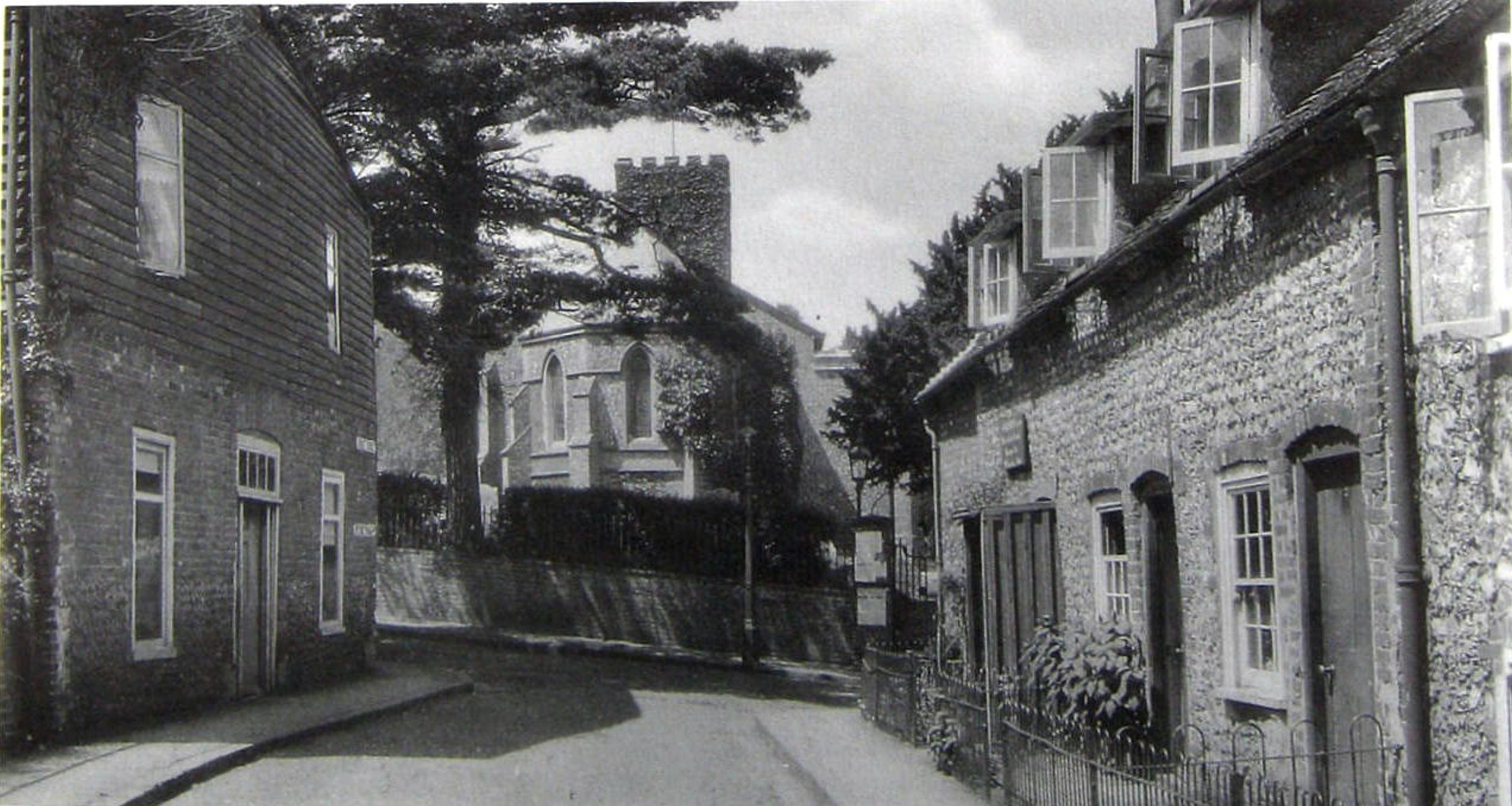
NB River village c1895. River paper mill chimney with St Peter's Church to the right Dover Castle in distance. Dover Museum

NB River village c1895. River paper mill chimney with St Peter’s Church to the right Dover Castle in distance. Dover Museum

Four years later, in 1704, the Hatton family sold the mill to Paetly Sturgeis and on his death the mill passed to his wife Katherine (d1717). It would appear that she employed John Walters to run the mill and on her death Katherine bequeathed the mill to her cousin, Katherine Dawkes (d1731). It was recorded that in 1742 the mill was being worked as a water mill and in possession of Isaac Hammond (d 1777), who leased it to journeyman papermaker Thomas Radford (c1710-1760). He had married Sarah Lamper (1709-1793) in 1735 at Buckland and five years later their son Thomas was born (1740-1772) and in 1745 their daughter Sarah. (1745-1777). In 1756 Thomas and Sarah leased River paper mill.

As noted, Thomas Radford, who possibly came from Boxley, near Maidstone, Kent, was a journeyman papermaker. As the demand for paper was not consistent, when orders came into paper mills the mill owner employed journeyman papermakers until the order was completed. Having served a full apprenticeship, the journeyman papermakers received their accreditation, which they carried with them. They were recognised professionals who commanded good payment for their work. Further, the identification document also ensured inn keepers that they would receive payment in full from the journeyman papermaker for the provision of a good meal and a comfortable nights lodging.

On leasing the mill, Thomas made a number of improvements, the most noticeable of which was building a tall chimney to carry away the smoke of fire and steam contaminated with caustic soda. Caustic soda was used for pulping wood and he also adapted the mill’s water wheel to work the pulverisers. Having to rely on journeymen coming to River due to lack of local skilled workers Thomas decided to hire local boys as apprentices, providing training that met the requirements of becoming a qualified papermaker. Standard indentures for apprentice papermakers, at that time, was 10years and although it was usually expected for the boy’s family to pay for the apprenticeship training, Thomas chose to pay the boys a token sum of money every quarter. He almost certainly had stringent rules, with which they had to comply but at the end of their training, the young men would be certificated professionals.

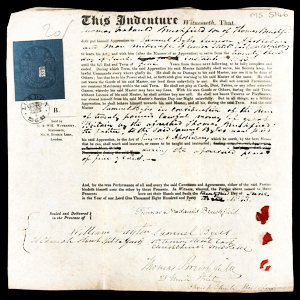
Apprentice Indenture certificate. Welcome - Wikimedia

Apprentice Indenture certificate. Welcome – Wikimedia

However, this initiative ran foul of the Dover Freemen’s requirement of apprentices such as ‘A parent has the right to pay a standard sum to enter their son into an apprenticeship lasting seven years under a Freeman.’ The parents of the local lads did not have the finance to pay for this privilege and further, Thomas was not a Dover Freeman. Sarah, his wife, was the daughter of a Freeman, and through her father, Thomas managed to claim his Freemanship. How he managed to get around the apprenticeship problem is unclear, but he did and he also retained journeymen to act as their teachers. Before he died on 19 November 1760 at the age of 50, Thomas bought land and arranged for cottages to be built along Minnis Lane. These were rented to the teacher journeymen and on completion of their apprenticeship, the young men, who were retained by the mill, would be eligible to rent a cottage, as they became available. With regards to the mill, Thomas’s Will states, ‘I give unto my wife Sarah all that my messuage or tenement mill house and water mill late and now used as a paper mill’. 

River Mill workers cottages Minnis Lane where William and Sarah lived. The cottages were demolished 1957. John Roy

River Mill workers cottages Minnis Lane where William and Sarah lived. The cottages were demolished 1957. John Roy

Sarah Radford was a businesswoman and she successfully ran the mill with the help of her son Thomas. Of the apprentices William Phipps (1747-1819) particularly stood out, as did his brothers, Christopher (1749-1831) and John (1759-1835). Young Thomas Radford married Elizabeth Cooper (1738-1794) in 1761 and they moved into the mill house where their daughter Elizabeth (b1762) was born the following year. When she grew up she married Luke Evans (d1796), a papermaker. It was not long after that William Phipps completed his apprenticeship and with Sarah’s approval, he started courting Sarah’s daughter Sarah. On Christmas Day 1765, William and Sarah were married and they moved into one of the Minnis Land cottages. Thomas ran the mill until he died in 1772 but by then the mill was in financial trouble. Whether William Phipps offered to run the mill is unclear but by this time the relationship between himself and his mother-in-law seems to have been strained. By 1774, the mill was in more financial trouble when Sarah Radford mortgaged it together with the mill house for £800 plus interest to Robert French (d1806).

2. William Phipps (1747-1819)

William and Sarah had two children Sarah born 1766 and William born 1769 but in 1777, William’s wife Sarah died and her mother sold the River paper mill to Ingram Horne (d1785). He was the son of paper manufacturer Thomas Horne (d1807), who rented Buckland cottage paper mill, Crabble Hill, from the Archbishop of Canterbury. Ingram had recently leased the Lower Buckland paper mill, further down the River Dour, from Henry Paine. A mill had been built by Paine in 1755 on the opposite side of the River Dour from Buckland corn mill, on what is now Lorne Road. However, Lower Buckland paper mill was not mentioned until 1775, when a deed referred to the newly erected paper mill on this site.

By 1780 River paper mill was being run by William Phipps and together with John Aldridge, and using a loan from the Fector Bank on Strond Street, Dover, they bought the mill from Horn. The following year, on 13 February 1781, Phipps married his second wife, Ann Claringbould (1755-1823) but the next year Phipps was declared bankrupt and so the mill reverted to the Fectors. Israel Claringbould, who was possibly Phipps father-in-law, bought the mill and then sold it to Thomas Boykett (d1792) reserving the power of redemption. Claringbould took the mill back but between 1784 and 1788, he leased it to a Mr. Low.

Up to 1784, Phipps had run the River mill but when Low took over the mill the Phipps’ brothers were reduced to the status of helping hands. In 1788, William Phipps acquired the semi-derelict Crabble paper mill. Over the following two years he rebuilt it and appears to have introduced the new style mould developed in 1757 by James Whatman senior (1702–1759) from Loose, near Maidstone, Kent. This replaced the traditional wooden and straight wire mould with one made of woven wire fabric, producing wove paper, that had a uniform surface. The main problem with the traditional mould was that the wires left indentations in the paper, called laid marks, which prevented clear sharp letters when the paper was used for printing.

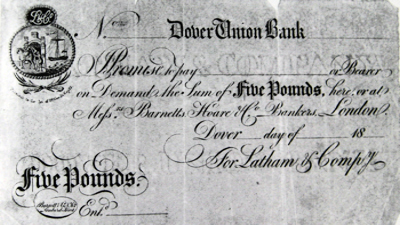
£5 note drawn on Latham's Dover Union Bank c1830 - note the watermark. David Ryeland

£5 note drawn on Latham’s Dover Union Bank c1830 – note the watermark. David Ryeland

At the refurbished Crabble paper mill, not only was wove paper produced but in 1790 John Phipps, William’s youngest brother, produced a paper he had patented. Basing his invention on the laid paper and watermark techniques, the patent specification states that it is ‘A method to facilitate the acquirement of several of the useful and polite arts by an easy, effectual and expeditious manner of teaching writing and. drawing which is done by fabricating the moulds, wove or washing wires … by having the lines made and the copies set for writing.’ The writing lines were made using watermark technique created by changing the thickness of the paper, while it was being made. This made a shadow/lightness in the paper and the Bank of England had been issuing bank notes with simple watermarks from about 1697 in an attempt to stop counterfeiting and high street banks followed suit including the Dover banks. To create his watermarked laid paper, John Phipps possibly used thicker but evenly spaced wires across the mould and fine wires on the vertical axis, which supported the heavier wire.

In the meantime, Low defaulted on his River paper mill lease and Claringbould was unable to persuade any of the Phipps brothers to return and run it for him. He therefore sold the mill to the Fectors Bank. William Phipps, in return for financial considerations over his debt to the bank in purchasing Crabble paper mill, agreed to lease and run the River mill on behalf of the Bank.

On 1 February 1793, France declared war on Britain and the Napoleonic Wars (1793-1815) began. The effect on Dover was an influx of military and naval forces and with them, an increase in demand which included the need for good quality paper. At Lower Buckland paper mill, Ingram Horn had died and Henry Paine was hit with a wage dispute. In 1794 Paine was declared bankrupt and William Phipps, using loans from both the Fector and Latham banks, bought the Lower Buckland paper mill a year later and completely rebuilt and refurbished it. By the end of the century, the historian, Edward Hasted (1732-1812), described the mill as large and well constructed. John Phipps, with the help of his brother Christopher, ran the mill producing John’s patented watermarked laid paper, which proved successful.

The wage dispute that had bankrupted Henry Paine was due to a rapid rise in prices and the increase in demand for paper in Dover. This was not just a local problem and in 1800 this had led to the founding of the Original Society of Papermakers that represented skilled workers in the paper industry. Their biggest fear was the increase in mechanisation within the paper industry and although it was William Phipps who was producing wove paper at River and Crabble paper mills and was moving towards mechanisation, it was the labour intensive Lower Buckland paper mill where the unrest boiled over.

William Phipps, in 1810, reacted by closing and then selling Lower Buckland paper mill to Sir Thomas Hyde Page (1746-1821) who had bought the nearby Brox-Ditch Meadow. Sir Thomas erected the mansion now referred to as 110 London Road facing Coombe Valley Road but in 1814 Sir Thomas sold much of his land including the house and the paper mill to William Kingsford (1778-1856) for £5,750 and moved away. In 1821, Kingsford borrowed £6,000, expanded the paper mill and for his workers built cottages, many of which can still be seen along the London Road.

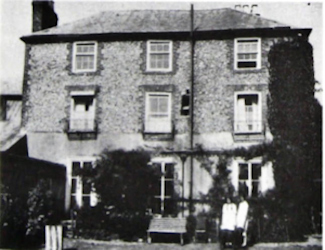
River Mill House, Lower Road built 1807 by William Phipps. John Roy

River Mill House, Lower Road built 1807 by William Phipps. John Roy

Through Israel Claringbould, in 1800 William Phipps paid £2,000 ‘to James Peter Fector‘ (1759-1804) of Fector Bank to repurchase the River Paper mill. Seven years later, in 1807, he rebuilt the mill and also the adjacent River Mill House – an elegant Georgian mansion that faced Lower Road. At the top of Minnis Lane is SS Peter and Paul Church and opposite was the first Dublin Man of War hostelry that was probably a converted cottage and at the time being run by John Brockman (1765-1837). It was said that Phipps, when he thought his mill hands were spending too much time in the pub, would go in and clear the house! This is not surprising, as Phipps was known to be a hard taskmaster. Indeed, he closed Lower Buckland Paper Mill as a warning to his other workers and he was not adverse to make surprise visits to the cottages on Minnis Lane. This was to check if they were clean and tidy and that the gardens were well tended. If not, the cottager and his family would be evicted.

With the continual increase in demand for paper but with rags becoming more expensive to buy plus the demands from his workers to increase wages in line with inflation, in 1807 Phipps installed the new 48inch Fourdrinier machine at his Crabble paper mill. This was described as driven by the water wheel and produced a continuous roll of paper. The machine consisted of a perforated cylinder covered with a wire cloth that revolved in a vat filled with stuff – the minute particles of cellulose pulp. The stuff was pressed onto the cylinder, removing the water through its centre and the pulp that remained was removed from the surface of the wire cloth by a continuous felt blanket. The stuff was then pressed again to remove any surplus water before leaving the machine as a long roll of paper, rather than separate sheets. The damp paper was then carefully reeled on to a Flat reeler, cut off by hand into sheets and removed to the lofts to be dried. Paper produced this way had a superior surface and appearance than the individually produced sheets of wove paper.

Fourdrinier papermaking machine - relatively modern -Frogmore Mills, Hertfordshire. Chris Allen Wikimedia

Fourdrinier papermaking machine – relatively modern -Frogmore Mills, Hertfordshire. Chris Allen Wikimedia

A machine for making continuous paper had been patented in by Nicholas Louis Robert (1721-1828) in 1799, but as it was at the time of the French Revolution (1789-1799) the machine was not a success. Nicholas Robert was working at a paper mill at Essonnes, near Paris, in France owned by St. Léger Didot (1767-1829). Didot’s brother-in-law, John Gamble, recognising their value, brought copies of Robert’s drawings to England and patented them in 1801. Gamble then took the drawings to London stationers, Henry (1766–1854) and Sealey Fourdrinier (1773–1847) who financed the ingenious engineer Bryan Donkin (1768-1855) to build the machine, making improvements as he saw fit. This Donkin did and in 1803 a machine was installed by John Dickinson (1782-1869) at his paper mill, Frogmore, Hertfordshire. In 1809 Dickinson patented the improved machine design.

Following the end of the Napoleonic Wars, approximately a quarter of a million soldiers and sailors, many of them maimed, returned to a Britain that was in a rapid economic decline. The wartime inflation continued especially as poor crops were causing food shortages. Income Tax, which had been introduced during the Wars, was abolished but it was replaced by taxes on staple commodities such as candles, paper and soap as well as luxury items such as sugar, beer and tobacco. To save money, town and cities cut the Poor Law relief rates that meant starvation was rife and businessmen, such as Phipps, looked for cheaper forms of paper production.

In Horne’s Guide to Dover, published in 1819, it states that ‘At Crabble there is an extensive paper mill, the property of Messrs W Phipps and Sons, in which there is a curious patent machine for making paper any length whatsoever.’ The Guide was referring to the Fourdrinier and in his 1907 pamphlet, ‘Recollections of River‘, River papermaker, Radford Evans (1836-1912), wrote: ‘Mr William Phipps was the first introducer of machines for paper making, and I was told that the identical machine at Crabble mills, of which I had charge for some years, was the second paper machine erected in England, the first being claimed by Dickinson’s at their water mill in Hertfordshire.’

Phipps was looking for other machines that would increase production while reducing labour costs and on 1 November 1820 Thomas Bonsor Crompton (1792-1858) of Farnworth, Lancashire, patented one. This was a method of drying continuous paper using a woven fabric to hold the sheet against steam heated drying cylinders. It is possible that William Phipps may have considered installing such a machine for according to an 1821 survey, carried out for insurance purposes, it states that in the drying room there were ‘wrought and cast iron coils’ that were notorious for causing fires. The same survey makes reference to the Fourdrinier machine describing it as a ‘48 inch paper making machine’. A survey in 1894 included a much larger paper making machine with drying cylinders.

At that time the village of River consisted of a few cottages and a number of hovels. All three brothers worked hard, each making a significant contribution to the paper industry. When William died, the village had 93 cottages that he had built. William’s second wife Ann died in 1823 having borne him ten children, John (1782-1841), Mary Anne (1784-1856), Susannah (1785-1879), Elizabeth (1786-1859) Maria (1788-1859), Christopher (1790-1867), Israel (1791), George (1794-1795) Filmer (1796-1851) and Eliza (1798-1859). William Phipps left his milling business to his sons John and Christopher, while Filmer inherited the wholesale stationers business at 176 Upper Thames Street, London, set up as an outlet for the family paper business.

3. John Phipps (1782-1841) and Christopher Phipps (1790-1867)

John Phipps & Co., River-mill Dover registered 1824, label attached to bales of paper. Dover Museum

John Phipps & Co., River-mill Dover registered 1824, label attached to bales of paper. Dover Museum

John Phipps registered the company as John Phipps & Co., River-mills Dover and in 1824 the company was listed as paper manufacturers. On 11 January 1825, John successfully applied for a patent on a form of the Dandy Roll. This was to impress watermarks onto continuous rolls of paper produced by the Fourdrinier machine. Engineer and paper mould maker, John Marshall from Dartford Kent, had invented the Dandy Roll but it had not been patented. Originally, it was a wooden roller covered with a wire cloth embossed with a pattern. Faint lines were made by laid wires that were parallel to the axis and bold lines by chain wires that ran around the circumference to secure the laid wires to the roll from the outside. Because the chain wires were on the outside of the laid wires, they made a greater impression in the pulp and therefore created a bolder finish than the laid wire lines.

Dhipps on 11 January 1825 at Crabble paper mill. Joe Harman

Dandy Roll patented by John Phipps on 11 January 1825 at Crabble paper mill. Joe Harman

The Phipps brothers’ patent Dandy Roll replaced the wooden roller with a cylinder formed of wire to create impressions upon the forming paper. Their patent, No. 5075 is listed as, ‘An Improvement or Improvements in Machinery for Making Paper.’ In the specification the patent states, ‘the employment of a roller the cylinder part of which is formed of ‘laid’ wire … the effect produced by said roller is that of making impressions upon the sheet of paper upon which said roller passes and thus the paper so made has the appearance of ‘laid’ paper.’ They installed the patent Dandy Roll at Crabble paper mill in 1825, and its most notable use at this time was the making of Indian currency paper. That year the British East India Company consolidated their Presidencies of Bengal, Bombay (now Mumbai) and Madras (now Chennai) and issued joint rupee currency, using the Phipps produced banknotes for larger denominations.

The two brothers also introduced the production of brown paper at Crabble paper mill where they had built a logwood mill store. The logwood, (haematoxylum campechianum) came from British Honduras, now Belize. The Governor of British Honduras from 1829-1837, was Dovorian (later) Sir Francis Cockburn (1780-1868). The Colony had been founded in 1638 by former British buccaneers who were joined by loggers in this heavily forested semi-tropical area on the east coast mainland of Central America. At the time, and for a long time after, the main export was logwood or bloodwood, as it was also known and was exported to Europe for use in dyeing fabrics and making brown paper. At Crabble paper mill, after grinding the logwood, it would have been boiled to extract the colour that the Phipps brothers would have sold on, possibly to the recently opened Scott Dyeworks, in Snargate Street. The remaining pulp was used for making the brown paper.

River Paper Mill 1825. Dover Library

River Paper Mill 1825. Dover Library

A survey of River paper mill of 1825 described it as having a ‘two vat mill with drying loft over.’ There was a boiler room, storeroom and salle – where female employees sorted and counted out sheets of paper for packing. Above was a drying loft. There was a sizing room, where the pulp was soaked in an adhesive of rosin – this was likely to have been made out of naphtha extract from pine stumps – and aluminium sulphate to stop ink spreading. A rope room, engine and engineers room, engine house with adjacent water wheel, vats and a rag house (see adjacent map). The waterwheel was used to drive the hammers as described earlier.

Even though the country was still in an economic depression, both River and Crabble mill, because of such innovations, continued to function well and the two brothers managed to maintain full employment though they did have to reduce pay. This was mentioned in a case that involved River mill workers that aroused national interest. The case was heard on 5 August 1826 at Maidstone Court and was brought against four members of Kent’s landed gentry by the mill blacksmith, William Stokes. The four squires were Henry Chudleigh Oxenden (1795-1889) – Commissioner of Dover Harbour and later Baronet, his brother George Oxenden (b1796), together with Sir John Fagg (1798-1873) – the High Sheriff of Kent, and John Oliver. They were accused of violently assaulting Stokes. London solicitor William Brodrick, who was representing Stokes on a pro bono publico basis, told the court that he had undertaken the case as he believed that even though Stokes who was working at a reduced wage rate to help to keep River paper mill operating, ‘he should not be denied impartial justice for a grievous injury inflicted by persons of rank.’

On Sunday 19 March 1826, Luke Evans (c1794-1867) and Thomas Maytum (d1849), both of whom worked at the mill and one of the sons of the John Brockman, the Dublin Man of War publican, had been out looking for foxes. They had with them two dogs owned by John Witnell of Dover. On finding a fox-earth on farmland at Wickham Bushes, Lydden, they let the two dogs down but the dogs were unable to get out. The next day Evans, Maytum together with Stokes went to dig the dogs out when Richard Graves, the farm steward, came to see what they were up to. On being told, he gave the men permission and the men managed to rescue the dogs. As the men were packing up their things Henry Oxenden and his party, all on horseback came on the scene. On inquiring if Graves’ master had given permission for the men to be on his land, Graves admitted that he had not asked. Oxenden responded by telling Graves to order the men off the land but as they were leaving anyway, they quickly made off.

 ABC of Fox Hunting by Sir John Dean Paul 1775-1852 plate 13 caption reads 'M was the Master, who gave the view holloa'. Wikimedia

ABC of Fox Hunting by Sir John Dean Paul 1775-1852 plate 13 caption reads ‘M was the Master, who gave the view holloa’. Wikimedia

As the men were crossing the farmland, Henry Oxenden called out ‘view holloa‘ – the shouts made by a hunter on seeing a fox break cover. He then loudly added ‘in the first place we will kill all their dogs…’ Evans took the tools from the other two and Stokes and Maytum picked up the dogs and all three men ran towards the nearby wood. The four horsemen chased after them and on reaching the men, George Oxenden knocked Stokes to the ground and then rode over him. This caused a deep injury to Stokes head and heavy bruising to his hip. One of the eyes of the dog Stokes was carrying was almost knocked out. John Oliver shot both dogs, although the second one was not injured. In court, Fagg and Oliver’s barristers stated that the men knew nothing of the fracas, while Messr Guerney, the barrister for Oxenden brothers, said that they were riding across private land fox hunting and the men had got in the way. If any injury was caused to Stokes it was accidental and superficial. The jury found Fagg and Oliver not guilty but the Oxenden brothers were both found guilty and were ordered to pay £100 damages. The judge, Sir Robert Graham (1744–1836), in his summing up said, ‘… the pursuit of manly sports could not justify the violations of the safety of his majesty’s subjects under any circumstances

According to Zachariah Warren’s (1775-1834) Dover Guide of 1830, all of Dover’s paper mills had come through the post war economic troubles and were at that time thriving. Ingram Horn bought Buckland cottage paper mill in 1788 and by 1820 his son Thomas (1778-1833), who by then owned it, wanted to retire so put the mill up for auction. Out of the proceeds Horn in 1823 built Buckland House, on Crabble Hill, that still stands today. George Dickinson (d1843), brother of John Dickinson the paper manufacturer who had patented the improved Fourdrinier continuous paper machine, leased Buckland paper mill in 1822. He had borrowed £30,000 from the Fector bank and had also built a steam driven paper mill at lower Charlton, known as Spring Garden paper mill, with a house next door. This he called Brook House that eventually became part of the former Royal Victoria Hospital on the High Street, this was not the Brook House that was infamously demolished by Dover District Council. William Knocker (1761-1847) leased Bushy Ruff paper mill in the Alkham Valley to a series of papermakers including from 1826 to George Dickinson until 1837 when Dickinson was declared bankrupt.

In the village of Charlton, William Kingsford owned the corn mill and had bought the other Charlton paper mill, near Charlton Green.  At the time of Warren’s Guide, he still owned both the Buckland corn mill and Lower Buckland paper mill but in 1835 he too was declared bankrupt. As we know, John and Christopher Phipps owned both River and Crabble paper mills but of interest, they still traded as Messrs Phipps and Sons. Further, at Crabble, between River and Dover, was Crabble corn mill – that can still be seen today – and was owned by brothers John and Joseph Pilcher together with their uncle Edward trading as Messrs Pilcher & Co. Of interest, they also owned Kearsney corn mill and in 1830 they were leasing it to John and Christopher Phipps!

Following the bankruptcy of William Kingsford on 14 February 1834, solicitor, Thomas Baker Bass (1807-1860) bought the Lower Buckland paper mill. He hired the Phipps brothers to run it and the following year they produced the East India Company rupee paper money there. The order enabled them to raise the capital, using loans from both of Dover’s banks, to buy the mill. The Fector Bank was run by George Jarvis (1774-1851) on behalf of John Minet Fector junior (1812-1868), who was a minor and the Latham Bank, chaired by the philanthropic Henshaw Latham (1782-1846).

At about this time, it would seem that John Phipps became incapacitated and he died in 1841. It would also appear that he lived in River Mill House with his brother and possibly other members of the family. The elegant Georgian mansion that faced Lower Road, River had ten bedrooms, one with a bath, good accommodation on the ground floor and a spacious wine cellar. Filmer Phipps had married Lucie Stephanie Palmira (1811-1898) in Boulogne and following the death of John, it appears that the couple and their young son, also called Filmer (1833-1911), spent time at River Mill House helping Christopher to run the paper making business. Christopher retained the company name as John Phipps & Co. River-mills Dover.

The former Lower Buckland paper mill after conversion into a brewery in 1846. Painted from a drawing of 1862 by James Tucker c1910. Dover Museum

The former Lower Buckland paper mill after conversion into a brewery in 1846. Painted from a drawing of 1862 by James Tucker c1910. Dover Museum

Although the country was falling into one of the deepest economic depressions of the 19th century, the three mills that Christopher Phipps owned were still receiving some orders. On 26 December 1844 he patented an improvement of the manufacturing of paper but on Easter Monday, 13 April 1846, the Latham bank collapsed owing £35,000. The bank’s holdings were sold over the heads of their borrowers and the loans made out to Christopher Phipps were called in. He was forced to sell Lower Buckland paper mill at less than what it was worth and also terminate his contract with the East India Company. Builder, John Pierce (1788-1851) of Bartholomew Terrace, Buckland, bought the mill in 1846 and it opened as a brewery the following year. Pierce named this after his hero, the Duke of Wellington (1769-1852).

As for Christopher Phipps, he just managed to hold onto both River and Crabble paper mills but Buckland cottage paper mill was hit. Except for a short period of time when the Weatherby family leased Buckland cottage paper mill, it remained empty until it was rented by Charles Ashdown (1808-1888) in 1849. By 1851 Ashdown owned the mill and was assisted by his son William Henry and known as Henry (1841-1875).

The economic woes, naturally, affected the workers as many were laid off while others took pay cuts. Nationally, with increased industrialisation a growing numbers of factory workers joined associations in their efforts to achieve better wages and working conditions. Such associations were severely dealt with by the authorites, but during the 1830s attempts were made to set up national general trade unions. During this time the Chartist Movement (1838-1857) had emerged with the aim to gain political rights and influence for the working classes. Although it fragmented, it helped to give the impetus to unions based in trades and following the passing of the Trade Union Act of 1871, they were legalised. The Trade Union Congress was established that year. Fractional disputes within the Original Society of Papermakers had stopped its expansion into machine-based paper mills including Dover’s. A splinter group, the United Brotherhood of Papermakers established in 1854 did make inroads at machine-based mills. However, in 1869, nationally, a number of papermakers broke away forming the Modern Society of Paper Makers. The two fractions reunited again in 1894 to form the Amalgamated Society of Paper Makers (ASPM).

In 1915, the National Union of Printing and Paper Workers (NUPPW) was formed by the amalgamation, the year before, of the National Amalgamated Society of Printers’ Warehousemen and Cutters and the newly formed National Union of Paper Mill Workers. The National Union of Printing, Bookbinding, Machine Ruling and Paper Workers was formed in 1921 by the amalgamation of the National Union of Printing and Paper Workers and the National Union of Bookbinders and Machine Rulers. In 1928, the trade union shortened its name to the National Union of Printing, Bookbinding and Paper Workers (NUPBPW). In 1937 the ASPM merged with NPBPW and in 1948 the Original Society of Papermakers merged with the NUPBPW! Since that time further mergers and amalgamations have taken place and at the time of writing the trade union representing paper workers in the UK is Unite the Union, commonly known as Unite and founded in 2007.

River Paper Mill Articles of Agreement of the Benefit Club 1838. Dover Library

River Paper Mill Articles of Agreement of the Benefit Club 1838. Dover Library

Back in 1822, at the Dublin Man of War pub, the River paper workers had formed a Friendly Benefit Club. The Club’s purpose was to provide relief for workers at the mill, who had been incapacitated, to earn a living. The Phipp brothers, more kindly than their father, had lent encouragement and most workers were members. In June 1838 the club rules were tightened and each papermaker who joined had to sign that they would accept the conditions. These included the condition that no person should be admitted under the age of 18 or over the age of 30. All members were expected to attend meetings and on arrival to pay one shilling that went into the Club’s coffer. If a member was late, he had to pay a tuppence fine but if he moved away he could claim his share of Stock in Hand – his proportion of amount in the Benefit Club at that particular time. Luke Evans and Thomas Maytum were key members of the River Papermakers Benefit Club along with Luke’s brother, Thomas Evans (1796-1868), Henry Pain (1818-1880) and Charles Langley.

Like most other paper mills at that time, workers were paid on the piecework basis – the amount the individual or team produced and how much the product was worth at the time it was sold. During the economic depression, Christopher had tried to maintain his workforce by cutting wages and if a surprise order came in, increasing their hours. The problem the workers faced was finding the time and the money to buy provisions. To help with this, Christopher opened a Butty shop for the workers, where they could buy provisions at prices Christopher had negotiated with the suppliers and what he could spend on stocking the store.

The prices were often far more than the same goods bought from Dover’s market traders or by bulk or negotiation. Further, the provisions were sometimes far from fresh and often of a poor quality. Albeit, for the workers the Butty was convenient and it also offered interest free ‘tick’. That is, the worker could buy goods and then have the amount deducted from their wages. If they were providing for a special occasion, have the amount to be paid spread over several weeks. This worked well for the workers and for Christopher, besides having reasonably regularly fed workers, if he was short of credit to pay his suppliers, he could issue ‘truck’ tickets for the workers to spend in the mill shop as part of their pay. This was officially called Trucking.

River paperworkers cottages with River paper mill on left Minnis Lane c1880. Dover Library

River paperworkers cottages with River paper mill on left Minnis Lane c1880. Dover Library

Christopher, like his predecessor Thomas Radford, saw that education of his workers as a benefit for the business and one particular apprentice stood out. This was Radford Evans – who much later wrote the pamphlet, ‘Recollections of River.’ He was the eldest son of Thomas Evans and his wife Ann née Little (1799-1860) and he was also the great-great grandson of Thomas Radford. From an early age the young Radford had shown himself to be bright, keen to learn and hardworking. Like many of the paper mill’s children, he had attended River school run by the National School Society of Education for the Poor founded in 1811. This was next to the Dublin Man of War public house on Minnis Lane and the premises had been provided at the instigation of Christopher’s mother, Ann Phipps.

From about 1812 for 56years, the schoolmaster and sometimes beershop keeper, was Edward Halladay (1797-1868) from Rodmersham, Kent. William Phipps daughters together with a Thomas Tipper and later Elizabeth Baxter helped him out. During Radford’s time at the school, he was encouraged to read widely and as an apprentice at River paper mill, he proved himself an asset to Christopher. Indeed, when Radford married Hannah Hopper (b1831), from East Langdon, in 1858, Christopher ensured Radford that he would have the next available cottage. This was the one next to the schoolhouse, where Radford also helped out. Three years before, when Radford had successfully completed his apprenticeship with honours, it was proposed by Henry Pain and seconded by Charles Langley that he became a member of the River Papermakers Benefit Club. He did and not long after was elected as one of the officers.

Dour alongside Watery Lane between Kearsney Abbey and River papermill, now Lower Road, River. Alan Sencicle

Dour alongside Watery Lane between Kearsney Abbey and River papermill, now Lower Road, River. Alan Sencicle

Although starvation was rife and an unprecedented number of businesses were failing in the 1840s, there were those who stood to make a financial killing. Kearsney Abbey, upstream from River Paper mill, had been built in 1820 by John Minet Fector junior’s father, also called John Minet Fector (1754-1821), of the Fector Banking family. Junior had inherited the 1100-acre Kearsney estate and in 1844 he put it on the market and moved away from Dover. In October that year Kearsney Abbey was sold to E.C Jones for £57,000 but he chose to leave the property empty. In September 1850 the estate was again on the market and a separate offer was made for the 7 acre meadow land, that abutted what was at the time called Watery Lane and now Lower Road, between the Abbey waterfall and the River Paper mill.

The speculating consortium, assuming that their offer would be accepted, announced that 20 cottages were to be built that would back onto the River Dour. Some of the water from the Dour, between Kearsney Abbey waterfall and the River paper millpond, they said, was to be channelled into the cottage gardens to create fishponds. This in turn would reduce the size of the millpond, which was the result of the dam created by the paper mill. This, they claimed, caused the regular flooding along that stretch of the lane from Kearsney to River village – hence the name Watery Lane. Further, it was well known, they said, that the mill was having financial problems and was likely to close.

The development plan came to nothing and the Great Exhibition, held at Crystal Palace, London, in 1851, heralded a new era of prosperity for the country. Whether Christopher attended the Exhibition is unknown but on 17 May that year, his brother Filmer died in Margate and was buried at River. Shortly after Filmer’s wife Lucie and their son, 18year old Filmer, left for France. While there, it appears that he made a point of finding out more about the French paper production before returning to England to take charge of the wholesale stationer business at 176 Upper Thames Street, London.

4. Christopher Phipps (1790-1867) and Filmer Phipps (1833-1911)

The River and Crabble paper mills recovered with Christopher relying on Filmer selling Phipps’ white paper through the London outlet, the good will of his workforce and looking for both cheaper methods of production and slots in the market to sell his paper. White paper was being produced at both mills using rags as the base but these were becoming increasingly expensive to buy as the American demand for rags had boosted the price. Added to this, many of the Continental countries prohibited the sale of rags abroad in order to keep the price of domestic produced paper down. Filmer, following his observations on French paper production, was horrified to find that in Britain, although there was customs duty, an import tax, on Continental paper, this did not increase the price to even match the cost of British domestic production. Further, British produced paper, when sold on the domestic market was subject to the tax of excise duty!

With regard to the production of white paper, Filmer was aware that Esparto grass (Stipa Tenacissima) produced the best quality but was considerably more expensive than rags. He was probably aware, from his wholesale business, that although Chlorine bleach was being tried by some paper manufacture factories, it had not been very successful. Filmer knew from his uncle Christopher that in 1823, it had cost about 23shillings to produce a ream of paper and due to the mechanisation introduced by his grandfather, William Phipps, in the 1850s it cost about 8shillings 2pence a ream. Nonetheless, imported white paper was still cheaper and so he agreed with his uncle, that the best future for the mills was to produce a special type of paper. Logwood supplies, that Christopher had used to produce the reddish brown paper at Crabble Mill, had become very expensive. This was due to the export of the wood from British Honduras being badly hit by the political strife there.

Finnis Timber Yard, Biggin Street late 19th century. Dover Library

Finnis Timber Yard, Biggin Street late 19th century. Dover Library

Christopher, with the help of Radford Evans at Crabble paper mill, tried a number of different materials and found that paper made from the trunks of the Brazilian redwood trees was particularly strong even though the result was a pale reddish/ brown colour. The Brazilian redwood was harder (14,200 Newtons) than logwood (13,000 Newtons) but the trees it came from were considerably bigger. At that time there was an abundant supply and it was being imported through Dover for cabinet and furniture manufacturers. How Christopher dealt with the debarking and cutting the trunk of such a large tree is unclear but Dover did have the large Finnis Timber Yard in Biggin Street. The grinding of the wood was almost certainly done at Crabble paper mill, using sandstone attached to a water wheel and it was possible to produce about five or even six tons of ground wood for pulping a day. The next stage was soaking the wood in a chemical solution such as caustic soda, to dissolve and remove various wood components such as lignin – a binder for cellulose fibres that provides stiffness to the cell walls – to leave just the cellulose. The paper was then made in the usual way, using the Fourdrinier machine.

Once production was on the way, Christopher looked for a market for the strong pale reddish/ brown paper where the colour could possibly be of benefit. Dover, besides being a port also had a strong military presence. Following discussions with the local senior army officers, he realised that there was a possible market for his paper to be used for wrapping gun cartridges and explosive material. The only problem was that the paper would have to be damp proof. River paper mill already had sizing vats and therefore the making of this special paper moved to there. Again, Radford Evans was in charge. It would seem that he had Fourdrinier type machines both at River and Crabble paper mill, for both mills also continued to make white paper from rags. Albeit, so successful was the cartridge paper that Christopher showed samples to the Admiralty, who had a shipping yard on Strond Street, by the harbour. They too were impressed by the strength and water tightness of the Phipps cartridge paper and placed an order. The Admiralty used the paper for wrapping ropes and it was made at Crabble Mill where a sizing vat was installed.

In parliament, William Ewart Gladstone (1809-1898), the Chancellor of the Exchequer (1859-1866), proposed to repeal all duties on paper. Over this, Christopher was pleased, as he had, for a long time, together with other paper makers asked for stamp duty, a form of excise duty, on paper to be repealed. However, the Gladstone proposal was for all duties to be removed and that would make paper imported from the Continent even cheaper. Although, Christopher did not face any competition for his cartridge paper, the production of white paper was still the main paper that the Phipps factories produced. On Tuesday 14 February 1860 a deputation of paper makers, including Filmer Phipps representing the Phipps paper mills, presented a memorandum to the House of Commons arguing against the proposal.

Victorian £1 stamp duty paid endorsement 1879. Wikimedia

Victorian £1 stamp duty paid endorsement 1879. Wikimedia

Stamp Duty was first introduced in 1694 on vellum, parchment and paper, to pay for the King William’s War (1688-1697). During the 18th century it was extended to cover a wide variety of items from newspapers and apprentice indentures to perfume and hair powder. Indeed, it was the 1765 Stamp Act that provoked the start of the American War of Independence (1775–1783), while in 1795, it was imposed directly onto paper production. The Newspaper and Stamp Duties Act of 1819 was one of six Acts of Parliament that came into force following the Peterloo Massacre in Manchester on 16 August 1819. It was the time of the post Napoleonic Wars starvation and the Acts were aimed, amongst other things, at curtailing outspoken radical newspaper journalists by increasing the price of newspapers by 7pence. Rather than suppressing journalists, who called it a tax on knowledge, it reduced the number of small town local newspapers sold, which had a direct affect on the local paper making industry.

Henry Hetherington (1792-1849) a leading Chartist, in 1831 published an unstamped paper, the Poor Man’s Guardian (1831-1835). Advertising the illegal status of the paper and recruiting hundreds of paper sellers he caused questions to be asked in the House of Commons and the protest was taken up by the Chartist, National Union of the Working Classes (1830-1843). The Lord Chancellor (1830 to 1834) the anti-slavery, Henry Peter Brougham, 1st Baron Brougham and Vaux, recommended that the tax on newspapers should be reduced to 1pence. In 1834 the stamp duty was abolished on pamphlets and reduced to 4pence on newspapers but punishment for tax evasion was draconian. Over the next three decades agitation for a free press escalated and in February 1860 Gladstone introduced the Paper Duty Repeal Bill that would abolish all duties on paper and associated goods.

As far as the paper makers were concerned the legislation, if enacted, would open the market to foreign competition. The paper makers claimed that this would be unfair as their European counterpart governments protected their paper industry. To support their argument, they had a meeting with the Prime Minister (1855-1858 & 1859-1865) Henry John Temple, 3rd Viscount Palmerston (1784-1865) at which Filmer Phipps attended. That same day, in early February 1860, the paper makers representatives, including Filmer, handed in their memorandum to the House of Commons and on Saturday 18 February 1860 it was put before a full House by Member of Parliament (1857-1864) Christopher Puller (1807-1864). Both Christopher and Filmer were in the public gallery.

In their memorandum to Parliament, the paper makers said that some countries, namely Holland, Belgium, France, Germany, Spain and Portugal, were sheltered by the ban on the export of the main component of paper – rags. This kept the price of rags artificially low in those countries. To endorse their argument, the paper makers cited the French paper making market, where a pound of rags to French manufacturers was 1½pence while the same amount of rags in Britain cost 3pence. A pound of rags, they said, produced a pound of paper on which 1pence duty is levied on imported French paper, which still made it cheaper to buy than British produced paper. Further, athough the British population was increasing and thereby created an increase in the amount of rags available, it was to be expected that the price would fall. But the American market for paper is greater than in Britain, they said, and the producers of paper there are willing to pay a higher price for rags. To make British paper more competitive, a duty should be added to exported rags. ‘To abolish ‘duties on paper would expose the British manufacturers of paper to unfair and a ruinous position.

House of Parliament and Westminster Abbey 1909. Library of Congress

House of Parliament and Westminster Abbey 1909. Library of Congress

Notwithstanding the paper makers stance, with pressure from the newspaper industry, printers, free traders and trade unionists, the Bill passed its second reading by 53 votes. The paper makers, fully supported by Dover paper makers who continued to be represented by Filmer Phipps, increased their opposition. The third reading of the Bill in May just scraped through by 9 votes before going to the House of Lords. There, on 21 May, the Bill was rejected causing a constitutional crisis. Those who wanted the Bill to succeed in its entirety, hit back by saying that paper makers were advocating a tax on knowledge. When the removal of import and export duties on paper entered into law there was a breakdown in relations between workers and owners in the paper making industry, most notably between Radford Evans and Christopher Phipps.

Customs duties were reduced to equal excise duties in August 1860 and in October the following year all paper taxes were repealed and Britain had a free press. The three main countries that prohibited the export of rags were Belgium, Germany and France. The British government tried to persuade them to rescind such action but Belgium refused and although Germany did agree they replaced prohibition with an export duty of £9 3shillings a ton. France replaced prohibition with a duty of £4 7shillings 2pence per ton of rags and said that this was equivalent to a bounty of £7 per ton of paper exported to Britain.

5. Filmer Phipps (1833-1911) and Radford Evans (1836-1912)

On 4 March 1867, Filmer Phipps was in attendance at the Middlesex Session to watch the prosecution of a cabman, Charles Boyd whom, it was alleged stole a portmanteau and other property to the value of £20. Although Boyd was found guilty, due to his previous good character mercy was shown and he was fined. On 6 October that year Christopher Phipps died and he was probably pleased to know that although the manufacture of white paper was not as competitive as similar paper from the Continent, just 22 miles away, the diversification into cartridge paper was paying off. Due to the perceived threat of Napoleon III (1852-1870) extensive works had been carried out on Dover’s Western Heights between October 1859 and February 1862 and the influx of military personnel had increased the demand for cartridge paper.

Christopher, in his Will, apparently bequeathed large cash payments to local charities and smaller ones to his numerous nephews and nieces. His nephew Filmer was his main beneficiary as he left him the two paper mills. The name John Phipps & Co. River-mills Dover was retained. At the time Filmer was successfully running the wholesale stationer’s business at 176 Upper Thames Street, London and living in Twickenham with his wife Catherine (born c 1843) from Ireland, four children and a retinue of servants. However, the loyalty of Christopher’s workforce was not what it had been.

Although many in the workforce had left the mill to find employment in the growing number of shops and industries in Dover, the village of River was still expanding. In November 1870, the River Parish passed a motion to comply with the Elementary Education Act of 1870 that created compulsory education in England and Wales for children aged between 5 and 13. The school was rebuilt on Lewisham Road, not far from the River Paper Mill, and meanwhile Filmer and his family treated the River Mill House as a summer lodge. No expense was spared on refurbishment and the social gatherings they held were the talk of the neighbourhood. Filmer had contributed to the expenses of the new school and Catherine played the lady bountiful. Not long after, Filmer was appointed a Kent County Justice of the Peace.

Radford Evans (1836-1912) of River Paper Mill and a founder of the River Co-operative Society. Joe Harman

Radford Evans (1836-1912) of River Paper Mill and a founder of the River Co-operative Society. Joe Harman

Meanwhile, Radford was virtually running River paper mill and both it and Crabble paper mill were slowly increasing the production of cartridge paper to meet the steady increase in demand. What Radford found particularly interesting was a deal Filmer had struck with the Royal Arsenal, Woolwich for waste cartridge paper. That was the Phipps paper left over after the Arsenal had cut out the required shape. This had started to arrive at Rver paper mill and Filmer had told Radford to find a profitable use for it. Possibly by trial and error, Radford found that the returned reddish cartridge paper could be pulped and dyed blue. Research has found that imported indigo produced from Asian plants of the genus Indigofera is in most blue paper produced around that time and so that is possibly what Radford used. The paper making process would have been similar to what was used for producing cartridge paper, except that the blue would be fixed to the paper using metallic salts such as alum or copper sulphate at an early stage. To Radford’s benefit, indigo was often mixed with a red dye such as Brazilwood, to brighten the paper and cartridge paper was made out of Brazilwood! Further, grocers liked to pack their goods in blue paper and because Phipps blue paper was particularly strong, it quickly proved popular.

The deal over the used cartridge paper that Filmer had procured was through the War Office in London but it would appear that John Arthur Jones (age 36) a warehouseman at the Arsenal, might have tipped him off. Waste paper from the Arsenal was usually sold to waste paper dealers in London, and a Robert Whitman, of Walworth, London, bought the cartridge paper off-cuts as part of a mixed lot of paper off-cut. For these he paid £3 a ton and Jones delivered them from the Arsenal. Filmer Phipps had offered the War Office 10shillings a ton just for the cartridge paper and they had agreed. However, Jones was delivering considerably more off-cuts to River paper mill and to Whitman, than was being paid for – sometimes twice as much and legal action was taken.

Sir Harry Bodkin Poland (1829-1928) Recorder of Dover appointed 1874. Vanity Fair 3 March 1886. Wikimedia

Sir Harry Bodkin Poland (1829-1928) Recorder of Dover appointed 1874. Vanity Fair 3 March 1886. Wikimedia

Three men, William McOubray (age 55 ) storekeeper at the Arsenal, Thomas Wright (age 46) a labourer at the Arsenal and Jones were arrested and charged with conspiracy to cheat and defraud the Crown. The trial was held at the Old Bailey, London, on 23 September 1869 and the case was heard by Justice William Baliol Brett, later 1st Viscount Esher, (1815-1899). Of interest, prosecution was led by the Attorney General (1868-1871) Robert Porrett Collier, 1st Baron Monkswell (1817-1886) and a member of his team was Harry Bodkin Poland (1829–1928) who was appointed the Recorder of Dover in 1874. The case lasted a day in court and a spokesman for the War Office confirmed a deal had been made with Filmer Phipps to buy the off-cuts at 10shillings a ton. Under normal circumstances the waste paper was usually sold in bulk to the highest bidder, in this case, Whitman who offered £3 a ton for a mixed bag.

It had been observed that from February to August 1869 Filmer Phipps had paid £17.6 for 352hundredweight of off-cuts but the amount of off-cuts the mill had received was 652hundredweight, the value of which was £32.6. During that period of time Whitman had also received far more off-cuts than he had paid for. In court, the prosecution argued that this could only have been carried out at the Arsenal by McOubray and Wright, who weighed the off-cuts and packed the delivery carts. As for Jones, who delivered them, he had entered into a private contract with both Phipps and Whitman. The defence lawyers said that on checking both Phipps and Whitman’s books, the amount of waste paper entered tallied with that stated in the Arsenal’s books compiled by McOubray. Further, if it was a conspiracy, as the prosecution claimed, why had neither Phipps nor Whitman been prosecuted. In his summing up, Mr Justice Brett observed that he could ‘see no benefit to the prisoners unless Phipps and Whitman were in on the conspiracy.’ Both men were seen to be above reproach, Phipps as a Justice of the Peace and Whitman holding a similar position. ‘This being so,’ said the Judge, ‘the excess waste paper could only have come about through carelessness when it was weighed by McOubray and Wright!’ The jury, after a few minutes of consultation, returned a verdict of not guilty.

When Radford had suggested that the off-cut cartridge paper would make strong blue paper bags for packing sugar and other groceries, Filmer had agreed. But as a businessman, he would see this as a risky proposition as the mill did not have any demand for that type of paper. It would seem that Filmer decided to cover the start-up costs by the profits from the Butty shops. Christopher had opened a second Butty shop at Crabble mill and when he was in charge the Butty shops were never seen as profit making concerns.

It can be conjectured that when Radford pointed this out Filmer’s response was that the Butty shops were part of the paper mills business and therefore should be profit making enterprises. What happened next is difficult to exactly ascertain, but Radford knew where the waste cartridge paper was coming from and he was almost certainly aware of the details of the Court case that were well publicised. After a discussion with Radford, in what Filmer announced was an act of generosity on his part, he said that he would not charge the Butty shops for the use of the blue paper bags!

To add insult to injury, as part of his workers wages Filmer issued truck tickets to be spent at the Butty shops. Christopher had done this when he was having financial turnover problems, not like Filmer, as a matter of course. However, when the 1875 Truck Act came into force, which prohibited whole or part payment of wages in food or drink or clothes or any other articles. Filmer, it would appear, was none too pleased especially as his opulent life style was taking its toll on his finances. It would also appear that he chose to ignore the Act where he could get away with it. The following year, through the London auctioneers Robinson and Fisher, Filmer mortgaged both River and Crabble paper mills for £6,000. Shortly after he officially promoted Radford to the position of Foreman at River paper mill and promised an increase in pay.

It would also seem that in order to retain his cut of the Butty shop profits, Filmer increased the prices the Butty shop charged. Radford almost certainly took this up with Filmer, as well as the continued use of trucking as part payment of wages but to no avail. In 1879 Radford, along with six other men, decided to set up their own shop. This was based on a co-operative set up in Rochdale in 1844, where the mill workers bought their goods wholesale and sold them to their members at market prices. They then divided any profits among the members in proportion to the amount the person spent. This had eventually led, on 3 April 1863, to the founding of the Co-operative Wholesale Industrial and Provident Society Limited (CWS).

92 Lower Road, River. The River Co-op Society original premises. Budge Adams Collection at Dover Museum

92 Lower Road, River. The River Co-op Society original premises. Budge Adams Collection at Dover Museum

The idea of a similar co-operative quickly caught the imagination of other workers at River and Crabble paper mills and in May 1880, under the Industrial and Provident or Friendly Societies Act (1876), the River Co-operative Society, (RCS) was founded. Radford Evans was the first Secretary. Each member paid 1shilling (5p) a week, which amounted to £139 share capital for the first year. Out of this the RCS paid 10shillings (50p) to join the CWS and bought tea, coffee, cocoa and corned beef in bulk. These, when sold, were packed into the blue paper bags produced by the mill and supposedly provided free by Filmer! The new Society had an original membership of 65 and business quickly grew. The sales at the end of the first year amounted to £1,162 and they established their first shop, at 92 Lower Road, River. The house is still there.

Filmer Phipps in order to make quick money diversified into brick making at River. He rented a field, bought the equipment and with his limited knowledge, supervised production. At the time, to meet the increasing population of Dover, streets of houses had been built along Folkestone Road and the Winchelsea Estate had been laid out in 1865. Houses along Barton Road were being built and Beaconsfield Lane, originally a footpath crossing the river by a small bridge, had been developed to become Beaconsfield Road. The town’s cricket field on the nearby Wood’s Meadow was acquired for the building of ‘good class houses’ that became Leighton Road and Millais Road. By 1881, homes along Maison Dieu Road and Pencester Road, and also the Clarendon Estate had been built but then the market slowed down. By 1888 speculative building in Dover was at a standstill and no one was interested in buying Phipps poorly made bricks.

River and Crabble paper mills - Official Receivers report following Filmer Phipps bankruptcy 17.09.1888

River and Crabble paper mills – Official Receivers report following Filmer Phipps bankruptcy 17.09.1888

On 17 September 1888 Filmer Phipps, stated that he was a wholesale stationer of 176 Upper Thames Street, London and trading as John Phipps & Co. Under the style of F Phipps & Co. trading as a paper maker, farmer and a brick manufacturer of River paper mill and Crabble paper mill. He was filing for bankruptcy and the court official stated that Phipps liabilities amounted to £15,532 with his assets of £4,375. It was agreed that his assets be vested in the Official Receiver and Phipps or/and his friends, could purchase them for £4,000. Phipps put River Mill House on the market but remained in residence, mortgaged his London properties to a firm of Estate Agents and Crabble paper mill was put up for sale.

Henry Hobday (1838-1921), Ashdown’s partner at Buckland paper mill would have liked to buy Crabble paper mill but Charles Ashdown had just died. When Lower Buckland paper mill had ceased to exist Ashdown had dropped the ‘cottage’ part of his paper mill’s name and had persuaded Hobday to become a partner in 1879. Hobday had been a paper mill manager at Snodland, on the River Medway, Kent, and when he came to Dover, he brought two of his sons, John Norwood Hobday (1860-1933) and Lewis Henry Hobday (1875-1958) with him along with the rest of his family.

In 1887 Ashdown and Hobday won a lucrative contract with the giant paper manufacturer, Wiggins, Teape, Carter and Barlow of London, to produce ledger paper. This was a strong durable medium to heavy writing paper with good erasing quality used in business ledgers and record books. Unfortunately, on 25 September that year, a fire badly damaged Buckland paper mill but in order to fulfil the contract, they rebuilt the mill that we see today with the distinctive clock tower, at the bottom of Crabble Hill at a cost £7,000. Ashdown was dead before it was completed.

Crabble Paper Mill at time of fire 10 July 1896. Dover Museum

Crabble Paper Mill at time of fire 10 July 1896. Dover Museum

Edward Percy Barlow (1855-1912), one of the directors of Wiggins, Teape, Carter and Barlow, made Hobday an offer for the Buckland paper mill which was accepted. Hobday stayed on as a manager and Barlow renamed the ledger paper, Conqueror paper. He also bought a luxurious apartment at Kearsney Court for his family and took over of the running of the Dover operations. In 1894, Crabble paper mill was on the market and advertised as covering just over 3acres. It comprised of a mill, bleach house, engine and boiler houses, chimney shaft, press house, drying house, store sheds, cottages and a 48inch inch Fourdrinier paper making machine. Barlow’s company purchased Crabble paper mill and carried on producing paper there using the ancient Fourdrinier machine but increasingly the mill was used as a rag house for the Buckland paper mill. That is, until a disastrous fire on 10 July 1906. Crabble paper mill was then rebuilt specifically as a rag house with a staff dining room and recreational hall. The latter was built in appreciation of the staff’s efforts to save the mill.

At its height, Crabble paper mill employed 250 women and 11 men. Following the introduction of man made fibres, in the latter part of the twentieth century, the mill was used for export packing and storage as well as a social club with a full size bowling green. In 1998, the Crabble paper mill site was put up for sale and initially the sale excluded both the bowling green and the social club. Then in June 1999, it was announced that Buckland paper mill was to close and both sites were to be sold. Following the sale, Crabble paper mill was turned into luxury apartments while the Buckland paper mill site, at the time of writing, is undergoing redevelopment.

Filmer Phipps bankruptcy hit the mill workers hard, not only were they out of a job, they had not been paid outstanding wages. Further, those who had received part of their wages in truck tickets were sent bills for the goods they had bought using the truck tickets! Compounding this, all those who lived in the paper mill cottages were billed for outstanding rent even though they had every reason to believe that the rents had been deducted from their wages. Radford Evans, apparently retaliated by claiming £9 14s 5d in unpaid wages. But he was also finding running the River Co-operative Society (RCS) heavy going. The RCS had built a small bakery in River, but local corn mill owners were refusing to sell them flour. This was led by Willsher Mannering (1841-1923) and his brother Edward (1849-1932) who owned both Crabble and Buckland corn mills. Initially Radford was able to get supplies from further a field but as time passed the boycott spread. During this time the RCS had opened a shop on East Cliff, but this had failed, leaving the business in debt.

Co-operative on Biggin Street on the right. Ministry of Information 1940

Co-operative on Biggin Street on the right. Ministry of Information 1940

Without the pressures of running River paper mill Radford was able to devote more time to the RCS. When things started to improve, he re-registered RCS as the Dover and District Co-operative Society Ltd (DDCS). The members then agreed to buy 3 Market Street, in the centre of Dover, but it would appear that Filmer Phipps was vociferous in blaming the demise of his mills on DDCS and in particular Radford. Phipps was still living at River Mill House and was an active member of Dover’s business elite. The Mannerings, who were also part of the business elite, made their dislike of Radford known and in consequence Dover’s major shop owners, led by George Crowhurst Rubie (1828-1916), launched a vicious campaign against DDCS. On 10 April 1889, having purchased the site in Biggin Street, the consortium put the name River Co-operative Society over its doors! Joseph Rayner, another member of the original consortium, was the manager.

On the day the Biggin Street shop opened about 800 of the 921 members were entertained to a celebration tea and were addressed by both the Secretary, Radford Evans and the now President of DDCS, Joseph Rayner. In the meantime, DDCS bought for £2,000 a plot further up Lower Road, River where the Co-operative store is today. There the shop, assembly room, bakery, and for their employees, cottages were built. Most of these buildings are still there today. For the next 100 years the local co-operative set up by the workers of River paper mill, became one of the major retailers in the East Kent area. Radford and Hannah moved away from the district and on 12 September 1912, Radford died at Princess Square, Bayswater, he was 76 and classed himself as a retired Forman papermaker. Hannah died in March 1917 in Paddington. On the day of Radford’s funeral all the DDCS shops closed and many of those who knew him travelled to Finchley where he was buried.

River - Paper Mill 1908. Dover Library

River – Paper Mill 1908. Dover Library

Following the bankruptcy, River paper mill remained under the management of Filmer Phipps operating as F.Phipps & Co. and he employed workers that were compliant. In 1894 the mill was put up for sale along with the River Mill House which was handled by Fuller, Horsey, Sons & Cassell of 11 Billiter Square, London. The adverts state that the mill covered just over 3 acres, was an ‘L’shaped building with two floors and built of brick, flint and timber. Beating engine house with five water wheels, chemical store, chimney shaft, rag, boiling and smith’s shops. The machinery included two paper making machines one of which was 52 inch and had eight drying cylinders – appearing to be a combined Fourdrinier papermaking machine and a Thomas Bonsor Crompton drying machine, patented back in 1821.

The mill was also listed as having eight screw presses, a vertical engine, a 6 horse-power horizontal engine a Loco type boiler – a horizontal, cylindrical boiler barrel containing a large number of small flue-tubes plus a double-walled firebox and a smokebox with chimney for the exhaust gases. A second boiler barrel of the type that contained larger flue-tubes to carry the superheater elements with forced draught provided by injecting exhausted steam back into the exhaust via a blast pipe in the smokebox. A compound condensing beam engine, which would have had either two or three cylinders, through which the steam was expanded in turn. With this engine, the exhaust of the high-pressure cylinder fed the low-pressure cylinder. There was also a Lancashire boiler – a long horizontal cylinder with two large flues containing the fires. Finally, a rag boiler, washing engines and various other items of equipment. The advert stated that the Mill made extra strong, air dried, brown paper, from Brazilian redwood trees and cartridge paper for Eely Brothers, a manufacturer of firearms cartridges in Edmonton, north east London; and Kynock ammunition factory, Witton, Birmingham. River Mill House was described as having fifteen rooms, a large garden and the whole covering about three acres of ground.

River Paper Mill Auction 15 May 1908. Dover Library

River Paper Mill Auction 15 May 1908. Dover Library

The River paper mill was again back on the market in 1901, but the advert was not as detailed as before. Albeit, it daid state that the mill had an engine house, five water wheels, chemical store, rag sorting houses, boiler houses, ring boiler, drying house, fitters and smiths shops, chimney and two paper making machines. In the national census that year, Filmer Phipps said that he was in Lewisham and that his occupation was the manager of River paper mill. In 1907, the mill was again on the market at £2,100 and the Mill House for sale at £600 but the grounds of the MIll House had been reduced to .75 of an acre. The accommodation was said to be good on the ground floor and that there was a spacious wine cellar below. On the first floor there were five bedrooms, a dressing room and a bathroom as before, but on the top floor there were five bedrooms and another bathroom! Nonetheless, neither the mill nor the house was sold and on Friday 15 May 1908 it went to auction.

This time River paper mill was bought and the mortgagees appointed Phipps as manager. Not long after reopened Phipps was in trouble over the accounts and sacked. He moved to Richmond where he died in 1911. Mancunian Philip Henry Crawshaw (b1858) was appointed to manage the mill and as the military were preparing for a possible war, he specialised in producing the extra strong air-dried brown cartridge paper. Crawshaw than increased production during World War I (1914-1918) until demand fell as the War was coming to an end. In the meantime Crawshaw applied for other posts and was appointed manager of Towgood & Beckwith’s Arborfield Mill, Helpstone, Lincolnshire. Among the different papers they produced was Cylinder Dried Rope Brown paper.

Captain F Foster bought the elegant Georgian River House, built in 1807 by William Phipps, in 1914. It was then sold to George Brisley (1871-1949) in 1921 who resided there until he died in 1949 and then the house was passed on to his daughter. In 1960 the mansion was purchased by the novelist James Barlow (1921-1973), the author of thirteen books two of which were made into films. They were Term of Trial starring Laurence Olivier (1907-1989) and released in 1962, the year Barlow sold River Mill House. Also The Burden of Proof – released as Villain in 1972 and starring Richard Burton (1929-1984). Shortly after Barlow moved out, the mansion was demolished and the houses that can be seen today along Lower Road on the opposite side of Minnis Lane from the mill ruins, were built.

Dublin Man O' War pub, Lower Road, River, Alan Sencicle 2009

Dublin Man O’ War pub, Lower Road, River, Alan Sencicle 2009

The Dublin Man O’War pub was rebuilt in 1898 on Lower Road, River, from a design by Edwin Pover (1843-1903) – a well-known Kent architect. Permission to transfer the licence from the former pub on Minnis Lane was given by Dover magistrates in the spring that year. The Pover designed pub suddenly closed in October 2016 and the building was demolished in spring 2019.

Up until 1927 the River Dour flowed across Minnis Lane and it was crossed by a ford, that year Dover Town Council erected a concrete bridge over the Dour. Following the closure of the paper mill, Professor Mark Purcell Mayo Collier (1857-1931) and his wife Florence Queenie (b1873), who owned Kearsney Abbey, bought the cottages. They renamed the paper mill cottages, Dublin cottages because of the proximity of the Dublin Man O’War pub. In 1927, one of the cottages was rented by a miner who worked as a sinker at the Betteshanger pit, owned by Pearson & Dorman Long Ltd. In November 1927 he was badly crushed and killed in an accident at the pit, which opened not long after. Of note, Dublin cottages were demolished in 1957.

River Paper Mill Chimney and River Dour c1900 from Kearsney - Budge Adams collection Museum

River Paper Mill Chimney and River Dour c1900 from Kearsney – Budge Adams collection Museum

The River paper mill had closed in 1918 and was stripped of its contents. Interest was expressed in it becoming a tannery but this was negated due to strong local opposition. This particularly came from the widow of Major General William Henry Randolph Simpson (c1830-1910), Catherine, the owner at that time of Kearsney Abbey. Although she won she still put the Abbey on the market and it was sold in 1920. The new owners were the Collier’s and Florence Queenie Collier, known as Queenie objected to every proposal for the industrial use of the former paper mill. Eventually the Collier’s purchased the 7-acre meadowland along the river Dour, between the Abbey and the mill and at the same time, the paper workers cottages, as mentioned above. Not long after, on 8 April 1928, they had the River paper mill chimney demolished.

Professor Mayo Collier died at Kearsney Abbey in 1931 and following his death Queenie remained at the Abbey until 1937 when she moved to Folkestone. At the start of World War II (1939-1945) the Abbey was commandeered by the War Department and following the War, Dover Borough Council commissioned town planner, Professor Patrick Abercrombie (1879-1957) to draw up plans for war-torn Dover. He suggested that Kearsney Abbey and grounds should become a recreational focal point for the town by creating  ‘a pleasant riverside walk from the Sea Front to Kearsney Abbey.’

Ruins of River Paper Mill, Lower Road - Minnis Lane , River. Alan Sencicle

Ruins of River Paper Mill, Lower Road – Minnis Lane , River. Alan Sencicle

Dover Borough Council bought the Abbey and 25 acres of land for £10,000 and eventually Professor Abercrombie’s riverside walk between Kearsney Abbey and Minnis Lane was realised. However, in 1967 plans were submitted to close the riverside path and demolish the paper mill ruins in order to build four houses costing £8,000 to £10,000 each on the 7acre meadowland. The residents of River petitioned against the scheme and a Public Planning Inquiry took place in July 1968. There the builder admitted that due to the nature and proximity of the River Dour, the cost of the engineering work necessary would be considerable and the proposal was turned down. Today, the ruins of the former River paper mill can still be seen at the bottom of Minnis Lane and are a feature of the River Dour Walk (see the River Dour Part 2 section 1).

Presented: 02 April 2019

Posted in Buildings, River Paper Mill, River Paper Mill, River Paper Mill, River Paper Mill, River Paper Mill | Comments Off on The Saga of River Paper Mill

Tides, Flooding, Western Docks & Esplanade Navigational Cut

Port of Dover Logo. Wikimedia

Port of Dover Logo. Wikimedia

Dover Harbour Board (DHB) is undertaking major reconstruction of the Port of Dover’s Western Docks. Highly controversial, on completion it will have a major impact on the town and port of Dover economically, socially, politically and environmentally. Within many of the stories of Dover published on the Doverhistorian.com web site, concern has been expressed over the problems of flooding and Alan Sencicle, a member of the Doverhistorian.com team, took this up with DHB. Sencicle went on to write and present a paper on a proposal to DHB and other interested parties. He showed that this could be incorporated into the DHB proposed Western Docks revival scheme in order to help counter Dover’s flooding problem. Eventually the proposal was acknowledged and taken up by DHB. This story explains why Dover has a flooding problem, the development of Western Docks and the Esplanade Navigational Cut.

The story is divided into the following sub-sections:
1. Tides
2. Flooding
3. Western Docks Modern History
4. Dover Western Docks Regeneration / Revival Plan
5. Esplanade Navigational Cut – Alan Sencicle’s proposal
6. The Esplanade Navigational Channel

1. Tides

UK Map showing the location of Dover, the English Channel and the Thames

UK Map showing the location of Dover, the English Channel and the Thames

Physically, Dover is situated at the extreme south-eastern tip of the British Isles. It is also the closest seaport to the Continent with Calais, France 20.6 miles (33.1km) the nearest and in between, the English Channel (French: La Manche). The Channel is an arm of the Atlantic Ocean and joins the North Sea off the Thames Estuary. It is about 350 miles (560 km) long, varies in width from the Strait of Dover (French: Pas de Calais) to 150 miles (240 km), and covers an area of approximately 29,000 square miles (75,000 square kilometres). The Strait of Dover has an average depth of about 130 feet (40 metres) whereas the English Channel to the west of the Dover Strait is typically 260 feet (80 metres) depth at its widest part. Because of this topography, the Strait of Dover acts like funnel to both winds and tides, making it notoriously tempestuous.

Recognised since ancient times, the Moon has an important effect on tidal movements. Because of the Moon’s gravitational force it tends to bring the Earth closer but as they both rotate about a common centre of gravity, this has a counter effect. Thus the part of the Earth’s surface nearest the Moon is subject to the greatest gravitational force, but only water on the Earth’s surface is free to move and it is this gravitational pull that creates tides. The actual magnitude of the gravitational pull and the time lags involved vary according to terrestrial conditions so no two places respond in the same way.

Shakespeare Cliff and beach when the (neap) tide is out. LS 2010

Shakespeare Cliff and beach when the (neap) tide is out. LS 2010

Another force involved in tidal movement is the Sun but due to the greater distance involved this effect is much less. Albeit, when the Sun and Moon are in conjunction – during the phase of a New Moon or in opposition Full Moon – the combination of the two forces act together and make the rise and fall of tides stronger – such tides are called Spring Tides. When the two celestial bodies are at right angles to each other, the force is not so strong and the result is what are called Neap Tides. Because there is a time interval involved, in the waters around Britain, spring tides occur 2 days after a New and Full Moon and the neap tides 2 days after the Moon’s Quarters. Finally, because the Moon’s orbit is elliptical, the distance between it and the Earth varies. When they are closest this is said to be Perigee and furthest away, Apogee.

The next factor to be taken into account is Tidal streams. These are the movements produced in response to the above but they are also affected by winds – the stronger the wind the greater the effect. Another factor is the barometric effect, when the atmospheric pressure is low, the sea level is increased and visa versa. The sea level will also be raised on the coast towards which the wind is blowing. Finally, if the sea level is raised in one area, there will be a fall in another. This is a particular problem in the southern part of the North Sea as it causes Storm surges leading to flooding along the east coast of England and on the west coasts of the Continent.

Physical changes both environmental and man-made affect the tidal streams. The first well-documented environmental change in the Dover area occurred at the beginning of 14th century with a major cliff fall at the east end of the Bay. At the time the River Dour estuary had two distinctive streams – the East and West Brook – with the Eastbrook offering the best course to the sea hence Dover’s harbour was there. The Eastbrook harbour was below Warden Down – the cliff on the east side of Woolcomber Street but the cliff fall changed the direction of the Dour westwards and eventually the harbour was moved to that side of the bay.

Tidal streams in Dover harbour, DHB Notice Board - AS 2010

Tidal streams in Dover harbour, DHB Notice Board – AS 2010

It also caused what is generally called the Eastward Drift – the tide sweeping round Shakespeare’s Cliff began depositing masses of pebbles at the western end of the Bay and by degrees a considerable bank was formed. This changed the direction of the current and during stormy weather breached the medieval sea wall, called the Wyke, leading to flooding. The tides of the Eastward Drift also caused pebbles to be deposited in the harbour entrance, blocking it and rendering it useless. This led to the creation of a new harbour to the west side of the Bay but the problems caused by the Eastward Drift increased with the building of Admiralty Pier in the mid 19th century.

Thus, if there are strong winds blowing from the south-west and the tidal stream is running in the same direction during a Perigee Spring tide. Then there will be an exceptionally high tide with the danger of consequential flooding especially as the lower section of the Dour is tidal. Further, if there is an atmospheric deep depression travelling eastwards past the entrance to the North Sea this, with the combination of tide and wind, will increase the danger of flooding. Then there are the physical changes both environmental and man-made that can and do exacerbate the problem.

2. Flooding

1948 map of Dover showing the present course of the River Dour to Wellington Dock

1948 map of Dover showing the present course of the River Dour to Wellington Dock

Dover is famous for its White cliffs, indeed the town nestles between the eastern cliffs on which the Castle is built and the Western Heights. They rise to 350 feet (110 metres) and are comprised of chalk and black flint. The town is traversed by the River Dour, which is just less than four miles long, narrow, not particularly deep and at the sea end it is tidal. The Dour rises between Lydden and Temple Ewell, with a tributary coming in from the Alkham valley. From Kearsney Abbey it flows through the village of River before reaching the town, where it skirts the east side of Pencester Gardens before turning west behind Castle Street. At Stembrook the Dour turns south towards the sea, eventually passing through a culvert under Townwall Street – the arterial A20. After which the Dour turns west, through a deep cutting and at New Bridge enters another culvert under Cambridge Terrace before discharging into Wellington Dock (See River Dour 2a and River Dour 2b)

Since ancient times, Dover has been an important crossing point to and from the Continent. This is shown by the discovery, in 1992, of the Bronze Age Boat, now in Dover Museum, and the bronze-age cargo of scrap metal found at nearby Langdon Bay, samples of which can also be seen in Dover Museum. As described in the section above on Tides, the course of the River Dour changed over time and a catastrophic consequence occurred in the early 14th Century. At that time reports of flooding were being recorded and initially the problem was dealt with by the building of a sea wall or Wyke from Snargate Street along the eastern Seafront. The area behind the Wyke was fed by the Dour and this became a large quay where passengers could disembark and ships could be built and repaired. However, it was barely adequate except at high tides and it was at the mercy of the vagaries of the Dour’s current and depth especially as the cliff fall rendered the Eastbrook harbour exit useless for getting rid of excess river water. Even though local seafarers had started to move their ships and boats to a small cove at Archcliffe Point, on the west side of Bay, the loss of a decent harbour and flooding were having a disastrous economic effect on the town.

Around 1495, Sir John Clark, Master of the Maison Dieu, sought Henry VII’s (1485-1509) patronage to turn this natural cove at Archcliffe Point into a commodious harbour. This he did by building a strong bank out into the Bay with an ‘entrance through Archcliffe Point’. At the extreme end of the bank, he built two towers on which mooring rings were fixed. The mariners were so pleased with the new harbour they called it Paradise Pent. However, the effects of the Eastward Drift soon manifested itself rendering Paradise Pent useless due to the pebbles blocking the harbour gates. In 1573 Elizabeth I (1558-1603) undertook a perambulation through Kent. Dover’s Mayor, Thomas Andrews with the help of intellectual Thomas Digges (1546-1595), from Wootton – 7 miles north west of Dover – and the support of Sir Walter Raleigh (1554-1618), petitioned the Queen. Her Majesty responded by granting the town the monopoly on certain exports to provide money that enabled harbour improvements to be made.

Harbour c1590 on the completion of Thomas Digges work drawn by Lieutenant Benjamin Worthington c1836. Dover Library

Harbour c1590 on the completion of Thomas Digges work drawn by Lieutenant Benjamin Worthington c1836. Dover Library

Digges came up with a new innovative design for a totally new harbour – and the Queen accepted it! The Eastward Drift had caused a lagoon to form across the Bay, which at its east end was fed by the Westbrook of the Dour and at the west open to the sea close to Paradise Pent. Digges utilised these physical changes enclosing the lagoon, which he named the Great Standing Water or Great Paradise Pent. A floodgate and sluice were inserted in the embankment at the sea end, which enabled the Great Paradise Pent to empty into Paradise Pent and clear the shingle blocking the harbour gates. To protect the town from flooding from the sea, another stronger sea wall, called the New Wyke, was built. Work on the new harbour began on 13 May 1583. It was finished about 1586, roughly the same time as the New Wyke was completed. This new harbour, costing £7,495 became the foundation of the Western Docks!

The problem of the harbour entrance silting up continued, this effectively narrowing the egress of the River Dour into the sea. In 1718, Cheeseman’s Head, a jetty south-west of the harbour mouth was built in order to try to deal with this problem. Nine years later (1727), a gate was inserted between the Great Paradise and the outer harbour of what had been the Paradise Pent in order to try and clear the blockage by holding back the Dour water in the Great Paradise and then releasing it in a whoosh at low tide. Nonetheless, by the time of the Napoleonic Wars (1792-1815), the Eastward Drift had rendered the harbour useless except at high tide and then, because the lower reaches of the Dour are tidal, high tides had the potential to cause flooding! By this time, most ships anchored in the bay, unloading onto rowing boats while flooding remained a problem in the town. Typically, on 14 August 1795, a violent storm hit the town and a torrent of water gushed down from the hills causing flooding, During this storm a cart belonging to a Mr Coleman, of the Priory, and carrying a load of dung was struck by lightning. The four horses pulling the cart were killed and Andrew Graves (1771-1794) of Whitfield, the waggoner, was swept down the valley into the Dour and drowned.

Dover Harbour Commission - James I (1603-1625) Royal Charter of 1606. DHB Website

Dover Harbour Commission – James I (1603-1625) Royal Charter of 1606. DHB Website

King James I (1603-1625) set up the Dover Harbour Commission by Royal Charter in 1606 placing the Lord Warden and his Commission, now Board, in charge of running the harbour. One of the Rights in the Charter was that all reclaimed land up to the cliffs from Archcliffe in the west to the Boundary Groyne at the base of Castle cliff, belonged to the Commission. In 1800, the Harbour authorities asked Parliament if they could sell what was by this time the silted up Paradise Pent for building. Subsequently the Pier District developed to the west of the harbour and became inhabited by ship owners, shipbuilders, merchants, mariners and associated workers. It became a lucrative source of revenue for the Commission but flooding caused by the problems of tides, heavy weather and a blocked harbour entrance continued. The Pier District was particularly hard hit.

Along the banks of the River Dour a series of flood plains evolved but during the course of the 19th century building and industrial development took priority and often only a few feet above the mean level of the Dour. Then, to meet the desperate need for a Harbour of Refuge on the South East coast of Britain at the same time as a need for a harbour for national defence, the government decided to build an Admiralty harbour. The first phase was the Admiralty Pier that was began in November 1847 and eventually completed in 1875. It was not until 1895 that the final stage of the Admiralty Harbour, which encloses the Bay, was started and this was officially opened on Friday 15 October 1909.

Dour, in full flood, Dieu Stone Lane showing proximity of buildings. LS 2014

Dour, in full flood, Dieu Stone Lane showing proximity of buildings. LS 2014

From when the foundations of the Admiralty Pier were laid, flooding caused by tides, as explained above, was exacerbated. Added to this there was the industrialisation, along the Dour, plus the large-scale house building and road laying programmes in the second half of the nineteenth century. The result of which turned the flooding problem into a regular crisis. In 1863, while what became Maison Dieu Road was being laid it was recommended that the surface should be raised 3 feet (1metre) above the Dour’s mean level. The Corporation decided that this was too expensive, so flooding of the road became a regular problem. Some thirty years later, the Corporation purchased the riparian rights to Stembrook Mill, further down the Dour, and lowered the base of the river by about 2 feet (0.6metres) from there to St James Lane. This initially solved the problem, but the continual development and the use of concrete or other impervious materials resulted in yet more flooding. In desperation, in 1905, the Corporation promoted a Bill in parliament to improve the drainage on Maison Dieu Road along with Folkestone Road. However, the problem of flooding has not gone away, for as the twentieth century progressed, the increase in population of these areas plus changes in household demands, have further increased the risks.

In December 1872, following heavy rainfall, the Dour overflowed its banks from Temple Ewell to Kearsney Abbey and from the Drellingore, in the Alkham Valley, to where the tributary joined the main river in Kearsney Abbey. Severe flooding from there to the sea put much of the town underwater. The guns at the Castle were unlimbered and removed as the cliff underneath was crumbling. Landslides were being experienced on the Western Heights and a 12foot crack was found in the tunnel of the London, Chatham and Dover Railway between the Priory and Harbour Stations. Water was also seeping through the walls of the South Eastern Railway’s Abbots Cliff tunnel.

Within a month, on 5 January 1873, following the classic combination of wind, weather and tide, the Pier District around the harbour, was severely flooded. This heavily populated area was not only under a combination of sea and fresh water but additionally raw sewage from the outfalls that discharged into the sea nearby. A destructive thunderstorm passed over Kent on 7 August 1876. Then on Sunday 14 November that year, there was an extraordinary high tide and a greater part of the Pier District was again flooded while a great deal of damage was done to the Seafront.

The laying of the track to the new Marine Station c1913-1914, Dover Museum.

The laying of the track to the new Marine Station c1913-1914, Dover Museum.

Following nearly half a century of regular flooding, in 1899 a particularly nasty flood again hit the town and the Pier District was again under water and raw sewerage. To create a secondary sea defence, the Dover Corporation proposed to buy land from DHB. As the land statutory was under the terms of the 1606 Charter, this they were unable to do. However, at the time the Admiralty Harbour was being built, which it was believed would stop the tidal effect of Dover’s flood problem. Government sanction was secured to condemn and demolish much of the Pier District, with a population of over 1,000, and a new Viaduct providing road access to what became the new Marine Station was then built.

Dovorian, Arthur Finnis Adams, known as Budge (1909-2000), writing of his childhood in the early part of the 20th century, spoke of the ancient Dolphin Lane, which survived until 2018. On the lane was the then Phoenix brewery and Budge tells us, in an article, published in the Dover Society magazine of May 1991, that in heavy weather and spring tides’, flooding was regular. Hence sandbags were stored in the yard of the brewery in readiness such that it made it difficult to enter the premises! Yet, when the Admiralty Harbour opened it was expected that the tidal aspect of flooding would go away and, indeed, DHB are still quick to make this point.

Flood level plaque, St James's Lane 7 May 1937 and taken by D. J Edward in September 1953. Dover Library

Flood level plaque, St James’s Lane 7 May 1937 and taken by D. J Edward in September 1953. Dover Library

Further, on 7 May 1937, five days before the Coronation of George VI (1936-1952), abnormal rainfall flooded Maison Dieu Road. On the night of 20 May, during high tide, there was a thunderstorm that lasted two hours and the Dolphin Lane / St James Lane area was under such deep water that a mark was affixed to the wall of the Phoenix brewery. This happened again on 10 June and finally on St Swithen’s Day (15 July) that year, the floods extended from Maison Dieu Road to Townwall Street.
On 20 July 1937, the town’s Borough Engineer, William E Boulton Smith (1883-1975), presented a report to Dover Borough Council in Committee. In this, he stated that flooding occurred when heavy rains coincided with spring tides and that extensive and immediate steps were necessary to improve the surface water drainage system of Dover. He emphasised that the continual increasing number of roads impervious to water exacerbated the problem. His recommendations amounted to a cost approaching £400,000 and although work was initiated, due to the threat of War, it ceased following other calls on the town’s budget.

Following World War II (1939-1945), the frequency of floods in Dover increased due to new housing and industrial development, both of which centred on the Dour Valley. In July 1957, severe flooding occurred following heavy rain and a high tide restricting the discharge of the River Dour. In 1961, the Dover Home Guard (1944) Rifle Club based in the Trevanion Caves, close to the junction of Townwall Street and Woolcomber Street, ceased to exist due to continued flooding of its range. As usual the Maison Dieu Road area was vulnerable to flooding but so were most of the areas along Dover’s arterial roads such as the A2 and A20.

Wellington Dock mitre lockgates, which retain water within the dock when sea levels are low but cannot prevent water flowing in when sea levels are high. Alan Sencicle 2009

Wellington Dock mitre lockgates, which retain water within the dock when sea levels are low but cannot prevent water flowing in when sea levels are high. Alan Sencicle 2009

In September 1957, Boulton Smith’s successor as Dover’s Borough Engineer 1951-1972, David Richard Bevan (1912-2006), produced another report. He made similar observations as his predecessor but increased the number of recommendations to include those dealing with flooding caused by the classic combination of wind, weather and tide restricting the discharge from the River Dour into the sea. The Council were recommended to build a new wider bridge over the Dour at Flying Horse Lane and also a new surface water sewer to drain the area to the north of Market Square. Plus the division of the main sewer that crossed the Dour in a culvert under New Bridge. For the first time from the Corporation, there were recommendations to DHB! Bevan recognised, amongst other structural shortcomings at Dover’s harbour, the Wellington Dock gates particularly exacerbated Dover’s vulnerability to flooding as they were/are mitre lockgates, which can retain water within the dock when sea levels are low but cannot prevent water flowing in when sea levels are high.

The Bevan Report was adopted by the Council, and between 1957 and 1961 improvements were made along Barton Road, Granville Street and London Road from what is now Coombe Valley Road to Buckland Bridge. Then in March 1959, the Council approved a £7000 scheme for laying new sewers in a part of the Maison Dieu Road area that was particularly prone to flooding. However, DHB rejected the Bevan Report, implying that the town’s flooding problems were not theirs. Adding that in 1948, Head Wrightson and Co, engineers and iron founders, of Thornaby-on-Tees and Teesdale Ironworks, Stockton-on-Tees, had replaced the old Wellington Docks gates, which had been in situ for 75 years, with gates that cost £35,000, so DHB had no intention of replacing them.

The River Dour alongside Lower Road, Temple Ewell. Alan Sencicle

The River Dour alongside Lower Road, Temple Ewell. Alan Sencicle

In 1972, the Reorganisation of Local Government Act was given Royal Assent and came into force on 1 April 1974 giving birth to Dover District Council (DDC). This was an amalgamation of four south-east Kent councils one of which was Dover Borough Council. DDC, in 1978, drew up plans to deal with emergencies such as flooding. The previous couple of years had seen a rise in the level of the Dour that had caused flooding in Temple Ewell. The blame was put on the National Coal Board who, apparently, had been sinking boreholes in the Lydden area in order to search for coal reserves and pumping the resultant water into the source of the Dour nearby!

Albeit, another source of potential flooding has developed since the early 1960s and this is getting worse. From that time, there has been an increase in the emphasis on human hygiene, the introduction of automatic washing machines and more recently dishwashers together with a rise in the number of self contained flats and extensive building on open spaces. These have all made a significant contribution to the increase of household water through Dover’s sewerage system at the same time as a significant reduction in the number of areas providing natural drainage. In order to help deal with this in 1994, the Victorian sewage works on Elizabeth Street, in the former Pier District, was upgraded and a 1.5metre diameter concrete pipe replaced the original outfall. At the same time a large underground sewerage farm was built at Broomfield Bank, Farthingloe, which opened in 1999.

The specially built Riverside Centre to combat flooding, on the known flood plain, next to the River Dour.

The specially built Riverside Centre to combat flooding, on the known flood plain, next to the River Dour.

Half a century after the Bevan report in 2008, a Dover Community Hospital, in line with the then government recommendations to include ‘step-up and step-down inpatient beds’, received the go-ahead. DDC decided to locate the new hospital on the former Brook House site, near to the Riverside Centre, in Maison Dieu Road and incorporating the Environmental Agency special anti-flood measures. However, a local pressure group, who were against a Community Hospital, objected to the scheme citing that the site was a recognised flood plain and rubbishing the key Environmental Agency report.

Thus, Dover’s new hospital project was downgraded and built on the car park of the former Buckland Hospital, on Coombe Valley Road. Ironically, this required the demolition of the unique underground Wartime Casualty Hospital complex specially designed to withstand heavy bombardment. From 1939 to 1943, what had been Buckland Workhouse was converted into a Casualty Hospital for wounded service men. The unique complex was in a deep reinforced concrete bunker, within which was the operating theatre made famous by Dr Gertrude Toland (1901-1985). She operated, with a team of doctors and nurses, during those dark War years, regardless of the bombing and shelling going on above, thus saving many hundreds of lives.

Flood prevention control box, Maison Dieu Road, installed by Southern Water Limited. The flood prevention pumps are nearby underground.

Flood prevention control box, Maison Dieu Road, installed by Southern Water Limited. The flood prevention pumps are nearby underground.

As for the proposal for a Community Hospital site on Maison Dieu Road, the Environmental Agency agent discussing his report told this author that although the site was vulnerable to flooding, that could be dealt with. A combination of factors caused the flooding, notably heavy rain and a high tide restricting the discharge of the River Dour into the sea, plus impervious road and car parking surfaces. Specialist building measures, similar to those used for the adjacent Riverside Centre had been intended for the proposed Community Hospital. However, he went on to say that a significant part of the problem lay with DHB, the River Dour provides the water for the Wellington Dock but the gates at times of high tides and heavy rain restrict the flow of that water into the sea.

Not long after, flood prevention kiosks and vents to reduce the flooding problem were built by Southern Water Limited. These are in Maison Dieu Road, Brookfield Place and at the Buckland Mill proposed housing development on Crabble Hill. Nonetheless, flooding continues, for instance, in July 2012, a combination of high tide and two hours heavy rain caused serious flooding to shops and homes along the Dour valley.

3. Western Docks Modern History

Map of Dover Western Docks circa 1970 showing Wellington Dock, Granville Dock the Tidal Basin, base of Admiralty Pier, North and South Pier, Prince of Wales Pier and the railway lines to Marine Station.

Map of Dover Western Docks circa 1970 showing Wellington Dock, Granville Dock the Tidal Basin, base of Admiralty Pier, North and South Pier, Prince of Wales Pier and the railway lines to Marine Station.

The Western Docks complex is made up of Wellington Dock, Granville Dock, the Tidal Basin, Admiralty Pier on which is the former Marine Station now the Cruise terminal and the Prince of Wales Pier. The Western Docks complex is made up of Wellington Dock, Granville Dock, the Tidal Basin, Admiralty Pier on which is the former Marine Station now the Cruise terminal and the Prince of Wales Pier. The final leg of the River Dour’s journey to the sea is through culverts under New Bridge and Cambridge Terrace and into Wellington Dock. The culverts were constructed in the 1840s and as the lower reaches of the Dour are tidal the floor of the river was lowered before entering the culverts. In 1874, Union Street, between Snargate Street and the Esplanade on the Seafront was widened and the Wellington Dock bridge on Union Street and between Wellington Dock and the Tidal Basin, was erected.

Following World War II, Dover Corporation commissioned Town Planner, Professor Patrick Abercrombie (1879-1957), to drawn up a plan for Dover’s future development. Among the many recommendations was the designation of the Eastern Dockyard for industrial purposes and major changes. The Dover Town Clerk moved into New Bridge House in 1949, which according to the 1606 DHB Constitution belonged to DHB, but he claimed it for Dover Corporation! At the time not only was the harbour in a poor state of repair but DHB were desperately short of money due to lack of revenue during the War. Besides replacing the Wellington Dock gates in 1948, amongst other projects, work started on repairing war damaged Ballast Quay, on the other side of Wellington Dock, opposite the present day Bradelei Wharf shopping complex. Ballast Quay was re-designed adding nearly 50-feet (15.25 metres) to its length and the gravel dredging industry moved in with their ships that later included South Coast Shipping’s Sand Dart (1957).

Front Door of Dover Harbour Board headquarters on Waterloo Crescent with the DHB crest over the door. Alan Sencicle 2009

Front Door of Dover Harbour Board headquarters on Waterloo Crescent with the DHB crest over the door. Alan Sencicle 2009

In 1950 DHB moved from Council House Street in the Pier District to new Headquarters in the western block of Waterloo Crescent on the Seafront, where they are today. They immediately installed the Harbour Board Crest over their new front door and re-exerted their right of ownership of ALL reclaimed land from Archcliffe in the west to the Boundary Groyne at the base of Castle cliff to the east, as sanctioned by the 1606 Charter. Further, they laid claim to the Eastern Dockyard as it was part of Dover Harbour!

Dover Corporation were furious for in November 1949, against their strenuous opposition, DHB had promoted a Parliamentary Bill to create a specialised Car Ferry terminal at the Eastern Dockyard. Permission was given in February 1951 and it was estimated that the facility would cost £500,000. The Dockyard was designated for Dover’s first drive-on drive-off ferry terminal and renamed Eastern Docks! The first stage opened in 1953 with two designed ferry berths, each with single link spans, accommodating two ships at any one time. At that time the Admiralty Pier was still Dover’s main ferry terminal and had eight berths including the Train-Ferry dock.

October 1956 saw the 350th anniversary of the Dover Harbour Board which they celebrated in style. This was not surprising as the drive-on, drive-off facilities offered at Eastern Docks was proving successful in creating a dramatic increase in car and coach traffic through the port. The Lord Warden, Sir Winston Churchill (1874-1965), wrote a letter of anniversary congratulations adding, ‘Your famous port has served the country well in peace and war, and I am happy to recall its long association with the Office of Lord Warden of the Cinque Ports.’

All augured well for DHB but the poor rail and road infrastructure, through the county of Kent to Dover, was failing to meet the increase in demand. Hence, Kent County Council (KCC) put pressure on the government to accept the notion that no freight carrying rail routes were to pass through Kent to the Channel Ports. Further, all container and passenger Continental road traffic was to use Channel crossings elsewhere rather than to pass through Kent. The main crux of their argument, which was spelt out in County and government documents and parliamentary speeches, was that Kent was the Garden of England and that the East Kent coast was primarily a tourist destination.

Charles II memorial and Walk at the time it opened in 1960. DHB

Charles II memorial and Walk at the time it opened in 1960. DHB

DHB appeared to endorse the tourism objective, particularly by commemorating the tertiary centenary of the 1660 Restoration by building the Charles II Walk on the Seafront. This was designed to pass the actual spot where Charles II (1649-1651 and 1660-1685) landed on 25 May 1660 and was opened to great razzmatazz. The King Charles Walk went from the Esplanade under the Prince of Wales Pier to the North Pier, which opened up, to both the townsfolk and tourists, a little known part of the harbour. It was a great success.

The KCC argument was taken on board by parliament. On 27 March 1963, the British Railways Board published their two part document, The Reshaping of British Railways, better known as the Beeching Report after the physicist and engineer, Dr Richard Beeching (1913-1985) the Chairman. Part of the recommendations of the Beeching Report was to encourage the growth of non-Kent ports for cross Channel traffic so diverting traffic away from Kent. The result was a piecemeal updating of Kent’s transport system.

Townwall Street, the main road to Eastern Docks through Dover, gridlocked - 1965. Ray Warner.

Townwall Street, the main road to Eastern Docks through Dover, gridlocked – 1965. Ray Warner.

DHB were not happy with the Report’s conclusions. Nonetheless, as the shortest sea crossing to the Continent plus reduced rail services nationally, road traffic continued to increase with the related increase in car ownership. DHB obliged by reclaiming land at the Eastern Docks seawards of the original customs hall and terminal buildings to build another berth. This allowed two lanes of vehicles to be loaded or unloaded simultaneously and opened in 1965. That year also saw the introduction of the roll-on, roll-off (Ro-Ro) service for freight at Dover. Before then lorries were loaded at the factory, the goods were off-loaded into the hold of a ship for the Channel crossing, and the process was repeated in reverse on disembarkation. Ro-Ro increased lorry traffic and together with the still increasing holidaymaker traffic, the effect on roads in the County was an increase in congestion and Dover was frequently grid locked.

To meet the increasing road traffic wanting to cross the Channel from Dover, DHB looked at different ways to create more ferry berths and decided to move the Hovercraft service to the Western Docks. The site they chose was on 15acres of foreshore next to the Prince of Wales Pier, between the Clock Tower and the North Pier. Much of the Charles II Walk disappeared and part of the Grade II listed Prince of Wales Pier, closest to the shore, was moved eastwards and the open iron work filled in. This development had a negative effect on the tidal flows within the harbour. A public outcry followed and the Minister for the Department of Environment, Anthony Crosland (1918-1977), called in the Planning Application for examination. It was given retrospective planning permission. Besides the new Hoverport, which opened in June 1978 and cost £12million, this created a lack of trust between the town and DHB, which still remains.

Four years earlier, on 1 April 1974, the Reorganisation of Local Government Act (1972) had come into force creating Dover District Council – DDC (see above), and the fledging DDC were face with a mountain of issues. Due to the political weakness of the makeup of Dover’s representative Councillors, the growth of road traffic through Dover was not high on DDC’s agenda. At the time, the A20, in the east of the County was little more than a winding country lane and the A2, the main London-Dover road, was an upgraded coach road. It had two lanes, one in each direction that traversed steep hills and ancient rural villages. By this time the amount of freight traffic was on a par with passenger car traffic and growing.

Prinses Stephanie - Jetfoil. Belgium Marine and Sealink. Dover Transport Museum

Prinses Stephanie – Jetfoil. Belgium Marine and Sealink. Dover Transport Museum

The European Community Act of 1972 was granted Royal Assent on 17 October that year and the United Kingdom became an official member of the European Economic Community (EEC) on 1 January 1973. Brussels was considered the de facto capital of the EEC and in consequence there was a demand for a frequent and fast public transport service between London and Brussels. The National Railway Company of Belgium (NRCB) operated Ostend’s 16 platform railway station from where trains went as far as Cologne, Berlin, Vienna, Copenhagen and Moscow but in particular, Brussels.

The Belgian state-owned ferry service, Regie voor Maritiem Transport (RMT), operated the Ostend-Dover route under the name Oostende Lines. Together with Sealink UK Ferry Company, they responded by inaugurating a fast Jetfoil passenger service between the Admiralty Pier and Ostend in May 1981. A special basin and berthing pontoon, costing £1.3million was built, with DHB, Sealink and RMT sharing the cost. Princesse Clementine and Prinses Stephanie, two Boeing Jetfoils, arrived in July and made the crossing in 100 minutes against the 3hours 45 minutes taken by ferries.

Jetfoil Basin, left Marine Station - at the time renamed Dover Western Docks - right the train ferry dock and behind, Southern House. Dover Museum

Jetfoil Basin, left Marine Station – at the time renamed Dover Western Docks – right the train ferry dock and behind, Southern House. Dover Museum

In order to provide a protective breakwater across the jetfoil basin, a sheet pile wall, 66 metres in length, 10 metres wide and 16 metres above the seabed was constructed. The steel piling came from British Steel’s Middlesborough Plant and 10-tonne stone blocks were laid, which were made on Shakespeare Beach, and used to form a wave-absorbing slope. The Jetfoil service saw a throughput of over 100,000 passengers in its first year of operation. Between 1985 and 1990, RMT operated in partnership with Townsend Thoresen and the jetfoils livery was changed accordingly. In 1994 the Jetfoil base was moved to Ramsgate where the service only survived a further three years.

At that time, One of the main cross Channel ferry operators was the nationalised British rail subsidiary, Sealink. The other was the privately owned Townsend Thoresen cross Channel ferry company that was formed in 1968 by the amalgamation of Townsend Car Ferries – founded in 1928 and Thoresen Car Ferries – founded in 1964. Following a take-over, Townsend Thoresen became the marketing name for European Ferries and eventually they operated from Dover as Townsend Thorensen European Ferries. In the meantime, in 1967, P&O Ferries, using the brand name Normandy Ferries, started operating between Dover and Boulogne. The Belgium state-owned ferry service Regie voor Maritiem Transport (RMT), as noted previously, operated the Ostend-Dover service.

Reine Astrid - Belgium Regie voor Maritiem Transport, Oostend Line, berthed alongside Admiralty Pier with other Belgium ships. Dover Harbour Board.

Reine Astrid – Belgium Regie voor Maritiem Transport, Oostend Line, berthed alongside Admiralty Pier with other Belgium ships. Dover Harbour Board.

The Belgium ferry service out of Western Docks to Ostend and back was very popular and to meet the demand RMT brought larger ships on line and enlarged their existing cross-Channel Ferries. To accommodate them, in 1982, DHB fitted a new fendering system at Number 3 berth on Admiralty Pier at a cost of £109,000 then undertook further work, which eventually came to £½million. At the time RMT, who operated the Ostend service, had formed a consortium with the British state-owned shipping service, Sealink. However, following the privatisation of Sealink in 1984, the relationship between the two companies broke down and between 1985 and 1990, RMT operated in partnership with Townsend Thorensen European Ferries. From 1991 the RMT ran its Oostend Line independently then in 1993, they went into partnership with Sally Line ferries that operated passenger and freight crossings between Ramsgate and Dunkerque West. After 147 years in Dover, RMT transferred their operations out of the port to Ramsgate but Sally Line ceased operating in 1997 and financial losses led to RMT’s eventual closure.

In 1984 Sea Containers Ltd, under its American founder James Sherwood, bought British Rail’s Sealink UK Ferry Company and renamed it Sealink British Ferries. The company leased Western Docks and said that they planned to redevelop and modernise it. The refurbishment included the upgrading of the ro-ro ferry berth, a new ferry berth and a new train ferry berth. In November 1984 work started on the reconstruction of the Sealink British Ferries ro-ro berth. Costing £450,000 this was completed in February 1985. An agreement between Sealink British Ferries, British Rail and the French SNCF (Société Nationale des Chemins de fer Français) Railways – who owned SeaFrance Ferries – to build the new Train-Ferry berth. This had previously been confirmed before Sherwood had bought Sealink and so construction began. The civil engineering contractors were W. A. Dawson Ltd. of Sundon Park, Luton and the project cost £8.9million.

The first train-ferry service to operate from Dover was in 1936, with the sea crossing going to Dunkerque. The final passenger service was on 27 September 1985 on the multi-purpose Sealink ferry St Eloi and the dock closed on 8 May 1987. The site was used as a depot for importing aggregates for road making. The consortium’s new berth was designed for ships of 23.0-metre beam and as part of the scheme new rail sidings costing £0.35million were laid by British Rail. A loading bridge and a machinery computer controlled link span was added, to meet the different states of the tides and was built by Cleveland Bridge and Engineering Co, Darlington, at a cost of £34.6million. The SeaFrance ship Nord Pas de Calais, built in 1987, was designated to use the berth and designed to take ro-ro container-lorries on the upper deck and trains on the lower deck. However, the Great Storm of 15/16 October 1987 wreaked havoc on the construction time but the service did eventually start operating between Dover and Dunkerque only to end on 22 December 1995 due to the opening of the Channel Tunnel. Following the closure of the new train ferry berth, the specially built bridge that connected with the ships remained on the Admiralty Pier for some time before being cut up and sold for its recyclable metal value.

Nord Pas de Calais with MyFerryLink livery 2012-2016 based at Eastern Docks. Alan Sencicle

Nord Pas de Calais with MyFerryLink livery 2012-2016 based at Eastern Docks. Alan Sencicle

In 1989, the Swedish ferry company Stena acquired 8% of Sea Containers and that company no longer leased Western Docks. Following a hostile take-over bid in 1991, Stena Line bought Sealink British Ferries and the Dover operation was rebranded first Sealink Stena Line, then Stena Sealink Line and finally Stena Line! Following the merger with P&O European Ferries in late 1997, the new company operated as P&O Stena until it was bought out by P&O Ferries in 2002. In 1996, the Nord Pas de Calais was renamed SeaFrance Nord Pas de Calais, transferred to the Dover and Calais crossing and from the end of that year she only carried freight. SeaFrance ceased operations in November 2011, when the ferry was bought by Eurotunnel, who dropped the prefix Sealink. Following a refit, in November 2012 the Nord Pas de Calais joined the Eurotunnel owned ferry company MyFerryLink but following the demise of the latter in 2016, she was renamed and chartered to run between Spain and Morocco.

The Channel Tunnel (French: Le tunnel sous la Manche), is a 50.45-kilometre (31.35 mile) rail tunnel from Folkestone to Coquelles, near Calais, France, was ratified by the Treaty of Canterbury. This was signed at Canterbury Cathedral on 12 February 1986 by the British Foreign Secretary (1983-1989), Sir Geoffrey Howe (1926-2015) and Roland Dumas, the French Minister of Foreign Affairs (1984-1986). The Treaty stipulated that the Channel Tunnel was strictly to be privately financed and the project started in 1988. It was finished in 1994 and cost £4.65 billion to build but this increased to £25 billion to provide the infrastructure such as high-speed railway lines and motorways. The infrastructure, according to a Eurotunnel Report of 2003, was financially backed directly and indirectly by the governments involved. Eurotunnel was founded 1986 and manages and operates the Channel Tunnel and in November 2017, Groupe Eurotunnel was rebranded Getlink. The Channel Tunnel was officially opened by Queen Elizabeth II and the French President François Mitterrand (1916-1996) on 6 May 1994. It provides Eurostar high-speed rail services between London and Paris and between London and Brussels, as well as car, coach and freight transport carried on a shuttle service between Folkestone and Coquelles.

Flexilink set up by DHB, Chambers of Commerce, Ferry & Freight operators, in opposition to the Channel Tunnel. 1986

Flexilink set up by DHB, Chambers of Commerce, Ferry & Freight operators, in opposition to the Channel Tunnel. 1986

From when the Tunnel project became a possibility DHB joined other ports, ferry, hovercraft and jetfoil operators as well as freight companies and Chambers of Commerce, and founded Flexilink to fight the Tunnel project. This enabled them to put pressure on the government so with the building of the M20, to provide a motorway connection between London and the Tunnel, the government agreed to upgrade the A20 as a concession to Dover. A short list of several routes was to be looked at a Public Inquiry in spring 1988, following which the democratically determined preferred route would be announced. DHB’s preferred route was the one we see today, which goes over the cliffs by Aycliffe to Western Docks, joins Townwall Street, then Marine Parade at East Cliff to Eastern Docks. Due to the continual heavy traffic going to and from Eastern Docks and only one underpass for walkers and cyclists, the road effectively cuts off the town of Dover from its Seafront. On 18 March 1987, before the Public Inquiry, this route was endorsed by the then DDC Chief Executive John Moir, in a statement he made to the House of Lords Select Committee (Hansard pp343-345). Following his retirement from DDC, Mr Moir joined the Board of DHB. Meanwhile, the M20 to Folkestone was completed in 1991 and the A20 section, costing £24million, was started in 1989 and completed in 1993. The Channel Tunnel opened to traffic in November 1994.

As the Channel Tunnel was being built, DHB and the Dover ferry operators slimmed down the work force. Directly and indirectly this caused 12% of the working population of the town to become unemployed. This reduction in staffing, it is thought by many Dovorians, to have ultimately led to tragedy. European Ferries marketed their Dover-Continental routes under the name Townsend Thorensen European Ferries. In 1986 P&O Ferries purchased a 50.01% interest in European Financial Holdings Ltd, which held 20.8% of shares in European Ferries and placed its Chairman (1983-2005), Sir Jeffrey Maurice Sterling on the Board. Staffing cuts were instigated and at the end of February 1987 P&O Ferries completed a successful £448million takeover of European Ferries. This included Townsend Thorensen European Ferries but retained the name for the Dover crossing. One of their three larger ships, the Herald of Free Enterprise, launched in 1980 and at just under 8,000 tons was licensed to carry 1,300 passengers and 350 cars. Like all larger ships, she was based at Eastern Docks and normally operated on the Dover-Calais crossing. However, she was temporarily transferred to the Zeebrugge crossing to replace another vessel away for annual re-fit.

The Herald of Free Enterprise Disaster 30th Anniversary Memorial Service held at St Mary's Church 6 March 2017.

The Herald of Free Enterprise Disaster 30th Anniversary Memorial Service held at St Mary’s Church 6 March 2017.

On the evening of 6 March 1987, the Herald of Free Enterprise left the Belgium port with her bow doors open. This caused her to take on water onto the lower car deck and she capsized onto a sandbank. The accident caused the deaths of 155 passengers and 38 crew, many of the latter came from the Dover area. Long lasting tributes can be seen in St Mary’s Church and other churches in the area as well as on special dedicated public seats on the Seafront. At Herald Wood alongside the A2 at Whitfield, there are planted the same number of trees as those who lost their lives. The disaster also effectively destroyed the soul of Dover, from which the town never fully recovered. This was exacerbated the following year with a bitter dispute between P&O Ferries and their workers.

Following the accident, P&O quickly dropped Townsend Thorensen European Ferries from their Dover based ships and replaced it with their own P&O livery. As mentioned above, in late 1997 P&O merged with Stena to form P&O Stena. The new company had gross assets of £410million, 14 ferries and 5,000 employees. Faced with the threat of the Channel Tunnel, the staffing cuts introduced the year before were intensified not only by cutting the workforce but forcing those that remained to agree to live on board at all times during their rostered working weeks. The number of ferries were reduced to six and they were all based at Eastern Docks leaving Western Docks without a regular cross Channel ferry service.

The total amount of traffic in 1988 crossing the Channel via Dover was 14,885,445 of which cars made up 82.75% and most were carried on ships berthed at Eastern Docks. The ferry companies, aiming at least to retain this throughput or even to increase it, introduced larger ferries that internally were designed to have the look of a cruise ship. This, it was believed, would attract more car carrying passengers when the Channel Tunnel opened. DHB also responded to the threat by expanding Eastern Docks and making them more user friendly. They also looked to help the hovercraft company, Hoverspeed, to expand. Following the move to the specially built Hoverpad on Western Docks Seafront in 1978, the two hovercraft, Princess Margaret and Princess Anne were lengthened to just over 56-metres and widened to nearly 28metres. They were 11.73metres high and when air cushions inflated, 14.17 metres high. The two modified craft were able to carry 424 passengers and 52 cars. In 1988, Hoverspeed had made a pre-tax profit of over £3million and James Sherwood’s Sea Containers Ltd bought the company but retained the name. They also decided to introduce catamarans or as Hoverspeed marketed them, SeaCats.

Hovercraft Princess Margaret passing through the Eastern Entrance in 1971. Alan Sencicle

Hovercraft Princess Margaret passing through the Eastern Entrance in 1971. Alan Sencicle

The Seacat Western Dock Fast Ferry (catamaran) berth was constructed on the Prince of Wales Pier side of the Hoverpad. It consisted of a bank seat, portal dolphins, Linkspan bridge and side fendering system. The first vehicle-carrying catamaran, the Great Britain designed to carry 80 cars and 450 passengers visited Dover in November 1990. The following year, two Seacats started operations. Although quieter than the hovercraft, they were slower and many passengers found their unique motion uncomfortable. At the end of 1993, the Seacat base was moved to Folkestone with Sterling stressing that some would stay in Dover but that the hovercraft would remain the core of the operations. Shortly after, the two hovercraft were withdrawn but were reintroduced in 1995 following the relaunching of Hoverspeed. Two years later, in 1997, a Seacat service from Dover to Ostend was introduced.

Hoverspeed's Seacat Diamant. Dover Harbour Board

Hoverspeed’s Seacat Diamant. Dover Harbour Board

In 2000 the hovercraft were withdrawn from service and the renamed Fast Ferry (catamaran) berth was extended with a passenger access walkway with operating machinery installed. This was for the arrival of Hoverspeed’s Italian built vessel SuperSeacat One, the following year. The 100-metre long craft increased the company’s capacity by 80%, initially using number Four berth at Eastern Docks, in May 2004 SpeedFerries catamaran service started operating. Aiming to undercut the fare ferries charged, SpeedFerries caused Hoverspeed to also cut their prices. Because of the price war, by July 2005 Hoverspeed was in financial trouble and on 17 November 2005 the Seacat Diamant made the last crossing out of Dover.

Hovercraft Propeller at the defunct Hoverport western end of Seafront. Alan Sencicle 2009

Hovercraft Propeller at the defunct Hoverport western end of Seafront. Alan Sencicle 2009

In January 2007 Speedferries moved their catamarans from Eastern Docks to the former Hovercraft Pad, one of which was SpeedOne. She was an Incat catamaran, launched in 1997, 86.62metres in length with a capacity to carry 900 passengers and 200 cars operating on the Dover-Boulogne route. In November 2008 SpeedFerries had a reported operating debt of approximately £1.2million and SpeedOne was impounded at Boulogne. Shortly after SpeedFerries went into administration and the Western Dock Fast Ferry (catamaran) berth was officially taken out of operation. Together, the hovercraft and catamaran services had survived for fifteen years after taking on both the Channel Tunnel and also cheap air flights. However, between 1993 and 2008 the number of passengers crossing the Channel via Dover had fallen by 24.78% and the number of tourist cars by 5.77%. All that was left when the Hoverport site was abandoned was deserted buildings, the Fast Ferry (catamaran) berth and a lone mounted hovercraft propeller.

Western Docks redevelopment plan 1993

Western Docks redevelopment plan 1993

Back in the early 1990s, when cross Channel ferries were getting bigger and had moved to Eastern Docks, DHB looked for alternative uses for Western Docks and they decided on a major waterfront development plan. The scheme was expected to cost £100million and included a yachting marina, blocks of luxury flats, a superstore, a 100-bedroom hotel and offices. The first phase was scheduled to start in 1994 and this was to be the superstore adjacent to Wellington Dock. The Grade II listed (Scheduled Ancient Monument) Dock was to be partly filled in to provide a car park for the superstore and to gain permission would take time, so work started on the proposed yachting marina in Granville Dock.

Used by freight vessels, they were moved to the Eastern Docks, while the gravel dredging industry was moved from Ballast Quay to what had been the Jetfoil Basin. About £1million was spent on modifications and work on the gates, sluices and quay faces of the Granville Dock. It was envisaged that when completed it would provide berths for 400 yachts but in the event, there was only space for 136 yachts. Although there were objections over the proposed partial filling in of the Wellington Dock, the main objection was from the Department of Environment (DoE). The objection was entirely unexpected and alarmed DHB. The DoE made it clear that part of the responsibility for Dover’s perpetual flood problem was due to the lay out of Western Docks and they objected to the proposed changes to Wellington Dock as they would grossly exacerbate Dover’s flood problem!

The former Marine station entrance, now cruise terminal 1. Dover Harbour Board

The former Marine station entrance, now cruise terminal 1. Dover Harbour Board

The scheme was abandoned but another facility in Western Docks was ripe for marine development and that was the Marine Railway Station at the base of Admiralty Pier. In 1992, the lease held by British Rail expired and Grade II Listing had been given that year. The station had a unique nationally related history, iconic stone work friezes and its elegance had assured its use in many films and TV plays. Designed by Sir Percy Crosland Tempest (1860-1924), the Chief Engineer of the London, Chatham and Dover Railway Company, within the building the station had six tracks, with platforms 3,4,5 and 6 around two islands. Access was from Lord Warden Square by a stair tower and a covered walkway and a pedestrian bridge with stairs going down to the platforms. The covered walkway and stair tower was divided internally to separate the station access from the Admiralty Pier walkway. When it was completed in 1914, Marine Station was estimated to have cost £250,000 and it was already considered of great architectural merit.

Marine Station, the Rod of Asclepius, the ancient Greek symbol of medicine in recognition of the role the station played during World War I. Alan Sencicle

Marine Station, the Rod of Asclepius, the ancient Greek symbol of medicine in recognition of the role the station played during World War I. Alan Sencicle

On 4 August 1914, World War I (1914-1918) was declared and Marine Station was commandeered to send troops to the Western Front. The station remained one of the country’s major hubs for the transportation of troops to and from the Continent and from 2 January 1915, Dover was designated the main receiving port for the men wounded at the Front. During the War, 3,166 ambulance ships were berthed at Admiralty Pier and 7,515 special trains, conveying 1,215,886 patients left Marine Station to hospitals throughout the country. In honour of this role, the Rod of Asclepius, the ancient Greek symbol of medicine is depicted on the stone work friezes on the outside of the building. Marine Station returned to civilian use in January 1919 and a magnificent Railway Workers War Memorial was erected. On the morning of 11 November 1920, aboard the destroyer Verdun, the body of the Unknown Warrior arrived at Admiralty Pier and was taken by train, from the Marine Station, for burial in Westminster Abbey.

Golden Arrow at Platform 3 Marine Station c1950s - David Ryeland Collection

Golden Arrow at Platform 3 Marine Station c1950s – David Ryeland Collection

During the inter-war period, the Marine Station was Dover’s most popular railway station and it was from there that wealthy passengers boarded the famous Golden Arrow railway service. On 12 May 1940 in World War II, Marine Station was closed but in June 1941, it was opened for military traffic going to the Second Front following Germany’s invasion of Russia. The Station then played an important part in the movement of military personnel, armaments and latterly railway engines to the War devastated Continent. Following the War the Station returned to its former civilian use and it was at this time that filmmakers and later TV producers included the building in their productions. However, on 24 September 1994 the station officially closed and DHB had already made a plan for its future.

In 1990, Fred Olsen Cruise Line of Harwich had approached DHB with a view to Dover becoming one of their homeports. This was agreed and a scheme costing £10million to revamp the former Marine Station was put into operation. As a Grade 2 Listed building the railway tracks had to be retained along with the magnificent Railway Workers War Memorial. The tracks were covered by the car parking area and the Railway Workers War Memorial now plays an important part in Armistice annual celebrations on 11 November. In 1996, the former elegant railway station reopened as a smart cruise terminal, which proved such a success that three years later work started on Cruise Terminal 2. This is on the site of the original Train-Ferry dock and Dover Cruise Port is now the UK’s second busiest cruise port.

De Bradelei Wharf - built as shipbuilding shed and later became DHB workshops - at the side of Wellington Dock with anchors restored by Richard Mahoney. Alan Sencicle

De Bradelei Wharf – built as shipbuilding shed and later became DHB workshops – at the side of Wellington Dock with anchors restored by Richard Mahony. Alan Sencicle

Complimenting the new cruise liner service, in the summer of 1996 DHB joined with factory shopping specialists, De Bradelei Mill, Chapel St, Belper, Derbyshire, to create an upmarket shopping outlet alongside Wellington Dock. They converted part of the DHB’s former shipbuilding sheds, which had been used in recent years as DHB workshops on Cambridge Road, into a 10unit-retail facility. This was named De Bradelei Wharf and the project proved popular not only with cruise line passengers but also with locals. The remainder of the buildings were converted and they too became part of theDe Bradelei Wharf shopping outlet. To provide a car park, the remaining dockside buildings, which included DHB Social Club, were demolished. The nearby former Cullin’s boatyard was converted into a popular restaurant and bistro and in De Bradelei Wharf and on Wellington Dockside can be seen some Dover maritime artefacts, restored by Richard Mahony.

By the millennium, Dover’s Western Docks was becoming a vibrant area, besides Cullin’s yard, other restaurants were also opening. Granville Dock was full of yachts and although DHB were only offering 35 marina berths in Wellington Dock in 1991 they promised more. By 2009, there was room for 157 yachts! There was also the popular Prince of Wales Pier, favoured for strolling, watching activities in the harbour and enjoying refreshments in the end of Pier, Lighthouse café. On Admiralty Pier the cruise terminal was busy and the walkway was particularly favoured by sea-anglers and those who enjoyed a bracing walk in the sea air. Regardless of the ferries, the harbour was popular for small craft with the annual regatta a particular crowd-pleaser. The beach remained popular, particularly in hot weather with special events on the Seafront well attended.

Baron Francis Arthur Cockfield of Dover (1916-2007), the Dovorian who was the architect behind the Single European Market.

Baron Francis Arthur Cockfield of Dover (1916-2007), the Dovorian who was the architect behind the Single European Market.

In 1992, events across the Channel instigated by a Dovorian were, however, to make a negative impact. The UK joined the European Economic Community (EEC) on 1 January 1973 and in 1979 the Conservative Party were returned to power under Margaret Thatcher (1925-2013). Baron Francis Arthur Cockfield of Dover (1916-2007) was a staunch supporter whose war-widowed mother had returned to her parents for his birth. With her new born infant, she returned to her home on the Clarendon Estate. Not long after, she moved to Beaconsfield Avenue from where Cockfield attended a local school before winning a scholarship to Dover Boys’ County School, (now Dover Boys Grammar School). Proving to be very bright, Arthur went on to read law and economics at the London School of Economics. In 1982, Cockfield was appointed to the Thatcher Cabinet as President of the Board of Trade until it merged with the Department of Industry the following year. In September 1984, on Thatcher’s instigation, Euro-sceptic Cockfield joined the European Commission under pro-European Jacques Delors.

At the time Delors was planning to carry the Treaty of Rome, – signed on ‎25 March 1957 and effective from ‎1 January 1958 and the basis of the European Community (EC)- to its logical conclusion, that of a Single European Market (SEM). Delors knew that although Cockfield was against the SEM, he was known for his thoroughness and intellectual rigour and so Delors appointed Cockfield his Internal Market Commissioner. Cockfield lived up to Delors’ expectations and effectively became the architect of the SEM. In 1987, the EC members committed themselves to removing all remaining barriers and on 1 November 1992 the SEM came into force. This seeks to guarantee the free movement of goods, capital, services, and labour within the European Union and the number of goods carrying vehicles, going through the port of Dover started to increase at a greater rate.

Port Zone and truck parking signs at the entrance of the Old Park estate. LS

Port Zone and truck parking signs at the entrance of the Old Park estate. LS

In 1993, the first full year after the introduction of the SEM, 1,107,246 heavy goods vehicles passed through the port of Dover and by 1997 the figure had risen to 1,602,863, an increase of 44.76%. Parking space had been increased at Eastern Docks but congestion had become a major problem. At Whitfield the 225 acre former Old Park Army Barracks had been put on the market by the Ministry of Defence in 1991 but had not sold when DHB first expressed an interest. However, in March 1998, DHB bought the site and announced that it was to be turned into a Freight Village.

Lorries, DHB said, going to and from the Continent, would be held at Old Park to ease the problem of congestion at Eastern Docks. Further, the site would also be the operational base for all freight related activities to free up more space at the docks. To improve the road infrastructure from the A2 Whitfield roundabout to the entrance of the proposed Freight Village, DHB was given a £500,000 government grant. Road realignments were implemented and Dover’s Member of Parliament (1997-2010), Gwyn Prosser, formally opened, in June 2001, what had been named a Port Zone. It was said that that the site was to be used for port-based industries and would have a large freight lorry park. However, by 2005, DHB had sold off about two-thirds of the Old Park site and a variety of businesses, many none port related, and much of the remaining land was then sold for housing development.

Operation Stack - the holding of lorries in one of the M20 or A20 lanes - this one is on the A20. Dover Mercury 04.03.2010

Operation Stack – the holding of lorries in one of the M20 or A20 lanes – this one is on the A20. Dover Mercury 04.03.2010

During this time the town of Dover had frequently been brought to a standstill by freight vehicles using the A20 – Townwall Street and Marine Parade, to get to the Eastern Docks. In 2002, 1,854,234 freight vehicles passed through Eastern Docks, an increase of 67.46% on the 1993 figure. This was not only having an adverse effect on Dover but when crossing delays occurred due to the weather, industrial disputes etc., both the M20 and the A20 became very congested. In 2004, using the Civil Contingencies Act of that year, Kent Police introduced Operation Stack – the holding of lorries returning to the Continent in one, or more, of the M20 lanes.

Pressure was put on DHB to look for a holding area and they proposed land adjacent to the A20 above the Farthingloe Valley. After what had happened at Old Park, many locals were sceptical of DHB’s motives but the site was formally rejected on the grounds that it was an Area of Outstanding National Beauty (AONB). Other ‘Greenfield’ areas along the A20 / M20 corridor were proposed, including the Alkham Valley, and some of the proposed sites were not subject to protection orders. So even against strong local opposition, they have been turned into large lorry parks with appropriate service amenities.

Townwall Street - lorries on A20 having left Eastern Docks to make deliveries throughout the UK. AS 2019

Townwall Street – lorries on A20 having left Eastern Docks to make deliveries throughout the UK. AS 2019

By 2005, Dover was fed up with the continual traffic jams caused by the heavy freight vehicles and the hostility against DHB was increasing. This came to a head when DHB lodged an objection against a Dover District Council (DDC) major planning application. Since the War a former bombsite, the St James area on the town side of Townwall Street, had been earmarked for development and the first major attempt was made in the late 1960s. This was the building of the Burlington House office complex and a multi-storey car park, both of which was of poor quality and under used such that they were eventually demolished.

Also built at that time in the St James area, was a Holiday Inn, an East Kent Bus Garage and several office blocks one of which housed Southern Television Ltd studios and nearby Townsend Thorensen car ferry company occupied a building. Eventually, these were all demolished and in 1995 DDC launched what was later named the Dover Town Investment Zone (DTIZ) that centred on what eventually became the £53million St James Leisure and Retail Park that opened in 2018. However, back in 2005, when DDC were looking for collaboration from business to take up leases, DHB lodged their objection, complaining over the extra traffic the project would create particularly on Townwall Street! The then Chief Executive of DHB, Bob Goldfield,wrote that it was ‘the primary trunk road for international traffic to and from the port.’

That same year, DHB were in open conflict against the residents of Aycliffe, East Cliff and the town in general over a major health concern. Aycliffe is alongside the steep incline of the A20 out of Dover and their access is by a roundabout part way down the incline. Generally, the traffic on the A20 take priority over the Aycliffe users and the slowness of lorries going up the hill means that other lorries try to overtake, but are still very slow and thus cause road blocks that back up onto the Aycliffe roundabout. Similarly, the residents of East Cliff were against the DHB proposed Eastern Docks Exit Road that was to bypass the roundabout at the entrance to the Eastern Docks and thus allow traffic to leave the dock area more easily. This was given permission and in 2007 the newly widened road was designated a primary trunk road!

Finally, in December 2005, the problem of pollution was raised at a public meeting – many Dover residents suffer from severe chest and sinus problems due to pollution blight including this author. Although it was denied (and still is) that the heavy vehicles going through the town were causing high levels of pollution. Under heavy questioning a representative from the Department of Environment admitted that nitrous oxide (NOx ) measurements caused by vehicle emissions were particularly high. Of note, although known as ‘Laughing Gas’ and is used as a pain medication and for anaesthesia as well as unlawful recreational purposes, NOx is also recognised as a major pollutant. In areas of high motor vehicle traffic it particularly causes inflammation of the airways and associated adverse health effects. The European Union emission inventory report 1990–2011 under the UNECE Convention on Long-range Trans-boundary Air Pollution (LRTAP), has shown that road transport and energy production were the greatest sources of NOx emissions in the EU during 2011.

Western Docks Revival Plan - DHB artist's impression of proposal. Dover Express 05.06.2008

Western Docks Revival Plan – DHB artist’s impression of proposal. Dover Express 05.06.2008

The number of heavy haulage vehicles coming through Dover in 2005 had increased to 2,045,867, an increase of 84.77% since 1993. After stating that the Western Docks were in a state of neglect since the ferry industry had moved to Eastern Docks, in March 2006 DHB launched their Western Docks Regeneration Plan, called the Dover Western Docks Revival Plan (DWDR). A DHB spokesman stated that ‘in thirty years the number of lorries using the port had increased by 530% … Dover is a freight port that handles lots of tourists, rather than a tourist port that handles lots of freight.‘ The proposed DWDR included the reclaiming (filling in) of the Granville Dock and Tidal harbour and the creation of four new ferry berths and a marina. Three of the new ferry berths were to be on the east side of a widened Prince of Wales Pier, which would no longer have public access. The fourth was to be on the west side on the site of the defunct Hoverport and Seacat berth.

The yachting marina was envisaged to be on the east side of the ravaged Prince of Wales Pier and landward of the new ferry berths. There was to be a waterway access across the Esplanade, at the west end of the Seafront, to Wellington Dock. However, as a swing bridge would be a necessity and this would cost £4million to build, the proposal was changed to an underground culvert. This would have resulted in the Wellington Dock becoming a landlocked lake. Dovorians who opposed this proposal stressed the importance of retaining use of the dock for additional marina capacity and, at the same time, dealing with Dover’s flooding problems.

4. Dover Western Docks Regeneration / Revival Plan

Alan Sencicle who campaigned for the Esplanade Navigational Cut. LS

Alan Sencicle who campaigned for the Esplanade Navigational Cut. LS

During a family discussion on the DWDR, Alan, my husband, an engineer and also a yachtsman as well as one of the Doverhistorian.com team, continued to stress his views on the Wellington Dock part of the proposal. He was a member of the Royal Ocean Racing Club team that represented England in the Southern Cross Cup Series in Australia, that included the Sydney-Hobart race in 1969. He then went on to crew for Prime Minister (1970-1974), Edward Heath (1916-2005) on his yacht, Morning Cloud. Alan spent hours of research weighing up the pros and cons and came to the conclusion that a culvert was cheap and could probably help to deal with the flooding problem. Nonetheless, the best option would be to cut a navigation channel through the Esplanade from Wellington Dock, which would connect the proposed new marina development to the dock and yacht berths, as first proposed. At the same time he later recognised, that for a modest increase in cost, this channel could incorporate a barrier to prevent flooding in the areas surrounding the tidal river Dour.

It was officially acknowledged that Dover’s marina nationally achieves the highest ratings in the industry for service and quality so it would be appropriate to utilise Wellington Dock as a marina. In a letter to the local papers, he listed the requirements of a yachting marina, such as toilets, shower facilities, refuelling pontoon, slipping facilities, waste disposal, and storage space for hauled out yachts and finished by asking if DHB visualised these being in the land locked Wellington Dock? He therefore suggested that the new channel could incorporate a sea lock of more modest proportions when compared with the size of the existing Wellington dock’s twin mitre gates. Further, that future dock gates both needed to retain water within the dock when sea levels are low and at the same time to prevent water flowing into the dock when sea levels are exceptionally high. The latter culminating in Dover’s flooding problem.

Response to his comments by DHB’s PR department was that they had a 30-year master plan. This included a pedestrian friendly Marina East Pier on the east side of the new yachting marina and the much wider Marina West Pier, which would have accommodation for shops and restaurants. In 2006 there had been a drought and the company who provide Dover with fresh water at that time, was granted a Drought Order, which gave them the right to ban all non-essential use of fresh water. This, a DHB senior official used to justify the DWDR plan to turn Wellington Dock into a fresh water lake. At the time Mike Krayenbrink was DHB’s Director of Port Development and approachable so Alan made contact with him.

Last days of the Prince of Wales Pier before closure. AS September 2015

Last days of the Prince of Wales Pier before closure. AS September 2015

Early in 2007 detailed plans of the DWDR proposal were released in which the freight and car ferry berths – No10, 11, 12 and 14 – were referred to as Terminal 2. Eastern Docks was renamed Terminal 1. The new Terminal 2 was expected to cost £300million and Wellington Dock was to become a reservoir surrounded by residential development. Granville Dock and the Tidal Basin were be filled in to create a lorry park with another, for about 300 trucks, to be located near the cruise terminal.

The cruise terminal and cruise liners were to remain at Admiralty Pier and for this reason, it was not going to be used for cargo berths. One of the main aims of the project was to free up space at Eastern Docks where a £85million improvements were being made. As the popular Prince of Wales Pier would be an integral part of Terminal 2, about 80metres would be lost and would no longer be accessible by the public. A spokesman for DHB said that he was pleased to announce that a new marina would be created near the Clock Tower corner of the Pier for 350yachts.

The unveiling of the refurbished Sir Clifford Jarrett (1909-1995) memorial - a former Chairman of DHB - on the Prince of Wales Pier, February 2005. Left to right, Bob Goldfield - the Chief Executive of DHB, middle and right - Dover Society's Jeremy Cope and Derek Leach. Dover Mercury

The unveiling of the refurbished Sir Clifford Jarrett (1909-1995) memorial – a former Chairman of DHB – on the Prince of Wales Pier, February 2005. Left to right, Bob Goldfield – the Chief Executive of DHB, middle and right – Dover Society’s Jeremy Cope and Derek Leach. Dover Mercury

By the summer of 2008 the proposed spending on the DWDR scheme was increased to £420million. Krayenbrink told this to those who attended the Annual Consultative Meeting that year, held at The Ark, Tower Hamlets. Regarding the waterway from Wellington Dock to the outer harbour, Krayenbrink said, it would be called The Cut and added that ‘There will be a navigable channel suitable for small craft similar to the existing one in Union Street (Wellington Dock gates and swing-bridge). There will be a need for dock gates and a bridge over the channel…’ Many other queries were raised, including  where the lifeboat would be berthed. Krayenbrink told the audience that the marina would have two piers – east and west – that the West Marina Pier was the widened Prince of Wales Pier to enable lorries to go along it, therefore the lifeboat crew would not have any problems getting to the sea end, where the lifeboat berth would be. He added that the East Marina Pier would be topped with a wide walkway. How DHB were to pay for DWDR was also of concern, to which the Chief Executive, Bob Goldfield, told the audience, ‘In simple terms there are many options that are available to fund such a massive investment from pure debt financing, just like a normal bank loan, to selling the organisation to another body that has the money to deliver on the development … The Board have made no decision regarding the preferred funding option.

Globally, an economic catastrophe was gaining momentum that put on hold the DWDR project and forced Goldfield and DHB to have to decide which of the two options or possible further options, they had to take. It would also affect Krayenbrink’s vision of the proposed Cut between Wellington Dock and the outer harbour. On the evening of Sunday 9 March 2008 in New York it became apparent that a number of large US banks had been caught up in leverage (lending) mania particularly in sub-prime mortgages and the borrowers were beginning to default. In other words, sub-prime borrowers credit ratings were so low they had a larger than average risk of defaulting as a percentage of bank lending – it was too high and borrowers were unable to pay back their loans. For the banking system to work, it relies on the equity provided by the bank’s investors and it is imperative that they have confidence in the safety of their investment. If the investors lose confidence then they will withdraw the bank’s equity and if there is an escalation of withdrawals, known as a run, the bank collapses. In other words, it is in danger of failing.

By Tuesday of that week, globally equities fell due to runs, Wall Street – the US financial centre – was in a state of panic as banking failure was spreading. On 22 April, the Royal Bank of Scotland (RBS) announced a rights issue which aimed to raise £12billion capital to offset a fall of £5.9billion. At the time, this was the largest rights issue in British corporate history. That summer, the money markets teetered as more banks failed. Then on Monday 15 September Lehman Brothers, the fourth-largest investment bank in the United States, failed and filed for bankruptcy. The next day, HBOS, which had formed out of a merger between Halifax Bank and the Bank of Scotland (not RBS), became the UK’s biggest victim of the banking crisis and the situation rapidly deteriorated. On Monday 6 October £90billion was wiped off the value of British firms as the recession hit. One week later, on 13 October the British government were forced into bailing out RBS by injecting £37 billion and taking up 58% of the Group.

DHB’s plans were put on hold while decisions were made as to what parts of the DWDR could be prioritised in relation to the possible finance available. With an annual turnover of about £60million and a £10-£12million operating profit, Krayenbrink told a Dover Society meeting in early 2010 that DHB had three options, they were:
1. Saving and borrowing – this, he said, would take too long and the government could refuse permission. NB, back in 1991, the government, with a view to privatisation, passed the Ports Act. This changed the status of DHB to that of a Trust Port and from that time it was known as the Port of Dover (the term DHB is retained for this story for ease of continuity). Thus, DHB became a Public Corporation and because of the recession the Treasury was restricting its borrowings.
2. The second option Krayenbrink mentioned was to sell 49% of the port. This, he said, would not attract investors and the government could keep the proceeds of the sale.
3. The third option was to sell 51% of the port, which was more attractive to investors as it would give the buyer overall control. DHB had estimated, he said, that the buyer would want a 12-15% return on their investment and this would be attractive to the government, especially as the country was in a deep recession. And they would retain all receipts from the sale.

Referendum Poster over the possible privatisation of the Port - 23 March 2011. LS

Referendum Poster over the possible privatisation of the Port – 23 March 2011. LS

In the event the DHB’s Board rejected option 1 as it ‘acts as an inhibitor to investment,’ and option 2 was similarly dismissed. Thus they went for option 3 and planned to create a wholly owned subsidiary company limited by shares. This was to be through a voluntary scheme under the Ports Act and would effectively result in the privatisation of DHB. In reaction a group of local businessmen and politicians launched an alternative option, that of Dover People’s Port Trust limited. Also using the 1991 Act, they planned to purchase DHB! This was contentious and dominated local news for a considerable period of time. To bring the wrangling to an end the People’s Port Trust called a Dover Town Referendum (Parish Poll) and this was held on Wednesday 23 March 2011. Only residents of Dover were allowed to vote and of those, only the ones who could attend. The question was, ‘Do you oppose the private sale of the Port of Dover as proposed by the Dover Harbour Board and support its transfer to the community of Dover instead?’ The poll took place between 16.00-21.00hrs and of those allowed to vote, 5,244 said yes, 113 said no. The Dover Society and the Trade Union – Unison conducted polls aimed at a wider local electorate. Their results echoed those of the official referendum.

TH DHB - 1990s Advert stating that it was Working for and with the Community.

DHB’s 1990s Advert stating that it was Working for and with the Community. LS

In the spring of 2010, DHB had submitted their DWDR proposal to the Secretary of State for Transport (June 2019 – May 2010) – Lord Andrew Adonis – for consideration. They were seeking a Harbour Revision Order (HRO), which would give the project the go ahead. In reality, their application was assessed by the Marine Management Organisation (MMO) – an executive non-departmental public body that under Section 14 of the Harbours Act 1964 such powers had been devolved. The Act stipulates that before approving an HRO, the MMO must be, ‘satisfied that the making of the order is desirable in the interest of securing the improvement, maintenance or management of the harbour in an efficient and economical manner or facilitating the efficient and economic transport of goods or passengers by sea or in the interests of the recreational use of sea-going ships’. When an HRO is being assessed for approval, organisations, companies and individuals, with an interest in the applicant port, can submit comments. With this in mind, DHB organised a public consultation during which time they hoped to deal with problems that could beset the HRO receiving approval.

For the 2011, DDC planning application, DHB had revised their 2006 DWDR plan in order to try and reduce the amount needed to finance the project by dividing it into two. Phase 1 appertained to the finance required for building Terminal 2, estimated to cost £120million. This included the four ferry berths, the filling in of Granville Dock and the Tidal Basin to create a lorry park and a yachting marina in the harbour. As part of Phase 1, the plan implied that Wellington Dock would become a tidal basin with The Cut through to the outer harbour. Phase 2 was to be for the more ‘fanciful’ (DHB description) aspects of the DWDR project, such as the Marina West Pier having accommodation for shops and restaurants. Later, in 2011 the MMO, with a few minor modifications, gave its approval and DHB turned its attention to raising the necessary private sector finance.

Towards the end of 2011, the DHB Board was restructured and Mike Krayenbrink decided to leave. According to the Dover Express (29.12.2011), he received a £300,000 handshake in addition to his £60,000 a year pension. Most of Krayenbrink’s department was transferred to DHB ‘Business and Support Services Directorate,’ headed by the Finance Director, Tim Waggott. Over the next couple of years the possibility of privatisation continued to rage. By May 2013 there was a new Harbour Board Chairman, George Jenkins, and that month Bob Goldfield stood down as Chief Executive. At about the same time, Stephen Hammond, the Ports and Shipping Minister, made it clear that ‘privatisation of the Port is history and proposals for a People’s Port was dead in the water.

Tim Waggott Chief Executive DHB (2013-2018). Kent Live April 2017

Tim Waggott Chief Executive DHB (2013-2018). Kent Live April 2017

Tim Waggott was appointed Chief Executive (2013-2018), and in June 2014, DHB applied to the MMO for the power to enter into joint ventures and borrow against assets. Within four months they received approval and at a public meeting, Waggott, told the audience that the MMO approval enabled the £120 million Phase 1 of Dover Western Docks Revival plan to progress. This, he said would ‘deliver over 600 new jobs for Dover and transforming the waterfront to be the catalyst for Dover’s wider regeneration.’ Jenkins then went on to announce that DHB were establishing a Community Fund for Dover and would launch it with a gift of £250,000 after that the Fund would annually receive 1% of DHB profits. That year the number of heavy goods vehicles going through Dover was 2,539,918 an increase of 129.39% since 1993!

Response by DHB Chief Executive Tim Waggott to Alan's proposal of a Esplanade Navigational Cut to help alleviate Dover’s flood problems and to maintain Wellington Dock as a viable yachting marina.

Response by DHB Chief Executive Tim Waggott to Alan’s proposal of a Esplanade Navigational Cut to help alleviate Dover’s flood problems and to maintain Wellington Dock as a viable yachting marina.

Following the appointment of Tim Waggott as Chief Executive, Doverhistorian.com representative, Alan Sencicle, had spoken with him with regard to Dover’s flooding problems. This had centred on Alan’s plan of turning The Cut, or as Alan called it – Esplanade Navigational Cut – between Wellington Dock and the outer harbour, into both a navigable and a flood prevention facility. As Chief Executive, Waggott invited Alan to come to Harbour House to discuss his project with the meeting taking place in July 2014. Alan told Waggott that Dover’s flood problems could be reduced by incorporating specially designed lock gates in the proposed Esplanade Navigational Cut. Further, not only would they help to alleviate Dover’s flood problems but would enable Wellington Dock to remain a significant part of a viable yachting marina. He went on to say that he had written a paper on the proposal and Waggott, who had shown interest, asked for a copy. Later, Alan described the meeting as positive and sent Waggott a copy of his paper with copies to the Dover Society and to Dover District Council.

It was not until September that Waggott responded, but he did say that he could confirm that following the concerns Alan had raised, the newly proposed navigational access to the Wellington Dock included arrangements for dealing with tidal surges and flood prevention. He added that, Data had been collated and examined from a variety of sources including DDC’s Strategic Flood Risk Assessment and a hydraulic modelling assessment of the River Dour. Waggott finished by saying that the ‘flood attenuation issues will form part of our future design and we will seek such central funding as required in due course.’ We were delighted with the response especially as work on the DWDR project in August, with the demolition of Fast Ferry (catamaran) berth at the former Hoverport had started. This indicated that work on the Esplanade Navigational Cut might start in the foreseeable future!

Eastern Docks on a typical busy day. The 6 acre lorry apron is the rectangle to the right of Jubilee Way. DHB 2015

Eastern Docks on a typical busy day. The 6 acre lorry apron is the rectangle to the right of Jubilee Way. DHB 2015

DHB sought Planning Permission from DDC in 2015 for their Revised DWDR project, making it clear that it was aimed at easing the pressure on the Eastern Docks of heavy vehicles. Waggott told a Dover Society meeting that the cargo terminal at Eastern Docks covered 6acres and that by moving it to Western Docks, it could double in size. He went on to say that Dover was the busiest port in the UK with a shipping movement every 10minutes, usually from Eastern Docks. The Eastern Docks were also the fourth largest facility for the number of passengers after Gatwick, Heathrow and Manchester airports and at that time the docks were halfway through an £85million improvement scheme.

Western Docks proposed Cargo terminal. DHB

Western Docks proposed Cargo terminal. DHB

To deal with moving the cargo terminal from Eastern Docks and the continual rise in the amount of freight through the port, DWDR plans were changed to create a large cargo terminal, with warehousing and packaging facilities. They also planned the site to accommodate facilities for haulage and delivery, together with component assembly provisions, construction, stevedoring, engineering and training accommodation. This increased the amount of shore space needed and therefore waterfront/marina facilities were to be reduced accordingly. The new proposal, DHB claimed, would cost £250million and was scheduled to open in 2019. The contractors for the new scheme were Graham’s Contractors Ltd, Walton, Preston, Lancashire.

The proposal brought wry smiles to the faces of many Dovorians as it was reminiscent of the post-war Eastern Dockyard, which was a successful light industrial zone. That is until 1953, when DHB turned it into a specialised Car Ferry Terminal and renamed the site Eastern Docks. This forced the firms operating there to move elsewhere, causing anger and a local rise in unemployment. That fiasco is mentioned in the section above as is the Old Park Estate saga. When in 1997, following the EC introducing the Single Market three years before, the number of lorries coming through Dover had increased by 44.67%, DHB bought the 225acre Old Park Estate. This was to create a Port Zone which provided lorry parking and a number of associated port industries, similar to those cited in the 2015 Revised DWDR project. To help to pay for the project, the government gave DHB a £½million grant and the EC gave a further grant to create a lorry friendly access from Whitfield Hill to the proposed Port Zone. However, by 2005, DHB had sold off over two-thirds of the Estate for housing and was looking at Farthingloe, for a possible lorry park! Hence, the 2015 Revised DWDR plans were seen as deja vu!

DHB Western Docks 2014 proposal showing The Cut (6) without an incorporated flood barrier. AS

DHB Western Docks 2014 proposal showing The Cut (6) without an incorporated flood barrier. AS

Looking at the planning application, it was evident to Alan that The Cut was no different to that which had been shown in an artist’s model of the scheme, produced the year before. The Cut only had a basic gate that separated the Wellington Dock water level from the proposed marina sea level but did not incorporate a flood barrier. Alan tried to speak to Waggott but he seemed to be disinterested. However, as a member of the Dover Society planning committee, Alan was able to explain to them his concerns over the lack of a flood barrier in the new scheme. The Chairman, Patrick Sherratt, wrote to Tim Waggott with copies to appropriate Parliamentary Ministers, requesting them all to give serious consideration to Alan’s proposed flood alleviation scheme.

In the same Planning Application it stated that Granville Dock and the Tidal Basin would be reclaimed by the use of sand to create a lorry park. The amount of sand was 2.5 million cubic metres and it was to be dredged from the Goodwin Sands, a 10mile-long sand bank off the east coast of Kent in the English Channel. To do so required DHB to submit an HRO. This they did, with the expectation that the MMO would give permission without equivocation. This aspect of the Application became public knowledge and the Save Our (Goodwin) Sands pressure group was set up, launching their campaign against the proposal.

DHB submitted another Planning Application in the spring of 2016 that included a request for consent to alter the Listed Wellington Dock Esplanade Quay. This, it said, was to provide access from the New Marina to Wellington Dock, through The Cut. It was evident by the description that The Cut was no different from that seen in the 2014 artist’s model and that it still did not incorporate a flood barrier. Another part of this application covered the proposed construction of new public lavatories on the Esplanade, near the proposed Cut. The Environment Agency opposed the application, pointing out that the toilets would be subject to flooding – DHB subsequently modified the plans.

The Dover Express contacted DHB to be told that The Cut would not go ahead until Phase 2 of development had been completed. This was because they (DHB) were relying on partners to pay for it and as it was unlikely to be profitable, partners would not be interested. At about this time a vacancy had occurred on the DHB Port and Community Forum (PCF) chaired by Derek Leach, the Chairman of the Dover Society. Founded in 2014 the PCF’s objective was to provide local community input into DHB proposed schemes with the aim ‘to implement projects with benefit to Dover and the Port itself.’ Alan applied to join the PCF and included details of his flood alleviation proposal but failed to receive the support necessary from the existing committee members. Apparently his flood alleviation plans were not considered to be of any benefit to Dover and the Port itself, as required by the PCF aims!

Brexit-themed mural by Banksy facing the Continental side of the A20 on the corner of York Street - Snargate Street. May 2017. Kent Messenger

Brexit-themed mural by Banksy facing the Continental side of the A20 on the corner of York Street – Snargate Street. May 2017. Kent Messenger

On Thursday 23 June 2016, the people of the United Kingdom went to the polls to vote on whether the country should remain a member of the European Union (EU) in a National Referendum. For the vote, Dover, Deal and surrounding areas including part of Sandwich were grouped together. Feelings on the issue were strong and DHB ran forums justifying staying in the EU arguing that leaving would be detrimental to Dover’s economy. Some members of the PCF loudly supported DHB’s stance and their campaigning was fierce. Those who actively supported the Leave campaign (Brexit) in the Dover area put great emphasis on the heavy goods vehicles going to and from the Continent blocking Dover’s roads, polluting the air and as they were mainly bringing goods from the Continent, they were forcing locals to take low paid unskilled jobs and killing industry in general. The local turnout on the day was 76.5% = 65,016 of the local population. Of these, 62.2% = 40,410 voted to Leave and 37.8% = 24,606 voted to Stay. In the county of Kent the turnout was 76% = 973,177 people. 59.2% = 576,587 voted to Leave and 40.8% = 396,590 voted to Stay.

DHB advert against the Save the Goodwins campaign from sand dredging for the Western Docks project. Sept 2016

DHB advert against the Save the Goodwins campaign from sand dredging for the Western Docks project. Sept 2016

Totally unconnected with the Referendum, anger against the dredging of the Goodwin Sands had escalated such that approximately 11,000 people had signed a petition against the project. DHB reacted by paying for full page adverts warning Dover people and such organisations as the Save Our (Goodwin) Sands to stop objecting as this was detrimental to Dover. It was expected by both DHB and the PCF that the MMO would agree to DHB’s dredging application. Instead the MMO made it clear that there was a statutory 42-day consultation period for public consultation and this began in June 2016. Due to the high level of public interest the consultation period was extended and then MMO requested further information from DHB giving them until 16 November 2016 to respond. The objectors main concern were anomalies in the dredging zone while the Ministry of Defence, through the MMO, required DHB to undertake research and supply information regarding the location of military air crash sites. Permission was eventually granted for infill material to be dredged from a designated site – Area 501, in the North Thames Estuary. Away from the Goodwins and from where DHB had planned to dredge.

Following this outcome and possibly in combination with the Referendum result, there was a total change of attitude by DHB. In January 2017, they appointed VolkerStevin construction and civil engineering company of Preston, Lancashire and Boskalis Westminster dredging company of Fareham, Hampshire, in a joint contract – VSBW – valued at £115 million. This was for the design and build of two new cargo berths including quay walls and land reclamation, a new marina pier, the marina curve … and a navigation channel with new lock gates, bridge and capital dredging work! Details showed that Alan’s paper on the Esplanade Navigational Cut had been taken into account and Waggott confirmed this!

5. Esplanade Navigational Cut – Alan Sencicle’s proposal

Back in July 2014, following the discussion between Alan Sencicle, as a member of the Doverhistorian.com team, and DHB Chief Executive, Tim Waggott, the latter was given a copy of the paper that he had written. This was for the provision of a both a navigable channel and a flood prevention facility from Wellington Dock to the outer harbour. Alan had made it clear to Waggott that he envisaged the lock would be part of the Dover Western Docks Revival (DWDR) scheme (see above). Copies of the paper were initially sent to Dover District Council and the Dover Society but later to relevant Ministers, the Environment Agency and the local media.

Alan’s proposal specifically focussed on The Cut, or as Alan called it in his plan – the Esplanade Navigational Cut – between Wellington Dock and the outer harbour. He argued that the lock should be purposely designed and fitted with suitably designed gates that could hold back exceptionally high tides. Finally, but crucially, the retaining walls must be built such they are higher than the highest possible predicted sea levels. Alan wrote that there were a number of ways that this may be achieved including:

Kiel Canal lock transverse lock gate that slides in and out of a recess to the side of the lock structure

Kiel Canal lock transverse lock gate that slides in and out of a recess to the side of the lock structure

– Duplicated mitre gates, similar to the present Wellington Dock gate, at the seaward end of the lock only. One pair to face in towards the dock and the other pair facing out towards the outer harbour.
– A transverse gate at the seaward end of the lock sliding in and out of a recess to the side of the lock structure, able to seal in both directions according to the state of the tide. This design of gate maximises the size or numbers of vessels that can pass through the lock for the minimum construction cost. The Kiel Canal locks incorporate such a design.
– If a basic lock were to be provided with two sets of mitre gates designed to retain dock water levels. A stopgate could be provided that would need to be inserted and removed by crane at times of predicted high tides likely to result in flooding. Such a stopgate would be situated between the mitre gates and the sea. If a second stopgate facility were to be incorporated beyond the mitre gates at the dock end of the new cut, then maintenance of all the dock gates could be carried out without the need to drain the dock. This has never been possible with the existing dock gates.
– The cheapest option would consist of no more than a single pair of mitre gates designed to maintain dock water levels over the low water period. Even then a stopgate facility should be installed either side for both flood prevention and for maintenance.
– A hinged gate on the seaward side of the lock that would lie flat on the bottom but capable of being raised to the vertical at times when high tides are predicted. This design was incorporated into the Train Ferry Dock opened in 1936 – see that story for a full description. The Thames Barrier is a development of this design.

Wellington Dock 2009. AS

Wellington Dock 2009. AS

Alan calculated the area of the Wellington Dock to be of the order of 32,650 square metres. Within such an area, a change in water level of only 1 metre equated to 32,650 tonnes or 32.65 million litres. He had studied water flows in the River Dour and estimated normal flow rates to be of the order of 2000 tonnes per hour (0.55 cubic metres per second, 550 litres per second) into the Wellington Dock. Maximum flow rates coincident with exceptionally high tides could be of the order of 10,000 tonnes per hour. It was likely that additional groundwater was finding its way into the dock and that the figures could be verified by closing the existing sluice gates over a low water period and monitoring the rate of rise of water level for both high and low river flows.

He went on to say that when required the new lock and its associated sluices could be used to lower the water level in the dock during the low water period. 1 to 1½ metres lowering of level could be all that was required to prevent any possible risk of flooding. If a suitable facility was incorporated into the Esplanade Navigational Cut to hold back exceptionally high tides. Then with the dock level lowered and all sluices closed, the flow from the river Dour and any other fresh water ingress would result in a controlled increase in level without any potential for flooding. Alan added that he could not see a requirement for the lock gates and sluices to be closed for more than 1½ hours either side of high water.

Thus, he wrote, there should be significant benefits of such a scheme for the Dover Harbour Board. The Environment Agency could save money on future flood prevention schemes as sea levels continue to rise as a result of climate change. Finally areas of the town blighted by the threat of flooding could also be made available for development such as the site that was previously proposed for a Community Hospital on the former site of Brook House site between Maison Dieu Road and the river Dour.

6. The Esplanade Navigational Channel

Base and sides of the Esplanade Navigational Channel. AS Nov 2018

Base and sides of the Esplanade Navigational Channel. AS Nov 2018

The go-ahead for the Esplanade Navigational Channel, as it has been named, was given in January 2017 and Waggott told Alan that his ideas had been incorporated into the design. By May 2018 the channel had been dug out and the information panels showed that the lock gates opened outwards towards the sea as opposed to the existing Wellington Dock mitre dock gates opened inwards towards the dock.

In January 2019 Doverhistorian.com received notification that a single leaf bascule bridge and marina lock gates for the Esplanade Navigational Channel had arrived. A bascule bridge is the most common type of moveable span bridges and the name is derived from the French term for balance scale. In essence, the bridge goes up and down with a counterweight that continuously balances its span throughout its upward swing. They can either be single leaf – as the one that will span the Esplanade Navigational Channel – or double, such as Tower Bridge, London. The DHB bridge has been designed and manufactured by the Engineering Company, Qualter Hall of Barnsley and the remit states that the bridge has to maintain vehicular and pedestrian access along the Esplanade.

Esplanade Navigational Lock single leaf bascule bridge. The pivoting arms sit on top of masts designed to look like ships masts. AS 2019

Esplanade Navigational Lock single leaf bascule bridge. The pivoting arms sit on top of masts designed to look like ships masts. AS 2019

Tie bars attach the bascule bridge deck to a pivoting arm, which sits on top of a pair of masts, designed to represent ships masts. The deck is lifted using hydraulic cylinders attached to the pivoting frame. The lifting mechanism is assisted by a steel filled counterweight section at the end of the balance arm. The deck is 16metres in length, 15.1metres in width and weighs 96 tonnes. It has a mast height of 16metres and was brought in by a sea-going barge from the fabricator, Victor Buyck Steel Construction, Oost-Vlaanderen (East Flanders), Belgium. It was lifted into place by a land-based crane with 1,250 tonne lifting capacity.

At about the same time as the bascule bridge sections had arrived so had the lock gates, two pairs. The Esplanade Navigational Channel is designed to have 2 mitre lock gates and 2 sector lock gates and it is expected that they will provide 24-hour access for marine craft. That is with the exception of extreme high tides and storm surge conditions, when the outer, sector lock gates will be shut to prevent flooding.

– The 2 Mitre gates will be located in the middle of the navigational channel adjacent to the bascule bridge. Mitre lock gates are the most common sea gates in use – the gates at the present entrance to the Wellington Dock are of this design. They require the level of water to be the same at both sides before they will open and consist of two leaves, the combined lengths of which exceed the width of the lock. When the lock is open, the leaves are housed in lock wall recesses and when closed, after turning through about 70°, they meet on the lock’s central axis in a V shape pointing towards Wellington Dock. In the case of the Navigational Channel, the 2 mitre gates are 6metres high, 5.5metres wide and each weigh 13 tonnes. The height is 6 metres lower than that of the sector gates in order to maintain a working level within the Wellington Dock.

Esplanade Navigational Lock Sector lock gates - artist impression - designed to open outwards. AS 2018
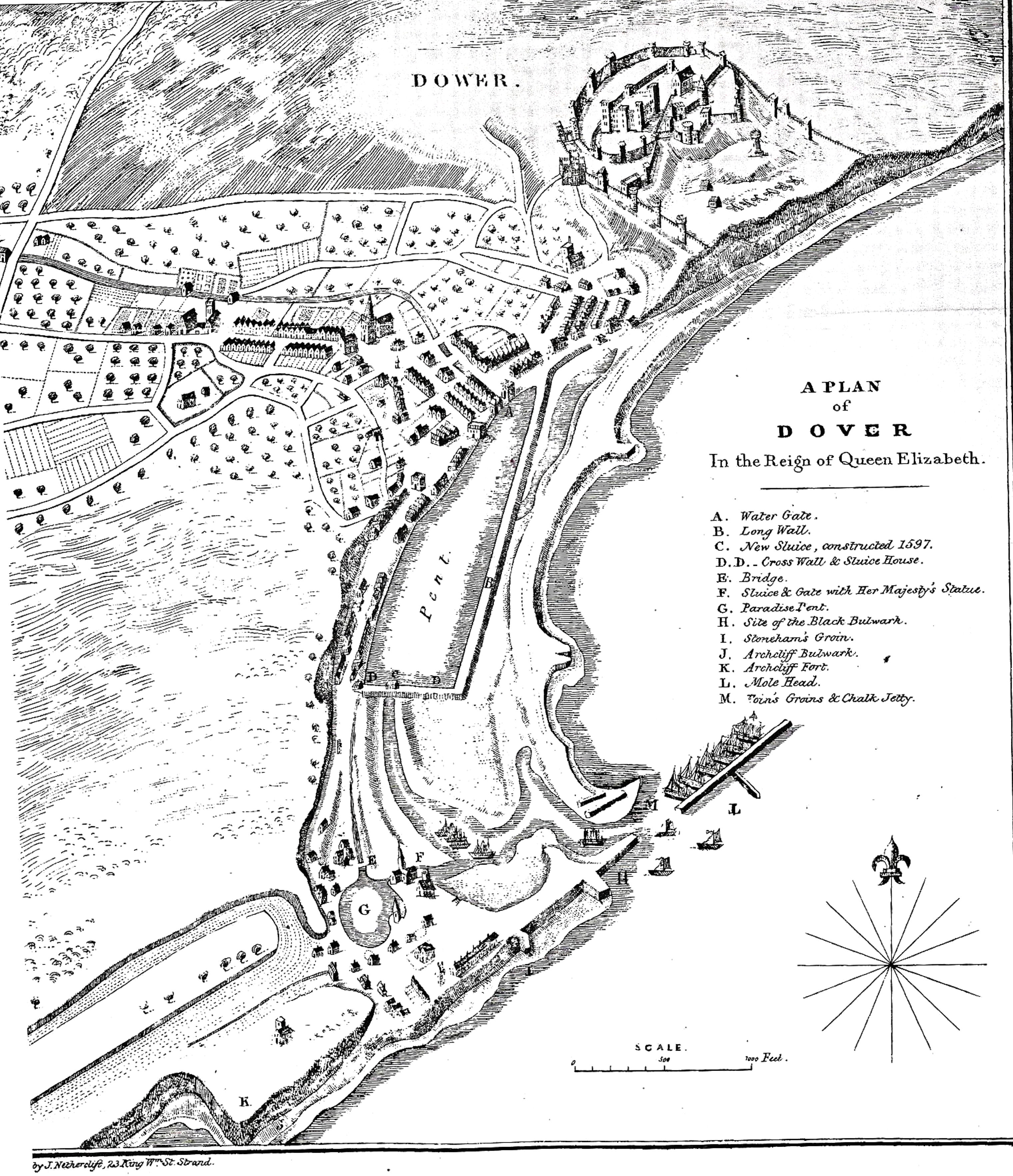
Esplanade Navigational Lock Sector lock gates – artist impression – designed to open outwards. AS 2018

– The 2 Sector gates will be located at the seaward entrance of the Esplanade Navigational Channel and are much more complex and expensive than the mitre lock gates. They are capable of opening even when the water levels and operating loads on either side are different. Because of their shape the water loads are transferred directly to the pivot which reduces friction and they are able to seal in both directions when shut. When open, like mitre gates, the leaves are housed in lock wall recesses. They are 12metres high and each weigh 50 tonnes. The most important thing about them is that the crest of the gates and the adjacent concrete structure has been designed to hold back sea levels as high as +9.5 metres above Ordnance Datum. In other words they are designed to provide flood prevention during extreme high tide and storm surge conditions and they take account any further increase in sea levels, well into the future.

Doverhistorian.com’s Alan Sencicle’s determination has paid off!

Presented: 14 February 2019

Posted in Buildings, Businesses, Flooding, Flooding, Local Government, Maritime, Port and Transport, Ships, Tides, Tides, Western Docks & Esplanade Navigational Cut, Western Docks & Esplanade Navigational Cut | Comments Off on Tides, Flooding, Western Docks & Esplanade Navigational Cut

Shipbuilding Part IV from 1815 to the Present Day

Map of Dover published by Z Warren in 1830. LS

Map of Dover published by Z Warren in 1830. LS

Dover’s ship building industry can be traced back to the Bronze Age and from Saxon times to the Middle Ages, Dover, as part of the Cinque Ports, provided the ships that effectively was the English Navy, (see Shipbuilding part I). During the 18th century, as can be seen in Shipbuilding part II, Dover’s ships were known as the pride of Europe and thus, as seen in Shipbuilding part III played an important role in the years leading up to and including the Napoleonic Wars (1792-1815). Part IV of this story begins at the end of the Napoleonic Wars and takes the reader to the present day.

Late 18th century poster showing the various types of ships that were being built at the time, many of which were built on Dover's beaches. Welcome Foundation Wikimedia.

Late 18th century poster showing the various types of ships that were being built at the time, many of which were built on Dover’s beaches. Welcome Foundation Wikimedia.

Following the Napoleonic Wars the Admiralty sold off many of their ships including most of those built in Dover. These included the Tisiphone, sold at Deptford in January 1816 for £1,000; Harpy was sold to a Mr Kilsby for £710; the 385ton Moselle was sold, the 290ton Gannet purchased by the Navy while being built by the King shipyard sold for £770 and the 384ton Eclipse, the last ship built by the King shipyard, sold for £1,400. The 284ton Nightingale sold for £810. G.F Young was particularly interested in Dover built ships from the King shipyard. In February 1819 he bought the Scorpion for £1,100 and a month later the Forester from the Admiralty. In 1815 the Cherub was recommissioned to the Royal Navy’s African station but was sold to a Mr Holmes for £940 in January 1820. Phoebe, the Fector ship that was her ally at Valpariso, Chile, in March 1814, was returned to Dover.

The selling of redundant ships by the Admiralty flooded the market and although Dover shipbuilders found work doing repairs and refitting, new orders were hard to come by. That is with the exception of hoys, small single masted cargo ships used for carrying flour from Dover’s cornmills to London. Shipyards closed and associated tradesmen found work difficult to come by. Further, approximately a quarter of a million soldiers and sailors, many of them maimed, returned home from the Wars adding to the national unemployment and destitution. The situation was exacerbated by appalling weather that had led to crop reduction and failure. Income Tax, which had been introduced to raise money during the wars, was abolished when peace was declared and replaced by taxes on staple commodities. These included such necessities as candles, paper and soap as well as luxury items such as sugar, beer and tobacco. As the economy slid further into the mire, the Poor Law relief rates were slashed and death through starvation was commonplace.

Dover mail coach - Hollingsbee Collection, Dover Museum

Dover mail coach – Hollingsbee Collection, Dover Museum

Up until the outbreak of the Napoleonic Wars, Dover ship owners, particularly the Fectors and the Latham/Rice families, provided most of the packet service ships that carried mails to and from the Continent. At the outbreak of the Wars this and passenger services were moved to Harwich while official cross Channel passenger and freight services from Dover were suspended. Then, in 1799 a regular stage coach service between Dover and London was introduced and shortly after a weekly mail coach. A packet service of sorts developed and although supposedly administered by the Admiralty this was effectively again run by the Fector and Latham/Rice families. Following the renewal of hostilities in 1803, the Admiralty almost abandoned the packet service to the local businessmen but on 10 October 1815, it was officially resumed under the auspices of the Admiralty. Nonetheless, it remained locally run.

The Dover built ships plying between Dover and Calais as packet and passage ships and along the coast, when work was available at this time were:
Ant – Master: T Barrett
Chichester – Master John Whitfield Rutter (1773-1825)
Cumberland – Master: John Hammond (1780-1854)
Dart – Master: M Bushell
Defence – Master: John Adams (1768-1835)
Elizabeth – Master: William Bushell (1782-1855)
Flora – Master: Archibald Watson (1780-1831)
Industry – Master: Tasmin Archer
King George I – Master: Michael King
King George II – Master:Thomas Mercer (b1791)
Lady Chasteragh – Master: William Mowll (1787-1872)
Lady Jane James – Master: John Hayward (1770-1838)
Lark – Master: T Noyce
Lord Duncan – Master: John Hamilton (1783-1859),
Lord Sidmouth – Master: Allen Peake (1764-1823)
Poll – Master: W Strains
Prince Leopold – Master: William Rogers (1763-1839)
Susanna – Master: Thomas Middleton (1751-1835)
Vigilant – Master: Stephen Bushell

Dover Custom House c1819. Dover Library

Dover Custom House c1819. Dover Library

Locally, it was assumed that the economic depression would be dealt with by the age old standby, smuggling. For much of the 18th the shipbuilding industry had expanded due to the illicit trade, it had provided employment for these ships and adequate income for the captains and crew with the knock-on effect for the town as a whole. However, the depth and extent of the depression meant that except for smuggled imported corn and other food grains, there was even a slump in the interest of formerly sought after luxury goods. This enabled to government to take a hard line against smuggling and in 1816, the Coastal Blockade was established.

Smuggling lugger being chased by a Royal Navy brig off Dover. Wikimedia

Smuggling lugger being chased by a Royal Navy brig off Dover. Wikimedia

The Admiralty frigates, Ganymede, Ramillies, and Severn, were put under the command of Captain ‘Flogging’ Joseph McCulloch, who proceeded to wage a merciless war on smuggling. Albeit, for some of Dover’s shipbuilders, this gave a respite in the post war economic depression as the government ordered new galleys for the newly formed Coastal Blockade. This was based on the reputation of Dover built ships being so fast they could outrun the Admiralty frigates. The respite, however, was too little too late. For instance, an order for a fast running sloop was placed with shipbuilders Pascall & Hedgecock but on 27 April 1817 the partnership, that had existed since 1797 and Pascall’s shipbuilding business, since 1732, was dissolved. The young James Hedgecock (b1800), had served his apprenticeship with the firm and in 1820 ran the company, still trading as William Hedgecock (b1765) and based in Beach Street tried to keep the business going. He built ships for the Customs and Excise but by the end of the decade Hedgecock’s ceased to exist.

Early steamship and a fully rigged sailing ship of early 19th century. Frank E Dobson

Early steamship and a fully rigged sailing ship of early 19th century. Frank E Dobson

The prevailing economic climate deeply affected Dover’s shipbuilding industry but the situation was inspiring innovations in the industry itself with the advent of ships driven by steam power. Steam powered vessels had actually been around since the end of the 18th century and in 1794 an experimental steam powered ship called the Kent was built. She was followed in 1801 by the steam tugs Charlotte Dundas 1 and 2, which worked on the Forth and Clyde canal near Glasgow. In 1812, the Comet successfully started operating between Glasgow and Helensburgh, to the north and west of the city. Like all early steam ships, the hulls retained the features appertaining to sailing ships and full sets of sails were also carried partly to increase speed as well as counteracting the lack of confidence in mechanical propulsion.

Meanwhile, in the face of shortage of food, Dover’s shipping owners Sam and Henshaw Latham managed to arrange for grain to be brought from the Continent with Henshaw recording on 9 February 1819, from Antwerp:
the sloop Wensleydale – Captain Partridge
the sloop Teazer – Captain Rogers
the sloop Lord Hill Captain Tapley
the sloop Favourite Captain Power from Ostend
all laden with wheat

In March 1819 the Elsie, a 37-ton steamboat, crossed the Channel and on 20 June, the steamship Savannah, with the help of sails, took 26 days to cross the Atlantic. The year before, on 14 June, the first paddle steam packet, Rob Roy, had made her first crossing from Belfast to the Clyde and on Friday 15 June 1820 she was introduced to the Dover-Calais passage. Taking 4½hrs to cross the Strait, the 88-ton ship was built by Denny of Dumbarton with 33 horsepower engines by Daniel Napier. The French government, attracted by the idea of steam, purchased Rob Roy, gave her the name of Henri Quatre and she subsequently worked the Calais-Dover packet run. The British government, impressed with steam packets, in 1822 introduced the Monarch and Sovereign.

The 70 ton sailing ship George I owned by the Fector's and hired by the Post Office as a supplementary packet ship

The 70 ton sailing ship George I owned by the Fector’s and hired by the Post Office as a supplementary packet ship

George III (1760-1820) died on 29 January 1820, he had been deemed incapable of ruling the country since 1811. Since then, his son, now George IV (1820-1830), had reigned as Regent and for his Coronation, his estranged Queen Caroline (1768-1821), was brought to England. She arrived in Dover on 5 June 1820 having crossed the Channel aboard the Prince Leopold, a Fector Packet sailing-ship under Master William Rogers. The Queen was given a tumultuous welcome plus a royal salute from the commandant of the garrison as well as a guard of honour! George IV, was furious and although by the following year the Queen was dead, as a form of retaliation the government gave the packet service contract to the Post Office. They introduced the Arrow and the Dasher, both wooden paddle steamers neither of which were built in Dover. The 149 gross ton Arrow had been built by William Elias Evans of Rotherhithe and the 130 gross ton Dasher by W Paterson, also of Rotherhithe. The Post Office added to their fleet the second-hand sailing ships Aukland, Eclipse, Chichester, King George I and the Lord Duncan. The 384ton Eclipse had been built by the King shipyard and bought by the Post Office for £1,400. The last three were 60 to 70 ton Dover built sloops.

Shipbuilders on Dover Beach 1820. George Jarvis.

Ship and boat builders on Dover Beach 1820. George Jarvis.

The 1820s saw a growth in the number of shipbuilders and associated professions who could still make a living such that they were still major businesses in Dover. By 1824 shipbuilders consisted of Richard Bromley of Fisherman’s Row, John Divine of Bakers Lane, James Duke (1791-1882) off South Pier and Kiazer Thornton of Snargate Street. The long time establishments of John Gilbee (1742-1815) and James Johnson (c1760-1824), who was part of a sail making family, were thriving. Both establishments were on Snargate over Sluice now Union Street and again the long time established John Freeman firm along with William Hedgecock’s business (see above), Hubbard and Clark and Henry Pilcher all on Beach Street next to Shakespeare Beach were also making a living.

Sailmakers were Philip Going (1795-1859) & Co. of Round Tower Street, Thomas Randall (1766-1835) on Fisherman’s Row, Thomas Spice (1765-1839) on Snargate over Sluice, Richard Hart, William Robinson (1801-1834), both on the Quay Side. The long since establishment of Peter Popkiss, former holder of the Post Office shipping contract, was based in Post Office Lane off Snargate Street. Albeit, of the four ropemakers operating in 1792, only Richard Jell (1762-1847) remained but in the 1820s Edward Frost of Limekiln Street had set up a ropemaking business. Thomas Ismay’s, ship chandling business still remained but had diversified into iron making, while John Osborn was in partnership with Messr Poole to create a ship chandlers, ironmongers and iron foundry business on Snargate Street.

The poor state of Dover’s harbour was due to neglect during the Wars, exacerbated by debt repayments from works that had been carried out. The Dover Harbour Commissioners’ main source of income was from tonnage dues and these, due to falling in trade had declined year on year since the end of the War. In 1820, Sir Henry Chudleigh Oxenden (1795-1889), the Harbour Commission’s Managing Commissioner loaned £4,500 and in June 1822 £1,500. Later he loaned a further £2,500, all at 4% interest, but this was of little help. The Harbour Commission therefore appealed to Parliament who set up a Committee on Foreign Trade to assess the situation. The Harbour Commissioners put forward an excellent case centring on increasing grants and, perhaps, the percentage tonnage dues paid. The Committee’s response, however, was the opposite of what the town had hoped. Their report stated that due to the fall in trade it would be unfair to increase tonnage dues and therefore decreased them adding that in their opinion the fall in trade was a temporary problem. As for grants, they said that when trade increased, the amount of money from tonnage dues would increase so saw little point in providing grants.

Embarking a steam packet ship in 1846. Grasemann-Mclachlan

Embarking a steam packet ship in 1846. Grasemann-Mclachlan

The shipbuilders recognised that the future of the industry was with steam ships but to reduce the risk of fire, they had to be built of iron instead of wood. In consequence, there was a need for iron foundries and dry docks. The first step in building a steam ship as with sailing ships, was to lay the keel using keel blocks to support the ship as it was being built. Although this could be carried out on the beach, as with sailing ships, the next stage was assembling the iron plates to form the hull and held by the use of giant nuts and bolts / screws. Due to the weight and size of the hull it was at this stage that dry docks were a necessity to be successful. Once this was achieved, then the ship could be launched out of the dry dock for the outfitting – so the installation of the engines, paddles etc. could begin.

Dover harbour entrance drawn by William Heath published in 1836 by Rigen.

Dover harbour entrance drawn by William Heath published in 1836 by Rigen.

However, the shipbuilders, the town, nor the Harbour Commissioners, even jointly, could afford to build a dry dock. Adapting what resources they had, the shipbuilders ventured into building steam-powered ships on the beach and in 1823, the Monarch, one of the country’s earliest paddle steam ships, was built on Shakespeare Beach. She was 100 tons, engined by Maudslay, Sons & Field, London, of nearly forty horsepower. She was put into service by the Post Office, on 30 April 1824, on the Dover-Boulogne route but due to catastrophic engine failure she was withdrawn from service and sold. Not long after the slightly larger Sovereign was built, but the Post Office was disinclined to buy anymore Dover built steam or sailing ships. Instead they acquired the 110 gross ton 83-foot Spitfire, a wooden paddle steamer with 40 horsepower engines built by Graham’s of Harwich in 1824. The wooden paddle steamer Fury also built by Graham’s of Harwich was also brought into service. Then in 1825, the American and Colonial Steam Navigation Company placed an order for a paddle steamship with the Duke shipyard. James Duke (1791-1881), who was joined by his son Robert (1827-1883) ran operating as J.H. & J Duke and the business continued until 1867.

The Duke shipyard built the Calpe for the American and Colonial Steam Navigation Company on Shakespeare Beach at the back of their home and works on the long since demolished Beach Street. She was 134feet in length, 438 tons register and was powered by a Maudslay 2-cylinder side-lever engine with a capability of 8mph. The boilers in the Calpe weighed more than 100 tons! However, by the time she was launched, the American Company had changed their minds and cancelled their order.

The Curaçao, formerly the Calpe, built in Dover and one of the first steam ships to cross the Atlantic. Dover Harbour Board.

The Curaçao, formerly the Calpe, built in Dover and one of the first steam ships to cross the Atlantic. Dover Harbour Board.

At the time, across the Channel, the Royal Netherlands Navy were also building steam-powered ships. Of these, one was for service in the Far East, and another in the West Indies. The first ship was built in Seraing, Liege, Belgium and fitted with Cockeril engines but the engines were too heavy and following tests the contract was withdrawn. Impressed by Dover’s shipbuilding expertise during the Napoleonic Wars, King William I of the Netherlands (1815-1840) ordered the Royal Netherlands Navy to replace it with a steam powered ship from Dover. The Duke’s were looking for a buyer for the Calpe and in October 1826 they sold her to the Netherlands Navy who renamed her Curaçao. Although without arms and with interiors for discerning private passngers, she was commissioned as ‘a man of war’! The Curaçao made her maiden voyage to Hellevoetsluis, near Rotterdam, where she was loaded with 400 tons of coal, mail, valuable freight and private passengers. On 26 April 1827, the Curaçao embarked for the Dutch West Indies and arrived at Paramaribo, Suriname, South America, on the 24 May. According to one account, her engines were used for 11 days, while another states that they were used throughout the journey.

The Curaçao’s next port of call was her namesake, the island of Curaçao, in the Dutch Antilles, where she took on fresh water. On 6 July, she embarked for the return journey arriving in Rotterdam on 4 August. For the first 22 days the crossing was under steam but due to a combination of saline scale in the boiler plus boiler leakage causing overheating and then broken paddles, the last week was under sail. In 1828, the Curaçao made a second and in 1829 a third crossing of the Atlantic and thereafter, she regularly made the crossing. In 1834, Englishman, Samuel Hall (1781-1863), patented the surface condenser, which was the first efficient means of reconstituting fresh water from steam and re-using it. The first crossing of the Atlantic entirely under steam is said to have taken place in 1838, when the British ship Sirius, with a Hall condenser, successfully made the crossing from Cork, Ireland, to New York. Albeit, it was also officially reported that the Curaçao, fitted with a Hall condenser, successfully made the crossing two years earlier. The Curaçao remained part of the Royal Netherlands fleet as a man-of-war until 1848 when she was sold for 9,500 florins and replaced by a second ship of the same name. Although, the Curaçao was recognised as the first ship to cross the Atlantic Ocean under steam and both ways, sadly, internationally this Dover built ship has never secured this rightful accolade.

With the success of the Calpe/ Curaçao it was hoped that similar orders would be placed in Dover. However, the Battle of Navarino, Greece, in 20 October 1827 was the last to be fought by the Royal Navy entirely with sailing ships and they turned to steamships built in the Royal dockyards of Portsmouth (founded 1496), Royal Dockyard at Woolwich (founded 1513) and the Royal Dockyard Chatham (founded 1547). The Government run Post Office, having no loyalty to the town, preferred the Thames based ship builders.

Castle Street, created out of the profits made from smuggling. From the Market Place c1830. LS

Castle Street, created out of the profits made from smuggling. From the Market Place c1830. LS

Adaptations for smuggling purposes were still undertaken by Dover’s shipbuilders though due to the continual tightening of anti-smuggling legislation, the industry was no longer run by wealthy businessmen. Indeed, their children became the leaders of the ‘respectable’ classes and took leading roles in the equally lucrative national and local politics together with property development. Typically, local businessmen, Edward Knocker (1804-1884), William Prescott (1805-1869), John Finnis, and Henry Elve (1803-1865), in 1829, bought landholdings on the east side of the Dour from the Market Square for £2,000. Edward Knocker, purchased the Castle Hill House and estate for £7,000 and evidence suggests that the money for both purchases came from the wealth acquired by smuggling. The members of the consortium were all the members of the Dover Paving Commission, which over-saw Dover’s building projects and they planned to develop their newly acquired landholdings. These became Castle Street and the southern end of the later renamed Maison Dieu Road and nearby streets.

Paddle Steam Packets 

Calais passengers preparing to board a sailing packet ship c1803 during bad weather. Joseph Mallard-Turner

Calais passengers preparing to board a sailing packet ship c1803 during bad weather. Joseph Mallard-Turner

When asked by a parliament committee, the Post Office stated that they and their passengers preferred steam packets to the cheaper to buy and run sailing ships. Further, since surface condensers, patented by Samuel Hall, had been introduced the constant need for fresh water for the boilers was adequately dealt with. They also said that steam packets were not so vulnerable to wind conditions as sailing ships. On 9 August 1833, the Post Office introduced a daily service between Dover and Calais, weather permitting, except on Sundays. Weather permitting being the salient requirement as Calais harbour was neither easy to enter nor exit for steam packets in bad weather, while Dover was impossible. On such occasions, the Post Office ships were forced to anchor in the Downs, off Deal, until the weather abated. In the meantime they used their remaining sailing ships to make the crossing but emphasised, to another parliamentary committee, that this could take up to twelve hours. Then, in 1834, Sir Robert Peel (1788-1850) made the crossing from France to England having travelled from Rome. This was on a fine day and he praised the ‘up-to-date advantage of a well fitted steam packet‘. Henceforth, this became the advertising slogan of the Channel packet industry and sailing ships were phased out.

In 1835, following the introduction of the Municipal Corporations Act, the running of Dover passed from Dover council and the Paving Commission into the hands of a new body, Dover Corporation. Although elected councillors were in charge and the Paving Commission ceased to exist, power effectively remained in the same hands. The poor state of Dover harbour remained the main concern of the now much stronger corporation, added to which they were able to emphasise the lack of provision of a Harbour of Refuge on the South East Coast. Using all the publicity they could muster and with the full backing of the Harbour Commissioners, the corporation turned their concerns into a major national worry.

Paddle steam ship in Dover. The pilots tower at the western side of the harbour can be seen. Dover Museum

Paddle steam ship in Dover. The pilots tower at the western side of the harbour can be seen. Dover Museum

As a result, the following year, Parliament set up a Commission to Inquire into the state of Dover Harbour. At the Inquiry, it became apparent that work had already started on deepening the Great Pent, between the Dour River and the Tidal Basin with its outlet to the sea. This, it was stated, was to enable the new Post office steam packets safe berths when not in use. The result was that in December 1836, the running of the Dover packet service was passed to the Admiralty although the Post Office regulated the times of departure. The Admiralty increased the number of steamships, though none were built in Dover. Dover town fathers’, ignored the declining needs of the shipbuilding industry and turned their full attention to the proposed South Eastern Railway Company’s (SER) rail link to London and with it, the urgent need for a larger and safer harbour that would also serve as a Harbour of Refuge.

Isambard Brunel's screw propeller steam ship Great Britain launched 1843. Library of Congress

Isambard Brunel’s screw propeller steam ship Great Britain launched 1843. Library of Congress

Nationally, in 1837, Swedish Captain John Ericsson (1803-1889) and independently, Francis Pettit Smith (1808-1874) successfully demonstrated screw propeller propulsion. As this was submerged all of the time, the new type of propeller provided more power than paddle propulsion and was less vulnerable to storm damage. Metal hulls had been around since 1777 but it was the wrought iron hulled, screwed propelled Great Britain, built by Isambard Kingdom Brunel (1806-1859) at Bristol and launched in 1843 that led the way. Locally, the SER was still building the railway line from London to the town but had extended and modernised the tiny Folkestone fishing harbour and laid a spur railway line from the main London line in order to create the Company’s principal cross Channel port to France. Except for passengers going to Ostend, the direct railway link via Folkestone harbour, to the Channel and France attracted passengers going there and in consequence, Dover’s packet trade suffered.

South Eastern Railway ran on trestles along the edge of Shakespeare Beach, below the cliffs, and where shipbuilders had their businesses. Dover Library

South Eastern Railway ran on trestles along the edge of Shakespeare Beach, below the cliffs, and where shipbuilders had their businesses. Dover Library

On 6 February 1844, SER officially opened their Dover station, renamed Town Station in 1863. Because the Company had taken the line as close to Folkestone as possible in order to create a cross Channel port, the shortest route from there to Dover was below the cliffs. The line ran along Shakespeare Beach on raised trestles and there, the remaining Dover shipbuilders plied their trade. As William Batcheller (1777-1858) wrote at the time, ‘… will clear away Beach Street, the whole of Seven Star Street, which will include nearly all the ship builders in Dover, not even excepting Mr Duke, whose residence will also come down.’ James Duke, whose home was on Fishermans Row where he owned three other houses that were demolished, asked the Railway Company for £9,000 in compensation for the loss of his shipbuilding yard and home. According to the surviving documentation, his shipbuilding business included a blacksmiths forge that he leased; a sawpit, shed, timberyard, steam boilers, and workshops all situated on the beach by the South Pier. Also an adjoining masthouse, boatshops and sail lofts.

Witness box in the former Court Hall, the Maison Dieu, where the shipbuilders compensation hearings were held. Alan Sencicle

Witness box in the former Court Hall, the Maison Dieu, where the shipbuilders compensation hearings were held. Alan Sencicle

The Company refused to pay any compensation so the shipbuilders were obliged to bring legal action. Duke and Cullin’s shipyards filed petitions and the Duke case was heard in August 1843 in the then Town Hall, now the Maison Dieu. Lasting two days, from the outset the court reflected the general view of the town, they needed the railway and therefore no sympathy was shown to the Duke shipbuilding company or any other shipbuilders who had lost their livelihood. Dover Harbour Commissioners, mindful that the shipbuilders occupied Harbour Commission land and paid good rent, stated that they planned to provide shipbuilding facilities around the Great Pent that was undergoing major refurbishment, becoming the renamed Wellington Dock. Thus, in recognition to Duke’s loss of property and to a lesser extent, his business, the jury awarded him £4.050. The outcome set the precedent for the other shipyards proposing to seek compensation with some following Cullin’s shipyard by settling privately.

Thomas Vincer (1821-1859) and his son applied for compensation and out of what they received they bought a smaller operation on Finnis Hill off Limekiln Street. Vincer’s other sons left the business, becoming mariners and following the death of Thomas Vincer the shipbuilding yard closed in 1859. Hannah Freeman, widow of shipbuilder John Freeman (1759-1831), successfully sought compensation. At the time she had leased the Freeman yard to mariner William Dixon, whose son Richard had served his apprenticeship under John Freeman and was running the yard. Others seeking compensation included John Finnis who was involved in the Castle Street development and owned a substantial amount of property in the Pier District including sixteen houses and two warehouses. Finnis’s Pier district properties were all demolished and his compensation was settled by private negotiations through his solicitor. The Mulberry Tree Inn, established possibly in 1790, on the edge of Shakespeare Beach under Archcliffe Fort, kept by William Gravener, was demolished along with the ropewalk and factory, by this time owned by a John Jones. His compensation was settled by jury and he was awarded £1,156.11 shillings.

Refurbishment of the Great Pent, on completion renamed Wellington Dock, to where the displaced shipbuilders moved. Dover Harbour Board.

Refurbishment of the Great Pent, on completion renamed Wellington Dock, to where the displaced shipbuilders moved. Dover Harbour Board.

The Harbour Commissioners kept their word and shipbuilders were invited to set up close to the refurbished Great Pent. This had begun in the 1830s with the deepening and then lining with granite blocks. Giant lock gates were inserted to provide access and egress between the new dock and the Tidal Basin. Additionally, an iron bridge was built over them and the whole enterprise was completed in 1844 at a cost of about £45,000. The Lord Warden, the Duke of Wellington (1769-1852) opened and gave his name to the refurbished dock on the 13 November 1846. Sluices were inserted at the side of the dock gates to relieve over filling from the Dour during stormy weather. Once operational, the Wellington Dock proved to be a financial blessing with the revenue from Passing Tolls increasing to £10,000 a year.

After SER completed their railway line to Dover, passengers travelling to France, still preferred to travel from Folkestone rather than Dover forcing the Admiralty to reinvent the packet service from Dover. They introduced a number of new steamships to Dover for the crossings to Calais and Ostend. In order that major as well as minor repairs could be undertaken at the port, they constructed a modern fully operational Packet Yard. Erected near Custom House Quay, Strond Street, on the Snargate Street side of the then Bason, later Granville Dock, it remained there until 1860 when it was replaced by much larger premises on the north side of Snargate Street.

Dover’s golden age of shipbuilding had drawn to a close but a few did take up the Harbour Commissioners offer and many shipwrights sought employment at the Packet Yard. However, the number of coal merchants in the town were increasing. In 1831, not long after the Dover built paddle steamer Calpe / Curaçao had been sold to the Royal Netherlands Navy and was crossing the Atlantic, there were three coal merchants. By 1841 there were twelve and although this was partly due an increase in industrial and household demand for coal, by their location, most can be directly attributed to the use of coal for bunkering steam vessels.

Dover’s Shipbuilding moves to Wellington Dock

Admiralty Pier shortly after completion. Ships could moor on both sides.

Admiralty Pier shortly after completion. Ships could moor on both sides.

On the south side of the Wellington Dock is Cambridge Road named after Prince Adolphus, Duke of Cambridge (1774-1850). It was laid out by the Harbour Commissioners in 1834 and handed over to the Paving Commission the following year. On the south side of Cambridge Road, facing the sea, Waterloo Crescent was built between 1834 and 1838 as the final part of a Harbour Commissioners building programme to attract wealthy Londoner’s to rent the elegant seaside properties. On the land between Cambridge Road and Wellington Dock what became Ordnance Stores and wharf was built and completed in 1845. Two years later, in 1847, after considerable pressure by Dover folk, local politicians, Harbour Commissioners and the Duke of Wellington for Dover to become a Harbour of Refuge, work on the Admiralty Pier began. Although only the western arm of the Harbour of Refuge – the Admiralty Pier – was completed and this was not until 1871.

Pier District and Dover harbour c 1830. Lynn Candace Sencicle

Pier District and Dover harbour c 1830. Lynn Candace Sencicle

The ubiquitous trade directories of the time gave shipbuilding, sail and rope making as well as paper making, corn grinding and oil crushing as Dover’s main occupations. Of the shipbuilders, the 1847 Bradshaw listed James Duke operating alongside Commercial Quay, the only purpose built quay at Wellington Dock and were on the north side. Robert Johnson was running Cullin’s shipyard close to the Ropewalk at the foot of Aycliffe. At the time the provision of shipping artefacts and repairing of iron work was by shipsmiths, of which there were three Thomas Ismay (1812-1881), son of Thomas Ismay (1747-1827) operating from the Crosswall, Poole and Alderton of 98 Snargate Street and Thomas Walters of 92 Snargate Street.

Dover’s sailmakers included Going and Debenham of Commercial Quay, John Johnson (bc1790-1854) of Union Street and 14 Limekiln Street, William Johnson (b1831) of 89 Limekiln Street and Robert Spice (1792-1867) of Council House Street. John Johnson’s home was 10 High Street, Charlton, and when he died in 1854, his estate was sold by auction and included the contents of a sail loft at Wellington Bridge. There were three ropemakers operating at this time, Edward I. Pittock of 18 Hawksbury Street, Thomas Dennis (1814-1876) of the Princess Maud Inn, Hawksbury Street and John Pittock of 13 Strond Street. John Pittock had established himself as a ropemaker in the 1820’s at Aycliffe, Due to the opening of the South Eastern Railway Company along the beach, the Aycliffe ropewalk was the only one left in the town. Ship Chandlers were William Johnson of Union Street and John Wrightson (b1811) of 61 Snargate Street and in Charlton, there was Thomas Smith with premises at 6 Charlton Terrace in the High Street and William Smith in Spring Gardens.

Boat building - Smack Forget-me-Knot, Tidal basin built 1883. Dover Museum

Boat building – Smack Forget-me-Knot, Tidal basin built 1883. Dover Museum

The main type of ships that were being built were fishing smacks and the occasional pilot ketch that the shipbuilder maintained on a regular basis. The term smack was applied to any type of decked or half decked boat with one-mast, a mainsail, two headsails and a bowsprit. The Admiralty packet ships were repaired at their Packet Yard along with others ships. The work they and independent shipbuilders and ancillary occupations carried out depended on the type of ship, the damage it had sustained and the treatment of the vessel before it required repairing. As the Channel was particularly hazardous, as the 19th century progressed, an increasing number of ships were brought to Dover for repairs. Mainly as a result of the number of ships traversing along the Channel and crossing the Channel as well as rough or foggy/murky weather conditions. The different occupations in Dover were highly skilled such that no matter what the damage was, as long as the ship’s damage was not too large – Dover did not have a sufficiently large dry dock – repairs were undertaken. Oak, the favoured wood of the past had generally been replaced with the cheaper pitch-pine (Pinus rigida) for wooden vessels and the Channel’s heavy weather ensured they easily succumbed to damage. Ironwork damage to hulls was usually caused by collisions and the increasing number of these ensured the growth of the associated highly skilled repairing occupations.

Map of Wellington Dock c1930 showing Slipway and Slip Quay. LS

Map of Wellington Dock c1930 showing Slipway and Slip Quay. LS

In March 1852, the Harbour Commissioners appointed Henry Lee & Sons of Chiswell Street, London to construct quays all the way round Wellington Dock. Additionally, wooden sheds were erected between the Dock and Cambridge Road for shipbuilders and associated industries. Two years before, in 1850, using the mud and the excavating track from building Wellington Dock, a slipway and quay, capable of handling vessels up to 175-feet (53.34 metres) in length and up to 550 tons register were built. The slipway was 567 feet (173 metres), at the time long enough to take two vessels, and the length of the cradle was 175feet (53 metres) and stone lined. To pull ships and boats up, there was a powerful boiler driven engine. In order to accommodate two vessels of up to 800tons in 1883 the slipway was lengthened, strengthened and widened A new boiler was installed to give the engine that pulled up the vessels additional power.

Slipway in Wellington Dock c1970. Dover Library

Slipway in Wellington Dock c1970. Dover Library

In using the slipway, the Harbour Master 1832-1860 – John Iron I (1744-1867) – or one of his deputies and their successors, would first find out the length of the vessel’s keel and the rise of the bilge. Bilge blocks would then be inserted on each side of the ship with keel blocks laid to the required length. The cradle was then lowered down the slipway and into the water by wheels on three rails to the depth that the vessels drew. The ship was then moved into position over the cradle and steadied by ropes. The cradle was then hoved up by the slipway steam engine. As soon as the vessel grounded the aft keel blocks and the bilge blocks were drawn under by ropes and secured. The cradle, with the vessel on it, was then hauled up the slipway as far as required. Should there be more ships needing repairs than room for, they had to wait their turn alongside Slip Quay. The last wooden vessel to be was built on the slipway was in 1878 and the last ship to use it was the Admiral Day, the Dover Harbour Board’s dredger, in 1993. Four years later, in 1997, Dover Harbour Board reclaimed the slipway area for the De Bradelei Wharf shopping development. At the upper level, the carriage lines could still be seen until recently.

Fairbairn hand cranked crane, at the side of Wellington Dock, installed in 1868. Alan Sencicle

Fairbairn hand cranked crane, at the side of Wellington Dock, installed in 1868. Alan Sencicle

The Dover Harbour Commission was reconstituted to the Dover Harbour Board (DHB) in 1861 and in 1868 the new Harbour Board, purchased the Fairbairn Hand Cranked Crane. This was to lift heavy shipping gear into and out of the ships and hoist smaller vessels in and out of Wellington Dock. The crane was designed and made by William Fairbairn (1789-1874), who was born in Kelso, Scotland, the son of a farmer. Apprenticed to a wheelwright, Fairbairn met and became friends of engineer George Stephenson (1781-1848) who inspired Fairbairn to set up a business in Manchester. There he designed and made machinery, including cranes, for cotton mills. In 1830, Fairbairn diversified into the iron boat building business opening a shipyard at Millwall, London where built several hundred vessels. As a shipbuilder, one of the problems Fairbairn faced was lifting the heavy metal parts into his ships. He therefore adapted his design for cotton mill cranes to shipbuilding. The Fairbairn crane, which can still be seen, is a designated Ancient Monument and has Grade II listing.

Granville Dock c1890. Dover Library

Granville Dock c1890. Dover Library

1871 saw the completion of the original 2,100-feet long Admiralty Pier, then later extended, which cost £693,077 to build. At the time ships tied up on both sides and thus it provided significant anchorage and shelter. Although, the much-needed Harbour of Refuge was showing no sign of ever being built, on 24 July that year the Dover Harbour Improvement Bill received Royal Assent. This enabled work to begin on deepening the Bason allowing vessels drawing up to 21-feet to enter at high water. Following completion, the dock was opened by the Lord Warden, Earl of Granville – George Leveson Gower (1815-1891), on 6 July 1874. The refurbished dock was renamed Granville Dock. Along Cambridge Road, Dover Harbour Board replaced the sheds used by shipbuilders and ancillary occupations with the purpose designed brick buildings that we see today. During the 1880s these were enlarged to accommodate the increase in space required by the shipbuilders.

By this time, more efficient ships’ engines were being introduced and from the 1880s steel began to replace iron for the hulls. These ships were larger than their predecessors not only to accommodate the engines but also to provide for the space required to store coal and the increase in the number of passengers and crew carried as well as cargo. Although the Dover fishing industry was on the wane, there was still a call for new fishing boats that were being built by the Dover shipbuilders.

Aerial View of Dover c1910, at the height of the town's affluence and as a tourist holiday resort. Bob Hollingsbee Collection

Aerial View of Dover c1910, at the height of the town’s affluence and as a tourist holiday resort. Bob Hollingsbee Collection

For recreational purposes the yacht was growing in popularity with these vessels typically being built around the Solent, the strait between the mainland and the Isle of Wight, or along the banks of the Thames. However, in 1870, owner of a large emporium in Market Lane and Mayor, Richard Dickeson (1823-1900) was elected the Chairman of Dover’s Regatta Committee and was determined that the club would produce nationally competitive racing teams. Over the following 26-years he presented a new Dover built racing galley to the club as well as providing specially Dover designed rowing boats to encourage Dover’s rowing crews. With this help, the club’s Senior Four were merited as being the most outstanding crew in Britain! Tourism had also taken off and during the season the lodging-houses were crowded with visitors. The knock-on effect for shipbuilders was an increase in the demand for small pleasure boats and cruisers. However, it was in repairing of ships that the shipyards received most of their lucrative work.

The Packet Yard (1859-1991) on Snargate Street and one of the town's main land based maritime employers. Map c1900

The Packet Yard (1859-1991) on Snargate Street and one of the town’s main land based maritime employers. Map c1900

The Packet Yard on Snargate Street, was owned by the London, Chatham & Dover Railway Company under the Chairmanship of James Staats Forbes (1823-1904). It employed 250 men with the combined weekly pay of £310 and locally headed by Ralph Kirtley. The main objective of the works was to keep in good repair, the Dover and Calais packet fleet. At this time there was 16 vessels, with the total indicated horsepower of 30,195. The aggregate number of voyages each year was approximately 3,088. Independently, according to the 1887 Dover Trade Directory, there were three shipbuilders/shipwrights operating at this time. They were James Arthur Beeching (1839-1897) and Edgar Samuel Beeching (1861-1927) operating from the DHB workshops in Cambridge Road and William Johnson Cullin (1839-1892) and Sons also based in the workshops. At 141 London Road, Buckland, there was Arthur Verey (1841-1921) & Co who specialised in building steam yachts.

Beeching shipbuilders, Wellington Dock with Dover Fishing smack DR 11, Surpise nearer to the camera. Dover Library

Beeching shipbuilders, Wellington Dock with Dover Fishing smack DR 11, Surpise nearer to the camera. Dover Library

Both Beeching and Cullin shipyards abutted the Wellington Dock slipway and both firms mainly produced fishing smacks from forty to fifty tons register. The models of which lined the office walls. Both shipbuilders also had their own fleet of fishing smacks. The Cullin shipyard could trace their history as shipbuilders in Dover back to 1638 (see Shipbuilders part I). Some fifty years after the Cullin family opened their shipyard, William Beeching, a cordwinder married Alice Randall and took over running Buckland corn mill. What happened next is difficult to ascertain other than members of the Beeching family, with Norfolk connections, settled in Dover and eventually opened a shipyard on Dover beach. This did not seem to survive after the Napoleonic Wars but a Norfolk relative, journeyman shipwright James Beeching, opened or took over the derelict yard in the 1860s.

In November 1888, a Dover Express reporter described the shipyard as thriving and containing a number of relatively newly built lofts for carrying on the historic branches of the trade, see Shipbuilding part I. Added to which there was a moulding loft, where moulds were made to the form of the timbers that were used. Cutting of the timbers to the required shape was carried out by master shipbuilders, by this time, using specially designed machines. There was also a large stock of seasoned timber suitable for the various works that the yard carried out, but this was mainly repairs. Although both Cullin and Beeching were keen to build larger vessels, the harbour only had a small dry dock just adequate for building fishing smacks and ships of that size. Albeit, when it came to repairs, Dover shipbuilders and shipwrights were termed ‘double handed’ as they could undertake all manner of ship repairs and were well favoured by European shipping companies.

Sailmakers and Ship Chandlers, Sharp and Enright's shop on Commercial Quay in the 1920s. In the following decade they moved to their present Snargate Street premises when Commercial Quay was demolished. Hollingsbee Collection.

Sailmakers and Ship Chandlers, Sharp and Enright’s shop on Commercial Quay in the 1920s. In the following decade they moved to their present Snargate Street premises when Commercial Quay was demolished. Hollingsbee Collection.

The 1887 Trade Directory lists three shipsmiths whose trade it was to repair ships metal work. They were Day, Hill & Co. of Snargate Street, Alfred Henry Gutsole (1833-1917) of 4 Commercial Quay and Miss Ewell who had business premises at 51 Oxenden Street and on Water Lane. There were also four sailmakers, J W Bishop 77 Snargate Street, R Blackford 21 Limekiln Street and William James Simpson (bcirca 1861) Strond Street. Thomas Spice who had a sailmaking business on Snargate-over-Sluice and later in the Old Buildings, 115 Snargate Street,  in 1839. On his death, sailmaker Robert Thomas Stanton (1834-1887) from Deal, who lived at 69 Limekiln Street, bought the business. He was also the landlord of the Royal Oak, 38 Oxenden Street in the Pier District, had a fishing smack named Deerhound and ran his sailmaking business, which included rope-spinning and chandlery, from premises at 17 Commercial Quay. By 1887, Stanton was the landlord of the Crusader Inn, 29 Council House Street, also in the Pier District, as well as being involved in his other enterprises. However, on 18 June 1887 Stanton committed suicide by hanging at his sail loft in Blenheim Square in Dover. After the inquest, the shop was sold and the Deerhound, his sail loft and his share in the ropewalk at Aycliffe were auctioned.

The shop was then bought by sailmakers John Enright (1837-1889) and John Sharp (1832-1906) plus two sleeping partners. They were Ernest Ardlie Marsh (1837-1938) and William Grant (1855-1925) who were connected with the shipping firm of George Hammond in Union Street. Sydney Sharp (1873-1956), the son of John, bought out the sleeping partners and ran the firm until World War II (1939-1945) by which time chandlery was the main business. Dover Harbour Board demolished Commercial Quay for dock development in the late 1920s and the firm, Sharp & Enright moved one street back to almost identical premises in Snargate Street.

Admiralty Pier during the construction of the extension with the former SER railway line going west and the former LCDR line going north. A steamer can be seen tied up against the outside of the Pier and boat builders on Shakespeare Beach Dover Library

Admiralty Pier during the construction of the extension with the former SER railway line going west and the former LCDR line going north. A steamer can be seen tied up against the outside of the Pier and boat builders on Shakespeare Beach Dover Library

By the turn of the century Dover’s Packet Yard, with its head office at 91 Snargate Street, was the town’s largest maritime support service employing shipwrights, shipsmiths and the other of the town’s ancillary professions. By this time the Yard was maintaining ships from other ports belonging to the recently formed South Eastern and Chatham Railway Company (SECR). This had come into operation on 1 January 1899 with the amalgamation of South Eastern Railway Company and the London, Chatham and Dover Railway Company, these two railway companies serving the county of Kent. The Packet Yard was also maintaining and repairing freight ships as well as other large maritime vessels from elsewhere. To improve and expand this service SECR, along with Dover Harbour Board (DHB) and Dover Corporation tried to pressure the government into building a large dry dock. Estimated to cost £50,000, SECR announced they would contribute £10,000 towards it but due to other financial commitments neither DHB nor the Corporation could, even jointly, make up the difference.

At the end of 1891, Parliament had agreed to lease the Admiralty Pier to DHB for 99 years and a start was made on an eastern pier of the much-needed Harbour of Refuge. For this, Parliament had sanctioned for the work to be paid for by a poll tax of 1 shilling (5pence) on each cross Channel passenger. On 20 July 1893, the first stone of the eastern arm of the project was laid by Edward Prince of Wales, later Edward VII (1901-1910) and was named the Prince of Wales Pier.

Packet Yard, Snargate Street, July 1971, prior to Demolition. John Gilham

Packet Yard, Snargate Street, July 1971, prior to Demolition. John Gilham

While this was underway, DHB submitted a Bill to Parliament for building a ‘Water Station’ with four railway tracks and berths for four cross-Channel steamers all under cover between the Admiralty and Prince of Wales Piers. The final estimated cost was £1,750,000 and to pay for these works the poll tax was to be increased on cross-Channel passengers. Albeit, on the international stage tension was rising. From 1890, Germany, under Wilhelm II (1888-1918), had been pursuing a massive naval expansion. In May 1895, when about three-quarters of the Prince of Wales Pier had been built, the Admiralty announced that it was going to use the port of Dover as a base for the Royal Navy and work started on the Admiralty Harbour that we see today. This was opened by George Prince of Wales later George V (1910-1936) on Friday 15 October 1909 but it did not include the proposed ‘Water Station’ nor the much needed large dry dock to maintain Dover’s role in ship building or as major ship repairers.

In 1903 part of the Cambridge Road premises used by the independent shipbuilders were rebuilt and taken over by the Marine Department of SECR, that let the western end out to William Cullin, the proprietor of the family shipyard. In the 1899 Trades Directory the Beeching shipyard was listed at their former address but by 1909 it had gone. Further down Cambridge Road, the Harbour Board enclosed the yard, in which the Fairbairn crane stood and from there to Wellington Bridge created an open quay. By this time, Dover’s only sailmakers were Sharp and Enright and a new company run by Shilson and Thorpe of 23 Worthington Street and Round Tower Street.

The former Dover Engineering Works at Charlton Green. The company had its origin as shipsmiths, an arm of ship building.

The former Dover Engineering Works at Charlton Green. The company had its origin as shipsmiths, an arm of ship building.

Alfred Gutsole was still in business as an independent shipsmith and also as independent shipsmiths was A L Thomas and Sons of 93b Snargate Street. Run by Anthony Lewis Thomas (1806-1878), he ran a jobbing foundry on Charlton Green, which continued after his death. By that time the foundry particularly specialised in manhole covers and street lamps. In 1902 it became a limited company and by 1908, Dover Mayor, Thomas Walter Lawrence Emden (1847-1913), owned a controlling number of ordinary shares and put his nephew, Vivian Elkington (1880-1963), in charge. Elkington, who lived in Granville Road, St Margaret’s Bay,  introduced marine engineering to the business and it was renamed Dover Engineering Works Ltd. During World War I (1914-1918), the company was responsible for maintaining the two-hundred-strong fleet of the Dover Patrol. Following the War the company mainly specialized in developing manhole covers and in 1928 developed what became the internationally known Gatic Cover (Gas & Air Tight Inspection Cover). In 1963, at the height of the Engineering Works success, Vivian Elkington died aged 83.

The fall of Dover’s Shipbuilding and Repairing industries

Prior to World War I the town Dover basked in prosperity as the Admiralty Harbour was built and the tourist industry attracted increasing number of visitors from the county, London and the Continent. Cruise liners, enroute between Europe and the USA, called in at the port and Dover’s retail sector sold products from home and abroad, many of which could not be bought in London! Indeed, Dover was in the top ten wealthiest towns in the country and although the halcyon days of large shipbuilding were long since over, ship and boat repairing was at its zenith. With this in mind application was made, in 1908, for two Graving Docks at Dover to enable major shipping repairs to be carried out at the port. However, the Admiralty negated the request, arguing that such a dock would increase use of the harbour by larger ships, thus causing overcrowding. Further, the exposed position of the dock might render it dangerous in wartime to a ship, which could not get out in case of need. Finally, there was an absence of facilities for workshops and plant for repairs on a large scale.’ The latter, the SECR, DHB and the Council were prepared to pay for.

Western Docks c1910 Wellington Dock in front, behind and to the left Tidal basin, Granville Dock on the right and Prince of Wales and Admiralty Pier beyond. Dover Museum

Western Docks c1910 Wellington Dock in front, behind and to the left Tidal Basin, Granville Dock on the right and Prince of Wales and Admiralty Piers beyond. Dover Museum

The shades of changes to come were seen in July 1911 when tension increased between Germany and Morocco with the Agadir crisis. Germany had sent her gunboat Panther to Agadir, Morocco, supposedly to protect the country’s firms even though the port was closed to non-Moroccan businesses. The Royal Navy’s 2nd Destroyer and 4th Destroyer Flotilla were anchored in Dover awaiting redeployment in Morocco if war broke out, (See the World War I Outbreak story). However, Germany backed down when France offered to retain her Moroccan interests in return for territory in the then French Equatorial Africa now the Republic of Congo. Nonetheless, the Admiralty ordered the Camber, at the Eastern Dockyard, to be deepened and to increase the oil storage facilities there as well as converting Langdon prison, on the Eastern cliffs, into Naval Barracks. Already, both the western and eastern entrances were equipped with boom defences and two 6-inch MK VIIs guns were mounted on the top of the Admiralty Pier Turret.

The summer of 1914 was glorious and Dover’s shipbuilding and boatbuilding with their associated occupations were enjoying the prosperity. But this was all coming to an end by the time that Britain declared War on Germany on Tuesday 4 August 1914. The War took its toll of the number of male Dovorians who were killed or maimed during that time and also on Dover’s economy. The latter was hard hit, not only because the country was at War, because Dover was designated as the military Fortress Dover and as such, harbour and town repairs were not carried out and projects were put on hold. Throughout this time there was rationing and inflation and the tourist industry had ceased. All new ships and boats were built elsewhere and were only repaired in Dover in emergency or were of justifiably necessity.

Sail Loft - Dolphin Yard Sailing Barge Museum, Sittingbourne

Sail Loft – Dolphin Yard Sailing Barge Museum, Sittingbourne

Following World War I the Dover Harbour Board Marine Engineering department occupied the eastern shed of what is now De Bradelei Wharf shopping complex on Cambridge Road. South Eastern and Chatham Railway – from 1 January 1923 Southern Railway – Marine Department was extended to also occupy the middle shed. At the western end, Cullins’ shipyard – Dover’s only remaining independent shipyard, remained. Albert Edward Cullin (1867-1925) was the son of William and following the War was elected as the Conservative councillor for the Town Ward in the local elections. Shipsmith, Alfred Gutsole remained in business at 4 Commercial Quay and also advertised himself as a blacksmith, while Albert John Partridge (1870-1950) also set up a shipsmith’s business from premises in Market Street. In the mid-1920s Ernest Alfred Tippin (1877-1942), from the Medway, also had a shipsmith’s business in Market Street while Sharp and Enright opened a sailmaking business, next to Cullin’s shipyard on Cambridge Road. Sometime later these premises were let to another sailmaker, J H Clark.

Near to camera is the Dover Stage Hotel. Facing is Cambridge Terrace with Granville Gardens in between. Waterloo Crescent is facing the sea and Wellington Dock is to the right at the rear of Cambridge Terrace. In between the Dock and Waterloo Mansions is Cambridge Road. The photograph was taken from Burlington House in 1974. Dover Museum

Near to camera is the Dover Stage Hotel. Facing is Cambridge Terrace with Granville Gardens in between. Waterloo Crescent is facing the sea and Wellington Dock is to the right at the rear of Cambridge Terrace. In between the Dock and Waterloo Mansions is Cambridge Road. The photograph was taken from Burlington House in 1974. Dover Museum

Dover was again taken over by the armed forces during World War II and designated Fortress Dover. During this War the town earned the justifiable nickname – Hell Fire Corner – as it was under constant attack from the start of the Battle of Britain on 10 July 1940 to the evening of Tuesday 26 September 1944. For the duration, like much of Dover, Wellington Dock and the surrounding quays and buildings were badly damaged by bombing and shelling. After repairs the three sheds on Cambridge Road were converted into one building. Temporary divisions were installed and then let to various occupants or used as Dover Harbour Board workshops. That is, except for premises at the west end that was still occupied by Cullin’s shipyard. This was under the ownership of Hubert Edward Cullin (1896-1960). In the early 1950’s, boat builders, Dover Yacht Company owned by Bernard Iveson, moved to the west of Cullin’s yard and shipwright Harry Croucher worked from 141 Snargate Street. At the time, shipbuilding was a vital British industry but for Dover, due to the lack of the salient infrastructure, including a large dry dock, this passed the town by.

Packet Yard, Snargate Street during demolition in 1991-92. Dover Museum

Packet Yard, Snargate Street during demolition in 1991-92. Dover Museum

Hubert Cullin died in 1960 and the shipyard became Cullin’s Engineering until the business closed. Bernard Iveson at Dover Yacht Company was joined by his two sons, Paul and Barry and the business was so successful that besides the shipyard, they had a chandlery at 165-167 Snargate Street. Sadly, Paul died young and eventually publishing company Media Chameleon Limited bought the business name. Following the War, the Dover’s Packet Yard continued to expand but during the privatisation boom it passed into the ownership of A & P Appledore and renamed the Dover Marine Workshops. Eventually, the large Snargate premises closed for the last time on 24 June 1991 and a basic business was transferred to Poulton Close Industrial Estate, Buckland. The demolition of the Snargate premises began the following month and Harry Croucher’s business ceased, possibly at about the same time as the Packet Yard closed.

Following the War, John William Sharp (b1910), who had worked as a plumber for Dover Harbour Board, took control of Sharp & Enright’s and was eventually joined by his son Michael. Later, Michael’s daughter, Sarah Munall née Sharp, joined the firm and now runs the business. In the early 1990s Dover Transport Museum occupied the former shipbuilding sheds on Cambridge Road until the summer of 1996. They were then offered a site owned by Dover Harbour Board, at Willingdon Road, Whitfield in the former Old Park Barracks grounds. There, the Museum continues to thrive and is well worth a visit. Dover Harbour Board along with factory shopping specialists De Bradelei Mill converted part of the former shipbuilding sheds into a factory outlet shopping centre.

The outlet proved successful and the following year the remainder of the buildings were converted and incorporated into the complex and the whole was renamed De Bradelei Wharf. At the west end, the former Cullin’s shipyard was taken over by one of Dover’s philanthropists, Jim Gleeson and turned into a bistro and micro brewery. Taking the name of the Dover’s longest running shipyard, this continues to grow in popularity and nearby, along Cambridge Road, the Fairbairn Hand Cranked Crane can be seen. The maritime engineering firm, Burgess Marine Ltd, with premises on Channel View Rd, was incorporated in January 2006 and operated in the commercial marine, defence and superyacht sectors. Unfortunately, in December 2017 it went into administration and was closed. In February 2018 a new marine engineering and repair company, Mechanica Marine, was launched to fill the gap. Finally, the Port of Dover (formerly Dover Harbour Board), one of the district’s largest employers now offers a bursary scheme for 16-24 year olds in Dover who are undertaking port-related university courses such as Marine Technology with Marine Engineering.
Dover built King George, an 80ton sloop of the Fector Bank Fleet and the fastest sailing ship of her time. Drawn by Lynn Candace Sencicle

Dover built King George, an 80ton sloop of the Fector Bank Fleet and the fastest sailing ship of her time. Drawn by Lynn Candace Sencicle

It should not be forgotten that Dover built ships, for centuries, were referred to as the ‘Pride of Europe’

Presented: 02 November 2018
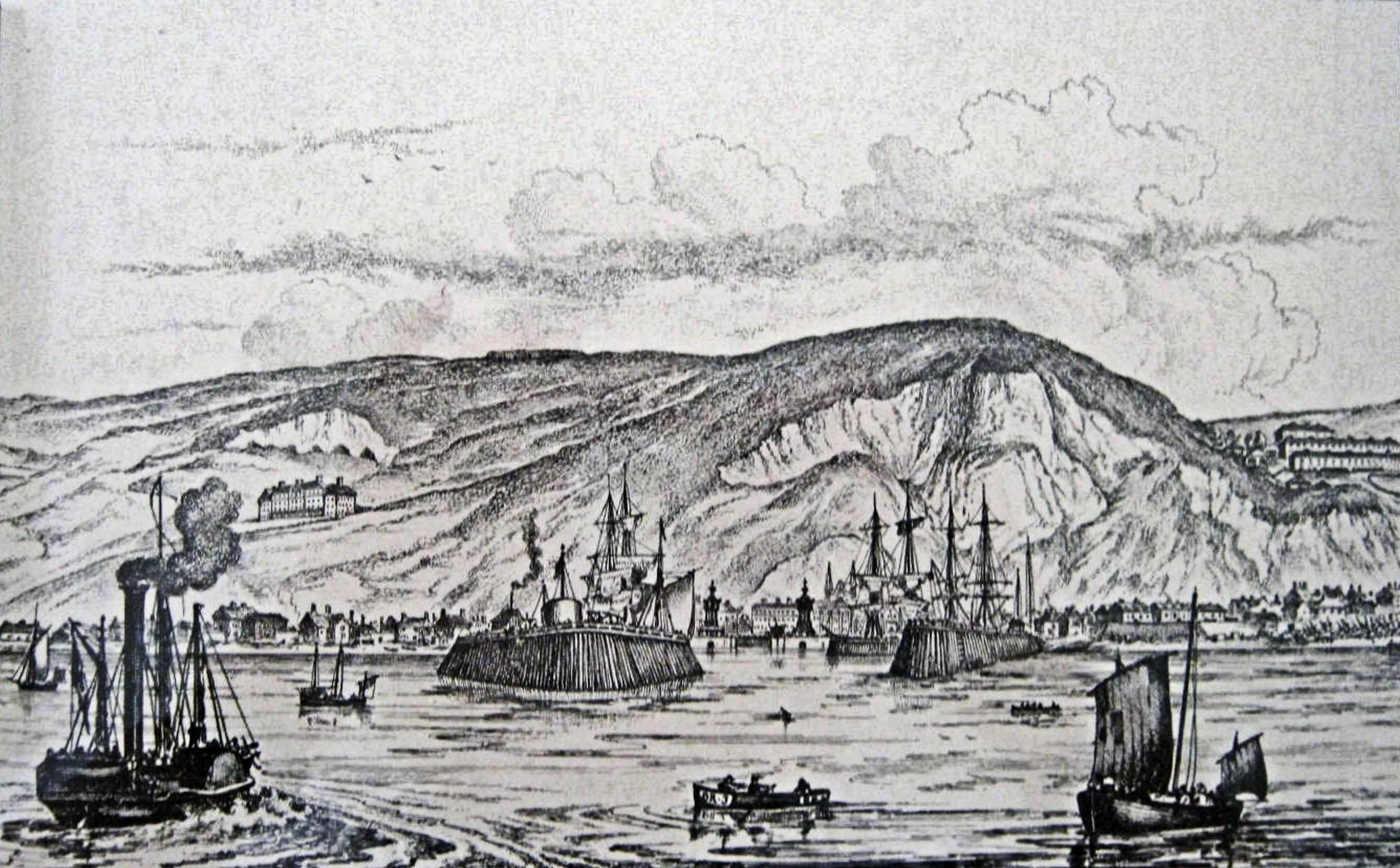
Posted in Armed Services, Businesses, Maritime, Shipbuilding Part IV from 1815 to the Present Day, Shipbuilding Part IV from 1815 to the Present Day, Shipbuilding Part IV from 1815 to the Present Day, Ships | Comments Off on Shipbuilding Part IV from 1815 to the Present Day

Shipbuilding Part III Napoleonic Wars 1793-1815

Map of Dover published in 1830. Z. Warren

Map of Dover published in 1830. Z. Warren

Dover shipbuilding can be traced back to the Bronze Age (2100BC-700BC) – see Shipbuilding Part I. The demand for ships produced in the town had oscillated over the centuries reaching new heights in the 18th century. As the century progressed, the town had seen the sailing ships built on its beaches earning the accolade the ‘Pride of Europe’ see Shipbuilding part II. They were mainly built out of locally grown oak, Quercus Robur, in sustained forests that surrounded the town at Alkham, Elham, Lydden, Lyminge, Temple Ewell and Whitfield. The ships were ordered and bought by passage and cargo operators as well as merchants and could be easily adapted as fighting machines in times of hostilities. At such times, regardless that the Royal dockyards of Portsmouth (founded 1496) Woolwich (founded 1513) and Chatham (founded 1547) provided much of the Royal Navy needs, they too bought Dover built ships. Particularly Brigs, a two masted vessel with square sails on each mast for power, and fore-and-aft staysails for manoeuvrability along with jibs and a spanker.

Napoleonic Wars part one 1793 to 1802

Harbour 1793 by R. Dodd. LS

Harbour 1793 by R. Dodd. LS

On 1 February 1793, France declared war on Britain and the Napoleonic Wars (1793-1815) began and this brought increased prosperity to Dover. Corn mills supplied flour for the troops billeted in the town and naval ships in the harbour, the number and variety of retail shops along with family industries increased. Even Dover’s dark industry of smuggling continued to thrive adding to the town’s wealth and the amount of black market goods that were sold by street sellers and available in the town’s shops!

However the Wars put a great deal of strain on the British economy as the country’s defence forces and the constant attacks on both imports and exports had the effect of increasing prices. Between 1793 and 1796, the increase in the government’s deficit abroad amounted to £36,439,269 with excise and customs duties its main source of income. This was of a similar magnitude to the deficit that had started the chain of events culminating in the French Revolution (1789-1799). Because of the influx of both the military and the naval forces into the town, Dover’s economy boomed but this was not reflected elsewhere in the country. Adding to Dover’s wealth, the Royal Navy ordered new ships and hired existing ships as well as issuing Letters of Marque were issued to existing ship owners giving a rise to the demand for more ships to undertake privateering.

TH Privateer Bury Air from Dublin bound to London taken by hired armed cutter Dover by Patrick Donavan. Michael Sharp

Privateer Bury Air from Dublin bound to London taken by hired armed cutter Dover by Patrick Donavan. Michael Sharp

The Dover, an armed cutter owned by Thomas Spice and captained by William Sharp was hired by the Board of Admiralty and stationed at Plymouth. In a letter dated 02 November 1796, belonging to Michael Sharp, written to Evan Nepean (1752-1822) Secretary to the Board of Admiralty 1795-1804 by Captain Sharp, the captain gives an account of his duties writing: Sir, I am to acquaint you that in the execution of their Lordships orders I fell in with NNW of Dodman (Head) a French privateer La Marie Anne with six guns and 37 men from Brest (Brittany) 4 days and had taken the Bury Air 130tons berthen laden with provisions from Dublin bound to London. I have the satisfaction to inform you that I have taken the above vessel and arrived at this Port (Plymouth) with the prize.
I am your obedient servant
William Sharp 

Fight between the Ladd shipyard built Enterprise and the French brig Flambeau summer 1800. Wikimedia

Fight between the Ladd shipyard built Enterprise and the French brig Flambeau summer 1800. Wikimedia

Dover Diarist, Thomas Pattenden (1748-1819), who lived on Townwall Street, gives numerous accounts of confrontations between Dover and French privateers during this time.  Another contemporary account of privateering in the Channel off Dover tells us that these conflicts usually took place in the late evening and provided entertainment for the locals. ‘It was curios on these occasions, to see men, women and children, running in multitudes and as eager to witness these conflicts, as they would have been to view some harmless amusement. None seem conscious of fear; but the field pieces, firing unexpectedly before the crowd, would sometimes cause them to scamper behind buildings.‘ While Dover’s Latham Bank, run by Sam Latham (1752-1834) loaned money to mariners to buy their own privateers. He wrote, ‘We always charge 2½% commission in advance of money to Captains of ships. Or an amount in prizes. We furnished the Duke of Montrose with an auctioneer here, regulated and charged accordingly.’

King George I cross Channel sailing packet the 70-ton sloop owned by John Minet Fector. Painting by Gordon Ellis. A model can be seen at Dover Museum.

King George I cross Channel sailing packet the 70-ton sloop owned by John Minet Fector. Painting by Gordon Ellis. A model can be seen at Dover Museum.

At this time, the senior member of Dover’s other bank was John Minet Fector (1754-1821), who had already earned the reputation as East Kent’s Godfather of smuggling. He was not only highly respected, he was loyal to those who worked for him. This was shown when the captain of the Prince of Wales, one of the Fector cross-Channel packets, was found carrying a substantial amount of contraband. Fector stood bail for a ‘considerable sum’ and although the smuggled cargo was impounded, no charges were brought against the captain. Nonetheless, there was concern over Fector’s alleged smuggling activities, in particular, expressed by Thomas Mantell (1751–1831), who was six times Mayor between 1795 and 1824. Mantell led a crusade against smuggling and in April 1799, Fector was accused of ‘aiding the enemy‘ by smuggling gold to France in return for wine and brandy. Although the evidence against him was strong, not only due to the rumours surrounding his cross Channel packet King George I but because of Fector’s own frequent crossings to Revolutionary France in the King George I. For reasons unclear at the time the case was dropped. It later transpired that Fector had been heavily involved in bringing French aristocrats, who potentially faced the guillotine, to England.

Plans of profile and decks of the Zephyr, built as a packet ship by the King shipyard. National Maritime Museum Greenwich; Admiralty Collection

Plans of profile and decks of the Zephyr, built as a packet ship by the King shipyard. National Maritime Museum Greenwich; Admiralty Collection

At the beginning of the Napoleonic Wars, the King shipyard, on Dover beach, was the only commercial ship builder in the country that the Royal Navy ordered or/and bought non-custom built ships. The shipyard had completed the gunbrig Piercer in 1794 while the 243ton brig Zephyr, that was being built as a packet ship, was purchased during construction the following year. However, they did charter (hire) ships, including those built by other Dover ship builders. The Nancy, a 46tons 6gun armed cutter with Master Henry Watson and 19crew was chartered to carry despatches. She had been a privateer during the American War of Independence (1775-1783) under Captain Edward Norwood and was then owned by William Mellish and Captain Norwood. In 1794 she was taking despatches to Admiral Samuel Hood (1724-1816) at Hyères Bay, near Toulon, South of France, but was captured by four French frigates. When the Peace of Amiens was declared in 1802, she was released and returned to Dover and was then bought by William Crow. He changed her name to Francis and between 1805 and 1806 she was chartered by the Admiralty to carry despatches again.

When the Zephyr was purchased in February 1795, she carried 76 men 16x6pounders and 10x4pounders and cost £2,660. Registered in May that year, the Zephyr had a glittering career, in January 1797, she took 12gun privateer La Reflechie while on a passage to the West Indies. Later that year she took the 4gun La Vengeur des Francais, the 6-gun La Legere, the 2-gun Le Va-Tout, the 8-gun privateer L’Espoir and with the Victorieus the 6-gun privateer La Couleuvre. Other Dover built ships based at the port were also involved in confrontations, as French privateers were constantly attacking shipping in the Channel. In 1793 the Cumberland, under the command of Matthew King had survived a fight with a French privateer while bringing much needed wheat over from Belgium. Other ships that had ferocious battles in the Channel at this time included the 72ton Favourite and the Union, both against French privateers.

Battle of Copenhagen - 02.04.1801 the Harpy next ship to the bottom. Sir William Laird Clowes (1856-1905).

Battle of Copenhagen – 02.04.1801 the Harpy next ship to the bottom. Sir William Laird Clowes (1856-1905).

1796 saw the launch of the 314ton Diligence class brig Harpy and the 192ton brig-rigged cutter Rambler at the King shipyard, the latter purchased while being built. The Harpy was launched in February 1796 and cost £3,683. She was commissioned in April under the command of Dovorian, Henry Bazely (1768-1824) and with a crew of 120men, she set sail for the Downs. There she took French privateers Le Cotentin in February 1797 and L’Esperance June 1797. She was part of Rear Admiral Sir Home Riggs Popham’s (1762-1820) squadron at Ostend on 8 May 1798 to destroy the sluice gates of the Bruge canal. February 1800 saw her in action with the Fairy against 46-gun Le Pallas and in April 1801, the Harpy was part of Vice-Admiral Horatio Nelson’s (1758-1805) fleet that defeated the Danish Fleet at the Battle of Copenhagen (2 April 1801). It was in this battle that Nelson, having been signalled to withdraw his fleet, is said to have put the telescope to his blind eye and pressed on with the attack, saying that he did not see the signal.

The result of the battle was that Denmark ceased being part of ‘The armed neutrality of the North,’ which allowed Russian grain to be brought through the Baltic thus helping to combat shortages in Britain and strengthening the blockade against the French. The French, for their part, retaliated by blockading British ports and attacking more Channel shipping. Following the Battle, the Harpy was paid off but was recommissioned and involved in many of these hostilities in the Channel. This included the attack on invasion craft at Boulogne in July 1804, gunboats off Vimereux (Wimeroux) in August that year and invasion crafts near Cap Griz Nez, April 1805.

Nelson fails against the flotilla near Boulogne 15.08.1801 Louis-Philippe Crepin (1772 – 1851) Wikimedia

Nelson fails against the flotilla near Boulogne 15.08.1801 Louis-Philippe Crepin (1772 – 1851) Wikimedia

The King shipyard launched the 18-gun sloop Echo, designed by Sir John Henslow (1730-1815), in 1797 at a cost of £4,010. She was fitted out at Deptford having sailed there using a temporary, or more correctly, a jury mast and the final cost, including fittings was £9,014. She was commissioned in October 1797 under Commander Graham Hamond and with a crew of 121 men the Echo sailed for the North Sea. On 14 February 1797,  15 ships of the British fleet, under Sir John Jervis (1735-1823), attacked 23 battleships of the Spanish fleet at the Battle of St Vincent off the south west coast of Portugal. Six months later, on 1 August, 13 French battle ships were attacked while at anchor by 14 battleships under Nelson at Abu Qir bay, near Alexandria, Egypt. Known as the Battle of the Nile, after a fierce fight all but two of the French ships were captured or destroyed.

Albeit, on 22 July 1801, it was said that soldiers from the Castle reported that on the hills around Boulogne they could see Napoleon’s army getting ready for invasion. In the harbour ships were being prepared to bring an army across the Channel. Within five days a convoy, under the command of Nelson assembled in the Downs off Deal. At 22.30hrs on the night of 15 August  ‘8 flat boats 8inch howitzers with a Lieutenant in each and 14 men and artillerymen … and 6 flats with 24 pounder carronades with a Lieutenant in each, seamen and 8 marines … under the command of four captains,’ crept into Boulogne harbour. Unfortunately, the boats did not arrive together and the first ones roused the French who quickly took to their boats. They defeated the British flotilla such that of the men who set out, 44 were killed and 128 were wounded. Not long after, the Echo sailed for the West Indies and was based at the Jamaica station. She was laid up in October 1806 and sold in May 1809.

The War brought prosperity to Dover and one of the many beneficiaries were Dover’s corn mills. They supplied the troops billeted in the town and naval ships in the harbour with flour and the Maison Dieu was used as a giant bake house. The Royal Navy had built Stembrook mill in 1792 and it was rebuilt and enlarged in 1799 and again in 1813. Thomas Horne (1754-1824) rebuilt the Town Mill in 1802 and his corn mill at Charlton was in full swing. In 1812, the Pilcher family rebuilt the Crabble corn mill we see today and they also rebuilt Temple Ewell and Kearsney Court mills. Some of the materials for the buildings were brought to Dover by ship as was the corn, mainly from Belgium, used in the milling industry. This increased the demand for local ships and in turn increased the number of ships being built by Dover shipbuilders.

Head of the long established shipbuilding yard, Henry Ladd junior (1755-1801) died in 1801 leaving the shipyard, which would start making a profit when the finished ships were paid for, to be run by his brother Luke (b1758). Henry’s sons Thomas (1781-1851) and William (b1783) were preparing to be apprenticed as shipwright/boat builders with their uncle but by October 1801, moves were being made to sign a peace treaty between Britain and France. This resulted in the Peace Treaty of Amiens of 27 March 1802.

Castle Hill House where the Mayor George Stringer held a grand ball to celebrate the Peace Treaty of Amiens of 27 March 1802. Alan Sencicle

Castle Hill House where the Mayor George Stringer held a grand ball to celebrate the Peace Treaty of Amiens of 27 March 1802. Alan Sencicle

In the Castle a French prisoner was making a model of the French Man O’War the Cesar out of the bones left over from his food rations. With the signing of the Peace Treaty he voluntarily remained a prisoner so he could finish the model! On the evening the Peace Treaty was signed, Mayor George Stringer (1769-1839) organised a Grand Ball at his home, Castle Hill House, but many in Dover, including Luke Ladd, were hoping that Peace would not last. While of those who attended the Ball and were privy to the terms of the Treaty, did not expect it to last as the terms meant that the French could exclude the British from trading with ports that had French ties.

Nonetheless, the Dover garrison was reduced from 10,000 men to just a few hundred and the major turn down in the economy was rapidly leading to the neglected harbour entrance becoming increasingly blocked with shingle. Local traders were drifting into bankruptcy and although 40 shipyards were recorded to exist on Dover beach, the rapid economic downturn meant that many of these premises were desolate.

Dover’s most successful shipyard, owned by the King family was suffering badly as they had specialised in providing ships for the Royal Navy. Not only was there a fall off of orders, ships that had been ordered but not paid for, were no longer required and left at the shipyard without a buyer. Whether it was the situation that caused Thomas Jones King’s incapacity is difficult to know but at about this time, either through an accident or illness, he was permanently moved to a sanatorium. John King took over the running of the business but the completed brigs Gannet and Hunter stood as stark reminders that they had no takers and John King had to lay off all his skilled and unskilled men.

Round Down Cliff showing the entrance to the smuggling storage cave called the Coining House. Alan Sencicle

Round Down Cliff showing the entrance to the smuggling storage cave called the Coining House. Alan Sencicle

Many of Dover’s out of work mariners turned to the age-old occupation of smuggling, with those shipbuilders still in existence adapting ships to hide contraband. This was the only aspect of the town’s economy that was improving. Indeed, when Kent historian, Edward Hasted (1732-1812) was writing, circa 1798, he noted that in the middle of Round Down cliff, to the west of Dover, ‘are two large square rooms cut out of chalk’. ‘One‘, he wrote, ‘is within the other, they are called the Coining House, and have a very difficult way to come at them, the cliff here being upwards of four hundred feet high.‘ It was said that the Coining House caves, in the Parish of Hougham, were used to store smuggled goods and the parish church of St Laurence Church was one of Dover’s main clearing houses of contraband. The vicar of Church Hougham was Thomas Tournay (d1795) and he was also the rector of the mariners’ St James Church, close to Dover’s Castle cliffs and an area known for the storage of contraband. On his death, Tournay’s son, William (d1833), was appointed Church Hougham’s vicar and it was still generally acknowledged that St Laurence Church was a clearing centre. Albeit, it was not until major restoration of St Laurence Church in 1866, that this was proved. Evidence of smuggled contraband was found hidden among the Church rafters, within the pulpit, the font and numerous other places!

Napoleonic Wars part two 1802 to 1815

The Lord Warden of the Cinque Ports,William Pitt the Younger (1759-1806), whose niece, Lady Hester Stanhope, (1776-1839) acting as deputy, set up the Cinque Ports Fencibles or Volunteers. The 1805 painting shows, the Lord Warden in his full dress uniform. Dover Museum

The Lord Warden of the Cinque Ports,William Pitt the Younger (1759-1806), whose niece, Lady Hester Stanhope, (1776-1839) acting as deputy, set up the Cinque Ports Fencibles or Volunteers. The 1805 painting shows, the Lord Warden in his full dress uniform. Dover Museum

Hint of possible end to the peace first arrived in Dover one day in early March 1803, when two officials from the Admiralty arrived at the King shipyard. They ordered thirteen brig-sloops of the 1795 Merlin design and brig-sloops built to Royal Navy’s surveyor, Sir William Rule’s Cruizer Class design of 1797! Within days, the possibility of war became a reality and with it the much-needed demand. By the end of March 1803, Napoleon Bonaparte announced that Britain had violated the Peace of Amiens Treaty and subsequently occupied Switzerland as well as closing the Dutch Ports to British trade. On 17 May, Britain declared war on France, the government remobilized the Navy and reintroduced the Letters of Marque. Many of the shipbuilders fitted out cross-Channel packet boats as fighting ships. However, in order to raise more money to finance the War, the government re-introduced Income Tax that had been set up and abolished the year before. To recruit more men to the armed forces, they passed the Army Reserve Act to encourage the enlistment of volunteers. In Dover Lady Hester Stanhope, (1776-1839), acting as deputy on behalf of her uncle, the Lord Warden William Pitt the Younger (1759-1806), set up the Cinque Ports Fencibles or Volunteers.

The Army Reserve Act also enabled the setting up of the Impress Service or Press Gangs. Made up of both naval officers and men, they went into taverns or even entered homes uninvited to enlist men. At Dover, they preferred to take seamen from merchant ships that stopped at the port. Or alternatively, seamen ‘recruited’ under the 1805 Prevention of Smuggling Act, which enabled any physically fit seaman found on vessels seized, regardless of whether contraband was found, to be impressed into the Royal Navy for five years. They also duped men from the maritime Pier District of Dover and shipbuilders along with those involved in the ancillary ship building trade were also coerced. At Dover, while awaiting transportation, all of these men were held in the town goal and in 1806 the Riot Act was read when a mob tried to release them. When control was regained, the Mayor, Robert Hunt (1754-1808) managed to commit the angry seamen and reluctant volunteers and sent them under escort to Newgate prison in London. It was later reported that at the time of the Battle of Trafalgar – 21 October 1805 – over half the Royal Navy’s 120,000 sailors were pressed men.

Dover Harbour c1800. LS

Dover Harbour c1800. LS

At least two of Dover built and owned ships were hired by the Royal Navy to be used by the Impress Service, which at this time was under the command of Lord William Allen Proby (1779-1804). One such ship was the 68ton with 6x3lb carriage guns, Minerva that was leased to the Service between 1803-1804 at £2,090 per annum by businessman and banker, Henshaw Latham (1782-1846). The second ship was the 48ton x 4gun Ant, owned by businessman Richard Mowll (1763-1811) and was hired for pressing between 1803-1810. Unlike ships commandeered by the Royal Navy, neither Latham nor Mowll were expected to provide crews, instead, the base crew were the pressed men augmented by seamen ‘recruited’ by the press gangs or through the Prevention of Smuggling Act.

The renewal of hostilities for Dover meant an influx of about 20,000 soldiers into the town and at the same there was an increase in the demand for Dover built ships. These were for both transportation of the soldiers and also as back-up vessels in the war zones. Then on 18 May 1804 Napoleon declared himself Emperor and the fear of invasion was very real. By 9 August, more than 100,000 seasoned French troops had amassed on the hills outside Boulogne, while in the French harbour there were 2,000 landing craft at the ready. The Cinque Ports Volunteers set up a chain of semaphores from Dover to London, so messages could be passed to George III (1760-1820) should the invasion force arrive. Queen Charlotte (1744-1818) was sent to Worcester with the Crown jewels for safety. The Volunteers then stood to arms for four successive nights along the shore waiting to resist the invasion. For the remainder of the wars, they manned the defence of the coast and built a defensive wall at St Margaret’s Bay, which can still be seen.

The Grand Shaft triple stairway built in the Napoleonic Wars to get soldiers quickly down to the harbour from the barracks on the Western Heights. Dover Museum

The Grand Shaft triple stairway built in the Napoleonic Wars to get soldiers quickly down to the harbour from the barracks on the Western Heights. Dover Museum

In Dover, a massive defence programme was also started on Western Heights, with the Citadel at the centre. The complex also included the Drop Redoubt Fort, batteries, deep moats, barracks, a military hospital and the Grand Shaft triple stairway to get soldiers quickly down to the harbour – and can still be seen. Across the valley, at the Castle, the Mote Bulwark and the Guilford Shaft were built to link the Castle with the shore. On the seaward side of Townwall Street a defensive canal was dug – all traces of which have long gone. Military building together with victualling meant that local trade boomed in the town as never before and bricks that were initially brought in by sea from Ipswich but at a cost of £3.12s 6d per thousand, galvanised Dovorians into manufacturing them. Dover’s first recorded brickfield was started at Dodd’s Lane, off Crabble Hill, in 1808.

Shakespeare beach with cliff behind, where most ships were built in Dover. LS

Shakespeare beach with cliff behind, where most ships were built in Dover. LS

The defence programme, as expected, included shipbuilding but there was a shortage of experienced shipwrights and ancillary trades brought about by the over zealous Impressing regime of Dover men. The Admiralty, however, particularly wanted Cutters, Brigs and Sloops, to accompany the Royal Navy fighting fleets or to carry despatches. Word went out and skilled men came to the town but due to the archaic town’s Freemen laws, they were not allowed to set up workshops on their own account. Nonetheless, by the end of 1804 there were some 40 shipyards recorded on Shakespeare Beach, owned by local Freemen. These included, the Cullin, Divine, Duke, Gilbee, Gravener, Hedgecock, Hubbard, Johnson, Kemp, Kennett, King, Large, Pascall, Pilcher, Walker and Worthington families.

 Espoir sloop of 14guns with the Liguria of 44guns by Nicholas Pocock Published by Bunney & Gold 1801 Wikimedia

Espoir sloop of 14guns with the Liguria of 44guns by Nicholas Pocock Published by Bunney & Gold 1801 Wikimedia

The King shipyard had already accepted four orders from the Royal Navy and managed to employ sufficient men to work on the first, the 383ton Scorpion, launched in October 1803. She was fitted and coppered at Sheerness and was Commissioned under Commander George Hardinge in November 1803 for the Channel and the Downs. The Scorion was involved in several confrontations and in 1807 sailed for the Leeward Islands, where again she had several successful confrontations. She was laid up at Sheerness in July 1813.

The shipyard then built the 385ton, 14gun, sloop  Espoir launched in September 1804 and commissioned the following month. After an active career she was paid off October 1816 and laid up in Portsmouth April 1821. While the Espoir was being built, the King shipyard had managed to recruit a full complement of workers and started on the 385ton 18gun sloop, Moselle. She was launched in October 1804, commissioned in December and had an eventful career. Most notably at Cadiz on 27 February 1806 (see below), following the Napoleonic Wars, she was sold at Deptford in December 1815. The Ladd shipyard, just managed to remain viable such that by 1805 Luke Ladd signed his nephew, Thomas as an apprentice and the following year his brother, William.

A cutter, frigate and an Indiaman with other ships all of which are typical of the ships that had been produced by the Dover shipyards. Wikimedia

A cutter, frigate and an Indiaman with other ships all of which are typical of the ships that had been produced by the Dover shipyards. Wikimedia

To save money, the Admiralty decided to augment the Royal Navy’s specially commissioned ships and ships awaiting customers in shipyards. To this end they chartered vessels, with the numbers steadily increasing during the following years, each ship being subject to a contract. This was usually for a period of 12months with possible extensions with the contract between the owners and three commissioners from the Admiralty. The owners were expected to fit the ships out with the crew, guns, ammunition and stores and to strictly comply with the contract terms. If there was any deficiency in any of the stipulations, such as the number of qualified officers, the number of the crew or the amount of supplies etc., deductions were made accordingly. This could mean that the owner could make a loss on the transaction, as it was often difficult finding and retaining crews. Further, the ship might be captured or lost at sea, in either case the contract came to an abrupt end.

In 1803 -1804 the following Dover shipyard built ships were hired by the Admiralty – owners name given if different from the shipyard:

From Peter Becker (1764-1842) & Richard Jell’s (1762-1847) shipyard came the 120tons Ann – a brig with 39 crew and carrying 10 carronades. She was chartered from 1804 to 1809.
From Samuel Collett and Messr Thomsett’s yard came the Venus, a 50ton ship originally owned by John Minet Fector (1754-1821) and armed with 6x3lb carriage guns. She was hired by the Admiralty between 1803 and 1805 for £2113 a year but was captured by a French Squadron in the Mediterranean in January 1805, so Collett and Thomsett lost heavily on the deal.

Richard Emmerson (1749-1817) of Sandwich owned the 84ton Hope, which carried 8x12lb carronades. She had a crew of 30 and was chartered in 1803-1805 for £2,605 per annum.
William Crow, William Pepper and Captain John Blake, owned the 124ton Nile. She was chartered between 1804 and 1806 for £4,576 year and carried 18x6lb carriage guns.
John Gilbee (1742-1815), by this time the single owner of the former Gilbee and Farley shipyard, rented out the 44ton Alert II, the smaller of two Dover ships of that name, with 20 crew and carrying 6x12lb carronades between 1804-1813.

Cutter passing astern of a frigate. Thomas Luny 1759-1837. Greenwich Maritime Museum

Cutter passing astern of a frigate. Thomas Luny 1759-1837. Greenwich Maritime Museum

Ship owner, packet contractor and banker, John Minet Fector rented to the Admiralty a number of Dover built ships including the larger, 78ton Active II with a crew of 27 under the ship’s Master, John Middleton (1751-1835). She carried 8x4lb carriage guns and was chartered between 1803-1814 for £2,360 a year. Fector’s 76tons 8 guns and 3masted cutter with 25 crew, Swift I was chartered in 1803 for an expected prolonged usage. She had been a privateer under different owners during the American War of Independence and was a sturdy ship, but was taken by the French in the Mediterranean in April 1804. The 100-ton Swift II with 8x12lb carronades and 30 crew was chartered 1803-1806 for £2,732 per year. The 75 ton Queen Charlotte I carrying 8x4lb carronades and 25 crew, jointly owned by Fector, Collett and Thomsett was chartered from 1803 to 1814 for £2,211 a year. While, the 60ton Queen Charlotte II with a crew of 25 under the ship’s Master, James Thomas and was chartered between 1803-1812.

Other Dover built ships Fector chartered to the Admiralty included the 50ton Athens with 24 crew and carrying 10x4lb carriage guns for £1,695 a year. The 56ton Dart with 6guns and 21 crew; 60ton Dolly with 22 crew, which Fector jointly owned with John King (b1769) and the 160ton Nymph with 10x4lb carriage guns, 23 crew under Master James Michael Boxer (1758-1840) were chartered between 1803 and 1804. Jointly with Collett, Fector owned the 79ton Phoenix with 8guns and 25 crew, he also owned the 124ton cutter Hawk with 40 crew under the Master James Cullen. Normally, he used her as a cargo vessel to Yarmouth, the Channel Islands, Belfast and Lough but chartered her to the Admiralty between 1803-1805 for £3,569 a year.

The Fector owned 128-ton cutter King George II with a hull designed to offer the minimum resistance in the water. She was chartered between 1803 and 1804, renamed Georgiana. In September 1804, she was grounded in the mouth of the river Seine on the ebb tide and set on fire by the crew before escaping from the French. Although, notice was given that the Georgiana was destroyed, in fact Fector and the crew rescued her! They brought her back to Dover where she was repaired and refitted by the King shipyard. On taking her original name she resumed service in Fector’s fleet.

The King shipyard built and rented a number of ships to the Admiralty at this time, including the 129ton former privateer Drake with 43 crew under Captain Matthew King (1759-1832), with 12 x 12& 6lb carriage guns. Chartered between 1804 and 1805, the Drake was jointly owned by John King (born 1769), Thomas King (1739-1815), Nicholas Ladd and Nicholas Steriker (1767-1830). The Lord Nelson I renamed Frederick in 1804 – 68tons 6x4lb carriage guns was chartered between 1803-1805. However, due to shortage of finances, following the Peace of Amiens, the King shipyard could not afford to have her coppered. When this was realised by the Admiralty, the Frederick was discharged. It was also stated that because of her size and deficiency of crew she was not seen as competent against the enemy.

Frigate Camperdown at anchor. John Oxley Library, Queensland. Wikimedia

Frigate Camperdown at anchor. John Oxley Library, Queensland. Wikimedia

Another ship owned by the King family and chartered to the Admiralty was the 76ton Albion. She was chartered between 1803-1812 for £3,626 a year and carried 6x4pound carriage guns and was crewed by 27 under Captain John May.
Charered between 1803-1814 for slightly less at £3,164 a year, was the 106ton Princess of Wales with 36 crew under Master James Slaughter and carried 10x12lb carronades.
The lute sterned Camperdown carried 14×12 carronades, had 53 crew under Master James Murray Cowham with Solomon Bevill. She was later owned by John Iggulden of Deal and chartered in 1804 for £4,677.
The 71ton Griffin had a crew of 24 and carried 6x3pound carriage guns, she was chartered between 1803 and 1805 for £2,106 per annum. While the 52ton Rose that had a crew of 20 and 6x3lb carriage guns was hired during 1803-1804 for £1,705 per year.
Fox renamed Friske in 1804 was a 98ton vessel with 30 crew and 8x4lb carriage guns owned by the Kings’ along with Collett and Thomsett. She was chrtered between 1803 and 1806 for £2,728 per annum.
The 163ton Althorpe – renamed Earl Spencer carrying 14x12lb carronades with 54 crew under Captain Thomas Chitty (b1763) was chartered in 1804 for £4,789 a year but foundered in the Channel in 1805. Thomas Finmore captained the 194ton Earl St Vincent with 60 crew and 14x12lb carronades and was chartered between 1804 and 1806.
Matthew King was the captain of the 129ton Drake with a crew of 43 and 12 x 12& 6lb carriage guns. The Telemachus carrying 40 crew with 10guns was chartered from the King shipyard between 1803 and 1804.

Armed-cutter similar to the Countess of Elgin, c1820. National Maritime Museum. Wikimedia

Armed-cutter similar to the Countess of Elgin, c1820. National Maritime Museum. Wikimedia

Ship owner, packet contractor and banker, Henshaw Latham owned a fleet of Dover built ships and chartered a number to the Admiralty. They included the cutter Countess of Elgin that was a privateer in the American War of Independence and had impressed the Admiralty such that they chartered her from 1803 to 1814. The Countess of Elgin’s Master was Richard Hammond and she was fitted with 8 carriage guns and had a crew of 25.
The 66 ton Duchess of Cumberland with a crew of 23 and 8x3lb carriage guns was chartered between 1803 and 1805 for £2,008 a year. Favourite, renamed Florence in 1804, was 72tons, with Master Abraham Hammond a crew of 25 and carried 6x3lb carriage guns, was chartered between 1803 and 1811 for £2219 a year. Charles Bostock was the Master in 1811 and a letter from Latham to the Admiralty, states that he was a very active and zealous man.

Other Latham ships included the 69ton Britannia with a crew of 24 and 6x3lb carriage guns, chartered 1803-1811 for £2,096; The 71ton British Fair with 6x3lb carriage guns and 3×12 carronades, she had a crew of 23 under Master Richard Rogers (1752-1835) and was chartered from 1803-1814 for £2,045 a year. While the 114ton Spider with 40 crew and 10x12lb carronades was chartered between 1803 and 1804 for £2,839 a year.

Businessman and banker, John Lewis Minet (1766-1829) also owned Dover built ships that he chartered to the Admiralty. They included the 163ton Earl Spencer with a reduced  crew of 42 under Master William Forsyth and carried 12x12lb carronades. She had been sold to Minet by the King family after refloating and fitting out. This followed her foundering in 1805 and she was chartered until 1814 at the reduced rate of £3,832 per year.
The 98ton Joseph with 30 crew and 8x4lb carriage guns, owned by Minet along with James Cullen and John Gilbee was chartered between 1803 and 1809 for £2,721 per annum. The 181ton Fanny, with a crew of 28 under Master Thomas Gritton was chartered in 1804. The 100ton cutter Hind with 8guns and 30 crew under Master James Cullen was chartered in 1803/04 as a convoy protector for merchant ships. Together with Minet she was jointly owned by Collett, Thomsett and John Iggulden. The following year, they paid John Coad £4 19shillings to take the Hind from Chesapeake to Hampton Roads, in the United States, and from there out to sea without the assistance of another pilot.

Names of sails of a typical top sail schooner. Frank E Dobson.

Names of sails of a typical top sail schooner. Frank E Dobson.

The War was becoming more intensive by the beginning of 1805 as Napoleon, using his military strength, sought to tighten his grip on mainland Europe. His well-equipped and well-trained army under an elite of competent officers was still at Boulogne. England’s only substantial hope was with the Royal Navy so the Admiralty hired more Dover built ships to augment those already in service. These included the 114ton Courier with 12 guns and 38 crew from sail and ropemakers, Messrs Becker and Jell, for two years. They also chartered the 96ton schooner, Princess Charlotte from Henshaw Latham for one year paying £2,698. She was carrying 8x12lb carronades and had a crew of 30. On completion of the contract, the Princess Charlotte was chartered again and carrying just 3lb & 4lb carriage guns her crew was reduced to 12 and commanded a commensurate reduced fee. On this occasion the Admiralty chartered her as a despatch ship.

From the King shipyard in January 1805, the Admiralty bought the brigs Nightingale and Seagull, built to a John Rule design approved by the Admiralty, along with the gun-brig Resolute. The latter, Resolute, was about 200tons with 12x6pounder carriage guns, 20 swivel guns and a crew of 60. Following the Wars the Resolute was fitted out
as a diving bell ship at Plymouth and commenced this career based on the south coast. In 1826 the Resolute was transferred, in the same capacity, to Bermuda until 1844 when she was converted into a Convict hulk before being paid off in 1852.

On the Continent, Napoleon was still winning victory after victory and on 26 May 1805 had himself crowned King of Italy at Milan. Along the south eastern English coast Martello Towers – small, round defensive forts with thick walls – were being built from Folkestone to Lydd. To arm them, twenty-four and twelve-pound guns were landed at Dover. Ships from the British fleet were heading towards Cadiz, in Southern Spain, where Vice-Admiral Lord Nelson would join them to take command. At Cadiz were the joint French and Spanish fleets under the able command of Vice-Admiral Pierre-Charles Villeneuve (1763-1806).

By September 1805, Villeneuvre’s fleet was in an ideal strategic position to lead a maritime attack on Britain. Nelson had drawn up an offensive battle plan that centred on decisive combat when the French put to sea. His intention was to annihilate the enemy and put to an end to Britain having to accept a defensive stance.

Contemporary Map showing the strategy of the Battle of Trafalgar 21 October 1805. Wikimedia

Contemporary Map showing the strategy of the Battle of Trafalgar 21 October 1805. Wikimedia

Briefly, Villeneuvre’s fleet put to sea on 19 October 1805 with a combined fleet of 33 French and Spanish ships, while Nelson had 27 British vessels. At dawn, two days later, the two sides were in visual contact off Cape Trafalgar on the southern coast of Spain to the east of Cadiz where Nelson’s fleet was formed into two columns. This was risky, as it left the vulnerable unarmed bows of Nelson’s leading ships exposed, but he took that chance. Nelson’s strategy was to lead the first column into the attack and destroy the enemy flagship. This was the decisive part of the Battle as it would leave the French/Spanish, leaderless and confused, to be destroyed by the second column, led by Admiral Cuthbert Collingwood (1748-1810). Once the enemy was so weakened, Nelson planned for the Royal Navy to deal with the remaining opposing fleet. That morning, Nelson sent his famous signal ‘England expects that every man will do his duty‘ to the fleet and the men cheered.

Battle of Trafalgar over the combined forces of the French & Spanish fleets by Frederick Stanfield Clarkson (1796-1867). Tate Gallery Wikimedia

Battle of Trafalgar over the combined forces of the French & Spanish fleets by Frederick Stanfield Clarkson (1796-1867). Tate Gallery Wikimedia

The Battle of Trafalgar, on 21 October 1805, was hard going with the sailors on board the first 12 ships involved in the first confrontation, sustaining some 1,200 deaths and injuries. Nonetheless, as Nelson had stated, this was the decisive part of the Battle. Following this stage, the enemy was weakened and because the British maintained their speed and flexibility, at 14.15hours Villeneuve surrendered. However, at the height of the Battle, Nelson was mortally wounded and died at 16.30hours. In total, approximately 1,700 British, several from Dover, were killed or wounded, while the French/Spanish sustained 6,000 casualties and nearly 20,000 men were taken prisoner.

Thwarted, Napoleon turned his attention east where he routed the Russians and Austrians at Austerlitz (now Slavkov u Brna, Czech Republic) on 2 December. Following the Battle of Trafalgar, Nelson’s body was preserved in brandy to be brought back to England for a State funeral. His ship, the Victory, carrying Nelson’s body, arrived off the South Foreland on 16 December and came into Dover as a gale was blowing. She left on the 19 December for Chatham with Edward Sherlock (1743-1826), a Dover pilot, at the helm. From the Battle of Trafalgar until the outbreak of World War I (1914-1918) in 1914, Britain had almost uncontested power over the world’s oceans, and it was generally acknowledged that ‘Britannia ruled the waves’.

The Battle of Trafalgar was a decisive victory in the Napoleonic Wars, but the confrontation was far from over, with many more battles and skirmishes to be fought before peace was restored in 1815. For instance, the 27 February 1806 saw action between the Royal Navy 38-gun frigate Hydra and the French brig Furet. Following the Battle of Trafalgar, the Furet along with three French frigates, managed to seek safety at Cadiz. Waiting for them to come out was Vice-Admiral Collingwood who had positioned the Hydra supported by the Dover built 385ton 18-gun sloop Moselle near the entrance to Cadiz harbour and positioned his heavier ships further out to sea. On the morning of the 23 February there was a strong easterly wind blowing and the Hydra and Moselle were blown off station. The French ships used the opportunity to make their escape. On seeing this, the captain of the Hydra despatched the Moselle to tell Collingwood who then gave chase. The ensuing fight culminated with the capture of the Furet. Of note, the crew of the Hydra shared the resultant prize money with the crew of the Moselle.

Dover's Custom House opened on 09 October 1806 on Custom House Quay. Lynn Candace Sencicle.

Dover’s Custom House opened on 09 October 1806 on Custom House Quay. Lynn Candace Sencicle.

After the start of the second of the Napoleonic Wars, the Customs Riding officers became more effective and ruthless in dealing with smugglers. This led to those taking part in the industry becoming more evasive. This was exacerbated by a growing anti-smuggling campaign within the town, particularly orchestrated by Mayor Thomas Mantell. The upturn in Dover’s economy, brought about by victualling and provision of other services as well as shipbuilding, to the Navy and Military had given him the opportunity, in 1804, to demand the government to build a new Custom House to augment or replace the old one on Custom House Quay. This was on the north side of the Inner harbour or Bason – the present Granville Dock. The Government eventually agreed on condition that the town provided the land and when it opened, they said, they would increase the number of Custom officials including Riding officers. Land was donated, on Custom House Quay, by ship-owner John Minet Fector, next to his own premises and the new Custom House opened, with much pomp and ceremony, on 9 October 1806. At the ceremony Fector was thanked and praised much to the amusement of most of the crowd that gathered. It would seem that except for Mantell and his cronies as well as the Customs officials, most of the audience knew that Fector was East Kent’s smuggling Godfather!

On 27 November 1806 the King shipyard launched the 18-ton sloop Cherub and three days later, on 30 November, the brig Foxhound. That year they also built the 384ton brigs Belette, Forester and the Leveret. The last naval vessel built by the King shipyard at Dover was the 384ton brig Eclipse, launched in August 1807. John King then moved to Upnor on the Medway selling his Dover yard to James Duke (1791-1881), son of John Duke who had been a shipbuilder since the 1780s. James, with his brother John Henry Duke (b1787), operated as J.H. & J Duke shipyard. On his death in 1815, Thomas King was buried at St James Church and all his property and ships were ordered to be sold following which his Will was valued at £100,000.

Typical 18th early 19th century brig. Frank E Dodman

Typical 18th early 19th century brig. Frank E Dodman

Other shipbuilders commissioned by the Admiralty at this time included James Johnson (c1760-1824) who built them two cutters. The Cheerful was launched on 12 November and the Surely three days later. Although built to Admiralty specifications as fighting ships, Johnson ensured that the hulls were such that they could easily be converted into cross-Channel packet boats, cargo ships and smuggling vessels if necessary. The earlier suddenness of the Peace Treaty of Amiens (1802) and its disastrous effects on Dover’s economy had made everyone wary.

Albeit, the state of the harbour left a lot to be desired and the Admiralty, although the Royal Navy frequently used it, refused to pay for the privilege nor did they feel obliged to contribute to the cost of the badly needed repairs. Following the death of William Pitt, on 30 January 1806, Robert Banks Jenkinson 2nd Earl of Liverpool (1770-1828) was appointed the Lord Warden (1806-1828). A year later the ‘Case of Dover Harbour’ was presented to parliament in an attempt to extend the Tonnage Dues Act (previously called Passing Tolls) that were about to expire. This tax had been introduced in 1579 and granted Dover the right of charging all ships passing through the Strait of Dover with the proviso that the money collected was only to be used for harbour repairs.

In parliament, Lord Liverpool presented the argument to justify renewal of the Act and this was that the Harbour Commission had a debt of £9,000, the south-pier head needed rebuilding and an estimate of the cost was £25,000. Following the submission, parliament agreed not only to extend the Act for another period, but also to take the right of tonnage dues away from Rye as they had failed to construct a useful harbour, as they had promised to do since 1723. Further, the new Act stated that the dues were to be levied on all vessels from twenty to three hundred tons, passing from, to, or by Dover. That those laden with coal had to pay one penny on one chaldron (approximately 28 cwt, 3,136lb or 1422 kg) and the same for every ton of grindstone, Portland and Purbeck stone.

In January 1808, a storm did considerable damage to the harbour mouth. Repairs and new methods of trying to eradicate the continual build up of pebbles were undertaken by James Moon (1763-1832), the Harbour Master. He had built, a small dry dock and a basin for the use of shipbuilders. All of these works were completed before 1820 and the dry dock, it was planned, would fulfil a desperate need due to the damage sustained by the constant skirmishes, in the defence of the town and in the name of privateering. Since 1803 the increasing number of attacks on the town by French privateers firing red-hot shot into the heavily populated areas had caused a great deal of devastation. Then on 8 May 1808, a massive fire, after one of these attacks, destroyed the Fector warehouses, the largest in the town and on the sea side of the harbour. English privateers chased after the culprits, and although angry they took the crew prisoner rather than throwing them overboard, as they would have done in the past. Following disembarkation the prisoners were taken to the town’s goal before being moved up to the Castle. In his diary, Thomas Pattenden (1748-1819) recorded that three escaped by boat, but they were pursued and recaptured by Dover mariners, in the Channel despite thick fog.

A smuggling lugger being chased by a Royal Navy Brig off Dover. Wikimedia

A smuggling lugger being chased by a Royal Navy Brig off Dover. Wikimedia

As the Wars progressed, the Admiralty hired more Dover built ships. Back in 1803 they had chartered the cutter, Lord Nelson II, owned by Samuel Collett and they chartered her again five years later, this time for two years. Unfortunately she was lost on 5 August 1809 with all hands. At the same time as they chartered Lord Nelson II for the 2nd time, they chartered the 50ton lugger Ox with 22 crew from Robert Hammond (1779-1826) and Captain John Blake for one year. A lugger is a two or three masted sailing vessel with lug, or four cornered (square) sails, suspended from a yard. In 1809 the cutter Dover, owned by sailmaker Thomas Spice (1765-1839), of Snargate-over-Sluice – now Union Street – was chartered once again. Her Master was William White, she had a crew of 13 and was chiefly to be used as a dispatch ship.

They were part of Sir Richard John Strachan’s (1760-1828) fleet. He was appointed Commander-in-Chief, North Sea watching the Dutch coast between 1809-1811. Two more Dover built ships were also part his squadron based off Flushing (Vlissingen), on the island of Walcheren in the West Scheldt River estuary. One of these ships was the 71ton cutter, Princess Augusta, carrying 8x12lb carronades and 30crew, owned by John King. She had been in constant service since 1803 and remained so until 1814 for which the King family were paid £2,240 a year. The other was the 74ton schooner, Flying Fish, under Master William Mate (1768-1833), owned by Henshaw Latham, chartered in 1809 and remaining in service until the end of the Napoleonic Wars.

 Bombardment of Flushing in the 1809 Walcheren Campaign. British Battles on Land and Sea, volume 3, British Library.

Bombardment of Flushing in the 1809 Walcheren Campaign. British Battles on Land and Sea, volume 3, British Library.

On 9 June 1809, Strachan was appointed the naval commander of an expedition to destroy the French arsenals on the swampy island of Walcheren. This expedition was the largest in the Peninsular Wars (1807-1814) that were part of the Napoleonic Wars. His fleet consisted of 264 warships and 352 transport ships, some of which were built in Dover as mentioned previously. They were carrying 44,000 troops, some 15,000 horses, field artillery and two siege trains. The expedition landed on Walcheren on 30 July 1809 at the height of the mosquito season. Some 4,106 men died of which 4,000 died of malaria, known at the time as Walcheren Fever and the French lost about the same percentage of troops to the disease. When the campaign was abandoned nearly 12,000 men were still sick and most of those who survived the illness remained permanently weakened. Strachan was blamed for the expedition’s failure but in his defence, he did make it clear that the ships had done all that had been required of them.

In 1811, the Admiralty hired more Dover owned and built ships. These included the Henshaw Latham’s cutter the Countess of Elgin; the 118ton schooner Charles with 40 crew owned by Thomas Lloyd (1766-1820) and the 183-ton schooner, True Briton with 30 crew owned by John Gilbee and sailmaker Peter Popkiss (1750-1822). The Royal Navy wanted to charter Fector’s flagship, ex-Royal Navy 70ton sloop, King George I, built by the King shipyard and the fastest ship on the cross Channel packet run. However, Fector reminded the Admiralty that they had already chartered the 58ton cutter, King George III that carried 6x4lb carriage guns with a crew of 22 under Master Thomas Mercer, on an agreement that was made in 1803 for £1886 per year and due to run until 1814. She was owned by a consortium consisting of Fector, Matthew King, Steven Collett and Thomsett. He then successfully suggested that the Admiralty charter his 160ton cutter Nymph armed with 10x4lb carriage guns and crewed by 23 men under Master James Boxer and partly owned by James Boxer.

Privateering by both British and French mariners continued, with the French increasingly homing in on Dover ships. Typically, on 13 January 1811 four privateers off Folkestone set upon Fector’s ship, Cumberland, under Master John Hammond (1780-1854) on her way home from Quebec, Canada. During the confrontation, the French boarded her three times, but the Cumberland’s crew managed to fight them off. The fracas finished when the Cumberland, firing a number of rounds, disabled at least one of the French vessels. On arriving in Dover, Captain Hammond reported that the Cumberland had lost one man and that the mate was injured but that they had taken three French prisoners. He also reported that during the encounter, the crew of the Cumberland had killed sixty French privateers but this was never substantiated.

Another shipyard opened on Dover beaches in 1812 owned by Thomas Vincer (1789-1859). He was born in Dover in 1789 becoming a Freeman in 1812 having served his apprenticeship in his father William’s shipyard and on completion his father leased him his own yard in Fishermans Row. The year was particularly special for Vincer, for not only did he become his own master, he married Margaret Marlow of Deal. They went on to have 12 children but dark clouds were gathering for Dover shipyards due to the lack of orders for new ships by the Admiralty. At about that same time as Thomas Vincer married Margaret, it appears that the Ladd shipyard closed.

A typical Clipper - the Westward-Ho in 1852. State Street Trust Company, Boston, Massachusetts. Wikimedia

A typical Clipper – the Westward-Ho in 1852. State Street Trust Company, Boston, Massachusetts. Wikimedia

On the international front there was increasing tension between Britain and the United States of America (USA) as US traders took advantage of Britain’s lack of resources due to the demands of the Napoleonic Wars. To try to deal with the US problem, in 1812, Britain implemented trade restrictions on the country. As a result, the US retaliated by declaring war on Britain – the United States War of 1812-1815. A number of Dover built ships owned and chartered by the Admiralty were sent to escort the British merchant shipping along the US/Canadian coast, as these merchant ships were coming under increasing attacks. The British also implemented a blockade of US ports. To run the blockade, the US developed the clipper, a form of either a schooner or a brigantine but developed for speed. Dover seamen that had been recruited by the press gangs and were on board the British ships took note of the design of this new style of US ship. They brought these drawings back to Dover and on the town’s beaches, shipbuilders used their expertise to recreate the design. The Admiralty, however,  was not interested as they did not conform to their specifications. Nonetheless, the more affluent local ship owners such as Fector and Latham were and they purchased the Dover type clippers.

The Napoleonic Wars were not confined to the European mainland, but also included the Caribbean and South America. One of the Dover built ships involved in the West Indies Campaign (1804-1810), was the 18ton sloop Cherub, launched by the King shipyard in 1806. In 1809, she was under the command of Thomas Tudor Tucker (1775–1852). Following the capture of Martinique on 24 February 1809 the Cherub was reclassed as Sixth Rate and carried 20guns. Eventually British naval forces dominated the seas in the West Indies and in the following year every single French, Dutch and Danish colony was firmly under allied (mainly British) control. The Cherub was then sent to South America and together with the 60ton cutter Dover and the Phoebe formerly the Betsy, carrying 6x12lb carronades and 20 crew – on loan to the Royal Navy by Fector for £1,905 a year, they took on the United States frigate, Essex at Valpariso, Chile, on 28 March 1814.

Dover Harbour (drawing c1830), but what it would have looked like in 1814-1815.

Dover Harbour (drawing c1830), but what it would have looked like in 1814-1815.

The following month, on 6 April 1814, following the capture of Napoleon, the Chaumont Peace Treaty was signed and the former Emperor was imprisoned on the Isle of Elba, in the Mediterranean. On Saturday 23 April Louis XVIII (1814-15 & 1815-24), arrived at Archcliffe Fort aboard the Jason. He was on his way to being restored to the throne of France after 21 years in exile and was received by a guard of honour headed by Mayor John Walker. The following day, after spending the night at Fector’s Pier House, on Strond Street in the Pier District, the King left for France. The shipbuilding fraternity had already recognised that their heyday was over unless smuggling increased or another outlet for their ships was established. However, on 26 February 1815, Napoleon escaped from imprisonment on Elba and quickly reassembled his Grand Army. Determined to regain his supremacy Napoleon prepared for battle and Dover became a hive of activity as troops embarked on Dover ships for Holland.

On the Continent, the events were going Napoleon’s way and by 15 June 1815, he was advancing towards Brussels. The next morning Napoleon’s forces attacked the Prussians, driving them back and splitting the allied defence. He next attacked the British, under the command of Arthur Wellesley (1769-1852), who had been previously elevated to the Duke of Wellington in 1814. Wellington withdrew to a ridge across the Brussels road near the village of Waterloo and the ensuing Battle took place on 18 June 1815. The British victory brought Napoleon’s reign and the Napoleonic Wars to an end. It was later reported that during the Napoleonic Wars the Royal Navy lost 344 vessels due to non-combat causes, 75 by foundering, 234 shipwrecked and 15 from accidental burnings or explosions. In the same period the Royal Navy lost 103,660 seamen: 84,440 from disease and accidents, 12,680 by shipwreck or foundering and 6,540 by enemy action.

The Cesar, a French Man O'War model made out of bones from the food rations by a French Prisoner of War during the Napoleonic Wars. Dover Museumm

The Cesar, a French Man O’War model made out of bones from the food rations by a French Prisoner of War during the Napoleonic Wars. Dover Museum

Shipbuilding Part 4 follows

Presented: 20 July 2018

Posted in Armed Services, Shipbuilding Part III Napoleonic Wars 1792-1815, Shipbuilding Part III Napoleonic Wars 1792-1815, Shipbuilding Part III Napoleonic Wars 1792-1815, Shipbuilding Part III Napoleonic Wars 1792-1815 | Comments Off on Shipbuilding Part III Napoleonic Wars 1793-1815