Shipbuilding Part II the Golden Age 1700 to 1793

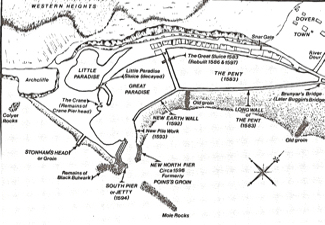
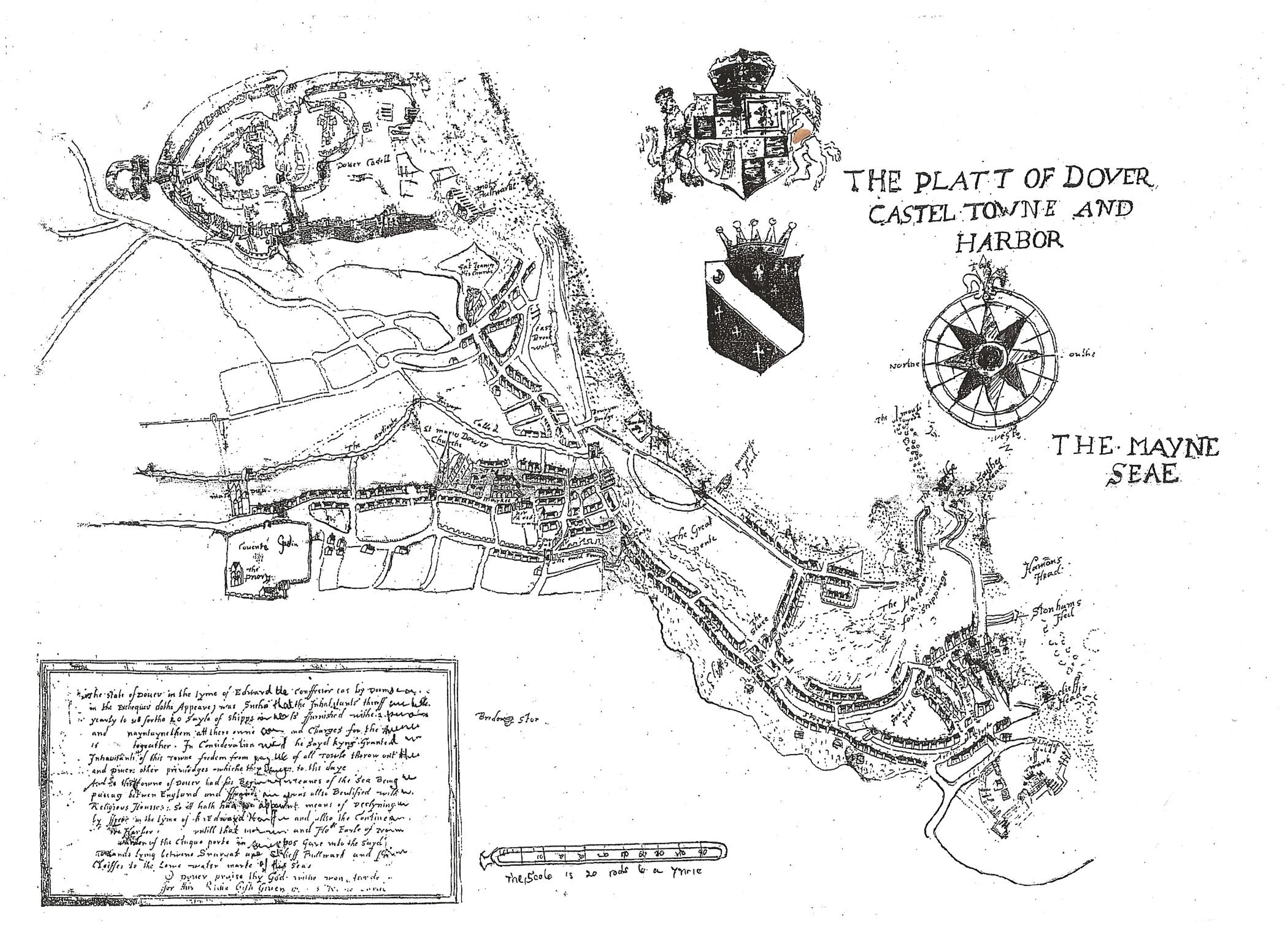
Dover Harbour c1590 on completion of Thomas Digges improvments drawn c1836 by Benjamin Worthington . Dover Library

Dover Harbour c1590 on completion of Thomas Digges improvments drawn c1836 by Benjamin Worthington . Dover Library

Part I of the Dover shipbuilding story covered the development of shipbuilding from the Bronze Age (2,100BC to 700BC), to the beginning of the 18th century. During that time there had been some highs, notably in the Bronze Age that left the town the legacy of the Bronze Age Boat – the oldest sea going craft in the World! From the late Saxon era, for some three hundred years the Cinque Ports ships, which included those from Dover, ruled the west of Europe seas. There were also the lows of the late Medieval, Tudor and Stuart era’s, particularly during the reign of Charles II (1649-1685). Albeit, towards the end of the 17th century the Dover ship building industry was given a new lease of life and ships built in Dover were recognised as the best.

It should be noted that the details of most of the ships featured in this golden age came from the work of Mark Frost the former Assistant Curator of Dover Museum, for which we give him and the Museum thanks. Papers held by the Local Studies Archives at Maidstone have augmented this research, and much of this information flies in the face of some accounts that can be read on the Internet. This may well cause confusion to readers and we can only leave it to them to draw their own conclusions.
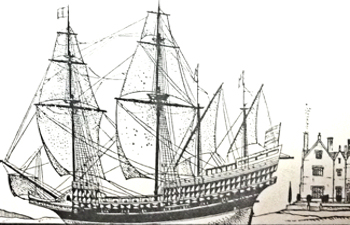
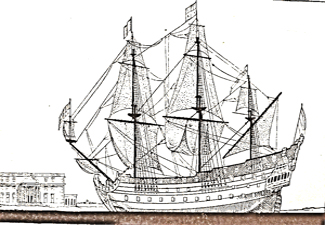
Elizabethan galleon typical of those built in Dover at that time. Frank E Dodman

Elizabethan galleon typical of those built in Dover at that time. Frank E Dodman

Anne (1702-1714) became queen of England and of Scotland on the death of her brother-in-law, William III (1688-1702) and was immediately popular. On 22 July 1706 the Treaty of Union united England and Scotland creating the United Kingdom of Great Britain and this came into effect on 1 May 1707. Immediately, maritime trade took on an important role for the economy of the country as a whole. Over the following years the techniques of shipbuilding was perfected and this included those by the individual Dover shipbuilding enterprises. During that century, the galleon gave way to the larger, faster and more slender vessels for the Channel crossing.
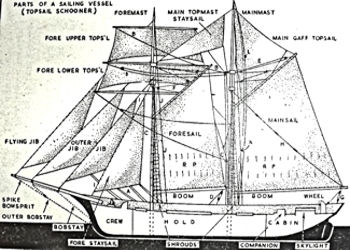
Parts of a Topsail Schooner. Frank E Dobson

Parts of a Topsail Schooner. Frank E Dobson

The diagram opposite comes from the Observers Book of Ships by Frank E Dodman (c1950) and shows the masts and sails of a Topsail Schooner. The rope on these ships was mainly used for rigging, a skill that was usually undertaken by sailmakers and ropebenders. Rigging tended to be divided in two types, Standing rigging, which helped to keep the masts in their permanent positions and Running rigging that controlled the movement and position of yards and sails. As can be seen from the diagram, the names of the sails come from the names of the masts to which they were attached.

Besides the main and mizzen masts, a four masted barque also had fore and jigger masts, while the fifth mast was sometimes called spanker or pusher mast. Other aspects to be noted of sailing vessels is that a lift takes the weight of a yard or boom, halliards – also written halyard – raise or lower a spar or sail, braces control the fore-and aft movement of the yards and the clew lines lift and lower corners of a square sail. To bend a sail was to attach it to the yard or boom, and to furl it was to secure it temporarily to a spar by short lengths of line called gaskets. Finally, a full-rigged ship was a sailing vessel with yards and square sails on all masts.

Changes to sails started in the early 18th century to meet innovations in ship design. The triangular headsail was introduced and a similar type of sail (staysail) was set on stays between each mast. Typically, the frigates had three head sails and six staysails and a small square spritsail under the bowsprit. The top spritsail that had been developed for the earlier galleons disappeared. The shape of the mizzen lanteen shaped sail gave way to a gaff style sail and side extensions were added to the top and topgallant sails. These changes were introduced on coastal trade, the ships designed to carry commodities from wood to coal but primarily corn. Smaller fishing craft were also being built and made stronger to withstand the heavy seas off the east coast and the Channel.
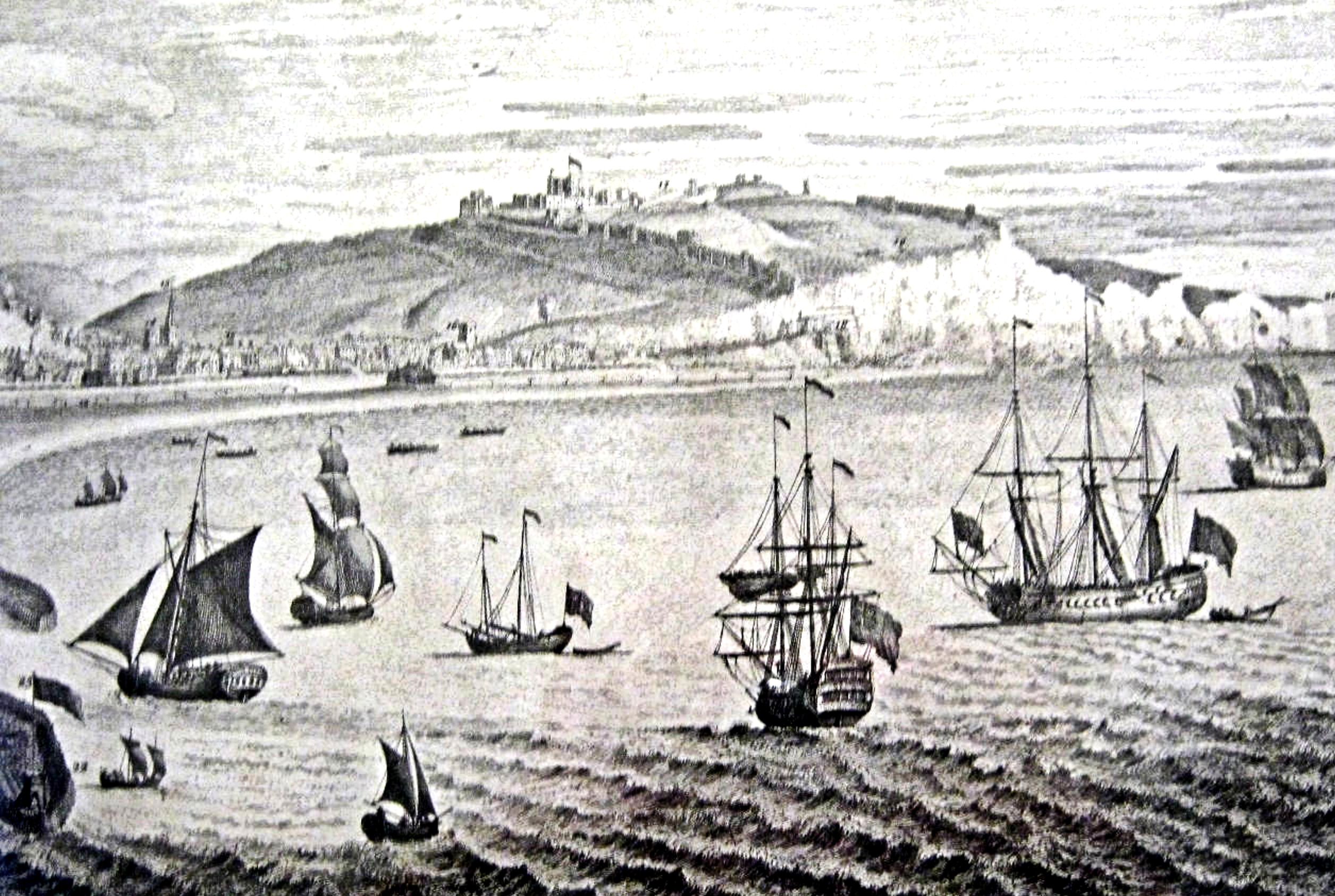
Southern aspect of Dover harbour c1738 - glass slide by Nathaniel Samuel Buck, Dover Harbour Board.

Southern aspect of Dover harbour c1738 – glass slide by Nathaniel Samuel Buck, Dover Harbour Board.

At the beginning of the 17th century, the Cullen and Kempe were the main shipbuilding families in Dover but by the turn of the 18th century they had been joined by Thomas Dawkes (poss.1641-1705), a relative of Richard Dawkes, who captured the Castle from the Royalists in 1641. An illustration of the growth in Dover’s ship building industry that was beginning to generate wealth was shown in Dawkes Will of 1705. He gave the Mayor and Jurats of Dover £50 to be invested and from the interest, the poor of St Mary’s parish were to receive bread on St Thomas’s day (3 July).

Members of the local wealthy Kennett family ran another ship building enterprise. For a long time the Kennett family had owned land to the south and west of Biggin Street, farmed by James Cannon, Mayor in 1716. By that time Mayor Cannon had bought the land and laid out Cannon Street that still exists today. Another branch of the Kennett family hailed from Postling, near Folkestone, where Basill Kennett was the vicar. His mother, Mary, was the daughter of Thomas White, a wealthy Dover master-shipwright and his brother was White Kennett (1660-1708) the Bishop of Peterborough. It was the sons of Basill Kennett, with the help of Grandfather Thomas that started a Dover shipbuilding operation, one of which was Matthew Kennett (b1670). He also took an active role in Dover politics becoming Mayor in 1724 and different members of the Kennett family were to continue to hold municipal offices in the town until 1857.
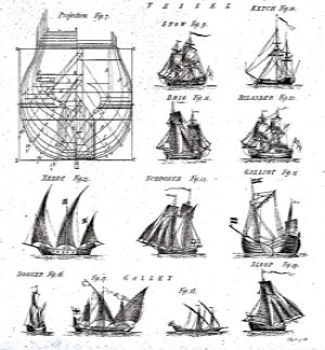
 Ship building showing various types of ships that were built at the time. Many of which were built at Dover. Welcome Foundation Wikimedia

Ship building showing various types of ships that were built at the time. Many of which were built at Dover. Welcome Foundation Wikimedia

Thomas Ladd (1) was born in the 1670s and trained as a carpenter, possibly in another town for in 1715 he was granted the Freedom of Dover by order of the Common Council. The original Freemen of Dover earned their living from the sea and owning their own boats. Over the course of time the Dover Freemen amalgamated with those from Sandwich, Hythe, Romney and Hastings to form the Confederation of the Cinque Ports. The Confederation received a Charter from Edward the Confessor (1042-1066), which gave them rights including freedom of movement, freehold of property, free to run a business and take apprentices for seven years, in other words the convention of Dover Freemen was born. By the time of the Norman Conquest (1066), fewer than half the adult males in the town were Freemen and that ratio would not change for over 600 years. Non-freemen were described as foreigners and had few rights. Freedom could only be obtained by birth, marriage, and apprenticeship, purchasing a freehold and by redemption – an expensive gift to the town.

Gaining his Freedom of the town, enabled Thomas Ladd to set up his own business and by 1730 he had opened a shipyard on the Shakespeare Beach alongside all the other shipbuilders of Dover. By that time, up to 300 ton ships were produced in large, sophisticated shipyards all with teams of qualified workers. They either worked directly for the shipbuilders or on their own account selling their expertise or/and products to the shipyards. They included draughtsmen, wood turners, joiners, iron founders, blacksmiths, sailmakers, ropemakers etc (see Part I of shipbuilding). Thomas Ladd’s two sons, Thomas (2) (1718- 1776) and Henry (1728-1790) were apprenticed to him, with Thomas gaining entry to the Freedomship in 1739 and Henry in 1749.

Roseau figurehead owned by Richard Mahoney and typical of the figureheads produced in Dover. The Roseau comes from the 371 gross tonnage, wooden barque, Roseau built at Jersey in 1857 by F.C.Clarke for Scrutton and Co of London.

Roseau figurehead owned by Richard Mahoney and typical of the figureheads produced in Dover. The Roseau comes from the 371 gross tonnage, wooden barque, Roseau built at Jersey in 1857 by F.C.Clarke for Scrutton and Co of London.

Like the other shipbuilders in Dover of this time, the Ladd family particularly made ships for merchant shipping trade as well as the Channel crossing and for fishing. These only differed to meet the needs of the ships’ usage, further, most could easily be converted into warships as needs necessitated. In design, the ships top deck was sheer or curved towards the bow and reduced in area but the forecastle and poop were higher than the waist while the poop was lower than the forecastle. The Dover ships were decorated but this was not as flamboyant as in the past. Instead the painted designs were simple and elegant and ship decorating developed into one of Dover’s expert crafts. As the century progressed, Dover art studios also included carved ships figureheads in their portfolios.

In 1732 another two shipwrights jointly opened a shipbuilding yard on leased wasteland close to the harbour’s South Pier. They were Thomas and his relative William Pascall, the latter born in 1708. They had both gained their Freedom by apprenticeship and recognising the increasing demand for Dover produced ships, theirs was a shipyard producing similar ships to others bring built on the town’s beaches. Nonetheless, their ships proved popular and to meet the increase in demand, in 1751 Thomas Pascall leased more land on Fishermans Row, in the Pier District. As their shipyard expanded, the two men trained apprentices, most of whom it would appear, were members of the Pascall family.

Towards the mid 18th century the Dover shipbuilders were building an increasing number of larger ships, mainly for the merchant shipping markets such that local merchants set up their own shipyards. One of these was Isaac Minet (c1677- 1745), whose shipbuilding yard was situated at the north-east corner of the harbour and in 1738 he launched the Expedition. This was one of several ships built at that time and probably replaced an older one of the same name but it is particularly remembered as it is one of the rare examples where the name of the ship was recorded. Occasionally Dover shipyards put in bids to build ships for the Royal Navy but they were never successful as the government war ships were built at the Royal dockyards of Portsmouth (founded 1496) Woolwich (founded 1513) and Chatham (founded 1547). If they required further shipping, the Admiralty would commandeer merchant ships and adapt them for their needs.

Wars of the Austrian Succession 1740-1748
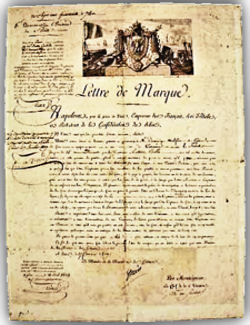
Letter of Marque (French) of 1809 Wikimedia

Letter of Marque (French) of 1809 Wikimedia

This situation changed in March 1744 when war was declared between England and France during the Wars of the Austrian Succession (1740-1748). From April that year Letters of Marque could be bought and Dover’s shipbuilders, mariners, merchants and ship owners quickly took advantage of them. Letters of Marque were issued by the government and allowed private citizens to seize goods of enemy nations’ ships as a prize for making war on them – called privateering it was a legal form of piracy! To be successful, the ship owners needed fast ships and the Dover shipbuilding industry specialised in building ships for this purpose.

Keels were laid down on the beaches and the ships were built of the best English oak, Quercus Robur that could withstand the fiercest of gales. A typical ship required a quantity of timber equivalent to some 40 acres of woodland and the oak trees were specially grown, with continual conservation of the species in mind. The woodlands were close to Dover and Waldershare and Lyminge forests still survive. The design of these ships was streamlined in order to provide a speed that could outstrip the speed of most other vessels. The Dover ships especially built at this time for privateering included the New Eagle – Captain John Bazely (1699-1763) – father of Admiral John Bazely (1740-1809); the Carlisle – Captain William Owen (b1704) the York – Captain Gravener, Endeavour – Master Thomas Kennett, the Hardwicke – Commander James Samson (b1687), the Cumberland and the Kingston.
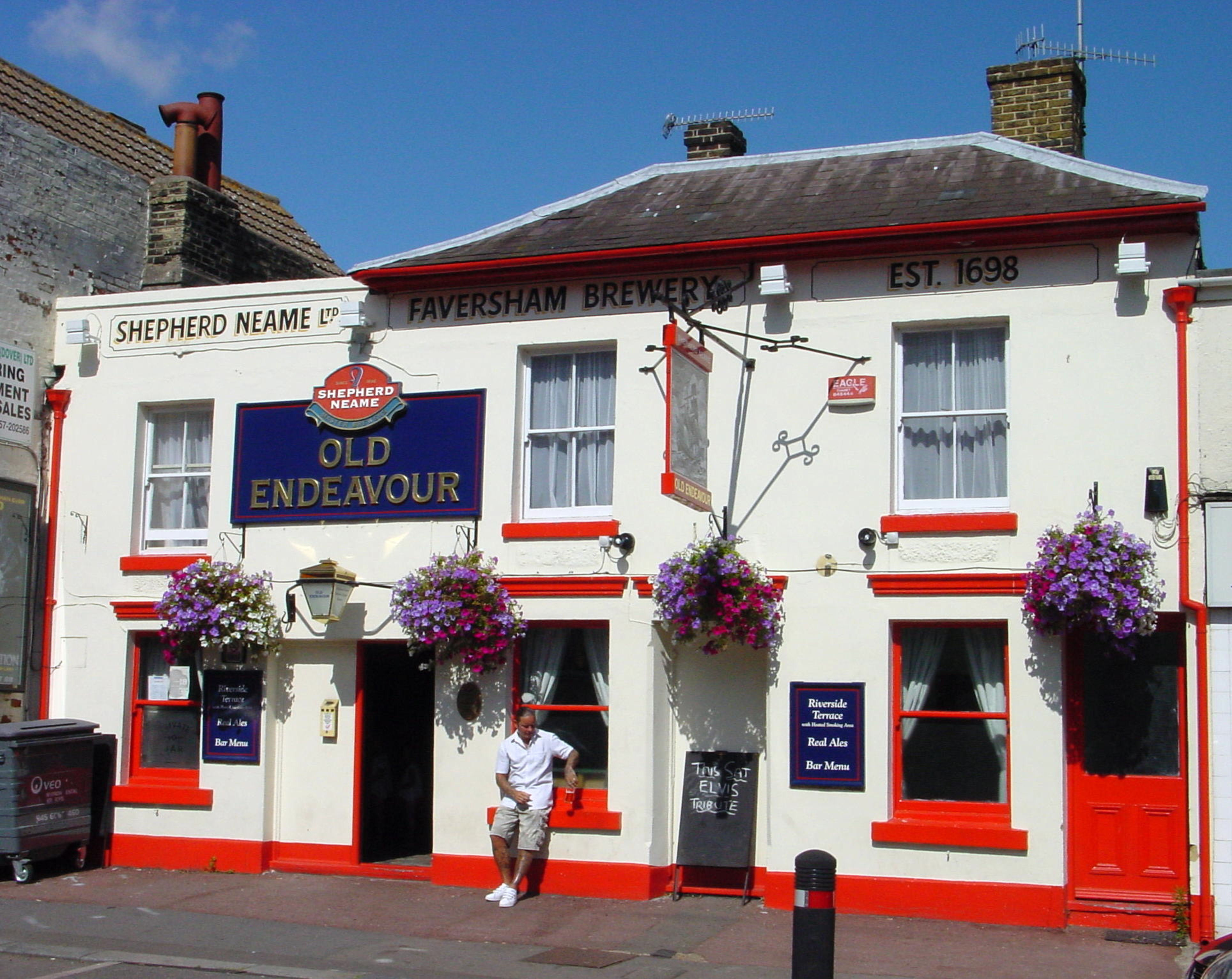
The Old Endeavour pub, London Road, named after the privateer ship Endeavour. AS

The Old Endeavour pub, London Road, named after the privateer ship Endeavour. AS

The New Eagle, Carlisle and the York were paid for out of contributions from a large number of towns folk plus the proceeds earned by Bazely on the second-hand ship, Eagle, bought by Bazely and Peter Fector (1723-1814) for privateering. The trio of ships earned a great deal of respect as well as considerable financial returns from privateering to the town’s folk that had contributed to purchasing the three ships. The Endeavour was also built on Dover beach and fitted out in July 1746. The ship’s master, Thomas Kennet, who was particularly famed for equally sharing out booty taken by privateering between his officers and men. One of the lower Buckland mill cottages on the present London Road was converted into the Old Endeavour pub about 1847 and named after the ship. Later the adjacent row of cottages were named Endeavour Place and the nearby present pub recognised the origin of its name in 1982, when Gaskin’s, the local glassmakers, were commissioned to make a stained glass window featuring the Endeavour. Sadly, this was removed sometime ago and the present owners have no knowledge of where it went.

James Boyton (1726-1803), Dover’s Chief Revenue Officer from 1743 to 1756, described another engagement typical of those that Dover privateers were involved in, writing ‘(The) privateer engaged 2 French privateers for 6 hours. He was obliged to pull away – he had four men killed and 9 wounded. The vessel is very much shattered … One of the French had 20 guns and the other 16; he had but 14 guns and 100 men. This privateer helped fight a 20 gun ship in the Calais Road … and had all his masts shot away, but was not taken’ Earlier in 1746, John Latham (1723-1801), a prominent local shipowner held an auction of goods taken from the captured French ships the Dauphin, Periait, Reynaird and Esperance. The list included ‘250 Muskets; some Pistols, Cutlasses, Cartouche-Boxes, Bayonets, Buss-Belts, Pole-Axes, Tents; Beef, Pork, Bread, and sundry Water Casks.’ However, the privateers, New Eagle, Carlisle, York and Endeavour came to the attention of the Privy Counsel who ordered for the ships to stay in port and their sails to be taken ashore. This, it was said, was on the orders of the East India Company and the ships stayed in Dover until May 1746, when they were taken into the King’s service.

On 23 July 1746, under the overall command of Admiral Edward Vernon (1684-1757), the New Eagle, Carlisle, York and the Endeavour played an important part in defeating a threatened invasion by the French based in Dunkirk. The Dover privateers captured several French transport ships that were taking soldiers from Dunkirk to Calais and Boulogne, on board of which was a great quantity of ammunition and provisions. There were also gun carriages and on one ship there was a fine brass mortar and gun as well as a large quantity of chevaux de fris. These were long poles with sharp spikes at one end that were usually placed around horse corals in military camps. The captured French soldiers were taken as prisoners to Dover Castle, where Prisoner of Wars were usually kept at that time. Of note, although the evidence that Dover Castle was used for this purpose during the Wars of the 18th century and including the Napoleonic Wars (1793-1815), some PhD students have gone to great lengths to negate the hard evidence!

On 8 April 1747, the York privateer under Captain Gravenor engaged with the two French privateers for six hours. He was obliged to give up when the York’s masts were shot away and was generally badly damaged plus four of his men had been killed and nine were wounded. Of the French privateers one had 20 guns and the other 16, while the York only 14 guns and one hundred men. The smaller French ship was a dogger privateer that came out of Calais to assist the first French ship and she initially managed to capture the York. But Gravenor and his men managed to get the York away and eventually they managed to get to the safety of the Margate Roads, off Deal.  For this Gravenor was praised by Admiral Vernon in despatches.

Seven Years’ War 1756-1763
Ropewalk laid by John Goodwin at Archcliffe in 1752 drawn in 1810. Dover Museum

Ropewalk laid by John Goodwin at Archcliffe in 1752 drawn in 1810. Dover Museum

By this time the Royal Navy looked with more than a passing interest at the ships that were being built in Dover and placed orders. Dover’s shipbuilding and associated businesses boomed but completion was hindered by problems in the ropemaking industry. The ropewalk on the main Dover beach was subject to tides and flooding. In 1752 the Harbour Commissioners started to erect a seawall from under the Castle cliffs along the seashore westwards and the ropewalk was in the way. Ropemaker, John Goodwin, on his suggestion was given leave by the Dover Harbour Commissioners to enclose a piece of ground or beach on the town side of the seawall, at his own expense. This new ropewalk was to be free of any encumbrance for 20 years after which Goodwin was to pay a sess or rent as deemed befitting by the Commissioners. The area Goodwin chose was above the sea at Archcliffe above Shakespeare Beach thus closer to the shipbuilding industry. On taking over the ground, Goodwin covered the area with chalk and then with mud out of the Pent and when this had settled he erected the wooden hurdles on which the hemp rope rested while being made by the ropemakers (see Part I of shipbuilding). The Ropewalk housing development now occupies the site.

18th Century Brig. Frank E Dodman

18th Century Brig. Frank E Dodman

Once the problem of a continual supply of excellent quality rope was assured, the shipbuilders were able to fulfil all of the Royal Navy’s requests. Many of these ships were four masted yet their keels were laid down on the beaches. The ships built for local demand tended to be smaller in size but of designs that emphasised speed and of a similar quality as those for the Royal Navy. New ships were expensive but the War, through privateering, had created a number of very wealthy families in Dover and generally most households prospered. Many new businesses opened some offering goods that rivalled those sold in the main retail streets of London, Paris and Bath. The centre was the Snargate Street area of the Pier district, at the west side of the town and close to the harbour. Albeit, following the end of hostilities the Government sold many of their ships at much reduced prices, which flooded the shipping market. This had a direct negative effect on private shipbuilding ports along the southern and eastern coast – with the exception of Dover!

Dover ship owners expanded their fleets with these large cheap ships and many of the mariners clubbed together to buy shares while, in some cases, whole families contributed to buying one of the second-hand Dover built ships. They then used their expertise by participating in smuggling businesses. The crews were mainly made up of mariners drawn from the post-war economic depressed Kent towns. This frequently caused discontent between different groups but the threat of harsh punishment by the heavy handed Dover employers was offset by the size of the purses the men received following a successful operation. Although not so many new ships were built at this time, work adapting ships for smuggling purposes was lucrative and the more ingenious the adaptation the more they could earn. Typically, masts were carefully hollowed to provide hiding places, beautifully carved wooden cabinets would have disguised drawers, while tight fitting partitions giving the impression that they butted against a wall would sometimes hide small rooms. Mansions and ordinary homes were also adapted to hide contraband and the operations thrived.

John Bazeley, Mayor 1762 ordered the demolition of the Medieval Biggin Gate. A plaque placed in 1896 can be seen in New Street. Alan Sencicle

John Bazeley, Mayor 1762 ordered the demolition of the Medieval Biggin Gate. A plaque placed in 1896 can be seen in New Street. Alan Sencicle

Further, in order to try and combat Dover’s growing smuggling operations and well aware that Dover built ships could easily outrun Revenue Cutters, the government imposed restrictions on the number of ships that were built at Dover. This increased the expertise in adaptation of second-hand ships, not only in hiding places on the ships but also in the speed that they travelled through the water. Called reconditioned ships, one such typical vessel was a privateer taken from the Spanish at the beginning of the Wars of the Austrian Succession. She was mounted with four carriage and twelve swivel guns and became the lead smuggling ship for a consortium made up of John Bazely, Peter Fector and Rooth Colebran (c1720-1781) and was reconditioned and fitted out by Thomas Pascall and his son John, both of whom also had shares. Of note, John Bazely was the Mayor in 1762 and gave permission to remove the Medieval Biggin Gate – a plaque placed in 1896 can still be seen in New Street. The ship worked as a privateer and took many prizes and on one occasion three doggers – single masted fishing boats – loaded with brandy off Calais.
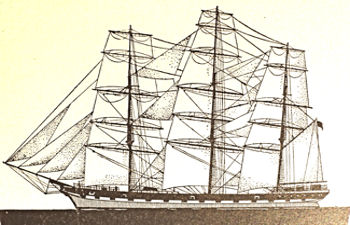
Full Rigged sailing ship of the 18th century of the type built on Dover beaches. Frank E Dodman

Full Rigged sailing ship of the 18th century of the type built on Dover beaches. Frank E Dodman

By the time of the Seven Years’ War (1756-1763), Dover was the major base for smuggling but with the chance of making more money from privateering, ships were quickly converted on Dover’s beaches. By this time the town’s shipbuilders were illegally turning out new vessels ranging from 20 tons to 150 tons burden that were paid and fitted out for the increasingly prosperous Dover merchants and London investors. Such was the growth that the government introduced more legislation, the Privateering Act of 1759, aimed at stopping the owners of ships that were less than a hundred tons and with a company of fewer than forty men claiming Letters of Marque. This led to an increase in the number of consortiums to purchase larger and faster Dover built ships and these were so impressive that the Royal Navy increasingly procured them!

Following the Seven Years’ War another, and possibly the most famous of the Dover shipbuilding families, started a business on Dover beach. This was the King shipyard founded by Thomas King (1739-1815), the son of William King, who by virtue of his marriage to Ann West, daughter of Freeman and mariner, William West, had gained his Freemanship. Thus Thomas claimed his Freedom by birth and after serving a shipbuilding apprenticeship in Dover, courted Ann Wellard (1735-1796) whom he married in 1764. Ann’s wealth provided the capital for the business and they specialised in the production of cross-Channel packet ships and coastal smacks. The firm prospered and the couple had five sons and two daughters. One of the daughters married into a shipbuilding associated family and the sons served as apprentices in the family shipyard. The two eldest sons, Thomas Jones King (1765-1818) and John King (born 1769) joined their father and the King shipyard expanded. Eventually, it covered the area from the remains of the present day Prince of Wales Pier westwards beyond the Admiralty Pier and lorry parks that now litter Dover’s Shakespeare Beach seafront, to where the Mulberry Tree Inn once stood.

Smuggling Lugger being chased by a Royal Navy Brig off Dover. Wikimedi

Smuggling Lugger being chased by a Royal Navy Brig off Dover. Wikimedi

On 25 Sep 1787 Ann West King (1767 -1818), the other of Thomas’s two daughters married William Knocker (1761-1847), the founding father of one of Dover’s major legal families. He was a key member of his family smuggling business that operated around Seasalter, seven miles east of Faversham and also at Heron – probably modern day Herne, near Reculver, then on the north Kent coast. By this time a number of wealthy Dover merchants and their families had smuggling domains around East Kent including the Bazely, Colebran, Latham, Rice, Sampson and Hammond families. However, the main smuggling family was the Fector’s whose operations were refined by John Minet Fector (1754-1821) following the American War of Independence (1775-1783). Of interest, the centre of their operation in Dover was from Pier House on Custom House Quay next door to the Custom House!

American War of Independence (1776-1783)

In an attempt to try and combat smuggling, the government invested in more Revenue Cutters, many of which were built on Dover’s beaches, sometimes next to specially designed smuggling ships! The government also increased the number of Riding Officers but it was the American War of Independence that was more successful in reducing the illicit trade. For this War, the Letters of Marque were not restricted as they had been in the Seven Years War and the Revenue Cutters were redeployed for military purposes. Shipowners used the opportunity to play a robust part in privateering for as records show, the, Dutton, an East Indiaman running out of Dover made £30,000 in profits from only three privateering voyages during this time! In February 1796, the Dutton was at Plymouth when a storm blew up that put the ship aground in Plymouth Sound. At the time, she was commissioned to take transport troops to the West Indies. Although the officers and most of the crew had managed to get ashore, the ship was breaking up with some 500 people, including a skeleton crew and women and children aboard. Famously, Dover born, Admiral Edward Pellew, 1st Viscount Exmouth (1757-1833) organised two rowing boats to carry hawsers – heavy ropes for towing and mooring. A large and powerful man, he swam to the stricken vessel, still dressed in full uniform including sword and instructed the crew to haul the ropes on board and once secured the passengers and crew was winched to safety.
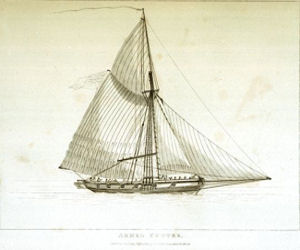
Armed Cutter c1820. National Maritime Museum. Wikimedia

Armed Cutter c1820. National Maritime Museum. Wikimedia

One of the first Dover ships ordered by the Admiralty following the outbreak of the War was from the Ladd family of shipbuilders. This was the Alert a 183ton, 14gun Cutter designed by Sir John Williams, Surveyor for the Royal Navy 1765-1784 and was one of the original pair of his design. The other was the Rattlesnake built by Farley of Folkestone. Cutters are small to medium size ships designed for speed rather than for capacity. They tend to be single masted, which is set further back than on a sloop and with fore and aft rigging. They have two or more headsails and often a bowsprit. Both the ships were lost, the Alert in 1778 and the Rattlesnake in 1781.

From the 1770s Henry Ladd was in sole charge of the family shipyard and he had three sons who served as apprenticed shipwrights with the family firm. They were Henry junior (1755-1801) – Freeman in 1777, Luke (b1758) – Freeman in 1778 and Thomas (3) (1765-1806) – Freeman in 1786. Henry senior died in 1790 and the business passed to Henry and Luke. The Ladds’ were keen to pass on their skills and took on a large number of apprentice shipwrights. Mark Frost tells us that these included:
Stephen Peake (b circa 1763) apprenticed to Henry Ladd made Freeman in 1783
William Barritt (b circa 1768) apprenticed to Luke Ladd made Freeman in 1788
Joseph Pritchard (b circa 1769) apprenticed to Henry Ladd senior made Freeman in 1789.
John Bentley (b circa 1780) apprenticed to Henry Ladd made Freeman in 1790
Matthew Norris (b circa 1780) apprenticed to Henry and Luke Ladd made Freeman in 1790.
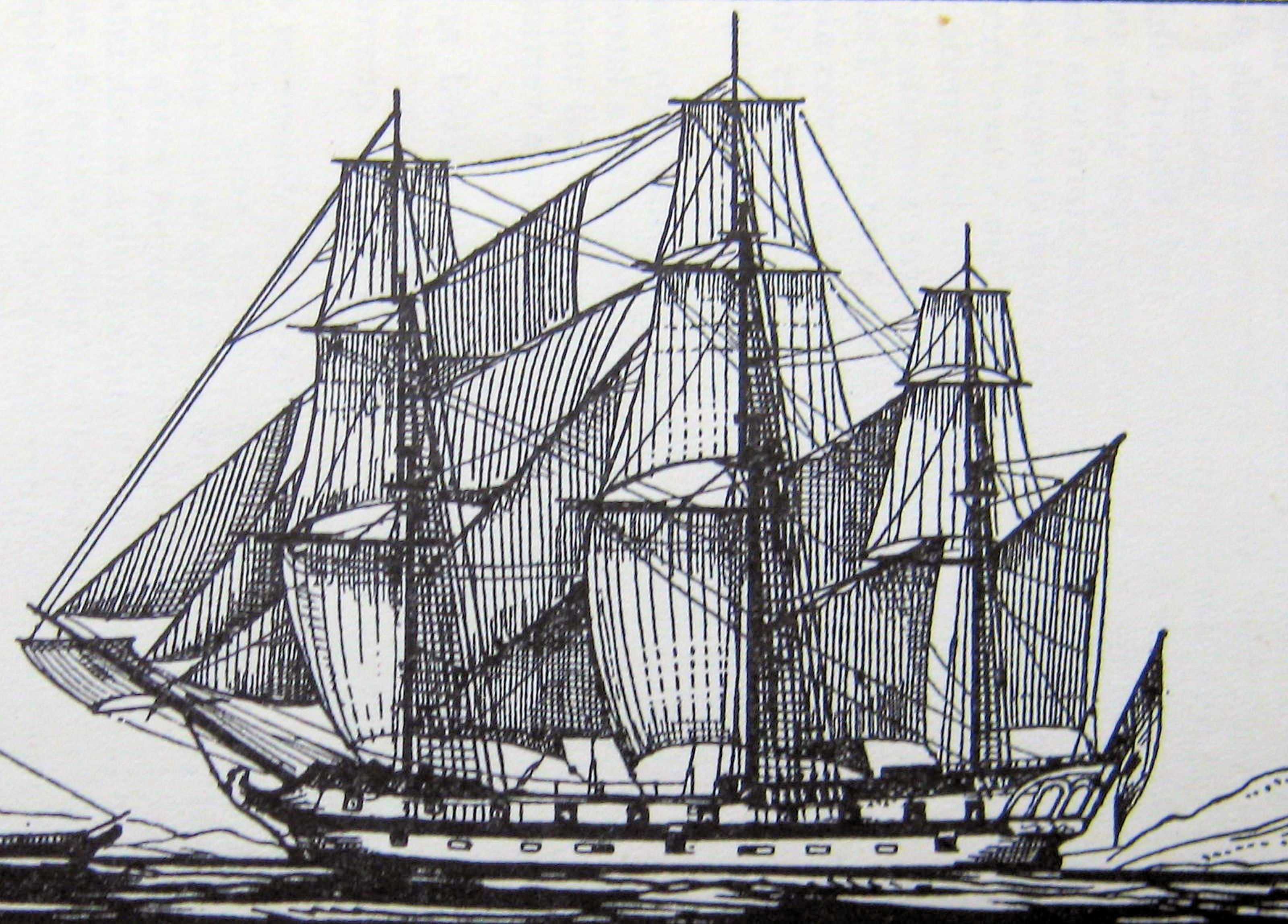
Frigate c1780. Frank Dobson

Frigate c1780. Frank Dobson

The Ladd shipyard was commissioned to build more Royal Navy ships including those designed by Sir John Williams. In 1771, the 28-gun Enterprise Class were the first frigates he designed but their sailing qualities did not match the equivalents designed by Sir Thomas Slade (1704-1771). Nevertheless, some 27 vessels were built to this design, more than to any other Sixth Rate design. These included five ships ordered in 1770 and 1771 and all brought into commission from the Ladd shipyard in 1775 and 1776. They were of 593tons with a crew of 200men and armament consisting of 24x9pounders and 4x3pounders. The Admiralty ordered a further 15ships of the same design, some from both Dover and Sandgate shipyards in 1880, including Ladds’.

Sir John Williams designed the Sprightly Class cutters – one-mast ships with a mainsail, two headsails and a bowsprit, a forerunner of modern day yachts. The prototype was the 150ton Sprightly I, built by the King shipyard in August 1777. She carried a crew of 60 men and had 10x3pounders and 12×1/2pounder swivels and shortly after 12 carronades x12pounders replaced the 3pounders. She was commissioned under Lieutenant William Hills but was lost, presumed foundered with all hands, in a storm off Guernsey on 23 December 1777.

Plan of the Upper deck of the Sprightly class of ships 1778. Wikimedia

Plan of the Upper deck of the Sprightly class of ships 1778. Wikimedia

The Navy replaced her the following year with Sprightly II, also built by the King shipyard. Costing £1,158 15shillings 5 pence and launched in August 1778, she was 150tons and was commissioned in September 1779 under Lieutenant Gabriel Bray for the Downs but paid off in 1780. Then, recommissioned in September that year and took part in the Battle of Dogger Bank on 5 August 1781 under Lieutenant Peter Rivett but was paid off again in May 1783. Recommissioned that month for Mounts Bay, west Cornwall but paid off in 1785. Recommissioned May 1786 for five years until she was again paid off. In 1792 under Lieutenant Richard Hawe and in March 1794 under Lieutenant Digby Dent and six months later under Lieutenant Robert Jump (-1801). She sailed for Jamaica in January 1799 but in February 1801 Sprightly II was captured by the 74 gun Le Dix Aout of Gateaume’s squadron in the Mediterranean and scuttled.

Another cutter ordered by the Royal Navy was the Expedition in February 1778 from the Ladd shipyard. Launched in August 1778, she cost £1,180 to build plus £1,348 fitting out and the ship’s bottom was coppered. The Royal Navy had introduced coppering of wooden ships’ bottoms as rivers were increasingly becoming infested with Gribble and Teredo worms. A mollusc that enters submerged timbers when it is very small and grows rapidly to about 4 to 6 inches in length and less than one-quarter inch in diameter. They riddle the interior of the wood until, without noticeable damage on the outside, an entire structure may suddenly collapse. All ships commissioned by the Royal Navy had to have 1milimetre or 0.04 inches thick copper sheathing covering the bottoms that gave the hulls a clean, wet surface that protected against the worms and, as a bonus, stopped the ships being fouled by weed.

Commissioned in September 1778 for the Downs, the Expedition was paid off in 1783 but refitted May 1784 and paid off the following year. Recommissioned March 1786 was refitted in 1789-1790 as a Channel packet. With the outbreak of the Napoleonic Wars, she was recommissioned May 1792 under the command of Lieutenant Grosvenor Winkworth for service in the North Sea. Followed in July 1793, under Lieutenant Bayntun Prideaux, for the Channel, then April 1796 Lieutenant George Raper (1769-1796). In 1802 she was under the command of Lieutenant Charles Boyes (died 1804) and decommissioned in conjunction with the signing of the Amiens Peace Treaty of that year (25 March 1802).
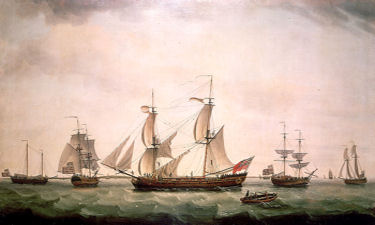
English Brig with captured American ships. F Holman 1778. Wikimedia

English Brig with captured American ships. F Holman 1778. Wikimedia

In August 1778 the King shipyard built and launched the 205ton brig Alert that was bought by the Royal Navy before completion. A brig was a two masted vessel with square sails on each mast for power, and fore-and-aft staysails for manoeuvrability along with jibs and spanker – similar to colliers of that time. She was launched in August and crewed by 80 men. The Alert carried 14x4pdrs, 12×1/2pdrs swivel guns and the cost including fitting and coppering cost £1,868 19shillings 10pence. Following the commissioning, the Alert was sailed under Commander James Vashon. That year she was seized by the American ‘rebel states’ and was used to set fire to two other British vessels carrying hay. Sir James Wallace (1731-1803) was the Captain of the 50-gun ship Experiment and he came to the rescue saving the Alert from being burnt too.

The Alert was in the Leeward Islands in February 1780 and at the Battle of Dogger Bank in August 1781. She was at the Battle of the Saintes 9-12 April 1782 off Dominica in the West Indies, following which she was paid off. The Battle of the Saintes, occurred due to the belief by the French that the American War of Independence could be ended successfully with the capture of Jamaica from the British. The British West Indies Fleet was under Admiral Sir George Brydges Rodney (1718-1792) and the French fleet, sailed from Fort Royal, Martinique under the Comte François Joseph Paul de Grasse (1722-1788). They first engaged off Dominica on 9 April, and then off the group of islets to the north called the Saints (Les Saintes) on the 12th. Rodney’s victory proved a counterbalance to the loss of the British colonies in America and allowed Britain to secure superiority over the French in the Caribbean in the 1783 Treaty of Versailles.

At Chatham, the Alert was then fitted out for the Channel packet service, which cost £617 10shillings 8d but in October 1783 was again laid up. Again fitted out at Chatham, this time for foreign service between April – July 1787, costing £625 1shillings 6pence. She was recommissioned in June 1787 under the command of Commodore George Burden and sailed for Jamaica. In 1791 she was again paid off and sold at Deptford for £235 in October 1792. The Alert was the only brig built for the Royal Navy to be disposed of prior to 1793.

Shipbuilding at East Cliff 1792. Dover Museum

Shipbuilding at East Cliff 1792. Dover Museum

Although the Dover shipyards were building vessels for the Royal Navy, they were also providing local shipowners and others with exceptionally fast ships that were being used as privateers and for smuggling. The shipbuilding yards, by this time, were along the beaches from Shakespeare Cliff to East Cliff and the number of privateers operating out of Dover during the War was in excess of 50. Most were built at Dover and shipbuilders and ancillary shipbuilding tradesmen operated many. For instance, Henry Ladd built and owned the 200ton British Hero with 16 carriage guns and captained by local John Wellard (1743-1817). He also built and owned, with others, the 45ton Charlotte and the 100ton cutter Job with Samuel Kempe and captained by Henry Pascall. She was put up for sale in in 1779 and described as ‘a prime sailor, exceedingly well founded.’
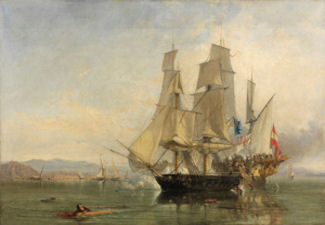
The Capture of El Gamo spanish treasure ship by the Dover built 3 masted brig, Speedy.

The Capture of El Gamo spanish treasure ship by the Dover built 3 masted brig, Speedy.

The King family built and owned the 129ton privateer Drake, and the three masted, 50 ton Surprize with 64x2lb carriage guns, 6swivels, 20 crew. Along with James Gravener, the King’s owned the 60ton Martha, a privateer with 8 swivel guns, 20crew and captained by Robert Steriker (1753-1830). In 1782 she took the Adventurer, a French privateer of Dunkirk and was sold in a sale at the King’s Head Tavern, Clarence Place next to the harbour. The 200ton Resolution was built by the King shipyard and owned by them along with John Osborne who was also her Captain. She was armed with 12x6lb carriage guns, 20 swivel guns and carried a crew of 60. She traded between Dover and Guernsey smuggling wines to London. Ropemaker John Goodwin owned the 260ton Bridgetown that carried 4 swivel guns and had a crew of 18. The 208ton Speedy, a three-masted brig designed by Sir John Williams, was built by a Dover shipbuilder carrying 14guns was launched in June 1781. She had a glittering career as a privateer as well as a Royal navy ship. While in that capacity and under the command of Thomas Cochrane (1775-1860), 10th Earl of Dundonald, Speedy was famous in capturing El Gamo, a Spanish treasure ship.
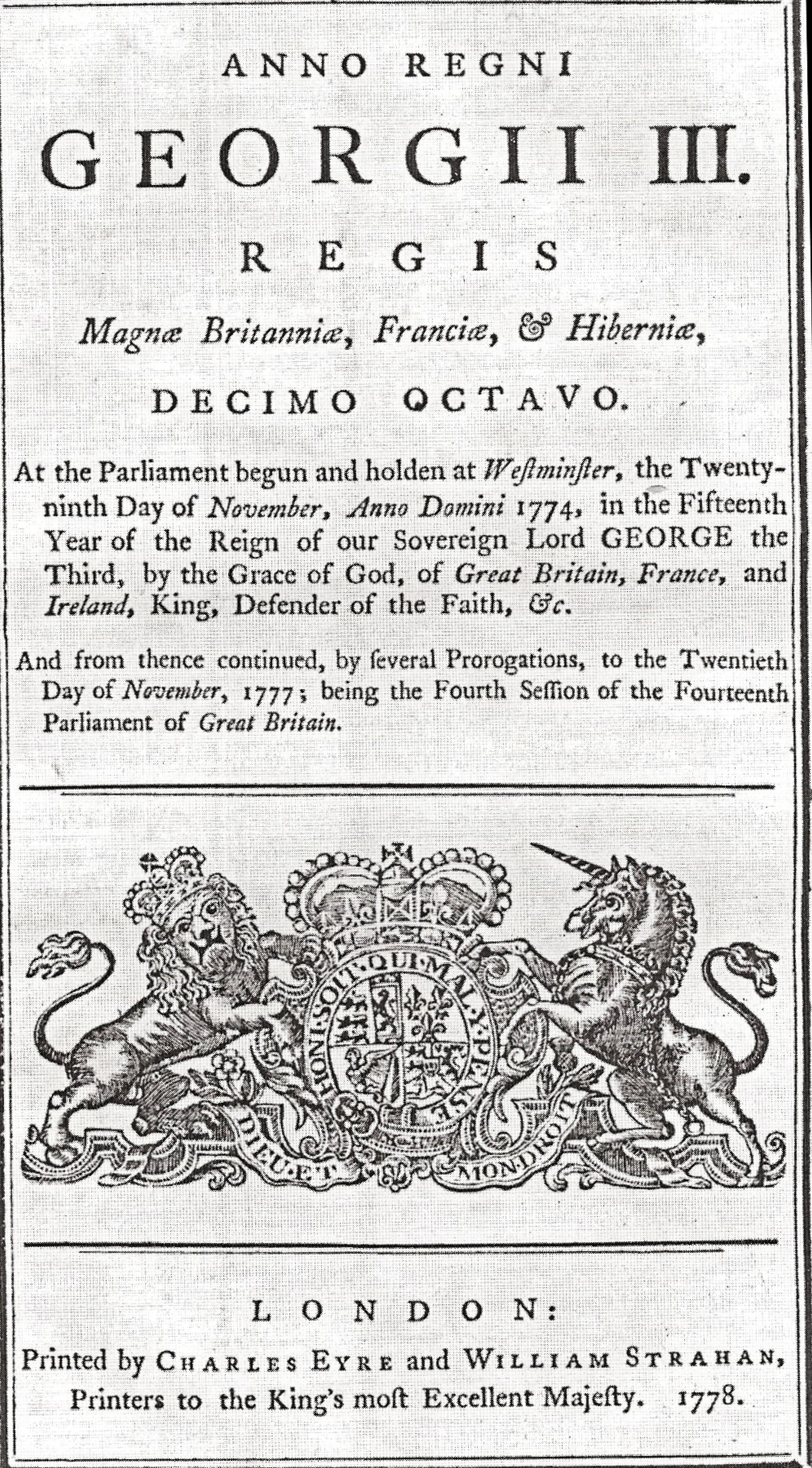
Front Cover of the Dover Paving Commission Act 1777. Dover Library

Front Cover of the Dover Paving Commission Act 1777. Dover Library

Smuggling was increasingly being organised by Dover businessmen with the government retaliating by increasing the number of Riding Officers. In 1778 the Dover’s Paving Commission was set up by Act of Parliament, its principal function was for town management including street lighting. Mayor, Matthew Kennett (1739-1818), of a ship owning family, took a leading part in framing the Act and the resulting document pleased the government. The Commission was made up of sixty-four named persons, including Matthew Kennett, and Jurats Christopher Gunman (1714-1781), James Hammond, John Latham, John Coleman, Thomas Bateman Lane (1746-1821), James Gunman (1747-1824) and Phineas Stringer (1730-1801). Nonetheless, Dover’s street lighting continued to be kept deliberately poor for as Charles Dickens (1812-1870), noted in his opening chapter of ‘The Tale of Two Cities,’ ‘… A little fishing was done in the port and a quantity of strolling about by night, and looking seaward, particularly at those times when the tide made and was near flood. Small tradesmen who did no business whatever, sometimes unaccountably realised large fortunes and it were remarkable that nobody in the neighbourhood could endure a lamplighter!

The War raged on and the Royal Navy continued to be interested in purchasing Dover built ships. The 206 ton brig Lively, built by the King shipyard, was launched in June 1779. The cost, including fitting out and coppering, was £1,821 11shillings 9pence. The Royal Navy purchased her along with the 181ton Cockatrice, also built by the King shipyard and launched the following year. The 340ton Merlin was purchased from the King shipyard while still being built in 1780. A sloop, she was crewed by 125men and initially had 18x6pounder guns. A sloop was a one-masted vessel with a mainsail, one headsail and no bowsprit. The Royal Navy also purchased the 317ton Bulldog, built by another Dover shipbuilder while William Crow, William Pepper and Captain John Blake, independently, bought the 124ton Nile, which carried 14x6lb carriage guns. In 1799 she was described in a newspaper article as a beautiful new lugger fitted out in Dover and pierced for 18guns. The Nile had a successful career as a privateer as was the Swift I. She had 6 swivel guns and 30crew and was owned and captained by John Osborne in a consortium with London merchants William Richards and Joseph Graves. Osborne was also part of the King consortium that ran the Resolution.

In 1780 William Hedgecock (b1765), son of victualler Michael Hedgecock (d1769), joined the Pascall yards as an apprentice and some seventeen years later formed a partnership with John Pascall trading as Pascall and Hedgecock. The continual demand for Dover ships attracted even more shipbuilders to set up their own businesses on Dover beaches, including John Freeman (1759-1831). He was born in Folkestone and apprenticed to a Dover shipwright about 1776 becoming a Freeman in 1781. Soon after Freeman opened a shipyard at Harts Row off Beach Street, close to Archcliff Fort. He married Elizabeth Vincer (b1760), of a shipbuilding family, and his two eldest sons, John (1787-1843) and Thomas Vincer Freeman (b 1789), were apprenticed to the Freeman shipyard as shipwrights. The Royal Navy commissioned ships from the Freeman shipyard along with the other Dover shipyards.
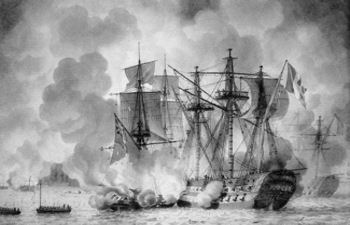
Régulus a 74-gun French ship under attack by British fireships 11 August 1809. Wikipaedia

Régulus a 74-gun French ship under attack by British fireships 11 August 1809. Wikipaedia

From the Ladd shipyard, the Royal Navy commissioned a prototype fireship/sloop, Tisiphone, the first of nine ships in the Tisiphone class, all of which were built on Dover beaches. The Tisiphone was launched in 1781 and the others were the 423ton Alecto launched 1781 and the 424ton Incendiary launched 1782, both built by Thomas King and each crewed by 55men. There was also the Comet (1783), Conflagration (1783), Megaera (1783), Pluto (1782), Spitfire (1782) and the Vulcan (1783). The design of these fireships was based on a French privateer fireship captured in 1745 and similar in many ways to a sloop of war. Indeed, fireships were often employed as sloops of war until they were used for the purpose they were built. The design of fireships differed from other ships in that they had a flush upper deck with the bulwarks carried forward along the waist and was pierced for gunports. When used as fireships they were filled with combustibles, set on fire then positioned to drift into an enemy fleet at anchor. Until they reached the chosen destination they were steered by a skeleton crew who escaped in the ship’s boat following impact with the enemy ship. An explosion ship or hellburner was a variation on the fireship, intended to cause damage by blowing up in proximity to enemy ships. As warships of this time were built of wood, caulked with tar and greased rope as well as carrying gunpowder, they were vulnerable to fire and therefore fireships were a major threat. Not only did fireships destroy enemy ships, they created panic and if the enemy were on the move, when a fireship was sent among them, it forced them to break formation.
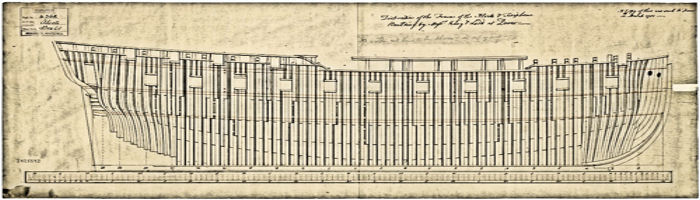
Design plan of the Dover built fireships by the King and Ladd yard between 1779 & 1784

Design plan of the Dover built fireships by the King and Ladd yard between 1779 & 1784

In Greek mythology Tisiphone was the Avenger of Murder – one of the three Furies – and the Tisiphone fireship was ordered in June 1779 and launched in May 1781 at a cost £9,195 3s 9d to build, including fitting and coppering. The Tisiphone was laid up in March 1785 and underwent a small repair at Woolwich. In May 1790 she was recommissioned under Commodore, later Admiral, Charles Tyler (1760-1835) and in 1793, was under the command of Commander Thomas Byam Martin (1773-1854) later Admiral of the Fleet and took the 12-gun privateer L’Outrade March that year. Although built to be used as a fireship, the Tisiphone, along with the other Dover built fireships, had all the attributes of a Dover built ship, including built of the finest locally grown English oak, Quercus Robur. She was therefore deployed as part of the battle fleet while awaiting her destruction as a fireship. This virtue of the Dover built ships was credited with reducing the British fleet from the enormous size required in the American War of Independence, to a streamlined service geared toward protecting merchant trade and the British Empire during the Napoleonic Wars!
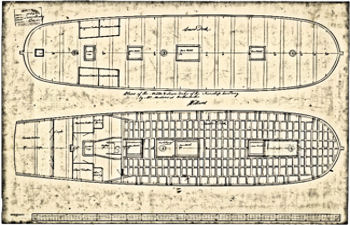
Design of the middle and lower decks of the Incendiary & Tisiphone class fireships in general 1778

Design of the middle and lower decks of the Incendiary & Tisiphone class fireships in general 1778

The Alecto was the first of the Tisiphone class fireship the King shipyard built for the Royal Navy costing £9,700.15shillings 1pence including fitting & coppering. After being paid up and laid up following the American War of Independence, the Alecto was recommissioned in 1798 and she also served as guardship at Lymington prior to he sale in 1802. Another of the Tisiphone class fireships built by the King shipyard was the Incendiary, launched 12 August 1782 costing £9,570.14.5d including fitting & coppering. Like both the Tisiphone and the Alecto she was not used for the job for which she was built and for the same reasons – she was of a superior craftmanship and built of Quercus Robur oak, which was ideal for shipbuilding as it did not burn easily! Instead the Incendiary was recommissioned in February 1793 and refitted at Sheerness. Eventually she was used as a fireship, along with the Majestic and Daedalus when they destroyed the storeship Suffren off Ushant, Brittany on 8 January 1797. With Suffren well alight and the other fireships ablaze the crewless Incendiary sailed out of the mayhem. A crew was despatched to deal with the smouldering ship but found that she had only suffered superficial damage! At a cost of £2,294, the Incendiary was refitted at Portsmouth but after a successful career particularly against French privateers, the 80-gun L’Indivisible of Count Honoré Ganteaume (1755-1818) captured her on 29 January 1801. This was in the Gulf of Cadiz, the southernmost point of mainland Portugal and recognising she was a fireship, her captors set her alight. The Incendiary refused to burn and her dignity throughout the ordeal was so awe-inspiring that it was suggested that she should be offered as a prize for diplomatic purposes. For whatever reason, a decision was made to scuttle her and the Incendiary gracefully sank to the bottom of the sea.

For quite sometime, some of Dover’s shipping companies had bought licences from the Post Office to operate the cross-Channel Packet industry. However, due to the danger from French privateers during the American War of Independence, they ceased this activity, sold their packet ships and invested in smaller, faster sloops, with relatively shallow draughts. These vessels enabled them to use the smaller Continental harbours for smuggling purposes. When peace returned, illegally importing contraband from France enabled them to maintain their lifestyles that they had acquired throughout the lucrative years of the American War. Although there was an increase in the number of Revenue men and cutters, smuggling became one of Dover’s major and most lucrative industries. Respectability was maintained with the reintroduction of the packet service, for which ships built in Dover were used. Four packet ships made the crossing every Wednesday and Saturday with mails for Calais and Ostend. As the Turnpiked Road to Folkestone from Dover, over the cliffs, was increasingly ‘dangerous from the falling cliffs,’ the present Folkestone Road through the Farthingloe Valley was built to replace this by the Turnpike Trust. The new road opened in 1783 and remained a turnpike until 1887. The abandoned old road to Folkestone, enabled more smuggling to take place along the cliffs in the area.

Dover Harbour c1800.

Dover Harbour c1800.

At this time, until the outbreak of the Napoleonic Wars, the ships built in Dover for the packet, passage and smuggling industries included the 48ton Ant, 78ton Countess of Elgin, 56ton Dart, Defence, 49ton Dover, 66ton Duchess of Cumberland, Flora, Hardwick, Industry, Lady Casterleagh, Lady Jane James, Lark, Lord Duncan, 160ton cutter Nymph, Pitt, Poll, Prince Leopold, Prince of Wales, Prince William Henry, 71 ton Princess Augusta, the 96ton schooner Princess Charlotte, Sybil, Susanah and the 50ton Venus. As the old Folkestone Road was no longer the main road out of Dover, the shores along cliffs on that stretch of coast became ideal for landing contraband increasing the smuggling industry profits. The industry became so flagrant that there was a public outcry and investigations were undertaken. It was found that in Dover the game of eluding the revenue laws were played to perfection and the Admiralty Records show, that Customs Officers more than once complained of the obstruction they met from the towns folk. It was known that tea was the main item being smuggled at Dover at this time. By the middle of the eighteenth century 4million pounds of tea was consumed in the country but duty had only been paid on 800,000 pounds! It was believed that Dover packets were the main carriers of the contraband as the frigates were the town’s largest ships and therefore were more likely to be able to keep the tea dry. The town’s two largest shipowners, the respectable Fectors and Lathams owned the packets.
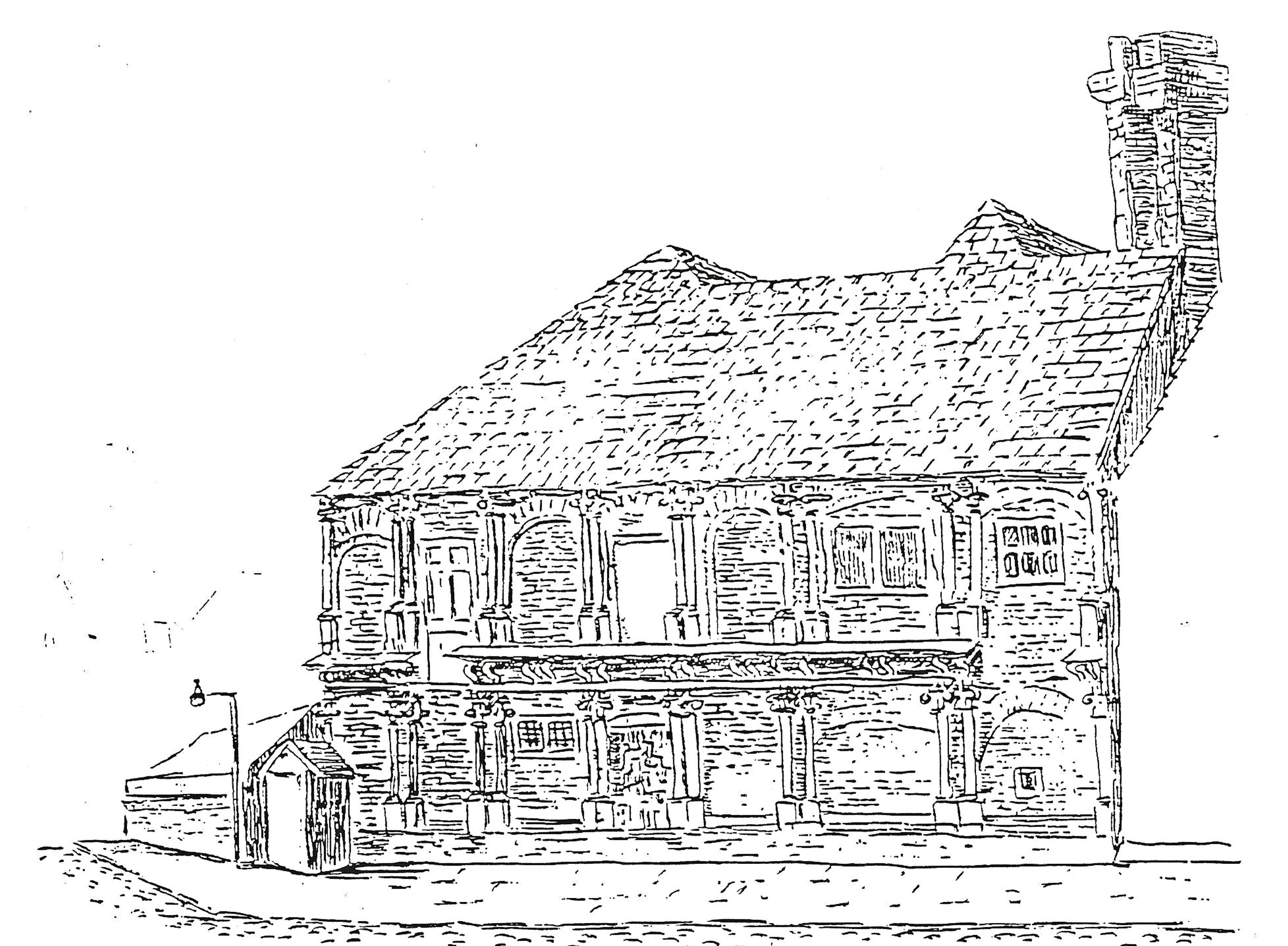
Dover custom house on Custom House quay built in 1666 and demolished March 1821 and replaced by a new Custom House built by John Minet Fector bank that year. Dover Museum

Dover custom house on Custom House quay built in 1666 and demolished March 1821 and replaced by a new Custom House built by John Minet Fector bank that year. Dover Museum

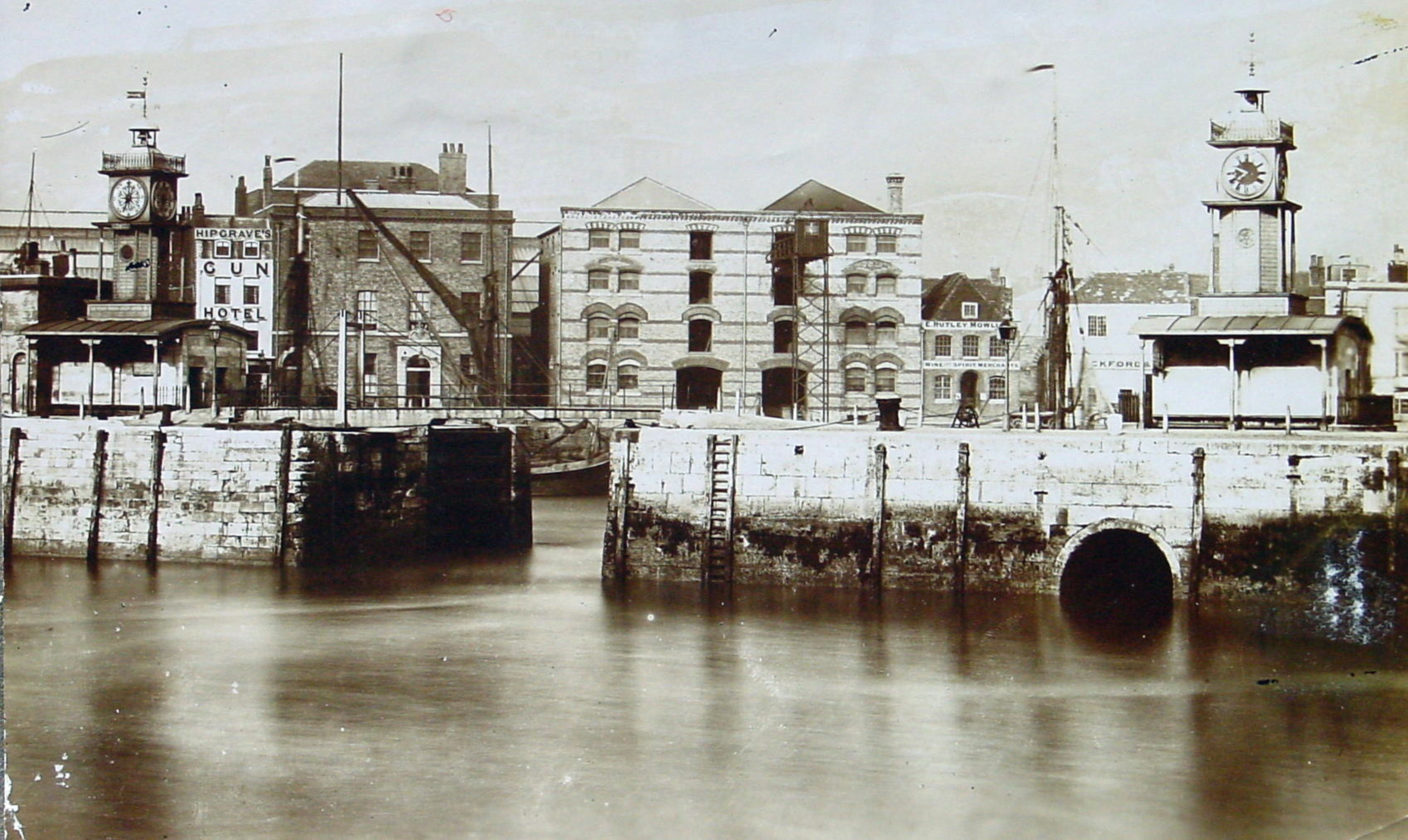
When the Revenue men wanted to go on board these packets, the ships had to tie up on Custom House Quay – approximately on the Snargate Street side of the present Granville Dock. A member of the shipowning family met the Revenue men and the senior officers were taken on board to participate in refreshments while the junior officers stayed on the quayside and kept watch. Throughout the inspection the crew were respectful and doing as requested by the Revenue officers. The inspections were undertaken without interference but nothing was ever found, nor did those on the quayside see anything amiss. Later that day, after the ship left Dover, the ship’s boats would be lowered below Hougham cliffs or at St Margaret’s Bay and smuggled caskets of tea would be taken ashore. Dover shipbuilders and associated trade had became ingenious in adapting the ships, its furniture etc. ensuring that tea was carried in the safest and dry conditions as possible!
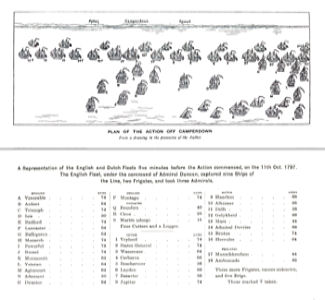
A representation of the English and Dutch fleets five minutes before action commenced in the Battle of Camperdown on 11 October 1797. The English fleet under the command of Admiral Adam Duncan (1731-1804) captured nine ships of the Line, two ships and took three Admirals. The battle is considered one of the most significant in British naval history. R is the Dover built frigate Circe carrying 28guns. Wikimedia

A representation of the English and Dutch fleets five minutes before action commenced in the Battle of Camperdown on 11 October 1797. The English fleet under the command of Admiral Adam Duncan (1731-1804) captured nine ships of the Line, two ships and took three Admirals. The battle is considered one of the most significant in British naval history. R is the Dover built frigate Circe carrying 28guns. Wikimedia

Albeit, following the end of the War of American Independence, those shipbuilders that had earned a good living from producing ships for the Royal Navy, were hit particularly hard as the Admiralty sold them off cheap and they ceased buying new vessels. Henry Ladd was declared bankrupt when proceedings were taken against him on 11 April 1785 by fellow shipbuilder, James Gravener. At the time, the Ladd yard was just finishing building Circe, an Enterprise Class frigate, which the Royal Navy had ordered in March 1782 but with the end of the war, had rescinded on the payment. This had cost the Ladd shipbuilding yard £6,117 including fitting out. The ship was laid up in the shipyard.

The French Revolution (1789-1799) started on 11 July 1789 and fearing what may happen to Britain, the government started to make preparations. The Admiralty increased its ship building policy and in September 1790, the Royal Navy recommissioned the Circe. They paid the money they owed for the ship and thus saved the Ladd shipyard. During the Napoleonic Wars the Circe was involved in the capture of the 14-gun L’Espiegle, off Ushant November 1793; took part in the Battle of Camperdown off the North Holland coast, 11 October 1797; the attack on Ostend on 18 May 1798. She also took the 12-gun Lijnx and 8-gun schooner Perseus at the mouth of the River Ems, northwestern Germany on 11 October 1799 but was wrecked on the Lemon and Ower Bank off Norfolk on 17 November 1803. In December 1797 the Circe was under the command of Captain Robert Winthrop (1764-1832) later Admiral of the Blue, who died at his residence in Dover on 10 May 1832.
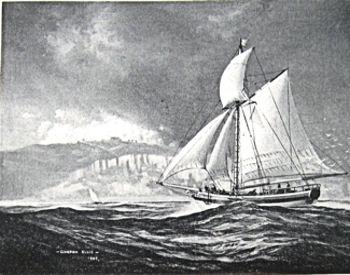
 King George I 70ton sloop Cross-Channel Sailing Packet owned by the Fector family by Gordon Ellis. A model can be seen in the Museum. LS

King George I 70ton sloop Cross-Channel Sailing Packet owned by the Fector family by Gordon Ellis. A model can be seen in the Museum. LS

There was also the King George II, built by the King shipyard for the Fector banking family, and whose master initially was Matthew King (1759-1832) and later George Bagster. The King George II was a 128-ton cutter with a hull designed to offer the minimum resistance in the water. This made her fast but not as fast as the Fector flagship, ex-Royal Navy 70ton sloop, King George I, also built by the King shipyard and remained the fastest ship on the cross Channel packet run. This was a feat that was not to be surpassed until the steam packets broke her record in the 1820s. A model of the King George I can be seen at Dover Museum but it was King George II packet ship, that was believed by the customs and others to be particularly heavily involved in smuggling. At this time, the average sum of duties collected by customs in Dover from 1788 to 1793 was only £14,269 per year and only amounted to a third of the salaries, wages and other outlays of the custom post in the town. On this subject Edward Hastard (1760-1855), in 1797, wrote that ‘so numerous are the contraband traders here whose success is chiefly owing to the blackness of the night; and at this time there is not a single light in the night throughout the whole town of Dover.

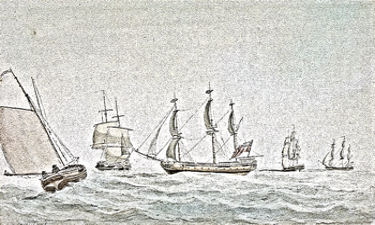
A cutter, frigate and an Indiaman with other ships all of which are typical of the ships produced by the King shipyard. Wikimedia

A cutter, frigate and an Indiaman with other ships all of which are typical of the ships produced by the King shipyard. Wikimedia

By 1790 William King of the King shipbuilding business, was active in local politics. His first taste came in 1784, when he was appointed by Dover’s councillors as one the Commissioners to the Court of Requests, even though he was not a member of the Common Council. The Court of Requests dealt with small debts up to £5 owed to tradesmen and the Commissioners had to have real property of £30 to £500 in personnel wealth. Shortly after King was elected a councillor and in 1790 he was elevated to that of a Jurat – the inner sanctum of the Corporation. It also bestowed upon him the eligibility to being elected a Mayor, as he was in September 1798. By that time King was heavily involved in producing ships for the Royal Navy and in 1800 was actively involved in the erection of New Bridge, designed to help Dover to become a tourist resort. However, in 1807, it was taken as granted that he would be elected Mayor again but the proposal was fiercely contested by Thomas Mantell (1751–1831) the leader of the anti-smuggling lobby. Although King won, this was only by a small majority and not only did he not stand again, but the King shipyard in Dover closed and the firm moved to Upton (Upnor), on the Medway.

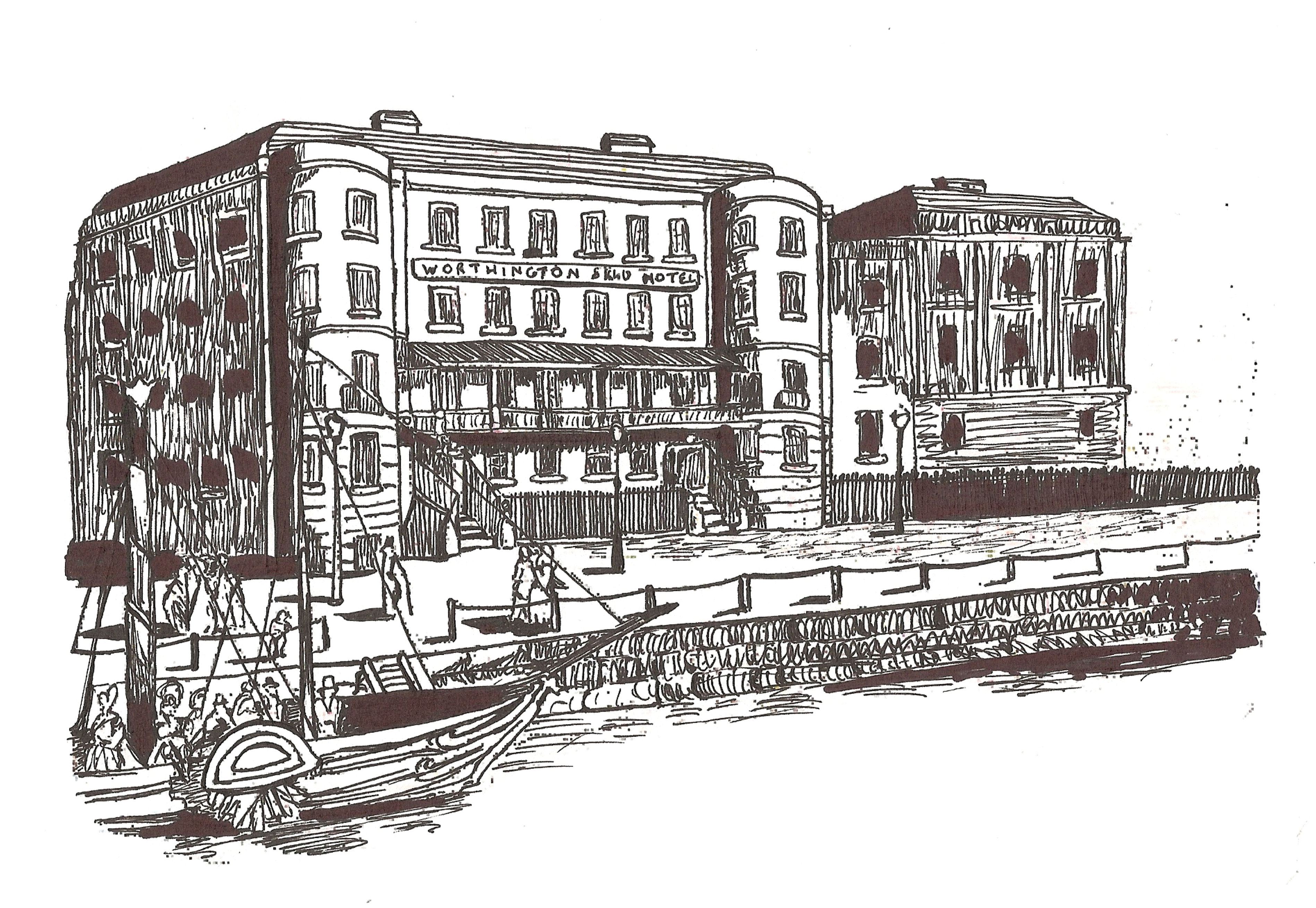
Another of Dover shipbuilding families was the influential Worthingtons. Their residences were at Maxton, nowadays a suburb of Dover at the west end of the Folkestone Road in Dover. The centre of their holdings was the Manor House at Maxton and about 1800, one of the members, had warehouses along Gardiner’s Lane, the only thoroughfare out of Dover going westwards. For this reason, the road was changed to Worthington Lane – now Worthington Street. One of the Royal Navy commanders during the Napoleonic Wars was Lieutenant Benjamin Worthington, whose home was the Maxton Manor House and following the end of the Napoleonic Wars he occupied his time projecting schemes for the improvement of Dover Harbour. Another member of the family, Benjamin Worthington, for many years kept the Ship Hotel on Custom House Quay and ran the Dover and London mail coaches.

As the Napoleonic Wars were approaching, the Dover shipbuilders and affiliated occupations had so perfected their techniques that Dover built ships were refereed to as the ‘Pride of Europe’. At the time the main shipbuilders listed were: Thomas Allen, Cowley & Austin, T Finch, Gilbee and Farley, Benjamin Glandfield, James Gravener, Kemp and Johnson, Matthew Kennett, Thomas King, Luke Ladd, James Large, Pascall and Hedgecock. John Scott, Robert Taylor, S T Walker and Elias Worthington. The ropemakers were Peter Becker (1764-1842) & Richard Jell (1762-1847), Richard Witherden (d1800) and Stephen Witherden (1757-1826). Thomas Ismay (1747-1827) was a ship-chandler and also an ironmonger, blacksmith and brazier. Becker & Jell were sailmakers as well as shipbuilders, as was Edward Ladd, Ratcliff & Co and Nicholas Ladd Steriker (1767-1830). During the Napoleonic Wars a tax was introduced on sails and all sail cloth was stamped with its place of origin on each sheet when the tax had been paid. It was a serious offence to use sails, which had not been stamped.

On 1 February 1793, France declared war on Britain and the Napoleonic Wars (1793-1815) began.

Dover Harbour 1793 by R Dodd. LS

Dover Harbour 1793 by R Dodd. LS

The Dover Shipbuilders story Part 3 covers the Napoleonic Wars 1793 – 1815

Presented: 04 May 2018

Posted in Armed Services, Businesses, Maritime, Shipbuilding Part II the Golden Age 1700 to 1793, Shipbuilding Part II the Golden Age 1700 to 1793, Shipbuilding Part II the Golden Age 1700 to 1793, Shipbuilding Part II the Golden Age 1700 to 1793, Ships | Comments Off on Shipbuilding Part II the Golden Age 1700 to 1793

Shipbuilding Part I Bronze Age to 1700

Bronze Age man. Bronze Age Boat display, Dover Museum

Bronze Age man. Bronze Age Boat display, Dover Museum

Boat and shipbuilding is one of the oldest branches of engineering and in Dover, the history can be traced back to the Bronze Age (2,100BC to 700BC), as we will see. An overview of the different aspects of shipbuilding is given in the final section of this part of the shipbuilding story. The descriptive terms used in shipbuilding are, as one would expect, nautical and below are a few  of those mentioned in the text:

Dividing a ship lengthways the front is called the Fore or Bow
the middle is the Midship
the back is the Aft or Stern
Starboard side, is the right-hand side of a ship looking forward
Port side, is the left-hand side looking forward.
Principal parts of a wooden ship are:
Beams – horizontal timbers lying across the ship, to support the decks and connect the two sides.
Bends – The thickest outside planking, extending from just below the water line up to the lower deck ports. Counter – the after part of the Bends around the stern.
Bowsprit – a wooden or metal spar running out from a ship’s bow, to which the forestays are fastened.
Bulwark – raised side of a ship above the deck level to give protection from high seas.
Capstan – A solid barrel of wood, turning round horizontally on a centre, used with the assistance of capstan bars, for weighing the anchor or lifting heavy weights
Carlings – short pieces of timber, running fore and aft, connecting one beam to each other, to distribute the strain of the masts, capstans etc.
Carvel hulls – a smooth hull is formed by edge joined planks attached to a frame.
Caulk – a sealant applied between the ship’s timbers where they abut.
Cleat – a T-shaped piece of wood, later metal on a boat or ship, to which ropes are made fast.
Clinker hull – wooden planks are fixed to each other with a slight overlap that is bevelled for a tight fit.
Cringles – rope loops on sails for attaching ropes.
Eyelets – holes punched through the sails for tying the rope onto the yards.
Focsle – abbreviation for fore castle that first became Focsole after ‘castles’ on the medieval ships.
Forestay – rigging which keeps the mast from falling backwards
Galley – Nautical kitchen
Garboard Strakes – the lowest planking outside, nearest to the keel, running fore and aft.
Grommets – eyelet in a sail finished with strands of rope.
Gunwale – the upper edge or planking of the side of a ship.
Helm – a wooden wheel or piece of timber attached to the rudder for steering the ship.
Keel – the principal timber of a wooden sailing vessel, runs fore and aft at the lowest part of the vessel and forms the foundation for the side timbers.
False Keel – is an additional keel below the main keel that protects the main keel should the ship go aground and also offers greater resistance in preventing the ship from being driven sideways through the water away from the wind.
Knees – Pieces of iron joining the beams to the shelf piece and the ship’s side.
Knot – a unit of speed equivalent to one nautical mile per hour.
Lateen sails – a triangular sail on a long yard at an angle of 45° to the mast.
Leeboards / Steerboards – large, flat paddles particularly useful in shallow waters such as rivers and estuaries, when the vessels are carrying heavy loads.
Luff – the edge of a fore-and-aft sail next to the mast or stay.
Mizzenmast – The mast aft of a ship’s mainmast.
Partners – frames of timber fitted on the decks around masts, capstans etc., to give them strength.
Ribs – a figurative expression for timbers that form the side of a ship.
Rivet – a short metal pin or bolt for holding together two plates of metal, its headless end being beaten out or pressed down when in place.
Rudder – flat pieces of wood hinged vertically for steering or directing the course of a ship. This was hung in a straight stern post by pintles and braces.
Run – narrowing of the after part of the body of the ship below the water.
Shelf piece – timbers that extend all round the ship inside for the beams to rest upon.
Sail loft – the place where the sails were cut and sewn.
Sailmakers palm – a leather strap worn around the hand for sewing sails with twine.
Seasoning – wood, when first cut is classed as ‘green’ and has about 50% moisture content. when it has been allowed to dry, that is seasoned, the wood gains strength, elasticity and durability properties.
Shroud – side supporting rope that goes from the top or head of the mast to someplace in line with the bottom or foot of the mast. Each one has the same name as the mast it supports.
Sloop – a sailing boat with a single mast and a fore-and-aft rig.
Snout or head – crews latrines
Sprit Sail – a four-sided, fore-and-aft sail that is carried on a yard below the bowsprit.
Square tuck stern – The hull ended in a 90 degree angle that was flat where the rudder was.
Stanchions – pillars of wood, later metal, supporting the beam amidships.
Stay – a rope supporting any mast from a forward position. Backstays – ropes going from the head of upper masts down to the side of the ship. Each stay and backstay has the same name as the mast it supports.
Staysail – A fore-and-aft rigged sail whose luff can be affixed to a stay running forward, most often but not always downwards, from a mast to the deck, the bowsprit, or to another mast
Stem – a piece of timber, which rises from the forepart of the keel to form the bow.
Stern Post – rises from the aft part of the keel to form the stern.
Tiller – a piece of wood fitted fore and aft into the head of the rudder.
Treenails – a wooden bolt used to fasten planks to the timbers and beams.
Waterway – this planking extending all round the inside of a ship immediately above the beams.
Yards –a cylindrical wooden spar, tapering to each end, secured across a ship’s mast from which a sail is hung. Half yards of gaffs were on the aft side of the mast or on stays or booms. A fore-and-aft sail is a sail not set on a yard.

Bronze Age shipbuilding
As stated in the opening paragraph, the history of boat and shipbuilding in Dover can be traced back to the Bronze Age, for it is here that what is believed to be the world’s oldest known seagoing vessel was found!

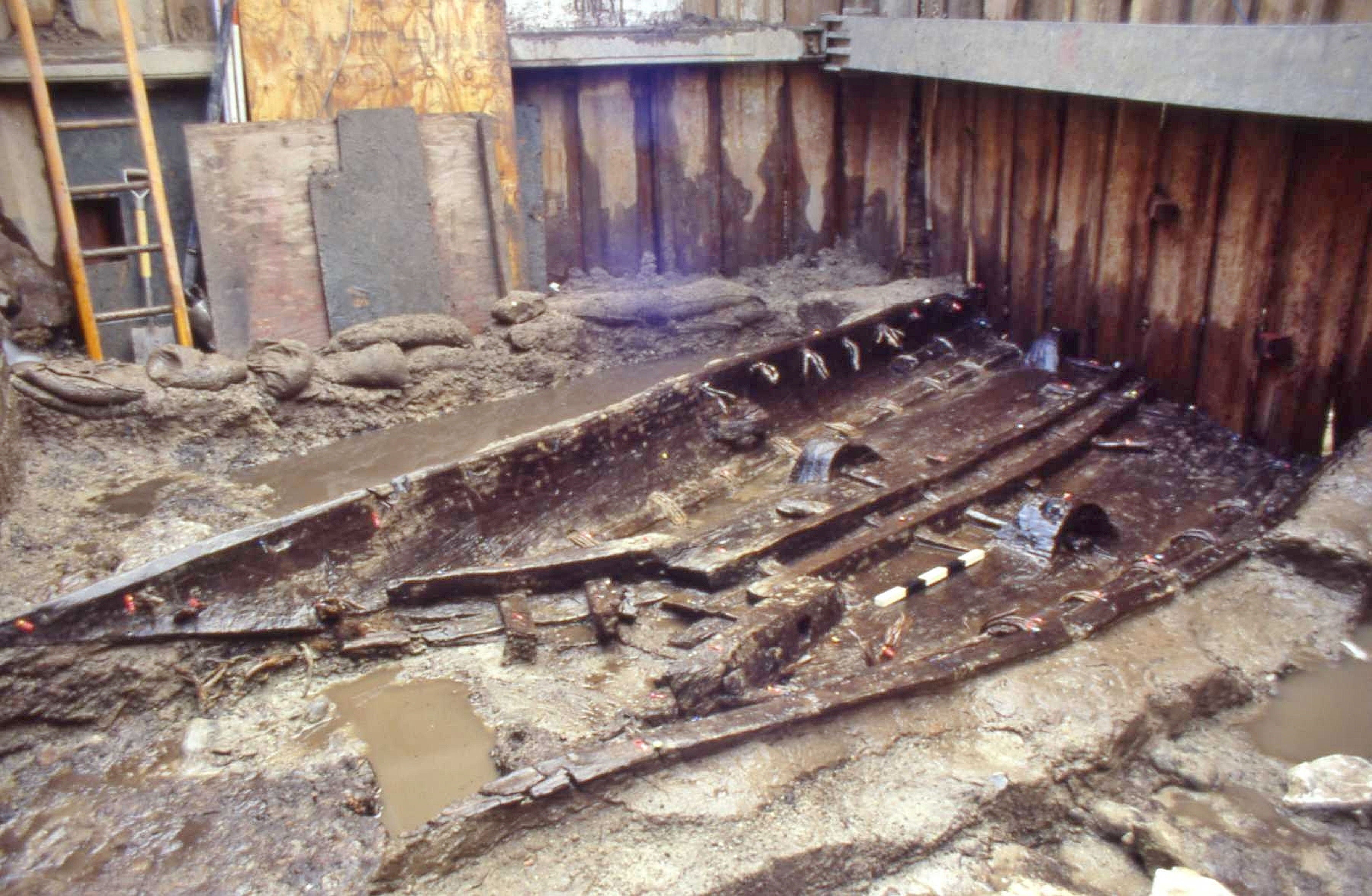
Bronze Age Boat discovered 28 September 1992 when Townwall Street was being excavated. Nick Edwards

Bronze Age Boat discovered 28 September 1992 when Townwall Street was being excavated. Nick Edwards

The world famous Bronze Age Boat was found on Monday 28 September 1992. At the time the new A20 into Dover was being built and work was about to get underway on the underpass between Bench Street and New Bridge. The underpass was being created to provide pedestrians with the only safe crossing of the new major road to the town’s seafront. On that memorable morning Nick Edwards was digging out earth for the underpass using a Caterpillar excavator for the contractors Norwest Holst. Observing the excavation was Canterbury Archaeological Trust’s Field Director, archaeologist Keith Parfit. The hole was about 18foot wide and when Edwards’ was about 18 foot down Parfit called a halt as he thought that he saw some timbers.

On examination, Parfit found that the timbers were ancient and he immediately contacted the consulting engineers, Mott Macdonald and along with Norwest Holst managed to negotiate a three-day halt in order to carry out a further assessment. It quickly became apparent to Parfit that the timbers were part of the lower portion of a boat that was intact apart from the damage to an area caused by the Caterpillar. The timbers, Parfit reported, extended across the full width of the pit, being the mid-section of a very well preserved ancient plank-sewn boat. Further negotiations with the contractors gained an extension to six days to carry out further excavations and assessments with a view to leaving the Boat in situ. However, the road engineers, who carried out an appraisal to look into the possibility to either raising or lowing the underpass, in order to leave the boat where it was, reported that this was not possible.

This meant that if the Boat was to be saved and preserved it had to be removed. A team of archaeological experts was called in and they concluded that due to the nature of Boat’s fragile construction, along with the time factor and damage already sustained, to safeguard its key structural features it would be safer to cut it into manageable segments. Intense recording then took place and on Saturday, 3 October, in conjunction with English Heritage conservators, the Boat was cut into ten sections each identified with a different letter. Each section was manoeuvred onto a pallet then stored in custom-built water tanks to slow down decay, while the mid-section was reconstructed using facsimiles of Bronze Age tools.

Although not all the Boat was excavated, it was assessed as probably being 42 feet in length (14 metres) and 9feet broad and about 27 feet was lifted. From the boat’s construction, it was concluded that it had been built by a master boat-builder of the Bronze Age era. The Boat has cleats and a central rail carved from two large oak base planks held together by traverse timbers. The side planks are held in place with individual stitches of twisted yew wood with moss caulking between the joints. It was carbon dated to circa 1300BC making it the oldest known sea-going craft in the world.

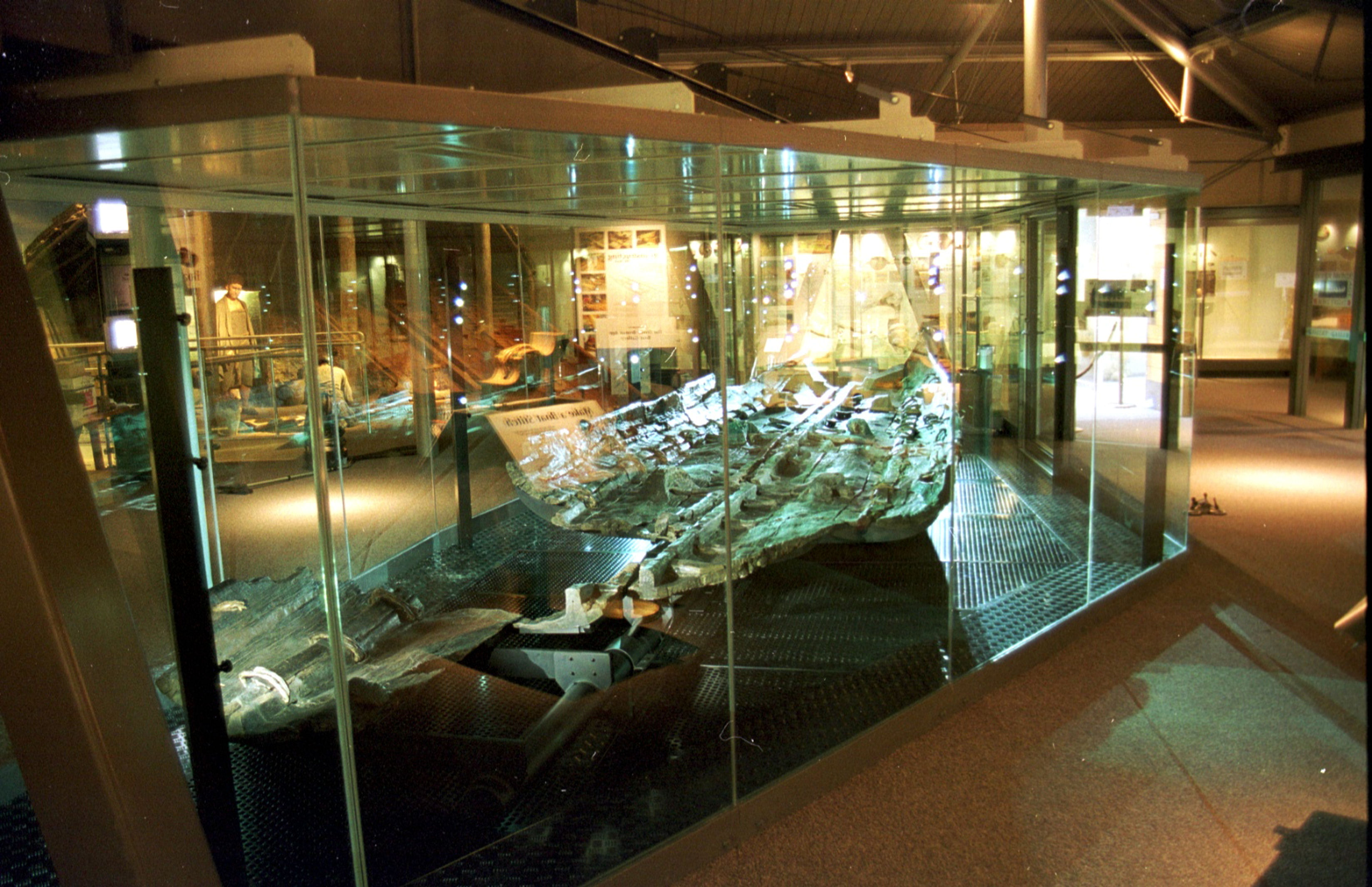
Bronze Age Boat in its own special gallery on the third floor of Dover Museum. pix from Dover Museum

Bronze Age Boat in its own special gallery on the third floor of Dover Museum. pix from Dover Museum

After undergoing special preservation treatment the Bronze Age Boat was brought to the Dover Museum and housed in a specially constructed gallery on the top floor. From the analysis carried out, it is believed that the Boat would have been suitable for carrying a significant cargo at a reasonable speed, in rough weather and possibly over long distances. Although no cargo was found, a small piece of unworked shale at the bottom of the boat proved, on analysis, to originate from Kimmeridge Bay, near Wareham – Dorset, some 160 miles to the west of Dover.

November 1999 saw the official opening of the Bronze Age Boat’s specially created exhibition by Robert Leigh-Pemberton, Baron Kingsdown (1926-2013) former Lord Lieutenant of Kent (1982-2002). And on 20 July 2005 Her Majesty, Queen Elizabeth II visited the museum specially to see the Bronze Age Boat.

At the time when the Bronze Age Boat was traversing the sea off Dover, the River Dour – the 7-mile river that serves Dover – was much wider and deeper than today, with wide tributaries. The tributaries were on the west side of the valley and over time they cut the chalk hills into broad almost parallel valleys we see today. The east side of the Dour valley lacked any such tributaries, but nailbournes – intermittent streams fed by underground springs – were, and still are, in abundance. Archaeological evidence strongly suggests that there was a significant growth in the population of the area in the Bronze Age and this was confirmed on 14 August 1974.

Bronze Age artefacts, circa 1100BC, found by members of the Dover Sub-Aqua Club at Langdon Bay, east of Dover Harbour. They can be seen in Dover Museum. L Sencicle

Bronze Age artefacts, circa 1100BC, found by members of the Dover Sub-Aqua Club at Langdon Bay, east of Dover Harbour. They can be seen in Dover Museum. L Sencicle

That day, divers Simon Stevens and Mike Hadlow of the Dover Sub-Aqua Club found bronze artefacts dating from around 1100 BC at Langdon Bay, to the east of the present Dover harbour. These included winged daggers and spearheads. Over the following years some 400 similar items, as well as jewellery, have been recovered. Most of these are now in the British Museum but there is a small display in Dover Museum. These findings have led to the speculation that they were the cargo of a Bronze Age scrap metal dealer and were probably going to be recast into tools! The site where they were found is protected under the 1973 Wrecks Act. Other Bronze Age artefacts include a priceless gold cup that was found in 2001 in a farmer’s field.

From all this evidence and from the later Iron Age (700BC- 43AD), has led to the conclusion that cross-Channel sea going vessels were operating throughout that time Further, the Iron Age is characterised by the introduction and spread of iron tools and weapons from the Continent. Dover, throughout that time was economically closely tied to northern France, especially the French port of Wissant. Although, it is thought that the Celts, who were highly skilled craftsmen, may have inhabited the Dover area, it is known that with the expansion of the Roman Empire there was an immigration of Belgics, from north-west mainland Europe. The Belgics were skilled craftsmen and formed large settlements including one near Court Wood, between Dover and Capel. Of interest, when the new A20 was being built in that area, archaeologists found a considerable quantity of related materials. All of which has led to the opinion that Dover had a thriving boat building industry in those early years.

Romans

Roman Galley drawn 16th centuary Metropolian Museum of Art. Wikimedia

Roman Galley drawn 16th centuary Metropolian Museum of Art. Wikimedia

The Romans arrived on British shores in 55BC, in a fleet of galleys headed by Julius Caesar (circa 100BC-44BC). Caesar considered Dover was the best place to land as it was perceived as the only sheltered haven on the south-east coast close to the Continent. However, the resident Britons did not agree and quickly made their presence felt. So the Romans turned east and landed at Walmer. Albeit, in the summer of 43AD, Claudius Caesar (10BC-54AD) ordered the invasion of Briton for the Roman Empire. This force again arrived in Roman galleys and consisted of approximately 40,000 troops, under General Aulus Plautius (44BC-01AD). They landed at Richborough, near present day Sandwich, where they established a bridgehead.

In essence, the Roman galleys were large rowed boats with a sail for favourable winds. They were light but strongly built and steered by a steer board – or starboard – suspended from the right-hand side of the ship close to the stern. Some galleys had two steer boards one deeper then the other and each was controlled by a small tiller that rotated the steer board in the direction required. When the ship heeled to port, the deeper steer board was more effective but harder to handle than its counterpart. On the aft part of the deck was a cabin surrounded by a substantial bulwark. Upon engaging the enemy the galley fleet formed lines abreast to give each other protection while confronting the enemy from their bows. Each ship was equipped with rams, grappling irons and missile-hurling devices for this purpose.

Stylised drawing showing the Classis Britannica, the pharos on the eastern and western heights and the Roman harbour. Dover Museum

Stylised drawing showing the Classis Britannica, the pharos on the eastern and western heights and the Roman harbour. Dover Museum

Excavations and research has shown that General Plautius became the first governor (43 to 47AD) of Britain. It was during this period that a fortified ‘castle’ with towers and earthworks was built on the western side of the Dour estuary with quays along the riverbank. Across the estuary, a seawall was built in a straight line between the two-free standing Pharos or lighthouses and in the centre was the harbour entrance. The Pharos were built from blocks of tufa, a form of limestone formed by the shells of minute fish accumulating around a nucleus, such as flint. The tufa used at the times of the Romans almost certainly came from the bed of the Dour as it has been found in many places along the Dour valley. Most notably in St Andrew’s Churchyard – Buckland, London Road, Barton Road and the Peter Street area. The Roman Pharos (lighthouse) on the Eastern Heights, some 43-feet (13-metres) in height, is the oldest surviving building in Britain and can be seen in the grounds of Dover Castle. A corresponding Pharos on the Western Heights was also built not long after the Romans built their harbour.

Roman Merchant Ship - 2nd century, note the artemon on the bow and steerboard. Frank E Dodman

Roman Merchant Ship – 2nd century, note the artemon on the bow and steerboard. Frank E Dodman

Once the military base and harbour were established, merchant sailing ships started to arrive. These were up to about 100feet in length with a broad beam to provide cargo capacity. Occasionally the crew rowed but on the whole, they relied on loose-footed square sails that were rigged in a fashion that was to be retained for over a thousand years. Some galleons were fitted with an artemon, a form of bowsprit on which was set a yard and a square sail of particular use when the wind was astern. At the waterline the hull was about the same at each end and the upper part of the hull was strengthened by external wales (planks of wood), which ran from stem to stern. The stern post often featured a swan looking aft, while both military and mercantile ships were given names often after Roman Gods.

It has been shown that the River Dover was tidal and navigable as far as Charlton Green, one-mile inland, when the Romans built the Classis Britannica, in about 130AD. This was confirmed by Kent Archaeological Research Unit (KARU) under the direction of Brian Philp in the 1970s, who found buildings that made up the Classis Britannica Fort. The Fort was effectively the headquarters of the Roman Fleet. It has been conjectured that during this time, due to earth being washed down the valley by the Dour meeting the shingle washed into the estuary by the sea, a shingle bank formed. For this reason, the Romans moved their harbour eastward reclaiming the site behind the shingle bar. This accounts for where the Roman Quay was found by Edward Knocker (1804-1884), in the mid-19th century.

Over the course of 500years of Roman occupation, both galleys and merchant ships were built in the vicinity of Dover.  As Dover was a major Roman naval base, for a long time this was probably undertaken by skilled Roman shipbuilders brought from Italy. Archaeological investigations undertaken at Portus near Rome have found inscriptions indicating the existence of a ‘guild of shipbuilders‘ during the time of Emperor Hadrian (AD117 to 138). There is little doubt that locals adopted these skills for their own maritime needs especially fishing and mercantile activities. Later in their occupation, the Romans built a larger fort, believed to be a part of the Roman Shore forts erected around 270AD along the coast. These were part of defensive measures against increasing Saxon incursions and by this time locals had refined their skills as shipbuilders.

Saxons and Vikings

Saxon model in Dover Museum. LS

Saxon model in Dover Museum. LS

As rulers, the Saxons (c450-1066) followed the Romans and in 596AD, Augustine, a Benedictine Monk, arrived in Kent introducing the Christian religion. A year later he became the first Archbishop of Canterbury, converted Æthelberht King of Kent (560-616) and soon after the King’s son, Eabald (616-640), founded a college for a group of Secular Canons in Dover ‘castle’. The castle referred to at this time is believed to be the former Roman Shore fort. In 691AD, Wihtred (c.690-725), King of Kent, following a victory in battle that was attributed to St Martin, ordered a new monastery to be built in the Saint’s honour. This was for the Canons at Dofras – the early Saxon name for Dover – and St Martin was pronounced the patron saint of Dover. Materials for the new monastery were brought in by Dover built ships, being unloaded on quays on the west side of the Dour.

Following the Bapchild Royal Council of 697AD, the Dover Canons were endowed with grants of large tracts of land – including sites along the Dour at Buckland and Charlton. They were also given the lucrative tithe of the passage of the Port of Dover and Dover shipyards flourished under the protection of the Canons. Albeit, while the new monastery was being built the town was frequently the target of attack from sea marauders. To help combat them, King Wihtred ordered the building of a seawall across the seaward face of the delta. Inland, a lane evolved that lead from the centre of town along the harbour to the Eastern Heights and the Roman Pharos. Because of its proximity to the harbour and the mooring posts on the quays, the lane became known as Dolphin Lane. Branching off Dolphin Lane towards the sea, west of the harbour, was St James Lane.

Vikings about to invade from Miscellany on the life of St. Edmund from the 12th century. Wikimedia

Vikings about to invade from Miscellany on the life of St. Edmund from the 12th century. Wikimedia

From about 790AD Vikings from Scandinavia frequently raided the British and French shores, along with many other places, in their warships. In Northern France, having been given the feudal overlordship of the Duchy of Normandy in 1066 they were to have a major influence in English history. The Viking ships were some 70feet in length, narrow with a shallow draft, light and built for speed. Both ends of the hull were the same shape, which enabled the ships to reverse direction quickly without having to turn around. They were built of unseasoned oak and used the Scandinavian clinker technique in building the hull. With the clinker method, the wooden planks were fixed to each other with a slight overlap that had been bevelled for a tight fit. The planks the Vikings used were split or rived, to make them stronger than if sawn. This enabled the hull to be relatively thin – reported as being about 1 inch thick, and the ship’s wooden ribs maintained the shape of the boat. This meant that the ships, which sat low in the water, were both light and manoeuvrable making excellent raiding machines.

The keel was made out of oak planking with each piece riveted together with wrought iron rivets and was part of both the stern and stem. As time passed, this was topped with a highly decorated stern post that was above the gunwale – the upper edge or planking of the side of the ship. The stem post at the bow, an extension of the keel, was even more decorated than the stern post and topped with a large finely carved animal’s head. The Viking ships had oars with a long shaft, or loom almost the full length of the ship, with a flat blade on the end. Initially, while the oarsmen rowed, the oars were held in place with rowlocks. Rowlocks were later replaced by oar ports that allowed the oars to be stored while under sail. A large rectangular sail was hoisted on a single stout mast and the vessels were steered with a large oar over the starboard quarter. Larger ships could travel at five to six knots and up to ten knots under sail. They could carry up to 100 warriors and along the beam the warriors hung their brightly coloured shields.

Hugin reconstructed Viking longboat at Pegwell Bay near Ramsgate. Midnightblueowl on Wikamedia

Hugin reconstructed Viking longboat at Pegwell Bay near Ramsgate. Midnightblueowl on Wikamedia

A replica of a late 9th century Viking ship can be seen on the cliff top at Pegwell Bay, Ramsgate. This is the Hugin, which sailed from Denmark to Thanet in 1949, and was given as a gift from the Danish Government. This was in celebration of the 1500th anniversary of the legendary invasion of Britain by brothers Hengist and Horsa, who landed at nearby Ebbsfleet in the 5th century. The Hugin is a reconstructed replica of the Gokstad ship, circa 890, that was found in a burial mound at Gokstad in Sandar, Sandefjord, Vestfold, Norway. It is currently on display at the Viking Ship Museum in Oslo, Norway.

Vikings introduced more sophisticated shipbuilding and endogenous shipbuilders such as those of Dover copied this. It is documented that Alfred the Great (849- 899) had a number of ships built, based on the Viking design, each of at least 60 oars. These were used, ironically, to counter the Viking raids and later historians regarded Alfred’s fleet as the foundation of the Royal Navy. The fleet won a significant victory in the Battle of Stourmouth at Plucks Gutter along the Wantsum Channel, not far from Pegwell Bay in 855. Following Alfred’s death, the ‘Royal Navy’ was abandoned and maritime skirmishes from potential invaders tended to be dealt with on a local level. A significant number of those who took part in the Battle of Stourmouth were members of Dover’s Fellowship of the Passage. The Fellowship of the Passage comprised entirely of Dover Freemen, which came about when the Kings of Kent ruled. As the town developed, the male inhabitants who had acquired personal property were obliged to pay a share of the town’s rent to the king and also to undertake the call to arms. Albeit, they were classed as Free Men and soon this was corrupted into ‘Freemen’.

Research historians and archaeologists tell us that during the Saxon period the Dour narrowed and divided into two fast flowing branches. These were named East Brook – later Eastbrook, and the West Brook – later Westbrook. The Westbrook was the main outlet to the sea for the Dour and it was along this branch that the town’s quays were situated. Between the two branches there was a delta of dry land and it was here that the burgesses of Dover developed the town’s shipyard.

Dover Seal showing a ship with a steerboard on the left side. Dover Library

Dover Seal showing a ship with a steerboard on the left side. Dover Library

Evidence from ancient seals and documents show that the design of these ships were based on what was perceived with the tools and resources available and the seas they had to traverse and on both Roman and Viking ships. The early Dover ships had the Roman carvel hulls, that is each wooden plank butts its neighbour. Unseasoned oak was used and the joints were still caulked using seaweed mixed with a binding agent. As the wood was unseasoned it is reasonable to expect that the ships had to be kept at sea all the time as berthing them on land would allow the timbers to dry out and shrink, which would cause the hull to become unstable. The actual design of the Dover ships was based on the Viking ships with a number of significant exceptions. For instance, the hulls were deeper in order to carry cargo and on both the bow and stern were storage cabins. The large sails were rectangular and that that the single large steering oar or sweep situated at the stern of the ship was on the port side. They also appear to lack the decoration seen on Viking war ships.

From the documents of that time it would seem that the crew consisted of twenty men and the ships were propelled by oars. They had the large square sail on a central mast that was at its best when the wind was astern. They were steered with leeboard that was shaped like a  large flat hook.

As Dover ships were built for fishing and transporting people, their horses and goods across the Channel and up and down both the Channel and the North Sea, hence the storage cabins. The prime use of the ships was fishing for herrings, as this was the principal trade of the town at that time. Herring was one of the country’s main staple foods and to enable unloading of the fish a small harbour was established at the mouth of the Eastbrook. On being landed the local women would slit open the herrings and then dry them on specially constructed hangers along the seafront. These hangers were also used in rope making. When the fish had dried out, they were packed into barrels in layers alternated with salt for transportation by the Dover ships. The salt was collected from salt pans created at the side of the Eastbrook. As cargo vessels, the Dover ships were also involved in the trade of luxury goods as far north as the Baltic and south to the western Mediterranean and North Africa.

Edward the Confessor window in SSPeter and Paul Church, Charlton. LS 2011

Edward the Confessor window in SSPeter and Paul Church, Charlton. LS 2011

By 1000AD, Dover was known as Doferem and had a thriving municipal boatyard, strong Continental trading links and an established mint. Freemen ruled the town and over time the Dover Freemen amalgamated with those from Hastings, Romney, Hythe and Sandwich and later Rye and Winchelsea, to form the Confederation of the Cinque Ports. The Confederation received a Charter from Edward the Confessor (1042-1066), which gave them rights including freedom of movement, freehold of property, free to run a business and take apprentices for seven years, such that the convention of Dover Freemen was born. By the time of the Conquest (1066), just under half the adult males in the town were Freemen and that ratio would not change for over 600 years. Non-freemen were described as foreigners and had few rights while Freemanship could only be obtained by birth, marriage, apprenticeship, purchasing a freehold and by redemption – an expensive gift to the town.

Edward the Confessor gave these rights as he was particularly interested in the Cinque Ports ships and the Portsmen. In return for the rights, by decree, the Cinque Ports Towns were obliged to provided the ruler of the Kingdom with a Royal Navy that centred on the provision of ‘ship service’. That was the provision of ships and men for 15 days a year to defend the realm. By so doing, he put the Cinque Ports above all other towns in the realm.

In order to be called on for defensive purposes the Cinque Ports ships were fitted with three ‘castles’ or raised platforms to accommodate the king’s soldiers. These were at the front, fitted on top of the existing storage cabin and called the forecastle that was later abbreviated to focsle, a term still used today. One at the stern again fitted on to the top of the existing storage cabin and called the stern castle and a lower one fitted directly on to the deck around the mast. The Cinque Ports shipbuilders also gave the bow stem a razor sharp edge. When encountering the enemy, the soldiers would fight from the castles in a similar way to that on dry land, while the Cinque Ports mariners would use the razor-sharp bows to strike the enemy ship amidships to sink the opposing ship. Following the fracas, the opposing ship would be left to sink and those on board, drown.

Location of major events during the Norman Conquest of England in 1066, adapted Peter Marren

Location of major events during the Norman Conquest of England in 1066, adapted Peter Marren

Prior to the Battle of Hastings on 14 October 1066, King Harold II (1066) of England, had been defending the country from invasion by his brothers, Tostig Godwinson c1026-1066) – Earl of Northumbria, and Harold Hardrada (c.1015-1066) – King of Norway and known as Harald III (1046-1066). Both were killed by Harold’s forces on 25 September, at the Battle of Stamford Bridge, East Yorkshire. To meet his foes Harold had taken his army and the Cinque Ports fleet north but while he was away the Viking descendent, William of Normandy (1028-1087), took the opportunity to invade. The winds were in William’s favour and his ships and army landed just outside the Cinque Ports town of Hastings. On hearing the news, Harold marched his army southwards having issued an order for the Cinque Ports ships to take on William’s invasion force. However, the winds that had helped William’s ships were against those from the Cinque Ports and the men had a struggle to row southwards. Hence, they did not arrive until after William’s forces had landed and Harold was killed and his tired army soundly beaten.

Following the Norman Conquest, the Cinque Ports, in 1069, were called upon to prove their loyalty to William I (1066-1087). They prepared their ships for battle and with a full retinue of soldiers they sailed to meet the King’s enemy. However, due to the direction of the wind they were unable to use their favoured method of attack and William expected that they would give up. This, the King assumed, was confirmed when the Cinque Ports mariners steered to windward of the enemy fleet. However, when the enemy ships were downwind, the Cinque Ports mariners heaved-to and threw large quantities of lime that they were carrying, at the enemy. This temporarily blinded the King’s enemy and enabled William’s soldiers to annihilate the opposition.

William recognised this as the Cinque Ports showing their loyalty to the monarch, so he granted them all the rights and privileges they had previously enjoyed in return for the established ship service. For Dover, William particularly assured the town’s Burgesses that the harbour would remain the base for the Royal fleet and as in Saxon days when the local ships were used for domestic duties, they used Eastbrook harbour. The much larger Westbrook harbour, with quays alongside what is now St James Lane, was used when the Cinque Ports ships were fitted out for ship service and unloading building material for St Martin-le-Grand monastery and other Norman buildings in the town.

To rule his newly acquired country effectively, William created palatinates and the Kent palatinate was under his half-brother, Odo the Bishop of Bayeaux (d1097). Odo, unfortunately, ordered a tidal mill to be built on the seashore close to the mouth of the Westbrook and it is believed that this mill allowed the build-up of silt. This eventually blocked the Westbrook and the entrance to Dover’s main harbour. In consequence the Eastbrook of the Dour increasingly became the main outlet to the sea and the town’s main harbour.

18th Century sketch of the old St James Church, the mariners church from 11th to early 19th century.

18th Century sketch of the old St James Church, the mariners church from 11th to early 19th century.

The Eastbrook emptied into the sea near Warden Down – the cliff that Castle Hill Road traverses – and the harbour was approached through Eastern Gate. Around this harbour Dover seafarers had long since settled and to serve their spiritual needs, the mariners St James old Church was built. At this time, the harbour seems to have entailed very little expenditure on the Corporation and the number of shipyards increased with both freemen and non-freemen sons being offered apprenticeships. Once they had served their apprenticeship and proved their skill, the young men were granted freemenships. This not only gave them the right to run their own businesses, train apprentices etc. they could also take an active role in civic affairs.

As the shipyards developed, the number of associated trades increased and those with skills gained elsewhere by apprenticeship were awarded with freemanship on payment. A skilled ship’s carpenter’s tools at this time would comprise of a trestle for cutting or splitting planks of oak using double ended saws. The oak planks were refined to meet the shipbuilder’s specifications by using handsaws and tools developed by the individual craftsmen. If the wood was to be shaped, to make it pliable the plank was placed in a long steam box and the water heated to the boiling point – 212degrees Fahrenheit or 100degrees Celsius. Businesses such as blacksmiths, ropemakers, riggers and sailmakers also set up and like the shipbuilders and carpenters, initially they served their apprenticeship, and gained their freedom by hereditary or purchase. Once purchased their freedom became hereditary for their descendants.

Cinque Ports ship early 14th century note the rudder. Dover Library.

Cinque Ports ship early 14th century note the rudder. Dover Library.

From the increasing availability of top-class products the shipwrights built an increasing quantity of top quality vessels that incorporated new innovations. Typically oak, their favoured wood was seasoned before used. Seasoning involves the drying out of fresh of green wood as this contains about 50% water. By reducing the moisture content the wood adds strength, elasticity and durability properties to the finished ship. Another, later, significant innovation were rudders for steering or directing the ship. They were hung on the stern post, which were straightened for the purpose. By having rudders, the ships no longer required the large, difficult to handle, inefficient steering oar.

About 1200AD the sea started to encroach the Dover shipyards area. To protect them and the town, the Corporation assisted by the Lieutenant of the Castle, built a retaining wall. This was from where Snargate and Bench Streets meet today to the west side of Eastbrook and called the Wyke – later renamed the Old Wyke. This had the effect of creating an inlet of the sea and a small cove on the west side of the eastern mouth of the Dour. It was on the margins of this cove that the shipyards reopened and the Wyke along with its maintenance was paid for out of the profits of the Passage and fines on maritime activities imposed by the Lord Warden. When the Wyke was completed, behind it a level, quay was built and for the first time the town had a commodious quayside where passengers and merchandise could embark and disembark.

Embarkation of Edward III for France from Dover in a Dover built ship 1359 A window in the Maison Dieu Stone Hall. AS

Embarkation of Edward III for France from Dover in a Dover built ship 1359 A window in the Maison Dieu Stone Hall. AS

This attracted both merchants and passengers to the port and it became more lucrative for the ship owners to carry them rather than supporting the Crown with ship service. The larger ship owners tended to hold the high positions on the Council and thus volunteered the ships of the smaller businesses for ship service while they monopolised the passenger/merchant services. This led to changes in ship design with new ships being built for the passage, having deeper holds and hulls of better quality wood etc. Those ships used in ship service tended to be repaired older ones and Edward III (1327-1377) attempted to put a stop to the practice. He did this by supporting an agreement whereby all Dover ships had to take it in turns to carry passengers/goods across the Channel. After three such trips, the ship was not allowed to make the crossing until all the other ships in the Dover fleet had undertaken three crossings. Further, all ship owners had to provide ships and crew for ship service by rotation and any ship owner that violated these agreements faced a penalty of one hundred shillings sterling. The town’s bailiff levied this, and the money raised passed into the hands of the Lord Warden, who therefore had a vested interest in assuring the agreement was adhered to.

Once this became routine, the Cinque Ports ships and the mariners who sailed them returned to being held in high esteem by the King and the demands for their services by the Crown increased though the payments for using the ships was not forthcoming. This had a negative effect on the town’s economy as the shipbuilders were unable to pay for building or repairing materials. Edward III, totally misunderstanding the situation he was causing, in 1355 authorised the mayors of the Cinque Ports to employ ships’ craftsmen with the necessary skills to help build and repair ships for fighting purposes. However, he still failed to pay for the ships and Dover and the rest of the Cinque Ports shipbuilding industry went into serious decline. Five years later an unstable peace existed that was to last nine years and the Cinque Ports were ordered to use the time to replenish their fleets but no money was provided. During these years the English lost complete control of the Channel and hostilities were then renewed.

Richard II (1377-1399) from a window in the Maison Dieu. Alan Sencicle.

Richard II (1377-1399) from a window in the Maison Dieu. Alan Sencicle.

Due to the lack of ships, the King was forced to pay merchants to use their ships for defensive purposes. Albeit, he failed to pay the mariners for sailing the ships along with his soldiers. This not only resulted in increasing anger but the lack of ships and soldiers based at the Castle to defend the Cinque Ports gave the French the opportunity to take advantage of the situation. This happened within a week of Edward dying on 21 July 1377. The French attacked the undefended Hastings and Rye and also appeared off Dover but did not attack. Instead, they sailed east then north entering the Thames and burnt Gravesend. His 10-year-old son, Richard II (1377-1399), succeeded Edward III and the war with France was resumed. Pressure was put on the young King to pay his soldiers, mariners, shipbuilders’ etc. and a poll tax, at four pence a head from all lay people over 14, was introduced. This led to the Peasants’ Revolt in 1381 whose leader, Wat Tyler (d1381), came from maritime Kent. During the stand off, promises were made but when the revolt was crushed all the concessions were revoked.

In order to try and build up a maritime defence, Parliament called upon all inland towns as well as ports, to build ships but due to the chronic lack of finance the Cinque Ports were unable to meet the demand. To stave off starvation, the towns were using their only seaworthy vessels to carry wool to Flanders, the major purchaser of English wool. In 1382 a writ was issued for Dover to press shipbuilders and associated tradesmen to work in the industry but by then Flanders had fallen under the influence of France so demand for exports had dried up. From Dover, the mariners were using their ageing, war battered ships, for piracy and Richard II, although recognising the cause of the problem did not have the financial resources to draw on. Instead, he issued a Charter in 1381 that stated, ‘no pilgrim shall pass out of our realm to Foreign parts except from Dover under the penalty of imprisonment for one year.’ This started to help Dover’s declining economy and two years later an expedition was mounted with the aim of opening the Flemish markets to the wool trade. The French were not interested in England’s wool and local mariners returned to piracy when not transporting pilgrims across the Channel. Together, these did increase the demand for the classic ships and classic Cinque Ports ships were produced.

In October 1396, Richard II landed at Dover with his second wife, Isabella of Valois (1389-1409), a child of eight years of age. Two years after the murder of Richard II she was reconveyed to France from the town by three ‘balyngers’ and two armed barges on 1 July 1402, ‘without her dowry and plundered’. A balynger was a vessel that could be propelled by either oars or sails and the name is supposed to derive from baloena – a whale. John Shute of Dover was the owner and he received £92 6shillings 8pence for his expenses and for bringing back the retinue of lords and ladies who accompanied the widowed Queen.

The town was in terminal economic decline and in an attempt to raise revenue to pay for new ships, the Corporation introduced wharfage dues for the use of the Wyke. This included the towns’ mariners and needless to say, this led to an uproar. During the minority of Henry VI (1422-1461), Humphrey of Lancaster, 1st Earl of Gloucester (1390-1447), was both the Lord Warden and the Protector of the Realm and in 1424, in the King’s name, he granted a Charter to the people of Dover free wharfage to their ships forever. This remained on the Dover Harbour Board’s statute book until the twentieth century when they quietly had the privilege revoked.

Map of Dover Harbour pre 1450

Map of Dover Harbour pre 1450

In a Charter of 1440, it stated that ‘the inhabitants of the town have almost entirely left it and half the town is empty and desolate, and its houses have, in many cases, fallen into ruins, will very likely be destroyed, and the inhabitants compelled to leave it, it is said, unless some fitting remedy be provided quickly.’ Henry VI had issued the Charter in order to try and reverse this situation by encouraging ship building saying, ‘the construction of ships for the passage, so that they might be trustworthy, strong, and good, as well in timber as in workmanship, also in ironwork and in all other things that shall appear requisite and fitting for strength and security.’ However, due to the lack of finance to undertake shipbuilding Dover could not afford to build any ships. Hythe and Sandwich could and in consequence increased their production and poached all the cross-Channel traffic from Dover, leaving the town destitute.

Further, the Eastward Drift – a phenomenon caused by the tide sweeping round Shakespeare Cliff and depositing masses of pebbles at the eastern end of the bay, was causing significant financial problems, as the pebbles had to be constantly removed from the entrance to Eastbrook Harbour. Then when the town thought that matters could get no worse, there was a major cliff fall from the Eastern Heights, blocking the harbour and rendering the Eastbrook harbour useless and causing serious flooding. Consideration was given to abandoning the town, as there were only a few inhabitants and the religious houses remaining. The remaining mariners moved their ships to a sheltered area at the western end of the bay where Archcliffe jutted out. This gave just enough protection from storms and from there they earned a living fishing.

Tudor Period

Wyke or Wick Tower - built by John Clarke 16th century for mooring ships. From a British Museum print. Courtesy of Dover Library

Wyke or Wick Tower – built by John Clarke 16th century for mooring ships. From a British Museum print. Courtesy of Dover Library

Around 1495, Sir John Clark, Master of the Maison Dieu, on successfully seeking Henry VII’s (1485-1509) patronage, designed and constructed a jetty near the mariners’ cove. Known as Clark’s Jetty it had towers for ships to be moored, one of which was Wyke tower. This sheltered the cove from the Channel seas and was such an improvement that the mariners called it Paradise Pent – later Little Paradise. Ship repairing and building started up again on the seafront near to what had been Eastbrook harbour. The ships that they produced were small sloop rigged craft of about 40-tons. The mariners quarter on reclaimed land at the western side of the Bay, had become known as the Pier District after a pier built by Henry VIII (1509-1547). This area grew significantly following harbour works carried out by Thomas Digges (c1546-1595), of Wooton during the reign of Elizabeth I (1558-1693). Snargate Street, named after the medieval Snar Gate believed to have been built in 1370, was almost the only access to the area from the rest of Dover.

15th century Carrack ship. Note the lateen sail at aft end. In 16th century more sails were added. Frank E Dodman

15th century Carrack ship. Note the lateen sail at aft end. In 16th century more sails were added. Frank E Dodman

During this time innovations were taking place in shipbuilding which had passed Dover by. These included the development of caravels, small highly manoeuvrable ships, by the Portuguese for exploration of the African coast. They had gently sloping bows and single stern castles, two masts and on the mizzenmast lateen sails could bet set for speed, particularly when sailing to windward. Lateen sails were triangular with a long yard held at an angle of 45° to the mizzenmast. The other major innovation in shipbuilding was the carrack. This was a much larger three or four-masted ocean-going sailing vessel of up to a 1,000tons with significant cargo space for long journeys and enabling it to carry large payloads. The carrack initially had one large sail, as shown in the picture, but as the 16th century progressed the number of square sails were increased to provide a much larger sail area. They were hung above the courses on the mainmast and foremast. The mizzenmast was rigged with a fore-and-aft triangular lateen sail and sometimes a square sail was hung beneath the bowsprit forward of the bow. They had high stern castles and an even higher fore castle thrusting out over the bow. These ships required a large crew to handle them and they were usually armed with cannons.

Map of Dover harbour 1596 after the Thomas Digges improvements. Alec Hasensen

Map of Dover harbour 1596 after the Thomas Digges improvements. Alec Hasensen

Thomas Digges had utilised the physical changes occurring in the Dover Bay, enclosing a large area into which the Dour flowed. This was named as the Great Standing Water or Great Paradise Pent. A floodgate and sluice were inserted in the embankment that is now Union Street. This enabled the Great Paradise Pent to empty into Paradise Pent and clear any shingle blocking the harbour gates. To protect the town during periods of heavy rain that caused flooding, a sea wall was built. Work began on 13 May 1583 and was finished about 1586, at a cost of £7,495, becoming the foundation for the Western Docks. To pay for the works Elizabeth I (1558-1603) in 1579 granted Dover the right of ‘Passing Tolls’ – a tax that was initially 3d (1.25p) per ton, was paid by all ships passing through the Strait of Dover. The Passing Tolls Acts were to be renewed many times over the next 400 years and the money collected was only used for harbour repairs.

On completion of Digges harbour, the shipbuilders moved to the Pier District beach by the seawall and supporting industries such as blacksmiths and sailmakers were set up nearby. As an ancient industry, the town’s Ropewalk was further east near the back of present day Gateway flats. Nationally, the large carracks dominated shipbuilding and these were used both as warships and merchant ships in the same way as the earlier Cinque Ports ships. To build and repair them large shipyards, under the patronage of the Crown opened. These were Portsmouth (founded 1496) Woolwich (founded 1513) and Chatham (founded 1547). Also, on the River Thames, the East India Company (founded 31 December 1600) opened a large shipyard at Blackwall. In Dover, the shipbuilders built fishing boats for their own/family use and incorporated aspects of both carracks and the Portuguese caravels for small sloop rigged craft of about 40-tons, as passage ships.

One of the locals who set up a shipyard at this time was Dover Freeman, Edward Kempe (1563-1612). He may have been the son of Thomas Kempe of Dover and therefore christened on 4 April 1563, and if it was, he gained his Freedom by hereditary. In 1588, at the time of the Spanish Armada, John Tench (d1589) was the Mayor of Dover but then died the following year. Mayor Tench had married Alice, daughter of Thomas Legent who was well known as a formidable lady that successfully organised many of the town’s civic functions as well as her husband’s political career. On the death of John Tench, Edward courted the widow and on becoming Mrs Kempe, Alice not only successfully organised Edward Kempe’s civic career but also his shipbuilding business.

Elizabethan Galleon, typical of the ships that the Kempe shipyard built. Frank E Dodman

Elizabethan Galleon, typical of the ships that the Kempe shipyard built. Frank E Dodman

Until Alice came along, Edward Kempe was producing similar ships to those of the neighbouring shipyards, but Alice managed to gain an order to build a galleon. This Kempe built out of seasoned oak and generally followed those produced elsewhere. It was under 500tons and had a square tuck stern. Although the forecastle projected forward, it was smaller than that of a carrack and further back. His galleon  incorporated a snout or head, for the crews’ latrines below the level of the forecastle. As typically, the ships had portholes on the gun deck to allow guns to be mounted lower in the hull and not just on the deck, so did Kempe’s. This enabled more powerful guns to be used that would not capsize the ship when fired. On the successful production of this prototype, orders came in and each subsequent ship became increasingly streamlined and therefore, faster.

By that time a spritsail was attached to the bowsprit so the Kempe shipyard adopted this too. In 1599, Kempe was elected Mayor and again 1612 but that year he died while in Office. The shipbuilding business, the most prosperous in the town, was taken over by Alice Kempe and their son, Edward Kempe. Edward Kempe senior was given a public funeral at St James’s Church where a monument was erected to his memory. Of the funeral, the Council minutes record states that in the funeral procession, immediately after the Jurats and Common Councilmen and son and heir, Edward Kempe, followed ‘Mrs Mayoresses and her daughters in mourning gowns.’

Stuart Period

Caravel from the archives of Pearson Scott Foresman, donated to the Wikimedia Foundation

Caravel from the archives of Pearson Scott Foresman, donated to the Wikimedia Foundation

During this time, production in Dover started on ships that specialised in taking pacquettes – Royal messages etc. across to the Continent. Couriers, riding fast horses from London would carry the pacquettes and on arrival at the port, the pacquettes would be stowed aboard a passage ship that would leave Dover or the French port on the following high tide. The ships that carried the despatches became known as pacquette boats and finally packets. For this purpose Kempe and other Dover shipyards built ships with features more akin to the Portuguese caravels than galleons, with such features as a lateen sail. By 1624, there was a well-organised Dover packet service to and from Wissant, Calais, Boulogne and Dieppe and a timetable had been introduced to attract the travelling public. For the owners of the packet ships, this quickly became a lucrative business, for although they were fined if the despatches arrived late, they received a regular premium to operate the service and they charged the travelling public high fares. Further, the ships were cheaper to build and therefore to buy and they required considerably less crew than the galleons.

The port of Dover had effectively developed into a ‘Freeport’, where goods were stored for trans-shipment in large warehouses that lined the seaside of the harbour and owned by the Braemes and Hammond families, amongst others. These goods were usually deposited by ships from the Continent and temporarily stored until they were picked up by ships going further afield, or visa-versa for a payment of less than half the duty demanded by regular Governments duties. In 1633-34 overseas products reshipped from Dover were at least twice as many as English products exported. C.W. Chalkin, in his book Seventeenth Century Kent: A Social And Economic History, tells us that in 1629 Dover had the largest volume of shipping in Kent, with thirty-six vessels totalling 2,063 tons. Dover shipbuilders had met the spin-off from the trans-shipment trade by producing galleons that were wider on the beam and deeper draft in order to carry merchandise across-Channel.

For travellers, although slower than packet ships and dependent on adequate amounts of cargo before setting off, passage ships – as the cargo carrying galleons were referred to, offered cheaper fares. This highlighted what had become a national issue, as the cost of travelling on packets had become exorbitant. Further, official despatches frequently went missing so James I (1603-1625) appointed Matthew de Quester as the government’s postmaster. Officially, his job was to supervise the carriage of letters ‘to foreign parts out of the monarch’s domains between Dover to the Continent.’ However, Quester made little difference to the service other than effectively introducing a tax – which he may well have pocketed – on merchant’s communiqués. Both merchants and the packet travelling public complained and in March 1633 Thomas Witherings (d1651) was appointed the official postmaster. He organised a system whereby the packets carried the mails to Calais immediately on their arrival at Dover but nothing else. As they were no longer carrying passengers, the timetable was abolished and the packet ships had to wait in France for the despatches to arrive before being brought back to England. The service ran twice weekly boats to Calais, and there was also a French sailing. At other times, the shipowners used the packet ships to carry the more lucrative timetabled passenger trade.

Cullins shipyard Seafood restaurant, Cambridge Road. Dover Harbour Board

Cullins shipyard Seafood restaurant, Cambridge Road. Dover Harbour Board

In 1639 another shipbuilding family opened a shipbuilding business alongside the Kempe shipyard in the Snargate Street area. This was run by members of the extensive Cullen/Cullin family and their legacy can still be seen today in Cullins Yard Seafood restaurant on Cambridge Road. The Cullen family were freehold owners at Great Napchester in Whitfield and quite wealthy. Indeed, Juliana Harvey (born c1576) half-sister of Dr William Harvey (1578-1657), physician to James I and famous for his discovery of the circulation of blood within the body, married a Thomas Cullen of Dover. It is also recorded in a Dover Corporation minute of 14 November 1636 that the premises in Biggin Gate was granted to James Cullen the Master of the Company of Dover leather workers for 21 years for their meeting on all occasions. However, it was brothers Thomas (b1616) and William Cullen (1623 –1678) that went into shipbuilding.

Luke Pepper, the Master of Dover’s Almshouses, in 1634 was the Mayor of Dover when Charles I (1625-1649) demanded ship money off every local authority in the country. Although the country was not at war, the Royal Navy was in poor state and the Royal shipyards did not have the money to build any new ships. Dover shipbuilders were angry as they were expected to subsidise their rival manufacturers. Nonetheless, the King’s writ stated that all authorities, ‘had to provide a ship of a certain tonnage, armed with a certain number of guns, equipped with a specific crew, supplied with provisions for six months and to be ready for service of the King at a certain sea-port on a set day.’ The cost of each ship as described in the writ was estimated at an average of £10 per ton and if the authority could not provide the said ship then they had to pay an equivalent tax. It was estimated that the tax would raise about £10million. It was the duty of the Sheriff of each county to undertake the assessment of the authorities in their jurisdiction and the Cinque Ports were rated at one ship of 800-tons with 320 men. On this basis, Dover was expected to pay £330 per year from 1635 and for the following four years, with a 20% discount if paid promptly.

The first demand for the annual ship money in Kent, was instigated by John Finch, 1st Baron Finch of Fordwich (1584-1660), in 1635. Four years later Dover, along with the rest of Kent, had not paid it or any subsequent demands. The county, in retaliation, was accused of ‘having a sad lack of religion, being sympathetic to Catholics, and a large number of rogues and ale houses.’ Following this, the Cinque Ports were ordered to provide both ship money and 300 soldiers with their clothing and other disbursements or pay £3 per man. The Ports petitioned Parliament saying that they could not afford to pay but by the time the complaint was to be heard, Parliament had been dissolved.

Collier Brig 'Brotherly Love'. Hamlyn Group Picture Library

Collier Brig ‘Brotherly Love’. Hamlyn Group Picture Library

By the outbreak of the Civil War (1642-1651) the Cullen shipyard was producing collier brigs used for carrying coal from the northeast to Kent. They were two masted, between 100-300ton and built to a standard design with square sails and fore and aft staysails. In 1641 Thomas Cullen was elected the Mayor of Dover and was holding the position at the time the Civil War broke out. Like most in the town, he was inclined towards the Parliamentarians but that summer shiploads of horses and men arrived for Charles I’s army, from the Continent. Alarmed, on the night of 20-21 August, local man, Richard Dawkes (b1606) together with 30 men scaled the Castle walls and disarmed the sleeping guards. Surrounding the porter’s lodge, they banged on the door until the guard opened it and surrendered the keys. They then locked the Castle gates, collected the ammunition and sent word to the town for reinforcements.

At the time Sir Edward Boys (1579-1646) was the Lieutenant of the Castle and he told Thomas Cullen, to ignore the request. Boys also raised a Trained Band – local army volunteers – in order to starve the men out. Although most of Dawkes men deserted him, ‘some good and well-affected people of the Town…’ did manage to send weapons and ammunition and Dawkes managed to get a request for help to Robert Rich, 2nd Earl of Warwick (1587-1658). Help quickly arrived and included two ships, ‘to ride near the castle, and to keep town in awe, till Parliament shall do something for settling thereof.’ This persuaded Boys to revoke his previous order and Mayor Cullen with the townsfolk went to help Dawkes and colleagues. The Castle fell into the hands of the Parliamentarians and Cullen ordered the town council to ‘chaine upp the streetes and to fortify the towne at all speed’. This cost £100 for ‘worke and labour.

The Parliamentary leaders fearing that Irish Catholic troops would join the Royalist army requested the aid of the Scots. The Scottish Presbyterian Covenanters promised their aid in return for the Scottish system of church government to be adopted in England. This was accepted by the majority of what became known as the Long Parliament, formed 1640 and continuing until 1653. In consequence, The Solemn League and Covenant was drawn up. This was effectively a treaty between the English Parliament and its Scottish counterpart for the preservation of the reformed religion in Scotland and the reformation of religion in England and Ireland. Although it did not explicitly mention Presbyterianism it was this group of Protestants it was aimed at. Nonetheless, it gave the green light to the English Independents – another form of Protestantism.

The Cullen’s were English Independents and in 1651 William Cullen was elected Mayor. This was the first of four times he was to hold the office during the Commonwealth (1652-1660), which was introduced by Oliver Cromwell (1599-1658). He ruled the country and during his administration four parliamentary elections were held in Dover. Cromwell dissolved the Long Parliament on 16 December 1653, and introduced by ‘an instrument of Government’ … to the end that the kingdom might be more equally represented.’ This gave England and Wales 395 Members of Parliament – 262 in the counties and 133 in the cities and towns. Dover, like most other towns was allowed to send one representative to Parliament, and in the election of 1654-1656, this was William Cullen.

Albeit, already, Mayor Cullen had been involved in national issues, for instance in October 1651, following Cromwell’s introduction of the Act of Navigation. Under this Act, any goods imported into England or transferred from one English colony to another, had to be carried in English ships. This meant that goods carried on Dutch ships was not allowed into any of the English colonies without paying hefty customs duties. As the legal statutes that gave Dover Freeport status, the new Act demanded that Dutch ships were obliged to deposit such goods at Dover for transferring onto English ships. To ensure that the Act was adhered to, English customs had the right to intercept non-English ships passing through the Strait of Dover and confiscate any unlawfully exported goods and the ship.

Possibly the Battle of Dover 1652 by Catharina Peeters. Wikimedia Commoons

Possibly the Battle of Dover 1652 by Catharina Peeters. Wikimedia Commoons

On 19 May 1652, the Dutch Admiral Maarten Harpertszoon Tromp (1598 –1653) was leading a convoy of 44 ships along the Downs and he refused to strike, that is, lower his flag in acknowledgement of the English fleet. The fleet was headed by Admiral Robert Blake (1598–1657) who had some fifteen vessels under his command. In response, Blake ordered a shot to be fired across Tromp’s bows to which Tromp retaliated with a broadside and a fierce battle began. Mayor Cullen arranged for townsmen to take their ships and help the English. Subsequently the Battle of Dover ensued until the Dutch fleet retired towards Holland. Blake reported what happened to Cromwell and in response, the Council of State wrote to Mayor Cullen wrote that, ‘The men of the Toune who so cheerfully went forth to assist in defence of their country which good seruice of theirs’. They also directed that the Dover men who had participated should be rewarded out of the prizes taken by the English fleet while the town was promised finance to build a new harbour pier.

Within a year it was decreed that Charles I younger son, Henry Stuart, Duke of Gloucester (1640-1660), who was held in Carisbrooke Castle on the Isle of Wight, was to be moved ‘to a fit place beyond the seas.’ On 13 February 1652 a tiny ship, hired by the State, left Cowes but due to bad weather was laid off the Goodwin Sands for three days. The master of the ship sought urgent help from Mayor Cullen, saying that ‘he was most alarmed that his important passenger might succumb whilst in his care.‘ Cullen arranged for the young Prince to be moved to a private house in Deal saying that this had been done with the utmost secrecy and hoped ‘that he would be forgiven for taking a wretchedly seasick child out of the cockleshell that he had been tossed about for three nights.

Following the defeat of the Royalists at the Battle of Worcester in 1651, the Scottish Presbyterians ceased to have a strong influence in England and the various Protestant fractions that made up the English Independents were strengthened. What was happening to the Cullen shipyard during this time is unknown, but religion and politics were synonymous. In 1654, Mayor Cullen ordered the Royal Arms to be taken down from the front of the Dover Court Hall and replaced by the Arms of the Commonwealth.

Charles II landing at Dover 25 May 1660 window. Stone Hall in the Maison Dieu.

Charles II landing at Dover 25 May 1660 window. Stone Hall in the Maison Dieu.

Oliver Cromwell died in 1658 and in February 1660, the Long Parliament reconvened. After issuing a call for the election of a new Parliament, it dissolved itself and on 25 May 1660 Charles II (1660-1685) landed on Dover beach. He had travelled from the Continent on the Royal Naval ship the Naseby, captained by Dovorian William Stokes (1624-1691) and the monarchy was restored.

Although Dover welcomed Charles II, the religious sympathies of the town were still that of English Independents. So, when the King asked for his Royal Arms to be erected in St Mary’s Church, he was forced to make his request statutory before townsfolk complied. Following the Restoration (1660), Stokes, returned to Dover and worked his own ships. Initially, these were built by the Cullen shipyard with a design based on an adaptation of the warships such as the Naseby with similarities to the ships produced by the Kempe ships of the beginning of the century.

Stokes was a member of the Church of England, or Anglican as it was generally termed at this time, and Charles II only accepted Anglicanism. Other forms of English Protestantism as well as Catholics were not tolerated. In 1662 the King’s Commissioners ordered all Dover officials to be Anglicans and therefore Stokes retained his civic position and became one of the most influential person in the town and was elected Mayor on seven occasions. The Cullens, on the other hand, lost their political positions and their shipbuilding business suffered and closed. Further, although Passing Tolls on which the town relied to pay for harbour repairs had been reintroduced following the Restoration (1660), these were considerably less than prior to the Civil Wars. Finally, when the Act expired in 1670 it was not renewed and so the harbour, already in a poor state, was left to the mercy of the wind and the weather.

 Stuart Frigate c1670 Frank E Dodman

Stuart Frigate c1670 Frank E Dodman

Nicholas Cullen (b1655), was possibly a nephew of Thomas and William and was keen on shipbuilding. He may well have honed his expertise in Holland for towards the end of the reign of Charles II the Dutch East India Company presented two yachts to the King. The design and how they were built Cullen knew, as they were similar to the crafts that the Dutch used as fleet tenders. The ships given to the King had bluff (rounded) bows, which were carved in royal insignias, they had gilded sterns and the rigging was simple fore-and-aft. So impressed was Charles II that he ordered fourteen more to be built in England. Nicholas Cullen was possibly involved in building one. The traditional Dutch ships were shallow draught vessels and about 80feet long with leeboards. The ships built for Charles II did not have leeboards as these had been discarded in favour of the square topsail. The ships were also more streamlined for speed.

Cullen took over the almost neglected family shipyard, but due to the harsh religious persecution of Non-Conformists to the Anglican doctorine, it was the only shipyard in the town. Although keen to learn, most of his workers were religious dissenters, thus subject to overt intimidation. They were not allowed to have businesses on their own account nor had they been allowed to undertake apprenticeship training. Stokes still held political power in the town and although paying lip service to this persecution, he went out of his way to protect Dover’s Non-Conformist citizens. As Cullen started rebuilding the family business he was faced with having to train his workers against the over-riding doctrine. This meant that his business rested on the building of collier brigs and most ship owners wanted them to be built as cheaply as possible. They wanted ‘workhorses’ that could be sold or scrapped at the end of their working life. These Cullen produced and ensured a regular full order book. However, due to the lack of skilled men, when Cullen was approached to build larger better quality ships he was forced to turn the commissions down.

In 1677 a Statute for the Realm a survey was carried out, and the one for the Town and Port of Dover stated that ‘The Mayor was William Stokes and the Councilmen were: Captaine Edward Roberts, John Matson, Richard Jacobs, Walter Braemes, Doctor Stephen Goulder, Edward Wivell (d 1716), William Richards, Nicholas Cullen, John Bullocke, Nathaniel Drew, Richard Breton, Frederick de Vinck, Symon Yorke (d1682), William Stokes, Charles Valey, Francis Basnick, Aeron Wellard snr.’ In April 1679 Stokes was elected as one of the two candidates representing Dover in Parliament. The other was Philip Papillon (1660-1736), of Huguenot stock and therefore attended the Anglican church. Dover’s Clerk of the Passage at this time was ship owner Jurat John Carlisle. In a fit of jealousy, he wrote to the Privy Council and complained that Stokes had condoned secret and unlawful religious meetings of Non-Conformists and added that Papillon’s family background showed him to be a Non-Conformist rather than an Anglican.

The Corporation were ordered to close all places where it was believed that Non-Conformist worship was taking place and to arrest six named Dovorians. These were Samuel Taverner (c1621-1715), Richard Matson, Edward Dell (b1599), Nathaniel Barry, Anthony Street and Symon Yorke. Richard Matson was a wealthy ship-owner with large land holdings in East Kent, all of which were confiscated as were all of the other accused men’s possessions. Both Stokes and Papillon were rebuked in Parliament but in 1681, they were both re-elected. Nonetheless, neither attended parliament that had reconvened in Oxford. Although merchants such as the Hammonds and Braemes had refurbished their warehouses and were rebuilding quays around the harbour, as had a Mr Brinder, Dover’s harbour was derelict and the town was in a poor state. Nicholas Cullen was elected Mayor in 1679 and again in 1680, 1681 and 1682 and he invited the Royal Ordnance to make their assessment of the port of Dover.

Sir Henry Shears, an officer in the Department was sent to undertake the task and in 1682 he sent his report to Charles II. He stated that ‘the port was … entirely useless, the pier within, being filled and choked up with sand and mud, and that there was a bank of beach at the mouth of the harbour of many thousand tons, which barred up the entrance; the town, which was wont to abound in shipping, seamen, commerce, people and plenty of all things, was become poor, desolate and despoiled, which is visible everywhere by their decayed buildings and habitations …’

Glorious Revolution

Help was not forthcoming so possibly as an overt act of defiance, Cullen ordered the Mayor’s and Jurats to hold their meetings above the Communion Table in St Mary’s Church. They readily complied and this quickly brought the King’s Privy Council to Dover. Cullen, along with other members of the council, were accused of taking the oath of the Solemn League and Covenant even though it had ceased to have any relevance since 1651 but had been outlawed by the 1661 Sedition Act and this is what they were accused of violating. Nicholas Cullen lost his office as Mayor and was replaced by Stokes. At the same time the town was issued with a new Charter that was aimed at blocking Non-Conformists, or their sympathisers, from holding Office. Stokes, the Anglican councillors and the town in general refused to comply. The town was heavily punished by having to pay hefty fines. In consequence Dover was forced to sell valuable assets including the town’s ancient silver as well as land at knockdown prices.

James II (1685-1688) succeeded his brother, Charles II, and was determined to return the country to the Catholic faith. Possibly at this time Nicholas Cullen went abroad, as did Thomas Papillon and many other non-Anglican Dovorians. Albeit, Dover’s Mayor at the time the King ascended the throne was a Huguenot Robert Jacob. He was selected again in 1688, but was removed from office by the King’s Privy Council.

The coat of arms of William III and Mary II erected in St Mary's Church, Dover c1688 and can still be seen there. LS

The coat of arms of William III and Mary II erected in St Mary’s Church, Dover c1688 and can still be seen there. LS

By the middle of 1688, James II’s days were numbered and plans were afoot for William of Orange (1650-1702) and his wife Mary Stuart junior (1662-1694) to land at Dover and take over the throne. William’s mother was Mary Stuart senior (1631-1660), the daughter of Charles I, while William’s wife Mary was the daughter of the beleaguered James II. On the day William and Mary were due to arrive, about 300 locals took possession of the Castle and remained there all night. However, due to a strong easterly wind William had continued to sail westward making landfall in Torbay on 5 November. This was followed by the Glorious Revolution (1688) that saw James go into exile and William III (1689-1702) together with his wife Mary II (1689-1694), crowned rulers of England. In St Mary’s church the Royal coat of arms of William and Mary was erected shortly afterwards and can still be seen there. Papillon returned to Dover and with Stokes, they represented the town in Parliament.

Because of all the troubles of the previous century the town, and in particular the port, was in a very poor state. Although, it was hoped that this would change following the Glorious Revolution, the country became embroiled in the Nine Years War (1688-1697) between Louis XIV (1643-1715) of France and a European coalition of Austria, the Holy Roman Empire, the Dutch Republic, Spain, England and Savoy. In the Channel, French privateers used the situation to their advantage and during this time England lost roughly 4,000 merchant ships to them. Following the Glorious Revolution, Nicholas Cullen had returned to Dover and reopened the family’s shipyard. He employed both Anglicans and Non-Conformist workers and they were all keen to gain the necessary skills in shipbuilding and associated industries. However, due to the poor state of the harbour, would be buyers were put off. This was cited by the Mayor Edward Wivell (d1716) in 1699, as part of a petition to William III for the renewal of the Passing Tolls Act. Passing Tolls were reintroduced but the average number of foreign cargoes passing through the port between 1695-1697 was only 29 and this low figure was reflected in the amount of revenue earned.

It would seem that Cullen showed a prototype of a galleon in the Bay Because due to the poor state of the harbour, and potential buyers were actively sort out. Soon the Cullen shipyard were producing galleons as one off designs following a standard pattern and were much larger than the ships previously built in Dover. Although the Dover galleons still had a forecastle and poop these were lower than their earlier counterparts, the bows were more rounded and the hulls were more streamlined. Although the Dover ships artists had suffered during the religious persecutions, painters slowly emerged and expanded their craft into woodcarving. Splendid ships figureheads apparently became the norm of Dover produced ships.

By 1696, Nicholas Cullen had amassed sufficient wealth such that by his Will of that year he gave a house and land on Victualling Quay – later Admiralty Yard. The annual income from the rent charge was to be distributed every New Year’s Day to 20 poor widows of the parish. Sadly, when the house was demolished for harbour development this important source of income was lost. Albeit, Philip Papillon, who died in 1719, added to the Cullen Charity by donating rent of £7 a year from 43 acres of land near Lydd that had been mortgaged by the Cullen family. This mortgage was eventually paid off and the land became the freehold property of the charity, which was then sold, and the money invested for charitable purposes. No other Cullen/Cullin family members stood for the council until November 1890, when William Cullin (1839– 1902) was elected to represent Pier Ward and held the seat until he died. Nonetheless, the Cullen shipyard was to continue producing ships and boats until the 20th century and was the last of Dover’s shipyard heritage.

Letter's Patent in Maison Dieu House, issued by Queen Anne (1702-1717) that sanctioned the creation of the Bason - later Granville Dock and the Tidal harbour. Dover Town Council.

Letter’s Patent in Maison Dieu House, issued by Queen Anne (1702-1717) that sanctioned the creation of the Bason – later Granville Dock and the Tidal harbour. Dover Town Council.

When Queen Anne (1702-1714) ascended the throne, Mayor John Hollingbery (1660-1728) petitioned her saying that the average number of passing foreign cargo vessels was rising but not by much due to the poor state of the harbour. In fact the number was only 26 a year between 1702-1712. Hollingbery went on to say that Dover had the expertise to produce fine ships but again, due to the poor state of the harbour, shipbuilders moored them in the Bay. The Queen responded positively and not only renewed the Passing Tolls Act, she also issued a Letter’s Patent that can still be seen in Maison Dieu House. This sanctioned a wooden Crosswall that was built under the direction of Sir Henry Shears by Master Carpenter Ockham and divided the Great Paradise harbour into two. This created an inner harbour – the forerunner of the present Granville Dock then called the Bason, and the main outer Tidal harbour. Gates were fitted in the new Crosswall opposite the mouth of the Tidal harbour and during neap tides, sluices in the gates would be opened in the hope that the whoosh of water would wash away shingle that had previously choked the old harbour. Unfortunately, it was not very effective but the improvements did have a positive effect on Dover’s shipbuilding businesses. It also increased the number of vessels paying the Passing Tolls levy between 1713 and 1738 to an average of 100 a year. (Andrews Thesis p105 Chalkin ibid p169)

Shipbuilding and associated trades

Dover’s shipbuilding from the beginning of the eighteenth century is looked at in part 2 the Shipbuilding story. The final section of this part deals with some general aspects of Dover’s shipbuilding applicable to both parts of the story.

King George 80ton sloop built about 1780. Drawn by Lynn Candace Sencicle from the shipbuilders model in the Dover Museum

King George 80ton sloop built about 1780. Drawn by Lynn Candace Sencicle from the shipbuilders model in the Dover Museum

On receiving an order, the first thing shipbuilders like Nicholas Cullen and successive Dover shipbuilders would have had to consider was the length, depth and breadth of the ship. From this the draughtsmen would draw up the plans to scale on a special type of paper produced by Dover’s paper manufacturers. The plans would be highly detailed giving an account of what would be entailed. From this a wooden model was made using scaled down measurements and showing the final construction with the lines and curvatures. An example of one such a model, the 80ton sloop King George built about 1780, possibly by Dover’s King shipyard can be seen in Dover Museum. From the model  and the specification charts, the lines of the final vessel were laid down in the moulding loft of the shipyard.

Moulds were made in which the shape of the timbers was formed and the most favoured wood used was Querius Robur oak. At this time Querius Robur oak was grown in the woods that then surrounded Dover at Whitfield, Temple Ewell, Alkham, Lydden, Elham and Lyminge. Tall trees from the centre of the forests were more likely to have long trunks that could be used to make the longest planks and the largest beams and the straight-grained wood could be cleft – split. Trees from the edges of the forests were more likely to have branches growing out at a 90º angle and therefore of use for knees – L-shaped brakets that strengthen the join between the main deck beams and the side of the ship. Approximately 40acres of oak were used for each galleon type ship and the felled oak was taken to the timber yards.

Finnis Timber Yard, Biggin Street late 19th century. Dover Library

Finnis Timber Yard, Biggin Street late 19th century. Dover Library

Approximately 40acres of oak were used for each galleon type ship and the felled oak was taken to the timber yards. The wood would then be seasoned or dried out, to reduce the weight and chances of decay and improving load bearing properties, among many other attributes. Wood seasoning took place in special sheds some 45feet by 25feet with louvered gables to keep out the rain. Each shed contained four interior racks, all about 5feet apart upon which the timbers were stacked in a way to allow the full circulation of air.

After the timbers were seasoned satisfactorily, the shipbuilder would choose the pieces for the principal parts of the ship based on their shapes. This was called converting and in selecting the wood for the curved pieces, the shipbuilder together with the timber yard specialists would use their own judgement and experience. The objective was to select timber with the natural shape as close to the required curve in order to avoid cutting across the grain. When the choices were made the timber, suitably marked, was transferred to the shipyard where it was prepared and then put into place on the ship.

TH Sawyers, working on a trestle to saw the timber, one man above, one below. Portsmouth Naval Dockyard

Sawyers, working on a trestle to saw the timber, one man above, one below. Portsmouth Naval Dockyard

The sawyers ‘broke down’ the logs and this was achieved by rolling or carrying the logs on to trestles, indoors this would be over a sawpit. Two strong men, sawyers, one working top and bottom would carefully choose the best cuts and then using a double handled saw make long and accurate cuts. The resultant timbers would then be seasoned or dried out, to reduce the weight and chances of decay and improving load bearing properties, among many other attributes. The timbers prepared by the sawyers at this stage were used to erect the frame or ribs to support the hull that gave the ship its shape and strength. It was essential that the grain of the wood followed the designed curve of the frame.

Because the grain of cleft planking runs straight along the timber, this was of particular use above the waterline and in building the ‘castles’. Thus the cleft planks were resistant to cracking, bending or warping by the extremes of weather. The cleaver skill was highly specialised at creating cleft planks and he would choose wood with a very straight grain. He would then tap wedges, initially very gently, into the grain and then becoming stronger to split a straight timber plank in half. Using the same method, the cleaver would then split the half planks into quarters and eighths etc. as required. Finally the required size plank was dressed, using an axe, to make it smooth.

Knees were not sawn but hewn, that is chopped from the tree and then carved to the required shape using an axe and an adze – an axe with an arched blade at right angles to the handle. ‘V’ shaped timbers were treated in a similar fashion and of particular use in creating ‘rising floors’, such as the ribs at the bow of the ship. Hewing was another highly specialized skill, using an axe, they would first remove the bark and the sapwood from the L-shaped or ‘V’ shaped timber and with the adze, create the required shape.

Starting from the keel, the floor timbers, which cross the keel and join the frame to the keel, are fitted. Then the futtocks or middle timbers were erected, from the base to the top to support the timbers that were attached lengthways from the bow to the stern called stringers, strakes and clamps. Clamps supported the deck beams on which the deck was laid. All of this was undertaken by skilled joiners, sawyers and scarfers (shaper of the wood) used specially designed tools while the ginders used a selection of special knives and other tools with which they moulded, planed, grooved and tongued the internal fittings.

Shipbuilding at East Cliff 1792 . Dover Museum

Shipbuilding at East Cliff 1792 . Dover Museum

The keel was the ship’s iron ‘backbone’ and along with all other ironwork, making it required the specialist skill of the iron founders and blacksmiths. Blacksmiths were an ancient trade in the town, while the growth of the town’s iron foundries had started in the Middle Ages. Much of the raw ore used, by the 18th century, came from the Weald of Kent and most of Dover’s iron foundries were in the Snargate Street area. Once the keel was laid and the timber frame of the ship was established the stem and stern posts were then erected along with the various constituent parts, including the hull, masts and spars etc. The internal wooden structures were carved, fitted and varnished along with the iron and brickwork, particularly in the galley where there was always the danger of fire. While all of this was going on the sails and the ropes were ordered.

Sailmakers and Chandlers - Sharp & Enright Commercial Quay c1920. Hollingsbee Collection

Sailmakers and Chandlers – Sharp & Enright Commercial Quay c1920. Hollingsbee Collection

Sailmaking was a highly specialised skill that involved whole families even though only the males served an apprenticeship. Up until cotton was imported sails were made out of woollen cloth or linen. Woollen cloth, although flexible was heavy when wet and would tear easily. Linen was strong but was also used for other things, most notably military and naval uniforms, the demand for which increased the price. Further as sails became larger, linen proved to be too heavy to be practical and as cotton became more readily available, increasingly became the fabric of choice except where the strength of linen was more serviceable. Sailcloth is often referred to as duck, from the Dutch word for cloth and the traditional width was 24inches.

A sail loft is the traditional name for the place where the sails were cut and sewn. These were large rooms with big windows in the ceiling to provide light. The wooden floor was even and smooth and down one side was a wide, long flat wooden table under which the sailmakers tools were stored and next to which those sewing the cloth sat. An experienced sail maker calculated the draught or belly of the sail from which the template was made. This was laid on the floor and strips of cloth were placed, marked off and cut, using a special sharp knife. Sewing the sail was a highly specialised skill that required dexterity and strength as very strong twine was used. This was held in a specially designed compartment next to where the sailmaker sat. Serving as a thimble for sewing with this twine, they wore a leather sailmakers palm and to provide tension to their work and to make sewing easier, they used a sharp pointed hook. A leather maker’s awl was used to make the holes through which the needle passed. The needles were specially made at the iron foundry with sharp triangular points and they were pulled through the sailcloth using pliers. The outside edges of the sails were finished with hems, on which a leech rope was attached, along with rope loops or cringles, for the ropes. To secure the sail to the yards rope holes, called eyelets, were punched into the sail and finished with strands of rope called grommets.

Original Dover Ropewalk on the seashore near the Castle c1780. Dover Museum

Original Dover Ropewalk on the seashore near the Castle c1780. Dover Museum

Although ropemaking was a major trade in Medieval Dover, after the turmoil of the seventeenth century it seemed to have all but died out by the late seventeenth century. For this reason Charles I employed Dutch experts to give instruction on its manufacture and Thomas White, later followed by John Goodwin, were Dover’s main rope manufacturers. Rope was made using hemp yarn, nettle or flax yarn and if it was likely to be constantly in water, it was soaked in pitch and tallow. Hemp yarn was preferred but within the trade there were many different qualities and Dover ropemaker, Thomas White, reported in the early eighteenth century that he had in store 48 reels of French yarn from a Mr Crucifix of Dieppe. It was a poor quality and at the time he could not make it into ropes so he wrote, ‘knowing that it will be damnified if it lay all winter, being full of sand.’ Thus,  he wrote that it would have to be laid out, aired and tarred, to preserve it.

The traditional method of making rope started by tying lengths of the preferred yarn to a hook that was attached to a wheel which was slowly turned whilst the Walkers, as they were called walked down a ropewalk that was about a quarter of a mile in length. Women were usually employed and they fed additional fibres from a supply they carried as need necessitated. At the same time they would be winding the twisted length into a ball. The length was stretched over wooden hurdles placed equidistant apart along the ropewalk – which was also used for herring hanging (drying). The initial length of yarn was the warp or core of the rope was made using the full length of the ropewalk, which had stout hurdles at each end.

On reaching the end, the walker would loop the core on the stout hurdle and then turn round and using the core as a base, add more fibres from the basket until the other end was reached. This the would carry on doing until the required thickness of the rope was achieved when it was removed, cut and finished off by the skilled ropemakers and ropebenders. If a thick rope was required, the same method was used, using a length of the basic rope as a core and twisting more prepared rope round it. If shorter lengths of rope were required, the spare length was cut off and then spliced with other rope pieces of the same thickness to form a rope of the desired length and was sold off cheaply. Over time, as ships became taller, the length of the ropewalk increased accordingly such that rope makers were able to produce ropes of up to 300 yards (100 metres) in length. A legacy of this craft is the Ropewalk, a terrace of houses at Aycliffe and named after Dover’s final ropewalk. South Eastern Railway Company in 1843 displaced the others, nearer the beach, for sidings and track.

Roseau ship-figurehead, owned by Richard Mahony, that for many years welcomed passengers to Dover's cruise liner terminal and then shopper to De Bradelei Wharf. LS

Roseau ship-figurehead, owned by Richard Mahony, that for many years welcomed passengers to Dover’s cruise liner terminal and then shoppers to De Bradelei Wharf. LS

Other trade skills required in shipbuilding included caulking. Oakum, hemp fibre usually twisted pieces of old rope a job – in Dover given to prisoners in the town’s gaol – and then soaked in pine tar. The making of which was the specialist skill of the tar makers. There were also coppersmiths who made and cut the metal to fit on the ships’ bottom. As ships were built of wood they were vulnerable to shipworm (toredo) and the copper sheathing proved to be an excellent deterrent. Chandlers specialised in finding or making up to date navigational equipment, charts and bedding and software, while the furniture makers made ships specialised wooden furnishings. Painters carried out decorating while artists/woodcarvers provided the ship-figureheads that decorated the bows of the Dover ships.

Members of families involved in Dover shipbuilding from the late 17th century included: Alderton, Allen, Austin, Becker, Beeching, Bishop, Blackford, Bromley, Clark, Cowley, Cullin, Dane, Day, Debenham, Divine, Duke, Enright, Ewell, Farley, Finch, Finnis, Freeman, Frost, Gilbee, Gill, Glandfield, Going, Gravener, Gutsole, Hart, Hedgecock, Hubbard, Hill, Ismay, Jell, Johnson, Kemp, Kennett, King, Ladd, Large, Osborn, Pascall, Philip, Pilcher, Pittock, Poole, Popkiss, Randall, Ratcliff, Richard, Robinson, Scott, Sharp, Shilson, Simpson, Smith, Spice, Steriker, Taylor, Thomas, Thornton, Thorpe, Tolputt, Verey, Vincer, Walker, Walters, Witherden, Worthington and Wrightson.

In Part II of the story of Dover Shipbuilding looks at the golden age of Dover’s shipbuilding industry from 1700 to 1793.

Posted in Armed Services, Businesses, Cinque Ports, Maritime, Shipbuilding Part I Bronze Age to 1700, Ships | Comments Off on Shipbuilding Part I Bronze Age to 1700

Charles Dickens and Dover

Map of Dover 1844 Highlighting areas mentioned in the Dickens and Dover text

Map of Dover 1844 Highlighting areas mentioned in the Dickens and Dover text

Charles Dickens (1812-1870), the famous 19th century British author, was a frequent visitor to Dover throughout his adult life. His first visit to the town was as part of an acting troupe in the 1830s, when the company played at the Apollonian Hall on Snargate Street. Dickens later crossed to and from the Continent via Dover, as he became increasingly successful, when he was  on speaking tours. He also stayed in the town for several weeks at a time. Towards the end of his life, these stays became more frequent. Albeit, unlike Boulogne, Broadstairs and Folkestone, Dickens did not write a special article on Dover possibly because Dover strongly features in many of his published works. Some of these are looked at below.

Charles Dickens (1812-1870). Dover Society Newsletter December 1992

Charles Dickens (1812-1870). Dover Society Newsletter December 1992

Charles Dickens, a second child, was born in Portsmouth on 7 February 1812. Shortly after, his family moved to Chatham, Kent where he spent his first five years. There, Dickens father, John Dickens (1785-1851), worked as a clerk in the pay office at the Royal Navy Dockyard and the family lived at 2 Ordnance Terrace – now number 12 that can still be seen. Later used as the basis for the character Wilkins Micawber in Dickens novel, David Copperfield, John Dickens was a spendthrift who held the eternally optimistic belief that ‘something will turn up.’ Unfortunately in 1821, due to financial difficulties, the family were forced to the smaller and cheaper house in St Mary’s Place, closer to Chatham dockyard, but since demolished. During this time, on walks with his father, Dickens would pass Gad’s Hill Place at Higham near Rochester and he vouched that when he earned enough money, he would buy the house.

Charles Dickens Advert in the Times of 21.03.1836 for Sketches by Boz published by John Macrone, St James Square, London

Advert in the Times of 21.03.1836 for Sketches by Boz published by John Macrone, St James Square, London

His father’s lack of financial acumen landed him in a debtors’ prison and the family was again forced to move, this time to Camden Town, London. There, to help support the family, Dickens worked 12hour days in a shoe polish factory. This meant that his schooling was intermittent but he did manage to gain some education and in 1827, Dickens was articled to a solicitor’s clerk. The following year he became a freelance reporter when he submitted short articles to the Monthly Magazine published between 1796 and 1843, but as with other contributors, Dickens was not paid. From 1834 Dickens secured the job of a reporter with the Morning Chronicle published from 1769 to 1862, and they began publishing Dickens short stories for which he used the pseudonym Boz.

Title page of 2nd series of Sketches by Boz by Charles Dickens illustrated by George Cruikshank US Library of Congress Prints & Photo Division

Title page of 2nd series of Sketches by Boz by Charles Dickens illustrated by George Cruikshank US Library of Congress Prints & Photo Division

Dickens stories were brought to the attention of London publisher John Macrone, who published some in a two-volume book. This was in February 1836 and had the title Sketches by Boz. George Cruikshank (1792-1878) illustrated the stories and a second series of short stories was published in August that year. The Title page of the latter was illustrated by George Cruikshank and shows two figures, closely resembling Dickens and Cruikshank, waving from a balloon. However, even before the first volume was published, Dickens received an offer from publishers Chapman and Hall, founded in 1834, for a series of 20 monthly-related articles of 12,000 words each. They were given the title, Pickwick Papers with the first one being published in April 1836. By the time the fourth episode of the Pickwick Papers was published, the series had become immensely successful.

On 2 April that same year, Dickens married the talented, fun-loving, daughter of George Hogarth (1783-1870), the Editor of the Evening Chronicle, a successful paper published in Newcastle, which also published Dickens work. Catherine (Kate) Thomson Hogarth (1815-1879) was an established author in her own right when she first met Dickens but was soon eclipsed by her husband a situation added to by the demands of motherhood. Kate had the first of their ten children in 1837. Shortly after, the family moved to 48 Doughty Street, Bloomsbury, London WC1N 2LX – now the home of the Charles Dickens Museum. Over the next few years they moved to various localities in London, eventually buying, in 1851, the large but now demolished Tavistock Place, also in Bloomsbury. This house stayed in Dickens possession until 1861.

During his lifetime, Dickens published fifteen novels, five novellas, and countless stories and essays. His skilfully drawn characters were, for the most part, composites of several characters that he knew, were acquainted with or came from local folk-law. The settings for his works, for the most part, were drawn from real life and there is little doubt that Dover, its history and its people provided Dickens with inspiration.

While the serialisation of Pickwick Papers was still being published, Dickens became the editor of Bentley’s Miscellany for two years from 1836. Founded by publisher Richard Bentley (1794-1871) that year, the magazine was to run until 1868 when it was merged with Temple Bar Magazine. In February 1837, Dickens published The Parish Boy’s Progress or as the novel is better known, Oliver Twist in Bentley’s Miscellany and used his pen name Boz. This was followed by Nicholas Nickleby in 20 parts and concluded in November 1839. To try and earn more money, Dickens increased his output and persuaded Chapman & Hall to publish a magazine specifically for his work. Called Master Humphrey’s Clock, it ran from 4 April 1840 to 4 December 1841. During that time Dickens published several of his short stories and the novels Old Curiosity Shop and Barnaby Rudge.

These were followed by a trip to the US with Kate while her younger sister, Georgina (Georgy) Hogarth (1827-1917), looked after their children. While there, Dickens published American Notes followed by the 20 part novel Martin Chuzzlewit, from January 1843 to July 1844,  neither of which was well received compared to the Old Curiosity Shop. Albeit, for Christmas 1843, Dickens published A Christmas Carol, the first of his annual Christmas books. The following year, he and Kate went to Italy, which resulted in a series of articles published in the Daily News and were aptly named Pictures from Italy. Dickens had founded the Daily News but it was not a commercial success and after 17 issues, he handed the editorship over to journalist John Foster (1812-1876) who turned the newspaper around and ran it until 1870. The paper eventually became the News Chronicle, which ceased publication on 17 October 1960 on being absorbed by the Daily Mail. Dickens went to Switzerland in 1846 and during a visit to Laussane, he started the 20 part Dombey and Son, published between October 1846 and April 1848.

Steam Packet Garland circa 1849 when the captain was Luke Smithe

Steam Packet Garland circa 1849 when the captain was Luke Smithett.

Prior to the completion of the South Eastern Railway (SER) line to Dover on 27 January 1844, travellers from London to the Continent would come to the port by mail coach or stagecoach. The mail coach would have been quicker but more expensive of the two. In 1842, SER had opened up their railway line to Folkestone and from there, passengers could take the steamship to Boulogne. Albeit, for his trip to Switzerland, it would seem that Dickens travelled to Dover by the cheaper horse drawn stagecoach and then crossed to Ostend. At the time there were two services going to Belgium out of Dover, the Dover packet Garland, a wooden paddle steamer built by Fletcher & Fearnall, London, of 295gross tonnage and engined by Messrs Penn & Son, Greenwich. The Garland had arrived at Dover on 27 May 1846, was captained by Luke Smithett (1800-1871) and on average made the crossing to Ostend in 4hours 30minutes. In 1846 the Belgium Government had started its own steam ship service between Ostend and Dover but this was not a financial success at the time that Dickens made this crossing and therefore not very reliable. So therefore, he most likely crossed on the Garland. Of interest, in October and November 1848, the Belgium Government came to an arrangement with the Admiralty with respect to their service and from then on the Company, Belgium Marine, proved to be a success. It finally ceased operating the Dover-Ostend service at the end of 1993.

David Copperfield

19th century stagecoach drawn by Phiz for the novel David Copperfield by Charles Dickens. Wikimedia

19th century stagecoach drawn by Phiz for the novel David Copperfield by Charles Dickens. Wikimedia

At this time, it would seem that Dickens frequently crossed to the Continent, mainly to escape creditors and an increasingly unhappy home life. Although Dickens was known to drive a hard bargain his increasing large family were a drain on his finances. Kate had at least twelve pregnancies and gave birth to ten children, which Dickens blamed totally on her. Increasingly, she had become the butt of his irritability over the most minor of her supposed many misdemeanours, so the household was far from content when both parents were at home. Underlying all of this were the failings on the part of Dickens to be prudent with his income. Moreover, this era was known as the ‘Hungry Forties,’ when the nation was impoverished and Dickens stagecoach journey to Dover at that time possibly played a part in the inspiration for his next novel, David Copperfield. Published in 20 parts from October 1846 to April 1848 it was illustrated by Hablot Knight Browne (1815-1882) using his pen name Phiz chosen to rhyme with Dickens pen name Boz.

There is no doubt that Dickens had collected material appertaining to Dover for his eighth novel, David Copperfield, following his visits to the town. The novel was first published in serial form from May 1849 to November 1850 and Dickens said that it was his favourite book. David, the hero of the story, is born into a comfortable middle class family but his father dies before he is born. His softhearted mother and the loyal housekeeper, Clara Peggotty – throughout the novel referred to as Peggotty – are supported by David’s formidable aunt, Betsey Trotwood who lives in Dover. However, at David’s birth, when Miss Trotwood realises that the child is a boy, she renounces him and departs.

His gentle mother and Peggotty are content until David’s mother marries again. The stepfather, Murdstone, and his cold, cruel, sister dominate the household and after the death of David’s mother, they rule so David is far from happy. The situation goes from bad to worse and after attending a grim school, David ends up in the employment of Murdstone and Grinby. While there, David lodges with the kindly Micawbers but as already noted, the character of Wilkins Micawber is based on Dickens father, John, an eternally optimistic spendthrift. Due to financial problems the Micawbers are forced to leave London and David, feeling abandoned, decides to run away. He sets off to Dover to look for his long lost aunt, Betsey Trotwood.

Igglesden's baker's shop in Market Square and founded in 1788, where Charles Dickens wrote, David Copperfield rested when he first arrives in Dover. Dover Museum

Igglesden’s baker’s shop in Market Square and founded in 1788, where Charles Dickens wrote, David Copperfield rested when he first arrives in Dover. Dover Museum

Having no money, David has to walk from London to Dover and eventually arrives tired, penniless and hungry. He rests by sitting on a baker’s steps in Dover’s Market Square. Immediately after publication this was identified as Igglesden’s baker’s shop and Dickens implicitly confirmed this. Of interest, John Igglesden had opened the bakery in 1788 and eventually his descendants went into partnership with the Graves family. In 1905, with the building of Lloyds Bank next door, the baker’s shop was rebuilt by Charles Edwin Beaufoy (1869-1955) in a mock Tudor style. The bakery was then expanded to include a restaurant and the business, Igglesden and Graves, remained as such until 1967. The building was then sold to John Wilkins, who had also bought properties along the adjacent Church Street for redevelopment. Before planning permission was given, Wilkins had to agree to retain the iconic façade. The premises were subsequently occupied by stationer Dennis Weaver (1931-2007) before becoming a café in 1993. At the time of writing it is in the possession of a charitable trust set up by Dover Town Council and is a café called The Market Square Kitchen that is run by a family firm.

Following his rest, David makes his way to the seashore and inquires among the boatmen after Miss Trotwood. He is told by one boatman that, ‘she lived in the Southforeland Light and had singed her whiskers by so doing so.’ South Foreland Lighthouse is along the cliffs east of Dover close to St Margaret’s Bay. Another, boatman tells David that ‘she was made fast to the great buoy outside the harbour, and could only be visited at half-tide.’ A third is adamant the Miss Trotwood is ‘locked up in Maidstone Gaol for child-stealing’ while a fourth says that ‘she was seen to mount a broom, in the last high wind, and make direct for Calais!‘ David then asks the fly drivers but they too were not helpful nor were the shopkeepers he asks. Eventually, David returns to the Market Square and starts chatting with a kindly fly driver. He tells David that ‘If you go up there, pointing with his whip towards the Heights, and keep right on till you come to some houses facing the sea, I think you’ll hear of her. My opinion is she won’t stand anything, so here’s a penny for you.’ The Heights the fly driver was referring to are the Western Heights. With the money the fly driver has given him, David returns to the baker’s shop and buys a loaf of bread. He eats it as he takes the path up the Heights.

Betsey Trotwood outside her cottage on Western Heights on David's arrival. Etching by Phiz for David Copperfield 1849. Wikimedia

Betsey Trotwood outside her cottage on Western Heights on David’s arrival. Etching by Phiz for David Copperfield 1849. Wikimedia

The way the fly driver pointed would most likely have taken David along Queen Street near the southwest corner of Market Square, which eventually would have brought him out onto Cowgate Hill. The path would then have taken David along the eastern edge of Cowgate Cemetery until he reach the foot of the Sixty-Four steps that led up the Heights to the Military Barracks. On the left, the seaward side, was Pilots Meadow, now allotments. The Meadow had been purchased in 1689 by the Cinque Ports Pilots and on the seaward side, were cottages for the Pilots, one of which was for the most senior, Upper Case Pilot. Close by the cottages was another flight of steps that led down to Snargate Street to enable the Pilots to get to their boats quickly. By 1730, a wooden Pilot’s lookout had been built on Cheeseman’s Head, where these days, Admiralty Pier leaves the shore and Pilot’s Field, as it was called, was let out for grazing to raise money for Pilots’ pensions. By Dickens time, Pilots Field had been renamed Pilots Meadow and was a favourite resting place of the author when walking the cliffs. Dickens would have noticed that the senior Pilot’s cottage was larger than the others, with double front bow windows and its own small walled garden. For these reasons, it was believed to be David’s Aunt, Betsey Trotwood’s home which Dickens describes as, ‘A very neat little cottage with cheerful bow windows: in front of it, a square gravelled court or garden full of flowers; carefully tended and smelling deliciously.

Although there is no doubt as to the location of Betsey Trotwood’s cottage in Dover, traditionally the lady herself appears to be a composite of two Dover characters plus Dickens imagination. The first lady was Betty Burville, cited by local historian Mary Horsley (c1847-1920), in her 1895 book Memories of Old Dover. Mary Horsley writes that she drew this conclusion from conversations with elderly local folk and confirmed that Betty Burville wore outrageous clothes and lived in the vicinity of Pilots Meadow. Further, locals told Miss Horsley that Betty Burville was, ‘a terror to us children as it being popularly supposed that she ate naughty children, and the horrid old woman encouraged the idea. Naturally the boys were her sworn enemies, and one of my brothers remembers boring a hole with gimlet, in her rain water butt, that she might find it empty in the morning!’ Modern day local historian, Peter Burville has provided further evidence that unequivocally supports Miss Horsley’s thesis. (Dover Society Magazine July 2012 p42 – p43).

The second Dover lady that went to make the character of Betsey Trotwood was based on the reputation of the deceased Sarah Rice (1754-1841), the formidable mother of Dover’s Member of Parliament (1837-1857), Edward Royd Rice (1790-1878). She had lived where the present St James Shopping Centre is situated close to the Woolcomber Street/ Townwall Street junction. Nearby, Thomas Golder (c1819-1859) kept a stud of donkeys that visitors to the town would hire for riding on the seashore. Sarah, very loudly, vehemently and frequently, yelled at these donkeys as they had a habit of invading her beautifully kept garden to eat her plants, in much the same way as Betsey Trotwood’s did!. Further, Sarah was wealthy and belonged to the English middle classes where bathing and cleanliness was part of their social standing.

Western Heights including Pilots Meadow and Snargate Street from Wellington Dock Marina. Dover Harbour Board

Western Heights including Pilots Meadow and Snargate Street from Wellington Dock Marina. Dover Harbour Board

Returning to the novel, once David has convinced his aunt of his identity she asks the advice of Mr Dick, her companion, what to do with him. Mr Dick responds by saying that he should be washed, to which Betsey calls out, ‘Janet, … and turning with a quiet triumph which I did not understand, (says) Mr Dick sets us all right. Heat the bath!’ Although Sarah had died at the time Dickens started to come to Dover she was a well-remembered character and an active and formidable business associate of the Latham Bank, one of Dover’s two banks. The other bank was Fectors, whose manservant, Henry Stone (1805-1892), throughout Dickens time, owned the Apollonian Hall. This was close to the Pilots Steps on Snargate Street and where Dickens always performed when he came to Dover.

In the 1920s and 1930s, author Walter Dexter (1877-1944) wrote a series of books about Charles Dickens in various localities throughout the UK. One of these, Kent of Dickens, was published in 1924 and he rubbished Dover’s claims writing, ‘The location of Betsey Trotwood at Dover is purely imaginary…’. He went on to say that ‘there is no record of Dickens having stayed for any length of time until 1852, three years after he had introduced it by name…’ This account came under attack from Dover’s intelligentsia, most notably solicitor John Hewitt Mowll (1891-1948), who not only provided hard evidence to the contrary but pointed out that Dickens came to Dover as part of an acting troop when they performed at the Apollonian Hall long before he wrote David Copperfield. Further, Mowll wrote, the great author had crossed the Channel to go to France from Dover and returned using the same route more than once. Finally, Mowll stated that if Dexter was correct why did Dickens emphatically state that the town, which David came, to find his aunt was Dover – there was no logic to Dexter’s claims. Sadly, Walter Dexter’s claims over this aspect of the David Copperfield story, has been reiterated on the internet as fact.

Smith's Folly, East Cliff from an original drawing by Rawle and engraved by John Nixon in 1801. Dover Library

Smith’s Folly, East Cliff from an original drawing by Rawle and engraved by John Nixon in 1801. Dover Library

Peggotty, the housekeeper in David Copperfield, takes David to Yarmouth in East Anglia, when he is a child, to stay with her brother and his family. This was at the time of David’s mother’s unfortunate marriage to Murdstone. Dickens tells us that the family lived in an upturned boat and up to 1930, when Dover was effectively cauterised from David Copperfield, it was assumed that the Peggottys dwelling was based on Smith’s Folly at East Cliff. Back in the early 1800s, Army Captain John Smith, the father of Admiral Sir William Sidney Smith (1764-1840) known by his middle name of Sidney, built his home at East Cliff. This was out of upturned boats and known as Smith’s Folly and became a tourist attraction. Although there are a number of other interesting characters in the book, none have a direct connection with Dover. As for the fate of David, he finds happiness with Agnes Wickfield of Canterbury, the daughter of Betsey Trotwood’s solicitor. Meanwhile, the Peggottys and the Micawbers, like a great many other folk from Britain in the ‘Hungry Forties’, emigrated to Australia.

 10 Camden Crescent, where Charles Dickens stayed in 1852. Destroyed in World War II. T W Tyrrell The Dickensian 1908

10 Camden Crescent, where Charles Dickens stayed in 1852. Destroyed in World War II. T W Tyrrell The Dickensian 1908

After the publication of David Copperfield, Dickens tells us that he travelled by train to Dover before going to Paris in 1851. From his description it can be assumed that this was Dickens first journey by train to the town. Both the comfort and the speed of the train astounded him. In an article published shortly after the journey, he asks what had SER ‘done with all the horrible little villages we used to pass through, in the diligence? (A Flight published 1851). The diligence was the four-wheeled stagecoach. The following year, 1852, Dickens had an extended stay in the town at 10 Camden Crescent. This part of the Crescent was destroyed during World War II (1939-1945) but on the present last house there is a Dover Society plaque in honour of the great writer.

Dover Society Plaque to Charles Dickens in Camden Crescent. Alan Sencicle

Dover Society Plaque to Charles Dickens in Camden Crescent. Alan Sencicle

Dickens had intended to stay at number 10 from July to October 1852 but this was interrupted by a tour with amateur players, taking in London, Nottingham, Derby, Newcastle-on-Tyne, Sunderland, Sheffield, Manchester and Liverpool. As soon as the tour was over, he returned to Dover. His friend, the novelist Wilkie Collins (1824-1889) visited while Dickens was at Camden Crescent and wrote a vivid account of the regulated way the household was run. Breakfast at 08.10 hours, afterwards writing until 14.00 hours then walking. Dinner was at 17.30 hours and bed between 22.00-23.00hours. Walking was an integral part of Dickens life in Dover confirmed in a letter dated 22 July 1852, to popular novelist Mary Louisa Boyle (1810-1890) daughter of Vice-Admiral Sir Courtenay Boyle (1770-1844) and friend of Georgy Hogarth. ‘My Dear Mary, you do scant justice to Dover. It is not quite a place to my taste, being too bandy – I mean musical, no reference to its legs – and infinity too genteel. But the sea is very fine, and the walks are quite remarkable.’

Bleak House

Pier District maritime quarter that, it is said, provided the atmosphere for Tom-all-Alone's in Bleak House. Dover Museum

Pier District maritime quarter that, it is said, provided the atmosphere for Tom-all-Alone’s in Bleak House. Dover Museum

At the time Dickens was working on Bleak House the working title was Tom-all-Alone’s. Although the story is set in London, the slums described were common to most British towns and in Dover parallels have been drawn with the densely populated Pier district of Dover. This was close to the harbour and the SER Town railway station and was the maritime quarter of the town. It had grown, without any form of planning, on land reclaimed from the sea. The maze of streets that made up the Pier District nestled under the Western Heights, which had been heavily fortified during the Napoleonic Wars (1793-1815) and in Dickens time was one of the country’s major garrisons. Because of the proximity to the harbour, town and garrison, the mercantile area of Dover had developed in the Pier District and included Snargate Street, Limekiln Street and Strond Street.

Bleak House was published in 20monthly parts from March 1852 to September 1853 and it has been argued that Dover’s Pier District helped to provide the atmosphere for Tom-All-Alone’s district in the book. This district, Dickens tells us, is close to Lincoln Inns Fields and the High Court of Chancery. The latter had jurisdiction over all matters of equity, including trusts, land law, the administration of the estates of lunatics and the guardianship of infants. The Court of Chancery had a bad reputation for long delays and it is this aspect where parallels can be drawn with another district in Dover at the time Dickens was working on Bleak House. A slum that specialised in prostitution for the military had evolved from the time of the Napoleonic Wars on the north eastern part of Western Heights. This district more closely fits the description of Dickens account of Tom-All-Alone’s than the Pier District. For Dickens writes, ‘It is a black, dilapidated street, avoided by all decent people; where the crazy houses were seized upon, when their decay was far advanced, by some bold vagrants, who, after establishing their own possession, took to letting them out in lodgings.’

Military Hill - building started to take place after the 1860 ruling as can be seen in this c1900 view from Priory Place. Dover Library

Military Hill – building started to take place after the 1860 ruling as can be seen in this c1900 view from Priory Place. Dover Library

When the garrison on Western Heights was being built during the Napoleonic Wars a Military Road was laid, part of which ran from York Street to part way up Military Hill. The owner of the immediate adjacent land was James Gunman (1747-1824) who sold it to Dover Corporation, with the intention of building a small housing estate. However, the War Office barred none military personnel using Military Road. The council protested but when the Government’s Privy Council assessed the situation they supported the War Office. A legal impasse resulted that lasted nearly 50years – similar to that described in Bleak House. This cost Dover Corporation a great deal of money in legal expenses (see Western Heights Part I) before the situation was partly sorted out in 1860 when building took place. Albeit, it was over 150 years after Dover Corporation first purchased the land, before the lower part of Military Road was formally dedicated for public use by the Ministry of Defence!

Immediately following the 1852 stay in Dover, Dickens left for Boulogne with Kate but was back in England for the publication of Bleak House, in 1853. He had fallen out of love with Kate and the self imposed demands of his work to earn money were taking their toll, with Dickens saying that he felt ‘as if I had been thinking my brain into a sort of cabbage net.’ (1990 biography by Peter Ackroyd). In March 1849 Dickens launched the weekly magazine, Household Words. This continued until 1859, when it was succeeded by All the Year Round, which continued until 1870, when Dickens died. In these two periodicals, Dickens mainly published short stories but he also published the novel Hard Times, between April and August 1854. The Child’s History of England was also published in parts in Household Words and then in three volumes between 1852 and 1854. Respected critic, Derek Hudson (1911-2003) described the work as a ‘boy’s book, founded on a strong sense of social justice,’ and was seen as typical of such books published in the mid 19th century.

Out of Season Dover Stay 1856

Ship Hotel on Custom House Quay circa 1834 from an etching by Lynn Candace Sencicle

Ship Hotel on Custom House Quay circa 1834 from an etching by Lynn Candace Sencicle

By March 1856, Dickens financial position was definitely looking up and he was starting work on his novel Little Dorritt when he heard that Gads Hill Place was on the market. This he bought for £1,760 with the intention of use it as a summer retreat. However, his relationship with Kate had reached rock bottom and his in-laws, whom he disliked, were staying at Tavistock Place. Dickens escaped, staying at Dover’s Ship Inn on Custom House Quay, arriving on 15 March and leaving on 23 May (Dover Telegraph’s of 1856), when, apparently, the Hogarth’s left the family home. Custom House Quay was on the landward side of Dover’s inner harbour or Bason, later following refurbishment it was renamed Granville Dock.

The entrance into the Bason, later the Granville Dock, with Custom House Quay at the rear. On the facing left side of the entrance was a tower containing a large compass and on the right, the red face with a white rim clock tower that Dickens talks about in Out of Season. Dover Library

The entrance into the Bason, later the Granville Dock, with Custom House Quay at the rear. On the facing left side of the entrance was a tower containing a large compass and on the right, the red face with a white rim clock tower that Dickens talks about in Out of Season. Dover Library

Here, Dickens settled down to work on Little Dorritt but his emotional state was such that he found it impossible. He described how he felt in Out of Season, published in Household Words on 28 June 1856, and his time in Dover was  juxtaposed into three days. Dickens wrote,  ‘I had scarcely fallen into my most promising attitude, and dipped my pen in the ink, when I found the clock upon the pier – a red-faced clock with a white rim – importuning me in a highly vexatious manner to consult my watch, and see how I was off for Greenwich time. Having no intention of making a voyage or taking an observation, I had not the least need of Greenwich time, and could have put up with watering-place time as a sufficiently accurate article. The pier-clock, however, persisting, I felt it necessary to lay down my pen, compare my watch with him, and fall into a grave solicitude about half-seconds. I had taken up my pen again, and was about to commence that valuable chapter, when a Custom-house cutter under the window requested that I would hold a naval review of her, immediately. It was impossible, under the circumstances, for any mental resolution, merely human, to dismiss the Custom-house cutter, because the shadow of her topmast fell upon my paper, and the vane played on the masterly blank chapter.’

As he had previously done, while in Dover, Dickens went for long walks, some of which were recounted in Out of Season. On one walk, of ten miles, he came to a seaside town without a cliff – probably Deal – ‘which, like the town I had come from, was out of season too. Half the houses were shut; half of the other half were to let; the town might have done as much business as it was doing then, if it was at the bottom of the sea. Nobody seemed to flourish save the attorney; his clerk’s pen was going in the bow-window of his wooden house; his brass door-plate alone was free from salt, and had been polished up that morning. On the beach, among the rough luggers and capstans, groups of storm-beaten boatmen, like a sort of marine monsters, watched under the under the lee of these objects, or stood leaning forward against the wind, looking out through battered spy-glasses.’

Of Dover, he wrote, after returning from a twenty mile walk, ‘I came among the shops, and they were emphatically out of season. The chemist had no boxes of ginger-beer powders, no beautifying sea-side soaps and washes, no attractive scents; nothing but his great google-eyed bottles, looking as if the winds of winter and the drift of salt had inflamed them. The grocers’ hot pickles, Harvey’s Sauce, Doctor Kitchener’s Zest, Anchovy Paste, Dundee Marmalade, and the whole stock of luxurious helps to appetite, were hybernating somewhere underground. The china-shop had no trifles from anywhere. The Bazaar had given in altogether, and presented a notice on the shutters that this establishment would re-open at Whitsuntide, and that the proprietor in the meantime might be heard of at Wild Lodge, East Cliff…East Cliff, at the east end of the bay was, at that time, a recent housing development.

While taking these walks Dickens would chat with locals and on one occasion, having gone into a hostelry for something to eat, he joined a landsman and two boatmen. They were ‘seated on a settle, smoking pipes and drinking beer out of thick pint crockery mugs – mugs peculiar to such places, with parti-coloured rings around them, and ornaments between the rings like frayed-out roots. The landsman was relating his experience, as yet only three nights old, of a fearful running-down case in the Channel…‘ Dickens went on to tell his readers that the landsman finished his tale by saying that he ‘saw hovellers, (long shore boatmen), to a man leap in the boats and tear about to hoist sail and get off, as if they had everyone of ’em gone, in a moment, raving mad. But they knew it was the cry of distress from the sinking emigrant ship.

Georgina Hogarth, Catherine Dickens and Charles Dickens by Daniel Maclise 1843. LS

Georgina Hogarth, Catherine Dickens and Charles Dickens by Daniel Maclise 1843. LS

Dickens returned to Tavistock House after his parents-in-law left, then in June 1858 he and Kate separated. She lived for awhile at their London home while Dickens made Gads Hill Place a permanent residence for himself and their children with the exception of his eldest son, Charles, known as Charley (1837-1896). Charley, at that time was working at the merchant Barings Bank (1762-1995) in London so he stayed with his mother while Georgy, Kate’s sister became Dickens housekeeper at Gads Hill Place. At about this time Dickens started to undertake speaking tours, which proved so profitable that the state of his finances were no longer a problem.

A Tale of Two Cities

Dickensian magazine, published by the Dickens Fellowship, front cover No457 vol 98 Summer 2002

Dickensian magazine, published by the Dickens Fellowship, front cover No457 vol 98 Summer 2002

Simultaneously in All the Year Round, published in monthly parts between June and December 1859, Dickens twelfth novel, A Tale of Two Cities was published. The story is set at the time of the French Revolution (1789-1799) in London, Paris and journeys between the two capitals. Some years ago, I undertook a piece of research showing the Dickens 1856 stay in Dover, played a part in many of the themes of the book. After a presentation to the Dickensian Fellowship, my work was published in the Dickensian, (Summer 2002 pp 140-144). In A Tale of Two Cities preface, Dickens states that, ‘the main idea of this story’ was conceived while acting ‘with my children and friends, in Mr Wilkie Collins’s drama The Frozen Deep.’ This was presented at Tavistock House, by Charles Dickens, family and friends on the Twelfth Night, 6 January, 1857. In the preface, Dickens acknowledges the 1837 work of the Scottish philosopher, Thomas Carlyle (1795-1881), French Revolution and it is known that Dickens had read the book over 500 times!

Gun Turret on Admiralty Pier, erected in the 1850s in the face of possible threats from France, seen from the former Prince of Wales Pier. AS 2015

Gun Turret on Admiralty Pier, erected in the 1850s in the face of possible threats from France, seen from the former Prince of Wales Pier. AS 2015

Although France had been an ally of Britain during the Crimean War (October 1853 – February 1856), by late spring 1856, the political relations between the two countries were strained. This was due to Emperor Napoleon III (1852–1870) reasserting France’s authority in Europe. Due to the perceived threat, the British Government’s chose Dover as a primary garrison. This led to the most extensive and expensive programme of defence constructions up to that time in the UK and included the erecting of the Gun Turret on Admiralty Pier and the defensive works on Western Heights at a cost of £37,577. It was generally known what was happening and why, and this could be another contributory factor in Dickens decision to base a novel on France at the time of the French Revolution. That had been the major event that had preceded the Napoleonic Wars and it was the Wars that led to the original massive military garrison on Western Heights.

A Tale of Two Cities opens in 1775 with a description of the situation in Paris and London that led up to the Revolution in France, neither of which are flattering. In the second chapter, entitled The Mail, Dickens tells us that it is a late Friday night in November and the mail coach from London to Dover is climbing up the steep Shooters Hill, Greenwich, on the old London-Dover Road (formerly the A2). The passengers have had to get out and walk ‘because the hill, and the harness, and the mud, and the mail, were all so heavy, that the horses had three times already come to a stop, besides once drawing the coach across the road, with the mutinous intent of taking it back to Blackheath.’ Travelling in the coach is Jarvis Lorry, agent for Tellson’s Bank in London. He is planning to go across the Channel from Dover, to France and then on to Paris. While on the coach he receives a mysterious message and sends back the answer, ‘Recalled to Life’.

Eventually the mail coach arrives at the coach terminus in Dover in the late morning. This Dickens tells us is the Royal George which is most likely to be a pseudonym for the Ship Inn, where Dickens had recently stayed. There was a Royal George at the time of Dickens but according to Paul Skelton’s website on Kent pubs (dover-web.com), it was on Priory Street and did not exist at that time of the French Revolution. Moreover, the Ship Hotel was the designated final stop for the London mail coaches that had been introduced in 1786. In the book, at the hotel, Mr Lorry is given the ‘Concord‘ bedchamber that was used for affluent mail coach passengers. The Concord was also the Ship’s best suite consisting of two rooms overlooking the Bason harbour. While staying at the Ship Inn, Dickens wrote to Wilkie Collins saying that he had ‘two charming rooms … overlooking the sea in the gayest way, ’

Mr Lorry has a late breakfast and then goes for a walk around the town. This Dickens describes by alluding to smuggling, which was one of the town’s main industries at the time the novel is set (see Shipbuilding part 2) ‘The little narrow crooked town of Dover is itself away from the beach, and ran its head into the chalk cliffs, like a marine ostrich. The beach was a desert of heaps of sea and stones tumbling wildly about, and the sea did what it liked, and what it liked was destruction. It thundered at the town and thundered at the cliffs, and brought the coast down madly … A little fishing was done in the port and a quantity of strolling about by night, and looking seaward, particularly at those times when the tide made and was near flood. Small tradesmen who did no business whatever, sometimes unaccountably realised large fortunes and it were remarkable that nobody in the neighbourhood could endure a lamplighter!

 Dr Manette in the Bastille by Phiz - Hablot Knight Browne - for Charles Dickens Tale of Two Cities. Wikimedia

Dr Manette in the Bastille by Phiz – Hablot Knight Browne – for Charles Dickens Tale of Two Cities. Wikimedia

On returning to the hotel Jarvis Lorry meets, by appointment, Lucie Manette also referred to as ‘Mam’selle’, who is French-born but brought up in England. He tells Lucie that her father, the physician Dr Alexandre Manette, is not dead but has for many years been held a prisoner in the Bastille, Paris, and that he had recently been released! There is little doubt that the character of Lucie is based on that of Ellen Ternan (1839-1914), whom Dickens met in 1857 and not long after became his mistress.

Banking on Dover, by Lorraine Sencicle published in 1993, gives a factual account of the Fector and Latham banks of Dover between 1685 and 1846.

Banking on Dover, by Lorraine Sencicle published in 1993, gives a factual account of the Fector and Latham banks of Dover between 1685 and 1846.

At the end of 1993, my academically acclaimed book, Banking on Dover, was published. It is a factual account of two diverse banking families who lived in Dover between 1685 and 1846 – with one growing out of one of the first High Street banks in the country that was started in Dover. This was the Fector Bank and they made their fortune by financing smuggling operations, backing privateering ships and land deals. An important member of the family was John Minet Fector, (1754-1821) who, prior to the Napoleonic Wars effectively became East Kent’s ‘Godfather’. He was charming, wealthy, well educated, confident and very popular. Fector’s greatest friend was George Jarvis (1774-1851) who, following the Wars, managed the Fector Bank while Fector was abroad. After Fector’s death. George Jarvis, also of a charming disposition, inherited from both his mistress and her mother, a magnificent estate in Lincolnshire where he died in 1851 aged 77 (See Dynasty’s of Dover parts 5i and 5ii Fector – Jarvis).

When I re-read A Tale of Two Cities, sometime after the publication of my book, I was struck by the fact that Dickens had called one of the first two main characters we meet, Jarvis Lorry and the other Lucie Manette. These names were similar to those who played important roles in the Fector family. John Minet Fector’s father, Peter Fector (1723-1814), had worked for his uncle, Isaac Minet (c1677- 1745) and initially the bank was the Minet bank! Not only was Fector’s middle name Minet, his wife’s maiden name was Laurie and his best friend was a Jarvis! Further, Fector’s son, also called John Minet Fector (1812-1868) took over the bank when he was old enough and amalgamated it with the National Provincial Bank. Shortly after, in order to become the Chairman of National Provincial Bank, he took his mother’s maiden name – that of Laurie! Spelt differently but sounding the same as the Lorry in A Tale of Two Cities! Another coincidence is that Fector junior, following his father’s death had effectively been brought up by the faithful servant, Henry Stone, who subsequently became the proprietor of the Apollonian Hall, There, as noted above, Dickens always performed or gave talks when in Dover!

During his 1856 stay, as already recounted, Dickens took a number of long walks. After one walk, he tells us that he went back to the Ship and debated on whether to go and see the Black Mesmerist or to settle down and read a book by the hotel fire. He opts for the latter and tells us in Out of Season, ‘…indeed I had not left France alone, but had come from the prisons of St Pélagie with my distinguished and unfortunate friend Madam Roland (in two volumes) which I bought for two francs each at the book-stall in the Place de la Concorde.’ Sainte-Pélagie was a prison in Paris from 1790 to 1899.

Three women knitting in front of the guillotine by John Mclenan for Tale of Two Cities by Charles Dickens. Wikimedia

Three women knitting in front of the guillotine by John Mclenan for Tale of Two Cities by Charles Dickens. Wikimedia

Madam Roland, was Jeanne Manon Roland (1754-1793), an engraver’s daughter who was politically minded, married and worked closely with her politically active husband. In 1792, her husband held one of the highest posts in France but it was a poison chalice for they soon after fell from grace and he was sent to Sainte-Pélagie prison. With his wife’s help, he escaped but Madam Roland remained a prisoner and was guillotined on 17 November 1793. Two days later her husband committed suicide outside Rouen. Of Madam Roland in the books, Dickens, tells us that ‘We spent some sadly interesting hours together on this occasion, and she told me – Madam Roland – again of her cruel discharge from the Abbaye, and of her being re-arrested before her free feet had sprung lightly up half-a-dozen steps of her own staircase and carried off to the prison which she only left for the guillotine.’

A Tale of Two Cities, is a story with two halves. After rescuing Dr Manette, Lucie and Jarvis Lorry bring him back to England but five years later they are obliged to testify in a treason trial. This is held at the Old Bailey, in London where the accused is Charles Darney, who for reasons unclear frequently goes to France and therefore is accused of sedition. However, Darney is acquitted after his counsel, C J Stryver, points out that he closely resembles Sydney Carton. The persona of Sydney Carton, is said to be based on the character Richard Wardour, in The Frozen Deep, that was played by Charles Dickens in his Twelfth Night production!

We are told that Carton is a brilliant English lawyer who loves Lucie Manette but drinks heavily and is a bit of a wastrel. In his first manuscript, Dickens gives Carton’s first name as Dick, but finally chooses Sydney after Algenon Sydney (1623-1683). He was a former Lord Warden of the Cinque Ports during the Commonwealth Period (1649-1660) and was charged with complicity in the Rye House Plot (1683) along with Lord William Russell (1639-1683). Both were tried by Judge George Jeffries (1645-1689) and executed in 1683. Dickens dedicated Tale of Two Cities to Lord John Russell (1792-1878) after whom Russell Street was named, was a descendent of the hapless Lord William.

The character of Charles Darney is said to be based on an actor, but in my thesis I made the case that like John Minet Fector, Charles Darney was wealthy, well educated and assured. Further, on Monday 22 April 1799, during the Napoleonic Wars, the Officers of the militia regiments, quartered at Dover Castle, all withdrew their accounts from the Fector Bank. Sometime during that day, John Minet Fector left his home and disappeared into Dover’s back streets. His crime was aiding the enemy and a reward of £2,000 was offered for his apprehension. This sudden allegation was based on the presentation of an 800 page report to the Directors of the East India Company in London, by Jacob Bosanquet (1755-1828).

King George I, John Minet Fector's 70ton sloop and the fastest ship on the cross Channel packet run in which he made many surreptitious crossings of the Channel during the time of the French Revolution. Gordon Ellis. A model of the ship can be seen at Dover Museum

King George I, John Minet Fector’s 70ton sloop and the fastest ship on the cross Channel packet run in which he made many surreptitious crossings of the Channel during the time of the French Revolution. Gordon Ellis. A model of the ship can be seen at Dover Museum

Fector was also accused of the ‘illicit trade against the chartered rights of the East India Company that amounted to treason.’ The main evidence rested on the fact that Fector was the leader of Dover’s smuggling fraternity and that from the start of the Revolution he had made numerous surreptitious trips to France, in his Dover built 70ton sloop, King George I, the fastest ship on the cross Channel packet run. The case against Fector was overwhelming but when the verdict was given, much to everyone’s surprise, he was exonerated!

Cover by Phiz - Hablot Knight Browne - for Charles Dickens A Tale of Two Cities, published in All the Year Round July 1859. Wikimedia

Cover by Phiz – Hablot Knight Browne – for Charles Dickens A Tale of Two Cities, published in All the Year Round July 1859. Wikimedia

At the time A Tale of Two Cities was set, Fector, lived at Pier House, on Strond Street. This fronted onto Custom House Quay and was next to the Ship Inn. During the 1840s the Fector bank amalgamated with the National Provincial Bank and Fector’s son sold Pier House to John Birmingham (1797-1875), the owner of the Ship Inn. He converted Pier House into suites, one of which was the Concord, which Dickens occupied overlooking Custom House Quay. In 1814, Louis XVIII of France (1814-1824) had stayed at Pier House as a guest of Fector, by which time it was already known that Fector had helped many French aristocrats to escape from Madam Guillotine during the Revolution!

Lord Warden Hotel shortly after opening in September 1853.

Lord Warden Hotel shortly after opening in September 1853.

On 7 September 1853, the opulent Lord Warden Hotel, close to Admiralty Pier, when Dover Station opened on 6 February 1844, renamed Town Station in 1863, John Birmingham was asked to become the manager. He eventually took the position and when he did, Dickens stayed at the hotel rather than the Ship Inn. In a letter, dated 1863, Dickens referred to John Birmingham and his wife Mary, as ‘my much esteemed friends.’ So they too, along with Henry Stone, would, no doubt, have told Dickens about John Minet Fector and the treason trial.

Uncommercial Traveller and Talks

Simultaneously with the publication of Tale of Two Cities, what has been described as the set of Dickens finest occasional essays, was The Uncommercial Traveller and published between 1861 and 1866, while a further eleven were added in a posthumous edition of 1875. From December 1860 to August 1861 he also published Great Expectations and Our Mutual Friend was published between May 1864 and November 1865. However, in the autumn of 1864, the continual demand, some of which was self imposed, on Dickens was telling on his health. He complained of suffering from a boiling head, decided to recuperate by the sea and chose Dover, staying with the Birmingham’s at the Lord Warden Hotel for about a week.

Dover received special treatment in Chapter 18 of The Uncommercial Traveller, a series of essays mentioned in the previous paragraph and cover a wide range of travel observations written in a style that reflected Dickens journalistic background. He crossed that Channel at least sixty times during his life and in The Calais Night Mail, Dickens described a train journey, travelling on the locomotive’s footplate of the night mail train from London to Dover. The train driver on the outward journey was Tom Jones and the stoker John Jones. The train left London Bridge at 20.30hours. A description of a Channel crossing had previously been described in Chapter 7 of The Uncommercial Traveller, in Travelling Abroad. In that story Dickens tells his readers about crossing the Channel on the Dover packet to Calais after exploring Europe.

Ostend packet ship in a squall of 1824. Grasemann Mclachlan

Ostend packet ship in a squall of 1824. Grasemann Mclachlan

Dickens writes, ‘As I wait here on board the night packet, for the South-Eastern Train to come down with the Mail, Dover appears to me to be illuminated for some intensely aggravating festivity in my personal dishonour. All its noises smack of taunting praises of the land, and dispraises of the gloomy sea, and of me for going on it. … A screech, a bell, and two red eyes come gliding down the Admiralty Pier with a smoothness of motion rendered more smooth by the heaving of the boat…. We, the boat, become violently agitated – rumble, hum, scream, roar, and establish an immense family washing-day at each paddle-box. Bright patches break out in the train as the doors of the post-office vans are opened, and instantly stooping figures with sacks upon their backs begin to be beheld among the piles, descending as it would seem in ghostly procession to Davy Jones’s Locker. The passengers come on board; a few shadowy Frenchmen, with hatboxes shaped like the stoppers of gigantic case-bottles; a few shadowy Germans in immense fur coats and boots; a few shadowy Englishmen prepared for the worst and pretending not to expect it.’

Of inclement weather and the Channel crossing, Dickens wrote in a letter to Georgy of November 1861, ‘The storm was most magnificent … the sea came in like a great sky of immense clouds, for ever breaking suddenly into furious rain … the unhappy Ostend packet, unable to get in or go back, beat about the Channel all Tuesday night and until noon yesterday, when I saw her come in, with five men at the wheel, a picture of misery inconceivable.’ The Calais Night Mail promised a rough Channel crossing but a content Dickens, who was used to crossing the Channel in bad weather on an unstabilised packet steamer, wrote, ‘The wind blows stiffly from the Nor-East, the sea runs high, we ship a deal of water, the night is dark and cold, and the shapeless passengers lie about in melancholy bundles, as if they were sorted out for the laundress; but for my own uncommercial part I cannot pretend that I am much inconvenienced by any of these things.’

In the essay Travelling Abroad, Dickens gives an account of the stage coach journey to Dover. Describing his arrival into the town on what is now the Old Folkestone Road, he wrote, ‘Over the road where the old Romans used to march, over the road where the old Canterbury pilgrims used to go, over the road where the travelling trains of the old imperious priests and princes used to jingle on horseback between the continent and this Island through the mud and water, over the road where Shakespeare hummed to himself, ‘Blow, blow, thou winter wind,’ as he sat in the saddle at the gate of the inn yard noticing the carriers; all among the cherry orchards, apple orchards, corn- fields, and hop-gardens; so went I, by Canterbury to Dover. There, the sea was tumbling in, with deep sounds, after dark, and the revolving French light on Cape Gris Nez was seen regularly bursting out and becoming obscured, as if the head of a gigantic light- keeper in an anxious state of mind were interposed every half- minute, to look how it was burning.

It was about 1857 that Dickens had started undertaking public reading tours. These covered characters and other aspects from his published works and held at numerous venues up and down the country. In Dover, they were always held at the Apollonian Hall, Snargate Street and he stayed at the Ship Inn until John Birmingham moved from there to take over the Lord Warden Hotel. Of note the Apollonian Hall was demolished in 1930 to enable Dover Harbour Board to widen the then Commercial Quay adjacent to Wellington Dock.

Charles Dickens at a Reading. Illustrated London News - Rochester Town Hall

Charles Dickens at a Reading. Illustrated London News – Rochester Town Hall

Dickens quoted passages from his works and acted each part with such conviction that the audience felt convinced that each character had come to life. His only props were a tall wooden table with a baize cover and a small lectern. These events were always well attended, received and covered in the local papers. On Tuesday 5 November 1861, he gave a two-hour presentation from Pickwick Papers and Nicholas Nickleby. Of the occasion, the Dover Express reported that ‘at times the silence in the crowded room was profound. The characters were brought upon the stage like old friends with new faces – to the bounded delight of the audience, who laughed and applauded almost unceasingly from beginning to end.’ While Dickens later wrote, ‘… the audience with the greatest sense of humour is certainly Dover. The people in the stalls see the example of laughing, in the most curiously unreserved way; and they laughed with such cordial enjoyment, when Squeers read the boys’ letters, that the contagion extended to me. For one couldn’t hear them without laughing too … So I am thankful to say, all goes well, and the recompense for the trouble is in every way great.’

Charles Dickens advert that he is to speak at the Apollonian Hall Snargate Street. Dover Express 10.10.1861

Charles Dickens advert that he is to speak at the Apollonian Hall Snargate Street. Dover Express 10.10.1861

Albeit, there were complaints. Draper, John Agate (1821-1902), who had a business at 128 Snargate Street and was active in Dover commerce. He also voiced concerns over the welfare of shop assistants and was the chief mover in the establishment of the Dover Trades Holiday and half-day off a week for full time shop assistants. The half-day off a week or early closing days, as they were called, lasted until 1970s but other shopkeepers complained and ostracised Agate over holidays with pay. One evening Agate took his family along to hear one of Dickens public readings. Being aware the Apollonian Hall could become so crowded that people were turned away, the family arrived early. Due to some confusion however, they were not allowed to enter the venue and therefore missed the presentation. Agate was angry and wrote Dickens a terse letter. Dickens responded with a kind and apologetic letter, which pleased Agate so much, that he displayed it in his shop window. Agate also announced that the letter was better than attending the talk as he could keep it whereas a talk would soon be forgotten!

Having come to Dover, staying at the Lord Warden Hotel, when he was not well in 1864, when Dickens doctors advised him to take rest, he returned once again to the town. There is little doubt that the demands of continually producing novels and essay plus the strenuous round of public readings had taken their toll on Dickens health. Although John Birmingham still held his post at the Lord Warden Hotel he was heavily involved in local politics and spending increasingly less time at the hotel. In consequence, Dickens frequently stayed with artist and later photographer, Lambert Weston (1806-1895), who owned two houses in Waterloo Crescent, on the seafront. One of these was managed by Lambert’s housekeeper, believed to be Eliza Paddon, and let to visitors such as Dickens. By that time, Dickens had a habit of getting up later than formerly and on fine days would walk up to Pilots Meadow, taking his writing materials to lie on the grass and work.

South Eastern Railway Company Staplehurst rail disaster 9 June 1865. Illustrated London News

South Eastern Railway Company Staplehurst rail disaster 9 June 1865. Illustrated London News

In the afternoon of 9 June 1865, Dickens was travelling on the SER Folkestone to London boat train with Ellen Ternan and her mother, Frances (c1803-1873). Engineering works were being undertaken on the Staplehurst, Kent, viaduct and a length of track had been removed. To warn train drivers SER had followed the Board of Trade regulations and placed a man with a red flag to warn drivers. The man should have been placed 1,000 yards away from where the track had been removed and the spacing of a number of telegraph poles would have determined this. In reality along that stretch of line, the poles were unusually placed closer together so the number that should have equated with 1,000yards only gave a distance of 554 yards and the train did not have sufficient time to stop. The train derailed and plunged into the riverbed below killing 10 people and injuring 40. The party survived and Dickens helped in the rescue but the Staplehurst rail disaster had a profound effect on him, from which, it was said, he never recovered.

Coming to Dover regularly and staying at Waterloo Crescent, Dickens spent his time in the town as he had before the railway accident. But in 1868, against medical and his friends advice he decided to under take another reading tour of the United States. This proved to be very popular and Dickens earned in the region of £20,000 but on return to England, it was apparent that he was far from well. Nonetheless, he worked on a new novel, The Mystery of Edwin Drood, which he never finished. Dickens died of a stroke at Gads Hill Place on 9 June 1870, the fifth anniversary of the Staplehurst disaster. In Dover, as in many other towns and cities, the people mourned and Queen Victoria (1837-1901), wrote in her diary ‘He is a very great loss. He had a large moving mind and the strongest sympathy for the working classes.

First Presented: 21 December 2015

Rewritten and Presented: 8 September 2018
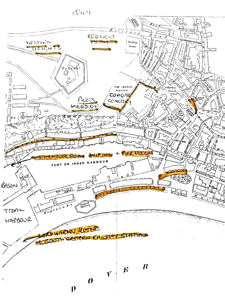
Posted in Dickens - the great author and Dover, Dickens - the great author and Dover, People, Tourism | Comments Off on Charles Dickens and Dover

Dover’s Seaplane Base and Mote Bulwark Part II

Schematic Map showing location of Mote Bulwark Seaplane Base & Guston Airfield

Schematic Map showing location of Mote Bulwark Seaplane Base & Guston Airfield

Part 1 of Dover’s Seaplane Base and Mote Bulwark started with the foundation of Mote Bulwark, the military site at the base of the Castle cliffs on the east side of Dover bay. This remained in the hands of the military up until a few years before World War I (1914-1918), when the site was given over to leisure activities. However, as the storm clouds of War started to gather, the area was taken over by the Admiralty and a Seaplane base was established. Part I of Mote Bulwark and Dover’s Seaplane base, discussed the development of aviation at that time and the role of the Dover seaplane establishment in the first year and a half of World War I. Part 2 of the story begins at this point.

Admiral Reginald Bacon (1863-1947) Chief of Fortress Dover 1915-1918. Lorraine Sencicle

Admiral Reginald Bacon (1863-1947) Chief of Fortress Dover 1915-1918. Lorraine Sencicle

1. Dover Seaplane base from the summer of 1916

In the early summer of 1916, Field Marshall Horatio Herbert Kitchener (1850-1916) was the Secretary of State for War (1914-1916) and he was looking to close Dover’s seaplane base. Dover at the time was under military rule and officially called Fortress Dover with Admiral Reginald Bacon (1863-1947) in command. In 1912, the Royal Flying Corps (RFC) formed and was made up of both military and naval personnel. On 1 July 1914 the naval wing became the Royal Naval Air Service (RNAS) while on 1 August 1915 the RFC, that had remained as the military wing, was officially separated from the army. The Seaplane station was part of the RNAS and at Guston was its sister establishment, the RNAS aeroplane base.

Lord Kitchener was killed on 5 July 1916, while on board the Hampshire when the ship struck a mine off Orkney. The next day David Lloyd George (1863-1945) was appointed Secretary of State for War, a post he held until the end of the year when he was appointed Prime Minister. Admiral Bacon used the opportunity and wrote to Lloyd George reiterating previous correspondence and emphasising the role of the Dover seaplanes within the context of the Dover Patrol. ‘Pilots’, he wrote, ‘were able to recognise sections of coastline from great heights and distances at the same time familiar with the different kinds of seagoing craft.’

Bacon followed this with a number of requests, including more seaplane and aeroplane pilots based at Dover; as well as increasing the number of naval personal training as pilots. In support, specially trained gun crews on both types of planes and the increase in the numbers of ground crew. Finally for the provision of more effective seaplanes. He was particularly interested in the Handley Page Type O, later nicknamed the bomb-dropper. This was a large, unequal-span three-bay biplane that was surprisingly light, as the spruce fuselage and flying surfaces, where possible were hollow. The four-bladed propellers, rotated in opposite directions to cancel torque and the four engines were enclosed metal nacelles. This was agreed with 7A Squadron of the newly formed 5th Wing RNAS coming to Guston before being based at Dunkirk. However, not long after a Handley Page Type O one was captured by the Germans and they adapted the design to what became the Gotha three-seater. Like the Handley Page aircraft, they carried about one-third of a ton of bombs the size of which was about 110lbs each. The shape of the bombs were designed so that they fell straight down and with increasing speed affording them more penetrative power.

Short Type 184 Seaplane. Wikimedia Commons

Short Type 184 Seaplane. Wikimedia Commons

The No 5 Wing together with members of the newly formed No 6 Squadron came to Guston before being sent to France. At the same time at the Seaplane base, the much better Short Type 184 machines replaced the Short Type 830 seaplanes. These were two-seater aircraft that not only increased the efficiency of reconnaissance and bombing, but could also carry 14inch torpedoes. At the same time a few Fairey Hamble Baby single-seater naval patrol aircraft were brought on station. Then, towards the end of 1916 the seaplane base was supplied with more Short Type 184’s and also Wight Type 840 anti-submarine patrol seaplanes.

 Anti-Aircraft Corps March 1915, Standing Down, Dover College Grounds. Maurice Sayers

Anti-Aircraft Corps March 1915, Standing Down, Dover College Grounds. Maurice Sayers

Shortly after Coastal batteries and patrol boats were given authority to take defensive action without clearance from Admiralty HQ! Although, under difficult circumstances of inadequate searchlights and armaments but with a strength of 137 volunteers, the Dover Anti-Aircraft Corps, which operated every night for nearly two years, were stood down. The air defences were totally reorganised and manned by military personnel and new stations were also erected but well outside the Dover boundary. At the harbour, the Admiralty had two 6-inch, anti-aircraft guns placed on the Prince of Wales Pier and the Eastern Arm respectively. Although they could not fire at a great angle their presence, it was believed, would act as a deterrent! The guns remained until after the May raids of 1918, when they were both removed.

World War I Zeppelin brought down August 1915 by Dover Anti-Aircraft guns courtesy of Doyle collection

World War I Zeppelin brought down August 1915 by Dover Anti-Aircraft guns courtesy of Doyle collection

Later in the summer of 1916, the seaplane personnel, sanctioned by Bacon, started making modifications to the Short Type 184 seaplanes. These improvements were such that the Admiralty renamed them Dover Type Short and ensured that the modifications were incorporated into Short Type 184 based elsewhere. These modifications included the introduction of uprated Sunbeam engines and a modified radiator, designed by Flight Lieutenant Charles Teverill Freeman (1894-1967). In October 1916 the Flight Lieutenant was awarded the Distinguish Service Cross in recognition of his gallantry and skill on the night of 2 August when he made a determined attack on a Zeppelin at sea. Returning a second and a third time, Freeman only abandoned his attack when he had exhausted his ammunition.

Freeman was one of the many seaplane pilots that spent time at the Dover base, others included Charles Langston Scott (1891-1972) who had been stationed at Dover before being assigned to command the Flying Boat Development Flight at the Royal Naval Air Station, Felixstowe. Before leaving Dover he had suggested to Bacon’s predecessor, Rear Admiral Horace Hood (1870-1916), the use of flying boats at Dover. Scott was subsequently promoted to Wing Commander and in 1931 was in charge of an experimental flight from England to Egypt. In November 1916, after Scott had left for Felixstowe, eighteen-year-old Adrian Henry Paull (1898-1965) entered the RNAS. Two months later he was appointed Flotilla Squadron Leader aboard the Lightfoot, a Marksman-class flotilla leader destroyer and was seconded from Harwich to the Dover Patrol in charge of a seaplane squadron made up of 23.

SSZ airship. Successful modification of SS airship by Capel engineers. Folkestone Library

SSZ airship. Successful modification of SS airship by Capel engineers. Folkestone Library

At Capel, again sanctioned by Bacon, the engineering section had built a successful variant of the SS Airship, with an improved car and a 75 horsepower Rolls Royce Hawk aeroengine. In a test flight it had been shown that the airship was capable of flying at over 50mph and was capable of carrying bombs weighing 350lbs. However, the modifications did not please Kitchener but following his death Bacon brought the modifications to the attention of Lloyd George. In August 1916, the Secretary of State for War supported by a retinue of personnel from the Admiralty came to Capel to watch a test flight. The modifications were then incorporated and also into the production of Sea Scouts as SSZero’s.

The air raids on Dover by the German airforce continued. This was made up of the military Luftstreitkräfte and the naval Marine-Fliegerabteilung. Albeit, on the night of 2-3 August 1916, a Zeppelin endeavoured to approach Dover when it was driven off by heavy gunfire. On 12 August, at 12.25hours, two seaplanes dropped four bombs from a height of 7,000feet to 8,000feet. One fell on the harbour and another caused slight injuries to some soldiers on parade at Fort Burgoyne. Thirteen days later, on 25 August a Zeppelin approached Dover from the west but was forced by gunfire to turn south and emptied its bombs into the sea off Shakespeare Cliff. On 22 September a seaplane, which remained in view for eight minutes, dropped bombs near the Duke of York’s school but caused no casualties.

German Planes from The People's War Book (1919) Wikimedia Commons

German Planes from The People’s War Book (1919) Wikimedia Commons

In the Channel, regardless of the efforts of the Dover Patrol, both Royal Navy and merchant ships were succumbing to torpedo attacks from German destroyers and U-boats. During the nights of January and February 1917 German destroyers and U-boats shelled, Dover, Southwold, Broadstairs, Margate, Ramsgate and Dunkirk. Each time, the vessels returned to their bases at Zeebrugge and Ostend undamaged. The German press made great play on the supposed British naval superiority, especially as the British fleet were being decimated. In the air, there was not a great deal of success and the bombing by the German combined airforce continued.

On 17 March 1917 a Zeppelin came towards Dover from the direction of Canterbury, and dropped an enormous bomb, reputed to have weighed 600lbs on Whinless Down, in a corner of Long Wood, Elms Vale. This was the largest bomb dropped in the district during the War. The Zeppelin also dropped two other bombs near Hougham, and then made off over the sea. She was brought down in France later that day. On the same day an aeroplane dropped several bombs near Langdon Battery and in the Camber. Following the raid, the German press falsely claimed that Dover Gas Works had been destroyed along with Swingate aerodrome. From October 1916 the British military Swingate aerodrome, to the east of the Castle and on the seaside of the Dover-Deal (A258) road, was mainly involved in training. At the time of the supposed attack the men were preparing the site for new occupants. On 6 April 1917, the United States of America declared war on Germany and the USAir Force took over Swingate.

When the German press reported that one of their seaplane squadrons had successfully bombed British vessels lying in the Downs, off Deal, and searchlights at Ramsgate, Reuter’s news agency negated the story. Based in London, the highly respected news agency reported that a single hostile plane had passed over some of Kent’s coastal towns dropping eight bombs but most had exploded on open ground. In fact on 19 April, the monitor Marechant Ney, while anchored in the Downs was attacked by a German seaplane that had swooped down very low and released a torpedo. This, missed the target and was brought down in the mud outside Ramsgate Harbour.

Curtiss Model E Flying Boat at Lake Keuka, Hammondsport, New York. wikimedia commons

Curtiss Model E Flying Boat at Lake Keuka, Hammondsport, New York. wikimedia commons

It was noted by the Royal Navy that the German press had not reported that on 7 April the sea wall at Zeebrugge, or the Mole as it was correctly called, was bombed by Dover RNAS seaplanes and aeroplanes. The contingency had also bombed ammunition dumps in Ghent and Brussels. At the same time G.88, a large German destroyer in Zeebrugge harbour, was torpedoed and sunk by the Dover based Coastal Motor Boats. Taking part in the RNAS attacks were large Curtiss H.12 Flying boats based at Dover. These had been sent to Dover on loan as a try out following the recommendation of Scott. He recommended for them to be tried out undertaking the same kind of work as seaplanes with the advantage of greater power and endurance in bad weather. The main problem was hoisting them onto dry land so they were kept at sea in the harbour, when not in use.

On Friday 25 May 1917, the Germans sent a squadron of about 16 Gotha bomber aeroplanes to attack East Kent. This was part of a German Gotha campaign that was to last until April 1918 and usually operated on a patrol line that stretched from Throwley, south of Faversham through Bekesbourne to Dover. During this period there were 113 air-raid alarms and the town was bombarded with 185 bombs and 23 shells. The number of civilians killed was 23 and 71 were injured. On that Friday, 25 May, the Gotha bombers travelled further afield. Using the Thames for navigation, they were intent of extending the attacks to Essex airfields. However, due to heavy cloud on reaching the Thames they turned south and at about 18.20hours the sky cleared when the squadron was just north of Folkestone. They dropped their loads over the town but no sirens were sounded. Tontine Street, which received the brunt of the attack, was crowded with shoppers. The British official response, initially, was to deny that the raid took place even though it was known that the casualty rate was high. When this became public knowledge, there was a blanket refusal to disclose the names of the victims.
Captain Alan Hughes Burgoyne (1881-1927) the Conservative Member of Parliament for Kensington brought this to the attention of the House of Commons. He asked, amongst other things, why had neither Folkestone nor Dover been warned of a possible impending attack. Further, why although many seaplanes lay ready for instant service in Dover harbour, orders to scramble were not given until 20minutes after the attack had taken place. Commander-in-Chief of the Home Forces, Field Marshal John Denton Pinkstone French (1852-1925) responded by saying that it was not possible to prevent attacks by aeroplanes, but that one of the Dover aeroplanes had shot down one of the German planes. Further, ‘he hoped that the measures that had already been taken would make any future raid a risky operation.’ East Kent had already found to their cost that Lord French tended to contradict orders that changed accepted procedures. However, in the light of the Folkestone attack, procedures were changed.

The response from the Germans was to say that the attack was on Dover harbour and that most of the naval and military ships and machinery had been destroyed and personnel had been killed. Their report went on to say that the British had fabricated the story that it was an attack on an unprotected South coast town and that the casualties were civilians to turn international feeling against the Germans. Following this communiqué, the Government agreed to make it officially known that the raid took place over Folkestone and that 71 civilians – 16 men, 28 women and 27 children – had been killed, while those injured amounted to more than 94. Still under attack by the German propaganda machine supported by news agencies in the UK, the British government eventually allowed the publication of the names of those who had been killed in the attack.
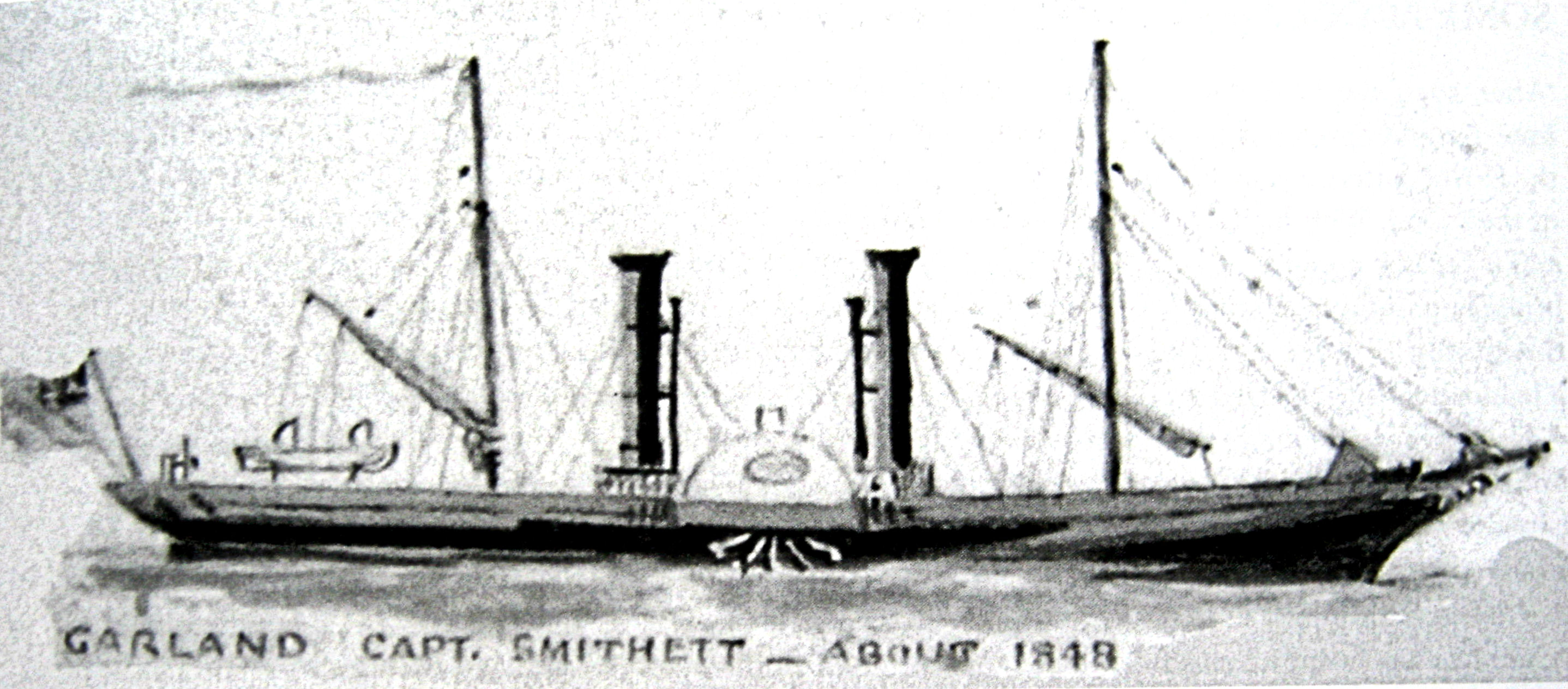
On 5 June 1917, monitors of the Dover Patrol carried out a bombardment of the German occupied port of Ostend. The Harwich Force, including the Lightfoot, patrolled to the North East of Ostend to screen the bombarding force from attack. Taking part were seaplanes and flying boats under the command of the Lightfoot’s Flotilla Squadron Leader Paull, still on secondment to the Dover Patrol. Although no longer having to await Admiralty permission to meet hostile planes until after they arrived, the problem of not knowing when they were coming remained. Thus the bombing continued.

Sound Mirror Abbots Cliff - Alan Sencicle

Sound Mirror Abbots Cliff – Alan Sencicle

In July 1915, a 16-foot sound mirror had been cut into the chalk face by Professor Thomas Mather (bc1856-1937) of the City & Guilds Engineering College, London working at Binbury Castle near Maidstone, Kent. He claimed that it could detect aircraft from 20 miles away. The sound mirror was hemispherical with a sound collector mounted on a pivot at the focal point. The sound collector was a trumpet shaped cone and the listener, who wore a stethoscope, moved the sound collector across the face of the mirror listening with his stethoscope. When he found the point where the sound was loudest bearings were taken and were read from vertical and horizontal scales on the collector. In 1917 these Sound Mirrors were being constructed along the south and east coast and the Thames estuary. The one in Fan Bay, below Swingate and another at Abbots Cliff can still be seen.

Felixstowe flying boat F.2A N4297 in flight. Imperial War Museum Wikimedia Commons

Felixstowe flying boat F.2A N4297 in flight. Imperial War Museum Wikimedia Commons

No 212 Squadron had been formed at Dover in June 1917, and large Felixstowe F2 flying boats were brought on station to augment the existing fleet. These were designed and developed by Lieutenant-Commander John Cyril Porte (1884-1919) at the Royal Naval Air Station Felixstowe and were fitted with two 350 horsepower Rolls Royce engines. Soon after arrival hydrophones were introduced that would allow the occupants of these flying boats, while ‘sitting’ on water, to listen for U-boats. To accommodate the F2s the Boundary Groyne was adapted to catapult the F2’s into the air and the launchway – the official name given at the time – consisted of two long shallow wooden channels to house the aircraft’s floats. The launchways were well greased and as the seaplane was prepared for take off, ground personnel held it down until the engine was opened up. As they let go, the flying boat was described as ‘leaping’ off the end of the launchway and into the air but sometimes into the sea! A concrete slipway was laid on the eastern side of the launchway and two more hangars were erected. A motor-powered winch for hauling the planes from the sea was housed in each hangar and thick wires, running over pulleys, hauled the flying boat onto a cradle and up the slipway.

Sopwith FI Camel fighter aeroplane AJ Insall Collection Imperial War Museum. Wikimedia Commons.

Sopwith FI Camel fighter aeroplane AJ Insall Collection Imperial War Museum. Wikimedia Commons.

At about the same time De Havilland DH9 and 9a together with Sopwith 2FI Camel naval fighters arrived and were based at the Guston airfield Wing Commander (later Air Vice Marshall) Charles Laverock Lambe (1875-1953), on 10 June 1917, had written to the Admiralty saying that British seaplanes had poor armaments and were inferior in performance compared to the German machines. The German heavily armed fighter seaplanes based at Ostend and Zeebrugge, he wrote, could attack the British slow-flying seaplanes while protecting their own fighter seaplanes. Although he recognised that aircraft sank if shot down over the sea, he recommended that with the exception of a few seaplanes kept back for reconnaissance purposes, they should all be withdrawn. He finished by recommending that they were replaced with aircraft fitted with airbags in the fuselage.

Take cover siren, nicknamed 'Lizzy'. Dover Library

Take cover siren, nicknamed ‘Lizzy’. Dover Library

By August 1917, sirens alerted locals some 10minutes before enemy seaplanes and aeroplanes arrived and naval and military personnel were alerted before if possible.
On 22 August a group of seven or eight Gothas in squadron formation came over the town at a height of from 11.000 to 12,000feet and dropped a dozen bombs. Most of these fell into the Harbour but one bomb dropped in the yard of the Admiral Harvey Pub in Bridge Street. Another fell in the grounds of Dover College, near a party of reservists in training, killing two and wounding three others. One fell on a house in Folkestone Road and passed through the floors without exploding. By the time the German aircraft arrived the Dover seaplanes were already in the air and along with coastal defence artillery, they fought off the invaders and two enemy aircraft were brought down. This was the last of the daylight Gotha raids.

Then on 2 September a single Gotha dropped seven bombs at 23.00hours – this was the first of the Gotha moonlight raids. Three fell in rapid succession and created unusually large craters. One fell near Castlemount that had been requisitioned as a Hospital, on the east side of Dover and two others just missed houses. Before the War Castlemount was a teacher training college operated by the French Les Frères des Ecoles Chrétiennes monks and opened in 1911. Following the War, the monks returned and stayed until 1939. One man was killed and four women and two children were injured, including one woman who was blown bodily out of her cottage. This was followed by an attack that was reported as coming in waves, lasting twenty to thirty minutes with the bombs causing a great deal of structural damage and injuries.

Wesley Hall, Folkestone Road bombed on Monday 24 September 1917. Dover Museum

Wesley Hall, Folkestone Road bombed on Monday 24 September 1917. Dover Museum

Almost immediately after dusk, on Monday 24 September 1917, the drone of Gotha bomber aeroplanes could be heard approaching and bomb dropping commenced as soon as Martin Mill was reached. The plane followed the Dover-Deal railway line into Dover, dropping bombs at intervals on the track. Another Gotha approached Dover from the sea and it’s first bomb fell in the passage leading from Castle Street to Dolphin Lane, but did little damage. The next bomb fell on the Wesley Hall in Folkestone Road where it hit the apex of the northern end wall blowing it away. The result was that the roof slipped off either side of the building and the crossbeams fell inside. Luckily no one was in the building.

The next bomb fell in the front garden of 10 Folkestone Road, occupied by J B Smith, some five or six yards away from the windows. In one of the front rooms Miss Pilcher was conducting a shorthand class, at which there were six young ladies present. When the bomb fell they were all injured, and one of them, Dorothy Eleanor Wood (1900-1917), subsequently died of her injuries. Miss Pilcher sustained a fractured thigh and Winifred Mary Greenland (b1902) lost an eye. The next bomb fell on the rear of 55 Folkestone Road where it fell on a garden wall, and its concussion did a great deal of damage to the adjoining houses. Another fell in the front garden of 57 Folkestone Road, but did not explode. Another bomb fell on the top of the railway entrance tunnel under the Western Heights. A bomb hit the back of 3 Selbourne Terrace, demolishing the detached wing of the house where the occupants had a narrow escape and an incendiary bomb fell on the allotment grounds at the back of Clarendon Place. A bomb was dropped on 40 Glenfield Road and the back of the house was blown in. Annie Keates (1865-1917), who had gone to reside at this house, after her own house in Wood Street had been damaged in a previous raid, was killed and her daughter, Annie Evelyn Keates (1905-1917), was so seriously injured that she died at the Hospital. Two houses were demolished in Pioneer Road, luckily the occupants were out. Another bomb demolished 75 Crabble Hill where Ellen Maria Kenward (1862-1917) was killed and buried in the ruins. Her father, Edward Kenward, (1840-1917) was pinned beneath the debris and later died at the hospital. The bedridden lady next door, Jane Gould (1831-1917), died later as a result of shock and injuries.

Crashed plane at Guston Airfield. Dover Museum

Crashed plane at Guston Airfield. Dover Museum

Over the following ten nights a succession of attacks were made. However, knowing that enemy planes were en route meant the artillery barrage ensured that the damage was not exacerbated. At the same time, Dover seaplanes were being used extensively in action over the Channel and Belgium but both seaplanes and aeroplanes were lost. One casualty was Flight Sub-Lieutenant Cecil Barnaby Cook, age 19 who crashed as tried to land back at Guston. Before his untimely death he had flown seven different types of aircraft since arriving in Dover.

In December that year, Lambe reiterated his recommendations that aeroplanes were superior to seaplanes, suggesting the total abolition of seaplanes for anti-submarine patrols. He did, however suggest keeping the Short Type 184s for communication and short patrol work only. A few weeks before, on 31 October 1917, a Gotha bomber dropped incendiaries along the length of the seafront and the seaplane sheds were set alight. Following the attack, Lambe strongly recommended the closure of the base but when Bacon refused, suggested just retaining a skeleton crew of ground staff to undertake repairs of seaplanes landing in Dover. Again, Bacon, did not agree and the base was quickly repaired.

Vice-Admiral Roger Keyes (1872-1945) appointed Commander in Chief of Fortress Dover on 31 December 1917

Vice-Admiral Roger Keyes (1872-1945) appointed Commander in Chief of Fortress Dover on 31 December 1917

Vice-Admiral Roger Keyes (1872-1945) replaced Admiral Bacon on 31 December 1917. Captain Lambe, at the first meeting, was quick to express his delight and views that aeroplanes were superior to seaplanes. He particularly emphasised that Bristol F.2, a two-seat biplane fighter and reconnaissance aircraft made by the Bristol Aeroplane Company, some of which were based at Guston, were proving particularly successful against the German moonlight raids. Keyes accepted Lambe’s point of view but added that he concurred with Admiral Bacon over the importance of seaplanes, saying that ‘the daily round and the common task of the Dover Patrol was the coastal patrol kept up from dawn to dusk, through all seasons of the year, by the seaplanes, only intermitted because of fog or gale. But for this persistent anti-submarine patrol, of which very few people have heard of, the losses of British shipping would be far more serious, for hostile submarines are bound to keep well under the surface for fear of detection, and shipping is thus able to pass by in comparative safety.

WWI Bristol F.2 two-seat fighter and reconnaissance biplane. Wikimedia

WWI Bristol F.2 two-seat fighter and reconnaissance biplane favoured by Lambe over seaplanes. Wikimedia

Keyes went on to say that the day to day work of the seaplanes involved two kinds of anti-submarine patrols, intensive and extensive. The intensive kind was concerned with spotting and escorting in the Channel. This was the area extending from the coast to a line marked by a number of buoys ten miles out. It was within this section that British and friendly convoys travelled and the older single-seater seaplanes in pairs, worked to protect them. Further out, Keyes said, often to beyond the 30-mile line the newer, faster seaplanes that could cope with heavy weather operated. In an emergency they could react swiftly as combat machines and if brought down, stay afloat. Even further away from the coast of England, the airships from Capel operated and flying boats when they came on station. The Channel, Keyes, finished, was therefore patrolled by every form of seaplane showing that they are essential for the defence of the country.

On 16 February 1918 seaplanes stationed at Dover were escorting a number of British ships crossing the Channel to Rotterdam when 16 German planes attacked the convoy. An air battle ensued and according to the Germans one of the seaplanes was brought down. According to Keyes, a seaplane pilot in a single-seater Fairey Hamble Baby, was in a fight against two of the hostile aeroplanes when his right arm was hit twice causing it to haemorrhage. Holding his arm tightly above the damaged artery, with his good hand, the pilot held the stick between his knees and safely navigated and landed the seaplane in Dover harbour. An Admiralty statement reported that none of the ships in the convoy were hit and that the seaplane patrol reformed and immediately returned to base.
Pemberton Billing designed PB29 aeroplane, Guston. Dover Transport Museum

Pemberton Billing designed PB29 aeroplane, Guston. Dover Transport Museum

By this time more fighter aeroplanes were based at Guston to escort and defend the seaplanes and flying boats that had arrived. These included the Pemberton Billing designed PB29 Zeppelin Destroyer that was test flown. Although the pilots said it climbed like a rocket it was difficult on take off and landing and therefore never went into production. Following the fracas of 16 February, the German’s were quick to respond with reprisals and over the next four nights, commentators wrote, were the most anxious for Dovorians throughout the War. During the night of Saturday 17 February, twenty-three bombs, all one hundred weight (112 pounds) each, rained on St Margaret’s Bay, to the east of Dover, in a line from Corner Cottage on the cliffs to the sports field near the village. The French Convent of the Annunciade or the Blessed Virgin Mary, founded in 1904, suffered severely as did a number of residences. Both aeroplanes and seaplanes planes went up to meet the attackers and together with anti-aircraft fire, the enemy flew off with one machine falling into the sea off Dover.

Seaplane being prepared for attack. Note the new RAF logo on the wing. Dover Museum

Seaplane being prepared for attack. Note the new RAF logo on the wing. Dover Museum

On 1 April 1918 the Royal Air Force (RAF) was formed by the amalgamation of the Royal Flying Corps and the Royal Naval Air Service. Keyes called these combined forces at Fortress Dover the Dover Patrol Air Force and he used them to great effect. By this time access and egress to Dover had been tightened up and speculation was afoot that a major sea offensive was about to take place. This seemed to be verified on the 11 April when Royal Navy monitors left the harbour and bombarded Zeebrugge and Ostend harbours. Throughout the War U-boats, based at Bruge with outlets to the sea at Zeebrugge and Ostend, had kept up a constant attack on British shipping and the 11 April counter attack was generally assumed to be the major British offensive on the Continental ports.

That day Dover seaplanes and aeroplanes also dropped bombs onto the one and a half mile sea wall, or Mole, that protected Zeebrugge harbour from the North Sea. Following the raid of 7 April 1917 the Germans had erected a fearsome array of mounted artillery to protect the harbour from attack. After the attack, planes from both bases flew over Zeebrugge harbour to assess the damage, the repairs that were taking place and what additional defence measures were being taken.

Sunday 21 April, at just before 11.00hours the most successful fighter pilot in the War was killed. Lieutenant Manfred von Richthofen (1892-1918), better known as the ‘Red Baron’, was shot down in a dogfight and his death was seen as a good omen by many of the airmen involved in the Zeebrugge Raid. This was near Vaux-sur-Somme and Richthofen was flying a red Fokker triplane over Morlancourt Ridge. He was pursuing Canadian pilot Lieutenant Wilfrid Reid ‘Wop’ May (1896-1952) of RAF No 209 squadron flying a Sopwith Camel. Between 16 February and 20 March 1918, the Squadron had been based at Dover’s Guston aerodrome. Canadian Captain Arthur Roy Brown (1893-1944) attempting to come to May’s rescue, at high speed, dived steeply and then climbed before going in for attack. Richthofen turned to avoid Brown when he was hit by a single .303 bullet penetrating his heart and lungs. Richthofen managed to make a rough landing before dying. Who actually fired that bullet is still the subject of debate and speculation.

Holy Trinity Church Strond Street Pier District 1835, where the Church Service was held prior to the Zeebrugge Raid of 22&23 April 1918. Lynn Candace Sencicle

Holy Trinity Church Strond Street Pier District 1835, where the Church Service was held prior to the Zeebrugge Raid of 22&23 April 1918. Lynn Candace Sencicle

Monday 22 April, was a lovely day with blue sky, light winds and spring flowers everywhere, it was the day the famous raid on Zeebrugge began. In the morning a special service was held at Holy Trinity Church in the Pier District attended by Keyes, other senior officials and members of the Dover Patrol. While this was going on seaplanes left the base on the seafront and aeroplanes from No 6 Squadron based at Guston joined them as they headed for Zeebrugge.

Zeebrugge Harbour following the raid of 22-23 April 1918, showing the sunken ships,blocking the entrance. Doyle Collection

The marine flotilla set off at 16.00hours on 22 April and included destroyers, submarines, motor launches, coastal motorboats, two commandeered Mersey ferries with three commandeered ships filled with concrete in tow. Heading the convoy was Keyes on his flagship Warwick. Escorting the convoy were Dover seaplanes and Sopwith Camel fighters. The attack on Zeebrugge was in order to block the canal from the U-boat base at Bruge to the port using the concrete filled ships. The attack lasted all night and the following day – which was St George’s Day and succeeded in blocking the harbour mouth and the canal to Bruge. The Zeebrugge raid is still annually celebrated in Dover on 23 April – St George’s Day, the Patron Saint of England. In St James Cemetery on Copt Hill, off Old Charlton Road, there is a section dedicated to those in the armed services that lost their lives in World War I along with a memorial to Vice-Admiral Keyes. There are also Dover Society Plaques on the outside of the Maison Dieu, on Biggin Street and the exterior wall of the museum, in the Market Square, telling of the event.

9 May saw the second part of the mission, to seal off the canal from Bruge at Ostend. From the weather to the nuances of the strategy everything was the same as the Zeebrugge raid. Again the Dover seaplanes and aeroplanes were involved in the preliminary operations, then escorting the flotilla across the Channel and during the raid dropping bombs on gun emplacements. However, the raid was not so successful, primarily due to only one blockship being sunk and therefore not totally blocking the canal entrance. Albeit, the damaged done did inhibit the German’s use of the Bruge base and the port as a destroyer base. Further, due to the overall effect of the Zeebrugge and Ostend raids on the German’s, this was to make that part of the Channel coast useless to them and they withdrew their marine operations.

German seaplane having been shot down in 1918. Doyle Collection

German seaplane having been shot down in 1918. Doyle Collection

The German reaction to both attacks was predictable and major attacks on Southern England took place over the next ten days. On the final day, Whit-Sunday, 19 May 1918, the Germans lost seven machines, two of which were brought down in the sea off Dover. In one the body of a flight commander was found, wearing the Order of Merit. Another German machine was brought down in flames near Canterbury. From then on, the Germans almost left England alone but increased their fury on Calais and Boulogne. There they flew down the Channel and on turning towards the town selected, they heavily bombed it.

The Dover Patrol Airforce, which included the Dunkirk base, turned their attention to the Continent, where they repeatedly, at low altitudes, bombed aerodromes from which the German aeroplanes set out to bomb England. In Command at Dunkirk was Geoffrey Rhodes Bromet (1891-1983) who had gained his early experience flying seaplanes in Dover and rose to the rank of Air Vice Marshal. Later, he was appointed the Lieutenant Governor of the Isle of Man 1945-1953. Meanwhile, over the Channel seaplanes and flying boats attacked U-boats while the aeroplanes based at Guston chased after and attacked Zeppelins.

 British preparing for battle, the German Spring Offensive March-July 1918. Imperial War Museum

British preparing for battle, the German Spring Offensive March-July 1918. Imperial War Museum

On 21 March 1918, following the surrender of the Russians 18 days before, the Germans started their Spring Offensive (March-July 1918) under General Erich von Ludendorff (1865-1937). This was to try and break through the Allied lines from the Somme to the Channel and from early April their objective was to force the British and Allies back to the Channel ports of Calais, Boulogne and Dunkirk and out of the War. Captain Lambe was promoted to Colonel and temporary Brigadier General of the Royal Air Force and sent to France.

The ensuing Fourth Battle of Ypres (7-29 April), was bloody with an estimated 86,000 German, 82,040 British, 30,000 French and 7,000 Portuguese casualties. The War was still raging and it looked, as if Ludendorff’s objectives were being achieved, albeit, there was a perceptible running down of the Dover seaplane base. It was hoped in Dover that the President of the new Air Board, Weetman Dickinson Pearson, 1st Viscount Cowdray (1856-1917), who had strong connections with the town – his company had built the Admiralty Harbour – would recognise the need to keep the Dover Seaplane Base.

On the Continent Ludendorff introduced a new tactic and was advancing, deeply penetrating the British lines. On 8 August the Allies launched their counter offensive with the introduction of strategic blanket bombing of German industrial targets, under the responsibility of Sir Hugh Trenchard (1873-1956). At the same time low flying aircraft were to be used to drown out the sound of tanks as they moved forward at night and at first light the RAF launched low-flying, pre-emptive attacks on German airfields and shipping. During this time, the RAF destroyed more than 8.000 enemy aircraft, dropped 8,000tons of bombs and fired 12million rounds of ammunition at ground targets.

Trenchard’s work had previously impressed the Commander in Chief, Field Marshall Sir Douglas Haig (1861-1928), for which he was knighted and appointed the Chief of Air Staff in January 1918. His vision for the RAF was as a separate senior service in its own right. Admiral of the Fleet, David Richard Beatty (1871-1936), on the other hand, saw the fledgling RAF in a supportive role to the other two services. Further, he had the backing of Harold Sidney Harmsworth, 1st Viscount Rothermere (1868-1940), the then President of the Air Council (1917-1918), along with cabinet ministers, the military and senior naval officers, In March 1918, Trenchard resigned after a difference of opinion with Lord Rothermere but was re-appointed by the newly appointed President of the Air Council, William Douglas Weir, 1st Viscount Weir (1877-1959). This had led to Trenchard playing a leading role in the blanket bombing of German industrial targets, a strategy that was to be used again in World War II (1939-1945). On gaining the appointment Trenchard based his headquarters in France and under his leadership, proved that the RAF had the capability to be a senior armed service in its own right.

Dancing in the street when peace was declared on 11 November 1918. Doyle collection

Dancing in the street when peace was declared on 11 November 1918. Doyle collection

The War was rapidly moving towards its final days on 1 July 1918, when the order came that Dover’s seaplane base was to close. In less than a month, on 20 July, at 09.25 hours, the sirens in Dover sounded and a German machine flew over the town from the direction of St Margaret’s Bay. The Seaplanes went up to fight it off and at the same time, the plane was heavily fired upon from the ground. Faced with this combined barrage, it turned away towards Ostend without dropping anything. That was the last air raid on England and given as the justification for running down of the Seaplane Base except for keeping the token number of four Short 184s and support staff. Thereafter, there was only one more air raid warning given at Dover, this was to announce the end of the War at 11.00hours on 11 November 1918 – Armistice Day.

The Marine Parade Seaplane base officially closed in March 1919 and the remaining staff had a farewell dinner.

From when the RAF was formed on 1 April 1918 to 31 October 1918 in UK anti-submarine patrols in Home waters was:
Total number of hours flown: 39,102
Hostile submarines sighted: 216
Hostile submarines attacked: 189
Hostile aircraft attacked: 351
Hostile aircraft destroyed: 184
Hostile aircraft damaged: 151
Hostile mines spotted: 69
Hostile mines destroyed by aircraft: 32
Total number of bombs dropped: 15,313 – This was equal to 666.5tons
Total Convoy fights: 3,441
Total photographs taken: 3,440

Map of Dover showing the number and where the town was bombed and shelled in World War I and the number of fatalities and injuries. Dover Library

Map of Dover showing the number and where the town was bombed and shelled in World War I and the number of fatalities and injuries. Dover Library

The number of Raids during World War I on Dover

Were: 113
Bombs dropped: 185
Shells on the town: 23
The civilian casualties:
Killed:
Men: 13
Women: 7
Children: 3
Injured
Men: 36
Women: 23
Children: 12

Throughout World War I and for some weeks after the Armistice was signed the town remained Fortress Dover under military rule. Strict regulations still applied including publicity and in consequence, a hundred years later, other towns which played a much lesser role in the defence of the country can, and have, made tourist capital with respect to their roles. So successful have they been that during the centenary coverage of World War I in 2014, Dover – one of the key players in the defence of nation – was ignored by Royalty, Parliament and the mainstream media such as the British Broadcasting Company – the BBC!

Dover Patrol Memorial, Leathercote Point, St Margaret's Bay Alan Sencicle

Dover Patrol Memorial, Leathercote Point, St Margaret’s Bay Alan Sencicle

Although the nation in 2014 chose to ignore Dover’s pivotal role during World War I, back in Post-World War I Britain, society’s attitude was very different. The country collected the money to pay for a memorial to the Dover Patrol, of which the Squadrons that flew and maintained the Dover seaplanes, aeroplanes and airships based at Mote Bulwark, Guston and Capel. Many of the pilots that had been based at Dover, Guston and Capel were highly decorated but a great many more lost their lives during the conflict. Hence, they were part of those honoured on 27 July 1921, when the Dover Patrol Memorial Obelisk was unveiled by Edward Prince of Wales (1894-1972) on Leathercote Point, St Margaret’s Bay. Shortly after a second Memorial Obelisk was unveiled at Cap Blanc Nez and a third at New York harbour in memory of the Dover Patrol’s French and American comrades. In 2015, the Dover Patrol Memorial at St Margaret’s Bay was given Grade II Listed Status.

InterWar Developments

The Air Ministry was created on 10 January 1919 to manage the Royal Air Force and the Secretary of State was Winston Churchill (1874-1965). He re-appointed Trenchard as the Chief of Air Staff on 31 March whose main job was the demobilisation of the RAF and establishing the service on a peace time basis. However, before Trenchard took up post, on 26 March, under Air Commodore Charles Lambe, the aeroplane squadrons at Guston were moved to Hawkshill aerodrome, Walmer and the Dover Seaplane base was formally closed. Once in office, Trenchard re-opened the Dover Seaplane file and following a debate in Parliament the decision was reversed as it was agreed to keep a token number of RAF ground crew there. All but one of the hangars was removed and the launchways and slipways were buried. Renamed the Marine Aircraft Repair Depot, the establishment’s role was to refuel and undertake emergency repairs on RAF seaplanes or flying boats that landed in the harbour.

At Folkestone, during March 1919, arrangements were made for the introduction of flying trips in seaplanes, as a tourist attraction. These machines were designed to carry four passengers in addition to the pilot and Jacob Pleydell-Bouverie, 6th Earl of Radnor (1868-1930) made the first flight. However, the Air Ministry quickly reminded the company that civilian flying was not allowed. On 1 May 1919, this was reversed and the Air Ministry issued the first official post-war rules and regulations. On 5 May the Government advertised the sale of former World War I aircraft. On the list were a number of seaplanes that had been based at Dover and these included the last four of Dover’s Short 184s. Former pilots set up flying companies, bought these planes and a number contacted Dover Corporation with a view to using the harbour as a seaplane terminal. They stated that their companies would be offering flights to places within Britain and also Europe.

Although the War was over, the harbour was still in the hands of the Admiralty so in 1919, neither Dover Harbour Board (DHB) nor Dover Corporation had the authority to give permission.  Nonetheless, both the Corporation and DHB were keen on the idea and suggested that aircraft companies made their own applications to the Air Ministry, adding that they would endorse such proposals. The Admiralty declined and the aviators went elsewhere. On 9 September 1923, by Act of Parliament, the Admiralty Harbour was transferred to DHB and British seaplane companies were contacted but the country was in a recession that was getting worse and there was no viable response.

The pre-War Territorial Army Drill Hall at Mote Bulwark that became the County Skating rink before commandeered by the Royal Navy for the WWI Seaplane service. Following the end of the War, it reverted to its original purpose as a Territorial Army Drill Hall. Hollingsbee Collection

The pre-War Territorial Army Drill Hall at Mote Bulwark that became the County Skating rink before commandeered by the Royal Navy for the WWI Seaplane service. Following the end of the War, it reverted to its original purpose as a Territorial Army Drill Hall. Hollingsbee Collection

About this time, the RAF initiated an air service between London and Paris. The Post Office, in early 1919, had opened an airmail service to and from Cologne, Germany. They opened a second airmail service to Cairo, Egypt and onto Baghdad, Iraq in 1922. Over the following decade the RAF pioneered all the major air-routes to what was then British Empire Countries (formalised in 1931 as the Commonwealth of Nations), using both aeroplanes and seaplanes. Once it was realised that private enterprise was not interested in setting up a seaplane base at Dover, DHB jointly with the Corporation approached the Post Office to persuade them to set up a seaplane operation between Dover and the Continent. They, however, were not interested. By this time, what was left of the former seaplane buildings at Mote Bulwark had been converted into army married quarters and the one remaining hangar housed a military riding school. The former skating rink building reverted to its original use as the Territorial Army Drill Hall.

Calais-Dover Air Service. Times 19 May 1928

Calais-Dover Air Service. Times 19 May 1928

It was not until 1928 that seaplanes returned to Dover’s harbour when French Henri Balleyguier’s (1887-1969) Compagnie Aérienne Française set up the Channel Air Express. This started out as a seaplane taxi service between Dover and Calais. DHB were so keen on the idea they designated a seaplane anchorage east of the Prince of Wales Pier with landing runs of 1,000, 1,200, 1,600 and 1,800 yards. The service quickly proved popular with journeys taking 20-minutes to Calais but passengers, on boarding the plane from the Pier, were almost guaranteed a wetting! However, the possibility of the rapid transhipment of mails was not lost on the French railways and this was soon after, put into operation using the Channel Air Express.

So successful was the Channel Air Express that Dover was designated as one of England’s eight official airports and only one of two for seaplanes – the other was at Woolston, Southampton. Of note, Lympne aerodrome, near Hythe, was designated as the third largest such airport in England, it operated from 1916 to 1984. By the beginning of 1933, Compagnie Aérienne Française service at Dover harbour was earning more from carrying post and light freight than passengers and it was possibly this that galvanised Southern Railway in to action. They employed consultants Airwork Services run by Air Vice Marshall Sir Henry ‘Nigel’ Norman (1897-1943) and Alan Muntz (1899-1985), with architect Graham Dawbarn (1893-1976) to look into possibilities of the Railway Company using seaplanes for freight transport.

Compagnie Aérienne Française Farman F.60 Goliath airliner F-ADCR. Wikimedia Commons

Compagnie Aérienne Française Farman F.60 Goliath airliner F-ADCR. Wikimedia Commons

While compiling their report, the consultants liaised through a junior officer, James Leslie Harrington (1906-1993 – and known by his middle name), within Southern Railway. Knowing Dover and remembering the seaplane base at Mote Bulwark, Harrington put forward the case for Dover harbour as an ideal place for Southern Railway to introduce a seaplane service. He pointed out that Dover’s then main railway station, Marine Station, was located on Admiralty Pier, to the west of the Prince of Wales Pier, from where Compagnie Aérienne Française operated.

Southern Railway published the report internally in March 1934. The consultants stated that besides Channel packet ships, ocean going and coal carrying ships were increasingly using the harbour. Although, Southern Railway could establish a successful air transport facility at Dover there were physical problems of using the harbour as a seaplane base. On the north-east side of the harbour, they wrote, were/are cliffs and along the Eastern Arm was the Tilmanstone Colliery aerial ropeway, both of which could be a liability. The harbour, itself, was notorious for its major negative tidal and wind effects and although the Channel Air Express, taken over by Air France in the summer of 1933, did offer a service, the previous summer it only operated 50 flights and hardly operated any during the winter. They also mentioned the landing field at Whitfield 3½ miles to the north of the harbour but this they also rejected.

However, the consultants enthusiastically suggested an alternative site. During the War, Nigel Norman had spent time as a Royal Flying Corps pilot at Swingate, which the consultants believed, would make a ‘splendid site’. At the time, the site was owned by the War Office and used by the Territorial Army except for a part that had been referred to as the Swingate aerodrome up to the War Office renting it out to a golf club a couple of years before. This, they suggested, almost certainly be made available for civil aviation. Further, the Swingate site offered the greatest possibilities for in 1933, Parliament approved a DHB Bill for a 1.75-mile railway line from the Kearsney junction, on the Deal line, through a tunnel to the Eastern dockyard. Southern Railway, Norman suggested, this could be used as a base for laying a line to Swingate and the ideal place for a Dover airport. The report was published and shelved. By that time Harrington had moved on becoming the Marine Manager at Dover and rising through the ranks of Southern Railways and its successors. He retired in 1969 as British Rail General Manager of the Shipping & International Services Division.

The RNLI Sir William Hillary Lifeboat, built 1930 and based at Dover primarily to rescue pilots and passengers on aircraft coming down in the Channel.

The RNLI Sir William Hillary Lifeboat, built 1930 and based at Dover primarily to rescue pilots and passengers on aircraft coming down in the Channel.

Back in the late 1920s, the recreational use of aircraft had started to increase and with this, the number of casualties. To deal with this growing problem, the Royal National Lifeboat Institution (RNLI) ordered a new and special lifeboat for their Dover station. Named Sir William Hillary after the founder of the RNLI, she came on station in 1929. Edward, Prince of Wales (later Edward VIII) officially launched her on the Wellington Dock slipway on 10 July 1930 having flown in to what was then generally called Swingate aerodrome especially for the occasion. The Sir William Hillary’s successful rescues were predominantly maritime, due to the speed with which crashed aircraft sank.

Typically, in 1932 a German mail and freight aeroplane was reported missing, while on a flight from London to Berlin. The plane was a single-engine low winged Junkers that had left Croydon airfield, Surrey, at 20.55hrs with two crew and no passengers At 21.37hrs, three mayday distress signals in rapid succession were received but when the Dover lifeboat searched the area there was not a trace. On 2 October 1934, a twin-engine De Havilland 89 belonging to Hillman Airways and with a highly experienced pilot and six passengers on board crashed into the sea off Folkestone. On crossing the Channel, the pilot reported that the visibility was poor and Croydon suspected that he was off course. The Folkestone lifeboat recovered the bodies and the Dover lifeboat searched the area to collect evidence as to the cause of the accident. Of note, Hillman Airways formed November 1931 and from 1 December 1934 the airline was given the contract to fly airmail to Ostend and Brussels operated by the Railway Air Services. In 1935, the company merged with Spartan Air Lines Ltd and the British United Airways Ltd to form British Airways Ltd.

Short S.19 Singapore Mark III seaplane of the RAF (Coastal) BJ Daventry. Imperial War Museum

Short S.19 Singapore Mark III seaplane of the RAF (Coastal) BJ Daventry. Imperial War Museum

During 1934 the Royal Air Force was strengthened and several new types of aeroplanes were coming on station. These included Vickers-Scarpa twin engine flying boats and the four engine Short S.19 Singapore Mark III seaplane with living and sleeping quarters for the crew. In November units of the Coastal Area were engaged in operations against the Home Fleet, as it attempted to pass Dover harbour. Crowds turned out to watch and there was talk that Dover was to become a seaplane base again. By that time the riding school at Mote Bulwark had been refurbished as a second Territorial Army Drill Hall and the older Drill Hall became the Castle Garrison Library.

Correspondence was exchanged between Dover Harbour Board jointly with Southern Railway to the Royal Air Force and it slowly became evident that the re-establishment of a seaplane base at Dover was not even being considered. Albeit, Dover’s economy was picking up and the town was becoming increasingly popular with day-trippers. As the Mote Bulwark area was unlikely to be used as a seaplane base it was suggested that a lift from there to the Castle should be built. This was estimated to cost £9,788 and although Dover Corporation promoted the idea, World War II (1939-1945) was in the offing and the scheme was abandoned.

Meanwhile, changes had been taking place at Swingate. British scientist, Robert Alexander Watson-Watt, (1892-1973) had described a technique that he called Radio Detection and Ranging, or RADAR, to the British Air Ministry. He had been looking at ways to detect thunderstorms. With the help of his assistant, J F Herd, by 1923 he had constructed a low-sensitivity radio direction finder and by using three radiotelegraph receivers for triangulation, they could track the direction of an incoming storm. From this Watson-Watt and his team, drew up plans for a system to detect aircraft using radio waves and soon after five experimental radar stations were constructed, designated as Air Ministry Experimental Stations. One of these was at Swingate where four wooden transmitting towers were erected and to the east, four receiving towers at right angles to each other. The transmitting towers had large platforms at the top and halfway down and between the towers were strung long wave and short wave transmitting aerial arrays. Trials took place and by the late 1930s they had proved so successful that Chain Home System (CHS) consisting of eighteen radar stations were erected along the coast that gave early warning of approaching enemy aircraft.

World War II, the Nuclear Age and Neglect

Casemates above the Mote Bulwark that were the offices of the Commander-in-Chief of Fortress Dover, Vice-Admiral Bertram Ramsay (1883-1945) . Alan Sencicle

Casemates above the Mote Bulwark that were the offices of the Commander-in-Chief of Fortress Dover, Vice-Admiral Bertram Ramsay (1883-1945) . Alan Sencicle

In the final days before the outbreak of World War II, Dover was again taken over by the armed forces and designated Fortress Dover. As in World War I, restrictions were imposed and the Castle became the headquarters. From 24 August 1939, the Casemates above the Mote Bulwark took on an important role as the offices for the Commander-in-Chief of Fortress Dover, Vice-Admiral Bertram Ramsay (1883-1945). These can be seen from the Seafront. The Vice-Admiral had served in the Dover Patrol between 1915-1918 and his first major duty was planning and co-ordinating Operation Dynamo, the Dunkirk Evacuation, (26 May to 4 June 1940). Some 100 Royal Navy Officers and 1,000 Women’s Royal Naval Service worked in the Casemates, helping to co-ordinate the rescue of 338,680 British and Allied servicemen from the French coast in the face of invading Germans.

Dumpy Diagram by Peter Sullivan - February 1987.

Dumpy Diagram by Peter Sullivan – February 1987.

Throughout this time, the Guilford shafts, first excavated in the early 19th century and developed during periods of hostility throughout that century (see Part I of the Mote Bulwark & Seaplane story), were lined with steel. Tunnelling and excavations created an underground hospital with the former underground Casemate barracks and tunnels being hollowed out to increase capacity. This created accommodation and a workplace for the Coastal Artillery, whose job it was to defend the Dover Strait. Below, and to a depth of some 144-feet (43.9-metres), excavations were undertaken to create DUMPY, started in August 1942 and completed by April 1943. The name DUMPY is often translated as Deep Underground Military Position Yellow and was to serve as The Channel Headquarters.

The Drill Halls and married quarters on the former Seaplane site, below Mote Bulwark, were used by the Royal Army Medical Corps to deal with medical emergencies from naval ships in the harbour. An anti-aircraft battery was built nearby. In early 1944, the World War I seaplane launchways and slipways were unearthed, repaired and used as landing stages to train troops in assault landings ready for the D-Day Landings on the beaches of Normandy from 6 June 1944. Once the Landings took place, the heavy bombardment that Dover had undergone since the beginning of the Battle of Britain on 10 July 1940, increased. As the Allied troops were drawing closer to Calais the attacks on Dover became even more intense. On Wednesday 28 June 1944, shells hit one of the former Drill Halls, killing three soldiers and injuring thirteen.

Opening of the Eastern Docks 30 June 1953. The photograph shows the Minster of Transport - Rt. Hon. Alan T Lennox-Boyd, Chairman of Dover Harbour Board - H T Hawksfield and the Register/General Manager of Dover Harbour Board - Cecil Byford. Lambert Weston.

Opening of the Eastern Docks 30 June 1953. The photograph shows the Minster of Transport – Rt. Hon. Alan T Lennox-Boyd, Chairman of Dover Harbour Board – H T Hawksfield and the Register/General Manager of Dover Harbour Board – Cecil Byford. Lambert Weston.

Following the War the metal parts of the launchways and slipways were removed, leaving the concrete foundations. The Drill Halls were repaired and eventually were refurbished for use by the Territorial Army Voluntary Reserve and Divisional Headquarters. On 30 November 1946, Dover ceased to be a naval base and the Eastern Dockyard became a light and heavy industrial zone. One of the companies that opened was A.W. Burke, a small engineering firm that made specialist parts for the British aircraft industry, particularly jet engines. Then in 1953, the Eastern Docks opened as Dover’s second major passenger terminal and the industrial companies moved out.

Traffic chaos in Townwall Street on the road leading to Eastern Docks in 1965. Dover Express.

Traffic chaos in Townwall Street on the road leading to Eastern Docks in 1965. Dover Express.

Aimed at the private motorist, the Eastern Docks quickly proved to be very popular and the town roads serving it soon became congested. In 1956, the Minister of Transport and Civil Aviation (1955-1959), Harold Watkinson (1910-1995) announced that a trunk road was to be created from Townwall Street to Eastern Docks and was completed in 1958. From Townwall Street, the trunk road took a right turn, opposite Mote Bulwark, into Duoro Place next to Gateway Flats. Then there was a sharp left turn on to the Seafront and then another sharp right turn on to Marine Parade towards the Eastern Docks. Traffic coming in the opposite direction used the same two lane narrow roads. Consequently, throughout the summer months it was congested, a situation that was to remain for over twenty years.

The armed services moved out of the Casemates in 1958 and the DUMPY level was taken over by the Home Office. The following year they were both refurbished as the top-secret Regional (South Eastern) Seat of Government in the event of nuclear war. The Complex provided radiation-proof living quarters for 420 people who may have had to remain underground for a considerable period of time. DUMPY was closed in the 1970s, in 1988 it was abandoned and finally declassified in 1992.

In the meantime, in February 1963, the Castle was handed over to the Ministry of Works, (Ancient Monument Branch), to be preserve as an ancient monument. The military retained St Mary-in-Castro as the garrison Church and the Constable’s Tower as the official residence of the local military commander, who was also the Deputy Constable of the Castle. After a time the Castle came under the auspices of Dover Corporation and from 1974, Dover District Council. The Grade I Listed Buildings, are now in the care of English Heritage and in 1990 the Dunkirk Operations rooms and the Casemate Level were open to the public and more recently, part of DUMPY.

Territorial Army site on the old Seaplane site, some years before demolition in the summer of 1981. Dover Express.

Territorial Army site on the old Seaplane site, some years before demolition in the summer of 1981. Dover Express.

The Territorial Army moved to purpose built Head Quarters in 1980 built on the site of the old Odeon cinema, London Road, Buckland. Following this, the old Seaplane shed/Drill Hall was demolished in the summer of 1981. At the same time the cliffs above were ‘made safe’. The following year, the remaining Drill Hall and other buildings were demolished and a bypass of the Douro Place-Marine Parade, East Cliff, junctions was created. The situation improved but as the number of lorries using Eastern Docks increased so did congestion.

Following the Territorial Army moving to their new HQ at Buckland, their former HQ at Mote Bulwark was virtually rebuilt as an Army Recruitment Centre with an associated building to the east. Both closed in the late 1990s and in 2002 the 120-year lease of the then derelict buildings along with the site was put up for sale. They were sold through Avon Estates Ltd of London, to a private buyer but two years later the building and the site was on the market again. This time the asking price was £350,000, and there was a strong demand in the town for the site to be bought for an aeronautical museum. Dover Town Council were approached but said that they were not interested a number of private local consortiums were and offers were made, but turned down. The site was eventually sold in 2008 to a private buyer but it remained derelict, although in 2017, what had been a boathouse was taken over by second-hand goods store but burnt down on 10 July 2018. The site remains in a poor state.

Old Territorial Army buildings below Mote Bulwark on Townwall Street. Since demolished but the site remains overgrown and derelict. Lorraine Sencicle

Old Territorial Army buildings below Mote Bulwark on Townwall Street. Since demolished but the site remains overgrown and derelict. Lorraine Sencicle

Nonetheless, the demand for an aeronautical museum on the site remains. This would not only celebrate the Seaplane Base at Mote Bulwark and Dover’s other lost World War I airbases, such as Capel, Guston, Swingate, Whitfield and Hawkshill but also aeronautical pioneers with strong connections to Dover. Such as:
Jean-Pierre Blanchard (1753-1809) and Dr John Jeffries (1744-1819) – The first aviators to cross the English Channel by balloon.
Louis Blériot (1872-1936) – The first person to fly across the Channel in a heavier-than-air craft;
Charles Rolls (1877-1910) – the first two-way, non-stop English Channel flight;
and Harriet Quimby (1875-1912) – the first woman to fly across the Channel.

If only …

A Short version of this story was Published in the Dover Mercury on 26 October 2014 and a longer version was Uploaded on 8 July 2017. Following a talk given at Dover Museum on the World War I Seaplane base, as part of the Zeebrugge Raid Centenary celebrations, of 21 April 2018, the story was expanded to include a more detail account of Dover and Seaplanes. This was Uploaded to coincide with the Royal Air Force centenary.

For further information:

Airfields of Britain Conservation Trust: http://www.abct.org.uk

Posted in Armed Services, Buildings, Dover's Seaplane Base and Mote Bulwark Part II, Dover's Seaplane Base and Mote Bulwark Part II, Dover's Seaplane Base and Mote Bulwark Part II, Wanton Destruction | Comments Off on Dover’s Seaplane Base and Mote Bulwark Part II

Dover’s Seaplane Base and Mote Bulwark Part I

Mote Bulwark is given as Battery on this 1890 map to the north west of Guilford Battery overlooking Marine Parade. The Seaplane Base included the lower part of these sites and crossed Marine Parade to the sea.

Mote Bulwark is given as Battery on this 1890 map to the north west of Guilford Battery overlooking Marine Parade. The Seaplane Base included the lower part of these sites and crossed Marine Parade to the sea.

Dover Seaplane Base and Mote Bulwark, the ruins of the latter can still be seen, were on the east side of Dover Bay close to the present day A20 access road to Eastern Docks. Although both played important roles in Dover’s, and indeed national history, these days they have been almost forgotten. Further, following a recent presentation of part of the story in Dover, when there was a call for a plaque to be erected as a reminder, a member of the audience with a lot power, argued vociferously against this as a waste of money! Nonetheless, Doverhistorian.com, has expanded the story from that given at the presentation and is leaving it to readers to make up their minds whether the story is worthy of interest. It is presented in two parts, Part One from the founding of Mote Bulwark and the  World War I Seaplane base to the summer of 1916. Part Two takes the reader from the summer of 1916 and the development of the seaplane base, to changes that have occurred from the inter-war period to the present day.

1. The history of Mote Bulwark

England in the late 1530s was in danger of invasion from the combined forces of France and Spain. France was England’s historical enemy and Henry VIII’s (1509-1547) divorce of Catherine of Aragon (1485-1536), had upset her nephew, Charles V Holy Roman Emperor (1519-1558) and King of Spain (1516-1558). ). On 18 June 1538, Francis I of France (1515-1547) and Charles V signed the Truce of Nice, this raising the possibility of invasion of England. Consequently, Henry instituted a massive defensive programme around the east and south coasts that included the building of Castles at Deal, Walmer and Sandown. In Dover, to defend the harbour, three batteries or bulwarks were begun in March 1539. The first, on the western side of the Bay, was situated on a small platform cut into the cliff with caves for the magazine but had disappeared by 1568. The second battery was also on the western side of the Bay and eventually became Archcliffe Fort and both batteries were aimed at protecting the recently created harbour on the west side of the bay.

Mote Bulwark 1541 - drawing entitled the' Bulwerck under the Castell Dyke.' British Library

Mote Bulwark 1541 – drawing entitled the ‘Bulwerck under the Castell Dyke.’ British Library

Shortly before, the sea came up to the foot of the cliffs below the Castle but due to the Eastward Drift, a natural phenomenon that deposits shingle along the coast line of Dover Bay, the sea was starting to recede leaving the Castle vulnerable. It was for this reason that the third battery was built and was known from the outset as Mote Bulwark – from Mote and Bailey a defensive structure enclosed by a wall or palisade. Like the other two bulwarks, it was made of earth revetted with timber but was more elaborate than the other two. The Mote Bulwark consisted of a long platform with two semi-circular gun ports pierced by six gun loops for mounted cannons. Behind the platform there was a long timber building which was probably a store house with the battery connected to the Castle by a tunnelled stairway. Completed by midsummer 1540, the total cost for the three bulwarks was £1,496 and to pay for these the King appropriated lands from Dover Corporation! Following the crisis, Mote Bulwark remained occupied by the military and at the time of the Henry VIII’s death in 1547, the battery had five pieces of ordnance of mixed calibre.

The Bulwark was again put on alert during the Spanish Armada of 1588 when a defensive extension was built along the shore to the Three Gun Battery, at the east end of present day Snargate Street. In 1607-1608, an Assessment of Ordnance in Kent stated that a Captain, two soldiers, one porter and two gunners manned Mote Bulwark. War with Spain again threatened in 1623 and a survey was undertaken of Dover’s military strength. Following much needed repairs to the Mote Bulwark, the Castle and Archcliffe Fort, all three were reported as being of a sound condition. The cost of these repairs came to £1,048 17shillings and the Mote Bulwark was mounted with 6 guns.

England’s King Charles I (1625-1649) had been at loggerheads with Parliament and this culminated, in mid-1642, in the Civil Wars (1642–1651). Kent was under Parliamentary rule in 1647 when the government decreed that Christmas festivities were illegal. Canterbury townsfolk refused to obey and their disobedience culminated with a rampage through the city with the crowd shouting, ‘For God, King Charles and Kent!’ The rioters took control of Canterbury until a force of some 3,000 Parliamentarians recaptured the city and subsequently, a special court was convened. The carefully selected jury were designed to return a verdict of guilty but instead, they used the opportunity to instigate a petition. This not only angered the Parliamentarians it led directly to the Kent Uprising (1647-1649) in which the Mote Bulwark played a pivotal part.

Dover Castle by Wenceslas Hollar (1607-1667). Mote Bulwark is at the foot of what appears to be a cleft below the Castle. wikimedia commons

Dover Castle by Wenceslas Hollar (1607-1667). Mote Bulwark is at the foot of what appears to be a cleft below the Castle. wikimedia commons

By May 1649, Walmer, Deal and Sandown Castles were captured from the Parliamentarians and the fleet, lying in the Downs, took the rebels side. This meant that only Dover Castle was in the hands of the Parliamentarians. One of the rebel leaders, Sir Richard Hardres (1606-1669), together with local Royalist, Arnold Braemes (1602-1681), marshalled some 2,000 men to mount an offensive and they seized the Mote Bulwark. The battery was full of ammunition and this they used to attack the Castle towers and corners. Although they fired some 500-cannon balls at the Castle, these were ‘without doing any material injury‘. Meanwhile, Parliament dispatched troops of the New Model Army under the command of Colonel Nathaniel Rich (1614- c1701) and Colonel Birkhamstead to retake Sandown, Deal and Walmer castles, and raise the siege at Dover. Colonel Birhamstead’s troops relieved Dover Castle on 6 June, which spelt the end of the uprising and the Civil Wars came to an end. This was followed by the Commonwealth (1649-1653), under the rule of a Republican Council of State headed by Oliver Cromwell (1599-1658), as the Lord Protector of the Commonwealth of England becoming, in 1653, the Interregnum (1653-1660).

In October 1651, Cromwell introduced the Act of Navigation (1651), which in essence meant that any goods imported into England or transferred from one English colony to another could only be carried in English ships. This meant, for instance, Dutch ships passing through the Strait of Dover were searched and goods deemed as unlawful were confiscated. Further, all foreign ships had to strike, that is, lower their flag in acknowledgement of English supremacy, when passing Dover Castle. It was only a matter of time before a confrontation took place and this happened on 19 May 1652. The Dutch Admiral Maarten Harpertszoon Tromp (1598–1653) was leading a convoy of 44 ships along the Downs, off the east coast of Kent, and he refused to strike when he met the English fleet of fifteen vessels, headed by Admiral Robert Blake (1598–1657). In response, Blake ordered a shot to be fired across Tromp’s bows to which the Admiral retaliated with a broadside and a fierce battle began lasting 5 hours.

Possibly the Battle of Dover 1652 - A naval battle on choppy waters 1652 by Catharina Peeters- wikimedia commons

Possibly the Battle of Dover 1652 – A naval battle on choppy waters 1652 by Catharina Peeters- wikimedia commons

The guns of the Castle and the Mote Bulwark fired but they lacked sufficient range to be of any use. The English were only saved by the poor gunnery on the part of the Dutch, which gave them time to send for reinforcements. Thomas Kelsey (d 1680) was, at the time, the Captain of Dover Castle and he arranged for eight ships from Dover, under the command of Captain Nehemiah Bourne (c.1611–1690), to join Blake’s fleet. At the same time, John Dixwell (1607-1689), Dover’s MP, used special powers to raise a county militia to guard the coast. During what was later called the Battle of Dover (1652), Blake’s forces sank one Dutch ship and took another. At nightfall the Dutch fleet retired towards Holland.

Following the Battle of Dover, Mote Bulwark was strengthened and the number of men increased. Later in 1660, saw the Restoration of Charles II (1649-1685). On 4 August 1661, the Dutch artist, Willem Schellinks (1627-1678), who kept a diary of his travels in England between 1661-1663 reported that he and his party visited Sir Wadeward the Commander at Mote Bulwark. Apparently, they were ‘hospitably entertained by him with claret wine.‘ During the visit, the Ambassador representing Frederick William the Elector of Brandenburg (1640-1688) embarked on a ship to Calais. He had been in England to discuss the guardianship and education of the ten-year-old orphaned Prince William of Orange (1650-1702), whose late mother, Mary, the Princess Royal (1631-1660), was the sister of Charles II. As Charles II’s reign progressed the Castle garrison was reduced and so was Mote Bulwark’s.

The Glorious Revolution of 1688 led to Prince William of Orange becoming England’s William III (1689-1702), who along with his wife Mary II 1689-1694), the daughter of Charles II, ruled the country. By that time, the Castle was in a ruinous and unarmed state and the tiny remaining military contingency had moved into the equally neglected Mote Bulwark. In 1691, fearing an invasion from France in support of the deposed James II (1685-1688), repairs were made plus installing 45 guns at the Castle and 11 at Mote Bulwark.

Rebuilding of Mote Bulwark with stone, was started sometime before 1737 and was sited below and to the west of the older Bulwark. This rebuilding was possibly provoked by the raising international tensions that eventually led to the Wars of the Austrian Succession (1740-1748). The Wars involved, amongst other nations, the ancient foes of England and France. The new Mote Bulwark consisted of a series of terraces cut into the cliff and in front of the lowest one was a new semi-circular Battery that had places for eight guns. On a higher terrace there was a paved area in front of a building which was marked on the Plans as the ‘Master Gunner’s House’ and nearby was another building labelled ‘Guard Room and Store House’.

Mote Bulwark - Detail of the gate from which the stairs led up to the Castle, also part of the 18th century gun platform. Alan Sencicle

Mote Bulwark – Detail of the gate from which the stairs led up to the Castle, also part of the 18th century gun platform. Alan Sencicle

The semi-circular Battery was enlarged in 1755-1756, as part of an extensive programme of defensive works at the Castle. They were being undertaken in order to address the potential of the Castle for artillery defence. Other works included the building of a number of Castle batteries, improving the defence of landward approaches from the north and east, and lowering the towers of Fitzwilliam Gate and Avranches to give the Castle guns a field of fire. A description of about 1772 states that Mote Bulwark consisted of a gate with rooms above and on both sides, a house for the gunner and an angled flight of brick steps connecting the different levels. The entrance to Mote Bulwark was from the east by a gradual ascent.

Guilford Battery with Mote Bulwark above - 1821  Dover Museum

Guilford Battery with Mote Bulwark above – 1821  Dover Museum

During the American War of Independence (1776-1783) France supported the colonials and Britain, fearing an invasion, strengthened the national defences. Four Batteries were built around the Bay by Thomas Hyde Page (1746-1821). They were Amherst Battery – east of where the Clock Tower is today; Townsend Battery close to the present day Lord Warden House; North’s Battery, in front of New Bridge – present day Granville Gardens; and Guilford Battery, below Mote Bulwark. The latter was built on a spur of land that had accumulated following the building of Castle Jetty in 1753 – a wooden pier below the Castle. Guilford Battery, like North’s Battery, was probably named after Frederick North, 2nd Earl of Guilford (1732-1792), who was the Lord Warden (1778-1792). At this time, Guilford Battery was armed with four 32-pounder guns and a number of carronades. Mote Bulwark’s defences were also repaired and these, according to financial statements, cost £1,200. The Castle Guard at Mote Bulwark were also in charge of the four new Batteries and they were manned by Volunteers of the Dover Association formed by Thomas Hyde.

Just before the outbreak of the Napoleonic Wars (1793-1815), the Guilford Shaft was excavated to link Mote Bulwark with the Castle on the cliffs above. In 1813, Reverend John Lyon (c1838-1817), vicar of St Mary’s Church wrote, ‘near the edge of the cliff, and not far from the end of the wall, a shaft has been sunk, one hundred and ninety feet deep, to form a communication with Mote’s Bulwark … In this shaft there are circular stairs, and when the Prince of Wales* visited the Castle in 1798 he was conducted down it, as the nearest way to the town.’ *The Prince of Wales was later George IV (1820-1830).

Troops outside the Castle Casemate Barracks . Watercolour by William Burgess, circa 1840. Dover Museum

Troops outside the Castle Casemate Barracks . Watercolour by William Burgess, circa 1840. Dover Museum

A few months later, the Casemate Barracks were begun. Designed by Lieutenant Colonel William Twiss (1745-1827) they too were excavated in the chalk cliff and provided accommodation for soldiers. Initially, there were four parallel tunnels extending approximately 100-feet into the cliff with vertical ventilation shafts and reached by a terrace that extended from just above Canons Gate. Three larger tunnels with ventilation shafts and a communicating tunnel, were excavated in 1798 to provide officers quarters. Later another communicating tunnel was built along with another entrance out onto the cliff face. The tunnels and the cliff face were finished with bricks – the windows, casemates, verandas and brickwork can still be seen from Townwall Street, above Mote Bulwark. It was said that in Casemate Barracks, one room could accommodate 200 men. These rooms were lit by oil lamps and heated using fireplaces and the chimneys took the smoke out through the top of the cliffs. The men slept on iron bedsteads.

Also under the auspices of Lieutenant Colonel Twiss, in April 1804, the building of the defences on Western Heights began. Strong defensive lines linked the Citadel – the main defence – that was also strengthened with a Redoubt on the eastern side. The Drop Redoubt, as the fortification was called, and the North Centre Bastion along with bombproof barracks and connecting lines were constructed at about the same time. Other works included a defensive canal between the Eastern and Western Heights, since long gone, and considerable defensive works including one at St Margaret’s Bay, that can still be seen and along the coast to the west, Martello Towers.

Castle Casemates above Mote Bulwark facing the Seafront. Originally excavated for barracks, during World War II they were the offices of the Commander-in-Chief of Fortress Dover. Alan Sencicle

Castle Casemates above Mote Bulwark facing the Seafront. Originally excavated for barracks, during World War II they were the offices of the Commander-in-Chief of Fortress Dover. Alan Sencicle

Napoleonic prisoners of war were held at the Castle and the caves that had formed in the cliffs at sea level were used to house them. To while away their time the prisoners made carvings and some of these works, it was said, were spectacular. In 1894, a Captain Lang gave the Cesar, a Man o’ War model, believed to have been made by a French prisoner out of bones left over from food rations. The ship can still be seen in Dover Museum. The caves are now in the care of English Heritage as part of its Dover Castle property.

The strip of shingle, at the foot of the eastern cliffs under the Castle, created by the Eastward Drift, continued to widen and in the late 18th century, Captain John Smith owned the newly created land east of Mote Bulwark. By 1816, there was a windmill and makeshift residences on this land. Sir Sidney Smith (1764-1840), the son of Captain Smith, sold the land to Willson Gates (c1758-1844) a builder who started the development of East Cliff and the adjacent Athol Terrace that we see today. Most of the major building programme took place between 1817 and 1840 but in 1847, when Colonel William Burton Tylden (1790-1854) was undertaking an audit of Dover defences, he was none too happy. He reported that three 18pounder guns were mounted on Mote Bulwark but that their fire was restricted by these developments at East Cliff. To deal with the problem Guilford Battery parapets were raised and 42-pounder guns installed on traversing platforms.

Mote Bulwark Stairs from the Castle to Cliff Casemates built 1870 - LS 2013

Mote Bulwark Stairs from the Castle to Cliff Casemates built 1870 – LS 2013

To ease access, in 1870 a double set of stairs was built from the Castle to the Casemates and by May 1886, the Guilford Battery was armed with six 8-inch, 65 cwt smooth bore guns. However, not long after it was recommended that they be removed, possibly due to their relative lack of firepower and the proximity of the East Cliff dwellings, and thereafter artillery remained for ornamentation only. By that time, Fort Burgoyne, north of the Castle, and Castle batteries on the cliffs above Mote Bulwark, both armed with heavy guns, formed the real line of defence on the east side of the Bay. On the west side, similar armaments had been placed on Western Heights and together, this ensured that the whole Bay was protected. Of the Thomas Hyde Page’s original four Batteries, erected c1775-1783, only Guilford Battery remained and this had been disarmed. Eventually the building became the Headquarters South East Military District and a drill hall was built for the Territorial Army.

Work started on Dover’s Admiralty Harbour in 1898 and the cliffs at the east end of the Bay were cut back. The Eastern Arm of the new harbour, 2,800-feet (approx. 854 metres) in length and with depths between 26-32 feet (7.93-9.8 metres), was started in January 1901 and completed by 1904. The Admiralty Harbour was officially opened on Friday 15 October 1909, by George Prince of Wales later George V (1910-1936). Sir William Crundall (1847-1934), chairman of Dover Harbour Board (DHB), laid the last coping stone on the widened part of Admiralty Pier on 2 April 1913. A month later work started on building the Marine Station at the landward end of Admiralty Pier with the foundations having been filled in by 1 million cubic yards of chalk taken from the eastern cliffs (see Dover, St Margaret’s and Martin Mill Railway Line part I). To enable the chalk to be transported across the bay Castle Jetty was extended and used for this purpose.

Skating rink on the site of the former Guilford battery c1912. Hollingsbee Collection Dover Museum

Skating rink on the site of the former Guilford battery c1912. Hollingsbee Collection Dover Museum

Prior to World War I (1914-1918) Mote Bulwark came under the care of the Ancient Monuments Branch of the Ministry of Works and no longer played a part in defence. Part of the old Guilford Battery grounds, next to the Territorial Army Drill Hall were rented out and it became a popular County Roller-Skating rink. The rink doubled as a dance hall that was equally, if not more popular. From September 1911, the remaining part of the grounds was used as an open-air theatre and cinema.

2. Seaplanes part one

Louis Blériot's flight across the Channel - the Daily Graphic 26 July 1909. Dover Library

Louis Blériot’s flight across the Channel – the Daily Graphic 26 July 1909. Dover Library

On 31 October 1908 Louis Blériot, (1872-1936), designed a monoplane that managed to fly a distance of 17 miles from Toury to Ateny both in Northern France, making two landings en-route and setting a record for distance flown. Two weeks before, 16 October, a former American cowboy, Samuel Cody (1867-1913), made the first powered flight in the British Isles. Together, these two events led the Daily Mail to offer a £1,000 prize to the first person to cross the English Channel in a heavier-than-air machine. This Blériot achieved on Sunday 25 July 1908, flying his Blériot No XI 25-horsepower monoplane from Sangatte, on the northern coast of France, to Northfall Meadow behind Dover Castle. From then on the development in aviation was rapid.

Orville & Wilbur Wright followed by Horace Short. The Short brothers won the right to build Wright planes. Eveline Larder

Orville & Wilbur Wright followed by Horace Short. The Short brothers won the right to build Wright planes. Eveline Larder

By 1910 the Dover Aero Club was established at Whitfield and was described as the ‘first air station in England.’ In fact this was an exaggeration as the airfield that earned the accolade with Eastchurch on the Isle of Sheppey, where Horace Short (1872-1917) and his brother Oswald (1883-1969) also opened the World’s first aeroplane factory at Mussell Manor in 1909. Flight magazine, was also founded in 1909 as ‘A Journal devoted to the Interests, Practice, and Progress of Aerial Locomotion‘, described the Dover club, in 1911, as ‘one of the most powerful aeronautical clubs in the country.’ At that time, the president was John Charles Pratt, 4th Marquess Camden (1872-1943) Lord Lieutenant of Kent (1905-1943) and the vice presidents included Field Marshall Horatio Herbert Kitchener (1850-1916), and Admiral of the Fleet, Lord John Rushworth Jellicoe (1859-1935). Ironically, during the pending War neither of these two gentlemen were particularly enthusiastic about the use of air support in combat.

Harriet Quimby 16 April 1912, next to the Blériot monoplane with a 50hp Gnome engine at Whitfield aeropdrome. Giacinta Bradley Koontz.

Harriet Quimby 16 April 1912, next to the Blériot monoplane with a 50hp Gnome engine at Whitfield aeropdrome. Giacinta Bradley Koontz.

On Tuesday 16 April 1912, aviatrix Harriet Quimby, (1875-1912), was the first woman to successfully fly across the Channel from England. She set off from Whitfield airfield and there is a plaque commemorating her achievement at the Ramada Hotel, Whitfield.

In the summer of 1913 the Daily Mail offered £5,000 for the first hydroplane, waterplane or seaplane capable or rising and alighting on water and flying a 1600-mile set course. The race was organised by the Royal Aero Club and started at Netley, Southampton Water. Each plane taking part had to stop for 30 minutes at eight control points and complete the course in 72hours or less. It had originally been planned that one of the compulsory stops would be Dover but by that time Europe was politically unstable and following the Aerial Navigation Acts of 1911 and 1913, Dover Harbour was a prohibited area. The alternative compulsory stop became Ramsgate and when the seaplanes flew near Dover they were obliged to pass at least 900yards from the end of Admiralty Pier, while the height above sea level was not to exceed 300feet. Finally, with the coming hostilities in mind, a report noted that seaplanes would be efficient at reconnoitring and in the detection of hostile submarines as submarines could easily be seen underwater by seaplanes travelling at great heights. Thus, it was mandatory for both the contestants and machine to be British.

Back in 1862, the Royal Engineers had undertaken the first military aviation experiments in Britain. By 1878 the first Air Estimate of £150 was passed by Government to enable aviation research to be undertaken. Six years later balloons were used in the Bechuanaland Campaign (1896-97) – now Botswana, South Africa – by the army. They were quickly recognised as of value and balloons were frequently used and saved British troops from ambush. In 1890 the Royal Engineers were granted a full Balloon Section with its own factory at Farnborough Airfield, Hampshire, from which developed the first Royal Aircraft Establishment.

The first British person to actually take off and land on water in an aeroplane appears to have been Commander Oliver Schwann / Swann (1878-1948), in 1910. Credit for building the first successful seaplanes goes to the Short brothers on the Isle of Sheppey (see above). By 1911 the Royal Engineers had an air battalion of two companies – Number 1 for airships and Number 2 for aeroplanes. They also received a grant from government of £85,000 and the following year the Royal Flying Corps (RFC) formed. Made up of a naval wing and a military wing the aviators were trained at the Central Flying School, at Upavon, Wiltshire.

Short Folder seaplane (S.64), serial number 81, being hoisted out from the Royal Navy ship Hermes with wings folded. wikimedia commons

Short Folder seaplane (S.64), serial number 81, being hoisted out from the Royal Navy ship Hermes with wings folded. wikimedia commons

On 7 May 1913 the Royal Navy cruiser Hermes was specially commissioned and fitted out as the first experimental seaplane carrier. Under the command of qualified pilot Captain Gerald William Vivian (1869-1921) the Hermes had a launching platform and room to stow 3 seaplanes. His team were all Royal Navy aviators and included Francis Rowland Scarlett (1875-1934), who eventually reached the rank of Air Vice-Marshal; James Louis Forbes (1880-1965) who eventually reached the rank of Air Commodore in the Royal Air Force and Francis Esme Theodore Hewlett (1891-1974). He was the son of Hilda Beatrice Hewlett (1864-1943), the first English aviatrix to earn a pilot’s licence. Hewlett retired as a Group Captain in the Royal Air Force and emigrated to New Zealand where he distinguished himself in World War II (1939-1945) and was promoted to Air Commodore.

Trials then took place to test launching and recovery methods and soon Captain Vivian and his team had developed tactics for use in fleet operations. Then on 23 December, Vivian was ordered to pay Hermes off and give the crew Christmas leave. At first effectively mothballed, the Hermes was recommissioned by Commander (later Air Vice-Marshall) Charles Laverock Lambe (1875-1953) on 31 August 1914 as a seaplane tender.

Vivian team’s work on the Hermes had impressed the Admiralty who procured the Ark Royal that was being built by Blyth Shipping Company, Northumbria for the Royal Navy. On the advice of Vivian and his team the Ark Royal was modified to accommodate seaplanes and she was launched on 5 September 1914. Spending most of World War I in the Mediterranean, in 1922 the Ark Royal was placed on reserve with occasional recommissioning. In 1932 she was renamed Pegasus and in World War II, amongst other duties, she served in her original role as a seaplane carrier. Following the War, the grand old lady was sold to a Panamanian company but was seized, in 1949, for debts and scrapped the following year.

Schematic Map showing location of Moat Bulwark Seaplane Base & Guston Airfield

Schematic Map showing location of Moat Bulwark Seaplane Base & Guston Airfield

As a preparation for the impending World War, in June 1913, the Royal Navy requisitioned Guilford Battery and the surrounding grounds. At the outbreak of War the area became the base for the Royal Naval Seaplane Patrol station as part of the Royal Naval Air Service (RNAS). The naval wing of Royal Flying Corps became the RNAS on 1 July 1914 and on 1 August 1915 the RFC that had remained as the military wing, was officially separated from the army. At the time War broke out, RNAS was made up of 127 officers and 500 men with 93 single seater seaplanes, 6 airships and 2 balloons.

Short S41 tractor at Dover in 1912. Dover Transport Museum

Short S41 tractor at Dover in 1912. Dover Transport Museum

Some of planes including Short S41 tractor were based at Dover. A hangar was built in the Guilford Battery grounds that had previously been used for an open-air theatre/cinema. At the same time the skating rink was converted into workshops and the Territorial Army building, a training school. The whole came under the command of Sheerness Naval District and officially named the Dover Hydro Aeroplane Station. At the time, the flying boats lay at anchor in Admiralty Harbour but due to difficulties were only hoisted out for major repairs. This was done by the use of steam cranes on the eastern arm, where the repairs were carried out until the hanger was built. Then the seaplanes were manually carried over Marine Parade until the steam cranes were moved there.

In May 1914, British pioneer aviator, Gustav Hamel (1889-1914), left Hardelot aerodrome, near Boulogne, France to fly to Hendon aerodrome, north west London. He then disappeared and was last seen heading for the Channel. Hamel was flying a Morane-Saulnier monoplane and when he left a stiff westerly wind was blowing plus mist over the Channel. The light cruiser Pathfinder and four Admiralty boats (t.d.s), Mullard, Osprey, Star and Bat, left Dover harbour in a vain search for Hamel. They were joined by a number of boats from the Royal Navy base at Nore in the Thames estuary and two seaplanes.

By the evening the wind had become stronger and shifted to a north-easterly direction when Seaplane number 72, piloted by Lieutenant Brodribb was about to land in Dover harbour. A heavy gust capsized his plane off the end of the Prince of Wales Pier but luckily Lieutenant Brodribb managed to escape and was rescued. Although the plane stayed afloat, the rough sea quickly broke it up and this raised caused concerns over their vulnerability. It was not until 6 July that anything was known of what had happened to Hamel, on that day the crew of a fishing vessel sighted what appeared to be his body off Boulogne.

Seaplanes arriving in Dover Harbour 1914. Bob Hollingsbee collection

Seaplanes arriving in Dover Harbour 1914. Bob Hollingsbee collection

At about the same time, mobilisation in preparation for War was taking place in Germany and most European countries, while in the UK, in order not to appear alarmist, such preparations were subjected to government spin. Typically, there was a flat denial that the works at Mote Bulwark were for the establishment of a seaplane base even though local workman were well aware of what they were building! While a news bulletin stated that the large squadron of seaplanes seen in Dover Harbour were there in order for George V to undertake a review!

Short type 74 seaplane 13 July 1914, Dover Express

Short type 74 seaplane 13 July 1914, Dover Express

How the authorities were going to explain away the constant stream of seaplanes flying over Dover on their way to Calshot, Southampton, where the RFC had established a Naval Air Station in March 1913, had become a local betting game! That is until one of the seaplanes broke down and landed in the harbour. According to the report published in the Dover Express of 17 July 1914, the seaplane was ‘was one of the latest type of machines with a very powerful engine and although great in size, by its wings folding back it could be reduced to such small compass that there was no difficulty stowing it away on the upper deck of the Shannon. It resumed flight at a quarter past ten.’ Four days before, a Short type 74 seaplane had broken down near St Margaret’s Bay and was towed into the harbour on 13 July. A Dover Express photographer was there to capture the scene.

Land at Swingate and a private airfield at Capel were commandeered by the RFC. The Swingate site was to be converted into an airfield for military purposes and it was talked about Capel becoming an RNAS airship station. On 3 August 1914, thousands of people came to Dover from the surrounding areas and as a far away as London to see the preparations that were being made for War. At 13.00 the French cruiser squadron of six ships came up the Channel and the crowds lining the cliffs, cheered. During the evening the first aeroplanes arrived at Swingate where approximately £14,000 had been spent to create the Military Aeroplane Station, as it was then called.

The pilots of aeroplanes and seaplanes, at that time, did not possess any armaments other than their own revolvers, automatic pistols and rifles. Experiments in the use of machine guns had been undertaken and in early 1914 the details of a device that would enable a machine gun to fire through the propeller had been submitted to the War Office. However, it was generally believed that the main use of aircraft was reconnaissance so they would not be participating in combat. While some, such as Field Marshall Sir Douglas Haig (1861-1928), who commanded the British Expeditionary Force, saw even this role as unnecessary. He was of the firm opinion that soldiers on horseback best undertook reconnaissance and that aeroplanes were strictly for recreational use.

At 23.00hrs on Tuesday 4 August 1914 Britain declared war on Germany. Immediately notices were signed by Mayor Edwin Farley (1864-1939) and Brigadier-General Fiennes Henry Crampton (1862-1938), the Dover Coast Defence Commander. The port and town of Dover were declared to be ‘Fortress Dover’ with the headquarters at the Castle and Rear Admiral Horace Hood (1870-1916) was appointed the Commander in Chief of Fortress Dover, and the next day Brigadier-General Crampton was promoted to the General Officer Commanding (G.O.C.) Fortress Dover. Notices were distributed that stated mobilisation had been ordered and the Defences of Dover had been placed on a war footing on both land and at sea.

Defence of the Realm Act 1914 World War I Dover Garrison Pass.

Defence of the Realm Act 1914 World War I Dover Garrison Pass.

Entrance and exit to Dover could only take place by the railways and the main roads to Folkestone (old A20), Deal (A258) and Canterbury (old A2). Special ‘Dover Garrison’ passes, limited in number, were necessary for all those who required to enter or leave the town, whether they were military, naval or the general public, and were issued by Dover’s Chief Police Constable David Fox (1864-1924). The Military Authorities had the power to arrest and search. All local newspapers were subject to censorship by the military and anyone approaching any defensive works was to be stopped, questioned and searched. The South East and Chatham Railways triple screw turbine packets, Empress II launched in 1907, Engadine and the Riviera both launched in 1911, were commandeered by the Government and fitted out to carry sea planes.

Guston Aerodrome off Deal Road. Duke of Yorks school clock tower can be seen. Dover Transport Museum

Guston Aerodrome off Deal Road. Duke of Yorks school clock tower can be seen. Dover Transport Museum

On 55acres of farmland between Fort Burgoyne and the Duke of York’s school just off the Deal Road, to the east of Dover, an officers’ and ground crew messes were constructed. Also tin accommodation huts (later called Tin Town) for the RNAS personnel. Adjacent, on a field that was commandeered by the RNAS, a runway of hardened earth was laid and named Guston aerodrome. Initially used for RNAS aeroplanes to carry personnel and goods to the Mote Bulwark seaplane station it became a main base for RNAS aeroplanes.

The British Expeditionary Force left for France between Sunday 9 August and Thursday 13 August escorted by Dover seaplanes, along with seaplanes from elsewhere and aeroplanes from Guston and Swingate. The first pilot to arrive was Lieutenant Hubert Dunsterville Harvey-Kelly (1891–1917), whose Blériot Experimental (BE 2) had left Dover at 06.45hrs and landed at Amiens at 08.20hrs. By the end of the day Squadrons 2,3 and 4 were in France and No 5 six days later.

As both the seaplanes and aeroplanes were extremely fragile and easily broke up, so their main duties were limited to observing German military and naval movements in order to provide information on exposed flanks and weak points in the German lines. When the pilot was sure that they were over an enemy position and they had been given permission, they were allowed to drop bombs over the side. Very quickly the pilots became highly skilled at spotting troop, train and ship movements, artillery placements, supply depots and harbour modifications. Such that even Haig was forced to admit that aeroplanes were becoming an invaluable asset to the ground forces and seaplanes to naval shipping!

German advance to the Channel 18 October 1914. Times

German advance to the Channel 18 October 1914. Times

Albeit, the German troops swept through Belgium routing the Belgian army and then defeating the French at Charleroi on 21 August 1914 and two days later the British Expeditionary Force of 90,000 men at Mons. This caused the entire Allied line in Belgium to retreat and the Ostend seaplane base to close. Although the Germans planned to capture the French ports, the Belgians prevented this by flooding the region of the Yser River. By the end of 1914 both sides had established lines extending approximately 800-kilometers (approximately 500 miles) from Switzerland to the North Sea.

Evacuation Notice issued late 1914 by orders of Brigadier-General Crampton. LS

Evacuation Notice issued late 1914 by orders of Brigadier-General Crampton. LS

Although the initially named submarine base was in the Camber, at the Eastern Dockyard, on completion the Sixth Destroyer Fleet was based there. The general feeling by government was that the problems on the Continent were to be short lived. Peace was expected by Christmas and the seaplanes, aeroplanes and the destroyers would be transferred elsewhere. From then on, just the pre-War military bases would be stationed permanently at Dover. The military were not so optimistic and Brigadier-General Crampton issued a warning notice, through Mayor Farley’s office, to nearly every household in Dover. This notice stated that if the Military order for them to evacuate the town they were to do so IMMEDIATELY.

The first of the German submarines (U-Boats) appeared in the Channel around the middle of September 1914, sinking the Aboukir, Hogue and Cressy, off Zeebrugge. Immediately after the Admiralty gave notice for a moveable V-shaped boom to be fitted across the Eastern entrance of Dover harbour. This was to prevent U-boats entering but it fitted so badly that it was carried away during a heavy sea, as was its replacement! Blockships were sunk to prevent torpedoes entering the Western entrance and minefields were laid in the Channel between the East Goodwin Lightship and Ostend. The scout ship, Attentive, was attacked by a U-boat on 27 September and this led to the withdrawal of the scouts from patrol duties. They were replaced by the famous Dover Patrol to which the Dover seaplane base and the RNAS No 1, and not long after No 2, aeroplane Squadron at Guston were based. Initially two Wright seaplanes, five Avro 504 seaplanes and two Henri-Farman F20 aeroplanes came on station. All the pilots were armed with either Winchester or Martini-Henri rifles and their own pistols and carried bombs.

Maurice Farman Biplane Flight International March 1910. Wikimedia

Maurice Farman Biplane Flight International March 1910. Wikimedia

At first the town’s only anti-aircraft defence weapon was a single 12-pounder anti-aircraft gun at Langdon Cliff but there were no searchlights. In October 1914, two 6-pounder Hotchkiss quick-firers were placed on the Western Heights. In November 1914, a local Anti-Aircraft Corps was set up by the Admiralty under the command of local General Practitioner Dr Ian Howden supported by a Chief Executive Officer, Lieutenant-Commander Capper. The role of the Corps was to take charge of the new searchlights that were being erected at the Drop Redoubt, Castle Keep and Langdon Battery by the Admiralty much to the annoyance of the Military! On 30 October, Captained by Lambe, the Hermes arrived at Dunkirk having taken seaplanes from Portsmouth. On the following day, off Calais, the German U-27 submarine sank the Hermes. The South East and Chatham Railway Company’s Cross Channel packet Invicta, and two destroyers rescued Commander Lambe and the crew.

Dover Society Plaque - First Aerial Bomb to fall on the United Kingdom.Taswell Stree Christmas Eve 1914. Alan Sencicle

Dover Society Plaque – First Aerial Bomb to fall on the United Kingdom.Taswell Stree Christmas Eve 1914. Alan Sencicle

On 21 December 1914 a lone enemy plane flew over Dover and dropped a couple of bombs on the harbour before returning to the Continent. Three days later, 24 December, the weather was cloudy when at just before 11.00hours the first aerial bombing raid in the United Kingdom took place and this was on Dover. The first bomb landed in the garden of Thomas Achee Terson (1843-1936), of Leyburne Road, Dover and had been dropped by Lieutenant Alfred von Prondzynski. He was flying a Taube aeroplane and had been aiming to drop his bomb on the Castle. It fell into a cabbage patch and the blast broke a number of windows in the vicinity and threw the St James Rectory gardener, James Banks, out of a tree in which he was perched cutting holly for Christmas decorations. He was only slightly injured. There is a Dover Society plaque nearby recording the event.

Crew member of a British SS 'Z' Class airship about to drop a bomb from rear cockpit of the gondola. Wikimedia Commons

Crew member of a British SS ‘Z’ Class airship about to drop a bomb from rear cockpit of the gondola. Wikimedia Commons

Two British aeroplanes and a seaplane, the pilots armed with pistols, rose in pursuit, but failed to sight their quarry. Fragments of the bomb were mounted on a shield and presented to George V (1910-1936). A man from Bootle, on Merseyside, bought another fragment for £20 at an auction, the proceeds were given to the Red Cross. This was one of the rare occurrences of an aeroplane bombing attack in the early part of the War by the Germans. The German airforce, throughout World War I was made up of the military Luftstreitkräfte and the naval Marine-Fliegerabteilung and they generally preferred the less flimsy Zeppelins that could carry much larger bombs than the hand thrown ones carried by pilots of aeroplanes and seaplanes.

The next day, Christmas day, Royal Naval ships and submarines supported by seven seaplanes, including a significant number from Dover, battled against German Zeppelins, seaplanes and submarines. This was at Cuxhaven on the North Sea coast of Lower Saxony, Germany, some 30miles from the Kiel canal. There, the German surface naval fleet had remained in the harbour throughout the fracas. Nonetheless, this was the first time that the British had used the combination of ships, seaplanes and submarines. Moreover, it was the first time that seaplanes were involved in combat and they demonstrated their capabilities well. During the battle they flew as low as was consistent with safety with the pilots dropping their bombs by hand, over the sides of the cockpits onto targets. It was believed that they did considerable damage including the destruction of a Parseval airship shed and an airship.

On 21 January 1915, German submarines moved into newly erected submarine bases along the coastline they had captured and into the Baltic. The main one for the Channel was at Bruges with outlets at Zeebrugge and Ostend and on 23 January 1915, the Guston aeroplane squadrons used the airfield at Dunkirk to attack German submarines at Zeebrugge. On 12 February, under the direction of Wing Commander Charles Samson (1883-1931), 34 aeroplanes attacked various submarine bases serving the Channel and the North Sea and on 16 February, 48 aeroplanes bombarded Ostend, Middelkerke, Ghuistelles and Zeebrugge, Belgium. Retaliation was various and fierce but on 3 April a German minelayer was driven into Dover harbour while coming under attack from aircraft based in Dover.

Flight Lieutenant Harold Rosher (1893-1916), of No 1 Squadron based at Guston and having flown from the Dunkirk airfield, told his parents of the raid. He wrote, ‘… my orders were to drop all my bombs on Zeebrugge … we went in order … slowest machine first, at two minute intervals … we had four destroyers at intervals across the Channel in case we or our engines went wrong, also seaplanes. It was mighty comforting to see them below.’ Shortly after, the Admiralty decided to make Dunkirk an aeroplane base and future air raids on a large scale would be undertaken from Dunkirk and other bases in France.

Admiral Reginald Bacon (1863-1947) Chief of Fortress Dover in 1915 -1918. LS

Admiral Reginald Bacon (1863-1947) Chief of Fortress Dover in 1915 -1918. LS

About the same time, the Dover seaplane establishment received an Admiralty directive informing them that the role of seaplanes was strictly to support the Dover Patrol by providing observations and intelligence but not combat. Following the directive, the seaplane personnel numbers were reduced and most of the seaplanes were relocated to other bases. The Dover Patrol had been set up by Rear Admiral Hood in order to try and stop German submarines passing down the Channel and into the Irish Sea and the Atlantic, where they were destroying British shipping. Hood’s perceived failure to achieve this goal led to him being replaced as the Commander in Chief of Fortress Dover in April 1915 by Admiral Sir Reginald Hugh Spencer Bacon (1863-1947).

On taking over, Bacon had Guilford Battery demolished and replaced by two sheds. The Dover seaplane station and Guston aerodrome were brought under the Nore Command, which covered all RNAS establishments from Felixstowe to Dover, but remained attached to the Dover Patrol. Flight Commander John Henry Lidderdale (1890-1933) a founder member of the RNAS later retiring as a Squadron Leader, was appointed commanding officer of Dover’s seaplane establishment. Within days, recently qualified personnel arrived along with Sopwith Baby seaplane fighters and ground support personnel. The directive confirmed that they were to work closely with the Dover Patrol but added was the statement to ‘hunt for German machines.’

White & Thompson No. 3 flying boat by William Lionel Wyllie 1851-1931. Delivered to Dover September 1915. National Maritime Museum, Greenwich.

White & Thompson No. 3 flying boat by William Lionel Wyllie 1851-1931. Delivered to Dover September 1915. National Maritime Museum, Greenwich.

During the summer of 1915, Dover seaplane establishment was equipped with Short Type 830 seaplanes, fitted with bomb emplacements below the fuselage; a Wight Type 840 anti-submarine patrol seaplane and on 14 September 1915, a White & Thompson No3 tractor biplane flying boat fitted with a Lewis gun on the port side of the cockpit for use in anti-submarine patrols. It would also seem that the base acquired a Franco-British Aviation (FBA) Type A and a Wight 171 pusher seaplane and a couple of experimental airships until the airship station was completed at Capel. Supporting the seaplane station was the commandeered and converted as a seaplane carrier, the South East and Chatham Railway packet Riviera

Short type 830 seaplane. Two bomb bays shown below fuselage. William Lionel Wylie. Wikimedia Commons

Short type 830 seaplane. Two bomb bays shown below fuselage. William Lionel Wylie. Wikimedia Commons

Guston was supplied with Sopwith Schneider and Martinsyde G.100 aeroplanes with synchronised machine guns that fired through the propeller. The pilots there particularly liked the Sopwith Schneider for night flying, much to the annoyance of locals. The recently qualified seaplane pilots practised over Dover harbour, testing the planes’ capabilities, particularly for speed along the Southern Breakwater. However, on 31 May, a Sopwith Type 830 and pilot had to be rescued from the sea by the crew of the South East and Chatham Railway’s ship Biarritz, which, at the time, had been commandeered for War service.

In early summer 1915, seaplanes accompanied the British Grand Fleet for the first time since the Cuxhaven attack on Christmas Day, nearly five months before. This was an exercise to northern waters to observe the movements of squadrons. Since the Cuxhaven attack, aeroplanes had been tried for this purpose but they had difficulties in rising from the deck of ships at sea. The 14 seaplanes were carried on the former Cunard Liner the Campania that had been gutted and converted by Cammell Laird shipyard, Birkenhead, for the purpose. In the initial trials the seaplanes were lowered into the water using a crane but it was then decided to extend the bow deck by 220feet to create a sort of flight deck and use land planes.

Battle Squadron of the Grand Fleet. Tom Robinson Collection

Battle Squadron of the Grand Fleet. Tom Robinson Collection

For this the Campania’s front funnel was removed and replaced with two narrower funnels. At the same time, at the request of the Admiral of the Fleet, Lord Jellicoe, the aft deck was cleared and the aft mast remove to enable the ship to carry kite observation balloons. From February 1915 to February 1918, the Campania was under that command of Captain Oliver Swann and it was probably due to his influence that seaplanes were used. They played their first significant role in the Battle of Jutland (31 May-1 June 1916) and continued to do so for the remainder of the War. As for the Campania, she sank on 5 November 1918 following a collision in the Firth of Forth. The wreck site is now classified as being of historical importance under the 1973 Protection of Wrecks Act.

On 10 August 1915 a Zeppelin bombed the harbour near the western entrance killing one sailor and injuring three. Fifteen days later there was another Zeppelin attack on the town but there were no casualties and anti-aircraft guns brought the Zeppelin down. Then on 15 September the first fatal flying accident occurred when Guston based Second Lieutenant Geoffrey Hobbs age 19, was killed near Martin Mill. During his career he had flown between 45 to 50 hours but was flying one of the Martinsyde G.100 aeroplanes for the first time. Flying at least 3,000 feet, all appeared to be well until the plane suddenly circled two or three times, turned over several times then fell to the ground.

Sea Scout (SS) airship, nicknamed ‘Blimps’ powered by BE2 single-engine tractor mount. Dover Transport Museum

Sea Scout (SS) airship, nicknamed ‘Blimps’ powered by BE2 single-engine tractor mount. Dover Transport Museum

Admiral Bacon, on 23 September 1915,   welcomed George V and showed the King round Admiralty harbour and other aspects of naval defence. This included the Mote Bulwark seaplane base, the Guston aerodrome and the Capel airship station. There the production of cheap Sea Scout (SS) airships, nicknamed ‘Blimps’ had begun. These, at this time, were powered by the BE2 single-engine tractor mount, with the airscrew mounted in front, pulling the balloon through the air rather than pushing it.

Zeppelin brought down in August 1915 by Dover Anti-Aircraft guns courtesy of Doyle collection

Zeppelin brought down in August 1915 by Dover Anti-Aircraft guns courtesy of Doyle collection

During that day, the prospect of using planes as part of the offensive were discussed with top officials, particularly in the light of the continual attacks by the German Zeppelins, seaplanes and aeroplanes on Channel shipping. Flight Commander Lidderdale stated that Zeppelins had been brought down and that the Dover Patrol preferred seaplanes to aeroplanes for Channel operations. Adding that, all planes were subject to engine failure but if an aeroplane came down over the sea, they sank. Lidderdale went on to say seaplanes had wooden boat like hulls that were planked with mahogany and cedar with steps on the bottom. As the seaplane was pulled along by its propeller it rose onto these steps and skimmed along the water until it took off. If the seaplane came down over water problems could be dealt with at the time, once these had been done the seaplane could take off again. If the trouble was not too serious, then the pilot could possibly get engine going sufficiently well for him to use the seaplane as a powered boat and if not, the seaplane would still stay afloat until help arrived.

Lidderdale was thanked, relocated elsewhere in the country and Wing Captain Commander Charles Lambe replaced Flight Commander Lidderdale. Further, it was stated, the pilots’ of airships based at Capel were better at spotting submarines in the Channel than the pilots of seaplanes. Thus, preference was to be given to expanding Capel, reducing the number of seaplanes at Dover and augmenting both with aeroplanes based at Guston.

German Planes from The People's War Book (1919) Wikimedia

German Planes from The People’s War Book (1919) Wikimedia

During the winter of 1915-1916 the formidable German Fokker monoplane made its appearance showing the full potential of aerial warfare. Fast and manoeuvrable it was fitted with interrupter gear and synchronised gun and airscrew. Throughout January, Dover was under constant attack and this showed the woeful inadequacy of the town’s defences. Further anti-aircraft guns were erected at the Castle and Fort Burgoyne, along with two 6inch guns on the Eastern Arm and the Prince of Wales Pier for the better protection of the harbour. These too, quickly proved to be inadequate and it was quietly recognised that the introduction of the Fokkas had enabled the Germans to acquire a marked superiority in the air. This was not only due to the quality of their machines but resulted from the sheer amount of them and the training of the men who flew them.

WWI Airship shed at Capel Aerodrome and an SS12 airship Dover Transport Museum

WWI Airship shed at Capel Aerodrome and an SS12 airship Dover Transport Museum

Compounding the situation, German seaplanes still remained a major force to be reckoned with. During the moonlit night of 23 January 1916, German seaplanes raided Dover dropping eight bombs that killed one person and injured several others included children, some seriously. At lunchtime the following day, two German seaplanes circled Dover and the pilots dropped bombs on the Marine railway station, Western Heights barracks and the Western Docks. The following day a German airship dropped bombs on the air sheds at Capel and questions were raised in the House of Commons. These centred on the lack of British aircraft to deal with the foe and those that did, only did so when the foes were returning to the Continent.

At the time, Field Marshall Kitchener, was the Secretary of State for War (1914-1916). His office stated that due to economic reasons, the number of seaplane pilots and seaplanes based at Dover had been reduced. Nonetheless, the Commons were told, there was still a large contingency of aeroplanes at Guston and they had seen off the attackers. To this, Canterbury MP Captain Francis Bennett Goldney (1865-1918) said that the previous weekend he had taken a walk to the RNAS Guston airfield and although the mess buildings were functioning, as the airfield had hardly been used since the previous autumn, the farmer was ploughing it up in preparation for crops!

Following Bennet–Goldney’s relentless questioning, the House was told that on the day Dover was attacked, 24 January, the German planes had arrived when the seaplane pilots were at the mess having lunch at Guston, some two miles away. However, there was a seaplane pilot and a couple of ground crew at the Mote Bulwark depot working on a faulty machine when the German planes arrived. Although he had not received permission from the Admiralty and was later in serious trouble, the pilot managed to scramble the seaplane and armed with his pistol, gave chase. At Swingate an aviator also managed to get an aeroplane in the air and armed with a Winchester rifle and five rounds of ammunition, he too gave chase.

Unfortunately, the House, were told, the Swingate pilot mistook the seaplane as German and opened fire and although he did little harm to the British seaplane, the German seaplanes made off. Parliament were also told that although Fortress Dover had been fitted with anti-aircraft guns, for economic reasons they were armed with percussion shells. These, the Members were told, required a high degree of accuracy to be of any use and as the gunners were firing at moving objects, high up in the air, success was only achieved by accident. On the day of the bombardment of Dover, the British gunners’ only significant impact was on Walmer Church tower!

 Aircraft Recognition Poster. Dover Castle English Heritage

Aircraft Recognition Poster. Dover Castle English Heritage

On 24 February 1916, off Dover, the liner Maloja – the largest ship in the P&O fleet and carrying 456 passengers and crew was torpedoed. 155 people drowned in the cold sea but many of the survivors were taken to the Lord Warden Hotel near the Admiralty Pier. The few seaplanes still based in Dover had helped in the operation. The attacks on Dover continued and throughout the raiders were heavily and continuously fired at by the new defence guns, but still without results. The plight was still played down by the Admiralty and War Office but locally an aircraft recognition poster was issued.

In March 1916 a Zeppelin dropped a number of bombs on Whinless Downs and two incendiary bombs at Hougham. Then on the afternoon of Sunday 19 March, two German seaplanes flew over Dover at about 14.00hours and dropped six bombs on the harbour before heading north-west, dropping more bombs on the town. One of these went through the roof of St Vincent Convent in Eastbrook Place, which at the time cared for children and was crowded. Falling tiles injured Sister Vincent but luckily none of the children were hurt. This was the second air-raid attack the Convent had suffered in ten days and subsequently they moved to temporary accommodation in St Leonard’s-on-Sea, East Sussex. In the 19 March attack on Dover, a bomb wrecked the storehouse and stables near St Mary’s Church and another bomb exploded some ten yards away from the Salem Chapel on Biggin Street blowing out the windows of nearby shops. In total, 7 people were killed in the town and many more were injured. Another seaplane dropped several bombs on Deal, while two others attacked Thanet.

Once permission was given, several Dover seaplanes led by Flight-Commander Reginald John Bone (1888-1972), went in pursuit but 30 miles out to sea, after an action lasting 15minutes, they had to give up. Albeit, during this fight a German machine was hit and an observer was killed but in East Kent, a total of 11 civilians were killed of which 5 were children and 28 were injured of which 9 were children.

Take cover siren, nicknamed 'Lizzy'. Dover Library

Take cover siren, nicknamed ‘Lizzy’. Dover Library

An enemy airman came over Dover on 25 April, at a height of 6,000feet and circled round, but did not drop any bombs. He was in full view but the warning sirens of an impending attack were not allowed to be sounded until, again, the Admiralty had granted permission. In Dover, the sirens were sounded until 20 minutes after the hostile plane had been spotted and 15 minutes after it was over the town. After which the RNAS planes including the seaplanes had to wait for clearance from the Admiralty before they took off. This meant that unless seaplane pilots took off without permission and thus finding themselves in serious trouble, as had happened in January, the Germans were well on their way back home by the time permission was granted.

Dover’s Mayor 1913-1919, Edwin Farley (1864-1939). Clare Farley

Dover’s Mayor 1913-1919, Edwin Farley (1864-1939). Clare Farley

In Ramsgate, locals said that the RNAS pilots and their crews were sitting around while raids were taking place. Initially, they were not believed, but on investigation it was found that what they had said was true. The reason given was that RNAS aeroplanes were not allowed to scramble until they too had received orders from the Admiralty. A deputation of Mayors from East Kent, led by Dover’s Mayor 1913-1919, Edwin Farley (1864-1939), tried to see the Commander-in-Chief of the Home Forces, Field Marshal John Denton Pinkstone French (1852-1925), to rectify matters. However, their efforts were met with procrastination and eventually they were told that Field Marshall French had declined to give orders to change the procedures. Throughout the spring and summer that year, the attacks continued on East Kent and the number of fatalities and injured continued to rise.

Bombing, shelling of Dover and fatal injury statistics. Dover Library

Bombing, shelling of Dover and fatal injury statistics. Dover Library

On 20 May there was another moonlight raid at 02.15 by two or three German seaplanes that dropped their bombs in rapid succession. On this occasion Dover College, where the boys were in residence had a narrow escape. A bomb fell close to the Grand Shaft Barracks on Western Heights, and one fell on the roof of the Ordnance Inn in Snargate Street, throwing several tons of masonry into the street. Another fell on Commercial Quay but throughout this raid the guns of defence were silent as orders from the Admiralty had not been given. The same happened on 9 July when several bombs fell but luckily they did little damage.

Part 2 of Dover’s Seaplane Base and Mote Bulwark follows on.

A short version of this story was published in the Dover Mercury on 26 October 2014 and a longer version was Uploaded on 8 July 2017. Following a talk given at Dover Museum on the World War I Seaplane base, as part of the Zeebrugge Raid Centenary celebrations, of 21 April 2018, the story was expanded to include a more detail account of Dover and Seaplanes. This was Uploaded to coincide with the Royal Air Force centenary celebrations of July 2018.

For further information:

Airfields of Britain Conservation Trust: http://www.abct.org.uk

Posted in Armed Services, Buildings, Dover's Seaplane Base and Mote Bulwark Part I, Wanton Destruction, World War I | Comments Off on Dover’s Seaplane Base and Mote Bulwark Part I