Packet Service V LCDR & the Route to Dover’s Prosperity

Prelude: London, Chatham & Dover Packet Service 1860-1874

London, Chatham and Dover Railway Company crest Dover Museum

London, Chatham and Dover Railway Company crest. Dover Museum

English packets out of Dover, that is ships carrying official messages and mail, evolved over the centuries. By 1624, there was a well-organised service to and from the Continental mainland. In the 1850’s the service, run by the nation’s General Post Office, was partially privatised with contracts that were purchased by private individuals to provide the service for a specified period of time. In 1852, Joseph George Churchward (1818-1890) won the packet contract for the Dover-Calais route (see Packets Part 2 and Part 3) and when the London, Chatham & Dover Railway opened their railway line to Dover in 1860, Churchward still held it.
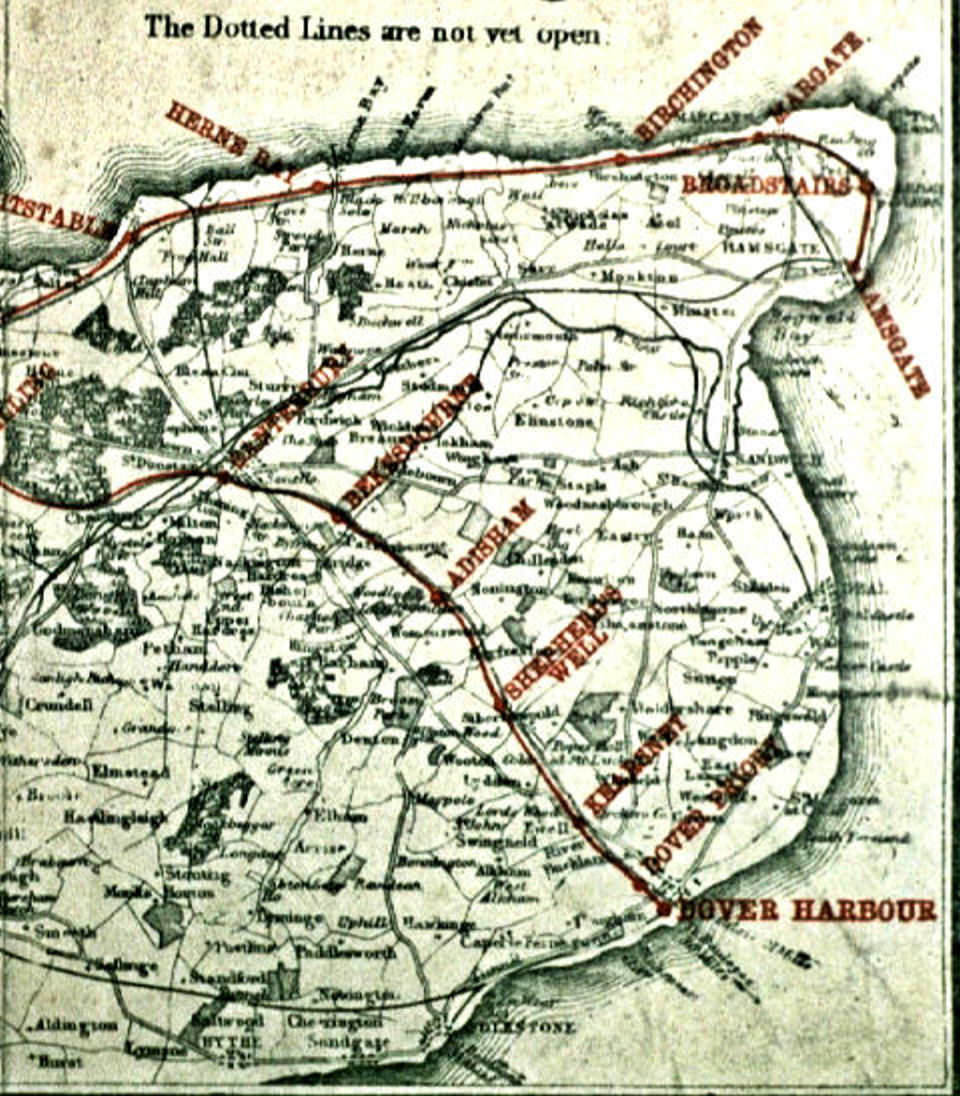
London, Chatham and Dover Railway line between Canterbury and Dover. Dover Museum

London, Chatham and Dover Railway line between Canterbury and Dover. Dover Museum

The London, Chatham & Dover Railway (LCDR) had been set up with the over-riding ambition to create an international freight-forwarding enterprise that co-ordinated the international exports and imports throughout the country. It’s centre was to be a massive depository on the Thames embankment, near to Victoria Railway station(see LCDR part I), from where their train services to Kent and the South East ran. The depository was to have its own wharf and their Continental shipping outlet was to be along the Thames estuary and across the North Sea. A second outlet was to be the port of Dover. To gain access to the port of Dover, LCDR had by-passed the established South Eastern Railway’s (SER) London to Dover rail network via Ashford and Folkestone and opened their route via North Kent and Canterbury.

In 1860 the LCDR railway line had reached Dover harbour and on 1 November that year they opened Harbour Station on the western side of the then harbour. In July 1860 they floated the LCDR Steamboat Service, a cross Channel shipping subsidiary company, which was the start of the envisaged freight forwarding enterprise. The Company then bought paddle steamers:
Samphire – a 330gross tonnage iron paddle steamer designed by Lieutenant Edward Edwin Morgan (1815-1892) and built by Messrs Money, Wigram & Co of London in 1861. She had 2×80 horsepower diagonal oscillating engines, with pistons 50inches in diameter with 3feet9inch stroke. These engines were built by Ravenhill, Salkeld & Co, Middlesex. Along with the Maid of Kent below, they were the first cross channel ships to have private cabins.
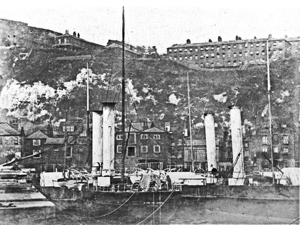
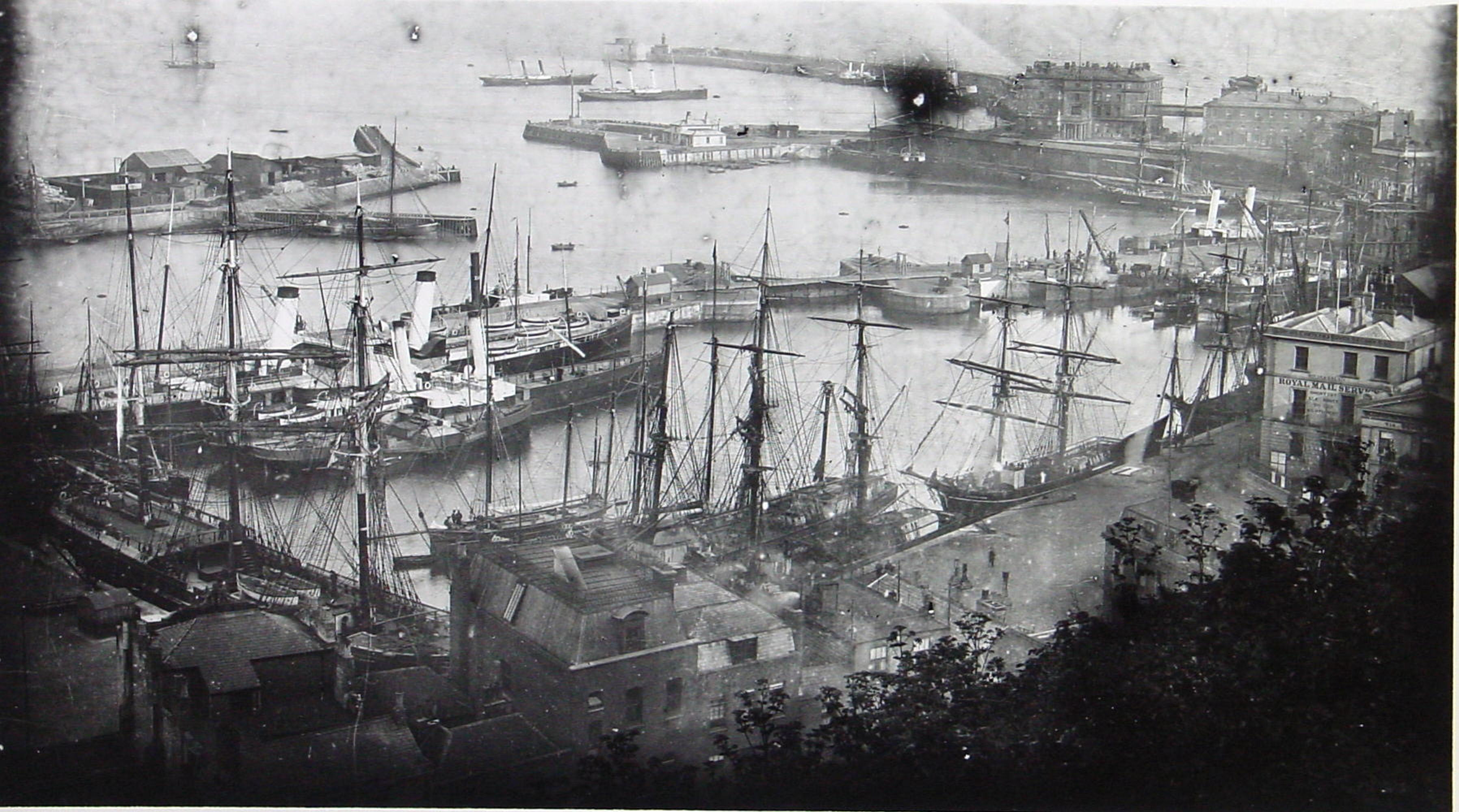
LCDR packet paddle steamers Samphire and Maid of Kent in Western Docks with the Western Heights Barracks on the cliffs behind. Dover Museum

LCDR packet paddle steamers Samphire and Maid of Kent in Western Docks with the Western Heights Barracks on the cliffs behind. Dover Museum

Maid of Kent (1) also designed by Lieutenant Morgan and engined by Ravenhill, Salkeld & Co. At 335gross tons, she was slightly bigger than the Samphire and built by Samuda Brothers of Poplar.

Petrel again she was designed by Lieutenant Morgan built by Messrs Money, Wigram & Co of London in 1862. The ship had 2×120 horsepower simple oscillating engines built by Ravenhill, Salkeld & Co, Middlesex.

Scud launched in 1862, was an Iron paddle steamer 482gross tonnage. Built by Samuda Brothers of Poplar with 2×120 simple oscillating horsepower engines by Ravenhill, Salkeld & Co. She was sold in 1872 and relocated at St John, New Brunswick but on 8 August 1882 was lost off Nova Scotia while on a passage from Boston, USA to Lunenberg, Nova Scotia.

Foam an Iron paddle steamer 497gross tonnage was launched in 1862 and built by Samuda Brothers of Poplar with a bow rudder. Her 2×120 simple oscillating horsepower engines were by Ravenhill, Salkeld & Co.

At this time, operating out of Dover harbour, with the Dover-Calais contract, was the Royal and Imperial Mail Steam Packet Company, owned by Churchward. With partners, he also held the Calais-Dover, Dover-Ostend and the Ostend–Dover contracts. In 1863, the Dover-Calais contract came up for renewal and was to run until 1870. It was expected that Churchward would either retain it or that the much larger SER, which also put in a bid, would run the service.
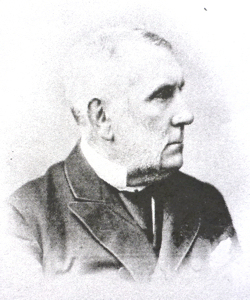
Sir Edward Watkin the Chairman of the South East Railway Company based at Folkestone. John Turner

Sir Edward Watkin the Chairman of the South East Railway Company based at Folkestone. John Turner

Operating out of Folkestone Harbour, they had developed, SER held both the Folkestone-Boulogne and the Boulogne-Folkestone packet contracts. Although their railway line from London actually terminated at Dover and from Folkestone to Dover ran through tunnels or at the base of the cliffs along the seashore. The Company’s chairman was the Mancunian, Sir Edward Watkin (1819-1901), who had worked his way up through the senior management structure of a number of railway companies. He was knighted in 1868 for his work in assisting the Canadian Federation and when Watkin was appointed Chairman of the SER in 1866, his wide experience and strong personality dominated. Further, his driving ambition, which he doggedly pursued, was a continuous railway line between Manchester and Paris. Watkin was also a seasoned Member of Parliament (MP) and having won the Hythe seat in 1874, he remaining their MP until 1895.

James Staats Forbes (1823-1904) Chairman of LCDR by George Charles Beresford 1864-1938. Wiki Commons

James Staats Forbes (1823-1904) Chairman of LCDR by George Charles Beresford 1864-1938. Wiki Commons

At the time the contract came up for renewal, LCDR, was already heading for deep financial trouble and in 1864, were forced to sell both Petrel and Foam. However, their General Manager, James Staats Forbes (1823-1904), saw the Company’s future prosperity in shipping rather than freight forwarding and submitted a lower bid than the other two. Forbes was born in Aberdeen to a railwayman and had trained as an engineering draughtsman. He then joined the Great Western Railway (GWR) as a booking office clerk at Paddington Railway station, London. He quickly climbed the lower and middle management ladders to become the goods superintendent and married Ann Bennett (1820-1901). They had five children, the first of which was George (1853-1855) who died at the age of two. The others were the eminent zoologist William Alexander (1855–1883), Ann born circa 1857, Sarah, born 1859 and Duncan Stewart born 1858. The latter went on to work for the Great Indian Peninsula Railway.

Forbes youngest two children were born in the Netherlands, where he had been recruited as the General Manager for the British managed Dutch-Rhenish Railway Company. His contract was for five years – which at the time was not likely as the Company was in a poor financial state. In the event, Forbes, using his natural business acumen, charm, resourcefulness and brilliance as a negotiator, turned the Company round. At the end of the contract Forbes declined to have it renewed but did accept the post of permanent adviser. The remuneration he earned from this sustained the Forbes’ family living standards throughout the hard times with LCDR that were to follow.

At the time of the Dover-Calais contract, Watkin was not the Chairman of SER but as a Board member, he argued for the Company to undercut Forbes bid, but was over-ruled. It would have meant that contract would be financial loss to SER. However, there were those with governmental power who did not want it awarded to Churchward and were apprehensive about it going to LCDR, as that Company had serious financial problems. Indeed, it was implied to SER that if they put in a bid equal to that of LCDR, they would be awarded the contract. This was put to the SER Board but they declined saying that the Folkestone route was the key to the whole Continental traffic while Dover was a mere backwater.

In the event LCDR were awarded the contract and the Company bought Churchward’s shipping stock and associated property. Forbes also negotiated a deal with Churchward whereby LCDR took over all of his contracts. However, as the contracts were in Churchward’s name, he still retained ownership. As the holder of the Dover-Calais contract, LCDR was privy to Berth 2 on the Admiralty Pier, where the London-Dover mail trains terminated. At that time, SER had held the contracts to carry both the Calais and the Ostend mails between London and Dover but by winning the packet contract, LCDR gained the London-Dover, Calais mails contract too.

Of the original fleet of Churchward ships, purchased by LCDR when they gained the contract, by 1875 only the Prince Frederick William of Prussia – usually shortened to Prince Frederick William remained. She was a 215-ton gross iron paddle steamer, designed by James Ash & Co of Poplar, launched in 1857. She was 180feet in length and 20-feet beam, 203-tons gross with 2×75 horsepower engines.
They had, however, in the intervening time purchased the:
Prince Imperial a 327.29gross tonnage iron paddle steamer from James Ash & Co of Poplar. She had, 2×90 horsepower oscillating engines that were supplied by Penn’s of Greenwich.
La France a 388 gross tonnage iron paddle steamer built by James Ash & Co of Poplar. She had 2×90 horsepower ordinary oscillating type engines.

The cost of purchasing and crewing the two ships had added yet further strain to LCDR’s already over-stretched resources but the Dover-Calais packet contract was potentially lucrative. Forbes was confident that the LCDR fleet would soon pay for themselves. However, both the Belgium and the French government had insisted that packet contract senior partners were nationals from their own countries. In the case of the Ostend-Dover contract the ‘senior’ partner was Belgium Marine a subsidiary of Belgium State Railways. Before the LCDR deal with Churchward was signed, Belgium Marine had  independently applied to the Belgium government to buy out Churchward’s Ostend-Dover share. They also managed to purchase the Dover-Ostend contract and from then on Belgium Marine held the monopoly of the Dover- Ostend packet route for over a century.
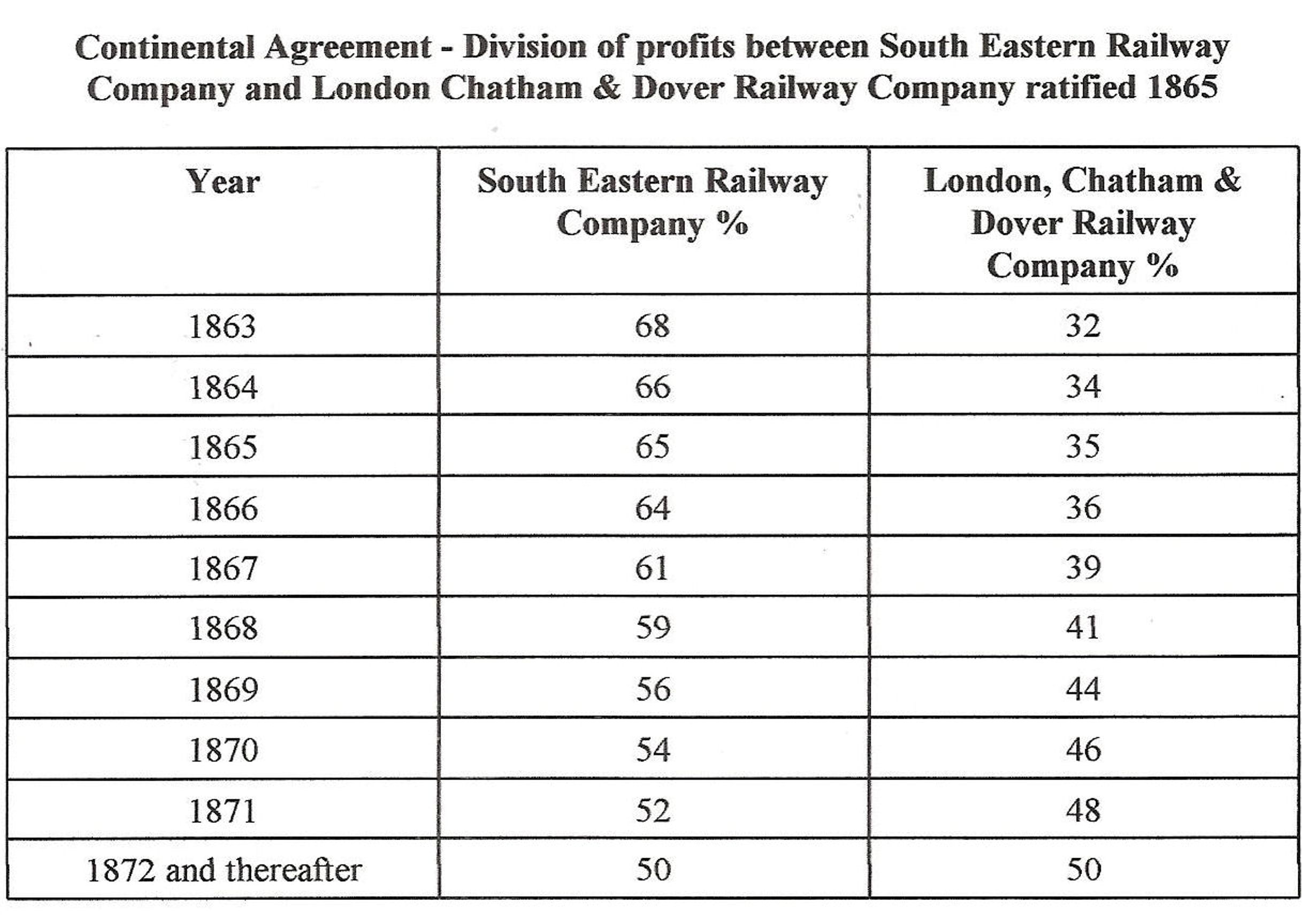
The Continental Agreement that was ratified in 1865 and divided the amount received by SER and LCDR for train journeys on the railway lines between London and the Channel Ports

The Continental Agreement that was ratified in 1865 and divided the amount received by SER and LCDR for train journeys on the railway lines between London and the Channel ports.

Not long after LCDR had gained the Dover-Calais packet contract, SER suggested that both Companies would benefit if they created an oligopolistic market. This proposition suited the LCDR Board even though it was readily apparent that the Continental Agreement, as it was called, worked in SER’s favour. They were under financial duress and saw the passage/packet enterprise of short term duration and the Continental Agreement would provide much needed income.  In essence, the Agreement meant that the two Companies pooled the profits earned from folk travelling on their railways to and from their cross-Channel ports. Although Forbes was unhappy about the terms he did manage to make modifications and the Agreement was ratified on 10 August 1865. Initially, LCDR received 32% and SER 68% of their joint takings with the gap progressively closing until 1872, from when on the takings were divided equally.

The French Calais-Dover contract, like that of the Belgium contract, was in Churchward’s and his senior national partner’s name. This expired in 1870, three years after the direct rail link between Calais and Boulogne opened, which shortened the route between Calais and Paris.  French political changes delayed the renewal until 1873 and, at the same time the Boulogne-Folkestone contract came up for renewal. Initially, both contracts were awarded to a French company but when it collapsed (See part 4 of the Packet story), both British companies were awarded the contracts but with stipulations. One of these, as far as LCDR was concerned, was that the transportation of the midday mails was on ships manned by French crews and flying the French flag. The Prince Imperial, La France, Petrel and Foam were assigned to the midday crossing.

In 1866 LCDR were declared bankrupt, following which Forbes, along with the recently appointed Company Secretary, William E Johnson,  became the joint managers and receivers of the Company. The Company was restructured, a new quasi Board of Directors were appointed and major consolidation took place. Although the financially disastrous rail side of the Company’s operations took up much Forbes time, he still took an active interest in what was becoming the most profitable part of LCDR, the Dover packet operations. However, the Samphire accident of 1865, pushed that sector into the red. Forbes, with the backing of a loyal and complying Dover maritime workforce stopped the packet side of the business sliding into further debt.

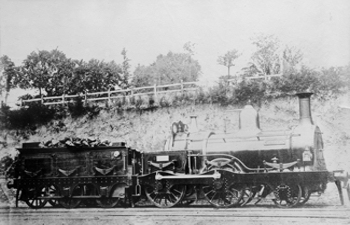
LCDR mail train locomotive 1873 - Martley 'Europa' Class 2-4-0 engine. LS Collection

LCDR mail train locomotive 1873 – Martley ‘Europa’ Class 2-4-0 engine. LS Collection

The final act of the quasi LCDR Board was, in 1873, the abandoning of the international freight forwarding dream and the Company regained its independence. A Board was appointed by the shareholders and the existing Chairman retained his position by a show of hands. He recommended the LCDR should build new railway engines and that Forbes was to be appointed to the Board. This was agreed and Martley ‘Europa’ Class  2-4-0 engines were purchased.

The following year, Forbes was offered the Chairmanship of LCDR, which he recognised was a poisoned chalice. Although, throughout all of LCDR’s turbulent history, Forbes had been awarded a large and increasingly escalating salary, in realty, the remuneration he received had fallen from when he was first employed by LCDR. Thus, much of the family income came from the stipend he received from the Dutch-Rhenish Railway Company. LCDR was broke, it desperately needed new trains, ships and infrastructure. The workforce needed living wages with prospects and there was little hope of the Company making ends meet in the near future. Thus, Forbes accepted the position but only on a temporary basis.

London Chatham and Dover Packet Service 1875 – 1884
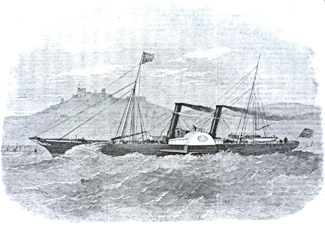
SER steam packet Victoria on the Folkestone - Boulogne crossing. Dover Library

SER steam packet Victoria on the Folkestone – Boulogne crossing. Dover Library

Not long after Forbes became Chairman of LCDR he became seriously ill and was totally debilitated throughout the winter of 1874-75. During that time Watkin, on behalf of SER, proposed a quasi merger between the two Kent railway/packet companies. In essence, Watkin suggested, there would be a fusion of the net profits of both companies, for an interchange of traffic and a friendly working relationship. The notion sounded good and the LCDR Board, agreed to a meeting. There, it was pointed out, by Watkin, that SER’s fleet of paddle steamers besides the Princess Maud and the Princess Clementine, which they had occasionally placed at Dover, consisted of five modern paddle steamers. These  were the Victoria and Albert Edward, both of which could make the crossing from Folkestone to Boulogne in 1½ hours while the newer ships, AlexanderEugene and Napoleon III were at the forefront of modern paddle steamer design. The LCDR Board were impressed and a series of amalgamation meetings were arranged for when Forbes returned to work.

The meetings were held in early March 1875 and Watkin expanded on the finer points of the deal and detailed the bureaucratic hurdles that had to be surmounted. The final one of which was parliamentary approval. Nonetheless, Watkin added, in the meantime the two Companies could take the proposed course of action on a provisional basis. The LCDR Board were in full agreement but Forbes was not so enthusiastic. He pointed out that the proposals were a broader version of the Continental Agreement that would be applicable to all the LCDR operations not just cross Channel traffic. Further the five paddle steamers that had been implied as relatively new, was open to interpretation. The Victoria and the Albert Edward were built in 1860 and 1861 respectively, while the Alexander and Eugene were built in 1864 and the Napoleon III was built long before the Emperor abdicated in 1870!

The LCDR Board agreed with Forbes that clauses were to be inserted into any agreement that protected the LCDR rail and maritime service along with LCDR staff, before asking for shareholders acceptance. Watkin, however rejected Forbes proposition and refused any compromise. At the end of May 1875, Forbes issued a formal statement saying, in effect, that negotiations had broken down but that LCDR were willing to reopen discussions.
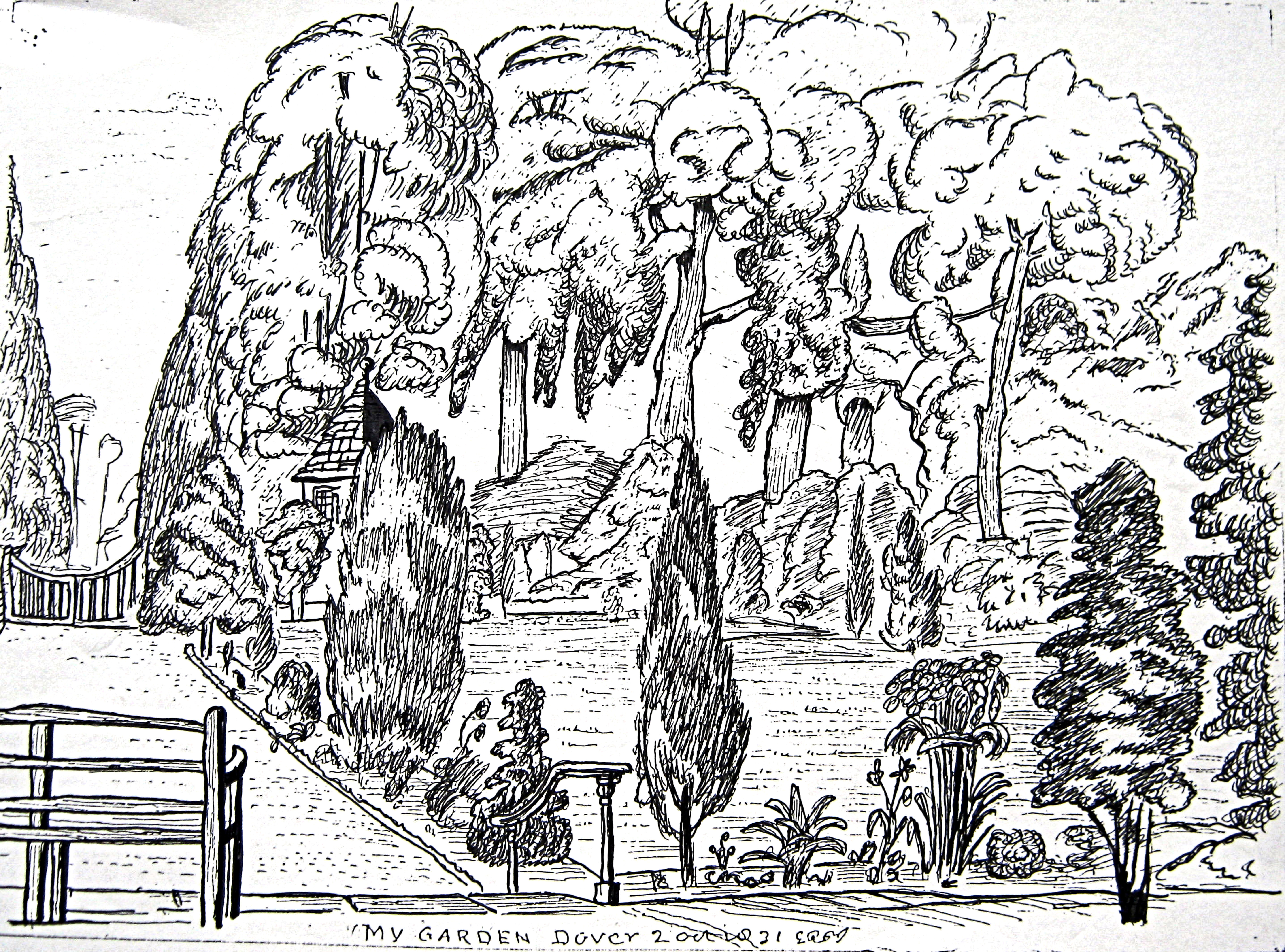
Site of the present day Pencester Gardens drawn in 1831 by George Jarvis, bought by SER in 1880 for a grand central Dover railway station for Watkin's Channel Tunnel project.

Site of the present day Pencester Gardens drawn in 1831 by George Jarvis, bought by SER in 1880 for a grand central Dover railway station for Watkin’s Channel Tunnel project.

Unperturbed, Watkin turned his attention to his primary objective, that of a continuous railway route between Manchester and Paris. Back in 1872, the SER shareholders voted £20,000 to build a Channel Tunnel. At the time, the project was to be undertaken in conjunction with the French Nord Railway. To this end, SER formed the Submarine Continental Railway Company and excavation was started at Abbots Cliff when a 74-foot shaft was sunk and a level heading was driven 2,601-feet. A French team undertook borings at their side of the Channel at Sangatte. A second 44-foot shaft was then sunk at the foot of Shakespeare Cliff in February 1881 and the heading progressed 6,380-feet under the sea. Work was going so well that Watkin bought Pencester Meadow, with the view of building a large, luxurious railway station in the centre of Dover. In 1878, SER installed a 60-lever signal box (Hawkesbury Street Junction) adjacent to the Town Station in preparation for the new railway line. However, at parliamentary level the Joint Committee of both Houses were of the opinion that a Channel Tunnel would not be expedient and the project was forced to be abandoned.

The Pencester site was put on the market and bought by William Crundall senior (1822-1888) and eventually became the Pencester Gardens we see today. These days the site adjacent to what was the Watkin Channel Tunnel boring plus the spoil from the present Channel Tunnel was levelled to create Samphire Hoe. This is run by the White Cliffs Countryside Partnership (WCCP) and is a popular visitor attraction. As for Watkin’s Manchester-Paris railway line ambition, this never materialised. However, in 1886 Watkin received a report from Professor Sir William Boyd Dawkins (1837-1929), an eminent geologist who was the main adviser to the Submarine Continental Railway Company. By that time Dawkins was boring for evidence of coal seams in the neighbourhood of Dover. His findings led to the discovery of the Kent Coalfield and the sinking of the long closed Shakespeare Colliery.

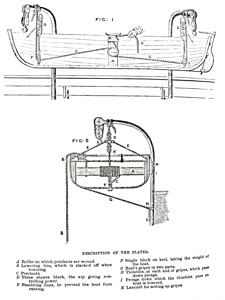
Forbes watched Watkin’s Channel Tunnel endeavours with interest but making LCDR pay was uppermost in his mind. The packet side of the business dominated discussions in the prominent national newspapers, particularly in relation to the major scourge of seasickness. The then famous inventor/engineer Henry Bessemer (1813-1898) had adapted a design of a paddle steamer by Sir Edward James Reed (1830-1906) that, it was reported, provided the answer to this problem. Reed had changed the way ships were designed from ‘the rule of thumb’ to calculations based, he said, on sound theoretically principles and from careful experiment he had produced a model that was internally stable on all occasions. Bessemer had adapted the Reed design and a ship had been built with a special swinging saloon, located along the centre of the ship, which rested on two telescopic cylinders with pistons. This kept the floor of the saloon horizontal, it was said, even during the roughest of crossings and Earle’s Shipbuilding and Engineering Company, Hull had built the prototype for Bessemer.
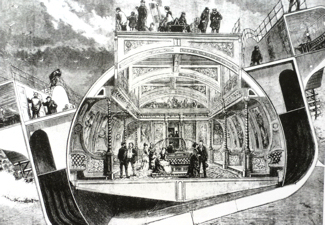
Bessemer showing the 'Swinging Saloon.' Illustrated London News 1875. Tom Robinson

Bessemer showing the ‘Swinging Saloon.’ Illustrated London News 1875. Tom Robinson

The prototype ship was named Bessemer,  tonnage 1,974gross.  She was 350feet in length and 65feet across the paddle boxes with a draft of 7feet 5inches. She was driven by 4 paddle wheels, two on each side that were powered by four sets of simple oscillating engines placed fore and aft to be out of the way of the saloon. The internal dimensions of the saloon were 70feet long, 30feet wide with a height of 20feet. Besides the main room, the rest of the saloon area was divided into a number of smaller rooms. The saloon area had spiral columns of carved oak and gilt moulded panels. Hand-painted murals decorated the walls while the seating was of Moroccan leather.

Forbes arranged for the Bessemer to be brought from Hull to Dover by LCDR’s Captain James John Pittock (1827-1899) at the beginning of March 1875. This was for a trial purpose only as he did not make any promises to purchase the ship. During the journey, Pittock and the crew tried out the anti-sea sickness mechanism. This was designed to keep the saloon steady by hydraulic machinery that oscillated by means of a mechanism called a ‘manipulator’. A member of the crew, using two short handles one in each hand, operated this by moving them in accordance with the movement of the ship. The sea condition, using the Beaufort Wind Scale when these trials took place were 4-5 fresh to strong breeze, small to moderate long form waves with white horses. Pittock reported that the manipulator worked.  At the beginning of May, with members of the LCDR Board, Forbes crossed to Calais on the Bessemer. The weather was fine (Beaufort scale 2-3) and she made the crossing in 1hour 40minutes and equivalent for the return journey.
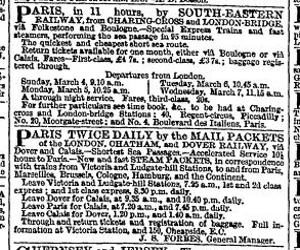
 Bessemer advert, May 1875

Bessemer advert, May 1875

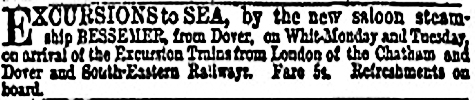
It was agreed that the Company would hire the Bessemer for the Whitsuntide holidays of Monday 17 and Tuesday 18 May. Special excursion trains were laid on and adverts placed quoting the fare as 5shillings a head with refreshments on board. A week before the special excursions, 500 gentlemen, including Prince Albert the Duke of Edinburgh (1844-1900) and the Lord Warden and Chairman of Dover Harbour Board (1866-1891), George Leveson Gower the Earl Granville (1815-1891), were the guests of LCDR. They crossed, on the Bessemer on a calm day to Calais and were then taken by the Northern Railways of France Company, to Paris for the weekend.

The Whitsuntide excursions proved a sell out and the ship was full on the first crossing to Calais. However, a few days before, on entering Calais harbour under Captain Pittock, the Bessemer caught a portion of the West Pier and demolished it. Surveyors for LCDR reported that both the wooden piers facing the entrance of Calais harbour were rotten and Sir Edward Reed endorsed this. Nonetheless, LCDR were sent a bill for £3,000 for repairs, which was more than LCDR would earn from the special excursions. As for the excursions, the weather did its worse with wind speeds increasing from force 6 on the Beaufort Scale to gale force 8 by the end of second day. The crew members operating the manipulator found it impossible to keep up with the ship’s movements and Captain Pittock ordered it to be closed down. Afterwards, he also reported that in the rough weather, the Bessemer was sluggish in answering the helm and was difficult to manage due to where the engines were situated.

LCDR declined offers to hire Bessemer again and in March 1876, following liquidation of the Bessemer Saloon Steamboat Company Ltd, she was at Millwall Docks on offer for sale by auction. This was held at the Captains’ Room of Lloyds Insurance, London in what is now the Royal Exchange in the City of London. Forbes, who attended, reported that she failed to obtain a bid and eventually the Bessemer was sold. The swinging saloon was removed before she was scrapped in 1877 and Reed purchased it for a billiard room at his home at Hextable, Kent. When the House eventually became part of a college, the saloon became the dining room. During World War II (1939-1945) the building was bombed and subsequently demolished including the unique dining room.
Castalia twin hull steamer c1875. Dover Library

Castalia twin hull steamer c1875. Dover Library

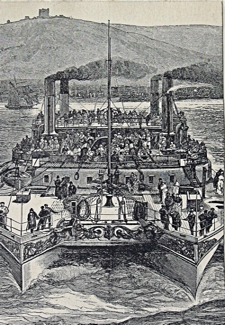
On 15 September 1875 another ship designed to combat the mal de mer made her maiden voyage from Dover to Calais. She was the Castalia made up of two hulls joined with strong girders and covered with a wide upper deck (see Packets IV last paragraph). LCDR hired the ship and she not only lived up to expectation but proved popular. In 1876 she carried over 10,000 passengers during the summer months. The free publicity provided by national newspaper articles, for both the Bessemer and the Castalia brought about an increased interest in crossing the Channel to Calais.  And subsequently the number of people using the LCDR trains to and from Dover and on the LCDR packet ships also increased. By the end of the year Forbes reported that 209,133 passengers had made the crossings, which was more than double the number of passengers in 1870 (102,673). Further, he added, LCDR had carried almost twice as many passengers than those carried by SER between Folkestone and Boulogne!

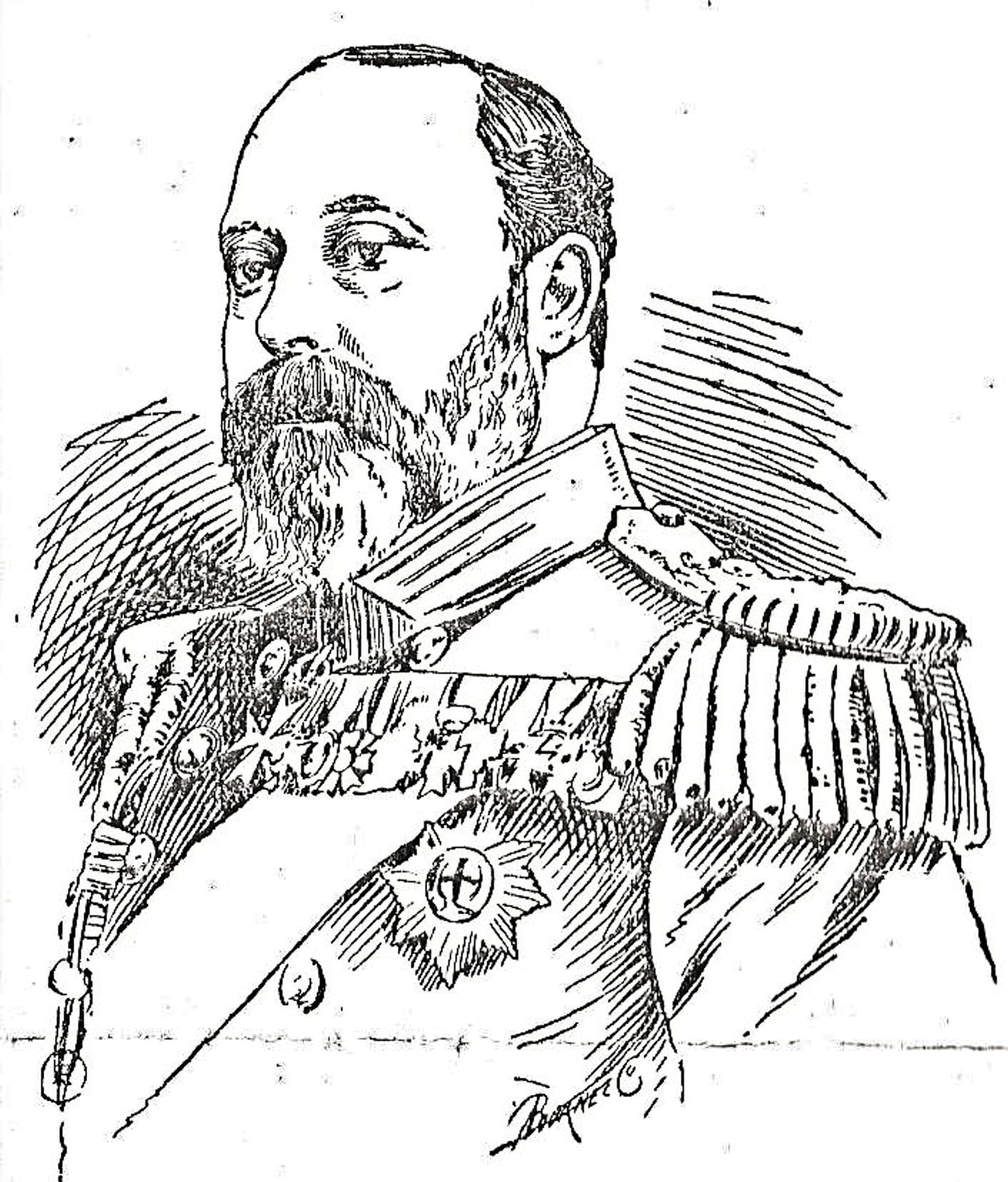
Besides Prince Albert the Duke of Edinburgh, Queen Victoria’s (1819-1901) extensive family were also regular passengers on the LCDR ships. They were all treated with the utmost courtesy and all their comfort needs were dealt with in the best way possible, including sea-sickness. In October 1875 Edward the Prince of Wales (1841-1910) and his wife Princess Alexandra of Denmark (1844-1925), along with the Duke of Edinburgh, embarked on the Castalia with Captain Pittock in charge. The Prince went on to Paris while the Princess and the Duke returned to England on the Castalia.

Prince Arthur, Duke of Connaught (1850-1942) regularly made the crossing as part of his military duties. These included travelling on the Castalia as well as the LCDR packet ships. In June 1873, the Duke brought his intended bride, the 13 year old Princess Louise Margaret of Prussia (1860-1917) to Britain on the Maid of Kent under the command of Captain William Waller Paine (1844-1917), to meet his family. She was the daughter of Prince Frederick Charles (1828-1885) and a great-niece of Emperor Wilhelm I (1871-1888) of Germany, who was Arthur’s godfather. The couple married on 13 March 1879, when Princess Louise was 19 and the bride’s family came to England for the occasion travelling on the Maid of Kent under Captain Pittock.
Maid of Kent tied up to Admiralty Pier. The body of George V (1819-1878), the last King of Hanover (1851-1866) was brought across the Channel on the ship for burial at Windsor.

Maid of Kent tied up to Admiralty Pier. The body of George V (1819-1878), the last King of Hanover (1851-1866) was brought across the Channel on the ship for burial at Windsor.

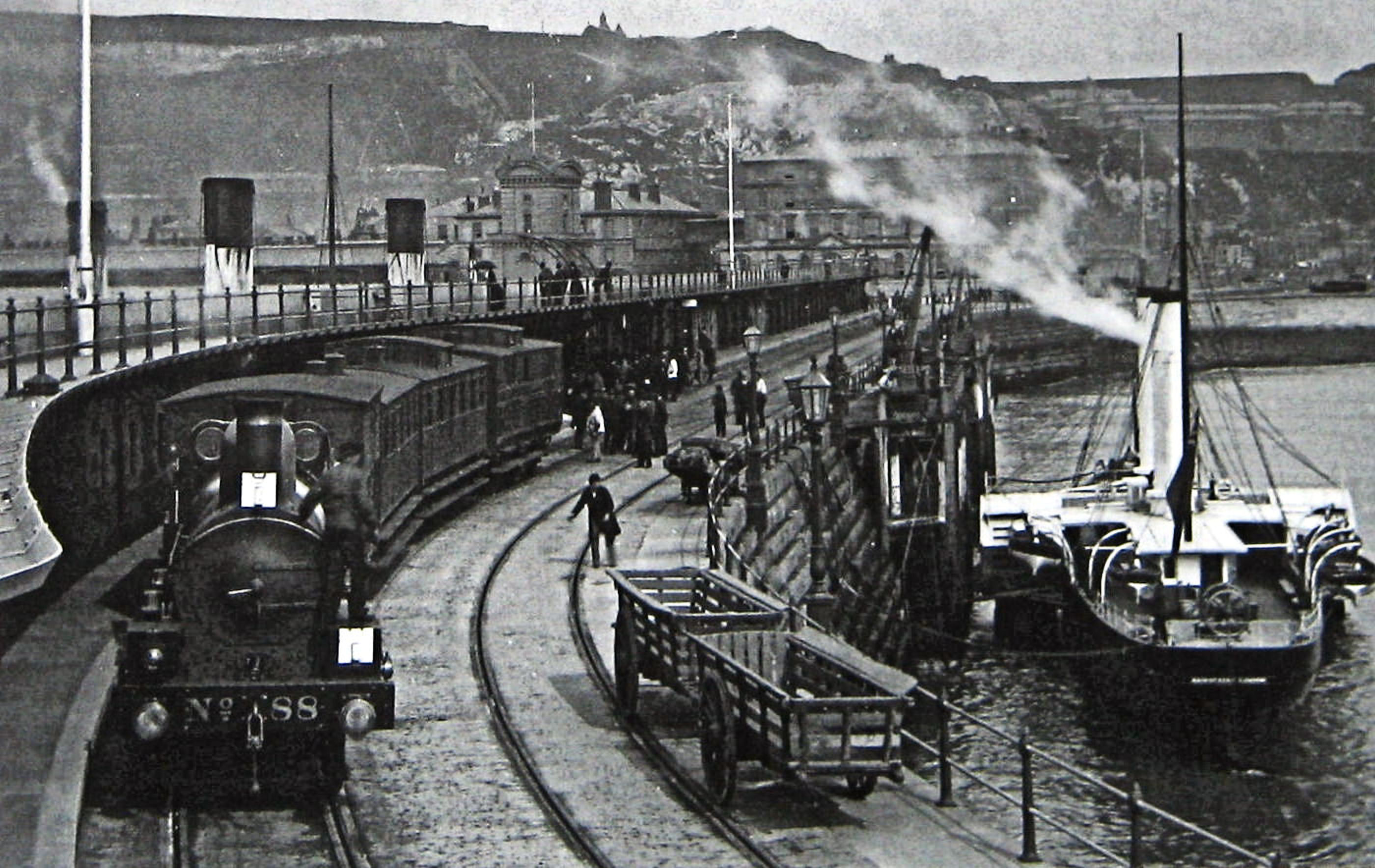
The blind George V (1819-1878), the last King of Hanover (1851-1866), and his daughter Princess Frederica of Hanover (1848- 1926) spent five weeks in Britain in May-June 1876. During the Austro-Prussian War of 1866 and against advice, King George involved his country on the side of Austria when Prussia invaded. This eventually led the surrender of the Hanoverian Army on 29 June and Prussia’s formal annexation of Hanover in September forced King George to abdicate. The father and daughter travelled to England on the Samphire, with Captain Frederick Dane (1835-1913) in command. They were met by one of Dover’s two Members of Parliament (1865-1889) Major Alexander George Dickson (1834-1889), on behalf of LCDR. Two years later, on 23 June 1878, the King’s body was brought back to England on the night packet from Calais, the Maid of Kent, under the command of Captain John Whitmore Bennett (1828-1907), for burial in St George’s Chapel, Windsor. A number of Hanoverian dignitaries accompanied the body but as it was 04.00hours when the ship docked at Admiralty Pier, there was no formal welcome. The Dover Express reported that the remains were ‘carried off to Windsor with as much ceremony as Her Majesty’s mails’. The funeral, the following day, more than made up for this.

Franz Joseph I (1848-1916) the Emperor of Austria’s wife, Empress Elisabeth (1837-1898), visited England in April 1876. Following the Seven Week Austro-Prussian War, Franz Joseph was forced to cede the German crown to Prussia but he did retain his Empire. In 1873, under the influence of the German Chancellor, Otto von Bismark (1815-1898), Franz Joseph along with Kaiser Wilhelm I (1871-1888) of Prussia later Emperor Wilhelm I of Germany and Tsar Alexander II (1855-1888) of Russia formed the League of Three Emperors (1873-1887). This was, it was reported, to maintain peace in Europe. Empress Elisabeth had crossed the Channel on the LCDR packet Foam in April 1876, with a large entourage. For the journey, she used the pseudonym the Countess of Palfry to hide her identity even though the entourage included a ‘stable of horses’! It would appear that she had expected to be invited to Windsor by Victoria but the British Queen declined to make such an offer. So the Empress of Austria and her retinue left for Towcester, Northamptonshire where, using the pseudonym Countess Hohenembs, she rented Easton Neston House.

The following month, May 1876, LCDR received a special request that was to be kept as secret as possible. The remains of King Louis-Philippe (1830-1848) of France and his wife Marie-Amélie (1782-1866) of Naples and the bodies of other members of the Orléans family including five of their children, that were buried in St Charles Borromeo Roman Catholic Chapel, Weybridge, were to be removed. The family had moved to England following Louis-Philippe’s abdication on 24 February 1848. Since that time, he and his family had lived at Claremont, Surrey and regularly worshipped at the Weybridge Chapel, where the bodies were buried. In June 1876 the French government agreed to the bodies being reburied at The Royal Chapel of Dreux, Normandy, France, the traditional burial place of members of the House of Orléans.

The cortege left Weybridge for Southampton and the crossing of the Channel to Honfleur, Normandy. For the crossing, the French government had requested that this was to be on a LCDR packet ship under the command of Captain Pittock and the Samphire was chartered for the purpose. Ten coffins plus an urn containing the embalmed heart of Louis-Philippe were placed on the aft part of the ship and draped with black cloth. The British Ensign was flown from the peak halyards and the French Tricolour from the main mast of the Samphire, both at half mast. The LCDR flag, also at half-mast, was flown at the entrance of Southampton Dock until the ship had left the harbour. However, the remains of Princess Victoria of Saxe-Coburg and Gotha (1822-1857), the wife of Prince Louis of Orléans, Duke of Nemours (1814-1896) and the cousin of Victoria’s consort, Prince Albert of Saxe-Coburg and Gotha (1819-1861) stayed at Weybridge. The Queen had refused to allow them to be removed but eventually, in 1979, they were moved to the Royal Chapel of Dreux.
Admiralty Pier following storm damage on 1 January 1877 at the seaward end. Dover Library

Admiralty Pier following storm damage on 1 January 1877 at the seaward end. Dover Library

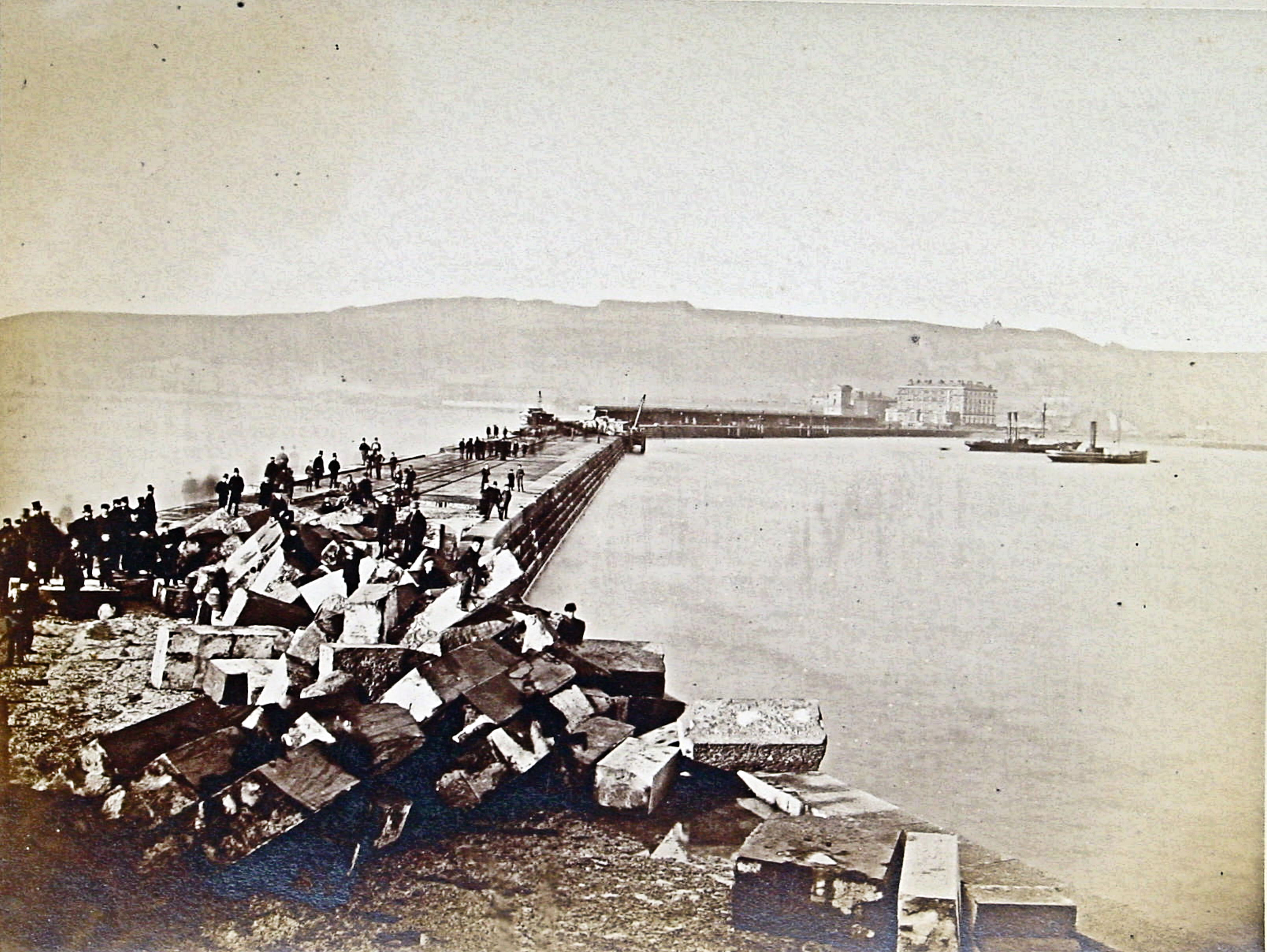
Storms damaged Admiralty Pier in January 1877 and Dover Harbour Board had paid £26,000 to have it repaired. The work was carried out by William Adcock (1840-1907). At Folkestone, SER ships were battered and the repairs were estimated at £2,000. The stormy weather continued and the cliffs between Folkestone and Dover started to give way. SER were forced to close the line while cliff shoring was being undertaken. LCDR helped out by allowing SER passengers to use their train to travel to Dover for the Ostend service. However, as the wet and stormy weather continued sections of the LCDR line between Dover and Canterbury became vulnerable to collapse.  An understanding was reached while repairs were undertaken enabling LCDR to divert their packet ships to Folkestone and SER trains to carry the mail for them. This bonhomie between the two companies gave their chairman Watkin, the impetus to make LCDR another offer of amalgamation and went as far at to devise a timetable for talks, sending an appropriately worded Bill to parliament and publicising the possibility.

This caused consternation in Canterbury, which was served by both companies to two separate railway stations, Canterbury East (LCDR) and Canterbury West (SER). In early February 1876 a public meeting was called under the chairmanship of the city’s mayor, William Henry Linom (1820-1888). Primary causes for concern were cuts in services and increases in ticket prices. Several speakers pointed out that as things stood, trains were often overcrowded and ticket prices extortionate between Kent and London except to places where both SER and LCDR had stations. On such lines the competition for passengers was such that there was plenty of room and the fare per mile was cheaper. The same applied, the audience was told, to the carriage of goods, produce and animals.

As for the cross Channel packet fares, a speaker stated that they were kept in check by competition. But that there was a general under capacity on the ships and except for when the Castalia was in operation. The accommodation provided by both companies, except on the Castalia and on all the trains was, at best, worn out! At the end of the meeting, it was proposed by Canterbury banker George Furley (1817-1898) and seconded by bookseller William Bohn, that a committee should be formed. Mayor Linom agreed to chair this and the remit was to observe the decisions made by the Directors of LCDR and SER. On this basis, Linom and his committee were authorised to take any action they saw fit in order to protect the interest of people residing in Canterbury and East Kent. The proposal was unanimously adopted.

Forbes digested the report of the Canterbury meeting, given to him by his employees who had attended and brought it up with Board members prior to the LCDR Annual General Meeting. This was held the following month and there, Board member Major Dickson put forward the SER amalgamation proposition and the shareholders endorsed it. Forbes, as Chairman, acknowledged their wishes adding that if SER offered favourable terms to LCDR, then an amalgamation would take place and neither he nor the Board would stand in the way.

He then added, in essence, that from 1860, when LCDR had first opened the line to Dover the Company has been fighting for its existence against two powerful neighbours, the South Eastern and the London, Brighton, and South Coast railway companies. Further, debt, pressing creditors and doubtful stock issues had wreaked havoc on LCDR but with skilful and careful leadership, he was sure that Company could, in time, become viable in its own right. Therefore, Forbes said, if negotiations were not favourable to LCDR and its shareholders, then the plan should be rejected. A show of hands supported hm.

The negotiations were turbid and as they were drawing to a close Forbes arranged to meet the Canterbury group on their own territory. From the opinions expressed, Forbes became aware of the need for a passage service from north Kent to the Netherlands and northern Europe and that the Stoomvaart Maatschappij Zeeland SS Co (SMZ), known in Britain as the Zeeland Steamship Company, had in 1875, run such a service from Queenborough north Kent. SMZ ‘s Dutch base was Flushing, (Dutch – Vlissingen) in south west Netherlands but that the service had since ceased.

Following the meeting, Forbes team contacted Simon Josephus Jitta (1818-1897) of SMZ and along with Forbes, they went to look at Queenborough. The town and port is on the east side of the River Medway where it enters the Thames Estuary. Back in the late 1850s the Sittingbourne & Sheerness Railway Company had built an 8miles 5chains spur from what became the LCDR Strood-Faversham railway line. This was to Sheerness where there was a Royal Naval base and the railway line had opened on 19 July 1860. From that time LCDR had leased the line from the Sittingbourne & Sheerness Railway Company for £7,000 per annum, which was just about covered by the receipts from Royal Naval passengers and goods.
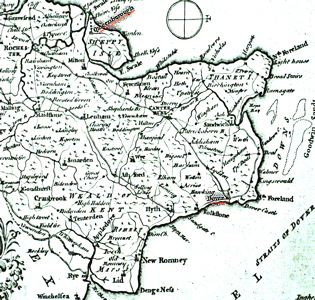
19th century East Kent map showing Dover, Queenborough and the LCDR Railway Line. Dover Museum

19th century East Kent map showing Dover, Queenborough and the LCDR Railway Line. Dover Museum

Two miles south of Sheerness, was/is Queenborough which, at the time Forbes and his team arrived, was in a very poor state. Historically, the town had thrived on trade from it’s position between London and the North Sea, but improved navigation meant that the town and it’s marine facilities were bypassed. In the 1850s Queenborough was bankrupt so parliament had put the town into the hands of Trustees. Forbes noted the location had possibilities and he made the Sittingbourne & Sheerness Railway Company an offer for their railway line. By the summer of 1876  the two companies had merged and LCDR were building the half-a-mile long Queenborough Pier. This was on the Sheerness side of Queenborough railway station out into the River Medway close to its junction with the River Swale. The Company then laid a railway connection from the down-side of the Sittingbourne & Sheerness Railway line and along the Pier. They also built a purpose designed quay adjacent to the Pier and after negotiations with Jitta of SMZ that Company started a new service between Queenborough and Flushing.
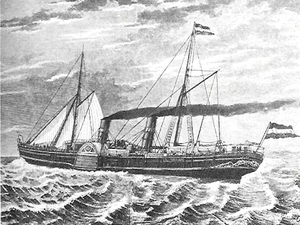
SMZ Stad Middelburg. Wikimedia Commons

SMZ Stad Middelburg. Wikimedia Commons

When SMZ had started their original service, on 26 July 1875, they did so with two former Confederate blockade runners left over from the American Civil War (1861 to 1865). These they named Stad Middelburg and the sister ship, Stad Vlissingen. The two ships had been built by Quiggin & Jack of Liverpool as the Northern and Southern, respectively. Originally, SMZ had run a nightly service except on Sundays with the two steam ships and following discussion with LCDR, SMZ reintroduced the service and ships until better and more ships could be afforded.

The new service was advertised and the media took notice but just as the new passage service was taking off, the crank axle of the Queenborough-Flushing boat express engine broke while travelling at high speed. This was about six miles from Sittingbourne and caused the driving wheels to leave the line and the train to travel nearly a mile, passing over a bridge, before the driver could bring it to a halt. Although the engine was considerably damaged and the SMZ ship was delayed for three hours until the passengers arrived, no one was hurt. It took two days to repair and re-open the line but the event was well covered in the national papers and commented upon by SER. In the meantime, Jitta had applied to the Dutch government for a Holland – England packet contract and with the backing of Forbes to provide the rail service, SMZ won it!

For much of the 19th century Dover had called for the much needed Harbour of Refuge on the East coast of Kent and for it to be sited at Dover. This had been promised and Admiralty Pier had been built to provide the western arm. However, government money had not been forthcoming to complete the project and this had not been helped by Watkin along with massive support from senior members of his political party, the Liberals and those powerful in the Folkestone/Hythe area putting pressure on the government to build the Harbour of Refuge at Folkestone. Back in 1873, Forbes had stood for a parliamentary election for the Liberal Party in Dover on the premise that he planned to turn Dover into one of the major passenger ports in Europe and his aim, if elected, was to get the Harbour of Refuge that the town had long been calling for. However, the voters of Dover declined to make him their MP, instead preferring a Tory.
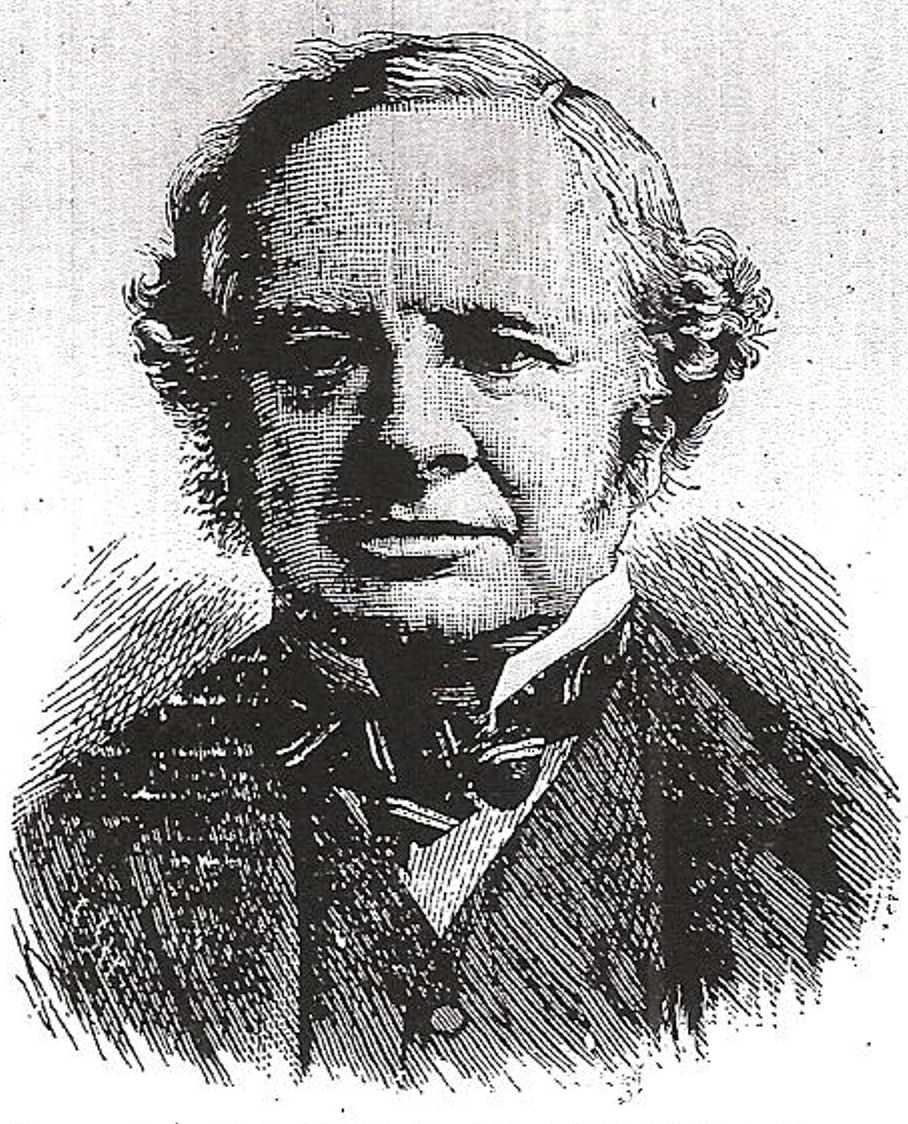
Earl Granville, Lord Warden and Chairman of Dover Harbour Board who was champion for a Harbour of Refuge to be sited at Dover.

Earl Granville, Lord Warden and Chairman of Dover Harbour Board who was champion for a Harbour of Refuge to be sited at Dover.

Albeit, in May 1876 in the House of Lords, the Lord Warden of the Cinque Ports,  the Liberal Earl of Granville, had again put forward the need for a Harbour of Refuge and emphasised that it should be at Dover. He also stated that since 1860, when LCDR had first provided a cross Channel service from Dover the number of passengers using the port had increased and this included members of the Royal family. Granville went on to say that the number of passengers carried between Dover and the ports of Calais and Ostend continued to increase and made reference to passenger figures for that year to May. The figures for the full year were embarkation for Calais 102,121 and for Ostend 18,142. Landed from Calais 99,728 from Ostend 19,137, making the total passenger traffic between Dover and Calais 201,849 and between Dover and Ostend 37,279 and the total passenger traffic for the port 239,128. Thus, he said, there was a need for a specially constructed Water Station, covered space to accommodate cross Channel steamers and a connection from the shore over which the trains would pass to get alongside the cross-Channel ships. Granville finished by saying that both railway companies along with Belgium Marine, through Dover Harbour Board (DHB), had offered to contribute a total of £200,000 towards such a facility but the government had turned down the offer. The government had told DHB that this was because they were planning to build a Harbour of Refuge but no evidence of this was forthcoming.

In response, Granville was told that a water station was about to be built at Dover by a private sector company. In 1875, Hugh Aldersley Egerton (1834-1913) of Banbury had filed a patent for a Channel Ferry that, he said, would revolutionise the cross-Channel industry between Dover and Calais. He had designed a triple-hull ship 600-feet long, with 228-feet beam and estimated to cost £125,000. The ship, he said, would have the capacity to carry ten complete trains, with 2,000 passengers and 500 tons of baggage. The trial of a model of the vessel took place on the Brent Reservoir between Hendon and Wembley Park, London. This was successful and was followed by a publicity trial on the Serpentine in Hyde Park, London. The following year, just before Granville made his speech, Egerton filed a patent application for the ‘Improvements in the construction of floating piers and other analogous structures for embarking or disembarking passengers, animals or merchandise,’ specifically with Dover in mind and included a water station. However, neither Egerton’s giant steamship nor the water station were built and he left for France. There Egerton became an adviser to the French government on cross-Channel shipping improvement.
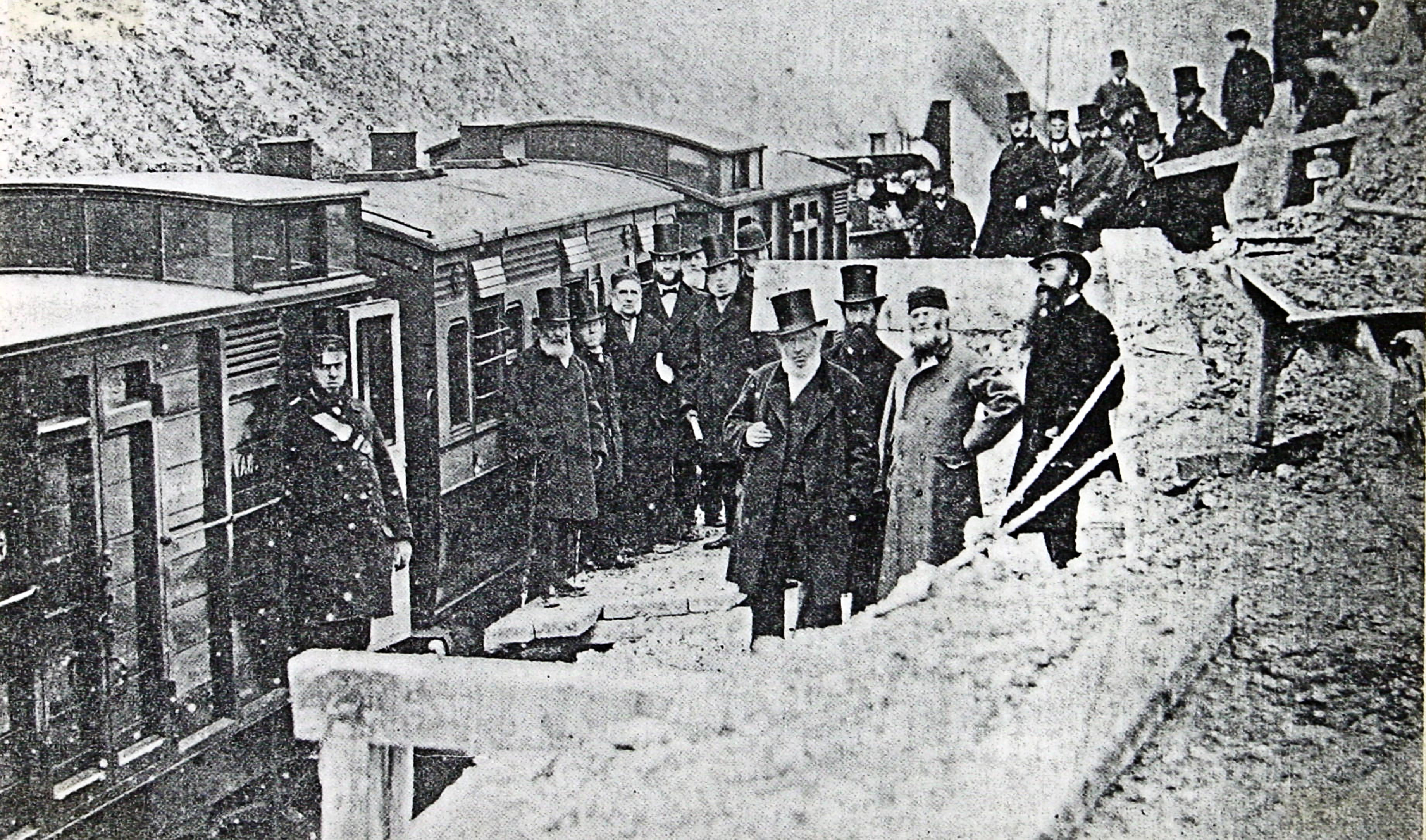
Opening of the SER Folkstone-Dover Line after a cliff fall in 1877. Watkin, the Chairman of LCDR is wearing the Cossack style hat. Dover Library

Opening of the SER Folkstone-Dover Line after a cliff fall in 1877. Watkin, the Chairman of LCDR is wearing the Cossack style hat. Dover Library

A severe storm hit the south east corner of Kent in January 1877, washing away the foot of the cliff at the eastern end of the Martello Tunnel, on the SER line between Dover and Folkestone. This had brought down some 60,000tons of the chalk cliff, killed three workers and completely blocking the line. Forbes reacted by offering the use of the whole of the LCDR railway lines to Watkin, writing, ‘We are partners in the Continental Agreement, take your mails over our railway.’ For the following two months, until SER repaired the line, their trains carrying mails for Belgium, went from London to Beckenham on the SER line and from there on they used the LCDR line to Dover. During this time there were rumours that SER had no intention of reopening the Folkestone-Dover line and Watkin was of the opinion the rumour had originated with Forbes. When the SER line was finally repaired, Watkin organised a grand re-opening and arrived on a Cudworths 2-4-0 Class E locomotive with a stovepipe chimney and wearing a Cossack style hat. At the time Russia was about to be embroiled in the Russo-Turkish War (1877–1878) and Watkin drew analogies from the two countries relationship and the relationship between SER and LCDR.

Nationally, the media and passengers were more interested in the accommodation on board cross Channel ships than the hat Watkin was wearing. Although SER was at the brunt of most of the complaints, LCDR also received a great deal of criticism particulary in comparison with the furnishing on the Bessemer and Castalia. In the summer of 1878 a major exhibition was to be staged in Paris and in consequence this increased the SER impetus to join forces with LCDR but Forbes and the Board were far from happy with the terms offered. Nonetheless, both companies started working together with a view to amalgamation and that included meeting the demands of the possible increase in the number of passengers crossing the Channel to attend the 1878 Paris Exhibition.

Early in 1877, an iron twin-hulled paddle steamer with engines by Black, Hawthorn & Co of Gateshead and designed and built by Andrew Leslie & Co of Hebburn-on-Tyne was launched. She was the direct successor to the Castalia and although the basic design was in accordance with the Captain William Dicey patent for that ship (see Packets part 4), the company that had ordered her, English Channel Steam Ship Company, had demanded a number of modifications. They named their new ship, Empress and she was launched on 14 April 1877. By that time, however, the English Channel Steam Ship Company was insolvent but having previously informed the English Channel Transit Company, Andrew Leslie & Co continued on their own account. She was estimated, at that time to cost £90,000.

The Empress was 302feet in length and 65feet6inches in width with a tonnage of 1,925gross. Her engines were 4 diagonal-acting 150horsepower, one on either side of the twin hulls while her draft was only 6foot 6inches. This would enable her to enter ports such as Calais harbour at low tide so the LCDR were interested. Although of the same principle as the Castalia, each hull was a ship within itself and through the wider gap between the two stems than that of the Castalia, the water rushed through with the velocity of a mill race. This gave the paddle wheels, which were amid-ships, a stronger bite. The water escaping at the stern added momentum to the speed of the ship without the rolling, pitching and tossing experienced on other ships at the time. Forbes was impressed.
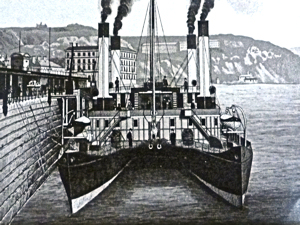
Calais-Douvres I Twin-hulled LCDR paddle steamer launched 1877. Dover Library

Calais-Douvres I Twin-hulled LCDR paddle steamer launched 1877. Dover Library

So impressed were LCDR that Forbes, members of the LCDR board and Captain Pittock went to see a trial, along the coast out of Newcastle to Coquet Island a distance of approximately 22½ statute  miles. A mile and a half longer than the direct route from Dover to Calais. With the average speed 14.48knots an hour, the trip took an hour and twenty minutes. Further, the ship could accommodate 1,000 passengers and the passenger accommodation was luxurious. By this time, the finances of LCDR were starting to look up and with the possible increase in bookings due to the Paris Exhibition, the LCDR contingent agreed to pay the full asking price! Renaming their new acquisition Calais-Douvres she was the first new ship that LCDR had purchased since the Company had first set up a cross-Channel packet service at Dover seventeen years before!

Captain Pittock and his crew brought the Calais-Douvres to Dover, arriving on 5 May 1878 having taken 24 hours from Newcastle. The journey was uneventful and the trial run to Calais was on 9 May. This proved highly satisfactory with an average speed of 14 knots. However, the Calais-Douvres had used up so much coal that she required bunkering, which took 1½hours. Two days later she made her publicity trip with the LCDR Board members headed by Forbes, representatives of SER, Nord of France Railway Company, Dover Harbour Board and dignitaries that included Richard Dickeson (1823-1900) the Mayor of Dover and councillors.
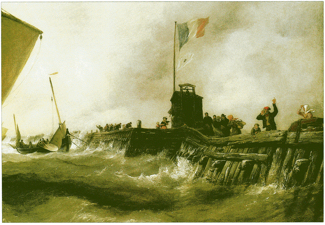
Calais harbour on a rough day by Edward William Cooke 1811-1880. Wikimedia Commons

Calais harbour on a rough day by Edward William Cooke 1811-1880. Wikimedia Commons

While in France, the assembled LCDR Board and guests were invited to look at the Calais Chamber of Commerce’s proposed plans for a new Calais harbour. They, like Dover, had great ideas but lacked the finance. Nonetheless, the French Government had set aside some 50million francs for national harbours to be created at Boulogne, Calais, Dieppe, Dunkerque and Le Havre. Indeed, on 9 May 1878, the first stone for a French national Harbour of Refuge had been laid at Boulogne. Originally the River Aa fed Calais harbour and although sand deposits had moved the mouth of the river north this had created a large lagoon on the flat seashore of the town. This natural reservoir filled at each tide and at other times was fed by local streams, which kept a channel sufficiently open to allow small vessels to enter.

The Dover-Calais and Folkestone–Boulogne mail packet contracts had come up for renewal at the beginning of 1878, as both LCDR and SER had terminated them early. This was a joint decision and the primarily reason had been in the hope of gaining better terms.  On 13 April, Forbes was asked by Henry Cuthbert (1829-1927) the Postmaster General (1877-1878) to specify LCDR Company’s requirements though SER were not approached. Forbes responded by asking for a number of increases and concessions including raising LCDR’s subsidy from £6,000 to £8,000 a year and for the transportation of special mail, particularly large or/and valuable packages to be paid between £20 and £40 each. Without being asked by Cuthbert, SER made the same demands. Cuthbert responded by terminating both contracts and publishing adverts for applications. Only LCDR and SER applied and both companies specified the terms that Forbes had outlined. This fait accompli the Lords of the Treasury reluctantly accepted on 22 April but stated that under the House of Commons Standing Orders of 13 July 1869, they were not going to specify the length of time the contracts were to run.

Out of the blue on 5 June 1878, the contracts were fully ratified but with stipulations applicable to both Companies. These were to improve the railway lines, engines and carriages between London and the Channel ports and for new packet ships to be purchased. During parliamentary discussions Major Dickson, Dover’s Member of Parliament and LCDR Board member, said that as far as LCDR were concerned, they had asked for a larger subsidy due to the increase in the amount of mail that had to be carried and the state of Calais harbour. The latter could not accommodate single keel ships of larger size than those already in operation until their new Harbour of Refuge was completed. It was for this reason, Dickeson told the Commons, that the Company had purchased the shallow draft Calais-Douvres, at great expense.

The previous year the other of Dover’s two Conservative MPs, Charles Kaye Freshfield (1865-1868 & 1874-1885) had reiterated the case for a Harbour of Refuge and reminded parliament that Granville had been promised the building of a Water Station at Dover in 1876, but this had not been forthcoming. He finished by pointing out that such a harbour was of national importance, saying ‘that the Strait of Dover, through which a large proportion of the nations commerce and navy had to pass and where the country’s ships of war could best wait in ambush should there be a need, should be completed.’ (Hansard 01.06.1877). However, on 26 March 1878, the Prime Minister, Benjamin Disraeli (1804-1881) First Earl of Beaconsfeld, had made a statement in the Lords that was so sarcastic it was generally seen that the Harbour of Refuge of Dover would not happen while he was in power. Disraeli’s disparaging remarks plus the building of the French Harbours of Refuge so infuriated the media that the Times of 7 September 1878 wrote, ‘The English experience has been disastrous, it is now nearly thirty years since we set about forming a harbour of refuge at Dover and we lost no time in constructing fortifications to defend it, but the harbour itself has been reduced to the Admiralty Pier, where the sea in one night destroys the work of a year … The Strait of Dover is about the worse sea crossing in the world …

Flushing - Vlissingen harbour 1913. Wikimedia Commons

Flushing – Vlissingen harbour 1913. Wikimedia Commons

Forbes recognised that LCDR did need new packets ships as well as engines, carriages, goods vans, freight wagons and infrastructure etc, but having purchased the Calais-Douvres, he did not have the money. Albeit, the Queenborough-Flushing crossing did have possibilities for upgrading. Along with Jitta, the chairman of SMZ, they met with the appropriate personnel within the Dutch government and negotiated a deal whereby the Dutch government agreed to refinance SMZ in order for that company to purchase two new ships at a low interest rate. These were, the Prinses Elisabeth and the Prinses Marie both registered in Amsterdam and ordered from the Fairfield Shipping Company of Glasgow. They were 3,000tons with two 200 horsepower compound diagonal engines that had a low pressure cylinder diameter of 106 inches that gave them a speed of 17.2knots. The boilers were fore and aft of the engines and the ships each had two funnels. The Prinses Elisabeth and the Prinses Marie were the largest, fastest and most comfortable of the cross-Channel steamers of the time and came on service in March and April 1878.

On the morning of 17 May the Crown Prince of Germany and his entourage arrived at Dover on the Samphire and in the afternoon the Prince and Princess of Wales came across on the Calais-Douvres having travelled from Paris. Dignitaries, military bands and a gun salute from the Castle gave a stately welcome to both Royal parties. The Crown Prince and his entourage had lunch at the Lord Warden Hotel before going on to London but the Prince and Princess of Wales went straight to Windsor Castle to a State banquet hosted by the Queen. Both parties travelled on LCDR trains. Unfortunately for LCDR, before the week was out the Petrel broke down on her way to Calais with passengers and mails on board. The Maid of Kent took both and continued the crossing while the Samphire took the Petrel in tow back to Dover.
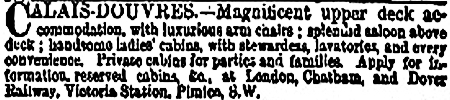
Calais-Douvres advert May 1878

Calais-Douvres advert May 1878

For the Whitsun Bank Holiday at the end of May 1878, LCDR provided a special excursion from London and stations along the railway line to Dover and then to Calais and back on the Calais-Douvres. Although the weather was bad, between 500 and 600 passengers took up the offer and were delighted particularly with the comfort the ship offered. For those looking for a longer holiday on the Continent the Prinses Marie and Prinses Elisabeth out of Queenborough, to Flushing proved the most popular. On Thursday 30 May the Calais-Douvres commenced her daily service and 242 passengers made the crossing to attend the Paris Exhibition. Unfortunately, just before leaving Dover, one of her cylinders failed so the crossing had to be made on three-quarters of her full power.

The Paris Exhibition ran between 1 May and 10 November 1878, to celebrate the recovery of France following the disastrous Franco-Prussian War of 1870-1871, when Emperor Napoleon III (1852-1870) was forced to abdicate. Together with SER, LCDR marketed special tickets at the reduced rate of 31shillings 6pence single and 47shillings return between London and Paris. For passengers living outside London, at the instigation of the Prince of Wales, there were special second class concessionary rates. For instance, between Bradford and Paris the single fare was 36shillings 6pence and cheaper for parties of 20persons. In Southwark, London, 18-year-old Thomas Cook decided to cash-in on the interest and he advertised single tickets at 30shillings first class and 25shillings second class, with return tickets at a further discount. He also advertised hotel accommodation in Paris for 25shillings a week.

Cook had contacted printer Edward Smith of Finsbury making out that he was the son of Thomas Cook (1808-1892) the travel entrepreneur and had ordered both advertising pamphlets and also tickets paying the printer 10shillings. Young Cook then sent the pamphlets to newspapers, one of which landed on the desk of William Hatton, the proprietor of the Bradford Chronicle and Mail. He published the offers and William Bonsor of Bradford deciding to take up the offer, sending the young Thomas Cook a postal order for the requisite amount and asked for details of the hotel accommodation. He received what he believed to be genuine travel and entrance tickets but not the details of the hotel accommodation. Bonsor therefore contacted the real Thomas Cook travel company thanking them for the tickets but stating that he still had not received the asked for hotel details. This brought the scam to light and the young Thomas Cook was arrested, tried and sent to prison.

Prime Minister Disraeli, on 10 June 1878, travelled on the Maid of Kent with Captain Pittock in charge, to Calais. From there he travelled by train to Berlin, spending the night at Prisse Palace, Belgium. The reason for the visit dated back to July 1875, when the former Prime Minister (1868-1874), William Ewart Gladstone (1809-1898) brought Beaconsfield’s attention to the atrocities being committed by the Turkish Ottoman Empire in Bulgaria and Herzegovina following an uprising. At the time the Ottoman Empire was a British ally and Robert Gascoyne-Cecil, 3rd Marquess of Salisbury (1830-1903) was despatched to the Constantinople Conference (December 1872-January 1873) to seek agreement on reforms in Bulgaria and Herzegovina. These were rejected and the result was the Russo-Turkish War (1877–1878), that Watkin had referred to when he reopened the Folkestone-Dover line in early 1877 wearing a Cossack style hat. As a result of the War the Russian forces freed most of the Balkans from Turkish rule. In January 1878 the British Fleet were sent to Constantinople while the Army was preparing for any repercussions a result of the War.

The British were concerned that the Russians, as masters of the Balkans, would threaten their power in the Mediterranean – a vital route to India. For LCDR, Forbes was concerned that hostilities would directly affect the transportation of Indian Mails. The Peace Treaty of St Stefano between the Ottoman Empire and Russia was signed on 3 March 1878 and included the provision to create an independent Bulgarian principality. This made it the largest country in the Balkans and was a concern. Other territories were ceded to Russia and therefore rejected by a number of European powers, including Britain. It was to the Berlin Congress, held in June and July that Beaconsfield, along with Salisbury, were travelling in the hope of a settlement. According to British observers, the Congress ended in a diplomatic victory by Beaconsfield as Russia allowed Turkey to recover most of its European provinces. Austria was given a protectorate over Bosnia and Britain was given Cyprus. The Treaty of Berlin was signed on 13 July 1878 and on his return Lord Beaconsfield and Lord Salisbury arrived in Dover on the Calais-Douvres to a tumultuous welcome. This included royalty and dignitaries from across the country. Beaconsfield Avenue and Salisbury Road, Dover, were later named in honour of the two men.
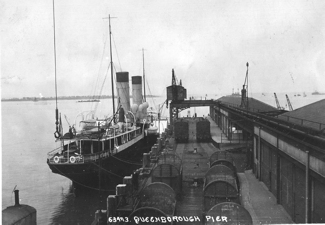
Queenborough Pier with a ship tied up alongside. Guildhall Museum Queenborough

Queenborough Pier with a ship tied up alongside. Guildhall Museum Queenborough

Monday 5 August 1878, was a national public holiday and the weather was fine. 811 people travelled from Dover to London to spend the day in the capital while some 2,203 travelled in the opposite direction to spend the day by the sea at Dover. In the latter part of the 19th century and early twentieth century Dover became a popular tourist resort and Dover Corporation were doing everything possible to foster that image. Two days before, on the Saturday 3,406 passengers left London for a holiday on the Continent with 495 crossing the Channel on the Calais-Douvres, not so many travelled on the other Dover – Calais ships nor the SER ships out of Folkestone with most preferring the Queenborough and Flushing route. This was hardly surprising for not only were the ships better, but the length of Queenborough Pier ensured that the quay could be used at all states of the tide. Further, the station was sited on the Pier close by, so passengers did not have far to walk. LCDR had installed turntables at the Pier end so that luggage carriages as well as freight wagons could be positioned for easy loading /unloading. SMZ had installed cranes at the Pierhead to make all these operations quicker and easier.

Pickpockets had long been a scourge of the packet ships, as well as railway stations and trains, and on that particular weekend a gang had travelled down from London to target  passengers on the Calais-Douvres. As a great favourite with day trippers the ship was expected to be crowded and following consumption of alcohol, the trippers were unlikely to notice they were victims until much later. Further, as the Calais-Douvres was heavy on fuel and in order to reduce consumption her speed was kept down, the longer duration of the crossing worked in favour of the pickpockets. When over the next few days, the extent of the pickpocketing came to light, the victims held LCDR morally responsible for the thefts and the Company came in for much criticism in the national newspapers.

Victorian Railway Police. British Transport Police History Group

Victorian Railway Police. British Transport Police History Group

LCDR already had their own police force that had been in existence in 1858, when the company operated under the name of East Kent Railway Company (See LCDR part I). Records of the LCDR earliest trial, still in existence, that took place at the Old Bailey, London, on 9 April 1866. This was the prosecution of Alfred Martin, age 38, who worked as a car-man who had stolen five dead fish. LCDR Police Inspector James Tyrell handled the case and when questioned, Martin told the Inspector that all he meant to do was take the fish, which were soles, home to his wife. Although Tyrell had a great deal of sympathy for the man, he was still obliged to bring the case. Martin was found guilty and lost his job. (Thanks are due to British Transport Police History Group for this information). Following the number of thefts on the Calais-Douvres over that August Bank Holiday weekend, LCDR recruited more policemen and increased the number travelling on their ships.

As the Calais-Douvres was heavy on coal, using about 40tons a day, and because of the reduced number of passengers travelling on the packets during the winter, she was taken out of service. This led to crew lay off including Captain Bennett. Just before midnight on 4 November 1878, about 8miles southwest off the South Foreland the German packet ship Pommerania of the Hamburg-American Steamship Company, was in collision with the Moel Eilian sailing vessel of Carnarvon. The 3,338ton Pommerania, enroute from New York to Hamburg, sank in 20minutes with a loss of some 50 lives. The night was foggy with drizzling rain and a moderate North North Easterly wind.
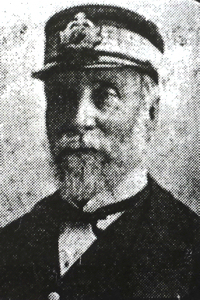
Captain John Whitmore Bennett (1828-1907) of the London Chatham and Dover Railway Company. Hollingsbee Collection

Captain John Whitmore Bennett (1828-1907) of the London Chatham and Dover Railway Company. Hollingsbee Collection

The Glengarry steamship from Middlesborough went to the rescue and the manifest showed that there were 151 passengers on board the Pommerania and a crew of 111. The Glengarry rescued 109 passengers and 63 crew members, all of whom were brought to Dover on the harbour tug Granville. Captain Bennett left his home in the Pier District and rowed out, with some of his crew that had also been laid off. They helped to bring the Moel Eilian into Dover. She was described as having her bow stoved in and the forward compartment full of water. In Dover, Captain Bennett was praised for and people recounted the Samphire disaster of 1865 (see Packet Service part IV) and how the Admiralty Court had made Captain Bennett the scapegoat for their own failure to implement safety regulations that would distinguish ships under sail from those under steam at night. They also recounted how, that same year, Captain Bennett, in charge of the Maid of Kent’s night service, through supreme seamanship had saved the disabled steam packet from drifting helplessly onto the Goodwin Sands. It was a long time after the accident that such regulations were introduced.

January 1879 saw the annual series of winter heavy gales that afflict the Dover Strait but this time the temperatures were generally so cold that there were reports of ice floes down the Thames. One morning the Granville dock gates were frozen and could not be opened thus the LCDR packet ships within were unable to leave. Eventually, under the supervision of the Harbour Master Richard Iron (1818-1883) a stout hawser was made fast with blocks and pulleys and operated by some 30men and gradually the gates did open. Nine hours late the night packet ship, Maid of Kent, to Calais was able to get underway.

The news from Calais was that once the inclement weather had abated, that work was to start on a Harbour of Refuge there. If it did go ahead, it would include major construction work that would make Calais a viable international shipping port! During the previous autumn the French Minister of Finance, Jean-Baptiste-Léon Say (1826-1896), and the Minister of Public Works Charles Louis de Saulces de Freycinet (1828-1923), had undertaken a tour through the departments of Pas de Calais and Nord. There they looked at ports and infrastructure and listened to the ideas of public bodies such as the Calais Chamber of Commerce. In Calais a careful survey had been undertaken on 10 September and the government surveyors had come up with a grand scheme. The communiqué stated that the scheme would have to go through the French Chamber of Deputies and the Senate so could be subjected to severe pruning. However, as Léon Gambetta (1838-1882) had been elected President of the Chamber of Deputies the letter finished by saying that the Calais Chamber of Commerce was sure that he would be receptive to Calais needs.

In February 1879, Empress Elisabeth of Austria again crossed the Channel and again incognito. She made the crossing, with her entourage and stable of horses, on the Maid of Kent and was on her way to Ireland. There, totally open as to whom she was, on 23 March she received a communiqué from home and was obliged to return immediately. This she did again crossing from Dover to Calais and then by rail to Vienna. The emergency that had summoned her were the negotiations taking place between the Austro-Hungarian  and German Empires. The result of which was the Dual Alliance of 7 October 1879, when the two Empires promised to support each other if Russia chose to attack either. The two Empires also agreed that in the case of aggression by any other or between any other powers they would remain neutral.

This political arrangement was the work of German Chancellor Bismark and he surmised that Russia would not dare to wage war against both Empires while the agreement would prevent Germany becoming isolated. The Alliance was expanded in 1882 when Italy joined the two nations but the potential of threat of the Triple Alliance led, in 1902, to the formation of the Triple Entente. This was between the United Kingdom, France and Russia and many historians believed it was the primary event leading to World War I (1914-1918). As far the Empress Elisabeth was concerned as she travelled home in 1879, the Dual Alliance could promote German nationalism and destroy the Austrian Empire.

The Calais harbour project was given the go ahead but its potential for LCDR, once complete, annoyed Watkin. This was compounded by the Liberal Lord Warden of the Cinque Ports, the Earl of Granville who, in the Lords, was constantly putting forward the case for Dover to become a Harbour of Refuge and because of this was considering leaving the Party. At the SER shareholders meeting in January 1880 meeting, in essence, he said that back in 1836 the Parliament Select Committee had favoured Hythe Bay for the Harbour of Refuge and this was the main reason that the Company had paid £18,000 for Folkestone harbour and make it their main port for Continental services. Even though the Company knew that it would be expensive and foolhardy due to geological problems caused by the proximity of the cliffs to the sea, pressure had been put on the Company to take the line to Dover. This work, paid for by the Company, had given the impetus for Dover to put the case forward for a Harbour of Refuge to be there. Nonetheless, the 1843 Parliamentary National Harbour of Refuge inquiry stated that Folkestone was the favourite.

Indeed, Watkin reminded his audience, the eminent civil engineer William Cubitt (1785–1861), had given evidence on behalf of SER, pointing out the vulnerability of the cliffs between Folkestone and Dover and described the work carried out by the Company to make Folkestone Harbour the pride of the Channel coast. Since that time, Watkin said, Dover had used every opportunity to push the Harbour of Refuge argument in their favour and the western arm of the Harbour of Refuge, Admiralty Pier, was built at Dover. Luckily for Folkestone the Tories, which could not normally be trusted, under Prime Minister Disraeli had shelved the Harbour of Refuge idea at Dover. However, if the Liberals came to power the Lord Warden, Lord Granville would ensure that the situation would change in favour of Dover.

Watkin then turned his audience’s attention on to LCDR, saying that they had opened their railway line to Dover as they planned to use the planned Harbour of Refuge as a Continental freight terminal – or so they said. In reality, they immediately bought ships for the cross Channel ships passage and their shrewd General Manager Forbes, quietly put in a bid for the packet contract between Dover and Calais. Why SER had allowed LCDR to win it, was beyond his comprehension, Watkin’s said, but at that time he was not the Chairman of SER.

Nonetheless, Watkin continued, SER had been fair to LCDR especially over the Continental Agreement whereby all Continental traffic receipts were pooled and divided between the two Companies. Forbes in his usual underhanded way, had opened a cross Channel service between Queenborough and Flushing and subsequently won the packet contacts to carry mail to and from the Netherlands! None of the profits that LCDR make from their rail service between London and Queenborough are included in their contributions to the Continental Agreement and in consequence SER was losing some £15,000 a year. Therefore, Watkin said, SER had two courses of action open to them. The first was litigation, which would be expensive. Alternatively, SER could set up a rival Continental service from Chatham where two of their existing ships would be based and for the Folkestone – Boulogne service, order possibly four new ships!

The shareholders voted for the second option and during the questions, Watkin confirmed that SER were occasionally running to Calais but, he added with delight, that LCDR were not allowed to berth any of their ships in Boulogne. This, he said, gave SER the monopoly of the shortest cross Channel route. On reading the press coverage of Watkin’s speech, Forbes wrote to him and the national newspapers informing both that SMZ operated the passage ships out of Queenborough not LCDR and therefore revenues earned by LCDR were not part of the Continental Agreement. A number of other writers pointed out that the Dover-Calais route was the shortest. In April 1880, the Liberals returned to power and the Earl of Granville, Dover Harbour Board, and Forbes with other interested parties, exerted as much pressure on the government as they could muster for a Harbour of Refuge to be built at Dover.
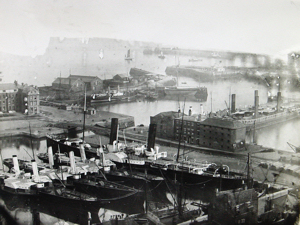
La France with the Breeze, Calais-Douvres and the Wave paddle steamers in Wellington Dock c1880-1890. Dover Library

La France with the Breeze, Calais-Douvres and the Wave paddle steamers in Wellington Dock c1880-1890. Dover Library

That month, Queen Victoria, for the first time, used the LCDR Queenborough quay when she returned from Germany. In Flushing the Queen, her youngest child Princess Beatrice (1857-1944) and their entourage had boarded the Royal Yacht (1855-1900), Victoria and Albert II. On arrival at Queenborough, they travelled by an LCDR train to Windsor. Six months later, on 16 November 1880,General Frederick Sleigh Roberts, 1st Earl Roberts (1832-1914), disembarked from the La France at Admiralty Pier to a tumultuous welcome that include both national and local dignitaries. Roberts had fought in the Indian Rebellion of 1857 where he was awarded the Victoria Cross and went on to have a successful military career rewarded by promotions.

In September 1879 Roberts was sent to Kabul, Afghanistan to seek retribution for the assassination of Sir Louis Cavagnari (1841-1879) and his envoy on 3 September 1879. Cavagnari had signed the Treaty of Gandamak with Emir Mohammad Yaqub Khan (1849-1923) in May, which relinquished the control of Afghanistan foreign affairs to the British Empire. It also brought an end to the Second Anglo–Afghan War (1878-1880) between the British Raj and Emirate of Afghanistan. Roberts led the invasion party of 10,000 troops and on 22 July 1880 Abdur Rahman Khan (c1840-1901), who held the position of Emir until his death in 1901, replaced Mohammad Khan.

For well over a century Dover entrepreneurs had earned a livelihood by forwarding parcels, samples and general freight to Continental buyers as well as receiving and forwarding to British addresses, similar packages from Continental manufacturers. This two-way transit of goods was on the increase as innovation had speeded up production. As the British Empire expanded, the manufacturers were looking at these new markets and transport was developing rapidly for the speedier handling of this traffic. In 1880 the General Post Office decided to set up a freight forwarding department, using their packet contracts to ensure fast delivery with the Continent. To tie in with this, LCDR rescheduled the night mail service from London to depart 15 minutes earlier so that the packet ship carrying the night mails to Calais could also leave Dover earlier. In Calais, on transferring the mail, the French mail train left and the mails arrived in Paris in time for delivery by the first post.

The weather for the Whitsuntide Bank Holiday weekend in 1880 was sunny and breezy and on the Monday LCDR offered a special return trip to Calais. This was on the luxurious twin hulled Calais-Douvres and was taken up by 1,200 passengers. From then the Company saw the number of passengers regularly travelling on the to Calais-Douvres being maintained and therefore decided to run her at full speed. The number of passengers increased such that by mid summer the decision was taken to permanently place the ship on the packet service. At the same time, they joined the Calais-Douvres service with the mail express leaving Victoria, London, at 07.40hours, five days a week and the passengers referred to the service as the LCDR Continental service!

At Folkestone, the SER were preparing for the arrival of the two of the four new ships Watkin had promised. They were the Albert Victor and the Louise Dagmar and they were the largest paddle ships to work the cross Channel passage at that time. Built by Samuda Brothers of Poplar, they were both 250feet long 29.2feet beam, 14.3feet deep and with a gross tonnage of 782tons. They had oscillating engines of 2,800ihp made by John Penn and the Albert Victor made  18.58knots over six runs. Both ships were also firsts in that they had steel hulls. Within a year the Duchess of Edinburgh arrived at Folkestone followed shortly after by the Mary Beatrice. The latter was similar to the Albert Victor and Louise Dagmar but 5-feet longer.
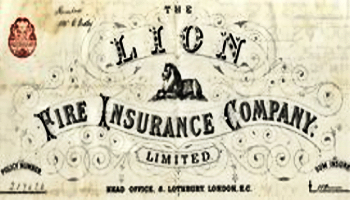
Lion Fire Insurance logo 1885 by Rosa Bonheur (1822-1899) Aviva Group Archive

Lion Fire Insurance logo 1885 by Rosa Bonheur (1822-1899) Aviva Group Archive

Forbes, besides maintaining a working relationship with the Dutch-Rhenish Railway Company, had been appointed the Chairman of the Metropolitan District Railway in 1872. At that time it was in an equally bad financial state as the LCDR  when he took over the Company. By 1880, both companies were looking up and that year Forbes was appointed a director of the Lion Insurance Company. This had been established as the Anglo-French Fire Insurance Company Ltd in London and Paris in 1879 and was formed to take over the portfolios of six or seven French offices in Alsace-Lorraine. The company was primarily involved in fire insurance and therefore changed its name to the Lion Fire Insurance Company Ltd. In 1880 it was renamed the Lion Insurance Company Ltd and that year a sister company, the Lion Life Insurance Company Ltd, was established. Both companies provided cover for LCDR rail and shipping operations. In 1888, the French arm of the company was liquidated and on 1 January 1902, it was acquired by the Yorkshire Insurance Company Ltd and was dissolved in 1913. The Yorkshire Insurance Company Ltd became part of the General Accident Fire and Life Assurance Corporation Ltd in 1967.

The insurance company that Forbes dealt with the pay outs following petty thefts and training LCDR police officers. The specialised training was introduced following the summer of 1880, when the number of thefts increased. The London gangs tended to target SER passengers, including those alighting at their Dover Town Station to make their way over to Admiralty Pier  for the Belgium ferries. Nonetheless, both LCDR and Belgium Marine ships were also being hit but of the three shipping companies, LCDR had the least problem with theft. As the SER thefts had occurred while passengers were crossing from the Town Station to the Belgium Marine ships, they became within the jurisdiction of Dover Borough police force, Superintendent Thomas Osborn Sanders (1835-1903) called a meeting.

Those attending included senior personnel from SER, LCDR and Belgium Marine, their senior police officers and representatives from the Lion Insurance Company. Since the Great Bullion Robbery of May 1855, SER had ensured a large police presence on their trains and ships and so they outnumbered the joint representatives of LCDR and Belgium Marine attending. Superintendent Sanders told the meeting that following the spate of thefts on the Calais-Douvres in 1878, LCDR had put plain clothes policemen on board their ships as well as uniformed constables. The plain clothes officers and astute passengers, without being asked to do so, made a note of the bank note serial numbers which they carried. If they used them in transactions on board the ships or were stolen during the crossing the appropriate banking authorities were informed of the notes serial numbers. By taking such a course of action, some gang members had been picked up and that was why less pick-pocketing took place on LCDR ships.

Superintendent Sanders went on to say that organised thieving rackets were taking place on other packet/shipping companies as well as on the various railways that made up the British network. For this reason, all the police forces were working together with Scotland Yard to try to put a stop to these rackets using methods similar to those used on LCDR packet ships. To co-ordinate the campaign, a special unit had been set up by Scotland Yard and could be contacted directly.

On 19 January 1881, a severe storm lifted large flagstones, weighing about a ton and a half each that formed the then 250 yard promenade on Admiralty Pier. In some places, the solid concrete base on which they were laid was also lifted. As in 1877, Adcock was called in to make the repairs but due to the time taken passengers boarding the LCDR packets complained of the work getting in their way. Initially, such complaints only occasionally appeared in the national newspapers but very quickly the complaints escalated and  LCDR began to wonder if they were emanating from elsewhere.

Weather Chart for 8 February 1881

Weather Chart for 8 February 1881

The winter storms, however, did not let up and at 02.30hours on 8 February the Breeze, carrying the French night mail, was endeavouring to leave Calais harbour against strong winds. Before making it to the open sea, she became stuck on the harbour bar and remained in that position for two hours before the captain and crew managed to get her off. By that time considerable damage had been done and the ship was deemed not seaworthy for the general public. Using the cross Channel submarine telegraph, Dover was informed and eventually the Wave arrived. She returned to Dover with the passengers, mail and the Breeze in tow at 11.00hours on 9 February. The number of shipping casualties in the Channel during those 24hours was unusually high and many were serious.

At the LCDR half yearly shareholders meeting, Forbes told his audience that although LCDR continued to make a great deal of progress, this had its costs. He particularly cited the introduction of the 10.00hrs morning service to Calais. As Calais was tidal, in agreement with the Northern France Railway Company, for 14 days out of 28 was for their boat-train service to leave for Paris, after the arrival of the new morning service. For the other 14 days, the service would go to Brussels. This had been put to the test for the Brussels Exhibition and proved successful, but advertising to potential passengers as to how the new service worked, had been time consuming and costly. Forbes then went on to say that he was particularly annoyed that in accordance with the Continental Agreement with SER, the Company had to pool the returns from this service but that SER were still refusing to allow LCDR to run ships to Boulogne. Nonetheless, even though SER had new ships, people still preferred the Dover-Calais route and that for the first time since 1871 when the LCDR Charter was renewed the Company was able to pay the full dividend on preference shares!

On an evening in November 1880 and 30minutes out of Calais, the Maid of Kent ran into a whale. The shock reverberating through the ship throwing many of the passengers off their seats. The creature was badly injured and was last seen lying on its back, surrounded by blood.

Four months later, on 13 March 1881 a bomb killed Tsar Alexander II of Russia in St Petersburg. The Tsar, from when he ascended the throne, had sought to undertake major reforms most notably of which was the emancipation of serfs. As far as Forbes and LCDR were concerned, the Tsar was planning a major railway network, which would open up Russia to the travelling public over which his emissary had been in touch with LCDR.

At the time, with the exception of the Moscow-St Petersburg line completed in 1851, there was only the 16mile long Tsarskoye Selo Railway that opened in 1838. Alexander II was succeeded by his son, the conservative Alexander III (1881-1894), who was to reverse many of his father’s reforms and this was of concern to Forbes. Albeit, at that time this was unknown and one of Alexander III’s reforms was railway developments, the first major one was the Trans-Caspian, which followed the ancient Silk Road from the Caspian Sea through western Asia. This opened up possibilities for LCDR as it connected Russia with the most wealthy and influential cities in Central Asia.  However, George Nathaniel Curzon, 1st Marquess Curzon of Kedleston (1859-1925), later the Lord Warden of the Cinque Ports (1905) saw the new railway line as a threat to British interests in India as he believed that Russia could deploy their troops against British India.

The two views on the possible Trans-Caspian railway were the centre of discussion at Dover between Forbes and the military and diplomatic escorts of the Duke and Duchess of Edinburgh. They had left on the Maid of Kent, under Captain Pittock, to take the condolences of the Royal family to Russia. Travelling with them was the Grand Duke Alexei Alexandrovich (1850-1908) the Tsar’s fourth son, who was staying in London at the time. When the funeral arrangements were made, the Prince and Princess of Wales attended on behalf of Queen Victoria and the British government. They too travelled on the Maid of Kent, on this occasion captained by Robert Stock, they then travelled on to Russia by train via Brussels and Berlin. Although Tsar Alexander III did reverse many of his father’s reforms the Trans-Caspian railway was built.
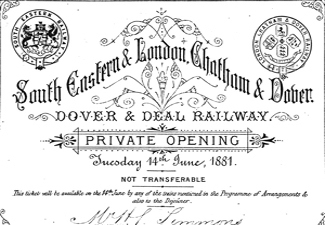
LCDR - SER invitation to the opening of the Dover-Deal Railway 14 June 1881. Dover Museum

LCDR – SER invitation to the opening of the Dover-Deal Railway 14 June 1881. Dover Museum

Although animosity was increasing between the two chairman of Kent’s railway companies on Saturday 29 June 1878, when the Earl of Granville had cut the first sod of the joint operation Dover-Deal railway line, the relationship seemed cordial. LCDR had received authorisation for the line in 1862 but did not have the finance to undertake the project. An agreement was made in 1874, when Forbes was away ill by Watkin as part of his proposed quasi-merger policy and preparation work had been undertaken by both Companies. The 10mile railway line, which  required a 1,412yard tunnel, would cost £150,000. Messrs Bradley & Mills had been chosen as the engineers and a Mr Walter as contractor. A double track extension was included in the proposal to connect with the SER line at Dover and this required property in the Pier District to be demolished and the Primitive Methodist chapel on Round Tower Street. As the project was a joint operation it had been agreed that it was to be managed by six members, three from LCDR and three from SER. The line opened to the public for service on 15 June 1881 and LCDR’s share of costs was £140,000.

Due to unexpected financial outlays on their wider railway network and another outlay, which, Forbes said he would return to, the LCDR half-yearly report of the summer of 1881 did not look as promising as shareholders had hoped. Forbes went on to say that a new connection had been made to the South of France through the auspices of the Northern France Railway Company in conjunction with the Paris & Lyons Railway Company. The new service, beginning in November, was expected to take 27hours from Calais and would terminate at Marseilles. The main advertising point was that passengers would not change trains in Paris and, in the event, the service proved more popular than even he hoped. He then went through other aspects of the Companies activities dwelling for a time on the Queenborough / SMZ operations.
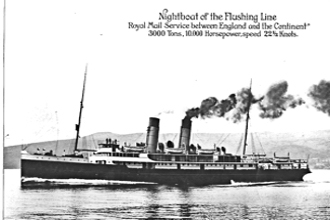
Night Boat of the Queenborough - Flushing service. Guildhall Museum Queenborough

Night Boat of the Queenborough – Flushing service. Guildhall Museum Queenborough

He told the shareholders that SMZ’s Stad Vlissingen had come to grief in 1879 and had been replaced by the former Isle of Man Steam Packet Company’s Snaefell. Renamed named Stad Breda by SMZ, she had been built in 1863 by Caird’s of Greenock. This, of course, had come at no cost to LCDR as SMZ was a totally separate company. Another aspect of SMZ’s activities, which were of note was that through railway services from Flushing to Berlin had been introduced in 1880 and to meet the possible increase in demand, SMZ had ordered the Prins Hendrik from Fairfield Shipping Company. She was similar, in every respect to the Prinses Marie and Prinses Elisabeth but proved to be slower than her sister ships (In 1889 she was reboilered and this sorted the problem out). The Stad Middleburg was to be renamed Aurora and SMZ had ordered a new ship that was expected to come on station in 1883, (she was named the Willem Prins Van Orange).  

Forbes then looked as if he was about to wind up his report and leave the podium and a few delegates started to clap. Forbes, thne leaned across the lectern and looking coyley he quietly mentioned the fall in the dividend pay-out. He lowered his voice and there was not a sound in the room, taking a loud, deep breath, he stood up straight and appearing to look as if he was about to tell individually everyone in the audience the reason why, he announced that this had come about because the Company had ordered a new luxury steam ship! The applause was loud and the shareholders looked as if they had been given a massive pay-out!

Invicta I Paddle Steamer 1910 launched 5 April 1882. Dover Museum

Invicta I Paddle Steamer 1910 launched 5 April 1882. Dover Museum

The luxury new steam ship, the Invicta, was launched on 5 April 1882. Designed by James Ash, she was built by the Thames Ironworks and Shipbuilding Company, Blackwall and engined by Maudsley, Sons and Field of Lambeth Marsh, London. The Invicta was 1,235gross tons and had 2x350horsepower diagonal oscillating engines. During construction, her stern was modified at the request of the now Captain Edward Morgan, LCDR’s engineer and marine superintendent. She was also fitted with a bow-rudder by Clement Mackrow (1855-1912) of the Thames Iron Works. The Invicta was much bigger than any of her predecessors or the SER new ships, while the modifications enable her to reverse out of Calais harbour.

The Invicta’s accommodation was described as excellent with fore and aft saloons beautifully fitted out. The first-class saloon was some 30-feet wide and 90-feet long with its floor just below the level of the sea. The room had internal dividers giving refreshment and sitting rooms. The sitting rooms were advertised for those more prone to seasickness to keep them away from the less squeamish. There was also a saloon for ladies and a another saloon for third class passengers. On either side of the ship, below a promenade deck that extended the entire length of the vessel, were fourteen individual cabins. The Invicta had lighting throughout, including the engine room and on each of the paddle boxes and the sponsons. The electricity was provided by a Siemens alternating current generator and the recently invented Joseph Swan’s (1828-1914) incandescent lamps. The outside lights were specially sited to ensure safer embarkation and disembarkation of passengers. This was a first for cross-Channel ships.

Captain Morgan took the Invicta from the shipyard to Queenborough arriving there in the first week of August 1882. On the following Saturday, 5 August, Forbes and the Directors of LCDR along with invited dignitaries were taken out on a trial trip. The following Wednesday, again under the direction of Captain Morgan, the Invicta left Queenborough for a speed trial over a measured mile (the mileposts being situated on the Maplin Sands, mudflats on the northern bank of the Thames estuary). This proved satisfactory and on the following day, at 13.15hours, she left the Mouse Light Ship, on the western extremity of the Mouse Sands, East South East of the Maplin Sands and 8 miles north of Whitstable, where she had moored overnight. The Invicta arrived in Dover at 15.30hours having travelling at an average of 18½ (knots) nautical miles an hour. Captain Morgan reported that due to the small amount of coal on board, he had kept her at three-quarter speed but he would expect that she would make the crossing to Calais in 60minutes. This, the Invicta failed to do but in December she had a minor accident and while she was out of service, the opportunity was taken to enlarge the paddle boxes.

In July 1882 Dover Harbour Board presented a Bill to Parliament asking for the powers necessary to create a large harbour which would enclosed Dover bay as far as the Northfall Tunnel – Eastern Cliffs and serve as a Commercial Harbour as well as a Harbour of Refuge. The Standing Orders of both Houses were suspended especially to examine the Bill but the Continental Agreement between the two railway companies became the major issue. Forbes totally backed the Bill but Watkin argued that if the Bill received Royal Assent, it would interfere with the arrangement. As a thank you for Forbes efforts, the Harbour Board agreed to commute LCDR Harbour dues. Meanwhile Major Dickson, as both Dover’s MP and LCDR Board member, continued to try and push the Bill through Parliament. He told them that the eminent engineers the late James Walker (1781-1862) and Sir John Hawkshaw (1811-1891), believed that the works projected by the Bill could be carried out. Two years later, in 1884 a Treasury minute intimated that the government wanted to carry out works themselves to their own designs and the Bill was arrested.

On Thursday 18 May there had been a disastrous fire at the Queenborough quay. It started in the baggage room of the Custom House destroying the wooden buildings that had been preserved by creosote. Several men died and the Custom House, the Telegraph Office and 27 trucks were destroyed. One of the trucks contained a large amount of silver. The service was transferred to Dover while rebuilding was undertaken. At about the same time, SER built their north of Kent port on the Isle of Grain, the easternmost point of the Hoo Peninsula. On 11 September 1882, with great ceremony, Watkin opened the serving railway station, which was at the head of a 400foot long timber pier out into the River Medway estuary. The complex was named Port Victoria and the specially purchased Duchess of Edinburgh was moved there for the occasion. She was built and engined by J and G Thomson and Co of Greenock and was 989 gross tonnage. Fitted with compound oscillating engines with a nominal horsepower of 427, she was expected to do the crossing to Belgium or the Netherlands, in good time. However, the Duchess of Edinburgh failed to live up to expectations and was sold. SER continued to run a cross Channel service from Port Victoria using their appropriately named ship, Victoria.

The Invicta had returned to Dover in April 1883 and this time did live up to expectations.
In the meantime the first Pullman car (see the Golden Arrow story) was introduced on LCDR’s 11.00 hours London – Paris – Italian route and the railway engine from London Victoria to Dover was named Jupiter. From Dover the Invicta, with Captain Frederick Dane (1835-1913) in command, was designated as the Continental ship and the rail service from London to Italy was called the Continental Express. This was, by this time, one of two Italian services of which LCDR was a part. The first left Victoria railway station at 08.00hours connecting at Calais with services running to Ventimiglia, Italy and calling at Cannes, Nice and Menton France, and other resorts enroute and went through the St Gothard Tunnel. The second was the Continental Express and had special carriages pulled by the different French railway company engines and went directly from Calais to Turin and Milan via the Mont Cenis Tunnel. The route skirted Paris by the Grande Ceinture Railway enabling passengers to travel through to Italy without a break in the journey.

The Duke of Cambridge accompanied by Lieutenant-General Sir Edward Newdegate (1825-1902), the military Commander of the South-Eastern District, whose headquarters was at Dover Castle, and senior army officers in September 1882 on the Invicta. They were there to inspect the ship for military purposes and travelled to Calais and back. That evening, in Dover, the distinguished party watched experiments with Invicta’s lights conducted by Captain Morgan and which attracted a large number of locals. A month later, the Duke of Edinburgh and his entourage arrived from Calais on the Samphire and were welcomed at Admiralty Pier, by Captain Morgan, Lieutenant-General Newdegate, and military and town dignitaries. The Royal party then travelled on a special SER train to Eastwell Manor, near Ashford, Kent, which was their residence until 1893.

During heavy weather in the early hours of Friday 2 February 1883, while the packet Prince Imperial was trying get into the Granville Dock, she was hit by the smack Nellie. On Saturday 9 June 1883, a collision occurred between the Wave and the French barque Fanny of Nantes bound for Szczecin, Poland. The Wave, under the command of Captain Wade, had left Calais in thick fog at 01.57hours with 102 passengers and mails, in the custody of the mail-master James Rayner. Working the engines at 30 revolutions a minute (full-speed was 40), all the regulation lights were lit and steam whistles constantly going. About 30 minuets out, the fog briefly cleared and Captain Wade thought he saw an object about two ships off, about half a point on the starboard bow. He ordered the helm to be starboarded and the engines to be stopped and then reversed at full speed.

However, as the Wave was still making headway and Captain Wade realised that she was not going to clear the oncoming vessel by going astern. He therefore ordered the engines to be stopped and then full speed ahead. Seconds later, the Wave was struck amidships with the Fanny of Nantes bowsprit passing between the funnels. The aft funnel of the Wave was lost and the mainmast was snapped off close to the top of the deck cabin. The bow of the Fanny of Nantes then swept off two lifeboats in the davits, the whole of the starboard bulwarks and the stanchions from near the paddle-box to the wheel down to the level of the deck. The sky-light of the aft cabin was smashed and one of the deck planks was badly damaged by falling gear. The engines had, by this time, been stopped and put into reverse.

Standing near the wheel was Eli Louis Barnett age 43years, a jeweller from Birmingham who was married with two children. He was killed when the main mast fell on his head. Herbert Boyd, from Paris was hurt in the back by a falling spar but survived. The captain of the Fanny of Nantes demanded that the Wave tow the barque into Calais, but Captain Wade, on receiving a report from his mate and two crew members whom he had sent to inspect the Fanny of Nantes, refused. They had told Captain Wade that the Fanny of Nantes was not as badly damaged as the Wave, which was later proved to be correct. In the meantime, the rest of the crew on the Wave ensured that she was water tight. Once satisfied, Captain Wade ordered for the ship to make for Dover where she eventually arrived at 06.00hrs. Many of the passengers praised the Captain and crew of the Wave and this was reiterated at the Inquest and to the Board of Trade inspectors. At the inquest, under the auspices of the coroner, Sydenham Payn (1844-1923) who had succeeded his father William Henry Payn (1803-1887) on 16 August 1882, the jury returned a verdict of accidental death on Mr Barnett and commended Captain Wade of the Wave.

In the national press and the House of Commons, parallels were drawn between the accident and that of the Samphire accident of 13 December 1865 and mentioned above. The press focussed on the Wave stating that she was going too fast and reminding the public that in the case of the Samphire, the Admiralty Court apportioned the full blame for the accident on Captain Bennett, who was still a LCDR cross Channel packet captain. The Commons, were reminded of the circumstances surrounding the Samphire accident and although Captain Bennett had not been exonerated, much had changed since then, including the capacity of lifeboats on board cross-Channel packets, The Members were told that the capacity of Wave’s lifeboats was 339 persons including the mails. Even though two lifeboats had been lost in the accident, on board on the night in question were 102 passengers and 20 crew plus the mail-master and mail bags and boxes. In the event, the Board of Trade and the Admiralty did not blame Captain Wade of LCDR.

The weather of winter 1883 was not out of the ordinary, thick freezing fog alternating with storms. A year later, on the night of 30 January 1884, there was a storm blowing from the west along the English Channel. That night the Samphire, under the command of Captain Bennett, battled into Dover from Calais and on board were 23 rescued seamen. They had come from the 2,288ton converted four-mast sailing barque, former P&O steamship, Simla. She had been bound for Australia from London under Captain Malcolm Nicholson when, she was struck amidships by the City of Lucknow. This had happened on the night of 25 January, some 25miles west-south-west of the Needles, Isle of Wight. The Captain of the clipper ship, City of Lucknow returning from Australia to London, was James Macdonald.

Captain Nicholson, his wife and two children along with the third mate and 12 members of the crew Simla were rescued by the South-Western Railway Company’s Guernsey and taken to Southampton. Remaining on board the slowly sinking ship were second mate B Thomson and 22 crew members until they were rescued by Captain Sallarias and crew of the steamship Nicholas Vagliano. Captain Sallarias took them to Dunkirk and from there they were transported to Calais. The men, some injured but all in a distressed state were brought to Dover on the Samphire and then taken to the Seamen’s Institute in the Pier District. In the meantime, the City of Lucknow limped towards Dover, where Captain Macdonald and his crew disembarked. After TLC and medical care, the crew members of the Simla left for London on a LCDR train.

Meanwhile the redevelopment of Calais harbour was being undertaken and for this purpose, the French authorities were purchasing dynamite from Charles William Curtis (1824-1905) Gun Powder factory at Faversham. Of interest, Curtis bought Kearsney Abbey in 1892 as it was close to Kearsney an LCDR station on the railway line to Faversham. Consignments sent to France consisted of packs of 56pounds of dynamite. Each pack was equally divided into 10 cardboard boxes and packed into wooden crates. The crates were transported by LCDR trains from Faversham to Dover and then loaded onto the LCDR packet ships. During the winter of 1883-84 the rough weather and the carriage of dynamite became a cause of public concern. Experts tried to reassure the general public by saying that the nitro-glycerine the dynamite contained could not be exploded by normal concussion but required a detonator. This, they assured people, was carried separately. Nonetheless, the concern escalated and in order to try and quell the growing public hysteria LCDR purchased three cargo ships. They were the 410horse-power Paris and the Chatham and the 300horse-power Calais to join the tug Post purchased from Churchward back in 1863, and from then on they were to carry the dynamite.
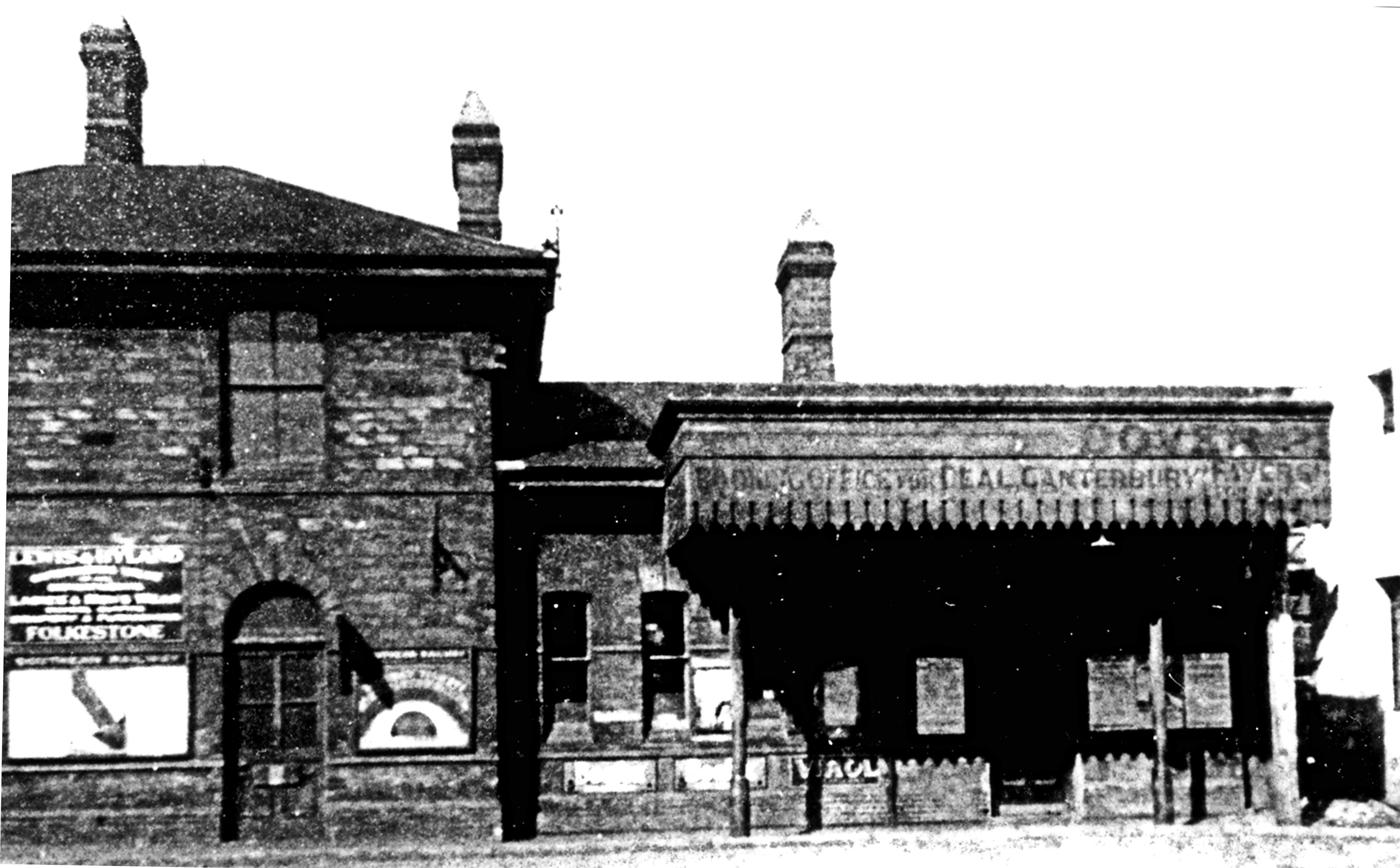
Priory Station May 1863. Dover Museum

Priory Station May 1863. Dover Museum

In March 1884, Thomas Hinckley and John Chatterway, workers at LCDR’s Priory Station, were arrested for illegally transporting two cylinders full of gun-cotton through the streets of Dover and thereby putting the general public in danger. Gun-cotton is a highly flammable material made by treating cotton with concentrated sulphuric acid and 70% nitric acid. The consignment had been sent by train from the Curtis Faversham Gunpowder factory to J Richardson, Seabrook Station by way of Dover to blow up the wreck of the Plussey. The two men were convicted of theft but because of the publicity over the carriage of dynamite on the LCDR packet ships the case made the national newspapers.

This was exploited to the full by an SER publicity campaign and by September Scotland Yard were placing their detectives at Dover. Their purpose was to work alongside customs officials and LCDR police officers, to check all baggage and personal possessions of passengers and crew travelling to and from Calais and Ostend. The subsequent delays of packets quickly affected the throughput of passengers who were increasingly preferring the ‘safer and quicker’ SER Boulogne-Folkestone service, as they advertised themselves. Then, in December 1884, two hundred-weight of dynamite was found on board the Wave hidden under a consignment of tin that was being sent from Paris to an address in Aden, now Yemen, via London. The Scotland Yard detectives took the dynamite to London and carried out an investigation. Shortly after the dynamite hysteria ceased.

Albeit, SER did not let up but the main focus of Watkin against LCDR turned to the monopolistic Continental Agreement. This intensified when Forbes announced, at a shareholders meeting, that LCDR were considering laying a railway line from Kearsney to Folkestone. Watkin told SER’s shareholders that their Company was the first of the two companies to provided passage ships from England to Europe and reiterated much of what he had said at the meeting of 1880 detailed above. Following sympathetic reports of Watkin’s speech in the national press, Forbes reminded Watkin and the press that not long before a landslide had blocked the Folkestone-Dover line and LCDR had helped SER out only to be publicly rebuked by Watkin. Adding that the landslide had occurred because of the line’s vulnerable position, under the cliffs and close proximity to the seashore.
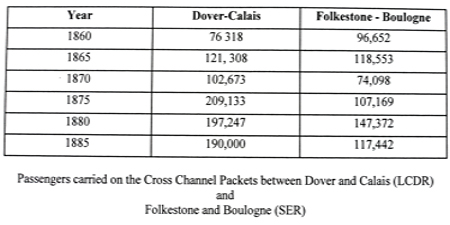
Number of passengers carried on LCDR & SER ships 1860-1885

Number of passengers carried on LCDR & SER ships 1860-1885

Watkin retaliated by calling Forbes the Don Quixote of LCDR who ‘showed fiction as fact, and the exuberant fancies of his teaming brain were realities.’ He then made reference to the historically poor financial condition of LCDR saying that Forbes was merely providing a distraction to the fall in the number of LCDR packet service passengers. Forbes, acknowledge that Watkin was correct that there had been a fall of 3.67% from 197,247 passengers carried in 1880. But pointed out that out that SER’s had fallen by over 20% from 147,372 in 1880. Albeit, Watkin’s campaign was so successful that the House of Commons declined to ratify LCDR’s proposal for a Kearsney-Folkestone railway line on the grounds in the fall of LCDR passenger throughput.

At the end of 1884, three Bills were presented to Parliament. The first came from SER, who wanted a settlement of all claims made under the Continental Agreement with LCDR. This, SER suggested, was to be through the Court of Arbitration and the said Court was to be given the powers by parliament, to settle such differences as the £10million owing SER by LCDR. The second Bill was submitted by LCDR and also appertained to the Continental Agreement and asked parliament to authorise LCDR to consolidate and equalise their tolls, rates and charges and to alter existing tolls etc and classify their traffic as to comply with the Agreement. The third Bill roused the most interest, as, initially, it was open to speculation as to who had submitted it. In fact it was submitted by Sir John Fowler (1817-1898) of International Communication Company, who was seeking authorisation to facilitate communication between England and France by an entirely new scheme.

Fowler, a civil engineer, had previously submitted cross-Channel shipping schemes but had failed to gain parliamentary approval. On this occasion he proposed to introduce larger steam-vessels with greater power, speed and burden at Dover than those provided by LCDR. In the same Bill he proposed that his company would build a water station, wharves, walls and jetties to create a special harbour that connected with the LCDR railway lines. Fowler stated that he planned to pay for this enterprise by entering into an agreement with Dover Harbour Board and Dover Corporation for loans to be paid for by passenger and freight tolls. Finally, he planned to accept from the French Government and the Compagnie de Chemins des Fer du Nord or from any other foreign government of company, guarantees and subsidies, or contributions towards the capital costs of the venture.

LCDR Victoria I launched 1885. Dover Museum

LCDR Victoria I launched 1885. Dover Museum

This took Forbes by surprise and immediately LCDR started work on a similar parliamentary Bill. He also contacted Sir William Pearce (1833-1888) owner of the Fairfield Shipbuilding and Engineering Company, who had built the SMZ ships and boasted that his shipyard could build a ship that would cross the Channel in 1hour. A deal was agreed on the understanding that the new ship would live up to Pearce’s boast. She was a steel paddle steamer with a bow rudder and 1,030 gross tonnage and the first LCDR ship to have compound diagonal acting engines and these were 2×450 horse power. She arrived in Dover on 10 August 1886 and in celebration of Queen Victoria’s golden jubilee was named Victoria.

On 21 January 1885, men in steam launches from the Royal Navy gunboat Triton, under the supervision of Captain Tizard, started taking soundings to see if there had been any shoaling due to the erection of the Admiralty Pier. Later, an official notification stated that the survey had been undertaken for the proposed Harbour of Refuge at Dover. Watkin, as Hythe’s MP, was given to understand that similar soundings had been taken on Hythe Bay with a view to creating a Harbour of Refuge at Folkestone.
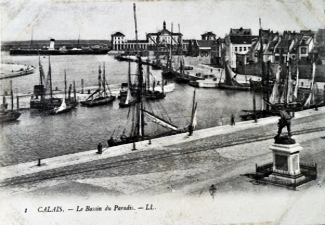
Calais - Bassin du Paradiss c1910. David Iron Collection

Calais – Bassin du Paradiss c1910. David Iron Collection

At Calais, work was going ahead at a pace and included a second sluice gate for the more efficient dredging of the fairway and to get rid of the bar. The groundwork for a graving dock was being prepared and a proposed canal was to be deeper and wider than even the Calais Chamber of Commerce had envisaged. One of the Piers was to be designated as the Steampacket Pier and this would be enlarged and be more appropriate to its function but until the new international Calais railway station was built, no decision had been made on what form it would finally take. The Faversham dynamite had been used to demolish what had remained of the town’s ancient walls and fortifications and the eastern and northern fronts were to be levelled. The Calais defences that remained were in the process of being upgraded and these included the citadel and batteries as well as a belt of coastal batteries and earth lines between Cap Blanc Nez and Oye. The new Calais harbour opened on 26 July 1889 and cost 2,250,000 francs.

In April 1885, LCDR and SMZ signed a contract for LCDR to construct a new Pier at Queenborough as SMZ had ordered three new ships for their Flushing service. The new wood and iron pier was to be long enough to berth and load two SMZ steamers at any one time. The construction was started in June and SMZ ordered the Engeland, Duitschland and Nederland from Fairfield Shipbuilding and Engineering Company. They were similar to their two earlier ships. Although financed from loans provided by the Dutch government to SMZ, Watkin insisted that the money had come through Forbes family connections in the Netherlands. This was, he said, to deprive SER out of their rightful share of the profits through the Continental Agreement.

LCDR started Chancery Court proceedings, in July 1885 against SER appertaining to the Continental Agreement. The case was to be heard by Sir Joseph William Chitty (1828-1899) and LCDR claimed that the traffic, in respect of SER Shorncliffe and Cheriton Arch were part of the Continental Agreement of 1865, but that SER had declined to include them in the said Agreement, hence they owed LCDR £350,325. SER submitted a counter-claim of £558,202 that, they said, should have accrued to SER with the opening of the Queenborough-Flushing route. LCDR were represented by Horace Davey Q.C. (1833-1907), Robert Romer QC (1840-1918), and Mr Sterling. SER were represented by the Attorney General (1885-1892) Richard Everard Webster the 1st Viscount Alverstone (1842-1915), Henry Bret Ince QC (1830-1889) and Charles Mitchell.

The national media were quick to point out that open hostility already existed between the London Metropolitan Railway and the London Metropolitan District Railway, where the two chairmen were Watkin and Forbes respectively. However, a number added that because of Forbes position within that and LCDR, together with directorships of other companies, his personal earnings were in the region of £15,000 a year. Regarding Watkin, they wrote that he had a natural faculty for ‘getting into hot water’ and cited his predatory behaviour towards a number of other railway companies. Yet on the LCDR-v-SER they totally sided with Watkin, stating, that LCDR had violated the spirit if not the letter of the Continental Agreement by establishing the Queenborough – Flushing route and had tried to tap into SER’s rightful Continental traffic by proposing to build the line between Kearsney and Folkestone.

The latter statement had been the rationale behind the Attorney General’s advice to parliament who was representing SER in the Court of Chancery. Therefore, it was generally assumed that SER’s claim would be upheld by Sir William Chitty. So confident that he would win, it took little persuasion by Watkin of SER Board and shareholders to sanction the building of the Folkestone-Canterbury line through the Elham Valley. This was to cut Dover out as a viable cross-Channel port and therefore Folkestone and the Hythe Bay, would become a Harbour of Refuge, with all the prestige that went with it. The Folkestone – Canterbury line was started that year opening in 1889.

 LCDR's crest, Blackfriars Bridge, Peter Trimming. Wikimedia Commons

LCDR’s crest, Blackfriars Bridge, Peter Trimming. Wikimedia Commons

Thanks to: Bryan Williams of Dover Museum, British Transport Police History Group and Queenborough Guildhall Museum.

Part VI of Dover’s Packet Industry and LCDR part 3 are to follow.

Presented: 19 October 2017


Posted in Businesses, Maritime, Packet Service V LCDR & the Route to Dover's Prosperity, Packet Service V LCDR & the Route to Dover's Prosperity, Packet Service V LCDR & the Route to Dover's Prosperity, Railways | Comments Off on Packet Service V LCDR & the Route to Dover’s Prosperity

Packet Service IV London Chatham & Dover Railway Company and the Samphire Accident

London, Chatham & Dover Railway Company Crest. Dover Museum

London, Chatham & Dover Railway Company Crest. Dover Museum

The London, Chatham and Dover Railway Company (LCDR) won the potential lucrative packet contract for carrying mails, both official and private, across the Channel from Dover to Calais in 1863. Two years earlier the Company’s railway lines reached the town and the company had built the Harbour station on the side of harbour near the base and east of the Admiralty Pier. To there, they planned to carry freight from a huge railway goods receiving complex they planned to build near their London terminus at Victoria railway station on the banks of the Thames (see London Chatham & Dover Railway part I). The freight would then be loaded onto cargo carrying vessels to the Continent and to all over the world. The only railway company, other than LCDR, to lay a railway line from London to Dover was the South Eastern Railway Company (SER) who had opened their line on 7 February 1844. Their terminus was the Town Station, to the west of the Admiralty Pier but about a mile away from Dover’s town centre.

Three years after SER had opened its railway terminus, the building of the Admiralty Pier commenced. At the time the Pier was planned to be the western Pier of a large Harbour of Refuge and Dover had great hopes that the new harbour plus the new railway line would give the town the economic boost it needed. However, in 1842, SER had bought the derelict Folkestone Harbour with the intention of turning that into their main passage port to the Continent and in 1850 they had built the North Kent Line as far as Strood. It was during this time, in 1845, that the London, Chatham and North Kent Railway was formed and they planned to lay a railway track from London Bridge Station to Ramsgate and Margate. Also in 1845, the Canterbury and Dover Railway Company was floated and this was to provide a connection at Canterbury with the London, Chatham and North Kent Railway from Dover.

East Kent Railway's Lines in East Kent showing the line to Thanet and to Dover and Dover Harbour. Dover Museum

East Kent Railway’s Lines in East Kent showing the line to Thanet and to Dover and Dover Harbour. Dover Museum

In 1852, the London, Chatham and North Kent Railway amalgamated with the Canterbury and Dover Railway to form the Strood, Canterbury and Dover Railway Company. They proposed a 44-mile line from Dover to join the SER London-Strood line at Strood but when the Company applied to parliament for permission, SER vehemently objected. Thus, in September 1852, the Company was dissolved but reconstituted, in September 1852, as the East Kent Railway Company, (EKR) and ratified in 1853. By 1860 it connected Rochester to Canterbury.

Joining of Dover to Canterbury by rail was the obvious next step and SER, which had objected to EKR’s projects thus far, offered no resistance. This was regardless that EKR had stated that they planned that their railway would go under the Western Heights and to Dover harbour close to SER’s Town station. In their parliamentary application EKR stated that they would build a station next to the harbour and called Harbour Station, from where they would run a fleet of cross Channel passage ships – they carried passengers and goods but not official mail.

This was given Royal Assent in 1855 as the East Kent Railway (extension to Dover) Act. The construction of the Canterbury-Dover line was started and EKR successfully changed their name to the London Chatham and Dover Railway (LCDR).  The second stage of the Admiralty Pier was on the way to being completed and LCDR, in their evidence to parliament for the Dover section, had suggested running a track along the Pier where they would build a station. SER had previously sought a similar agreement so reiterated it, but as the Pier was not completed neither companies were given permission.

At the time, EKR’s ambitious plan was not the carriage of passengers and goods across the Channel and they had not even given any thought in trying to gain a packet contract to carry posted and official mail and parcels to and from the Continent. They planned to create a major freight terminal at Dover harbour for shipping goods to and from abroad in connection with a massive depository on the banks of the Thames in central London. From the outset SER treated the ambition as ridiculous and therefore felt that their cross Channel passage service had the potential of being threatened by LCDR’s activities. In 1860 EKR obtained powers to build a railway from Rochester to London to create a direct main line to the north bank of the Thames and close to their proposed depository and station at Victoria Street, Westminster.

In the same year that LCDR arrived in Dover, 1861, the Harbours and Passing Tolls Act came into force with the aim of facilitating the Construction and Improvement of Harbours by authorising Loans to Harbour authorities. The Act abolished Dover’s Passing Tolls and embodied within it a new constitution that led to the Harbour Act of the same year. This abolished the Harbour Commissioners that had been in existence since 1606, replacing them with the Dover Harbour Board. Like the Commissioners, the Board was presided over by the Lord Warden at the time (1861-1865), Henry John Temple, 3rd Viscount Palmerston (1784-1865). The new Board consisted of five members, two of which were representatives of Dover Corporation, one represented SER, one the Board of Trade and one the Admiralty. The latter was Captain Jeffrey Wheelock Noble RN (1805-1865), the superintendent of Pilots and following his death on 21 March 1865, by Steriker Finnis (1817-1889). Following the opening of the Harbour Station, LCDR demanded that they too should have a representative, which was agreed, making two representing the Railway Companies making a total of six members.

The new Constitution allowed for three ex-officio members, they were the Register (not Registrar) – at the time this was local solicitor James Stilwell (1828-1898); the Chief Engineer – Rowland Rees (1816-1902) and Harbour Master – Richard Iron (1819-1883). The new constitution not only changed the makeup of the Board but it also deprived it of its prime source of income, that of Passing Tolls – at the time worth £10,000 a year. The Act did allow, subject to parliamentary approval, debenture flotations and for arrangements to be made with the railway companies to raise finance for harbour improvements. A later court ruling gave priority of berthing to the contributory railway companies.

Admiralty Pier with a London, Chatham and Dover Railway Company train and packet ship in the Bay. South Eastern Railway's Lord Warden Hotel is on the right. Dover Museum

Admiralty Pier with a London, Chatham and Dover Railway Company train and packet ship in the Bay. South Eastern Railway’s Lord Warden Hotel on the right. Dover Museum

By 1863, 1,675 feet of the Admiralty Pier had been constructed and the quay against which ships berthed on the east side was 1,539 feet in length. The best position was Berth 2 and this was designated for the sole use of packet ships belonging to the Royal & Imperial Mail Steam Packet Company, which held most of the packet carrying contracts to and from the Continent. The Company owner was Joseph George Churchward (1818-1890) and his packet ships left Berth 2 for Calais in the morning and evening. The schedule tied in with SER mail trains from London and for this reason, from October 1861, SER had been allowed to lay and run along a line on Admiralty Pier to Berth 2.

SER had expected to retain the mail train contracts and planned to put in a bid for the packet contract to Calais when that came up for renewal in 1863. They already held the Folkestone – Boulogne contract and in order to further their Calais bid, SER moved two of their cross Channel ships, the Princess Clementine and the Princess Maud, to Dover. They also paid to have a covered walkway erected between the Lord Warden Hotel, which they owned, and their Town Station. However, when Churchward’s contract was extended, in April 1862, to 1870 SER moved the two ships back to Folkestone.

To save the Government money, the Dover- Calais Packet contract had been privatised in 1854 and Churchward had held it since that time. To ensure his vessels were in working order he had rented the former Admiralty packet yard for £120 a year but had increased the number of workshops there without the permission of the owners, Dover Harbour Commissioners. Just prior to the reconstitution of 1861, they demolished the buildings and evicted Churchward. During LCDR’s excavation of the lower (west) end of Snargate Street for their tunnel from Dover Priory railway station to the harbour, they demolished a number of buildings. This created a vacant plot, which Churchward had bought from LCDR to build his own Packet Yard.

Tiger Class Swallow 2-4-0 engine designed by William Martley and built by Peto, Brassey & Betts 1861. Wikimedia Commons

Tiger Class Swallow 2-4-0 engine designed by William Martley and built by Peto, Brassey & Betts 1861. Wikimedia Commons

For their envisaged cargo shipping company LCDR had floated the subsidiary company, LCDR Steamboat Service. Irish locomotive engineer William Martley (1824-1874) was appointed LCDR’s Locomotive Superintendent. In 1861 he designed the Tiger Class Swallow 2-4-0 engine built by Peto, Brassey and Betts of London that was not withdrawn from service until 1904. At the same time, Martley established the Longhedge railway works on Stewarts Lane, Battersea. This opened in 1862 but due to money being spent on new railway lines, the work was mainly repairing and rebuilding a variety of engines, including the specially ordered Hawthorn engines. In 1864, having possibly been head-hunted by Forbes, the General Manager of LCDR, Martley was entrusted with the organisation and supervision of the company’s shipping line.

In the summer of 1862 LCDR, introduced a midday cross Channel passage service from a quay they had created close to Harbour Station. This tied in with the timing of their ‘boat train’ from London. For this reason, the front of Harbour Station faced the quay. Prior to Martley taking up the post, LCDR had ordered the paddle steamers:

Maid of Kent (1) was designed by Royal Navy Lieutenant James Morgan, the Company’s newly appointed naval architect and marine engineer.

Paddle steamers Maid of Kent and the Samphire tied up to the London, Chatham & Dover Railway quay at the west end of the tidal basin. Dover Museum

Paddle steamers Maid of Kent and the Samphire tied up to the London, Chatham & Dover Railway quay at the west end of the tidal basin. Dover Museum

She was 335gross tonnage, built by Samuda Brothers of Poplar and her 2×80 horse power diagonal oscillating engines, with pistons 50inches in diameter with a 3feet9inch stroke, were built by Ravenhill, Salkeld & Co. The paddles were feathered and the boilers were tubular. The Maid of Kent, along with her sister ship, Samphire, had private cabins described as ‘loft and capacious’ and thus they were the first cross-Channel ship to have such luxuries. The ship’s two rowing/lifeboats were fitted with the Charles Clifford’s method of lowering ships’ boats and designed in 1852. Popular with the Royal Navy, this was the first time this design had been used on a non-Naval ship and Morgan ensured that all the ships he ordered had the Clifford design lifeboats. The Maid of Kent was launched at the same time as the Samphire but during their joint trial to Calais from the Thames the weather deteriorated and the Maid of Kent suffered damage to both paddles and paddle boxes. When LCDR won the Dover-Calais packet contact, the Maid of Kent had new, more powerful engines, installed.

Samphire – designed by Lieutenant Morgan and built by Messrs Money, Wigram & Co of London in 1861, she was originally named Shakespeare. The Samphire was a 330gross tonnage iron paddle steamer and engined by Ravenhill, Salkeld & Co of Blackwall, London. Except for the slightly less tonnage she was identical to the Maid of Kent. When Churchward’s Dover-Calais packet contract was renewed, LCDR loaned him the Samphire and on Tuesday 15 May 1862 she made the fastest crossing to Calais. Taking 1hour 23minutes and 1hour 18 minutes for the return journey her mean speed was 16.265nautical or 18.825 statute miles per hour.

Petrel was launched in 1862, designed by Lieutenant Morgan and built by Messrs Money, Wigram & Co of 503gross tonnage and had 2×120 horse power, simple oscillating engines built by Ravenhill, Salkeld & Co. At the suggestion of Admiral Sir Baldwin Wake Walker (1802-1876), the surveyor for the Royal Navy (1848-1861) under whom Lieutenant Morgan had served, she was fitted with a bow rudder. Walker was notable for his wooden hulled wrought iron-clad battle ship the Warrior that was not so vulnerable to gun-fire as the Royal Navy’s iron ships of that time were. The Warrior can now be seen at the Portsmouth Naval Dockyard Museum. On 29 June 1862, the Petrel made her trial run to Calais with Walker on board and she made the crossing at an average speed of about 18 statute miles an hour.

Scud was an iron paddle steamer of 482gross tonnage launched in 1862. She was built by Samuda Brothers of Poplar with 2×120 horse power, simple oscillating engines by Ravenhill, Salkeld & Co.

Foam an iron paddle steamer of 497gross tonnage launched in 1862. She was also built by Samuda Brothers of Poplar and was fitted with a bow rudder similar to Petrel. Her 2×120 horse power, simple oscillating engines were by Ravenhill, Salkeld & Co.

Before SER moved their two ships back to Folkestone, they suggested to LDCR that instead of having a trade war, the two companies should form a cross Channel passage cartel. Three directors of LCDR, George Francis Robert Harris the 3rd Baron Harris  (1810-1872), Sir Cusack Patrick Roney (1810-1868) and Charles Jones Hilton (1809-1866), met the directors from SER headed by Sir Edward Watkin (1819-1901), at the Westminster Palace Hotel. There, SER proposed that they would run the cross Channel service between Folkestone and Boulogne while LCDR would cover the Dover-Calais crossing. That all railway receipts from all stations in a six-mile radius of Charing Cross railway station, London via Dover, Folkestone and any other port that might be used along the coast between Margate and Hastings for the Continent would be divided between them.

As SER was the established Channel passage company they would have 70% of the receipts and LCDR, as the new comer, 30%. SER also suggested that the Agreement should run for 10years when the ratio that would, by that time, have become incrementally equal. Thereafter, if they wished to continue, then separate contracts could be drawn up. LCDR were well aware that SER costs would always be lower than theirs because of Dover Corporation’s Coal Dues – a local tax for the carriage of coals through the town even if they were brought in by sea. Albeit, as LCDR planned a major cargo terminal at Dover not primarily the provision of a passage service, they readily agreed and it was appropriately named the Continental Agreement.

In December 1862, it took everyone by surprise to see an advert for the Dover-Calais contract from June 1863. Churchward immediately took legal action over the sudden change in decision (see Packet Service Part III). LCDR’s General Manager, James Forbes, approached the Company’s Board of Directors and suggested that LCDR put in a bid and also to provide the mail trains. At first they were reluctant and approached SER and it was agreed that they would put in a combined bid, whereby SER would provide the mail rail service and both companies would provide the mail ships and share the revenue from the latter pro rata. Days before the decision on who should be awarded the contract, Forbes put in another bid solely on behalf of LCDR for the Dover-Calais packet contract with no mention of how the mail would be transported between London and Dover.

Just before the closing date of the Dover-Calais packet contract, Forbes, on behalf of LCDR, put in a bid to run the service from London to Calais via Dover of £6,000, thus under-cutting the SER-LCDR’s joint bid. Forbes, in his submission pointed out that the Dover – Calais sea route was shorter than Folkestone – Boulogne and that SER, as the dominant partner, would promote the Folkestone-Boulogne route, which was tidal and therefore irregular. Forbes was successful and LCDR’s full packet contract, from London to Calais, came into effect on Saturday 20 June 1863!

James Staats Forbes (1823-1904) of the London, Chatham and Dover Railway Company. Vanity Fair 22 February 1900. Evelyn Robinson

James Staats Forbes (1823-1904) of the London, Chatham and Dover Railway Company. Vanity Fair 22 February 1900. Evelyn Robinson

James Staats Forbes, had trained as an engineering draughtsman before joining the Great Western Railway. He eventually became the goods superintendent at Paddington railway station and then joined the Dutch Rhenish Railway. He was effectively head-hunted by EKR and was appointed General Manager by LCDR in 1861. Forbes was later described as charming, eloquent and a brilliant negotiator but at this time, the Board members were angry. To them Forbes was a mere employee who had the audacity to tell them that LCDR was not in a financial position to support their grandiose idea of the port of Dover becoming an international freight terminal. Nonetheless, they did accept Forbes’ argument that, for the short term, LCDR should concentrate on the Channel packet contract to Calais.

LCDR Board members then expressed concern over the Continental Agreement, as they recognised that as it stood it was not in LCDR’s favour. Forbes stated that they should consider rescinding the Agreement but the  Chairman, George John Watson Milles, 4th Baron Sondes (1794-1874), stated that such an action was not, in essence, gentlemanly. Forbes walked out, possibly telling Lord Sondes what he could do with his job! What happened next is unclear but in the course of that afternoon a compromise was reached whereby Forbes would make amendments to the Continental Agreement Bill in favour of LCDR, as it went through the parliamentary process. He also had his salary increased to £1,500 a year!

Continental Agreement between the London, Chatham and Dover Railway Company and South Eastern Company as ratified in 1865

Continental Agreement between the London, Chatham and Dover Railway Company and South Eastern Company as ratified in 1865

The final Continental Agreement was ratified on 10 August 1865 and started with LCDR receiving 32% and SER = 68% progressively closing until 1872, when both companies would receive 50-50%. Payments were made every half-year and came into operation immediately. SER were not happy over the final agreement and a court battle ensued, which Forbes won on behalf of LCDR.

Although LCDR had been awarded the contract for carrying mails, Churchward refused to accept the decision, stating that in the final year of holding the contract his ships carried 131,030 passengers and that they would remain loyal to his company. In Calais, on the morning of LCDR’s first day, Captain Jenkins of Churchward’s ship, Vivid II and Churchward’s solicitor shephered passengers onto the Vivid II, demanding that the mails be put aboard too. The ship was steamed up and was ready to go when the French Vice-Consul arrived and insisted that the mails were loaded on to the LCDR ship Samphire. The Samphire left France with the mails and the passengers. Sortly after Vivid II also set sail for Dover but without either mail or passengers. That evening Churchward waited on Admiralty Pier to meet the mail train from London with Vivid II standing by. The mails, however, were loaded straight onto the Samphire and, as in the morning, after she left Dover the Vivid II followed her but again with neither mail or passengers!

This situation carried on for a short time but Churchward recognising that passengers were not loyal to him as the LCDR trains from London always tied in their arrival with the departure of the LCDR packet to Calais, Churchward capitulated. Arrangements were made through Forbes for Churchward to transfer his steamboats, offices and packet yard to LCDR for £120,000. This Churchward agreed. LCDR would pay instalments of £7,000 a year until 1870, made up of cash, preference shares and bonds bearing 5% annual interest. LCDR also agreed to pay Churchward annuities of £800 per annum to 1870 for his share of the Dover-Ostend Belgium contract. Churchward held this contract jointly with a shipping subsidiary of Belgium state railways, Belgium Marine. Before the deal was signed with LCDR, Belgium Marine applied to the Belgium government to buy out Churchward’s share and offered the Belgium government 100,000frances for the full contract. They were successful and from then on Belgium Marine held the monopoly of the Ostend-Belgium route for over a century.

Forbes, and probably the LCDR Board members, were annoyed at Churchward’s double dealing and this raised concern over the French Calais-Dover contract that was also part of the deal with Churchward. The contract had been negotiated in 1860 and was due to expire in 1870. LCDR could not buy the contract from Churchward as the French insisted that the main owner was a French national or company. Churchward had got round this with a sleeping partner M. Clebetteal & Co of Dieppe. It was therefore agreed that LCDR would run the service and receive 70% of the total receipts earned each year.

With the loss of the loss of the Belgium contract, Forbes had envisaged running a passage service – passenger and goods carrying but no official mail – from Dover to Boulogne. The Northern Railway of France opposed this, as they felt that it would conflict and cause confusion in people’s minds with the SER Folkestone-Boulogne packet service. Forbes therefore decided to concentrate on the Dover – Calais packet services and purchased Churchward’s steam packets to augment LCDR’s. These were:

Vivid II landing the King of Sardinia in 1855. Illustrated London News

Vivid II landing the King of Sardinia in 1855. Illustrated London News

Vivid II formerly the Onyx, an iron paddle steamer built in 1846 by Ditchburn and Mare, engined by Messrs Penn & Son, Greenwich and 294 gross tonnage.

L’Alliance formerly the Garland, a wooden paddle steamer built by Fletcher & Fearnall, London, engined by Messrs Penn & Son, Greenwich and 295 gross tonnage. Her name was changed to L’Alliance to comply with French demands when, in 1855, Churchward first secured the contract to carry French mails from Calais to England.

Prince Frederick William of Prussia – usually shortened to Prince Frederick William, the 215-ton gross iron paddle steamer was launched in 1857, and designed by James Ash. She was 180-feet in length and 20-feet beam, 203-tons gross with 2x75horse-power engines.

Included in the deal because Churchward had no use for her, was the 149-ton gross iron paddle steamer Jupiter, which he had bought in 1856 as a relief ship. She had been built and worked as a Thames pleasure steamer and had not been fitted out for the packet industry.

On the securing of the packet fleet and the packet yard Martley took responsibility of the latter. He then, along with Forbes and the packet boat captains, settled down to get his head around the General Post Office rules that governed packet ships. When Churchward had won the contract back in 1854, the rules governing the Packet contract were basic. The appointed companies had to carry the mails to and from the stated Continental or Irish ports fast and regularly. Over time the remit was tightened and by the time LCDR won the Dover – Calais contract, the book was thick with clauses including the demand that the packet companies had to employ the very best ships and equipment to standards set by the Admiralty, who undertook regular inspections.

Once up and running, LCDR ran an efficient service that complied, as far they were aware, to the rules and regulations governing packet boats. Further, the LCDR packet ships, Samphire and the Maid of Kent quickly became firm favourites with the British Royal family and their relations. They were always given a special service and a warm welcome with as many dignitaries as possible in attendance. Typically, on 5 October 1863, the newly elected George I, King of the Greeks (1863-1913), brother of Alexandra of Denmark, the Princess of Wales (1844-1925), arrived in Dover at 15.00hrs having crossed from Calais in the Samphire, the journey having taken 1hour 26minutes. On disembarking, the King and his entourage was welcomed by local dignitaries and military personnel as well as LCDR senior management. The Royal party then lunched at the Lord Warden Hotel before leaving for London Victoria on a special train under the superintendence of Henry Cox (born 1828), the Harbour Station master.

Pilots Tower opened in 1848. The ground floor was gutted in 1864 to enable the London, Chatham & Dover railway company line to go through the tower from Harbour railway station on to Admiralty Pier. Dover Library

Pilots Tower opened in 1848. The ground floor was gutted in 1864 to enable the London, Chatham & Dover railway company line to go through the tower from Harbour railway station on to Admiralty Pier. Dover Library

With regards to the provision of special services to members of the Royal family, the packet contract helped in that it automatically gave LCDR the prime Berth 2 on the Admiralty Pier. On winning the contract, LCDR had immediately petitioned DHB to lay a connecting line from Harbour Station. This was agreed but between the Station and the Pier stood the tall, highly ornate and very solid Pilots’ station. Opened in 1848 besides its practical purpose, it was also of interest to tourists, so could not be demolished. Albeit, as Forbes was aware, LCDR’s finances were stretched and the Board were also reluctant to spend any more money than necessary on the Packet service.

Forbes approached the mechanical and civil engineer, Thomas Russell Crampton (1816-1888), and his plan was implemented. The ground floor of the tower, with a ceiling height of 20ft (over 6 metres), was gutted and the LCDR line was laid through the Tower! This had the unexpected effect of turning the visitor interest into a lucrative tourist attraction for the town! From the Pilots tower the railway line ran onto the Pier, on the harbour side of the SER line,  to Berth 2 and was opened on 30 August 1864.

This was the first day that LCDR ran trains onto Admiralty Pier and coincidentally, Francis, Duke of Teck (1837-1900) and his wife Princess Mary of Cambridge (1833-1907), arrived and were given the Royal welcome. They had travelled from Victoria Station, London on the 20.30hours LCDR train to embarked on the LCDR packet Wave for France. Forbes, used the event for publicity purposes, saying that the visit was to open the LCDR Admiralty Pier line! The Wave was a 344-gross ton, 199 foot long iron paddle steamer built by Money, Wigram & Co, Blackwall, Middlesex in September 1863. Like the other LCDR ships, she had 2×80 horse power diagonal oscillating engines by Ravenhill, Salkeld & Co. Her sister ship Breeze, with a gross tonnage of 349, was similar in all respects except that she was slightly wider that the Wave.

LCDR were not only impressing Royalty, they had caught the imagination of Dover’s business community. In December 1863, Baron Sondes was invited to lay the the foundation stone of the Clarence Hotel, Dover. This was on the corner of Townwall Street  and Woolcomber Street, built by the Clarence Hotel Company whose directors included Steriker Finnis and Rowland Rees senior, both major shareholders in LCDR and part of Dover Harbour Board. The hotel was designed by John Wichcord (1790-1860). It opened in 1865 but was eventually demolished and the Burlington Hotel was built on the site.

In February 1864, LCDR reported that the accounts for the final six months of 1863  showed that £3,984,947 had been spent on main line services, £4,586,883 on the Metropolitan Extension in London and £23,713 on shipping from Dover. The number of passengers carried by LCDR on their ships was 123,053, a fall since the year before. This, Forbes told the Board, was due to the Great Exhibition, held at Crystal Palace, which had artificially swollen the number of passengers coming from the Continent. According to Churchward’s figures, he said, in 1860 there were only 76,318 passengers. From the main line services £171,086 had been received, from the Metropolitan Extension £30,928 while from Dover shipping the net receipts were £34,516. Lord Sondes and the other Board members thanked Forbes and congratulated themselves but resolved that the company would not be paying dividends.

Dover Harbour 1850 view from Western Heights. Dover Library

Dover Harbour 1850 view from Western Heights. Dover Library

When Sondes explained the reasons why at the shareholders meeting, a Mr Shaw from Dover responded by saying that in his opinion, the Board directors were in no position to congratulate themselves. ‘The company had started out with £700,000 capital from shares and borrowing,’ he said, ‘but this now stood £9,000,000! In his opinion shareholders should employ counsel in Parliament to protect their interests.’ Shaw went on to say that the Dover shipping operation was the only part of the company that was profitable. ‘Yet’, he said, ‘Dover was being badly treated by LCDR.’

LCDR Company Secretary, George Augustus Frederick Charles Holroyd 2nd Earl of Sheffield (1802-1876), told the shareholders that the Board of LCDR had agreed with the full backing of shareholders that the company’s operations in Dover was to create a world class cargo terminal. Adding that ‘until the connection between Admiralty Pier and the Metropolitan Extension was completed, there was little point in spending or doing anymore than necessary at the Dover end.’ To Forbes surprise, Rowland Rees agreed with Holroyd, saying that ‘once the Extension was completed, an enormous amount of traffic would come through Dover and it would be then time to expand the Dover terminus.’

 Forbes LCDR advert for the Dover - Calais service August 1862. Times

Forbes LCDR advert for the Dover – Calais service August 1862. Times

Forbes was to remember Rees reasoning over the necessity for adequate infrastructure before undertaking the prime objective, in this case Dover becoming a major cargo terminal. This, with a combination of other reasons, cemented Forbes’ belief that the cross- Channel packet operation was a better option than a cargo terminal. The Company had four packet ships,  the Samphire, Maid of Kent, Breeze and Wave operating twice daily crossings of the Channel, with the other ships in the fleet in reserve. The boat trains left Victoria railway station, London, at 07.00hours and 15.00hours. Passengers on the earlier train arrived in Paris at 18.00hrs and on the afternoon train, arrived in the French capital at 07.20hrs the following morning. Forbes’ advert assured passengers that the tickets provided a through service and there was no landing by small boats as at other ports – obliquely making a jibe at SER’s Folkestone-Boulogne service!

Calais Pier, Sloop returning to Port by Edward William Cooke 1811-1880. Wikimedia Commons

Calais Pier, Sloop returning to Port by Edward William Cooke 1811-1880. Wikimedia Commons

Although the adverts did make potential passengers aware of the Dover-Calais service, one of his major problems was the port of Calais. There the embarkation  and disembarkation of passengers left a lot to be desired, particularly at night. On 26 December 1863 George Roland and his wife, from Edinburgh, were returning to England via Calais and were the first of a stream of passengers in France to go on board the ship that was to take them to Dover. It was very cold but both were well wrapped up and wearing the appropriate footwear to negotiate the stairs, wet quay etc. As directed by the conductor, they went down the unlit stairs to the dark quay. Then they had to negotiate a gangplank, without railings,  to board the ship. Mr Roland lost his footing and fell into the sea. His wife would have fallen in too had not the passenger behind her grabbed her. Mr Roland was fished out by crew members of the ship and other passengers, but soaked through boarded the ship. On returning to the UK Mr Roland complained to Lord Sheffield, the LCDR Company secretary, to be told that the responsibility for boarding, sailing and leaving the ship was that of the passenger and LCDR disclaimed all liability.

The response was publicised by Mr Roland and Forbes brought the matter up with the LCDR Board. He was told that this only applied to ordinary passengers. People with status were ensured a full, safe and positive reception. For instance when Archduke Maximilian of Austria (1832-1867), his wife and their entourage, were travelling in supposed incognito on a special train arriving at Calais at 01.00hours in March 1864. For them, the whole harbour was lit up and staff were there to ensure that they embarked on the packet ship, Breeze, safely! This was not lost on the passengers at the quay that night, who had been marshalled via a dark and hazardous route and of this, Forbes was aware.

Internationally, this was the time of the American Civil War (1861-1865) and in January 1864, Forbes sold the L’Alliance to the Confederate States of American for blockade running along with Jupiter. However, while crossing the Bay of Biscay the Jupiter foundered and was lost. To replace these, he ordered the 327.29gross tonnage Prince Imperial iron paddle steamer from James Ash & Co of Poplar. She had, 2×90 horse power oscillating engines that were supplied by Penn’s of Greenwich. The vessel arrived in September 1864 for the night service. To raise finance for this outlay, the previous autumn he had briefly chartered, the Scud, to Belgium Marine. On arrival of the Prince Imperial, Forbes sold Foam and Petrel to a Mr F Sabel of Liverpool for the China trade.

The LCDR half yearly report ending on 31 December 1864, stated that the receipts on the 72½ miles of main line track continued to increase amounting to £182,240. However, the expenditure on the main line between Bickley and Dover was £4,443,602 while the receipts from cross Channel traffic was only £32,352 out of which were expenses that amounted to £19,156 and included the cost of two new ships. Shareholders were angry but the LCDR Board assured them that once the cargo terminal opened at Dover, the situation would improve.

La France - with other Paddle Steamers in Wellington Dock + c1880-90. Dover Library

La France – with other Paddle Steamers in Wellington Dock + c1880-90. Dover Library

The second ship that Forbes had ordered came from James Ash & Co of Poplar, and was the 388 gross ton iron paddle steamer La France. She arrived in Dover on 4 January 1865 and Forbes publicity hailed her as the fastest steam ship to make the crossing. This came under attack from John and William Dudgeon of Cubitt Town, London, the builders of the Mary Augusta, a 970ton 280 horse power twin screw steamship built for the American Civil War as a blockade runner.

The Mary Augusta made her trial run between Dover and Calais and this was turned into a race against La France in March that year. The wind was a moderate East North East and starting off the end of the Admiralty Pier at approximately 09.30hours by 09.53hours both ships were off the South Foreland and level pegging. Then a hot bearing problem developed in the starboard engine of the Mary Augusta that resulted in a reduction of revolutions. Nonetheless, she succeeded in drawing away from La France and by 10.45hrs, the heated bearing having cooled, the Mary Augusta made faster headway than her rival. At 11.04.45sec, the Mary Augusta reached Calais head, turned round and headed back to England. With the help of her fore and aft sails she arrived back at Admiralty Pier before La France. Her total timing was 2hours 45minutes and 10 seconds and the Dudgen brothers were pleased with the success. James Dunwoody Bulloch (1823-1901), the Chief Agent in England for Confederate Army, purchased the Mary Augusta but the war was over by the time she arrived.

The outcome of the race was a blow for Forbes and the Board was unhappy as the race was given a lot of publicity and the Company shareholders were becoming increasingly disgruntled. At one meeting Rowland Rees asked Forbes to explain, given the persistent fall in the number of passengers travelling on LCDR ships, why more ships were being brought into service. Rees told the packed meeting that the fall in the number of passengers between 1862 and 1863 was 6% while and in 1864 there had only been 120,251 passengers giving a fall of just over 2%. Forbes responded by saying that LCDR had taken over a number of old ships from Churchward, who was at the meeting, when they first began operations. These, he said, had been sold off and were being replaced by the new ones to attract more passengers. Churchward, is not recorded as making any comment.

Folkestone Harbour in the 19th century. Folkestone Library

Folkestone Harbour in the 19th century. Folkestone Library

At a subsequent Board meeting the cross Channel passenger statistics and the lack of greater income from the service was discussed. Regarding the latter, Forbes told the directors that SER were not playing fair over the Continental Agreement. SER had built the new Shorncliffe railway station (now Folkestone West), and were claiming that passengers alighting there were NOT going to the port of Folkestone and therefore their ticket receipts were not included in the Agreement. In reality, he said, the passengers were invited to alight and watch the engines being changed before the train went on to Cheriton Arch station that served the port of Folkestone. Forbes went on to say that although the Continental Agreement for 1864 netted £368,000 between the two companies because of the division LCDR only received £125,120. At the time the Continental Bill had not been finally ratified by parliament and Forbes used the opportunity to make further changes but the LCDR Board of directors did not agree. The Continental Agreement was finally ratified on 10 August 1865 and at the time LCDR were running into major financial troubles. These are discussed in detail in London, Chatham and Dover Railway – Part I story.

About the same time as the Continental Agreement was ratified another LCDR shareholders meeting was taking place with LCDR’s growing financial problem being the main issue. LCDR’s Chairman, Lord Sondes, successfully motioned the authorisation to convert ordinary shares into ordinary capital stock in the general undertaking of the Company. On the basis of this 2,400 appertaining to the Dover – Calais packet service were converted to interest bearing shares of £25 each and named Dover preference arrears stock. They were redeemable and raised £60,000. Sondes then proposed that ‘The Directors were also authorised to capitalise further arrears of interest on Dover preference capital by the creation and issue of £110,000 addition shares or stock, redeemable and entitled to a dividend not exceeding 5% per annum.’ This Forbes knew was not for the packet arm of the Company but to meet costs of the Company’s London Metropolitan Extension. A number of shareholders also recognised what was happening but Lord Sheffield motioned for their views to be over-ruled and this was carried.

On the night of Thursday 26 October 1865 one of the heaviest gales up to that time occurred. The two LCDR ships transporting mail that night were the Breeze under the command of Captain Matthews and the Prince Frederick William under Captain William Clark. So rough was the weather that the vessels left Admiralty Pier over 2hours late at 00.35hours and 00.37hours respectively. The Breeze had 131 Continental mail boxes and 75 passengers and Prince Frederick William had 210 boxes bound for India, China and Australia. Battling against the roughest seas that Captain Matthews had ever encountered he brought the Breeze safely into Calais at about 02.30hours. The Prince Frederick William did not arrive and as the night wore on there was increasing concern. At about 04.00hours another steamer was sent out from Dover to look for her and just after 06.00hours the Prince Frederick William arrived in Calais aided by the ship sent to find her. The strain of ploughing through the violent waves had broken the intermediate shaft of one of her engines disabling one of her paddles.

The Samphire Accident

 LCDR iron paddle ship Samphire c1860. Hollingsbee Collection

LCDR iron paddle ship Samphire c1860. Hollingsbee Collection

At 23.30hours on the night of Wednesday 13 December 1865, the LCDR packet ship Samphire, under Captain John Whitmore Bennett (1828-1907), was carrying mails and 78 passengers from Dover to Calais. The Samphire, had left Dover at 22.58hours, the weather was hazy, the wind North North West to North with a fair wind and ebb tide. When she was less than 5 miles out she was hit by the 500ton Fanny Buck from Boston, Massachusetts, under the command of Captain Hoad. The Fanny Buck was bound from Rotterdam – then Flanders and now the Netherlands – to Cardiff. She was laden with ballast. The Samphire‘s speed at the time of the accident was 12 miles-an-hour and 5 of her passengers lost their lives. The accident is particularly memorable as the outcome emphasised the first major legislative ground rules for ships traversing the English Channel.

The inquest was held on 15 December in Dover Town Hall, now the Maison Dieu, under the direction of William Henry Payn (1803-1887) the town coroner. LCDR’s solicitor was Wollaston Knocker (1838-1907) of Dover and those who lost their lives were, Monsieur Laynelet – traveller in the house of Messrs Bockering, Fieresand Co Paris; Miss Baines, Miss Koenig, Monsieur Duclercq and an unknown man lost overboard at the time of the collision.

The crew of the Samphire under Captain Bennett that night were, William Richards – mate, Charles Datlin – acting mate, J Fleet – carpenter and seamen: W Norris, Robert Malpas, Thomas George Northover, J Gillman, Frederick Waters and Henry George Boyce. Other crew members were Henry Hills – boy, Henry Hickings (1834-1891) – steward, Thomas Hardy – chief engineer, William Waters (b 1831) – second engineer and stokers: R Bishop, T & M Trevett and W Jones. The mail master was George Henry Suters (1836-1901). Only members of the crew of the Samphire gave evidence at the inquest. The jury’s conclusion was, in effect, that nobody was to blame and nothing was at fault, other than the Fanny Buck did not show sufficient light. They added that it was ‘the coolness and the intrepidity displayed by Captain Bennett and the crew of the Samphire in their trying position, which under God’s providence, were the means of rescuing so many lives.’

This quickly brought a rebuke from the crew and owners of the Fanny Buck as well as from ship owners and yachtsmen who frequently traversed the Strait of Dover. The letters were published in the national press with many stating that the Fanny Buck was travelling along the Channel while the Samphire was crossing it and therefore the blame rested fully on the Samphire. All the local officials involved including the coastguard described the night as moonless with a distinct haze that made it difficult to see anything that was not lit. However, the passengers from the Samphire told the media that it was clear moonlit night and that the lights from the lighthouses on South Foreland and the Cap Griz Nez, France, could easily be seen. Pilot Samuel Dane (1813-1875) said that the weather was that all cross Channel captains feared most. ‘In misty or foggy weather’ he said, ‘you can see clearly, one minute, then you are running in thick fog which suddenly lifts again, showing shipping all around and equally quickly descend again.’

The former Dover Court jury box in the former Town Hall now the Maison Dieu, where the Samphire Inquest and Board of Trade Inquiry were held.

The former Dover Court jury box in the former Town Hall now the Maison Dieu, where the Samphire Inquest and Board of Trade Inquiry were held.

The accident sparked such interest that journalists from national newspapers joined local reporters in attending the Board of Trade Inquiry, which opened on 21 December 1865 in the then Dover Court room part of the then Town Hall complex now the Maison Dieu. Carrying out the investigation in pursuant of the Merchant Shipping Act of 1854 and the Merchant Shipping Amendment Act of 1862 was Dover Mayor, William Rigden Mummery (1819-1868) and local magistrate, Dr Edward Farrant Astley (1812-1907). At that time the Board of Trade was the governing body responsible for all civil maritime matters including safety and the loss of British ships. The attending assessors on behalf of the Board of Trade were Captain Henry Harris and Captain Robert B Baker and the Trade’s solicitor was James O’Dowd (1809-1903). Solicitors Messrs Edwards & Son represented Mr Bowden – agent for the owners of the Fanny Buck, Mr Fox represented Captain Bennett, and Wollaston Knocker (1825-1890) represented LCDR packet service. The hearing lasted 11 days.

The Captain and members of the Samphire crew were the first to give evidence and in essence, they generally agreed that the Samphire left Admiralty Pier at 22.57hours on the evening of 13 December. The Captain had constantly used night glasses (binoculars) to aid his vision and was on the Bridge as lookout on the port side when the accident happened. With him was the call-boy Henry Hills who passed on messages, through the communication pipe that went to the engine room. Robert Malpas was lookout on the starboard side and Thomas Northover was on the bow as the forward look out. They had been told by the first mate, William Richards, to be especially vigilant as there were herring boats about. It was difficult to see dark or unlit objects because of the intermittent poor visibility. The Samphire’s navigation lights shone brightly, there was a white one on the masthead, a red one on the port bow and green one on the starboard bow. The speed was 12knots and Charles Datlin with George Boyce were on the wheel and steering South East half East.

About 15-20minutes after leaving the Pier, Northover called out that there was ‘a sail off the port bow.’ At the same time Malpas called out that there was ‘a light two points on the port bow.’ The Captain confirmed both sightings and shouted to the wheel ‘Hard To Port’, Datlin replied Port and the Samphire responded. Seconds later, as the Fanny Buck loomed and the Captain rapidly ordered to the engine room, ‘Case Her, Stop Her.’ The orders were immediately carried out. The barque struck the Samphire on the port bow and the Captain ordered the engine room to go astern. The Fanny Buck’s bow was on the deck of the Samphire and two Fanny Buck crewmen fell from her bow onto the Samphire. They both were wearing caps, a gansey – a seaman’s knitted woollen sweater – and trousers but no shoes or stockings. At this point, for the first time, the crew members of the Samphire observed a dim green light on the starboard side of the Fanny Buck.

On board the Fanny Buck was pilot, John D Hondlehone from Rotterdam, who was navigating at the time of the accident as the captain was ill and indisposed. The mate was Daniel Pigsaud, who acted for the captain. The total crew consisted of 3 Englishmen, 2 Americans, 1 Swede, 1 Prussian – Frederick Drenkow – and 5 others. All could speak English but at the hearing, to ensure clarity of understanding, Samuel Metcalf Latham (1799-1886) as the Dover Dutch consul, stood by as interpreter. Although a steamer, the Fanny Buck was under sail at the time, with all the plain sails set up to the top gallants. The wind was North to North North West and they were steering west by north alternating with west by south, depending on which tack they were on. They were travelling at about 6-7knots an hour and at the time of the accident, the Fanny Buck was close hauled to the wind on the starboard tack.

All the Fanny Buck crew agreed that the weather was at times hazy then becoming foggy and occasionally clearing. They also agreed on all of the events on the Fanny Buck that night. Frederick Drenkow was the lookout on the foredeck and James Sheppard was on the wheel. Two others were on general look out while the pilot, Hondlehone, and the mate, Pigsaud, were on the aftdeck. It was also generally agreed that the Fanny Buck’s navigation lights complied with the British Admiralty ruling of a white one on the masthead, the red on the port bow and green on the starboard bow. They all shone brightly and the mate, Pigsaud, had started checking and trimming them immediately after the four bells had been struck – at 22.00hours. This procedure took about three to four minutes each light.

About 15 minutes before the collision, Drenkow had called out in Dutch that there was a white masthead light in-shore of the Fanny Buck, and Hondlehone gauged that the light came from what turned out to be the Samphire. She was about 2-3 miles away and four points on the starboard bow. Hondlehone did not order Sheppard to alter course as he said that it was the duty of the Samphire to get out of the way. Albeit, about 8-10 minutes later Drenkow called out that there was a red light and then seeing both a red and green light called out ‘Steamer ahoy, Back engines’.

Hondlehone ordered Drenkow and one other man to loudly hail the Samphire from the foredeck. This they did but the Samphire carried on. On impact both men fell onto the Samphire’s foredeck. The shock of the impact on the starboard bow forced the Fanny Buck to heel over to port but she straightened up when the Samphire pulled back. A whistle was heard from Samphire and there was shouts for help but the Fanny Buck continued on her course. Her stanchion on the starboard bow was badly damaged causing her to take in water, this Hondlehone said, would have increased if the Fanny Buck had changed to a port tack. All hands on the ship were then involved in taking the sails down and using them to make emergency repairs to stop the flooding before the Fanny Buck sank. The Fanny Buck then headed for Sandgate, along the coast, where she was anchored. After nailing canvas over the hole she was brought  back to Dover.

The last witness from the Fanny Buck was the steward, James Miller. In his affidavit he had said that part of his duties was looking after the navigation lamps. He concurred with the rest of the crew that the mate, Pigsaud, had checked and trimmed the lights immediately after the four bells had been struck. At the time of the accident Miller said, he went on deck and all three lights were burning brightly. However, under questioning on his routine that day, Miller said that earlier in the day he had taken the three lamps to his cabin, to clean and prepare them for that night. At the time he was also looking after the Fanny Buck’s, captain who was very sick. He had trimmed one of the lamps when the captain summoned Miller with his bell. On returning to his cabin Miller poured a gill of oil into each lamp adding that it was of poor quality and tended to smoke when lit.

When the collision took place Miller was in bed and was thrown out due to the impact. As he left the cabin the mate, Pigsaud came to him with the green lamp in his hand and said ‘Steward, this lamp is out.’ Checking it, Miller found that two of the three tubes did not have wicks so he inserted two new ones. He then filled the lamp with oil at which point the captain’s lady called for Miller to attend her husband. When Miller returned to his cabin, the lamp was gone. The following morning, Miller found the lamp on deck, leaning against a locker, together with the other two lamps. When it was pointed out that this differed from his affidavit, Miller replied that when he heard of the deaths caused by the accident, he felt remorse as, in his mind, it was the Fanny Buck’s inadequate navigation lights that had caused the accident.

Events on the Samphire

Captain John Whitmore Bennett (1828-1907). Hollingsbee Collection

Captain John Whitmore Bennett (1828-1907). Hollingsbee Collection

From the affidavits and evidence given in the coroner’s court by the Captain and the crew of the Samphire, it was clear that following the impact Captain Bennett ordered the boats to be lowered and the rockets to be fired. However, the rockets and the blue warning lights that when displayed indicated that the ship was not underway, were in the fore compartment. This was under water so even if they could have been retrieved would not have been of any use. Also under water was the fore cabin in which three passengers had drowned. Two were Mieta Baines, aged about 20, and daughter of Reverend Edward Baines (1801-1881) of Yalding, Kent and her German governess Georgina Koenig about 23 years old.

The Samphire had four boats each with four oars, 2 cutters and 2 lifeboats. Before any of the boats were lowered three passengers with their luggage had already climbed into the first cutter. The passengers remained seated with their luggage close to them and when asked, refused to move and this limited the number of people the cutter had room to carry. It also hindered the lowering of the cutter but on hitting the sea, on the orders of Captain Bennett, William Richards together with four crew members and with the three passengers still on board, rowed to Dover for help. The Belgium mail packet, Belgique had passed Samphire, but as no blue lights were showing carried on to Dover. She was being tied up at Admiralty Pier when the cutter arrived. On hearing of the calamity, the Belgique’s captain immediately ordered the ship to go to the aid of the Samphire.

The second cutter, with a great deal of difficulty due to about 20 passengers with their luggage having already commandeered the boat and a passenger who had a knife with which he was trying to cut one of the lines. When he saw Captain Bennett he put the knife away, sat down and the boat was successfully lowered. On board were Malpas, two other members of Samphire’s crew and Drenkow from the Fanny Buck. However, due to the tight squeeze and particularly the passengers luggage, a bung was displaced and lost. In consequence the boat started to take in water but unaware of this, Captain Bennett ordered Malpas to go to the Fanny Buck and ask them to ‘heave to and help’. They rowed after the Fanny Buck and all the seamen, including Drenkow called out but no notice was taken. As the Fanny Buck increasingly moved away from the boat, Malpas at the behest of the demanding passengers, along with the other three seamen, rowed to Dover.

It was not long after that it was realised that the boat was leaking and that this was due to the missing bung. Malpas told the passengers what he believed had happened and told the passengers to throw their luggage overboard if they wanted to reach Dover. The passengers refused nor would they help find the missing bung. Without any instructions from Malpas, all four seamen started stripping off and used their clothes to try and plug the bung hole. Not one passenger parted with any of their clothing or possessions. As water was still seeping in, Drenkow, who had been loaned a pair of boots by another Samphire crew member, used them to bail the water out, while the other three rowed the boat. At the Inquiry, passengers on board the boat that night all concurred that it was not their job to row the boat nor had mere seamen the right to tell them to throw their luggage overboard. The four crew men did say that one of the passengers did help with the rowing and another helped Drenkow in bailing out.

The cutter arrived at Admiralty Pier at 01.45hours with the passengers being taken to the nearby Lord Warden Hotel where the kitchen staff were just arriving. The marine superintendent, Sir Luke Smithett (1800-1871), had already arrived on the scene and had ordered the kitchens to be opened. He and his staff then offered the distraught passengers the option of either returning to London on the 04.00hours train or to rest at the hotel and take the next packet to Calais at 09.30hours that morning. Those who had lost their tickets were given passes. Albeit, later a number wrote strongly worded letters to the press and stated under oath at the Board of Trade Inquiry, that this was untrue. They had been abandoned by the four crew men at the deserted Hotel and were unable to even get a hot drink. At the inquiry, other passengers from the cutter refuted this and concurred with Smithett’s account. The four crew men were taken to the Sailors’ Home and all stated that they were well looked after.

As the first of the lifeboats was being prepared Captain Bennett insisted that the few ladies on board were to be helped to get into it. However, a number of men bulldozing their way through with their luggage, pushed past them, sat down and refused to get out. They also all sat in the aft section, having stowed their luggage in the bow. Frederick Waters who was responsible for lowering the lifeboat at the bow, was unable to get near the Clifford equipment and the Captain asked them to remove some of the cases so that Waters could get in. This they did but when Northover, who was in overall charge, gave the order to start lowering the boat a couple of the passengers, complained that crewman Norris, who was responsible for the aft equipment, was elbowing them. They stood up and started to clamber down the boat pushing Northover aside. The boat tilted then dropped, still at an angle, and all the passengers, their luggage and the crew fell out.

The lifeboat, upturned but with the help of the crew on board, most of the passengers used it to gain a hold of the boat-tackle and climb back onto the Samphire. It then became apparent that one passenger was still in the water and lifebuoys were thrown to him. Captain Bennett, with a running bowline round his body, dived in and secured a line around the man – M. Duclercq a merchant from Gravelines, now France then Flanders. Duclercq, like all of the other passengers, was wearing a thick heavy coat and winter boots. These quickly filled with water and as Duclercq was being raised, the weight of his boots pulled him out of the harness and he fell into the sea and drowned. Another man was then seen and Captain Bennett again went to his rescue but before reaching the man, believed to be a Russian nobleman, sank without trace.

By this time the second lifeboat was ready to be launched and regardless that Captain Bennett had ordered that the ladies were to be given priority, about 16 men with their luggage sat in it and refused to move. However, Suters did manage to get on the boat, but the passengers made it clear that there was no room for the mail sacks, so these were left on Samphire. Members of the crew lowered the lifeboat safely and she started for Dover. As the lifeboat was going around the stern, the Samphire‘s steward, Hickings, who was on the ship, spotted Boyce in the sea. Boyce was holding up a man with a lifebuoy around him. Hickings’ yelled to Charles Datlin the acting mate who was in charge of the lifeboat, to go to Boyce’s aid. A fracas broke out, then eventually the lifeboat rowed off in the direction of Dover. In the meantime, Hickings’ with the help of stoker Bishop hauled out Boyce and the man, who was still alive, to safety.

The remaining passengers, including all the ladies, Captain Bennett, Henry Hickings, the two engineers – Thomas Hardy and William Waters –  along with Boyce and Bishop remained on the Samphire. Due to the separate water tight compartments, the Samphire did not sink and although her engines still functioned, she had lost her steering power. The Belgium mail packet Belgique, arrived 40 minutes after being told that the Samphire was in trouble and took the remaining passengers and their luggage to Dover. They left a stock of blue lights in order to warn other craft that the Samphire was disabled. About two hours later the Belgique returned by which time the Samphire had drifted some 10 to 12 miles and into thick fog. Eventually the Belgique located the Samphire and the distressed ship’s engines were fired up so that the Belgique could tow her. Both ships arrived in Dover harbour at about 08.15hours on 14 December.

The Questioning of Captain Bennett

Each member of both crews was questioned at the hearing of the events that night and from Samphire, Captain Bennett came in for the most scrutiny. The three representatives from the Board of Trade, Captains Harris and Baker and solicitor O’Dowd focussed their attention on the ship’s boats, while Dover’s Mayor Mummery and Dr Astley closely questioned Bennett on aspects of the packet contract.

In answer to the Board of Trade representatives questioning, Bennett told the hearing that two of Samphire’s boats were lifeboats fitted with the Charles Clifford’s method of lowering ships’ boats and each with four oars and were always left uncovered during winter months in case of emergencies. The other two boats were four oared cutters. The Captains then asked how the cutter was launched in which the bung was missing. Bennett re-iterated that it was the second boat to be launched and that the passengers had already boarded it stowed their luggage under the seating before it was prepared and were badly seated. The passengers were all well wrapped up against the winter weather and were loudly demanding that the boat should be launched forthwith. This was regardless that there were no crew members on the boat but they were so sure that the Samphire was sinking fast that one of the passengers, who had a knife, was standing up and trying to cut through the lines that were holding the boat to the Samphire.

Asked how Bennett believed the passengers should have been seated on the boats, he replied that they should have sat in the thwarts – across the boat – with equal number on  either side and remained seated. Asked if this applied to the lifeboats and Bennett replied in the affirmative. He was then asked if, at any time, the passengers were told where to sit, to remain seated and not to take their luggage with them. Bennett replied that he had asked them and added that he was a mere captain while the passengers were gentlemen. One did not tell ones social superiors what to do. Solicitor O’Dowd asked Bennett why he had not ordered his crewmen to unload the boats of the passengers luggage or at least persuade the passengers to leave their luggage behind. ‘That night the passengers,’ replied Bennett, ‘were not open to persuasion to do anything against their will.’

Illustration of the Clifford's equipment adapted lifeboat. From Nares Seamanship 1862

Illustration of the Clifford’s equipment adapted lifeboat. From Nares Seamanship 1862

They then asked Bennett about the Clifford equipment and what, in his opinion, had gone wrong on the first lifeboat. Bennett said that once he managed to get Frederick Waters into the bow, there were three members of the crew involved in lowering the lifeboat using the equipment. Northover was at the centre, in charge of the boat and of lowering the line and aft was Norris. When all were seated, Northover started lowering the boat by putting the line one turn round the cleat and then slowly slackening it off. It was at this point that the two passengers clambered past him and Northover let go of the line. The lifeboat tipped aft and, as the hearing knew, every one and everything fell into the sea.

They then asked about Suter’s role in the events that night. Bennett, possibly surprised by the question, said that Suter’s responsibility was the mail. This he carried to be loaded onto the last boat to leave the ship but there was no room. Suter, boarded the lifeboat but Bennett was not sure if he had helped to row it. The mail was taken to Dover on the Belgique and loaded on to the next packet to leave Dover for Calais. On being asked what he knew of Suter’s background Bennett said that he hardly knew Suter.

The two Captains were none committal as to what they thought of Bennett’s evidence but did say that in their opinion, Bennett had acted courageously in trying to save M. Duclercq life. That although he was wet through and that it was very cold, he had remained on deck so that the second lifeboat was lowered safely.

In response to Mayor Mummery and Dr Astley’s questioning over the packet contract and requirements appertaining to the duration of the crossings. Bennett said that to comply with the contract the duration of the voyage was not to exceed two hours and five minutes. If the crossing was quicker then LCDR was paid a bonus of £5 by the Postmaster General. Out of this the ships’ captains received 2shillings and members of the crew the same amount shared between them. If the duration of the crossing exceeded the time limit by 15minutes or more, LCDR was fined at least £5 by the Post-Master General depending on the duration and causes of the delay. A proportion of the captains and crews packet money was deducted accordingly. LCDR paid the captains and the crews their packet money every quarter, while they received their wages after every set of crossings.

Conclusion of the Samphire accident

Shipwright George Barber was the Board of Trade surveyor and he told the hearing that he examined the lights of the Fanny Buck in the Harbour Master’s, Richard Iron, office. He said that the lamps were smaller than those of the Samphire, with a short range but were in good condition. Each contained one burner with three cottons and held about half a pint of oil. He had spoken to Miller and asked the steward if the lamps were as he had prepared them on the fateful day. Miller, at the time, was unaware that this was contentious and examined the lamps. He said that two of the three wicks in the red lamp were those he had inserted but the green wicks were totally different and of a better quality. Barber, told the Inquiry, that in his opinion, the replacement wicks would have made a difference to the brightness of the lights but that he would have expected them to be trimmed about every four hours.

On examining the places where the lights had been fixed on the Fanny Buck, Barber surmised that the lights would have been difficult to see especially because of the poor quality of the wicks and that such low quality would not have been allowed on a British vessel. Barber also stated that he had examined the three remaining Samphire boats and that the Charles Clifford’s launching gear on the one lifeboat remaining, with that fitted, lacked adequate maintenance. The rowlocks were out of true and the oars and rudders of all three boats needed attention. He also examined boats in service on another of LCDR ships and found that they too lacked adequate maintenance.

In Dover, the overwhelming opinion was that Captain Bennett was heroic for not only had he managed to get most of the passengers safely off the Samphire, but ensured that they reached the harbour safely. He had made valiant efforts to save the lives of those that fell into the sea and he had stayed on the half submerged vessel in order to bring her home. It therefore came as shock when the Board of Trade stated that Captain Bennett of the Samphire was at fault for causing the accident.

Their report stated that Captain Bennett was driving his vessel too fast for the adverse weather conditions. This, they recognised was due to the demands of the General Post Office’s Packet Contract and therefore the damage to the ship and loss of life did not only arise from his fault. They recognised that Captain Bennett’s conduct after the collision was exemplary, using his utmost endeavours to save lives and to adopt such measures as were proper. This would have been expected from him and it was for these reasons alone, the Inquiry report stated, Captain Bennett would not have his Master’s certificate cancelled or suspended.

The conduct of the crew came in for a fierce rebuke. The report stated that those in the boats had shown a lack of concern for the plight of those still on board the Samphire, which was sinking. Charles Datlin, the acting mate, was deserving of the highest censure, they wrote, as he had effectively made off in the lifeboat. The fact that the passengers were demanding, ignored requests and difficult to control was no more than natural under the circumstances and formed no excuse for poor conduct by the Captain and crew. This the Inquiry blamed on the weakness of Captain Bennett in handling alarmed, panic stricken passengers. The clumsiness of lowering of ship’s boats received censure and this was blamed on the lack of training and maintenance. However, the Inquiry report was particularly scathing of the mail master, George Suters,  saying that he had previously been a carpenter in the Royal Navy and yet he had deserted his mails and his ship in a cowardly manner by getting into one of the boats.

LCDR came in for fierce criticism over the lack of maintenance of the boats and lack of crew training. Regarding the state of the boats, Martley took responsibility and Forbes took responsibility over the lack of crew training. The report went on to say that although the Samphire was carrying a greater number of boats than was required by the Board of Trade in line with Government regulations, there was insufficient to secure the safety of ALL the passengers and crew. This, the report stated, was possibly the cause of the passengers panic. The behaviour of the crew of the Fanny Buck came in for criticism too. The lights on the Fanny Buck, the Inquiry report stated, were shown to have been inadequate and of not returning to the scene of the accident and offering help was also condemned. With these in mind, the Inquiry held them as partially culpable for what had happened. Finally, the provisions of the Government Packet Contract was seen as the main culprit for the accident as, said the Inquiry report, it held out a direct premium for quick passages in all weathers and conditions. This put a great moral pressure on the owners and commanders of the mail vessels by the general public, which was wilful and dangerous.

Following on from the Board of Trade Inquiry was the Court of the Admiralty Hearing. This was before Stephen Lushington (1782-1873) and the Trinity House Masters. The Hearing took place in February 1867 and lasted two days. All those who attended believed that the Hearing was to settle the principle conflict for compensation purposes, whether the Fanny Buck had her proper lights exhibited. However, the Masters of Trinity House reminded the Court of the legal conditions laid down in the Merchant Shipping Act of 1854 and the Merchant Shipping Amendment Act of 1862. That although the Fanny Buck was a steamer, at the time of the accident she was under sail and as such she would have difficulty altering course. The Acts made it clear that in all circumstances steam had to give way to sail. Thus the unanimous opinion was that the Samphire was to blame for the accident as the Captain and the crew could see that the Fanny Buck was under sail. The subsequent Judicial Committee of the Privy Council affirmed the Admiralty Court’s verdict and stated that the Samphire was totally to blame for the mid-Channel accident. LCDR were ordered to pay damages of £1,400 10shillings 10 pence to the owners of the Fanny Buck.

These days, power driven vessels, when under way, must carry on or in the front of the foremast or the forepart of the vessel a white light, visible over an arc of the horizon of 225 degrees shown equally to port and starboard. Additionally, vessels over 150 feet in length must carry a second white light with similar characteristics mounted towards the stern, with a significant distance between them. This white light must be mounted at least 15 feet higher than the forward light. Sailing vessels may be readily identified when under way, as they must carry two lights at the top of the foremast, the upper one red and the lower one green. They should be sufficiently separated so as to be clearly distinguished.

LCDR Packet service after the Samphire Accident

The Samphire accident was hardly discussed at the numerous LCDR meetings that were being held at the time. This was possibly because LCDR were fast approaching the rocks of bankruptcy and most of the Board members were in denial over what was happening. The imminent financial collapse was due to the Company’s prime agents running their London operations having ‘created‘ false share floatations – See London Chatham and Dover Railway Company Part I for details. Typically, although the Board of Trade had stated that ship maintenance, crew training etc. were inadequate these were not of concern to Board. The shipping operations were little more than a soft touch to raise money. In August 1865 the Chairman, Lord Sondes, successfully motioned for the authorisation to convert 2,400 Dover shipping preference interest bearing shares of £25 each. Called the Dover Preference Arrears Stock, they were redeemable and raised £60,000. At that same meeting, Sondes proposed for the directors to be authorised ‘to capitalise further arrears of interest on Dover preference capital by the creation and issue of £110,000 addition shares or stock, redeemable and entitled to a dividend not exceeding 5% per annum.’ Although a number of shareholders objected to the motion and demanded that the emphasis should be on bringing the fleet up to standard, crew training etc., the motion was carried.

Forbes LCDR advert, without time taken, for the Dover-Calais packet service and the SER advert which includes the length of time. Times 3 March 1866

Forbes LCDR advert, without time taken, for the Dover-Calais packet service and the SER advert which includes the length of time. Times 3 March 1866

In response, Forbes increased the  advertising to attract more passengers emphasising the the Continental connections to the cross Channel packet service. The Dover-Calais route, the adverts told the punters, was the shortest sea passage and that the company had new and the fastest steam packets making the crossing on a daily basis. His adverts went on to say that LCDR offered passengers two choices, they could either leave Victoria station at 07.25 hours on which they had the choice of 1st and 2nd class journey or, at 08.30, for the 1st class express. They would then leave Dover for Calais at 09.35hours or 22.40hours depending on their choice. The length of time taken was not given. Following the Samphire accident Forbes and Martley took it upon themselves to advise all the LCDR captains to make the crossing at the fastest but safest speed and that the connecting trains would have to wait. Nor was the price of the journey given as this was regularly increased to pay for maintenance of the fleet. As increases should have been subject to Parliamentary approval, it would seem that they took place at the local level without going through the LCDR Board!

SER responded with an increase in their advertising, emphasising that their service to Paris took 11 hours from Charing Cross railway station. They ran four crossings from Folkestone to Boulogne a week and charged £4.7shillings (£4.35pence) first class and for second class, £3.7shillings (£3.35pence). The London, Brighton and South Coast Railway quickly joined in the advertising war, offering their service to Paris via Brighton and Dieppe. They charged £1.10shillings (£1.50p) for a first class single, £1.2shillings (£1.10p) second class and 15shillngs third class but did make it clear that the time taken to cross the Channel was weather dependent.

Admiralty Pier before the extension or the Turret were built and showing the open single railway line. The second line was between the original line and the parapet with a narrow platform inbetween. LS

Admiralty Pier before the extension or the Turret were built and showing the open single railway line. The second line was between the original line and the parapet with a narrow platform in between. LS

Regardless of Forbes, Martley and the packet Captains efforts to try and save the LCDR Dover operations, in February 1866 the LCDR Board approached SER with a view to amalgamate the two companies. This was agreed at Board level and the laying of parallel rail lines on Admiralty Pier with a central crossover that enabled both railway companies to use the single platform, was started. At that time ships could berth on either side of Admiralty Pier and SER advised the LCDR Board that a long narrow platform would enabled embarkation and disembarkation on both side of the Pier. The only drawback, and this the the Board members accepted against Forbes advice, was that already the line was open to south-westerly storms that soaked the mail packages, passengers, their luggage and staff who were in attendance! That money would be better spent using the limited space to build a shelter. This was rejected.

Forbes notice of Continental restrictions due to political reasons. Times 21 June 1866

Forbes notice of Continental restrictions due to political reasons. Times 21 June 1866

Exacerbating Forbes problems in trying to make the Dover packet a semblance of success, were Continental politics and the knock-on effect. Forbes, had advertised the LCDR packet service connection with the Rhenish Railway service to Hanover, Berlin and beyond. Through tickets could be purchased at Victoria station. At the time Germany was a collection of states, many of which had their own monarchies though  they belonged to the German Confederation. This had been formed following the Napoleonic Wars (1792-1815). To bring to an end the devastating Crimean War (1853-1856) the Treaty of Paris was signed on 30 March 1856 and this gave rise to a spirit of nationalism. Prince Otto Von Bismarck (1815-1898), became the Prime Minister of the largest and most powerful of the States that made up the German Confederation – Prussia – and he exploited this situation. A power struggle followed between the German Confederation and the Austrian Empire that resulted in the Austro-Prussian War of 1866 and the subsequent dominance of Prussia. In June 1866, Forbes issue a press release stating that the service to the German Confederation was suspended and this had a direct negative effect on the demand for cross-Channel travel.

Before the SER-LCDR amalgamation was ratified, the ever increasing financial problems facing the LCDR came to a head and in August 1866 a Committee of Investigation was set up. LCDR were declared bankrupt and James Staats Forbes and William E Johnson – the recently appointed Company Secretary – were appointed joint managers and receivers. The Committee of Investigation published their report on 9 October and in the section on the Dover shipping service, they stated that it was still in debt due to the costs incurred on setting it up from scratch but added that unlike the rest of LCDR operations the sector was becoming financially viable. They particularly noted the Continental Agreement yields and stated that the net profit of the Cross Channel Packet Service for the year ending 30 June 1866 was £17,434 6shillings 9pence. Following the financial collapse, parliament stated that the company was an economic and social necessity and LCDR was restructured. Consequently the company survived but most of the original investors lost their money and the owners of the Fanny Buck did not received any compensation.

On 1 January 1867 the direct rail link between Calais and Boulogne opened, shortening the route between Calais and Paris. Initially only mail carrying trains were allowed on the new route but from 29 March, passenger trains were allowed to use the line. Although the Samphire accident was still fresh in people’s minds, there was a general awareness that Forbes, Martley and the packet ships captains and crew, which included Captain Bennett, had undergone training and the ships surpassed the standards demanded by the Board of Trade.

Edward Prince of Wales circa 1890s. The future King was a regular visitor to Dover as he was very fond of sailing. The Prince of Wales Pier, which he opened, was named after him. Dover Express.

Edward Prince of Wales circa 1890s. The future King was a regular visitor to Dover as he was very fond of sailing. The Prince of Wales Pier, which he opened, was named after him. Dover Express.

Endorsing this, on Thursday 21 March Christian IX of Denmark (1863-1906) and his entourage crossed from the Continent on the Samphire. He came to England to visit his daughter, Princess Alexandra (1844-1925) the Princess of Wales and her husband Prince Edward (1841-1910) the Prince of Wales (later Edward VII 1901-1910). They were met at Dover by General Frederik Von Bülow (1791–1858) of the Danish Embassy, Lord Alfred Hervey (1816–1875) of the Prince of Wales household, Captain Thomas Cuppage Bruce (1821-1896), the Admiralty-Superintendent for Dover and William Martley.

Edward Prince of Wales circa 1890s, the future King was a regular visitor to Dover as he was very fond of sailing. The Prince of Wales Pier, which he opened, was named after him. In May that year the Prince, with his wife, Princess Alexander, crossed the Channel on the Maid of Kent to attend the Paris Exhibition. On Tuesday 25 June, Augusta Saxe-Weimar-Eisenach (1811-1890), the Queen of Prussia arrived from Ostend aboard the Samphire. She spent the night at the Lord Warden Hotel, from where the next morning, before leaving for Windsor to see Queen Victoria (1819-1901), the Queen of Prussia received Prince Christian of Schleswig-Holstein-Augustenburg (1831-1917) and Princess Helena (1846-1923) daughter of Queen Victoria.

The couple then crossed to the Continent on the Maid of Kent to see Prince Christian’s family, which was headed by his father Christian August II, Duke of Schleswig-Holstein-Sonderburg-Augustenburg (1798-1869) of the Danish Royal family. The Prince had arrived in Dover aboard the Maid of Kent in January 1866 to ask the Queen permission to marry Princess Helena. She agreed as long as they lived in England. They married in a ceremony at the private Chapel at Windsor on 5 July 1866.

In 1867 Forbes was appointed to take charge of LCDR while the problems within the company were dealt with but the total number of passengers between Dover and Calais were now looking promising. 121,308 passengers had been recorded for 1865 an increase of just under 1% on the previous year. Then on Saturday 2 May, Thomas Wells, a 19-year- carriage cleaner who suffered from extreme mood swings cold bloodedly murdered Dover Priory Stationmaster, Edward Adolphus J Walsh (born 1809), in his office.

At the time Churchward was Mayor of Dover and therefore the chief Magistrate. He remanded Wells and soon after the inquest was held. There, Payn, the town’s coroner presided and although Wells pleaded insanity the jury were not convinced. They returned a verdict of Wilful Murder and Wells was hung at Maidstone Prison on 13 August 1868. He was the first person to be convicted of murder since an Act banned public executions. Execution, in the UK, was abolished (except for treason) in 1973 and the last UK execution took place in 1964. The punishment was totally abolished in 1998.

Kearsney Abbey in 1840. Lynn Candace Sencicle

Kearsney Abbey in 1840. Lynn Candace Sencicle

The French Calais-Dover packet contract was part of the deal between Churchward and LCDR. This was in the name of Churchward and his partner, Clebetteal & Co of Dieppe and by 1868 it was earning more than £7,000 a year. In the terms of the agreement, Churchward the recipient of the money, paid LCDR 70% – just over £5,000. The contract was due to expire in 1870 but to ensure it remained in their name Churchward and Clebetteal saw the French government’s packet official in 1868. The visit was successful as they were officially assured that on renewal, it would be in their names and last for a further ten years. Churchward kept the meeting and its outcome a secret but on the strength of the outcome, in 1870, he bought Kearsney Abbey for £10,500.

During Easter 1869, some 20,000 members of military volunteer corps from all over the country arrived in Dover by special LCDR trains for the annual Volunteer Review. For the occasion people came from far and wide, including the Continent, to attend. The town festooned with brightly coloured flags and streamers and the Royal Navy ships in the harbour were dressed overall. The LCDR packets looked splendid and the crews were keen to show their skills in safety training and took visitors around LCDR ships moored in the Bay in the new boats that the packets carried. At sea, the brig Ferret, an eight-gun sailing vessel used as a training ship for boys, arrived on the Saturday but as that day progressed the weather deteriorated. The Ferret, with a crew of 17 men, 8 stewards and carrying 86 boys, under the command of Lieutenant Carré was moored in the Bay. At about 04.20 hours on the Sunday morning, force seven winds were blowing and the Ferret broke her moorings. She bore rapidly, stem-on, into the Admiralty Pier. Just tied up on the other side of the Pier was the Breeze and the crew’s recent training came to the fore. They threw lines and ropes to the beleaguered crew and boys and successfully rescued them all.

Bermuda Floating Dock passing down the Channel. Illustrated London News 3 July 1869

Bermuda Floating Dock passing down the Channel. Illustrated London News 3 July 1869

LCDR, and particularly the crew of the Breeze, were congratulated. On 3 July that year the town turned out to see a unique spectacle – a huge floating dock being transported down the Channel. Indeed, LCDR laid on special trains and having repurchased their packet ships, Petrel and Foam, the Petrel was dressed overall and on board were dignitaries. The Campbell and Johnstone shipyard on the Thames had built the iron floating dock and it was 380 feet long with a ‘U’ shaped the cross section of which had a 120 feet separation between its vertical sides. It could accommodate vessels up to 10,000tons and its displacement was 8,400 tons. The dock was bound for Bermuda, in the western North Atlantic, and an important Royal Navy base. The dock was launched in September 1868, had spent the winter submerged at Sheerness, on the north Kent coast. In June 1869 the floating dock started its 4,000 mile journey to Bermuda towed by the iron clads Agincourt and Northumberland to Madeira. There they were replaced by Admiral Wake Walker’s Warrior and her sister ship Black Prince. Admiral Wake Walker had been actively involved in the designing of the Petrel!

Since 1866, when Forbes had been forced to issue a statement over the LCDR connections with the railway services on the Continent the situation became volatile. Bismarck, had annexed a number of territories, including many that bordered France, to form the North German Confederation. Following the overthrow of Queen Isabella of Spain (1833-1868) in 1868, a Prussian prince was put forward as a candidate for the throne of Spain and France demanded this to be withdrawn. Although the Prussians did, the situation was hostile and resulted in the Franco-Prussian War (1870-1871) when France was defeated. The French emperor, Napoleon III (1852-1870) was deposed and he and his wife came to England. In 1871,Wilhelm I, the King of Prussia (1861-1888) was crowned the Kaiser or Emperor (1871-1888) of a united Germany.

Following the fall of Napoleon III, the Third Republic (1870-1940) was formed in France. As a result, the relationship between both LCDR and SER and the French government fell to an all time low. The harbours and the facilities at the French ports, which left a lot to be desired, were frequently closed, particularly Boulogne. Embarkation and disembarkation at night was more difficult than ever and the loading and unloading of luggage was done by crane but, at the best, haphazard. Ropes holding boxes and freight were worn out and frequently snapped  and large boxes or cases were often placed on smaller ones, resulting in many falling into the sea and being lost. The train services from Calais and Boulogne were often interrupted, if they ran at all, due to aged, worn out engines. In February 1870 a deputation from LCDR led by Forbes and from SER, led by Watkin met with Auguste de Talhouët-Roy (1819-1884), the French Minister of Public works who was in London. They raised their complaints about what was happening and he suggested they put their grievances and proposals for rectifying them in writing.

Seamens' Institute on Commercial Quay c1895. Dover Library

Seamens’ Institute on Commercial Quay c1895. Dover Library

Weakening Forbe’s argument and seized upon by Talhouët-Roy, was another fatal accident. This happened on Admiralty Pier when 28year old George Geddes, the son of a Dover police officer, was crushed by wine cases that fell while being unloaded. They had been brought to Dover from Calais by Pathfinder, a cargo vessel that had been rented by LCDR. The inquest into Geddes death was held in Dover on Monday 17 January 1870 with coroner Payn presiding. Supporting the Geddes family was Reverend William Yate (1802-1877) of St John’s Mariners Church who was actively involved in Dover’s Seamens Institute on Commercial Quay. The inquest jurors heard that cases were being unloaded by crane using a sling and Geddes was part of the team on the quayside unloading the goods. On each occasion six slings were used in rotation and were attached by their holding rope to the crane’s hook and designed to carry up to 2tons 8hundredweight.

The slings were expected to last six months before being replaced and those used that day in January, were issued new two months before on 16 November 1869. On each lift, eight cases of wine were carried from the ship and each case weighed approximately 2hundredweight. On the fateful day, the sling rope broke next to the splice and the wine cases crushed Geddes. On examination of the rope and sling by the jury, they were of the opinion that it was badly worn. They returned a verdict of accidental death due to the rope or sling used in the discharging of cargo breaking, owing to its insufficiency to bear the strain of which it was put. The Board of Trade demanded that all such slings were regularly checked, replaced and carried far lighter loads.

Geddes family did not receive any compensation over which Reverend Yate made a well publicised fuss. He was told that following the bankruptcy of LCDR, the 1869 LCDR Arbitration Act had appointed Arbitrators to primarily deal with LCDR finances. They were empowered to ensure that the company continued to function and following the accident they had appointed a temporary Board of Directors headed by Grosvenor Hodgkinson (1818-1881) MP and included Forbes and Johnson but the emphasis of the new Board was on functioning not getting involved in any spending.

Not long after, all Calais and Boulogne railway services were suspended and most official mail was diverted to Ostend and carried by Belgium Marine. On 30 October 1871, the Belgium Government’s packet ship, the Leopold, became the first ship carrying mail from Australia and India docked alongside Admiralty Pier. Churchward and Clebetteal  introduced a temporary packet service between Calais and Cherbourg using the former Vivid II renamed Scout. Packets ran from Dover to Calais, connecting with this service. In July 1871 the Calais and Boulogne rail service was reinstated and Forbes was not slow in publishing adverts saying that return tickets between London and Paris could be bought at a discount. However, when passengers went to buy them, they found that only return tickets were discounted and not by a significant amount. Complaints were made, but these were met with dismissive replies from the new LCDR Board blaming the misleading adverts on the French railways!

The adverts continued along with some emphasising the virtues of buying through tickets, single or return between London and Brussels. On this journey, however, they were only cheaper if the passenger was willing to carry their own luggage and if they bought three separate tickets, two for the railway journeys and one for the crossing. Again, LCDR and particularly Forbes came in for passenger criticism to which the LCDR Board response said that this was due to the handling costs as through tickets enabled luggage to be dealt with quicker at the various customs posts! Whether an altercation took place between the Board and Forbes is not known but it was known that Forbes instituted a more passenger friendly attitude, sometimes stating that the Company’s finances had precedence on most decisions.

In March 1872, a deputation led by SER Chairman, Watkin that included the chairman of the LCDR Board Grosvenor Hodgkinson and Forbes, visited the President of France (1871-1873), Adolphe Thiers (1797-1877) at the Palace of Versailles. This was to complain about passports being introduced by the French and both Watkins and Forbes also planned to bring up the deficiencies at Calais and Boulogne harbours. Passports had been around since 1414 but it was not until 1858, following the start of the political upheavals in France, that passport rules had been tightened and since the Franco-Prussian War, they were required to enter and leave France.

Neither ferry operating company liked them, nor did the travelling public. They had to be checked by customs officials and this delayed ships’ sailing times. However, President Thiers made it clear that the passport scheme would not change until the French political situation had settled. With regards to both Calais and Boulogne harbours, the Minister was much more affable saying that the French had no objection to them being improved. Then smiling, added that the only proviso was the English Government or/and one or both railway companies paid for the works!

Republican, the French packet boat previously a gun boat c1872. Dover Library

Republican, the French packet boat previously a gun boat c1872. Dover Library

Although Churchward and Clebetteal had been assured that they, and thus LCDR, would continue holding the French packet contract that was to have been ratified in 1870, because of the troubles nothing had happened. With the change of regime in France it was to be reviewed on 16 September 1872 and required the main applicant to be French. Churchward, citing Clebetteal as the main partner, put a tender of £22,500 a year with a view to reaching a deal with the LCDR’s new Board of Directors, once successful. On 15 September French journalists Messrs Dupont and Magnier presented a tender for £20,000 a year. The two men did not have any ships let alone experience, nonetheless they won the contract. The French government loaned them three small sailing gunboats, the Averne, Vigie and the Foam, the latter of which was renamed the Republican so as not to confuse it with the former packet of the same name. The same French company was also awarded the contract for the Boulogne–Folkestone passage and Pierre Siscoe (1850-1875) of Dover was appointed the Company’s agent.

As LCDR carried the English mails to France from Dover, they still had Berth 2 on Admiralty Pier and also the attendant priorities. The French company had to berth where there was room but often no crane was available. Further, the French company’s sailing boats were relatively slow compared to LCDR’s steamers and they consistently missed railway connections in both countries. Advised by a Captain Guerney, the French company chartered from Belgium Marine the 237ton Eclaire built in 1865. In fair weather she made time comparable with LCDR ships and therefore the French company put in an offer to buy her along with her sister ship Diamant – formerly Belgium Marine’s Chemin-de-Fer. She was a 340ton paddle steamer built by Ditchburn & Mare of Blackwall and launched in 1846. In 1873, they also bought the former John Penn built by the Thames Ironworks and Shipbuilding Company for Churchward in 1860 and was used on the Dover-Calais packet service. Churchward had sold the John Penn to the Belgium Marine in 1862 when she was renamed the Perle.

The weather in autumn 1872 was blustery resulting in heavy seas and in consequence there were a number of shipping accidents. On 10 October the Breeze hit the pier head at Calais while trying to enter the harbour and damaged the decking by the paddle-boxes. This was quickly repaired but by November the weather had deteriorated and the Eclaire broke down. The Dover Harbour Board tug, Palmerston made the crossing with the mails until the LCDR’s Wave under Captain Daniel Mcdonald Goldsack (1824-1907), was made available to carry them for the French. The French company then chartered the Rambler of London and when on station resumed their service. Eventually the Eclaire returned but soon after she was in collision with the Wave and both were taken off service for repairs.

Chemin de Fer 1849 later the Diamant painting by Gordon Ellis (1920-1978). Belgium Marine

Chemin de Fer 1849 later the Diamant painting by Gordon Ellis (1920-1978). Belgium Marine

On Tuesday 5 November, the Diamant came on station and made good time even though the ship’s engineers reported that her machinery was stiff from lack of use. As the Wave was still out of action, the Diamant carried the British and Indian mails until the Maid of Kent, under the command of Captain James John Pittock (1827-1899), took over. Albeit, the French insisted on continuing to load the Indian mails onto the Diamant and altercations took place in Calais with the Indian mails remaining on the Diamant. Four days later, the weather was foul and both Maid of Kent and Diamant were unable to leave the port until late. Then, in very rough weather, they raced across the Channel with the Diamant arriving at the packet quay aside Admiralty Pier first but with engine problems. Heavy seas the following day delayed the packet service out of Dover but due to the incapacity of the Diamant both the Maid of Kent and the Wave were on station and carried all the mails to and from Calais!

The French government then ordered a delay at border crossings of mails for England from all countries east of France. The worst affected was the main border rail crossing into France from Italy and LCDR, with the help of the British Foreign Office, arranged for mails from Italy to be taken to Cologne in Rhineland now North Rhine-Westphalia, Germany, and from there via Ostend and on to Dover. The overall effect on the French Treasury was a loss of 250,000francs and in order to recoup such losses, a surcharge was put on internal French mails to England. This amounted to an increase from 11francs per kilogram to 23francs and the fall in the use of the service hurt the holders of the French Packet contract, Messrs Dupont and Magnier, the most. The mails going via Cologne badly affected both LCDR and SER, as all these subsequently went via Belgium and most were being carried by the Belgium Marine.

The weather, in December 1872 did not abate and on the morning of 4 December the Breeze, leaving Calais in a gale and poor visibility hit and sank a French pilot boat with three men on board. The Breeze lifeboat was lowered and one man, who was clinging to an oar, was picked up but the other two drowned. Because of the weather the packet ships were frequently late but Forbes had made it clear that safety was a priority and therefore LCDR were faced with an increased number of fines. William Monsell (1812-1894) the Postmaster General )1871-1873) was not sympathetic about the cause of the delays and subsequently LCDR were frequently subjected to hefty fines. Chairman Hodgkinson and the other members of the LCDR Board were calling on Forbes to wind up the Dover shipping operations and when the weather was no kinder at the beginning of January this seemed a distinct possibility.

Then on 9 January 1873, Napoleon III, who had lived at Chiselhurst since he abdicated, died. This brought a considerable number of people, by way of Calais and Dover, from France to attend the funeral in London. Extra sea-crossings and trains were laid on. Although storms continued to batter the ships such that passengers did not have pleasant crossings, Dover’s LCDR packet service was saved! As the bad weather continued, the French company, with only three ships, had to rely increasingly on LCDR ships and Belgium Marine to help them meet their obligations. By March 1873, as the French official mail was increasingly going by way of Belgium and the owners, Dupont and Magnier, gave up the French contract. LCDR put in bid to transport the mails between Calais and Dover and SER between Boulogne and Folkestone, equivalent to Churchward’s original bid.

However Churchward put in a new lower bid and Belgium Marine offered to undertake the contract at the same rate as Dupont and Magnier. LCDR and SER, then reduced their offers, but the canny French would not budge recognising that both railway companies needed both the British and French contracts to make their packet services viable. After further negotiations both LCDR and SER agreed to accept a joint fee lower than that paid to Dupont and Magnier. The contract was for 12 years with the amount paid by the French to both companies decreasing each half year instead of increasing every year. Further, the contract stipulated that the LCDR ships carrying the midday mails between Dover and Calais were to be manned by French crews and fly the French flag. The Company transferred the Prince Imperial, La France, Petrel and Foam to the French flag.

Sir Edward Watkin (1819-1901) Chairman of South Eastern Railway. John Turner

Sir Edward Watkin (1819-1901) Chairman of South Eastern Railway. John Turner

LCDR’s Annual General Meeting was held in August 1873 and Hodgkinson told his audience that the notion of LCDR turning Dover into a freight port had been laid to rest along with the remainder of that scheme. He was pleased to announce that the temporary arrangement that had created the Board of LCDR had been ratified as permanent by the government. However, he was none too happy, with regard to the Company’s shipping operations from Dover. Nonetheless, he had been assured by Forbes that given time and  resources it could become a successful cross-Channel packet service. Hodgkinson was also unhappy over the French packet contract but recognised, as Chairman Watkin of SER had, that they were forced to accept it. Nonetheless, he was concerned about the rolling stock between Calais and Paris as they were aged.

Forbes then told the meeting that the Northern France Railway Company’s trains had been commandeered for the Franco-Prussian War and were no longer fit for purpose. However, on 24 May the President of France, Adolphe Thiers, had fallen from power and not long after, the French Government asked LCDR and SER if they would supply a train each to Northern France Railway Company. Depending on the decision of the Meeting, Forbes said, LCDR, along with SER – who had already agreed – would supply trains at prices commensurate to the difference in the amount they felt should have been paid for the French Packet contracts. This was agreed along with increasing Forbes salary to £2,500 a year.

With the effective remit to turn Dover into one of the major passenger ports in Europe and in order to meet the requirements of a Harbour of Refuge that the town had long been calling for, Forbes turned his attention to politics. He was invited by Dover’s Liberal Party chairman, Samuel Metcalf Latham to stand in the next parliamentary election for Dover. This was expected to be held approximately four to five years later and as the Liberals had won the 1871 General election, Forbes had a good chance of winning. He centred his manifesto on the harbour and was assured of the support of both the Chairman of Dover Harbour Board, – the Lord Warden (1866-1891), Liberal George Leveson Gower the Earl Granville (1815-1891) – as well Samuel Latham, who was also a member of the Board.

Back in August 1872, Dover Harbour Board adopted a scheme designed by Sir John Hawkshaw (1811-1891), which utilising Admiralty Pier enclosed 340 acres of sea space. This was to be ‘deepened so as to admit steamers of draught of not less than the Holyhead class.’ Other improvements included a covered walkway from both the LCDR Harbour Station and the SER Town Station and along the Admiralty Pier and included both stations having a covered landing wharf. This was so that, ‘passengers could embark and disembark in comfort, whatever the condition of the weather.’

It was agreed that Sir Andrew Clark would build the proposed harbour but as the cost was assessed at £970,000, this raised concerns even though it was ratified by the 1873 Dover Harbour Act. In July the Admiralty ship, Porcupine, arrived in Dover to undertake a survey for the planned harbour and for the Liberal government. To ensure the government received value for money, they added six appointees to the Harbour Board. Two of these represented the Board of Trade and, at the same time the Treasury through the Board of Trade, proposed that both LCDR and SER should contribute £10,000 each to the project that would be raised by charging an extra 6d (2½p) per passenger they carried to or from Dover. Both Forbes, for LCDR and Watkin for SER, refused and instead agreed to pay £8,000 per annum – £4,000 by each company for 5 years – on condition that the passenger tax was dropped and accommodation for their ships, to be afforded at Dover Harbour, free of charge. However, this was declined by the Treasury.

At that time, Dover had two MPs, one of which was Liberal Sir George Jessel (1824-1883), and on 30 August 1873 he was appointed the Master of the Rolls (1873-1883). This led to a by-election and Forbes agreed to stand, his Conservative opponent was Edward William Bennett. This was the first Parliamentary election in Dover under the 1872 Ballot Act that introduced the secret ballot box vote. Although Bennett won with 1,415 votes against Forbes 1,094, on the day of the election rumour was rife that two members of Forbes’ team were guilty of bribery. The accusers were Hilliard – the chairman of the Conservative committee and Evan Hare – Bennett’s agent. The alleged guilty men were former Mayor and Magistrate, Richard Dickeson (1823-1900) and Councillor Robinson. They immediately took legal action and Hilliard and Hare were found guilty of libel.

The Liberal Prime Minister, William Ewart Gladstone (1809-1898) called the General Election in January 1874 but Forbes did not stand. Both of Dover’s Conservative candidates won as did the Party. Following the election the new Conservative administration referred Dover’s Harbour of Refuge proposal to a Select committee and they advocated a larger scheme. A new Bill was submitted in December and the scheme was estimated to cost £1,600,000. On the government’s initiation, it was placed in the hands of the Board of Trade’s two representatives on Dover Harbour Board, to pilot it through the Committee stages. In June 1875, the House of Commons Select Committee gave its approval but on Tuesday 13 July 1875, in the House of Lords, Charles Henry Gordon-Lennox, 6th Duke of Richmond (1818-1903), on behalf of the Conservative government, announced that the proposal was to be, in essence, put on hold.

Granville Dock circa 1890, with LCDR packet boats tied up. Dover Library

Granville Dock circa 1890, with LCDR packet boats tied up. Dover Library

Nonetheless, since May 1871, work had been going on to improve the entrance to the inner harbour Bason. This was widened to 70-feet, and the sill lowered to allow vessels drawing 20-feet at spring tides and 16-feet at neap tides to enter. The refurbished dock was opened by the Earl of Granville on 6 July 1874 and renamed Granville Dock. The aggregate expenditure was £74,416 13s 1d. The occasion was marked by an official lunch at the Lord Warden Hotel with the Maid of Kent taking passengers from Admiralty Pier into the new dock, led by the harbour tug Palmerston.

Forbes long standing colleague and friend, William Martley, suddenly died on 6 February 1874 and this appeared to greatly affect Forbes. When Hodgkinson announced that he would be retiring as Chairman of LCDR at the AGM and asked Forbes if he was interested, he declined. . Albeit, at the AGM, Forbes accepted the post but only on a temporary basis and although there was an increase in remuneration, there was not sufficient money available to pay his present salary.

At the time, the Castalia was the chief topic of conversation in the port as she was believed to put an end to the scourge of sea-sickness. Invented by retired Royal Navy Captain William Dicey and with the unreserved interest of Earl Granville, she was built by the Thames Ironworks and Shipbuilding Company. The ship was made up of two half hulls, each having a 17feet beam and placed 26feet apart, joined with strong girders and covered with an upper deck 60feet wide. Although she was allegedly completed in 1874 she did not make her maiden voyage to Dover until 15 September 1875. Forbes looked over her with more than a passing interest and Steriker Finnis, who was nearby, commented that LCDR may be interested in buying her. Forbes responded saying that LCDR did not have the finance to purchase a second hand conventional replacement vessel let alone a new, experimental, vessel like the Castalia. Finnis replied with his favourite saying, ‘Dover, holds the key of the Channel and …‘  Forbes added, ‘and therefore the World!’

Packet Service V – London Chatham and Dover Packet Service 1875 – 1884 continues

Presented: 28 July 2017


Posted in Businesses, London Chatham & Dover Railway Company and the Samphire Accident, London Chatham & Dover Railway Company Packet Contract and the Samphire Accident, Maritime, Packet Service IV London Chatham & Dover Railway Company and the Samphire Accident, Packet Service IV London Chatham & Dover Railway Company and the Samphire Accident, Railways | Comments Off on Packet Service IV London Chatham & Dover Railway Company and the Samphire Accident

Rifles Monument

The Grade II Listed Rifles Monument, on New Bridge twix Camden Crescent and Cambridge Terrace. Alan Sencicle

The Grade II Listed Rifles Monument, on New Bridge twix Camden Crescent and Cambridge Terrace. Alan Sencicle

The Grade II Listed Rifles Monument, on New Bridge twix Camden Crescent and Cambridge Terrace, near the seafront, is a grand granite edifice with bronze decorations. It is 5.5metres (18feet) high and 2metres 6feet) square and is the only one of five examples of free-standing Indian Mutiny group of monuments in England. From the outset the Monument was contentious and remains so.

The obelisk was erected by Officers of the First Battalion of the 60th Rifles to honour their comrades who fell in the Indian Mutiny (as it was then called) of 1857-1859. In attendance was Mayor, John Birmingham and many local dignitaries. With full military honours, the monument was unveiled in August 1861. Unbeknown to the dignitaries and the men of the regiment at the time, the Officers’ had been ordered not to attend. Within days, for reasons unspecified at the time, the Rifles were transferred out of Dover and shortly after, Dover Corporation received a letter from ‘someone on high’ in government demanding that the obelisk be taken down forthwith!

1890 Map showing the Rifles Monument's location between Camden Crescent and New Bridge near the seafront.

1890 Map showing the Rifles Monument’s location between Camden Crescent and New Bridge near the seafront.

In the 1860s  every city and town in the country that thought it had worth, seemed to want to outdo each other with the number and grandeur of the monuments that were being erected within their boundaries. Dover was no exception. The Corporation had drawn up a list of what they too would like and were already on the way to achieving status symbols.  Yet here was a beautiful free standing  monument, which had not been paid for by the Corporation, and they had received a letter, from central Government, demanding that it should be pulled down!

Edward Knocker (1804-1884) had been elected Town Clerk in 1860 and he was also the Seneschal of the Grand Court of Shepway of the Cinque Ports. In 1861 the Prime Minister, Henry John Temple, 3rd Viscount Palmerston (1784-1865) was appointed the Lord Warden of the Cinque Ports and the Constable of Dover Castle. As Seneschal it was Knocker’s job to arrange the new Lord Warden’s investiture. Coincidental to the unveiling of the Rifles Monument this was to take place the same month – August 1861 – and with regards to the installation Knocker, Mayor Birmingham and the council were determined to put on a magnificent show.

From 1668, formal installations of the Lord Warden had taken place on Dover’s Western Heights. This had been by the Bredenstone – the ancient Roman Pharos – but the ceremonies had ceased there when the Heights became a military zone. Further, due to the demise of the Cinque Ports, the investitures no longer had the grandeur they once enjoyed and this was the basis of Knocker’s stated reason for it to be a magnificent ceremony. However, at the meeting of the Court of Shepway, when the installation was discussed, the other Cinque Ports called for it to be low key affair and to take place in one of their towns. Knocker, however, successfully argued that Dover was the supreme port and that the full ancient ceremony should be revived. He added that Dover would finance the occasion and won the vote!

Installation of Lord Palmerston 29 August 1861 as the Lord Warden. Dover Museum

Installation of Lord Palmerston 29 August 1861 as the Lord Warden. Dover Museum

The installation took place on 29 August 1861 and to add the notion of supremacy of Dover over the other Cinque Ports, Knocker paid for the Dover Corporation trefoil shape Device adopted by Dover Corporation until 1974 and by Dover Town Council in 1996. Designed by William Courthope (1807-1866), the Registrar of the College of Arms, the bottom left is the traditional Cinque Ports vessel with a forecastle, poop etc. and the bottom right, the historical presentation of St Martin – the Patron Saint of Dover. The shield of the Cinque Ports cheekily surmounts these! Finally, to add even more weight to Dover’s supremacy over the other Cinque Ports, Knocker paid for the former Lord Wardens shields that decorate the Stone Hall in the Maison Dieu – then the Town Hall. The designs were supplied by and carried out by local artist and later photographer, Edward Sclater.

During the proceedings, Knocker told Palmerston of the Rifles Monument debacle but much to Knocker’s surprise, the Lord Warden, responded by saying that as Prime Minister he was aware that the India Office had issued the directive for ‘diplomatic reasons.’ Further he was sure that Dover council would understand and follow any requests that the India Office made. Knocker, was well aware that the East India Company, set up in 1600, was effectively ruling British India. Although, their monopoly over trade had been weakened over time, the Company retained responsibility, under the supervision of the Board of Control, based in London, for the government of India.

Map of British India in 1860. Wikimedia Commons

Map of British India in 1860. Wikimedia Commons

The East India Company’s rule of British India was supported by a number of regiments backed by three local divisions that made up the Indian Army. The latter soldiers were predominantly high-caste Brahmins and were frequently treated with contempt by their British colleagues. The sequence of events that led to what was referred to in Britain, at the time this story took place, as the Indian Mutiny are well documented. These days the hostilities that took place between 1857 and 1859 are called the Indian First War of Independence, The Indian Rebellion of 1857, The Revolt of 1857, or The Sepoy Mutiny.

Statue of Mangal Pandey at Shaheed Smarak Meerut 2012 - Siddhartha Ghai Wikimedia Commons

Statue of Mangal Pandey at Shaheed Smarak Meerut 2012 – Siddhartha Ghai Wikimedia Commons

Briefly, there had been growing resentment against British rule and a number of local uprisings. Then on 29 March 1857 a soldier in the 6th Company of the 34th Bengal Native Infantry, Mangal Pandey (1827-1857) at Barrackpore  in North Kolkata, was reported as calling upon the men of his regiment to rebel and threaten to shoot the first European that they set eyes on. The Indian officer in command, Ishwari Prasad, was ordered to arrest Pandey but Pandey had proved impossible for Prasad to restrain. After what amounted to a fracas, Pandey was finally arrested and was hung on 8 April. Although Pandey had  insisted that he had mutinied on his own accord and that no other person had played any part in encouraging him, on 22 April Prasad was also hung. On 6 May the regiment to which Pandey and Prasad belonged was disbanded with disgrace as a form of punishment. The reaction was what became known as the Indian Mutiny when atrocities were committed on both sides. The officers and men of Rifle Battalions were called upon to fight in the hostilities that followed.

Private Battalion Companies 1758. Royal Green Jackets (The Rifles) Museum

Private Battalion Companies 1758. Royal Green Jackets (The Rifles) Museum

The Rifles origin was as an infantry regiment that had been raised in the Seven Years War (1756-1763) in what was then the British Americas. At the time they were called the Royal Americans and were particularly noted for their abilities in skirmishes and reconnaissance. Highly thought of, the Royal Americans were with General James Wolfe (1727-1759) on 23 January 1759. That day, on the Plains of Abraham close to the township of Quebec, the British routed the French and seized the city. Following the Battle, General Wolfe gave the Royal Americans the motto ‘Celer et Audax’ (Swift & Bold). The regiment was again raised to fight on the side of the British during the American War of Independence (1775-1783). This time they were ranked as the 60th Regiment of Foot and displayed the same abilities as before and were noted for their skill in their use of Baker Rifles.

Following the outbreak of the Napoleonic Wars (1792-1815), the expertise of the 60th Regiment of Foot as riflemen were discussed and a contingent from what became the Canadian Fencibles Infantry were brought to Britain. However, the proximity of the United States and their increasing allegiance with France led to a major rethink of this policy. This consideration proved to be well founded when, in 1812, the United States declared war on Britain (See the Francis Cockburn story). In 1797 another Battalion of the 60th Regiment of Foot was raised under Baron Francis de Rottenburg (1757–1832) and his treatise on riflemen and light infantry led directly to the raising of the ‘Experimental Corps of Riflemen’ in 1800.

Riflemen 5th Battlion 1797 6th Battalion 1799. Royal Green Jackets (The Rifles) Museum

Riflemen 5th Battlion 1797 6th Battalion 1799. Royal Green Jackets (The Rifles) Museum

Under Colonel Coote Manningham (c.1765-1809), the members of this new Corps were hand picked from other regiments and for the want of another name, were initially ranked as the 60th Regiment of Foot. The Corps were given a green uniform and armed with a Baker rifle in place of the smoothbore musket normally issue to army personnel. The men were then put under the command of Sir John Moore (1761-1809) at Shorncliffe camp near Folkestone, where they specialised in skirmishes and reconnaissance and shooting with rifles. They were then gazetted as The Rifle Corps and were the first British unit specialising in light infantry on the European battlefield.

The Corps quickly earned battle honours in the Napoleonic Wars (1793-1815), including fighting alongside Horatio Nelson (1758-1805) at the battle of Copenhagen (1801) and Arthur Wellesley, the Duke of Wellington (1769-1852), at Waterloo (1815). Following the Napoleonic Wars, the regiment was renamed The Duke of York’s Own Rifle Corps and then, in 1830, they became King’s Royal Rifle Corps (KRRC). In 1835 the Duke of Wellington’s son, Arthur Richard Wellesley (1807-1884) as Marquess of Douro (1814-1852), was an Officer in the Rifles and was quartered in Dover. The Rifles went on to serve in South Africa, 1846-1847 and the Crimea in 1853-1856. A year later the Rifles were comprised of three Battalions and the King’s Royal Rifle Corps were designated as the First Battalion of the 60th Rifles.

Pattern1853 Enfield Rifle. Wikipaedia Commons

Pattern1853 Enfield Rifle. Wikipaedia Commons

In the May of 1856 a detachment of the First Battalion of Rifles, as they were often cited, were based in Chatham and were ordered to proceed to Turnpike Camp, Saltwood, near Hythe – westwards along the coast from Dover. This was for instruction in the use of the new Pattern 1853 Enfield Rifle that had been imported from the United States and was being manufactured in Britain. The course was run by Colonel Charles C Hay, Inspector-General of Musketry, and one of the aspects of the new gun was that the cartridge was wrapped in greased paper which had to cut, usually by biting, to release the gun powder.

Following instruction, the officers returned to the Battalion as instructors and shortly after officers from the Second and Third Rifles Battalions also undertook the course in order to train members of their Battalions. Enfield Rifles were then issued to the First Battalion of Rifles and the other Battalions. A year later, following the news of the rebellion in India, members of the second and third Battalions left for India in small transports, the First Battalion of Rifles were already there. The small transporters each carried up to 350 officers and men, the journey took more than three months. In September 1857 the Fourth Battalion of Rifles were formed and their members joined the other three Battalions in India.

St Johns Church, Meerut, the oldest Church in North India. StJohnsChurch Wikimedia Commons

St Johns Church, Meerut, the oldest Church in North India. StJohnsChurch Wikimedia Commons

Members of the First Battalion had arrived in India in 1856 and were in Delhi early in 1857 where Ensign Everard Phillipps had been injured in hostilities on 15 January. It had been noted in the dispatches that he had acted beyond the call of duty. The First Battalion were then sent to Meerut in Uttar Pradesh, as part of the second largest of the East India Company garrisons. Following the deaths of Pandey and Prasad the unrest had escalated and on 24 April 1857, Meerut’s commander, Lieutenant Colonel George Munro Carmichael-Smyth (1803-1890), ordered his Indian 3rd Indian Cavalry division to use the new Enfield rifles brought from Britain. Of these men, 85 refused on religious grounds. The Hindus believed the paper surrounding the cartridges were greased with cow fat and the Muslims with pig fat. All 85 were stripped of their uniforms, shackled and imprisoned. Two weeks later, on Sunday 10 May, the gates of the prison were opened surreptitiously and the 85, along with other prisoners, escaped. Shouting what became the famous slogan “Dilli Chalo” (Let’s march to Delhi!) was first raised in Meerut. When the escapees attacked, as it was a Sunday, the First Battalion were at Church Parade and therefore unarmed. Nonetheless, the members managed to escape, collected arms and fought back.

Indian States in British India in Revolt of 1857. Wikimedia Commons

Indian States in British India in Revolt of 1857. Wikimedia Commons

The rebellion then spread throughout much of British India, with the States of Jhajjar, Dadri, Farukhnagar and Bahadurgarh, Amjhera, Shagarh, Biaj Raghogarh, Singhbum
Nargund, Shorapur in the forefront. The States where the majority aided the British were the Independent Kingdom of Kashmir, Kapurthala, Patiala, Sirmur, Bikaner, Jaipur, Alwar, Bharathpur, Rampur and the Independent of Nepal, Sirohi, Mewar, Bundi, Jaora, Bijawar, Ajaigar, Rewa, Udaipur, Keonjhar and Hyderabad.  Although the Bengal Army rebelled during the Indian Mutiny (1857-1859), the East India Company’s Madras and Bombay Armies were relatively unaffected and other regiments, including Sikhs, Punjabi Moslems and Gurkhas, remained loyal, partly due to their fear of a return to Mughal rule.

The men of the First Battalion were then marched, under the command of Colonel Jones, nicknamed the ‘Avenger’, to Delhi. 30,000 mutineers occupied the city and the fighting was hard. During the actions the First Battalion held the key position on Delhi Ridge throughout three months of bitter fighting, along with members of the 143rd (Tomb Troop) Battery – Royal Artillery, Queen’s Own Corps of Guides and the Sirmoor Goorhas.

The Guides had marched over six hundred miles to reach Delhi, at the hottest time of the year, and immediately thrown into combat. Within the first hour 350 out of 600 men had been killed. The Company of the Queen’s Own Corps of Guides is now the 2nd Battalion of the Frontier Force Regiment of the Pakistan Army. The Sirmoor Goorhas had been recruited from disbanded soldiers of the Nepalese Army and had been formed at Nahan in Sirmoor State, a small independent kingdom in the Punjab. In September 1857 Delhi was recaptured and for their services the Goorhas were granted the honorary colour of the First Battalion of Rifles. With the decision to number the Gurkha regiments in 1861, the Sirmoor Rifles became the 2nd Gurkha Regiment and permitted to wear a uniform similar to that of the King’s Royal Rifle Corps. Following changes in policy and amalgamations the Sirmoor Rifle Regiment are now the 1st Battalion Royal Gurkha Rifles.

British Residency, Lucknow, where over 3,000 inhabitants sought refuge, only 1,000 of which survived. Arpan Mahajan Wikimedia Commons

British Residency, Lucknow, where over 3,000 inhabitants sought refuge, only 1,000 of which survived. Arpan Mahajan Wikimedia Commons

Following the relief of Delhi, the First Battalion of Rifles took in the Oudh Campaign (1857-1858) and in quelling the uprising and siege of Lucknow the capital of present day Uttar Pradesh. The British Residency at Lucknow was centre of all British activities during the siege and for almost 90 days it served as a refuge for approximately 3000 British inhabitants of which only 1,000 survived. Within the walls are the graves over 200 British soldiers who lost their lives during the siege, which took over 18months to suppress. The ruins are a protected monument by the Archaeological Survey of India.

British Ambulancemen and soldiers helping the wounded during the Indian uprising. A. Laby after G.F. Atkinson. Wellcome Images

British Ambulancemen and soldiers helping the wounded during the Indian uprising. A. Laby after G.F. Atkinson. Wellcome Images

Following the siege of Lucknow many British senior Army Officers wanted to declare the rebellion over. However, Charles John Canning, Viscount Canning (1812-1862), the Governor-General of India was adamant that until all the rebels were suppressed, the military campaigns should continue. In Britain the Palmerston government had introduced the Government of India Act that had been given Royal Assent on 2 August 1858. On 1 November an amnesty to all rebels not involved in murder. Rohilkhand (given as Rohilcund on Dover’s Rifle Monument) had become a stronghold of rebels that had escaped from Lucknow and the First Battalion of Rifles were deployed in the campaign to relieve the area. This was one of the last actions the Battalion was involved in. On 19 June 1859, Canning, the governor-general declared the hostilities over and the final victory was declared on 8 July 1859.

 Lucknow Drum presented to Dover on 17 April 1860 but lost during a raid on the Museum during World War II. Dover Museum

Lucknow Drum presented to Dover on 17 April 1860 but lost during a raid on the Museum during World War II. Dover Museum

The First Battalion of Rifles returned to England in March 1860 and expected to return to their new headquarters at Winchester but due to the potential hostilities on the Continent they were redeployed on Western Heights, Dover. The town gave them a grand welcome and in return, on 17 April, the Battalion took part in the presentation of the Lucknow Drum to Mayor Birmingham and the Drum was placed in the Dover Museum. Sadly, it was lost during one of the German attacks during World War II (1939-1945). However, during the hostilities in India the British Parliament had questioned the way India was being governed and the India Act had led to the Board of Control of the East India Companies being replaced by the India Office. This was to function, under the Secretary of State for India, as an executive office of United Kingdom government alongside the Foreign Office, Colonial Office, Home Office and War Office. Until 1949, India was governed directly this way in the name of the Crown.

Victoria Cross Medal without Bar. Wikimedia Commons

Victoria Cross Medal without Bar. Wikimedia Commons

During the campaigns in India, 182 Victoria Crosses (VCs), including two posthumously, were awarded to members of the British Armed Forces, British Indian Army and civilians under their command. The most VC’s ever been awarded in a single day was at the Second Relief of Lucknow. The First Battalion of Rifles won twelve VCs and Corporal Nash of the 2nd Battalion while attached to the First Battalion also received the VC, therefore he is included in the list below: The VCs were awarded to:

Ensign Everard Aloysius Lisle Phillipps: 15 January 1857 Delhi, where he died on 18 September 1857. He was posthumously awarded the VC on 15th January 1907. Originally recipients had to survive to receive the VC and this was the earliest a VC that had been backdated. He was originally in the 11th Regiment of Bengal Native Infantry but joined the First Battalion of Rifles after his regiment mutinied.

Private Samuel Turner Citation states: ‘On 19th June 1857 at Delhi, when, during a severe conflict with the enemy at night, Private Turner carried off on his shoulder, under heavy fire, a mortally wounded officer of the Indian Service. Private Turner himself was wounded by a sabre-cut in the right arm. His gallant conduct saved the officer from the fate of others, whose mangled remains were not recovered until the following day.’ He was buried at Meerut, India.

Colour-Sergeant Stephen Garvin Citation states: ‘On 23rd June 1857 at Delhi, Colour-Sergeant Garvin volunteered to lead a small party of men under heavy fire to the Sammy House in order to dislodge a number of the enemy who were keeping up destructive fire on the advanced battery of heavy guns. This action was successful. Colour-Sergeant Garvin was also commended for gallant conduct throughout the operations before Delhi.’ He was buried at Chesterton, Cambridgeshire.

Lieutenant Alfred Spencer Heathcote Citation states: ‘From June to September 1857, throughout the Siege of Delhi, during which he was wounded, Lieutenant Heathcote’s conduct was most gallant. He volunteered for services of extreme danger, especially during the six days of severe fighting in the streets after the assault.’ He was buried Bowral, Australia.

Private William James Thompson Citation states: ‘On July 1857 at Lucknow, Private Thompson saved the life of his commanding officer, Captain Wilton, by dashing forward to his relief when that officer was surrounded by a number of the enemy. The private killed two of the assailants before further assistance arrived. Private Thompson was also commended for conspicuous gallantry throughout the siege and he was elected by the regiment to be awarded the Victoria Cross.’ He was buried at Walsall, Staffordshire.

 Rifleman 1858. Royal Green Jackets (The Rifles) Museum

Rifleman 1858. Royal Green Jackets (The Rifles) Museum

Private John Divane Citation states: ‘On 10th September 1857 at Delhi, Private Divane headed a successful charge by the Beeloochee and Sikh troops on one of the enemy’s trenches. He leapt out of our trenches, closely followed by the native troops and was shot down from the top of the enemy’s breastworks.’ He was buried Penzance, Cornwall.

Bugler William Sutton Citation states: ‘On 13 September 1857 at Delhi, on the night previous to the assault, Bugler Sutton volunteered to reconnoitre the breach. His conduct was conspicuous throughout the operations, especially on 2 August 1857 on which occasion during an attack he rushed over the trenches and killed one of the enemy’s buglers, who was in the act of sounding.’ He was buried at Ightham, Kent.

Colour-Sergeant George Waller Citation states: ‘On 14 September 1857 at Delhi, Colour-Sergeant Waller charged and captured the enemy’s guns near the Kabul Gate. On 18th September he showed conspicuous bravery in the repulse of a sudden attack made by the enemy on the gun near the Chaudney Chouk.’ He was buried Hurstpierpoint, West Sussex.

Private David Hawkes Citation states: ‘On 11 March 1858 at Lucknow, Private Hawkes’ company was engaged with a large number of the enemy near the Iron Bridge. At one stage a captain, Henry Wilmot, found himself at the end of a street with only four of his men, opposed to a considerable body of the enemy. One of the men was shot through both legs and Private Hawkes, although severely wounded, lifted him up with the help of a corporal, William Nash and they then carried their comrade for a considerable distance, the captain firing with the men’s rifles and covering the retreat of the party.’ He was killed in action, Faizabad, India, on 14th August 1858.

Corporal William Nash of the Second Battalion Citation states: ‘On 11 March 1858 at Lucknow, Corporal Nash’s company was attached to the First Battalion and engaged with a large number of the enemy near the Iron Bridge. At one stage a captain, Henry Wilmot, found himself at the end of a street with only four of his men opposed to a considerable body of the enemy. One of the men was shot through both legs and Corporal Nash and a private, David Hawkes, who was himself severely wounded, lifted the man up and then carried him for a considerable distance, the captain covering the retreat of the party.’ He later achieved the rank of Sergeant.

Sir Henry Wilmot 5th Baronet 1831-1901, awarded the VC following action on 11 March 1858 at Lucknow. Wikimedia Commons

Sir Henry Wilmot 5th Baronet 1831-1901, awarded the VC following action on 11 March 1858 at Lucknow. Wikimedia Commons

Captain Sir Henry Wilmot 5th Baronet Citation states: ‘On 11 March 1858 at Lucknow, Captain Wilmot’s company was engaged with a large number of the enemy near the Iron Bridge. He found himself at one stage, at the end of a street with only four of his men opposed to a considerable body of the enemy. One of his men was shot through both legs and two, David Hawkes and William Nash, of the others lifted him and although one of them was severely wounded they carried their comrade for a considerable distance, Wilmot firing with the men’s rifles and covering the retreat of the party. For his actions he was awarded the Victoria Cross.’ He later achieved the rank of Colonel.

Private Valentine Bambrick Citation states: ‘On 6th May 1858 at Bareilly, Private Bambrick showed conspicuous bravery when, in a serai, three Ghazees attacked him, one of whom he cut down. He was wounded twice on this occasion.’ Later, Private Bambrick was stripped of his VC, following conviction of assault and theft of a comrade’s medals. He committed suicide in Pentonville Prison, London on 1 April 1864 and was buried at Finchley. Nowadays a holder cannot be stripped of the VC no matter what crime has been committed.

Private Sam “John” Shaw Citation states: On 13 June 1858 at Lucknow, an armed man, a Ghazee, was seen to enter a tope of trees and a party of officers and men went after him. Private Shaw, coming upon him, drew his short sword and after a struggle, during which the private received a severe tulwar wound, the Ghazee was killed.

During the hostilities 2,392 British subjects and servicemen died including 170 service from the First Battalion of Rifles. It was to these men that the monument was erected as can be seen from the following inscriptions:
North face:
IN MEMORY OF COMRADES WHO FELL DURING THE INDIAN CAMPAIGNS OF 1857, 1858, AND 1859. ERECTED BY THE 1st BATTALION 60th ROYAL RIFLES AUGUST 1861.

Rifles Monument Inscription on the North Face. Alan Lee

Rifles Monument Inscription on the North Face. Alan Lee

On the East face of the monument the inscription simply says:
OUDE
The West face:
ROHILCUND
While on the South face:
DELHI
with: CELER ET AUDAX (the regimental motto, meaning Swift and Bold) underneath.
Below the cornice at the top are bronze swags on which are hung medals of previous battle honours and the North face additionally has a bronze trophy with a lion’s head mask.

Although no names were recorded on Dover’s Rifle Monument, another at Beonja Khasra, Uttar Pradesh, which was erected by the First Battalion of Rifles, does. This Monument’s inscription states that it is dedicated to members who were killed nearby in action against the mutineers of the Bengal Army on 30 and 31 May 1857. From the inscription, four men died of heat stroke during the fight and one man was wounded on the 31 May and died at Meerat on 4 June 1857.

 Rifle's Monument, Camden Crescent, Grand Hotel and Marine later Granville Gardens. Dover Museum

Rifle’s Monument, Camden Crescent, Grand Hotel and Marine later Granville Gardens. Dover Museum

Following Palmerston, as the Lord Warden, telling Town Clerk Knocker, the reason why the Indian Office had announced that Rifles Monument was to be demolished, the council voted to take over responsibility. Within days the area immediately surrounding the Monument was dug over, planted and a square strong iron fence was erected on deep brick foundations. In September 1871, the Council again received an official communiqué from the India Office ordering them to remove the Monument but Knocker responded saying that the council did not have sufficient funds!

Rifles Monument showing the chip caused by a World War I bomb exploding nearby on 23.01.1916. LS

Rifles Monument showing the chip caused by a World War I bomb exploding nearby on 23.01.1916. LS

During World War I (1914-1918), on Sunday 23 January 1916, the first night raid on England took place. It was a bright moonlight night with no wind when a German seaplane approached Dover from the west. No sirens were sounded, so the first anyone knew of the raid was when a series of loud retorts woke them up. In all nine bombs were dropped, as the seaplane flew  east-northeast. The first bomb landed outside of 9 Waterloo Crescent on the seafront, the second in the middle of the road in front of 7 Cambridge Terrace and the third bomb struck the coping of 1 Camden Crescent. The fourth bomb fell on the roof of the Red Lion public house in St James Street, killing Harry Sladen, the barman at the pub. The next bomb fell on the roof of Leney’s brewery malthouse nearby and the sixth fell on the gas office. The seventh bomb fell at the back of 10 Golden Cross Cottages, Dolphin  Lane, wounding young sisters Daisy and Grace Marlow along with Julia Philpott age 71 years. The last bomb fell in front of 9 Victoria Park, breaking windows and shortly after the seaplane disappeared. The third bomb had exploded near to the Rifle’s Monument and it took a large chip out of the edge of the north face.

Rifles Monument after it had been turned into a roundabout in 1936. Note the design of the keep left signs. Dover Museum

Rifles Monument after it had been turned into a roundabout in 1936. Note the design of the keep left signs. Dover Museum

In 1936 the first traffic roundabouts were introduced in Dover and one was adjacent to the Lord Warden Hotel while the other was the Rifles Monument. The latter required the change to the shape of the small garden surrounding the Monument from a square to a circle and the iron railings adapted accordingly. The early form of Keep Left signs were erected and can be clearly be seen on the photograph. Following World War II (1939-1945) these were replaced by internally illuminated rectangular traffic bollards that had the main components below the surface. Thus, if a vehicle hit the traffic bollard, the units below the surface were not damaged. These can be seen in the photograph below.

Rifles Monument in 1975 showing the west side (Rohilcund). Note the iconic Dover Stage Coachotel on the left standing on stilts. Dover Museum

Rifles Monument in 1975 showing the west side (Rohilcund). Note the iconic Dover Stage Coachotel on the left standing on stilts. Dover Museum

At about the time that the Rifles Monument became the centrepiece of one of Dover’s first roundabouts, in the chalk cliffs below the Castle defence work was being carried out. This included the extending and deepening of existing tunnels to provide what would become the headquarters of Fortress Dover, if World War II was declared. Into one of the chalk walls of an excavated tunnel someone has carved KRRC 1936, into the chalk wall. KRRC were the initials of the King’s Royal Rifle Corps, the First Battalion of Rifles, pre Indian Mutiny, name that had affectionately been used thereafter by most combatants. In 1941, the government requisitioned all post-1850 iron gates and railings for the War effort and this, it is thought, was when the Rifles Monument’s iron boundary railings were removed.

 Royal Green Jackets regimental band in concert in Connaught Hall pre 2006 Dover Museum

Royal Green Jackets regimental band in concert in Connaught Hall pre 2006 Dover Museum

In 1958, the Oxfordshire and Buckinghamshire Light Infantry joined with the two Battalions of Rifles to form the Green Jackets Brigade. Later, in 1966, the Rifles became part of the Royal Green Jackets. The 1st Battalion of King’s Royal Rifle Corps (KRRC) then became the 2nd Battalion Royal Green Jackets (KRRC). On the disbandment of 1st Battalion of the Royal Green Jackets in 1992, the 2nd Battalion was redesignated as the 1st Battalion. In 2007 all the Rifle Brigades and Royal Green Jackets merged to form the Rifle Regiment. This is the largest Infantry regiment within the British Army, and within the Regiment, the former First Battalion of Rifles became the 2nd Battalion The Rifles.

The Rifles Monument remained under the auspices of Dover Corporation until 1974 when following reorganisation it came into the care of Dover District Council. In 1996 Dover Town Council was formed and sometime after 2006 the Monument was transferred to their care. Albeit, some of the councillors claimed that the Monument was not politically correct and called for it to be dismantled. They were erroneously led to believe that it had been transferred to the care of the Dover Society and this is still the claim on some websites.

These days the Monument serves as a reminder that Dover was for centuries a major garrison town. After World War II, the Dover garrison was slowly reduced with the barracks on Western Heights closing in the early 1950s, followed by the Castle Barracks in 1958. Old Park Barracks, near Whitfield, closed in 1991 followed by Connaught Barracks, which closed on Friday 10 March 2006. This last act finally brought to an end over a thousand years of the town’s recorded military history and as the last soldiers stationed there, the 1st Battalion of the Parachute Regiment, marched away, people lined the street, many in tears.

Rifle Brigade Badge. Major R D Cassidy

Rifle Brigade Badge. Major R D Cassidy

Thanks to Alan Lee for his help and encouragement.

Presented: 01 June 2017

For more information on the King’s Royal Rifle Corps contact: http://rgjmuseum.co.uk/

Posted in Armed Services, Local Government, Rifles Monument, Rifles Monument, Rifles Monument, Tourism | Comments Off on Rifles Monument

Golden Arrow – The Luxury Train

The down Golden Arrow at Knockholt Summit, just south of Knockholt station headed by Merchant Navy class 35026 Lamport and Holt Line - Thanks to Norman Johnson

The down Golden Arrow at Knockholt Summit, just south of Knockholt station, headed by Merchant Navy class 35026 Lamport and Holt Line – Thanks to Norman Johnson

Railways have always fascinated Lorraine, the editor of Doverhistorian.com. Indeed, if Dr. Richard Beeching’s (1913-1985) advice had not been heeded some eighteen months after she started working for the Eastern Region of British Railways, her career would have taken a very different direction. These days, one of the beauties of being a senior citizen, is that together with advance fares her and Alan, her husband and member of the team – railcards allows them to indulge in her passion. Someday, Lorraine hopes, that one of her dearest wishes will come true and she will travel on the Golden Arrow.

On 19 August 1921, the Railways Act received Royal Assent that proscribed all the railway companies, which were in private hands, to merge into four ‘Groups’. One of these was the Southern Railway Company and was made up of railway companies that operated south of the Thames. These included the two companies that served Dover – South Eastern Railway Company, which used the line through Shakespeare Tunnel to the then Town Station and Marine Station, at Western docks; and the London, Chatham and Dover Railway Company, which went to the Marine Station via Priory Station and Harbour Station.

Southern Railway map of the British railway system detail of the Kent Crossings to Europe. Severn Valley Railway

Southern Railway map of the British railway system detail of the Kent Crossings to Europe. Severn Valley Railway

Southern Railway came into operation on 1 January 1923. Not long after, Southern set up the first professional Public Relations department on the railway network. Under the influence of John Elliot (1898-1988), it was instrumental in creating the positive image for both the company and the places it served. This included boat trains and the company introduced Southern’s Continental Handbook, which listed destinations across the Continents as far as Japan and included a fold-out map giving the appropriate railway lines serving each country.

At the time, Davison Alexander Dalziel (1854-1928) was the chairman of the International Sleeping Car Share Trust Ltd, better known as Wagons-Lits. It is generally accepted that Dalzeil put forward the notion of Southern’s Continental Express boat train that was introduced on 14 November 1924. Designed to be the height of luxury, it consisted of six first class Pullman cars, a baggage and a brake van. Like all boat trains to Dover, the London terminus was Victoria Station and the luxurious Continental Express left at 10.50hrs connecting with a packet ship at Dover and the return Continental Express train left Dover for London at 17.30hrs.

In 1848, New Yorker George Mortimer Pullman (1831-1897), the third of ten children, went into business with his father James – a cabinetmaker, as a salesman. This meant he had to travel a lot and in those days in the US it was by train. His journeys were uncomfortable as the seats were often bare wood, there was no heating and lighting was by candle. On one particular overnight journey it was so uncomfortable that Pullman could not sleep. Instead, he spent his time measuring the carriage and considered ways of redesigning it to meet his, and he was sure, other passengers needs.

Golden Arrow - Southern Railways Publicity Department c1929 Wikimedia.org

Golden Arrow – Southern Railways Publicity Department c1929 Wikimedia.org

Becoming a successful engineering contractor, Pullman persuaded the Chicago & Alton Railroad to loan him two carriages. In these he installed seats that could be converted into beds that were placed longitudinally and were designed to provide the height of comfort and luxury. The carriages also had washrooms, oil lighting and other luxury trappings and were inaugurated in August 1859. An immediate success, the Pullman Company developed what became luxury hotels on wheels and included dining cars, lounge cars with a library and on some, a barber and a hairdresser! The first Pullman service in Britain was introduced in 1874 by the Midland Railway Company between London’s St Pancras Station and Bradford. The first Pullman car on a boat train was on the London, Chatham and Dover Railway’s Jupiter in 1882 from London Victoria to Dover and connected with the packet Invicta for Calais and a through service from the French port to Turin and Milan via the Mont Cenis Tunnel.

The Continental Express, had the classic Pullman livery of umber and cream but with white roofs as Southern felt that they looked ‘better’. The carriages were pulled by a King Arthur class locomotive, originally designed by Robert Wallace Urie (1854-1937) and advanced by Richard Maunsell (1868-1944) in 1925 as the N-15 class. Each locomotive was named after a character from the court at Camelot and the name of the locomotive and number-plates were of polished brass with a background of either red or black.

Golden Arrow - post-war publicity shot of the 'Trianon' cocktail bar

Golden Arrow – post-war publicity shot of the ‘Trianon’ cocktail bar

The French, in September 1926, followed Southern’s lead and launched an equivalent all-Pullman train between Paris and Calais and given the name Fléche d’Or. To take passengers across the Channel, Southern Railway had ordered the Canterbury from Denny’s of Dumbarton shipyard. In the meantime, the company decided to up grade the Continental Express with a new train given the anglicised French name … Golden Arrow! This new luxurious train consisted of 10 Pullman cars, hauled by one of sixteen 4-6-0 Lord Nelson Class engines sporting a Union Flag and Tricolour. At the time the Lord Nelson class was introduced, in 1926, they were the most powerful engines in Great Britain with a tractive effort of 33,510lb.

Southern Railway’s Golden Arrow crystallised the classic British version of the Pullman. The interior was panelled with exotic woods inlaid with decorated marquetry and gilt fittings. The floor was thickly carpeted and at each window were plush curtains. There was a parlour car, which furnished with well upholstered, free standing armchairs, each one facing another across a table for two. There were two rows of these either side of a central gangway. On each table was a freshly laundered tablecloth, a lamp with a silk warm coloured shade resembling an inverted tulip. On board was the ‘Trianon’ cocktail bar, a converted twelve-wheeled Pullman modelled on a high-class club for the rich. The train also boasted of the first public address system and passengers were addressed in both English and French. The train also had electric lighting, steam heating and air-conditioning. The name of each carriage was painted in an ornamental frame below the windows. The word Pullman was painted in elongated gold lettering above the windows.

Canterbury - layout pre World War II. Alan Sencicle collection

Canterbury – layout pre World War II. Alan Sencicle collection

The Canterbury was launched on 13 December 1928 at Dumbarton. Of 2,910tons gross, her length was, 329 feet 7 inches (100 metres) between perpendiculars, a beam of 47 feet 1 inch (14.4 metres) and a draught of 16 feet 10 inches (5metres). The majority of the decks were occupied by passenger quarters, of which she was capable of carrying up to 1,700. However, she was only expected to carry 300 – 400 passengers because of the clientele she served.  Four geared turbines taking steam from four water tube boilers that were served by a single raked funnel drove the Canterbury. She arrived in Dover on 30 April 1929 and at Victoria Station at 11.00hrs on 15 May Southern introduced its Golden Arrow service and at Dover the Canterbury commenced service on the same day.

Golden Arrow Poster. East Lancashire Railway 2011

Golden Arrow Poster. East Lancashire Railway 2011

The journey between London and Paris was advertised to take 6½ hours and the single fare cost £6 10shillings (£6.50p). The Golden Arrow was scheduled to depart London Victoria from platform 2 at 11.00hrs and reach Dover Marine Station at 12.38hrs. Apart from the climb to the Knockholt summit, the line is fairly level with a very long straight section between Tonbridge and Ashford, such that speeds of 96kph (60mph) were not unknown. Having crossed the Channel in the Canterbury on reaching Calais the passengers were transferred to the awaiting Fléche d’Or, a four-cylinder Nord Pacific of the French Northern railway, arriving in Paris at 17.35, (English time).

Passports were examined by immigration and personal baggage was examined by customs before boarding the train. As larger baggage was put into the baggage wagon, at the rear of the train, it was also examined by customs prior to leaving London or Paris. The owners of the baggage were given a personalised ticket, to show that it had been registered, with its reciprocal stuck onto the appropriate piece of luggage. Occasionally customs and/or immigration officers travelled the route and dealt with concerns. At Victoria station there was a blackboard on which was written the state of the sea that day.

In March 1929, the New York Stock exchange, on Wall Street, wobbled and on 20 September 1929, the London Stock Exchange crashed. Following which, top investor, Charles Hatray – who lived at St Margaret’s Bay – being sent to gaol for fraud and forgery. Stock exchange instability gave way to deterioration and on Wall Street this gained momentum. On Black Tuesday, 29 October 1929, Wall Street crashed. The repercussions were felt around the world leading to a major economic depression.

Canterbury - Alan Sencicle collection

Canterbury – Alan Sencicle collection

The Southern Railway annual reports for 1929 and the following two years reflected this with the non-viability of the Golden Arrow and the Canterbury holding centre stage. It was noted that on the Dover-Continental passage, the number of passengers travelling second class (the same as 3rd class on trains), during the year ending February 1931 had increased by 28,000 but the number of first class passengers had fallen by 50,000. Further, much of the increase in traffic was on the Ostend route, where ships were under the control of the Belgium Government. Following the report, the decision was taken to introduce, in May 1931, third class carriages on the Golden Arrow. At about the same time the Canterbury was modified to allow for the two classes of passengers. Ticket prices remained the same for the first class while for second/third class passengers it was £4.10s (£4.50p) each way.

Golden Arrow Pullman Car ticket number 0000. Michael Stewart

Golden Arrow Pullman Car ticket number 0000. Michael Stewart

As the economy recovered the Golden Arrow service gained more passengers in both classes. On 14 January 1939 the British Prime Minister (1937-1940) Neville Chamberlain (1869-1940) together with Edward Wood, 1st Earl of Halifax (1881-1959), the Foreign Secretary (1938-1940), travelled by way of Dover, using the Golden Arrow and the Canterbury, for Rome. This was to meet with Benito Mussolini (1883-1945), the Italian political leader, in an effort to persuade him not to become involved in the pending conflict. World War II was declared on 3 September 1939.

Canterbury - War Service. York Rail Museum

Canterbury – War Service. York Rail Museum

The Canterbury left Dover for Calais, following the Golden Arrow’s last trip, for the duration of the war. She was then converted into a troop carrying ship. On the afternoon of 29 May 1940, during the Dunkirk Evacuation, the Canterbury was attacked and badly damaged. Nonetheless, having returned to Dover and patched up was back rescuing soldiers from the beaches on 3 June.

She became, in February 1943, part of Force J along with another Southern Railway vessel, Isle of Thanet.  The Canterbury took part in the D-Day landings of 1944, sailing from Southampton, she landed her contingent of troops on Juno Beach on 6 June. After a distinguished war service, the Canterbury was given a refit, which included the installation of radar, and returned to Dover.

Golden Arrow - the Oliver Bulleid’s Merchant Navy Class 4-6-2, c 1947

Golden Arrow – the Oliver Bulleid’s Merchant Navy Class 4-6-2, c 1947

The Golden Arrow service resumed on 15 April 1946 using pre-war rolling stock and that evening, on BBC Home Service radio, was a special programme. This was to celebrate and a gala dinner was also held at Charing Cross hotel, London. The train was allocated to Stewarts Lane shed, a large railway servicing facility at Battersea, London that had been founded by the London, Chatham and Dover Railway Company back in 1862.

Considerable expense was lavished on both the engine and carriages of the Golden Arrow and the train proved popular from the outset. The cost of tickets on the service was retained at pre-war prices but the journey, because of the poor state of the French railways, was scheduled to take 8½hours. Nonetheless, on arrival in Calais, there were coaches available to take passengers to Basle, Lausanne and Milan.

Shortly after, Oliver Bulleid’s (1882-1970), Merchant Navy Class 4-6-2 engines replaced the Lord Nelson Class engines of the Golden Arrow. Introduced in 1941, these engines had an all-welded boiler, chain-driven valve-gear and, at the time, a novel air-smoothing casing. It was reported that until June 1961, before leaving the shed for the day, the engine’s freshly washed special circular Golden Arrow headboard was mounted on the smokebox door and the wooden horizontal arrows were secured on special attachments on the side of the casing! The white route discs, freshly painted when needed, were fixed above each buffer on the lamp brackets and finally the Union Jack and the Tricolour was fixed on a vee-shaped carrier on the buffer beam.

The ship Invicta, had been built in 1939 to take over from the Canterbury but was commandeered for war work following her launch in 1940. On demobilisation, she was converted to oil fuel having been originally designed to use Kent coal. Fitted with radar, on 10 October 1946 Invicta came to Dover to take over the Golden Arrow service. The Invicta was also Southern Railway’s flagship and Len Payne was appointed Master. Five days later, the Canterbury, was transferred to the Folkestone-Boulogne service until 27 September 1964, when she was towed away to Antwerp to be scrapped.

Golden Arrow hauled by the William Shakespeare engine out of Marine Station. Dover Library

Golden Arrow hauled by the William Shakespeare engine out of Marine Station. Dover Library

The Golden Arrow celebrated the first post-war year on 15 April 1947, having carried 180,000 passengers but October saw the introduction of travel for pleasure restrictions. Although the Golden Arrow service continued, the number of passengers fell dramatically. As the economy began to pick up the restrictions were lifted and the service regained its popularity. On 1 January 1948, with the nationalisation of railways, the Southern Railway became Southern Region. In 1951, the Britannia 4-6-2 Standard Class 7-MT, was introduced to the service. One of these, the William Shakespeare, finished with standard green livery, was exhibited at the 1951 Festival of Britain. Variants of the original Merchant Navy class such as Battle of Britain and the West Country classes were used along with British Railway’s standard Pacifics.

Golden Arrow at Platform 3 Marine Station c1950s - David Ryeland Collection

Golden Arrow at Platform 3 Marine Station c1950s – David Ryeland Collection

In October 1952 the outward journey on the Golden Arrow service was transferred, for a short while, to Folkestone. Then on 19 December 1955, Southern Region’s commodore, Len Payne collapsed and died just as the Invicta was about to leave Dover for Calais. Later that decade, the Kent Coast electrification scheme began and it was goodbye to steam engines. It was a West Country class steam locomotive that pulled the Golden Arrow bound for Victoria in June 1961 before electric engines were introduce. The crew were Tom Crabb of Melbourne Avenue driver – who was due to retire – and fireman Eric Brereton of Friars Way. The Mayor, railwayman, Robert Eade, councillors and crowds of locals waved goodbye. Other trains gave whistle salutes.

Golden Arrow - Electric engine pulling out of Marine Station. Dover Harbour Board

Golden Arrow – Electric engine pulling out of Marine Station. Dover Harbour Board

The Golden Arrow electric locomotive carried a plain rectangular headboard and the two flags. There were short horizontal arrows on the side behind the cab doors. At the time, the demand for the service was beginning to wane in face of competition from the car.  The Invicta made her last Golden Arrow sailing on 8 August 1972 and the last Golden Arrow, train ran on 30 September that year.

In spring 1985, the Golden Arrow featured on 22p stamps, in the Post Office’s ‘Famous Trains’ series. At the inauguration of the Channel Tunnel in May 1994, a Britannia class steam locomotive pulled Golden Arrow Pullman cars. When Marine Station closed that year, it was the Britannia class, Iron Duke – named after the Duke of Wellington – which hauled the last train to use the station. In the summer of 2003, the Golden Arrow, operated by Wessex Trains, made the first of a series of journeys pulled by the Battle of Britain class engine, Tangmere. Thus, the memory of the Golden Arrow lives on and, of interest, when the then Strategic Rail Authority (2001-2006), on 15 October 2002, launched a programme, in an effort to raise serious money from the private sector, they named it the … Golden Arrow!

  • Shorter version first Published: Dover Mercury:  17 & 24 November 2011
  • Rewritten: 02.05.2017
Posted in Golden Arrow - The Luxury Train, Port and Transport | Comments Off on Golden Arrow – The Luxury Train

Theatres Part III – Dover’s Amateur Groups

Dover, like most British communities, has staged theatrical performances of some kind since earliest times. The first two stories in this series on the town’s theatrical tradition, Theatres Part I – to 1900 and Theatres Part II – to the Present Day, looked at the theatres, their ownership and productions, with an appropriate mention of Dover’s amateur theatrical groups. This story features these groups with a mention, where appropriate, of Dover’s theatres!

Shakespeare Cliff formerly Hay Cliff. Renamed after the great playwright featured the cliff in his tragedy, King Lear.

Shakespeare Cliff formerly Hay Cliff. Renamed after the great playwright featured the cliff in his tragedy, King Lear.

Like most towns, Dover’s theatrical traditions are lost in the mist of time. However, we do know that by the Medieval period the town frequently hosted travelling players and possibly locals put on performances. It is known that William Shakespeare (1564-1616) and his company, the King’s Men came to Dover and one such visit gave him the inspiration for a famous scene in Act IV Scene I of his play King Lear.  Later, Hay Cliff, on the western side of Dover was renamed Shakespeare Cliff in the great author’s honour.

At that time both professional and amateur performances would have been either outside or in specially converted rooms or barns. Dover’s first purpose designated theatre opened in 1785 at Pierce’s Court, close to Market Square. Then on 15 October that year, the Fector banking family opened a small theatre in the former Assembly Rooms on Snargate Street. This was under the management of the youngest son, William Fector (1764-1805) and by all accounts, the beauty and fashion of the town and country, ‘fretted their hour upon the stage’. Described as a small and elegant theatre, the first production was the 1776 tragedy, The Siege of Damascus by John Hughes, in which William played the lead part Phocias, to a packed theatre.

Although an amateur production with an amateur cast, the production was given rave reviews in the October 1785 editions of the London Times.  William Fector’s acting ability was particularly singled out as being likened to the famous actor, David Garrick (1717-1779) when he was of the same age. The account added ‘we can only look on Mr Fector as a prodigy of the stage.’  William Fector shortly afterwards became a professional actor but this was short lived as he returned to his family and died after a long illness. Others in the cast included Sir Thomas Mantell (1751–1831), Packet Boat agent and Dover Mayor six times between 1795 and 1824. Although his acting ability was not particularly acclaimed, his wife, the former actress Ann Oakley (1756-1834), more than made up for this. Further, as a renowned beauty, she apparently set off a white and rose costume and it was this that had caught the eyes of the London critics!

Theatre Royal 33-34 Snargate Street opened on 22 November 1790. Rigden 1844

Theatre Royal 33-34 Snargate Street opened on 22 November 1790. Rigden 1844

On 22 November 1790 a larger, purpose built theatre, called the Theatre Royal, was erected at nearby 33 and 34 Snargate Street. Robert Copeland was appointed manager and his daughter, Fanny Copeland (1801-1854) was born in the Snargate Street theatre. She was acting on the stage when she was only two and by the time she was in her mid-teens, Fanny was an accomplished professional actress. Eventually, she took over the management of Sadler’s Wells, London but died of cholera in 1854.

Following Copeland, there were a number of managers of Dover’s Theatre Royal and  occasionally they too would put on local amateur productions. By 1826, the theatre was owned and run by William Walter Sutton (1794-1874), the organist at St Mary’s Church  who actively encouraged amateur theatricals. This was particularly between September to early April, when both professional and amateur players performed. However, it would seem that amateur productions had to give way to visiting theatre groups as well as famous singers and musicians, if Sutton could book them.

In 1839, the Apollonian Hall and Tavern, on the south side of Snargate Street opened but it was tiny with seating for only eighty. Nonetheless, it was particularly liked by Charles Dickens (1812-1870) when he came to the town to give public readings. Whether at this time it was used by local amateur groups is unclear. The Alhambra Music Hall in Market Square, which opened in 1864 and later became the Phoenix Tavern and Music Hall, mainly hired professional theatre groups but occasionally did put on an amateur show. When, in 1898, the theatre reopened as the Empire Palace of Variety, the point that only professional productions were staged was forcibly made.

Wellington Hall betwixt Snargate and Northampton Streets where Dover Dramatic Society productions were staged in the mid 19th century

Wellington Hall betwixt Snargate and Northampton Streets where Dover Dramatic Society productions were staged in the mid 19th century

Albeit, the Dover Dramatic Society was a thriving concern by the 1860s, putting on productions at the Wellington Hall betwixt Snargate Street and Northampton Street. The Hall served many purposes and was close by the Theatre Royal. In their December 1867 production of short pieces, the Dover Dramatic Society’s stage and scenery was painted by Messrs Frazer & Son of Dover and was subject to much admiration. Of the actors, Mr Bolton was given praise for his performance in A Blighted Being, a one act farce adapted from the French Vaudeville production of  Une Existence Decoloree by Tom Taylor. George Bennett starred in Not a Bad Judge a two-act drama by James Robinson Planché (1796-1880). While several members of the cast were in the Spitalfields Weaver, a one act comic drama by Thomas Hayes Baily (1797-1839). The leads, their names not given, were nonetheless given a standing ovation!

By the 1880s there were at least three amateur theatrical groups in Dover, one of which was the successor to the Dover Dramatic Society – the Dover Dramatic Star Amateurs. The second group was the Dover Amateur Minstrel Troupe managed by Messrs Kingsford and Middleton and the third, the Invicta Minstrels. All of the three groups’ productions appeared to be popular but few details have remained. Typically, the Invicta Minstrels, apparently, raised £14 2s 2d from two performances but for what reason was not disclosed.

Professor Harry James Taylor (1868-1936) c 1908 Dover Borough organist. Dover Museum

Professor Harry James Taylor (1868-1936) c 1908 Dover Borough organist. Dover Museum

In 1895/6, on the site of the Theatre Royal a new 600-seat theatre, the Tivoli, was built and staged a wide range of productions direct from London’s West End. Although, at the time there was a growth in amateur theatricals and choral societies in town, the management of this and other theatres were far from encouraging. The Dover Amateur Sacred Choral Society and the Dover Harmonic Society were founded about this time but they quickly foundered. However, in 1892, the Borough organist, Professor Harry J. Taylor (1868-1936) set up the Dover Choral Union becoming its first director. He composed All Hail to Thee Dauntless Dover, which was first performed in the Dover Pageant in 1908, and is now performed every summer at the Dover Proms Concert.

Connaught Hall interior drawing by Howard Gantry. Note the Astley organ at the far end. Dover Library

Connaught Hall interior drawing by Howard Gantry. Note the Astley organ at the far end. Dover Library

In 1883 Connaught Hall, in the then Town Hall now the Maison Dieu, opened and ten years later Flashman’s furniture store on the corner of Market Square and Castle Street designed, and built a stage proscenium for theatrical productions there. This became the ‘home’ of Dover Choral Union and the Hall was used for amateur theatrical productions staged by a proliferation of local groups. However, in 1902, Dr Edward Ferrand Astley (1812-1907) paid for the organ we can still see, but sadly not hear today, and when this was installed all theatrical productions were banned in Connaught Hall.

The new 600-seat theatre on Snargate Street, having recently reverted its name to the Theatre Royal, staged a wide range of professional productions out of which the Dover patrons preferred Vaudeville. In 1901 the manager, a well-known Vaudeville MC, left to take charge of another new theatre that was to open in Castle Place on Maison Dieu Road. Called Transfield’s Hippodrome it specialised in Burlesque – what was seen as a cruder form of Vaudeville. However, the Palace in Market Square specialised in both Vaudeville and Burlesque and due to a number of other problems Transfield’s closed. In 1906 the Snargate Street theatre was put up for sale, which left a void that was slowly filled by local amateurs groups putting on non-titillating musical comedies and plays in a variety of non-theatrical establishments.

Walter L Emden Mayor of Dover 1907-1909, builder of theatres and ensured the success of the 1908 Dover Pageant by including all the local thespians who wished to take part.

Walter L Emden Mayor of Dover 1907-1909, builder of theatres and ensured the success of the 1908 Dover Pageant by including all the local thespians who wished to take part.

In November 1907 Walter Emden (1847-1913) was elected the Mayor of Dover, a position he held for three years. He lived in St Margaret’s and was a civil engineer who had made his name as an architect of London theatres and hotels.  At the time the Vicar of St Mary’s Church, Rev. Henry Bartram, was impressed by a pageant he had seen in Sherborne which had been directed by the nationally famous pageant producer, Louis Napoleon Parker. Rev Bertram had already set in motion the idea of a similar production in Dover when Water Emden was appointed Mayor.

Mayor Emden demanded that as many local people who were interested should take part and this included most of the local thespians, singers and musicians. He also used his London connections to ensure both Royalty and the famous attended the pageant. At the same time, Louis Parker was persuaded to come to Dover to oversee the production. The Dover Pageant was performed every day from July 27 to August 1 in the grounds of Dover College and the director of music was the Borough organist, Professor Harry J. Taylor. There were over 2,000 performers including most of the local dignitaries as well as the members of Professor Taylor’s Dover Choral Union and, of course, members of the various local amateur dramatic groups. The Dover Pageant of 1908 was a great success.

Following the Pageant, it would seem that local actors, singers and musicians joined forces and staged productions in a variety of non-theatrical places around the town. In June 1911 a large group came together to provide evening entertainment for the Kent County Cricket Week at Crabble Athletic Ground. The two visiting cricket teams were Leicester and Nottingham and this large group of amateur local artistes provided the evening entertainment. They chose William Schwenck Gilbert (1836-1911) and Arthur Seymour Sullivan’s (1842-1900) comic opera HMS Pinafore, first performed in 1878. Its success spurred these local performers to put together another Gilbert and Sullivan collaboration, The Mikado. Where to stage it though was a problem as theatrical productions were banned from Connaught Hall and the various theatres in the town were only interested in professional companies.

By this time the Theatre Royal in Snargate Street – then one of the town’s major shopping streets – had reopened under new management as the renamed Royal Hippodrome though generally known as the Hippodrome. Harry Kemp Spain (1885-1968), the former manager of the Phoenix Tavern and Music Hall in the Market Square, was employed as stage manager with a free hand on productions. Spain was persuaded to put on the production of The Mikado by these amateurs who called themselves the Dover Operatic and Dramatic Society. He gave them what he knew to be a ‘slow week’ when seats were difficult to fill in the first week in December 1911.

"DODS

To Spain’s surprise, the DODS – as the Dover Operatic and Dramatic Society  is generally known – production of The Mikado was a sell-out with rave reviews! Sidney Turnpenny (1890-1976), who later became a DODS president, took part in the production and later wrote ‘The show opened with the whole cast on stage and the orchestra playing Edward Elgar’s (1857-1934) Pomp and Circumstance. When Wilfred Barclay rose to sing Land of Hope and Glory’ – words added to Pomp & Circumstance by A. C. Benson (1862-1925) – ‘everyone in the house rose too. The colours and splendour of the full dress uniforms and the beautiful gowns of the ladies made it an occasion never to be forgotten.’

DODS Florodoro performed December 1912 at the Hippodrome Snargate Street. Dover Times 21 November 1912.

DODS Florodoro performed December 1912 at the Hippodrome Snargate Street. Dover Times 21 November 1912.

The Lord Warden (1908-1913) Thomas Brassey, 1st Earl Brassey (1836-1918) attended one of the performances and he asked for a special showing to mark the anniversary of his inauguration the following January! Over 500 guests attended including Officers of the Atlantic Fleet in their full dress uniform. Afterwards, the Earl presented DODS with an album of photographs from the opera. The following year DODS staged the musical comedy Florodora from the book by Owen Hall (1853-1907) with music by Leslie Stuart (1863-1928) and additional songs by Paul Rubens (1875-1917) with lyrics by Edward Boyd-Jones. In 1913, DODS returned to a Gilbert Sullivan comic opera, Iolanthe and this like the other two productions was a sell-out!

Mote Bulwark, at East Cliff, was under the care of the Ancient Monuments Branch of the Ministry of Works and no longer played a part in the defence of the port. On part of the grounds below was the popular County roller-skating rink and the remainder, from September 1911, was used as an open-air theatre and cinema. In June 1913, this whole area was requisitioned by the Royal Naval Seaplane Patrol and a hanger for seaplanes was then built on the site of the open-air theatre. On 4 August 1914 World War I (1914-1918) was declared and Harry Spain of the Hippodrome left for war service. The new resident manager, C Taylor Lawson, refused to allow amateur productions to be staged at the theatre and this caused a public outcry. In response the council allowed amateur productions to be staged in Connaught Hall up until November 1918.

From the outset of the War, Dover came under Military Rule as Fortress Dover and with this there was a large influx of military and naval personnel. The amateur theatricals held in Connaught Hall varied in content as did those held at the King’s Hall in Biggin Street, the Seamen’s’ Mission in the Pier District and the Drill Hall in Liverpool Street, all of which encouraged amateur shows to be staged. These performances were produced by both locals and servicemen and centred on popular music hall acts of the time and were very popular.

Soldiers marching through Market Square during World War I. The photograph shows the north and east of the Square with Castle Street and the Castle beyond. Dover Museum

Soldiers marching through Market Square during World War I. The photograph shows the north and east of the Square with Castle Street and the Castle beyond. Dover Museum

From 10 January 1916 all places of amusement closed at 22.00hrs, that is with the exception of Smoking Concerts for troops in the former Empire Palace of Variety in Market Square. These Smoking Concerts were live music performances by military or naval personnel along with local amateurs. Only men were allowed to attend and apparently they discussed politics, the way the war was being run and similar topics, while smoking and sipping a rationed amount of beer or spirits. The theatre had initially been commandeered by the East Surrey Regiment and they were followed by other Regiments.

Air raids on the town were heaviest in the earlier years of the War but due to the lack of labour, shelters were slow to materialise. In consequence, locals sought safety by building their own shelters or using existing tunnels such as the large Crabble railway arch, which was sandbagged for the purpose. Two sets of caves at the back of the High Street on the west side, one belonging to Beaufoy’s and another to Pepper’s, were improved and brought into use, as was the Grand Shaft. However, the majority of the civilian inhabitants stayed in their houses without cover, and whenever there was a raid all public venues were cleared. In the autumn of 1918 the influenza epidemic hit Dover. Schools were closed and places of entertainment and Connaght Hall ceased to be available for theatrical productions.

In the immediate aftermath of the War, locals staged shows to raise money for the injured and the dependants of those killed during the War, though the only venues available were church halls. Further, the increase in the number of theatres converted into cinemas took its toll on takings at these voluntary shows. This provoked a letter writer to the Dover Express published on 6 April 1920, for a live theatre in the town saying that ‘picture palaces were multiplying.’ The editor responded by saying that it was time the ban was lifted at Connaught Hall.

When, Harry Spain returned from war service he also returned to the Hippodrome as stage manager. However, the new owner, Sidney W Winter (1871-1926), was not interested in putting on amateur theatricals. Albeit, hopes were raised when the Empire Palace of Variety Theatre in the Market Square, reopened with the promise that they would stage local theatre group productions as well as professional touring companies. At the time the country was rapidly sliding into an economic depression that was to fluctuate but last until 1935 and this hit sales. In consequence, the theatre only featured vaudeville and burlesque touring companies and even these did not attract ‘bums-on-seats’. In 1926 the theatre closed and remained empty until it was destroyed by enemy action on 23 March 1942 during World War II (1939-1945).

DODS production of The Mikado at the Hippodrome, Snargate Street 1927. George & Julie Ruck

DODS production of The Mikado at the Hippodrome, Snargate Street 1927. George & Julie Ruck

Sidney Winter died at Kingsbridge, Devon in 1926 and the Hippodrome was put on the market. While the for sale signs were hanging outside, Harry Spain – as temporary theatre manager – allowed DODS to stage the play by Philip Anderson, Nothing but the Truth, a fast-paced comedy-mystery, set on an ocean liner around the time of the sinking of the Titanic in 1912. This was a success and hopes were raised and realised for DODS to stage productions at the theatre. In 1927 they put on The Mikado, 1928 The Yeoman of the Guard and 1929 Iolanthe all by Gilbert and Sullivan. The company entered their production of Iolanthe into a national competition for musical productions and came second in the regional finals and ninth overall!

By 1928 the Dutch gabled Kings Hall in Biggin Street was succumbing to competition from the newly opened state of the art Granada cinema in Castle Street. Kings Hall therefore was refurbished as a theatre and this was carried out by the Turnpenny Furnishing Company of London Road over a December weekend in 1930. The first theatrical performance was on 26 December that year and was by a professional touring company. This was attended by Mayor Hilton Ernest Russell (1872-1959) who commented that the entire staff were residents of Dover. He added that he ‘hoped to soon see locals performing on stage‘ and this was echoed by the owners. However, the theatre was sold in March 1933 and on 1 June 1934, it became part of the Gaumont cinema franchise retaining the name Kings Hall. From August 1961 it became a successful bingo hall.

Guide Players December 1929 production of Sleeping Beauty with Pauline Selman as the Fairy Godmother. Joe Harman

Guide Players December 1929 production of Sleeping Beauty with Pauline Selman as the Fairy Godmother. Joe Harman

Towards the end of the 1920s the council did relent and agreed to allow theatrical productions to be staged in the Connaught Hall. This DODS took advantage of by putting on plays and shows when the Hippodrome was unavailable. The Guide Players, also took up the opportunity and a Miss Elnor produced these. In 1929 she successfully staged Sleeping Beauty with Pauline Stelman as the Fairy Godmother. Miss Elnor continued to stage annual pantomimes at Connaught Hall and in 1935, the Guide Players put on Cinderella. As Miss Elnor made the point of giving a part to anyone who wanted as long as they turned up to rehearsals, that year saw a record set for the number of actors on the Connaught Hall stage at any one time – 230 performers! One of those operating the lights for that production was local historian Joe Harman and in the large cast was a young girl called Rosa, who later became Joe’s wife.

The Desert Song at the Hippodrome, Snargate Street. Autographed programmed 1934 George & Julie Ruck

The Desert Song at the Hippodrome, Snargate Street. Autographed programmed 1934 George & Julie Ruck

The new owner of the Hippodrome, W Rice, in 1932, applied to turn the building into a cinema and so DODS had to stage their production of The Mikado in Dover’s Connaught Hall. The following year the Hippodrome was in the hands of a Mr M Morris, who quickly disposed of notions of the Hippodrome becoming a cinema. His first major show in April 1934 was DODS production of the then West End hit, Sigmund Romberg’s (1887-1951) Desert Song. This quickly sold out with people adding their names to an ever-growing waiting list for returned tickets. The box office receipts for the week amounted to £600 when the average wage for a man was £3 a week!

The main characters, in a cast of over 70, the lead parts of Desert Song were played by: Walter Brown, Winifred Coats, Cyril Gane, William Goldsack, William Gosby, Archie Green, Alfred Gunn, Helen Hartley, Harry Igglesden, Freda Licence, William Moore, Freda Park, Lionel Reeves, Ivor Reid, Sydney Sharp, Patricia Sherwood, Peggy Saunders, Phylis Taylor, Jack Williams, Victor White. The production was produced by Mr and Mrs Lionel Kilby, music director P L Hartley, accompanist W Jeffery and dances arranged by Mrs Lionel Kirby.

All augured well for DODS and in May 1935 they staged The Vagabond King operetta by Rudolph Friml (1879-1972) with book and lyrics by poet Brian Hooker (1880-1946) and William H Post. However, by autumn 1935, the theatre’s for sale signs were up again. Herbert Roberts Armstrong (1882-1947), known as HR, and his wife Rosina bought the theatre and retained Harry Spain as stage manager. On 26 October 1936, having refurbished the theatre, it reopened and Spain enabled DODS to stage Rose-Marie, the operetta-style musical with music by Rudolf Friml and Herbert Stothart (1885-1949) and book and lyrics by Otto Harbach (1873-1973) and Oscar Hammerstein II (1895-1960).

DODS production of The Maid of the Mountains at the Hippodrome, Snargate Street 1939. George & Julie Ruck

DODS production of The Maid of the Mountains at the Hippodrome, Snargate Street 1939. George & Julie Ruck

In 1939 DODS staged the West End hit Maid of the Mountains composed by Harold Fraser-Simpson (1872-1944) and James William Tate’s (1875-1922). This was the last major amateur production at the Hippodrome as World War II (1939-1945) was declared on 3 September 1939. Dover returned to military rule and again became Fortress Dover. Immediately black-out restrictions and fuel rationing was introduced but the War brought a great number of servicemen and women to Dover and the Hippodrome along with cinemas and pubs were allowed to stay open to meet their needs and amateur productions ceased. Seen as a relatively safe area, before the end of September thousands of children were evacuated from London to Dover.

Members of DODS and servicemen staged shows for the evacuated and local children’s entertainment. The Hippodrome, increasingly put on professional productions provided by London’s Universal Variety Agency and at Christmas staged Babes in the Wood. DODS put on a Christmas spectacular in the Connaught Hall but by that time, as the War was not directly affecting the UK, many of the evacuated children had returned to London. Locals remained loyal to DODS and thereafter there was a reluctance to stage another professional pantomime at the Hippodrome!

As the London children left, an increasing number of military and naval personnel arrived but within months they too were withdrawn. On the Continent, by early spring 1940, country after country were falling like dominoes to German occupation and refugees started to arrive in Dover on a variety of seagoing vessels. The Town Hall, in which is the Connaught Hall, was given over to the military who documented and interrogated the refugees before moving them on. The German forces were rapidly moving across Europe and then through France. On 10 May 1940 an All-Party Coalition was formed in Britain with Winston Churchill (1874-1965) as Prime Minister (1940-1945) and Anthony Eden (1897-1977) as the Secretary of State for War (May-December 1940). By 21 May, although putting up desperate resistance, thousands of Allied troops, mainly comprising of the British Expeditionary Force, were cornered at the port of Dunkirk.

Vice-Admiral Bertram Ramsay (1883-1945), who had served with the Dover Patrol in World War I, was in command of Fortress Dover at this time in World War II. Therefore he was in charge of the Evacuation of Dunkirk that lasted nine days in May and June, when 180,982 men were landed at Dover. Following the Evacuation the UK seriously prepared itself for wartime conditions by which time Dover was in the front line of attack. 10 July saw the start of the Battle of Britain – the prolonged aerial conflict for the control of the skies above the Channel and South Eastern England and lasted until 31 October.

World War II. Being entertained in one of the underground caves in 1940. Dover Museum

World War II. Being entertained in one of the underground caves in 1940. Dover Museum

Throughout, DODS personnel that had not been called up and were not otherwise engaged in local wartime service, along with other thespians, singers and musicians that remained, staged shows for locals and those stationed in the town. These sometime took place in Connaught Hall but more often in church halls and the locals were often joined by military personnel. The town’s children had been evacuated to Wales in late spring 1940 but before the end of the year, although the town was under constant attack, they slowly started to return. From 21 September, all theatres along with cinemas, clubs and restaurants, had to close by 22.00hrs each evening and were not allowed to re-open until half-an-hour before sunrise. The police could change the closing time to 21.00hrs if necessary.

Following the Battle of Britain, although Dover was frequently bombed, it was the shelling from across the Channel that was unremitting and this was to last until 26 September 1944. The Hippodrome was in the front line of this constant attack but twice-nightly shows played to packed houses. Many internationally famous entertainers performed and the theatre was also allowed to open on Sundays and Christmas days for ENSA (Entertainments National Service Association), productions that provided entertainment for troops during WWII. Occasionally, locals were allowed to stage matinees for children.

World War II. A children's Christmas Party being held in the Oil Mills caves Limekiln Street 1943. Such parties had been held since the Christmas of 1940 in all the caves and bomb shelters. Dover Museum

World War II. A children’s Christmas Party being held in the Oil Mills caves Limekiln Street 1943. Such parties had been held since the Christmas of 1940 in all the caves and bomb shelters. Dover Museum

Albeit, the town’s caves and tunnels along with cellars were used as bomb shelters and it was within them local thespians, singers, musicians and service personnel provided entertainment. One of these caves was the Lagoon Cave close to the High Street. There, for 25 December 1941, locals decorated the dark but dry cave with home made paper chains and a tree that they embellished with silver paper bows from chocolate wrappers. After a special tea, some 50 children were entertained to a short pantomime staged by the local entertainers. Afterwards, the children were each given a present by a Mr Wildish dressed as Santa Claus.

Three years later, on Friday 1 September, a shell exploded outside the entrance to the cave, which was packed with adults and children. Mabel Hubbard, age 54, of the Globe Inn, Peter Street; Ellen Mills, age 39 of Peter Street and her four-year-old daughter Yvonne, and Charles Barlow, age 52 of Metropole Flats were all killed. Although the Hippodrome theatre had been hit before, about midday on 25 September 1944, it was heavily shelled. The next day at 19.15hours the bombardment of Dover that the town had endured for four years ceased. The wrecked Hippodrome never re-opened and was demolished in January 1951.

Once peace returned, Dovorians worked quickly to try and restore some sort of normality to the battered town. One of the first post-war activities was the Dover and District Music Club, which was reformed under the Chairmanship of Sydney Clout. The following year John Stainer formed the associated Dover Orchestra, the Leader of which was Sydney Clout. Wilfred Holland, the Borough organist succeeded John Stainer until he died in 1980. However, it was Margarite Laurie (1875-1962), who was the main driving force of both. In 1947, Wilfred Holland took over the baton of the Choral Union, renamed as Dover Choral Society. That year also saw the founding of the Dover Players by Janet and Malcolm (Mac) Young.

Initially, the Dover Players successfully staged plays in what available venues there were. In 1950 they were able to donate £100 towards the cost of clearing up the war battered eastern side of the Market Square. This was one of many places that was made to look acceptable in Dover through voluntary work. That year local photographer, Ray Warner (1914-1989) was appointed chairman of the Dover Players and he suggested, as there was no suitable indoor venue, they staged their plays out of doors. It was agreed to stage a special Shakespeare production to coincide with the Festival of Britain taking place in London in 1951.

Photographer Ray Warner, Chairman of the Dover Players, filming one of the many productions staged by the company in Kearsney Abbey. Dover Museum

Photographer Ray Warner, Chairman of the Dover Players, filming one of the many productions staged by the company in Kearsney Abbey. Dover Museum

At this time Dover Corporation had presented a Bill in Parliament, which had received Royal Assent. Within this Act Kearsney Abbey and its grounds were brought under the jurisdiction of the council – the boundary stone to mark the event can be seen outside the Abbey grounds on the Alkham Valley Road. The Players, along with others, helped to tidy up the grounds and on specially constructed grass staging they presented a production of Shakespeare’s  A Midsummer Night ‘s Dream to celebrate the Festival. Over 4,000 people attended.

DODS 1950 production of Gilbert & Sullivan's in Connaught Hall. Iolanthe Queen of the Fairies scene. LS

DODS 1950 production of Gilbert & Sullivan’s in Connaught Hall. Iolanthe Queen of the Fairies scene. LS

Solicitor, Henry Wallace Youden (1873-1956) and his wife the photographer Dorothy Sherwood Youden (1889-1958) were members of DODS before the War. It was they, after the War, who instigated the reforming of the Society. With very little money and no sponsors DODS reformed in 1949. Forming a loose connection with the members of the Dover Orchestra and the Choral Union they set about staging their award winning 1929 production of Iolanthe in 1950. This was to be performed in Connaught Hall but the venue no longer had a stage. So the group built one from materials taken from the bombed out Hippodrome and, surprisingly, the council publicly stated that they did not object! Further, lighting was limited, acting space cramped and there was no proscenium or apron stage.

DOD’s chairman at the time was Charles Wind, who co-owned the Goulden and Wind music shop in Cannon Street. He kept pessimism at bay while the folk of Dover rallied round and the Dover Express gave the production excellent reviews. The cast included: John Ayling, Reg Brockman, Mary Buss, Charles Cocks, Marie Greenstreet, Claire Haines, Jack Hornsey, Reginald Cyril Percy Leppard (1900-1994), Alex Lyons, Lucy Moore, Sheila Perry, Roland Romney, Edith Sinnock, Jean Vane and Bob Winter. The music was provided by the Orchestra of the Royal Engineers, Chatham, and directed by the Duke of York’s Military School’s bandmaster, A. A. Stringer.

The following year, in April 1951, DODS staged Gilbert and Sullivan’s The Gondoliers for which they rescued a 16-inch square beam from the Hippodrome! This was before the building was finally demolished and was used to make a proscenium for the stage. The proscenium came into its own in 1952 with their 35th production, The Mikado. The Society launched its Drama Section with The Wishing Well (which version was unclear) and this was followed a year later with Joseph Kesselring’s (1902-1967), Arsenic and Old Lace. Both productions were sell-outs and received an excellent reception from the audience. Albeit, Arsenic and Old Lace came in for a fierce lashing from the Dover Express reporter Bill Bailey. The gentleman was kinder to Dover Players’ production of The Heiress by Ruth and Augustus Goetz, and he singled out Moya Large, whose performance, he said, was particularly fine.

By November 1952 attention had turned to the forthcoming Coronation of Elizabeth II that took place in June 1953. It was suggested, at a meeting of the town’s entertainment committee, that to celebrate a concert hall/theatre should be built. This however, was estimated to cost £50,000 and immediately shelved. A year later the idea was again put to the council and this time it was agreed that the Market Hall would be converted into a theatre but this idea was eventually shelved as well.

The Dover Players, Coronation year (1953) production in Kearsney Abbey on the only day the weather was good. The photograph was probably taken by Ray Warner. Tom Robinson Collection

The Dover Players, Coronation year (1953) production in Kearsney Abbey on the only day the weather was good. The photograph was probably taken by Ray Warner. Tom Robinson Collection

Two months before the Coronation, DODS had spent £650 to stage the Edwardian musical comedy The Quaker Girl by Adrian Ross (1859-1933), Percy Greenbank (1878-1968) and  Lionel Monckton (1861-1924) in Connaught Hall. This was a great success with full houses and standing ovations such that even the Dover Express critic was, surprisingly fair. The Dover Players decided to mark the Coronation with an open-air production of the Merchant of Venice at Kearsney Abbey. Except for one day only, the weather was abysmal keeping attendance figures down and ruining the production. Two years later, in 1955 they kept their fingers crossed when they again attempted to stage an open-air production at Kearsney Abbey. This time it was Shakespeare’s Twelfth Night and the weather was kinder. Further, the East Kent Road Car Company put on buses to take people to and from the performances!

DODS Son et Lumiere at Dover Castle 19 August to 16 September 1961. Front cover - George & Julie Ruck

DODS Son et Lumiere at Dover Castle 19 August to 16 September 1961. Front cover – George & Julie Ruck

DODS produced the ambitious Son et Lumière at Dover Castle, then under the auspices of Dover Corporation between 19 August to 16 September 1961. The driving force was the Society’s chairman, Denis Weaver (1931-2007) the production being written by two members of DODS, Audrey Pain and David Cheeseman. This was to celebrate the Company’s 50th anniversary and the 40-minute show was presented every evening except Sundays for four weeks from 21.15hrs. The production told the story of 900 years of the Castle’s history – from 1066 to June 1940 – and was done by a combination of light, voices and music. Over 40 members of DODS recorded their parts on tape, including Jeffrey Archer, a Physical Education teacher at Dover College at that time. The recordings were then reproduced stereophonically during the concert together with changes in the lighting and the illumination of different part of the Castle, reflecting the dramatic points of the sound track. Tickets cost 3shillings 6pence and advance booking was available for groups of 15 or more. Dover Corporation agreed to underwrite the show to the tune of £1,600, but the show was seen by 9,360 people. This  degree of success ensured the council’s money was not called upon.

On 3rd – 7th July 1962, as part of Dover’s Elizabethan Week the Dover Players put on another production of their popular Midsummer’s Nights Dream in Kearsney Abbey. The President of the town’s Elizabethan theme celebrations was the Countess of Guilford supported by 20 Vice-Presidents. These included Dover’s MP – Sir John Abuthnot (1912-1992), the Mayor Alderman Arthur Husk (1900-1973), senior officers of Dover’s military establishments, and representatives of Dover’s maritime and business communities. The cast and production management consisted over nearly 100 personnel and again included Dover College’s Physical Education teacher Jeffrey Archer who played Puck.

Dour Drama Group 1975 production of Peacocks Must Go. Peter Austen

Dour Drama Group 1975 production of Peacocks Must Go. Peter Austen

By 1963 most of the villages around Dover had their own theatrical groups and were putting on shows, plays and pantomimes. That year, in Dover, the Dour Dramatic Group was formed, under the leadership of Fred Couch. About twelve people attended the first meeting when the rules of the society were drawn up. The Group’s remit was to specialise in producing less well-known drama productions to a professional standard. About the same time Greta Revitt was elected President, a position she held for many years when Margaret Austen succeeded her. The Company’s first play was But Once a Year by Falkland L Carey (1897-1989),was staged at the River Village Hall and ran for two nights in November that year. Two of those involved were Ron Simmons, who ran a shop in River Street, and Margaret Larner. They met during rehearsals and later married!  Ron Simmons was in the Company’s 1972 production of Peacocks Must Go by Dennis Driscoll with Gabriella Cowling, Nell Darby, Greta Revitt, and Heather Waller.

Dover Players Hamlet at the Castle 1960. Lambert Weston

Dover Players Hamlet at the Castle 1960. Lambert Weston

The Dover Players, in 1960, staged a successful production of Shakespeare’s Hamlet at the Castle but the company ran into serious financial trouble with their Christmas production of Aladdin in 1962. Against major competition from the Marlow Theatre in Canterbury, they were left with a debt of £400. Although there was talk that the group was to amalgamate with DODS, the Chairman, Ray Warner, told the media that the Players wanted to remain independent. In the summer of 1964, the society staged a spectacular production of The Golden Splendour, on an open-air stage at the Castle. This was a selection of interwoven humorous pieces from various Shakespeare’s plays. Dame Sybil Thorndike (1882-1976) was the patron of the production.

Underwritten by Dover Corporation for £750, the council inserted the proviso that the production was to be performed for 10 consecutive days. This gave the amateur group a huge headache but the dates they chose ensured that the performances would not clash with school exams. Further, Dover Harbour Board employees involved were given positive support from the management. Nonetheless, a number of parts still had to be played by two or more actors in order to enable to stage fourteen shows, including four matinees. For wider publicity, prior to opening night, the Players held a ball in the Banqueting Hall of the Castle, which was organised by Osyth Vere Napier North (1935-1992), the Countess of Guilford. The entire cast were wearing their Elizabethan costumes.

Another of Dover Players productions at Kearsney Abbey, Shakespeare's Midsummer Nights Dream. Ray Warner for Lambert Weston. Dover Museum

Another of Dover Players productions at Kearsney Abbey, Shakespeare’s Midsummer Nights Dream. Ray Warner for Lambert Weston. Dover Museum

The weather, however, was particularly nasty and the council’s money had to be called upon. The financial position of the Players had reach rock bottom and DODS offer became increasingly attractive. They decided to struggle on and in 1967 they staged an Easter production of William Gibson’s (1914-2008) intense drama The Miracle Worker about a blind tutor to a deaf and blind girl. The producer was Janet Young, who initiated the Players first production, and there was talk of this being their last production. The people of Dover supported the group and the play was a sufficient success for the company to survive. For their 21st Anniversary the following year, the Players put on the much lighter Shakespeare’s comedy As You Like It in the grounds of Kearsney Abbey. The weather was kind.

DODS Mill, Temple Ewell purchased 1971 to provide rehearsal rooms, work shop and storage - artists drawing George & Julie Ruck

DODS Mill, Temple Ewell purchased 1971 to provide rehearsal rooms, work shop and storage – artists drawing George & Julie Ruck

DODS continuing success was such that in 1971 they bought one of the two corn mills at Temple Ewell to provide rehearsal rooms, a workshop and storage. That year was their Diamond jubilee and they put on two very successful productions in Connaught Hall. One was Richard Rodgers (1902-1979) and  Oscar Hammerstein’s II (1895-1960) Oklahoma in May and the other, Gilbert and Sullivan’s The Mikado in December. The Dour Dramatic Group successfully presented Blithe Spirit by Noël Coward (1899-1973) in the spring of that year and  the whodunit House on the Cliff by George Batson (1914–1977) in the autumn. The Dover Players in January put on a polished and highly acclaimed production of David Henneker’s (1906-2001) musical comedy, Half a Sixpence in Connaught Hall, but two years later, after 25years of magnificent ups and despairing downs, the group folded.

DODS - Jack and the Beanstalk by Wilfred Miller at the Connaught Hall 1975. George & Julie Ruck

DODS – Jack and the Beanstalk by Wilfred Miller at the Connaught Hall 1975. George & Julie Ruck

Following the demise of the Dover Players, DODS, were very much aware that this was due to the folk of Dover increasingly preferring the professional pantomime productions put on at Canterbury’s purpose built Marlow Theatre. Nonetheless, in 1975 they dipped their toe in the water to put on a pantomime. Supported by an expensive and massive publicity campaign they pulled off a successful production of Jack and the Beanstalk in Connaught Hall. This has been followed by the Company staging annual pantomimes ever since.

In 1978, the BBC started filming scenes for a ten part television series Telford’s Change, which they planned to broadcast at peak viewing time on Sunday evenings. Created and starring Peter Barkworth (1929-2006) and written by Brian Clark, the story centred on the exploits of the manager of the fictional Dover Knights Bank. For this, they used New Bridge House, which had been built by National Provincial Bank, opening in 1865. At the time that Telford’s Change was being made, the building was the Office of the Chief Executive of Dover District Council (DDC). Throughout the production, many of the local thespians had small parts and Shirley Choules, a member of the Dour Dramatic Group, made an appearance working in her grocers shop, MiniMart 49-50 London Road.

Sid Seagull the compere in the White Cliffs Experience Time and Tide Theatre. Dover District Council

Sid Seagull the compere in the White Cliffs Experience Time and Tide Theatre. Dover District Council

DDC had come into force on 1 April 1974 following the 1972 Local Government Act and although the new District Council was happy to allow the BBC to use their Chief Executive’s office at New Bridge House, they showed significantly less sympathy towards Dover, including the local theatre groups. Then in the 1980s the council started to look kindly upon the town, viewing it not as a port and the industrial heartland of the District but as tourism centre in its own right. This new strategy rested on the council’s pet project, the White Cliffs Experience (WCE) on the west side of Dover’s Market Square. This consisted of a series of displays telling the story of Dover from the Iron Age to the present day. The focal point was the central tower that housed the Time and Tide Theatre. Sid Seagull was the compere, who along with Corporal Crab, told stories of Dover assisted by a back projection of Dover’s white cliffs. The cliffs talked, telling the audience that it was a rock star named Cliff Face!

There was no seating as such, instead the audience sat on carpeted tiers. The estimated cost of the WCE, including off-site parking, was £22million. Expense hardly appeared to be a problem with regards to professional advisers hired by DDC. Local thespians were encourage to help by dressing up in appropriate costumes to show people around and some were employed to undertake specific roles. During this time the notion of having a purpose built theatre in Dover briefly entered the council’s agenda and was equally as quickly dismissed as too expensive. Meanwhile, individual theatrical companies such as DODS were expected to pay approximately £2,000 for each production they staged at Connaught Hall. To those who complained, DDC spokespersons were quick to point out that this included a 25% discount and implied that the council were being generous.

The programme cover for DODS 1989 annual major show, Ruddigore, in Connaught Hall in 1989. George & Julie Ruck

The programme cover for DODS 1989 annual major show, Ruddigore, in Connaught Hall in 1989. George & Julie Ruck

The cost of hiring Connaught Hall three times a year became an issue following DODS annual major production of 1989,  Gilbert and Sullivan’s Ruddigore, produced by Astor Secondary School’s deputy headmaster, Philip Janaway. With a cast of just under 50, a production team of 35 plus helpers during performances and fantastic sets by John Ravenhill – who also played Adam Goodheart – the show was recognised as a top class production. However, the expense of hiring Connaught Hall marred what would have otherwise been a great success To try and solve the problem, DODS made the decision to sell the Mill at Temple Ewell and buy or, if necessary, build its own theatre. They planned to try to raise the money through commercial sponsorship, public appeals and fundraising events.

The previous year, DDC were asked to contribute £2000 towards the Deal Theatre Project, which had staged Shakespeare’s Pericles at Deal Castle. They planned to produce Romeo and Juliet in 1989 at the same venue and DDC’s Tourism and Marketing committee favourably discussed the project with only one objection, Councillor Dick Hubbard who was reported as saying that during the Pericles production, ‘I froze on that night and thought if that’s William Shakespeare I don’t want to see anymore!’ Nonetheless, Shakespeare’s plays were seen as a select offering that would edify local audiences and the Deal production received the grant they asked for. Their production of Romeo and Juliet, was well acclaimed and was a great success.

Julie Ruck and Kate Hibbert in the Dour Dramatic Society's production of Killing of Sister George 1990. Kent Messenger

Julie Ruck and Kate Hibbert in the Dour Dramatic Society’s production of Killing of Sister George 1990. Kent Messenger

The Dour Dramatic Society, staging most of their productions at River Village Hall, successfully presented, in 1990, The Killing of Sister George, by Frank Marcus (1928-1996). The tense black comedy is based on an actress whose life collapses when she is sacked from a radio serial. Julie Ruck played June Buckridge – the Sister George in the radio programme, with Katie Hibbert as Alice ‘Childie’ McNaught, Susan Yarrow as Mrs Mercy Croft and Mary Kettyle as Madame Xenia and was directed by Shirley Choules. That same year saw DODS successfully staging the equally difficult Kiss Me, Kate, written by Samuel Spewack (1899-1971) and Bella Spewack (1899-1990) with music and lyrics by Cole Porter (1899-1994) in Connaught Hall, to great acclaim.

The two leads were Janet Smith and Mike Scurfield with Opal Roberts’, who played Bianca, and her rendition of Always True To You In My Fashion, brought the house down! While Andy Lewis and Mike Gee’s interpretation of Brush Up Your Shakespeare had the audience shouting for more! In the Connaught Hall, in July 1991, the Dour Dramatic Society, together with the Squires School of Dancing and singers Peter Booth and Jean Pearson accompanied by Stephen Yarrow gave a brilliant performance of a selection of Noël Coward’s works. The backdrops, all painted by 17 year old Mike Jones, were also highly acclaimed.
DODS Carousel programme cover of the performance staged at the Connaught Hall in 1974. George & Julie Ruck

DODS Carousel programme cover of the performance staged at the Connaught Hall in 1974. George & Julie Ruck

1991 saw the Deal Theatre Project again receiving a grant from DDC to secure their production of Shakespeare’s Winters Tale at Walmer Castle. Meanwhile DODS were finding it increasingly difficult to cover the costs of its major productions. In 1992, they planned to stage Richard Rodgers and Oscar Hammerstein II’s Carousel that they had successfully performed in 1974. The Society applied for a reduction in the hire charges for Connaught Hall suggesting that this was offset by splitting Box Office receipts in lieu of a permanent fixed hall hire charge. They pointed out that local councils in Margate, Folkestone and Canterbury supported their amateur dramatic groups and letter writers in Dover’s local press noted that the Deal Theatre Project had received considerable financial help from DDC for three consecutive years.

Dover District Council Tourism Committee minutes 10 March 1992 DODS request for financial assistance.

Dover District Council Tourism Committee minutes 10 March 1992 DODS request for financial assistance.

The council discussed the application but argued that they charged DODS, and all the other local theatre groups, using Connaught  Hall only £2,000 for the performance time. That the full cost of the Hall for the duration of DODS proposed production was £3,133 and during the days the production was being staged, Connaught Hall could not be used for any other purpose. Finally, the council said, that from DODS’ own figures, the company was likely to receive £6,240 from ticket sales for the duration of the production, while their expenses, not counting the hire of Connaught Hall, amounted to £5,055. This meant that only £1,185 would be left to split between DODS and the council and thus, the council would lose out! Public protests over this decision ensued and eventually the council gave DODS a one-off contribution of £1,750 towards their production of Carousel.

Carousel ran between 12 and 16 May 1992 in the Connaught Hall and was produced by Lyn Dourthe. Emma Clarke, Gary Cordes, Mike Scurfield and Kathy Wilmhurst played the main characters under the musical direction of Alistair Auld. The show was a sell out and a great success with even the scenery gaining more than DODS usual high praise. This was particularly directed at the beautiful carousel horses that were individually made especially for the production.

Like most schools throughout the country, all of Dover’s schools, grammar, secondary and public, have Assembly hall stages on which they put on public theatrical, choral and orchestral productions. Pupils provided the entertainment and their colleagues, family and friends attended the shows. During the school year, many schools would also stage smaller productions usually for in-house audiences only. All the public productions were popular and came up to the standards commensurate with the enthusiasm of the teachers involved. In Dover, like elsewhere, schools were becoming more ambitious and publicising their productions in order to encourage a wider public audience.

Typically, in 1990 Archers Court School – now Dover Christ Church Academy – successfully staged Guys and Dolls, music and lyrics by Frank Loesser, book by Jo Swerling and Abe Burrows. In this production, all the participants were captivating but it was Zoe Hudson’s portrayal of Miss Adelaide that received the greatest acclaim. That year saw the combined Dover Girls’ and Boys’ Grammar schools presenting a flawless production of Shakespeare’s Romeo and Juliet with the two leads played by John Tomkinson and Lindsay Thomson. In 1993, one of Dover’s two public schools, the Duke of York’s, opened the Nye Hall, a purpose built theatre.

Children who lived at Ropewalk and Aycliffe about to be evacuated from Dover in 1940. Ray Langabeer

Children who lived at Ropewalk and Aycliffe about to be evacuated from Dover in 1940. Ray Langabeer

DODS in 1994, launched their junior section, the Next Generation for theatrical productions undertaken by young thespians. The following year they premiered with The Vackees a musical play by Carl Davies about the arrival of evacuated children to a Somerset village from London and their relationship with the native children. As Dover, immediately after the outbreak of World War II in 1939, received child evacuees from London (see above) and a year later Dover children were evacuated to Wales, the story had a strong local affinity.

Dour Drama Group's production of Pack of Lies 1999. Peter Austen

Dour Drama Group’s production of Pack of Lies 1999. Peter Austen

Marie Kelly Thomas established the Dover Youth Theatre in 1996, which included workshops designed for young people to learn differing aspects of productions. These cover dance and drama, radio plays for broadcast, makeup including prosthetics, film skills as well as all aspects of staging and producing theatre productions. Part of the remit was to give students the opportunity to take Trinity Guildhall speech and drama exams. Dour Dramatic Group continued to stage successful plays from Steel Magnolias by Robert Harling in 1992 to Pack of Lies by Hugh Whitemore, in 1999. The latter included Peter Austen, Simon Crowley, Jackie Gore, Shirley Magner, Sheila McLeish, Lynda Paramour, Janet Smith, Sian Williams, Laurence Woolnough and Mark Yarrow. However, the financial costs, including Royalties, which could be as a high as £50 for each performance, was beginning to take its toll.

For their all their productions DODS, were still having to pay the high cost of hiring the Connaught Hall even though it was not designed for their annual  large scale theatrical show. Although the company was still trying to raise the money to buy their own theatre and local cinemas were closing, bingo operators, breweries and night-club owners had greater financial resources than the amateur theatre company, to purchase these redundant buildings. Nonetheless, on 1 August 1999, DODS became a Company Limited by Guarantee. Jan Chapman was elected company secretary, Beverley Williams finance director, Stephen Yarrow music director, Dave Smith technical director and Simon Crowley buildings director Bryan Hinton-Jones drama director, Mike Scurfield operatic director, Emma Todhunter mime director and Marie Darall Next Generation director. George Ruck was elected chairman – a position he had formerly held since 1993 and Mike Scurfield  vice-chairman. In May that year they staged Fiddler on the Roof , music by Jerry Bock (1928-2010), lyrics Sheldon Harnick (b1924) from the book by Joseph Stein (1912-2010) to packed houses at Connaught Hall.

The Ladywell side of the Connaught Hall side of the former Town Hall, now the Maison Dieu . The relative new part at the end is the former Technical College that DODS were interested in purchasing. Alan Sencicle

The Ladywell side of the Connaught Hall side of the former Town Hall, now the Maison Dieu . The relative new part at the end is the former Technical College that DODS were interested in purchasing. Alan Sencicle

In 2000, the Listed former Technical College on Ladywell was offered for sale and one of the bidders was DODS. Talks took place between the Society and DDC to create an Arts Centre where various drama and musical groups could rehearse, design and make scenery, costumes and lighting as well as hold meetings. The talks included raising the £100,000 needed to purchase and renovate the building to their requirement and centred on DDC buying the building. This they planned to do by giving the proceeds from the sale of DODS Mill at Temple Ewell to DDC who in turn would make a grant to DODS for the difference in costs. Following the meeting DODS chairman, George Ruck, said that DDC were being supportive over their proposal.

Unfortunately, DODS were outbid by a local charitable trust, Superior (Dover) Ltd set up for the purpose of purchasing the building. John Huggins of the Chunnel Group, Lydden, and Alex Buitron of the Moonflower restaurant ran the Trust with the public blessing of the then Town Centre Manager, Mike Webb. The latter stated that the intention was to help to regenerate Dover and the Trust sought planning permission to convert the building into six flats and offices. In 2003, it was sold to property developers Raylion Ltd who planned to create 15 dockland style flats, within the building, plus conference facilities, a cafe and a fitness centre on the ground floor. DODS did not give in and looked, in 2003, at the Salvation Army Citadel in the High Street, when that was put on the market. However, DODS estimated that it was too expensive to convert into the much need Arts centre. The building was sold and then converted into flats.

DODS production of Oh What a Lovely War in 2006. George & Julie Ruck

DODS production of Oh What a Lovely War in 2006. George & Julie Ruck

DODS were not put off, for in May 2006 they mirrored the boldness of the Company in the 1930s by successfully presenting Oh What a Lovely War  by Gerry Raffles (1924-1975) and Joan Littlewood (1914-2002) from the radio play of the same name by Charles Chilton (1917-2013). The DODS production included images of life in World War I trenches and other aspects of early twentieth century warfare. The show’s programme had a military feel to it, with an account of the political stance towards World War I taken by the author and originators of musical epic. There were also tributes to eight service personnel who were killed during that War and who were all relatives of DODS members. One of these was Albert John (Jack) Ruck, the father of the DODS president, George Ruck. To support the show, the then Dover Mayor, Ken Tranter, enabled an exhibition to be held at the Dover Town Council’s offices at Maison Dieu House.

The following year DODS staged the musical version of the Witches of Eastwick based on John Updike’s (1932-2009) novel, music by Dana P Rowe and lyrics by John Dempsy. The DODS production starred Mark Yarrow as Darryl Van Horne with the three witches played by Karen Griffiths, Lucy Perrow and Judith Smith. Directed by Mike Brodie. The production, according to the local critics, was highly acclaimed as a challenge to stage and the production provided an excellent utterly spellbinding entertainment! However, neither Oh What a Lovely War or Witches of Eastwick attracted a sufficiently large audience to cover the costs including the renting of Connaught Hall.

Roundhouse Theatre in the Dover Discovery Centre, Market Square. Alan Sencicle

Roundhouse Theatre in the Dover Discovery Centre, Market Square. Alan Sencicle

The White Cliffs Experience, in Market Square, was sold to Kent County Council for £1 and renamed the Dover Discovery Centre. 2003 saw the library moved from Maison Dieu House to the Discovery Centre, which also included the Adult Education Centre and the small tiered theatre in the tower, without proper seating. That year professional actor and director, Richard Esdale set up the Blackfish Academy in Dover. This was to enable young people to express themselves through the performing arts and Esdale won the contract from Kent County Council to use the small theatre. Renamed the Roundhouse Theatre,  Esdale with his team, including Barry Clayton, Mike Scurfield, Jan Hope and Julia Lewis, repainted the auditorium and set up a workshop. They also put in 100 seats –  about a third of the capacity of the theatre.

Within a few weeks of the Blackfish Academy opening in 2004 there were 80 members and their first production was Hood the Musical by Andy Brown and Steve Williamson. In October 2006 the Roundhouse theatre was officially opened by the Mayor Jan Tranter. Actress Vicki Michelle, from the BBC television comedy series Allo ‘Allo! and the ITV soap opera Emmerdale, became the Blackfish Academy’s patron. Work continued to be carried out using donations but the following April, rehearsals were well under way for the Blackfish Academy’s next production. This was the We Will Rock You musical written by Ben Elton with music by Queen. Staged in July 2007 to great acclaim, the show was directed by Esdale and starred Jacob Manley and Louise Orfila. The production was so successful that it raised the necessary funds to complete the renovation and provide seating.

Dour Drama Group's production of Shop for Charity c2004. Peter Austen

Dour Drama Group’s production of Shop for Charity c2004. Peter Austen

Meanwhile, the White Cliffs Theatre at Astor School opened in 2001 and the following year the school became Astor College for the Arts. Meanwhile, St Edmund’s Catholic School, specialising in the performing arts opened their New Eden Theatre with seating for 300. The Dour Drama Company continued to produce regular plays and in 2004, three of their members took part in Canterbury Cathedral’s The Mystery Play starring Edward Woodwood as God and Daniel MacPherson as Jesus. However, the lack of interest in plays by the general public, was beginning to take its toll on the Dour Drama Company. Their production of the play, Tea for Two, failed to attract the expected audiences, with an average of just 30 people turning up on each of the three nights it was performed. Nonetheless, the Company successfully followed the production with the more successful Shop For Charity by Charles Mander and featuring Peter Austen, Jill Gatehouse, Jacky Gore, Jan Smith and Janet Southwood.

In October 2007, the Dover Youth Theatre performed playlets from Oliver Twist, Bleak House and a Tale of Two Cities during the 2nd annual Charles Dickens Festival, in Market Square. Directed by Marie Kelly-Thomas most of those taking part attended different schools in the district and the event was organised by Dover Carnival Association to celebrate the author’s links with Dover. The following June, Ian McCracken, a former head boy of Archers Court School now Dover Christ Church Academy, presented the musical adaptation of the Sword in the Stone by Disney. About the young life of King Arthur and the magical wizard Merlin, it was successfully staged at the  Roundhouse Theatre. McCracken had set up his company, Support Act, in 2005 to introduce different productions to local schools in order to encourage links between pupils and local theatres.

A large number of young thespians attending the Blackfish Academy were earning Duke of Edinburgh Award scheme certificates as well as successfully putting on excellent shows. These included The Wedding Singer written by Chad Beguelin and Tim Herlihy with music by Matthew Sklar and lyrics by Chad Beguelin, and the musical Full Monty in 2011. Based on Peter Cattaneo’s 1997 film but set in Buffalo, New York, the Full Monty musical lyrics are by Terrence McNally and music by David Yazbek, the cast included, Jake Parker, Steven Adams, Matt Mold, Conan Osborne and Barry and Matt Clayton. That year saw the Blackfish Academy student, Rebecca Jo Roberts, land the title role of Eponine in the West End Musical, Les Miserables – based on the novel by Victor Hugo (1802-1885), lyrics by Alain Boublil and music by Claude-Michel Schönberg.

In May 2008 DODS put on their musical production of Thoroughly Modern Millie by Richard Morris (1924-1996) and Dick Scanlan, music by Jeanine Tesori and lyrics by Dick Scanlan, in their traditional venue of the Connaught Hall. Their younger members section, Next Generation,  were successfully putting on plays at St Edmund’s School’s New Eden Theatre. There they staged the High School Musical based on the Disney Channel original film High School Musical, in the autumn 2008. This, they followed with the complex pantomime Peter Denyer’s Sinbad the Sailor in January 2009, both to great acclaim.

 DODS 100th Anniversary celebration weekend September 2011. George & Julie Ruck

DODS 100th Anniversary celebration weekend September 2011. George and Julie Ruck

DODS celebrated their 100th anniversary in 2011 and staged the pantomime Jack and the Beanstalk written by member Keith Cox in January. In June, the musical Cabaret adapted from The Berlin Stories by Christopher Isherwood (1904-1986), music by John Kander (born 1927) lyrics by Fred Ebb (1928-2004). Next Generation staged their production of A Centenary of Song at Christ Church Academy and their production of Steel Magnolias in November was staged at the Roundhouse Theatre.

The actual Centenary celebrations were held over the weekend of  9 and 10 September 2011. The first evening DODS presented a concert version of the Society’s first ever show, HMS Pinafore under the musical direction of Stephen Yarrow. The narrators were Julie Ruck and Ann Wadey, the accompanist was Aaron Shilson and the character Jack Strew sung by Joe Yarrow and Jock Cain. Approximately 60 choristers took part and were well applauded. The following evening the Company held their Centenary Ball at the same venue where the Cool Cats provided the music. Since 1911, DODS have produced over 200 shows, supported by an orchestra of professional musicians, both civilian and military and including music teachers.

Dour Dramatic Group final production November 2013. Dover Mercury

Dour Dramatic Group final production November 2013. Dover Mercury

The second of Dover’s two public schools, Dover College, opened their purpose built Eccleshall Theatre in the summer of 2013. Sadly the following year Dover lost one of its enduring amateur theatrical groups – the Dour Dramatic Group. Their final production was a one-act comedy The Flesh Game by Rae Shirley that looks at the problems of slimming and this was followed by a collection of short sketches and dramas under the apt heading of The Final Curtain.  Directed by Heather Waller the cast included, Peter Austen, Peter Bowley, Jill Gatehouse, Jacky Gore, Shirley Magner, Linda Paramor, Jane Potter, Jan Smith and Janet Southwood.

In 2012 DODS received an Accolade of Excellence from the National Operatic and Dramatic Association for their production of Noel Coward’s  Present Laughter. Two years later, in August 2014, the Dover Youth Theatre put on a stunning show The Going Down of the Sun from the Ode of Remembrance taken from Laurence Binyon’s (1869-1943) poem, For the Fallen as part of the centenary  commemoration of the start of World War I (1914-1918). The outdoor performance was at Samphire Hoe and was a combination of songs, poems, story telling and short plays. By this time the Dover Youth Theatre classes had moved to Salem Baptist Church on Maison Dieu Road. In 2015 student Emily Burrows gained Grade 7 with Distinction, Lydia Rinaldi grade 7 High Merit and Freda Lawson Grade 6 High Merit in London’s Guildhall exams.

Another West End musical, The Lion King based on the Disney film of the same name with music by Elton John, lyrics by Tim Rice and the musical score created by Hans Zimmer, was successfully performed by pupils from St Edmund’s school. This was in collaboration with pupils from Charlton, St Martin’s and St Richard’s primary schools at St Edmund’s New Eden Theatre. The Blackfish Academy staged Sunshine on Leith by Stephen Greenhorn with the music of the Proclaimers for their tenth anniversary in 2014.

A compilation of photographs of different productions from the Centenary programme of Dover's longest running amateur theatre group - Dover Operatic and Dramatic Society. George & Julie Ruck

A compilation of photographs of different productions from the Centenary programme of Dover’s longest running amateur theatre group – Dover Operatic and Dramatic Society. George & Julie Ruck

DODS  started major refurbishment work of their mill at Temple Ewell in 2013, nonetheless they successfully staged the pantomime Aladdin in January 2014 and Andrew Lloyd Webber and Tim Rice’s Jesus Christ Superstar in May. This was successfully performed at the Astor College for the Arts, White Cliffs Theatre to great acclaim. During the refurbishment the Society rehearsed their productions in a variety of places including the Ark Christian Centre, Noahs Ark Road and the Millennium Hall, Temple Ewell. The cost of the refurbishment was helped by a £15,000 contribution from the Roger De Haan Charitable Trust.

DODS, along with the other amateur theatrical groups that have come and gone have ensured that Dover’s homespun theatre tradition continues to thrive with local thespians, singers and musicians. The aim of DODS is to continue to provide a variety of  live entertainment in Dover 3 – 4  times a year, involving both adults and children. This includes Next Generation, which encourages youngsters from the age of 8 to enjoy being on stage and to learn the skills of being part of a team. Both Blackfish Academy and the Dover Youth Theatre were contacted during the research and writing of this story but the present management of Blackfish Academy wanted editorial rights while Dover Youth Theatre failed to respond.

  • Presented: 14 March 2017
  • Contacts:
    Dover Operatic and Dramatic Society  E-mail: webmaster@dods.org.uk
    Website: http://www.dods.org.uk
Posted in Societies, Culture and Entertainment, Theatres Part III – Dover’s Amateur Groups, Tourism | Comments Off on Theatres Part III – Dover’s Amateur Groups