Prince of Wales Pier Part I – The start to 1914

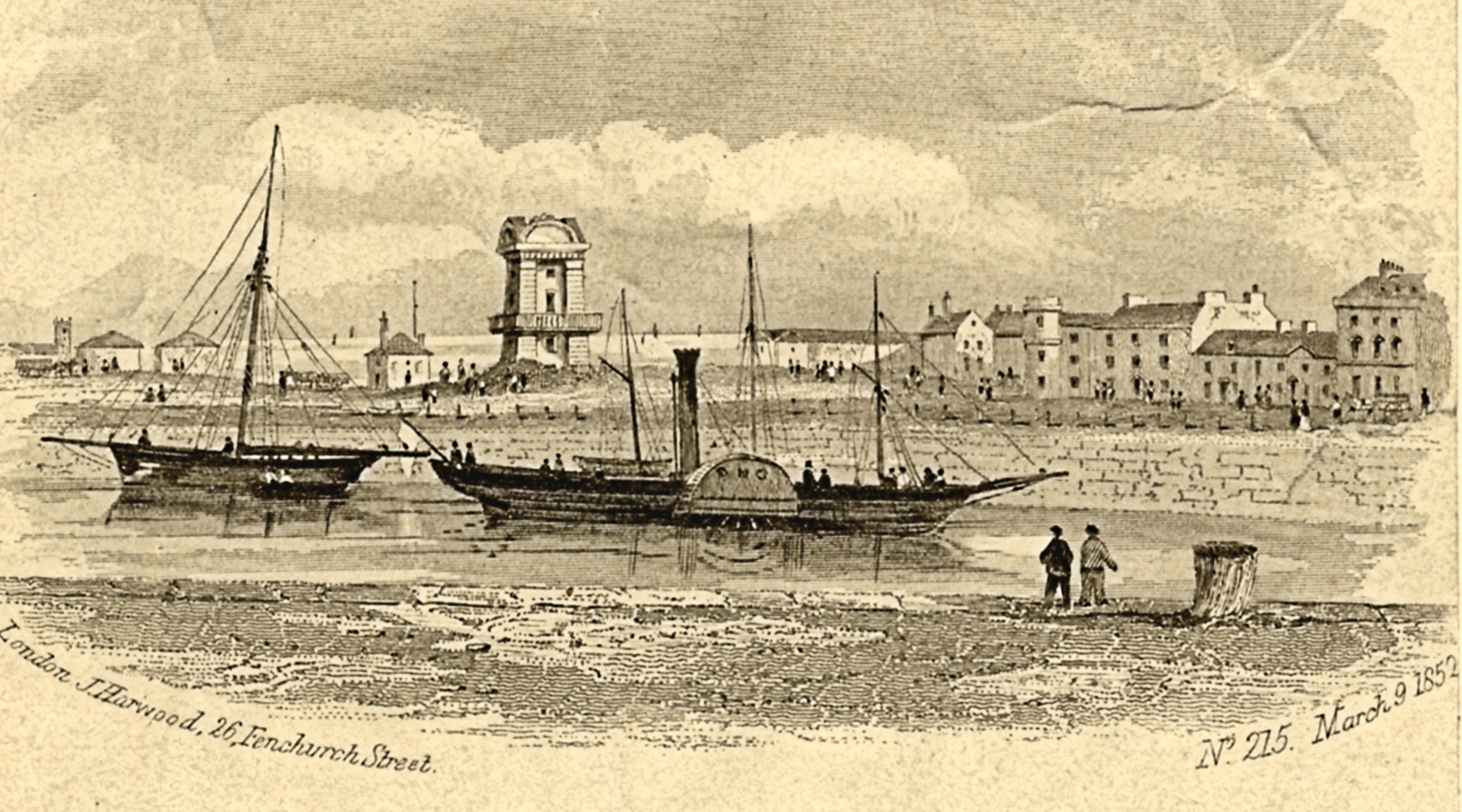
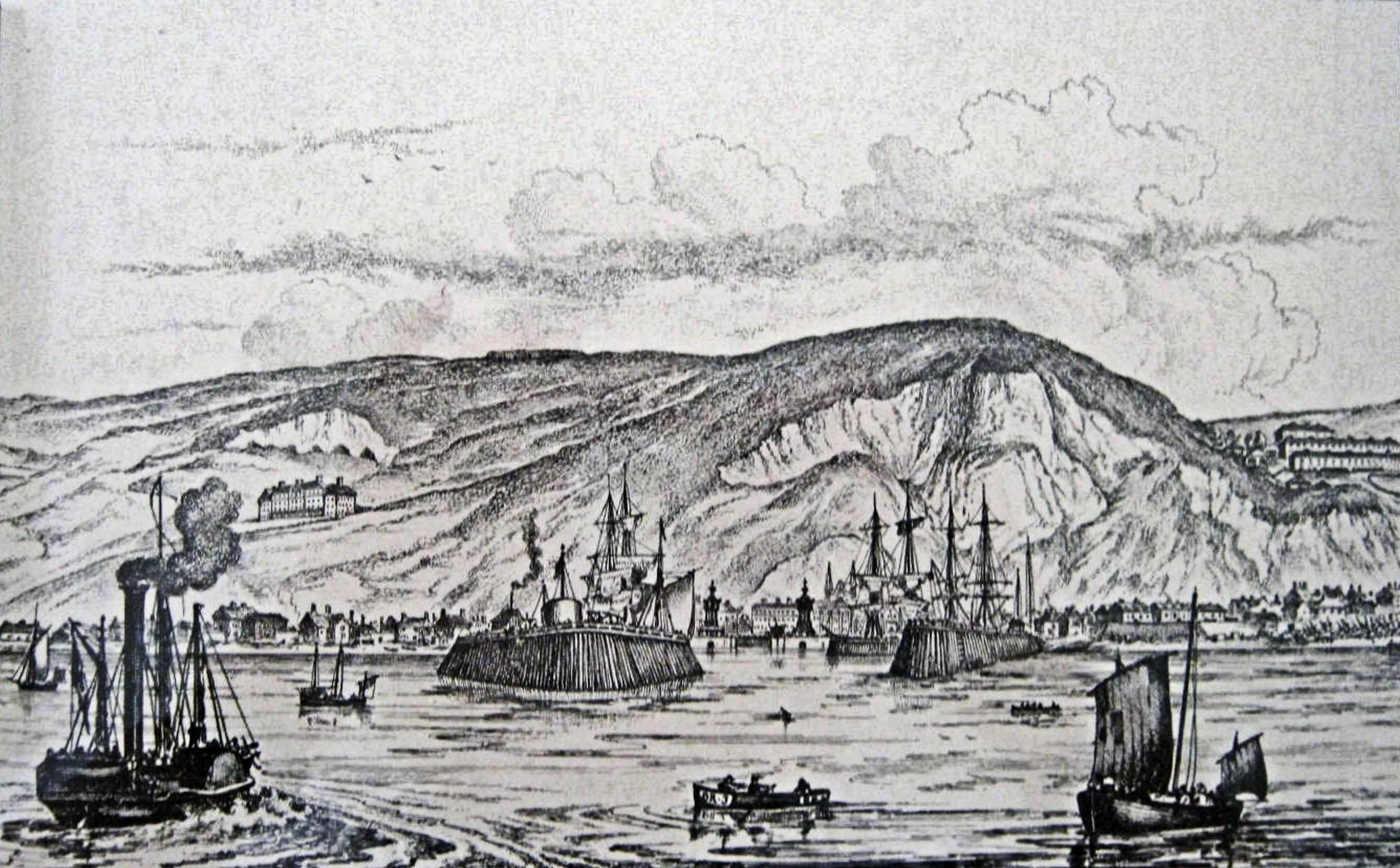
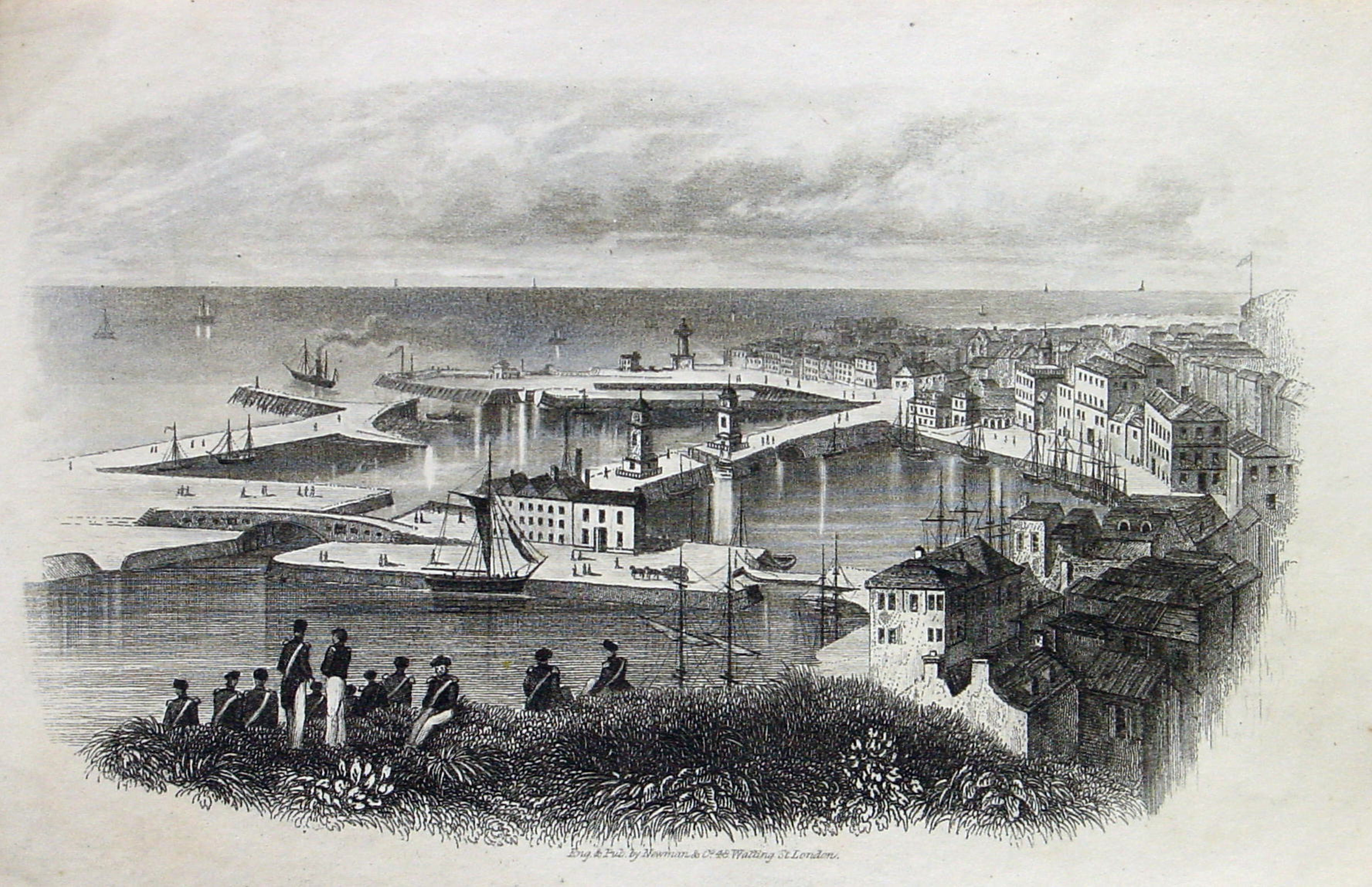
Dover harbour c1850 - the nearest dock is Wellington Dock with the Bason on the right and the Tidal Basin on the left. Dover Library

Dover harbour c1850 – the nearest dock is Wellington Dock with the Bason on the right and the Tidal Basin on the left. Dover Library

After considerable pressure on the government by Dover folk, local politicians, the Harbour Commissioners and the Duke of Wellington (1769-1852), for Dover to become a Harbour of Refuge, in 1847 the Admiralty Pier was started. This was to be the western pier of the Harbour of Refuge and although plans were proposed and accepted by government for an eastern pier, due financial reasons they did not materialise. Time passed and the Harbour Commissioners, faced with the prospect of larger steamers going to other ports such as Folkestone, wanted to carry out major improvements to the existing harbour in order for such ships to berth within the harbour. At the time the harbour consisted of the Bason (inner basin), Wellington Dock and the Tidal Basin. They therefore submitted a Bill to parliament in 1861 to this effect. Instead of being given approval and sanctioned to borrow money to pay for the work, the Harbour Commissioners were reconstituted and the Dover Harbour Board (DHB) was created. Not only was borrowing restricted but the main source of revenue for the Harbour Commissioners – passing tolls, a tax on shipping traversing the Strait of Dover – was discontinued.
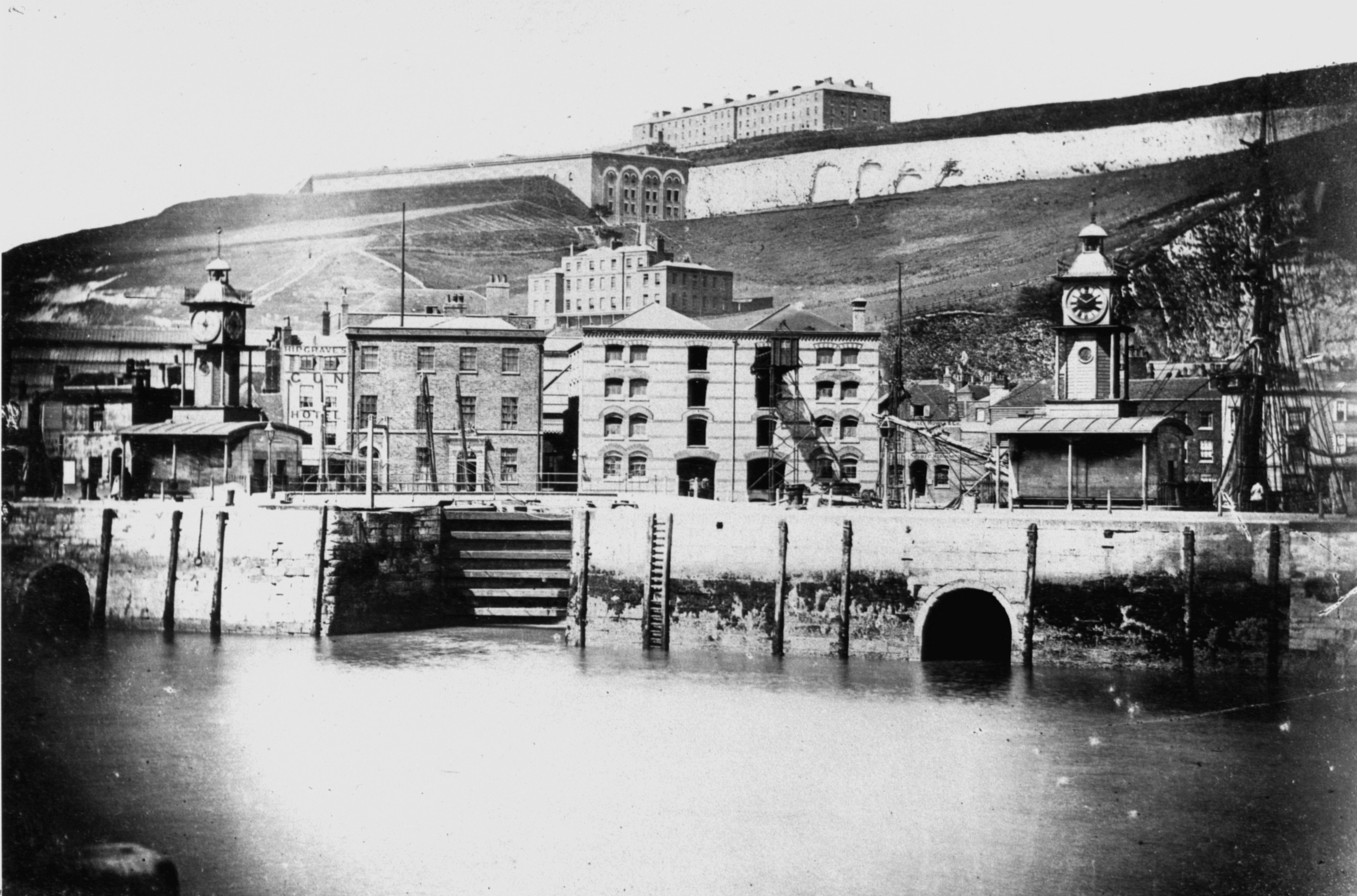
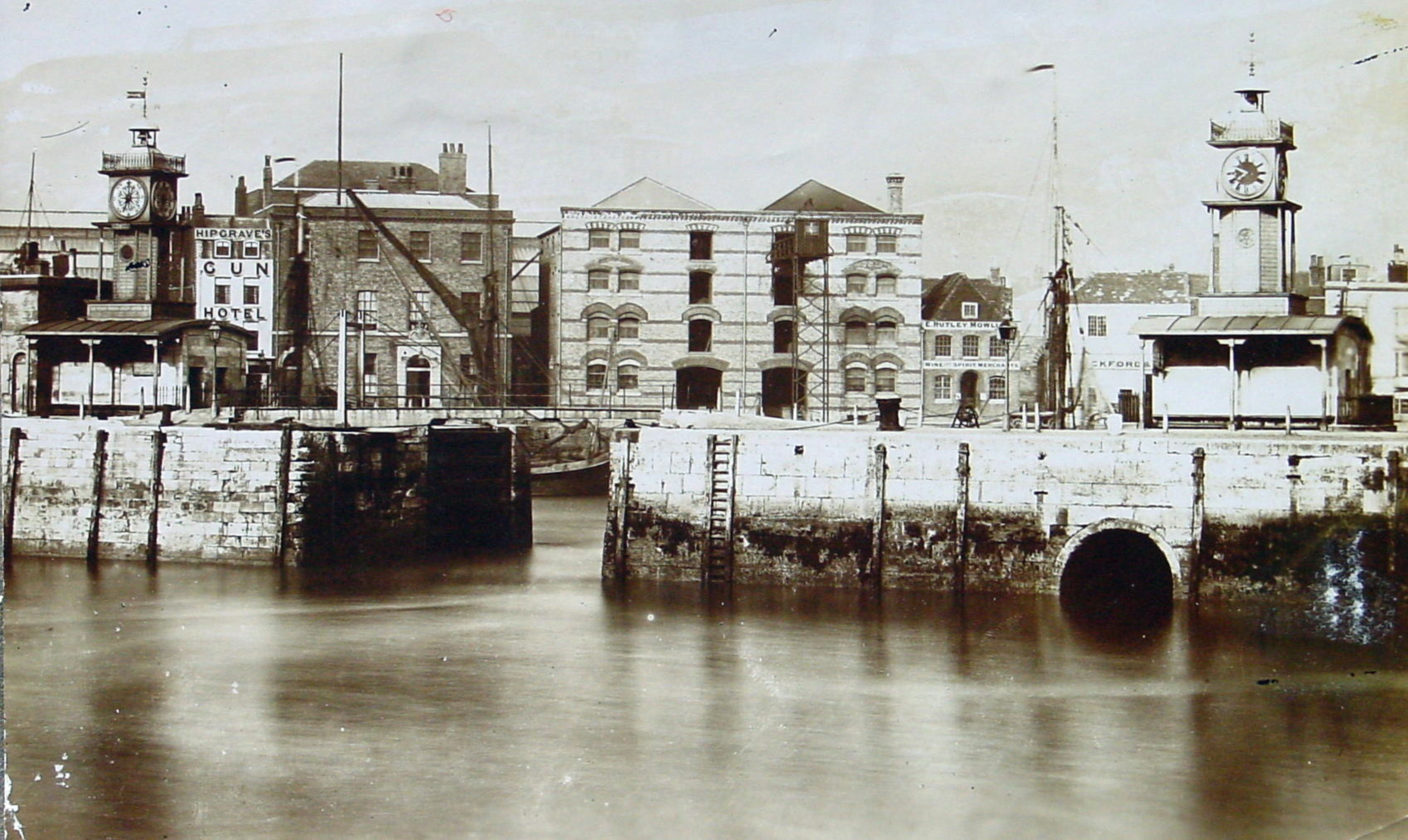
Clock Tower (right) and Compass Tower (left) on Crosswall of the Bason c1870. Dover Museum

Clock Tower (right) and Compass Tower (left) on Crosswall of the Bason c1870. Dover Museum

The new DHB could do very little except scrimp and save and keep spending to a minimum. Eventually they raised sufficient money to apply for a loan to carry out the much-needed improvements. This they achieved with parliament allowing sufficient borrowing for major work to being in 1871. This was on the existing Bason and on completion it reopened as the Granville Dock. In order for the larger steamers to enter the new Dock, it was necessary to widen the entrance and that meant that the existing majestic clock tower, which stood at the entrance had to be demolished. The actual clocks were cleaned and a new clock tower with a lifeboat station along side was built at the western end of the seafront and completed in 1877. Shortly after the quay space was increased alongside Wellington Dock and in 1888 its gates were widened.

In August 1872, a DHB Board meeting, presided over by the then Deputy Chairman Steriker Finnis (1817-1889), was held. The members of the Board included, Samuel M Latham and John Birmingham representing Dover Corporation and James Staat Forbes and C W Eberall of the South Eastern Railway (SER) and the London Chatham and Dover Railway (LCDR) respectively. There was unanimous agreement to adopt a scheme to create a commercial harbour designed by Sir John Hawkshaw (1811-1891) that utilised the existing Admiralty Pier and enclosed 340 acres of sea space. The sea space was to be ‘deepened so as to admit steamers of draught of not less than the Holyhead class.’ Other improvements were to include a covered walkway from both the SER Town Station and the LCDR Harbour Stations. Each of the stations was to have a landing wharf, so that, ‘passengers could embark and disembark in comfort, whatever the condition of the weather.’

For this they would need grants and to borrow so DHB, Dover council and local politicians kept up the pressure on government to sanction the proposition. However, for all their efforts very little was accomplished. Yet cross-Channel ships were still increasing in size and number and the port was not able to accommodate them at all states of the tide. Out of pure frustration on 3 October 1890, with Deputy Chairman William Layton Lowndes in the DHB Chair, the Board voted to undertake the building of the much-needed Harbour of Refuge and Commercial Harbour themselves. DHB Register, James Stilwell, drew up a Parliamentary Bill for authorisation to borrow £300,000. Additional finance, Stilwell said, would be raised by the introduction of a passenger tax similar to the type imposed by the French government to raise money for harbours in northern France. Sir John Coode (1816-1892), of Coode, Son and Matthews, Consulting Engineers, 9, Victoria Street, Westminster, designed the proposed Commercial Harbour.
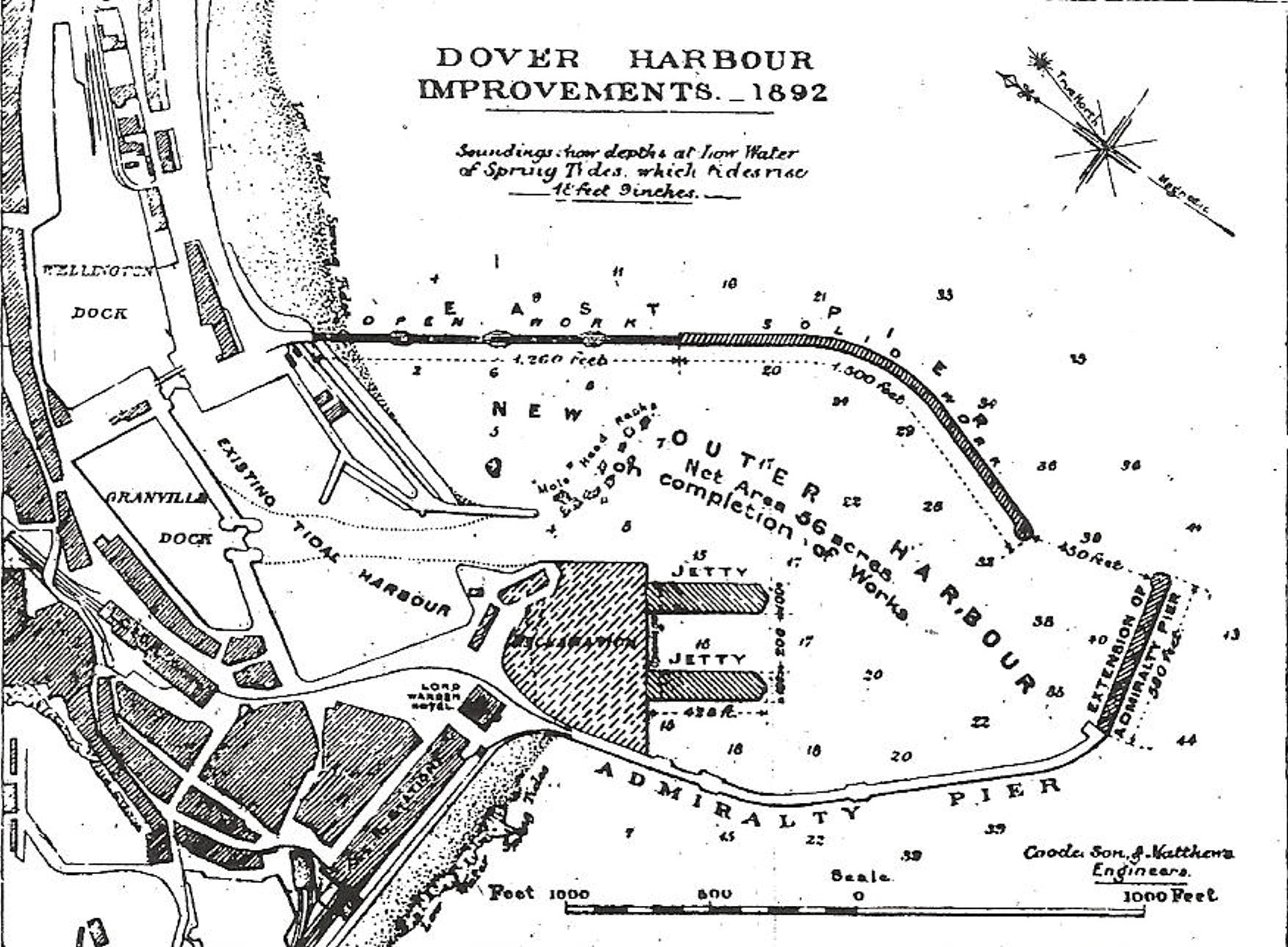
Commercial Harbour proposal in 1892

Commercial Harbour proposal in 1892

The proposal was for a deep-sea harbour outside the north and south pier heads enclosing 56-acres with depths ranging from 15-feet to 40-feet at low spring tides. It was to be bounded on the western side by the existing Admiralty Pier plus an extension of 560-feet to shelter the eastern pier. On the eastern side, a pier 2,760-feet in length that started in a southerly direction and curved towards the south-west giving an entrance 450-feet wide facing east was envisaged. As the prevailing winds are from the south-west the commercial harbour was to be sheltered by an overlap of the extended Admiralty Pier. Within the harbour would be a water station – a covered space to accommodate four or five cross Channel steamers. There would be a connection from the shore over which the trains would pass to go alongside the cross-Channel ships. Part of the proposal was to remove or incorporate the ruins of the partially built Tudor breakwater and mole.  Known, along with a number of other names, as the Mole Head, this was a continual shipping hazard near the entrance to the Tidal basin.

In 1891 the DHB successfully obtained the Act for the construction of the Commercial Harbour that allowed them to levy a tax of 1-shilling (5pence) on each Channel passenger and to borrow. Parliament also agreed to lease DHB  the existing Admiralty Pier for 99-years but the Act contained a caveat. The approval of several named departments had to be sought and the contract price confirmed before full approval could be given. DHB sought approval from the stipulated bodies and put the eastern pier proposal out to tender. The stipulated departments were the Admiralty, the War Office, the Board of Trade, and the Office of Woods and Forests. Approval was given by all except the Admiralty who were uncommitted either way. The best contract price was £410,400 and the full estimate for the project was £600,000. The submission was presented in August 1892 and parliamentary approval was given for the eastern pier but not for any alterations to the Admiralty Pier.
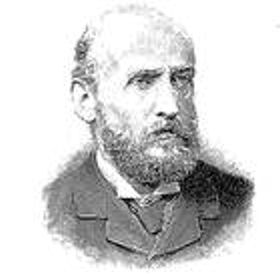
John Jackson - Civil Engineer. Internet

John Jackson – Civil Engineer. Internet

The building contract for the eastern pier was awarded to John Jackson (1851-1919) of 2, Victoria Street, Westminster. Born in York, Jackson studied engineering at Edinburgh University under eminent mathematician Peter Guthrie Tate (1831-1901). In 1875, shortly after graduation, Jackson set up his own company and quickly gained a reputation as a structural engineer. Known for his ‘hands on’ approach, Jackson was later appointed to work on the construction of the Admiralty Harbour and the Dover and Martin Mill Railway Line. He was knighted in 1895. Civil Engineer John Kyle (1837-1905) was appointed the resident engineer at Dover under Messrs Coode, Son and Matthews.

The landward section of the pier, called the viaduct throughout the construction process, was designed to be 1,260-feet of open iron framework. This was to enable free water circulation within the new harbour as there was a strong eddy current setting from the east towards the head of Admiralty Pier for much of each tide. because of this, the open ironwork, it was anticipated, would prevent the silting up of the Tidal harbour outside the Granville and Wellington docks. The sub-contractor for the ironwork was Messrs Head, Wrightson & Co engineers and iron founders, of Thornaby-on-Tees and Teesdale Ironworks, Stockton-On-Tees and the total amount of iron used for the viaduct was 3,000 tons. The final cost for the ironwork was £414,000. Head, Wright & Co had undertaken work on the Granville Dock and were later to build the lighthouses on the Southern Breakwater.
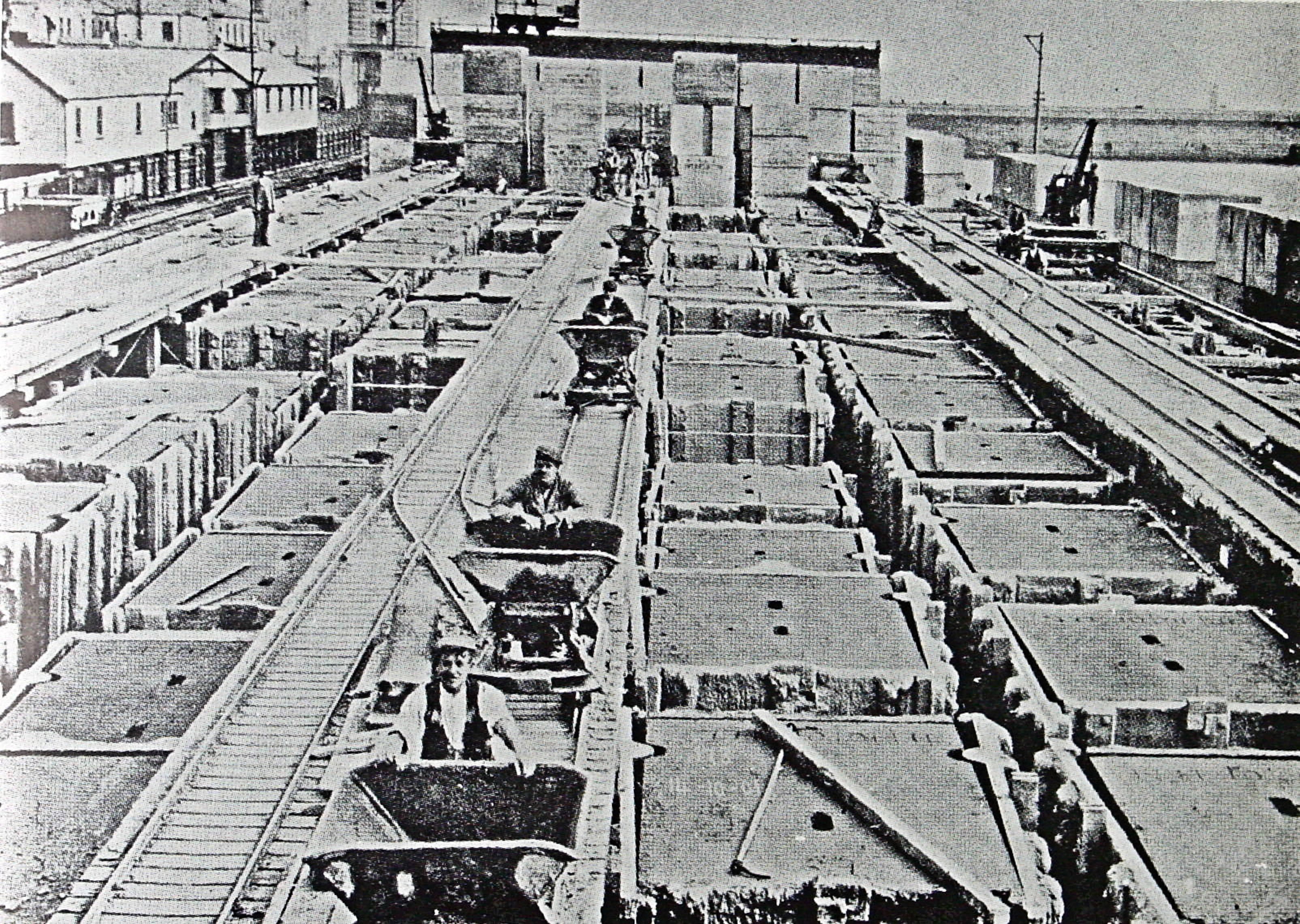
Block making for Admiralty Pier - Concrete poured into wood moulds that opened at side when set. Courtesy of DHB

Block making for Admiralty Pier – Concrete poured into wood moulds that opened at each side when set. Courtesy of DHB

The sub-contract for the concrete blocks for the solid pier was given to Messrs Coode, Son and Matthews who besides designing the new pier, were considered ahead of their time in harbour construction. The method used to make the blocks effectively piloted that used to create the concrete blocks to build the later Admiralty Harbour. A blockyard was set up between the root of the new pier and the Wellington Dock using one large mixer – see Admiralty Pier part I  – the extension – for the details of how they were made. Each block for the pier was 12-feet by 6-feet and 4-feet 3-inches high and when the blocks were ready they were conveyed along the pier on a tramway and placed into position on the solid pier by a Titan crane. This was known to being able to lift 62½-tons over a radius of 100-feet. The actual building of the new pier only required a 60-foot radius and the blocks did not exceed 22-tons. All round, on the sea facing side, each block was bonded with granite, to protect them from damage by ships.
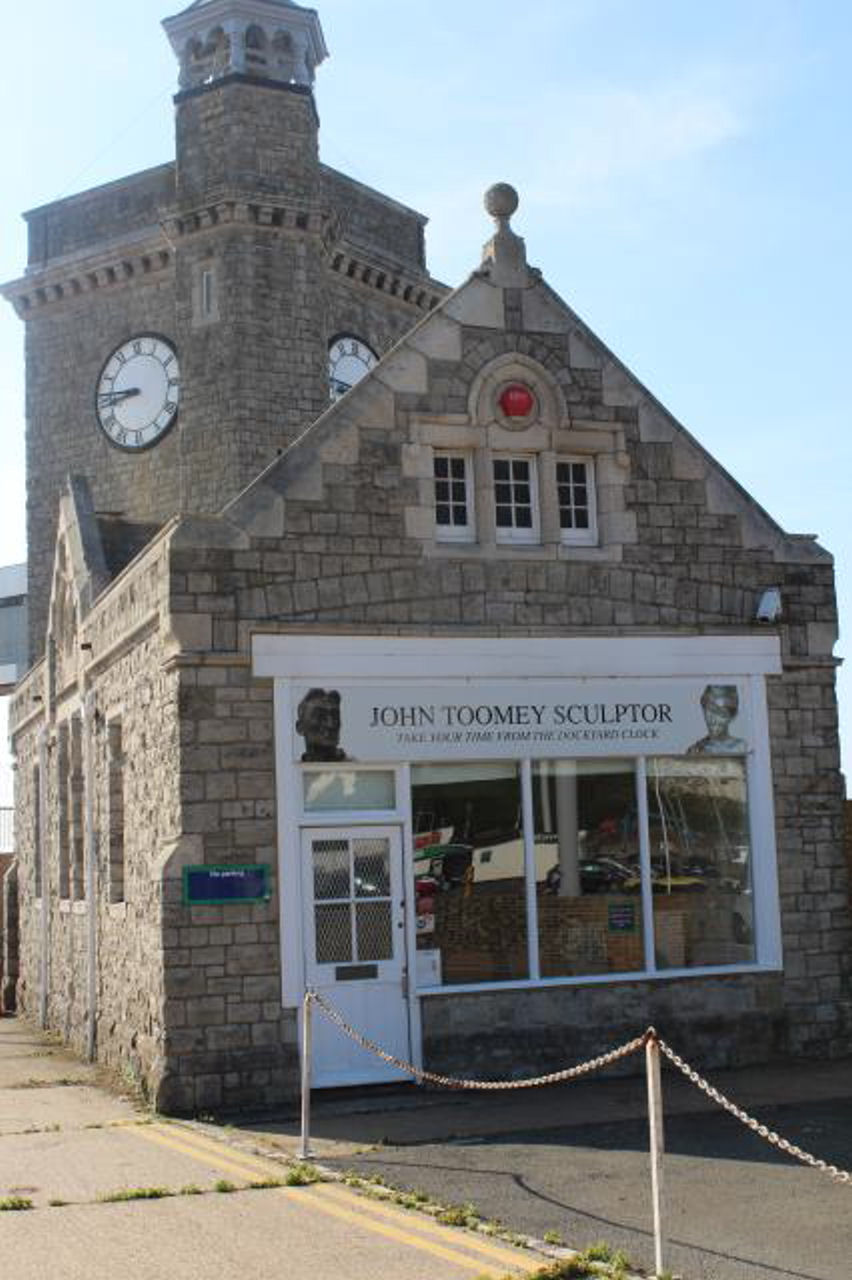
Rebuilt in c1890 Clock Tower behind what was the Lifeboat Station. Dover Harbour Board

Rebuilt in c1890 Clock Tower behind what was the Lifeboat Station. Dover Harbour Board

The approach to the new eastern pier began with an inclined root from the Esplanade eastward of the present Clock tower. The Clock tower and Lifeboat station had been rebuilt in 1877 and after much deliberation were rebuilt again to the west of their original site to make room for the root of the eastern pier. The deck level of the iron-structured viaduct was 19-feet above high water at spring tides in order, it was planned, to lift it above the reach of the sea during the heaviest of gales. Starting from the root, the open iron viaduct was arranged in bays and was to  rest upon three piles driven deep into the seabed, filled with concrete. Surveyors had said that the piers nearest the shore would be on a bed of sand and gravel that rested on the chalk and gradually tapered away towards the deep water. The piers supporting the outer section of the viaduct would be driven straight into the chalk.
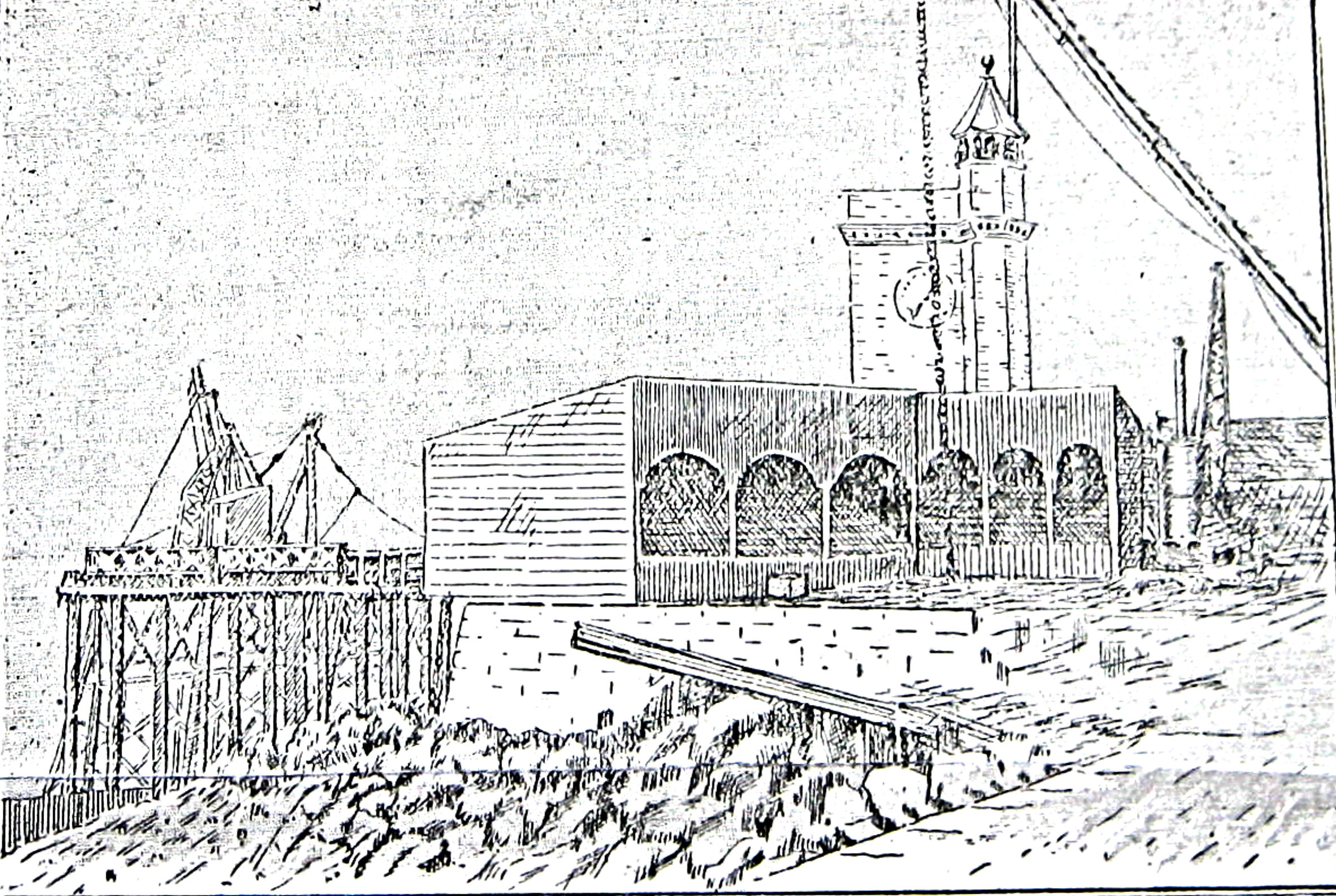
Prince of Wales Pier at the start of construction showing the lattice work. Dover Express July 1893

Prince of Wales Pier at the start of construction showing the lattice work. Dover Express July 1893

Attached to the iron cylinders were to be three rows of latticed girders supported by wrought iron piles securely braced together to ensure rigidity. On the girders, the roadway was to be formed of corrugated plating three-eighths of an inch thick riveted together to form a continuous table. The corrugations were filled with concrete and on this paving, blocks of Jarrah timber were to be laid. Jarrah timber is a large sized hardwood found only in the south west of Western Australia. The viaduct was to have a uniform width of 30-feet throughout its length, with two footpaths each 6-feet wide and a central roadway of 18-feet. They consisted of Portland cement concrete laid upon the ironwork and protected by an exterior coating of French asphalt. Locally made iron was used for mouldings, curves and guttering and handrails were fitted on each side for the entire length. As the approved design of the pier was to enable it to be used by promenading pedestrians, at three points there were to be open iron seats and in the middle there was to be a covered resting area 100-feet long.
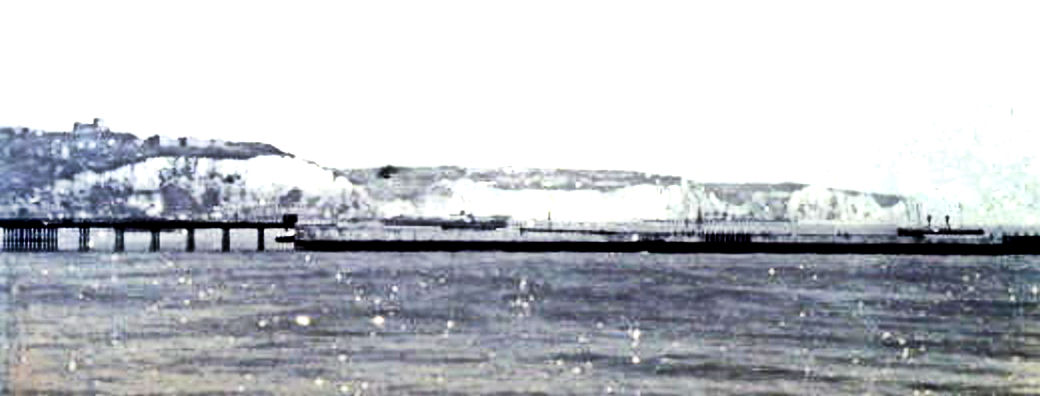
Prince of Wales Pier circa 1900 - David Iron Collection

Prince of Wales Pier circa 1900 – David Iron Collection

The 1,500-feet long solid pier was to be attached to the open iron viaduct and was to consist of concrete blocks, faced with granite and grounded in 3-feet of chalk. The top width was 35-feet and the bottom section, resting on the seabed, was 45-feet. The coping level of the solid section of the pier was 10-feet above high water at spring tides, corresponding with the Admiralty Pier. The width was again 30-feet throughout its length, with a central roadway of 10-feet wide and a footpath on the west side 6-feet wide. On the eastern side there was to be two parapets, one above the other, to match the west side of the Admiralty Pier at that time. The pier was to take a south-easterly direction until the Head was reached, when it was to be more southerly with the outer portion south-south-west. The Head was to be circular 55-feet in diameter on which a lighthouse was to be built of the same material. The blocks of the Head were to be bonded, joggled and cramped together. Along the back of the solid work was to be a protective apron consisting of two rows of concrete bags, each bag weighing 14-tons, which were used to preserve the chalk foundation from the corrosive action of the sea. The difference between the higher viaduct and the solid pier was an incline of one in forty.
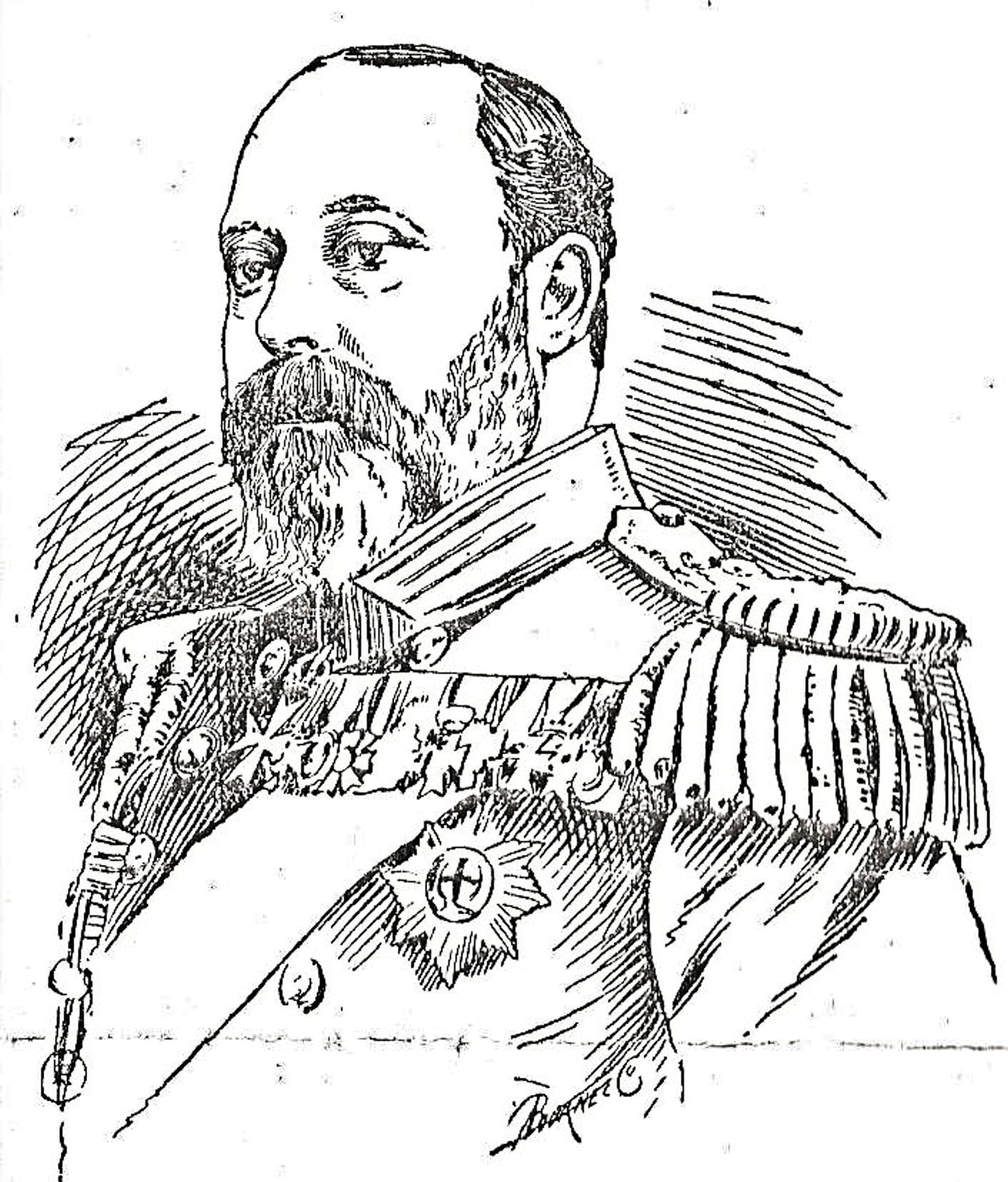
Edward Prince of Wales circa 1890s. Dover Express

Edward Prince of Wales circa 1890s. Dover Express

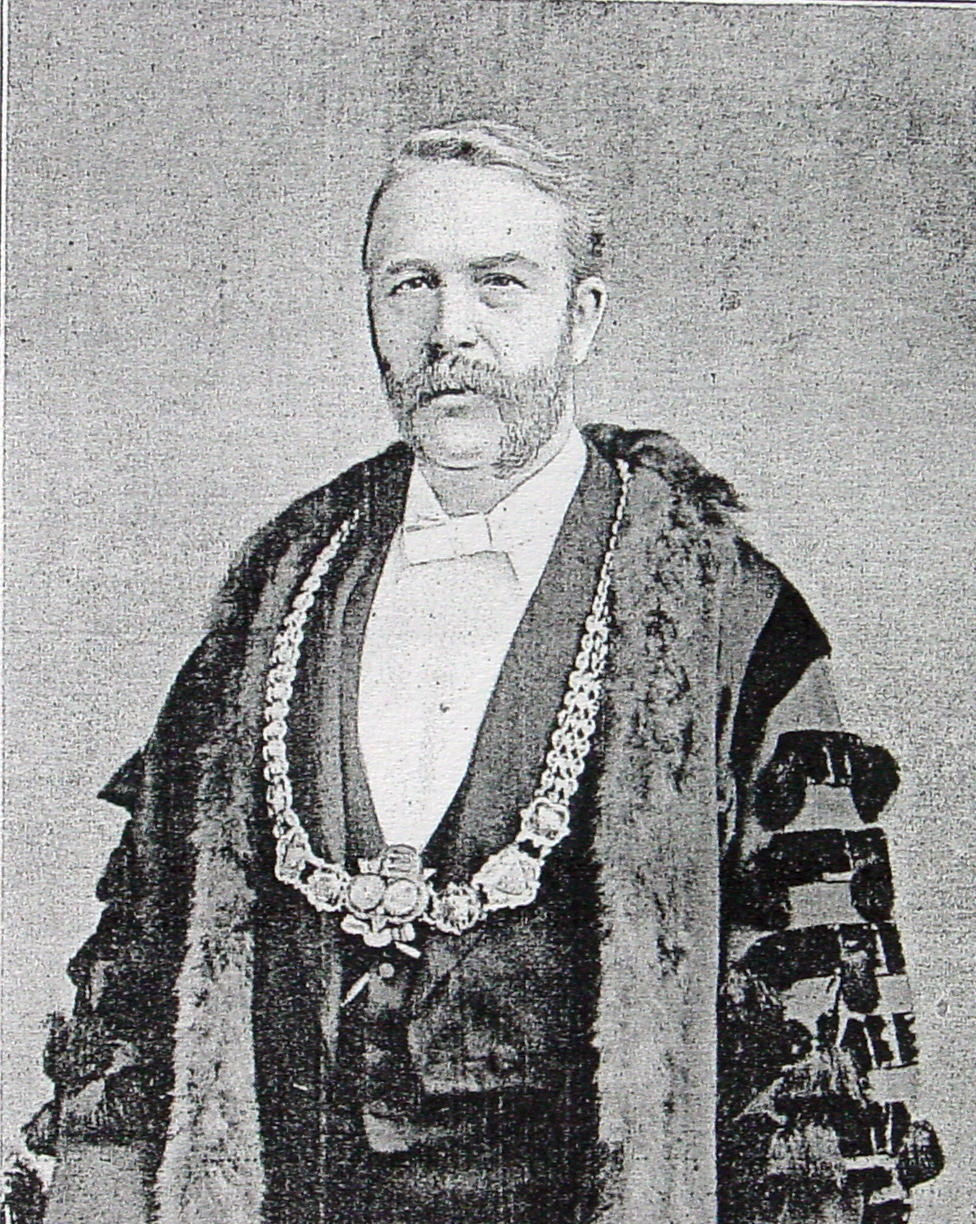
Dover council and DHB spent £’000s decorating the town for the Prince of Wales, (later Edward VII, 1901-1910) who was coming to lay the foundation stone of the eastern pier of the projected Commercial harbour.  The weather, however, on Thursday 20 July 1893 was atrocious with high winds and driving rain. His Royal Highness arrived at the LCDR Harbour Station a few minutes before 13.00hrs where he was received by the Lord Warden of the Cinque Ports (1892-1895), the Marquess of Dufferin and Ava (1826-1902) on behalf of DHB. The town was represented by the thirteen times Mayor of Dover (from 1886 to 1910), Sir William Crandall (1847-1934) and Dover Member of Parliament (1889-1913) George Wyndham (1863-1913). Also in attendance was Major-General Lord William Seymour (1838-1915) – Commander of the South Eastern District and numerous other dignitaries.

On the Prince’s arrival  a Royal Salute was fired from the Drop Redoubt, on the Western Heights and accompanied by the Marquis, the Prince, in the State carriage led a procession of 37 horse drawn carriages to the already laid approach of the proposed Pier. There a tented awning had been erected and a crimson carpet laid. On each side of the carpet, leading to the entrance of the awning, was a guard of honour composing of the Cinque Ports Artillery Volunteers and room for 1,500 spectators, 850 of which had seats. Inside the awning was the foundation stone and seating for the accompanying dignitaries.
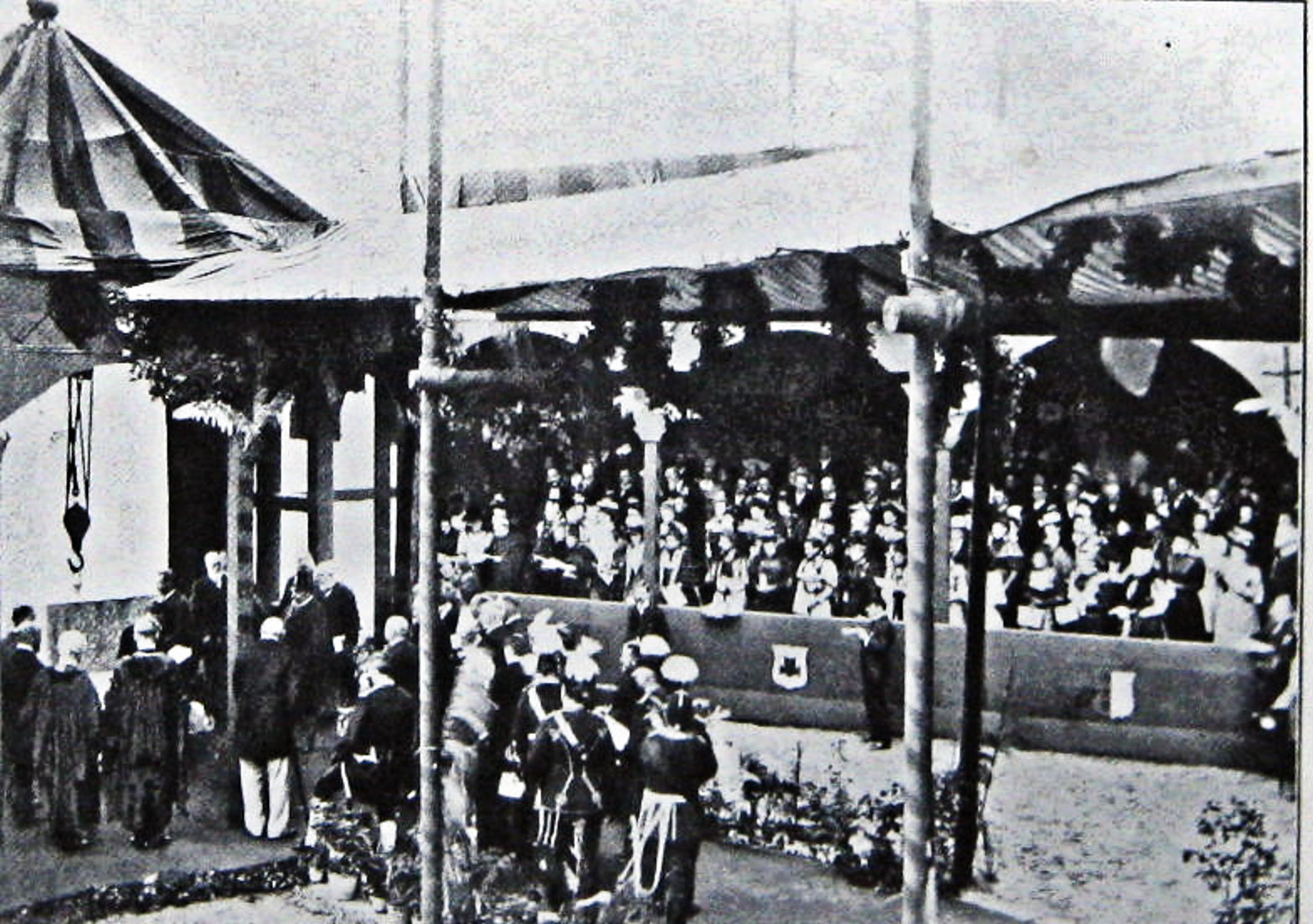
Laying of the Foundation Stone by Edward the Prince of Wales on 20 July 1893. Dover Museum

Laying of the Foundation Stone by Edward the Prince of Wales on 20 July 1893. Dover Museum

When all the dignitaries were seated, the late Sir John Coode’s son, also called John and an engineer, gave a short description of the project. In a cavity of the foundation stone were laid two bottles, one containing 1893 dated coins of the realm and a brief statement of the circumstances under which the stone was laid. The second bottle contained newspapers describing the proposed event and both bottles were covered by a plaque listing the names of those involved in the design and construction of the pier and the senior dignitaries attending that day. John Jackson then handed the Prince a silver trowel  and an ivory mallet with ivory handles. Mounted on the end of the handles was the crest of the Prince of Wales in solid gold. Cement was placed on the lower stone over the two bottles and the Prince smoothed it with the trowel. A brass plate was placed underneath on the foundation stone with the inscription:

The Trowel is of massive silver picked in with gold, with a carved ivory handle with the Prince of Wales crest mounted in solid gold at the end. On the trowel is engraved the following: Presented to His Royal Highness the Prince of Wales by John Jackson, Contractor, on the occasion of the laying of the Memorial Stone July 20 1893’

Then engineers lowered the upper stone in place, which the Prince tapped with the ivory mallet. This stone carried the following inscription:
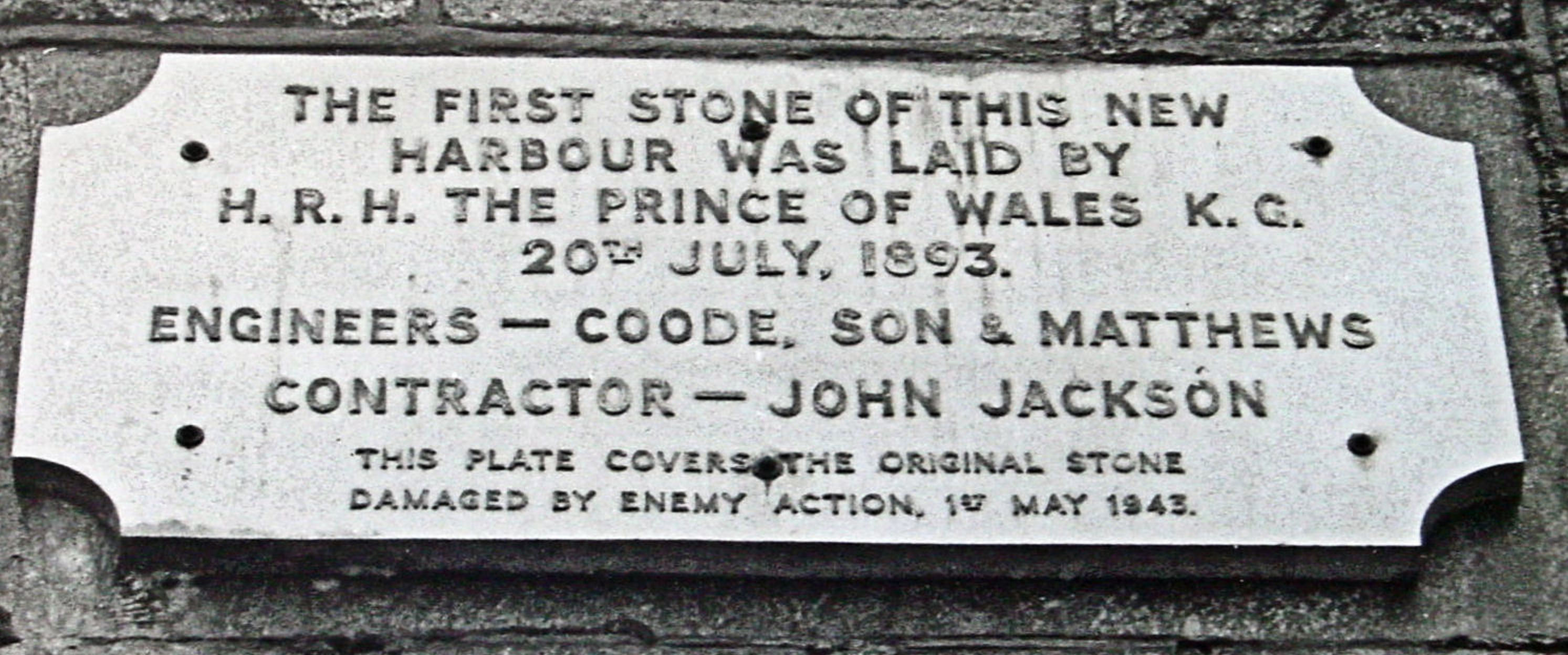
Prince of Wales Pier Foundation Stone first laid 20 July 1893 relaid 1954 to replace the original badly damaged during World War II. LS

Prince of Wales Pier Foundation Stone first laid 20 July 1893 relaid 1954 to replace the original badly damaged during World War II. LS

‘The first stone of this new harbour was laid by H.R.H. the Prince of Wales, K.G. 20th July, 1893. Engineers Coode, Son and Matthews; contractor, John Jackson.’ The present plaque was put in place in 1954 following World War II and reads: ‘The first stone of this new harbour was laid by H.R.H The Prince of Wales K.G. 20 July 1893 Engineers Coode, Son & Matthews. Contractor John Jackson. This plate covers the original stone damaged by enemy action 1 May 1943.’

During the ceremony it was announced that the new pier was to be called ‘The Prince of Wales Pier,’ and afterwards the procession of carriages made their way, in the pouring rain, to the Town Hall (now the Maison Dieu). Although the weather was awful, the streets were crowded with well wishers and in Cannon Street 6,000 school children were standing on tiered benches. As the Prince approached, the children ‘raised their voices to invoke blessings on the Royal visitor.’ Accompanied by a band, they then sang ‘God Bless the Prince of Wales.’ Afterwards each child was given a bag containing a piece of cake and an orange. In the Market Square, Mayor Crundall (1847-1934) stopped the procession and gave the Prince a formal welcome to Dover. Much to the delight of the crowds, the Prince responded with a long eloquent address that won the hearts of all the onlookers.
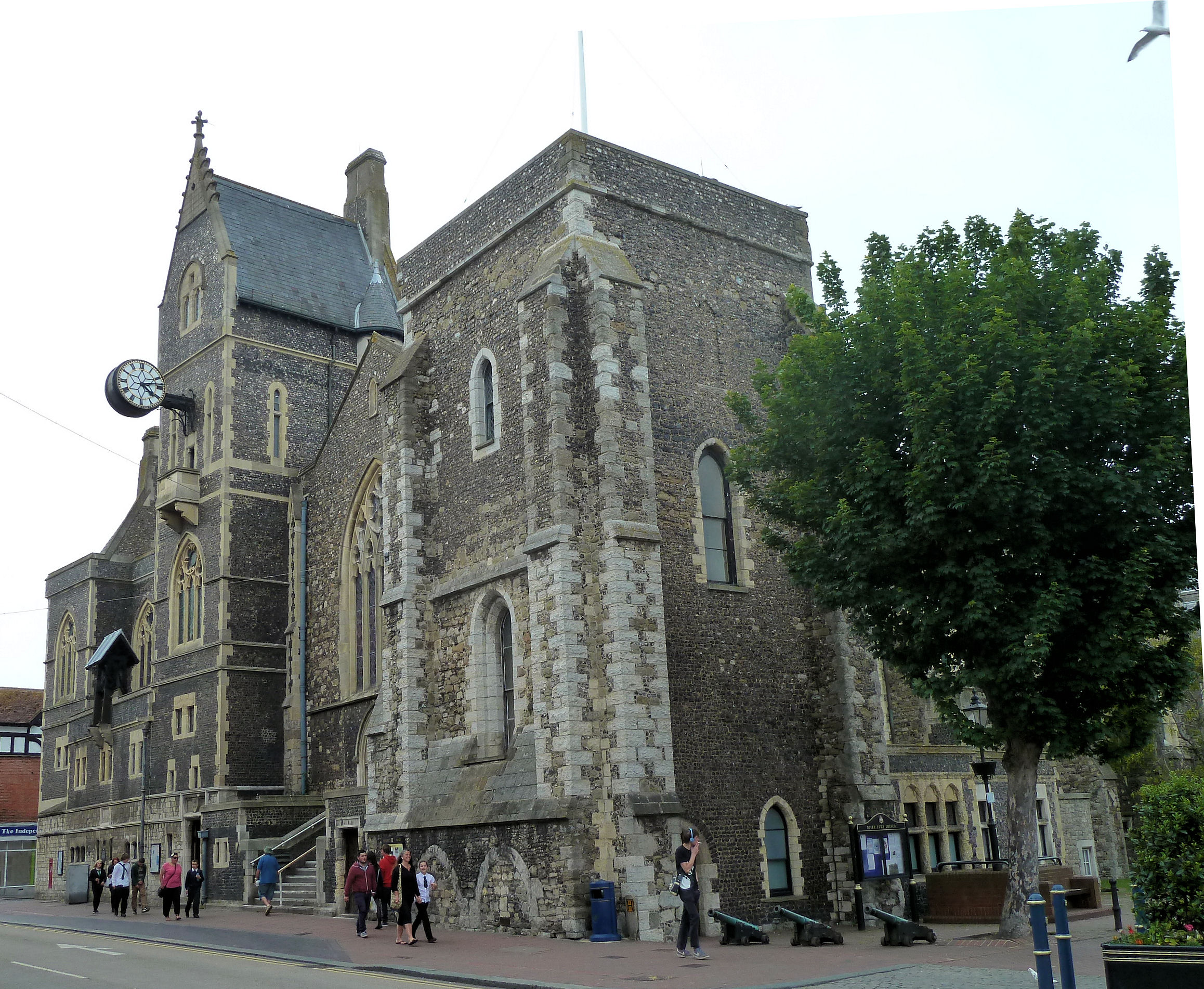
The Former Dover Town Hall where Edward the Prince of Wales was entertained on 20 July 1893. AS 2013

The Former Dover Town Hall where Edward the Prince of Wales was entertained on 20 July 1893. AS 2013

In the Town Hall the Prince, along with 480 guests, sat down for a sumptuous meal and at 15.30 he and his retinue left to take the train back to London. On the way the entourage passed through Dover College. There the headmaster, Reverend William Cookworthy Compton received His Highness, and during the subsequent conversation the Prince requested that the boys be given a week’s holiday! The Royal personage, just before 16.00hrs, left from Priory station for Victoria station, London. For the remainder of the day, although the weather remained miserable, there were a considerable number of activities including a regatta, swimming races, fireworks and the pubs were allowed to stay open until midnight. In the evening gas lit illuminations were switched on throughout the town.

It was not long after the foundation stone was laid before the first major construction problem was encountered. When the first pile was driven in, it sank into the soft seabed without trace! A second one was tried, further out, and this did the same. It was then decided to sink hollow cast-iron cylinders placed 40-feet apart and to then fill them with concrete. Although this worked, it delayed the construction. Nonetheless, by the autumn of 1893, the iron viaduct was progressing well and it was estimated that the poll-tax of one-shilling on all cross channel passengers would raise £16,000 that year. However, there was concern that the Pier was a potential shipping hazard so on 21 September two green lights were fixed to the sea end staging.  A cardinal buoy was also placed at the seaward edge of where the staging for the viaduct was expected to reach.

A year later with the iron viaduct almost complete the first submarine block of the solid section of the Pier was laid on the seabed. Approval, however, for the proposed extension of the Admiralty Pier had still not been received from the Admiralty and both DHB and the council were becoming increasingly anxious. At the time, the Admiralty were taking a close interest on events on mainland Europe. On 18 January 1871, Germany had unified under the country’s first Chancellor, Otto von Bismarck (1815-1898), which changed the balance of power in Europe. Bismarck had strived to keep the peace but in 1890, Wilhelm II (1888-1918) effectively sacked him and then pursued a massive naval expansion. This galvanised the British government to consider the construction of a National Harbour on the south coast and until the go ahead and the location was decided the Admiralty were not committing themselves.

1895 saw the appointment of a new Lord Warden of the Cinque Ports, the former Prime Minister, Robert Arthur Talbot Gascoyne-Cecil, 3rd Marquess of Salisbury, by virtue of which he was the Chairman of Dover Harbour Board. By May that year 1,100-feet of the 1,500-foot solid section of the Pier had been built and that month the Admiralty announced its decision. The port of Dover was to be a base for the Royal Navy and a National Admiralty Harbour was to be built that would enclose the whole of Dover bay! The first Naval Works Act was passed in 1895 when it was estimated that the Admiralty Harbour would cost £3,500,000 and the proposal made it necessary to alter the plans for Commercial Harbour especially the Prince of Wales Pier.
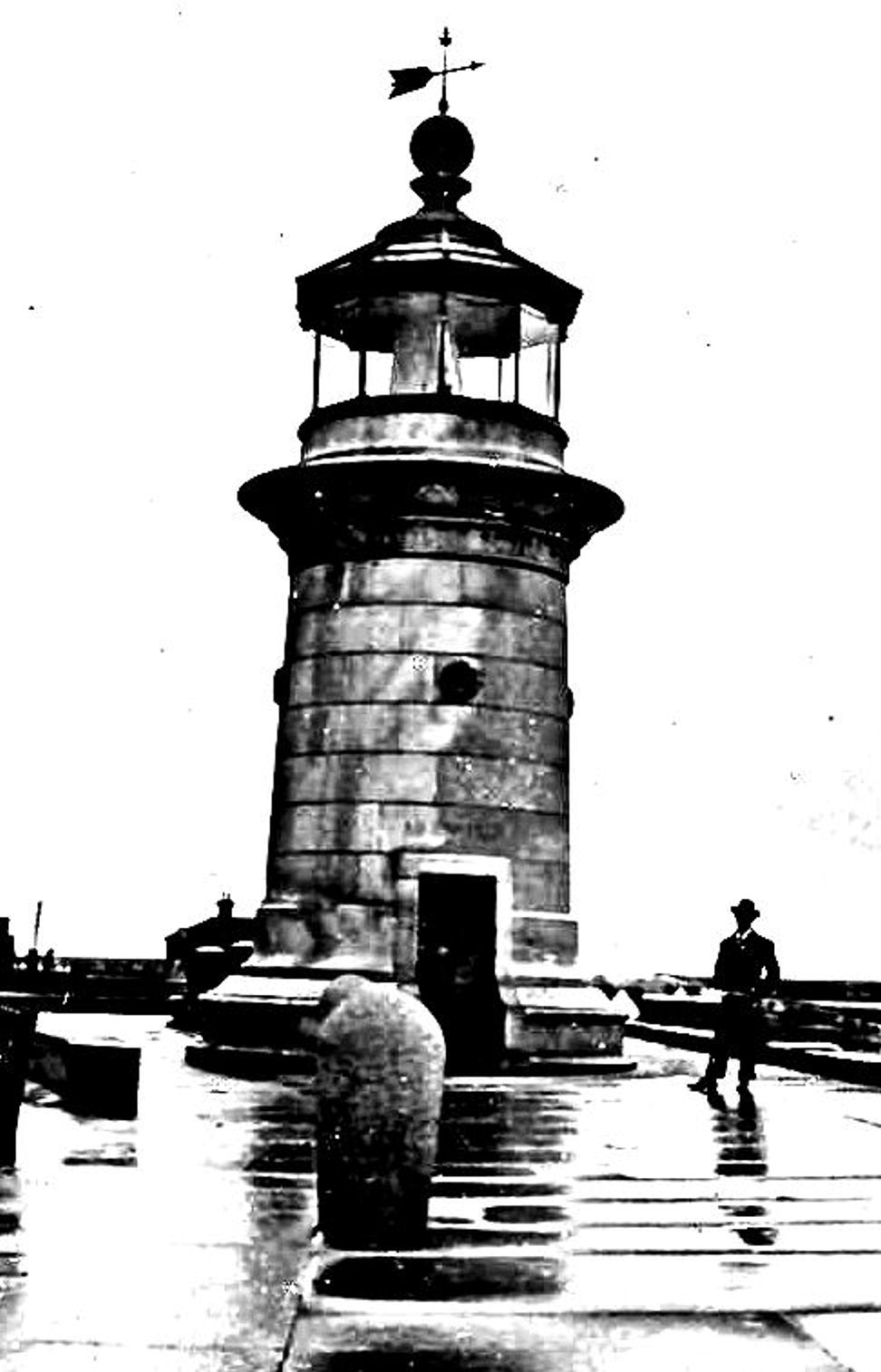
Prince of Wales Pier Lighthouse c1920. Paul Skelton

Prince of Wales Pier Lighthouse c1920. Paul Skelton

The major and most expensive change was at the Head of the Prince of Wales Pier. Although the original design remained the same, the Head was straightened and carried forward making the now straight Pier 2,910-feet long. The parapets that had been built on the solid section were removed with only those around the Head remaining. On the Head, approached by a flight of granite steps, was the lighthouse. Built of granite, it was topped with a  cylindrical lantern room on which was a metal weather vane. The road and footpaths were to be commensurate with the iron viaduct of the Pier. The Admiralty Pier extension was to be 2,000-feet long, paid for by the Admiralty and to be use for Admiralty purposes. For some time later, it was agreed that the remainder of the proposed Commercial Harbour works were to go ahead but other changes precluded them reaching a conclusion and these included leaving the the dangerous Mole Head rocks as they were.

Further, another unforeseen problem was becoming increasingly worse due to the ongoing construction of the Prince of Wales Pier. The area between the Pier and Admiralty Pier was increasingly subject to heavy swell that, at times, made it impossible for ships to berth alongside the Admiralty Pier such they were diverted to the rival port of Folkestone. To try and deal with this, a meeting was convened in November 1898 between the DHB, the two railway companies – SER and LDCR – and the Continental railway companies whose ships used Dover harbour. It was agreed that until the Admiralty Pier extension was long enough to intercept the Prince of Wales and thus creating calm water, there would be major problems due to adverse tides. At the time of the meeting, work had not begun on the Admiralty Pier extension but high priority was given and work started a month later. The Admiralty, sympathetic to the situation, made assurances that the extension would be completed in less than two years.
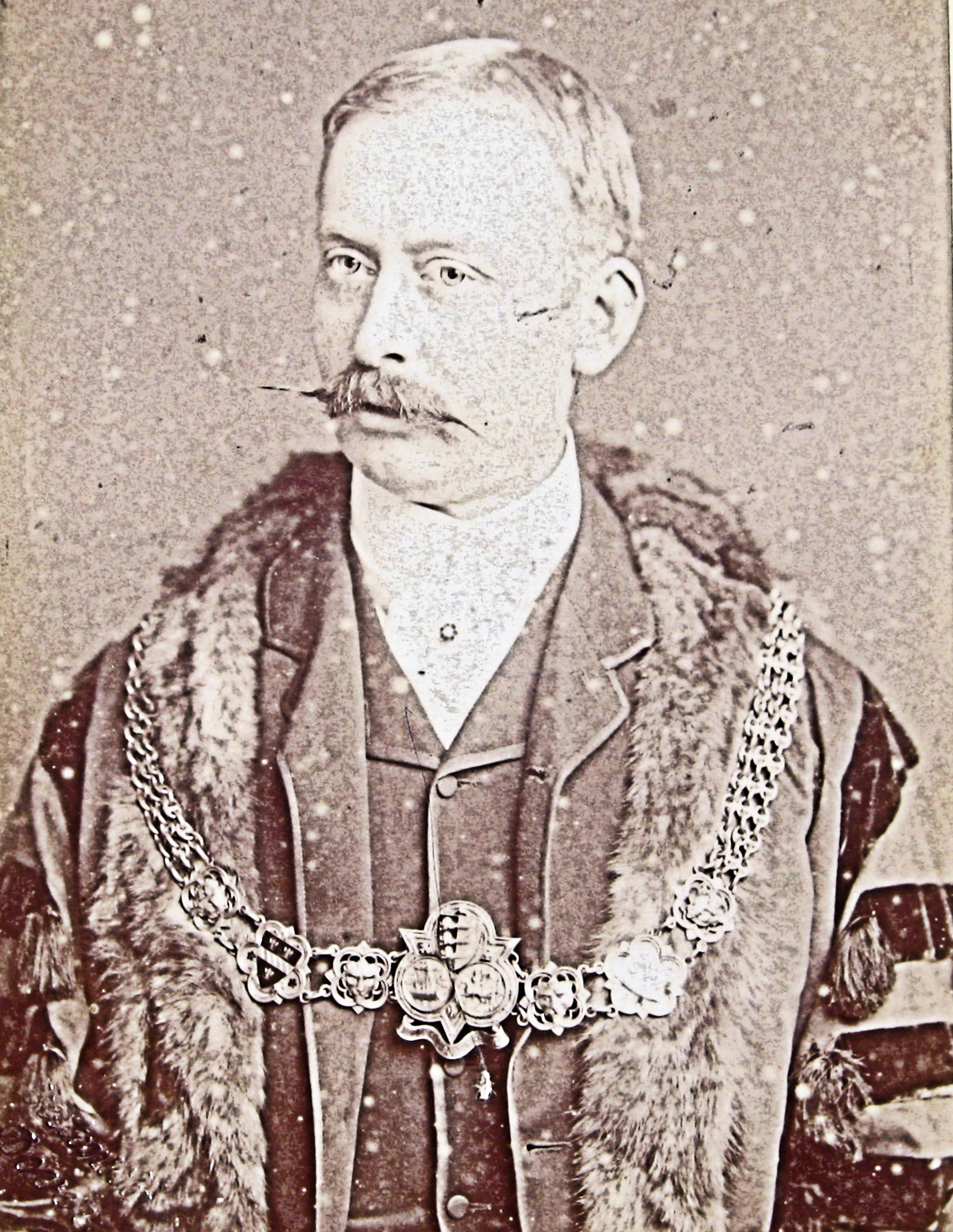
Sir William Crundall 1847-1934 Mayor thirteen times between 1886 and 1910. David Iron Collection

Sir William Crundall 1847-1934 Mayor thirteen times between 1886 and 1910. David Iron Collection

In August 1896 the Undercliff Reclamation Act received Royal Assent. This Act was for laying out land on the South Foreland, near St Margaret’s, where a new ‘Dover’ was to be built (see Dover, St Margaret’s and Martin Mill Railway Line part I). A syndicate of three had been formed to promote the Bill, one of which was Sir William Crundall – Mayor of Dover 13 times between 1886 and 1910. The second, John Jackson – who was building the Prince of Wales Pier. The other was construction engineer Weetman Dickinson Pearson, 1st Viscount Cowdray (1856-1927). His company had won the contract to build the Admiralty Harbour. In 1886, William Crundall had been appointed to the Harbour Board as the Board of Trade representative. James Stilwell (1829-1898), DHB’s Register, who had successfully piloted the Commercial Harbour scheme through parliament died in May 1898. Local solicitor and an adept organiser, Worsfold Mowll, who was a close friend of William Crundall, succeeded him. In the original proposal for the Prince of Wales Pier, James Stillwell had envisaged laying a railway line along the Pier and to have a landing stage for Continental passengers on the east side. On the west side, nearest to the Admiralty Pier, was envisaged a landing stage for use by Atlantic liner traffic and Mowll reminded Crundall of this. Together, with the knowing backing of Jackson and Pearson, they suggested to the Harbour Board that Transatlantic-shipping companies should be contacted.

In March 1901 the Deputy Chairman of DHB, William Layton Lowndes, suggested that another member of the Harbour Board should deputise for him on the grounds of his advanced age and Sir William Crundall was elected to take this role. On 9 April, at the request of the Marquis of Salisbury, King Edward VII (1901-1910) endorsed the decision. That month, Sir William Crundall and Worsfold Mowll together with DHB engineer Arthur Thomas Walmisley and Harbour Master Captain John Iron travelled to Brussels. This was on the invitation from King Leopold II of Belgium (1865-1909) to discuss proposals to increase the speed of the postal services that were carried on Belgium packet ships out of Dover. During the visit, the deputation put forward the plan for Dover becoming a port for transatlantic shipping and the notion was well received. On 23 August the German Bismark-class 3,000-ton corvette, Stein, paid a formal visit to Dover and was warmly welcomed by Mayor William Barnes, Town Clerk – Wollaston Knocker, Sir William Crundall, Worsfold Mowll and Captain Iron. The captain of the ship, Commander Burcham, was entertained to lunch by Major General Hallam Parr (1847-1914), Commander of the South-Eastern District.

On 3 September 1901, the deputation of four plus John Coode of the firm Messrs Coode & Son were at Potsdam Palace, Germany, making representations on Dover becoming a port for transatlantic liners. There they met with Kaiser Wilhelm II, who was wearing the uniform of a British Admiral. In attendance were the German Secretaries of State, Baron von Richtofen and Admiral Alfred von Tirpitz (1849-1930) and Herr Weigland with Albert Ballin (1857–1918), Director-Generals of the Norddeutscher Lloyd line and the Hamburg-Amerika Steamship Companies respectively. The Kaiser had a billiard table prepared so that charts and relevant papers could be spread and Sir William made the presentation. Afterwards the Dover deputation were entertained to a luncheon at the Palace and the following morning they left for The Hague for discussions with board members of the Dutch Atlantic Service.

In early January 1902, Richard Reid Dobell (1836-1902), of the Canadian government, came to Dover where he met with Sir William Crundall to discuss using Dover for transatlantic crossings and was shown round Prince of Wales Pier. In an unofficial capacity was Sir Henry Campbell-Bannerman (1836-1908) the leader of the Liberal Party that was in opposition at the time. He was staying at the Lord Warden Hotel. Although Mr Dobell was killed a few days later following a fall from a horse while visiting his son in Folkestone, Sir Henry Campbell-Bannerman reported the positive outcome of the meeting to the government.
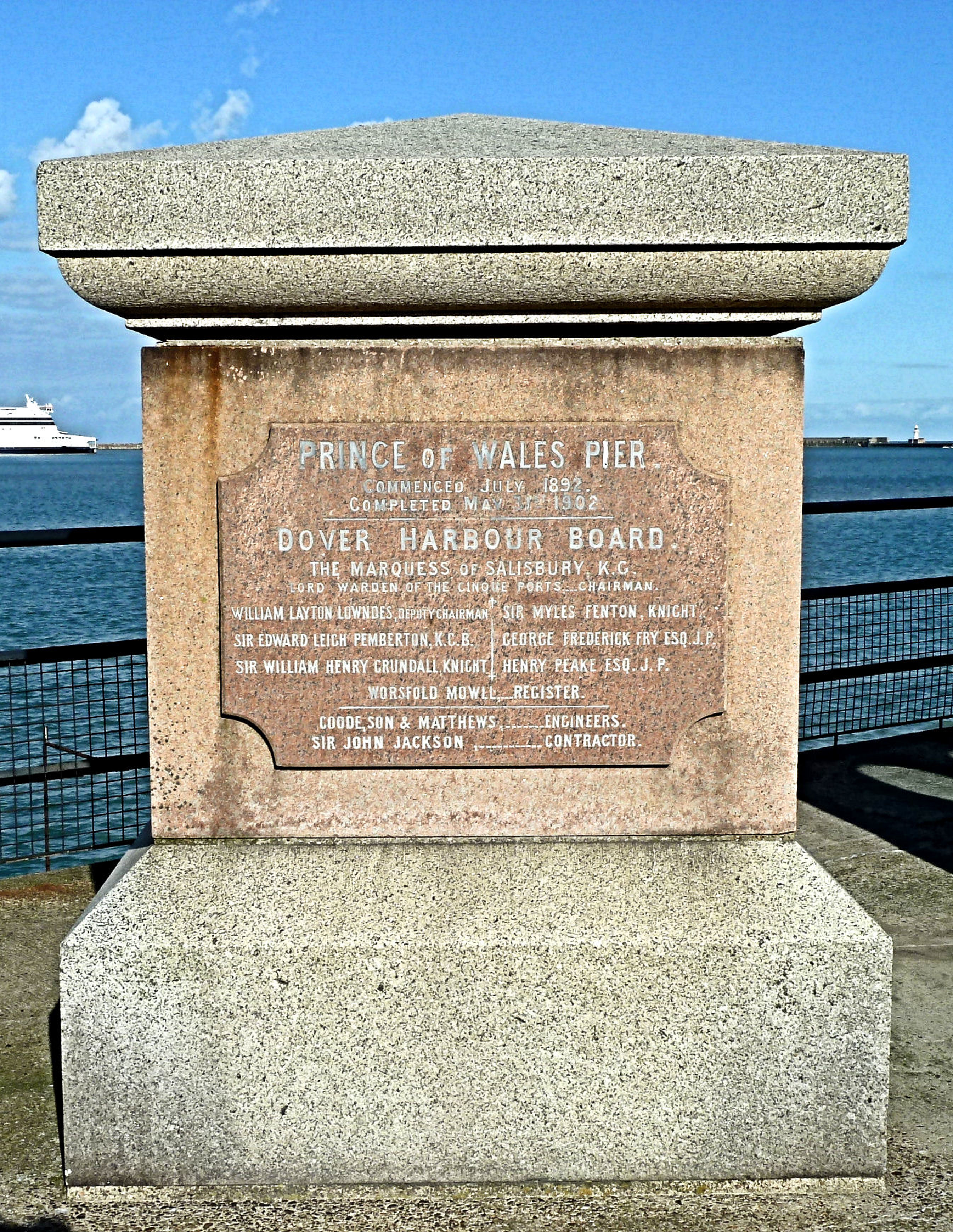
Commerative memorial for the completion of the Prince of Wales Pier 31 May 1902 where the viaduct meets the solid Pier. AS 2015

Commerative memorial for the completion of the Prince of Wales Pier 31 May 1902 where the viaduct meets the solid Pier. AS 2015

By the end of November 1901 the contractor’s railway was removed from the Pier and with the exception of the asphalting of the roadway on the viaduct portion, all the work was finished. The Prince of Wales Pier was formerly handed over to DHB on 1 January 1902 and on 14 February the cranes and other contract artefacts were sold. The formal opening took place on 31 May by the Marquess of Salisbury when a Completion Stone was laid at the point where the viaduct joined the solid section. In attendance were all the members of the Harbour Board: William Layton Lowndes, Sir William Crundall, Sir Myles Fenton, (1830-1918) – General Manager of SER, Sir Edward Leigh Pemberton (1823-1910), George Frederick Fry, Henry Peake and Worsfold Mowll. Also there was Sir John Jackson and engineers Coode, Son and Matthews. On completion the Pier was 2,910 ft long with an open viaduct of 1,260 feet, the remainder being of solid masonry. The depth at low water varied from 25-feet to 35-feet. The pier had cost £570,000 to build, met by the issue of £400,000 debenture stock, plus £170,000 in temporary loans to be paid for by the poll-tax.

SER and LDCR had merged in 1899, forming the South Eastern and Chatham Railway Company (SECR) and by a loop through the Pier district, the two lines were joined together. At the time, DHB had submitted a Bill to Parliament for building the envisaged  ‘Water Station’ with four railway tracks and berths for four cross-Channel steamers all under cover between the Admiralty and Prince of Wales Piers. The final estimated cost was £1,750,000 and to help to pay for these works an increase in the poll tax on cross-Channel passengers was sought. The poll-tax was to be increased from 1shilling to 2shillings 6pence per head. Tagged on to this Bill was the proposal to widen the Wellington dock gates in order to admit the newer larger steamers into the dock. The Bill was given Royal Assent.
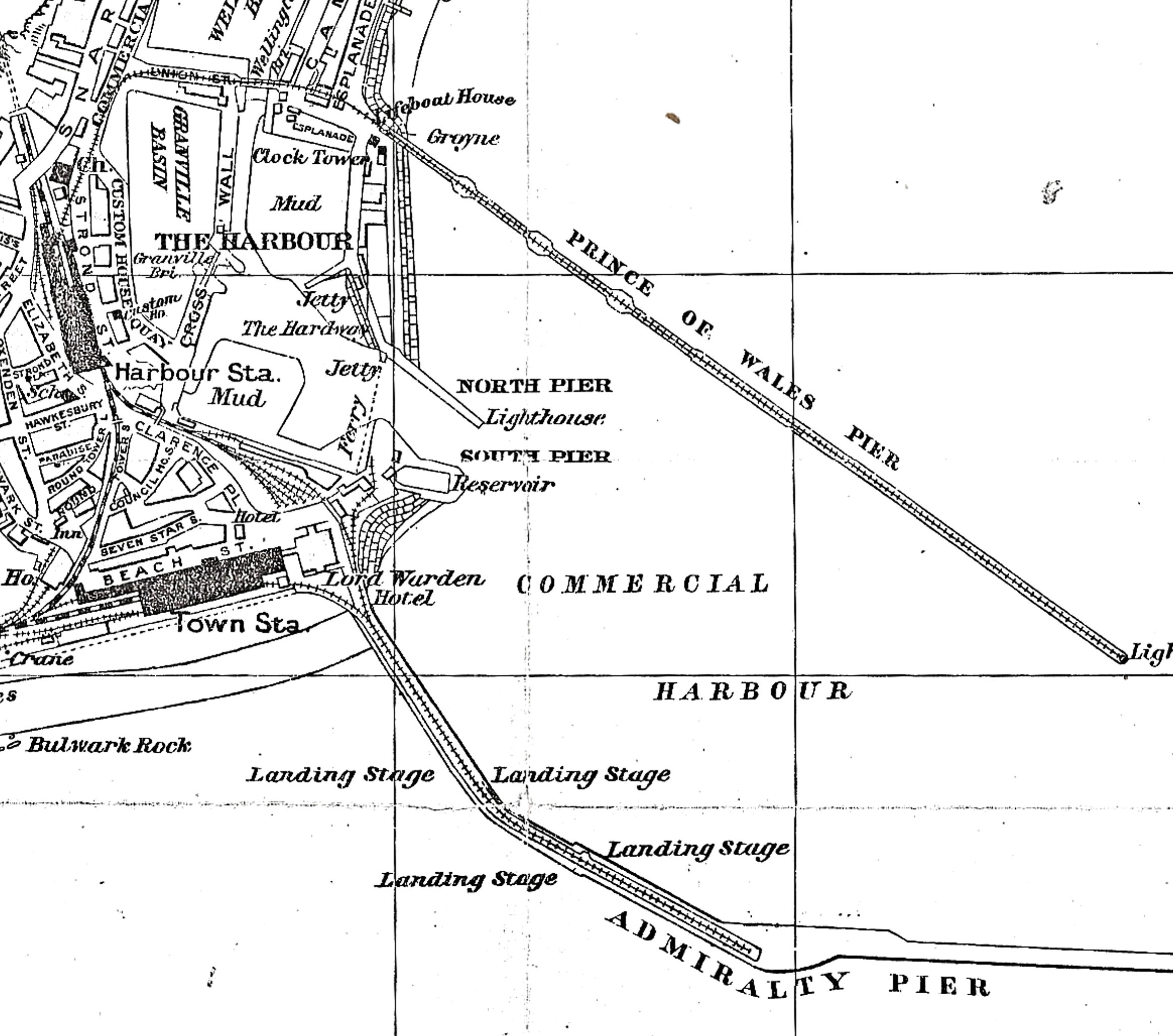
SECR proposed railway line from Harbour Station to Prince of Wales Pier c1900

SECR proposed railway line from Harbour Station to Prince of Wales Pier c1900

By November 1900, five transatlantic shipping companies had notified DHB that they were interested in making Dover a port of call, one of which was the Hamburg Amerika Line. Their recently launched Transatlantic liner Deutschland, drew 30-foot of water, while the White Star Line, recently launched, Celtic, drew 33-feet, so both could berth alongside the Prince of Wales Pier. More importantly, they could berth at low water of a springtide with 3-6-feet to spare! This meant that the railway line, envisaged by James Stilwell, was of paramount importance but this would need a wider and stronger Wellington dock bridge to accommodate a railway line and bear the weight of a railway locomotive. This, it was estimated would take two years to build while it would take four years to build the ‘Water Station.’

The ‘Water Station’ was put on hold and SECR agreed to lay a single-track railway line onto the Prince of Wales Pier from the joining loop to the Pier. On the Pier a 500foot long landing stage would be built on the east side where the Transatlantic liners would be accommodated. This was on the opposite side from the original plan but had been brought about by the building of the Admiralty Pier. The landing stage would have a wooden canopy that covered both the landing stage and the railway platform to provide cover for the passengers in all weathers.
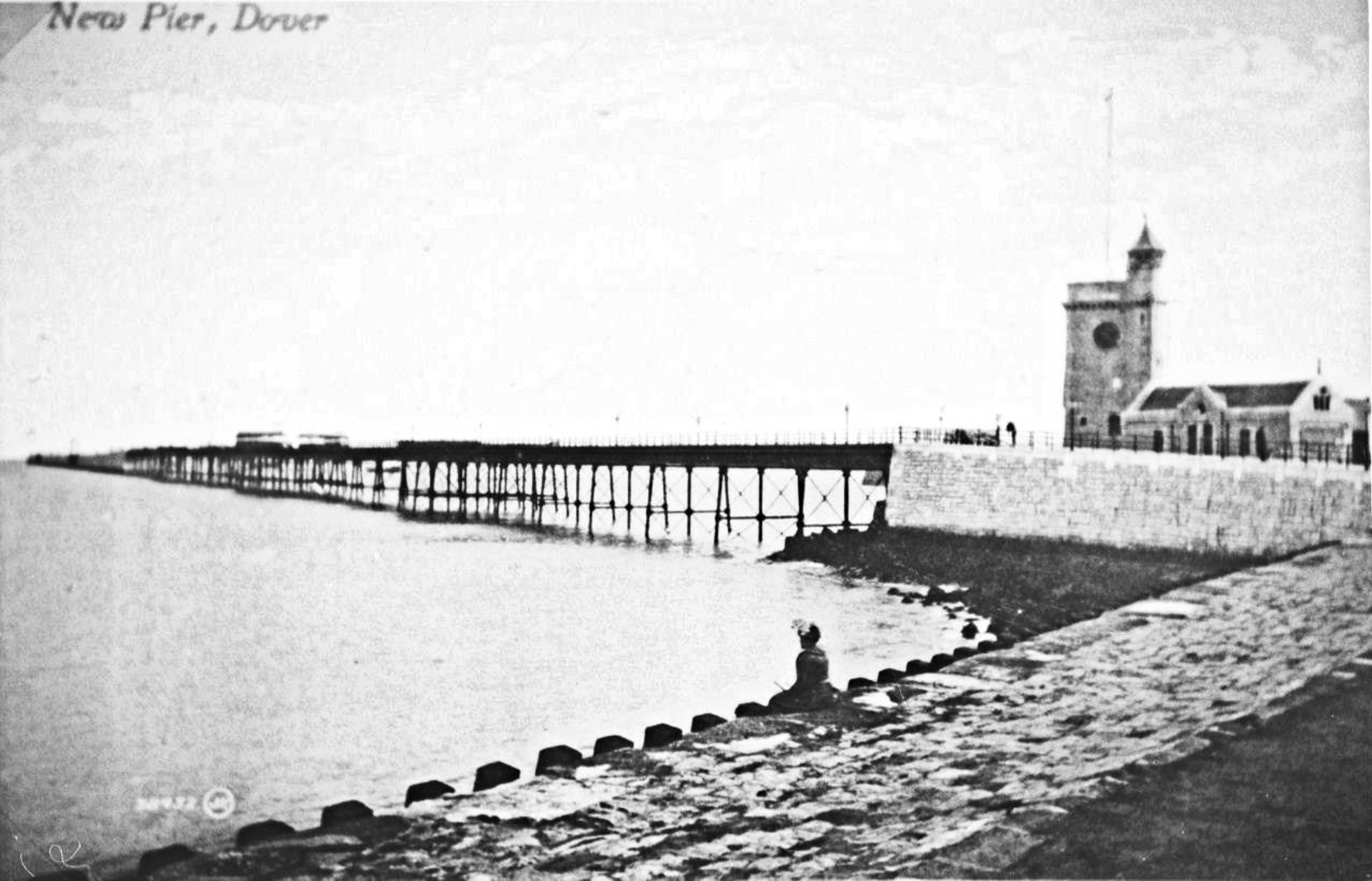
Prince of Wales Pier c1905. Dover Museum

Prince of Wales Pier c1905. Dover Museum

Cross-Channel steamers berthed on the west side of the Pier and the first to do so was the  Princess Beatrice, on 12 July 1902. However, comparatively few cross-Channel vessels used the Pier as the back up facilities were on the Admiralty Pier and so that was infinitely more preferable. In the plans submitted to parliament for the Prince of Wales Pier, it was stated that there would be a promenade for the general public and throughout the building this had been the understanding and, indeed, the gates had a pedestrian access for all to see.  However, the gate was shut and padlocked. Increasingly the general public became vociferous, including writing to national newspapers. Worsfold Mowll promised that access would be available when final work was completed and cited that testing of the electric lamps was the cause of the delay. On 1 January 1903 the lock came off the gate while a  wooden turnstile was erected and then the gate was locked again.

The gate remain locked until July 1903, when it was opened to coincide with the arrival of Émile Loubet (1838-1929), the French President (1899-1906). Britain’s relationship with France had fallen to a low ebb by 1898, due to the Alfred Dreyfus Affair – a French military officer of Jewish descent was falsely accused of treason and heavily punished (1894-1906) – and the Boer War (1899-1902). Thus, from Dover’s perspective, the visit by the French President was seen as an important economic step. The British government saw the visit as the first step to healing the British and French political differences and indeed, it did lead to the Entente Cordiale that was signed in London on 8 April 1904.
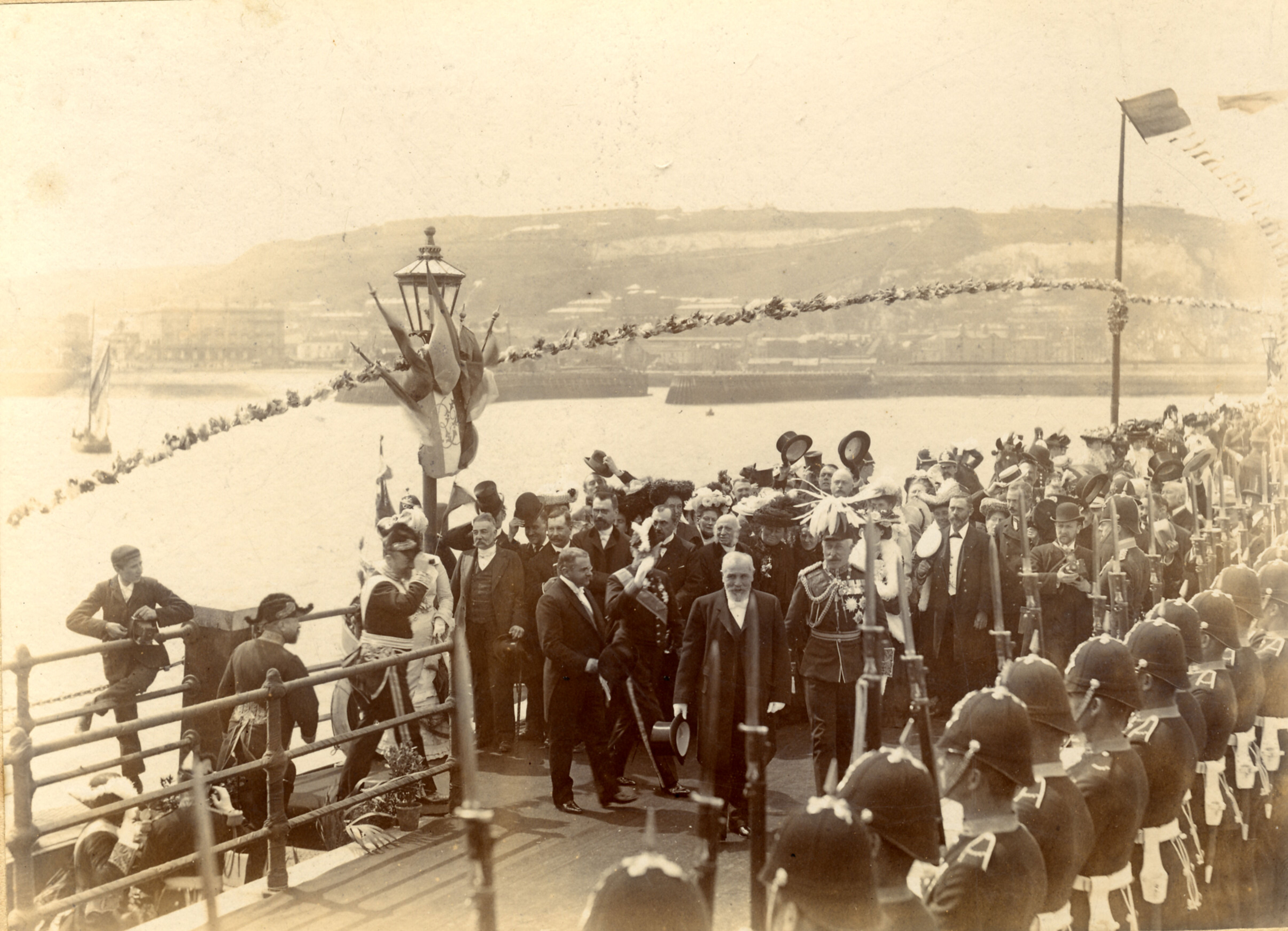
French President Loubet arriving at Prince of Wales Pier July 1903. Dover Museum

French President Loubet arriving at Prince of Wales Pier July 1903. Dover Museum

Émile Loubet arrived on 6 July 1903, and his welcome in Dover was subject to special instructions from the Lord Chamberlain, Edward Hyde Villiers, 5th Earl of Clarendon (1846-1914). The President arrived from Boulogne at 13.15hrs on the 8,151-ton cruiser Guiche and even the weather obeyed the Lord Chamberlain’s wishes – it was superb! Prior to M. Loubet landing, members of the press from both France and England were entertained to lunch at the Burlington Hotel by Worsfold Mowll in the belief that this would ensure positive press coverage. The President disembarked on the Prince of Wales Pier where a Royal pavilion, specially brought from London for the occasion, had been erected and fitted out in the Louis XVI style. The President was met by Prince Arthur, Duke of Connaught (1850-1942), the French Ambassador to Great Britain (1898-1920) Paul Cambon (1843-1924), and staff from the French Embassy. Lord Howe – Lord-in-Waiting on behalf of the King, Captain the Hon. Seymour Fortesque – Equerry-in-Waiting and senior army personnel especially appointed by the King to escort the President throughout his visit.

The welcoming address was made in the pavilion by Dover Town Clerk – Wollaston Knocker. He then introduced the Mayor – Frederick Wright and Sir William Crundall who represented DHB. Members of the Corporation, the Dover Harbour Board, senior military personnel stationed in Dover and other local VIPs were in attendance. Following the welcome, the President and his entourage left in four Royal carriages, provided by the King, for Priory Station escorted by a detachment of 1st Royal Dragoons. The route was lined with soldiers from different battalions, boys from Dover College and Dover’s Gordon orphanage in their Scottish attire. Crowds, many from France, that had arrived earlier that day, cheered as the entourage passed. As the President entered the railway carriage on the train taking him to Victoria Station, London, a 21-gun salute was fired from the Western Heights. That evening and until the French President returned to his own country on 10 July, the government paid for Dover to be illuminated and as a goodwill gesture, DHB opened the Prince of Wales Pier to the public free of charge!
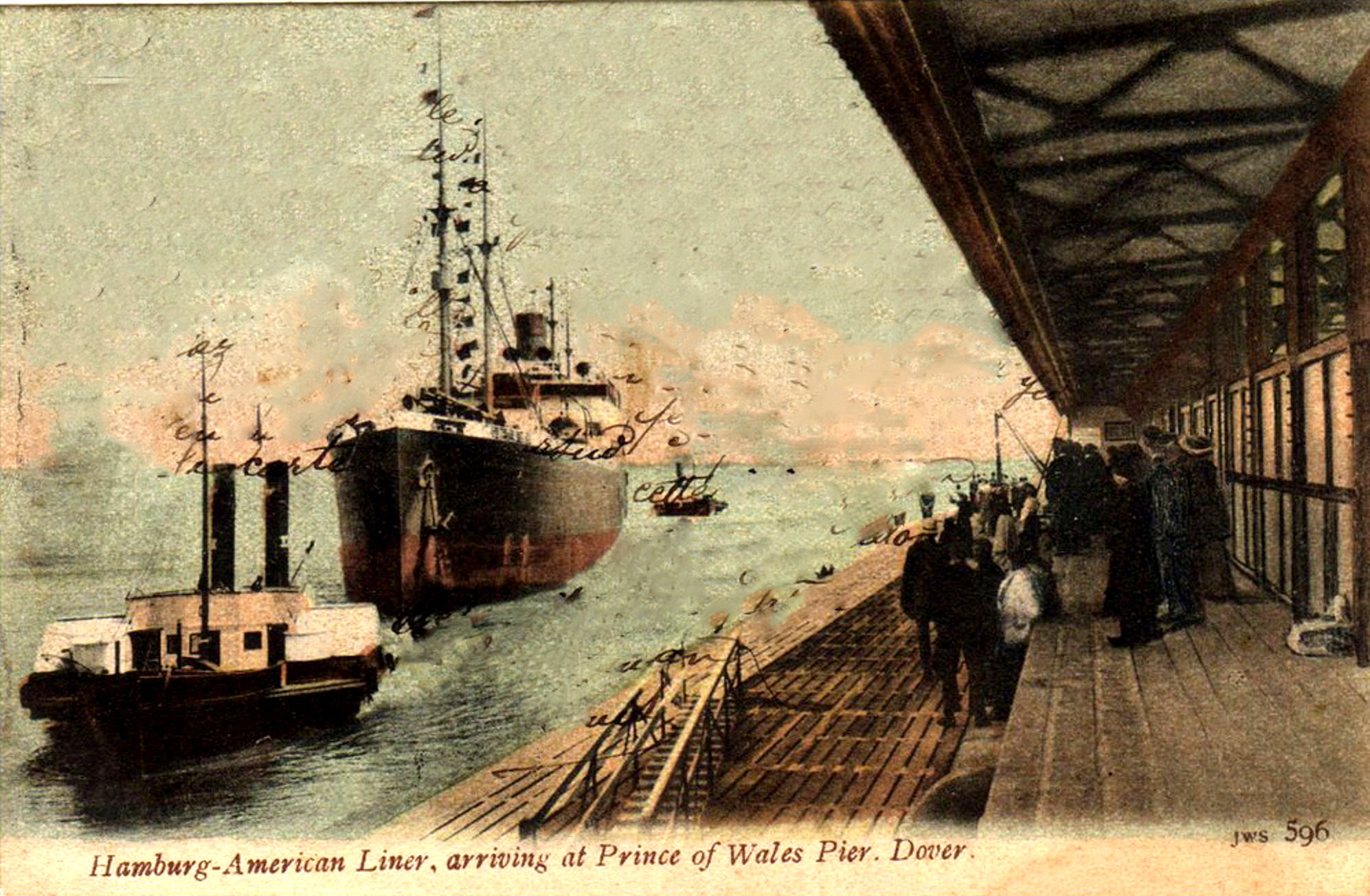
Hamburg-Amerika Line ship arriving at the Prince of Wales Pier. John Alsop

Hamburg-Amerika Line ship arriving at the Prince of Wales Pier. John Alsop

While the 500-foot landing jetty was being constructed on the east side of the Prince of Wales Pier, electrically powered capstans were installed. With the power coming from Dover electricity works through a newly laid cable carried within a cast-iron conduit that also powered the Wellington swing bridge when it was completed. Besides the covered landing stage and station, a wooden waiting room was erected close to the lighthouse. There, besides conveniences and telegraph facilities both light and alcoholic refreshments were available, for the latter the Lord Warden Hotel had gained a licence.

At the end of July 1903 the Hamburg-Amerika Line 4,550-ton Prinz Sigismund arrived to test the Prince of Wales Pier berthing facilities. On board was Albert Ballin, along with four senior officials and 700 passengers. The decked out ship, came alongside the Pier under the direction of the Harbour Master, Captain John Iron, without tug assistance. Herr Ballin was received by Sir William Crundall as Deputy Chairman of the Harbour Board, Councillor William Barnes the Deputy Mayor of Dover and Mr Phillips, representing British agents of the Hamburg-Amerika Line.

More than satisfied with the berthing and the proposed railway arrangements, Herr Ballin stated that the Line would make Dover the Port of Call for the English Channel the following year. On hearing the good news the Kaiser sent Crundall a telegram of congratulations. In the subsequent press statement, Crundall announced that besides the Hamburg-Amerika Line, the South America Line, Mexican Line and steamers bound for the Far East were making Dover a Port of Call. SECR estimated that on the agreement with the Hamburg-Amerika Line alone, 40,000 passengers a year would be using the Prince of Wales Pier. They therefore recommended an improved railway station and, reasoned, this would require the Pier to be widened. When it came to who would foot the bill, SECR said that they could possibly lend DHB the money which DHB would pay back out of the poll-tax revenue received from the ship passengers.
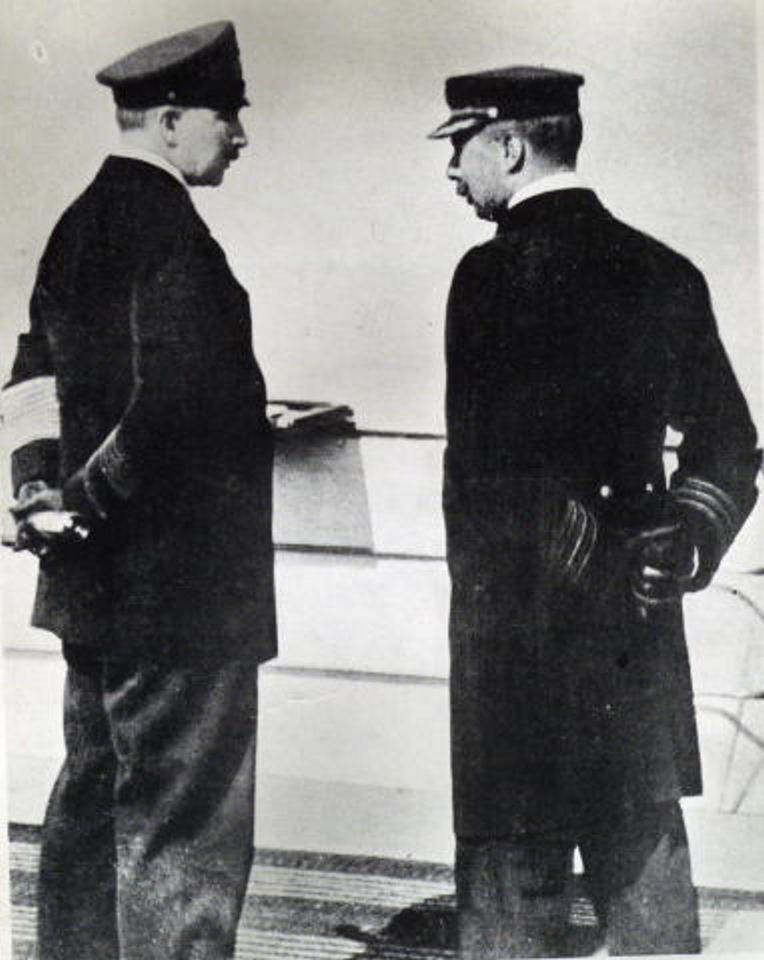
Dover Harbour Master, Captain John Iron (right) talking to Kaiser Wilhelm II on the König Albert 15.12.1903. David Iron Collection

Dover Harbour Master, Captain John Iron (right) talking to Kaiser Wilhelm II on the König Albert 15.12.1903. David Iron Collection

On 15 December 1903, an agreement was signed between DHB, SECR and the Hamburg-Amerika Line for their ocean going cruise ships to call into Dover from 1 July 1904. On the morning of Sunday 13 March 1904 the Kaiser Wilhelm II, who was voyaging to Vigo and Gibraltar, was expected to arrive at the Prince of Wales Pier on the 10,643-ton König Albert steamship belonging to the Norddeutscher Lloyd Line. However, due to thick fog the ship was delayed so the Dover reception party travelled out on a DHB tug to meet the Kaiser in the Channel. The party included Captain John Iron, the Harbour Master, who was photographed talking to Wilhelm II on the Bridge.

Messrs Pearson and Son won the contract for the construction of the new steel swing bridge that replaced the existing Wellington Dock bridge and work started on 27 January 1904. At the same time began the construction of the 2,900-feet long branch line, with two steep gradients, from Harbour Station to the Prince of Wales Pier. On the Pier a covered railway station was built. The railway track followed the route agreed upon four years earlier, leaving the main line north of Harbour Station, going along Strond Street around the east and north of the Granville Dock to Union Street and then south across the Wellington Bridge and the Esplanade to the Prince of Wales Pier. In 1900 part of the grand Esplanade Hotel opposite the entrance to the Pier, had been demolished to widen the access from Union Street to the Pier for the new railway line.
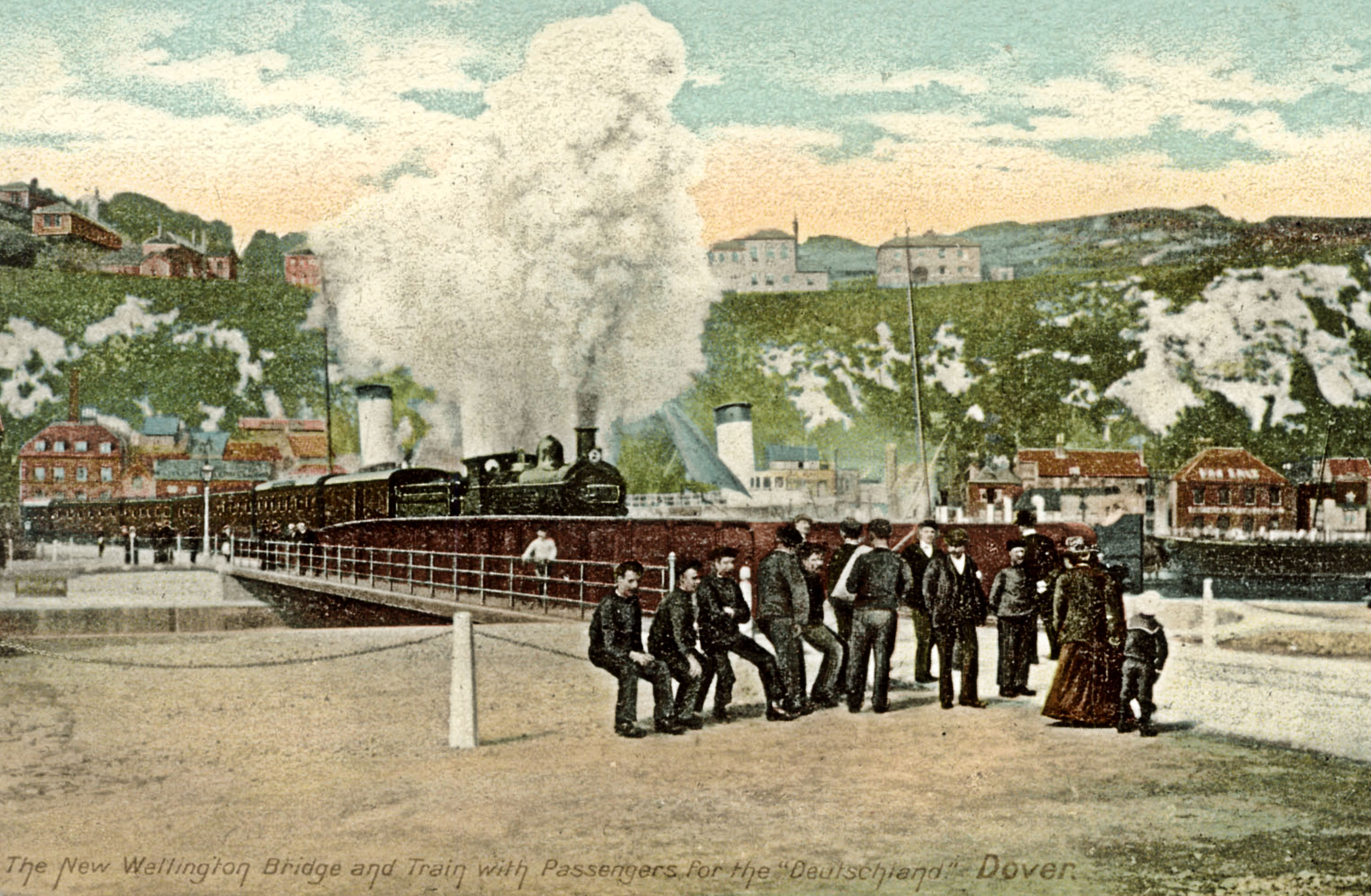
Train with Engine number 05745 crossing the Wellington Bridge. Nick Catford

Train with Engine number 05745 crossing the Wellington Bridge. Nick Catford

At the Harbour Station, the down platform was rebuilt – on wheels – so it could be swung out of the way as needs necessitated! The new Wellington Bridge was completed in June 1904, and was swung by a combination of hydraulic and electric power, this project costing £600,000. On Saturday 25 June a trial run of a train onto the Prince of Wales Pier took place under the scrutiny of Major-General Charles Hutchinson (1826-1912), the former Chief Inspecting Officer for Railways. He was undertaking the commissioning tests of the Pier viaduct and the Wellington Bridge and was satisfied.
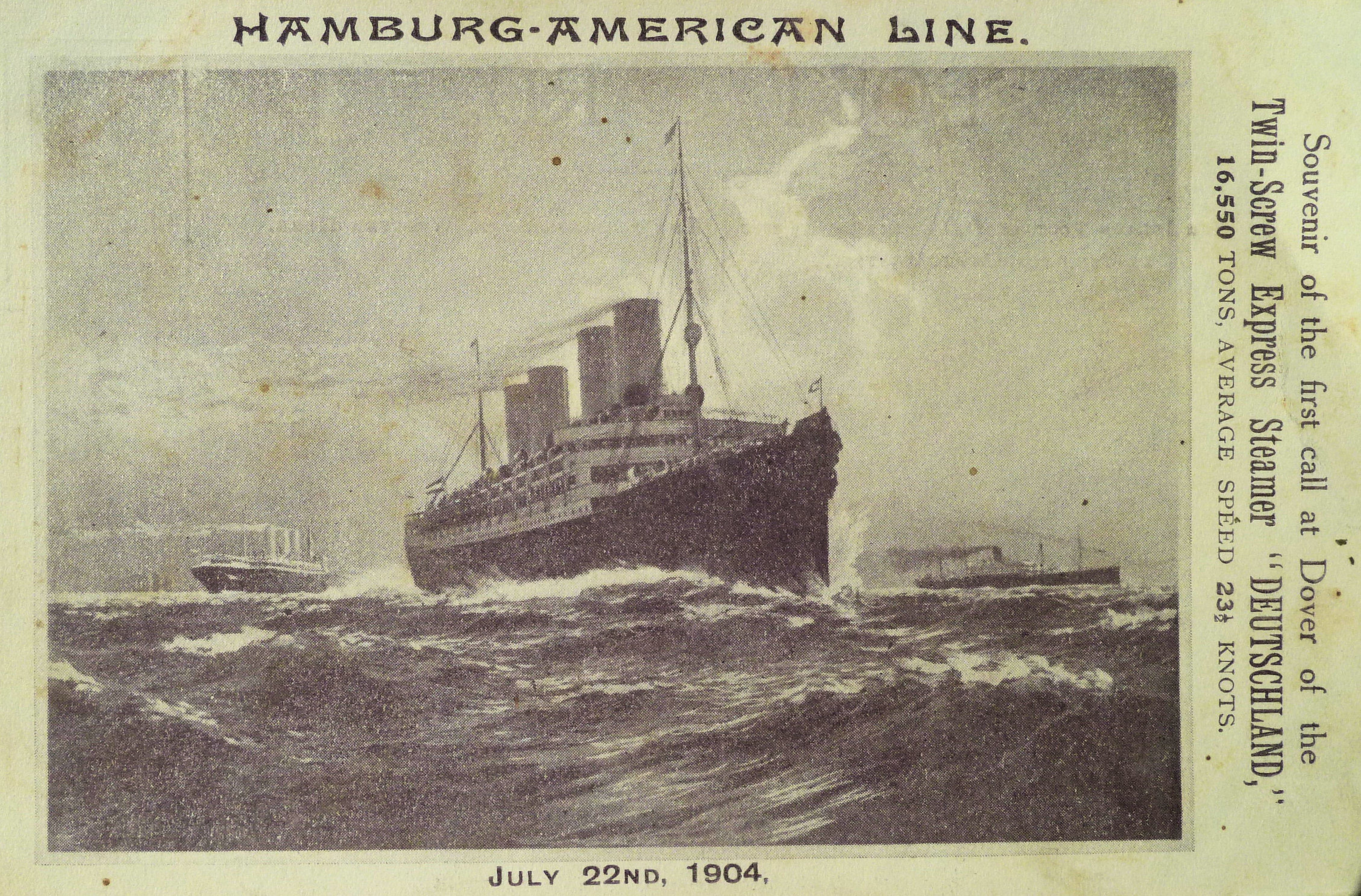
Deutschland souvenir postcard of her first arrival at Dover on 22 July 1904. David Iron Collection

Deutschland souvenir postcard of her first arrival at Dover on 22 July 1904. David Iron Collection

The Prinz Waldermar arrived on 1 July 1904 berthing alongside the designated transatlantic liners’ landing stage on the east side of the Pier. Following which, several Atlantic steamers called including the 16,550-tons Deutschland for which a special commemorative postcard was issued on her first arrival, 22 July 1904. SECR launched their new railway service – the Atlantic Liner Express. In December DHB’s new and powerful tug, the Lady Curzon, arrived as the primary tug for assisting transatlantic liners. However, at about the same time, the Admiralty issued an order stating that the Admiralty Harbour was only for the use by Royal Navy vessels. That all Commercial traffic was to moor in the Commercial harbour, contravention carried a £10 fine. This would be detrimental to the handling of transatlantic shipping so Crundall, Mowll and the town clerk – Wollaston Knocker, used all their persuasive power to convince the Admiralty to reconsider.
Amerika by the Prince of Wales Pier. John Alsop

Amerika by the Prince of Wales Pier. John Alsop

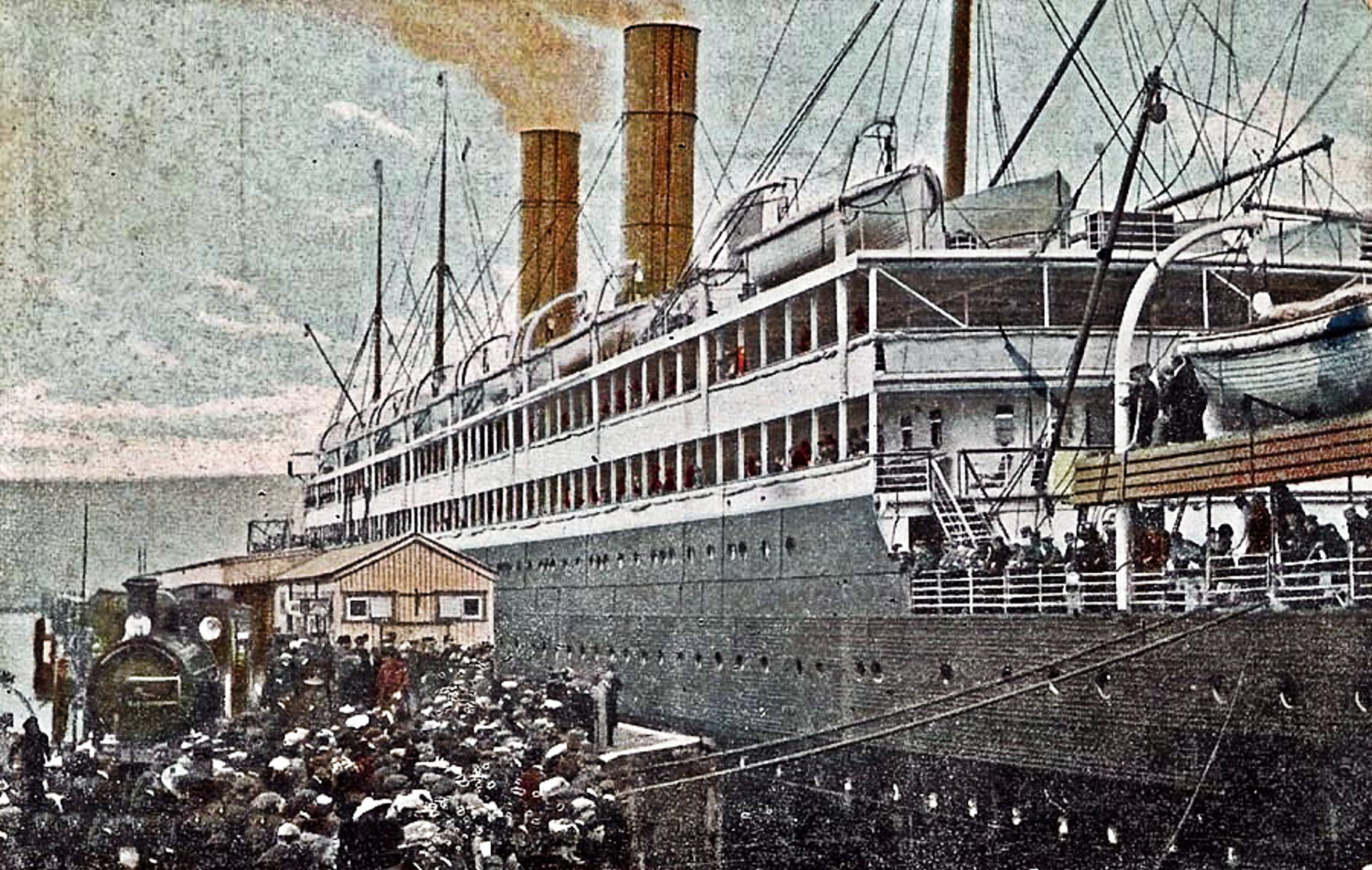
In March 1905, the large German steamer Erithia was being coaled alongside the east side of the Prince of Wales Pier when there was a sudden squall. The hundredweight (112 pound) coal bags were blown off the wagons and the horses bolted dragging the carts behind them. The squall quickly passed and the terrified horses were brought back. During the summer, ships belonging to the Red Star Line were regularly arriving at the Prince of Wales Pier and on 12 October, the newly launched 22,225 ton Amerika, built by Harland and Wolff, Belfast for the Hamburg-Amerika Line, tied up alongside the east side of the Pier. Local dignitaries headed by the Mayor/Deputy Chairman of DHB, Sir William Crundall, and crowds greeted her. The 25,128-tons Kaserin Victoria Auguste, built by Aktien-Gesellschaft Vulcan at Stettin (now Szcecin, Poland) for the Hamburg-Amerika Line on her maiden voyage, arrived on 11 May 1906. She was, at the time, the world’s largest liner and as she docked alongside the Prince of Wales Pier she too received a magnificent welcome.
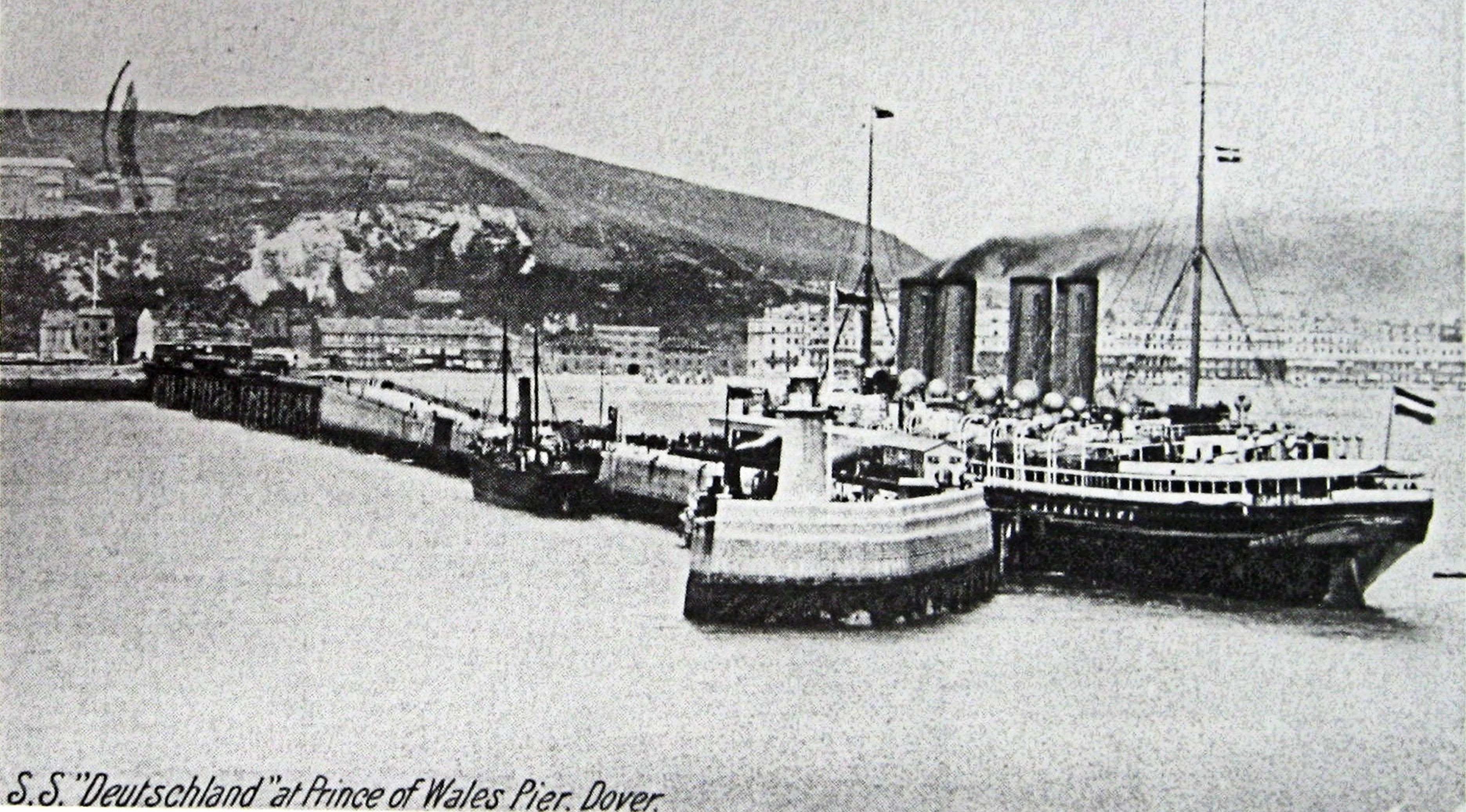
Deutschland tied alongside Prince of Wales Pier 1907. Bob Hollingsbee Collection

Deutschland tied alongside Prince of Wales Pier 1907. Bob Hollingsbee Collection

However, the liners brought with them problems not previously considered. A seaman’s strike at Hamburg meant that the 8,332 ton Fürst Bismark, built in 1905 by Fairfield Shipbuilding and Engineering Company, Glasgow, left Hamburg with only half her compliment of crew. Bound for Mexico and Cuba, she picked up more crew en route for Dover where seamen had been recruited from London and Liverpool docks. On arrival at the Prince of Wales Pier, the British contingency realised that they were effectively strike breaking and rejoined the train that had brought them, putting their kit bags in the luggage van. Crew members of the Fürst Bismark took the kit bags off the train and on board the ship and trouble broke out. Although Dover spectators were in sympathy with the seamen, the officials were not and the police were called. Eventually, the men reluctantly went on board. However, as the ship was about to sail two British men climbed down the bow ropes onto the Pier and absconded. The next day the Deutschland, arrived with her full compliment of crew.

Work on building the Admiralty Harbour was still underway with the Southern Breakwater gradually narrowing the Western Entrance such that by the end of June 1906 it was only 1000-foot wide. The Deutschland arrived on Friday 13 July en route for New York coming in bow first and landing 93 passengers. At midday, 83 new passengers having embarked, the ship was leaving with the DHB tugs Lady Curzon and Lady Vita in attendance. The narrowness of the gap between the Southern Breakwater and the Admiralty Pier made the manoeuvre difficult and the transatlantic liner had to inch out. Owing to a mistake in one of the orders sent to the engine room, the Deutschland suddenly went ahead causing the tugs’ hawsers to snap. The order was then given to reverse engines and the ship hit the granite part of the Prince of Wales Pier extensively damaging her bows.

Much to the surprise of observers, the ship then majestically reversed out of the Western entrance without any assistance! While anchored in the Channel, arrangements were made for the Deutschland to return to port and that evening she again tied up alongside the Prince of Wales Pier. The 1,500 passengers on board disembarked and 1,200 sacks of mail for the United States were taken off. The passengers went by special train to Southampton where they boarded the New York, for America. Assessment of damage at that time showed that the bow plates of the Deutschland were doubled back to starboard and her fore compartments were full of water. It was decided that she would go to Hamburg for repairs where it was decided she needed 40 new bow plates.

Dover Harbour 14 July 1903 Prince of Wales Pier, to the right Admiralty Pier. Wellington Dock near the camara with Waterloo Crescent and Esplanade in between. Nick Catford

Dover Harbour 14 July 1903 Prince of Wales Pier, to the right Admiralty Pier. Wellington Dock near the camara with Waterloo Crescent and Esplanade in between. Nick Catford

In the last six months of 1905 the number of liner passengers that embarked and disembarked on the Pier was 3,586 and for the corresponding period in 1906, 5,028 . However, a week after the Deutschland disaster the Hamburg-Amerika Company announced that the whole of their New York fleet would cease to call at Dover. An agreement was reached with the Admiralty that on the completion of the Admiralty Pier, DHB would  be given the lease of the whole of the Pier in return for the Admiralty taking over the east side of the Prince of Wales Pier.

This was confirmed by an Act of Parliament that DHB sought. The same Act provided for the widening of part of the old portion of the Admiralty Pier bringing it, architecturally, into line with the rest of the Pier for the construction of what became the Marine Station. In the meantime a new transatlantic ships’ berth was erected on the Admiralty Pier extension that opened on 7 October 1908. By this time, the area of the Admiralty harbour was 610acres and the Commercial harbour 75acres. The Tidal Basin, Granville dock and Wellington dock amounted to 23acres giving Dover harbour a total of 708acres.

The Lord Warden, Lord Curzon of Kedleston (1859-1925), resigned in 1905 and was succeeded by Prince George the Prince of Wales – later George V (1910-1936). As Lord Warden, the Prince automatically held the office of Chairman of DHB but an Act of Parliament relieved him of the duty. This Act has been applicable to all subsequent Lord Wardens. The Deputy chairman of DHB at the time, Sir William Crundall, was elected Chairman of DHB and held the post until his death in 1934.

With a view to base part of the Home Fleet in Dover, the Admiralty started tests on the viability and in March 1907, undertook mooring trials. The 17,500-ton King Edward VII Class battleship, Africa narrowly avoided collision with the Southern Breakwater and the 12,790-ton armoured cruiser Duke of Edinburgh ran aground at high tide just off the Prince of Wales Pier. This was due to her anchor failing to find a purchase in the sandy seabed. Further tests showed that there were significant problems of pitching and rolling whenever the ships were expose to windy weather that were never solved. The results of the trials discouraged the Navy from considering establishing any great presence in Dover. Further, transatlantic liners were also experiencing problems and on 28 October 1907, the 12,760-ton Red Star liner Finland, homeward bound from New York to Antwerp, struck the end of the Southern Breakwater damaging both the ship and the Breakwater. She was brought alongside the Prince of Wales Pier where it was seen that her bows were extensively damaged. The Breakwater was also badly damaged and several workers were injured.
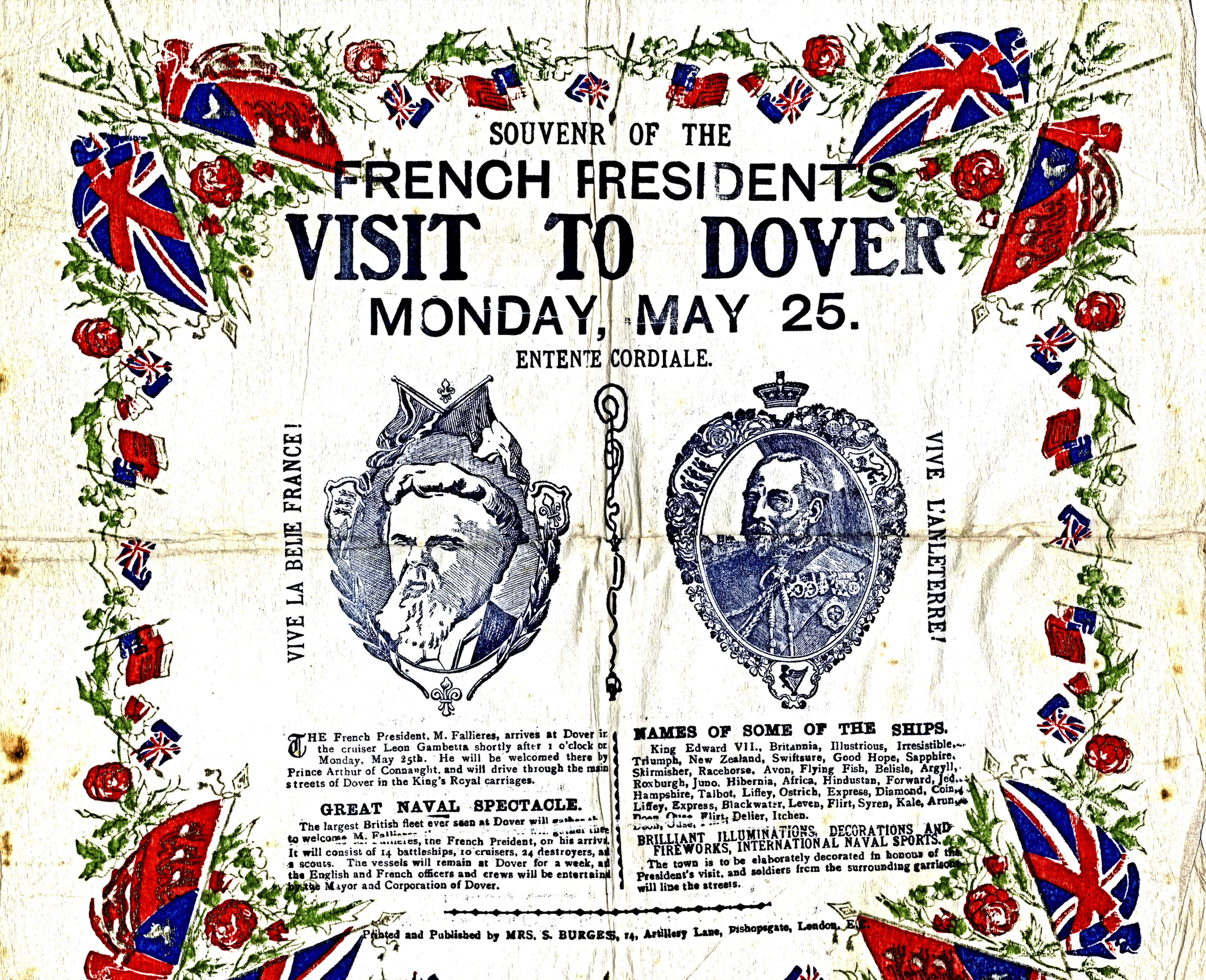
French President Fallière visit 25 May 1908. Dover Museum

French President Fallière visit 25 May 1908. Dover Museum

The new President of France (1906-1913) – Armand Fallières, (1841-1931), paid a State Visit on Monday 25 May 1908. Arriving on the 12,400-ton French armoured cruiser Léon Gambetta at the Prince of Wales Pier, a crimson-covered walkway was in position. He was escorted to the Royal pavilion, now kept in Dover for such occasions where Prince Arthur and other dignitaries received him. There were 60 war ships assembled in the harbour that day and troops from Dover, Shorncliffe and Canterbury garrisons lined the streets to Priory Station. Thousands of onlookers were on the seafront and along the route to watch the procession consisting of four carriages escorted by mounted 20th Hussars. At the station, members of the cast of the forthcoming Dover Pageant, dressed in full armour of Saxon and Norman knights with ancient swords and pikes, provided a spectacular guard of honour. It was agreed by the corporation to present the President with a silver salver engraved with emblemic views of Dover and in return the President presented the Mayor of Dover, Walter Emden, with the Chevalier Order of the Legion of Honour. The President stayed in Great Britain for four days departing from the Pier for Calais on 29 May.
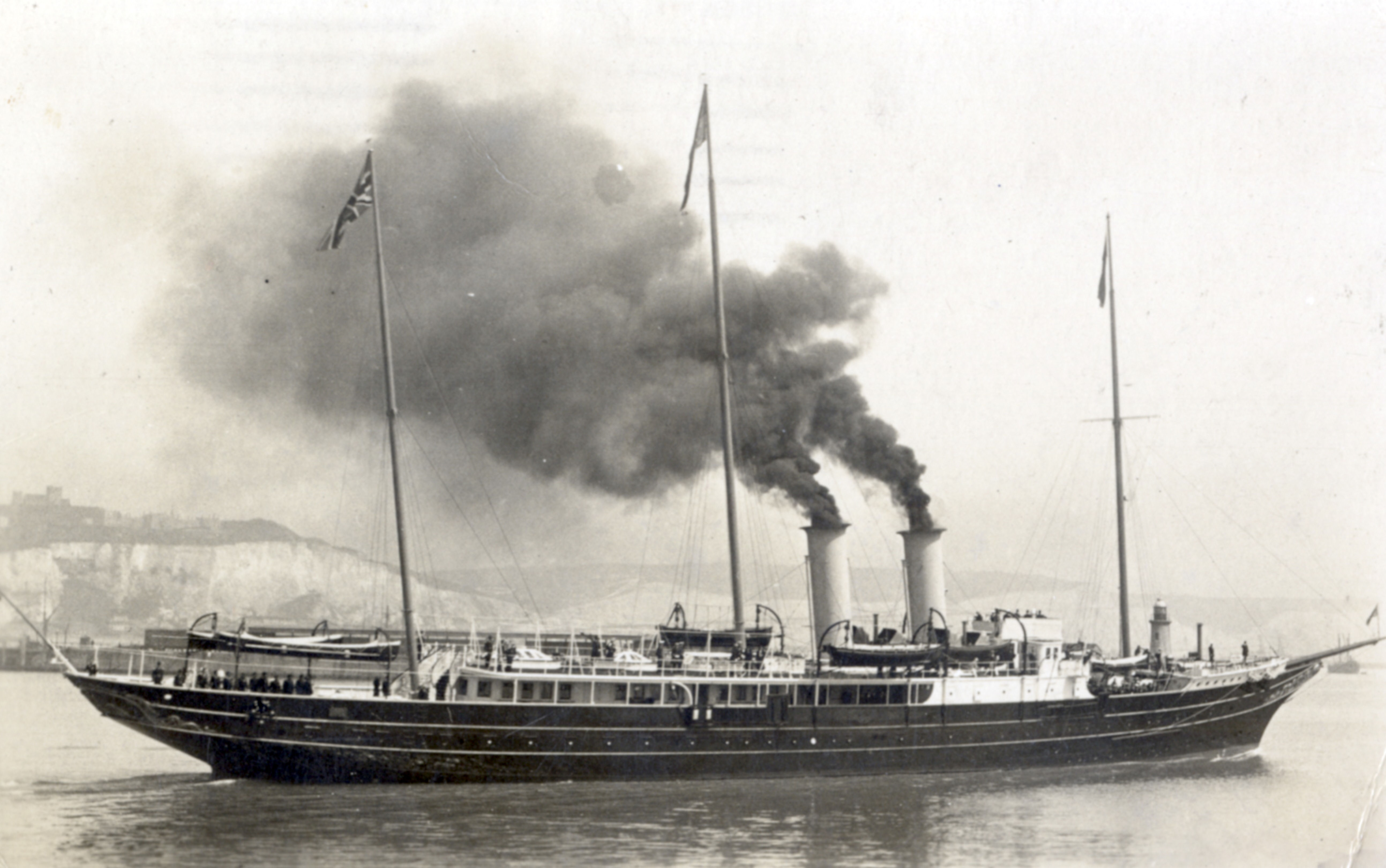
Royal yacht Alexandra circa1905. Dover Museum

Royal yacht Alexandra circa1905. Dover Museum

Berthing trials were made by the 2,113-ton Royal Yacht Alexandra on 26 June 1908 at the Prince of Wales Pier and these proved successful. Edward VII, on 10 August, made the first crossing to the Continent on the Alexandra en route for Marienbad, now Mariánské Lázně in the Czech Republic, where he annually took the health waters. Subsequently, Royalty, particularly King Edward on diplomatic missions, frequently used the Pier.

After the Deutschland disaster, except for bad weather when cross Channel ships tied up there or the Alexandra was expected, it was assumed by national commentators that the Prince of Wales Pier would become a typical early 20th century promenade pier. In fact, they had forgotten that part of the role of the Commercial Harbour was that of a Harbour of Refuge. At the end of December 1906, the 4,158-ton steamer Ormley, from Belfast, went ashore at St Margaret’s Bay on Boxing Day (26 December). She was brought alongside the Prince of Wales Pier for repairs by the DHB tugs Lady Curzon and Lady Crundall. Although not the first shipping casualty to be tied up alongside the Pier, by the end of September 1908, seeing damaged ships there was a regular sight.

One evening, at the end of that month, the London collier steamer Southmoor, tied up alongside the Prince of Wales Pier with a number of boats in tow behind her. On board the Southmoor were women, many wearing the latest firs and fashion. In the boats were men, again, many were expensively dressed but like the women, were looking tired and crumpled. The 3,272-ton Argonaut, belonging to the Co-operative Cruising Company Limited, had been on her way from London to the Mediterranean with 120 passengers and the same number of crew on board. Off Dungeness, during thick fog, she had been hit by the 2,355-ton Newcastle steamer Kingswell with the Argonaut quickly taking on water. Her Captain called for the ship to be abandoned with the passengers and crew putting on warm clothes, life jackets and taking to the lifeboats. Twenty minutes after she had been hit the Argonaut foundered. The passengers were made up of members of British high society with one, the Countess de Hamil, losing her jewel case containing £6,000 of gems. The Southmoor took on board the women and the men, along with the crew members, were in the life boats that the Southmoor towed into Dover harbour.

A trial took place, on 1 October 1908, to disembark troops on the Prince of Wales Pier, with a view to use the pier for such military purposes. That day the 3rd Battalion the Worcesters’ arrived on the former Union-Castle requisitioned packet, by then a troop transport ship, Avondale Castle, from South Africa. On disembarkation the men were marched to the Dover garrison, where they were quartered. The exercise was reported as successful and in May the following year (1909) the Admiralty announced that a second landing stage was to be built on the east side of the Pier by a Gillingham firm. This landing stage was only 100-feet in length but had three decks connected by two stairways making it available for pinnaces and ships of all sizes at all states of the tide.
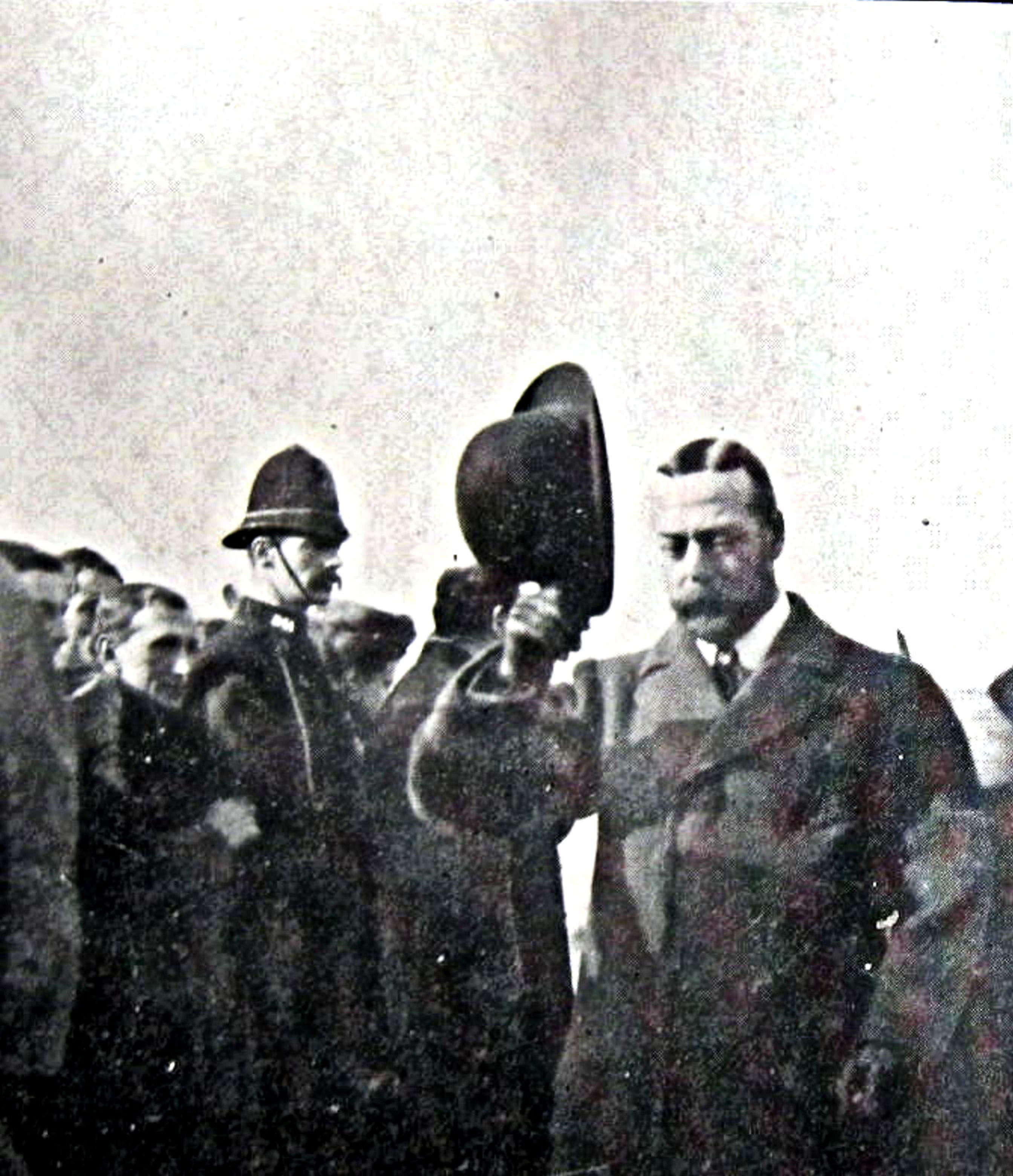
Prince of Wales later George V on 15 October 1908 on the Prince of Wales Pier following the official opening of the Admiralty Harbour. Dover Library

Prince of Wales later George V on 15 October 1909 on the Prince of Wales Pier following the official opening of the Admiralty Harbour. Dover Library

George Prince of Wales officially opened the Admiralty Harbour on Friday 15 October 1909. For the occasion, the Prince alighted from the train, that had brought him from London, by the Clock Tower from where he, and the entourage, were taken to the Eastern Arm. There the ceremony was performed following which he embarked on the yacht Enchantress and was brought to the Prince of Wales Pier. It was from the Pier station that the Prince boarded the train to take him to London. That day the flagship of Vice-Admiral Prince Louis of Battenburg (1854-1921), the 15,000-ton battleship Prince of Wales, was lying alongside the Pier.

In the spring of 1910 Edward VII was in Biarritz and on 27 April he returned to England. As was expected, arrangements were made for the Royal Yacht Alexandra to berth alongside the Prince of Wales Pier but a strong easterly wind was blowing and the Harbour Master, Captain John Iron, arranged for berthing on the west side of the Pier. This was not only out of the ordinary but not very convenient for the Guard of Honour, naval, military and civil dignitaries etc. Iron was ordered to arrange the Alexandra to come along the east side but he refused to comply and instead, arranged for a signal to be sent to the Alexandra saying that the yacht was to come in on the west side. Fearing that he had altered the King’s specific orders over the berthing arrangements, when Iron met His Majesty at the gangway he apologised for not obeying the Royal order. To this, the King responded, Why didn’t you?’ Iron replied, ‘Because I did not want her to be damaged by the swell setting on that side.’ ‘Ah,’ replied the King, ‘I knew you had a good reason.’ The weather, although very windy, was warm but Iron noted, that when they shook hands, how cold the King’s hand was. This was the last Channel crossing His Majesty made for on 6 May, King Edward VII died.

Although Edward VII only ruled for 10 years, during that time he made great use of his diplomatic skills. Thus, for the King’s funeral, special trains had to be laid on as more than 50 ruling monarchs, crown princes, special envoys and ambassadors passed through Dover. Typically, on 18 May 1910, a special train left from the Prince of Wales Pier at 15.10hrs carrying King Manuel II of Portugal and Alexander the Crown Prince of Serbia and both their entourage. Another train left at 17.20hrs with Prince Fushimi Sadanaru of Japan, Adolphus Frederick V – the Grand Duke of Mecklenburg-Strelitz and Prince Carl of Sweden and Norway, on board. The funeral was one of the largest gatherings of European Royals and many subsequently lost their thrones due to World War I (1914-1918). However, Manuel II of Portugal was deposed much earlier, in October that year.

To accommodate the new railway station on Admiralty Pier the bend in that Pier disappeared. During heavy weather the bend had provided shelter and the result was that there were numerous suspensions of Channel services or diverting of ships to Folkestone. To retain cross Channel shipping in Dover it was necessary to persuade the Admiralty to allow ships, during strong westerly winds, to tie up alongside the east side of the Prince of Wales Pier. On some days there were so many ships trying to get alongside the Pier that they were forced to tie up two abreast and delays were frequent. Military manoeuvres and the results of shipping accidents compounded the problem of shortage of space alongside the Pier at such times.

In the autumn of 1910, the twin-screw triple expansion engined 7,640-ton emigrant ship Cairnrona left London bound for New York. On board were approximately 900 passengers, mainly from Russia and Armenia. At about 05.30hrs on 3 September, 9-10 miles west of Beachy Head, fire broke out followed by an explosion and the ship turned back to Dover. Shortly after the accident, some women and children were transferred to the steamship Kanawha with the Upland taking on board a further 248 women and children. Those rescued on the Upland were the first to be brought to the Prince of Wales Pier and many of them were suffering from burns. This was the first that Harbour Master Iron knew of the accident and arrangements were quickly made to take the injured to the Royal Victoria Hospital in Dover.

At the time Vice-Admiral Prince Louis of Battenburg, was giving a dinner party on his flagship Prince of Wales alongside the Pier, and he ordered that all assistance was to be given by the Royal Navy ships berthed in the harbour. The Cainrona, later that night, was brought into to Dover by the Kanawha and DHB tugs. Many of the women and children rescued by the Kanawha were also in want of medical attention while on the Cairnrona, many of the crew and some of the 500 male passengers on board required medical attention and many more were seriously injured. The subsequent Inquiry found that the explosion was caused by red-hot ashes or cinders drawn from the furnaces that had found their way to the bottom of the starboard bunker. There they had come into contact with coal generated gas which in combination with air became an explosive mixture that was subsequently ignited. The explosion blew off the bunker hatches on the shelter deck. The Court found David Lowden, Chief Engineer, in default.
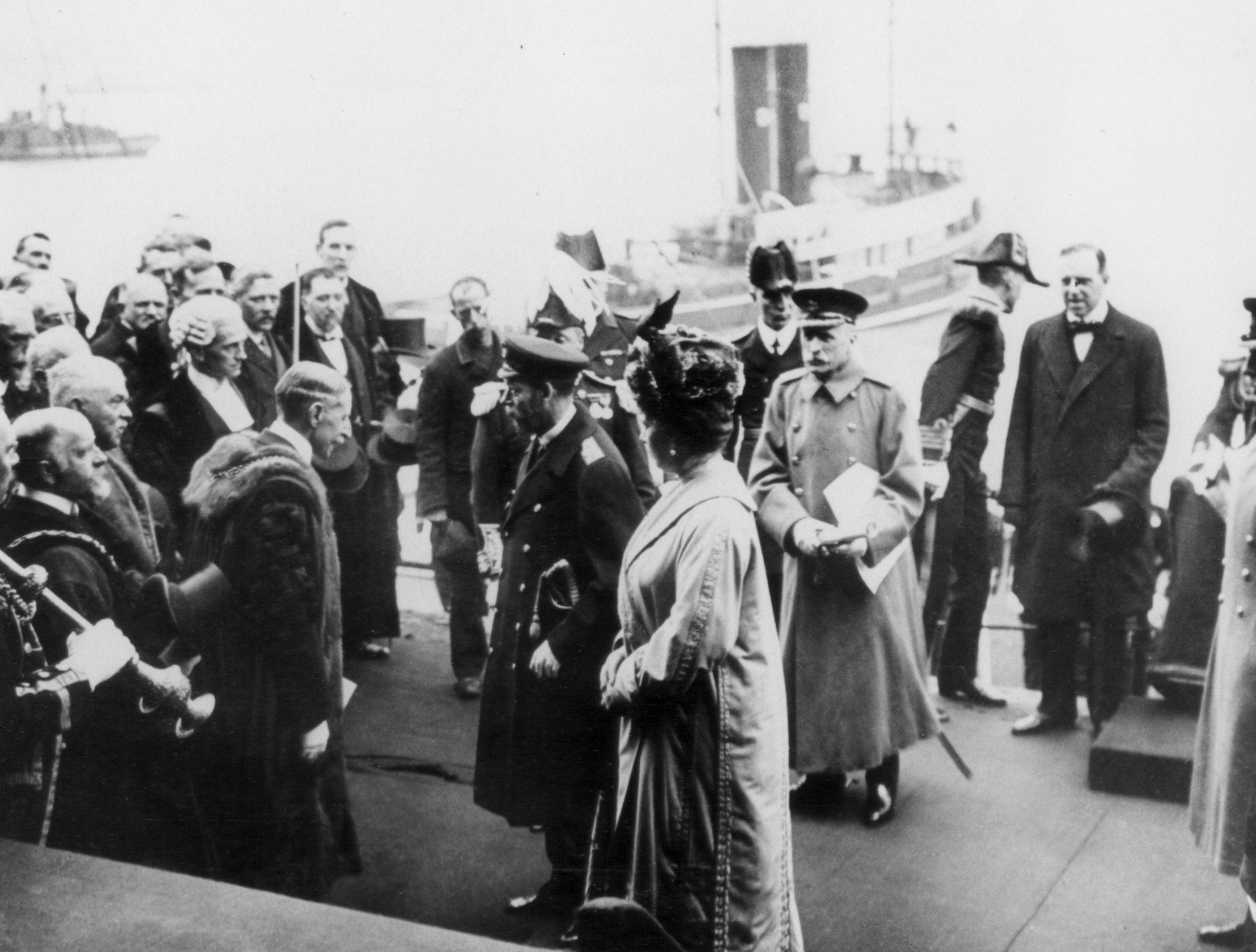
Mayor Edwin Farley greeting King George V and Queen Mary on the Prince of Wales Pier just before the outbreak of World War I. Clare Farley

Mayor Edwin Farley greeting King George V and Queen Mary on the Prince of Wales Pier just before the outbreak of World War I. Clare Farley

Possibly because the Prince of Wales Pier was a hive of activity, it was popular for promenading. Possibly many of these spectators gave little thought to the full implication of the reasons as to why there was an increasing number of naval ships using the harbour. On 27 August 1911, Kaiser Wilhelm II had made his ‘Place in the Sun’ speech, which inaugurated the expansion of the German navy. From then on, the harbour was frequently visited by naval ships and a large number were present when, on 27 June 1913, Raymond Poincaré (1860-1934) President of France (1913-1920), departed for the Continent.

The President had been on a State Visit and his departure provided a great deal of interest for the onlookers, particularly because of the pageantry of the occasion. The Royal pavilion had been erected, the crimson carpet laid and the numerous British and French ships were dressed overall. Added to which the weather was fine and the Mayor of Dover, Edwin Farley, was presented with the Chevalier Order of the Legion of Honour. The highlight of the occasion occurred as the President’s ship, the Pas de Calais, passed through the Western entrance. Three Navy aeroplanes came from the direction of Eastchurch and flew over dipping their wings in salute.  This was only four years after Louis Blériot had made the first heavier than air flight across the Channel!
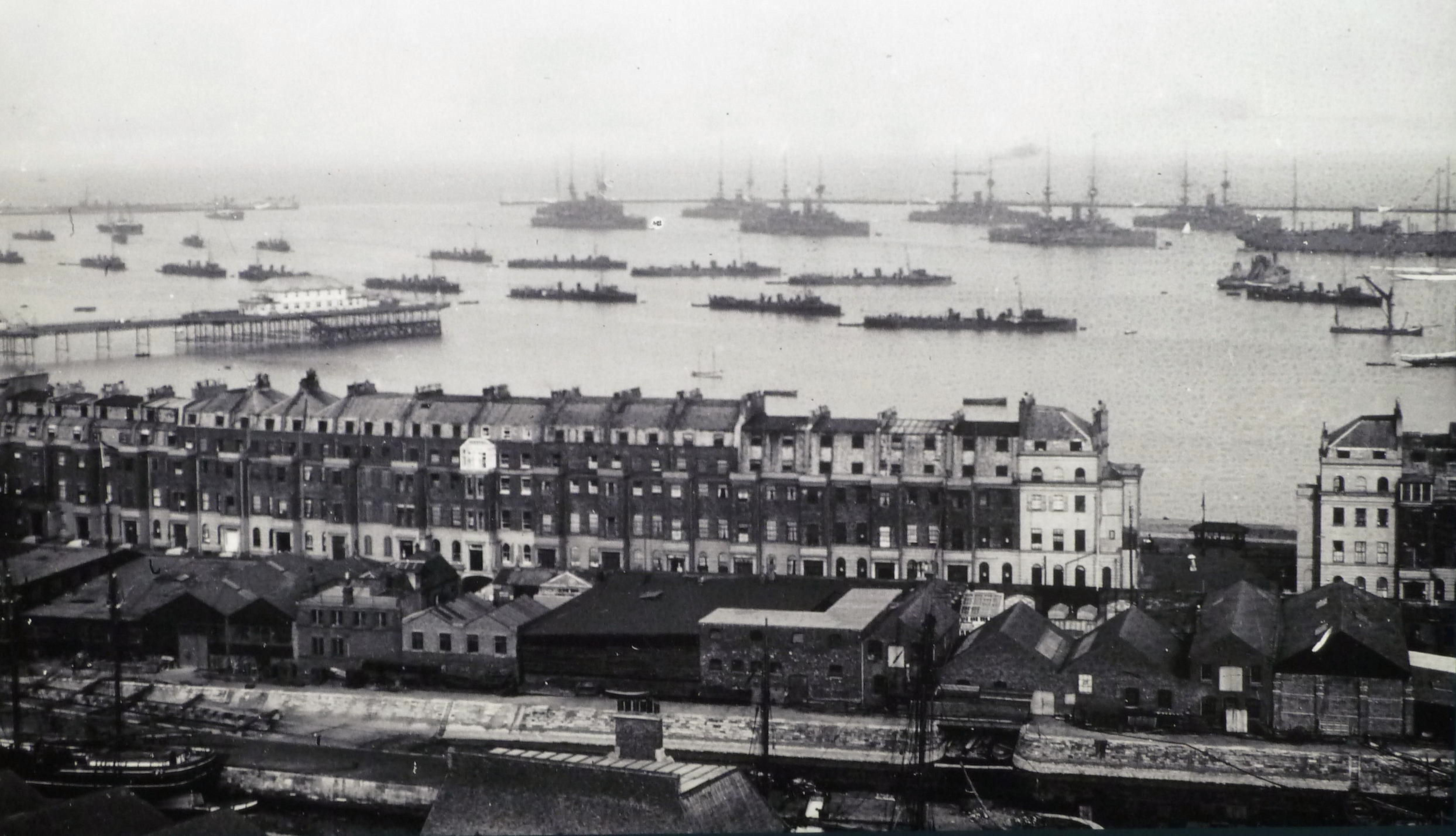
Warships in the harbour c1914 Promenade Pier left. Evelyn Robinson Collection

Warships in the harbour c1914 Promenade Pier left. Evelyn Robinson Collection

The same atmosphere abounded on 21 April 1914, when the weather was summer like. Although folk were not allowed on the Prince of Wales Pier as King George V and Queen Mary was expected, the seafront was crowded. Boys from the Duke of York’s School provided the guard of honour on the Pier and as the train arrived in Priory Station at 10.20hrs. A salute of guns was fired and the ships in the harbour all sounded their horns. The Royal party arrived at the Prince of Wales Pier in an open carriage and as they boarded the Royal yacht Alexandra, the Royal Standard was broken out at the masthead. As soon as the Royal yacht left for France with escorting warships Nottingham and Birmingham, folk were allowed back on the Pier. From there they witnessed the arrival of the military airship B4 that landed eight passengers at the Castle. Four months later this world came to an end with the outbreak of World War I (1914-1918).

Part II of the Prince of Wales Pier story continues.


Presented: 23 September 2015


Posted in Buildings, Maritime, Prince of Wales Pier Part I, Prince of Wales Pier Part I | Comments Off on Prince of Wales Pier Part I – The start to 1914

Kearsney Abbey

Map of 1789 showing Casney Court - the old name for Kearsney

Map of 1789 showing Casney Court – the old name for Kearsney

At the confluence of the 4-mile long River Dour from Watersend, near Temple Ewell, and it’s tributary coming in from the Alkham Valley, is Kearsney Abbey. On leaving the Abbey, the Dour wends its way through Dover until it reaches the sea via Wellington Dock. Over the centuries, the name Kearsney appears in many forms, including Casney, Casteney, Kersoney and Kernsey and although not a village it did have a manor.

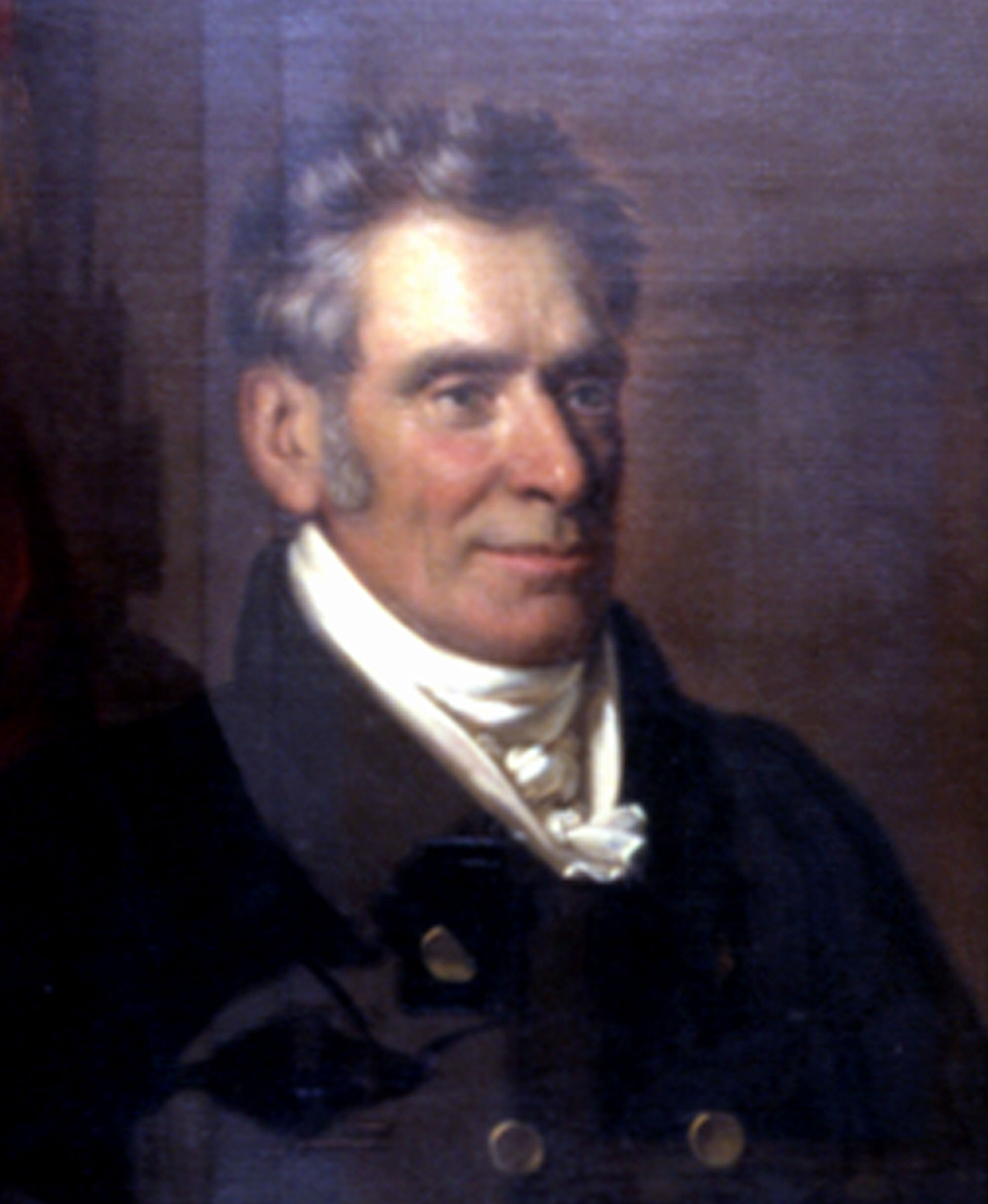
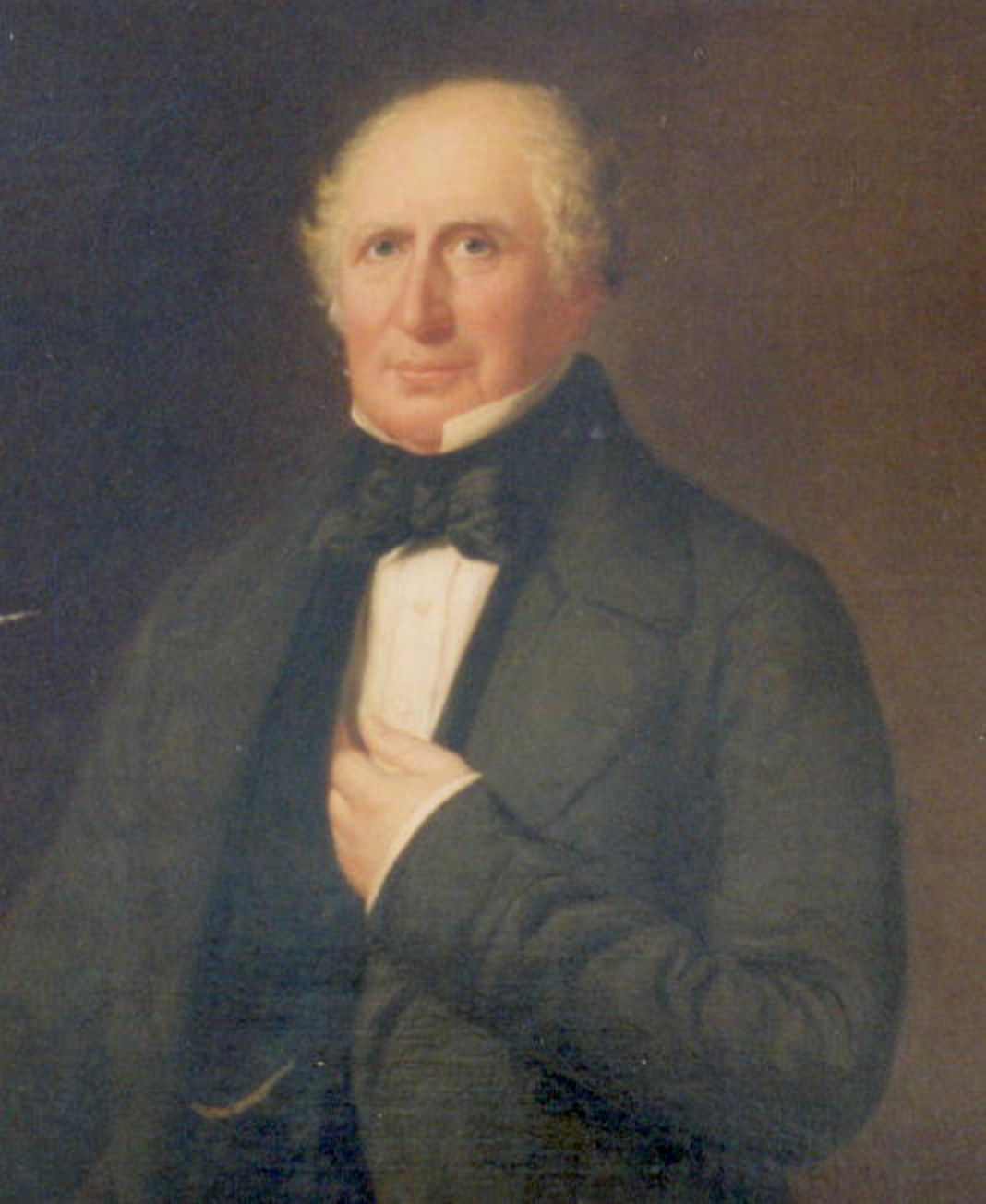
Peter Fector bought the Kearsney estate in 1790. Dover Museum detail

Peter Fector bought the Kearsney estate in 1790. Dover Museum detail

Peter Fector, head of one of Dover’s two original banking and ship owning families, purchased the Kearsney estate in 1790 for £72,000. This included Kearsney Manor, 11,000 acres of land and a corn mill. The Napoleonic Wars (1792-1815) had made the town economically prosperous by providing victuals for both the military and the navy. After 1815 and the Battle of Waterloo, the whole country slid into a deep economic depression but Dover was kept economically buoyant for a while from the income received during the Wars. Albeit, by 1820, like the rest of the country, Dover was in the grip of an economic slump, although not everyone was too badly affected and this included Peter Fector’s son, John Minet Fector. He had inherited the family business along with the Kearsney estate. On returning from an extended tour of the Continent, with his wife Anne and young family of three girls and one boy, he recognized that something had to be done to help the town.

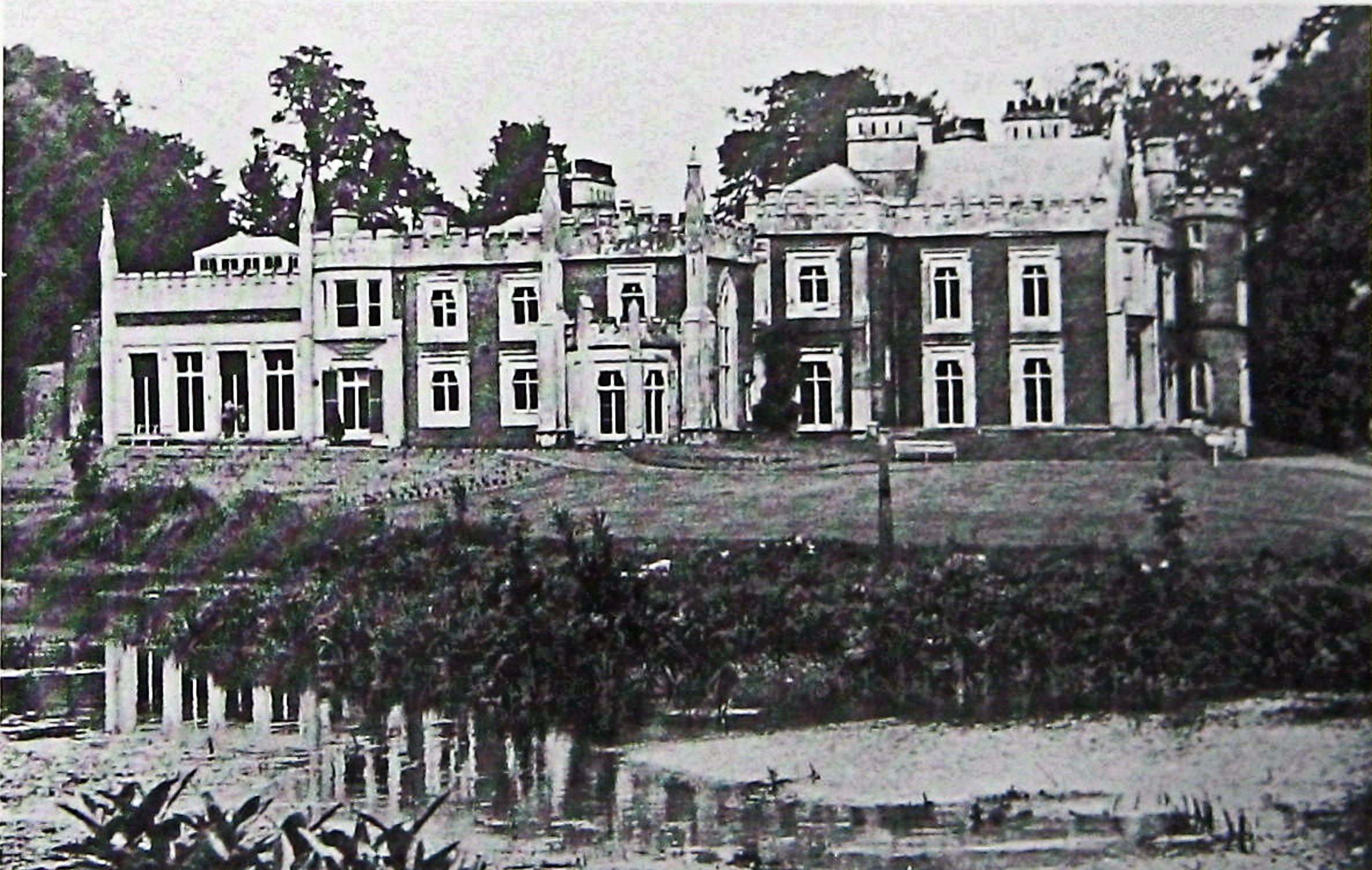
John Minet Fector was very popular with Dover town’s folk having always provided employment when it was needed and he immediately boosted employment prospects by announcing that he was to build a mansion. This was to be within some 90 acres of woodland and meadows at the River Dour confluence ‘in style of an Abbey.’  The mansion and grounds were known from the outset as Kearsney Abbey.

Kearsney Abbey c1840 by Lynn Candace Sencicle

Kearsney Abbey c1840 by Lynn Candace Sencicle

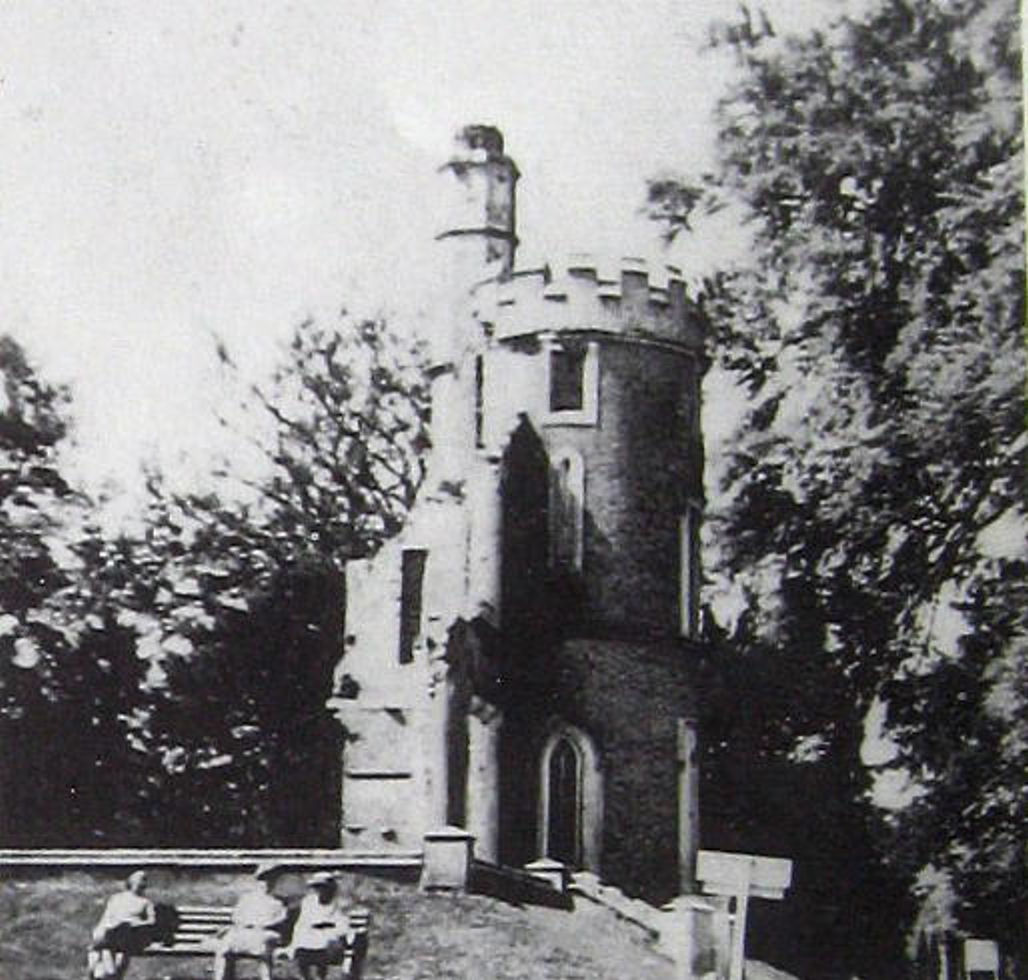
Architecturally, the final building was of the John Nash (1752-1835) picturesque Gothic style with a tower, crenellated parapets and supporting buttresses. It was possibly designed by Horton of Buckland, the architect behind the developments that were about to take place along Dover’s seafront. Most of the dressed stonework came from Dover buildings that were being demolished at that time. These included the medieval Town Walls and Gatehouses along Townwall Street and one of the two round towers from the harbour that features in the frieze of Henry VIII’s (1509-1547) departure to the Field of the Cloth of Gold (7-24 June 1520). This event is depicted in one of the Stone Hall windows in the Maison Dieu.

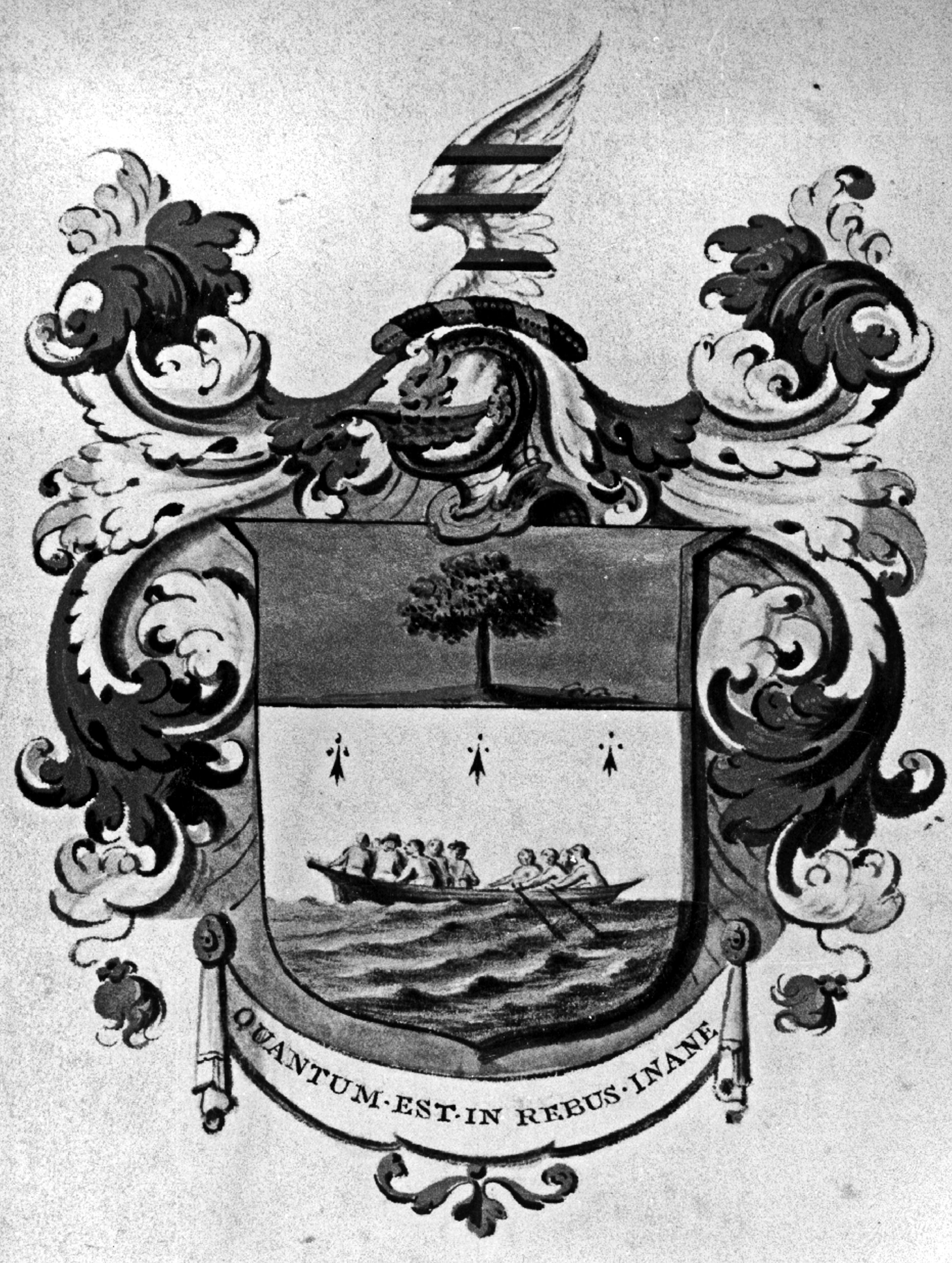
Minet Family Arms that were depicted in the windows of the billiard room . Dover Museum

Minet Family Arms that were depicted in the windows of the billiard room . Dover Museum

The main entrance was south facing and consisted of a magnificent lofty hallway with abbey style windows.  Off the hall was a drawing room – 28feet by 20feet and 14feet high; a dining room – 30feet by 21feet; a breakfast room, study and two wings. The east wing led to an oak-panelled library 32feet by 20feet and included a tower room. At the end of the west wing was an oak-panelled billiard room 29feet by 22feet and 22feet 6inches high with adjacent male boudoirs. Upstairs, along a corridor some 50feet in length were 13 bedrooms with dressing rooms en suite and 4 bathrooms. On the floor above were domestic workrooms and servants rooms. There was also a full suite of offices on the ground floor and in the cellars, patent iron wine bins. The windows of the billiard room were emblazoned with the Arms of the Fector, Minet and Laurie families. Close friends of both Anne and John Minet Fector, were the artistically minded George Jarvis and Sarah Gunman and they possibly influenced the design.

In the grounds was a laundry, dairy, orangery, stables for 12 horses, coach house with standing for 6 carriages and grooms room. 10 workers cottages were built and a gardener’s house. Estate buildings included barns, cow-house, piggeries, 3 acres of kitchen gardens, numerous forcing houses, small mill and an icehouse. An extensive park with four interlinked lakes was laid in the style of Humphry Repton (1752-1818) and planted with deciduous native trees and a variety of trees from North America including the Giant Redwood.

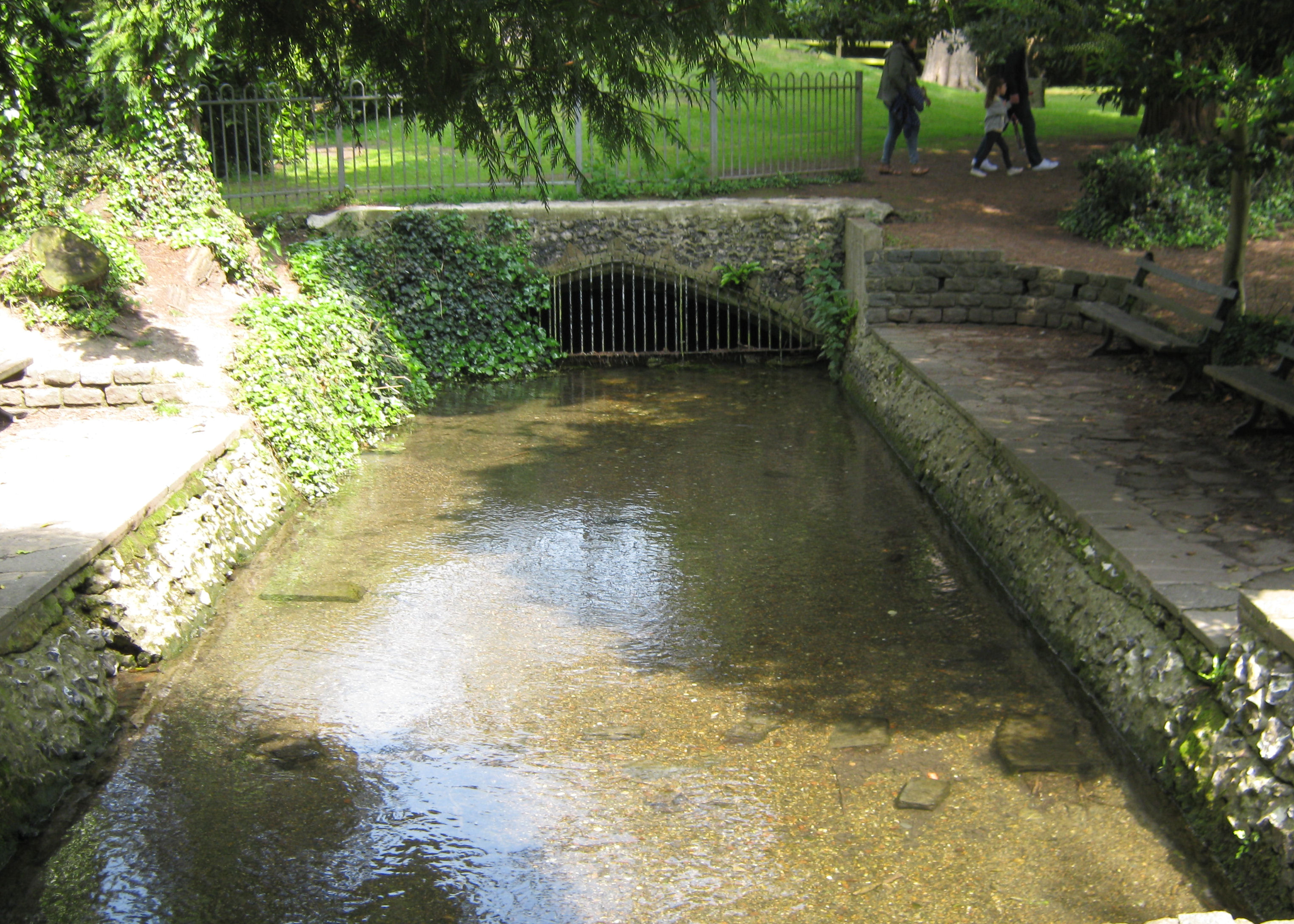
Kearsney Abbey - River Dour culvert for the icehouse. Lorraine Sencicle

Kearsney Abbey – River Dour culvert for the icehouse. Lorraine Sencicle

The icehouse was east of the main building and was a deep-bricked and later concreted. The ice was kept cold by a stream from the main River Dour coming into the Abbey grounds in a culvert from Kearsney Manor and originating at Watersend. The river water was carried in underground culvert to the icehouse and then was taken, in another culvert to supply was for the fountain in the middle of Kearsney Abbey Lake. Like many other similar country estates that had icehouses, the ice was hewn from icebergs or glaciers and brought in by ship. The ice was kept cool by the depth of the icehouse and the stream of fresh water. 

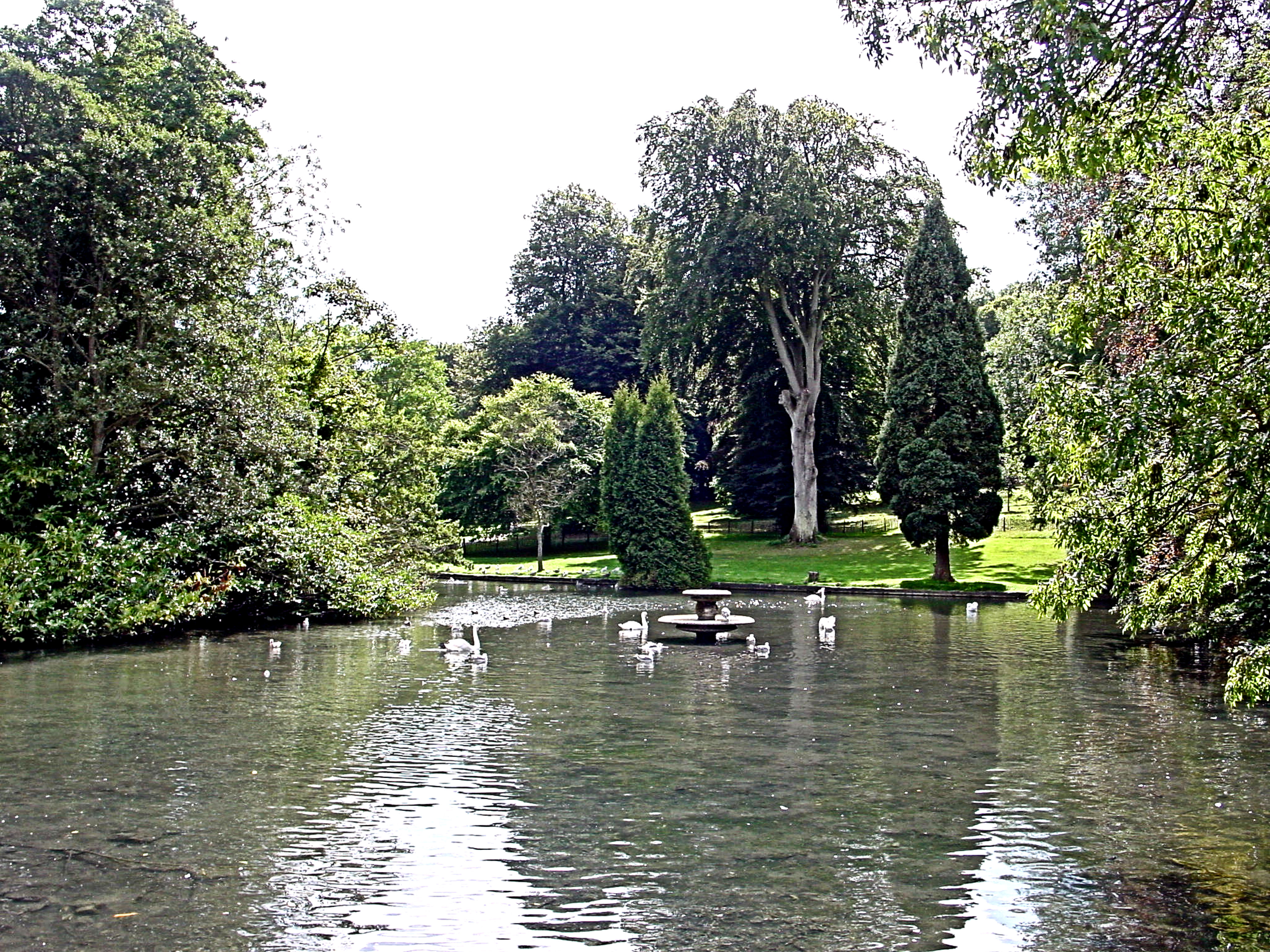
Kearsney Abbey lake, fountain and swans. Alan Sencicle

Kearsney Abbey lake, fountain and swans. Alan Sencicle

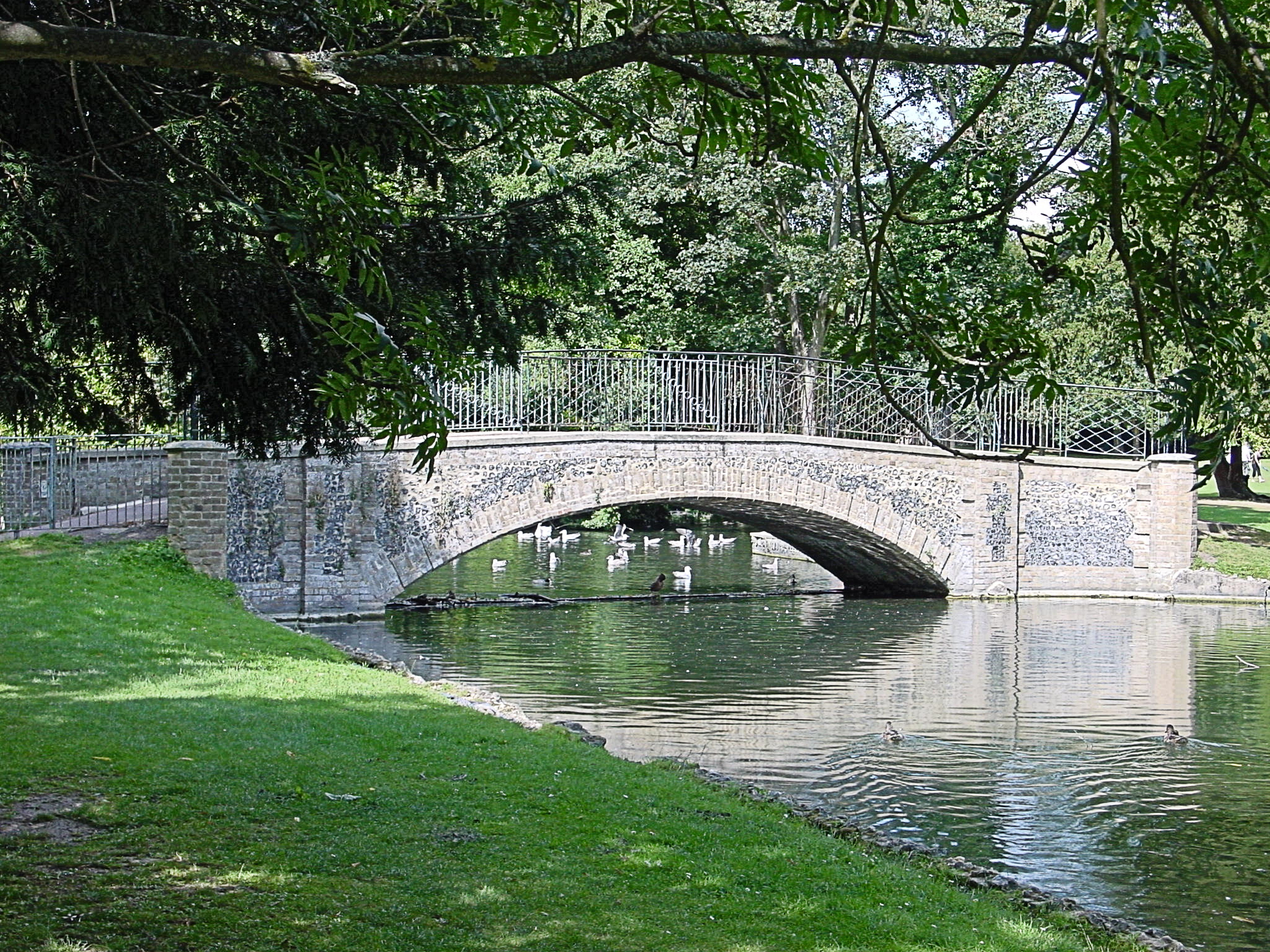
The lakes were created where streams from the two branches of the Dour united. Water from the Dour streams supported ornamental fountains that worked by a head of water pressure through pipes. An ornamental bridge with wrought iron railings was constructed and swans that had been nesting for centuries on the Alkham valley Dour tributary quickly made the lakes their home – both can still be seen. Over time the lakes became famous for trout fishing. John Minet Fector bought the old Town Mill erected in 1587, had it dismantled and rebuilt to a smaller scale to the south of the lakes. The internal workings were restored and used to pump water to the Abbey. The mechanism was still in use up until 1924. What remained of the mill was used to build the waterfall along with parts of the medieval Town Wall.

John Minet Fector, however, was never to see the town boom again or the completion of his Abbey for he suddenly died on 12 June 1821 at Kearsney Manor. The town was grief stricken with the funeral route, from the Manor to St James churchyard, lined by every man, woman and child in the district. Later a mausoleum was constructed in the churchyard. The Abbey was completed and furnished by the end of 1822 and Anne Fector with her children moved in. Their only son, John Minet Fector junior, born 28 March 1812, inherited Kearsney Abbey and on reaching the age of 21 his mother Anne moved back to Kearsney Manor and he became the master of the Abbey.

John Minet Fector junior aka Laurie. Dover Museum

John Minet Fector junior aka Laurie. Dover Museum

At the same time John Minet junior, as he was locally known, took over his father’s business enterprises and this centred on the Fector bank. Interested in local affairs he was determined to become one of Dover’s two Members of Parliament and made the South Eastern Railway (SER) line to Folkestone and Dover his principal concern. By 1835 he was one of the four trustees of SER and when the council wanted to buy the ancient Maison Dieu for a Town Hall, John Minet junior came up with a deal. He suggested that the silver his grandfather, Peter Fector, had bequeathed to the town together with the pieces of silver given by the family since, be mortgaged to the Fector bank, on which he would loan the £1,500 needed. The loan was to be paid back over 25 years and as a ‘goodwill gesture’, John Minet junior said that the council could borrow the silver for civic occasions. Dover Corporation accepted the offer.

In the general election of April 1835, John Minet junior was one of the two Conservative candidates elected. Shortly afterwards he purchased the hostelry, Little Waldershare, at the top of the old Castle Hill Road. He demolished the building and replaced it with Laureston House, named after Anne Fector whose maiden name was Laurie, and she moved in. From when John Minet junior became the master of Kearsney Abbey he was keen to add Dover’s associated artefacts. Typically,  in 1836, during the re-building of a corner shop betwixt Bench Street and Townwall Street, a ‘curious Gothic window’ was found. He had it built into the waterfall structure at Kearsney Abbey.

In 1836, the Dover Harbour Commissioners promoted a Parliamentary Bill to raise £60,000 in an effort to combat the reoccurrence of the age-old problem of the Eastward Drift that frequently blocked the harbour mouth with shingle. At the same time a proposal to turn Dover port into a Harbour Refuge was launched. Between 12 May and 7 June a Parliamentary Committee looked at the proposal and it was expected that John Minet junior would back it. However, an SER Bill was going through Parliament that was more to his interest and it received Royal Assent on 21 June. At the time, due to geological problems with the cliffs between Folkestone and Dover, there was talk of terminating the line at Folkestone. SER, with John Minet’s junior’s full backing, bought the run-down Folkestone harbour with the intention of turning it into their main harbour for crossing to the Continent.

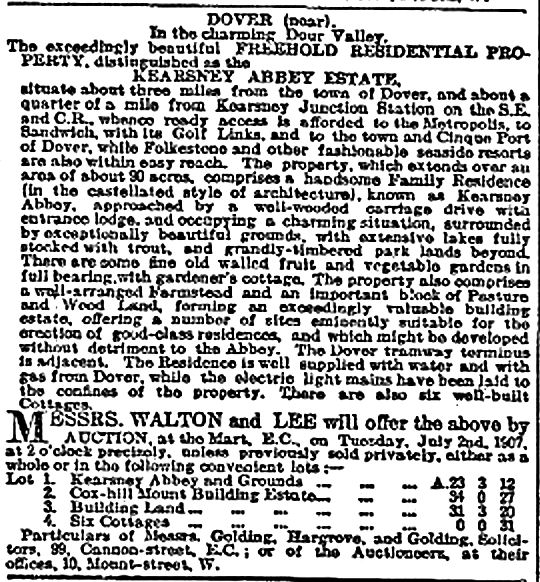
Advert for the sale of Kearsney Abbey August 1850

Advert for the sale of Kearsney Abbey August 1850

John Minet junior celebrated his 25th birthday on 28 March 1837 with a week of festivities at Kearsney Abbey. On the day of his birthday a special peal of bells was rung from both St Marys and St James churches. Following the ascent of Queen Victoria (1837-1901) on 20 June 1837 a general election was held but because of his lack of support for the Harbour of Refuge and his full support for the Folkestone harbour proposal, John Minet junior came bottom of the poll. His mother Anne moved to London where she died on 10 September 1848 and he became the elected representative for Maidstone. In January 1842 he amalgamated Fector’s with the National Provincial Bank, and assuming his mother’s maiden name of Laurie, became the chairman. He held that position until 1866 and died two years later. In 1844 John Minet junior had put all of the Fector properties on the market and the Kearsney estate of 11,000 acres was sold in October that year to E.C Jones for £57,000. The Abbey was described at the time as ‘erected in a monastic style … its romantic scenery engages the attention of every passing stranger.’

There was no one listed as resident at Kearsney Abbey in the 1847 Bradshaw and in September 1850 Kearsney Abbey was on the market again. It would seem that the portion between the waterfall and Minnis Lane, River was seen by a speculator as an ideal site to erect 20 cottages. According to the plans, these backed on to the Dour, which was to be used to fill each garden’s fish pond, but the plan came to nothing.  In 1854 the whole estate was on the market again and was bought by Ebenezer Fuller Maitland, High Sheriff of Berkshire and Deputy Lieutenant of the City of London. However, in the autumn 1857 Mr Maitland died and the Abbey was cleared of all furnishings. The Abbey was then available for renting with the advert stating that the grounds were only 15acres and asking intending tenants to contact a Mr Bockott or a Mr Bailey – both having London addresses. In the spring of 1859 the Kearsney Estate was on the market again.

Kearsney Station c1900. Eveline Larder

Kearsney Station c1900. Eveline Larder

An Act of 1853 had led to formation of the East Kent Railway, and on 22 July 1861, having successfully changed their name to the London, Chatham and Dover Railway, the Company opened the line from London to Dover Priory. The station before Dover Priory was at Kearsney with Halts in between. The Kearsney station had a small goods siding and platforms for passenger trains to serve the villages of River and Temple Ewell. Not long afterwards the development of the hamlet of Kearsney began. The opening of the railway line to Kearsney was subsequently used as a selling point following EC Jones repurchasing the property. He put the Abbey along with Kearsney Manor on the market stating that London was only 2hours away by train from Kearsney station and that the continental packet service only 3 miles away.

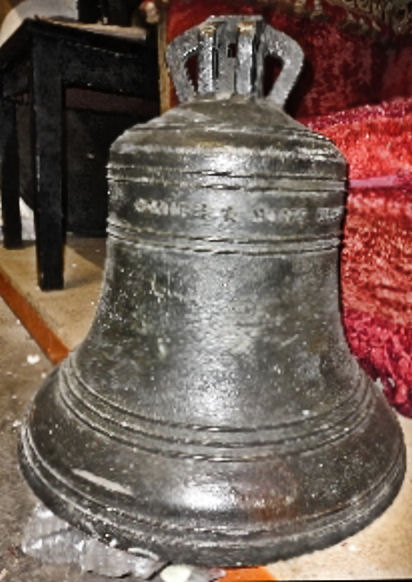
Kearsney Abbey Bell cast 1867-8 by Mears and Stainbank of Whitechapel. Dover Museum

Kearsney Abbey Bell cast 1867-8 by Mears and Stainbank of Whitechapel. Dover Museum

It would appear that the Abbey was leased out for there is a bell dated 1868, marked ‘Smith and Sons Clockmakers, Clerkenwell’ and made by Mears and Stainbank of Whitechapel that came from the Abbey. The bell is now at Dover Museum. During the Easter weekend of the following year, 1869, the grounds of the Abbey were open for visitors during the annual Volunteers review held in the town. That year however, the weather was atrocious and in the early hours of 29 March, Easter Monday, the crew of 17 men, 8 stewards and 86 boys including some of the boys from Dover’s Sea Scouts – later Sea Cadets – were rescued when the training ship Ferret hit the Admiralty Pier.

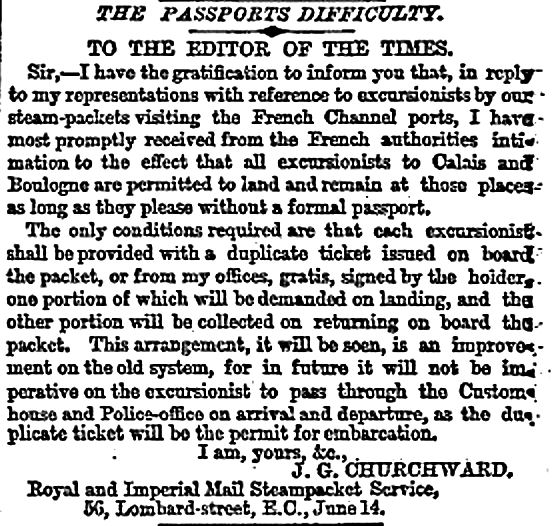
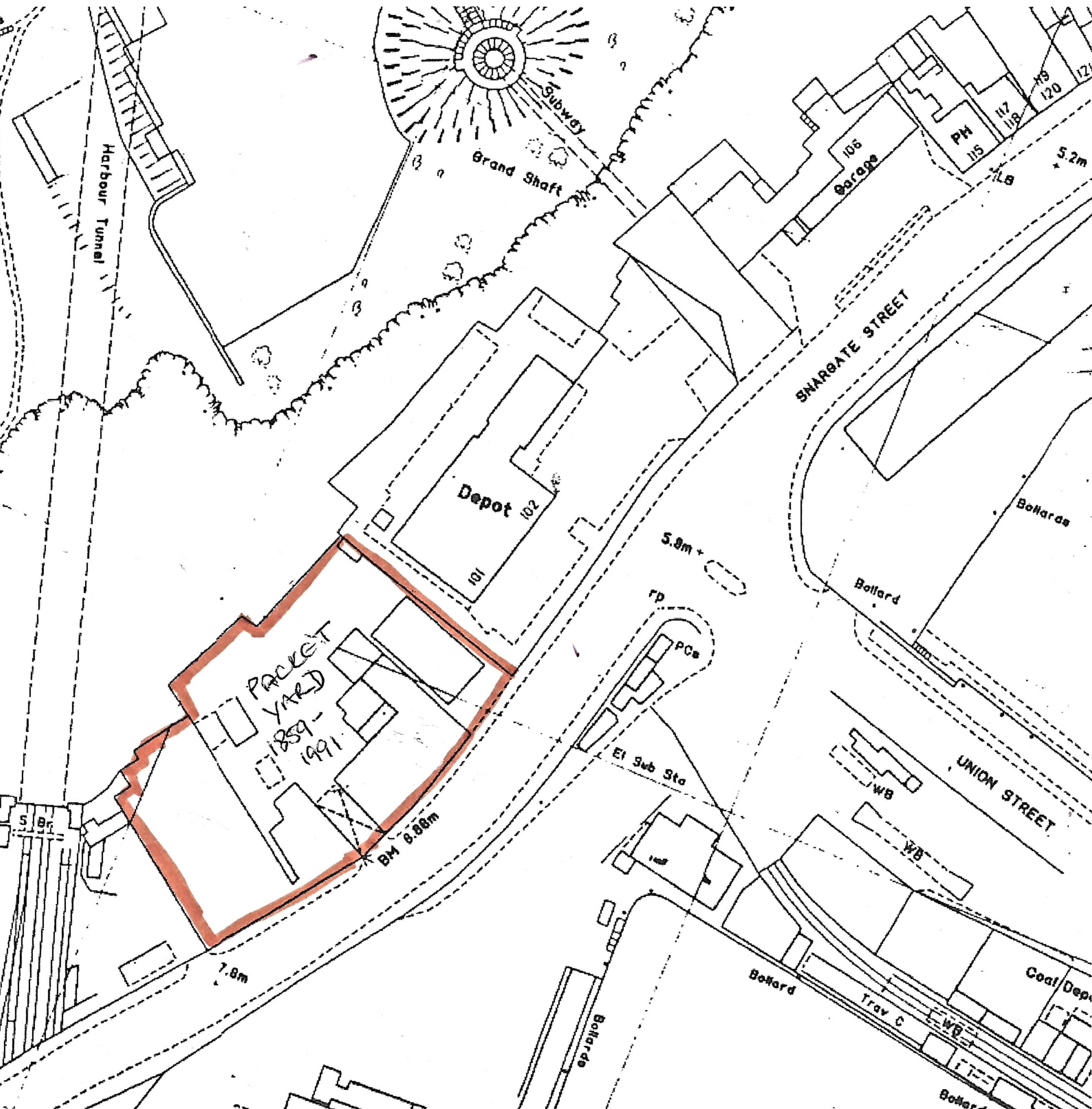
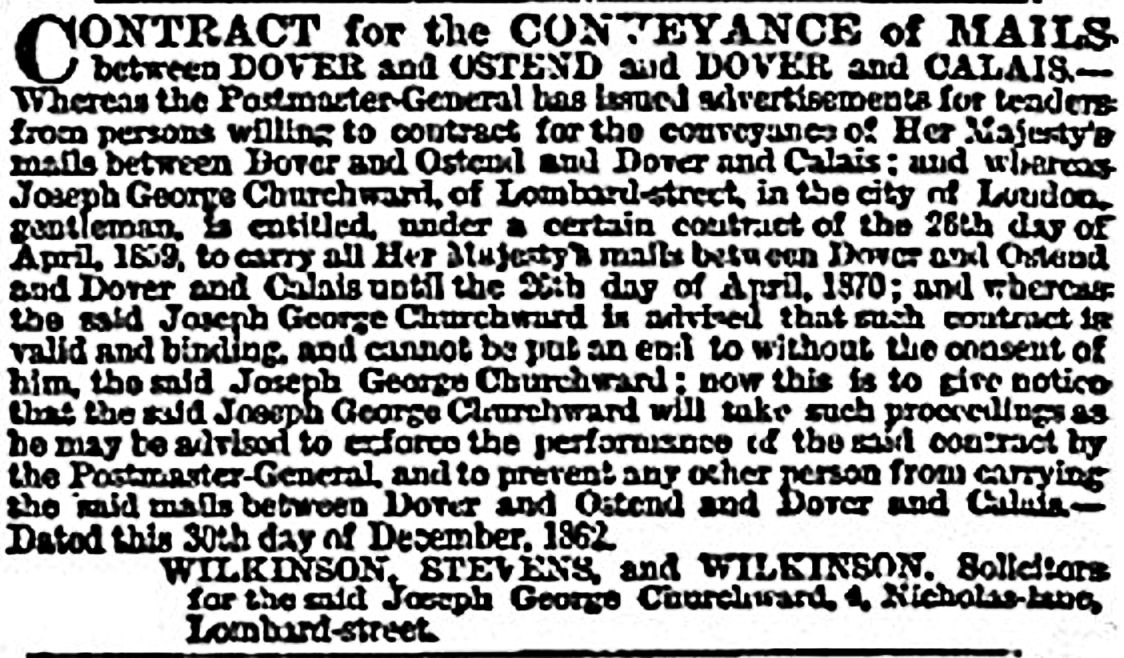
In 1870, The Kearsney estate including the Manor was bought by Dover’s former Mayor, (1867) Joseph George Churchward, for £10,500. Journalist and entrepreneur, Churchward came to Dover in the early 1850s to take over the Packet Service when it was franchised to the private sector. He lost the franchise to the London, Chatham and Dover Railway Company in 1863 but negotiated an excellent price for his ships, offices and the Packet yard – which he founded. Heavily involved in local politics, Churchward owned two local papers and used them to the full to influence the electorate.

The census of 1871 lists Churchward, his wife Annabella and four of their children, George, Rose, Charles and Alavic as living at the Abbey. There the family were attended by a full retinue of servants under the charge of an imposing butler named Sutter Sulliman from Persia. The only daughter, Rose, married in Westminster Abbey in February 1874 but in September the following year Churchward, put Kearsney Abbey on the market and moved to Kearsney Manor. During his tenure, Churchward had ‘modernised’ the Abbey however, in what way is unclear. It was sold by private treaty to Francis Lyon Barrington, the Sheriff of Durham, the following year. Although only 47, Barrington died in the spring of 1877 and the whole 90acres of the Abbey estate was on the market again. Patent iron wine bins that were bought in the 1820s were sold as a separate item.

John Henry Wellington Graham Loftus, fourth Marquis of Ely (1849-1889) bought Kearsney Abbey as a country estate and it would seem that it was he who had the aviary erected. It is known that the Marquis had culverts installed to regulate the flow of waste water from the mills upstream to prevent the lakes from flooding. The culverts were capped and are still there. During work carried out in 1974, it was found that the culverts lay on an ancient rough flint track.

By 1882, the whole of the Kearsney estate had been split with 26acres of the land to the north of the Abbey and west of the Manor, sold. There Kearsney Court was built. The 90 acres that made up the Kearsney Abbey estate remained in the possession of the Marquis of Ely but he died suddenly on 4 April 1889 in Nice, south of France. The Marquis had married Caroline Caithness in 1875, but they did not have issue. Even though his cousin succeeded him to the title, Lady Caroline owned Kearsney Abbey.

Immediately following the funeral Kearsney Abbey was put up for auction but it was not until 1892 that Faversham gunpowder manufacturer, Charles William Curtis (1824-1905), bought it paying £17,000. Curtis was a descendent of Sir William Curtis (1752-1829) Lord Mayor of London and MP for the City. Sir William also owned Cliff House, Ramsgate, where on 24 and 25 September 1821, George IV (1820-1830) stayed and granted Ramsgate harbour Royal status. Sir William erected a monument to this effect and on an island in one of the Abbey lakes Curtis placed a miniature replica. The 1901 census lists Kearsney Abbey as having 14 domestic staff including a butler.

That year a syndicate was formed by Dover Harbour Board chairman Sir William Crundall (1847-1934) and included Weetman Dickinson Pearson – 1st Viscount Cowdray and John Jackson (1851-1919). At the time, all three were involved in the building of the Admiralty Harbour and the Dover, St Margaret’s and Martin Mill Railway Line. Crundall was also the Chairman of the privately owned Dover Electricity Company and the syndicate proposed to build a tram/railway service powered by electricity. The line was planned to run from the Dover-Deal railway on Crabble Hill to St Peter & St Paul’s church, River, and then through Kearsney Abbey to the Alkham Valley terminating about a quarter of a mile north of the road leading to Chilton Farm. Curtis objected and although an official inquiry in 1902 gave permission for the tram/railway project to go ahead it stated that the line was to terminate at Minnis Lane, River. In the event this became a tramline.

Hardly had the dust settled when Curtis was making more objections. This time it was over a proposal to extend Dover Borough boundaries to include River and part of Temple Ewell parish. At the public inquiry the opposition was vociferous and although the extension was granted to include River and Kearsney this was only as far as the Railway Bell on the London Road. Temple Ewell, Kearsney railway station, Kearsney Manor and Kearsney Abbey remained part of the Rural Council.

St Peter and Paul Church River. Gareth Moore - Original Dover Memorial website

St Peter and Paul Church River. Gareth Moore – Original Dover Memorial website

Both Curtis and his wife, Henrietta Francisca, had quickly assimilated themselves into the local community with Curtis taking the role of a benevolent country squire. He actually looked the part as he had ‘cherry face and well developed features’. Active in local matters Curtis gave generous donations to local charities and every year the couple entertained the River Sunday School in the grounds of the Abbey. Indeed, when Curtis died at the Abbey on 5 May 1905, age 81, it was reported that the whole village of River turned out to his funeral held in St Peter and Paul’s Church.

Major-General Simpson put the Kearsney Abbey Estate on the market dividing it into four lots. June 1907

Major-General Simpson put the Kearsney Abbey Estate on the market dividing it into four lots. June 1907

The next occupant of Kearsney Abbey was Major-General William Henry Randolph Simpson (c1830-1910) and his wife Catherine. Soon after they moved in, the Major started to run the household down including closing the laundry and in 1907 the estate was on the market again. The Abbey estate was described as being well wooded and having a carriage drive to the entrance lodge. The lakes were fully stocked with trout and there were walled fruit and vegetable gardens, grandly timbered parkland, gardeners’ cottages, farmstead with pasture and woodland ‘eminently suitable for good-class residences, which can be developed without detriment to the Abbey.’ The Abbey along with other residences on the estate were supplied with water and gas from Dover, while mains electricity cables had been laid ‘within the confines of the properties.’ The adverts finished by acknowledging the close proximity of the tram route and to ensure a good price, the Major was selling the estate in four lots:

1. Kearsney Abbey and Grounds – approximately 23acres

2. Cox-hill Mount Building Estate – approximately 34 acres

3. Building Land – approximately 31 acres

4. Six Cottages plus land

It would appear that the asking price for Kearsney Abbey was not reached, for following the death of the Major in 1910, Catherine Simpson still owned the property. She re-opened the laundry and made a number of internal alterations that included modern conveniences. She then leased the Abbey to American author, Benjamin Franklin Lieber (1853-1915) of the Lieber Code Company, New York. Mr Lieber and his family used the Abbey for a summer residence until his death in 1915. Mrs Simpson put the Abbey on the market and in the summer of 1919, the contents were put to auction. These included a collection of English and Italian furniture such as a carved oak dining table, Venetian and Florentine carved walnut cabinets, chairs, table and screen, ‘Calrene’ drawing room appointments inlaid with mother-of-pearl and ebony – the chairs and settees covered in ‘Borg du Barry’ silk damask. Bedroom furniture of similar quality ornaments, a well stocked wine cellar, household effects and Turkish, Wilton and Axminster carpets. Also for sale was a 28-30horse-powered dark green Humber limousine car with grey upholstery and bodywork made by Starey and Woolley of Nottingham. In March the following year, the farmland was on the market as building land. Having remarried, Catherine died in Monte Carlo in February 1926.

Professor Mark Purcell Mayo Collier (1857-1931) purchased the Abbey in 1920. Known as Mayo Collier, he was an eminent London surgeon that in 1878, had made a name for himself as the medical officer in charge of the Dardanelle’s Expedition during the Russo-Turkish war (1877-1878). On returning he set up as surgeon on Harley Street specialising in afflictions of the Ear, Nose and Throat, and was the consultant to a number of London Hospitals. Eventually Mr Collier was appointed Professor of comparative anatomy and physiology at the Royal College of Surgeons. Immediately on purchasing Kearsney Abbey, Professor Collier’s wife, Florence ‘Queenie’ born in British India in 1873, took control. The Abbey was refurbished and refurnished, ten servants including a butler and a footman were employed, plus gardeners and coachmen. However, in March 1924, the fully furnished Abbey was on the market again and again every year until 1930. Queenie Collier, it would seem, was not altogether in agreement with this as, concurrently, she placed adverts for servants and was very specific in her requirements. For instance, in 1926 she required a ‘Useful man … who must be intelligent, tall of good appearance, accustom to the care of dogs and not under the age of 24years.’ As time past, the age requirement of Mrs Collier’s male servants was increased to 30years and over. They also had to be teetotallers and non-smokers.

Professor Mayo Collier died at Kearsney Abbey on 20 September 1931 aged 74 and following his death Queenie remained at Kearsney Abbey. Occasionally Frederick E Murray-Collier stayed albeit,  Queenie was an active participant in Dover’s social life and had a box permanently reserved at the Dover Hippodrome on Snargate Street. In 1933 there was great excitement when the gardeners, dredging the Kearsney Abbey lakes found a locked strong box. It transpired that it had been stolen from St Augustine’s church, East Langdon the year before along with candlesticks and the church records. However, in 1937, Queenie decided to move to Folkestone and the Abbey was put on the market again. The description of the internal and external structures showed very little change while in the grounds, the estate was listed as having a laundry, dairy, orangery, stables and garage, 10 cottages, farm buildings and parkland. On leaving the Abbey, Mrs Collier wanted to take furniture, furnishings, linen, paintings and household effects plus two tons of silver ornaments, cutlery etc. to her new home. The carrier organising the removal agreed except for the silver which he feared would lead to his lorry being hi-jacked. Eventually a compromise was reached whereby the carrier moved all the other items during the day and the silver, ‘secretly’ in the middle of the night!

In March 1938, a proposal was put forward to develop what had been described as the 34 acre Cox-hill Mount Building Estate back in 1907. This was for 105 houses and 5 shops and put forward by K O Martin and W E Hollis. The proposed development was divided into five sections:

Section I – Chilton Way – An extension of Lewisham Road, laid out to a width of 30-feet with footways 5-feet wide and an additional 200-foot of grass verge which would enable the street to be widened to 50-feet in the future.

Section 2 – Chilton Way – A continuation of the above to a width of 30-feet, with footways 5-feet wide.

Section 3 – Coxhill Gardens – To be of a width 30-foot, with footways 5-feet wide.

Section 4 – Coxhill Gardens – A continuation of the above for a length of less than 500-feet to be of a width of 24-feet, with footways 4-foot 6-inches wide.

Section 5 – Chilton Close – An approach road on the west side of Chilton Way Section 2 and to be 14-feet wide with a pathway of 4-feet wide on one side.

The proposal was given approval and by the end of the year the development was partially built.

At the start of World War II (1939-1945) Kearsney Abbey was commandeered by the War Department as an Auxiliary Territorial Service Operation’s establishment and Headquarters of Number 2 Searchlight Regiment. The Auxiliary Territorial Service, better known by its acronym ATS, was the women’s branch of the British Army during the War and was founded in September 1938. In a report, prior to the end of the War, it was suggested that once the Army moved out, the Abbey and grounds should be bought for housing. Following the War, in June 1945, Dover Borough Council (DBC) commissioned town planner, Professor Abercrombie (1879-1957) to draw up plans for war-torn Dover. He dismissed the housing notion and instead suggested that Kearsney Abbey and grounds should become a recreational focal point by creating a ‘a pleasant riverside walk from the Sea Front to Kearsney Abbey.’

Hilton Ernest Russell the main driving force behind Kearsney Abbey being used for public recreation.

Hilton Ernest Russell the main driving force behind Kearsney Abbey being used for public recreation

The River Dour walk, as visualised by Abercrombie, is still the dream of many Dovorians but at that time along with Kearsney Abbey being used for recreational purposes, the notions were dismissed as ridiculous.  Nonetheless, Councillor Hilton Russell – Mayor of Dover in 1928 and 1929 – endorsed the idea. DBC bought the Abbey and 25 acres of land for £10,000 but the general consensus was that the Abbey should be demolished and the land redeveloped for housing. Cllr Russell stuck to his guns arguing that the Abbey should be leased for educational purposes for 4 years, until a final decision was made on its future. In 1946 Cllr Russell made his stance an issue during the local elections but lost his seat. A few days later the Dover Rural District Council (DRDC) elections were held and Cllr Russell was elected to represent Temple Ewell.

Lack of money and material resources precluded any housing development taking place so DBC neglected both the Abbey and the grounds. Although these were owned by DBC they were within DRDC’s boundaries and when Cllr Russell was appointed to the DRDC Pleasure Grounds Committee he put pressure on DBC to restore both the Abbey and the grounds. DBC argued that it would cost £30,000 to restore both – money better spent on new housing. Neither Cllr Russell nor the DRDC would give up so DBC asked the Boundary Commission to bring the Abbey and grounds within their jurisdiction. Under the controlling influence of the formidable Town Clerk, solicitor James A Johnson, DBC put forward a strong case. However, at the end of June 1949 the Boundary Commission was wound up and Kearsney Abbey remained within DRDC’s domain.

Two months later part of the Abbey grounds was sufficiently renovated to allow public access. However, in November that year, DBC submitted a Bill in Parliament to bring within the Borough part of the Buckland Housing Estate and in a sub-section added Kearsney Abbey and Grounds. Although RDC did object, only 23 people turned up to the public meeting called by the council to approve a Parliamentary Bill to extend the boundaries. The Bill received Royal Assent in 1950 and came into force in April 1951. The boundary stone to mark the event can be seen outside the Abbey grounds on the Alkham Valley road.

Shakespearian Play Coronation year - 1953, Kearsney Abbey probably taken by Ray Warner. Tom Robinson Collection

Shakespearian Play Coronation year – 1953, Kearsney Abbey probably taken by Ray Warner. Tom Robinson Collection

The newly acquired park land was tidied up and as a contribution to the town’s Festival of Britain celebrations that year, on specially constructed grass staging, the Dover Players put on a production of A Midsummer Night’s Dream. Founded by Janet and Malcolm (Mac) Young the chairman of Dover Players, local photographer, Ray Warner (1914-1989), had suggested the idea of this outdoor setting. Over 4,000 people attended and the event became regular feature in Dover’s calendar for over 15 years.

In 1950 Cllr Russell was appointed chairman of the RDC’s Pleasure Grounds Committee and successfully piloted the scheme to purchase the gardens of Kearsney Court and to return them to their former glory. Named Russell Gardens, they were formally opened in May 1951 and were immediately seen as a jewel in the RDC crown. While in 1952 the newly launched Dover Archery Club were given permission to use part of Kearsney Abbey grounds for target practice and in 1953, with the Coronation of Queen Elizabeth II, the grounds played a key part of the Dover celebrations.

Kearsney Abbey 1950s. Tom Robinson

Kearsney Abbey 1950s. Tom Robinson

Throughout this time talk over the future of Kearsney Abbey centred on the demolition of the building and selling of the land for development. The building had been empty since 1945 with no attempt at making repairs let alone refurbishing and this was of concern to an increasing number of locals. Towards the end of the War the Dover Excavation Committee had been set up with the prime objective to examine and record as much of the blitzed areas as possible before rebuilding started. Once building started, perfectly good or repairable buildings, many ancient, were demolished in the name of progress. The Dover Excavation Committee started to challenge this and so their funding was cut and they were officially disbanded. Nonetheless, former members remained particularly vociferous over Kearsney Abbey and were increasingly being supported by the general public.

 Remains of Kearsney Abbey's east wing after the partial demolition. Tom Robinson

Remains of Kearsney Abbey’s east wing after the partial demolition. Tom Robinson

Reluctantly, DBC promised to spend money on refurbishment but first they commissioned a survey on the state of the Abbey. Carried out by the Borough Engineer, and in his report of 24 February 1959 he stated that ‘a detailed examination of the surviving part of the mansion at Kearsney Abbey has disclosed that the whole of the timbers of the top storey and the roof are affected by dry rot, and the wooden lintel supporting the wall over the bay of the east wing is also affected, as result of which cracks have appeared in the wall above, that there are numerous other minor defects.‘ He recommended that, ‘no further expenditure  be incurred on the building, that with the exception of the tearoom and the lean-to kitchen, the whole of the remaining part of the building be demolished.’ The report was approved but it brought about a public outcry with a demand for an independent survey and a collection was started to undertake this. 

In February 1960, the council accepted the offer of £231 for the right to demolish the suggested part of Kearsney Abbey from the Dover Demolition and Erection Company. For a while the remaining part, which included the tower, stood forlornly until the demolition contractor offered to pay the council £2,000 to demolish it. His caveat was that he kept the debris along with the remains from the earlier demolition and this was agreed. When he finished, all that remained of the Abbey was the old billiard room/tearoom, and that was because it had been earmarked for use as an office. At the time, consideration was being given to using the grounds for overnight parking to relieve local roads and car parks from caravans destined to cross the Channel the following day. However, when various building proposals were suggested for the site, the caravan park idea was dropped.

TH. Kearsney Abbey Midsummer Night's Dream 1962 programme listing Jeffry Archer as Puck. Penny Kenton-Russ

Kearsney Abbey Midsummer Night’s Dream 1962 programme listing Jeffry Archer as Puck. Penny Kenton-Russ

Theatrical productions at the Abbey and on 3rd – 7th July 1962 saw the Dover Players put on another production of Midsummer’s Nights Dream. This was part of Dover’s Elizabethan Week whose President was the Countess of Guilford supported by 20 Vice-Presidents. They included Dover’s MP – Sir John Abuthnot (1912-1992), the Mayor Alderman Arthur Husk (1900-1973), senior officers of Dover’s military establishments and representatives of Dover’s maritime and business communities. The cast and production management consisted over nearly 100 personnel and included the Physical Education teacher at Dover College who played Puck. He was none other than the former politician turned author, Baron Archer of Weston-super-Mare, better known as Jeffrey Archer!

1964 saw David Ennals (1922-1995), who knew little about Dover, capturing the parliamentary seat with the slender majority of 418 votes. One of the first things that Ennals did was to form the New Dover Group, to provide him with information and ideas for his new constituency. Initially the membership was by invitation, but soon the Group divorced itself from its political origins, opened its doors to all residents of Dover and those interested in the town. Becoming an amenity group, one of the first projects was to try and save the Kearsney Abbey grounds from development. They also took up the Abercrombie concept of a riverside walk between Kearsney Abbey and the seafront. DBC accepted, in principle, the dedication of a metre wide strip adjoining the Dour, for this path, whenever planning consents were granted along the Dour.

Part of the Kearsney Abbey estate, before the War, were the cottages along the Alkham Road. These, by this time, were dilapidated. The town was split between having them condemned and demolished and the New Dover Group, who wanted them renovated – DRDC, in whose authority they were, voted to have them renovated. Then, in 1970, to raise finance, DBC put part of the Abbey grounds on the market for development and attractive offers came pouring in. At the same time Kent County Council (KCC) were becoming increasingly concerned that much of what was left of old Dover was succumbing to demolition in the name of progress. That year they designated large areas of the town as conservation areas and although these did not include Kearsney Abbey grounds, the New Dover Group hoped that what had happened would be seen as a warning shot.

The remains of Kearsney Abbey Wall, Alkham Valley Road now had English Heritage Grade 2 listing. Alan Sencicle

The remains of Kearsney Abbey Wall, Alkham Valley Road, now had English Heritage Grade II listing. Alan Sencicle

However, in January the following year KCC, having voted to widen the Alkham Valley Road, obliged DBC to ask the Minister of the Environment for permission to sell them a strip of land for the purpose. Permission was given on the understanding that a new high wall was built at the expense of KCC to replace the one that had to be demolished for the scheme. What remained of the wall later received English Heritage Grade II Listing.  Albeit, DBC, against strenuous opposition of the New Dover Group, sold the Abbey kitchen garden and paddock, close to Lewisham Road for development.

Three years later, on 1 April 1974, due to Reorganisation of Local Government, DBC along with DRDC and other local councils in the area were amalgamated to form Dover District Council (DDC). Within two months, the newly formed DDC purchased Bushy Ruff House and its 26 acres, on the Alkham Valley Road, for about £90,000. The house and grounds are next to Russell Gardens that were inherited by DDC from DRDC through the Reorganisation.

Kearsney Abbey Tree planting ceremony by Mayor Peter Mee . This was the last act by Dover Corporation in 1973 before Reorganisation. Dover Museum

Kearsney Abbey Tree planting ceremony by Mayor Peter Mee . This was the last act by Dover Corporation in 1973 before Reorganisation. Dover Museum

The following year an appraisal of the state of the trees within the Abbey grounds was undertaken and it was found that some were significant in their own right. They included Yew trees (Taxus baccata), an Indian Bean tree (Catalpa bignonioides) – a native of the Eastern United States, Cedar of Lebanon (Cedrus libanil) Atlas Cedar (Cedrus alantica), Deodar (Cedrus deodara) – a native of the Himalayas and one of the first introduced into Britain, Weeping Ash (Fraxinus excelsior C. var Pendula), Common Lime (Tilia vulgaris) Evergreen Oak (Quercus Ilex). A purple Copper Beech (Fagus sylvatica C. var Cuprea) was identified and was believed to be a survivor of five which, according to legend, had sprung up in Zurich, Switzerland, on the spot where five brothers had killed each other. However, further examination showed that the Kearsney Abbey tree had been grafted at a height of about four feet.

The swans were still nesting at the Abbey, as the grounds are generally called and a pride of three peacocks were given a new home there. They were joined by silver pheasants, ducks, moorhens, coots, Chinese, Canadian and greylag geese, some of these birds were introduced, others arrived on their own accord. The peacocks, unfortunately for householders in the neighbourhood, used their island home as a base from which they plundered gardens. As they became bolder, having enjoyed a good meal, instead of flying back, they walked along the centre of neighbouring roads to the Abbey causing traffic mayhem! To deal with the increasing problem, the peacocks’ flight feathers were cut on a regular basis, also a bird-feeding budget was ring fenced. Voluntary wardens were appointed, one of which was Brenda Pittaway.

Kearsney Abbey DDC Garden Party advert June 1991

Kearsney Abbey DDC Garden Party advert June 1991

In the 1980s DDC introduced the policy of making Dover a tourist destination. This was welcomed by the town’s folk and initially was within budgetary possibilities. Then consultant expertise was brought in and costs escalated as the expensive White Cliffs Experience (WCE) was introduced as the lynchpin attraction. The DDC Tourism and Amenities department was disbanded on 31 March 1987 and the running of parks and open spaces came under the auspices of the Director of Planning and Technical Services. The WCE was to be paid for by the selling of Dover’s open spaces including Kearsney Abbey. There was immediately a public outcry and DDC quickly dropped the idea. Instead, they announced that Abbey grounds were to receive a makeover and besides a public amenity, they would be used for civic functions. Particularly, there would be an annual civic party to which a wider cross-section of local interests and voluntary organisations would be represented. This idea, although short lived, proved successful. At the same time, regular Sunday afternoon band concerts were introduced during the summer months and the Abbey was increasingly used for fun activities organised by the White Cliffs Countryside Project (now White Cliffs Countryside Partnership).

Kearsney Abbey - the white building is the former billiard room now a tea room. Alan Sencicle

Kearsney Abbey – the white building is the former billiard room now a tea room. Alan Sencicle

In 1989 brown rot was found in the only part of the Abbey that was left standing – the billiard room/tearoom. The council’s initial reaction was demolition especially as it would cost £5,000 to deal with the problem together with refurbishment. Further, the car park and footpaths needed resurfacing, costing a further £3,500 and there had also been a number of complaints about the misuse of a designated bar-be-cue site within the grounds. After much debate, it was decided to undertake the resurfacing and relocating the bar-be-cue area but the cost of demolishing the tearoom was prohibitive! Nearly a decade later and very little had been undertaken to deal with the Grade II Listed tearoom problems. With the aim of preservation, architects at DDC designed a timber framed veranda-style extension but English Heritage did not approve demanding a full restoration. Councillors made it clear that in their opinion the existing building was long out of date but did acknowledge that the tearoom made approximately £15,000 a year profit.

Kearsney Abbey Lake and Grade 2 Listed bridge. Alan Sencicle

Kearsney Abbey Lake and Grade II Listed bridge. Alan Sencicle

In 2000 the then DDC Director of Planning, now Chief Executive, Nadeem Aziz announced that the feeding budget of swans at the Abbey was to be stopped and councillors were suggesting that some of the swans should be culled. At the time there were 41 swans, the same number as there had been for the previous 11 years. In a letter to the Kearsney Abbey voluntary warden, Mrs Pittaway, Mr Aziz said that the number of swans were causing an increase in salmonella and streptococci in the water and the excessive number of birds meant that large areas of the lawns were unsuitable for public access. Mrs Pittaway, was mortified and a public outcry ensued followed by a public meeting. There, Dr Jane Cuthbert, an independent scientific adviser, showed that the councils argument on bacteria was flawed. The Egham based Swan Sanctuary tested the water and found no evidence to linking any bacteria with the swans while it was generally stated that the grass around the lakes was mowed so short that it was inevitable that at times it was a quagmire.

Kearsney Abbey - Dover Express 23 April 2015

Kearsney Abbey – Dover Express 23 April 2015 –

The council backed off and the swans along with other waterfowl are still there and the Abbey grounds remain amongst the most attractive in the county of Kent. Occasionally would be building developers pass a covetous eye over the site and make attractive offers, though public feeling prevails against such outcomes. Even though, all but the repaired billiard room of the original building has been demolished, the former coach house and cottages on the Alkham Valley Road remain. All are English Heritage Grade II Listed. There are also a number of structures within the Abbey grounds that have this Listing including, the Bridge between two of the lakes; the remains of the original Wall and the Gate Piers; the Wall at the end of the final lake and the Ruins that form the waterfall. Recently, DDC have been awarded £3.3 million from the Heritage Lottery Fund and Big Lottery Fund’s ‘Parks for People’ programme to bring the Kearsney Parks to life.

  • Presented: 7 September 2015
Posted in Kearsney, Kearsney Abbey, Kearsney Abbey, Kearsney Abbey, Kearsney Abbey Mansion, Open Spaces, Tourism, Wanton Destruction | Comments Off on Kearsney Abbey

Dynasty of Dover part Vii, Fector – Jarvis

 View from the roof of the Fector Bank by George Jarvis. Western Heights on the left and Castle on the right

View from the roof of the Fector Bank by George Jarvis. Western Heights on the left and Castle on the right

Dynasty of Dover part vi, Fector-Jarvis, began with the Duke of Wellington (1769-1852) arriving in Dover following the Battle of Waterloo (1815) and centred on the wealthy John Minet Fector (1754-1821). He owned one of Dover’s two banks and a thriving shipping business. Taking his family on an extended tour of Europe in 1819, he left the banking side of his enterprises in the capable hands of his close friend, George Jarvis (1774-1851) and the shipping business was looked after by his equally competent nephew, Peter Fector (1787-1862). Following the end of the Napoleonic Wars (1793-1815) the British economy went into sharp decline, though Dover was able to survive for a short time after on the wealth created during the Wars.

Kearsney Abbey 1840 by Lynn Candace Sencicle

Kearsney Abbey 1840 by Lynn Candace Sencicle

By the time John Minet, as he was known, returned to Dover, the town was in the grip of the economic depression. John Minet’s solution was to build Kearsney Abbey and lend money to local businesses whom he thought had the ability to survive. This had taken its toll on his personal wealth and with the arrival of steam ships, following discussions with Peter and George, it was decided to allow the shipping part of the enterprises to run its course. That is, instead of replacing the Fector sailing ships with steam ships the business was to increasingly concentrate on the banking side. For this reason he had a new bank built on Customs House Quay, replacing the old Customs House that had been built in 1666. As the manager of the Fector bank, George had become friendly with James and his much younger wife, Sarah Gunman (See Dynasty of Dover part III – Gunmans) , who owned a large mansion with extensive grounds in the centre of Dover. On 12 June 1821, John Minet suddenly died and in his Will he had stipulated that George Jarvis should run the banking business until John Minet’s only son, John Minet Fector junior, born 28 March 1812, reached the age of majority.

From Saxon times Dover, as a Cinque Port, had a number of privileges in return for providing ship-service to the ruling monarch. These privileges included the full authority to deal with all criminal offences and the right to arrest, imprison or execute criminals arrested. The mayor passed all sentences, including those of death and in 1822 the Dover Mayor was Henshaw Latham. By that time, wooden gallows had become a permanent fixture on the rising ground to the left of what is now Tower Hamlets Road, opposite what was the Black Horse tavern – now the Eagle Hotel. The last Dovorian to be hanged there was Alexander John Spence who had been found guilty of shooting, during a confrontation,  Preventative Coastal Blockade Officer  Lieutenant Philip Graham working from the ship Ramillies based at Dover.

Plaque erected by the Dover Society on the Eagle Hotel, Tower Hamlets. Alan Sencicle

Plaque erected by the Dover Society on the Eagle Hotel, Tower Hamlets. Alan Sencicle

On the morning of Spence’s execution, 9 August 1822, the town turned out to watch the event and this included George Jarvis, Peter and most of the Fector family along with the Gunmans. All had paid £1.1s (£1.05p) to the Black Horse Inn for a good view and victuals. Spence arrived at the gallows accompanied by the hangman and Reverend John Maule of St Mary’s Church with local dignitaries travelling in covered carriages behind. Following the execution, Spence’s body was given to relatives for disposal and he was buried in St Mary’s Churchyard. The next year saw the last public execution in Dover and that was treated with equal public interest. The man found guilty of smuggling came from Margate. There is a plaque on the Eagle Hotel erected by the Dover Society.

Fanny Copeland (1801-1854), the daughter of Robert Copeland married Edward Fitzwilliam in 1822 and the Fector daughters who were in London at the time attended the celebrations. The Fector banking family once had a small theatre in the former Assembly House, close to present day 157 Snargate Street that was under the management of John Minet’s youngest brother, William Fector (1764-1805). One actress who played there was Ann Oakley the wife of Thomas Mantell, Mayor five times since 1793 and again in 1824. With finance from the Fectors, Mantell and others, in 1790, the larger purpose built Assembly Rooms opened and Robert Copeland was appointed manager. Fanny Copeland was born at the Dover theatre and was acting on the stage when she two. By the time she was in her mid-teens she was an accomplished actress and in 1830, she took over the management of Sadler’s Wells. At the time she was the highest earning actress in the country but died of cholera in 1854 and was buried in Kensal Green cemetery.

St Peter's Church River. Gareth Moore - Original Dover Memorial website

St Peter’s Church River. Gareth Moore – Original Dover Memorial website

27 July 1822 saw the marriage of Charlotte Mary Fector, the second daughter of the late John Minet, to lawyer and cricketer John Bayley (1793-1871), the eldest son of the Hon. Mr Justice John Bayley 1st Baronet (1761-1841), at St Peter’s Church, River. The match was a great delight to her mother Anne and George Jarvis. That year, on 5 December 1822, John Minet’s eldest daughter, Judith, married Henry Pringle Bruyere at the same church but the match was not well received. The relationship was long standing and John Minet had made arrangements that if the couple married, a special trust was to be set up on behalf of Judith. Following the wedding George carried out John Minet’s wishes and the £10,000 trust fund was formalised. Out of this Judith was paid a generous allowance in four instalments a year the amount increasing with the number of children she had. Only Judith had access to the fund for capital expenditure but this had to be countersigned by George until her brother, John Minet junior, came of age.

Pier House, Strond Street. Originally the Minet and the Fector family home before becoming the Fector bank until the Minet brothers set up their bank. Lynn Candace Sencicle

Pier House, Strond Street. Originally the Minet and the Fector family home before becoming the Fector bank until the Minet brothers set up their bank. Lynn Candace Sencicle 1993

Isaac and John Lewis Minet were cousins of John Minet Fector and on his death became the owners of Pier House in Strond Street and expected to take over the Fector bank based there. Under George’s management the Fector bank moved to Snargate Street so with the backing of London banker Lewis Stride, they opened their own bank in Pier House. One of the partners and the manager of Dover bank, Latham, Rice and Co, was Mayor Henshaw Latham, (born 1782). In 1822 the Dover Gas Act, which Latham had promoted, enabled the Dover Gas Light Company to be created. Prior to the passing of the Act, Dover streets had been lit with oil lamps that were introduced during the Napoleonic Wars. The Act gave the company the power to dig up streets, lay pipes and to raise £9000 capital in £50 shares. It actually stated that the ‘inflammable air,’ would be obtained from coal and ‘conducted to the street lamps and houses by means of tubes.’ The promoters for the company besides Latham included Isaac and John Lewis Minet, Lewis Stride, John Finnis, John Jeken, Michael Kingsford, Thomas Knocker and Thomas Mantell. Latham was appointed Chairman as he held the largest number of shares and the company’s gas works was on the site of the former Trevanion’s mansion on Woolcomber Street – the area where the swimming pool now stands. In 1824 gas lights were introduced on both pier-heads of Dover harbour and by 1828 it was reported that gas lighting was in general use, ‘not only in the streets, but in most of the principal shops and inns, and in some private houses.’ The price of gas was, at first, very expensive but fell during the first 27 years of the company’s existence.

In November 1822 John Jeken, who owned Castle Hill House, was elected Mayor for the first time and as such his major project was that of almshouses. Back in 1800 the Overseers of the Poor of St Mary’s Parish had made an effort to secure income for the relief of the poor from Dovers ancient Almshouses charity, held by the council, but were continually frustrated. In 1818, they submitted a case to the Court of Chancery arguing that the charity funds were being used by the Corporation as a pot of money from which it continually borrowed. Two years later the Lord Chancellor (1807-1827), John Scott, 1st Earl of Eldon (1751-1838) ordered that the accumulated fund of £1,657, including money owed by the council, was to be used to build almshouses. During his incumbency Mayor Jeken laid the foundation stone for seventeen new houses that opened in 1826 and for years after were known as Jeken’s Almshouses. They survived until 1970 when they were demolished to make way for the York Street by-pass.

Ship builders on Dover beach 1820 by George Jarvis

Ship builders on Dover beach 1820 by George Jarvis

By virtue of being the Mayor, John Jeken was also the coroner and an Inquest was held before him on 16 January 1823. This followed the death of William Cullen and three unknown persons forming part of the crew of the Three Brothers cutter. The highly respected Cullen was a member of Dover’s shipbuilding family and the deputed mariner of the Badger revenue cutter based in Dover. The Three Brothers cutter was brought into the harbour by the Badger and from the evidence presented it was learnt that the Three Brothers was seen about 3 miles off the French coast. Henry Wingfield, chief mate of the revenue cutter suspected she was involved in smuggling and the commander, Lieutenant Nazar, ordered a shot to be fired across her bows. Instead of heaving-to, the Three Brothers set sail and a running fight lasting 6½-hours ensued in which the three men died. On boarding the cutter it was found that she was carrying a cargo of tea, tobacco and spirits intended for illicit importation and valued at £10,000. She had a crew of 27 and an immense quantity of firearms plus four 6-pound carronades – a short smoothbore cast iron cannon. On landing in Dover the remaining crew were taken to Maidstone gaol and the Inquest lasted five hours. The jury returned, in the case of William Cullen, a verdict of ‘Wilful murder against some person or persons unknown.’ In the case of the three men ‘justifiable homicide‘. This was the largest seizure of smuggled goods for more than ten years and was much talked about in the town.

Unitarian Church at the bottom of Adrian Street. Alan Sencicle 2009

Unitarian Church at the bottom of Adrian Street. Alan Sencicle 2009

The number of Non-conformists in the town were growing fast and to provide accommodation, in 1819, the Baptists had laid the foundation stone for a new Church on the western side of Dover, just below what remained of the medieval town wall that crossed Adrian Street. This was to replace a smaller chapel built by Samuel Taverner (c1621-1715) in the 17th century, approximately where Durham Hill meets present day York Street. The new chapel opened in 1820 but by 1828 the congregation were wholly Unitarian. They have worshipped there ever since and in 1974 the building was Listed as Grade II. In 1823, the Particular Baptists built a large chapel, accommodating some 500 persons, on the side of the Pent (later Wellington Dock) and on Middle Row, in the Pier District, that year, a chapel was built by Mr Igglesden for the Wesleyans and dedicated to St John. 

Map of Dover 1843 showing St James Street and other places emntined in the story - Dover LibaryOn the afternoon of 5 November 1823, a fire broke out at the plumbery of James Holmes in St James Street when boiling lead was accidentally dropped into a barrel of turpentine. Under the 1778, Dover Paving Act, the Corporation created an embryonic fire service under the auspices of a chief Watchman called Constable and fires were dealt with by locals living in the Ward. On 5 November when a fire broke out in St James’ Street, the Corporation fire appliance manned by Ward locals attended, assisted by military from the Ordnance depot and members of the Coastal Blockade. However, the locals manning the fire appliance could not get it to spray sufficient water and the fire quickly spread totally demolishing the carpenter’s shop next door. William Marks bakers shop and James Michael Boxer’s home were next to succumb as wind fanned the flames and the fire appliance was still not working properly. By this time it was feared that the whole of the north side of St James Street would be totally destroyed so two dwelling houses were demolished. This checked the progress of the flames but a woman and child in the household of Mr Holmes were killed. Following the fire, the Paving Commission on which George Jarvis served, appointed Town Porters with the Town Sergeant in charge, to practice once a month using the town’s fire appliance. This was the start of what became Dover fire brigade and the porters were encouraged to turn out as the Town Sergeant had been authorised to spend 10s (50p) on beer!

Liverpool Street with Shipdem's Round House on left 1840. Dover Museum

Liverpool Street with Shipdem’s Round House on left 1840. Dover Museum

The annual municipal elections took place in November and the one held in 1823, miller Joseph Webb Pilcher was elected Mayor for the first time. Having borrowed from the Fector Bank during the previous economic down turn, his business was doing well and he lived in a mansion on the west side of Biggin Street. Dover was now becoming a fashionable seaside resort with properties being bought as quickly as the Harbour Commissioners new developments were being built. Following Liverpool Street, which they started in 1818, was Liverpool Terrace and in the publicity of the time the town boasted of fourteen principal inns, baths and bathing machines, musical evenings, promenades, a theatre, local land and water excursions, donkey rides along the seashore for both children and adults and other activities. The Harbour Commissioners built Waterloo Crescent in 1838, followed by the Esplanade, Wellesley Terrace and Cambridge Terrace while private developers built expensive properties at East Cliff, Camden Crescent and Marine Parade.

Sarah Gunman by J F Joseph. Doddington Hall, Lincolnshire

Sarah Gunman by J F Joseph. Doddington Hall, Lincolnshire

Much to the town’s consternation, in late May 1824, some 200 Spanish army officers arrived in Dover from France, still wearing what was left of their uniforms, they were bedraggled and destitute. Over the following weeks many more arrived and George, who was detailed to look after their needs, reported their story. Following the Napoleonic Wars, monarchy was re-established in France under Louis XVIII (1814-1824), who had stayed with the Fector’s at Pier House before returning from exile in England. The Spanish king, Ferdinand VII (d 1833), was restored following the Wars but his country was financially ruined and many of her colonies were seeking independence. In January 1820, Spanish liberal army officers backed a coup d’état and took control. Ferdinand appealed to France and Louis XVIII complied with a successful invasion in 1823. Many of the officers were killed or taken prisoner. Following the invasion Ferdinand was restored to rule Spain with absolute power and the officers were released but there was nowhere for them to go, so they were seeking asylum in England. At the time, George was assisting Sarah Gunman who was nursing her sick husband, James who died on 29 June 1824. His funeral and burial was at St Mary’s Church and  was very well attended.  For a number of years George and his family had an apartment within the Gunman Mansion and following the death of James, Sarahs mother, also called Sarah, moved into her apartment within the mansion, ‘to give respectability to the situation.’

Harbour circa 1830 by Lynn Candace Sencicle

Harbour circa 1830 by Lynn Candace Sencicle

Henry Bruyere, the husband of John Minet’s eldest daughter Judith, had helped George with the Spanish asylum seekers. Once they had their needs dealt with they were despatched to London. During this time, Bruyere suggested that he should use his expertise as a sea captain on the shipping side of the Fector enterprises. Both he and Judith were concerned that the Fector ships, when they came to the end of their useful life, were being sold. A meeting was held where Judith was told by Peter Fector, with George by his side, about the costs of replacing the sailing ships with steam ships. Judith was adamant and reminded both Peter and George that it was her father’s businesses they were running.

Curaçao - (formerly Calpe), one of the first steam ships to cross the Atlantic. Dover Harbour Board

Curaçao – (formerly Calpe), one of the first steam ships to cross the Atlantic. Dover Harbour Board

In the end, it was reluctantly agreed that Bruyere would assist Peter. In 1825, J.H. & J Duke, working on Shakespeare Beach, built the Calpe. Originally for the American and Colonial Steam Navigation Company, she was 134-feet (40.9 metres) in length, with a displacement of 438 tons and powered by a Maudslay 2-cylinder side-lever engine with a capability of 8mph. Together with boilers weighing more than 100 tons, the Calpe was expensive to build and even more expensive to maintain with a crew of specialist paddle steamer trained seamen. On completion, the Dukes sold the Calpe to the Netherlands Royal Navy who renamed her Curaçao. She claimed international fame in 1827 as the first ship to cross the Atlantic Ocean under steam both ways. Peter, used this to distance himself from the business and moved to the Fector owned Eythorne House, in Eythorne. In 1826, the Post Office ceased to use sailing ships on its Dover to Calais Packet service in preference to steam ships. 

The Coastal Blockade officers were also concerned about Bruyere taking over the Fector shipping business, especially when they heard rumours that he was considering buying sailing ships. It was common knowledge that sailing ships were being built in Dover with false keels, hollow masts, and other subterfuges for smuggling purposes. Then, in March 1825, the general gossip in the town was that some Bow Street Runners from London (forbears of the police), were to be stationed in Dover in order to instigate a crack down on horse theft. This was another crime that was escalating and there was every reason to believe that the stolen horses were being exported through Dover to dealers in France and the Netherlands. Bruyere, denied all knowledge of either illicit trade and that he was considering adding sailing ships to the Fector fleet.

Sarah Hussey Gunman - died 4 May 1825. Widow of James Gunman memorial St Mary's Church. LS

Sarah Hussey Gunman – died 4 May 1825. Widow of James Gunman memorial St Mary’s Church. LS

By this time George was making plans to marry Sarah Gunman as a decent interval from the death of her husband James had almost elapsed. Following Easter in 1825, she was not well and on 4 May 1825, Sarah died. George organised a stone memorial to Sarah that can be seen in St Mary’s Church. Both Sarah and her mother had inherited most of the shares in the palatial Doddington Hall, Lincolnshire. In 1816 Sarah’s mother had bought a further one-sixth for £12,000 and that left just one share which was in the hands of John Savile, 2nd Earl of Mexborough (1761-1830). In her will, Sarah bequeathed her shares and the all the lands and property she had inherited from her husband, to her mother with a caveat. On her mother’s death, the estates were to pass to George Jarvis together with the option to purchase her mother’s shares in Doddington Hall, if her mother so wished.

Pier District where the banks were situated by T S Cooper c 1820.

Pier District where the banks were situated by T S Cooper c 1820.

Nationally, by February 1825, the Bank of England’s gold reserves were lower than five years previously and were still falling. On 1 April Dover Saving bank had opened but at by the end of that year the speculative bubble burst and country banks across the country collapsed. George together with Henshaw Latham issued a notice in the local and London papers, assuring customers that the Bank of England was safe and had its entire confidence in the stability of their respective banks. Sarah Rice, a shareholder in the Latham bank was a friend of Nathan Rothschild (1777-1836) and she knew that he had come to the rescue of the Bank of England by providing the necessary gold. In Dover, a public declaration was signed and published by several of Dover’s wealthiest residents stating that they would continue to make deposits and take notes issued by the Fector and the Latham Banks. In Deal, depositors withdrew their money from their local bank, May, Wyborn White and Mercer bank, which collapsed with a devastating impact on Deal’s economy. The Minet bank moved from Pier House and into Snargate Street having amalgamated with Lewis Stride’s London bank.

Town Hall, Court Hall and sometimes called Guildhall - Market Square - built 1605 demolished 1861 where voting took place following an 1825 Act of Parliament

Town Hall, Court Hall and sometimes called Guildhall – Market Square – built 1605 demolished 1861 where voting took place following an 1825 Act of Parliament

John Finnis was a Wesleyian and during his Mayoralty from November 1825, he sought an Act of Parliament stopping the election of Members of Parliament and Mayors taking place in St Mary’s Church. The 1826 parliamentary election was fierce and although the flamboyant entourage of John Halcomb (1790-1852), one of the candidates, was particularly remembered, it was during this election that slavery was a major issue. On 17 March the Town Hall was packed to hear the debate headed by Dovers incumbent MP, Edward Bootle Wilbraham who passionately argued against slavery. This was of particular interest to George as he was born and brought up in Antigua where his father was a plantation owner with a great many slaves. Polling for Dover’s two members was extended over five days, Wilbraham came top with 1,175 votes and new comer, Charles Poulett Thomson (1799-1841) came second with 746 votes. Joseph Butterworth, who had previously held one of Dover’s seats only managed to get 198 votes and immediately caught a chill from which he later died. A memorial service was held at the Wesleyan Chapel at Buckland for him. 

At the Lent assizes, Maidstone in 1826, George was called upon to give a character reference for Preventative Coastal Blockade Officer, Lieutenant Philip Graham of the Ramillies. It was because of the shooting and wounding Lieutenant Graham that Alexander John Spence was publicly hanged in 1822. Lieutenant Graham was accused of ‘sending challenges’ to Robert Sherard, 6th Earl of Harborough (1797–1859), ‘with the intent to provoke him into fighting a duel.’ The evidence largely rested with Earl Harborough and John Ward – Dover’s Collector of Customs. Lieutenant Graham was found guilty, sentenced to four months in Marshelsea prison, London and lost his job.

Dover Tasmania where the Ransley gang were sent to the penal colony. Community Liaison Office, Dover, Tasmania

Dover Tasmania where the Ransley gang were sent to the penal colony. Community Liaison Office, Dover, Tasmania

In the summer that year a gang of smugglers were confronted on Dover beach by Preventative Officers with First Class Quartermater Richard Morgan in charge. He was killed and one of his colleagues, seaman Michael Pickett, was wounded. George and his fellow townsmen made it clear that the conviction of Lieutenant Graham had given a carte-blanche to smugglers and between them they offered a £500 reward for information. It was believed that those responsible belonged to the infamous Aldington gang that came from the Romney Marsh headed by George Ransley. Much to George’s annoyance, most folk in Dover closed ranks and the wall of silence lasted for ten weeks. Then two gang members were arrested and turned King‘s evidence. At their trial the gang members said that the darkness on the night of the crime hindered positive identification as to whom had confronted them. The two, along with George Ransley and the rest of the gang were transported to the penal colony in Dover, Tasmania. They were later joined by their wives and family.

The downturn in the economy had hit the boatmen who rowed passengers to and from the cross Channel ships when they were unable to get into the harbour. In 1826, in order to raise money for their poorer brethren the boatmen organised a series of boat races and invited soldiers from the garrison, the town’s visiting gentry and affluent businessmen to take part. George and Henry Bruyere agreed and the prize money was raised by public subscription. The event was so successful that the following year society folk from far and wide attended the Dover Regatta. The one held on 28 August 1827,was reported in the London newspapers, saying that ‘an immense assemblage of beauty and fashion came from all parts of the coast and interior, balls and concerts were held at the Assembly Rooms, and at Batcheller’s spacious rooms at the King’s Arms Library.’ (Times 30.08.1827). A form of the annual Dover Regatta is still held today.

Batcheller's Kings Arms library 1 Snargate Street 1826. Drawing by Lynn Candace Sencicle

Batcheller’s Kings Arms library 1 Snargate Street 1826. Drawing by Lynn Candace Sencicle

William Batcheller had opened his King’s Arms library in Snargate Street, on the corner with New Bridge at about the same time as the first Regatta. He produced guidebooks on Dover and in 1833 he established the Dover Telegraph. The first local paper, the Cinque Ports Pilot, had been published by Zachariah Warren in 1824 and then on 20 November 1825, the Cinque Port Herald was established. Warren had taken over George Ledger’s shop and printing works in Snargate Street that had opened in 1782. Batcheller’s library was spacious and during the day people would meet and chat. In the evening they would go next door to the Assembly Rooms and it was not long before Batcheller took over and incorporated the Assembly Rooms. The result quickly became the social centre of Dover that was to last for a long time. The library was later taken over by Cluff Brothers for some 80 years then the building was given over to a variety of uses until 1950. That year it was converted into the Hôtel de France and the Café de Paris but the building was finally demolished in the early 1970s.

During 1826 John Shipdem, after thirty-five years as Town Clerk, decided to retire but retained his position as Register with Dover Harbour Commissioners. His son-in-law, George William Ledger, son of the printer of the same name, was elected Town Clerk. The municipal year finished with the election of George Stringer as Mayor for the third time. However, a lasting legacy of John Finnis’s time in office was the Mechanics’ Institute that was formed on 26 January 1826 by Archibald Wilson, of Coulthard and Wilson the shoemakers, at his home, 7 Market Street. The idea was to provide books and reading materials to enable those with mechanical interest and those with expertise to find out more. George was one of those who provided books and he also helped by teaching mathematics. Wilson’s institute evolved into the Dover Working Men’s Institute and in 1878 the Institute, as it was called, moved to a grand building at 6 Biggin Street. This eventually became the basis of the Dover public library.

Letter sent by the trustees of the Fector Bank to customers on the retirement of George Jarvis and replaced by Henry Bruyeres May 1827

Letter sent by the trustees of the Fector Bank to customers on the retirement of George Jarvis and replaced by Henry Bruyere May 1827

In May 1827 a formal letter was issued by the Fector Bank that George Jarvis was to retire as manager due to ill health. People were told that he was going to live in Lincolnshire but that members of his immediate family were staying in Dover, particularly his eldest son, George Knollis Jarvis (1803-1873). Two years later, on 17 February 1829, Sarah’s mother died and in respect of her daughter’s wishes she instructed her executors to make over to George, Sarah’s shares of the Doddington Hall estate. She also gave George the option of purchasing, at the same price that she had paid, her shares in the estate. George took up the offer and also bought Lord Mexborough’s share in 1830 for £14,000. About the same time George married Frances Sturges, daughter of the Chancellor of Winchester Cathedral. Henry Bruyere, succeeded George as the manager of the Fector bank.

Doddington Hall, Lincolnshire that George Jarvis inherited from Sarah Gunman. Doddington Hall, Lincolnshire

Doddington Hall, Lincolnshire that George Jarvis inherited from Sarah Gunman. Doddington Hall, Lincolnshire

George Knollis Jarvis (1803-1873) – George junior – married in 1833, Emily Pretyman (1815-1840), eldest daughter of the Chancellor of Lincoln Cathedral. They lived in the former Gunman mansion called, by George Jarvis senior, the Maison Dieu Estate. Emily died on 6 March 1840 at the age of 24 and was buried in St Mary’s church – a memorial to her can be seen by the north door. George junior move to the Knees in Shepherdswell and was active in Dover affairs including the Dover branch of the Shipwrecked Fishermen & Mariners’ Benevolent Society and chairing various local committees such as the Dover Pavement Board. In the 1851 census, George junior was back at the Maison Dieu Estate with his two children, Emily Louisa Harriet born 1835 and George Eden born on 6 March1840 and his father. George senior died shortly after and was buried at St James’ church. George junior inherited all his estates but his wife Emily had died giving birth to George Eden and her memorial can be seen by the north door of St Mary’s Church.

George Jarvis' Garden now Pencester Gardens dated 02 October1831

George Jarvis’ Garden now Pencester Gardens dated 02 October 1831

The Maison Dieu estate owned by George junior stretched from Maison Dieu House to Stembrook when George junior at the Maison Dieu Estate on the market in 1854. William Moxon bought the northern part built his residence, Brook House, and laid out Pencester Road. The remainder was sold to William Crundall senior (1822-1888) who intended to build crescent of houses that was given the provisional name of Neville Road. When Moxon laid out what became Pencester Road, Crundall built mansions along its southern length and he also bought what had been the Charlton paper mill on Woods Meadow, where Charlton shopping centre is today. This he converted into a sawmill and used the wood from the trees he had up rooted from the former Maison Dieu Estate to get the business going. This created a meadow and using the abandoned Neville Road as an access drive he turned the site into a storage yard for his timber and allowed it to be used for school outings. This was known as Timberyard Meadow and later Crundall’s son, William Crundall junior (1847-1934), turned it into the business Timber Yard. In 1922 Dover Corporation purchased the site to become Pencester Gardens that we see today.

By the time Henry Bruyere took over the management of the Fector bank, he was an elected Dover councillor and magistrate. With an eye on becoming mayor, in 1828 he and Judith presented a silver snuff horn or mull, to the town council. Together with Judiths younger brother John Minet junior, they also gave pieces of ‘Plate. In November 1829, Bruyere was elected Mayor but the following year Rowland Stephenson (1782–1856), a highly respected London businessman, who had relatives living in Dover, disappeared. At the time of his disappearance Stephenson was the treasurer or trustee of several companies and charitable trusts including Londons St Bartholomews Hospital. He had, however, invested heavily in Thomas Horners London Colisseum in Regents Park using money that he had been entrusted with. Following his disappearance, Stephenson opened accounts at both the Fector and Latham banks and Bruyere on Latham’s advice notified the authorities in London. Unaware of this but realising that the heat was on, Stephenson called into both banks to close his accounts. The tellers refused and Stephenson disappeared to resurface in America.

Following the death of the Lord Warden, the Earl of Liverpool, in December 1828, Arthur Wellesley, Duke of Wellington was appointed Lord Warden and Constable of Dover Castle in January the following year. Although both Henry and Judith ordered new clothes for the installation, Wellington said that the role of Constable was an historic relic so was not bothering with an installation ceremony. Wellington’s mind was changed and on 28 July 1829 the installation took place and was a splendid affair with royalty and national dignitaries attending. Judith was radiant though throughout the proceedings, Henshaw Latham was irritating Bruyere over the future of country banking and the inadequacies of the law. Bruyere did agreed, however, to back Latham in any action he took. Other bankers in Kent organised a petition but Latham refused to sign on his own account and on behalf of Bruyere. This gave the impression that Hensham Latham was Dover’s senior banker. Watching was John Minet Fector junior and he was not happy. On reaching the age 21 in 1833, he took over the Fector Bank and gave Bruyere the sack.

Judith was devastated but was informed by her brother that she was more than adequately provided for as she received £600 a year from the trust that had been set up. John Minet junior did however, make money available from her trust fund, to buy South Bank House, Regents Park, London. By 1842, Bruyere was financially embarrassed and Judith, with their five children, moved to cheaper Jersey leaving Bruyere at their London home. Bruyere found employment with the London and North Western railway, quickly gaining promotion. He sent his wife an allowance from his wages and asked her to come home. Judith returned to London in May 1847 on the marriages of two of their children. While in London, she lived at the London home but by this time Bruyere was the owner. Judith then returned to Jersey with two of their children then in 1848, died from cholera. On her death she left an outstanding debt of nearly £100 that Bruyere refused to pay so John Minet junior stepped in. In 1851, following the Bicester railway accident when six people were killed, Bruyere, along with the directors of the Railway Company, were condemned for the lack of concern of human life. Bruyere died in 1885.

John Minet Fector junior. Dover Museum

John Minet Fector junior. Dover Museum

Since his father’s death, John Minet junior, it would seem, was educated by a series of tutors but it was his faithful servant Henry Stone, whom he held most dearly. When John Minet junior took control of the Fector bank it was evident that he had inherited all his father’s business acumen. He was also interested in local affairs and was determined to live up to his father’s promise and become one of Dover’s two elected representatives in Parliament. In May 1834 a meeting was called in the Town Hall  chaired by the Mayor – the miller Joseph Webb Pilcher. John Minet junior was invited on the platform along with several other dignitaries. The only item on the agenda was bringing the railway to Dover and John Minet junior rounded off the meeting by calling for a motion to back the proposal, saying that, ‘by carrying it into effect, the intercourse with France would be materially improved, and Dover would feel the good effects of a communication by which farmers and fishermen could expeditiously convey their goods to London markets. The motion was unanimously carried and John Minet junior was called upon to be the chairman of subsequent meetings on the subject. Along with the Latham bank, Fectors was the new Railway Company banker. By 1835 John Minet junior was one of the four trustees of the South Eastern Railway Company.

Silver Candelabra from the Fector collection. Left Mayor Bill Newman Mayor 1992-1993 right LS

Silver Candelabra from the Fector collection. Left Mayor Bill Newman Mayor 1992-1993, right Lorraine Sencicle

That year, 1834, the Ordnance Department offered the ancient Maison Dieu for auction along with Maison Dieu House next door. The suggested price was £7,680. The town council wanted to replace the Town Hall in Market Square but could not afford the asking price. The Ordnance Department suggested splitting the sale and offered the Maison Dieu at a much lower price but the council were short by £1,500. John Minet junior suggested that the silver his grandfather, Peter Fector, had bequeathed to the town together with the pieces of Plate’ and silver mull given by his sister and Henry Bruyere, be mortgaged to the bank. On this, he would lend the £1,500 to be paid back over 25 years and as a ‘goodwill gesture’, John Minet junior said that they could borrow the silver for civic occasions. Dover Corporation accepted the offer.

In parliament, the Liberal reforms caused a split within the Party and in April 1835 a general election was called. Sir John Rae Reid (1791-1867) was elected as one of Dover’s representatives in 1832 and was nominated by John Shipdem. John Minet junior stood as Reids running mate having been nominated by John Jeken and John Webb Pilcher. The Liberals only fielded one candidate, Edward Royds Rice (1790-1878), son of Sarah Rice and nominated by Henshaw Latham’s brother Samuel. Just as Dovorians never saw the Fector and Latham banks as rivals, neither did they see the two local men that way even though they stood for opposing political parties. Thus there was sentiment for returning both but , party feeling swamped sentiment. John Minet junior headed the poll, Sir John Rae Reid came next and Edward Rice was only 21 votes behind.

Harbour, Pilot's Tower and Paddle Steamers. Dover Museum

Harbour, Pilot’s Tower and Paddle Steamer. Dover Museum

Of his maiden speech in the House of Commons, John Minet juniors cousin, James wrote, It appears that he speaks on one side and votes on the other.Shortly after the election, John Minet junior purchased the hostelry, Little Waldershare at the top of the old Castle Hill Road. He demolished the building and replaced it with Laureston House, named after his mother whose maiden name was Laurie. Anne, his mother, moved in. In 1830, Henshaw Latham was the Mayor of Dover for the third time and besides being a senior member of one of Dover’s two banking families and Treasurer of Dover Harbour Commissioners, he was the Warden of the Pilots‘ Court of Lodemanage and a Lloyds shipping agent. Latham was resolved to expand Dover’s harbour into a Harbour of Refuge and was determined that if the opportunity arose he would make the case. In 1836 the Harbour Commissioners promoted a Parliamentary Bill to raise £60,000 in an effort to combat the reoccurrence of the age-old problem of the Eastward Drift that blocked the harbour mouth with shingle.

The Parliamentary Committee sat between 12 May and 7 June 1836 and Latham expected John Minet junior to back him all the way. Nineteen witnesses put forward evidence but John Minet junior was not among them and for this he was condemned by his fellow Conservatives in the House of Commons. That year the South Eastern Railway Bill (SER) was going through Parliament and received Royal Assent on 21 June. If the problem with the harbour entrance could be solved, then it was generally assumed by the folks in Dover that the railway company’s main passage to France would be from the port. However, John Minet junior supported SER in buying Folkestone harbour for their main crossing.

Edward Rice - Liberal MP for Dover 1837-1857 who persude the proposal that Dover should become a Harbour of Refuge. Dover Museum

Edward Rice – Liberal MP for Dover 1837-1857 who pursued the proposal that Dover should become a Harbour of Refuge. Dover Museum

John Minet junior celebrated his 25th birthday on 28 March 1837 by a week of festivities at Kearsney Abbey. On the day of his birthday a special peal of bells was rung from both St Marys and St James churches. On the ascent of Queen Victoria (1837-1901) on 20 June 1837 a general election was called in July the same three candidates stood. However, John Minet junior, only received 742 votes against Edward Royds Rice who received 864 votes with Reid coming second with 829 votes. Rice’s manifesto centred on the Harbour of Refuge. Following his arrival at Westminster, Rice pursued this objective with vigour and in 1847 approval was given for four large Harbours of Refuge to be constructed, one of which was Dover and this eventually became the harbour we see today.

South Eastern Railway line on trestles along Shakespeare Beach. Dover Library

South Eastern Railway line on trestles along Shakespeare Beach. Dover Library

Immediately following the election John Minet junior sent for Lewis Stride and asked him to join the Fector bank. Lewis, after some consideration, took up the offer becoming the manager on 31 July 1837. By that time, John Minet junior was enjoying a ‘Continental tour and African excursion,’ which was to last a further eight months. His mother Anne moved to London where she died on 10 September 1848 and John Minet junior brought her body back to Dover where she was buried next to her husband in St James Church. John Minet junior actively worked with SER and the French government in opening a railway line to their Continental ports. The first was Boulogne and arrangements were made for SER ships to berth there when the port opened. By June 1842, the line from London had reached Folkestone and the Harbour there became SER’s port of choice for the cross-Channel passage. Although the Act of Parliament was for the line to go to Dover, Round Down Cliff proved an obstacle until it was blown up on Thursday 26 January 1843. The railway line to Dover was completed by 27 January 1844 and formerly opened on Tuesday 6 February that year.

Kearsney Manor c1970s once part of the Fector estate

Kearsney Manor c1970s once part of the Fector estate

In October 1841 John Minet junior was formerly introduced to the supporters of the Conservative party in Maidstone and was elected one of their two Members of Parliament. Three years later, in 1844 he put all his Dover properties on the market. Within the year Kearsney Abbey had been sold to a Mr E C Jones, who paid £57,000. The Pilcher family, in 1838, were still paying off loans to the Fector bank when the economy went into a down turn. They transferred the deeds of Temple Ewell, Crabble and Town mills to the bank but things did not get better and John Minet junior declared them bankrupt in 1842. He sold Crabble corn mill to Willsher Mannering senior for £2,610. Temple Ewell corn mill was initially sold to a Mr Martin, who on being declared bankrupt was then sold to Alfred Stanley, who bought the mill for £100. By that time he owned Kearsney mill, in the grounds of Kearsney Manor. Laureston House was sold and eventually demolished. St Mary’s school, a direct descendent of the Queen Street school that Sarah Gunman cared about, was built on the site.

From the sale of Kearsney Abbey and the rest of his estate, John Minet junior bought himself and his wife, Isabella daughter of General Augustus William Murray, a mansion in Hyde Park, London, where he died on 24 February 1868. John Minet juniors faithful servant Henry Stone stayed on in Dover, becoming the proprietor of the Apollonian Hall in Snargate Street. He was also elected to the council and became a Director of Dover Gas Works. In 1856 the Fector town mansion, which stood on the sea side of St James Street, was bought by the Dover Gas Company. Having sold much of the land for redevelopment they had the fine Regency residence demolished in order to build a large gasholder. Workmen digging the foundations came across what turned out to be an extensive Roman quay!

NatWest Chamber door, Market Square, above which is the citation on Dover's oldest bank . Alan Sencicle

NatWest Chamber door, Market Square, above which is the citation on Dover’s oldest bank. Alan Sencicle

In 1841 John Minet junior arranged for the business of J Minet Fector & Co to be reconstituted as Fector & Co and was looking to amalgamate the bank. He believed that the future of country banks was as joint-stock companies and his chance came in January 1842 when he amalgamated Fector’s with the National Provincial Bank. That bank had been established in 1833 and in May 1845 he joined the Board. In 1848, assuming his mother’s maiden name of Laurie John Minet junior became the chairman, a position he occupied until 1866 when he retired, he died two years later. Under his guidance, the bank became a major concern and today it is known as the Nat West Bank.


  • Presented: 10 August 2015
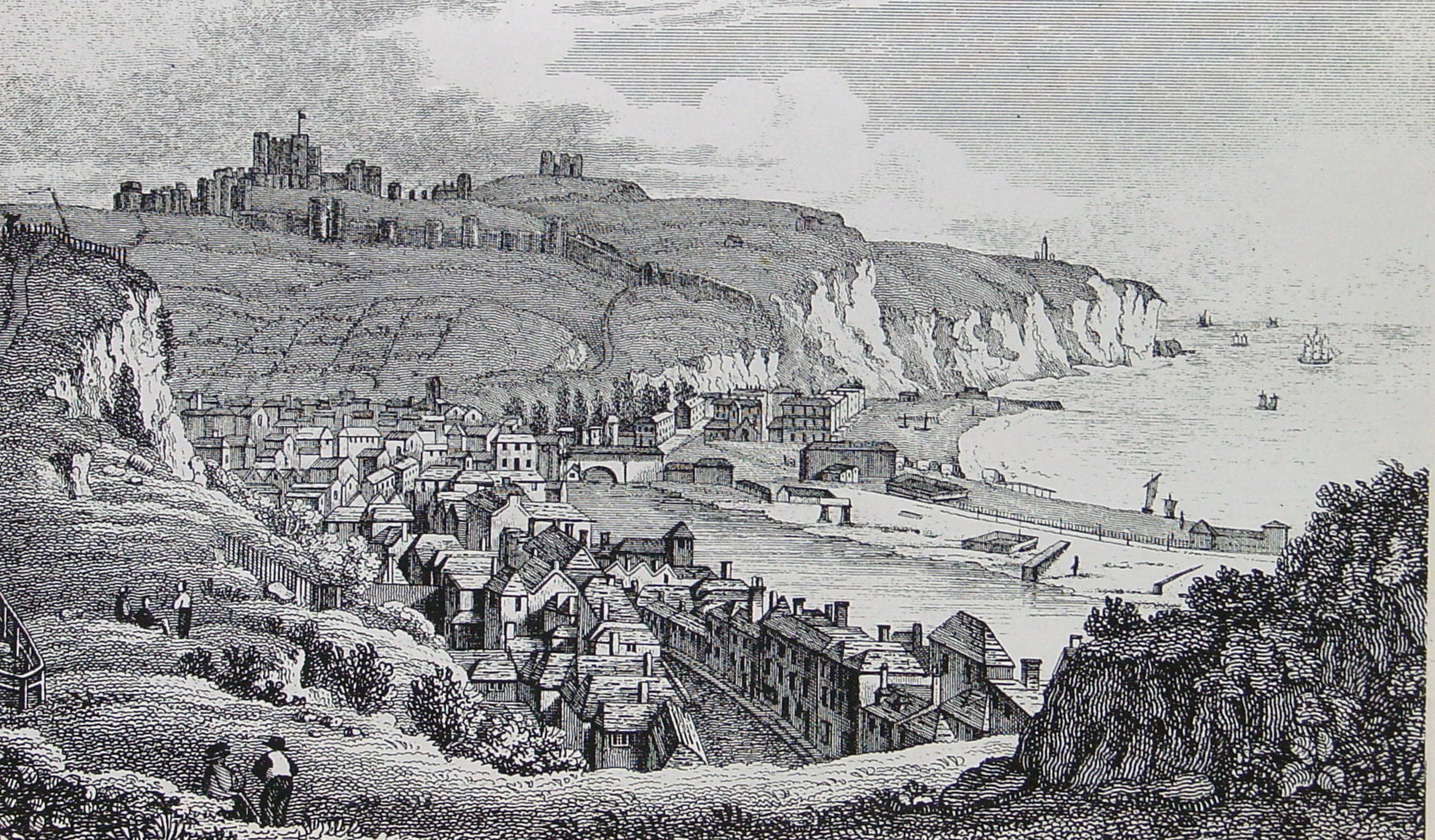


Posted in Dynasty of Dover, Part Vii Fector - Jarvis | Comments Off on Dynasty of Dover part Vii, Fector – Jarvis

Dynasty of Dover part Vi Fector – Jarvis

Pier House, Strond Street / Custom House Quay, the Fector family home and bank. Lynn Candace Sencicle 1993

Pier House, Strond Street / Custom House Quay, the Fector family home and bank. Lynn Candace Sencicle 1993

When the Duke of Wellington’s (1769-1852) ship berthed at the Crosswall, Dover, following the Battle of Waterloo (1815), there was great rejoicing. Henry Jell, Emanuel Levey and Thomas Birch carried him shoulder high to the Ship Inn, on Custom House Quay. The Inn was next to Pier House, the family home of John Minet Fector and the night before, to celebrate the event, he had hosted a grand ball in the Assembly Rooms, on nearby Snargate Street. Fector, or John Minet as known to most, was born in 1754 and as a banker, ship owner, property owner and godfather of the East Kent smuggling trade, he was the wealthiest man in Dover. Further, he was good looking, charming, witty, clever and his benevolence seemed to know no bounds. These attributes,  made him universally popular. (See Dynasty of Dover part IV Minet – Fector)

Brigade-Major George Ralph Payne Jarvis, born in 1774, was a recipient of John Minet’s hospitality when he had first come to Dover some nine years previously. It was the time of the Napoleonic Wars (1793-1815) and George then held a much lower rank, so while the town was vibrant, it was also expensive. This was due to the inflationary pressures that war brought and the already thriving port was heaving with naval and military personnel. At the same time, there was a massive new military building project under way on Western Heights. George and Philadelphia, his wife, became acquainted with John Minet and his wife Anne socially and they quickly became friends. George was the youngest of twenty-one children of an Antiguan plantation owner and had joined the army at the age 17. In 1802 he married the wealthy Philadelphia Blackwell, daughter of a partner in Martin’s Bank, London. Their eldest son, George Knollis, was born the same year, since then they had added to their brood and Philadelphia was pregnant again.

Map of Dover 1843. Dover Libary

Map of Dover 1843. Dover Library

John Minet rented one of his many large properties to George and Philadelphia in the then thriving maritime Pier District of Dover. Although Pier House actually fronted on to Strond Street with Customs House Quay at the rear. It was from there that John Minet ran the Fector bank and his shipping operations. Anne, his wife, preferred their mansion in St James Street, in the centre of Dover as there was plenty of room for their growing family of girls and it was near to her closest friends. Nearby, but nearer the sea than the Fector mansions, was the home of the beautiful, lively and clever Sarah Rice. Her teenage son Edward, born in 1790, was destined to join the second of Dover’s banks, Latham, Rice and Co. run by Sam Latham.

Sam Latham’s son Henshaw, born in 1782, was already involved in both the banking and shipping interests. Anne’s other friend’s home was on the landward side of St James Street, Sarah Gunman, who first arrived in Dover not long after George and Philadelphia. Sarah at that time, had recently married the much older James Gunman, who owned the vast estate, with an equally vast mansion, that went from the Maison Dieu to the Stembrook arm of the River Dour and fronted Biggin Street. (See Dynasty of Dover part III – Gunmans)

Within a few weeks, George left Dover to lead an expedition to Buenos Aires under Sir William Beresford (1768-1856) and John Minet and Anne promised to look after Philadelphia and the children. During the Napoleonic Wars, in order to draw the troops from the theatres of war and destabilize the French, the British sent numerous expeditionary forces to France or her allies territories. Spain, at the time, was an ally of France and as Buenos Aires was a Spanish possession it was decided to invade the City. Initially, the expedition was successful and on 27 June 1806, having put up very little defence, Buenos Aires capitulated. The Spanish then brought in reinforcements and eventually reclaimed Buenos Aires on 14 August with the British sustaining heavy casualties. The British surrendered but when George returned to Dover he had received the war medal with three clasps.

Over the next three years George, for the most part, was stationed in Dover and his friendship with John Fector deepened. Then on 30 July 1809 George, along with 39,000 other men, was sent to the island of Walcheren, at the mouth of the Scheldt estuary in the province of Zeeland, Netherlands. They landed on 30 July and it was, without doubt, Britain’s most disastrous expedition of the Napoleonic Wars. The objective of the British was to assist the Austrians, who were allies, to destroy the French fleet that at the time was believed to be in Flushing (Vlissingen). Before the force landed, the Austrians had already been defeated by the French who had moved their fleet to Antwerp. Nonetheless, the expeditionary force stayed until 9 December during which time 4,066 of the men died – only 106 in combat. The rest had succumbed to Walcheren Fever believed to be caused by a lethal combination of malaria, typhus, typhoid, and dysentery. By 1 February 1810, 11,513 officers and men were still sick and this included George. He returned to Dover but remained ill for some time after. Indeed, Arthur Wellesley who became the Duke of Wellington in 1814, requested that units which had served in the Walcheren Campaign should not be sent to him because the sickness had left them physically so weak.

View from the roof of the Fector Bank by George Jarvis. Western Heights on the left and Castle on the right

View from the roof of the Fector Bank by George Jarvis. Western Heights on the left and Castle on the right

While George was ill, John Minet ensured that he received the best care possible. George, thinking he would never recover, resigned his commission. The military commanders thought differently and put him on half pay. While he was ill, George took up drawing and wood carving and eventually started to help out in Fector’s bank. John Minet’s brother, James, had been in charge of that side of the business but following James death in 1804, John Minet had looked after it. James young son Peter, born 1787, was learning the ropes but he, like John Minet, preferred the commercial/shipping side of the business. They were both grateful when George started to assume command especially as even the senior clerks were happy to work under George.

On 31 December 1814, when it was believed that the Napoleonic Wars were over, John decided to split the bank and commercial/shipping into two separate companies. The banking side was changed from Fector & Minet to J Minet Fector & Co under the management of George, while John, assisted by Peter, remained in control of the commercial/shipping side, which operated under the name of J Minet Fector. However, Napoleon escaped from Elba in early 1815 and George, who although was on half pay, played an active part in increasing defences locally – some of which can still be seen at St Margaret’s Bay. When Napoleon was defeated at the Battle of Waterloo and peace returned, George remained on half pay attaining the rank of Lieutenant-Colonel in 1819. However, in 1816, George’s wife, Philadelphia, died, by which time she had given birth to seven children.

Following the victory of Waterloo, approximately a quarter of a million soldiers and sailors, many of them maimed, returned to Britain and were faced with unemployment. There was already inflationary pressures and poor crops leading to food shortages, exacerbated them. Income Tax, which had been introduced during the Wars, was abolished but it was replaced by taxes on staple commodities such as candles, paper and soap as well as luxury items such as sugar, beer and tobacco. To save money, town and cities cut the Poor Law relief rates that meant starvation was rife. This was not initially felt in Dover, as the wars had proved profitable and the town was able to bask in that prosperity.

King George 80 ton sloop of the Fector Bank fleet c1790 drawn by Candace Sencicle

King George 80 ton sloop of the Fector Bank fleet c1790 drawn by Candace Sencicle

Looking to the future, although John Minet had been the godfather of East Kent’s smuggling enterprises before and during the Wars, attitudes were changing. Like the other local smuggling barons, he recognised that it was expedient to distance himself from the trade especially when, in 1816, a Captain McCulloch proposed the establishment of the Coastal Blockade to deal with smuggling. The Admiralty frigates, Ganymede, Ramillies, and Severn, were put under his command and ships were watched, followed and frequently boarded if there was even a suspicion of contraband. If any was found, both men and vessel were seized and the owner was always assumed to be guilty. Initially the Blockade covered the Downs between the North and South Forelands, but was soon extended around the coast from Sheerness, on the north Kent coast, to Beachy Head, near Eastbourne, East Sussex. John Minet therefore decided that the future lay with using his ships for legitimate purposes only.

Kearsney Manor c1970s

Kearsney Manor c1970s

Parliament was dissolved on 10 June 1818 and at the time, Dover had two Members of Parliament. It was expected that one of the new MPs would be the sitting Member for Dover, John Jackson (1763–1820) and it was assumed that John Minet would be the other. Immediately George Page, Henry Morris, Edward Rutley and John Jell mounted a campaign on his behalf. Within days it was expected he would win by a landslide but John Minet was not at his town or his country house, Kearsney Manor, and was oblivious to all this activity.

When he heard he was in Boulogne and wrote a long letter. This was publicised and in it, he thanked his supporters but declined to stand. He did, however, suggest that his son – also called John Minet Fector (b 1812) –  should represent the town when he grew up. As the election was fast approaching Edward Bootle Wilbraham (1771-1853) stood instead and was unopposed. Wilbraham was a veteran Parliamentarian who was happy to stand in Dover having married Mary Elizabeth Taylor daughter of Rev Edward Taylor of Bifrons, Patrixbourne.

Sarah Gunman 1772-1825 by J F Joseph. Doddington Hall, Lincolnshire

Sarah Gunman 1772-1825 by J F Joseph. Doddington Hall, Lincolnshire

At the Bank, George met the husband of Anne Fector’s friend, Sarah Gunman James Gunman and they immediately got on well. James invited George to his home, Gunman’s Mansion, to meet his wife, the former Sarah Hussey Delaval of Northumberland, born in 1772. Although younger than her husband, she appeared devoted to him. George had already met Sarah socially and knew of her philanthropic work, particularly in the education of local children for which she received well-deserved praise. Sarah, James Gunman told George, had financial problems that badly needed attending to and asked for his help. Both Sarah and her mother, also called Sarah, had inherited most of the shares in a palatial estate at Doddington, Lincolnshire and in 1816 Sarah’s mother had bought a further one-sixth for £12,000. This left just one share that was in the hands of an outsider, John Savile, 2nd Earl of Mexborough (1761-1830) but he was unwilling to sell.

Although Sarah’s mother was a frequent resident on the Lincolnshire estate, there were a number of financial transactions required of Sarah and her mother over which George’s expertise was needed. George agreed and carried out his duties well. When they were resolved, George remained a frequent visitor and a close friendship developed with George spending much of his spare time at the Gunman residence pursuing his passion both for drawing and for Sarah.

With George competently running the banking side and Peter running the shipping side of the business, John Minet took the opportunity to take Anne and his family around Europe on an extended tour. Local elections in Dover, in those days, were held in November and the Mayor was appointed a few days later. In November 1819, Thomas Mantell was appointed the Mayor for the fifth time since 1795, the sixth and final times was in 1824. Born at Chilham, near Canterbury, Mantell was one of Dover’s Surgeons but ceased to practise in 1793 when he was appointed agent at the port for prisoners of war. After the War he secured the post of agent for the mail packets a positioned he held for the remainder of his life. The Dover Post Office was on the quayside and the postmaster was sailmaker Peter Popkiss (1750-1822) it was from there that post was taken and also collected by the town’s inhabitants.

The mail to London was despatched at eight at night and arrived from London at six in the morning. Mail to Folkestone, Hythe and Romney, left the town at six in the morning and arrived from those places at half-past seven at night. Mantell, as the government agent, ensured that official mail to and from abroad was efficiently and speedily dealt with. The post for Calais was carried in Post Office Packet ships and crossed the Channel on Wednesday, Thursday, Friday and Saturdays, returning on Monday, Wednesday, Friday and Saturdays. The Packets were sloops of about 700-tons and they were the Lord Duncan – Captain J Hamilton, the Chichester – Captain John Whitfield Rutter (1773-1825) and the King George – Captain M King. John Minet’s pride and joy was the King George and worked the passage along with a number of other ships belonging to the Fector fleet. The Latham, Rice and Co also had a large fleet and several other local ship owners worked the passage. The Fector and Lathams sailing ships and  captains were:

Ant – T Barnett                      Catherine – A Fraser               Countess of Elgin – R Hammond

Cumberland – J Hammond    Dart – G Wilkinson          Defence – J Adams

Dover- W Davidson             Flora – A Watson              Industry – Carlton

King George – Matthew King       King George II – T Mercer  Lady Castlereagh – W Mowell

Lady Jane James – J Hayward      Lark – G Johnson       Lord Duncan – J Hamilton

Poll – W Strains                Prince Leopold – R Rogers   Princess Augusta – J Blake

Princess Charlotte – E Hallands     Queen Charlotte – J Thomas

Sybil – Thomas Middleton  Trafalgar – Lieutenant T E Knight

Market Square with the Town or Court Hall in the centre 1822 by John Eastes Youden given by E E Pain. Dover Museum

Market Square with the Town or Court Hall in the centre 1822 by John Eastes Youden given by E E Pain. Dover Museum

Following the formal election of the Mayor, an eminent worthy was given an Honorary Freemanship of the town, if possible, followed by a feast that he paid for. Since the Honorary Freeman’s Act of 1885 these have been given for services to the town but in those days they were given to aristocrats or persons of prestige who resided in the town. On 7 November, following the election of Mayor Mantell,  the Prince William 1st Duke of Clarence (1765-1837) later in 1830 crowned William IV, was given the Honorary Freedom of Dover. 

He, along with his wife and a ‘foreign lady’, arrived at 16.00hrs at the Court Hall in the Market Square. There the whole of the Corporation plus the town’s clergy, principal persons of the town including both George, Peter and the Gunmans, senior military and naval personnel were assembled. The Town’s recorder, William Kenrick, asked the Royal personage if he was willing to take the oath and on affirmation the Town Clerk, John Shipman, proceeded to administer the customary oath. Led by Mayor Mantell, the throng repaired to the Ship Inn, Strond Street, where they all participated in a sumptuous meal and drank many toasts.

Fector bank Forgery Notice 1819

Fector bank Forgery Notice 1819

Two days later, on 9 November, it was apparent that forged Fector Bank £10 notes were in circulation. In 1816, the Gold Standard was statutorily established and the pound sterling was defined in a fixed quantity of gold. The following year the sovereign, containing 123.27 grains of gold, was put into circulation and under the gold standard system, paper money was convertible on demand into gold. This led to a massive increase in bank note forgery with, in 1817 the year after the gold standard was introduced, nearly 29,000 forged notes were presented to the Bank of England. Legitimate Fector notes equated with Bank of England notes, but it was the forged notes that were being exchange for sovereigns. To deal with this George issued both handbills and posters recommending that, ‘…till the offending parties are discovered, for the speedy discovery of whom no measures will be spared, all persons taking Ten Pound Notes will minute the back of them the day they are taken, and the name of the persons they are taken from.’ Eventually a Thomas Wildish was arrested, put on trial at the Old Bailey, found guilty and hung.

In the past, when times were hard, people in Dover turned to smuggling. Although the pre-war godfather’s of smuggling, such as John Minet, had given up the profession, it is well documented that Dover ships were bringing grain from the continent but how much was legal or smuggled is unclear. On 26 May 1820, the Coastal Blockade seized a smuggling galley and the crew of eleven men were committed to the town’s gaol, in Market Square, to await transportation. At 13.00hrs, as the prisoners were led out into the Square, there was a shout of ‘liberty‘ from the assembled throng and immediately the crowd rushed the prison wielding pick-axes, crowbars, saws and hammers. Mayor Mantell read the Riot Act but the mob managed to free the prisoners. The Coastal Blockade and the Preventative Water Guard, who served the rest of the country, amalgamated in 1821 under the Board of Customs, and renamed the Coast Guard and in recent times this was renamed Coastguard.

The Round House on left and the newly built Liverpool Street on the right 1840. Dover Museum

The Round House on left and the newly built Liverpool Street on the right 1840. Dover Museum

The Corporation’s surveyor, Richard Elsam, rebuilt the gaol on the same site from his own design. With what building materials were left, he built a row of tenements on Dieu Stone Lane. Elsams most famous building was on the seaside of Townwall Street (now part of Camden Crescent) for the Town Clerk, John Shipdem. It was an unusual turreted roundhouse with a Moorish theme and it was said that this was ‘so that the devil wouldn’t be able to catch the Town Clerk in a corner!’ Unlike the town gaol, which only survived thirteen years when it was condemned as unsatisfactory, the Round House survived until September 1940 when it was devastated by a bomb blast. After World War II (1939-1945) the equally iconic Dover Stage was built on the site but Dover District Council demolished this in 1989 and the site has since become a car park.

Caroline of Brunswick Queen to George IV. 1820. Internet

Caroline of Brunswick, Queen to George IV. 1820. Internet

This was not the only time that Mayor Mantell read the Riot Act that year. On 29 January 1820 George III (1760-1820) died at the age of eighty-two. He had been deemed incapable of ruling the country since 1811, when his son, George IV (1820-1830), had reigned as Regent. The people of Dover saw the new King as extravagant, self-indulgent and ultimately to blame for their economic woes. They used the opportunity to express their feelings when his estranged wife, Caroline of Brunswick, returned from the Continent. She arrived at the port on 5 June 1820 and was given a tumultuous welcome. However, when she arrived in London she was treated badly as witnesses were brought from the Continent to testify against her. It was on their arrival in Dover that rioting again broke out.

In London, Queen Caroline was stopped from going to the Coronation that was attended by Henshaw Latham. As a Burgess of Dover, he was participating in the Cinque Ports ancient tradition of burgesses carrying the Royal Canopy at Coronations. He later wrote that throughout the ceremony he could hear the piteous pleas of Queen Caroline asking to be let in. This was the last time the Cinque Ports exercised the right to carry the canopy over the Sovereign. Three weeks after the Coronation, Queen Caroline was dead and in Dover, the Corporation named Caroline Place after her. This was roughly where Stembrook car park is today. Following the ascendancy of George IV a general election was called with Edward Bootle Wilbraham and Joseph Butterworth (1770–1826) standing unopposed.

Kearsney Abbey 1840 by Lynn Candace Sencicle

Kearsney Abbey 1840 by Lynn Candace Sencicle

The Fector’s returned from the Grand Tour on 14 October 1820 and the town rejoiced. John Minet, with George and Peter at his side, organised an open day to which all the men in the town were invited and John Minet listened to their problems. These centred on the lack of work, the Coastal Blockade and George and Peter’s refusal to run the Fector smuggling enterprise. As East Kent’s ‘Godfather‘, they expected that John would soon have the smuggling industry running as smoothly as before but instead, John asked George to make all the financial arrangements for the building of a mansion on his Kearsney estate. John Minet’s father, Peter, had bought his Kearsney estate in 1790 for £70,000, which included Kearsney Manor, and on the meadowland where the Dour tributary from Alkham met the main stream from Watersend, near Temple Ewell, John planned to build the mansion that was to be called Kearsney Abbey.

The population for Dover in 1821 was, in total, 11,468 having increased by 1,221 since 1811. To help create employment in the town besides the building of Kearsney Abbey, John Minet organised the building of a replacement customs house, as the old one was derelict. He also loaned money to businesses to create employment and for these projects, it would appear John Minet liquidated much of his assets. On the home front John’s eldest daughter Anne Judith Laurie, known as Judith, wanted to marry French Canadian packet captain, Henry Pringle Bruyere. He was born in Dover in 1798 when his parents lived at Archliffe Fort. John Minet did not approve of the match and hoped that it would fizzle out. In the event that it did not, he made arrangements in the event the couple did marry, for a special trust fund of £10,000 to be set up on behalf of Judith. Out of this, Judith would receive an allowance and if she required any more money then it had to be approved by John Minet, or on his death, his son John Minet junior. If John Minet died before his son reached his maturity, then George Jarvis must approve it.

Harbour Entrance Dover by William Heath published 1836 by Rigden with steam ships. Harbour House LS 2010

Harbour Entrance Dover by William Heath published 1836 by Rigden with steam ships. Harbour House LS 2010

In March 1819 the Elsie, a 37-ton steamboat crossed the Channel and on 20 June, the steamship Savannah, took 26 days to cross the Atlantic. The year before, on 14 June, the first steam packet, Rob Roy, had made her first crossing from Belfast to the Clyde. On Friday 15 June 1820 she was introduced to the Dover-Calais crossing and took 4½hrs to cross the Strait. The 88-ton ship was built by Denny of Dumbarton with 30 horsepower engines by Daniel Napier. The French government, attracted to the idea of steam, purchased the Rob Roy and she remained on the Dover-Calais run. The Post Office, impressed with steam packets, introduced the Monarch and Arrow in 1822 and in 1823 they acquired the swift 83-foot packet Spitfire with 40 horsepower engines.

This was of concern to John Minet as all his fleet were sailing ships and although steam packets did have drawbacks, they were faster. Following discussions with Peter and George, it was decided not to replace the sailing ships but to sell them when they were no longer serviceable. Besides the Post Office packet ships, the new paddle steamers working out of Dover in the 1820s and their owners were:

Britannia  and Medusa – Bushells of Dover

Monarch, Salamander  and  Sovereign – Haywards of Dover

Dr George Dell, surgeon and the son of Captain Dell, of the Mail Packet Service was elected Mayor for the second time in November 1820 – previously in 1810. One of his ancestors, Edward Dell was a leading Non-conformist spending time in the Castle dungeon, along with Samuel Taverner, Richard Matson, Nathaniel Barry, Simon Yorke and Anthony Street, for his beliefs. George Jarvis negotiated with George Dell, on behalf of the Gunman family, about land on the west side of Biggin Street. The Doctor called his new acquisition Queen’s Gardens, probably after Queen Caroline, and planned to build a mansion but this did not materialise. Eventually the land was sold to build the cottages we see today.

St Mary's Church interior 1822 by George Jarvis

St Mary’s Church interior 1822 by George Jarvis

The vergers of St Mary’s Church were also inspired and they organised a major refurbishment of the Church but according to Sir Stephen Glynne, ‘… many frightful windows inserted. A most unsightly effect is also produced by the addition of a new slate roof along the whole length of the north aisle.’ He was equally as scathing about the interior saying that it was over crowded with pews and galleries and finished by noting that, ‘the Corporation seat is behind the altar.’ Following the alterations George made a drawing of the interior.

Sarah Gunman was also caught up by the idea of construction for the betterment of Dover and to provide work. She particularly cared about the Dover Charity School in Queen Street that had originally been founded in 1789 for forty boys and twenty girls. The number of girls soon increased to thirty and since then, the demand for places had risen such that the school was badly overcrowded. Sarah set up a subscription and donations poured in. In 1820 the new Queen Street school opened with places for 200 boys and 200 girls for all the poor children in the town and neighbouring villages.

At East Cliff, where a mill had stood, four cottages were erected, number 3 was named after Blair Athol in Scotland by the resident, Mrs MacIntyre, and subsequently when more cottages were added it was named Athol Terrace. The harbour at the time was on the western side of Dover Bay and although the economic depression was lifting, across the Channel things were much brighter. The Channel shipping service was doing well from wealthy passengers and the export of goods and specie. Sometimes as much as £200,000 specie was carried on one crossing for speculation on the Continental money markets of Amsterdam, Hamburg and Paris. The passage was made in all sorts of weather and at all hours of the day and night. From London, mail coaches, heavily laden with gold would travel along the Kent turnpikes bringing their precious consignments. 

Following the New Year of 1821 work on the harbour that had been carried out by engineer, James Moon, the harbour master was almost completed. This was to deal with the shingle bar caused by the Eastward drift that washed shingle into the Bay from the west and at neap tides prevented ships using the harbour. Before Moon started his work the Crosswall went from Union Street, then called Snargate over Sluice, to the Pier district and was built of wood. There was a wall across the Tidal harbour that created an inner harbour called the Bason into which gates were fitted opposite the mouth of the Tidal harbour. During neap tides, the gates would be opened in the hope that the accommodated water would wash away the shingle bar but this was not very effective.

The Bason later Granville Dock entrance with Compass Tower on left and the Clock Tower on right. Dover Library

The Bason, later Granville Dock. Entrance with Compass Tower on left and the Clock Tower on right. Dover Library

Moon reconstructed the Crosswall and new gates and sluices were fitted. When the sluices, on either side of the gates were opened they cleared the harbour mouth within an hour and according to Captain Post, ‘a French ship, of 240 tons register, drawing 12 feet, entered the harbour without difficulty, and at the lowest neap tides.’ However, the operating mechanism for the new sluices was cumbersome so it was decided to build an edifice to house them and to turn this into a feature. The final building was a clock tower, with four faces that, with great ceremony, was opened on 14 April 1830 and George Jarvis attended. Because of the lack of symmetry, a second tower was built and this had four compass faces. The clock tower is the same one we can now see on the seafront.

The cost of the harbour work was £81,500, whereas, the passing tolls – the tax on ships passing Dover harbour while traversing the Dover Strait – on average only amounted to £10,500 per year and dues collected on ships using the harbour (tonnage dues) only came to an average of £1,150 a year. On both of these a shipping tax of 6% was levied. During the preceding five years £23,500 had been borrowed to pay for the harbour works and together with the interest that had to be paid to the Fector and Latham banks on loans taken out in the 1790s, the total annual interest was £1,500 a year. To meet these debt repayments, in 1820 Sir Henry Oxenden, the Managing Commissioner of Dover Harbour Commission, loaned a further £4,500 and in June 1822, £1,500, then a month later an additional £2,500, all at 4% interest. To meet all the debt repayments the Harbour Commission appealed to Parliament who set up a Committee on Foreign Trade to look at works being carried out at both Ramsgate and Dover harbours. Their response was the opposite to what the Commissioners had hoped. The Committee said that due to the reduction in trade and the large sums paid by ships for the maintenance of the harbours, Dover Harbour Commissioners should consider reducing tonnage dues!

Ship builders on Dover beach 1820 by George Jarvis before the construction of the town mansions in 1818

Ship builders on Dover beach 1820 by George Jarvis before the construction of the town mansions in 1818

Robert Jenkinson (1720-1828) – Lord Hawksbury (1796) and later the Earl of Liverpool (1808) – was appointed the Lord Warden of the Cinque Ports on 30 January 1806 and by virtue of this office was also the Chairman of Dover Harbour Commissioners. The Register (now Chief Executive) was the financially astute John Shipdem and banker Sam Latham together with Thomas Bateman Lane, were the joint Treasurers. The shortage of money for harbour works was a long-term problem and in 1816, the Commission decided that instead of using the old revenues – the money earned from rents from buildings on the Commission’s lands – for harbour repairs, that they would use it instead for building purposes.

All reclaimed land, by the 1606 Dover Harbour Act, belonged to the Harbour Commission and Mr Horton, the Surveyor of Buckland, was called in. On 16 November 1816 he presented plans to build 96 large residences on a proposed street running parallel to but on the seaward side of Townwall Street. It was agreed that except for the initial cost which would come out of old revenues and borrowing, the project would be self-financing. That is, the next stage of the project would not commence until the Commissioners had accrued enough capital to pay off the original debt and had sufficient to start the next stage. The money for the first stage of the development was borrowed from the Fector and Latham banks and was started in 1818 with four blocks of town mansions with lawns in-between. The project was named Liverpool Street, after the Lord Warden.

Buckland corn and paper mill cottages, London Road. Alan Sencicle

Buckland corn and paper mill cottages, London Road. Alan Sencicle

Following the Napoleonic Wars the demand for flour had slumped, hitting Dover’s milling industry hard. In 1814, William Kingsford bought Buckland corn mill for £1,120 and the adjacent lands from Sir Thomas Hyde Page, the Military Engineer for £5,750. He rebuilt the corn mill we see today and it commenced grinding a year later. At the time it was a good buy as the town was feeding both the navy and army stationed thereabouts. However, when the Wars were over the demand for flour dropped. In 1821, John Minet bought the Town corn mill, which was dismantled, and the internal workings were used to pump water to Kearsney Abbey. In 1821, Kingsford borrowed £6,000 to expand the lower Buckland paper mill, next to his corn mill and built the cottages that can still be seen along the London Road, for his paper workers. The year before he had bought Charlton corn mill and the adjacent Charlton seed mill, grinding corn in the summer and rapeseed in the winter to produce oil seed cake for cattle. He borrowed £5,000 from the Fector bank to enlarge the buildings and improve the plant.

The Limekiln Street corn mill was in the possession of the Fector bank following the bankruptcy of Peter Becker. As the economy started to pick up, Joseph Walker, of Dover’s brewing family bought it and converted the mill for the purpose of producing oil seed cake. The mill grew into a complex that became known as the Oil Mills. To supply the steam, the mill had its own waterworks, at the time a wonder of modern technology. With the increase in the demand for flour, hoys (small cargo sailing ships) brought grain to be milled in Dover and then took the flour up to London. This gave another of Dover’s milling families, the Pilchers the impetus to rebuild the Town mill, using loans from the Fector bank. They also employed Edward Powell to run it and having taken over the Stembrook mill from the Navy they employed Julius Winter to run that.

Buckland House, Crabble Hill. Dover Museum

Buckland House, Crabble Hill. Dover Museum

The paper mills had also been hit by the economic downturn and in 1814 Buckland paper mill had suffered a disastrous fire. Four years later, when the economy started to improve, it was rebuilt but its owner, Thomas Horne, wanted to retire and put the mill up for auction in 1820. Out of the proceeds he built, in 1823, Buckland House, on Crabble Hill that still stands today. George Dickinson, brother of John Dickinson the famous paper manufacturer leased Buckland paper mill in 1822 having borrowed £30,000 from the Fector bank and built a steam driven paper mill at Charlton with a house next door. This he called Brook House, not to be confused with the iconic Brook House. Eventually, his house became part of the former Royal Victoria Hospital on the High Street. Dickinson also built the cottages on London Road for his paper workers and leased Bushy Ruff mills in 1826. William Phipps, the owner of River and Crabble paper mills died in 1819 leaving his business to his sons Christopher and John. In 1825, they patented the dandy roll, invented by John Marshall. This was a wooden roller covered with a wire cloth and used to add watermarks for making Indian currency paper.

Letter from Fector Bank signed by George Jarvis announcing the death of John Minet Fector dated 15 June 1821

Letter from Fector Bank signed by George Jarvis announcing the death of John Minet Fector dated 15 June 1821

John Minet Fector died suddenly on 12 June 1821 at Kearsney Manor and everything in the town stopped on the day of his funeral. The route between Kearsney Manor and St James’s Church, where a mausoleum was later constructed, was said to have been lined by every man, woman and child in the district. It had already been agreed that George would remain manager until John Minet’s son, John Minet junior, came of age. Unfortunately, it would appear that not all of the Fector family agreed as John Minet’s cousins, Isaac and John Lewis Minet came from London with the view of taking over the bank. George refused to comply and re-registered the bank as J Minet Fector & Co but had to move location to Snargate Street as the Minet brothers claimed Pier House. Isaac and John Lewis Minet, under the name of Minet Brothers & Co on 7 September 1821, opened their bank at Pier House on Strond Street. One of their partners was banker Lewis Stride who was known to be a very competent banker. The shipping side of the Fector business was taken over by Peter Fector.


  • Presented: 08 August 2015
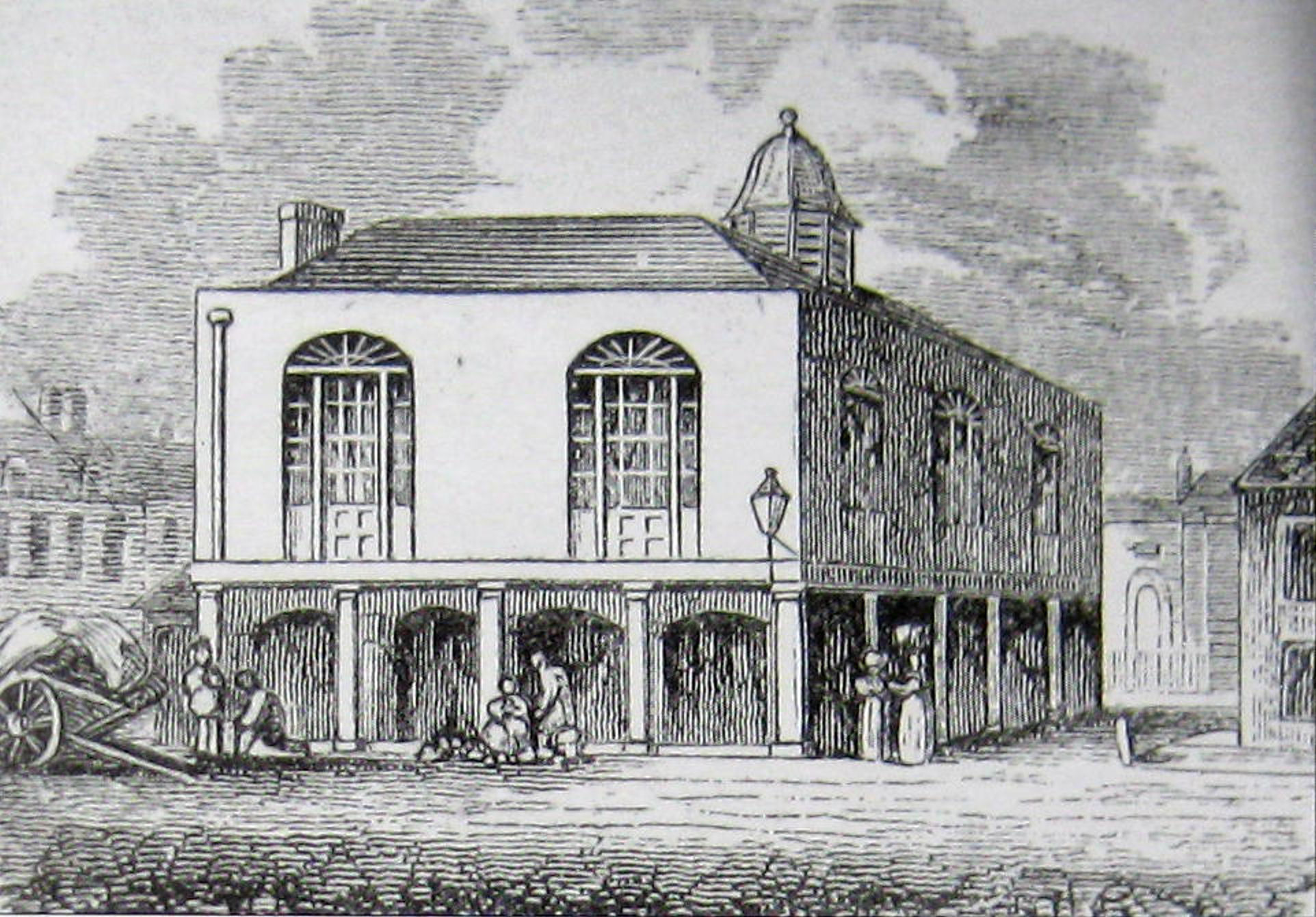
Posted in Dynasty of Dover, Part Vi - Fector - Jarvis | Comments Off on Dynasty of Dover part Vi Fector – Jarvis

Packet Service Part III – Churchward founder of the Packet Yard and Politician

Dover harbour c1850, from Western Heights. Dover Library

Dover harbour c1850, from Western Heights. Dover Library

In Packet Service part II it was explained why the government, in 1853, decided to put the packet contracts between Dover and Calais and Dover and Ostend out to tender. At the time, the South East Railway Company (SER) had assumed that they would win the contract as they had the ships and resources but a syndicate headed by Joseph Churchward (1818-1900) undercut them. Churchward was a nautical journalist for the London Morning Herald with  Machiavellian personality who lacked the finance and expertise to run a packet service. Further, he only had one small ship, the Ondine (II), an Iron paddle Steamer built and engined by Miller, Ravenhill & Co. in 1847 and 101.1 burthen.

On winning the contract Churchward bought three ex-Admiralty packet ships by instalments and underwritten by his close friend and ship builder Charles Mare. These were, the Onyx an iron paddle steamer built by Ditchburn and Mare, engined by Messrs Penn & Son, Greenwich – tonnage 294 gross and in 1854 renamed Vivid II. The Undine an iron paddle steamer built and engined in 1845 by Miller, Ravenhill & Co of Blackwall, and 86 burthen, renamed Dover and the Violet, an iron paddle steamer built by Ditchburn and Mare, Blackwall, engined by Messrs Penn & Son, Greenwich with tonnage of 295 gross.

Garland circa 1848 when Captain Luke Smithett was the Master. Jim Henderson

Garland circa 1848 when Captain Luke Smithett was the Master. Jim Henderson

Shortly afterwards Churchward bought the Garland a wooden paddle steamer built by Fletcher & Fearnall, London, engined by Messrs Penn & Son, Greenwich with tonnage of 295 gross. She had previously worked the Dover packet service for the Admiralty and was renamed LAlliance in accordance with his French contract for carrying mails from France to England in 1855. That year Mare built two luxury paddle steamers for Churchward. They were the Empress and Queen and were 123.5 burthen with 2 x 50 horsepower engines made by Ravenhill, Salk & Co. These were primarily used to fulfil the French contract but he also had the contract to carry Belgium mails as well as his initial British Admiralty contract. To comply with the French contract, he employed French crew for daytime crossings and British at night. Further the Queen wasShortly afterwards Churchward bought the Garland a wooden paddle steamer built by Fletcher & Fearnall, London, engined by Messrs Penn & Son, Greenwich with tonnage of 295 gross. She had previously worked the Dover packet service for the Admiralty and was renamed LAlliance in accordance with his French contract for carrying mails from France to England in 1855. That year Mare built two luxury paddle steamers for Churchward. They were the Empress and Queen and were 123.5 burthen with 2 x 50 horsepower engines made by Ravenhill, Salk &  also called La Reine when the French crew were on board and the Empress the Imperative.

Without offices or a base of any kind in Dover, Churchward managed to persuade the Admiralty to allow him, temporarily, to use their packet yard and offices on Snargate Street for £120 a year. These backed onto what later became Granville Dock where he set up workshops headed by Timothy Harrington as superintendent. Harrington was part of Churchward’s original syndicate and in consequence was very well paid, receiving a salary of £450 per year plus 10% of the profits made. Harrington slowly turned the site into a successful repair yard with skilled men, apprentices and workshops. Further, Churchward hired competent experienced officers and men to crew his ships including the highly respected former Commodore of the Admiralty packet service, Captain Luke Smithett who headed Churchward’s marine operations. In November 1854, Churchward put the company on a legal footing and named the Dover Royal Mail Packet Company. However, Mare, his financial backer was declared bankrupt in October 1855 and on the night of 5-6 January 1857, the Violet was lost with all hands. Further, the Violet was underinsured and it would cost £14,000 to replace her. Following the demise of Mare, Churchward’s financial guarantees were gone and with the loss of the Violet, Churchward was also in danger of being declared bankrupt.

Vivid (I) and the Landing of the King of Sardinia in 1855. Illustrated London News

Vivid (I) and the Landing of the King of Sardinia in 1855. Illustrated London News

In 1856, Churchward had bought the 149-ton gross iron paddle Thames pleasure steamer Jupiter, cheaply. She was not fitted out for the packet industry so had been used as a relief ship and even in early 1858, when he badly needed another ship, Churchward recognised that she could not be used. Cap in hand, Churchward turned to the Admiralty for help and took along Smithett. The Admiralty agreed to lease, gratuitously, the Princess Alice until 17 April 1857 and the Vivid (I). The Princess Alice was an iron paddle steamer 110.1 burthen and the Vivid (I), a wooden paddle steamer of 352 ¾ burthen that was a great favourite of Smithett. The Vivid (I) stayed on the Dover – Calais service until 14 May 1857 from then on the Jupiter  undertook the packet service on a temporary basis.

Even though Vivid (I) had been leant to Churchward, the Admiralty still had first claim and in March 1857 a Mr Jeffries used her for an Admiralty experiment. Jeffries had patented a smoke consuming apparatus that, he claimed, would help in fuel economy and the Vivid (I) was sent to the Admiralty yard at Woolwich where she was fitted with Jeffries apparatus. She was then brought back to Dover and went into service that evening. The weather was fair when Captain Hammond took her on the Ostend night mails delivery. The two-way crossing took eight and three-quarter hours and the amount of fuel used was 75-80% of what would normally have been used given the conditions. Further, it was particularly noted that the dense black smoke the ship normally emitted was greatly reduced which pleased the passengers. Churchward asked to keep the fitment and suggested that it should be used but the recommendation appears to have come to nothing.

Mare’s father-in-law, Peter Rolt (1798-1882), reconstituted the Thames Iron Works and Shipbuilding Company and Churchward, who had two ships for his packet service on the order books one of which was about to be launched. Frederick William IV (1840-1861) of Prussia had been very generous to the widows and orphans of the crew of the Violet after she was lost in January 1857. In respect of this, Churchward decided to name his new ship Prince Frederick William of Prussia – usually shortened to Prince Frederick William. The 215-ton gross iron paddle steamer was designed by James Ash, 180-feet in length and 20-feet beam, 203-tons gross with 2x75horse-powered engines and a boiler pressure of 24lbs.

 Harbour, Pilot's Tower and Paddle Steamers. Dover Museum

Harbour, Pilot’s Tower and Paddle Steamer. Dover Museum

When he had placed the order, Churchward and Mare had decided that she would be the last word in comfort and speed but at the time Churchward only paid for materials and Mare the workmanship. With Rolt in charge, Churchward was expected to paid the full market price. The Prince Frederick William was the first ship to leave the newly formed Shipbuilding Company and this roused a great deal of media interest. Always the publicist Churchward organised a special trial that took place on 6 August 1857.  Between Brunswick Wharf, Blackwall and Woolwich Dockyard on the Thames, the Prince Frederick William’s average speed was recorded as 17½knots and it was acknowledged that she was one of the fastest vessels in the world. On board, her fittings were the height of elegance and luxury and the national papers also emphasised this. Two days later, she was in Dover undertaking her maiden voyage with the mails to Ostend.

Churchward, did not have a clue how to pay for the Prince Frederick William so in the hope of providing much needed finance, Churchward applied and won the India and China mails contract with the Post Office. His major selling point was the Admiralty Pier that although not completed, ships could berth alongside. This meant that at Dover, Churchward was not handicapped with a tidal harbour that could only be used twice a day. However, the contract stipulated that the service was to be to Boulogne and that the Prince Frederick William was to be used. At the time, the Post Office Authorities were proud of the speed of their service from London to Folkestone from where SER, who had previously held the contract, took the mails to Boulogne. From Boulogne to Paris and then onto Marseilles, in the south France, the journey was fast and efficient. The only stumbling block to this fast service had been Folkestone Harbour, which was tidal. Churchward, to get round the Boulogne problem, decided to use the Prince Frederick William for his Admiralty scheduled, Dover – Calais service and hire six-oared boats to take the mail between Boulogne and the Prince Frederick William when she reached the Calais Roads in the Channel. Unfortunately, for Churchward the contract did not provide the finance he desperately needed as the sheer amount of mail meant that he frequently had to hire four and sometimes six rowing boats to make the Boulogne connection.

Possibly a Churchward ship arriving at Dover harbour. Dover Museum

Possibly a Churchward ship arriving at Dover harbour. Dover Museum

In January 1858, following continual arguments, Churchward gave his marine superintendent, Timothy Harrington, three months notice. In April, when Harrington had ceased to work for Churchward, he started legal action. Harrington stated that he had not been paid the 10% of the profits, as had been agreed. Churchward countered this by saying that no profits had been made. Nonetheless, Harrington continued to pursue the matter, widening his action until in 1860 a lawsuit partially upheld Harrington’s claims. These ongoing legal costs took their toll on Churchward’s already financially dire situation and he still had to pay for the Prince Frederick William and the other ship on the order books. In the end, he was forced to resort to selling his two older prize ships, the Queen and the Empress. Churchward offered the two ships to the French government who agreed a good price and the deal was sealed in March 1858.

With Harrington gone, Churchward was left with the responsibility of the ship repairs. The Prince Frederick William was accidentally beached at Kingsdown, east of Dover, on 3 February 1858, causing her hull to be stoved in. Later that year, the Vivid (I) ran down a fishing smack causing three men to drown and damage to the ship. The following year, on the night of 26-27 February 1859, the Prince Frederick William, with Captain James John Pittock (1827-1899) in command, collided with Calais Pier. A northwest gale was blowing, which made Calais harbour difficult to negotiate even though the light indicating access was lit. Six of the 37 passengers were taken ashore on the ship’s boat and the new Calais lifeboat came to the rescue. The men had just taken the eighth passenger on board when the boat was thrown so heavily against the Prince Frederick William that the lifeboat capsized and three passengers were drowned. The remaining 23 passengers stayed on board the ship and when the tide ebbed the following day, the crew, carrying the mails, walked ashore. Captain Pittock was suspended from duty and a four day enquiry was held at Dover. It was found that the accident was due, in the first place, to Calais light indicating that there was sufficient depth of water to make the entrance. Further, the sea conditions would have made the entrance into the harbour difficult normally  but due to the lack of water, impossible. Captain Pittock was exonerated and returned to duty. However, within a month, when easterly gales were delaying the packet service, questions were being asked in the national press as to why a bit of wind was causing delays!

Change in Passports Notice 21.04.1858

Change in Passports Notice 21.04.1858

Churchward and Smithett, in April 1858, having publicly aired their views on forthcoming changes in passport regulations, were invited to meet a Mr Fitzgerald at the Foreign Office. In England, Henry V (1413-1422) by Act of Parliament of 1414 is credited with inventing the first true passport. Louis XIV (1661-1715) of France, granted personally signed documents that allowed the holder to ‘passe port,’ meaning ‘to pass through a port’ as most international travel was by sailing ships. From this came the term ‘passport’. From 1772, British passports were issued but written in French and from 1794 they were issued by the Secretary of State for Foreign Affairs. British passports could be issued to a person of any nationality as a promise of ‘safe conduct’ from the British monarch and authorised the holder to travel wherever they wanted. However, these passports were only available to the aristocracy be they British or foreign nationals. The remainder of society, particularly merchants, bank managers and the middle classes in general, had to purchase passports from authorised diplomats and consulars representing the specific countries they were to pass through, which was cumbersome.

In France on the evening of 14 January 1858, Louis-Napoleon III (1808-1873) and his wife Eugénie escaped an assassination attempt unharmed. The ringleader of the conspirators was an Italian nationalist, Felice Orsini (1819-1858) aided by a French exile living in London, Simon Bernard. Orsini was captured, tried and executed but as Bernard held a British passport, the British government refused to extradite him. In response, the French refused to acknowledge anyone travelling on a British passport and it was this that had led to an amendment in the regulations.

From 3 February 1858, the British government ceased to be responsible for other nationals and stating that, ‘Every Continental Prince, by his own agents is to look after his own people.’ Passport application forms were issued to those who asked for them and they had to be filled in by one of the persons making the request. They then needed to be countersigned by an authorised person and sent with the remittance to the passport office, Downing Street, London. More than one person could share the same passport, such as a husband, wife, their children, tutors and their servants. The authorised persons were initially magistrates, justices of the peace or mayors of corporate towns, but this was soon after extended to include other designations.

Verification from the French regarding passports from Joseph Churchward 15.06.1858

Verification from the French regarding passports from Joseph Churchward 15.06.1858

In some ports, designated agents were appointed to issue passports instead of sending application forms directly to London and in Dover this was Samuel Metcalf Latham, whose offices were on Union Street. The fee was fixed at 6shillings of which 5shillings was the official stamp duty. The main complaint that Churchward and Smithett discussed with Mr Fitzgerald, concerned travellers who crossed the Channel, for social or business purposes and only stayed for a short while before returning to France or Belgium. It was agreed that in such circumstances, as long as the person held a return ticket, they could disembark at Dover undertake their requirements without an official passport. In June 1856, the French authorities agreed that passengers from England holding return tickets did not require passports for short-term stays. Further, the excursionist was not required to go through customs.

Churchward had used his journalistic skills on behalf of the local Conservatives in the General Election of 1857 but the two Whig candidates, Ralph Bernal Osborne (1808-1882) MP 1857–1859 and Sir William Russell, (1822-1892), were elected. The Whigs, under Henry Temple, 3rd Viscount Palmerston (1784-1865) held a significant majority of the seats and Osborne was appointed Secretary to the Admiralty. In this role, Osborne was instrumental in proposing the abolition of the Harbour Commissioners and his work ultimately led to the 1861 Harbours and Passing Tolls &c. Act that abolished the Commissioners and set up of the Dover Harbour Board. During this time, the Commissioners made sure that their house was in order, including looking at their properties to ensure that they were legally compliant.

Location of Churchward's Packet Yard, Snargate Street 1859 map c 1900

Location of Churchward’s Packet Yard, Snargate Street 1859. map c 1900

The Admiralty packet yard had been sublet, on a temporary basis, to Churchward at £120 a year since 1854 and the many extensions had been built without permission. The Harbour Commissioners demanded that they be demolished and Churchward was evicted. He tried to rent alternative premises but was continually thwarted by the Commissioners as he would become a sub-tenant.  The Admiralty suggested that he had his ships repaired at the Naval yard at Woolwich, paying the commercial rate and buy or rent property in Dover for his administration. Churchward could not even consider paying the full commercial rate for repairs even if he could, by taking his ships to the Thames would take them out of service for too long. At the lower (west) end of Snargate Street, the London Chatham and Dover Railway Company (LCDR) were excavating a tunnel for their line from what would become Dover Priory station to the harbour. Nearby was a vacant plot, which Churchward bought and built his own Packet Yard.

Throughout this time, Churchward kept up persistent lobbying for a seven-year extension of his Admiralty contract to bring it into line with his Belgium contract and what he hoped would be a renewed French contract. The Belgium contract expired in 26 April 1870. Within the Admiralty he had considerable influence but the Conservative Postmaster General, Admiral Charles Abbot, 2nd Baron Colchester (1798-1867), opposed the move. On 16 April 1859, Churchward received a communication stating categorically that the Admiralty contract would cease on 20 June 1863. This, he believed, was due to the influence of Bernal Osborn and responded by contacting his friends at the Admiralty office. At about the same time as Churchward received the letter from the Postmaster General, a general election was called and immediately he used his journalistic skills to try to influence the outcome. Churchward wanted to secure the election of two Conservative candidates whom, he believed, would support the extension of his contract. As nationally the Conservative Party was in disarray it was expected that the incumbent Whig, now the newly formed Liberal party, MP’s for Dover, Bernal Osborn and Sir William Russell, would win.

Election hustings in the Market Square 1871. Dover Museum

Election hustings in the Market Square 1871. Dover Museum

The hustings, in those days, were erected in Market Square where the partisans would verbally propose their candidates to the electorate. Locally the weaker Conservative Party fielded Sir Henry Leake and William Nichol. Both were in their 70s, highly thought of and approved by Churchward. Sir Henry was a Lord of the Admiralty while William Nichol was a Liverpool merchant and a Director of the London and County bank. By most accounts, the election process in Dover that year, was one of the dirtiest ever witnessed with threats of unjustifiable legal action, bribery, treating (paying for expensive lunches etc) and threatening prize fighters.

Churchward used the local newspapers, Dover Telegraph and Dover Chronicle, to support the Tory candidates and run the Liberal ones down and it was well recognised that it was Churchward’s influence that Leake and Nichol won by a large majority. The former incumbent and Churchward‘s nemesis, Bernal Osborn, came bottom of the poll. Following the election, the defeated candidates submitted a petition to the House of Commons alleging bribery, treating and intimidation by the two winning candidates and their agents.

Nationally, the Liberals won the general election returning Lord Palmerston as Prime Minister. The Dover case was heard in March 1860 by the House of Commons Election Committee chaired by Conservative Milnes Gaskell (1810-1873) and only appertained to the candidates. The Hearing was told that Dover’s population was 21,478 inhabitants of which 2,038 had the right to vote and included 819 Freemen, either resident in the town or living within seven miles. The general election had been called on 15 April and on the following day, it was announced that Churchward’s contract was to terminate in 1863. The accusers told the Hearing that Churchward then posted a notice in his Packet Yard, ‘begging all his men who had not promised their votes to do so. A meeting was held in the yard and the whole of the packet service pledged themselves to vote for the Conservative candidates.’

They went on to remind the Hearing of Churchward’s behaviour in the Plymouth election of 1852 (see Packet Service part II) when he had been found guilty of bribery. They went on to say that because the ballot was not secret it was known that all 53 of Churchward’s employees voted for the Conservative candidates, which amounted to undue influence. Further, they said, Churchward had given ‘carte blanche’ to one of his employees, a Mr Dodd to get as many votes as possible for Churchward’s candidates. Nevertheless, they emphasised, Dodd was not to say that the money Churchward gave him was for electioneering matters but for some other reason.

Dodd, in his evidence, confirmed this, saying that he understood the real meaning of Churchward’s request and had ‘bought’ approximately 500 votes paying, on average, £2 a vote. However, he was unsure that this was legal and therefore spoke to Churchward, who appeared to understand his consternation. Dodd then sought other employment and became a conductor on South Eastern Railway. The House of Commons Election Committee found bribery proven but as the successful parliamentary candidates, according to the evidence, were not privy to the illegal practices the election was not declared null and void.

Dover-Deal Road c1860

Dover-Deal Road c1860

Churchward was subsequently brought before a Parliamentary Committee when his conduct during the election came under the spotlight but he was able to defend himself. In his testimony, Churchward gave his home address as 21 Townwall Street, Dover and told the Committee that when he first won the Admiralty packet contract in 1854, it had not been ruminative. Nonetheless, it had enabled him to secure the French and Belgium contracts that made his business profitable. Out of these profits he was able to employ his men, open his Packet Yard and provide more employment.

Churchward admitted that the Admiralty contract was to expire in 1863 but the Belgium contract was to run until 1870 and he was sure of securing an extension to his French contract to the same date. He went on to say that if the Admiralty contract were extended for the same period he would be able to purchase another luxury packet ship. He admitted that the Post Office refused to extend the contract but on the 26 April he received written confirmation that the Admiralty agreed to the extension for which he would be paid £18,000 a year. The increase, he said, was to take into account increases in harbour rent and tonnage dues.

Since 26 April, Churchward told the Hearing, he had confirmed the order for the new steamer and poured more resources into the Packet Yard to keep his other vessels in good repair. These works along with his other shore staff and the crews of the steamers placed him in a position as a large employer of local labour. From this, he had gained a great deal of respect from those who he employed. Following Churchward’s testimony, evidence such as Dodd’s, was presented. Nonetheless, the Committee concluded that nothing substantial could be found against Churchward and that ‘he was a businessman who actions were dictate by the desire to achieve commercial success.’

John Penn. Dover Museum

John Penn. Dover Museum

On 18 February 1860 Churchwards new steamer, the John Penn, left Thames Ironworks and Shipbuilding Company, Blackwall for Dover. Like the Prince Frederick William, she was designed by James Ash and was similar in most respects; the only exception was that Penn’s of Greenwich engined the John Penn. This accounted for the new ship’s name for John Penn was the founder of the firm and was known for perfecting the oscillating cylinder engine. The John Penn covered the 89miles from Blackwall to Dover in 5-hours 7-minutes. On arrival she went straight into service taking 220 boxes of Indian and Australian mail, weighing just under 6-tons, to Calais. Under Captain Smithett, the crossing took 1-hour 23-minutes and Churchward was on board along with Mr Knight the superintendent for the South Eastern Railway (SER) who was to deal with the French railway arrangements.

Churchward won the French contract to run until 1 April 1870, with one caveat, he was required to have a French partner and he appointed a M. Clebetteal & Co of Dieppe. To help avert another catastrophe, in 1859, the Calais authorities introduced the Poste, a tender for carrying the mails when the tides were too low to use the harbour. With the new ship and the contract firmly under his belt, Churchward, along with Smithett, introduced another innovation to the Packet service – the training of youths to become officers. To be accepted the boy was required have a good knowledge of seamanship, leadership abilities and expected to be literate. On completion of the training, the boy was accepted as ship apprentice without premiums (See Sea Cadets).

European Royalty crossing the Channel showed a preference for Churchward’s luxury packets ships and in September 1860, the Grand Duke Michael of Russia (1832-1909), and the brother of Czar Alexander II (1855-1881), along with his wife and a retinue of 25 distinguished persons made the crossing. They arrived aboard Prince Frederick William and dined at Ship Hotel before travelling to London and thence to Torquay. The ship was in charge of Captain Pittock but on Royal request, Captain Smithett attended to the party and travelled to Devonshire with them. For this, Smithett was given a costly ring. A few days before, Smithett had escorted to France the Grand Duchess Marie of Russia (1819-1896), again aboard Prince Frederick William and was given a heavy gold chain for his trouble. On 18 July 1861, Prince Frederick William of Prussia arrived in Dover, but not on the ship named after him but on Vivid (I), with Captain Smithett at the helm. The following year, Queen Victoria (1837-1901) knighted Captain Luke Smithett!

In the town, Churchward was also beginning to be held in esteem and in 1861 was asked to arrange the Regatta. This was held on the same weekend as the installation of the Prime Minister, Viscount Palmerston as the Lord Warden of the Cinque Ports. Smithett joined Churchward’s team and between them they were determined that the Regatta would be the best ever.  The new Lord Warden attended, to see yachts from all around the kingdom in Dover Bay. Not only were there several classes of yacht races, there were races between four-oared regatta-built galleys, skiffs, pleasure boats and fishing vessels. In the evening, there was a grand ball and a magnificent firework display.

Admiralty Pier c1870

Admiralty Pier c1870

By 1861, the second stage of the Admiralty Pier was almost complete giving 1,539 feet of quay space. This was two years before, Churchward’s packet contract was expected to cease in 1863. Because of this, SER had entered into an agreement with the Admiralty that allowed trains to pass directly onto the new Pier for which they had contributed £3,000 towards modifications. When the modifications were completed a new railway line continued from SER’s Town Station on a curve to a new station the new Pier. Adjacent was the quay where ships would berth. In October 1861, SER started running trains on the Admiralty Pier but Berth 2 was designated strictly for the sole use of Churchwards Packets and only mail trains were permitted to use that section of railway line. With the new berthing facilities, Churchward was quick to advertise the ease by which passengers could transfer from train to ship and visa versa. However, the parliamentary inspectorate that checked out the ships of the tendered packet contracts cast doubts on the Ondine II. The inspector concerned, reported that she was of ‘doubtful efficience,’  and recommended that she should be withdrawn from packet service. The Ondine II was only used by the Churchward enterprise as a relief ship but in that capacity she was needed and Churchward did not have the resources to replace her. Pressure was on Churchward with the Ondine II being withdrawn from service in February 1862. She was then used only for excursions until she was sold. The Ondine II  was later broken up in 1889.

Otherwise, everything was beginning to augur well for Churchward with his business receiving high commendation in April 1862. That month, much to the surprise of the government and the national media, Earl Charles John Canning (1812-1862), arrived without ceremony on the Vivid I from Calais. Captain Smithett was master and on recognising Lord Canning, telegraphed Churchward before the ship left port. Canning was the former Governor-General of India holding that position during the Indian uprising of 1857 and was highly thought of in Britain. On arrival at Dover, Churchward ensured that Lord Canning would receive the welcome he deserved and a gun salute was fired as the ship came into the Bay. On Admiralty Pier, Mayor John Birmingham and senior military personnel from the garrison met Lord Canning but it was evident that his Lordship looked worn and tired. In fact, he had returned home because he was very ill and died two months later.

Notice from Churchward's solicitors appertaining to his Contract January 1863

Notice from Churchward’s solicitors appertaining to his Contract January 1863

It was a morning towards the end of 1862 when Churchward was reading the national papers that he received a bombshell! The Liberal Post Master General, Edward John Stanley, 2nd Baron Stanley of Alderley (1802-1869), was advertising for tenders for the Dover-Calais and the Dover-Ostend packet contract from 21 April 1863! Churchward immediately contacted his London solicitors, who wrote to the Post Office and Admiralty as well as putting an advertisement in the papers. It was made clear that in their opinion  Churchward held the contracts until the spring 1870 and that they were legally binding. The situation was discussed in Parliament and it was generally agreed that Churchward and his legal counsel were correct. However, in the House of Lords, on 17 May 1863, the Solicitor General, Roundell Palmer, 1st Earl of Selborne (1812-1895), drew attention to the date of the contract, 26 April 1859. This, he said, was on the eve of the general election and even though the Liberal government had retained power, the government, as a body, had changed. He reminded the House that at the 1859 election the two incumbent (Liberal) candidates for Dover, against the national tend, had lost the election. This, he said, had subsequently led to an inquiry into bribery allegations in which Churchward’s name featured. Selborne did not mention the outcome of the second hearing but finished by stating that upon the merits of the case, the House would be justified in repudiating the contract, though satisfied that the Members of the government of the day acted on public grounds. This was upheld by 173 votes to 163. Two days before, public notice was issued stating that Churchward would not be paid for packet services provided by his company from 21 April to June 1863.

Churchward retaliated by having his English employees meet the SER mail trains and formally ask for the French and Belgium mails. When the officials refused to hand them over, Churchward’s employees left. Shortly after, his Belgian employees would go to the train and on showing that they represented the Belgian government packets, the mails would be handed over. Churchward was going to apply the same tactic to the French mails but instead he just brought mails back from France as required by his French contract. At the same time, through his Belgium assistant, he offered that take the British mails for France to Ostend and to arrange for them to be transported to Calais by train. This was agreed and carried out. Then, in early July he sent the Post Master General a bill for £4,000 for carrying British mails for Belgium and French on his Belgium packet ships but the Postmaster Generals office refused to pay. The London. Chatham and Dover Railway Company (LCDR) won the new British packet contract and were paid £13,000 a year. It was ratified 1 May 1863 and came into effect on 20 June 1863.

On LCDR winning the contract, Churchward started legal action against the government and resulted in presenting a Petition of Right. The Hearing for this was at the end of 1865 in the Court of the Queens Bench at Westminster before Justice John Mellor (1809-1887), Justice William Shee (1804-1868) and Robert Lush (1807–1881). There it was heard that the Attorney General (1863-1866), the recently promoted Roundell Palmer, 1st Earl of Selborne, had demurred saying that Churchward had no valid claim against the Crown as no valid funds were provided by Parliament for the purpose of carrying out his alleged mail contract. That by the 1860 Act of Appropriation, when it was returned to the Post Office the Admiralty ceased to have control of the mail packet service. The Act did leave the Admiralty with the right to make contracts over the use of the vessels employed and check out their sea-worthiness but not the actual carriage of mail. Churchward’s council argued that the 1860 Act had been ratified after Churchward had been awarded the contract by the Admiralty in 1859. Nonetheless, the Court upheld the arguments put forward by Attorney General Selbourne.

A year later, following a general election when the Conservatives came to power, Sir William Bovill, (1814-1873) was appointed the Solicitor General. He came to the same Court on behalf of the new Attorney General, Sir John Rolt (1804-1871) and Churchward. This was to ask for a move to strike out issues of fact in the earlier judgement, arguing that they created the precedence that the payment for Government contracts only applied to services delivered not for services promised. Therefore, when a contract is summarily terminated the contracting company has no remedy. However, it was agreed to overturn the ruling on the Petition of Right, Churchward would be required to bring a Petition of Errors. Shortly afterwards Churchward received £4,000 for services rendered between April and June 1863. However, it would appear that Churchward did not submit a Petition of Error for the earlier judgement was cited in similar government contract cases for a long time afterwards.

Following LCDR’s contract ratification in 1863 Churchward agreed to transfer his steamboats, offices and packet yard for £120,000 to the Railway Company. Paid in instalments of £7,000 until 1870, the payment was made up of cash, preference shares and bonds bearing 5% annual interest. LCDR also agreed to pay Churchward an annuity of £800 per annum to 1870 for the Belgium contract. For the French contract, Churchward and his French appointee, M. Clebetteal & Co of Dieppe, were to receive 30% of LCDR’s return and in 1863 this was £1,800 with Churchward taking the larger share. Churchward’s steam packets at the time of agreement were:

The former Onyx, renamed Vivid II and was sold to LCDR.

The former Garland changed to L’Alliance to comply with the French contract sold to LCDR. They sold her on to the Confederate States of American for use as a blockade-runner and she was scrapped in 1867.

Prince Frederick William sold to LCDR and remained in service until 1878.

John Penn sold to the Belgium packet service in 1862, before Churchward made the deal with LCDR, and renamed the Perle. She was later sold on to the French packet service retaining her Belgium name.

Jupiter sold to LCDR who sold her to the Confederate States of American as a blockade-runner but was lost, on her way over, in the Bay of Biscay.

Churchward then turned his energies and attention to local matters. The 1865 general election in Dover was almost as vicious as the one of 1859 but with four new candidates. They were William Coutts Keppel, Viscount Bury (1832-1894) and Thomas Eustace Smith (1831–1903), a shipping magnet both nominated by the Liberals. The Conservatives nominated Major Alexander George Dickson (1834-1889) and Charles Kaye Freshfield (1808-1891). Dickson’s name had been put forward by senior Conservative Alderman John Birmingham and Freshfield by Churchward. Throughout the campaign, Churchward used his journalistic skills to extol the virtues of both the Conservative candidates to the detriment of the Liberal candidates. Although the Conservative vote was less than in 1859, Dickson won with 1,027 votes, Freshfield 1,012, Bury 907 and Smith 901.

In August 1866, Churchward was appointed Justice of the Peace (JP). Shortly after a motion was passed in the House of Commons to amend the Act to state that ‘all persons in the Commission of the Peace who had been proved to be connected with corrupt practices should be removed.’ By January 1867, questions were being asked in Parliament as to why Churchward still held the position of JP as the Commons had found him guilty of bribery in the 1852 election. After much debate, in March 1867, a vote was taken to amend the Act in order to remove Churchward and anyone else found guilty of corrupt practices from becoming JPs. The motion was defeated by 161 to 141.

Dover Telegraph established in 1833 - 2 King Street 1919 advert

Dover Telegraph established in 1833 – 2 King Street 1919 advert

Following his arrival in Dover, Churchward had used his journalistic skill in the Dover Telegraph and the Dover Chronicle. William Batcheller had started the Dover Telegraph in 1833 and William Prescott of Guston founded the Dover Chronicle in January 1835. By 1843, both papers had a joint yearly circulation of 53,000. In October 1868, the Dover Telegraph was put up for auction and Churchward bought it having already acquired the Dover Chronicle. Although only a relatively small circulation, the two papers gave Churchward a strong base in which he used to make or break local politicians. He very effectively created a small press empire, which he did not relinquish until September 1884. The only opposition was the Dover Express founded in 1858.

Probably as a reaction against the parliamentarians who wished, but failed, to remove him as a magistrate, Churchward decided to become Dovers chief magistrate. At that time the Mayor held the position and Churchward was not even a councillor! On 1 November 1867, he was elected as one of the representatives for Castle Ward, which covered a large area on the east of the town up to the river boundary. Hardly had the count finished when it was announced that he should be Dovers next Mayor. At the time, the mayoral year started approximately two weeks after the local elections that took place in November.

Brook House Maison Dieu Road 1988, owned by John Birmingham who was to hold a lavish dinner there had he been elected Mayor in 1867. Dover Museum

Brook House Maison Dieu Road 1988, owned by John Birmingham who was to hold a lavish dinner there had he been elected Mayor in 1867. Dover Museum

Albeit, the decision on the next Mayor had already been made and that was the Conservative stalwart, John Birmingham. Birmingham had taken over the prestigious Ship Hotel in 1844 and in 1853 was appointed as manager of the new and grand Lord Warden Hotel by the owners, SER. A Conservative councillor for the Town Ward, Birmingham was elected an Alderman in 1858 and two years later, he was unanimously chosen as Mayor and re-elected the following year. In October 1867, he had bought Brook House and following his anticipated election as Mayor, he was going to hold a lavish dinner there for all the members of his Party. Churchward relished the contest and the outcome was just as he liked – a close call with Churchward beating Birmingham by 13 votes to 11.

Chain and Badge of Office of the Mayor of Dover presented to the town by Dover's Recorder Sir William Bodkin in 1868

Chain and Badge of Office of the Mayor of Dover presented to the town by Dover’s Recorder Sir William Bodkin in 1868

A few weeks later, as Mayor, Churchward received a letter from Sir William Bodkin (1791-1874), Dover’s Recorder. Bodkin said that he was, ‘desirous of offering some acknowledgement of the great kindness with which he had been treated by the authorities at Dover during his long connection with them and that it was his intention to present an official chain to be worn by the Chief Magistrate of the Borough during their respective terms of office, for ever.’ Bodkin’s present was a beautiful piece of workmanship composed of three chains of oval links, six circular links cast and pierced with Lion marks with the badge of the trefoil Arms of Dover. At the January Quarter Sessions, which as Chief Magistrate Churchward presided, the presentation was formerly made by Sir William Bodkin placing the chain around Churchward’s neck. The valuable decoration has since that time been worn by the Mayor’s of Dover at Council meetings and on all special occasions.

Castle Street, Welcoming Volunteers to the Review - Illustrated London News 04.05.1867. Dover Library

Castle Street, Welcoming Volunteers to the Review – Illustrated London News 04.05.1867. Dover Library

Churchward undoubtedly wore the new chain of office to the Volunteer Review that took place over the Easter Weekend of 1868. He had been actively involved in the Cinque Ports Volunteers, eventually taking command from when he first arrived in Dover. He had also participated in the establishment of the Dover Company of Rifle Volunteers allowing the pattern department room of his Packet Yard to be used for drilling. Churchward relinquished his position in the Cinque Ports Volunteers in 1864, passing the command to solicitor Edward Knocker the then Town Clerk. On 5 May 1868, following a unanimous election, the post of Town Clerk went to Edward Knocker’s son, Wollaston Knocker who held the post until his death in 1907.

Shortly after Wollaston Knocker took up post, 19-year old Thomas Wells was accused of murdering LCDR Dover Priory stationmaster Edward Walshe. For the initial Hearing he was brought before Churchward, as Chief magistrate. Wells, a carriage cleaner, had been reproached by Walshe for firing a pistol on Company property while on duty. A meeting was held that included the railway superintendent, Henry Cox where it was obvious that Wells did not think he had done anything wrong. Wells showed resentment at being reproached and Walshe asked him to leave the room for ten minutes to reflect on why both he and Cox thought otherwise. A few minutes later, while Cox was sitting writing up the report with Walshe standing besides him, Wells flung open the door and fired his gun at the stationmaster‘s head, killing him. Churchward remanded Wells and soon after the inquest was held. The town’s coroner, William Henry Payn presided and the jury returned a verdict of ‘Wilful Murder.’ In August 1868, Wells was hung at Maidstone Prison, the first person to be convicted of murder following the enactment of the Capital Punishment Amendment Act of 1868 that put an end to public executions.

On retiring as Mayor in November 1868, Churchward was elected to the Aldermanic Bench, a position that he held until 1874. Because of his Mayoral commitments Churchward did not have the time to play an active part in the general election of 17 November 1868. Major Dickson topped the poll but Freshfield came third. Second was one of the Liberal candidates, lawyer George Jessel (1824-1883) who impressed Churchward with the vigour he fought the election. During the election, Jessel had made a point of denouncing bribery and afterwards a petition was sent to the House of Commons alleging such practices. Dickson and Churchward were both named but the evidence was slight and the case was dismissed.

Dover Castle Hotel, 6 Clarence Place in the Pier District. Dover Museum

Dover Castle Hotel, 6 Clarence Place in the Pier District. Dover Museum

The recently knighted Sir George Jessel was appointment Solicitor General in 1871 and a bye-election was called. Jessel stood and the Conservatives nominated an Edward Barnett. Churchward had made it clear that the election was nominal and not to field a candidate but this had been ignored. In his newspapers, Churchward declined to support Barnett and Jessell won. That night rioters smashed the windows of Jessel’s supporters homes en route from Market Square to the Pier District. There they vented their fury on the Dover Castle Hotel, Clarence Place in the Pier District where Jessel had been staying during the election.

Churchward was vitriolic over the incident and the Conservatives retaliated by publishing a new local paper, the Dover Standard. The following year, on Jessel’s appointment as Master of the Rolls, another bye-election was called. This time Barnett, with the full backing of the Dover Standard, won, This time Barnett, with the full backing of the Dover Standard, won, his Liberal opponent was James Staat Forbes (1823-1904), the general manager of LCDR and member of the Dover Harbour Board.  This was the first Parliamentary election in Dover under the Ballot Act 1872 requiring a secret vote by means of the ballot box. However, on the day of the election rumour was rife that two members of Forbes’ committee had been found guilty of bribery. The accusers were Hilliard – the chairman of the Conservative committee and Evan Hare – Barnett’s agent. The alleged guilty men were ex-Mayor and Magistrate, Richard Dickeson and councillor Robinson. They immediately took legal action and Hillard and Hare were found guilty of libel. The Dover Standard did not report the proceedings but Churchward had a field day in his papers!

Kearsney Abbey 1840 by Lynn Candace Sencicle

Kearsney Abbey 1840 by Lynn Candace Sencicle

The French Calais-Dover packet contract was part of the deal between Churchward and LCDR and this was due to expire in 1870. By 1868 it was earning more than £7,000 a year and in the terms of the agreement, Churchward and Clebetteal were receiving 30% just over £2,000. To ensure that it remained in their name, Churchward and Clebetteal saw the French government’s packet official in 1868. They were assured that on renewal the contract would be in their names for a further 10 years. In 1870 the Kearsney Abbey estate, which included the Abbey, Kearsney Manor, Bushy Ruff Mill and land adjoining, but not Bushy Ruff House, came up for sale and on the strength of the French contract renewal, he purchased the estate for £10,500.

For the first few years, Churchward lived in Kearsney Abbey with his wife, Annabelle née Carrington, whom he married in 1841 and four of his six children. He was attended by a full retinue of servants under the charge of an imposing butler named Sutter Sulliman from Persia. Political upheaval in France negated the promises made over the French Calais-Dover packet contract and in 1875, Churchward put Kearsney Abbey on the market. He, Annabelle with faithful retainer Sulliman moved into Kearnsey Manor. Kearsney Abbey was sold to F Lyon Barrington but when he died in 1877 the Abbey was bought by John Henry Loftus 4th Marquess of Ely (1849-1889).

The Belgium government advertised a 15-year packet contract in 1871 to carry mails between Antwerp and New York. Churchward formed a consortium with Frank Clarke Hills (c1808-1892), Lord Alan Spencer Churchill (1825-1873) and Peter Rolt. The first two, like Churchward, were directors of the Thames Iron Works and Shipbuilding Company. It was proposed that ships built by the company would carry the mail. An American consortium also applied but they were not as fully prepared such that Churchward’s consortium won. The contract was for a fortnightly service and the requisite vessels were to be 2,500-3,000 tons. Arrangements included a call at Dover harbour. It is unclear whether the consortium successfully complied with the contract for it was withdrawn in 1874 and given to the American rival, Clement Griscom (1841-1912) of the Red Star Line.

In January 1872 Churchward introduced the highly acclaimed shipping and harbour engineer James Abernethy (1814-1896), to a town council meeting chaired by the Mayor of Dover, Richard Dickeson. The subject was the Harbour of Refuge and the meeting centred on the possibility of using the Admiralty Pier as a western arm of a proposed harbour, enclosing 340 acres of sea space. Throughout that year, this was the main subject of discussion and in August, at a DHB Board meeting presided over by Deputy Chairman Steriker Finnis and including Dover representatives Samuel M Latham and John Birmingham, together with the railway companies representatives, James Staat Forbes and C W Eberall, the proposal was agreed.

Sir Andrew Clark was to build the proposed harbour and in May 1873, Churchward in the Dover Chronicle reported that the proposal had been sanctioned by a recent Dover Harbour Act. In July 1873 the Admiralty ship, Porcupine, arrived in Dover to undertake the survey for the planned new Harbour of Refuge. The proposal was eventually started with the building of the Prince of Wales Pier. Then, in May 1895, when the Pier was about three quarters built the Admiralty announced that they were going to use the port of Dover as a base for the Royal Navy and the Admiralty harbour we see today was constructed.

Churchward was elected a councillor in November 1875 as a representative of the Pier Ward, retiring in 1878. The year before, the popular Castle Ward incumbent, William Adcock was asked to stand for the Conservatives in the Liberal stronghold of Town Ward against Richard Dickeson and Philip Stiff.  Adcock was thrashed. As compensation, Churchward arranged for Adcock to be nominated for the office of Alderman and he was given a full term – six years. However, in November 1879 the Conservatives lost their majority in the council and Adcock his seat. At the time, the main local issue was the extension of the town hall – now the Maison Dieu – and in particular how it was to be paid for. The Conservatives were not keen on a large extension, as this would require a large government loan, though the Liberals, under Dickeson took the opposite line. In 1881, Liberal Lord Frederick Cavendish (1836-1882), then the Secretary of the Treasury, wrote to the council giving government consent to borrow the money and what became Connaught Hall was built.

William Adcock, Mayor of Dover 1895-96 wearing the Mayor's chain given by Sir William Bodkin. Dover Library

William Adcock, Mayor of Dover 1895-96 wearing the Mayor’s chain given by Sir William Bodkin. Dover Library

The Liberals held the majority in the Council for four more years but under Churchward’s guidance, the Conservatives gained one seat or more every year. In November 1885, they were of a sufficient strength to elect a Mayor and Churchward ensured that Adcock was elected to the position. In the meantime, the 1880 general election had been won by the Conservative candidates but by a diminished majority. At the next general election, owing to the 1885 Redistribution of Seats Act, there was only one seat at Dover and this was fought for vigorously. Major Dickson again headed the poll with 2,066 against the Liberal, Murray Lawes of Old Park with 1,418 votes. Following the dissolution of Parliament the following year Major Dickson, was the only candidate and it was the first parliamentary election in Dover since 1830 that had passed without a contest.

The 1887 local election was a political embarrassment for Churchward due to the lack of suitable candidates. In the end, he stood in the maritime Pier Ward with a Mr Bussey as the fellow candidate. Bussey was so out of touch that he argued against Churchward and the other candidates over the proposed Harbour of Refuge! This cost Churchward the election and he was angry. Albeit following the death of Major Dickson, Churchward fully supported Conservative George Wyndham (1863-1913) who won the parliamentary bye-election of 1889 and held the seat until his death.

In 1882, Churchward split his Kearsney estate selling the land to the north of the Abbey and west of the Manor. There Kearsney Court was built and later Edward Barlow, Managing Director of Wiggins Teape’s paper mills resided. Barlow made significant alterations that included laying the formal gardens that eventually became Russell Gardens. However, in the spring of 1884, Churchward’s wife, Annabelle died aged 72 and in September of that year, he disposed of the Dover Telegraph and the Dover Chronicle. The following year in London, where he bought a house, Churchward married Elizabeth Durrant of Ipswich, some 30years his junior.

Kearsney Manor c1970s , Churchward's home in Dover during the last years of his life.

Kearsney Manor c1970s , Churchward’s home in Dover during the last years of his life

Churchward returned to Kearsney Manor and Dover politics, occupying the positions of Chairman of the Dover Highway Board and Rural Sanitary Authority. When Kent County Council was constituted in 1889, Churchward was elected a county councillor then following a serious accident he withdrew and took a long vacation. In 1894, Churchward was appointed chairman of the Dover Rural Council, which was formed that year and by virtue of the new Act became a county Magistrate. The year before, he sweetened his relationship with his former major publishing rival, the Dover Express, by asking the Board of Guardians to change the day of their meetings to ‘make it more convenient ‘ for the debates to be reported to the local newspapers. However, the accident, chronic gout and age were taking their toll and in 1899 he and Elizabeth decided to move to their London home where he died on 2 January 1900 age 81. Churchward’s body was returned to Dover and he was buried in St Peter and St Paul’s Churchyard, River, next to Annabelle, his first wife.

Packet Yard Snargate Street during demolition 1991-92 - Joseph Churchward's most enduring legacy to Dover. Budge Adams Collection - Dover Museum

Packet Yard Snargate Street during demolition 1991-92 Joseph Churchward’s most enduring legacy to Dover. Budge Adams Collection – Dover Museum

Although Churchward’s success as the holder of the Packet contract is questionable, he did leave Dover two great legacies – the Packet Yard and political influence. Taking the latter first, although he was a Conservative and assumed the role of puppet master, through his two papers he did not let party politics interfere with his judgement. In consequence, Churchward laid and built upon the foundations that by the end of the century made Dover one of the top 10% wealthiest English towns. Churchward’s other legacy was the Packet Yard at 91 Snargate Street and was more enduring, The Yard continued to expand, becoming the largest maritime support service in the town and was later renamed the Dover Marine Workshops – owner A & P Appledore. It closed for the last time on 24 June 1991 when the business was transferred to Poulton Close Industrial Estate, Buckland. There the staff clocked in for work Tuesday 25 June 1991. The demolition of the Snargate Street Packet Yard began on Monday 1 July 1991 and was completed by the end of the second week of August that year. The contractor for the work was Norwest Holst with Dover Demolition Company.

Packet Service IV – London Chatham and Dover Packet Service 1863 – 1874 continues

  • Presented: 5 August 2015


Posted in Businesses, Churchward Joseph - founder of the Packet Yard Packet Service Part III and Politician, Churchward Joseph part II founder of the Packet Yard Parket Service and Politician, III. Packet Service - Churchward founder of the Packet Yard and Politician, Kearsney, Local Government, Maritime, Packet Service Part III - Churchward founder of the Packet Yard and Politician, People | Comments Off on Packet Service Part III – Churchward founder of the Packet Yard and Politician