Dover’s Photographers & the Film Festival

Modern Camera Obscura by The Bearded Man - Own work. Wikapaedia

Modern Camera Obscura by The Bearded Man – Own work. Wikipedia

Aristotle (384 -322 BC), noted that ‘sunlight travelling through small openings between the leaves of a tree, the holes of a sieve, the openings wickerwork, and even interlaced fingers will create circular patches of light on the ground’ (Euclid Optics)
This is the principle of the camera obscura, a box with a hole in one side whereby the light from outside the box passes through the hole and reproduces an inverted image while the colour and perspective remains. In 1502, Leonardo da Vinci (1452–1519) published the first clear description of the camera obscura in Codex Atlanticus and in 1725 Johann Heinrich Schultz (1687-1744) noted that silver salts would darken according the strength of light to which they were exposed. Dover diarist Thomas Pattenden (1748-1819) on 2 December 1797 mentioned that a Captain Thorley had loaned a camera obscura to him. Pattenden then took account of the measurements and bought a piece of glass to make a camera for himself. By that time artists were using the camera obscura to capture the image of their subject on a ground-glass screen.
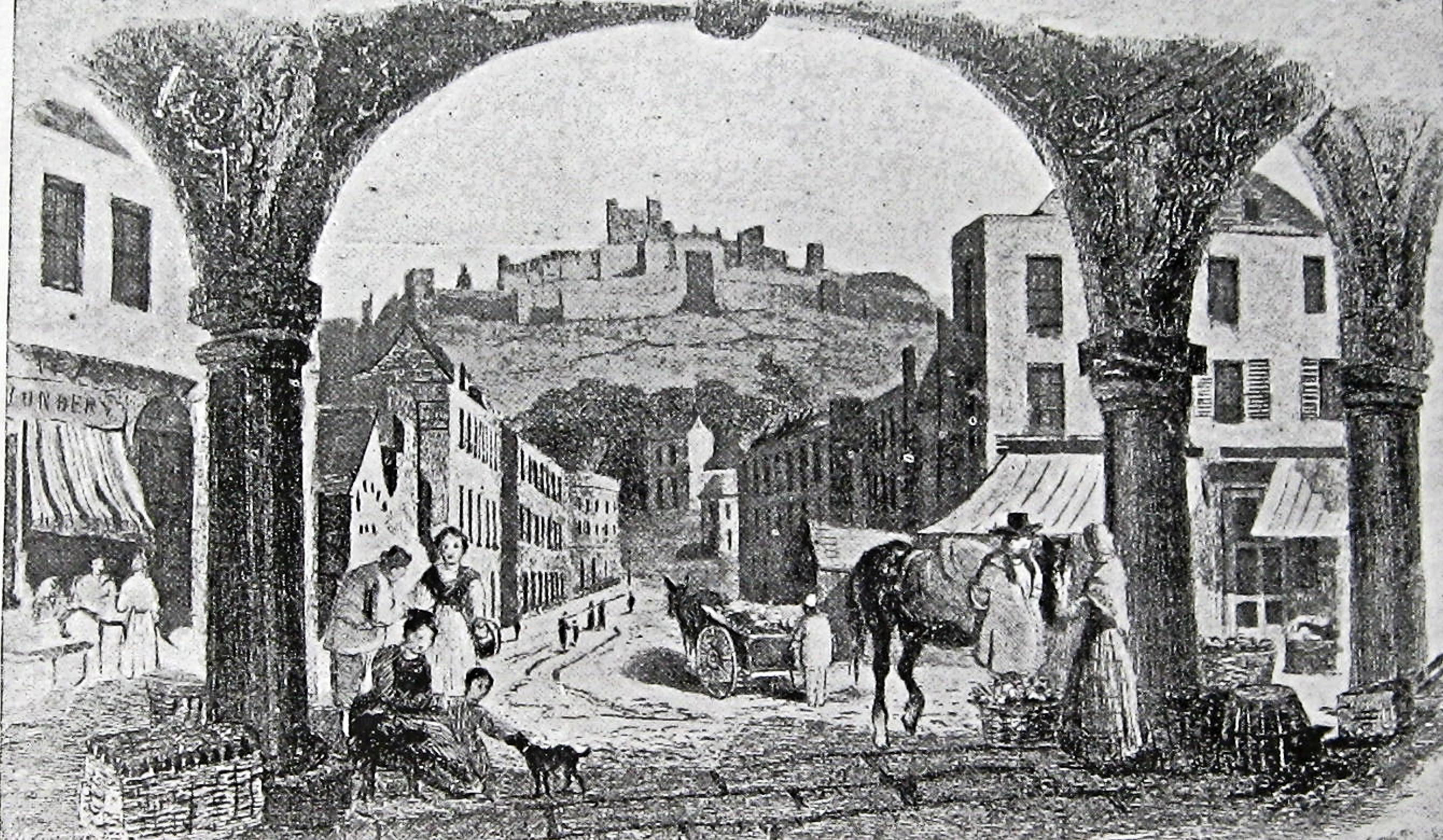
Looking down Castle Street from the Market place c 1830

Looking down Castle Street from the Market place c 1830

Joseph Niczephore Niepce (1765- 1833), about 1826, found that when the image was thrown onto a pewter plate covered with a light sensitive coating of bitumen solution, after about eight hours the image became permanently fixed. Not long after Neipce went into partnership with Louis-Jacques-Mandé Daguerre (1787- 1851) and adopting Schultz’s discovery, used copperplate covered with silver iodide as the light-sensitive coating. With this, in 1835, Daguerre succeeded in developing an image with mercury vapour. Two years later after more experiments Daguerre found that the image could be fixed permanently by immersing the plate in a solution of common salt. This became known as the Daguerre process and on the 9 September 1840 the Dover Chronicle reported that ‘Doctor Simon of Castle Street had produced a portrait from life by the Daguerreotype process.’ The article stated that the exposure was ‘taken under unfavourable circumstance. The sun having shone only eight minutes, seven more minutes were persevered in only a whitish light from a partly concealed sun … on to a silver oxide with mercury on a copper plate.

Dr J P Simon appears to have obtained a copy of Daguerre’s work for by Thursday 21 November 1839 having translated it he was selling copies for one shilling and sixpence each. Dr Simon was fluent of French and English and by that time had published a poem on photography and was giving lectures on the subject. The Dover Chronicle, acknowledging all of this said that Doctor Simon’s work should not be looked upon as a mere translation, but as ‘internal evidence of a practical knowledge of art.’ By 25 September 1841 Simon had obtained a Dagurreotype licence and produced ‘a portrait of a girl about ten years of age.’ He also continued to give lectures but these were only attended by a few and in May 1842 advertised his Dagurreotype licence and two years later advertised a series of farewell lectures prior to leaving Dover.

Edward Sclater 1803-1889 Dover Photographer. David Iron Collection

Edward Sclater 1803-1889 Dover Photographer. David Iron Collection

One of those who may have attended Dr Simon’s talks was Edward Sclater, born in Dover in 1803 he was, by 1840, was one of Dover’s foremost carvers and gilders. About that time Dover’s Town Clerk, Edward Knocker, asked Sclater to design and carve the former Lord Wardens shields. These can still be seen today decorating the Stone Hall of Dover’s Maison Dieu. It is not clear if Sclater bought Simon’s licence, but at about the same time as the doctor left Dover, Sclater added photography to his credentials. His workshop/studio was at 191 Snargate Street. Of interest, in 1828, Sclater’s daughter Ann, named after her mother, was born and when she grew up married Henry Crundall (1821-1894) from Lambeth, Surrey. His brother, William, became Dover’s Mayor and William’s son, also called William, was knighted and became Dover’s Mayor 13 times! Henry Crundall and Ann Sclater’s eldest daughter married John Iron (1858-1944), Dover’s long serving harbour master.

Dovorian George Thomas Amos, a devout Quaker, was born in 1827 and went to sea when he grew up. In the early 1850s he opened a tobacconist shop in Sandgate and about 1858, another one at 70 Biggin Street, Dover. It was here that Amos introduced photography into his business, at first using the Daguerreotype method. However, although this process produced positive exposures, each one was unique and could not be copied. William Henry Fox Talbot (1800-1877) had looked at ways of copying exposures and in 1841, instead of glass plates tried using ordinary paper impregnated with silver iodide solution. When the paper was treated with chemicals a negative image became visible and each of these could be used to make a number of positives by shining a light through them and thus devised a method of making duplicates.

George Amos 70 Biggin Street December 1867 advert stating that his gallery is one of the largest in Europe

George Amos 70 Biggin Street December 1867 advert stating that his gallery is one of the largest in Europe

It would seem that Amos might have used the Fox Talbot’s process before switching to the wet-plate process that superseded it. This had been invented in 1850 by sculptor Frederick Scott Archer (1813–1857) who coated a glass plate with a liquid emulsion of silver iodide and photographic collodion, which he had invented. The process was quick, cheap and enabled portraits to be developed quickly and from this, the modern gelatine emulsion evolved. By 1867 George Amos, using this method, boasted in his adverts of the time to having one of the largest photographic galleries in Europe!

George Amos, photographer 12 Snargate Street. Dover Library

George Amos, photographer 12 Snargate Street. Dover Library

According to another of the Amos adverts, besides using the most modern equipment the sitters were placed ‘in the best possible position for the purpose of art and for taking portraits in all states of the atmosphere, as well as securing effect, which cannot possibly be obtained by any other gallery surrounded by buildings.’ Three years later, with the introduction of the Habitual Criminals Act, Amos won the contract to take photographs of criminals in Dover gaol for which he was paid 10 shillings each. Amos married Tabitha Manuel and had several children including Eugene, who joined his father in the photographic business. By this time he had moved to 12 Snargate Street. The developing of photographs was still a laborious skilled job requiring cumbersome equipment, but once Eugene learnt the trade, his father renamed the studio Amos & Amos.

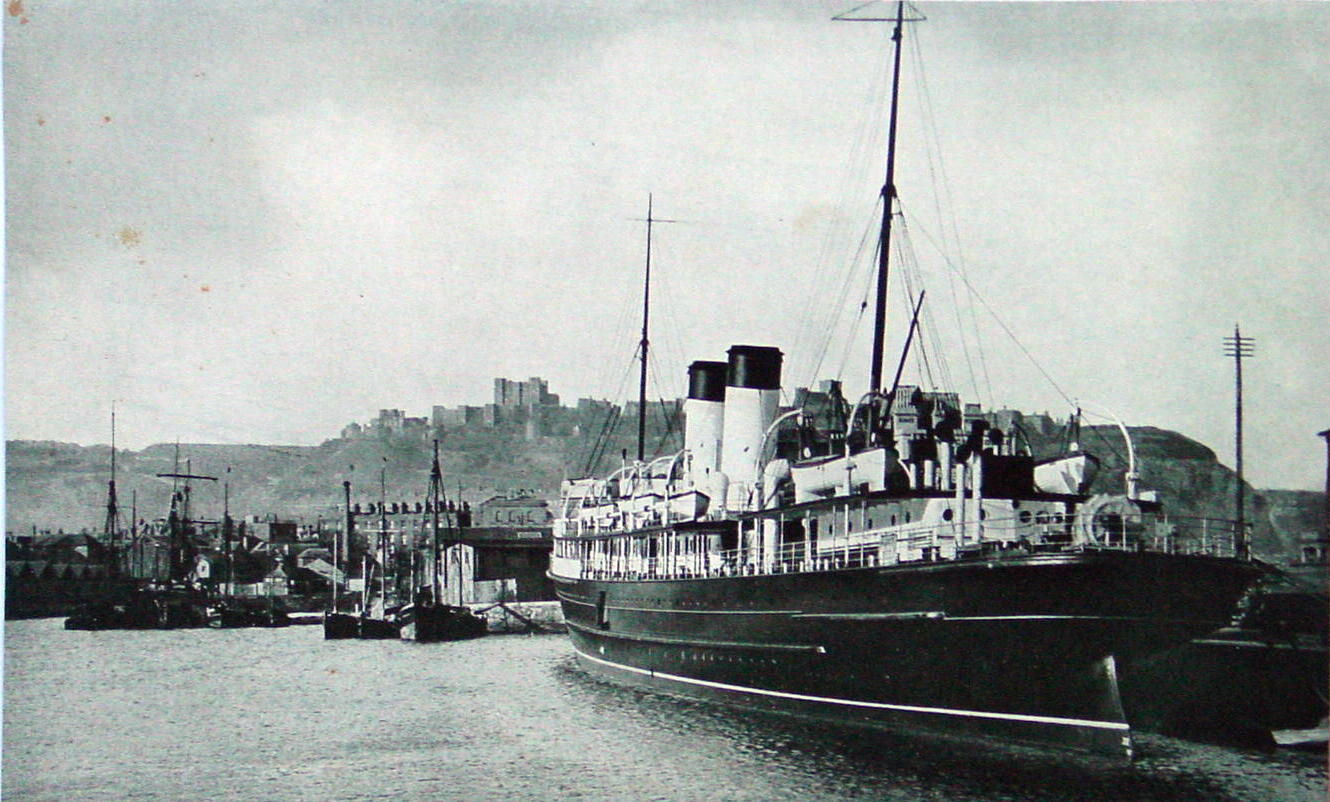
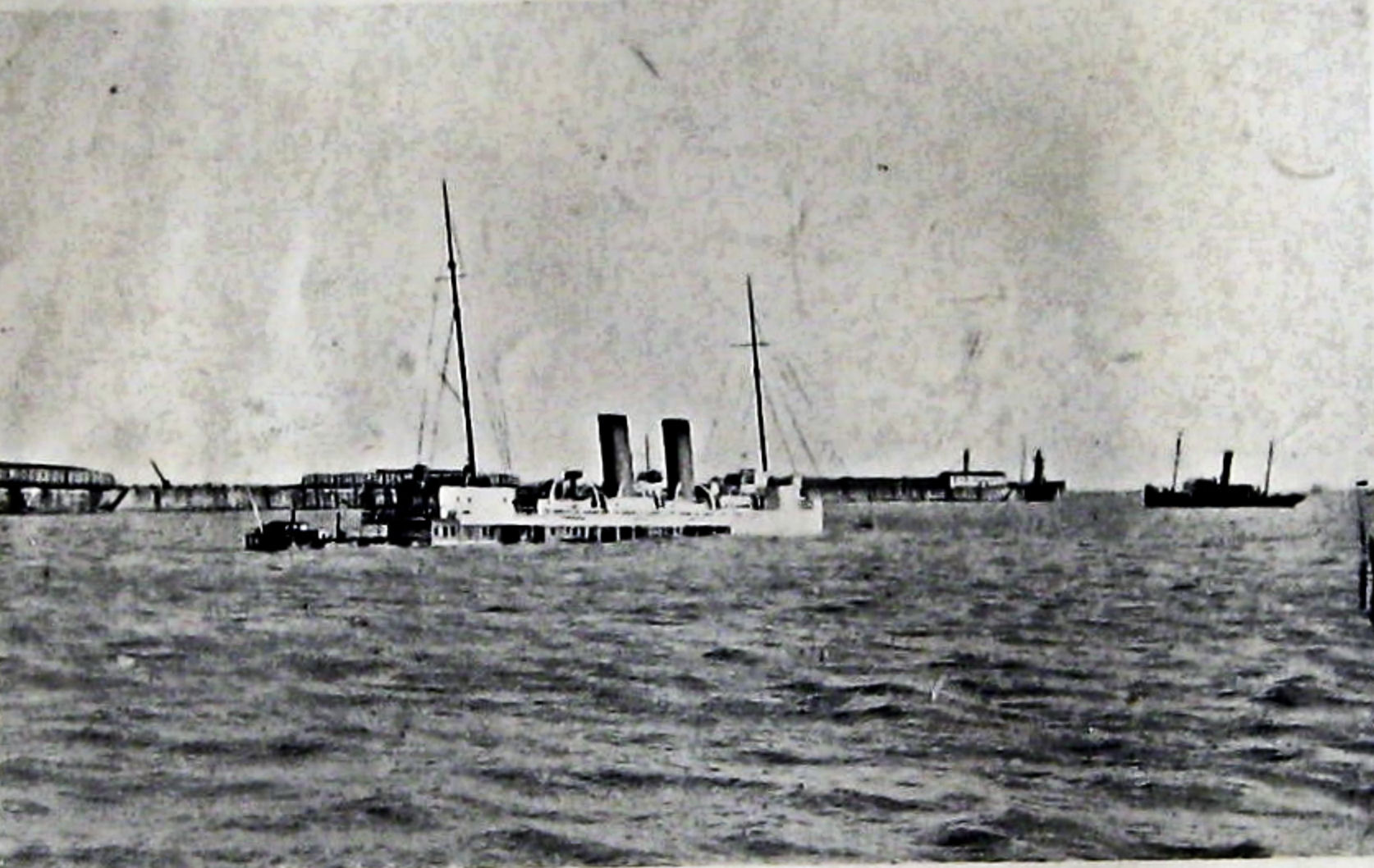
Glatton on the right of salvage ship Dapper 1925. Photograph taken by Eugene Amos.

Glatton on the right of salvage ship Dapper 1925. Photograph taken by Eugene Amos.


Eugene Amos quickly made a name for himself as a nautical photographer going out into the Channel, in all weathers, almost up to his death in 1942. During the inter-war period he photographed the salvaging of the Glatton that was sunk in the Harbour in 1918. Amos junior was also a eminent amateur archaeologist and recognising ancient finds in Dover as belonging to a Roman Classis Britannica Fort, he subsequently identified the location of a Roman Shore Fort. It would seem that Eugene Amos never married and by 1918, Amos & Amos was being run by Rachel Ann Amos. She died in 1920 but the business remained and seems to have been run by Eugene’s sister, Florence Mary Amos known as Flora,  who had married Arthur Gregg in 1903. The studio/shop was bombed during World War II and never re-opened. Of interest Paul Amos, no relation, these days runs a photography business from the Old Print House in Russell Street.

Woolcomber Street photograph by Amos & Amos 12 Snargate Street

Woolcomber Street photograph by Amos & Amos 12 Snargate Street

In the 1850s the number of photographic studios in Dover started to proliferate. William Hayler had a studio in Snargate Street while nearby at 113 Snargate Street, drawing master Josiah Fedarb diversified into the photographic business. David Williams from Waltham opened a studio in Last Lane and M Barnett one at 166 Snargate Street. At 45 Snargate Street, Frederick Collins opened a studio and in 1859 William Wallis had a photographic business on Commercial Quay alongside Wellington Dock, but soon after moved to 36 Snargate Street then to Tontine Street, Folkestone. Canterbury born Samuel Jacobs opened his studio at 36 Snargate Street before moving to 2 Biggin Street. He was the Dover police photographer between 1872 and 1878 but in 1883 Jacobs moved to Sandgate. In July 1888, he committed suicide during a state of temporary insanity.

Pilot William Waters senior painted by his son, artist William Waters. Dover Museum

Pilot William Waters senior, painted by his son, artist William Waters. Dover Museum

Edward King opened his business at 102 Snargate Street in 1862, moved to the Esplanade, on the seafront in 1874 and he too photographed criminals in Dover gaol. By 1862, Clark & Co opened up at 42, Townwall Street and James Clark opened a studio at 46 Snargate Street, staying for 7 years. Also in 1862, Thomas Wilkinson opened at 121 Snargate Street, staying until 1867 when the business passed into the hands of W M Newell who stayed until 1870. Meanwhile William Richard Waters opened his photographic studio at 7 Bench Street in 1867 and ran it for 5 years. Waters, the son of a Dover Pilot, was born in the Pier District of Dover and went on to become an eminent portrait painter whose studio was at 23 Castle Street. Eight of his paintings were exhibited at the Royal Academy and his watercolours of scenes in and around Dover received the recognition they deserved by the end of the 19th century. Why Water’s moved into the photographic profession is unclear for he was working as a successful artist from his studio and then his home at 15 Norman Street until days before his death on 4 January 1880.

Alexander Grossmann photographer. Dover Library

Alexander Grossmann photographer. Dover Library

From 1867 to 1901 Alexander James Grossman was listed as a Dover photographer. Born in Pressburg (now Bratislava), Hungary in 1834, Grossman was brought to England by his refugee parents while a child. Naturalized as a British Subject, he was christened at St Mary’s, Whitechapel, London in 1855 and joined the 95th Rifles renamed the Rifle Brigade in 1881. An early posting was to Dover where he met and married Sophia Ada at the Holy Trinity Church, in the Pier District. While in the army, Grossman was patronised by Prince Arthur (1850 -1942), during his service with the Rifle Brigade, whom, it was said, encouraged Grossman to become a professional photographer. Prince Arthur was the third son of Queen Victoria (1837-1901) and later became the Duke of Connaught giving his name to Connaught Hall and Connaught Park.
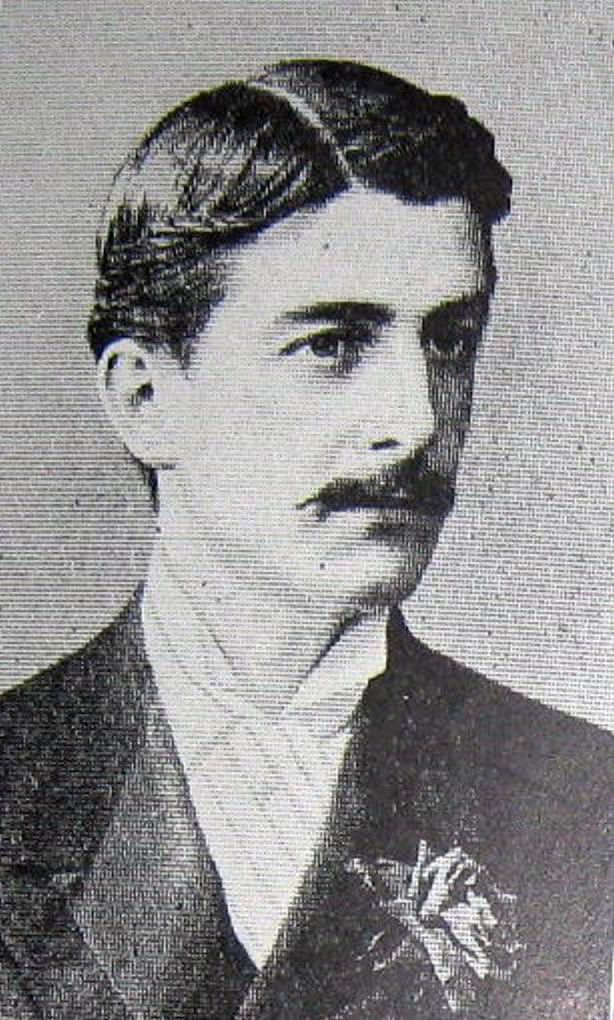
George Wyndham Dover's MP. Under Secretary of State for War. Photographer Alexander Grossman c 1885

George Wyndham Dover’s MP. Under Secretary of State for War. Photographer Alexander Grossman c 1885

On discharge from the army, Grossman opened his photographic studio at Snargate House, 16 Snargate Street and was to stay there until 1901. From 1899, for two years, he also had a studio at 20 Biggin Street. In 1878, Grossman received international appreciation as an interpreter when on 26 November the 3,382ton Hamburg-American mail packet Pommerania, on a voyage from the US to Germany, was in collision with iron sailing ship Moel Eilion off the South Foreland. 172 passengers, mainly German, from the Pommerania were landed at Dover and taken to the Seamen’s Mission. There Grossman took on the mantle of interpreter and carer staying with the passengers until such time passage was found for all of them to return to Hamburg. After leaving Dover, Grossman retired to Holborn in the City of London.

About 1871 Richard Leach Maddox (1816-1902) invented the dry-plate process which meant that glass plates could be purchased with ready-coated dry emulsion of silver iodide and gelatine. This encouraged the growth of amateur photography by the wealthy which, in Dover deterred new photographers without alternative sources of income setting up a business. Some did try, for instance, Henry Verrall moved into 9 Bench Street in 1870, but does not appear to have stayed very long. James Walter Browning appears to have done considerably better, running a successful studio at 50 High Street from 1878-1890 when he sold the premises to Jean-Baptiste Gemneul Bonnaud. About the same time as Browning set up business Lambert Weston introduced photography into his artist’s studio at his home on the seafront.
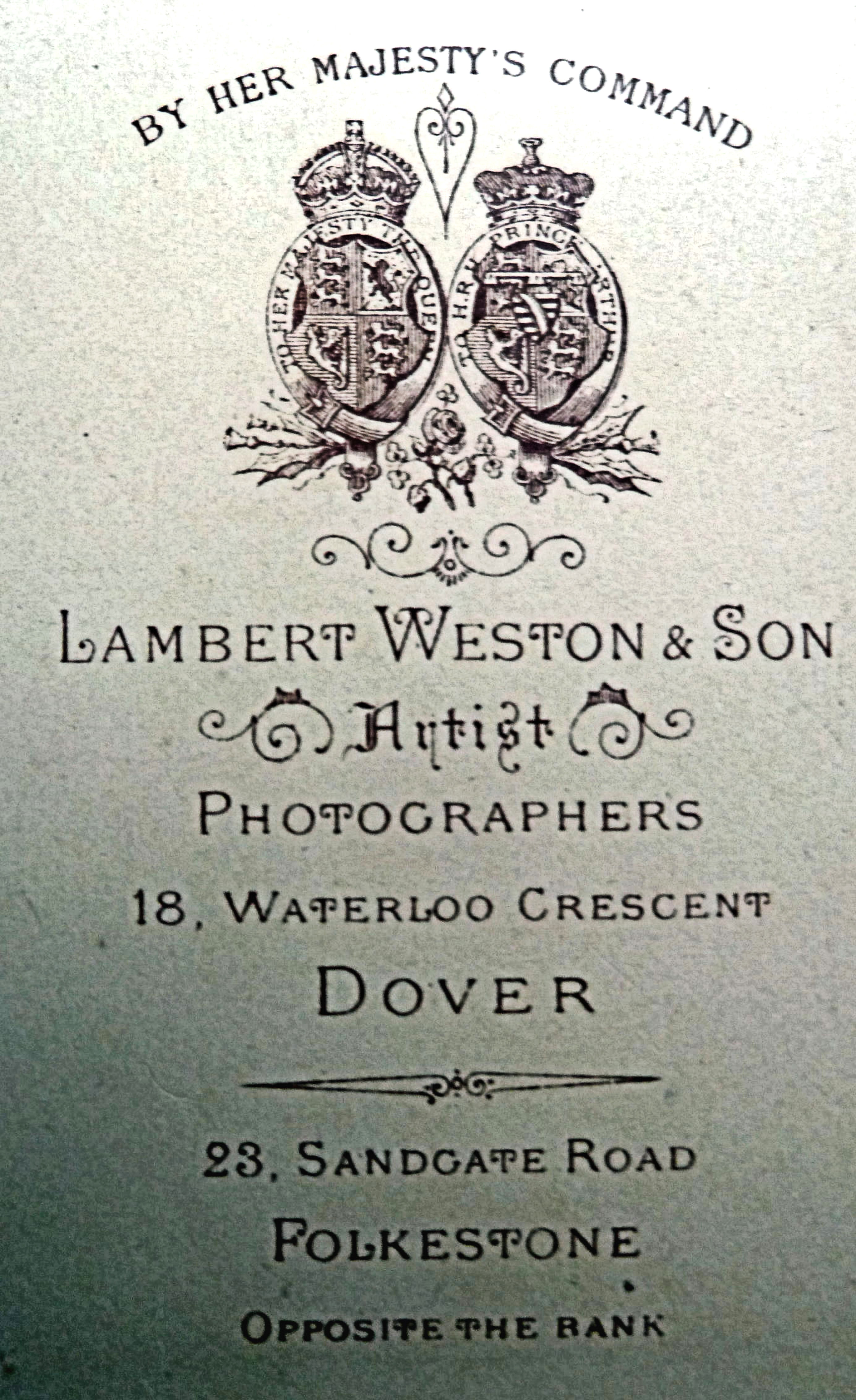
Lambert Weston 18 Waterloo Crescent. David Iron Collection

Lambert Weston 18 Waterloo Crescent. David Iron Collection

Lambert Llewellyn Weston born on 25 September 1836 in Folkestone, came to Dover and became a successful artist. He owned 17 & 18 Waterloo Crescent with his studio in number 18, while number 17 was managed by his housekeeper who let it out to distinguished guests. During his career as an artist, Weston knew caricaturist George Cruikshank (1792-1878) who was a frequent guest. Another famous personage who rented Weston’s property was Charles Dickens (1812-1870). The great author was a frequent visitor to Dover and as he grew older spent an increasing amount of time, staying at Waterloo Crescent. It was recorded that Dickens, on fine days would walk up to Pilots Meadow, where he would work. The Times of 1 January 1896, tells us that Lambert Weston was an intimate friend of both Dickens and Cruikshank. In the early 1870s Weston opened a photographic studio at 18 Waterloo Crescent and it was to stay there for the next twenty years. Shortly after Weston opened another photographic studio at 23 Sandgate Road, Folkestone. By the time he died, on 2 February 1895, other members of Lambert’s family were running the photographic business and the firm, in Dover, moved to 15 Bench Street.
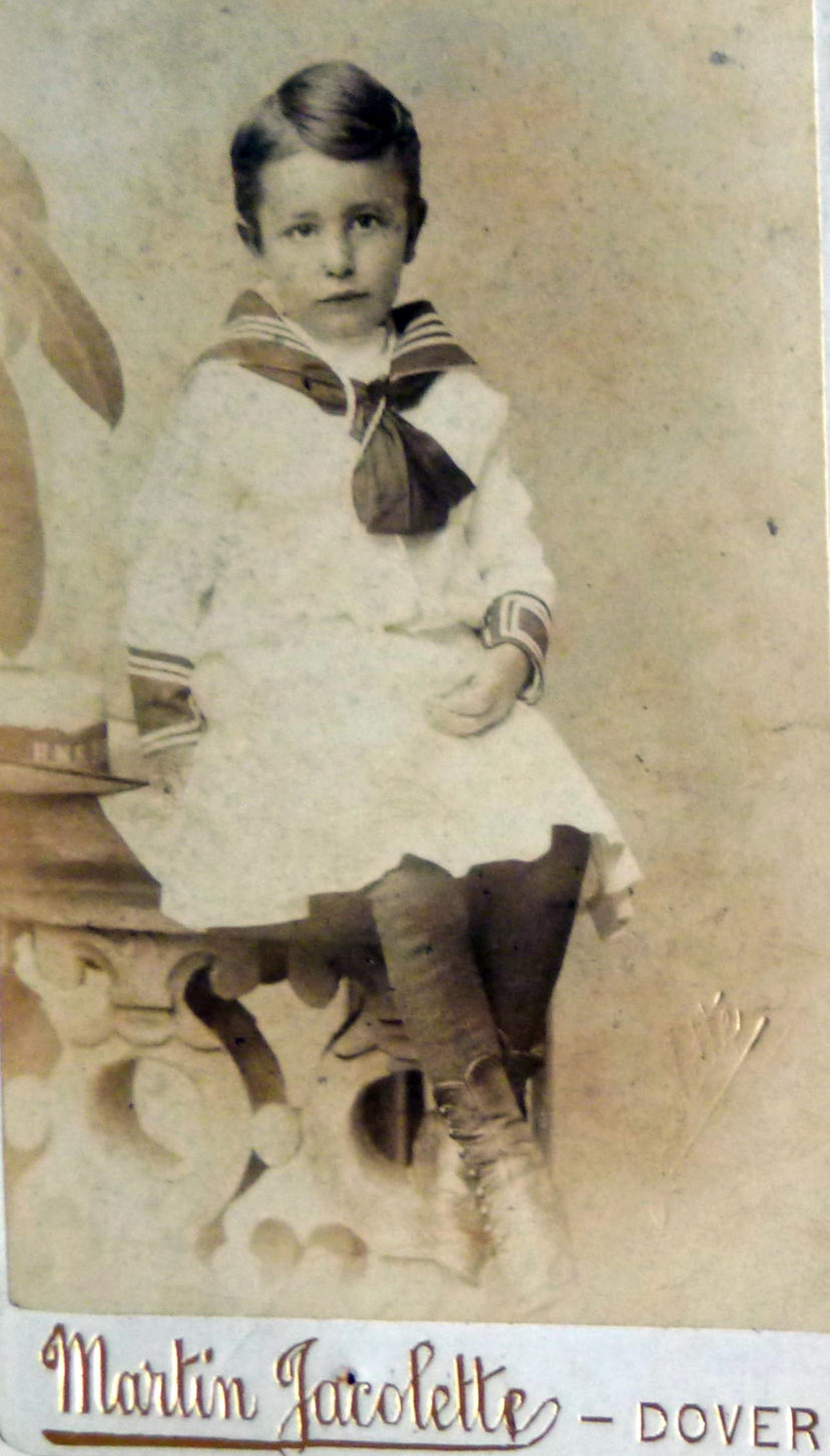
Martin Jacolette photographer subject Harry Crundall c1881. David Iron Collection

Martin Jacolette photographer, subject Harry Crundall c1881. David Iron Collection

Frederick Artis, from Oxford moved into the former photographic studio of Thomas Wilkinson and W M Newell at 121 Snargate Street between 1881 -1883. Percy Pilcher opened his photographic business in Woolcomber Street in 1887 and then moved to 15 Castle Street staying there until 1892. About 1870, Martin Jacolette, born in Tavistock, Devon in 1850, the son of a Swiss miniature painter, came to Dover. Here he trained as a portrait painter and photographer under Lambert Weston and by 1881 had opened his own artist and photographic studio. This was in his home at 1 Priory Hill, although he remained with Lambert Weston managing the photographic side of his business.

By 1887 Jacolette had purchased, with possibly Weston’s help, North Brook House, 17 Biggin Street. The building had been the home of bootmaker Thomas Holloway having formerly been the home and possibly built for iron founder Edward Poole. According to local historian Joe Harman, the building foundations were strengthened by the use of old millstones, one of which came from Crabble corn mill. At the rear of the house, facing north, Jacolette built his photographic studio and subsequently earned a national and then international reputation as a portrait photographer.
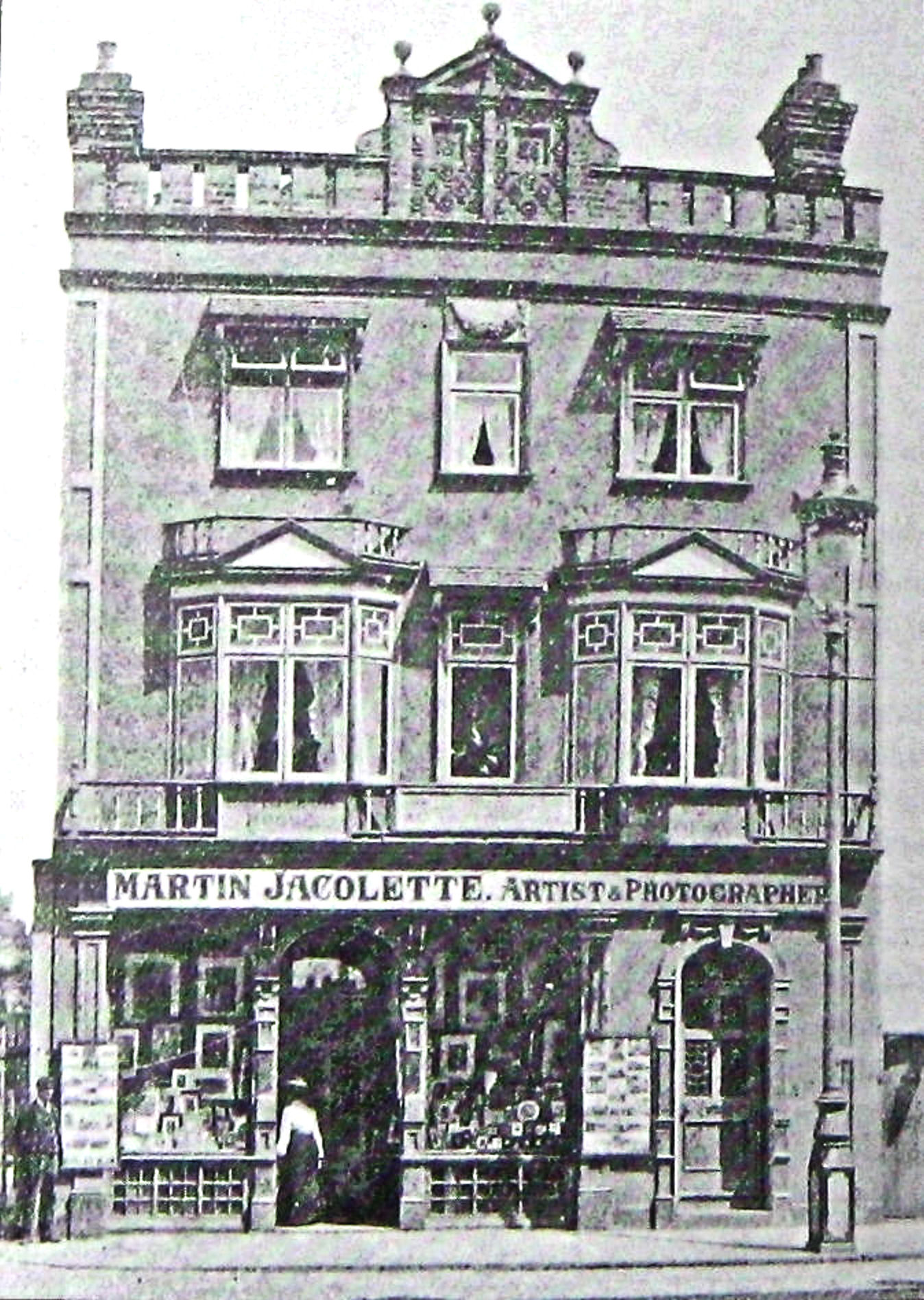
Martin Jacolette 17 Biggin Street c1895. Joe Harman

Martin Jacolette 17 Biggin Street c1895. Joe Harman

As he climbed the ladder of success, Jacolette opened a studio at Queens Gate Hall, Harrington Road, South Kensington offering to undertake both portrait painting and photography. Nonetheless, it was his portrait photographs that received acclaim and in 1890 Jacolette introduced Photo-Mezzotint, which was soon adopted by portrait photographers throughout the country. However, on 3 December 1907 Jacolette died while undertaking a portrait commission in London, he was 56 years old. The following year an exhibition of Jacolette’s photographic portraits were shown at the offices of the British Journal of Photography, 24 Wellington Street, the Strand, London. Following Jacolette’s death North Brook House was sold as a going concern to Herbert & Reece photographers.

St Mary's Church by Martin Jacolette following demolition of neighbouring properties.

St Mary’s Church by Martin Jacolette studio following demolition of neighbouring properties.

In the world of experimental photography attempts were being made to replace glass plates, usually 12 inches by 10 inches, with something lighter, more compact and in a form that would allow several photographs to be taken without reloading. George Eastman in the US manufactured the first successful emulsion-coated film in the form of a roll in 1889. Although the Eastman celluloid film had not reached the UK, the number of professional photographers and antiquarians in Dover, during the 1890s increased. It was noted in the local press that they were seen there in ‘droves’ in Cannon Street, during the demolition of the ancient houses prior to street widening for trams. The quaint interiors of these houses, some of them dating from about the time of the Commonwealth 1640-1660, were recorded, sadly most of the photographs, if not all, have been lost. However, when the buildings on the east side of Cannon Street, between St Mary’s Church and Market Square were demolished, unique views of the Church were photographed and some of these have survived.

In the Martin Jacolette stable and probably the one who took the photograph and tinted it was  Thomas Moodie of Clairville, 40 Priory Hill. Moodie later set up as a photographic artist and miniature painter in his own right. Another artist/photographer was Reginald Millar of Maison Dieu Road while William Henry Pettitt was a reporter/photographer who, it would appear, freelanced for local papers. Pettitt was also the Dover agent of the Caligraph Typewriter, which boasted of the letters being laid out alphabetically with a level keyboard and having arithmetical and mathematical features.
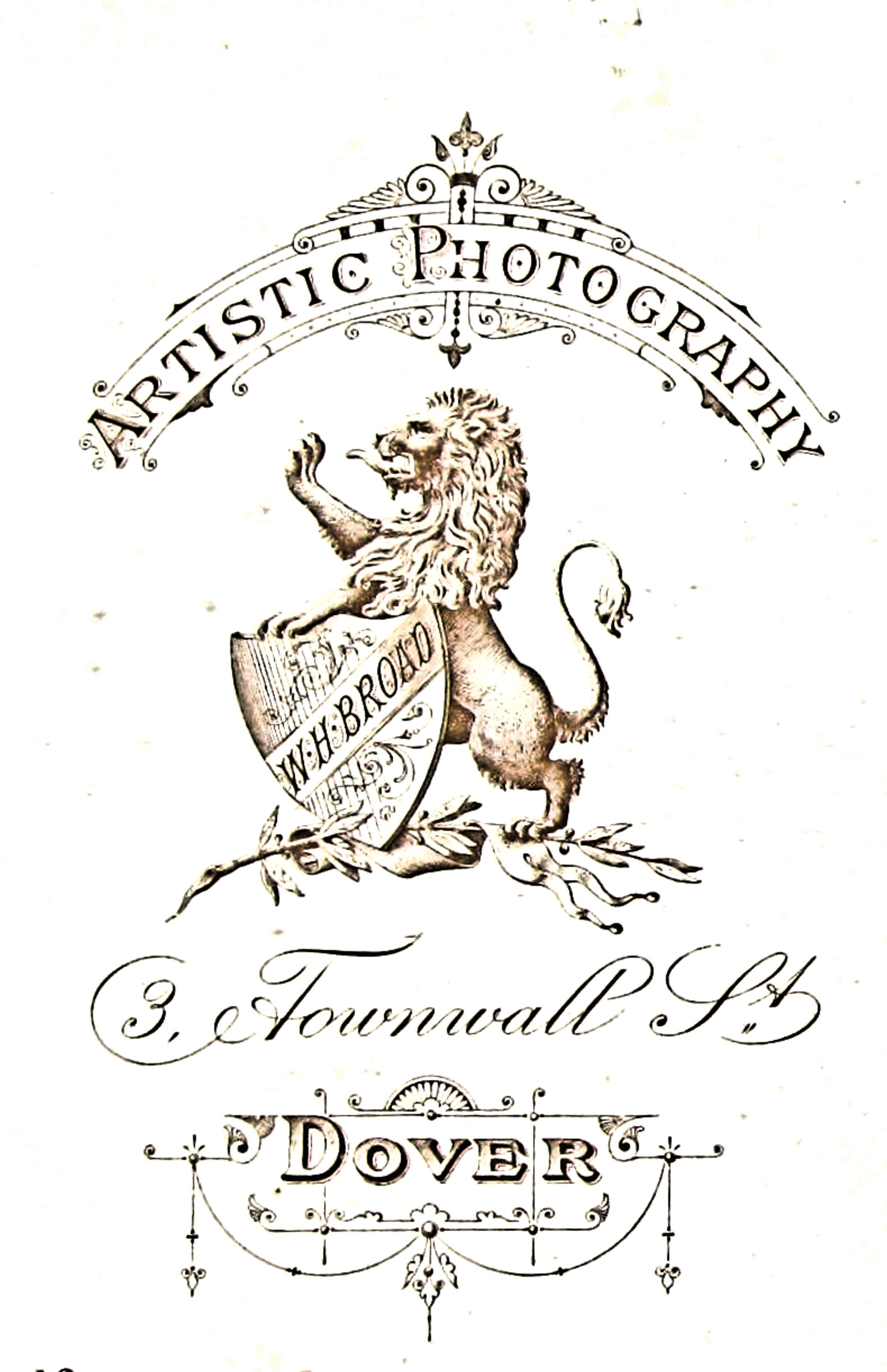
Photographer - William Henry Wright Broad 3 Townwall Street 1898-1909. David Iron Collection

Photographer – William Henry Wright Broad 3 Townwall Street 1898-1909. David Iron Collection

At 129 Snargate Street Martin & Taylor opened their studio in 1890 staying there for nearly a decade. At 121 Snargate Street, what had been renamed the Snargate Street Studio was taken over by Frederick Deakin, who stayed until 1909. At 3 Townwall Street – on the south (sea) side of the then much narrower Street, William Henry Wright Broad (1851-1939) opened a studio in 1898. Born in Deal, Broad came to Dover as an assistant to Lambert Weston before opening his own studio. He stayed at 3 Townwall Street until 1909 and in 1900 was joined by Edmund Bowles who bought the studio and stayed until 1930. Broad lived at 5 Albert Road and died on 14 April 1939.

Charles Stevens Harris (1865-1938) - Photographer

Charles Stevens Harris (1865-1938) – Photographer

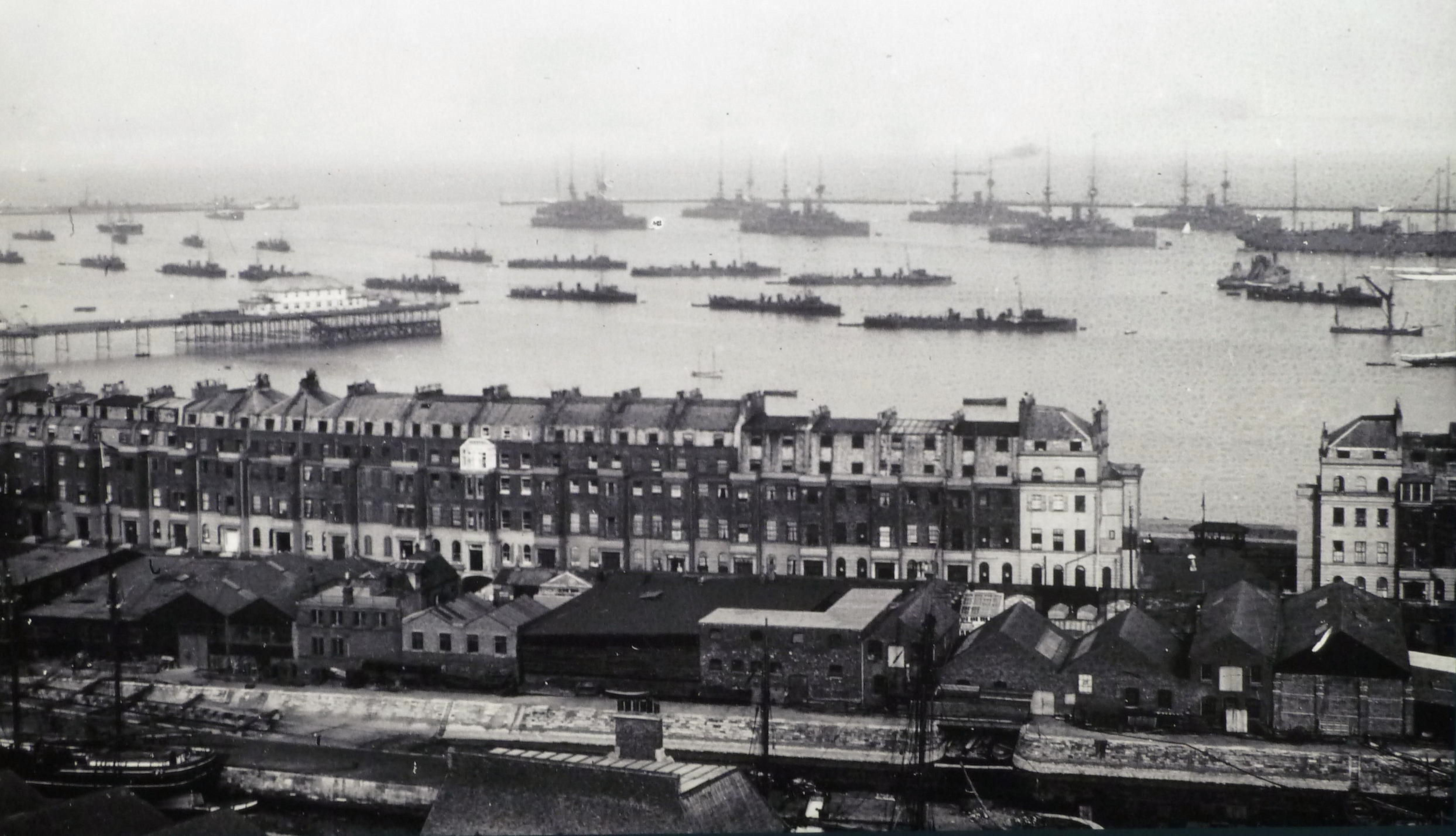
By the turn of the century, Dover was one of the most affluent towns in the country and this had a positive effect on the local photographic profession. Charles Stevens Harris (1865-1938) of Odo Lodge, 52 Odo Road, Buckland, opened a studio in his home about 1890 running it from there until 1899. Harris then moved the business to 77 London Road until he died on 13 October 1938 at the age of 73. In 1906 Harris produced a series of photographs one of which, a panoramic view of the Admiralty Harbour, was taken with a special camera and received national acclaim. The photograph features about forty vessels of the British Fleet sheltering in the harbour that was being built for them.

Admiralty Harbour panoramic view c1906 believed to be taken by Charles Harris, photographer

Admiralty Harbour panoramic view c1906 believed to be taken by Charles Harris, photographer

At about the same time as Charles Harris opened up his photographic studio, John George Whorwell opened his at his home, 7 Bench Street. This was the same address where William Richard Waters once had his photographic studio. Whorwell was a success as an out-of-doors photographer, specialising in outdoor shots of weddings and garden parties. Whorwell also offered dark room facilities for amateurs where he would teach his students how to use his equipment. Whorwell was also a local pioneer in producing moving pictures using the inventions of the time.
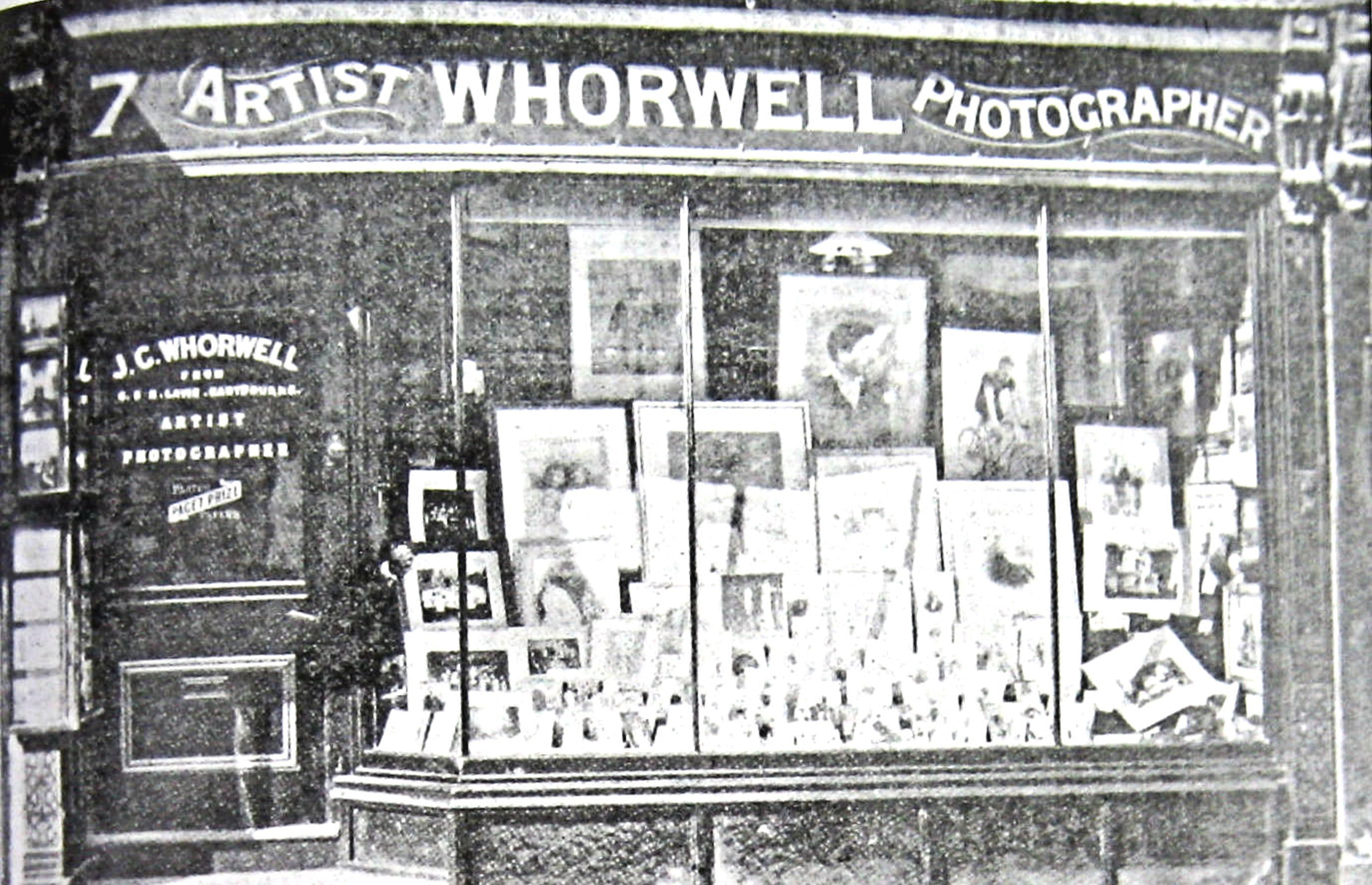
Photographer John George Whorwell 7 Bench Street 1899. Budge Adams Collection Dover Museum.

Photographer John George Whorwell 7 Bench Street 1899. Budge Adams Collection Dover Museum.

Having previously offering Lantern Shows based on the pioneering photographic studies of motion undertaken by Eadweard Muybridge (1830-1904), Whorwell was the first professional photographer in Dover to use a cine camera. William Friese-Green (1855-1921) had invented the basic feature of the cine camera and projector in 1888 and Thomas Alva Edison (1847-1931) had invented the kinescope in 1891. In France Auguste (1862-1954) and Louis Lumière (1864-1948) pioneered projection of the moving pictures and their first public performance took place in Paris on 22 March 1895. Using a combination of these inventions, Whorwell gave public shows.
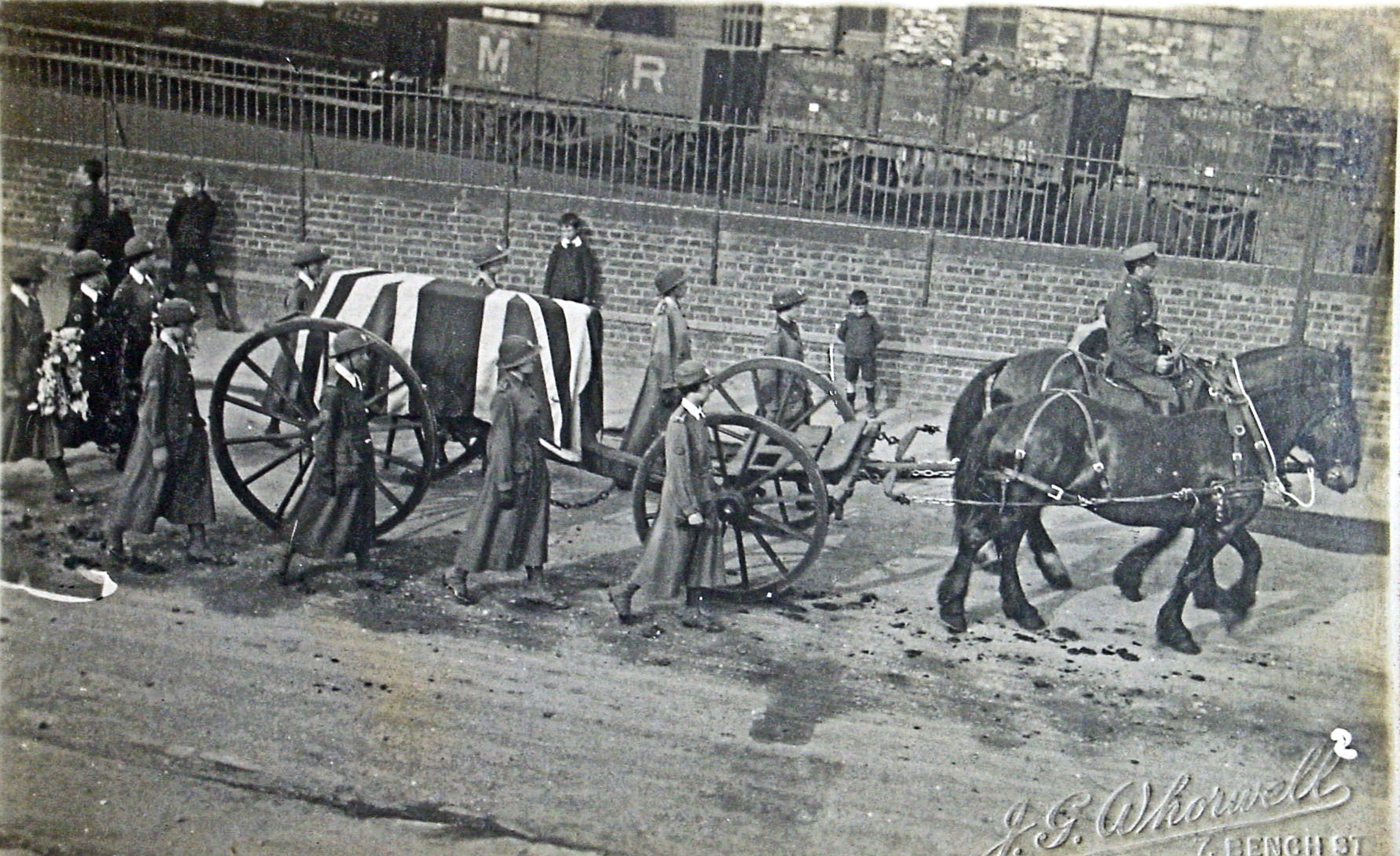
Spanish 'Flu' epidemic 1918 - Postcard of a victim's funeral procession by J G Whorwell, 7 Bench Street. Eveline Robinson collection

Spanish ‘Flu’ epidemic 1918 – Postcard of a victim’s funeral procession by J G Whorwell, 7 Bench Street. Eveline Robinson collection

When John Whorwell died on 23 July 1933 aged 74, his son Arthur with the help of his sister, Lillian, took over the business. World War II (1939-1945) broke out in 1939 and just after midnight on Monday 4 October 1940, shelling destroyed the nearby Guildhall Vaults public house on the corner of Queen Street and Bench Street. Although the blast caused severe damage to properties in the area, the Whorwell’s studio quickly patched up their premises and returned to work. However, Arthur died on 15 March 1944 when Lillian subsequently took up the reigns. In September 1947 Lillian put on a successful child photography exhibition showing photographs taken by the studio from when it first opened. However, in 1971, the studio finally closed.

The number of photographers setting up business in Dover continued to increase. At his own home, Haslemere, Kearsney, George Hatton Buckman, the Chief Clerk at Dover Gas Company, had a studio. James Willis of 27 Buckland Avenue had a small studio and nearby at number 3 Buckland Avenue, John Harry Gibson also had studio – he specialised in outdoor photographs. B Knight briefly operated from 4 Snargate Street and then, it would appear sold the studio to George Lusty who came from Cheltenham. Herbert & Reece bought Jacolette’s studio at 17 Biggin Street and bookbinder, Tom Oakley had a studio at his home, Rose Cottage 32 St Radigunds Road. Thomas H Chapman opened a studio at 233 London Road in 1909, staying until the 1920s and in 1909 Edmund Vincer Bowles took over the studio at 3 Townwall Street.
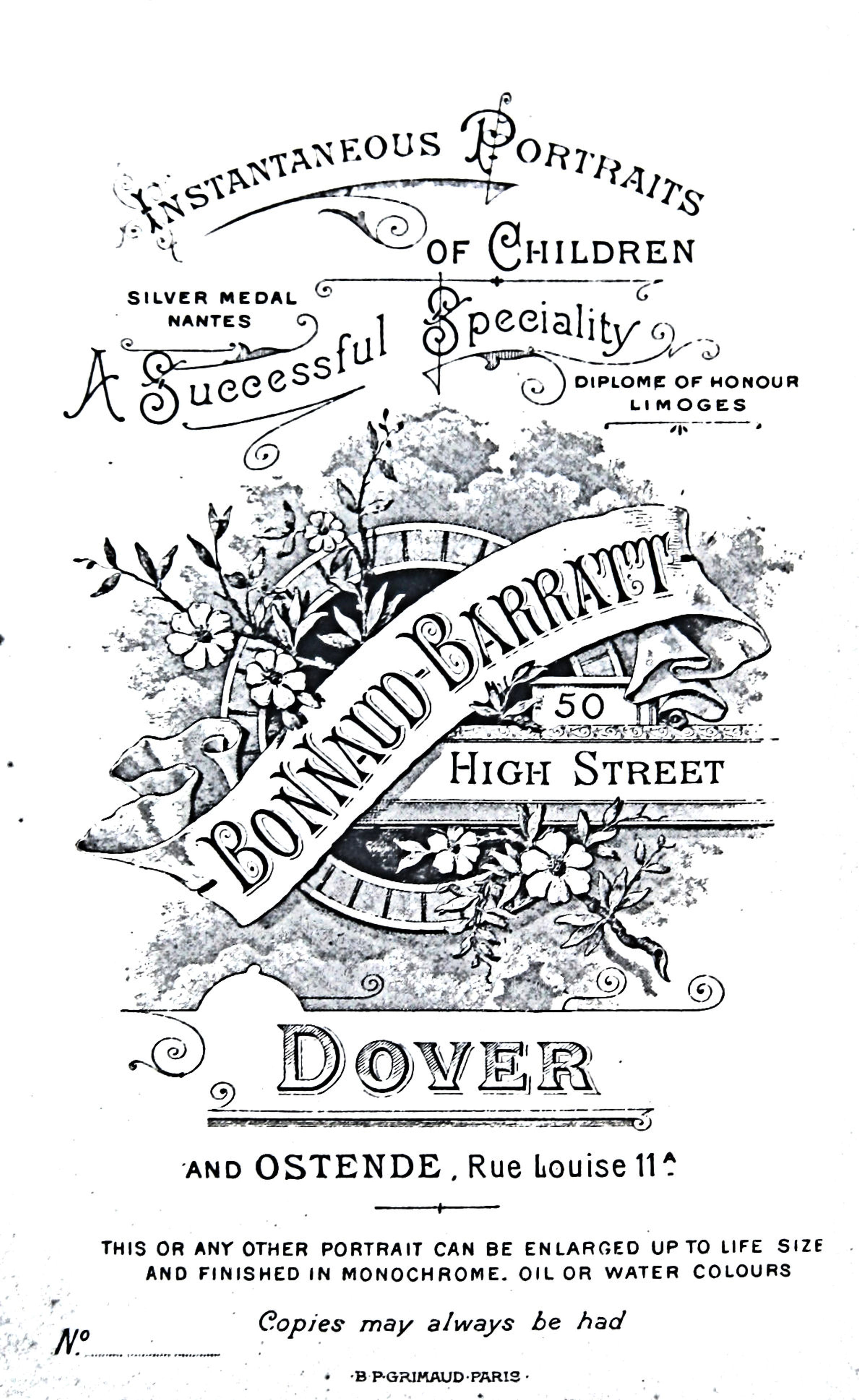
Photographer - Bonnaud-Barratt 50 High Street. Dover Library

Photographer – Bonnaud-Barratt 50 High Street. Dover Library

Jean -Baptiste Bonnaud took over James Walter Browning’s studio at 50 High Street in 1895. Born in Limoges, France about 1839, Bonnaud retained his French nationality but hyphenated Barratt to his surname. He was a chemist and also had a business at Rue Louis 11a Ostend, Belgium. It would appear that Bonnaud had taken up photography as a sideline to running his chemist shop but by making full use of the new Eastman celluloid roll film had carved out a niche as a photographer of children. He stayed in Dover until about 1909 when he sold the business to George Jarrett.

George Henry Jarrett was born in Blean, near Canterbury, in 1881 and finished his training as a photographer under Jean-Baptiste Bonnaud. He bought Bonnaud’s business about 1909 and lived with his wife, Kate, above the shop. There his son, later Sir Clifford Jarrett the Chairman of Dover Harbour Board, was born in 1910 and daughter Joan was born 1914. George Jarrett was called up in World War I (1914-1918), leaving Kate to run the business with the help of Jarrett‘s assistant, later Mrs Ridgewell. However in the autumn of 1917 the shop was a victim of a bombing raid and Kate took their children to her parents home in Canterbury. Following the War, Jarrett returned and once the premises were made habitable, the family moved back in.

Mrs Ridgewell stayed with Jarrett until 1925 and later recounted to local historian Joe Harman, aspects of her job that mainly entailed re-touching prints. (My Dover p100-p101 published by Riverdale Publications 2001). ‘The work was done on the glass plate negative, using a very sharp black lead pencil which was sharpened by rubbing on emery paper.’ Her desk had side screens and a cover to cut out backlight and she held the negative paper over the aperture in the sloping board at the back. The natural light showed through and she could improve the negative. Head and shoulder portraits needed a lot of attention to remove some of the wrinkles and lines around the mouth for female sitters and frown on the men. The proofs were black and white but the finished prints were in sepia. Following the death of photographer, Charles Harris on 13 October 1938, Jarrett bought his studio at 77 London Road and stayed there until he retired in 1958.
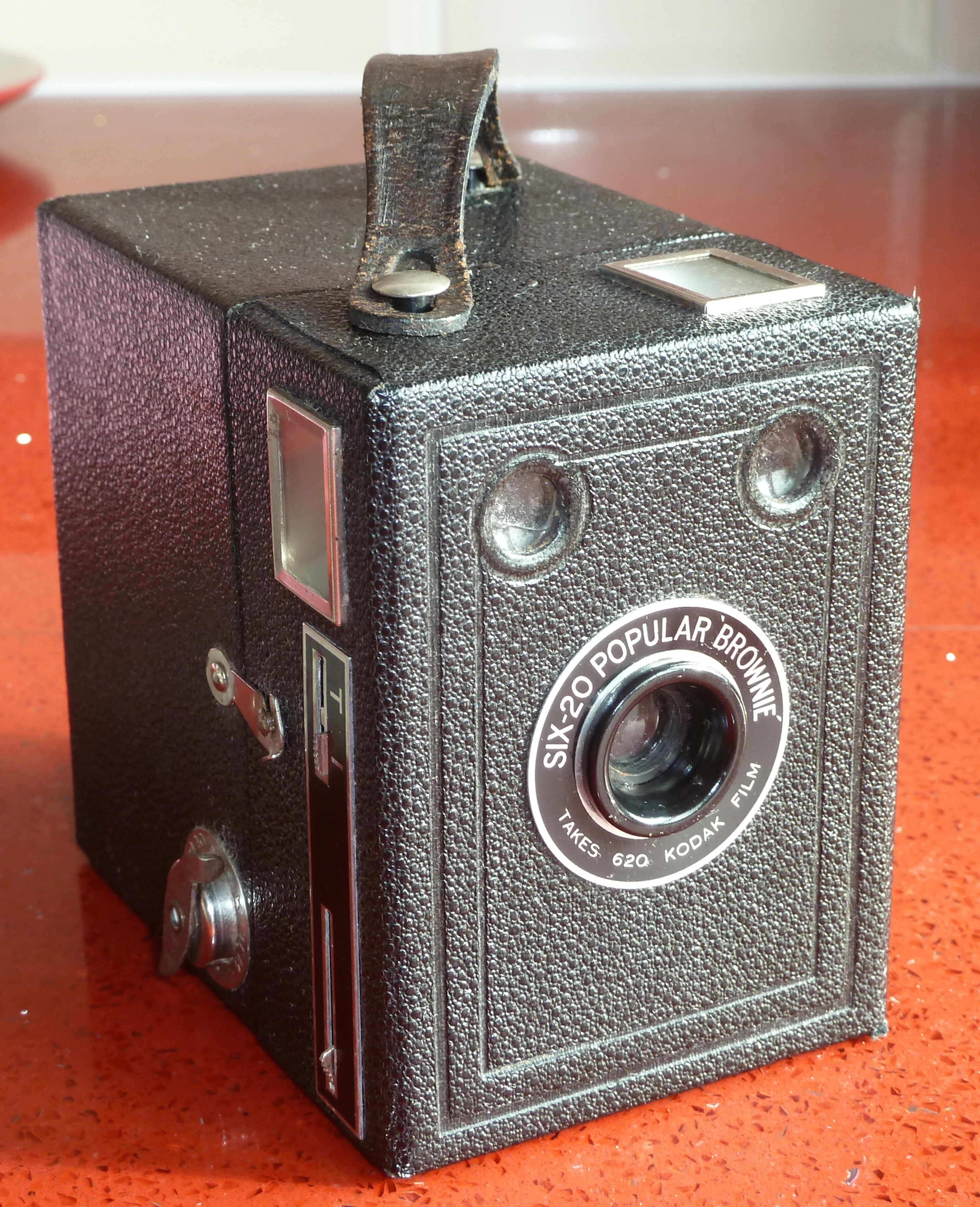
Eastman Kodax Brownie box camera with fixed focus lens, single speed and a fixed aperture. Alan Sencicle

Eastman Kodak Brownie box camera with fixed focus lens, single speed and a fixed aperture. Alan Sencicle

In the last days of peace before World War I, in 1911 Arthur Burger opened the Rapid Art Studio at 11 King Street and R Millar opened a studio in his home, 6 Bushy Ruff Cottages. That year the former Jacolette studio at 17 Biggin Street was transferred to Raymond Reece Lloyd who was still running it in 1917. In 1913, William Coppard and W Leppard opened a studio at 176 Snargate Street and were joined by Henry C Rhodes in 1915. In the US, George Eastman, who had produced the first celluloid roll film, also manufactured the Kodak camera, correctly advertised as ‘You press the button – we do the rest.’ It was a simple box with a fixed focus lens, single speed and a fixed aperture. In 1914 the company introduced the first precision miniature camera, the Minnograph, using 35mm film and was to be increasingly used in the War to come.

As World War I progressed a number of photographic studios opened and possibly included some run by men invalided out of the armed services. The studios included J Mackay at 7 Snargate Street and J F Bennett 38 Snargate Street. Walshams Ltd moved into the former Grossman studios at 16 Snargate Street and C Knight opened a studio at 35 Biggin Street in in 1915 and was also listed at 184 Snargate Street towards the end of the War. By 1919, M Seaman opened his Peoples Studio at 8 King Street, H Shaw at 61 Biggin Street and Albert Hayes opened a studio at 3 Frith Road.
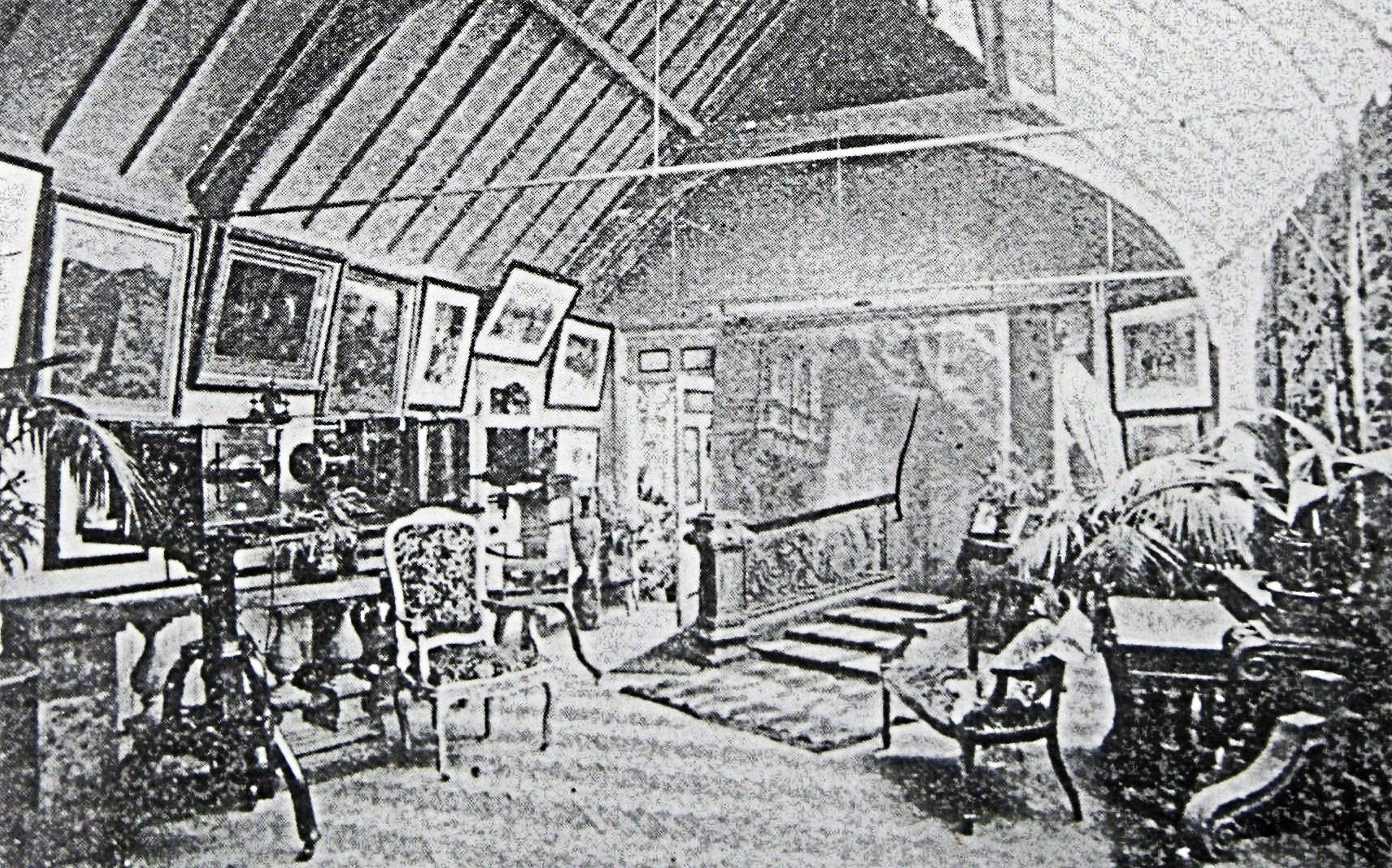
Interior of the famous Martin Jacolette studio at the rear of North Brook House, 17 Biggin Street. Joe Harman

Interior of the famous Martin Jacolette studio at the rear of North Brook House, 17 Biggin Street. Joe Harman

Following the War Dover, like the rest of the country, was hit by a deep economic depression that in turn led to fall off in the demand for the services of photographers. Further, existing photographic studios were under threat particularly from out of work military trained photographers setting up businesses. Many of these businesses were short lived but those that did survive for more than a year included, Bertram Hewson who joined H Shaw at 61 Biggin Street and Spencer Enterprises Ltd that set up at 74 London Road in 1922. S Wilson joined Sidney Charles Wallis who opened up a studio at 38 Snargate Street while Sydney Herbert Brock set up business in Maison Dieu Road in 1926 staying there until 1930 and Richard Levy opened up at 11c Bench Street. However, during the 1920s the former Jacolette studio became the Gas Showrooms and then changed hands many times but the once famous studio at the rear of the house, facing north remained. Following World War 2 (1939-1945) the building was gutted and rebuilt but the façade remained. In the 1990s it underwent another makeover and although the façade still remained the once famous studio was demolished. At the time of writing Halifax Bank occupy the premises.
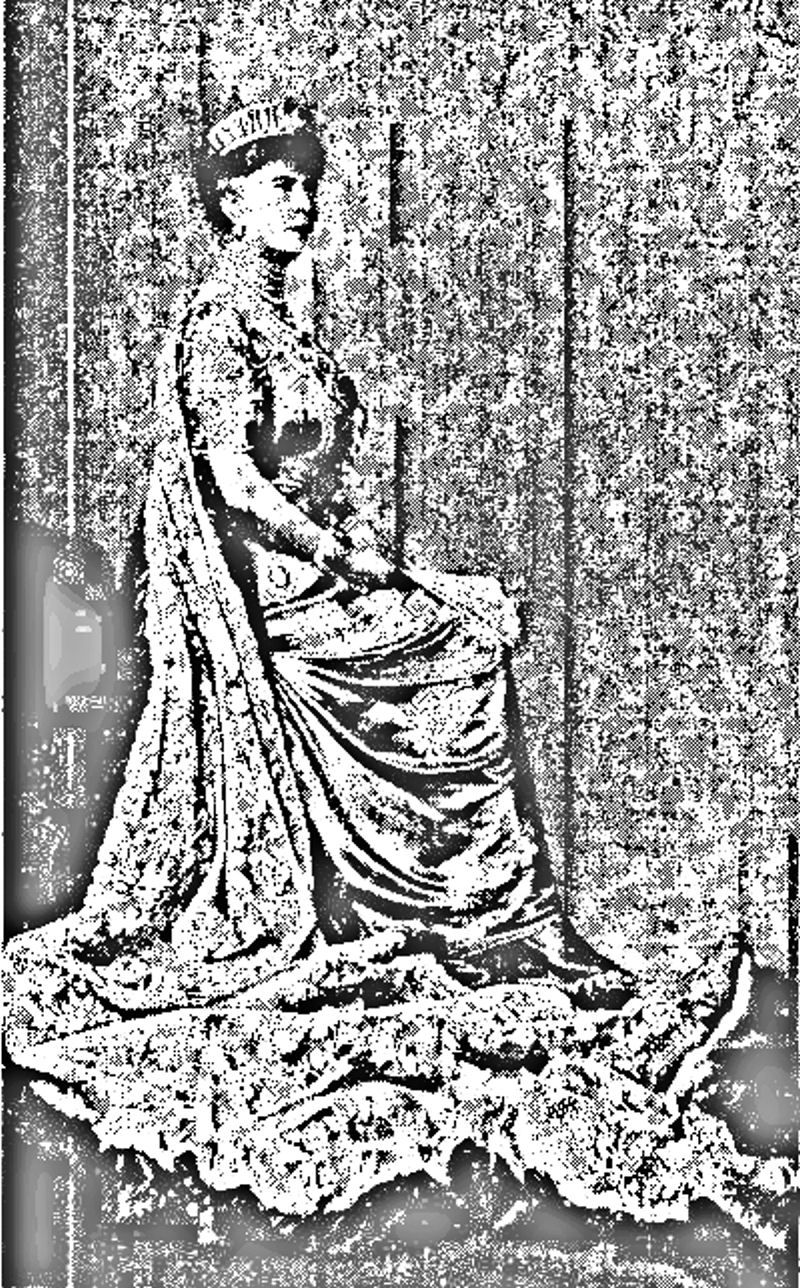
Queen Mary photographed by Lambert Weston published June 1922

Queen Mary photographed by Lambert Weston published June 1922

The long established photographers were fairing far better with the Lambert Weston stable doing particularly well having an enviable proven track record in portrait photography. One of their photographers was Dorothy Sherwood who was born in 1889 into a middle class family with 7 servants at Sandgate Road, Folkestone. A keen amateur photographer, Sherwood trained with Lambert Weston’s Folkestone outlet and in about 1923 came to Dover to manage their smaller Bench Street studio. Whether it was Sherwood who took one of the most famous photographs of that time is unknown, but in 1922, the Lambert Weston studio was chosen to photograph Queen Mary (1867-1953), the wife of George V (1910-1936). The Royal personage was wearing the dress she wore at the last formal Court of the 1922 Social Season, this was sapphire blue and gold brocade embroidered in blue and gold diamante. Attached was an Irish lace train lined with gold tissue. The original black and white version of the photograph was published in the national and international press while a hand tinted coloured version was sent to British embassies, other official agencies and dignitaries throughout the World.

Much work had been carried out by a variety of researchers into the production of coloured photographs since James Clerk Maxwell (1831-1879), a British physicist had obtained a series of coloured negatives in 1861. To obtain these negatives, Maxwell had photographed tartan ribbon through three primary coloured filters and superimposed them to make full-colour photographs but was not very successful. In 1935, Eastman’s introduced Kodachrome film that consisted of three thin layers of emulsion, each sensitive to the different primary colours. When exposed, each retained an image of the scene in the colour in which it was sensitive. The film was developed layer by layer and a transparency was produced giving the true colours of the scene.
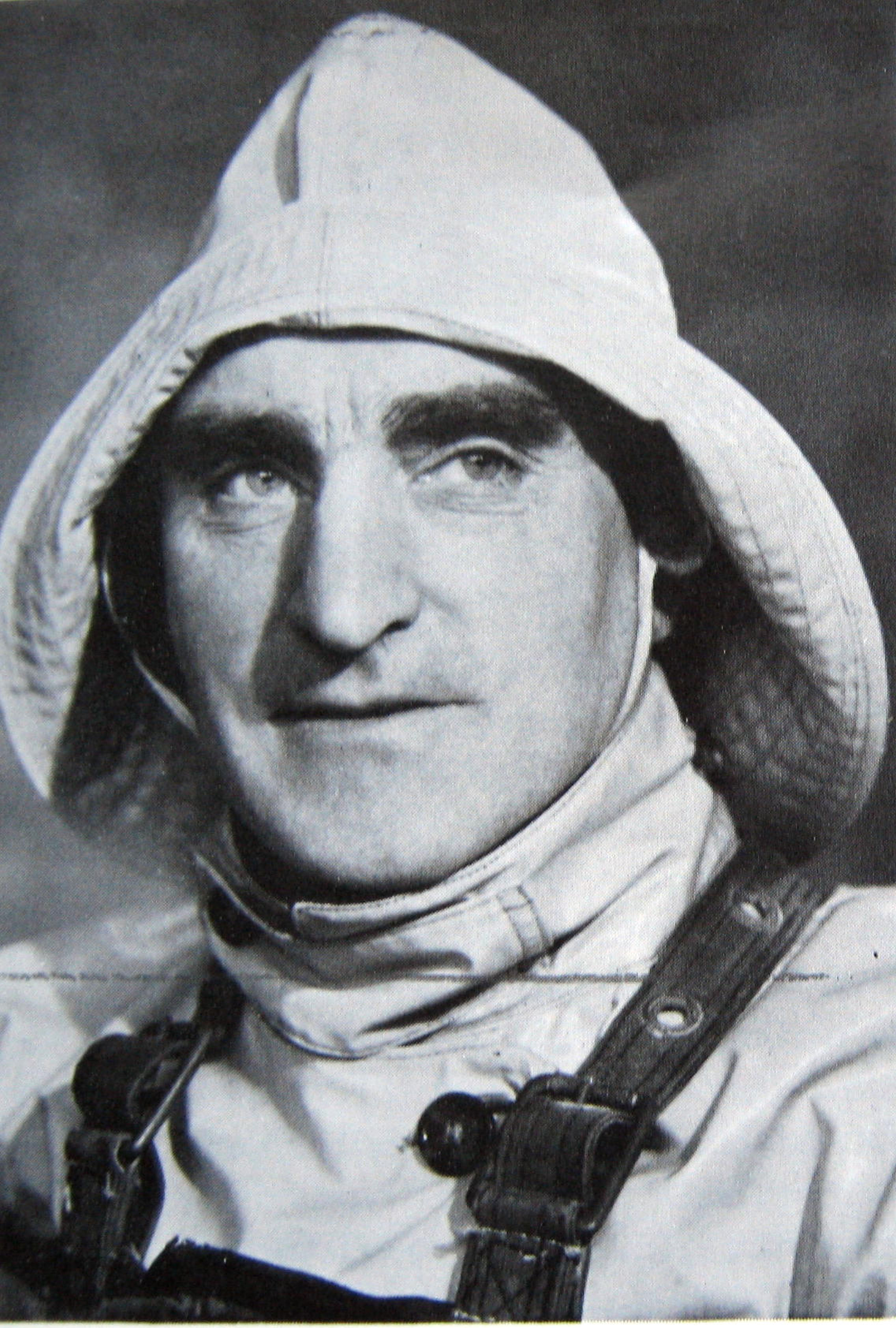
Lifeboat Coxswain John Walker photographed by Dorothy Sherwood for Lambert Weston. Dover RNLI

Lifeboat Coxswain John Walker photographed by Dorothy Sherwood for Lambert Weston. Dover RNLI

In 1931, Sherwood bought the Edmund Bowles studio at 3 Townwall Street and although she traded under her own name she sometimes did work for the Lambert Weston Company. Sherwood, by this time was one of the most famous portrait photographers of her time and turned 3 Townwall Street into one of the most celebrated photographic studios. In 1936, she married Henry Youden but continued to work as a professional photographer up to 1938 when she sold the business to Ray Warner. Dorothy Sherwood Youden died on 13 January 1958 age 70.

As Dover’s economy started to pick up, new photographic studios were established, these included W C Fuller at 78 Snargate Street and Farringdon & Harrison on Maison Dieu Road which later became R J Baker & Farringdon then Hudson Photo Service in Spencer Enterprises Ltd old studios at 74 London Road. Cuffs were a long established library and stationers at 1 New Bridge and following the War, Harcombe Cuff opened a photographic studio.

Harcombe Cuff devoted part of the premises to photographic equipment including selling Eastman’s Brownie Box cameras, Eastman Kodak films and Ilford films – the English equivalent. This encouraged amateur photographers in the area and eventually led to the founding of the Dover Camera Club, which met at the Art College, on Maison Dieu Road. There, youngsters and those who could not afford cameras were encouraged to join by making camera obscurers and to hand trace the vision displayed. Active members of the Club included Dover’s Town Clerk, Samuel Loxton, and the Charlton flourmill owner, Charles Chitty. Local historian, Joe Harman, was one of those who joined and went on to be an accredited amateur photographer.
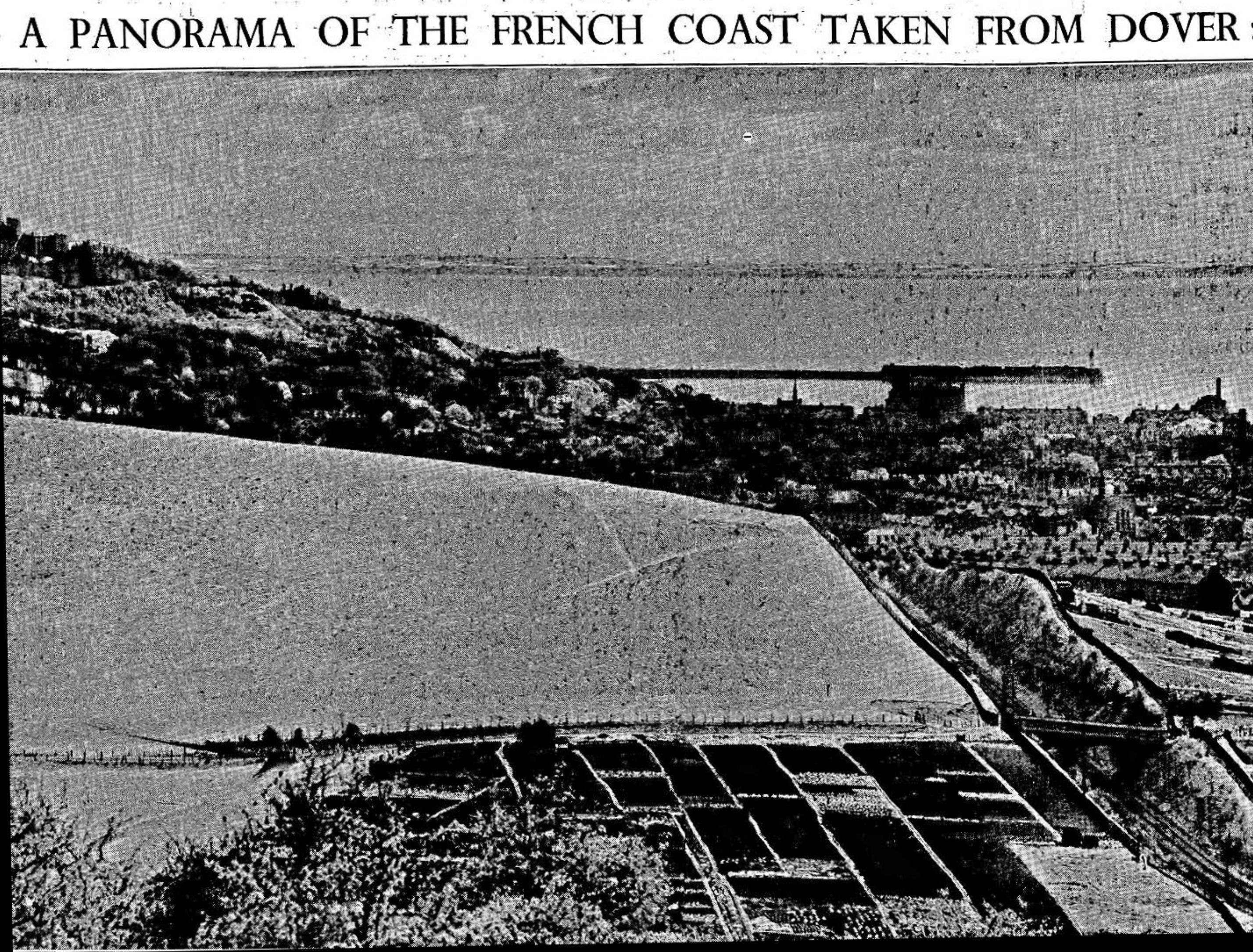
Coast of France from Old Park published in the Times 09.05.1932 by Ilford Films using the new filter and Selochrome film

Coast of France from Old Park published in the Times 09.05.1932 by Ilford Films using the new filter and Selochrome film

Ilford photographics founded in 1879 by Alfred Hugh Harman (1841-1913) as the Britannia Works Company in Ilford, northeast London. Initially they made photographic plates but became known for their celluloid roll films. By 1932, the company was a household name and in spring that year, they developed a revolutionary new ‘lens’ for cameras. This allowed the photographer to take long distance photographs that penetrated mist and haze. Based on the premise that red light scatters light less than blue, they developed an infrared filter – a suitably dyed piece of gelatine that was placed in front of a telescopic lens. To publicise the new ‘lens’ Ilford took photographs of Cap Gris Nez, on the French coast, from the roof of Old Park Mansion, Dover, in the presence of national newspaper reporters. On the day of the shoot, the unaided eye could not see the coast and to find direction a compass was used. The presentation was a success!

War damaged east end of Snargate Street during World War II - Kent Messenger.

War damaged east end of Snargate Street during World War II – Kent Messenger.

Just before World War II (1939-1945), Lowe & Son opened a studio at 148 Snargate Street which remained until they closed in 1962, having succumbed severe War damage. During the War, Dover became known as Hell Fire Corner and newspaper photographers frequently photographed the devastation. Following the War, in 1948, George W Tunnicliffe opened a studio at 127 Folkestone Road and in 1953 Fleet Street photographer and film cameraman Joe Court (died 2000) opened his shop and studio in the High Street. Court provided news photos and films for local and national media while his staff specialised in wedding photographs. The shop was run by Court’s wife Pat (died 2005), and in the early 1960s the business moved to King Street. At about that time photographer Ron Jones joined the staff and eventually became the manager staying until they closed at Easter 2005. Pat Court, was an active member of Dover Chamber of Commerce serving as its treasurer for a good number of years. She was also a founder member of the White Cliffs Tourism Association and helped to set up the Dover Cruise Welcome Club – now the Dover Greeters.
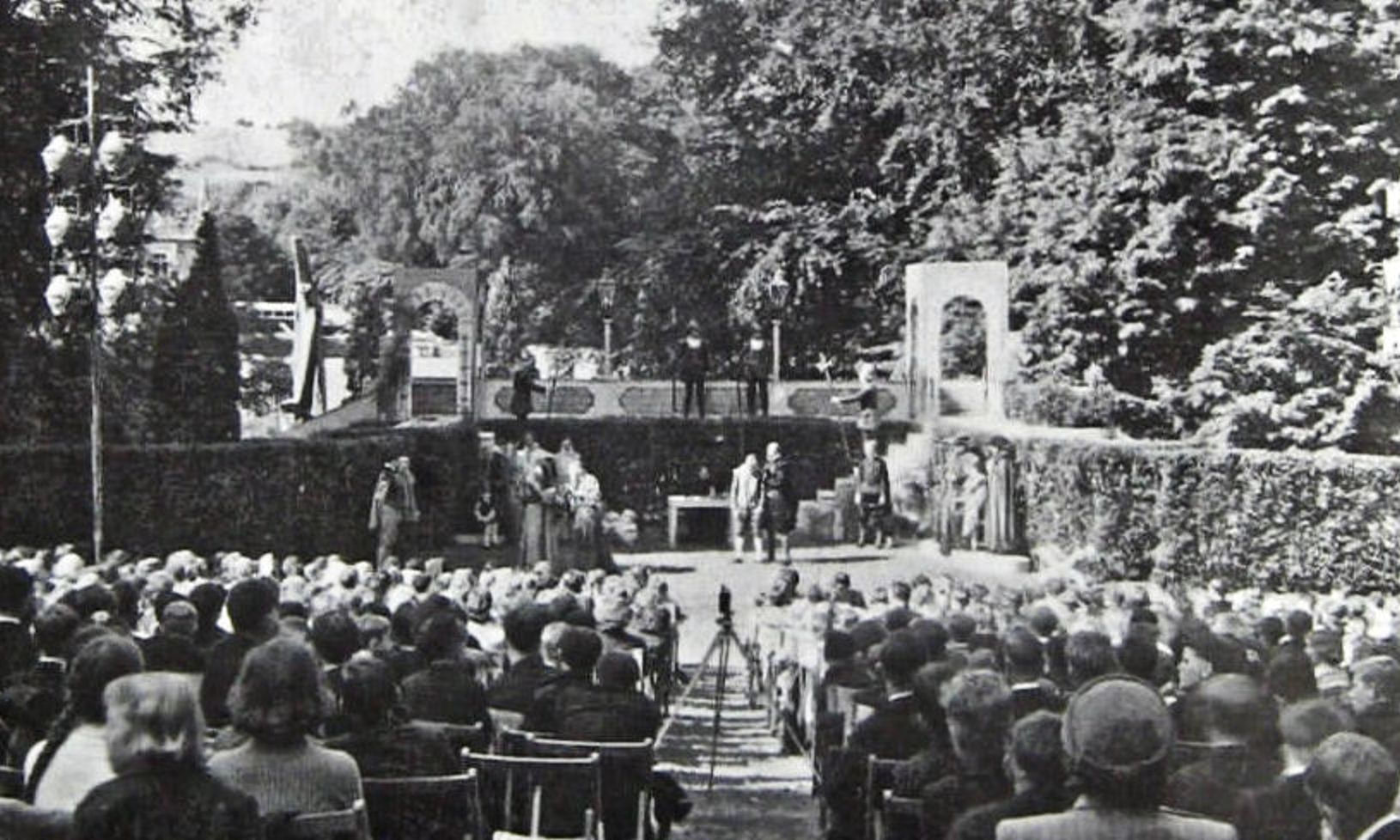
 Shakespearian Play Coronation year - 1953, Kearsney Abbey probably taken by Ray Warner. Tom Robinson Collection

Shakespearian Play Coronation year – 1953, Kearsney Abbey probably taken by Ray Warner. Tom Robinson Collection

Ray Warner came to Dover in 1938, to manage the Bench Street branch of Lambert Weston  and when Dorothy Sherwood retired bought her Townwall Street studio. Warner was born in Folkestone in 1914 and like Dorothy Sherwood before him, trained with the Lambert Weston company in Folkestone. During the War, Warner served in the Royal Air Force (RAF) Bomber Command as a photographer. Following the War, he returned to Dover with his wife Kay and rebuilt his neglected and war devastated photographic business premises. He also helped in the rebirth of the Dover Camera Club and was the chairman of the Dover Players, initiating the Shakespearian productions in Kearsney Abbey during the 1950s.
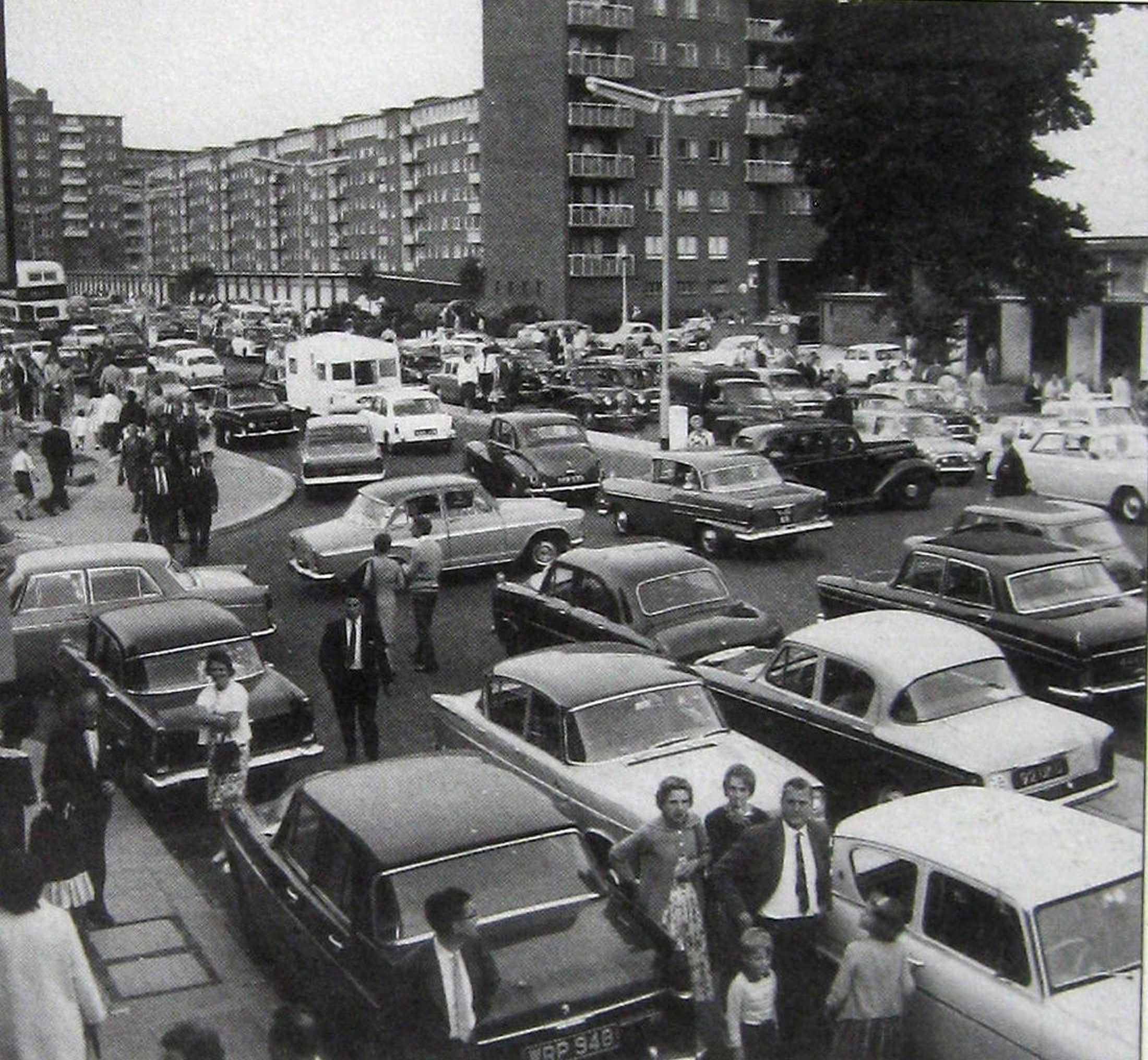
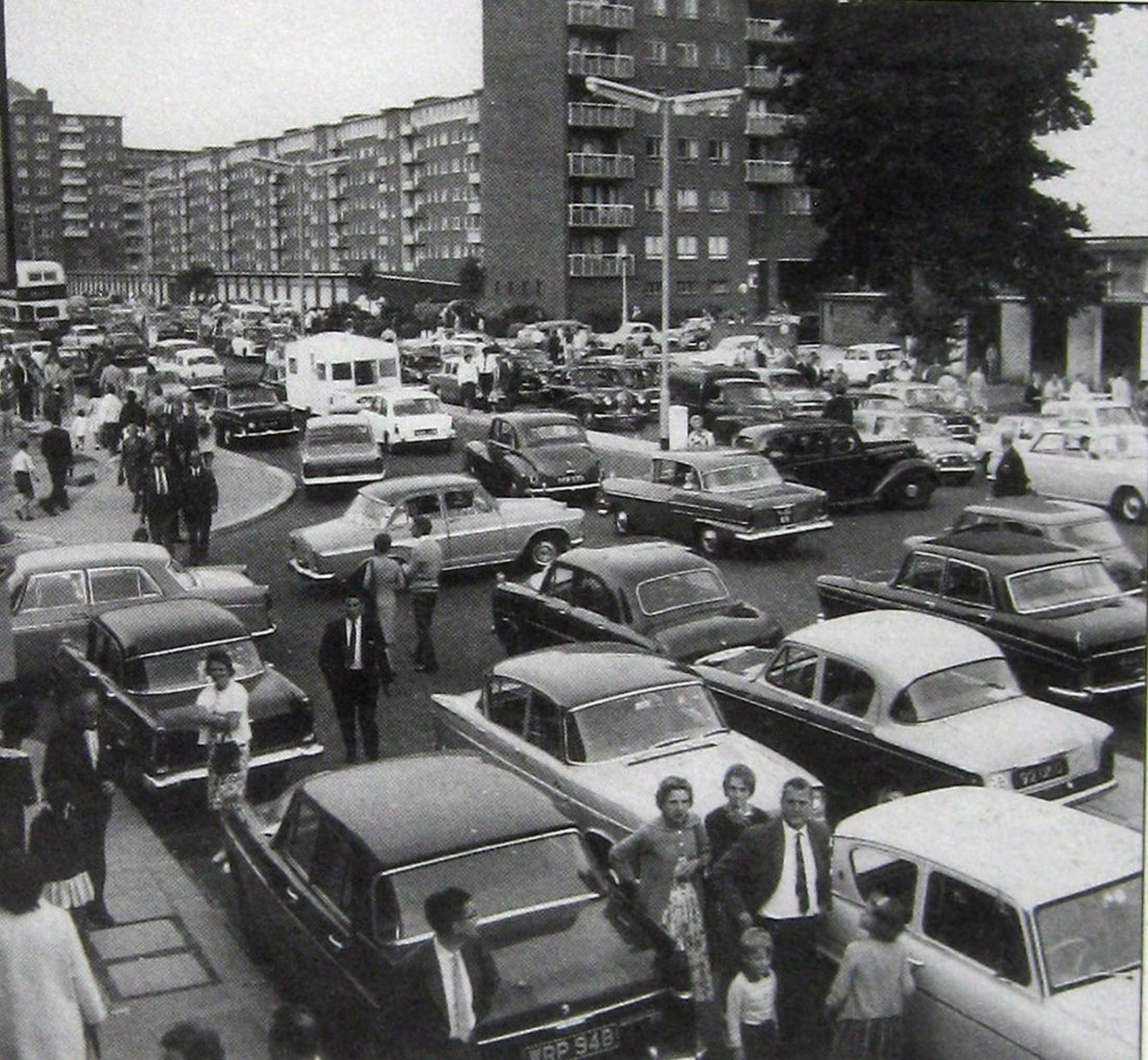
Townwall Street after widening - Traffic chaos 1965. Ray Warner

Townwall Street after widening – Traffic chaos 1965. Ray Warner

In 1961 Warner took over the Lambert Weston Company and changed its name to his own. However, at that time, the south side of Townwall Street was to be demolished to make way for a wider road to Eastern Docks and this included Warner’s studio. As his original premises were being demolished, Warner had a new modern studio built on the opposite side of the road that became number 42 Townwall Street. In 1977, Warner sold the business to commercial photographer John Caughlin who ran the company as Ray Warner Ltd. However, two years later, in 1979, the studio closed and Caughlin opened a business in his own name from his home in London Road, River. The Townwall Street premises were then used for an assortment of enterprises but in 2008, the block that housed the once internationally famous studio were bought by Dover District Council (DDC) and were subsequently demolished.

Although retired from the business, Warner continued to take photographs and filming films. In 1987 Raymond Baxter (1922-2006), the chairman of the Royal National Lifeboat Institution public relations, presented Warner with a silver statuette for 30 years service. For her Christmas cards in 1988 the Lord Warden of the Cinque Ports (1978-2002) Queen Elizabeth the Queen Mother (1900-2002) chose a photograph that Warner had taken of her at Walmer Castle. Sadly, a year later, on 15 December 1989 Ray Warner died and St Mary’s Church, Dover, was packed for his funeral but his legacy, the Dover Film Festival, lives on.

Film making had taken off since the turn of the century and in 1923 the earliest system for recording sound directly onto film was devised by US physicist Lee de Forest (1873-1961). This was introduced in newsreels in 1927 and employed in the first feature length ‘talkie’ in October that year – The Jazz Singer. Walt Disney (1901-1966), using the three-colour process in 1932, produced his cartoon Flowers and Trees and in 1935 the first Hollywood Technicolor film, Becky Sharp, was released.

In Dover, the Granville Film Society was formed in 1937 with founder members including Foley Gossling and Major Philip Walker. Gossling made a film for the occasion entitled Snow in the Channel, which was so successful that he was asked to make another. The project, Mr Probert, took a year and was shown just before World War II broke out. In 1948, Dover Film Society was formed and among the members were Gossling and Ray Warner. As a tribute to the Granville Film Society, they showed Mr Probert for ten days to packed audiences.
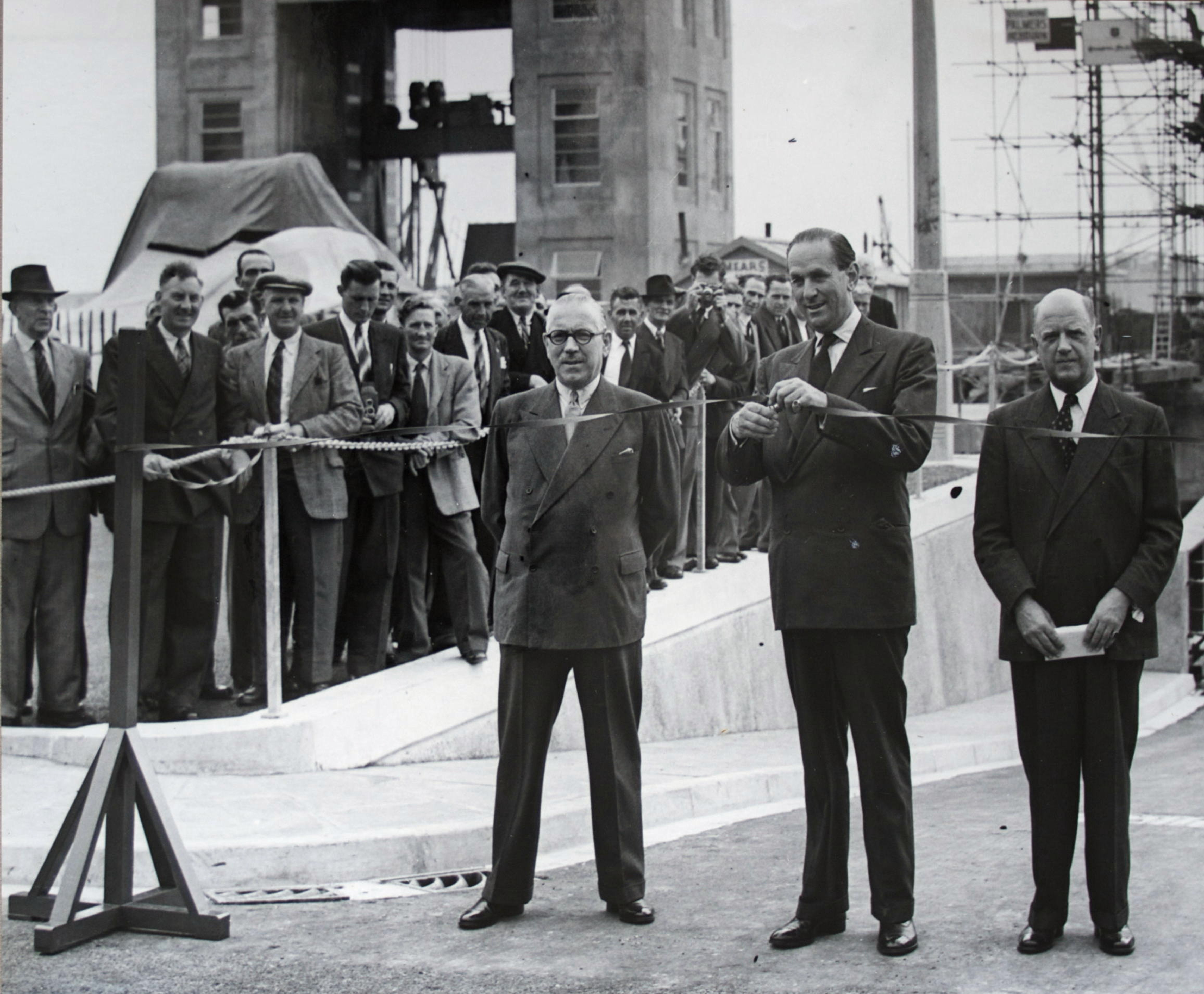
Opening of the Western Berth at Eastern Docks 30.06.1953 by Minister of Transport, Chairman. photograph by Ray Warner for Lambert Weston

Opening of the Western Berth at the Camber, Eastern Docks 30.06.1953 by Minister of Transport Alan Lennox Boyd . Photograph by Ray Warner for Lambert Weston

Ray Warner had introduced film making into his photographic portfolio before the War and as a photographer in the RAF he had also made films. On reopening his photographic studio in Townwall Street in 1946, Warner started filming life in and around Dover, using professional 16millimetre film. The following year Warner showed a compilation of his films of local events and people and it was a massive hit! Over the next few years, Warner carried on making films on the life in Dover and occasionally put on shows that were always a success. In March 1953, to compliment the opening of the Eastern Docks as a major car ferry terminal, Warner, with port official W Taylor Allen, premiered their successful film, The Gateway of England.

Warner continued making film compilations of life in Dover and occasionally putting on shows, as these always proved popular, he decided to expand the idea into an actual Film Festival. Warner applied to Dover Borough Council for a grant and it was agreed that he would fund the film making side of the Festival and the Council would pay for the venue and its staging. The Film Festival was launched in 1971 – the 25th anniversary of Warner’s first compilation of Dover life. The Film Festival was booked to last three days and opened with a short film of general interest. This was followed by local historian, Ivan Green’s ‘Then and Now’ still slides of old Dover.
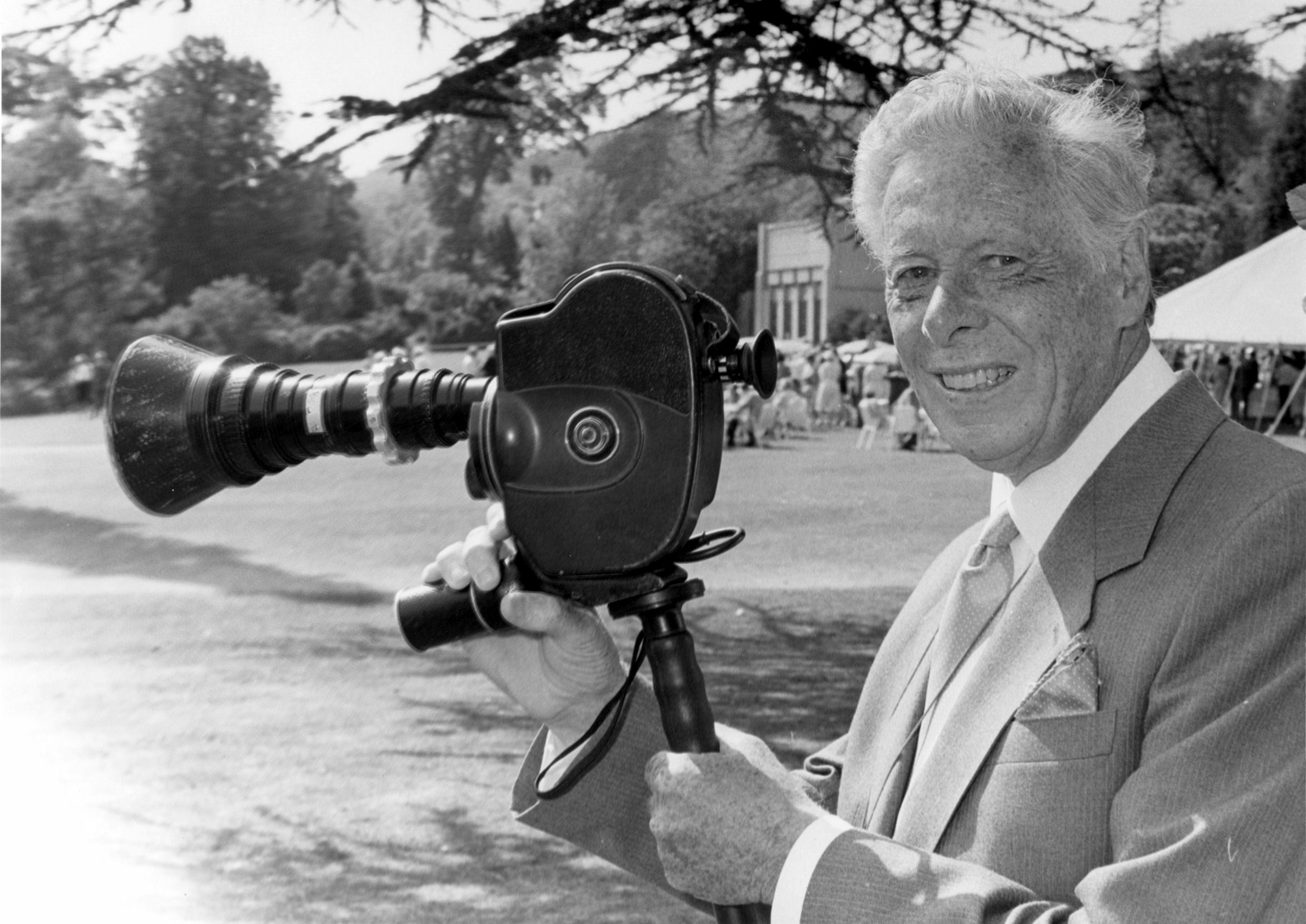
Photographer Ray Warner who founded the Dover Film Festival in the grounds of Kearsney Abbey. Dover Museum

Photographer Ray Warner who founded the Dover Film Festival in the grounds of Kearsney Abbey. Dover Museum

An interval followed during which time the audience could browse an exhibition put together by Dover library and Dover museum. The audience then settled down for Warner’s compilation of Dover life. The format played to packed houses on each day and Ian Gill, the Town Clerk, encouraged Warner and Green to form a small committee and develop the idea. With publicity help from Councillor Peter Bean, the first Annual Film Festival was held in the Town Hall in 1972, however, in 1974 Dover District Council (DDC) took over from the Borough Council such that a new source of funding was required.

DDC agreed to fund the Festival for that year and sticking to the format, the three-day event was held in November 1974. Green gave an Illustrative talk on old Dover, Peter Belsey of Dover History Society and John Greenstreet together with Dover library put on a photographic exhibition and Reginald Adams gave a recital of music specially composed for the 1908 Dover Pageant. Warner’s photographic stills were on show and these included the ongoing work on the Channel Tunnel that included a shot of the mole boring machine breaking through the end of the pilot tunnel and another showing the depth of the borings.

Demolition of the south side of Townwall Street 19623. Ray Warner

Demolition of the south side of Townwall Street 19623. Ray Warner

In the compilation section there was a spectacular film of the gas works, on Coombe Valley Road, being blown up and of firemen fighting a blaze in the docks. There was also extracts of visits by the former Lord Warden (1941-1965) Sir Winston Churchill (1874-1965) as part of the celebration of his birth at the end of November that year. As a result of the successful Festival DDC agreed to annual funding as long as the Film Festival was expanded to cover the whole of the district with DDC also agreeing to pay for the Warner film print!

By 1983 the Festival was so popular that it was extended to four days and the following year, Warner’s annual film compilation of Dover life took on a highly professional look. This was with the help of sound recorder -Terry Nunn, film editor – John Falconer, scriptwriter -Terry Sutton and music composers and performers – Reginald Adams with Peter Stone. That year, 1984, the Film Society had won a £380 Kodak Community Award and with it involved many local groups and organisations in a project to make a film about Ralph Stott (1839-1877), who lived at Crabble House and produced an interesting flying machine. The story was written by and starred two reporters from the Dover Express, Don Lehane and Keith Murray, supported by a large cast including Peter Elgar, Betty Pilcher and Mandy Cork. The cameramen were Norman Williams and Harry Thomas, director Glyn Davies and producer, John Roy.
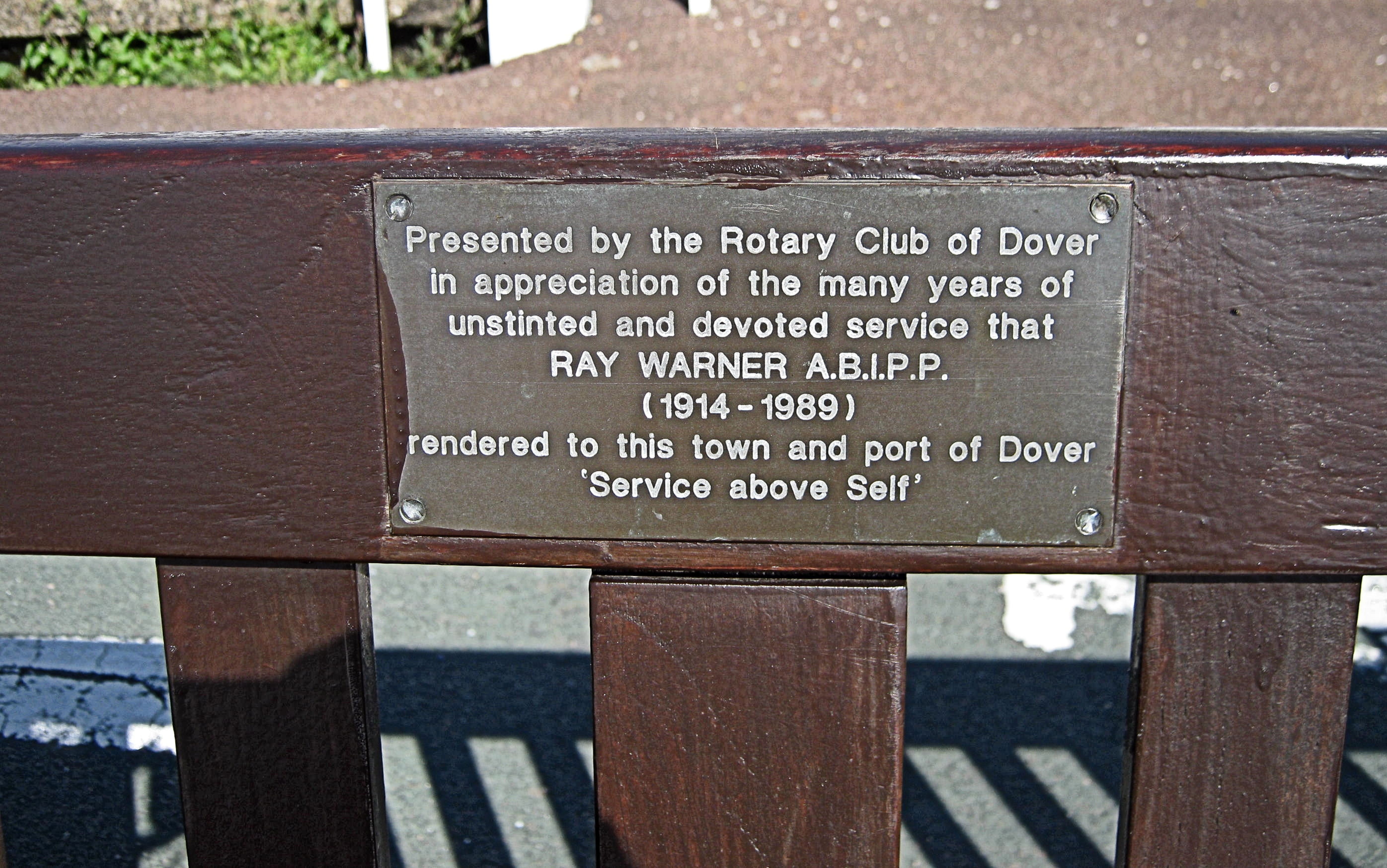
Ray Warner seat - a tribute to Dover's photographer by the Rotary Club on the East side of the Seafront. LS

Ray Warner seat – a tribute to Dover’s photographer by the Rotary Club on the East side of the Seafront. LS

Ray Warner by 1989, had produced 41 annual films depicting the history of the changing face of Dover – a record hardly matched by any other town. That year his health started to deteriorate but with the help of Vice-Chairman, John Roy and the rest of the committee, the Festival was a success. However, Warner was a professional film maker and was determined, regardless that his health was failing, the 1990 festival should go on. Ray died in December 1989 and a seat presented by the Rotary Club in tribute to the great photographer can be seen on the Seafront. In the following March the Festival did go on and was a success.

Although everyone involved wanted to ensure that the Film Festival would go on, a number of problems faced the committee notably, none of them had been involved in direct film making, let alone were professionals. Further, not only was Ray Warner a professional who made films to extremely high standard, he never charged the Film Festival a fee. Another problem was that Warner, following the annual Festival, would tour clubs and organisations showing part of the annual film and promoting the next Festival, who would do that? Of equal concern was DDC who were putting considerable pressure on the committee and in particularly John Roy for a business plan over the future of the Festival. Then there was the problem of what would happen to the 42 films, including the 1990 film, that Ray Warner had made on Dover life plus his still photographs?
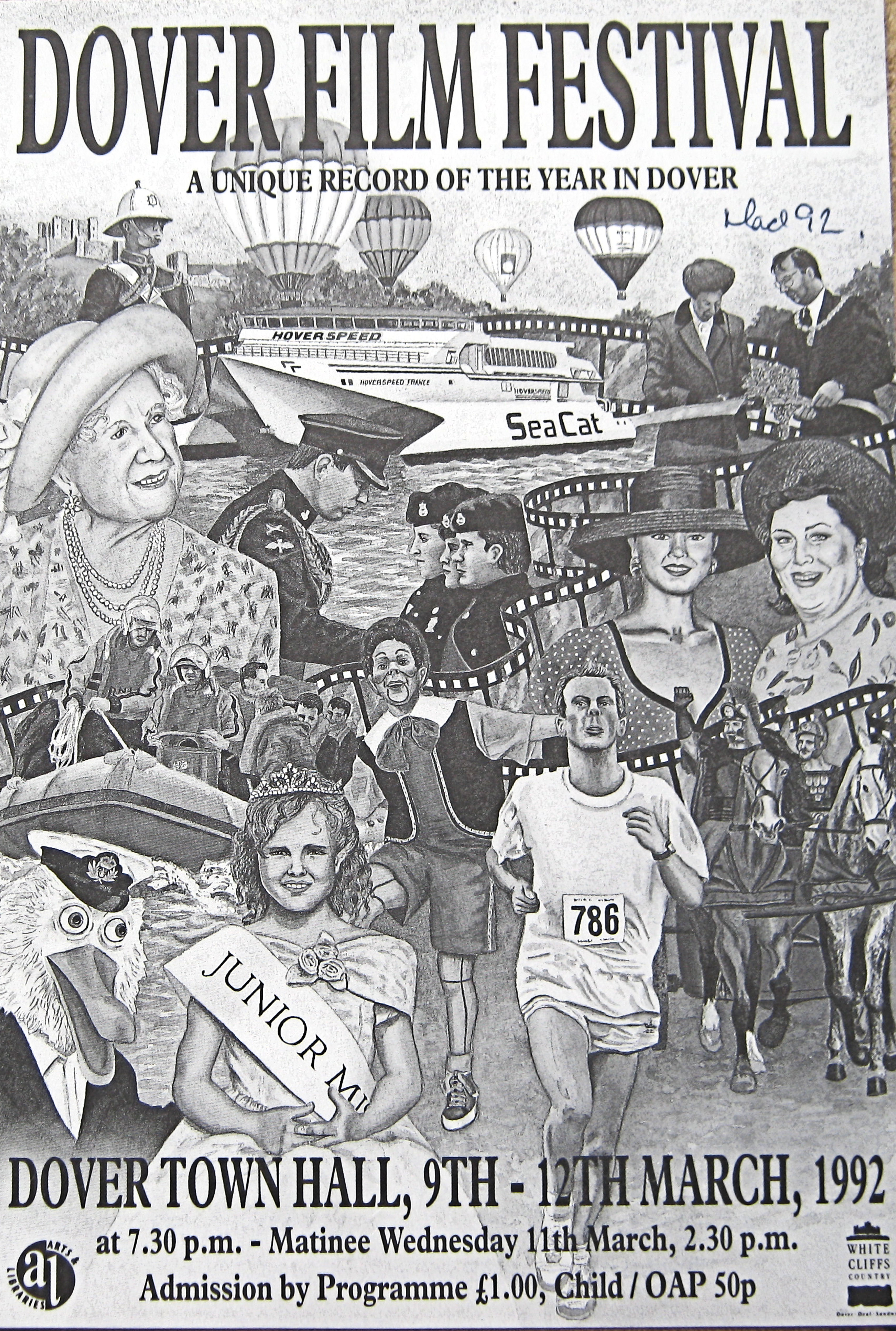
Film Festival March 1992

Film Festival, March 1992

Roy and the Festival Committee came up with a workable business plan and professional photographer and film maker. Phil Heath, managing director of Heathfield Studios, Birchwood Rise, off Folkestone Road, Dover, agreed to take over the filming. In 1991, as of tradition, Phil joined John and Ivan along with Ivan‘s wife Margaret, all giving their services without payment. Margaret undertook the role of projectionist and co-researcher and Ray Warner’s films and photographs were cared for by Ivan and Phil. So successful was the Festival that the following year DDC agree to pay for the publication of the programme, the front cover of which became a collectors item in its own right! Sadly, not long after, John Roy died and the Festival was again put in jeopardy.

Luckily, the energetic businessman and tireless campaigner for Dover, Roy Dryden, came to the rescue and agreed to take over the role of chairman. Within two years of Dryden taking over, the number of performances at the Annual Festival increased to seven with an average of 400 people attending each day. 1996 saw the silver anniversary of the Festival, when Ivan and Margaret Green were presented with a silver salver. The following year the Festival broke all records with the number of people who attended and as on previous and subsequent occasions, the profits were donated to a local charity.

Ron Dryden the energetic businessman who successfully took the chair of the Dover Film Festival

Ron Dryden the energetic businessman who successfully took the chair of the Dover Film Festival

However, in order to meet the financial outlay of this increase in demand, more funding was required. Dryden and Heath applied for an increase in the grant from DDC for the 1995 production but they reacted by demanding editorial. The relationship turned sour and this resulted in a DDC officer making threats that were caught on camera. An internal investigation was undertaken and the council officers were cleared of maladministration but DDC did agree to carry out an audit of printing contracts. The subsequent Ombudsman’s report upheld DDC’s internal investigation saying that the allegations levied by Dryden and Heath were, with minor exceptions, baseless and that the coverage given by the local media was both misleading and sensationalised. Nonetheless, the Chief Executive of DDC was asked to apologise to Dryden and Heath.

Following the publication of the Ombudsman’s report, DDC’s Chairman at the time, emphatically stated that he was pleased that finally the matter could be put to rest. This, however, was not the case and Councillors demanded the resignation of Dryden and Heath. The result was opposite to what these Councillors expected, people who had not formerly attended the Film Festivals came to the 1996 one! Impressed with what they saw, they returned the following year with their friends and although money was desperately short, the 1997 broke all records for attendance with all five evening performances and both matinees packed!

Dryden, however, was more than a just a local businessman he was the President of the Dover Chamber of Commerce. Further, his battles on behalf of Dover, against DDC, for a better deal was, by that time, legendary and the Annual Film Festival became a target for retribution. The 1999 Film Festival was billed as the last but NOT through lack of public support. Ivan Green died in 2003 and the following year Ron Dryden died. The Ray Warner films were put into the safe custody of Jon Iveson, the curator of Dover Museum.

Mike McFarnell

Mike McFarnell

As a tribute to Ivan Green, in 2003, Dover Pageant Master Mike McFarnell showed a film depicting life in Dover during the previous year using the format that Ray Warner and Phil Health had used. Lasting an hour, the film was shown to an invited audience in the DDC Chambers, Whitfield. The event was hosted by the Chairman of DDC, Councillor Pat Heath and proved successful such that the Chairman encouraged McFarnell to revive the Annual Film Festival. McFarnell produced a business plan but estimated that cost would be £10,000 – more than he could afford. However, he said he would and did continue to film many aspects of the life of the town and district.

At the 2004 Dover Proms, Michael Foad presented McFarnell with a cheque for £100 to start a fund to buy a video projector and the Dover Carnival Association matched this. Joined by Terry Nunn to provide the narration and Terry Sutton, the script, McFarnell decided to put on a Festival in February 2005. His compilation of events in and around the district was shown in the Connaught Hall at the Maison Dieu, together with an earlier Ray Warner film. The Festival lasted two days with six showings each 61 minutes long on a screen paid for by Dover Rotary Club. Other contributions came from, Dover Daihatsu, Dover Kia, Dover Eurochange, Dover Harbour Board, Dover Town Centre Management, Friends of Dover Castle, George Hammond PLC, MWM Video production, Paul-Browns of Dover, P&O Ferries and SAGA Group Ltd.

St James Cemetery annual Zeebrugge ceremony. Alan Sencicle

St James Cemetery annual Dover Patrol – Zeebrugge ceremony. Alan Sencicle

The compilation included a whole range of aspects of Dover life from theatrical productions to sporting events, the annual inspection of Dover Sea Cadets on Remembrance Sunday to the annual Dover Patrol service at St James’ Cemetery with the ringing of the Zeebrugge Bell on the Maison Dieu balcony. Sir Richard Branson creating a new world record for the fastest Channel crossing was there and the atrocious weather that ruined the annual hospital fete and caused the flooding, not long after. The most poignant moment in the compilation was Dover stalwart, Jack Hewitt, filmed at the St George Day service at St Mary’s Church, shortly before he died.

The 2005 Film Festival was such a success that the Film Festival was returned to Dover’s social calendar. The 2006 and 2007 events were even more successful and in 2008 the Festival included a 20-minute workshop, given by Terry Sutton. Although the heating failed that year, the whole programme was a great success. 2008 saw the last Dover Pageant produced by McFarnell and in 2012, the Dover Pageant, as an organisation ceased. Up to then, while under the auspices of McFarnell, the Film Festival had been produced through the Dover Pageant Company. To enable the Film Festival to carry on, McFarnell set up a new ‘Not for profit‘ company limited by guarantee.

The 2011 film of Dover Life, presented at 2012 Dover Film Festival, the narration was by Terry Nunn and the script was written by Graham Tutthill. The film was sent to Dover’s twin town, Split, in Croatia for their international film festival. The Dover entry was in competition with nearly 300 tourism and travel related films from 69 different countries in the category for movies up to 60minutes long. 76 of these films were selected for showing and the Dover film won the top prize!

Posted in Businesses, Photographers & the Film Festival, Photographers & the Film Festival, Societies, Culture and Entertainment | Comments Off on Dover’s Photographers & the Film Festival

London Chatham & Dover Railway Part I

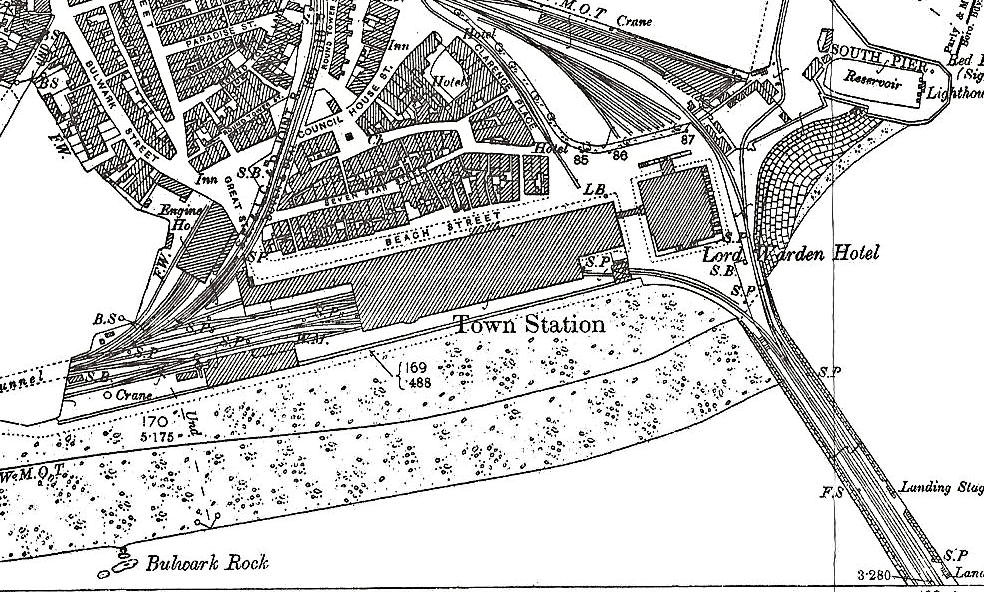
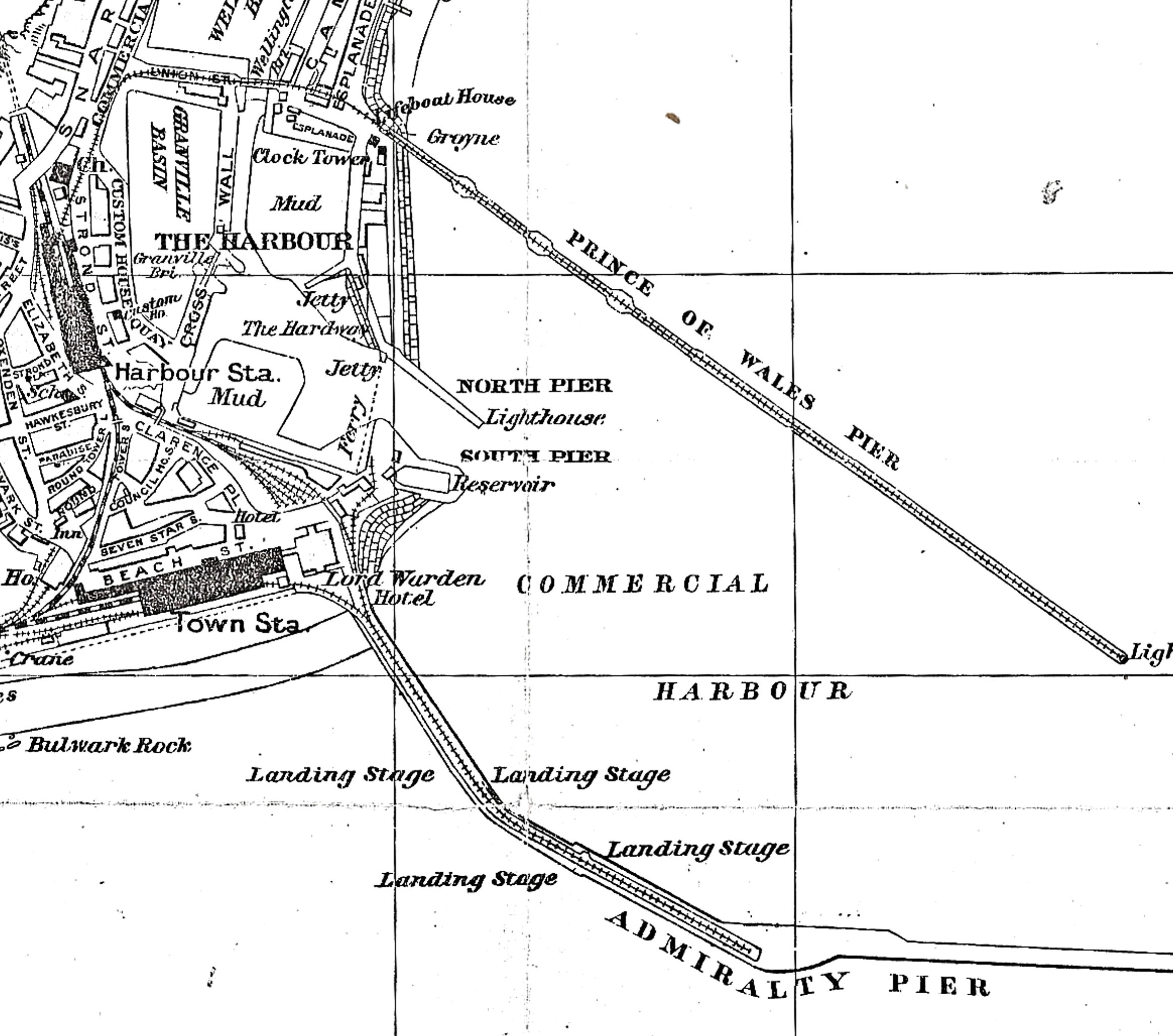
Location of South Eastern Railway' s Town Station in Dover. 1890

Location of South Eastern Railway’ s Town Station in Dover. 1890

Dover’s first railway terminus, Town Station, was built by the South Eastern Railway Company (SER) and opened on 6 February 1844. The company had been given Royal Assent on 21 June 1836 and incorporated the Canterbury – Whitstable Railway that opened in 1830 and the London and Greenwich Railway that opened in 1833. The station was located on Beach Street, in the Pier District of Dover and was named Town station in 1863 even though it was closer to the harbour than the centre of town, nearly a mile away. Throughout the 19th century, the Pier District was the maritime area of Dover comprising of short streets that had been built on shingle banks, which had formed on the seaward side of Paradise Pent, a small harbour built at the end of the 15th century.

Besides Beach Street, the other main streets were, Great Street, Round Tower Street, Council House Street, Middle Row, Seven Star Street, Elizabeth Street and Clarence Place. Paradise Pent had long since silted up and had been replaced by the much larger inner harbour or Bason (later Granville Dock). Access to the sea from the Bason was through the Tidal harbour, the western side of which was Clarence Place. To the south of Clarence Place and east of Beach Street and the Town Station, the Admiralty Pier was started in 1847. With the coming of the railway, via the SER line to the Town station and the building of Admiralty Pier – planned at the time to be the Western Pier of a Harbour of Refuge – Dover had great hopes for the future. However, SER bought the derelict Folkestone Harbour in 1842 with the intention of turning that into their main passage port to the Continent.

Schematic drawing giving dates of the laying of East Kent Railway Lines

Schematic drawing giving dates of the laying of East Kent Railway Lines

SER had previously successfully applied for permission from parliament to build a railway line from London to north-east Kent, called the North Kent Line, and by 1846 had opened a track from their main London-Folkestone line at Ashford to Margate in Thanet. This was by way of Canterbury – now Canterbury West station – and Broadstairs. The following year they opened a spur from Margate down the east coast to Sandwich and Deal but discounted the need to connect Dover with either Canterbury or Deal. By 1849, SER had built their North Kent Line from London through Greenwich and Dartford to Strood but did not consider it economically viable to join this to the Canterbury – Margate spur.

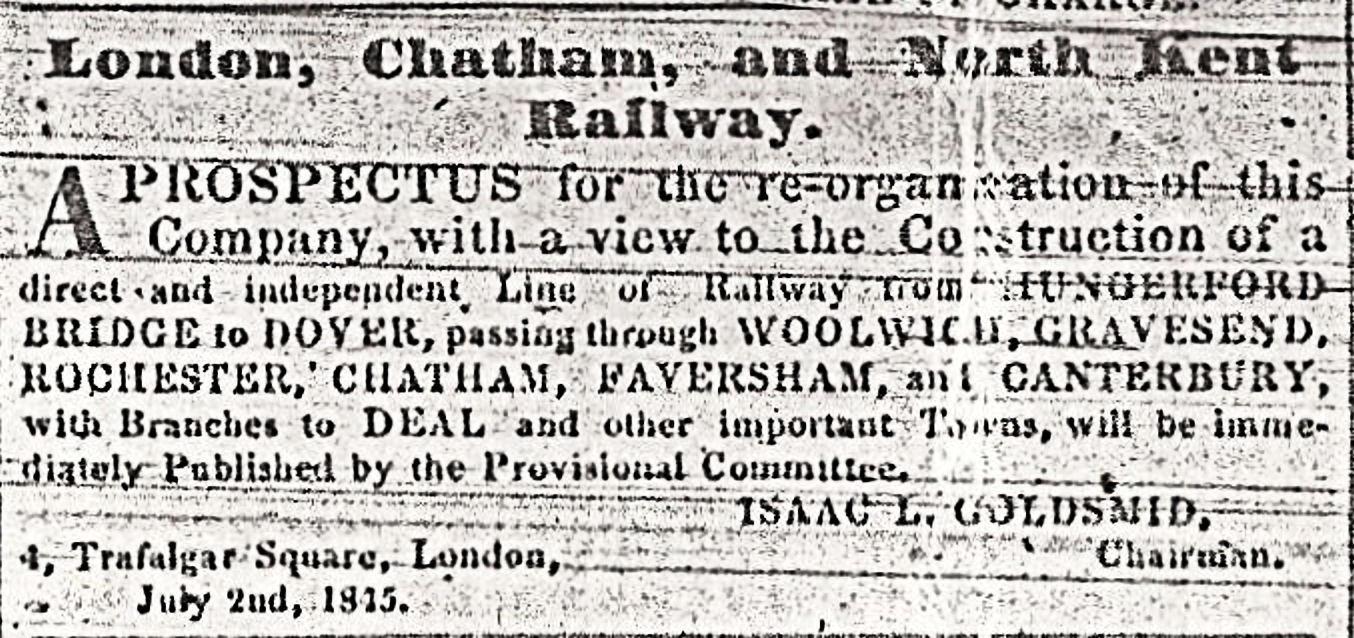
In the meantime a second company, the London, Chatham and North Kent Railway, was set up in 1845. One of the committee members was Sir Brook W Bridges (1801-1875) of Goodnestone Park, Member of Parliament (MP) for East Kent in 1852 and again in 1857-1868. This company planned to lay a railway track from Strood to Ramsgate and join the SER lines at both ends.

London, Chatham and North Kent Railway 14.10.1845

London, Chatham and North Kent Railway    02.07.1845

The Canterbury and Dover Railway Company was floated in October 1845 to provide a connection at Canterbury with the London, Chatham and North Kent Railway from Dover. The company also planned to extend their line from Dover to Deal. The committee included Dover Aldermen – Roger Stephen Court, Charles Kesterman, Edward Rutley and William Sankey. Dover Common Councilmen – Josiah Hollyer and Edward Seward along with Benjamin Worthington and John Birmingham. One of their three bankers was Latham & Co of Dover.

At Rochester on 30 January 1850, the North Kent Railway Continuation Rochester to Chatham group held a meeting to sanction the proposition by the London, Chatham and North Kent Railway to connect with the SER line at Strood. They also proposed to sanction the London, Chatham and North Kent Railway to build a railway connecting Strood to Dover and Downs (Deal) via Canterbury. Both resolutions were unanimously agreed. On Thursday 9 June 1853, in parliament, the London, Chatham and North Kent Railway were given permission to construct a railway bridge over the River Medway, a railway line between Strood and Canterbury and a branch from Faversham to Faversham Creek. Although the Company had applied for running powers over the existing SER North Kent Line to London Bridge, due to strong opposition from SER, this was watered down to giving SER the power to treat the London, Chatham and North Kent Railway traffic as its own for a financial consideration.

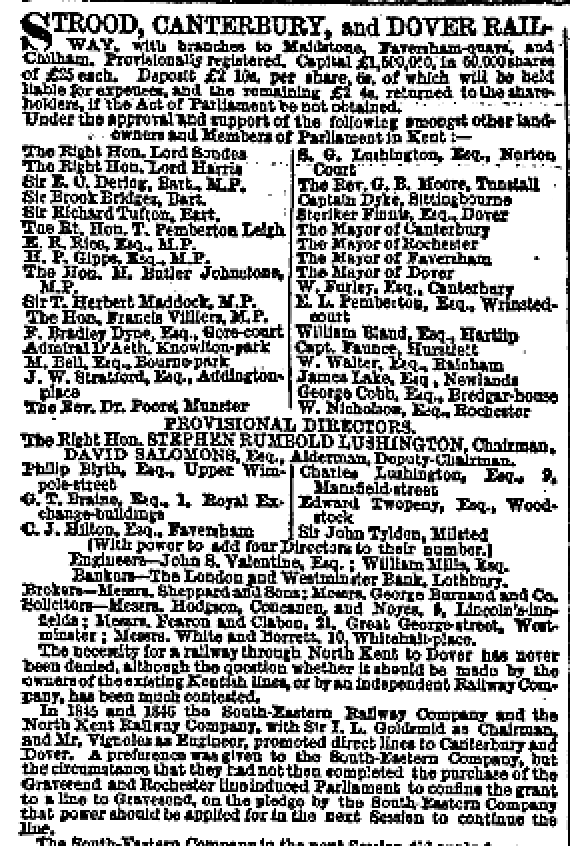
Strood, Canterbury and Dover Railway floatation 26.10.1852

Strood, Canterbury and Dover Railway flotation 26.10.1852

While the Bill was going through parliament, the London, Chatham and North Kent Railway, in 1852, had amalgamated with the Canterbury and Dover Railway to form the Strood, Canterbury and Dover Railway Company. The directors were, chairman – Stephen Rumbold Lushington (1776-1868) who was born in Godmersham, Kent and was a former Governor of Madras (now Chennai). Deputy chairman – Canterbury Alderman David Salomons. The other directors were Philip Blyth, G T Braine, Charles Jones Hilton (1809-1866) – cement manufacturer of Court Street Faversham, Charles Manners Lushington (1819-1864) MP for Canterbury 1854-1857 and son of the Chairman, Edward Twopeny and Sir John Tylden. The supporting land owners and Members of Parliament (MPs) included George John Watson Milles, 4th Baron Sondes (1794-1874), George Francis Robert Harris (1810-1872), 3rd Baron Harris also a former Governor of Madras, Sir Brook Bridges, Dover’s MP Edward Royd Rice (1790-1878), Admiral George Hughes D’Eath of Knowlton Park, Steriker Finnis of Dover and John Birmingham in his capacity as the Mayor of Dover.

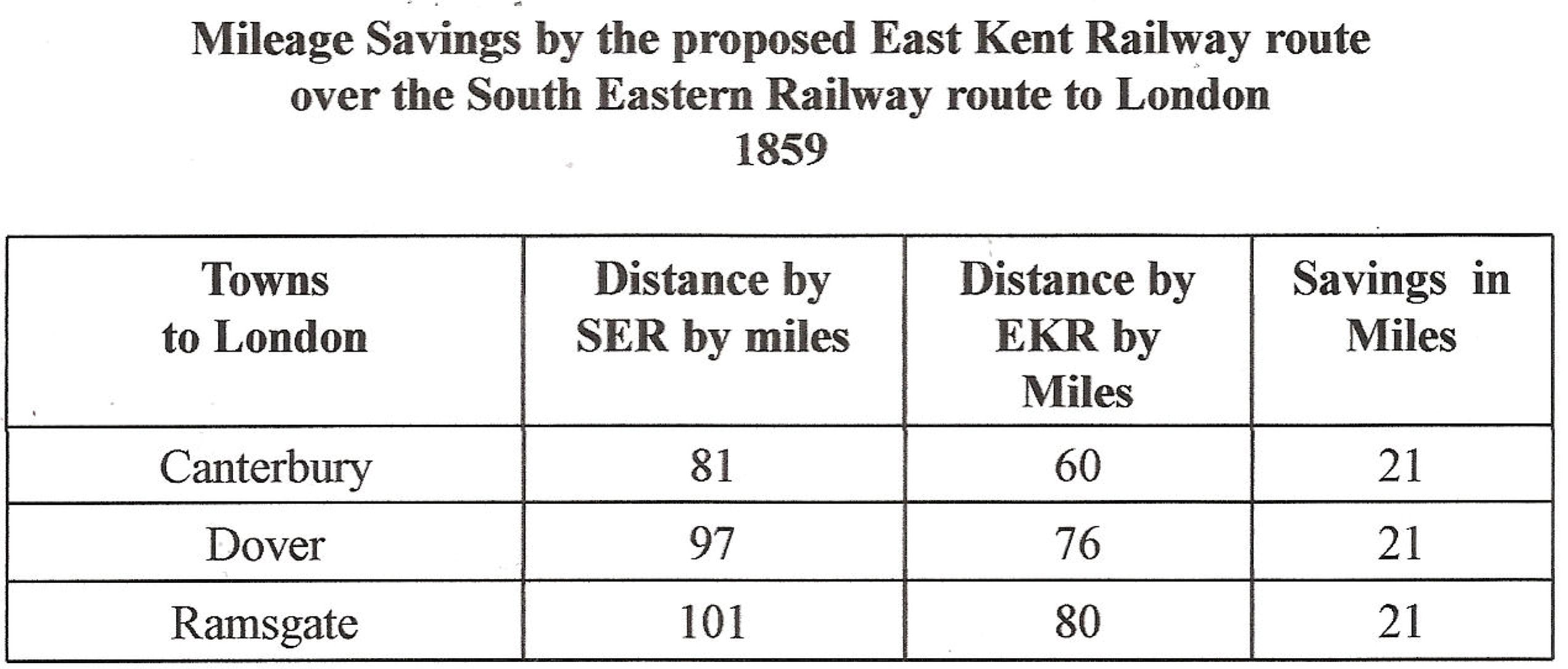
Mileage saved by EKR proposed route compared to SER's route into London 1859. EKR Report

Mileage saved by EKR proposed route compared to SER’s route into London 1859. EKR Report

The Strood, Canterbury and Dover Railway Company proposed a 44-mile line from Dover to join the SER London-Strood line at Strood but when the Company applied to parliament to sanction their proposition SER vehemently objected. The company was dissolved and reconstituted, in September 1852, as the East Kent Railway Company, (EKR) under the Chairmanship of Lord Sondes and the Company Secretary George Augustus Frederick Charles Holroyd 2nd Earl of Sheffield (1802-1876). The rest of the Board was made up of the directors of the old company and the shareholders remained, on the whole, as before. One of the shareholders was a major investor in EKR, Thomas Russell Crampton (1816-1888). The company’s capital was £70,000 in 28,000 shares of £25 each and EKR made a great point of comparing their proposed mileages with those of SER.

Utilising the Act of 1853, EKR started by building a railway line between Strood and Canterbury under the direction of Thomas Crampton. Coming from Broadstairs, Kent, he had previously been a senior engineer with SER and had been involved in the laying of the successful England-France Submarine Cable. During his time with SER, Crampton had worked with engineer Edward Ladd Betts (1815-1872) who was born at Buckland, near Dover. However, Crampton had fallen foul of SER’s Consulting Engineer, Joseph Locke (1805-1860) on the subject of SER extending their North Kent Line from Strood to Margate and was dispensed with.

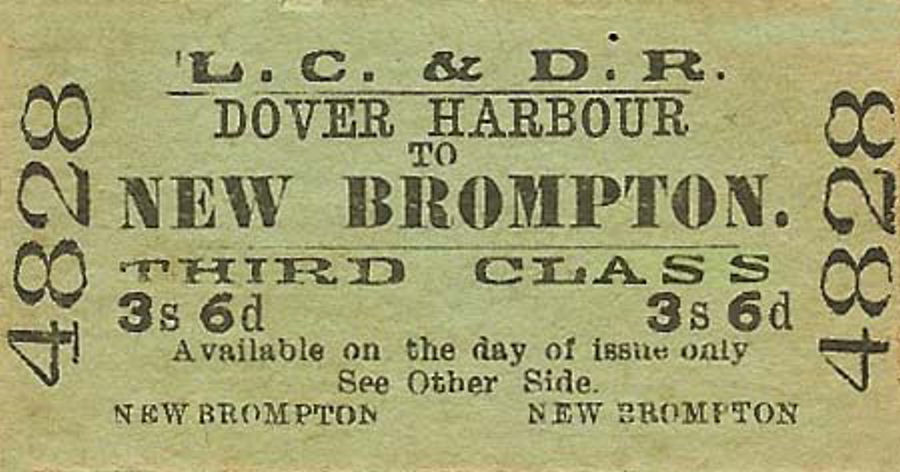
Laying the track from Strood by EKR was slow progress due to lack of finance but eventually, on 25 January 1858, they opened their line between Chatham and Faversham, with intermediate stations at Rainham, Sittingbourne and Teynham. The Rochester Bridge over the Medway to Chatham and designed by Joseph Cubitt (1811-1872), opened in March 1858 with an intermediate station named New Brampton – renamed Gillingham on 1 October 1912. The journey between Strood and Faversham took about 50 minutes instead of nearly a day by horse drawn coach.

In June that year, SER put forward proposals to amalgamate with EKR but due to concerns by SER’s own directors over the precarious financial state of EKR, the discussions failed. Therefore, EKR applied to parliament to extend their line from Strood into London by a separate route. SER knowing of EKR’s financial situation, did not offer any resistance. In October 1855, EKR held shareholders meeting to discuss extending the railway, when it was built, from Canterbury to Dover. In the chair was Brooke Bridges supported by the company secretary, Edward Knocker. Brooke Bridges made it clear that EKR planned to break SER’s monopoly over Kent and Knocker gave details of the population that EKR’s line would serve. He told the shareholders that including Dover and Canterbury and the villages in between, there lived 75,731 persons and estimated that collectively they would use the new line sufficiently to give EKR an annual revenue of £16,000. If the railway was connected to London, Knocker tentatively suggested, ‘where the population was nearly 2,500,000 persons, the annual revenue could be expected to be £30,000 from 150,000 annual passengers visiting the Kent coast or/and crossing the Channel!’ He went on to say that it was expected that with Dover’s Continental connections and goods traffic would provide significant revenue while a Deal branch would generate £6,000 per annum.

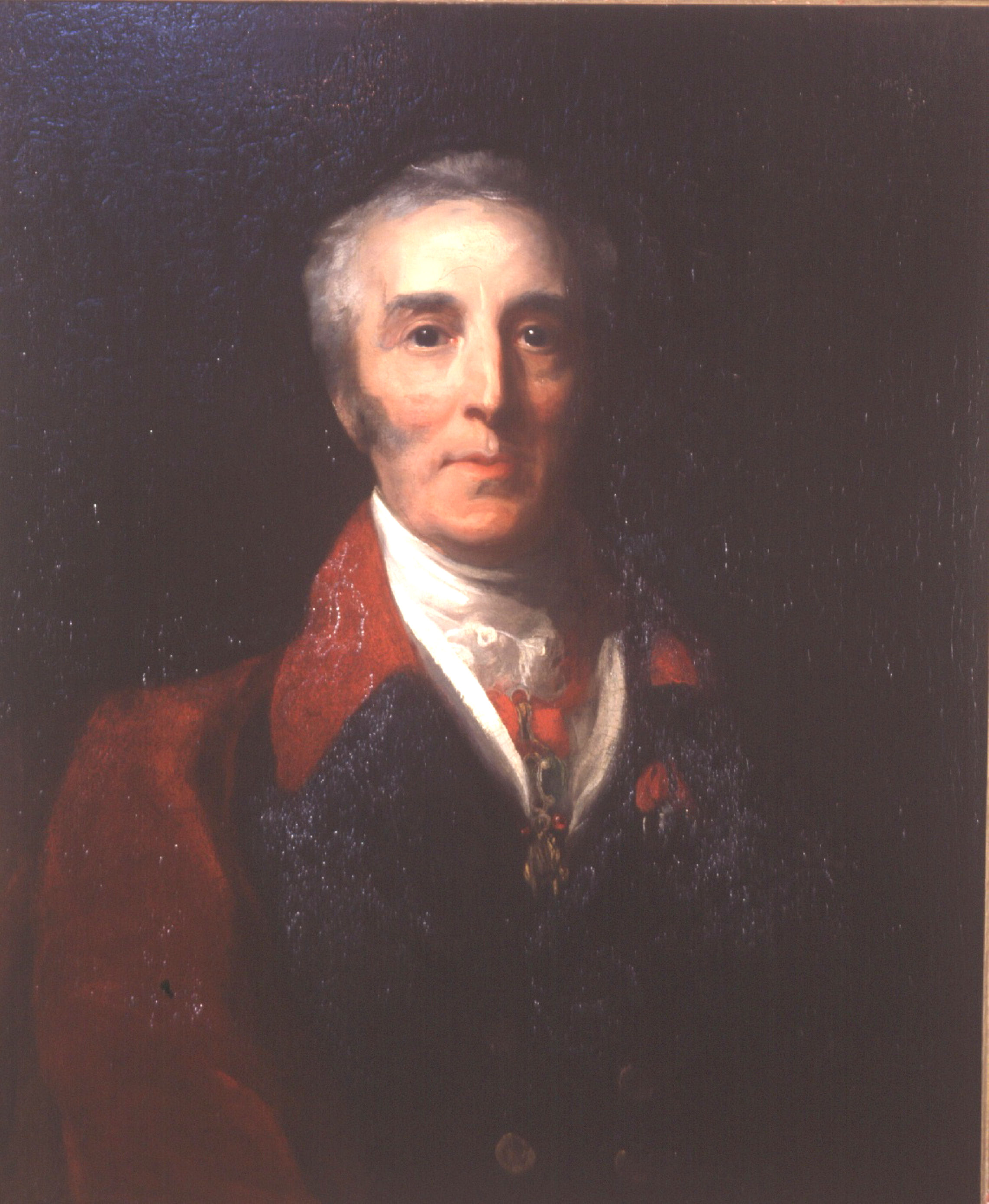
The Duke of Wellington had backed the idea of an alternative railway line bewteen Dover and London to that of SER's . Painting by John Lilley 1837. Dover Museum

The Duke of Wellington had backed the idea of an alternative railway line between Dover and London to that of SER’s . Painting by John Lilley 1837. Dover Museum

In answer to questions, the directors stated that it was envisage that the railway, in Dover, would go under the Western Heights and a station would be built next to the harbour. There, the shareholders were told, the station would be in a sheltered position and from where the company would run a fleet of cross Channel ships. A Mr Taylor, then read out a letter from the deceased Lord Warden 1829-1852 the Duke of Wellington (1769-1852), dated 3 November 1849. In the letter Wellington totally endorsed a railway line as proposed by EKR, saying that in the interest of national security there should be two separate railway routes from Dover to London. Emphasising, that he was particularly concerned over the vulnerability of the SER line between Folkestone and Dover. The resolution to go ahead with the construction of the Canterbury – Dover railway line was proposed by Dover’s MP Edward Royd Rice, seconded by the Mayor of Canterbury and carried unanimously by EKR shareholders.

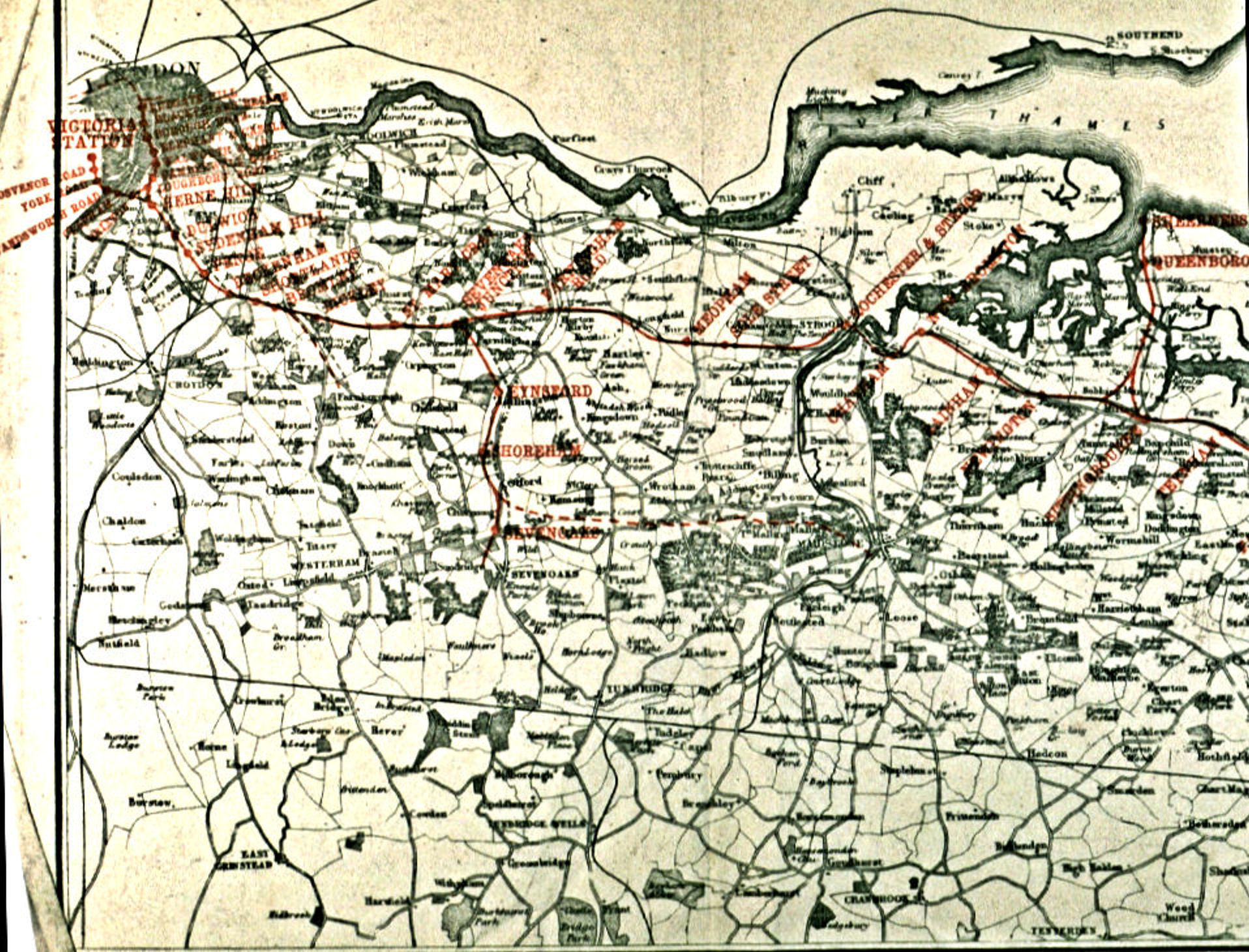
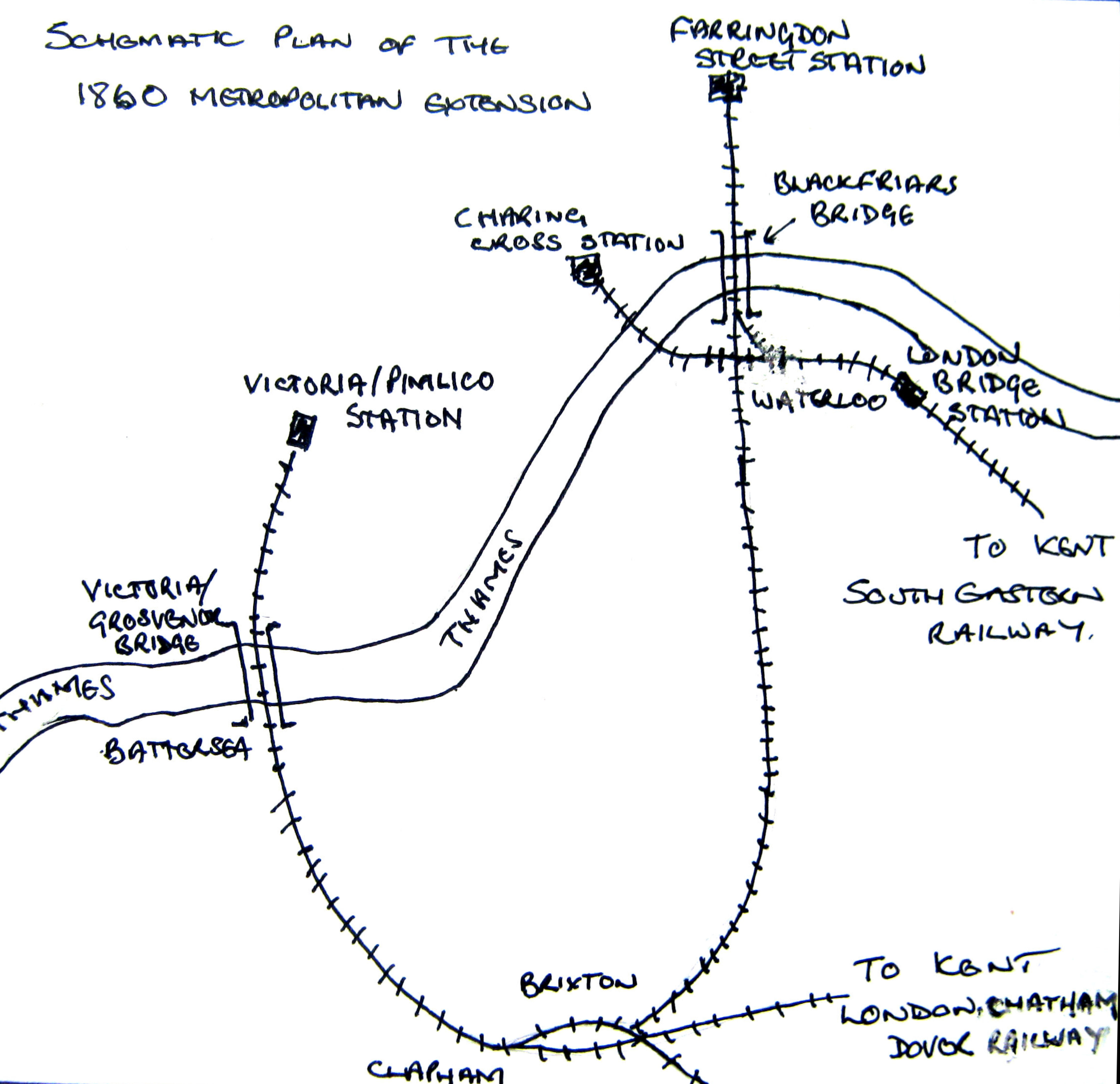
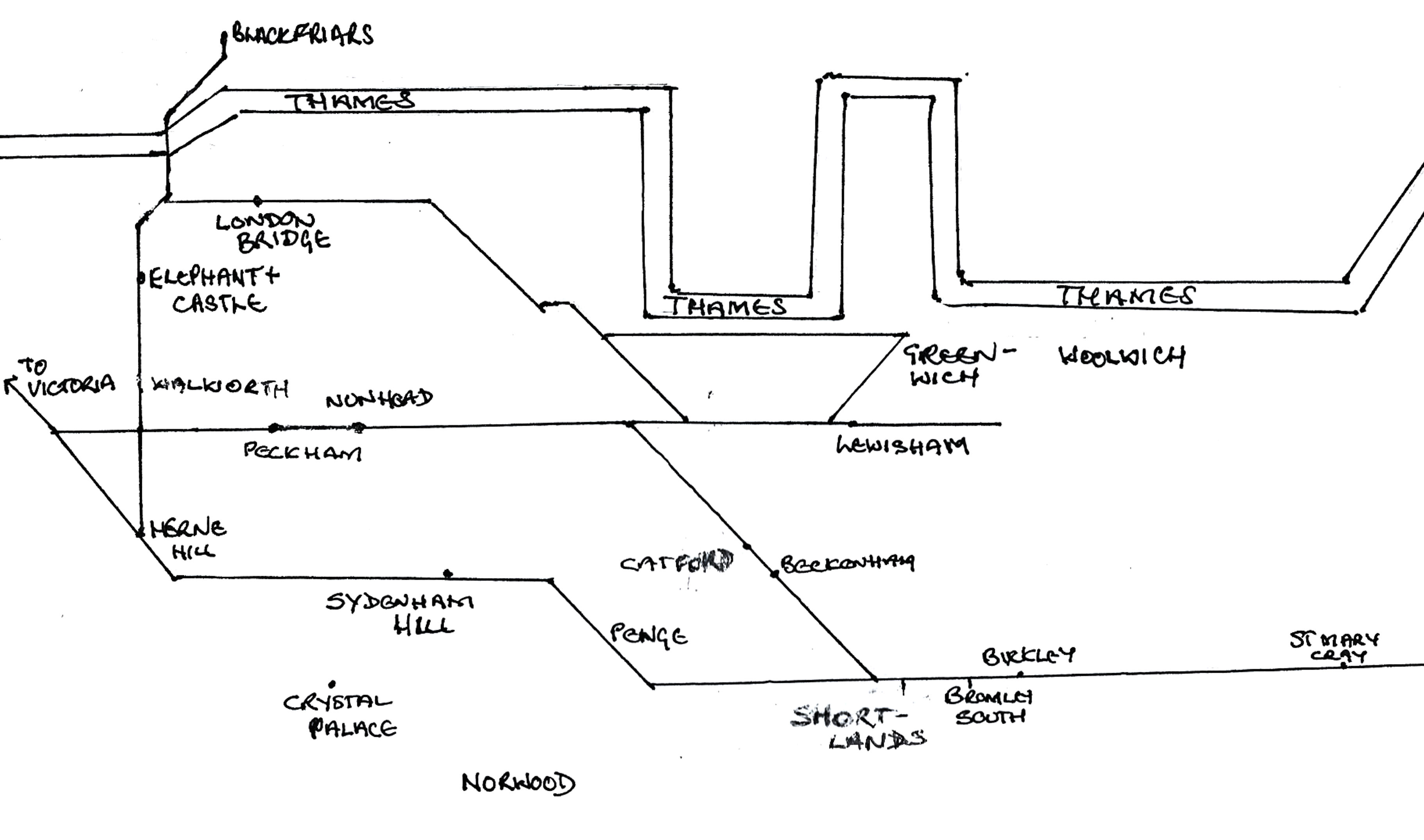
EKR’s Parliamentary Bill of 1858, to extend their line from Strood into London was going through the process when, in July 1859, EKR re-designated their title as the London, Chatham & Dover Railway Company (LCDR). The Bill provided for a new line from Strood to St Mary Cray, where it was expected to connect with the West End of London and Crystal Palace Railway Company at Shortlands – then named Bromley. From there, two possible routes existed for the Thames crossing, one was via Blackfriars and the other via Battersea. The proposed London terminus was to be at Manor Street, Westminster.

The Bill also included the proposed railway track from Canterbury to Dover with a spur from Dover to Deal. As had been discussed at the meeting of June 1858, the Canterbury-Dover the line would go under the Western Heights terminating at the harbour. LCDR envisaged making Dover their main crossing point for the Continent. During the parliamentary inquiries, representatives of LCDR emphasised that SER had chosen to make Folkestone their main harbour for the Continent and had created a monopoly to the detriment of the general public.

Pier District in the late 19th century. Dover Museum

Pier District in the late 19th century. Dover Museum

Among those who gave evidence on behalf of LCDR was Prince George, 2nd Duke of Cambridge (1819 -1904). Shortly after being given Royal Assent in 1860, LCDR started work in earnest on both the Eastern and Western sections of their proposed operation, the centre section being the Strood to Faversham line. The first section of the Eastern operation was the laying of the line to Canterbury then to Dover. However, in Dover there was much opposition, particularly as homes would have to be demolished in the heavily populated Pier District. In January 1860, the Mayor of Dover, James Cuthbert Ottaway, called a public Common Hall meeting where Alderman Edward Knocker, Alderman James Wood, Councillor Baker, Rowland Rees, Reverend Briggs and Steriker Finnis all put forward the arguments for the line. The meeting concluded with agreement.

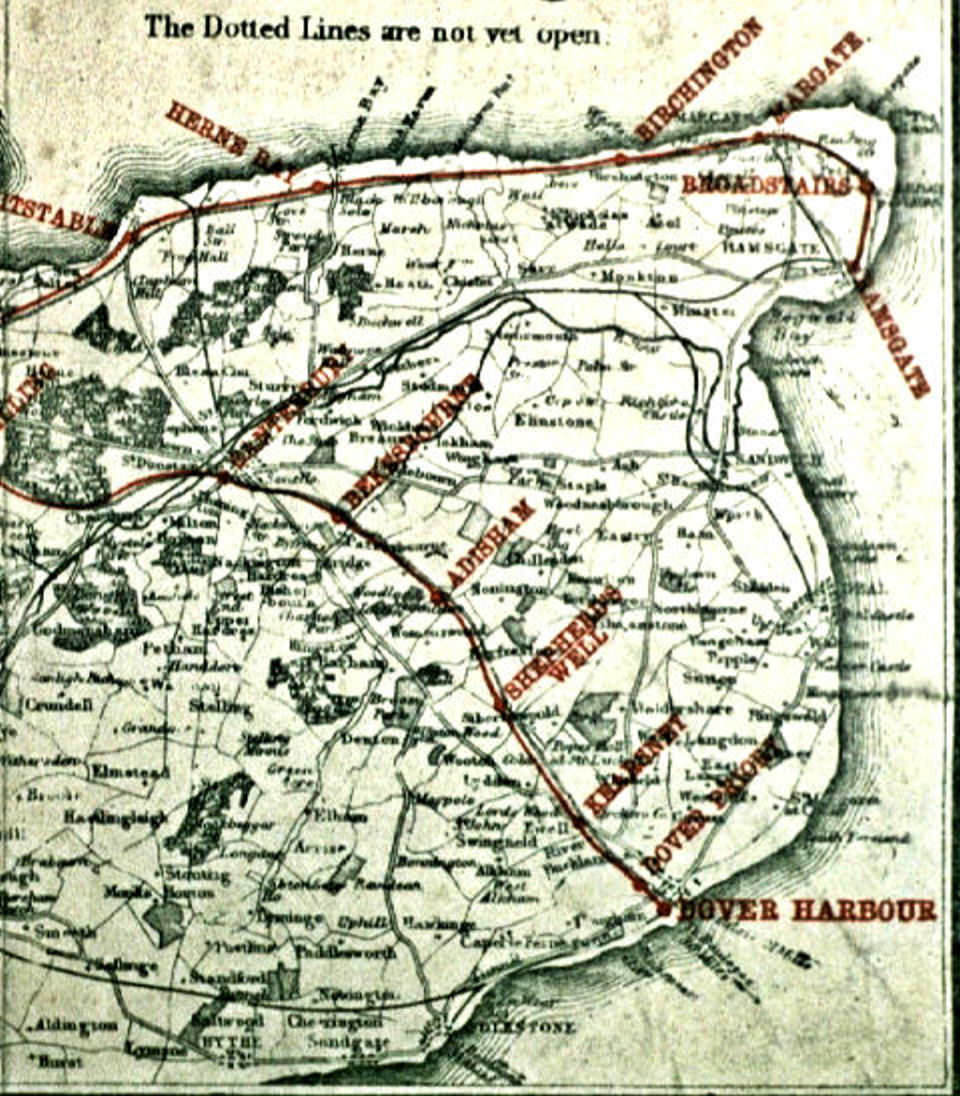
The branch line from Faversham to Faversham Creek was opened on 12 April 1860 and the line between Faversham and Canterbury, with an intermediate station at Selling, opened on 9 July 1860. The line from Canterbury to Dover was calculated to be just under 17-miles and until it was completed, LCDR laid on a regular horse drawn omnibus service. Advertising that there would be three omnibuses a day leaving Dover for Canterbury, the first class fare between Dover and London was 11shillings, 2nd class 9shillings and third class 7shillings. The omnibus service made strategic stops at villages where LCDR proposed to open railway stations in order to attract passengers. Four intermediate stations were planned, they were Bekesbourne, Adisham, Shepherdswell and Kearsney before Dover Town station as LCDR decided to call their Dover station. In 1863 LCDR changed the name of the station to Dover Priory.

London, Chatham and Dover Railway line down to Dover and to Thanet c1865. Dover Museum

London, Chatham and Dover Railway line down to Dover and to Thanet c1865. Dover Museum

The track was through undulating terrain requiring cuttings, embankments, bridges and tunnels. The bridges were chiefly over or under country roads and were all built of brick. There were four tunnels but as the line was principally going through compact chalk, it was believed, that once consolidated these would be easily maintained. From Canterbury to Bekesbourne, the distance was some 3 miles.  Using an engine with 32 trucks attached to carry and remove materials, all was going well. By the 19 January 1860, a bridge plus a lengthy embankment had been built but at 17.00hrs, not far from the village of Bekesbourne, men were working in one of the cuttings when one of them realised something was amiss and rang the danger bell. Most of the men were out when some 100-tons of earth collapsed into the cutting burying three men and a horse. Following the accident, measures were taken to erect more substantial boarding in an effort to stop further such accidents. The station at Bekesbourne was/is situated between Bekesbourne Hill and the village itself.

At this time men had already been working on the next section of track to Adisham station, approximately 7-miles from Canterbury. On this section another high embankment was required plus a bridge with two arches. Adisham, at this time was a quiet rural village on the west of the line but this changed in the early part of the 20th century with the coming of the Kent Coalfields, the opening of Snowdown Colliery and the village of Aylesham with its own railway station. Back in 1860 the next station down the line after Adisham was Shepherdswell or Sibertswold as the village was originally called. The name Sibertswold had been change to Shebbertswell by the end of the 18th century and during the early part of the 19th century, to Shepherdwell, yet a myth exists that it was LCDR that changed the name. Although a station was not built at Lydden, to get there from Shephersdwell, LCDR were required to excavate a 2,376yard tunnel. The compact chalk meant that the tunnel was completely dry throughout the time the men took to brick it with cement throughout.

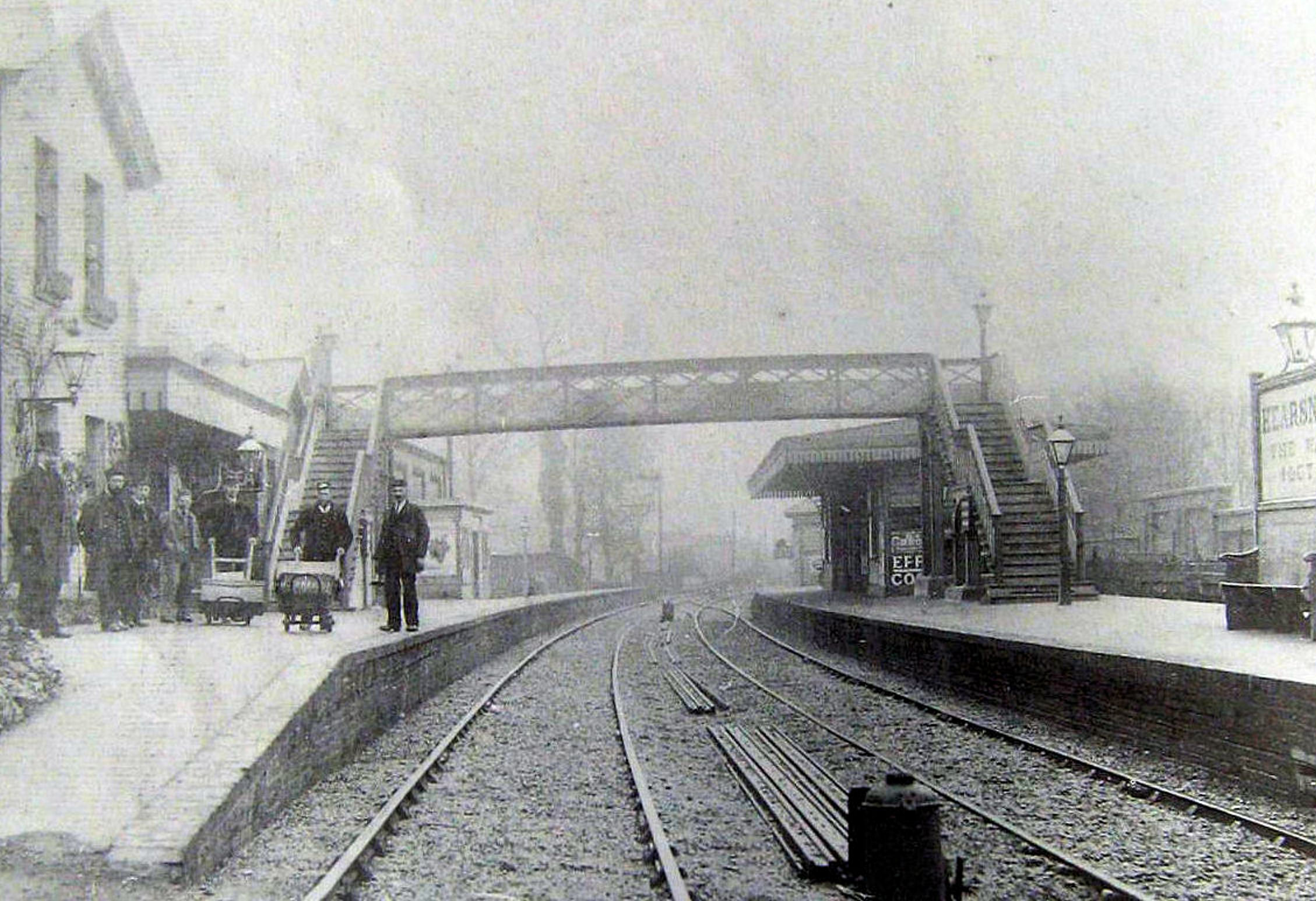
Kearsney Railway Station c1870. John Sulby

Kearsney Railway Station c1870. John Sulby

After the tunnel, the line passed to the east of the village of Lydden. The next village was Temple Ewell where a viaduct was erected across the Lower Road just before the line reached Kearsney Station. This was built with a small goods siding and platforms for passenger trains to serve the villages of River and Temple Ewell or Ewell as the station board states. Immediately after leaving Kearsney station a bridge had to be built to cross the road leading to Kearsney Abbey. Running along the high ground on the east side of the village of River the line passed over two bridges at Crabble and remained on the high ground to the west of St Andrew’s Church, Buckland. Taking the line into Dover required the erecting of bridges and the excavating of two tunnels. The first tunnel, of 200-yards in length, was between Buckland Bottom and Tower Hamlets and the second, of 125yards, between Tower Hamlets and Dover Priory Station.

Map of Dover showing the railway line from Crabble to the harbour. Alan Young of disused-stations.org.uk

Map of Dover showing the railway line from Crabble to the harbour. Alan Young of disused-stations.org.uk

Between the first and second tunnel was the growing working class district of Tower Hamlets where there lay an obstacle that LCDR had not budgeted for. The access road to Tower Hamlets, at the time call Black Horse Lane, was a gradual incline from the London Road/High Street cross roads. LCDR intended to make it a level crossing but because of the population growth of the area, the Board of Trade insisted on a bridge over the railway lines. It was estimated that this would necessitate a stiff gradient of 1in7 so the road was curved southward giving a gradient of 1in13, which satisfied the Board of Trade. Shortly afterwards the name of the new access was changed to Tower Hamlets Road.

Priory Station May 1862 - Dover Museum

Priory Station May 1862 – Dover Museum

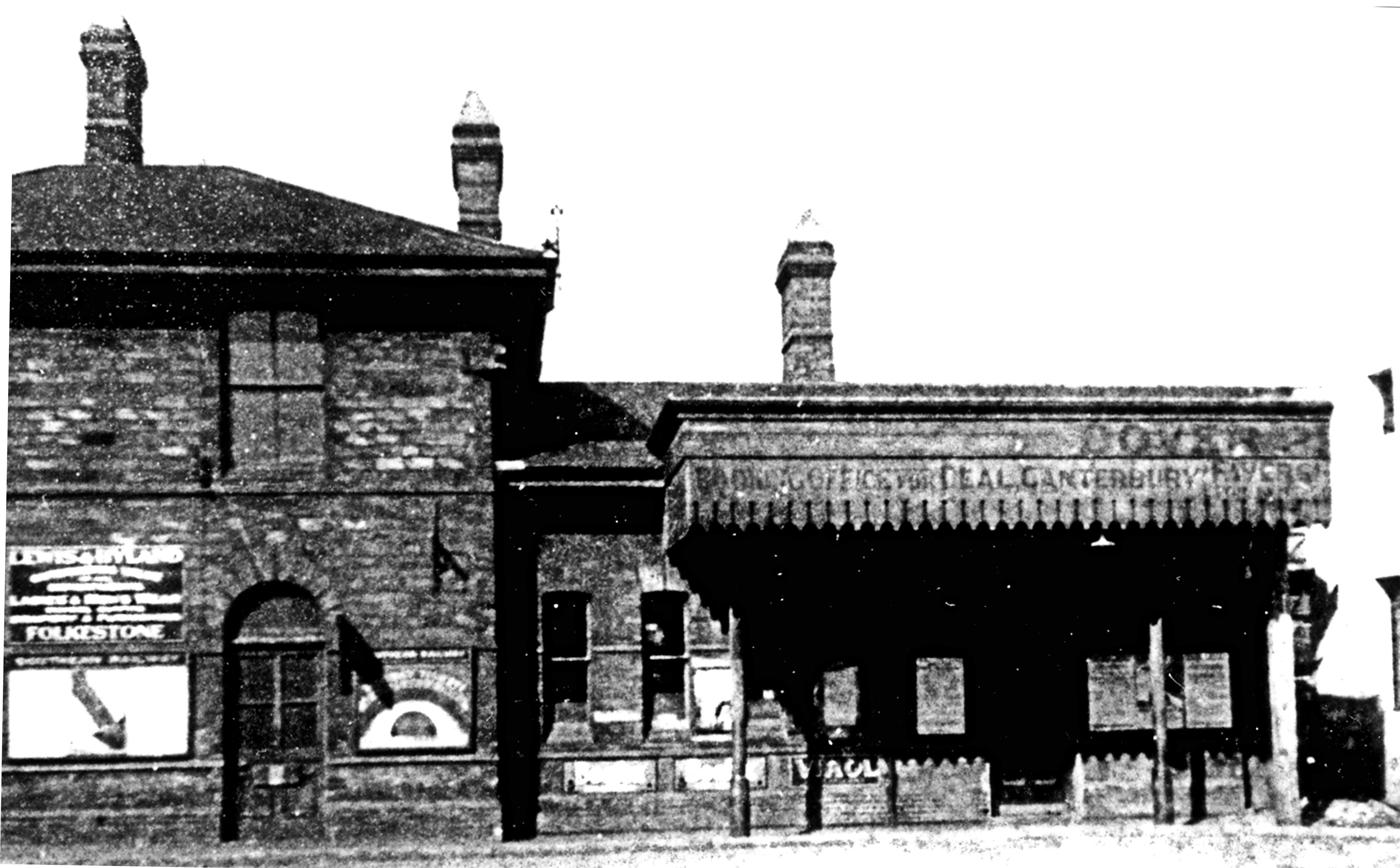
Dover Priory railway station opened on 21 July 1861 as the temporary terminus of the LCDR. Services started immediately and although the facilities were basic, the railway staff did everything they could to improve the situation. Until the station at the harbour was built, the company laid on four-horse omnibuses, leaving their office in Strond Street, near the harbour, to meet the 07.50hours, 10.50hours and 16.15hours trains on weekdays and on Sundays at 10.15hours, 12.30hours and 16.15hours. The booking clerk was George Gillman.

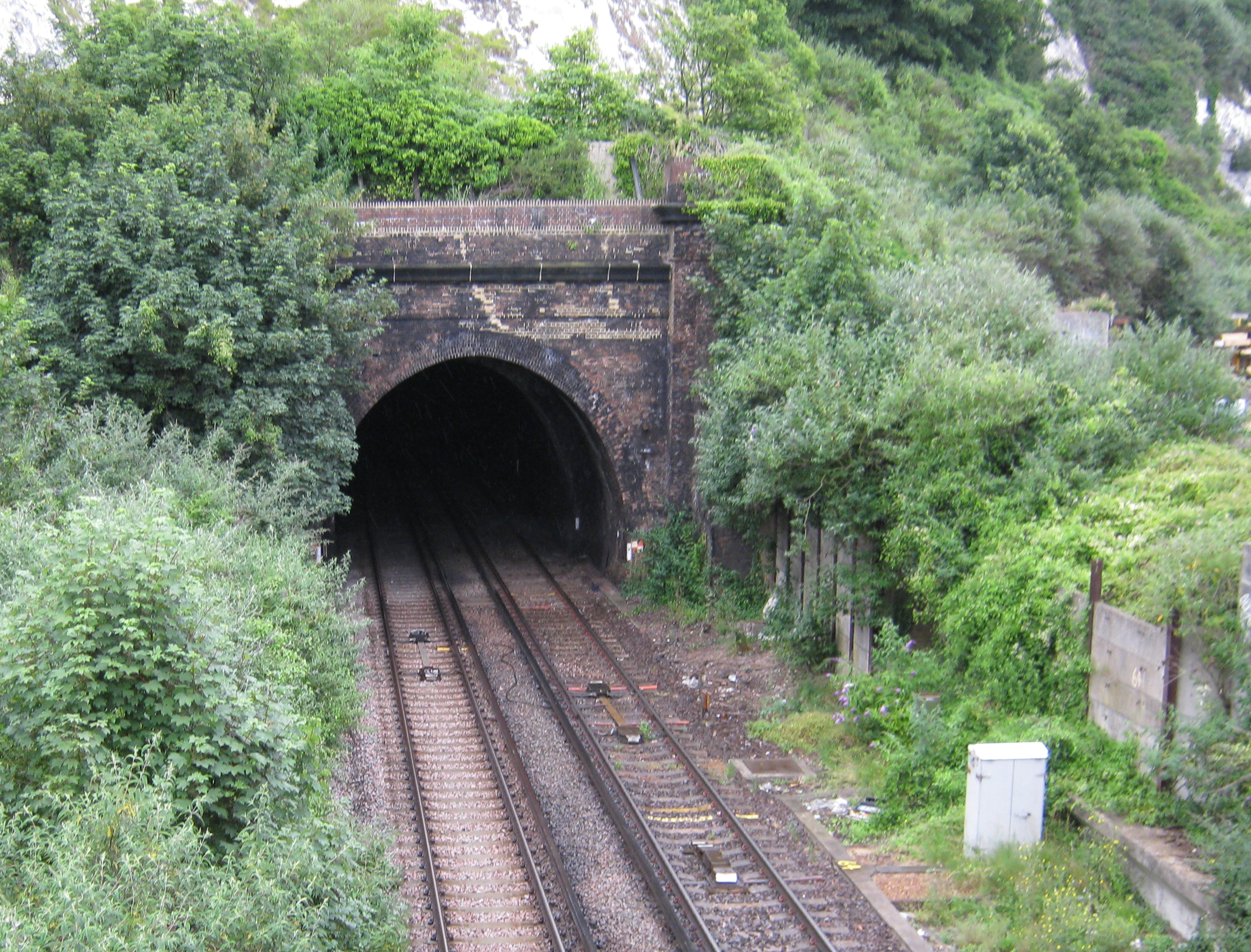
To take the line through to the harbour, it first had to cross the Folkestone Road. Although at the time there were few properties along the road, the notion of the railway brought in a proliferation of property developers. With this in mind and the extra expense that the Tower Hamlets bridge had cost, LCDR decided to erect a bridge using the natural shape of St Martin’s Hill and this was completed in 1861. To complete the line, the 684-yard tunnel under the Western Heights was excavated.

London, Chatham & Dover Railway Tunnel from Priory to Limekiln Street. LS 2010

London, Chatham & Dover Railway Tunnel from Priory to Limekiln Street. LS 2010

Before reaching the Pier District the line passed through the caves and land of the Oil Mills on Limekiln Street. Owned by Robert Walker, he accepted compensation from LCDR and then sold the land east of the track back to the railway company who eventually built their Bonded warehouse on the site! It had originally been intended that the line would cross Limekiln Street by a level crossing but this required the demolition of four houses belonging to Dover Harbour Board. They took legal action but had to accept LCDR’s plans and were compensated.

By 1861, the second stage of the Admiralty Pier was almost completed and LCDR, in their evidence to parliament for the Dover section, had suggested running their track along Admiralty Pier where they would build a station. SER had previously sought permission but as the Pier was not completed, neither of the companies were given permission. Therefore LCDR selected a site for their terminus adjacent to the harbour as near as possible to Admiralty Pier. The site chosen was on Elizabeth Street and required the demolition of properties there, in the adjacent Round Tower Street and the nearby Council House Street. At the western end of the harbour was the Crosswall were a regular fish market was held. To persuade the council to move the market further east along the crosswall was only achieved when compensation was given. However, the paying of compensations was taking its toll on the LCDR’s finances and to reduce it in Dover, LCDR argued that the properties being demolished were old and unsanitary.

Map showing the location of Harbour Station, in the Pier District, with the Harbour 1890

Map showing the location of Harbour Station in the Pier District and the Harbour in 1890

Albeit, Dover’s Roman Catholic community held out over their priests’ house and LCDR were forced to pay £650 when it was demolished. The Roman Catholic Chapel opposite the new station, for which they expected greater compensation deal, remained. The Anglican community were persuaded to allow the demolition of the Parish’s Holy Trinity Church School built in 1847. Their agreement provided £50 per annum in perpetuity from LCDR towards a new school. Lessons, until the new school was built, were held in the Ship Hotel on Custom House Quay. However, as the new railway station attracted businesses to the Pier District that put up the cost of building land, the Parish was unable to afford any land.

In 1867, LCDR provided land on the corner of Hawkesbury Street where a new school was built. Also suffering, but without a thought of compensation, were the men who had worked on the building of the line. On completion they were out of work and although many left the area to work on railway lines being built elsewhere, a considerable number had homes and families in Dover. For those who could not find work, they and their families faced destitution. To try and combat this, the Also suffering were the men who had worked on the building of the line but were now unemployed.  To provide some work, Dover’s Mayor, John Birmingham instigated the widening of what was then Love Lane, now Barton Road. It was not until the 1880s, that the road was developed, as we know it today.

Possibly due to the lack of finance, it was decided to wait before building a permanent harbour station and so a temporary structure was erected and opened on 1 November 1861. The company immediately named the terminus as Harbour Station and boasted that luggage would go straight onto the ferries at the same time as the passengers. Making the point that passengers using the SER trains had to carry their luggage to the ships. Local townsmen, who had previously been running daily horse drawn omnibuses to Canterbury and London, changed to offering regular services from the harbour to various locations in Dover and surrounding villages.

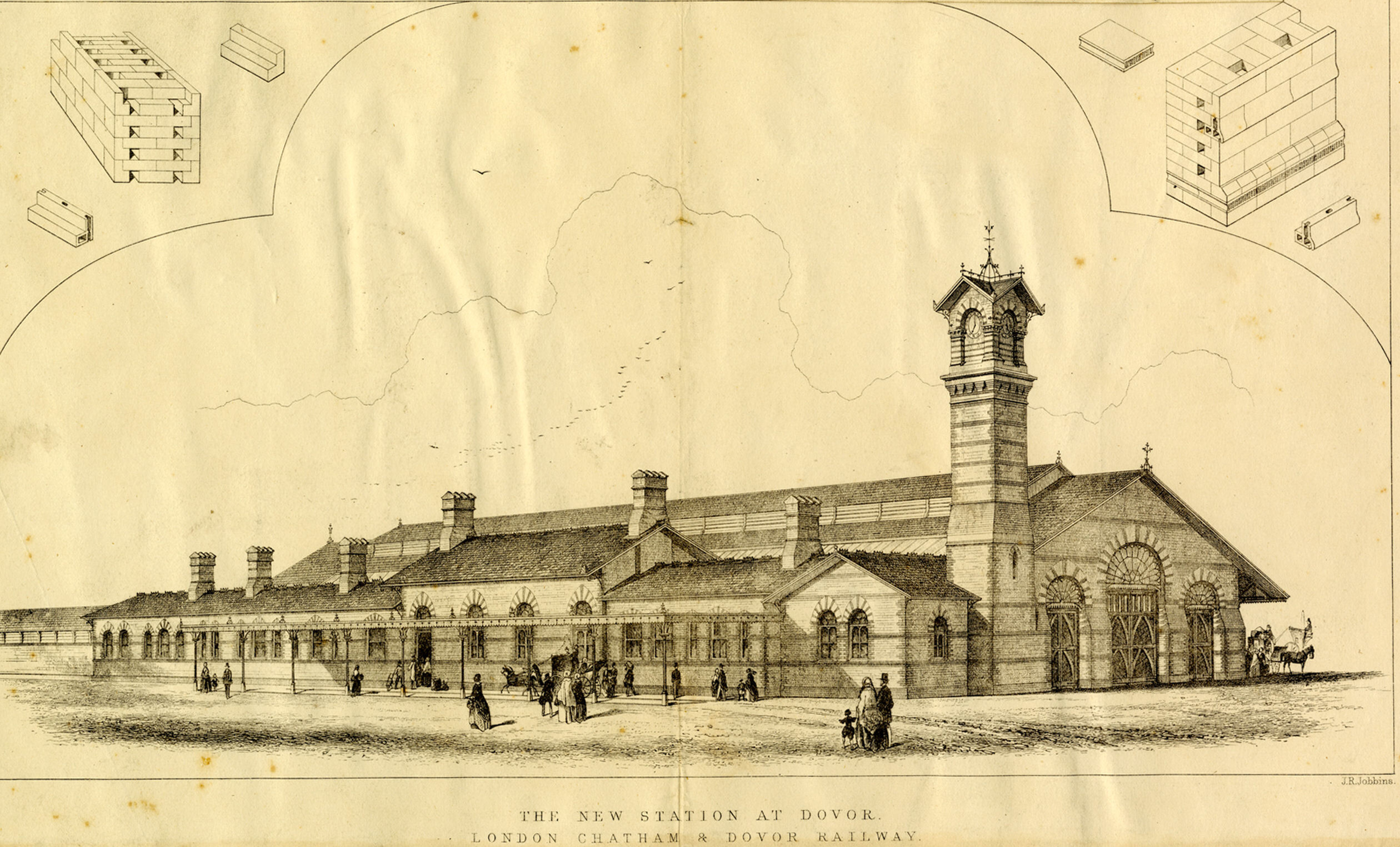
London, Chatham and Dover Railway Harbour Station designed by J R Jobbins 1860. Dover Museum

London, Chatham and Dover Railway Harbour Station designed by J R Jobbins 1860. Dover Museum

The temporary Harbour Station was replaced with a permanent structure, some of which can still be seen today and has been given Grade II status. The building was designed by J R Jobbins and was originally dominated by an ‘Italianate’ style clock tower and was especially built, so it was said, because SER did not have a clock tower. Passenger washing facilities with running water and lavatories were part of the fixtures unlike SER’s Town Station of that time. However, as most of the neighbouring households had to make do with water pumps, local women would arrive with both their dirty laundry and dirty children and make full use of the facilities! Although attempts were made to try and stop this practice, there are reports that it was still going on up to World War I (1914-1918). The station also had a refreshment room and later Spiers and Pond, who pioneered national railway catering in the UK, won the contract.

With the building of Harbour Station the clocks in Dover were then set by the Station clock. Up until 1840, time was decided at the local level, usually by a church clock. That year the Great Western Railway Company had introduced Railway Time that synchronises railway clocks on each of their stations and enabled the railway companies to produce accurate timetables. Following Great Western’s lead Railway Time was adopted by all the individual railway companies and in accordance with that set by the Royal Observatory at Greenwich – Greenwich Mean Time. Unfortunately, the Harbour Station’s tall Italianate ornate clock had the obstinate tendency to be slow! This led to a businessman bringing a successful court action against LCDR after he missed his train. The clock hands were removed and never replaced but the tower remained. After the building of the adjacent Train Ferry Berth in the 1930s the tower was truncated and a light was fitted on the top to guide ferries into the berth.

LCDR’s rolling stock was painted black and to save money much of it was bought through Messrs Lucas Brothers who built many of the LCDR railway stations, including Harbour Station. EKR had bought second hand locomotives or borrowed from the Great Northern Railway, small Hawthorn engines. In 1858, they had ordered six new 4-4-0-saddle tank locomotives from R and W Hawthorn of Newcastle Upon-Tyne, but they too were small and also unreliable. William Martley (1824-1874) was appointed in 1860 as LCDR’s Locomotive Superintendent and immediately established the Longhedge railway works Stewarts Lane, Battersea. This opened in 1862 but due to money being spent on new railway lines, the work was mainly repairing and rebuilding a variety of engines, including the specially ordered Hawthorn engines.

The railway between Faversham and Ramsgate in Thanet, was built between 1860 and 1863 with the first 11-miles to Herne Bay having been completed by LCDR as a single track line. Whitstable, the first station, opened on 1 August 1860 and Herne Bay opened on 13 July 1861. The Margate and Ramgate section opened in 1863 with two intermediate stations at Birchington and Broadstairs. The sections of this 27-mile line were undertaken by different companies set up by LCDR under an agreement by which LCDR received half the receipts up to £45,420 and thereafter one quarter of the gross receipts. LCDR also paid the joint companies a rent of £45,000 per annum. Although the companies amalgamated as the Kent Coast Railway they were not formerly incorporated until 1865.

Map of the London, Chatham & Dover Railway Metropolitan Extension - Eastern Section C1865. Dover Museum

Map of the London, Chatham & Dover Railway Metropolitan Extension – Eastern Section C1865. Dover Museum

The Western Section of the LCDR railway line consisted of group schemes all requiring different Acts of Parliament and collectively called the Western and London Extension. Later this was divided into two, the Eastern and Western sections of the Metropolitan Extension. In the 1860 Act of Parliament it had been envisaged that LCDR would build the track from Strood to St Mary Cray, where it was expected to connect with the West End of London and Crystal Palace Railway (WEL&CPR) at Bromley/Shortlands. From there, two possible routes existed to the Thames; one was via Blackfriars and the other via Battersea. On assessing the route from there on, LCDR had worked out that 17 individual sections of line would need to be built connecting to existing or proposed lines operated by nearly as many individual companies.

The first part of the Eastern section of the Metropolitan Extension was  between Strood and St Mary Cray. This had actually been proposed under a Parliamentary Bill of 1856, which failed but two years later it received consent. The next section westward was from St Mary Cray to Bromley/Shortlands and this required going cap-in-hand to the Mid-Kent & North Kent Junction Railway (Mid-Kent Company). The Mid-Kent Company had formed in 1855 to construct a 7.5-mile line between the SER line at Lewisham and WEL&CPR at Beckenham. The line opened in 1857 but under a ten-year agreement with the Mid-Kent Company, SER, held running rights to the Shortlands/Bromley Junction at Southborough later renamed Bickley.

SER opposed LCDR running their trains along this part of the track so LCDR circumvented the problem by successfully applying to parliament for a separate line between Shortlands/Bromley Junction and Bickley/Southborough. The arrangement was made for the Mid-Kent Company to lay it, but it took two years to build the 2miles 30chains single track. This was leased to LCDR on 1 September 1863 for 999years. Altogether, the ownership of the 20miles 54 chains Strood -Bickley tracks were merged into the General Undertakings of the LCDR by the 1859 Act at a perpetual rent of £28,000 per annum.

LCDR - Harbour Station to New Brompton ticket. Michael Stewart

LCDR – Harbour Station to New Brompton ticket. Michael Stewart

The WEL&CPR Company had built a line between Crystal Palace and Wandsworth that opened in 1856. Two years later they had extended the line to Pimlico – which was, in fact, Battersea Wharf on the south side of the Thames. In 1857 WEL&CPR, had laid a track to Norwood then to Beckenham Junction building a short-lived station at Penge. LCDR had inherited the running powers over this section of track from EKR and later bought it. However, because of the EKR contract, in 1862 LCDR faced legal claims appertaining to land at Penge. This was the first of much major land litigation that LCDR was to fight over the next few years as they ventured into London. These were to be a significant strain on their financial resources. In 1859, WEL&CPR sold their line from Norwood junction to Pimlico/Battersea Wharf to the giant London, Brighton and South Coast Railway (LB&SCR).

LB&SCR was formed in 1846 by the amalgamation of the London and Croydon Railway Company and the London and Brighton Railway Company which had opened in 1837. Initially, it was envisaged by LCDR to join with the LB&SCR at Beckenham Junction. From there, they expected to enter London by way of Herne Hill, bridging the Thames to Blackfriars where they would open their London terminus. LCDR, with a grand scheme in mind, bought land in the expectation of connecting with the Metropolitan Company Railway in the heart of London. In the meantime the LB&SCR had sought a site for their London terminus opposite, Battersea Wharf on the north side of the Thames and LCDR decided to go with that. A loose amalgamation of four railway companies – LB&SCR, LCDR, Great Western Railway and the London and North Western Railway floated the Victoria Station and Pimlico Railway Company (VS&PR) that was given Royal Assent in 1859. The purpose of VS&PR was to provide a crossing of the Thames to a new railway station with the working name of Grosvenor Terminus that became Victoria Station.

The 930-foot bridge across the Thames, costing £84,000 and now known as Grosvenor Bridge, was designed by John Fowler (1817-1898). It originally had 5 spans and carried two lines – each of a separate gauge. The cost of the project was split equally four ways. Victoria Station was formerly opened in 27 March 1858 and on 1 November 1861, LCDR ran their official train into the station to open their ‘section’. However, the relationship between the Great Western Company and LB&SCR/LCDR Companies was far from amicable and the latter two decided to build an additional adjacent station – also called Victoria Station. This opened on 25 August 1862 but as LB&SCR was the senior partner in the transaction and LCDR were running their trains over LB&SCR’s last 15miles of tracks, be it at a continually increasing rental, LCDR agreed to pay two-thirds of the costs. Further, the new station required the Thames bridge to be widened to carry an additional two more lines. The cost was £245,000, which was paid for by LB&SCR/LCDR and divided in the same way as the new station!

A branch line had been opened from Strood to Maidstone in 1856 and from Swanley to Sevenoaks opening on 2 June 1862. Known as the Sevenoaks, Maidstone & Tonbridge Line it was a distinct corporate body with the legal power to build a 15miles 30chains extension between Otford and Maidstone. Incorporated as a General Undertaking by LCDR under the 1859 Act, they paid £11,500 rent per annum to the Sevenoaks company. In 1860 the Sittingbourne & Sheerness Railway Company in association with LCDR built an 8miles 5chains spur from the Strood-Faversham line to the naval base of Sheerness on the Isle of Sheppey. This included an intermediate station and pier at Queenborough, a flourishing port for Holland and northern Europe. The contract included a road bridge with tolls over the Swale, between the Isle of Sheppey and the mainland. Opening on 19 July 1860, LCDR leased the line from the company at £7,000 per annum until the two companies merged in 1876.

The building of the LCDR lines in Kent up to Beckenham Junction had thus far been undertaken by engineers Crampton and Frederick Thomas Turner (1812–1877). However, for the Metropolitan Extension lines and stations as well as the bridge over the River Thames to Victoria Station, LCDR had given the contracts to Peto & Betts together with Crampton. Samuel Morton Peto (1809-1889), known as Morton Peto, he was an engineer and entrepreneur who had joined with Crampton’s old associate, Edward Betts, in 1848 to form their own company. Together, Peto & Betts had worked on numerous of railway contracts and for the most part they were paid in debentures and shares. Debentures were paid bi-annually at a fixed interest rate on the face value of the debenture. Shares came in several categories and the number bought determined the percentage of profits the owner received. Shares could be sold and the price paid depended on what they appeared to be worth in relation to the company’s profits. Debentures provided Peto & Betts with a regular income while they could, and did, sell the shares at a later date when they were worth a higher price than the face value.

London, Chatham and Dover train on Admiralty Pier, the Lord Warden Hotel is on the right. Dover Museum

London, Chatham and Dover train on Admiralty Pier, the Lord Warden Hotel is on the right. Dover Museum

In the same year LCDR had arrived in Dover, 1861, the Dover Harbour Board was reconstituted. The Lord Warden still retained the chairmanship as it was written in the original Charter of 1606. The new change appertained to the Board that replaced the Commission. This was to be made up of two burgesses (senior councillors or aldermen) of Dover elected by the town council, and one nominee each of the First Lord of the Admiralty, the Board of Trade and SER. Although SER had moved two of their cross Channel ships, the Princess Clementine and the Princess Maud, from Folkestone to Dover this was to do with other reasons than the reconstituted Dover Harbour Board. In October 1861, SER had started running trains onto the Admiralty Pier, but the best position, Berth 2, was designated strictly for the sole use of mail trains and Joseph George Churchward‘s (1818-1890) packet ships. Although SER had the contract for the mail trains, when they found that the lucrative Dover packet contract was not due for renewal until 1870 they moved their two ships back to Folkestone in April 1862.

Maid of Kent Paddle Steamer, Pilots tower can be seen in the background. LS Collection

Maid of Kent Paddle Steamer, Pilots tower can be seen in the background. LS Collection

As part of their plan to take the line to Dover harbour, LCDR floated a subsidiary cross Channel passage company, named the LCDR Steamboat Service. The supervisory responsibility was given to engineer, William Martley (1824-1874) and over the next few years the paddle steamers, Samphire, Maid of Kent, Scud, Foam, Breeze, Wave and La France were built for the company. Much to Churchward’s chagrin and SER’s surprise, the Dover packet contract was advertised in December 1862 to come into operation from 21 April 1863. Churchward instigated legal action and although he was legally correct the evidence was overruled by the Solicitor General, Roundell Palmer 1st Earl of Selborne (1812-1895) and upheld by the House of Lords. By this time it was expected that SER would win the packet contract and that it would be moved to Folkestone to the detriment of Dover. However, LCDR put in a lower offer than SER, saying that they could run service for £13,000 a year out of Dover. They were successful and it came into effect on 20 June 1863.

Churchward agreed to transfer his steamboats, offices and packet yard to LCDR for £120,000, paid in instalments of £7,000 until 1870. The £7,000 per annum was made up of cash, preference shares and debentures bearing 5% annual interest. LCDR also agreed to pay Churchward an annuity of £800 per annum to 1870 for the Belgium-Britain packet contract, which he held until that year. Although well satisfied with the transactions, LCDR Directors decided to put the Dover-Deal railway project on hold until 1870. The ships sold to LCDR by Churchward were Vivid II, the former Garland name changed to L’Alliance to comply with an earlier French packet contract, Jupiter and the Prince Frederick William. They bought the former Churchward packet ships Empress and Prince Imperial which Churchward had sold to the French and later LCDR acquired the 123-ton Queen from the French and changed her name to Pioneer.

Harbour, Pilot's Tower and Paddle Steamers. Dover Museum

Harbour, Pilot’s Tower and Paddle Steamer. Dover Museum

Having the packet contract and because of it, Berth 2 on the Admiralty Pier, LCDR petitioned to build a connecting line from Harbour Station. This was agreed but between the Station and the Pier stood the highly ornate tall and very solid Pilots’ station. This had opened in 1848 and was also a major tourist attraction. Money was getting short, and following the advice of their engineer Crampton, the ground floor of the tower, with a ceiling height of 20ft (over 6 metres), was gutted and the LCDR line laid through the Tower – which increased its interest as a tourist asset!

From the Pilots tower LCDR’s line ran onto the Pier on the harbour side of the SER line until a central crossover was reached. This enabled trains from both companies to run along side the long single platform that was against the western parapet. During south-westerly storms, which are not uncommon to Dover, waves broke over the parapet soaking railway passengers and their luggage! LCDR were given the southern part of the platform near to Berth 2. On the first day that LCDR started to run trains onto Admiralty Pier, 30 August 1864, Prince George, the Duke of Cambridge and his wife, Princess Mary, having travelled from London on an LCDR train, embarked on the LCDR steamer Wave for France. LCDR used the event for publicity purposes, saying that Royalty had opened the Admiralty Pier line!

Back in 1862, before SER had moved their two ships back to Folkestone, they suggested to LCDR that the two companies should form what became the Continental Agreement to avoid duplication of shipping services. Indeed, they gave this as their justification for moving their ships back to Folkestone. The general idea of the Continental Agreement was for all the railway receipts from every Channel passage port between Margate and Hastings to be pooled and then divided. As SER was the established Channel passage company they would have 70% of the receipts and LCDR, as the new comer, 30%. This was to last for ten years and thereafter the ratio was 60%-40%. The Directors of LCDR agreed and a Bill was presented to parliament.

Continental Agreement ratified August 1865 dividing the receipts of South Eastern and London, Chatham & Dover cross Channel shipping services

Continental Agreement ratified August 1865 dividing the receipts of South Eastern and London, Chatham & Dover cross Channel shipping services

Not long before James Staats Forbes (1823-1904) was appointed the General Manager of LCDR. He clashed with the company’s Board of Directors when he suggested that the Continental Agreement proposal should be rescinded. Forbes was reminded that he was merely an employee but as the Bill progressed through parliament, he did manage to make amendments. The final agreement, ratified on 10 August 1865 was for the percentages to start from 32%-68% in 1863 and progressively closing until 1872, when they would be 50%-50%. Payments were half-yearly and came into operation immediately. By 1865 SER were promoting their company as THE cross Channel port, at Folkestone. To get round the Continental Agreement they built the attractive new Shorncliffe station (now Folkestone West) at Cheriton as this would not be subjected to the levy. However, Forbes did get his own way when he brought in the young William Robert Sykes (1840–1917), to train under him in order to take charge of maintenance of LCDR’s telegraph instruments, clocks, watches and lighting.

In December 1863 Lord Sondes, the Chairman of LCDR, laid the foundation stone of the Clarence Hotel, on the corner of Townwall Street and Woolcomber Street, built by the Clarence Hotel Company. The directors of the company included Steriker Finnis and Rowland Rees, both local men and major shareholders of LCDR. John Wichcord (1790-1860) designed the hotel, and when it finally opened in 1865, five-storeys with 240 rooms had been completed. However, the building was not finished as the owners had over reached themselves. Eventually it was demolished and the famous Burlington Hotel was built on the site.

In the days of the EKR the ultimate ambition of the company was to run a railway service between London and Paris with connections throughout England. This was to be achieved by building the railway to Dover, running a packet service across the Channel and teaming up with the French railway services. A second part of the vision was for the port of Dover to be a cargo terminal where goods from all parts country would be sent abroad or imported and taken to London by EKR railway. This same scheme was the goal of LCDR’s activities as they had built railway to Dover and set up the cross Channel service. The next part of the scheme was to build a massive depository on the Thames embankment, with its own wharf and near their London railway station. This depositary or warehouse was to be used as a holding area for goods waiting to be moved onto trains or lighters – the latter transported goods to or from the larger cargo ships moored on the Thames.

Report justifying the Metropolitan Extension to LCDR shareholders January 1863

Report justifying the Metropolitan Extension to LCDR shareholders in January 1863

At the time horse drawn heavy vehicle traffic was used to carry goods between the different London railway stations and lighters. Thus, the Board of LCDR reasoned, the project – the Metropolitan Extension –  would ease the congestion clogging up the streets of London especially if they could get all the large railway companies to utilise the service. Not long after LCDR was formed they had sought and received, in 1860, the Act for the Metropolitan Extension.  In 1862 the Board gave the project contract to Peto and Betts in partnership with Crampton and it was estimated to cost £5.979million.

Before the decision had been made for Victoria Station to be LCDR’s London terminus, the company had been considering building a terminus further east, in the area of Blackfriars and they had planned to enter London by way of Herne Hill, crossing the Thames near London Bridge to Blackfriars. At the time and for a while after, LCDR bought land in the expectation of building this line, which included connecting with the Metropolitan Company line in the vicinity of Farrindon Street. That company had already laid lines to Kings Cross station, to connect with the Great Northern Railway and to Paddington station to connect with the Great Western Railway. These connections were part of the World’s first underground railway that the Metropolitan Company opened in 1863.

London Chatham & Dover Railway - Schematic Plan of the 1860 Metropolitan Extension - LS2015

London Chatham & Dover Railway – Schematic Plan of the 1860 Metropolitan Extension – LS2015

Joseph Cubitt, who had designed the Rochester Bridge, designed LCDR’s bridge across the Thames at Blackfriars and this was opened on 1 June 1864. Land had been bought nearby and the construction of the warehouse started shortly after. A railway route between the warehouse and Victoria station, to the west, was laid looping round via Brixton and Clapham using, as far as possible, lines already belonging or leased to LCDR with the company laying the rest. A second route was built between the warehouse and London Bridge Station to the east. To the north a line was to be laid to Farringdon Street to connect with the Metropolitan railway. In preparation, LCDR bought the site of the old Fleet prison for £60,000, the prison was infamous for incarcerating debtors and was demolished in the 1840s.

LCDR Metropolitan Extension 1864 only stations referred to in text shown. LS2015

LCDR Metropolitan Extension 1864 only stations referred to in text shown. LS2015

From the existing main line to Beckenham, as had originally been planned, a new line north was laid to Herne Hill. However, between Penge and Sydenham required the construction of a 2,290-yard tunnel. Some 200,000 cubic yards of heavy clay had to be removed and although much of it was made into bricks to line the tunnel it was an expensive, time consuming operation. The connection between Herne Hill and Blackfriars required Acts of Parliament and reached the Elephant and Castle on 6 October 1862 and eventually, on 21 December 1864, Blackfriars station.

However, for the last stretch, the line had gone through the heavily populated Southwark demolishing a lot of working-class homes and in neighbouring Lambeth 141 homes were demolished in one week, displacing 750 people. The homeless were forced to move away from London and from their work. To help deal with the problem, Forbes, initially without Board approval, offered to carry workers a distance not exceeding 10-miles into London for 1-shilling a week. In the autumn of 1864, Forbes reported that LCDR had carried 3,688 working men, the receipts being 5shillings 6pence per train mile while the expenditure for LCDR was 3-shillings 7pence per train mile.

Prior to arriving at Blackfriars Station, the line crossed the Thames on the newly built Blackfriars Bridge, and then continued north to Ludgate Hill. On this section litigation and associated costs against the company escalated, nonetheless, the station opened on 1 June 1865. From Ludgate Hill, LCDR had planned to build a line to the site of old Fleet Prison, on which Peto and Betts had already built a station and offices. However, the Metropolitan Company had built their Farringdon Street station nearby. In 1864, the City Undertaking Act came into force that sought to limit railway extensions through London without just cause. Metropolitan Railway had already agreed to lay two lines between Farringdon Street and Kings Cross station, for which Great Northern Railway had paid. To get round the Act and build the line to Farringdon Street, members of LCDR Board floated the City Lines Company to which Great Northern Railway loaned £300,000. LCDR in the name of the City Lines Company built a line from Ludgate Hill that joined Farringdon Street – Kings Cross line near Earl Street.

London, Chatham & Dover advert for their cross-Channel service with a mention of the connection to Crystal Palace. Dover Library

London, Chatham & Dover advert for their cross-Channel service with a mention of the connection to Crystal Palace. Dover Library

The success of the Metropolitan Extension project required the cooperation of several different railway companies requiring separate Acts of Parliament. However, at the time there was a proliferation of Bills in parliament, typically, in 1862, although Crystal Palace, in south London, already had an excellent train service provided by LB&SCR, a new company, the Crystal Palace & South London Junction Railway was given Royal Assent. The proposal was to be a branch line to Crystal Palace from LCDR main line at Peckham and was to have 5 stations. This had the backing of LCDR and was mentioned in their adverts.

By the end of 1863, many more Bills were still going through the parliamentary process. These included a 2½-mile track between Greenwich and Woolwich, estimated cost £200,000, another line of over 6-miles costing £420,000 and a track of just over 14-miles between Epsom and Sutton estimated to cost £400,000. The logic of why LCDR were involved in the latter two was lost on most LCDR debenture and shareholders.

To end the unrest, Morton Peto joined LCDR Board as financial advisor in December 1863. Immediately there was a clash between him and Forbes, who as the general manager, was forced to concede to Peto although he did manage to stop two other lines of doubtful use being built. Peto then put forward an ingenious proposal by which he would fund a floating debt of £1.25 million that would enable the company to issue more stock. These sold quickly and LCDR were able to raise more cash by issuing debentures.

In June 1863, with Lord Harris the deputy chairman presiding, the LCDR Board voted to issue common fund shares to the value of £750,000 and to borrow a further £250,000. Lord Harris had been the Governor of Madras who had returned to England in 1859, bought shares in LCDR, was appointed a director and then deputy chairman. The funds were to extend the Greenwich line, the Metropolitan Extension lines to London Bridge and to undertake improvements at Victoria Station. On Forbes taking up the position of general manager, he suggested that all of the various railway companies in Kent, in which LCDR had significant share holdings, be consolidated. The LCDR Board agreed and in November 1863, Mid Kent Railway Company was dissolved and became part of LCDR. In February 1864, with Lord Sondes in the chair, LCDR reported that the accounts for the final six months of 1863 showed that £3,984,947 had been spent on main line services, £4,586,883 on the Metropolitan Extension and £23,713 on shipping from Dover. From the main line services £171,086 had been received, from the Metropolitan Extension £30,928 and from Dover shipping £34,516. It was resolved that the company would not be paying dividends but finished by complimenting themselves, Peto & Betts and Crampton on how well LCDR was doing.

Mr Shaw, a shareholder from Dover, responded by saying that in his opinion, the Directors were in no position to congratulate themselves! ‘The company had started with £700,000 capital from shares and borrowing,’ he said, ‘and this now stood £9,000,000! In his opinion shareholders should employ counsel in Parliament to protect their interests.’ Shaw went on to say that the Dover shipping operation was the only part of the company that was profitable and that since LCDR had taken over the packet service, the number of passengers carried was 123,053. ‘Yet’, he said, ‘Dover was being badly treated by LCDR.’ The Company Secretary, the Earl of Sheffield, on behalf of the Board, responded saying ‘that until the connection between Admiralty Pier and the Metropolitan Extension was completed, there was little point in spending anymore than necessary at the Dover end.’ Rowland Rees, at the time Dover Harbour Board’s surveyor, agreed with Holroyd, saying that ‘once the Extension was completed, an enormous amount of traffic would come through Dover and it would be then time to expand the Dover terminus.’

LCDR’s first major rail accident occurred on 26 September 1864, when the fast train to Dover was traversing a low embankment after leaving Penge station. For reasons unclear, the engine left the track and plunged down the embankment dragging with it a second class carriage and another carriage. In the second class carriage were four passengers, all injured. The first class carriages, with some 30 passengers on board and the guards van stayed on the track. The guard returned to Penge station and after telegraphing London a relief train was sent to take the 30 unhurt passengers to Dover. The injured passengers, driver and the stoker were treated at the scene. In November 1864, with Lord Sondes in the Chair, LCDR agreed to raise £100,000 by the issue of shares and borrowing £33,000 by means of a debenture issue. This was to pay for a double line between Sevenoaks and Tonbridge and creating a junction with SER railway there. On 11 January 1864, SER had opened Charing Cross Station as their main London terminus.

On 15 November 1864, a shareholder of both LCDR and LB&SCR sought to bring a legal action against the Chairman of LB&SCR, Leo Schuster (1791-1871). Travelling on a train out of Victoria Station, both the applicant and Schulster were in the same 1st class railway carriage. Not long after crossing the Thames Mr Schulster opened the door of the carriage and jumped out. Concerned, the passenger reported the incident at the next station only to be told that Mr Schulster frequently joined and left the LB&SCR trains in such a manner and was of no concern.

Following unsympathetic reaction to his complaint to LB&SCR management, the passenger complained to LCDR as they ran trains on that part of the line. Forbes encouraged the passenger to take legal action, which was successful. This rested on Forbes, when he told the court of the case of 16-year old apprentice, Hugh Brown. The previous April, Brown left a train while it was entering Victoria Station and fell but did not sustain any injuries but it was against the law and Brown was arrested. Brown’s mother, a widow with four other children, worked in a laundry. Therefore the court was lenient and fined Hugh Brown 5-shillings. This was a lot of money for the Browns and therefore, Forbes suggested, Schulster should pay a fine of equal magnitude to his income. The relationship between LCDR and LB&SCR then went into freefall!

The half yearly report ending on 31 December 1864 stated that receipts on the 72½ miles of main line track amounted to £182,240 compared to £136,551 for the same half the previous year and £102,957 for the corresponding period the year before. The receipts derived from the cross Channel traffic £32,352 and expenses £19,156, while the expenditure on the main line between Bickley and Dover was £4,443,602 and for the Metropolitan Extension £5,451,886. In April 1865 LCDR were summoned before the Kingston Assizes for poor quality workmanship of the Metropolitan Extension bridges over roads in Newington. The bridges, it was alleged, were unfit for the passage for propulsion, not water tight and were dangerous to those passing underneath. LCDR denied negligence but did say that they would undertake remedies.

Emanuel Sochazewski on 26 March died from injuries received after falling between carriages at Harbour Station and was buried in Cowgate Cemetery - AS 2012

Emanuel Sochaczewski on 26 March 1865 died from injuries received after falling between carriages at Harbour Station and was buried in Cowgate Cemetery – AS 2012

The previous month, on 11 March 1865, John Hart age 48 was killed in the tunnel under the Western Heights. A labourer, he had previously worked for SER, where he had lost a leg in an accident. He had since been given a post by LCDR to oil the points in the tunnel. On that evening, at 19.00hours, the express train from London entered the tunnel at about the same time as the up-train came from the opposite direction. The express train knocked Mr Hart down and the wheels ran over his body cutting it in half. He was buried in St James Cemetery. On 26 March, Emanuel Sochaczewski (1820-1865), the agent for the Belgium Steam Packet Company who worked for Latham’s of Dover, was killed at Harbour Station. He had been waiting for the London train to meet Sir Cusack Patrick Roney (1810-1868) the Railway Historian and Chairman of the Sevenoaks, Maidstone & Tonbridge Company. As the train pulled into the station, Mr Sochaczewski ran up the platform but was so intent on waving to Roney, he hit a post and fell between the train carriages. He was crushed, died two hours later and was buried in Cowgate Cemetery.

May 1865, and an increasing number of shareholders of LCDR were unhappy. Amongst other things, they called for the agreement with the Kent Coast Railway Company to abandon the last part of the line to Ramsgate. The Kent Coast Railway Company had been floated in September 1862 to build a 28-mile line in conjunction with LCDR from Faversham by Whitstable to Ramsgate but had only reached Margate. There were also calls to either abandon the Dover-Deal line or, if authorisation was given to the Bill that was to be presented to parliament, to sell the authorisation to another company. The Chairman, Lord Harris, did not commit himself to either demands, but did say that three other Bills the directors were considering would be held back. Lord Harris finished the meeting by saying that the Metropolitan Extension would be completed by the end of July 1866.

A meeting was held the following month with Sheffield in the chair, where he told shareholders that the contract had been ratified for the Sevenoaks, Maidstone & Tonbridge Company to build a line between Otford and Maidstone. The agreement, he said, was for LCDR to lease the new section for 999years at £14,500 per year and the line was to be constructed by Peto, Betts and Crampton. In July, with Lord Sondes in the chair a favourable report was presented on the progress of the Metropolitan Extension. However, a Mr Hitchcock criticised the quality of the work thus far on the Metropolitan Extension and asked, ‘what amount of money was in hand to pay debenture interest on the main line and when would the shareholders expect a dividend?’ LCDR’s new company secretary, William E Johnson, responded saying that, ‘if the revenue increased in the next six months as it had done in the past, the balance of profit on the Main Line would be enough to cover all fixed charges on it, and to leave a small surplus but insufficient for a dividend.

LCDR packet Paddle Steamers Samphire and Maid of Kent at Western Docks with Western Heights barracks on the cliffs behind. Dover Museum

LCDR packet Paddle Steamers Samphire and Maid of Kent at Western Docks with Western Heights barracks on the cliffs behind. Dover Museum

At the shareholders meeting of August 1865 the Chairman Lord Sondes successfully motioned the authorisation to convert ordinary shares into ordinary capital stock in the General Undertaking of the company. On the basis of this 2,400 Dover preference shares appertaining to the cross-Channel packet service were converted to interest bearing shares of £25 each. Called Dover preference arrears stock, redeemable they raised £60,000. At that same meeting, Sondes proposed that ‘The Directors were also authorised to capitalize further arrears of interest on Dover preference capital by the creation and issue of £110,000 additional shares or stock, redeemable and entitled to a dividend not exceeding 5% per annum.’ A number of shareholders objected but Sheffield came to the defence of the proposition, which was seconded by Lord Harris and carried. Peto, in reply to the question concerning the increasing delays and increasing expenditure on the Metropolitan Extension, stated that his firm ‘were proceeding vigorously and that the project was expected to be completed in April 1867.’

At 23.30hours on the night of Wednesday 13 December 1865, the LCDR packet ship Samphire, under Captain John Whitmore Bennett (1828- 1907), was carrying mails and 78 passengers from Dover to Calais. Twenty minutes after leaving the port she was in a mid-Channel collision with American barque Fanny Buck and five passengers lost their lives. In the Admiralty Court the unanimous opinion was that the Samphire was to blame for the accident as the Captain and the crew could see that the Fanny Buck was under sail.

London, Chatham & Dover Railway Company labourers 1861. Dover Museum

London, Chatham & Dover Railway Company labourers 1861. Dover Museum

The LCDR Directors six month report dated 26 February 1866 showed that on the capital account, expenditure on the main line had been £4,789,463, on the Metropolitan Extension £6,182,515 with Victoria Stations improvements of £470,718 and City Lines costs £1,125,147. The Metropolitan Extension gross receipts for the half-year was £237,134. On 22 March the Metropolitan Extension, Kennington, Clapham & Brixton Bill was discussed in the House of Lords. The Bill stated that LCDR envisaged raising £2,000,000 by shares and £666,000 by debentures. The railway would have an aggregate length of 9miles 71 chains. On 11 April a nominal amount of £2,207,300 of LCDR ordinary stock, at the time held in deposit for advances, was offered for cash realization at £27 10shillings for each £100 of shares! 5 days later Directors delegated by the Boards of SER and LCDR met to discuss the fusion of the two companies. The chairmen of both companies were at the meeting and therefore it was assumed that the respective companies would accept their recommendations.

On 10 May 1866 at 15.00hours, the city bank Overand, Gurney and Company closed its doors and ceased trading. 11 days later Peto & Betts were suspended by LCDR and the company made other arrangements to enable outstanding works to be completed. SER backed off the proposed amalgamation. On 4 June, in the House of Lords, both Sondes and Harris came under attack from other members. On 30 June LCDR announced the inability to pay the interest due on debentures for the previous six months. This amounted to £76,000, which added to previous non-payments came to £400,000! Proceedings were started in the Court of Chancery by debenture holders but the Court appointed LCDR’s general manager Forbes and secretary Johnson as the receivers. The debenture holders tried to get this overturned but the LCDR Board successfully sought legal protection and, at the same time, an assignment to stop special creditors seizing and appropriating the rolling stock and ships. The special creditors were mainly landowners seeking outstanding payments amounting to £700,000.

After a summer of disquiet on 24 August 1866 a number of LCDR’s debenture and shareholders met and listed a series of resolutions on the issues over which they had concerns. They sent these in a letter to every known LCDR and associated company debenture and shareholder and recommended that an investigative committee should look into their concerns. One week later the Board held a meeting where it was announced that they had just discovered that there had been an over issue of £128,000 of debentures! A debenture/shareholders initiated Committee of Investigation was set up. The members were: Grosvenor Hodgkinson MP (1818-1881) – Chairman, W Edward Hillard – Deputy Chairman, S H Burbury (1831-1911), Thomas A Hankey, William Hartridge, Frederick Heritage, Augustus T Hotham, Cornelius Surgry and G C Taylor. They started work immediately.

At the time, the Board of Directors of LCDR were, Chairman – Lord Sondes, Deputy Chairman – Lord Harris, Sir Robert Walter Carden (1801-1888) – banker and Conservative politician, George Cobb, William Henry Gladstone (1840-1891) – eldest son of the future Prime Minister, Charles Jones Hilton (1809-1866) – cement manufacturer of Court Street, Faversham, Lord Sheffield, and James Rich. The company solicitors were Charles Freshfield and G G Newman. Charles Freshfield (1808-1891) was Dover’s Member of Parliament and was heavily involved in LB&SCR. The LCDR officers were Secretary – W E Johnson and General Manager – James Staats Forbes. The Committee of Investigation published their report on 9 October.

The Committee’s Report started by describing LCDR as a combination of several undertakings each with separate debentures and share capital and each undertaking entirely separate. They were, said the Report:
1. Western Extension – Description included in above, merged with the General Undertakings under the 1861 Act at a perpetual rent of £28,000 per annum.
2. Mid-Kent Cray Line – Description included in above, leased to LCDR by SER from 1 September 1863 for 999years for £361 10shillings per annum.
3. Kent Coast Line – Description included in above, incorporated in separate parts with the agreement that LCDR received half the receipts up to £45,420 and thereafter one quarter of gross receipts. The rent paid by LCDR, £45,000 per annum.
4. Sevenoaks, Maidstone & Tonbridge Line – Description included in above, merged as a General Undertaking the rent paid by LCDR, £11,500 per annum.
5. Sittingbourne & Sheerness Railway – Description included in above, leased to LCDR at £7,000 per annum
6. Steamboat Service – Description included in above, added to which, the Service was in debt due to the costs incurred for setting up a shipping company from scratch. However, the Report stated, the Continental Agreement with SER in 1865 had yielded £368,000 gross, divisible between the two companies. The net profit of the Steamboat Service for the year ending 30 June 1866 was £17,434 6shillings 9pence.

The Report then looked at the Metropolitan Extension, saying that it was sanctioned by the Metropolitan Extensions Act 1860 but curtailed and limited under the City Undertaking Act 1864. However, work continued to be carried out financed by the General Undertaking through a number of separate companies set up by directors of LCDR. Examples were given as to how the General Undertaking process worked. Typically, the Crystal Palace and South London Railway Company (CP&SLRC) was given Royal Assent in 1862. Parties connected with LCDR promoted CP&SLRC. One of these was company director Lord Sheffield who acted as CP&SLRC secretary and another was LCDR solicitor, Newman, who was also solicitor to two other General Undertaking companies. For the construction of the line, an arrangement was made through LCDR with Peto & Betts.

The line was to be 6¼miles with 5 stations and estimated to cost £512,000. The authorised capital was £225,000 in debentures paying 6% per annum and £675,000 of 10shilling shares. Peto & Betts agreed to construct the line for a percentage of the debentures and shares. However, the Chatham Company, also an LCDR General Undertaking, refused to allow CP&SLRC to create a junction with their line at Peckham. CP&SLRC’s Chairman, Sir Cusack Roney, turned to LCDR Board for help but they refused to do anything as Lord Sheffield and Newman were abroad. Instead, they declined to sanction the payment of interest on the CP&SLRC debentures saying that the line would never be finished. In reaction, CP&SLRC sought the help of the Government Inspectorate and the line was completed, as a separate undertaking, and opened to traffic in August 1865.

 LCDR's crest, Blackfriars Bridge, Peter Trimming. Wikimedia Commons

LCDR’s crest, Blackfriars Bridge, Peter Trimming. Wikimedia Commons

Another of these companies, the Report detailed, was City Lines and their project between Earl Street and Farringdon Street. After an account of its history, they said that the projected line had opened in January 1866 and was in a ‘most unsatisfactory state both financially and with regards to accommodation works.’ The new Victoria Station and the Blackfriars Bridge over the Thames, which also came under City Lines, was treated kinder and it is evident that the Committee were satisfied. Albeit, the Eastern Section of the Metropolitan Extension, they said, was originally to be from Walworth Road Station to CP&SLRC Peckham station and to be built by Peto & Betts. It was intended that eventually the line would be extended to Greenwich with a tunnel under Greenwich Park, through Charlton and terminate at Woolwich. The line between Nunhead and Greenwich was nearly completed in 1864 but nothing had been done between Walworth Road and Peckham or between Greenwich and Woolwich. The issue of debentures and shares was £15,253,597 while expenditure thus far was £16,683,493.

After detailing other aspects of the company, the different railway lines and contracts, the Committee turned to Peto & Betts. They noted that since 1860, Peto & Betts or their nominees had subscribed for the whole share capital of many of the different companies that had been floated through the General Undertaking, on their own account. When asked, Peto & Betts said that in many instances they did this on behalf of LCDR Board. Peto & Betts also alleged that in executing some of the contracts they were undertaken on the understanding that they would be indemnified by LCDR from any loss on the ultimate realisation of the shares, saying ‘That the contracts were executed for the sole purpose of enabling LCDR to raise money on debentures and also, by way of a loan, on the shares and stocks so subscribed.

The Committee in their Report stated that when Peto had joined the Board as financial advisor in December 1863, a floating debt of £1.25 million, through debentures and shares, was created. This enabled LCDR to issue more debentures and shares to pay for work Peto & Betts were carrying out. The Committee, on investigation, were of the opinion that Peto, or his associates, had taken up this stock at a heavy discount so was able to certify that the majority of it had been subscribed. (This was later proved to be correct). On 11 April 1866, £2,207,300 of LCDR ordinary stock was dumped on the market. Peto & Betts told the Committee that they did this on behalf of LCDR ‘but’, the Report stated, ‘the company only received £38,000.’ The Report finishes this section by saying that ‘without expressing the opinion that proper care had not been taken to protect the interests of the company with reference to contracts of work. Not only was no competition invited but the necessary precautions do not appear to have been taken in fixing the prices to be paid.’

The Board of Directors of LCDR also came in for fierce criticism. The Committee’s Report reminded them that legislation limited borrowing by the use of debentures to one-third of the amount raised by shares. Further, ‘there is a bona fide liability on the part of shareholders to pay the remaining half of such share capital. Various Acts forbid these powers to be evaded until the whole of the capital for which the shares had been subscribe or taken and one-half paid up.’ Finally, every stage required to be approved by a Justice of the Peace so that debenture creditors would be protected. The accounts, the Committee reported, showed this legislation had been systematically evaded. Several issues of debentures exceeded the amount LCDR received from the sale of shares. In the case of the Eastern Section the whole of the share capital of £1,070,000 was subscribed for by Peto & Betts or their nominees and the only capital actually raised was by debentures. There was also an over issue of debentures on City Lines and many of the other Metropolitan Extension companies.

The Report particularly cites the nominees listed for a Metropolitan Extension company in August 1864 taken from LCDR’s Allotment Book. They were Edward Ladd Betts, Charles Ladd Christian, Thomas Crampton, John Hervey, Charles Lowinger (1823-1880), Henry Miller, Sir Samuel Peto, Sir Cusack Roney, Frederick Henry Trevithick (1816-1902) and Thomas White. The amount the nominees were credited as paying was £750,000. In fact, no money was actually paid by them, said the Committee, and when interviewed, most were unaware that their names had been used. Albeit, in the same month debentures for the said company were issued to Peto and Betts for £390,000 and in the months that followed debentures to the public were issued for £110,000 giving the full Parliamentary limit of £500,000 for debentures. At the time, the Commission added, it stated in LCDR’s records that a number of shareholders had written, expressing concern about the flotation but the Board made it clear the share money was accountable.

In the final section of their Report, the Committee looked at land dealings and made a number of recommendations but in essence, lumped these creditors with the debenture and shareholders. The Committee made it clear that saving the future of LCDR was uppermost in their minds but gave an order of priority of the creditors to be paid, starting with landowners, followed by the different debenture holders and then the different types of share holdings. Noting that the debenture and share holdings were in the hands of the Court of Chancery and that they make take a different view. Thus, the immediate business was the completion and improving of existing lines – £338,526, rolling stock and machinery – £28,275, new lines, authorised work and work applied for – £877,858, which altogether came to £1,244,659. Saying that, ‘the whole organisation will be a great jeopardy until measures are promptly taken to raise capital to pay off the floating debts and thus enable debenture holders and share holders to receive the net proceeds on the different lines as they accrue.’

Summary of the Bill prepared by the Directors of London, Chatham and Dover Railway Times 19 December 1866

Summary of the Bill prepared by the Directors of London, Chatham and Dover Railway – The Times       19 December 1866

Although LCDR’s Board of Directors took notice of the Committee’s Report, on 17 November 1866 they presented parliament with a dictum on how they believed LCDR could be extricated from its problems. In this they asked to be given the power to create £1,500,000 stock to take preference over all existing shares and debentures. With this they would clear all liabilities and complete, with the exception of the Walworth and Peckham branch, the Metropolitan Extension. Second, the authority to issue £5,203,500 debentures, bearing a perpetual 4% dividend, the proceeds of which was to be used to redeem all existing debentures. Third, amalgamation of the various sections of the General Undertakings and lastly, all suits against LCDR to be frozen for twelve months and on the part of the debenture holders for five years. This proposition was agreed under the LCDR Arrangement Act of 1867.

In the months that followed LCDR was restructured replacing the Board of Directors and the company solicitors. A number of Acts were passed that tightened company law and the LCDR Arbitration Act 1869, was passed. This was to deal with LCDR claimants and Robert Arthur Talbot Gascoyne-Cecil, 3rd Marquess of Salisbury (1830-1903) – Prime Minister from 1895-1902 and Hugh McCalmont Cairns, 1st Earl Cairns (1819-1885) – Lord Chancellor in 1868 and again 1874-1880, were appointed as the Arbitrators. Their judgement was that from 30 June 1870 the various companies that made up LCDR, including those floated under General Undertakings, were to be consolidated into one company retaining the name of the London, Chatham & Dover Railway Company (LCDR). From 18 August 1870 and within three years, LCDR were to sell and convert into money all superfluous lands and deposit the net proceeds into the London & Westminster Bank LCDR Arbitration Land Account. And LCDR were to redeem all debentures issued by the previous Board of Directors under the LCDR 1867 Arrangement Act. These had raised £30,250 and LCDR was to pay all outstanding interest.

The way forward to save the company, the two Arbitrators said, was for LCDR to issue £5,000,000 in debentures at 4½% per annum and to be called the LCDR Arbitration Debenture Stock. They were also to issue preference shares amounting to £4,384,289 with a preferential dividend of 4½% per annum and referred to as the LCDR Arbitration Preference Stock and ordinary stock to the amount of £7,743,405 to rank after the preference stock and to be called the LCDR Arbitration Ordinary Stock. LCDR, as a company, could only issue up to £5,475 ordinary stock as deemed by the 1866 Railway Companies’ Securities!

Liabilities were put into 15 sequential Schedules and monies raised, after meeting the requirements of saving the railway service, was to clear each Schedule in turn. The Arbitrators listed, within each Schedule, the full liabilities and costs. The second part of the Arbitrators Report concerned the voting rights of the holders of the Arbitration stock. Again they emphasised that they were mindful that the practical role of LCDR, that of providing a railway service was paramount and that liquidating to pay previous creditors could have disastrous consequences on both company and the services. With this in mind, they stated, the Arbitration debenture holders were to be given one vote for every £100 they held in LCDR stocks while shareholders would have 1 vote for every £300 of stocks they held.

LCDR Crest. Dover Museum

LCDR Crest. Dover Museum

LCDR survived but most of the original investors lost their money. Legal action was brought against the previous Directors, but both Lords Sondes and Harris had died before conclusions were reached. Peto & Betts company was dissolved and both men were declared bankrupt. An attempt was made by the new Board of Directors of LCDR to sue, but were persuaded that it would be fruitless.

  • Presented: 09 December 2015


Posted in Businesses, London Chatham & Dover Railway Part I, London Chatham & Dover Railway Part I, Railways | Comments Off on London Chatham & Dover Railway Part I

Unknown Warrior and Richard (Edward) Aldington – Dover’s War Poet

Signing of the Armistice Treaty to end World War I - November 11 1918. Wikimedia Commons

Signing of the Armistice Treaty to end World War I – November 11 1918. Wikimedia Commons

World War I (1914-1918), was the bloodiest war in modern history and after four years and three months Catholic politician and Chef de Mission – Matthias Erzberger (1875-1921), German Army General Detlof von Winterfeldt, Count Alfred von Oberndorff (1870-1963) of the German Foreign Ministry and Admiral Ernst Vanselow of the German Imperial Navy, signed the Armistice Document. This was witnessed by French Marshal Ferdinand Foch (1851-1929) and Admiral Sir Rosslyn Wemyss (1864-1933) the First Sea Lord, on behalf of the Allies. This memorable event took place between 05.12hours and 05.20hours, French time, on 11 November 1918 in Marshal Foch’s railway carriage in the Forest of Compiègne, Picardy, France. In attendance were French General Maxime Weygand (1867-1965), Rear-Admiral George Hope (1869-1959) – the Deputy First Sea Lord and Captain John Marriott (1879-1938) of the Royal Navy.

Dover Town Council Seal - depicting St Martin of Tours. LS

Dover Town Council Seal – depicting St Martin of Tours. LS

At 10.20hours, that morning the British Prime Minister (1916-1922), David Lloyd George (1863-1945) announced that, ‘the Armistice was signed at five o’clock this morning, and hostilities are to cease on all fronts at 11 a.m. to-day.’ At the precise time all fighting ceased on the battlefields and shortly after, it was estimated that during the conflict some ten million souls had perished. Of these, estimated at the time, about 960,000 were British and Dominion servicemen. By coincidence, the 11th of November is celebrated as St. Martin’s feast day, the patron saint of soldiers, France and Dover. Martin was a soldier in the 4th century Roman Army and on his discharge went to Poitiers, France. There, he became a disciple of Saint Hilary and in AD371, was appointed Bishop of Tours. Many miracles were attributed to him, most notably offering half of his cloak to a beggar at the gate of Amiens and afterwards experiencing a vision of Christ relating the charitable act to the angels. It is for this act that St Martin was venerated and this is how he is depicted in Dover’s coat of arms.

World War I Victory Parade 19 July 1919 the Cenotaph was a temporary structure for the occasion. Evelyn Larder Collection

World War I Victory Parade 19 July 1919 the Cenotaph was a temporary structure for the occasion. Evelyn Larder Collection

A year after the signing of the Armistice, in 1919,  at the then recently erected wood-and-plaster temporary Cenotaph – designed by Sir Edwin Lutyens (1869-1944), in Whitehall, London a special Armistice Day service was held. The monument had been erected for the Victory Parade held on 19 July 1919 and was scheduled for demolition shortly after. However, pressure from the general public was such that by the end of the month it was announced that the temporary Cenotaph would remain until replaced by a permanent structure and would be in memory of all who had fallen during World War I. The Portland stone Cenotaph, which is seen today was started in early 1920 by Holland, Hannen & Cubitts of London and was scheduled to be unveiled by King George V (1910-1936).  As part of the 1919 Armistice Day service, for two minutes from 11.00hours all but essential traffic, including railway trains, were stopped and silence was observed. Up until 1945, Armistice Day continued to be celebrated on 11 November and included the two-minute silence.

During World War I, some 300,000 British and Dominion soldiers with no known grave had been killed and there was a groundswell of public opinion that a representative nameless hero of the War should be dignified with a national burial. The government, in 1920, appointed George Nathaniel Curzon, 1st Marquess Curzon of Kedleston (1859-1925) to look into the possibility. Lord Curzon was a senior Conservative politician who in 1905, had held the position of Lord Warden of the Cinque Ports. He set up a committee and it was agreed that Westminster Abbey would be a fitting burial place. Although it is said elsewhere that George V was against the proposal, the King immediately announced that he would represent the nation as the chief mourner at the burial. The date chosen was 11 November 1920 – Armistice Day and the day chosen for officially unveiling the newly built Cenotaph.

Westminster Abbey c1920s. Evelyn Larder Collection

Westminster Abbey c1920s. Evelyn Larder Collection

Following George V’s announcement, applications to attend the Westminster Abbey service came from some 1,500 of British and foreign members of high society and dignitaries, but Lord Curzon had other plans. The service in Westminster Abbey would take place after the Cenotaph service where representatives of the fighting forces would be. At the Abbey, there were places for 2,800 people and seating would be available at the windows in the Government Offices along Whitehall.

There would have to be seats at the Abbey for the immediate Royal family, 40 representatives of the Government and Dominions – including two Prime Ministers that had served during the War – the heads of the prominent religious denominations and principal walks of public life. A further two hundred were to be set aside for Peers and Members of Parliament who had lost a close relative in the War and a hundred for representatives of the various ex-servicemen organisations.

Thus, there would be approximately 2,400 seats at the Abbey and these, the Curzon committee decided, would be made available to the relatives of those who had fallen but whose identities had been lost. At the top of the list were women who had lost their husband and sons or husband and only son. Next, were mothers who had lost all or only sons. Third, widows who had lost their husband and finally, women who had lost their husband or sons but whose graves was known. If there were more applicants than seats the same principle was to be applied to the allocation of seats in the government office windows along Whitehall. For those who were still unlucky there would be a reserved section along Whitehall, near the Cenotaph. If, on the other hand, the spaces were not all taken, there would be a ballot of those who had lost a close relative with a known grave.

Clearing Station of the injured circa 1918. Doyle collection

Clearing Station of the injured circa 1918. Doyle collection

The War wounded had areas reserved for them along Whitehall near the Cenotaph as long as they wore their medals and ex-servicemen, also wearing their medals, would have sections reserved from them. They would all be encouraged to join in a parade following the Cenotaph Service and to lay wreaths, if they wished, during a slow march past. They would also have sections reserved for them outside of the Abbey.

The Curzon report was accepted by Parliament and the order of the proceedings was such that the King, Royal Princes, the government, church and the other representatives would all be attending the Cenotaph service before going to Abbey. The unveiling of the new Cenotaph was to take place at 11.00hours and for two minutes, excepting essential traffic, all traffic including railway services was to be stopped. However, Parliament decided, the occasion would not be a Bank Holiday as, they decreed, it would cause a great dislocation of business and a public holiday was one for ‘national rejoicing and therefore hardly suitable for a day on which so solemn and an impressive ceremony was to take place.’

Members of Parliament representing naval constituencies asked if an unknown sailor could be buried alongside the soldier to which Prime Minister, Lloyd George responded by saying that ‘representatives from the Admiralty and from the Air Board had attended the discussions. The conclusion come to be all the Services was that under the circumstances the course that has been adopted is the right one. The inscription on the coffin is not a soldier but as an unknown warrior.’ (Hansard 01.11.1920) Representatives from foreign governments asked if they could have seats at Westminster Abbey but were told that they could attend the Cenotaph service, the service at the Abbey was exclusively a national ceremony.

Meanwhile, officers and soldiers had been sent to Aisne, Arras, Pyres and Somme – the four major battlefields – to exhume four bodies of soldiers buried there who had died in the early years of the War. The bodies had to be as old as possible in order to ensure they were sufficiently decomposed to be unidentifiable. Having been examined to check that there were no identification marks, the four bodies were wrapped in old sacks and taken to a chapel at Saint Pol-sur-Ternoise, near Arras, northern France. This was on 7 November 1920 and there the Reverend George Kendall (1882-1961) and two undertakers received the bodies. At the stroke of midnight Brigadier Louis John Wyatt (1874-1955) General Officer Commanding British Troops in France and Flanders and Lieutenant Colonel EAS Gell of the Directorate of Graves Registration and Enquiries went into the chapel alone.

The bodies were on stretchers, each covered with a Union Jack. The two officers did not know from which battlefield the individual bodies had come from. Brigadier Wyatt, in some reports say blindfolded, others with his eyes closed, touched one and then the two officers placed that body into a rough coffin, which had been left for the purpose. The other three bodies were given a ceremonial burial led by Reverend Kendall. The one chosen was taken by an army ambulance to Boulogne and carried into the Officers’ Mess by eight non-Commissioned officers drawn from the various Armed services including one from Australia, another a Canadian. There, it was then taken into the library that had been quickly converted into a Chapelle Ardante. The floor was strewn with autumn flowers and the coffin was placed on a table, covered with a tattered Union Jack from the Front and guarded by the non commissioned officers.

HMS Verdun - Admiralty ‘V’ class torpedo-boat destroyer that carried the Unknown Warrior home to Britain. Wikapaedia

HMS Verdun – Admiralty ‘V’ class torpedo-boat destroyer that carried the Unknown Warrior home to Britain. Wikapaedia

In the meantime the British torpedo-boat destroyer, HMS Verdun, carrying an iron bound oak coffin provided by the Undertakers Association had arrived at Boulogne. The Union Jack covering the coffin was the same one used to cover the coffins of Nurse Edith Cavell (1865-1915) and Captain Charles Fryatt (1872-1916) when their bodies were brought home. Nurse Cavell had helped some 200 Allied soldiers escape from German-occupied Belgium to neutral Netherlands during the War. She was arrested and tried on 7 October 1915 and shot five days later. Captain Charles Fryatt had commanded the Great Eastern Steamer Brussels, which had been a scourge to German shipping. Captured in June 1916 after he had failed to ram the German U-33, Captain Fryatt was convicted before his trial and executed on 27 July 1916. The Verdun was named after French victories at Verdun, and was one of twenty vessels of the Admiralty ‘V’ class then in service. Built by Messrs Hawthorn, Leslie and Co. at Hebburn-on-Tyne she was delivered in November 1917 and attached to the Fourth Destroyer Flotilla of the Atlantic Fleet. Her commanding officer was Lieutenant-Commander Colin S Thomson.

The iron bound oak coffin was taken to the Chapelle Ardante and the body was moved from the rough coffin and placed into the oak one. Fastened to the lid was a sword from George V’s personal collection and a plaque bearing the inscription:

A British Warrior who fell
in the Great War 1914/1918

In the early hours of the 10 November, the eight non-commissioned officers, who had vigil, placed the coffin, covered with the Union Jack that Captain Thomson had brought from England and wreaths, onto a wagon. With an escort of French and British soldiers the precious cargo was taken through Boulogne where, even though it was early in the morning, thousands of French men and women lined the streets to pay their respects. One Frenchman summed up the general feeling by saying that the British Warrior had died ‘for our country as much as his own.’ At the Quai Gambetta, where the Verdun was tied up was Marshall Foch and General Weygand. The White Ensign was lowered to half-mast while the coffin was carried up the gangplank and piped aboard with an Admiral’s salute.

The Verdun, with an escort of destroyers, arrived outside Dover’s Western entrance at 13.00hours. The sky, it was reported, was solid grey – appropriate to the occasion. The colour was reflected in the calm sea and the normally white cliffs of Dover took on a grey hue as did the town and Castle. Although Dover’s seafront was crowded, all was quiet when at 15.00hours the Verdun, followed by her escort, slowly steamed along the entire length of the Southern breakwater to the Eastern entrance. From there she came in alone, the escort of destroyers having returned to sea. The Verdun made her way across the harbour and at the same time the Field-Marshal’s salute of 19 guns was made from the Castle. The silence returned and the lines of troops waiting along the entire length of the Admiralty Pier stood, their heads bowed and arms reversed.

Unknown Warrior arriving at Admiralty Pier from Boulogne 10 November 1920. Dover Express

Unknown Warrior arriving at Admiralty Pier from Boulogne 10 November 1920. Dover Express

As the Verdun drew closer to her mooring, stern first, the military bands on the quayside struck up Sir Edward Elgar’s (1857-1934), Land of Hope and Glory. In the stern was the coffin covered by the special Union Jack on top of which were wreaths given by the French, the crew of the Verdun and the various British Units that had attended during the Unknown Warrior’s time in Boulogne. At each corner was a Verdun sailor, with his head bowed and rifle reversed. Behind stood the Adjutant-General, Sir George McDonough (1865-1942). The Verdun crew were at their stations standing to attention. The coffin was taken off the ship by six warrant officers, representing the different services all of which had taken an active part in the War. It was then passed to the pallbearers – six senior officers of the different Services who too had played an active part. The Adjutant-General followed the coffin and after him came Major General Sir John Raynsford Longley (1867-1953) and Colonel Knight who was in command of the Dover garrison.

 The coffin of the Unknown Warrior being carried along Admiralty Pier to the awaiting train. Dover Mercury

The coffin of the Unknown Warrior being carried along Admiralty Pier to the awaiting train. Dover Mercury

On the quayside were dignitaries representing Royalty, the Armed Services and the Church as well as Dover’s Mayor Charles Selens and Councillors. The coffin was then transferred, with great ceremony, into the waiting South Eastern and Chatham Railway passenger luggage van no 132. The same special carriage that had carried the bodies of Nurse Cavell and Captain Fryatt. Inside was decorated with laurels, palms and lilies and the coffin, still covered with the Union Jack, was guarded by four servicemen, arms reversed and representing each of the armed services. The wreaths, carried from the Verdun, were placed on the top of the coffin.

However, locals were prevented from paying their respects at Admiralty Pier, which caused a great deal of upset. The Dover Express commented, ‘Not even those widows from Dover who mourn their husbands who have no known grave, were allowed entry.’ At the time the villages of Eythorne, Swingfield, St Margaret’s and Temple Ewell had unveiled War Memorials to their inhabitants that had been killed. In Dover, there was a strong movement wanting the town to forget about the past and to concentrate on moving forward. It was not until the 29 October 1924 that Dover’s War Memorial, in front of the Maison Dieu House, was unveiled. Sculpted by a former student of Dover’s Art school, Richard Reginald Goulden (1876–1932), it was unveiled by Vice-Admiral Roger Keyes (1872-1945), who oversaw the Zeebrugge and Ostend Raids. Most of the town‘s inhabitants including War-time Mayor, Sir Edwin Farley, attended. A plaque was added after World War II in memory of locals who fell during that conflict.

A small shunting engine that also hauled two more carriages pulled the long railway carriage carrying the Unknown Warrior from Dover to London. One carriage was full of wreaths and flowers and the other, soldiers. As the train steamed into Victoria station it had an impromptu effect on those on the concourse. Dignitaries and onlookers alike fell silent and quietly wept. The silence remained as the train drew to a halt and Officers and Grenadier Guardsmen drew up, saluted, but the silence continued. The coffin was taken to a specially created Chapel of Rest at the station and everyone stopped and bowed their heads.

The weather on the morning of 11 November 1920 was bright and clear. The coffin was placed onto a gun carriage and covered with the special Union Jack. On the flag, soldiers placed side arms and a steel helmet. Taking their positions at the side were, Admiral Sir Doveton Sturdoe (1859-1945), Admiral Sir Charles Madden (1862-1935), Field Marshal John French 1st Earl of Ypres (1852-1925), Field Marshal Lord Haig (1861-1928), Field Marshal Sir Henry Wilson (1864-1922), General Lord Horne (1861-1929), General Julian Byng Viscount Vimy (1862-1935), and Air Marshal Sir Hugh Trenchard (1873-1936).  The Unknown Soldier left the railway station followed by lines of soldiers doing a slow march to the sound of muffled drums. The entourage took an hour to reach the Cenotaph and along the way the London streets were crowded with silent, motionless, folk – many with their heads bowed.

Armistice Day 11 November 1920, Cenotaph before unveiling London. Evelyn Larder Collection

Armistice Day 11 November 1920, Cenotaph before unveiling London. Evelyn Larder Collection

George V and the selected dignitaries were at the Cenotaph and when the coffin arrived the first thing the King did was to place a wreath of laurel leaves and crimson flowers on the top of the coffin. A brief service followed and when Big Ben struck 11.00hours, George V pressed a button and the Cenotaph veiling flags – Union Jacks – dropped to the ground and two minute silence ensued. The stillness was broken by the sound of the Last Post and George V placed a wreath at the base of the Cenotaph. This was followed by the lying of wreaths by dignitaries and appointed representatives of the armed services.

Headed by massed bands, the Archbishop of Canterbury, the Bishop of London and the heads of the other denominations, they left the Cenotaph. Behind them the coffin of the Unknown Warrior was escorted by the senior military personnel, followed by the King, the Royal Princes and the dignitaries. Four sentries were posted at the Cenotaph, one at each corner drawn from the Royal Navy, Royal Marines, Army and Royal Air Force, heads bowed and resting on their Arms reversed. Then came the march past by members of the Armed Forces of Britain and the Dominions, followed by hundreds of former service personnel all wearing their medals and many carrying wreaths.

The Unknown Warrior's coffin being taken into Westminster Abbey 11 November 1920. Times

The Unknown Warrior’s coffin being taken into Westminster Abbey 11 November 1920. Times

Family members of those lost during the War were already in the Abbey when non-commissioned officers of the Guards carried the coffin in. They passed between two lines of men who had either won the Victoria Cross or had otherwise been distinguished for special valour during the War. George V walked behind followed by the Princes, Peers, Statesmen and  selected dignitaries. The coffin was lowered into the grave and the King scattered it with soil brought from the battlefields. Hymns were sung and the short service ended with the throbbing of drums and bugles sounding the réveille.

Following on from the former servicemen and women passing the Cenotaph came the ordinary folk of which there were so many that there were still queues as darkness fell. After the service had finished in Westminster Abbey, members of the Armed forces, former service personnel and ordinary folk filed passed the tomb of the Unknown Warrior until closing time. The next day and for days after both the Cenotaph and the tomb of the Unknown Soldier were visited by thousands. On one afternoon a number of ex-servicemen, in wheelchairs having lost both legs, lay wreaths at the Cenotaph before going on to the Abbey. On one of the wreaths were inscribed the words ‘Lest We Forget.’

Tomb of the Unknown Warrior, Westminster Abbey. Doyle collection

Tomb of the Unknown Warrior, Westminster Abbey. Doyle collection

The tomb of the Unknown Warrior was finally sealed on 18 November 1920 by which time over one million people had paid their respects. Soil brought from the battlefields of France and Flanders filled the grave. Capped with a black Belgian marble stone, the inscription by the Dean of Westminster, Herbert Ryle (1856-1935) engraved in a brass plate from melted down wartime ammunition reads:
Beneath this stone rests the body // Of a British warrior //Unknown by name or rank // Brought from France to lie among // The most illustrious of the land // And buried here on Armistice Day //11 November 1920, in the presence of // His Majesty King George V // His Ministers of State // The Chiefs of his forces // And a vast concourse of the nation //Thus are commemorated the many // Multitudes who during the Great // War of 1914 – 1918 gave the most that // Man can give life itself // For God // For King and Country // For loved ones Home and Empire // For the sacred cause of justice and //The Freedom of the World // They buried him among the Kings because he // Had done good toward God and toward // His House

Around the main inscription are four texts, at the top: The Lord knoweth them that are his, the side: Unknown and yet well known, dying and behold we live, the other side: Greater love hath no man than this and at the base: In Christ shall all be made alive.

Edward / Richard Aldington. From the Internet

Edward / Richard Aldington. From the Internet

One of those who stood in silence that day at the Cenotaph and walked down to gaze into the tomb of the Unknown Warrior was a young soldier, brought up in Dover and suffering from shell shock. His name was Edward Aldington (1892-1962) and using the name Richard Aldington, not only became one of the county’s acclaimed War Poets he is acknowledged as such in the Poets’ Corner, in Westminster Abbey. Christened Edward Godfree Aldington, he was born at Portsmouth on 8 July 1892, the eldest son of Albert Edward Aldington (1864–1921), bookseller and later a solicitor‘s clerk and his wife, Jessie May Godfree (1872–1954). Jesse later became an acclaimed novelist in her own right and was the keeper of the Mermaid Inn, Rye.

The family came to Dover around 1898 and after attending preparatory schools at Walmer and St Margaret’s, Edward was enrolled into Dover College in 1904, which apparently he did not like. His father Albert opened his own legal practice at 18 Castle Street about 1905, and it was expected that Edward would train to become a solicitor when he grew up. However, Albert’s business acumen left a lot to be desired and after two years, the family, which by this time included two daughters, moved to Eastry and Edward left Dover College. The family then moved to Kingston-upon-Thames where, in 1911, another son, Paul – known as Tony – was born. When Edward was about 17-years-old he published his first book of poetry and shortly after enrolled at University College, London.

Due to his father’s continuing financial problems, Edward had to leave university before graduating but he did manage to secure a job as a sports writer. Albeit, Edward’s real interest was writing poetry and prose and he soon came under the wing of literary hostess, Ethel Elizabeth (Brigit) Patmore (1882–1965). Bridget introduced Edward to like minded individuals, including poet and critic Thomas Ernest Hulme (1883-1917) who had founded the influential Imagist Movement in the United States. With poet and critic Ezra Pound (1885-1972), poet and translator Frank Stuart Flint (1885-1960) and American poet and novelist Hilda Dolittle (1886-1961) – known as H.D – Edward was a founding member of the British Imagist Movement. Others who joined included Folkestone’s novelist and historian John Mills Whitham (1883-1956) and Thomas Stearns Eliot (1888-1965) known as T.S.Eliot. The Imagist principles were that of directness, precision, concreteness and free rhythmic cadence and Edward was the editor of their magazine, The Egoist. In 1913 Edward and H D married and in 1915 they published their joint work on translations from Greek and Latin, Images, Old and New.

Richard Aldington- Images of War 1919 front cover, designed by Paul Nash and published by Cyril William Beaumont of Beaumont Press

Richard Aldington- Images of War 1919 front cover, designed by Paul Nash and published by Cyril William Beaumont of Beaumont Press

At the outbreak of World War I, having been rejected as unfit for military service, Edward worked as the secretary to novelist and poet Ford Maddox Ford (1873-1939) writing propaganda material. Albeit, Edward continued to apply to join-up and on 24 June 1916 he was accepted by the 11th battalion of the Devonshire regiment. T.S.Eliot, took over the editorship of The Egoist and  Edward was reported as saying that ‘I was 19 when I was brought into it, and by 1916 I was deep into first war and out of Imagism.’ (Victory in Limbo – A History of Imagism 1908-1917 by J B Harmer – Secker & Warburg 1975). Securing a Commission six months later Edward embarked for the Front. During the remaining war years, he saw some of the worst fighting in France and Flanders. One of his jobs was to collect the identification discs of those who had been killed. Of this, he later wrote:
Well, as to that, the nastiest job I’ve had
Was last year on this very front
Taking the discs at night from men
Who’d hung for six months on the wire
Just over there.
The worst of all was
They fell to pieces at the touch
Thank God we couldn’t see their faces;
They had gas helmets on …’ (Images of War, Beaumont Press, 1919)

Besides shell shock Edward suffered from chronic bronchitis due to exposure to mustard gas and he was gazetted out of the Army in February 1919. Shortly after he and H D separated. During the War, American art student Dorothy (Arabella) Yorke (1891–1971) had moved into the flat above the Aldington‘s. She and Edward became lovers and they stayed together for a number of years. Using the first name of Richard, Edward wrote his anthology of War poems, the Images of War. The cover and the decorations were designed by surrealistic artist Paul Nash (1889-1946) and the typography and binding was arranged by Cyril William Beaumont (1891-1976). The book was printed by hand on Beaumont’s press at 75, Charing Cross Road, Westminster, London on the evening of St George’s Day (23 April) 1919.

Although, initially, only a limited number of the anthology were published it was a great success and Edward adopted the name Richard. He and Arabella moved to Berkshire where Richard worked as a critic and translator of French poetry. He also wrote a book about his friend, novelist David Herbert (DH) Lawrence (1885-1930): D. H. Lawrence, An Indiscretion. Signed up by Alexander Stuart Frere (1892-1984) for the publisher William Heinemann –  Frere later became the chairman of the publishing House – he encouraged Richard to write. Over the next ten years Richard produced a proliferation of novels, short stories and poems. His most famous novel, Death of a Hero, was published in 1929 and was described by novelist and critic George Orwell (1903-1950), as ‘the best of the English war books.’ It is a semi-autobiography centring on a George Winterbourne who enlists in the army at the outbreak of World War I. As a poet, Richard’s acclaimed piece was A Dream in the Luxembourg, dedicated to his old friend, Brigit Patmore. In recent times it is seen as evocative of the 1920s.

Richard Aldington in the Times of 4 July 1938

Richard Aldington in the Times of 4 July 1938

The first time the BBC broadcast the Armistice Day ceremony was in 1930. That evening the Company broadcast the British Legion’s Festival of Remembrance from the Albert Hall and was followed by an anthology of War poems, including Richard’s. In the early 1930s, journalist Mark Goulden (1898-1980) took over the editorship of the Sunday Referee turning it into a lively and popular journal for the British thinking classes. His columnists included many famous intellectuals from the literary world and Richard was one of those who contributed. However, Richard spent much of the late 1920s to the mid-1930s in France with DH Lawrence and Brigit Patmore. While in France, he wrote seven novels and discovered and encouraged Irish novelist Samuel Becket (1906-1989).

In March 1936, Richard led a contingent of well known authors, including T.S.Eliot, Aldous Huxley (1894-1963), A.A. Milne (1882-1956), Vita Sackville-West (1892-1962), H G Wells (1866-1946) and Virginia Woolfe (1882-1941), in a plea to the British government to change the laws of libel. At the time an author only had to describe a fictional character, for a person with means to seek legal action. They would then contend that the character was a deliberate misrepresentation of them and provide two witnesses to confirm the accusation. However, in November 1937, Richard was in court and was forced to pay £1,500 in damages. He had been cited in a notorious divorce case for having committed adultery with Netta McCulloch (1911-1977), the daughter-in-law of Bridget Patmore. Later that year Richard and HD finally divorced and he married Netta. During World War II (1939-1945) the couple moved to the United States.

During his time in the US, Richard worked in Hollywood and New York, but his greatest achievement was his biography of the Duke of Wellington (1769-1852), published in the US in 1943. In March 1947, following the book’s publication in the UK, Richard was awarded the James Tait Black Memorial Prize for best biography. By this time, Richard was an acknowledged author of biographies but his work on T.E. Lawrence (1888-1935), Lawrence of Arabia: A Biographical Enquiry, came in for a great deal of flack by British critics. Richard had spent a great deal of time in France during the Inter-War years, where Lawrence was seen as an enemy and the critics there applauded Richard’s biography. In essence, Richard had painted Lawrence as a legend of his own making. Following the publication, Richard was effectively blacklisted in the English speaking world, but by the late 1950’s, his works were back on the shelves. Following which, they were translated into Russian where they became very popular.

Russians' tribute to Richard Aldington - Reuter 30 July 1962

Russians’ tribute to Richard Aldington – Reuter 30 July 1962

Richard Aldington died at his home at Sury-en-Vaux, France, on 27 July 1962, having recently returned from Russia. On hearing of his death the Russian Society for Cultural Relations wrote, ‘We are deeply grieved by the death of this veteran of English literature, an outstanding writer whose books served the noble cause of humanism and world peace and won the affections of millions of readers in the USSR.’ Some in the British press took a different stance with the Times of 30 July saying that Richard was an ‘Angry Young Man, years before they became fashionable and became an Angry Old Man.’ However, the Telegraph, of the same day, was kinder saying that, ‘Aldington’s brilliance in so many fields of literature has been rivalled by few of his generation and is indeed rare at any time’. To date there is nothing in Dover to mark this celebrated writer.

Richard’s brother, Paul Anthony Glynn Aldington – Tony, became a solicitor and marrying in 1932, he returned to Dover living and practising at 25 Castle Street. Tony remarried in 1948 and in 1953 was joined in the practice by Welshman, Thomas Robert (Bob) Davies. On 1 October 1963, the partnership was dissolved but both men appeared to carry on working in the practice. Tony became a salaried partner on 1 April 1964 and retired in July that year. However, on 25 May 1965, Tony was struck off the roll of solicitors, having been found guilty of breaches of the solicitors’ accounting rules. His name was restored in July 1974 but in the meantime the firm of solicitors, Knocker, Elwin and Lambert absorbed his and Davies’ practice. Later, Knocker, Elwin and Lambert was of one of the firms that amalgamated to become Knocker, Bradley and Pain – the present day Bradleys solicitors now in Maison Dieu Road.

Unknown Warrior - Unveiling of the Dover Society Plaque programme at Marine Station 17.05.1997. David Iron Collection

Unknown Warrior – Unveiling of the Dover Society Plaque programme at Marine Station 17.05.1997. David Iron Collection

Up to World War II (1939-1945), the annual National Service of Remembrance was held on the closest Sunday to Armistice Day, 11 November. Following the War, Remembrance Sunday was fixed as the second Sunday in November. The Unknown Warrior’s grave in Westminster Abbey is the only floor grave/stone in the Abbey that people are not allowed to walk on. On 11 November 1985, 16 Great War poets were commemorated by a slate stone unveiled in the Abbey’s Poets Corner and Richard Aldington heads the list. The inscription, from the work of Wilfred Owen (1893-1918) reads: ‘My subject is War, and the pity of War. The Poetry is in the pity.’

On 17 May 1997, at the former Marine Station on the Admiralty Pier, Dover – now the entrance to Cruise Terminal One – General Sir Charles Guthrie, Chief of the Defence Staff unveiled a plaque commemorating the arrival of the body of the Unknown Soldier into Britain. Commissioned by the Dover Society, Sir Charles said that, ‘the plaque would remind people that the Unknown Soldier was one of 908,000 soldiers, sailors and airmen from the British Empire who went out and were killed in World War I.’

Presented: 11 November 2015

Shortened Version in the Dover Mercury: 03 & 10 November 2011


Posted in Aldington Richard (Edward) - Dover’s War Poet, Aldington Richard (Edward) - Dover’s War Poet, Armed Services, Castle Street and Russell Street, People, Unknown Warrior and Richard (Edward) Aldington - Dover’s War Poet, World War I | Comments Off on Unknown Warrior and Richard (Edward) Aldington – Dover’s War Poet

Shakespeare Colliery

19th century colliery winding gear.

19th century colliery winding gear.

Unlike most other United Kingdom coalfields, the former Kent coalfield was a relatively recent discovery and quite by chance. It is said that the first coal bed discovered in South East England was in 1801, when lignite was discovered near Heathfield, East Sussex. However, there was so little of it and it was of such poor quality that after two weeks the local blacksmith had exhausted the workings! Other coal deposits were found at Bexhill (1804), Rotherfield (1806), Maresfield (1806) and Horsham (1813) all in East Sussex and none sufficient to make mining worth while.

Coal measures had long being exploited in Belgium and physical similarities between those and coal found in the West of England’s Bristol and Somerset coalfield was observed as early as 1826. Coal measures were discovered in the Pas de Calais, northern France in 1846, exploited from 1853 and it was suggested that they were part of the same coalfield. Sir Henry de la Beche (1766-1855) in ‘Memoir of Geological Society,’ (1846) confirmed this and went on to suggest that a coalfield stretched across South East England. This view was re-enforced in 1855, by geologist Professor Robert Alfred Cloyne Goodwin-Austin (1808-1884) in his paper, ‘Coal Measures beneath the South-Eastern part of England.’

Eminent British geologist Sir Roderick Impey Murchison (1792-1871) refuted these arguments. Collecting and collating information from existing coalfields as far away as Russia, other theorists put together substantial evidence supporting Professor Goodwin-Austin’s theory. Further, it was beginning to be agreed that if coal were to be found in South East England, it would be in the vicinity of the Weald where coal had been found in the early 19th century. In 1872, at the Brighton meeting of the British Association for the Advancement of Science, a sub-committee was set up and a test boring was undertaken in 1875, at Battle, East Sussex. This was to a depth of 1,905-feet but when the project had cost £7,000 and the boring tool jammed, it was stopped.

Round Down Cliff following it been 'blown' out of the way of the South Eastern Railway Company's London-Dover railway line on 26 January 1843 painted by William Burgess - Dover Museum

Round Down Cliff following it being ‘blown’ out of the way of the South Eastern Railway Company’s London-Dover railway line on 26 January 1843 painted by William Burgess – Dover Museum

Back in 1836, the South Eastern Railway Company (SER) sought an Act of Parliament to build a line from London to Dover that was given Royal Assent on 21 June 1836. The decision had been made to take the railway line from Folkestone to Dover along the seashore and engineer, William Cubitt (1785–1861), superintended the project. By June 1842, the line from London had reached Folkestone but a major obstacle faced Cubitt – that of Round Down Cliff rising to a height of 375-feet above sea level. It was estimated by Cubitt to average some 70-feet in thickness and was so unstable that it could not be tunnelled. He therefore decided to ’blow’ the cliff out of the way using gunpowder. This was undertaken on Thursday 26 January 1843 and the resultant chalk provided a platform for the railway line. The railway line was completed to Dover by 27 January 1844 and officially opened on Tuesday 6 February the same year.

Sir Edward Watkin and the Board in 1877. Dover Library

Sir Edward Watkin and the Board in 1877. Dover Library

In 1866 Sir Edward Watkin (1819-1901) was appointed the Chairman (1866-1901) of SER. He was also the Chairman of the Manchester, Sheffield and Lincolnshire Railway Company and the Metropolitan Railway Company as well as being a director of a number of other railway companies. His ambition was to open a railway service between Manchester and Paris and envisaged that the route across the Channel would be by way of a Channel Tunnel.

However, in January 1871, the Channel Tunnel Company (Limited) was registered by private subscribers headed by Richard de Aquila Grosvenor, 1st Baron Stalbridge (1837-1912), with the board including Frederick Edward Blackett Beaumont (1833-1899) and engineer Sir John Hawkshaw (1811-1891). The latter was involved in creating a Harbour of Refuge at Dover. The Channel Tunnel Company was given authorisation for five years,  in 1875, by an Act of Parliament. Estimated to cost £80,000, preliminary work was started at St Margaret’s Bay but due to flooding problems, progress was very slow. Indeed, they did not get very far by the time their powers expired in 1880.

Abbots Cliff showing the Coining House cave, from there a path was cut to get to the beach below. Alan Sencicle

Abbots Cliff showing the Coining House cave, from there a path was cut to get to the beach below. Alan Sencicle

Watkin, intent on pursuing his vision, persuaded the SER Board to sanction the scheme and in 1878, SER installed a 60-lever signal box adjacent to the Town Station in preparation. Working in conjunction with the French Nord Railway, SER formed the subsidiary, Submarine Continental Railway Company and in 1880 a shaft was sunk at the foot of Abbots Cliff. For the workmen to get down to the beach during the construction of the Folkestone – Dover line the steep Akers steps were cleared. This zigzag path had been cut into the cliff face by smugglers to their booty cave known as the Coining House. At the time, SER had steps cut in the cliff face down to the beach. As the old path was the only alternative to walking through Shakespeare tunnel, the Submarine Continental Railway Company had the path cleared and repaired.

A 74-foot shaft was sunk and a level heading was driven 2,601-feet. The French team were undertaking borings at their side of the Channel and to indicate where the English borings were taking place a lighthouse was built. This was on the top of Abbots Cliff and was 130-foot tall and crowned with a 24-foot high lantern. A second 44-foot shaft sunk at the foot of Shakespeare Cliff in February 1881 and the heading was progressed to 6,380-feet under the sea. Work was going so well, that Watkin bought Pencester Meadow and the plan was for  SER to build a railway station in the centre of Dover.

Proposed Channel Tunnel c1880. White Cliffs Countryside Project - Shakespeare Cliff Booklet

Artist impression of the proposed Channel Tunnel site c1880. White Cliffs Countryside Partnership – Shakespeare Cliff Booklet

The borings at Abbots Cliff confirmed that there would be thick chalk deposits through which the proposed tunnel could be excavated. The second boring from the bottom of the shaft at the foot of Shakespeare Cliff confirmed this. The Submarine Continental Railway Company applied for powers to build their Channel Tunnel. In their submission they recognised that a major parliamentary concern would be that the tunnel could be used for invasion purposes from the Continent, so emphasis was laid on stating how quickly the Tunnel could be closed and secured if the event was likely.

By this time, the Channel Tunnel Company (Limited) had applied for parliamentary powers to continue their project. In April 1882, both companies were ordered by the Board of Trade to cease all Tunnel borings but Watkin’s company carried on so the Board of Trade took legal action. In the meantime, the two rival companies had been in negotiation and amalgamated under the name of the Channel Tunnel Company. The new management made an application to parliament to build a Channel Tunnel and Major Alexander Dickson (1839-1889), one of Dover’s two Members of Parliament (1865-1889) took up the cause. A Joint Select Committee of the Houses of Lords and Commons was set up in 1883 but they found that it was ‘inexpedient for a Parliamentary sanction to a submarine communication between England and France.’ All tunnelling stopped.

The Institution of Civil Engineers, on 9 December 1873, had held a meeting where geologist Joseph Prestwich (1812-1896) discussed the Channel Tunnel Company (Limited) proposal. In attendance was Beaumont and also Francis Brady, the Chief Engineer of SER. Prestwich had outlined the geological conditions where the then Channel Tunnel Company (Limited) boring was to take place and spoke at length about the supposed extensive coalfield running from the West of England to Belgium. This was not lost on Brady nor Beaumont. The latter was also the secretary of the Kentish Exploration Committee, which had been established to promote public interest in proving the existence of a concealed coalfield in South East England.

At the time the mood of the establishment was heavily influenced by the work of Sir Roderick Impey Murchison, in essence that the coal in the Pas de Calais Region was an outcrop of the Belgium coalfield. Based on test borings, Prestwich believed that it was indeed part of the Belgium coalfield but sided with Professor Goodwin-Austin. This was that the French coalfield was not just an outcrop, but part of the main coalfield that extended westwards. Further, Prestwich estimated that coal seams were approximately 300-feet below the surface at Folkestone and 600-feet at Dover. In that area, he said, the Palmoznic strata were tilted at high angles and that on the original elevated area they were covered with horizontal cretaceous strata.

South Eastern Railway Company ticket Dover to Channel Tunnel workings possibly for shareholders or/and media dated 19 September 1895. Nick Catford

South Eastern Railway Company ticket, Dover to Channel Tunnel workings possibly for shareholders or/and media dated 19 September 1899. Nick Catford

Professor Sir William Boyd Dawkins (1837-1929), another eminent geologist, was the main adviser to Watkins’ Submarine Continental Railway Company and he and Brady had discussed the possibility of coal measures in the area. When the Channel Tunnel borings had been ordered to cease, Brady put it to Watkins that they should use the already excavated shafts to undertake test borings for coal. Watkin and the new amalgamated Channel Tunnel Company Board, dismissed the idea as they were concerned with persuading the government to change their mind over the Channel Tunnel. Albeit, Professor Dawkins took up the cudgel and with the help of Brady made a presentation to the Board. He told them that ‘the geological evidence was conclusive that the valuable coalfields of South Wales and Somerset were connected with the equally valuable coalfields in northern France and Belgium, some 1,200 square miles of extent.’

Dawkins then described the French coalfields saying that, ‘at Calais they had been proved to a depth of 1,090-feet below British Ordnance Data (B.O.D).’ Adding that the rocks between the French and the West of England coalfields were made up of, ‘deep folds with older Salurian and Devonian rocks nearer the surface and the newer coal bearing carboniferous rocks below, while in neighbouring areas the reverse was true.’ If Brady was allowed to undertake the borings, Dawkins said, and ‘coal measures were proved, a discovery of vast importance would be made. If, on the other hand, rocks older than the carboniferous were struck, they would offer basis for future borings, which would result in the discovery of the hidden coalfields and be the cause of an economic revolution…’

Although the Board were primarily concerned with putting forward another attempt at securing parliamentary approval for a Channel Tunnel, they accepted Dawkins and Brady’s argument. In May 1885, in evidence to the Parliamentary Committee considering their Channel Tunnel Bill, Watkin made reference to the possible large coal deposits in the area where the Channel Tunnel borings had been taking place. This appeared to appease the Board of Trade for they gave permission for trial borings for coal measures to go ahead. Nonetheless, Watkin was heavily criticised in the national press over his assertion that significant coal measure lay below East Kent – the Garden of England!

Finding Coal in the Channel Tunnel works - contemporary cartoon c1890. Dover Library

Finding Coal in the Channel Tunnel works – contemporary cartoon c1890. Dover Library

In early 1886, Brady, under the supervision of Professor Dawkins, started drilling. This was from the bottom of the 44-foot deep Channel Tunnel shaft, on the site of the blasted chalk from Round Down Cliff. By December 1887 a depth of 734-feet had been reached but the prevailing view still sided with, by then late, Sir Roderick Murchison that the exercise was a waste of time and money. Nonetheless, a number of sceptical geologists were willing to endorse borings, as long as they were paid, in the Thanet area. In the Boardroom of the Channel Tunnel Company at a meeting held in August 1888, Watkin reported that the borehole was 900-feet deep and that the first 500-feet was 18-inches in diameter and lined. The remainder was 15-inches in diameter and unlined. However, he sadly had to report that not even a trace of coal had been found. In the national press the enterprise had gone from criticism to ridicule – mainly levied at Watkin.

On Saturday 15 February 1890, Brady reported that at 1,180-feet below the surface, A small quantity of clean bright coal was found in the clay, was tested by burning and proved to be of good bituminous character. Brady went on to say That the correspondence of the deposits (sand, limestone and black clay) are similar to those found in the Somersetshire coalfield the (only) difference is the absence of red marl. Further investigation showed the seam to be 3-feet 6-inches wide with a 4-inch parting of sandstone and shale in the middle.

The possibility of a significant coalfield led the Channel Tunnel Company members to consider the finances involved in France. In 1888 the coal raised in the Calais coalfields was 7,877,213 tons. The number employed underground was 20,896 of which 2,506 were children and the average wage was 3shillings 1pence a day. The number of men working above ground was 6,049, the number of women was 731 and children 805. The average daily wage for surface workers was 2shillings 5pence. The number killed in 1888 was 37 and injured 71, the total wage bill was £1,365,627 and the amount received for the coal was £8,031,789. In 1889 the amount of coal raised in the Calais coalfields had increased to 8,624,837 tons.

Rocks penetrated by the borehole April 1890. Channel Tunnel Colliery Company

Rocks penetrated by the borehole April 1890. Channel Tunnel Colliery Company

At the annual general meeting of the Channel Tunnel Company, held in December 1892, it was motioned to form the entirely separate Channel Tunnel Colliery Company. Shares were offered to Channel Tunnel Company shareholders in the first instance and then on flotation. With attendant publicity, Watkin bought 1,000 shares at £1 each. He had also been involved in negotiations with the landowners in the vicinity of where the test boring were taking place. These were the Ecclesiastical Commissioners of which Arthur Philip Stanhope (1838-1905), 6th Earl Stanhope and Lord Lieutenant of Kent was the Chairman and the Woods and Forest Department of which Sir Nigel Kingscote (1830-1908) was president. Both men were favourable to the coal mining project.

However, it was generally recognised that the cost of sinking a shaft to coal measures was enormous and was directly irrecoverable. The indirect return came from profit on the sale of the coal obtained which was subject to the vagaries of both the national and international markets. At the time of the boring, the cost of sinking two shafts in Belgium to a depth of 2,306-feet, where there was known excellent coal seams, was £484,000. To buy into a project with as many unknowns as that the Channel Tunnel Colliery Company were advocating resulted in little interest. In 1893, when the borehole was at a depth of 2,274-feet B.O.D or 2330-feet 6inches, drilling was ordered to stop. Nonetheless, Brady was able to prove the existence of thirteen coal seams of which 6 were over 2-feet in thickness and the largest being a clean section of 4-feet of good quality bituminous coal. The total workable thickness of coal was given as 15-feet 6inches.

Entrepreneur Arthur Burr. Courtesy of Dover Museum

Entrepreneur Arthur Burr. Courtesy of Dover Museum

With a stated capital of £200,000 in £1 shares on 23 March 1896, Arthur Burr (1849-1919) formed the Kent Coal Field Syndicate. The Syndicate paid Channel Tunnel Company £50,000 for the mineral rights and to erect a colliery on the site of the blasted chalk from Round Down Cliff. Arthur Burr, an ingenious and enterprising financier, was born in Islington the son of a leather merchant. His enterprises had led him to become a regular in the bankruptcy courts and at the time he set up the Kent Coal Field Syndicate was an undischarged bankrupt. The Syndicate plan was to use fully paid up shares in the company as collateral. £150,000 of these shares were issued out of which came the £50,000 paid to the Channel Tunnel Company. As part of the deal, the Channel Tunnel Company would buy back the mineral rights after three years if the mining operations had not started. Always keen on giving publicity to his deals, Burr stated that the colliery would be producing 3,000 tons of coal per day by 1900.

William James Cousins, an estate agent who had been a student and demonstrator at South Kensington School of Mines, was, in 1895, approached by Burr to find out all he could about the Kent coalfields. From November 1895 to May 1896 Cousins surveyed the district for which he received £100 and reported in detail Brady’s findings. Burr was impressed, set up and floated the shares in the Syndicate and stated that there was a 4-foot seam at a depth of 2,172 – feet. Shaft number 1 – later known as the Brady shaft – was started in July 1896, 280-feet westward of the Brady borehole. The sinking was under the supervision of the company’s Mining Director Gilbert Picairn Simpson and mining engineer Alexander Reid.

Sinkers at Dover Colliery. White Cliffs Country Project - Shakespeare Cliff booklet

Sinkers at Dover Colliery. White Cliffs Country Partnership – Shakespeare Cliff booklet

When the sinking started, Cousins for his favourable report, received from Burr 5,000 of ordinary shares in the Syndicate. At the time Cousins was the owner/director of the Lands Distribution Company and Burr suggested that his company should undertake the sinking of two shafts at was then called the Dover Colliery. Cousin’s declined on legal advice and also returned the 5,000 of shares. Albeit, Cousins did apply to buy, out of his own money, 500 shares in the Syndicate and was appointed a Managing Director. On receipt, however, he found that the shares were for the Colliery and General Contract Company. Seven subscribers had formed this on 6 October 1896, and the Company’s purpose was the equipping and sinking of two colliery shafts on behalf of the Syndicate. The capital of the company was fixed at £30,000 with Burrs nominee, Harcourt Willoughby Marley, an employee in another of Burrs enterprises, guaranteeing £15,000.

In fact Cousins had, he later stated, inadvertently agreed to accept the Colliery and General Contract Company shares to become a Managing Director in the Syndicate. The agreement stated that the Company was to receive, on completion, £55,000 of which £22,000 was to be in cash and £33,000 in Kent Coalfields Syndicate shares. The completion date was given as 15 April 1898 and the Company was underwritten by Cousin’s Lands Distribution Company, for which that Company was to receive cash and shares.

South Eastern Railway Company laid sidings into the site. White Cliffs Countryside Project - Shakespeare Cliff

South Eastern Railway Company laid sidings into the site. White Cliffs Countryside Partnership – Shakespeare Cliff

To help operations South Eastern Railway obtained a lease from the Crown and Ecclesiastical Commissioners to lay sidings into the site. The first major problem facing Cousins’ was that Kent did not have many indigenous miners and his new Company had to attracted men from the U.K.’s traditional mining areas. The Syndicate had been responsible for the sinking thus far and also financing equipment but declined responsibility in providing sinking equipment. This they said was the responsibility of Cousins’ Company and in the belief that water would not be a major problem declined to pay for the installation of pumps or a pump engine.

A few days after the Syndicate’s engineers, Simpson and Reid,  had started the sinking of the Brady shaft in June 1896, Yorkshireman, Harry Ball was killed by a chalk fall. This was Kent coalfield’s first mining accident. Nonetheless, by the time they handed over to Cousins’ Colliery and General Contract Company at the beginning of October, a 17-foot diameter shaft had passed through Chalk, Chalk Marl and Gault Beds and reached the Lower Greensand Beds. Water had started to leak into the shaft but Cousins’ was assured that this was easily removed manually. By 16 October sinking had reached 366-feet 6-inches (312-feet B.O.D) when water broke through and the shaft quickly filled. Luckily all the men escaped but work was abandoned.

Immediately, Cousins’ Company started the sinking of the second shaft, variously called Number 2, Y and Simpson shaft. This was midway between the borehole and the Brady shaft – some 127-feet away. It was 20-foot in diameter and having experienced water problems with the Brady shaft; 15-foot boreholes were made into the shaft bottom to give advance warning of flooding. The sinking was proving successful and the mining engineer was paid off. Indeed, the shaft was so dry that three of the sinkers used punches to break up the bottom but sinking remained difficult so a lightly charged shot hole was fired. This was on the morning of 6 March 1897, after which the fourteen sinkers returned to work. The sinkers started to load the loose material into the large mining bucket, or hoppit as they are called, and noticed that the top material was damp. However, the material underneath was perfectly dry, so reassured they carried on working.

At 22.55hrs the top of the Lower Greensand Beds was struck and the master sinker noticed that the sand was wet. Suddenly, ‘with forces like that of an explosion’ water shot into the shaft from underneath. In a file the men quickly climbed up the iron rings supporting the timber lining. When their cries for help were heard from below the hoppit, which was at the surface, was lowered. However, the hoppit could only hold 2 men – 3 men, at a squash – at any one time. Three men climbed in and on reaching the top, the hoppit was quickly lowered and another three clambered aboard. One of these men was the master sinker, who reported that the water was rising rapidly. Together with another man he went down in the hoppit but by then the water had risen to 40-feet. There was no one on the iron rings.

Within 30-minutes of the water breaking through it had risen 80-feet and eventually reached over 100-feet. Seven of the men who lost their lives were Charles Bishop (28) of Dover, who left a widow and 2 children, and George Terry (22) also of Dover. John Jarvis Barrs (22) of Nottinghamshire, Richard Brockwell (22) of Shropshire, Robert Reed (54) of Rochester, George Wigman (36) of Woking, Surrey – married with 2 children, Samuel Wilmot (38) of Derbyshire – married with 2 children. The eighth man was not named.

Shakespeare Colliery Map 1898 sowing location of the Brady and Simpson shafts. Nick Catford Subterranian Britannica website

Shakespeare Colliery Map 1898 showing location of the Brady and Simpson shafts. Nick Catford Subterranian Britannica website

It was subsequently found that the water level in the borehole in the Brady shaft had dropped 127-feet at the time of the accident. The Inquiry into the disaster was conducted by John Gerrard, Inspector of Mines, who, in essence, concluded that the Greensand Beds were pervious and contained a great amount of water that was held in position by the impervious Gault Beds above. Under a head of about 265-feet of water from both the borehole and Brady shaft, sufficient pressure was exerted on the water in the Lower Greensand to burst through the few feet of hard sandstone and clay that formed the bottom of the Simpson shaft. The water, having been released from pressure was forced up the shaft.

The report drew an analogy to the principle of artesian wells, saying that by placing an empty bucket into water and piercing a hole in the bottom — water will be forced into the bucket from below until it reaches the level of the surrounding water. Since the Greensand Beds were at an angle, the level of the surrounding water corresponded to the highest point of the Beds in the area. In this case, water rose to within 40-feet of the top of the shaft as it also had in the borehole. The Inspector was critical over the lack of a site engineer and caustically finished his report by stating, ’that it would have been a distinct advantage of all concerned had some of the energy which had been displayed in Stock Exchange developments been devoted to the fitting of plant.’

Following the accident a diver was sent down the Simpson shaft and reported that it was like quicksand at the bottom. That until some of the water was drained it would be impossible to get the bodies out. It was recognised that both shafts were connected and to clear them of water a second hand ‘ponderous pump’ with a chain cable weighing 16-tons, was set up in the Brady shaft. The sinkers, however, found that emptying the shafts using barrels, was more effective and the ‘ponderous pump’ was removed. Eventually specialist miners were brought in from Wolverhampton with state of the arts pumps. These took three days to install and getting them working. It took over a month for the sinkers to pump out the shaft and recover the 8 bodies.

During this time the Dover Standard set up a relief fund for the dependents of those killed. Administered by Dover’s Mayor Henry Minter Baker, Town Clerk Wollaston Knocker, local big Whig, Sir William Crundall and Alexander Reid, £1,397 9shillings 7pence was raised. To this Cousins, in the name of the Colliery and General Contract Company, contributed £50 and £300 to defray expenses.

At the beginning of May 1897, Burr had floated a new company, the Kent Coal Exploration Company, offering 225,000 shares at £1 each of which 150,000 ordinary shares were offered for subscription. 25,000 £1 deferred shares were allotted to the promoters and included Cousins in the capacity as Managing Director of the Colliery and General Contract Company. The prospectus talked of reviving the old iron industry of Kent and Sussex making particular reference to a bed of iron ore, 12-feet thick, on the Kent Coal Syndicates property. In July the Kent Coal Finance and Development Company Limited was floated and the five board of directors included Cousins, again in his capacity as Managing Director of the Colliery and General Contract Company. On the Board of this new Company was George Fry, Dover magistrate, member of Dover Harbour Board and Chairman of the Kent Coal Field Syndicate.

Kent Collieries Corporation prospectus October 1897

Kent Collieries Corporation prospectus October 1897

In October 1897, the Kent Collieries Corporation Ltd was formed with the stated capital of £1,500,000 to take over the properties of the Kent Coalfields Syndicate. The directors included Brady of South Eastern Railway Company, Fry and Simpson but not Cousins. That same month the Colliery and General Contract Company with liabilities of £21,859 of which £10,749 were unsecured and assets of only £6,997, was wound up by Simpson. The Receiver gave the reasons for the Companys failure as the low price paid for carrying out the work, insufficient working capital, not having a resident engineer and insufficiently protected by its contract. He emphasised that the contract was of subservience to Kent Coal Field Syndicate.

The Kent Collieries Corporation Ltd took over the sinking operations and work was restarted on both shafts but in November 1897, at 500-feet, water, fine sand in suspension was encountered in the Brady shaft. After consideration, the shaft was abandoned. The sinking of a third shaft, Number 3 shaft, was started in February 1898 over the original borehole. 18-feet in diameter, cast-iron tubes were installed as it was dug to seal it from water in the rocks. At a depth of 310-feet a tunnel was driven between Number 3 shaft and the Simpson shaft to form a lodgement for pumping purposes. At 580-feet a chamber was constructed to hold a pumping engine but at 600-feet work on sinking Number 3 shaft stopped.

In July 1899 Kent Collieries Corporation together with the Kent Coal, Finance & Development Company and the Mid-Kent Coal Syndicate – another company set up by the un-discharged bankrupt Burr – were amalgamated. On 13 October 1899 a new company, the Consolidated Kent Collieries Corporation Ltd was registered under the parent company of Kent Coal Field Syndicate. The stated working capital was £1.5million but with inherited debts of £297,000, two thirds of which were irrecoverable. Further, it was reported, the machinery at Dover colliery was in a dangerous condition and the plant was not only second-hand but also obsolete and worn out.

Nonetheless, work continued and in 1900, South Eastern and Chatham Railway Company, a loosely amalgamated South Eastern Railway Company and London, Chatham and Dover Railway Company, had set up a rudimentary Halt near the Dover Colliery for miners living in Dover. The Halt did not have any platforms so miners had to jump off and climb on board. By January 1901, 937-feet had been sunk at the Simpson shaft and work was progressing rapidly. Number 3 shaft pumps were being used to keep it dry. This had been at a cost of £118,000 and it was costing approximately £1,000 a week to carry on at an average of 80-feet a month. On the positive side, workable iron ore, 15-feet in thickness, had been found at 580-feet.

Shakespeare Colliery after the introduction of the Kind-Chauldron method of sinking in 1902. Nick Catford

Shakespeare Colliery after the introduction of the Kind-Chauldron method of sinking in 1902. Nick Catford

At the end of February 1901, before Richard Everard Webster, 1st Viscount Alverstone (1842-1915) the Lord Chief Justice (1900-1913), Burr, along with Cousins, Simpson, Marley, James Browne-Martin, George Wreford, Dr Edward Robson Roos and Henry Thomas Potter stood trial that lasted eight days. They were accused of inflating the price of shares in Kent Coal Exploration Company, set up in May 1897, without any intention of developing the Dover Colliery. The case centred on Burr’s record as a bankrupt, Cousins’ Colliery and General Contract Company and the report of the Companies Liquidation Inspector appertaining to Cousins’ Company. This, in turn, had rested on the Inspector of Mines report, by John Gerrard, into the accident at the Simpson shaft of March 1897.  The Lord Chief Justice, however, acquitted the accused saying that those who bought the shares in Kent Coal Exploration Company, did so in the belief that they were a prudent investment. The Lord Chief Justice also found that there was no lack of intention to develop Dover Colliery and was critical of John Gerrard’s remarks about the energy that had been displayed in Stock Exchange developments.

In the Boardroom of the Consolidated Kent Collieries Corporation, the directors appeared to hold Burr as the culprit for the case being brought and on the grounds that he was still an undischarged bankrupt, excluded him. Furious Burr, at the end of February 1901, issued a circular entitled The Boards Mendacious Report, in which he accused the directors of dishonest and fraudulent practices. At the time he was heavily involved in another court case that appeared not to be going his way, whether this influenced Burr’s decision to withdraw his accusation, is unclear. Afterwards, albeit still a shareholder, he also distanced himself from the Board of Consolidated Kent Collieries Corporation.

By October 1901, a depth of 1,020-feet had been reached in the Simpson shaft and a core sample revealed a coal seam at 1,188-feet 7-inches. A second seam at 1,192-feet 1-inch was found, the total thickness of which was 3-feet 10-inches. At that time the method used for excavating the shaft was drilling and digging followed by bricking. By December that year, it was estimated that sinking was within with 90-feet of the first of the coal seams but ingress of water was faster than the pumps could get rid of it, was slowing operations down. The Board suggested that a further £150,000 would enable them to deal with the water problems and were talking of the colliery becoming a large industrial concern.

Kind - Chaldron iron rings being inserted into a Shakespeare Colliery mine shaft. Brian Hartley White Cliffs Countryside Partnership

Kind – Chaldron iron rings being inserted into a Shakespeare Colliery mine shaft. Brian Hartley White Cliffs Countryside Partnership

To this Burr, using his excellent relationship with the media, successfully disillusioned the shareholders of the Corporation. Then fate played into his hands when the winding engine clutch broke and the steel rope fell down the shaft crashing into the pumping gear. Despair ruled the Boardroom until J Leroy, suggested bringing in French engineers from the Pas de Calais coalfields. This was agreed and these engineers recommended an entirely different way of sinking the shaft – the Kind-Chaldron method. The method used a trépan, as the machinery was called, which was a steel beam the length of which was the diameter of the shaft, and carried rows of teeth projecting vertically downwards. The beam was alternatively raised about a foot and then dropped, falling by its own weight. The action caused the teeth to pulverise the rock at the base of the shaft and as the beam, which was suspended by a central pivot, was turned through an angle on each drop, a circular hole was gradually excavated. This was done under water, which was then pumped out and the shaft tubbed with thick iron rings. These were bolted together and fixed to the walls of the shaft.

South Eastern & Chatham Railway ticket from Dover to Shakespeare Colliery post 1899 - Michael Stewart Collection

South Eastern & Chatham Railway ticket from Dover to Shakespeare Colliery post 1899 – Michael Stewart Collection

Costing £7,000 for the machinery, the Kind-Chaldron method was introduced into the Simpson shaft in July 1902 and the Brady shaft in September. At the time of the introduction into the Simpson shaft the water was a 1,000-feet deep and during the operations the shaft was widened to 18-feet in diameter. The operations were undertaken using a false bottom so that a workable section could be dealt with. As the water was pumped out of the section cast-iron tubes were bolted into position and then hydraulic applied cement was used as infilling to keep that section of the shaft dry. The cast-iron tubes were brought by freighters from Germany and unloaded in the Wellington Dock. From there they were carried in small barges towed by a tug to the Colliery landing stage and then hauled onto an inclined railway to the shafts. The Kind-Chaldron method was estimated to cost the Corporation £75,000 and to help finance it they invited every creditor to surrender their charge and take debentures to an equal amount.

Kent Coalfield map showing the extent of coal reserves in Kent.

Kent Coalfield map showing the extent of coal reserves in Kent.

The first coal seam was hit in the Simpson shaft on 25 September 1903 and the second by early 1904, but they were disappointingly thin so sinking continued. Sir Owen Slacke, was appointed chairman of Consolidated Kent Collieries Corporation. He sort a special resolution at a shareholders meeting of 19 October 1904 to raise a further £200,000 for further sinking. In the audience were J Leroy, Arthur Burr and William Cousins. Leroy stated that the operation had cost £100,000 and that the other £100,000 was in order to defray previous liabilities and that this had not been stated. Slacke retorted that the full details had been given in the company report and an altercation between the two men occurred. Leroy, who had brought his solicitor, resigned and walked out. The following day, Leroy presided over a meeting of Kent Coal Concessions, a company set up by Burr in 1896 with the purpose of buying potential underground coalfields but not surface land. Within two years of Leroy joining forces with Burr, Kent Coal Concessions had secured mining rights over 20,000 acres of East Kent, sufficient, it was reported, for 20 collieries to be established.

At the time of the meeting Cousins was not a happy man. The Corporation, under Leroy, had set up a subsidiary, Kent Coalfield Extension Ltd. Cousins, along with another director of the Corporation had been appointed as the only two directors and given a remit that they fully carried out. However, instead of receiving remuneration, Consolidated, without telling Cousins or the other director, ordered the company to be wound up. A liquidator was called in who issued a misfeasance summons against Cousins. This, Cousins brought to the attention of the shareholders at the meeting of 19 October 1904 but they voted that the Consolidated was correct in its actions. Cousins sort redress and in 1907, the action against Cousins for misfeasance was dismissed by the High Court and subsequently the Court of Appeal and all costs were charged against Consolidated Kent Collieries Corporation.

Prospectus for Kent Collieries Ltd April 1905

Prospectus for Kent Collieries Ltd April 1905

On the 3 February 1905 there was great rejoicing at the now renamed Shakespeare Colliery, as the deeper coal seam was reached in the renamed Simpson Pit and a bucket of coal was sent up. By March, only 12-tons of coal had been won and it was estimated that this had cost the Corporation £125,000 a ton! Following further discontent within the Boardroom, in April Sir Owen Slacke and his supporters formed Kent Collieries Ltd to acquire from Consolidated Kent Collieries Corporation its undertaking in Shakespeare Colliery. The new company was to provide the working capital to put the Shakespeare Colliery upon a commercial and productive basis and the price paid was £37,500 in fully paid shares plus clearing the companys outstanding liabilities of £46,000. From the issue of shares it was expected to raise £400,000 capital and sinking was continued.

The sinking of Simpson Pit reached 1,450-feet by July 1905 and in January 1906 it had reached 1,635-feet. This was some 400-feet below where the Kind-Chaudron tubbing had ceased, as it was believed that it had passed through the water bearing layers. Five ‘workable seams’ had been found but only the lower two were considered to be of ‘marketable value.’ Two thicker seams still lay below. Sinking recommenced but immediately water, at the rate of 10,000 gallons an hour, rushed in. Work was suspended and pumps were installed. On investigation, the water was found to be coming from the adjacent, but not connected Brady shaft, where the borehole was down to 2,250-feet. It was therefore agreed that further sinking of the Simpson Pit would cease as workable seams had been proved. The Pit was fitted with permanent winding and a ventilation heading was driven between the Simpson Pit and Number 3 shaft.

By the summer of 1907 a 1-foot 8-inch seam at a depth of 1,273-feet was being worked at the Simpson Pit and the amount of coal raised daily was between 7-9 tons. The workers at the coal face were paid more than surface workers and in consequence surface workers sought to get mine workers jobs. This caused strife and to make matters worse, if it was believed that a miner was slacking a surface worker would be sent down to check him out. On 1 June 1907 Charles Marsh of 7 East Street was sent down to check out George Eleander of 1 Chapel Street. Eleander, who had previously been part of the sinking team and had been at the colliery for a number of years, was sacked and Marsh took his place. Late that evening, Marsh was on his way home when Eleander, the worse for drink, attacked him but as he had previously good record was let off with a fine of £1. That year, Leney’s Phoenix Brewery in Dover purchased coal from the Pit and advertised their Dover Pale Ale as ‘Brewed by Kent Coal’. This was soon quietly dropped when the coal proved to be of a poor quality.

Iron Rings on the quay of Wellington Dock for Shakespeare Colliery 1909. Nick Catford

Iron Rings on the quay of Wellington Dock for Shakespeare Colliery 1909. Nick Catford

Further sinking of Number 3 shaft was started but instead of the expensive Kind-Chauldron method, sectional tubbing with iron rings was used and electric pumps installed. The 18-feet in diameter shaft was at 1,272-feet by spring 1908 when legal action was started against Kent Collieries Ltd over the electric pumps. All operations ceased while the case was heard in the High Court in London. Kent Collieries Ltd lost and the litigation expenses cut heavily into the working capital. A new company Chairman, Joseph Shaw, was appointed. He was also new to the company but had long experience sinking coalmines in South Wales. At the company meeting in January 1909, Shaw made it clear to shareholders that unless £125,000 of newly issued preference shares were sold it was hopeless to proceed as there were liabilities of nearly £28,000. By the autumn production was down to a standstill and before the year was out, the Official Receiver was called in.

Entrepreneur Richard Tilden Smith (1865-1929), at this time was involved in Kent Collieries Ltd, and he was also acquainted with Arthur Dorman (1848-1931). Dorman along with Albert de Laude Long, had formed Dorman Long and Co in 1875 as steel makers, constructional engineers and bridge builders. Early in 1910, Dorman set up Channel Collieries Trust Ltd, with Dorman Long and Co as the major shareholder, other shareholders included Tilden Smith and mining engineer Edward Otto Forster Brown. Their remit stated that their intention was to purchase land near South Foreland where they would build a residential estate, approached by a Cliff Road and the Dover, St Margaret’s and Martin Mill Light Railway from Dover. They also made an offer to the Official Receiver for Shakespeare Colliery and an agreement was reached whereby the name Kent Collieries Ltd was retained while Channel Collieries Trust Ltd became the major shareholder.

Boring of Number 3 shaft was resumed while the Brady shaft and Simpson Pit were put on hold. This was due to the colliery being given a major makeover with the installation of up-to-date equipment. The changes included the introduction of double-winding machines at both the now renamed Brady Pit and the Simpson Pit. Automatic stokers fed the boilers and electric pump engines and dynamos were installed to provide light and power. On 4 April 1912, Kent Collieries Ltd issued a press release stating that ‘the first Kent Coal will be produced in the next few days,’ and that ‘a year from now the existing pit will be producing coal at a rate of 150,000 tons a year!’

Shakespeare Colliery owned by Kent Collieries on the front page of the Times supplement 24 April 1912

Shakespeare Colliery owned by Kent Collieries on the front page of the Times supplement 24 April 1912

Shakespeare Colliery was given the front page of the Times Finance, Commerce and Shipping supplement on 24 April 1912, with drawings of the colliery, power house – showing the close proximity of the SECRailway lines – Simpson Pit, Number 3 shaft and a borehole at Ropersole, 8-miles away. The caption, under the main picture read: ‘The First Pit to Deliver Coal from the Kent Coal Measures’, adding that, ‘Seams of coal reached by Shaft No2 (Simpson Pit), at 1,273-feet, 21-to 22inch seam highly bituminous, of good general commercial value, and especially suitable for gas production, with fireclay underneath … At 1,500-feet, 30-inch seam, clean bright house coal of good quality with fireclay underneath. At 1,614- feet, 27-inch seam, clean bright coal of good coking quality…’ The article went on to say that the mining rights of Kent Collieries Ltd included about 13,000 acres and that its freehold properties came to about 647acres. The cost of mining a ton of coal was given as between 7-shillings and 9-shillings and that it would take about 500-years to exhaust the coal deposits.

Shakespeare Colliery coal together with iron baring rocks. Tom Robinson Collection

Shakespeare Colliery coal together with iron baring rocks. Tom Robinson Collection

At the time of publication, miners were arriving at Dover that had been recruited from northern coalfields to work at the Shakespeare Colliery. Shortly after it was reported that three headings had been started in the Simpson Pit and that a train consisting of twelve trucks with the capacity of ten tons each had been filled and taken to the London market. Burr’s rival Kent Coal Concessions said that of the consignment of coal sent from the mine, only 120-tons had come from the Simpson pit. That the rest had been brought in from Dorman Long and Co’s northeastern mines to impress disillusioned shareholders and gullible national newspaper reporters! Local newspapers supported Burr’s account.

At 18.00hrs on 5 September 1912, during the sinking of Number 3 shaft, 14 men were working at 1,300-feet. A tank containing 1,200 gallons of water was being drawn up but when it was about 300-feet from the top of the shaft it became detached and fell. Banging the sides of the shaft taking with it bricks, debris and fragments of steam and ventilation pipes it fell to the bottom. Miners working at the surface and those who heard what had happened rushed to the shaft. The 14 men were still at the bottom but due to the now damaged rudimentary winding gear a rescue operation was severely hampered. Dover doctors and surgeons from the Royal Victoria Hospital drove to the pit to help and along with family members all waited.

No 3 Shaft winding gear 1912. White Cliffs Countryside Project

No 3 shaft winding gear 1912. White Cliffs Countryside Partnership

Eventually 11 of the men were rescued but Robert Dunlop, J Faules, J Graham, W Mountein and Robert Sunshine were badly injured and taken to the Royal Victoria Hospital, Dover. The others also suffered injures and they were dealt with on site. The remaining three miners were under the tank and when the rescue party finally managed to free them, it was found that George Ball and Joseph Watson had been killed. J Little was severely injured. The cause of the accident was attributed to the engine winding man who had inadvertently put full speed on to the engines in the wrong direction causing the chain to snap.

The month before, August 1912, 100-tons of coal had been hoisted from Number 3 shaft and sent for testing. It was found to be of high commercial value. At Snowdown colliery, owned by one of Burr’s associated companies, East Kent Colliery Company the first commercial East Kent coal was raised on 19 November 1912 and given wide publicity. On 2 June 1913, the Shakespeare Holt officially opened. This tiny railway station was situated near Number 3 shaft and consisted of two timber platforms. In September it was reported that the sinking of Number 3 shaft had reached 1,275-feet. Further, a 16-foot-thick seam of limonite iron ore, had been found during the sinking of a borehole. 1,000 tons of ore were extracted and testing proved the seam to be commercially viable. It was estimated that there were over 100 million tons of ore over an area of 6 square miles!

Coal Strata at Shakespeare Colliery. Times 1912

Coal Strata at Shakespeare Colliery. Times 1912

Channel Collieries Trust had provided advances amounting to £81,900, exclusive of interest, to Kent Collieries Ltd and they asked for the option to commence working on excavating the iron lying below lands owned or leased by Kent Collieries Ltd. In return Channel Collieries Trust offered to delay the payment of arrears by Kent Collieries Ltd until 1 August 1915. This was agreed and the Board members of Kent Collieries Ltd immediately voted to continue sinking number 3 shaft to the coal reserves and to sink the Simpson Pit to 1,810-feet. Analysis of the seam at that depth showed the coal compared favourably with Welsh coal – the heating power was 14.367units whereas Welsh coal was 14.858units.

By 1910, Burr was heavily involved in at least twenty-two different companies, all of which had his Kent Coal Concessions Ltd as a major shareholder. In 1914, these were consolidated but retained the name. Channel Collieries Trust had holdings in the East Kent Colliery Company and they along with Dorman Long held shares in the consolidated company. On 13 April 1913, Sir William Crundall – Chairman of Dover Harbour Board and Weetman Dickinson Pearson, 1st Viscount Cowdray – whose company had built Dover’s Admiralty Harbour, announced that they were selling their shares in the Dover, St Margaret’s and Martin Mill Railway Company – which amounted to 50%, by transfer, to the Channel Collieries Trust. World War I (1914-1918) started on 4 August 1914 and fifteen months later, in December 1915, Kent Collieries Ltd announced that it was to close for the duration of the War. This, they said, was due to, scarcity of labour and transport difficulties. The two working shafts were sealed off with concrete plugs, just below the level of the iron ore seam, to reduce the pumping requirement. At a shareholders meeting held in February 1916, in agreement with the Channel Collieries Trust, the holders of £70,000 debentures would accept warrants in lieu of interest until the end of hostilities.

In June 1917, Kent Collieries Ltd and Channel Collieries Trust amalgamated and the capital for the new company was given as £750,000. Two months later the two amalgamated companies went into voluntary liquidation and with the consent of the Treasury, Dorman Long the main shareholders, created the Channel Steel Company. At the same time, with Treasury approval, all of the different East Kent coal mining interests were transferred to the Channel Steel Company including some of the holdings of the consolidated Kent Coal Concessions. However, the company, which operated out of Castle Hill House, still held most of the mineral rights. The chairman of Dorman Long, Arthur Long, in 1917, told the annual general meeting of shareholders that, there is a large bed of ironstone on the property, and that tests in the past two years have produced encouraging results. and he hoped that before long the result may be the establishment of an important iron industry in the county of Kent.

1919 map showing Shakespeare Colliery

1919 map showing Shakespeare Colliery

In 1918 winding gear at Shakespeare Colliery was sold for scrap and the chimney demolished but plans were afoot to reopen the site at a later date to exploit the iron deposits. A caretaker was employed to keep the remaining machinery oiled and the site tidy. S Pearson and Son who had built Admiralty Harbour and had large share holding in what remained of Kent Coal Concessions joined forces with Dorman Long & Company to form Pearson & Dorman Long Company in 1922. About the same time, the Channel Steel Company took over most of the mineral rights of Kent Coal Concessions and the company went into liquidation in 1925. One of the stated aims of the Channel Steel Company was to exploit the iron-ore at Shakespeare colliery. However, the colliery remained in mothballs and in 1928 the remaining machinery, including engines, pumps, pipes, tanks and small winding engines was sold for scrap to ship breakers, A.O.Hills Ltd of Dover. At the same time 150,000 bricks were sold but the Channel Steel Company announced that the colliery may still be utilised for mining iron ore.

Shakespeare Colliery Boiler House and Pit head works in the Times of 24 April1912 demolished in the 1950s. Times

Shakespeare Colliery Boiler House and Pit head works in the Times of 24 April 1912, demolished in the 1950s. Times

Nothing happened but the caretaker was still retained. On 25 August 1938, this was Charles Gatehouse who welcomed Bruna Plarre after she successfully swam the Channel in 15½hours. In September 1949, Fernand Du Moulin made the crossing also landed near the old workings. He was the first Belgium to complete the Channel swim and during World War II (1939-1945) he had been the leader of the resistance movement in Liége (Luik). Channel Steel Company that owned Shakespeare Colliery in 1952, officially ceased trading and the caretaker of the site was sacked. At the time some of the colliery buildings were still standing including the boiler house. By the mid-1950s all the buildings had been demolished, the site cleared and railway sidings laid. The colliery shafts were eventually capped by civil engineers Mott, Hay & Anderson.

Map showing the disused Shakespeare Colliery railway station. Alan Young of ww.disused-stations.org.uk

Map showing the disused Shakespeare Colliery railway station. Alan Young of ww.disused-stations.org.uk

In 1973 Parliament gave their approval for a Channel Tunnel on the Folkestone side of where the Tunnel was started back in 1880. Concern was expressed that the old Tunnel and/or the Shakespeare colliery workings would cause problems but geological studies showed that they were no threat to the proposed Tunnel. For totally different reasons this Channel Tunnel proposal was abandoned. However, on 12 February 1986 the Treaty was signed between the UK and France for a Fixed Link – a Tunnel – between the two countries. Again the proposed Tunnel was to be on the Folkestone side of the old workings and geologists investigated the route. They drove over 70 boreholes ahead of the working face of the new Tunnel to ensure all was well. The 31.4mile Channel Tunnel was opened on 6 May 1994 at Calais by Queen Elizabeth II and French President (1981-1995) François Mitterrand (1916-1996).

The spoil from the Channel Tunnel, about 6.5million cubic yards of chalk marl, was deposited near to the site of the former Shakespeare Colliery creating a 185-acre site. Approximately, 75acres of the site were planted with wild flower seeds, including rock samphire from plants growing on adjacent cliffs. Its fleshy green leaves were harvested in May, pickled in barrels of brine and sent to London, where it was served as a delicacy accompaniment to meat. The samphire pickers on what was once called Hay Cliffe, now Shakespeare Cliff, was mentioned in William Shakespeare’s (1564-1616) King Lear vi 12 giving the new name to the cliff:

How fearful

And dizzy ‘tis to cast one’s eyes so low!

The crows and choughs that wing the midway air

Show scarce so gross as beetles; half-way down

Hangs one that gathers samphire, dreadful trade!

Samphire Hoe. White Cliffs Countryside Project

Samphire Hoe. White Cliffs Countryside Project


Following a public competition, won by Gillian Janaway – a retired English teacher from Dover, the site was named Samphire Hoe.

The White Cliffs Countryside Project (now White Cliffs Countryside Partnership), launched in 1989, took responsibility for Samphire Hoe and the site was officially opened to visitors in July 1997. PowerGen donated that year, the Waiting Miner Statue, which had stood outside Richborough Power Station, to Dover District Council. The statue was placed in Granville Gardens, Dover – to commemorate the town as the birthplace of the Kent Coalfield. However, the statue was moved to Fowlmead Country Park in 2010 and only the plinth remains.


  • Presented: 29 October 2015


Posted in Kent Coal Field, Open Spaces, Samphire Hoe - Shakespeare Colliery, Shakespeare Colliery | Comments Off on Shakespeare Colliery

Prince of Wales Pier Part II – 1914 to the Present Day

Dover Harbour 14 July 1903 - Prince of Wales Pier to the right, Admiralty Pier left Wellington Dock near the camara with Waterloo Crescent and Esplanade. Nick Catford

Dover Harbour 14 July 1903 – Prince of Wales Pier with Admiralty Pier beyond. Wellington Dock near the camera with Waterloo Crescent and Esplanade. Nick Catford

Part I of the story of the Prince of Wales Pier tells that it was constructed as the eastern arm of the Commercial harbour cum Harbour of Refuge, by Dover Harbour Board (DHB) and was formerly opened in 1902. The Pier is 2,910-feet long with the inner portion, at that time, consisting of 1,260-feet of open iron viaduct and the remainder solid masonry. The depth at low water varied from 25 feet to 35 feet. The Pier was constructed from the designs of Sir John Coode (1816-1892), under the superintendence of the engineers, Messrs Coode, Son and Matthews, by Sir John Jackson Ltd, contractors. Even though the Pier was started before the Admiralty Harbour, which opened in 1909, had been officially considered, structural alterations were demanded. Nonetheless, Prince of Wales Pier belonged to DHB with pedestrian access as of right.

In 1903, the east side of the Prince of Wales Pier was given over to Transatlantic liners and the west side to cross-Channel ferries. The Wellington Bridge was reconstructed to take railway trains and in 1904 a single-track railway line was laid with a railway station. However, on 13 July 1906, the Hamburg-Amerika Line Transatlantic liner, Deutschland, hit the end of the Pier sustaining serious damage. Following the accident a new Transatlantic liner berth was built on the Admiralty Pier extension, the east side of the Prince of Wales Pier was given to the Admiralty and confirmed by Act of Parliament. Following the swap, the landing stage on the east side of the Pier was used for berthing the Royal yachts and when a three tiered berth was built, besides Royal yachts the east side was used by the navy and the military. The west side of the Pier, although used by cross-Channel ferries, was increasingly used for ships that had been involved in accidents.

Warships in the harbour c1914 Promenade Pier left, Waterloo Crescent centre. Evelyn Robinson Collection

Warships in the harbour c1914 Promenade Pier left, Waterloo Crescent centre. Evelyn Robinson Collection

Following the unification of Germany in 1871, the country had become the dominant European land power and following the accession of Wilhelm II (1888-1918) to the throne, relations between Germany and other European powers started to deteriorate. In the months before Britain declared war, World War I (1914-1918), on 4 August 1914, the Admiralty had started to bring back its major units from around the world to concentrate them into a single force, the Grand Fleet. This was formed in August 1914 under Admiral Sir John Jellicoe (1859-1935) and as the German navy, under Admiral Alfred von Tirpitz (1849-1930), was increasingly growing in strength, wider consideration was given to the safety of the bases for the British fleet.

The German fleet were based at Kiel on the Baltic Sea and Wilhelmshaven on the North Sea. The British Battle Fleet, was moved to Scapa Flow, Orkney, to try and control the North Sea. At the time it was not expected that the naval aspect of the conflict would reach Dover, in consequence the town and port’s main sea defences rested with the Dover Patrol and its fleet of motor launches. They were supplemented by a fleet of small submarines based in the Camber where pens had been specially built to give them shelter. Admiral Reginald Bacon (1863-1947) was in charge of the Dover Patrol and the Admiralty offices were in Fleet House on Marine Parade.

Troop ship alongside of the Prince of Wales Pier World War I. Dover Library

Troopship alongside of the Prince of Wales Pier World War I. Dover Library

On 4 August 1914 the town became part of Fortress Dover, with its headquarters at the Castle and the Admiralty took over the functions of DHB. A signalling training school was set up on the Prince of Wales Pier and the Pier was also designated to transport troops to and from battlegrounds of Europe. The first large contingency were Royal Marines who left on Saturday 19 September on two transport ships for Dunkirk. From there they went to Antwerp to assist in its defence. A section of the Royal Navy Division, left from the Pier on Sunday 4 October 1914 with their colleagues leaving in another ship from the Admiralty Pier. All were going to Antwerp.

Antwerp fell on 9 October,  and many were of the men who had embarked from Dover were killed. Of those who survived, most were taken prisoners of war but some did manage to return, looking the worse for their ordeal. They were on ships arriving from the Continent carrying mainly Belgium refugees. The bedraggled refugees on the ships tying up alongside the Prince of Wales Pier boarded the trains from the station that had been built for wealthy cruise line passengers. From the Pier they were sent to various parts of the United Kingdom. Although the Admiralty Pier became the main receiving quay for hospital ships following heavy battles, the Prince of Wales Pier was also used in that capacity.

Map of the Western Docks showing the Prince of Wales Pier, Admiralty Pier, the docks and the SECR railway line from Harbour Station to Prince of Wales Pier c1900

Map of the Western Docks showing the Prince of Wales Pier, Admiralty Pier, the docks and the SECR railway line from Harbour Station to Prince of Wales Pier c1900

From the Pier, the railway connection to the main South Eastern and Chatham Railway (SECR) line was via Harbour Station and to keep Admiralty Pier clear for hospital ships, other troop vessels returning from the Continent were brought alongside the Prince of Wales Pier. Royalty, politicians and senior officials in the armed services tended to use the Pier and on the 23 September 1915 George V (1910-1936) arrived by train in the full dress uniform of Admiral of the Fleet. From the Pier he embarked on a Naval launch, for the adjacent Promenade Pier to the east, that had been commandeered for naval purposes before the outbreak of War. From there, the King was taken, in an open car, to the Eastern Dockyard, accompanied by Admiral Sir Reginald Bacon.

In the air, at the outbreak of the War, the enemy relied on Zepplins as their chief agent of destruction, so search lights and anti-aircraft batteries were set up in and around the town and port. Nonetheless, the harbour was bombed though the Prince of Wales Pier remained unscathed. By 1916, aeroplane raids became the norm and the Pier was armed with 6-inch anti-aircraft guns to help provide protection. However, on the night of 30-31 October 1917 two seamen sought shelter under the latticework of the Prince of Wales Pier as a Gotha aeroplane was dropping incendiary bombs on the town. One of the bombs hit the beach close to the Pier, exploded, killing one of the seamen and seriously injuring the other. The advance of the German armies in Flanders in 1918, proved threatening and an attack on Dover was felt to be imminent. Infantry detachments were deployed at all times on the Breakwater and the shore at the foot of the piers. Trench mortars and machine-guns were fixed at every vital point including along the Prince of Wales Pier.

From the outbreak of War the Admiralty had been toying with the idea of running a railway line from the Western Docks to the Eastern Dockyard. In 1918, Messrs S Pearson & Son Ltd successfully tendered to lay a single-track line running the length of the promenade from the Prince of Wales Pier railway line, by the Clock Tower, to the Eastern Dockyard that became known as the Seafront Railway. The railway lines used were those made for the Dover-Martin Railway line when building the Eastern Arm of the Admiralty Harbour and by this time belonging to the Dover, St Margaret’s and Martin Mill Light Railway Company. However, the connection between the Seafront Railway and the Prince of Wales Pier Line created an awkward back shunt for the Seafront railway engine drivers that included a steep gradient. Further, the line did not have a signalling system so passing loops were laid with catch points to enable trains to run in both directions. Soon after the line was laid an accident occurred so a low fence was erected on each side.

When the War was over, the harbour was still in the hands of the Admiralty but the Commercial Harbour, including the Admiralty Pier and the west side of the Prince of Wales Pier, was managed by DHB. There was a great deal of repair work to be done and DHB were over £1million in debt. Channel passage ships started using the Admiralty Pier as soon as the authorities allowed and when the Pier was not being used for ships returning servicemen from the Continent. The Prince of Wales Pier was also used for returning soldiers who were billeted in rest camps around the town while awaiting demobilisation.

Sir William Crundall, the Chairman of Dover Harbour Board (1906-1934).

Sir William Crundall, the Chairman of Dover Harbour Board (1906-1934).

The Chairman of DHB (1906-1934), Sir William Crundall (1847-1934), had been the Mayor of Dover thirteen times but that was before the War and since the declaration of peace, society was changing. Whereas before the War, Sir William and those holding similar positions of authority could dictate policies, in 1920 such expectations were open to question. That year, Dover Corporation applied to extend their boundaries to include mainly areas they wished to develop for housing. However, in their Bill, much to the annoyance of Sir William, the council applied to include all of Dover’s Piers. Sir William and the Register of DHB, John Mowll, pointed out that since 1606, when DHB was constituted, all the land in Dover that had been reclaimed from the sea belonged to DHB. This included the Piers that were not under the control of the Admiralty.

At the time, negotiations were taking place between the Admiralty and DHB with a view to transferring the whole of Admiralty Harbour to DHB but with certain caveats. If the boundaries were extended, then they would apply to the Prince of Wales Pier, the Promenade Pier, the Eastern Arm and adjacent Dockyard. This would mean that DHB would have to pay rates to Dover Corporation and Kent County Council (KCC) and seek planning permission from Dover Corporation or KCC. A Public Inquiry was held and the proposed boundary change was sanctioned. Sir William and the Board were furious so the Register, John Mowll – a solicitor, put together their case and centred it on the Marine Station. The case was heard in the High Court in March 1920 before Justice Charles Darling (1849–1936) and the Corporation boundary proposal was upheld. It was subsequently affirmed by the Court of Appeal. On 1 November 1921, it was officially declared that ALL the Piers that jut out to sea from the Borough of Dover were part of the Borough of Dover, even those in the hands of the Admiralty.

The western side of the Prince of Wales Pier was open to promenaders in the summer of 1921 and special excursion trains were laid on to bring folk to the town. Trains could still be taken directly to the Pier where excursion steamers waited to take passengers for trips out into the Channel. After protracted negotiations on 9 September 1923, the Admiralty Harbour, comprising of 610 acres, was transferred, by Act of Parliament to DHB. The Admiralty retained some rights, the most important of which was that should the Defence of the Realm create the necessity, the Harbour without compensation, would revert to the Admiralty. DHB agreed to rename the Admiralty Harbour ‘The Outer Harbour,’ and immediately took over from the Admiralty, the dues charged on vessels using it. This gave them a healthy source of revenue.

Kent Coalfield - Map showing the extent of coal reserves in Kent.

Kent Coalfield – Map showing the extent of coal reserves in Kent.

Following the transfer of the harbour to DHB, the Dover Chamber of Commerce set up a ‘town team,’ who presented a policy document on the best way forward to ensure the future prosperity of the town and port. The presentation was the result of negotiations with DHB and Dover council that had been on-going since before the end of the War. The Chamber’s town team outlined two schemes that had emerged from the negotiations, the first centred on the development of the Kent coalfield. At the time it was envisaged that 15 mines would be sunk in East Kent, three of which were already open and proving productive. They were Snowdown, Tilmanstone and Chislet and one of the first things that DHB had done, following the War, was to have railway lines for coal trucks, laid along the quays of both Granville and Wellington Dock. Coal yards opened that were paying rent to DHB, providing another source of income. In order to export more coal from these mines, the ‘town team’ proposed widening the Prince of Wales Pier, laying three railway lines and erecting coal staithes.

The council and the Chamber of Commerce were in favour of this proposal as the costs involved would be minimal by utilising the new railway lines that DHB had laid around the inner docks and the existing Prince of Wales Pier railway line. The alternative suggestion put forward by the Chamber of Commerce‘s town team, was to build a new jetty within the Commercial Harbour, between the Prince of Wales Pier and the Admiralty Pier. Before the War, it had been agreed that this area would be used to build a ‘Water Station’ and included three cross-Channel shipping berths. The proposed jetty, in the new scheme, was envisaged to be 1,000-feet long; 60-feet wide and again would have three railway lines. Besides the increase in expense of building a new Pier, a great deal of dredging would have to be undertaken as well as the cost of laying a connecting railway line. It was agreed, between the Chamber of Commerce and Dover Corporation, that the first option was the most favourable but to their surprise, DHB responded by saying that finance was not yet available and therefore they were unable to make any commitment.

In reality, DHB were considering a third plan. Neither Granville nor Wellington docks were adequate to deal with the size of new ships that were being built. Further, during the War the Admiralty had brought to Dover a ‘floating’ dry dock, which had since been removed and DHB wanted to build both a dry dock and a wet dock. These, they believed were more important than either of the town team’s plans. DHB therefore sought an Act of Parliament to build a retaining wall, including lock gates, across the Commercial harbour between the Prince of Wales Pier and the Admiralty Pier. This was for a large wet dock on the site of the existing Tidal Basin with a smaller dry dock for cross-Channel shipping in front of the Clock Tower.

A larger dry dock was proposed between the Prince of Wales Pier and the Granville Gardens with a channel into the outer harbour and for the use of Transatlantic cruise vessels. Other proposals within the Bill were to extend the quay spaces in the Wellington and Granville Docks. The cost was estimated as £1.25million for which an application was made to the Trades Facilities Committee for a guarantee. The latter was on the promise of providing work for the unemployed, which was steadily rising. Although fiercely opposed by the council, Chamber of Commerce and towns folk, the Bill received Royal Assent. The proposals, however, never reached fruition.

At about this time private seaplane companies were being set up and a number applied to DHB for a seaplane anchorage. There had been a seaplane establishment on the Seafront near the Mote Bulwark during the War but this had officially closed on 26 March 1919. Albeit, a few ground crew remained to refuel the occasional Royal Air Force seaplanes and flying boats. Following negotiations, it was agreed to designate a seaplane anchorage east of the Prince of Wales Pier with landing runs of 1,000, 1,200, 1,600 and 1,800 yards. The anchorage was well used and brought in more revenue for DHB.

The London Chatham and Dover railway company and the South Eastern Railway Company had partially amalgamated in 1899, creating the South Eastern Chatham and Dover Railway (SECD). Following the 1921 Railways Act, which came into force on I January 1923, SECD became part of the new Southern Railway network. With two members on the DHB Board, they were more concerned at maintaining the Prince of Wales Pier for the use of cross-Channel shipping during heavy weather rather than for the exporting of coal. In February 1924, fierce easterly winds and intense cold had made crossing the Channel difficult and berthing against the Admiralty Pier almost impossible. The west side of the Prince of Wales Pier was the only option and the case of the 1,767-ton Belgium steamer, Pieter de Coninck was one such case cited later. The ship had left Ostend for Dover but 24-hours later when she finally berthed in Dover harbour she required two tugs to get her to the Prince of Wales Pier. The little steamer, with 91 passengers on board, rolled and pitched severely but was eventually tied up safely. The Harbour Master, John Iron, reported that the Admiralty Pier had been impossible to approach.

In the early 1920s the country had started to slide into an economic depression exacerbated by sterling being in an unsustainable parity making imports consistently cheaper than exports. In consequence, unemployment continued to rise and cheap imports of coal was affecting the domestic industry. Midnight on 3 May 1926 saw the beginning of the General Strike when the railways, including shipping services to the Continent, ceased operations. By the end of the second day most workers in other Dover industries were on strike. On Wednesday, just after midday, the strike was being called off and on the Friday a national railway settlement led to a partial resumption of national services. In Dover, Southern Railway resumed its full rail and shipping services but the miners remained on strike for a long time after.

Channel Swimmer Gertrude Ederle with coach Jabez Wolff 1926. Eveline Robinson collection

Channel Swimmer Gertrude Ederle with coach Jabez Wolff 1926. Eveline Robinson collection

Since the beginning of the early 1920s, the Prince of Wales Pier became a magnet for the unemployed and interest in sea angling grew, offering solace during the depths of the economic depression and also to the striking miners. It was at about this time the Dover Sea Angling Association started to run national fishing competitions. On the evening of 19 August 1928, 23-year-old Ivy Hawke of Surbiton stepped onto the Prince of Wales Pier having successfully swum the Channel. She had made landfall at Hope Point, between Kingsdown and St Margaret’s making the crossing in 19hours and 19minutes. She was the 14th person to succeed since Captain Matthew Webb (1848-1883) had made the first successful crossing on 24-25 August 1875. Up until 19 August 1928, the fastest Channel swim was made by Georges Michel in 11hours 5minutes on 10 September 1926 and the fastest woman was Gertrude Ederle (1905-2003) on 6 August 1926 who took 14hours 39minutes.

Ville de Liege the day after the accident 12 February 1929 photograpph taken by John Iron, Dover Harbour Master. David Iron Collection

Ville de Liege the day after the accident 12 February 1929 photograpph taken by John Iron, Dover Harbour Master. David Iron Collection

Once the notion of the Prince of Wales Pier being used for coal staithes had been abandoned, Captain John Iron, Dover’s Harbour Master, arranged for DHB tugs to be berthed along the west side of the Prince of Wales Pier. This enabled them to move quickly within the Commercial and Outer Harbours and also out into the Channel through the Eastern entrance. It was on the west side of the Pier where the DHB tugs, Lady Brassey and Lady Duncannon were berthed on the evening of 11 February 1928. At the time the 1,365-ton Ville de Liege came into the harbour it was intensely cold with a fresh wind blowing. The Belgium cross-Channel ship attempted to moor alongside the Admiralty Pier but as she went astern she was caught by a combination of tide and wind and hit the dangerous Mole Rocks between the Tidal Harbour and the Prince of Wales Pier. The ship sank but although the passengers were frozen and frightened they were safely taken off. In April the 961-ton cargo ship Emilie Dunford trying to turn into the Commercial Harbour struck the head of the Pier badly damaging her starboard bow. While in December the Castitas Antwerp, leaving the Commercial harbour, struck the Pier head and sustained far more damage.

Jim Ryeland. David Ryeland Collection

Jim Ryeland. David Ryeland Collection

During the mid-1920s, Jim Ryeland of Hammonds was travelling around different countries attempting to persuade cruise liners to call at Dover and in 1927 the Royal Netherlands Steamship Company took this up. The 3,600-tons Simon Bolivar arrived on 26 March to a civic welcome on Admiralty Pier. Following this, the Company’s ships regularly called at the port, sometimes berthing alongside the Prince of Wales Pier. This motivated Southern Railway to repair the Prince of Wales railway line. Manually operated points were also installed at the junction with the Seafront Railway, by the Clock Tower, but a regular service was not introduced and the line was not used that often.

By 1932 cruise ships belonging to the Royal Netherlands Steamship Company were calling at Dover on a regular basis but preferred to moor in the Outer harbour. This, they said was due to the closure of the Western entrance making berthing difficult. Blockships had been placed across the Western Harbour entrance by the Admiralty at the start of World War I. To help encourage cruise liners to call, even if they berthed in the Outer harbour, DHB purchased the Penlec, a liner tender from the Great Western Railway Company. The tender helped to transfer passengers and supplies to the Prince of Wales Pier. The 3,800-ton Cottica, the newest ship of the Surinam fleet, called in 1928 and steamers from the Jamaica Direct Fruit Company in 1929. However, in 1932, under the instigation of Jim Ryeland, Bullard & King Line’s 5,175-ton Umkuzi berthed alongside the Prince of Wales Pier landing 63 passengers and taking on board 100-tons of bunkers (assorted fuel).

Work started at the end of February 1931 to remove the blockships and on 6 May 1933, the remnants of the Livonian, lying nearest to the entrance, was blasted away and the entrance opened that afternoon. Two months earlier, the Horn Line announced that they would be making fortnightly calls at the port to picked up passengers on the company’s regular crossing from Hamburg to Trinidad. In August the Norddeutscher Line announced that the 9,400-ton twin screw steamer Trier, would be making regular calls at Dover to embark passengers for its Far Eastern destinations to Singapore. By this time the Holland Africa Line was calling regularly along with the Hamburg Sud Afrika Line on an occasional basis and the Elder Dempster Line based in Liverpool. Further, the Hamburg-Amerika Line returned to the port, but with only the company’s smaller ships. Because of this increase in cruise traffic, DHB purchased the tender Lady Saville. As the decade progressed the number of cruise ships continued to increase and by 1937 there were 15 different cruise lines calling at the port with some berthing along the east side of Prince of Wales Pier.

Shipping casualties continued to be brought along the west side of Prince of Wales Pier and DHB craft including tugs and tenders were also moored alongside the Pier on that side. On 24 February 1934 the Lady Saville was trying to do just that but there were two shipping casualties already berthed alongside when the Lady Saville fouled a bolt in a spar of the drifter Radiant Rose. The Lady Saville was quickly repaired and put back into service but the shipping casualties took longer to repair and shipping casualties were a regular occurrence in the Strait of Dover. On 31 August 1935 the 6,757-ton German emigrant steamer Eisenach was in collision with the British 29,150-ton battleship Ramillies. The Eisenach suffered severe damage to her port bow and was brought into the harbour stern first by the DHB tugs Lady Duncannon and the Simson and helped by the Goliath. The crews quarters of the Eisenbach were in the bow and as a result of the accident two crew  members were killed. The final toll was three crew members dead and one missing.

Seafront - 1930s. Dover Library

Seafront – 1930s. Dover Library

As the 1930s progressed, Dover Corporation increasingly instigated visitor attractions to bring tourists and their spending power into the town. By the end of the decade, nearly every weekend during the summer months there was a major attraction. There would be thousands of spectators on the Seafront and the Pier to see such events as the annual Regatta, organised by the Royal Cinque Ports Yacht Club, that attracted very expensive yachts. There would also be sailing competitions involving smaller boats such as dinghies. Dover Sea Angling Club continued to run national fishing competitions and the council organised an annual Water Pageant. Swimming clubs ran the annual Breakwater swimming competition as well as associated competitions. The Rowing Club too, organised races within the confines of the outer harbour.

There would be pleasure steamer trips from the Prince of Wales such as the twice weekly excursions on the twin screw passenger steamer Lady Savile (with one ‘L’). Many of the larger events finished with a firework display and these always took place on the Prince of Wales Pier. As the decade wore on, many visitors stayed for the weekend at one of the grand hotels or in lodging houses with a walk along the Prince of Wales Pier a necessary part of the town’s tourist package. Indeed, it was frequently stated that on fine Sundays it was almost impossible to pass along the Seafront and the Prince of Wales Pier because of the crowds.

Following Britain’s declaration of World War II (1939-1945) against Germany on 3 September 1939, the port of Dover closed on 5 September. Shortly after saw the embarkation of the British Expeditionary Force (BEF) to the Continent. Throughout the War, the officer responsible for co-ordinating all of Dover’s defences that made up Fortress Dover was the Fortress Commander based at the Castle. Immediately the Prince of Wales Pier was commandeered and public access forbidden. During this time the Pier was in use constantly by both naval and military personnel. On the Continent the German forces, employing blitzkrieg tactics, that is attacking with a dense force of parachuted-armed soldiers quickly followed by armoured, motorised infantry with close air support, had attacked country after country. This led to an ever-increasing number of refugees and although cross-Channel ships were taking them to Folkestone, many arrived in Dover on other seagoing vessels. These berthed by the Prince of Wales Pier and from there the refugees were taken by East Kent buses to the then Town Hall for documentation and interrogation.

Dunkirk 1940, Troops arriving in Dover having been evacuated. Doyle Collection.

Dunkirk 1940, Troops arriving in Dover having been evacuated. Doyle Collection.

By 24 May 1940, the Germans had reached the Continental coast and there was only one escape route to Britain and that was at Dunkirk. Operation Dynamo, better known as the Evacuation of Dunkirk, was launched under the command of the Dover Fortress commander, Vice-Admiral Bertram Ramsay (1883-1945). A fleet of 222 British naval vessels and 665 other craft, known later as the ‘Little Ships’, went to the rescue and between 26 May and 4 June, 338,226 British and Allied troops were evacuated from the beaches of Dunkirk. Many of the soldiers were brought to Dover and the Prince of Wales Pier played a significant role.

Dunkirk Evacuation 27 May - 3 June 1940, RAF covering the evacuation. Doyle Collection.

Dunkirk Evacuation 27 May – 3 June 1940, RAF covering the evacuation. Doyle Collection.

Following the Evacuation of Dunkirk, resources were used for defensive measures, including the installation of guns and surrounding the deck of the Prince of Wales Pier with barbed wire. Between 10 July and 31 October 1940, the prolonged aerial conflict between the Luftwaffe and the Royal Air Force, known as the Battle of Britain, took place in the skies of South East England. On the morning of Sunday 24 August a massive formation of German aircraft could be seen approaching with the RAF in the skies to meet it. Rescue launches, berthed alongside the Prince of Wales Pier, were at the ready to pick up airmen of planes shot down. That day, one of the launches brought back Pilot Officer Stewart who had baled out of his Spitfire. However, the Pier was continually under attack with heavy shelling or bombing killing or injuring personnel working on or berthed alongside the Pier. In September six men were killed when a bomb hit a trawler berthed there. The following month more personnel were killed along with civilian bricklayer Herbert Trinder of Walmer, engaged in a repair.

Prince of Wales Pier Foundation Stone first laid 20 July 1893 relaid 1954.

Prince of Wales Pier Foundation Stone first laid 20 July 1893, relaid in 1954.

In the years following the Battle of Britain, Dover remained in the front line and the position of the Prince of Wales Pier made it an easy target for enemy shelling and bombing. On Saturday 1 May 1943 a shell exploded close to the Pier foundation stone which was damaged, and a soldier was slightly hurt. When peace returned the foundation stone was repaired and the present plaque erected. The citation reads: The first stone of this new harbour was laid by H.R.H The Prince of Wales K.G. 20 July 1893. Engineers – Coode, Son & Matthews. Contractor – John Jackson. This plate covers the original stone damaged by enemy action, 1 May 1943. The next day, 2 May 1943,  the minesweeper Opossum, berthed alongside the Pier, took a direct hit and sank at her moorings. At the end of the month, an ARP reported that a bomb had sank the Adam, while tied up alongside the Prince of Wales Pier.

By the autumn of 1943, preparations were afoot for the Allied invasion of France and information abounded that this would be by the Pas de Calais. The German’s therefore increased their attacks on Dover and shells continued to explode on and around the Prince of Wales Pier. On 8 April 1944, the Seafront became a restricted area and gradually what appeared to be landing craft filled the harbour. Yet, in the weeks leading up to D-Day, it seemed as though secretiveness was forgotten as minesweepers berthed alongside the Pier after spending time carrying out extensive sweeping operations in Dover Strait. From the beginning of June 1944 when they left harbour they initially went in different directions. They then made their way westwards along the Channel to lead the battleships that were to bombard the Normandy beaches prior to the invasion fleet landing. The D-Day Landings that took place on the beaches of Normandy commenced on 6 June 1944 and many Dover men, ships and boats were involved.

Prince of Wales Pier Gunner in World War II manning Oerlikon gun against attack. Doyle Collection

Prince of Wales Pier Gunner in World War II manning Oerlikon gun against aerial attack.   Doyle Collection

Of note, the behaviour of the minesweepers together with the  landing craft – which were dummies – was all designed to deceive the enemy into believing that the attack would be around the Calais area – and it worked. Following the D-Day Landings, the Allied troops moved north toward the Channel ports and the German assault on Dover from occupied France increased. The Prince of Wales Pier, like the rest of the town, took a major battering. Minesweeper Lois, that had been involved in the Normany Landings, was hit, sank off the Pier and three of her crew were injured.

When the War was over, the Seafront was off limits due to the danger from war-time defences. Albeit, to enable the locals to supplement their meagre food rations members of the Dover Sea Angling Club, along with others who had fishing tackle, were allowed access to the Prince of Wales Pier, Southern Breakwater and the Eastern Arm. In October 1945, the Sea Angling Club held a successful angling festival from the Prince of Wales Pier, despite rough weather. Three years later the Club recorded the greatest number of members up until that date. Blockships were sunk across the Western entrance at the beginning of the War and as in the years that followed World War I, they remained despite the promise that the Admiralty would move them. It was not until 1963 that except for one, they were removed by DHB with assistance from the Admiralty. The remaining blockship, the Spanish Prince, remained a shipping hazard to the east of the head of the Prince of Wales Pier. A Wreck buoy  and later a North Cardinal Buoy marked safe passage to the north and west of the wreck prior to its eventual removal.

The first liner to call into Dover, following the Armistice, was the Royal Netherlands Steamship Company’s Maarskirk on 18 March 1946, bound for the West Indies. However, the poor state of the Prince of Wales Pier, and the Admiralty Pier being used for military and naval purposes, prevented her tying up. She therefore moored in the Outer Harbour and this provoked fierce criticism of Dover in the national press. Although the Western entrance was blocked, said the reports, this did not prevent the south-westerly wind blown waves rolling in, bouncing on the Eastern Arm and making it uncomfortable for the passengers on the Maarskirk. Albeit, the Royal Netherlands Steamship Company continued to use Dover as a port of call and, indeed, throughout the 1950s cruise liners called with 1957 being the peak year. However, most of these ships moored in the Outer harbour with passengers transferred by tender to the Prince of Wales Pier.

Western Docks showing the Prince of Wales Pier / Seafront / Union Street junction that was altered to accommodate the Seafront railway track c1950. Nick Catford

Western Docks showing the Prince of Wales Pier / Seafront / Union Street junction that was altered to accommodate the Seafront railway track c1950. Nick Catford

In 1948, during major maintenance of the Wellington Dock gates, it was decided to realign the Prince of Wales Pier / Seafront Railway junction near the Clock Tower. This was to get rid of the complicated shunting arrangement for engine drivers working on the Seafront Line and was made possible by the severely battered Esplanade. However, it was not until 1951 that war damaged properties on the Esplanade were demolished and it was across the area where they had stood that the line was relayed. Following the realignment the Seafront trains could go directly from the Wellington Bridge on Union Street along the Seafront to the Eastern Dockyard.

During the inter-war period, with the opening of Marine Station and the advent of the Golden Arrow service and the Train-Ferries, Royalty and State Visitors used the Admiralty Pier. By 1950 the railway track on the Prince of Wales Pier and the landing jetty had been repaired on the east side. The decision over the Pier’s future had been made, it was to be a cargo terminal with berths on the west side, to supplement those in Granville Dock. In the interim, the general public had full access to the Pier and DHB tugs moored alongside.

Map of Dover Harbour c1955 showing proximity of the prince of Wales Pier with the Admiralty Pier and Marine Station. David Iron Collection

Map of Dover Harbour c1955 showing proximity of the Prince of Wales Pier with the Admiralty Pier and Marine Station. David Iron Collection

The 7 March 1950 was a calm, warm, spring day when French President (1947-1954), Vincent Auriol (1884-1956) arrived alongside the Admiralty Pier for a State Visit. He had crossed the Channel on the 13,600-tonnes French Aircraft carrier, Arromanches. The French President was met by a contingent of dignitaries headed by Prince Henry the Duke of Gloucester (1928-1974) with Dover Mayor William (Bill) Fish in the Party. Members of the press commented upon the quietness of the public reception. They were told that the public were not allowed near the Pier or the Marine Station but there were some folk on the Prince of Wales Pier. The President, dignitaries and the press alighted from the train that was to take them to London and M. Auriol went onto the Admiralty Pier quay to where he could see the Prince of Wales Pier. There, crowds were jostling in the hope of catching sight of the distinguished party and when they saw President Auriol waving to them, the cheer of ‘Vive La France’ was deafening! Following the incident, it is claimed, the decision was taken to refurbish the Pier for use by the general public and on welcoming Royal dignitaries to the Admiralty Pier, that they should be given an opportunity to wave to spectators on the Prince of Wales Pier.

It was not until 1957 that the Prince of Wales Pier was used in an official capacity. That year, on 29 June, Queen Elizabeth the Queen Mother (1900-2002) embarked on the 1710-ton destroyer Chieftain for Dunkirk. In his role as President of the Imperial War Graves Commission, Prince Henry the Duke of Gloucester accompanied her. In Dunkirk the Queen Mother unveiled the Dunkirk War Memorial, a tribute to the 68,000 who died during the Dunkirk Evacuation and the 338,226 the Evacuation had saved. The Royal party returned to Dover that evening by which time the crowds on and around the Prince of Wales Pier was in the thousands.

Queen Elizabeth and Prince Philip at Dover Town Hall with Mayor Jack Williams meeting town dignitaries 28 March1958. Bob Hollingsbee Collection

Queen Elizabeth and Prince Philip at Dover Town Hall with Mayor Jack Williams meeting town dignitaries 28 March1958. Bob Hollingsbee Collection

The following year on, Friday 28 March, when returning from a State Visit to Holland, Queen Elizabeth and the Duke of Edinburgh landed at the Prince of Wales Pier. They had arrived on the 5,769-ton Royal Yacht Britannia (in service from 1954-1997) and again thousands of folk were there to greet them. On leaving the Pier, the Royal couple were driven to the Castle and to the then Town Hall, now the Maison Dieu, where many of Dover’s prominent citizens were presented to the Queen by the Mayor, Alderman Jack Williams. Before leaving the ancient building, the Queen unveiled a plaque commemorating the visit.

In the 1950s, poliomyelitis had reached epidemic proportions and the usual treatment was to get the patient as quickly as possible into isolation hospitals. There banks of negative pressure ventilators or ‘iron lungs’ were used to enable patients to breathe. In those days, Dover’s Isolation Hospital was situated in Noah’s Ark Road, Tower Hamlets and it was there that patients, be they from town and district or having been disembarked at the port, were taken. Local Historian, Joe Harman, was an ambulance driver in those days and recalled picking up patients including, on one occasion, a member of the crew from the Varne Lightship who was brought to the Prince of Wales Pier.

King Charles II Memorial and Walk circa1960. DHB Collection

King Charles II Memorial and Walk circa1960. DHB Collection

In 1959, following the two Royal visits, DHB decided to give the Prince of Wales Pier a facelift by providing a refreshment kiosk and a new shelter at the end of the Pier. This was followed by the installation of a new public walkway along the Seafront to the North Pier passing under the Prince of Wales Pier. The walkway was officially opened in May 1959 by Wykeham Stanley Cornwallis, 2nd Baron Cornwallis (1892-1982), Lord Lieutenant of Kent (1944-1972) to commemorate the tertiary centenary of the Restoration of the Monarchy in 1660. The walk was designed to pass the actual spot where Charles II (1649-1685) landed and therefore named, appropriately, the Charles II Walk.

Lighthouse Cafe, Prince of Wales Pier. DHB Collection

Lighthouse Café, Prince of Wales Pier. DHB Collection

Further plans were afoot including the building of the Lighthouse restaurant/café that opened at the Pier head on 16 May 1960 and was served by a bus service that ran along the Pier! The restaurant/café was built around the central lighthouse and provided excellent facilities for watching shipping while enjoying light refreshments. From 12 May 1972 Bass Charrington gained the license to serve alcoholic drinks but the venture proved unsuccessful, nonetheless, the Lighthouse remained as popular as ever.  Various social events were held including the Pierhead ‘Jump’ dance party hosted by the Royal Cinque Ports Yacht Club (RCPYC) in the sixties. On the wall outside the Lighthouse was the figurehead from the 371-ton barque Roseau, which sailed between the UK and the West Indies in the 19th century.

On 29 June 1960 Prince Henry the Duke of Gloucester disembarked onto the Prince of Wales Pier from the Trinity House vessel Patricia and visited the Pilot Office. Following which he inspected the Cinque Ports Pilots and Cutter personnel. Just less than a month later, on 28 July a Cinque Ports Pilot safely brought the 3,265-ton Clarita Schroder into the harbour and she tied up alongside the Prince of Wales Pier. The cargo ship was carrying cars, crated foodstuffs and machinery when suddenly there was fire in her hold. Although controlled within four hours by Kent Fire service using five foam branches and nine water jets. The Service stayed for over nineteen hours.

Kayseri 7 September 1961 along side the Prince of Wales Pier. John Meakins & Roger Marden collection Fire Fighting in Kent

Kayseri, 7 September 1961 alongside the Prince of Wales Pier. John Meakins & Roger Marden collection Fire Fighting in Kent

The 6,000-ton vessel Kayseri, on 7 September 1961, was bound for Denmark with a cargo of oilcake and sunflower seeds. Off Margate fire was discovered in the cargo hold and two Kent Fire Service officers went on board. They recommended that the hatches be battened down to contain the fire and it was arranged for the ship to be brought into Dover alongside the Prince of Wales Pier. Once alongside, the Fire Officers were trying to extinguish the fire when two explosions occurred. The Kayseri then became unstable with a list of 8º to port. Following consultations with the Captain, Harbour Master and the Chief Fire Officer it was agreed to tow the ship out and beach her so that the hold could be flooded and the fire extinguished.

27 March 1963 was a black day for British Railways for it was that day the British Railways Board published their two-part report, The Reshaping of British Railways. Better known as the Beeching Report, after the Chairman – Dr Richard Beeching (1913-1985). The report was designed to make the British Railways financially profitable. The upshot was the closure of approximately 33% of the rail network. Part of the report appertained to freight transport that ultimately led to Freightline being set up. The company, now privatised, is still a major carrier of container goods but at that time, due to pressure from KCC, no freight carrying rail routes were designated to pass through Kent to the Channel Ports.

Further, although the trunk road routes were poor to the East Kent coast, nothing to ameliorate this was envisaged. It was expected that container and passenger Continental traffic would go to other UK ports and East Kent would become a quaint tourist destination in its own right. The Prince of Wales Pier along with the Seafront, already subject to much improvement, was designated as part of Dover’s tourist jewels and the revamping continued. In December 1964 the Seafront Railway ceased but the railway lines along the Prince of Wales Pier remained. British Railways members on Dover Harbour Board had announced that they wanted the line to be kept open!

Princess Marina the Duchess of Kent (1906-1968), disembarked onto the Prince of Wales Pier on 26 July 1967 to name the Royal National Lifeboat Institute (RNLI), Dover branch, new lifeboat. Funded by the Ancient Order of Foresters, the Faithful Forester was a Waveney Class 44 foot (13.5 metres) lifeboat built by Brook Marine of Lowestoft being capable of 15 knots. The Princess’s husband, Prince George the Duke of Kent (1902-1942) had been the President of the RNLI from 1936 to 1942 and their son, Prince Edward Duke of Kent, succeeded Princess Marina as President in 1969. This was the Princess’s last naming ceremony for the RNLI before her death.

Prince of Wales Sea Training School Plaque on the lighthouse at the head of the Prince of Wales Pier. Alan Sencicle

Prince of Wales Sea Training School Plaque on the lighthouse at the head of the Prince of Wales Pier. Alan Sencicle

At the bottom of Durham Hill, on what was Hartley’s Meadow, during the Napoleonic Wars (1793-1815), John Hartley built Prospect House. Following the Wars, in about 1821, he opened a boarding school for boys. After changing ownership on several occasions the building eventually became a guest house before being taken over by the Navy in World War II. In 1946 the British Sailors’ Society bought the property and then in 1953, the Prince of Wales Sea Training School took over the building, staying until 1976. They moved out that year but before doing so, a plaque was placed on the Prince of Wales Pier lighthouse commemorating the school’s stay in Dover.

It had been KCC’s plan for East Kent to be a rustic tourist destination, offering sea, sand, beautiful scenery, well preserved ancient buildings, rural villages and pre-war style sea side towns with the bonus of a regular ferry crossing to Europe from Dover. The reality was going in an altogether different direction. Regardless of the lack of an adequate road network Dover was fast becoming one of the busiest passenger ports in the World. Further, and possibly due to the failure to recognise the port as a possible freight link with the Continent, the number of lorries going through the town and port was escalating.

The Reorganisation of Local Government Act (1972) came into force on 1 April 1974 and gave birth to Dover District Council (DDC), an amalgamation of four south-east Kent councils one of which was Dover Corporation. The fledging council had a mountain of problems to face and, it would appear, the growth of traffic through Dover to the port was not high on the agenda. A proposed Channel Tunnel had been given the go ahead and its threat to Dover’s economy was of much greater importance and, on the positive side, the Tunnel could even reduce the amount of traffic going through the town. However, this two edge sword was not lost on DHB. In order to keep the lorry traffic coming through the port, they approached KCC, in December 1974, for permission to open a freight lorry park alongside the A2.

Typical traffic chaos between Townwall Street to Eastern Docks in 1965. Through town it was stop-go! Dover Express

Typical traffic chaos between Townwall Street to Eastern Docks in 1965. Through town, it was stop-go! Dover Express

At the time, the A2 London-Dover road was little more that the old turnpiked coach road that had been upgraded with a copious amount of tarmacadam. It was narrow with just two lanes, one for each direction, that traversed steep hills and rural villages. From Canterbury it passed through the winding villages of Bridge, Lydden and Temple Ewell before reaching Kearsney and the sharp drop of Crabble Hill into Dover’s residential areas. From there it wended its way through the town centre before reaching the Seafront and then by a tortuous route it finally made it to the Eastern Docks.

In the early 1970’s, a contingent of KCC councillors came from Maidstone and accepted that although it was predominantly car traffic that caused the continual chaos through Dover,  lorry traffic to the port was increasing by 10% per year. Further, the A2 road to Dover was far from ideal for the volume and type of traffic that was using it. Because of this, they reasoned lorry operators would start looking to the Channel Tunnel or other ports and the lorry traffic through Dover would eventually fall to manageable levels. Therefore, they decided, in the short run, DHB should find accommodation for the lorries within the Eastern Docks and not contrive to pass on the cost for providing such a park onto rate payers!

Hovercraft Princess Margaret coming through the Eastern Entrance 1971. Alan Sencicle

Hovercraft Princess Margaret coming through the Eastern Entrance 1971. Alan Sencicle

Looking around the Eastern Docks for a potential lorry park, DHB’s eyes settled on the Hovercraft pad there. It was on 25 July 1959, that the experimental SRN hovercraft made the first historic crossing from Calais to Dover in just under two hours. On 11 June 1968 Seaspeed, a subsidiary of British Rail, introduced the Mountbatten class, 250 seater + 30 cars, SRN4 Princess Margaret hovercraft between the Eastern Dock and le Portel, Boulogne. The second SRN4 Princess Anne was introduced in August 1969 and as the service was proving popular, Seaspeed were looking to expand. British Rail officials were looking at alternative sites including Pegwell Bay, from where the rival company Hoverlloyd operated, Shakespeare Beach and the Warren near Folkestone.

At the time, the Chairman of Dover Harbour Board (1971-1980) was Sir Clifford Jarrett (1909-1995), an old boy of Dover Boys’ Grammar School so it was assumed he would be sympathetic to Dover town and locals views. In order to release the Hovercraft site at the Eastern Docks for lorry parking, DHB offered 15 acres of foreshore with the section that included the dangerous Mole Rock, between the Clock Tower and the North Pier, next to the Prince of Wales Pier, to be turned into a hovercraft pad. This was accepted and it looked as if a number of problems had successfully been dealt with, including what was cited by DHB, ‘the utilisation of an idle valuable land resource.’

However, Dover’s public thought otherwise and the Minister for the Department of the Environment, Anthony Crosland (1918-1977), called in the Planning Application for examination. By that time, the public had formed the Save Our Seafront Action Group, members of which included, amongst others, the Royal Cinque Ports Yacht Club, Dover Chamber of Commerce, Dover Sea Anglers Association, and Dover Members of both DDC and KCC. The Group’s secretary was Jack Woolford – who later became the longstanding Chairman of the Dover Society.

The east side lattice ironwork section of the Prince of Wales Pier c1970. The new hoverport was to go on the west side. Dover Museum

The east side lattice ironwork section of the Prince of Wales Pier c1970. The new hoverport was to go on the west side. Dover Museum

Woolford immediately sort to have the Prince of Wales Pier Listed by English Heritage and Grade II designation was given on 1 December 1975. One of the major reasons given by English Heritage, at that time, was because the Pier was ‘the only Dover Harbour structure designed by probably the most distinguished harbour engineer of the 19 century, Sir John Coode in 1890-2 … It survives substantially intact with end lighthouse, cleats and steps, iron railings and lamp standards…’ This became the main objection to the hovercraft pad proposal, other objections  included the potential noise from the hovercraft and the loss of the King Charles II Walk. DHB retaliated by saying the Seaspeed would move to another port which would lead to a loss of jobs. While British Rail preferred the ‘carrot approach’ saying that they planned to utilise the existing railway connection for the proposed hoverport, between the Main Line and the Prince of Wales Pier.

At the end of October 1975, rumours abounded that DHB planned to demolish the lattice ironwork section of the Prince of Wales Pier and to replace it with a concrete wall and that the Pier head was to be demolished to reduce the length of the Pier. DHB responded by saying that a concrete shield would be built and this would enclose and thus preserve the lattice ironwork from the elements as well as reducing potential noise from the hovercraft. The demolition of the Pier head was to give hovercraft a clear run in to the hoverpad from the Western entrance and the previous shipping accidents involving the Pier head were also cited. In November the Transport Minister (1975-1976) Dr John Gilbert (1927-2013) came to Dover to inspect the plans, see the site and speak with British Rail and DHB officials along with leaders of the protest group.

 HoverSpeed (former Seaspeed) Hovercraft Terminal Building Seafront c1980

HoverSpeed (former Seaspeed) Hovercraft Terminal Building Seafront c1980

Seaspeed submitted plans to British Rail to extend their two Mountbatten class hovercrafts on the correct assumption that permission would be given. Work began on building the new hovercraft pad even though formal permission for building the pad was not given in March 1976. At the time, it was clearly stated that the lattice ironwork section of the Prince of Wales Pier would be preserved in a concrete casing. Work was due to be finished in the summer of 1977 but appalling weather caused long delays and the cost of the project increased to £8million. Eventually it was finished in June 1978 and formally opened by Prince Edward, Duke of Kent.

Concrete Hovercraft shield along the length of the former lattice ironwork west side of the Prince of Wales Pier. Alan Sencicle

Concrete noise reflecting shield along the length of the former lattice ironwork on the west side of the Prince of Wales Pier. Alan Sencicle

In the event, the Prince of Wales Pier was not foreshortened and the lighthouse, Lighthouse restaurant/café remained along with the Grade II Listed artefacts. The railway line could still be seen but it was already known that British Rail had rescinded on the promise of the railway connection to the Hoverpad.  There was a concrete shield along the length of what had been the lattice ironwork section of the Pier, with Perspex portholes so that the public could view the Hoverpad. Technical reports stated that the concrete part of the Pier had been built using ‘a 400m long twin sheet steel piled cofferdam cellular structure in filled with ballast and surfaced in a reinforced concrete cap spanning between reinforced concrete beams supported on the sheet steel piles and at the harbour end by a masonry block construction 500m long founded on the underlying chalk.’

However, it was plain to see and later reproduced on maps, that the straight Prince of Wales Pier had a significant bend to the west where the former latticed ironwork section joined the masonry part of the Pier. Initially, assurances were given that the lattice ironwork was still intact and within the concrete casing and that the bend was due to it being wider than the masonry part of the Pier. When this was queried the public were told that the west side of the lattice ironwork had been demolished but the foundations were safe under the Hovercraft Pad! Ten years later the following statement was quietly issued: ‘When Hoverport was built in 1978 the viaduct section was demolished and replaced with twin sheet piled walls, tie rods and ballast infill it was offset to the east by about 10m to give more land to the Hoverport.’

The Royal Yacht Britannia in 1979 arriving for the Installation of Queen Elizabeth the Queen Mother as the Lord Warden of the Cinque Ports. DHB Archives

The Royal Yacht Britannia in 1979 arriving for the Installation of Queen Elizabeth the Queen Mother as the Lord Warden of the Cinque Ports. DHB Archives

For many Dovorians, the highlight of 1979 was the installation of Queen Elizabeth the Queen Mother (1900-2002) as Lord Warden of the Cinque Ports. The Queen Mother arrived on board the Royal yacht Britannia on 31 July when the strong winds prevented the ship from berthing alongside the Prince of Wales Pier. Thus she came ashore by Royal barge before visiting both Dover and Walmer Castles. The following day, 1 August, the weather was awful, wind and torrential rain. Nonetheless, folk dressed appropriately for the weather but with red/white/ blue trimmings the colours of which ran down eager and excited faces that lined the streets. After the Hallowing service at St Mary in Castro Church at the Castle, the Queen Mother accompanied by her grandson, Prince Edward, travelled in a glass coach to the grounds of Dover College for the installation ceremony. Princess Margaret (1930-2002) had arrived with the Queen Mother on board the Royal yacht but she remained on board Britannia, by then, moored alongside the Prince of Wales Pier. A firework display lit up the harbour when the Royal yacht sailed late that night.

Shortly after 1600hrs on Saturday 30 March 1985 the Hovercraft, Princess Margaret, with 370 passengers on board – mainly French schoolchildren – was coming through the Western entrance. At the time, there were strong winds and heavy seas such that she hit the Southern Breakwater. A number of passengers were thrown into the sea and members of the crew jumped in to rescue them. Both the lifeboat Rotary Service and the tug Dexterous were prompt with their assistance. After rescuing those in the sea the next job was to rescue the passengers still in their seats that were suspended over the tumultuous sea – there were no seatbelts to hold them in. The lifeboat crew ran a rope to the Prince of Wales Pier to steady the Hovercraft, and then putting Rotary Service on the damaged side of the Hovercraft, carefully helped the stricken passengers to safety. Altogether, the lifeboat crew worked for eight hours taking off 175 passengers and 8 crew as well as searching for the missing. Four passengers died in the accident.

During the early hours of 16 October 1987, one of the worst storms in two hundred years hit southern Britain. That night the Sealink freight ship Seafreight Highway was trying to get alongside No.3 berth at the Western Docks to load for a crossing to Zeebrugge. However, a generator had failed so the bow thruster was not working. A DHB tug was helping the beleaguered ship but due to the strong southerly wind was unable to hold the Seafreight Highway. In danger of becoming trapped between the Prince of Wales Pier and the ship, the tug aborted, which left Seafreight Highway to her own devices. The master on the Seafreight Highway went full astern to get her stern into the wind and away from Pier. Unfortunately the bow came up under the café that overhung the end of the Pier and surrounded the lighthouse. As a result, the Seafreight Highway, lifted the cafe off its foundations, virtually destroying it, and displaced the lighthouse from its base by about 18inches. The master then aborted trying to get to the Admiralty Pier and went to lay-by on the Eastern Arm, for repairs to the generator.

Prince of Wales Pier Lighthouse tea room with lighthouse behind. Alan Sencicle

Prince of Wales Pier Lighthouse tea room with lighthouse behind. Alan Sencicle

Problems, however, did not cease for during that night the ship was virtually battered against the Eastern Arm, and suffered a great deal of damage. That night the Sealink ferry Hengist, based at Folkestone, ended up aground on the concrete apron at the Warren between Dover and Folkestone. While the St Christopher, coming from Calais to Dover, was hit by seas so hard that her upper deck steel door, below the bridge, was twisted totally out of shape and vehicles were overturned. Following the great storm, the Prince of Wales Pier lighthouse was dismantled, block by block – each block numbered – and then rebuilt using the same design and blocks. The restaurant/café was demolished and the second Lighthouse cafe, now completely detached from the lighthouse, was built. Costing £65,000 it opened in August 1989. The Roseau figurehead was rescued, put in storage and later restored by Richard Mahoney of White Cliffs Boat tours. She can be seen, at the time of writing, in De Bradelei Wharf shopping mall on Cambridge Road.

Dover harbour swimming, sailing and yacht mooring areas and the Prince of Wales Pier including the bend where the former lattice section had been replaced to widen the Hoverpad. Alan Sencicle

Dover harbour swimming, sailing and yacht mooring areas and the Prince of Wales Pier including the bend where the former lattice section had been replaced to widen the Hoverpad. Alan Sencicle

In the late 1980s, as part of a tourism initiative, notices were erected telling folk about aspects of the town. On the Seafront one such notice described the Amenity part of the Harbour – the water area, bounded by the Prince of Wales Pier, the beach, Castle Jetty and the northern limits of the Anchorage. It was stated that this is about 90 hectares or 225 acres. The noticed finished by stating ‘Any reclamation or work involving a permanent use of the sea bed requires approval of Crown Estates to whom rent has to be paid.’ At the time, the area together with the remaining water areas was patrolled and regulated by the Harbour Manager through Port Control and the Board’s patrol launch Diplomat.

Queen Elizabeth the Queen Mother, Lord Warden of the Cinque Ports, again came to Dover on the Britannia and berthed alongside the Prince of Wales Pier. This was on Sunday 4 June 1989 to mark her first 10-years as Lord Warden. The weather was consistent with the day of her inauguration but did not put the crowds off. As the ship tied up a royal salute was fired from the Castle with the lifeboat, tugs and ships in the harbour, dressed overall, sounding their horns in greeting. The Lord Warden entertained guests for lunch on board Britannia and held a reception followed by a private dinner party in the evening. The following day the Queen Mother attended a Thanksgiving service at St Mary’s Church and then visited St Mary’s Primary school, which was celebrating its 2nd centenary that year. That day the Cinque Ports’ Court of Brotherhood and Guestling were meeting in the Maison Dieu and as Lord Warden, the Queen Mother presided over it. It was not yet 13.00hrs when she left so the Queen Mother went for a walk-about in Dover’s town centre meeting locals. She then rejoined Britannia, which departed Dover escorted by the Andromeda.

Hovercrafts on the Pad at Western Docks with a Seacat, in the sea, next to the Prince of Wales Pier. Brian Laverick-Smith

Hovercraft on the Pad at Western Docks with a Seacat, in the sea, next to the Prince of Wales Pier. Brian Laverick-Smith

The Prince of Wales Pier was traditionally where fireworks displays took place and in April 1993 a fantastic display was put on for the arrival of P&O’s new super ferry, 28,138-ton Pride of Burgundy. As the cross Channel ship entered the western entrance, shortly before mid-night, the firework display lit up the sky. The centrepiece was the name of the ship and it looked as though it was written in the stars! That year, on the western side of the Prince of Wales Pier, the Western Dock Fast Ferry (catamaran) berth was constructed, consisting of a bank seat, portal dolphins, Linkspan bridge and side fendering system. Even though the Prince of Wales Pier was Grade II Listed, the fendering system, mooring access walkway and Restricted Area fencing were attached to the Pier’s masonry.

SeaCats, as they were nicknamed, had been introduced to Dover in April 1990 with the arrival of Hoverspeed France. At the time the berth was being built, in 1993, it was expected that the SeaCats would eventually replace the hovercrafts, as the latter were getting old. For the spectators on the Pier, they provided a new interest. Three years later, on Admiralty Pier, Cruise Terminal One opened providing another delight for spectators on the Prince of Wales Pier especially when some ships, as they left the port for the 1st time, were accompanied by harbour board tugs spraying water from fire fighting water cannon. Prior to her inaugural cruise, when she was in the port for 2 days, NCL arranged for a firework display from the Prince of Wales Pier as a spectacular celebration for their latest ship, the Norwegian Sky.

The Western Dock Fast Ferry (catamaran) berth alongside the Prince of Wales Pier was extended in 2001. This was for the arrival of Hoverspeed’s Italian built vessel Superseacat One. The 100-metre long craft operated to both Calais and Ostend and increased the company’s capacity by 80%. A passenger access walkway with operating machinery was installed between the eastern linkspan bridge support dolphin and the wall of the Grade II Listed Prince of Wales Pier. The two SRN4 hovercraft, Princess Margaret and Princess Anne had been withdrawn from service on 1 October 2000. Then, on 17 November 2005 the SeaCat Diamant made her last departure out of Dover and in 2008 the Western Dock Fast Ferry (catamaran) berth was officially taken out of operation when Hoverspeed went into administration.

Clifford Jarrett memorial unveiled February 2005 lft to rt CX of DHB Bob Goldfield, Dover Society's Jeremy Cope and Derek Leach. Dover Mercury 24.02 2005

Clifford Jarrett memorial unveiled February 2005 lft to rt CX of DHB Bob Goldfield, Dover Society’s Jeremy Cope and Derek Leach. Dover Mercury 24.02 2005

In 1995 the former Chairman of the Dover Harbour Board who had given the green light to the demolition of the Grade II Listed historic latticed ironwork of the Prince of Wales Pier, Sir Clifford Jarrett, died. In his memory, DHB and the Dover Society erected a bronze memorial on the Pier but it eventually was corroded by sea spray. In February 2005, a replacement granite memorial, created by monumental masons Cleverley and Spencer of Charlton, was unveiled on the Prince of Wales Pier. The Chairman of the Dover Society, Derek Leach together with the vice-Chairman Jeremy Cope and the Chief Executive of DHB Bob Goldfield unveiled the memorial.

For the year ending 2005 the number of freight lorries passing through Eastern Docks was 1.98million and the number forecast per year by 2034 was 3.9million. In March 2006, DHB announced, with great deal of publicity, that the Western Docks would be redesigned. The changes would include reclaiming (filling in) the Granville Dock and Tidal Basin, the shortening of the Prince of Wales Pier and the creation of four new ferry berths and a yachting marina. Three of the new ferry berths were to be on the east side of a widened Prince of Wales Pier and the fourth on the west alongside the site of the disused hoverport. It was envisaged that a new marina would be constructed landward of the three east side ferry berths, with a waterway access across the Esplanade / Marine Parade to Wellington Dock. The project, it was said, was to be a catalyst for the rejuvenation of Dover.

 Stylized map showing the significantly wider Prince of Wales Pier with marina, two jetties and a shipping berth on the east side and a second berth alongside the reclaimed Hoverport. Existing public access in black new in colour. DHB 2015

Stylized map showing the significantly wider Prince of Wales Pier with marina, two jetties and a shipping berth on the east side and a second berth alongside the reclaimed Hoverport. Existing public access in black, new in colour. DHB 2015

For a number of years DDC had been striving to gain similar publicity for the St James’ Development scheme situated between Castle Street and Townwall Street in the centre of Dover town. Soon after the DHB project was launched, the two redevelopment projects were lumped together by the media with talk of pedestrian aerial walkways to join the two proposals.  As time past, other newsworthy matters came to the fore and media interest waned. With a change in top personnel at DHB their project was revamped and re-publicised. The two historic docks would still be filled in and the Prince of Wales Pier widened to create a new 2-berth cargo terminal similar to that first envisaged in 1950 but without the railway lines. Besides the two cargo berths the Pier would be foreshortened and the marina and the waterway access to Wellington Dock would be built on the east side.

The revamped plan was launched with great razzmatazz and kept totally separate from DDC’s St James Development plans. Further, DHB shrewdly sort to quell opposition by the use of workshops – where they set the agenda. Taking out full page advertisements in the local papers – implying that the whole community positively endorsed the changes afoot and offering an annual Community Fund of £100,000 for voluntary groups in Dover. What remained of the Grade II Listed Prince of Wales Pier would be encased within the new widened structure and the Grade II Listed artefacts would be removed for safekeeping except the lighthouse, which would removed, stone by stone and rebuilt in a new location.

The changes are radical and not always clear but the Western Dock Revival Project, as it is called, does require the approval of government through a Harbour Revision Order (HRO). This is, at the time of publication, still awaited but the Prince of Wales Pier has been closed for ‘Health and Safety Reasons’, while the Listed artefacts are being removed. Over 300 people have officially opposed the proposed changes to the Pier through the Lawful means of objection to the Planning Application. DHB response was, to use their own reported words, to ‘check all of the comments, and of the many only two of them have been to our workshops to hear our plans.’ We hasten to say, at this point, that a member of the Doverhistorian.com team did attend the workshops on a regular basis and we are amongst those who filed objections.
On this point, Doverhistorian.com is well aware that the correct procedure is to record all of the concerns expressed for posterity but in this case, there are many so we have limited the list to a few and where possible, DHB’s response:
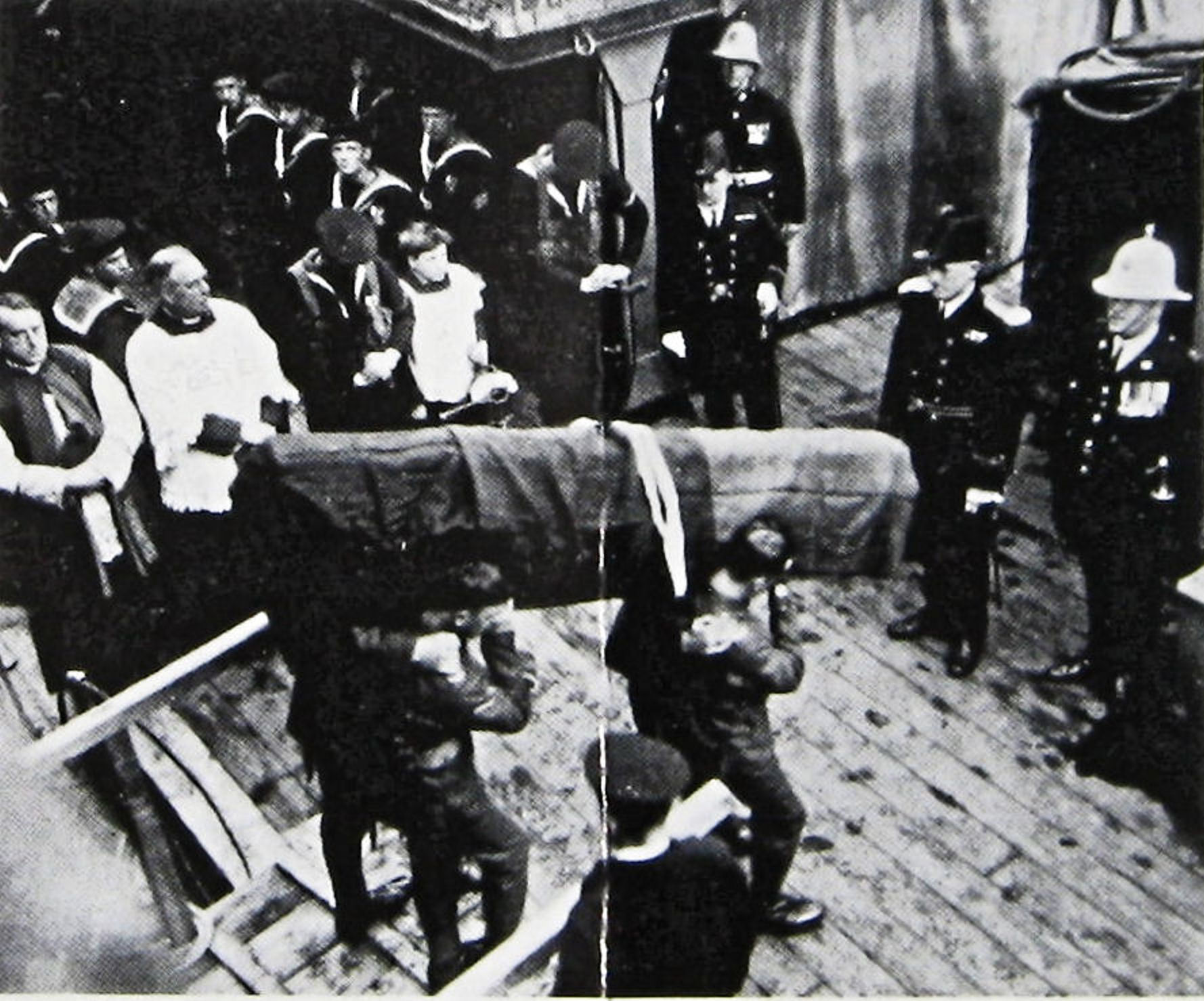
The entrance to the Prince of Wales Pier before it was close on 1 October 2015. Alan Sencicle

The entrance to the Prince of Wales Pier before it was close on 1 October 2015. Alan Sencicle

The first, and the most common concern, is the loss of public right of way on the Prince of Wales Pier. The public right of way was part of the original application to Parliament for permission to build the Pier in 1891. The official response is that shown in the map above, in black it states that the existing  Prince of Wales Pier gives 850metres of public access while the new development will eventually give 1,050metres around the newly built marina. Plus, according to the Chief Executive of DHB, Tim Waggott reported in the Dover Express (24 September 2015) , ‘When the end of the Pier is not used by cargo and freight ships we can facilitate escorted access to the rest of the Pier.‘

The proposed new marina and how it is going to be financed is of concern. Doverhistorian.com has learnt that the Western Dock Revival Project will be in three phases and that the redevelopment of the Prince of Wales Pier is the first phase. The public has been led to believe that the marina will be funded by ‘partners’ and that this will be the private sector. The private sector relies on funding for such projects with high marginal costs, through banks and after the crises of the last few years, banks are risk averse of such projects. Alternatively, money could come from the public sector, similarly to the funding for Ramsgate’s marina but DHB would not be drawn on this.
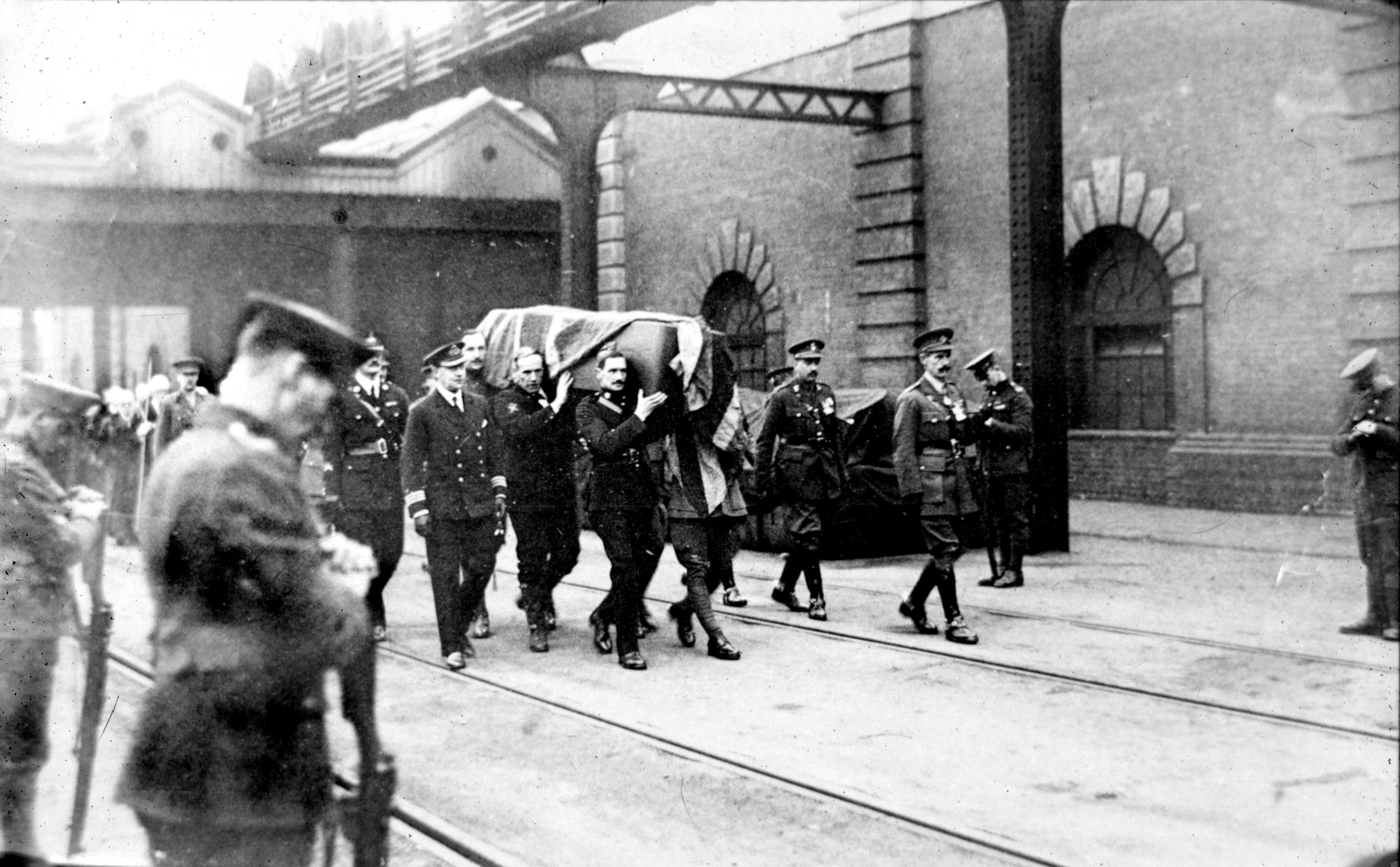
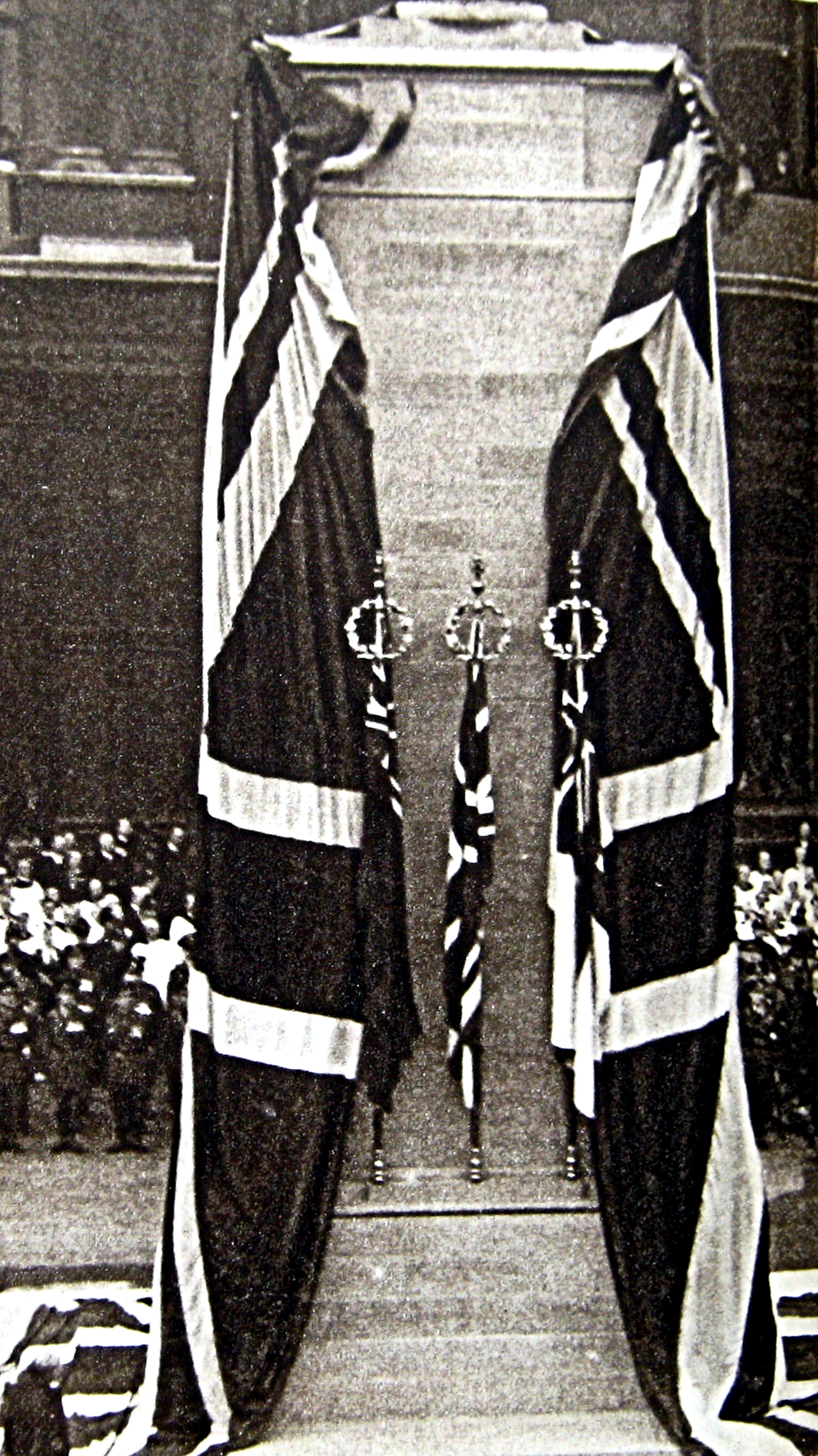
To ensure that the Wellington Dock does not become a sterile pond that empties through culverts, it is proposed to make a cut through the Esplanade to the new marina. This  would provide access and berths for boats along with the marina and to maintain the water level in the Wellington Dock a lock would be needed. It is also proposed that the  ‘partners’ are financing the proposed cut through but as Dover has had flooding problems since the building of the Admiralty Pier (see Flooding and Harbour of Refuge part I) and the way to alleviate this would be by the installation of purpose built lock gates. Such a lock will have significant marginal costs but, unlike the proposed marina, very low financial returns.

Cut through from Wellington Dock across the Seafront to the Sea proposal. Note there are no Lock Gates - DHB poster January 2016

Cut through from Wellington Dock across the Seafront to the Sea proposal. Note there are no Lock Gates – DHB poster January 2016
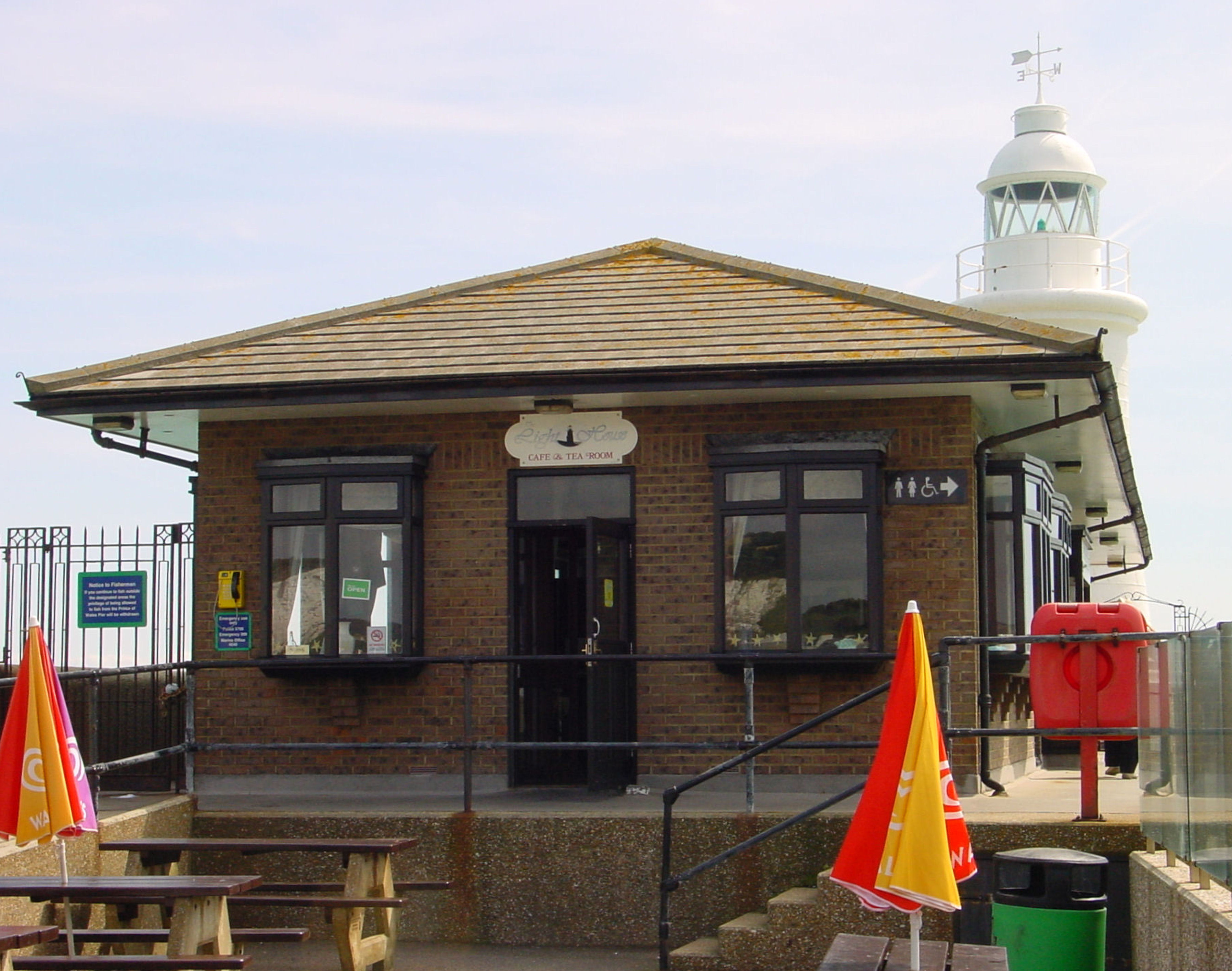
To date we await reassurances, in writing, from DHB that they will be funding the cut through incorporating a flood prevention lock. However, in the publicity pictures, although the proposed cutting from Wellington Dock across the Seafront to the sea is shown, there are no lock gates shown and it would appear that Wellington Dock would become a tidal basin that is unless there is a sill that would maintain an adequate water level for yachts.

Last days of the Prince of Wales Pier before closure. AS September 2015

Last days of the Prince of Wales Pier before threatened closure. AS September 2015

We note that some folk have objected as they are concerned that if the present proposal proves a failure and/or a good offer for the Commercial Harbour comes along, DHB will accept it. DHB does have a track record of making such deals, see Old Park story part II. Another aspect of the loss of the beloved Pier, particularly concerns the berthing of Royal Navy ships and Royal visits when the cruise terminal is busy. We assume they will berth on the east side of the Pier when Phase 1 is completed? Finally, if the utilisation of the Prince of Wales Pier is so important to the future of Dover’s regeneration why has the large adjacent old hoverport been allowed to lay idle for all these years when, for far less cost, it could have been converted into a freight berth with considerable lorry parking space? It does not make sense.

Closed Shop: The Prince of Wales Pier was due to close but this has now been delayed as members of the public have made it clear that they are unhappy about the decisions. However, Dover folk are suppose to be represented at the Port & Community Forum that meet every three months with representatives of Dover Harbour Board (DHB). This is to discuss issues such as the future of Prince of Wales Pier. The Forum is made up of supposed representatives of the town and occasionally two leave and they are suppose to be replaced by new comers. If more than two people apply to join, then the existing members vote for whom they would prefer. On Thursday 17 December two new members were suppose to be elected and the Prince of Wales Pier was to be discussed. Nine people applied to join the Forum, two of whom were the ones that were due to be replaced! Voting took place and, needless to say, the ones that should have been replaced were voted back on! The Chief Executive of DHB gave a presentation of the Prince of Wales Pier but as the Forum is a closed shop, NO searching questions were asked by the supposed representatives of Dover folk!

Prince of Wales Pier - the beginning of the demolition January 2016. Alan Sencicle

Prince of Wales Pier – the beginning of the demolition January 2016. Alan Sencicle

January 2016 – The Prince of Wales Pier has now been closed and Dover Harbour Board has put in for more planning permission. This is to lower the height of the landward approach near the Clock Tower that promises that a prescriptive record with photographs of the lay out prior to demolition will be kept in case any museum is interested in the future. The application also states that it is expected that the new ‘marina curve’ will be open to public access by 2018.

First Presented: 03 October 2015


Posted in Buildings, Maritime, Prince of Wales Pier Part II, Prince of Wales Pier Part II - 1914 to the Present Day, Prince of Wales Pier Part II - 1914 to the Present Day, Prince of Wales Pier Part II - 1914 to the Present Day, Prince of Wales Pier Part II - 1914 to the Present Day, Wanton Destruction, World War I, World War II | Comments Off on Prince of Wales Pier Part II – 1914 to the Present Day