Falkland’s Conflict – the Terence Lewin story

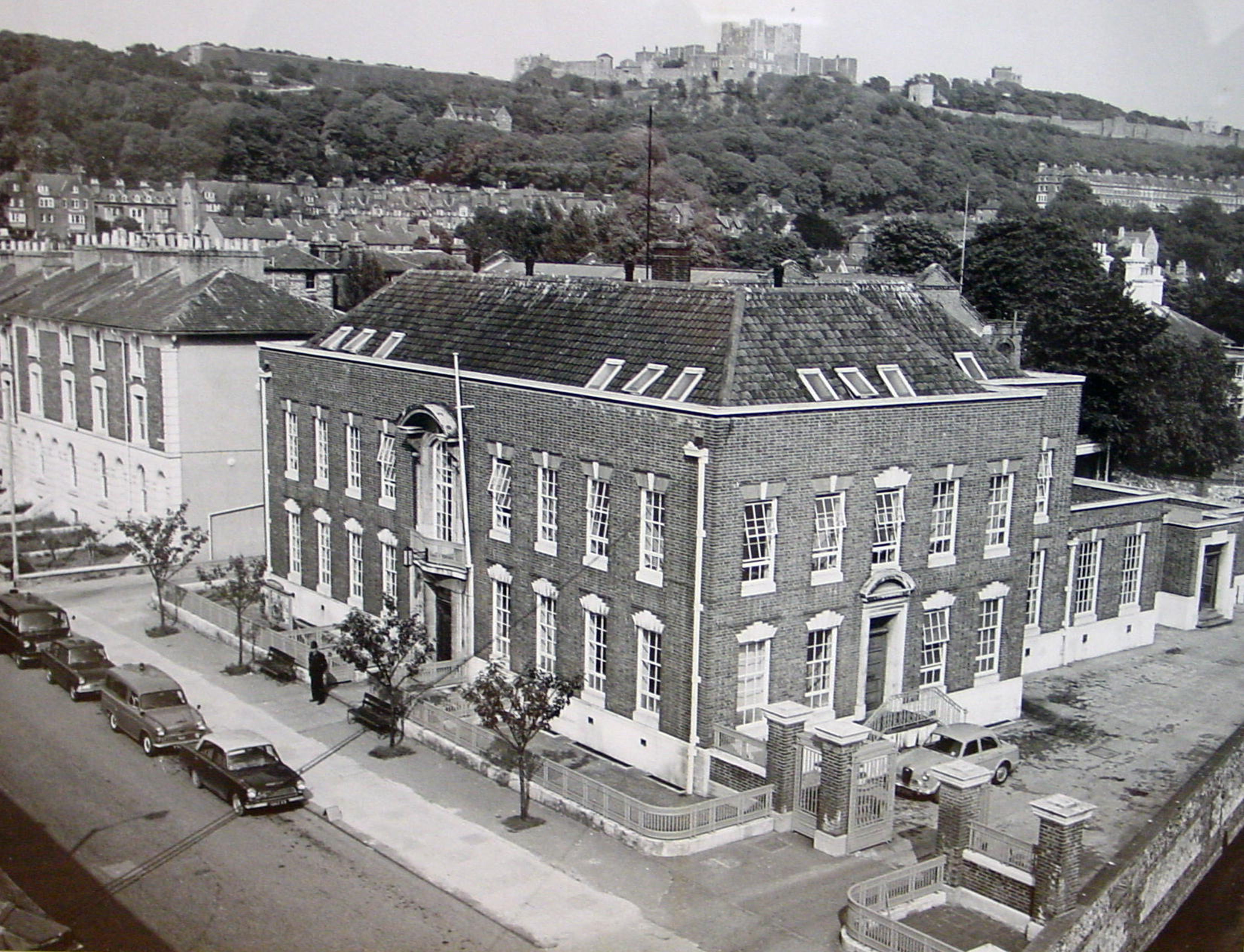
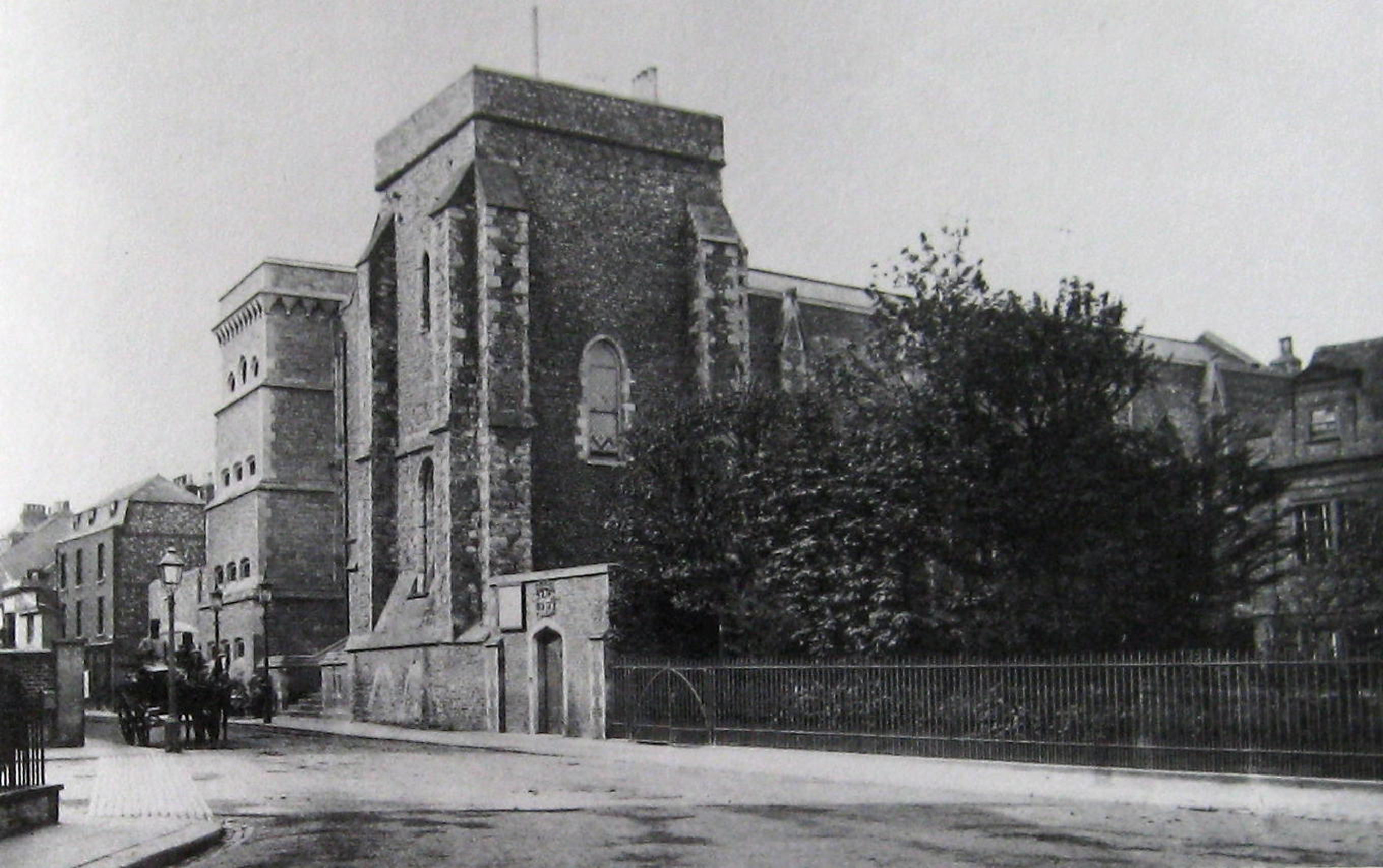
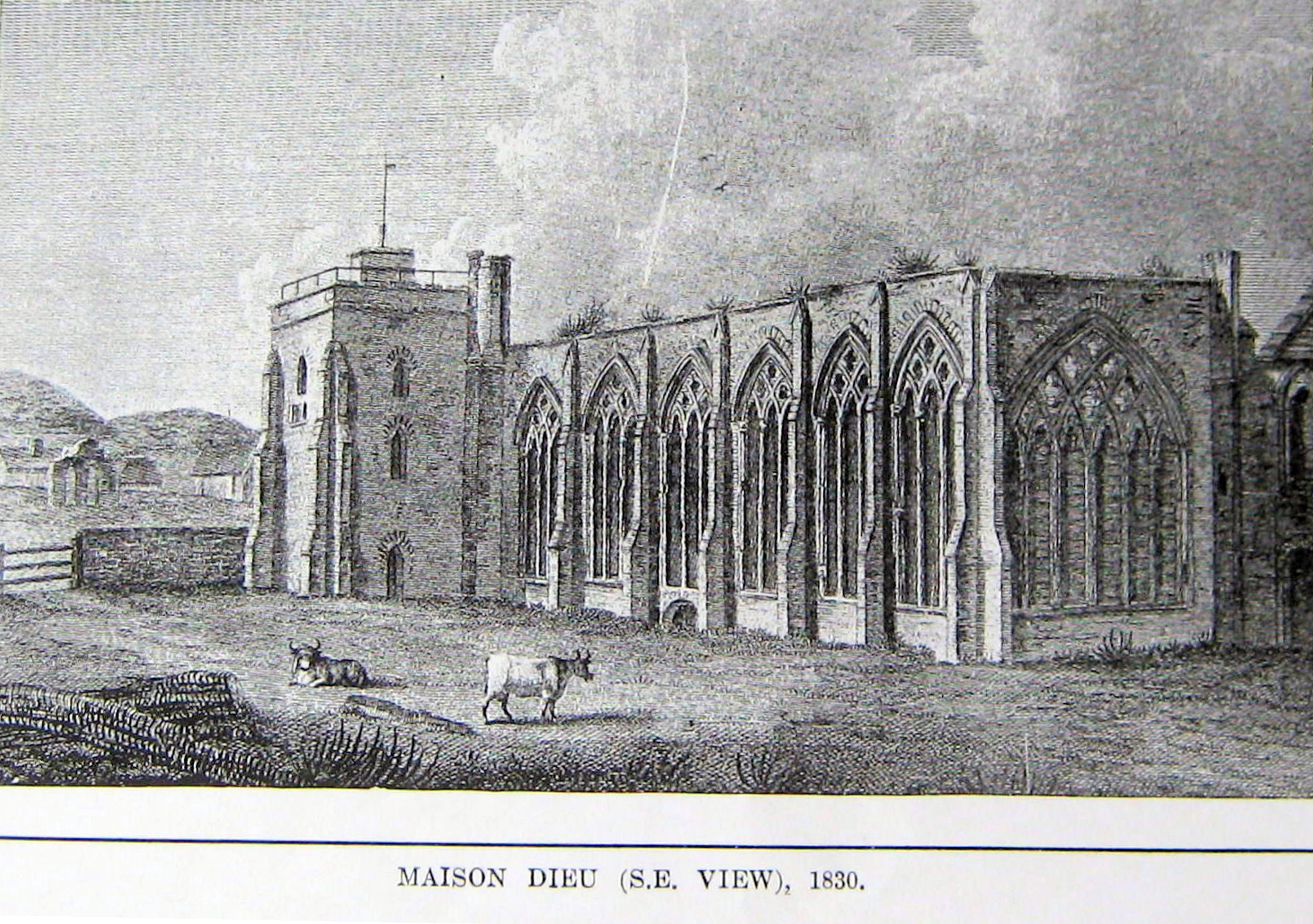
Terence Lewin's birthplace, 103 Maison Dieu Road. Alan Sencicle 2009.

Terence Lewin’s birthplace, 103 Maison Dieu Road. Alan Sencicle 2009

Moray House, 103 Maison Dieu Road is now the presbytery for the adjacent St Paul’s Roman Catholic Church. In the early part of 20th century it was where the Lewin family lived and on 19 November 1920, where Terence Thornton Lewin (1920-1999) was born. He attended the Judd School, Tonbridge and on leaving school, Terence planned to join the police but as World War II (1939-1945), was imminent he joined the Royal Navy instead. As a naval officer, the young Terence was a gunnery officer aboard HMS Ashanti that helped bring relief to beleaguered Malta when about half the rescuing convoy were lost through enemy action. At the time this author’s father was on the island. According to him, if the Royal Navy had not made it through, Malta almost certainly would have capitulated. Mentioned three times in dispatches, Terence was awarded the Distinguished Service Cross and when peace returned he remained in the Royal Navy and rose through the ranks, from being the second commanding officer of the Royal Yacht Britannia in the 1950s, to First Sea Lord in 1977.

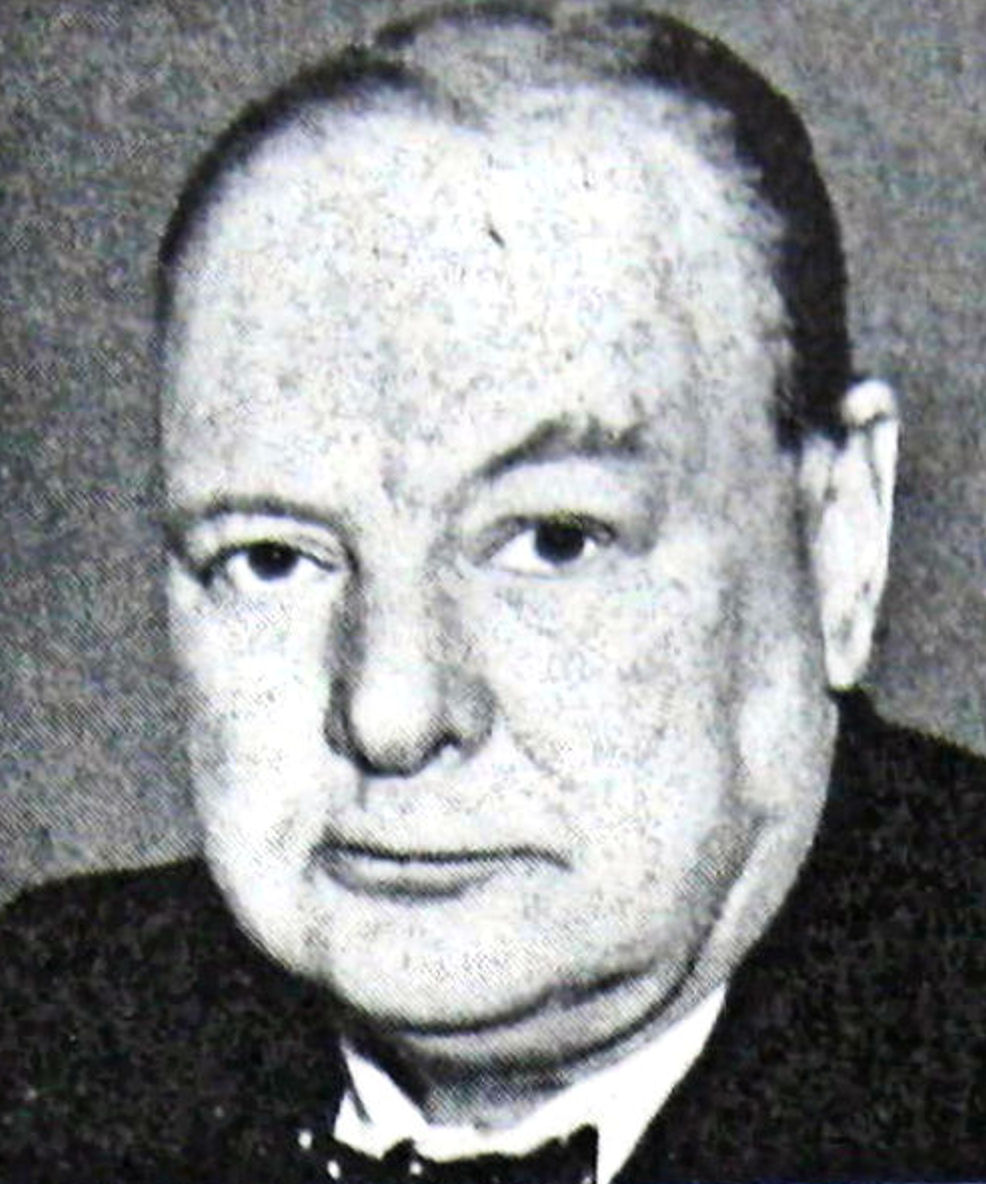
Sir Terence Lewin, 1920-1999 - Chief of Defence Staff 1979-1982

Sir Terence Lewin, 1920-1999 – Chief of Defence Staff 1979-1982

Knighted, Sir Terence was appointed Chief of Defence Staff (CDS) in 1979 – the most senior serving officer in the Armed Forces. Internationally, the Cold War (1947-1991) showed no signs of abating although there had been strategic arms reduction treaties. The USSR had deployed SS20 missiles at strategic places that were targeted at European cities and military bases. They had also invaded Afghanistan, in response to which US Pershing and Cruise missiles had been ordered by the North Atlantic Treaty Organisation (NATO). In Britain, Ministry of Defence, politicians and media attention centred on NATO and the Cold War. One of Sir Terence’s CDS predecessors was Lord Louis Mountbatten (1900-1979). When he held the post (1959-1965), his role had been that of an independent advisor to Government representing all three Services – the Army, Royal Navy and Royal Air Force. Since then the role had evolved to that of chairman of the three Armed Services who, in turn were supported by government Junior Ministers for each of the services.

Mrs Margaret Thatcher 1925-2013 Prime Minister 1979-1990

Mrs Margaret Thatcher 1925-2013 Prime Minister 1979-1990

Although the seven met regularly, approximately every six months they would meet to review colonial theatres of operation throughout the world and contingency plans if potential problems were identified. In June 1981, the Junior Ministers’ roles were scrapped and the role of the CDS returned to the Mountbatten model. Thus the prime responsibility of the CDS was that of giving a ‘neutral’ opinion to the Government as the leading adviser on the Armed Services. The individual Chief of Staffs of the three Services retained their previous rights including personal access to the then Prime Minister (1979-1990), Mrs Margaret Thatcher (1925-2013). Although superficially it appeared that these changes strengthened the senior personnel of the Armed Services, in fact it was part of a Government initiative to weaken them in order to play one off against the other and reduce defence spending.

John Nott, Secretary of State for Defence 1981-1983

John Nott, Secretary of State for Defence 1981-1983

In January 1981, John Nott was appointed Secretary of State for Defence (1981-1983). Nott was the author of the 1981 Defence White Paper, The Way Forward. This proposed extensive cuts to the Royal Navy that included sale of the aircraft carrier Invincible, selling 9 of the 59 escort ships and withdrawal of Endurance, the ice patrol ship in the South Atlantic. Additionally, the possible sale of Intrepid and Fearless, disbanding the Royal Marine Amphibious Force, closure of Chatham Dockyard and a cut of 8,000 to 10,000 naval staff. There were to be cuts in the regular Army that would be offset by the expansion of the volunteer Territorial Army. Cuts to the Royal Air Force were to be minimal, focussing on what was seen as out of date such as the long-range Vulcan bomber but increasing the number of aircraft needed for Britain’s role in the Cold War. This did not altogether sit well with Sir Terence, particularly in relation to the Royal Navy, therefore he used his new position to fight the cut backs.

General Leopoldo Galtieri 1826-2003

General Leopoldo Galtieri 1926-2003

There had been a dispute since the mid 19th century with Argentina over British control of the Falkland Islands in the South Atlantic, which the Argentinians called Islas Malvinas, along with South Georgia and the South Sandwich Islands. Britain colonised the Falklands in 1833 whereas Argentina, the eighth largest country in the World, was formed out of the Spanish Viceroyalty of the Rio Plata and achieved her independence in 1861. In early 1982, the population of the Falklands was 1,800 mainly made up of former British nationals. At the time Argentina was ruled by a military junta of three under the Presidency of General Leopoldo Galtieri (1926-2003). The other two members were Admiral Jorge Anaya (1926-2008) Commander-in-Chief of the Argentinian Naval Operations and Brigadier Basilio Arturo Ignacio Lami Dozo the Commander-in-Chief of the Argentinian Air Force. This junta was unpopular and was facing major economic problems. Therefore a diversion was called for.
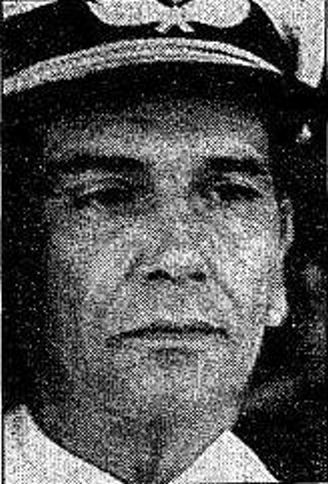
Admiral Jorge Anaya (1926-2008) Commander-in-Chief of the Argentinean Naval Operations

Admiral Jorge Anaya (1926-2008) Commander-in-Chief of the Argentinian Naval Operations

Admiral Anaya firmly believed that the Falklands/Malvinas belonged to Argentina. He put forward a well-argued treatise suggesting the time was ripe for Argentine to retake them. In Admiral Anaya’s opinion, the British Foreign Secretary (1979-1982) Lord Peter Carrington was known to favour decolonisation of British territories. Although when the British Labour Party were in power, they had seen off an Argentinian attempt at repossession. It had already been muted by the Conservative government that in order to withdraw Britain’s involvement in the South Atlantic, Argentina would be given the islands with a certain, but easily ignored, caveat.

The caveat he was referring to was in order to protect the Islanders sovereignty, the British proposed to lease them back for a limited period of time. Albeit, Anaya reasoned, in recent legislation on British nationality the Falkland Islanders had not been given any special status. Further, the recent British Defence Review had made it clear that the Royal Navy was to be severely reduced and this included scrapping of the only British naval vessel in the region, the Endurance on 15 April that year. Looking at the wider picture, the US, as far as Argentina was concerned, required the country’s anti-Communist allegiance in South America and also as a trading partner. The United Nations (UN) would be averse to military action by the British so even if they opposed Argentina’s repossession, Anaya reasoned, this would merely be a token response. Therefore Argentina had nothing to lose so Galtieri was persuaded.

Sir Terence was in his final year as CDS before retirement. A British joint services expedition were finishing a remapping survey of South Georgia, 800 miles east of the Falkland Islands. Like the Falkland Islanders, the tiny population on South Georgia depended on fishing and sheep farming. As Sir Terence was a patron of the expedition he was given a copy of the map, which he took with him to New Zealand the following month. On 19 March 1982, a group of 40 Argentinian civilians, under scrap metal dealer, Constantino Davidoff, arrived on South Georgia having been given permission by the British Embassy in Buenos Aires, Argentina. They had proposed to dismantle an old whaling station on the island and sell the metal for scrap. However, on arrival on the island, Davidoff ran up the Argentinian flag.

At the time Endurance, under the command of Captain Nick Barker (died 1997), was in Stanley, the capital of the Falkland Islands on East Falkland. With 24 Marines on board from Naval Party 8901, based on the Island at Moody Brook Barracks south east of Stanley, Endurance set sail for South Georgia to investigate. They arrived at Grytviken on 24 March where some of the Marines set up an observation post. Davidoff and his men were dismantling the old whaling station, nonetheless Endurance, with the remaining Marines on board, stayed in the area.

On that day, Sir Terence and Mrs Thatcher went to Northwood, Hertfordshire. In 1938 Northwood had opened as the headquarters of the Royal Air Force Coastal Command. A network of underground bunkers and operation blocks was then established on the site. When the post of the Commander-in-Chief of the Fleet was created in 1971 the Royal Navy took over the site and later the headquarters of the Flag Officer of Submarines moved to Northwood in 1978. There, on the 24 March visit, the Prime Minister met the Commander-in-Chief of the Fleet, Admiral Sir John Fieldhouse (1922-1998) and his staff at their underground command post.

It was believed that the Argentinian navy were strung out along the country’s coast patrolling its 200-mile zone some 1,000 miles away from the Falklands. When asked by the media if the visit by the Prime Minister was to discuss a British Task Force landing in South Georgia, this was denied. However, Argentinian intelligence sources stated that the BBC news had reported that a task force was about to be deployed to the South Atlantic. In Buenos Aires the Argentinian strategy was discussed in the light of the BBC report and the invasion brought forward.
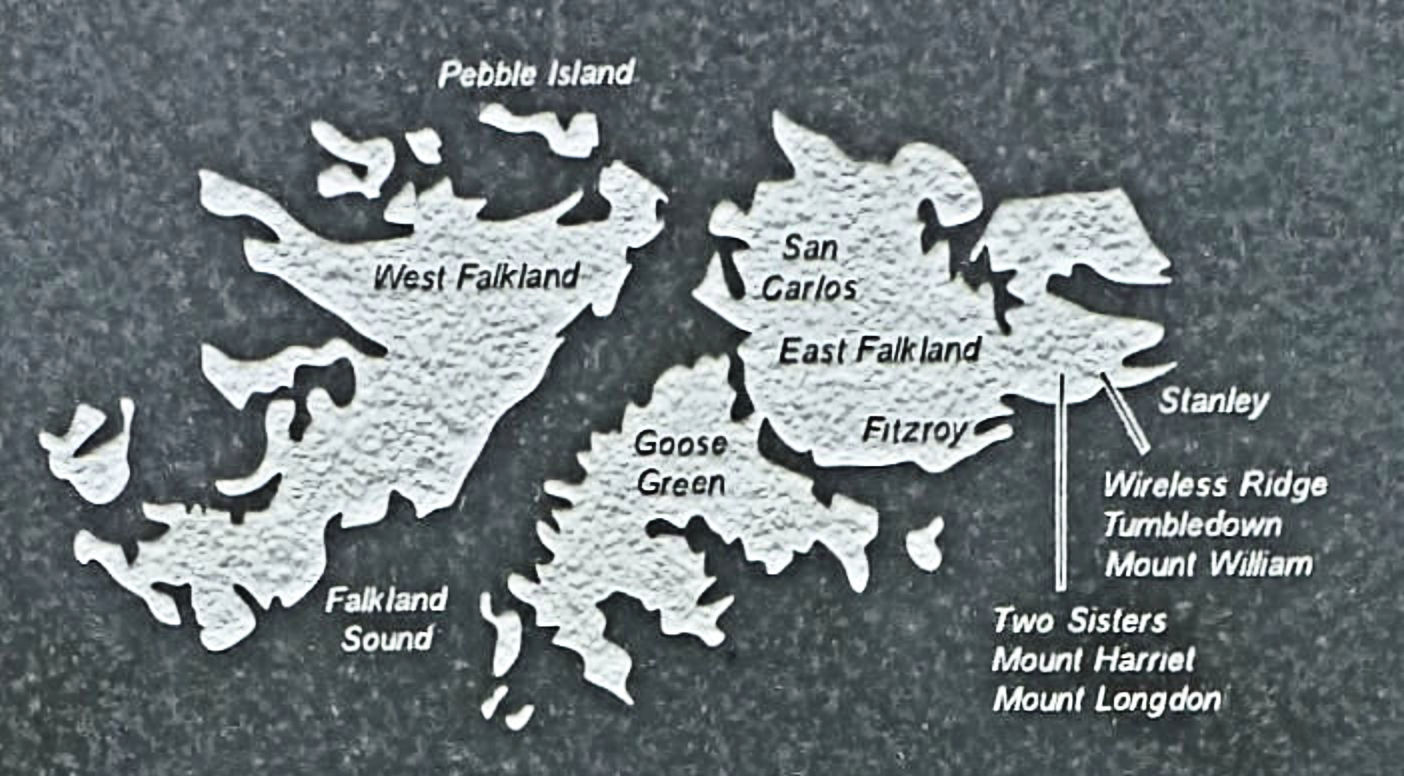
Falkland Islands Map - National Memorial Arboretum, Staffordshire

Falkland Islands Map – National Memorial Arboretum, Staffordshire

Friday 26 March and British intelligence reported that 2 Argentine corvettes were sailing towards South Georgia. Foreign Secretary Carrington was having increasingly chilly diplomatic discussions with General Galtiari and three days later, on Monday 29 March, intelligence reported a well equipped Argentinian fleet were two days sailing distance from the Falklands. On the same day Sir Rex Hunt (1926-2012), the Governor, Commander-in-Chief and Vice Admiral of the Falkland Islands received a communiqué warning that an Argentinian submarine was off the Islands, probably reconnoitring for good beachheads.

US Secretary of State, Alexander Haig (1924-2010) was in contact with Lord Carrington and pressured the British Government not to undertake any enforcement action as he was seeking a peaceful solution. From then on Secretary of State Haig travelled between Washington, Buenos Aires and London conducting what was termed shuttle diplomacy to gain peace. In London, at one of many government meetings on Wednesday 31 March, it was said that the general feeling in Cabinet, Parliament and the media was that to recapture the Islands, if they were invaded, was foolhardy.

At the time Sir Terence was in New Zealand watching military exercises but was in contact with Mrs Thatcher and also Sir Henry Leach (1923-2011), the First Sea Lord. Sir Terence advised, in the first instance, the early retaking of South Georgia as a contribution to a graduated pressure on the Argentinians’ as well as a useful exercise of the Tri-Service co-operation between the British three armed services. If the Argentinians did not pull back,   sending in a Task Force to retake the Islands if need necessitated. This, in Sir Terence’s opinion, would lead to a loss of ships but the Task force would achieve its objective.
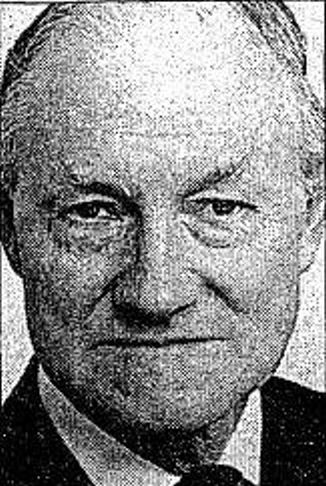
Sir Henry Leach (1923-2011), the First Sea Lord

Sir Henry Leach (1923-2011), the First Sea Lord

Sir Terence’s rational was reiterated in detail by the First Sea Lord at a meeting in Downing Street, but was against the advice of the Ministry of Defence which Defence Secretary, John Nott, put forward in detail. However, Defence Minister Nott did make it clear that, in his opinion, if the Argentinians invaded the first British submarines to arrive should launch an early attack. This, he went on to say, should be followed by the declaration of an Exclusion Zone by the British government and then the Argentinians would go away. The meeting lasted some 5hours at the end of which Mrs Thatcher asked Sir Henry Leach what he thought should be done. His response was to follow Sir Terence’s advice and to form a Task Force with the authority to send it. Both the submarine Spartan, under Commander James Taylor and Splendid, under the command of Roger Lane-Nott were ordered to prepare and be on standby. In the early hours of Thursday morning, following another very long meeting chaired by Mrs Thatcher, Hermes and Invincible aircraft carriers, were also put on standby.

On 1 April, Sir Terence arrived back in England and was told that in accordance with his advice, the remaining Marines on Endurance disembarked with the order to put up a token resistance if the Argentinians landed. Deploying at the British Antarctic Survey base, King Edward Point, on South Georgia, the Marines prepared for a possible invasion. The first Argentinian forces to arrive opened fire and the Marines fought back managing to bring down a helicopter that was about to land more troops. An Argentinian corvette opened fired from the sea but the Marines succeeded in causing sufficient damage below the vessel’s waterline that it withdrew. However, within three hours the eighty Marines were surrounded and having fulfilled their remit including killing five Argentinian soldiers and injuring seventeen, surrendered. They were taken to Montevideo the capital city of Uruguay and a few days later were repatriated to Britain. Coming in for severe criticism from politicians, Sir Terence held his nerve and continued to push for the retaking of South Georgia as soon as practically possible.

At 04.40hours the following day, 2 April, 150 men of the Argentinian Special Forces unit, Buzos Tacticos, landed by helicopter at Mullet Creek inlet, on the east coast of East Falkland. There they split into two groups; one headed for the Royal Marines Barracks at Moody Brook and the other to Port Stanley. Due to the events on South Georgia, the commanding officer at Moody Brook, Major Mike Norman, had relocated his headquarters to the Governors’ House at Port Stanley. The Islands’ only protection was a number of manned defence positions around the East Island. Major Norman had arrived with his detachment a few days before in order to relieve Major Gary Noott and what should have been an outgoing 8901 detachment. The two Royal Marine forces combined and Major Norman took command, as he was the senior of the two Officers.

Stanley Falkland Islands - Wikapaedia

Stanley, Falkland Islands – Wikipaedia

When the Prime Minister, Mrs Thatcher was informed of the invasion, instead of suggesting a token offence and the diplomatic handover of the Falklands to Argentina, she took the advice of Sir Terence. The Overseas and Defence, South Atlantic Committee better, known as the War Cabinet was set up comprising key Cabinet politicians including, Home Secretary (1979-1983) William Whitelaw (1918-1999), John Nott, Lord Carrington and Sir Terence. The media quickly latched on to the fact that the Chancellor of the Exchequer (1979-1983) Sir Geoffrey Howe (1929-2015) was not included. Mrs Thatcher said he had been left out, as she wanted to keep money out of any decisions made. The War Cabinet met at least once a day and sometimes meetings lasted many hours. According to Sir Terence’s biographer, Rear Admiral Richard Hill (Cassell 2000), he and Mrs Thatcher, ‘… really clicked, once they learned to trust each other.’

Named Operation Corporate, the British offensive was under the control of Commander-in-Chief of the Fleet, Admiral Fieldhouse using his headquarters at Northwood. The Operation consisted of two separate seagoing Task Forces, one consisting of surface ships, called the Fleet Task Force, and the other nuclear-powered submarines and both supported by air defences. An Amphibious Task Force, if the Argentinians did not back off, would undertake the landings of the Land Force Task Group that would retake the Falklands. Again they would be supported by air defences. The Land Task Force Group would also receive support from the Fleet Task Force until they retook the Islands. Finally, but an intrinsic part of the plan from the beginning, would be the Special Forces (UKSF) operations. The whole operation would be Tri-Service made up of the British three armed services.

Although, on paper this seemed an audacious if excellent plan, in reality there were a number of major logistical problems. The main one was the distance between the UK and the Falklands. A convoy of ships were selected and made ready. Submarines already at sea set course for the South Atlantic. However, the only British C-130 aircraft capable of landing at Stanley airport were not fitted with air-to-air fuelling probes (AAR) and without the support of air defences, retaking of the Islands would be impossible. So a strategy plan was worked backwards from June 1982.

The South Atlantic in June would be in the depths of winter and although on a similar latitude to Britain, the Islands did not have the benefit of the Gulf Stream or equivalent, to warm the seas. In the northern hemisphere’s summer months icebergs frequently came within 200 miles of the Falklands. The Islands do not have high mountains or continental land masses to protect them, in consequence the average wind speed is 15 miles per hour against in Britain where it is on average, 4 miles an hour. As the Task Force ships chosen would be in operation until at least June, by that time they would badly be in need of a full refit. Therefore, in order for Sir Terence to mount a major offensive to demonstrate the capabilities of the Tri-Service, the Operation had start before 1 May. The three Services Chiefs, agreed with Sir Terence, that it could be done.
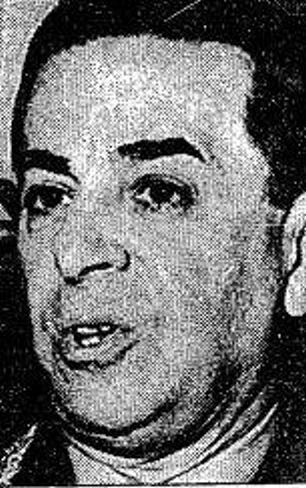
Brigadier General Mario Benjamin Menéndez (1930-2015) the Military Governor of the Malvinas, South Georgia and South Sandwich Islands.

Brigadier General Mario Benjamin Menéndez (1930-2015) the Military Governor of the Malvinas, South Georgia and South Sandwich Islands.

Meanwhile, at 06.15hours on Friday 2 April the first force of the Argentinian Buzos Tacticos attacked the Governor’s residence on East Falkland. Major Norman was there and shortly after, one of his defence positions at Yorke Point reported that Argentinian forces were landing at Yorke Bay, 4 miles north-east of Stanley and close to Stanley airport. This followed by a report that amphibious armoured personnel carriers were advancing on Port Stanley. As these troops headed towards the Capital they were met by a section of Royal Marines and two vehicles were knocked out. The section then made their way to Government House, which some 600 Argentinian troops had surrounded and fierce fighting took place. Following the capture of the Falklands Broadcasting Station and the Cable and Wireless Office in Port Stanley, which stopped any outside communication, Rex Hunt took the decision to surrender to the Argentinians. This took place at 09.25hours when the Royal Marines were ordered to lay down their arms. The Governor and Marines were flown to Montevideo and from there to Britain. General Galtiari appointed Brigadier General Mario Benjamin Menéndez (1930-2015) the Military Governor of the Malvinas, South Georgia and South Sandwich Islands.

That day, two of the Submarine Task Force, Spartan and Splendid were already sailing towards the South Atlantic. A third submarine, Conqueror, under the command of Captain Christopher Wreford-Brown, was ordered to join them. Before leaving Faslane Naval Base on the Clyde, where Conqueror was being prepared, a team of UKSF joined the crew. The UKSF men had with them knives, hand guns, rifles, heavy machine guns, hand grenades, limpet mines, plastic explosives, Gemini inflatables, outboard motors and skis, all of which were stowed alongside the submarine’s torpedoes! Conqueror set sail for the South Atlantic on 4 April and Captain Wreford-Brown’s basic remit was the finding and attacking any Argentine naval forces threatening the Task Force.
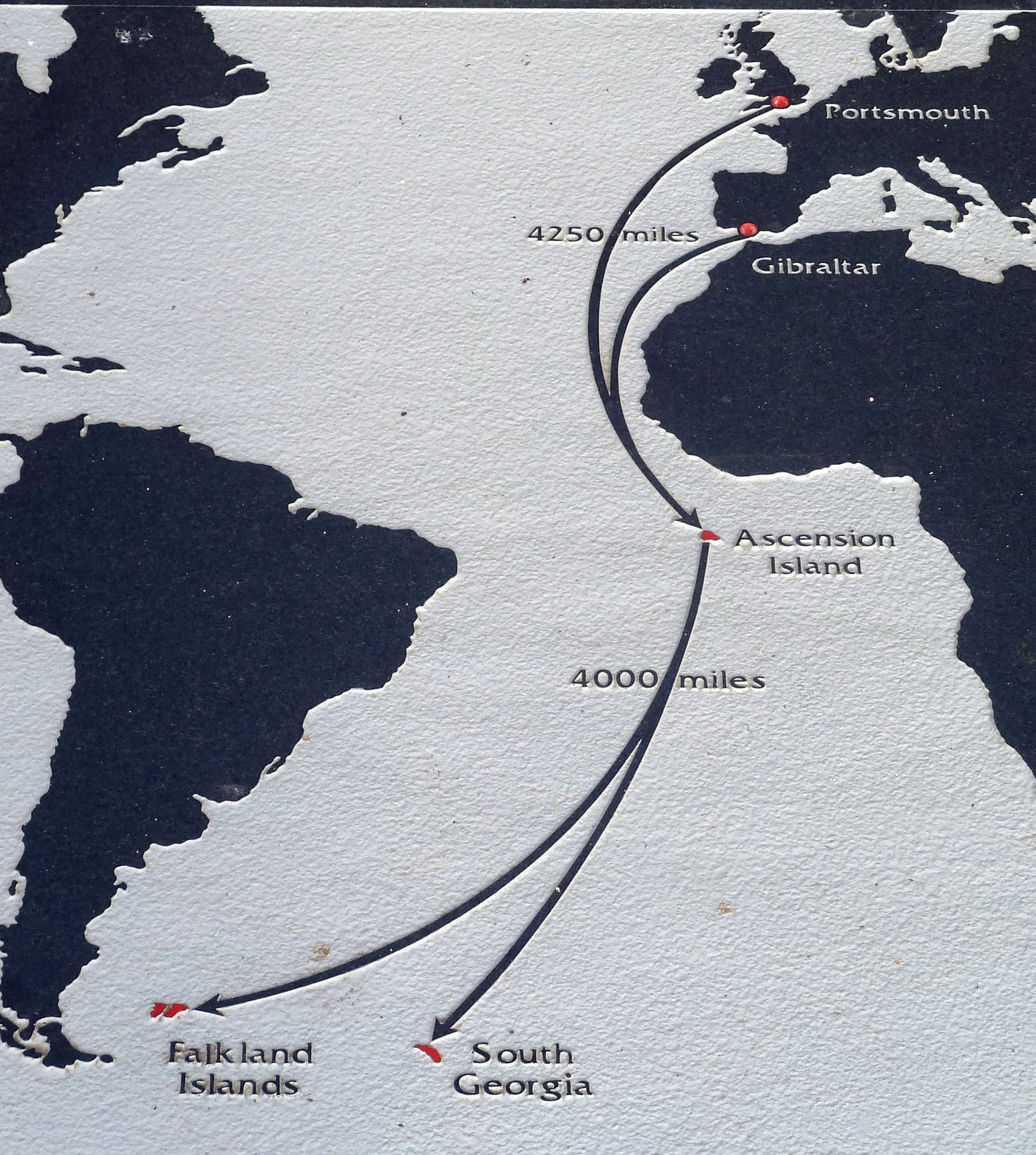
The route of the British Task Force to the Falkland Islands and South Georgia 1982. National Memorial Arboretum Staffordshire

The route of the British Task Force to the Falkland Islands and South Georgia 1982. National Memorial Arboretum Staffordshire

Number 3 Parachute Regiment (3 PARA) was at its base in Tidworth on the Salisbury Plain when they received the order to stand-by. On 4 April the Commanding Officer, Lieutenant Colonel Hew Pike, met with Brigadier Julian Thompson, the Commander of 3 Royal Marine Commando Brigade of which 3 PARA would be a part to bring the Brigade up to strength. During the next five days all preparations were made and the on 9 April the Brigade set sail on the requisitioned P&O cruise liner Canberra from Southampton. Lieutenant Colonel Herbert Jones (1940-1982) was the commanding officer of 2 Parachute Regiment (2 PARA) and was on holiday abroad with his family when the crisis came. The Regiment was in Aldershot at the time, routinely preparing for a six-month tour of duty in Belize, Central America. Most of his force had been stood down the previous weekend for Rest and Recuperation. Jones immediately returned to Aldershot and with great determination informed all the relevant parties that his battalion was to be part of the Task Force. This was followed by recalling all of 2 PARA troops by telegrams, ‘phone calls and notices at railway stations and ports including Dover.

While these preparations were going on the Foreign Secretary, Lord Carrington, through Sir Anthony Parsons (1922-1996) – UK’s Permanent Secretary at the UN, tabled the motion demanding the immediate cessation of hostilities and a withdrawal of Argentinian forces from the Falkland Islands. This was sanctioned as Resolution 502 with the call by the UN Security Council for a diplomatic solution to the situation and for both countries to refrain from further military action. Adopted by 10 votes to 1, with Panama opposing and the Soviet Union, Spain, Poland and China abstaining. The mandate was given the full support of the Commonwealth and the European Economic Community. This gave more power to the US Secretary of State, Alexander Haig for a compromise. On 5 April Lord Carrington resigned, taking the full responsibility for the complacency and failures in the Foreign and Commonwealth Office to foresee the development of the Falkland crisis. Francis Pym (1922-2008) was appointed in Lord Carrington’s place and was more in tune with Sir Terence’s stance on Operation Corporate.

Mrs Thatcher, meanwhile, was building up a close relationship with the President of the US, (1981-1989), Ronald Reagan (1911-2004), who had previously referred to the Falkland Islands as a ‘little ice cold bunch of land.’ She was well aware that Britain depended on US Sidewinder missiles to arm the Harriers as well as intelligence and diplomatic support to retake the Falklands. Apparently, she told the President that the fundamental principal of what the free world stood for was at stake and that if Britain gave way, then these principles would be permanently under threat. Thereafter the President and the Prime Minister became close allies. However, Haig was not so inclined and saw the only answer was in a peace settlement in compliance with the UN Resolution 502.

The Fleet Task Force, consisted of 115 ships with the aircraft carriers Hermes and Invincible setting sail from Portsmouth on 5 April. In 1966, Sir Terence was the Captain of Hermes and his second in command, at that time, was John Fieldhouse! On board the Hermes was Rear Admiral Sandy Woodward (1932-2013), the Commander of the Fleet Task Force at Operation Level. As the two ships left, Sir Terence was in consultation with Sir Michael Havers (1923-1992) the Attorney General (1979-1987) – a former Recorder of Dover (1962 to 1968), as well as officials and legal advisers from the Cabinet Office, the Ministry of Defence and the Foreign and Commonwealth Office. From these discussions Sir Terence drew up Rules of Engagement that could be used and activated on ministerial authority. To these the Prime Minister added that the commanding officer would naturally have the right to exercise his discretion on any matter relating to the safety of his vessel.
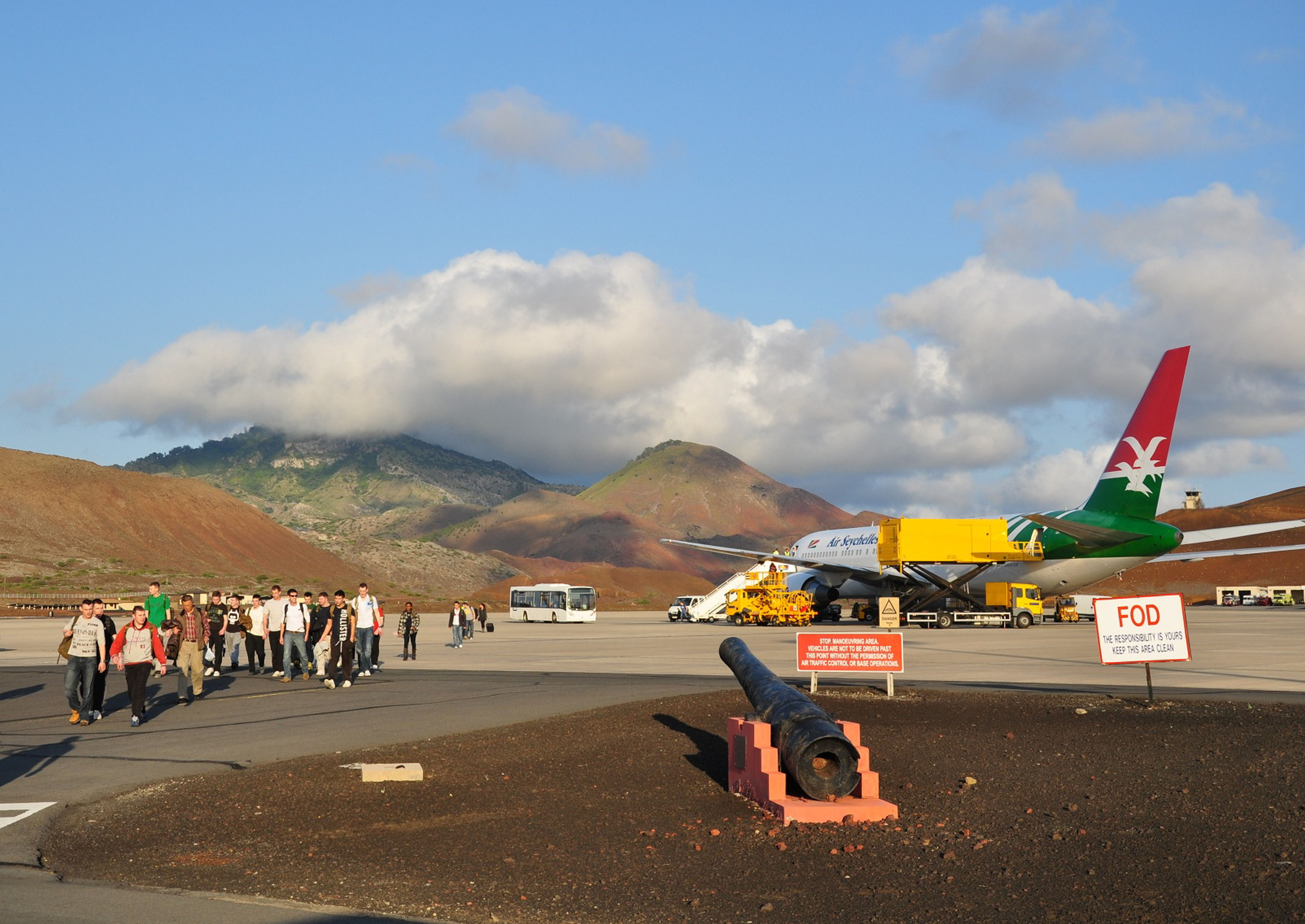
Wideawake Airfield Ascension Island - Wikapaedia

Wideawake Airfield Ascension Island – Wikipaedia

It was agreed that a forward logistics base was to be set up at Ascension Island some 4,250 miles south of the UK and 4000 miles north of the Falklands. From there, RAF C-130s and VC-10s could deliver supplies from the UK and supplies could be air-dropped from helicopters to the Task Force. Although Wideawake airfield on Ascension had a 10,000-foot runway it had been leased by government to the US and Pan American Airways managed it. At the time, the airfield was only used about four times a week for which Pan American Airways maintained more than adequate fuel capacity but this was not sufficient for heavy use. To make the airfield viable, a tanker was moored off the Island to pump fuel through a floating pipeline to the bulk fuel farm at Georgetown, the Capital on Ascension. From there the RAF laid a pipeline to the airfield. A fleet of tankers that were fed by fourteen commercial tankers supplied the fuel for the Task Force.

In order to give more time for a diplomatic withdrawal, on 7 April, the War Cabinet agreed to a 200-mile Maritime Exclusion Zone (MEZ) that would come into effect at midnight on 11/12 April. The following day Defence Secretary Nott announced to the House of Commons that from the time indicated, ‘any Argentinian warships and Argentinian auxiliaries found within this zone will be treated as hostile and are liable to attack by British forces.’ He went on to say that the measure was ‘without prejudice to the right of the United Kingdom to take whatever additional measures may be needed to exercise the right of self defence, under Article 51 of the United Nations Charter.’ Argentina, the other South American states and the Soviet Union were warned to keep their submarines out of the Exclusion Zone.

On arrival at the Exclusion Zone the Submarine Task Force were briefed to conduct surveillance of Argentine forces and collect intelligence about naval movements. They were permitted to use minimal force in self-defence and if the Argentinian forces attacked  Endurance, they were to return sufficient fire to prevent further attack. Spartan arrived in the Exclusion Zone on 12 April and went to undertake reconnaissance off Stanley. On 15 April they observed two Argentinian vessels laying two minefields near the entrance of the harbour. The submarine stayed in the area until 21 April providing updates on activities.  Splendid arrived in the Exclusion Zone on 15 April, positioned north west of the Islands. In accordance with the directive, the crew gathered and forwarded intelligence to Northwood. In between, like the crew of Spartan, they trained for attack and counter attack. Conqueror was sailing towards South Georgia as part of Operation Paraquat – the reoccupation of that Island. On arrival on 18 April, the UKSF men on board were transferred onto South Georgia but during the transfer two of them slipped. A full load of equipment was washed off Conqueror’s casing by the rough weather but was recovered by a helicopter.

Wideawake airfield on Ascension Island became one of the busiest airports in the World on 16 April with over 300 aircraft movements. RAF Harrier jump jets and Royal Navy Sea Harriers were flown in having been fitted with AAR’s and thereby were refuelled en-route and during operations. Also fitted with AAR’s were the long-ranged Vulcan bombers, which had been saved from being scrapped! They were used in the operations and particularly the attack on Stanley airfield and its defences. Also arriving on Ascension were Nimrods to carry out maritime surveillance sorties and patrols in support of the Fleet Task Force as it sailed south. Hercules transport aircraft carried supplies to Ascension before being deployed to support the Fleet Task Force as it approached the Falklands.

Ships belonging to the Amphibious Task Force started arriving at Ascension Island on 17 April and one of the first was Fearless the headquarters ship of the Amphibious Task Force. Also senior personnel of the Land Force Task Group. Hermes was in port and on the same day Admiral Fieldhouse with Air Marshal Sir John Curtiss (1924-2013) and Major General Jeremy Moore (1928-2007) flew in. Air Marshal Curtiss was the Task Force Air Commander whose headquarters was at Northwood and had an excellent rapport with Admiral Fieldhouse.
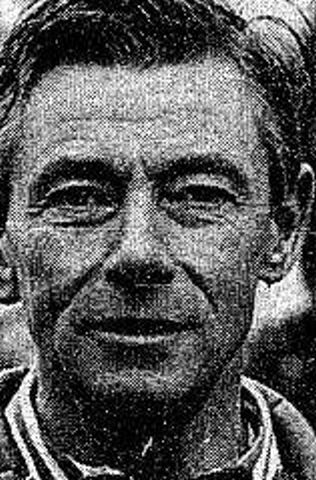
Major General Jeremy Moore (1928-2007) Commander of the Land Force Task Group.

Major General Jeremy Moore (1928-2007) Commander of the Land Force Task Group.

Major General Moore was a former Housemaster at the Royal Marines School of Music, Deal and in Command there between 1973 and 1975. From 1979 he was in Command of all the Marine commando forces and was on the verge of retirement. Having taken part in the strategic planning at Northwood, he flew to Ascension to take over the Land Force Task Group. This consisted of the 3rd Commando Brigade that included the 2 and 3 PARA, and the 5th Infantry Brigade. A Council of War was held on Hermes to discuss landings and the repossession of the Islands. It was assessed that there were approximately 10,000 Argentinian troops on the Islands of which about 7,500 were in the Stanley area and therefore there was a need for more troops and ships.

At a War Cabinet meeting on 21 April Sir Terence informed Mrs Thatcher that an Argentinian naval force had been located, including the aircraft carrier Veinticinco de Mayo – the former Royal Navy ship Venerable. She was between the Argentinian coast and the MEZ and that Splendid had been ordered to observe. The War Cabinet recognised that the British submarine would be under the high seas ‘Rules of Engagement’ so she could not attack except in self-defence. That afternoon, in Buenos Aires, US Secretary of State Haig met with President Galtieri. The President told him that he was planning a visit to the Falkland Islands and that he was prepared to withdraw his troops from the Islands if Britain recognised Argentinian claim to sovereignty with no concessions.

News of the meeting and the outcome reached Downing Street at 21.00hrs and an hour later Prime Minister Thatcher met with William Whitelaw, Francis Pym, John Nott, Sir Terence and Cecil Parkinson (1931-2016). The latter was there in his capacity as the Conservative Party Chairman to explain to Mrs Thatcher the ramifications within the Party of conclusions made. The meeting lasted two hours following which Francis Pym flew first to Brussels to meet with European Ministers then to Washington. His brief was that concessions, demanded by General Galtieri, could not be made as the British Parliament or the country would not accept them. At the same time, Splendid was ordered to return to the MEZ. Both the diplomatic visits and the return of Splendid was in order that Britain would NOT be seen impeding the negotiations that had been implemented by the United Nations Resolution 502 and carried out by Haig.

Due to not wanting to be seen to be going against the UN Resolution 502 and upsetting Haig’s peace negotiations,  pressure was put on Sir Terence to stop Operation Paraquat – the retaking of South Georgia. The US Secretary of State Haig, for his part, informed Galtiari on the impending possibility of British forces trying to retake the Island. In documents of the time, Haig said that he was doing this to show Galtieri that the US was neutral and could be trusted in the negotiations. It was agreed with Mrs Thatcher that if Operation Paraquat failed then Sir Terence would take the full blame. Sir Terence’s nerve held and on 25 April he was able to telephoned the Prime Minister from Northwood to say that members of the Royal Navy, Marines and Special Forces had retaken the Argentinian base at Grytviken on South Georgia with relative little loss of life! After making the announcement to the Commons, Mrs Thatcher and the War Council cabinet members went to Chequers, the official country house of the Prime Minister near Aylesbury, Buckinghamshire. There, in a meeting lasting four hours they were briefed in detail by Sir Terence. After the meeting Mrs Thatcher had an audience with the Queen that lasted a further two hours. The other members of the Cabinet were briefed at Northwood.

Four container ships were requisitioned and converted into aircraft transporters in order to take supplies to the Fleet Task Force. They were the 14,950ton Cunard roll-on roll-off Atlantic Conveyor, her sister ship, Atlantic Causeway, the 18,000tons Contender Bezant and the 28,000tons Astronomer. At the time the arming of requisitioned none-military ships was controversial so not one of the requisitioned ships had any form of defence. The Atlantic Conveyor left for Ascension on 25 April with a cargo of six Royal Navy Wessex helicopters and five RAF Chinook helicopters. At Ascension her cargo was increased with the addition of six of the nine RAF Harrier jump jets and the eight Royal Navy Sea Harriers. The other three ships were loaded with supplies.

Rear Admiral Sandy Woodward (1932-2013), the Commander of the Fleet Task Force at Operation Level

Rear Admiral Sandy Woodward (1932-2013), the Commander of the Fleet Task Force at Operation Level

By this time the Fleet Task Force under Rear Admiral Sandy Woodward aboard Hermes were nearing the MEZ and on 29 April Splendid detected five Argentinian frigates. These were the Argentinian escort forces and were soon joined by more vessels including destroyers and the Veinticinco de Mayo. In London, Sir Terence told the War Cabinet that the Veinticinco de Mayo aircraft carrier was capable of covering 500 miles a day and therefore could be a military threat from any position and concluded that a submarine attack to disable the Veinticinco de Mayo was the best option.

After discussing the legal, political and military implications of such action, the War Cabinet authorised an attack on the aircraft carrier. To tighten up the justification the MEZ was redefined as a Total Exclusion Zone (TEZ) and included air defences. On 30 April the Argentinians were informed that, ‘Any ship and any aircraft, whether military or civil, which is found within the zone without the due authority from the Ministry of Defence in London will be regarded as operating in support of the illegal occupation and will therefore be regarded as hostile.’ Copies were sent to the US and Secretary Haig, other South American countries and the Soviet Union.

On 29 April Conqueror received orders from London to locate the General Belgrano group and headed towards the possible location. The General Belgrano or Belgrano as she was generally referred to, was formerly the USS Phoenix that had survived the attack on Pearl Harbour and went on to see action during World War II (1939-1945). She was armed with 15×6-inch guns with a range of 13 miles and 2 British Sea Cat missile systems. Two Exocet-armed destroyers accompanied the cruiser. The following day Rear Admiral Woodward was given permission to enter the TEZ and to start the process of recapturing the Falkland Islands. As a form of protection, Conqueror was given permission to attack but only ships within the TEZ.

The Conqueror on 1 May, located the Belgrano and her escorts but this was outside the TEZ. That day a number of British ships in the Fleet Task Force had been subject to air attacks and Vice Admiral Woodward was of the belief that that a full-scale attack was developing. It was known that although Stanley Airport was inadequate for the Argentinian Mirages and Skyhawks, moderate improvements would make the airfield feasible. Therefore, that day Vulcans and Sea Harriers attacked the airfield putting it out of immediate operational use.
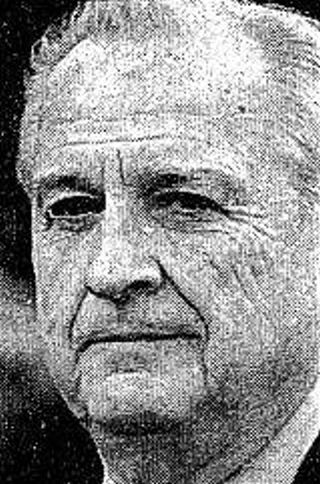
Vice Admiral Juan Jose Lombardo - Argentinian Commander of Naval Operations in the South Atlantic

Vice Admiral Juan Jose Lombardo – Argentinian Commander of Naval Operations in the South Atlantic

That evening the Argentinian Operational Commander, Rear Admiral Jorge Allara, on the orders of the Argentinian Commander of Naval Operations in the South Atlantic, Vice Admiral Juan Jose Lombardo, prepared for an all out attack. The aircraft carrier Veinticinco de Mayo and her escorts were to go north of the TEZ, from where they were to launch an air attack at first light. A second Argentinian task force, which included Exocet missile-armed frigates, was to deploy south of the TEZ in order to attack any British warships that attempted to flee the Veinticinco de Mayo attack. Finally, a third task force, which included the Belgrano, were ordered to the Burdwood Bank – an area of shallow water approximately 120 miles south of the Falklands in which submarines find it difficult to shadow – and to deal with any British vessels operating in that area.

On receiving this intelligence, Vice Admiral Woodward became increasingly concerned that the Fleet Task Force was in danger from a ‘pincer’ attack. In his report the Vice Admiral stated that he saw this coming from the three separate Argentinian contingents: the aircraft carrier Veinticinco de Mayo with escorts to the north of his position; Exocet missile-armed frigates in the centre and to the south the gun-armed cruiser, the Belgrano, accompanied by the two Exocet-armed destroyers. ‘My hope was,’ the Vice Admiral stated, ‘to keep Conqueror in close touch with the Belgrano group to the south and to shadow the carrier and her escorts to the north with one of the submarines up there. Upon word from London, I would expect to make our presence felt, preferably by removing the carrier, and almost as important that aircraft she carried, from the Argentinian Order of Battle.’ (HMS Conqueror – Report of Proceedings 01.07.1982)

In the early hours of 2 May, Vice Admiral Lombardo issued the order for Rear Admiral Allara and the Argentinian units to close on the British Fleet Task Force and attack without restriction. The communiqué was picked up by British intelligence and duly forwarded. It confirmed Vice Admiral Woodward’s belief that the Belgrano and her escorts, who were heading south, would use the darkness to turn and steam towards the Task Force. When near enough to strike, he believed, they would again change direction in order to launch an attack while ships in the Task Force were preparing to receive a missile attack from another direction. Vice Admiral Woodward wrote ‘I badly need the Conqueror to sink her (the Belgrano) before she turns away from her present course, because if we wait for her to enter the TEZ, we may lose her, very quickly.’ (Sandy Woodward – One Hundred Days, Harper Press 2012).

Vice Admiral Woodward was authorised to take action against any Argentinian forces he thought were threatening him but was not able to command the submarines to help without going through the War Cabinet. Further, neither contingent could attack unless they were within the TEZ and both Task Forces were outside the TEZ. At the time, both  Splendid and Spartan were looking for the Veinticinco de Mayo Group and were unable to make contact. However, Conqueror had picked up the sound of the Belgrano Group and on 1 May had made visual contact. For the next twenty-four hours the submarine shadowed the Belgrano Group and on 2 May Conqueror reported to Northwood that the Group had changed course towards the Fleet Task Force.

As Vice Admiral Woodward’s worse fears grew he signalled London ordering that  Conqueror sink the Belgrano. In London, the message was blocked to stop Conqueror acting on the command and passed on to Sir Terence. This was 10.45hours 2 May and Sir Terence called a meeting of the Chiefs of Staff who, with the news of Vice Admiral Lombardo’s orders to attack, agreed that the standing Rules of Engagement be altered to permit a counter attack by Conqueror. At the time Mrs Thatcher was at Chequers, with the War Cabinet politicians and Sir Terence went straight there. They were already aware of Vice Admiral Lombardo’s orders and when Sir Terence explained the situation, they agreed to his request to change the Rules of Engagement. The politicians main concern was that it would be political suicide if they did not acquiesce to Sir Terence’s request and the Belgrano sank the British aircraft carrier with hundreds of casualties. Permission was granted for Commander Christopher Wreford-Brown, the Commanding Officer of  Conqueror to attack the Belgrano if she posed a threat to the British fleet. The Ministry of Defence sent a signal to this effect at 12.07hours and within half-an-hour, new orders were issued.

Conqueror was 36 nautical miles (58 kilometres) outside the TEZ, at torpedo depth. On board she had two different types of torpedoes, World War II Mark8 type, which were reliable, accurate at close range and had a warhead capable of penetrating the hull of the Belgrano. The second type of torpedoes was the more modern Mark24 Tigerfish, which had a tendency to be unreliable. On consultation with his officers, Wreford-Brown ordered three Mark8s be to be made ready. The weather was stormy and closing in. The Belgrano was gently zigzagging at about 13knots and it was important not to betray Conqueror’s position. The atmosphere on the submarine intensified as she came closer to the Belgrano. At 18.51hours the Belgrano was down to a speed of 11knots and the three torpedoes were put into standby mode. At 18.57hours the Conqueror was 1,400-yards on the Belgrano’s port beam when Commandeer Chris Wreford-Brown ordered the three torpedoes to be fired at three-second intervals. The first torpedo missed the Belgrano and hit one of the escort vessels but did not explode for a further 57seconds. The second hit the Belgrano, mid-ships and exploded on impact. The third also exploded when it hit the stern of the Argentinian ship.

In total, 321 men lost their lives and 15 minutes after the Belgrano’s crew was ordered to abandon ship, she sank. Setting a course to the south, Wreford-Brown ordered the Conqueror to go to a depth of 500-feet and a speed of 22knots. The two escorting Argentinian destroyers went after the Conqueror, and one depth charge exploded close enough to make the 4,000-ton submarine shudder. Nonetheless, she managed to clear the area with the destroyers returning to rescuing the 700 men in life rafts from the cold, open ocean. Controversy followed as it was stated by a number of countries that although international law stated that in times of war, the heading of a belligerent ship had no baring on its status, the Falklands Conflict was not technically a war. Second, the Belgrano was outside the British imposed TEZ. Further, and the lasting aspect of the controversy, were intercepted Argentinian signals that ordered their fleet to return to the previous positions as they had been spotted by a Royal Navy Sea Harrier. This could mean that the Belgrano was sailing away from the Fleet Task Force. However, increasing evidence at the time showed that they were not received in London until after the Conqueror had attacked the Belgrano.

Nonetheless, when the crew of Conqueror returned to their homeland, they and their families were hounded mercilessly by the press. The Prime Minister, Mrs Thatcher came in for a well publicised grilling on BBC’s Nationwide, (24.05.1983), by schoolteacher Diana Gould (1926-2011) from Cirencester, Gloucester. Mrs Gould accused the Prime Minister of ordering the sinking of the Belgrano in order to de-rail the US Secretary of State Haig backed Peruvian Peace Plan. Of the controversy, Sir Terence said, ‘A catastrophe like the sinking of a major unit was bound to happen sooner or later once the Argentinians had invaded and the Task Force sailed. They must have realised the risk, we certainly did, and it was my job to ensure that it didn’t happen to us first.

Meanwhile, both Spartan and Splendid were still looking for the Veinticinco de Mayo Group but to no avail. Following the attack, the aircraft carrier along with the Argentinian Naval Force, was returning to Argentine territorial waters. The Veinticinco de May was located outside the territorial waters but the decision of the War Cabinet was to do nothing unless she changed direction with a clear hostile intent. Internationally, the US Secretary of State Haig was threatening Britain with political isolation if the Peruvian Peace Proposals were not accepted. On 6 May the Rules of Engagement were changed to include the restriction of attacks on the Veinticinco de Mayo when she was more than twelve hours steaming distance from the Task Force.
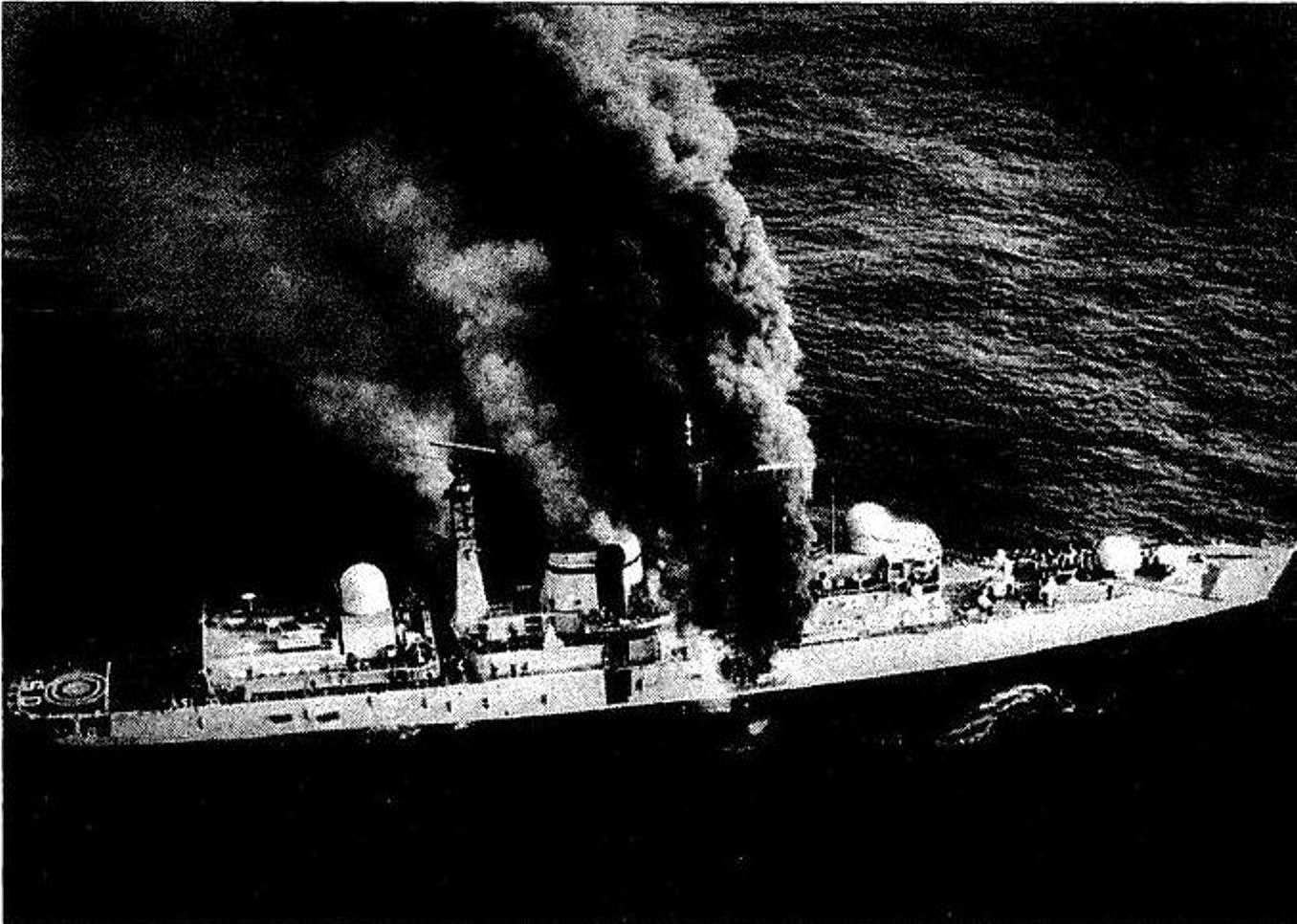
Sheffield after being struck my the Exocet missile 4 May 1982 - Press Association

Sheffield after being struck my the Exocet missile 4 May 1982 – Press Association

Two days after the sinking of the Belgrano, on 4 May, an Argentinian Exocet missile hit the British destroyer Sheffield launched by Queen Elizabeth II in 1972. It was fired at 11.04hours approximately 20-30 miles away from a Super Étendard fighter, piloted by Lieutenant Armando Mayora and Lieutenant Commander Augusto Bedacarratz, who was commanding the mission. The aircraft came from the Rio Grand air base, Tierra del Fuego, flying below the Task Force’s radar screens. Captain James William Salt (1940-2009) only had time to shout ‘Take cover!’ Before the missile struck Sheffield amidships about 8-feet above the waterline. The result was an inferno killing 20 and severely injuring 24 of the crew. Fire crews from other ships fought the raging fire but as she was being towed to South Georgia Sheffield sank. The site is now a designated War Grave. Sheffield was the first loss of a major British warship in 37 years.

The requisitioned P&O cruise liner Uganda had been designated a hospital ship and fitted out accordingly. On board were 12 doctors, 40 members of the Queen Alexandra Royal Naval Nursing Service and medical support staff. The survey vessels Hecla, Hydra and Herald had all been fitted out as ambulance ships and they took the dead and wounded to  Uganda. During the remainder of the Conflict Uganda and the converted survey vessels along with Argentinian ambulance vessels dealt with both British and Argentinian casualties. The staff on board Uganda undertaking a total of 504 surgical operations and treating 730 casualties. Both British and Argentinian casualties were transferred to Montevideo from where they were returned to their home countries.

As a gesture of solidarity on 5 May, Prime Minister of New Zealand, Robert Muldoon, told Sir Terence that his country would loan their Leander class frigate Canterbury, if Britain launched an attack. She was strictly to be used to relieve a British ship from other duties in order for it to go to join the Fleet Task Force. The gesture was accepted but opposition to the Conflict increased in the UK with many commentators supporting Leader of the Labour Party Michael Foot’s (1913-2010) argument for the US backed compromise. While others were quick to side with one of the editors of the Labour Herald, Ken Livingstone, who wrote that the Government had ‘blood on its hands from the senseless war.’

Meanwhile, on 7 May, Sir Terence, in a press conference, stated that he saw the way forward was through negotiation. That the build up of diplomatic, economic and military pressure was bringing about an achievement. Foreign Secretary Pym, in the House of Commons, reiterated this line of argument. However, in the subsequent press conference, Pym lost his temper with a journalist saying, ‘You may be on the Argentinian side but I must tell you that we are certainly not asking anything too much of the Argentines. They invaded, they are the aggressor. They put their forces onto that island and, when Resolution 502 was passed, they used it to reinforce that island.’ Resolution 502 had been adopted by the UN Security Council on 3 April and had called for a diplomatic end to hostilities between Britain and Argentina over the Falkland Islands.

Albeit, within Britain, the general mood was of support of defending against an invasion and with this the number of vessels and military forces the War Council sent to the area increased. In the US President Reagan openly expressed support of the British stance but his opposition and some members of his administration, particularly Secretary of State Haig, wanted a settlement saying that the Conflict was causing an unwanted distraction to the Administration’s diplomatic relations with South America. On 7 May, the Land Force Task Group under Major Jeremy Moore, left Ascension Island to retake the Falkland Islands.

Intelligence had informed Northwood that the Argentinians had set up an airbase on Pebble Island, part of the Falkland Islands group, north of West Falkland. The island was/is almost two islands joined by an isthmus, about 19 miles by 4.3 miles at its widest point with a sheep and cattle farming settlement and a bird reserve. Using a local airstrip, the Argentinians named their airbase Aeródromo Auxiliar Calderón, or Calderon as it was referred to by the British, and based some 300 Argentinian airmen protected by a small unit from their Naval infantry battalion. Also at Calderon were T-34 Mentors and Pucara aircraft and a newly erected radar site that could be used to attack the proposed landings on the Falklands.

On the night of 13/14 May an eight-man section from the Boat Troop of DD Squadron Special Air Services (SAS) landed on Pebble Island and set up two observation posts. They carried out surveillance of the settlement, the radar site and the airfield. On the night of 14/15 May, Sea King helicopters landed 45 men of D Squadron accompanied by naval gunfire forward observer, Captain Chris Brown and supported by gunfire from the destroyer Glamorgan directed by Captain Brown. The SAS men destroyed 11 aircraft, the radar, an ammunition dump and an aviation fuel store. One was hurt and, according to British intelligence, the Argentinian Commanding Officer of the Base was killed.

Following the success of the Pebble Island raid, it was agreed to mount a similar raid on the Rio Grand air base, Tierra del Fuego, South American mainland. The airbase housed the Exocet missiles and the Super Etandard bombers that would carry them. Code-named Operation Mikardo it was to be undertaken by 55 SAS men and reconnaissance for the Operation began in the early hours of 18 May from Invincible. A Sea King helicopter was used to fly the eight men reconnaissance group and it was planned to drop them on the Argentinian side of Tierra del Fuego and for the helicopter then to go to Chile, as it would be at the end of its operational range where it would be destroyed. Unfortunately, the helicopter was forced to divert, adding twenty minutes to the journey, then as the mainland was approached thick fog cause delays that led the operation to be aborted.

Commodore Michael Clapp commanded the Amphibious Landing Force on the Falklands. His job was to select a suitable landing area and deliver the troops ashore safely. He selected San Carlos Water, a fjord-like inlet on the west coast of East Falkland facing Falkland Sound. This is the sea strait between the two main islands that included at least eight safe anchorages. Reconnaissance showed that there did not appear to be Argentinian troops in the immediate area and to protect the landing force from air attack, Sea Harriers would provide air cover. However, of concern was an Argentine position at the top of Fanning Head, at the north end of Falkland Sound, which was armed with heavy weapons.

East Falkland Island - the day augured well when the Task Force started to arrive at San Carlos Bay. Alan Sencicle

East Falkland Island – the day augured well when the Task Force started to arrive at San Carlos Bay. Alan Sencicle

On being given permission by the War Cabinet the British Fleet entered San Carlos Water during the night of 20/21 May quietly sailing past the Fanning Head position. Under the command of Major-General Moore at 02.30hours local time on 21 May the British troops and supplies started landing on three beaches inside San Carlos Water. The day augured well as there was low cloud, which with the total blackout of information, it was hoped, would reduced the chance of an air attack. However, later that day the Task Force was spotted by the Argentinians at the Fanning Head position and at approximately 17.40hours local time the bulk of the air strikes began.

The bombing was heavy and tended to be aimed at Royal Navy frigates and destroyers not the supply and troops ships. The Royal Navy frigate Ardent, whilst lying in Falkland Sound, was attacked by at least three waves of Argentine aircraft and sunk leaving 22 dead. Thirteen bombs hit the ships of the Task Force without detonating including a 1,000lb that hit the destroyer Antrim whilst supporting the main landing. Two days later, 23 May, the frigate Antelope was on air defence duty at the entrance to San Carlos Water protecting the beachhead established two days before. She came under attack from four Skyhawks but although damaged she was moved to sheltered waters. There were two unexploded bombs on board that needed to be dealt with and one of which was in a dangerous state. The Royal Engineers bomb disposal technicians came on board but on the fourth attempt at defusing the bomb it exploded killing one of the bomb disposal team and badly injuring another. Antelope was forced to be abandoned and within minutes of the crew leaving, the missile magazines began exploding.

On 25 May the destroyer Coventry along with Broadsword were about 10 miles north of Pebble Island acting as decoys to draw Argentinian aircraft away from San Carlos Water. The attacking force moved in and three bombs struck Coventry just above the waterline, two of which exploded. One entered the Forward Engine Room causing the ship to list to port. The other breached the bulkhead causing uncontrollable flooding. Within 20 minutes Coventry was abandoned and capsized. Nineteen of her crew were lost and a further thirty injured with one dying from his injuries later. Famously, while the crew were waiting for Broadsword to come to the rescue, they sang Monty Python’s Eric Idle comedy song ‘Always Look on the Bright Side of Life,’ that featured in the 1979 Python film Life of Brian. Sir Terence had an emotional attachment to Coventry as his wife Jane had named her at the launching. He argued that the announcement of the ship’s loss was not to be made until he had a full list of the casualties and the relatives had been informed. However, Sir Terence was over-ruled by John Nott.

Sir Terence had an audience with the Queen on 25 May, to brief the Monarch on the San Carlos landings. That night the Atlantic Conveyor was due into San Carlos Water. She had left Ascension Island in a convoy that included the requisitioned Queen Elizabeth 2.  Included on board the Atlantic Conveyor was equipment for the construction of an airstrip at San Carlos and the five Chinook and six Wessex helicopters. The helicopters were to be used to move 2 PARA and 3 PARA to key high grounds and were urgently needed. On arrival one of the Chinooks left the Atlantic Conveyor on a mission. Shortly after and before the ship had been unloaded, Exocet missiles hit her with the loss of twelve crew members and the urgent supplies. In the light of the Atlantic Conveyor attack the much larger and better known Queen Elizabeth 2 that was bringing 3,000 members of the Fifth Infantry Brigade, was diverted  to South Georgia. For the journey she was blacked out and with her radars switched off, steamed without modern aids to avoid detection.
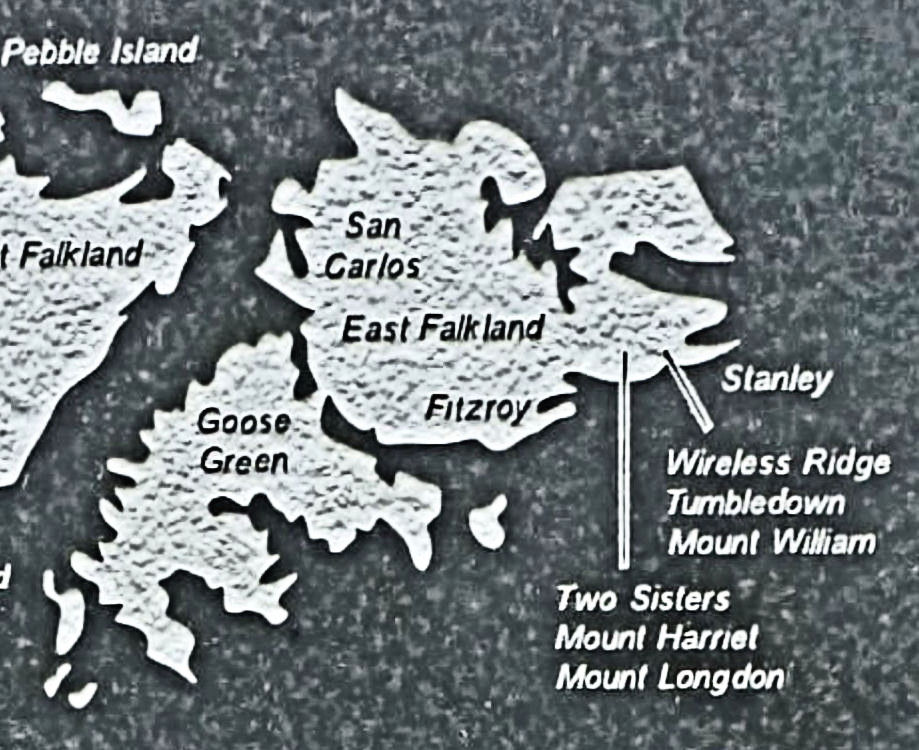
East Island, Falkland Islands Map detail - National Memorial Arboretum, Staffordshire

East Island, Falkland Islands Map detail – National Memorial Arboretum, Staffordshire

Some 3,000 British forces, most belonging to 2 PARA and 3 PARA had quickly secured the beachhead at San Carlos. With the loss of the Atlantic Conveyor and the Chinooks they faced a long march across East Falkland to Stanley 50 miles away. The loss of the ships and subsequent delays were taking its toll back in the UK, where the demand for the withdrawal from the Islands was mounting. Internationally, pressure was being put on the UN to call for a cease fire. About thirteen miles to the south, through rough and boggy terrain, much of it heavily mined,was/is the Darwin settlement. This is on the east side of the central isthmus of East Falkland and about 2½ miles away is the settlement of Goose Green.

About 1,200 Argentinian troops occupied both Darwin and Goose Green and in Goose Green village hall over 100 islanders were imprisoned. Although, it had been planned to bypass Darwin and Goose Green, the War Cabinet wanted an early offensive as a distraction. Sir Terence and Admiral Fieldhouse in discussion with Major-General Moore chose to take on the Argentinian troops at Darwin/Goose Green. If successful, it would boost moral in the UK and the forces would be in control of a significant portion of the East Falklands.

Brigadier Julian Thompson, the Commander of 3 Royal Marine Commando Brigade of which, by this time both 2 PARA and 3 PARA were part, had set up his headquarters at the commandeered Camilla Creek House. This was between San Carlos and Goose Green and the Battle for Darwin and Goose Green started when Colonel H Jones of 2 PARA was ordered there. 2 PARA were to ‘carry out a raid on Goose Green Isthmus and to capture settlements before withdrawing in a reserve for the main thrust to the north.’ Air support was to be provided by RAF Harriers and naval gunfire support was to be provided by the frigate Arrow during the hours of darkness. Due to the loss of the Atlantic Conveyor with the helicopters that were to move 2 PARA, the company had walked, undetected, through the rough terrain to Darwin. Further, the BBC World Service had informed its listeners that a parachute battalion was preparing for an attack on Darwin and Goose Green!

Against a determined stand by the Argentine 12th Infantry Regiment, ‘A’, ‘C’, and ‘E’ company of 2 PARA fought hard but were failing to make much headway and were stuck at the bottom of Darwin Hill. Above them were Argentinians in well-defended trenches. Colonel H Jones initially led an unsuccessful charge and then turned west along the base of the Hill. Again he tried to advance up the hill and was just short of the trenches when he was hit and fell. Colonel H Jones got up was hit again twice, fell back and died. He was posthumously awarded the Victoria Cross.
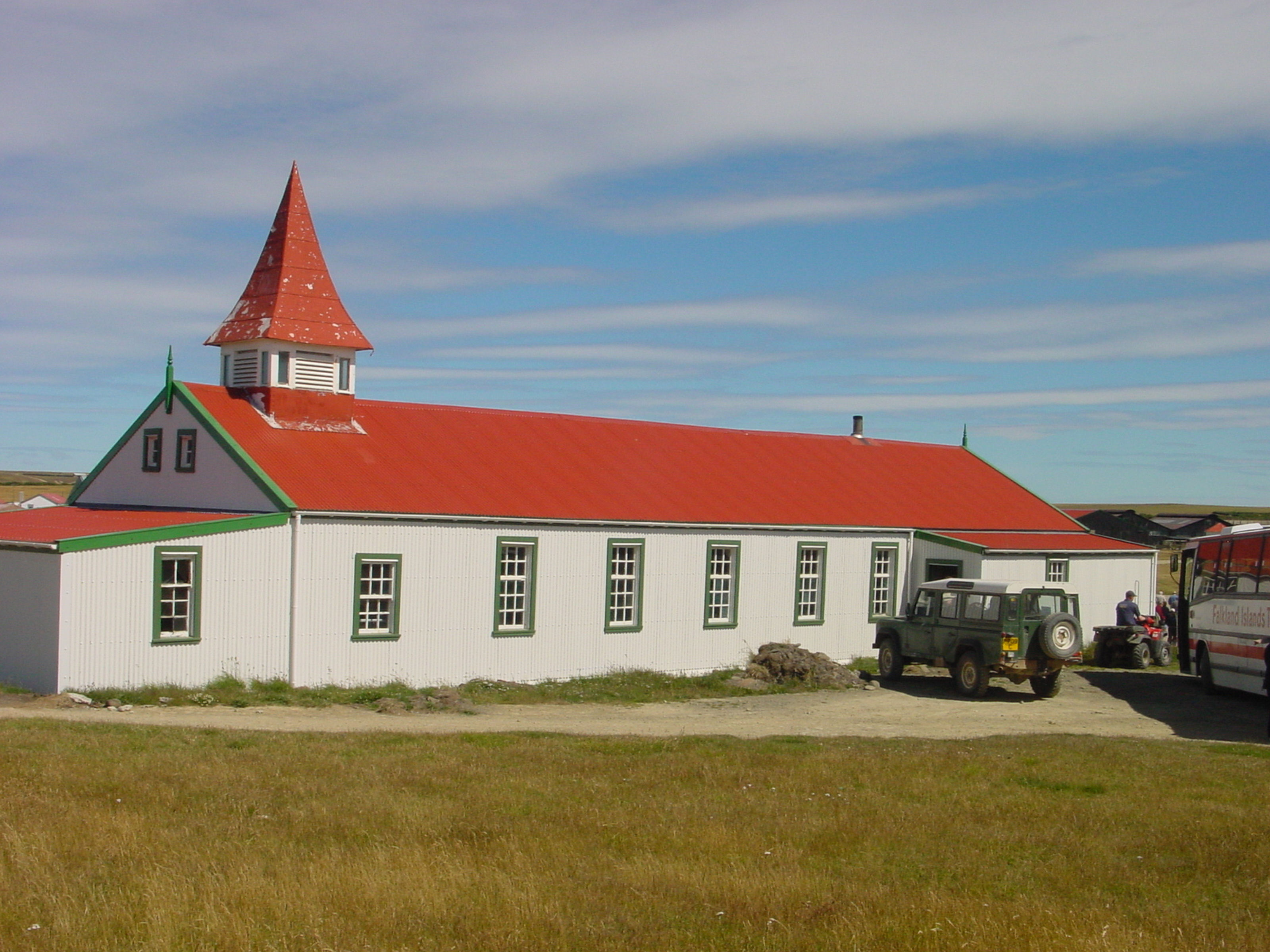
Goose Green Village Hall in which locals were locked when the Argentine Military Junta took over the Islands in 1982. Alan Sencicle

Goose Green Village Hall where locals were imprisoned when the Argentine Military Junta took over the Islands in 1982. Alan Sencicle

Major Chris Keeble took over PARA 2 on the death of Colonel Jones and it was about noon on 28 May when the trench was cleared and sometime after Darwin Hill was secured. While this was going on a second and equally as fierce fighting was taking place to secure Boca Hill by 2 PARA’s  ‘B’ Company under Major John Crosland. With ‘A’ company staying at Darwin Hill, ‘B’ made their way south to Goose Green and ‘C’ and ‘D’ companies made their way to Darwin school and the airfield. The fighting remained fierce and by the last light on 28 May the situation was not brilliant. Although casualties were being evacuated, the remaining men were exhausted, their clothes were wet and it was bitterly cold. They had surrounded both Darwin and Goose Green but the Argentinians were still putting up fierce resistance. Major Keeble spoke to the company commanders and suggested that the Argentineans be asked to surrender but to make the period of negotiations as long as possible to give time for reinforcements to arrived! If they refused, the Officers suggested, then Goose Green could be flattened with artillery and mortars and then attacked. However, there were civilians locked in the village hall.

With Brigadier Thompson’s agreement, Major Keeble, Captain Alan Coulson and Captain Rod Bell, the latter of which translated it into Spanish, worked on a surrender text. At 10.00hours on 29 May, two Argentinian prisoners, who had been well briefed, were sent into Goose Green. If they were not back within I hour, the prisoners were to say, then Goose Green would be flattened. Within minutes the two men returned and a meeting took place between Major Keeble and his contingent who met with Air Vice-Commodore Wilson Dosio Pedroza and Lieutenant Colonel Italio Pioggi (1935-2012) and his contingent that took place in a hut above which flew a white flag. Captain Rod Bell was the interpreter. It was agreed to release the civilians and both sides left the hut. If there was a surrender it was agreed this would take place on an area of flat ground above the settlement at 13.30hours that day.

When the British contingent arrived all was quiet but it was known that the Argentinian troops had been seen packing their belongings. Suddenly, a column of troops, all air force personnel, marched towards the flat ground and formed into a hollow square. After being addressed by Air Vice-Commodore Pedroza they sang the Argentinian national anthem and laid down their arms. Air Vice-Commodore Pedroza marched over to Major Keeble, saluted and handed over his pistol. While this was going on more men arrived and they too formed a hollow square and were addressed by Lieutenant Colonel Pioggi and surrendered. 2 PARA suffered 15 killed and 30 wounded. 55 Argentinians were killed and between 8 and 100 were wounded.

PARA 2 Memorial Falkland Islands. Alan Sencicle

PARA 2 Memorial Falkland Islands. Alan Sencicle

News of the victory, when relayed to London, had the desired effect. It also enabled the remaining British forces to move out of San Carlos beachhead. Over the next few days a succession of intense battles and skirmishes took place as the British forces fought their way across East Falkland to Port Stanley. From the air the RAF Harriers attacked the Argentinian aircraft, most of which were based in Argentina. As the British forces trekked eastwards, the weather continued to deteriorate but the Mountain Leader Training Cadre of the 3 Commando Brigade successfully took Top Malo House on 31 May. The Fifth Infantry Brigade of 5,000 men, comprising principally of a battalion of 2nd Scots Guards, a battalion of 1st Welsh guards and Gurkhas were at San Carlos, 3,000 of them having come from South Georgia. With these additional troops, Major-General Moore could start looking at the retaking of Stanley.

Moving eastwards, first to Teal Inlet in the north of East Falkland, 3 PARA had left San Carlos beachhead after 2 PARA. Like 2 PARA, they had to go on foot through rough terrain as the Chinooks had been lost when the Atlantic Conveyor was sunk. They then advanced to Estancia, closer to Stanley, passing undetected north of enemy positions. With the help of local farmers the battalion established themselves waiting on an airlift to Mount Kent. The weather continued to deteriorate and they were in visible range of enemy guns. On 3 June they started the reconnaissance in order to take the strategic Mount Longdon overlooking Stanley. During the evening of 6 June President Ronald Reagan and Mrs Reagan arrived at Heathrow Airport, London, for a visit as a guest of the Queen. The Duke of Edinburgh welcomed the couple on behalf of the Queen and among those in the President’s retinue was Secretary of State Haig. The British welcoming party included Mrs Thatcher and Sir Terence. At the time, as far as the World and particularly the UN was concerned, Secretary of State Haig would be trying to negotiate a peaceful ending to the Conflict in order to save Argentina any humiliation.

Meanwhile, the Welsh Guard members of the Fifth Infantry Brigade were being taken to Bluff Cove, an inlet south of Stanley. Their transport was the landing ship Sir Galahad accompanied by the landing ship Sir Tristram. On the morning of the 8 June Argentinian planes took off for an attack and this was picked up by the submarine Valiant’s electronic-warfare mast. Northwood was immediately notified by satellite and the message was relayed to the Task Forces on the different parts of the Islands. Due to technical problems these were delayed until after the Argentinian air force flight arrived but some were met by Harriers on the look out. Some of those that made it through, dropped bombs four of which hit the frigate Plymouth in Falkland Sound but as the aircraft was flying low they failed to detonate.

In Bluff Cove, five Argentinian Skyhawks attacked the Sir Galahad and the Sir Tristram. 56 men were killed and over 150 were injured and of these, 38 Welsh Guards were killed and a further 19 were badly burnt. This was highest British casualty figure for any unit in the Falklands. The Guards belonged to the Prince of Wales and Third Companies and following the end of the Conflict, the ship was sunk and declared an official war grave. General Mario Menéndez, the Argentinian Military Governor, was told that 900 British soldiers had been killed and consequently informed Buenos Aires that he expected the British assault to stall.

Besides Gun emplacements there were Mine Fields laid by the Argentinians. LS

Besides Gun emplacements, there were Mine Fields laid by the Argentinians. LS

On 10 June final preparations were made to capture Two Sisters, Mount Harriet and Mount Longdon, the high ground surrounding Stanley. As strategic positions they were well defended with Mine Fields and gun emplacements.  Men from 45 Commando, 40 Commando and 29 Commando under Lieutenant-Colonel Andrew Whitehead and with naval gunfire support from Glamorgan, at 02.00hours started their assault on Two Sisters. It took all of that day against fierce resistance from the Argentinians to take the twin peaks. Lieutenant Colonel Nick Vaux, the commander, led 42 Commando into the Battle for Mount Harriet on the night of 11/12 June with support from 29 Commando and naval gunfire support from the frigate Yarmouth. Again the Argentinians put up fierce resistance as they were also doing at Mount Longdon, which 3 PARA were attempting to take. Mount Longdon was/is long and narrow with two peaks covered in rocks. To the east lay Wireless Ridge that continued eastwards to Moody Brook and to Mount Tumbledown. The estimated strength of the Argentinian forces holding Mount Longdon was 800 men supported by heavy artillery sited at Moody Brook.

The Battle for Mount Longdon started at 21.00hours on 11 June and was led by Lieutenant Colonel Hew Pike. Men from the 29 Commando Regiment and the Royal Artillery supported 3 PARA and the frigate Avenger provided naval gunfire support. Sergeant Ian John McKay (1953-1982) of 4 platoon of 3 PARA was on the northern side of Mount Longdon. As the platoon advanced they came under increasing heavy fire, along with 5 platoon, they were becoming increasingly beleaguered. The commander, Lieutenant Andrew Bickerdike, with some men, including Sergeant Mackay, reconnoitred the Argentinian gun positions to see how they could relieve their position. Identifying the heaviest gun position they took a closer look but it also contained a number of snipers with image intensifiers.

The Argentinian fire was accurate, one of the men was killed and six of the group were injured, including Lieutenant Bickerdike. The command devolved to Sergeant McKay decided to attack the position reasoning that by doing so it would relieve beleaguered 4 and 5 Platoons. Taking three men with him, Sergeant McKay broke cover and charged the enemy position, which was met by a hail of fire. One of the men was killed and two others seriously wounded. Nonetheless, Sergeant McKay continued to charge the position alone and on reaching it, knocked it out with grenades. Sadly, Sergeant McKay was killed but was awarded a posthumous Victoria Cross. The Battle for Mount Longdon continued to end at approximately 11.00hours on 12 June when 3 PARA finally secured it. An Argentinian prisoner later stated that ‘It was terrible! (Pike) threw company after company against us and we could not stop them. They kept coming even through the mortar fire, it was incredible! You have the bravest and most professional troops in the world.’ (Para! By Peter Harclerode – Brockhampton Press 1999).

Argentine Prisoners of War guarded by Paratroopers - Internet

Argentine Prisoners of War guarded by Paratroopers – Internet

The satisfaction of gaining the well defended three strategic high grounds was quickly dampened when on 12 June,  Glamorgan was hit by an Exocet missile causing severe damage. Fourteen crewmen were killed and many more injured. Closing in on Port Stanley from the South West, on the evening of 13 June the British troops still had to secure three more well defended key positions. Two brigades consisting of Royal Marines, Paratroopers, Guardsmen and Gurkhas began advancing from the high ground and all met with fierce resistance.

As the Scots Guards were battling for Mount Tumbledown, the Gurkhas, under gunfire, went along the line of Goat Ridge, to the north of Tumbledown. They were preparing for their assault on Mount William once Mount Tumbledown was taken. As dawn approached on 14 June, the Guards had still not secured Tumbledown so the Gurkhas made the dangerous but successful daylight assault on Mount William. When the Argentinians were taken prisoners they saw the Gurkhas unsheathed their huge curved ‘kukri’ knives. Terrified that the soldiers were going to decapitate them they feared the worst until the Gurkhas started to use the knives to cut up boot laces to tie the prisoners hands together! Meanwhile, 2 PARA ,with light armour support from 3 Troop of the Blues and Royals, made the successful assault on Wireless Ridge.

A Company of 2 PARA, at 13.30hours on 14 June, were the first British troops to enter Stanley and soon after they were joined by other British troops. Although General Menendez had 8,000 troops in the area when they met the British troops, they laid down their arms. General Galtieri, in Buenos Aires, ordered General Menendez to stand firm and to continue the fight but General Menendez decided to negotiate. Sir Terence was informed and immediately went to the Fleet’s operational headquarters at Northwood. That afternoon, the Islanders besieged in Stanley’s West Store were surprised to hear a knock on the door. When they opened it there stood Major General Jeremy Moore. He greeted the islanders saying, ‘Hello, I’m Jeremy Moore. Sorry it’s taken rather a long time to get here!’

At 18.00hours on 14 June the message was received that the Argentinian garrison were prepared to discuss surrender terms and two hours later General Menendez, after speaking with General Galtieri, met with Brigadier John Waters, Major General-Moore’s deputy, at Moody Brook. Sir Terence returned to London and the surrender document was drawn up covering enemy forces both on West and East Falkland. This was transmitted to Major-General Moore who immediately went to Moody Brook to discuss the terms. However, shortly after the surrender document was sent the communication network between London and Stanley broke down. Luckily, the SAS had a direct radio link between their headquarters at Credenhill, Hereford and Stanley so from Hereford a full commentary of what was happening was relayed. This was by ‘phone to Northwood and from there to the War Cabinet Room in the Commons.

Times headline 15 June 1982 following the announcement of ceasefire in the Falklands

Times headline 15 June 1982 following the announcement of ceasefire in the Falklands

In the War Cabinet Room Mrs Thatcher, along with Sir Terence and John Nott, were drafting out the announcement of the surrender. Mrs Thatcher hoped that news of the confirmation of the surrender would come before 22.00hours so it would make the main British news broadcasts at that time. As discussions on details were still taking place in Stanley the Prime Minister went into, the by then packed, Chamber of the House of Commons. To an elated welcome she told MP’s that the White Flags of Surrender were flying over Stanley and that the final surrender was expected at any time. At midnight General Menendez formerly surrendered all Argentine Forces in both East and West Falklands to Major-General Moore, the Commander British Land Forces, Falklands. Sir Terence and John Nott went to the Ministry of Defence to meet the media and answer questions. At the same time Mrs Thatcher announced that the victory was won by an operation that was ‘boldly planned, bravely executed and brilliantly accomplished.

On 20 June the British retook the South Sandwich Islands and declared hostilities to be over. By that time 3 Falkland Islanders, together with 255 British and 649 Argentine members of the armed forces, had been killed, over half of the latter due to the sinking of the Belgrano. 89 Royal Navy, auxiliary and merchant ships were involved in the campaign. The following day, 21 June, Diana, Princess of Wales (1961-1997) gave birth to Prince William. His uncle, Prince Andrew, saw action in the Falklands Conflict on board Invincible as a Sea King helicopter co-pilot.

In October 1983, Sir Terence retired as Chief of the Defence Staff, but on 27 October the Commons Defence Committee called him to answer questions. In the grilling Sir Terence was asked why he and his colleagues had deliberately used misinformation and censorship to the British media during the Falkland operations. The Committee had previously heard severe criticism from the Press Association that as a free press it was up to individual editors to make such decisions. Sir Terence responded saying that his job was to help to win the war and that he would not regard the information released as misleading the press and the British public but as misleading the enemy. Saying ‘Anything I can do to help win is fair and I would have thought that the media and the public would want that too.’ (Hansard)

The Select Committee also wanted clarification on the haste of the operation saying that many believed it to be a politically motivated attempt to undermine the peace talks. Sir Terence response was that the Falklands operation could not be delayed much longer that year due to the Islands location in the South Atlantic, and most notably, the weather. He went on to say that by the following year, 1983, due to the ongoing run down of the armed services and particularly the Fleet on which the Task Force’s reliance was crucial, such an operation could not have been mounted.’ Adding, in essence, that ‘the Conflict demonstrated a classic failure of deterrence … The consequences of not demonstrating to a potential enemy sufficiently clearly that you have both the political will and the military capability to deter aggression.’ There were a number of occasions that he deeply regretted, Sir Terence said, the ‘dead and wounded on both sides but’, he added, ‘ that the campaign was a worthwhile exercise for the free world.’ He finished by saying that ‘it was fortunate that the three sectors of the British Armed Forces were first class and well trained.’ (Hansard)

Within days of Stanley being retaken, General Galtieri was removed from power along with other members of the former junta. He was arrested in late 1983 and charged in a military court with human rights violations and with mismanaging the Falklands War. In May 1986, General Galtieri was found guilty of mishandling the war and sentenced to twelve years in prison. Also convicted were 39 officers including Admiral Anaya and Brigadier Basil Dozo and in 1988 Galtieri, Anaya and Dozo were stripped of their rank. Two years later, in 1990 Galtieri and all the officers received a Presidential Pardon. Twenty-two years after the Conflict, in 1994, the Argentinian Government announced that the sinking of the Belgrano was a ‘legal act of war‘ but still claimed sovereignty over the Falklands.

Following the Conflict, the proposed cutbacks of the Royal Navy fleet was abandoned and replacements for many of the lost ships and helicopters were ordered including more Sea Harriers. Sir Terence was given the task of restructuring the Armed forces, for which, in the New Years Honours list of 1984, he was created Baron Lewin of Greenwich. Baron Lewin died on 23 January 1999 when he was cited as being, ‘one of the greatest military leaders of the late 20th century.’ Yet, he has not received any recognition in the town of his birth. Further, Dover’s status as a garrison town finally came to an end, after over a thousand years in February 2006 when Connaught Barracks closed. Ironically, with regards to this story, it was the 1st Battalion of the Parachute Regiment that marched away from Dover that day.
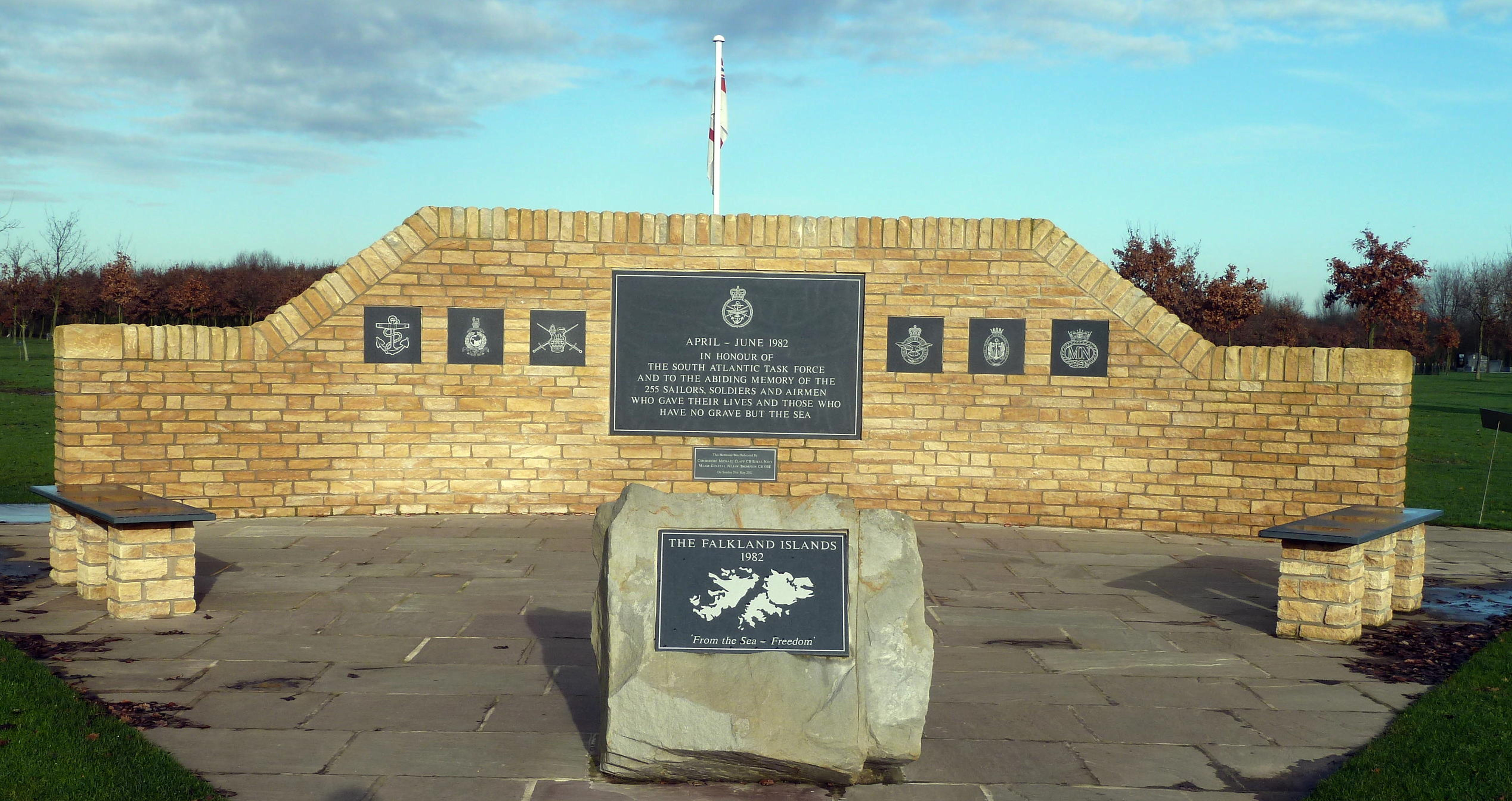
South Atlantic Campaign National Memorial Arboretum Staffordshire

South Atlantic Campaign National Memorial Arboretum Staffordshire. Alan Sencicle

Presented: 13 May 2016. 

  • A short pre UK 30-Year Rule account of the Falklands Conflict was published in the Dover Mercury 26 November 2009
  • and in the Dover Society Magazine, March 2011.
Posted in Armed Services, Falkland's Conflict – the Terence Lewin story, Falkland’s Conflict – the Terence Lewin story, Lewin Terence & the Falklands Conflict, People | Comments Off on Falkland’s Conflict – the Terence Lewin story

Dover’s Home Guard

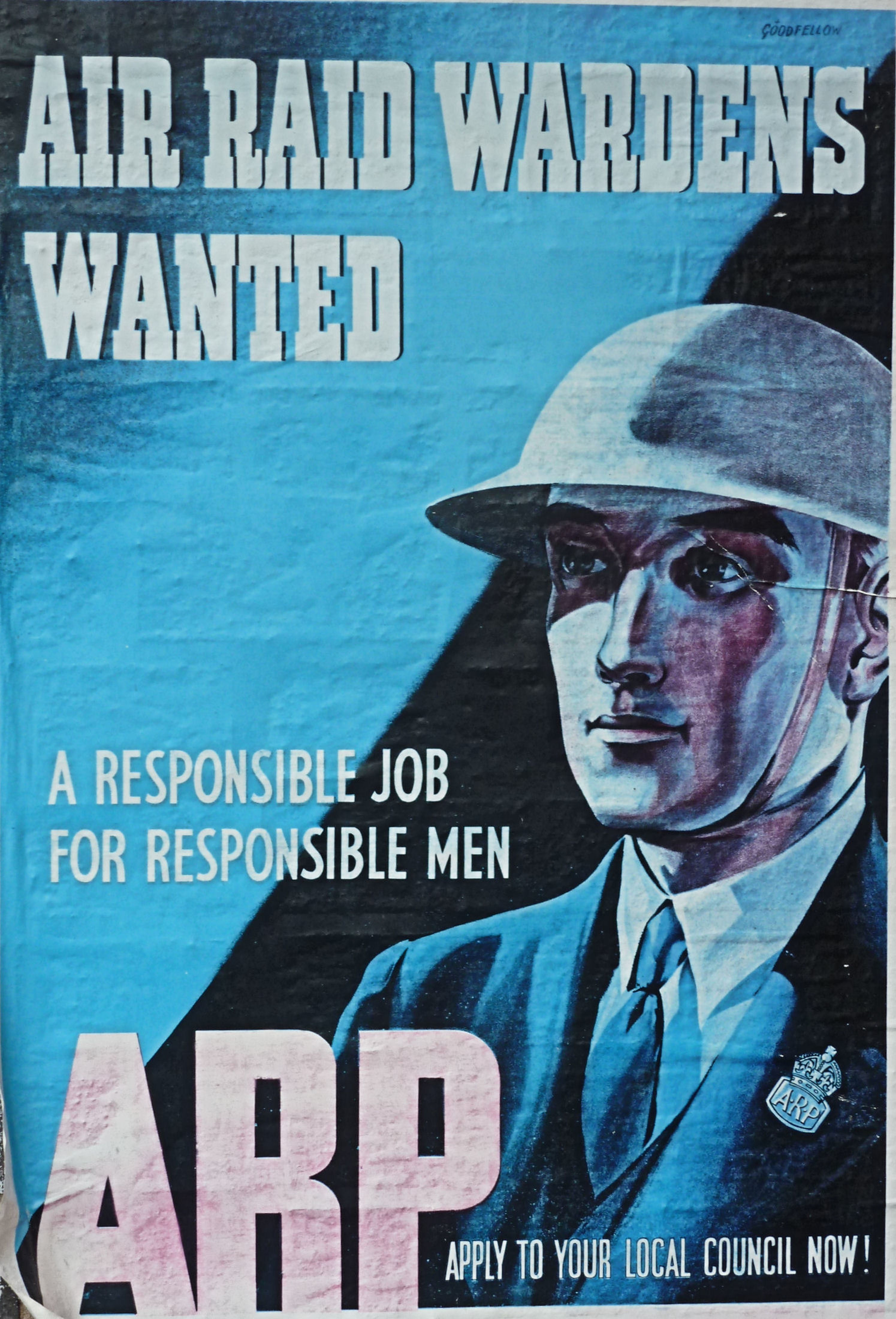
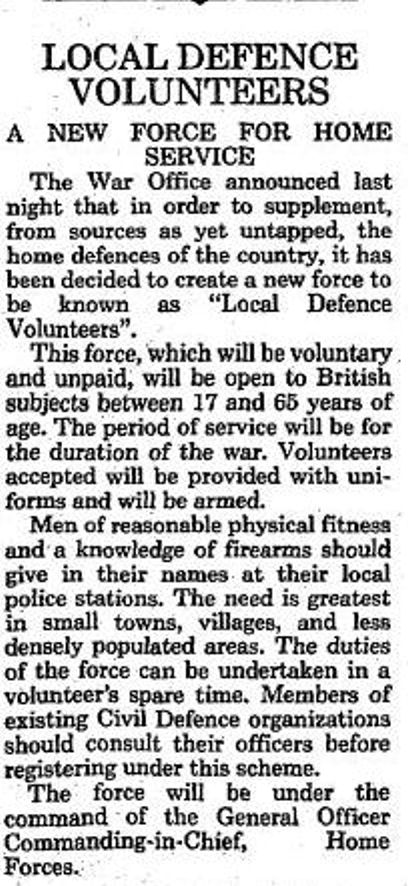
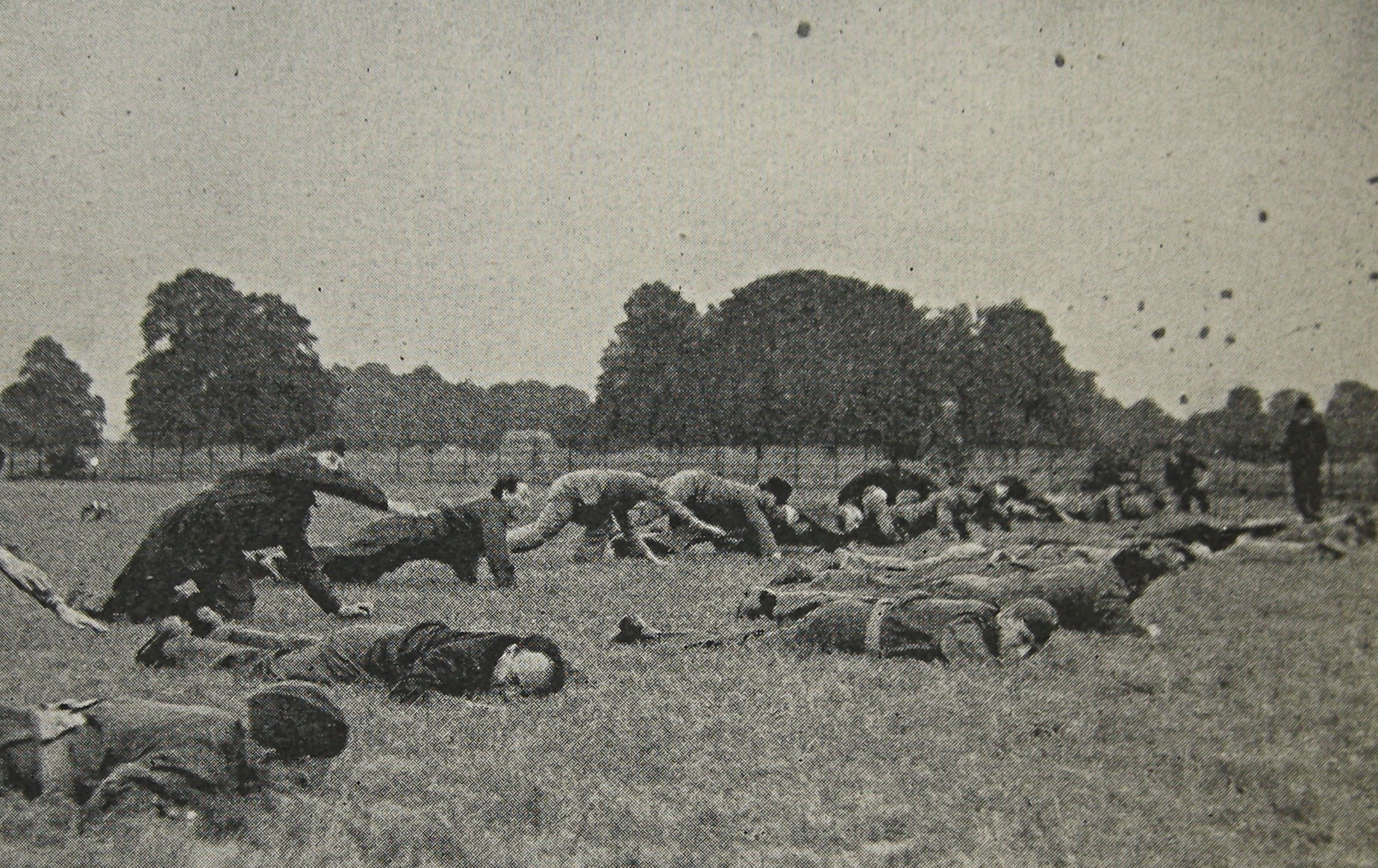
In the run up to World War II (1939-1945), the United Kingdom was preparing for the eventually of war. In 1938, air raid wardens were being recruited and households were given advice on how to build air-raid shelters in their gardens. War was declared on 3 September 1939 but it was not until 1940 that the Local Defence Volunteers (LDV) were set up. This was made up of men too young, too old or employed in vital civilian work to enable them to join the Armed Forces. Instead, these civilians took on the unpaid, part-time role of defending the country.

Lord Warden of the Cinque Ports William Pitt as the Commanding Officer of the Cinque Ports Volunteer Fencibles c1805. Dover Museum

Lord Warden of the Cinque Ports William Pitt as the Commanding Officer of the Cinque Ports Volunteer Fencibles c1805. Dover Museum

This was not the first time that local men in Dover had volunteered to defend the homeland. Back in 1775, in support of the American War of Independence (1775-1783), France declared war on Britain. As Dover was the nearest town and port to France, it was the most vulnerable and the Dover Volunteers were formed. These men were trained to fight the French should they invade and when troubles again appeared across the Channel in 1798, the Dover Volunteers were re-formed as the Cinque Ports Fencibles. This was by the decree of the Mayor, William Knocker and the Lord Warden of the Cinque Ports (1792-1806) at that time, William Pitt (1759-1806), who signed up as a private. Dover’s contingency was part of a national movement that about 350,000 volunteers joined and William Pitt gained experience in every aspect of their duties and rose to become the commanding officer.

Castle Street, Welcoming Volunteers - Illustrated London News 04.05.1867. Dover Library

Castle Street, Welcoming Volunteers – Illustrated London News 04.05.1867. Dover Library

In Dover eight companies were formed, their main duties being that of observation and signalling. The latter meant that they were ‘stationed at different places along the coast to transmit to the others inland the news of the approach, if it should ever come, of the French fleet.’ At about the same time the Corps of Sea Fencibles for the Defence of the Coast of England against Invasion, was formed. Made up of seafaring men resident in Dover and other ports, their duties were to gain intelligence and to offer greater security to coast-trading vessels. With the outbreak of the Napoleonic Wars (1803-1815), the volunteers prepared to defend the South East corner of Kent including building fortifications as well as observing and signalling. However, in 1811, five years after William Pitt had died, the government voted to disband the volunteer militia and suggested that members should join the regular army. During the Wars the women of Dover made banners for the Dover Volunteers and these can still be seen hanging in the Stone Hall of Dover’s Maison Dieu. With rise of Napoleon III (1808-1873) in 1852, the volunteers were given an official blessing and reformed!

Inauguration of the Earl Beauchamp as Lord Warden 1914 - Market Square. Bob Hollingsbee Collection Dover Museum

Inauguration of the Earl Beauchamp as Lord Warden 1914 – Market Square. Bob Hollingsbee Collection Dover Museum

The Boer War (1899-1902) gave rise to concerns that Dover was ill prepared in the event of European hostilities and a meeting was convened in the Town Hall under the Chairmanship of Mayor William Crundall. On 27 February 1900, the Dover Rifle Club was formed to help in the defence should invaders arrive. Initially, members practised in the Market Hall until, in 1903 the council provided a rifle range near Aycliffe. The East Kent Rifles evolved out of the Club and the mounted sectioned gained the Royal accolade. In 1914 when William Lygon 7th Earl Beauchamp (1872-1938) was installed as the Lord Warden of the Cinque Ports, the riders of the Royal East Kent Mounted Rifles were part of the colourful procession. With the advent of World War I (1914-1918), the Volunteer Training Corps was set up, whereas members of brigades such as the Royal East Kent Mounted Rifles were encouraged to join the regular army.

 World War II Air Raid Warden Poster

World War II Air Raid Warden Poster

With the preparations for war taking place before the outbreak of World War II volunteer organisations were officially set up including the Civil Defence Service in 1935. In 1941 a number of other services, such as the Air Raid Precautions (ARP), came under the Civil Defence umbrella, for instance, first aid and stretcher parties, the fire watcher service, gas decontamination teams, messengers, observers, rescue parties, wardens and welfare units assisted by the Women’s Voluntary Service. The uniform was dark blue battledress and berets with circular badges incorporating the letters ‘CD’  topped by the king’s crown and a larger one on the left pocket. However, although Germany was invading other countries at that time, little thought was given to the defence of Britain if it too was invaded.

British Expeditionary Force arriving on the Continent September 1939 - Doyle Collection

British Expeditionary Force arriving on the Continent September 1939 – Doyle Collection

To keep the foe at bay, plans were drawn up for the transportation of men and materials to France and following the invasion of Poland, Britain declared War on Germany on Sunday 3 September 1939. The plans were immediately put into operation and the port and town was, as in World War I (1914-1918), declared Fortress Dover. This meant that all the restrictions applicable to a military fortress were put into place. Men of the British Expeditionary Force arrived and with guns, tanks and all the equipment and supplies necessary to maintain an army in the field were shipped across the Channel to Continental Europe.

In October 1939, the First Lord of the Admiralty, Winston Churchill (1874-1965), suggested the setting up of a volunteer Home Guard force. His idea was that the Force would be made up of men not eligible to be called up due to age or because they were in reserved occupations. Ideally, they would have the military background of taking part in World War I. Such organisations were already developing at the time, for instance the members of the Dover and District Rifle Club had formed themselves into an unofficial voluntary defence corps. Nothing more came of the suggestion due to the Munich Appeasement Agreement of 29 September 1938, when Germany, Britain, France and Italy agreed to the annexation of Sudetenland in Western Czechoslovakia. This, it was hoped would avert war.

However, in March 1939, Adolph Hitler (1889-1945) violated the Agreement and Nazi Germany firstly invaded Czechoslovakia. Their forces had employed blitzkrieg tactics, that is attacking with a dense force of parachuted-armed soldiers quickly followed by armoured, motorised infantry with close air support. Although each subsequent invaded country fought back, they were falling like dominoes and on 15 April 1940, at 11.00hrs the Netherlands Army signed their declaration of capitulation.

Winston Churchill - World War II Coalition Government Prime Minister 10.05.1940. LS Collection

Winston Churchill – World War II Coalition Government Prime Minister 10.05.1940. LS Collection

Later that day the British War Office announced their decision to create the Local Defence Volunteers as a last stance against the possible German invasion of Britain. On 3 May 1940 the Allied forces of Britain, the Commonwealth and countries already or under threat of invasion, were forced to pull out of Norway and on 10 May German forces were rapidly moving through France. In Britain an All Party Coalition was formed, headed by Winston Churchill, to rule the country. On 13 May the provisional outline for the Local Defence Volunteers had been drawn up.


Announcement of the formation of the Local Defence Volunteers published 15 May 1940.

Announcement of the formation of the Local Defence Volunteers published 15 May 1940.

In the evening of 14 May, the new Secretary of State for War, Anthony Eden (1897-1977) made the radio broadcast announcing the formation of the Local Defence Volunteers (LDV), the purpose of which, he said, would be to guard against the possibility of German parachute troops landing. These troops, he went on to say, were specially trained and their function was to seize important points, such as aerodromes, power stations, villages, railway junctions and telephone exchanges. Their purpose was to disorganise and confuse as a preparation for the main body of troops. These, he said, he expected would come by both aircraft and by sea.

The War Minister then called for men who were British subjects between the ages of 17 and 65 to come forward to offer their services, on a part-time basis over and above their full-time work, for which they would not get paid, to help defend the country. Members of existing civil defence organisations, the Minister said, should see their commanding officers before volunteering. Further, men who would ultimately be called up under the National Service (Armed Forces) Act may join this new force temporarily but on receiving their calling up papers were to join the regular armed services. Mr Eden finished by saying that the volunteers should be fit, have a knowledge of firearms and would receive a uniform and arms. Those interested were to go to the local police station to sign on.

Dover Police Station, Park Street c 1970. Kent Police

Dover Police Station, Park Street c 1970. Kent Police

Almost immediately men started to arrive at Dover police station, but were told to come back at 08.00hrs the following morning. Over twenty volunteers were at the police station before 08.00hrs, where a specially manned table had been set up. Within an hour, a second table was set up and the call went out for more staff to come in and help out. Throughout the day men, mainly between the ages of 40 and 50 years signed up, the majority being World War I veterans. They included a General and several musketry instructors. Within the first twenty-four hours throughout the country some 250,000 men volunteered of which 600 had enrolled at Dover. The demand to join the local rifle club was unprecedented!

John Pratt, the 4th Marquess of Camden (1872-1943) as Lord Lieutenant of Kent (1905-1943) was made responsible for the Kent LDV’s and he sent telegrams explaining how they would operate. They were to function as units corresponding to police districts or in large organisations, within the work place, and be co-ordinated by a General Staff Officer with an hierarchy of area organisers, group organisers, company commanders, platoon commanders and section leaders. On 16 May, with the publication of the Defence (Local Defence Volunteers) Order in (Privy) Council, the LDV achieved official legal status. The following day, 17 May, the War Office by Statutory Rules and Orders 1940, No 748, stated that the LDV members would be subject to military law as a soldier. They then issued orders to the regular army on what had been decreed adding that the leaders of units would not hold commissions or have the power to command regular forces. The role of the LDV’s, in the case of invasion, was to try to slow down the advance of the enemy, even by only a few hours, in order to give the regular forces time to regroup.

May 1940 Local Defence Volunteers prepare for the real thing. Doyle Collection

May 1940 Local Defence Volunteers prepare for the real thing. Doyle Collection

That week the Commander-in-Chief of Home Forces (1940), General Sir Edmund Ironside (1880-1959), requested owners of rifles who were willing to lend them to the LDV’s to notify the police station nearest their homes, giving details of type and any ammunition held. This was followed by instructions from the Home Secretary (1940-1945) Herbert Morrison (1888-1965) for the police to take possession of stocks and firearms in gunsmiths’ shops, and an Order issued prohibiting aliens (foreign nationals) from possessing firearms without permission from the police.

On 18 May Captain William (Bill) Moore was appointed to command the Dover Company of the 8th (Cinque Ports) Battalion of the Local Defence Volunteers and on the 22 May, five platoons were formed and prospective officers appointed. However, not having any premises, for the first year Dover’s LDVs headquarters were vacant rooms separately located in premises along the Seafront. A couple of boxes of uniforms did arrive – one contained linen overalls and the other field service caps. This lack of the promised uniforms was reflected elsewhere and so an official announcement was made that those without uniforms were to wear armbands with the letters L.D.V embroidered on them.

Dunkirk Evacuation 27 May - 3 June 1940, line of evacuees making their way to a waiting ship. Doyle Collection

Dunkirk Evacuation 27 May – 3 June 1940, line of evacuees making their way to a waiting ship. Doyle Collection

By this time the German forces were rapidly approaching Amiens, northern France, and by 21 May advance attachments had reached Aisne. Although putting up desperate resistance, thousands of Allied troops, mainly comprising of the British Expeditionary Force, were being cornered at the port of Dunkirk. Vice-Admiral Bertram Ramsay (1883-1945), who had served with the Dover Patrol in World War I, was in command of Fortress Dover and also in charge of the Evacuation of Dunkirk. On Sunday 26 May Operation Dynamo was put into action when under Ramsay’s direction. A fleet of 222 British naval vessels and 665 other craft, known later as the Little Ships, went to the rescue of the beleaguered troops. The Dunkirk Evacuation continued over the following nine days when 180,982 men were landed at Dover and some 327 trains took the survivors to locations throughout the country.

The collapse of all Continental resistance gave the Nazi’s complete command of Europe’s western seaboard from Narvik in the north to the Spanish frontier in the south. This provided air and naval bases that made Britain within easy range for invasion.

Road Block on Folkestone Road at Farthingloe. Dover Museum

Road Block on Folkestone Road at Farthingloe. Dover Museum

On the evening that Operation Dynamo was put into action, Captain Moore and the LDV volunteers went out on night-duty patrols over the hills and cliffs surrounding Dover. The LDVs main duty was to work in close collaboration with the local stations of the Observer Corps by watching out for and to report enemy landings. Also, to prevent movement by blocking roads and patrolling and protecting vulnerable locations. However, in order to avoid mistakes and confusion, all men were to act on the instructions of their commanding officer, who in turn had to act in accordance with his section commander. In the event of invasion, they were to deal with the enemy paratrooper parties as they landed and this led to the LDV’s being given the nickname parashootists. A bit of a misnomer as most of the LVDs were armed with home produced weapons such as pikes made of well-sharpened kitchen knives attached to staves. Anger was vented against the 1937 Firearms Act, which had removed from private hands the now much needed weapons and those earlier weapons had subsequently been destroyed.

June 1940 Local Defence Volunteers removing road signs. Doyle Collection

June 1940 Local Defence Volunteers removing road signs. Doyle Collection

On 4 June Churchill made one of  his many resounding speeches, on this occasion to Parliament and opened with, We shall defend our island whatever the cost may be. We shall fight on the landing grounds, in the fields, in the street and in the hills... Apparently, afterwards, Churchill said to a colleague, and we will fight them with the butt end of broken beer bottles because that’s all we bloody well have got! A Defence Area consisting of the coastline and twenty miles inland from the Wash in Lincolnshire to Sussex was put into force. Within this Defence Area movement was restricted and passes were essential The manning of checkpoints was mainly undertaken by the LDV. They were also ordered to remove all place name signs within the Defence Area and to help with camouflage, under the directions of professionals from film studios and theatres such as Glyndebourne.

Winnie or Pooh 14-inch ex-naval gun capable of firing their missiles across the 21-mile wide Dover Strait to France. Dover Museum

Winnie or Pooh 14-inch ex-naval gun capable of firing their missiles across the 21-mile wide Dover Strait to France. Dover Museum

The LDV also helped the military to erect a continual barbed wire barricade along the coast with a battery of guns covering every likely line of approach. They built sentry boxes by the checkpoints and watched all approaches to cities, towns and villages. They built pillboxes, dug trenches and prepared to take on the enemy at close quarters if necessary. Around Dover and the harbour, all batteries were manned 24/7 and local railway lines were utilised as mobile batteries. Behind the cliffs of St Margaret’s Bay the first big artillery batteries were being prepared and within a month Winnie and Pooh, two 14-inch ex-naval guns capable of firing their missiles across the 21-mile wide Dover Strait to France, were installed. On 2 June 1940 the evacuation of 2,899 school children to Monmouthshire in Wales began. They left from Dover Priory railway station with teachers and helpers.

It was again announced that the LDV would be issued with uniforms and that the dark blue berets worn by the Royal Army Service Corps were about to the despatched. Although some 90,000 khaki coloured cotton twill overalls consisting of an army style blouse and trousers were about to be despatched, re-equipping men returning from Dunkirk took precedence, so only a few arrived. In the meantime, the LDV men made do with their own practical clothing and members of the local WVS were asked to make armlets, more correctly called brassards, out of whatever khaki coloured material was available and to embroider LDV on them until special ones were manufactured. In all, there were at that time, some 1,500,000 LDVs but eventually uniforms along with some arms, ammunition and bombs arrived at battalion HQs at all times of day and night and in Dover at the LDVs different locations!

America, at this time, was following a policy of isolation and their Neutrality Act forbid any involvement in what was happening in Europe. Albeit, the American Committee for the Defense of British Homes had been set up following the introduction of the 1937 Firearms Act in Britain. One of the leading members was industrialist and businessman Richards W Cotton. Shortly after War was declared, although the Neutrality Act forbid any involvement on either side, nonetheless, he set up a counterpart organisation in Britain. The role of this organisation was to receive and distribute gifts sent by the American fraternity. These gifts were arms, ammunition and money for equipment and on arrival in Britain were distributed to the LDVs. Of interest the guns often had tags attached asking for them to be returned to the owner after the war was over! It was estimated that prior to the US entering the War in December 1941, Cotton’s organisation had sent 1million World War I rifles and 1,000 privately owned field guns plus the appropriate ammunition!

Local Defence Volunteers - Training included learning how to make 'Molotov Cocktails' to throw under enemy tanks. Doyle Collection

Local Defence Volunteers – Training included learning how to make ‘Molotov Cocktails’ to throw under enemy tanks. Doyle Collection

Training of the LDVs was held at weekends when, except for shift workers, most could attend. The sessions were organised with the co-operation of the National Rifle Association and with the help of regular soldiers. It was assumed that all the volunteers had firearms experience but before going out into the range, instruction was given on the different parts of the rifle and about the use of fixed apertures or battle sights, as they were called. Once on the range, the shooting was at 200 yards and the volunteers were allocated targets and told to aim about a foot below the bulls eye. About 1,000 volunteers were trained each weekend that summer and given instruction in unarmed combat, making and throwing Molotov Cocktails to deal with enemy tanks – bottles partially filled with a mixture of petrol, paraffin and crude oil – and given instruction on discipline, observation, judging and recalling distances. The LDVs were instructed on making verbal and written reports of what they did and any occurrences when they were on duty.

Manning serchlights against enemy aircraft. Government pamphlet c1940. Doyle Collection

Manning serchlights against enemy aircraft. Government pamphlet c1940. Doyle Collection

By the end of June, Northern France was in German hands leaving Britain open to attack. The roles of the LDVs by now had developed into the needs of the locality they served and the scale of the attack likely to be encountered. In the Dover area, some of the LDVs had almost the static job of manning positions, roadblocks and vulnerable points in order to slow down the enemies advance, should they land. Others were responsible for the manning of searchlights and undertaking patrols either on foot, bicycle or horseback. Should invasion occur, this section were to be a mobile reserve, acting and striking quickly. At 05.20 hours on 6 July the first enemy bomb fell on Dover and 10 July saw the start of the Battle of Britain – the prolonged aerial conflict for the control of the skies above the Channel and South Eastern England. This was between the Luftwaffe (the German Air Force) and the Royal Air Force. The Battle was to last until 31 October 1940.

The Battle for Britain was the first phase of the German Operation Sea Lion, a three phased planned invasion commanded by Reischsmarshall Hermann Goering (1893-1946) the top ranking soldier of all Germany, and Grand Admiral Eriche Raeder (1876-1960) who was in charge of the German Navy. This first phase was envisaged to be the aerial bombardment of Britain’s coastal defences. This was to be followed by an elite unit, called the Wild Dogs, who would wear British Army uniforms. They were to be parachuted in and hold key positions until the main body of troops arrived. These were to be nine divisions of 67,000 men who would be towed across the Channel in barges. The barges were already in place at the Continental Channel ports. During the crossing and throughout that invasion, the main force was to be supported by an airborne division.

The main attack was to be on Dover but at the same time, to cause confusion and split the defences, there would be an attack on Brighton. At Dover, the Wild Dogs would have been expected to have seized the harbour, railway stations and the cliffs by the time the main force arrived. The German Forces would then take London and impose the New Order. Resistance was expected and therefore all men between the ages of 17 and 45, with the exception of those belonging to the vital professions, were to be deported to Continental camps.

Home Guard outside the Royal Oak Capel-le-Ferne c1940 . Note the greatcoats and steel helmets, possibly borrowed for the photograph. Dover Museum

Home Guard outside the Royal Oak, Capel-le-Ferne c1940 . Note the greatcoats and steel helmets, possibly borrowed for the photograph. Dover Museum

At the instigation of Churchill, on 22 July the LDV were renamed the Home Guard. The administration was put on a firm footing by being given to the Territorial Army Associations and Auxiliary Air Force. Home Guard battalions of over 800 men were to have an administrative assistant, specially released from the regular forces, for the efficient functioning of the battalions. In Dover, most of the Home Guards had uniforms but that was more due to distribution logistics than to needs. Dover was a town with railway stations and frequent trains! In many rural areas and relatively isolated towns, the situation was entirely different. It was even worse where battalions were scattered over a number of villages each with their own company. Most battalion commanders had to find their own transport and large boxes were not easy to distribute especially with wartime petrol restrictions. By the end of August, blankets started to arrive in Dover that were to be used until great coats were ready. In fact, due to shortages of materials and other demands, the notion of providing greatcoats changed to that of capes made out of heavy serge. The men were also issued with  simple canvas bags for carrying arms and ammunition.

Pill boxes were constructed by the Home Guard. This one is on Western Heights AS 2009

Pill boxes were constructed by the Home Guard. This one is on Western Heights AS 2009

Although asked for, steel helmets were slow to arrive, so make do and improvise created various forms of head protection. Training in towns tended to be in Drill Halls where many, like in Dover, had its own miniature firing range. However, in Dover, the Drill Hall, near Mote Bulwark, was being used by the military so it was not available for use by the Home Guard. They like their counterparts in the country battalions had to make do with whatever facilities were available. However, they were better off than the Home Guard Volunteers living outside of the town in one respect were. The country Home Guard had to cycle maybe three to five miles to the training facility and then back again all after a hard day’s work. In Dover, at least the facility was not far away but the Home Guard faced a bigger and more dangerous problem – the constant attacks that made any journey in the town precarious. Towards the end of July, on one of his many visits to Dover, Churchill suggested that the Home Guard’s night-duty patrols on the hills and cliffs were to be transferred to the Seafront.

Aircraft Recognition illustrations

Aircraft Recognition illustrations

Every night for the rest of the War, without official waterproofs but with steel helmets and Lee-Enfield rifles, the Dover Home Guard patrolled Dover’s Seafront – England’s front line to the enemy held Continent. Very quickly, these Home Guards were also asked to help within the gun batteries, of which there were many on the Seafront and on 29 July they had their first taste of direct action against the enemy. Since capturing northern France, the German firepower was aimed at Channel shipping. That morning, Junker 87s dive-bombers attacked the harbour. Initially there was a single reconnaissance aircraft that was speedily driven off but shortly after, flying out of the sun came the Junkers escorted by some 50 Messerschmitts.

Sandhurst following the attack of 29 July 1940. Michael Harmer

Sandhurst following the attack of 29 July 1940. Michael Harmer

As they approached the harbour the Junkers formed groups of eight and in almost vertical dives they attacked. The Naval Auxiliary ship Gulzar and other vessels in the Camber, Eastern Dockyard, were wrecked and the Codrington nearby was hit, setting on fire the 10,000-ton naval supply ship Sandhurst which was full of torpedoes, ammunition and fuel oil. Dover’s firemen fought the blazes for many hours and they were justly awarded the George Medal and King’s Commendation for Brave Conduct. It was reported that the high rate of gunfire took their toll on the German planes and although the Home Guard did not officially come on duty until late that day, those that were during and immediately after the attack, were congratulated on the part they played.

German pilot Artur Dau shot down 28.08.1940 over Hougham being interviewed by PC Hills, with left to right Home Guard, Jack Wood, ARP Warden Cyril Souton and local Mr Worrall. Kath & Bob Hollingsbee Collection

German pilot Artur Dau shot down 28.08.1940 over Hougham being interviewed by PC Hills, with left to right Home Guard, Jack Wood, ARP Warden Cyril Souton and local Mr Worrall. Kath & Bob Hollingsbee Collection

On 12 August shelling started from the big guns erected on the cliffs of France and a man and a woman in Dover were killed. Following this attack, shelling became a frequent occurrence, coming out of nowhere and causing instant death or injury – a special shelling siren was introduced in October. On 28 August, Squadron Leader Peter Townsend (1914-1995) had shot down the plane that Hauptmann Artur Dau was piloting. Dau bailed out, landed near Hougham and quick on the scene were Jack Wood of the Home Guard, Police Constable C Hills, Cyril Souton of the ARP, a Mr Worrall and a camera man. The photograph taken that day shows the German pilot being taken into custody by PC Hills with the others looking on. Of note, Cyril Souton, a bus driver with East Kent Road Car Company, became a Parish Councillor and died in 1981 in his 80s.

St Barnabas Church, Barton Road shelled 22 August 1940. Doyle Collection

St Barnabas Church, Barton Road shelled 22 August 1940. Doyle Collection

In September formal training of the Home Guard was started with residential courses for officers and local courses for the rest. The courses provided military defence training, including the manning of batteries. Those on Dover’s Seafront were, by this time, being manned at night by the Home Guard in order  to release some regular soldiers so they could return to the Front. The number of checkpoints in the South-East corner of Britain continued to increase and for the same reason, were taken over for the Home Guard to man. Pedestrians, cyclists and motorists were stopped at every post and had to produce the relevant passes. The closer they approached Fortress Dover, the more frequent the checkpoints. On one occasion a motorist refused to stop on the Dover-Deal Road (A258) checkpoint near the turn off for St Margaret’s, and was shot.

Dover Seafront defences. Doyle Collection

Dover Seafront defences. Doyle Collection

On Saturday 7 September General Headquarters to Home Forces broadcast the code word Cromwell at 20.00hours . This signified that the German invasion was imminent. In Dover that day, folk had watched what seemed like a thousand German aircraft, made up of bombers and fighters, overhead. The objective of the planes was to blitz London. The Home Guard in Dover was out in force that evening when the code word was issued. On the Seafront they were at the ready. However, excepting for a lone Heinkel 11 heading back to base, they did not see anything untoward. The Heinkel was shot at and it dropped its load into the harbour but did little damage.

During the summer of 1940, the Commander-in-Chief of the Home Forces, General Ironside, advocated a special line of defences to delay the enemy if invasion took place. To use his words, it was to ‘prevent the enemy from running riot and tearing the guts out of the country as has happened in France.’ Colonel Colin McVean Gubbins (1896-1976) was appointed commander of these special units and the task of setting them up was given to Captain Peter Fleming (1907-1971) – the elder brother of Ian Fleming (1908-1964), author of the James Bond stories. Known as the 201 Battalion of the Home Guard it was formed in the late autumn of 1940 from volunteers within the Home Guard who met certain requirements. They had to be willing, able to keep secrets and have knowledge of every nuance and crag in their locality. Royal Engineers were given the task of building underground bunkers located in areas suggested by the new recruits, ideally in woodland with an entrance that could be well hidden.

One special unit was at Drellingore, not far from Bushy Ruff, in the Alkham Valley. Local military historian, Roy Humphries, described the underground bunker as having an entrance covered by a hinged large old tree stump. Underneath was a concrete lined vertical shaft about three feet square and eight feet deep with iron climbing rungs let into the side. At the bottom of the shaft was a large chamber approximately 16-feet square with a small tunnel at the furthest end and known as the bolt hole. The main chamber was roofed with corrugated iron sheeting and had a wooden floor. In it were two three-tier wooden bed-frames, a trestle table, locker, chairs, a 50gallon galvanised-iron water tank, an Elsan toilet, enough rations to last the occupants three weeks and a small keg of rum.

Drellingore Top Secret camp with one of the special Home Guards, Sam Osbourne looking at the entrance. Dover Express War Supplement 01.09.1989

Drellingore Top Secret camp with one of the special Home Guards, Sam Osbourne looking at the entrance. Dover Express War Supplement 01.09.1989

The Drellingore platoon under the command of Lieutenant Cecil Lines and his team, nicknamed the scallywags, consisted of Sergeant George Marsh, Samuel Osborne, Thomas Holmans, Charles Fayers and Dennis Dewar. The armaments supplied to the platoon included rubber truncheons, a Thomson Sub Machine Gun, two Springfield .300 rifles, two bayonets, grenades, phosphorus bombs, paraffin incendiaries, delayed pencil fuses, detonators, gelignite, sticky bombs, mines, spools of trip wire and plastic explosive. Each man was personally issued with a .38 Smith & Wesson revolver, a Fairbairn Commando knife, a brass knuckleduster and a pair of rubber plimsolls.

The men underwent regular training sessions at Tappington Hall, Denton in the Elham Valley, where they were taught the best way to destroy vital emplacements without the enemy realising it was sabotage and with particular emphasis on the destruction of fuel and ammunition dumps. The men also became experts in unarmed combat and were taught to kill silently. However, they were made aware that because of the nature of the job, if captured the six men would be considered to be outside the rules of the Geneva Convention so could be shot as spies.

Because of the secrecy involved, there are very few details as to how many and the location of these secret units but it was believed that there was one at Wanston Farm, St Margaret’s. This was close to the Battery complex that was constructed in 1941, which housed two 15-inch guns, nicknamed Jane and Clem. On the Romney Marsh, four special platoons were established, one of which was at Snargate, where the special chamber still exists and is registered as an ancient monument. The special units were phased out during 1943 but as D-Day of June 1944, approached there was a move to parachute these specially trained men into France to help the resistance Forces but the idea was dropped.

Wellesley Road looking towards Townwall Street attacked on the same day that Home Guard Fred Howard was killed. Dover Library

Wellesley Road looking towards Townwall Street attacked on the same day that Home Guard Fred Hayward was killed. Dover Library

Gas fitter Fred Hayward was the first Home Guard to be killed by enemy action in Dover. On Wednesday 11 September, from just after 15.00hrs in the afternoon until nearly midnight Dover was subjected to both bomb and shell attacks. One of the bombs fell near the entrance to Priory Station goods yard off the Folkestone Road, causing a large crater and cutting gas, water and electricity mains, which was an emergency. Once the water supply was cut off, dealing with the multi-fractured gas pipe became the priority but because of the mess in the crater this was proving difficult. Several hours had gone by and at 23.15hours, with shells being fired overhead, Fred was trying to seal the fractured pipe and was beginning to feel that his job was almost done. Nearby the bomb-disposal officers were still trying to disarm the bomb when it exploded.

Fred, a married family man who lived at 52 Tower Hill was killed. Even though he was not on duty as a Home Guard, Fred was buried with full Home Guard honours in Charlton Cemetery. By this time serious consideration was being given by the government, to the local Civil Defence personnel being trained as a special local Home Guard battalion. Undertaking their volunteer duties within the Civil Defence, as normal but if invasion was imminent, they were to take up arms as part of the Home Guard.

Norman Sutton one of the Home Guard who manned Dover's Seafront during World War II and also provided the national newspapers account of weather over Dover. Terry Sutton

Norman Sutton one of the Home Guard who manned Dover’s Seafront during World War II and also provided the national newspapers accounts of weather over Dover. Terry Sutton

On 12 October, Hitler postponed the Operation Sea Lion invasion to the spring of 1941. This was, of course, unknown at the time especially as the bombing and shelling of Dover remained unremitting. The Home Guard kept up their nightly vigil on the Seafront and from there they could see the anti-aircraft gun (ack-ack) flashes over Calais. When asked about this, one Home Guard was reported as saying,  ‘We’re giving Jerry a taste of his own medicine.’ An upbeat answer to what was being seen by the War Cabinet as ‘suicide duty’ by Dover’s Home Guard on the Seafront. At the time Home Guard, Norman Sutton (1914-1986) was one of those whose duties were on the Seafront and he was also a reporter with the Dover Express (later the Editor). Reporting restrictions had been imposed within Fortress Dover with the outbreak of War but in 1940 they were lifted. From then on, Norman Sutton’s weather reports from Dover were published on the front page of most national newspapers and became famous!

Police Station, Park Street, November 1940 after a bombing raid. Kent Police

Police Station, Park Street, November 1940 after a bombing raid. Kent Police

Philip Henry Kerr, the 11th Marquess of Lothian (1882-1940) was the British Ambassador to the United States and in November 1940 he came to Dover, ‘to see what Hell’s Corner was really like.’ During his visit the Ambassador saw the bomb damaged Dover Police station – where the first volunteers for Dover’s Home Guard signed on. He then met members of the Home Guard manning Dover’s Seafront and it was planned that his report to the US Government would be aimed at gaining economic support for Britain from the US. Albeit, on arrival in New York on 23 November journalists there reported that he told them that ‘Britain was broke, it’s your money we want,’  this had the negative effect of being exploited by German propaganda. A Christian Scientist, Lord Lothian died on 12 December 1940 having refused medical treatment.

At the end of 1940, Captain Moore, the Commanding Officer of the Dover Company of the Home Guard, left the town and Major M G Logan took his place. By this time employers platoons in the town included the Post Office, Southern Railway, Dover Harbour Board, East Kent Bus Company and the municipal Gas and Electricity works. The main task of the members of these Home Guard units was the defence of their employers’ premises. During the first few months of 1941, the Germans were concentrating their efforts on night bombings and so the Dover Company was on full alert. However, as London, industrial areas and ports further to the west and north east of the country were the main targets, the town and port of Dover was left relatively free from attack.

Flashman's Depositary, Dieu Stone Lane shelled 31 March 1941. Kent Messenger Group

Flashman’s Depositary, Dieu Stone Lane shelled 31 March 1941. Kent Messenger Group

There were the occasional tipper and jettison raids, the latter applied to the enemy aircraft that jettisoned their remaining bombs before returning to the Continent. In March that year, five jettisoned bombs were dropped near Granville Gardens totally demolishing one of the Home Guards gun sites but there were no casualties. By the end of that spring, the situation hotted up again with the Junker dive-bombers causing deaths and injuries. Further, in the first six months of the year the town was heavily shelled on 15 separate occasions adding to the mounting injuries and loss of life and property.

Although, the Dover contingency of the Home Guard were well armed and had been issued with respirators and tin hats, in other parts of the country the Guardsmen were relying on home made weapons and no protective clothes. In June 1941, Churchill put pressure on the War Office to do something about this and in response 250,000 pikes, made out of steel tubing with a welded bayonet on the end, were issued! This caused uproar with questions being asked in Parliament, to which Baron Henry Page Croft (1881-1947), the Under Secretary of State for War (1940-1945) responded, saying that  ‘a pike was the most effective and silent weapon!’ It seemed evident to many that the Under Secretary had little respect for the Home Guard and general moral went down.

Cannon Street World War II damage

Cannon Street World War II damage

Eventually, Sten Sub-Machine Guns were issued to the Home Guard but some units had to wait until 1943 before receiving them. To increase moral, administrative assistants were superseded by adjutant-quartermasters during 1941 and a permanent staff instructor was allocated to each Home Guard battalion. However, the call-up of men to join the regular forces was taking its toll on numbers, particularly in specialist fields. This meant that existing members were expected to take on the mantel of these specialist skills as well as their own and train new recruits. Further, as Home Guards, on reaching the age of retirement – 65-years, were expected to leave this was having an adverse effect. At local levels, where the men were fit and keen to stay on, they did but gave up any rank they previously held.

The number of German pilots forced to bail out of their burning planes steadily increased and one such badly injured pilot landed in a Hougham field. He was met by Home Guard Percy Atkins and his colleagues who released the pilot from his parachute and carried him to the nearby farmhouse. There, first aid was administered by the Civil Defence volunteer and following the pilot’s arrest, the local police took him to hospital. At St Margaret’s the Home Guard were quickly on the scene when another injured pilot, Hauptman Pingle, carefully landed his disabled plane. Pingle was arrested and taken to hospital but on examination of the plane it was found to be a new Me 100f. Experts were soon on the scene and announced that it was sufficiently intact for examination.  It was carefully loaded onto a lorry and taken away.

Thomas' Ironmongers 84-86 London Road for a awhile the HQ of the Dover Home Guard during World War II. Dover Museum

Thomas’ Ironmongers 84-86 London Road for a while the HQ of the Dover Home Guard during World War II. Dover Museum

Around the first anniversary of the forming of the Dover Home Guard, their headquarters in rooms on the now battered Seafront, moved. This was to Thomas’s ironmongers’ store 84-86 London Road and the previous March, Major Logan was succeeded by Major F A Belchamber as the Commanding Officer. The main brief of the Home Guard at this time, besides controlling roadblocks, was the ‘waiting and watching’ while manning of the night time defences on the Seafront. A reporter writing in the 27 August 1941 edition of the Times described the coastal batteries in and around Dover as well-hidden strong points. He went on to give an account of looking through powerful field glasses from one of the Home Guard’s observation posts towards Calais. He said that he could make out one of the long range gun emplacements and was told that the number of such batteries were constantly being increased. With them, the number of attacks on shipping in the Channel and the town also increased.

Burlington Hotel following an attack by a Junkers dive-bomber 7 September 1941. Dover Library

Burlington Hotel following an attack by a Junkers dive-bomber 7 September 1941. Dover Library

On the evening of Thursday 2 October 1941 Home Guard William Stacey, aged 66, after doing his stint, was walking to his home at 10 Rope Walk when three Heinkel flew over the western side of the town. Dropping part of their load, these exploded along Limekiln Street and on Archcliffe Road demolishing a row of houses and two pubs. William Stacey was killed instantly. Buried in St Mary’s cemetery his coffin was covered with the Union Flag and his Home Guard colleagues attended.

Royal Engineer Army Officer, Lieutenant Alfred John Whittingstall from Jarrow was giving hand grenade instruction to the men of the Capel-Le-Ferne platoon B Company 8th (Cinque Ports) Battalion, when one of the Home Guards dropped a live grenade. The Lieutenant ordered the men to lie down and he threw himself, with his feet pointing at the grenade to limit the danger area. It exploded and Lt.Whittingstall was injured. For his bravery the Lieutenant was awarded the MBE on the recommendation of Lt General Bernard Montgomery, Commander-in-Chief, South East Command but a year later Lt Whittingstall was killed on active service in Egypt. It was about this time that it came to light that due to the lack of facilities some Home Guard commanders were keeping grenades and other lethal explosives under their beds and equally unlikely places at home! The Royal Engineers were drafted in to help the Home Guard build ammunition storehouses, which then became compulsory for the storage of such weapons.

Womens' Voluntary Defence Corps in training. From a British Government leaflet. Doyle Collection

Womens’ Voluntary Defence Corps in training. From a British Government leaflet. Doyle Collection

On Thursday 18 December 1941, Captain Henry Margessen (1890-1965), the Secretary of State for War (1940-1942), proposed the compulsory enlistment for the Home Guard with a maximum of 48-hours duty in any four-week period. Built into the proposal was a certain amount of flexibility to take into account the demands on members’ full-time jobs, for instance, farm labourers during harvest time. It was also proposed that the age of joining would be reduced to 16-years but that the youngsters would be limited in the duties they were expected to undertake.  The compulsory enlistment of men to the Home Guard was confirmed by the National Service Act of 1942, with the added clause that those who failed to attend practices, parades or turn up for rostered duty were likely to be prosecuted. In September 1944 David Davies, a 20-year-old miner at Snowdown Colliery was fined £8 9shillings 6pence at Dover Police Court for not attending a Home Guard parade. Consideration was also being given to women joining the Home Guard and in December 1941 the Women’s Home Defence was formed. Headed by politician and writer Edith Summerskill (1901-1980) the women were given basic military training and undertook duties within platoons.

Royal Army Service Corps and members of the Home Guard searching the vegetation along a Southern English beach for enemy paratroops - government leaflet. Doyle Collection

Royal Army Service Corps and members of the Home Guard searching the vegetation along a Southern English beach for enemy paratroops – government leaflet. Doyle Collection

To release more men for front line duties, the Home Guards’ duties were extended to include the general manning of coastal artillery guns and at Dover this meant day operations as well as at night. In 1942 Home Guards being used to defend airfields operated by the Royal Air Force, on the premise they knew their locality better than the regular troops, were learning how to shoot paratroopers while they were descending. Home Guard transport units were set up to relieve regular Royal Army Service Corps drivers and these units of the Home Guard were given the authority to impress vehicles for military use on action stations. 48hundred-weight vehicles were provided for country battalions and motor cycles were issued for despatch riders. Having come a long way in training and equipment since June 1940, military authorities had be constantly reminded that the Home Guard was still a part-time force made up of men with full time jobs as civilians that, nevertheless, could find themselves facing highly trained German troops.

The East Kent Bus Company had its own Home Guard of which William George Ford, Robert Magnus Lynch, Frederick Mische, Victor William Pilcher, Walter Sidney Sherwood and Brian Taylor were all members, indeed, Brian Taylor was a lieutenant. The garage in Dover was in St James Street and on the evening of 23 March 1942, they were finishing for the day when, at 19.15hours they heard the sirens. In the Market Square, the East Kent Bus Office was hit killing members of staff and at the bus garage all but local manager, Brian Taylor who wanted to finish something, ran to the shelter in the basement. Bus conductress, Minnie Hawkins, didn’t quite make it when the German Junker’s JU88 dropped its the armour-piercing bomb that penetrated the roof of the garage and the shelter below.

East Kent Road Car World War II Memorial (detail) Dover Transport Museum. LS 2010

East Kent Road Car World War II Memorial (detail) Dover Transport Museum. LS 2010

The Civil Defence, soldiers and locals were quick on the scene. On clearing the rubble they found Brian Taylor, aged 32 and of Rose Cottage, Kearsney, who was killed in his badly damaged office. Minnie Hawkins was killed just outside the shelter but the shelter itself was filling up with water from a burst main. The rescue squad managed to get into the shelter through a hole in the roof by the time doctors and nurses arrived and a shuttle service of ambulances was arranged to take victims to hospital. Bus Inspector William Pearson was one of the first hauled through the hole. He was followed by William Ford, aged 29, Frederick Hogben, Robert Lynch, aged 37 of Elms Vale Road, Frederick Mische, age 45 of Winchelsea Street, was an ARP Ambulance driver as well as being a member of the Home Guard and bus driver, Walter Sherwood age 31 of Underdown Road. They were all dead. Victor Pilcher aged 26 was found still alive but died four days later at the Casualty Hospital, now Buckland Hospital, from internal injuries. Members of the Home Guard were bearers of their colleagues’ coffins and representatives of the Transport and General Workers’ Union attended. The bus company’s office was moved to Lydden. A memorial and special display can be seen at the Dover Transport Museum, Whitfield.

Drill Hall Townwall Street 1912 badly damaged in World War II but after repairs were undertaken, in October 1942 it became the HQ of Dover Home Guard. Dover Museum

Drill Hall Townwall Street 1912 badly damaged in World War II but after repairs were undertaken, in October 1942 it became the HQ of Dover Home Guard. Dover Museum

The second anniversary of the forming of the Home Guard was marked by King George VI (1936-1952) becoming the Colonel-in-Chief. To reinforce the national importance of the organisation, the training branch was transferred from a Directorate to the General Head Quarters Home Forces. The term volunteer ceased and all ranks in the Home Guard matched regular army usage. In addition regular army officers were appointed to every three battalions for training purposes and a car was provided for the adjutant. He was also given the regular services of an army quartermaster to relieve him of some of his administrative work. Major Belchamber was obliged to resign as Commanding officer of the Dover Brigade in September 1942, as he was over 65years old and was succeeded by Major PA Mills. The following month, the Company moved to the repaired, badly damaged, Drill Hall in Liverpool Street, which had its own miniature firing range.

A few weeks before the anniversary, a 17-year-old Home Guard private was picked up trying to get onto the heavily guarded Dover beach. In his statement to the police, he said that he had come from Suffolk with the intention of killing Pierre Laval (1883-1945) a French politician and Jean Louis Darlan (1881-1942) a French Admiral and politician. Both men were serving in the pro-German French Vichy regime. The young Home Guard saw both politicians as traitors who should be dealt with. He also planned to shoot a few Germans and do some serious destruction en-route. When arrested he had with him a Thompson sub-machine gun (tommy gun) and ammunition and told the court that he took the gun, as he knew that a rifle would be no good. He went on to say that he had never fired a tommy gun but that he had read the instructions! The magistrates fined him £2.8shilling and put him parole for stealing the gun and ammunition. Of note, a young Frenchman assassinated Darlan on 24 December 1942 and Laval was tried for High Treason and executed by firing squad following the end of the War.

German railway gun firing shells outside Calais. Doyle Collection

German railway gun firing shells outside Calais. Doyle Collection

On the evening of Saturday 6 September 1942, some hundred shells were fired at Dover and an armour piecing type hit Pioneer Road damaging nearby properties. On Home Guard duty was farm worker, Lance-Corporal Leonard White age 37, who was seriously injured and died later in hospital. Loud speakers came into operation on Dover streets in early October 1942, to warn people of imminent danger and on 23 October, the battered but still functioning Priory Station was the scene of lasting historical interest. Field Marshall Jann Christian Smuts (1870-1950) the Prime Minister of the Union of South Africa (1939-1948) visited the town accompanied by regular visitor, Prime Minister Winston Churchill. They inspected some 130 representatives of the Civil Defence Services and members of the Home Guard. Shelling was almost a daily occurrence and on the evening of Thursday 10 December one of the many shells was an airburst type. This exploded over Priory Station and another shell hit 79 Folkestone Road where Home Guard, Company Sergeant Major David Burns, was killed.

Although the destruction and devastation of Dover continued, at the end of 1942, William Boulton Smith, the Borough Engineer since 1920 put forward a plan for the reconstruction of Dover in the event of peace. The plan covered a period of fifty years and was adopted by the council at that time but it was not until the late 1940s that the plan, with adjustments made by Town Planner, Professor Patrick Abercrombie (1879-1957), was put into action. This was the basis of what we see today. In the meantime, the War carried on and the destruction and casualties mounted. In February 1943 the former manager of Dover’s Lloyds Bank, Ernest Lyford, who had retired to Surrey, was accidentally killed by a bomb at a Home Guard practice. In March there were reports of mysterious explosions coming from the French coast that led to speculation that a new type of weapon was being introduced. Fear quickly mounted that it would be tried out on Dover.

Home Guard in a mock gas attack and wearing gas masks during a training session. Doyle Collection

Home Guard in a mock gas attack and wearing gas masks during a training session. Doyle Collection

On 16 May 1943 the local Home Guard celebrated its third anniversary by staging a display at Crabble Athletic Ground and Home Guard battalions in the surrounding villages also held celebrations that day. A formal parade took place in London, with the King accompanied by Sir James Grigg (1890-1964) Secretary State for War (1942-1945) and General Sir Bernard Paget (1887-1961) Commander-in-Chief of the Home Forces (1941-1944) taking the salute. The parade was made up of officers and other ranks from every Home Guard battalion in London and there were representatives from every area and from the specialist groups. They all wore battle dress, steel helmets and respirators. In the evening there was a special service at Westminster Abbey.

In the US, Churchill gave a speech at the White House in praise of the British Home Guard, which was broadcast in Britain. He said that there were 2million Home Guards and spoke of their faithful unwavering and indispensable work from the darkest days of the summer of 1940. When Britain stood alone, he said, and the Home Guard relied on improvised weapons and wearing armbands. The Prime Minister went on to say that the Home Guard, each had uniforms, were well trained and were equipped with arms and ammunition. There were also women Home Guards who handled guns, were involved in manning coastal batteries and drove and maintained motor transport. Further, Churchill reminded his audience, they all had daily work in fields or factories and that their work in the Home Guard was gratis.

Post Office, Priory Street, shelled on 28 June 1943 killing Walter Garrett, George Kerry and John Parfitt. Kent Messenger.

Post Office, Priory Street, shelled on 28 June 1943 killing Walter Garrett, George Kerry and John Parfitt. Kent Messenger.

The night of 28 June 1943 saw a German convoy of three merchantmen with an escort of E-boats traversing the Dover Strait on which British gunners opened fire. The Germans on the French coast retaliated and many shells hit Dover. One large shell hit the General Post Office in Biggin Street/Priory Street on the Priory Street side, killing Walter Garrett, George Kerry and John Parfitt. George Kerry and John Parfitt were members of the Home Guard and at their burial their coffins were covered with the Union Flag and borne to their graves by their colleagues in the Home Guard. On that night, while helping at the incident, ambulance driver William Golding was killed. Due to the damage, the town was without telephones for three weeks except for emergency calls.

This retaliatory action of the Germans of firing on the town was a deliberate ploy in the hope that locals would complain about the British long-range guns attacking the enemy’s shipping passing through the Strait of Dover. Dovorians, however, were stoical and were more concerned about their children who were drifting back from evacuation in Wales. As the weather had been kind to farmers producing one of the biggest crops in years, many mothers took their offspring to the surrounding countryside to help get the harvest in and keep them out of harms way. Members of the Home Guard, also planned to help out on the farms but orders came that they were to help troops in the area to widen lanes, erect telegraph poles and build more gun emplacements. Before the end of August 1943, truck loads of food, fuel and armaments arrived in the town, which the Home Guard helped to unload. When they had the time, they were undergoing further military training.

At the beginning of September, Operation Sankey was put into effect. This was an amphibious exercise involving hundreds of men going through embarkation routines and partial crossings of the Channel on various types of craft. Overhead, the seagoing craft were protected by waves of Royal Air Force and Unites States Air Force planes. On land, the Home Guard manned the increased number of checkpoints and gun emplacements that they had erected. Others, along with military personnel, were marching, in full uniform and carrying weapons at the ready along the cliffs and around the country lanes or manning the newly erected gun emplacements.

Massive Gun emplacement being erected outside Calais against England Autumn 1943. Doyle Collection

Massive Gun emplacement being erected outside Calais against England Autumn 1943. Doyle Collection

The spring of 1943 had seen the successful ending of the Siege of Stalingrad (1942-1943) and at El Alamein, North Africa (October-November 1942) the German advance had been checked. In Britain, months of planning and careful preparation were taking place and this began to take shape on 10 July when the Allies landed in Sicily. This was the start of a continual offensive that would liberate country after country until the Allied armies reached Germany and was noted for the remarkable degree of co-operation. Operation Sankey was part of this offensive and what was one of the biggest, longest running and dangerous charades of the War – that of deceiving the German’s into believing that the invasion would come from the south-east of England. The operation was a continuing success for in speeches the German leaders boasted that their fortifications and coastal defences along the Channel and Atlantic Coast were impregnable. Parties of press men were escorted around some, especially those outside Calais and Boulogne built by men of the Todt Organisation – the Nazi civil and military engineering group made up of forced labour from occupied countries – who also built bomb-proof shelters of steel and concrete for housing ‘U’boats.  These new massive guns along the French coast were housed at the entrances to natural caves and in other strong positions and surrounded by generally heightened defences.

Sir Winston Churchill installed as the Lord Warden of the Cinque Ports in 1946. Dover Express

Sir Winston Churchill installed as the Lord Warden of the Cinque Ports in 1946. Dover Express

The Prime Minister, Winston Churchill, was offered Honorary Freedom of Dover in September 1943, which was accepted. Churchill had already been offered the post of the Lord Warden of the Cinque Ports and again this he had accepted but on both counts made it clear that he would not take up the positions until peace returned. Sir Winston Churchill was installed as the Lord Warden of the Cinque Ports in 1946 and was bestowed the Honorary Freedom of Dover in 1951.

For months, people in Dover and surrounding areas been hearing the steady drone of RAF and USAAF planes on their way to bomb German cities and hoped that peace was not too long away. However, on the evening of 21 January 1944 the German retaliatory Operation Steinbock started when numerous Luftwaffe crossed the Channel with the intention of bombing London. On the Seafront, the Home Guard manning the anti-aircraft (ack-ack) guns along with soldiers manning the batteries along the cliffs created, it was reported, ‘the biggest concentration of flak seen since the Battle of Britain.’ Thus, Operation Steinbock was not as successful as was planned with many of the aircraft being brought down long before reaching their targets.

Admiralty Pier Turret 6 inch quick firing gun. Nick Catford

Admiralty Pier Turret 6 inch quick firing gun. Nick Catford

Thus far, servicemen had manned the Admiralty Pier Turret Battery but on 1 April it was handed over to the Dover Harbour Board Home Guard to enable soldiers to be relocated for the Second Front. One officer and eight Home Guard servicemen were to be on duty at any one time so the contingent was supplemented by sixty men from the main Dover Home Guard. The day before an order had been issued by Sir James Grigg, Secretary of State for War, making the Seafront out of bounds for anyone without a special pass. The combined British and American Operation Fortitude had begun. This built on Operation Sankey and troop movements around the town increased considerably.

General Montgomery addressing troops 2 February 1944 in Dover. Doyle Collection

General Montgomery addressing troops 2 February 1944 in Dover. Doyle Collection

Dummy tank landing craft were constructed in what is now the De Bradelei Wharf shopping complex but at that time the building housed the Dover Harbour Board workshops. Along the Seafront concrete aprons and small piers were constructed and a fleet of the hoax landing boats were moored alongside and in the Bay. Members of the Home Guard erected specially stencilled signs at road junctions and next to field gates, supposedly to help troops orientate. To add to the deception, official meetings were held at Dover’s Town Hall, now the Maison Dieu, to discuss dealing with washed up bodies following landings in Calais. In February 1944, General Montgomery attended one of these meetings and addressed the troops in Dover.

Local historian Joe Harman was a member of the Home Guard at the time, and he recalled going on a motorbike, out to Lydden in the line of duty. When he reached the plateau along Swanton Lane where there was an emergency airfield, he saw a great deal of activity with planes taking off and landing. He later found out that the exercise consisted of a few planes that after take off were flying away from the field in one direction and returning from another, only take off again after refuelling etc. This was to give the illusion of a lot of activity, as Joe had initially surmised, but of importance was that these movements would appear as a considerable number of blips on the enemy radar screens in France!

D-Day Landings June 1944 from the base of Admiral Bertram Ramsay statue at Dover Castle. Alan Sencicle

D-Day Landings June 1944 from the base of Admiral Bertram Ramsay statue at Dover Castle. Alan Sencicle

While all of this was going on, the Germans stepped up their attacks on Dover wreaking death and destruction. Then, in the early hours of Tuesday 6 June General Dwight Eisenhower (1890-1969), the Supreme Allied Commander of the Allied forces, gave the ‘Go’ to Operation Overlord – the Normandy Landings. The Allied Naval Commander in Chief was Admiral Bertram Ramsay and throughout the day, as Allied ships traversed the Channel, minesweepers and coastal craft were looking out for both submarines and mines as well as laying smoke screens. In France, the Germans batteries were in full operation bombarding the Channel and the town of Dover constantly.

Pilotless VI bomber first seen over Dover 13 June 1944. LS Collection

Pilotless VI bomber first seen over Dover 13 June 1944. LS Collection

To add to the carnage in Dover, on 13 June the first of the VI pilotless flying machines propelled by rocket motors and carrying 1-ton warheads appeared. When the motor stopped those who were in earshot knew that they were likely to be the victims but had little time to seek shelter. A heavy concentration of ack-ack guns, many handled by the Home Guard, brought many down but it was the arrival of the US 127th AAA Gun Battalion at Swingate that had the greatest impact. The Battalion was equipped with four remote controlled 90-milimetre guns, linked to radar and an early form of computer that dealt effectively with flying bombs. Swingate, however, was open and therefore vulnerable to cross-Channel shelling and the Germans took advantage of this.

As the Allied Armies worked their way along the French coast from Normandy the launching of flying bombs and shelling of Dover and East Kent increased. The last flying bomb was from Calais on 1 September but the shelling continued to increase as if the Germans wanted to get rid of all their ammunition before being overrun. Although the town had become used to its ‘Hell Fire Corner’ image, what was happening and what was still to come was the worst of the whole War. Day after day, night after night, the shelling continued, Wednesday 13 September was no exception and shortly after a train arrived at Priory Station a shell exploded killing service personnel, civilians including a child and a police officer. Buildings at Charlton Green ceased to exist and others were badly damaged, including the school. What gas, water and electricity were still functioning ceased and in Kearsney Avenue on duty Home Guard John Price was killed.

Castle Street following the last shell to hit Dover on Tuesday 26 September 1944. Kent Messenger. Dover Library

Castle Street following the last shell to hit Dover on Tuesday 26 September 1944. Kent Messenger. Dover Library

Although the battering did not let up, Dover folk were aware that only twenty-miles away, across the Channel, the Allies had reached the Pas de Calais and were closing in. This was interpreted by journalists, working from their London offices, that Dover was no longer under attack. Those that actually ventured down to Dover had a rude awakening when they arrived in the, by now, wrecked town, to have shells whizzing past them. The nightmare continued until Tuesday 26 September when the bombardment was savage from just after midday until late afternoon. Over 45 shells fell on the town and although a lot of buildings were hit there were only four casualties. The shelling then stopped and the All Clear was sounded. Two hours later, the again sirens again shrieked and a solitary shell came in at 19.16hours. This hit Hubbard’s umbrella shop in Castle Street, destroying the shop and adjacent premises. Then, that was it! Four years of Hell were over! In the last 26 days, from the 1 September, 500 homes had been destroyed and 1,500 had been seriously damaged in the town!

At first there was disbelief, when the bombardment ceased, then tentative celebrations, when the truth eventually dawned that it had ceased the real celebrations started! Dover Home Guard after four years in the most exposed part of Hell Fire Corner were relieved of duty and on Wednesday 18 October George VI and Queen Elizabeth came to Dover to inspected Civil Defence workers. Some of the original members of Dover’s Home Guard were present at the event in the Town Hall. Of the original members, only sixty were left, those who had left had been called up to serve in the Armed Forces, were past the age requirement or because their industry had been relocated out of town.

Directive sent by King George VI to all members of the Home Guard on Standing Down - December 1944

Directive sent by King George VI to all members of the Home Guard on Standing Down – December 1944

The previous Sunday, 15 October, over 3,000 officers and men of the Kent Home Guard had attended a ‘stand-down’ thanksgiving service at Canterbury Cathedral. The final stand down was on Sunday 3 December, when the Dover Company was honoured by the town being selected as the venue of the final parade of the 8th Cinque Ports Battalion. That day the rain poured but 600 Home Guards assembled on the Seafront where they were addressed by the Commanding Officer of the battalion, Lieutenant Colonel R.W.Brent They then marched to St Mary’s Church, headed by the band of the Royal Marines. After the service, the men formed up on Biggin Street, and with the band leading them, they marched back to the Seafront. There the salute was taken at Cambridge Terrace by Colonel W.H.D. Wilson, Home Guard Commander, East Kent. Forming up in a line abreast, Lieutenant Colonel R.W.Brent gave the Battalion the order ‘DISMISS!’ for the last time.

Nearly a thousand men, ineligible for military service, were at one time or another members of the Dover Company. The British Home Guard was finally disbanded on 31 December 1945. Members had won two George Crosses and thirteen George Medals but 768 were killed during the War and 5,750 were wounded. Approximately 50 civilians were killed by members of the Home Guard. Following stand down, all the male members of the Home Guard were issued with certificates and on request, Defence Medals. After campaigning in 1945,  women volunteers received certificates. Later, Winston Churchill wrote, ‘If in 1940 the enemy had descended suddenly in large numbers from the sky, he would have found only little clusters of men mostly armed with shotguns…’

Bombing raids and shelling damage and casualties during the World War II

Bombing raids and shelling damage and casualties during the World War II

The last missile to land near Dover was a V-2 rocket which exploded five miles off Shakespeare Cliff on 27 February 1945 and Dover’s last alert was sounded at the end of March that year. During the years 1940-1944 the enemy dropped 464 bombs on Dover borough and 2,226 shells crashed down on the town between 12 August 1940 and 26 September 1944.  There were also three parachute mines and 1,500 incendiary bombs. Just over 3,000 alerts were sounded of which 2,872 were giving warning of enemy aircraft and 187 after shells had landed. The very high speed of shells gives little or no advance warning. As a result of the raids, 216 civilians were killed, 344 severely injured and 416 slightly injured.  In total 957 homes were destroyed, 898 seriously damaged and 6,705 were less seriously damaged. Public buildings, general businesses and industrial premises were also destroyed or badly damaged.

Home Guard having officially stood down in December were part of the victory celebrations at Crabble Athletic Ground in 1945. Jim Davis

Home Guard having officially stood down in December were part of the victory celebrations at Crabble Athletic Ground in 1945. Jim Davis

Following the end of the War in 1945 a special celebration was held at Crabble Athletic Ground. There, the Dover platoon of the 8th Cinque Ports Battalion, in front of townsfolk, took a final salute to those they had helped to defend against all odds during the War. On standing down, former members set up a rifle club using a 25-yard range in Trevanion Street caves. These are near the present Swimming Pool and had been used as air-raid shelters in the War. The club chairman was Norman Sutton, Editor of the Dover Express.  In 1961, due to flooding at the Trevanion Street range, the Dover Home Guard (1944) Rifle Club joined with another local rifle club to become the Dover and District Rifle Club. The Admiralty and the War Office, on 18 September 1945, handed back to the Harbour Board most of the harbour they had controlled from 1939. On 30 November 1946, Dover ceased to be a naval base.

The Cold War (1947-1991) blew in during 1947 and with it a new threat, this time from the Soviet Union. In May 1949 a Parliamentary Committee was set up to look into the possibility of re-establishing the Home Guard and this was taken up by Winston Churchill, when he became Prime Minister in 1951. The organisation became effective with the Home Guard Act of 7 December that year and recruitment started on 2 April 1952 with the aim of enlisting 170,000 men in the first year. The 8th Kent (Dover) Home Guard was formed under Lieutenant-Colonel Cecil Lines, with headquarters at the Drill Hall on Liverpool Street, but recruitment was slow.

Nationally the picture was no different with only about 25,000 men committing themselves plus a further 21,000 agreeing to join if an emergency arose. As the fear of a nuclear war gripped the nation, more joined but still not sufficient and in 1956 the Home Guard were put on the Reserve List. On 31 July 1957 they were disbanded altogether. That year saw the long range guns that had defended the town during World War II broken up, the coastal artillery disbanded and railway lines serving the gun sites dismantled. In 1968 the first episode of the highly popular television series Dad’s Army was broadcast. It ran until 1977 with 80 episodes, a radio version based on television scripts, two feature films and a stage show.  Confirming that the Home Guard had a place in the country’s memories.

Frontline Britain memorial to those Civilians and Services killed in East Kent 1939-1945 - Dover Seafront. Unveiled by Countess Mountbatten of Burma 20.09.1994. LS

Frontline Britain memorial to those Civilians and Services killed in East Kent 1939-1945 – Dover Seafront. Unveiled by Countess Mountbatten of Burma 20.09.1994. LS

Albeit, there is one aspect of the Home Guard over which little consideration has been given but sums up that first and foremost, the Home Guard were soldiers defending Britain during World War II against all odds. It concerns one of  those 768 members of the Home Guard who were killed in line of duty and centres on his Estate. Home Guard, Frederick Mirrielees was killed when a hand grenade was accidentally dropped on 17 August 1940. At the time a regular Army Sergeant was giving instruction and it was he who had dropped the grenade. The Inland Revenue treated all the Home Guards’ Estates when killed in the line of duties as those of civilians and demanded death duties – taxes on the decease’s Estate. The Mirrielees family lawyers argued that under the Finance Act of 1891 the Estates of common members of the armed forces killed in action were exempt from death duties. The Inland Revenue retaliated by saying that Mr Mirrielees had been appointed company commander within his platoon but, argued the Estate’s lawyers, in the Home Guard there was little difference in the duties performed by officers to those of the common members. They were all soldiers who were doing the job for King and Country without financial recompense. Needless to say the Inland Revenue found this amusing saying the Local Defence Volunteers were just that, volunteers … amateur soldiers, Dads Army playing at soldiers but in reality, civilians.

Government Information recruitment advert for the Local Defence Volunteers May 1940 later the Home Guard. Doyle Collection

Government Information recruitment advert for the Local Defence Volunteers May 1940 later the Home Guard. Doyle Collection

The case wended its way through the full British legal system ending in the House of Lords in October 1944. There, the Lord High Chancellor (1940-1945), John Allsebrook Simon (1873-1954) ruled that by Statutory Rules and Orders 1940, Number 748 dated 17 May 1940, ‘members of the then Local Defence Volunteers later the Home Guard, should be subject to military law as a soldier.’ He went on to say that a ‘soldier is one who risks his life for the defence of his country; and no other characteristic of his calling carries any comparable weight in defining it. It is in public acknowledgement of this dedication that he enjoys any privileges that the law allows to soldiers. In this case the testator’s life had not only been risked but given; and the law and the nation would have been churlish indeed if they had denied a soldiers rights to one who had died a soldiers death.’ House of Lords 9 October 1944.


  • Presented: 5 April 2016
Posted in Dover's Home Guard, World War II | Comments Off on Dover’s Home Guard

Langdon Prison

Dover Castle that housed a prison near Canons Gate - the main entrance.

Dover Castle that housed a prison near Canon’s Gate – the main entrance.

When Dover Castle was built in the reign of Henry II (1154-1189), included was a prison and this was situated near the Canon’s Gate at the main entrance. Initially, it was a general-purpose prison, then a political and ecclesiastical prison and later a debtors’ prison. At that time a collection box was mounted outside the Castle Gate and during parliamentary elections candidates made a particular point, with attendant publicity, to put money in the box. Once the elections were over only the winners continued the practice until the next parliamentary election. In the eighteenth century prison reformer, James Neild (1744-1814), made a bequest of £800 for the prisoners welfare in the Castle prison and when it closed in 1855 the bequest was passed on to Dover Almshouses.

Maison Dieu prior to the demolition of the Prison, which looks like a tower on the left but was the full length of the Maison Dieu. LS

Maison Dieu prior to the demolition of the Prison, which looks like a tower on the left but was the full length of the Maison Dieu. LS

The town of Dover had prisons from the earliest times and during medieval times, up until 1746, there were prisons for different classes of inmates in the town wall gate-towers. That year, Dover Corporation bought a house near Queen Street to provide a purposely-designed town gaol – as the British call such institutions. The lane on which it was established was renamed Gaol Lane and still exists. The gaol was partially re-built in 1795 then later in 1820 a mob attacked it to let the inmates free. The building was damaged beyond repair and another, much larger, prison was built on the same site. In 1836 the council bought the Maison Dieu and attached, on the Ladywell side, they built a relatively massive prison.

As Britain colonised different parts of the world, transportation became the choice punishment for British convicted prisoners and early in the 19th century, Australia was the most favoured. That is, with the exception of South Australia, which was never used as a penal colony. In the 1840s, due to pressure from the New South Wales’s authorities, criminals ceased to be sent there but transportation to Western Australia and Tasmania stayed on the statute book for another ten years. By that time, it was noticed that after completing their sentence many stayed in the new country and it was evident that transportation was being seen as a free passage to build a new life! The Penal Servitude Act of 1857 abolished sentences of transportation but still allowed those sentenced to penal servitude to be taken overseas to serve part of their sentences. Ten years later this loophole was finally closed.

Eastern Heights - Langdon Cliff, Langdon Hole and South Foreland from the end of Eastern Arm - LS 2013

Eastern Heights – Langdon Cliff, Langdon Hole and South Foreland from the end of Eastern Arm – LS 2013

National reforms made the Ladywell prison obsolete and a new prison was created under Maison Dieu’s, Stone Hall. To do this, the floor of the Stone Hall was raised and the steep flight of steps we have to climb for access, were built. The new prison opened in 1867 but when Borough Prison Jurisdiction was abolished under the Prison Act 1877, except for the cells used for police purposes, the prison was demolished. In 1940, police cells in Ladywell Police Station replaced those police cells but the door can still be seen opposite Biggin Hall. The police cells at the police station were closed in 2011. Following the closure of the barracks on Western Heights, in 1954 the Citadel was turned into a prison. Four years later it became a Borstal Institution and was later renamed a Young Offenders Institute. Just after the millennium, the buildings were refurbished as a detention centre for asylum seekers. Back in the latter part of the nineteenth century Dover had another prison at the Langdon Cliff beauty spot on the Eastern Heights and two small buildings still stand.
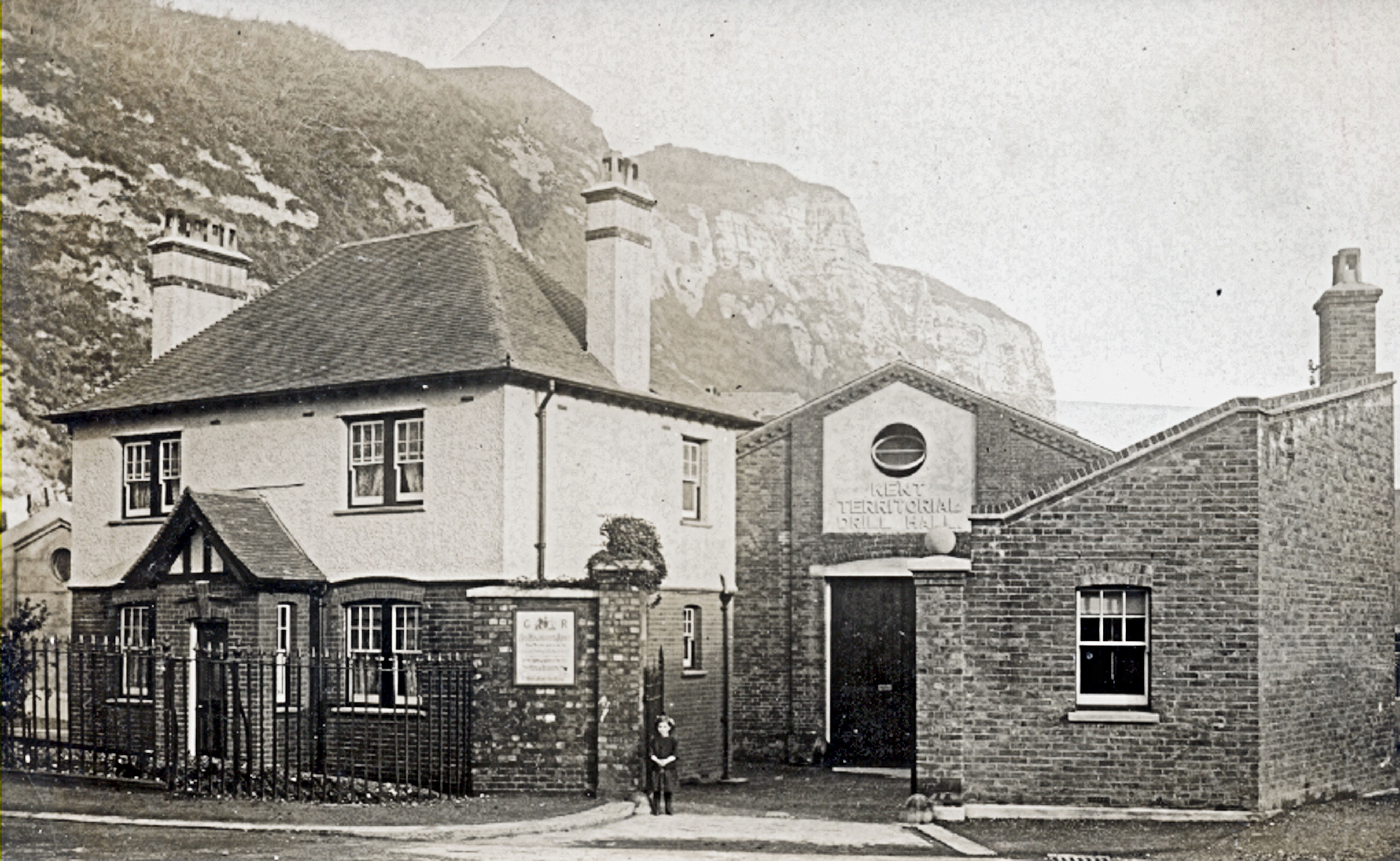
The Prison Act of 1877 aimed at coordinating the prisons and practices within prisons. The Home Secretary at the time, Conservative Sir Richard Cross (1823-1914), was given the power to centralise British prisons and this was delegated to the Board of Prison Commissioners with the support of an inspectorate. Prison reformers, such as James Neild, had been canvassing for a change in dealing with convicted prisoners for over a century. They wanted prisons to change from pure punishment to include reforming of the prisoner in order that when they were released, the prisoners could then become worthy members of society. This, it was felt, was best achieved by cutting the length of sentences and implementing continuous and methodical employment of criminals in useful labour. These reforms were to be implemented under the authority of the Convict Labour Commission.

The following five years saw a general fall in the number of prison inmates while the general population increased. Although this could be attributed to the implementation of reduced sentencing the Convict Labour Commission announced that it was the reforms they had introduced and looked at making further prison reforms. One of these was the building of new prisons designed to meet the changes in the general philosophy of prison reform. Considerations taken into account was to be the locality stating that the new prisons were to be built and of a type where there was no risk to either the public or the management of the prisoners. The prisons were to be able to provide continual employment to the inmates for a number of years and the work itself was to be of a national utility that would not pay if undertaken in any other way. Finally, two sorts of work were considered ideal, the construction of harbours of refuge and the reclamation of land.

Harbour prior to start of the Harbour of Refuge - Commercial Harbour c1890. Ian Cook

Harbour prior to start of the Harbour of Refuge – Commercial Harbour c1890. Ian Cook

Dover had been fighting for a Harbour of Refuge from the eighteenth century and in 1848 construction of the western arm – the Admiralty Pier – was started. Subjected to delays for financial and political reasons, the Pier was not completed until 1871 and both the Dover Harbour Board and Dover Corporation were in despair as to whether the eastern arm would ever be built. Nonetheless, the town kept up the pressure and in 1875, the Government introduced a Bill for the formation of a Harbour of Refuge at Dover! This stated that the new harbour would enclose 300 acres of the Bay at a cost of £970,000. Having quickly passed through preliminary stages, the Bill was referred to a Select Committee. The delegation, on behalf of Dover was led by the Commander-in-Chief HRH Prince George, 2nd Duke of Cambridge (1819-1904) and supported by Naval surveyor Major-General Thomas Collinson (1821-1902), Civil Engineer Sir John Hawkshaw (1811-1891), Dover Harbour Board’s Register James Stilwell (1829-1898), Hydrographer of the Admiralty Captain Evans, the Board of Trade resident engineer at Dover Edward Druce (d 1898) and others.

In June 1875 the Committee reported to the House of Commons that the formation of a large harbour at Dover, from a naval and military point of view, was of great importance, particularly as there wasn’t a coaling place between Portsmouth and Sheerness for refuelling ships. Further, there was no proper place for embarking troops onto ships from the major barracks at Woolwich, Chatham, Sheerness or Portsmouth. However, on the 25 June that year, the Government withdrew the Bill on the grounds of lack of finance. Frustrated, in July 1882 the Dover Harbour Board decided to try and raise the money to build the proposed harbour themselves. They applied to Parliament asking for the powers necessary to create a Harbour of Refuge together with a Commercial Harbour that would enclosed Dover bay as far as the Northfall Tunnel – Eastern Cliffs. The proposal was given Royal Assent but before work commenced, the Government intervened with a proposal of its own.

The Prison Commission’s Report had been published in January 1883 and the proposed Harbour of Refuge/Commercial Harbour at Dover, fitted in with the recommendations. Thus, the Government would partially fund the proposal as long as convict labour was used. The Prison Commission was so excited about the proposal, even before it had been officially sanctioned, they had produced a work plan! This gave the size of the convict groups that were ideal for undertaking such work and how other problems would be dealt with. Their conclusion was that the groups would be small, kept separate and work under the watchful eyes of two or more warders. However, it would appear that the Commission had not taken into account the rise and fall of the tides, particularly the extent of the strength during spring tides and that they were cyclical, that is, two weeks after the strong spring tide there would be the weaker neap tide. Further, that the times of high tide change on a daily basis and that the strength of the wind has a direct effect on working conditions. Finally, satisfied that both problems of tides and weather were insurmountable they agreed that they had to be accommodated within the regime of running an efficient prison. Nonetheless, there was the concern over what would happen to the convicts once the harbour was finished and therefore, to justify building a prison, to build a Harbour of Refuge at Dover, this project was to take at least 20-25years.

Fox Hill Down east of the Castle and, these days, owned and conserved by the National Trust. LS

Fox Hill Down east of the Castle and, these days, owned and conserved by the National Trust. LS

The Commission asked the Board of Trade resident engineer at Dover, Edward Druce  to find a suitable site and he suggested Fox Hill Down, to the east of the Castle. It was owned by the Ecclesiastical Commission and was accessed from the Seafront, at that time, by the Northfall Tunnel. The major drawback was the lack of suitable building material in the vicinity but the Commission suggested that this could be brought in barges from Rye using convict labour. On 16 January 1883 came the news that Major-General Sir Andrew Clark (1824-1902), Inspector General of Fortifications (1882-1886) had been told by the Home Office that the Government had decided to construct a National Harbour at Dover. Further, the work was to be undertaken by convict labour. The Dover Express of 19 January stated that the prison buildings would be permanent and once the new Harbour of Refuge was built, they would become barracks for the Castle garrison.

Although the new prison was going ahead, parliament had not sanctioned the Dover Convict Prison Bill. To rectify this the Home Secretary, Sir William Harcourt (1827-1904), presented the Bill to the House of Commons on 23 February 1883. He stated that the harbour project would take 12 years to complete and approximately 900 convicts would be used. The scheme, he said, would cost £790,000 but a larger scheme costing £1,040,000 would be more cost effective in the long run as it would provide a suitable Admiralty harbour and provide work for the convicts for a longer period. He finished by saying that for the duration of the project, the convicts would be transferred to the Admiralty and on completion of the Harbour of Refuge, would be transferred back to the Prison service. As the Bill progressed through parliament, Sir William emphasised the need for a new project as the work for convicts at Chatham and Portsmouth was coming to an end. He showed little interest in the Dover Harbour of Refuge aspect of the proposal other than lengthening the proposed time it would take to build.

Taking into account Harcourt’s recommendations, a Parliamentary Committee, in April 1883, sanctioned the Harbour of Refuge proposal to be built at Dover employing convict labour. That the new harbour should be 520 acres and that it was to take about 25 years to build. In August that year, parliament approved that £16,000 could be spent on the proposed prison and 20 acres of cliff-top land was to be purchased from the Ecclesiastical Commissioners. In Dover, the desperate need for a Harbour of Refuge/Commercial Harbour engendered a general feeling of disappointment due to the length of time it was going to take to build. Nationally, this was seen by many commentators that Dover was against the use of convict labour per se. Although this was vehemently denied by Dover Harbour Board and Dover Corporation, the Prime Minister (1880-1885) William Gladstone (1809-1898) reacted by saying he was putting the proposal on hold until an expenditure survey had been made.

Nonetheless, the land for the prison was bought and the contract for building it was advertised. Several firms, including three from Dover, put in tenders and the contract was won by Denne of Walmer. He had projected to do the job for £25,000, the lowest tender and that it would be finished within a year. Within hours of winning the contract Mr Denne was looking at the site, which was about half a mile from the Castle where the ground gradually sloped down to the edge of the cliff. When Mr Denne arrived, Major Hardiman met him and already there was a pile of several thousand bricks waiting on the three acre building site. The governor’s residence, Mr Denne was told, was to be to the west of the Prison and to the east, warders’ houses. There would be a prison hospital, a separate laundry, administration block, bakery and engine room. The actual prison was to be three storeys high and the complex surrounded by a 15-foot high solid boundary wall that would be about three-quarters of mile in extent.

Schematic drawing from memory of Langdon Prison by Major R Corbett. Dover Library

Schematic drawing, from memory, of Langdon Prison by Major R Corbett. Dover Library

The contract also included the building of a road at the back of the proposed prison to a prison yard, which would be down the hill on Northfall Meadow. Additional bricks to those already at the site were to be made by Mr Denne’s firm and would be brought from Walmer by cart to the Lone Tree on the Dover-Deal Road (A258). There they would be transferred onto a horse drawn tramway to the site. The tramway was to be built by the Royal Engineers and this had been arranged with the Earl of Guilford, who owned the land between the proposed prison and the Dover/Deal Road. Stone and timber was to come from Dover and it was hoped that much of the labour for building the prison would also come from Dover. In fact, labourers came from far and wide with many lodging in St Margaret’s. At the same time  Royal Engineers were going to create two reservoirs and erect water tanks to the north-east of the prison complex and sewerage tanks to the west.

By this time, it was accepted that the Harbour of Refuge would  not be completed for a long time but hopes were raised in April 1885, that the project would soon start when a major survey of Dover Bay was undertaken. This was under the superintendence of oceanographer and hydrographic surveyor Captain Thomas Henry Tizard (1839-1924) of Her Majesty’s, ship Triton. The area covered extended from Shakespeare Cliff on the west to Langdon Bay on the east, the distance off shore was a little over 1¼ miles. On 31 August 1885 the first batch of, 50 convicts arrived at Priory Station guarded by 10 warders. The event was reported by the Dover Express (04.09.1885), who wrote that the convicts ‘were handcuffed in couples and fastened together in five groups of ten by chains. They wore the usual convict garb, red and yellow coats, yellow scotch caps, grey stockings and yellow knickerbockers.’

Although Denne had stated that he would build the three blocks of prison cells within the year, he only completed the ancillary buildings and block, ‘A’ by the end of the year. The remaining two blocks were given over to the Royal Engineers to superintend using convict labour under the watchful eye of armed warders. When the prison was completed block ‘A’ was at the top, the exercise area on the second level together with block ’B’ and block  ‘C’, on the level nearer the sea. All were surrounded by a high wall.

A Dover Express reporter, along with a group of councillors, were allowed to look round the prison in May 1886. At the time convicts were laying the steep road from the Dover/Deal Road via Northfall Meadow to the site of the prison – now called South Foreland Road. The visitors travelled in wagons pulled by horses along this road and the reporter tells us that as they passed the convicts, they all stopped work and at the command of the warder turned their backs to the visitors. At the top of Langdon Cliff, the visitors approached the prison gates and were met by several officials, all of whom were ‘gentlemen’. The reporter tells us that on the right of the entrance was a waiting room, opposite which was a large reading room and library for the use of the warders. The visitors then crossed the courtyard, to the right of which were offices, in the centre was the work complex that included the kitchen, laundry and workrooms and on the left, the prison hospital. In front of them was a large building with the letter ‘A’ painted on the wall.

Langdon Prison 1905. Dover Museum

Langdon Prison 1905. Dover Museum

They were accompanied to block ‘A’ by a warder who took out a large bunch of keys and unlocked an iron gate, then a sturdy door before the visitors could gain entry into the building. The first thing that struck them was the cleanliness and airiness of the place. The floor was described as being made of asphalt and that it shone through continual sweeping. The block had three storeys that were open to the centre of the building with iron galleries stretching along the full length and across the two upper floors. The cells were surprisingly large with high ceilings. In each cell, facing the door was a shelf that contained a rolled up hammock with its bedding. Let into the wall of the cells, some two to three feet above the floor, were two eyelet holes from which a hammock was slung at night. Behind the door was a triangular shelf on which, in some cells, were useful books such as Castell’s Popular Educator and Chamber’s Journal. On each cell door was the occupant’s name and number while on the walls outside were ‘notices to convicts’ and a dietary table. Night soil was collected in the morning and each prisoner was responsible for cleaning his own latrine.

The visitors were then shown around the common area on the ground floor of block ‘A’. This housed a large stove for heating the building and a reading stand. On a wall the reporter saw a notice listing which prisoners were allowed to grow their hair and cultivate whiskers. The visitors then left the building and were taken to the kitchen and were met with ‘an appetising savoury smell’. The kitchen was large and contained all the latest implements and cooking utensils. About half a dozen convicts were doing the washing up watched over by a warder. On the table were brown loaves of various sizes, the larger ones being for breakfast and supper and the smaller ones for dinner. The visitors were then told about the daily allowance of food and given the opportunity to see the pantry where it was kept and to taste the beverages. They reported that both the tea and cocoa were of good quality. Near the kitchen was the workroom. There, convicts were employed in shoemaking, bookbinding and darning stockings. In the same complex were the bathrooms where convicts received a weekly ‘tubbing’.

Down the steep incline towards the cliff edge, at the time, two other prison blocks were being built. Prisoners were laying the foundations for prison blocks, ’B’ and ‘C’ and the reporter tells us that ‘… high above them on scaffolds were posted several armed warders, who were not only able to see the movements of the men beneath but had the advantage of taking in at a glance the whole of the prison and some distance beyond.’ Before leaving the prison, the visitors were taken into the prisoner visitors’ room. Immediately in front of them, wrote the reporter, were iron bars that went across the width of the room separating the inmates from their visitors. Set into the wall at the far side of the room, on the other side of the iron bars, was the door by which the convict and warder entered. There were no chairs so all remained standing with the guard standing to one side of the prisoner between him and his visitor. This was to ensure that they could speak to each other but that nothing could be passed. In their report of the visit, the councillors were impressed with what they had seen saying that Langdon prison was as comfortable and agreeable as circumstances would allow.

By July 1887, no decision had been made about the proposed Dover’s Harbour of Refuge and questions were asked in the House of Commons, particularly in relation to the employment of convicts at Langdon Prison. Conservative Arthur Balfour (1848-1930) replied on behalf of the government saying that if the harbour works proceeded they should not be by half measure in a desire to save large sums. He declined to expand further on the future of either the prison or the Harbour of Refuge. A month later the questions were again raised when the Home Secretary (1886-1892) Henry Matthews (1826-1913) stated that £68,000 had been earmarked for the prison project and thus far £49,000 had been spent. ‘That having spent that amount of money it was obvious that the government was going to carry out its intentions.’ He went on to say that the government‘s policy was to take all prisoners, not under sentence of death, out of London and to place them on public works in the country. Another MP, without being called by the Speaker, shouted that Mr Matthews had not answered the question and this was followed by a chorus of ‘here, here.’

1960s map showing the location of Langdon Prison Barracks site on the Eastern Cliffs

1960s map showing the location of Langdon Prison Barracks site on the Eastern Cliffs

In the House of Commons, on 4 April 1888, Dover’s Conservative MP (1874-1889) Major Alexander Dickson (1834-1889) tabled the question asking for the government’s intention regarding both the harbour and the convict prison. The Leader of the House of Commons (1887-1891) William Henry Smith (1825-1891) – later Lord Warden of the Cinque Ports – replied saying ‘that it was not the intention of the Government to proceed with the harbour in question.’ Stunned, Major Dickson questioned the cost of the prison thus far and its future purpose, William Smith replied that the total expenditure had been £61,575 10shillings 9pence. Of which £48,400 5pence had been spent on buildings and £13,175 10shillings 4pence for land. Mr Smith went on to say that although the prison had been built to supply labour to build a Harbour of Refuge, that there were doubts over Dover being the best place for such a harbour and it was for this reason it was considered to suspend further outlay.

In Dover, both the Harbour Board and the Corporation looked at other means to build the badly needed Harbour of Refuge/Commercial Harbour. Meanwhile at Langdon prison, it was business as usual. In 1889, the staff consisted of Governor – Captain F Johnson, Deputy-Governor – Captain W E Balle, Chaplain – Rev. John Core Tipper, Medical Officer – H Smalley, Assistant Surgeon – C H Mayhew, Steward – M D Hogg, Foreman of Works – G R Waters and Chief Warder Seymour. The number of inmates was 102 and their main occupation was sewing mailbags. Dover Harbour Board, on 3 October 1890, again applied to parliament for permission for them to build a Harbour of Refuge/Commercial Harbour and for it to be built by a private contractor using ordinary and convict labour. All the government departments except the Admiralty gave approval for the harbour project while the Home Office withheld their support from using convict labour.

At the time what became the Penal Servitude Act of 1891 was going through parliament. This enabled Courts to pass sentences of three years and upwards, instead of a minimum of five years. Not only was this expected to reduce the prison population but would also reduce the need to find outside employment for prisoners that was giving rise to discontent from the unemployed. Work started on the eastern arm of the Dover Harbour of Refuge/Commercial harbour – this became the Prince of Wales Pier. The contract was given to Sir John Jackson of Westminster but approval for the use of convict labour was not forthcoming. Four years later, in 1895, the prison population at Langdon had been reduced as prisoners were starting to be moved to other prisons. The staff remained and government officials reassured the town that the prison was not going to close.

Liberator Building Society Advert of 1887 in Dover's press giving James Bland of Priory Hill as the local agent.

Liberator Building Society Advert of 1887 in Dover’s press giving James Bland of Priory Hill as the local agent.

This appeared to be confirmed when the prison received its most high-profile inmate Jabez Spencer Balfour (1843-1916). Balfour had been the Liberal Member of Parliament for Burnley (1889-1893) and before then had been an MP for other constituencies. In 1867 he founded the Lands Allotment Company, the following year the Liberator Society that purported to be a building society. These were followed, in 1875, by the House and Land Investment Trust. By the interchange of cheques between the three companies he and his associates had produced sufficient paper profits to attract small investors. More companies were then set up and the paper profits continued to increase, some buildings actually saw the light of day. All of which attracted thousands of small savers, mainly working men, shop keepers, professional men, ministers of religion and women of slender means. In 1892 one of the companies collapsed and by the end of that year they all had, with total liabilities of £8,360,000. All the small savers lost their money. Balfour disappeared and turned up in Buenos Aires three months later. The extradition proceedings took two years then in May 1895 he was charged at Bow Street magistrates court and following the subsequent trial was sentence to 14-years penal servitude for conspiracy and fraud. The collapse of the Liberator group of companies led to the 1894 Building Societies Act that required Societies to keep and present full accounts, to maintain lendings at a manageable proportion to deposits and for them to be used for the purpose as laid down in the Building Society Acts. In November 1895 Balfour was incarcerated in Langdon prison.

While all of this was going on, parliamentary approval was being sort for the Undercliff Reclamation Bill, the main given purpose of which was the prevention of sea erosion at the base of Dover’s Eastern Cliffs. In early 1895 there was a severe frost, lasting several days, that had caused a number of cliff falls along the stretch of coast between Dover and St Margaret’s Bay. In February 1895, Chief-Warden Luxon was almost killed when he was returning to the prison from East Cliff by way of the then Northfall Tunnel. As he was about to emerge at the prison end, there was a massive cliff fall that eventually blocked the exit. Luxon managed to escape but there were fears that ‘C’ block may succumb to a cliff fall and it was evacuated. In their evidence to Parliament on the Undercliff Reclamation Bill, Dover Corporation showed that over the previous 25 years the encroachment of the sea had given rise to numerous cliff falls along that stretch of the coast. To build such a wall, they said, would be an excellent use of convict labour.

Sir William Crundall 1847-1934 Mayor thirteen times between 1886 and 1910. David Iron Collection

Sir William Crundall 1847-1934 Mayor thirteen times between 1886 and 1910. David Iron Collection

The Undercliff Reclamation Bill, was in fact a private business venture sponsored by Sir William Crundall (1847-1934) – thirteen times Mayor of Dover from 1886 to 1910 and Chairman of Dover Harbour Board from 1906, Sir John Jackson – who was building the Prince of Wales Pier and Weetman Dickinson Pearson, 1st Viscount Cowdray (1856-1927) – the eminent construction engineer. In reality, the ultimate purpose of the Bill, as far as the three men were concerned, was not the prevention of sea erosion at the base of Dover’s Eastern Cliffs but to build a road to St Margaret‘s where they planned to develop an exclusive housing estate made up of palatial detached homes in extensive grounds. (See Dover, St Margaret’s and Martin Mill Railway Line – Part I).

Dover Corporation, Dover Rural District Council, St Margaret’s Parish Council and the editor of the Dover Express, John Bavington Jones all recognised what the three developers real intentions were. They all backed the Bill as it was the only way they could see a seawall being built. Further, they all guessed that if convict labour was not used, the three developers were likely to take the road over the cliffs, which was a cheaper option. For their part, government cabinet ministers and department officials were at great pains to reassure the different councils and Bavington Jones that prisoners were being moved out due to the closure of block ‘C’. They also implied that the move was to make room for more robust convicts, who could tackle the hard manual work required to excavate the Undercliff. Further, according to Bavington Jones, the Labour Party’s Keir Hardie (1856-1915) along with Trade Unionists John Elliot Burns (1858-1943) and Henry Broadhurst (1840-1911) were prepared to back convict labour being used along with skilled labour to  build a seawall and road to St Margaret’s.

Dover Harbour 14 July 1903 Prince of Wales Pier to the right Admiralty Pier. Wellington Dock near the camara with Waterloo Crescent and Esplanade Nick Catford

Dover Harbour 14 July 1903 Prince of Wales Pier. To the right is the Admiralty Pier. Wellington Dock nearest the camera with Waterloo Crescent and Esplanade. Nick Catford

In Parliament, Herbert Asquith (1852-1928) – the Home Secretary (1892-1895), announced that although the Penal Servitude Act was reducing the prison population, the provision of free labour by convicts was causing discontent amongst the unemployed. This being so, he was very much against convicts being used for what was private enterprise. In the autumn of 1895, the Home Office announced that ‘Owing to the decision not to proceed with the Harbour of Refuge by convicts, there has been no outdoor employment for them at Dover…’ Langdon prison was to close on 30 January 1896. In May 1895, when about three-quarters of the Prince of Wales Pier had been completed, the Admiralty announced its decision. It was going to use the port of Dover as a base for the Royal Navy and that an Admiralty Harbour would be built by private contractors to enclose Dover Bay!

Balfour, in January 1896, was one of the last prisoners to leave Langdon Prison. He was transferred to Parkhurst Prison on the Isle of Wight and due to exemplary conduct was released after 10½years. At Easter 1897, the former convict prison housed some 3,000 Surrey Brigade of Military Volunteers who had come to Dover on a military training exercise. The Admiralty Harbour, we see today, was given the go ahead and on 9 November 1897 it was announced that Viscount Cowdray’s company – Pearsons, were to be the main contractors, Sir John Jackson was a subcontractor and Dover Harbour Board, under Sir William Crundall, was to be actively involved.

Langdon Convict Prison / Broadlees Military Prison Langdon Cliff Map c 1903 showing location notereservoir caption & the proposed road to St Margarets. Dover Library

Langdon Convict Prison / Broadlees Military Prison Langdon Cliff Map c 1903 showing location. Note reservoir caption & the proposed road to St Margarets. Dover Library

When work on the Admiralty Harbour was started the Northfall Tunnel was closed and a pathway was excavated with the prospect of it eventually becoming a broad road connecting Dover to the South Foreland. A subterranean tunnel, from the precincts of the old prison to the beach below, was hewn within the cliffs and parallel water pipes were laid. The water was piped from the prison reservoirs to the Eastern Arm building site. Besides the reservoirs on maps of that time is the statement, ‘Soft water for use by the Admiralty.’ This has been interpreted to mean that the water was to be used for ship’s boilers, as hard water was not suitable. The Martin Mill – Dover light railway line was cut across the cliffs to carry shingle for the construction of concrete blocks at what became the Eastern Dockyard and passed close to the prison site. On reaching the cliff edge, the wagons were emptied into side tipping skips that were taken down the cliff face on a funicular.

In March 1899, it was rumoured that Portland Prison, Dorset, was to close and that the convicts there were to be moved to Dover. This turned out to be speculation for although inspectors from London were looking at the prison on Langdon Cliffs, this was for other purposes. In September 1900, the War Department announced that they were going to use the Broadlees Prison complex – the new name for Langdon Prison – as a military prison for the South Eastern, Woolwich and Thames District. On the recommendation of the inspectors representing the Military Board, alterations of an extensive character were going to take place to make the buildings suitable before prisoners could be moved in.

Work started almost immediately with’C’ block being demolished, and the cells in ‘B’ block  made larger by knocking two cells into one. The former ‘B’ block was extended eastwards with a separate equal size annex. These two blocks were renumbered ‘A’ and ‘B’ block and the former ‘A’ block renumbered ‘C’ block. In August 1901 official approval was given for the New Military Prison by the Secretary of State for War, William St John Broderick (1856-1942). It was reported that the prison would be under the superintendence of a full time army officer graded as a military governor second class. Further, the person chosen would be fully aware of the ‘more enlightened system of military prisons that was being introduced.’ Under this system, prisoners were treated more like soldiers than criminals so that they would be useful members of the military establishment.

Broadlees Prison, Langdon Cliff Agreement between War Dept & Dover Corporation re Drainage 09.12.1903 - Dover Library

Broadlees Prison, Langdon Cliff Agreement between War Dept & Dover Corporation re Drainage 09.12.1903 – Dover Library

At the time, Britain was heavily involved in the Boer War (1899-1902) in South Africa, and this had given rise to 1,377 convictions with most serving their sentences in South Africa. It soon transpired that the prisoners to be sent to Broadlees Military Prison were those who had been sentenced to heavy terms of imprisonment at the Front. Generally, they were said, to be very dangerous characters who had committed atrocities of the worst kind. Further, even though the prisoners were of such character, they were still to be treated more like soldiers than criminals and once they had served their sentences they were to be discharged from the army. Another announcement stated that Broadlees was to be the largest military prison in the country and further building work included the only two buildings still standing, these were at the eastern end of the prison. A stable block was built next to the Governor’s house, a house for the Chief Warder and a married quarters block for prison warders to the north-west. Not long after 380 cells were certified for use.

The criminal-soldiers started arriving by the end of 1901 having been brought from South Africa by ship with most disembarking at Dover. They were handcuffed, had shackles around their ankles and walked from the harbour to Athol Terrace at the base of the Eastern Cliffs. They then had to climb the steep path that had been recently excavated, to the prison gates. It was reported that locals felt sorry for the prisoners, as the shackles around the ankles made it difficult for them to climb up the steep path.

Field Marshall Lord Frederick Roberts (1832-1914) being given the Honorary Freedom of Dover 28 August 1902. Dover Museum

Field Marshall Lord Frederick Roberts (1832-1914) being given the Honorary Freedom of Dover 28 August 1902. Dover Museum

Of the prisoners sent to Broadlees Prison at this time, five had separately been found guilty of sleeping at their posts. Field Marshall Lord Frederick Roberts (1832-1914), Commander in Chief of the Forces, had been asked to look into their cases as it was believed the punishment was far in excess of the seriousness of the crime. The Field Marshall did as he was bid and found that they had all been found asleep and had therefore put in jeopardy what they had been assigned to guard. However, in each case the men had been on duty in excess of 24hours, without a break and including having to relieve themselves while at post. The results of his inquiries were passed on to the relevant authorities and their convictions were over-turned on the grounds of mitigating circumstances. The soldiers were released on 3 September 1902, a week before Lord Roberts received the Honorary Freedom of Dover.

Broadlees Military Prison, Langdon Cliff, Governor and Staff. Dover Library

Broadlees Military Prison, Langdon Cliff, Governor and Staff. Dover Library

It was about this time that the prison was up-graded from a second class Military Prison to a first class one and Major G.S. Haines was appointed governor. Major C.C. Daniels of the Royal Scots succeeded as prison governor in May 1904 and on 13 August 1904 a prisoner named Taylor asked to see him. At the interview, Artilleryman Taylor confessed that he had committed the Peasenhall murder and that it was preying on his mind so much that he could not think.

The murder had taken place in the village of Peasenhall, Suffolk on 31 May 1902. At about midnight Rose Harsent, a servant girl, had her throat cut and sustained deep gashes to her shoulders. She was unmarried and six months pregnant. After a police investigation William Gardner, a church stalwart and foreman at the local seed drill works was arrested. The father of six children, Gardner had an affair with Rose in 1901 but at the time of Rose’s death, he was at home in bed with his wife who staunchly corroborated this.

Gardner was brought to trial at Ipswich, Suffolk on 7 November 1902. The prosecutor was Henry Fielding Dickens (1849-1913), a son of author, Charles Dickens (1812-1870). He was also Deal’s Recorder. The jury reached a verdict of 11 to 1 in favour of conviction. In those days, for a conviction to be acceptable the jury had to be 100% in agreement. Gardner’s retrial took place on 21 January 1903, again the prosecutor was Dickens, but this time the 10 out of the 12-man jury returned the opposite verdict of not guilty. Instead of yet another retrial, Dickens’ offered a  writ of nolle prosequi, which meant that Dickens had declined to further pursue the case against Gardner.

Artilleryman Taylor, the prisoner at Broadlees, came from Peasenhall and had, in 1903, been found guilty of enlisting using fraudulent papers. Superintendent Staunton of Suffolk County Police came to the prison and interrogated Taylor. It was evident to him that Taylor had detailed knowledge that would only be known to someone closely involved and the interrogation finished with Taylor signing a confession. This, along with the Superintendent’s report, was sent to the Home Office. A few days later it was reported that neither Superintendent Staunton nor Major Daniels had believed that Taylor was the murderer and the case against him was closed. It later transpired that Rose was a flighty lass who had a string of lovers but these days it is generally thought that her murderer was Gardner’s wife.

In September 1907 it was announced that the Broadlees Military Prison was to close and that no more prisoners were to be sent there after 1 October that year. It was finally closed on 28 February 1908 when the eighteen remaining prisoners were removed to Woking prison. Locally, two sets of speculations abounded. First, that the buildings were to be converted into barracks, but even the speculators recognised that this would require extensive internal gutting and rebuilding. The alternative view was that as the site actually belonged to the Prison Authorities and was on loan to the War Office, it was likely to become a civil prison. All speculation ceased when the Home Office announced that the prison was to be used for juvenile offenders under a special system that had been introduced in 1902, at Borstal Prison, Rochester. The Home Office planned to re-open Borstal prison as an ordinary convict establishment.

Langdon - Broadlees Prison 1915. Dover Museum

Langdon – Broadlees Prison 1915. Dover Museum

At this time, the War Office was concerned at events in Europe. In 1890, Germany, under Wilhelm II (1888-1918), had been pursuing a massive naval expansion. It was this that had galvanised the British government to build the Admiralty Harbour as a base for the Royal Navy and in 1900, at the prison, an observation post was built next to the tunnel going down to the seashore. The juvenile offenders institute project at Langdon was abandoned and as World War I (1914-1918) loomed the Admiralty ordered the prison to be converted into Naval Barracks. Besides housing naval personnel the site became a military transit camp for troops going to the Western Front.

Langdon Cliffs with the steep zigzag path down to Fan Bay clearly visible. LS

Langdon Cliffs with the steep zigzag path down to Fan Bay clearly visible. LS

To help protect the Admiralty Harbour from attack, a cave was excavated part-way down the tunnel to house Langdon Battery, which was equipped with three 9-inch guns. To the east, three searchlight batteries were installed with generators nearer the seashore in order to illuminate passing ships for identification. They were accessed by a steep zigzag path, known as the Langdon Stairs or from Fan Bay beach below by a ladder. During the War a medical centre was built next to the observation post in the former prison compound and at about the same time the water pipes from the reservoirs were strengthened. The water was for use by naval vessels moored in the Camber in the Eastern Dockyard. In February 1918, a ship aiming shells at Langdon Battery hit the former prison injuring two soldiers.

East Arrow Block just below the Castle and demolished in 1984. The photograph shows the excavation of the A2 Jubilee Way in the 1970s. Dover Museum

East Arrow Block just below the Castle and demolished in 1984. The photograph shows the excavation of the A2 Jubilee Way in the 1970s and the coastguard cottages nearer to the camera. Dover Museum

Following the War, work started on converting the Castle infantry quarters. This included building four blocks of new quarters on the cliff just below the eastern side of the Castle. To save money, bricks and other materials from the former prison were utilised. A small tramway was laid, worked by motors and wire ropes, that hauled the wagons down the hill from the prison site and up again to the construction site. On 25 July 1924 the demolition of block ‘C’ began and by the end of 1925 the East Arrow Block, as it was named, was completed. The complex was demolished in 1984 and the photograph on the right shows the excavation of the A2 in the 1970s with the East Arrow Block below the Castle and the coastguard cottages nearest the camera. Back in 1925, only the former governor’s and chief warder’s houses the prison hospital, some storage buildings and the strong prison walls, of Langdon prison remained. The former prison site was again renamed, this time to Langdon Barracks. The former governor’s house was named Mount Kemmel and the chief warder’s house became The Red House. Langdon Barracks were given over to the Coastal Defence Artillery to be manned by the Territorial Army (TAs), supported by a small artillery unit from the regular Royal Garrison Artillery who permanently occupied the Barracks.

At the beginning of World War II (1939-1945), Mount Kemmel was commandeered as the headquarters of the Royal Artillery 75th Anti-Aircraft Regiment, who were manning the Dover batteries. The Red House became the home of the Master Gunner and his family, the hospital became the Sergeants’ Mess and the other building were used for storage. Again, the tunnel from old prison to the beach and Langdon Battery was re-equipped with defensive measures. Langdon Hole Deep Shelter was excavated and comprised of two parallel tunnels lined with steel and with iron girders for support. The water pipes from the reservoirs were extended to the end of the Eastern Arm to provide running fresh water for the staff and the Batteries there. Towards the end of the war through to 1948, Langdon Barracks were used for German prisoners-of war awaiting repatriation.

One of the two former Prison buildings at Langdon Cliff that are still standing. The plaques give date of construction in 1902 and refurbishment in 1995. A Sencicle

One of the two former Prison buildings at Langdon Cliff that are still standing. The plaques give date of construction as 1902 and refurbishment in 1995. A Sencicle

Early in the 1950s the entire former prison site, with the exception of the two 1902 buildings, was cleared. Dover Harbour Board demolished the old reservoirs and constructed two new ones to the rear of the 1902 buildings. The new water pipes had wider apertures than the former ones and they were carrying considerably more water from 330-feet above the Eastern Docks, a pressure break tank was built about 115-feet above the dock buildings. In 1989, it was reported that the daily consumption of water from the reservoirs at Eastern Docks was approximately 300,000 gallons a day!

Dover Rural Council, in 1959, accepted a suggestion by the War Department Land Agent that they should take up the lease of 25 acres of land at the top of the Eastern cliffs. It was also suggested that the site of the former Langdon Prison should be laid as an official car park and public open space. Unfenced, the site became a favourite place for parties and  occasional public concerts. Following the successful outcome of the referendum to join the European Community in 1975, a massive party was held on Langdon Cliff! The site was transferred to Dover District Council (DDC) in 1974, following Local Government Re-organisation but due to legal complications the transfer was not completed until 14 April 1976.

 Langdon Cliffs - Visitor map.

Langdon Cliffs – Visitor map.

In order to raise money to pay for the ill-fated White Cliffs Experience, DDC, in the 1980s earmarked the former prison site for redevelopment but following the National Trust buying five miles of Eastern cliffs coastline, through its Operation Neptune Project, DDC gave it to them. As the area is rich in chalk-turf species such as horseshoe vetch, sheep’s fescue, salad burnet, wild thyme, wild carrot and alexanders, in the early 1990s the area was designated a Site of Special Scientific Interest (SSSI). In 1995, the two remaining buildings from the old prison were restored and are now used for administrative purposes. The land has been landscaped, laid out with walks and car parks and in 1999 the visitor centre and café opened. A permanent team of staff supported by volunteers’ run the complex. The National Trust’s main aim is to get visitors to appreciate the surrounding countryside and the areas history and visitor information panels have been erected. Much of the finance is raised locally, by the volunteers and special events.

The visitor centre is open daily throughout the year excluding Christmas Eve and Christmas Day and offers a selection of homemade lunches and cakes. Free maps are available at the visitor centre that shows the walks over the cliffs to South Foreland Lighthouse, which is also well worth a visit. En route there is the Fan Bay Deep Shelter (see Swingate story part II) and both the Lighthouse and the Shelter are open four days a week from Easter to October.
For more information: http://www.national.trust.org.uk/the-white-cliffs-of-dover

  • Presented: 14 March 2016
Posted in Armed Services, Courts, Crime & Punishment, Langdon Prison, Langdon Prison, Langdon Prison, Langdon Prison - Broadlees Prison, Open Spaces, Tourism | Comments Off on Langdon Prison

Origins of the Cinque Ports and Dover Part II

Dover Castle

Dover Castle

Henry III (1216-1272) ascended the throne when he was only 9 years old but like his father’s, King John (1199-1216), reign it was a stormy one. Following the Battle of Dover of 24 August 1217 (see Origins of the Cinque Ports and Dover Part I), the Cinque Ports mariners, known as Portsmen, settled back into earning their living locally. This was from the sea by fishing, ferrying people and goods across the English Channel and piracy. The latter they were able to get away with as the Court of Shepway was the only external court they recognised where the judges were all Portsmen! To try and put an end to the piracy, Henry in 1226, created the post of Warden of the Cinque Ports. At first the Warden, was jointly held by the Constable of Dover Castle, the Lord of Folkestone William d’Averanche at that time. The other person was the Prepositus of Dover who also acted as the Mayor of the town, Henry Turgis at that time. The role of the Warden, it was decreed, was to preside over the Court of Shepway and this the Portsman accepted.

Map showing the Cinque Ports and the two Antient Towns. Dover District Council

Map showing the Cinque Ports and the two Antient Towns. Dover District Council

From thereon, however, the Portsmen only accepted Royal orders or mandates from the Crown if they came through the Warden. This they were able to do as they provided Ship Service that was, effectively, the Royal Fleet of maritime England. The Cinque Ports were Hastings, Romney, Hythe, Dover and Sandwich and their role, function and privileges were decreed by Charters. In 1229, Henry issued another Charter to the Cinque Ports that was subsequently lost. A copy dated 1300, was discovered in 1931 in New Romney. This stated that the five ports were equal in status and privileges but differed in the number of ships and crew they were bound to provide for Ship Service. As a whole they were obliged to supply 57 ships a year for 15 days with 20 men and a boy for each vessel and at the Ports expense. The Ship Service was divided with Dover and Hastings being obliged to provide 21 vessels each and the other three towns, 5 vessels apiece. If, however, the King wished to retain the vessels in excess of that period then he would pay the costs.

13th century Cinque Ports ship

13th century Cinque Ports ship

When Ship Service was first instituted, during the reign of Edward the Confessor (1042-1066), Dover was required to provide 20 ships and in order to comply, the town was originally divided into 20 wards with each ward providing a fully crewed ship. At different periods of time the number and names of the wards changed. By 1429, when the names were fully recorded there was 21, Bekyn, Burman, Bully’s, Canon, Castledene, Derman, Delfys, Deeper, Halfguden, Horsepol, Moryns, Nankyn, Ox, Snargate, Syngyl, St Mary, St George, St Nicholas, Upmarket, Werston and Wolvys.

It was evident from the 1229 Charter that Dover had a strong maritime presence and this was because in 1227, Henry conferred on the town the monopoly of the cross-Channel passage by royal charter, given with the consent of Parliament. It was enacted ‘that no pilgrims shall pass out of our realm to foreign parts except from Dover under the penalty of imprisonment for one year.’ The passage was, in those days, the carrying of passengers and cargo across the Channel to Wissant, France and proved to be a very lucrative source of revenue to Dover. Further, on 21 February 1173 the murdered Archbishop of Canterbury, Thomas Becket (c1119-1170) was canonised and pilgrims came from all over Europe to visit his tomb. Hence, because of the monopoly of the passage, the pilgrims stayed in Dover with the poorer ones at the Maison Dieu, before going to Canterbury.

Cinque Ports Court of Brotherhood and Guestling 1953

Cinque Ports Court of Brotherhood and Guestling 1953

The position of Warden of the Cinque Ports was elevated to Lord Warden and in 1242 Peter de Savoy (1203-1268) the Earl of Richmond, received the first commission for the combined office of Lord Warden and Constable of Dover Castle. It was about this time that two other Cinque Port courts in addition to the Court of Shepway, were established. As they were set up by the Portsmen for the administration of the Cinque Ports they were independent of monarch and country’s judiciary. One of these was the Court of Brodhull, believed to be named after a village near Dymchurch, Kent that no longer exists and the other was at Guestling, Sussex. The jurisdiction of the Court of Brodhull covered only the Kent Cinque Ports and later the name was changed to Brotherhood. Initially, its duty was to control the Bailiffs who administered the annual Yarmouth Herring Fairs that the Portsmen had founded in Saxon times. Other areas regularly discussed were the Kent Ports’ Ship Service and Coronation obligations, a privilege that had been decreed in earlier Cinque Port Charters. The meetings were irregular and presided over by the Speaker whose appointment was, and still is, renewed annually in rotation by the Mayors of the Cinque Ports and their incorporated Limbs.

Generally equated with the Court of Brodhull was, and still is, the Court of Guestling, which was probably called after a village near Hastings of the same name. This Court seems to have been an informal gathering of the Sussex members of the Confederation plus the Antient Towns of Rye and Winchelsea. The subjects discussed included the provision of Ship Service, matters requiring remedial jurisdiction and inhibiting Frenchmen from fishing near the Sussex shore. Like the Court of Brodhull, the Guestling Court was presided over by the Speaker with the Mayors of the Sussex Cinque Ports, Antient Towns and incorporated Limbs, renewed annually in rotation. For centuries, the meeting of port representatives in one county would be followed a few days later by those of the other. The Brodhull Court moved to Romney in the mid-fourteenth century and the proceedings of both Courts were entered into the ‘Great White and Black Bookes of the Cinqz Portes of England.

Except for Dover, which had the monopoly of the passage, fishing provided the main livelihood for the Cinque Ports. However, as Henry had, up until the founding of the Courts of Brodhull and Guestling, called the Fleet out in excess of their obligation under Ship Service. As he had paid for the privilege and the Portsmen were able to keep part of the booty, they were appeased. Nonetheless, they were increasingly relying on the proceeds of the Yarmouth Herring Fair for their main earnings. When, in 1242, Henry again called them out in excess of their Ship Service obligation, they were not happy. 

Henry III (detail) from window in the Maison Dieu. Alan Sencicle.

Henry III (detail) from window in the Maison Dieu. Alan Sencicle.

The Portsmen’s ships, although of the same basic design, had increased in size which enabled them to carry sixteen or more horses plus knights and their retinue. The Portsmens order, on that occasion, was to take troops to France as Henry was planning to regain Poitou with the help of his brother-in-law, Simon de Montfort (1208–1265) 6th Earl of Leicester. Henry‘s brother Richard (1209-1272) had lost Poitou some 15-years before. Albeit, shortage of funds turned the exercise into a disaster and the Portsmen made their anger felt. In recompense, on return to England Henry ordered the Cinque Ports Fleet to ravage the French coast.

They carried out the order with gusto, attacking coastal ports from Calais to La Rochelle – cruelly robbing and killing English as well as the French. The French retaliated by changing the design of their ships and increasing their number. In consequence, towards the end of their pillaging spree, the Portsmen suffered defeats and were driven back to England. A truce relieved the situation and with it came prosperity such that in 1254, Dover, together with the other Cinque Ports, presented Henry with jewels and in return, the King granted Dover his share of the harbour tolls for the defence of the Castle.

Cinque Port Cog early 14th cent, note the rudder. Dover Library

Cinque Port Cog early 14th cent, note the rudder. Dover Library

Learning from the experience, by 1255, the Portsmen designed a new ship called a cog. This had a much larger clinker built hull than the traditional Cinque Ports ship and it also had a built up poop at the stern, a main mast, a bowsprit and later a mizzen mast. No longer needing to be navigated by a sweep – a large oar – off the stern quarter, it had a rudder. This meant that it was more navigable, performed better in rough seas and could sail much closer to the wind. However, like its predecessors, the cog did not have an anchor, instead the Portsmen filled fishing nets with stones that they threw off the bow. Later modifications included an anchor and together with changes in the rigging the cog design remained in service for several centuries. Further, as the ship relied entirely on sails it could carry much more cargo or/and troops, their horses, weapons and other goods that they required.

However, Henry’s concerns over land holdings on the Continent were becoming an increasing drain on the English economy. Like his predecessors, he raised money by increasing taxation that did not go down well with the country’s elite Barons. They owned castles, vast estates, provided Henry with troops but were powerful in their own right. They had tried to resolve the issues between Henry and the French King Louis VII (1137-1180) through diplomacy, but with little success. They therefore called upon Henry’s brother-in-law, Simon de Montfort to force Henry to surrender power to a Baronial led council.

Simon de Montfort. LS

Simon de Montfort. LS

Initially, Henry appeared to comply with the Barons but in 1261, he successfully gained a Papal Bull exempting him from the agreed resolutions and both sides drew up forces. The Lord Warden at that time was Richard de Grey (d1271) who resigned while the Portsmen sided with de Montfort. A succession of Lord Wardens came and went but the Portsmen remained loyal to de Montfort. At the beginning of June 1263, Nicholas de Crioll was given the post of Lord Warden with the main task of securing Dover harbour against the Portsmen on behalf of the King. After two weeks of skirmishes and brawls it was evident that de Crioll had failed.

The King’s second surviving son, Edmund (1245-1296), was appointed Lord Warden on 15 June but in August de Montfort reappointed de Grey. In December that year, with the help of the Portsmen, de Grey repulsed Henry’s eldest son, Prince Edward (1239-1307) who tried to take over the fortification. Sir Roger de Leybourne (1215-1271) had been a Baronial supporter but had been forced to forfeit his estates by Henry. However, Edward was his childhood friend and he managed to get a message to Leybourne promising the return of his estates if he switched sides. Leybourne raised a small army and seized the Castle releasing Edward.

Nonetheless, the Portsmen remained loyal to de Montfort and on 14 May 1264, supported him at the Battle of Lewes. There, Henry was defeated and he and his two sons were taken prisoners. De Montfort, with the help of the Portsmen, repossessed the Castle and subsequently the two Princes were held prisoners there. In exchange for Portsmen who had been taken prisoners by Royalist forces, Edward was released and immediately raised an army against de Montfort. He then laid siege to the Castle and when he gained control of the Keep, the Castle’s military force surrendered. In the meantime, Henry’s wife, Eleanor of Provence (1223-1291), was on the Continent collecting forces and preparing to invade. Thus, de Montfort asked the Portsmen to patrol the Strait ‘vigorously’, which they did, stopping so much merchant shipping that prices of coastal trade and imported commodities rose significantly. They also razed to the ground Royalist Portsmouth.

In February 1264 Leybourne went to France in order to escort Henry back to Dover and on landing marched with the King to Northampton. The Portsman took advantage of this taking possession of the Castle in the name of de Montfort. He appointed his son Henry de Montfort (1238-1265), Constable and on Leybourne’s returned he refused to allow him access. Henry recognising that the Portsmen would not capitulate gave Leybourne other appointments and they stayed. De Montfort summoned Parliament on 20 January 1265 and insisted that all representatives were to be elected. The vote was given to those who owned the freehold of land to an annual rent of 40 shillings (‘Forty-shilling Freeholders’) and the Cinque Ports and Antient Towns were represented by 28 Cinque Ports Barons – of no relation to the country’s Barons, but an ancient titular rank.

However, many of the Barons thought that the reforms were going too far and de Montfort’s allies started to defect to Prince Edward. Flying the de Montfort banners, Edward met de Montfort at Evesham, Worcestershire, on 4 August 1265, and thus leading him into a trap. Weakened by this, de Montfort, his son Henry and his supporters, including Portsmen, were defeated. From that time until Henry III died, (1272), Edward ruled England.

Stephen de Pencester - Lord Warden 1267-1297 - designed by H W Lonsdale 1892 for a window in the Maison Dieu. Dover Museum

Stephen de Pencester – Lord Warden 1267-1297 – designed by H W Lonsdale 1892 for a window in the Maison Dieu. Dover Museum

As for Leybourne, he regained the posts of Constable and Lord Warden following the Battle but retribution was high on his list and he used it against the Dover and the other Cinque Ports. Prince Edward hearing of this, on 26 November, he relieved Leybourne of his posts and took them himself. Once in charge, Prince Edward received the Portsmen into the King’s grace, confirming their liberties and forgiving all homicides and depredations. By March 1266, the Prince was able to state that he had overcome the rebellion and resigned as the Constable of Dover Castle and Lord Warden.

The following year, Sir Stephen de Pencester (d 1303) was appointed Constable and Lord Warden. An administrator, Pencester collected and collated the Dover Castle Charter Book, which gave an account of the Castle rights, privileges and immunities since Saxon times. He then went on to lay out a set of Statutes for the efficient running of the Castle. This gives a unique insight into the daily life of the Castle at that time. He was also one of the witnesses of the Great Cinque Ports Charter of 1278 that Edward gave the Portsmen. Pencester also started the ‘Red Book’ listing the ships that each Port was obliged to supply and in 1293, he produced the first authoritative list of Cinque Ports Confederation Members. It is believed by some that Pencester Gardens were named after him.

Edward I, detail from the Finnis window, Council Chamber, Maison Dieu. Alan Sencicle

Edward I, detail from the Finnis window, Council Chamber, Maison Dieu. Alan Sencicle

Following his Father’s death in 1272, Edward I (1272-1307) ascended the throne though he was on a pilgrimage to the Holy Land and did not arrive back to Dover until two years later. At the time, it would appear, the country was at relative peace with the Portsmen going about their business of fishing, providing passage and pillaging the French coast. When the King was crowned, the Portsmen Baron’s attended the Coronation and in 1274, the Cinque Ports Fleet was back in action. They were part of Edward’s campaign against the Welsh, creating a blockade along the coastline to prevent French supplies.

However, the demand on the Portsmen was in excess of Ship Service and this led to riots in Dover and discontent in the other Cinque Ports. Nonetheless, the demand for the Portsmen’s services, over and beyond the call of Ship Service, continued. In 1277, in order to appease the Portsmen, Edward granted them the rights of all plunder taken from the Welsh and the right to ransom all prisoners taken except those the King wanted for himself. The Portsmen inflicted and suffered heavy losses but overall they helped to secure victory and financially, did very well.

Cinque Ports Flag showing the of three lions passant guardian conjoined to as many ships hulls. Stone Hall, Maison Dieu LS 2009

Cinque Ports Flag showing the three lions passant guardian conjoined to as many ships hulls. Stone Hall, Maison Dieu LS 2009

Further, in reward for the victory, in 1278, Edward granted the Great Cinque Ports Charter, that encapsulated all their duties, rights and privileges of the former Charters and effectively confirmed the Cinque Ports as providing England’s first true navy. Unlike previous Cinque Ports Charters, this one was a comprehensive and carefully written document, typical of Edward, and it was possibly this reason as to why it was treated with great honour. It was about this time that the Cinque Ports device of three lions passant guardian conjoined to as many ships hulls, came into use.

In 1282, the Portsmen were back in action off Wales, supporting the King, before aiding him in his forays into Scotland. On 13 May 1286, Edward and his wife Eleanor of Castile (1241-1290) left Dover, in a fleet of ships, including those of the Cinque Ports, to pay homage to Philip IV of France (1285-1314). Edward was the Duke of Aquitaine and therefore, regarding the lands that Edward held in Gascony, he was the French King’s vassal. Four years later Edward’s beloved Eleanor died but for political reasons, he was soon looking at Blanche (1278-1305), sister of Philip IV, as her successor.

Although England and France were on peaceful terms the Portsmen carried on pillaging the French coast when circumstances allowed. The extent of this was such that Philip complained and it was Edward who called a Commission of Inquiry. At face value, it would appear that the Inquiry found the Portsmen not to be as pugnacious as had been reported. In reality, as Edward’s exchequer received one-fifth of the Portsmen’s booty, the result was not a surprise! Albeit, the lie was exposed on 15 May 1293 when the Portsmen went on a pillaging foray along the coast of Brittany. The French were ready and engaged them in a sea Battle off Point St Mathieu, Brittany.

About 400 vessels were involved with the Portsmen holding their own, taking many prizes but not before throwing about a thousand Frenchmen overboard to their deaths. They then went on to ransack and raze Cherbourg and sack La Rochelle. Following the massacre Edward was ordered, as Duke of Aquitaine, to appear before Philip and explain. Edward refused. For punishment, Philip declared Gascony forfeit and Edward retaliated by embarking on an expedition to recover the province. A protracted war ensued during which time Blanche rejected Edward as a suitor.

Thomas Hale Murder at the Priory 1295 from the Life and Passion of Thomas de la Hale by John of Tynemouth 1377

Thomas Hale’s Murder at the Priory 1295 from the Life and Passion of Thomas de la Hale by John of Tynemouth 1377

On the night of Tuesday 2 August 1295,  a French fleet of 300 ships landed a large force of soldiers on the beach under Western Heights. Dover was sacked, the houses burnt to the ground and the town folk slaughtered. Only the churches and religious houses survived the fire and they were pillaged. Anyone found within the religious establishments were also put to death. At the Priory the French could not find any valuables but did find Thomas Hale, a frail elderly monk. Although they tortured him, he refused to tell them where the valuables were hidden and was subsequently killed.

Coronation Canopy being carried by Cinque Ports Barons at the Coronation of Charles I. LS Collection

Coronation Canopy being carried by Cinque Ports Barons at the Coronation of Charles I. LS Collection

After dealing successfully with another revolt in Wales, Edward decided to try and retake Gascony and with the Cinque Ports Fleet, they left for France on 9 October 1295. To raise money for the expedition Edward had called a parliament but the Clergy and Barons refused financial help. Edward, therefore reconstituted parliament, taking on board many of the reforms that Simon de Montford had advocated. The new Model Parliament met on 13 November 1295 but as the Portsmen were away, the number of their representatives was reduced to 14, considerably less than the number de Montfort had advocated. In order to placate the Portsmen, Edward issued a mandate granting the right of the Cinque Ports Barons elected to Parliament, to carry the Canopy over the head of the sovereign at Coronations.

The Scottish King (1292 to 1296), John Balliol (1249-1314) made a pact with Philip of France in 1295 against Edwards wishes. In response, Edward gathered an army of 25,000, including Portsmen, one of which was John de Aula, from Dover. He commanded a division of Kentish men-at-arms. On 30 March 1296, Edward’s forces arrived at the border town of Berwick-on-Tweed, but the citizens refused to open the gate. The troops stormed the town and massacred nearly the whole population. Edward then marched his troops into Scotland forcing John Balliol to abdicate. The Cinque Ports Fleet was off the Scottish coast when they received the order to help the army to take on William Wallace (d1305) who was leading a counter attack.

At the same time Philip of France was in a hostile situation against Guy of Dampierre – Count of Flanders (1251-1305). Although the Count’s relationship with Edward was not good, he called upon the King for help. On 22 August 1297, Edward sailed for Sluys, (these days Sluis or L’Ecluse) Flanders (these days the Dutch speaking northern part of Belgium) with the Cinque Ports Fleet to wage war against Philip. The Fleet included ships from Yarmouth. Much to the annoyance of the folk of Yarmouth, their town was still under the control of the Cinque Ports and off Sluys, an altercation took place. The Portsmen burnt 20 of Yarmouth’s ships and in consequence, Edward’s mission was aborted. Instead of punishing the Portsmen, as the mariners of Yarmouth expected, the King granted the Portsmen another profitable Charter and the Yarmouth men were ordered to keep the peace!

The rebellion still raged in Scotland and at the Battle of Stirling on 11 September 1297, Wallace and his army routed the English. However,the following year, at the Battle of Falkirk,  things did not go so well for him. Although the Scottish rebellion continued, with France, peace was restored in May 1303, when Philip returned Gascony to Edward. That year the Cinque Ports Fleet were sent to Scotland to help the English army against Wallace. The following year, 1304, Philip asked Edward for help to deal with Guy of Dampierre and he sent his old enemy, twenty fully equipped Cinque Ports ships!

The Scottish wars were costing Edward money that he did not have and in consequence, he increased taxes and included the Cinque Ports as a request. Although this was not the first time such a request had been made, it was still against their constitution. The Courts of Brodhull and Guestling met and the Portsmen agreed to pay 2,000 marcs. Hastings paid 700 marcs and the four other Ports 1,300 marcs between them. On 3 May 1305, Wallace was captured at Strathclyde and brought to London where he was publicly executed in the most horrific manner. This was to serve as a warning to other rebels.

Edward II Maison Dieu. Alan Sencicle.

Edward II Maison Dieu. Alan Sencicle.

On 3 July 1307, Edward died of dysentery and was succeeded by his son, Edward II (1307-1327). On ascending the throne, he was taken by the Cinque Ports Fleet to France where he married Isabella (1295-1358) the only surviving daughter of Philip. They returned on 2 February 1308 and were met by the King’s favourite, Piers Gaveston (c1284-1312), much to the annoyance of Isabella. In June the Portsmen were asked to provide vessels for another war against Scotland but instead, they went to the help of their previous foes, the Bayonnaise, to defeat the Gascons. In August the request was countermanded and an Inquiry took place. It would appear that Edward had not paid for Ship Service in excess of the Chartered days. This appeared to remain a problem for although the King was increasingly calling upon the Portsmens services, this only led to rioting within the town of Dover. 

To try and deal with the Ship Service problem instead of paying the outstanding debts, Edward, in 1309, issued an edict forbidding passage from Dover to the Continent of fighting men. This, in effect meant nearly all men and therefore directly weakened Dover’s economy. Recognising that Dover no longer had the protection of the King, the French and Wissant in particular, made the most of the situation by undercutting prices charged for the passage crossing. This became so serious that Portsmen from Dover attacked a Wissant ship. In response, Edward ordered the Lord Warden (1307-1327) Robert de Kendall, to appoint justices to look into what was happening and to settle the grievances. Eventually a fixed timetable for passage ships from both ports was implemented along with an equitable tariff structure. However, piracy continued and within Dover, rioting was becoming the norm. The blame, for all of this, was put on Kendall and he was brought to trial but acquitted.

While this was going on, in 1310, the King had ordered Robert de Kendall and his Deputy Henry de Cobham the younger (c1260-1339), to assess the Cinque Ports, the Antient towns and the incorporated Limbs for taxation. As they did not respect Edward in the same way as his father, they refused. Unlike elsewhere in England, Edward offered the Portsmen a compromise, he allowed them to undertake the assessments to raise the gross sum demanded.

Throughout the medieval period and probably before, a number of specialist industries had developed in Dover, from shipbuilding to rope making and from carpentry to sail making and with them ancillary specialities such as bakeries, builders and so on. These had all been assimilated into the Fellowship of Freemen with obligatory apprenticeship entailments and came under the generalised category of Portsmen. Ship owners had also developed into specialist groups, broadly fishermen and merchants with, at the top end of the first and the bottom of the second, an overlap. Some of the fishermen owned their own small boats, while those at the top of the strata owned a number of similar size boats that they leased out or used themselves. None of these fishing boats were large enough to count for Ship Service although their mariners were. They were also responsible, at that time, for attacking Dutch fishing vessels and stealing their fish.

The merchants, on the other hand, provided passage service across the Channel and carried cargo and passengers along the coast of England and the Continent sometimes running a convey of trading ships into the Mediterranean. Within this group there were a few at the top of the strata that dominated the most lucrative aspects of the industry, notably the passage. When it came to Ship Service, it was the smaller ship owners who were forced to undertake the obligation recruiting fishermen to make up the numbers. It was this aspect that was behind both the piracy and the rioting. So the Justices, in order to try and combat the monopoly of the passage by the wealthier ship owners, recommended that if Dover was to retain the overall monopoly of the passage the town was to accept another Charter. This was drawn up and issued by Edward in 1313, and named the twenty-one Dover ships, with the different owners and stating that each ship was to work in turn to make the Channel passage. Further, each ship owner was to charge exactly the same price that was acceptable to the whole fleet. If a ship owner failed to comply they faced a fine of 100 shillings. Edward, also expressly forbid all Portsmen attacking Dutch vessels and stealing their fish.

Nonetheless, in 1312 the Portsmen were accused of pilfering cargo from Flemish vessels when they were sailing past the Breton Coast. However, little seems to have been done to curb their piratical behaviour. The next year they were called upon to take Edward to France for a length of time greater than obligatory Ship Service. On their return, they were sent to Scotland The Battle of Bannockburn took place on 24 June 1314 and the Portsmen were once again called upon to undertake a military role. However, the King’s handling of the Battle did not impress them, so they left the field and returned to sea. Later that year Robert de Kendall was ordered to account for this and, it would appear, that he gave an acceptable reason. Not long after, Dutch and Flemish merchants were complaining that the Portsmen had returned to piracy. Again, Kendall was held to account and accused of ‘winking’ – ignoring the Portsmen’s piratical activities.

Although cleared, Kendall was directed to persuade the Portsmen to provide ships for the King at their own expense. The hapless Kendall, in March 1316, was ordered to go to every port between Greenwich and Southampton to persuade each of those towns to send as many fully equipped ships as they could, at their own cost, in the King’s service as long as required. Edward’s edict stated that the ‘King wishes to provide ships for the better keeping of the English sea, and for the repulse of certain malefactors who have committed manslaughter and other enormities on the sea upon the men of this realm.’ Similar edicts were issued to every other port between Lynn, in East Anglia and Greenwich and between Southampton and Falmouth, Devon.

The country, at the time, was devastated by a series of bad harvests and as the price of grain reached high prices, starvation was on the increase. This gave the Portsmen another way of making money by stealing grain from the Continent and selling it in England. The Yarmouth men also plundered the Continental ports for the same reason but in 1316,a fleet of Portsmen and the Yarmouth men attacked the same stretch of Continental coast. The Yarmouth men burnt and sank the Cinque Ports ships killing the crews. The Portsmen back in Kent and Sussex, prepared to retaliate but Edward threatened that if they put to sea they would be treated as rebels. For once the Portsmen did as they were bid but Yarmouth was ordered to pay the towns £1,000 compensation.

Lord Warden of the Cinque Ports Hugh Despence, designed by H W Lonsdale 1892. Dover Museum

Lord Warden of the Cinque Ports Hugh Despence, designed by H W Lonsdale 1892. Dover Museum

Albeit, the poor economic state of the country was increasing and along with it, political unrest. The Portsmen returned to their piratical pursuits with vigour and in order to bring them into line, Hugh de Despenser (1286-1326), Edward’s favourite, was appointed Constable and Lord Warden in August 1321. He along with his father were effectively running the country and their rule was later referred to as ‘the Tyranny.’ As the Lord Warden, Despenser took the piratical lead of the Portsmen and like a ‘a sea monster, lying in wait for merchants as they crossed his path‘, they became a frightening force. When Despenser was busy elsewhere in the country, he appointed his friends as Deputies both as Lord Warden and as ‘Pirate King’. Thus, the Portsmen ravaged Channel shipping, the Continental coast, Yarmouth and the coasts of Hampshire, Dorset and Cornwall. The inhabitants there pleaded for the King’s protection against ‘homicides, robberies and ship burning!’ But to no avail.
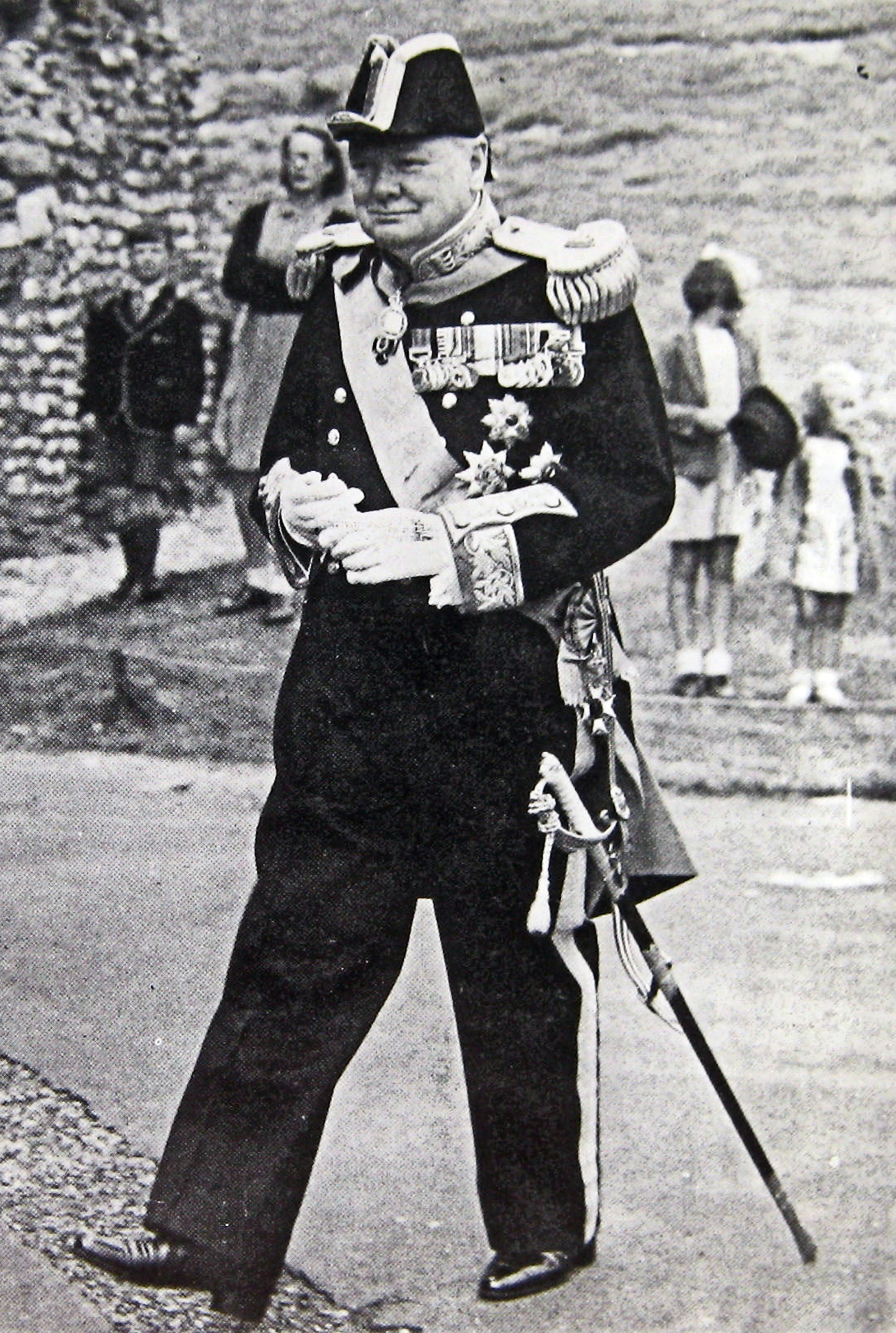
In France, Charles IV (1322-1328), Edward’s brother-in-law, ascended the throne in 1322. Soon after, he made moves to occupy Aquitaine and the probability of war increased. Charles then allied France with Scotland and in 1324, the Cinque Ports Fleet were paid by Edward to take the English army to Aquitaine as Charles was threatening to retake Gascony. The Portsmen were not asked to fight but to return home and wait instructions. On the way home they attacked towns and shipping, taking the booty back with them. In March 1325, the Portsmen were asked to take Queen Isabella to France where she was instructed to persuade her brother not to invade Gascony and, instead, to accept a peace settlement. The report at the time stated that Isabella was overjoyed to be leaving England and in France did obtain the agreement asked for. However, this required her husband Edward to go to France and pay homage to her brother Charles. Angry, at this affront, the Despensers seized Isabella’s English land holdings and Edward sent his young son, Prince Edward (1312-1377), to persuade his mother to rescind the agreement. Once Isabella had the Prince with her, she joined forces with her lover, the Earl of March, Roger Mortimer (1287-1330).

As an invasion was inevitable, in August 1325, Edward ordered a survey of all English vessels of 50 tons and over to take place in Portsmouth. In September 1326, when Isabella and Mortimer arrived at the river Orwell in Suffolk the crews of the English fleet, which included Cinque Ports vessels, mutinied. This was followed by riots in London and Edward abdicated in January 1327 in favour of his son, Prince Edward. The King was imprisoned and finally ended his days on 22 September 1327 at Berkeley Castle, Gloucestershire, in mysterious circumstances – possibly tortured to death. Hugh Despenser, had been executed on 24 November 1326 but the Portsmen were seen as too valuable an asset to punish. However, ten years later the young King Edward III (1327-1377), in order to keep peace with France, ordered the Portsmen to pay 8,000 marks compensation for their activities against the French under Despenser. Whether they actually contributed all of that sum is unclear but the event marked the start of the decline in the importance of the Cinque Ports Fleet.

Edward III detail from the Finnis window, Council Chamber, Maison Dieul. Alan Sencicle.

Edward III detail from the Finnis window, Council Chamber, Maison Dieu. Alan Sencicle.

When Edward III came to power England was at war with France and one of his first acts was to order the Lord Warden, Bartholomew Burghersh (d1355), to survey the ships of the Cinque Ports and to keep them in repair. At that time, Dover was providing one ship of 140 tons, one of 80 and two of 60 tons to the Fleet. A year later, the order was rescinded as peace with France was declared. This lasted until Philip VI (1338-1350) ascended the French throne. Isabella, Edward’s mother, was the last direct heir to the French throne but as a woman, she was ineligible to rule. Further, Salic Law debarred succession through the female line. Under this law, Philip as a distant cousin of Edward’s, was next in line and Edward objected. Philip’s supporters rallied round him and further, claimed a hereditary claim on Aquitaine. Edward retaliated by declaring himself the rightful king of France and thus started what historians afterwards would call the Hundred Years War (1337 to 1453).

The French attacked Portsmouth and Southampton, Jersey was captured and France controlled the Channel. In dealing with what Edward saw as an impending invasion, he blamed Portsmen for the attacks, saying that it was their duty to guard the sea coast, ‘as the Commons did the land’. He then summoned by proclamation, men of the Cinque Ports to resist the King’s rebels. About this time geological changes to the south east coast were causing the silting up of the Cinque Ports harbours and only Dover and Sandwich were able to match the size of the ships the French were building. The French ships were, on average, about 100 tons and their much larger ones required manning levels of at least sixty-five. Nonetheless, when the King’s exchequer stated that they would meet half the costs, the Cinque Ports did provide a squadron of 21 ships and 9 more came from the Thames. From other sources, Edward’s fleet was eventually increased to 100 ships, all of which were fully equipped and he was ready to do battle.

To ensure that the Portsmen did not use their new ships for piratical reasons, the Lord Warden, William de Clinton, 1st Earl of Huntingdon (c.1304-1354), was told that, ‘as governor of the mariners (he) ought to rule them in all their laws and customs. … Sailors were bound to obey his orders and no master of a ship was to hoist sail or cast anchor before the Admiral. All ships were to keep close to the flagship as possible, and none were to enter port, land any of their crew, leave the fleet or enter an engagement without order.’ This, the Portsmen resented but as part of the Ship Service, in 1339, took Edward and his Army to the Continent. In Ghent, the following February, Edward was officially crowned King of France but Philip retaliated by the French fleet attacking the Cinque Ports of Hastings and Rye. The Portsmen quickly returned from Flanders with vengeance on their minds but by that time the French fleet had sailed off. The Portsmen took revenge by attacking Boulogne, partly burning the town and in the port they sank ships taking 12 sea captains prisoners. Holding a kangaroo court, they accused the captains of attacking English merchant vessels, found them guilty and hung them in the town square.

Philip deployed his navy in the Western Scheldt estuary and in April 1340 proclamations were read in the Cinque Ports towns. The one applicable to Dover stated that persons living within six miles were to withdraw to within the walls. Besides the Castle walls, the town had partly been walled from the late 11th century and by the beginning of the reign of Edward II they probably enclosed much of the town. Edward III‘s fleet met Philip’s fleet outside Sluys on 24 June 1340. The Earl of Huntingdon led 60 Cinque Ports ships. A further 70 ships came from western ports and were commanded by the Richard FitzAlan, 10th Earl of Arundel (c.1306-1376). Edward arrived with a much smaller Royal Fleet of ships, on one of which were Queen Philippa (1314-1369) and the ladies of the court, but he was in overall command. The French had about 190 ships, under three separate commanders. Edward ordered this fleet to position themselves to their best advantage and to work together. He then sent his ships in units of three – two carrying archers and one man-at-arms. From the two ships with the archers, the longbow men, fired the first shots and as they came closer to the French ships, all the archers rained arrows, then the men-at-arms boarded and fierce hand-to-hand fighting took place.

Cinque Ports Sea Battle c14th century. LS Collection

Cinque Ports Sea Battle c14th century. LS Collection

While this was going on, some of the English crewmen clambered aboard the French ships and cut the halliards, thus disabling them. The remaining crewmen stayed on board defending the English ships by attacking boarding Frenchmen and despatching injured ones overboard. The battle had raged for about twelve hours by which time between 20,000 and 30,000 Frenchmen had been killed including two of the three commanders. However, as the French were retreating, one of their ships, James de Depe, turned and attacked one of the Sandwich ships. The Earl of Huntingdon brought the other Cinque Ports ships to the Sandwich ship’s aid and the French ship was captured. On board were four hundred men killed or dying. The English had also suffered a large number of casualties but nothing like the French and they brought the captured ships back to England. These were commandeered by Edward for his navy and in consequence of the Battle, England assumed dominance of the Channel. Shortly after, Edward set up an advisory council that included a delegation from the Cinque Ports.

The following year, Edward  sailed from Sandwich leading a fleet of 357 vessels, nineteen of which were from Dover. By 1344 he had about 700 ships in his navy and that year he appointed a Clerk of the King’s ships in charge of the 34 Royal ships. Although the Cinque Ports Fleet was still being called upon in excess of their Ship Service obligation, the towns themselves were coming under increasing attacks from the French. In that year, 1344, Edward decreed that the Dover Portsmen ‘shall give, in the aid of the commonality, out of every ship freighted with horses 2shillings, with foot passengers 12pence, to be collected before leaving the shore, and deposited in a common box by the mayor and jurats.’ The decree finished by stating that this applied in perpetuity for the ‘better supplying of other necessities of the town as they arose.’

Two years later, in July 1346, Edward left England with a force of 15,000 men using the Cinque Ports Fleet to transport them to Caen, Normandy. Once there, the Portsmen instructed the troops on how to quickly sack a town, causing the greatest amount of destruction and loss of life while leaving as much booty to take as possible. The fleet was then instructed to return back to England. This they did, ravaging other French ports en route. From Caen, Edward’s army marched across France and at Crécy, north of the Somme, the English met the much larger French force. Crécy is generally seen as the second great battle of the Hundred Years War and took place on 26 August 1346. The French army was about 50 times greater than the English and well rested. Albeit, Edward made particular use of the long bow with the occasional use of the recently introduced cannon. The French army was decimated.

After Crécy, Edward marched to Calais and on September 1346 he laid siege to the town. He had an army of 35,000 men and a fleet of 710 ships manned by 14,151 men which, besides the King’s ships included squadrons from Bristol, Dartmouth, Dunwich – Suffolk, Fowey – Cornwall, London, Portsmouth, Plymouth and Southampton. From the Cinque Ports:

  • Dover furnished 16 ships and 336 men
  • Faversham 2 ships and 25 men
  • Hastings 5 ships and 96 men,
  • Hythe 6 ships and 122 men
  • Margate 15 ships and 160 men
  • Romney 4 ships and 65 men
  • Rye 9 ships and 156 men
  • Sandwich 22 ships and 504 men
  • Seaford 5 ships and 80 men
  • Winchelsea 21 ships and 596 men
  • Yarmouth 43 ships and 1,075 men
Calais Burghers by Auguste Rodin ( 1840–1917) London. LS 2010

Calais Burghers by Auguste Rodin ( 1840–1917)  LS 2010

Although the English planned to adopt the Portsmen’s barbaric tactics, Calais defences were so strong that they were unable to break them down. Instead they went for starvation tactics and the people of Calais held out until 3 August 1347 when six Calais Burghers offered the town up to Edward and asked for clemency for the townsfolk. The King ordered the Burghers to be executed and his troops were ready to go in and do their worst, when Edward’s Queen Philippa threw herself at his feet. She then pleaded with Edward not to commit the atrocities. Instead, she begged him to send the six Calais Burghers and their servants to England as hostages. In return, the people of Calais were to accept English rule. As this gave Edward an English base in France, he accepted this suggestion and Calais was saved.

The Portsmen brought the Burghers and their servants’ back to England, landing at Dover. The Burghers were then taken to the Knights Hospitallers’ main house at Temple Ewell before journeying to London while the servants were taken to the village of Braddon, on the Western Heights. In 1348 the Black Death plague swept England and according to Dover folk-law the Burghers servants brought the petulance to Braddon before it reached the rest of the country. To stop it spreading the villagers of Braddon isolated themselves and thus the village died. Albeit, finding in-roads elsewhere, the disease took its toll throughout the country.

Edward Woodstock the Black Prince (1330-1376) tomb Canterbury Cathedral. Lorraine Sencicle 2016

Edward Woodstock the Black Prince (1330-1376) tomb Canterbury Cathedral. Lorraine Sencicle 2016

Two years later, on 29 August 1350, an English fleet of 50 ships including many from the Cinque Ports was fighting again. This time at the Battle of Winchelsea or as it was referred to by the Portsmen, the Battle of the L’Espagnols sur Mer. Taking place in the Channel off Winchelsea, the English Fleet was under the combined command of Edward and his eldest son, Edward of Woodstock (1330-1376), better known as the Black Prince. The slightly smaller, though with larger ships, French fleet was under the command of Charles de La Cerda (1327-1354). Although the English won and Edward was given the title ‘Le Roi de la Mer’, his fleet suffered heavy losses. Of the ships the English captured, fourteen came from Spain.

Although Dover lost some ships and men during the Battle, the town at that time was buoyant. Calais had developed into an English market and as Dover had the monopoly of the passage, these were years of great prosperity. However, the Hundred Year Wars continued and in 1355 the Mayors of the Cinque Ports were authorised to press carpenters and others with the necessary skills to build and repair ships. The following year saw the Black Prince bringing John II King of France (1350-1364) as his prisoner, through Sandwich following the Battle of Poitiers of 19 September 1356.

Three years later in 1359 as the Lord Warden (1355-1359) Roger Mortimer, the 2nd Earl of March (1328-1360), was vested with the office of Admiral of the Cinque Ports in perpetuity. Thus every subsequent Lord Warden has held the position. The office was created to prevent complications due to the Cinque Ports being in two counties, Kent and Sussex. Initially, the Cinque Ports Admiralty Court was held in Sandwich, and was designed for local inquests to determine questions of wreck and piracy. However, this conflicted with the role of the Lord Warden within the Cinque Ports chartered rights. The Portsmen complained to Edward that the Earl was listening to pleas beyond the Cinque Ports. The King upheld the Portsmens complaint and forbade the Lord Warden to encroach upon the Portmens chartered privileges.

The Lord Warden's jurisdiction as the Admiral of the Cinque Ports.

The Lord Warden’s jurisdiction as the Admiral of the Cinque Ports.

Albeit, the powers of the Portsmen were already decreasing and as they continued to do so, the powers  of the Lord Warden increased. Over time the Lord Warden’s jurisdiction, as Admiral of the Cinque Ports became to include the regulation of trade, especially fishing within the Ports. Also determining all offences at sea, in an area extending from Horse of Willingdon in Sussex to Naze Tower in Suffolk, and seaward to a point 5 miles off Cape Gris-Nez. It was sometimes expedient to hold the Court in other ports than Sandwich but eventually it settled permanently in St James Church, Dover. The increased responsibilities profited the Lord Wardens, as they were entitled to the best anchor and cable from every wreck, shares in goods captured from pirates and payment for fishing licences. Before the end of the century, the post of Lord Warden had become a life appointment.

During these years the French reorganised their fleet into a major force with the aim of regaining the Channel. At the same time Edward’s health went into decline, as did England. Although taxes increased, Edward was forced to increase shipping payments to merchants but for his own contracts, wages were left unpaid including services beyond Cinque Ports’ Ship Service. The French made the most of this and ravaged Winchelsea. The Portsmen were given leave to seek retribution, which they did. Nonetheless, the French continued to gain control of Continental ports and by 1369 controlled the Channel. By 1375 only Calais, Cherbourg, Brest, Bayonne and Bordeaux remained in the hands of the English and the Lord Warden, Ralph Spigurnell was given orders to send the leading men of the Cinque Ports to the King in order to be consulted about the future Navy.

Edward the Black Prince and heir to the throne, after a long and debilitating illness, died in 1376 and was buried in Canterbury Cathedral. His father, Edward died on 21 July 1377 and within a week the French attacked Hastings and Rye. They appeared off Dover but did not attack, instead they sailed east then north entering the Thames and burning Gravesend. Towards the end of that year Parliament called upon inland towns as well as ports, to build more ships. Of the Cinque Ports and the Antient Towns, only Dover, Hythe, Romney and Sandwich had functional harbours, the others were becoming land-locked due to silt.

Richard II the Maison Dieu. Alan Sencicle 2010

Richard II the Maison Dieu. Alan Sencicle 2010

The Black Prince’s 10-year-old son succeeded his grandfather as Richard II (1377-1399), and the war with France continued. To raise money, a poll tax at four pence a head from all lay people over 14, was introduced. This led to the Peasants’ Revolt of 1381, whose leader, Wat Tyler, came from Kent. The revolt was crushed and what concessions that were initially given, were revoked soon after. In December 1382 a writ was issued for a general press of men in the Cinque Ports following the French military advance into Flanders. This threatened Calais and put a stop to the lucrative English wool trade that through taxation was providing much of the revenue into the Royal coffers. The following year Henry le Despenser (1341–1406), the Bishop of Norwich – grandson of Hugh de Despenser – led an ill trained and ill-equipped expedition into Flanders and was routed by the French.

In April 1386, Charles VI (1380-1422) of France announced a planned invasion of England and assembled an army and fleet at Sluys. Once again a proclamation was issued, stating that persons living within six miles of Dover and other Kent ports should withdraw into the towns for protection. All that summer, along the Scheldt in Flanders, the shipbuilders were busy. In the Cinque Ports, particularly Dover, the shipbuilders were equally active. By September at Sluys, with a navy of 1,200 vessels Charles VI had assembled some 40,000 knights and squires, 50,000 horses and 60,000-foot soldiers. French intelligence stated that Charles intended to land at Dover and the town was instructed, by the Lord Warden (1384-1388), Sir Simon de Burley (c1336-1388), to be fully surrounded by a wall of stone and lime. For this, Dover received ten marks yearly.

Lord Warden Edmund Langley - Edward Astley window, Connaught Hall design by H W Lonsdale 1892. Dover Museum

Lord Warden Edmund of Langley – Edward Astley window, Connaught Hall design by H W Lonsdale 1892. Dover Museum

At the Castle, 500 men-at-arms and 1,200 archers under the former Lord Warden (1376-1381), Edmund of Langley, the Earl of Cambridge and 1st Duke of York – fourth surviving son of Edward III, were stationed. September came and went but the French invasion did not come. Langley’s intelligence sources said that Charles VI was waiting for John the Duc of Berry (1340-1416) and his men, who finally arrived in October. By the end of that month the weather in the Channel had deteriorated and a succession of westerlies deterred the invasion. However, in 1388, de Burley, the Lord Warden, was charged with the intention of selling the Castle to the French and in May that year, executed for treason.

Between 1394 and 1396 the Cinque Ports provided their full Ship Service for Richard’s passage to both Ireland and Calais, even though only the four functioning ports provided the ships. In November 1396, Richard landed at Dover with his second wife, child bride Isabella of Valois (1389-1409), the eldest daughter of Charles IV of France. The marriage was for diplomatic reasons as it was hoped that it would seal a truce between the two countries. Isabella left France with a large dowry and many expensive gifts that Richard had bought. However, during the rough crossing her dowry, most of the gifts and Richard’s money chest was lost overboard. Dover was obliged to raise £40 as a loan to Richard but was never repaid.

The country’s poor economy strangled by heavy taxation and general discontent brought Richard’s reign to a premature end. In 1399 when he was forced to abdicate to his cousin, Henry Bolingbrook (1367-1413) the Duke of Lancaster and grandson of Edward III. The King was subsequently murdered in Pontefract Castle. His 12-year old widow, Isabella returned to France, through Dover and carried by courtesy of the Portsmen. Henry IV (1399 to 1413), (Henry Bolingbrook) succeeded Richard but by this time the Royal fleet consisted of just four ships, ten years later, only two.

Henry V - Canterbury Cathedral

Henry V – Canterbury Cathedral

In 1409 Henry Prince of Wales, (later Henry V 1413 -1432) was appointed Lord Warden but due to the increasing ill-health of his father, within a year he was in all practical purposes ruling England. During his tenure as Lord Warden and in the name of his father, Prince Henry made a Treaty with John the Fearless (1371-1419), the Duke of Burgundy (1404-1419), guaranteeing the safety in the Narrow Seas (Channel) for three years. This was achieved by the use of the Cinque Ports Fleet as quasi coastguards. At about the same time an agreement was reached with mariners from Southampton to Thanet with those along the French coast from Honfleur to Hendrenese for a fixed tariff of captured mariners and seamen on their coasts. This was to pay for the prisoners’ board while they were held. Fishing boats, straying into the wrong waters had to be released on payment of 3s 4d and all disputes were to be settled by arbitration.

Thomas FitzAlan, 12th Earl of Arundel (1381-1415), succeeded as Lord Warden in 1413. As the Court of Shepway was still the only external court recognised by the Cinque Ports and their Liberties, it was in the Lord Wardens best interests to foster this. Over time, the Lord Warden became known as the ‘Judge Supreme’ and to suit his convenience the bulk of the work of the Shepway Court was transferred to St James Church in Dover. The first documented case at Dover was heard in 1414 and concerned a breach of contract between Hugh Rys of Sandwich and a Genoese merchant, Thomas Suffye.

After months of negotiation in August 1414, it was agreed that Henry would marry Catherine of Valois (1401-1437), the youngest daughter of the increasingly mad Charles VI of France. This was providing that the crown of France passed to Henry on the death of Charles. However, a feud between the French royal family and the House of Burgundy was causing chaos and anarchy throughout that country and the Treaty of the Narrow Seas broke down. Shortly afterwards, in 1415, Humphrey, Duke of Gloucester (1390-1447), youngest brother of Henry V was appointed Constable and Lord Warden. He retained the position until his death in 1447.

From ancient times, Dover’s harbour was under the eastern cliffs and together with the Bay, made Dover a well favoured port. However, the Eastward Drift that was causing problems to the Cinque Ports west of Dover, and making Dover’s harbour inaccessible at times. The Eastward Drift was also denuding Dover’s beaches such that at high tide the sea came in as far as the present Market Square. To stem the problem the Corporation built a retaining wall from near the corner of Snargate Street and Bench Street along the sea front to the harbour, which they called the Wyke. This created a large quay where passengers and goods could disembark and ship repairs take place. Although the Wyke was initially paid for by the Corporation by wharfage dues. Ship and boat owners – all of whom were Portsmen – had the ancient right of being free of such dues and therefore protested.

The problem was successfully resolved by the Lord Warden – Duke Humphrey who gave the Corporation the fines paid to the Admiralty Court by pilots and ship owners for breaches of regulations. At the same time he gave Dovorians the right of free wharfage in perpetuity. This, the Corporation ignored but an appeal to Henry resulted in a Charter that granted the privilege of free wharfage of Dovorian ships forever. In 2004 this was put to the test by Richard Mahony who operates sea and land tours promoting local tourism. The Dover Harbour Board successfully argued that the privilege had long since fallen into disuse.

Maison Dieu circa 1830. LS Collection

Maison Dieu circa 1830. LS Collection

At the national level, negotiations over Henry’s claims to the French throne continued until July 1415, when they broke down. With the consent of Parliament he assembled an invasion force at Dover. This consisted of 1,500 ships, including some from the Cinque Ports, and an army of 25,500 men from all over the country and beyond. The Officers of State administered the contingency from the Maison Dieu. On 13 August 1415 the largest force, until World War I (1914-1918), ever to leave Dover departed for France. The convoy arrived at Saint Denise Chef de Caux, at the mouth of the River Seine the following day. They then marched to Harfleur where the town was besieged. The intention had been to go on and take Paris but dysentery was taking a heavy toll on the English force and the siege lasted until 22 September. Henry considered remaining  at Harfleur until his men had recovered and further contingencies arrived. On recognising the vulnerability, he decided that his army would be safer to march the 150 miles (240 kilometres) to the English stronghold of Calais.

Henry’s army did not leave Harfleur until 8 October 1415, by which time it numbered about 9,000 and included Portsmen as they decided to stay with Henry. In the meantime, the French Armagnac family who opposed the Burgundian family and Henry’s claim to the French throne, under Charles d’Albret Constable of France, had raised an army of 20,000. The French had reached Rouen and were heading for the River Somme in order to block Henry’s way to Calais. By the time Henry’s men reached the Somme, they were weak, hungry and tired and death due to dysentery was still taking a heavy toll. In order to cross the River, Henry was forced to go south and on 24 October he reached Agincourt, a village three miles northwest of Arras. Henry’s army was reduced to about 5,500 men and the last thing anyone wanted to do was to fight. However, as the French were blocking the way they knew there was no alternative.

d’Albret’s army was considerably larger, fresh, well fed and better equipped. Early in the morning of 25 October, St Crispin’s Day, Henry assembled his men and he deployed them in a single defensive line. Most were dismounted and long-bowmen made up the largest part of the force. Although the French were divided into three large forces, the woodland surrounding the site narrowed their attack. Their first division, that of heavily armoured horsemen were met with a hail of arrows and were unable to manoeuvre. The second division, again mainly consisting of the heavily armoured horsemen, were met with another hail of arrows and besides lacking maneovrebility their way was blocked by the casualties of the first force. Within three hours the French started to withdraw, 6000 of their men lay dead or dying on the battlefield one of which was Charles d’Albret. The English lost about 500 men.

Henry having carried out a victorious campaign sailed from Calais to Dover, where he was hailed as a ‘conquering hero‘ and carried shoulder high through the town. After an equally ecstatic welcome in London, Parliament granted Henry the customs revenues for life, which helped to secure his finances. Then, along with the Cinque Ports Fleet, he returned to Calais in 1416 only to find that the Armagnac dynasty were supporting the Dauphin Charles’ claim to the French throne. On returning to England, Henry revived the navy by ordering larger ships designed to meet changes in naval warfare and many were built in the Cinque Ports. He also modernised his army and in 1417 the Cinque Ports Fleet left Dover escorting Henry back to France. The Portsmen were a small part of a large fleet of ships that Henry‘s army, horses, weapons and sundry baggage required for a military campaign.

On 4 September 1417, Caen in Normandy fell to Henry and on 14 July 1418 he laid siege to Rouen. This was to last until 19 January 1419 during which time John the Duke of Burgundy was seeking a reconciliation with the French Armagnac dynasty. In response, the English government issued a proclamation, on 8 June 1418, calling the inhabitants of the Cinque Ports to arms. However, in September that year the Duke of Burgundy was murdered by a member of the Armagnac faction and was succeeded by his son Philip (1396-1467). In December, Philip aligned himself with Henry against the Armagnac dynasty.

Henry returned to France, by way from Dover, taking with him 24,000 archers and 4,000 choice men-at-arms and on 21 May 1420, at Troyes, signed a Treaty with Charles VI securing his claim to the French throne. On 2 June, Henry married Catherine of Valois and the couple returned, through Dover, to England. On 6 December 1421, Catherine gave birth to their son, also called Henry. However, the Dauphin Charles supported by the Armagnac dynasty refused to accept the Treaty of Troyes and Henry again returned to France, escorted by the Cinque Ports Fleet, in order to secure his claim. On 31 August, during the siege of Meux, Henry fatally succumbed to dysentery and was brought back in a coffin to Dover, once again escorted by the Cinque Ports Fleet. At the port, Henry’s coffin was carried by Cinque Ports Barons while Portsmen with their ceremonial oars reversed and knights with black plumes and lances reversed and many more joined a procession. The sad entourage passed the through the town and along the London Road until it reached London and the warrior King was laid to rest in Westminster Abbey. Before he died, Henry appointed his brother Humphrey, Duke of Gloucester and Lord Warden of the Cinque Ports, his son’s protector.

Henry VI the Maison Dieu. Alan Sencicle.

Henry VI the Maison Dieu. Alan Sencicle.

Most of France was under English rule with John the Duke of Bedford (1389-1435), supported by Philip Duke of Burgundy, as Regent. In October 1424, using the Cinque Ports Fleet, Humphrey invaded Hainaut, which his wife, Jacqueline of Holland (1401-1436) laid claim. As Holland was ruled by the Burgundian family this put the Anglo-Burgundy alliance in jeopardy. Using diplomatic tactics, the Duke of Bedford secured Philip of Burgundy’s allegiance again and Dauphin Charles supporters suffered a string of defeats. That is, until 8 May 1429, when Joan d’Arc triumphantly led the Dauphin’s army of 4,000 into Orléans relieving the city from an English siege. This, together with the coronation of the Dauphin as Charles VII had a tremendous effect on the French morale and a succession of French victories followed. On 24 May 1430 Joan d’Arc was captured by the Burgundian faction at the Battle of Compiegne but one year later she was burnt at the stake by the French. Henry VI of England was crowned Henry II of France on 16 December at Saint-Denise near Paris.

In the wake of the sense of nationalism that was sweeping France, Philip Duke of Burgundy changed his allegiance to supporting Charles VII. On 29 July 1436 French forces under him besieged Calais, but Duke Humphrey, as the Portsmen affectionately referred to him, with the Cinque Ports Fleet attacked and Philip withdrew. Nonetheless, attacks and battles over Henry’s holdings in France raged such that on 14 July 1439 a truce was agreed between England, Burgundy and France. It was agreed that Henry would hold onto lands in France but would not hold the title of King of France. Two years before, Henry’s mother, Catherine of Valois,  the sister of Charles VII, died. On her death it was revealed that she had secretly married her lover, Owain ap Maredudd ap Tudur – known as Owen Tudor, (c1400-1461). He was a Welsh squire who had attended Henry V at Agincourt and they had three sons and a daughter.

Henry’s English counsel refused to accept the truce and subsequently the battles raged on. By this time William de la Pole, 1st Duke of Suffolk, (1396-1450), was gaining a great deal of power, particularly at the expense of Duke Humphrey, who was next in line to the throne after Henry. In 1441 Duke Humphrey’s second wife, Eleanor of Cobham (c.1400-1452), was charged with witchcraft and treason. Found guilty, she was imprisoned for life in Peel Castle on the Isle of Man. The Portsmen, always loyal to Duke Humphrey, also came under attack with a number of severe penalties served on the Cinque Ports Barons.

In August 1443, de la Pole landed at Cherbourg with 8,000 men and associated military equipment, with a view to take new lands. This was against the advice of Duke Humphrey as he was using all the resources available to him, including the Cinque Ports Fleet, to retain a hold on Gascony and Normandy. De la Pole, took no notice and further, failed to form a logistical plan on feeding and accommodating his large force or moving equipment. In order to meet these requirements de la Pole levied unlawful taxes on the locals and commandeered their horses and carts. Nonetheless, the exercise still proved to be an expensive fiasco and Duke Humphrey made this known.

Trying to prevent uprisings in occupied France were taking their toll on the English economy and a search for peace became a matter of urgency. Regardless of the Cherbourg fiasco, de la Pole remained a favourite of Henry who promoted him to Lord Chamberlain. In this capacity, de la Pole negotiated a marriage treaty between Henry and Margaret of Anjou (1430-1482), which gained a two-year truce. The couple married on 22 April 1445 and in November 1446, Henry, under Margaret’s influence, gave the Cinque Ports Barons a number of awards to win their trust. Meanwhile, except for his position as Lord Warden, the Portsmens’ beloved Duke Humphrey retired from public life.

In February 1447 de la Pole called a Parliament at Bury St Edmunds, Suffolk. On arrival Duke Humphrey was arrested and charged with treason but he died before he could be brought to trial. The next Lord Warden was  de la Pole’s supporter, James Fiennes, 1st Baron Saye and Sele (1395-1450) and with the death of Duke Humphrey, this made de la Pole, the most powerful man in England. During the next three years Henry lost nearly all of his possessions in France and holding de la Pole and Saye and Sele responsible he had them arrested. They were imprisoned in the Tower of London and tried for treason. Henry, possibly in a fit of remorse over his favourite plight, commuted de la Pole’s sentence to 5 years exile and he left Ipswich for Burgundy on 30 April 1450. On 2 May, off Dover, his ship was seized and de la Pole was thrown into a rowing boat. There his head was cut off with a rusty sword and his body was dumped on Dover beach. According to local legend, his head was buried in a chalk casket in St Peter’s Church, Dover – it was never found. Lord Saye and Sele was beheaded by a mob in London on 4 July that year.

Humphrey Stafford, 1st Duke of Buckingham (1402-1460) succeeded Saye and Sele as Lord Warden, but in March 1454 Henry succumbed to a mental illness. This was not the first time but the appointment of Lord Protector, as was required, led to a power struggle. This led to the civil war known as the Wars of the Roses (1455-1487). Taking advantage of the turmoil in England, the French attacked the Cinque Ports coast and in 1457 they killed the Mayor of Sandwich, John Drury. To this day, as a mark of respect, the ceremonial dress of the mayor of Sandwich and the mayor of its Limb, Deal, are black robes. The other Cinque Ports mayors wear full length scarlet robes, trimmed with fur.

The Lord Warden, Humphrey Stafford was killed in the Battle of Northampton 10 July 1460 and was replaced as Lord Warden by the Earl of Warwick, Richard Nevill (1428-1471). Neville, was at that time a Yorkist supporter and between 4 March 1461 and 3 October 1470, Edward Duke of York (1442-1483) ruled England as Edward IV. After a dispute with Edward, Nevill switched sides and was instrumental in restoring Henry to the throne. However, he was killed on 14 April 1471 at the Battle of Barnet. On 9 July that year, with the Wars of the Roses still raging, Edward having regained the throne seized the Dover Liberties.

18th Century Sketch of St James' Church

18th Century Sketch of St James’ Church

At the time, Yorkist supporter, Sir John Scott (c.1423-1485), was the acting Lord Warden. Edward assumed that Scott and the Portsmen had followed Nevill’s lead and joined the Lancastrian cause. In the Portsmen’s defence, Scott stated that as of ancient right, the Cinque Portsmen were independent in civil wars. Nonetheless, Edward mounted a Commission of Judges to try and punish those responsible for using the Cinque Ports Fleet against him. Thomas Hexstall, the Mayor of Dover and by virtue of office, a Baron of the Cinque Ports, was singled out and arrested. He was put on trial in St James Church. The judges were Nicholas Statham – Baron of the Exchequer, Cardinal Thomas Bouchier (1404-1486), Thomas Dynham, John Fogge, Thomas Echyngham, and William Nottingham. After listening to all the evidence, they pardoned Hexstall who went on to be the Mayor of Dover six more times!

Henry VI was imprisoned in the Tower of London where he died on 21 May 1471. By that time Edward had appointed the William fitz-Alan the 16th Earl of Arundel (1417-1487) Lord Warden. From then on the Portsmens political influence was superseded by the Lord Wardens and this was on the ascendancy. Nonetheless, on 26 May 1475 Edward called out the Cinque Ports Fleet to wait off Sandwich. On the 26 June they were ordered to take his army from there to Calais, from where Edward proposed to launch an invasion. This was to claim the throne of France especially as the French King, Louis XI (1461-1483), had backed the Lancastrian cause during the Wars of the Roses. Edward expected a military support from Charles Duke of Burgundy (1433-1477) but although the Duke turned up, he only brought his body guards. Edward was therefore forced to compromise and agreed to leave France on payment of £15,000 and an annual pension of £10,000 a year for 7 years. Also for Louis’s son, Charles (1470-1498), to marry his daughter Elizabeth of York (1466-1503).

Richard III Maison Dieu. Alan Sencicle.

Richard III Maison Dieu. Alan Sencicle.

On the death of Edward, Richard Duke of Gloucester (1452-1485) claimed the throne as Richard III (1483-1485). The Lord Warden, Earl of Arundel attended his coronation. It was expected the Cinque Ports Barons would do the same and also carry the coronation canopy. Instead, the Courts of Brodhill and Guestling was convened and after a discussion the Cinque Ports Barons issued the order ‘No precept from Dover Castle to be obeyed.’ Whether any did attend is unclear but following the coronation, Richard, showed particular favour to Dover by imposing on persons, horses, sheep, cattle and merchandise carried between Dover and Calais, a tax to enable the town to build a new sea wall. Two years later on 22 August 1485, Richard was killed  at the Battle of Bosworth Field – the last battle of the civil war. The victor was Henry Tudor, 2nd Earl of Richmond (1457-1509), whose paternal grandparents were Catherine of Valois and Owen Tudor. Henry married Elizabeth of York and when he was crowned Henry VII (1485-1509) the Earl of Arundel attended. He held the golden coronation canopy over Henry’s head along with the Cinque Ports Barons!

Dover harbour c1540 following the completion of Sir John Thompson's new harbour at the western side of the Bay

Dover harbour c1540 following the completion of Sir John Thompson’s new harbour at the western side of the Bay

About this time there was a massive cliff fall that rendered Dover’s Eastbrook harbour useless. As all but Sandwich of the other Cinque Ports harbours had or were succumbing to the Eastward Drift, Henry transferred the cross-Channel traffic to Sandwich. He then issued an edict stating that goods were only to be carried in English ships. John Clark, the Master of the Maison Dieu, on behalf of Dover, successfully petitioned Henry for a grant to build a small harbour on the western side of Dover Bay. When this was granted, it would seem that the other Cinque Ports did the same. In response, Henry made a grant in recognition of the past services of the Ports, ‘for the better enabling the ports in their ordinary charges at sea and maintenance of shipping, and not in particular for the furnishing out of shipping upon extraordinary occasions of state.

The Cinque Ports and their ships had become the target of pirate attacks and in 1487, Henry, for a fee, agreed to provide three guard ships. Five years later, in November 1492, the Portsmen took part of Henry’s army to Calais from Sandwich. Although preparations for war were being made the expedition ended amicably. The following year Henry appointed his younger son, also called Henry (1491-1547), the Lord Warden. Prince Arthur (born 1486) as the elder son, was the heir to the throne until he died in 1505. Even though elevated to that of heir, Prince Henry retained the office as Lord Warden until he ascended the throne in 1509 as Henry VIII (1509-1547).

Henry VIII at Dover for the Field of the Cloth of Gold 1520, Maison Dieu. Alan Sencicle 2009

Henry VIII at Dover for the Field of the Cloth of Gold 1520, Maison Dieu. Alan Sencicle 2009

The Cinque Ports Fleet maintained their ancient obligations as best they could during the reign of Henry VIII (1509-1547), taking his army from Sandwich to Calais in 1513 and from Dover to Calais in 1520, 1544 and 1545. Having six ships of one hundred and sixty tons each, the Portsmen remained at sea for five months at their own expense in order to show that they were still viable. Indeed, in 1588, the Cinque Ports Fleet set sail from Sandwich, to confront the Spanish Armada. Each of the six ships had one pinnace of thirty tons, in attendance and one of ships, said to have belonged to Dover, acted as decoy leading one the Spanish galleons onto a treacherous Goodwin Sandbank. There, the beleaguered galleon was set upon by the other Cinque Ports ships, her crew killed and the ship completely destroyed. This was the last action of the Cinque Ports Fleet but in 1590, the Lord Warden, Sir William Brooke, 10th Baron Cobham (1527-1597) officially acknowledged the existence of the Courts of Brodhull and Guestling.

At the beginning of the reign of Charles I (1625-1649), the Cinque Ports fitted out two large ships which served for two months and cost them £1,800. In 1663 the Cinque Ports bailiffs made their final appearance at the Yarmouth Herring Fair but the office of Lord Warden continued to go from strength to strength. In 1673, the Lord Warden was given the right to raise a militia within the liberties of the Cinque Ports but during the War of American Independence (1775–1783) this was superseded by the Cinque Ports’ Volunteers Regiment (see Western Heights part I). The Napoleonic Wars (1803–1815) brought renewed threats from the Continent, and the Lord Warden raised several volunteer horse and foot soldiers in the ancient name of Ship Service and were named the Cinque Ports’ Fencibles. Shipbuilding remained one of the mainstays of the Cinque Ports with fishing one of the main industries. The passage from England to the Continent that had been given to Sandwich was returned to Dover and became a major industry that the port still retains.

Baron of the Cinque Ports Costume worn by Wollaston Knocker at the coronation of Edward VII 1902. Dover Library

Baron of the Cinque Ports Costume worn by Wollaston Knocker at the coronation of Edward VII 1902. Dover Library

With the passing of time, most of the ancient rights and privileges that the Portsmen had enjoyed ceased to exist. The individual Courts of Brodhull – renamed Brotherhood – and Guestling united in the 19th Century and are these days generally referred to as the Confederation. The Speaker is drawn from the Mayors of the members of the Confederation, in rotation and on 21 May each year. The Confederation, with all the traditions of former times, meets to witness the transfer of the Speakership. Each port and corporate member of the Cinque Ports are expected to send a deputation even though the business transacted is nominal. The title, Baron of the Cinque Ports devolved to the Mayors and these days the title only applies to Mayors on the accession of a monarch to the throne.

The office of Admiral of the Cinque Ports was extended to cover the whole of the English fleet and gave the Lord Wardens the right of exercising jurisdiction in Admiralty cases according to maritime law. The Admiralty jurisdiction continues to this day, being confirmed by the Municipal Corporations Act of 1883. Within its defined limits it is concurrent and equal to that administered by the Admiralty Division of the High Court of Justice. The last full sitting of this court was in 1914, however the Lord Warden still appoints the Judge Official and Commissary. Albeit, like the Court of Chancery the Admiralty Court, in reality, survives in name only.

The importance of the Shepway Court to the Lord Wardens decreased along with the importance of the Portsmen. These days, the only real purpose of the Court of Shepway is the installation of the Lord Warden. Once installed, the Lord Warden can exercise the right of presiding over it. In August 1923, during the Wardenship of William Lygon, 7th Earl Beauchamp (1872-1938), a Cross was erected on the site where it is believed the original Court of Shepway was held.

Dover Councillors as Barons of the Cinque Ports at the Installation of Lord Boyce as Lord Warden April 2005. Dover Mercury

Dover Councillors as Barons of the Cinque Ports at the Installation of Lord Boyce as Lord Warden April 2005. Dover Mercury

Lord Warden’s role was extended in 1606 to that of presiding over the Dover Harbour Commission, later Dover Harbour Board. This lasted until 1905 when George, the Prince of Wales was appointed – later George V (1910-1936). A special Act of Parliament relieved him and subsequent Lord Wardens of serving on Dover Harbour Board. In 1708, Walmer Castle was made the official residence of the Lord Warden and this remains so today. The substantial salary that the Lord Wardens once received ceased in 1828 but the inauguration ceremony was given a new lease of life with the appointment of Lord Palmerston as Lord Warden in 1860. At the same time, Dover became the Head Port. In 1978 Queen Elizabeth the Queen Mother, became the first female Lord Warden and not only proved to be a great favourite with the folk who live in Cinque Ports, she resurrected its historic significance. The Present Lord Warden is Admiral of the Fleet Michael Cecil Boyce, Baron Boyce, who was appointed on 10 December 2004 and installed on 12 April 2005.

Sadly, the twin institutions of the Cinque Ports and the Lord Warden have, over the last few years, become increasingly remote and elitist. Such that following the publication of this story a considerable number of people, many of whom live in the Dover area, were surprised to read that the twin institutions still existed.

  • Presented: 29 February 2016
Posted in Armed Services, Cinque Ports, Cinque Ports Origins & Dover Part II, Cinque Ports Origins & Dover Part II, Cinque Ports Origins & Dover Part II, Cinque Ports Origins & Dover Part II, Maritime, Royalty, Tourism | Comments Off on Origins of the Cinque Ports and Dover Part II

Origins of the Cinque Ports and Dover Part I

Stylised drawing showing the Roman Classis Britannica, Pharos on the eastern and Western Heights and Roman harbour. Dover Museum

Stylised drawing showing the Roman Classis Britannica, Pharos on the eastern and Western Heights and Roman harbour. Dover Museum

It was probable that the indigenous mariners of Dover played a significant role in the defence of Britain from invasion by the Saxons, in the time of the Roman occupation. Long before the Romans had established the large Classis Britannica on the western side of what is now Market Square, Dover, followed by the larger Shore Fort. The Romans had also built Dover’s first harbour, to the east of the forts in the estuary of the River Dour. Following their departure, King Wihtred (c 690-725) had a wall built across the Dour delta to protect his newly established Canons at St Martin’s monastery from sea robbers. Within this protection a harbour was created on the eastern side of Dover Bay that was fed by the River Dour. The harbour was approached through Eastern Gate, which stood about 75-yards west of the site on which old St James Church was subsequently built.

This harbour remained on the eastern side of the town for more than a thousand years and was possibly used by Alfred the Great (849- 899). In 897, he had a number of ships built each of at least 60 oars, to counter Danish Viking raids along the south coast of England. These ships were seen by later historians, as the foundation of the Royal Navy and Alfred’s fleet won a significant victory in the Battle of Stourmouth, in East Kent, in the Wantsum Channel, at Plucks Gutter. Following Alfred’s death the ‘navy’ was abandoned and except for frequent maritime skirmishes from potential invaders, Dovorians busied themselves with cross-Channel traffic and fishing for herrings, the country’s main staple food. The quay, at this time, was probably where King Street is now.

UK Map showing the location of Dover and the English Channel

UK Map showing the location of Dover and the English Channel

Dover, situated at the southeastern tip of the British Isles is the closest seaport to the Continent. It is on the English Channel – an arm of the Atlantic Ocean that joins the North Sea off the Thames Estuary. The Channel is about 350 miles long, varies in width from the narrow Strait of Dover (French: Pas de Calais) 22 miles to 150 miles further west. The Channel is a relatively shallow sea with an average depth of about of about 148 feet in the Strait and 390 feet at its widest part. Because of this, it acts as a funnel to both winds and tides, making the Strait notoriously tempestuous. In consequence, the ships built by the mariners of Dover and the other ports along the Strait were strong and the mariners competent seamen. Further, the mariners of three ports had loose amalgamation. These ports were, Dover, Sandwich and Limme – as it was called in those days, Lympne these days and at that time it was on the coast. Calling themselves Portsmen, the affiliation was fostered by long trips to the fishing grounds of the North Sea.

Edward the Confessor (1042-1066) recognised the capabilities of these mariners and also the strength of their ships. It was also evident to him that the ports were in an excellent strategic position from a military and naval point of view. In consequence, Dover in 1036, was the base for the royal fleet and in 1041 the King officially augmented his fleet by giving the Portsmen a much-prized Charter. This stated that they were to provide Ship Service, that was to provide 20 ships, manned with 21 men for 15 days a year. To comply with the Ship Service Dover was divided into 20 wards with each ward providing a fully crewed ship. At different periods of time the number and names of the wards changed and by 1429, when the names were fully recorded, there were 21 wards: Bekyn, Burman, Bully’s, Canon, Castledene, Derman, Delfys, Deeper, Halfguden, Horsepol, Moryns, Nankyn, Ox, Snargate, Syngyl, St Mary, St George, St Nicholas, Upmarket, Werston and Wolvys. The role of the Portsmen manning the ships was to protect the coast and to provide cross Channel passage of troops needed to defend English possessions in France. In return the King gave the three towns rights and privileges.

Edward the Confessor window, SS Peter & Paul Church, Charlton. LS 2011

Edward the Confessor window, St. Peter & Paul Church, Charlton. LS 2011

Long before Edward the Confessor came to the throne, Dover’s mariners who worked the passage – carrying people, animals and cargo between England and France – had formed the Fellowship of the Passage. When not working the passage they were fishermen but of more importance, they were all Freemen and with their contemporaries in the other two towns, it was they who provided the ship service. Therefore, it was for them that privileges in the Charter were given. These privileges were the titular rank of Baron and the right of personal liberty (passage), free carts (freedom of movement), freeland (freehold) and free trade.

Edward also appointed Godwyn, the Earl of Wessex (1001-1053), the father of his wife Edith (1025-1075), the Lord Protector of Dover, Constable of the Saxon Castle and Earl of Kent. Although loyal to the King, Godwyn, at the time, was becoming increasingly angry at the growing Norman influence that Edward was fostering. In 1048, Eustace II, Count of Boulogne (c1015-c1087), demanded of the Dover Portsmen, the feudal right of droit de gîte – the forcible possession of lodgings that best pleased him. This was against their Chartered rights and therefore they refused. An altercation ensued in which Eustace’s men came worse off and Godwyn spoke up on behalf of the Dovorians, which the King accepted.

However, in 1051, Edward received Eustace at his court with great honours and shortly afterwards there was a second violent clash between the people of Dover and Eustace and his army. Seven townsfolk were killed though Eustace lost twenty men. Edward ordered Godwyn to punish the townsfolk but he refused and for this, Godwyn and his family were exiled from the Kingdom. That was in September 1051 but before the year was out, Edward again appointed Dover as the base for his royal fleet. The following year Godwyn returned with armed forces and much to Edward’s surprise, the Portsmen supported Godwyn. Edward was obliged to restore Godwyn’s titles and allow Dovorians to defend the town as of right. Godwyn died on 15 April 1053 and his son Harold succeeded him to all his titles, including Lord Protector of Dover and Constable of the Saxon Castle.

Godwyn (1001-1053) Earl of Kent - Mummery-Bamfield window Connaught Hall. - LS 2013

Godwyn (1001-1053) Earl of Kent – Mummery-Bamfield window Connaught Hall. – LS 2013

Harold took these roles as seriously as his father and finished Dover’s main military fortification, the Castle. Many years before a Saxon Castle had started to be erected on the top of the Eastern Heights and Harold had a Saxon Keep and towers built. In 1064-65 he allied himself and the Portsmen with William, Duke of Normandy (b 1028). This was against William’s enemy Conan II, Duke of Brittany (1033-1066). For this, William knighted Harold and presented him with weapons and arms in return, according to the Bayeux Tapestry, Harold swore to support William in his claim to the throne of England. However, it has been suggested that the patron of the Tapestry, Eustace of Boulogne had used his influence to have this put in! There are also various accounts of Edward the Confessor promising William the crown of England.

In 1062-3, with the help of the Portsmen it is said, Harold conquered Wales and two years later subdued a major rebellion in Northumbria. For these and other reasons, Edward named Harold his successor and this was confirmed at the sitting of the Witanagemot on 5 January 1066 – the day that Edward the Confessor died. Harold was crowned King but his brother Tostig (d1066) and King Harold II of Norway (d1066), the latter laying claim to the throne, invaded. Having defeated them at Stamford Bridge, Yorkshire, on 25 September 1066, Harold and his army, which included Portsmen, marched south. The news reached Harold that William and his forces had set sail from Normandy and the army put a spurt on. William arrived at Pevensey, East Sussex, on 28 September 1066 and following Harold and his army’s arrival, the famous Battle of Hastings took place nearby. That was on Saturday 14 October 1066 where Harold was killed and William was proclaimed the King of England (1066-1087).

The Burning of Dover, Bayeaux Tapestry. Dover Museum

The Burning of Dover, Bayeaux Tapestry. Dover Museum

Following the Battle, William I’s army marched east along the coast razing to the ground, villages and towns including the three Ports. In Dover, the monastery of St Martin that had been built on the site of the old Roman Shore Fort was ransacked and destroyed. William, a religious man, was angry and ordered the monastery to  be rebuilt in a grander style. For sometime after, it was believed the Norman church of St Martin the Grand, was the most magnificent edifice of its type in England. From excavations, it is known that the monastic buildings stretched from what is now Market Square to Bench Street and reached the banks of the River Dour.

Not long after, East Kent came under attack from the Danes who were repulsed by the Portsmen and their allies from the ports of Hythe and Romney. This provided proof of loyalty to William and he drew up a new Charter. In this the stronger port of Hythe substituted that of Lymne while Romney, west of Hythe, was added, as the coast there was unprotected. Further, their mariners were well known for being as hardy and ferocious as those from Dover. Finally, Hastings was included, to the west of Dungeness point, in honour of his victory there. William also made Hastings the head Port and collectively, thereafter, these five Ports were called the Cinque Ports – pronounced ‘sink’. The Freemen of all these ports who provided ship service were called Barons and the Charter stated that the Cinque Ports Barons, and their heirs ‘do to us and to our heirs Kings of England yearly their full service of fifty-seven ships at their cost for fifteen days at the summons of us or our heirs.’

Throughout England, William introduced an entirely new legal system adopted from that established in Normandy. The Sovereign was head and laws were administered, if not by him in person, by judges appointed directly by and dependent upon him. William also effectively created palatinates and one was for Kent that included the Cinque Ports. The Kent palatinate was under his half-brother, Odo the Bishop of Bayeaux (d1097) and gave Odo extra special powers that included the head of the new Norman legal system. Odo used this and quickly proved himself to be despotic. One of his actions was to withdraw the Portsmen’s privileges and within a decade the hated Odo was deposed. This enabled Kent and the Cinque Ports to revert to aspects of the pre-Norman legal system that they liked and also, for the Portsmen, the reintroduction of William’s Charter.

The famous survey, the Domesday Book of 1086, confirmed the Charter and Cinque Ports importance in relation to the English Channel and the coast of mainland Europe. Indeed, the Kent portion begins: ‘Douere, in the time of King Edward, rendered eighteen pounds, of which moneys King Edward had two parts, and Earl Goodwyne the third … The Burgesses gave the King twenty ships once a year, for fifteen days, and in each ship were twenty-one men. This they did in return for his having endowed them with Saca and Soca.’ The Domesday book goes on to say that when the King’s messengers came to Dover for passage to France, the towns Burgesses provided a Pilot and an assistant to give the messenger and his horse passage. For this, the pilots were paid 2 pence in summer and 3 pence in winter. For anything else, the messenger had to pay out of his own pocket.

About the time of the Domesday Book another book was written strictly applicable to the Cinque Ports. This, apparently recorded details of William’s Charter and thereafter was like a diary giving accounts of the Cinque Ports jurisdiction, powers, financial contributions made and paid out in consequence of the Charter and subsequent Charters. Sadly, the book disappeared towards the end of the reign of Charles II (1630-1685) and, to date, has not been found. Ship service apparently dominated the entries.

Cinque Ports Ship Townwall Street subway mosaics, note the sweep at the stern quarter. Alan Sencicle 2009

Cinque Ports Ship Townwall Street subway mosaics, note the sweep at the stern quarter. Alan Sencicle 2009

Herring fishing was also well covered in the book as an important industry to the Cinque Ports. The Portsmen built their own ships and in Dover this took place on the beach and were kept at sea except at times of danger or foul weather when they were hauled on to the beach. The ships were built as fishing vessels and, particularly in Dover, passage vessels. To convert them into warships for ship service, the Portsmen erected fore and stern castles and armed the crew. At the time, the ships did not have rudders; instead they were navigated by a sweep – a large oar – off the stern quarter. The size of the ships can be gleaned from the fact that twenty men pulled the oars and a large square sail propelled them.

William II (1087-1100) - Canterbury Cathedral. Lorraine Sencicle 2016

William II (1087-1100) – Canterbury Cathedral. Lorraine Sencicle 2016

William II (1087-1100) succeeded his father to the throne and the Cinque Ports men were equally as loyal to him. However, William I had divided his domains between his two sons giving the Duchy of Normandy to his elder son, Duke Robert Curthose of Normandy (c1051-1106) and William II, England. Robert wanted to unite the two countries with one ruler – himself, supported by Odo. An invasion took place with Odo seizing Pevensey Castle built by William I in 1088. The Portsmen supported William II and attacked. Odo was expecting Duke Robert to come to their aid but he failed to arrive. Odo and his men escaped to Rochester Castle but once there the Castle was held in a siege lasting six weeks by Royalist forces including Portsmen. When Odo and his men were finally released they were in a dreadful physical state and so were allowed to return to Normandy.

In 1090, the Portsmen went with William to France to claim Normandy and the following year to Scotland to stop an invasion. Battles subsequently ensued, most, of which the Portsmen were involved in. In 1100 the King died without issue and his younger brother, Henry (b 1068), was proclaimed King. At the time Duke Robert was on his way home from the 1st Crusade (1096–1099) and so Henry I (1100-1135), was crowned in haste on 5 August. In March 1101 Duke Robert invaded, by way of Dover, and the Portsmen fought back. He then moved further west along the coast to Portsmouth and in August that year the two brothers met at Alton, Hampshire. A negotiated settlement confirming Henry as King and controller of the English Channel averted civil war but the animosity was to remain for years to come.

Unveiling of the Shepway Cross 04 August 1923. Dover Library

Unveiling of the Shepway Cross 04 August 1923. Dover Library

To meet the needs of the Cinque Portsmen a single special court had been developed under the auspices of the King’s officers. Held at Shepway, near Hythe, the court dealt with cases that were considered beyond the jurisdiction of the five towns’ courts such as, treason, counterfeit, treasure–trove and naval service. It also gave the right of Appeal against judgements of town officers. The Shepway Court normally met once a year but could be summoned for a special meeting with forty days notice. Attendance by the Barons of the Cinque Ports was compulsory.

Henry I was involved in a number of altercations both in Britain and abroad, and on most occasions the services of Portsmen were called upon. In 1118, Maud, Henry’s wife died and on 25 November 1120, Henry’s only legitimate son, William, died in a shipwreck. Thus, in 1126 Henry appointed his daughter Matilda (1102-1167), as his heir. At the instigation of Henry for better relations with the French province of Anjou, she married the 15 year old Geoffrey Plantagenet, Count of Anjou (d 1151) in 1128. At the time the English Barons – no relation to Cinque Ports Barons – were very powerful in the country, owning great swathes of land on which they ruled from fortified castles that they had built or inherited. These Barons were the progeny of the Norman elite who had come over with William I and were subsequently rewarded with the domains. Thus they were a major force in English politics and although they had initially agreed to Matilda being Henry’s successor, following the marriage they changed their allegiance to Henry’s nephew, Stephen of Blois (b circa 1092). Stephen had married Maud (sometimes called Matilda) of Boulogne (c1105-1152) who was the first cousin of Matilda on her mother’s side. Maud was also the granddaughter of Eustace II of Boulogne, her father being Eustace III who had supported Duke Robert Curthose’s claims to the English throne.

Cinque Ports Flag showing the Coat of Arms, Maison Dieu. LS 2009

Cinque Ports Flag showing the Coat of Arms, Maison Dieu. LS 2009

Henry died in December 1135, while Matilda was on the Continent and Henry’s nephew, Stephen, speedily crossed to Dover to claim his right to the throne as the male heir in accordance with the custom in Normandy. However, he found Dover Castle closed to him by the Constable, John de Fiennes with the Portsmen supporting Fiennes. Nonetheless, with the support of the Barons, Stephen marched to London, seized the throne and the treasury. On 22 December 1135, Archbishop William Corbeil (1070- 1136) crowned Stephen and Maud at Canterbury Cathedral. The Archbishop had been the instigator for the demise of Dover’s beloved great monastery, St Martin-le-Grand, much to the annoyance of the Dover Portsmen. Matilda landed in Dover with an army in March 1136 but even though Fiennes was a relation, she avoided the Castle and went to Canterbury.

In 1138, while Stephen was fighting Matilda’s army in the Midlands, Maud advanced into Kent and demanded the surrender of the Castle. John de Fiennes was fighting alongside Matilda, having left his deputy, Walkelin de Magimnot in charge. He surrendered the Castle to Maud. At the Battle of Lincoln in April 1141, Stephen was captured and imprisoned. Matilda, taking the Saxon title of ‘Lady of the English‘, briefly ruled, with the support of the Cinque Ports. Meanwhile, Maud had rallied support and Stephen was eventually released. On regaining the throne, Stephen, in 1147, sent the Cinque Ports Fleet to help in the siege of Lisbon (1 July – 25 October) with the promise of plunder and thereby getting them out of the way.

Dover Priory Gatehouse from a drawing by E Piper by Lynn Candace Sencicle

Dover Priory Gatehouse from a drawing by E Piper. Lynn Candace Sencicle

The civil war continued and in 1147 Matilda’s son, Henry (b 1133), raised a small army of mercenaries and invaded England. The Cinque Ports fleet were still in Portugal. Nonetheless, Walkelin Magminot capitulated Dover Castle! In January 1148 Matilda abandoned her claim to the English throne and the Castle was eventually returned to Stephen. In 1152, Stephen appointed his son Eustace (1129-1153), Constable of the Castle with Magminot as his deputy. At about the same time, Stephen persuaded a few powerful Barons to support Eustace as his heir to the throne of England. His wife Maud had died on 5 May 1152 but then the following year Eustace died. They were both buried at Faversham Abbey that Stephen and Maud had founded. Following Eustace’s death an uneasy compromise was reached whereby Stephen would remain King but on his death, he was to be succeeded by Matilda’s son, as Henry II (1154-1189). Stephen died at Dover Priory on 25 October 1154. His body was taken to Faversham and buried next to his wife and son.

Although the Cinque Ports had provided a naval fleet for England from the days of Edward the Confessor, the politically astute Henry II issued a Charter in 1155 that formally recognised the Fleet as the nation’s naval force. The Charter stipulated that the Cinque Ports was to provide 57 ships crewed by 21 sailors apiece and to maintain the ships ready for the Crown in case of need. In return, the towns received ‘Exemption from tax and tallage. Right of soc and sac, tol and team, blodwit and fledwit, pillory and tumbril, infangentheof and outfangentheof, mundbryce, waives and strays, flotsam and jetsam and ligan’

In other words, they were exempt from tax and tolls and had the right of self-government, permission to levy tolls, punish those who shed blood or flee justice, punish minor offences, detain and execute criminals both inside and outside the port’s jurisdiction, and punish breaches of the peace. They had the right of possession of lost goods that remained unclaimed after a year, goods thrown overboard, and floating wreckage. They were also given the right of the King’s Truce when, from the Festival of St Michael (29 September) to St Andrew (30 November), the citizens were immune from arrest for debt or civil actions.

Cinque Ports, the two Antient Towns and the Limbs. LAMS

Cinque Ports, the two Antient Towns and the Limbs. LAMS

To enable the Cinque Ports to carry out the services required by Henry and his successors, the new Charter allowed the Ports to incorporate, or take over the administration of other towns. These were called ‘limbs and liberties’ and enjoyed many of the privileges afforded to the Head Ports. The liberties were usually villages near the Cinque Port while the Limb’s were towns further afield and far greater demands were made on them. To make sure that Limbs contributed to the Ship Service a Deputy was appointed by the Head Port to govern them. He could summon the inhabitants for any purpose to appear at the appropriate body in the Head Port. This ranged from crimes to the renewal of hostelry licences but the Deputy did not have the power to take independent action. There were two types of Limbs, incorporated and unincorporated. The corporate members were those whose membership was conferred by Royal Charter and they shared many of the Head Ports privileges. The unincorporated members were associated with their Head Port by private agreement and did not share any of the privileges. At the time, Hastings had fourteen Limbs, Romney five, Hythe one, Dover three and Sandwich five. It was in this Charter that the Court of Shepway was recognised.

Henry II - 1154-1189

Henry II – 1154-1189

Henry II’s political astuteness pervaded everything he did. Through the marriages of two of his four legitimate sons and diplomacy he gained possession of most of the west coast of France. The marriages of his three daughters brought him political influence in Castile, Germany and Italy. However, his personal relationships were appalling, notably with his wife, Eleanor of Aquitaine (c1122-1204). She was the former wife of Louis VII of France (c1137-1180) and she and Henry had married only two months after her divorce. The reasons given for the divorce was that she and Louis were too closely related but she and Henry were as equally related! Henry’s relationship with his four legitimate sons, Henry (1133-1189), Richard (1157-1199), Geoffrey (1158-1186), and John (1166-1216) were disastrous. The King famously fell out with his close friend and companion, Thomas Becket (c1120-1170) and not so famously, but of great consequence to the Cinque Ports, was Henry’s relationship with Louis of France. At best, this was ambiguous.

Immediately on ascending the throne, Henry had set about regaining control of his grandfather’s domains on the Continent that had been lost during the Stephen/Matilda wars. Thus the Cinque Port fleet was employed to the full but even with the help of the Limbs there were mixed consequences. When involved in action, the Portsmen amassed fortunes from pillage, part of which they paid to Henry, but in between times their expenditure on Ship Service out weighed payments received from Henry. The King reached an uneasy peace in January 1169 which enabled the Portsmen to return to the steadily lucrative herring fishing. However, the year before, Henry had started to build a great fortification that could be seen from the coast of France, the impressive Dover Castle that can be seen today.

Dover Castle built by Henry II

Dover Castle built by Henry II

Started in 1168, during the following six years the Castle on the Eastern Heights began to take shape. This required many thousands of tons of stone. Most of which was were hewn in the Boughton Monchelsea quarries about three miles south of Maidstone on the River Medway. The stone was then dragged to the River on sledges and loaded onto Cinque Ports ships. The heavy cargo was then brought round to Dover’s harbour below the Eastern Heights. Ragstone was brought the same way from the Folkestone area, as was Caen stone from Normandy. From the harbour the stone was hauled up the steep hill to the site on sledges drawn by oxen. The ships used, were specially built by the Portsmen for the purpose and were larger than their fishing/fighting ships, requiring fifty oars and larger square sails, on a single central mast. The time spent building the ships and hauling the masonry to Dover was less time than that of the main source of income, fishing.

Following the building of the Castle, Henry continued with his altercations in France and frequently called upon the services of the Cinque Ports Fleet to transport him, his court and his soldiers across the Strait. One such journey, in July 1170, was to Fréteval, in the Loire Valley to make peace with Thomas Becket, his exiled Archbishop. The Archbishop returned by way of the Cinque Port of Sandwich on 1 December and went straight to Canterbury Cathedral but very quickly had another clash with Henry. The story of what happened next is well covered elsewhere. Suffice to say that on the afternoon of 29 December 1170, Archbishop Becket was in conference with, amongst others, Richard a monk from Dover. Four of Henry II’s knights – Reginald fitzUrse, Hugh de Morville, William de Tracy and Richard le Breton, entered the Cathedral and murdered Becket.

Canterbury Cathedral where Archbishop Thomas Becket was murdered. Lorraine Sencicle 2016

Canterbury Cathedral where Archbishop Thomas Becket was murdered. Lorraine Sencicle 2016

Afterwards, Richard the monk arranged for the immediate burial of the Archbishop and three years later Becket was Canonised. However, his replacement as Archbishop had not been appointed and Henry proposed the quiet, mild mannered, Richard of Dover. This was met with strong opposition from within the English Church but on 7 April 1174, Pope Alexander III (1159-1181) consecrated Richard as Archbishop of Canterbury. He was also appointed Alexander’s Legate – judge for the papacy. Following Archbishop Richard’s return to England he was enthroned at Canterbury on 5 October. During that year Canterbury Cathedral was destroyed by fire and subsequently rebuilt in the Gothic style we see today.

Map showing the Cinque Ports and the two Antient Towns. Dover District Council

Map showing the Cinque Ports and the two Antient Towns. Dover District Council

Henry continued to regularly call on the services of the Cinque Ports Fleet, usually to deal with territorial problems in France instigated by at least one of his sons. These, in turn, led to tensions with Louis and the demands on the Portsmen increased. To help them provide Ship Service, in 1190 the ports of Rye and Winchelsea were added by Charter to the original five ports. The two ports, known as the Antient Towns, were granted equal status to the Head Ports and the full title of the Confederation became The Cinque Ports and the Two Antient Towns.  

Worn out by endless quarrels and battles, Henry died in July 1189. He was succeeded by his third son Richard, the older two sons having died. Henry’s death was possibly unexpected, for Richard had already declared his intention of joining the Third Crusade (1189–1192). Regardless of becoming King, Richard came to Dover to assemble his forces and on 1 December, before embarking, he signed a new Charter for the town. When he left for the Holy Land, his forces consisted of 4,000 men-at-arms, 4,000-foot soldiers, and a fleet of 100 ships, some of which were part of the Cinque Ports Fleet. To enable him to join the Crusade, Richard sold official posts to the highest bidders. The most senior civil post in England was that of Chancellor, who would also act as Regent while the King was away. William Longchamp (d 1197), from Normandy paid £3,000 for the privilege.

During his return to England, following the Crusade, Richard was captured by Leopold V, Duke of Austria (1177-1194) and then held for ransom by the Holy Roman Emperor – Henry VI (1191-1197). Longchamp negotiated a ransom payment of 100,000 marks, drawn from the English coffers, with large contributions from Richard’s mother’s and John’s purses, amongst others. Richard was freed on 4 February 1194 and the pair returned to England through Sandwich. While Richard was in captivity, Longchamp had been relieved of his power by Richard’s brother John, over which the King was none too happy about.

Coronation Canopy being carried by Cinque Ports Barons at the Coronation of Charles I. LS Collection

Coronation Canopy being carried by Cinque Ports Barons at the Coronation of Charles I. LS Collection

While Richard was held hostage, John, recognising the major importance of the Cinque Ports realised that if he became King the loyalty of the Portsmen would be a valuable asset. To help gain their complicity he gave them, in Richard’s name, another privilege. That  of the right of chosen Cinque Ports Barons to carry the gold Coronation canopy over the Monarch’s head in the procession from Westminster Hall to Westminster Abbey. At the subsequent banquet, he gave them the right to dine at the Royal table on the Monarch’s right hand side and afterwards they could have the canopy to be divided between themselves.

On his return to England, Richard named John as his successor and then lived up to his name Richard the Lion Heart over territorial disputes mainly against Philip II of France (1180-1223). These drew heavily on the already depleted English coffers that were causing unrest with the Barons as the onus could fall on them to relieve the country of debts. Hit by a crossbow arrow, Richard died on 6 April 1199 and John ascended the throne. He immediately, made a compact with Philip that brought two years of peace. Much maligned even today, John (1199-1216) faced formidable opposition from the religious and baronial establishments. The latter wanted full autonomy over their individual estates, castles and armies which John, in order to try and augment the country’s depleted coffers, increased taxation. In response, they wanted Philip of France to invade England in the belief that he would give them the autonomy they desired.

King John Window in the Council Chamber, Maison Dieu. Alan Sencicle.

King John Window in the Council Chamber, Maison Dieu. Alan Sencicle.

This had a direct effect on the Cinque Ports Fleet in their role as defenders, frequently engaging French ships and, on the whole, they were successful. It could be said that they took their role seriously, for not only did they sink many ships, they destroyed others in their own harbours on the pretext that they may invade. The Portsmen also pillaged French towns on the pretext that the percentage of the bounty given to the King helped to increase the country’s defences. The threat of invasion meant that John was obliged to finish the work on Dover Castle, including the completion of the Keep, most of the bailey and some of the curtain wall. These works required the services of the Portsmen to carry the materials in ships newly constructed for the purpose. Regardless of the share of booty that the Portsmen were giving to John, the Castle and other fortifications required money, which John was obliged to raise through more taxes.

As herrings were still a major part of the country’s staple diet and as the Portsmen were heavily involved in defending and raising money for themselves and John, they had to make the most of the time they had looking after their fishing industry. For centuries the Portsmen had been fishing off the East Anglian coast and at the time of Edward the Confessor had set up a base off the River Yare there. This had grown into a small town independent of the Portsmen but one of the privileges given in the Cinque Ports Charter of 1155 was to allow Portsmen to continue fishing off the River Yare. Sometime before, the Portsmen had encouraged the growth of an annual market in Yarmouth where they sold their herrings and  administered. Because of the demands made on them to provide Ship Service, In 1205, John gave the Portsmen the right of den and strond – use of shore and quay – at Yarmouth. This effectively gave them the monopoly of all herrings caught there. The locals in Yarmouth objected and three years later they petitioned to have their own charter to regain some of their independence. However, John needed the Portsmen’s allegiance so he allowed them to retain the rights. This did not go down well with the citizens of Yarmouth.

13th century Cinque Ports ship.

13th century Cinque Ports ship.

In 1209 John appointed William of Wrotham (d 1217) ‘Custodes’ or ‘Keeper of the Galley’s’. He brought together the Cinque Ports Fleet with pressed merchant vessels to create effectively a ‘Royal Navy’. Changes in ship design were instigated including removable forecastles on both Cinque Ports and the other ships during combat. To pay for these and other expenses, John introduced judicial reforms that included fines rather than physical punishments. The reforms had a lasting, positive, impact on the English common law system while the fines were of great benefit to the coffers. However, they caused even more ill feeling from the country’s powerful Barons and so the threat of invasion increased.

Faversham Magna Carta. AS 2015

Faversham Magna Carta with seal. AS 2015

The Portsmen, in 1214, took John and his military forces to France where he suffered an humiliating defeat. In consequence, at Runnymede, alongside the river Thames in Surrey, on 15 June 1215, the Barons forced John to put his seal on the Magna Carter if he wanted to retain the Crown. In essence, the document promised the protection of church rights and protection for the Barons from illegal imprisonment, access to swift justice and limitations on payments to the Crown. Copies of the Magna Carta were sent all over the country including the different Cinque Ports and their Limbs. Hubert de Burgh (1170-1243), the Constable of Dover Castle, put the Dover copy in safe keeping at the Castle – so safe it was not rediscovered until 1630! It is now in the British Museum. Once John had signed the Magna Carta, the Barons reneged on their side of the bargain and invited Philip’s son, Louis the Dauphin of France (1187-1226) to take the throne.

Hubert de Burg, Kingsford Window, Stone Hall, Maison Dieu. Alan Sencicle.

Hubert de Burgh, Kingsford Window, Stone Hall, Maison Dieu. Alan Sencicle.

The Dauphin invaded and the Portsmen fought valiantly at the side of Hubert de Burgh but he finally landed at Stonar near Sandwich. With his troops, the Dauphin marched to London and on the way, Canterbury and Rochester Castles surrendered to him. On reaching the Capital, the Dauphin was triumphantly welcomed. Meanwhile, at the Castle, with a garrison of 140 men, Hubert de Burgh along with the Portsmen remained loyal to the King. They knew that once the Castle fell then John would be forced to abdicate and the Dauphin could be crowned and as far as the Portsmen were concerned, their privileges and liberties would be lost.

De Burgh and his men held under siege in the Castle for over a year by the Dauphin and his men camped outside on the eastern foothills. Almost starving, de Burgh and his men still held out even when they heard that John had died. During this time, the Dauphin’s men tried to undermine the North Gate in order to gain entry, but failed. Then a massive contingent of re-enforcements set sail from France to invade. Secretly leaving the Castle in the hands of his deputy, de Burgh joined the Portsmen and set sail with the Cinque Ports Fleet to take the armada on. At the Battle of Dover on 24 August 1217 the Cinque Ports Fleet, under the command of Hubert de Burgh, routed the French Navy and prevented the invasion of England!

Continues on: Origins of the Cinque Ports and Dover Part II  

  • Presented: 06 February 2016


Posted in Armed Services, Cinque Ports, Cinque Ports Origins & Dover Part I, Cinque Ports Origins & Dover Part I, Cinque Ports Origins & Dover Part I, Maritime, Tourism | Comments Off on Origins of the Cinque Ports and Dover Part I