Captain Carey, the Queen and World War I shipping in the Channel.

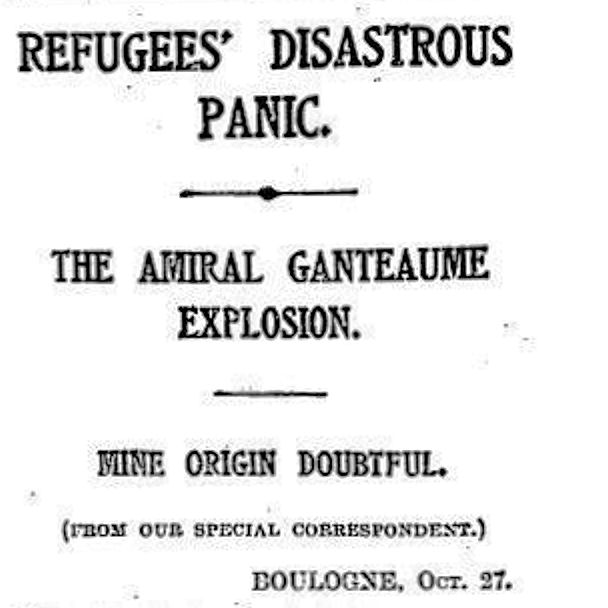
The sinking of the Amiral Ganteaume - Times headline 28 October 1914

The sinking of the Amiral Ganteaume – Times headline 28 October 1914

Newsflash: the Times special correspondent in Folkestone 28th October 1914:
The French Steamer Amiral Ganteaume carrying about 2,500 French refugees from Calais to Havre, struck a floating mine this afternoon about 12 miles off Cape Gris Nez. It is believed that the passengers were saved, with the exception of between 30 and 40, by the South Eastern and Chatham Railway Company’s steamer Queen. Fifteen of the passengers were drowned, and about the same number were crushed to death when the two vessels came together.’

Although World War I (1914-1918) technically began on 28 July 1914, on 3 August, Germany declared war on France and massed her troops on the Belgium border. In accordance with the written obligation of 1839 to uphold the neutrality of Belgium, the UK demanded Germany to respect it. They refused and the next day, 4 August, Britain declared war on Germany, the latter’s troops having swept through Belgium, routing the Belgian army. Then on 14 August, they defeated the French at Charleroi and on the 31 August, the British Expeditionary Force at Mons. The subsequent fighting consisted mainly of trench warfare with the German capture of the Belgium coast having put Allied shipping under constant threat.

The defences of Dover were placed on a war footing, both on land and sea. The entrance and exit to, the now Fortress Dover, was strictly by the railways and the main roads to Folkestone, Deal and Canterbury. Special passes, limited in number, were necessary for those who required to enter or leave the town. The Military Authorities had the power to arrest and search. All local newspapers were subject to censorship by the military and anyone approaching any defensive works would be stopped.  Cross-Channel ferries were transferred to Folkestone from where they took troops to the Continent and brought back civilians desperate to get back to England.

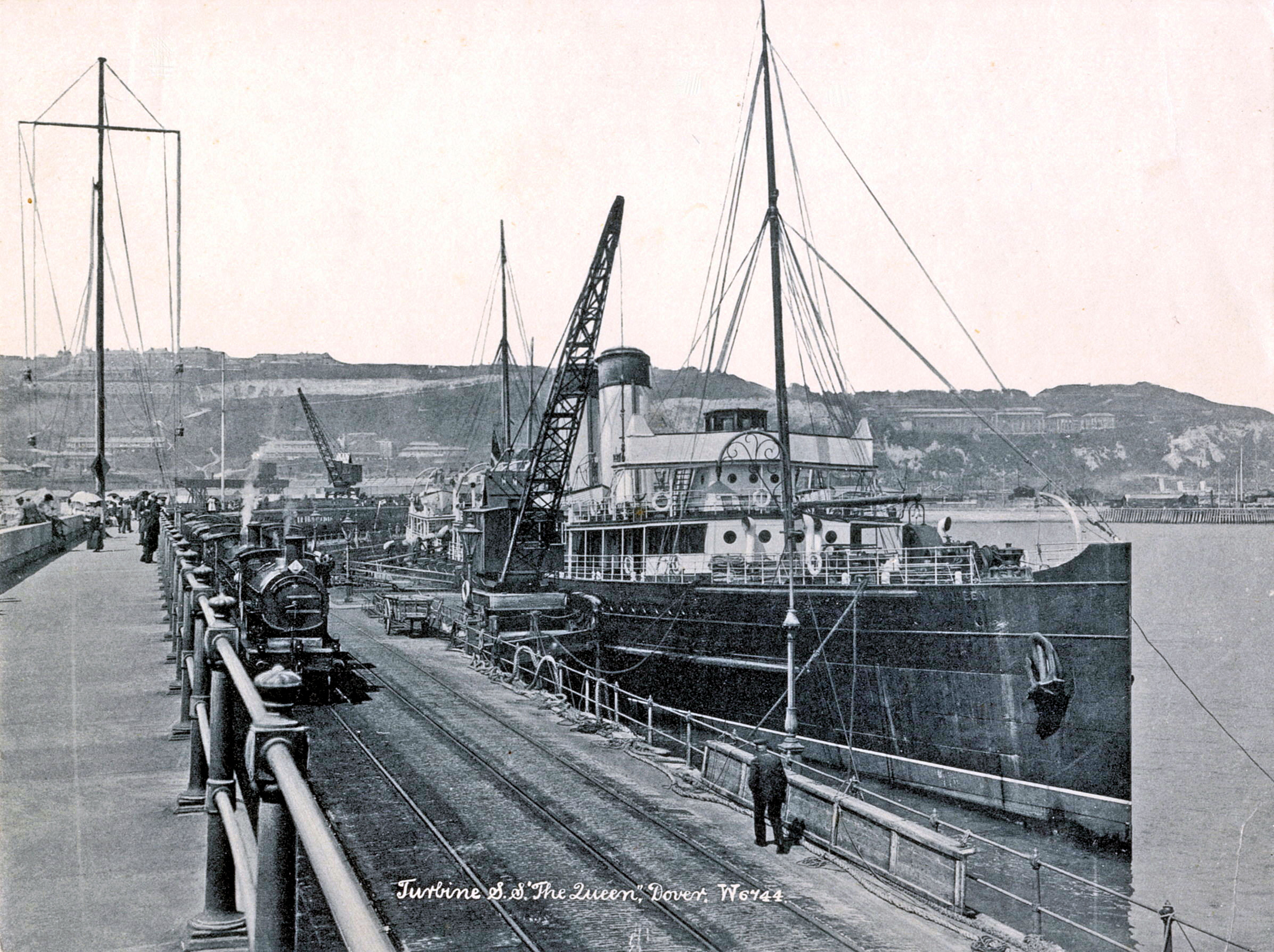
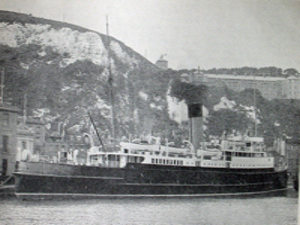
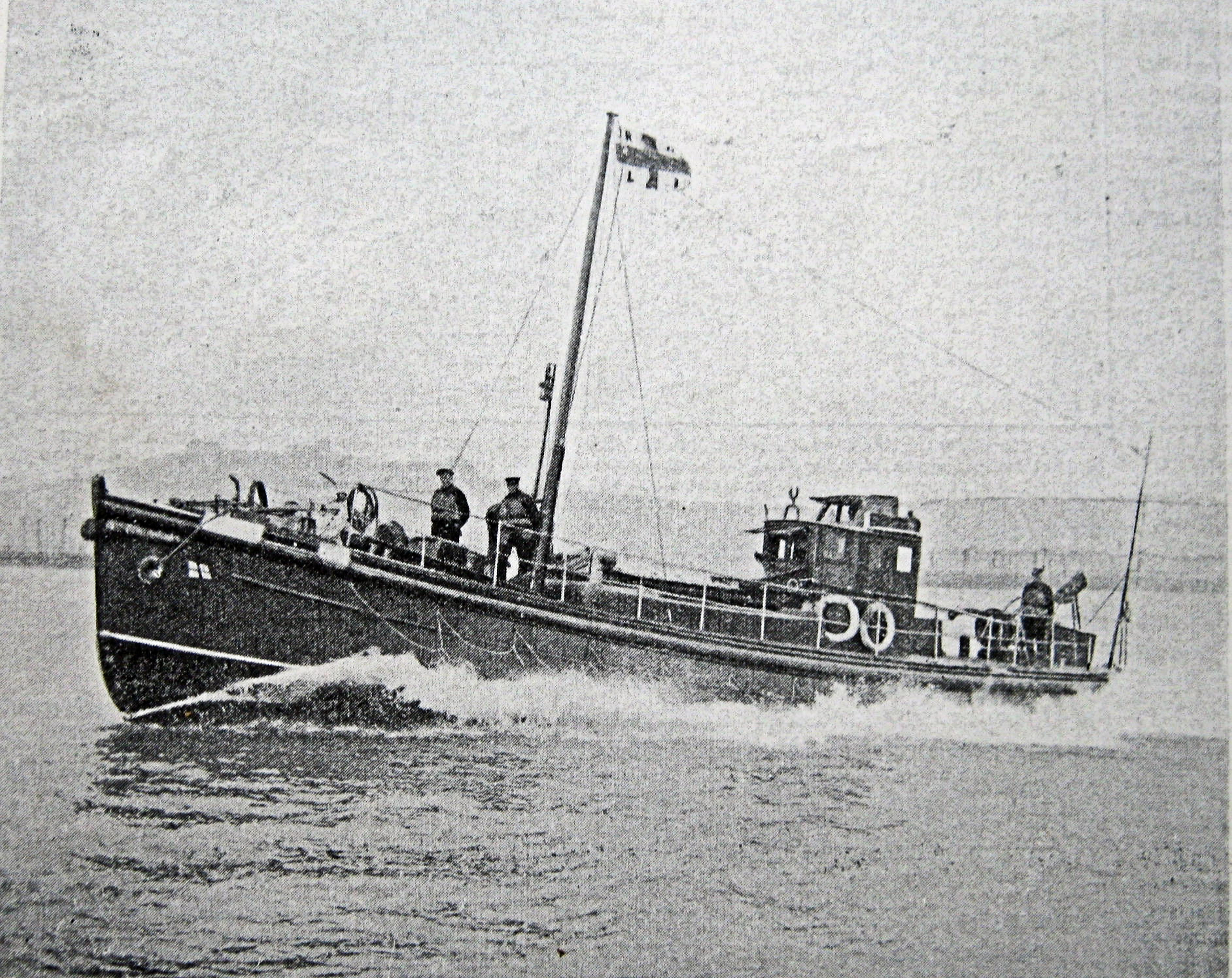
Queen c1905-10 alongside Admiralty Pier, Dover. Dover Museum

Queen c1905-10 alongside Admiralty Pier, Dover. Dover Museum

One such ship was the Queen a steel triple screw turbine steamer, built in 1903, by Denny’s of Dumbarton for the South Eastern and Chatham Railway Company (SECR). Her tonnage was 1,676 gross, 345 net and she had three compound direct drive steam turbines, one of high pressure driving the central screw and two of low pressure, driving the outer screws. The Queen was the first cross Channel turbine steamer to come to the port and was put on the Dover / Calais route in June 1903. She quickly became a favourite both for speed and for comfort and was seen by the Company as one of the main reasons for the dramatic increase in passengers in that and subsequent years.

Robert Edward Carey (1864-1942), was born on 30 October 1864 at 2 Townwall Street, Dover, and went to sea with his father when he was 14. They mainly worked on colliers, brigs and schooners sailing out of Dover. In 1892, Robert joined SECR and was married to Eliza Pont the following year. On 20 October 1914 he was appointed the Master of the Queen and six days later, on 26 October, he had taken the Queen across the Channel to Boulogne. On the return journey, at 16.30hrs, off the Varne bank, he saw distress signals. They came from the Amiral Ganteaume a 4,560-ton steamer built by Napier and Miller Ltd, Glasgow, in 1902. She was carrying some 2,500 French refugees from Calais to Havre and according to a Times special correspondent in Folkestone she had, ‘struck a floating mine about 12 miles off Cape Gris Nez.’

Donald Waylen, a Daily Mail reporter who was on board the Queen, wrote that screams could be heard some way off. As they came closer, they could see that most of the passengers on the Amiral Ganteaume were tightly packed on the main deck with some climbing the mast. To his horror, passengers could be seen jumping or being pushed overboard.

Waylen went on to write that the sea was running high and with great skill, Captain Carey manoeuvred the Queen to the leeward side of the Amiral Ganteaume. Then, according to Wentworth Huyshe (1847-1934), who was on the Queen, ‘Before this seaman like manoeuvre was complete … we saw that the whole mass of the refugees were frantic with terror, shouting crying, gesticulating frantically, waving caps and handkerchiefs. A long loud, wailing cry of terror and despair arose, but mingled with it, and soon, thank God, drowning it, the sound of cheering and clapping of hands and a joyous shout of ‘Vive l’Anglterre!’ Huyshe wrote that although rescue was at hand, some passengers jumped over the side and swam AWAY from the Queen!

Once alongside and gangway made, the passengers of the Amiral Ganteaume swarmed onboard the Queen, pushing others to the ground and trampling on them. About 15 passengers were pushed overboard between the two ships and were crushed to death or drowned. One woman, carrying a small child, jumped at the wrong moment, fell between the two ships and they too were crushed. A number of the crew and passengers of the Queen, who were helping, were also knocked down in the rush. Nonetheless, as the Daily Mail reporter observed, ‘The crew and passengers of the Queen worked splendidly to rescue the refugees, and eventually their coolness had a pacifying effect, and something like order was restored.’

Eventually, with 1,964 passengers on board from the stricken vessel, the Queen sailed for Folkestone. The captain and crew of the Amiral Ganteaume, remained with the ship and as they parted the two captains saluted each other.

Arriving at about 19.00hrs the injured – seventeen – were first taken to the Pavilion Hotel and then to Folkestone Hospital. The remainder were put on a train for London and on arrival, they were taken to Alexandra Palace. Of the injured, one died, one lost a leg and two others had an arm amputated. Several children were badly scalded or burnt about the head.

The Amiral Ganteaume eventually made it to Boulogne, where her crew stated that she had not hit a mine but that the ship’s boiler had exploded. Most of the passengers who had been thrown into the sea were rescued by fishing boats out of Boulogne. With watertight bulkheads closed, the Amiral Ganteaume was towed to Bordeaux where she arrived on 27 October and was examined.

The official inquiry took place in Paris where the captain of the Amiral Ganteaume said that Napier & Miller in Glasgow had built the ship in 1902 and that the operator was Chargeurs Réunis of Havre. He went on to say that the vessel had been torpedoed on the starboard side between the engine and the stokehold. The helmsman had seen the periscope of a submarine. A formidable explosion had occurred raising a column of water about 50-yards high.

The examination of the Amiral Ganteaume found that in one of the damaged lifeboats fragments of a German torpedo was discovered. This, French and British experts stated, proved that the vessel was torpedoed by a German submarine. They provided photographs that included ones showing the torpedo fragment.

The conclusion was that the ship had been subject to a torpedo attack without military excuse. With the help of the Channel steamer Queen and the trawler Sagaie nearly all the 2,500 passengers were rescued. Four engine-room hands were killed by the explosion and 20 passengers, consisting of old men, women and children. Finally, the attack was the first recorded attempt made to sink a passenger vessel.

The first German submarines, or U-boats as they were referred to by the end of 1914, had appeared in the Channel around the middle of September that year, sinking the Aboukir, Hogue and Cressy, off Zeebrugge. All three had men on board from Dover. Immediately after, the Admiralty gave notice that a minefield was to be laid in the eastern entrance to the English Channel, between the East Goodwin Lightship and Ostend.

The Scout, Attentive, was attacked by a U-boat on 27 September. This was the first appearance of the U-boats in the Channel and led to the withdrawal of the Scouts from patrol duties. They were replaced by the Dover Patrol and from March 1915, under the command of Rear Admiral Horace Hood (1870-1916)*. The Patrol had bases in both Dover and Dunkerque and consisted of naval destroyers, small submarines, drifters and requisitioned fishing vessels.

*NB: In the Battle of Jutland (31 May-1 June 1916) Rear Admiral Hood commanded the Third Battleship Squadron but was killed when his flagship, the battle-cruiser Invincible, was sunk on 31 May 1916.

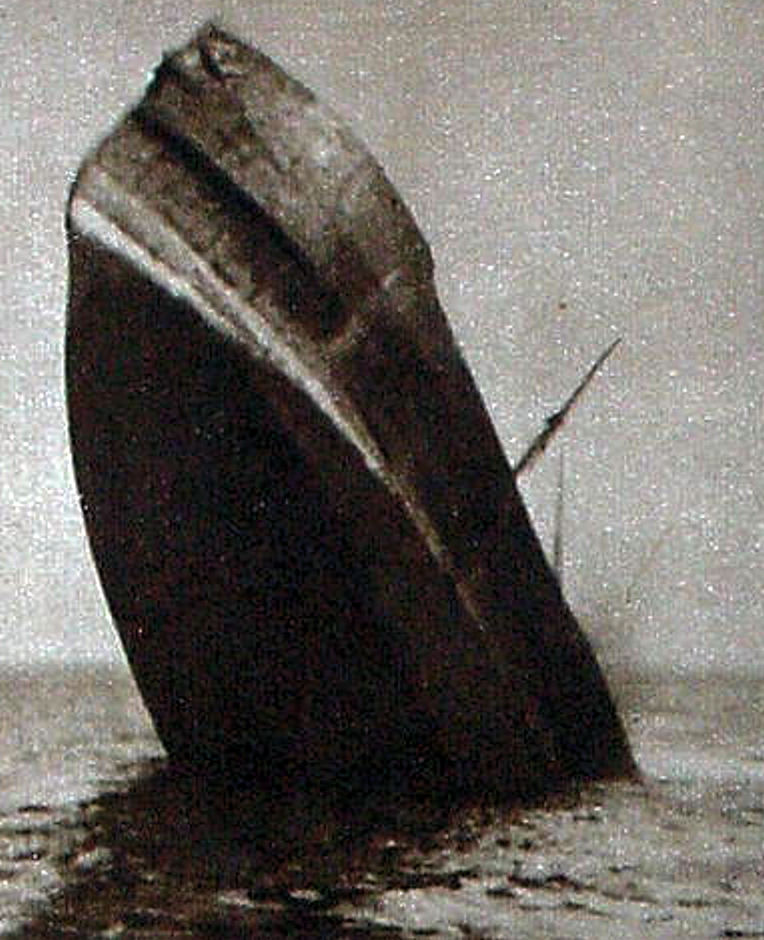
Ship sinking stern first after being hit by a torpedo. Doyle Collection

Ship sinking stern first after being hit by a torpedo. Doyle Collection

With regards to what had happened to the Amiral Ganteaume, the view of the Admiralty was that the devastation caused by the submarine’s torpedo was catastrophic. However, they implied, submarines were a ‘novel craft’ and not a great concern. The official statement issued on 1 December 1914, said,  ‘During the first four months of the War the raids of German submarines have resulted in the destruction of seven of our men-of-war and four or five merchant ships. By gunfire, however, the Germans have succeeded in destroying three men-of-war and some 50 merchantmen.’ Therefore, it was concluded, that it was only a matter of time before the naval establishment will have worked out how to deal with the ‘novel craft.’

Shortly after, the Admiralty commended Captain Carey on the successful rescue of most of the passengers from the Amiral Ganteaume, then nothing more was said. The Captain quietly carried on with the transporting of troops across the Channel. This, after Carey had save so many lives, many in Dover found offensive and it was taken up by the Dover Express . The result was that the French awarded Captain Carey  the Medaille de Sauvetage en Or (2iém classe) and the Medaille d’Or Societe Centrale de Sauvetage de Naufrages. King Albert I (1909-1934) of Belgium created him Chevalier de l’Ordre de Leopold. Sir Francis Dent (1866-1955), General Manager of SECR, gave Captain Carey a gold watch. Then, in November 1917, when George V (1910-1936) was returning from Boulogne on the hospital ship Anglia, of which Captain Carey was Master that day, the King personally expressed his appreciation.

That year, King George recognised that there was a gap in the honours system. There was no official acknowledgement of the many thousands of people who had served in numerous non-combatant capacities during the war. In order to make amends, on 4 June he introduced the Most Excellent Order of the British Empire and Captain Carey was so honoured in the New Years Honours list of 1919.

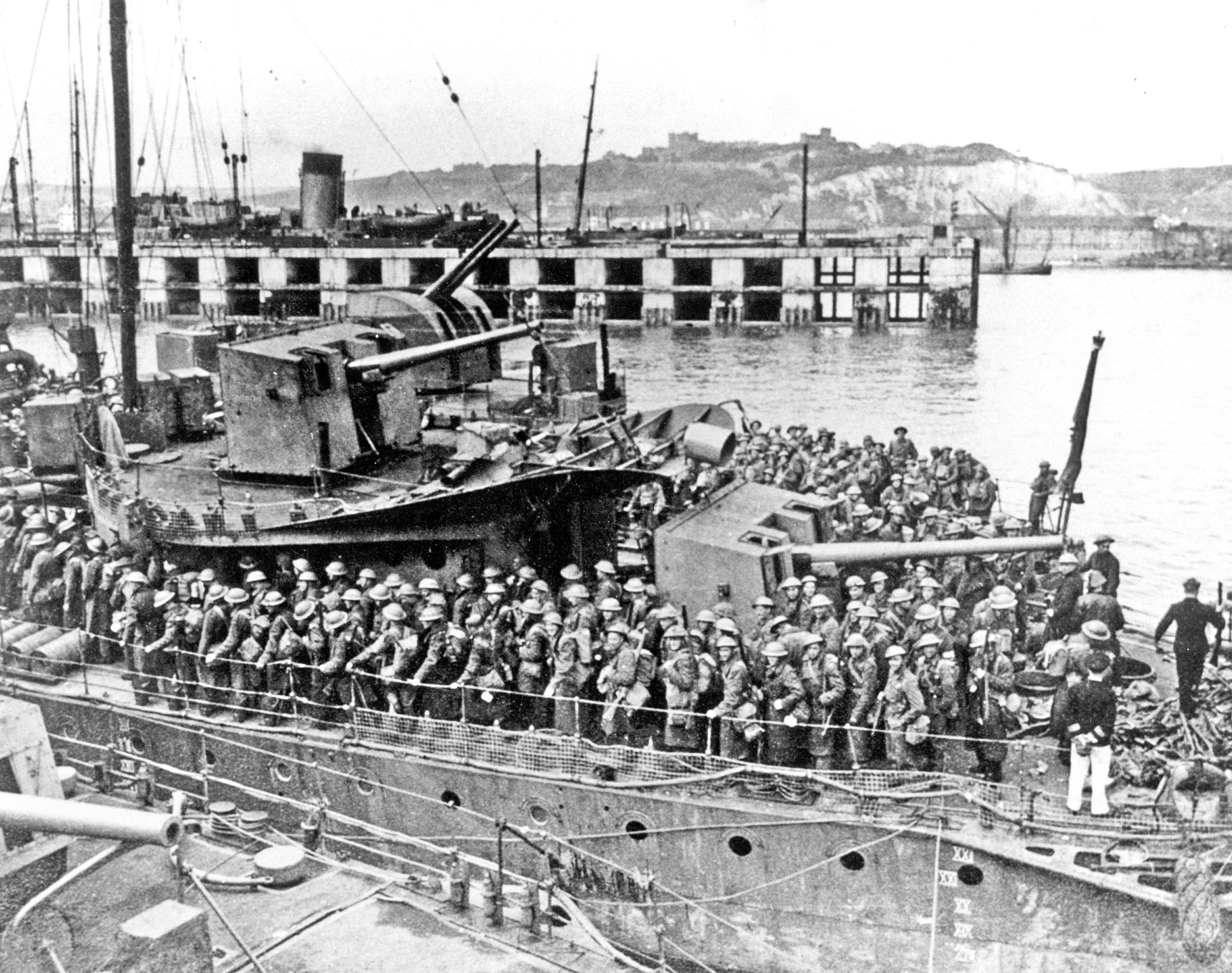
Troop ship in World War I alongside Admiralty Pier. Dover Museum

Troop ship in World War I alongside Admiralty Pier. Dover Museum

Throughout the War, Captain Carey was involved in the transporting of troops to and from Calais and Boulogne and also between Southampton and Havre. Following the War he was appointed Master of the 2,384ton Maid of Orleans a steel twin-screw passenger and cargo steamer launched 4 March 1918. Along with other cross Channel ships, she was commandeered for active service in World War II (1939-1945) and was part of the May-June 1940 Dunkirk rescue.

It was reported that the Maid of Orleans was so packed with troops that they were standing shoulder to shoulder when the ship was attacked by five planes. When she arrived in Dover, it was reported that ‘blood was running down her sides.’  The ship was also involved in the Normandy D-Day landings of June 1944 and after making several trips to the beaches hit a mine on 28 June, sinking off St. Catherine’s Point, Isle of Wight. Five crew members were lost.

Isle of Thanet, built 1925 in Granville Dock. A 2,664ton steel twin screws turbine steamer. Alan Sencicle

Isle of Thanet, built 1925 in Granville Dock. A 2,664ton steel twin screws turbine steamer. Alan Sencicle

In 1925, Captain Carey was appointed the Commander of Southern Railway‘s Channel fleet and his flagship was the newly launched Isle of Thanet, a post he held until he retired in 1929. The 2,664ton Isle of Thanet was a steel twin-screw turbine steamer built by Denny’s of Dumbarton, launched 23 April 1925. She was provided with Babcock & Wilcox water-tube boilers, oil rather than coal-fired and made her inaugural voyage to Calais on 24 July. In November that year she was transferred to Folkestone for the Boulogne passage. She was the first hospital ship to go into Dunkirk and made several trips. She also saw activity in the D-Day Landings as the deputy HQ ship of Force J commanded by Admiral Philip Vian (1894-1968). Following the War in July 1947, the Isle of Thanet reopened the Dover-Boulogne service and in May 1948 was transferred to Folkestone until September 1963. She was then brought to Dover until towed away on 10 June 1964 to be broken up.

In 1940, Captain Carey was awarded the MBE, along with other members of his crew, for the lives they saved in the Amiral Ganteaume disaster.

The Queen, the ship involved in the Amiral Ganteaume rescue, was the first turbine steamer commissioned by SECR and initially worked the Dover-Calais run. In 1907, she was transferred to the Folkestone – Boulogne service from where she was commandeered in World War I as a troop carrier. In August 1916 she was involved in another heroic rescue when she helped to take men off the packed but disabled troop transport ship Empress Queen to safety. The 2,140ton steel paddle steamer, belonging to the Isle of Man Steam Company, had been commandeered by the Admiralty on 6 February 1915, again as a troop carrier.

On returning from Le Havre to Southampton on 1 February 1916, with 1,300 men on board, the Empress Queen ran aground on rocks off the Isle of Wight during foul weather with poor visibility. Destroyers and other ships, including the Queen, took off the troops but the crew stayed on board in order to try and save the beleaguered ship. The weather deteriorated even more but the Bembridge lifeboat did manage to rescued 110 people still on board. As the Queen was still in the vicinity, she took a further nine.

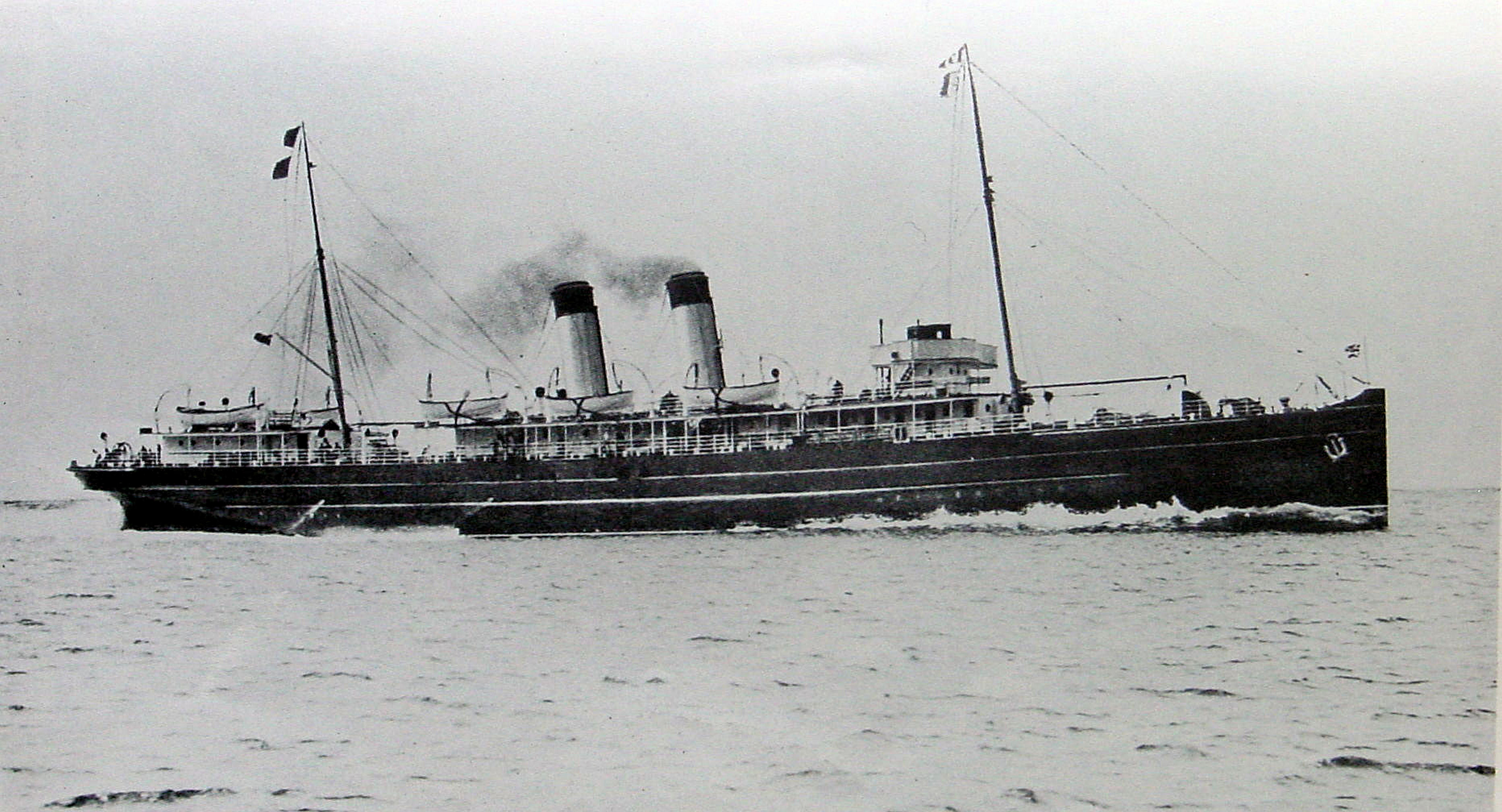
Queen - cross Channel turbine steamer torpedoed 26 October 1916

Queen – cross Channel turbine steamer torpedoed 26 October 1916

By the end of 1916, about 300,000 tons of shipping was being destroyed every month in the Channel and North Atlantic. On 26 October 1916, while making the return journey after disembarking troops, German destroyers surrounded the Queen. The German commander allowed the crew to take to their boats before they torpedoed the Queen. According to the Admiralty report, she drifted for over three hours before finally coming to rest on the South Goodwins. The ship’s crew were picked up and returned to Dover. Lewis Dilnot (21), the ship’s cook, later died from injuries sustained while launching the vessel’s lifeboats.

In the twenty-fours hours that the Queen was sunk, ten destroyers were sunk in the Channel by U-boats, including the torpedo-boat destroyer Flirt, commanded by Richard P Kellett, but nine of her crew were saved. The Tribal or F Class torpedo-boat destroyer Nubian, commanded by Montague Bernard, was disabled, and grounded in the succeeding gale. Six patrol boats were also sunk. The carnage at the Somme, when in the course of three months in 1916, 420,000 British service men, 200,000 French and 450,000 Germans were killed or injured. Altogether, a total of 400,000 from both sides died. This together with the incessant U-boats attacks, led to the resignation of Herbert Asquith (1852-1928) as Prime Minister (1908-1916) on 7 December.

In charge of the Dover Patrol at the time the Queen was sunk, was Admiral Sir Reginald Bacon (1863-1947) who had ordered the Channel Barrage – a huge net, with minefields on either side, which was strung across the Channel suspended from fishing boats and buoys to try and block the passage of U-boats. Regardless of this the U-boats attacks continued and in April 1917, about 875,000 tons of British and Allied shipping were destroyed and subsequent shortages led to the introduction of partial rationing in June 1917 and general rationing on 1 January 1918. Secret German documents were obtained and they showed that U-boats were travelling on the surface at night, passing OVER the Channel Barrage! Vice-Admiral Roger Keyes (1872-1945) replaced Admiral Bacon on 31 December 1917 and shortly after, the British First Sea Lord, Sir John Jellicoe (1859-1935), was dismissed. Before going Jellicoe proposed a raid on the Zeebrugge/Ostend U-boat base and Keyes’ objective was to formulate a plan – the Zeebrugge Raid!

A shorter version was published in the Dover Mercury: 11 November 2010

Posted in Armed Services, Carey Captain and the Queen, Carey Captain and the Queen, Carey Captain and the Queen, People, Port and Transport | Comments Off on Captain Carey, the Queen and World War I shipping in the Channel.

River Dour Part II the Walk Section II – from Barton to Wellington Dock

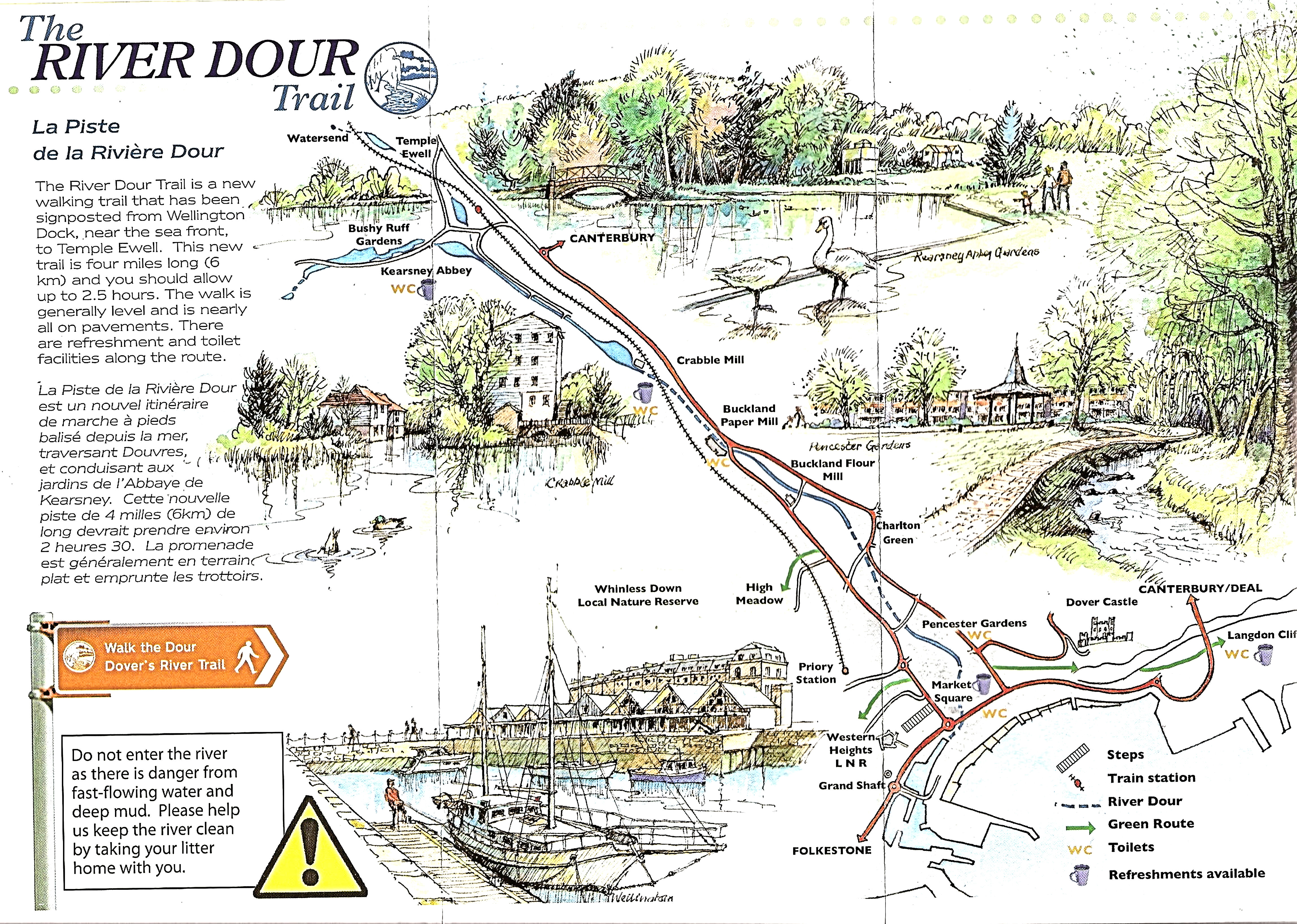
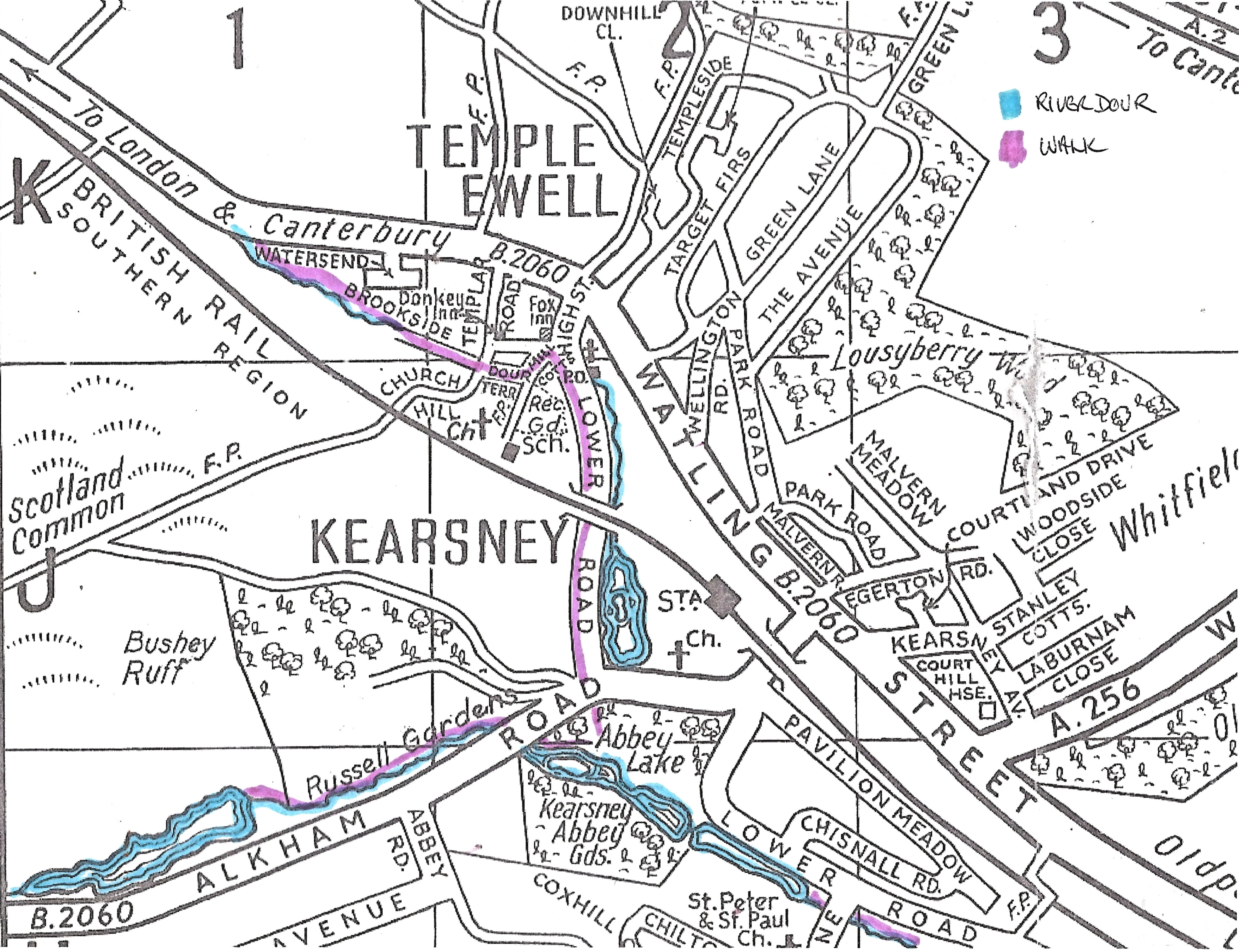
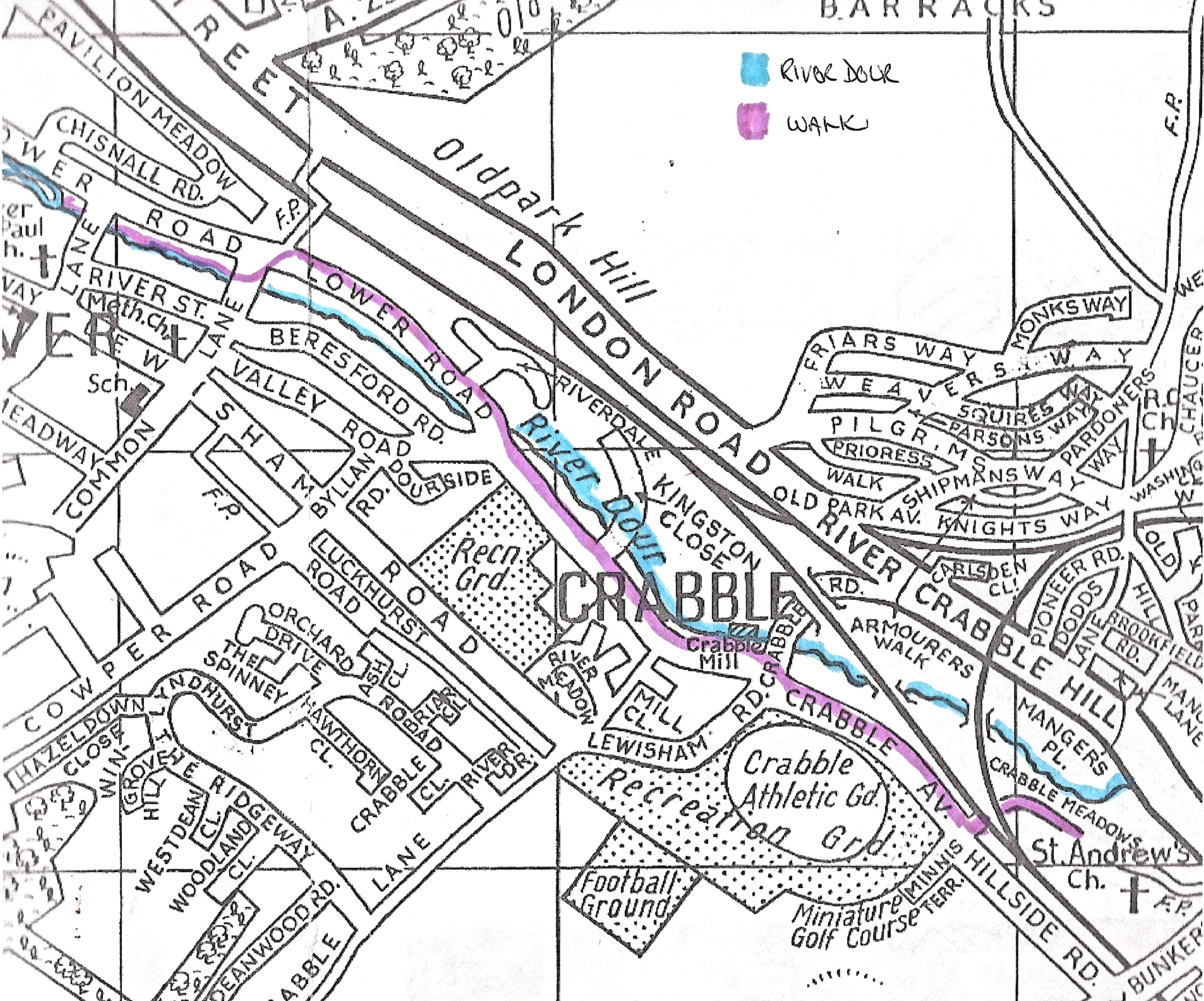
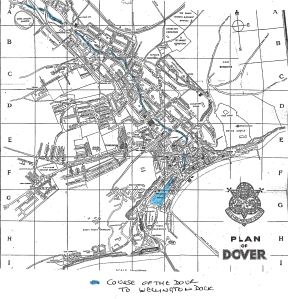
White Cliffs Countryside River Dour Path Trail map. White Cliffs Countryside Partnership

White Cliffs Countryside River Dour Path Trail map. White Cliffs Countryside Partnership

The walk along the Dour is divided into two sections. Part II section I went from Temple Ewell to Buckland and this section goes from Lorne Road, Barton, to Wellington Dock through:

1. Barton
2. Barton Path
3. Charlton
4. Crafford Street to Pencester
5. Pencester Gardens
6. Stembrook
7. St James Area – West
8. New Bridge to Wellington Dock

1. Barton

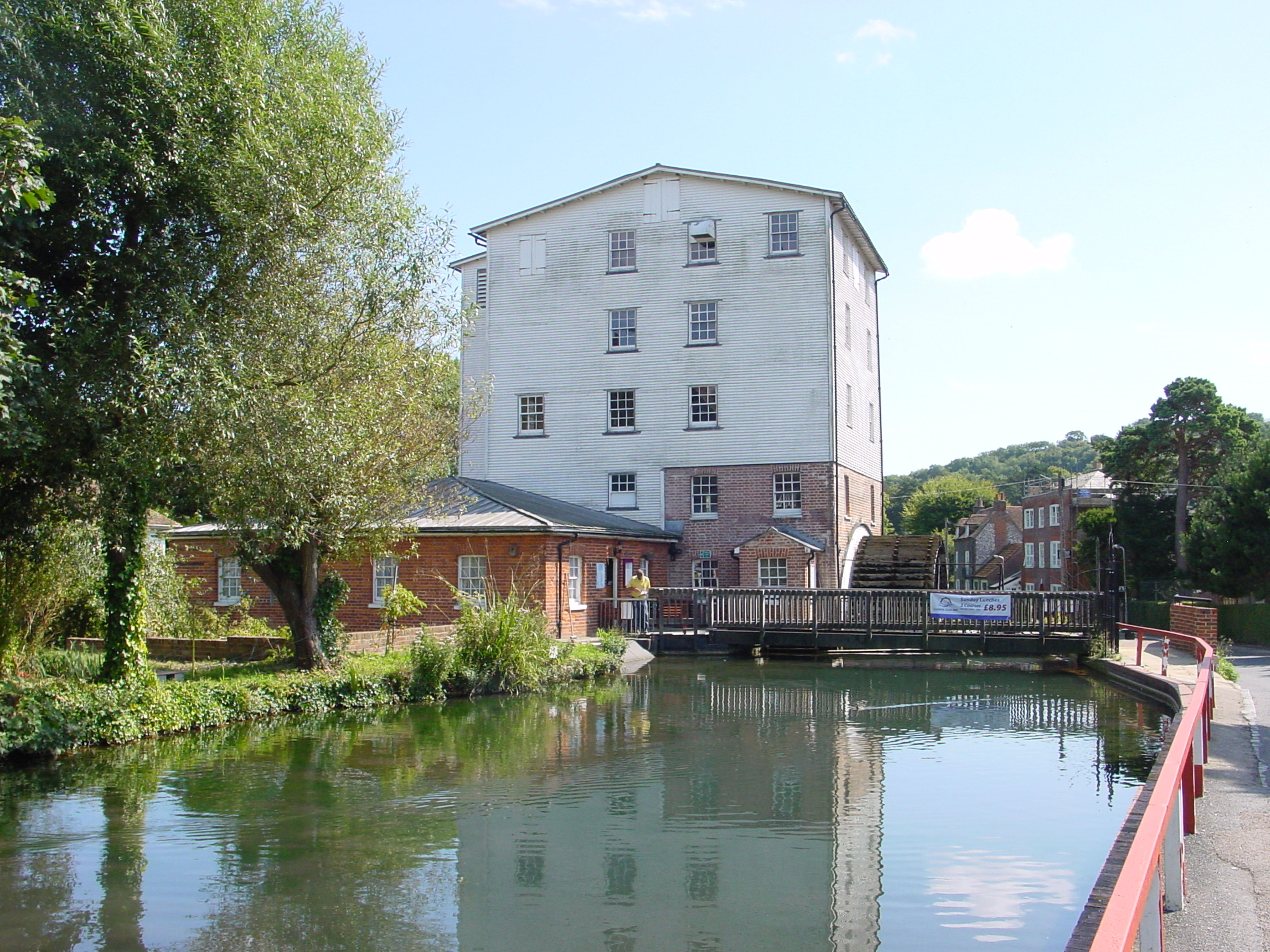
Buckland Corn Mill water wheel, Lorne Road. Alan Sencicle

Buckland Corn Mill water wheel, Lorne Road. Alan Sencicle

Starting from Lorne Road, off  London Road, Buckland and opposite Coombe Valley Road, the walk crosses the Dour by a bridge that was first erected by Thomas Hyde Page in the late 18th century. From the left (north) parapet there is an excellent view of the former Buckland corn mill, now apartments, waterwheel. Upstream the Dour flows between London Road and Alfred Road into the former millpond. Owned by Criccieth Homes, in 2006 the pond was drained to repair damaged sluice gates and at the time it was reported that the pond would be open to the public. Eight years later, in 2014, it was reported that instead, the pond was being considered for use for hydroponics farming – the growing of plants in water without soil. Two years later the millpond was put on the market with an asking price of £30,000. In response, moves were made to persuade Dover District Council to purchase it for community use but as yet this has not come to anything.

Prior to Lorne Road coming into existence at the end of the 19th century,  Brookfield nursery occupied the east side of the Dour. The site was bought by Worsfold and Hayward of Market Square and Lorne Road and Alfred Road were built but several years went by before the name of Lorne Road was extended across the bridge to London Road.

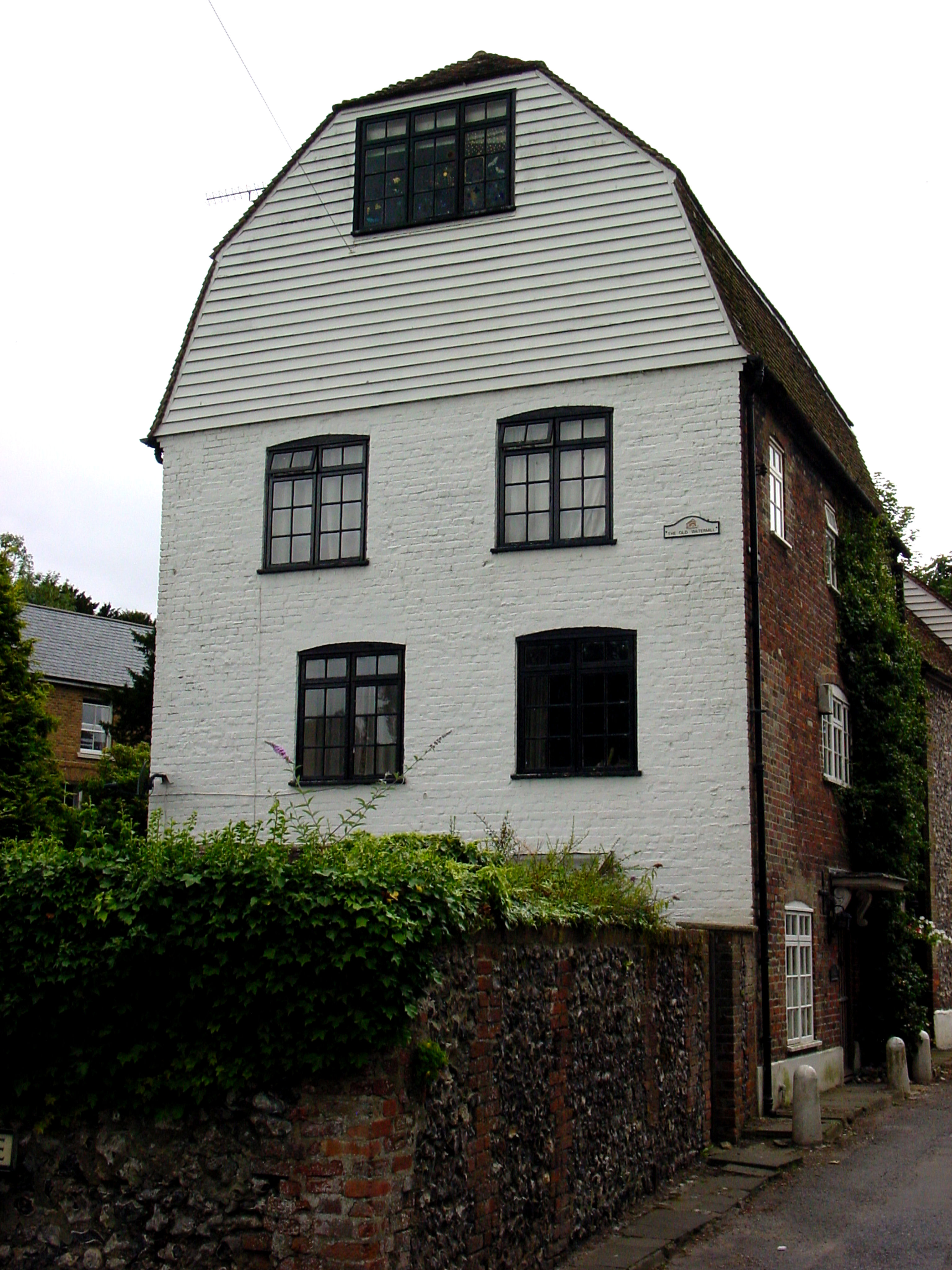
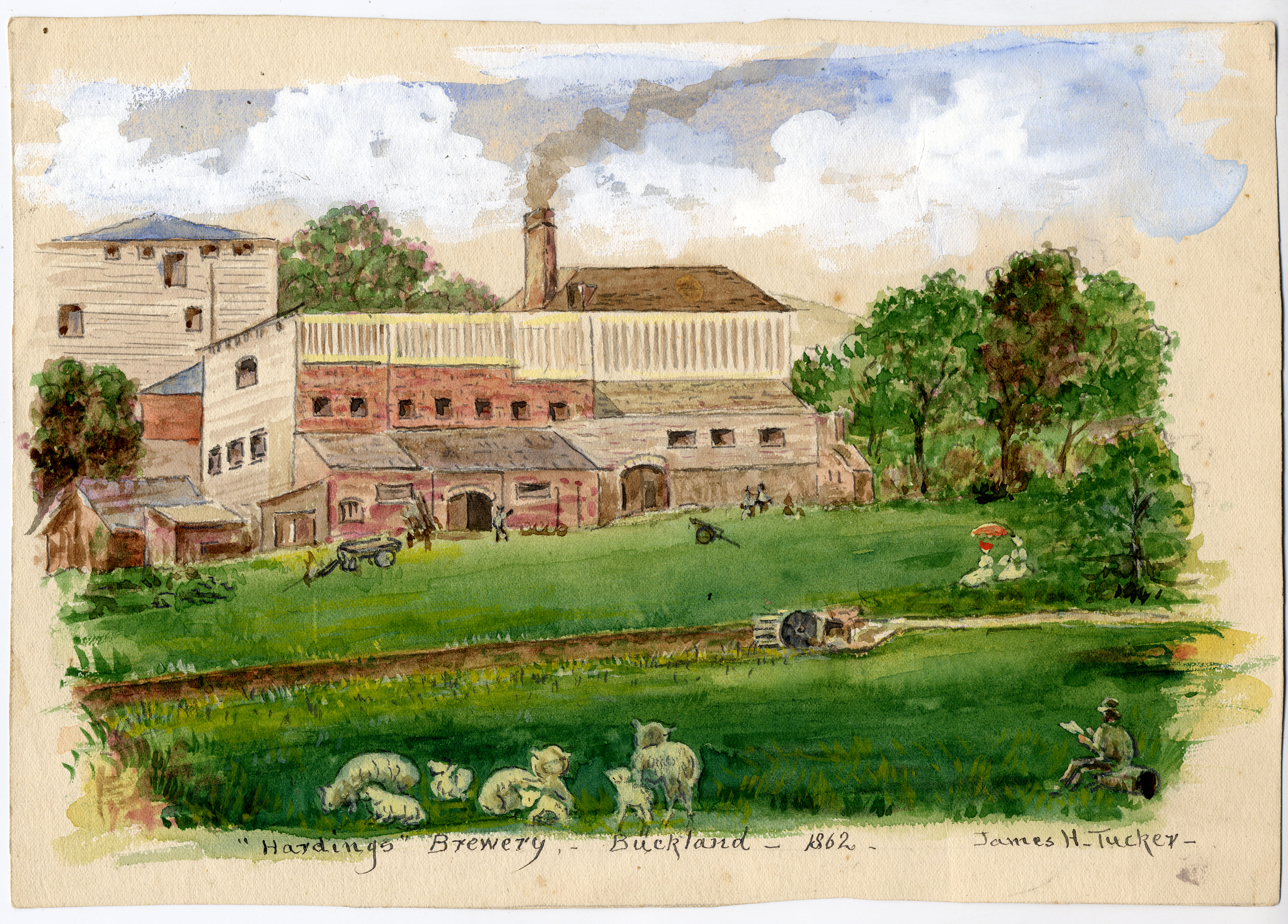
On the north side of Lorne Road once stood an ancient corn mill that in 1775 became part of the newly built Lower Buckland paper mill. In 1846, builder, John Peirce of Bartholomew Terrace, bought the paper mill which he converted into a Brewery named after his hero, the Duke of Wellington (1769-1852). Later Wellington Brewery came into the possession of Peirce’s son-in-law, William Harding, who added his name. In November 1913, the Mannering family, who owned Buckland corn mill, bought the brewery for storage use but retained much of the equipment. In 1961, E M Gheysens, toy manufacturers, bought the site and the old buildings were demolished. The new premises eventually became a P&O training centre and they were followed by Steel Designers Construction. For a long time the building was allowed to fall into disrepair but since the building has been renovated and small firms have moved in. Opposite  a new housing scheme is underway.

Joss Stone's childhood home in Alfred Road. Alan Sencicle

Joss Stone’s childhood home in Alfred Road.  Alan Sencicle

Further along Lorne Road, on the left, is the entrance into Alfred Road where the internationally celebrated singer/song writer/actress, Joss Stone, spent her early childhood. Born at Buckland Hospital, Coombe Valley Road, on 11 April 1987, she was named Jocelyn Eve Stoker and later attended St Mary’s Primary School. Her family moved to Ashill, Devon when Joss was about eight years old but her grandparents stayed in the area along with many of her relatives. Specialising in Soul music, between 2001 and 2003 Joss won the BBC Star for the Night and Steps to the Stars. Signed up by Steve Greenberg of S-Curve records, New York then EMI, recording in Los Angeles, Joss’s debut album, Soul Sessions was released in 2003.  This was a huge success in both the United Kingdom and the United States and her second album, Mind, Body and Soul debuted at number one in the UK. In 2005, at the age of 17, Joss became the youngest ever winner of the British Female Solo Artist in the Brit. Awards! Having expanded her career into acting, Joss made her debut in the 2006 film Eragon and in 2011 played Anne of Cleves (1515-1547) 4th wife of Henry VIII (1509-1547). This was in The Tudors series on the US premium cable television channel Showtime. Joss always promised to return and give concerts in both Dover and Deal. This she fulfilled in March 2009, on stage at the Maison Dieu and the Castle Community Centre, Deal. Tickets sold out within hours!

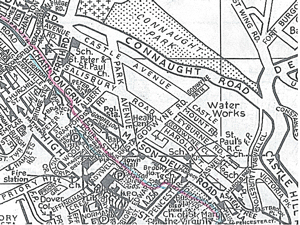
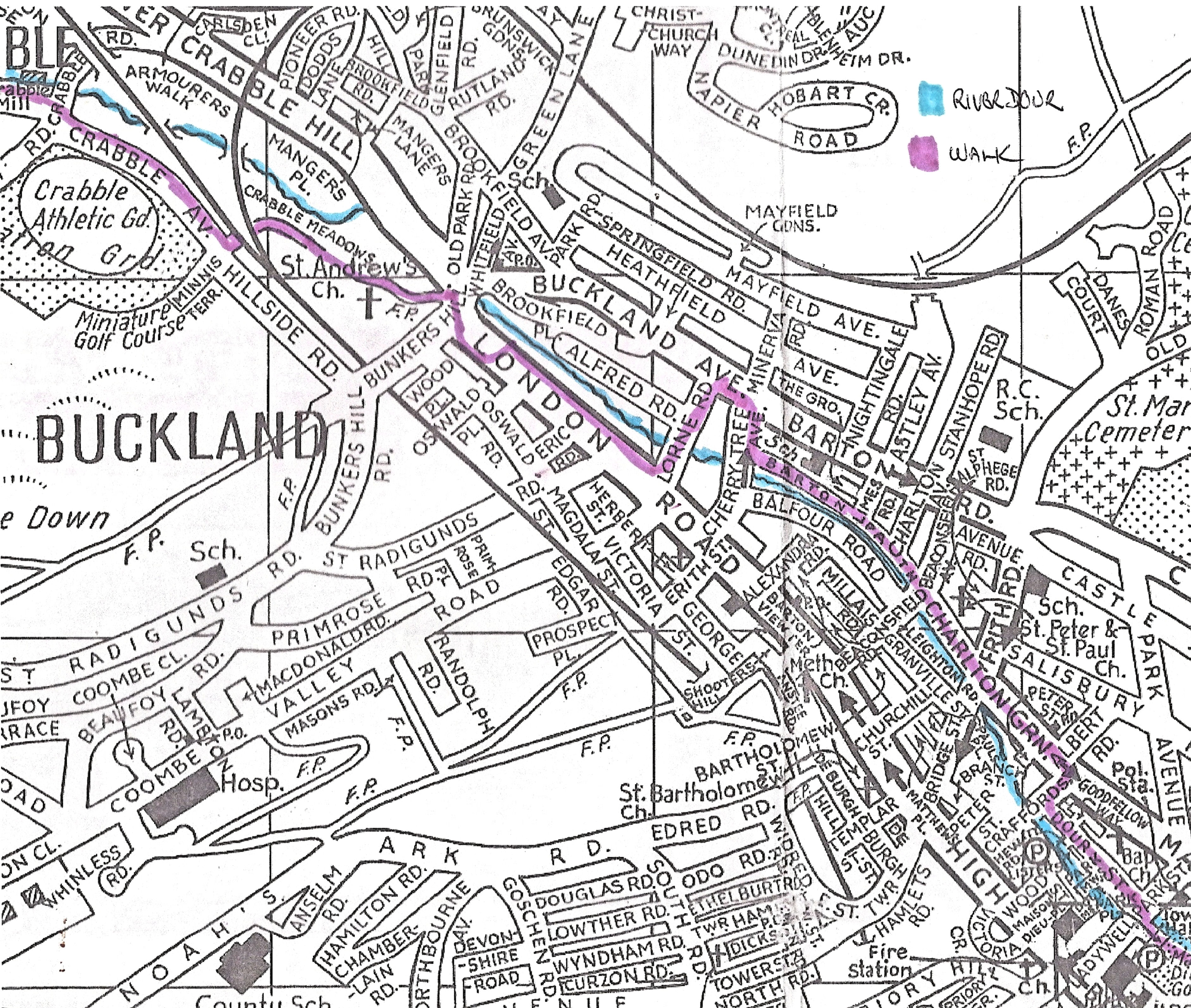
Dour Walk through Barton and along Barton Path to Charlton. Service Publications c1990

Dour Walk through Barton and along Barton Path to Charlton. Service Publications c1990

At the end of Lorne Road turn right into Barton Road, and perhaps call into the White Cliffs Bakery on the corner. Barton Road was originally a crooked narrow thoroughfare called Barton Back Lane and was given that name due the proximity of Barton Manor, later farm, that stood between the present road and the Dour. In 1861 this part of the road was slightly widened on the instigation of the Mayor, John Birmingham to provide work for the unemployed. Most of whom had been involved in building the London, Chatham and Dover Railway line and on completion had no further jobs to go to.  By that time the road was known as ‘Love Lane’ as it was favoured by couples on fine summer evenings! Sir William Crundall (1847-1934), Dover’s Mayor 13 times, put an end to that in the 1880s when he started the development of the area that included housing between the old lane and the Dour. Renamed Barton Road, it was widened to its present dimensions in 1896.

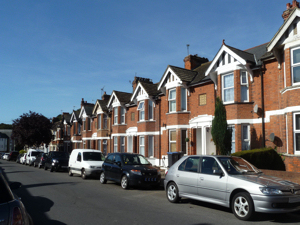
Cherry Tree Avenue, cottages on the south side between the Dour and Barton Path. Alan Sencicle

Cherry Tree Avenue, cottages on the south side between the Dour and Barton Path. Alan Sencicle

Cross Cherry Tree Avenue at the traffic light, turn right and the walk will take the first turning left. Go past the school playing field to Barton Path, just before the parade of shops. Before traversing the path, Cherry Tree Avenue was originally called Cherry Lane but was changed after houses were built in 1896 and trees, not cherry trees, were planted. On the opposite side from the footpath is a classic Co-operative building and next to it is the River Dour, with the remains of a small quay. The Dour goes under the Avenue and comes out east of Balfour Road. The latter was built about 1902 and was named after the then Prime Minister 1902-1905 Arthur Balfour (1848-1930).  Before going to Barton Path, note the variety of different architectural styles of the properties along Cherry Tree Avenue, especially as most were built at the same time.

2. Barton Path

Barton Farm on the Dour, glass slide not dated. Dover Museum

Barton Farm on the Dour, glass slide not dated. Dover Museum

On the left of Barton Path, up until the latter part of the 19th century, was Barton Meadow on which fairs were held. As Barton was rapidly being developed concern was expressed over the loss of open spaces and from ancient times, there has been a right of way from Barton Back Lane, skirting the south side of Barton Farm and the north side of SS Peter and Paul Church, Charlton, where the Dour was crossed on a plank to Beaconsfield Road. There was also another ancient path, owned by the Ecclesiastical Commission that ran along the east side of the Dour from St Andrews Church to SSPeter and Paul Church. By 1890,  Alderman George Birch, the proprietor of the then Falcon Hotel, at the corner of Bridge Street and London Road, was becoming increasingly concerned and called for a path along the Dour, which he named ‘The Barton Path.’ He envisaged that eventually the path would be extended both ways to run alongside the Dour throughout its whole course.

Brown trout in the Dour alongside Barton Path. AS

Brown trout in the Dour alongside Barton Path. AS

Alderman Birch, set about persuading the Ecclesiastical Commission and Dover Corporation to use parts of the two paths to create ‘The Barton Path! An agreement was signed on 23 June 1893 and work started immediately. The council also agreed to purchase a strip of land on the opposite side of the river in order to ‘add to it’s beauty’ by planting trees. Albeit, they were outbid for the land by developers and Balfour Road was built. Nonetheless, the Barton Path was a success from the outset and in 1905, it was reported that an 18inch trout was found in the Dour along this stretch. However, at the time, the Dour was considered in law to be a watercourse and did not received river status until December 1993! Further, Alderman Birch’s dream of a path alongside the full length of the river is still a dream – see latter section of Part I of the River Dour story.

Barton Road c1901 with St Barnabas Church on right. Fr C Johnson

Barton Road c1901 with St Barnabas Church on right. Fr C Johnson

As a consequence of the development of Barton it was agreed to create a separate parish and to class the area as a village. In 1901 St Barnabas Church was built on Barton Meadow, to the left of the start of Barton Path. The architect was Benjamin Ingelow, builder P.W. Paramor and it cost £6,130 4s 7d. The church was popular from the outset and a parish hall was erected between the Church and Barton School. However, in August 1940, during the Battle of Britain, the Church was severely damaged by a shell and subsequently demolished. In 1953, due to the loss of the Church, the parish boundaries were redrawn and Barton became a hamlet of both Buckland and Charlton. The ruins of the Church were demolished the following year and the site became Barton School playing field.

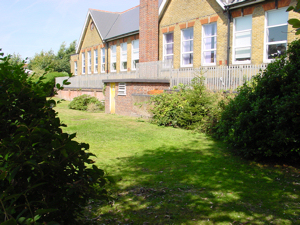
Barton School from Barton Path. Alan Sencicle

Barton School from Barton Path. Alan Sencicle

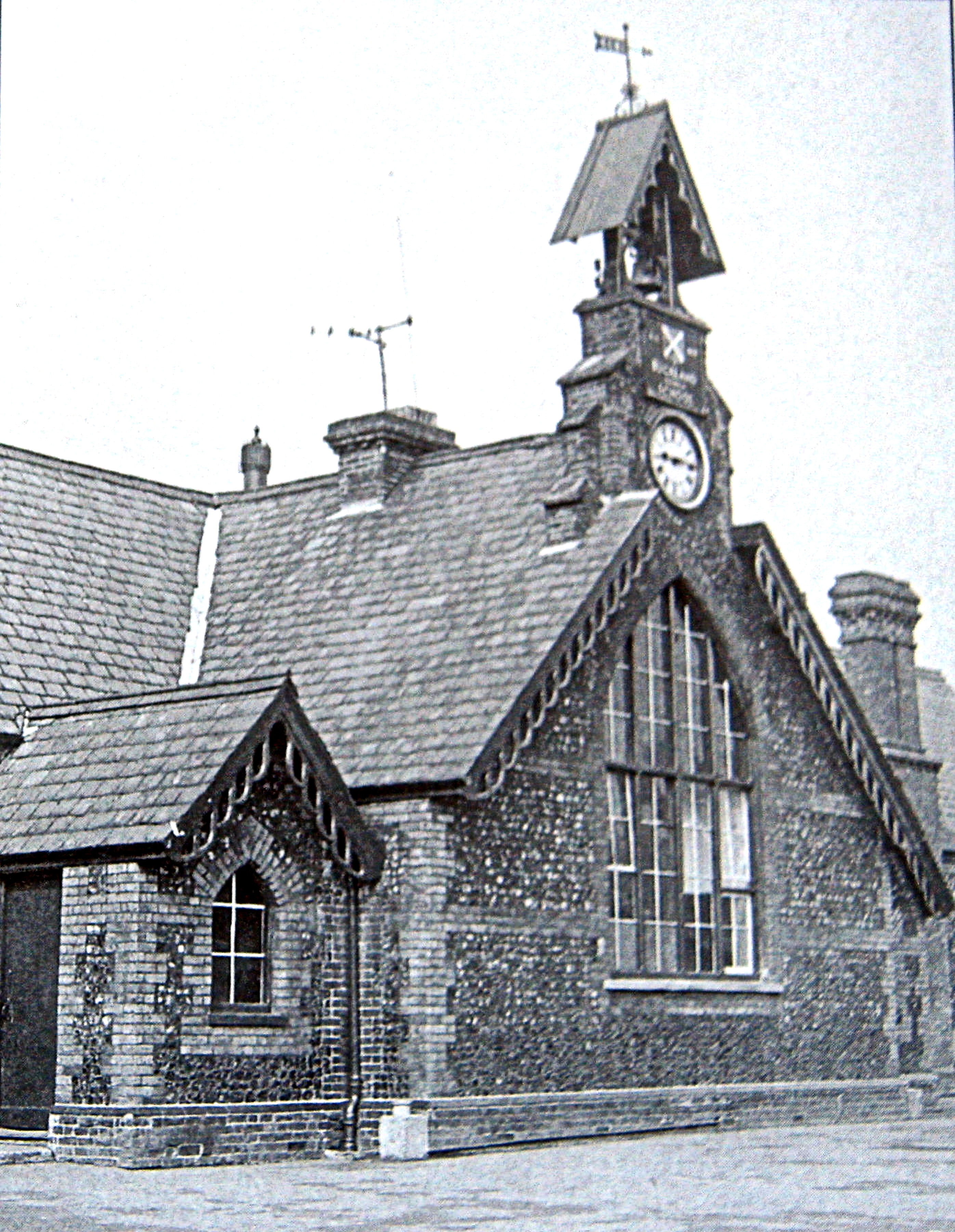
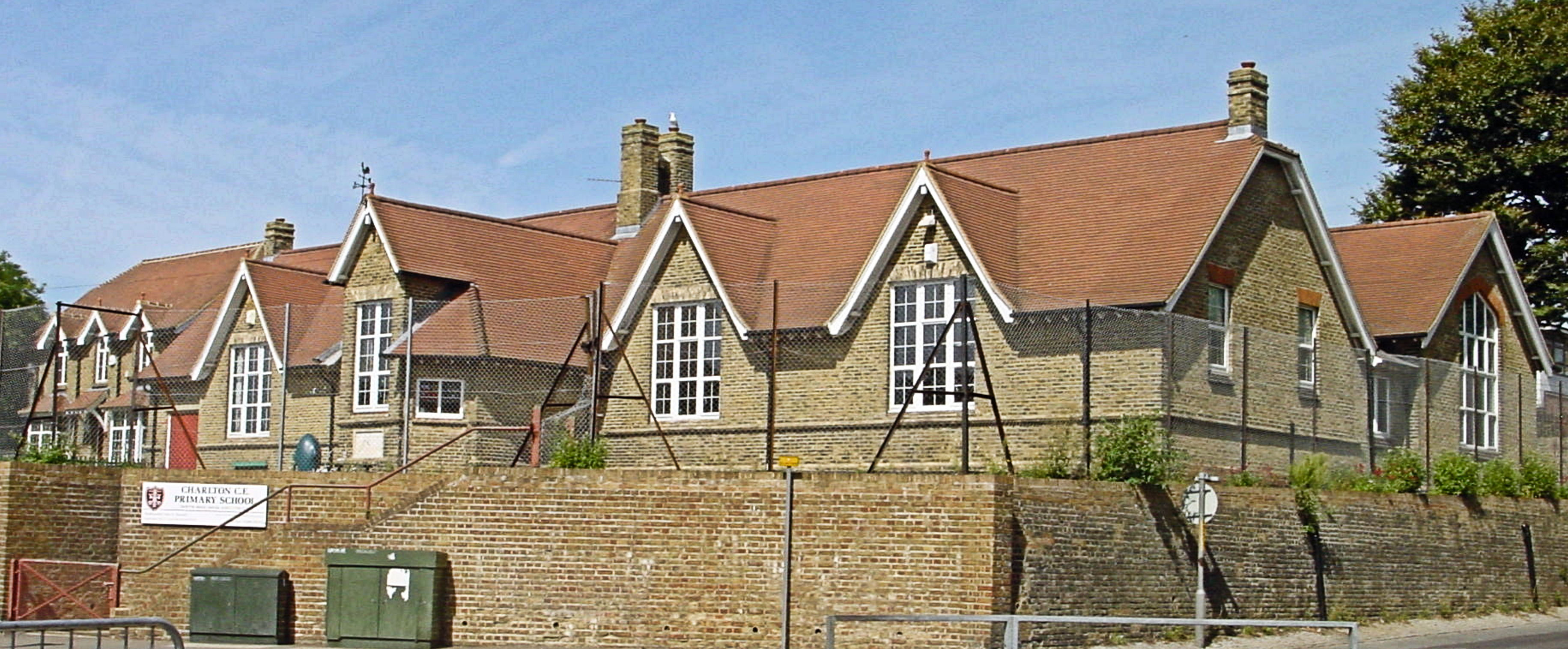
Along the Barton Path, on the left, is the back of Barton School. Envisaged in 1897 to meet the needs of the rapidly expanding Barton, at that time the children were attending Buckland School on London Road. Initially, it was agreed that the new school would accommodate 440 boys in four classrooms and it was designed as such by Cresswell and Newman of Castle Street. It was built by William G Lewis and the cost was £3,500 provided through charities connected with St Andrew’s Church. The building was started but due to national changes in education policies the number of places for the boys had to be reduced or more classrooms had to be built. Building stopped, discussions took place and in the end, it was agreed to keep the design and reduce the number of places to 240boys and build a separate infants school on the same site.

Eventually, at the end of January 1903 the boys school, with four classrooms, opened and the infants school shortly after. Later, Dover Corporation purchased both schools but as the girls were still at Buckland school It was not until 1912 that an annex was opened to accommodate the girls.  With the opening of Shatterlocks Boys’ School on Heathfield Avenue, in 1937, Barton Road infant school closed giving more accommodation for the girls. Following World War II (1939-1945) up until 1957, the school catered for children between the ages of  7 and 15. That year the £180,000 Archers Court Secondary School opened at Whitfield, now Christ Church Academy, and Barton School became a junior school.

Charlton mill pond on the Dour with Barton Farm on left and Charlton SS Peter and Paul Church on the right. C1850. Sencicle collection

Charlton mill pond on the Dour with Barton Farm on left and Charlton SS Peter and Paul Church on the right. C1850. Sencicle collection

Further along  the path, on what was originally Barton Manor farmland 106 houses on four roads were built back in the 1880s. They were Limes Road, Charlton Avenue, the Grove and Beaconsfield Avenue and more about the latter later. Limes Road was built first and runs from Barton Path to Barton Road. When building was under way, it was found that there was enough room to fit in a few more houses by sacrificing a couple of houses on Limes Road and creating a short road at right angles to the school boundary. This became the Grove.

Barton Path weir taking a stream under Balfour Road to Charlton Green to control the amount of water in former mill pond. AS

Barton Path weir taking a stream under Balfour Road to Charlton Green to control the amount of water in the former mill pond. AS

Parallel to Limes Road, Charlton Avenue was built on the actual site of Barton Manor/farmhouse and both Limes Road and Charlton Avenue can be accessed from Barton Path. Near the opposite bank of the Dour from Limes Road, is a triangular indent that once was a sluice gate and weir, only the weir remains. This was created to control the amount of water in the millpond when Chitty’s corn mill, further down stream, was in existence. The stream goes under Balfour Road, Halford’s on Bridge Street emerging below the bridge on the opposite side of the road at Charlton Green through the most western of the 3 arches.

Another local girl who found fame in the United States, once lived on the small estate by the banks of the Dour. Sonita Henry was born on 23 January 1977, attending Charlton school followed by the Dover Girls’ Grammar school and South Kent College where she read media studies. On moving to New York in 1997 she quickly became well known as a photographic model, then moved to Los Angeles. There she was given a part in The Fifth Element (1997). More films, television programmes and commercials followed. The Land Rover Discovery commercial was screened in the UK and of her many films, Sonita’s most notable recent part was that of the doctor who delivered Captain Kirk in the film Star Trek (2009) – The town can now boast that the first person to hold the famous Captain came from Dover!

Barton Path Mural alongside the Dour, painted by pupils of Barton, Charlton and Dover Girls' Grammar schools. AS

Barton Path Mural alongside the Dour, painted by pupils of Barton, Charlton and Dover Girls’ Grammar schools. AS

The wall that separates Barton School and the back gardens of properties from Barton path is highly decorated with murals. They were first painted by 160 Dover school pupils back in 2011. The pupils mainly came from Barton Road Junior school, Charlton Primary school and Dover Girls’ Grammar school and the works were dome under the supervision of local artist, Anita Luckett. When completed, anti-vandal varnish was used to protect the colourful work. Albeit the natural elements took their toll and in 2013 the murals were restored and dedicated to former Dover Town Mayor, Diane Smallwood, who had died the previous year. Councillor Jim Hood funded the restoration.

Dour from Beaconsfield Bridge looking upstream. AS

Dour from Beaconsfield Bridge looking upstream. AS

Barton Path finishes at Beaconsfield Avenue, the fourth of the roads built on Barton Manor farmland. The ancient footpath, mentioned above, crossed the Dour on planks to Beaconsfield Road when it was planned in 1866. However, the Road was not built until 1881 and was named in honour of the recently deceased Prime Minister (1874 to 1880) Benjamin Disraeli (1834-1881). At that time a brick foot bridge was built across the Dour and John Beach (1842-1895) from Kings Lynn, Norfolk, owned the Sedgemeade cork factory next to the river.  His residence was Sedgemeade House on Beaconsfield Road and is now a dental practice. The road bridge we see today was built in 1902 and as this created a continuation of Beaconsfield Road to Barton Road, the new road was named Beaconsfield Avenue.

Although it is generally known that on Thursday 23 June 2016, the people of the United Kingdom voted to leave the Economic Union and in Dover District the tally was 62.2% – 40,410 wanting to leave. Back in the early 1970s the feeling was different and the majority in the area voted to join and in 1992, those who supported the notion of a politically unified Europe saw the creation of a Single European Market as the greatest achievement thus far. What many did not realise that it was a Dovorian, Arthur Cockfield (1916-2007), who had lived in Beaconsfield Avenue as a child and went on to attend Dover Boys’ Grammar School, achieved this!

Beaconsfield Avenue north side where Arthur Cockfield (1916- 2007) lived as a child. AS

Beaconsfield Avenue north side where Arthur Cockfield (1916- 2007) lived as a child. AS

In September 1984, aged 68, Cockfield was appointed to the European Commission under pro-European Jacques Delors. In less than a year, Cockfield produced a White Paper listing 283 barriers that needed to be abolished to create a ‘frontier-free Europe.’ Against every barrier, he listed what needed to be done to abolish them and a timetable to carry this out by December 1992. A year before the deadline, on 07 February 1992, the Maarstricht Treaty was signed and when it became effective on 1 November 1993, it took Jacque Delors vision of a European Economic, Monetary and Political Union, to the next stage. On time, the first part of that dream came into force – the Single European Market.  Since then it has evolved into the European Union with more countries joining but in June 51.9% of UK citizens voted to leave. On time, the first part of that dream came into force – the Single European Market. Since then it has evolved into the European Union with more countries joining but in June 2016, 51.9% of UK citizens voted to leave.

3. Charlton

Dour walk through Charlton to Pencester Gardens. Service Publications c1990

Dour walk through Charlton to Pencester Gardens. Service Publications c1990

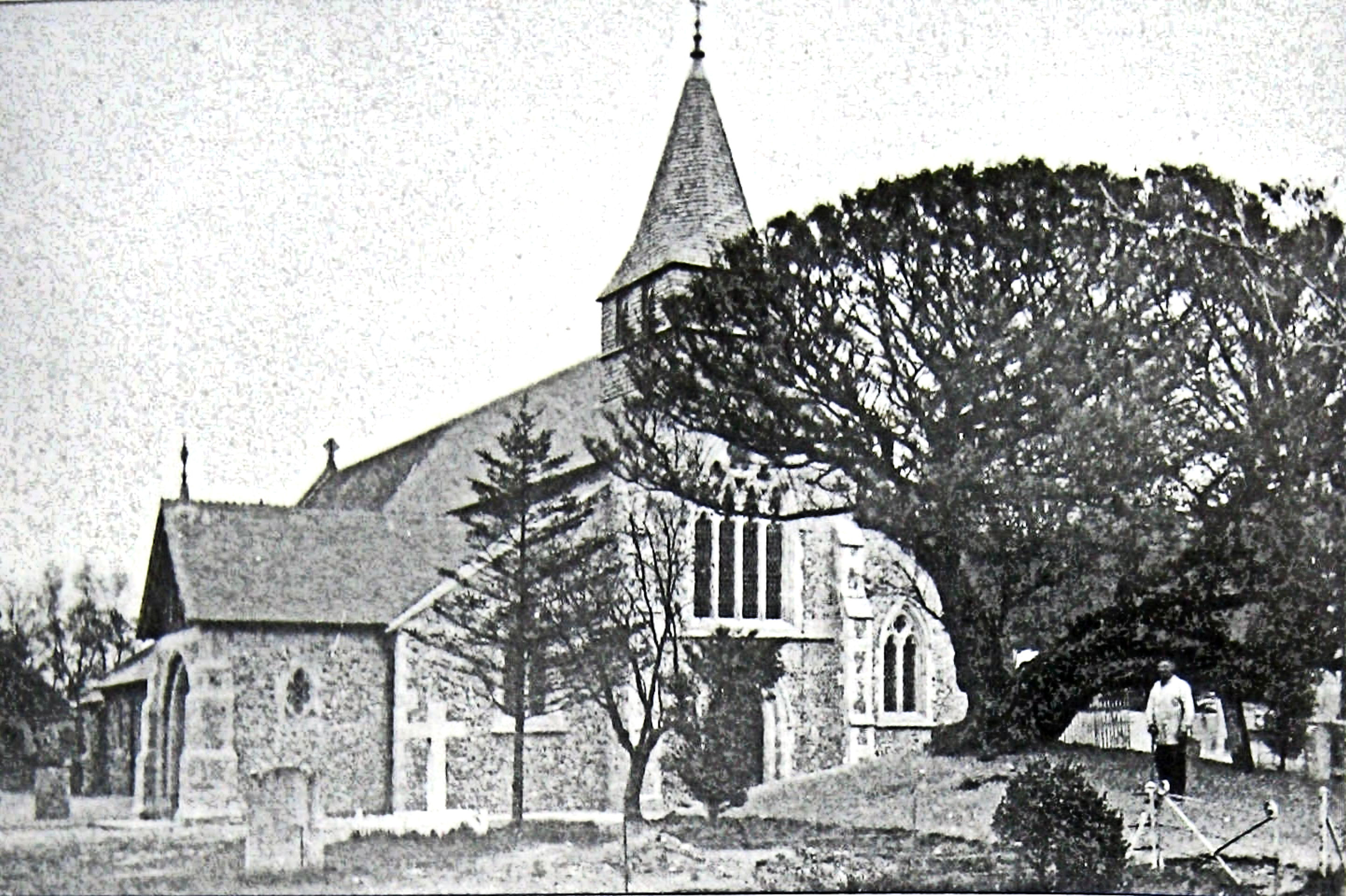
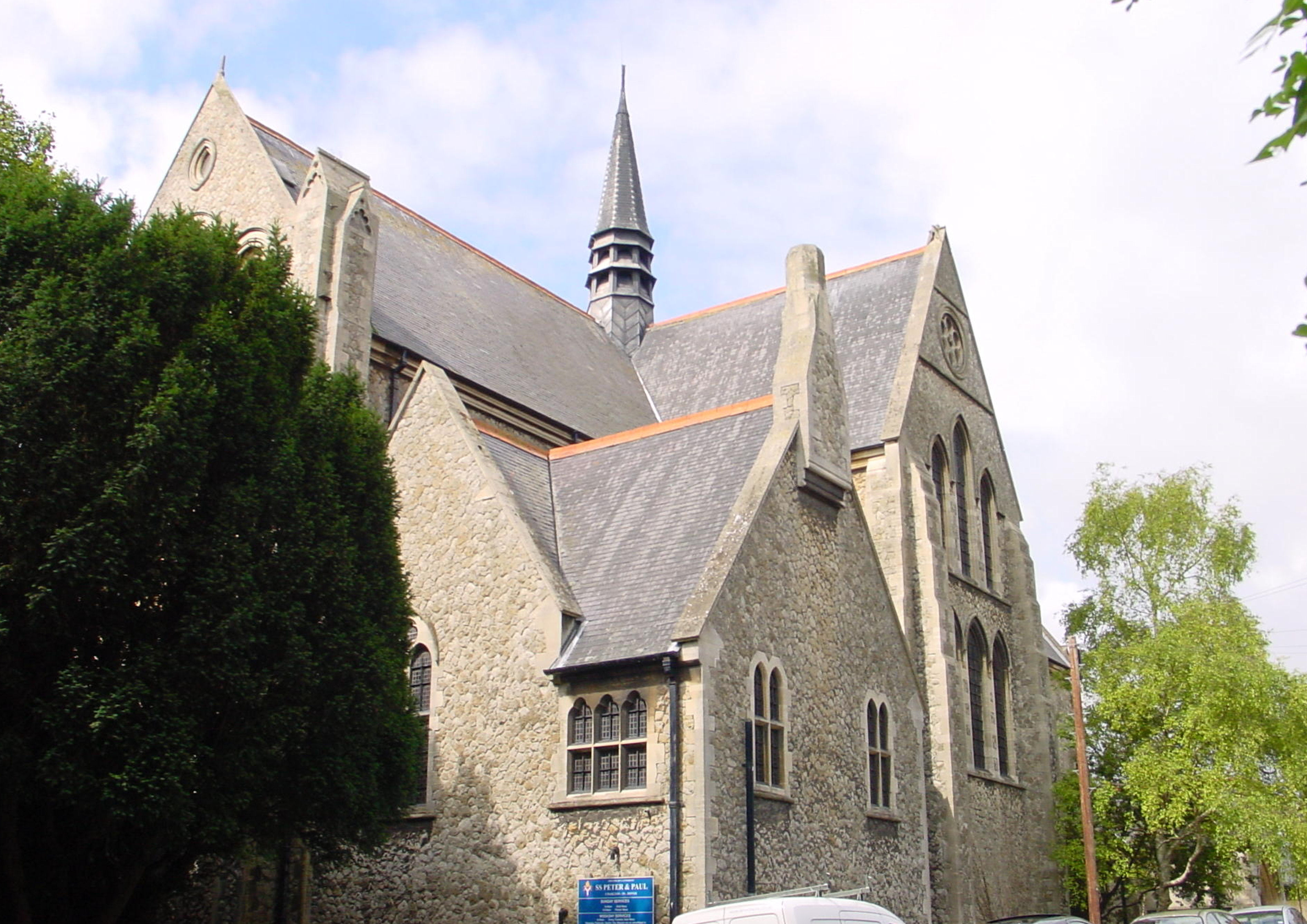
Crossing Beaconsfield Avenue the walk enters Charlton and the ancient boundary between Charlton and Buckland was along Charlton’s SS Peter & Paul Church north wall. The path we are taking is besides the west wall of SS Peter & Paul Churchyard, Charlton Green. On the right, behind newly built residences, is the Dour.  The original Church was built before 1291 and was very close to the banks of the Dour, as can be seen in the picture below. It was said that this was to enable baptism to take place in the river. At the time the Church and its tithes belonged to Bartholomew de Badlesmere (1275-1322), but he was hung, drawn and quartered for treason on 14 April 1322 at Blean, near Canterbury! After the Reformation (1529-1536) the Church was transferred to John Monins and remained in the Monins family until 1888 when it came under the patronage of Keeble College, Oxford.

SS Peter & Paul old Church, Charlton by the River Dour 1893 before demolition. Fr Colin Johnson

SS Peter & Paul old Church, Charlton by the River Dour 1893 before demolition. Fr Colin Johnson

Between 1514 and 1541 Sir John Clark, the Master of the Maison Dieu, was the rector of Charlton Church. Around 1495, he had sought Henry VII’s (1485-1509) patronage to turn a small natural cove at Archcliffe Point into a commodious harbour – the start of what eventually became Western Docks. In 1827 the Dour side Church was rebuilt on the same site and in 1840, Charlton’s parochial school was built near the church. In 1888 the Rev Sidney Faithorn Green was given the incumbency. He was High Church, which at that time was highly controversial as Low Church beliefs were in the ascendancy. For his beliefs, Green spent time incarcerated in prison but was welcomed by the Charlton parishioners. It was during his incumbency that the present SS Peter and Paul Church was built. Consecrated on 19 April 1893, the new Church was designed by James Brooks (1825-1901), built by J J Wise of Deal, cost over £13,000 and has 700 sittings.

Albert Mummery's gravestone - SS Peter & Paul Churchyard, Charlton. Alan Sencicle

Albert Mummery’s gravestone – SS Peter & Paul Churchyard, Charlton. Alan Sencicle

The new Charlton Church was built in what had been the old Churchyard, and when the old church was demolished the ground became part of the present Churchyard. It was at that time that the present Charlton Green path was laid to give a continuance of the Barton Path. On the opposite side of the Dour stood Charlton mill. In consequence, this part of the Dour was the millpond and therefore much wider than it is today. The reclaimed land of the former millpond has, in recent years, been given over to housing. The wall we see today, was built on Church side of the path with an entrance into the Churchyard.  Besides being a haven of tranquillity, the Churchyard does have many interesting things to see. These include a plaque set in the grass marking the site where the altar of the old church had stood. There is also a broken gravestone near the far wall close to Frith Road, dedicated to the internationally recognised Father of Modern Mountaineering, Albert Mummery (1855-1895) who lost his life in the Himalayas.

Mention has been made of Charlton corn mill, that stood on the opposite side of the Dour, where Halfords is today. Briefly, the mill was bought in 1865 by George Chitty (1842-1915) and from then on was colloquially called Chitty’s mill. Among the many modifications he made was the introduction of a 200 horsepower steam engine to replace the water wheel. For this he had a water tower built, which in World War II was used as a target by enemy guns. On 2 September 1944, a shell exploded on the roof and a hot piece of shrapnel, lodged in the roof timbers and smouldered. By the time the fire brigade arrived, the roof was well alight and the mill never re-opened.

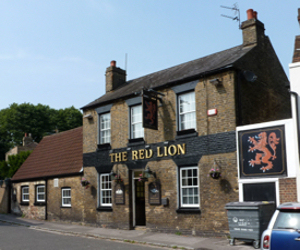
Red Lion, Charlton Green. LS

Red Lion, Charlton Green. LS

Back in 1706, opposite the mill and near the old Church was a farmhouse owned by a John Hubbard. Five years later, on his death, his son Clement became the owner and he added a forge to the property. By 1726, this had become a large farm and was sold to Francis Ralph for £240. With his wife Patchell and eleven children, Ralph moved in and the family remained there until the early 1800’s. The much-reduced estate was bought by Flavius Josephus Kingsford (circa1758-1851), a farmer and miller on Bulwark Hill, above the Pier District on Western Heights. By 1805 he had converted the old farmhouse and registered it as the Red Lion alehouse. Flavius had two sons, Edward (1801-1864) and Alfred (1803-1878) and when Edward was old enough, Flavius gave him the Red Lion. The inn, as it became, was listed in Pigot’s directory of 1824. By 1849, Flavius’s other son Alfred, who owned the Windmill brewery on the corner of London Road and what is now Coombe Valley Road, had taken over the Red Lion.

Dour looking up stream at the north parapet of the Bridge Street bridge Charlton Green. AS

Dour looking up stream at the north parapet of the Bridge Street bridge Charlton Green. AS

That year Alfred Kingsford had the farmhouse demolished and the present Red Lion was built on the site. Ten years later he sold the pub to Alfred Leney senior (1837-1900) of Phoenix Brewery, Dolphin Lane. They merged with Fremlins in 1926 and Whitbreads in 1967. In 1952 the Red Lion landlord, Leonard Latchem, had the first outdoor skittle alley in the area laid. This was opened on 6 June by Dover football legend, Fred Durrant (1921-2010), former centre forward for Queen Park Rangers (1946-1949) and at the time he opened the skittle alley, manager of Dover Football Club (1950-1957). Other pubs soon followed the Red Lion, opening skittle alleys and eventually competing for the Latchem trophy. Next to the Red Lion was the mill owners’ house. Appropriately called Mill Cottage but nowadays renamed Drove House and next door are the Dour Side Cottages.

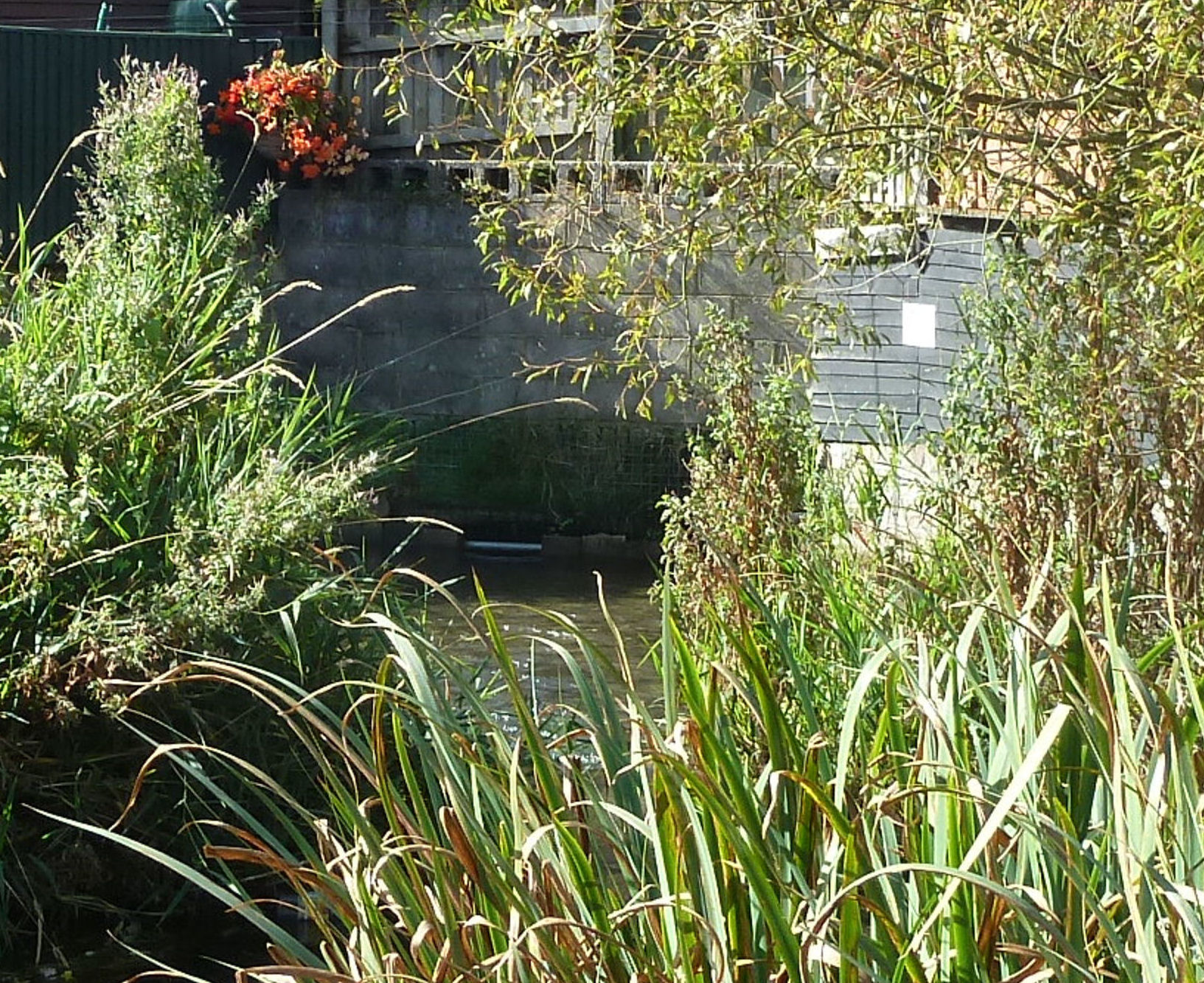
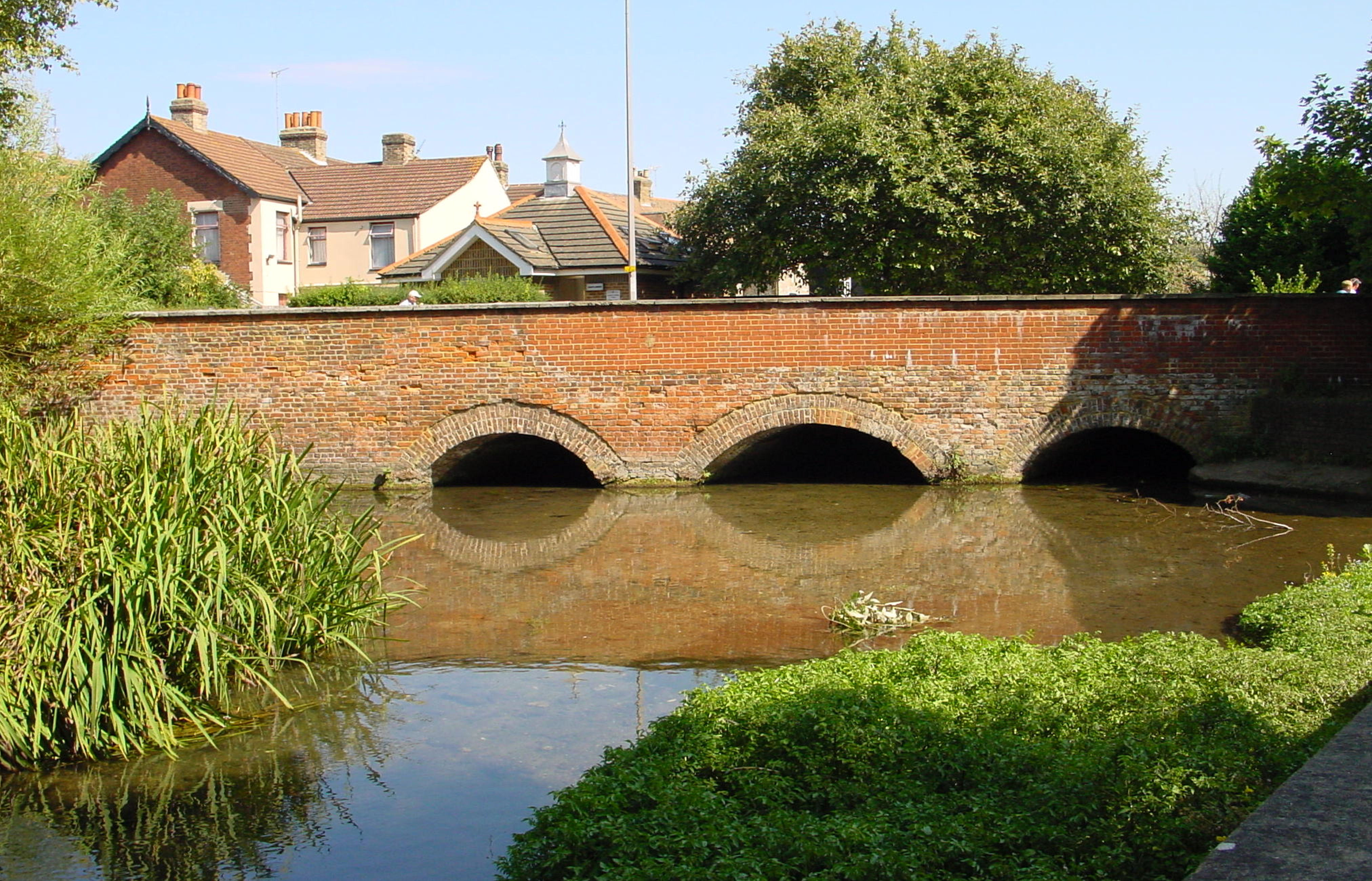
Bridge over the Dour at Charlton Green with three arches. Through the left arch the diverted stream joins the main river. LS

Bridge over the Dour at Charlton Green with three arches. Through the left arch the diverted stream joins the main river. LS

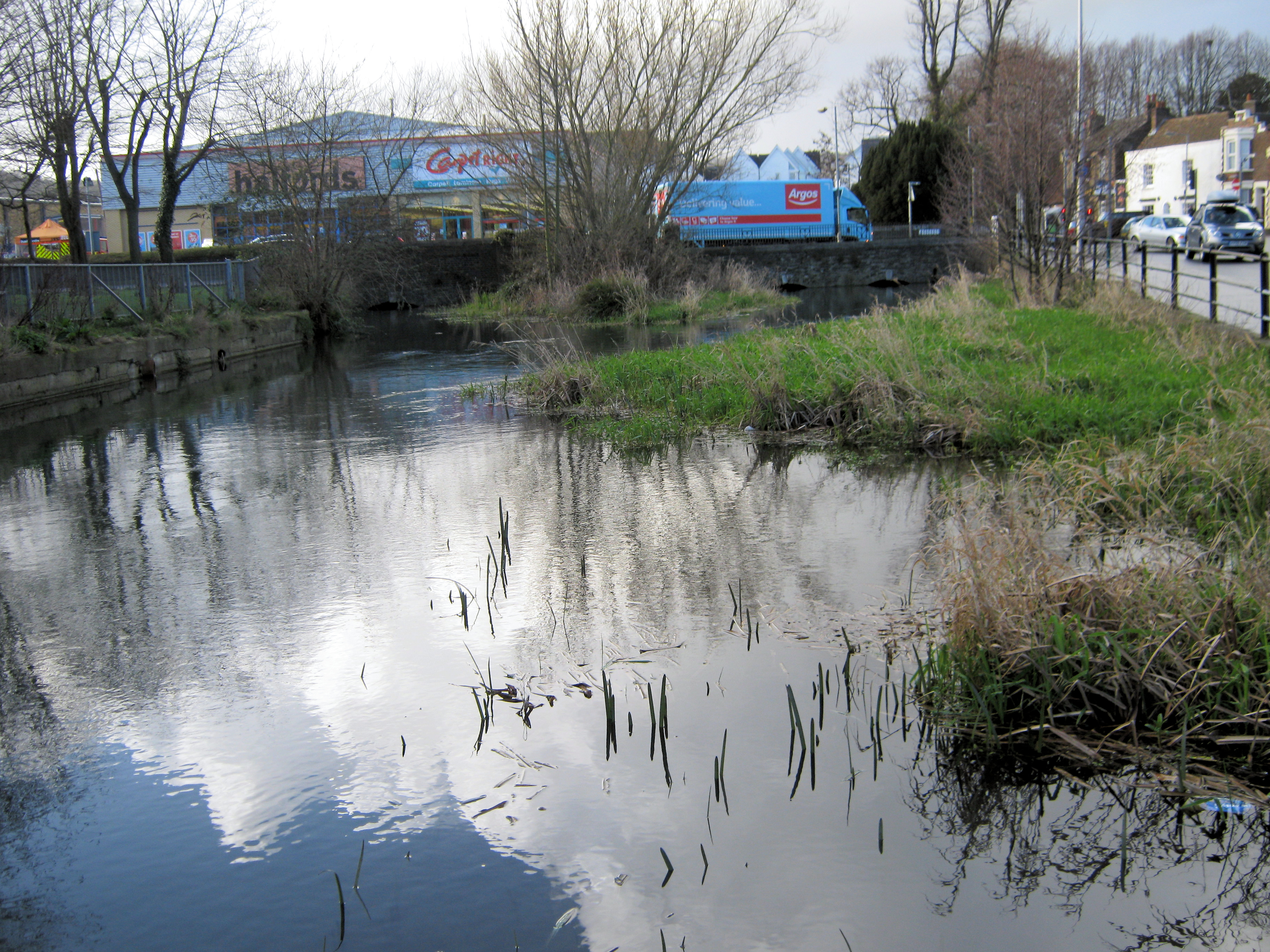
Although the walk continues along Charlton Green it is necessary to cross the busy Bridge Street. The safest way is by the pelican crossing east of the bridge over the Dour. When the bridge was erected in 1829, it gave the ancient thoroughfare the name of Bridge Street. Before that date there were two wooden foot bridges at this end of Bridge Street, crossing two branches of the Dour. The main stream, which today the north parapet of the Bridge Street bridge goes over, and the other wooden bridge over the stream mentioned above that goes under Balfour Road. Both streams come together through three arches below the bridge on the south side. Although difficult to see, because of the foliage, the stream from Balfour Road comes through the west arch and the main river comes through the other two arches.

Dour weir at Charlton Green before the river goes under the Castleton Shopping Centre car parks. AS

Dour weir at Charlton Green before the river goes under the Castleton Shopping Centre car parks. AS

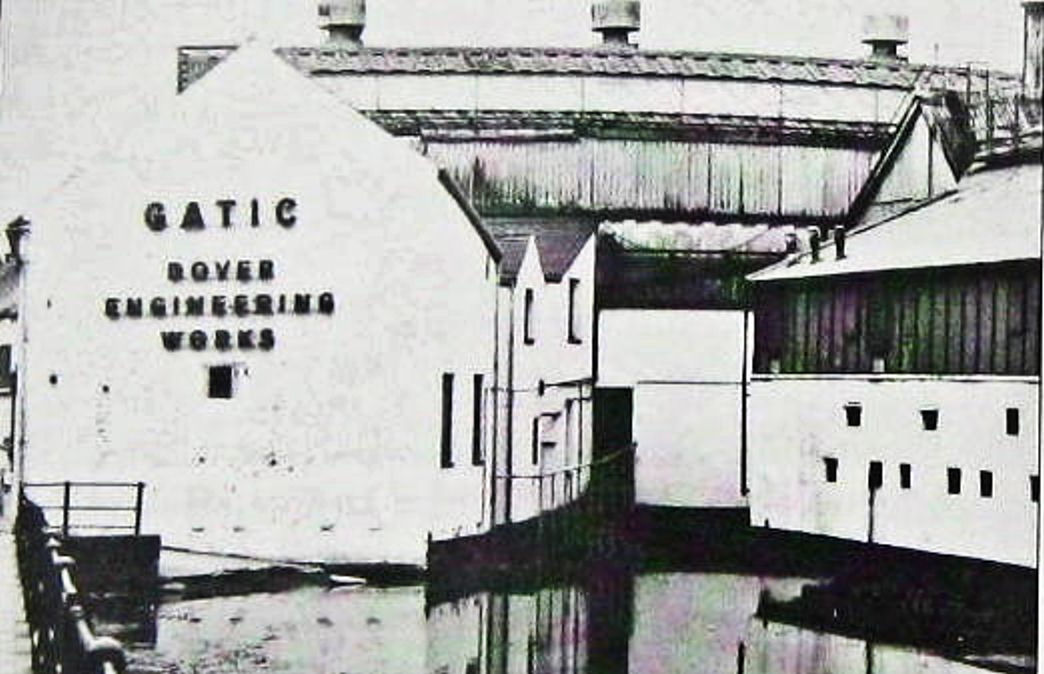
The footpath, alongside the very busy Maison Dieu Road, is wide as it is a shared cycle path. Before 1861, the road was called Charlton Back Lane going down to the sea and favoured by smugglers. What is now Castleton Shopping centre, Morrisons superstore and car parks on the right, was once the actual Charlton Green but was covered by houses during the early part of the 19th century and by the end of the century and by World War II, much was covered by Dover Engineering Works. To enable this development to take place the Dour goes over a weir and through underground culverts emerging diagonally opposite at Crafford Street.

Next to Morrisons the Dour is quite wide and although housing developments, road laying, the preference for concrete over grass and lack of consideration by Dover Harbour Board have together created a regular flooding problem for the lower parts of town. This was addressed by the Environment Agency that carried out a River Dour Improvements Study. Their conclusions confirmed that the wide channel below Bridge Street bridge plus the weir before the culvert taking the river across the car parks caused the flow of water to slow down. In turn, they stated, this caused build up of sediment that exacerbates the proneness to flooding. In 2013 they undertook a major operation lasting five weeks clearing the sediment and opening up the river. At the time of writing, three years later, the situation is as it was plus, due to lack of financial resources, many surface drain gullys in the area are blocked with sediment such that floods still regularly occur!

Over a century after the notion of a Dour riverside walk from Kearsney Abbey to Wellington Dock, work began on a walking and cycling route in 2010. The wide path along the side of Maison Dieu Road was the first section completed that year. At the same time, on wasteland between Morrisons and the Dour a small ‘park’ was created and can be accessed from the path on the café side of the store.

CCharlton Green - the classic industrial building opened in 1952, later to become the Post Office foreign mails' depot that closed in 2003 and the building demolished in 2019 . LS

Charlton Green – the classic industrial building opened in 1952, later to become the Post Office foreign mails’ depot that closed in 2003 and the building demolished in 2019 . LS

Across the busy Maison Dieu Road, best accessed by crossing at the traffic lights, are two places of interest. Facing the crossing and along Maison Dieu Road was a classic 1950s industrial building that the town should have been proud of but was demolished in early 2019 to build a McCarthy & Stone of Bournemouth, retirements apartment block. The demolished building was a MO Valve Company factory that opened in 1952 but they vacated it five years later. It then became a Royal Mail foreign mails’ depot, which closed in 2003 and since then the building had a variety of occupants but was generally neglected. It had been hoped, when McCarthy & Stone bought the premises, they would have incorporated the iconic front entrance but sadly this was the first part to go.

Charlton Green - Former MO Valve building Maison Dieu Road being demolished 01.02.2019

Charlton Green – Former MO Valve building Maison Dieu Road being demolished 01.02.2019

Three Hornbeam trees fronted the Royal Mail building on Maison Dieu Road but the new developers uprooted these. In response to questioning, their spokeswoman said that they ‘were surveyed by an arboriculturalist as lower grade trees, and their removal was discussed and supported by the Council’s planning and tree officers.’ Adding that as ‘Part of our proposed landscaping plans for the site introduces 15 new street trees to the road frontage which will help improve the amenity of Charlton Green.’

Nearby is the Louis Armstrong pub a well known jazz and folk venue where the LA Music Club, whose president is Nick ‘Topper’ Headon of the Clash, gives young musicians the chance to play with professionals to improve their skills. Nearby is the Louis Armstrong pub, a well known jazz and folk venue where the LA Music Club, whose president is Nick ‘Topper’ Headon of the Clash, gives young musicians the chance to play with professionals to improve their skills.

Returning to the traffic lights to re-cross the Maison Dieu Road, the walk continues on the wide path alongside the busy road to the Castleton Shopping Centre vehicle entrance and exit. The entrance is particularly dangerous as drivers frequently fail to indicate that they are going to turn in. Further, many vehicles  cut the corner by mounting the curb and DO NOT seem to notice that there may be pedestrians waiting to cross. After crossing the vehicle entrance and exit, the path turns sharp right then left, alongside the car park and comes out onto Crafford Street.

4. Crafford Street to Pencester

Dour from the north parapet on Crafford St. emerging from underneath the Castleton Shopping Centre car parks. LS

Dour from the north parapet on Crafford St. emerging from underneath the Castleton Shopping Centre car parks. LS

Crafford Street was named after John Crafford the Lay Master of the Maison Dieu during the reign of Henry VII (1485-1509). It was formally adopted in 1868 when Thomas Chaney, a local carpenter built the first houses there. From 1928 to 1988 the Dover Co-operative Society’s large dairy was on Crafford Street but the only function of the street now is as an access from Maison Dieu Road to the Charlton Shopping Centre car park. This development, owned by Park Rutland, opened in September 1980 and was part of a £3m complex. At the time it included a large Sainsbury’s supermarket. It cost the owner of the freehold, AXAEquity and Law, £1.5m and faced the High Street. Having resulted in the closure of numerous small shops in the vicinity, Sainsbury’s closed the store in 1992 with 41years on the lease to run. The freehold owners sold the premises for £2.2m by which time the use of the multi-storey car park had diminished. Just before the entrance to the car park the Dour emerges from under the concrete of the Castleton Shopping Centre car park.

Dour from Crafford Street looking down stream. The Charlton Centre Car Park is on right. LS

Dour from Crafford Street looking down stream. The Charlton Centre Car Park is on right. LS

After passing under Crafford Street the river comes out between housing on the left and the Charlton Centre car park on the right. Nonetheless, there is a short but pretty view down the river. The walk, after Crafford Street goes along Dour Street, much of which is lined with pretty cottages but the pavement is often blighted with litter. At the north end of Dour Street, on the left is Charlton House, a modern building that was erected by Adams Printers in 1990. The company was founded in 1888 by bookbinder Arthur Robert Adams (1855-1928) in Priory Street, moving to 37 Castle Street in 1909. Needing larger premises, they moved to the former Southern Television Studios in Russell Street in 1983. Later that decade, Dover District Council wanted the site for an extended car park to accommodate visitors to the ill-fated White Cliffs Experience that was built adjacent to the Market Square. The family run business therefore invested in the purpose built premises we see today on Dour Street. Budge (Arthur Finnis) Adams (1909-2000), who was at the helm of the company for much of the 20th century, was a keen local historian who lived in Castle Hill House.

Dour Street cottages east side. Alan Sencicle

Dour Street cottages Alan Sencicle

The land on which Dour Street was built, was originally owned by the Crown but farmed by the Gorley family as part of their Ladywell farm. When the foundations were laid for the first four houses, it was to be called Gore Street but the builders, Messrs Nightingale and Bushell, hadn’t sought planning permission. Further, they had not made any effort to include infrastructure such as water supply pipes and a sewer. Altercations took place between them and the council and three years later, they agreed to comply, including changing the name to Dour Street. Most of the properties date from that time and when finished they were well sought after pretty cottages lining both sides of the street. Then on the evening of Thursday 2 October 1941, during World War II, three German Heinkel III’s dropped their bombs on the town when cottages in Dour Street were hit. James and Annie Tapsell, Patrick Carberry and Frank Field were killed. Following the War the flats that we see today on the east side were built on the bombsite.

Although called Dour Street, it is evident that between the street and the river there are modern residences. These are on Goodfellow Way, named after the Mayor of Dover in 1972, Cllr. Kathleen Goodfellow. When Dour Street was laid out in 1862, Alfred Matthew’s building yard stopped the cottages on the west side of the street abutting the river. William Crundall senior (c1823-1888) bought the building yard in 1856 and after buying the extensively wooded part of the former Jarvis estate that is now Pencester Gardens, opened a saw mill business on the site. Under the management of his son Sir William Crundall, the long term Mayor of Dover, the saw mill site expanded to occupy both side of the Dour over which connecting bridges were erected. The sawmills finally closed after over 100years on the site and Charlton Shopping Centre was built on the west side of the Dour and Goodfellow Way on the east side.

Park Street shop blind holder permitted under an 1815 ruling and inserted in 1861. Alan Sencicle

Park Street shop blind holder permitted under an 1815 ruling and inserted in 1861. Alan Sencicle

At the south end of Dour Street are Park Street and Park Place. Built by Charles Gorley on Crown land, the properties on the left side of Dour Street and the opposite side of the road were completed by 1861. At the time the area was called Maison Dieu Park and the provisional name given was Park Street, which stuck. About the same time the line of shops on the right, with the Park Inn next to the Dour, were built and causing confusion ever since, were called Park Place. The council stipulated that the shops were to be for retail purposes and that there should be no competing businesses. Further, to comply with an 1815 ruling, they were permitted to have shop blinds projecting over the pavement with supports at least seven feet from the ground fitting into iron brackets in the pavement. The iron brackets were at the owners expense and a couple can still be seen today. Park Inn, at the time of writing is up for sale. A free house, the pub is said to be haunted by a Madam who once kept a brothel there!

Maison Dieu showing the prison erected on the Ladywell side in 1837 and demolished in 1878. Dover Museum

Maison Dieu showing the prison erected on the Ladywell side in 1836 and demolished in 1878. Dover Museum

Park Street/Park Place becomes Ladywell when the road bridge crosses over Dour! In fact Ladywell is an ancient street named after one of the town’s original main wells, the Well of Our Lady, which dated back to possibly Saxon times. The Well was in a wall on the south side of the street and provided chalybeate, (containing iron) water that was said to be beneficial for sickness and long term maladies. To access the Well, stone steps went down to enable folk to fill their buckets. For the more affluent, the water was taken around the town by men wearing white smocks shouting  ‘a penny a pail.’ For reasons unclear, they were all generally called ‘Old Ned’ – either that or one of the men lived for a couple of hundred years and had several clones! The water was said to make the best cup of tea and was sought after, both in the town and as far away as London. However, in 1836 the new town gaol was built as an extension to the newly acquired Maison Dieu on the Ladywell side. To accommodate the gaol, alterations were made to the Well but in 1866 an analysis showed the Ladywell water was contaminated by human waste from the prison! The Well was immediately closed down and the gaol closed in 1878.

Former Electricity Showroom and offices, Sir John Falstaff pub and the present Fire Station, Ladywell late 1930s. Dover Library

Former Electricity Showroom and offices, Sir John Falstaff pub and the present Fire Station, Ladywell late 1930s. Dover Library

On the north side of Ladywell is the architectural classic 1930s retail building. It was purpose built as the town’s electricity showrooms, at a time when Dover produced its own electricity! Next door is the Fleurs pub, built in 1903 as Sir John Falstaff. Back in 1795, Thomas Harrison built four cottages on the site of the present day Fleurs and by 1865, they were owned by butcher, Thomas Royce. He converted two of the cottages into a hostelry which he named Falstaff, after the Shakespearean comic character. In 1900, Ladywell was widened and the buildings were demolished but three years later the pub we see today was built with the stunning tiling and stonework and renamed the Sir John Falstaff. Next door to the pub is Dover Fire Station that has a long and dramatic history as can be read on this website.

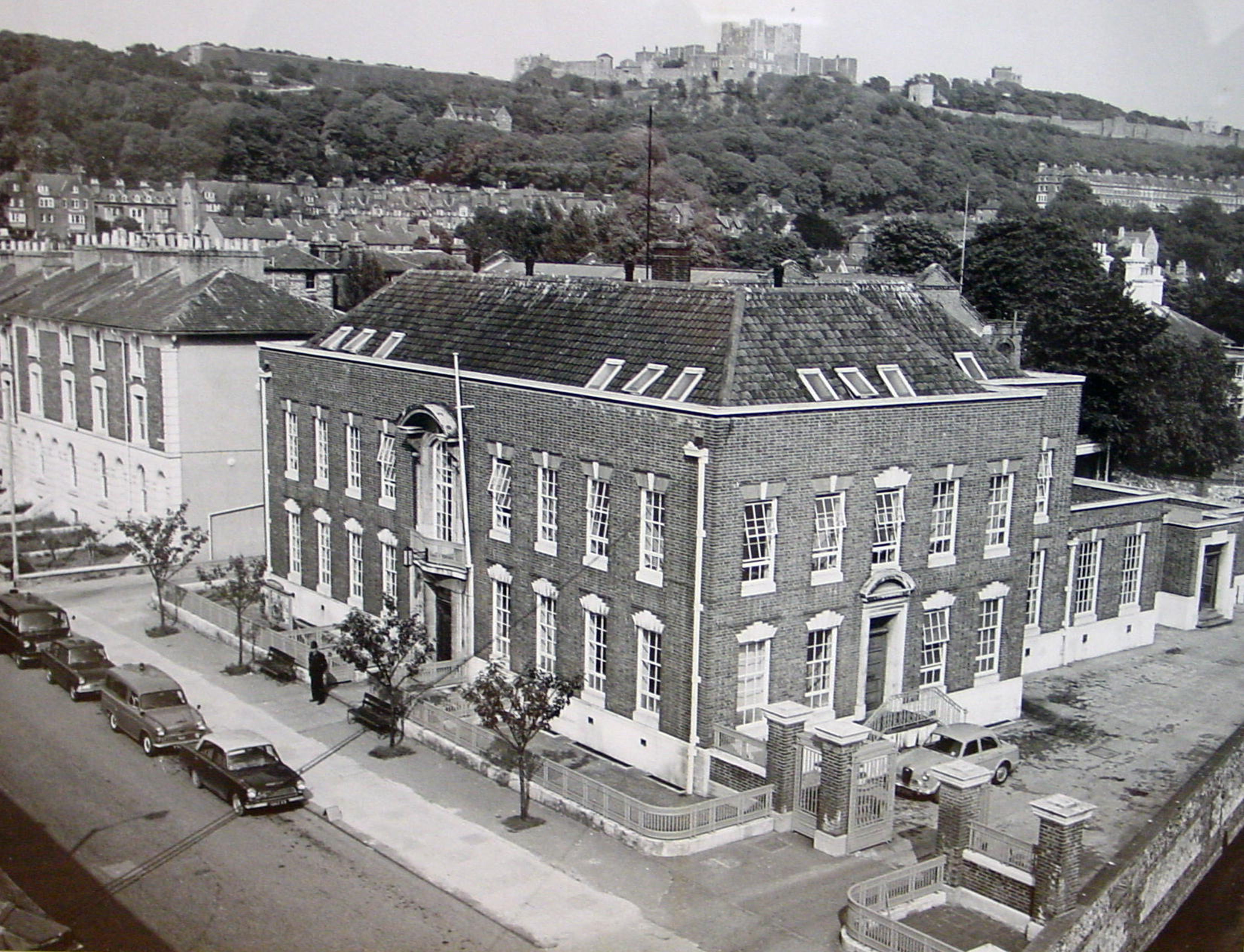
Dover Police Station, Park Street c1970. Kent Police

Dover Police Station, Park Street c1970. Kent Police

On the south side of Ladywell,  Connaught Hall and the former Art and Technical college replaced the town gaol. Next to the former college is Ladywell car park and of interest are the two wartime bomb cases that are now used to protect the wall on both sides. Between the car park and the Dour is a footpath alongside the Dour. On the opposite side of the river is Dover Police station. Dover once had its own police force that included the fire service. Back in the 1930s, having built a new fire station it was decided to build a fine new police station for the town to be proud of. The foundation stone was laid on 29 July 1939 by Mayor Jimmy Cairns and as World War II was anticipated, the cellars were designed to take bomb blasts. The new police station opened on 4 October 1940 but by the end of the year, it had been devastated by bombing. Repaired, the building was subsequently damaged on eighteen further separate occasions by enemy action! On three occasions the damage was serious. On 1 April 1943 Dover police force amalgamated with Kent Constabulary and since the end of the War the town’s police station has steadily been down graded in relative importance.

Ladywell/Park Street bridge over Dour, note the older bridge underneath. Alan Sencicle

Ladywell/Park Street bridge over Dour, note the older bridge underneath. Alan Sencicle

The footpath from Ladywell to Pencester Road was started in 1972 when Kent Education Committee gave up land on condition that the town should bear the cost of laying and maintaining it. This included, if necessary, fencing but Dover council went further by providing large planters nearly all the way to Pencester Road,  in which for years, there were superb flower displays. Sadly, a change in policy meant that the planters were neglected and many were removed. Those that remain tend to be used as litter bins. Both the Ladywell/Park Street bridge and the wall at the police station side of the river are worth a closer look. Under the bridge, the old river bridge can still be seen while the wall can be seen to be made up of a mish-mash of building materials and hewn blocks of stone. It is generally believed that these building materials came from the base of the Union Hall, built as a Ragged School for destitute boys back in 1850 by Wilfred Mowll. When the school closed in 1892, the building became a chapel for the use of any religious sect that did not have its own premises but was demolished in the late 1930s to make way for the police station.

The building on the right facing the car park is Biggin Hall built in 1881 and from 1894 to 1942 it was the municipal bathing house. It then became the temporary home of Dover Library following which, it was refurbished as a public hall. Having been used by many organisations it was then leased out, with the Oddfellows among others, becoming tenants. In October 2013, it was reported that following negotiations with Dover District Council, it had been agreed to ‘give’ Biggin Hall to the Dover Community Association for £1. The Association had sold Cleary House, on Maison Dieu Road, for £220,000 the previous year and agreed to refurbish Biggin Hall. Work started on this in spring 2016. Past Biggin Hall, on the right, is Kent County Council’s Well Community Resource Centre, formerly Dover children’s library. This faces a path going from Biggin Street to Maison Dieu Road onto which the walk will take a detour.

Boundary stones in Maison Dieu gardens representing St James and Charlton Parishes. There was once a third representing St Mary's Parish. LS

Boundary stones in Maison Dieu gardens representing St James and Charlton Parishes. There was once a third representing St Mary’s Parish. LS

Turning left and crossing the Dour bridge, lift the foliage on the left side of the south parapet. There, two ancient boundary stones can be seen that depict the boundaries of St James’ and Charlton parishes. There once was a third stone representing St Mary’s parish on the opposite side of the south parapet. Dover was originally divided into two parishes, St Mary’s created in 1535, following the Reformation (1529-1536) and St James’ parish, headed by St James’ old church – the ruins of which are near the present swimming pool on Woolcomber Street – later. Charlton juxtaposed with both in the vicinity of this bridge. The local tax or rates as they were later called, was the main source of income to all the parishes and therefore they jealously guarded their boundaries in order to received their full dues. The actual boundary between St James and Charlton was on the east side of the bridge while the boundary between St Mary’s and Charlton was along Ladywell. The boundary between St Mary’s and St James was from this bridge to Stembrook – down the centre of the Dour. Thus it was the custom of the Town Crier, during the beating of the bounds to wade down the centre of the river to proclaim the boundary! In 1953, the parishes merged and the St Mary boundary stone disappeared.

John Birmingham boundary stone for Brook House in Pencester Road car park. A similar but not so legible one can be seen in Maison Dieu Gardens. Alan Sencicle

John Birmingham boundary stone for Brook House in Pencester Road car park. A similar but not so legible one can be seen in Maison Dieu Gardens. Alan Sencicle

Carrying on along this path towards Maison Dieu Road, the north wall, on the left, was once the northern boundary wall of Brook House that was bought by John Birmingham, Mayor in 1860. In 1868 he had walls built surrounding his property and erected ownership plaques on all four sides. On the north wall his now almost illegible plaque can be seen and a similar but better-preserved one can be seen on the southern wall of what was his property at the rear of Pencester Road car park. Brook House was a beautiful mid-Victorian building that was bought by Dover Corporation in 1920 and the surrounding gardens, renamed Maison Dieu Gardens, were open to the public. However, at 05.00hrs on Saturday 16 July 1988, the building was bulldozed into oblivion in order to provide a coach park for the ill-fated White Cliffs Experience, now the Library, just off the Market Square.

Further along this path just before what was once Brook House stable-block, the Dover Electricity Station main-gate post can be seen. The station opened in 1891 and provided Dover’s electricity until the introduction of the Grid system in the early 1930s. From then on it provided electricity to the central Grid until it was nationalised under the 1947 Electricity Act.  Part of the power station was converted into a substation but most of the empty buildings remained until demolished in June 1985, that is with the exception of the gatepost and walls now in the adjacent police station car park.

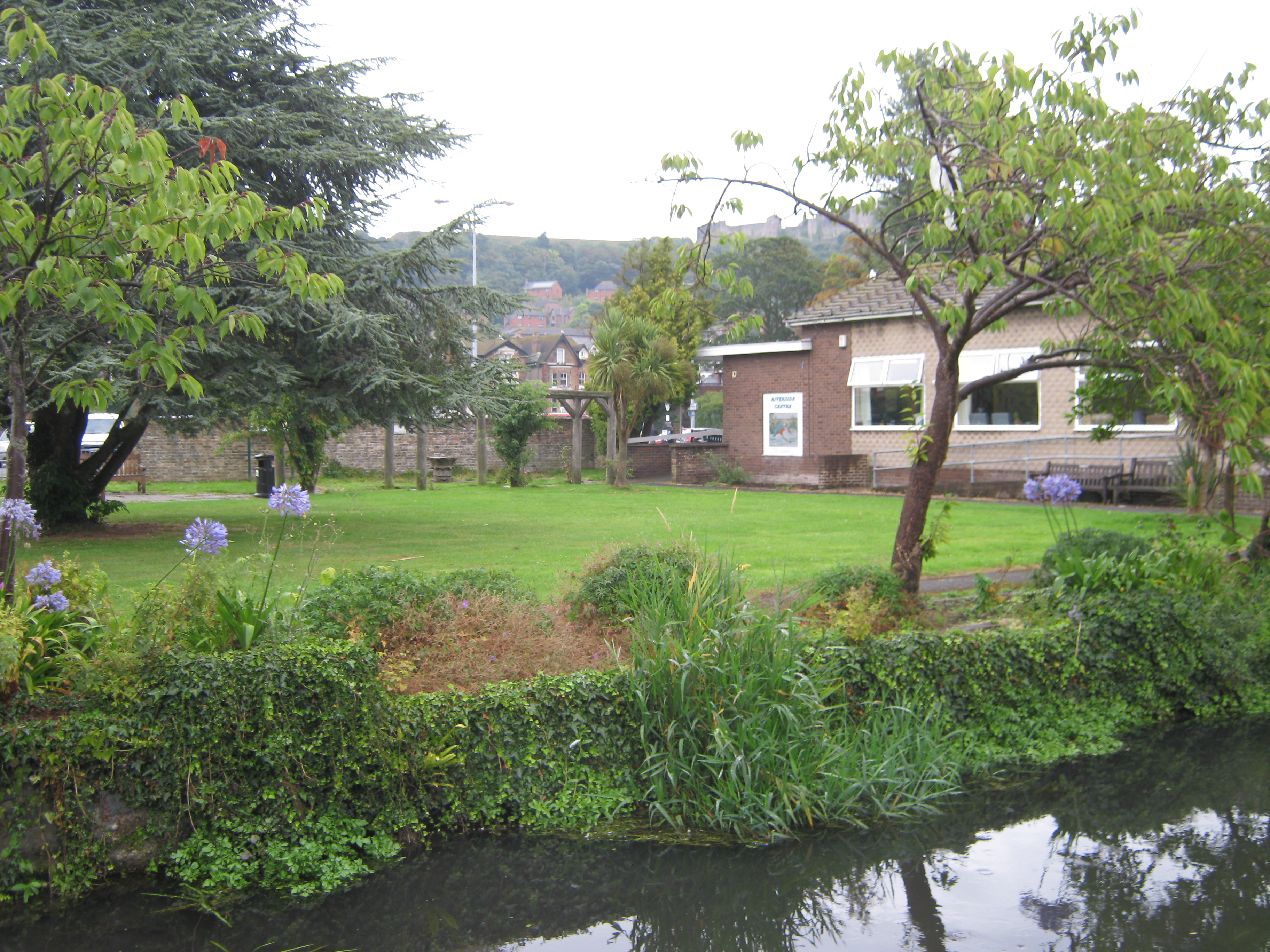
Riverside Centre and Garden from across the River Dour. LS

Riverside Centre and Garden from across the River Dour. LS

Turning round, the walk heads towards the bridge and on the left are the Riverside Gardens and Riverside Centre. In 1965, Dover Corporation gave this land and £5000 towards the Dover Old Peoples Community Centre. The Centre opened on 1 November 1967, and quickly assumed the name Riverside Centre. This name included the surrounding garden. In 1969 the Czechoslovakian ambassador, dedicated part of the gardens to Lidice – a former mining village near Prague that was destroyed and the inhabitants murdered by the Nazi’s on 10 June 1942. A commemorative plaque was erected nearby but this has long since disappeared. In the Garden there are several dedicated seats and it is a nice quiet oasis.

Dour looking downstream with the further education College on the left. LS

Dour looking downstream with the further education college on the left. LS

Crossing back over the bridge to the Dour side path, on the right is Dover Bowling Club headquarters. Founded as the Dover Institute Bowling Club in 1907 it quickly proved to be very successful. However, during World War II the green succumbed to a direct hit by a bomb – it is said that one of the bomb casings at the entrance to Ladywell car park is the remains of the culprit. The club was renamed the Dover Bowling Club and after major repairs, the Green reopened in 1955, since when the club has remained successful. The fairly modern building overlooking the Green was once the local British Telecommunications headquarters.

Dour foot and cycle bridge close to the further education College. LS

Dour foot and cycle bridge close to the further education College. LS

The path continues alongside the Dour and on the other side, after the Riverside Centre, are the grounds of Dover’s once named College of Further Education. It was built in 1982, based on a design to replicate the Keep at Dover Castle and cost £1million. Subject to reorganisations, financial problems and changes of names, the college has, nevertheless remained popular. The path now takes a sharp left to across the Dour on the specially constructed footpath/cycle bridge. Then, after a short walk, on reaching the gates of the College, a sharp turn right on to the wide path/drive leading from the college to Pencester Road.

5. Pencester Gardens

Pencester Road by Mary Horsley 1893. Dover Museum

Pencester Road by Mary Horsley 1893. Dover Museum

Pencester Road was originally a right of way footpath from Biggin Street and up the hills to the east and the river was crossed on wooden planks. Part of the line of the footpath can still be seen along the southern side of St Paul’s Church on the opposite side of Maison Dieu Road. From the beginning of the 18th to the middle of 19th century the Gunman and then the Jarvis family owned a magnificent mansion on a vast estate that stretched from Maison Dieu House almost to Stembrook where there was a large tannery. Their mansion faced Biggin Street and the east side of the estate abutted Charlton Back Lane. In 1853 the estate was divided into two along the right of way footpath. The northern part was sold to William Moxon, who built Brook House and to provide egress into Biggin Street, he built a makeshift bridge across the Dour where the planks had been.

Moxon successfully applied for permission to lay out sites alongside the track and the council called it Pencester Road. This was after John de Pencester who had helped to defeat Louis the Dauphin of France (1187-1226) when he held siege to the Castle in 1216 and depicted in a stained-glass window in the Maison Dieu’s Stone Hall. Eventually, fine detached properties were built along both sides of the road with a space left on the south side west of the Dour for what eventually became Pencester Gardens. Most of the properties, although damaged in World War II, were repaired and occupied following the War. Those properties that did succumb were on the southern side and East Kent bus services occupied one of the sites.

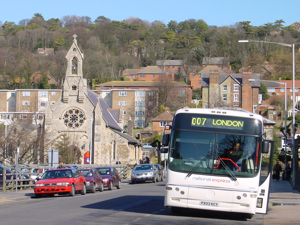
Pencester Road looking east with the 007 London <a href="https://doverhistorian.com/2016/12/16/east-kent-road-car-company-and-dover-part-ii/">National Express </a> 007 coach service. Left St-Paul's Roman Catholic Church, Maison Dieu Road. Alan

Pencester Road looking east with the 007 London National Express 007 coach service. Left St-Paul’s Roman Catholic Church, Maison Dieu Road. Alan Sencicle

In 1964, seven of the northern side properties were demolished in order to enable St Martin’s Property Corporation to build the shops with flats above that we see today. Twenty years later the remainder of the original properties along that side were demolished to create a car park, including East Kent buses booking and enquiry office opposite to the former bombsite.  In the 1980s properties, east of the Dour and the site occupied by the bus company were demolished to build a bus station. Pressure, at the time, was mounting for a purpose built Magistrates Court and this was built instead. With five courtrooms this opened in December 1987, however, due to the general down grading of Dover as a town of consequence, the court is now mainly used for administrative purposes. The bus station was never built but external bus services, coach services to London and some services within the town operate from Pencester Road.

Pencester Gardens serpentine path alongside the River Dour. LS

Pencester Gardens serpentine path alongside the River Dour. LS

After carefully crossing Pencester Road – it is part of the one-way system and the traffic comes from the left – the walk enters Pencester Gardens. Take the serpentine path to the left alongside the west side of the Dour.  What are now the Pencester Gardens was the southern part of the Gunman/Jarvis estate that was sold in 1853. This was bought by William Crundall senior and three years later, in 1856, he bought the former Charlton paper mill (see above) which he converted into sawmill. Using the trees from the former Gunman/Jarvis estate he quickly made his fortune. Once most of the trees were removed, the land became a meadow that was prone to flooding. Over time tall poplar, copper beeches, and other fine trees flourished in the dank conditions and although Crundall used the site for storing timber he allowed it to be used for school treats. About 1880, he sold the meadow to Sir Edward Watkin, (1819-1901), Chairman of the South Eastern Railway, who was planning to build a railway station on the site. His proposed railway was to run from France through a Channel Tunnel to St Margaret’s. When the project failed, Crundall re-purchased the site at less than what he had been paid for it and his son, Sir William Crundall, turned it into a timber yard. In 1922, he sold the land to Dover Corporation and the council, having bought Stembrook tanyard, eventually created Pencester Gardens.

Dour from Dieu Stone bridge, Pencester Gardens are on the left. LS

Dour from Dieu Stone bridge, Pencester Gardens are on the left. LS

In the 1980s Dover District Council decided to build on Dover’s wealth of history to revamp the town as a tourist attraction. Part of their scheme included Pencester Gardens and for this reason, in 1988, the serpentine path along the Dour was laid. At the end of the path, to the left is the next crossing of the Dour, at Dieu Stone Lane. From the bridge, looking south, it can be seen that the river carries on in southerly direction but once out of sight it turns west behind Castle Street. Our walk, from the bridge, takes the path to the right in the same direction as the river goes. Before taking that path, the walk briefly takes a detour left over the bridge to the end of Dieu Stone Lane where it meets Maison Dieu Road and what was once the maritime hub of Dover.

From about the 6th century up until the 15th century the Dour split where the river turns sharp right/westward behind the present Castle Street. The east stream carried on south entering the sea approximately where Woolcomber Street meets Townwall Street today. Harbours were formed, one close to St Martin’s monastery, near present day Market Square and another under the Eastern Heights fed by the eastern stream of the Dour, in this area. By the time that William I (1066-1087) invaded England in 1066, the Eastbrook harbour, as it was called, was of national importance particularly for military and commercial purposes. Such was the importance of Dover’s harbours that the King made a grant to the town’s Burgesses to ensure the continuation of their services. However, between 1300 and 1500 there was a movement of land mass that triggered a phenomenon called the Eastward Drift – the tide sweeping round Shakespeare Cliff and depositing masses of pebbles at the eastern end of the bay. This, together with a cliff fall, rendered the Eastbrook harbour useless and a new harbour was created at the western side of the bay. The name Eastbrook Place was given to the early 19th century houses to the right on Maison Dieu Road.

Hubert de Burgh, Mary's Church Lady Chapel Window. LS

Hubert de Burgh, Mary’s Church Lady Chapel Window. LS

Dieu Stone Lane was originally known as ‘D’ Stone Lane after a boundary stone between the town and the lands owned by the Maison Dieu. Hubert de Burgh (1170-1243) founded the latter in 1203 on land north of the then boundary of the Dover town. An ancient right of way that originally went along this boundary from Biggin Street to the Castle and a continuation of this path can still be seen on the opposite side of Maison Dieu Road. That area has national significance that goes back to when  King John (1199-1216) signed the Magna Carta in 1215. The Barons reneged on their side of the bargain and invited King Philip II of France (1180-1223) son, Louis the Dauphin of France (1187-1226) to take the throne. The invasion was almost complete with only Dover Castle, under the Constable of the Castle, Hubert de Burgh (1170-1243) holding out. The siege lasted for over a year with the Dauphin and his men camped on the foothills in this area. Almost starving, de Burgh and his men still held out even when they heard that John had died and the Dauphin’s men tried to undermine the North Gate in order to gain entry. When a massive contingent of re-enforcement’s set sail from France to invade, De Burgh secretly left the Castle and set sail with the Cinque Ports Fleet to take the armada on. John de Pencester arrived with his contingent to relieve the Castle and at sea, De Burgh and the Cinque Ports Fleet, eventually on 24 August 1217, routed the French Navy and prevented the invasion of England!

St James (New) Church 1939, Maison Dieu Road. Budge Adams Collection Dover Museum

St James (New) Church 1939, Maison Dieu Road. Budge Adams Collection Dover Museum

On the south side of Dieu Stone Lane is Eastbrook Place, named after the old harbour. In 1887 the building closest to Dieu Stone Lane became a convent for the Sisters of St Vincent and the long wing facing Dieu Stone Lane was added in 1903. Later the name of the House was changed to St Mary’s but in February 2005, with only five Sisters left in Dover, they sold what had become a residential home. The villas on the north side of Dieu Stone Lane were built in 1881 and on the opposite side of Maison Dieu Road, next to the ancient path and where the Dauphin’s men camped, was the former site of St James (new) Church. Built in 1861, at the same time as Maison Dieu Road was laid and named, it met the spiritual needs of the rapidly increasing population in the area. However, the Church, having suffered some damage during World War II, was demolished in 1952 and is now St Mary’s school playing field. At the far end of the field are the only remains of the Church.

6. Stembrook

Dour from Dieu Stone bridge flowing past the rear of Eastbrook Place and in the distance, where it turns sharp right. From there, the river runs between Stembrook Court and Castle Street. LS

Dour from Dieu Stone bridge flowing past the rear of Eastbrook Place and in the distance, where it turns sharp right. From there, the river runs between Stembrook Court and Castle Street. LS

Returning to the Dieu Stone Lane bridge, the walk takes the southern path through Pencester Gardens. On the left is Pencester Court, a block of 24 flats on four floors completed in early 1952 behind which is the River Dour. It is recorded that the family of William Hortin, Mayor in 1329, held what was described as being marshy ground between East and West Brook’s of the River Dour, from which the name Stembrook was derived. At the time, nearer to the ancient Eastbrook harbour, were shipbuilding yards while to the west was the municipal stray animals’ pen. There, farm animals that had wondered off their owner’s property were kept until the owner claimed them for a fee. Nearby was the extensive Stembrook tannery that was in this vicinity from at least the 14th century.

On leaving Pencester Gardens, a former supermarket is on the left on the site of what was once Stembrook corn mill. The five storey mill was built in 1792, when troops were being moved into Dover just before the start of the Napoleonic Wars (1793-1815). Following the Napoleonic Wars, Caroline Place was built where Stembrook car park is today. Consisting of small cottages, they were specifically named after George IV’s (1821-1830) wife, Caroline of Brunswick (1768-1821), even though it brought the town into direct conflict with the Royal Family and the government of the time.

Former Caroline Place where Stembrook car park is today. Dover Library

Former Caroline Place where Stembrook car park is today. Dover Library

Caroline was the estranged wife of George and when she arrived in England for his Coronation, against the wishes of George and the government,  the people of Dover welcomed her. Not only that, but George was seeking a divorce and when his witnesses brought from the Continent to make accusations against her, the people of Dover made it clear that they were not welcome! Nonetheless, the beleaguered Queen was subjected to a humiliating eleven-week inquiry by the House of Lords, as the Peers looked for possible ways to secure a divorce but failed. In the end, on the day of the Coronation, Caroline was barred from entering Westminster Abbey and although it was June the weather was atrocious. Caroline caught a cold from which she subsequently died. Caroline Place succumbed to World War II attacks and because the Queen’s full title was Caroline of Brunswick it was decided to call the new car park, Stembrook. Of interest, in 1968 it was Dover’s first car park to levy parking charges.

St Mary's Church from the south-east facing Stembrook. LS.

St Mary’s Church from the south-east facing Stembrook. LS.

The close proximity of Stembrook Mill meant that the little cottages were subject to damp and this was emphasised in the Rawlinson Public Health Report on Dover in 1849. At the time it was recommended that the mill should be demolished but this did not happen until 1918. Nonetheless, on what was marshland a large triangle of poor quality properties were built opposite the mill with the east side facing the mill, the south side facing Castle Street and the west side facing Church Street. At the top of Church Street is St Mary’s Church – although not part of the walk is well worth a visit.  The walk continues along the present day Stembrook between the former supermarket and the Stembrook flats on the right. During World War II the popular British Restaurant opened on Stembrook where civilians could purchase a three-course meal, ‘off the ration’, for 9d (approx. 4p)! Later renamed the Civic Restaurant, it was the centre of controversy following the War as it was seen as a public enterprise competing with commercial restaurants. As most of the Stembrook properties had succumbed to War damage in 1947 Compulsory Purchase Orders were granted that enabled the Corporation to acquire all the properties at their site value.

In 1949, plans to build flats on the site were given the go-ahead and the following year all the pre-war premises were cleared away. In the meantime, the council sold the land to the Post Office who envisaged building an automatic telephone exchange on the site! As the Post Office’s plans were still unclear the council wrote a caveat that enabled them to re-purchase the land at the same price if the Post Office changed their minds. By 1955, the Post Office had not taken up the option and the contract was terminated. The council, using government Reconstruction Grants built thirty-four flats that became Stembrook Court, two showrooms that were leased to two automobile firms on Castle Street with a pub on the corner of Church Street and Stembrook. During the excavation for the pub’s foundations, a Roman quay or wooden causeway, was found and nearby evidence of a Roman bath as well as tiles, pottery, glass and part of an Andernach (Germany) lava millstone. Because of these finds, the new pub was named the Roman Quay and opened on 31 July 1957. The total cost of the development was £80,000.

Dover Market under the Court Hall by William Burgess. Of note, the Court Hall was demolished in 1861. Dover Museum

Dover Market under the Court Hall by William Burgess. Of note, the Court Hall was demolished in 1861. Dover Museum

High up on a wall near the corner of the Stembrook flats and Castle Street is a Dover Society plaque dedicated to arguably Dover’s greatest artist, William Burgess (1805-1861). Born in Canterbury, Burgess learnt his craft while working for his uncle painting horse drawn coaches. About 1828, with his wife Harriet, Burgess settled at 14 Stembrook and over time his work was exhibited at the Royal Academy and the Royal Society of British Artists. In 1844, Burgess opened a Cosmorama that enabled the viewer to see his sketches and paintings of Dover as if they were looking through a window. Even though Burgess was nationally already recognised as an artist of repute, the attraction was so popular that it served to bring his work to a wider audience. Some of Burgess’ work is on display in Dover Museum, Market Square.

Dover Society Plaque commemorating the last Enemy shell to do material damage to hit Dover and occurred on 26 September 1944 in Castle Street. Alan Sencicle

Dover Society Plaque commemorating the last Enemy shell to do material damage to hit Dover and occurred on 26 September 1944 in Castle Street. Alan Sencicle

The walk, from the top of Stembrook will go across Castle Street to Dolphin Place but before crossing the Street, there are two items of interest to see. The first is on the right at the corner of Castle Street and Church Street. Again, fairly high up, is another Dover Society plaque that commemorates the last shell to hit Dover during World War II causing material damage. For four years the town was under constant bombardment that gave rise to the town’s nickname, ‘Hell Fire Corner’ and ended on 30 September when the last shell fired on Dover by German cross-Channel guns. Four days before, on Tuesday 26 September 1944 at 19.15hrs a shell to do material damage hit Hubbard’s Umbrella Shop and it is to this that the plaque was dedicated. The other item of interest is across the entrance to Stembrook and past the carpet shop on Castle Street. Between the shop and the older building is all that can be seen of the bridge that was built in 1832, to span the Dour. In the deep gully there are the remains of the former Stembrook corn mill’s wheel pit that, at times, can still be seen.

7. St James Area – West

Map of Dover town centre in 1990 showing the course of the Dour and the route the walk takes. Much of the St James area to Wellington Dock has changed since 1990 but the map does give an idea of the route. Service Publications c1990

Map of Dover town centre in 1990 showing the course of the Dour and the route the walk takes. Much of the St James area to Wellington Dock has changed since 1990 but the map does give an idea of the route. Service Publications c1990

From Castle Street, the Dour goes through a culvert, initially diagonally then straightens up to re-emerge in St James’ Lane. Before Castle Street was built, between 1830 and 1835, Stembrook extended to Dolphin Lane. Following the opening of Castle Street into Market Square the southern section of Stembrook to Dolphin Lane was renamed Dolphin Place. In ancient times Dolphin Lane was a narrow road between the town and the Castle but with the development of the Eastbrook harbour, the much wider St James Street to the south, evolved. By the 17th century this was the main thoroughfare linking the town to the Castle, St. James (old) Church, the nearby maritime community and the roads eastwards along the coast. A century later, the St James area was an upmarket residential area and although the grand mansions were replaced by houses and commercial businesses, up until World War II, it was relatively prosperous too. However, during World War II much of the area was totally devastated with only properties at the Castle end surviving. Today, St James’ Street main legacy is that of its name, which has been given to the long awaited £53million St James retail and leisure shopping park that opened in 2018. Sadly, all traces of Dolphin Lane was eradicated in the name of progress.

Having crossed Castle Street, the walk takes us down the short Dolphin Place alongside waste ground. Not that long ago, the once majestic Granada Cinema stood here but was bought by the pub chain, J D Wetherspoon, who allowed the building to rot. When there was hope for restoration the company sold the building to speculators who had it demolished, possibly to make a nice profit now the St James Development has been completed. The former building, however, still leaves a legacy – unique piece of building technology – and it still exists under the site!

The former Granada Cinema, Castle Street opened in 1930 demolished in 2014. Adeline Reilly

The former Granada Cinema, Castle Street opened in 1930 demolished in 2014. Adeline Reidy

Back in 1927 the site was the barrel yard of Leney’s Phoenix Brewery and they sold it to Sidney Bernstein (1899-1993) in order for him to build a picture palace that would reflect, ‘… the vast extravaganzas of Moorish and renaissance architecture where the working class could be royally entertained…’ The grand Granada cinema opened on the site on 8 January 1930 with a magnificent exterior of white stone and mottled brickwork. A huge glass window dominated the front elevation. The building contractors were Bovis (1928) Ltd. and work had started on 14 May 1929.

Their main problem was that the original bridge over the Dour had ran into problems as the southern end had finished in a bog. This had been dealt with by taking the river through a 22-foot (6.7 metres) wide culvert running diagonally across Castle Street. As the nearby Leney’s Phoenix brewery expanded to create the barrel yard they had covered the area, including the Dour, with metal sheeting, topped with aggregates and paving. To carry the weight of the proposed cinema, the Bovis engineers erected concrete walls on either side of the Dour and further sets across the boggy land, which they then drained and filled with aggregates. The whole was then spanned with steelwork and concrete and the metal frame of the cinema was anchored in the concrete. In some places this was only 18 inches (0.45metres) below ground level but it worked.

Dolphin Place, as already noted, was originally the southern part of Stembrook that once led to the ancient Dolphin Lane and the name dolphin comes from the old name for mooring posts used for tying ships to the quay of the early harbour. It is recorded that there was a brewery in this area in 1740 for that year the Clements family were taking the water from the Dour in order to brew ale. As the brewery expanded the owners sank a deep artesian well and by 1808 the huge concern was owned by James Walker, when he had the first steam pump in Dover installed. The water was pumped up to a huge tank on the roof of the brewery and pipes and taps were installed. Alfred Leney senior (1837-1900), together with a silent partner, bought the brewery in the 1860s and proceeded to expand the business. Renaming it the Phoenix Brewery, it became one of the leading suppliers of the beverage in Kent.

Dolphin House, Dolphin Place former Phoenix Brewery premises. LS

Dolphin House, Dolphin Place former Phoenix Brewery premises. LS

As the brewery expanded, former residences in Dolphin Passage and Dolphin Lane were either demolished or incorporated as malting houses and other ancillary uses as required. These include the residences that can still be seen in Dolphin Place. Eventually, the first part of Dolphin Lane, which ran from Market Square to the Castle, became the carriageway to the brewery and the public Lane was realigned to start on the Castle side of the brewery! However, the Phoenix Brewery’s main problem was the regular flooding of the Dour such that sandbags were stored in the brewery yard making the entrance to the premises difficult. Having already sold off part of the premises, the brewery was amalgamated with Fremlins in 1927 with only the bottling plant remaining. This closed in October 1952 but it was another seven years before the brewery chimney was demolished. The company also had a table water factory in Russell Street but this closed in 1953.

The site of the then proposed St James Area Development was investigated by Canterbury Archaeological Trust before development took place. The history of this development project is of interest and starts with the devastation from bombing and shelling of the area during World War II. Following the War, in February 1949, the Minister of Town and Country Planning gave the council the right and the financial help to compulsory buy, war damaged land and property in various parts of the town. Albeit, for reasons that no one could understand – other than the government knowing that it would cost them a great deal – this did not include the devastated St James area. In consequence, the problem fell on the cash-strapped Dover Corporation. Speculators moved in until they found that there was no quick profit to be made and equally as quickly moved out. In consequence, as cash became available, the council bought up the bombsites and to attract businesses to build on these site, provided cheap long-term leases and generous planning permission. Legitimate businesses included Southern Television studios, Townsend Thorensen ferry company offices, East Kent Road Car Company garage and the Holiday Inn.

Demolition of Burlington House January 2016 in preparation for the St James Development scheme. Alan Sencicle

Demolition of Burlington House January 2016 in preparation for the St James Development scheme. Alan Sencicle

Other, not so salubrious developments, also took place, most notably the 12-floor Burlington House and Dover’s first multi-storey car park. Further, the area was seen as a hotchpotch of building with a large make-do car park and in 1995, Dover District Council (DDC) decided to revamp the whole area. They launched an indicative Master Plan for a new future and for the next four years a lot was said and written but nothing materialised. Then in 1999, DDC renamed the area the Dover Town Centre Investment Zone (DTIZ) and according to the then Chief Executive John Moir, it was expected to ‘quickly bare fruit.’ Over the next few years most of the business that still remained moved out and various exciting schemes were floated but came to nothing. In 2011, yet another scheme was launched but little notice was taken as the empty Burlington House still dominated the blighted area. This was demolished in 2016, since when yet another plan was launched and the recently opened St James shopping centre is the result.

River Dour alongside St James Lane. LS

River Dour alongside St James Lane. LS

Between the St James retail and leisure shopping park and the Dour is St James Lane, another ancient thoroughfare. In Saxon times it was one of Dover’s principle quays and before World War II it was a vibrant street that connected Townwall Street with St James Street, King Street and Dolphin Lane. The first lane on the right, Flying Horse Lane, once connected St James Street with Kings Street and until 1892 was called St James Street, of which it was part. Why the name of the street changed is to do with an ancient hostelry, the Fleur de Lis that was in existence at the time of the Civil War (1642-1651). During that time, Richard Dawkes conspired with his friends to take Dover Castle for the Roundheads. By the late 18th century stage coaches left the Fleur de Lis to London, including the Flying Horse – the fastest mail coach.  For this reason the name of the pub was changed. In 1892 the inn was demolished to make way for a new General Post Office and in honour of the ancient inn, the thoroughfare was renamed Flying Horse Lane! The bridge over the Dour probably dates from the 14th century as it contains late medieval stonework and the riverbank is lined with similar stone. It is believe by some that this stone work is evidence that once there was a town wall that went along St James Lane. The pub on the corner, the Lord Nelson dates from 1805 but the pub we see today was rebuilt in 1873 following a destructive fire.

The next lane to the right off St James Lane is Fishmongers Lane where the Dour is crossed by another ancient bridge that contains late Medieval stonework. Originally called Kings Lane, then Butchery Lane – after a town wall tower that once stood nearby. In 1836 the fish market opened and the thoroughfare was renamed Fishmongers Lane. However, in 1852 the market moved to the Crosswall, between the Tidal Basin and Granville Dock, and an ice store opened on the site. This was demolished by enemy action during World War II but the Lane has retained its early 19th century name. Hardly discernible but nevertheless still there is the tiny Mill Lane that runs parallel to the Dour. A tidal mill was recorded nearby in the 1086 Domesday Book and it is believed that this eventually caused a build up of silt that made the Westbrook un-navigable. At the time the Dour at Eastbrook was already a harbour and the silting of the Westbrook ensured it became the Dover’s main harbour.

Town Mill bridge, Mill Lane and the Dour, there is evidence of medieval building. LS

Town Mill bridge, Mill Lane and the Dour, there is evidence of medieval building. LS

Besides the tidal mill, there was the town’s mill and this was on Mill Lane. It is recorded that it was rebuilt in 1520 and possibly because the new bridge was blocking the flow of the river, it was demolished and rebuilt again 1587. That year John and Edward Milwarde acquired the lease from the council that obliged them to provide ‘two seams of good wheaten meal, to be sold for the poor and other inhabitants of Dover at a charge corresponding with the neighbouring markets.’ By 1821 the mill had fallen into disuse and John Minet Fector (1754-1821) had the mill dismantled and transported to his new home, Kearsney Abbey. There the internal workings were used to pump water to the Abbey and the remains were incorporated into the waterfall there along with remains from Dover’s Town Wall.  Shortly after the Pilcher family built a new mill on the former Mill Lane mill site but milling ceased in 1889. The former corn mill became a corn store until 1924 and then it was allowed to become derelict. The mill was eventually demolished in 1953 but the foundations are still visible in the river.

The walk now enters the very busy Townwall Street, the Dover end of the M20/A20 route to Eastern Docks. The crossing to the sea side is via the underpass accessed on the right. As for the town walls, there is documentary evidence that Dover was at least partially walled from the 11th century and in April 1340 Edward III (1327-1377) proclaimed that persons living within six miles of Dover were to withdraw to within the walls. Since then there have been countless other references to Dover’s town walls and indeed, in the early 19th century one of the towers housed the town’s lock-up. Yet recent archaeological evidence and document research have questioned their existence. Of those archaeologists who agree that Dover did have town walls the general consensus is that one ran along the southern side of St. James’ Street. It has also been suggested that Townwall Street may have been built at a later date than the walls on reclaimed land and outside of the walls.

Bronze Age Boat, Townwall Street at the time of its discovery 28 September 1992. Nick Edwards

Bronze Age Boat, Townwall Street at the time of its discovery 28 September 1992. Nick Edwards

Pedestrians, like the Dour, get to the seafront under Townwall Street but the river is in a culvert! The pedestrian underpass, on the right, was excavated in 1992, when the A20 was brought over the western cliffs and along Townwall Street to Eastern Docks. During the excavations archaeological surveys were undertaken by Canterbury Archaeological Trust led by Keith Parfitt. On the morning of 28 September Nick Edwards, operating a Caterpillar excavator for the contractors Norwest Holst, uncovered what turned out to be a Bronze Age boat – believed to be the worlds oldest known seagoing vessel!  This was discovered near to the path from Townwall Street leading down to the underpass and a Dover Society plaque is positioned near the spot where it was discovered. The preserved boat can now be seen in Dover’s Museum and it is well worth a visit.

8. New Bridge to Wellington Dock

The underpass brings the walk to New Bridge, near the sea front. Originally built in 1800 to span the Dour and was so called to distinguish it from Buggins Bridge that crossed the river further east. Since then most of the original New Bridge has been demolished and rebuilt with greater width on several occasions. The Dour, these days, can still be seen over the eastern parapet, next to New Bridge House. At the seaward end are Camden Crescent and Granville Gardens and their stories can be read on this website along with the story of the creator of Camden Crescent – William Sankey (1789-1866) and famous residents Cuthbert John Ottaway (1850-1878) – England’s first football captain and Charles Dickens (1812-1870).

New Bridge looking towards Bench Street with Cambridge Terrace on the left and New Bridge House on the right. Note the buildings on the bridge c1900. David Iron

New Bridge looking towards Bench Street with Cambridge Terrace on the left and New Bridge House on the right. Note the buildings on the bridge c1900. David Iron

In the centre of New Bridge is the Grade II Listed Rifles Monument which has a colourful history. On the west side is the boarded up but elegant Cambridge Terrace that was built in 1856, named after Prince George the Duke of Cambridge (1819-1904) and owned by Dover Harbour Board (DHB). Why the tenants, mainly organisations and businesses, were given days to leave by the DHB back in 2009 is unknown. Nonetheless, the building of the Terrace, part of which straddles the Dour, was an engineering achievement in its day. In March 1852, a 10foot to 14foot diameter culvert was built by Henry Lee & Sons of Chiswell Street, London, under the newly constructed Northampton Quay for the Dour to flow into Wellington Dock.

While this was being undertaken, the Harbour Commissioners – the fore-runners of the Harbour Board – decided to extend the brick culvert by 330feet to enable the building of properties on the west side of New Bridge. The culvert was strengthened using Medina cement and bricks to form ‘masses 2feet long.’ The Medina Cement Company had been established on the bank of the Medina River, Isle of Wight, around 1840 and by the mid 19th century, the company had acquired the reputation as a pioneer in cement concrete. Before the culvert was completed the Commissioners decided to build the tall, elegant terrace and in consequence the culvert was further strengthened. This narrowed the aperture through which the Dour flows and during heavy wet weather this causes the Dour to back up. To try and relieve the situation, the Dour, on the eastern side of New Bridge is in the deep cutting.

Following the Terrace round brings the walk into Cambridge Road that was laid out in 1835. At the time the Harbour Commissioners were floating a Bill in Parliament to raise money to undertake much needed work on the harbour. The following year, 1836, the South Eastern Railway Bill was given Royal Assent and its promoters planned to end the line at Folkestone. A government inquiry concluded that the railway line should terminate at Dover and that the harbour should be improved (see Harbour of Refuge story part one). Subsequently, the Tidal Basin was enlarged and the Pent, into which the Dour flowed, was scoured and lined. Using the excavated mud, Northampton Quay and Street were created and what became Ordnance and Commercial Quays were laid. The Pent was renamed Wellington Dock and opened on 13 November 1846 by the Duke of Wellington (1769-1852) Lord Warden of the Cinque Ports (1829-1852) and chairman of the Dover Harbour Commissioners.

De Bradelei Wharf - former DHB workshops on Cambridge Road and at the side of Wellington Dock with anchors restored by Richard Mahony. Alan Sencicle

De Bradelei Wharf – former DHB workshops on Cambridge Road and at the side of Wellington Dock with anchors restored by Richard Mahony. Alan Sencicle

In the meantime the railway line opened to Dover in February 1844 and after traversing the cliffs was laid on wooden trestles along the along the edge of Shakespeare Beach. From there it terminated in Dover’s Pier District by the harbour. Since early Tudor times Dover’s shipbuilding industry had gravitated to Shakespeare Beach and with the building of the railway, they were forced to move out. To deal with the problem, the Harbour Commissioners built three large sheds  between Cambridge Road and Ordnance Quay at the side of Wellington Dock. They also converted the track used for excavating the mud and silt out of the Pent when creating Wellington Dock into a slipway for the ship builders and erected the Fairbairn hand cranked  crane that can be seen at the far end of Cambridge Road.

As iron hulls started to supersede wooden hulled vessels, the number of ship builders declined. Following World War I (1914-1918) the Dover Harbour Board (DHB) Marine Engineering department occupied the eastern shed, South Eastern and Chatham Railway – later Southern Railway – Marine Department the middle shed and the westerly one was Cullins’ shipyard. Between the Marine Department and the Railway Marine Department was Tapley’s Central Garage. Wellington Dock, the surrounding quays and building were badly damaged by bombardment during World War II, then following repairs, the three sheds were converted into one building. Temporary divisions were installed and then let to various occupants but the sheds were mainly used as DHB’s workshops.

In the early 1990s Dover Transport Museum occupied the former sheds until the summer of 1996, when DHB along with factory shopping specialists De Bradelei Mill converted part of the buildings into a factory outlet shopping centre. The outlet proved successful and the following year the remainder of the buildings were converted giving 80,000 square feet, with a restaurant opening in the former Cullins boat yard at the western end. The former quays were converted into a car park and the whole renamed De Bradelei Wharf. The entrance to these car parks brings us near to the end of our walk – Wellington Dock.

Wellington Dock east end and the Bubbles, where the Dour enters the dock. Alan Sencicle

Wellington Dock east end and the Bubbles, where the Dour enters the dock. Alan Sencicle

Wellington Dock at the eastern end appears to have two ‘prongs’. The left ‘prong’, adjacent to the shopping complex, is the remains of the slipway. Note the twin iron tracks that were once used when hauling ships onto the slipway. On the opposite side of the slipway, between the two ‘prongs’ are artefacts found during dredging the Wellington Dock and restored by Richard Mahony. On the far side of the car park, in a cobbled area, short steel tram lines remain. These were part of the town’s extensive tram system that operated between 1897 to 31 December 1936 and this part was Northampton Street. Finally, in between is the second ‘prong’ of Wellington Dock and at this end is nicknamed the ‘Bubbles.’ This is due to the effect of the Dour entering the Dock at this point.

Presented: 3 September 2016

Posted in Maritime, Open Spaces, River Dour Part II – the Walk Section II from Barton to Wellington Dock, River Dour Part II – the Walk Section II from Barton to Wellington Dock, River Dour Part II the Walk Section II - from Barton to Wellington Dock, Tourism | Comments Off on River Dour Part II the Walk Section II – from Barton to Wellington Dock

River Dour Part II the Walk Section I – Temple Ewell to Buckland

White Cliffs Countryside River Dour Path Trail map. White Cliffs Countryside Partnership

White Cliffs Countryside River Dour Trail map. White Cliffs Countryside Partnership

Having looked at the History of the River Dour in Part I, Part II is a virtual walk looking at aspects of the history of Dover along the four-mile river. The walk starts at Temple Ewell and goes to Wellington Dock, taking in the Dour tributary from the Alkham Valley. As Dover is an historic treasure trove the walk is divided into two sections. The first covers:

1. Temple Ewell
2. Kearsney Manor
3. Dour Tributary from Drellingore to Kearsney Abbey
4. Kearsney Abbey
5. River
6. Crabble
7. Buckland
Section II of the walk goes from Barton to Wellington Dock.

1. Temple Ewell

The virtual walk along the Dour starts at Temple Ewell, a village north of Dover on what was once Watling Street the Roman road to London. More recently the road was the A2 but since 1974 the much quieter A256. The primary source of the Dour is actually a pond at Watersend, at the north end of Temple Ewell, fed by nine springs. Throughout the course to Wellington Dock and the sea, the river is fed by tributaries, the main one from Drellingore in the Alkham Valley, and springs both permanent and intermittent or nailbournes, as discussed in Part I of the River Dour story.

Dour by Brookside, Temple Ewell c2008 . Paul Skelton

Dour by Brookside, Temple Ewell c2008 . Paul Skelton

The village of Temple Ewell can trace its origins to when the Romans laid Watling Street but was first mentioned in 772AD, when Æwille, meaning river source or spring was mentioned in a Saxon charter. Following the Conquest of 1066, the area came under Norman ownership and in the Domesday Book of 1086, the village was called Ewelle or Etwelle – derived from its Saxon name. Ewell received the prefix from the Knights Templars when in 1163 they were given the village in recognition of their work as the major fighting force during the Crusades.

The Knights Templars’ Preceptory was high on the hill close to Temple Farm on the east side of Temple Ewell. Documentary evidence shows that it was in the Knights Templars possession in 1185 with an estate in access of 300 acres. It remained in the Templars possession for another 150years and was there that King John (1199-1216) in 1213 met the Papal Legate, Pandulph Varroaccio (d1226) and signed the Deed submitting the Kingdom to Pope Innocent III’s (1198-1216) authority. The Deed is addressed as ‘at the home of the Temple near Dover.’

In the latter part of the 18th century, Edward Hasted (1732-1812) started his description of Temple Ewell by saying that the, ‘hills rise here on each side very high and mountainous, and the vales between them are very deep and hollow; the hills are almost wholly enclosed, some of them arable, and the others covered with greenswerd, having furzes and broom interspersed on them at different intervals.’ Adding that ‘the prospects on both sides being beautifully romantic and singular; and they are terminated by the town of Dover, its castle, and the sea, and beyond all, the Boulogne hills on the coast of France.’ In many respects, the village has retained much of the character that Hasted described and some of the mountainous hills are now part of the Lydden and Temple Ewell Downs Nature Reserve administered by the Kent Wildlife Trust that can be accessed from the village.

Dour Walk - Temple Ewell & Kearsney Map, Service Publications c1990

Dour Walk – Temple Ewell & Kearsney Map, Service Publications c1990

The walk starts in the centre of the village at the appropriately name Brookside. The springs that feed the Dour here are relatively warm and it was once suggested that boring should be undertaken to see if there were hot springs at a lower level. If this was the case, it was suggested, they could be utilised as ‘medicinal baths.’ However, nothing came of the idea. Nearby are the remains of the Temple Ewell corn mills, one of which is considered a fine example of a mid-19th century corn mill. The original Temple Ewell mill was built by the Knights Templars and was rebuilt in 1535. In 1798, at the time of the Napoleonic Wars (1793-1815), Joseph and John Pilcher of Margate bought the mill in the hope of making their fortune. At the time Dover was a military and naval base and there was a great demand for flour but the plan failed in the economic depression that followed the War. The Pilchers learnt the hard way that mill owning was subject to the vagaries of politics and the economy as well as the climate. Eventually, the Pilchers were declared bankrupt and the mill was sold.

In 1847, Alfred Stanley senior bought the mill for £100. He already owned the land at Watersend including the foundation springs as well as Kearsney corn mill. In 1870 his son built a second mill nearby, to the same specifications as the Kearsney mill and the business thrived. By 1957, the second Temple Ewell mill was the last working corn mill on the Dour and was owned by the great-grandson of Alfred Stanley! Part of the first Temple Ewell mill was demolished with the remainder becoming a residence while the second mill continued to operate until it closed in 1967. Four years later Dover Operatic and Drama Society bought the mill to provide rehearsal rooms and storage facilities.

Temple Ewell - ghosts of Ghost Hill by Jennie Ward

Temple Ewell – ghosts of Ghost Hill by Jennie Ward

As the Dour enters the centre of the village, on the right is Church Hill that leads to Scotland Common and Ghost Hill. Local folklore tells us that a handsome young man, riding a horse and carrying an older female pillion fashion, haunts Ghost Hill. The story has been recounted in the book Haunted Dover, and took place during the American War of Independence (1776-1783). Tom, a despatch rider, was taking an important message that had arrived from France, to London. Before leaving Dover he had called on his beloved, Elizabeth, daughter of Benjamin Worthington, who owned the Ship Hotel, on Custom House Quay – now the Snargate Street side of the Granville Dock.

Unfortunately, Tom was deliberately drugged so was unable to take the message and Elizabeth took it instead. At Temple Ewell, she met with an accident at the foot of Ghost Hill and her frozen lifeless body was returned to Dover. Tom, still suffering the effects of the drug, rode as fast as he could to London and delivered the message but exhaustion got the better of him and he collapsed and died. Elizabeth, however, made a slow recovery and the story goes that Tom’s ghost came back to Temple Ewell and they would meet until she too eventually died. The memory of the two lovers and their horse lives on through the name of the hill!

SS Peter & Paul Church Temple Ewell. Dover Library

SS Peter & Paul Church Temple Ewell. Dover Library

SS Peter and Paul Church, nestles below Ghost Hill and was built by the Knights Templars. A legacy is the original eight pointed cross emblem of the Templars that can still be seen within the beautiful northwest doorway. The round-headed window to the west of the door also probably dates from that time, as does the north wall of the nave. During World War II (1939-1945) a shell exploded nearby, shattering the Church’s stained glass window. Nearby is Temple Ewell school, which opened in 1871, the children having previously been taught in the Church. Since that time the school has been enlarged and still remains an important part of village life. The recreation ground between the Church and the school was laid in 1935 to celebrate the silver jubilee of the accession of George V (1910-1936) to the throne.

At the bottom of Church Hill is the appropriately named Templar Road and carrying on from Brookside is Dour Terrace that leads into the High Street. On the corner is the Fox public house, which originally was a cottage from which the occupants, Thomas Friend and his family, provided ale for the mill workers. Having held a victuallers’ licence from before 1861, it would seem that Mr Friend erected a larger building on the site about that time. George, Thomas’s son, took over the pub and it stayed in the family until 1918 when it was again rebuilt to that which we can see today.

River Dour, Lower Road, Temple Ewell. Alan Sencicle

River Dour, Lower Road, Temple Ewell. Alan Sencicle

Opposite the Fox is the Lower Road (Temple Ewell) that runs alongside the Dour, to the hamlet of Kearsney. The walk goes along Lower Road path and although modern developments are often subject of derision, on the left side at the far side of the Dour, are some new build bungalows. The gardens run down to the river giving the whole a pretty aspect. The high railway viaduct crosses the Lower Road roughly where the hamlet of Kearsney begins. The viaduct was built in 1860 for the London, Chatham and Dover Railway Company and these days the line is from London Victoria to Dover via Canterbury.

2. Kearsney

Kearsney Manor c1970s

Kearsney Manor c1970s

At Kearsney the Dour enters the grounds of Kearsney Manor on the left side. The lake was originally the ancient Kearsney millpond and at the far side is a black and white building. This was the hamlet’s medieval Kearsney Court but name was changed about 1900 to Kearsney Manor after the new Kearsney Court was named along the Alkham Valley Road. Kearsney was once part of the medieval Barony of Saye and by 1490 was in the possession of the Roper family of Canterbury. About a century later the estate was sold to the Best family, also of Canterbury, and over the succeeding centuries passed through several owners. In 1701, the hamlet was in the hands of John Sladden, a Dover Merchant who gave it to his sister Mary on her marriage to Thomas Fagge, also of Dover. Thomas Biggs of Dover inherited the estate in 1788 and two years later sold it to banker, Peter Fector (1723-1814).

Peter Fector gave the estate to his son John Minet Fector (1754-1821) who bequeathed it to his son, John Minet Fector junior (1812-1868) who sold all his Kearsney estates in 1844 and moved to London. In 1870 the former Packet owner and Dover’s Mayor, (1867) Joseph George Churchward (1818-1900), bought the estates and seven years later he moved from Kearsney Abbey to the Manor. Following his death in 1900, the Manor, including the mill, was bought by Frank Leney (1871-1900), of the brewing family, who extended and modernised the building. However, he became seriously ill and moved out in 1902 and the Manor with the mill was sold that year. A French Order of Augustinian nuns known as Les Dames Augustines du Frécieux Sang bought the Manor and the Sisters stayed until 1981. During that time the tiny chapel was built but in 1952 the mill was demolished. The property is now in the possession of the Sisters of the Christian Retreat. For the full story: see Kearsney Manor.

Kearsney Station c1900. Eveline Larder

Kearsney Station c1900. Eveline Larder

The Dover–London railway line, via Canterbury, runs through Kearsney and east of the Manor is Kearsney railway station. Built by the London, Chatham and Dover Railway Company the station opened in 1861 to serve the residents of Ewell and River, as can still be seen on the station sign. On leaving the grounds of Kearsney Manor, the Dour passes through a conduit and into the grounds of Kearsney Abbey on the opposite side of the Alkham Valley Road. Before entering the Abbey note the 1951 boundary stone that mark’s the Abbey coming under jurisdiction of Dover Corporation – more about this in the section on Kearsney Abbey below.

3. The Dour Tributary from Drellingore to Kearsney Abbey

Bushy Ruff Lake - River Dour. Alan Sencicle 2009

Bushy Ruff Lake – River Dour. Alan Sencicle 2009

The Dour tributary rises from a nailbourne (intermittent spring) at Drellingore, a wooded hill above the pretty village of Alkham on the Alkham Valley Road. Back in 1830, Zachariah Warren’s Dover Guide , made reference to this nailbourne saying that at Drellingore there was a large pond that sometimes dried up. He goes on to say that ‘at other times it overflows its banks, and produces a considerable stream of water, which taking its course over the fields, passes down the valley and joins the river.’ During World War II a Home Guard platoon, who knew the area well, had an underground bunker at Drellingore from which they were to cause mayhem if the Germans had invaded. All down the Alkham valley, the river is fed by springs, many of which are nailbournes. From Drellingore the Dour tributary enters the 4 acre Bushy Ruff lake that was created in the early 19th century when paper mills were built and the mill dam partially blocked the tributary that these days is a magnet for wild life.

This part of the walk starts from the east side of the lake near to former colonial style Bushy Ruff House, which is the subject of its own story: Bushy Ruff. Going east, it can be seen that the tributary divides, one stream going right into a culvert that takes it under the Alkham Valley Road to Chilton Brook and then on to Kearsney Abbey. This was the course of the river in 1882 but that year Dover brewer Alfred Charles Leney (1860-1973) of the brewing family bought Kearsney Court farm and 4 acres of land along the Alkham Valley Road. His intention of building a grand residence, named Kearsney Court, more palatial than its neighbour, Kearsney Abbey. He was never satisfied and in 1900 he moved to his new residence at Sandling leaving the Kearsney mansion unfinished. The estate was bought by Edward Percy Barlow (1855-1912), a Managing Director with Wiggins Teape. The company had just bought Buckland paper mill on Crabble Hill and Barlow was to manage it. Highly efficient, Barlow quickly ensured that Kearsney Court was completed.

Kearsney Court showing the formal garden designed by Thomas Mawson. Dover Museum

Kearsney Court showing the formal garden designed by Thomas Mawson. Dover Museum

To complement Kearsney Court, Barlow hired Thomas H Mawson (1861-1933), the landscape architect of high repute, to create a garden that would show the house to its best advantage. Mawson envisaged making a feature of the south side of Kearsney Court with a ‘cascading’ formal garden going down to the River Dour tributary. To achieve this, Mawson diverted part of the Dour from Bushy Ruff bridge, to pass along the front of Kearsney Court from west to east. It is the path along this part of the Dour tributary that our virtual walk takes us.

Immediately, the walk goes past the first of the two eye catching Pergola Bridges. Under this one is a stepped cascade, designed to avoid stagnation. From the Pergola Bridge, the river then forms an elongated lake complimented with tree lined walkways. Originally, from the house to the river, were raised semi-circular terraces with linking staircases and sweeping lawns, edged with box and golden yew hedges. The whole vista was interspersed with trees that gave the impression of magnificence.

Kearsney Court Pagola Bridge with the Dour cascading through 1903 - Harding Family

Kearsney Court Pergola Bridge with the Dour cascading through, 1903 – Harding Family

While Mawson was creating this garden, Barlow’s wife, Alice Mary, was the President of the Dover Womens’ Suffrage movement, but she resigned on the death of her husband in 1912. Kearsney Court was sold and eventually, in 1930, the mansion became a hospital for wealthy alcoholics. During World War II it was requisitioned and following the War was sold to a property speculator. He divided the house into maisonettes but was not interested in that part of the garden through which the Dour flowed.

The Pergola Bridge with the elongated lake crafted out of the River Dour by Thomas Mawson. Alan Sencicle

The Pergola Bridge with the elongated lake crafted out of the River Dour by Thomas Mawson. Alan Sencicle

Former Dover Mayor, Hilton Ernest Russell was a Rural District Councillor who came to the rescue, acquiring the unwanted part of the Mawson formal gardens for his council. With the limited funds and materials available, the elongated lake, Pergola Bridges and the walkways were renovated and the gardens were officially opened to the public in May 1951. Over the following years the renovation continued and they became the jewel in the council’s crown. Following the death of Cllr. Russell in 1959, the area was named Russell Gardens and at the time of writing they are being refurbished with the help of a grant from the Heritage Lottery Fund. For the Full story: Kearsney Court and Russell Gardens.

The walk having followed the Dour tributary through Russell Gardens exits at an iron gate onto the Alkham Valley Road. Nearby the tributary, in a culvert, goes under the road, to Kearsney Abbey. The pedestrian, however, has to cross this road, notorious for speeding cars, to the entrance into Kearsney Abbey opposite.

4. Kearsney Abbey

Kearsney Abbey 1950s. Tom Robinson

Kearsney Abbey 1950s. Tom Robinson

Kearsney Abbey was never a religious Abbey but the name given by John Minet Fector to his country mansion in 1820. Following World War II, Dover Corporation  commissioned town planner, Professor Abercrombie (1879-1957) to draw up plans for war-torn Dover. He suggested that Kearsney Abbey should become a recreational starting point of a riverside walk to the Seafront. This did not go down well as Dover Borough Council wanted the site for housing development though at the time, the Abbey came under jurisdiction of the Rural Council. Cllr. Russell sought to implement Professor Abercrombie’s suggestion and Dover Corporation reacted by applying for the boundary to be changed with this coming into force in April 1951. With great delight and ceremony, the boundary stone to mark the event was erected and this can be seen outside the Abbey grounds near the entrance opposite Lower Road, Temple Ewell.  Albeit, unable to implement their housing immediately, the Dover council tidied up the parkland with the Dover Players putting on annual and popular Shakespearian productions.

The extensive park had four inter-linked lakes with fountains fed by the river Dour and an ornamental bridge for crossing the lake. The tributary from the Alkham Valley on entering Kearsney Abbey, divides with one stream going to what was once Kearsney Abbey Mill that has long since gone. These days it is carried in a conduit that empties into the Kearsney Abbey lake. The other stream, after passing what was the original Abbey billiard room, now a tearoom, having been dammed further down, becomes the lake.

Kearsney Abbey - River Dour culvert for the icehouse - Lorraine Sencicle

Kearsney Abbey – River Dour culvert for the icehouse – Lorraine Sencicle

The main stream of the Dour, from Kearsney Manor, is carried in conduit under the Alkham Valley Road and comes out in a deep cutting at the east side of the grounds. Before reaching the cutting, there is a grass covered mound, underneath what was once the Abbey icehouse. From the cutting the Dour divides with one stream entering a conduit and the other, into metal pipes. The conduit is lined with chalk blocks and was laid directly onto the original riverbed to the exit of Abbey park where it becomes part of the waterfall. The pipes carry a head of water under pressure, which once worked ornamental fountains that stood in the middle of the lake.

The original swans moved into the Abbey on their own accord, from further up stream in the Alkham valley tributary, and settled on the islands. In 1877, the Abbey was bought by John Henry Wellington Graham Loftus, fourth Marquis of Ely (1849-1889). He had culverts installed to regulate the flow of wastewater from the mills upstream, including Kearsney Abbey’s own mill in order to prevent the lakes from flooding.

Kearsney Abbey lake, fountain and swans. Alan Sencicle

Kearsney Abbey lake, fountain and swans. Alan Sencicle

By 1882, the whole of the Kearsney estate had been split with 26 acres of the land to the north of the Abbey and west of the Manor sold to become Kearsney Court. The 90 acres that made up the Kearsney Abbey estate remained in the possession of the Marquis of Ely until he died suddenly in 1889. The Abbey then went through a number of owners, including the Faversham gunpowder manufacturer, Charles William Curtis (1824-1905). During World War II the Abbey was commandeered and following the War, bought by Dover Borough Council (DBC).

Having wanted the Abbey grounds for new housing, in February 1960, Dover Council arranged for all but the former billiard room to be demolished. A massive public outcry stopped the redevelopment then in the 1980s Dover District Council (DDC) decided to make Dover a tourist destination, including the Abbey grounds. Escalating costs of the tourist-pivotal White Cliffs Experience in the Market Square, Kearsney Abbey, like other open spaces that speculators had their eyes on, came under threat. Following an even greater public outcry DDC backed off and the Abbey grounds received a makeover. All the original structures that were still standing, including the bridge, were given English Heritage Grade II Listing and recently, DDC have been awarded £3.3 million from the Heritage Lottery Fund to bring the Kearsney Parks back to life. For the full story: Kearsney Abbey.

Kearsney Path and Ruins Dour. Alan Sencicle 2009

Kearsney Path and Ruins in the the Dour. Alan Sencicle 2009

The walk leaves the Abbey on the east side of the Dour along the path by the waterfall, then through a pretty glade adjacent to the river. This waterfall was constructed as a ‘ruin’ feature to dam the Dour and create the lakes. Back in the 1820s, Fector had bought the old Town Mill near Townwall Street, had it dismantled and rebuilt to a smaller scale, in the grounds of the Abbey. This was in order to pump water to the mansion and the mechanism was still in use until 1924. What remained of the mill, along with parts of the medieval Town Wall that was being dismantled about the same time, created the dam and its attendant waterfall. Since the 19th century planning permission has been given to build residences along this part of the Dour bank but so far nothing has come of the projects. The Dour side path finishes by another waterfall created by ruins, the ruins were once the prosperous River Paper Mill.

5. River

Dour Walk - River Map Service Publications c1990

Dour Walk – River Map Service Publications c1990

The paper mill was on the corner of Minnis Lane in the village of River. In the Domesday Book of 1086 the village name was written as Ripa, it was also given as Ad Ripam and Riparia. By the time of Edward I (1272-1307), the village was called Villa de Riviere and this was eventually shortened to River. At the end of the 18th century the village was described by Edward Hasted, as being ‘pleasantly situated about two miles from Dover, in a variety of country of high hills and deep extensive valleys; the high London road goes through it, on the left side of which the uniclosed down hills rise very sudden and high. On the other side, the slope of the vale is as sudden for two or three fields, at the bottom of which the river Dour meanders its little silver stream;’ He goes on ‘On the further bank, among a narrow range of meadows, is a long straggling row of pretty neat-built houses, among which are three papermills, a corn, and a seed mill, comprehending the village of River, having the church in the midst of them, beyond which the hills rise again very high, being frequently arable, interspersed with small coppices and clumps of wood wildly placed among them. And finishes, ‘The view of this from the London road forms a most romantic and picturesque scene. ’ Although much house building has taken place since that time, in some respects the ambience is not much different. The ruins of the first of the three paper mills, referred to by Hasted, now forms the picturesque waterfall mentioned above.

River Paper Mill ruins Lower Road - Minnis Lane , River . Alan Sencicle

River Paper Mill ruins Lower Road – Minnis Lane , River . Alan Sencicle

Minnis Lane takes its name from a common at the top and a corn mill once stood on the site of the demolished paper mill. Religious persecution in the Low Countries between 1567-1573 by the Grand Duke Alva (1507-1582)  brought a flood of refugees to England. Among them were paper makers and early records show that some settled alongside the Dour and it is believed that it was one of the refugees that converted the former cornmill into a paper mill. By 1689 there was a thriving paper mill on the site, later known as Radford’s Mill. The daughter of Thomas Radford married journeyman papermaker, William Phipps, who leased the mill in 1765 and purchased it in 1780. Phipps introduced the first paper making machine to be used in Dover about 1821. Some eighty years later, when the mill was put up for sale, the inventory stated that it had an engine house, five water wheels, chemical store, rag sorting houses, boiler houses, ring boiler, drying house, fitters and smiths shops, chimney and two paper making machines. However, the Mill closed in 1907, reopened briefly in World War I (1914-1918) but closed again in 1918 and was subsequently demolished. The tall chimney was demolished in 1928.

On the opposite side of Minnis Lane were mill workers homes called Dublin Cottages and behind them was the Dublin Man O’ War hostelry. The pub, at that time, was probably a converted cottage but the house was particularly famous for its Hollands Gin. According to contemporary accounts, the proprietor between 1838 and 1881 was John Knott and the reason why it was so famous was because it was cheap!  In those days, wholesalers had to have a special permit from the Customs to sell gin to retailers and to ensure that the full duty was paid, the Customs employed gaugers. The gaugers job was to check that the wholesalers’ books tallied with the retailers so that the full amount of duty was paid.

River Mill workers Cottages Minnis Lane demolished 1957. John Roy

River Mill workers Cottages Minnis Lane demolished 1957. John Roy

It was alleged that John Knott came to an arrangement with the wholesalers and the gaugers, giving them a percentage of his gin profits if they reported that he was selling a lower amount of gin than he was actually selling. The Customs were not slow to realise what was happening and attempts were made to prosecute Knott. One each occasion he was found not guilty! Although Customs were unable to put an end to the practice, it was the teetotallers’ movement in the village that did, by persuading people against the evil of drinking gin!  In 1898 the more recent Dublin Man O’War pub was built on River’s Lower Road. Designed by Edwin Pover, a well known East Kent architect, James Rolle was the landlord at the time.

On the same side as the mill workers’ cottages and the former Dublin Man O’War, was the River Mill House. The elegant Georgian mansion faced Lower Road and was erected for William Phipps (1758-1837) and was occupied by succeeding generations of the family. Filmer Phipps (1833-1911), circa 1888, was declared bankrupt and sold the house. An advert of May 1894 tells us that it had 15 rooms, a large garden and was set in 3/4acre of grounds. The novelist James Barlow (1921-1973) bought the house in 1960 but two years later he sold it. Shortly after, it was demolished and the houses we see today, along Lower Road, were built.

Lower Road, River, was originally called Watery Lane due to its proneness to flooding and our walk crosses the road at the bottom of  Minnis Lane. Nearby is a telephone box and to the left is the ‘Cut’, steep steps and footpath up the escarpment from River to London Road. It was originally a roadway replacing one further south, when the railway line was laid in 1861. The Cut remained a road until well into the twentieth century and a notice close to the railway bridge states that it is insufficient to carry a heavy motor car!

The walk along Lower Road passes cottages that were once inhabited by mill workers and opposite the entrance to Common Lane is the village Co-operative store. Although modern, its presence has historic significance that goes back to a River Paper mill worker, Radford Evans (c1835-1912). In 1879 he was a foreman at the mill, married with nine children and lived in one of the cottages on Minnis Lane – demolished 1957. As soon as their children were old enough, they joined their parents to work at the mill. The Phipps family drove their workers hard with long hours and pay based on piecework and made up of a combination of cash and truck or tickets. The latter the workers exchanged for groceries from the Butty – the mill shop – at prices determined by Phipps. By 1879, the self educated Evans was fed up with the extortionate Butty system so he and six other men, inspired by the national Cooperative movement, decided to form a co-operative to purchase their groceries wholesale. The River Co-operative Society, (RCS) was registered in May 1888, opening their first shop at 92 Lower Road. The house, now private, can still be seen.

Former Co-op Lower Road River now cottages. Alan Sencicle 2009

Former Co-op Lower Road River now cottages. Alan Sencicle 2009

Although the development of the River Co-operative was subject to set backs, the organisation, on 10 April 1889, purchased a site in Biggin Street which became their Central store. They also bought the site in River that includes the present Cooperative store. Following World War II, the renamed Dover and District Co-operative Society became Dover’s main retailer with stores in Aycliffe, Buckland Estate, Sheridan Road, Folkestone Road, Manor Road and Union (later Coombe Valley) Road, Cherry Tree Avenue and branches at Whitfield, Elvington and Aylesham. They also had a large departmental store in the centre of Dover, an equally large bakery and taking up much of Crafford Street, a dairy. They also had countless other facilities to meet the needs of the householder. In 1948, Sidney Doble of the Co-operative Sports Club carried the Olympic Torch on the way to Wembley through Dover. Albeit, since that time, the Co-operative has faced fierce competition and gone into decline such that by 2008, it was reported that only the River shop and the Dover funeral parlour remained. In July 2010 a large Co-operative store opened in Stembrook, close by the Dour. The full story can be read on Co-operative Society and Dover.

Dour from Common Lane bridge, River. Lorraine Sencicle 2016

Dour from Common Lane bridge, River. Lorraine Sencicle 2016

The Dour once flowed across Common Lane that goes up to River Common. Vehicles crossing the river sloshed through the ford while pedestrians used a rickety footbridge. The reinforced concrete bridge we see today was built by G W Lewis and Sons, opened on 15 July 1927 and cost £1,659. It is only by looking over the bridge parapet that the river can be seen as it runs behind houses. Thus the walk must continue along the Lower Road.

The next building of historic interest is the Royal Oak, part of which is Grade II Listed. In the early 19th century Edward Halladay lived in the Royal Oak cottage and besides opening a beer house in 1838, he was the village schoolmaster and sub-postmaster. The school was a success and many local children attended when they were not working. In 1847 Elizabeth Baxter became the village schoolmistress and by 1858 Mrs Fanny Dowding held that post. Although the younger children attended the school at the Royal Oak cottage, the older ones attended lessons in the Church.

Royal Oak, Lower Road, River. Alan Sencicle

Royal Oak, Lower Road, River. Alan Sencicle

Moves were afoot to consolidate the situation and in 1871 John Judges had the school rebuilt on the present Lewisham Road site. Although Edward Halladay and subsequent landlords of what became the Royal Oak pub, wanted a full licence it was not until 1944 that Alfred Gardner, representing the brewers Gardner and Company, managed to get a licence to sell wine. It was another eight years before they were successful in gaining the full licence and that was only because the Hotel de Paris, then on Strond Street by the Granville Dock, was due to be demolished so the licence was transferred.

New build houses at Riverdale are on the left before the Lower Road veers to the right and crosses the Dour. Riverdale was named after the large Victorian house, built in the 1840s, that stood on the site until it was demolished in 1971. After crossing the bridge over the Dour, the house on the right was built in 1894 and during the Great Storm of October 1987 a large tree was uprooted and narrowly missed demolishing the bridge!

6. Crabble

Dour Walk - Crabble Map Service Publications c1990

Dour Walk – Crabble Map Service Publications c1990

Crabble is a hamlet between River and Buckland and lies in the hollow, west of Crabble Hill that carried the London Road into Dover. Where the name came from seems to be lost in the mists of time. After crossing the bridge the Lower Road is on the right of the Dour, which is no longer obscured by houses and widens out into the pretty millpond of Crabble Mill.

The original Crabble corn mill was in existence from before the time of Henry III (1216-1272). He had granted a Charter to St Radigunds Abbey that mentioned the corn mill at Crabble. In 1746, the Horne family owned the mill with Thomas Horne (d1807) taking possession around 1784. During the Napoleonic Wars the mill, along with other Dover corn mills, was working flat out to meet the needs of the naval and military personnel billeted in the town. At the time William Baldwin, who leased it to the Pilcher family, owned the corn mill. Joseph and John Pilcher borrowed from Fector’s bank to purchase it in 1804, using these loans to build the Grade II Listed mill we see today.

Crabble Mill. Alan Sencicle

Crabble Mill and Mill Pond. Alan Sencicle

Willsher Mannering senior (1814-1853) bought Crabble Mill in 1836 for £2,610 and when he died, his son Willsher junior (1841-1923) eventually took control. With sights on the London market, Willsher transported flour by sea and with his brother Edward (1849-1932) made the family fortune. Willsher resided at the now demolished Crabble House until 1908, when he moved to Riverdale House until his death in 1923.  The mill ceased to operate on a commercial scale in 1893 but the Mannerings kept it well maintained until it was sold in 1957.

Crabble Mill from the south. Alan Sencicle

Crabble Mill from the south. Alan Sencicle

Possible development of the site was considered though it was generally opposed. In 1972 the Cleary Foundation bought the mill and spent £30,000 on restoration. Following the advent of Dover District Council (DDC) in 1974 the mill was neglected so the Crabble Corn Mill Trust was set up and in 1987 was given the freehold by the Cleary Foundation plus £25,000 towards restoration. DDC reacted by repairing the pond wall and giving £130,000 towards refurbishment. English Heritage gave a further £100,000. In 2013 a plaque marking the 200th anniversary of the mill was unveiled by the Lord Lieutenant of Kent, Viscount De L’Isle. The automated water-powered iconic Industrial Revolution corn mill is open Easter to September, Sundays only 11:00-16:00hours and is open all the year round for booked parties. Both guided and self-guided tours are available and it is well worth a visit.

After the mill, the Dour flows past pretty cottages and gardens once famous for early primroses. The Crabble Mill Trust with the help of a grant from the Heritage Lottery Fund purchased these in 1995. On the opposite side of the road is the 18th century Crabble Court and next door what was the original River Parish poor house. Following its closure, it was bought by John and Joseph Pilcher in 1793 for £45 and became the latter’s residence. In 1850 the house was bought as the vicarage for River St Peter and St Paul Church but ten years later a larger house, on London Road, was built for the vicar. After a succession of owners Edward Mannering junior (1880-1971) of the milling family bought it just prior to the outbreak of World War II and stayed there until he died in 1958.

Crabble Mill - Rag Women c1890s possibly taken by Alice Barlow. Dover Library

Crabble Mill – Rag Women c1890s possibly taken by Alice Barlow. Dover Library

On reaching the junction with Crabble Road on the left a residential complex can be seen. This is part of what was once Crabble paper mill that was built by William Phipps in 1790. By 1807 he had introduced machinery to produce continuous paper and his sons, Christopher (1790-1867) and John (1782-1841), invested in the dandy roll, to make watermarks. Christopher’s nephew, Filmer Phipps (1833-1911), inherited the business but on being declared bankrupt in 1888, the paper mill was sold to Wiggins, Teape, Carter and Barlow of London. Edward Percy Barlow of Kearsney Court was one of the Managing Directors and head of the Dover branch. Having bought Buckland paper mill Barlow turned Crabble paper mill into a rag house and at its height, employed 250 women and 11 men. The mill was rebuilt in 1896 and again following a disastrous fire on 10 July 1906. Following World War II the mill was used for storage purposes before closing in 1989. Since then the site was redeveloped to the complex we see today.

Crabble Road Railway Bridge, River demolished c 1936

Crabble Road Railway Bridge, River demolished c 1936

The walk crosses the junction from Lower Road to Crabble Avenue with Crabble Road on the left and Lewisham Road on the right. Crabble Road climbs the steep hill with sharp bends to the London Road. Opposite to what was Crabble paper mill, once stood the attractive Georgian Crabble House. When the London, Chatham & Dover Railway Company laid the track to Dover, it passed over Crabble Road and then through Crabble House garden. To enable the occupants of the House to reach the remainder of their estate the railway company built a tunnel through the embankment! The entrance to this can still be seen from the social club drive on the left side of the bridge. Crabble House was demolished in 1965 and bungalows were built on the site. The original railway bridge was rebuilt in 1936/7 when Dover Borough Council switched from open top trams to double-decker buses. Lewisham Road is to the right and climbs the hill into River village and was laid in the early 20th century. At that time, this part was the narrow Crabble Lane until it was renamed The Lane still exists but now goes from the top of Lewisham Road to Abbey Road and on to St Radigunds Abbey. Near the junction with Lower Road, at that time, was the ancient Crabble farmhouse sometimes called Parsonage farmhouse although Crabble never had a parson.

 Crabble, River, Tram Accident Commemoration Dover Society Blue Plaque. AS 2015

Crabble, River Tram Accident Commemoration Dover Society Blue Plaque. AS 2015

On Sunday 19 August 1917 one of the worst tram accidents on record took place on the bridge that crosses the Dour at this location. Eleven people died and 61 were injured, many seriously, with one dying later. The causes included a combination of the steep gradient; sharp curves not dealt with adequately due to cost saving; an open top, overcrowded top heavy tram; inadequate safety precautions and an inexperienced driver. On that fateful day, for reasons unclear, the driver omitted one of the vital safety precautions at the top of the hill. This led to the tram going at full power all the way down to the bottom where it overturned with the upper deck smashing into the river bridge wall. The full story, taken from the Coroner’s and Board of Trade Reports, can be read in Crabble Tram Accident. On the bridge wall there is a Dover Society commemorative plaque.

Cricketers Arms, Crabble Avenue Alan Sencicle

Cricketers Arms, Crabble Avenue Alan Sencicle

Having crossed Crabble Road into Crabble Avenue we loose sight of the Dour as it goes behind the properties and through a culvert under the railway line and then into the grounds of the former Buckland paper mill. The first building on the left on Crabble Avenue is Chestnut Cottage, built in 1881. Next door is the Cricketers Arms where that many of those involved in the Crabble Tram accident were taken. This was originally opened in 1892 as a hostelry by Frank Leney of the brewing family. In 1896 a syndicate including Frank’s older brother Alfred C Leney bought a 14acre plot of land that was part of Crabble Meadows and included the hostelry. Alfred C Leney was toying with the idea of building a hotel and bought the hostelry from the syndicate, enlarged it and named it the Cricketers’ Arms. A popular venue, the readers of the Dover Express voted the pub ‘Dover’s Best Boozer’ in 2016. The general comments were that it is an all round family friendly pub with a sprawling beer garden.

Crabble Athletic Cricket Ground pre-World War I. Dover Museum

Crabble Athletic Cricket Ground pre-World War I. Dover Museum

The syndicate, to which Leney belonged, planned to build an international cricket ground on the site they bought. He, like the others, surveyor Henry Hayward, solicitor James Stilwell and Francis Finnis, was a keen cricket fan. In 1896 Dover’s cricket ground had been sold in order to build what are now Millais and Leighton Roads. Henry Hayward’s architect son Fred designed and developed the site, which is on the opposite side of Crabble Avenue to the Cricketers Arms. The ground included the 8-acre perfect oval area for cricket and famous cricketer, Alec Hearne (1863–1952), laid out the quick draining/drying playing surface. Arthur Munns, who had once played for Kent, was appointed groundsman. Surrounding the state-of-the-art cricket pitch was an asphalt cycle track and at the side, tea lawns and a pavilion. Later, a winding path interspersed with flowerbeds and shrubberies was laid and has since matured into a very nice walk.

Crabble Athletic Ground - Cricket 1907. Courtesy of Dover Library

Crabble Athletic Ground – Cricket 1907. Courtesy of Dover Library

Dover’s Member of Parliament (1889-1913) George Wyndham (1893-1913) opened the Crabble Athletic Ground on Whit-Monday 1897. Two years later, in 1899, Marylebone Cricket Club (MCC) played at Crabble but a court case, which the syndicate won but were not given costs, took its toll. The following year, even though the town held a successful cricket festival, the syndicate decided to sell Crabble for housing. Dover Corporation stepped in and bought the ground for £5,500 in 1902 and excepting for war years both Test matches and County cricket was played at Crabble until 1976. That year the Test and County cricket pitch inspector, Bernard Flack, failed the pitch for the following year’s fixtures and professional cricket ceased. See the full story of Cricket and Crabble Athletic Ground.

Crabble cricket ground with the new football pitch, constructed by the unemployed 1929-1930, nearer the camera. Dover Library

Crabble cricket ground with the new football pitch, constructed by the unemployed 1929-1930, nearer the camera. Dover Library

Crabble Athletic Ground is now the home of Dover Sharks RFC Rugby Union Football Club. Along Lewisham Road is the entrance into the Dover Athletic Football ground. In Dover Association Football was first played on Barton Meadow – where Barton Road school is today, There was a football pitch at Crabble between Gorse Hill and the cricket ground, but this was for military personnel use only. In 1920 Dover United football club was formed and the pitch became their home ground. As they gained success a better ground was wanted and the council allowed them to use the cricket ground in the winter. Increasingly football encroached into the cricket season and matters came to a head in 1924. It was suggested that if money came available a new football pitch with stands would be laid on the old football ground. A plan was prepared and an application was made to the Unemployment Grants Committee in 1929. This opened a year later and in 1934 the Dover Football Club won the Kent Second Division League trophy.

Dover Athletic Football Club logo

Dover Athletic Football Club logo

Following World War II the club was re-formed and in 1952 became semi-professional joining the Southern League First division in 1959. They were promoted to the Southern League Premier division in 1967 but due to unpaid taxes the club folded. Out of the ashes, in 1983 Dover Athletic Limited was admitted into the Southern League winning the championship in 1990 but as the ground did not meet the required standard, the Club was denied promotion into the Conference League. Work was undertaken and three years later, after winning the League again, the club was promoted. From the 2000-2001 season the club faced a number of problems augmented by poor results and was relegated. In 2008, things started to lookup and in the 2013–14 season, Dover reached the play-off final for the second successive season and defeated Ebbsfleet United to return to the Conference Premier. The following year the ‘Whites’ as the Dover team are known, won through to the third round of the Football Association’s (FA) Cup and played Premier League Crystal Palace at Crabble on 4 January 2015. Ironically, England’s first soccer captain was Dovorian Cuthbert Ottaway (1850-1878) and during his career he played for Crystal Palace, nonetheless the visitors won 4-nil.

7. Buckland

Dour Walk - Buckland, Barton & Charlton Map Service Publications c1990

Dour Walk – Buckland, Barton & Charlton Map Service Publications c1990

At the corner of Crabble Avenue and Hillside Road is a tunnel that takes the footpath under the railway line and comes out in the ancient village of Buckland. The village was described by Hasted in the late 18th century as being long and straggling and an ‘exceeding barren country, which on the left consists of open downs and on the right of small inclosures of arable, with much rough ground and coppice wood, the soil of the former being a hard chalk.’ He went on to say that on ‘the whole a poor and barren country, unprofitable to the occupier, and dangerous to the traveller.’ But tempered the description by adding that in the valley ‘the lands and meadows are fertile, and produce good corn and grass. In the vale, in the southern part of this parish, among the arable lands, is situated Coombe farm; and in the northern part of it the manor of Barton.’ It had developed on the side of the London Road to which the path – Crabble Meadows – leads. On the right is St Andrews Church and on the left is the former site of Buckland Paper Mill, once Dover’s largest none-maritime employer.

St Andrews Church Buckland 1880s and the famous yew tree after it had been moved. Bob Hollingsbee

St Andrews Church Buckland 1880s and the famous yew tree after it had been moved. Bob Hollingsbee

The parish church of St Andrew’s was built about 1196 but its Saxon origins can still be seen. With the increasing population, the Church was partially rebuilt and enlarged in 1851 but due to the continuing increase in population, in 1880, the nave and aisles were doubled in length. The work was undertaken by William Adcock  One of the biggest problems faced was the ancient yew tree – at the time to believed to be a 1,000 years old. The tree was carefully uprooted and replanted further away from the Church and can still be seen in the Churchyard protected by an iron fence. Following the building of much of the Buckland housing estate, on the hills above Buckland village, a new daughter Church, was dedicated to St Nicholas in 1960.

Inside the Church there are many interesting artefacts including the Earl of Eglinton Ship’s Bell dated 1854. Buckland parish school opened within the precincts of St Andrew’s church in 1842 and catered for 100 boys and girls. In 1860, with a government grant of £1,320, a new school opened on the London Road with a distinctive bell tower. That year, the Earl of Eglinton was wrecked off St Margaret‘s Bay and the bell was bought for the school. When the school closed in 1968/9 the bell was preserved in the Church. The stained glass windows of the Church gives an insight into the parish history. For instance, one is in memory of brewer Alfred Leney senior who died on Sunday November 4 1900. It was his tenants who paid for the window.

St Andrew's graveyard - Lewis Hobday (1875-1958) who worked at Buckland Paper mill that his father had formerly owned. LS 2011

St Andrew’s graveyard – Lewis Hobday (1875-1958) who worked at Buckland Paper mill that his father had formerly owned. LS 2011

Of the monuments that can be seen in the Church, there is a marble one to Sir John Bentley (c 1703-1772), Vice Admiral of the White. He had the original mansion, named the Shrubbery, built on Crabble Hill – before Brookfield Avenue was built – and he also owned Buckland Manor. With regards to the Shrubbery, a greater part of the original estate is now owned by the Coleman Trust and includes the R V Coleman Home fronting Brookfield Avenue. The Home is currently let to the Health Authority and is predominantly used as a Mental Health Clinic. Outside, the Churchyard contains numerous and many still legible family memorials and tombstones that show the broad spectrum of the livelihoods of folk who once lived in the village.  For instance, Lewis Hobday, the son of the former owner of Buckland paper mill who spent most of his working life at the mill.

On the opposite side of Crabble Meadows path is the Dour and the remains of Buckland Paper Mill. Originally this was a glebe wetland fed by the Dour and also springs belonging to St Andrew’s Church. At some point the river course was deepened and possibly the direction altered to include the springs and a corn mill was erected. Eventually, this became a paper mill and in 1777 Ingram Horne (d1785), a local landowner, bought it and had the mill rebuilt. About 1825, George Dickinson, the brother of John Dickinson who founded the well-known paper makers, took over the mill followed in 1836 by William Weatherly. During this time the mill was subject to several devastating fires but on each occasion was rebuilt, enlarged and improvements made.

Buckland Paper Mill c1910. Dover Museum

Buckland Paper Mill c1910. Dover Museum

In 1840 Charles Ashdown (1808-1888) bought the mill and ran it assisted by his son William Henry, known as Henry (1841-1875). Eventually the Ashdown’s went into partnership with Henry Hobday (1838-1921). In 1887 they won a lucrative contract with the giant paper manufacturer, Wiggins, Teape, Carter and Barlow of London, to produce Conqueror Paper. Unfortunately, on 25 September 1887, yet another disastrous fire badly damaged the premises but in order to fulfil the contract, they had the mill repaired and bought new state of the art equipment costing £7,000. Having successfully fulfilled the contract Ashdown died and the giant paper company made Hobday an offer that he did not refuse!

Former Buckland Paper Mill closed 2000 - aerial view in its hayday. Dover Museum

Former Buckland Paper Mill closed 2000 – aerial view in its heyday. Dover Museum

One of the new owners was Edward Barlow who became Chairman of the Dover factory. Taking up the post in 1900 he immediately invested in expanding the premises and soon Buckland Paper Mill’s output was approximately 70-tons of paper a week and the largest manufacturing firm in Dover. The company besides buying Crabble paper mill sank a number of wells in the grounds of Buckland Mill to tap the abundant water supply. The mill and the company, Wiggins Teape, continued to expand and to remain successful. In December 1990 they amalgamated with the French owned Arjomari to become Arjo Wiggins Appleton. The new company operated in 29 countries and had a workforce of 19,000 employees – they were the largest paper production group in Europe. By the year 2000 the mill site covered nine acres, had more than 200,000 square feet of buildings and its own electricity generating plant. However, in June that year, the production was transferred to Stoneywood Mill, Aberdeen resulting in the Dover mill’s closure with the loss of 150 jobs. Since then the site has been earmarked for a housing development.

Buckland Bridge, London Road, looking south originally built in 1795. Alan Sencicle

Buckland Bridge, London Road, looking south originally built in 1795. Alan Sencicle

The walk comes to London Road that for centuries the Dour was crossed by ford. In 1753, the Dover to Barham Downs part of the road to London was turnpiked and from the revenues, in 1795, the Dour was deepened  in order to build the brick three arched Buckland Bridge. A few years later, on 18 June 1814 the Duke of Wellington (1769-1852) met the leader of the Prussian forces during the Napoleonic Wars, Marshall Gebhard Leberecht von Blücher (1742-1819) on the Bridge. On 6 April Napoleon Bonaparte (1769-1821) had abdicated and was imprisoned on the island of Elba. The meeting took place as Wellington had been appointed the ambassador to France. By March 1815, Napoleon had escaped from Elba and quickly marshalled his army. The Napoleonic Wars resumed and both Wellington and Blücher were allies in the final defeat of Napoleon. This was on 18 June at the Battle of Waterloo.

In the 19th century local politicians would meet Dover’s two Members of Parliament on the Bridge, welcoming them with brass bands and silken banners. It was also the place, at election times, that the parliamentary candidates with an entourage of supporters would make their public entry into the town. From the descriptions of the time it would seem that the pageantry surrounding these occasions was spectacular, expensive and designed to try and out-rival other candidates. During the twentieth century the bridge has been widened to accommodate increasing traffic and in 1993 the town’s one-way traffic scheme was extended to Buckland Bridge. It is not unusual for cars, travelling at speed, to crash through the bridge parapat and land in the Dour!

Bull Inn, London Road, Buckland. Alan Sencicle

Bull Inn, London Road, Buckland. Alan Sencicle

The walk continues along the right side pavement by the busy London Road crossing at the pelican crossing to the Bull Inn side of the road. The popular Bull Inn was in existence in 1792 when the innkeeper was a John Smith. The sign above the door includes the lines:
When money’s gone and credit bad
Its that which makes the bull mad.’ P.W. Sneller transport firm, in 1878, introduced a popular horse-drawn, open-top bus that ran from the Bull Inn to the South Eastern Railway’s Town railway station, in the Pier district. The company opened on Cherry Tree Avenue in 1876 and survived until 1979, at its height had a staff of 30 and 17 lorries and of note the two old petrol pumps on Cherry Tree Avenue are the firms legacy. The Sneller horse-drawn tram service continued until electric trams were introduced in 1897. During the 19th century the pub not only backed onto the Dour, but its grounds included an orchard and stables.

Former paper workers cottages on London Road near the corn mill, Buckland. Alan Sencicle

Former paper workers cottages on London Road near the corn mill, Buckland. Alan Sencicle

Along  London Road, it can be seen that some of buildings are cottages or converted cottages. Towards the end of the Napoleonic Wars William Kingsford bought Lower Buckland paper mill, on what became Lorne Road, and his son had the cottages built for the paper workers. In 1819, Alexander I (1801-1825) the Emperor of Russia, attended the christening of the Princess Victoria (1819-1901) – later Queen – as one of the Godparents. On passing the cottages on the way to London the Emperor was impressed by their pleasing appearance of neatness, comfort, and cleanliness. From this, so it was reported, the monarch formed a very high opinion of the advanced state of civilisation and happiness to which the working classes of England had attained!

Old Endeavour, London Road, Buckland. Alan Sencicle

Old Endeavour, London Road, Buckland. Alan Sencicle

One of the paper mill cottages was converted into the Old Endeavour pub about 1847 and was named such as it was near a row of cottages called Endeavour Place. They had been named after the Dover privateer, Endeavour, fitted out on Shakespeare Beach in July 1746. Privateering was a legalised form of piracy and one of the main income earners for the folk of Dover in the eighteenth century! The master of the Endeavour was Thomas Kennet and he was particular famed for sharing out booty equally between his officers and men. The pub sign recognises the origin of its name and in 1982, Gaskin’s, the local glassmakers, made a ‘window’ for the pub featuring the Endeavour, but sadly it seems to have disappeared. On the opposite side of the road from the pub is the once Buckland School, mentioned above.

Before reaching the former Buckland corn mill that dominates this side of London Road, is Ryder House. Originally named Lundy House it was built by William Kingsford senior, the owner of Buckland corn mill, as his residence in about 1820. In 1846 Alfred Kingsford , the then owner of the Windmill Brewery, on the opposite side of London Road (1803-1878)then on the corner with Coombe Valley Road where Kingsford Court now stands), purchased the House. In the 1880s the Mannering family who, by that time, owned Buckland corn mill bought Lundy House.

 Ryder House, formery Lundy House, London Road, Buckland. Alan Sencicle

Ryder House, formery Lundy House, London Road, Buckland. Alan Sencicle

By 1889 the House was split into two with the main part, 115 London Road, occupied by Edward Mannering snr. The north side, 116 London Road, was renamed Brooklands and was occupied by Edwin Birch who founded Dover Marquee Company. Eventually, the two parts were rejoined but following World War II, the House was again split and remained in private occupancy until 1988. Mencare Ltd, which specialised in the care of adults with learning disabilities and owned by brothers, Brian and Roy Smith, purchased it. They restored building into one house, and renamed it Ryder House after an ancestor who played golf as part of the Ryder Cup team. The two brothers sold the business to Robinia Care Group in 1996.

Former Buckland Corn Mill, London Road. Alan Sencicle

Former Buckland Corn Mill, London Road. Alan Sencicle

The imposing former Buckland corn mill was built in 1814 on the site of a medieval mill on what was then Brox-Ditch Meadow that extended to the east side of the Dour. The ancient mill was acquired by William Kingsford senior in 1814 when he bought the lands belonging to Military Engineer Sir Thomas Hyde Page. Kingsford rebuilt the mill and it commenced grinding a year later. The mill was later sold to the Pilcher family who paid for it using money borrowed from the Latham Bank of Dover. When the bank collapsed on 13 April 1846 the Pilcher family lost their livelihood. In 1863 Willsher Mannering junior rented Buckland corn mill, buying it two years later and in 1876, extended it to the five-storeys we see today. The corn mill closed in 1957 after which it was used by a number of Dover businesses until in 1996 when it was offered for sale and eventually Criccieth Homes sympathetically converted the mill into flats.

110 London Road, Buckland. Alan Sencicle

110 London Road, Buckland. Alan Sencicle

Crossing Lorne Road, where Part II of the walk will takes us, there is an 18th century house of note. This is 110 London Road and was once under threat of demolition but a ‘compromise’ was reached by the addition of a modern, unsympathetic, office block! Sir Thomas Hyde Page built the house, the military engineer responsible for a number of important defence works at the Castle during the American War of Independence (1776-1815). He was also responsible for starting what eventually became the Western Heights fortifications, building four shore batteries (since demolished) which together with Archcliffe Fort and a canal along the seafront, made an effective line of defence during the Napoleonic Wars. See the stories of the 110 London Road and Western Heights – in two parts).

Section II is the Walk from Barton to Wellington Dock.

Posted in Maritime, Open Spaces, River Dour part II the Walk section I –Temple Ewell to Buckland, River Dour Part II the Walk Section I –Temple Ewell to Buckland, Tourism | Comments Off on River Dour Part II the Walk Section I – Temple Ewell to Buckland

Dour River – Part I an Historical Overview

1948 map of Dover showing the course of the River Dour from Crabble to Wellington Dock

1948 map of Dover showing the course of the River Dour from Crabble to Wellington Dock

The story of Dover’s four mile long River Dour has been divided into two parts and the first part is subdivided into three parts, the first gives an overview in an historical context. Rising at the appropriately named Watersend in Temple Ewell with the main tributary coming in from the Alkham valley, the Dour passes through four villages and through a greater part of the town of Dover before flowing into the Wellington Dock. The second subdivision is an overview of the history of the four villages that the river passes through, Temple Ewell, River, Buckland, and Charlton. The final subdivision briefly covers the ecological plight of the Dour from when it was declared as a mere watercourse in 1901 to being officially declared a river in November 1993 and the problems that still exist today. Part two of the River Dour story is a virtual walk along the River Dour Trail.

Historical Overview of the River Dour

Dover is famous for the White Cliffs and the fact that the town and port are closer to Continental Europe than any other part of Britain. By coincidence the only significant gap in the famous cliffs, on the English side, is at Dover and this has made the port the natural destination for Continental traders, migrants and invaders alike. The history of the town and port are inextricably linked to the geographic location and therefore they have played a significant role in the grand panorama of events associated with the country as a whole. The cliffs on either side of the town rise to 350 feet (110 metres) at the seaward end and are comprised of chalk and black flint. Yet the gap was created, over thousands of years, by the, just less than four miles long, River Dour!

Brown trout in the Dour alongside Barton Path. AS

Brown trout in the Dour alongside Barton Path. AS

One of only two pure chalk streams in Kent the Dour, brown trout, these days, spawn in the gravel bed. The river is narrow, not particularly deep but flows constantly as it is fed by numerous springs. It is these that give the river it’s high calcium content and although it should be low in silt, due widening of the river for industrial purposes from the early 19th century and, more recently, the dumping of rubbish, the build up of silt has caused ecological problems. Nonetheless, it is almost certain that this diminutive river helped to create the great Dover Bay. Not only that, but because the river is fed by numerous springs, it has ensured the port of Dover has survived long after sister harbours, along the coast, have ceased to be of international importance.

At least two million years ago the first humans appeared in Africa. Gradually nomadic hunters spread to the European Continent about 700,000 years ago. At this time, south eastern Britain was linked to Continental Europe by a wide land bridge that allowed humans to cross freely. In 1956, when the ground was being prepared to build the National Provincial Bank on the west side of Market Square a mammoth tooth was found, said to be 500,000 years old! The following year, on the same site, ‘pot boiler’ flints, used to heat liquids, were found and in 1970 excavations by Kent Archaeological Rescue Unit (KARU), uncovered a late Stone Age (Neanderthal) ‘extensive forum’ beneath the centre of Dover.

Some 18,000 years ago an ice sheet covered the northern part of Britain and the dust from the ice fields were deposited in what is now East Kent and these contributed to the course of the river Dour. During the Mesolithic period, from 8,000-4300 BC, rising seas finally broke through the connecting Continental land bridge, by which time the locality was well occupied. Excavations by the Canterbury Archaeological Trust (CAT) prior to the building of the A20 from Court Wood to Aycliffe, found Mesolithic to Neolithic (4300 BC – 2500 BC) flint tools and waste flints. On the steep east side of the Dour valley, near Hobart Crescent -Buckland estate, archaeologists found a pre-historic burial ground.

It is due to the Dour cutting through the chalk cliffs, providing water and shelter for these early settlers, that Dover owes its existence. In early times the river would have been much wider and deeper than in the last millennium with wide tributaries. These came from the west cutting the chalk hills into broad almost parallel valleys. The steeper east side of the Dour valley lacks any such terrain but nailbournes – intermittent streams fed by underground springs – were, and still are, in abundance. These features have had a lasting influence on the development of the town.
Bronze Age c1100BC artefacts found by Dover Sub-Aqua Club in Langdon Bay in Dover Museum. LS 2014

Bronze Age c1100BC artefacts found by Dover Sub-Aqua Club in Langdon Bay in Dover Museum. LS 2014

During the Bronze Age, from about 2500 BC to 700 BC, there is evidence of a significant growth in the population of the area. Not only in the fertile valleys to the west of the Dour but there is evidence of soil erosion on the steep sided eastern flank. This suggests that this side of the valley was also cultivated. On 14 August 1974 divers Simon Stevens and Mike Hadlow of the Dover Sub-Aqua Club found bronze artefacts dating from around 1100 BC at Langdon Bay, to the east of the present Dover harbour. These included winged daggers and spearheads and over the following years some 400 similar items, as well as jewellery, were recovered. Most of these are now in the British Museum but there is a small display in Dover Museum.

Of particular note, bronze is an alloy made from a combination of copper and tin, neither of which are found in this part of England or northern France. While the artefacts, on the whole, appeared to have been used or damaged in some way. This suggests that the bronze artefacts came from further afield, possible from Alpine areas. This has led to the speculation that the finds were the cargo of a Bronze Age scrap metal dealer and were probably going to be recast into tools! The site where they were found is protected under the 1973 Wrecks Act.
Bronze Age Boat discovered under Townwall Street. Nick Edwards 28.09.1992.

Bronze Age Boat discovered under Townwall Street. Nick Edwards 28.09.1992.

Other Bronze Age artefacts have been found around the area and these include a priceless gold cup that was found in 2001. However, the greatest find of all, so far, occurred on Monday 28 September 1992, by CAT archaeologist Keith Parfitt. This was the earliest sea-going craft in the world! Discovered in what was once the wide estuary of the river Dour at the bottom of present day Bench Street, the boat was built of oak about 1550 BC. Under the auspices of the Bronze Age Boat Trust, it has been specially preserved and is now on displayed in Dover Museum. It was believed that the Boat was capable of carrying a significant cargo, could travel at a reasonable speed, in fairly rough weather and possibly over long distances. A half size replica has been made and the seaworthiness and ability to carry significant cargo have been proved – as this author can testify. Whether the original Boat was capable of crossing the Channel is, as yet, to be proved by the replica.

The Iron Age (700BC- 43AD) is characterised by the introduction and spread of iron tools and weapons. Although iron is found in abundance, it is far more difficult to work than bronze. Archaeological evidence is increasingly showing that Dover was economically closely tied to northern France, especially the French port of Wissant, and this was undoubtedly for the purposes of trade. In July 1991, again during the building of the A20 between Court Wood and Aycliffe, archaeological investigations revealed pottery of the late Bronze Age/early Iron Age transition period. Iron Age objects have also been found on the Western Heights, including a small farmstead from circa 300 BC, while investigations, published in 1963, suggest that the configuration of earthworks on the Eastern Heights, where the Castle now stands, was an Iron Age fort.

It is thought that the Celts, who were highly skilled craftsmen, may have inhabited the Dover area. Albeit, with the expansion of the Roman Empire, immigration of Belgics from northwest mainland Europe did take place. The latter formed large settlements including one near Court Wood, where archaeologists have found a considerable quantity of materials relating to this Belgic as well as early Roman occupation. In 1990, Sue Lee, a local historian/archaeologist alerted Brian Philp of KARU to what turned out to be four Iron Age cremation burial sites in the Alkham Valley. These dated from about 50 BC and two contained large wooden buckets decorated with bronze heads, sheeting and fittings. The finds are now in the British Museum but other finds, including a pedestal urn along with a replica of the buckets a can be seen at the Roman Painted House Museum on New Street.
Romans - Memorial of Julius Caesar landing place at Walmer. LS

Romans – Memorial of Julius Caesar landing place at Walmer. LS

In 55BC, Julius Caesar (100BC- 44BC) commanded a conquering expedition to Britain aiming to land in the Dour estuary. At this time, the lower reaches were at least 200metres in width. In the Commentaries on his campaigns, written in the third person, Caesar tell us that he was ‘determined to proceed into Britain because he was told that in almost all the Gallic wars succour had been supplied from thence to our enemies.’ With his fleet of 80 ships and two galleys, on 25 August he ‘reached Britain with the first squadron of ships about the fourth hour of the day, and there saw the forces of the Britons drawn up in arms on all the hills. The nature of the place is this: The sea was confined by mountains so close to it that a dart could be thrown from the summit to the shore…’ Calling this place Dubris (meaning waters), it is generally accepted that Julius Caesar was describing Dover.

Caesar goes on to describe how the British forces were marshalled on the Eastern and Western Heights in ways that persuaded the invaders to take the next flood tide east where they landed at Walmer. There the Britons, who had followed in chariots and on horseback, attacked the Romans but the invaders were victorious and made camp on the beach. Afterwards, Caesar’s view of the Briton’s changed, for he writes, ‘…by far the most civilised are those who inhabit Cantium, the whole of which is a maritime region; and their manners differ little from those of the Gauls’. Cantium means rim or border and the modern name Kent is derived from it. However, after surveying the area, Julius Caesar and his troops sailed away.

In the summer of 43AD, Claudius Caesar (41AD-54AD) ordered the invasion of Briton for the Roman Empire. Their invasion force of approximately of 40,000 troops, under Aulus Plautius (44BC-01AD), landed at Richborough, near present day Sandwich. There he established a bridgehead and commemorated the success by building a triumphal arch whose cross-shaped foundations still survive. It was following this invasion that the Romans built a harbour on the wide river Dour estuary. However, like many of the stories appertaining to the Romans and Dover following Julius Caesar’s visit, this assertion was seen as local folk-law by professional archaeologists and other intellectuals. That is until 1856, when workmen were excavating a site on the former Fector estate, which fronted St James’ Street, for a gasometer.

About twenty feet beneath the surface, the workmen came across a framework of English oak timber, of an average width of about twelve feet. This was constructed of four longitudinal beams on each side – all about a foot square – laid upon one another and from each of these beams, traverse ones had been placed at a distance of about eleven feet apart. The frame had a slight downward incline towards the River Dour and the timber, though discoloured by water, was as sound as when first used. Though strongly built, the structure only had a few bolt or peg fixings. At the time this discovery excited much interest. None more so than Dover’s then town clerk, Edward Knocker (1804-1883) who made a model of the framework out of oak. It was recognised by those who had previously rejected the notion of Dover being of significance during Roman times. It was agreed that the finds had been laid down ‘by the Romans as a hard or roadway to and from their landing place on what was a boggy shore, and it must have been constructed at least 1,500 years ago.’ In other words a Roman quay.
Roman Pharos and St Mary in Castro Church in Dover Castle grounds. LS 2013

Roman Pharos and St Mary in Castro Church in Dover Castle grounds. LS 2013

In his subsequent account, Knocker, made reference to the Roman Pharos or lighthouses. At that time besides the one on the Eastern Heights there was the ruins of a corresponding one on the Western Heights. The one on the Eastern Heights, to be seen in the Castle grounds, is the oldest surviving building in Britain and is some 43-feet (13-metres) in height. Research since Knocker’s time has shown that General Aulus Plautius, who began the Roman conquest of Britain in 43AD,  became the first governor of the new province, serving from 43AD to 47AD. It was during this period that a fortified ‘castle’ with towers and earthworks was built on the western side of the Dour estuary with quays along the riverbank. Across the estuary, sea walls were built in a straight line between the two Pharos and in the centre was the harbour entrance.

The Pharos were built from blocks of tufa, a form of limestone formed by the shells of minute fish accumulating around a nucleus, such as flint. The tufa used at the times of the Romans almost certainly came from the bed of the Dour as it has been found in many places along the Dour valley. Most notably in St Andrew’s Churchyard – Buckland, London Road, Barton Road and the Peter Street area. It is said that a bed of tufa, up to 4-feet thick, lies under what was the playground of Buckland School, now a private housing concern. These days tufa is still found along the valley of the Dour but this tends to be friable unlike the hard tufa used by the Romans.

Stylised drawing showing the Classis Britannica, Pharos on the eastern and Western Heights and Roman harbour. Dover Museum

Stylised drawing showing the Classis Britannica, Pharos on the eastern and Western Heights and Roman harbour. Dover Museum

Continuing his interest in the Roman Quay, in about 1860, Knocker reported piles, groins and mooring rings in the then ancient Dolphin Lane area. This indicated, and more recent evidence confirms, that over time the Romans probably reclaimed land along the west side of the estuary gradually moving the harbour quays eastwards. However, it was not for another 110 years before local amateur archaeologists were taken seriously and the claims excavated. KARU under the direction of Brian Philp found buildings that made up the Classis Britannica Fort, built about 130AD and the base for the Roman Fleet in Britain.

A later and larger fort, built by the Romans, was unearthed, believed to be a part of the Roman Shore Fort series of forts. These were erected around 270AD along the coast to protect the Roman occupied territories from Saxon incursions. In 1956 a length of chalk-block quay, supported by piles and planks, was found at Stembrook and this is now believed to represent part of a waterfront from that time. In 1974 a trial-excavation near Bench Street located another deeply buried chalk-block structure and this may represent a continuation of the Roman waterfront.

Schematic Map c1974 of the location of the Classis Britannica and the Roman Shore Fort. St Martin's cemetery is shown at the bottom. KARU

Schematic Map c1974 of the location of the Classis Britannica and the Roman Shore Fort. St Martin’s cemetery is shown at the bottom. KARU

More recent work has shown that the River Dover was tidal and navigable as far as Charlton Green one-mile inland, when the Romans built the Classis Britannica. At that time the harbour was probably to the east of where the River now flows. It is conjectured that due to earth being washed down the valley by the Dour meeting the shingle washed into the estuary by the sea, a shingle bank formed. For this reason, the Romans moved their harbour westward reclaiming the site behind the shingle bar. This accounts for where the Roman Quay was found by Knocker in the mid 19th century.

During the Roman occupation an adjacent settlement of locals almost certainly grew to meet the needs of the invaders and farming was being undertaken. At the time there were two roads out of Dover one to Richborough and the other, Watling Street, to London. Watling Street followed the course of the River Dour and it is almost certain that the fertile banks of the Dour were used for agricultural and husbandry purposes.

As rulers, the Saxons (c450-1066) followed the Romans and in 596AD, Augustine, a Benedictine Monk, arrived and introduced Kent to the Christian religion. A year later he became the first Archbishop of Canterbury and converted Æthelberht King of Kent (c589-616). Soon after the King’s son, Eabald (616-640), founded a college for the Secular Canons in Dover ‘castle’. The castle referred to, at this time, is believed to be the old Roman Shore fort. In 691AD, Wihtred (c.690-725), King of Kent, following a victory in battle that was attributed to St Martin, ordered a new monastery to be built in the Saint’s honour for the Canons at Dofras – the early Saxon name for Dover. Material for the new monastery was brought by ships that were unloaded on quays on the west side of the Dour.
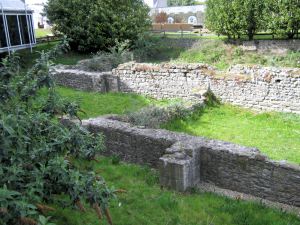
Ruins of St Martin-le-Grand by the steps of the entrance to the Dover Discovery Centre, Market Square. LS

Ruins of St Martin-le-Grand by the steps of the entrance to the Dover Discovery Centre, Market Square. LS

Following the Bapchild Royal Council of 697AD, the Canons were endowed with grants of large tracts of land – including along the Dour at Buckland and Charlton. They were also given the lucrative tithe of the passage of the Port of Dover. Albeit, while the new monastery was being built it was frequently the target of attack from sea marauders. To help combat these, King Wihtred ordered the building of a seawall across the Dour estuary.

The farmers along the River Dour continued to provide food for the growing population and the first written record of a corn mill in Britain was in 762AD. The mill was on the Dour in the locality that has been identified as Buckland. Long before the end of the Saxon period, a corn mill at Charlton was recorded and it is known that the Canons’ of St  Martin-le-Grand had a water driven mill on the Dour – probably the Town Mill. By 1000AD, Dover, renamed Doferem, was a prosperous town with an established mint and cross-Channel trading links. It was also the head of the Cinque Ports Confederation and Dover was providing a base for royal fleets. Following the Norman invasion of 1066, William I  (1066-1087) made a grant to the town’s Burgesses to ensure the harbour remained a base for the Royal fleet.
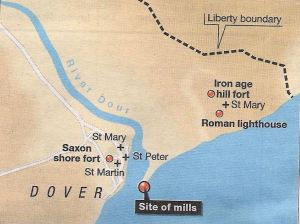
Map showing the Dour estuary c1086 with the location of St Martin-le-Grand, St Mary's & St Peter's Churches, town mills and Iron Age fort on Eastern cliffs. This author's understanding from a talk by Keith Parfitt of Canterbury Archaeological Trust 2016

Map showing the Dour estuary c1086 with the location of St Martin-le-Grand, St Mary’s & St Peter’s Churches, town mills and Iron Age fort on Eastern cliffs. This author’s understanding from a talk by Keith Parfitt of Canterbury Archaeological Trust 2016

The King also effectively created palatinates and the Kent palatinate was under his half-brother, Odo the Bishop of Bayeaux (d1097). The Domesday Survey of 1086 gives a description of a mill sanctioned by Odo, ‘ in the entrance of the port of Dovere, there is one mill, which damages almost every ship, by the great swell of the sea, and does great damage to the king and his tenants; and it was not there at the time of King Edward.’ From this it is assumed that the Dour estuary had narrowed from Roman times and was relatively narrow and fast flowing at that time.

It is believed by many that Odo’s tidal mill allowed the build up of silt and contributed to the Dour forming two riverlets, the existence of which is well documented. Initially they were called the East and West Brook but are frequently referred to as Eastbrook and Westbrook. A survey carried out by Dover Harbour Board in 1988 found gravel about 10metres east of Admiralty Pier indicative of an old river bed. It has been assumed that this was Westbrook’s entry into the sea. Eastbrook took a more easterly direction and it emptied into the sea near Warden Down – the cliff that Castle Hill Road traverses. It was close to here that a harbour was built and was approached through Eastern Gate. Around this harbour the medieval mariners settled.

The Eastbrook harbour became the town’s main harbour and over the next 300 years this harbour proved to be a great success, with royalty, both English and foreign, using Dover as the principal port for passage to and from the Continent. However, the sea began to encroach and floods became a regular occurrence.  To protect the town, a retaining wall was built from what is now the Snargate Street/Bench Street area to the west side of Eastbrook. Called the Wyke, an inlet had formed at the west side of the Eastbrook. Shipbuilders utilised this as an entrance to what became the town’s shipyard, in the area behind the Wyke. In 1440, Henry VI (1422-1461) granted a Charter to encourage Dover’s shipbuilding industry.

The town and its harbour continued to come under attack but not without cause (See Cinque Ports part II). To protect both, at the latter end of the 14th century, strong town walls were built. Within these, in 1370 a new gate, called Snar Gate, for the Westbrook of the Dour to exit the town into the sea was erected at the bottom of the present York Street. Between 1300 and 1500 there was a movement of land mass that triggered the phenomenon called the Eastward Drift – the tide sweeping round Shakespeare Cliff and depositing masses of pebbles at the eastern end of the bay.
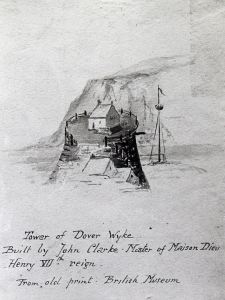
Wyke or Wick Tower - built by John Clarke c1500. From a British Museum print. Dover Library

Wyke or Wick Tower – built by John Clarke c1500. From a British Museum print. Dover Library

This, together with a cliff fall at the beginning of the fourteenth century, rendered the Eastbrook Harbour useless and over the succeeding centuries it silted up. The cliff fall, apparently, cause the Eastbrook of the Dour to take a westerly serpentine direction eventually joining with the Westbrook. At the same time the Wyke had ceased to be effective in protecting the town from floods and the building of a new Wyke commenced. This started at Snar Gate and ran along the whole sea front of the town.

The loss of the Eastbrook Harbour had a devastating effect on the town’s economy which in turn had a knock-on effect on the livelihoods of the inhabitants further up the Dour. The Corporation saw hope by turning a natural anchorage at the foot of Archcliffe Point into a harbour. Sir John Clarke, Master of the Maison Dieu sought Henry VII’s (1485-1509) patronage and built a new harbour that the mariners called Paradise Pent. However, in the autumn of 1539 a series of southwesterly storms deposited pebbles into the entrance of Paradise Pent and also where the Dour discharged into the sea.

Conjointly, this caused serious flooding and Mayor John Bowles petitioned Henry VIII (1509-1547), who in 1540 set up a Commission to investigate. Over the next two years, solutions were put forward to the King, but having already spent a great deal of money on Dover’s harbour for his fleet, he declined to spend any more. By 1566 an offshore shingle bar had built up across the Bay from Archcliffe to the foot of the Castle cliffs. This enclosed a tidal lagoon into which the Dour flowed.

Harbour c1590 on the completion of Thomas Digges work. Drawn by Lt Benjamin Worthington c 1836. Dover Library

Harbour c1590 on the completion of Thomas Digges work. Drawn by Lt Benjamin Worthington c 1836. Dover Library

Having gained experience in the Netherlands, engineer Thomas Digges (c1546-1595), of Wooton, in 1581, came up with a revolutionary design to deal with the problem. He proposed strengthening the naturally formed shingle bar that had created the lagoon into which the Dour flowed. This he did using faggots covered with earth, held down with piles. The resultant long wall was parallel to the shore and to this, he joined a strengthened shingle embankment running from the end of of the natural long wall and formed what is now Union Street.

It also enclosed a large area into which the Dour flowed and was called the Great Standing Water or Great Pent. A floodgate and sluice were inserted in the embankment that is now Union Street which enabled the Great Pent to empty into Paradise Pent and clear any shingle blocking what was then the harbour. To relieve the River Dour during periods of heavy rain that caused flooding a sea wall, parallel to what is now Snargate Street was built with sluices and floodgates and called the Great Paradise. Costing £7,495, work began on 13 May 1583 and finished about 1586.

Over the next three centuries many alterations and modifications were made to the harbour then, in 1830,  a major refurbishment to the Great Pent was undertaken. This included removing some 20,000 tons of mud that had been deposited by the River Dour and the new dock was deepend. It was then lined with granite and two 60-feet (18.3 metres) giant lock gates were inserted that provided access and egress between the Great Pent and the Tidal Basin.

An iron bridge was built over them and the whole enterprise was completed in 1844, costing about £45,000. The Lord Warden, the Duke of Wellington (1769-1852) opened what was formerly the Great Pent along with the bridge on the 13 November 1846 and they were named, respectively, Wellington Dock and Wellington Bridge. Sluices were inserted at the side of the dock gate to relieve over filling of the new dock from the Dour during stormy weather.

New Bridge at the time it was built in 1800. Dover Museum

New Bridge at the time it was built in 1800. Dover Museum

Further up the river to the east of the then Great Pent, in 1800, a bridge was built across the Dour to enable folk to access the seafront and beach. Appropriately named, New Bridge, on the west side John Hillier had a builders yard. In 1826 William Batcheller bought Hillier’s yard and built a fine Regency mansion called Kings Library in which he opened a library and assembly rooms and where the high society of Dover subsequently met. The eastern parapet of New Bridge was removed in 1840 to enable widening and premises were built from Bench Street across the bridge.

The area around New Bridge, however, was devoid of lamplight and reeking with all kinds of filth. In March 1852, the Harbour Commissioners appointed Henry Lee & Sons of Chiswell Street, London to construct quays around, what was by this time, Wellington Dock. That year the parapet on the west side of New Bridge was removed to provide access into the newly constructed Northampton Street (now gone) and Quay. A 10foot to 14foot diameter culvert was built under Northampton Quay for the Dour to flow into Wellington Dock.

Northampton Quay was still being built when it was decided to extend the brick culvert carrying the river Dour by 330feet and this was strengthened using Medina cement and bricks to form ‘masses 2feet long.’ The Medina Cement Company had been established on the bank of the Medina River, Isle of Wight, around 1840 and by the mid 19th century, the company had acquired the reputation as a pioneer in cement concrete. For a number of years it rivalled Portland cement, exhibiting at the 1851 Great Exhibition and securing government contracts. The two products had quite different properties, Medina Cement was a ‘roman’ cement and quick drying, while Portland was slower drying but ultimately considered stronger.

New Bridge looking towards Bench Street, Cambridge Terrace on the left and new Bridge House on the right note buildings on the bridge c1900. David Iron

New Bridge looking towards Bench Street, Cambridge Terrace on the left and new Bridge House on the right note buildings on the bridge c1900. David Iron

Once the culvert was completed, exclusive properties were built from the Batcheller’s Kings Arms Library over the Dour culvert to reclaimed land beyond. When finished in 1856 the new properties were called Cambridge Terrace and to take their weight the Dour culvert was further strengthened which narrowed the aperture. In 1864-1865, opposite Cambridge Terrace, New Bridge House was erected.

Throughout this time Admiralty Pier, construction was started in November 1847, followed by the Admiralty Harbour which was finished in 1909. Together with the narrowed aperture culvert and the reduction of sluices to relieve excess water in the Wellington Dock, resulted in an unwanted effect. During heavy weather and when tides are exceptionally high, water from the Wellington Dock cannot flow out and therefore the Dour river waters back-up. Exacerbating this problem, during the 19th century the Dour flood plains, particularly in Dover, were used for building purposes. Hence, when there is a combination of heavy rain and high tides Dover becomes susceptible to flooding.

Villages along the River Dour

As stated at the beginning of this story, the Dour passes through the villages of Temple Ewell River, Buckland, and Charlton before going through Dover and emptying into the Wellington Dock. The next part of this story takes a brief historical look at these four villages.

Temple Ewell
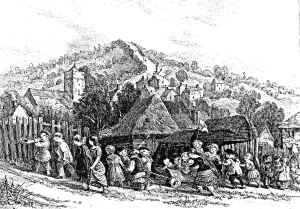
Temple Ewell children climbing the hill to Lousyberry Wood with village and Ewell Minnis in the background c1900. Dover Library

Temple Ewell children climbing the hill to Lousyberry Wood with village and Ewell Minnis in the background c1900. Dover Library

Temple Ewell is the village in which the Dour rises at Watersend and in Saxon times was known as Æwille, meaning river source or spring. The village has a long history for it was mentioned in a charter of around 772AD. Surrounded on three sides by high cliffs and there would have been on the fourth side if the Dour, in ancient times, had not carved out the valley that cuts through the south side. The Romans utilised this opening when they built Watling Street through the village. By the time of Edward the Confessor (1042-1066), Edrich de Alkham was the landowner. Of note, the Dour’s main tributary starts from east of the village of Alkham and runs along the Alkham valley.

Following the Conquest of 1066, the area came under Norman ownership and in the Domesday Book of 1086, the village was called Ewelle or Etwelle. It was recorded that there was a manor house, five watermills, about fifty homes and a wooden church. In 1163, the Knights Templars, the major fighting force during the Crusades, were given Ewelle in recognition of their work for which the village was given the prefix Temple. It was they who built the Church, not far from the River Dour, from which the present St Peter and St Paul Church evolved. Indeed, the original eight pointed cross emblem of the Knights Templars can still be seen in the present Church.

The converted former corn mill Temple Ewell. Alan Sencicle

The converted former corn mill Temple Ewell. Alan Sencicle

Traditionally, the village was predominantly a sheep rearing and arable farming community and like all such villages, had a corn mill that was situated on the river Dour. This was built by the Knights Templars and rebuilt in 1535. Alfred Stanley senior bought Temple Ewell Mill for £100, and in 1870, his son built a second mill nearby. By 1957, this was the last working corn mill on the river Dour and was owned by Alfred Stanley, the great-grandson of the original Alfred Stanley! Much of the first Temple Ewell mill was demolished to make room for housing and the second mill closed in 1967. Four years later, it was bought by Dover Operatic and Drama Society to provide rehearsal rooms and storage facilities. Nonetheless, structurally, the building is a fine example of a mid-19th century corn mill.

The village school, next to the Church, opened in 1871 and over time has been extended and continues to thrive with high ratings from the Ofsted – Office for Standards in Education, Children’s Services and Skills who inspect and regulate services that care for children and young people, and services providing education and skills for learners of all ages. Up until the opening of the new A2 in 1974, the London Road made the village a major accident black spot but today it is much quieter. The thriving Community Centre, built in 1909, is next to London Road and has the look of an old village school and at one time, the village boasted of four pubs.

River Dour, Lower Road, Temple Ewell. Alan Sencicle

River Dour, Lower Road, Temple Ewell. Alan Sencicle

In the late 19th century, a massive coalfield was discovered under East Kent and the Brady shaft at Shakespeare Colliery was started in July 1896. A total of 14 coal seams, stretching from Dover almost to Herne Bay, were eventually found and it was envisaged to sink 15 mines, one of which was at Stonehall, Lydden, the next village to Temple Ewell towards Canterbury. The colliery was not commercially viable and was finally abandoned in 1923 due to proneness of flooding. In the 1970s the National Coal Board under took boring to evaluate the extent of the flooding and if it could be contained using modern technology. Water was pumped out and into the Dour but in 1978 this caused serious flooding in Temple Ewell. The National Coal Board were forced to change their policy and the Stonehall project was abandoned although, it is believed, that water is still pumped from the old mine into the Dour.

These days, only the Fox Inn, in the centre of the village, remains. Temple Ewell also has a village shop and at one time there was a butchers, a cobblers and a black smiths amongst other trades. The building of the housing estate on the east side of London Road, Target Firs, dramatically increased the size of the population of the village. Many of the new female residents were employed at either the Watersend pickle factory or Alexander Couchman’s sweet factory in Target Firs. Both factories have long since disappeared but the housing estate has grown considerably.

Much of the old village developed around the River Dour and between Temple Ewell and the next village along the Dour – River – is the hamlet of Kearsney. The Lower Road follows the Dour and crossing the road, on a high viaduct, is the railway line from London via Canterbury to Dover. Built by the London, Chatham and Dover Railway company Kearsney railway station serves both Temple Ewell and the village of River. After passing underneath the Alkham Valley Road, the river Dour enters Kearsney Abbey parkland where it is joined by its tributary from the Alkham valley and forms a lake before entering the village of River.

River

Map of Watling Street, South Eastern & Chatham Railway line between Dover and London, River, Temple Ewell and Kearsney c1919

Map of Watling Street, South Eastern & Chatham Railway line between Dover and London, River, Temple Ewell and Kearsney c1919

The village of River comes after Kearsney Abbey and its name causes a great deal of confusion to people who do not know the area. In fact it was named such because the River Dour runs through it! Although long ago River ceased to be a rustic village and in 1903 became part of the Borough of Dover, like Temple Ewell, it has maintained its own identity. The church of St Peter and St Paul is on the corner of Lewisham Road and Minnis Lane, on the west side, on the hill above the Dour.

The Church can trace its origins back to 1208, was rebuilt in 1832 and restored in 1876. Initially, it was dedicated to St Peter but later it was rededicated to SS Peter and Paul, only to revert back to just St Peter. Then there was another change of mind and it was rededicated in 1876! Of interest, all the village churches along the Dour are dedicated to apostles who were fishermen and at one time Dover also had a church dedicated to St Peter – as can be seen on one of the maps above – it too was next to the Dour!

River Paper Mill ruins Lower Road - Common Lane , River . Alan Sencicle

River Paper Mill ruins, Lower Road – Common Lane , River . Alan Sencicle

Minnis Lane is the first road on the right after leaving Kearsney Abbey by the footpath along the Dour. Near the bridge over the Dour are the ruins of what was once River paper mill and further along the Lower Road is a present branch of the Co-operative Society. Between the two and now a residence, was the original Dover Co-operative Society building founded by mill workers. Having previously supported its own Poor House, the River Union Workhouse on Valley, serving 13 rural parishes was adapted from an earlier building. This cease to exist in 1836 when the Union Workhouse, which later became Buckland Hospital, was built in Dover.

The arrival of the London, Chatham and Dover Railway in 1861 led to an influx of wealthier households and the demand for new homes led to a thriving brick making industry within the village. As the desire for more houses increased the steep hills on the west side of the village were developed but commercially produced building materials put an end to the local brick makers. Because the London Road is high on the steep escarpment on the east side, the village has never been laid prey to the volume of traffic that once blighted Temple Ewell.
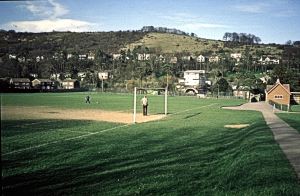
River Recreation Ground 1988 with Old Park hill in the background. Dover Museum

River Recreation Ground 1988 with Old Park hill in the background. Dover Museum

There has been a village school in existence since before 1871 but in that year the school was taken over by John Judges and rebuilt on Lewisham Road. Since then, the school has been extended, refurbished, had makeovers and then a rebuild, all to meet an increasing demand for school places. In 1922, a village hall was erected out of corrugated ex-Army huts that had been used as a military hospital during World War I (1914-1918). This was land given by local market gardener Councillor Hilton Russell, the driving force of the later Russell Gardens. However, by the 1950s, the Hall was in a poor condition.

On the instigation of Hilton Russell’s son, Ray Russell, money was found, the hall was re-established and more recently rebuilt. Between Lewisham Road and Lower Road, is River’s large recreation ground. Back in the late 1980s Dover District Council (DDC) passed a covetous eye in order to raise money for their pet project, the short lived White Cliffs Experience, and ear marked the recreation ground for housing development. Vociferous protests that unified the village ensued and DDC backed off.
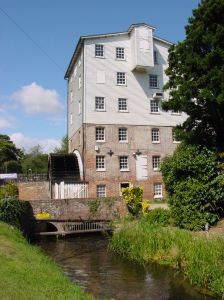
Crabble Mill on the Dour river. Alan Sencicle

Crabble Mill on the Dour river. Alan Sencicle

From River the Dour runs alongside the Lower Road through the picturesque hamlet of Crabble. Although Crabble corn mill has long since ceased to be a commercial flour producing operation, these days it is recognised as one of the finest examples of a working Georgian water mill in Europe. The nearby new build housing, on the whole, does not detract from the character of Crabble. The once large Crabble paper mill that stood by the southerly main road in and out of River, has been converted into a sympathetic housing development.

An electric tram track opened to River Church along Crabble Hill Road and Lewisham Road on 2 October 1905. On Sunday 19 August 1917 one of the worst tram accidents in the country occurred on the bridge that goes over the River Dour. In the Crabble Tram accident 11 people were killed and 60 were injured, many seriously. On the bridge there is a Dover Society Plaque to their memory. On the opposite side of the road is the Dover Athletic Football Club ground and adjacent, the rugby/cricket ground. Called the Crabble Athletic Ground it was opened on Whit-Monday 1897 and neither ground are strangers to national, and once international, events.

Buckland

Dover and environs map showing the location of Buckland and Charlton and the course of the River Dour. Hasted 1798

Dover and environs map showing the location of Buckland and Charlton and the course of the River Dour. Hasted 1798

The next village along the Dour is Buckland and although it has long since been taken over by Dover, it still retains a semblance of the village it was. The Romans laid Watling Street, the road to London along the west side of the Dour through Buckland and it crossed the Dour by a ford at the foot of Crabble Hill. The village grew up alongside this road and the Dour and extended along the valley to the west, known as Buckland Bottom. In those days, there was another Roman road that went to Richborough, probably crossing the Dour where Bridge Street bridge is today and ran up Frith Road, Old Charlton Road and east over the North Downs. North of Frith Road, there was Buckland Back Lane approximately where Barton Road and Buckland Avenue are today,  joining Watling Street at the bottom of Crabble Hill. During Saxon times, the Buckland area was well inhabited, their dead being buried in a large Saxon cemetery that was discovered in the early 1950s around what is now the Hobart Crescent/Napier Road area of the Buckland housing estate. In 762AD the country’s first corn mill was recorded in the vicinity of Buckland.

At the time of the 1086 Domesday Book, the parish of Buckland was made up of the manor of Buckland, Dudmanscombe (at this time pronounced and later spelt Deadmanscombe) and Barton. The manor of Buckland was at the bottom of Crabble Hill, and was demolished in 1897 to build a tram shed (now Hollis Motors occupies the site). The Court-lodge for Dudmanscoombe and  Barton was at Coombe Farm, which lay at the furthest end of Coombe Valley, where a road ran to Poulton and St Radigund’s Abbey. Buckland corn mill, was on the east side of the Dour and the mill lands, called Brox-Ditch meadow then Brook-Ditch Meadow, were along the east bank of the Dour where Lorne Road and Alfred Road are today. By 1451, the Buckland corn mill was run by Dionisia Ive and was in the hands of the Brethren of the Maison Dieu and subsequently Dover Priory until the Dissolution of Monasteries in 1535. The valley to Coombe Farm, up until the mid-twentieth century, was called Buckland Bottom and was not inhabited except for the farm. On the south side of the Buckland Bottom was an ancient cart track over Whinless Down (so called after Whinless, the old name for gorse) to West Hougham.

Hardings Brewery formerly lower Buckland corn and then paper mill 1862 painted James A Tucker c 1910. Dover Museum

Hardings Brewery formerly lower Buckland corn and then paper mill 1862 painted James A Tucker c 1910. Dover Museum

By 1753 the road, from the bottom of Tower Hamlets Road where the Dover town boundary ended, to Barham Downs, south of Canterbury, was turnpiked. A toll house on Crabble Hill was built to catch folk leaving Dover by Buckland Back Lane. The toll road charges paid for road improvements and the brick Buckland bridge was built on the site of the ford using tollgate money in 1795. About four years later the nearby Bull Inn opened and is still popular today.

Up until the opening of the turnpike, papermaking was a cottage industry but following the road being turnpiked Henry Paine built a paper mill alongside the ancient corn mill. Although subjected to the vicissitudes of the economy the mill expanded and William Kingsford junior built cottages for his workers. Many are still standing today along the London Road near the Bull Inn. The Buckland (lower) paper mill became a brewery, the name changing to Hardings. This was demolished in 1962 to make way for a new Gheysen’s toy factory and then became a P&O training centre. It is, at the time of writing, a derelict site.

A water-pumping windmill was built in 1798 on the corner of London Road and Buckland Bottom. In the 1820s, Flavius Josephus Kingsford (circa 1758-1851), a farmer and miller on Bulwark Hill, above the Pier District on Western Heights, bought it. He gave the windmill site to his younger son, Alfred (1803-1878) and for himself he built Ivy House next door, 226-227 London Road and now converted into maisonettes, as his home. In 1829 Flavius and Alfred converted the windmill machinery to pump water and Alfred opened a brewery. The brewery lasted until 1889, having been taken over by George Beer and Ridgen two years before. In 1896, George Sacre Palmer (1843-1905) opened a coach building factory on the site and had a distinctive arch built over the entrance at the corner of London Road/Union Road – a replica of which can now be seen at the Transport Museum, Whitfield. Opposite the brewery, in1814, William Kingsford senior bought Buckland corn mill and the adjacent lands from Sir Thomas Hyde Page, the Western Heights Military Engineer. It was Page who built the still standing 110, London Road and the original Lorne Road bridge across the Dour.

Buckland Corn Mill Water wheel, Lorne Road. Alan Sencicle

Buckland Corn Mill Water wheel, Lorne Road. Alan Sencicle

William Kingsford rebuilt the corn mill laying the foundations of the mill we see today and Lundy House (now Ryder House), next door. By 1843 the mill was rented by Wilsher Mannering but he died ten years later. In 1865, the mill was bought by Wiltshire’s son of the same name who had set his sights on the rapidly expanding London market, sending his flour there by sea in hoys. His brother John joined Wilsher and the mill was increased to the five-storey corn mill we see today. The Mannering brothers were joined in the business by Wiltshire’s two sons and the mill stayed within the family until it closed in 1957. Following its closure Buckland corn mill was used by businessmen for offices and storage. In 1996, it was offered for sale and has now been converted into flats.

A prominent feature close to Buckland bridge is the carcass of what was the Wiggins Teape Buckland paper mill that suddenly closed in 2000. What is left of the building is an attribute to industrial architecture with a grand clock tower that still stands. The whole site extends northwards from Buckland bridge up Crabble Hill almost to where the Dover – Deal railway line passes over the London Road. On the west side of the derelict mill is the ancient St Andrews Church with the river Dour passing beneath what is left of the mill nearby.
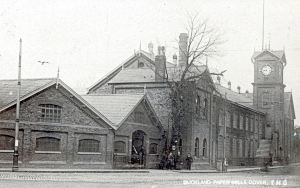
Buckland Paper Mill c1910. Dover Museum

Buckland Paper Mill c1910. Dover Museum

Originally, a corn mill stood on the site, but by 1777 it had been converted into a  paper mill. Having been rebuilt and expanded several times – on each occasion following devastating fires – and also having changed hands. In 1890 it was bought by the giant paper manufacturer, Wiggins, Teape, Carter and Barlow of London, to produce Conqueror Paper. Not long after, they bought the nearby Crabble Paper Mill and for 100 years appeared to be successful up until the sudden unexpected closure.

On the west side of the London Road, from 1141 to the Dissolution of the Monasteries, was the large St Bartholomew’s Leper Hospital. The 130acre site stretched from approximately opposite what is now Beaconsfield Road to where the TA centre is these days. When it was forcibly closed, the site was sold, the buildings demolished and the land used for farming. By 1825 the site was owned by William Kingsford and that year the first houses were built there. Nine years later in 1834, Kingsford, who had over reached himself was declared bankrupt and the entire 130acre site was sold. At the time, the area was called Chapel Mount and subsequently became known as High Meadows and then Shooters Hill and over the next few decades the area was covered in housing.

In 1835 the boundary of the Borough of Dover was extended to include parts of Buckland village and immediately to the south of the then Buckland Bottom was, Dudmanscombe farm house. This was demolished and George Street, Erith Street and Victoria Street were built. At the back of the farmhouse there was a brickfield owned by John Finnis and farmlands.
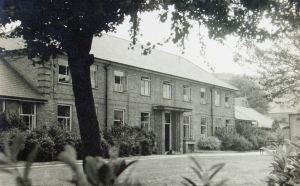
Buckland Hospital c1950. Anglo-Canadian Trade Press

Buckland Hospital c1950. Anglo-Canadian Trade Press

A large part of the lands were already owned by George Hatton Loud who owned 110, London Road. He sold part of these land holdings where the Union Workhouse was then built. In consequence, the name of the road was changed to Union Road in 1865. At the start of World War II (1939-1945) the old Workhouse was already being used as an annex to the Royal Victoria Hospital on the High Street when it was commandeered as a military hospital. In 1948, with the introduction of the National Health Service it became Buckland Hospital and the name of the road was changed to Coombe Valley Road. The building has since closed.

The still standing, York House opposite what is now Beaconsfield Road, was built by Anthony Freeman Payn, who ran the York Hotel on the Esplanade, near the Clock Tower, about 1835. Beaconsfield Road was planned in 1866 along with Churchill Street and Granville Street but they were not built until 1880. Beaconsfield Road followed the line of an ancient footpath going to Barton Back Lane crossing the Dour on planks. There was once an extensive meadow alongside the west bank of the Dour almost from Ladywell to Cherry Tree Avenue – then called Cherry Lane. The northern end, between Beaconsfield Road and Cherry Lane, had become the town’s cricket ground but in 1896, the land was sold to build housing along Millais and Leighton Roads.

By 1845, William Batchellor tells us that, ‘there is an almost continuous line of buildings (uniting) this village to that of Charlton, and to the town of Dover.’ The construction of the London, Chatham and Dover railway line in 1861, from Dover to Canterbury, required the building of a 660 feet tunnel under Shooters Hill to Tower Hamlets and two bridges over Buckland Bottom and St Radigunds Road. As soon as the railway opened, the Dover Gas Company selected a spot just west of the line along Buckland Bottom, and by 1871 they had opened their gas works there.
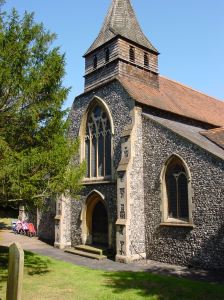
St Andrew's Church, Buckland. Alan Sencicle

St Andrew’s Church, Buckland. Alan Sencicle

Around this time Edgar Road, Prospect Place, Randolph Road, Magdala Road, Primrose Road, MacDonald Road, Lambton Road a line of houses on the south side of St Radigunds Road, Oswald Road and Eric Road were built. In 1894, William Pritchard aged 8, died after falling some 14feet from the unfenced Buckland Terrace onto the London Road below. William’s death was far from being the first there. As a result the Borough Coroner, Sydenham Payn, told the council to take responsibility for fencing the Terrace. Eventually, besides the fence and the bus shelter we see today, a room with a lavatory was excavated and built into the brick wall. It was large enough to be used as an emergency air raid shelter in World War II!

St Andrew’s Church, close by Buckland bridge is Saxon in origin. Rebuilt in the 12th century, it retained much of its Saxon design and again when it was expanded in the 14th century. To meet the needs of the growing parish, in 1880, it was decided to double the length of the nave and to add a new belfry. This, however, meant the more than 1,000-year-old yew tree in the churchyard had to be moved. Supporting the roots, as they became exposed, a deep trench was dug around the base of the tree and rollers place underneath it. Reputed to have weighed 56-tons, the tree was moved in a cart along timber rails, some 60 feet to the west, where it was replanted. It survived, thrived and still can be seen today in the churchyard!
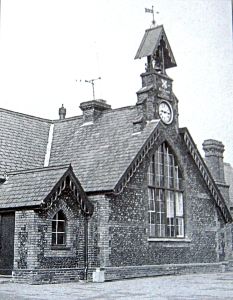
Buckland School on London Road opened in 1859 and closed in 1968 and eventually was converted into a housing complex. Bob Hollingsbee Collection

Buckland School on London Road. Opened 1859, closed in 1968 and eventually converted into a housing complex. Bob Hollingsbee Collection

Buckland had its own parochial school that opened in 1839 on the western end of the churchyard. As the population of the village increased, the school moved twice to larger premises. Then land was obtained on London Road and on 24 February 1859, the foundation stone was laid. During the excavation for the foundations of the new school Roman pottery and artefacts were found. The bell for the new school came from the sailing ship Earl of Eglinton, which was wrecked off St Margaret’s Bay in 1860 and at the same time Brookfield House, by the Dour in what became Brookfield Place, was built as a master’s residence.

On 22 May 1885, Mary Tyler, the eldest daughter of the Market Square furniture shop owner, George Flashman, laid the foundation stone for the extension of the School with George contributing £225. However, the successful school was closed in 1968 and became a social club for the staff of the cross-Channel shipping company, Townsend. Following the change of ownership of Townsend Thoresen in 1987, the former school became Churchill’s Snooker Club before eventually being turned into a residential complex.

Charlton

The last village the river Dour goes through before reaching Dover is Charlton. These days the village is hard to distinguish from its northern neighbour Buckland and the town of Dover to the south. One of the clearest indicators of the old village, but not its boundaries, is the main road out of Dover. From the Bridge Street/Tower Hamlets Road traffic lights, to the north is London Road, Buckland and to the south is the High Street which becomes Biggin Street at the Ladywell junction. This was Charlton village High Street. Another indicator is Charlton school and SSPeter and Paul Church, the latter of which is situated close by the east bank of the Dour close to Charlton Green. The Green, for over a thousand years was the centre of the old village but not long ago a large part was renamed the Castleton Shopping Centre. The River Dour is buried in a culvert under its car park!
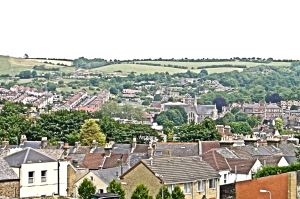
Charlton from Priory Hill. Alan Sencicle

Charlton from Priory Hill. Alan Sencicle

From archaeological evidence, there is reason to believe the Dour, in Roman times was navigable up to Charlton. By the time of Edward the Confessor (1042-1066) the manor of Charlton was attached to the Barony of Chilham, some six miles the other side of Canterbury. This was because King was one of the prebends of the ancient monastery of St Martin-le-Grand that stood near Dover’s Market Square, and his possessions included Chilham. After the Norman Conquest, Charlton continued to belong to St Martin’s monastery and then Dover Priory. About this time, above the village to the east where the hills rise towards Dover Castle on a wide relatively flat area the knights from the Castle practiced chivalry. Called Knights Bottom, the area was later integrated into the cemeteries and Connaught Park. As time passed, a mill was erected close by the west side of the Dour and in 1203 the land on the east side was given to the Maison Dieu. By by 1291, the parish Church dedicated to SS Peter and Paul had been built. Nearby was a large village green and the village grew around the Church, the Green and on both sides of the Dour. In Edward II (1307-1327) reign, it was given to Bartholomew de Badlesmere (1275-1322) and together with Charlton Green and the farmland, remained in possession of the Badlesmere family up until the Reformation (1529-1536).

Following the Reformation, Charlton Green became a separate entity to the Church and long before the turn of the 19th century, the High Street, which was part of the main concourse out of Dover, had been developed. On the Charlton side of the present day Bridge Street, St Mary’s Poor House had been built. The Green was surrounded by cottages and nearby were two mills. The land at Charlton was rich from the flood plains of the Dour and, in particular, the cottage dwellers along the High Street who all had very long gardens, utilised this. Becoming professional market gardeners, tulips grown in Charlton-by-Dover were highly prized. In the summer, awnings to maintain production covered the tulips and the gardeners also cultivated fragrant flowers from which honey was produced. Again, this was sort after by the high society of London.

Charlton Green - Chitty's Flour Mill c 1920 - Hollingsbee collection Dover Museum

Charlton Green – Chitty’s Flour Mill c 1920 – Hollingsbee collection Dover Museum

The mill opposite the Church on the Dour had existed since Saxon times but was demolished in 1850 and a new flour mill  built. This was owned by the Dover Aerated Bread Company until they went into liquidation in 1865. George Chitty bought the mill, retaining the name Aerated Bread Company, but supplemented the River Dour water wheel with a 200 horsepower steam engine. For this a water tower was built to feed the boilers. With modifications to both the mill and their products the firm was so successful that they largely rebuilt the mill in 1906 and opened warehouses at Granville Dock. However, during World War II the water tower was used as a target by enemy guns and on 2 September 1944, a shell exploded on the roof and a hot piece of shrapnel lodged in the roof timbers and smouldered. By the time the fire brigade arrived, the roof was well alight. The mill never re-opened but the company was still in business for quite a long time after.

During the late 18th century, Charlton became a fashionable waterhole due to a chalybeate spring, which runs into a tributary and then into the Dour from the appropriately named Branch Street. This was successfully utilised in the 19th century, by Stephen Elms who established an aerated waters and sweet factory. In 1830 Spring Gardens, named after the chalybeate spring, along with nearby Peter Street and Churchill Terrace, were built for paper makers from Charlton Paper Mill.

Charlton Centre, High Street. LS

Charlton Shopping Centre, High Street. LS

The mill was established in 1833, by George Dickinson, the younger brother of the famous paper maker, on the southern end of what was Wood’s Meadow. This once covered the west bank of the Dour from Cherry Tree Avenue almost to Ladywell. Adjacent to this mill, Dickinson built a large mansion that he named Brook House – which is often confused with the Brook House on Maison Dieu Road that was notoriously demolished by Dover District Council. In 1856, William Crundall senior bought the mill for use as a sawmill and over the next 100years the firm expanded along both sides of the Dour. When the company was sold the original Charlton Paper Mill was demolished. Since then houses and the Charlton Shopping Centre occupy the site.

In 1829, the bridge on Bridge Street was built and about the same time, the original Admiral Harvey Inn opened. This was on the same site as the pub of the same name now stands. Nearer to where the High Street and London Road meets, the border between Charlton and Buckland veers north and Matthew Place, Paul’s Place and Harvieian Place were built. On the opposite side of Bridge Street on the site of the St Mary’s Poor House, Catherine’s Place, Colebran Street, Brook Street and Branch Street had been built. Along Charlton High Street, the old market garden industry was giving way to retail and most of the present day shop fronts were built on the old gardens. On the west side of the High Street, without any authorisation, Barwick Alley was built in 1823. In 1842, the Alley was the centre of a smallpox outbreak and in 1875; it was condemned but was not demolished until 1882.
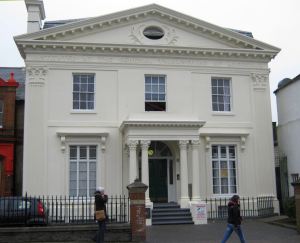
Former Royal Victoria Hospital, High Street. LS 2013

Former Royal Victoria Hospital, High Street. LS 2013

The whole of Charlton was incorporated into the Borough of Dover in 1836 and in May 1840, the plant and the building materials of Charlton paper mill were sold. The adjacent Brook House and half an acre of the nearby Woods Meadow were let. Brook House was offered for sale by auction in 1850 and was bought for £1,336 by the town. Following modifications, it opened as the town’s hospital on 1 May 1851 and in 1858 the part of Woods Meadow was purchased to extend the hospital. Eventually, the hospital was renamed the Royal Victoria Hospital. Maison Dieu Place was built facing the northern side of the Hospital at about the same time as Wood Street and the Dourside Cottages in 1860.

On the opposite side of the High Street, Victoria Crescent had been built in 1838 and originally was more crescent like, but the outer ‘horns’ were demolished along with the ornamental garden, to widen the High Street. About 1843, on land the town side opposite the Maison Dieu – the then Town Hall – and Priory Hill, St Martin’s Terrace was built. While on the land between Priory Hill and Victoria Crescent a similar row of houses were erected. These were demolished in 1899 in order to widen the High Street.

St Columba Congregational Church was built of Kentish rag faced with Corsham stone on the land that remained. With a tower some 80feet high that was finished above the roof level with Corsham stone, it was generally described as magnificent. The main entrance was described as being enriched with a wealth of sculptured stonework surmounted by a fine Gothic window. It had cost £9,000 to build and opened in September 1904.

St Columba Congregational Church, High Street, Chalton on opening September 1904. Dover Library

St Columba Congregational Church, High Street, Charlton on opening September 1904. Dover Library

One hundred years later, after becoming redundant, the Church was sold to a property developer who was converting the building into luxury flats. In September 2007 the former Church was subject to an arson attack. The totally gutted remains still stand at the time of writing. It was in Peter Street that the Primitive Methodists were to build their first Chapel, which opened in 1860 but closed with the opening of the London Road Methodist Church, on Beaconsfield Road in 1901. In recent years the Methodist and the Congregationalist members joined to form the Beacon Church utilising the former London Road Methodist Church. It was this that led to the closure of St Columba Church.

Maison Dieu Road was originally called Charlton Back Lane and this was/is on the east side of the River. Opposite, on the west side, between the Lane and the Dour, was Maison Dieu Park. During the 19th Century they were both developed for housing with the building on Dour Street starting in 1862, parallel to the Dour. Between Dour Street and the river was Alfred Matthews building yard but this was destroyed by fire in 1874. Subsequently the land was incorporated into the Crundall sawing mill complex in the opposite side of the Dour.

By all accounts, Charlton Fair was one of the most popular fairs in the neighbourhood but as developers needed more land the Fair diminished in size and about 1850 moved to Barton Meadow, close to the River Dour, on the west side of Buckland Back Lane. Following the move, Anthony Lewis Thomas started a jobbing foundry on Charlton Green, which continued after his death in 1878. By this time the expanding foundry was named AL Thomas & Sons that specialised in manhole covers and street lamps. In 1902 it became a limited company and by 1908, Dover Mayor, Walter Emden, owned a controlling number of ordinary shares in the company and put his nephew, Vivian Elkington, in charge.

Renamed Dover Engineering Works Ltd, during World War I the company was responsible for maintaining the two-hundred-strong fleet of the Dover Patrol. When peace returned work resumed making manhole covers and lampposts but due to the increasing number of motor vehicles there was a demand for stronger and better fitting covers. After experiments, in 1928 Elkington and his foreman developed what became the well-known Gatic Cover (Gas & Air Tight Inspection Cover). During World War II the Engineering Works moved to Watford but agreed to come back to Dover if they could used their old premises on Charlton Green.
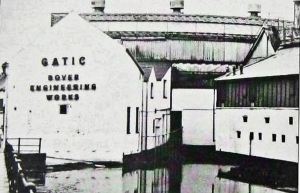
Dover Engineering Works, Charlton Green.

Dover Engineering Works, Charlton Green.

Initially, they opened a small foundry within the Eastern Dockyard while the Charlton foundry was rebuilt. Culverting the once famous chalybeate spring to flow into the Dour near what is now Charlton multi-storey car park, the new premises included the area previously occupied by the lower end of Peter Street and Spring Gardens.

The new foundry meant that the company could expand operations to included large projects for airfields, power stations and oil installations. In 1964, at the height of the Engineering Works success Vivian Elkington died aged 82. The Company became a subsidiary of Newman Industries, Bristol, in 1977, then eleven years later, in July 1988, they called in the Receiver. Bought by the Parkfield Group, most of the foundry work moved to Irvine in Scotland. Some production did move to Coombe Valley Road but only 23 out of the 155 jobs were saved.
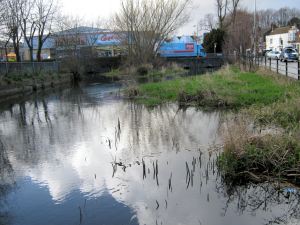
River Dour at Charlton Green, the gated garden next to Morrisons in on the left. halfords can just be seen and the Red Lion pub is on the right. 2014. LS

River Dour at Charlton Green, the gated garden next to Morrisons in on the left. Halfords can just be seen with the Red Lion pub on the right. 2014. LS

The Charlton Green engineering complex was demolished and a B&Q superstore and car park was built on the site. Later joined, in October 1990, by a Co-op Leo £7.5m food super-store with its own car park under which the remaining exposed River Dour at Charlton Green was culverted. The next door Charlton Centre and its car park were sold to Targetfellow, a commercial property group in 2006 though the Co-op had closed its doors at Christmas in 2004. The previous Co-op building was divided into smaller units and renamed the Castleton Shopping Centre so as not to be confused with the Charlton Centre next door. In 2009 B&Q moved to a much larger store on the Whitfield trading estate and on 25 January 2010 Morrisons supermarket opened its doors on the former B&Q site. The adjacent land that was left of the once extensive Charlton Green, next to the Dour and close to Bridge Street bridge, was cleaned up and became a gated picnic area.

Up until 1881 there was a ford through the Dour by the north side of Charlton Church and with the building of Brookfield Road it was replaced by a footbridge. In 1902, following the building of properties on Beaconsfield Avenue, the footbridge was demolished and the road bridge we see today was built to connect the two Beaconfields. World War II took its toll on much of Dover and in 1947 the 53-year-old London Fancy Box Company moved into the war damaged former Chitty flour mill on Bridge Street. They had come to Dover as the War had created a shortage of female labour in London.

The London Fancy Box Company had a new factory built on Beaconsfield Road and Granville Street, by the side of the Dour, and in 1953, the firm moved in. The former Chitty flour mill was taken over by Dover Engineering Works, demolished and new works built. The London Fancy Box Company thrived at Beaconsfield Road and opened another factory in Coombe Valley Road. An exhibition was held at Dover Museum, in 1994, to celebrate the firm’s centenary, but it had already become heavily automated and in 1998 the Beaconsfield Road factory closed. The factory was demolished and properties were built, the site of the Dover Engineering annex – formerly Chitty flour mill – was taken over by Halfords motor accessories in 1989.
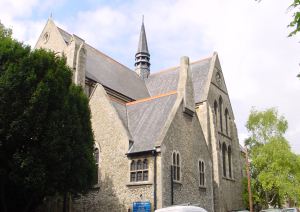
 St Peter & St Paul Church, Charlton. Alan Sencicle

St Peter & St Paul Church, Charlton. Alan Sencicle

Charlton’s SS Peter and Paul Church was expanded in 1827 and again in 1847 to meet the growth in population. To quench their thirst, the nearby ancient Red Lion Inn was rebuilt about 1843! In 1891, J J Wise of Deal rebuilt Charlton Church to a cruciform design in stone, by James Brooks (1825-1901). In the early English style, the Church has a central fleche with one bell and seating for 700. The old Church, on the banks of the Dour, was later demolished and Barton Riverside Path, which had been laid between Cherry Tree Avenue and Beaconsfield Avenue was extended from across the Avenue to Frith Road forming the pleasant public walk that still exists today.

Charlton Primary School, Barton Road. Alan Sencicle

Charlton Primary School, Barton Road. Alan Sencicle

Charlton’s children were without any form of education until Rev. Frederick Augustus Glover (1800-1881) was appointed rector of the Church (1837-1845). A keen mathematician he registered with the Patent Office the specification of an ‘improved instrument for measuring of angles.’ In 1840, Rev. Glover instigated the building of the first parochial school for Charlton; this was for 80 boys and was situated in the churchyard. In 1875, a new boys’ school was built on Granville Street and a girls school was started in January 1877 on Buckland Back Road. Having possibly been taught in the Granville Street school, the girls along with infants, on 2 June 1882 moved in to their new school and this we see today on the later renamed Barton Road corner with Frith Road. On Wednesday 13 September 1944, during World War II, the boys’ Granville Street school was destroyed by enemy action. To accommodate the Boys, an extension was added to the girls’ school in 1954.

Barton Farm was east of Charlton Church on Buckland Back Lane and from the 1880s farmland was being offered for sale for property development. The land immediately next to the Dour was acquired for the Cherry Tree Avenue – Beaconsfield Avenue, Dour side walk. By 1900, Barton farmhouse had been demolished and Charlton Avenue, Limes Road and Barton Grove were built on the site. Further developments took place along the newly named Barton Road and Heathfield Avenue and Mayfield Avenue were developed across the hillside on the east side.

Barton Farm on the River Dour, glass slide not dated. Dover Museum

Barton Farm on the River Dour, glass slide not dated. Dover Museum

Traversing these roads down to Barton Road more roads laid out to housing were built. Access to Long Hill, high on the east side of the valley, had been created by the London, Chatham and Dover/South Eastern Railways when they built the Dover-Deal railway line. It was an ancient right of way from Buckland Back Road to the Roman Road that eventually went to Richborough. Astley Avenue, named after Dr Edward Farrant Astley, was built in line with this footpath and on Long Hill, Dover Marquee Company moved their business just beyond the little tunnel on Long Hill where the Corporation also laid out allotments.

Barton Road School LS 2013

Barton Road School LS 2013

To meet the spiritual needs of the influx of new residents, St Barnabas Church was built in 1901 on Barton Meadow near to Cherry Tree Avenue. However, in 1940 the Church was badly damaged in and air raid and demolished. Barton Road Elementary School opened next to St Barnabas Church in January 1903 and alongside the Barton riverside path. Separate infant accommodation was started at about the same time and the girls’ school was built in 1912 on the same site. In 1937, Shatterlocks Boys’ School, on Heathfield Avenue, opened and eventually became a mixed infant school and Barton Infant School closed. Following the World War II up until 1957, when Archers Court Secondary School opened at Whitfield , the school catered for children between 7 and 15. That year Barton School became a junior school.

Ecological Plight of the River Dour since World War II

From this brief look at the history of the development of the villages along the Dour it can be seen that over the last 200 years the river has sustained numerous industries and from Buckland onwards, extensive housing developments. The industries that have utilised the diminutive River Dour included corn and paper mills, breweries, tanneries, saw mills, electricity and gas works, a pipe factory, an iron foundry and a box factory, to name but a few. In 1901, Dover Corporation sought to have the Dour recognised a river in order for them to constrain over usage and to try and keep it clean. However, the government authorities declared that it was merely a watercourse, which meant that it belonged to the owners of land on either side of the river and they could use it as they wished!

Abercrombie Plan - Planned redevelopment of Dover along the Dour c 1947. Dover Library

Abercrombie Plan – Planned redevelopment of Dover along the Dour c 1947. Dover Library

During World War II, both bombs and shells heavily scarred the town. When the shelling ceased on September 27th 1944, it was estimated that the war damaged sustained was proportionally greater than in any other town throughout the country.  In June 1945 Town Planner, Professor Patrick Abercrombie (1879-1957) was hired to produce a Reconstruction Plan for Dover. The premise of his Report was that ‘the lifeblood of a town of the nature of Dover is undoubtedly its industry,’ and this was to centre on the Dour valley. Although the Professor did emphasise the importance of the ecological and historical aspects of the Dour, the council ignored this. The overall result was that, at best, the Dour was treated as an inconvenient nuisance, ideally to be buried – most notably at Charlton Green. At worse, it was a dumping ground for household and heavier rubbish. As for the proposed redevelopment of Dover this became piecemeal with a move away from industry to housing.

The New Dover Group recommended, in 1965, to the then Dover Corporation that the Dour should be cleaned throughout its length. Adding that voluntary labour to do the job was available. They also advocated that once the Dour was cleaned up it should be turned into the town’s corridor of natural beauty. Finally, that the Barton Path should be cleaned and repaired and that a walk should be created between Kearsney Abbey and Townwall Street along the Dour. The Corporation made the right noises, Barton Path was repaired and swept but then they permitted developments along the banks of the Dour and forgot about the other recommendations.
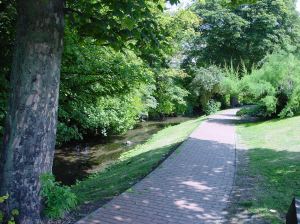
Pencester Gardens river side path alongside the Dour. Alan Sencicle

Pencester Gardens riverside path next to the Dour. Alan Sencicle

Dover Corporation was disbanded and replaced in 1974 by Dover District Council (DDC) and the New Dover Group banged the proverbial drum in their ears over the state of the Dour. Some of the members, that year, set up the River Dour Association with the prime objective of making the river an ecological paradise and creating a walk along its banks. Although the Dour was still officially a watercourse and therefore did not have the legal status of a river on environmental issues, DDC, in the late 1980s laid the Dourside footpath in Pencester Gardens.

Although the New Dover Group had disbanded in the early 1980’s, later that decade the Dover Society was formed basing their constitution on that of the New Dover Group. Most of the members of the River Dour Association were also members of the Dover Society, whose concerns included the neglected and polluted Dour. In October 1989 the Dover Society led a major clean up of the Dour with Whitbread and Shepherd Neame breweries providing the incentive of 50 dozen cans of beer to volunteers along with funds. 115 folk from local pubs plus many others turned up and in one day, the Dour was cleared from Temple Ewell to New Bridge! The result required a fleet of DDC vehicles to clear everything away, which angered a few! Within weeks the Dour was again turning into a dump with rubbish ranging from both domestic and industrial waste and appliances to abandoned vehicles, furniture and furnishings.

The River Dour Association public meeting called over the poor state of the Dour held in Biggin Hall 18 January 1991

The River Dour Association public meeting, called over the poor state of the Dour held in Biggin Hall 18 January 1991

By the early 1990s DDC spent over £22million pounds on the ill fated White Cliffs Experience in the Market Square and associated projects and the River Dour Association were angry. For except the show piece of Pencester Gardens, the remainder of the Dour was totally neglected and they called a public meeting. This took place on 18 January 1991 in Biggin Hall and was so well attended that folk were standing in the aisles!

The clean up began and by the beginning of May the Dover Society were again demanding a riverside walk from Kearsney Abbey to the Seafront. However, this proposal led to a proliferation of objections from residents along the proposed route, so the notion was abandoned by DDC. By the end of that month, Southern Water applied to dispose of screened sewerage in the Dour at Wood Street, by the Charlton Centre, and a month later the National Rivers Authority applied to abstract water from the Dour nearer its source.

Complaints by ‘namby, pamby conservationists‘, as they were called by Councillors, Council Officers and vociferous members of the public, led to government officials arriving in Dover. They came in  October 1992 with the remit to check if the Dour really had any ecological problems of concern. They were made welcome by those who insisted there were no problems and were shown the Dour where it runs through Pencester Gardens. However, the officials returned and carried out their own observations and testing.

Their report, in essence, stated that they were shocked at the state of the Dour adding that something should be done quickly. By December the White Cliffs Countryside Project (Later White Cliffs Countryside Partnership) were given authority to look into the state of the Dour and the Kent County Council (KCC)/DDC IMPACT joint committee agreed to make the riverside walk proposal a primary objective. Albeit, in May 1993, KCC sold land fronting the Dour near Cherry Tree Avenue to a firm of car breakers and DDC apparently due to financial constraints, was finding funding difficult. Then, in December 1993 came the good news, after 92 years of petitioning the Environmental Agency officially upgraded the Dour from a watercourse to a river!
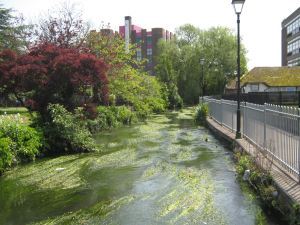
Dour Path alongside the river Dour , Maison Dieu Gardens. LS

Dour Path alongside the river Dour , Maison Dieu Gardens. LS

Nonetheless, problems and rubbish continued to increase such that various volunteer groups set aside whole days to clean the Dour and the River Dour Association became River Watch headed by Ian Lilford of Balfour Road. Sustained success started to be achieved and in January 1998 the Dour was upgraded from a stream to a river! The little bridge on the Maison Dieu path alongside the Dour between Maison Dieu gardens and South Kent College, was replaced in 2001 by the College and DDC. The path was also re-laid. River Watch were able to report that there was significantly less dumping of household goods in the Dour but that litter was still a problem. On undertaking a check on the ecology of the Dour, Environmental Agency inspectors, using stun equipment, found that the Dour had a significant level of brown trout and that they were successfully breeding in the lower reaches.

In January 2004 Dover Town Council (DTC), formed in 1996, officially recognised that the River Dour had the potential to become an asset to the town! Albeit, not quite in the way conservationists envisaged for by April that year they were giving consideration to installing wind turbines along the River. This was to produce electricity but the notion came to nothing. Meanwhile, River Watch volunteers continued to try and keep the Dour free from rubbish and litter, loudly suggesting that a full-time warden be employed to stop the river being used as a ‘public dustbin.’ DTC responded, pleading a lack of money.

White Cliffs Countryside River Dour Path Trail map. White Cliffs Countryside Partnership

White Cliffs Countryside, River Dour Path Trail  White Cliffs Countryside Partnership

Not long after, River Watch ceased to exist as a Group. Then, in November 2006 a Wild Life Trail along the banks of the Dour was launched by the White Cliffs Countryside Partnership. Nonetheless, the problem of rubbish and litter never seemed to lessen and in 2007 the Dover Society set up their River Dour Steering Group, in an effort to try and keep on top of the problem. In the spring of 2013, DTC installed five information panels along the banks of the Dour, by local artist and researcher, Anita Luckett. These panels tell the story of the Dour and its wildlife.

Although the cleaning up of the Dour has come a long way since the 1960s, there is still some way to go, particularly in persuading folk to appreciate and care for the Dour. This includes telling folk that it is not a rubbish dump, nor are the brown trout and mallard ducks, which now breed in the lower reaches, to be taken home for supper! The White Cliffs Countryside Partnership’s well signposted trail along the Dour is the basic theme of Part II of the story of the River Dour.

Presented: 3 June 2016

Posted in Dour River – Part One an Historical Overview, Dour River – Part One an Historical Overview, Maritime, Open Spaces, Tourism | Comments Off on Dour River – Part I an Historical Overview

Kearsney Court and Russell Gardens

Location of Kearsney Court and Russell Gardens Kearsney circa1960s

Location of Kearsney Court and Russell Gardens Kearsney circa1960s

The main source of the 4-mile River Dour is at Watersend, Temple Ewell, while that of its tributary is at Drellingore in the Alkham Valley. Kearsney Court and Russell Gardens are on the tributary. An estate map shows that in 1774 there was a continuous stretch of water called Chilton Brook, from roughly where Bushy Ruff Lake is these days to where the road rises near Kearsney Abbey. In the 1820s, two adjoining mills were built on the site of an old mill at Bushy Ruff and it was these that created Bushy Ruff Lake. The Lake had the effect of drying out the land over which Chilton Brook had flooded, although occasionally it still flooded the area. To help combat this, a canal was dug along which the tributary flowed and across which a bridge was built. This enabled people, often with carts, to traverse from the village of Alkham and the Bushy Ruff mills towards Dover.

Prior to this, in 1790 Peter Fector (1723-1814) of the banking family, purchased what was then the Kearsney Court estate, which included what is now Kearsney Manor and all the land westward along what became Alkham Valley Road to the Bushy Ruff estate. The purchase also included land from Temple Ewell to River. Thirty years later, following the Napoleonic Wars (1793-1815), his son, John Minet Fector (1754-1821), built Kearsney Abbey. Members of the Fector family, including his son, also called John Minet Fector (1812- 1868) remained at Kearsney Abbey until October 1844 when the whole estate was sold to E C Jones for £57,000. The estate was then bought by Ebenezer Fuller Maitland but on his death, in 1859, what was the 26acre Kearsney Court Farm, north of the Abbey and west of the Manor was sold.

Alkham Valley Road, Kearsney c1900. Dover Library

Alkham Valley Road, Kearsney c1900. Dover Library

The estate again came into the hands of Mr Jones and in 1870, he sold the Abbey for £10,500 to Joseph George Churchward (1818-1900) who had been Dover’s Mayor in 1867 and was the owner of the mail packet service. Churchward also bought Kearsney Court Farm and part of the Bushy Ruff estate, except for the colonial style mansion and gardens. By 1882 this part of his estate had been sold and the remainder was split with the 90 acres making up the separate Kearsney Abbey estate. Following the sale, the name of the old Kearsney Court House and its grounds was changed to Kearsney Manor while Kearsney Court Farm became Kearsney Manor Farm. It would appear that the Spanton family actually ran the the 24.5 acre farm west of Lower Road Temple Ewell fronting the Alkham Valley Road, but not long after it was put up for sale

Alfred Charles Leney (1860-1973), the eldest son of brewer, bought the farm and a little more land, making 28.5 acres in all. He set about building a gentleman’s country home and the work was undertaken by Messrs Hayward and Paramor of London Road, Dover. The proposed mansion was to be of dressed stone and have, on the ground floor, a large hall, 3 reception rooms and a conservatory. The first floor would have 7 bedrooms, dressing rooms, bathrooms and in the basement would be offices. There was to be two servant bedrooms on the second floor, plus work rooms and the mansion was to be surrounded by modern style gardens. There would be stabling for four horses, a coach house, a coachman’s cottage with the remainder to become farmland. The approach was to be by a long drive with two elegant gate lodges and the estimated cost was £13,000.

Edward Percy Barlow of Kearsney Court and Wiggins, Teape, Carter and Barlow known as Wiggins Teape

Edward Percy Barlow of Kearsney Court and Wiggins, Teape, Carter and Barlow known as Wiggins Teape

With the passage of time Kearsney Court, as Leney was to call his residence, became grander as he wanted it to be of greater importance than its neighbour, Kearsney Abbey! For whatever reason is unclear but about 1890, Leney decided to build his new home, called Garden House, at Sandling and sold Kearsney Court privately to Edward Percy Barlow (1855-1912). He was the Managing Directors of Wiggins, Teape, Carter and Barlow of London, a paper-manufacturing company that had recently purchased Buckland Paper Mill on Crabble Hill. Born in Hackney, Barlow had a successful career and was a part owner of the paper-manufacturing company. It had been agreed that Edward Barlow would run the new acquisition and consequently he was looking for a fine residence for his wife, Alice Mary, and growing family. They had two sons, Frank and Keith and two daughters Theodora and Barbara.

Buckland Paper Mill could trace its origin to when a corn mill had stood on the site at the bottom of Crabble Hill, close by the River Dour. This was before Buckland Bridge, that crosses the river nearby was built. By 1777, paper was being made on the site and that year Ingram Horne (1785), a local landowner took over the mill. Having been rebuilt several times – on each occasion following devastating fires – and also having changed hands, in 1840 Charles Ashdown (1808-1888) bought the mill. He eventually went into partnership with Henry Hobday and in 1887 they won a lucrative contract with the giant paper manufacturer, Wiggins, Teape, Carter and Barlow of London, to produce Conqueror Paper. Unfortunately, on 25 September 1887, yet another disastrous fire badly damaged the premises but in order to fulfil the contract, they had the mill repaired and bought new state of the art equipment at a cost £7,000.

Buckland Paper Mill c1910. Dover Museum

Buckland Paper Mill c1910. Dover Museum

Having successfully fulfilled the contract, Ashdown died and the giant company made Hobday an offer that he did not refuse! As one of the owners of the Company, Barlow became the Chairman of the Dover factory, taking up the post in 1900. While Barlow was in charge,  the mill prospered and was subsequently enlarged. No2 paper machine installed and No 3 Paper Machine was introduced in 1911. By that time, Buckland Paper Mill’s output was approximately 70-tons of paper a week and it was largest manufacturing firm in Dover.

Alice Mary Barlow wife of Edward Barlow and President of Dover Women's Suffrage Society. Photo Ralph Harding

Alice Mary Barlow wife of Edward Barlow and President of Dover Women’s Suffrage Society. Photo Ralph Harding

As a boss, Barlow was astute though popular with the workers. He was well known for providing support and assistance to his employees when they were in need and actively encouraged a Work’s Social club. In 1904, Wiggins Teape, as it was generally termed, under the direction of Barlow, took over Crabble paper mill and following a disastrous on 10 July 1906, had it rebuilt. The little mill opened the following year and the new building included a dining room and recreation room for the predominantly female workforce. This was in recognition of their attempts to control the fire. Of note, Alice Mary Barlow, became a leading member and in time President of the Dover Women’s’ Suffrage Society and their daughter-in-law, Alice, became the Vice President.

Thomas H Mawson The Art and Craft of Garden Making 1857 - Harding Family

Thomas H Mawson The Art and Craft of Garden Making 1857 – Harding Family

Under the ownership of the Barlows, the red-bricked heavily gabled house was finished. To complement their magnificent home, Barlow hired Thomas H Mawson (1861-1933), the landscape architect of high repute, to create a garden that would show the house to its best advantage. Born in Lancashire, Mawson came to London to train as a gardener and quickly showed an aptitude for laying out gardens. At a time when local governments were endeavouring to cut unemployment by providing parks and gardens, Mawson became the landscape gardener of choice. Andrew Carnegie (1835-1919) spotted the young man’s talent and hired Mawson to prepare and execute a plan for Pittencrieff Park in Dunfermline. The successful outcome made Mawson’s name and eventually international fame. By the 1920s Mawson was also an acclaimed town planner his two main published works being The Art and Craft of Garden Making (1900), and Civic Art (1911), in which he discussed the principles of town planning.

Lower Pagola Bridge with cascade 1903 - Harding Family

Lower Pagola Bridge with cascade 1903 – Harding Family

The basic premise of the gardens Mawson designed was to use the house as the focal point by the creation of steadily increasing informal layouts leading towards the surrounding countryside. At Kearsney Court, Mawson envisaged making a feature of the south facing side the house with a ‘cascading’ formal garden going down to the River Dour tributary. At the time the Dour tributary left Bushy Ruff in a southerly direction, first to Chilton Brook then easterly to Kearsney Abbey. Mawson diverted a stream of the Dour, close to Bushy Ruff bridge, to pass along the front of Kearsney Court from west to east and then to be carried through a culvert across to Kearsney Abbey. The river stream was then designed to enter the garden over a stepped cascade, in order to avoid stagnation. This is almost under the eye catching Pergola Bridge, that can still be seen today, though at the time was next to a boathouse. From the Pergola Bridge, the river was then given the feel of a canal by an elongated lake complimented with the beautifully laid out walkways.

After the second Pergola the Dour stream meandered through the garden before entering a colvert that took the water to Kearsney Abbey. Alan Sencicle

After the second Pergola the Dour stream meandered through the garden before entering a culvert that took the water to Kearsney Abbey. Alan Sencicle

A stream of water fed into a large lily pond situated to correspond with the centre of the house. Equidistant from the lily pond to the first Pergola bridge, a smaller Pergola Bridge was built under which the Dour stream cascaded into a less formal channel that meandered through the east part of the garden. The River stream then entered another culvert that took it across the Alkham Valley Road into Kearsney Abbey.

On either side of the lily pond were tennis courts and there was also a croquet lawn.  Going down from the house to the river, were raised semi-circular terraces with linking staircases and sweeping lawns, edged with box and golden yew hedges. The whole vista was interspersed with trees giving the impression of magnificence. Above the formal garden to the west the area was landscaped to give a ‘natural’ feel and included cedar trees and wild flower meadows.

Edward Barlow's funeral 26 June 1912 at SSPeter & Paul Church, River. Harding Family

Edward Barlow’s funeral 26 June 1912 at SSPeter & Paul Church, River. Harding Family
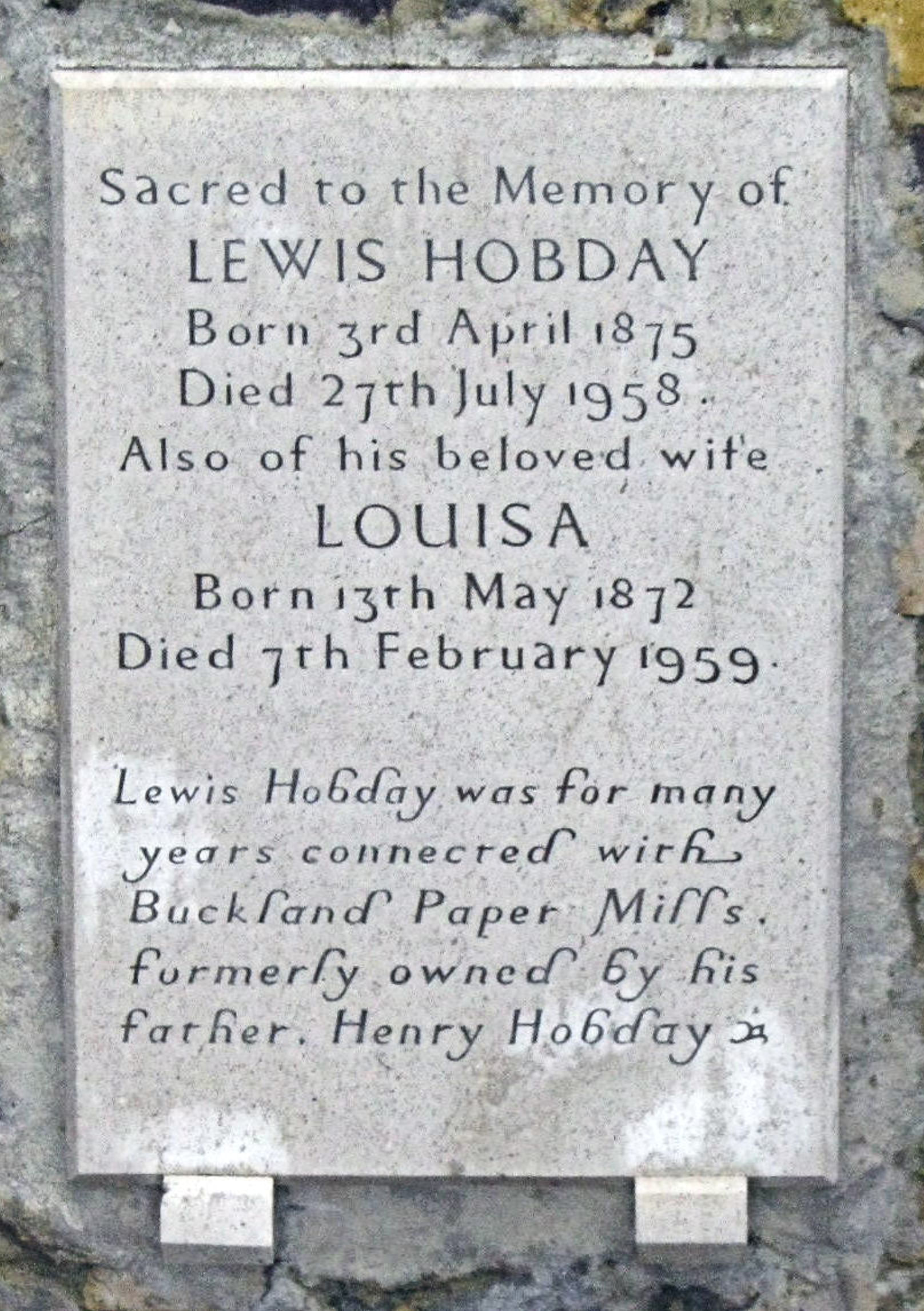
A few years after the completion of Kearsney Court gardens Edward Barlow became ill, so during the winter of 1911-1912 he and his wife went to the Mediterranean. Unfortunately, Barlow’s health did not improve. Returning to his beloved Kearsney Court, he died on Sunday evening 12 June 1912. Before Barlow became ill, besides running two mills in Dover and actively involved in the business of Wiggins Teape, he supported both local and county cricket teams and the work of the local Ambulance brigade. Barlow was a Magistrate of the Cinque Ports and as a keen yachtsman, the Vice-Commodore of the Royal Cinque Ports Yacht Club. On the day of his funeral, all the flags on the principal public buildings in Dover were flown at half-mast and the service, which was packed, took place at SS Peter & Paul Church, River, where he was also buried.

On the death of Edward Barlow, Kearsney Court was put on the market. The house was described as being approached by a long drive with three lodges and contained 15 bedrooms, four of which were fitted with baths. It had two staircases, a fine lounge hall, four reception rooms, billiard room, loggia, conservatory, a complete set of offices plus water and gas were laid on. The gardens were described as being terraced and included a croquet lawn and two tennis lawns, large ornamental lake, with streams, cascades and pergola bridges, orchard and grassland all set in about 22acres.

Kearsney Court - Sale Brochure 1912 - Harding Family

Kearsney Court – Sale Brochure 1912 – Harding Family

The property been put on the market by Keith Barlow (1885-1930) through Worsfold and Hayward of 3 Market Square, Dover. The solicitors were Stilwell and Harby. Mrs Alice Mary Barlow remained at Kearsney Court until the property was sold and then moved to Denton Court. Eventually, she moved to 15 Victoria Park where she died on 2 March 1930 and was buried next to her husband in SS Peter & Paul Churchyard, River. Their son Keith, on the death of his father, became the Chairman of Wiggins Teape’s operations in Dover and also a Director of the parent company. In 1925 he was appointed Chairman of the Wiggins Teape group of companies.

In 1914, two years after the death of Edward Barlow, Kearsney Court had still not been sold, so the asking price was drastically reduced. Eventually, in 1915, Mrs E Johnson bought the property for £9,000 and following the end of World War I (1914-1918) she made the property over to her husband, William Johnson. It was on the market once again in 1925. The main attributes given were central heating, electric lights and main drainage, while the asking price had fallen to £3,500!

Kearsney Court lounge when a nursing Home c1930s. Harding Family

Kearsney Court lounge when a nursing Home c1930s. Harding Family

Nonetheless, it was not until circa 1930 the property was eventually sold to Messrs A and H Stocker. They owned two private mental institutions in London and Kearsney Court became a hospital for wealthy alcoholics with Dr Frank Raymond King in charge. Following the outbreak of World War II (1939-1945) the mansion was requisitioned by the War Department and afterwards put on the market through Flashman’s of Dover.

Courtney Dale Ltd, a development company, was interested in buying the mansion, with part of the formal gardens but not all of the land offered as part of the sale. At the time, there was talk of Kearsney Court becoming a temporary school while Castlemount school, in central Dover, was being repaired but this came to naught. Therefore, Courtney Dale’s offer was accepted and they bought the mansion, the upper part of the formal gardens, the driveway and  part of the woodland to the west. The mansion they converted into seven maisonettes and the gardens were refurbished. Courtney Dale hoped to sell the woodland but it was in a neglected state and no one was interested. The remaining land, including the lower part of the derelict Mawson formal gardens stayed on Flashman’s books, unsold.

Hilton Ernest Russell Dover Mayor between November 1928 and November 1930

Hilton Ernest Russell Dover Mayor between November 1928 and November 1930

Back in 1904 Hilton Ernest Russell opened a nursery in the village of River and showing an interest in local politics in November 1920 was elected to Dover Corporation. In 1928 he was elected Mayor and again the following year and his incumbency, which lasted from November 1928 to November 1930, was marked by several memorable events. In January 1929 he was in attendance at the council organised eighth annual dinner of Dover’s Klassical Konfraternity of Kongenial Konfrerers. This was a club for locals over the age of eighty years, of which there were 83 members in attendance and a further 800 who could not make the celebration. They received vouchers, which they could exchange for goods. In April, like all of Dover’s mayors since the end of World War I, excepting during World War II (1939-1945), he presided over the annual Zeebrugge celebration.

On 26 June 1929, Mayor Russell welcomed the Prince of Wales (1894-1972), later King Edward VIII (1936), when he arrived at Dover Priory Station. The Prince, along with Mayor Russell and an entourage went to the Dover College playing field at Farthingloe, passing streets lined with local folk waving flags and cheering. At Farthingloe, the Prince inspected the 1st Battalion of the Seaforth Islanders, stationed at the Castle. Afterwards, they all went to the Citadel barracks, on Western Heights to watch the Seaforth Highlanders Games.

Sir William Hillary Lifeboat built 1930 and brought to Dover to deal with aircraft casualties in the Channel.

Sir William Hillary Lifeboat built 1930 and brought to Dover to deal with aircraft casualties in the Channel.

A month later, on 26 July 1929, to mark the 20th anniversary of Louis Blériot’s historic flight across the Channel on 25 July 1909, Mayor Russell welcomed the great aviator at Swingate Aerodrome. The party then went to Northfall Meadow to see the Blériot memorial commemorating the occasion that was paid for by Duckhams Oil. Alexander Duckham (1877-1945) was in attendance. Almost a year later on 10 July 1930, Prince Edward was again welcomed by Mayor Russell and this time it was the Prince who arrived by plane at Swingate. The Prince had come to the town to officially launch the Dover lifeboat, Sir William Hillary. At the time, she was the fastest motor vessel in the world and had been bought to deal with the increasing number of aeroplanes crashing into the Channel.

Alderman Hilton Russell was coming to the end of his tenure as Dover’s Mayor when one of the worst air crashes to that date occurred. This was on 5 October, during a storm over Beauvais in France, when the R 101 airship crashed. The airship had left Cardington, Bedfordshire on an experimental flight to India when she hit a hillside and exploded. Only six of the fifty-four passengers and crew survived. Amongst the dead was the British Secretary of State for Air (1929-1930), Christopher Thomson, 1st Baron Thomson (1875-1930) and the Director of Civil Aviation, Air Vice Marshall Sir Sefton Brancker (1877-1930).

R101 disaster Beauvais, France 5 October 1930 . Postcard Eveline Larder Collection

R101 disaster Beauvais, France 5 October 1930 . Postcard Eveline Larder Collection

The bodies of the victims were brought back to England in the Royal Navy Ships Tribune and Tempest by way of Boulogne and Dover. On arrival at Admiralty Pier, there was a Guard of Honour with Mayor Russell in attendance before they were taken by train to London. With the consent of relatives, the bodies were buried in one grave at Cardington though memorial services were held elsewhere, including Dover. The Inquiry was conducted by John Allsebrook Simon, 1st Viscount Simon (1873-1954) with the resulting abandonment of all airship construction in Britain.

Finally, in the hours before he ceased to be Mayor, Russell made the national press on his own behalf! It was November and one of the final points of discussion by the council was the opening of local cinemas on Sundays. The council had previously agreed that cinemas should close on the Sabbath but this had caused a public outcry so when the subject was debated for the second time in the Connaught Hall of Town Hall, now the Maison Dieu, it was packed. The debate was both stormy and passionate with much heckling against both sides of the argument. When it came to the vote, Mayor Russell was obliged to leave the Chamber so that if the result was hung he would not be influenced when he placed his casting vote. It was hung – 11 councillors for and 11 councillors against. The next decision was who would tell the Mayor to return to the Chamber to make the casting vote.

Former Dover Town Hall where the vote for Sunday opening of cinemas in the town took place. AS 2013

Former Dover Town Hall where the vote for Sunday opening of cinemas in the town took place. AS 2013

In order to ensure that the Mayor was not influenced, the council took the extraordinary decision to send a telegram informing him of the result. This was written, the telegram was sent and everyone waited. Eventually, the telegram boy arrived with the result sealed in the official envelope. Nearly two hours had gone by when the council official knocked on the door of the room in which Mayor Russell had remained. The mayor, with due solemnity, was asked to return to the Chamber! Mayor Russell stood in front of the assembled councillors, council officials, members of the public and of the media both local and by this time, from distant parts. With baited breath they all watched as he carefully opened the telegram envelope. He read the result, pulled himself up to his full height and announced to the ensembled throng that Dover cinemas would open on Sundays!

During the next few years, Alderman Russell was created an Honorary Freeman, and appointed a magistrate. He was also instrumental in the council’s acquisition of Kearsney Abbey following World War II. During the War the Abbey had been commandeered and after, Dover Borough Council (DBC) commissioned town planner, Professor Abercrombie (1879-1957) to draw up plans for war-torn Dover. He suggested that Kearsney Abbey and grounds should become a recreational focal point by creating  ‘a pleasant riverside walk from the Sea Front to Kearsney Abbey.’ DBC dismissed the idea as ridiculous suggesting that the Abbey be demolished and the grounds used for housing but Councillor Russell endorsed Abercrombie’s suggestion and stuck to his guns. In the local elections of 1946, he made this an issue and lost his seat! A few days later the Dover Rural District Council (RDC) elections were held and Cllr. Russell was elected to represent Temple Ewell.

Lack of money and material resources precluded the Kearsney Abbey being used for a housing development so the site was neglected. Although Kearsney Abbey was owned by DBC it was within RDC’s boundaries. When Cllr Russell was appointed to the RDC Pleasure Grounds Committee he put pressure on DBC to restore both the Abbey and the grounds. This DBC refused and instead successfully sort to change their boundaries to bring the Abbey and grounds within their jurisdiction. The full story of what happened next can be read in the Kearsney Abbey story, suffice to say that although Kearsney Abbey was demolished the grounds were saved for public use as Hilton Russell and Professor Abercrombie envisaged.

Russell Gardens the former lily pond at the time of writing the H E Russell garden. Alan Sencicle

Russell Gardens the former lily pond at the time of writing the H E Russell garden. Alan Sencicle

As for the 23-acre Kearsney Court estate, following the conversion of the mansion into seven maisonettes, the development company, Courtney Dale Ltd, put the predominantly neglected woodland that was part of their purchase on the market. The part of the formal gardens that they had not bought remained on sale through Flashman’s of Dover. What happened next is not altogether clear, but it would appear that Cllr Russell, who had been appointed the chairman of the RDC’s Pleasure Grounds Committee, persuaded Courtney Dale to gift the woodland to RDC. At about the same time the company bought the remaining plot that fronted the Alkham Valley Road and included the lower part of the Mawson formal gardens.

Cllr. Russell then set about persuading his colleagues on RDC to buy this plot from Courtney Dale Ltd. They offered £1,500, which was accepted! Once in the hands of RDC, Cllr. Russell, who was a gardener and nurseryman by profession, organised for the lower part of the Mawson formal gardens to be returned to something like their former state. Mrs C G Lines, wife of the Chairman of RDC, officially opened the renovated elongated lake, Pergola Bridges and sidewalks in May 1951. The remaining RDC owned Gardens were, over the next few years, restored when money and materials were available. Councillor Hilton Russell remained on the RDC until his death on 13 January 1959. He was buried near Edward and Alice Mary Barlow in SS Peter & Paul Churchyard, River by which time the Gardens were seen as a jewel in RDC’s and Dover’s crown and were named Russell Gardens after him!

Russell Gardens - Bill Norton Arbour, Victim of the Herald Disaster. Alan Sencicle

Russell Gardens – Bill Norton Arbour, Victim of the Herald Disaster. Alan Sencicle

In 1974, the newly created Dover District Council (DDC) inherited Russell Gardens. Shortly after, they bought Bushy Ruff house plus 26 acres including the lake for about £90,000. Although various development enterprises were considered for both sites these came to nothing. In the end, DDC accepted local opinion and Russell Gardens remained and Bushy Ruff Lake was opened to the public as an extension of them. The Gardens, these days, are Listed along with three of the buildings and still include tennis courts; pleasant walkways, the lake and the romantic bridges. A recent addition is a Men of Trees, Kent Branch, arbour in memory of Bill Norton, (1919-1987) who died in the Herald of Free Enterprise disaster

Water abstraction during the late 1980s and early 1990s took its toll on the Dour tributary and a minor earthquake, that cracked the bottom of the elongated lake, followed this. As DDC are not averse to giving planning permission to projects harmful to Listed buildings and development proposals to Areas of Outstanding Natural Beauty, Russell Gardens came under threat. Developers passed their covetous eyes over the Gardens but regardless of the problems, Russell Gardens remained popular. This DDC acknowledged saying that ‘Russell Gardens are a tourism asset due to the high volumes of visitor numbers, particularly in summer months.’

The Pergola Bridge with the elongated lake crafted out of the River Dour by Thomas Mawson. Alan Sencicle

The elongated lake created out of a stream of the River Dour and entering the garden from under the Pergola bridge. Alan Sencicle

DDC made an application to the Heritage Lottery Fund’s ‘Parks for People’ programme for £3.3million to finance proposals to be carried out in both Kearsney Abbey and Russell Gardens. Regarding Russell Gardens, it is planned  they will be restored, as far as possible, back to Thomas Mawson’s original plan. At the same time, recognising that Russell Gardens are a public park while Kearsney Court is in private ownership. Restoration will include removing overgrown shrubs to restore the visual connection between house and gardens, repairing paths and architectural features, improving entrances and planting, reinstating the summerhouse with public toilets, and creating historically sensitive play areas. It is hoped that the gardens will subsequently be maintained by a staff of three.

Russell Gardens story was Published in the Dover Mercury 10 December 2009

For further information on the proposals for Russell Gardens:

http://wwwkearsneyparks.co.uk 

Posted in Barlow Edward - Kearsney Court and Russell Gardens, Kearsney Court and Russell Gardens, Kearsney Court and Russell Gardens, Open Spaces, People, Russell Hilton - Kearsney Court and Russell Gardens, Tourism | Comments Off on Kearsney Court and Russell Gardens