Packet Service II – Joseph Churchward and the Violet

Once the leader of Dover, died in London on 2 January 1900 at the ripe old age of 81.

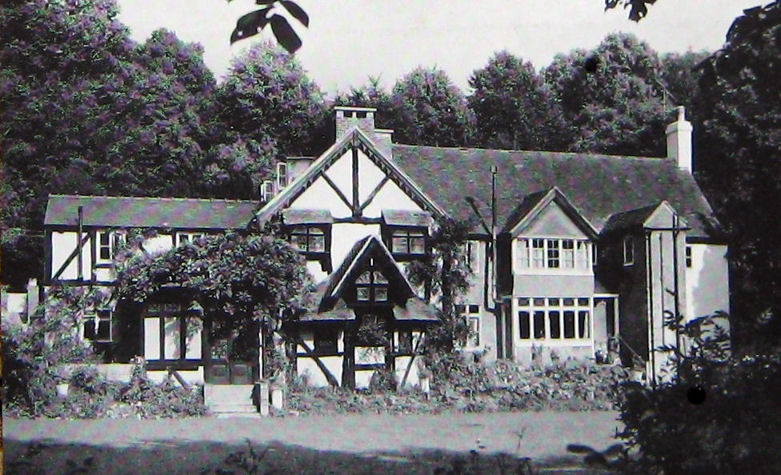
Kearsney Manor c1970s the country home of Joseph Churcheward in the years before he died.

Kearsney Manor c1970s, the country home of Joseph Churchward in the years before he died.

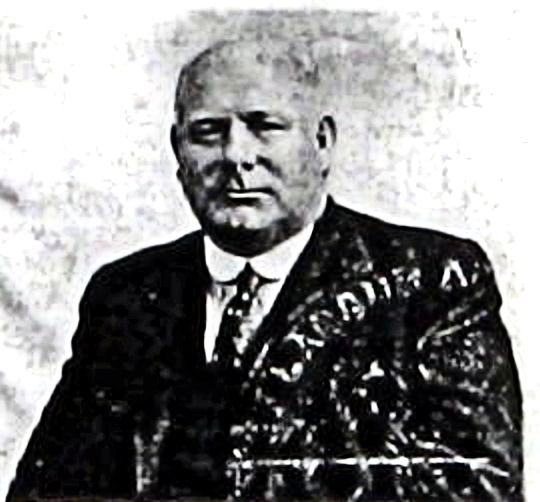
We regret to record the death of Mr Joseph Churchward which occurred at his residence, Gilstone Road, Kensington, on Tuesday evening at the age of 81. Mr Churchward more than a year ago finally retired from public life giving up his office as Chairman of Dover Rural District Council, and a few weeks ago he left his residence at Kearsney and moved to Gilston Road where he died.’ So began Joseph Churchward’s obituary in the Dover Express. Churchward was a newspaperman with Machiavellian principles who came to Dover to run the newly privatised packet service in 1854.

Joseph George Churchward was born in Devonport on 22 December 1818, and used his knowledge of the nautical aspects of his native town when he moved, as a youth, to London. There he trained as a journalist and quickly rose to become the naval editor of the United Service Gazette and the Nautical Standard. About 1842, Churchward joined the staff of the politically Conservative, London Morning Herald, as the naval editor. At the time, the newspaper’s editor was Dr Stanley Lees Giffard (1788-1858), the father of Harding Gifford, 1st Earl of Halsbury (1823-1921), later Lord Chancellor. An ardent Conservative, Churchward took on the role as agent for Charles John Mare in the General Election of July 1852.

Mare was an engineer and shipbuilder who owned and ran the large Orchard Yard at Blackwall on the Thames. Those were the days before the introduction of the ballot box and on a show of hands Mare was returned as one of the two representatives for Plymouth. The other MP was Liberal lawyer Robert Collier, 1st Baron Monkswell (1817-1886). However, before the celebrations were over, the losing candidates launched a petition stating that some voters for Mare had been bribed with promises of government employment or situations. Churchward was named as the culprit when 29 of those who had voted for Mare were subsequently given government posts! Mare was unseated and the succeeding election was won by Conservative lawyer Sir Roundell Palmer (1812-1895), later the first Lord Selborne.

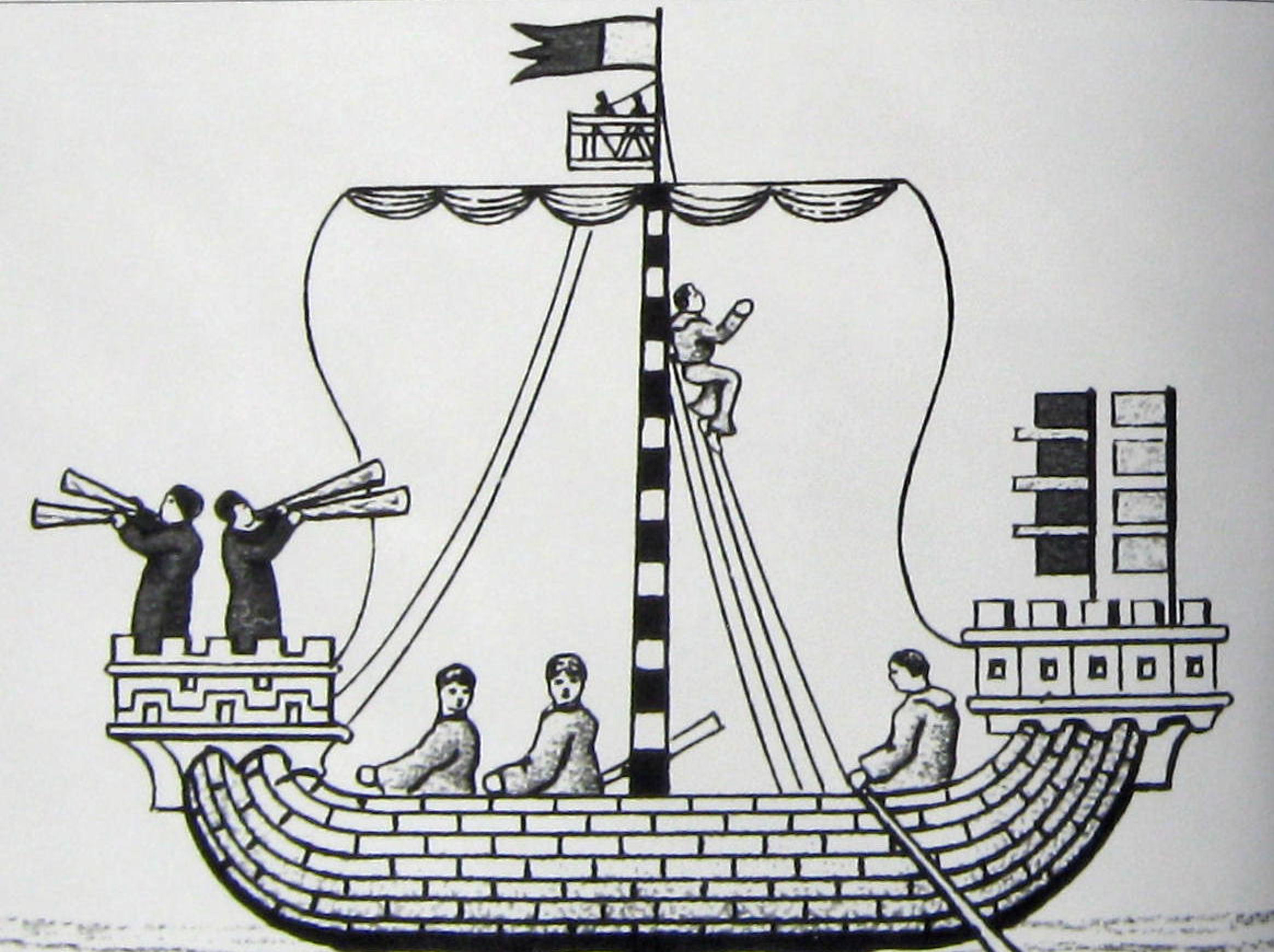
Cinque Port ship- c13th when Dover had the monopoly of the Channel passage

Cinque Port ship- c13th when Dover had the monopoly of the Channel passage

During his career as a naval journalist, Churchward had created a network of close contacts in the Admiralty and he was well versed with the details of the Dover Packet Service. The story, Packet Service I to 1854, gives the details of its inception and notes that due to the proximity of Dover to the Continental mainland the port was a favourite Passage crossing of the Channel from the earliest times. Following the invasion of England by William I (1066-1087) in 1066, the Domesday Book of 1086 recorded that Kings messengers, riding on horseback, paid 2pence in summer and 3pence in winter, for their passage across the Channel to Wissant, in the northern France. In 1227, Henry III (1216-1272) conferred on Dover the monopoly of the cross-Channel traffic to Wissant but from 1381, by Royal proclamation, the passage was changed from Wissant to the newly formed port of Calais. By the early seventeenth century Dover still retained the major crossing between England and France and the passage ships that specialised in taking pacquettes, that is Royal messages etc., became known as Packet ships. Built in Dover, these ships were renowned for being efficient and fast.

The 1657 Postage of England, Scotland and Ireland Settling Act, enacted the position of Postmaster General. Following the Restoration in 1660, the Post Office packet service was farmed by wealthy individuals and Dover’s first post office was established in 1673 in the Customs House on Customs House Pier. Four years later it had been moved to Strond Street and remained in the Pier District until 1893 when it was moved into purpose built premises on King Street. In the 18th century the farming of mail was replaced by individual contracts under license by the Post Office By the time of the French Revolution in 1789, there were five Post Office packet licences for Dover ships with thirty such vessels sailing between Dover and the Continent.

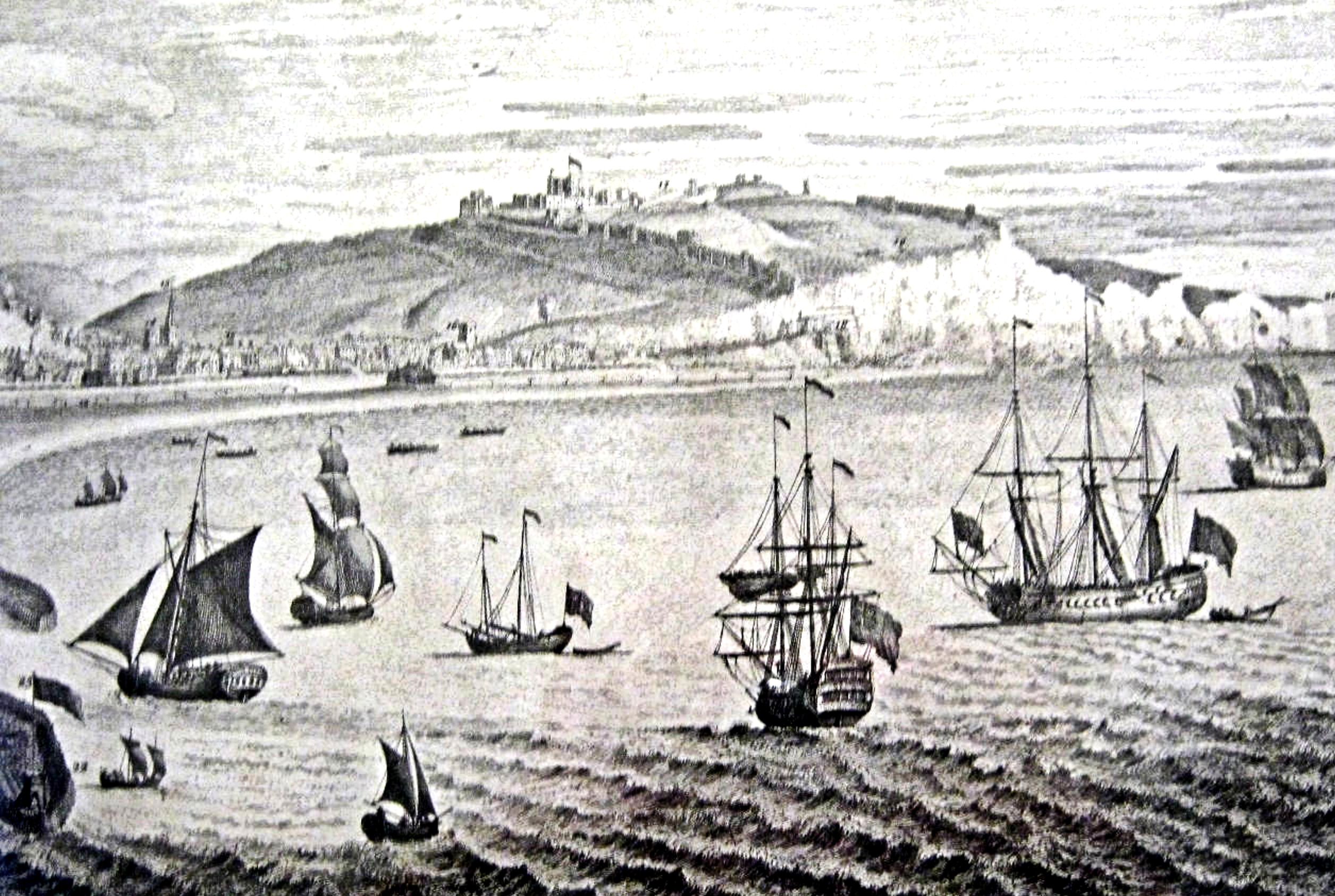
outh Prospect of Dover c 1739 showing a variety of ships in the Bay with the Castle beyond. Dover Harbour Board

South Prospect of Dover c 1739 showing a variety of ships in the Bay with the Castle beyond. Dover Harbour Board

Following the start of the Napoleonic Wars (1793-1815), the base for the Channel packets moved to Harwich but within ten years, a packet service was operating out of Dover and administered by the Admiralty. On 10 October 1815, the packet service was officially resumed with ships going to Calais and Ostend and in 1821, the service was taken over by the Post Office. This was the age of steam ships but they were proving costly to run such that by 1836, the Post Office was making, on average, a loss of £38,739 a year. A number of private concerns made offers to take over the service but instead, in December 1836, the national packet service was transferred to the Admiralty with the Post Office regulating the times of departure.

On Tuesday 6 February 1844, the South Eastern Railway Company (SER) opened their railway line to Dover but two years before, Joseph Baxendale (1785-1872), the Chairman of SER, had purchased the silted up Folkestone Harbour and after undertaking vast and expensive improvement, made Folkestone SER’s crossing port to the Continent.

From that time, SER had regularly applied to the Admiralty for the Channel mail packet contract but had been consistently refused and therefore turned their attention to petitioning Parliament on the subject. In 1850, the Railway Company submitted an offer to carry the mails across the Channel for £9,825 and a parliamentary committee was set up to investigate. They looked into the possibility of putting the Dover and Calais packet service out to tender but were informed that, after allowing for the receipts from passengers, the carriage of the mails between the two ports cost £6,244 per annum. As this was significantly lower than the sum SER had offered the Committee reported that putting the service to tender would involve increased expenditure, so no action was then taken.

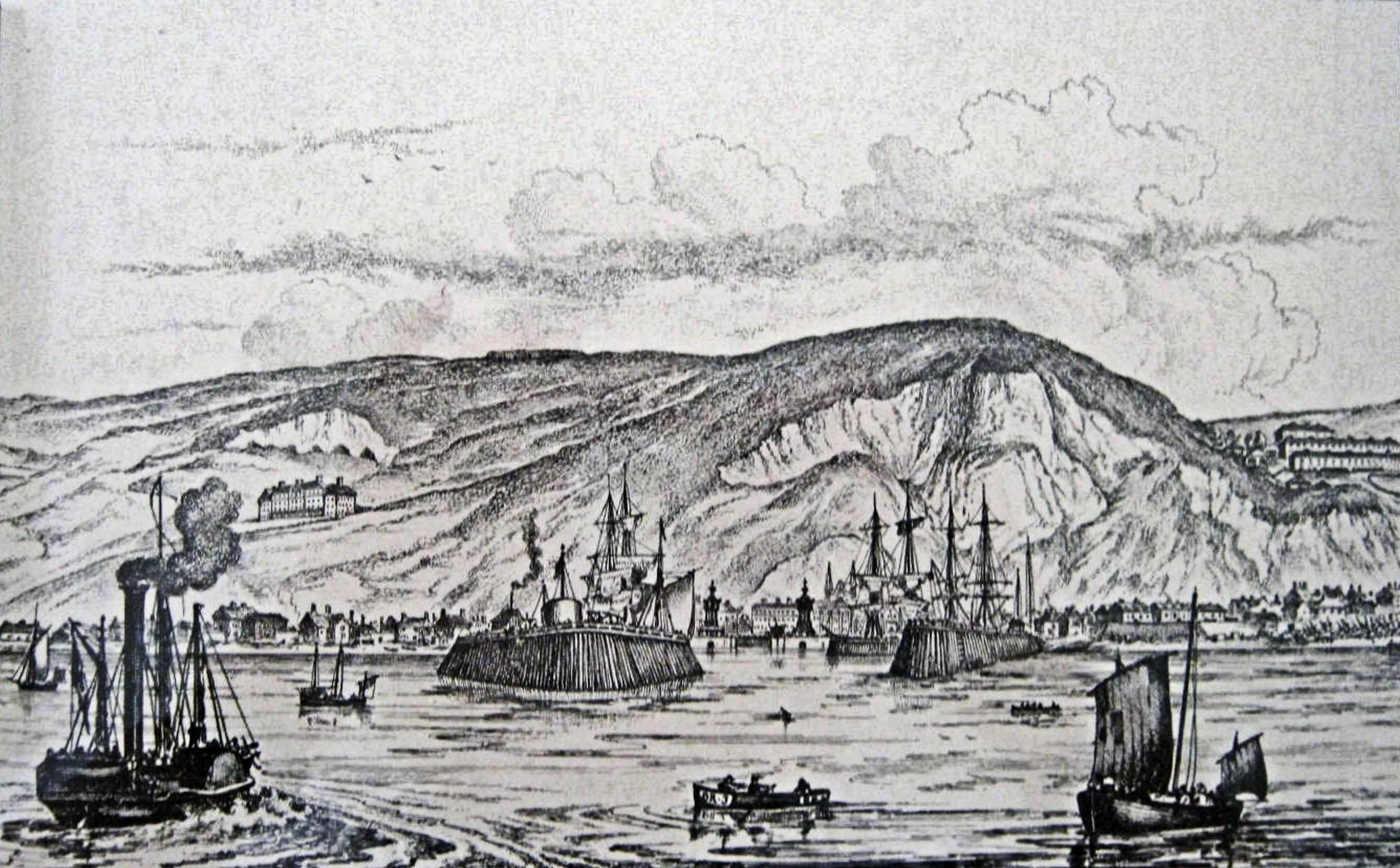
Dover Harbour Entrance - by William Heath published 1836 by Rigden. Dover Harbour Board

Dover Harbour Entrance – by William Heath published 1836 by Rigden. Dover Harbour Board

Nonetheless, SER did not give up and instead used the Great Exhibition, held in London in 1851, to illustrate the efficiency of their service. Both the SER and the Admiralty, made substantial profits from the carriage of passengers during the time of the Exhibition. At that time, the Admiralty packet ships out of Dover were the Dover, Garland, Onyx, Princess Alice, Violet, Vivid, and the Widgeon. However, in 1852, the Violet had to be taken to the naval dockyard at Woolwich, on the Thames, following damage to her bowsprit and bow. Following repairs, Captain Baldock, the inspector of the Dover Mail Packets, checked her out and she returned to Dover. Nonetheless, SER with the help of national newspapers journalists including Churchward, used the incident to put pressure on parliamentary representatives for the service to be put out to tender. SER suggested that such contracts would give an annual saving to the government of £10,000 and in September 1852 Churchward made a tentative proposal to run such a service himself.

Following the General Election of 1852, a parliamentary coalition was formed between the Whigs (later Liberals) and the Conservatives. The Chancellor of the Exchequer (1852-1855) was the Whig William Ewart Gladstone (1809-1898). War had broken out in the Crimea and it looked as if Britain would become involved – and was from March 1854 to 1856. Cash strapped, the government set up a parliamentary committee in 1853, to look again at the proposition of putting the mail contract out to tender. That summer they published their report in which it was concluded, ‘the service between Dover, Calais and Ostend appears to have been satisfactorily performed as regards both mails and passengers, but as a line on which there is so great a passenger traffic may be expected to be self-supporting. As the receipts from passengers, fares and freight parcels do not cover the cost and expenses of the packets, we recommend that tenders be publicly invited. In order to ascertain whether a contract may not be formed by which the service may be done with greater economy, and under stipulations that would prevent any diminution of punctuality and efficiency.’

The  Comptroller of Victualling and Transport Services, T Grant, prepared a draft of conditions of tenders for both the mail services between Dover and Calais and Dover and Ostend and this was approved in December 1853. With the closing date of 26 January 1854, advertisements were placed in the newspapers and tenders invited. By that time, three companies had submitted offers, SER for £16,520 annually to serve Calais only but with eight ships. The second, North of Europe Steam Navigation Company with a tender for £19,750 annually to run six ships to both French and Belgium ports and the third was a Henry Jenkins & Co to serve both routes for £15,500 annually with only one ship but stated that there were five more on order.

Henry Jenkins & Co was in fact a syndicate headed by Messrs Jenkin and Churchward. Although a formal agreement had not been drawn up, there were four members – Joseph George Churchward, Captain Henry Jenkins, Edward Baldwin and Timothy Harrington. Henry Jenkins was the Captain of the Morning Herald‘s despatch boat Ondine (II) and although Jenkins name was the syndicates title, he was very much a junior partner to Churchward.

The original Ondine was an iron paddle steamer built in 1845 for Dover ship owners, Messrs Bushell and worked the Dover-Boulogne passage with the licence to carry the Indian mail. When that packet service ceased from Dover the Ondine was sold to Edward Baldwin the proprietor of the London Morning Herald. He subsequently sold her to the Admiralty who renamed her Undine, occasionally coming to Dover on a temporary basis. She was replaced in Baldwins fleet by Ondine II and made regular Channel crossings.

– Edward Baldwin acquired the ownership of the Morning Herald in 1843 and offered to supply the capital to finance the undertaking if Churchward’s bid was successful.

– Timothy Harrington was the Ondine (II)‘s engineer and so had the technological knowledge that would be needed.

All were unqualified to run a high pressured, high prestige packet service across one of the most hazardous stretches of water in the World. Further, they were woefully under financed and resourced with only the Ondine (II), yet, as a syndicate, they had deliberately put in the low and unrealistic tender that had been accepted. Possibly, for this reason, Baldwin dropped out of the syndicate but he did agree to sell Churchward the Ondine (II) if they were successful. Churchward’s old friend Charles Mare took Baldwin’s place, as a silent partner, within the syndicate.

The Ondine (I) / Undine -- arriving at Dover harbour. Dover Museum

The Ondine (I) / Undine – arriving at Dover harbour. Dover Museum

On 4 February 1854, Ralph Bernal Osborne (1808-1882), Liberal MP for Middlesex and Secretary to the Admiralty 1853–1858, wrote to Henry Jenkins & Co, accepting their tender of £15,500. The contract required ‘the carrying mails at not less than 13-knots an hour and by no less than six steam vessels, each of at least 100 tons’ register and manned by competent officers. A ship was to leave from Dover to Calais and another from Calais to Dover every weekday and for Ostend a ship had to leave Dover alternate weekdays and another to leave from Ostend to Dover every alternate weekday.’ The contract was to continue until 1 October 1858 but the syndicate still only had one ship and she was just 100-tons!

Churchward suggested to the Admiralty that as they were no longer running the Dover packet service he would relieve them of the ships! The Admiralty were not taken in but did agree to sell three of their former packet ships, the Onyx, Undine and Violet for £13,000, payable by quarterly instalments. It was also agreed that Churchward would lease two more ships for a couple of weeks, the Vivid and Princess Alice. The contract was underwritten and signed on 2 April 1854 by Mare who also agreed to supply two more ships.

Thus, at the time Churchward took over the Dover packet service his syndicate owned:

Ondine (II) Iron Paddle Steamer built and engined by Miller, Ravenhill & Co. in 1847 for Edward Baldwin and was 101.1 -tons

Onyx an iron paddle steamer built by Ditchburn and Mare, Blackwall and engined by Messrs Penn & Son, Greenwich. Her tonnage was 294 gross and bought by Churchward as part of the Mare underwritten deal. Having new boilers fitted she did not come into service until May 1854.

Undine an iron paddle steamer built and engined in 1845 by Miller, Ravenhill & Co of Blackwall, and 86 burthen. Registered as Ondine when Edward Baldwin owned her and although small, had proved to be fast. It was for this reason that the Admiralty had bought her in February 1847 and allowed her to be used on the packet service. Churchward renamed her the Dover (II).

Violet an iron paddle steamer built by Ditchburn and Mare, Blackwall, engined by Messrs Penn & Son, Greenwich and tonnage 295 gross. This ship was used, in 1852, by SER and Churchward to show that the Admiralty wasted money.

The two ships on a lease were the Vivid, a wooden paddle steamer of 352 ¾ burthen and the Princess Alice, an iron paddle steamer 110.1 burthen.

For premises, the Dover Harbour Commissioners offered the lease of a 300-foot frontage of the Wellington Dock but Churchward could not afford the amount asked. With considerable audacity, Churchward turned to the Admiralty and again reminded them that they were no longer running the packets service and offered, as a caretaker, to look after their packet yard and offices between what would become Granville Dock and Snargate Street. Much to Churchward’s delight, the Admiralty agreed but as he had to admit that he would be using the premises they came to an arrangement he could afford. 

Although Churchward had written a great deal about the Packet industry, he was still a novice as to how the transportation of mails worked. He quickly learnt that the ship’s captain would assign one of his officers to prepare the stowage plans of the expected mails. The officer would ensure that the consignments were kept dry, were equally spread throughout the ship and could be quickly unloaded when the ship arrived at the designated port. The packages were in bags and were stowed at approximately thirteen bags to the ton in a space of 40-cubic feet. Government confidential mail was stored in the ships safe along with ‘bullion‘ packages from private firms and individuals. Bullion packages contained gold, silver or/and coins and were sealed and weighed in boxes by the sender before being transported to the railway station. A ‘waybill’ gave the weight of the sealed box but not the contents where it came from and the destination. The weight of the box was checked against the waybill at the railway receiving station before signing acceptance. The box was again weighed and checked against the waybill, before being carried on board the packet ship and again after unloading at the destination port prior to being transported to its final destination where the exercise was repeated. (See the Great Bullion Robbery story part I).

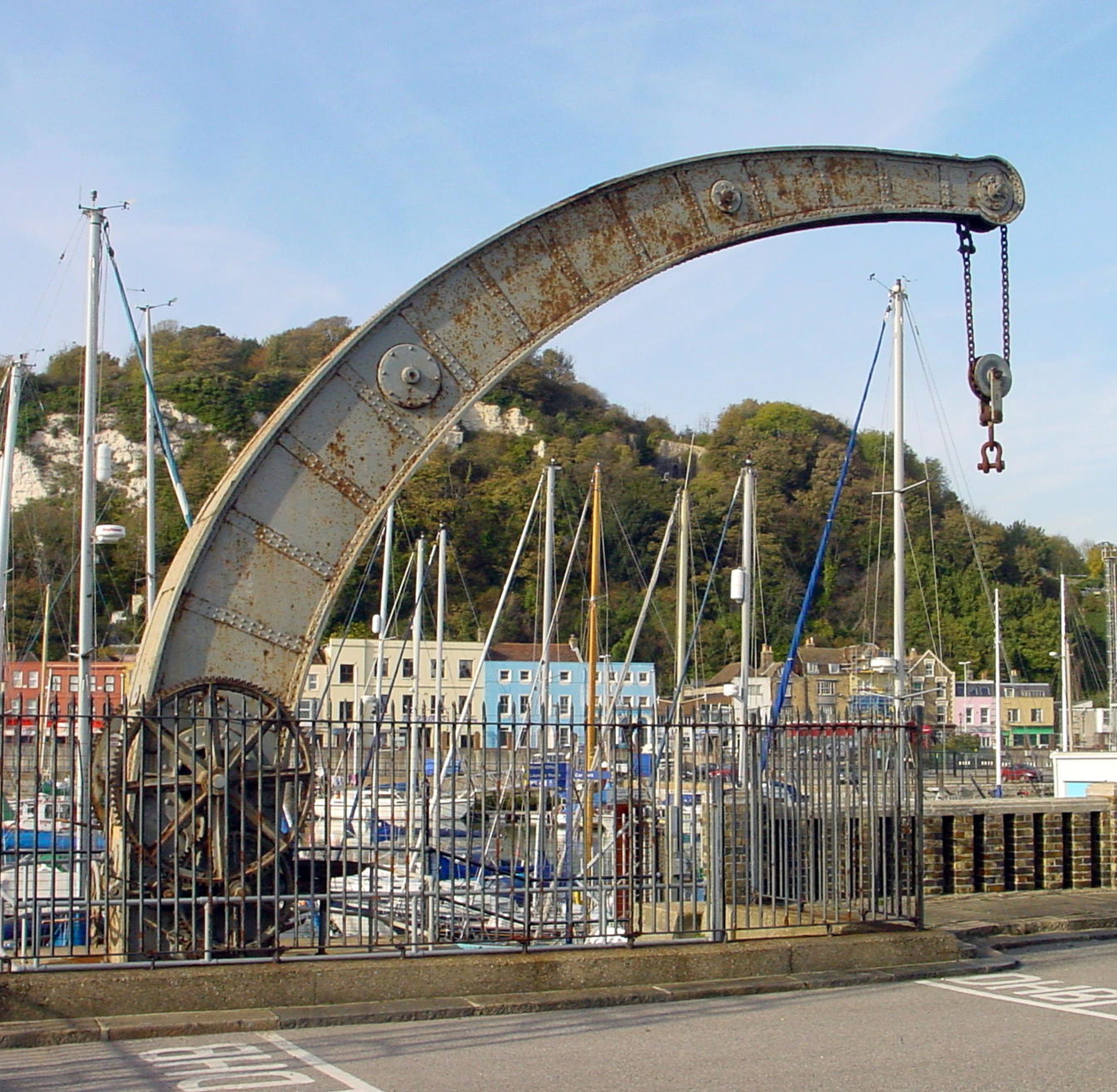
Fairbairn hand crank crane 1868 Wellington Dock similar to one mounted on Admiralty Pier used for loading mail on and off packet ships. Alan Sencicle 2009

Fairbairn hand crank crane 1868 Wellington Dock similar to one mounted on Admiralty Pier used for loading mail on and off packet ships. Alan Sencicle 2009

The bags of ordinary mail, on arrival in Dover, were examined by post office officials and numbered. Again the waybill system was used showing where the bag came from and it’s destination. The number of packages the bag contained and the overall weight of the bag were all noted on the waybill. The loading of the mail always took time and took precedence over passengers. If the mail train was late or there was a particularly large consignment of mail, then the ship would leave late and on some occasions passengers’ baggage had to travel on a separate ship to make room for the mail. The mailbags, in those days were hoisted onto and off the ship by crane, similar to the Fairbairn hand crank crane that can be seen at the south side of the Wellington Dock, the crane being mounted on Admiralty Pier. Throughout the operation, a cross-check was maintained to ensure that all the mail on the waybill were loaded onto the ship. Once the ship was loaded, an officer from the ship along with the guard of the train checked the train to ensure that no item had been left behind. Once the mail was stowed and the ship had sailed, those involved in the loading of the mail returned to normal duties. On arrival at the port of destination, following unloading, each bag was checked against the waybill. Once those on shore were happy that the packages and the waybill correlated, the loading of the ship with mail going in the opposite direction began. On reaching Dover, the waybills were recorded and filed.

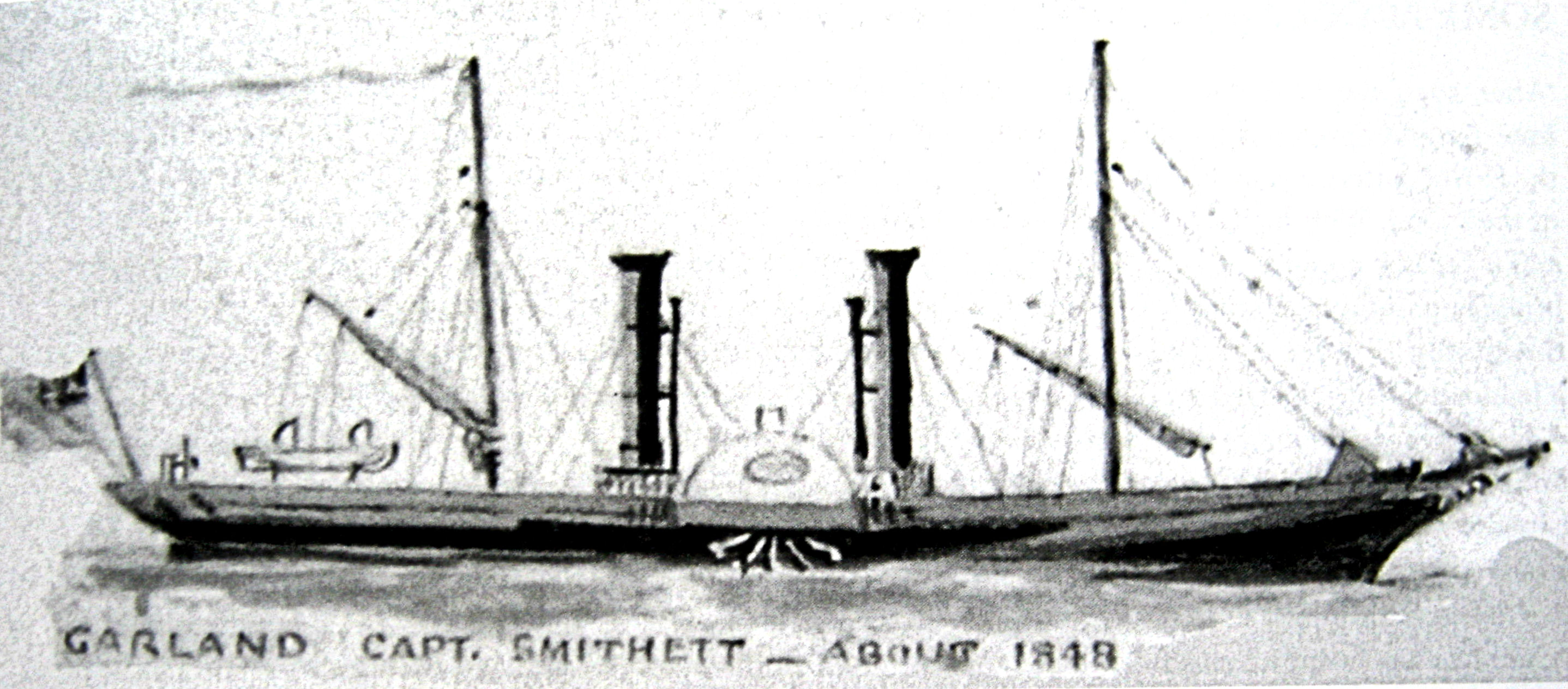
Garland circa 1848 when Captain Luke Smithett was the Master. Jim Henderson

Garland circa 1848 when Captain Luke Smithett was the Master. Jim Henderson

On 15 April, after 40 years service and as Commodore of the Admiralty Fleet from 1837, Luke Smithett (1800-1871) retired. On that day, after conveying the Prince George, Duke of Cambridge (1859-1904) and General Lord Raglan (1788-1855) to Calais, he took the Vivid to Woolwich. There she was refitted for general duties in the Royal Navy and in her stead the Garland was offered to Churchward. The Garland was a wooden paddle steamer built by Fletcher & Fearnall, London, engined by Messrs Penn & Son, Greenwich and tonnage of 295 gross. She had previously worked the Dover packet service and Churchward had little alternative but to buy her outright costing him £4,800, which he could ill afford.

The Princess Alice returned to the Admiralty and for the first summer of his operations Churchward was a ship short but luckily, Harrington had ensured that none of the fleet had to be taken out of service. At the Admiralty packet yard Harrington, when Churchward had the money, started to build up stores and a crew of specialists to ensure that as much maintenance of the ships as possible could take place there.

However, on the 23 August Churchward rented the Princess Alice for a couple of weeks, while he leased the Dover, Onyx and Violet, under the command of Luke Smithett, to the French Government to take French troops to the Crimean War. The amount he earned from the deal helped Churchward’s severely limited finances and it was hoped that at least one of the two ships being built by Mare would come on station before the year was out. However, the Crimean War meant that there was a shortage of labour and scarcity of materials and in consequence the ships did not arrive. Thus, the Princess Alice remained in Dover until 14 February 1855 at considerable cost to Churchward.

Pilot boat going to a vessel in heavy weather. Illustrated London News October 1857. Dover Library

Pilot boat going to a vessel in heavy weather. Illustrated London News October 1857. Dover Library

The three ships he loaned to the French actually returned by the weekend of Saturday 18 November 1854, but heavy weather meant that the mail packet did not leave Calais until 08.00hrs. Subsequently the mail was late in arriving in London and this was given national news coverage by those who felt that the contract should have been given to SER. Over that weekend the weather, particularly on the Continent side of the Channel, deteriorated such that on the Sunday the packet ships did not leave either Calais or Ostend. On the Monday morning the national papers were particularly nasty thus the  Onyx was about to leave Dover in the most atrocious weather. There were 70 passengers on board, when the heavy swell snapped her hawsers and drove the ship so hard against the Admiralty Pier that her paddle box spring beam was damaged. The mail and passengers were transferred to another packet ship that managed to make the crossing. As Harrington did not have the parts, equipment or expertise the Onyx was towed to Mare’s shipyard. There she was rebuilt and renamed Vivid II before returning to Dover.

In order to make the business profitable it was imperative for Churchward to win the Belgium contract for carrying mails from Ostend to Dover and ideally to give him the monopoly he needed to win the French contract. In order to win the Belgium contract, on 30 November 1854, Churchward set up the Dover Royal Mail Packet Company to run the Dover packet service in line with the Admiralty contract. The syndicate ceased to exist. Instead, Churchward became the General Manager in charge locally and Mare the Managing Director of the company as a whole. Jenkins and Harrington became highly paid senior employees, with Jenkins as Captain of the Ondine – with which he was happy – and Harrington the superintendent of the marine engineering department at the former Admiralty Packet Yard. Harrington’s salary was £450 per year plus 10% of profits made. Luke Smithett was appointed Commodore of the Dover Royal Mail Packet Company fleet. Shortly after, Churchward won the Belgium contract which was particularly lucrative as he did not require any more ships, once the new ones arrived.

However, towards the end of 1854 the great sluices at Calais harbour collapsed making it impossible for Churchward’s packets to use the harbour. Smithett handled to public relations, apologising for the delays in the service and ensuring that a packet ship would run both ways everyday. In the meantime the Calais harbour authorities were constantly pressured by Churchward and made the necessary repairs. Much to the annoyance of the Calais officials, the French authorities were impressed with Churchward’s persistence and in January 1855, he secured the French contract as the sole carrier for inward-bound Calais-Dover mails.

The contract was for fifteen years but there were stipulations, for instance, ships carrying the day mails from Calais had to run under the French flag and be French manned and owned. To meet this criterion Churchward employed both French and British crews, so when the English officials came aboard, he would say that his crew were predominantly English and when in France, he would say that his crew was predominantly French! Again the French authorities were impressed, this time with the pretence and paid Churchward an extra £7,000! However, the caveat was that only Churchward’s new ships were to be used for the French contract and that the older ships were to be used for the Belgium mails. To get round the latter stipulation, Churchward renamed the Garland, L’Alliance placed her under the French flag, gave her a predominant French crew and put her on the mid-day run to Calais and back.

Churchward Advert centring on his two new ships Express and Queen. 1855

Churchward Advert centring on his two new ships Express and Queen. 1855

With the long-term contract from the French, before the month was out, Churchward wrote to the Admiralty suggesting that they extend his contract to 10 years! He justified the extension by saying that as his existing fleet were aged and were costing a great deal in upkeep but were not worth replacing unless his contract was extended. The Admiralty declined noting that the two promised ships at the time of the original contract, were about to be launched. They were the Empress and the Queen, and following trials on the Thames, arrived in Dover in February 1855 within a fortnight of each other. They were built and paid for by Mare and were 123.5 burthan with 2 x 50 horsepower engines made by Ravenhill, Salk & Co. Due to Churchward’s necessity to retain the façade demanded by both the British and French terms of contracts, the Queen was sometimes referred to as the La Reine. From the moment they arrived in Dover, both ships were hailed for having ‘splendid lines’ and the internal passenger furnishings were luxurious.

Luke Smithett captained the Empress and the Queen was under the superintendence of Captain Moore. One of the ships left Dover for Calais every day at 14.00hrs or on the arrival of the 11.30hrs train from London if it was delayed. The ship returned at 22.00hrs from Calais, on arrival of the train from Paris. The first class fare was 9-shillings and second-class 7-shillings. The address given for Dover Royal Mail Packet Company was 56 Lombard Street, London.

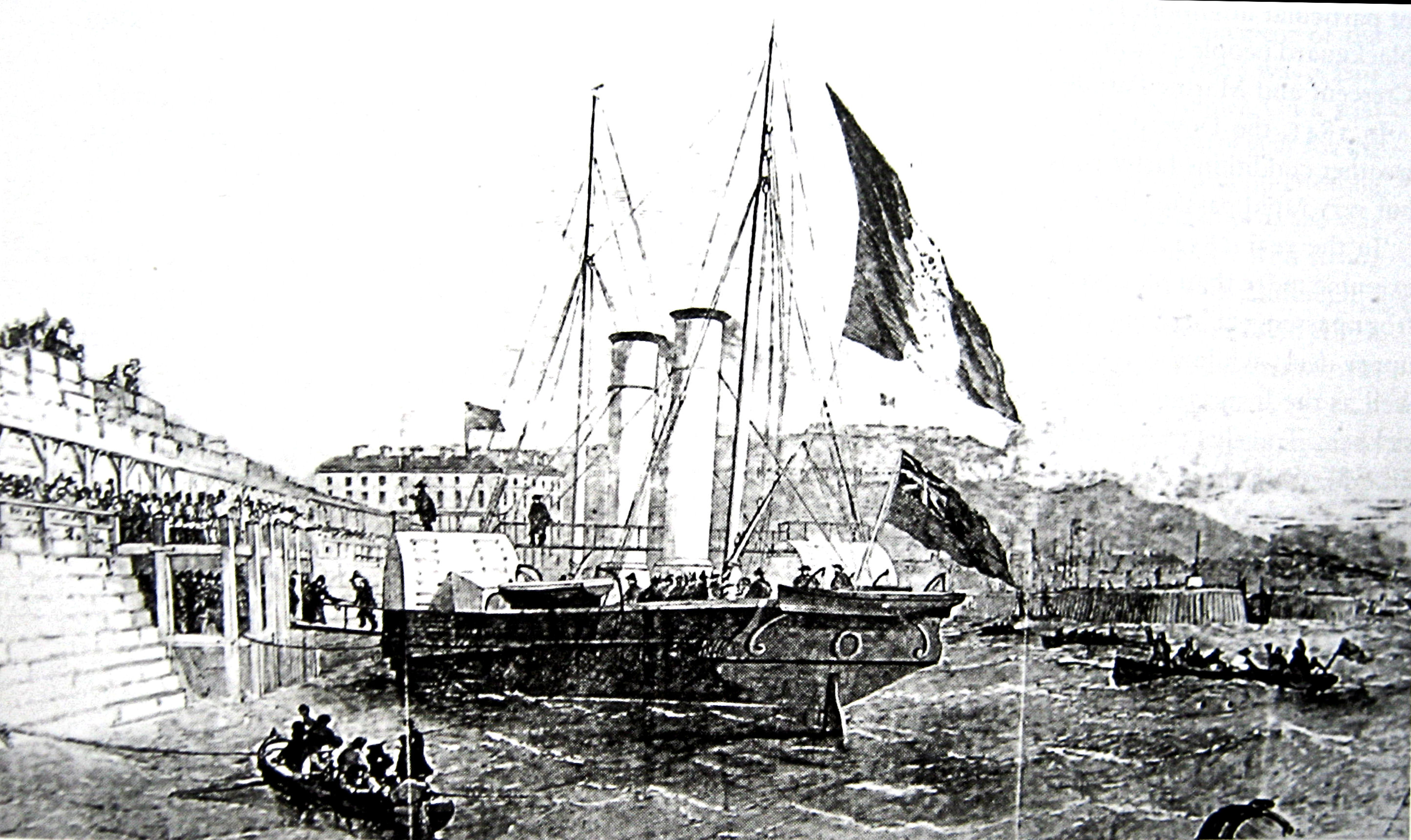
Vivid and the landing of King Victor Emmanuel of Sardinia on 30 November 1855. Illustrated London News

Vivid and the landing of King Victor Emmanuel of Sardinia on 30 November 1855. Illustrated London News

In April 1855 Emperor Napoleon III (1852–70) and Empress Eugénie returned to France after a state visit to Britain. They travelled on the new packet Empress, but the crossing was somewhat rough and as Calais harbour was still proving to be a problem the ship berthed in Boulogne having taken 2½hours. During the crossing, the Emperor conferred upon Smithett the Legion of Honour and the media coverage was considerable and favourable to Churchward’s packet service. In March 1855 the alliance between Sardinia and England was ratified and on 30 November King Victor Emmanuel of Sardinia (1849-1861) arrived in Dover on the Vivid. He and his retinue stayed the night in the Cambridge apartments at the Ship Hotel on Custom House Quay where John Birmingham was the mine host.

By May 1855, the Calais harbour problems had been dealt with and Churchward was advertising the packet service to France.  However, on 4 May 1855 the Dover hit the west pier head at Ostend during heavy weather. The passengers, mail and crew were rescued but for Churchward it was financial blow as the Dover was under-insured. Churchward wrote to the Admiralty asking for an increase in the annual contract payment and an extension of the contract but received short shift. He again wrote and persistence paid off, for on 5 July the newly appointed permanent secretary, barrister and Liberal Thomas Phinn (1814-1866), agreed to extend Churchward’s contract until 20 June 1863. He also allowed Churchward to use the former Admiralty packet premises rent-free but the annual Admiralty packet contract payment was reduced to £13,500.

Much to Churchward’s shock Mare was declared bankrupt in October 1855. His unsecured debts were given as £160,000 and total liabilities £40,000. The bankruptcy court heard that Mare’s shipyard order books were full and that 20 Government iron mortar vessels of 100 tons and worth £2,200 each were under construction of which 6 were ready for delivery. Six gunboats had recently been launched while others were still under construction along with despatch boats. Besides government orders, the shipyard were building a number of other ships for private concerns but due to the Crimean War there was a shortage of materials and men, albeit Mare’s wage bill came to £3,500 weekly.

With Mare’s bankruptcy, Churchward could not afford to replace his entire fleet with new ships and so repairing the existing fleet was given priority. Harrington and his men were undertaking the day-to-day maintenance and repairs but major repairs had been undertaken by Mare’s shipyard at a reduced cost as Churchward could not afford competitive rates for such repairs. Harrington had nagged to upgrade and extend the facilities and expertise at the Admiralty packet yard, as this had become the cheapest option. Churchward agreed.

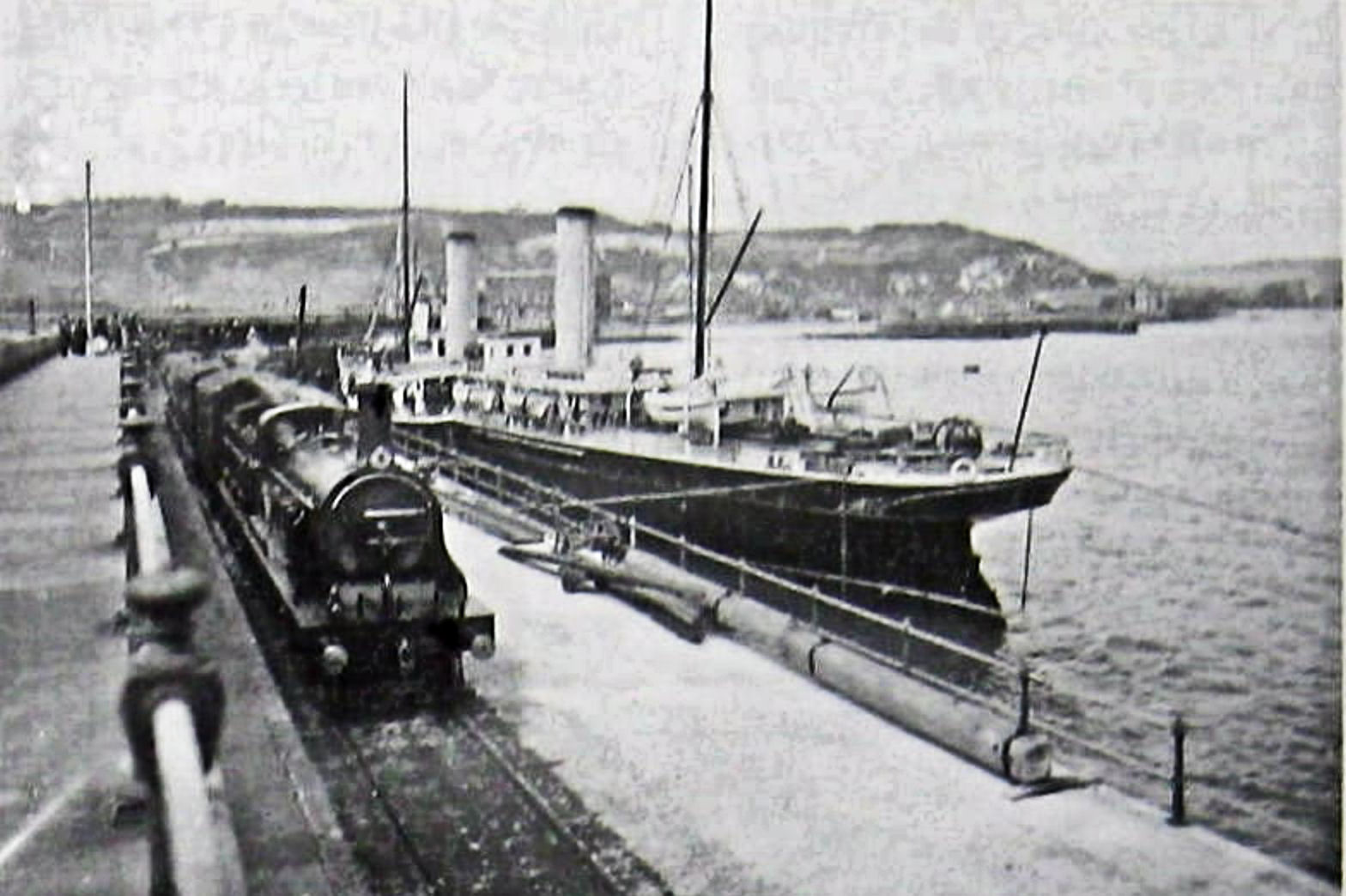
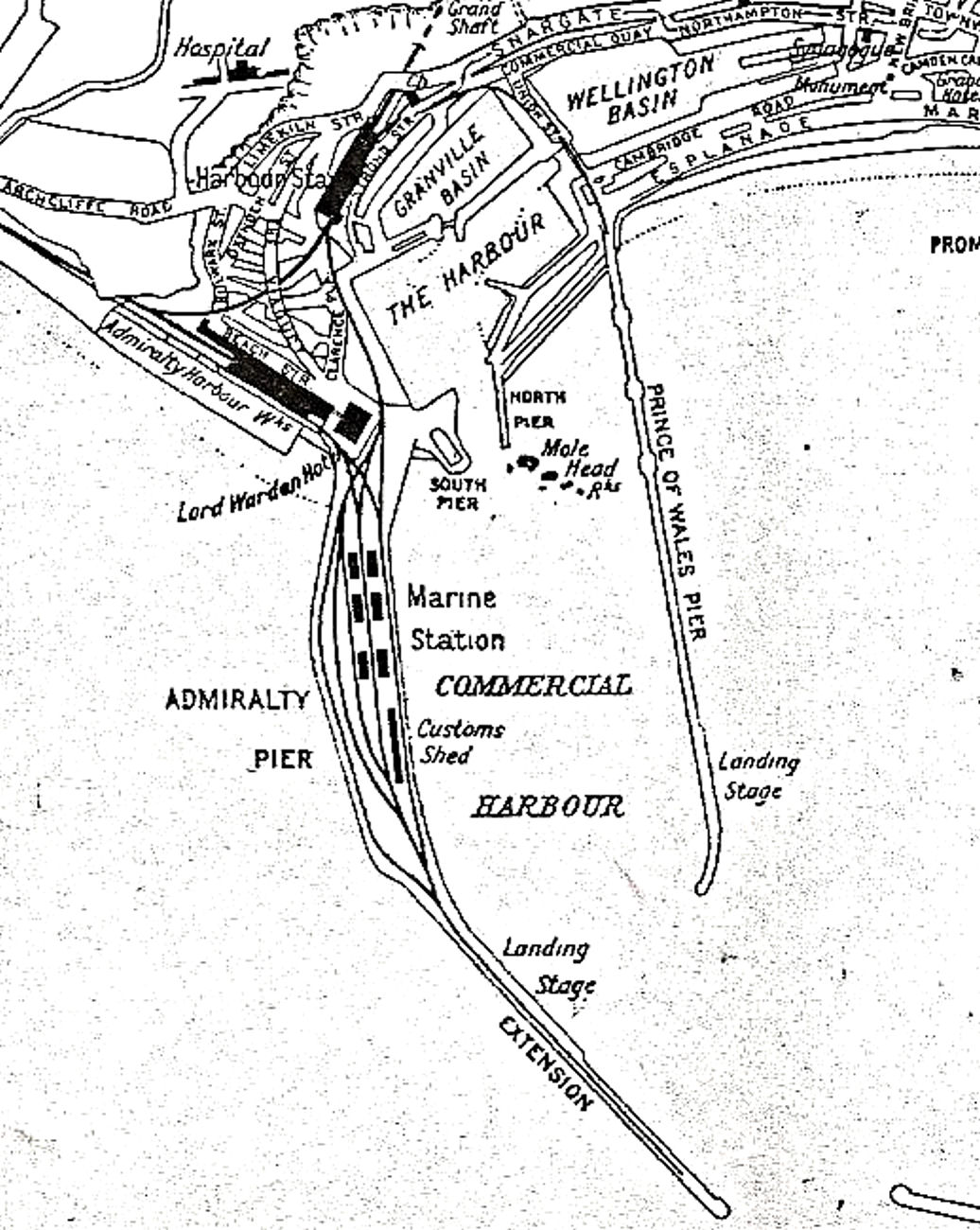
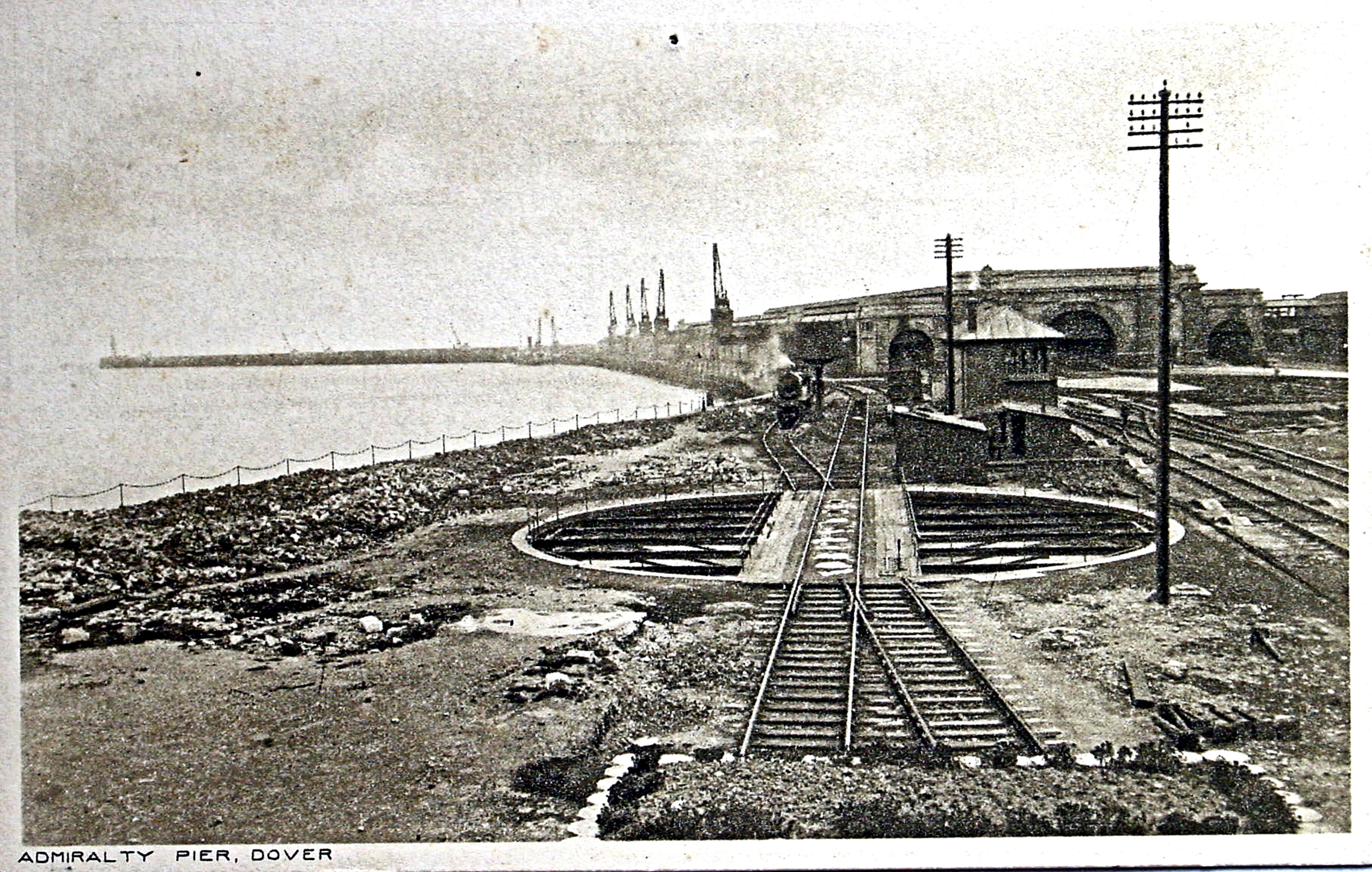
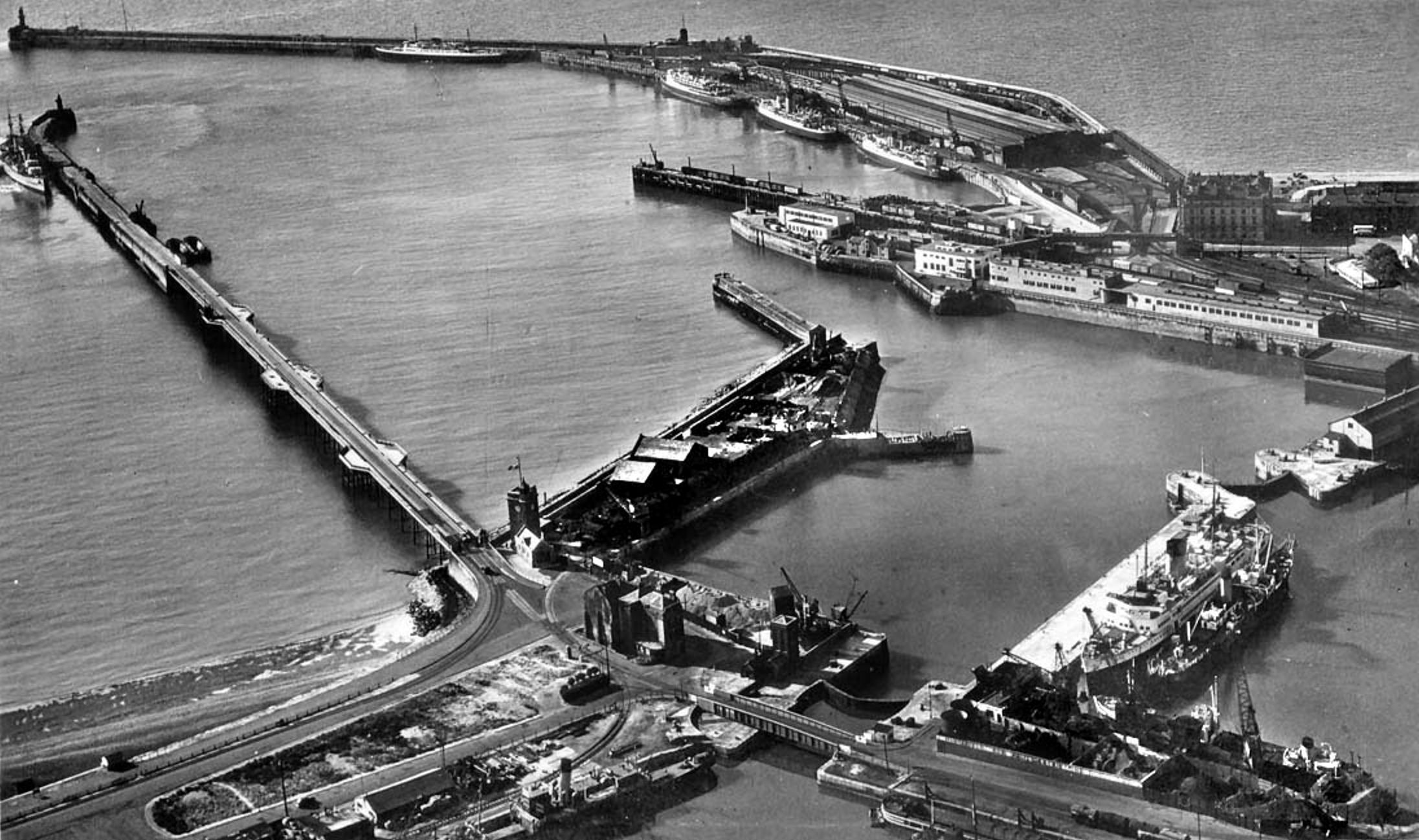
Admiralty Pier with a steamer approaching c1870

Admiralty Pier with a steamer approaching c1870

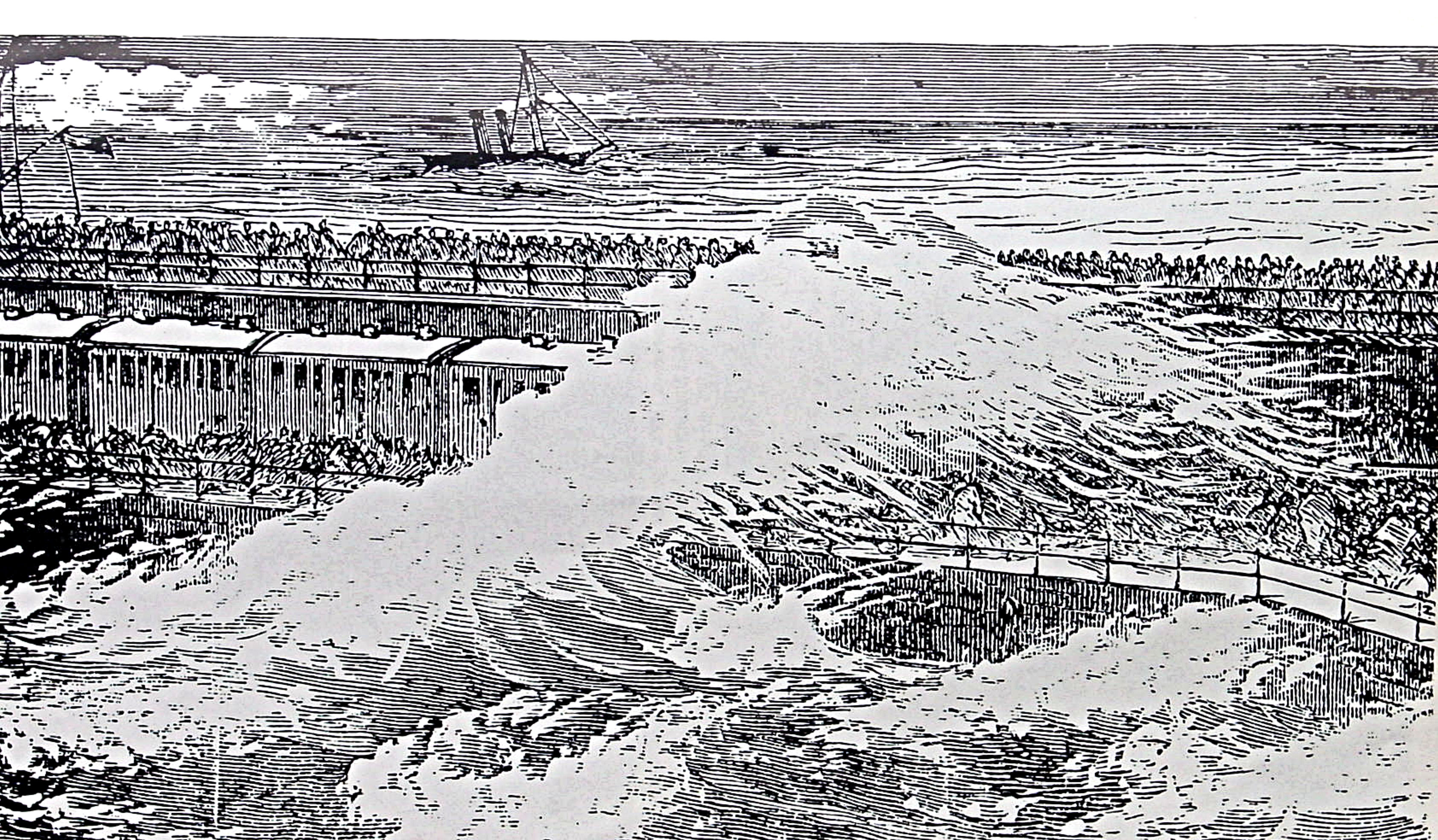
The captains of his fleet were also doing their best to provide a successful service. Typically, an equinox gale on 28 September 1856 made it difficult for the packets to get alongside Admiralty Pier and by that evening, the weather was so bad that it was not expected that any of the packet ships would return to Dover. However, at about 22.00hrs the Ondine from Calais, with Royal and Imperial mails and 50 passengers on board, with her canvas set, came into Dover Bay at a tremendous rate. At that time, steamship engines were unreliable and sails were carried for use in such weather. The flag was up to show that it was safe to enter the harbour and hundreds of people came to Admiralty Pier to watch. The little ship made it to the harbour entrance but the entrance was blocked with debris from the Admiralty Pier works damaged by the gale. The Ondine bore away, ‘in a most stately fashion,’ and eventually moored in Ramsgate where the mail and passengers were disembarked.

Technological innovations had given rise to the birth of the modern communication industry and on Wednesday 28 August 1850, an experimental channel submarine telegraph cable was laid between Dover and France. The following year, on 24 September 1851, the first permanent cable was laid and Churchward was quick to recognise the importance of the telegraph especially if crossings were delayed due to adverse weather conditions. However, submarine telegraph cables were vulnerable and on the night of Monday 5 January 1857 during a storm force 10, a 700-ton heavily laden ship lost her anchor in the Downs. Driven by wind and tide she was in danger of colliding with the schooner Spirit of the Age, whose crew let the anchor play out releasing 40-fathoms of chain. Then the ship suddenly came to a halt. 

In Ostend that night, Captain Edward Lyne was in charge of the 300-ton Channel packet, Violet and tried to communicate with Churchward. Lyne, an experienced captain, wanted to delay the crossing due to ‘a storm of wind from the north-east and snow making visibility poor,’ and wrote the message down for the telegrapher. The telegrapher tried to send it but the line was dead and so the Captain asked the clerk to amend the message to say that the Violet would make the crossing but was likely to be delayed. This the telegrapher wrote down and said that he would send it as soon as possible.

The Violet cast off at 20.30hours with a crew of 17, a mail guard and one passenger – other passengers, who were due to travel that night changed their minds. Meanwhile, the Spirit of the Age, as quickly as she had come to a halt suddenly swung round and was careering forward at great speed when, for the second time, she came to an abrupt halt. She eventually broke away and came to grief on the Goodwins, by which time her crew had taken to the lifeboats.

The Violet had come into service at Dover in February 1846 and it was a minor accident in 1852, that was used by SER and Churchward to put pressure on Parliamentary representatives for the Packet contract to be put out to tender. On New Year’s Eve 1852/3, Joseph Wright, a stoker, had an argument with another seaman, Richard Sharpe, on the Violet while she was in Ostend harbour. This led to a struggle and although no witnesses actually saw any blows being struck, Wright did end up on the floor and immediately complained that the back of his head hurt. Sharpe apologised and the two men shook hands and had a cup of coffee. Then Wright was sick and went to lie down and three hours later, he was talking incoherently. On examination by a doctor he was admitted into Ostend hospital where he died that night.

An inquest was held at the Shakespeare pub, Hawksbury Street in Dover’s Pier District, and by a unanimous decision the foreman of the jury, William Hopley, announced a verdict of ‘homicide’ by Richard Sharpe. This took the Coroner, George Thompson, by surprise and when he interviewed the jury, he found that they were unclear as to what homicide meant. Eventually, the verdict was revised to manslaughter and Sharpe was sent for trial at Maidstone. On 7 March 1853 in front of Sir Edward Hall Alderson, the hon. Sir John Taylor Coleridge, and Francis Colville Hyde – the Sheriff of Kent, Richard Sharpe was acquitted.

The Violet was due into Dover by 22.00hrs on 5 January 1857, and the mail train was held for her arrival. By midnight she still had not arrived and the gale was given as the reason for the delay. Churchward tried several times to contact Ostend by telegraph but the line was dead. By 04.00hrs, concern was being felt and the mail train was allowed to leave. By 07.00hrs, when the Violet had still not arrived concern gave way to agitation and folk were coming to the harbour to hear of news. Churchward and Smithett tried to keep the assembled crowd calm by saying that Captain Lyne was an experienced mariner and had decided to stay in Ostend on account of the weather but due to the telegraph still being out of order, there was no way of checking.

Both Churchward and Smithett knew that Lyne would have left Ostend as soon as possible and so telegraphed harbours on the Kent coast for news. On the Tuesday afternoon, word reached them that three bodies had been seen off Ramsgate and fears of a tragedy rippled throughout the town. By Wednesday morning the harbour was crowded with folk waiting for news when the news came that the Violet  had left Ostend on the Monday evening. Then Churchward received a telegraph saying that portions of cabin doors, the chain box and other articles had been found on the on the outer edge of the southern spit of the treacherous Goodwin Sands. Captain Smithett immediately left Dover on the Empress for Ramsgate and the Goodwins.

Mapp of the Downes December 1736 by Charles Labelye. Violet was wrecked on south of the Gull Beacon on the Goodwins 5-6 January 1857

Mapp of the Downes December 1736 by Charles Labelye. Violet was wrecked on south of the Gull Beacon on the Goodwins 5-6 January 1857

On arrival at Ramsgate, Smithett was told that the three bodies had been picked up and brought ashore. They had been found lashed to a life buoy not far from a wreck, believed to be the Violet, which lay on the sand southward of the beacon. Smithett went out to see it and wrote in his report that, ‘From the position of the vessel’s head, I am of the opinion that, having as they thought, run their distance, and catching sight of the Gull Light through the terrific snowstorm, the two lights were mistaken for the South Foreland. I find this mistake is frequently occurring. The vessel sits upright on the sand, funnel gone; decks, bulkhead, cabin doors &c to be seen floating away. Some luggers, either from this place or Deal, were seen out near her at low water.’

The bodies were identified by William Kay, second mate of the Empress.  The men were stokers Nathaniel Harmer, William Patrick and Samuel Sharp. The inquest was held in Ramsgate where it was presumed that their deaths resulted from cold, and not from drowning – a supposition that was supported by the appearance of the corpses, according to Smithett, as they looked more like living than dead men. The jury returned a verdict of ‘Found drowned.’

That afternoon Smithett brought the three stokers from the Violet back to Dover and having recovered the mail that the Violet had been carrying, arranged for it to be landed at Folkestone. Eighteen officers and crew were lost, they were: Captain Edmund Lyne; Chief Officer James Paul, Second Officer Henry Pullman, Engineer George Dilks, Mail Officer Mortleman, Carpenter Alexander Smart, Boatswain George Freeman, Leading Stoker Nathaniel Harmer, Stoker William Patrick, Stoker Samuel Sharp, Steward Stephen Penny, Cabin Boy Penny, Ship’s Boy William Crofts, Seamen Henry Fox, James Harber, Samuel Laslett, John Shillatoe and James White.

In Dover, concern and sympathy turned to the bereaved, as it was certain that the 16 widows and 42 children would all be plunged into destitution. A subscription was hastily organised and a gentleman walked into Churchward’s office leaving a £5 note with the message, ‘as a contribution from an intended passenger on the Violet.‘ By that time the Mayor, James Worsfold, a retired naval officer, had organised an official fund raising with Luke Smithett as one of the Trustees.

Francis Cockburn and the Violet disaster letter to Captain Smithett published in all the national and many international newspapers. Times 14 January 1857

Francis Cockburn and the Violet disaster letter to Captain Smithett published in all the national and many international newspapers. Times 14 January 1857

Lieutenant General Francis Cockburn (1780-1867) of East Cliff wrote to Smithett suggesting that a letter to the national newspapers would be appropriate in raising money for the poor widows and orphans saying that, ‘these unfortunates, it does appear to me, are fully entitled to public relief as those in the army and navy who are killed in action or died in hospital in the Crimea.’ He went on to say,The wreck of the Violet is quite distinct from the general class of wrecks, inasmuch as it was entirely caused by the zealous and gallant determination to fulfil a public duty, and I do think if so stated in the London papers a large subscription would be made there. It was the desire of duty to fulfil the contract made with the country that led to this sad result.’

Smithett did as was suggested sending a copy of Cockburn’s letter which was published in national and international newspapers. Donations came in from far and wide and included a large contibution from Frederick William IV of Prussia (1840-1861). The fund raising proved so successful that monthly payments were regularly made to eleven of the widows at the Dover Sailors’ Home for many years after as well as making improvements to the establishment. An inventory of the crew showed that Samuel Sharpe was a relative of Richard Sharpe, who was cleared of causing the death of Joseph Wright on New Years Eve 1852. The reason the telegraph was not working that night was due to the Spirit of the Age anchor fouling both the Ostend and Calais telegraph lines. It took a month to make repairs and cost £1,627.

Part III of the Packet Service –  Churchward,  the Packet Yard on Snargate Street follows.

  •  Presented: 22 July 2015
Posted in Businesses, Churchward Joseph part I and the Packet Contract, Churchward Joseph part I the Packet Contract, Packet Service II - Joseph Churchward and the Violet, People, Ships, Violet - Joseph Churchward and the Packet Service | Comments Off on Packet Service II – Joseph Churchward and the Violet

Richard Tilden Smith and the Aerial Ropeway

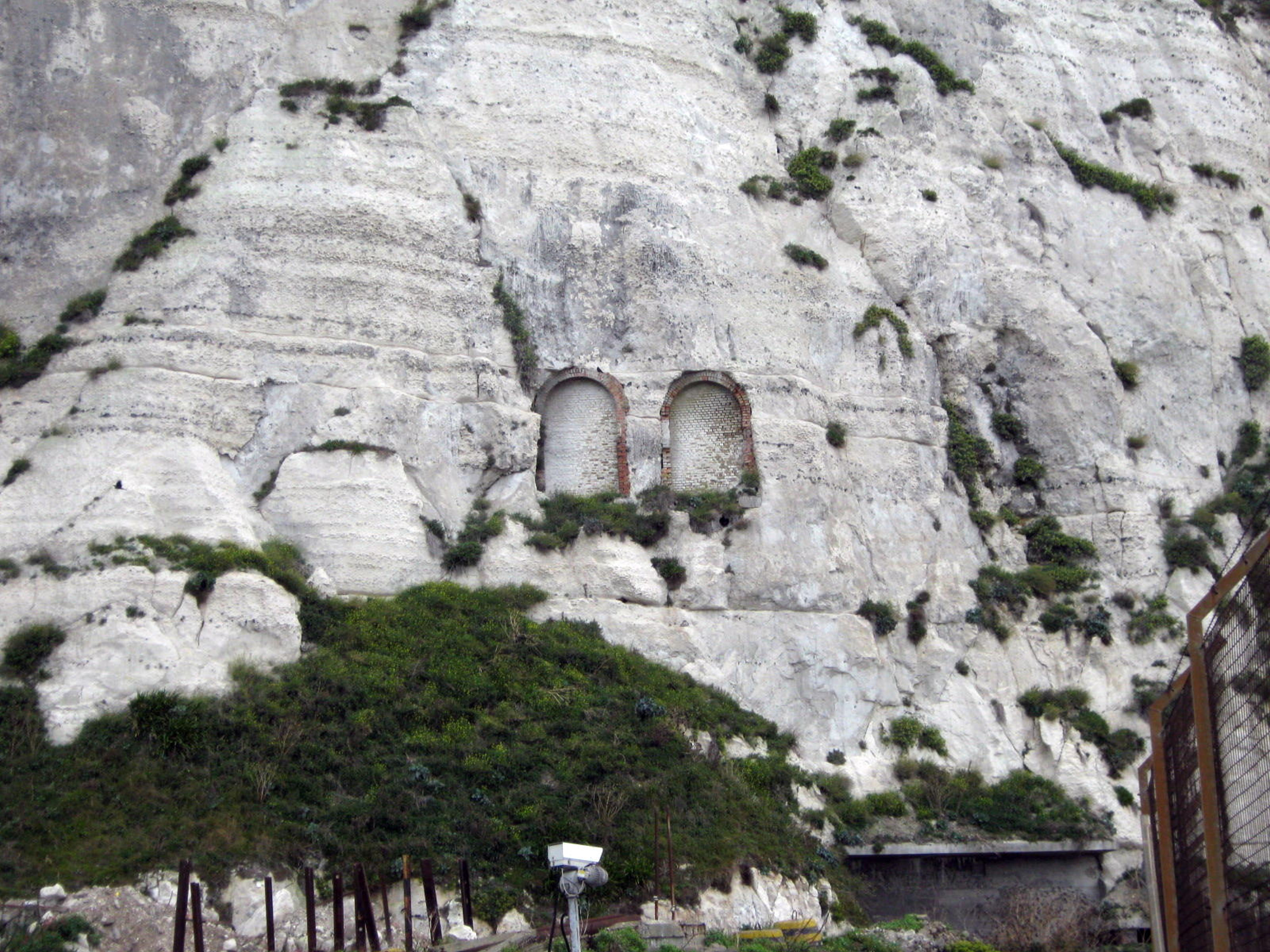
Eastern Docks - Aerial Ropeway tunnels - LS 2010

Eastern Docks – Aerial Ropeway tunnels – LS 2010

At the eastern end of Eastern docks, at the point where the dock road turns seawards, high in the cliffs can be seen two bricked in tunnels. One is the entrance and the other the exit to what were twin tunnels that were part of the unique coal carrying Aerial Ropeway.

The Kent coalfield was discovered at the end of the nineteenth century and in 1896 entrepreneur Arthur Burr formed the Kent Coal Field Syndicate and bought the mineral rights. The first shaft named after Francis Brady – the engineer who first established that the Kent coalfield existed – was at the new Shakespeare Colliery, Dover and work on sinking it started that year. Even though the Colliery proved unproductive the continual demand for coal encouraged other borings to be undertaken in and around the Dover area and a total of 14 coal seams, stretching from Dover almost to Herne Bay, were eventually found. It had been envisaged to sink 15 mines but in the event only four became commercially viable one of which was near the village of Eythorne, northeast of Dover, and named Tilmanstone colliery.

Dover & Environs 1828 - Eythorne near the location of Tilmanstoen collier is underlined. Dover Library

Dover & Environs 1828 – Eythorne, near the location of Tilmanstone colliery, is underlined. Dover Library

Work began on Tilmanstone colliery in 1906 by Arthur Burr through two of his many companies, Foncage and Sondage syndicates. Beset by bad geology and inadequate capital resources it was not until May 1908 that the first shaft of Tilmanstone colliery had reached 913-feet. At the time, the bricking had only been undertaken to a depth of 631-feet and in consequence the shaft started to collapse. A second shaft was started on 19 November 1907 but again due to the lack of financial resources there were many delays and in 1909 a hoppit (hoist bucket) fell down the shaft. Three sinkers were killed, pump pipes were destroyed causing water to pour in and the shaft was abandoned for nine months. In August 1910, the third shaft was started and sinking was slow until electric pumps were installed in 1912. By December that year all three shafts had reached coal measures and in March 1913, shaft No1 hit the 1,590-feet deep Beresford seam. Commercial operations were started, then a year later on 14 January 1914, the colliery went into receivership. The shareholders replaced Burr and rescued the company, which became the East Kent Colliery Company.

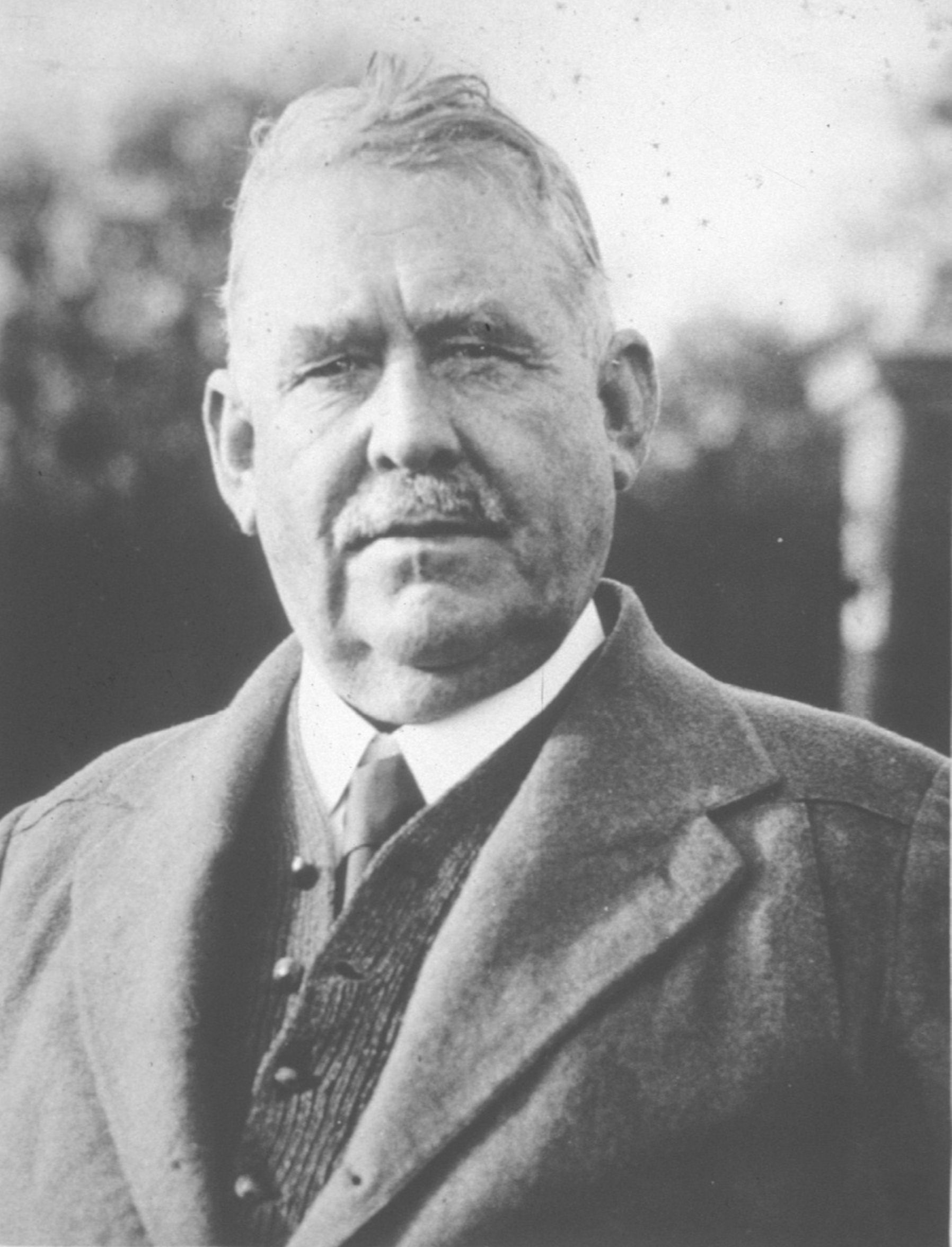
Richard Tilden Smith. Dover Museum

Richard Tilden Smith. Dover Museum

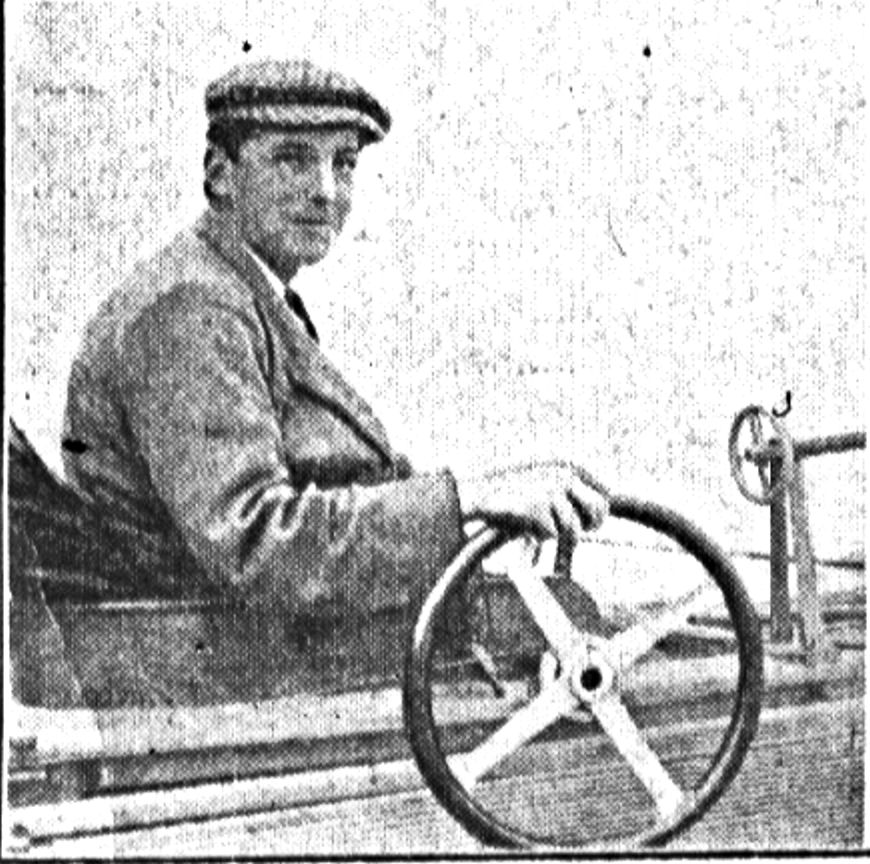
A year later one of the East Kent Colliery Company shareholders, Richard Tilden Smith, made a bid to purchase Tilmanstone colliery but was thwarted. Tilden Smith was born in New South Wales, Australia on 14 October 1865, the son of a banker who died when Tilden Smith was 16 but left property in a gold field. Tilden Smith was a keen sportsman who as a youth showed unnerving business acumen and before he was 21 years old  owned 5-million acres of land and 75,000 head of cattle. Tilden Smith also played a prominent part in the opening of the Australian South Maitland coalfield that was the most extensive coalfield in New South Wales. However, the Australian banking crisis of 1893 hit Tilden Smith hard and he came to England a comparatively poor man.

Shortly after the South African gold rush started and Tilden Smith went to try his luck there by refinancing derelict property, which proved a successful venture. Providing him with a healthy bank account, Tilden Smith returned to Britain to make his fortune. He was one of the founding members of the British Bank of Northern Commerce – later incorporated into Hambros. In 1905 he became involved in one of Burr’s companies, Kent Collieries Ltd and in 1910 a new company Channel Collieries Trust Ltd was set up with particular interest in Shakespeare Colliery. In 1905 he became involved in Kent Collieries Ltd that owned Shakespeare Colliery and in 1910 a new company Channel Collieries Trust Ltd was set up with particular interest in Shakespeare Colliery. One of the major shareholders of Channel Collieries Trust Ltd was Sir Arthur Dorman (1848-1931) who along with Albert de Laude Long, had formed Dorman Long and Co in 1875 – steel makers, constructional engineers and bridge builders.

In 1896 Burr has set up Kent Coal Concessions with the purpose of buying potential underground coalfields but not surface land. By 1910, Burr was Manager or Director of at least twenty-two different companies, all of which had his Kent Coal Concessions Ltd as a major shareholder. In 1913, these were consolidated under the name of Kent Coal Concessions and Dorman Long held 30,000 shares in the consolidated company. In 1914, Burr was forced to resign from all his posts and faced several legal actions for fraud and misuse of funds. Encouraged by the Treasury, a reconsolidation of Kent Coal Concessions began and out of this, in 1917, the Channel Steel Company, whose major shareholder was Dorman Long, was created. The severely reduced Kent Coal Concessions remained and made Castle Hill House their headquarters but in 1925, the company folded.

 Weetman Dickinson Pearson, 1st Viscount Cowdray. Internet

Weetman Dickinson Pearson, 1st Viscount Cowdray. Internet

In the meantime near Swansea, south Wales, Tilden Smith had bought a colliery from which the Swansea Vale Spelter works bought their coal. The German Company Aran Hirsch and Shon of Halderstadt owned the spelter works which made commercial zinc. Then in 1908, along with the future President of the United States – Herbert Hoover (1874-1964), Tilden Smith reopened old mine workings at Namtu, Burma (now Myanmar) belonging to Burma Corporation. The Corporation were the owners of the largest silver, lead, zinc and copper mines in the world.

The following year, on 9 August 1909, the Dover, St Margaret’s and Martin Mill Light Railway Company was formed by Sir William Crundall – Chairman of Dover Harbour Board (DHB), Weetman Dickinson Pearson, 1st Viscount Cowdray – whose company had built Dover’s Admiralty Harbour and civil engineer John Jackson who built the Prince of Wales Pier. These three men owned 25 shares each of the new company and four others owned one share each. One of these shareholders was Tilden Smith but at a closed meeting held on 13 April 1913, Sir William Crundall and Viscount Cowdray announced that they were selling their shares by transfer, to the Channel Collieries Trust. Not only was Tilden Smith and the other three single shareholders not invited to the meeting, the first that Tilden Smith heard about the deal was when he read about it in the national newspapers. A bitter legal battle ensued where Tilden Smith unsuccessfully tried to seek redress.

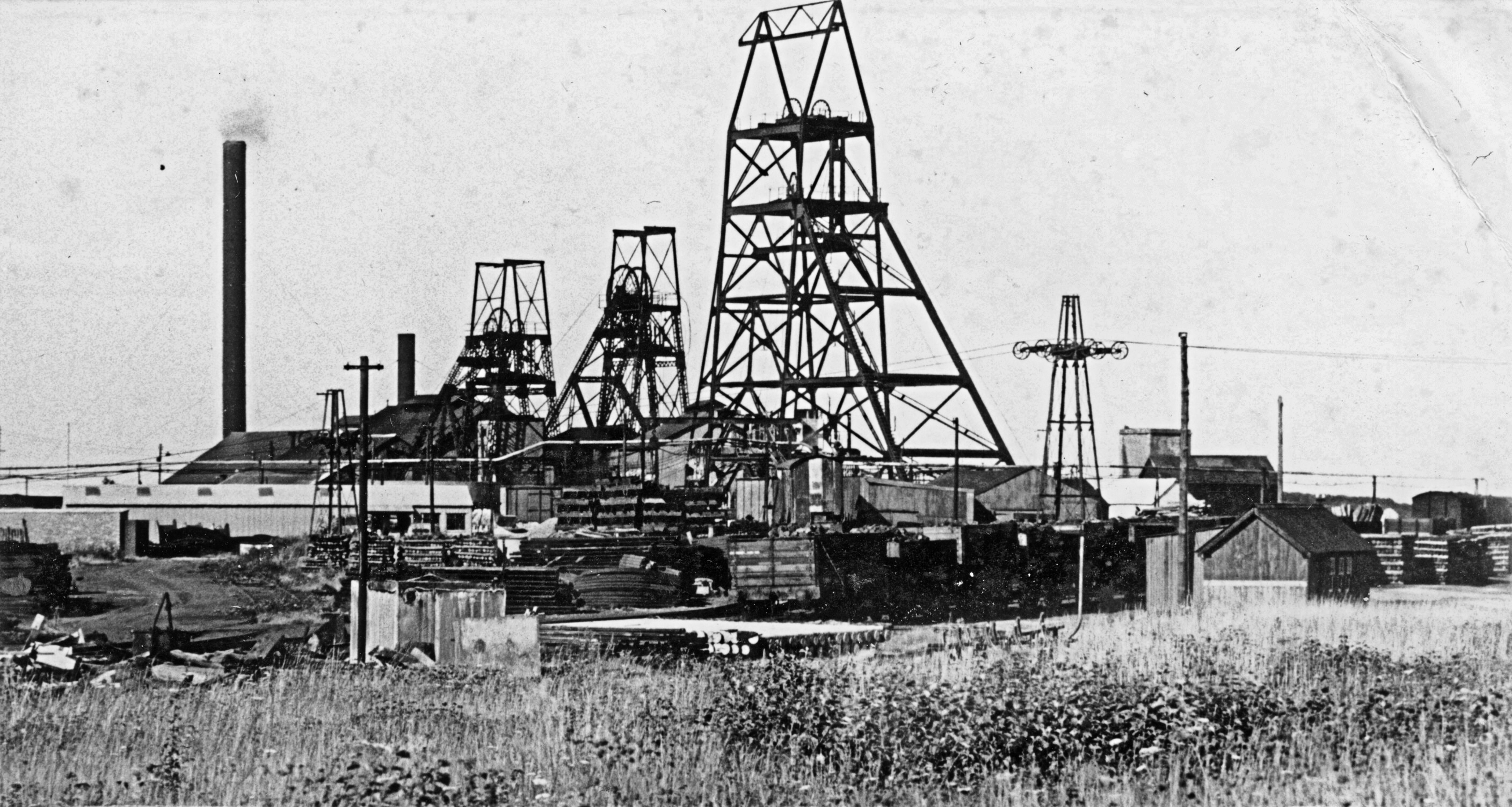
Tilmanstone Colliery c1915. Dover Museum

Tilmanstone Colliery c1915. Dover Museum

Following the outbreak of World War I (1914-1918) Britain was short of zinc – an important constituent of brass along with copper – and in response Tilden Smith purchased the German owned Swansea Vale Spelter works. He subsequently established an up-to-date zinc smelting plant at nearby Avonmouth, where mustard gas was also produced. Ironically, later in the War Tilden Smith‘s only son succumbed to mustard gas and died of the poisoning some years later. In 1915 Tilden Smith, with an eye still on the Kent coalfield, made the bid to purchase Tilmanstone colliery mentioned above. However, that year he consolidated all Welsh holdings into the National Smelting Company and with the co-operation of the Government increased the production of commercial zinc. Two years later Tilden Smith incorporated the company to include his holdings in the Burma Corporation that he had increased having bought Hoover’s shares. By this time, Tilden Smith was a director of a number of other companies including Baldwin’s, a large steel and galvanised tin manufacturer in South Wales that also owned a number of collieries.

Kent Coalfield - Map showing the extent of coal reserves in East Kent.

Kent Coalfield – Map showing the extent of coal reserves in East Kent.

During the War, East Kent Colliery Company’s Tilmanstone Colliery made a profit and in the couple of years that followed, further sinking of No 3 shaft took place with the plan to reach the deep but rich Milyard seam. However, in the early 1920s, the company was hit by the prevailing economic depression and cheaper imported coal. Production was already reduced and in 1922, a severe in-burst of water into the Beresford seam cut production even more. That year Dorman Long joined forces with Viscount Cowdray to form Pearson and Dorman Long Ltd. The new company immediately started the preliminary work on what eventually became Betteshanger Colliery and through the Channel Steel Company, they proposed the building of a steel works on the cliffs between Dover and St Margaret’s.

In 1918, with a total subscribed share capital of £1million, Tilden Smith had formed the National Metal and Chemical Bank, which became his main holding company. He sold his interests in the smelting works and Burma mines to the Bank in 1923  and set up the Share Guarantee Trust. Through the Trust he bought shares from the panic-stricken shareholders in the East Kent Colliery Company and at the end of 1924, the Share Guarantee Trust forced the East Kent Colliery Company into receivership. The Share Guarantee Trust held nearly a third of the first mortgage debentures in the colliery. On 13 February 1925, the Official Receiver, reluctantly and against the wishes of the directors of East Kent Colliery Company, appointed Tilden Smith as the general manager of the colliery while its future was decided. The directors put forward a scheme that on paper looked as if it could work, but no backers came forward putting the pit in danger of closure.

Tilden Smith then set up a new company, Tilmanstone (Kent) Collieries Limited, and after showing considerable acumen as the colliery manager in July 1925 applied for permission to reconstruct the colliery. This was to be based on a reconstruction programme submitted by F D Mottram and was approved by the mortgage debenture holders and the Court of Chancery. Through Tilmanstone (Kent) Collieries Limited, Tilden Smith acquired the assets of Tilmanstone colliery for £139,667 but not the colliery itself as this was still in the hands of the debenture and shareholders. The first mortgage debentures, amounting to £122,710 were exchanged on equal par for the first mortgage debentures in the old company – the majority of which were held by Share Guarantee Trust! The second debentures in the old company amounted to £203,871 but the holders of these had no right of call so lost their money. However, Tilden Smith did issue 400,000 second mortgage debentures at par, initially to those who had lost their money and then the general public but charged 10% commission on the dealings. Due to the lack of interest, there was little take up so Share Guarantee Trust bought 97.3% of them! In the old company the share capital had amounted to £490,583, the largest owner of which was Barclays Bank with 3.22% but they lost their money. However, shares to the value of £40,000 were offered on the open market in Tilmanstone (Kent) Collieries Limited. As far as the colliery was concerned, the Official Receiver accepted Mottram’s reconstruction programme to be instigated by Tilden Smith. Of note, from 1920 Mottram was Tilden Smith’s private secretary, a role that was to continue up until December 1929.

Tilmanstone colliery no 1 shaft reached the Beresford seam at 1,590-feet in March 1913. Dover Museum

Tilmanstone colliery No 1 shaft reached the Beresford seam at 1,590-feet in March 1913. Dover Museum

The total mining area of Tilmanstone colliery, at this time, was 7,956acres and nearby was the East Kent Light Railway, a feeder track to Shepherdswell and then into the Southern Railway main line between Dover and London. By rail, the distance to London was 74½ miles and to Dover 9½ miles where Dover Harbour Board (DHB) encouraged coal and timber merchants to set up business on the quaysides of both Wellington and Granville Docks. Railway lines had been laid to both docks to connect with Southern Railway. Transport by road to either London or Dover was poor.

The output of coal from Tilmanstone in 1925 was 239,000 tons, 65% of the total output from the Kent coalfields. No 1 shaft to the 5-feet thick Beresford seam was worked at a depth of 1,560-feet and was proved at Tilmanstone for an area of 2,000 acres. The initial mining technique was long wall but due to leakage through the roof, that was abandoned and the pillar and stall method was used instead. The number of miners, in 1925, was 854 – 41% of the Kent coalfield labour force – but the working conditions were bad. The price per ton of coal from the Kent mines that year was 18shillings 9pence a ton which compared unfavourably with the average price of 16shillings 4pence a ton from the other British coalfields. The advantage the Kent coalfield did have was its proximity of the southeast and especially the London market.

Miners - Pit-head workers c1924. Tom Robinson

Miners – Pithead workers c1924. Tom Robinson

As manager of Tilmanstone, the first thing Tilden Smith did was to look at creating greater co-operation from the miners and to persuade them that, as things were, the colliery was not financially viable. In 1924, following a national wage award, the miners had been given notice by the owners to terminate their agreements and to be paid a lower rate. This had led to a dispute that resulted in a higher pay award that the directors of the East Kent Colliery Company could not afford. It was because of this that Tilden Smith had forced the Company into receivership. Then on Thursday 22 October 1925, Thomas Clark age 17 of Prioress Way, Dover, was killed following a roof fall in the mine. He had been a miner, alongside his father, since he was 14 and the accident was caused by a bar, holding up the roof, having broken due to deterioration. On 3 December the previous year, before Tilden Smith had taken over as manager, a steam/water separator in the electricity generating plant had exploded. Made of cast iron by the British Westinghouse Electrical and Manufacturing Company, it had been installed in 1911. Steam at high pressure passed through the separator and in 1917 three cracks on the same side were found. A steel plate was put over the area with the intention of the East Kent Colliery Company to replace the separator but this had not happened. Luckily, no one was killed although a number of workers were injured. Nonetheless, due to lack of money only a temporary repair had been made.

Throughout the British mining industry at that time, cheap imported coal had led to short-time working, wage cuts and unemployment with the consequence of increasing unrest. In the spring of 1926, the strength of sterling had caused the price of imported coal to fall lower than that produced domestically and a Royal Commission recommended a further cut in the miners’ wages. In his evidence to the Commission, Tilden Smith strongly argued for the government to create a Coal Board under which all collieries in the country would be compulsorily amalgamated. This, he reasoned, would enable the industry to be put on a sound economic footing. Little notice was taken of Tilden Smith or of others mine owners who were putting contrary to conventional arguments forward. Sir Arthur Dorman, was another that fell into this category following his powerful and well reported speech (Economist 19.12.1925) on exchange rates. He virtually begged the government for equal parity but the response was, ‘a strong £ was the sign of a strong country.’ (Dover, St Margaret’s and Martin Mill Railway Line part 2).

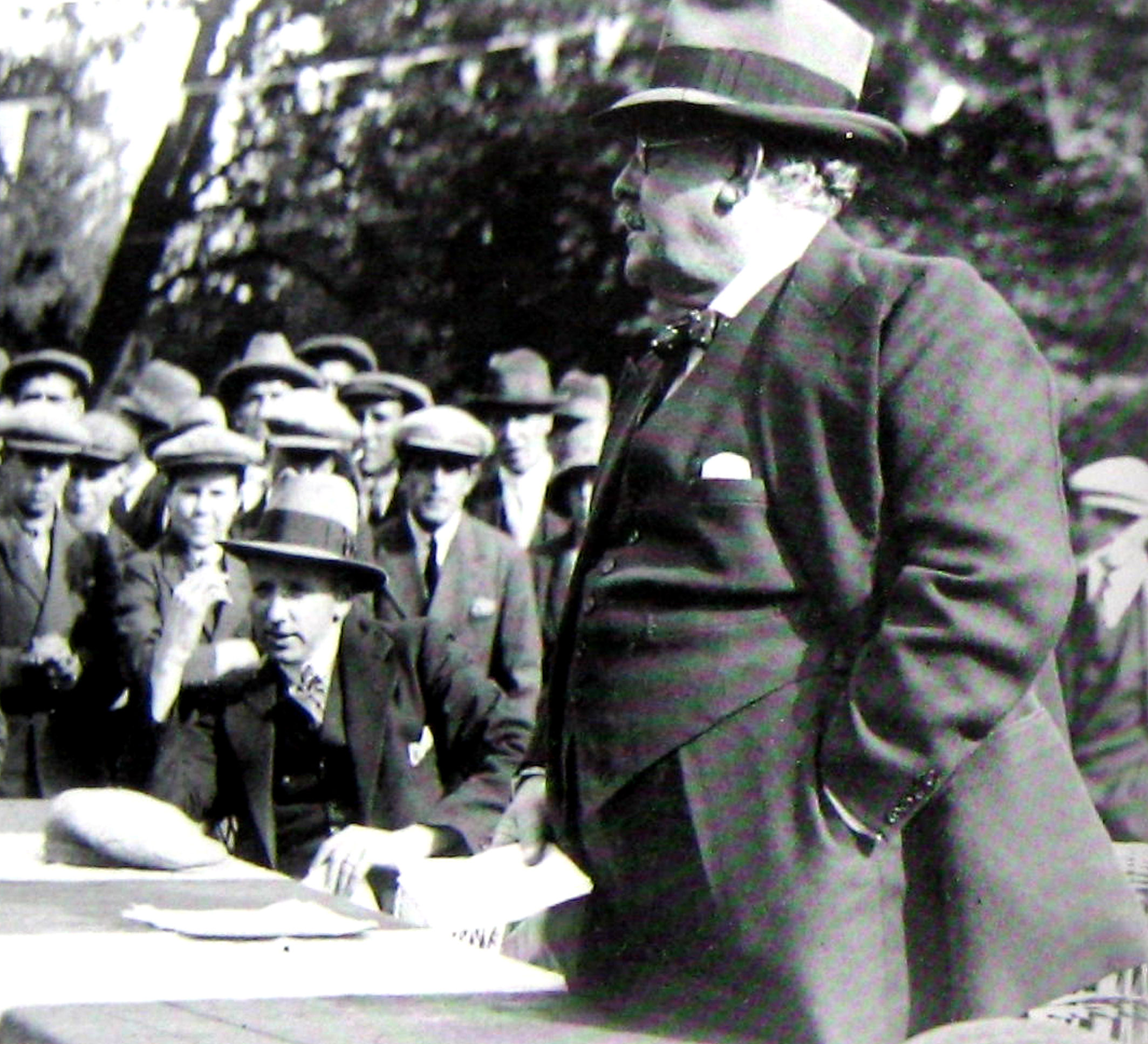
Bill Newman Mayor of Dover 1992-1993 son of Bill Newman, one of Tilmanstone colliery union representatives during the time when Richard Tilden Smith owned the colliery.

Bill Newman Mayor of Dover 1992-1993 son of Bill Newman, one of Tilmanstone colliery union representatives during the time when Richard Tilden Smith owned the colliery.

The first General Strike in British history began at midnight on 3 May 1926. Out of fear of a Bolshevik type revolution, a National State of Emergency was declared. Under the leadership of the Kent Miner’s secretary, John Elks, the Dover Central Strike Committee was set up and this included the union representative of Tilmanstone colliery, Bill Newman. His son, of the same name, was active in local politics up until recently. For the miners the strike lasted six months and throughout that time, Tilden Smith contributed £100 a week towards the cost of food for the miners’ wives and families. Meanwhile, he took the opportunity to improve the efficiency and working conditions of Tilmanstone colliery.

Water ingress into the Tilmanstone mine amounted to 20-tons per ton of coal produced. As a result, the existing pumping machinery had to deal with 2,000-gallons of water per minute (almost 9 tons per minute). When Tilden smith was appointed manager, pumps existed at three stations down the mineshaft. At the 600-feet level, the 1,140-feet level and in the Beresford seam at the 1,560-feet level. With the existing machinery the estimated cost of pumping per ton of coal raised was 2shillings 6pence. Tilden Smith had a new, larger and more efficient electricity generating plant installed to work the largest pump in the country at that time, nicknamed Lady Gray. The 1,050-horsepower (785 kilowatt) pump was capable of lifting 1,500-gallons of water a minute to the surface directly from the Beresford seam 1,560-feet below! The new electricity station had the capacity to produce 8,000 kilowatts (8 megawatts); generating at 3,000 volts (3kv) with live superheated steam at 150-200lbs per square inch (psi) while the pit itself provided the cooling water of 1,800-2,000-gallons per minute. A second generator was later acquired, (1929), to provide electricity specifically to work the Lady Gray. New winding and haulage gear were installed during the 1926 refurbishment, along with two triple-decked cages each capable of carrying 12 men or 6 tubs of coal. From the top to bottom, 1,560-feet below ground, they took 47-seconds. The winding rope used was one and five sixteenths of an inch in diameter with a breaking strain of 120-tons.

Along with new surface and coal cleaning plants, a new boiler to pulverize coal was installed. These were introduced to deal with poor quality coal, which was crushed and then mixed with pitch. The mixture was ‘cooked’ using super-heated steam from 400º to 500º Fahrenheit and then pressed into either rectangular industrial brickettes or ovoid shaped ‘Coaloid’ – the commercial name. Coaloid was sold to householders as Tilmanstone New Coal … that ‘burnt freely with a cheerful flame and gave off great heat.‘ The plant cost £15,000 and was designed to produce 10-tons of Coaloid and 10-tons of briquettes an hour. Both were a great success especially as they were weather proof and cheaper than domestic coal.

Richard Tilden Smith talking to the miners of Tilmanstone Colliery. Tom Robinson

Richard Tilden Smith talking to the miners of Tilmanstone Colliery. Tom Robinson

As part of his long-term plans for the colliery Tilden Smith applied, in September 1926, to Dover Corporation to sanction an aerial ropeway connecting Tilmanstone colliery with Dover Harbour for the conveyance of coal. He was advised that the council were unable to sanction such a ropeway as it was a Rural Council matter but that they promised moral support. The Rural Council said that they would discuss the proposition but shelved it. In October, Tilden Smith registered, with a capital of £100 in £1 shares, Tilmanstone Transport Co to carry coal and other products by rail. At the same time, he applied to the Railway and Canal Commission, for the power to erect an aerial ropeway for a distance of 6½ miles (this was as stated in the original application) between the colliery and the Eastern Arm of the Eastern Dockyard. The proposed cost given was £61,195 and the application stated that the aerial ropeway would be carried on poles or standards of steel or ferro-concrete about 120yards apart. Where the ropeway crossed roads there would be bridges of the girder or suspension type. Fixed steel buckets would each carry between 5 and 10 hundredweight (cwt) of coal and be suspended by little trolleys from the ropeway.

The proposed course of the aerial ropeway crossed land owned by 18 different personages one of which was Southern Railway – the chief opponent of the project. They saw the proposal as a test case … if Tilmanstone (Kent) Collieries Ltd were given the power to erect such a cheap means of transport; nationally it could remove from the hands of Railway Companies a very large part of their traffic. Pearson and Dorman Long Ltd took a great deal of interest but did not object outright. It would appear that they opposed the project because it would make Tilmanstone coal cheaper than the coal from their mines but if Tilden Smith won, then Southern Railway would be obliged to lower their freight charges for the carriage of coal. At the time the charge from Tilmanstone to the harbour was 5shillings 9pence a ton of coal. Tilden Smith had estimated the cost of transporting a ton of coal using an aerial ropeway would be 1shilling 9pence a ton. DHB were also ambivalent in their response. On the one hand, they recognised that the proposed aerial ropeway would bring considerable trade to the Harbour without any expenditure on its part. On the other, two members of the Board were representatives of Southern Railway. The Railway and Canal Commission met on 5 November and the case was heard by Mr Justice John Sankey, (1866-1948), Major Sir Edward Hale Tindal Atkinson, (1878-1957) and Sir Lewis Coward who deferred the application to a full Hearing. Nonetheless, Tilden Smith immediately applied for planning permission.

Elvington Court - postcard published by L R Hampshire Post office, Eythorne. Dover Museum

Elvington Court – postcard published by L R Hampshire Post Office, Eythorne. Dover Museum

At the beginning of November the miners drifted back to work at their old wage rate and the Official Receiver gave his permission for Tilmanstone (Kent) Collieries Ltd to run the mine. On Wednesday 17 November, Tilmanstone colliery reopened and the men were given 48hours to return otherwise there was no guarantee of a job. Over 700 men reported to work and were given a new contract with Tilmanstone (Kent) Collieries Ltd. Immediately the long-wall system of mining was readopted. Tilden Smith also instituted plans to improve industrial relations by converting Elvington Court, a country house that he owned, into a residential club with accommodation for some 150 single workers. The adjacent large barn was converted into a miners leisure centre and had a seating capacity of 750. Electric lighting and heating was installed, a dance floor laid and a stage erected with dressing rooms behind. Smaller rooms were created where training sessions could be held, classes in various subjects took place and interest groups met. Adjacent to the barn a fully equipped ambulance station was erected with breathing and rescue appliances and a motor ambulance.

Elvington village miners cottages. Steve Harding

Elvington village miners cottages. Steve Harding

The Mining Industry Act of 1926 required that all the underground workers had to be men over the age of 18years and to have been employed regularly in the industry prior to April 1926. Throughout the industry, following the strike, there was high unemployment so in mining districts adverts were placed in local newspapers offering work, good pay and accommodation for experienced miners. Some men did write to ask for work but the majority just arrived, many walking, from Durham, Lancashire, Yorkshire and south Wales. Tilden Smith responded by developing Eythorne village, which was near the colliery, for his married employees. For this project, he set up a joint subsidiary company, Elvington Tenants Ltd, with funding through his National Metal and Chemical Bank and formed an agreement between that company, Tilmanstone (Kent) Collieries Ltd and Eastry Rural District Council to build houses and infrastructure. Financed by Elvington Tenants Ltd when the homes were completed they were to be leased to Tilmanstone (Kent) Collieries Ltd for renting to its employees who would later have the option to buy.

In the spring of 1927, Tilden Smith leased 24 acres of land at Langdon Hole from the War Office for a proposed cement works but in March 1927 the case before the Railway and Canal Commission opened and lasted 9days. Tilden Smith had applied for permission to erect an aerial ropeway under sections 3 and 5 of the Mines (Working Facilities and Support) Act 1923. The main thrust of his argument was that Southern Railway charged 5shillings 9pence a ton to transport coal to Dover harbour. This, he argued, made it impossible to produce coal at a competitive rate for export and if continued the colliery would have to close. DHB remained on the fence and besides Southern Railway, the application was opposed by East Kent Light Railway Company – controlled by Southern Railway since 26 March 1926, the Channel Steel Company, Pearson Dorman Long, the War Office, the Commission for Crown Lands, Earl Guilford of Waldershare and Misses Zilla and Susannah Gray of Wigmore Farm, Eythorne. A number of those who had opposed the proposal before the preliminary Hearing in November had withdrawn their objections.

Southern Railway coat of Arms 1923-1948

Southern Railway coat of Arms 1923-1948

In their opening statement, Southern Railway made it clear that they had a business to run and that it was not in their interests to carry coal at a loss in order to help the development of the Kent coalfield. However, they did agree to reduce their rates to 2shillings 8pence a ton if the amount of coal they carried from any one mine was between 200,000 and 250,000 tons a year subject to a Railway Rates Tribunal agreement. As part of his evidence, Sir Herbert Walker (1868-1949) General Manager of Southern Railway (1923-1937) described an alternative Southern Railway proposed scheme for exporting coal from Dover. This, he said, was in conjunction with DHB and centred on the erection of four or five coal staithes on the Eastern Arm with room for the marshalling of wagons on reclaimed land under the cliff. It was anticipated that as soon as the Hearing was over, £35,000 would be spent on the construction of two of the coal staithes. Coal would be brought to Wellington and Granville Docks for unloading onto railway wagons and using the Seafront Railway the wagons would be taken to the new coal staithes where it was expected some 1½ to 2 million tons of coal a year would be processed. He finished by saying that on 17 March Southern Railway would be submitting an application for permission to carry coal on the Sea Front Railway.

Towards the end of the Hearing, DHB had a change of attitude saying that they were totally committed to Tilden Smith’s proposal of an aerial ropeway and that a special modern coal  staithe would be built. Into this, the buckets from the aerial ropeway would empty and from the staithe, ships would be automatically loaded with coal. The empty buckets would return to the colliery to be filled again and start once more on the circuit. As far as was practically possible the whole process would be fast, efficient and automated. In its judgement, the Court stated that they agreed with Tilden Smith’s proposal of an aerial ropeway on the grounds of economy, efficiency and safety but that the application failed on technical grounds, as the plans submitted on the last section of the proposed ropeway at Eastern Dockyard were inaccurate and the estimates illusionary. This related to conflicts with the last minute evidence given by DHB. The case had cost Tilden Smith £5,000 and he was exasperated.

On 17 March 1927, Southern Railway did seek permission to carry coal on the Sea Front Railway and the following day 900 men working at Tilmanstone Colliery received two weeks notice that the pit was to close. They were told that typically, for the week ending 5 March the cost of producing and transporting a ton of coal was 17shillings 2½pence, the price received per ton was 14shillings 4 3/4pence. The Mayor of Dover, Richard Barwick, who was also a DHB Board member, issued a statement saying that the majority of 900 men lived in Dover and had some 5,000 dependents. Because of the lay-offs so shortly after the prolonged strike, he feared that in a very short time many of the miners’ dependents would have to go to the Board of Guardians to survive. This and other publicity surrounding the judgement led to a public outcry and pressure was put on Tilden Smith to keep the mine open.

Tilden Smith did and he also renewed his application for the Ropeway producing well-drafted plans and full costings for the final part of the proposed ropeway. These were drawn up with the help of DHB Register, John Mowll. The Hearing was held on 27 July 1927 and Southern Railway were asked that if permission were given, would the two Southern Railway members on the Board of DHB be opposed to the Board co-operating with Tilmanstone Colliery in building a coal staithe on the Eastern Arm? Southern Railway’s representatives assured the Tribunal they would not object and after a three-day Hearing, the Railway and Canal Commission granted the application. Preparations were started by the engineers from Tilmanstone colliery headed by Bernard Whitaker and Richard Barwick’s building firm under the supervision of Ropeways Ltd, Aldwich House, London – later British Ropeway Engineering Company. However, Southern Railway together with the East Kent Light Railway appealed against the Railway and Canal Commission’s decision. Their argument was that the Commission did not have the power to grant means of communication such as an aerial ropeway. When the Appeal was filed work on the Ropeway was suspended pending the outcome.

The Appeal took place in November 1927 before Lord Justice Thomas Scrutton (1856-1934), Lord Justice Charles Sargant (1856-1942) and Lord Justice Frederick Greer (1863-1945). Southern Railway expanded their argument by saying that the ‘Commission did not have the jurisdiction to order that anyone could construct railways over the face of other people’s property merely because a colliery company satisfied them that the scheme was to the advantage of the public.’ Counsel for Tilden Smith countered this by arguing that the 1923 Act gave the Commission wide powers with the object to facilitate the easy working of minerals and where it was in the national interest to do so. That the rights of private property were over-ridden on terms of fair compensation to the owners. On 16 December 1927, the Court of Appeal published their judgement dismissing the Appeal. The objectors responded by saying that they would Appeal to the House of Lords – but they did not follow this through. During that week, Tilmanstone was credited in raising the largest amount of coal of any East Kent colliery thus far – 6,500tons!

Tilmanstone colliery c1929 the Aerial Ropeway can be seen on the right. Dover Museum

Tilmanstone colliery c1929 the Aerial Ropeway can be seen on the right. Dover Museum

Work again started on the aerial ropeway by Bernard Whitaker and his engineers, Barwicks and Ropeways Ltd. This included the laying of markers for the track, felling of trees, determining the location of each trestle and how many trestles were needed. Preparations for overcoming obstacles such as roads and railway tracks were undertaken. Richard Barwick’s building firm started laying the bases for the 177 iron trestles that were, on average, 75-yards apart and designed to support the Ropeway. Because of the weight of the coal, the buckets – 5-hundredweight and the capacity to carry 16 hundredweight, they would be too heavy for the Ropeway to go straight to the Eastern Dockyard 7½ miles away. For this reason, a dividing station was created at Pineham, East Langdon, 3½ miles from the colliery and it was from there that both sections of the Ropeway were driven by a 60-65 horsepower engine manufactured by Belliss & Morcom of Ledsam Street Works, Birmingham

Aerial Ropeway entering and exiting the Eastern Docktard from the cliff face.

Aerial Ropeway entering and exiting the Eastern Dockyard from the cliff face.

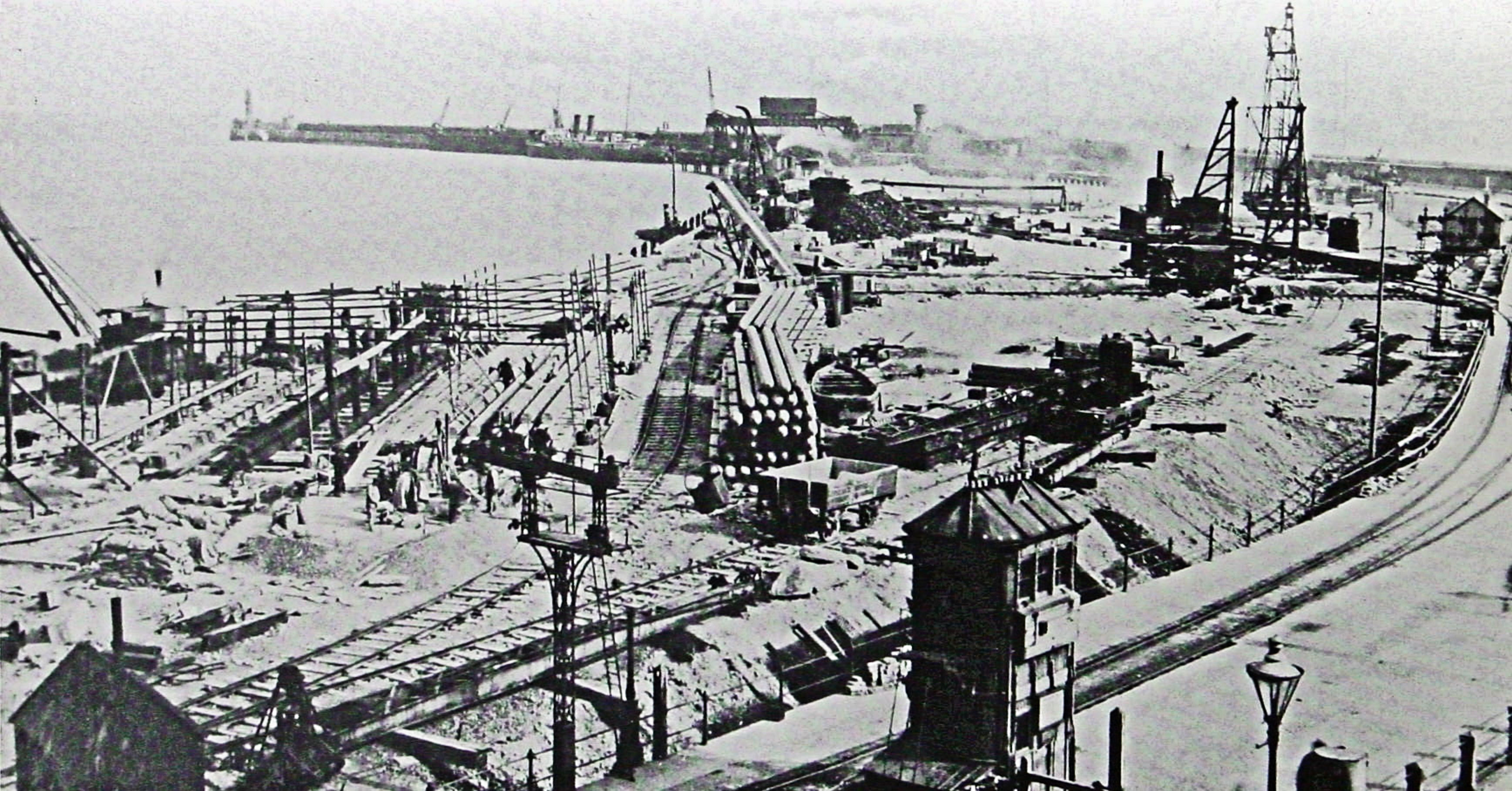
The major problem, however, was the steep drop from the top of the cliffs above the Eastern Dockyard to the Eastern Arm. Initially the plan was for the Aerial Ropeway buckets to be routed over the cliff edge and down to Langdon Bay. Then to travel along the beach to the Eastern Arm. Work started and the remains of huge concrete platforms in which metal stanchions would have been placed can still be seen. The idea was abandoned as impractical as the Bay is tidal. For the construction of the Eastern Arm, approximately thirty years before, Pearsons had made the concrete blocks out of sand, shingle and cement, the first two were originally brought by ship from Stonar, near Sandwich. The whole exercise was time consuming and expensive such that Pearsons built a Standard gauge Light Railway line from Martin Mill to the top of the cliffs (see Dover, Martin Mill Railway part 1). From there the sand and shingle was taken down the cliff face by a funicular with side tipping skips to ease unloading and this, although not ideal, seemed to be the only answer. However, Tilden Smith’s engineer, Bernard Whitaker, advised that the Ropeway should go through the cliffs in twin tunnels. A survey was undertaken from Northfall Meadow to above the Eastern Dockyard and it was found possible for the Ropeway to go through the cliffs as long as it went through two narrow tunnels.

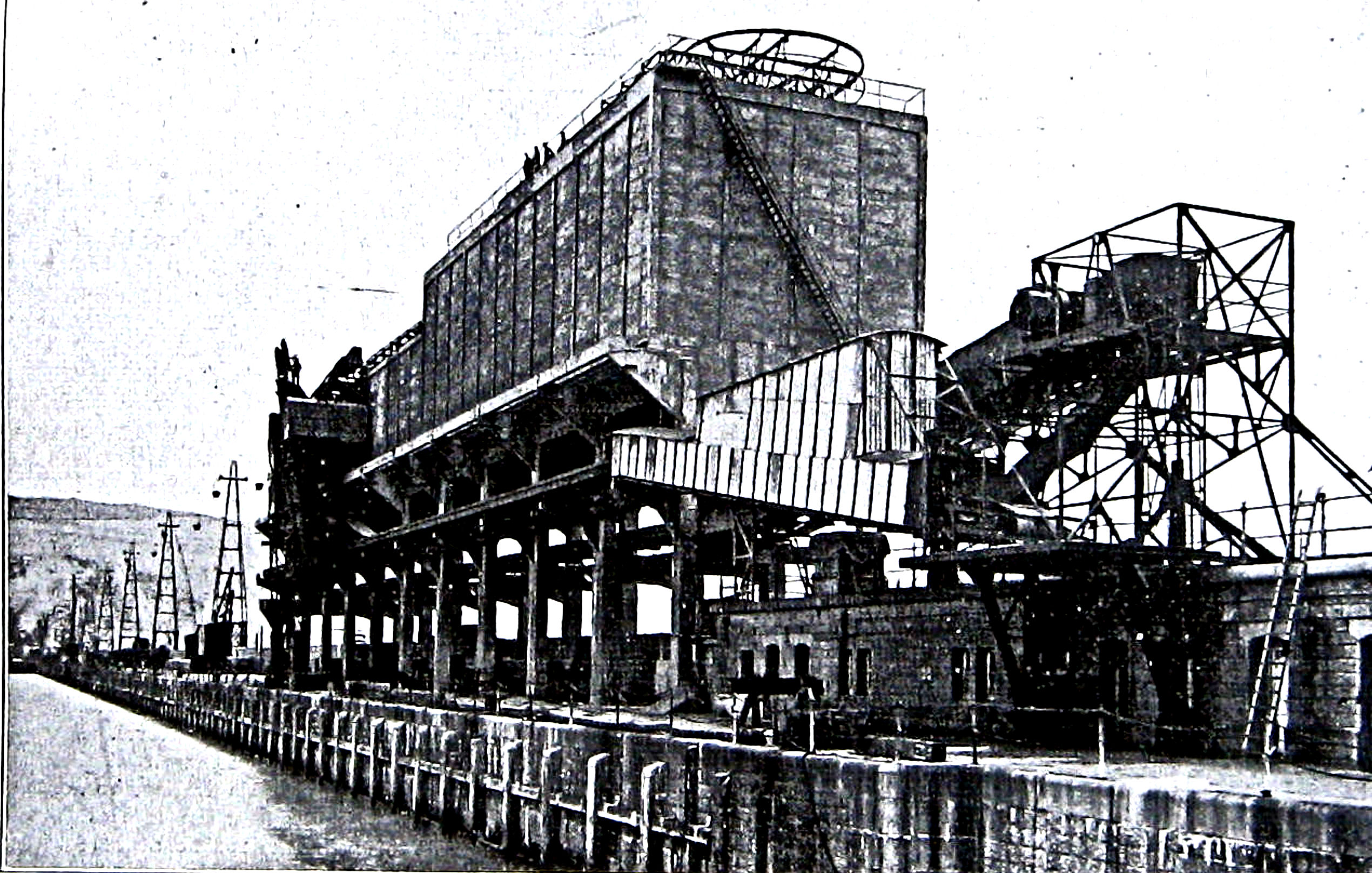
Aerial Ropeway Coal Staithe Eastern Arm. Railway Gazette January 1931

Aerial Ropeway Coal Staithe Eastern Arm. Railway Gazette January 1931

Work on the coal staithe on the Eastern Arm was started in August 1928 at a point where there was 30-feet depth at low water. Built of ferro-concrete by the Yorkshire Hennebique Construction Company, it was 250-feet in length, designed to hold 5000-tons of coal and was supported on two longitudinal rows of ferro-concrete columns. One of the rows was on the parapet wall – evidence of which can still be seen – and the other on the main deck of the Eastern Arm. A  shunt rail at the return terminal, at the far end of the staithe, enabled the buckets to gravitate around the south end prior to being picked up once again by the running rope. However, there was no mechanism to correct the buckets so a man had to be there all the time the Ropeway was in operation to return them to the upright position whilst the 2 wheels of the supporting trolley were off the moving rope. The staithe was fitted with a mechanical discharging mechanism that enabled a vessel to be loaded with 500 tons of coal an hour. Besides the man righting the buckets only two other men were required to work the staithe. One was in charge of the conveyors and the travelling feeder under the staithe and the other in the cabin on the travelling tower from which he controlled all the movements of the operation during the loading of a ship.

By October 1928 work on further sinking of No 2 and No 3 shafts at Tilmanstone was being undertaken as it was decided to take them both to the deep but rich Milyard seam. By the end of the year, new steel pit-headgear was erected and at a depth of 3,035 feet the seam was reached in May 1930 by No 3 shaft. Tilden Smith had discussions with DHB, who agreed to lease a portion of the Eastern Dockyard to carrying out reclamation works in connection with a cement factory that was proposed on Langdon Cliff. Discussions took place with Dover Corporation to build some 1,000 and 2,000 new homes for workers and their families employed at the new cement and associated industries that were being planned. However, the council declined to support the proposal saying that Tilden Smith had promised to supply electricity to the town but the power lines had still not been built. Eventually, approval was given by Dover Rural Council for 50 houses to be erected in Elvington under a subsidy scheme approved by the Ministry of Health. The houses were built by a Chatham firm. 

At the time, Tilden Smith was having discussions with DHB, who agreed to lease a portion of the Eastern Dockyard to carrying out reclamation works in connection with a cement factory that was proposed on Langdon Cliff. On 26 October the miners at Tilmanstone, after a great deal of persuading, accepted what was one of the most revolutionary deals of the time when they became part of management structure! A joint management committee was formed but the undertaking did not included profit sharing for as Tilden Smith had pointed out, with such schemes, the men would have to bear the losses and Tilmanstone was making a loss.

On 11 January 1929, the Railway and Canal Commissioners Court gave permission to cut two tunnels 1,140 feet long, 7-feet wide and 13-feet high, through the cliffs to the Eastern Arm and work started immediately. The aerial ropeway was carried in a straight line from Pineham to the top of Langdon Cliff above Langdon Hole where a 90º-angle station was built to take the ropeway through one of the tunnels. A second 30º-angle station was built underground just before the Ropeway emerged above the Eastern Dockyard to enable the Ropeway to run along the Eastern Arm. A third angle station was built at the entrance to the second tunnel to take the Ropeway through but on leaving the exit, the 90º-angle station was used. On the Eastern Arm, the trestles were increased to 70-feet in height such that the buckets passed over the top of the giant staithe.

While this was going on, in May 1929, the War Office took legal action against the Channel Steel Company forcing them to pay £1,300 compensation for the breach of covenant over the 24 acres of land on Langdon Cliff that Tilden Smith was leasing from the War Office for his cement works. In 1896, Pearsons had leased that land to lay their railway track from Martin Mill to the cliffs above the Eastern Dockyard with the provision that by December 1899 the site had to be restored to its original condition. They had not carried out the work but up until the receipt of the legal notice, no one seemed concerned. Channel Steel Company paid the compensation and immediately the War Office placed the land on the market and both Tilden Smith and Channel Steel Company put in a bid. The War Office sold the land to the Channel Steel Company who announced that they were going to build a cement factory on the site! However, Tilden Smith held the lease as a sitting tenant and he had also leased, from the War Office, the adjacent land above the twin tunnels.

Aerial Ropeway showing trestles crossing the countryside. Railway Gazette January 1931

Aerial Ropeway showing trestles crossing the countryside. Railway Gazette January 1931

On the Eastern Arm, the trestles for the Ropeway were erected and the wire ropes in position. By the end of the year, the huge staithe was completed. The only obstacle was the agreement between DHB and Tilden Smith over the use of the facility. Members of the Board, undoubtedly the railway appointed members and their supporters, wanted the facility altered to enable Southern Railway to transport coal from the Pearson Dorman Long mines at Snowdown and Betteshanger. It was pointed out that once the coal reached Dover at the Western Docks, it could be carried by the Seafront Railway to the Eastern Dockyard. It was logical that if a lower staithe was adjacent to the giant staithe, they could share the same docking area. Tilden Smith refused to entertain the idea.

The main non-maritime event in Dover’s social calendar during the inter-war years was the annual Royal Victoria Hospital fete, usually held on Pencester Gardens and the surrounding streets. The celebrations included the carnival when horse-drawn and motorised vehicles pulled floats (decked out trailers) by different businesses and drove around the town and were judged with prizes awarded. Tilmanstone miners always entered and in 1929, their float featured a mining stall made of wood with two miners burning Coaloid or Tilmanstone New Coal, in a brazier. Tilden Smith paid for the entry etc. on the understanding that a banner was erected stating ‘We burn Tilmanstone coal.’ This was done and the trailer was one of the favourites to win. However, before the judging was completed, the banner caught fire and the float was soon ablaze but was quickly put out by the Dover fire brigade. Not to miss the opportunity, Tilden Smith commented that the accident proved the calorific value of Tilmanstone New Coal!

Due to the breakdown in the talks between Tilden Smith and DHB, over the use of the Eastern Arm coal staithe by Pearson Dorman Long, he had to apply to the Railway and Canal Commissioners Court for a time extension over completion of the Ropeway. On 25 July the Court permitted the extension and also agreed that royalties paid to landowners above ground of the Tilmanstone colliery areas be reduced on condition that Tilmanstone (Kent) Collieries Ltd owned the mining area below ground. The Company bought the freehold of the mining area below ground for £40,000 paid by annual instalments of £2,000 and underwritten by Tilden Smith. It was  also agreed not to build ancillary works on land east of the road running north-south at the side of the colliery.

Although the ‘revolutionary’ Joint Management Committee at Tilmanstone colliery was accepted by the majority of the miners, there was still discontent among a few. This was exacerbated by reports coming out of Russia of the halcyon way miners were treated there. It would appear, from what these articles said, that the miners ran the mines they worked in and in consequence enjoyed the best working and social conditions for miners in the world. Tilden Smith was intrigued and at his own expense sent a delegation to look at the conditions with a view to introduce them at Tilmanstone. The group was led by two miners, both of whom believed the reports, J Crane – secretary of the local Labour Party and W (Jack) Roome – a communist. In the deputation was Walter Haydon, a journalist from Dover. They went to the Donetz Basin in southern Ukraine, which at the time was the largest coalfield in Communist Russia. Both miners had been chosen by the other colliers and Haydon’s account of the trip was later published as, Russia as Seen by Two Tilmanstone Miners: A Record of a Tour to the Donetz Basin in August – September 1929. The miners returned disillusioned, as the working conditions were much worse than those in the Kent coalfield while the management at Tilmanstone was infinitely better. Afterwards they had recounted their experiences to the other miners and Tilden Smith offered to pay the passage of any miner and his family who wished to go to Russia.

September 1929 saw work start on a building for pithead baths on the main road to the colliery. Consuming 38,000 gallons of water a week, there were 60 baths of the ‘shower’ design and the facility contained 1,008 lockers for the miners’ dirty clothes on one side of the baths and on the other 1,008 for their clean clothes. The baths were connected to the mine by an underground passage to protect the men during inclement weather. Costing £13,000 the baths were provided by the Miners’ Welfare Fund and each miner contributed 6pence a week to use them. There was a small charge for soap and towels for miners who did not bring their own and the facility was opened in October 1930 by Emmanuel (Manny) Shinwell (1884-1986), the Secretary to the Mines Department.

Richard Tilden Smith's notion of the future - the Industrial Eden

Richard Tilden Smith’s notion of the future – the Industrial Eden

The annual sports and garden fete at Elvington Court in 1929 was attended by over 2,000 employees and their families  on 22 September. Tilden Smith used the opportunity to outline his plans for the colliery and East Kent describing them as the Industrial Eden. He announced the start of a £2million development programme that would begin before the end of the year and the plans included the completion of shafts number 2 and 3 to the Milyard seam. An electricity power station to be built close to the colliery in order to increase the power to the mine, the aerial ropeway and the many other activities that he planned. He was expecting to supply electricity to distributors in London and plans were afoot to manufacture coal gas for household and industrial use. Another proposal was the largest cement factory in the country that was to open the following year on the 24 acres of land at Langdon Cliff, where he planned to utilise the chalk in Dover’s white cliffs, local clay found around Eythorne and fuelled by Tilmanstone coal. Cement would go for export with some retained for the domestic market!

To go with the cement, would be bricks, primarily made out of waste products from the mine and the other industries. Other proposals mentioned included the installation of a carbonisation plant and steel production with blast furnaces, rolling mills with by-product plants out of which chemical products would be extracted. For this, Tilden Smith told his enthralled audience, he would not be buying in iron from elsewhere but that it would be dug up from the very earth on which the audience stood! For under the East Kent soil there was not only coal but rich deposits of iron ore and that he was about to acquire leases of the nearby Guilford and Waldershare collieries that had significant iron-ore deposits. Industrial Eden was, he implied, well on the way to reaching its fruition and within four years, the output at Tilmanstone would be 4,000-tons of coal a day, a large percentage of which would be consumed by the Company’s own factories!

The opening ceremony of the first section of the Aerial Ropeway at the Drive and Driving station, Pineham. Kencole 1929

The opening ceremony of the first section of the Aerial Ropeway at the Drive and Driving station, Pineham. Kencole 1929

The first section of the Ropeway, from Tilmanstone colliery to Pineham was formerly opened on 12 October 1929 by, it was later said, some of the invited guests riding down in the buckets to the dividing station. There the wife of Richard Barwick, former Mayor and on the Board of DHB, started the Ropeway. The first bucket arrived from Tilmanstone Colliery 45-minutes later, during which time speeches were made. Afterwards, as a token of appreciation, Tilden Smith gave Mrs Barwick a model of the Ropeway, constructed by his engineering department and made of silver plated solid brass. The model consisted of two trestles connected with ropes on which were suspended a couple of miniature buckets.

Tilden Smith had acquired, by October 1929, a controlling interest in the Deal and Walmer Gas Company, the Folkestone Gas and Coke Company and the East Kent Gas Company. The latter was formed in 1923, and supplied gas to the rural areas of East Kent. The Company also held most of the remaining shares in the Deal and Walmer Company and controlled Whitstable Coke and Gas Company. That month Tilden Smith set up the Dover Coal, Gas and Power Company with the stated intention of co-ordinating the companies and supplying them with gas produced from a low temperature carbonising plant to be built near the colliery. This, he stated, was cheaper than the gas produced by the high temperature process that was favoured by the previous owners of the companies. Tilden Smith’s planned gas works was expected to produce 1,000 cubic-feet of gas each hour of operation and as bi-products of the coal used, Coaloid or Tilmanstone New Coal along with artificial manure, benzene, creosote, dyes and pitch would be manufactured.

On 18 December 1929, Tilden Smith was in the House of Commons with friends to lobby Parliament. A new Coal Bill was under discussion and Tilden Smith was again putting forward the argument for compulsory amalgamation of all collieries under a single Coal Board on terms that would ensure both the independence and prosperity of the British coal mining industry. As the group was going into lunch, Tilden Smith suddenly collapsed and died. He was survived by his wife and four daughters, his only son had died as a result of mustard gas poisoning sustained during World War I. At the time of Tilden Smiths death, Tilmanstone Colliery was the second largest coal-producing colliery in East Kent – 7,560 tons of coal was raised during the week Tilden Smith died.

Corminster at the opening of the Aerial Ropeway on 14 February 1930. Dover Museum

Corminster at the opening of the Aerial Ropeway on 14 February 1930. Dover Museum

The Aerial Ropeway was finally finished in January 1930 and the formal opening took place on 14 February 1930 but due to the death of Richard Tilden Smith the ceremony was a simple one. Mrs ‘Pip’ Edridge, eldest daughter of Richard Tilden Smith and S Hare, the Managing Director of Tilmanstone (Kent) Collieries Ltd, started the Ropeway. The first ship to be loaded with Tilmanstone coal was the collier Corminster belonging to Messrs W Cory and Co. The consignment was for Barking Power Station for pulverising before being fed to the boiler furnaces.

The statistics given at the time were:

Tilmanstone Colliery: The approximate output of coal and miners employed between 1925 and 1929 (1926 omitted because of the General Strike) was:

1925  239,000tons output  854 miners employed

1927  226,000tons output  979 miners employed

1928  332,000tons output  993 miners employed

1929  338,000tons output  1,047 miners employed

– Tilmanstone’s colliery mineral area was 7,956acres of which 1,706acres were freehold.

– The Ropeway was designed and installed under the supervision of Ropeways Ltd, Aldwich House, London – later British Ropeway Engineering Company.

– The Ropeway was 12,300yards long and it took one and three-quarter hours from when a bucket left Tilmanstone Colliery to reach the staithe on the Eastern Arm at Dover.

– The altitude at Tilmanstone colliery was 198feet and the difference in level between the loading station at the colliery and the discharge station on Eastern Arm was 100feet.

– The driving power at the colliery was a 200-horsepower Robey vertical engine and the speed of the Ropeway was 4¼ miles an hour.

– There were 585 buckets on the Ropeway, an empty bucket weighed 5hundredweight and had a load capacity of 16hundredweight.

– The maximum coal transfer rate was potentially 267 tons for each hour of operation.

– The loading station at Tilmanstone was fed from 1,000-ton bunker

– The interval between the dispatch of buckets was 21.4 seconds and the distance between buckets was approximately 46yards.

– The rope was 4inches in circumference (1.273 inches diameter), had a breaking strain of 8tons and was made by W T Henley Telegraph Wire works, Holborn Viaduct, London E C1.

– The continuous wire rope was supported by 177 trestles, 30feet high and each weighing 3½tons. On average they were positioned 75 yards apart.

– R J Barwick’s of Dover constructed the bases for the trestles

– The trestles were made by Ropeways Ltd, Aldwich House, London – later British Ropeway Engineering Company.

On the trestles were one, two or four wheels fitted into compensating balance beams to support the rope and at no point were there any more than two buckets between any two trestles.

– The Ropeway was approximately 30feet above ground level; the clearance below the buckets was 12-feet rising to 20-feet over roads and railway lines.

– The Ropeway traversed 15 roads and 2 railways and the crossings were protected by girder-type bridges. These were 20feet wide with the longest having a span of 100feet.

– The dividing station at Pineham was 3½miles from Tilmanstone and sited 261feet above sea level. Here the buckets transferred from one running rope to the other by means of a shunt rail upon which the 2 wheels of the support trolley ran along, aided by gravity.

– Both sections of the Ropeway were driven from the dividing station by a 60-65 horsepower Belliss & Morcom steam engine. Twin sets of driving and tensioning gears were fitted.

– There were three angle stations, one on the cliffs and the second and third near the seaward end of the tunnels.

The two tunnels were 1,140feet long, 7feet wide, and 13feet high and at the seaward end they were 87feet above sea level.

The coal staithe was built of ferro-concrete by the Yorkshire Hennebique Construction Company, was 250feet in length, designed to hold 5000tons of coal and was supported on two longitudinal rows of ferro-concrete columns.

– The staithe was divided into ten divisions with 20 discharging doors and the coal was carried on a series of conveyor belts from the holding bunker to an automatic weighing machine and then down a chute into the ships hold.

– The automated plant had a capacity of 12tons a minute enabling ships to be loaded at a rate of 720tons an hour.

– The motive power for the staithe was derived from the steam engine at the Pineham dividing station and used nine electric 500-volt motors to drive the staithe operations. Three men worked at the staithe.

– Total Ropeway’s litigation fees amounted to £20,000 and the total cost of the undertaking was estimated to have been £170,000.

– The Ropeway cost £125,000 and the coal staithe£25,000 and was capable of carrying 3,000 tons of coal a day from Tilmanstone Colliery to Dover’s Eastern dockyard at a cost at the time of the official opening, of 1s 9d (8.75p) per ton against 5s 9d (28.75p) by rail. The carrying capacity of the Ropeway was greater than the average daily output of the colliery, of around 1000 tons of coal a day in 1929.

The gross value of Richard Tilden Smiths estate was given as £880,495 9shillings 6pence, with net personal wealth of £686,996 2shillings 8pence gross (proved 1933). In his Will Tilden Smith left provisions to meet costs likely to accrue to DHB and were met until July 1937. The money came from the Tilden Smith Trust that was permitted to operate the colliery for seven years. At the time of Tilden Smith’s death, it was estimated that there was enough coal to last 300years if mined at 5,000 tons a day. Albeit, due to the final crisis caused by his death, all envisage projects were stopped including work on the two shafts to the Milyard seam. Tilmanstone (Kent) Collieries Ltd appointed FD Mottram as the Secretary of the reconstruction of the colliery, a position he held until 1952. His initial main concern was making the Beresford seam pay its way. Due to losses, no dividends were paid, and the Tilmanstone Branch of the Kent MineWorkers Association agreed to voluntary wage reductions in order to prevent closure.

The Aerial Ropeway, at first,  lived up to expectations except at the staithe, which quickly proved to be dangerous for the three-man team working there. A number of accidents were reported and in 1931 Noel Bragden was killed and Jack Hamerton seriously injured, when they were buried in fine coal. After the fatality there appears to have been a number of technical problems that brought the Ropeway to a standstill. Already laying railway lines in the eastern Dockyard, in the spring 1930, DHB laid two railway tracks along Eastern Arm to the staithe. The up railway line ran underneath the staithe and the down line ran on the harbour side.

Corminster being loaded with coal from the giant staithe 14 Feb 1930 scaffold for the Southern Railway staith on right. Dover Museum

Corminster being loaded with coal from the giant staithe 14 Feb 1930 scaffold for the Southern Railway staithe on right. Dover Museum

Before the opening of the giant staithe, Tilmanstone (Kent) Collieries Ltd  were approached by Southern Railway regarding building a second smaller staithe for coal from Snowdown and Betteshanger collieries. This time, the project  was agreed and by the  day of the opening of the Aerial Ropeway scaffold had been erected for the low coal staithe. The lower staithe was paid for by Southern Railway and was for coal from Snowdown and Betteshanger collieries. However, during 1933-1934, due to the prevailing world economic recession, the amount of coal carried by the Ropeway and the railway was severely reduced but did pick up as the decade progressed. A large percentage of the coal and coal products for the London and Home counties markets were carried from Tilmanstone colliery by the East Kent Light Railway to the railway junction at Shepherdswell. From 1930 to 1939, the Light Railway carried between 210,000-tons and 250,000-tons of Tilmanstone coal every year.

Besides carrying coal from Tilmanstone to the Eastern Arm, the use of the Ropeway was leased to other companies to carry minerals from the mine. One such company was Hamerstley Ganister Company of Durham who leased the Ropeway in 1931 in order to carry waste products to a railway siding for transportation by rail to Durham. There the waste products were used in the manufacture of firebricks. The Ropeway crossed farmland belonging to William Brown for a distance of 1,600-yards. He asked for wayleave rent of £200 a year, the amount he received before the reduction sanctioned by the Railway and Canal Commissioners in July 1929. Hamerstley Ganister offered 2pence a yard plus 7shillings6pence for each trestle sited on the farmer’s land, which altogether amounted to £18 a year. The land, they told the Court, was used for grazing so the Ropeway did not interfere with its usage. Farmer Brown lost but sought an Appeal in the High Court and again was unsuccessful.

Aerial Ropeway crossing the road near Malmains Farm. Dover Express 30.07.1982

Aerial Ropeway crossing the road (A256) near Malmains Farm. Dover Express

From Tilden Smith’s death up until 1935 the issuing of first mortgage debentures raised further capital for the mine. In July 1925, this had amounted to £122,710 and by 1935, there were £678,165 first mortgage debentures. The National Metal and Industrial Finance Company Ltd and its wholly owned subsidiary, London Mortgage Trust Ltd predominantly held these – two companies set up by Tilden Smith. When the Tilden Smith Trust cease to operate the colliery, in July 1937, the controlling interest in the Tilmanstone (Kent) Collieries Ltd was acquired by the Harley Drayton Group and about the same time, the company acquired control of the National Metal and Industrial Finance Company. That same month Tilden Smith’s family estate sold their inherited interests to the Anglo-French Investment Consolidation Ltd also part of the Drayton Group. Affiliated to the Group was the British Electric Traction Company who stated that they were looking at building on the ideas expressed by Tilden Smith as his ‘Industrial Eden.’ Of interest, the British Electric Traction Company was the parent company of the East Kent Road Car Company, that operated the East Kent bus services.

At the start of World War II (1939-1945), the Ropeway ceased operation abruptly though  the demand for coal ensured that Tilmanstone colliery was profitable and these profits were retained to develop the two shafts to the Milyard seam. Coal was still in the buckets when the Ropeway closed and would later spontaneously combust looking very pretty but a hazard from fire and from enemy attacks. Further, soldiers stationed near the Ropeway used both the trestles and the buckets for target practice.

Tilmanstone colliery c1970s. Dover Museum

Tilmanstone colliery c1970s. Dover Museum

The Kent Coalfield undertakings were transferred to the National Coal Board as part of the Nationalisation of collieries on 1 January 1947. At that time, the net colliery assets were given as £276,376 but for 1946, the mine had recorded a net profit of £65,610. Tilmanstone was extensively modernised after Nationalisation but was always considered uneconomic by the National Coal Board and from 1967 was earmarked to close. It closed along with Snowdown in 1987, Chislet had closed in 1969. The last colliery in the Kent coalfield to close was Betteshanger on 28 August 1989. During its working life Tilmanstone produced 20million tons of coal. There were three shafts, No1 = 1,590-feet deep to the Beresford seam, No2 = 3,168 and No3 = 3,139 to the Milyard Seam. All three seams were sealed during 1987.

Remains of the initial plan for the Aerial Ropeway. Buckets were to be routed over the cliff edge above Langdon Bay and then to the Eastern Arm. Colin Varrall.

Remains of the initial plan for the Aerial Ropeway. Buckets were to be routed over the cliff edge above Langdon Bay and then to the Eastern Arm. Colin Varrall.

As part of property assets at the time of Nationalisation, the Aerial Ropeway was transferred to the DHB. They saw it as uneconomic to repair and in 1952, work started on dismantling the Ropeway when the buckets and wire ropes were removed. Over the following two years, the trestles and bridges were demolished and what could be sold, was. The coal staithe on the Eastern Arm was knocked down in 1955 and at the same time, the smaller coal staithe was removed. Traces of the Aerial Ropeway across  the countryside can still be seen but the best view is the two sealed tunnel entrances above Eastern Docks.


  • Presented: 4 July 2015

Dedicated to: Tony Sansum (1952-2015)


Posted in Aerial Ropeway and Richard Tilden Smith, Aerial Ropeway and Richard Tilden Smith, Aerial Ropeway and Richard Tilden Smith, Buildings, Businesses, Eythorne and Elvington, Kent Coal Field, People, Routes, Tilden Smith Richard and the Aerial Ropeway, Tilden Smith Richard and the Aerial Ropeway, Tilden Smith Richard and the Aerial Ropeway | Comments Off on Richard Tilden Smith and the Aerial Ropeway

Roman Painted House

Roman Painted House - New Street. LS 2014

Roman Painted House – New Street. LS 2014

The Roman Painted House is one of the finest of its type in Britain and a major tourist attraction. The story starts over 2000 years ago when the Romans came to the shores of Britain. It then moves to more modern times and the long struggle by local amateurs to convince the established professionals to have a rethink. The story then looks at the discovery of Dover’s glittering prizes that were found when the professionals moved in and why most of these unique treasures were then reburied. The worldwide triumphs are covered and the dark days that followed. The latter helped to lead to the introduction of new legislation and are told from the perspective of this author. Finally, the events since that time and the recent national accolades that make the Roman Painted House a very special attraction.

Long before Julius Caesar (100BC-44BC) commanded the first conquering expedition to Britain, the country had close trading ties with Continental Europe. Skilful warriors went from Britain to assist in repelling the advances of the Romans on the Continent. Julius Caesar’s attempted invasion was on 25 August 55BC of which he wrote in Commentaries on his Campaigns (using the third person) that ‘Caesar determined to proceed into Britain because he was told that in almost all the Gallic wars succour had been supplied from thence to our enemies.’ In a fleet of 80 ships and two galleys he ‘reached Britain with the first squadron of ships about the fourth hour of the day, and there saw the forces of the Britons drawn up in arms on all the hills. The nature of the place is this: The sea was confined by mountains so close to it that a dart could be thrown from the summit to the shore …’ Calling the place Dubris – meaning waters, it is generally assumed that he was describing Dover.

Memorial of Julius Ceasar landing place on the Strand at Walmer

Memorial of Julius Ceasar’s landing place on the Strand at Walmer

Julius Caesar went on to give an account of how the British forces were marshalled on the Eastern and Western Heights overlooking Dubris and this persuaded the fleet to take the next flood tide east and to make landfall at Walmer, East Kent. There the Britons, having followed the invasion fleet in chariots or on horseback, attacked but the Roman’s were victorious and made camp on the beach. Following the encounter, Caesar’s view of the Britons changed, for he wrote, ‘…by far the most civilised are those who inhabit Cantium, the whole of which is a maritime region; and their manners differ little from those of the Gauls’. Cantium means a rim or border from which is derived the modern name of Kent. It was nearly 100 years before the Romans returned during which time the Britons enjoyed relative peace with Continental contacts through trade and diplomacy.

In the summer of AD43, the Roman Emperor Claudius (AD41-AD54) ordered his army to make a second attempt to invade Britain. His force, under Aulus Plautius, consisted of approximately 40,000 troops landed at Richborough, near present day Sandwich, East Kent. The principal force in the army was the Roman Legion, a unit of about 6,000 men, supplemented by a large number of auxiliary cohorts. The cohorts were units of about 600 men drawn from the vast Roman Empire. Of the many cohorts serving in Britain the Cohors I Bataesiorum, appear to have been stationed in the South East of England. They stamped their tiles and other artefacts used in their buildings, CIB and many of these tiles have been found in the South East. At Richborough, the Romans established a bridgehead and commemorated their success by building a triumphal arch whose cross-shaped foundations still survive.

At first, the progress of the Romans was rapid but after the initial military success came a period of consolidation when much of southern England and Wales was under firm control. By AD100, most of the indigenous population had settled into a peaceful co-existence when farming, towns and various industries flourished. Roads, bridges, public buildings, aqueducts, schools, temples, churches, villas, palaces and factories were built. However, following the death of her husband the king of the British Iceni tribe of north East Anglia, Boudicca became the prime ruler. Shortly after, the Romans annexed Boudicca’s kingdom, flogged her and raped her daughters. Together with the Trinovantes of south East Anglia, whose capital was Camulodunum – modern day Colchester, Boudicca led a famous revolt and was killed in AD61.

Roman builders tableau Dover Museum vestibule

Roman builders tableau Dover Museum vestibule

The power of the Romans was not affected by the uprising and they built a series of fortified ports with large garrisons for their provincial naval fleet around the coast. The fleet was raised by Claudius for the invasion of Britain and these forts were located in many places along the southeast and southern coast and on the Continental side of the Channel. Called Classis Britannica, the archaeological evidence of these forts is the inscription CLBR or variants on their artefacts such as tiles and building materials. The role of the Roman naval fleet was to ferry troops and supplies along the coast and rivers and to keep open communication routes across the English Channel. For a long time it was believed that the main bases of the Classis Britannia were Boulogne, in northern France, and Richborough in England. It was said that no such fort existed in Dover.

From about AD 270 Roman Britain came under attack from Saxon pirates and it became necessary to fortify the shores. The Classis Britannica forts were strengthened, replaced or new large strong Roman Shore (Rutupine Shore) forts were built. These forts were along the coasts of Kent, Essex, Suffolk, Norfolk and the Continental coastline on the opposite side of the Channel. Under the command of a Limen-Arch or Comes Littoris Saxonici the forts linked the military units. Comes Littoris Saxonici translates as Count of the Saxon Shore and often the forts are referred to as Saxon Shore forts, which causes a great deal of confusion so throughout this text the term Roman Shore fort has been used. The remains of the Roman Shore fort at Rutupiae (Richborough) are still visible and according to a late Roman military list, there was at Dover ‘The prefect of Tungrecanorum.

St Martin le Grand Ground Plan from C.R.Haines, Dover Priory. CUP 1930

St Martin le Grand Ground Plan from C.R.Haines, Dover Priory. CUP 1930

Sometime before AD450, control effectively ended from Rome and the civil administration and the economy in Britain totally collapsed. The Angles and Saxons (usually referred to as Saxons) invaded and over the next 200 years, seven kingdoms evolved. Dubris became Dorfa then Dofris and in the 7th century Widred, the Saxon King of Kent (c690-725), built a monastery with a chapel. Dedicated to St Martin, it was situated on the west side of what is now Market Square. Following the Battle of Hastings in 1066, William I’s (1066-1087) army marched along the coast razing villages and towns to the ground and this included Dover and the monastery and chapel of St Martin. William I, a religious man, was so angry that he ordered the monastery be rebuilt with a great church and that it was to be dedicated to St Martin. It was said that St Martin-le-Grand was the most magnificent church in England. In the Domesday Book of 1086, the town’s name is given as Dovere.

By 1618 very little evidence of the Roman occupation survived in Dover beyond two structures, one on the Eastern and the remains of another on the Western Heights. Saxon buildings had, by that time, been demolished or incorporated into later buildings. That year, the council voted to use stones of the derelict Church of St Martin-le-Grand to be used to build Buggin’s Bridge over the River Dour to the seafront. Much of the east end of the Church was demolished in 1818 then later in 1826, the King Street – Bench Street road-widening scheme revealed what was believed to be part of one of St Martin’s under-crofts or crypts. In 1845, the archaeologist, Rev F C Plumptre described what remained of the ancient monastery and nearly twenty years later William Batcheller wrote that some of the mossy ruins still ‘overtop adjoining premises, and in the Market Square may still be seen the fragment of the north transept wall.’

It was conjectured, during the restoration of St Mary's Church, that traces of structures were a Roman bath house. Alan Sencicle 2009

It was conjectured, during the restoration of St Mary’s Church, that traces of structures were a Roman bath house. Alan Sencicle 2009

Rev Plumptre was asked to comment on findings during the restoration of St Mary’s Church in Cannon Street in 1843-1844 and identified traces of a Roman bathhouse. Nearby, in 1778-9, what were believed to be Roman walls were previously found. In 1856, some 20-feet (6 metres) down on land in St Jamess Street, evidence of a Roman construction was unearthed. This comprised of four longitudinal wooden beams about 20-feet in length and each a foot square joined together to make a frame. Under the supervision of Town Clerk Edward Knocker (1804-1884) workmen dug a trench that revealed substantial wooden staging about 100 feet in length. Not only was it strongly built, there were few bolts or pegs holding it together and the discovery excited both local and national interest. It was concluded that the structure had been laid down ‘by the Romans as a hard or roadway to and from their landing place on what was a boggy shore and it must have been constructed at least 1,500 years ago.‘  In 1924 East Kent Road Car Company had a bus garage built in nearby St James Lane and when excavating the foundation pits a number of Roman artefacts were found.

Prior to the Knocker excavations, the structure on the Eastern Heights in the Castle grounds was believed to have been built by the Roman General, Aulus Plautius, as part of a building programme erected as aids to quell the rebellious Britons circa AD50. Following the excavation of the conjectured Roman quay, it was believed that the structure was a Pharos – a Roman lighthouse. At the time, the Pharos was classed as the tallest surviving Roman building in Britain.

Roman Pharos + St Mary in Castro Church in the grounds of Dover Castle. LS 2013

Roman Pharos + St Mary in Castro Church in the grounds of Dover Castle. LS 2013

Following the Restoration (1660), the installation of the Lord Warden took place on the Western Heights nearby the second known Roman structure, at the time called the Breden Stone – later Bredenstone. The structure was said to have mythological origins and was still visible in the 18th century. It was almost totally destroyed when the Western Heights defences were constructed at the beginning of the 19th century. In May 1861, Clement Tait, an engineer, working on new constructions in the Drop Redoubt on the Western Heights, excavated and recorded the Bredenstone when it was identified as the western Pharos and sister of the still standing Pharos within the Castle grounds! Together with the evidence of the Roman harbour and the two lighthouses or Pharos, it was conjectured that Dover was a port of significance during the Roman occupation.

In the winter of 1859-60, during excavations for the foundations of houses on Market Lane, several chalk coffins were found and a large number of low denominations Roman coins. Shortly afterwards, during excavations for Buckland School, London Road, a large quantities of Roman pottery was found, indicating to the archaeologists of the time, that there was possibly a pottery manufacture there during the time of the Roman occupation. In 1861, the Town Hall that occupied the centre of what is now the Market Square was demolished and about 10-feet down on a northwestern angle a tessellated pavement was unearthed. It was conjectured that this was possibly the site of a Roman luxurious bath.

Rev Puckle's map of what he believed to be Roman Dover surrounded by a wall with gates which he named from ancient documents. 1893

Rev Puckle’s map of what he believed to be Roman Dover surrounded by a wall with gates which he named from ancient documents. 1893

By this time most locals believed, from the evidence found, that Dover was occupied by the Romans and that they had built a significant harbour. Reverend Puckle, the Rector of St Marys church, published a map in 1893 showing what he believed to be the Roman town walls. However, Reverend S.P.H Statham, Rector of St Mary-in-Castro at the Castle, in his seminal work, The History of the Castle, Town and Port of Dover, (published 1899), supported the prevailing accepted view, writing that during Roman times, ‘a main road existed between Dover and London, which conclusively proves that a considerable traffic existed, and another road joined the town to Rutupiae (Richborough) … the port of disembarkation from the Continent.’ He went on to say that ‘during the days of Roman occupation Dover never had defending walls.’

'Rubbish' found while excavating for Lloyds Bank on the north side of Market Square in 1908. Identified by Eugene Amos - who took the photograph - of archaeological significance. Dover Museum

‘Rubbish’ found while excavating for Lloyds Bank on the north side of Market Square in 1908. Identified by Eugene Amos – who took the photograph – of archaeological significance. Dover Museum

Mary Horsley (circa 1847-1920), in her booklet Old Dover and its Churches, recorded that in 1908, when Lloyds Bank was being built on the north side of Market Square, a large quantity of Roman tiling, Roman pottery of various kinds, Samian ware, Roman glass, etc. were found together with a lava millstone. As it was impossible to piece any of the fragments together, they were deposited in boxes in the Museum as ‘archaeological rubbish’. However, in 1913, at a depth of 9-feet, under the south east corner of the Market Square/King Street, where excavations were taking place for the then new London County and Westminster Bank. A larger number of red tiles about 1½inches thick and 8½inches square were found. One had the letters CIB and the others CLBR stamped on them. Photographer Eugene Amos (1872-1942), was the Honorary Archaeologist to Dover Corporation and  identified these as Roman in origin and went so far as to say that they indicated the presence of a Roman Classis Britannica fort in the area. This was rejected by the eminent archaeologists of the time, who said that like the fragments on the opposite side of the Square, which Mary Horsley described, had been dumped and reminded Amos that he was a mere amateur. That year, 1913, Amos also identified remains found during the excavations for the foundations of the former head Post Office in Biggin Street as Roman.

In 1920, during excavations in nearby Cannon Street, more Roman tiles were found and it was conjectured that in Roman times the estuary of Dover’s River Dour, was much wider, tidal and navigable as far as Charlton Green one-mile inland. At first the harbour was in the centre of the estuary but sometime during the Roman period silting of the estuary had narrowed the Dour and the harbour was moved to the west. Then, for reasons unclear, the river separated into the East and West Brook finding its main outlet to the sea on the eastern side of Dover Bay, where, in late Saxon times, the harbour was built. These conjectures and the previous findings, particularly, those of Amos, were examined by Sir Mortimer Wheeler (1890-1976). In 1929, against received archaeological opinion, he stated that it was his belief was that the Romans had built a Classis Britannica fort on the Dour estuary, on the western side of Dover.

World War II east end of Snargate Street that revealed what was believed to be Roman remains. Kent Messenger.

World War II east end of Snargate Street that revealed what was believed to be Roman remains. Kent Messenger.

Dover was heavily bombed and shelled during World War II (1939-1945) and towards the end of the War, the Dover Excavation Committee was set up. Their prime objective was the examining of as much of the blitzed areas as possible before rebuilding started. This was in an attempt to discover more about the early history of the town. In the spring of 1946, the foundations of chalk built dwellings and a Roman Road were unearthed between Queen Street and Market Street. Four years later portions of a Roman building were uncovered on the west side of Market Square. This was followed by the finding of a Roman Quay at Stembrook and a well in Market Square. Excavations for Maritime House, the National Union of Seamen offices in Snargate Street, revealed portions of two substantial Roman buildings. They were of dressed chalk blocks lined with tufa with the larger one having flint foundations overlaid with tiles but covered with a thick layer of soot. The smaller one was on a bed of chalk covered by a layer of reddish hard material containing broken tiles.

All of these findings and previous findings together with the pre-War thesis of Sir Mortimer Wheeler led Dover Excavation Committee to launch an appeal. This was for funds to finance search for what was believed to be a Classis Britannica and a Roman Shore fort beneath the Queen Street area. In an effort to cement their argument, the Committee highlighted the fact that on a late Roman Shore forts military list there was at Dover ‘The prefect of Tungrecanorum.’  However, academic archaeologists told the council that if either fort had existed they would have been on Castle Hill. Beyond the eastern Pharos. They said the only remains found in Dover were those thought by amateurs to be Roman. The council declined to back the project and it eventually died through lack of funding. Nonetheless, identifiable Roman remains continued to be unearthed.

Map showing York Street, Princes Street & Queen Street area before the building of the York Street by-pass

Map showing York Street, Princes Street & Queen Street area before the building of the York Street by-pass

Due to the increasing volume of road traffic to both Dovers Eastern Dockyard and Admiralty Pier at the western docks through the town centre, by the mid 1960s plans were afoot for a dual carriageway by-pass.

This was to be along the line of the ancient narrow York Street and included a town centre redevelopment project. The envisaged York Street by-pass was to be in a deep cutting and the New Dover Group that had evolved out of the Dover Excavation Committee, persuaded the council to contact Kent Archaeological Rescue Unit (KARU) for their help. They had undertaken a number of important excavations ahead of proposed developments and KARU was made up of a full time team of professional archaeologists supported by an army of volunteers. Their objective was to: survey, excavate, record and publish details of sites threatened with destruction. 

Although, within the archaeological world, the possibility of finding significant Roman remains in Dover was said to be negligible, in September 1970, Brian Philp a professional archaeologist with KARU, agreed to undertake a survey. Excavations were started in the Queen Street, Princes Street and York Street area, west of Market Square. This was along the line of the proposed by-pass and almost immediately, clear and considerable evidence was found in the shape of chalk block walls. These were identified as the Roman Shore fort built around AD270! By February 1971, copies of KARU’s interim report were sent to, amongst others, the Department of the Environment and Dover Corporation. By June that year, following a second excavation programme, more spectacular remains were found and the project was receiving worldwide interest. On 1 September 1971, the construction of the York Street by-pass began but there was no money available for preservation of the Roman remains or for re-routing the road. This was a known problem to the New Dover Group and other concerned locals as they had previously made considerable efforts to preserve historic buildings, some dating from Tudor times. Many had survived the destruction of World War II but had then been lost due to actions by developers.

The first job of the road builders was the laying of a gas pipe on the east side of the new road. Within a couple of days, the top of an hitherto unknown bastion relating to the Roman Shore fort was revealed and workers, armed with pneumatic drills, set about demolishing it. The archaeologists spoke to the sub-contractors and the trench for the gas pipe was moved inches away from the remains. However, on the morning of 8 September a mechanical excavator arrived, it had been brought in by the main contractor to move the trench back to the original course. The contractors showed no interest in the protestations of the archaeologists so they responded by painting a sign highlighting the needless destruction of the internationally important remains. Luckily, from 1960 to 1982, the independent television company, Southern Television, had a studio in Russell Street and that evening they covered the story but wrongly blamed Dover Corporation for moving the proposed trench. A meeting the next day not only righted this but led Dover’s Town Clerk, Ian Gill, to proclaim that ‘if the archaeologists say stop, then you (the contractors) stop – at least for 24hours.

On 13 September 1971 a contractor’s bulldozer and mechanical excavator revealed another hitherto unexcavated area containing Roman masonry. This was in the area south of Queen Street and the archaeologists and their battalion of helpers moved in to unearth as much as possible in 24hours. In fact, they were given 72hours and the finds in the area included a barrack, drains, sewers and the south and east walls of what was, by this time, identified as Dover’s Classis Britannica naval fort dating from AD130! Further excavation showed that the fortress covered about two acres west of the present day Market Square and was substantially intact. The remains of some of the fort walls and several internal walls were 6-feet high – the most complete Roman military installation remaining in Southern Britain! Further, the site probably went a good way along the proposed York Street by-pass route and to areas beyond that could possibly have other Roman remains. Although Sir Mortimer Wheeler and Dr Arnold Taylor (1911–2002) – the Chief Inspector of Ancient Monuments – were informed, little could be done in the time allowed and on 18 September, the contractors moved in. Albeit, on payment from the archaeologists, the sub-contractors did remove tons of earth from selected areas that were remote from the road works.

In the meantime, John Clithero and Douglas Crellin, of the New Dover Group, held a meeting with Dover council while KARU contacted the Minister for Housing and Construction (1970-1972), Julian Amery (1919-1996). The Dover Express, in those days was based in Dover, and they headlined what was happening and Southern Television, along with the national daily Observer covered the story. Julian Amery ordered a three-week delay in road building while archaeological excavation and recording work took place. The situation demanded that the archaeologists and their helpers worked 24/7 and the use of torches and car headlights became important pieces of equipment! However, the weather was far from kind. Then, on 6 October, Julian Amery wrote saying that he had agreed to raise the York Street by-pass level by 12 to 18 inches in order to ensure the preservation of the walls of Dover’s Classis Britannica to the height of 3-feet. Adding that where the remains lie, on the east side, consideration could be given to their display, elsewhere they could be marked out on the surface where practicable. He finished his letter by saying that he had arranged for the road works to be delayed for a further month to allow time for recording.

South East Corner of the Classis Britannica under excavation. Brian Philp of the Kent Archaeological Rescue Unit

South East Corner of the Classis Britannica under excavation. Brian Philp of the Kent Archaeological Rescue Unit

This was a move in the right direction, but fell short of preserving Dover’s internationally renowned historic Roman remains. Therefore, KARU commissioned Chartered Surveyor, George Ashenden to look into the problem. Using Ministry of Transport specifications for trunk roads in urban areas, he suggested that the tail back of the Queen Street approach be raised and lengthened to enable the gradient of the proposed York Street to be increased. That York Street was to be a two carriageway road and he suggested that that road be raised with the two carriageways to be on split-levels. Dover’s Member of Parliament (1970-1987) Peter Rees (1926-2008) gave these recommendations along with the accompanying drawings to Julian Amery. Meanwhile, further excavations of the remains were being undertaken but with the deadline looming, the number of archaeologists and volunteers decreasing and the weather continuing to deteriorate a general air of pessimism prevailed.

On 16 November 1971, the contractors moved in ready to smash the largest excavated area the following day when Terry Sutton, a reporter with the Dover Express, arrived. He had an official government press release – Julian Amery, in consultation with his engineers, agreed to George Ashenden’s proposals! The northbound – western side of the by-pass – was to be raised by 5-feet 9-inches and the southbound – eastern side by 3-feet 9-inches – as we see today. Underneath is preserved a large part of Dover’s Classis Britannica and part of the Roman Shore Fort!

Stylised drawing showing the Classis Britannica, Pharos on the Eastern and Western Heights and Roman harbour. Dover Museum

Stylised drawing showing the Classis Britannica, Pharos on the Eastern and Western Heights and Roman harbour. Dover Museum

Excavations continued on the Classis Britannica, uncovering 14 major buildings including a 15-foot high defensive wall – 10-feet thick built of chalk and tufa behind a 40-foot ditch ten feet deep. It was known that Roman forts evolved in rectangular pattern with rounded corners, two gates midway along the short sides linked by a main street, and two gates, main, and subsidiary, in each of the long sides. In the central area of the fort were administrative buildings, including the headquarters and a commanding officers house. On either side was accommodation for the troops, their mounts, and stores. In Dover, KARU found that Dovers fort followed similar lines with barrack blocks, the granary, and infrastructure including roads, water systems, drains and sewers excavated. The buildings were mainly of chalk blocks, quarried locally, with clay roof tiles and timber frames and supports. An aqueduct, the remains of which were 2.10metres wide fed the water supply system and a 90cm high chalk block channel was found on the north side of Durham Hill in 1971. The line of the aqueduct from its source is not known, but the topography suggests that it followed the side of the Folkestone Road valley being fed from a natural spring about a mile from the fort.

Schematic Map c1974 of the location of the Classis Britannica and the Roman Shore fort - referred to as Saxon Shore fort. St Martin's cemetery is shown at the bottom. Brian Philp of the Kent Archaeological Rescue Unit

Schematic Map c1974 of the location of the Classis Britannica and the Roman Shore fort – referred to as Saxon Shore fort. St Martin’s cemetery is shown at the bottom. Brian Philp of the Kent Archaeological Rescue Unit

Besides incidental material such as prehistoric pottery, flint implements, Roman pottery, tiles etc., coins in mint condition of the period of Emperor Constantine (272-337 AD) have been found. Excavations show that three Roman roads began at Dover, one to Richborough, the second to Canterbury and the third to Lympne. Of interest, up until the building of the present A2 and A20, the main roads out of Dover followed similar routes. Another find was the base of a 25-foot catapult tower capable of hurling projectiles nearly a mile from the Roman fort. Further excavations uncovered many more Roman buildings showing that the army engineers selected a different site for the military Shore Fort to that of the Classis Britannica naval fort. The second fort being built closer to what was probably the harbour but over-lapping the northeast corner of the Classis Britannica. In 1979, one of the largest and most complete Roman military bathhouses in Southern Britain was discovered. 60feet by 120feet with at least 10 rooms within the 14-feet high walls, it was in a remarkable state of preservation and was temporarily open to the public. Like most of the archaeological remains found, to preserve it, those of the bathhouse were carefully reburied but before doing so, in 1984-5 eleven gemstones were found in a large drain carrying wastewater from the bathhouse. The depictions on the gemstones included Mars, panoply of arms, a browsing goat and the Goddess Tyche of Alexandria.

Mark Errington of Dover, in 1972, while helping to excavate a relatively small piece of land to the west of Market Square, discovered a large solid gold finger ring with a fine red garnet probably of the 5th-7th centuries. The ring was valued at about £10,000. KARU having discovered a considerable amount about the Dover Saxons, in August 1978 discovered the original Church of St Martin. The building was approximately 30feet by 65feet and made entirely of wood and the findings suggested that it dated from between the 7th and 9th century. In 1987, KARU found an 8th century Saxon hut cut into the ground, near York Street, within which were a number of pieces of Saxon pottery and loom weights. Excavations in the grounds of Dover College revealed remains of St Martins Priory, which had superseded St Martin-le-Grand, also clear evidence of pre-historic material. Another find was an ancient burial ground between Priory Road and Biggin Street, next to St Edmund’s Chapel. While other excavations showed that the River Dour valley was inhabited during the Bronze Age (2,100BC to 700BC).

Excavated ruins of the Roman Shore fort that included the 15-feet high wall found under the old market hall now Dover Museum. Brian Philp of the Kent Archaeological Rescue Unit

Excavated ruins of the Roman Shore fort that included the 15-feet high wall found under the old market hall now Dover Museum. Brian Philp of the Kent Archaeological Rescue Unit

In March 1972, Maybrook Properties submitted to Dover Corporation a ‘Piazza’ scheme to develop the west of Market Square, at an estimated cost of £5m. The scheme included shops, market, offices, a museum, pub and a multi-storey car park. All of which put the archaeological excavation programmes in jeopardy. To make way for the new development, the century old Market Hall was to be demolished and at the time Hatton’s departmental store, 45 – 47 Biggin Street and a family business founded in 1877, closed. With the threat of the Market closing, the number of market stallholders dwindled and the remaining 23 were moved to the vacated Hatton premises. Then the newly formed Dover District Council (DDC) kicked the stall holders out of Hattons in June 1975. Maybrook Properties built Maybrook House on York Street, damaging carefully buried archaeological remains but due to upheavals in the national economy, the Piazza scheme never became a reality. John and Mary Dixon, along with members of the New Dover Group, campaigned to save the Market Hall and in 1973 succeeded in having the façade Grade 2 Listed. However, due to the failure of the Piazza scheme, both the façade and the interior were abandoned and allowed to rot. The Hall was close to the location of the excavation sites and the archaeologists took the opportunity to undertake excavations within the old Market Hall. There they found more Roman remains including the 15-feet high Roman Shore fort wall mentioned above.

Roman Painted House. DDC Tourism Department 1970s

Roman Painted House. DDC Tourism Department 1970s

During the 1970 excavations a large but simple Saxon wooden hut built around AD800 was uncovered. When the rubble on which it stood was examined it was found to be the earthworks thrown up in connection with the construction of the Roman Shore Fort. At the time, a fine Roman building circa AD200 was glimpsed that had been preserved by the earthworks. Kept a closely guarded secret until July 1971, the building proved to be one of the largest and most complete Roman mansio or official hotels north of the Alps. As it was outside the Classis Britannica, it was probably built for high-ranking travellers maybe even Emperor Hadrian. The Roman Painted House, as it is now called, was excavated in 1971 and found to have been built of brick and flint, 60-feet by 120-feet and was at least two storeys comprising of at least six rooms. The walls in four rooms survive to a height of 4-6ft and the hard red floors covered a substantially complete and sophisticated under-floor heating system. The large arched flues, the various heating channels and the vertical wall-flues that kept the building comfortably warm can still be seen.

Within these rooms are over 400 square feet of painted plaster that include, above a lower red and green dado an architectural scheme of coloured panels 28 of which survive. The panels are framed by fluted columns that sit on painted projecting bases above a stage. Each panel contains a motif relating to Bacchus, the Roman God of wine. These panels give the House its modern name and are well worth seeing. Like the Classis Britannica, the House was built over an earlier building but some 70 years before the Roman Shore fort and was possibly partly demolished by the Roman Army during the construction of the latter fort.

The building was outside of the line of the then proposed York Street by-pass and expert opinion was unanimous that it should be preserved. DDC were not interested in Dover’s treasures so the Dover Roman Painted House Trust was formed and launched a £90,000 appeal in August 1975. This was to build a structure over the House to preserve the painted walls and the project was put out to tender. The builders’ costs were £20,000 more than the Trust expected so archaeologists involved in KARU, unpaid, undertook the management of the site and the supervision of sub-contractors. Carrying out most of the unskilled and labouring jobs on a voluntary basis after 180 days of non-stop work the building was constructed and the flat roof in position by mid-September 1976. Then began the task of consolidation and conservation of the Roman villa and its painted plaster walls. Of those active in raising funds, especially in London, was Dover’s MP, Peter Rees.

The Roman Painted House opened to the public on 12 May 1977, and within the first month over 20,000 people visited. It was recognised as the best-preserved building of its type north of the Alps and Dover was proud. DDC, who owned the site started to look favourably upon it and contributed £25,000 towards the permanent museum. A delegation of councillors went to the Department of Environment to ask for a another grant. In 1979, the House took second place in a competition run by the Illustrated London News to find the Museum of the Year, winning £500 donated by Imperial Tobacco. The Roman Painted House continued to gain accolades and awards and in July 1986, the Lord Warden, Queen Elizabeth the Queen Mother, visited. The tour was scheduled to last three-quarter of an hour but the Queen Mother was so interested, she stayed one and a quarter hours! Trustees and members of staff were presented to the Royal visitor and the Director, archaeologist Brian Philp and Trustee George Ruck guided her throughout the visit.

Market Hall circa 1930s, Stall holders were moved out in the early 1970s and the building was to be demolished. In 1973 Grade II listing was achieved for the façade and it was agreed to located the Roman Heritage Centre in a new build behind the façade. Dover Museum

Market Hall circa 1930s, Stall holders were moved out in the early 1970s and the building was to be demolished. In 1973 Grade II listing was achieved for the façade and it was agreed to locate the Roman Heritage Centre in a new build behind the façade. Dover Museum

Following the failure of the Piazza Scheme, in 1986 DDC appointed consultants Hillier Parker to advise on the potential of the land behind the shops on the west side of Market Square, next to the Roman Painted House. The consultants advised that the area should be used for a tourism-related project such as the construction of a Roman Heritage Centre to display many of the archaeological finds over the previous 20 years. Following Hillier Parker’s advice it was agreed that the project would be in-house and John Clayton, the Director of Planning and Technical Services, drew up a plan. The Roman Heritage Centre was to be on three floors and have a common entrance with the Roman Painted House, where a tourist information office was to be located. It was envisaged that this would encourage visitors to go to see other local historic sites. At about the same time the Kent Building Preservation Trust identified 15 properties in Dover that were endangered by decay. One  of these buildings was the derelict Market Hall with a façade that was Grade 2 Listed. This tied in with the Clayton plan and the council gave permission to proceed with the three-storey Roman Heritage Centre there.

With the close collaboration of KARU, planning permission was given in 1988 and work started. At the time this author like many others was delighted but a change of policy by DDC to what became the White Cliffs Experience (WCE) now the Dover Discovery Centre and includes the library, changed many folks minds.

Sid Seagull compare in the Time and Tide Theatre of the White Cliffs Experience

Sid Seagull compare in the Time and Tide Theatre of the White Cliffs Experience

In essence, the WCE was to be Dover’s answer to the Heritage Centres then proliferating around the country and described by Martyn Harris of the Telegraph as ‘cosy and bowdlerised views of the past,’ (Daily Telegraph 24 March 1989 p15). The cartoon style displays ranged from Iron Age to present day with the focal point housed in a large central tower. This was the Time and Tide Theatre where Sydney the Seagull and Corporal Crab told stories of Dover assisted by a back projection of Dover’s white cliffs that talked and told listeners that it was a rock star named Cliff Face! The estimated cost, including off-site parking, was £22m and the beautiful Brook House along with the iconic Dover Stage were demolished to make way for coach and car parks. To help to pay for the WCE, it was envisaged that part of Pencester Gardens would be used to build a shopping complex in a lease and lease back deal.

A firm of consultants were brought in by DDC to spearhead the WCE project and their initial plan was to put the central tower over the Roman Painted House, driving four giant piles, spanning 21-feet across, through the internationally important building. KARU refused to cooperate and were quickly reminded that DDC owned the land. KARU suggested an alternative site where no known remains existed but DDC set up the Archaeology Advisory Board who would cooperate with their plans. The location was moved to the present position where giant concrete piles were driven through the buried Classis Britannica and other important archaeological remains!

Lorraine Sencicle's Election manifesto for Pineham Ward in DCC election 12 January 1988

Lorraine Sencicle’s Election manifesto for Pineham Ward in the DCC election of 12 January 1988

At the forefront of the protests were KARU archaeologists and when a two-seat by-election was called in Pineham (Whitfield) for January 12 1988, this author stood as an Independent candidate. At the top of my election manifesto was the alternative plan to the WCE. The archaeologists’ protests and my stance provoked a response that quickly became an horrific nightmare.

Reading my diary, the copious statements and letters of that time, the nightmare for me started on the day it became known I was running as a candidate. The telephone rang and when I answered a popular ballad was playing. This happened on a couple more occasions and then a man spoke – the same ballad was playing in the background. His voice was friendly though he did not give his name. Instead, he advised me to pull out of the election and put distance between the archaeologists and myself. He rang several times, always the same music was playing in the background but made assertions about the archaeologists. Namely, that one did not receive any remuneration so therefore was an amateur but had created a cult following. Further, the supposed ruins under the proposed WCE development were not what the archaeologists claimed them to be.

Then, on the morning of 23 December 1987, a reporter from the local independent radio station telephoned and asked me about allegations of corruption appertaining to DDCs proposed WCE. He told me that he and other members of the media, had been informed of these allegations. Although names were not given, sufficient hints ensured that those who were accused could be determined. I was dazed and within seconds of putting the phone down another reporter rang. By the time the postman arrived, reporters from the local papers, radio and TV stations had telephoned asking the same questions. The postman brought a letter from DDC legal department, accusing me of making unsubstantiated allegations regarding the award of the Heritage Centre (later WCE) contract to Bovis Construction Ltd and alleging corruption involving Council Members and others regarding publicity for the project. Later that morning I learnt that two of the archaeologists had received similar letters.

Bovis were from same corporate stable as P&O which was important to the people of Dover. In January 1987, European Ferries, operators of Townsend Thorenson, were taken over by P&O plc. Two months later, at 18.28hrs on the evening of 6 March, the 7,951 gross-tons former Townsend Thorensen ship, Herald of Free Enterprise, capsized off Zeebrugge on its way to Dover. There were 459 passengers and 80 crew on board, 193 lost their lives including 38 crewmembers, 26, of whom, were locals. P&O expressed regret but at the time they were cutting jobs, lengthening workers hours and cutting pay. Following the disaster, they carried on with this policy. In December 1987, the company told the National Union of Seamen that they intended to reduce the annual wage bill of £35 million by £6 million. This was to be done by cutting the number of staff by a further 20%, reducing earnings by an average of £25 a week, increasing the time worked on board their ferries by an extra month a year and obliging crew members to work very long hours. On 6 February 1988, the Seamen went on strike. The dispute was lengthy, bitter and the Seamen were forced to accept the new conditions. I had publicly reproached DDC for awarding Bovis the WCE building contract as, to my mind, it was not good  for local public relations. 

Following what should have been a joyful Christmas for us, the telephone calls started again but this time from an authoritarian sounding woman. Still the same ballad played in the background but if another member of my family answered the phone or I did not say anything, only the music played. Initially and when I was caught off guard, a woman spoke and I still shudder when I recall what she had to say. She reiterated all the same accusations as the man about the archaeologists, adding that it was they who were spreading untrue rumours of corruption. Yet it was me, she said, who would be sued which would lead to losing our home, my job etc. That I had two choices, testify that one (giving the name) was an amateur archaeologist who headed a cult following or kill myself. I saw a senior police officer and signed a form to have an intercept put on our phone for a trial period of ten days. However, after two days, the engineered telephoned to say that the police had heard the conversation and advised that we should go ex-directory immediately. We did.

The election went far better than I anticipated and although the phone calls stopped, they had affected me so much that I decided to quit local politics. Nonetheless, pressure to testify against the archaeologist was exerted in other ways. At the instigation of DDC, I was interviewed by two police officers from Kent Police Fraud Squad with my husband in attendance. I gave the Officers all the information I had on the Bovis contract and they appeared to agree with my comments. Regarding the proposed WCE project, I did say that it had been handed over to consultants and that in my opinion, the handling of sub contracts was not transparent such that the political faux pas of the Bovis contract, had been made.

I vehemently denied making the allegations of corruption and the police officers responded by saying that two councillors had made this accusation at a council meeting. This was held in private on the evening of 21 December, when they told councillors and council officers that they had visited my home that afternoon and I had made allegations of corruption against a local reporter. In fact, no such a meeting had taken place and I was able to prove it. Later it transpired that this accusation was part of a publicity stunt. The Fraud officers said that the horrific phone calls were a local police matter and not relevant to their investigation.  Throughout the interview, the two officers kept returning to the archaeologist even saying that DDC had told them that he was not professional and was acting out of jealousy, supported by a cult following. Initially, I felt relieved after speaking about my concerns over the lack of transparency with the police officers but their obsession with the archaeologist niggled me. The more I thought about the interview, and in the light of subsequent events, I became convinced that the main aim of the officers was to elicit a corroborative statement over the allegations that had already been made to the police about the archaeologist.

Once the police had cleared DDC of corruption the aggression escalated. Everything I did, said, or did not say, was interpreted in a negative light. An attempt was made to have me compulsorily admitted into psychiatric unit but my husband, GP and the police all refused to sign the Mental Health Act 1983 Section committal form. I had complained to the Local Authority Ombudsman who spent a highly publicised day with DDC. Shortly after, I received his report in which he said that the letter I had been sent was a council oversight, and cleared them of maladministration. This, DDC interpreted in their PR as implying that the Ombudsman had investigated my complaint and cleared them of corruption!

To publicly emphasise the untrue accusation that the KARU archaeologist was an amateur, another group of archaeologists were brought in. They sanctioned the driving of the giant piles through the Classis Britannica then the remains of the most complete Roman military installation in Southern Britain! Over this and the destruction of the other remains, the leading archaeologist of the group described KARU’s  concerns as simply ridiculous (Dover Express 6 January 1989 page 14). DDC, along with the archaeologist and the consultants spearheading the WCE project complained to the Institute of Field Archaeology in an attempt to get the target KARU archaeologist crossed off. At the same time a small annual grant to the Roman Painted House from DDC was stopped.

The White Cliffs Experience was officially opened by Princess Anne in 1991 but closed as an economic failure on 17 December 2000 – locally it was nicknamed the white elephant experience! In a letter written in 1988, from the architects of the WCE justifying the giant piles, it was said that ‘modern structures cannot be designed around archaeological remains.’ In 1990, National Planning Laws changed making it imperative for all applicants to consider archaeological aspects of the site when submitting plans for approval by councils.

St Martin-le-Grand remains by the Dover Discovery Centre steps. LS 2012

St Martin-le-Grand remains by the Dover Discovery Centre steps. LS 2012

Excavations during the building of the A20 were undertaken by the Canterbury Archaeological Trust in the late 1980s-early 1990s and the discoveries were many and important. The most significant was the Bronze Age Boat, that can be seen in a special gallery in Dover Museum. Near to where the Bronze Age Boat was found, at the junction of Bench Street and Townwall Street, a section of Dover’s medieval town wall and the massive squared timbers of a Roman harbour mole were found. About the same time, KARU unearthed what was possibly the house of the Commandant of the Classis Britannica in Albany Place. This comprised of two richly painted walls and the remains of an under floor heating system. In 1993, what is left of St Martin-le-Grand, by the steps leading to the Discovery Centre in the Market Square, received Schedule Ancient Monument Consent.

In 1994, local historian Joe Harman spotted ancient remains while keeping an eye on the digging of a new soakaway to the west side of St Marys Church. In 1778-9, what were believed to be Roman walls had been found nearby and in 1843-1844 traces of what was believed to be a Roman bathhouse were found. Harman notified KARU and subsequent excavations revealed part of an important Roman building, probably comprising of at least three rooms with under floor heating in the main room. A 5-foot high-mortared wall with many courses composed of Roman tiles, chalk blocks and flints were still standing. Fragments of the painted wall plaster can be seen at the Roman Painted House.

After five years of marginalization by DDC, in August 1995, following the election of Councillor Tony Sansum as the new Council Leader, the funding for the Roman Painted House was reinstated. Sansum had been a great support to me during the dark days and had repeatedly said that when he had the power he would make sure that the Roman Painted House would be put back on the list of council grants.

With the introduction of regular calls into the port of Dover by cruise liners, the Roman Painted House became the must see attraction by a completely new set of visitors. However, in November 2005, the Roman Painted House Trust announced that £40,000 a year was needed if the House was to survive as a museum. Then, on the evening of 15 July 2007, the Trust was faced with an additional worry. Following an evening out, two local women decided to take a taxi home and went to the taxi office in New Street, next door to the Roman Painted House. While waiting, one of the women decided that she needed to urinate, went into the Roman Painted House car park and climbed over the 3-foot white painted wall. The wall surrounds the House complex but having climbed the wall, the woman fell into the moat on the other side. She sustained a fractured skull that left her with permanent injuries. Using a no-win no-fee arrangement the woman sued the Trust and Dover District Council, who own the site, for £300,000 saying it was dangerous. In April 2014, at the High Court in London, Judge John Leighton Williams ruled that the woman was a trespasser in law and rejected her claim.

Queen Elizabeth II Golden Jubilee Award 2013 to the Roman Painted House. Brian Philp of the Kent Archaeological Rescue Unit

Queen Elizabeth II Golden Jubilee Award 2013 to the Roman Painted House. Brian Philp of the Kent Archaeological Rescue Unit

The Roman Painted House is open to the public during the summer months. The entrance is on New Street and it is run by local volunteers. Even the professional archaeologists are unpaid. In 2013, the Roman Painted House was featured as one of the top 10 ‘hidden gems’ across England and Wales in ITV’s Britain’s Secret Homes and has won numerous national awards. For his work, Brian Philp received an Hon.D.Litt (Doctor of Letters) from the University of Kent at Canterbury (my university!). In 2013 he was awarded an M.B.E in the Queen’s Birthday Honours list.

Presented: 11 June 2015


Roman Painted House: http://www.the-cka.fastnet.co.uk has a link 

Posted in Armed Services, Buildings, Roman Painted House, Roman Painted House, Roman Painted House, Roman Painted House, Roman Painted House, Societies, Culture and Entertainment, Tourism, York Street | Comments Off on Roman Painted House

Admiralty Pier Part II from 1909

Admiralty Pier circa1900 showing the new extension. Dover Museum

Admiralty Pier circa1900 showing the new extension. Dover Museum

Admiralty Pier is one of the major engineering feats of the late 19th – early twentieth century, and the story of its building was covered in Part I Admiralty Pier. Briefly, the first part of the Pier was started in November 1847 and finally completed on 31 March 1875. Parliament agreed to lease the Pier to Dover Harbour Board (DHB) for 99-years in 1891 and on 26 July 1893 the first stone, of the eastern arm of what DHB envisaged to be its Commercial Harbour, was laid by Prince of Wales, (later Edward VII, 1901-1910). This became the Prince of Wales Pier and was completed in January 1902. In May 1895, the Admiralty announced that it was going to use the port of Dover as a base for the Royal Navy and would build an Admiralty Harbour to enclose Dover Bay. Admiralty Pier was extended, the Eastern Arm and Southern Breakwater built and on 15 October 1909 George Prince of Wales, later George V (1910-1936), opened the Dover Admiralty Harbour.
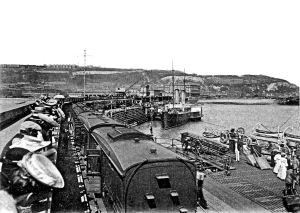
Admiralty Pier railway line and the 26068 circa1907. Nick Catford c1907

Admiralty Pier railway line circa1907. Nick Catford

In 1907 it was agreed by DHB to surrender the east side of the Prince of Wales Pier for use by the Admiralty in order to widen the Admiralty Pier and build a Marine Station for the Continental packets ships and cruise liners. The Admiralty Pier extension had been completed by 7 October 1908 and at the head a steel lighthouse was constructed. This was from an earlier design by Richard Hodson (1831-1890), the Chief Engineer of the Thames Ironworks and Shipbuilding Company that had made the steam engines for the Admiralty Pier Turret. The contract for the widening of the old part of Admiralty Pier for the new railway station was given to Messrs Pearson and Son and signed on 14 May 1909. The contract price was £439,447 and the whole project was estimated to cost £600,000 using plans drawn up by DHB engineer Arthur Thomas Walmisley (1848-1923) with consulting engineer Arthur Cameron Hurtzig (1853-1915).

At the same time as Messrs Pearson and Son were given the widening of the Pier for the new station contract, they were given a contract to erect a temporary landing stage on the Admiralty Pier extension. The framework was open pile and to meet changes in tidal levels a two-tiered landing stage was attached. The landing stage was roofed, 20-feet wide by 800-feet long and principally designed for cruise liners. To minimise the disturbance to the cross-Channel passage services, two of the five berths on the original Pier were to be kept open until the landing stage was finished when one was to be demolished. The other berth was to be demolished when the berth was operational.
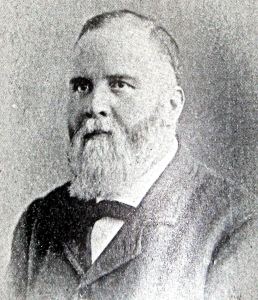
E Worsfold Mowll Register of Dover Harbour Board. Dover Library

E Worsfold Mowll, Register of Dover Harbour Board. Dover Library

In order to pay for the projects DHB re-issued all its stock plus, on 11 July 1909, additional stock with an interest rate of 3.75%. To raise the income necessary to meet the interest payments and to go towards a sinking fund on a further loan of £1m, they applied to Parliament for an increase in the Passenger Tax. The passenger tax was 2shillings and 6pence (12½pence) and increased by 1shilling (5pence) on each Channel passenger embarking and disembarking. The interest on the £1m loan was agreed at 4% and the sinking fund 2½%. Worsfold Mowll, the DHB Register, giving evidence to a House of Commons selective committee, said that over above the individual Passenger Tax, 5shillings was received by DHB for every train that went onto the Admiralty Pier and £1 for every ship that tied up alongside. Both the increased Passenger Tax and the loans were agreed under section 27 of the 1906 Dover Harbour (Works etc.) Act.

Before work started on widening the Pier, South Eastern and Chatham Railway (SECR)obtained the lease from DHB for that part of the Pier at a nominal rent of £10 a year for 99 years but were responsible for building the new station. Work started on the widening  on 5 July 1909 but on advice from DHB, Pearson’s initially concentrated on building the landing stage on the Pier extension. By the end of 1909, railway lines connected the landing stage and further down the Pier an oil tank was erected by the Admiralty, similar to the oil installations  at the Eastern Dockyard. It could hold 110-tons of oil.
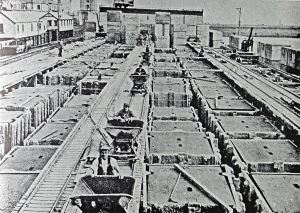
Block making on Shakespeare Beach circa 1900. Courtesy of DHB

Block making at Shakespeare Beach circa 1900. Courtesy of DHB

The area to be reclaimed for the widening was 11.3 acres and Pearson’s made concrete blocks at Shakespeare beach, in the same way as the blocks had been made for the major construction of the Pier (see Admiralty Pier part I). Huon Pine was brought from Dover, Tasmania (see Transportation Story), to provide the timber staging. For the 2,260-feet sea wall each pile were placed 40-feet apart and driven into the seabed using a cantilever pile driver. On these, staging was erected and rails were laid for Goliath cranes, that lowered the concrete blocks into place. Titan cranes later replaced the Goliath cranes.
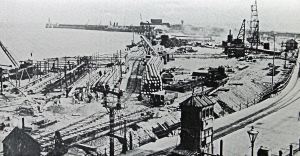
Admiralty Pier during widening for the Marine Station circa 1912. Dover Harbour Board.

Admiralty Pier during widening for the Marine Station circa 1910. Dover Harbour Board.

The building of the sea wall required the relatively soft seabed to be removed. This was done using mechanical diggers lowered either by Goliaths or a floating crane. The excavated material was put into barges and dumped at sea. Workmen, in diving bells suspended from the Goliaths, levelled the seabed prior to laying the concrete blocks. As before, they were lowered by the Goliaths and set into position by divers. The wall had to stand by itself until in-filled so the base width was half its height. Once the 2,260-feet sea wall was constructed, infilling progressed by use of 1 million cubic yards of chalk brought from East Cliff. At the base of East Cliff, railway lines were laid to transport the chalk to Castle Jetty where it was loaded onto barges and taken to the Pier. The excavations at East Cliff served a dual purpose as a road was formed from the excavations that was to be the approach from Dover to a new exclusive residential estate at South Foreland, St Margaret’s(see Dover, St Margaret’s and Martin Railway Part I). By the end of 1909 over 500feet of staging for the widening had been built.

To meet Admiralty requirements, a 6-feet high 4½-feet conduit to carry electric cables to the new station was constructed. This was from the Lord Warden Hotel to the seaward end of the reclaimed area but an unexpected difficulty was encountered. When the original Admiralty Pier was constructed this was from Cheeseman’s Head, where an ancient jetty had stood. It had been assumed that the jetty was demolished when the Pier was built in the mid-19th century. In fact the Cheeseman’s Head jetty had served as a foundation and was in a poor state. This had to be demolished and new foundations for the Pier laid before the required conduit could be constructed.
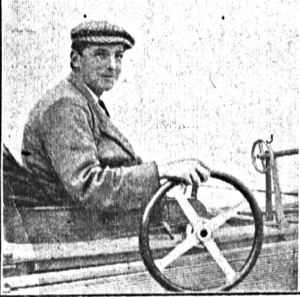
Hubert Latham - Sunday Graphic 01 July1909. Dover Museum

Hubert Latham – Sunday Graphic 01 July 1909. Dover Museum

All work stopped on 10 July 1909 when Hubert Latham (1883-1912) was expected to make the first crossing of the Channel by aeroplane. He was expected to land on Ropewalk Meadow, Aycliffe but only ticket holders were to be allowed into the intended-landing place. Therefore, DHB opened up the Pier allowing free access to the 2,000-feet long extension, together with the upper promenade of the original Pier. On the day, although it was blustery the Pier was packed but due to the strong winds Latham did not make the flight. He again attempted to make the flight on 27 July and free access to Admiralty Pier was once again available. Although crowded, work did not stop this time, though it probably did when sightseers saw Latham’s aircraft approaching. It came from a south-easterly direction and looked like an enormous seagull but to the sightseers  did not seem high enough to clear the cliffs. Latham brought the machine round and tried to gain height but then dipped and dropped into the sea. The aeroplane struck the water just off the Pier extension and several ships and boats went to the rescue. Louis Blériot (1872-1936) had made the first successful crossing two days earlier on 25 July.
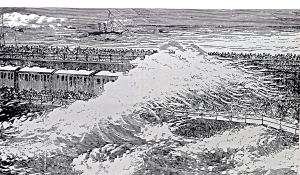
Admiralty Pier on a rough day from the Illustrated London News. Dover Library

Admiralty Pier on a rough day from the Illustrated London News. Dover Library

The weather and the western entrance to the harbour remained a problem. In February 1910 storms had damaged many of the temporary buildings erected for the widening of the Pier. When similar weather condition prevailed on 7 October 1909, the Brigantine Osprey, was unable to make it through the western entrance and tried to get alongside the west side of the Pier, where a landing stage had been erected. She was wrecked with the loss of all but three of the crew. Coastguard Maurice Miller, wearing a lifeline, managed to get on board the wreck, erect a breeches buoy and rescued the three. For this he was awarded a Board of Trade Medal for gallantry for saving life at sea. For a time, during such weather, some packet ships had been diverted to Folkestone while other cross Channel and cruise services were directed through the eastern entrance to berth alongside the Prince of Wales Pier. On some days there were so many ships trying to get alongside that Pier they were forced to tie up two abreast and delays were frequent.
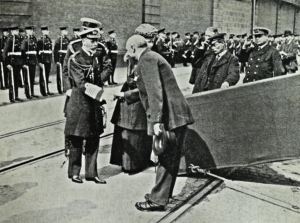
Edward VII shaking hands with Harbour Master John Iron Admiralty Pier March 1910 before leaving for Biarritz. David Iron Collection

Edward VII shaking hands with Harbour Master John Iron Admiralty Pier March 1910 before leaving for Biarritz. David Iron Collection

On March 1910, while on his annual trip to Biarritz, France, Edward VII (1901-1910) collapsed and on 27 April returned to England by way of Dover. He was met by Harbour Master, John Iron (1858-1944), who wrote that the King did not appear at all well. Edward VII’s health continued to deteriorate and on 5 May, the Queen consort Alexandra (1844-1925) returned from Corfu, Greece, by way of Dover. The following day the King died. More than 50 ruling monarchs, crown princes, special envoys and ambassadors landed at the Pier to board special trains to take them to the funeral. King George V and Queen consort Mary’s coronation took place on 22 June 1911 and again the Admiralty Pier and special trains were in demand. Although packet ships had been using the new landing berth on the Pier extension for the coronation and the weeks after, it was not until 1 November that an official berthing trial took place. This was successful and in his speech after the ceremony, the Chairman of DHB, Sir William Crundall, said that with a depth at low water of 43-feet he expected that about 20 cruise liners a month would be tying up at Dover!

From 1890, Germany, under Wilhelm II (1888-1918), had been pursuing a massive naval expansion. It was this that had galvanised the British government into building the Admiralty Harbour as a base for the Royal Navy. In July 1911, Germany sent her gunboat Panther to Agadir, Morocco, supposedly to protect the country’s firms even though the port was closed to nonMoroccan businesses. The Admiralty reacted by, amongst other things, ordering the Camber, at the Eastern Dockyard, to be deepened, increasing the oil storage facilities there as well as converting Langdon prison, on the Eastern cliffs, into a Naval Barracks.
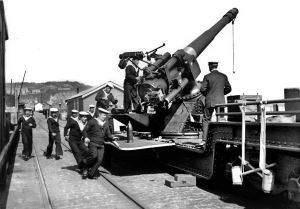
One of the Admiralty Pier Turret 6-inch MK VIIs guns mounted on the top. Nick Catford

One of the Admiralty Pier Turret’s 6-inch MK VIIs guns mounted on the Pier. Nick Catford

Already, both the western and eastern entrances were equipped with a boom defence and a fort built at the head of the Admiralty was designated Pier Turret Battery. Further construction took place with two 6-inch MK VIIs guns mounted on the Pier. The new fortifications were armed with a mixture of breech-loading medium and light quick-firing guns that were mounted in concrete emplacements. Searchlights, barracks and magazines were erected, the sites of some still survive. However, the searchlights were a hazard to ships approaching or negotiating port entrances. Captain Dixon, the cross-Channel Marine Superintendent made representations to the military authorities who agreed to extinguish the lights when a warning blast was given by a ship. Unfortunately, these blasts were not always heard so it was agreed that ships would instead use flares.

The infilling for the new station was completed in February 1913 and was strengthened by over 100 ferro-concrete octagon shaped piles, 17-inches across the top with a cast iron shoe, driven through to the old seabed underneath the infilling. The piles varied in length, up to 62-feet and were driven into position by a 42-hundredweight (2.1 tons) monkey falling a distance of 4-feet 6-inches. The project had cost £375,000 and on 2 April 1913 Sir William Crundall laid the final stone. Following the ceremony Mr Moir, managing director of Pearsons, informed all those who had worked on the project they would be granted an extra days pay.
Marine Station with adjacent berths plan. May 1910

Marine Station with adjacent berths plan. May 1910

In the spring of 1912 tenders were invited for building the Marine Station, but as the projected prices were considerably in excess of estimates SECR had made, the company did not accept any tender and decided to build the station themselves. Sir Percy Crosland Tempest (1861-1924) designed the new station with four railway tracks and two island platforms, 700-feet long and 60-feet wide. The platforms were to have duplicate refreshment rooms and waiting rooms each 100-feet in length a general office and a post office. The edifice was to be topped with a 770-feet long braced arch roof. Adjacent there were to be berths for four cross-Channel steamers the access to which was to be made through covered walkways. The deep-water landing stage was to be 780-feet long and 20-feet wide with lower decks opposite to the centre of the vessels.
Building of Marine Station 15.11.1913. Dover Museum

Building of Marine Station 15.11.1913. Dover Museum

On 24 May 1912, the Pilots gave up the Pilots Tower so that it could be demolished in order for a double set of railway lines to be laid to the new station. The tower was demolished in 1914 by which time the Pilots had bought and moved into No.1 the Esplanade. Work started on building the station and the contract for the piling was given to Considère Construction Company of Westminster. They used 1,300 x 18-inch piles along the whole length of the reclaimed area. The piles ranged from 38-feet to 72-feet long, ranged each side in groups of two and four to carry the foundations of the outside walls. A further 1,200 heavy piles were driven at the shoreward end of the site to carry the foundations of the station entrance and groups of piling were driven in for the various station buildings. Connecting ferro-concrete slabs were laid on the top of the piles along the whole length of the station wall foundations. Concrete rafts were provided for the station buildings. SECR’s usual contractor for such purposes, Messrs W E Blake Ltd of Fulham, built the walls and platforms for the station.
Admiralty Pier - Entrance steps were divided, the left took passengers to Marine Station, right to the Pier. Alan Sencicle 2015

Admiralty Pier – Entrance steps were divided, the left took passengers to Marine Station, right to the Pier walk.              Alan Sencicle 2015

By April 1913 work on the new station was progressing well with the Butterley Iron and Steel Company, Ripley, Derbyshire providing and erecting the steel framework. The depth of water for the berths was given as 16-feet at low water of spring tides and a coaling berth was in the course of construction. At each of the passenger berths, awnings extending as far as possible across the quay towards the ships were about to be erected. Access to and from the station was by steps on the opposite side of the road to the Lord Warden Hotel. The left side took passengers to the station, by the means of a footbridge, the right to the Admiralty Pier public promenade. The latter was reopened at Easter but was closed again on 1 October for the winter.

There had been several tests to assess the suitability of Dover harbour for the Atlantic fleet between 1909 and 1913 with special reference to the problems of entering the western entrance and the uncomfortable and sometimes difficult mooring conditions. These were found to be caused by opposing tidal surges rushing simultaneously through both harbour entrances creating cross currents. For this reason and in order to take submarines, the Camber had been deepened at the Eastern dockyard. With the widening of the Pier a further problem had become apparent, it exacerbated the sea swell along the entire length during heavy weather. At Rosyth on the Firth of Forth, Scotland, the Admiralty were building a much larger naval base and Vice-Admiral of the Fleet Prince Louis Alexander Mountbatten (1854-1921), announced that Dover would be a station for submarines based in the Camber and destroyers.
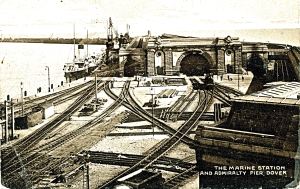
Admiralty Pier - the laying of track to the new Marine Station. Dover Museum

Admiralty Pier – the laying of track to the new Marine Station. Dover Museum

The stone front of the Marine station and the brick walls were completed in the early months of 1914 and the approach from what was planned to be a Viaduct access to the station was completed. By the end of July 1914, all of the building work of the Station was finished but on Saturday 1 August, Germany declared war on Russia, invaded Luxembourg and crossed the French frontier at several points. Ferries were crossing the Channel as often and as fast as they could, endeavouring to bring back home as many folk from France as possible. Winston Churchill, the First Lord of the Admiralty, issued the order to mobilize the Royal Navy on a war basis and aboard destroyers, moored in the harbour, crews were engaged in getting rid of all surplus woodwork in preparation for action.

As Germany moved into Belgium, Belgian refugees started to arrive, at first on ferries then on all kinds of craft. One night the Belgium Queen Elisabeth (1876-1965) and her three children arrived at the Pier incognito. Earlier the moveable assets of the state bank had arrived and were quickly taken to the Bank of England in London. The British Prime Minister (1908 to 1916), Herbert Asquith (1852-1928) and French Prime Minister (1914-1915) René Viviani (1863-1925), with Sir John French (1852-1925), who was appointed the Commander of the British Expeditionary Force on 30 July 1914, and Lord Herbert Kitchener (1850-1916) Secretary of State for War, with others dined on board a British cruiser moored to the Admiralty Pier to discuss the events.
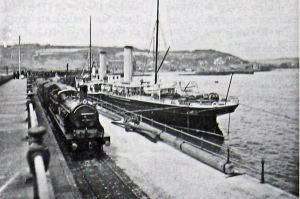
Marie Henrietta the nearest ship along side Admiralty Pier circa 1899. Bob Hollingsbee Collection Dover Museum

Marie Henrietta the nearest ship alongside Admiralty Pier circa 1899. Bob Hollingsbee Collection Dover Museum

At 14.30hrs on Sunday 2 August the Marie Henrietta tied up at the Pier having come from Ostend with 1,122 passengers on board. At 19.30hrs the Princesse Clementine arrived with a further 1,400 passengers from Belgium. That evening the Admiralty mobilised all the Fleet and at 19.00hrs, as the warships left the harbour, the Special Service section of the Cinque Ports Territorial Force arrived to operated the Coast Defence Searchlights at the Pier Turret Battery. At about the same time the first aeroplanes arrived at the Swingate military ‘aeroplane station.’
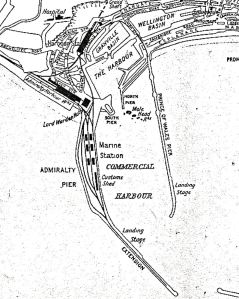
Admiralty Pier map showing the new Marine station and the landing stage

Admiralty Pier map showing the new Marine station and the landing stage

By Bank Holiday Monday, 3 August, it was clear that only a miracle could avert Britain being drawn into the conflict. At 03.00hrs, a telegram was sent to Southsea Castle ordering the Dover Unit of the Cinque Ports Territorial Force of Royal Engineers to return at once to help man the Pier Turret Battery. George V issued a Royal Proclamation calling up the Royal Navy Reserve, Royal Fleet Reserve and Officers and Men of the Royal Naval Volunteer Reserve.

The packed SECR ferry, Engadine, arrived from Calais and tied up on Admiralty Pier at 08.00hrs following which all Channel traffic from France was transferred to Folkestone. The Pier and the Marine station were then commandeered by the Admiralty and guarded by sentries. The last passenger ship to arrive at Admiralty Pier from Belgium was the steamer Rapide on Tuesday 4 August at 02.10hrs with 893 passengers on board. She left at 15.30hrs that afternoon for Ostend with six passengers, by which time Germany had declared war on Belgium. At 23.00hrs on 4 August 1914 Britain declared war on Germany in accordance with the written obligation of 1839 to uphold the neutrality of Belgium. World War I (1914-1918) had began and Dover became Fortress Dover (see World War I – the Outbreak).
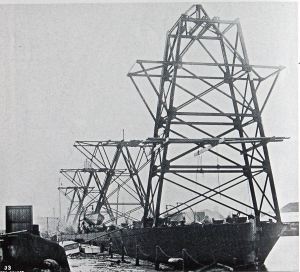
Spanish Prince being converted into a blockship, sunk March 1915. Alan Sencicle Collection

Spanish Prince being converted into a blockship, sunk March 1915. Alan Sencicle Collection

Both the western and eastern harbour entrances were already equipped with a boom defence and forts had been built on Admiralty Pier, the Eastern Arm and the Southern Breakwater to prevent enemy ships and submarines entering. It was believed, however, that the greatest threat to shipping would come from torpedoes fired from outside the western entrance. The quickest, cheapest and most effective way to block the entrance was to fill old ships with shingle and sink them across it. Initially the Livonian and the Montrose were chosen but the Montrose broke from her Admiralty Pier moorings, sailed out of the harbour and came to rest on the Goodwin Sands. She was replaced by the Spanish Prince.

Fortress Dover included the town and the entrance and exit was subject to restrictions as well as everyday aspects. These included the banning of street and harbour lighting, the result of which were fatalities from drowning. To combat this the whole of the dock area was surrounded by wire fencing, which reduced fatalities but made access, even in an emergency, difficult. In the Channel the first German submarines appeared around the middle of September 1914, sinking the Aboukir, Hogue and Cressy, off Zeebrugge and the Dover Patrol was formed to defend the Strait of Dover. The work of the Patrol made the Naval Port of Dover the second most important Naval base in the British Isles. The port was also the base for the naval attacks on the enemy occupied Belgian coast and was designated the Homeport for ambulance ships.
First Expeditionary Force on the way to the front from Admiralty Pier - note the canopy. Doyle Collection

First Expeditionary Force on the way to the front from Admiralty Pier – note the canopy. Doyle Collection

The demand on the station at Admiralty Pier and the quays increased dramatically as troops arrived by train and embarked for the Western Front. Those from camps nearer Dover, marched to the Pier, often through villages and streets lined with cheering spectators. The first of the thousands of troops to leave the Pier for France were the British Expeditionary Force under the command of Sir John French. He departed for the Front on 14 August from Admiralty Pier aboard the Sentinel.

It was not long after, the first of the wounded arrived at the Pier and on disembarkation were sent by train to hospitals further a field. On 10 December 1914 the Pier Turret Battery had their ‘first major encounter with the enemy’, when, at 05.30hrs a searchlight reflected off what was believed to be a submarine periscope and they opened fire. The Batteries along the Southern Breakwater took up the firing and the ‘periscope’ disappeared. It was later reported that four submarines had been seen, that two had sunk and the other two disabled. However, this was later shown to be the product of fertile imaginations and that no one was even sure if a periscope had actually been seen!
The injured walking and lying along the Menin Road following the Battle of 20-25 September 1917. Doyle Collection

The injured walking and lying along the Menin Road following the Battle of 20-25 September 1917. Doyle Collection

Albeit, the berths on the Admiralty Pier were increasingly being used by hospital ships. The first hospital ships had been commandeered from the Great Western Railway Company’s Fishguard-Rosslare route. As more wounded arrived from the Western Front, pressure was mounted to complete Marine Station and from 2 January 1915 the station and the quays became the country’s main receiving hospital for the men wounded at the Front. Because of the nature of the arms being used it was expected that casualty rates would be high but the sheer number of maimed and injured men exceeded all expectations. At the Front the Royal Army Medical Corps, the Red Cross and the various medical and nursing organisations provided a high level of care. If a casualty survived the battlefield he would have a good chance of making it to Dover. In towns and cities throughout the country the number of hospitals proliferated with many commandeered buildings becoming centres of medical excellence such that the survival rate was high.

Marine Station, Medical symbol in recognition of the role the station played during World War I. Alan Sencicle

Marine Station. Medical symbol in recognition of the role the station played during World War I. Alan Sencicle 2015

As the War progressed more ships and large yachts were commandeered as hospital vessels. During the Battle of Loos in 1915 and the offensives of 1917 and 1918 the number of hospital ships arriving at the Pier and the trains leaving for hospitals elsewhere, increased dramatically. However, it was the Battle of the Somme (1 July to 18 November 1916) that the through-put of the wounded was at its highest. Up to nine hospital ships arrived each day and trains were continuously leaving Marine Station for London, packed with the injured, 24hours a day over a three day period. Those too ill to travel were taken to the Military Hospitals on Western Heights, Castlemount and elsewhere in the town. The Town Station was turned into a mortuary. On the façade of Marine Station – now Cruise Terminal One – are medical symbols especially carved as a tribute to the station’s role during World War I.

The Town Station could be used as a mortuary for on 19 December 1915 a massive landslide along the Warren, between Dover and Folkestone, blocked a mile of railway track. SECR, after consultation with the Board of Trade decided that the blockage could not be removed during the War and for the remainder the Admiralty used the Archcliffe and Shakespeare Cliff tunnels to store mines and shells for locally based warships. Trains in and out of Dover to London used the Canterbury line and due to an increasing number of ambulance trains and military trains the effects of wear and tear were causing delays. It was not until 11 August 1919 that the Folkestone line reopened. The advance of the German armies in Flanders in 1918, proved threatening and an attack on Dover was felt to be imminent. Infantry detachments were deployed at all times on the Breakwater and the shore at the foot of the piers. Trench mortars and machine-guns were fixed at every vital point including along the Admiralty Pier.

The War ended on 11 November 1918, Armistice Day, and on 27 November, King George V, Edward Prince of Wales and Prince Albert ( later George VI 1936-1952) arrived at Marine Station at 11.20hrs. Ten minutes later they boarded the Broke to be taken to Boulogne where they met Field Marshal Sir Douglas Haig (1861-1928), before going onto Paris. In December the Field Marshal and a party of his Generals disembarked from the Termagant at the Eastern Dockyard and were transported to the Admiralty Pier station. Lining the route were Dover’s school children and at the station a civic address was presented by Mayor Fairley before the party boarded the 11.00hrs train to London. Over the next year a number of other very senior military personnel returned by way of Dover and were given a welcome appropriate to their status. These included Field Marshal General Sir Edmund Allenby (1861-1936) and the American General John ‘Black Jack’ Pershing (1860-1948).
The arrival of American President Woodrow Wilson at Admiralty Pier on 26 December 1918. Dover Museum

The arrival of American President Woodrow Wilson at Admiralty Pier on 26 December 1918. Dover Museum

One of the most tumultuous welcomes was given to the American President Thomas Woodrow Wilson (1856-1924) and his wife Edith (1872-1961), who arrived from Calais at Admiralty Pier on the Brighton passenger steamer on 26 December 1918. This was the first visit to Britain by a US president while still in office and their ship had been escorted by the Termagant, six destroyers and a flotilla of other ships. Circling above, were British and French aeroplanes and on entering the harbour a Royal salute was fired from the Castle. At the Pier the East Kent Regiment provided a guard of honour and Prince Arthur, Duke of Connaught (1850-1942), and Vice-Admiral Sir Roger Keyes (1872-1945) welcomed the President and his wife. Also on the quay were other dignitaries included officials from both Britain and the US plus Mayor Farley of Dover and other councillors. As the distinguished couple walked to the Marine Station a group of Dover school girls, wearing ‘Stars and Stripes’ dresses, strew roses in their path. At the station, Sir Archibald Bodkin (1862–1957), Dover’s Recorder, read an address emphasising the part America had played during the War. The President replied by thanking Dover for the part the town played and this was met with a resounding applause. Then the Presidential party left for London.
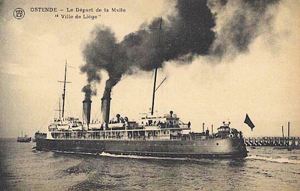
The first ship to leave Admiralty Pier for Ostend was the Ville de Liege on 18 January 1919

The first ship to leave Admiralty Pier for Ostend was the Ville de Liege on 18 January 1919

Although the War was over, the harbour was still in the hands of the Admiralty but the Commercial Harbour was managed by DHB. They had to deal with, at the best, years of neglect and at the worst, adaptations to the harbour that were not relevant to a passenger port. To make matters worse, they were £1m in debt from pre-war loans. On 18 December 1918, a few of the restrictions on civilian crossings to France were lifted but due to the devastation on the Continent travelling there was difficult. Civilian crossings to Belgium resumed on 18 January 1919 when a channel at Ostend harbour was cleared following the destruction and the partial blocking by the Dover Patrol on 10 May 1918. The first ship on that crossing, the Ville de Liege departed from the Admiralty Pier. Two days later the remaining restrictions on the crossings to Calais and Boulogne were lifted. However, naval ships in the process of being repaired occupied the majority of the Pier berths.

Returning soldiers from Europe were billeted in rest camps around the town while awaiting demobilisation but the paperwork took time. In January 1919 a large group of War tired servicemen marched to the Town Hall (now Maison Dieu) demanding to be allowed to go home and more personnel were drafted in to help with the paperwork. Then, on 12 June 1919, 200 soldiers of the Black Watch Regiment billeted in the Oil Mills on Limekiln Street, still awaiting demobilisation, were marched to Admiralty Pier. On arrival, they were told that they were to embark for France to help in clearing up operations. The men, without any fuss, did an about-turn and marched back to the Oil Mills. Shortly after they too were demobbed!
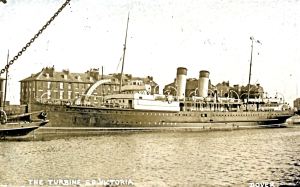
Victoria one of the cross-Channel ships commandeered for War service that following a refit was returned to Dover in January 1919. Dover Museum

Victoria, one of the cross-Channel ships commandeered for War service. Following a refit she was returned to Dover in January 1919. Dover Museum

The British cross-Channel ships returned to Dover in January 1919, after refitting. All had been commandeered for war service and the first to return was the screw turbine steamers Invicta (II) launched in 1905 and the Victoria (II) launched in 1907. By the summer season of 1920, the number of passengers using the cross Channel services had almost returned to the pre-War level. This provided the much needed passenger tax revenue for DHB. In one week in March, 8,598 people crossed the Channel netting £644 passenger tax. That year Dover Corporation applied to extend the Borough boundaries to include all Dover Piers and was the subject of an Inquiry in March. This led to a High Court case before Mr Justice Darling later that month, when Marine Station was asked to be included in the Parish of Dover and was granted. DHB went to the Court of Appeal but lost.
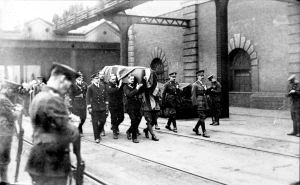
Arrival of the Unknown Warrior at Admiralty Pier on 10 November 1920. Dover Mercury

Arrival of the Unknown Warrior at Admiralty Pier on 10 November 1920. East Kent Mercury

Following the first Armistice Day in 1918, the idea of interring, in Westminster Abbey, one of those who had been killed during the War but whose identity had been lost was born. This developed into honouring all the 908,000 servicemen who had lost their lives. On 10 November 1920, the body of the Unknown Warrior was brought across the Channel in the British warship, Verdun. The oak coffin was provided by the Undertakers Association and draped with the Union Jack. On Admiralty Pier were dignities representing Royalty, the Armed Services and the Church as well as the Mayor and Councillors of Dover. As the coffin was carried from the ship the Royal Fusiliers Band played Elgar’s Land of Hope and Glory and all were visibly moved. The coffin was then transferred, with great ceremony, into the waiting SECR passenger luggage van number 132. Surrounded by uniformed servicemen standing at attention. It was taken to London and then to Westminster Abbey, where the Unknown Soldier was finally laid to rest.
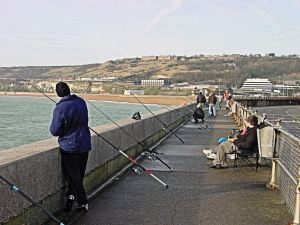
Admiralty Pier promanade still as popular as it was in the 1920s Alan Sencicle

Admiralty Pier promanade still as popular as it was in the 1920s Alan Sencicle

The fine weather of the summer 1921 brought a large number of visitors to Dover and on 19 July the full length of the promenade on the Admiralty Pier was opened. This proved the most popular of the tourist attractions that summer. Regrouping of the many of British private railway companies took place on 1 January 1923 and Southern Railway came into operation. This included the two railway companies that served Dover, which had semi-amalgamated in 1899 to form the South Eastern and Chatham Railway Companies Management Committee.
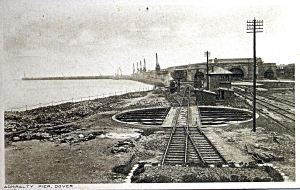
Admiralty Pier railway turn table prior to demolition in March 1935. Dover Library

Admiralty Pier railway turn table prior to demolition in March 1935. Dover Library

On 24 June 1923, at a meeting with Dover Corporation, Southern Railway announced that they planned a new engine depot, marshalling yards, goods yard and the rebuilding of the Customs sheds on the West Quay on Admiralty Pier, near Marine Station. The highly controversial Viaduct, which had been the main reason for the demolition of much of the maritime Pier District, opened in 1922. The Limekiln Street bridge opened in June 1923 and the level crossings at both Elizabeth Street and the Crosswall closed making access to the Marine Station and Admiralty Pier smoother for the road user. To widen access for the motorist, in March 1935, the railway engine turntable near the Admiralty Pier gates was demolished and a new one built close to Shakespeare Beach.

After protracted negotiations on 9 September 1923, the Admiralty Harbour was transferred by Act of Parliament to DHB, with the Admiralty retaining some rights. The most important was that should the Defence of the Realm create the necessity, the harbour, without compensation, was to revert to the Admiralty. Although the Marine Station had opened the station on the Pier extension was still in use but in October, a violent south-westerly gale almost swept a train off the Pier overturning one carriage and smashing windows in others. Three members of the King’s Dragoon Guards were severely injured and two porters suffered broken bones.
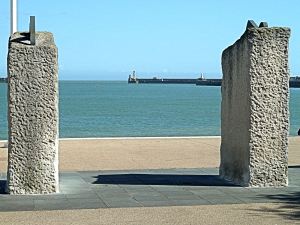
Twin 'Crest of a Wave' sculptures by Ray Smith on Dover seafront looking towards the western entrance and on the right Prince of Wales Pier. Alan Sencicle

Twin ‘Crest of a Wave’ sculptures by Ray Smith on Dover seafront looking towards the western entrance and on the right the Prince of Wales Pier. Alan Sencicle

The problems with the western entrance and the uncomfortable and sometimes difficult mooring conditions within the harbour remained a problem. In November 1925, DHB sort for an Act of Parliament to permanently close the western entrance. They argued that closure would give smooth water and would do much to shelter the Marine Station in easterly gales. Further, a survey of the harbour had shown that the Eastward Drift – the deposit of shingle brought by tidal flows from the west – was shallowing the Harbour. Further, the shingle came in almost entirely through the western entrance. The Admiralty opposed the Harbour Board Bill in Parliament, arguing that it was essential for the Navy to have two entrances in the harbour, making reference to the caveats within the Act of 1923. Parliament, however, gave greater weight to Dover being a commercial port and the Bill became as Act. However, experiments using a model showed that closing the western entrance would create more problems than already existed and so the project was abandoned.
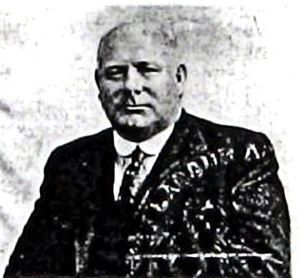
 Jack Elks (1885-1950) Kent Coalminers Leader

Jack Elks (1885-1950) Kent Coalminers Leader

The General Strike began on Monday 3 May 1926 and the Dover Central Strike Committee was formed under the leadership of the Kent Miner’s secretary, Jack Elks (1885-1950). The railway, including shipping services to the Continent, stopped and also at the Packet Yard, where ship repairs took place. By the end of the second day most workers in other Dover industries were on strike. On Wednesday, just after midday, the strike was being called off and on the Friday a national railway settlement led to a partial resumption of national services. In Dover, Southern Railway resumed its full rail and shipping services but the miners remained on strike. Coal shortages led to the passage crossings cut to one English ship, one French ship and one Ostend ship daily.

At the beginning of the strike Southern Railway had arranged for imports of American coal if necessary. They put this into operation and the Danish steamer Nordkap arrived on 17 June with 5,000tons of coal that was discharged directly into railway trucks on Admiralty Pier. Coal shipments then arrived regularly, long after the miners returned to work at the end of the year. On several occasions there were two trans-Atlantic coal ships discharging coal at the same time and the amount of coal landed was approximately a quarter of a million tons. This enabled the Southern Railway to run all its summer rail and cross-Channel services that year. However, one of the berths on Admiralty Pier was badly damaged on 22 June when one of the coal carrying ships, Blythmoor struck and badly damaged the landing stage. The ship’s hawse-pipe was damaged and the bow plates stoved in.

In the early 1920s, James Ryeland of George Hammond persuaded the Royal Netherlands Steamship Company to call in at Dover on their way to and from the Caribbean and South America. Instead of berthing on Admiralty Pier the cruise company embarked and disembarked their passengers by tender in the outer harbour. The Hamburg-Amerika Line Toledo called on 1 December 1924 on her way from Germany to South America and did tie up on Admiralty pier. However, due to the poor state of the harbour and the facilities available the Toledo only made a few more calls before moving to Southampton.
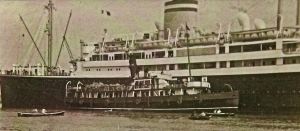
Hamburg -America Liner Patria with tender Lady Saville late 1930s. David Ryeland

Hamburg-America Liner Patria with tender Lady Saville late 1930s. David Ryeland

By 1927 the Royal Netherlands Steamship Company’s smaller ships were calling at Dover every two weeks and on 26 March that year their new and largest vessel Simon Bolivar, docked at Admiralty Pier. James Ryeland and the Mayor, Captain Thomas Bodley Scott R.N., welcomed her. Later that year Dover became a port of call for the company’s liner Surinam, that went to South America and then onto New York and their new steamer the Cettica made an initial call. Although other shipping lines started to use Dover as a port of call, with some mooring alongside the Prince of Wales Pier, the general preference was to moor in the outer harbour. In 1931 DHB purchased the Penlec, a liner tender from the Great Western Railway Company, to help with the transfer of passengers and supplies. She was joined by the Lady Saville when the cruise liner service picked up in the middle 1930s.

In July 1928, Captain Stuart Townsend chartered the 386-ton coastal collier Artificer and from the Eastern Dockyard operated a car-carrying cross-Channel service between Dover and Calais. This was primarily for passengers with motorcars with the cars being loaded by crane. Southern Railway were already operating a car carrying service from the Admiralty Pier and again, cars were loaded by crane. Albeit, in response to the Townsend operations they launched, in 1931, the Autocarrier. She was originally designed to be a cargo ship but was altered to carry cars as the Railway Company’s first designated cross-Channel car-carrying ferry.
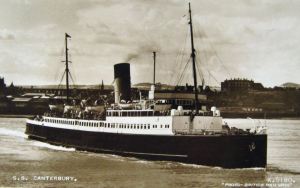
Canterbury. Alan Sencicle collection

Canterbury. Alan Sencicle collection

The first contingent of troops from the occupied Rhineland disembarked on Admiralty Pier on 24 September 1929. Although an official welcoming party had not been arranged, Dover folk turned out and gave a rousing welcome. The Seaforth Highlanders based in Dover were also there and played lively Scottish airs before the contingent boarded a special train taking them to Catterick, north Yorkshire. Three months earlier, in May 1929 the Golden Arrow train service was introduced between London and Dover and at Admiralty Pier the last word in pre-War luxury, the 2,910 gross-ton Canterbury launched in 1928, was waiting to take passengers across the Channel to France.

In 1930, DHB invited tenders to remove the World War I blockships close to the Admiralty Pier and the western entrance. The Harbour Master and salvage expert, John Iron, was given the job and planned to remove the gantries and then pump out the ballast to raise the ships and take them to the Eastern Dockyard for scrapping. The Livonian was lying nearest to Admiralty Pier so she was dealt with first. The work started at the end of February 1931 and the site was finally cleared on 6 May 1933. The project was fraught with danger so it was decided, after removing the gantries, to leave the Spanish Prince where she lay. Later, during a gale, the Spanish Prince shifted position and became less of a hazard.
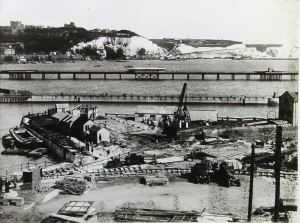
Train Ferry Dock underconstruction. Dover Library

Train Ferry Dock underconstruction. Dover Library

Work started in August 1933 on a Train-Ferry dock  at the base of Admiralty Pier. The specifications for a concrete dock 414-feet long and 72-feet wide, with a minimum depth of water of 17-feet to a maximum of 36-feet, were drawn up by George Elson, Chief Engineer of Southern Railway. John Mowlem & Co along with Edmund Nuttal, Sons & Co were given the construction contract. The Gates were made by William Arrol & Co – leading Scottish civil engineers, and worked on horizontal hinges fixed below the dock sill. Two rail-lines were laid to connect the dock to the main rail-line with William Arrol & Co erecting a link span to connect the railway lines to the ships. The whole project cost £231,000.
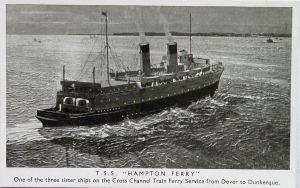
Hampton Ferry. Dover Library

Hampton Ferry. Dover Library

Southern Railway ordered three ferries built by Swan, Hunter & Wigham Richardson, Newcastle-on-Tyne. They were the Twickenham, Hampton and Shepperton each 2,839 tons, length was 359-foot; 63-foot 9-inch beam and 12-foot 6-inches draft. Coal-fired and with a service speed of 16 knots, each ship was designed to take 12 sleeping cars and 500 passengers or approximately 40 goods wagons. The formal crossing was on Monday 12 October 1936 when trains were shunted aboard the Hampton and at the helm was Captain Len Payne. Distinguished guests included he Home Secretary – John Allsebrook Simon, 1st Viscount Simon (1873-1954), the French Ambassador, British and French railway officials and the Lord Warden of the Cinque Ports: Major Freeman Freeman-Thomas, 1st Marquess of Willingdon (1866-1941). The night service between London and Paris was officially inaugurated by the French Ambassador on 5 October 1936. The facilities for carrying motorcars was inaugurated on 28 June 1937 on a small floor (garage) above the train deck accommodating approximately 20 cars.

At the time that the Admiralty Pier extension was completed, a fog gun, or more correctly a detonator signal fired by electricity, was operated from the Pier lighthouse. In foggy weather the gun went off every two minutes but in February 1934, DHB issued a notice to mariners announcing that after 1 August that year the fog gun would be replaced by a diaphone fog signal sounding a blast of two seconds duration every 10seconds from the lighthouse. At the eastern end of the Southern Breakwater, an electrically operated bell giving one stroke every 7½seconds was sounded. A small diaphone on the Southern breakwater was already in existence and gave a 3second blast every 10 seconds.

From the mid-1930s the number of cross-Channel passengers and cars rapidly increased at the same time as the number of freight ships were increasing. Such was the situation, along Admiralty Pier, that ships were queuing to get alongside. Plans were made to increase the number of berths from eight and included using the Eastern Dockyard. The idea was given added impetus in January 1939 when Prime Minister (1937-1940) Neville Chamberlain (1869-1940) together with Foreign Secretary (1938-1940) Edward Wood, 1st Earl of Halifax (1881-1959), travelled through the port using the Golden Arrow service, for Rome. There they met Italian Prime Minister (1922-1943) Benito Mussolini (1883-1945) in order to persuade him not to become involved in any conflict. However, on 3 September 1939 when World War II (1939-1945) was declared, the Pier, along with the rest of the harbour, again come under the Admiralty as part of Fortress Dover
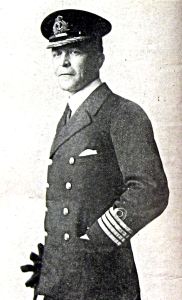
Captain Henry Percy Douglas naval officer specialised in surveying. Worked with Vice Admiral Roger Keyes in preparation for the Zeebrugge Raid. Chairman of DHB 1934-39

Captain Henry Percy Douglas naval officer who worked with Vice Admiral Roger Keyes in preparation for the Zeebrugge Raid. Chairman of DHB 1934-39 and buried at sea.

The final cross Channel ship to leave Dover and the Admiralty Pier was the Canterbury of the Golden Arrow Service. The port closed on 5 September. Shortly after the embarkation of the British Expeditionary Force to the Continent commenced. On the 7 November, Vice-Admiral Sir Henry Percy Douglas (1876-1939) who had resided in Dover and was the Chairman of the Dover Harbour Board (1934-1939), was buried at Sea, his cortége leaving from the Pier. Known as Sir Percy Douglas, he was a British naval officer who specialised in surveying and from April 1917 to January 1918, he worked with Vice Admiral Roger Keyes in preparation for the Zeebrugge and Ostend Raids.

Throughout the War, the officer responsible for co-ordinating all of Dover’s defences be they on land, sea or in the air was the Fortress Commander based at the Castle. Admiralty Pier Turret battery, as in World War I was based at the Turret with a second gun emplacement on the Pier extension. Initially railway carriages were brought in to provide accommodation for the personnel until new quarters were built. On the night of 28-29 November 1939, a cliff fall along the Warren blocked the railway line from Dover to London via Folkestone. A similar fall to that which blocked the line during the latter years of World War I. This time the blockage was cleared within five months. At about the same time, the Royal Navy requisitioned the two Train-Ferries Hampton and Shepperton for minelaying. Between December 1939 and May 1940, mines were laid in the Channel and southern North Sea by the two ferries working with two Royal Navy minelayers.

Although, during the inter-war period, the Admiralty had objected to the blocking of the western entrance. However, when taking command of the harbour, as they had in World War I, they decided to block the western entrance. The War Sepoy, a Z-Type tanker, built by William Grey and Co. of West Hartlepool under the WWI Standardised Shipbuilding Scheme was one of the ships used. She was 412-foot long, 52-foot beam and 5,800 tons gross and had been badly damaged in the harbour during an air raid on 19 July 1940. Beyond repair, she was filled with concrete and towed into position and sunk on 7 September. The steamer, Minnie de Larringa that had been sunk in the port of London by German bombing, was refloated, towed round to Dover and sunk in the western entrance on 5 February 1941.
Dunkirk 1940 Troops arriving in Dover having been evacuated. Doyle Collection.

Dunkirk 1940 Troops arriving in Dover having been evacuated. Doyle Collection.

On the Continent in May 1940 the French and Belgium ports fell to German onslaught and the British Expeditionary Force were forced onto the beaches of Dunkirk. Masterminded by Vice-Admiral Bertram Ramsay (1883-1945) Dover Fortress Commander launched Operation Dynamo or the Dunkirk Evacuation, as it is known. A fleet of 222 British naval vessels and 665 other craft, known later as the ‘Little Ships’, went to the rescue. Vice Admiral Ramsay, his dedicated staff, the rescue ships and their crews, the harbour officials, the Southern Railway staff, East Kent Road Car Company employees, and townspeople of every vocation, worked ceaselessly. Almost nine hundred vessels, some manned by civilian volunteers, began their epic task of plying to and fro across the Channel, loaded to the gunwales – far exceeding safety limits, with exhausted troops. Only the Admiralty Pier was deemed suitable for the intense disembarkation but throughout, with little room for manoeuvre, the two Dover Harbour Board tugs, Lady Duncannon and Lady Brassey, pushed and pulled the ships from their moorings for either rapid repairs or essential refuelling.
Maid of Orleans during the Dunkirk Evacuation came under heavy attack and arrived in Doverwhen she arrived in Dover with 'blood was running down her sides.'

Maid of Orleans during the Dunkirk Evacuation came under heavy attack. When she arrived in Dover ‘blood was running down her sides.’

Between 26 May and the 4 June 1940, the exhausted men, their clothing in tatters and many wounded, arrived at Dover. Most were disembarked on the Admiralty Pier but due to the numbers returned to England many were disembarked on the Eastern Arm and the Prince of Wales Pier. The cross-Channel ship, Isle of Thanet had been requisitioned as a hospital ship and was the first such ship to go into Dunkirk. She made several trips along with the other Dover passage ships including the Autocarrier, Biarritz, Canterbury, Hampton Ferry, Shepperton Ferry, Maid of Orleans and the Dinard. While standing off the Mole at Dunkirk the Canterbury was badly battered and on reaching Dover was hastily repaired and returned to pick up more troops. The Maid of Orleans packed with troops, on leaving Dunkirk was heavily attacked from the air and it was reported that when she arrived in Dover, ‘blood was running down her sides.’

At height of the Evacuation, 31 May, 4 hospital ships, 25 destroyers, 12 transport ships, 14 drifters and minesweepers, 6 paddle steamers, 5 trawlers, 16 motor yachts, 12 Dutch skoots and more than 20 other vessels disembarked 34,484 men from the beaches of Dunkirk. On that day, the vessels alongside Admiralty Pier’s berths were three abreast disembarking soldiers. Most of the vessels were battered, some beyond recognition. Between 26 May and 4 June 1940, 338,226 British and Allied troops were evacuated from the beaches of Dunkirk and all told, nearly 200,000 British and Allied troops passed through Dover. On 12 May, during the evacuation, the town and port were declared a ‘Protected Area’ and following the evacuation Marine Station was ‘closed’. In June 1941, the Station was ‘opened’ to military traffic going to the Second Front following Germany’s invasion of Russia.
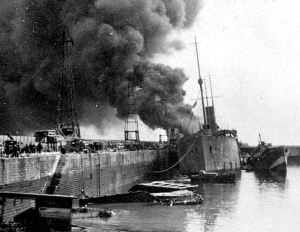
Sandhurst, hit while moored in the Harbour during the Battle of Britain, 29 Jul 1940. Michael Harmer

Sandhurst, hit while moored in the Harbour during the Battle of Britain, 29 Jul 1940. Michael Harmer

The Dunkirk Evacuation was followed, between the 10 July and 31 October 1940, by the Battle of Britain when the Germans tried to gain supremacy over the Channel in preparation for invasion. It is said that Adolph Hitler had given the order, before the Battle began, that the port of Dover was to remain serviceable. This, it was said, was because he planned to cross the Channel by sea and receive Britain’s surrender from George VI on Admiralty Pier. Nonetheless, the harbour, including the Pier, came in for heavy, unremitting, attacks from land – across the Channel, sea and air.

On 28 August, with the Prime Minister Winston Churchill in attendance, an experimental Parachute and Cable (PAC) anti-aircraft device was fired from the Pier. A rocket projectile, its function was to be fired at enemy aircraft and in tests had reached a height of about 600-feet, trailing a wire behind it. A sudden jerk of the wire released a small parachute with an explosive charge attached that would damage the aircraft. Possibly due to wind effects, the experimental projectile’s wires became entangled and it plummeted to the ground without achieving anything.
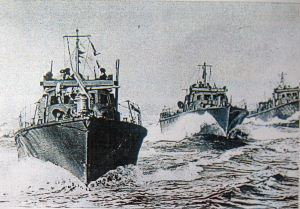
Minelaying Fleet British and Norwegian that operated from Admiralty Pier. David Ryland

British and Norwegian Mine Laying Fleet that operated from Admiralty Pier. David Ryland

The British and Norwegian mine laying fleet operated from Admiral Pier and from the end of July 1940 barrage balloons were sited around the town including Admiralty Pier. These were designed to keep enemy aircraft above a certain height to reduce accurate bomb-aiming. Although they were effective in their intended role they also caused friendly fatalities. In the early hours of 30 June 1941, a Blenheim of the 59 squadron, based at Detling, returning at low level from a bombing raid in France, hit a barrage balloon cable above Admiralty Pier. The plane crashed into the sea and only the pilot of a crew of three was found. Pilot Officer J N Whitmore was buried with full military honours at Hawkinge Cemetery. On 15 September 1941, in the early afternoon, a Dornier bomber destroyed twelve trawlers tied up against the Admiralty Pier. The motor torpedo boat, Botanic was hit killing the captain and five men and seriously injuring several others. On 5 November that year Flight Sergeant Spallin of 609 squadron, was returning from a sortie in his fighter when he too hit the balloon on Admiralty Pier. Unable to get out of the cockpit the Flight Sergeant died when his plane sank.
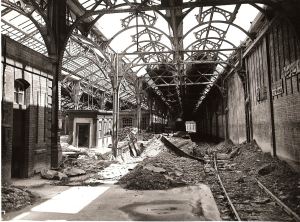
Marine Station following the attack of 25 September 1944. Dover Library

Marine Station following the attack of 25 September 1944. Dover Library

In order to release troops for the D-Day landings, on 1 April 1944 the Admiralty Pier Turret Battery was given over to the Dover Harbour Board Home Guard supplemented by the Dover Home Guard. In June the VI pilotless flying machine (doodle bug) was brought into use by the enemy. Carrying a 1-ton war head propelled by a rocket motor that once stopped, the warhead was designed to fall to the ground doing untold damage. At the end of August one exploded on Admiralty Pier. At this time, Allied troops were drawing closer to Calais and the attacks on Dover town became intense. Marine Station came in for sustained shelling and on 25 September it was all but destroyed.

Following D-Day, 6 June 1944, the Train-Ferry Dock became a hive of activity and on 29 June 1944 the Twickenham, with a large gantry, protruding over the stern and carrying a transporter crane capable of carrying 84 tons, delivered the first load of British-built locomotives to the Continent. Both the Hampton and Shepperton, were similarly adapted, joining their sister ship in transporting engines to Calais and Boulogne when they were freed from occupation.

When peace returned, the number of ships tying-up at Admiralty Pier escalated and approximately 400,000 troops, including prisoners of war – one of which was this author’s Father – disembarked at the Pier. To process them, three transcript camps were set up in Dover with the troops being sent to London and beyond. Often there were thirty full trains a day carrying returning men. As the troops were arriving in Dover, Belgium refugees, who had been in England for the duration of the War, were returning home.
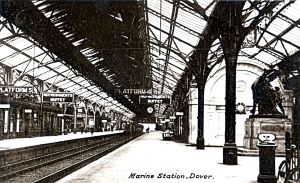
Marine Station circa1950s-1960s with war memorial on the right. Dover Museum

Marine Station circa1950s-1960s with war memorial on the right. Dover Museum

On 10 July Dover Naval Command had ceased to exist as an independent force coming under the Nore command and on 30 November 1946, Dover ceased to be a naval base. Previously, on 18 September 1945, the Admiralty and the War Office handed the port back to DHB but due to enemy attacks it was in a much worse state than after World War I. Marine station was handed back to Southern Railway and once emergency repairs and renovation had taken place, returned to operation in April 1946. Another plaque was added to the station’s War Memorial, that reads, ‘And to the 626 men of the Southern Railway who gave their lives in the 1939-1945 war.’
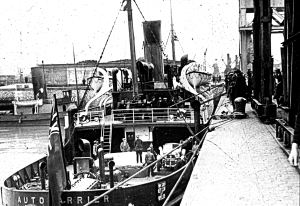
Autocarrier I. Dover Museum

Autocarrier I. Dover Museum

Southern Railway started a restrictive cargo service on 9 August 1945, from Folkestone using the Maidstone and the Hythe. The first cross-Channel ship to return to Dover was the Invicta, which made the crossing on 26 December 1945 but as a troop carrier. It was not until April 1946 that she underwent a refit and returned on October taking over from the Canterbury to operate the Golden Arrow service. The Canterbury had returned in April after her refit and the Golden Arrow service was resumed. Despite austerity on 11 October the 100,000th post-war passenger boarded the service. The Canterbury was given another refit and went to Folkestone where she inaugurated a new Folkestone-Calais service on 1 December. The Autocarrier returned to Admiralty Pier and first crossed to Calais on 15 May, while the rival Townsend Brothers Cromarty Firth, operated from the Eastern Dockyard, did not start until 1 April 1947.

The ferry service, Regie Voor Maritiem Transport (Belgium Marine), having started a service to Folkestone, transferred to Admiralty Pier on 7 October 1946 with the Prinses Josephine Charlotte and Prince Baudouin. Following repatriation, all three Train-Ferries were fitted with oil-fired boilers and the service was resumed in May 1947. The Autocarrier was transferred to Folkestone and the newly converted Dinard arrived at Admiralty Pier for the car-carrying Boulogne passage on 1 July 1947. The Dinard had a turntable on the main deck that enabled the ‘first car on to be the first car off!’ However, following the August bank holiday, when 5,156 passengers travelled from Dover to the Continent, it was announced that the American Loan crisis was to curtail foreign travel for pleasure purposes. Coming into fully operation on 1 October the crisis severely reduced the number of passengers until the ban was lifted in April 1948.
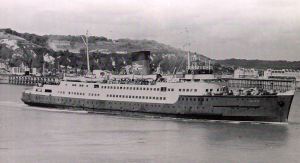
Invicta, the first ship to use the western entrance after it was opened on 26 April 1963. Alan Sencicle collection

Invicta, the first ship to use the western entrance after it was opened on 26 April 1963. Alan Sencicle collection

Although, the western entrance was to be cleared of blockships by October 1945, the Admiralty appeared to be in no hurry, citing poor weather and other demands on their salvage boats. A survey undertaken on 2 May 1950 found that the War Sepoy was buried under the hull of the World War I blockship, Spanish Prince but was finally lifted in August 1962. The Minnie de Larringa was raised in August 1960 and on 26 April 1963, the Golden Arrow vessel Invicta left Dover through the re-opened western entrance. However, the Spanish Prince collapsed during the operations and shifted position and her new position was marked by a Cardinal buoy, to the east of the western entrance. Her superstructure continued to break-up naturally but she remained a potential hazard. Salvage work was undertaken in 2010 and the old blockship was cut up where she lay and taken ashore by tug and barge.

On 18 March 1946 the first post-war cruise liner, the Royal Netherlands Line Maaskirk bound for the West Indies arrived in Dover. She anchored in the outer harbour and passengers were transferred by tender. When the 9,000 ton liner Umgeni came to Dover on 7 and 8 July 1948 to embark passengers, mails and stores for South Africa she was berthed on the Eastern Arm. However, the number of cruise ships decreased due to the lack of a tendering service and poor conditions on the Piers. Over the next forty years cruise liner traffic fluctuated but it was rare for any to use the Admiralty Pier.
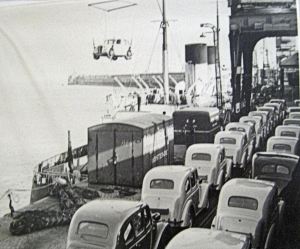
Admiralty Pier - Cars being hoisted onto ship for export. Dover Transport Museum

Admiralty Pier – Cars being hoisted onto ship for export. Dover Transport Museum

In 1950, for the first time since before the War, the number of fare paying passengers crossing the Channel, exceeded 1million. Cargo handled was approximately 750,000-tons. Two years before, in 1948, DHB had put forward a plan to move cross-Channel ferry operations to the Eastern Dockyard and use Admiralty Pier, supported by the Wellington and Granville Docks, for cargo. However, the state of the harbour, shortages, lack of money and a major confrontation between the DHB and Dover Corporation slowed the process down. The seeds of the latter had been sown during the dark days of World War II, when the council had devised a plan for the future of the town following the War. Town planner, Professor Abercrombie, was hired to give weight to this plan and although he recognised the importance of Dover harbour, the Professor agreed with the council stating that ‘the lifeblood of a town of the nature of Dover is undoubtedly its industry.’ He went on to recommended the demolition of East Cliff and Athol Terrace to be replaced by a wide access road to the Eastern Dockyard that had been earmarked for industrial purposes.

DHB vehemently opposed the plan but was over-ruled in court. Albeit, in November 1949, against strenuous opposition from Dover council, DHB promoted a Parliamentary Bill to create a specialised Car Ferry terminal at the Eastern Dockyard for the bulk of passenger services. Permission was given in February 1951 and it was estimated that the facility would cost £500,000. The railway ferries berthing at Admiralty Pier dominated Dover’s ferry industry and DHB centring freight only services at the Pier did not go down well. Southern Railway had ceased when the railway network was nationalised on 1 January 1948, becoming British Railways Southern Region. The only other ferry operator was Townsend Brothers, based at the Eastern Dockyard, with one ship operating only in the summer months. In 1950 they bought the Halladale and converted it to carry 350 passengers and 55 cars. The following year the Company used a converted Bailey bridge as an unloading ramp introducing roll on – roll off (Ro-Ro) to the Dover ferry industry.
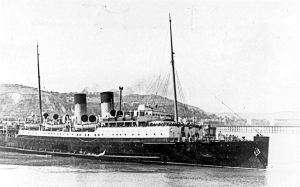
Dinard 1946 when she was commandeered as a troop ship. Dover Museum

Dinard 1946 when she was commandeered as a troop ship. Dover Museum

That year, 1950, Southern Region’s Dinard carried a record number of motorists from Admiralty Pier. To deal with the throughput, Southern Region opened an additional Customs hall at the Pier, which could accommodate 10 cars at a time. The old customs hall could only handle 6 cars and less could be handled at the Eastern Dockyard. On 14 August, the day the new customs shed opened, eighty-five cars disembarked and were cleared in 80-minutes. Nonetheless, the development of the Eastern Dockyard as a car-ferry terminal continued and was formally opened, as Eastern Docks on the 30 June 1953 by the Minister of Transport (1952-1954), the Rt. Hon. Alan T Lennox-Boyd MP (1904-1983). Along  with the Chairman of DHB – H T Hawksfield and the Register/General Manager – Cecil Byford as part of the ceremony, he was driven aboard the Dinard!
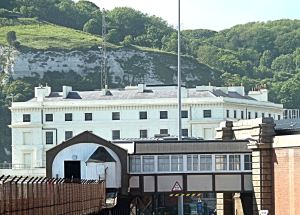
Admiralty Pier - Connecting bridge that took passengers into Marine Station. AS 2015

Admiralty Pier – Connecting bridge that took passengers into Marine Station. AS 2015

Admiralty Pier remained as Dover’s main ferry terminal with the eight berths and the number of passengers still growing fast. This was partly  due to the introduction of restrictive Travel Allowances that encouraged people to take short breaks instead of longer holidays on the Continent. Initially the Travel Allowance was £100 in cash but in November 1951 the allowance was reduced to £50 per person and from January 1952, only £25, banking was also affected. However, the cargo trade continued to expand and at Granville and Wellington Docks the ancient Strond Street almost disappeared and Northampton Street did. This was to enable the quays to be widened and commercial buildings erected. From 1952 the Golden Arrow service was transferred to Folkestone.

The number of passengers coming through Dover continued to increase year on year and in September 1958 the 2millionth passenger passed through. Albeit, an increasing percentage of passenger traffic was going through the Eastern Docks but the Belgium ships on the Ostend route and the French National Railways ships tended to be berthed on the Admiralty Pier. The number of passage ships using Dover as a home base continued to increase but Southern Region by 1958, for economic reasons, had not introduced a new ship to Dover since the Lord Warden in 1952.
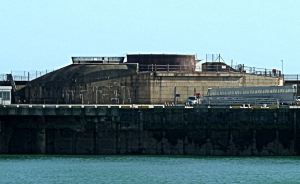
Admiralty Pier Turret from the Prince of Wales Pier. AS 2015

Admiralty Pier Turret from the Prince of Wales Pier. AS 2015

In May 1960 the DHB, to complement the new public walk along the seafront to the North Pier, opened the Turret Walk on Admiralty Pier. The seafront walk went under the Prince of Wales Pier and was named after Charles II. This was in honour of the tertiary centenary of the King’s landing on Dover beach following the Restoration of the Monarchy. For the Turret Walk, a false roof had been put on the Turret raising it by three courses of brick to be level with the new footpath. One of the former MK gun positions was converted into a shelter with windows looking out to sea and the other became a raised circular platform with seats on top and a safety rail around it.
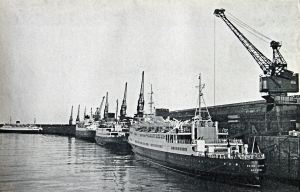
Admiralty Pier - with cross- Channel ferries berthed alongside. The Reine Astrid is at the front circa 1960s. Dover Harbour Board.

Admiralty Pier – with cross- Channel ferries berthed alongside. The Reine Astrid is in the foreground. circa 1960s. Dover Harbour Board.

Albeit, the ferry companies were increasingly complaining that the berths were uncomfortable at Admiralty Pier compared to those at Eastern Docks. This was investigated in 1963 and four schemes were suggested to ameliorate the long term problem. The solutions offered could have been used in conjunction with each other or individually but all were expensive. At the time it was not uncommon to see five ferries berthed alongside Admiralty Pier with another ship in the Train-Ferry Dock and four ferries at the Eastern Docks but DHB said that they could not afford to put any of the solutions into operation. However, a refurbishment of the berthing facilities at the Pier was instigated and included the demolition of the Admiralty oil installations dating from World War I. During demolition, the installations burst into flames but the prompt action of the Southern Region firemen stopped what could have been a major catastrophe.
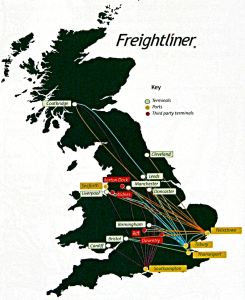
Freightliner Service that did not include the Channel Ports

Freightliner Service that did not include the Channel Ports

On 27 March 1963 the British Railways Board published their two part The Reshaping of British Railways, better known as the Beeching Report after Dr Richard Beeching (1913-1985) the Chairman. His report was designed to make the British railways financially profitable and the upshot was the closure of approximately 33% of the rail network. This was mainly feeder lines that cut off communities and industry from the main rail transport system but led to a saving of a mere £30m. Part of the report appertained to freight transport that ultimately led to Freightliner being set up. The company, now privatised, is still a major carrier of container goods but due to pressure from Kent County Council (KCC), no freight carrying rail routes were designated to pass through Kent to the Channel Ports. Further, although the trunk road routes were poor to the East Kent coast nothing to ameliorate this was envisaged. It was expected that container and passenger Continental traffic would go to other UK ports and East Kent would become a tourist destination in its own right.

Dover Corporation, in 1973, turned its attention to the former Pier District, by this time all but demolished to create vehicle access to Shakespeare Beach. The council voted to improve the remaining terrace properties along Beach Street, where once the Town Station had stood. Apparently ‘phone calls were made from Harbour House, Waterloo Crescent to the Town Clerk’s office, in the former DHB headquarters at New Bridge House. DHB already had provisional plans for the area in conjunction with replacing the old Viaduct leading to Admiralty Pier and dealing with the increasing freight traffic. In 1974 freight traffic was greater than car/passenger traffic. The DHB official went on to say that a new ferry berth was to be constructed at the Admiralty Pier knuckle – the first at the Pier since the Train-Ferry Dock in the 1930s.

A new Viaduct and associated roads were constructed but the railway lines along Admiralty Pier extension were cut off. The new £700,000 berth opened on 28 June 1974 specialising in heavy goods vehicles roll-on/roll-off (Ro-Ro) traffic. That same day saw the inaugural crossing of the Belgium car ferry Prins Laurent. However, in July the car ferry Normannia was badly holed after hitting an underwater object near Admiralty Pier and was taken out of service. Back in June 1949, the Maid of Orleans had arrived in Dover to great fanfare. She was the first vessel on the Channel crossing fitted with a Denny Brown stabiliser and although she initially worked the Folkestone – Boulogne service, in the winter she was the relief ship on the Golden Arrow service. A traditional passenger ferry she returned to Dover in August 1972 on the rail-connected passenger service from Admiralty Pier but in 1975, she was sold. Her replacement was the Caesarea, launched in 1960 and sold in 1981 to be replaced by the Caledonian Princess, launched in 1961.

Belgium Marine inaugurated a Jetfoil passenger service between the Admiralty Pier and Ostend in May 1981. A special berthing pontoon, costing £1.3m was built by Mears with DHB, Sealink Ferry Company (former Southern Railways) and Belgium Marine sharing the cost. The two Boeing Jetfoils Princesse Clementine and Prinses Stephanie, arriving in July and made the crossing in 100 minutes against 3hours 45 minutes taken by ferries. Costing £14m each, the Jetfoils had the capacity to carry 316 passengers. In order to provide a protective breakwater around the berthing pontoon, a sheet pile wall, 66 metres in length, 10 metres wide and 16 metres high was constructed. The steel piling was provided by British Steel’s Middlesbrough Plant. New 10-tonne blocks, made on Shakespeare Beach, were used to form a wave absorbing slope. The service saw a throughput of over 100,000 in the first year and British Rail said that they would provide a rail link for the service. The Jetfoil project however, proved shortlived.
Nord Pas de Calais. Dover Harbour Board

Nord Pas de Calais. Dover Harbour Board

Number 3 berth on Admiralty Pier was fitted with a new fendering system in 1982 at a cost of £109,000. Three years later the berth was enlarged to take vessels up to 23.0-metre beam and cost £½m. This was in order to take enlarged Belgium ferries on the Ostend crossing. The Train-Ferry dock closed on 8 May 1987 by which time the Train-Ferry ships only carried rail freight and freight lorries. However, an agreement between Sealink, British Rail and French Railways to build a new Train-Ferry berth. This was at the knuckle of Admiralty Pier, constructed by W A Dawson and cost £8.9m. It was designed for 23-metre beam ships and as part of the scheme new rail sidings were laid by British Rail for £0.35m. The loading bridge and machinery was built by Cleveland Bridge, cost £34.6m and the link span was computer controlled to meet the different states of the tides. The Nord Pas de Calais was the only ferry designated to use the berth and was designed to carry trains on the lower deck and 690 metres of Ro-Ro freight vehicles above. However, the Great Storm of 15/16 October 1987 reeked havoc on the construction time and the service finished operating in 1994 with the opening of the Channel Tunnel. The bridges were cut up and sold for their recyclable metal value.
Admiralty Pier coverered section once gave access both to the Pier and Marine Station. AS 2015

Admiralty Pier coverered section once gave access both to the Pier and Marine Station. AS 2015

Admiralty Pier has always been popular for anglers, with the Dover Sea Angling Association (DSAA), running competitions during the inter-war period. The association introduced Sea Angling week in 1947. Tragedy occurred in September 1959 when 11-year old sea-angler John Saich of Temple Ewell was swept off Admiralty Pier by 30-foot waves and drowned. Albeit, following DHB opening the Turret Walk, the Pier became even more popular for anglers but the hurricane force winds on the night of 15/16 October 1987 rendered the walkway unsafe and it was closed. DSAA negotiated a fifteen-year maintenance contract with DHB and carried out repairs costing a total of £177,000. The Admiralty Pier was reopened to anglers and walkers in November 1989. In return, DSAA run the Admiralty Pier walk under licence from DHB. Access to the walkway is behind Lord Warden House, up the flight of steps and through a hall that was once shared by passengers going to Marine Station.
Marine Station early 1990s. Dover Express

Marine Station early 1990s. Dover Express

In 1990, DHB was approached by Fred Olsen Cruise Line of Harwich with a view to Dover becoming one of their home ports. This seemed like a particularly good idea as the threat of the opening of the Channel Tunnel in 1994 was of great concern to DHB. They sent officials to Miami to test out the market to see if Dover was viewed as an ideal UK port of call for cruise liners. The feedback was excellent and the group put forward the proposal of a cruise liner terminal. By that time Marine Station had been renamed Dover Western Docks but its usage had diminished and British Rail’s 99 year lease with DHB was about to come to an end. Following the closure of Marine Station on 24 September 1994, it was found that the Grade 2 listed building was in a far worse condition than envisaged and local architect, Trevor Gibbens, produced plans for refurbishment.
Former Marine Station now Cruise Terminal I former passenger stairs to the platform the railway lines have been covered with tarmac to create parking spaces. LS 2010

Former Marine Station now Cruise Terminal I. Passenger stair entrance to platforms. The railway lines have been covered with tarmac to create parking spaces. LS 2010

A £10m refurbishment scheme was instigated by DHB that included removing the railway lines outside the former station to make car and coach parking space. Because the building is listed, the railway lines inside are still there but buried beneath the tarmac. A mezzanine floor was created as a passenger lounge with a tinted glass roof. The dedicated quay length for the new cruise terminal was 432 metres and dredging gave minimum 10.5 metres depth of water. The terminal opened in 1996, and the author travelled on one of the 98 cruises vessels that used Dover that year. By 1998, there had been 140 cruise liner calls and DHB decided to build a second terminal. In 1999 work started on Cruise terminal 2 on what had been the site of the Train-Ferry berth. Although the quay length at Cruise terminal 2 is the same as Cruise terminal 1, the facility has seating for 700 passengers and 2,035 square metres of baggage handling space. The combined cost of the two terminals was £28m.

The A20 was widened and rerouted across the west of Farthingloe Valley along the cliffs and into Dover close to Western Docks and Admiralty Pier, and along to Eastern Docks, in the early 1990s. Costing £24m it was not until 1993 that it actually opened. At the time, although the transportation of goods in container lorries had been increasing for thirty years, locally little thought was given to what was happening in the European Parliament. This was regardless that the key person was a Dovorian and an old boy of Dover Boys’ Grammar School – Francis Arthur Cockfield (1916-2007). It was Cockfield who created the Single European Market that allowed, amongst other thing, the free movement of trade. By the end of the century traffic congestion, due to the number of lorries on the A20 was more than a major problem, a problem that since has escalated to overwhelming proportions.

DHB, initially reacted by purchasing the former Old Park Barracks  site and turning it into a Port Zone with a lorry park. For a number of reasons this did not materialize and much of the site was sold, mainly for housing. They then considered turning part of the Farthingloe Valley over to a lorry park but as the area is protected, this failed to gain planning permission. In November 2000 they looked at the possibility of creating a new dock area, to be called Westport, along Shakespeare Beach and restoring a rail link to the port. Although Shakespeare Beach was technically a Dover amenity, public access had long since been made difficult due to much area landward of the Beach being given over to freight lorries.
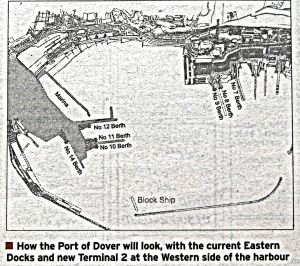
Western Docks refurbishment proposal. Dover Mercury 01.02.2007

Western Docks refurbishment proposal. Dover Mercury 01.02.2007  The blockship was removed in 2010

For the year ending 2005 the number of freight lorries passing through Eastern Docks was 1.98million and the number forecast per year by 2034 was 3.9million. In March 2006, DHB announced that a second ferry terminal would be built and that it would be part of a full redesign of the Western Docks. This was published in February 2007 and was envisaged to include the reclaiming (filling in) of the Granville Dock and Tidal Basin and the creation of four new ferry berths and a marina. Three of the new ferry berths would be on the east side of a widened Prince of Wales Pier and the fourth on the west side on the site of what had been the hoverport. The marina was envisaged to be on the east side of the Prince of Wales Pier, landward of the new ferry berths, with a waterway access across the Esplanade / Marine Parade to Wellington Dock. However, following costing, it was decided that the latter would be too expensive. On reappraisal it was decided that Wellington dock would be land locked with the water released via sluices but with no thought given to Dover’s flooding problems (see Flooding).
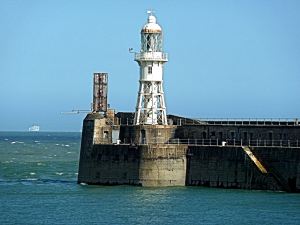
The Grade II listed Admiralty Pier light house and traffic control. AS 2015

The Grade II listed Admiralty Pier light house and traffic control light array. AS 2015

It was proposed to lengthen Admiralty Pier by a further 75 to 100 metres in order to reduce the century old problems. The access to the Admiralty Pier walkway was to be refurbished with the emphasis on restoring what had been the historic pedestrian access to the Marine Station. The work for the full proposal was scheduled to be completed by 2012-13 and to cost approximately £300m. The Admiralty Pier, was listed as Grade 2, along with associated structures including the steel lighthouse designed by Richard Hodson (1831-1890) – see above – on 16 December 2009. The former Marine Station, now Cruise Terminal 1, was refurbished in 2014 along with the pedestrian access to Admiralty Pier promenade.

  • Presented: 29 May 2015


Posted in Admiralty Pier Part II from 1909, Admiralty Pier Part II from 1909, Admiralty Pier Part II from 1909, Admiralty Pier Part II from 1909, Admiralty Pier Part II from 1909, Admiralty Pier Part II from 1909, Buildings, Maritime, Railways, Tourism, World War I, World War II | Comments Off on Admiralty Pier Part II from 1909

Admiralty Pier Gun Turret

Admiralty Pier Turret from the Prince of Wales Pier. AS 2015

Admiralty Pier Turret from the Prince of Wales Pier. AS 2015

Admiralty Pier Gun Turret stands, like a large drum, at the knuckle of Admiralty Pier and Doverhistorian.com was once lucky enough to see the unique and special guns inside. One of the questions frequently asked about the Turret, is why is it part way along the Pier … and easily answered as when it was built, the Admiralty Pier ended there!

Following a Parliamentary Inquiry in 1836, the Admiralty agreed to build two piers to provide a safer harbour – a Harbour of Refuge. After three more inquiries, the decision to combine a Harbour of Refuge and a National Naval Port on the southeast coast of England, the construction of Admiralty Pier began in 1847. On 14 June 1851, the Father Thames, landed 50 passengers at the Pier and five days later the Princess Alice, became the first cross-Channel packet steamer to use the facility when she landed 86 passengers. After that, the Pier was well used by the cross-Channel ferry operators, as it enabled ships to load/unload whatever the state of tide. However, the Pier was not fully completed until 1871.

Archcliffe Fort by Samuel Joseph Mackie c 1840s - Dover Museum

Archcliffe Fort by Samuel Joseph Mackie c 1840s – Dover Museum

While the Pier was under construction, there were those in Parliament who were concerned that the Admiralty Pier would also make life easy for any potential invader and a Royal Commission was set up. As part of their inquiries, on 27 August 1853, Sir James Graham (1792-1861), First Lord of the Admiralty, headed a retinue of delegates to Dover on an official visit. They came in the Dover mail packet, Vivid, under the command of Captain Luke Smithett. The ship tied up on Admiralty Pier, the influential officials being met by Dover Mayor, Charles Lamb and the two Dover Members of Parliament, Edward Rice (1790-1878) MP for Dover 1837-1857 and Henry Cadogan – later Viscount Chelsea (1812-1873) MP for Dover 1852-1857. The Admiralty representatives looked around the Pier and also inspected Archcliffe Fort, where the Royal Artillery had recently fixed large guns to protect the envisaged Harbour of Refuge.

William Jervois (internet) on whose recommendation the Turret was built

William Jervois (internet) on whose recommendation the Turret was built

The visit was successful and their report was taken into account in a second Royal Commission that was set up to examine the efficiency of the country’s land based fortifications against naval attack. Military engineer, Major William Francis Drummond Jervois, (1821-1897) – later knighted – was appointed Secretary to this Commission, which first sat on 20 August 1859. Their report was published on 7 February 1860 and concerning Dover’s harbour, recommended that, ‘Batteries on the breakwater (Admiralty Pier) will be required, when that work had progressed sufficiently far out to afford the necessary sites.’ When the Pier was completed in 1871, it was agreed that a gun turret would be built at the Pier head.

The design was a Fort, probably with two tiers of guns and on the top of the tiers, three more in cupolas. The building contract for a £20,000 superstructure, signed in September 1871, was given to Henry Lee & Sons of Chiswell Street, London, who had been working on the construction of Admiralty Pier. The Admiralty appointed Dover Harbour Board engineer (DHB) Edward Druce (died 1898) as the engineer in charge. He was already the overall engineer in charge of the building of the Admiralty Pier. To prepare the foundations, Druce used diving bells as he had for the construction of the Pier and work started in January 1872. As part of the foundations, Druce incorporated a projecting apron to secure the base of the structure from being undermined by tidal currents. Within two years, the stonework for the Turret was up to high water level and the substructure was completed by January 1874. The cost was £19,718 4shillings 0pence.

The year before the Admiralty had rethought the type of guns to be used and decided upon one that would pierce the thickest armour plating on ships then available. This led to a change in design to a Turret similar to those erected on the Royal Navy’s iron armour-plated ships and required a 75-ton gun from the Royal Gun Factory. The specifications for the gun stated that it had to have a bore of 14inches but being able to be increased to 15 or 16 inches. Design number W3913 was produced by the Factory’s Superintendent and the gun was estimated to cost £8,000. Approval was given and in September 1875, a gun with a bore of 14½ inches was ready. The specially built barge, Magog, took the gun to Shoeburyness for testing. However, by that time, the Admiralty had changed its mind yet again and decided on two heavier guns of 80-tons each that were ordered and built at Woolwich.

Admiralty Pier Turret circular passage. c1873. Dover Museum

Admiralty Pier Turret circular passage. c1873. Dover Museum

The new design for the Turret was produced by Captain English and was an iron-plated circular rotating structure weighing over 700 tons. It was the only one of its type to be built and within it there were several levels. The Turret’s frame was of wrought iron clad with three layers of 7inches armour with 2-inch layers of iron and wood between them. The upper chamber – 33-feet above sea level – was to house two 80-ton, 16-inch rifled muzzle-loaders with a range of up to 4.3-miles. The magazine was in the basement just above high water mark, and separated from the engine room by a granite wall. This was divided into three sections each containing 50 rounds of Studless Common Shells MkII, and Palliser Shots MkII, complete with gas checks, wedge wads etc. for each gun. Lifts were installed to the upper chamber to enable the guns to be loaded in 2½ minutes.

For the new design, the stonework had to be brought up to quay level with the contract again being given to Henry Lee & Sons. By April 1875, the stone base of the Turret was finished and covered with a temporary roof. Luckily the roof was strong for on Tuesday 24 August 1875, some 200-300 people gathered on and around it to see Captain Matthew Webb (1848-1883) dive off the end of Admiralty Pier. This was the start of the first successful swim across the English Channel to France with Webb taking 21hours 45 minutes to complete his 39mile (64 kilometres) swim. The Webb Memorial can be seen in the Gateway Gardens on Marine Parade.

The Turret revolved on thirty-two wheels and was powered by five steam engines. The engine room was built of solid concrete and was partly below sea level. The machinery servicing the guns was designed by Richard Hodson (1831-1890), Chief Engineer of the Thames Ironworks and Shipbuilding Company. One engine ran the guns in and out, and elevated and depressed them. It also worked the ammunition lift and the rammer. The main engine rotated the Turret. An auxiliary engine and a donkey engine supplied two boilers and drove the pump for the ‘Hydro Pneumatic accumulators’, which were used for hosing out the guns. Finally, gas lamps provided lighting.

Cross section view of the Shear Frame. Public Records Office

Cross section view of the Shear Frame. Public Records Office

To lift the guns into place Captain English designed a special shearframe – an ‘A’ frame with the feet or spars that rested on the ground and secured in place by splay and heel tackles. The top of the spars or crutch, were held in place by guy-wires and a block and tackle attached to the crutch that was used as part of the lifting process. Captain English also designed an overhead traveller – a gantry with a travelling crane. Together and using hydraulic jacks, they were to be used to lift and move the guns from the Pier to the top of the Turret. The traveller was designed to be mounted on wooden supports with one end placed on top of the Turret and the other overhanging the quay. Each gun was to be hauled up from the quay using four hydraulic jacks, manually pulled to the other end of the traveller and then lowered into the Turret.

Built on Admiralty Pier by Messrs Tannett, Walker & Co of Leeds under the supervision of Captain English, the shearframe weighed 60tons and cost £3,286, while the traveller weighed 22tons 8hundredweight and cost £782. In August 1881, the naval steamship Panamure brought 110tons of railway iron from the Royal Arsenal Woolwich to test both the shearframe and the overhead traveller. Due to lack of space, it had been decided that muscle power, with a strong derrick, would be used to lift the guns and carriages out of the ship in which they were delivered.

30-ton Turret Gun Carriage. The Engineer 24.09.1875

30-ton Turret Gun Carriage. The Engineer 24.09.1875

By September, the platforms for the guns were in place and good progress had been made erecting the shearframe by the time the gun carriages arrived. The carriages were designed to transport the heavy guns and to support them when they were fired. They were built of wrought iron, weighed 30tons each and mounted on two sets of six-wheeled bogies. The carriages were lifted from the ship to the Pier and from the Pier to a sufficient elevation before being gradually lowered, with great care into position, within the Turret. Manpower and the derrick was used throughout with the entire operation taking a week.

The first test on the shearframe and traveller took place on 17 October 1881, but one of the parts of the shearframe failed. With the problem fixed a second test was successful. It was discovered that with the use of a large capstan, temporarily installed for the purpose, 60 men could lift 110tons ‘easily’. However, a severe gale hit Dover on 27 November and washed the shearframe, blocks of granite, slings for the 80-ton guns, loose chain, some of the railway iron and an iron trolley weighing about 2-tons, into the sea. The sea also broke through the Turret’s temporary roofing doing considerable damage to the machinery inside with the engine room reported to have floodwater to the depth of 7½feet. The shearframe, washed up near East Cliff , was dragged along the seafront by a large fatigue party. Divers managed to retrieve most of the other articles but not all of the railway iron that included rails on which the trunnion sleigh was to run when moving the guns along the quay.

Admiralty Pier - The landing of the 80-ton gun on to the trunnion tray December 1881.

Admiralty Pier – The loading of the 80-ton gun on to the trunnion sleigh December 1881.

After test firing, the first of the enormous guns was brought to Dover aboard the Stanley arriving on Sunday 4 December 1881. While repairs to the Turret were taking place, the ship berthed in the Granville Dock. The installation was conducted by Captain Bailey of the Royal Artillery and Major Plunkett of the Royal Engineers under the superintendence of Colonel Inglis and Captain English. On 6 December, the ship was moved round to the side of the Pier and an attempt was made to lift the gun out of the ship. It failed due to the time wasted on the quayside preparing for the lift which meant that that the tide had receded with the result that the chains were too short! A second attempt was made on the Wednesday and a third on Thursday 8 December. This day, the huge gun was lifted out of the Stanley and then lowered onto the trunnion sleigh – a large gun carriage with steel plates along the bottom and mounted on rollers.

Admiralty Pier Turret - The Traveller - Public Record Office

Admiralty Pier Turret – The Traveller – Public Record Office

On Monday 12 December using man power and rope wound round the specially installed capstan, the trunnion sleigh with the gun on top was hauled onto rails and then to the Turret. Unfortunately, many of the sleepers buckled under the weight and there were insufficient rails due to the number lost in the storm. Eventually, the gun reached the Turret but when it came to lifting, the hydraulic jacks only worked intermittently. Colonel Inglis wrote that ‘when all four jacks were in good order, a rate of lift of 3feet per hour was obtained.’ Further, inclement weather and the sea breaking over the Pier delayed the process even more but eventually the gun was lifted.

When it came to lowering the gun into the Turret, it was found that the opening in the roof was too small so the gun on the trunnion sleigh was lowered in at an angle. Then it was found that the clearance for the trunnion was only ¼inch each side so on the assumption that the tight clearance would prevent the slings coming off the retaining washers were removed. Breaths were held as the gun was lowered, very slowly, but with sighs of relief all round the gun did not fall out of the slings! It was eventually fully installed by 6 January 1882.

The Stanley had arrived in Dover with the second gun on Friday 16 December and stayed in Granville Dock until the gun was finally offloaded. The procedure was as before but with an adequate number of rails, the problem with the jacks dealt with and a wider clearance at the top of the Turret created. The second gun was fully installed by 12 May 1882. Then the massive dome roof, about 1metre thick and comprising of alternative layers of hardwood and iron, was constructed. During this time, work on the guns machinery took place and it was known throughout Dover that the guns were ready for testing.

Letters were written to the Secretary of State for War (1882-1885) – Spencer Compton Cavendish, Marquess of Hartington (1833-1908), from the residents of East Cliff. They complained that due to the dangerous state of the cliffs, when the guns were fired, the cliffs would tumble down. An engineer was engaged to examine the cliffs, reporting they were sound but did suggest that when the test took place the people of Dover should leave their windows open. The test took place on 20 July 1883 and although windows were left open, most of Dover residents gathered on the seafront and Western Heights. At a little after 13.00hrs, the first shot was fired with a 250-pound charge. This was followed by a second shot with 337 pounds of powder and finally, three shots using 450 pounds of gunpowder.

Of the test, it was reported in the Dover Express that, ‘an immense volume of smoke belched forth, and very shortly, at what appeared a mile distant, the projectile struck the water and made three more appearances at a great distance.’ The loud bangs did not start an avalanche at East Cliff and except for two windows in the nearby Admiralty Pier lighthouse, not a window in the town was broken. Nonetheless, the exercise highlighted a number of problems that had to be dealt with.

Admiralty Pier showing square cornered head the turret is to right of the lighthouse

Admiralty Pier showing square cornered head. The turret is to the right of the lighthouse

Following a shipping accident during thick fog in 1885, some of the squared cornered Admiralty Pierhead’s concrete blocks were displaced. The Admiralty Pier head was extended and widened slightly getting rid of the square corners. At the same time the military took the opportunity to make changes to the Turret. As part of the rebuilding a shell store, cartridge store and coal bunker for the Turret was built on the landward side. A passage was cut through to the Turret’s ammunition lift, which then became the main entrance and the original entrance was converted into a defending gallery for riflemen in case of attack. As part of the refurbishment electric lighting was installed, powered by a dynamo driven by its own steam engine.
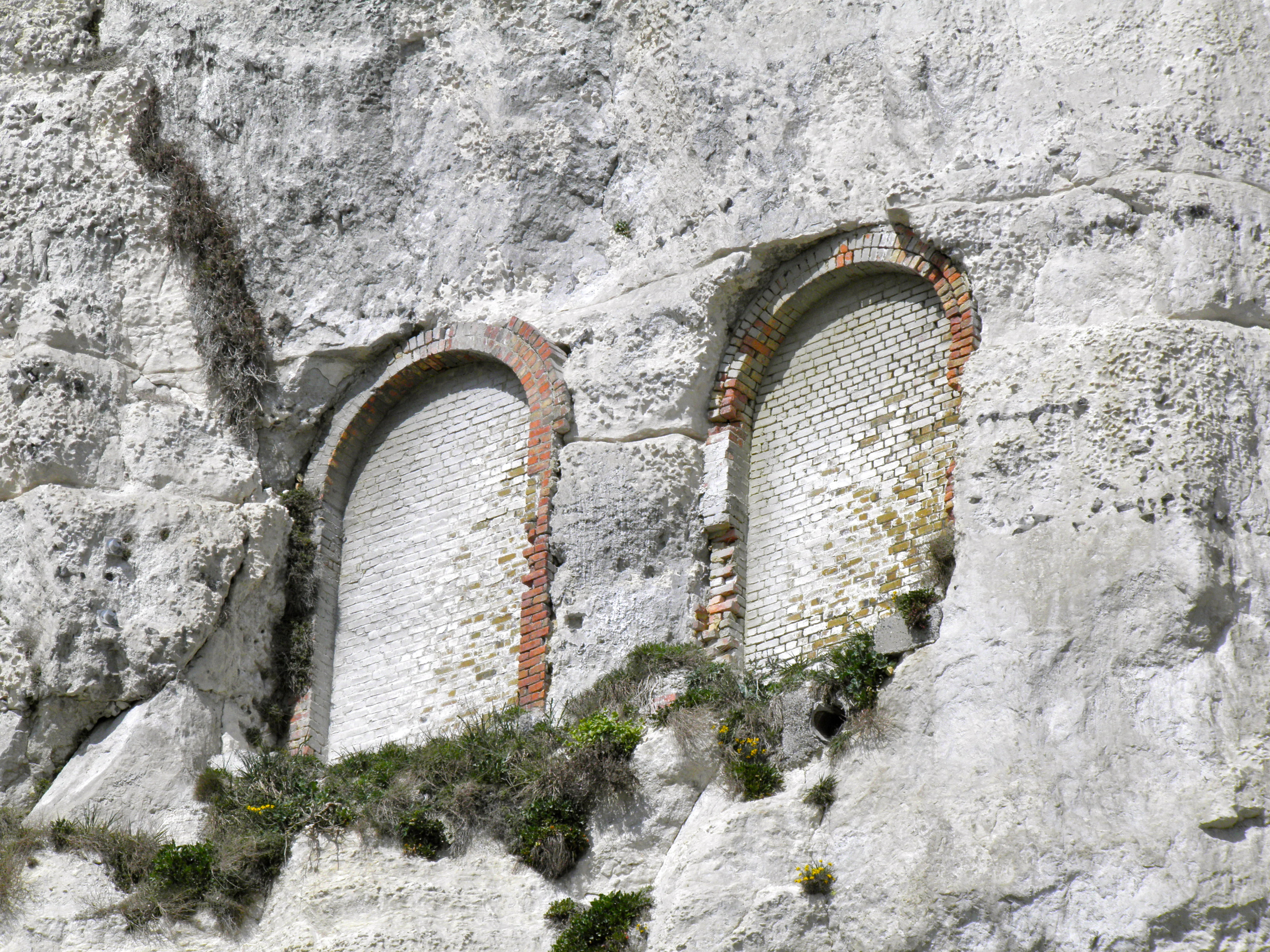
 Admiralty Pier Turret ports, slides and apertures to which the guns were depressed for loading c1873. Dover Museum
Admiralty Pier Turret ports, slides and apertures to which the guns were depressed for loading c1873. Dover Museum

On Friday 12 March 1886, another test was carried out when four rounds were fired but again there were problems, most notably the fouling of the guns’ bores. Albeit, of greater interest was the use of compressed air, at 60-65lbs per square inch, as a substitute for steam to the Turret’s engines. The compressed air was supplied through wrought iron pipes from compressors belonging to the Channel Tunnel works, at the foot of Shakespeare Cliff. Following the test, the Defence Committee reported that although there were a few problems the Turret was ready to be handed over to the Royal Artillery.

It was known that the Turret’s weight including the two guns, was 895tons and the whole project had cost £150,000. However, problems remained. The main one being that because of the weight involved, the substructure of the Turret and magazine required strengthening, costing just under a further £40,000. Questions were asked in Parliament, especially as expenditure on military training had been cut to save money. Adding fuel to the anger were developments in the artillery industry, particularly breech-loading long-range guns. It was stated that they made the Turret guns obsolete. Other problems besides the weight were dealt with by a complete lack of urgency, over the next few years.
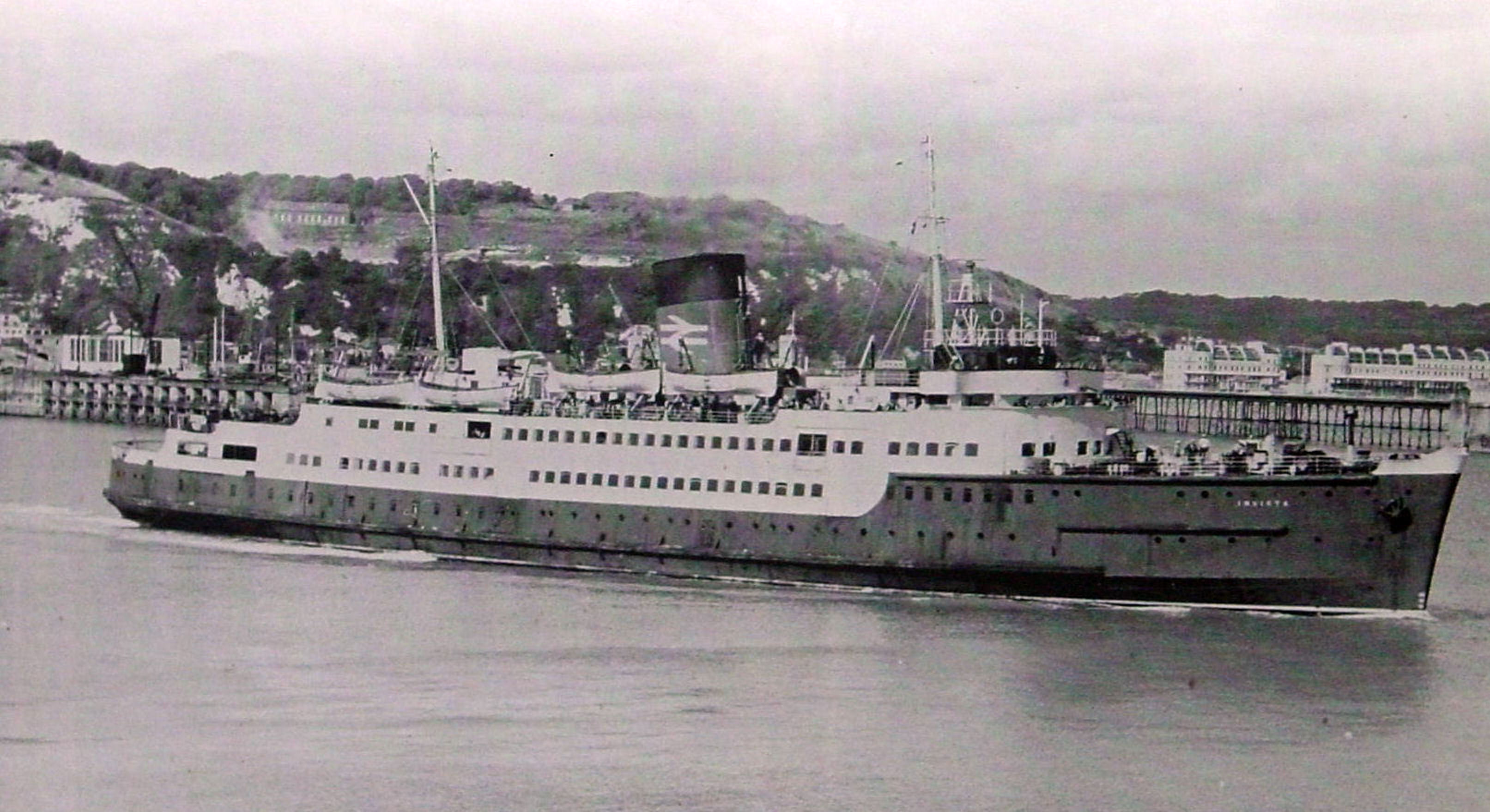
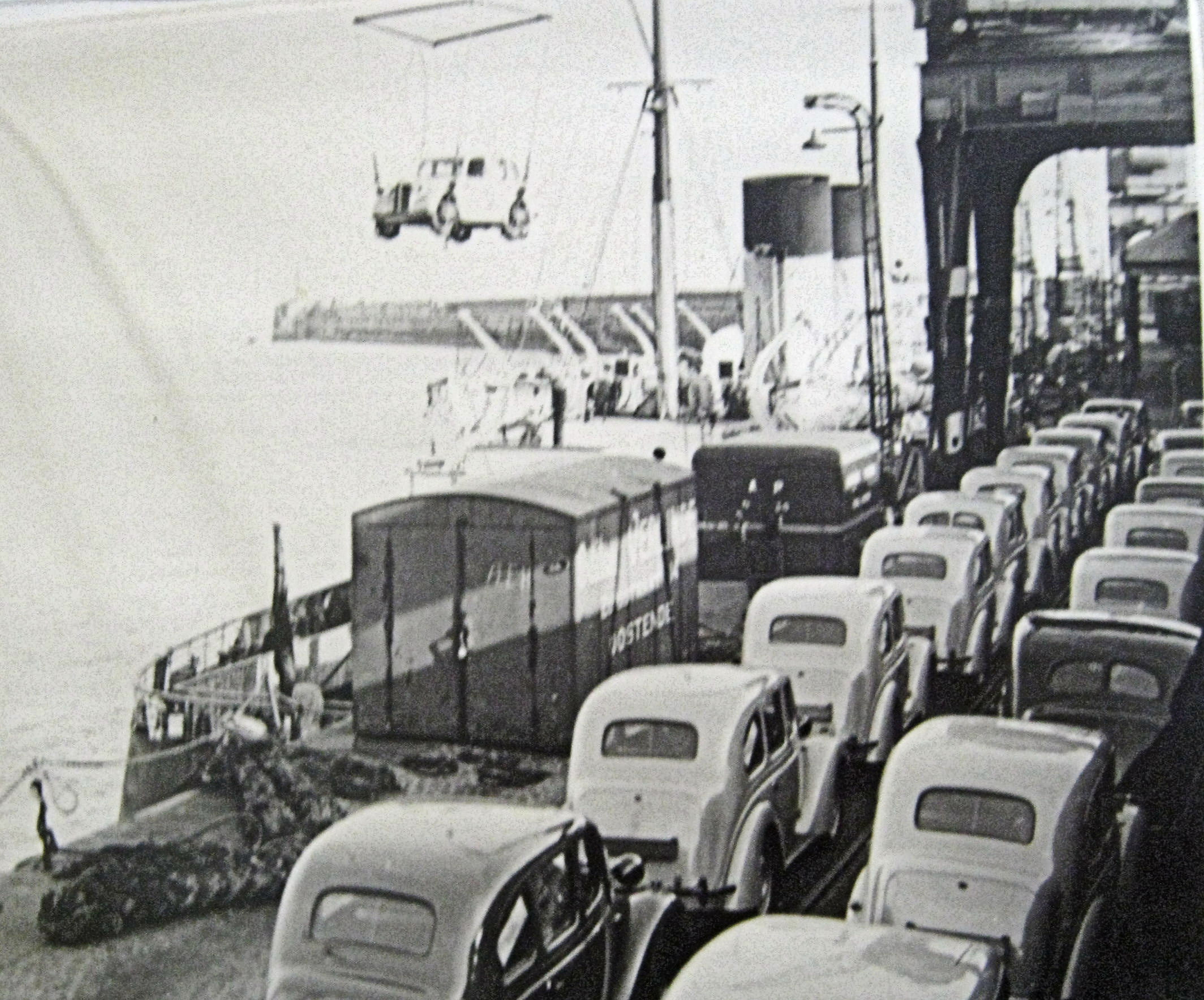
The guns in the Turret were never to be fired again but in 1895, the Admiralty announced that it was to use the port of Dover as a base for the Royal Navy. It was envisaged that the whole of Dover’s bay would be enclosed by an extension of the Admiralty Pier, an Eastern Arm and a Southern Breakwater from the Eastern Arm head to the extended Admiralty Pier head. In January 1898, the Turret was officially declared obsolete, the guns were to be removed and the Turret demolished. This, however was not to take place until the construction of three modern forts had been completed, one on Langdon Cliff and two on Western Heights.

Widening of the Admiralty Pier around the Turret during the building of the Admiralty Harbour. Note the old lighthouse on top of the Turret 18.3.1902. Nick Catford

Widening of the Admiralty Pier around the Turret during the building of the Admiralty Harbour. Note the old lighthouse on top of the Turret 18.3.1902. Nick Catford

As the works on the new Admiralty Harbour progressed, the old small lighthouse close to the Turret, which had been repositioned on the roof of the Turret in 1895, was replaced but not demolished. Demolition of the Turret itself, was being considered but at the time, increasing naval expansion was taking place in Germany. The defence of the new Admiralty Harbour became of paramount importance so the Turret stayed and the Pier was widened to accommodate it, though the north east corner was demolished. In the report of Dover’s Defences revised in 1907, it  was stated that the Admiralty Pier’s armament was ‘7×12 pr Q.F (quick firing) guns – approved but not mounted.‘ By that time, the Admiralty Pier extension was almost finished and a ‘fort’ was to be built at its head. At the same time, similar fortifications were built on the Southern Breakwater and at the end of the Eastern Arm.

Admiralty Pier during reconstruction showing searchlight emplacements from the harbour side of the Pier - 23.7.1908. Nick Catford

Admiralty Pier during reconstruction showing searchlight emplacements from the harbour side of the Pier – 23.7.1908. Nick Catford

Due to the widening of the Pier, the Turret was on its west side and shortly after the Turret was designated as a battery. It was to have 2x6inch breech-loading guns to cover the approaches from the west mounted on the top so that they fired clear of the Pier’s parapet. Work began in March 1908. The former shell store became the battery’s magazine, with ammunition lifts to each of the guns and two searchlight emplacements were erected nearby being incorporated into the Pier’s parapet. In April 1909 the Turret was designated Pier Turret Battery and two 6-inch breech-loading MK VII*s guns were in place. One of the guns came from the South Front Battery on Western Heights and the other from Woolwich and they were test fired on 16 June. George Prince of Wales, later George V (1910-1936) officially opened the new Admiralty Harbour on 15 October 1909.

Admiralty Pier Extension Battery Plan. Nick Catford

Admiralty Pier Extension Battery Plan. Nick Catford

The Turret was, on 10 May 1911, again formerly handed over to the Royal Artillery by which time the Royal Engineers had increased the number of latrines and living quarters were made more habitable. The obsolete lighthouse on the top of the Turret was designated as the Battery Control with the battery on the Pier extension under its command. The Battery Control was equipped with, amongst other items, a telephone and a Barr & Stroud range-finder. Searchlights were added to the extension battery and another searchlight, this one on the top of the Turret, in April 1914. Much to the irritation of the captains of the cross Channel ships, the new searchlight faced towards the western entrance and together with the extension search lights ‘blinded them’. The original artillery store and guardroom were, at this time, converted into a bathroom and wash house. From July 1914, the Turret was designated as being manned for War.

The Special Services of the Royal Artillery initially manned the Pier Turret Battery and their main concern, besides the preparation for War, were the large number of Belgian refugees coming across the Channel in all kinds of craft, many not seaworthy. Refugees included the Belgium Queen Elisabeth (1876-1965) and her three children who arrived on a Belgium packet ship that tied up at the Admiralty Pier. At about this time the Port Examination Service came into force and worked from two small steam vessels that were stationed outside the harbour. Their job was to check the credentials of any vessel desiring entry. One of the steamers usually lay off the Turret battery and was alerted, throughout the War, by a cumbersome system that started when a vessel was approaching. The Port War Signal Station telephoned the Fire Command Post who then telephoned the Turret who relayed the message to the Examination Service by megaphone!

Other duties included special detailing, such as when the British Prime Minister (1908 to 1916) – Herbert Asquith (1852-1928) and French Prime Minister (1914-1915) – René Viviani (1863-1925) along with Sir John French (1852-1925) – Commander of the British Expeditionary Force and Lord Herbert Kitchener (1850-1916) – Secretary of State for War, dined on board a British cruiser moored at the Admiralty Pier.

On another occasion, the Battery Commander was ordered to give an informal welcome to a foreign steamer of a friendly Power. He was then told that on board were the Directors of Belgium’s National Bank. The ship arrived late at night and the captain, confused by the searchlights scraped against the Admiralty Pier before berthing alongside one of the landing stages. There, wrapped in loose sacking, was unloaded a large amount of gold and securities that were transferred to the Bank of England for safe custody for the duration of the War.

Admiralty Pier Troop Movement during World War I. Dover Museum

Admiralty Pier Troop Movement during World War I. Dover Museum

World War I (1914-1918) was declared on 4 August 1914. The Special Services were replaced by the Dover Unit of the Cinque Ports Territorial Force of the Royal Engineers along with regular army units that changed as the War progressed. One of the jobs the men of the battery was to help with was the organisation of troops on Admiralty Pier for embarkation. However, one of their main concerns was the problem of friendly ships being confused by the blaze of the searchlights. This continued throughout the War so the men had to keep a sharp lookout so that the searchlight could be doused when friendly ships were in difficulties due to them. The searchlights were used to search for possible hostile craft and illuminate any sea surface targets as required by the Garrison Artillery and used carbon-arc electrodes. Besides the danger of fire, the carbon rods had to be changed regularly. As this took time, it was important to do it when it was believed there was no hostile shipping around.

During the summer months the Pier Turret Battery operated two watches at night and during the winter, this was increased to three. The routine was that the first shift of the night attended to the overhaul of the searchlights and the last shift the tuning up of the searchlight plant before going off duty. In consequence, there was never any serious breakdown. Subaltern John Mowll, was in charge of the Battery. He later wrote that the strain of continuous watch, largely though night glasses, was apt to become great, and particularly in the early hours of the morning, the seascape immediately before us was apt to be dotted with all sorts of shapes and forms, which loomed up suddenly in the beams of the search lights.As the War progressed, as most of the lamps and carbons had been made in Germany shortages became a problem and so the lights were often doused for long periods at a time.

The Pier Turret Battery had their ‘first major encounter’ with the enemy at 05.30hrs on 10 December 1914 when a searchlight reflected off what was believed to be a submarine periscope and they opened fire. The batteries along the Southern Breakwater took up the firing and the ‘periscope’ disappeared. It was reported that four submarines had been seen and that two had sunk and the other two disabled. However, this was later shown to be the product of reporters’ fertile imaginations and that no one was even sure if a periscope had actually been seen!

Marine Station Passenger entrance, note the medical emblem on left. Alan Sencicle 2009

Marine Station Passenger entrance, note the medical emblem on left. Alan Sencicle 2009

The officers of the Battery were billeted at Archcliffe Fort. Later in 1916, watch huts were built for them, near the Battery Command post on the top of the Turret. In 1917, another watch hut was built specifically for officers of the Royal Engineers. According to the Batteries Fort Record Book very little happened for the duration of the War, that is, until the final year. A trawler tried to enter the harbour without showing a recognition flag, in April 1918, and was fired upon. Later, in October, two drifters showed the incorrect flag and received similar treatment. Nonetheless, the men who manned Pier Turret Battery were heavily involved in the embarkation of troops going to fight at the Front and those disembarking, particularly the wounded who were taken to Marine Station that had been commandeered for the purpose.

Following the end of the War the Pier Turret Battery establishment was maintained until 1920 when it was reduced to one Non-Commissioned Officer and three men. The two 6inch MKVII* guns were stripped and greased and the breech locks were stored in the Turret along with two 12-pounder guns from the Shoulder of Mutton Battery below the Castle. In 1921, a depression range-finder was mounted on the Turret underneath the Barr & Stroud range-finder. The Battery, until 1938, was kept under ‘care and maintenance’, mainly being used for Territorial Army exercises.

Western part of the harbour circa 1950 but showing the harbour as it would have been during the interwar period. Nick Catford

Western part of the harbour circa 1950 but showing the harbour as it would have been during the interwar period. Nick Catford

On 19 July 1921, DHB opened a promenade on the Admiralty Pier and this proved a popular tourist attraction. In preparation, the military obliged by moving the two gun shields for the 6-inch breech-loading MK VII*s, to inside of the Turret’s railings. The gun shields were dragged on well-greased planks using a winch and a 6-to-1 tackle arrangement. At about this time, the Turret itself underwent a major refurbishment using batten and canvas walls, to create a family home for the Battery Sergeant Major. The guardroom became the entrance hall, living room and bedrooms. The artillery store was converted into a kitchen and the store into a washhouse. The fitter’s shop became an office and officers room and a new fitter’s shop with its own forge was built. The flanking gallery was converted into a lamp room and a wartime temporary lean-to was given a new lease of life as a paint shop. In the summer, the Battery Sergeant Major would erect a board outside the Turret giving a history of the guns and an offer to show people around on request!

The British Prime Minister (1937-1940) – Neville Chamberlain (1869-1940) together with French Prime Minister (1938-1940) – Édouard Daladier (1884-1970) met the German Chancellor (1933-1945) – Adolph Hitler (1889-1945) and the Italian Prime Minister (1922-1943) – Benito Mussolini (1883-1945), in Munich during September 1938. This was to discuss the future of the Sudetenland part of northwestern Czechoslovakia. Briefly, at the meeting, Mussolini put forward a plan prepared by the German foreign office, in which Germany would occupy Sudetenland and an international commission would decide on its future. An agreement was reached on 30 September following which Prime Minister Chamberlain flew back to England, waving the declaration and making his infamous statement, ‘Peace For Our Time.’ Shortly after, the 170 (Kent and Sussex) Heavy Battery of the Royal Artillery Territorial Army moved into Admiralty Pier Turret and armaments started arriving.

The 170 (Kent and Sussex) Heavy Battery were subsequently withdrawn but were back again on 3 September 1939 with the outbreak of World War II (1939-1945). Like the previous War, the Command Post was at the Turret and on the Admiralty Pier extension was the second gun emplacement, referred to as the battery out-post (B.O.P.), amongst other names. However, there was an acute lack of accommodation and the men were obliged to sleep in old railway carriages specially brought in. The Battery Sergeant Major and his family were found new quarters and moved out. By the end of 1940, officers’ sleeping quarters and servants quarters had been built on the top of the original guard room and an artillery store, a battery office and store above a new fitter’s shop. A single storey collection of buildings had been erected and consisted of the sergeant’s mess and sleeping quarters, workshop and gun store. On the extension were the men’s quarters including bunks in a tunnel under the adjacent lighthouse, ablutions, latrines and a rest room. Within the Battery perimeter, a two-storey block was built for a Bofors gun crew with the gun mounted on the roof.

From the outset of the War, the harbour was part of Fortress Dover and throughout the War, the officer responsible for co-ordinating all of Dover’s defences be they on land, sea or in the air was the Fortress Commander based at the Castle. Although the town and harbour’s six batteries had their own command posts and plotting rooms, the nerve centre was the Fire Command Post, also at the Castle. The six batteries were the Pier Turret battery on Admiralty Pier, the Eastern Arm battery, two batteries on the Southern Breakwater and one at the Citadel, Western Heights and the other at Langdon Cliffs. 

In May 1940, the French and Belgium Channel ports fell to German occupation, which led to Operation Dynamo or the Dunkirk Evacuation, as it is known. This was masterminded by Vice-Admiral Bertram Ramsay (1883-1945) from his headquarters at the Castle and came into operation on 24 May 1940, when the only escape route to Britain was via Dunkirk. A fleet of 222 British naval vessels and 665 other craft, known later as the ‘Little Ships’, went to the rescue. Many of the soldiers were brought to Dover and were disembarked onto Admiralty Pier, the Prince of Wales Pier and the Eastern Arm. Sometimes the vessels were as many as five abreast. Most of the vessels when they returned to England were battered, some beyond recognition. Some of the vessels were sunk by bombers within sight of the end of Admiralty Pier and it was a sad duty of the men of the Pier Battery to give details.

Dunkirk 1940 Troops arriving in Dover having been evacuated. Doyle Collection.

Dunkirk 1940 Troops arriving in Dover having been evacuated. Doyle Collection.

The men, when they arrived from Dunkirk were exhausted, their clothing in tatters and many were wounded. Soldiers from the Pier Battery were assigned to dealing with the men once they were ashore. Sometimes they provided first aid, at other times it was marshalling the men to waiting railway trains or to ambulances. Many of the rescued men left their weapons on the Pier so another job of the battery was collecting, sorting, and sending them to the appropriate arsenal. Unofficially this was sometimes the Pier battery arsenal! Another distressing jobs assigned to the Pier battery soldiers was helping to recover the identity discs of those who had been killed either on the Dunkirk beaches and brought across by their mates or had been killed while making the crossing. Their job was to list the names for identification purposes. At the other extreme, the most enjoyable part was handing out beer provided by Dover pubs and breweries for the men. At such times, they listened to tales of what had happened in the previous few days of which there were many. Between 26 May and 4 June 1940, 338,226 British and Allied troops were evacuated from the beaches of Dunkirk.

Admiralty Pier Turret 6 inch quick firing gun. Nick Catford

Admiralty Pier Turret 6 inch quick firing gun. Nick Catford

Following the fall of Dunkirk, General Field Marshal Hermann Goring (1893-1946), Commander of the Luftwaffe, issued instructions for the first phase of a battle, which if successful, would establish air superiority over the Channel to be followed by the invasion of Britain. As a result, on 2 July 1940, attacks on shipping and Channel ports by small groups of bombers with fighter protection commenced. Defences around the country were quickly erected and Pier Turret Battery was strengthened. Both naval and army personnel were stationed at the Pier Turret battery. The Command post already had its own plotting rooms but was equipped with modern technology, as it became available. Between 10 July and 31 October 1940, the frequent and prolonged aerial conflicts came to be known as the Battle of Britain. After the end of October, both in the air and at sea the battles continued until 1945 and this part of Britain became known as Hell Fire Corner. 

Sandhurst following an airaid on the harbour 29 July 1940. Thanks to Michael Harmer

Sandhurst following an air raid on the harbour 29 July 1940. Thanks to Michael Harmer

During the Battle of Britain and after, the searchlights were regularly in use and they were powered by two Ruston and Hornsby diesel engines at Archcliffe Fort. The B.O.P post, a concrete hut at the extreme end of the pier extension had two 12-pounders, installed in 1909 and later another 12-pounder in February 1940, telephones, a lookout slit, latrine and cold running water. What the Turret command post lacked in home comforts was compensated by armaments, including the MKVII* 6inch guns installed in 1909. The harbour was under constant attack and the attacks were without mercy. On 29 July, for instance, all the harbour batteries were dive-bombed by over 120 enemy planes including JU87 dive-bombers and ME 109s. On 18 October a shell fell on the newly built Sergeants’ Mess at the Turret, two men were killed and three seriously injured.

The Pier Battery continued to come under attack from the air, particularly early in the morning when the sun was in the lookouts’ eyes. On 16 December 1941 the B.O.P on the pier extension was bombed and one man wounded. Both the Turret and B.O.P came under attack from the sea though with few casualties. And then there was the weather! On 14 November 1940 when one of the men was going to the B.O.P. from the Turret during stormy weather, he was swept off the Pier and drowned. After that incident, a rope was secured along the edge of the Pier, between the Turret and the B.O.P., for the men to hold on to during rough weather.

During the War, some 69 servicemen were killed and over 100 seriously injured manning the coast batteries and several, stationed at the Pier and Southern Breakwater batteries, were washed over the side and drowned. In order to release troops for the D-Day Landings, on 1 April 1944, Pier Turret became a Home Guard Battery with one officer and eight servicemen. On 18 September 1945, the Admiralty and the War Office handed back to the Harbour Board most of the harbour that they had controlled from 1939. On 30 November 1946, Dover ceased to be a naval base. The last entry into the Pier Turret Battery Record Book was in August 1947 where it was written, ‘ORD B.L. 6″ MKVII* and mtgsMKII were withdrawn and removed to Woolwich C.R. Depot and Swingate Dump, Dover, respectively, by the Armt. Withdrawal Party.’

Admiralty Pier Turret circa 1960s. Dover Museum

Admiralty Pier Turret circa 1960s. Dover Museum

Over the next few years, many of the structures on Admiralty Pier were demolished and in 1958-59 DHB demolished all the remaining Pier Battery buildings in order to create a walkway. The path was laid on the top of the Turret and opened in 1960 when the old footpath around the Turret was closed. A false roof was put on the remainder of the Turret and raised by three courses of brick to be level with the path. The MK gun positions, still remained and one was converted into a shelter with windows looking out to sea. The other became a raised circular platform with seats on top and a safety rail around it. The Battery Command post-cum lighthouse had been demolished sometime after the War but the base remained. This was made into an artistic ‘feature’ whose aesthetic qualities were lost on most who tried to figure out what its purpose was during the War! The old Turret gun ports were removed and one was replaced with a steel sheet that was capable of being opened but was padlocked. The other was covered with a welded steel sheet. Both of them had four ventilation holes.

Admiralty Pier Turret - one of the 80-ton guns that remains. Dover Museum

Admiralty Pier Turret – one of the 80-ton guns that remains. Dover Museum

At that time it was possible, with permission and under DHB escort, to see the 80-ton guns, their carriages and machinery – albeit rusty – lifts and World War I and II artefacts. Following the Great Storm of 15-16 October 1987 the walkway was closed and it was reported that much of the machinery had been removed due to corrosion. In 1990, this author was lucky enough to enter the Turret but all we were allowed to see were the 80-ton guns and part of the inclined slides that let them descend until the muzzles protruded from the gun ports. Nonetheless, it is a memory not forgotten. In 1996, Cruise Terminal One opened in the former Marine Station and passengers on board the various cruise liners can, from the decks, see the Turret. It can also be seen from the walkway along Admiralty Pier. Listed as Grade II as part of the Admiralty Pier and Associated Structures listing, it is a unique structure, inside of which are the only guns of that type ever to be mounted on land.

Turret 80-ton Gun - The Engineer 24.09.1875

Turret 80-ton Gun – The Engineer 24.09.1875

One day, perhaps, the Turret will be open to the general public.

  • First Published in the Dover Mercury: 12 August 2010
  • Revised and Expanded: 14 May 2015


Posted in Admiralty Pier Gun Turret, Armed Services, Maritime | Comments Off on Admiralty Pier Gun Turret