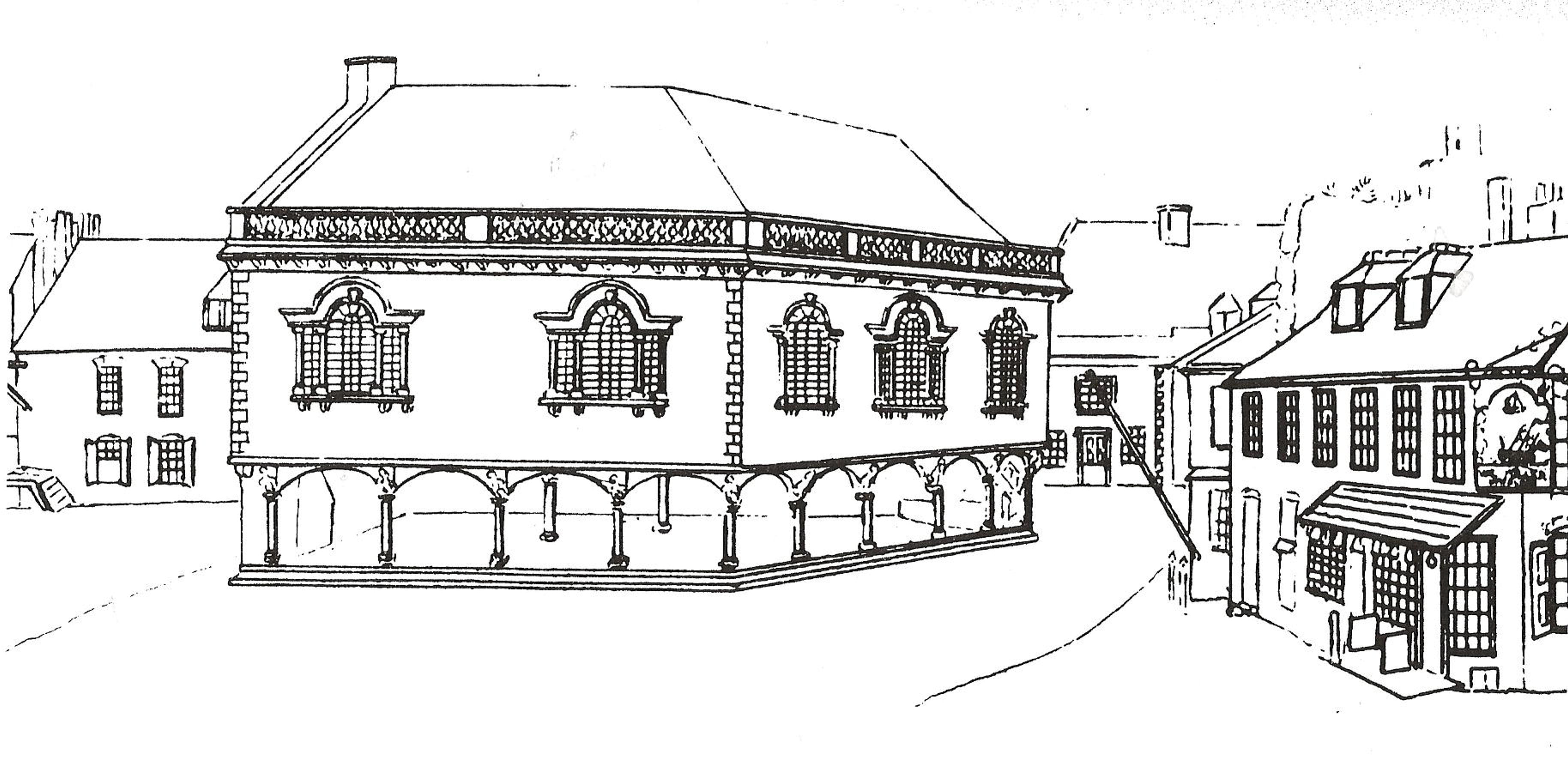
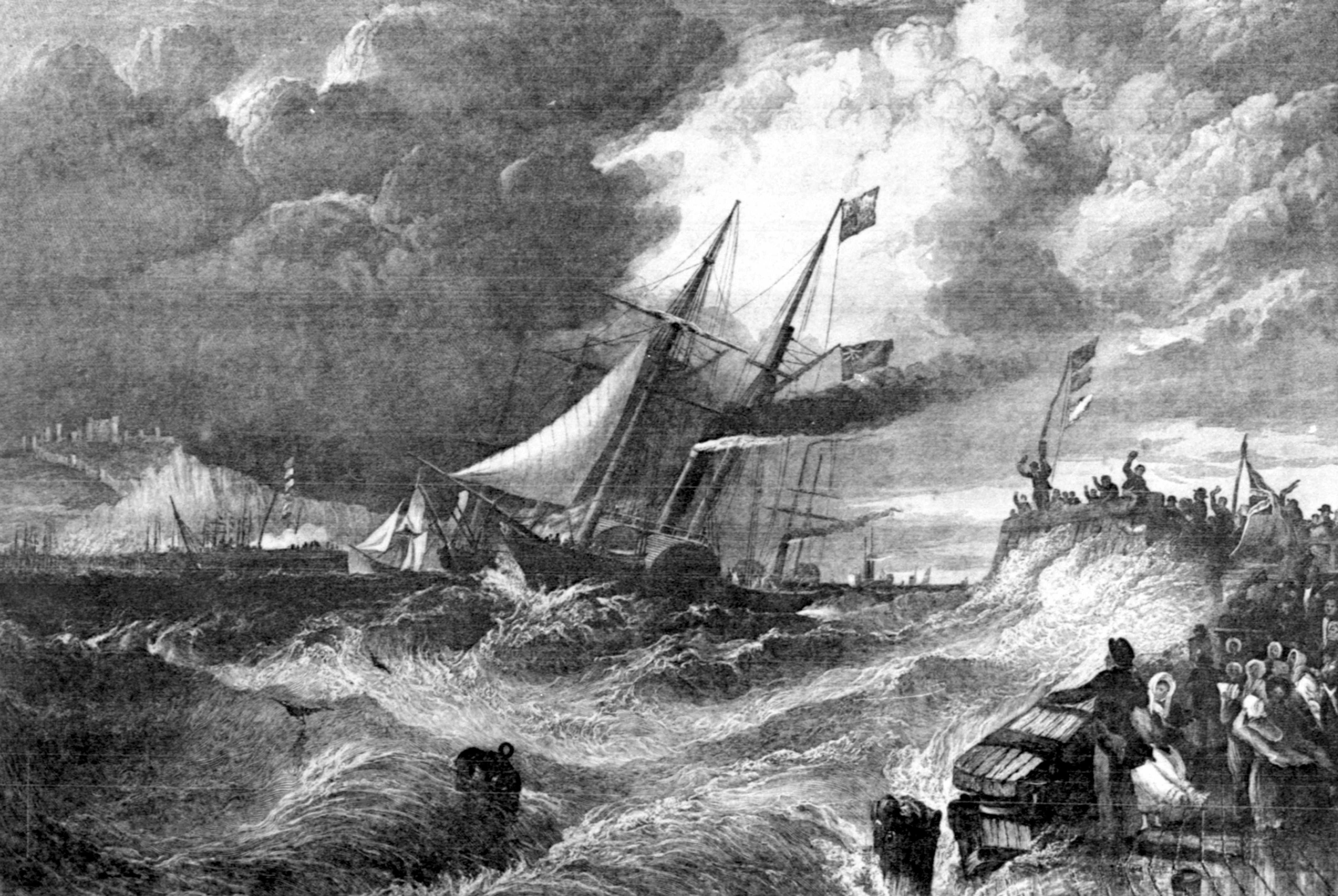
Admiralty Pier Part I 1836-1908

Admiralty Pier c1900. Dover Museum

Admiralty Pier c1900. Dover Museum

Admiralty Pier is one of the great British engineering feats of the 19th and early twentieth century. Since then it has played an important part in both national and local history. Part I of the story of the Admiralty Pier covers events leading up to and the almost completion of the Pier. Admiralty Pier Part II covers the building of Marine Station and the practical function of the Pier since.


The possibility of building Admiralty Pier, originally the western arm of the Harbour of Refuge had been through four enquiries by 1847 when the final approval was given. The first was in 1836, the second – a Royal Commission – in 1840, a Committee of the House of Commons in 1844, and Admiral Sir Bryan Martin’s Commission in 1845. The first Inquiry had been called at the behest of the Dover Harbour Commissioners, who wanted Dover to become a Harbour of Refuge for ships traversing the notoriously treacherous Strait of Dover.
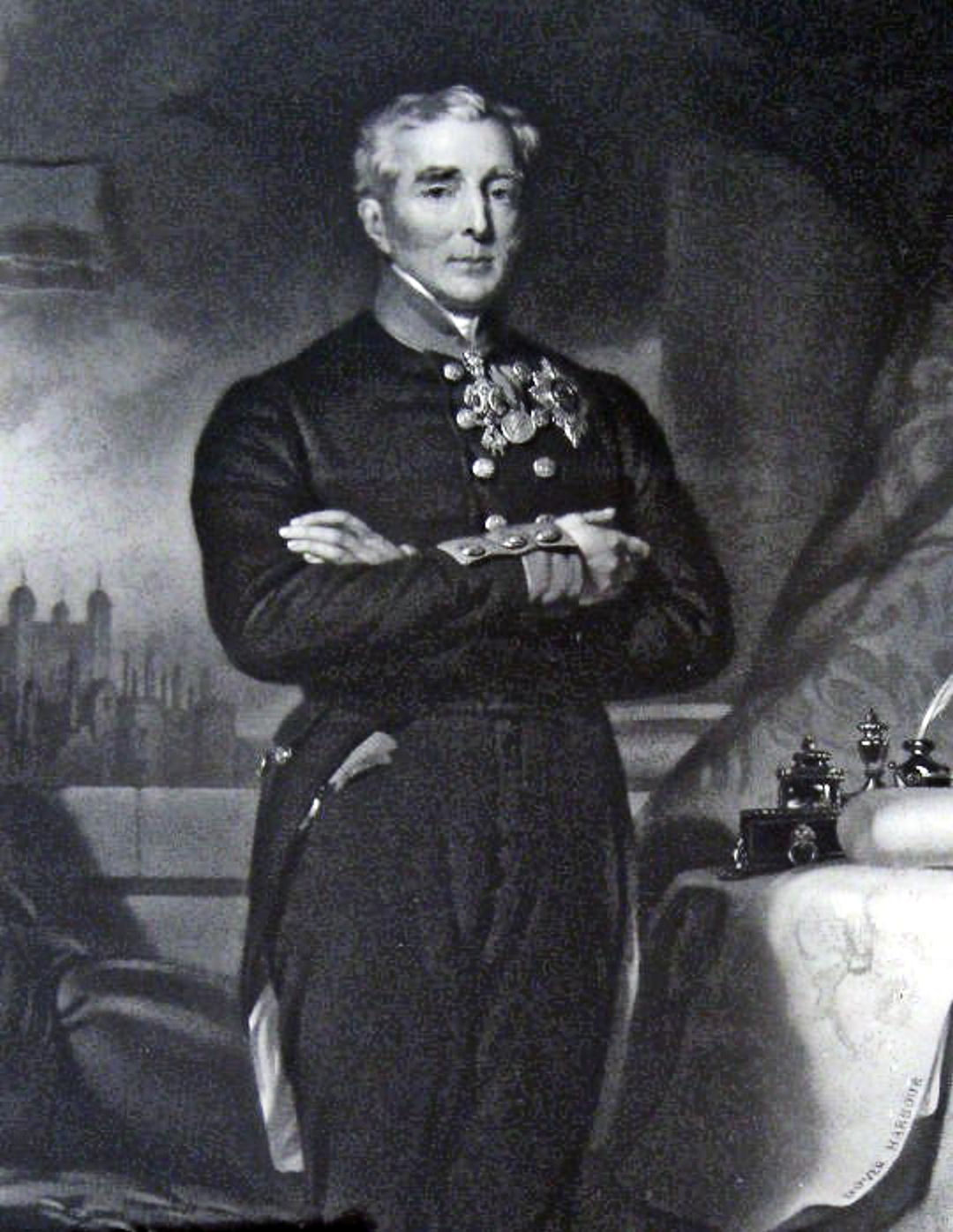
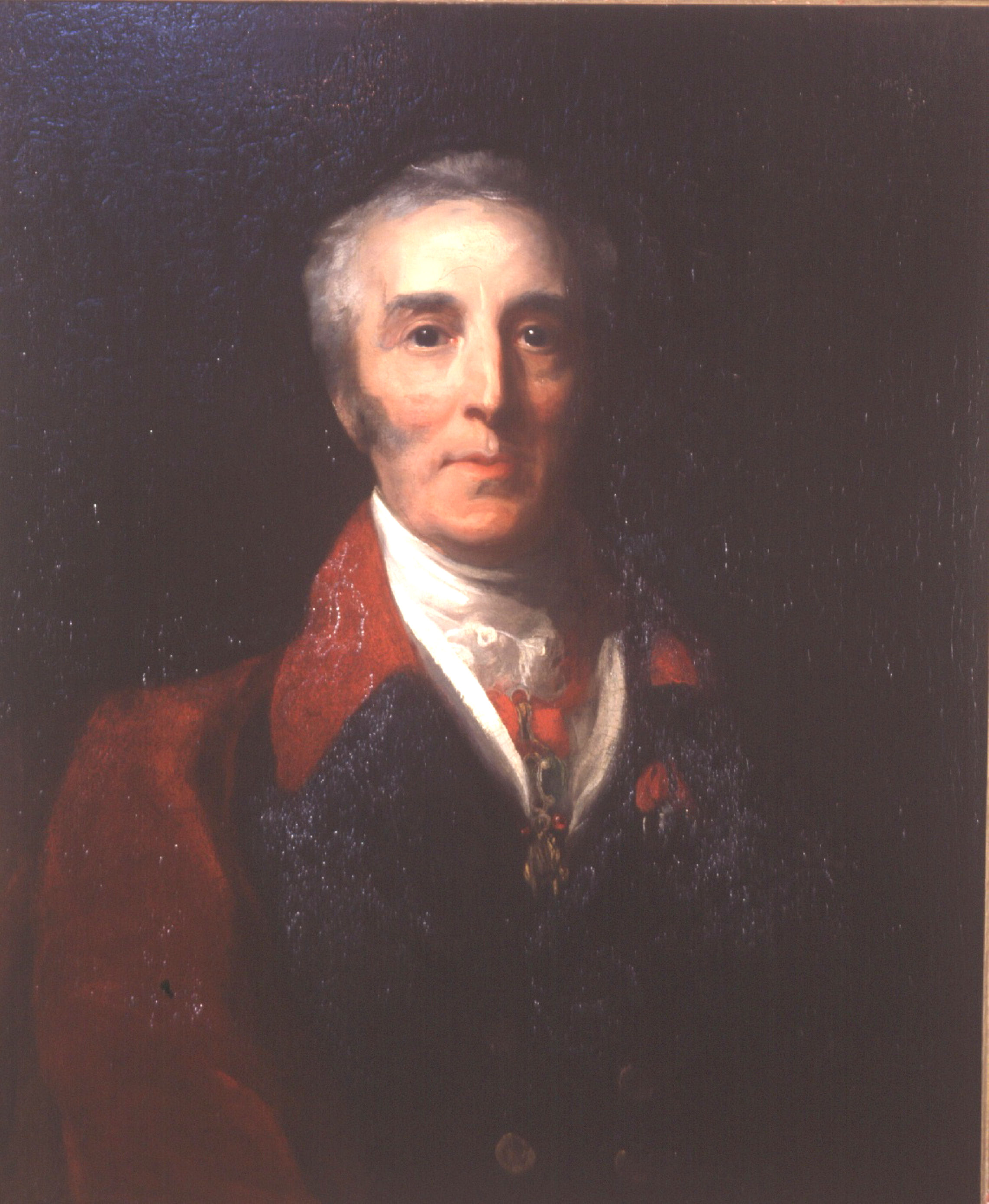
Duke of Wellington. Dover Harbour Board.

Duke of Wellington. Dover Harbour Board.

The other inquiries were direct descendents of the first with the added input from Arthur Wellesley, the Duke of Wellington (1769-1852) who had been installed as the Lord Warden of the Cinque Ports in 1829. He was worried that if there were more hostilities with France, the port as it was, would be useless due to the Eastward Drift – shingle being washed into and blocking the harbour entrance. Wellington had appointed the famous civil engineer Thomas Telford (1757-1834) to find a way of tackling the problem. Although Telford was dead by the time his recommendations and other measures had been instigated, the result was the Wellington Dock, which was formerly opened by the Duke on 13 November 1846.

It was the combination of arguments put forward for a Harbour of Refuge and a National Naval Port on the south east coast that influenced Admiral Sir Bryan Martin’s Commission in 1845. They recommended that a harbour should be constructed in Dover Bay and the design submitted by James Walker (1781-1862), then the Dover harbour engineer, was accepted. His proposal covered an area of 520 acres and was estimated to cost £2,500,000. However, nothing happened, so there was another Inquiry asking why? Finally, approval was given in 1847, though for a different design.

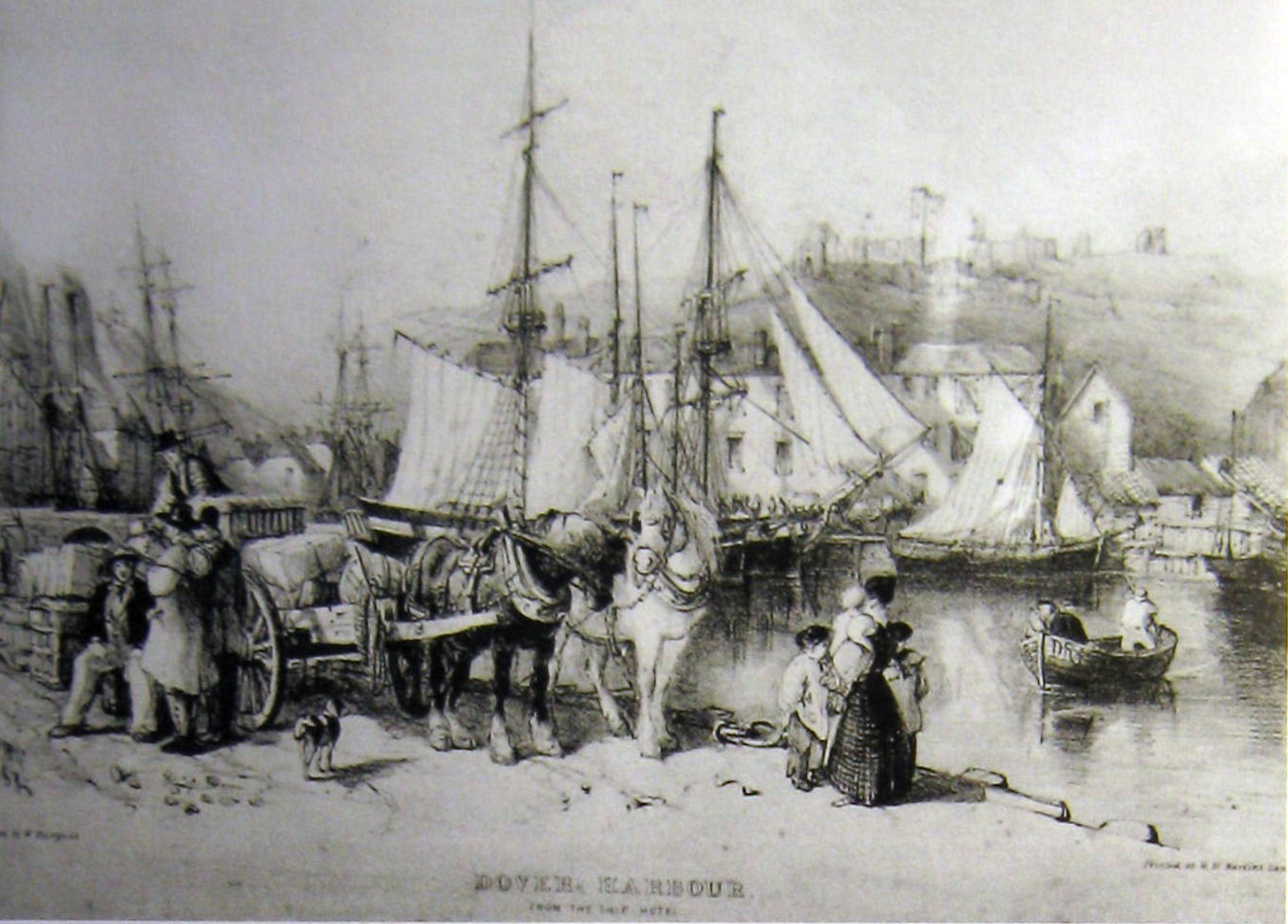
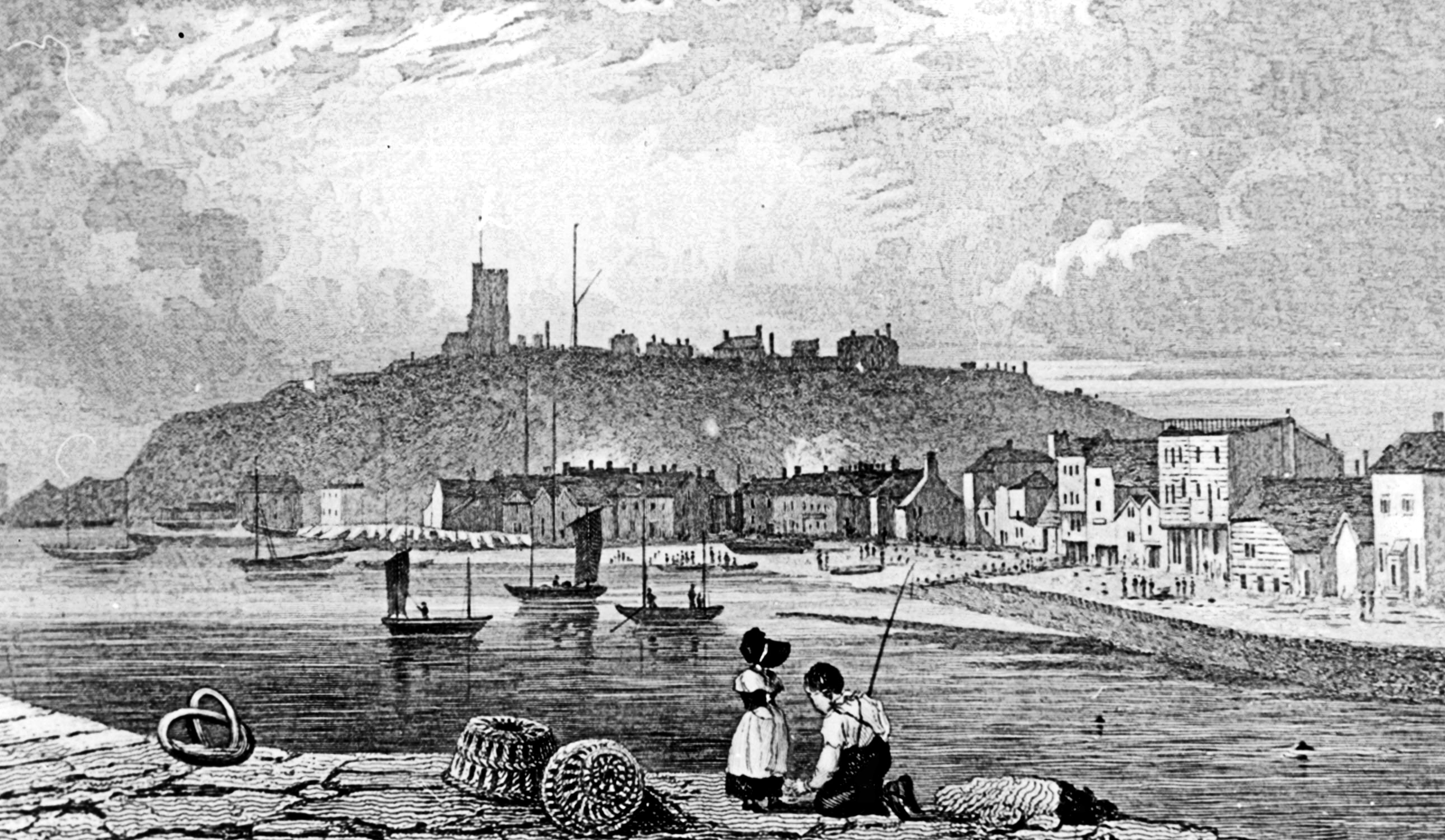
Dover Harbour c1830. Cheesman's Head was to right of the then harbour entrance.

Dover Harbour c1830. Cheeseman’s Head was to the right of the then harbour entrance.

The designed eventually chosen was drawn up by Sir John Hawkshaw (1811-1891) and was to be built under the supervision of Sir John Rennie (1794-1874). The main building contractor was Henry Lee & Sons of Chiswell Street, London. The construction process was divided into parts. The first started from the shore at Cheeseman’s Head – one of the bluffs on Archcliff promontory that was once part of the ancient harbour – and was 800-feet long extending almost at right angles. At the time, this was believed to be the most difficult part of the works and was estimated to cost £245,000.

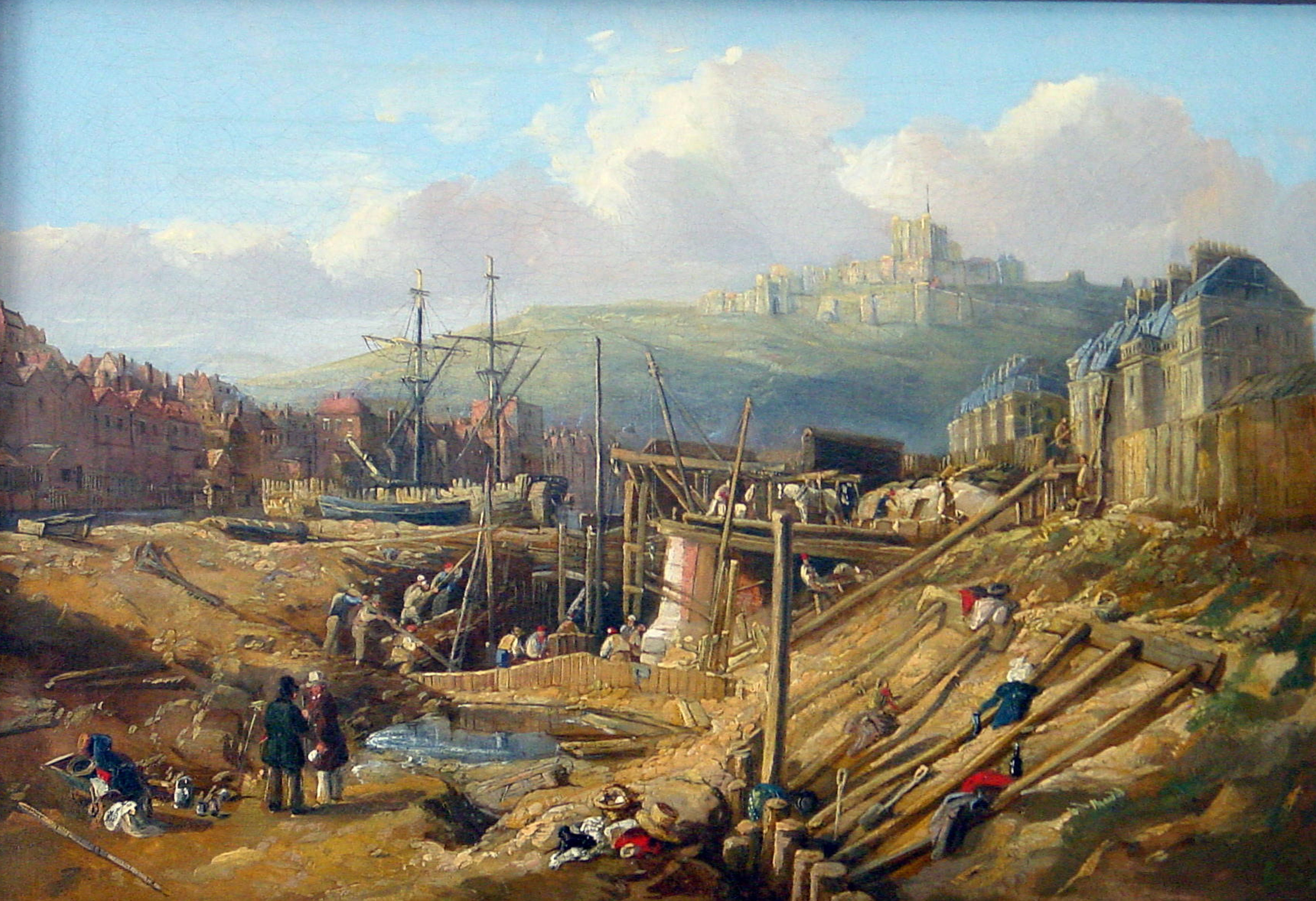
The first phase began in November 1847, without any fanfare, when wooden staging was erected 100-feet long and 10-feet above high water level. It was not until Sunday 2 April 1848 that the formal laying of the foundation stone took place. The next day the seabed foundations were started. About three-feet of mud was first removed using a new dredging machine while at low tide men with shovels took over. Then the sea floor was flattened using a new-fangled steam operated machine. Blocks of Portland stone, each weighing about 3-tons, were brought by sea from William & John Freeman’s quarry at Grossland, Isle of Portland, Dorset. Dover Harbour Commissioners (DHB) charged Henry Lee & Sons 13½pence per ton to land these stone blocks!
Admiralty Pier construction c1847-1850. Dover Library

Admiralty Pier construction c1847-1850. Dover Library

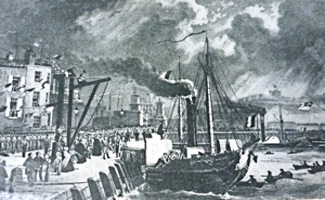
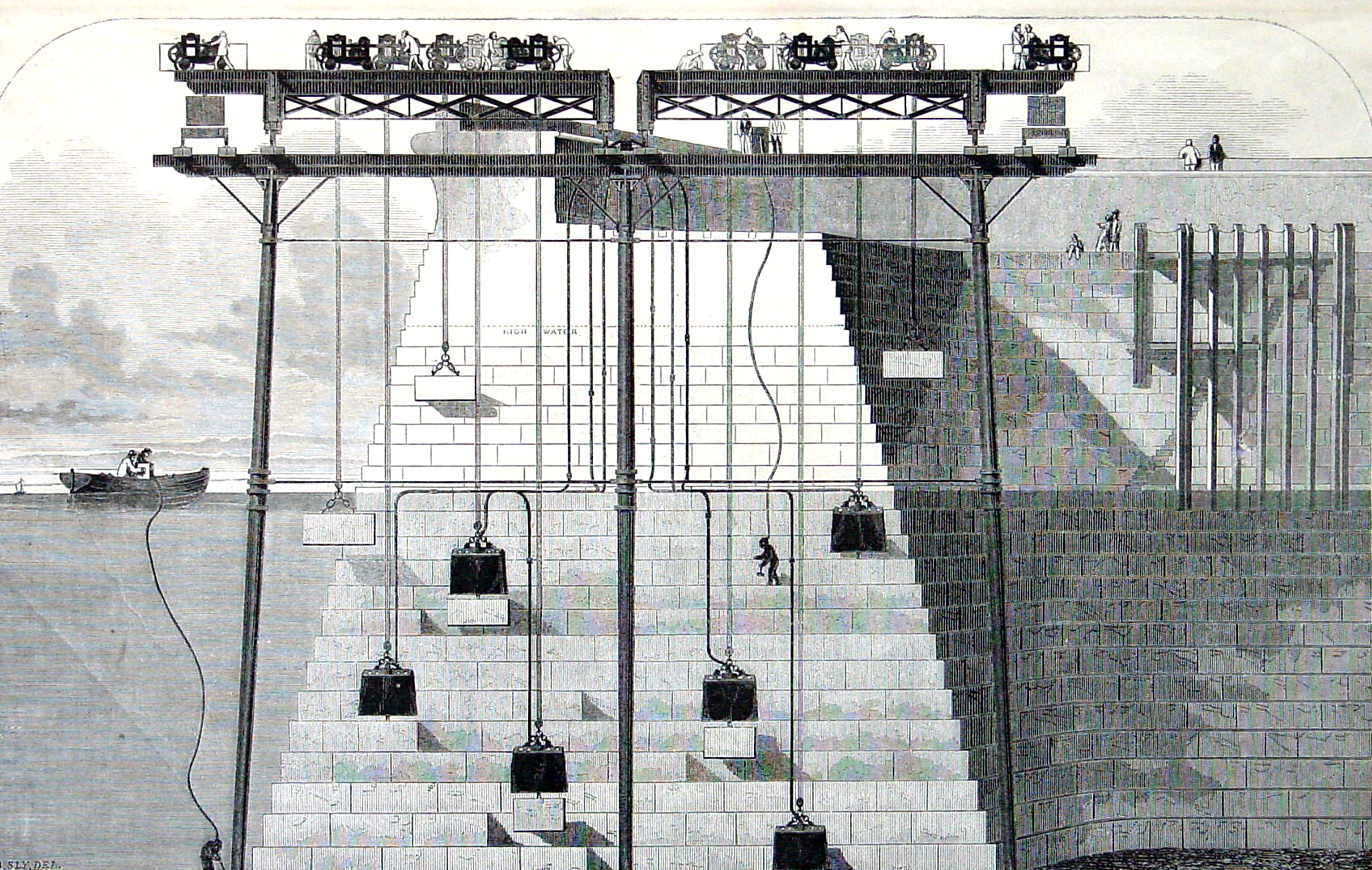
The problem of placing the foundation stones was given to the young harbour engineer, Edward Druce (died 1898). A survey had shown that the harbour floor was solid and so the decision was whether the divers involved should be helmeted or whether diving bells were to be used. Druce opted for the latter. Each stone was lowered by crane and positioned by divers working in three large diving bells for 5-hours at a time. Eighteen blocks formed each horizontal course and were built to a height of 6-feet below the high water mark. The stones were then faced, on the west side, with granite, on the east side with Bramley Fall Stone. The Namurian sandstone, Bramley Fall Stone, was quarried at Horsforth in Leeds and was known for its strength and durability.  The final height of the Pier was 10-feet above the high water mark and once the foundation level was laid the work was carried out by helmeted divers. An illustration of the time gives shows how this was undertaken.
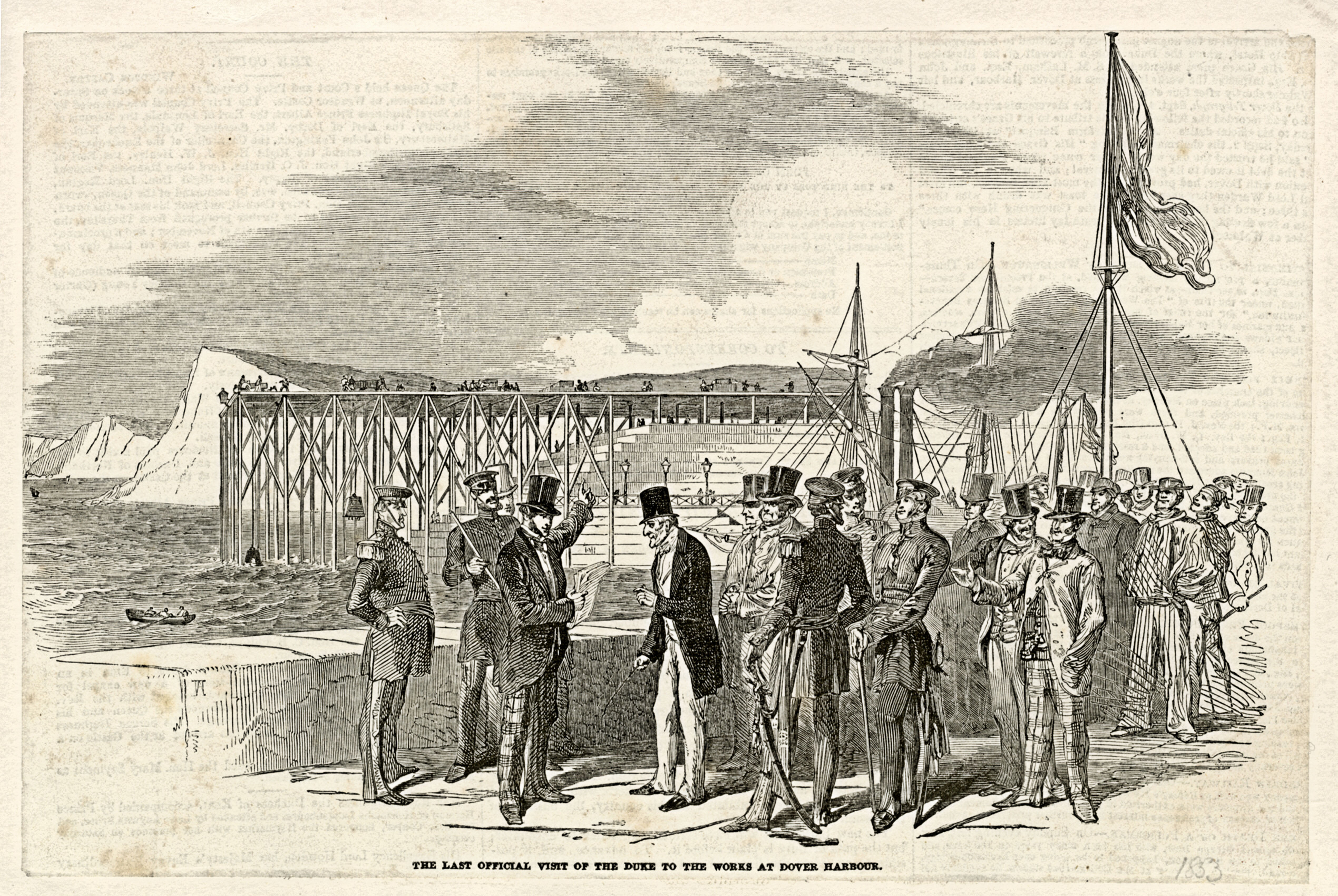
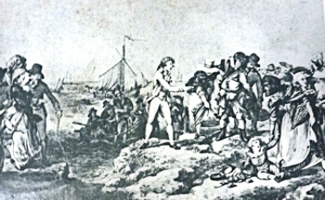
Admiralty Pier construction being inspected by the Duke of Wellington (1769-1852). Dover Museum

Admiralty Pier construction being inspected by the Duke of Wellington (1769-1852). Dover Museum

In August 1849, when about 650-feet from the shore had been completed the Duke of Wellington paid one of his regular visits. As usual, he was escorted by James Walker, Henry Lee and harbour master – John Iron (I). The Duke was already aware that the seabed was a lot softer than had been anticipated such that  the foundation stones had to be re-laid at a greater depth. Once that problem had been dealt with, Iron told the Duke that building work was having a calming effect on the sea on the eastward side and that it had curtailed the Eastward Drift. This had allowed the harbour entrance to be deepened by 3-feet for which the steam-dredging machine was used. However, Iron added, there was evidence that as the Pier progressed it was giving rise to flooding in the town. Wellington ensured that money was available to build a protective seawall from the base of the new Pier along the seafront to the Boundary Groyne opposite Guilford Battery – where the Harbour Commissioners jurisdiction ended.

All was going well until Tuesday 8 October 1850, when during an intense storm, centring on Dover, piles, 18-inches square were snapped and three 5-ton diving bells were carried out to sea – two being found later. At daybreak, the bay was strewn with fragments of timber and machinery including broken cranes, air pumps and traversers. The Duke of Wellington rode from Walmer to inspect the damage and accompanied by James Walker with Colonel Blanchard of the Ordnance went to the extreme end of what remained of the Pier. Remedial work was quickly undertaken and work on building the Pier resumed after two weeks only to be disrupted by another storm on 23 October and a far worse one on 15 December. In January 1851, another storm washed 200 stones out of position and they had to be re-laid.
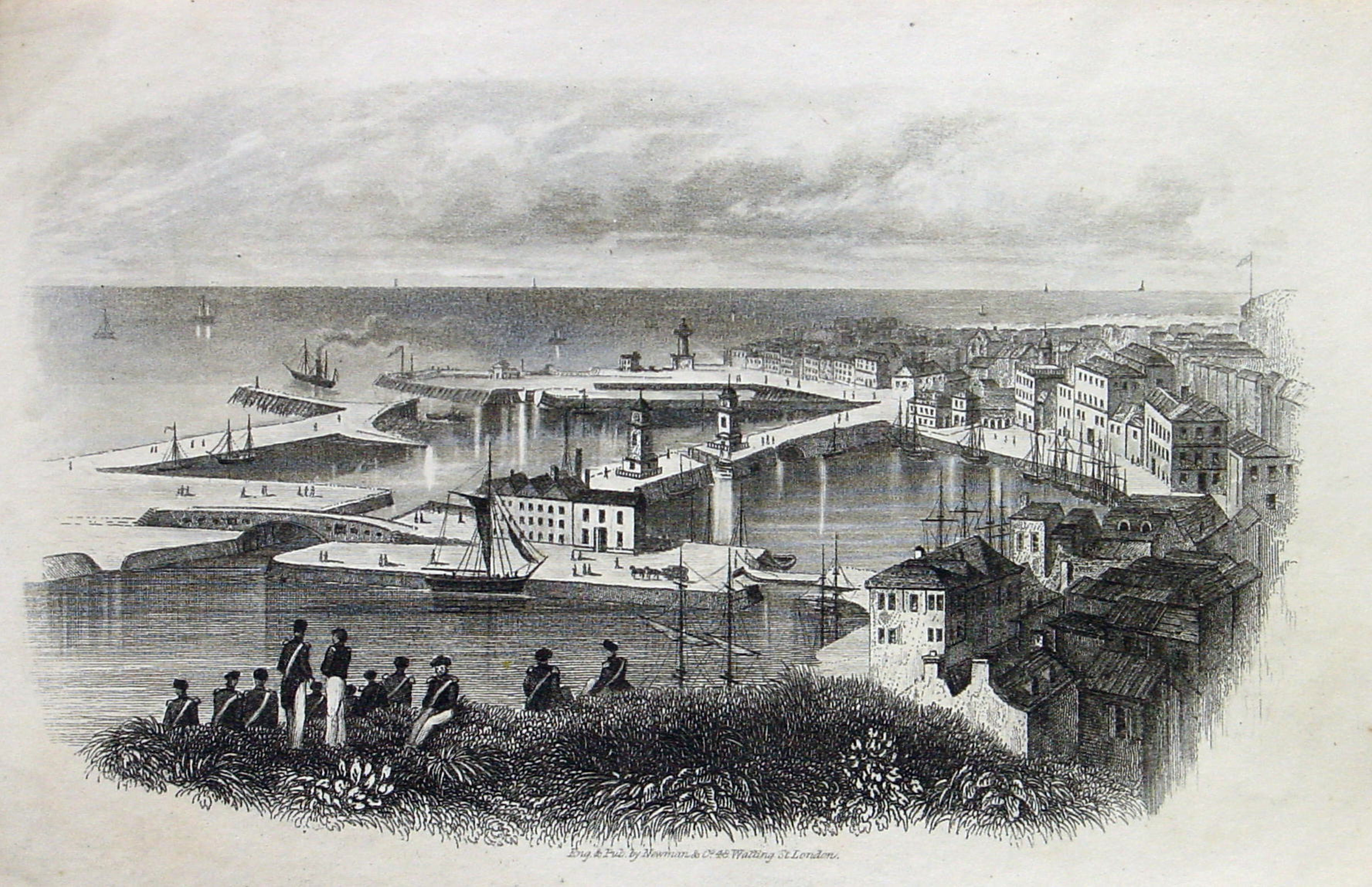
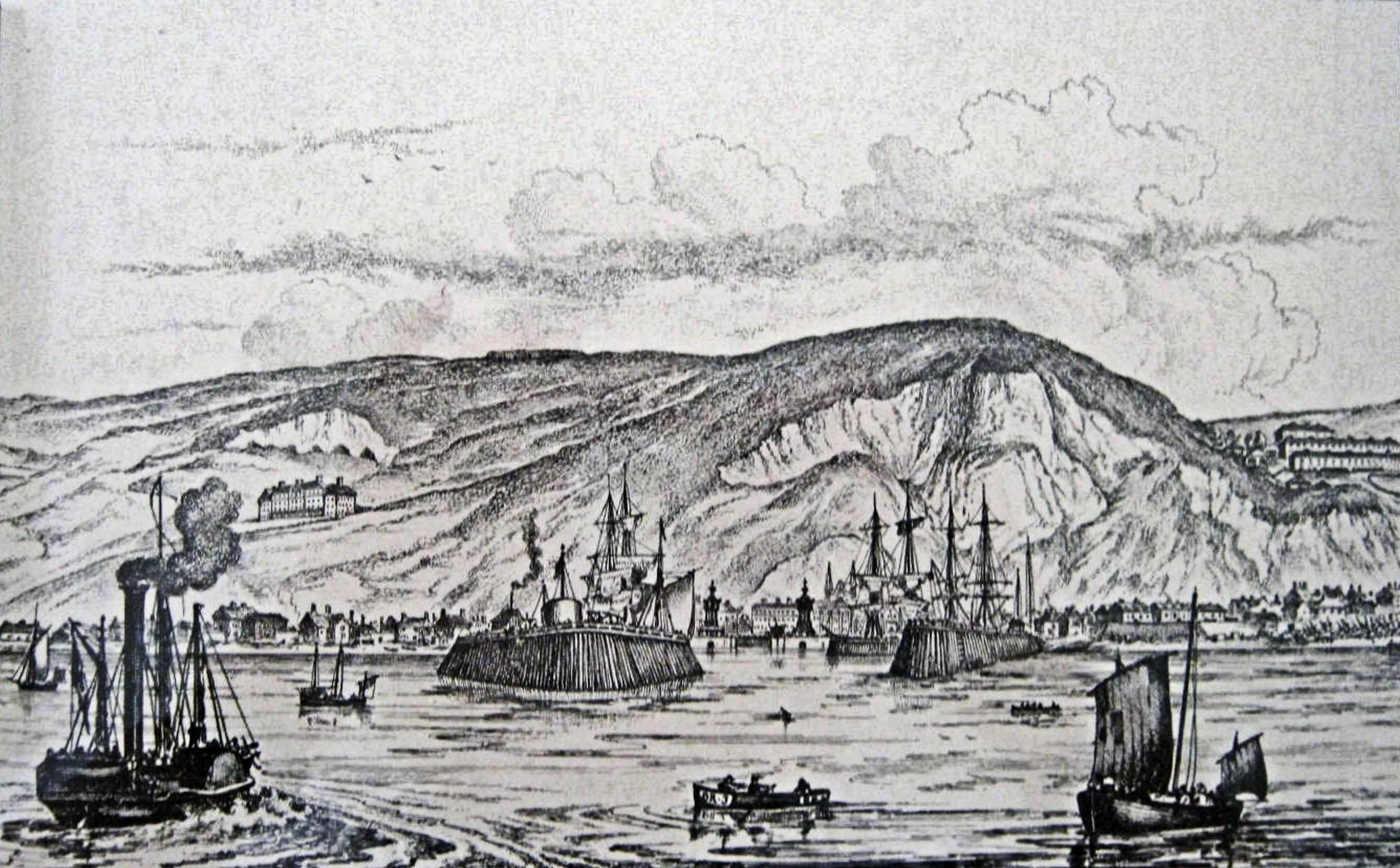
Dover Harbour c1850 from Western Heights. In the foreground is Wellington Dock, what was then the Bason now Granville Dock and the Tidal basin. The uppermost Pier is the start of Admiralty Pier. Dover Library

Dover Harbour c1850 from Western Heights. In the foreground is Wellington Dock, what was then the Bason now Granville Dock and the Tidal basin. The uppermost structure is the start of Admiralty Pier. Dover Library

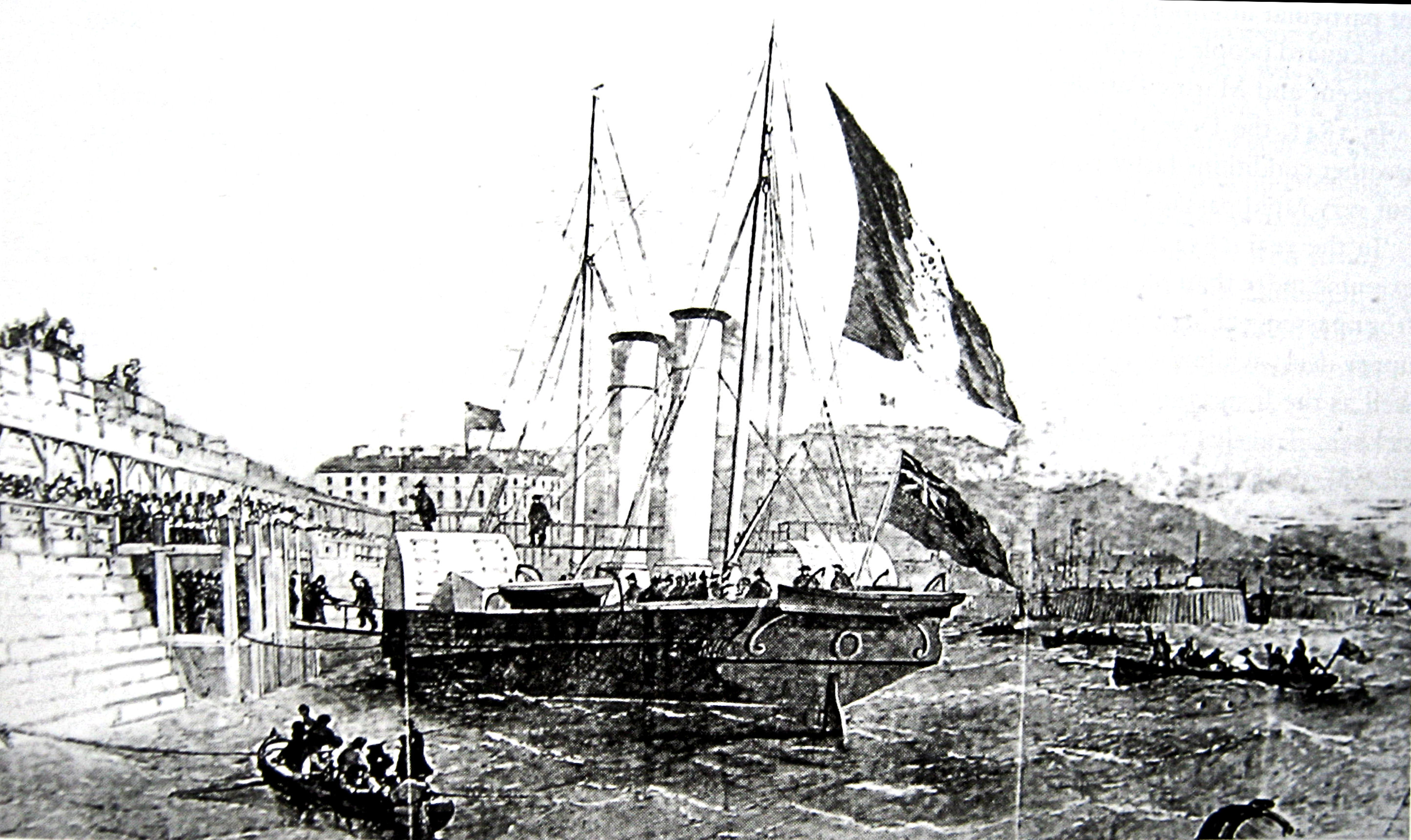
By 14 June 1851, the Pier was taking shape and on that day, the pleasure steamer, Father Thames, landed 50 passengers. Five days later, on 19 June 1851, it was announced that the first part of the Admiralty Pier was complete and the Princess Alice, became the first cross-Channel packet ship to use it. Elsewhere, it is wrongly stated that the packet Onyx landed passengers on 15 January 1851 – that day the Onyx was moored in the Downs due to bad weather. With the proximity of both the South Eastern Railway Company’s (SER) Town Station, opened in 1843, and the Lord Warden Hotel, it was hoped that the future use of the Pier for the purpose of landing and loading would be guaranteed.

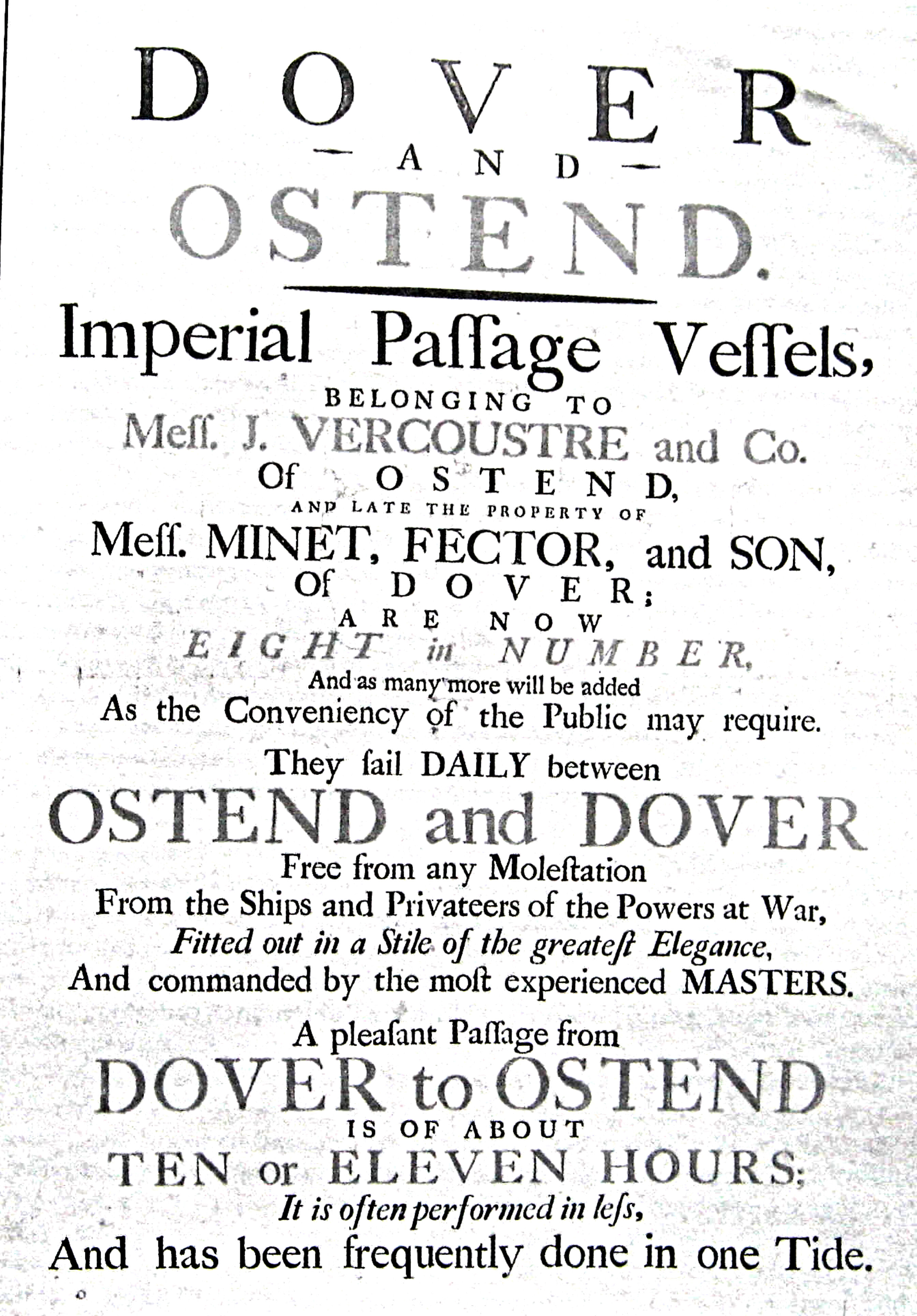
SER built a new Custom House near the Pier with the intention of using Admiralty Pier, but as the company was not allowed to run trains on the Pier to meet their ships the company moved all their vessels back to their own harbour at Folkestone. Albeit, the Pier was well used by the six Admiralty Packets steamers that carried mail from 1837 to 1854 and plied the Channel twice daily between Dover and the three ports of Calais, Boulogne and Ostend. Alongside the English mail steamers there were also French and Belgium mail packets and in 1851 the Great Exhibition in London ensured the Pier’s success. During the period of the Exhibition, passenger traffic from the Continent using the Packets was sometimes in excess of 200 passengers per ship.

As the Admiralty Pier gained in length, the problem of flooding, although alleviated by the new seawall, did not go away. This was used by SER and their supporters as an argument for the Harbour of Refuge to be sited in the Folkestone-Hythe Bay. On 27 August 1853 Sir James Graham (1792-1861), First Lord of the Admiralty, headed a retinue of delegates to Dover on an official visit. They were brought to Dover by Captain Luke Smithett, on the Vivid mail packet. The ship tied up on Admiralty Pier and the influential officials were met by Mayor Charles Lamb and the two Dover members of Parliament, Edward Rice (1790-1878) MP for Dover 1837-1857 and Henry Cadogan – later Viscount Chelsea (1812-1873) MP for Dover 1852-1857. The Admiralty representatives also inspected Archcliffe Fort where the Royal Artillery had recently fixed large guns to protect the envisaged Harbour of Refuge. The visit was successful and a subsequent Royal Commission recommended that the Admiralty Pier should be extended and that a gun turret should be incorporated.

London Chatham & Dover Railway's Harbour Station proposal. Dover Library

London, Chatham & Dover Railway’s Harbour Station proposal. Dover Library

At the time, the Bill for the Canterbury-Dover railway line was going through Parliament and eventually led to the London, Chatham and Dover Railway (LCDR). The company proposed to make Dover their main crossing point to the Continent in competition with the Folkestone based SER. In their evidence to the House of Lords on the Bill, SER stated that they had wanted to run their line along the Admiralty Pier but permission had been withheld. In their evidence, LCDR stated that they too wished to run their line along the Pier although their main station was in Elizabeth Street. Permission from the Admiralty was not forthcoming for either company.

On 27 December 1853, as the first phase of the Admiralty Pier was almost completed the foreman carpenter, Richard Mopat, was blown off the Pier during a gale and drowned. It was suggested an iron railing should be erected to stop such accidents happening again. A few weeks later the second phase, the building of a further 1,000-feet was began. However, to save money, instead of a solid wall of Portland stone, blocks were used to build the inner and outer walls. The trough between was filled with concrete blocks and rubble and finished with concrete. The concrete blocks were made on the adjacent Western (now Shakespeare) beach and the aim was to complete the second phase by November 1864.

Although this method of construction was cheaper, there were loud complaints regarding the slow rate of progress that was being made. This was mainly due to Treasury financial constraints and problems with the soft seabed that required sinking foundation stones much deeper than anticipated. In the House of Commons, when it was reported that thus far the Pier had cost £278,000. there was an outcry that the project was a waste of public money and funding should cease. In 1858, a House of Commons Select Committee was set up to look into this and they also listened to the argument over the need for a Harbour of Refuge. The Committee concluded that as long as the costs of the second phase did not exceed the financial amount lost through shipping disasters then the investment was worthwhile. However, instead of an eastern pier Dover would have to make do with a landing stage.

In 1859, the Admiralty finally agreed for SER to run onto the new Admiralty Pier for which SER agreed to contribute £3,000. They were told that there would be special facilities for packet ships. Five years previously in 1854, tenders had been invited for the prestigious and lucrative Packet contract and SER had expected to win it. Instead, it was awarded to Jenkins & Churchward though it was due for renewal in 1863.
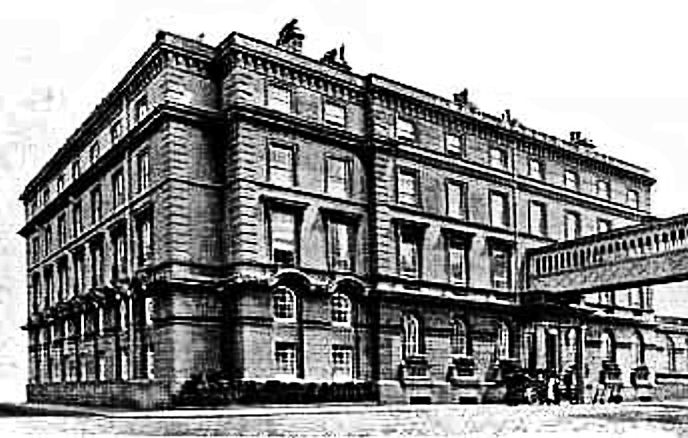
Lord Warden Hotel showing the walkway to the South Eastern Railway Town Station. Nick Catford

Lord Warden Hotel showing the walkway to the South Eastern Railway Town Station. Nick Catford

SER planned that the new railway line would continue from Town Station on a curve onto the new Pier, so that passengers and mail would be adjacent to where the ships berthed. In order to do this it was necessary to build a substantial tall seawall between the west side of the Pier and the shore. This, SER shareholders agreed to pay for, as it also would have the added advantage of protecting the Lord Warden Hotel from strong southwesterly winds. At the time, there was a walkway from the Hotel to the railway station. The wall and the laying of the line was completed in the summer of 1861 and in October SER started running trains on the Admiralty Pier to meet the company’s passage service.

In 1861, the Harbours and Passing Tolls Act came into force with the aim of facilitating the Construction and Improvement of Harbours by authorising Loans to Harbour authorities. The Act abolished Dover’s Passing Tolls and embodied within it a new constitution that led to the Harbour Act of the same year. This Act abolished the Harbour Commissioners replacing them with the Dover Harbour Board (DHB) presided over by the Lord Warden (1866-1891) who, at the time, was George Leveson Gower the Earl Granville (1815-1891). The new Board consisted of six, two of which were members of Dover Corporation, two represented the railway companies, one the Admiralty and one the Board of Trade.

James Walker had ceased to be the harbour engineer but his company held the contract as consultant engineers until Walker’s death on 8 October 1862. Then all of the firm’s government contracts were passed to Messrs McClean and Stileman of Great George Street, London. They took up the Admiralty Pier contract in the spring of 1864. John Robinson McClean (1813-1873) was the President of the Institution of Civil Engineers for the years 1864 and 1865, and eminent engineer Francis Croughton Stileman (1824-1889) had been his partner since 1849. Edward Druce continued as the resident engineer and Henry Lee as the contractor for Admiralty Pier.

By 1863, 1,675-feet of the Admiralty Pier had been constructed and the length of the quay was 1,539-feet. For the third and final works, the costs had been estimated at £101,000 spread over two years. It was estimated that work would finish in November 1864 but government money was tight and opposition was growing. In November 1861, the London Chatham Dover Railway (LCDR) opened to Harbour Station. They successfully petitioned Parliament to run their trains along Admiralty Pier and they were charged the same as SER were being charged.
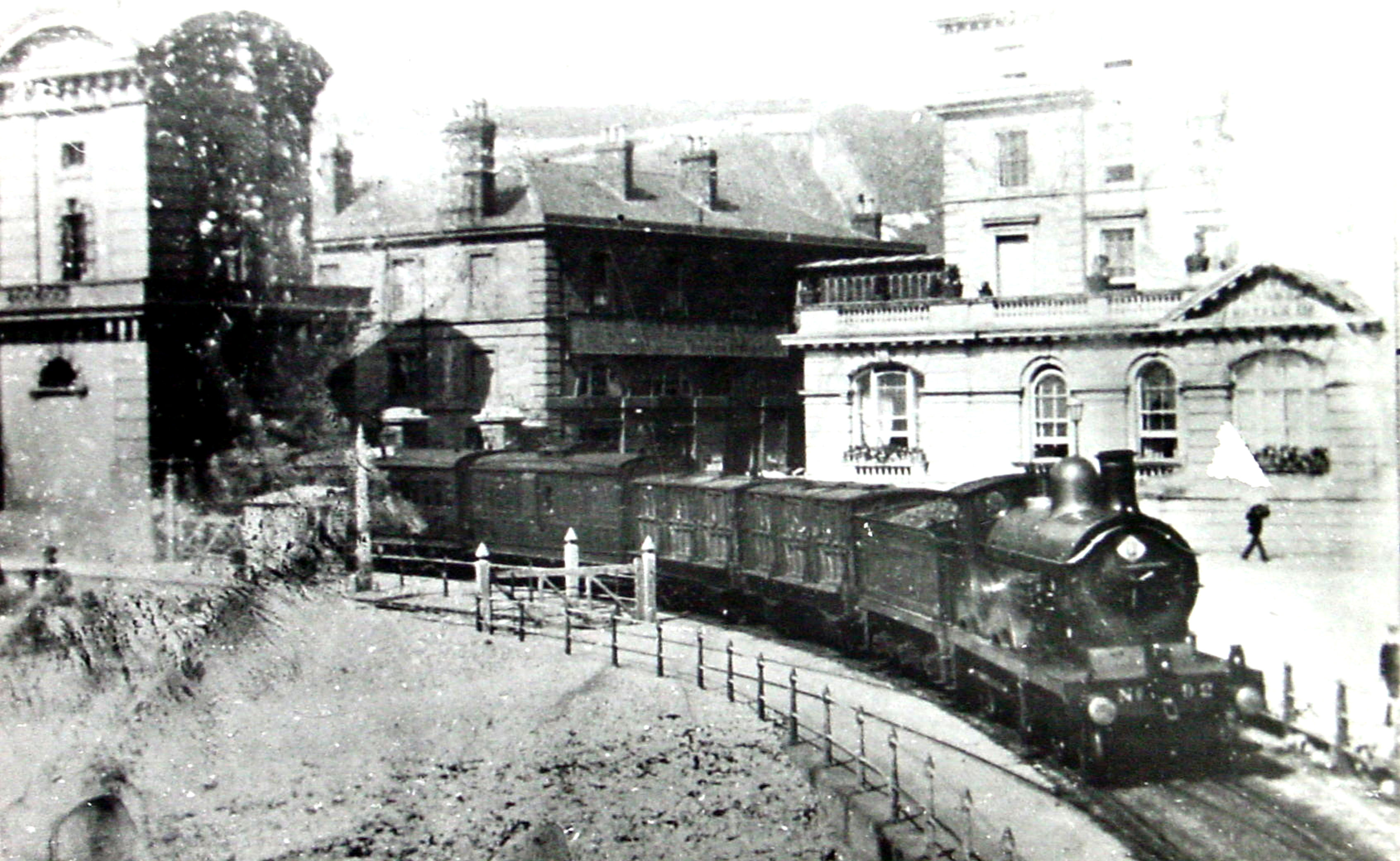
South East & Chatham train D class 9.9.0. going through the Pilot's Tower c1905.

South Eastern & Chatham Railway’s ‘D’ Class 4-4-0 going through the Pilot’s Tower c1905.

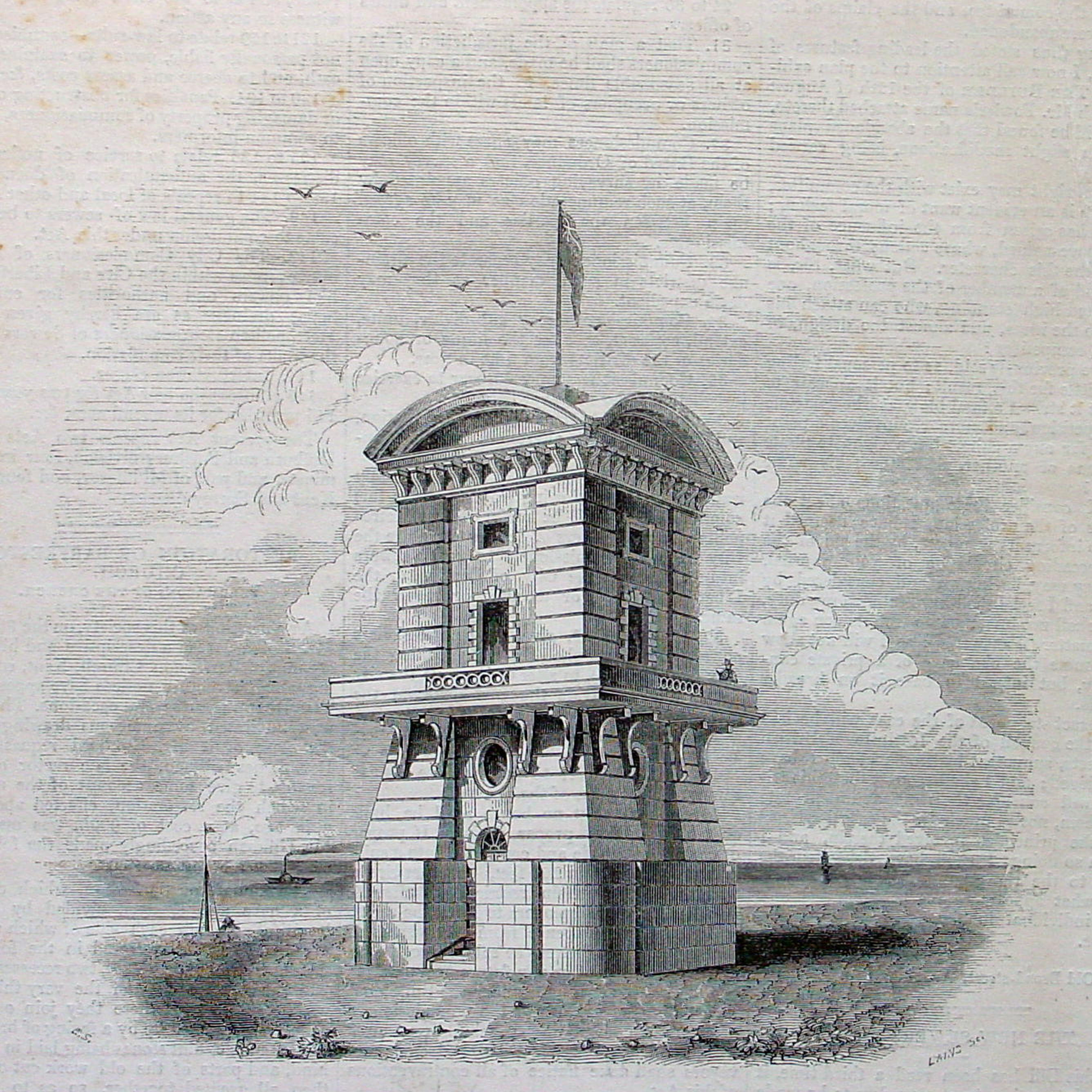
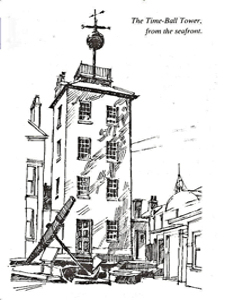
This appeared advantageous to SER, for to make way for their track in 1844, the pilot station was demolished on Cheeseman’s Head. In its place, a highly ornate pilot station was built of stone and standing on a bed of concrete 10 feet thick opening in 1848. This new tower was between the LCDR’s harbour station and the Admiralty Pier! Instead of building a parapet over the sea to circumvent the tower, LCDR noted that the ground floor of the tower had a ceiling height of 20ft (over 6 metres). They bid for the area to be gutted and laid their line through the Tower! Then, in 1863, LCDR won the converted Dover Mail Packet contract and from 30 August 1864, their trains ran through the Pilots tower to Admiralty Pier!

To add insult to injury, according to SER, the rules for the use of the Admiralty Pier were skewed in favour of LCDR. There was just room for two lines on the Pier with a central crossover that enabled trains to reach the further part of the single platform from the town end. The single platform was against the western parapet and during inclement weather waves broke over the parapet soaking passengers and their luggage! Initially, SER were pleased as they were designated the use of the platform at northern end of the Pier – nearest the town – and the LCDR the southern part. On the eastern side of the Pier were five landing berths, three inner and two outer. Berths one to three were for Continental steamers while the outer two were for Navy use. Berth 2 was designated strictly for the sole use of Packets and mail trains had priority. Near berth one, SER’s berth, was Mole Head Rock. Although this was a known shipping hazard, no attempt was made to remove it (see Ville de Liege story).
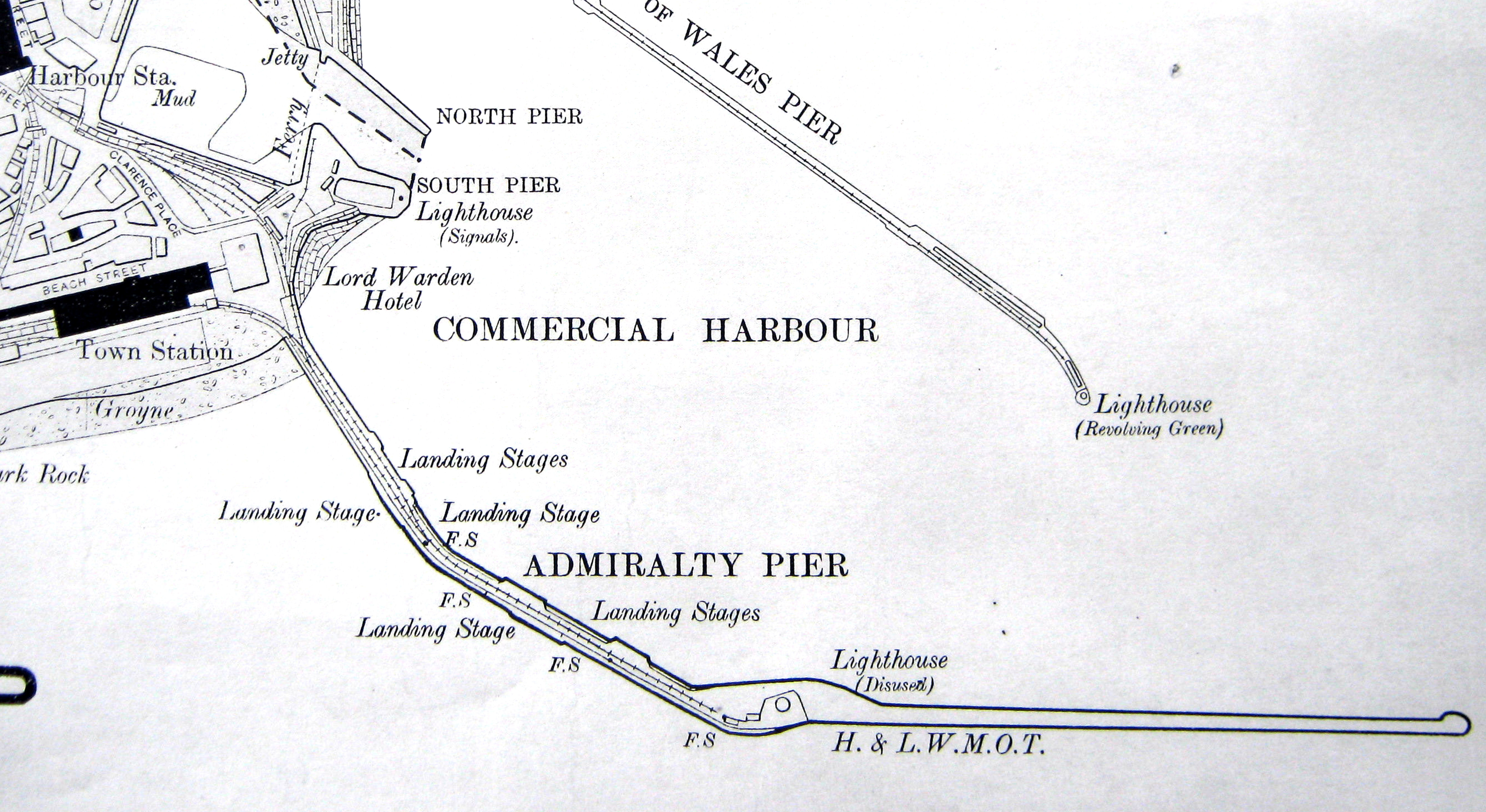
Map dated 1919 of Admiralty Pier showing the railway lines layout prior to the building of the extension landing stage and Marine Station started in 1909

Map dated 1919 of Admiralty Pier showing the railway lines layout prior to the building of the extension landing stage and Marine Station started in 1909

Besides mail trains having priority, trains were not allowed onto the Pier before their advertised time and if an SER train was running late, it had to wait until the Pier was clear of LCDR trains. If trains from both companies arrived late, the mail train had priority and then the first to arrive was given access. If the second train was an LCDR and there were no mail trains, that was allowed access but if it was an SER train, it had to wait until the LCDR had left! Finally, if both companies had trains on the Pier the SER train had to leave before the LCDR . The rules quickly became abhorrent to SER who complained bitterly but to no avail and they withdrew their passage service from Dover. On that first day that Admiralty Pier was open to LCDR trains, 30 August 1864, the Duke and Princess Mary of Cambridge arrived on Admiralty Pier where the Royal entourage embarked on the LCDR steamer Wave for France. LCDR used the event for publicity purposes, saying that Royalty had opened their Admiralty Pier line!
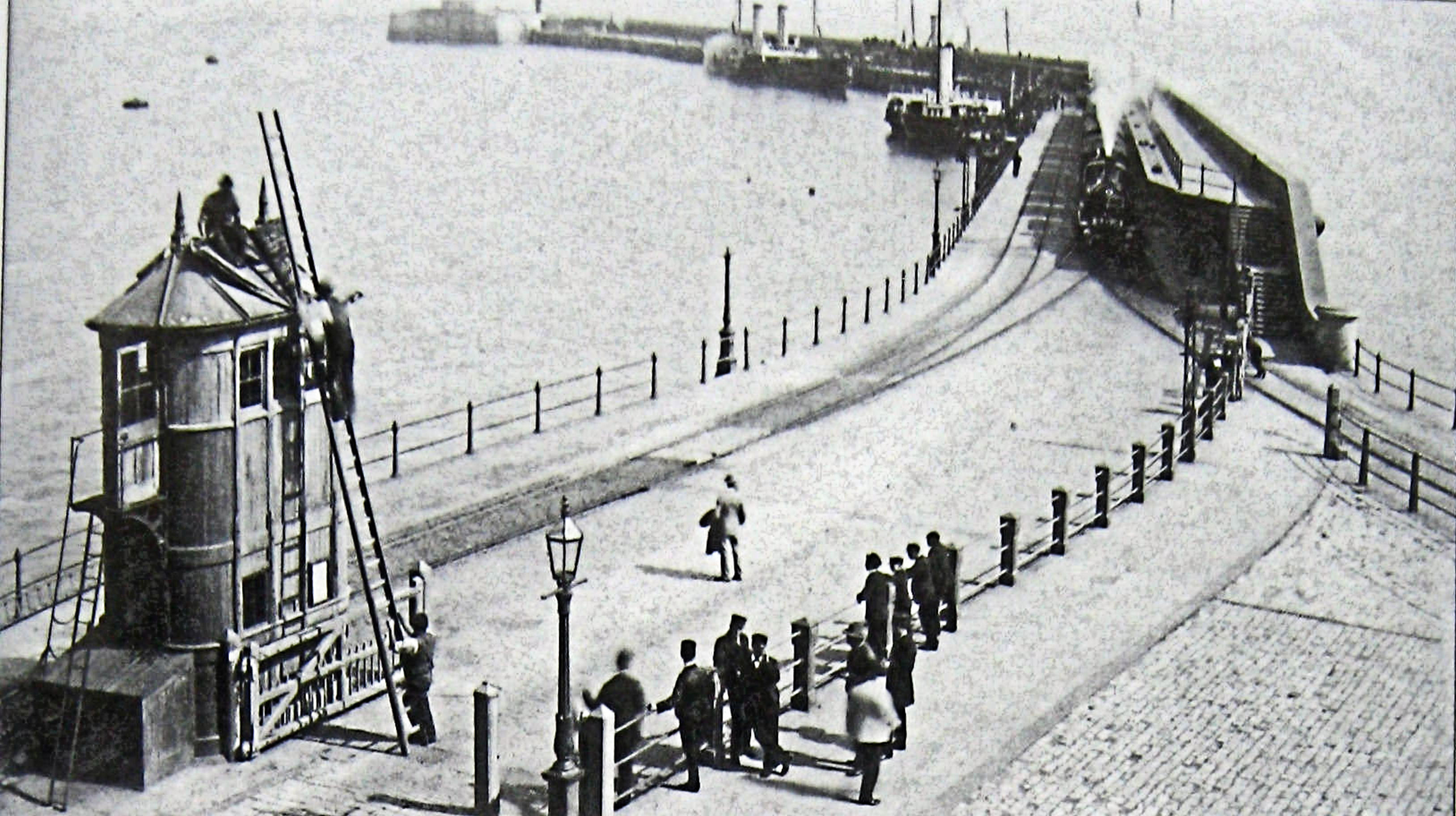
TAdmiralty Pier c1890 with a Sterling engine on the line. Note shutters on signal box. Bob Hollingsbee collection, Dover Museum

Admiralty Pier c1890 with a Sterling engine on the line. Note shutters on signal box. Bob Hollingsbee collection, Dover Museum

At the time the Admiralty Pier station did not have a covering, but one was quickly erected for the Royals. This was later temporarily reinforced several times but remained for years after. Indeed, one of the many complaints dated 1879 said, ‘it is bad enough to stand shivering on a wet, stormy day in a seasick crowd waiting to land. But to land across a mere plank in motion, at an angle of 45º on to a slippery pier, to pass up soaked staircases along open planks and to walk some 200 yards drenched by the rain and frozen by the wind … No rank, wealth or infirmity can buy off the dread and the danger of that wretched five minutes in which hundreds of people, worn out with travelling, tired and weak, are drenched and chilled as a preparation for their long journey back to London.’ Of interest, the signal box at the northern end of the Admiralty Pier lines had storm shutters to protect the windows during rough weather.

On 25 June 1865, the Admiralty Pier upper promenade opened and both promenades were 250 yards in length. The station and the lines were on the lower level at the east side of Pier adjacent to the landing berths. Both promenades were laid with flagstones weighing a ton and a half each and walkways were lit by gas ornamental lamps. The lower one also had telegraph posts carrying two sets of wires, one for SER use and the other for LCDR going to the two sets of offices. The offices were on the landward side of the northern end of the platform. Both promenades were expected to become major tourist attractions and the council drew up a list of charges and employed gatekeepers to collect the revenue. However, restrictions were imposed by the Admiralty forbidding the public access to the lower Pier twenty minutes prior to the arrival of a train or a cross-Channel ship until its departure and ten minutes prior to the same for the Upper Pier.

Admiralty Pier with a London, Chatham and Dover Railway Company train and packet ship in the Bay. South Eastern Railway Lord Warden is on the right. Dover Museum

Admiralty Pier with a London, Chatham and Dover Railway Company train and packet ship in the Bay. South Eastern Railway Lord Warden is on the right. Dover Museum

During the summer of 1865 and 1866, the restrictions meant that the Pier was closed to visitors for most of the time. This naturally caused a public outcry. Edward Knocker, Dover Town Clerk wrote a terse letter to the Admiralty but they were resolute that as the railway companies paid rent, apart from the Royal Navy, they had sole use. Others, including the Corporation could only use the Pier at the Navy’s or railway companies’ convenience. Matters came to a head when an excursion boat from Ramsgate was not allowed to dock against the Pier to disembark and embark its 100+ passengers that were visiting Dover. The passengers had to stand on the open quayside for some three hours during which time there was a rainstorm. Although nothing was done to ameliorate such situations, to placate the council, iron railings were erected along the eastern edge of the upper promenade so that it could be opened to the public.

Admiralty Pier circa 1870s

Admiralty Pier circa 1870s

As there was no chance of the eastern pier ever being built and the ships were increasing in size, it became imperative to deepen the Bason, Wellington Dock and the Tidal Basin to retain practical use. These measures were costed at £166,000 and the Parliamentary Dover Harbour Improvement Bill was submitted by DHB even though the scheme did not have the backing of the Admiralty. However, the responsibility for the building of Admiralty Pier had been passed to the Board of Trade and in March 1867, the final part of the Pier began. The consulting engineers were again McClean and Stileman.

By this time, the jetties were completed with the inner jetties having a depth of 10 to 17 feet and the outer 40 feet at low water spring tide. However, they were all vulnerable to southwesterly winds and the resulting cross-currents. Although the argument for the eastern pier was put forward, it was rejected. Instead, it was agreed that the final part of the Admiralty Pier would be changed. The plans were drawn up for it to built in a curve, 600-feet long with a substantial round pier head. The cost was estimated at £200,000 and therefore rejected. Another plan was submitted and after much deliberation was agreed. The final part was to be 300-feet in length on an easterly curve ending with a not so substantial square cornered head.
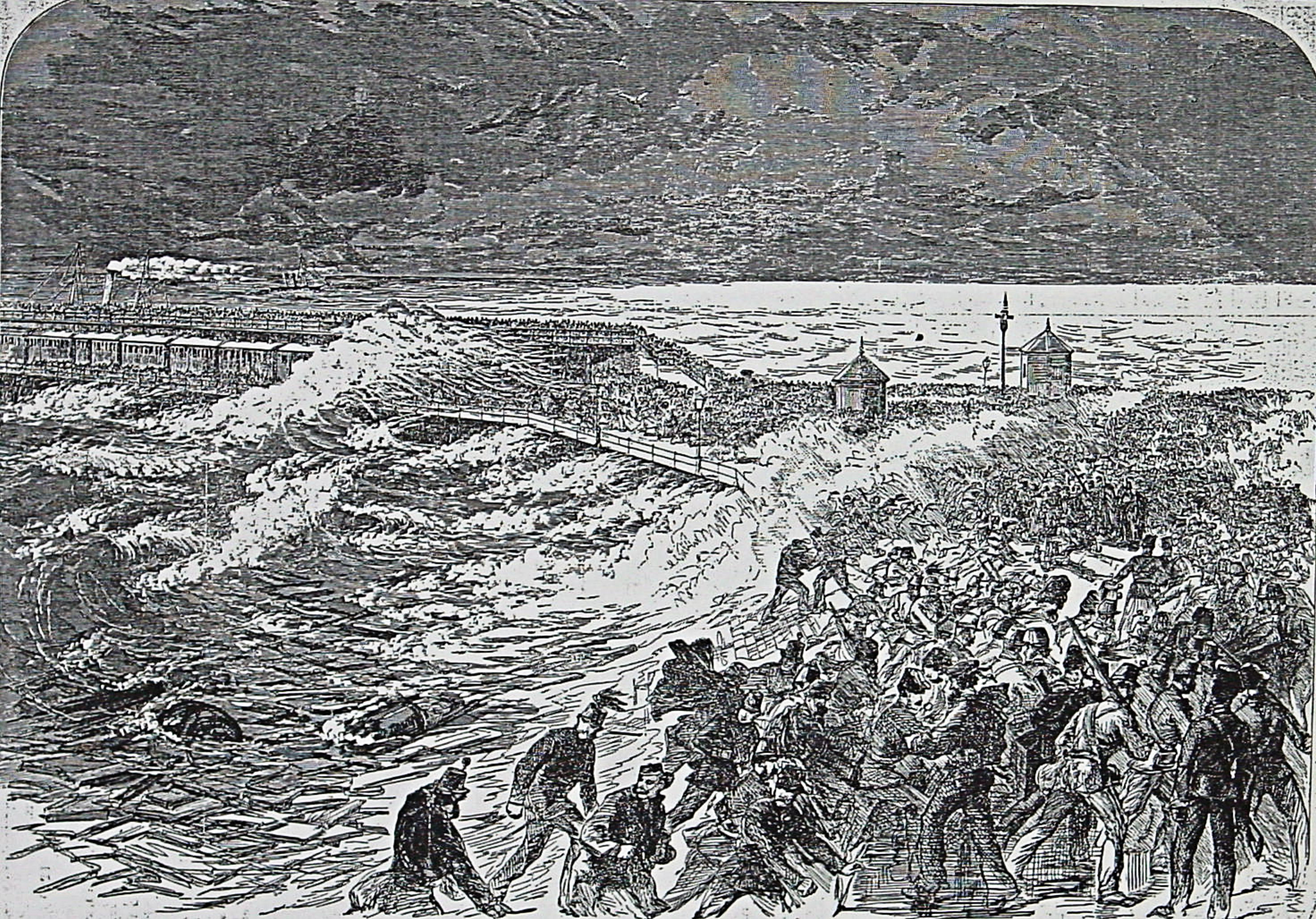
Wreck of the Ferret at the Volunteer Review of Easter 1869. Illustrated London News 10.04.1869. Dover Lbrary

Wreck of the Ferret at the Volunteer Review of Easter 1869. Illustrated London News 10.04.1869. Dover Lbrary

On 29 March 1869 – the Easter weekend – during a severe storm the sail-training brig, Ferret, which had been on a mooring buoy, broke free, hit the Admiralty Pier and eventually sank. On board were 17 men, 8 stewards and 86 boys under training – some of which belonged to Dover Sea Scouts (Now Sea Cadets). All the crew and the boys were rescued but at the subsequent inquiry, the lack of the second pier of the proposed Harbour of Refuge was given as a reason for the mishap. Nonetheless, later that year, to save money, the services of McClean and Stileman were dispensed with and Edward Druce was promoted as overall engineer in charge and took over from Henry Lee as builder at the end of 1869.

Ten years before, in 1859, military engineer, Major William Francis Drummond Jervois, (1821-1897) – later knighted – was Secretary to a Royal Commission set up to examine the efficiency of the country’s land based fortifications against naval attack. His report suggested that a gun turret should be erected on Admiralty Pier head. Work started on building the Turret in September 1871 with Henry Lee winning the building contract for the £20,000 superstructure. Within two years, the Admiralty had altered the original design to that of an iron-plated circular rotating structure weighing over 700 tons. It was mounted with two 80-ton, 16-inch rifled muzzle-loaders with a range of up to 4.3 miles.

On 24 July 1871, the Dover Harbour Improvement Bill received Royal Assent and work started on deepening Bason so those vessels drawing 21-feet could enter at high water. The Bason was completed on 6 July 1874, opened by the Lord Warden, Earl Granville and was renamed Granville Dock. On 30 October 1871, the Belgium Governments packet ship, the Leopold, became the first ship carrying mail from Australia and India that docked alongside Admiralty Pier. There was also a regular boat service between London and Dover by the General Steam Navigation Company of Great Tower Street, London.

The Admiralty Pier, finally completed on 31 March 1875, was 2,100-feet long and cost £693,077. However, if the wind was from the south, southeast or southwest, the Pier did not offer a leeward side and there was the danger from the Mole rocks. In the year the Admiralty Pier was completed five vessels were shipwrecked on the Mole rocks, with one, a timber ship losing all hands. By 1881, such accidents were commonplace and the Board of Trade, in an effort to find a solution laid down two sets of moorings consisting of 200-feet of chain, off the eastward side of the Pier.

Admiralty Pier showing the square cornered Head. The Turret is to right of lighthouse

Admiralty Pier showing the square cornered Head. The Turret is to the right of lighthouse

Further, the square cornered head of Admiralty Pier had been giving concern but it was assumed that the lighthouse would stop any serious accidents. However, before it was completed, at 23.00hrs on 28 March 1873, during thick fog, the large screw steamer International belonging to the International Telegraph Company on her way from London to Bilboa, Spain, ran into one of the corners of the Pier. The ship knocked away staging, two large piles, displaced some of the enormous blocks of stone and became entangled in chains and piling. Shortly after the Turret was finished, the Admiralty Pier head was extended and widened slightly getting rid of the square corners.
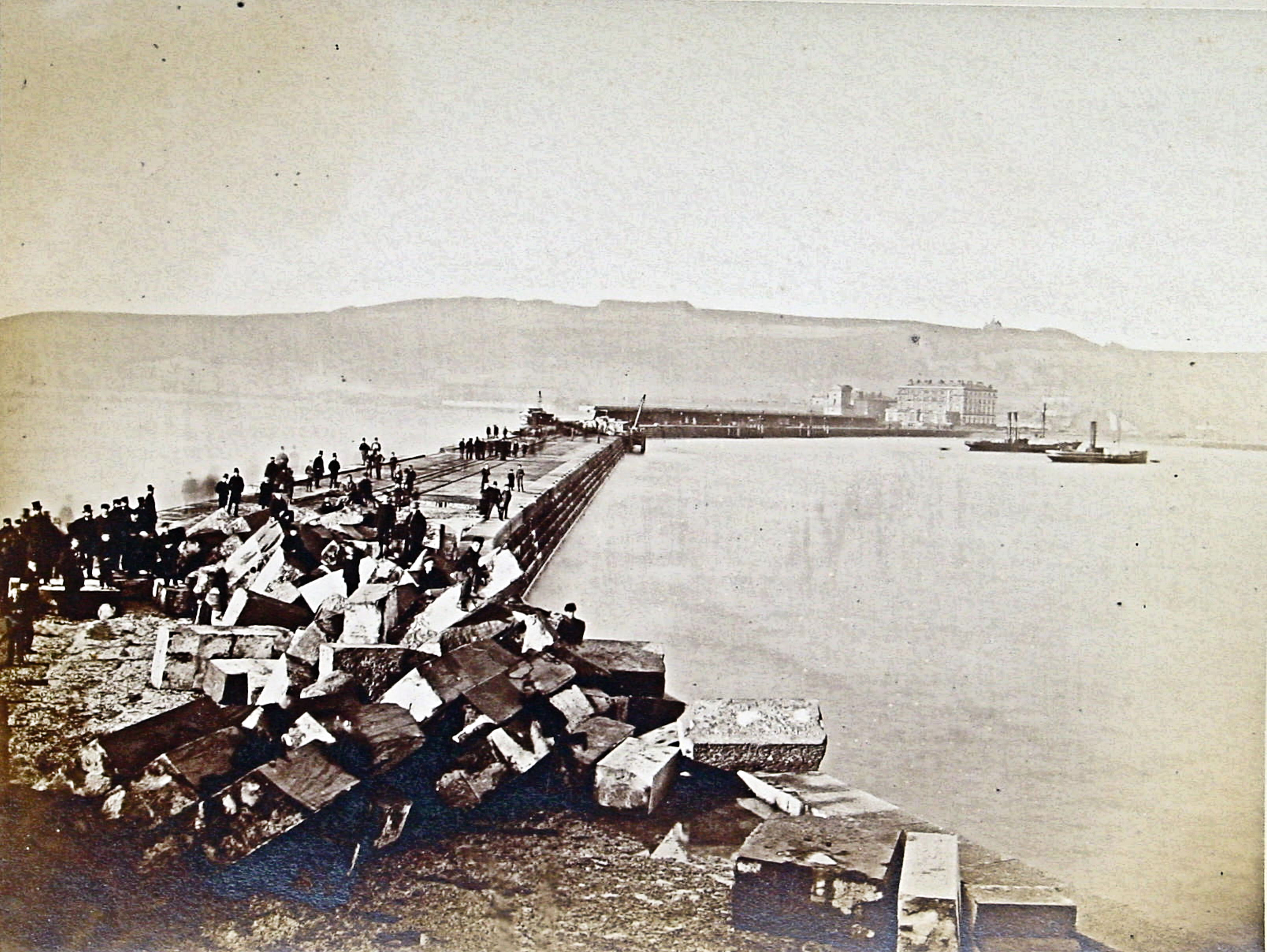
Admiralty Pier After the great storm of 1st January 1877. Dover Library

Admiralty Pier After the great storm of 1st January 1877. Dover Library

The third concern was the Pier’s vulnerability in bad weather. This was apparent on 1 January 1877 when the upper part of the centre of the curve and the parapet on the western side were swept away and the upper galleries  destroyed in a storm. The Admiralty estimated that the cost of the damage to be £26,000 and sought the advice of the Pier’s designer, Sir John Hawkshaw. However, his new design was rejected as too expensive and other options were sought. In the end, the project devolved down to Druce, who stuck to Hawkshaw’s new design and brought in local builder William Adcock to carry out the work. Adcock was rarely the cheapest to tender for work but he did have the reputation as a builder of excellence. A solid parapet was built with a vertical face and a wider base, the thinnest part was 12-feet wide and the stone facing being filled with concrete.

On 19 January 1881, the Pier again suffered damage. The large flagstones, weighing about a ton and a half each, forming the 250 yard promenade were lifted, displaced and in some places the solid concrete base on which the promenade was laid, was lifted out. Lampposts were bent and two were snapped off, telegraph posts were flattened and some of the iron railings were swept away. The windows of the offices were blown out, the doors wrenched off their hinges and the buildings on the wharf flattened. The repairs carried out in 1877 to the upper promenade, however, held. The damage was estimated at £10,000 and Adcock was again called in to carry out repairs.

Captain Matthew Webb - Memorial (detail), Marine Parade. Alan Sencicle 2009

Captain Matthew Webb – Memorial (detail), Marine Parade. Alan Sencicle 2009

Some 200-300 people gathered on and around the Turret on Tuesday 24 August 1875 to see Captain Matthew Webb (1848-1883) dive off at the start of the first successful swim across the English Channel to France. The time taken was 21 hours 45 minutes and he had actually swum 39 miles (64 kilometres). The Webb memorial can be seen in the Gateway Gardens on Marine Parade.

On 21 January 1885, men in steam launches from the Royal Navy gunboat Triton, under the supervision of Captain Tizard, started taking soundings for what was locally believed to be a national harbour for the Navy. It was said that the proposed harbour would be 700 acres of water surrounded by three arms. The eastern arm would be from below the Langdon barracks on the eastern cliffs and the same length as the Admiralty Pier, which would be the western arm. In between there would be a breakwater giving an east and west entrance to the proposed harbour. Later, an official notification stated that the purpose of the survey was to see if there had been any shoaling due to the erection of the Admiralty Pier. This was followed by another statement saying that the survey had been undertaken for the purpose of the proposed Harbour of Refuge.
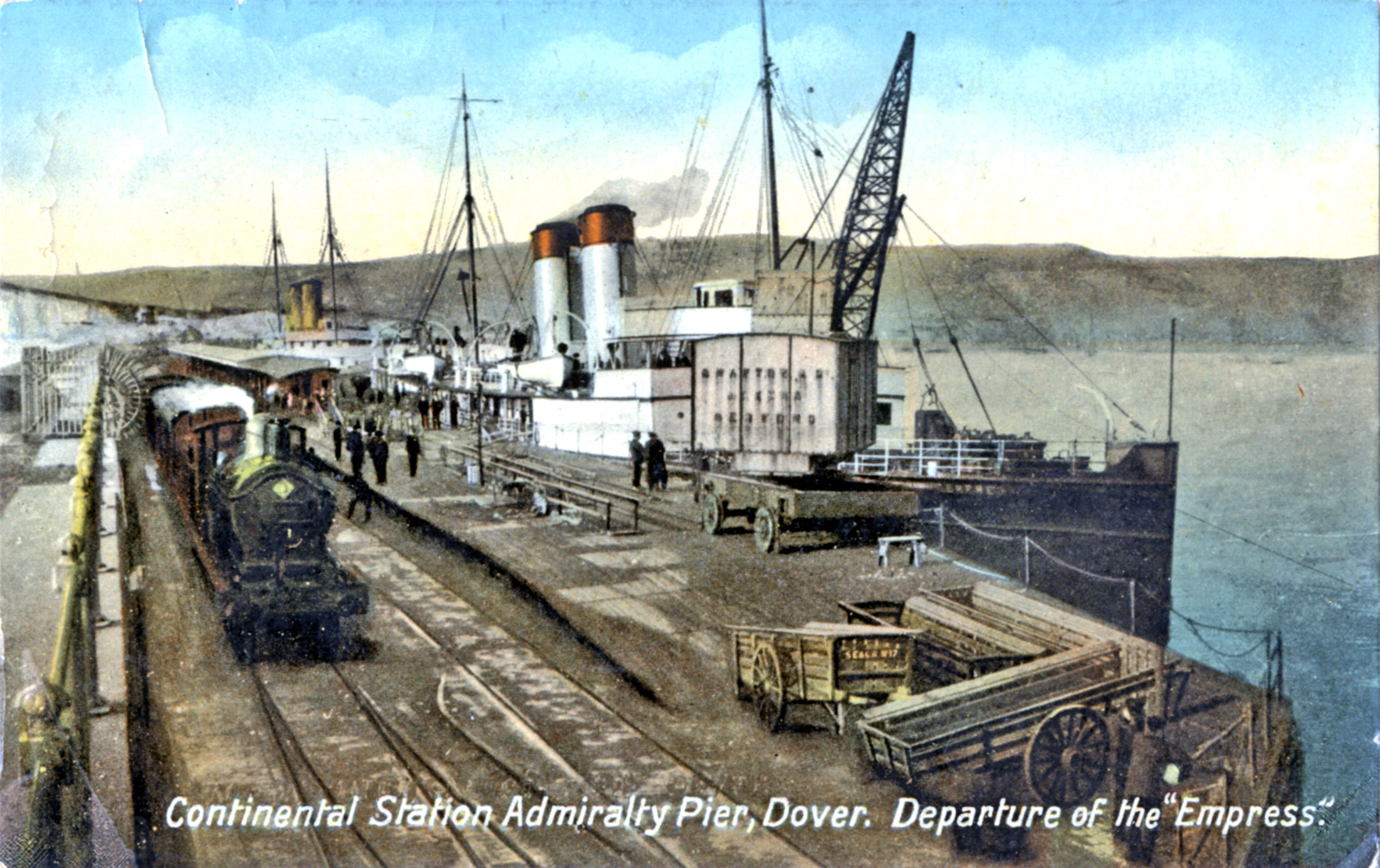
Admiralty Pier with the Empress alongside c1900. Dover Museum

Admiralty Pier with the Empress alongside c1900. Dover Museum

In 1888 the Wellington Dock gates were widened ten feet to accommodate the new cross-Channel ships such as the 1,030 gross tonnage steel paddle steamer Victoria that came on station in 1886 and the 1,213 gross tonnage steel paddle steamer Empress that arrived in 1887 as well as colliers. New coal stores for the convenience of local coal-merchants were built on the Northampton Quay. The slipway was lengthened, strengthened and widened to take vessels up to 800 tons. However, the LCDR representative on DHB was far from happy. The company, he argued made a considerable contribution to DHB’s revenues to provide accommodation of their fleet and the Continental fleets including French and Ostend mail boats and steamers. However, due to the lack of space, they were compelled to keep their large and valuable boats under steam all night in the Downs or in the Bay, causing the company unnecessary expense and the crew and passengers great discomfort.
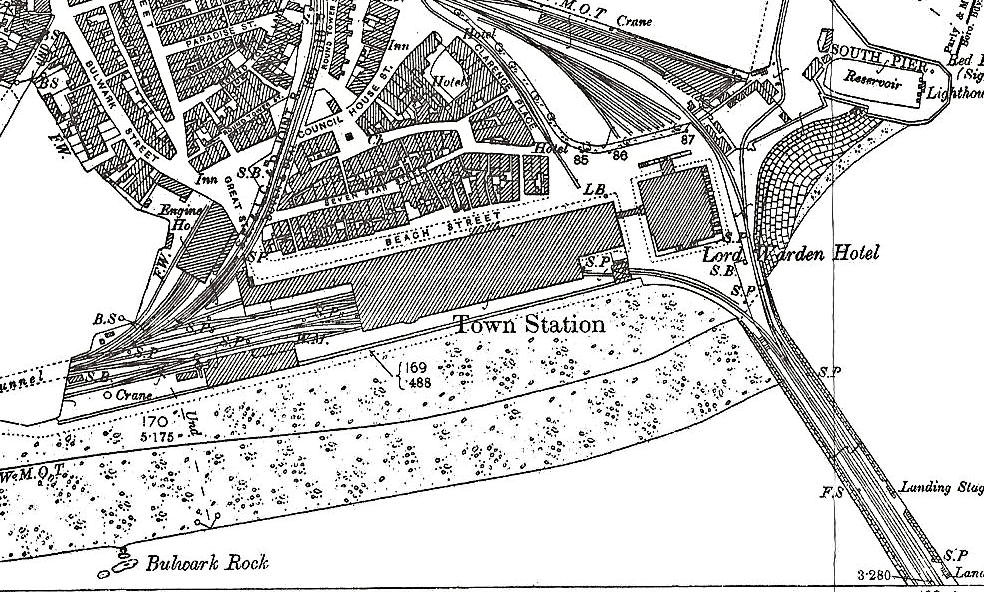
1890 Map showing the proximity of the SER Town Station and the LCDR Harbour Station to Admiralty Pier and the landing stages

1890 Map showing the proximity of the SER Town Station to Admiralty Pier and the landing stages. The LCDR Harbour Station is situated off the top of this map.

Further, during southeasterly gales, it was exceedingly difficult to land passengers and occasionally incoming packets had to lie outside the harbour tossing on a rough sea for several hours as it was dangerous, if not impossible, for any vessels to go alongside. Other members of the Board, excepting the SER representative, added to this saying that as the port did not have deep water at all states of the tide it was virtually closed to commerce of the world. That even as a Harbour of Refuge, the harbour was grossly inadequate. Dover Corporation and most of the townsfolk were of the same opinion.

On 3 October 1890, DHB, under the chairmanship of the deputy chairman Layton Lowdes as Lord Granville was indisposed due to gout, voted to undertake the development of the much-needed Harbour of Refuge/Commercial harbour themselves. They unanimously agreed to apply in the next session of Parliament for a Bill to authorise DHB to spend £300,000. In addition, to raise more money they asked for the introduction of a passenger tax similar to that imposed by the French government to finance their harbours in northern France. The Register, James Stilwell, drafted the application and included plans for the new harbour submitted by Sir John Coode (1816-1892), of Coode, Son and Matthews.
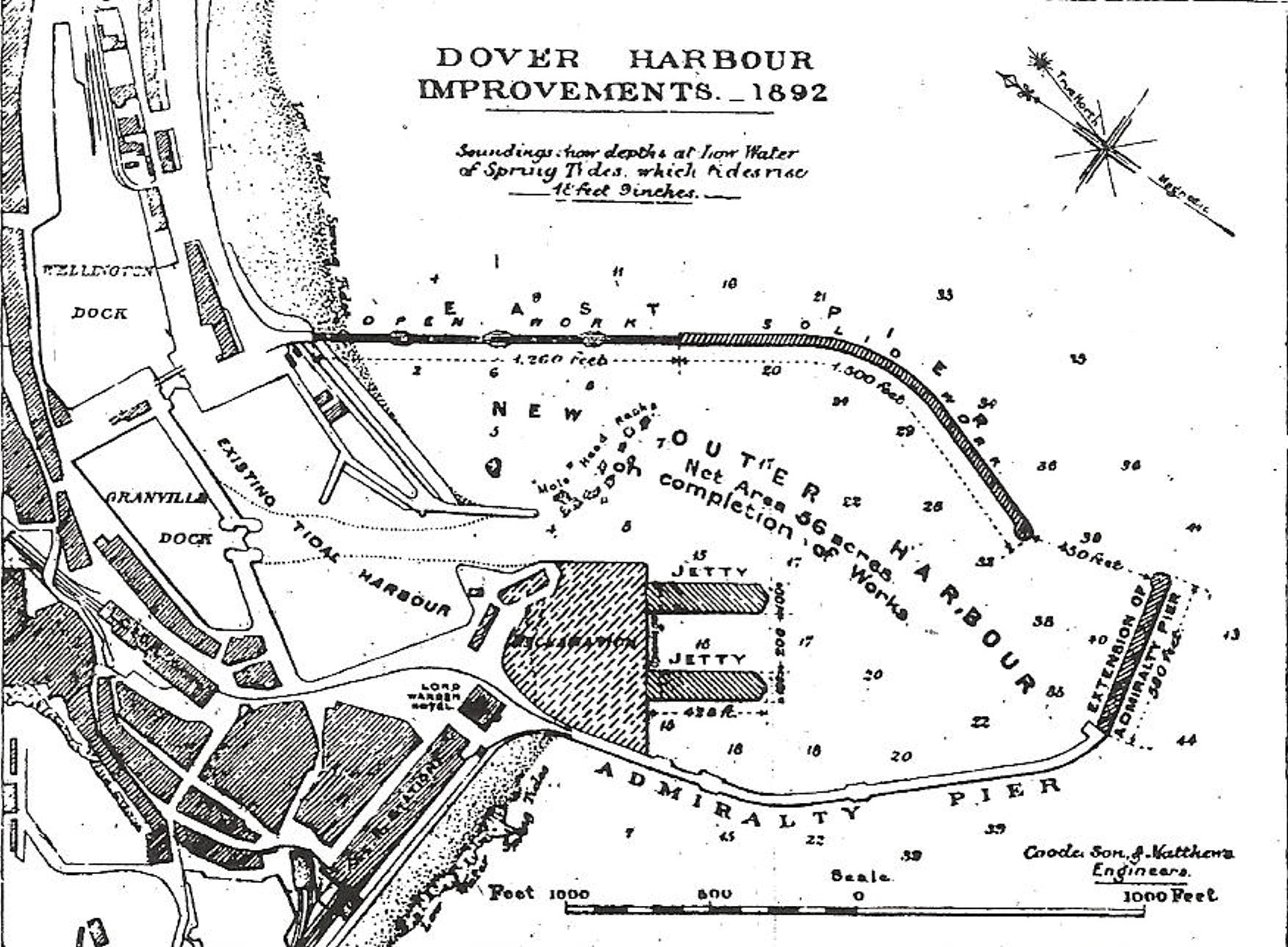
Commercial Harbour proposal

Commercial Harbour proposal

The proposed harbour was to be bound on the western side by the Admiralty Pier extended 560-feet. On the eastern side, an arm 2,760-feet seaward starting in a southerly direction and curving towards the southwest. This would give an entrance 450-feet wide facing towards the east and sheltered by an overlap of the extended Admiralty Pier. Within the new harbour would be a water station – a covered space to accommodate four or five cross Channel steamers and a connection from the shore next to which railway lines would be laid and connected to the main lines. However, the best contract price for the proposed eastern arm was over £400,000. Therefore, in the final submission presented in August 1892, the estimate for the work was increased to £600,000.

In the meantime the problems of the existing situation continued. On 1 February 1892, the Belgium government’s packet ship the Prince Baudouin was going alongside the Pier during a heavy gale, to disembark passengers. The tide and a heavy swell caused by a strong southwesterly wind caught her and she hit the Pier with great force sustaining considerable damage on the starboard side.  The ship immediately started to take in water. The captain ran for what was the harbour entrance at that time but she struck the Mole Rocks. There she sank close to where another ship, a German steamer, Liebenstein, had sank a few weeks before. The passengers, crew and mails were rescued and temporary repairs were made to the Prince Baudouin following which she was refloated and taken into the old harbour.

A month later the Belgium government’s packet ship Ville de Douvres, carrying mails and passengers, while trying to get alongside the Admiralty Pier during a gale touched the Mole Rocks. The LCDR mail packet Foam successfully towed her off. The following month, the LCDR steamer Prince hit the Mole rocks while trying to berth alongside the Pier during rough weather. These accidents were by no means out of the ordinary but served to show the seriousness of the problems.
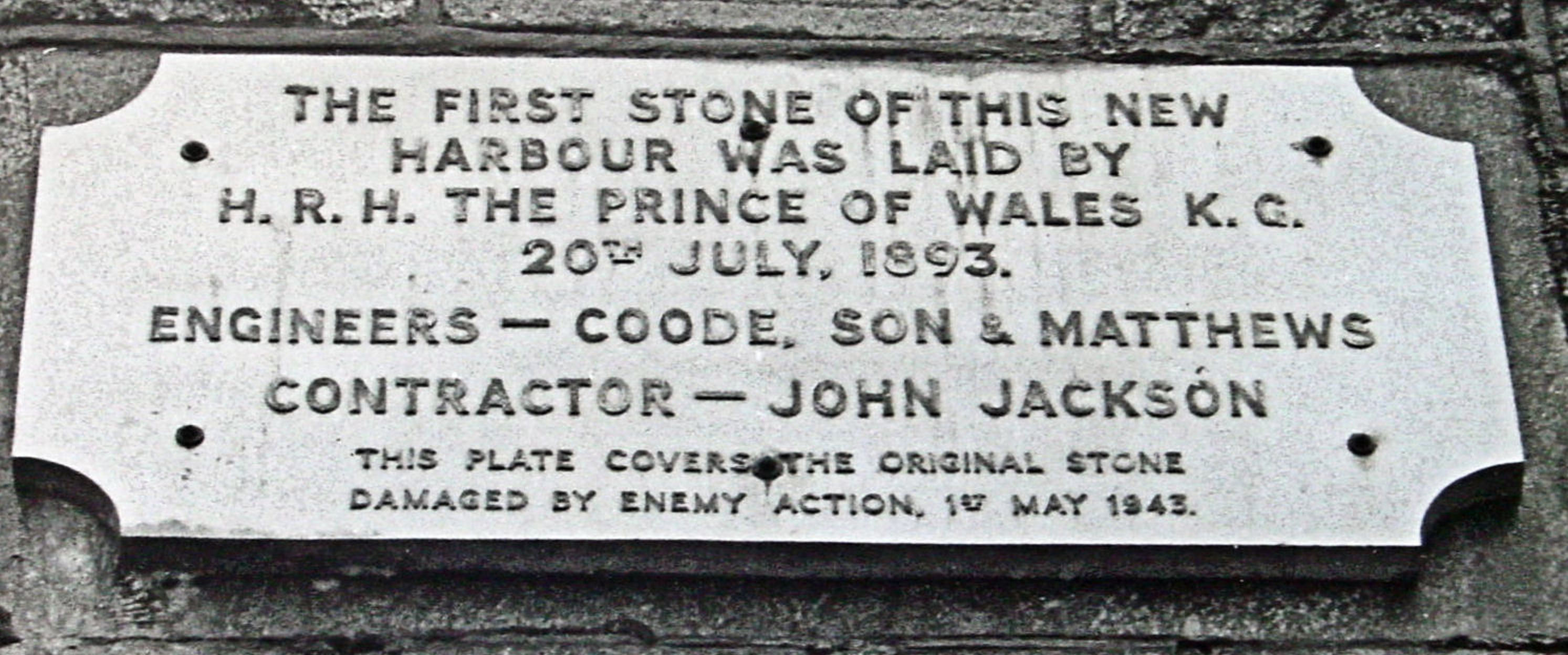
Prince of Wales Pier Foundation Stone first laid 20 July 1893 relaid 1954.

Prince of Wales Pier Foundation Stone first laid 20 July 1893 relaid 1954.

The Bill for a Harbour of Refuge/Commercial Harbour was passed by Parliament who also granted the power for DHB to levy a tax of 1 shilling (5pence) on each Channel passenger. Parliament also agreed to lease the Admiralty Pier to DHB for 99-years and the arrangements were drawn up and signed by the end of 1891. Shortly afterwards Edward Druce retired as resident engineer but before work could begin on either the Admiralty or eastern pier the proposals had to be sanctioned by the Board of Admiralty. On 20 July 1893, the first stone of the eastern arm of the project was laid by Prince of Wales, (later Edward VII, 1901-1910) and took the name of Prince of Wales Pier. In September 1894, the first submarine block of the Prince of Wales Pier was laid on the bed of the sea but approval, from the Admiralty, still had not been given for the proposed alterations to the Admiralty Pier.

At this time, the Admiralty was taking a close interest in events on mainland Europe. On 18 January 1871, Germany had unified under the country’s first Chancellor, Otto von Bismarck (1815-1898), which changed the balance of power in Europe. Bismarck had strived to keep the peace but in 1890, Wilhelm II (1888-1918) effectively sacked him and then pursued a massive naval expansion. This galvanised the British government to consider the construction of a National Harbour on the south coast. In May 1895, when about three-quarters of the Prince of Wales Pier had been built, the Admiralty announced its decision – it was going to use the port of Dover as a base for the Royal Navy.

Map of Admiralty Harbour. Daily Telegraph 1909

Map of Admiralty Harbour. Daily Telegraph 1909

For the new Admiralty Harbour, Coode, Son & Matthew were appointed as design engineers with Major Sir Henry Pilkington (1849-1930) engineer in charge. It was not until 9 November 1897 that the building contractors were announced – Messrs S Pearson & Son Ltd. The extension of Admiralty Pier was to be completed in 8 years and the remainder of the harbour in 10 years. Subcontractors included two local firms, one headed by William Adcock and the other Richard Barwick. The proposed new Harbour consisted of:

i. At the west, Admiralty Pier extended by 2,000-feet in an easterly direction

ii. The erection of an Eastern Arm, 3,320-feet long from the east cliff at Langdon Hole in a southerly direction from a 3,850-foot long sea wall reclaiming an area of over twenty acres.

iii. A Southern Breakwater, 4,300-feet long, three-quarters of a mile from the shore.

iv. This was separated from the Admiralty Pier extension by a western entrance 800-foot wide and the eastern arm by the eastern entrance 600-feet wide. At the lowest tide, the depth of water in the entrances was to be 42-feet.

It was designed to moor twenty battleships plus a considerable number of smaller naval craft and the finance was provided under various Naval Works Acts. The first Naval Works Act was passed in 1895 when it was estimated that the cost would be £3,500,000. The proposal made it necessary to alter the plans for commercial harbour including the Prince of Wales Pier. Although completed in 1902 with a curve at the seaward end, this was to be demolished making the Pier straight.

Before their work began, Pearson’s bought a quarry in Cornwall containing all the necessary granite for the proposed works. This was to be used to face massive concrete blocks that would form the main structure of the new harbour walls. Skilled men in many different crafts were recruited, boarding huts, offices, foundries, workshops, repair shops and stores were erected and in the summer of 1898 work commenced. Huon Pine was brought from the former penal colony of Dover, Tasmania, (see Transportation story), by ship to provide temporary staging around which the new harbour was built.
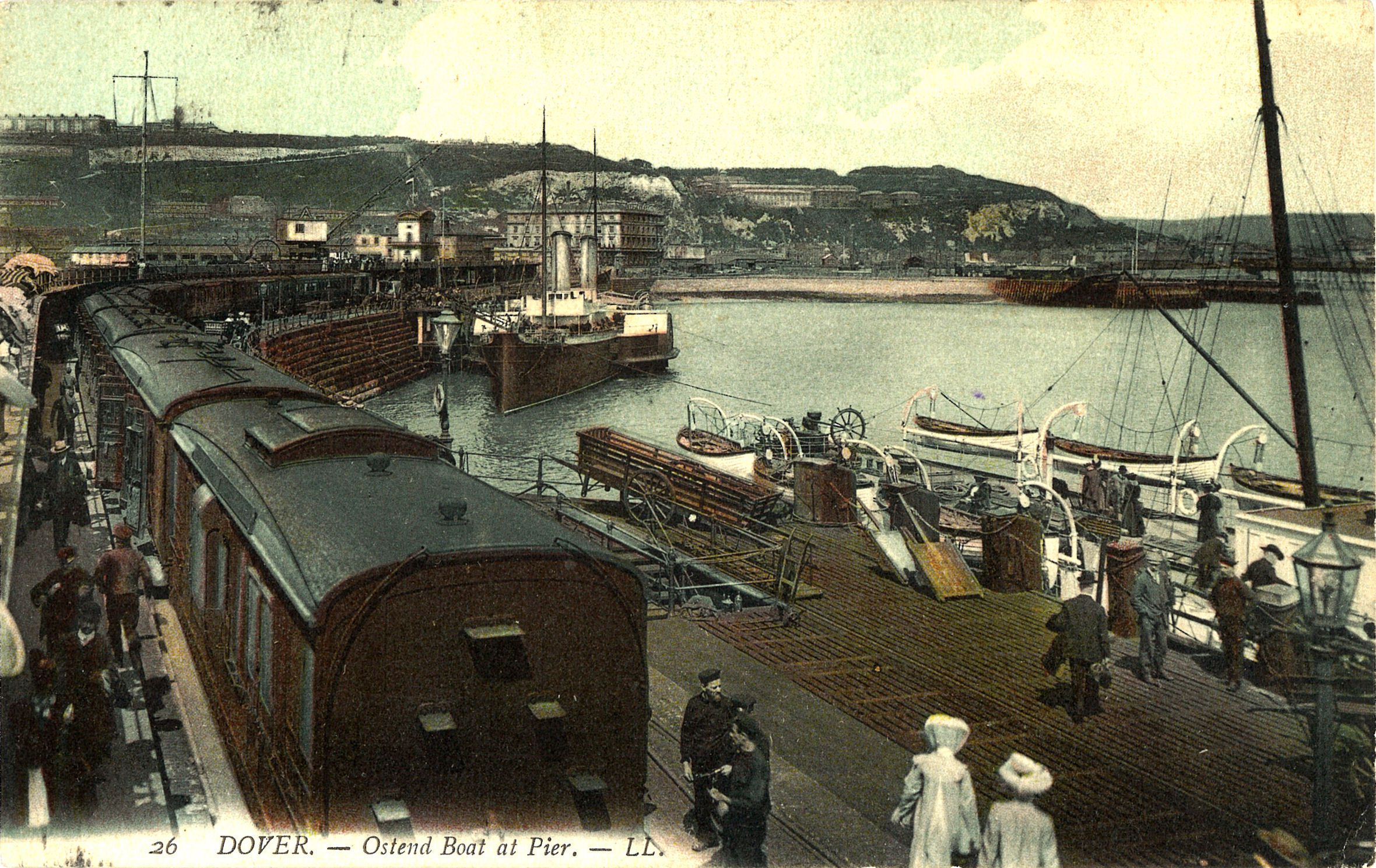
Admiralty Pier circa 1880 with a Ostend ship tied up. Dover Museum

Admiralty Pier circa 1880 with an Ostend ship alongside. Dover Museum

Although there was fear, in many quarters of possible German hostility, others believed this to be unfounded. In August 1898, nearly 2,000 carrier pigeons arrived from Germany via Ostend on the Belgium mail packet, Princess Josephine to be trained for German military purposes to fly back to a base in Dusseldoff, Cologne. A fee was paid to DHB and the birds were released from Admiralty Pier but instead of flying back across the Channel they stayed in England roosting on both the Admiralty Pier and the Western Heights! This led to a public outcry, particularly as they were German military pigeons. The following year another 600 birds were brought to England and DHB were assured that they came from Belgium. The weather was clear and at lower levels there was hardly any wind but at higher levels an easterly was blowing. On reaching the high wind, the birds attempted to face it but then chose a more southerly course. It was reported that none reached their chosen destination in Belgium.
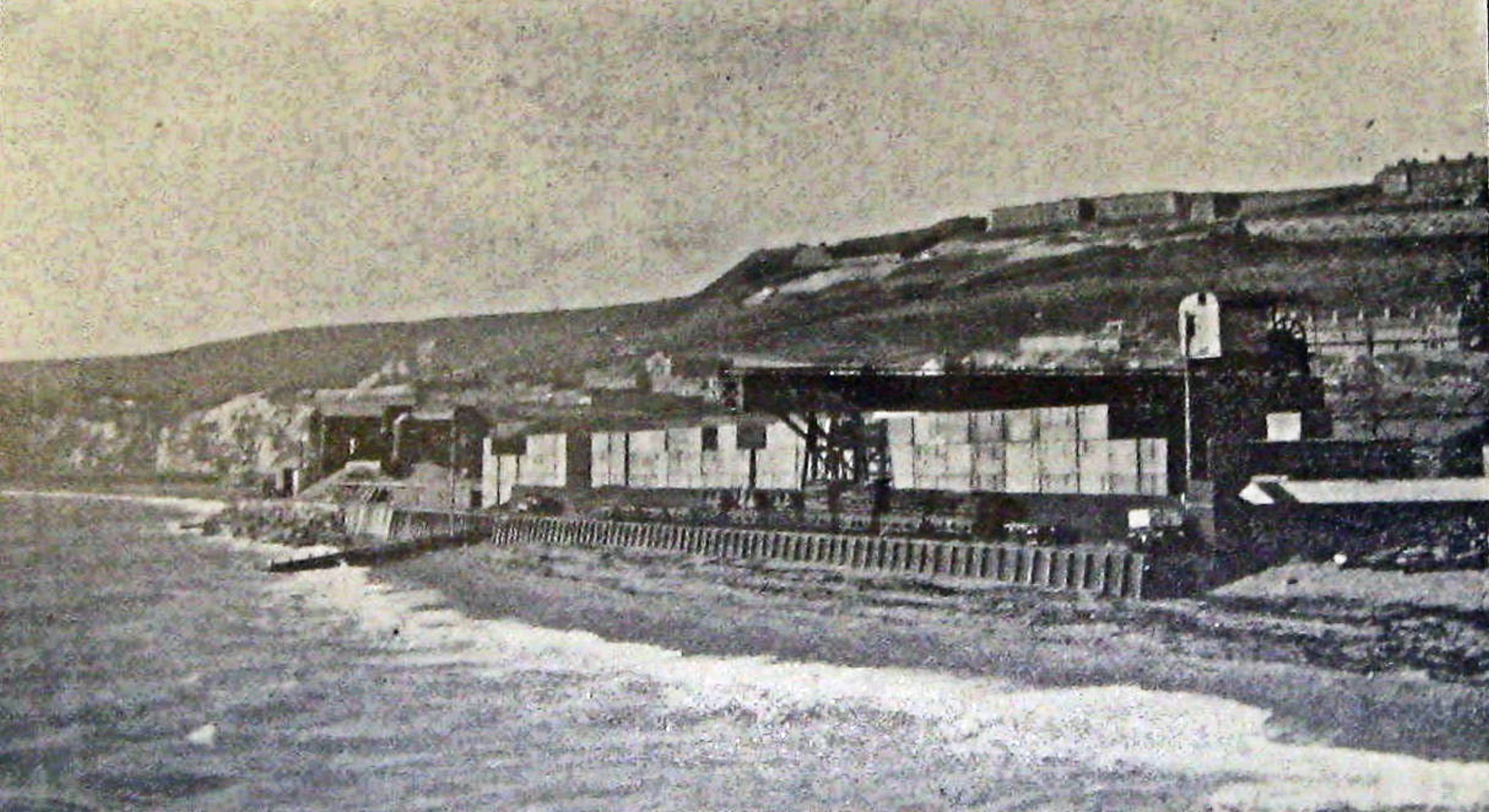
 Western Block works on Shakespeare beach note the low seawall. Dover Library

Western Block works on Shakespeare beach. Note the low seawall. Dover Library

The concrete blocks for the new harbour were made on two sites – one at the east end of the bay (see the Dover, St Margaret’s and Martin Mill Railway Line story part I). The second, for the Admiralty Pier, was on what is now Shakespeare beach but then called the Western beach. The block-making yard on Shakespeare beach was started in the summer of 1898 after a low seawall was constructed. By March 1899, the block-making floor, concrete mixers and cement sheds were practically complete, a work yard a goliath had almost been erected and block making was started. Blocks weighed between 24 and 42-tons, were made out of cement, sand and shingle, the latter brought from Rye by train.
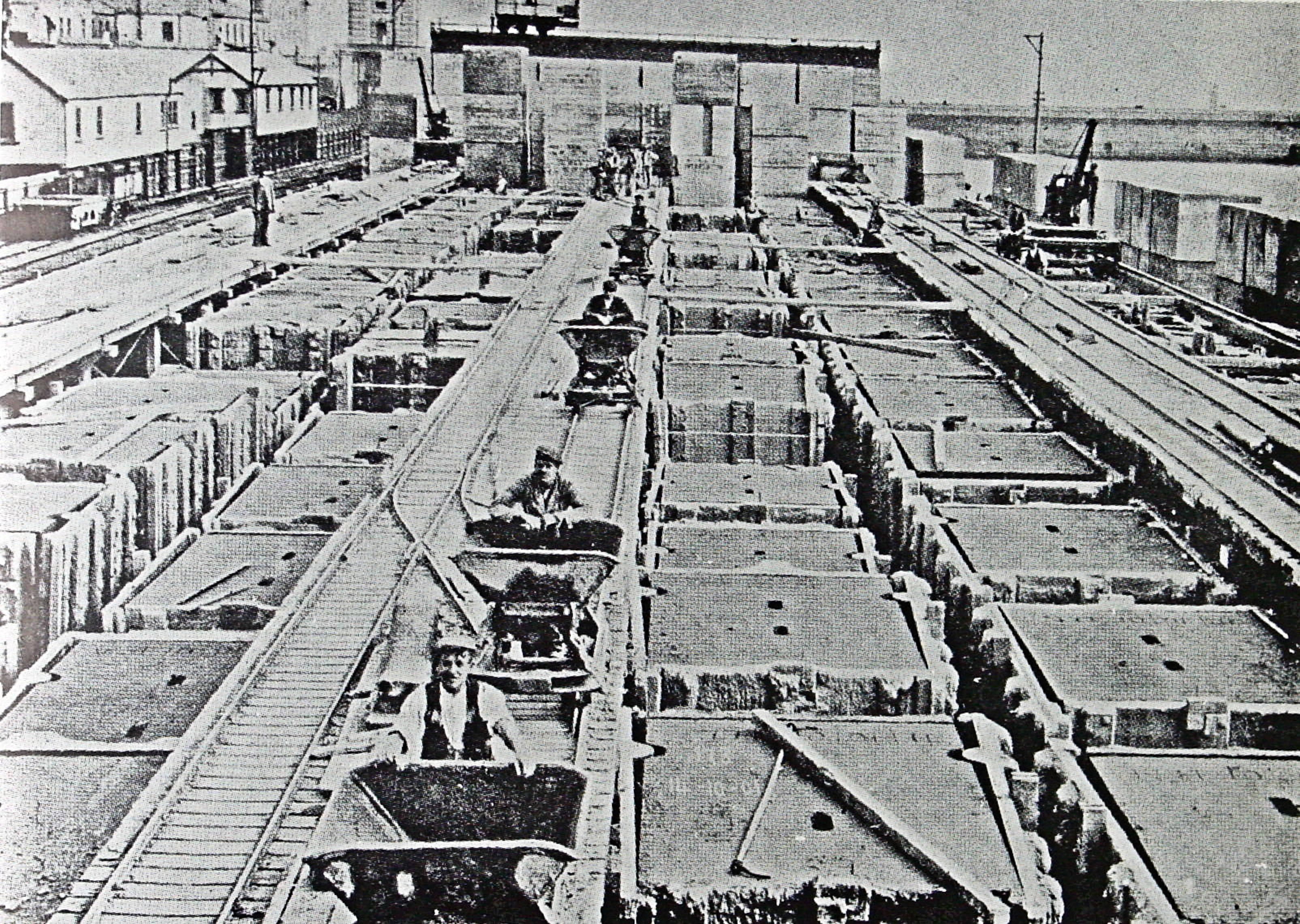
Block making c1900. Concrete poured into wood moulds that opened at side when set. Dover Harbour Board.

Block making c1900. Concrete poured into wood moulds that opened at the side when set. Dover Harbour Board

The concrete was made in large mixers and some 250 blocks were made at any one time. Each mould had a circular convex protrusion at each side that formed a semi-circular indentation in the blocks when placed on the seabed next to each other, forming a cylindrical cavity. Called ‘joggling’, when the blocks were laid, the cavity would be filled with concrete to bind the blocks together. Each block was ‘cored,’ to enable easy lifting, with two slanting holes created by two large pieces of wood in the mould. After two days the moulds were slackened off and the wood creating the cores were removed. Later Lewis bars – iron bolts with a ‘T’ head at the lower end – were inserted and given a quarter turn and shackles were attached to the upper ends to enable the cranes to lift the blocks. After a further eight days, depending on the weather, the moulds were removed and the blocks carried by goliaths – cranes with a span of 100-feet that could lift 50-tons – to the Admiralty Pier side of the beach. There they were weighted, dated, numbered and then placed in stacks for at least six weeks until sufficiently cured for use.
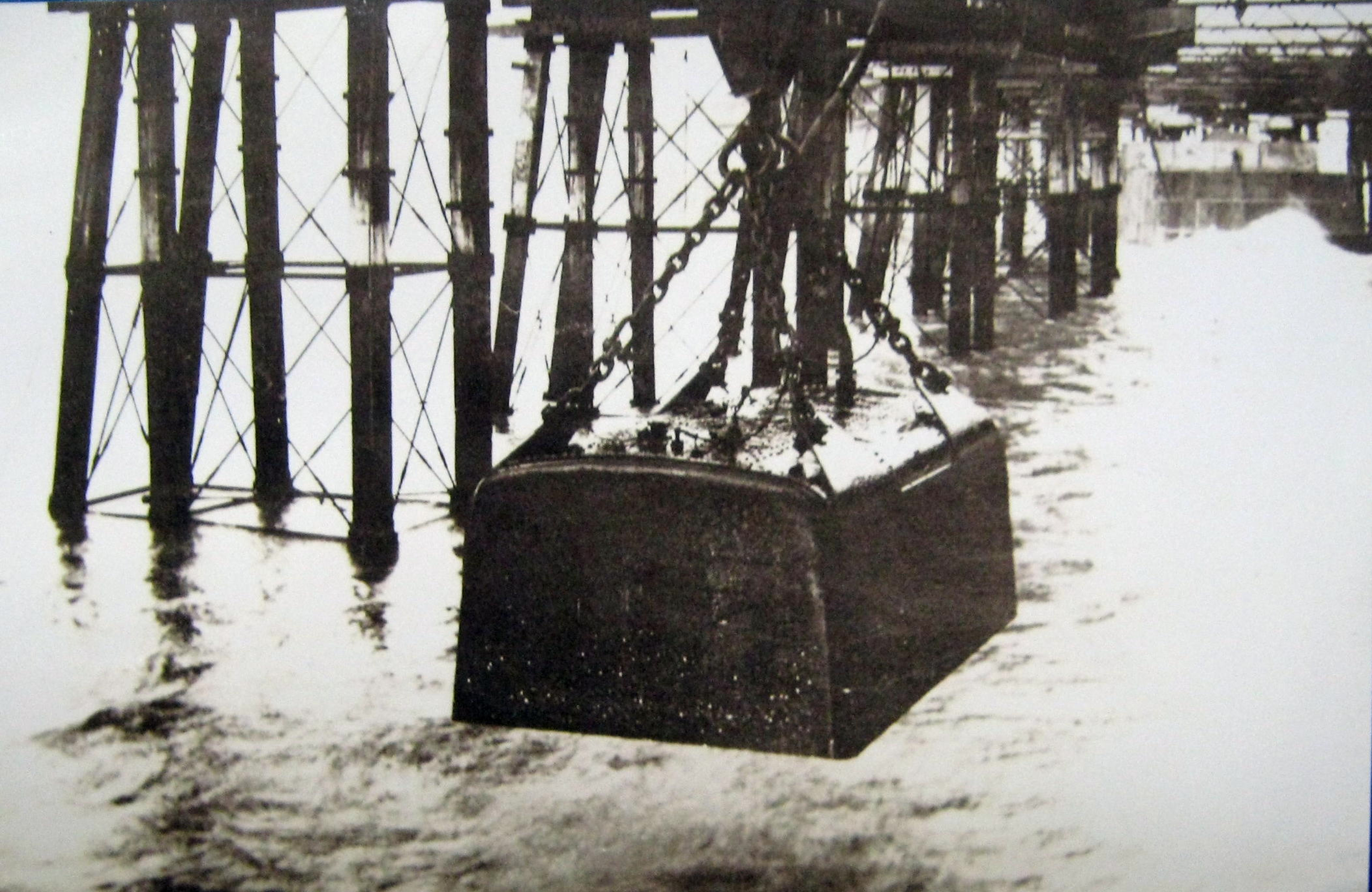
Diving bell with the men who worked inside to prepare the sea bed being lowered into the sea by a crane . Dover Transport Museum

Diving bell with the men who worked inside to prepare the sea bed being lowered into the sea by a crane . Dover Transport Museum

For the foundations of the new harbour walls, the upper crust of the seabed was removed by great clamshell grabs until the solid seabed was reached. Siebe Gorman & Company Ltd undertook the underwater work, with divers working in diving bells to level the prepared surface of the seabed. The diving bells, of which there were seven, weighed about 40-tons, 17-feet long and 10-feet wide, and were swung and then lowered into the sea by a crane. There were about 80 divers working on the project with each diving bell with space for up to six men. On reaching the seabed, it was usual for some water to have leaked into the bell, often about 2-feet. This was driven out by compressed air. Each bell was lit by electricity with the lights being placed close to the thick glass windows. It was usual for four men to work in the bells under an air pressure of 27lbs per square inch (this being sufficient to maintain the bell ‘dry’ in water depth up to 60-feet) for three hours. They dug up the seabed using mechanical shovels until it was smooth and level. The material excavated was put into a large box and taken to the surface. Throughout operations, the divers were in contact with the crane driver by mechanical means. Helping the divers were men working from open rowing boats.

Huon pine staging posts across which a lattice of steel girders were bolted and on these, heavy timber platforms were laid.

Huon pine staging posts across which a lattice of steel girders were bolted and on these, heavy timber platforms were laid.

Huon pine staging posts, measuring some 100-feet from top to bottom and 20-inches square, were floated into position between empty barrels. Two sets of six iron-shod posts were driven into the seabed every 50-feet opposite one another by pile drivers. Across these posts a lattice of steel girders were bolted and on these, heavy timber platforms some 15-feet wide, crane/railway lines were laid. The platforms were approximately 28-feet above the high water mark. Gradually the staging was built out to sea from both the Admiralty Pier and on the eastern side, what was to be the Eastern arm of the new Admiralty Harbour.

Between the piers, the concrete blocks were lowered by 60-ton goliath cranes. Dover Museum

Between the piers, the concrete blocks were lowered by 60-ton goliath cranes. Dover Museum

Between the piers, the concrete blocks were laid by a 60-ton goliath crane lowering the blocks into the sea. Divers not working from within bells then put these into place. To prevent lateral movement caused by storm waves the blocks were ‘joggled’ by the divers filling the cylindrical cavities with concrete in bags that consolidated the mass into a solid structure. The blocks that formed the ends of the Arms and the Breakwater were bound together with iron bars.
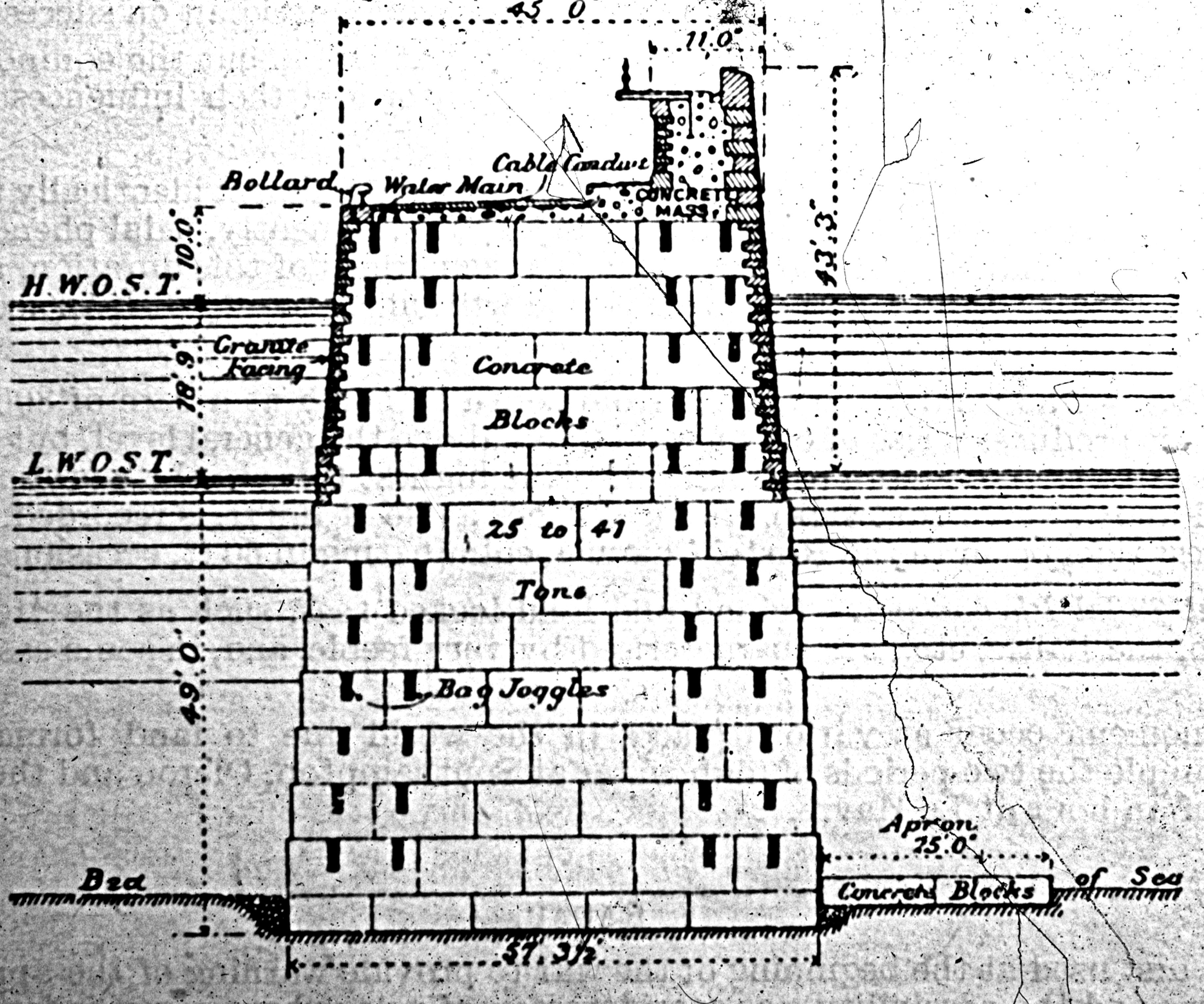
Admiralty Pier Construction design. Budge Adams collection Dover Museum

Admiralty Pier construction design. Budge Adams collection Dover Museum

The bottom of the new harbour walls were 36-feet wide decreasing to 30-feet wide at the top and was perpendicular on the harbour side and stepped on the seaward side. As the concrete walls were completed, the cement blocks above the low water mark were bedded and grouted with cement and faced with granite blocks between one and five tons each. In total for the whole harbour, over 3½million tons of granite was used, 1,920,000 tons of concrete blocks – about 64,000 blocks and 1,500,000 cubic feet of timber.

Admiralty Pier extension construction. Dover Museum

Admiralty Pier extension construction. Dover Museum

By October 1898, due to the ongoing construction of the Prince of Wales Pier, the area between that Pier and Admiralty Pier was increasingly subject to a heavy swell that, at times, made it impossible to berth alongside Admiralty Pier. During such conditions, ships were diverted to Folkestone. A meeting was convened in November 1898 between the DHB, the SER, LDCR and the Continental railway companies whose ships used Dover harbour and the Admiralty, over this problem. The Admiralty said that the contract for the Admiralty Pier extension was to be completed two years less than the remainder of the works but they would give these works even higher priority.
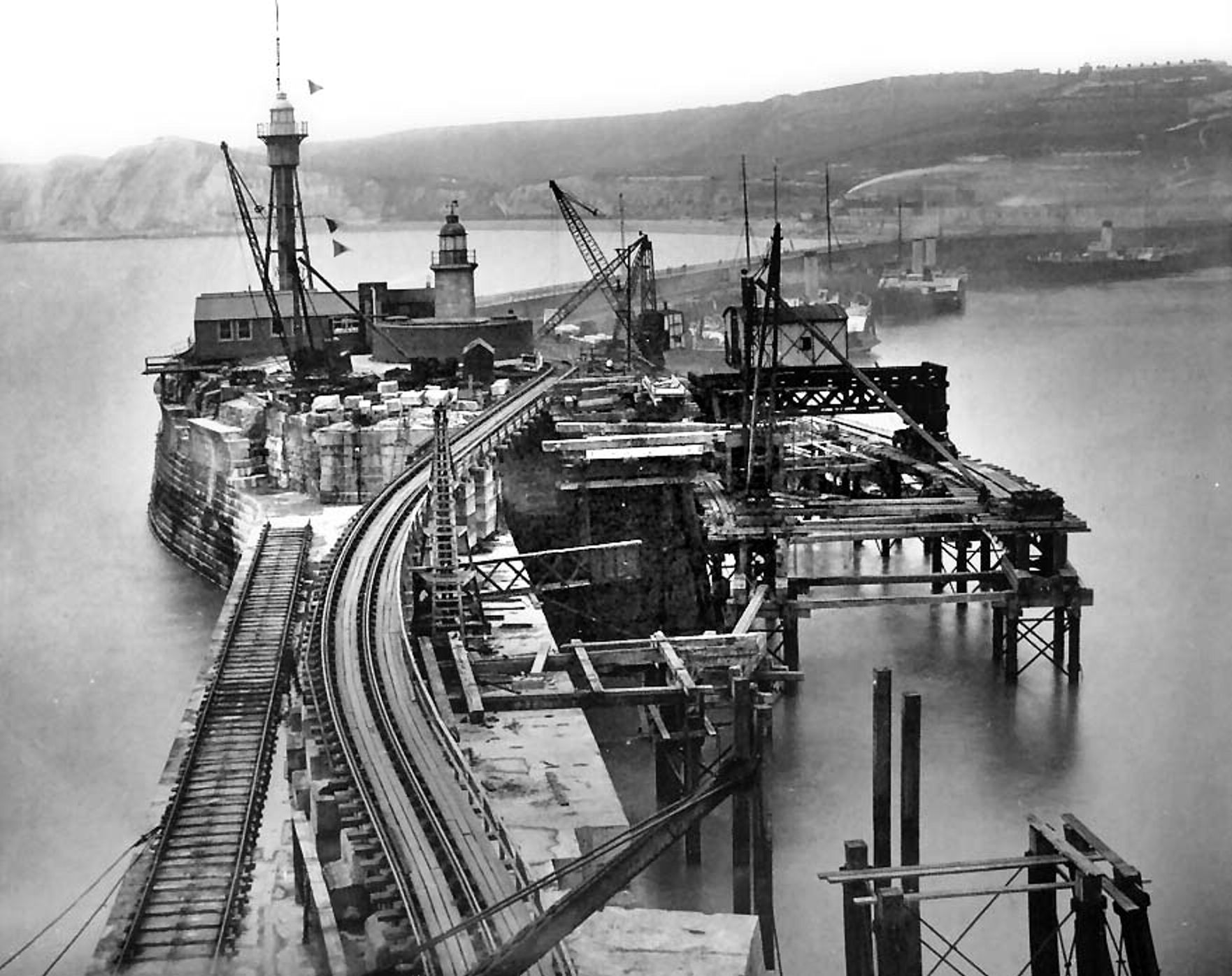
 Widening of the Admiralty Pier around the Turret, the old lighthouse on top of the Turret is on the right and the new temporary tall one is on the left. Nick Catford

Widening of the Admiralty Pier around the Turret, the old lighthouse on top of the Turret is on the right and the new temporary tall one is on the left. Nick Catford

The old small lighthouse close to the Turret that had been moved to the roof was replaced and much later was demolished. Initially a taller temporary steel lighthouse, 76-feet high came on station in August 1899, while another lighthouse was mounted on top of the most seaward of the cranes and was moved forward as construction of the Pier extension progressed. To supplement these the Admiralty brought in a lightship that was moored at the end of the works and fog signalling apparatus was installed. Lightships were also in place off the end of the Eastern Arm works and Southern Breakwater; however, they were all vulnerable to weather and collisions from other ships.

The first lightship off the Admiralty Pier foundered in a gale and the crew had to be rescued by the lifeboat. A larger lightship replaced it but was hit by an Atlantic liner. The next one was much larger but the French mail packet Le Nord hit her at 23.30 on 12 November 1901. On board the lightship were both the crew and the relief crew, 16, all of whom lost their lives. In the early hours of 10 May 1902, the 2,900-ton steamer Brator hit another lightship and the Dover lifeboat went to the rescue. The captain and three of the lightship’s crew, who were seriously injured, were transferred by the lifeboat to the Seaman’s Mission, where they were treated.
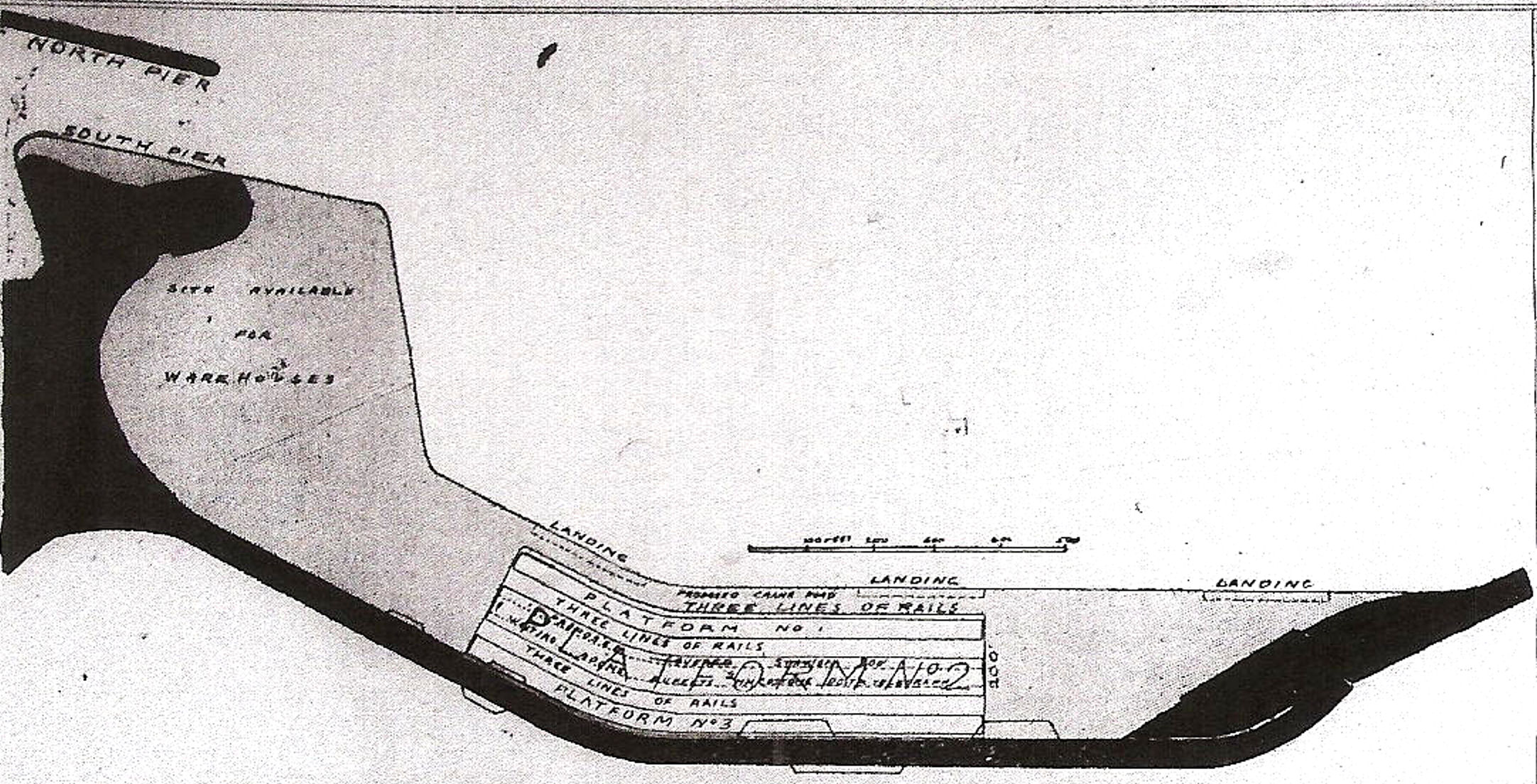
Continental Water Station Dover Express 08.12.1905

Continental Water Station Dover Express 08.12.1905

In November 1900, Dover Harbour Board presented a Bill to Parliament to complete and equip the Commercial harbour and make improvements to the old harbour. Part of the proposals was that of a jetty 1,000-foot long, starting from land reclaimed between South Pier and Admiralty Pier. Called a Water Station, the roofing was to extend from one pier to the other and it housed four berths. This would enable, according to the proposal, passengers to embark and disembark. It was also envisaged that nearby, adjacent to Admiralty Pier a large floating dock was to be erected.

Admiralty Pier extension construction. Dover Museum

Admiralty Pier extension construction. Dover Museum

Although land reclamation had already started, neither project came to anything. Within the Bill was a request, by the railway companies, asking for the right to lay crane lines along Admiralty pier in order improve the handling of passenger luggage. This was sanctioned and DHB engineer, Arthur Thomas Walmisley (1848-1923), designed two electric cranes for the purpose. These were built, installed and on 26 June 1903, with great pomp and surrounded by officials, one of the cranes was put to use. A top portion of a former South Eastern and Chatham Railway Company (SECR -a loose amalgamation of the former SER and LCDR) truck weighing approximately 15-hundredweight was lowered by one of the cranes into the hold of the Le Nord, on one side of the Admiralty Pier. The ship then steamed round to the other side where the second crane lifted out the truck and put it back onto its bogie section.

In the speech that followed by Sir William Crundall, the Deputy Chairman of DHB, he announced that these were the first electric cranes to be employed by a Harbour Board or Dock company in the country and were to be used for the transport of passenger baggage. By this time, there were two buffets for passengers awaiting departure of either a ship or a train on Admiralty Pier station provided by Gordon Hotels Ltd. Albeit, during rough weather, the buffets were closed and trains did not traverse the Pier. If passengers either embarked or disembark during such times, they were still forced to walk the length of the Pier often carrying or wheeling their luggage under inadequate, aged, shelter. This, the railway companies blamed on DHB as they had continually refused to pay for adequate cover for passengers.

Sir William Crundall

Sir William Crundall

Even before the Prince of Wales Pier was completed, DHB were considering constructing a berth on the Admiralty Pier side for Atlantic liners. Sir William Crundall, along with DHB Register, Worsfold Mowll, John Coode of the firm Messrs Coode, Son and Matthews, DHB engineer Arthur Walmisley and Harbour Master – John Iron (II), left for Germany to raise interest. On 3 September 1901, they met Kaiser Wilhelm II (1888-1918), who was wearing the uniform of a British Admiral, at Potsdam Palace. Present were the German Secretaries of State, Baron von Richtofen and Admiral Alfred von Tirpitz (1849-1930), Herr Weigland and Albert Ballin (1857-1918), Director-Generals of Norddeutscher Lloyd line and the Hamburg-Amerika Steamship Companies respectively.  The Kaiser had a billiard table prepared so that charts and relevant papers could be spread out when Sir William made a presentation. Afterwards the Dover deputation were entertained to a luncheon at the Palace and the following morning they left for The Hague for discussions with board members of the Dutch Atlantic Service.
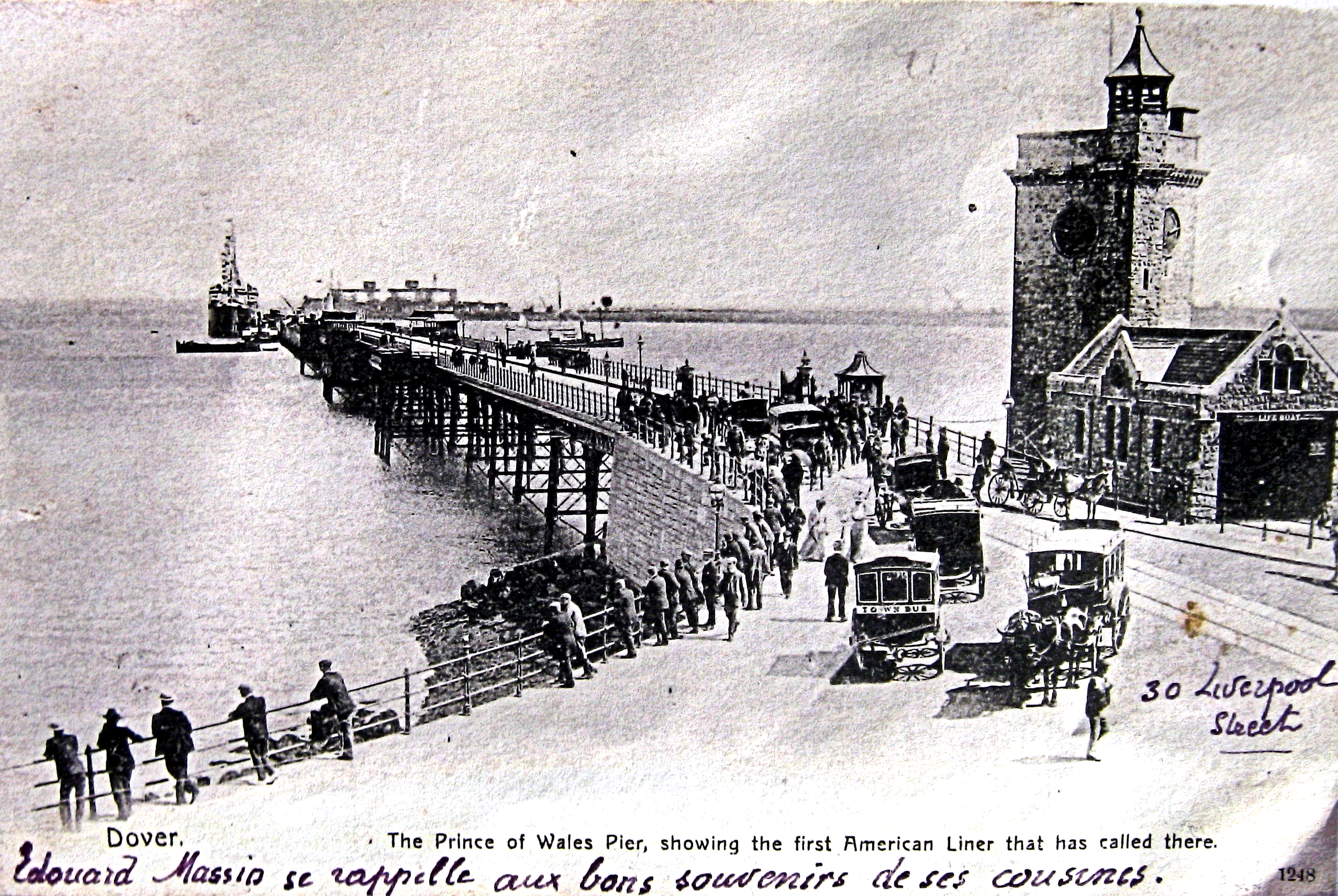
Prinz Waldemar 1 July 1904 the first transatlantic cruise ship to tie up in Dover. Barrie Wilson

Prinz Waldemar 1 July 1904 the first transatlantic vessel to tie up in Dover. Barrie Wilson

On 15 December 1903, an agreement was signed between DHB, SECR and the Hamburg-Amerika Line for their ocean going cruise ships to call into Dover from 1 July 1904. The Atlantic liners berth was in what was designated as the Commercial harbour and an electric swing bridge was constructed to carry the railway over the Wellington Dock entrance to the Prince of Wales Pier. The Prinz Waldermar arrived in July 1904 berthing alongside a newly built transatlantic ships’ landing stage on the east side. The Continental passage ships had been were using the smaller jetty on the west side of the Pier but an Admiralty Order in Council was issued stating that the Admiralty harbour was only for the use by the Royal Navy vessels. Commercial traffic was only to moor in the Commercial harbour, to the west of the Prince of Wales Pier, contravention carried a £10 fine. Moorings for 13 battleships, 4 big cruisers and 10 smaller cruisers, as well as 36 torpedo craft, were laid in 1905.
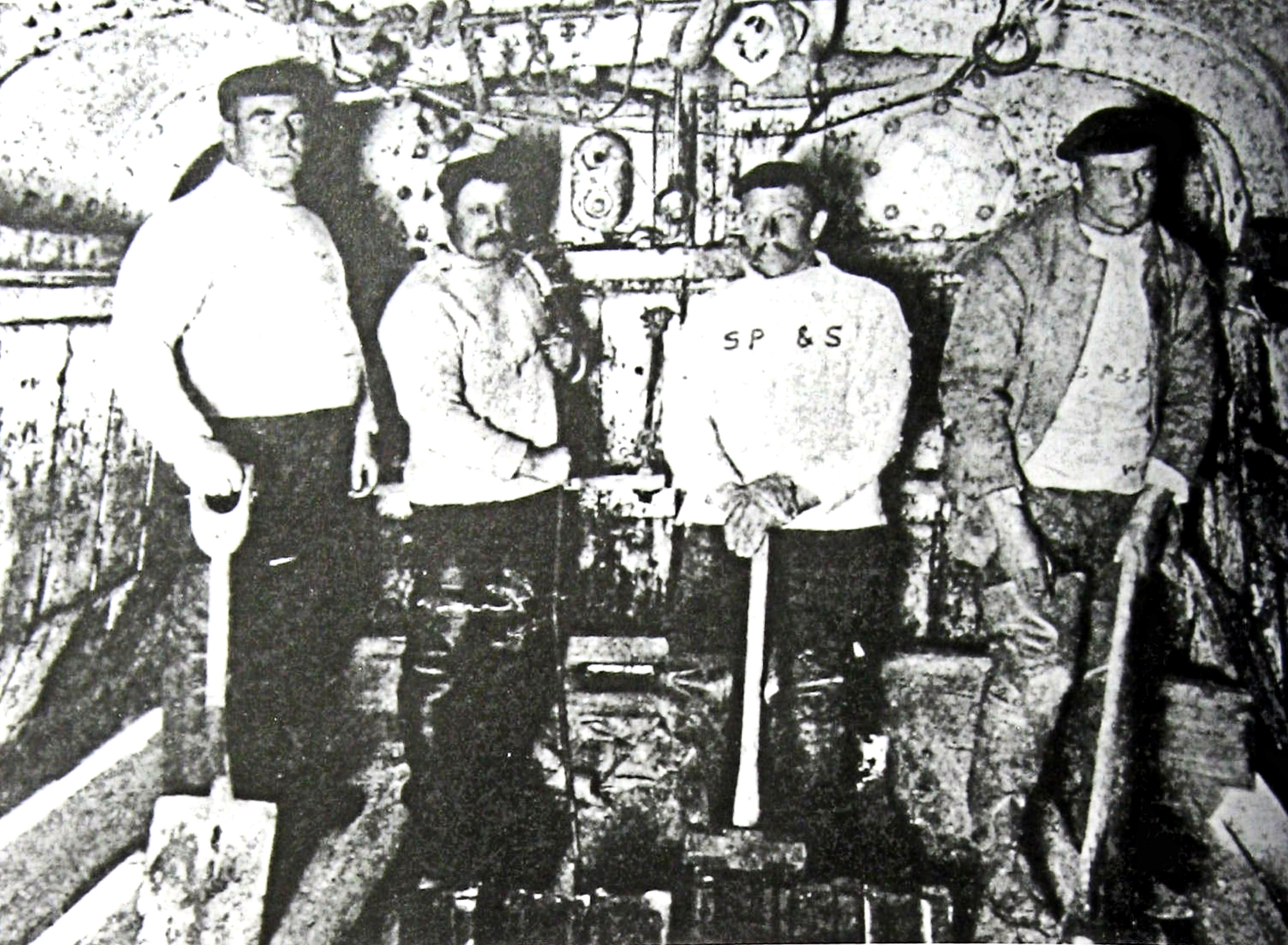
Admiralty Harbour. Diving Bell workers in Bell. Hollingsbee Collection Dover Museum

Admiralty Harbour Diving Bell. Workers inside Bell. Hollingsbee Collection Dover Museum

During extremely heavy weather, work was suspended on the new Admiralty Harbour, sometimes for days at a time. A storm lasting several days in September 1903, swept away part of the Admiralty Pier extension staging and a huge cage that had been erected over the Southern Breakwater started to disintegrate. The cage was built out of Huon pine and steel girders on which goliath cranes stood. The building of the Southern breakwater was the most difficult because of its exposed position and the depth of water – at high spring tides some 45 to 55-feet. Work had started in August 1904 when the strongly built staging was erected in the same way as that of Admiralty Pier and the Eastern Arm. Most of the 80 divers were involved.

Admiralty Pier extension construction. Dover Museum

Admiralty Pier extension construction. Dover Museum

Because of the potential scouring and tidal action of the sea ‘aprons’ projecting 25-feet horizontally from the base were built on the seaward side of the Southern Breakwater. The beds for the aprons were excavated to a depth of 2-feet and were built using blocks weighing from 9-14tons and 3½-feet deep. These were laid using powerful cranes. On the seaward side of both the Admiralty Pier and the Eastern Arm, parapets were erected 11-feet and 10-feet wide respectively, the top of the Admiralty Pier being 43½-feet and Eastern Arm 39-feet above low water. Level with the bottom of the parapet was/is a ‘bull nose’ or blunt lip, bending outwards to the sea in order to try to deflect and to help combat sea washing over the harbour walls.

By January 1905, 1,600-feet of the Southern Breakwater was above the low water mark and the Admiralty Pier extension was almost completed. It was intended that the Admiralty Pier would overlap the Southern Breakwater by some 500-feet in order to allow vessels to enter safely. However, during the construction of the Breakwater, because of the staging, this was reduced to less than 400-feet resulting in ships’ sterns being in the strong tide while the bow was in the calmer water. This made the entrance into the harbour difficult and a Red Star Line vessel and a number of cross-Channel ferries had collided with staging.
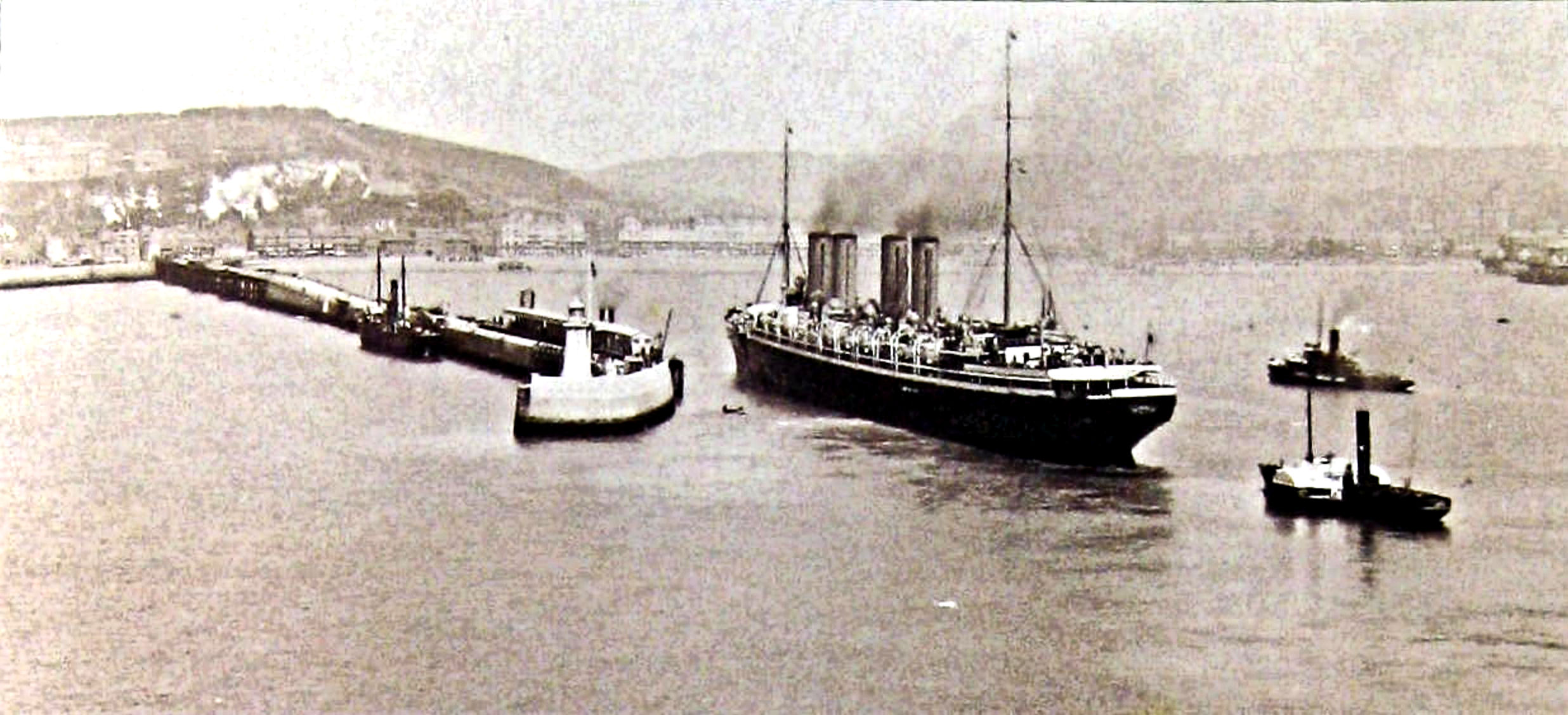
Deutschland coming alongside the Price of Wales Pier 1904 . David Hammond

Deutschland coming alongside the Prince of Wales Pier 1904 . David Hammond

In June 1906 the Prinz Joachim collided with the staging and the Admiralty reacted by issuing a directive saying that the harbour was unsafe for cruise vessels to enter and the entrance was to be redesigned to be 800-feet wide. A few weeks later, on 13 July 1906, the German liner Deutschland – the fastest liner in the World – hit the Southern Breakwater jetty with her stern. Then her bow hit the Prince of Wales Pier seriously damaging her stem and the plating on either side of her bow. Her voyage to America was abandoned.
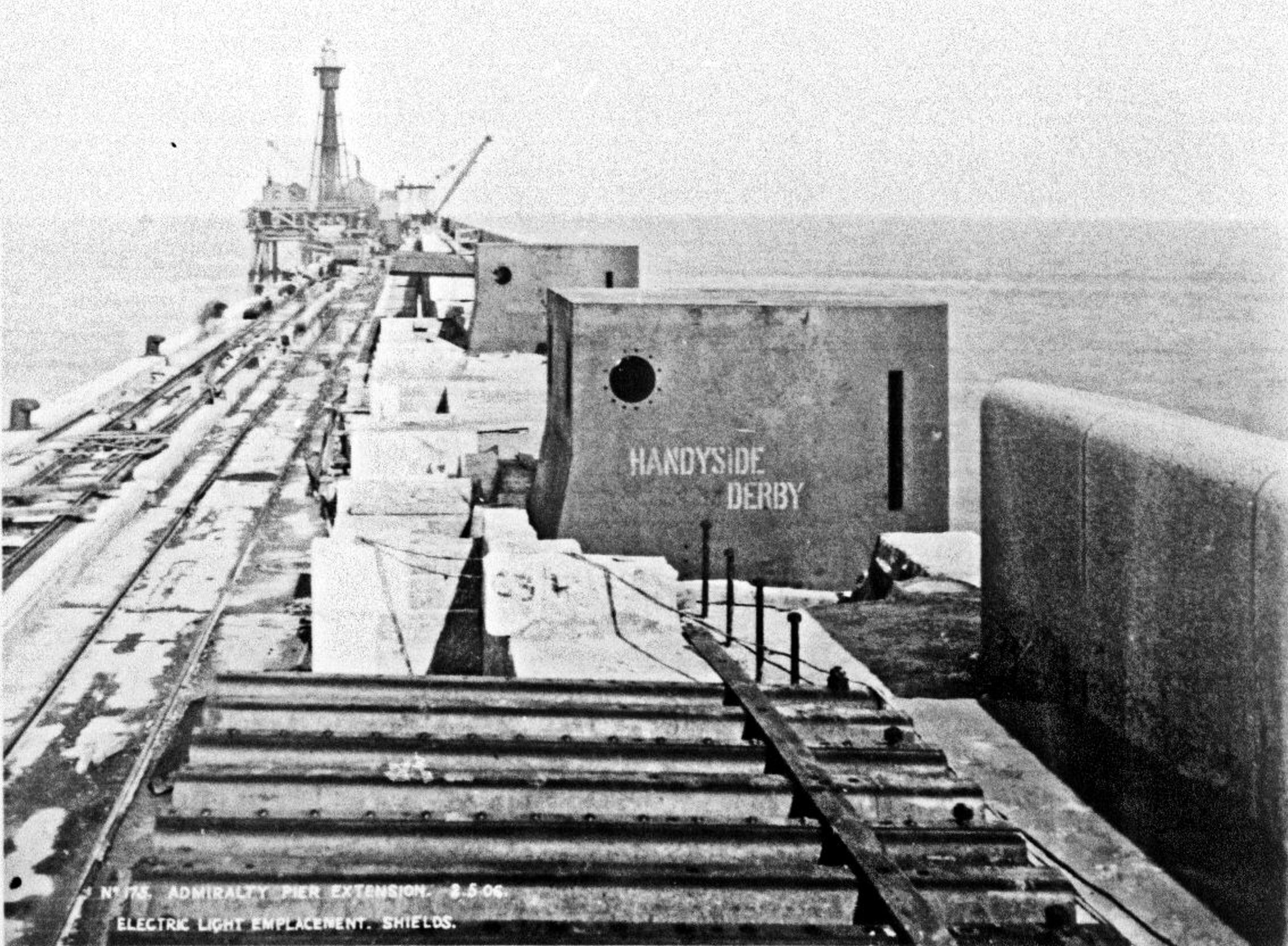
Admiralty Pier Electric Light emplacement 03.05.1906 note lighthouse. Dover Museum

Admiralty Pier Electric Light emplacement 03.05.1906 note lighthouse. Dover Museum

An agreement was reached, that on  completion of the Admiralty Pier, DHB was to be given the lease of the whole of the Pier in return for the Admiralty taking over the east side of the Prince of Wales Pier. This was confirmed by Act of Parliament in 1906. The same Act also provided for the widening of the old portion of the Admiralty Pier, bringing it, architecturally, into line with the extension and for the construction of a Continental marine station.

Because of the transatlantic liners disasters, the Admiralty, in 1907, undertook a number of tests to check out the safety of the harbour. Battleship Africa and cruiser Duke of Edinburgh both encountered problems on entering the Western entrance. It was also found that the mooring sites were unsuitable for such large vessels particularly in gusty winds. Smaller ships and submarines were subjected to pitching and rolling that was at the best uncomfortable for the crew or at worst brought about severe seasickness. The only way to reduce the incoming swell was to narrow the western entrance making it dangerous for ships to enter. The Admiralty therefore decided to build a tidal dock or camber adjacent to the Eastern Arm.

With the proposed widening of the Admiralty Pier, a further increase of 1 shilling on the passenger tax was required. This was to give the income necessary to meet the interest charges and sinking fund on a loan of £1m and under section 27 of the 1906 Dover Harbour (Works etc) Act it was agreed. The original levy was 1s6d (7½pence) on passengers landing and embarking, the 1906 levy was increased to 2s6d (12½pence). The interest on the £1m loan was agreed at 4% and the sinking fund 2½%. Worsfold Mowll, DHB Register, giving evidence to the House of Commons, said that over and above the individual passenger tax, 5shillings was received for every train that went onto the Admiralty Pier and £1 for every ship that went alongside.
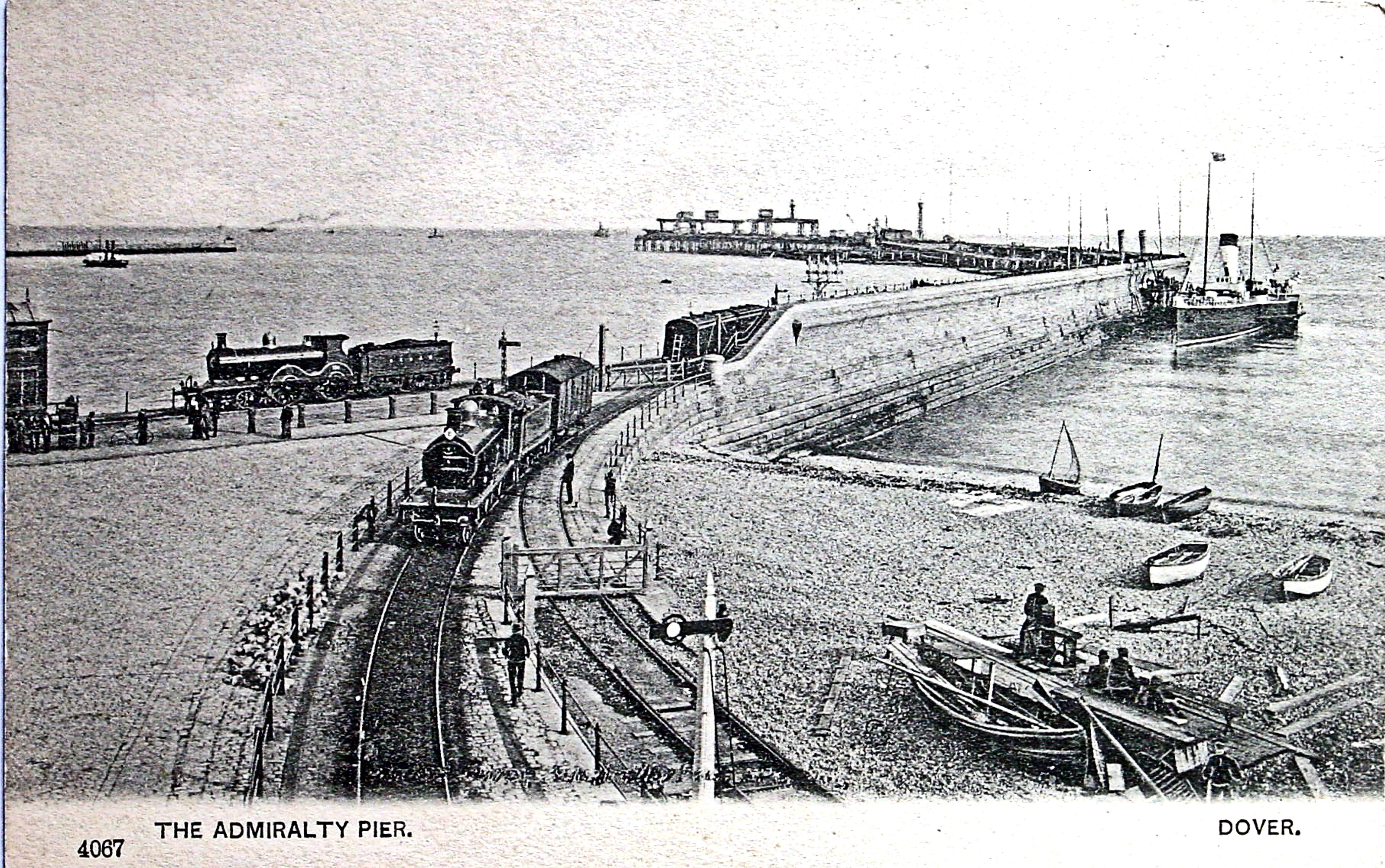
Admiralty Pier during construction of extension. Two railway lines, boat builders, steamer berthed on the western side. Dover Library

Admiralty Pier during construction of extension. Two railway lines, boat builders, steamer berthed on the western side. Dover Library

In September 1907 the Southern Breakwater was completed and the Admiralty withdrew its danger notice to transatlantic liners. Then only two months later, the Red Star liner Finland struck the end of the Southern Breakwater. The accident caused some damage to the ship but more to the Breakwater. Shortly after the Germania hit the end of the Prince of Wales Pier. By that time, it had been agreed that Pearson’s would build an outer landing stage against Admiralty Pier for both cross-Channel ships and for transatlantic liners to avoid such accidents. Orders were also issued stating that until completion of the Admiralty Harbour a Union Jack was to be hoisted at the Coastguard signal station, on the Admiralty Pier when it was safe for ships to enter the harbour. When the flag was dipped, it was safer for ships to remain outside.

As the Admiralty Harbour works were reaching their completion the Lords of the Admiralty paid visits. On each occasion they were met by Sir William Crundall and members and officers of DHB along with Dover Mayor Walter Emden and Corporation. Early in 1908, the battleship Jupiter started a series of trials of the harbour entrances and the moorings. The rebuilding of the Admiralty Pier Turret was started in March and a second fort was built at the end of Admiralty Pier. Similar forts were built on the Southern Breakwater and at the end of the Eastern Arm. A new steel lighthouse was erected on the end of Admiralty Pier and was first used on 7 October 1908.
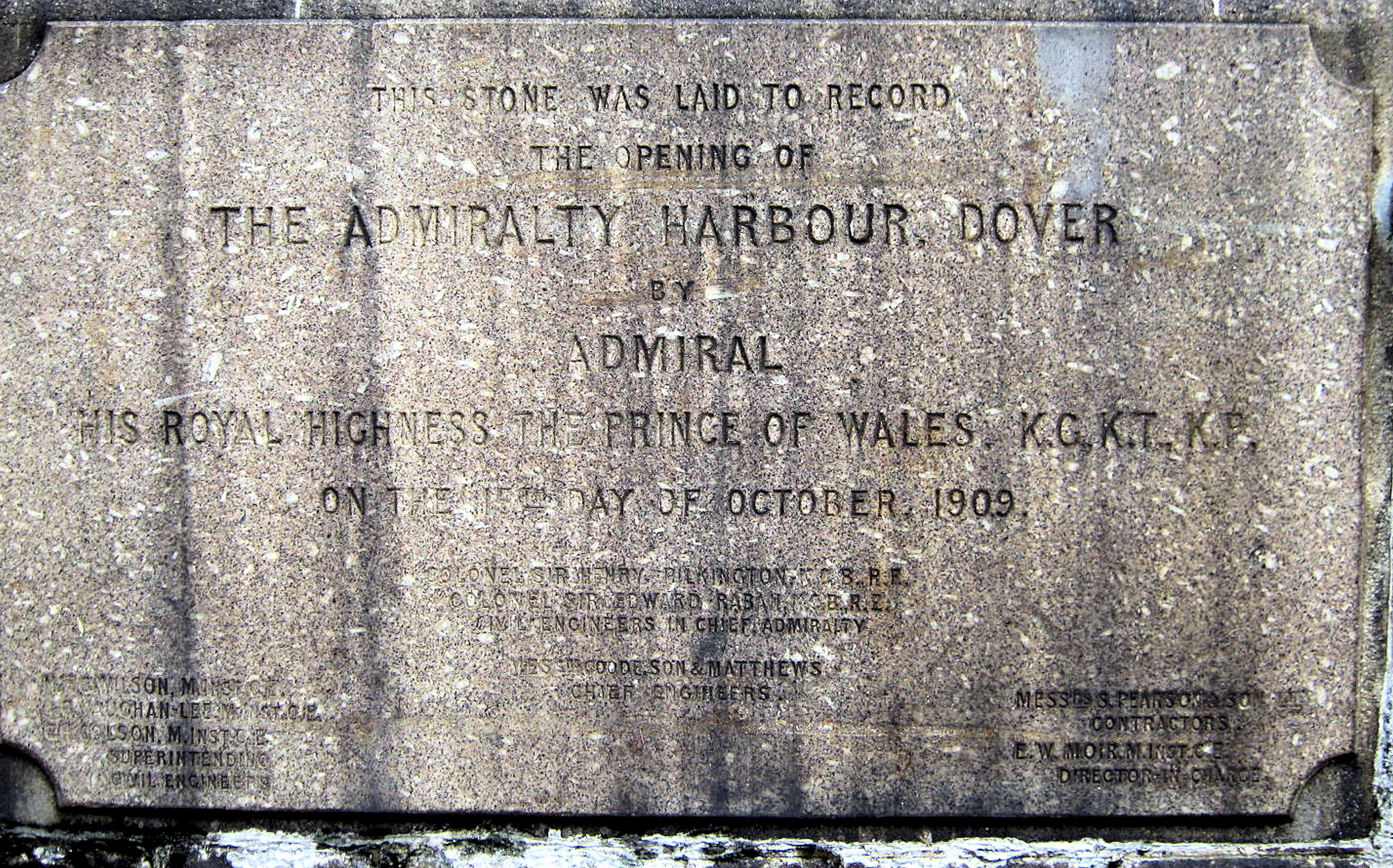
Admiralty Harbour final stone laid by George Prince of Wales later George V (1910-1936) on 15 October 1909. LS 2010

Admiralty Harbour final stone laid by George, Prince of Wales later George V (1910-1936) on 15 October 1909. LS 2010

During a severe gale on Friday 15 October 1909, Admiral of the Fleet, George, Prince of Wales later George V (1910-1936) arrived in Dover by train and was driven to the shore end of the Eastern Arm where he laid the last stone commemorating the building of the Admiralty Harbour. Inside a cavity under the stone is a casket containing a parchment telling of the construction of the Admiralty Harbour, copies of the Times, Dover Express and the Dover Chronicle along with coins of the realm. Following the ceremony, the Prince was driven to the Clock Tower, on the seafront, where he boarded a train to the Admiralty Pier station. Alongside was the Royal Yacht Enchantress, which the Prince and the dignitaries boarded to enjoy a lunch.

Approximately, between 1,500 and 1,800 men worked on the project and many accidents and some deaths occurred. However, with regard to the divers, no deaths or serious injuries were recorded in connection with working either with compressed air or in diving bells. Part 2 of the Admiralty Pier continues the story from the official opening in 1909 to the present day.

Presented: 30 April 2015

Of Note:
Jur Kingma tells me that the Dover Admiralty Pier was the inspiration of the piers/breakwaters of the IJmuiden seaport on the Amsterdam Ship Canal. (1865-1876). The consultant engineer of the Amsterdam Ship Canal company was Sir John Hawkshaw and the Contractor was Henry Lee & Sons. Engineer Charles Burn, worked for the Amsterdam Water Supply Company and wrote a book on the building of Admiralty Pier and he with Bland W Croker made the first plans for the Amsterdam Ship Canal. In IJmuiden a large factory opened to make the concrete blocks for the Ship Canal and the first Titan crane – designed by Darnton Hutton, engineer of Henry Lee & Sons – was used in 1870 at IJmuiden.


Posted in Admiralty Pier Part I 1836-1908, Admiralty Pier Part I 1836-1908, Admiralty Pier Part I 1836-1908, Admiralty Pier Part I 1836-1908, Buildings, Maritime, Railways, Tourism | Comments Off on Admiralty Pier Part I 1836-1908

Duke of Wellington & Dover

Duke of Wellington in the uniform of the Lord Warden of the Cinque Ports. Dover Harbour Board.

Duke of Wellington in the uniform of the Lord Warden of the Cinque Ports. Dover Harbour Board.

The reporter sneered, ‘What did Wellington ever do for Dover that warrants a Doverhistorian.com tourist plaque in memory of him?’ Alan, a member of Doverhistorian.com, had suggested that one should be placed on the wall outside the headquarters of Dover Harbour Board at Harbour House on Waterloo Crescent. True much has been written about Arthur Wellesley, the Duke of Wellington (1769-1852), on both his military accomplishments – particularly the Battle of Waterloo of 1815 – and his political career. Less has been written about his role as the Lord Warden of the Cinque Ports (pronounced ‘sink’) but there is the excellent book by Gregory Holyoake on Wellington at Walmer, Buckland Publications 1996. As for Wellington and Dover, he does feature in this author’s academically acclaimed book Banking on Dover, published in 1993 but there is little else until this article was uploaded!

The Lord Warden was originally the Constable of Dover Castle - a position still held - and therefore the Head of the Cinque Ports

The Lord Warden was originally the Constable of Dover Castle – a position still held – and therefore the Head of the Cinque Ports. AS 2013

The Duke of Wellington was installed as the Lord Warden of the Cinque Ports in 1829. The Cinque Ports originated during Saxon times (circa 450AD and 1066) as a loose confederation of the fishermen of Dover, Hastings, Hythe, Romney and Sandwich along the south east coast of England. Edward the Confessor (1042-1066) recognised both their seamanship and the ships they built were strong enough to withstand the conditions in the English Channel and the North Sea. In 1050 he proclaimed that the five towns (the two antient towns of Rye and Winchelsea joined later), would provide ‘ship service’. That was, 57 ships, fully manned for 15 days’ service a year, each port being allocated a share of the total burden. In return, the King gave the towns many rights and privileges and created the office of the Constable of Dover Castle as the protector of the Cinque Ports.

The Cinque Ports grew in both financial and political strength and in order to regain control, Henry III (1216-1272) created the office of the Warden of the Cinque Ports – it was not until 15th century that the post had the prefix Lord. William d’ Averanch was the first Constable of Dover Castle and Warden of the Cinque Ports and was appointed 12 March 1226. The Confederation of the Cinque Ports was legalised by Charter in June 1278 and the duty of the Warden was to maintain and defend the liberties of the Ports and to preside over the Court of Shepway. The latter was perhaps the most powerful instrument in discharging the duty, as the Warden was the King’s representative independent of the other Royal Courts. During the 14th century, some of the Wardens held office as Admiral, with command not only of the Cinque Ports ships but also of the whole of the English fleet.

Lord Wardens Flag photograph by Ray Warner

Lord Wardens Flag photograph by Ray Warner

Following the change from Warden to Lord Warden the office was synonymous as a reward to the greatest of the nobility and held for life. This role included the office of the Admiral of the Cinque Ports, presiding over the Cinque Ports Court of Chancery, the chief muster master of the Cinque Ports militia and with that the position of Lieutenant of Kent. The Lord Warden was given the right of flying the distinctive flag of his office in all the Cinque Ports and their Liberties and later the residence at Walmer Castle. These days, the position of Lord Warden and Admiral of the Cinque Ports is the most ancient military honour available in England. The Duke of Wellington was appointed as the Lord Warden and Constable of Dover Castle on 20 January 1829.

Arthur Wellesley was born on 1 May 1769 in Ireland, probably Dublin. He was commissioned as an ensign in the British Army on 7 March 1787, rising through the ranks and following the outbreak of the Napoleonic Wars (1793-1815) becoming a Lieutenant-Colonel in September 1793. During the next few years, Arthur Wellesley played a significant part in some 60 battles and was noted for his organisational skills, perseverance and courage. A Tory, Wellesley was also interested in politics and was elected Member of Parliament for the Cinque Port of Rye in a by-election that took place in April 1806. A position he held until the general election in the following November, when he lost the seat.

Napoleonic Wars - Britain facing the Enemy by Isaac Cruikshank 1798. LS Collection

Napoleonic Wars – Britain facing the Enemy by Isaac Cruikshank 1798. LS Collection

Wellesley led the British Army in the Peninsula Wars (1808-1813) in Spain and Portugal against Napoleon (Emperor of France 1804-1814) and attained the rank of Field Marshal in June 1813. On 6 April 1814, Napoleon abdicated with the signing of the Chaumont Peace Treaty. He was appointed the ambassador to France and was granted the Dukedom of Wellington. On 11 July 1814, Wellington was in Dover where he greeted the leader of the Prussian forces, Marshall Gebhard Leberecht von Blücher (1742-1819), on the newly built Buckland Bridge. Neither men knowing that in less than a year they would be allies in the final defeat of Napoleon. In March 1815, Napoleon returned from Elba at the head of an army and the Wars resumed. Wellington spent much time in Dover reassembling his Army, having footwear made by Coultard and Wilson of Last Lane for his soldiers. Also battle orders printed by Mr Mate of the ancient former Dolphin Lane that ceased to exist in 2018, his premises were approximately where the Granada cinema stood until recently.

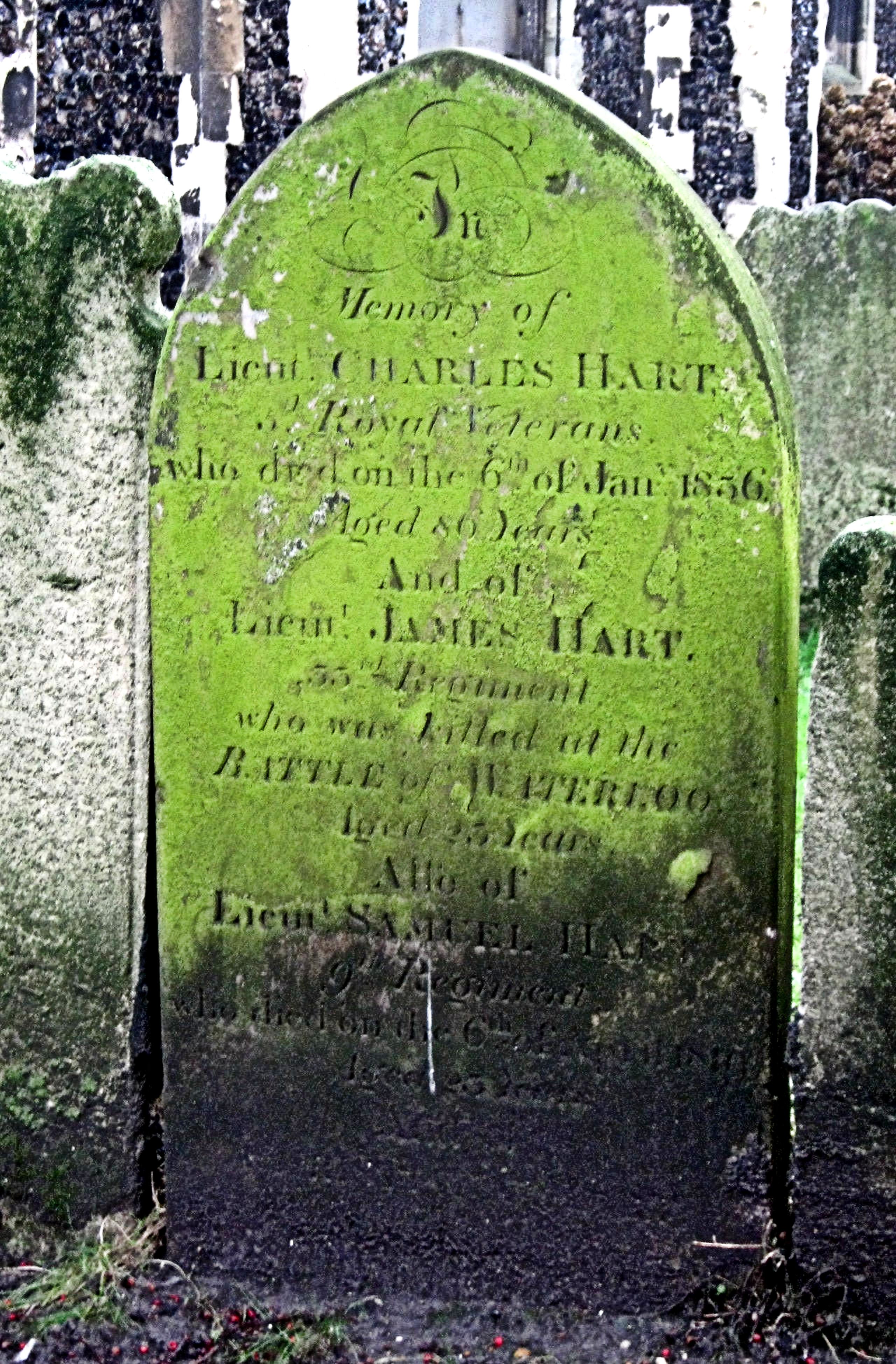
Gravestone of Lt. James Hart age 23years killed at the Battle of Waterloo. St Mary's Church graveyard. LS 2011

Gravestone of Lt. James Hart aged 23 years killed at the Battle of Waterloo. St Mary’s Church graveyard. LS 2011

The Battle of Waterloo took place on 18 June 1815 following which Wellington landed in Dover on 23 June. He arrived in Dover Bay at about 03.00hrs in the sloop Rosario, and the guns on Western Heights were fired to welcome him! By the time the Rosario came into Dover harbour, the quays and piers were crowded. On landing at the Crosswall, the exultation was deafening and the Duke was lifted onto the shoulders of townsmen Henry Jell, Emanuel Levey and Thomas Birch. They carried the Duke to the Ship Inn, on Custom House Quay with the  crowds cheering all the way. When they reached the Inn’s low entrance the three men refused to put the Duke down, instead they crouched so the Duke would not bump his head! Inside, Marshall Blücher was there to greet his friend and comrade.

Following the Wars, Wellington returned to politics and in 1819 was appointed Master-General of Ordnance and later Commander-in-Chief of the British Army. At the time the Prime Minister (1812-1827) was Robert Jenkinson, 2nd Earl of Liverpool (1770-1828). The Earl was also the Lord Warden a position that he held from 1806. During his last days as Prime Minister and for sometime after, there was political deadlock with two Prime Ministers of short duration holding the office. This ended on 26 January 1828 when the Duke of Wellington was appointed and it was during this term of office that Wellington earned the epitaph ‘Iron Duke,’ over his resolute stance on issues.

A year later Wellington was appointed Lord Warden of the Cinque Ports and Constable of Dover Castle. Although, it is said that he dispensed with the formal installation this is untrue. The installation took place at Dover Castle on 28 July 1829 and was a splendid affair with royalty and many local and national dignitaries attending. On Thursday 15 October 1829, the Duke attended his first Dover Harbour Commission session held in the Council House on Council House Street in the then Pier District. This was presided over by Wellington as Lord Warden of the Cinque Ports and he wore the uniform of the Lord Warden of the Cinque Ports, decorated with the Order of the Garter.

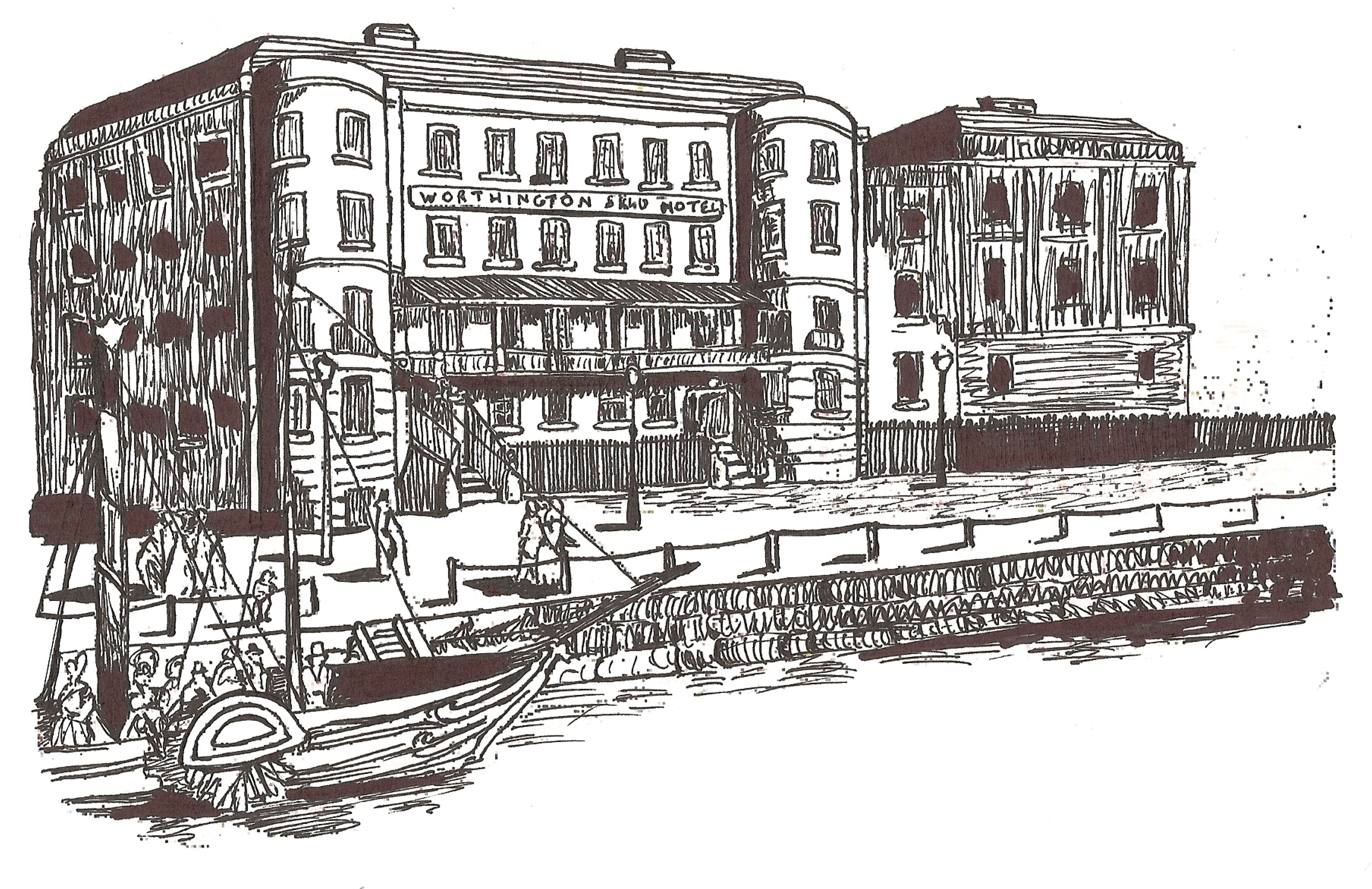
Ship Hotel circa 1834 by Lynn Candace Sencicle

Ship Hotel circa 1834 by Lynn Candace Sencicle

Attended by Robert Henry Jenkinson, a relative of the former Lord Warden and Deputy Warden of the Cinque Ports, and an entourage of dignitaries and officials, Wellington left the Ship Hotel on Custom House Quay for the Council House. A guard of honour was waiting and upon the arrival of the procession a salute of guns was fired from the Drop Redoubt Battery on Western Heights. Following the inaugural Session, Matthew Kennett – Mayor of Dover, John Shipdem – Register of the Harbour Commission along with Harbour Commissioners, Commanding Officer of the garrison and his men, the full town council, collector of customs and his officers etc., the entourage walked the full length of Snargate Street. The procession returned along the quays to the Ship Hotel. There, the dignitaries partook in an ‘elegant dinner’ at which ‘every delicacy the season afforded’ was served.

Walmer Castle by George Shepherd

Walmer Castle by George Shepherd

It was at the Lord Warden’s official residence, Walmer Castle, where Wellington was to spend as much time as possible and where he stuck to his renowned rigorous regime. This was getting up early, taking regular exercise, eating simple food, drinking in moderation and sleeping on a hard, uncurtained bed. He often invited guests to stay and besides his family, these included Queen Victoria (1837-1901), and Prince Albert (1819-1861), a number of favoured female friends and many illustrious personages of the time. Wellington retained all the servants at the Castle at his own expense and paid Mrs Norman, who had retired as the long-term housekeeper before Wellington took up the appointment.

From amongst the locals, Wellington had a small group of friends with whom he spent a great deal of time. They included, John Iron (1774-1867) – Dover harbour master, Henshaw Latham (1782-1843) – banker and treasurer of the Dover Harbour Commission, Thomas Pain – Register to the Admiral of the Cinque Ports, Daniel Peake (1766-1852) – senior Cinque Ports pilot, Luke Smithett (1801- 1871) – senior packet captain and James Worsfold (1795-1870) – the Commissioner of Salvage at the Admiralty Court. The men all lived in Dover and when asked why he enjoyed their company, Wellington is reported as saying that Deal and Walmer were poor places for information adding, ‘Now Dover, you always see somebody to tell you the news … or what he does quite as well, somebody you can quote for having told you it!’

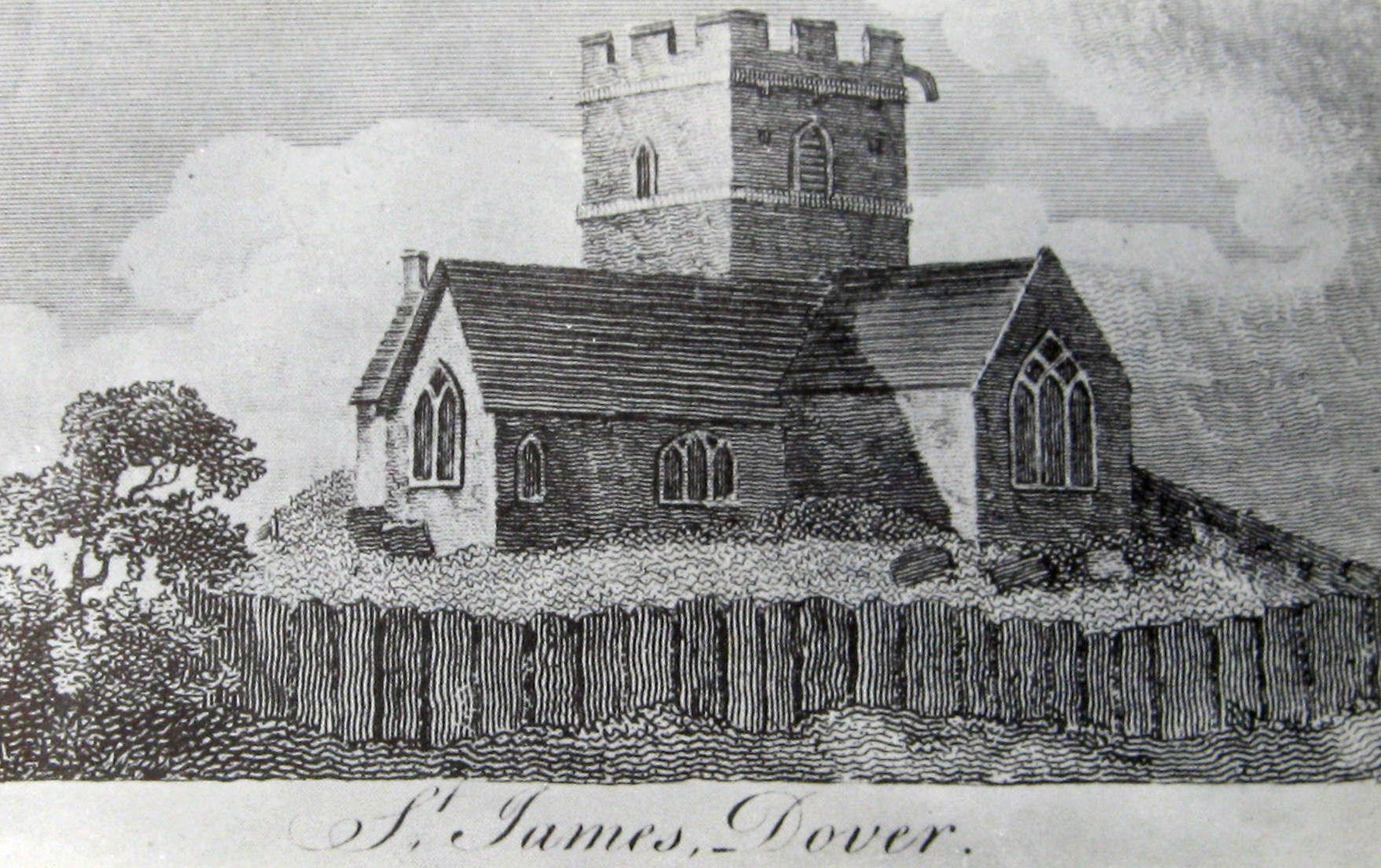
18th Century Sketch of St James' Church where the Cinque Ports Courts of Admiralty, Chancery and Lodemanage were held.

18th Century Sketch of St James’ Church where the Cinque Ports Courts of Admiralty, Chancery and Lodemanage were held.

As Admiral of the Cinque Ports, the Lord Warden presided over the Admiralty Court that met in St James Church on St James Street. There, all aspects of maritime law were judged and Wellington was noted for being ‘most punctual in his attendance at the Court.’ Under the jurisdiction of the Admiralty Court were the Court of Lodemanage and the administration of the Cinque Ports Pilots. Of his many other duties as Lord Warden, Wellington was not particularly interested but he did appoint ‘worthy occupants who took the responsibilities seriously.’

In June 1830 George IV (1820-1830) died, Parliament was dissolved and in the elections that followed, in his capacity as Lord Warden, Wellington could choose one of the two representatives. Wellington’s chose Sir John Rae Reid (1791-1867), who, although not a local man, Sir John owned a fleet of ships. On becoming one of Dovers two Members of Parliament, he ensured that his ships used both Dovers harbour and her mariners. Like his patron, Reid was a Tory and he was also the Governor of the Bank of England. The Freemen of Dover chose the other Member, and their choice was Tory, Charles Poulett Thomson. However, although Dover sent two Tory’s  to Westminster, the Tory’s lost the election to the Whigs and Wellington was no longer Prime Minister.

As Admiral of the Cinque Ports, Wellington took his position seriously and many of the cases were of a routine nature. However, on one occasion, what appeared to be routine case turned out to be anything but! This concerned the disposal of a whale that had been driven into Whitstable Bay, north Kent, in the autumn of 1831. Whitstable was within the jurisdiction of the Lord Warden of the Cinque Ports and the local fishermen, having secured the whale on the shore claimed salvage. James Worsfold – the Commissioner of Salvage at the Admiralty Court – advised Wellington to uphold their claim. 

Not long after, much to everyones surprise, the Admiralty brought a high court case against Wellington, as Admiral of the Cinque Ports. He was accused of sanctioning the claim of salvage to which the fishermen were not entitled. The writ went on to say ‘the whale, like the sturgeon was a royal fish and therefore the property of the Crown.’ In court, Thomas Pain, the Register to the Admiral of the Cinque Ports, argued that although the whale belonged to the Sovereign, the Sovereign may transfer this right to another and in this case to the Lord Warden. He used a case that took place in 1668 as a precedent and the court upheld Wellington’s decision.
Lord Wardens bench, Court of Lodemanage, St James old Church, post 1935 now in Dove Museum. Dover Library

Lord Wardens bench, Court of Lodemanage, St James old Church, post 1935 now in Dover Museum. Dover Library

Wellington was known to be fair, and a legal stance on behalf of the Cinque Port Pilots was to set a precedent. The fraternity had existed since Saxon time, and from the beginning they took charge of ships traversing through the Cinque Ports area of Channel – one of the most dangerous seaways in the world. By 1495, the Dover pilots, as elsewhere, were governed by a set of tight rules that they were obliged to obey and on 20 May 1515, Henry VIII put the Cinque Ports Pilots on a formal footing that he sanctioned by Charter. Since 1526, the Lord Warden had adjudicated internal disputes of the Fellowship of the Cinque Ports Pilots. This over time was extended to external disputes resulting in the Court of Lodemanage.

Before Wellington was appointed Lord Warden, Lloyds Insurance of London was increasingly prosecuting Cinque Ports Pilots in the Admiralty Court in London on matters that seemed, to the pilots to be unjust. Daniel Peake – senior Cinque Ports pilot – told Wellington of this. Following one particularly unfair prosecution in 1832, Wellington instructed the Register, Thomas Pain, to write to John Bennett, the Secretary of Lloyds Insurance. In the letter Wellington made it clear that any complaint against the Cinque Port Pilots was to be addressed to him. And that such complaints were, ‘fully substantiated and that every circumstance bearing upon the particular case be brought and the circumstances states under oath, in order for a just and satisfactory decision.’(12.06.1832) The Cinque Ports Pilots thereafter held Wellington in high esteem.

Parliament was dissolved in June 1831 over the highly controversial Reform Bill. The country was in a volatile mood and Wellington’s London residence was attacked. In the next Parliament, when the Reform Bill was going through the final Reading in the House of Lords, Wellington, in order to avoid widespread riots and possible revolution persuaded Peers who felt the same as he, not to vote. The Bill became Law that year. In Dover, there was an election in 1832 and a by-election in 1833. In November 1834, the Whig Prime Minister, Viscount Melbourne, resigned and Wellington was temporarily appointed to the position on 17th of that month and in December, Sir Robert Peel (1788-1850) became Prime Minister.

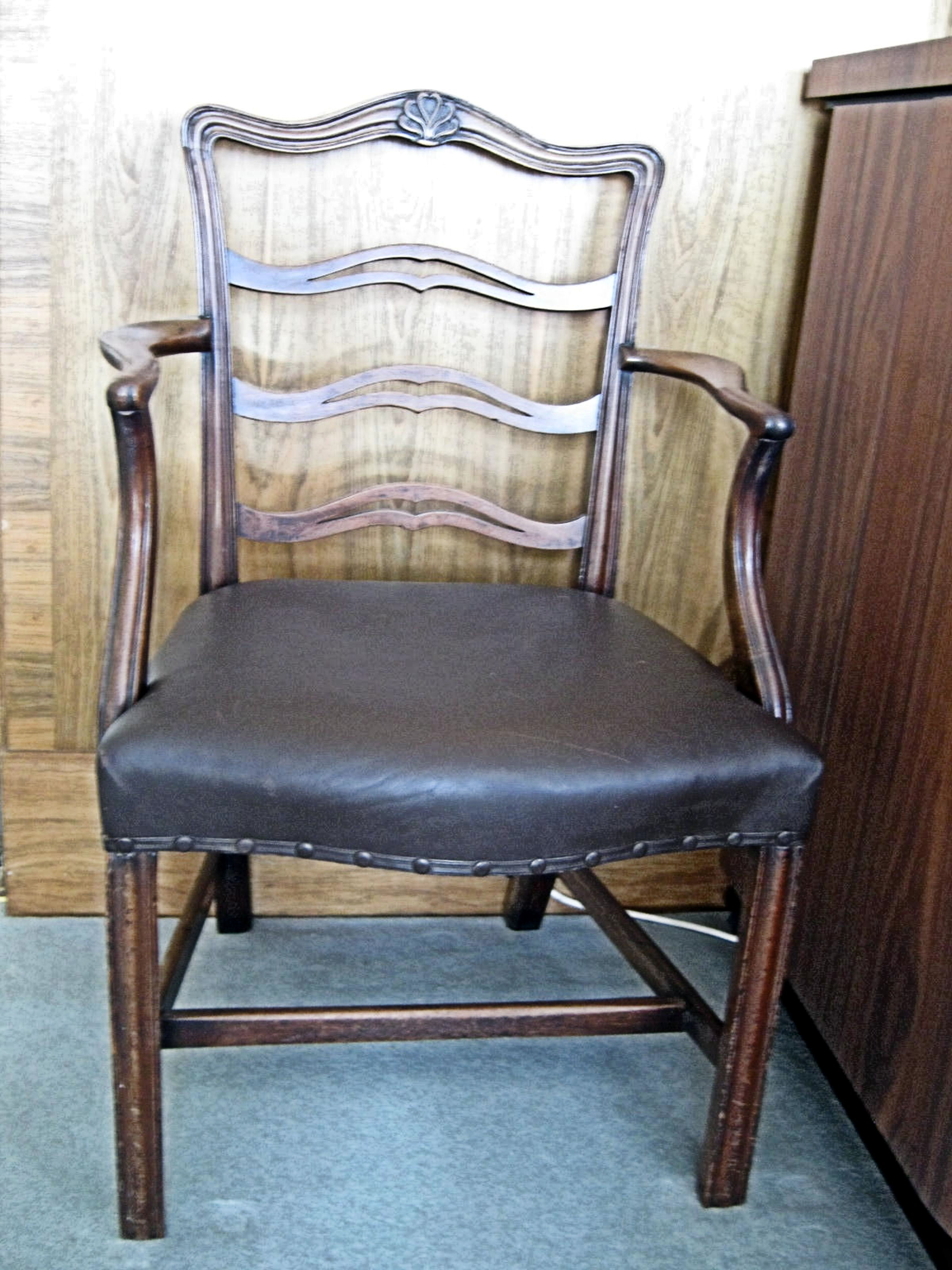
Duke of Wellington's Chair, Harbour House Waterloo Crescent. LS 2010

Duke of Wellington’s Chair, Harbour House Waterloo Crescent. LS 2010

As Chairman of the Dover Harbour Commissioners, Wellington hardly ever missed a meeting and in the Board Room, Wellington installed his favourite chair. These days it can be seen at Harbour House on Waterloo Crescent. The continual problem of the Eastward Drift, that washed the shingle round the head of Dover Bay and into the harbour entrance, dominated most meetings. The autumn of 1833 was particularly noted for the number of gales with the inclement weather continuing throughout the winter bringing unprecedented quantities of shingle that blocked the harbour mouth. At Christmas, the situation was so bad that the packet-boats were suspended for three days while the harbour was cleared. John Iron, the harbour master, suggested a resident engineer should be appointed to deal with the problem. Civil engineer Elias Pym Fordham of Sandover, Hertfordshire was given the job. Fordham was married to a granddaughter of Dover’s Samuel Taverner and appointed on the 25 April 1832.

Dover Harbour c 1830

Dover Harbour c 1830

Sir Henry Oxenden, a member of the Harbour Commission, had previously spent a great deal of time and his own money on trying to solve the problem of the Eastward Drift. At the time, the harbour was at the west end of the bay and comprised of the Tidal Basin – the main entrance and exit from the sea – the inner harbour or Bason and the non-tidal Pent into which the River Dour flowed. Oxenden made a number of recommendations that received the full approval of Wellington and the other Commissioners. Fordham was ordered to install new lock gates to the Bason and to clear the mud out of the Pent. The idea was that the deepened Pent water could be used to flush away the shingle from the Tidal harbour mouth. Fordham managed to have 19,926 tons of mud cleared from the Pent but the townsfolk were not happy, saying that the work was of little use, as ships could still not get in except at spring tides.

On New Years Day 1834, a public meeting was held at the Paris Hotel on Snargate Street with Councillor William Prescott, a grocer and tea dealer as chairman. Most of those who attended were particularly critical of the Harbour Commissioners saying that merchants paid port dues but because of the shingle bar and the lack of anything being done about it, were excluded from using what they paid for. The outcome of the meeting was that if nothing were done by 16 January 1834 to improve the condition of the harbour, further plans would be made. 

Attending the meeting on behalf of Wellington, who was in Reading, was Henshaw Latham who besides being the Harbour Commission treasurer, headed one of Dovers two banks and also a partner in one of the town’s major shipping companies. Also at the meeting was John Minet Fector junior (1812-1868), owner of the other of Dovers two banks and also the owner of a major shipping line based in Dover; and Edward Rice (1790-1878) of Danes Court, Tilmanstone – a partner in the Latham bank/shipping business. Fector was a Tory and Rice a Whig and both had their eye on becoming the next second Member of Parliament for Dover.

Town Hall 1606-1834 demolished 1841. Where the townsfolk held a meeting concerning the harbour on 16 January 1834 that led to the Parliamentary Inquiry of 1836. Dover Museum

Town Hall 1606-1834 demolished 1841. Where the townsfolk held a meeting concerning the harbour on 16 January 1834 that led to the Parliamentary Inquiry of 1836. Dover Museum

The following day Latham sent an account of the public meeting to Wellington and on that same day, Rice contacted Sir Henry Oxenden who was a close friend of his mother Sarah Rice. Because of the distance involved, the correspondence with Wellington took time. This delay was interpreted by the townsfolk that nothing was being done. On Thursday 16 January a second meeting was held at the Town Hall in what was then the Market Place (now Square) and chaired by Humphrey Humphreys, owner of Stembrook tannery. Again, there was a good deal of criticism of the Harbour Commissioners but the meeting was also attended by Daniel Peake and other Cinque Ports pilots, who knew of Latham’s commitment to Dover becoming a Harbour of Refuge. Little notice was taken of the pilots and the next morning a petition was written and signed by solicitor George William Ledger who was the Town Clerk, and addressed to Wellington.

A few days later, a deputation, headed by the Mayor Joseph Pilcher and Humphries, went to see the Duke of Wellington at Apsley House, his London home. Five days later Thomas Telford (1757–1834) the Scottish-born engineer, road, bridge and canal builder arrived in Dover. He had been appointed by Wellington to examine, existing works for the construction and maintenance of the harbour, and conversing with the engineer employed there you should report your opinion, whether any other and what works ought to be constructed for the purpose of a harbour at Dover; at what expense; and, if you should think that the works now in existence are sufficient for the purpose, whether any additional means of operation could be given to them to render them efficient.

Thomas Telford brought in to try and sort out the problem of the eastward Drift on the harbour. LS Collection

Thomas Telford brought in to try and sort out the problem of the eastward Drift on the harbour. LS Collection

Thomas Telford came to Dover, made an assessment and a number of suggestions. These came to £29,410 and to pay for them Latham, as treasurer, applied to the government for a loan of £16,000. The 1828 Dover Harbour Commissioners Act provided safeguards against personal liability that protected the Commissioners if they applied for a government loan. However, such loans had to be equally matched by finance from other sources. Harbour Commissioners William Osmond Hammond agreed to loan £2,500 at 4% per year, W F Grenville £3,500 and Sir Henry Oxenden £4,000 giving a total of £25,000. It was estimated that remainder of monies required could be met by tonnage dues – a tax on shipping passing through the Strait of Dover and imports and exports through the town of Dover.

The contract for the work was given to George Burge and the agreement was signed on 8 April 1834. Within a year the estimated cost for the works had risen to £31,905 6s 2d, however, during that time Thomas Telford had died on 2 September 1834. Wellington wrote to James Walker (1781-1862), the President of the Society of Engineers who accepted the invitation. Walker and Fordham did not get on well and in the end, Fordham resigned in November 1835 after which Walker became the resident engineer.

Because the plans for the proposed refurbishment of the Pent were in hand, Latham with the backing of Iron, Pain, Peake, Smithett, Worsfold and Rice started to sell the idea of Dover becoming a Harbour of Refuge to Wellington. Although Wellington recognised that a Harbour of Refuge was needed, he resolved that it should be on the Goodwin Sands side of the Downs off Deal. The Goodwin Sands are approximately 10-miles long and 2-miles wide but this varies as they are always shifting. They are soft, porous, tenacious quicksand and thus treacherous. The Downs is an 8-mile long channel approximately 4-miles wide between the East Kent coast and the infamous Sands that is safe for ships of those days to traverse except when a west-south-west wind blew. The first lightship, North Sand Head, went on station in 1795 at the Gull Stream – northerly entrance to the Downs. South Sand Head lightship did not go on station until 1832 and the East Goodwin lightship in 1874.

Although Wellington was adamant about the location of a Harbour of Refuge, he had quickly assimilated himself into the life of the town of Dover. He regularly visited schools to talk about his exploits on the field of battle and one particular school he returned to many times was situated at 8 Biggin Street. Locals had many stories of their interactions with the Duke and one concerned Wellington and his eldest son, Arthur Richard Wellesley, Marquess of Douro (1807-1884). He was in the Rifle Brigade and quartered in Dover during 1835.

Squiers Bazaar, Snargate Street to Northampton Street were the Marquess of Douro ran up a bill that Wellington refused to pay.

Squier’s Bazaar, Snargate Street to Northampton Street where the Marquess of Douro ran up a bill that Wellington refused to pay.

The story goes that the Marquess frequently visited Squier’s Bazaar on Snargate Street and a favourite meeting place of the young affluent members of society and the officers quartered in the town. At the time, a Mr Reuban ran it and the Marquess was known to be remiss on paying his bills. Reuban, decided to send Wellington his son’s bill but instead of receiving the sum, received the following reply: ‘Field Marshal the Duke of Wellington in not the same person as the Marquess of Douro and declines to be the Collector of Mr Reuben’s debts.’ Wellington signed the letter for which Reuben was offered £5 but refused to sell it. Instead he had it framed and put it on show where it attracted customers who spent more than the original bill! Later Douro Place, which still exists, was named after Wellington’s eldest son.

The next general election took place in 1835 and as well as John Rae Reid, Tory John Minet Fector junior was elected with Whig, Edward Rice, coming third just 21 votes behind. In Parliament, the Whigs were in power. Dover harbour was one of the main issues during the election as the works that James Walker was undertaking were seen as much too slow. Further, the Harbour Commissioners, including Wellington, were becoming increasingly reluctant to commit to any more money to the project.

Henshaw Latham, suggested that they could promote a Bill through Parliament for the Harbour of Refuge at Dover which, if agreed, would enable the 1828 Harbour Act to be amended so that a total of £60,000 borrowing without matching funding could be included. Latham presented an excellent case for a Harbour of Refuge starting by showing that 1,573 vessels had been stranded or wrecked off Dover between 1833-1835. That 129 vessels were missing or lost and in the case of 81 vessels, the entire crew had drowned.

Although, Wellington was convinced that the Harbour of Refuge should be off Deal he agreed and a Bill to this effect was promoted in Parliament.  When it came to the Second Reading in the House of Commons, John Fector junior moved that the Bill should be referred to a Select Committee. This, he argued, would give the inhabitants of Dover an opportunity to declare whether or not they were satisfied with the Constitution of the Dover Harbour Commission. So instead of gaining the powers the Commission sought, Wellington, Latham and the Harbour Commissioners found themselves the subject of scrutiny.

Pilot boat going to a vessel in heavy weather. Illustrated London News October 1857. Dover Library

Pilot boat going to a vessel in heavy weather. Illustrated London News October 1857. Dover Library

The Parliamentary Committee sat between 12 May and 7 June 1836 and examined nineteen witnesses including Henshaw Latham, John Shipdem, Daniel Peake, Captain Edward Boxer (1784-1855) – Royal Navy, William Cubitt (1785–1861) – Civil Engineer and Government Witness, Philip Going – Ship owner, Robert Hammond – Warden of the Pilots, Philip Hardwicke – solicitor and Receiver of Harbour Rents, John Hawkins – Clerk of Works, Humphrey Humphries, John Iron, Captain Harry David Jones – Royal Engineer and Government Witness, Isaac Pattison – Harbour Pilot, John Benjamin Post – Cinque Ports Pilot, William Prescott, James Walker, Richard Wardle – Engineer’s Assistant, Edward Rice and Lieutenant Benjamin Worthington – Royal Navy and author of a plan to improve the harbour.

Although all of the above supported the notion of a Harbour of Refuge at Dover some, egged on by John Fector junior, wanted the Harbour Commission abolished. This line of reasoning, however, detracted from the argument for a Harbour of Refuge but did not lead to the abolition of the Harbour Commission. Independently, a Parliament Select Committee was set up to investigate every aspect of shipwrecks and in the general election of 1837, Dover voted in favour of Edward Rice and rejected John Fector junior.

Throughout the 1836 Hearing, Wellington watched or was kept informed of the proceedings for he was heavily involved in two other parliamentary issues. The first was the South Eastern Railway Bill that was seeking approval and received Royal Assent on 21 June 1836. This Wellington backed on behalf of Dover and stating that if the problem with the harbour entrance could be solved then it could be assumed that the Railway Company’s main passage to France would be from the port of Dover.

The second issue was the Pilotage Bill. In 1833, the House of Commons had conducted an inquiry into the distress of Dover and Deal boatmen that had been displaced by the pilot cutters. Making provisions for the boatmen, the number of Cinque Ports pilots allowed by legislation had been curtailed. The Pilotage Bill took this one stage further, arguing in favour of boatmen taking over the work of pilots between the South Foreland and Dungeness. Many ship owners backed this, as boatmen were much cheaper than the professional pilots. Wellington fought hard on behalf of the Cinque Ports pilots and the Bill was not sanctioned. However, in 1835, a Royal Commission was set up to look at pilotage and this resulted in the Pilotage Act of 1836 that recommended the appointment of the Elder Brethren of Trinity House, Deptford, as the central licensing body. It also called for the abolition of the Cinque Ports pilots but Wellington ensured that this was not implemented.

Wellington Pavilion external view by William Burgess 1839

Wellington Pavilion external view by William Burgess 1839

To celebrate 10 years as Lord Warden, on Friday 30 August 1839, the town of Dover held a large banquet in honour of the Duke of Wellington. Mayor of Dover, Edward Pett Thompson, was the chairman of the Banquet Committee and a design for a pavilion was commissioned from local architect, Mr Edmunds. The pavilion covered 20,420 square feet, required 400 loads of timber, was made waterproof by the use of tarred cartridge paper and took 100 men sixty days to build. It was erected in the Priory Meadow, on the site of the present Norman and Saxon Streets opposite the Maison Dieu and cost £12,200.

The entrance to the pavilion was decorated with, ‘Military Insignia, Painting, Tapestry and Banners and with the arms and armour from the Tower of London.’ Inside, at the centre was a 40-foot square, the sides of which the seats rose in the effect of an amphitheatre. Pink and white striped drapery covered the internal walls and coats of arms of the Lord Wardens from Earl Godwyn down to the Duke of Wellington, were hung on them. Chandeliers were hung from the rafters and the pillars were decorated with stars of bayonets, groups of muskets and ancient armour. William Burgess (1805-1861) was commissioned to make drawings, engravings and paintings  recording the event.

On the morning of the banquet, six passage ships were commissioned to convey two thousand passengers from Ramsgate and Margate to watch the event. Another passage ship brought sightseers from Rye. Those invited, were due to sit down at 17.30hrs and half an hour before, Wellington, escorted by the 27th Regiment under the Command of Captain Smith – who had been at Waterloo – came into town from the direction of the Castle. The Duke was resplendent in his Lord Wardens uniform. The streets of Dover were crowded and everyone who attended was met with loud cheers. As Wellington arrived at the venue a salute of guns were fired from the garrison on Western Heights.

Wellington Pavilion the dinner by William Burgess 1839. Dover Museum

Wellington Pavilion the dinner by William Burgess 1839. Dover Museum

The banquet cost over £3,000 and 2,250 people sat down for the meal but as always in those days, the ladies sat apart from the men. They were only given a pudding of jelly and ice cream. All were charged 1½guineas (£1.57pence) to attend but the knives had gold handles and were borrowed from a firm in London! There were twenty-six tables accommodating 25 men at each, twenty-six accommodating 23 men, one accommodating 124 and the Dukes table that accommodated 172 men. The menu for these men included roasted freshly killed venison provided by Francis North 6th Earl of Guilford (1772-1861), 29 quarters of lamb, 56 dishes of roast veal, 56 dishes of boiled beef, 28 dishes of roast beef, 240 roast chickens, 40 turkeys, 28 hams, 56 tongues, 240 venison pies, 20 pigeon pies, 200 lobsters, salads, puddings, fruit pies and a bottle of wine for each guest.

Wellington Pavilion - the Ball by William Burgess 1839. Dover Museum

Wellington Pavilion – the Ball by William Burgess 1839. Dover Museum

Six days later a grand ball was held in the pavilion for which 940 guests bought tickets. Music was provided by the bands of the 27th and 90th Regiments. Attending both, besides local officials, were the aristocrats, gentry, dignitaries of the county and the country. It was reported that the Duke and his party enjoyed the dancing from 21.00hrs to after midnight and that the ball continued until the early hours. A medal was struck in honour of the celebrations; on the obverse was the head of the Duke and on the reverse, the Castle and the Arms of the Cinque Ports.

Prince Albert arriving at Dover for his marriage to Queen Victoria on 6 February 1840. Dover Museum

Prince Albert arriving at Dover for his marriage to Queen Victoria on 6 February 1840. Dover Museum

A few months later, on 10 February 1840, Queen Victoria married Prince Albert of Saxe-Coburg-Gotha. The Prince had travelled to Dover four days before on the steam packet Ariel, captained by Luke Smithett and escorted by HMS Firebrand. On arrival at the harbour, Wellington, the Harbour Commissioners and local dignitaries met the Prince. In 1842, the former home of brewer Mr Walker on Biggin Street, was converted into a pub and called the Prince Albert, to mark the occasion. There is an elaborate inscription on the building to this effect.

Camden Crescent with Cambridge Terrace behind and Granville gardens in front. Alan Sencicle 2009.

Camden Crescent with Cambridge Terrace behind and Granville gardens in front. Alan Sencicle 2009.

During the Peninsula Wars, Dr William Sankey was an Army surgeon attached to the Rifle Brigade. There he distinguished himself and the Duke of Wellington mentioned him in despatches. On leaving the army, the doctor settled in Dover and in the late 1830s put forward the idea to Wellington of what became Camden Crescent. The land was reclaimed and under the Harbour Commission Charter of 1606, as such, it belonged to them. Wellington fully endorsed the scheme and the first house was built in 1840. It was Sankey who suggested that the terrace should be named after John Jeffreys Pratt, 1st Marquess Camden (1759-1840), the Lord Lieutenant of Kent and at the time, a member of the Harbour Commission and to this Wellington agreed.

The Parliament Select Committee that was set up to investigate every aspect of shipwrecks, concluded that Harbours of Refuge were needed and that one should be on the south east Kent coast.  The Duke of Wellington, Sir Robert Peel – the Tory Prime Minister – and Lloyds Insurance all favoured this to be in the vicinity of the Goodwin Sands, off Deal. The Parliamentary Whigs favoured it to be in the Folkestone/Hythe Bay. Only Whig Edward Rice in Parliament and those who backed Henshaw Latham at the Inquiry wanted it in the Dover Bay.

The Goodwin Sands plan had been put forward by civil engineer, William Bush, who suggested that the entire sandbank could be surrounded by a series of cast-iron caissons. These would be sunk 30-feet below the sands on what was believed to be chalky subterranean and then the whole area inside would be pumped dry. The floor of the area  would be lined with granite surrounded by a permanent granite seawall. This would be flooded to provide a Harbour of Refuge and at the entrance would be an 86-foot high cast iron lighthouse bolted onto a caisson. The lighthouse was to be surmounted by a 40-foot lantern house, topped with a life size statue of Queen Victoria and called ‘Light of All Nations.’

Wellington’s close friends in Dover, John Iron, Daniel Peake, Thomas Pain, Luke Smithett, and James Worsfold along with Henshaw Latham tried to dissuade the Lord Warden but the Iron Duke was resolute. Further, Wellington put a lot of his own money into Bush’s project. In autumn 1841 the first caisson, built at Thorncliffe Iron Works Chapeltown near Sheffield Yorkshire, was towed in sections to Deal. The sections were bolted together and on 18 September, Wellington along with a number of engineers, dignitaries and friends including Henshaw Latham, watched the as an attempt was made to tow the gigantic caisson out to the Goodwins. The exercise failed.

Light of All Nations lighthouse on the Goodwin sands. LS Collection

Light of All Nations lighthouse on the Goodwin sands. LS Collection

A month later, an attempt was made to move it from Deal beach but the towing vessel ran aground. As a result, the caisson was taken back to Deal where it was sank off the pier. In July 1842, another attempt was made and was successful. Three months later the caisson was struck by the Nancy, a cargo ship that sank, losing all hands and over turning the caisson. Eventually, the caisson was corrected, a gigantic lighthouse was built on it and a celebration supper was held inside. What happened next, according to Sir John Henry Pelly (1777-1852), Deputy Master of Trinity House in his evidence to the June 1845 Parliamentary Committee on Lighthouses, was that the lighthouse was badly situated. It was on the Goodwin Sands where it was leading ships into danger. Trinity House ordered the project to be abandoned and the Light of All Nations to be demolished.

As Wellington’s pet scheme started to fail he increasingly backed Rice in Parliament and eventually the Tory Prime Minister, Sir Robert Peel, appointed another Committee. This was under Sir Thomas Byam Martin (1773-1854), a Conservative stalwart. The Hearings started on 1 May 1844 and both Rice and Latham gave evidence. On 7 August that year, the Commission published its report and it was recommended that Dover should be the Harbour of Refuge and a national naval base.

Although that inquiry did not have subsequent results, a second in 1846 did and in 1847, approval was given for four large Harbours of Refuge – Holyhead, Portland, Alderney and Dover. By that time Latham was dead but the others who backed him including Rice, attended a celebration dinner along with Wellington at Walmer Castle. The construction of the Admiralty Pier started in April 1848 and Wellington rode over from Walmer as often as he could to watch over the progress.

South Eastern Railway line looking towards Folkestone 1846. Dover Museum

South Eastern Railway line looking towards Folkestone 1846. Dover Museum

Throughout this time, the South Eastern Railway line was being constructed towards Dover but from Folkestone the going was slow as Round Down cliff had to be blown out of the way and the Shakespeare Cliff and Archcliffe tunnels had to be excavated. Engineer William Cubitt superintended the tunnels but excavating for the Shakespeare Cliff tunnel was proving a problem. The chalk was not as sound as first thought. Cubitt opted for two single-line tunnels 12-feet wide, 30-feet high, 10-foot apart and 1,331 yards in length with lancet arches. During the course of construction, Wellington was equally as attentive as he was over Admiralty Pier and frequently visited.  As Archcliffe tunnel was being built (now gone), Wellington was assured that changes to Archcliffe Fort were militarily advantageous. The railway line was completed by 27 January 1844 and on Tuesday 6 February, it was officially opened.

Pilots Tower opened 1848 where the Crusie liner terminal is now. Dover Library

Pilots Tower opened 1848 where the Cruise liner terminal is now. Dover Library

That year Wellington was again in Parliament backing the cause of the Cinque Ports Pilots against a move to replace them with boatmen. In 1844, to make way for the South Eastern Railway track, the Cheeseman’s Head pilot station was demolished and with Wellington’s full approval and financial help a highly ornate pilot’s station, built of stone and standing on a bed of concrete 10 feet thick, opened in 1848. The following year (1849), the Pilotage Bill centred once again on disbanding the Cinque Ports Pilots and their job being given to boatmen. Wellington, actively backed Rice during the Bill’s progress through the House of Commons and that part of the Bill floundered!

Major excavation work being crried out on the Pent that after it was lined with granite and was reopened on13 November 1846 as the Wellington Dock. Harbour House

Major excavation work being carried out on the Pent. After, it was lined with granite and reopened on 13 November 1846 as the Wellington Dock. Harbour House

The works on the Pent reached fruition in 1844 and cost about £45,000. They included the construction of a new entrance from the outer tidal harbour and an entrance into the Pent through giant 60ft lock gates on Union Street. To do this, the York Hotel, two pubs, a row of high quality residential housing and the Amherst battery were all demolished. Nearly 20,000 tons of mud was removed over a three-year period to deepen the Pent. It was then lined with granite and over the lock gates, an iron bridge was built.

 Wellington Dock. Alan Sencicle 2009.

Wellington Dock. Alan Sencicle 2009.

In 1846, Wellington retired from political life and on the 13 November that year, he formerly opened the scheme. The Pent was renamed Wellington Dock and the swing bridge, Wellington Bridge. The winch mechanism, installed in 1845, to operate the lock gates can still be seen. Once operational, the Wellington Dock proved to a financial blessing with the revenue from Passing Tolls increasing to £10,000 a year. The year following a 2-foot high marble bust of the Duke of Wellington was sculptured by Dover stonemason, James Jarvist, and much admired.

Fair progress had been made on the building of Admiralty Pier and Wellington inspected the progress frequently. John Iron, James Walker and Henry Lee – the building contractor –  usually escorted him. Wellington kept them on their toes firing numerous questions and making  observations. On one occasion, when the weather was particularly rough, he turned to Walker saying, ‘I don’t question your plans at all; but make it strong! Make it strong!’ On another occasion in August 1849, when about 650-feet from the shore was completed, Iron told Wellington that the construction had reached the true tide. This was not only having a calming effect on the sea on the eastward side but was permanently keeping the shingle, brought by the Eastward drift, out of the harbour mouth. Thus, the harbour entrance had been deepened by 3-feet.

However, there was evidence that as the Pier progressed it was giving rise to flooding in the town. As the Chairman of the Harbour Commissions, Wellington was aware of the problem and had sanctioned a protective seawall from the base of the new Pier along the sea front to the Boundary Groyne opposite Guilford Battery – where the Harbour Commissioners jurisdiction ended.

Admiralty Pier construction being inspected by the Duke of Wellington (1769-1852). Dover Museum

Admiralty Pier construction being inspected by the Duke of Wellington (1769-1852). Dover Museum

On Tuesday 8 October 1850 an intense storm, centred on Dover, severely damaged much of the works that had been undertaken on Admiralty Pier. Piles, 18-inches square were snapped and three huge diving bells were carried away to sea – two were later found. At daybreak, the bay was strewn with fragments of timber and machinery including broken cranes air-pumps and traversers. Wellington rode from Walmer to inspect the damage. Repairs were undertaken and on 14 June 1851, the steamer Father Thames, tied up at the Admiralty Pier and landed 50 passengers.

It was in the evening of Wednesday 28 August 1850 that Wellington rode to Dover from Walmer to inspect a new contraption but had been delayed, which annoyed him as he was always meticulous in his timing. Irritated, he arrived a few minutes past 21.00hrs at the South Eastern Railway Town Station, on Beach Street in the Pier District, and entered a horsebox in a siding. Inside, there was great jubilation for only minutes before the first Channel Submarine Cable telegraphed message from England to France, dictated by the Dover Mayor, Steriker Finnis, had been sent. This should have been undertaken by Wellington. Alas, he was not there to perform the honour.

The message said, ‘The Ancient Ports of Dover and Calais must be the great highway of communication with the whole Continent; in fact, the whole world!’ The epoch-making experiment had cost approximately £2,000, the news of which quickly spread. Wellington returned to the horsebox the following day to inspect the apparatus and hopefully to send a message,  but during the night the cable had been cut by a fisherman close to the French coast, so once again Wellington was unable to send a message.

Goliath paying out the first Submarine Cable on 28 August 1850. Illustrated London News

Goliath paying out the first Submarine Cable on 28 August 1850. Illustrated London News

The following year, on 24 September 1851, the permanent cable was laid from the South Foreland, St Margarets to Cap Gris Nez near Wissant. By this time, the Submarine Telegraph Company had opened a temporary office under the Castle walls and Wellington had visited on several occasions. On that day in 1851, Wellington had a meeting in Harbour House and was to catch the train to London at 14.00hrs to attend a function on behalf of the Queen. It was agreed that if the connection were made before Wellington left Dover a telegraphed signal from Calais would trigger a gun of salute from Western Heights. The gun used was a 32-pounder loaded with ten pounds of powder. The telegraph connection was made just as Wellington’s train was pulling out of the station and the signal was sent. The loud retort reverberated around the town and the cannon ball landed in the Bay creating a ‘tidal wave’ that precipitated another flood! Clearly the days before ‘blanks’ were the preferred option! 

Arthur Wellesley, the Duke of Wellington (1769-1852), Lord Warden of the Cinque Ports by John Lilley 1837 paid for by the people of Dover. Dover Museum

Arthur Wellesley, the Duke of Wellington (1769-1852), Lord Warden of the Cinque Ports by John Lilley 1837 paid for by the people of Dover. Dover Museum

On Saturday 11 September 1852, Wellington made his usual trip by horseback to check out the progress of the Admiralty Pier and returned to Walmer that same evening. Early on the following Tuesday morning of 14 September, the Duke was to due to meet one of his women friends, Priscilla Anne Fane, Countess of Westmoreland (1793-1879) in Dover. However, on waking Wellington had severe chest and stomach pains and told his valet, Mr Kendall, to call the apothecary. Mr Hulke from Deal arrived at 09.00hrs, diagnosed indigestion and prescribed dry toast and tea. Wellington’s younger son Charles (1808-1858) was at Walmer Castle and persuaded his father to postpone his trip to Dover. His eldest son, Marquess of Douro, was in Baden-Baden south-western Germany at the time. By late morning, Wellington’s condition had deteriorated and he lost consciousness. At 15.30hrs, Arthur Wellesley, the first Duke of Wellington died, he was aged 83.

Wellington instructed that he should be buried at St Mary’s Church, Walmer but Parliament and public opinion thought otherwise. His body was left at Walmer Castle while arrangements were made for a State funeral. During this time, the Duke’s family and national dignitaries went to Castle and on 9 and 10 November ordinary folk were allowed to file pass the Duke’s body. On the evening of 11 November 1852, Wellington’s body was taken from Walmer Castle in a hearse drawn by four black plumed horses to the Town Station in Dover. Silent crowds lined the route. At the railway station, James Macgregor (1808-1858) chairman of South Eastern Railway Company met the cortège and the 21.15hrs train took the coffin to London.

There, Wellington lay in State in the Great Hall of Chelsea Hospital until the evening prior to the funeral when his body was taken to the Audience Room of the Horse Guards. At 07.30hrs the following morning, Thursday 18 November, a long procession led by six battalions of 600-strong infantry soldiers and included the Lieutenant and Deputy Lieutenant of Dover Castle together with the captains of Deal, Sandown, Sandgate and Walmer Castles, wended its way to St Paul’s Cathedral. There, after a magnificent service, Wellington was buried next to Horatio Nelson (1758-1805). The Mayors and other officials of the Cinque Ports were in attendance including Thomas Birch, who had carried the Duke on his shoulders when he landed in Dover after the Battle of Waterloo.

The ruins of St James Old Church South Aisle where the Cinque Port Admiralty Court and the Pilots Lodemanage Courts sat. Douglas Welby

The ruins of St James Old Church South Aisle where the Cinque Ports, Admiralty Court and the Pilots Lodemanage Courts sat. Douglas Welby

The last of the pilots Court of Lodemanage was held at St James’ Church on 21 October 1852 after which the church was allowed to deteriorate for want of money. On Wellington’s death, the Cinque Ports Pilots were brought under the jurisdiction of the Master and Brethren of Trinity House Deptford but remained a separate body. On that October day, the town turned out to mourn the passing of both Wellington and the Cinque Ports Pilots. A procession, headed by the senior Warden – the Master of the Court of Lodemanage – followed by all the pilots, including those who had retired from St Mary’s Church to St James Church. The pilots were wearing their ceremonial blue coats and primrose waistcoats adorned with gilt buttons.

Maison Dieu 1830 Dover Town Hall from 1834

Maison Dieu 1830 Dover Town Hall from 1834

The pilots were followed by the Mayor and all the civic dignitaries in their apparel, officers and men in full dress uniform from both the Castle and Western Heights, all those involved in the maritime aspects of Dover in their appropriate formal dress including the Harbour Commissioners. It seemed as though all the inhabitants of Dover, who were not in the procession, lined the route and all were dressed in full mourning. At St James Church, a formal service was held and then, retracing their steps, they returned to the Market Place. There, the pilots left the procession going into the nearby Antwerp Hotel, for a wake that lasted many hours and most had to be carted home! The remainder of the procession marched to the Town Hall (In the late 20th century it once again became known as the Maison Dieu) for a more formal wake.

Lord Warden House formerly Southern House and the Lord Warden Hotel named after the Duke of Wellington. Alan Sencicle 2009

Lord Warden House formerly Southern House and the Lord Warden Hotel named after the Duke of Wellington.            Alan Sencicle 2009

The Duke of Wellington, as Lord Warden, had a huge impact on Dover and following his death, numerous places were named after him, from streets to pubs and hotels, from a brewery to arcades and social halls. Many have now gone but Wellington Dock can still be seen and Lord Warden House, formerly the Lord Warden Hotel was named after him. Wellington was active in promoting Dover’s first railway line and when the nearby Marine Station was due to close in 1994 the Britannia class, Iron Duke – 70014, hauled the last passenger train to use the station.

Three Canons from the Battle of Waterloo given to the town by Mayor Matthew Pepper next to the Maison Dieu. Alan Sencicle 2009.

Three cannons from the Battle of Waterloo given to the town by Mayor Matthew Pepper next to the Maison Dieu. Alan Sencicle 2009.

Three cannons used at the Battle of Waterloo and given to the town by former Mayor Matthew Pepper  can be seen outside the Maison Dieu. Inside, the Coat of Arms of past Lord Wardens can be seen around the Stone Hall and include Wellington’s. Old St James Church, in which the Admiralty Court and the Court of Lodemanage was held, was badly damaged during World War II but the ruins can be explored. The Bench used by the Court of Lodemanage was restored following the War and can now be seen in the Museum along with the portrait of Wellington by John Lilley (active 1832-1853) paid for by public subscription in 1837. The full-length painting was reduced to a head and shoulders in 1973. This cost £70, by a council vote of 7 to 3, without any assessment being made of its value.

Dover Harbour Board headquarters at Harbour House, Waterloo Crescent. Alan Sencicle 2009

Dover Harbour Board headquarters at Harbour House, Waterloo Crescent. Alan Sencicle 2009

The elegant Waterloo Crescent on the Seafront, which includes the Dover Harbour Board headquarters, was built between 1834 and 1838 and so named in honour of the then Lord Warden – the Duke of Wellington. A painting of Wellington, bought by the Harbour Commission is displayed in Harbour House and Wellington’s chair on which the inscription reads:

Dover Harbour Board

This Chair was used by his grace

The Duke of Wellington K.G.

Lord Warden of the Cinque Ports 1829-1852

                                 When presiding at the Harbour Sessions at Council House Street, Dover.

To date, Dover Society has declined to promote a blue plaque in recognition of the Duke of Wellingtons association with Dover. By the time the cynical reporter had read the above story, he was convinced they should change their minds!

  • Presented:
  • 31 March 2015


Posted in Armed Services, Wellington Duke of & Dover, Wellington Duke of & Dover, Wellington Duke of & Dover, Wellington Duke of & Dover | Comments Off on Duke of Wellington & Dover

Dover Public Library Part II – From Winning to Broken Promises

Biggin Street looking north 1930s, the man walking towards the camara is approximately outside what was no 6 where the Dover's first public library opened in 1935. Hollingsbee Collection Dover Museum

Biggin Street looking north 1930s, the man walking towards the camara is approximately outside what was no 6 where the Dover’s first public library opened in 1935. Hollingsbee Collection Dover Museum

It had taken almost 100 years to get a public library in Dover and this opened on 13 March 1935 at 6 Biggin Street – 85 years after the introduction of the first Public Libraries Act of 1850. The Act had permitted councils to use ratepayers’ money to provide a building, light and fuel and employ a librarian – further details can be read in Part I of the Library story. Subsequent to the 1850 Act, there were several more designed to encourage towns and cities to set up Libraries but in Dover, these were ignored. The main reason given was that ‘a free library was a luxury that the ratepayers of Dover could ill-afford and that the ratepayers already contributed 1pence in the £ towards elementary education, which many saw as a waste.’ (Cllr. Birkett 1913) – A view echoed today (2015) in regards to the future of Dover’s public library.

When Dover’s first municipal public library opened on that spring day in 1935, it was under the auspices of Dover Borough Council. William S Munford Bachelor of Science, aged 23, was appointed Dover’s first public librarian. The capital cost of the building was approximately £7,000, with an expected annual expenditure of about £3,000. The library was stocked with over 7,600 books and in the fortnight before opening 900 people had registered as readers. Immediately after the opening, people queued to enrol and two weeks later 19,641 books had been issue. It was commented in the local press that a centenary party should have been held, as it had taken that long to get the facility that people obviously wanted!

In his annual report a year later, Munford said that the number of readers registered was 12,262 amounting to 29.5% of the town’s population. The average percentage of readers to population over the whole country was 16.7%. The number of books issued in the previous year was 366,106. Concerning classification, the most popular books were fiction especially modern (79.5%) followed by geography and history (5.6%) then other non-fiction. The reference library contained three special collections, 234 books about Dover, 864 books on Kent and 239 on Dickens. The Dickens material was a gift of William Barnes (c1850-1942), the Dover Corporation honorary librarian at the Museum. Munford went on to say that following the opening of the library, the Carnegie Trust had given a grant of £650 spread over three years to buy books.

Argo - the Library magazine published quarterly from April 1937 to Summer 1939

Argo – the Library magazine published quarterly from April 1937 to Summer 1939

Munford reported that since the opening of the adult library, having acquired 1,300 children’s books a junior library had opened. It had been said that children would not be interested in books but 2,933 children had registered and the number of books had since been increased to 2,638 and more donations were desperately needed. Children, he went on, preferred non-fiction to fiction and all told, the number of issues in the year amounted to 62,460 books. Further, the junior library was increasingly being used as a study room as well as a resource centre. The following year Munford issued the library’s first magazine, ARGO. Named after the ship, in Greek mythology, when Argonauts went to seek the Golden Fleece. Designed to establish closer contact between the library and its readers it gave accounts of recent additions to the book stock. Proving popular, ARGO was issued four times a year and was free to readers at the library.

On 5 January 1938, Munford told the local press that the library contained 20,000 volumes and its millionth book had been issued! His annual report, published in May, stated that the percentage of readers to the population was 26.7%, still significantly higher than the country’s average. That modern fiction remained the favourite at 76.6% of adult books issued, followed by history and geography, social science, literature, fine arts, technology, science, and biographies. Young people still preferred non-fictional books but there was a significant trend towards classic and adult adventure books in preference to books aimed at children.

Fred Whitehouse Headmaster Dover Boys' County School who successfully put forward the argument for a public library in Dover

Fred Whitehouse Headmaster Dover Boys’ County School who successfully put forward the argument for a public library in Dover

In January 1939 Fred Whitehouse, who did a great deal to establish the public library in Dover, died and the library closed on the day of his funeral so the staff could attend. On 3 September 1939, World War II (1939-1945) broke out and from May 1940 until September 1944, Dover became Hell Fire Corner. With the influx of armed forces personnel, the demands on the library increased significantly and the YMCA introduced a mobile library van, provided by the British War Relief Society of USA. This worked in conjunction with the library and made weekly visits to the various gun batteries etc in the Dover area.

A large bomb fell at the rear of the library building on Maundy Thursday, 2 April 1942, causing a great deal of damage. Although the building was beyond repair, the library staff worked throughout the Easter weekend rescuing most of the books and furnishings. Temporary premises were found at 16 Effingham Crescent, where the library opened two weeks later. At about the same time, the slipper baths were removed from Biggin Hall and it was planned that the library would move in. For a variety of reasons, it stayed in Effingham Crescent. On Tuesday 26 September 1944 more than 50 shells were fired at the town, this was the last day of the four-year bombardment.

When the shelling ceased it was estimated that the war damage sustained by the town was proportionally greater than in any other town in the country. A reconstruction plan had already been drawn up and Maison Dieu House, at the time the Borough Engineers’ offices, was to be the new home for Dover’s public library. In October 1945, the library moved from the house in Effingham Crescent into Biggin Hall. About the same time, William Munford resigned as Dover’s librarian to take up the post of Cambridge City librarian and was succeeded by Bernard Corrall.

Biggin Hall used by the Pulic Library in the post-War years.

Biggin Hall used by the Public Library in the post-War years.

Biggin Hall proved to be totally inadequate through lack of space. To help the situation the junior library was moved to one of the Museum’s rooms under the then Town Hall, now the Maison Dieu. To make room for the junior library, the town archives and local book collections held by the museum were stored in a lavatory cubicle at Ladywell police station! Nonetheless, Bernard Corrall managed to reintroduce the pre-War successful quarterly magazine in spring 1947 and renamed it ‘New Leaf.’ However, in his annual reports Corrall was not complementary about the facilities at Biggin Hall. Indeed, in his report of 1948, he wrote, ‘We now operate under the most trying conditions, as you know and where all activities from the consulting of reference works to the borrowing of novels and the reading of periodicals all takes place in one room.’

Maison Dieu House, home of Dover's public library 1953- 2003. LS 2011

Maison Dieu House, home of Dover’s public library 1952- 2003. LS 2011

In July 1948, the Town Clerk’s department moved from Brook House to New Bridge House, or Harbour House as it was then known. The council decided, in May 1949, to apply for a loan of £1,750 for repairs and adaptations to Brook House for the use by the Borough Engineers department’s staff and the move to Maison Dieu House became a step nearer. However, Maison Dieu House – a scheduled Ancient Monument – was in a bad condition as the result of war damage, death-watch beetle and ‘nails having been driven into walls and woodwork to hang things on.’ The council took a vote on whether to demolish the building and go for a purpose built library or whether to preserve the Jacobean House and adapt it for a library. With a vote of six to four, the latter was agreed and an application for a loan of £5,000 was made to the Ministry of Health.

Maison Dieu House after conversion to the public library. Dover Library

Maison Dieu House after conversion to the public library. Dover Library

Special bricks, made by Hawkinge Brickworks, were used for the repairs, the building was strengthened using weight bearing  steel and ‘tying the front wall into position’. The floor covering in public rooms was cork and in staff rooms, the areas were either covered with linoleum or needle loom felt carpeting. Most of the furniture came from Biggin Hall with only shelving and racks being new. Wood facing in public rooms was first quality oak and African hardwood in staff only areas. Low-pressure gas fired hot water central heating was installed with the boiler housed in a separate building. The main lending library was on the first floor. This was chosen as the room had previously been divided into 6 by poor quality partition walls and so were easy to remove. The ground floor walls were part of the structure and could not be removed.

Mayor Bill Fish welcomes Lady Cornwallis before handing her the silver key to unlock the library door at Maison Dieu House. Dover Express 13.06.1952

Mayor Bill Fish welcomes Lady Cornwallis before handing her the silver key to unlock the library door at Maison Dieu House. Dover Express 13.06.1952

The cost of war damage, conversion and equipment came to £10,181 of which £3,000 came from war damage grants. The refurbishment was started by Philip V Marchant, Borough Engineer under the direction of the Ancient Monuments branch of the Ministry of Works, and completed by his successor, David R Bevan. A loan of £3,500 was raised to purchase books and on 11 June 1952, the new library was to be formally opened by the Lord Lieutenant of Kent, Col Wykeham Cornwallis, 2nd Baron Cornwallis (1892-1982). Unfortunately, he was not well, so his wife Lady Esme Cornwallis took his place. The library had a total of 25,000 books and in September that year, librarian Bernard Corrall reported that a thousand books a day were being issued, the highest since 1936.

The junior library remained in the basement of the Town Hall but the old library premises in Biggin Street, by that time, had been demolished. On the site and adjacent sites, in 1955, the buildings on the east side of Biggin Street, below Maison Dieu House, that we see today had been erected.

In July 1956, a new Dover Corporation Act received Royal Assent. Its main purpose appertained to buses and the repeal of sections of an old Act, which made owners of East Cliff properties liable to the cost of maintaining sea defences. As with such Bills, the council took the opportunity to include other provisions. On this occasion, a provision to charge fines on non-return and overdue library books.

The library, once it opened in Maison Dieu House, was proving very popular. Dover Library

The library, once it opened in Maison Dieu House, was proving very popular. Dover Library

The library was becoming increasingly more popular but many of those who wished to join lived outside of the Dover boundaries. Concessions were made and at the same time the council pressured Kent County Council (KCC) to pay for these borrowers. In the end, KCC agreed to a one off payment but this was not acceptable to the council and so both sides returned to the negotiating table. The 1961 annual report for Dover Library stated that 86,305 non-fiction books had been issued that year and the number of fiction books was 193,112. The total number of books issued was 23% higher than ever before. The junior library, on the other hand, had trouble attracting interest for which, Corrall – Dover’s librarian – blamed wholly on the cramped, inappropriate location.

A site in Maison Dieu gardens opposite the bowling green was earmarked for a junior library in 1961 and £9,000 was set aside. However, there were loud objections pointing out that the children’s library in the basement of the Town Hall was hardly used. Further, the vociferous middle class residents of Dover said that the main reason that their children did not use the libraries was because they could get all the information and entertainment they needed from the radio, television and gramophone records. Libraries were for ‘old fuddy-duddies’ and their children ‘wouldn‘t be seen dead in the public library!’ So the junior library project was postponed and the widening of Biggin Street, opposite new shops that were to be built (at the time Tesco’s and up until recently Dorothy Perkins) was given priority.

Opening of the Junior Library opened by Mayor Cyril Chilton 20.11.1963. Dover Library

Opening of the Junior Library by Mayor Cyril Chilton 20.11.1963. Dover Library

Eventually, the purpose built junior and teenagers library opened, with great pomp, on Wednesday 20 November 1963 by Mayor Cyril Chilton. One of the children shown in the publicity photographs taken on the first day was the offspring of the ‘middle class complainer who had been reported as saying that her child would not be seen dead in the library,’ cited above, but asked not to be named!

During the War L R McColvin, the City Librarian of Westminster, undertook a survey of the country’s libraries and found a wide variation in standards, with poor book stocks, inadequate staffing, unsuitable buildings and a general lack of cooperation and enthusiasm. ‘Economic factors tend to be too strong to permit the maintenance of an efficient library service,’ was his conclusion. This became the basis of the Roberts Report on County Libraries of 1959, when they found that little had changed.

The government in 1957 had appointed the Roberts Committee to look at the Public Library services and they recommended that every public library should have a statutory duty to provide efficient services. That the Minister of Education should oversee the service and appoint two advisory bodies, one for England and one for Wales, to assist him. In 1962, a working party was appointed by the Education Minister, Sir Edward Boyle (1923-1981) and chaired by H T Bourdillion. Using the Roberts’ recommendations as a basis, resulted in the 1964 Public Libraries and Museums Act that briefly stated Local councils had to abide by the Public Libraries Act, which makes public library services a statutory duty for local authorities and that Councils must:

  • Provide a comprehensive and efficient library service for all persons in the area that want to make use of it.
  • Lend books and other printed material free of charge for those who live, work or study in the area.

The government was to superintend the councils’ role and had a duty to oversee and promote the public library service and take action where a local authority fails to perform its duties.

Under the new Act, inspectors checked out libraries. Following Dover’s inspection, the library was held up as an epitome of a small town library. However, there were some comments made over inadequacies due to the constraints of the building. Due to rising costs and cutbacks, the quarterly newsletter, New Leaf, ceased to be published following the 1965 March edition. It was replaced by a monthly duplicated sheet advising on latest additions of books and any changes within the Dover library services.

One of the library exibits at the Dover Past and Present Exhibition, Connaught Hall. Dover Library

One of the library exibits at the Dover Past and Present Exhibition, Connaught Hall. Dover Library

In 1965, together with the museum, the recently formed New Dover Group (now Dover Society) and backed by more than 50 local firms plus all the local schools, the Dover Library organised the Dover, Past and Present exhibition in the Connaught Hall. This proved so successful that in 1971, when local photographer, Ray Warner and local historian, Ivan Green launched the Annual Dover Film Festival a concurrent exhibition was put on jointly by the museum and library. The annual Dover Film Festival is still popular today.

Dover’s chief librarian, Bernard Corrall, retired in 1966 and was succeeded by Tony Ricketts. Asked, by the council to provide a synopsis on how the library should develop, Ricketts’ made three suggestions. The first was the introduction of a record library at a charge of 1shilling (5pence) a record for 2 weeks borrowing. Ricketts’ pointed out that classical records, in shops, cost £5, which was a lot of money to spend by someone who had heard a piece only once and would like to hear it again. He said that new, replacement records, could be bought out of the charges levied and he envisaged the initial overall cost to be £1,500.

Mobile library van introduced in 1968. Dover Library

Mobile library van introduced in 1968. Dover Library

Ricketts second suggestion, was that there should be a Local History Department. The town, he said, had a considerable store of ancient documents, deeds, and local history books and some of these were available to readers in the reference section of the library.  If there was a special room with restrictive access and supervised by a specialist librarian, most if not all could be made available and that he was sure this would prove popular. Finally, Ricketts suggested a mobile library service for the disabled and those who lived more than a mile from the library. This, his predecessor had long argued for, and he was aware that a vehicle was been considered. It was less than two years later, in January 1968, that the mobile library van was introduced to serve Dover and outlying areas including Crabble and Kearsney. Before 1974, the other two of Rickett’s recommendations were introduced.

The 1972 Local Government Act led to the formation of Dover District Council (DDC) on 1 April 1974 and from this date Dover’s library came under KCC. With this, the ownership of Maison Dieu House, Dover’s books and records were transferred to KCC. At the time, the library facilities and services provided included:

  • Lending, reference/information, children’s section, meeting rooms, collections of periodicals, record library, technical and commercial literature, international documents, a full and documented range of archive and local history room and materials.
  • Support for smaller village libraries by providing a basic lending reference/information service.
  • Mobile library taking books to the aged and housebound, to hospitals, persons and others that were unable to reach the library.
  • Activities such as lectures, exhibitions and displays that helped to advertise the library services to a wider public. Also a thriving local studies and cultural centre where local historians could share their expertise and encourage others to share the interest.
  • Working closely with local schools and colleges, industry and other institutions such as the then Young Offenders Institute on Western Heights.
  • Providing technical information services and special collections for the use of groups, such as dramatic societies, workers educational associations and local history enthusiasts.

Tony Ricketts was appointed the group librarian and his domain included the local villages, however the quarterly newsletter New Leaf ceased. Three years after reorganisation, the village libraries of Alkham, Capel, Church Hougham, Guston, Kingsdown, Langdon, Ringwould, Staple and Temple Ewell were closed. The mobile library van routes were extended, as this was seen by KCC as a more efficient way of serving rural areas. The old Dover Corporation van was replaced in June 1981 with a £18,000 mobile van.

By 1980, the number of LP records borrowed was in decline, but the borrowing demand exceeded the footfall into the local studies section. The record collection was moved to a different part of the library and loaning was extended to include audiocassettes. CDs were included shortly after, videos in the 1990s followed by DVDs during which time the LPs had ceased to be stocked.

Junior Library following the opening in Decemeber 1963. Dover Library

Junior Library following the opening in Decemeber 1963. Dover Library

Group librarian, Tony Ricketts suddenly died in August 1988 and Gavin Wright was appointed. He held a post-degree diploma in Librarianship and had worked at Dover library for five years. November 1988 saw the 25th anniversary of the opening of the junior library and it was reported that during that time 1,500,000 books had been borrowed. Over 2,000 children from 14 Dover schools attended the celebrations. Two years later, schoolchildren along with old age pensioners lost the ‘no fines’ concession for overdue books but it was agreed that librarians could use their discretion.

Dover museum had been in the cramped basement of the Town Hall since the War, but in 1989, it was moved to the purpose built premises in Market Square. This was behind the preserved facade of the old Market Hall and next to what was expected to be the iconic White Cliffs Experience. The museum library was, and still is, on the first/second floor in a very narrow room immediately behind the facade. All the time the museum was in the overcrowded Town Hall basement, most of Dover’s ancient documents had been looked after by the library. When the new museum opened, instead of going there, the ancient documents were moved to the newly opened Local Studies facility in Maidstone.

A new specially converted mobile library was introduced in 1990. With glass panels in the roof to provide better light, while inside the van was a paperback carousel for teenage stock, a seating area alongside the picture books area and its own heating system and built-in washbasin. The van called at 63 stops in the district and carried 25,000 books. During the previous year 69,000 loans had been made from the mobile van. In February 1993, a £200 induction loop system for the hard of hearing with hearing aids was installed and paid for by the Dover Club for the Deaf and Hard of Hearing. At about the same time, the Dover Lions provided the library with an ‘easy reader’ to help users with eyesight problems.

Cartoon on creeping 'privatisation' of Dover's Library by George Pitts in Dover Express 26.07.1991

Cartoon on creeping ‘privatisation’ of Dover’s Library by George Pitts in Dover Express 26.07.1991

However, there was talk at government level, of making public libraries financially self sufficient. At the same time, at the local level, a lot of the library books were put on sale as, it was said, a major refurbishment was in the offing. After many years of agitation to provide disabled access to the upstairs main section of the library, in September 1993 the library underwent major structural work and refurbishment. The building is Grade 2* listed and special permission had to be gained for the installation of a lift. The work closed the library for 9 weeks, cost £80,000 but before work started masses of books were sold. KCC councillor Paul Verrill cut the official tape to open the refurbished building. At the end of the year the quarterly newsletter, New Leaf was re-launched and replacement books made up for those that had been sold.

Dover Library following refurbishment c1993. Dover Library

Dover Library following refurbishment c1993. Dover Library

In the mid-1990s, the first PC was made available for public use in the library and in 1999 connections were made to the Internet. Two years later, in 2001, new computers with Internet connections were installed. At the end of 1993 this author’s book, Banking on Dover was published. Much of the basic research was undertaken at Dover library with the help from the Local Studies specialist, Trish Godfrey. However, because of the amount of Dover’s historic material that had been moved to Maidstone, a great many railway journeys had to be made.

 Local Studies Room at the library in Maison Dieu House. Dover Library

Local Studies Room at the library in Maison Dieu House. Dover Library

Albeit, it was in that Local Studies room that my interest in Local History was born and fostered by Joe Harman, who became my mentor. It was there that I met, shared views and was encouraged by other local historians including, Tony Belsey, David Collier, John Douch, Sylvia Dunford, Bob Hollingsbee and Doug Welby. On 22 November, after my work was published, the library reopened and a special exhibition for my book was mounted. This was not unusual, as Gavin Wright did this for ALL local authors on publication.

Agitation by locals having to travel to Maidstone to view local archival material brought a change in October 2000 when a new archives centre opened near DDC offices at Whitfield. The collections that had been moved to Maidstone could be ordered and viewed. Records including those of Dover Corporations spanning seven centuries, Dover Harbour Board, the Cinque Ports Confederation, Courts and prisons amongst others, were available. Only open for two days a week both tables and archival material had to be booked in advance and one had to know exactly what one wanted, which was fine for seasoned local historians. However, KCC did say that it was committed to make such material even more accessible to all members of the public in the Dover area.

Golden jubillee celebration of the Library at Maison Dieu House booklet by Keth Howell 2002

Golden jubillee celebration of the Library at Maison Dieu House booklet by Keith Howell 2002

Queen Elizabeth II sent a letter of congratulation to Dover library on 11 June 2002, when the library celebrated its Golden Jubilee at Maison Dieu House. A special exhibition was mounted for the event with the publication of a booklet by librarian Keith Howell. The exhibition featured a Time Line with a photograph display from 1952 and the booklet, Maison Dieu House and Libraries in Dover given out free.

The White Cliffs Experience, adjacent to the Museum in Market Square, closed due to mounting losses on 17 December 2000. The building was sold by DDC to KCC for £1 and renamed the Dover Discovery Centre – for some odd reason to equate with the initials of Dover District Council! On Saturday 14 June 2003, the library at Maison Dieu House closed pending a move to the Dover Discovery Centre. Until the end of July a mobile library parked outside the former library had served the town. As had happened in 1993, masses of books were again sold but this time they were not replaced.

2003 the Junior Library put up for sale but KCC gave the wrong address and the wrong building in the for sale advert!

2003 the Junior Library is put up for sale but KCC gave the wrong address and the wrong building in the for sale advert!

On Monday 28 July 2003, the ‘new’ library opened to the public and was formally opened in September that year. As for Maison Dieu House and the junior library, both of which had been purchased by Dover Corporation using local ratepayers’ money, were put on the market by KCC. The asking price for Maison Dieu House was £400,000 and the junior library for £175,000. Further, in the advert for the junior library, not only was address wrong but the photograph was of the former Technical college!

In a letter from Sir Sandy Bruce-Lockhart (1942-2008) – Leader of Kent County Council and dated 31 July 2003. Sir Sandy said that KCC had invested £1.45m in the new  Whitecliff Library – we assume that he meant the Dover Discovery Centre – saying that it would be a ‘flagship library’. He went on to say that Maison Dieu House was taken into account in raising the £1.45m and that it was agreed that KCC would sell Maison Dieu House to Dover Town Council for £310,000. The shortfall of £90,000 would come from both KCC and Dover District Council.

Letter from Sandy Bruce-Lockhart - Leader of Kent County Council outlining the sale of Maison Dieu House and the planned future of the library at Dover Discovery Centre 31.07.2003

Letter from Sandy Bruce-Lockhart – Leader of Kent County Council outlining the sale of Maison Dieu House and the planned future of the library at Dover Discovery Centre 31.07.2003

Following the £1.45million make over of the former White Cliffs Experience, a ‘One Stop Shop’ was introduced by KCC to the Dover Discovery Centre. From observation and write ups in the local press, part of the library area and the remaining librarians dealt with bus passes, helped immigrants fill in official forms and registered births and deaths.

The local studies section of the library continued for a short while but a change in KCC policy from specialist to ubiquitous librarians meant further loss of valuable expertise. On 2005, the number of professional librarians across the county was cut by one-third. However, for the Queen Elizabeth II’s visit to Dover library in 2006, ‘officials’ arrived giving the appearance of the well-staffed library of yesteryear.

A year later, plans were afoot for further cuts in the number of professional librarians. At the time KCC were responsible for 106 libraries across the county and a KCC representative was reported as saying that this showed a lack of efficiency. The areas to be cut back, besides libraries, were visits to schools and play schools, homework clubs, local history sections, local history events, author visits and IT sessions.

Pending the opening of the £12m, Kent History and Library Centre at Maidstone in 2012, on Friday 11 November 2011, the East Kent Archive Centre, at Whitfield closed. Since then, those interested in local history have to travel to Maidstone.

January 2014 saw a ‘makeover’ of what is generally known as the ‘dull corridor’ that led into the junior’s part of the library. Volunteers with the Princes Trust carried this out as part of a community project. The volunteers also funded the project by undertaking sponsored walks and general fund raising in Dover’s town centre.

Map of the Dover Library showing computer terminals

Plan of the Dover Library showing computer terminals

At the beginning of Part 1 of this story on Dover Library, reference was made to the Dover woman who made it clear that Dover library should be allowed to close because neither she nor her children ever used it. One of the reasons she cited was that the library lacked modern technology such as Internet access. Although Dover library has been allowed to run down, as shown above, computers with Internet connections were introduced in 2001. Indeed, these are shown on the plan view of the present library published by KCC.

In 2011, locality boards were set up including, supposedly, one in Dover. The person/people involved were/are to enable KCC determine the best model for the library and, according to KCC Councillor Mike Hill, to ‘tailor the library services to the needs of each community.‘ To date, doverhistorian.com is not aware of any person claiming to be Dover’s representative. Further the KCC website does not refer to such representatives. However, in January 2015, KCC asked the people of Dover to accept a proposed public library that would be run by a Charitable Trust with a token financial backing by the Statutory Authority – KCC and staffed predominantly by volunteers.

Dover Discovery Centre Market Square, the present location of the Dover Library. Alan Sencicle 2009

Dover Discovery Centre Market Square, the present location of the Dover Library. Alan Sencicle 2009

On 18 December 2014, a report on the nation’s libraries was published. This was commissioned by the present government (to May 2015) and generally known as the Sieghart Report. Amongst other things – See Submission on the KCC proposal – the report stated that across England 35 per cent of people use a library regularly and ‘among the poorest it’s closer to 50 per cent. It’s a vital lifeline for a lot of people.’ Dover district has 5 of the poorest wards in the county. Statistically the library will be used by 15% more than a library in the more affluent towns.

Not only did KCC break the promise given by Sir Sandy Bruce Lockhart that Dover Public Library would become a ‘Flagship Public Library again’ as it was hoped, by those who care about the people of Dover’s future. Sadly, they preferred to listen to the woman with a lot of weight and her cronies mentioned at the start of Part I Library story. In May 2015 they announced that the people of Dover would have to travel to Maidstone to access full public library facilities.


  • Presented:
  • 16 March 2015
Posted in Dover Public Library - From Winning to Broken Promises, Dover Public Library - From Winning to Broken Promises, Dover Public Library - From Winning to Broken Promises, Dover Public Library - From Winning to Broken Promises, Schools and Education | Comments Off on Dover Public Library Part II – From Winning to Broken Promises

Dover Public Library Part I – the Long Road to Winning

‘We don’t need a public library‘ said the woman with all the authority of her position, ‘I have never used it and the children I have spoken to, don’t either. Therefore it should be left to volunteers.’ This view, is a reflection of that espoused by those with the power over the future of Dover’s public library. Through a series of cut backs it’s function has been demeaned instead of allowing it to evolve and it is Kent County Council who have the statutory responsibility to provide the resources to enable public libraries to evolve. The cut backs have been used to finance a £20million facility near the headquarters of the Kent County Council in West Kent. Dover’s first public library opened on 13 March 1935, though it had taken over a hundred years to get one! Below is that story. The second part – From Winning to Broken Promises – covers the events from 1935 up to late spring 2015 when powerful locals, like the woman above, persuaded Kent County Council that Dover folk were not interested in the full public library facility as had been promised ten years previously.

The Guildhall Market Square, where Dover council met when the Lansdowne collection was purchased in 1807.

The Guildhall Market Square, where Dover council met when the Lansdowne collection was purchased in 1807.

In 1807, Dover council purchased, from the executors of William Petty, 1st Marquess of Lansdowne (1737-1805), some valuable papers. These included one relating to surveys of the harbour, pier, and Castle fortifications and dated between 1559 and 1591. The paper included reports on their decaying condition and proposals for their repair by Sir Thomas Fludd (c.1545 – 1607), surveyor of Kent in 1578. Also in the collection were surveys of the Maison Dieu, then a storehouse, made in 1590 and 1591; ‘A Discourse of the Harbour, from the Time of Julius Caesar to 1604’, by John Fooke, a Jurat of Dover. Papers relating to the taxations for repairing the harbour dated 1625 and formerly belonging to Sir Julius Caesar (1557/1558-1636). Plans of the Castle, town and harbour, in 1581, made by Thomas Digges (c1546-1595). The accounts of Thomas Marchaunt the Receiver of the Constabulary of Dover in 1405, and a fragment of the fifteenth century Register of St. Martin’s Priory. These were to be added to the council’s library and are one of the earliest acknowledgements that such a library existed.

For the gentry and middle class residents of Dover there were libraries and reading rooms such as John Horn’s Apollo Library. Horn attracted members by issuing tokens with a nominal value that could be used to purchase goods from his shop. In 1769 a Mr Newport of Snargate Street advertised that his library had a stock of 7,000 books but by 1792, both Mr Newport and his books seem to have disappeared. At 86 Snargate Street there was George Ledger’s Albion Library that opened in 1782. Ledger published the first book to be printed in the town – Volume 2 of Rev. John Lyons History of the Town, Port and Castle of Dover in 1799. Rev. Lyons was the Minister at St Mary’s church and keenly interested in local history. Ledger also published the first ‘Dover Historical Sketch,‘ which was aimed at the town’s fledgling tourism market. Following the Napoleonic Wars (1792-1815), with the influx of affluent visitors, the number of such libraries proliferated with many going into publishing and some acting as employment bureaux!

Squiers Bazaar betwix Snargate Street to Northampton Street was a popular private library local youths and 'belles' of the more affluent families would meet!

Squier’s Bazaar betwix Snargate Street to Northampton Street was a popular private library where local youths and ‘belles’ of the more affluent families would meet!

As a seafaring town, there were mariners and because of the tempestuous Strait of Dover, many were victims of shipwrecks. Those who survived were taken to the British International Sailors’ Society refuge in the Pier District. Founded in 1818, not only did the Sailors’ refuge provide bed, board and help, it also had a library and reading room. Two years later what later became the Unitarian Chapel in Adrian Street opened and included a library. Squier’s Bazaar, in nearby Snargate Street had a large reading room that included a library where, apparently, the local youths and ‘belles’ of the more affluent families would meet! By that time, Zachariah Warren had taken over the Albion library and created a ‘handsome reading room.‘ These and other privately run libraries worked by members paying an annual subscription that allowed them to borrow books. Most catered for the popular taste providing fiction and lighter non-fiction material.

Batcheller's Kings Arms library 1 Snargate Street 1826. Drawing by Lynn Candace Sencicle

Batcheller’s Kings Arms library 1 Snargate Street 1826. Drawing by Lynn Candace Sencicle

Archibald Wilson, of Coulthard and Wilson the shoemakers, lived at 7 Market Street and it was here, on 26 January 1826, he welcomed young men with an interest in gaining mechanical expertise to use his library. His philanthropic gesture enabled the young men to develop their interest and gain better employment. Later that year, (1826), William Batcheller, a schoolmaster at the Dover Charity School, had a library built on the corner with New Bridge and Snargate Street. Batcheller had bought local builder Frederick John Hillier’s old house, had it demolished and built a fine Regency mansion he named ‘The King’s Arms,’ after the then King George IV (1820-1830).

Batcheller boasted that his library had 5,143 books, six daily and thirteen weekly  provincial papers, magazines and reviews. These were all available to subscribers who paid 1 guinea (£1.05p) a year to borrow or alternatively use the reading room. To use both the price was 1½guineas (£1.57½p). At Batcheller’s premises, stationery and musical instruments could be purchased and for special occasions the musical instruments, including pianofortes, could be hired. Above the library, there were card rooms and an Assembly room. The latter proved so popular for dances that Batcheller bought the adjacent property and opened a much larger Assembly room where the town’s grand balls and dinners were held. Like many other library owners, Batcheller was into publishing and produced numerous engravings of Dover and annual Guides to Dover that were published for some 40 years. However, in July 1829 disaster struck the King’s Arms library when a storm broke 46 panes of glass and the rainwater damaged most of the stock of books.

By 1830, Zachariah Warren reported that there were several libraries in the town and he had taken over Boynton’s Marine Library that had opened in 1823 on Marine Parade. Warren wrote that this library was fitted up ‘with considerable neatness’ and commanded views of the harbour and French coast. The reading room, ‘is well supplied with the daily papers, periodical publications and the county papers.‘ He was still running the Albion library at 86 Snargate Street and one subscription covered both libraries. However, the author of Ingoldsby’s Legends Richard Barham (1788-1845) commented, in Monster Balloon off Dover that Dover folk ‘flocked to peruse, That same evening in crews, Scorning Batcheller’s Papers and Warren’s Reviews.’

Albion Library run by Henry Harris & Johnson 86 Snargate Street and 16 Market Square c1845

Albion Library run by Henry Harris & Johnson 86 Snargate Street and 16 Market Square c1845

The Warrens were an old Dover family and George Warren, of the same address as Zachariah, published many lithographs by Dover artist William Robert Waters (1812-1880). They also published Dover’s first newspaper the Cinque Ports Pilot, in 1824. William Batcheller started the Dover Telegraph in 1833 that ran until 1927 and in 1834 a Mr Prescott started the Dover Chronicle from his library. That year, Zachariah Warren died and the Albion library and the Marine Parade Library were taken over by a Mr Hendry, who had a reading room extension built to the Albion library. Henry Harris and his partner succeeded him some 20 years later and opened another library in the then Market Place, now Market Square.

The affluent classes of the town founded the Dover Museum in 1836 and that too contained a library and reading room for the members. The following year, at 66 Snargate Street, Thomas Rigden established the Queen’s Arms Library. Known, these days, for the lithograph views of Dover that he published, Rigden also published, in 1844, A short historical sketch of the Town of Dover and its environs collected from ancient records and other authentic materials. The library, it would seem, closed in 1850. Churches were also setting up libraries and schools for the children of their parishioners. Russell Street Independent (Congregational) Chapel, that opened in 1838, had schoolrooms and a library. Two years later, on 27 August 1840, the Salem Chapel opened in Biggin Street with schoolrooms and library attached. Meanwhile, Batcheller’s Guides to Dover, were proving best sellers and in 1838 he published Lieutenant B Worthington, R.N’s  the Proposed Plan for Improving Dover Harbour.

The Public Libraries Act of 1850 permitted the councils of towns with over 10,000 population and the approval of two-thirds of the local government electors, to provide a building, light and fuel and employ a librarian. The total annual cost was not to exceed a ½pence rate. No provision was made for the purchase of books on the assumption that benefactors would donate them. Although Dover could have taken this up, the council, after only cursory debate, decided that the affluent were well provided for and the remainder of the town’s population were too ignorant to learn to read. However, there were those, like Archibald Wilson, who thought that those adults who could not read should be taught.

Archibald Wilson, who founded what became the Dover Institute was one of the partners in Coulthard & Wilson Boot Makers, 5&6 Last Lane, 1 Pencester Road and 26 Biggin Street. Dover Year book 1876-81

Archibald Wilson, who founded what became the Dover Institute was one of the partners in Coulthard & Wilson Boot Makers, 5&6 Last Lane, 1 Pencester Road and 26 Biggin Street. Dover Year book 1876-81

In 1852, after extending his house in Market Street, Archibald Wilson opened the building as the Mechanics Institute. The curriculum included basic and advanced reading, writing and numerical skills and courses in technical education plus the library. To use the library the three-month subscription was 1 shilling 6 pence (7½p) for men and 1 shilling (5p) for women. However, only men were allowed to enrol for courses and even though most of them worked long hours and had growing families, the number of students soon overwhelmed the Wilson household. The family moved to a new place and the adjacent houses in Market Street were purchased for the renamed Dover Working Men’s Institute. Shortened to Dover Institute, the demand for courses was such that it outgrew the premises and in  1878, it was decided a larger, more purpose built building was needed. The Institute moved to 6 Biggin Street and  was officially opened in 1891. Wilson’s premises in Market Street were renamed Lawson Hall and used for religious and philanthropic purposes.

Dover’s Ragged School for Boys had opened on 1 January 1850 at the corner of Ladywell Lane and Park Street (where the Police station is now), to provide a basic education for very poor boys. Two years later, there was a thriving Girls’ Ragged School in Adrian Street and shortly after a lending library was added with books provided by the affluent members of Dover’s society. This library was not only for the girls but also for other female members of their household. For women who could not read, classes were provided and were well attended. The library proved to be very popular.

By 1860, there were six private libraries in Dover run on philosophical principles. They were the Dover Museum and Philosophical Institution, Market Square – Hon. Secs: A Phillips and Alexander Bottle. Dover Institute at 7 Market Street – Hon. Secs: John Agate and Mr Bentley. Dover Youths Institute, St James’ Street – Treasurer Steriker Finnis and Hon.Sec Reverend F R Stratton. Dover Crimean Institute, Castle Street open to everyone with free lending for non commissioned officers’ and soldiers stationed in Dover: Hon Sec: Reverend T Maynard, Treasurer Edward Hills. Dover Proprietary Library, Castle Street and the Dover Young Men’s Christian Association, Adrian Street.

The 1845 Museums Act empowered boroughs with a population of 10,000 or more to raise a ½d rate for their establishment. Dover did take this up and eventually the museum founded by the Dover Philosophical Institute  in 1836 moved into the upper floor of the newly built Market Hall that opened in January 1849. In December 1852, Dover MP (1835-1852), Edward Royds Rice (1790-1878) in a House of Commons debate, asked for reports relating to arts, manufactures and commerce, to be made available to bodies such as the Dover Philosophical Institute, so that they could be read at the museum.

Market Hall 1846, Dover Museum was on the upper floor. Dover Museum

Market Hall 1846, Dover Museum was on the upper floor. Dover Museum

This was eventually accepted and an extended library opened within the museum for members of the Philosophical Institute. In 1874 the former Town Clerk, Edward Knocker was elected Honorary Librarian to the Corporation, a position he held until his death in 1884. His son, Town Clerk Wollaston Knocker who held the post until his death on 22 September 1907, succeeded him. During both their incumbencies a library of ancient and modern books and documents appertaining to Dover Corporation were acquired.

Subsequent Public Libraries Acts following the Act of 1850 had raised the rate limitation to 1penny (1855), permitted the purchase of books and newspapers and repealed the population limit. By 1880, 98 authorities had adopted the Acts and in 1882 Nottingham pioneered Britain’s first children’s library. In Dover, the council stated that the town did not need a public library as those who wanted to read could belong to a private library and those who did not were obviously not interested in gaining knowledge. Both the Knocker father and son gave public talks on Dover’s heritage and encouraged other local historians, such as Mary Horsley, Reverend S.P.H. Statham and John Bavington Jones to do the same. They all wrote local history books and  in 1886, the Library Society was formed. Besides private libraries, many of Dover’s church and chapel schools joined. By May that year there were 80 member libraries sharing the books.

Dover’s famous Kings Arms Library, established by William Batcheller, was bought by Messrs Harvey and Hemin around 1876. Messrs Dawson and Son were the next owners followed by the Cuff Brothers who ran it for some 80 years. The building was converted to a hotel in 1950 but was demolished in the early 1970s to make way for the widening of Townwall Street.

Another well-known library was the Dover Proprietary Library established in 1844, at 2 Castle Street, above Hills Coachworks. A fire at the coachbuilders on 5 January 1888 destroyed the library, which, according to an invoice compiled two years before contained approximately 7,000 volumes. These included the following, all of which were lost: Domesday Book of Kent, William Darell’s The History of Dover Castle published in 1786. Edward Hasted (1732-1812) The history and topographical survey of the county of Kent all the volumes published in 1797. Edward Knocker’s Grand Court of Shepway – a rare copy. William Lambard’s A Perambulation of Kent published in 1576. Rev. John Lyon’s The history of the town and port of Dover and of Dover Castle published in 1814. Rev. John Puckle’s The Church and Fortress of Dover Castle published 1864. Lt. B Worthington’s Plan for Improving Dover Harbour. Histories of Kent by authors such as Paul de Rapin (1661-1725), James Anthony Froude, (1818- 1894) and Thomas Babington Macaulay (1800-1859), David Hume (1711-1776), were also destroyed.

Other books and manuscripts lost covered the Ports and Forts of Kent, Kentish Genealogies, a parliamentary report on Dover Harbour dated 1819, the poll book for Dover of 1841. Law reports including one on Harbours of Refuge, a Charter relating to Cinque Ports dated 1668 and another dated 1662. The President of the Library was the Rev. J. B. Bampton, the Vice President Dr. Parsons, Librarian the Rev. F. A. Hammond, Treasurer Alexander Bottle and the Hon. Sec. was J. Bolton. In 1877, the Granville Gardens opened on the Seafront and following the fire, the committee had a new library built. It was stocked with books that had been salvaged from Castle Street and new ones bought with the £2,500 received from the insurance company. At the time, the Gardens were owned by Dover Harbour Board but in May 1893, the council took them over and the Dover Proprietary Library was kicked out. The library building was converted into a glass-roofed conservatory cafe, called Granville Bars.

John Falconer's Shop Biggin Street. Dover Museum

John Falconer’s Shop Biggin Street. Dover Museum

On 28 November 1893, Dover Corporation received an official letter from the Dover Chamber of Commerce recommending the adoption of a Public Library in accordance with the 1850 Public Libraries Act and subsequent Acts. The council declined on the grounds that there were plenty enough private libraries and the poor who could read were not so inclined. A public meeting was held in Connaught Hall at the end of March 1894 and addressed by Thomas Greenwood (1851-1908) a great advocator of free public libraries. The Hall was packed, and the resolution for a Dover Public Library was put forward by outfitter John Falconer, on behalf of the Chamber of Commerce and backed by the Dover Express. This was overwhelmingly endorsed but there were objectors, such as a Mr Sutton, who claimed that the Chamber of Commerce was ‘foisting a library on Dover ratepayers.’ At about the same time, Henry James Goulden, who had a large bookshop in Canterbury, offered Dover a gift of a large collection of books on condition that the council put the Free Public Libraries Act into operation. The council declined the offer, on the conditions stipulated, by a vote of 14 to 7.

In 1900, Maison Dieu House was bought by the Corporation and became the offices of the Borough Engineer and Medical Officer of Health. The electricity generating station owned by the council was just round the corner in Park Street, and in 1904, the Medical Officer moved out in order to provide office space for the electricity station staff. At the same time the demand for a public library increased and towards the end of 1900 ‘an extensively signed’ petition was organised by John Falconer. Falconer, born in Scotland, had a tailoring and outfitting business at 17 Bench Street and lived at Moray House on Maison Dieu Road.

Two years went by and in 1902, John Falconer wrote asking for a grant for a Dover Public Library from Andrew Carnegie (1835-1919). Carnegie was a Scottish-American industrialist who had made his fortune in the American steel industry and became a noted philanthropist. Among his many projects was the establishment of public libraries for which he gave substantial grants. These were on the understanding that the local authority matched the grant by providing the land and a budget for operation and maintenance of the library. Carnegie responded to Falconer in February 1903 agreeing to give £10,000 to set up a public library on condition that the council provided a building and adopt the 1850 and subsequent Public Libraries Acts. John Bavington Jones, owner of the Dover Express, was delighted and suggested that the ground floor of the Market Hall be converted as a compliment to the museum on the first floor. This was generally agreed but not by the council. They made it clear that they were not willing to devote a penny rate in perpetuity when there were plenty of private libraries around for those willing to pay for the privilege of reading.

Following the council’s rejection of the Carnegie grant, the committee of the Dover Institute borrowed a sum that they could ill afford, to make major alterations to the ground floor of their Biggin Street building. A new and larger library was created, alterations were made to the reading room and an annexe was built to provide teaching rooms. The Rt. Hon George Wyndham, Member of Parliament (1889-1913), opened the newly refurbished Institute on 19 November 1904. Along Biggin Street, the Co-operative had opened a large store within which they had created a library for its members to use.

John Bavington Jones, Local Historian, Owner and Editor of the Dover Express. Dover Museum

John Bavington Jones, Local Historian, Owner and Editor of the Dover Express. Dover Museum

Not only were an increasing number of middle class inhabitants becoming frustrated with the council’s lack of motivation in providing a public library, they were also angry that Dover’s ancient records were being lost to national libraries and museums. John Bavington Jones, voiced these concerns adding, with regards to a public library, ‘Although it has to be recorded that Dover of to-day does not possess a centre of enlightenment, public opinion appears to be growing in favour of spending public money in a moderate way, not only for mental recreation, but for liberally furnishing the minds of citizens with information on public affairs to enable them to rightly exercise the duties of citizenship.’ (First edition of Annals of Dover – 1916).

Two years before, in January 1913, John Falconer had died but before his death, he had again approached Andrew Carnegie to ask him to re-offer his substantial grant. This time the council held a special meeting under the chairmanship of Mayor William Crundall, who pointed out that the grant would mean Dover being required to comply with the Public Libraries Acts. At the meeting, Councillor Edward Chitty, who advocated a public library, responded, saying that ‘only one-fifth of teenagers in Dover, on leaving compulsory education received any form of instruction from either the local Education Committee or the Dover Institute and a free library would go someway in rectifying this.’ However, Councillor William Burkett countered the argument by saying that ‘a free library was a luxury that the ratepayers of Dover could ill-afford and that the ratepayers already contributed 1pence in the £ towards elementary education, which many saw as a waste.

Biggin Street looking north 1930s, the Dover Institute is on the right. Hollingsbee Collection Dover Museum

Biggin Street looking north 1930s, the Dover Institute is on the right. Hollingsbee Collection Dover Museum

Following World War I (1914-1918) the Public Libraries Act of 1919 repealed the penny rate limitation and authorised County Councils to adopt the Libraries Acts for any areas not already served. The management of such libraries was to come under their education committees. Dover, as semi-independent, argued that besides the various private libraries in the town, the Dover Institute had reopened and had a library containing 11,000 volumes for its members, finishing by saying that if people wanted to read they should pay. At the time, the garrison had their own library for all the military personnel and was well used. Boots the Chemist operated a commercial lending library and the Cooperative had a library for its members. Albeit, at the time, due to the economic depression unemployment and poverty were high which meant that more than half of Dover’s population, due to the lack of means, did not have access to any of the facilities the council mentioned. However, those who supported the council’s stance, stated that instead of wasting their time reading the unemployed should be out looking for work and providing food for their families.

Dover’s councillors and supporters on this issue, were no different to many other towns including many that had set up Carnegie funded libraries in more affluent times. This was now being seen in the wide variation in the standards of existing public libraries and the Kenyon Committee was appointed in 1924 to look into the problem. Three years later, they published the Report on Public Libraries in England and Wales, in which they recommended that existing library authorities should continue as they were, but that there should be a much greater co-operation between library authorities on a voluntary basis. The Committee recommended a system of co-ordination based on a National Central Library as a central store for books to be lent to local libraries and as a link between all public libraries. Although, no legislation was enacted the scheme for co-ordination was adopted and the National Central Library was born.

Fred Whitehouse Headmaster Dover Boys' County School the driving force to get a Public Library for Dover

Fred Whitehouse Headmaster Dover Boys’ County School the driving force to get a Public Library for Dover

In 1931, Dover Borough Council received a proposal from Kent County Council (KCC) to open a public library in Dover, but this was not backed by any finance to purchase premises, fixtures or fittings. Correspondence took place and although a library was not forthcoming KCC implemented a charge on Dover council of £700 a year for the non-existent library! On 9 December that year, new premises for KCC’s Dover Boys’ County School were opened by Prince George – later George VI (1936-1952) – in Astor Avenue. The headmaster, since the school’s inception in 1905, was Fred Whitehouse who had also shown great deal of interest in the general education of all Dover youngsters.

Throughout the previous decade, Dover’s economy had oscillated between depression and desolation and in 1933, it was at its lowest ebb. In January that year, about 2,500 adult males, out of a total population of 41,281, were unemployed. For the children of the unemployed, Mayor Alderman Frederick Morecroft set up a soup kitchen providing 1,500 dinners a week. One of those helping was Fred Whitehouse who expressed  concern that the pupil-teacher ratio in Dover’s elementary schools was very high and that there were no library facilities for these youngsters. Not long after, Lady Violet Astor (1889-1965), the wife of Dover’s Member of Parliament, John Jacob Astor – MP 1922-1945 opened a Social Services centre for the unemployed in Market Square. The newspapers gave a great deal of coverage to Lady Violet, saying that she looked stunning as she was wearing ‘a particularly pretty astrakhan coat.’

Mayor Frederick Morecroft who made the Dover Public Library happen. Dover Museum

Mayor Frederick Morecroft who made the Dover Public Library happen. Dover Museum

Both Mayor Morecroft and Headmaster Whitehouse were embarrassed while many of the middle class onlookers were sickened. Whitehouse wrote to the Carnegie trustees asking if Dover were still eligible for a grant, to be told that monies were only available for the improvement of the book stocks of existing libraries set up under the various Public Libraries Acts. Morecroft contacted KCC, who responded by saying that, ‘owing to the financial stringency of the past few years it has not been possible to make any progress with the proposed County scheme of regional libraries, and at present see no likelihood of any such scheme being started in the immediate future.’ The council was angry, as they had been paying KCC £700 a year since 1931 for a public library service that had not been delivered! Following heated correspondence, KCC agreed that Dover was free from the liability and sent a cheque for £2,355!

Mayor Morecroft, then set up a special council committee, headed by himself and with Cllrs Donald and Goodfellow and co-opted – Fred Whitehouse. Later the committee was expanded to include Alderman Hilton Russell and Cllr Lorna Bomford. They decided, with full council approval, that ‘if a Public Library is established (in Dover) it should be on autonomous lines for the Borough alone and entirely independent of the Kent Education Committee.’ Council officials quickly discovered that by taking this line Dover town library would be entitled, on the payment of small annual subscription, the full privileges of the National Central Library and the Students’ Central Library.

Dover Institute, Biggin Street Insurance map 1905

Dover Institute, Biggin Street Insurance map 1905

As for the premises, the council voted to acquire and adapt the Dover Institute in Biggin Street. This was estimated to cost approximately £6,000 without provision for furniture and books. The Committee of the Dover Institute agreed and except for the billiard tables, the sale included fittings, fixtures, furniture and all the books in their existing library. It was noted that the front of the ground floor of the building was let to a shop at £100 per annum.

On 19 February 1934,  at the request of the council, William Charles Berwick Sayers (1881-1960), Chief Librarian of Croydon, came to Dover. He had been invited to inspect the Institute building and the provisional plans for its adaptation prepared by the Borough Engineer. Beyond certain modifications, Sayers gave his approval and agreed to write an advisory report. It is of note that Sayers, has since gone down in the annals of British history as a member of a small but remarkable group of librarians who gave some measure of distinction to the British public library service during the early decades of the present century.

Sayers, submitted his report giving useful information and suggestions including:

  • that the minimum number of persons using the lending library should be estimated from 10% to 15% of the population;
  • that a minimum satisfactory level of stock as asserted by the Government Public Library Committee Report of 1927 was 30 volumes per 100 of the population, representing 12,000 volumes for Dover. Though as a start, he added, there could be fewer, but hardly with less than 8,000 at an estimated cost of £1,660.

He also specified the stock percentages by reference, fiction, non-fiction and children’s volumes. Stating that as most libraries find their stocks rapidly deplete he would prefer a stock of 12,000 volumes at a cost of about £2,490.

The eminent librarian said that book stock was a capital charge and loan repayments had to be made in ten years. He then gave the usual percentages of library income devoted to various items and suggested that the annual figures, based on an expenditure of a rate of 2pence in the £ would be:

Books and binding 22% @ 2pence rate           = £440

Newspapers and periodicals 5% @ ditto         = £100

Salaries and wages 46% @ ditto                       = £920

Postage, printing, heating etc. 27% @ ditto   = £540

Total = £2,000

Sayers added that loan charges would lessen the amount available for books and salaries but about £100 per annum might be received in fines.

He also supplied information regarding the usual hours of opening for town libraries and suggested that the staff should consist of a Librarian; assistant Librarian, assistant for the Children’s Room; a Caretaker Cleaner; and 3 or 4 secondary school boys or girls leavers as juniors. The Librarian should at least hold the Associationship of the Library Association and the salary should be about £300 per annum. His report included tabular information appertaining to 17 towns, which could be compared with Dover, giving population, rateable value, library rate, library expenditure, staff, volumes in stock and issued, and registered readers.

It was agreed to apply to the Minister of Health (then a requirement) for the sanction to borrow £10,000 for capital expenditure under the Public Libraries Act 1892. The breakdown of figures given was:

Purchase of buildings and expenses = £4,040

Structural alterations                           = £2,400

Furniture                                                = £900

Books                                                      = £2,490

Incidentals                                             = £170

Total = £10,000

To pay for the capital loan plus the estimated yearly expenses an additional 2pence in the £ rates was agreed.

Dover’s first municipal public library opened at 6 Biggin Street on 13 March 1935 and William S Munford, aged 23 and with a Bachelor of Science degree, was appointed Dover’s first public librarian. The capital cost of the new library was approximately £7000 and the annual expenditure was expected to be about £3,000. The library was stocked with over 7,600 books and in the fortnight before opening 900 people had registered as readers! Immediately after opening people queued all the way down Biggin Street to enrol and two weeks later 19,641 books had been issued.

It was commented in the local press that a Centenary Party should have been held, as it had taken that long to get a facility that the people of Dover had so obviously wanted!

Part 2 of this story looks at what happened in less than a century.

  • Presented: 13 March 2015


Posted in Dover Public Library - the Long Road to Winning, Dover Public Library - the Long Road to Winning, Dover Public Library - the Long Road to Winning, Dover Public Library - the Long Road to Winning, Library, Schools and Education, Societies, Culture and Entertainment, Wanton Destruction | Comments Off on Dover Public Library Part I – the Long Road to Winning

Packet Service I to 1854

The World's earliest known sea going craft - the Bronze Age Boat in its own special gallery on at the Dover Museum. Dover Museum

The World’s earliest known sea going craft – the Bronze Age Boat in its own special gallery at the Dover Museum.       Dover Museum

The earliest known sea-going craft in the world is the Bronze Age Boat kept at Dover Museum. The Bronze Age period is usually given as between circa 2,100BC to 700BC and this boat was built about 1,500 BC. It took goods and/or people across the Channel – the Dover Passage. When Julius Caesar (c100BC-44BC) arrived on the British shores in 55BC, Dover was considered the best place to land as it was perceived as the only sheltered haven on the south-east coast. However, the resident Britons quickly made their presence felt and so the Romans turned east and landed at Walmer. Albeit, the Romans came back in the summer of AD43 with a large force and conquered Briton as far north as the Hadrian’s Wall. They stayed for five centuries during which they used Dover as a base, building light beacons or pharos on the eastern and western heights in order to light the way into the River Dour. The pharos on the Eastern heights still survives.

During the Roman occupation of Dover the River Dour estuary changed, creating two streams, one running west and the other east. The eastern stream, under eastern cliffs, was the most direct course to the sea and here the Eastbrook harbour was formed. The Saxons (c450AD and 1066) followed the Romans and it was during this time that Royal Decrees referred to ships carrying royal mail between Dover and the French port of Wissant. During the days of Edward the Confessor (1042-1066) Dover was one of the five ports and two antient towns that made up the Confederation of the Cinque Ports. In return for a number of privileges they were obliged to supply the monarch with 57 ships a year, of which Dover supplied 20 ships for 15 days with 21 men for each vessel. This obligation was the forerunner of the Royal Navy.

Cinque Port ship c13th cent as it appears on the Arms of Dover

Cinque Port ship c13th cent as it appears on the Arms of Dover

William I (1066-1087) invaded England in 1066 and in the Domesday Book of 1086, it is recorded that the Kings messengers, riding on horseback, paid 2pence in summer and 3pence in winter for their passage across the Channel. During the medieval period, England had strong ties, not always friendly, with France and in 1227, Henry III (1216-1272) conferred on Dover the monopoly of the cross-Channel traffic to Wissant in France. The mariners of Dover became prosperous but also arrogant such that from 1323, a Royal Directive was issued compelling the fellowship of Dover mariners to make fair charges and to take regular turns. Then, in 1343, another Royal Ordinance compelled the fellowship to pay a certain proportion of their profits into the Common Chest of Dover Corporation to be used for the upkeep of the harbour. In 1381 a Royal Charter was issued ordering the passage to change from Wissant to the newly formed port of Calais.

Throughout this time, the Dover mariners in their small ships were well used in making the Passage – crossing the Strait of Dover with goods and/or passengers. They carried Royalty, the Royal court, Royal messages, envoys and armed forces. However, between 1300 and 1500 there was a movement in the land mass that triggered a phenomenon called the Eastward Drift – the tide sweeping round Shakespeare Cliff and depositing masses of pebbles at the eastern end of the Bay. Then a massive cliff fall rendered the Eastbrook harbour useless and the lucrative business of the passage went to Sandwich. John Clark, the Master of the Maison Dieu, petitioned Henry VII (1485-1509) for a grant to build a small harbour on the western side of Dover Bay.

Dover Harbour c1543 - Cottonian Manuscript. Bob Hollingsbee Collection Dover Museum

Dover Harbour c1543 – Cottonian Manuscript. Bob Hollingsbee Collection Dover Museum

Following the move the passage industry eventually recovered by which time the Dover shipbuilders had developed small sloop rigged craft of about 40-tons. A century later, the major passage between England and France was from Dover and the passage ships that specialised in taking pacquettes – Royal messages etc. – would leave Dover or the French port on the high tide following the arrival of the pacquettes. They became known as pacquette boats and finally packets. Over time, the Dover shipbuilders developed increasingly faster ships and by 1624, there was a well-organised packet service to and from Wissant, Calais, Boulogne and Dieppe.

Although fast, the packets were frequently beset by Dunkirkers – the name given to the Barbary Corsairs who had settled around the estuary of the River Aa that flows into the sea at Gravelines in northern France between Calais and Dunkirk. During the reign of Charles I (1625-1649) Dunkirkers captured a Packet-boat soon after it had left the French coast for England. On board, so the story goes, were three buxom nurses from Normandy, a midwife, dancing teacher, eleven nuns and a gentleman only 18inches tall. He was in fact the poet Sir Jeffery Hudson (1619-circa 1682), who wrote under the thinly disguised nom de plume of Microphilus and was part of the Court of Henrietta of France (1609-1669), wife of King Charles. Sir Jeffrey had accompanied the Queen to England on her marriage to Charles and as she was, by this time, expecting a baby he was escorting the nurses who were to attend the Queen during her confinement. Apparently, Sir Jeffrey, by beguilement and fabrication, saved the ship and the Queen’s nurses from being taken hostage!

Having written the book Discourse on Piracy, which became the recognised manual for the suppression of the illicit occupation, Henry Mainwaring (1587/8-1653) was appointed to try to solve the problem. He was a well-known buccaneer who had turned gamekeeper and was so successful at dealing with the pirates that he was knighted. He was also appointed a Lieutenant of Dover Castle, the Deputy Warden of the Cinque Ports and was elected to Parliament as Dover’s MP!

The cost to the travelling public and the increasing frequency of the loss of official despatches on packets became a justified concern. James I (1603-1625) in 1619, appointed Matthew de Quester as the government’s postmaster to deal with the problems. Officially, his job was to supervise the carriage of letters to foreign parts out of the monarch’s domains between Dover to the Continent. However, Quester made little difference to the service other than effectively introducing a tax – much of which he may well have pocketed – on merchandize. Both the merchants and the packet travelling public complained.

In March 1633, Thomas Witherings, a London merchant, was appointed as one of two postmasters to administer foreign mails and the Dover and French packet service. At the time, messengers on horseback delivered the official mail and, in the case of important mail, the official messengers carried it to the recipient in Europe. Otherwise, mail was put in sacks for the Channel crossing and then given to a second set of official messengers, on the Continent, for delivery to the recipients. As the packet ships tended to drop anchor in the Bay, boatmen were paid £2 to take the mail and official messengers and the horses to the packet ships that would then convey them across the Channel. London merchants had their own messengers and used either packet or passage ships.

Due to the sporadic Anglo-Dutch Wars (1652-1674), the packet boat owners and the men who manned them became exposed to a new danger, that of Dutch privateers who infested the busy Dover Strait. Privateering was a legalised  form of piracy that was introduced in England during the reign of Henry III, (1216-1272). Ship owners were granted commissions to seize the king’s enemies ships at sea in return for splitting the proceeds with the Crown. The commissions limited the activity of the privateer to a specific locality and to hostile nations. During the reign of Edward III (1327-1377), the commissions were formalised with Letters of Marque. In order to avoid Dutch ships that held Letters of Marque, the Dover packets could be escorted by large frigates or other armed vessels but they had to be paid for by the Packet Farmer.

Dover Custom House 17th cent. Lynn Candace Sencicle

Dover Custom House 17th cent. Lynn Candace Sencicle

The 1657 Postage of England, Scotland and Ireland Settlement Act, enacted the position of Postmaster General and following the Restoration in 1660, the Post Office packet service was Farmed by wealthy individuals. They bought a 10-year lease which gave them authority to charge for mail carried on the packet boats. Out of the revenue the Farmer earned, he paid a percentage to the Crown, hired the packet boats with crew and shore staff that was headed by the Dover postmaster who arranged for saddle horses to carry the mails by six stages to London. Daniel O’Neill (c1612-1664) held the position of Postmaster General in 1663-64 and he gave T. Tremen junior the authority to open a combined Post and Packet Office in Dover. This was at the Customs House in Snargate Street.

Packet ships operated three times a week. On Monday’s packets went to Calais and either Nieupoort or Ostend and on Thursday’s they went to Calais and Friday to Nieupoort or Ostend.  There was an established rate for the carriage of letters and this service was to last, except in times of war, until 1744. Between 1672 and 1677, the Dover packet contracts were managed by a Colonel Roger Whitley (1618-1697) who although he used his position to feather his own nest, organised a highly efficient packet service on behalf of the Farmers. Whitley’s efficiency included copies of the correspondence with the Farmers, which were filed in the apparently now missing Dover Letter Book.

Customs House built 1666 demolished March 1821 replaced by John Minet Fector Bank in 1821. Dover Museum

Customs House built 1666 demolished March 1821 replaced by John Minet Fector Bank in 1821. Dover Museum

During Whitley’s time, the Dover passage service was worked by four packets and they carried Letters of Protection, which meant that any privateer would be in trouble from his own country if they boarded the one without invite. John Lambert, in 1673, was the master of one of the packets out of Dover but lost his life at sea that year. Dover’s first post office was established in 1673 within the new Customs House on Customs House Quay. The Head of Customs, Mr Houseman, was also the manager of the Dover’s Letter Office, and handled local letters. Under him were Mr Rouse – the postmaster who arranged the saddle horses and there was also the Clerk of the Passage, an early form of immigration officer. The Farmers were Henry Bennet, 1st Earl of Arlington (1618-1685) who was the Postmaster General from 1667-1685 and Sir John Berkeley, Baron Berkeley of Stratton (1607-1678).

Charles II (1641-1685) expressly laid down by a Statute that the Packet-boats must not carry parcels or any other freight. Although illegal it was openly flouted even by the government and Whitley was well aware of what as going on and in one of his reports stated that ‘it was coevil with the Packet service itself.’ Unofficially, they only way he could deal with the problem was to ensure that the Clerk of the Passage must satisfy himself that no Packet carried so large a quantity of goods or stowed them in such a manner as to put the ship out of trim. Many of the goods were merely legitimate covers of smuggled contents.

South Prospect of Dover c1739. Dover Harbour Board

South Prospect of Dover c1739. Dover Harbour Board

At the time of Whitley, John Carlisle was Clerk of the Passage (see Stokes Dynasty). He was a Dover Jurat who also owned one of the packets. The other packet owners were Richard Hills, Walter Finnis and Ambrose Williams. In 1674, Francis Bastinck was appointed Clerk of the Passage and four years later was appointed Dovers Postmaster. The Farmer was James Duke of York (later King James II 16851688) who complained to the Privy Council that the Dover mails were too slow. A Mr Sawtell was sent to investigate and Mr Rouse, the postmaster, was told that he was ‘to haste in his duties … the Dover letters were expected at Court every Sunday.’ Around 1678 the Dover Letter Office moved to Strond Street and remained in the Pier District until 1893 when it moved into purpose built premises on King Street. During the reign of Louis XIV (1643-1715) of France, the word malle, entered the English language as mail. Malle were the bags slung across post horses backs in which letters were carried.

The continued improvements in the designs and building of ships by Dover shipbuilders meant that in the 18th century they had the reputation of being the most sturdy and swiftest sailing ships in Europe. Indeed, Dover’s packets were so highly thought of that orders for Dover built ships craft flowed into the town from the Admiralty, domestic and foreign buyers. Although the Custom Farmers hired packet ships some were individually licensed by the Post Office, individual ship owners were not paid to carry mail. Their profits came from carrying passengers and freight but because of the reputation of the service they provided, the individual owners enjoyed a long running boom and pushed the Custom Farmers out of the market.

Landing on Dover beach from cross Channel ships in the 18th century. Grasemann & McLachlan

Landing on Dover beach from cross Channel ships in the 18th century. Grasemann & McLachlan

Possibly, because the local passage shipowners were making good profits, by the mid-18th century the Post Office introduced greater control that included a share of the proceeds from passenger and freight traffic. Ships, by this time, had increased in size with a crew of nine, except during wartime when the number of men increased. During those times, the packet ships were allowed to carry armaments for use against privateers. There were also changes taking place on the Continent and by February 1744, the regular mail service to Nieupoort had ceased with all Flanders (Belgium) mail going to Ostend. This left Dover on Tuesdays and Fridays and the Post Office changed the Calais packets to Tuesdays and Fridays in April 1763.

However, the relationship between France and England was far from cordial. In January 1773, according to a story cited by Alec Hasenson (History of Dover Harbour. Aurum Special Publications 1980 pp149), ‘the Packet Express sailed from Dover to Calais with mails, and their being a heavy sea, Mr Pascall, the mate of the Union Packet, then in Calais, thinking the Express could not enter the port, came out in a small boat, rowed by seven Frenchmen, to exchange mails at sea. The boat was upset, and the seven Frenchmen drowned. Pascall contrived to get on the bottom of the capsized boat, but because the French were all drowned, the French soldiers would not allow a boat to go out and rescue Pascall, who was drowned within hail of hundreds of spectators.’

During the American War of Independence the Fector's were forced to sell their ships. This poster was produced by the purchaser Flanegan Vercoustre. Dover Museum

During the American War of Independence the Fector’s were forced to sell their ships. This poster was produced by the purchaser Flanegan Vercoustre. Dover Museum

The situation deteriorated even further during the American War of Independence (1776-1783), due to the danger from French privateers. They, apparently, took no notice of the Letters of Protection and the packets ceased making the crossing. The Dover packet ship owners such as the Minet/Fector’s were forced to sell their ships and instead use small but fast boats with shallow draughts and used ‘safe’ Continental natural harbours. Following the War, four Dover packets operated, making the crossing every Wednesday and Saturday with mails for Calais and Ostend.

This encouraged the growth of the smuggling industry a practice that became so flagrant that there was a public outcry and investigations were undertaken. It was found that in Dover the game of eluding the revenue laws were played to perfection and with even more zest in the West Country. Admiralty Records show, that Customs Officers more than once complained of the obstruction  they met with when the Revenue men went on board Dover Packets to carry out routine examination.

By this time two large shipping companies had developed in Dover and they were owned by the Minet/Fector and the Latham/Rice banking/shipping families. They also owned all the packet licences and had fleets of ships that were fast and were used interchangeably as packet and passage vessels. By the time of the French Revolution in 1788, there were five Post Office packet licences for Dover ships and thirty vessels sailing between Dover and the Continent and both families were heavily involved in smuggling.

Calais passengers preparing to board a Packet boat c1803 by Joseph Mallard Turner M Turner. LS print

Calais passengers preparing to board a Packet boat c1803 by Joseph Mallard Turner M Turner. LS print

Following the outset of the Napoleonic Wars (1793-1815) the base for the Channel packets moved to Harwich and passenger and mail services out of Dover were officially suspended. Except for Fector ships, packets were redeployed either as cargo vessels or commandeered by the Royal Navy as warships. As the Fector bank held a large percentage of the Vercoustre company based in Ostend, their ships sailed under the neutral Belgian flag and they were immune from attack. In fact, their advertisement asserted that they sailed ‘free from molestation from ships and privateers of the Powers at War’. In 1799 a regular stagecoach between Dover and London was introduced and shortly after a weekly mail coach.

Under an agreement between the French and British Governments an Order in Council had exempted the Post Office Sailing Packets and Byes from the general embargo on shipping – a Bye was a vessel hired temporarily for the postal service. Thus the Dover packet service had been officially reinstated but was administered by the Admiralty. In 1798 the Dover packet, Despatch, commanded by Captain John Osborne was summoned to surrender by a French privateer and his ship was seized despite various protests. Osborne and his crew were made prisoners-of-war and the Despatch was taken to Dunkirk where it was declared a ‘prize.’ A few weeks later Captain Osborn was exchanged for a French officer prisoner and returned to Dover, but his crew were kept in prison, with one remaining there for three years before he was exchanged. In September 1798 Captain Osbourne was carrying two of the King’s messengers on the Despatch and they were taken ashore at Calais in one of the ship’s rowboats. What happened next was described by diarist Thomas Pattenden (1748-1819), who wrote that on going ashore the two Messengers ‘were drowned and also one of the sailors, the boat was over run with waves.’ (14 September 1798).

Custom House Quay by Burgess William - lythograph 1844. Dover Museum

Custom House Quay by Burgess William – lythograph 1844. Dover Museum

Privateering continued in the Channel and the Wars continued on the Continent. However, in the early hours of 14 February 1814, the weather was cold and the skies clear when there was a knock on the door of the Ship Hotel, on Custom House Quay. The proprietor, Benjamin Worthington, opened the door to a man in rich military dress who presented himself as Lieutenant-Colonel du Bourg, aide-de-camp to General Cathcart (1755-1843). The officer was wet from the knees down and said that he had just disembarked from a boat that had berthed on the beach. He went on to say, in hushed tones, that he was a courier bearing the important news that, ‘Napoleon Bonaparte had been slain in battle, the allies are in Paris and Peace is certain.’ He finished by asking Mr Worthington not to say anything to anyone about this.

Worthington gave the man a dry pair of pants and a hot meal and bid his servants to ensure that the officer was looked after. The officer told each servant the tale and swore them to secrecy. He then left the hotel, ‘in a post-chaise and four for the Metropolis.’ By that  evening what the officer had told a few people Dover to keep secret had become common knowledge in London. The following morning anyone with spare cash in the City hurried to the Stock Exchange to buy government consols. By the afternoon the scene there was, by all accounts, wildly exciting!

Time Ball Tower, Deal courtesy of Dover District Council Tourism Department

Time Ball Tower, Deal courtesy of Dover District Council Tourism Department

At number 10 Downing Street, the Prime Minister, Robert Jenkinson, Earl of Liverpool (1770-1828), was having doubts. The news had not been followed by any details of Napoleon Bonaparte’s (1769-1821) defeat – nor had any news come by the shutter telegraph system from the Deal Time Ball Tower – the Time Ball was the terminus of the 12-station line between Deal and the Admiralty in London. The Prime Minister’s concerns were well founded for two weeks before Admiral Thomas Cochrane (1775-1860) and some friends had bought consols to the value of £826,000. On 15 February 1814, they sold them for a handsome profit to the eager buyers. For his part in the supposed fraud, Admiral Cochrane received a year’s sentence, fined £1,000 and pilloried. Later his conviction was overturned.

Following the abdication of Napoleon in April 1814, a Peace Treaty was signed and everyone thought that the wars were over. However, on 26 February 1815, Napoleon escaped from imprisonment on the island of Elba, in the Mediterranean, and quickly reassembled his Grand Army. Determined to regain his supremacy Napoleon prepared for battle and Dover became a hive of activity as troops embarked for Holland.

Duke of Wellington (1769-1852) - Dover Harbour Board

Duke of Wellington (1769-1852) – Dover Harbour Board

On the Continent, the events were going Napoleon’s way and by 15 June 1815, he was advancing towards Brussels. On the London Stock Exchange, the price of government consols fell to an all time low. The next morning Napoleon’s forces attacked the Prussians, driving them back and splitting the allied defence. He next attacked the British, under the command of Arthur Wellesley, the Duke of Wellington (1769-1852). Wellington withdrew to a ridge across the Brussels road near the village of Waterloo and the imminent British defeat was telegraphed, via the Timeball Tower, to London. The bottom fell out of the government consols market.

The morning of 18 June, Napoleon and Wellington faced each other across the battlefield at Waterloo. The battle lasted nine hours and was one of the bloodiest in history. It was said that Nathan Rothschild (1777-1836), whose friends included the Fector and the Latham/Rice families, promised prizes to the first packet to bring news of the battle outcome. One of Rothschild’s agents, Rothworth, obtained a copy of the Dutch Gazette, fresh from the printers with the headlines saying that the Duke of Wellington had defeated Napoleon.

King George 80 ton sloop of the Fector Bank fleet c1790 drawn by Candace Sencicle

King George 80 ton sloop of the Fector Bank fleet c1790 drawn by Candace Sencicle

Rothworth travelled from Ostend, on the Latham/Rice packet British Fair and on landing went straight to London. He entered the city on 20 June and immediately reported to Rothschild who, in turn, conveyed the news to the Prime Minister. Lord Liverpool, concerned that it was yet another swindle, refused to accept the news until it was confirmed via the Timeball Tower. Rothschild, together with friends, including the Lathams, Sarah Rice and John Minet Fector went to the Stock Exchange. There, they sold a large amount of government consols at the depressed price to their own representatives. The whisper was that ‘Rothchild knows’ and others sold theirs too – to the same representatives of Rothchild, Lathams, Rice and Fector! When the news broke of Wellington’s success, Dover’s two banking families, along with Rothschild and the representatives, had made a fortune!

Ostend Packet in a Squall 1824. Grasemann & McLachlan

Ostend Packet in a Squall 1824. Grasemann & McLachlan

The packet service was officially resumed on 10 October 1815, and the administration was immediately taken out of hands of the Fector and Latham/Rice families. Sloops of 60 to 70 tons were brought to Dover and the crossings were dependent not only on the ships but the wind and tide. If the wind was favourable and the sea calm, the crossing could take three hours to Calais and to Ostend in seven. However, if unfavourable, it was considerably longer as the ships were forced to tack, traversing the channel in a zigzag fashion that doubled or even trebled the distance. Passengers suffered great discomfort and on arrival from the Continent to quote one contemporary writer, ‘…porters of all ages seized your baggage as soon as you had arrived at Dover and conducted you, whether you liked it or not, to the hotel opposite – the Royal George – the landing stage from where the mail-coaches left for London. In the hotel you found an enormous buffet laden with veritable mountains of food; roast beef, hot and cold roast chicken, turkey stuffed with truffles, York ham and pies of every description. Magnificent cut glass decanters and glittering bottles scintillated among the plates of food. All this was rather tempting, but costly to the traveller, who only had to reach for a leg of chicken or a glass of sherry. It was asking too much not to give way to temptation, especially if he had had nothing to eat for twelve or fifteen hours or, more …

Once on the coach, the passenger was faced with a long, cold and uncomfortable ride to London 75 miles away. This would take about six hours if the coach were non-stop and much longer if it stopped to enable the passengers to take refreshments or to stay the night. The luggage followed, piled high on other coaches or on open, but cheaper wagons, which travelled at much slower speed and frequently stopped the night at taverns enroute. Both were called ’slow coaches’ and thus originated the description, still applied to anyone who is slow moving.

On Friday 15 June 1820 the first paddle steam packet, Rob Roy, was introduced to the Dover-Calais passage. Taking 4½hrs to cross the Strait, the 88-ton ship was built by Denny of Dumbarton with 33 horsepower engines by Daniel Napier. The French government, attracted by the idea of steam, purchased Rob Roy, gave her the name of Henri Quatre. She subsequently worked the Calais-Dover run. George III died on 29 January 1820 and his estranged Queen, Caroline, was brought to England in the Prince Leopold, a Fector Packet ship under Master R Rogers. The Queen arrived on 5 June 1820 and was given a tumultuous welcome plus a royal salute from the commandant of the garrison and a guard of honour!

Dover Harbour c1800

Dover Harbour c1800

In 1821 the government gave the packet service to the Post Office and they introduced the Arrow and the Dasher as their first cross-Channel steam packets. They were both wooden paddle steamers with the 149 gross ton Arrow being built by William Elias Evans of Rotherhithe and the 130 gross ton Dasher by W Paterson, also of Rotherhithe. In 1824, the Post Office acquired the 110 gross ton 83-foot Spitfire wooden paddle steamer with 40 horse-power engines built by Graham’s of Harwich and the wooden paddle steamer Fury also built by Graham’s of Harwich. The Post Office sailing ships at the time were the Aukland, Eclipse, Chichester, King George II and the Lord Duncan. Dover shipbuilders built three. On 1 October 1822, the Monarch, a 100 gross ton wooden paddle steamer built by James Duke of Dover and engined by Maudsley, Sons & Field, London was launched. Working the Dover-Boulogne route on 30 April 1824, due to catastrophic engine failure between Boulogne and Dover, the Monarch was withdrawn from service and sold. 

Because the Post Office steam packets were not so vulnerable to wind conditions as the sailing ships they were preferred by passengers to the passage sailing ships. On 9 August 1833, the Post Office introduced a daily service, weather permitting, except on Sundays, between Dover and Calais. During bad weather Calais harbour was neither easy to enter or exit and Dover impossible even for steam packets. On such occasions, all ships would run to the Downs off Deal, until the weather abated. Albeit, in 1834, Sir Robert Peel (1788-1850) made the crossing from France to England having travelled from Rome and praised, in his biography, of the ‘up-to-date advantage of a well fitted steam packet’.

Harbour Entrance - Dover by William Heath published 1836 by Rigden. Dover Harbour Board

Harbour Entrance – Dover by William Heath published 1836 by Rigden. Dover Harbour Board

On 5 February 1834, the Arrow with Captain Luke Smithett in command made the crossing from Dover to Ostend, in 5hours 45 minutes, the fastest passage on record at that time. However, Henshaw Latham of the Latham shipping/banking family was not impressed. He held a number of consulates that included the American, Russian, Dutch, Spanish, Portuguese, Sicilian and most of the German States and wrote, ‘Holding eleven consular appointments we have constant applications from maimed, invalid, discharged seamen; a number of vagabonds passing themselves as such. Whilst there were private Packets, we had comparatively no difficulty, but now that the Post Office have monopolised the Passage. It is a sad cause of Annoyance … (as there is) trouble to get Reimbursement of your actual expenses.’

Post Office Packet Boats Tariff 1836. Gratian Hart Batcheller Kings Arms - Belgium Marine

Post Office Packet Boats Tariff 1836. Gratian Hart Batcheller Kings Arms – Belgium Marine

This probably stemmed from the fact that the steam packets were proving costly for the Post Office and they wanted out. A number of private concerns made offers for the Dover packet service, but all were turned down. Instead, a Commission of Inquiry headed by Captain George Evans was set up in May 1836, to investigate. It was found that the cost of operating, maintenance and repair of the ships for the four years to May 1836 was £273,018. In the same years, the packets had made a loss of, on average, £38,739 a year.

At Dover, it was noted that the packets left early in the morning so that the mail could be taken on a Paris train that arrived in the French capital late morning. However, potential passengers found the time leaving Dover far too early nonetheless, there was a growing interest to travel on passage ships.  The prospective loss to the Post Office was estimated as £4,000 for the previous year. It was also reported that at Dover, ‘the accounts were not examined with a view to ascertain whether the stores charged have been actually supplied, nor are any observations made on the prices. The bills are not certified by the commanders; and the agent acknowledges that the only check he has is his dependence on the honesty of the tradesman not to charge far more than has actually been delivered.’

All the necessary arrangements were made to transfer the national packet service to the Admiralty in December 1836 with the Post Office regulating the times of departure.
On 21 October 1837, Prince Adolphus, Duke of Cambridge (1774-1850), arrived at Worthington’s Hotel on Packet Boat quay, at 18.00hours to meet the Duchess, Princess Augusta of Hesse-Kassel (1797-1889). The following morning they left on the Ferret under Captain John Hamilton (1765-1758), whom the Duke had particularly requested. Captain Hamilton had been in Calais and had to come back to Dover specifically to meet the Duke’s request. He escorted the Royal party across the Channel and they stayed in the state apartments at a hotel in the French town.

The lack of a direct rail service to Dover was having a detrimental effect on both packet and passage ships, as passengers were increasingly switching to travel via Folkestone to France. Despite this severe handicap the Admiralty packet industry developed into a very efficient organisation and many new steamships were built such as:

Embarking on a Packet ship 1846. Grasemann & McLachlan

Embarking on a Packet ship 1846. Grasemann & McLachlan

The Widgeon, a wooden paddle steamer built by Sir William Symonds at Chatham, engined by Messrs Seaward & Capel of London and tonnage 164 gross. She came straight from the shipyard on 25 October 1837, captained by M J Hamilton. From 1847, she became a survey ship for the Royal Navy. In the third week of August 1850 the Widgeon, made several crossings of the Channel laying flagged buoys that marked the course of the first cross Channel telegraph cable

Dover an iron paddle steamer designed and built by John Laird of North Birkenhead, engined by Messrs Fawcett & Co and was 224 burthen (an archaic tonnage of a ship based on the number of tuns of wine that could be carried in the holds). She arrived straight from the shipyard on 12 August 1840, captained by B Lyne. Was withdrawn in 1847 and then saw service in Gambia, West Africa.

Princess Alice, an iron paddle steamer built by Ditchburn and Mare, Blackwall, engined by Maudsley, Sons & Field and 110.1 burthens. She belonged to Dover ship owners, John and William Hayward of Snargate Street and came on station as a packet on 27 December 1843. She was purchased by the Admiralty on 27 January 1844 for £11,350 as a replacement for Beaver and was captained initially by Luke Smithett and from 1848 by Captain Edward Charles Rutter (1794-1880).  She ceased to be a packet ship in February 1855 but occasionally returned to Dover in that capacity.

Onyx an iron paddle steamer built by Ditchburn and Mare, Blackwall, engined by Messrs Penn & Son, Greenwich and tonnage 294 gross. A replacement for Arial she arrived on 30 January 1846 and made the fastest crossings between Dover and Calais from 1846 to 1848, taking, on average, one hour and twenty-five minutes.

Violet an iron paddle steamer built by Ditchburn and Mare, Blackwall, engined by Messrs Penn & Son, Greenwich and tonnage 295 gross. She came to straight to Dover arriving 8 April 1846 as a replacement for the Swallow and captained by Lieut. Jones RN.

Garland circa 1848 when Captain Luke Smithett was the Master. Jim Henderson

Garland circa 1848 when Captain Luke Smithett was the Master. Jim Henderson

Garland a wooden paddle steamer built by Fletcher & Fearnall, London, engined by Messrs Penn & Son, Greenwich and tonnage 295 gross. Built for the Dover packet service she arrived 27 May 1846 and captained by Lieut. Wylde RN. She made the quickest passage from Boulogne taking 1hour 50 minutes and regularly made the crossing to Ostend in 4hours 30minutes.

The Ondine an iron paddle steamer built and engined in 1845 by Miller, Ravenhill & Co of Blackwall, 86 burthens for Dover ship owners, Messrs Bushell. The Ondine, worked the Dover-Boulogne passage with the licence to carry the Indian mail. When the packet service ceased out of Dover, she was sold to Edward Baldwin (died 1848) the proprietor of the London Morning Herald. On 2 April 1845, Ondine made the crossing between Dover and Boulogne in 1hour 51minutes and was to break this record several times thereafter. Impressed, the Admiralty made Baldwin an offer for her and finally, in February 1847, £10,936 was accepted. Renamed Undine, she was commissioned for the Portsmouth – Le Havre crossing but occasionally coming to Dover on a temporary basis. In June 1848, she moved to Dover permanently as the relief vessel, with John Warman as her captain, until 1850 when she returned to Portsmouth.

The Vivid a wooden paddle steamer designed by Oliver Lang, Chatham Royal Dockyard, engined by Messrs Penn & Son, Greenwich and 352 ¾ burthen. She arrived in Dover from her maiden trials in 8 April 1848 and was captained by Luke Smithett (1800-1871) – the Commodore of the Admiralty Fleet.

Prince Albert arriving at Dover in the Ariel on 6 February 1840 for his marriage to Queen Victoria four days later. Dover Museum

Prince Albert arriving at Dover in the Ariel on 6 February 1840 for his marriage to Queen Victoria four days later. Dover Museum

Luke Smithett had been a captain in the Irish Packet service before coming Dover. Highly thought of, Smithett was usually selected to pilot or accompany the Royal yacht, and to conduct Royal visitors to and from the country. On 6 February 1840, he brought Prince Albert of Saxe-Coburg and Gotha (1819-1861) in the Ariel, to be married four days later to  Queen Victoria (1837-1901). When the Princess Alice came on station, Captain Smithett took command and was not only proud of her, but also believed that she could not be beaten on speed. Following the arrival of the Onyx a race was arranged between the two ships. In a run of an hour and a half along the Kentish coast, the Onyx proved swifter by nine minutes. Captain Smithett on the Vivid brought Napoleon III (1852-1873) and Empress Eugénie (1826-1920) to England on 16 April 1855 to start a 6-day State visit. In Dover, the Royal couple were met by Prince Albert, Dover’s Mayor William Payn and other civic dignitaries and the Emperor conferred the French Legion of Honour on Captain Smithett. In 1862, Queen Victoria knighted him.

Chermin-de-Fer 1846.. The first Belgium steam Packet by Gordon Ellis (detail) 1949

Chermin-de-Fer 1846.. The first Belgium steam Packet by Gordon Ellis (detail) 1949

Back on 6 February 1844, with the opening of the South Eastern Railway (SER) the uncomfortable and tiresome mail-coach journey from London to Dover gave way to the considerably quicker train. In 1846 the Belgium Government started its own steam ship service between Ostend and Dover. Their first ship was an iron paddle steamer built by Ditchburn and Mare of Blackwall and named the Chermin-de-Fer. Her tonnage was 340gross and had two 60horse-powered circular cylinder direct-acting engines by Maudsley, Son and Field. The Chermin-de-Fer’s first official crossing was on 3 March 1846 and around 1851 she was renamed Diamant in order to conform to a policy of naming all Belgium’s early packets after precious stones. Their second ship was the Ville D’Ostende, 352 gross tonnage with her maiden voyage on 6 August 1847. She was later renamed Rubis and was built by John Cockerill, who had a shipyard at the French speaking Walloon city of Seraing, close to Liege, on the banks of the River Meuse, Southern Belgium. The 352ton Ville de Bruges later renamed Topaz followed the Ville D’Ostende. However, the service was not initially a financial successful. In 1847, the annual losses amounted to 300,000 francs and there was a call for it to be abandoned. The Belgium government approached Admiralty with a view to sharing the expenses and the mail service between the two countries and agreements were signed to this effect in October and November 1848.

The next Admiralty contract for French mail ran from January 1848 for one year and one month with the remit demanding acceleration in postal communication. On 2 September 1848, the Northern Railway of France opened their line to Calais and the question of restoring Calais as primary French Channel port came under discussion. At the end of January 1849, the Admiralty ceased running mail packets to Boulogne with Calais expected to become the principal port in France for British travellers. From the packet records of 1849, 1850 and 1851, it appears that there were two packet crossings a day from Dover to and from the ports of Boulogne, Calais and Ostend. Typically, the statistics up to the closing of the Boulogne packet route are espoused by those of the week ending 24 June 1848. That week, 900 Continental passengers passed through the English port with 500 going to Ostend, 300 to Boulogne but only 100 to Calais.

Folkestone about the time Folkestone Harbour was bought by South Eastern Railway Company. Museum

Folkestone about the time Folkestone Harbour was bought by South Eastern Railway Company. Museum

South Eastern Railway Company (SER) had opened their railway line to Dover on Tuesday 6 February 1844. Two years before Joseph Baxendale (1785-1872), the Chairman of SER had purchased the silted up Folkestone Harbour for £18,000. He immediately sold the harbour to SER, who then spent some £250,000 on deepening, constructing landing stages, passenger facilities, a viaduct across the town of Folkestone and a railway station. Folkestone Harbour opened on 24 June 1843 and SER hired ships from the Steam Navigation Company to provide a crossing to Boulogne until their own vessels were ready. From that time, they had regularly applied for the Channel mail packet contract but had been consistently refused.

Although the Admiralty adhered to the contract made with Boulogne, following the opening of the Calais-Paris railway connection that port was favoured. On 31 January 1849, the Admiralty ceased running mail packet’s to Boulogne and thereafter, Calais resumed its old position as the principal French port for English packets. SER, with one eye on the potentially lucrative mail contract and with the opening of the Calais-Paris railway line, introduced the Dover-Calais route to their schedules.

Train-Packet schedules Spring 1850 presented by South Eastern Railway Company to the Inquiry

Rail-Packet schedules Spring 1850 presented by South Eastern Railway Company to the Inquiry

SER transferred the Princess Maud, the Queen of the French paddle steamers to Dover and persuaded the Admiralty to increase passenger fares on the Dover packets to equal the fares that the SER charged their passengers. Their argument was that the Admiralty were subsidising cross Channel passengers travelling on their ships. A new fare structure was introduced and the number of passengers using the packet boats fell. This led to yet another Inquiry where it was shown, by SER, that of the two packet crossings to Calais, the day mail train left London at 10.30hrs. It arrived in Dover at 14.30hrs, where the mail was loaded onto the packet boat and taken to Calais. The train left Calais at 18.30hrs and arrived in Paris at 05.30 the next morning and a reciprocal journey operated in the opposite direction. This, it was stated, was convenient for the delivery of mail, which took place approximately two hours later, but left the two capitals too early for businesses purposes. The evening mail train left London at 20.30hrs and Paris at 20.00hrs, which was convenient for businesses but the arrival in London, argued SER, was at 10.30hrs and Paris 08.45hrs with mail delivered some two hours after. The time the trains left was convenient but by the time the mail arrived a considerable part of the days business had been done.

The following year a Parliamentary Committee considered putting the transit of mails between Dover and Calais out for tender. SER gave evidence and offered to carry the mails for £9,825 per annum but the Committee found that the Admiralty were carrying the mails for £6,244per annum, so no action was taken. Captain Boys had been the Superintendent Commander of Dover’s Admiralty’s fleet and in 1841 he was followed by Captain Henry Boteler. By this time, there were six packets and all were repainted and renamed but the personnel remained the same. They were the Arrow renamed Aerial under Captain Luke Smithett, Crusader renamed Charon under Captain Edward Rutter, Ferret renamed Swallow under captain R Sherlock, Salamander renamed Beaver under Lieutenant Madge and Firefly renamed Myrtle the reserve packet.

Admiralty Pier construction being inspected by the Duke of Wellington (1769-1852). Dover Museum

Admiralty Pier construction being inspected by the Duke of Wellington (1769-1852). Dover Museum

The Great Exhibition was held in London in 1851, and SER lay on express trains between Dover and London, arriving an hour before either the Princess Maud or the Queen of the French were due into the port. Although the number of passengers using the packets coming to Dover increased significantly, averaging some two hundred passengers each voyage, the larger SER ships were crowded. SER’s gamble paid dividends! It was that year the first part of the Admiralty Pier was completed and on 19 June 1851 the Princess Alice, became the first cross-Channel packet to use the Pier on a regular basis. On that day, she landed 86 passengers and their baggage, after which the Pier was well used, except in rough weather.

Although the Onyx was scheduled, on 14 June 1851, to be the first packet to tie up on the partially built Admiralty Pier but as the harbour official log states, ‘This morning the Onyx had orders to land at the new Pier, but was unable to do so, being a strong SW wind, and the Pier works not yet affording sufficient shelter from the sea either at the buoy or the landing place, so as to lie at either with safety; also being low water spring tide at the time of arrival, there was not sufficient water to come to the buoy or the Pier without risk.’ The following day the Violet, coming from Ostend, made fast on a harbour buoy and sent the mails by boat to the Pier. She then proceeded into the harbour to land passengers.

Vivid landing King Victor Emmanuel II (1849-1852) of Sardinia in 1855. Illustrated London News

Vivid landing King Victor Emmanuel II (1849-1852) of Sardinia in 1855. Illustrated London News

Later, on 14 June, the steamer Father Thames, managed to make it to the Admiralty Pier and landed 50 passengers but two days later, 16 June, when the Vivid tried to get alongside, she failed due to a heavy swell. Instead she anchored in the bay with the mail and passengers taken off by Dover boatmen. Elsewhere, it states that the Onyx was the first ship to land passengers on the Admiralty Pier and that was on 15 January 1851. In fact, the Pier was not sufficiently advanced to take vessels and passengers at that time. Further, on that date, there was a gale blowing and the mail packets, including the Onyx, had to run for shelter in the Downs.

In 1852, the Violet was forced to put into Woolwich, on the Thames, following damage to her bowsprit and bow. Captain Baldock, inspector of the Dover Mail Packets, checked her out and following repairs she returned to Dover. At the time, SER, supported by the Times newspaper, were putting pressure on parliamentary representatives. Thus, the relatively minor accident and the cost of repair of the Violet was blown out of proportion. The Times reported that the Dover packet industry, in private hands would bring an annual saving to the government of £10,000. Eventually, in 1854, tenders were invited and SER made a bid but it was Jenkins & Churchward‘s offer of £15,500 that was accepted! Joseph Churchward, who ran the company, purchased a ship named Ondine as his first and only ship in his packet fleet! He then purchased the Undine and renamed her Dover and the Onyx and Violet and leased the Vivid and Princess Alice.

Packet Service II under Churchward Part I (1854-1857) continues

  • First Presented:
  • 02 March 2015


Posted in I. Packet Service to 1854, Ships of the Packet Service to 1854 | Comments Off on Packet Service I to 1854